Tag Archives: Kingsport Times

Common nighthawks share autumn skies with many other migrants

Autumn’s a chance for me to indulge my passion for warblers, with a few dozen species of these songbirds passing through the region in the span of a few weeks. I always try to keep in mind, however, that the warblers are not the only migrating birds winging through the region.

The Elizabethton Bird Club had planned a “nighthawks and hot dogs” party at the home of Larry McDaniel near Jonesborough, but that event had to be cancelled because of the recent surge in COVID-19 cases in the region.

My silver lining was that I saw a large flock of common nighthawks at my home on Aug. 29. It was an evening of birding dominated by insect-eaters and fruit-eaters.

Cedar waxwings and one American robin perched in the wild cherry trees and plucked ripening fruit from the branches.

Swooping overhead a handful of Chimney Swifts and about 30 Common Nighthawks (the first I have seen this fall) collected insects just over the treetops. Flycatching from a dead blue spruce was an Eastern Wood-Pewee, another fall first.

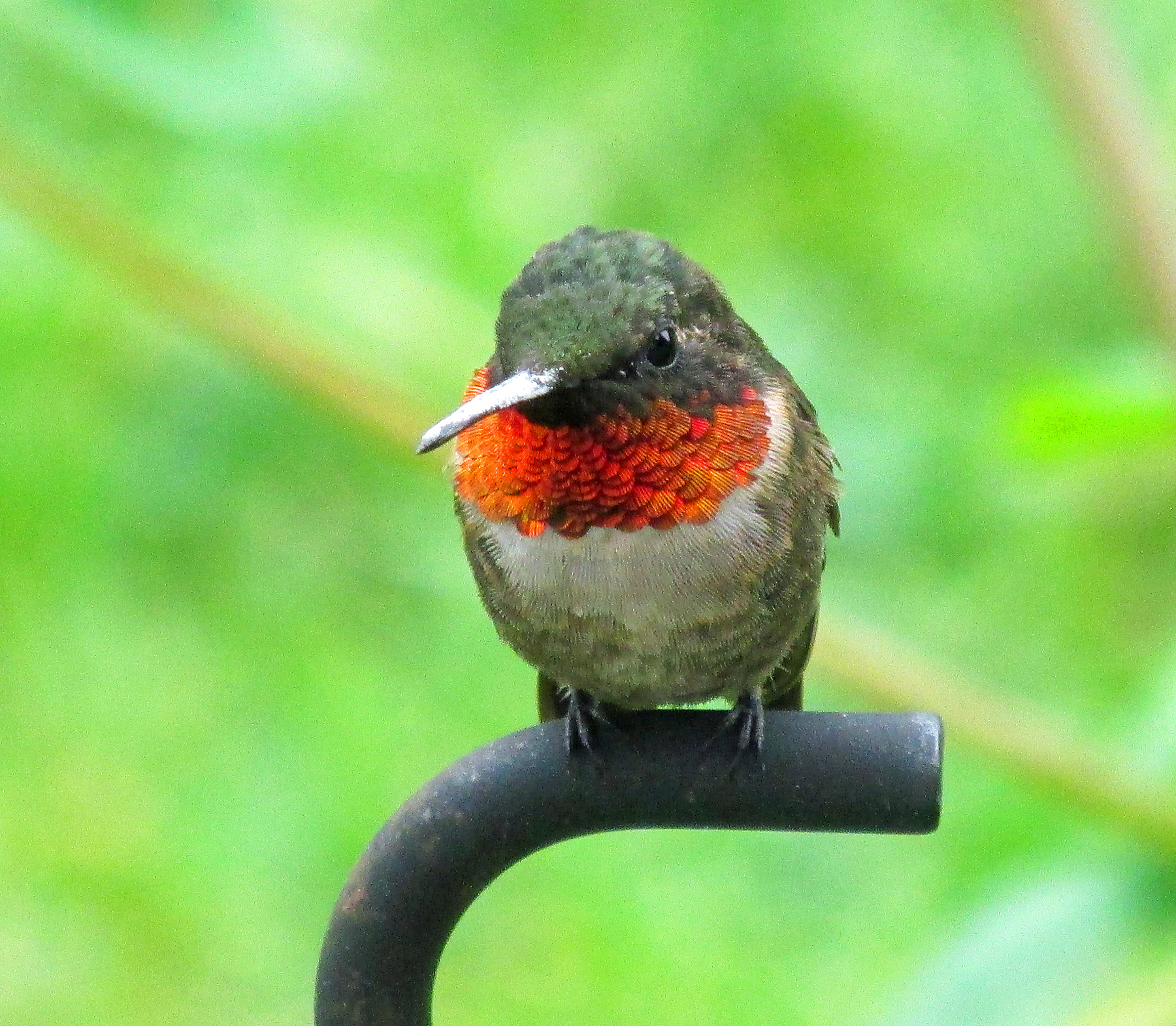
Other birds included a pair of Northern cardinals feeding three young, an Eastern towhee and one hooded warbler. At one point an irritable ruby-throated hummingbird chased the pewee round and round the trunk of the dead spruce. They almost looked like they were characters in a zany cartoon.
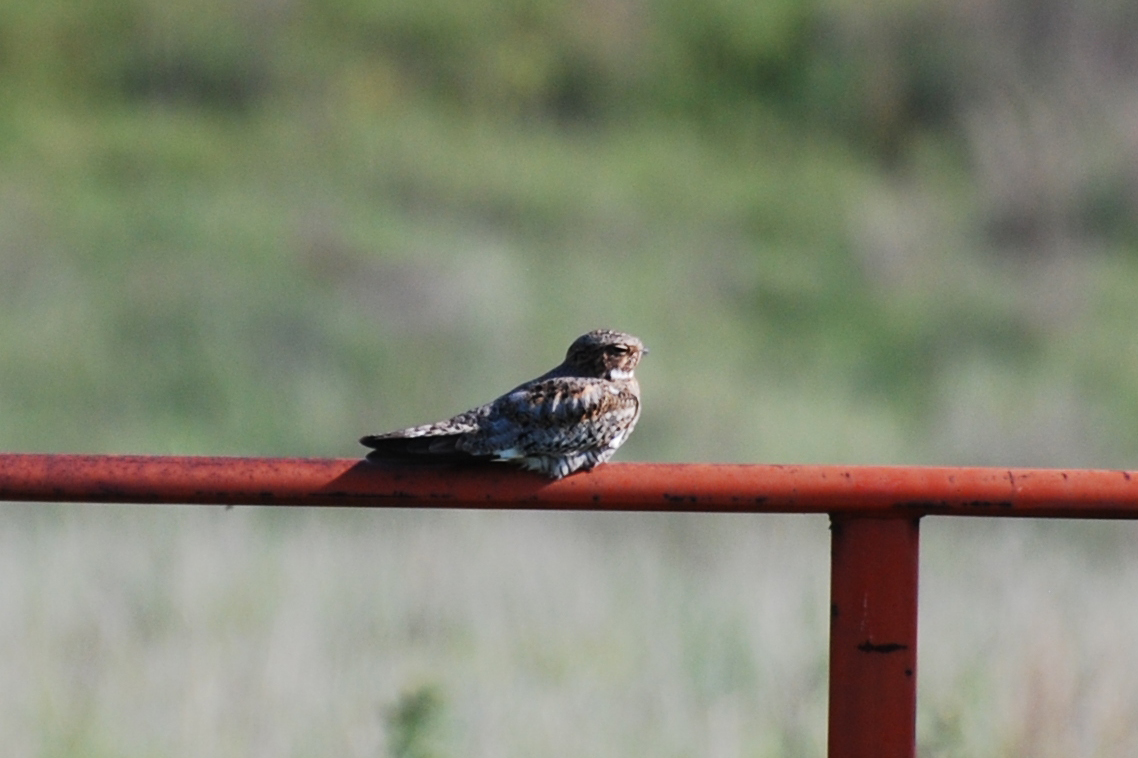
Photo by Jean Potter • A common nighthawk rests on a metal railing.

Like such birds as warblers, vireos, thrushes, tanagers, flycatchers and hummingbirds, the common nighthawk is a neotropical migrant. In addition, this nighthawk has one of the longest migration routes of any North American bird. Twice a year, these birds migrate for distances ranging from 1,600 to 4,200 miles. Nighthawks that spend the spring and summer in Canada travel to southern South America for the winter months.

With September advancing on the calendar, I have been keeping an eye on the treetops for passing warblers, vireos and tanagers, but I also remember to direct my gaze to the skies. Forgetting to look skyward could result in missing the passage of such varied migrants as chimney swifts, broad-winged hawks and common nighthawks.

So, what is a common nighthawk? First, this bird, despite what is implied by its name, is not a hawk. It’s also not strictly nocturnal. Particularly in the fall, nighthawks are active during daylight hours when engaged in catching winged insects. Outside of fall migration, these birds can often be observed over large parking lots or well-lit streets, snatching up insects swarming around the light poles.
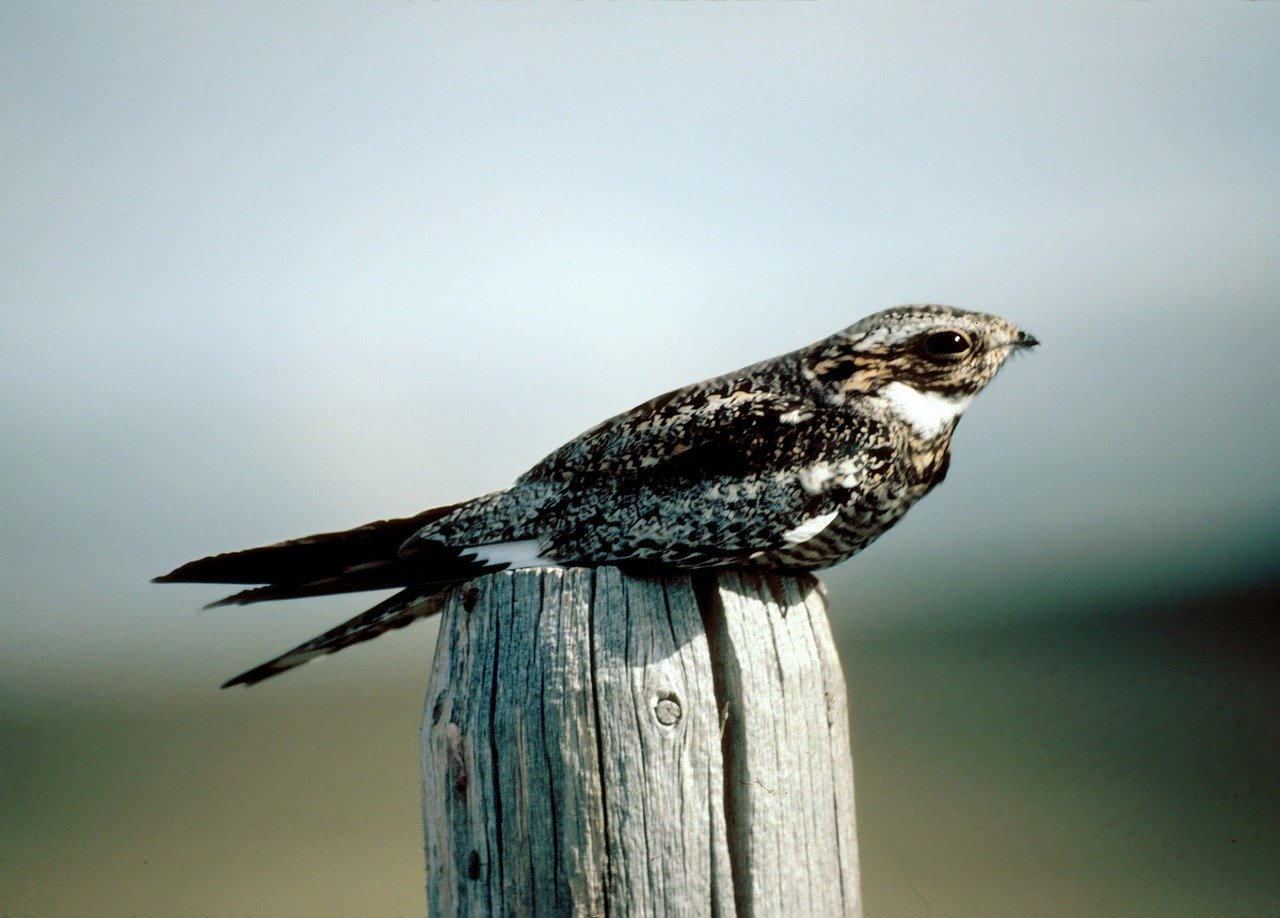
Photo by Skeeze/Pixabay • A common nighthawk adopts an elongated pose atop a fencepost.

The common nighthawk is one of three members of the nightjar family found in the region during the summer months. The other two nightjars are the whip-poor-will and chuck-will’s-widow, birds that produce their namesake vocalizations in the nocturnal hours. Both of these species migrate, but they don’t take the dramatic approach employed by nighthawks. Each fall, common nighthawks form large flocks, ranging in size from dozens to hundreds or even thousands of individuals, as they migrate south for the winter.

Unlike whips and chucks, the common nighthawk isn’t active only after dark, which makes it much easier to observe these birds. They look somewhat like swifts and swallows but are much larger. They are brownish-gray birds with pointed wings and forked tails. They are easily identified by distinctive white patches on the underside of their wings.

A perplexing nickname for the common nighthawk is “bull-bat.” This merger of the words “bull” and “bat” makes sense when you explore a little deeper. The common nighthawk earned the nickname “bull-bat” because of its perceived “bat-like” flight and a “bull-like” boom produced by its wings as it pulls out of a dive.

The nightjar, or Caprimulgidae, family of birds is also sometimes known as “goatsuckers.” Apparently, in trying to explain the nocturnal tendencies of these birds, the Greeks came up with the imaginative but erroneous idea that birds like nighthawks liked to sneak into barns and have a meal of fresh goat’s milk. In reality, nighthawks feed almost exclusively on insects, including ants, wasps, beetles, caddisflies, moths, mayflies, flies, crickets, grasshoppers, and other insects. They capture much of their insect prey on the wing.

There are almost 80 species of nightjars in the world. Less than 10 occur in North America. Many of the common nighthawk’s relatives have been given descriptive names, such as long-trained nightjar, collared nightjar, spot-tailed nightjar, red-necked nightjar, golden nightjar, fiery-necked nightjar, swamp nightjar, pennant-winged nightjar, lyre-tailed nightjar, little nightjar, sickle-winged nightjar, rufous-bellied nighthawk, short-tailed nighthawk, sand-coloured nighthawk and least nighthawk.

So, keep looking skyward. The next flock of migrating common nighthawks may fly over your home. These flocks are usually on the move in August and throughout September.

I will keep watching the skies. Nighthawks can also appear almost magically, as if out of thin air. First, observers may see one of two birds, then several, followed quickly by dozens or sometimes hundreds as they wheel and cavort in the skies overhead with impressive grace and agility. I’ve seen flocks that would easily number more than 500 birds in locations throughout the region, although flocks often number only a couple of dozen birds.

To share a sighting, ask a question or make a comment, email me at ahoodedwarbler@aol.com.

Photo by Bryan Stevens • Rising clouds provide a backdrop for a flock of migrating nighthawks.
Wood duck one of few ducks that’s an area resident in summer months

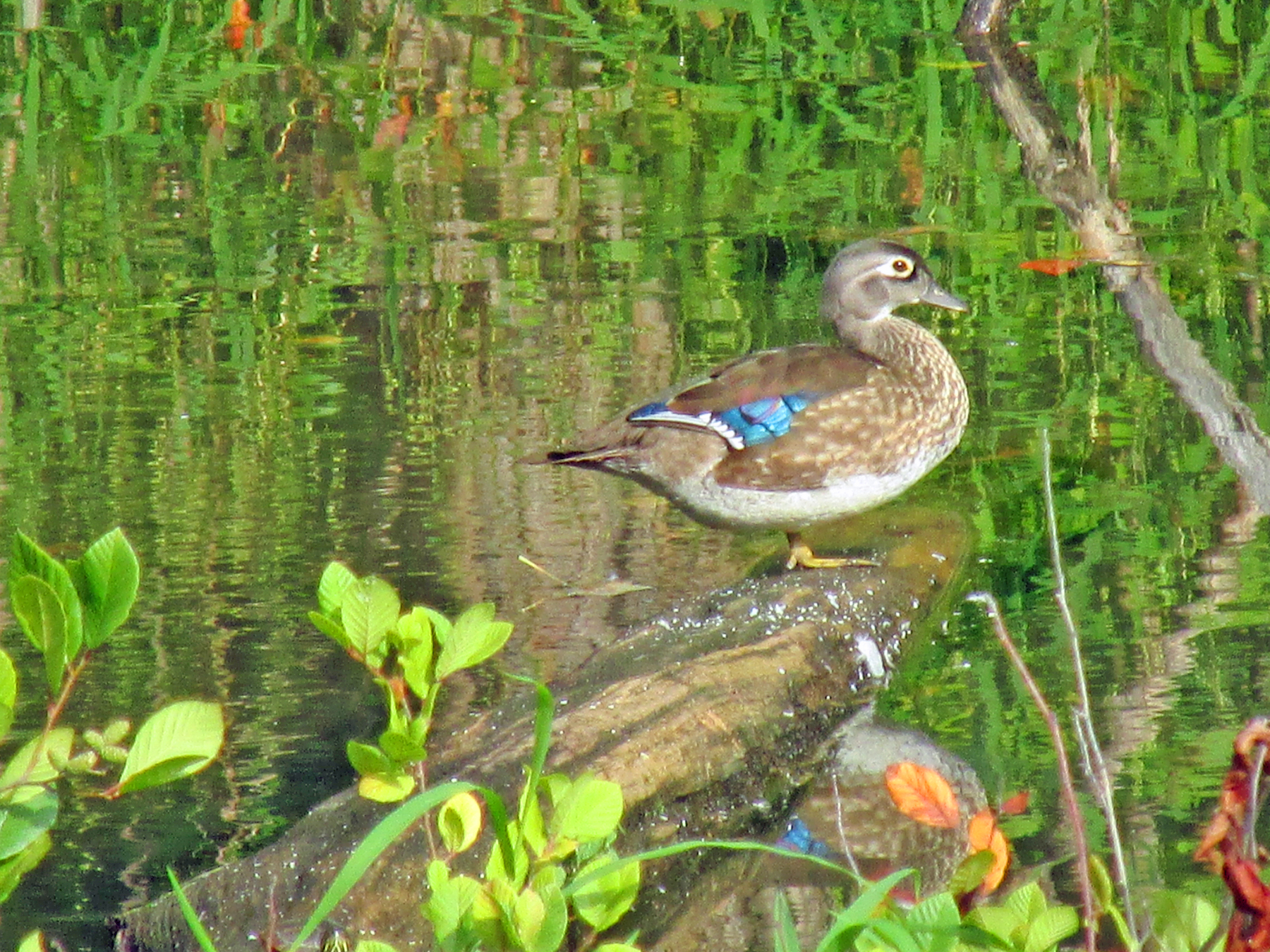
Photo by Bryan Stevens • A wood duck, also known as the summer duck or Carolina duck in some locations, perches on a submerged log.

I’ve enjoyed sporadic observations of a family of wood ducks living at the fish pond this summer. A wood duck hen chose to raise four ducklings at my pond, which is cloaked in abundant cattails and waterlilies. I think the dense vegetation offers concealment that makes the little family feel at ease.

Nevertheless, the ducks have remained elusive. I get glimpses of them, but the moment they become aware of me the ducklings form a single line and file one by one into the stands of cattails. The hen is always the last to seek the shelter of the cattails, no doubt ensuring the safety of her young before she thinks of herself.

Waterfowl are usually scarce in the region in summer aside from the ubiquitous Canada geese and mallards found at ponds, local park, golf courses and many other locations. Waterfowl aren’t entirely absent, however, especially when you add the variety of domesticated waterfowl that are often found with the aforementioned geese and ducks.

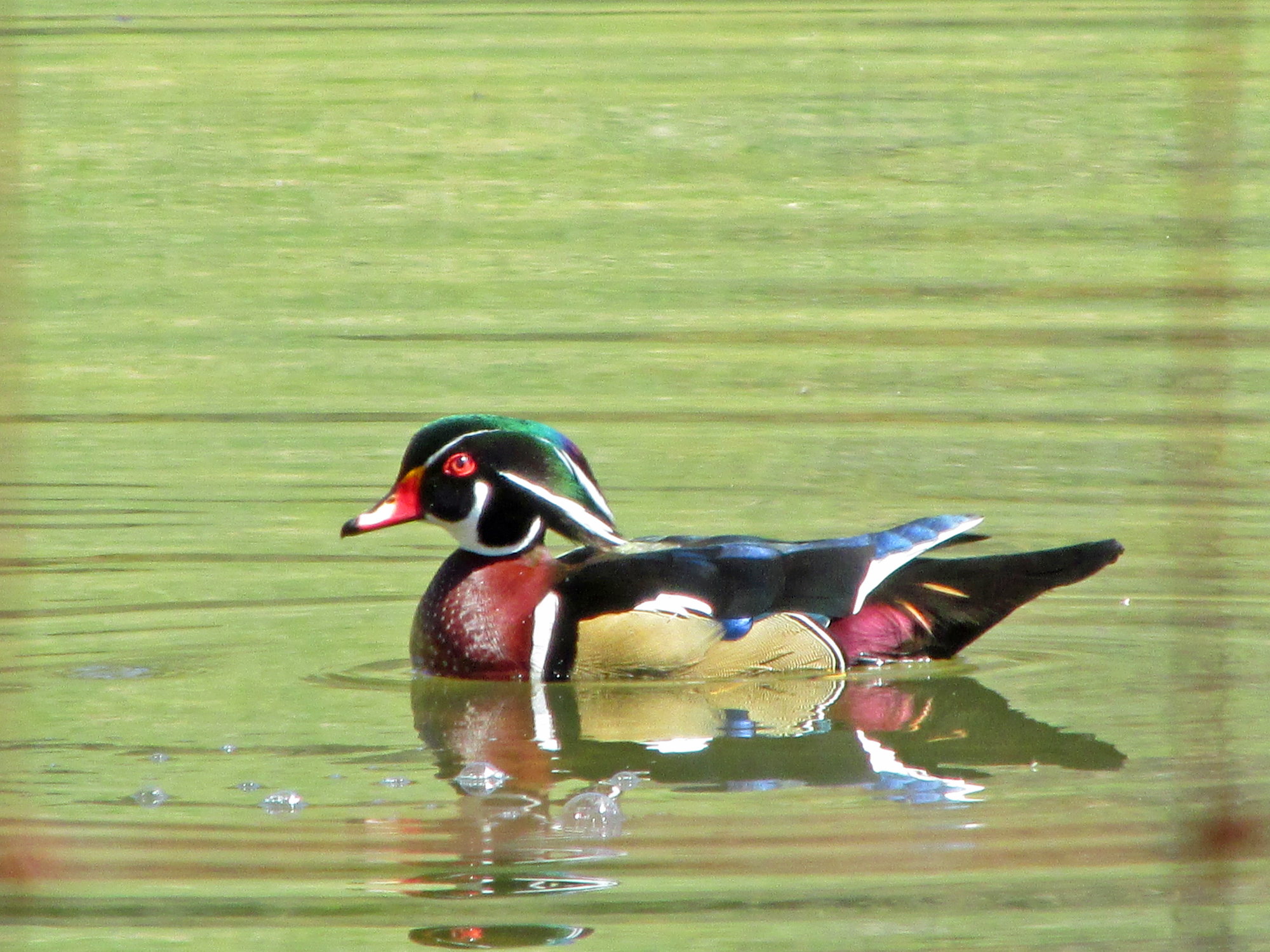
Photo by Bryan Stevens • Male wood ducks are one of the most stunning of North America’s waterfowl.

The small wood duck is an exception. This duck is a species of waterfowl that can be found, in suitable habitat, during the summer nesting season throughout the southeastern United States. Unlike Canada geese and mallards, which historically never nested in the region until recent decades, the wood duck is actually supposed to be present during the warmer months of the year. In many parts of their range, wood ducks are known as the “summer duck” since they are the only wild native nesting duck present during the season.

Another common name for this species is the Carolina duck, which refers to the southern stronghold of this species of waterfowl. Wood ducks are year-round residents across much of the southeastern United States, especially in suitable habitat such as small lakes, flooded woodlands, swamps and marshes.

Like a handful of other North American waterfowl, the wood duck is a cavity-nesting bird. These ducks often occupy former nesting cavities created by woodpeckers, but they will also readily accept nesting boxes of suitable dimensions provided by human landlords. Because of their devotion to nesting in cavities, wood ducks have at least something in common with songbirds like Eastern bluebirds, tree swallows and house wrens, as well as larger birds such as American kestrels and Eastern screech-owls. Wood ducks aren’t the only waterfowl that nest in cavities. Buffleheads, hooded mergansers and common goldeneyes are also cavity-nesting ducks. None of those ducks, however, nest in the southeastern United States.

Some wood duck nests can be located far above the ground, which poses a challenge for flightless young. Like most species of waterfowl, young wood ducks are born capable of immediately leaving the nest and being led by their mother to foraging areas. First, however, there’s that giant leap of faith that each of the ducklings must make. Nests are often built over water, so that first jump often ends in a splash-down. Some nests are built over land, but that doesn’t seem an obstacle. The ducklings make that leap without any difficulty. Just like the Abominable Snowmen in the old holiday favorite “Rudolph, The Red-nosed Reindeer,” wood duck babies bounce! Once the ducklings have departed their cozy nesting cavity, their mother will guard them from predators and lead them to prime foraging areas for a period of about two months.

Photo by Jack Bulmer/Pixabay • A wood duck hen keeps watch as one of her ducklings forages in the thick duckweed covering a pond’s surface.

The wood duck belongs to the genus Aix. The only other species in the genus — the Mandarin duck — is native to East Asia. The two are classified as “perching ducks” by biologists. The males of both these species are among the most ornate ducks in the world. The male wood duck has red eyes and a dark-tipped red bill. The colors in a male’s plumage includes glossy, iridescent greens, purples and browns in dramatic patterns. The male also has a distinctive head crest. Female wood ducks also have crests, but their plumage is overall gray and brown with a teardrop-shaped white patch around the eyes, as well as a white chin and throat.

The majority of a wood duck’s diet consists of vegetable matter. In autumn, I’ve observed these ducks foraging with enthusiasm for acorns. Summer, however, is a time for gorging on insects. The wood duck hen, and her ducklings in particular, have been happy to forage for insects and other small invertebrates among the floating lily pads.

In his book, “Birds of Lake, Pond and Marsh,” author John Eastman noted that the wood duck was the most abundant of North American ducks during the 19th century. In the late 19th century, pressures from hunting and habitat destruction combined to dramatically lower the numbers of this exclusively North American duck. Eastman noted that the Federal Migratory Bird Treaty Act of 1918 is largely credited with saving the wood duck from possible extinction.

From 1918 to 1941, it was illegal to hunt wood ducks. Thanks to this temporary hunting ban and other conservation measures, the wood duck population recovered in dramatic fashion. Recent surveys all point to a species on the rebound with numbers of wood ducks rising for the past several decades.

The creek and the fish pond at my home have proven dependable magnets over the years for attracting visiting wood ducks. I also have good luck finding wood ducks at the large pond at Erwin Fishery Park. Most wood ducks in the southeastern United States do not migrate. Those that live farther north during the summer will migrate to areas as far south as Mexico in the fall. We’re fortunate to reside in a region where wood ducks are year-round resident waterfowl.

I feel even more fortunate that a stealthy visit to the fish pond at my home has given me numerous opportunities over the past few months to glimpse the lives of these fascinating ducks of summer.

••••

To share an observation, make a comment or ask a question, email me at ahoodedwarbler@aol.com.

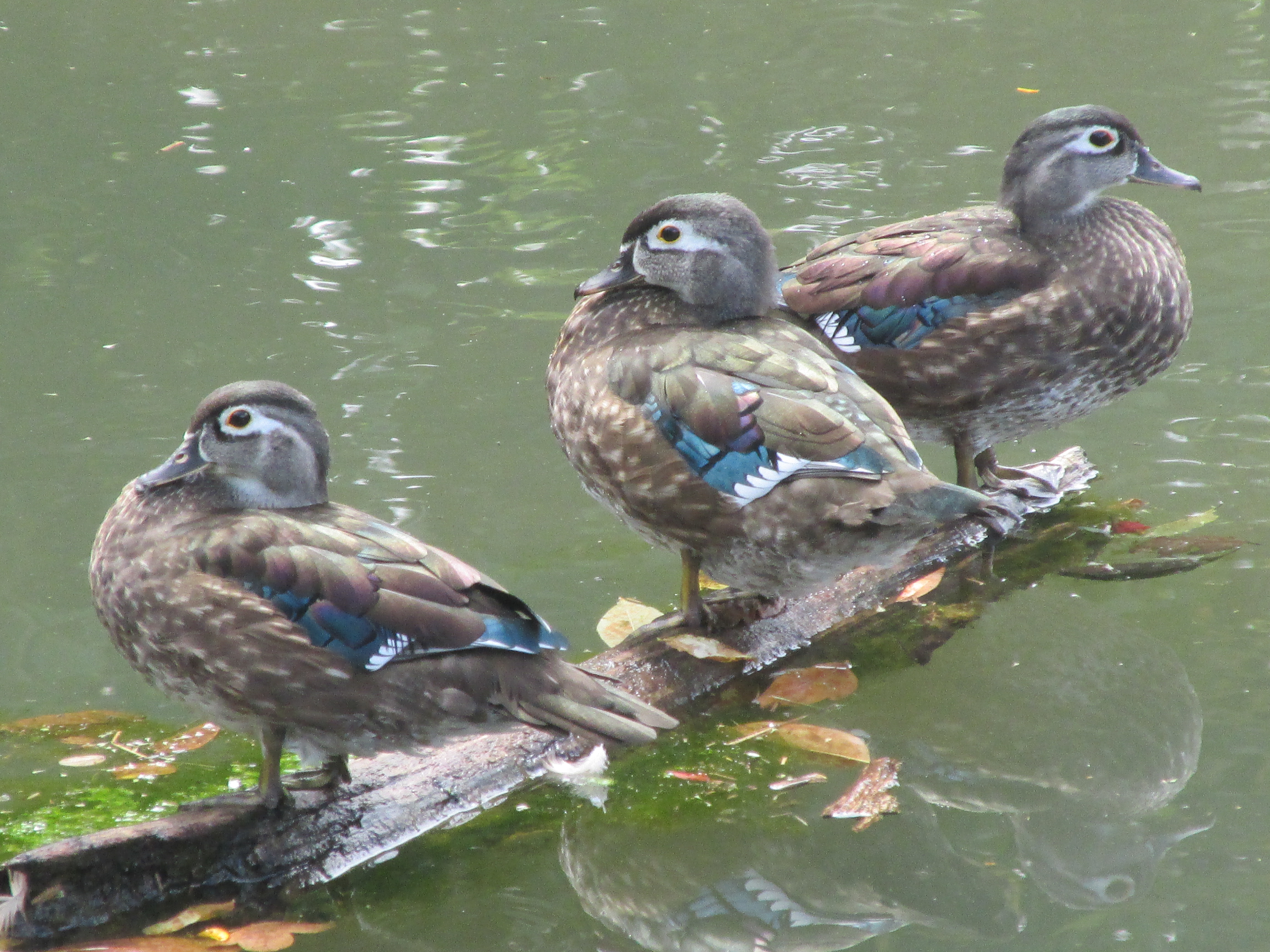
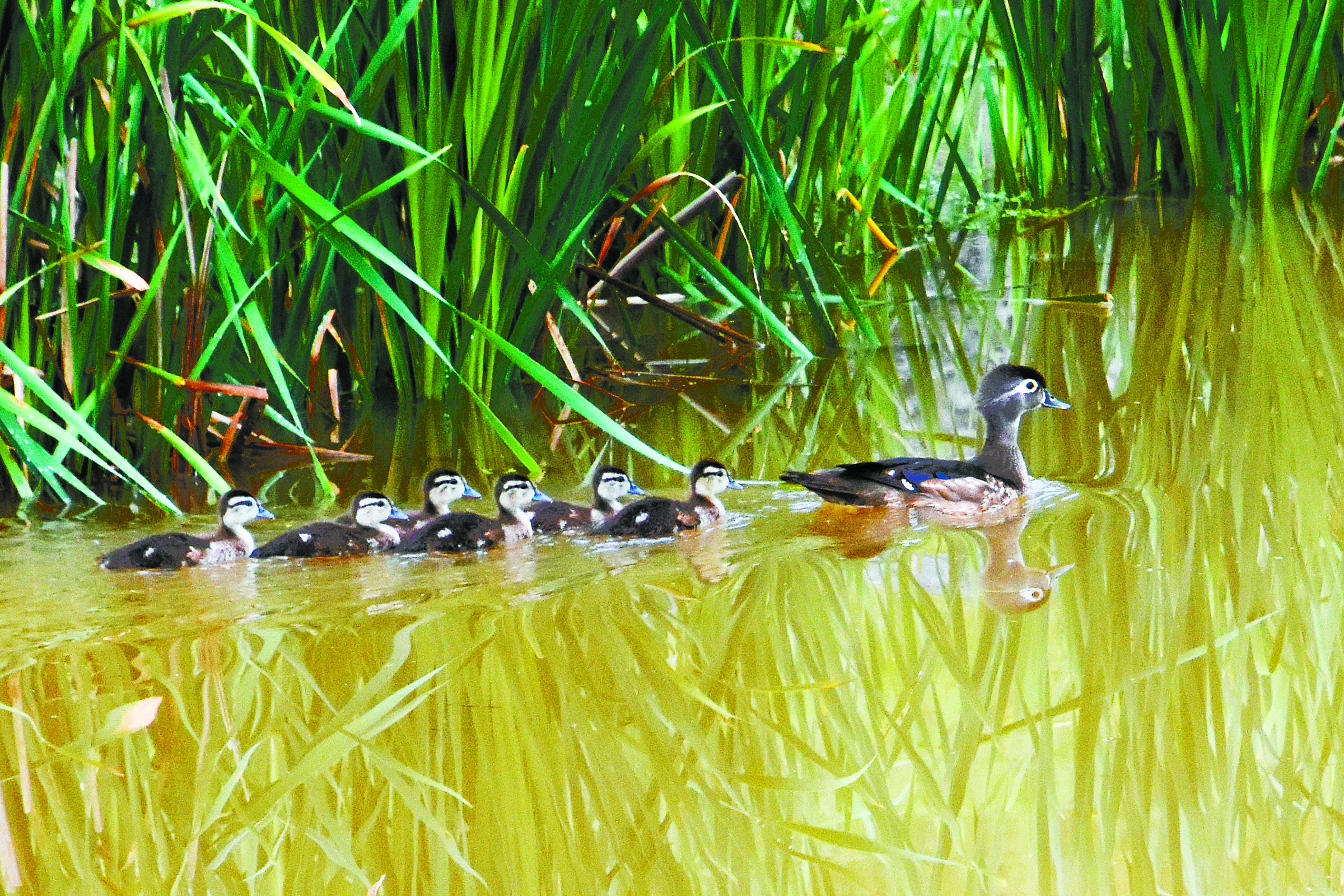
Photo by Bryan Stevens • A wood duck family shares a fallen log.

Sightings signal that migration has started

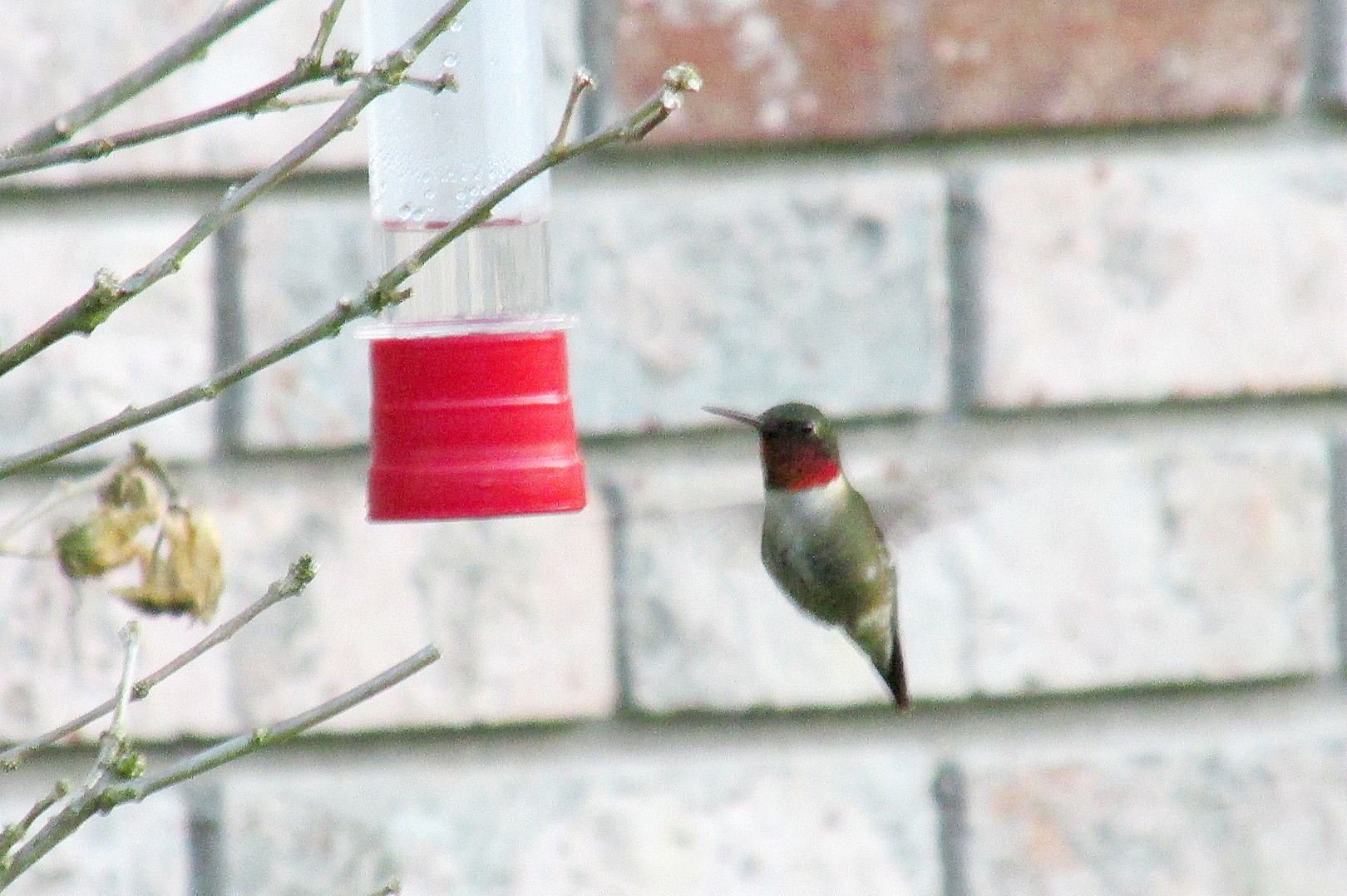
Photo by Bryan Stevens • Ruby-throated Hummingbirds make a non-stop crossing of the Gulf of Mexico. A hurricane in the Gulf during migration could have serious consequences for this small bird.

Mack Hayes, a resident of Telford, posted on my Facebook page recently about hummingbird experiences. 

“I have two hummingbird feeders out, and boy are they really working them,” Mack wrote. “I see several of them, and of course they fight each other. Males and females both. Guess they are getting ready for their long flight  ahead of them.”

Mack’s post reminded me that many of our favored summer visitors will soon make their return migrations to regions more hospitable for the duration of the winter season.

I replied to his post with my own comment.

“I am sure they are getting ready, but I still hope they don’t get in too great a hurry. I would like to keep them with us as long as possible.”

At home, I have enjoyed some fun bird observations. It was a veritable feeding frenzy in a corner of my yard for about an hour on Tuesday, Aug. 10. Everything kicked off with a Red-eyed Vireo enjoying some elderberries. I was reminded that, with a really good look, the Red-eyed Vireo should never be mistaken for a warbler. That bill is so much bigger than a warbler bill! I was watching the vireo in binoculars when he coughed and popped up an elderberry. He immediately swallowed it again! Waste not, want not, I suppose. 

I am counting this burst of bird activity as the official kickoff for my fall migration watching.

I watched the vireo a long time before I realized there was a Gray Catbird perched lower in the shrub and also enjoying the elderberries. Then, in rapid succession, three warblers: Black-throated Green Warbler, Northern Parula and Worm-eating Warbler. On the fringes of all this activity I noticed a Brown Thrasher, Downy Woodpecker, a couple of Mourning Doves, and the resident Carolina Chickadees, Tufted Titmice and Carolina Wrens. 

I also saw some parents hard-pressed to satisfy their young, including a Blue-gray Gnatcatcher being followed and pestered by a couple of young gnatcatchers, and a male Eastern Towhee leading a youngster around on the ground as they foraged beneath the forsythia tangle. 

Photo Courtesy of Jean Potter
A red-eyed vireo sits on its basket-shaped nest.

At the feeders I saw American Goldfinches, Northern Cardinals, and several Ruby-throated Hummingbirds, which don’t know the meaning of the word “share” as they dived and attacked any of their fellow hummers that came too close to “their” feeder. All in all, a fun Tuesday evening.

The start of migration appears to be more of a crawl than a sprint this fall, but I have picked up a few additional signs. For instance, I’ve been hearing the scolding sounds of red-eyed vireos from woodland edges for the past few weeks even before I observed the vireo feeding on the elderberries. A dedicated singer at most times, this vireo seems more likely to produce a harsh, scolding cry at this time of the year. Other hints of the steady advance of fall migration include flocks of chimney swifts congregating in the skies over my home and the unmistakable croaking of common ravens from nearby ridges.

So far, I’ve seen only a few warblers. At a glance, vireos would appear related to the wood warblers. Research into DNA, however, has led many experts to contend that vireos are more closely related to crows and shrikes. Like the flycatcher and hummingbird families, the vireo family is exclusive to the New World. With a mere 50 species, vireos and their kin are vastly outnumbered by flycatchers and hummingbirds. The majority of vireos resides in the tropics, but about a dozen species nest in the United States.

In East Tennessee Southwest Virginia and Western North Carolina, vireos resident during the summer months include red-eyed vireo, white-eyed vireo, blue-headed vireo, yellow-throated vireo and warbling vireo. Most people are likely unaware of vireos. Although not uncommon, these birds are more frequently heard than seen. They spend much of their time in the forest canopy or in dense brush. When singing, they can remain at a perch, unmoving, for long periods of time.

Photo by Bryan Stevens • Blue-headed vireos, such as this bird, are high-elevation summer residents in the region. In the fall, they are also common migrants.

The loud scolding calls of red-eyed vireos often heard this time of year are given apparently when the vireo is alarmed or irritated. This scolding vocalization is quite unlike the usual ones produced by this bird. First and foremost, the call is louder than one would think could be produced by a bird that is only about six inches long. During the summer season, the red-eyed vireo is also one of the most persistent of singing songbirds. Another common name for the red-eyed vireo is “preacher bird,” so called because of its tendency to unceasingly deliver its song.

The red-eyed vireo is still considered one of eastern North America’s most common summer breeding birds. At one time, the red-eyed vireo was probably the most common breeding bird in eastern woodlands. That, sadly, is no longer the case. Red-eyed vireos are olive-green above and clean white below. These birds show a distinctive head pattern consisting of a gray crown and white eyebrow stripe bordered above and below by black lines. Adults also have the red eyes that give this particular vireo its common name. The term “vireo,” originating in Latin, can be translated into English as “green bird.” It’s an apt description, as many of these small birds are primarily dull green in coloration. Consider the vireos the “Plain Janes” of songbirds.

Some of the more colorful common names for vireos include the dwarf vireo, golden vireo and yellow-winged vireo.  In Central and South America, the vireo family expands to include many birds with common names such as shrike-vireo, greenlet and peppershrike. Some of the varied species include lemon-chested greenlet, green shrike-vireo and the black-bellied peppershrike.

I still focus most of my birding efforts on warblers in the autumn, but vireos are always a pleasant diversion when the colorful warblers make themselves scarce.

Keep your eyes open for new visitors. Those hummingbirds that scorned you this spring may give your home a second glance as they pass through this fall. In addition, the skies are filled with migrating raptors, flycatchers, thrushes, nighthawks and many other birds. 

Share sightings, ask questions or make comments by emailing me at ahoodedwarbler@aol.com. 

Many of the world’s birds wear masks as part of their plumage

Photo by Pexels from Pixabay • Many human masks feature feathers, but many of our feathered friends sport masks.

Who was that masked bird? 

While asking pardon from “The Lone Ranger,” which originated the memorable “Who was that masked man?” question, I thought I’d take a look this week at some of our feather friends known for going about their lives fully masked. After all, masks are all the rage, apparently.

When we look back, perhaps not fondly but inevitably, on the years 2020 and 2021, I’m confident that the one icon of this blip in the arc of history will be the mask. Living in the time of COVID-19 has been a cross to bear for current generations, but remember that our great-grandparents withstood the Spanish flu and our more distant ancestors weathered the plague known as “the black death.” 

Many of them did so by using masks, some more effectively than others, to shield themselves from infection. Even back in the 1300s as the black death, i.e. the bubonic plague, rampaged through Europe, masks were recognized as a means of dealing with a contagion. 

Image by Enrique Meseguer from Pixabay • In their dark costumes with bird-beaked masks, these “doctors” must have presented a nightmarish appearance to their patients.

To complete the circle connecting masks and birds, I’ll remind readers that a strange costume arose in the 1300s among “doctors” attempting to combat the pandemic of their time. Plague doctors traveled across Europe, seeking public employment from desperate towns and cities, in an easily recognizable costume that consisted of dark robes and a weird mask with a prominent bird-like beak. The result was a look straight from some fevered nightmare. 

Looking at illustrations of these strange beaked masks and reading about some of the absurdly horrendous “cures” offered by these charlatans, I’m surprised that an anti-bird sentiment didn’t rise up and turn people against some of our fine feathered friends.  Ironically, the masks offered little or no protection from disease. Let’s just say that these were not the quality of some of the better surgical masks available today.

It may surprise people to learn that many birds are “masked.”  For mask-wearing birds, however, it’s not a choice but simply a quirk of their plumage that has given so many of our feather friends a distinctive mask, or in some cases even a complete hood, to complete their appearance. Birds ranging from popular backyard visitors like the cedar waxwing to more unusual avians such as the masked flowerpiercer and the masked fin foot wear masks.

The masked tityra is a medium-sized songbird. It has traditionally been placed in the cotinga or the tyrant flycatcher family, but many experts believe it is better placed in Tityridae. The masked  tityra has been spotted once north of the border, being found in the Bentsen/Rio Grande Valley State Park in February of 1990.

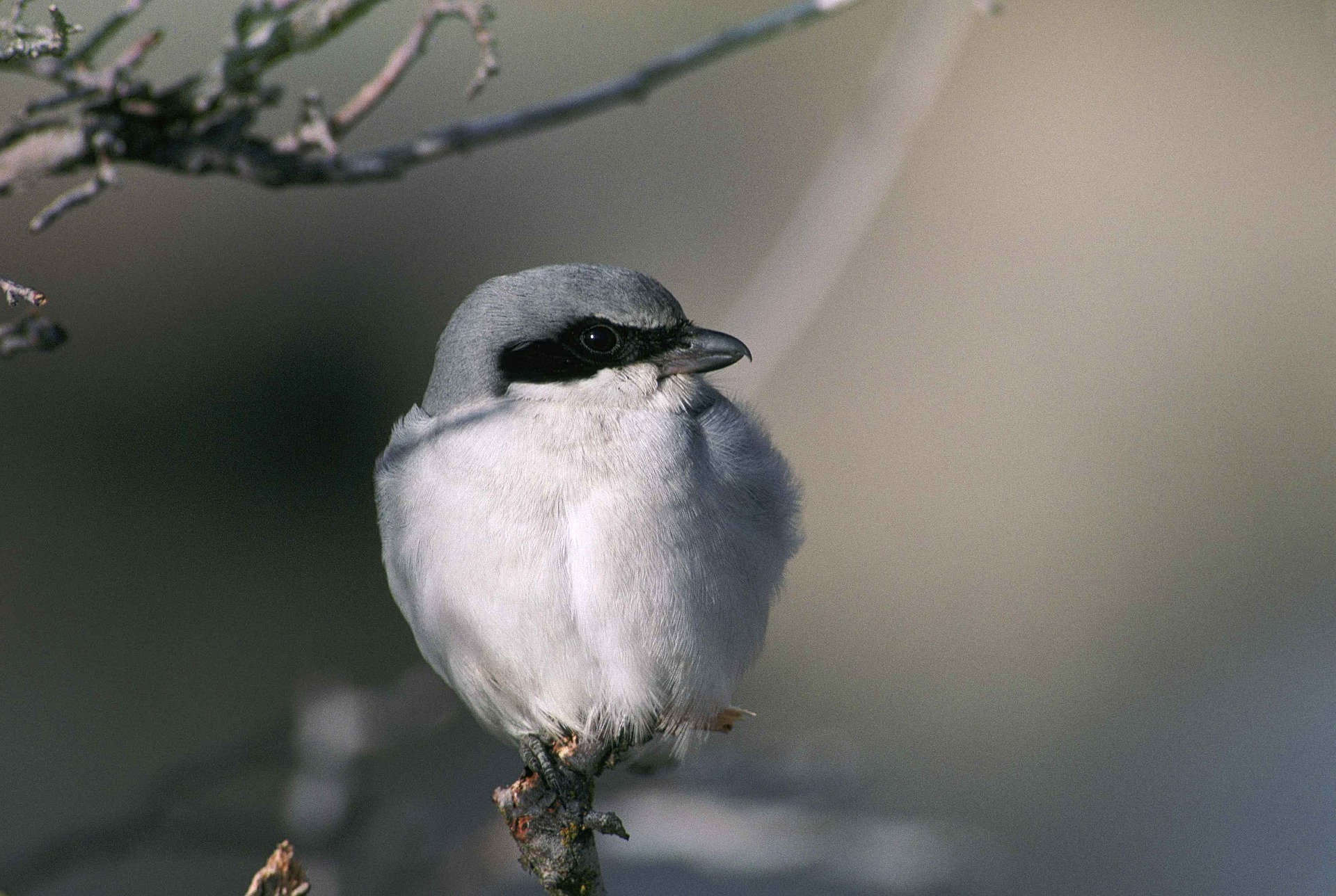
Photo by Pixabay • The loggerhead shrike sports a classic black mask. With this shrike, both males and females are identical in appearance.

Shrikes are a family with many mask-wearing members. The loggerhead shrike, in addition to wearing a bandit’s mask, even has the unsavory nickname of “butcher bird” due to its gruesome habit of impaling prey on thorns or barbed wire fences. The loggerhead shrike is native to the United States and is the only member of the family found in Northeast Tennessee. The Northern shrike, which is the only other shrike in North America, is also masked.

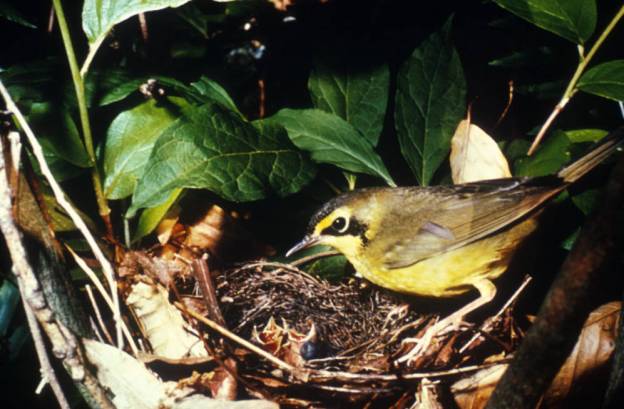
Some warblers sport masks, including the common yellowthroat and hooded warbler. Well, the latter wears an encompassing black hood, but you get the idea. The Kentucky warbler sports a partial black mask around the eyes. There’s also the masked yellowthroat — the name seems a bit too on point — that maintains separate resident breeding populations in Central and South America. Based on photos, the masked yellowthroat’s mask is even more pronounced than the mask of the common yellowthroat. 

There’s also the masked booby, which is a large seabird in the booby/gannet family, Sulidae. This bird spends most of its time at sea, coming to land to breed and nest. The name “booby” is actually derived from the Spanish word “bobo,” which can be translated to mean “fool” or “clown.” These seabirds are not truly stupid, but the Spanish, seeing them on land and out of their element, only noticed how awkward and clumsy the birds are on land. Some relatives of the masked booby include blue-footed booby, brown booby, red-footed booby, Nazca booby and Abbott’s booby of Christmas Island in the eastern Indian Ocean. 

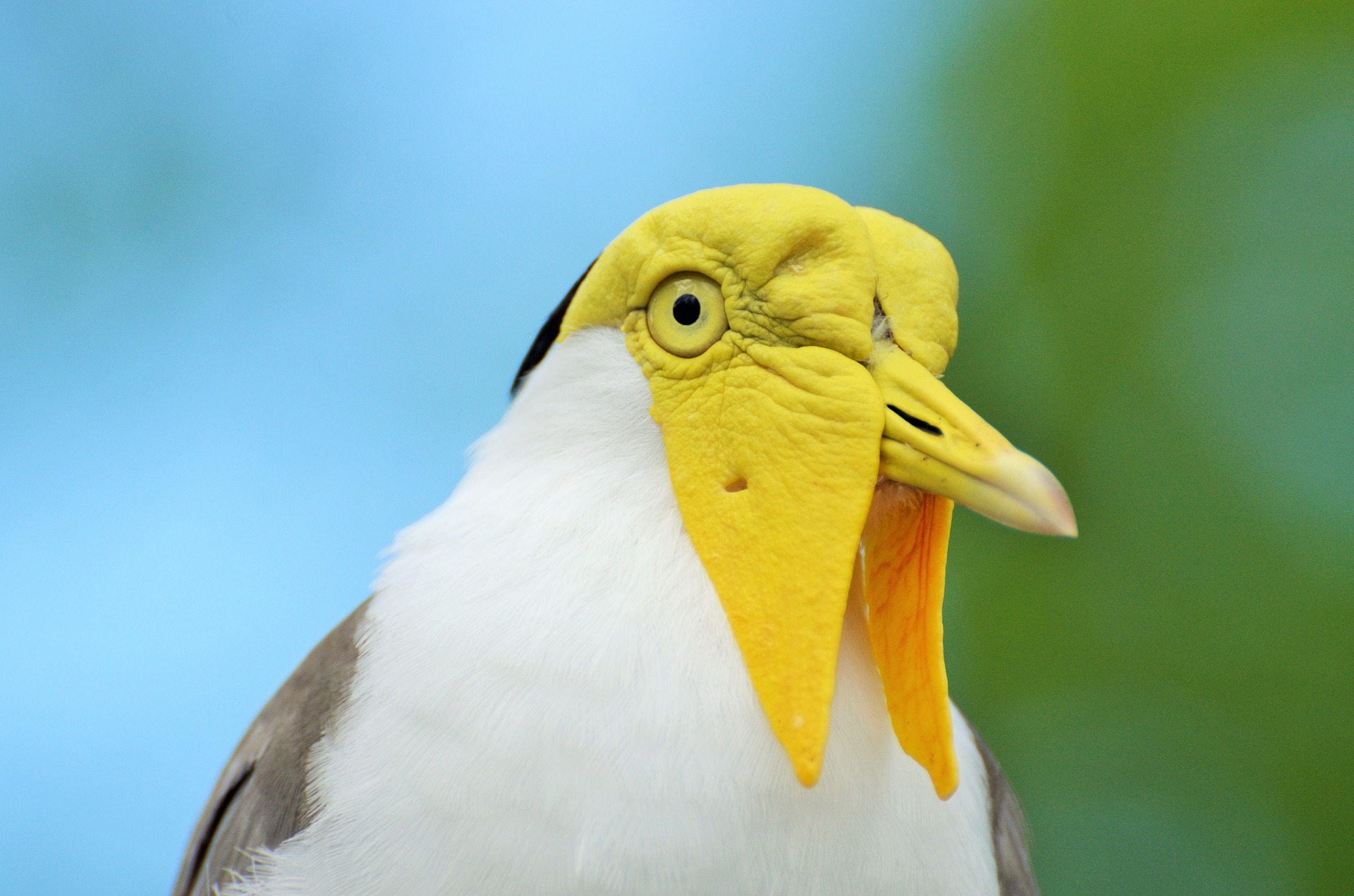
Photo by Nadine Doerlé from Pixabay • The shorebird known as the masked lapwing is an Australian species.

The masked lapwing is a large, common and conspicuous shorebird native to Australia, particularly the northern and eastern parts of the continent, as well as New Zealand and New Guinea. In the family Charadriidae, which consists of plovers, lapwings and dotterels, the masked lapwing is the biggest of the bunch. The masked lapwing reaches a length of 14 inches and can weigh 368 grams. 

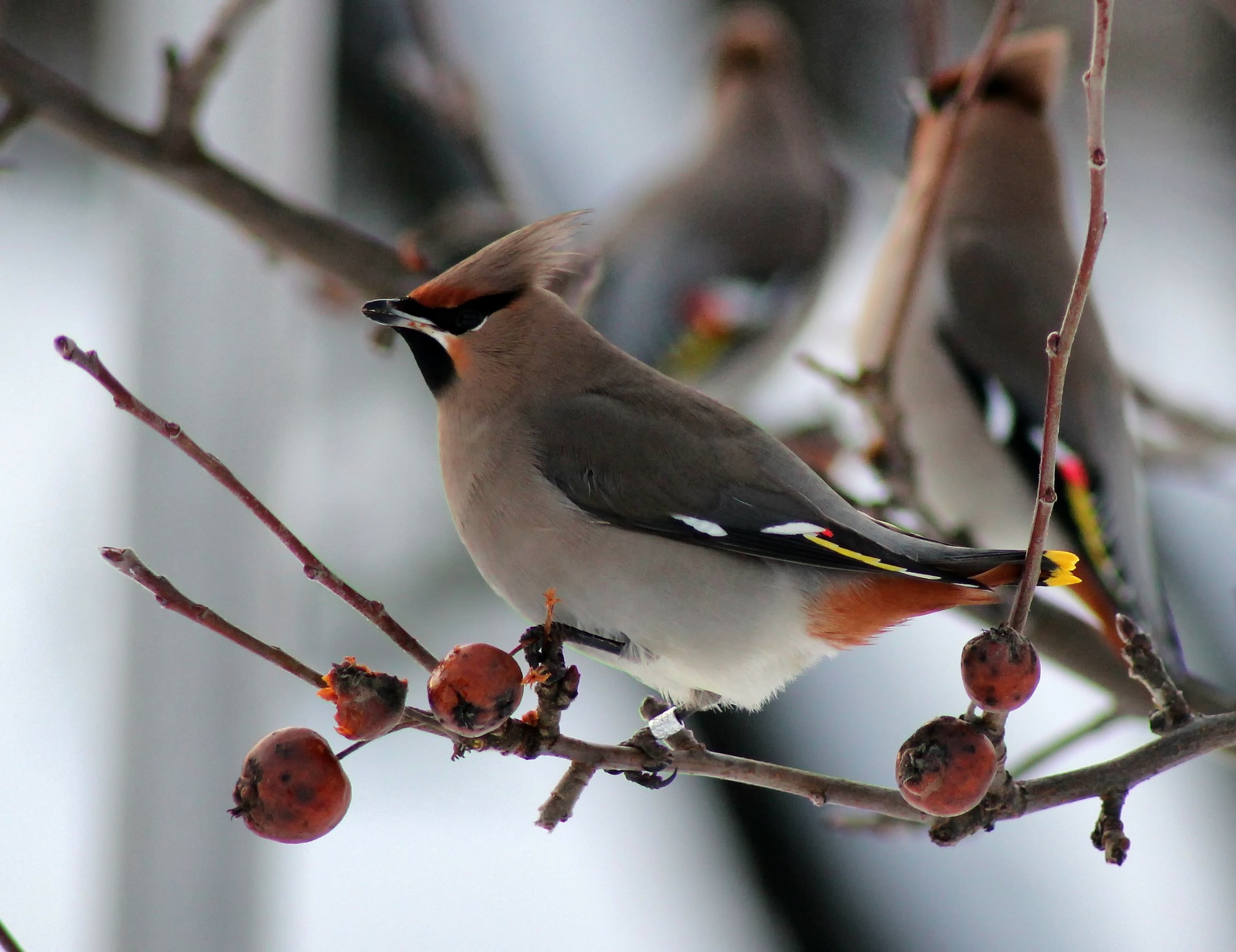
The cedar waxwing sports a jaunty crest. Unlike many birds with only males wearing the mask, both sexes wear sleek black masks. The world’s two other waxwings — bohemian waxwing and Japanese waxwing – are also masked. I’ve seen large flocks of cedar waxwings in recent weeks. Late summer is usually a good time to find these jaunty birds in the region.

Photo by David Mark from Pixabay • The Bohemian waxwing is a larger relative of the Cedar Waxwing. Both species sport a prominent black facial mask.

There’s no masked crow, but there is a hooded crow. Ranging across Europe and Asia, this crow has different common names in various countries.  In Ireland, it is called caróg liath or grey crow, while in Germany its often called the “mist crow.” It’s also called the Scotch crow and the Danish crow. The hooded crow is associated with fairies in the Scottish highlands and Ireland. There’s an 18th century tradition in Scotland in which shepherds would make offerings to them to keep fairies from attacking sheep. 

There’s a masked duck native to the American tropics. From time to time, these small ducks even stage invasions into southern states like Florida and Texas. A male masked duck in breeding plumage has a black face mask, bright blue bill and dark rusty-red body.

The masked trogon is another bird of the American tropics, ranging mostly in the Andes of South America. Males are variously glossy green, reddish-bronze or golden-green on their head, chest and back, with a red belly and a distinct red eye-ring. There’s usually a white band of feathers that separates the red belly from the greenish plumage of this bird. The trogons are closely related to the family of brilliant birds known as quetzals. 

The masked flowerpiercer is related to tanagers and can be found in Venezuela, Colombia, Ecuador, Peru and Bolivia. Flowerpiercers are so named because of a sharp hook on the tip of their upper mandible which they use to slice open the base of flowers to get at the nectar. It’s a simple but effective hack for a bird unable to hover like a hummingbird. 

Found in Vietnam and China, the masked laughing thrush is a sociable, noisy thrush reflected by its common Chinese name, which means “seven sisters.” These birds often produce their harsh chattering when deep under cover of tangled vegetation. 

The masked finch is a small songbird found in dry savannah across northern Australia. Like the aforementioned masked laughingthrush, this finch is a noisy bird. Hundreds or even thousands of individuals may gather at popular watering holes to drink, bathe and preen, all while chattering constantly. 

The masked fin foot is found in the brackish waters of the eastern Indian subcontinent, which includes Indochina, Malaysia and Indonesia. This odd bird has been described as a combination of a cormorant and hornbill. This unique bird is endangered. Although a 2009 survey indicated that 600 to 1,700 masked finfoots existed, a worrisome 2020 survey found only 100 to 300 individuals. Most of the surviving individuals are found in Bangladesh and Cambodia. 

Lesser masked weaver, an African species, is a colony-nesting bird. Only the males show a distinctive mask of black feathers over the face. The rest of the male’s plumage is a bright yellow-green.

The golden masked owl is a barn owl endemic to the island of New Britain in Papua New Guinea. This owl’s facial disc, which is white in most barn owls, is tinged with russet-gold that does indeed form the shape of a partial mask like those used for masquerades.

There are other “masked” birds, but I think this sampling provides ample evidence that the mask appears frequently in the various plumage patterns worn by the world’s almost 10,000 species of birds.

Take care and stay well. For questions about birds, or to make a comment or share an observation, email me at ahoodedwarbler@aol.com. 

Wandering birds provide some surprising moments for birders

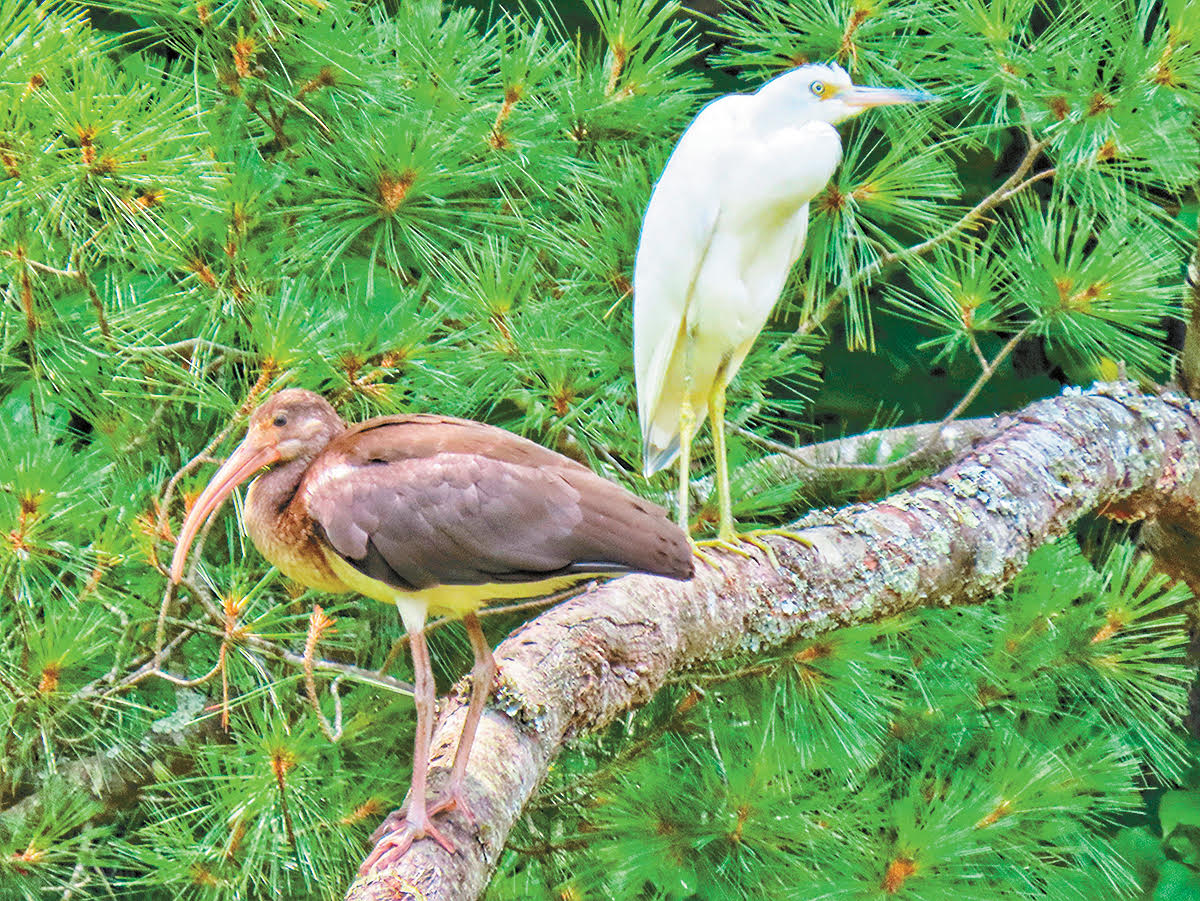
Photo by Roger Mullins • A little blue heron, right, shares a perch with a white ibis at the Buffalo Valley Golf Course in Unicoi. These wading birds are usually found near the coast, but individuals tend to disperse and wander widely after the summer nesting season comes to an end.

Late summer has a sort of lazy feel. Most birds are finishing up their nesting season. Hungry fledglings appear at feeders in the company of adults. In recent weeks, I’m starting to notice a slight uptick in the number of hummingbirds visiting my feeders and garden flowers. It helps that I’ve got dense stands of naturalized bee balm at the edge of my woods. The cedar waxwings have finished off the mulberries, but I suspect they will stick around for the wild cherries. I’ve also noticed the vanguard of migrant birds that are starting to make appearances as fall migration approaches. It’s not just songbirds, however, that are on the move. Some large and rather conspicuous birds have been attracting attention in recent weeks, including a variety of wading birds.

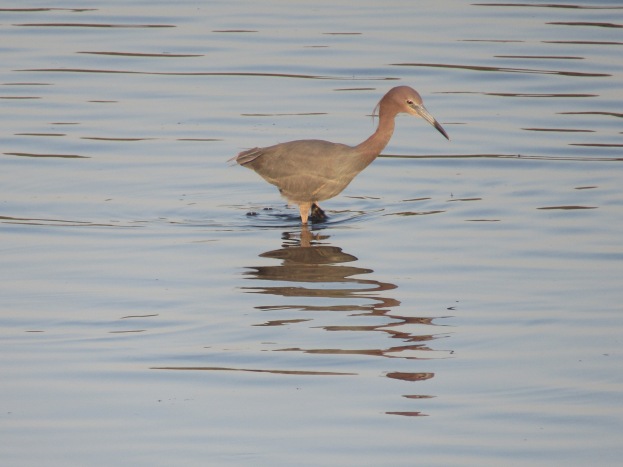
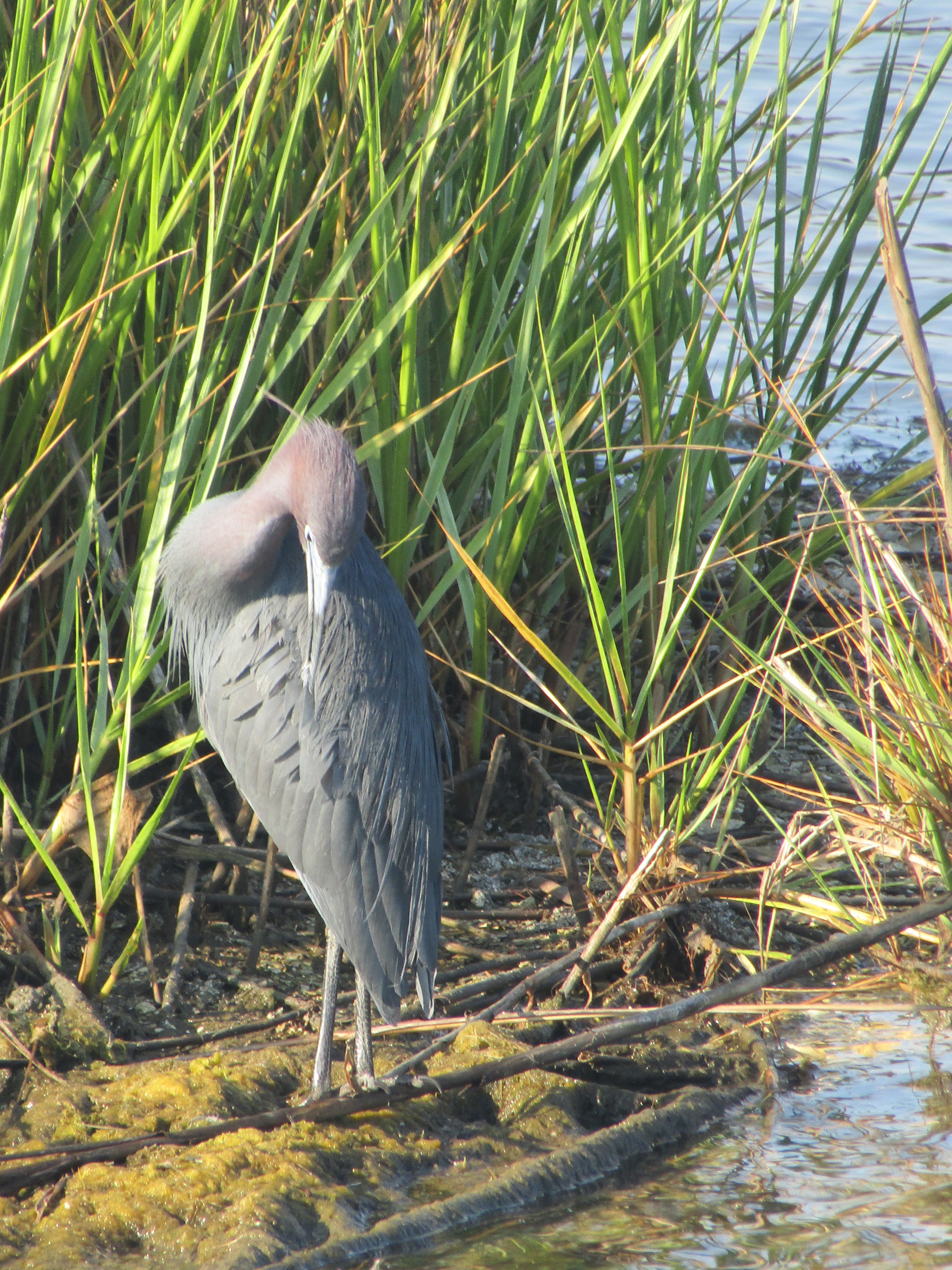
Sightings this summer of long-legged wading birds in Northeast Tennessee that are outside of their usual range have included little blue herons, white ibis and great egrets. The little blue heron and ibis have been recent visitors to Unicoi County. To toss another species into the mix, Tom and Cathy McNeil recently found an American anhinga near Austin Springs at Boone Lake in Washington County. Their anhinga sighting followed their discovery of seven or eight little blue herons and 14 great egrets at this well-known birding hot spot.

Photo by Bryan Stevens • Adult little blue herons, like this adult preening at Huntington Beach State Park, South Carolina, have a mix of blue and purple feathers.

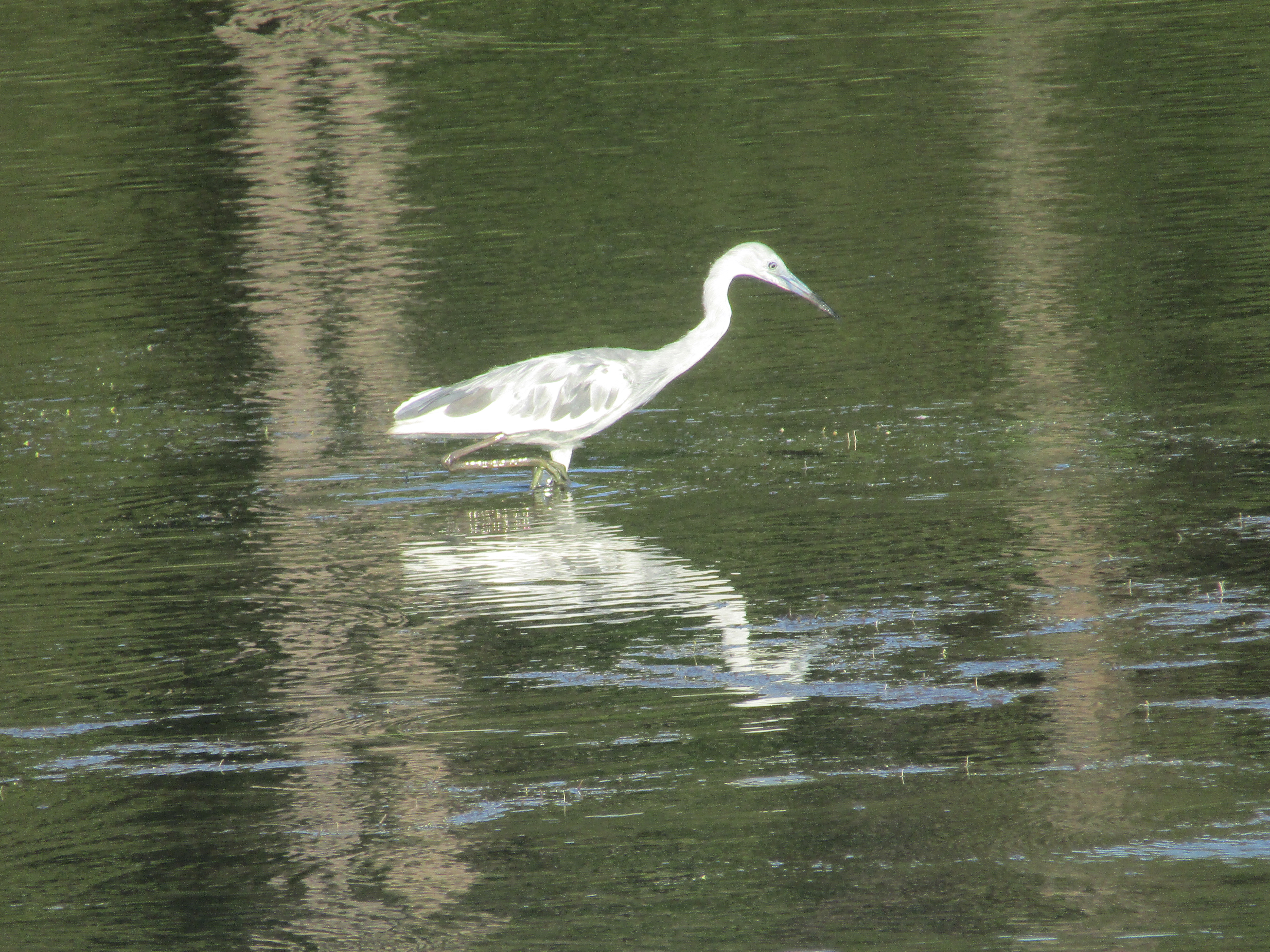
Roger Mullins discovered both an immature little blue heron and an immature white ibis during one of his regular visits to scan the ponds along the former Buffalo Valley Golf Course in Unicoi.

“I first spotted the little blue on July 5, and then on July 10 I saw the white ibis standing just a few feet away on the same limb.

“Within minutes they were standing next to each other,” he continued. “They were even following each other from place to place, almost like they were siblings.”

Roger noted that the little blue heron gradually learned to trust him, but he could only get so close without making the bird feel uncomfortable.

“Being extremely patient, taking it slow and easy, is pretty much how I approach all wildlife, and it usually pays off well,” Roger shared.

“I first started visiting the golf course ponds back in the winter when someone told me about seeing a male hooded merganser there,” he noted. “There is not always an abundance of wildlife present, but I always check it out just in case. The best thing about these ponds is the consistent peace and tranquility, since people don’t usually go there for family recreation or to walk their dogs.”

Roger added that he doubted that the little blue heron would have lingered at a public park with more activity.

Most of my own observations of little blue herons have taken place in SouthCarolina, Georgia and Florida, although I have seen this species a couple of times in Tennessee. I have also found little blue herons more skittish than some herons and egrets.

Photo by Bryan Stevens • This photo of a little blue heron at Huntington Beach State Park, South Carolina, shows the intermediate phase of plumage that makes identification even more of a challenge.

While diverting storms can’t be ruled out for causing some unexpected birds to detour into the region, it’s also normal behavior for young wading birds to disperse far and wide after leaving the nest. North American waders, or wading birds, include such long-legged species as herons, egrets, bitterns, ibises, storks and spoonbills. Most species are associated with wetlands or coastal areas.

Late summer birding is usually a period of doldrums as heat and humidity can discourage birders as well as diminish bird activity. However, it’s also the time of year when birders can make some unexpected surprises as wandering waders explore uncharted territory.

The great egret – a larger relative of the little blue heron – became a motivational symbol for conservation with the foundation of the National Audubon Society in 1905. Today, the organization has nearly 500 local chapters, each of which is an independent non-profit organization voluntarily affiliated with the National Audubon Society. These chapters often organize birdwatching field trips and conservation-related activities. The National Audubon Society spearheaded efforts to end the mass slaughter of various bird species. Some birds were killed for food, but millions were also killed for their showy feathers that were destined to decorate stylish attire worn as a symbol of high fashion. As early as 1910, some states began passing legislation to abolish trade in bird plumes. The federal government also came to the assistance of birds with the Migratory Bird Treaty Act, which was a law first enacted in 1916 to implement measures to protect and conserve migratory birds.

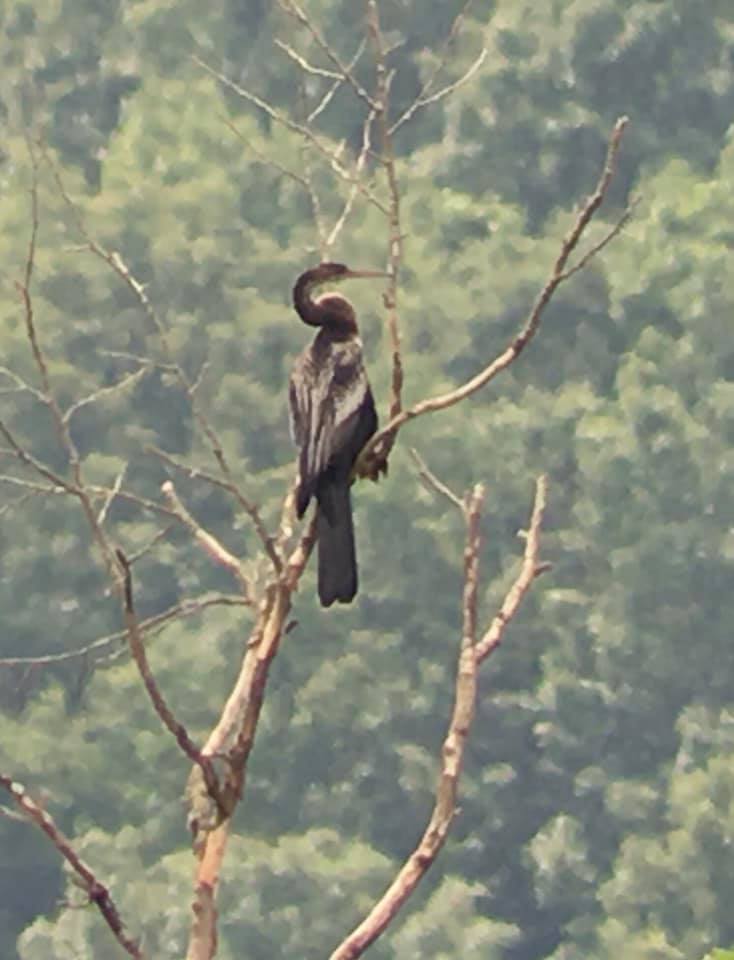
Photo by Tom McNeil • An American anhinga at Boone Lake found by Tom and Cathy McNeil represents an unusual find for the region. Even more unusual, Tom McNeil found another anhinga in Johnson County, Tennessee, a few days later.

Scientifically speaking, the little blue heron would be more accurately described as an egret. With the scientific name of Egretta caerulea, the little blue heron’s closest relatives are other members of the genus Egretta, which includes such other North American wading birds as snowy egret, reddish egret and tricolored heron. Other members of the genus found in other global localities include little egret, slaty egret and Chinese egret. I’m not sure why the tricolored heron and little blue heron were not named tricolored egret and little blue egret, but there are some Egretta species that also bear the name heron, including black heron, white-faced heron, Pacific reef heron and Western reef heron. It’s probably important to note that there are no real physical differences between herons and egrets. They are all classified together in the family Ardeidae.

I’m fairly confident that Roger’s sighting of a little blue heron is the first documented occurrence of the species in Unicoi County. His white ibis is unexpected but not unprecedented. An immature white ibis spent several days in July of 2011 at the ponds and fields at the home and farm of former Unicoi mayor Johnny Lynch.

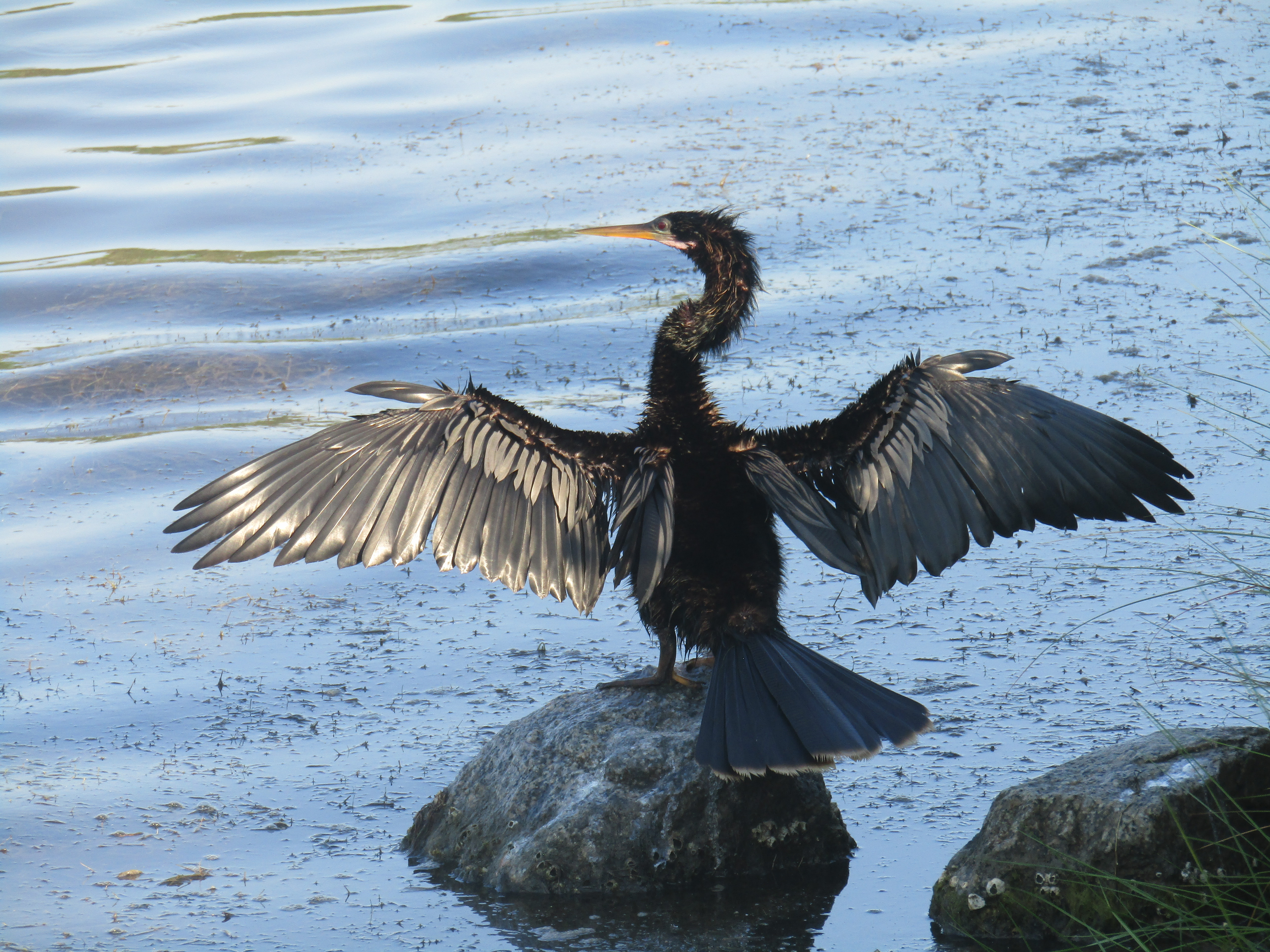
Photo by Bryan Stevens • An American Anhinga dries off feathers after a swim at Huntington Beach State Park in South Carolina.

As for the anhinga spotted by the McNeils, this rare visitor was found the following day by several area birders, including Michelle Sparks who relocated the anhinga from her kayak. The anhinga is a large waterbird with a slender neck and a dagger-shaped bill reminiscent of a heron’s bill. These birds spend much of their time swimming beneath the water, often with only their neck and bill above the surface. Apparently the term “anhinga” comes from a native tribe in Brazil. Anhingas prefer fresh water, but they are often found in coastal areas. Most reports from Tennessee come from near Reelfoot Lake in the western portion of the state. Other common names for the anhinga include “water turkey,” “snake bird,” “American darter” and “devil bird.” Worldwide, there are only four species of anhingas, or darters as they are called in other parts of the world. The other three are the Indian darter, the African darter and the Australian darter.

Tom shared an amusing anecdote on Facebook about their sighting of the anhinga.

“Cathy and I found this bird (the anhinga) yesterday evening out of absolute luck,” he wrote. “We had already birded the area and had some great fun observing the little blue herons and great egrets.  We stopped at the Austin Springs bridge for a few moments and saw four river otters playing under the bridge and then just decided to drive back the way we came.”

On their way back, Cathy had Tom stop so she could look at the “white birds” in the top of the trees across the water.

“We both pulled up our binoculars to look at them, but it was the bird perched below them that was the star of the show,” he reported. “We shouted ‘anhinga’  at the exact same time!”

That’s the beauty of birding – those “anhinga” moments. I’m hoping readers are enjoying some fun birds this summer. Share sightings, ask questions or make comments by emailing me at ahoodedwarbler@aol.com.


Long-running count tallies summer’s nesting bird species

Photo by Jean Potter • Counters found 116 species on the recent Carter County Summer Bird Count, including this female wood duck and ducklings photographed on the Watauga River in Elizabethton, Tennessee. A total of 13 wood ducks were found on the day of the count.

The 28th Carter County Summer Bird Count was held Saturday, June 12, with 28 observers taking part.

The weather, which was less than optimal, challenged observers. Rain held steady for much of the day. The rain, along with dense fog on Roan Mountain and other high elevations, resulted in reduced birdsong in many areas. Thus, numbers of individuals were low for many species, especially songbirds.

Despite these hurdles, the count tallied 116 species, which is just one species shy of the recent 10-year average and actually two above the average of the previous 27 years, so, it was not bad considering the weather.

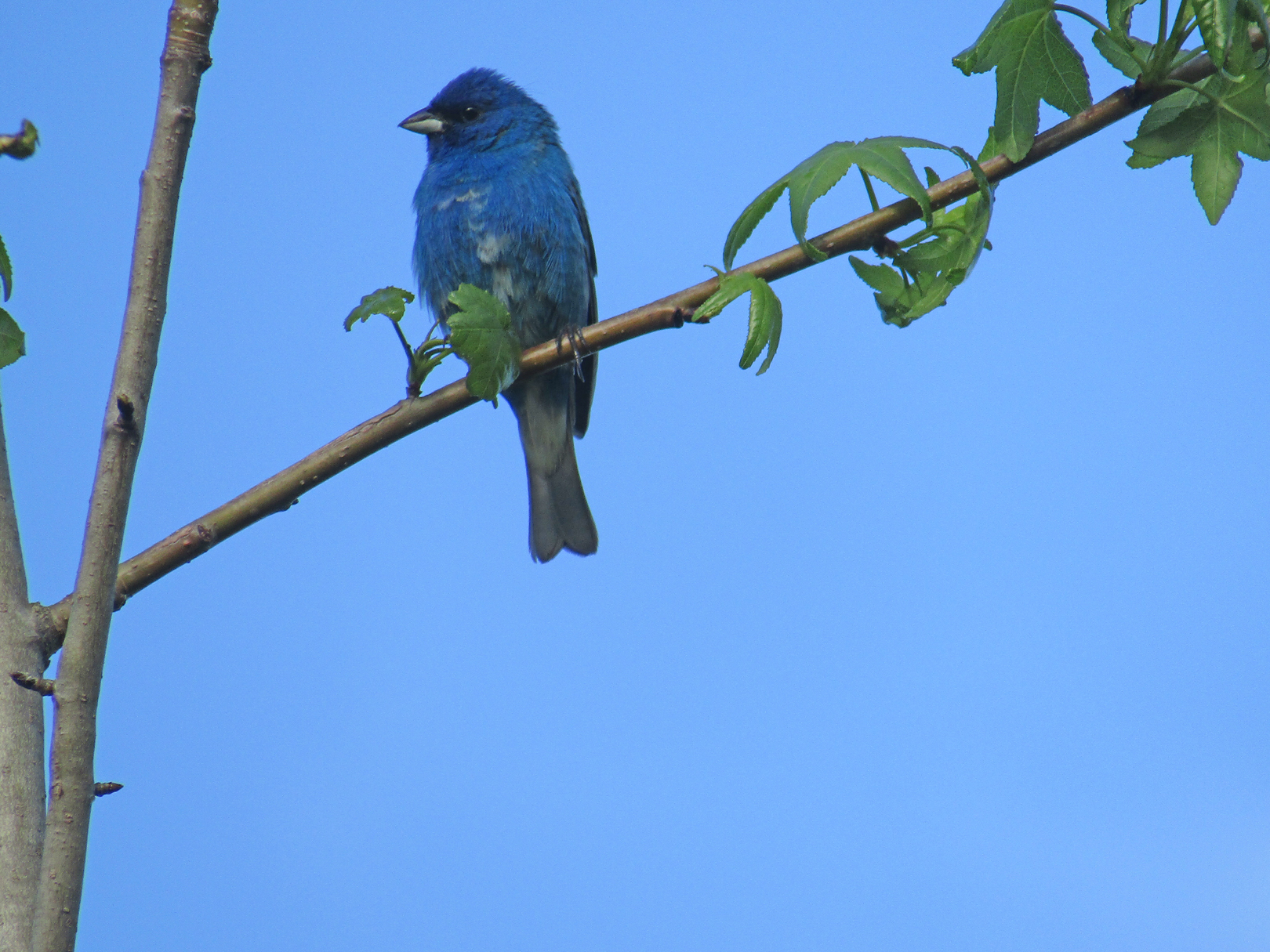
Photo by Bryan Stevens • Nesting neotropical migrants, such as this Indigo Bunting, increased the total number of species for the annual summer count.

Participants included Fred Alsop, Rob Biller, Catherine Cummins, Dianne Draper, Dave Gardner, Tammy Griffey, Don Holt, David Kirschke, Rick Knight (compiler), Roy Knispel, Richard Lewis, Dianna Lynn, Vern Maddux, Larry McDaniel, Joe McGuiness, Tom and Cathy McNeil, Brookie and Jean Potter, Judith Reid, Brenda Richards, Judi Sawyer, Michele Sparks, Bryan Stevens, Kim Stroud, Scott Turner, Charles Warden and John Whinery.

Some species were missed, including yellow-crowned night-heron, great horned owl, chuck-will’s-widow, willow flycatcher, brown creeper, hermit thrush, Kentucky warbler and magnolia warbler. These species are often, but not always, found on this count, according to long-time count compiler Rick Knight.

See if one of your favorite birds was hit or miss, common or uncommon, by scanning over the listing of the total.

The tally follows:
Canada goose, 218; wood duck, 13; mallard, 92; ruffed grouse, 1; wild turkey, 40; double-crested cormorant, 16; great blue heron, 23; and green heron, 2.
Black vulture, 7; turkey vulture, 25; osprey, 1; Cooper’s hawk, 3; bald eagle, 2; red-shouldered hawk, 4; broad-winged hawk, 7; and red-tailed hawk, 10.
Killdeer, 8; American woodcock, 1; rock pigeon, 101; Eurasian collared-dove, 2; mourning dove, 177; yellow-billed cuckoo, 5; Eastern screech-owl, 5; barred owl, 2; common nighthawk, 2; and Eastern whip-poor-will, 7.
Chimney swift, 99; ruby-throated hummingbird, 28; belted kingfisher, 11; red-bellied woodpecker, 24; yellow-bellied sapsucker, 2; downy woodpecker, 19; hairy woodpecker, 3; Northern flicker, 36; pileated woodpecker, 15; and American kestrel, 1.
Eastern wood-pewee, 24; Acadian flycatcher, 9; alder flycatcher, 2; least flycatcher, 13; Eastern phoebe, 48; great crested flycatcher, 7; and Eastern kingbird, 21.
White-eyed vireo, 5; yellow-throated vireo, 2; blue-headed vireo, 38; warbling vireo, 1; red-eyed vireo, 117; blue jay, 77; American crow, 185; fish crow, 4; and common raven, 5.
Purple martin, 38; Northern rough-winged swallow, 34; tree swallow, 109; barn swallow, 154; and cliff swallow, 137.
Carolina chickadee, 32; tufted titmouse, 65; red-breasted nuthatch, 3; white-breasted nuthatch, 10; house wren, 60; winter wren, 3; Carolina wren, 84; blue-gray gnatcatcher, 8; and golden-crowned kinglet, 2.
Eastern bluebird, 113; veery, 23; wood thrush, 35; American robin, 510; gray catbird, 42; brown thrasher, 38; Northern mockingbird, 62; European starling, 1,203; and cedar waxwing, 45.
Ovenbird, 50; worm-eating warbler, 4; Louisiana waterthrush, 10; golden-winged warbler 1; black-and-white warbler 27; Swainson’s warbler, 2; common yellowthroat, 12; hooded warbler, 67; American redstart, 8; Northern parula, 30; Blackburnian warbler, 4; yellow warbler, 1; chestnut-sided warbler, 12; black-throated blue warbler, 20; pine warbler, 2; yellow-throated warbler, 9; prairie warbler, 3; black-throated green warbler, 14; Canada warbler; 5; and yellow-breasted chat, 9.
Eastern towhee; 112; chipping sparrow, 61; field sparrow, 58; savannah sparrow, 1; song sparrow, 253; dark-eyed junco, 46; scarlet tanager, 25; Northern cardinal, 157; rose-breasted grosbeak, 5; blue grosbeak, 5; and indigo bunting, 102.
Red-winged blackbird, 109; Eastern meadowlark, 15; common grackle, 67; brown-headed cowbird, 43; orchard oriole, 4; and Baltimore oriole, 2.
House finch, 132; pine siskin, 1; American goldfinch, 97; and house sparrow, 44.

•••••


I received a phone call from Marian Swanson of Aldie, Virginia, this past week. Marian was looking for advice on feeders for attracting indigo buntings, which she had observed near her home. She was specifically seeking a feeder that would prevent the seed from getting wet during rainstorms.

At her request, I provided Marian with some links to websites offering a variety of feeders for sale.

It’s always great to hear from readers. If you have a bird-related question, email me at bstevens@erwinrecord.net or ahoodedwarbler@aol.com. I also enjoy hearing about bird observations or general comments from readers.

Couple glimpses odd bird at Unaka Mountain’s Beauty Spo


This American woodcock was photographed by Erwin resident Amy Tipton during a stop that she and her husband made recently at the Unaka Mountain Beauty Spot.

Known for migrating incredible distances, the shorebirds are often referred to as “wind birds,” a romantic allusion to their habit of taking wing for the epic journeys that astound scientists and birders alike.

Among the far-flung family known as the shorebirds are species known as sandpipers and plovers, as well as whimbrels, willets, tattlers, godwits, turnstones and an array of others.

Still, among the general public, as well as some birders, the shorebirds are a much misunderstood group of birds. For example, most people could hardly be blamed for believing that shorebirds are inhabitants of only the beach and shore.

In fact, some species are at home in a variety of habitats, ranging from woodlands and prairies to the Arctic tundra and mudflats. Some are notoriously elusive, their camouflage and low-key behavior allowing them to escape casual notice at most times.

In late winter and early spring, a true oddball among the shorebirds begins courting. The American woodcock, also known by such whimsical names as “bog sucker” and “timberdoodle,” is a shorebird that has completely abandoned the shore in favor of woodlands and fields. Beginning as early as February, American woodcocks in the region conduct nightly courtship displays, starting at dusk, that combine aerial acrobatics with an assortment of unusual acoustical flourishes. Any wet field adjacent to a wooded area could offer a stage for these evening displays, but unless you know where to look and make an effort to do so, the American woodcock might as well remain a phantom of the night.

These mating rituals provide almost the only time of the year during which this bird makes itself available for observation. It’s only during this brief window that opens into their lives that we can be assured a glimpse. Even then, our peeks at woodcocks often consist of a fuzzy twilight escapade as the bird flings itself heavenward only to make a spiraling descent a few seconds later. The displays begin with a distinct vocalization, a type of “pent,” that also has the quality of sounding like some sort of mechanical buzzer.

Once the displays conclude for the season, the birds assume nesting duties, usually unobserved by humans. The rest of the year, almost nothing but blind, sheer luck would allow a birder to stumble across an American woodcock. It’s almost as if they disappear after these spring flights of fancy.

Of course, they don’t actually disappear. They are still out there, going about their daily lives. On occasion, someone can stumble across one without even trying.

Amy Tipton can claim to be so fortunate after she and her husband, Paul, recently encountered an “unusual bird” on Unaka Mountain near the well-known Beauty Spot.

“We had gone to the Beauty Spot to watch the sunset on Sunday, June 27,” Amy wrote in a Facebook message to me. “It was the 20th anniversary of our first date.”

On the way back to the Jeep, Paul noticed a very unusual bird. He pointed out the bird and asked Amy if she knew what it was.

“It was just sitting at the edge of the parking area where the gravel/dirt road meets the tall grass,” Amy wrote. “It was not dark enough to keep us from seeing it, but plenty dark enough to keep me from getting a good photo.”

Amy said that she knew she only had one chance to get a photo.

“I set the flash and hoped for the best,” she wrote. “It’s blurry, but I’m thankful I was able to get anything. As soon as the flash fired, it made a funny noise and flew into the trees.”

Amy added, “It looked more like a sea bird to me, and we thought it might have flown off course. We had no idea such a strange bird lived on Unaka Mountain. We’ll always remember the first time we saw a timberdoodle.”

An American woodcock patrols a patch of bare ground in a photo by U.S. Fish & Wildlife.

One look at Amy’s photo confirmed that she and her husband had encountered a woodcock. With its big head and large eyes, the American woodcock is rather gnome-like in its appearance. There’s something downright odd about this shorebird that has chosen to exile itself so far from seashores.

Its chosen lifestyle, however, has proven advantageous for the species. The woodcock is an efficient forager, feeding on earthworms, as well as insects, millipedes and spiders. Scientists theorize that the woodcocks can actually hear and feel the earthworms as they move underground.

About 20 years ago, Joe McGuiness, an Erwin resident and a fellow member of the Elizabethton Bird Club, found an American woodcock one summer making itself at home in his neighborhood of Rolling Hills. I got to see that bird, which to date is my only upclose and personal observation of an American woodcock.

I have traveled to locations such as Shady Valley in Johnson County and Persimmon Ridge Park in Jonesborough to witness the courting flights of these unusual birds. Of course, since these flights do not commence until dusk, the experience is more auditory than visual.

The woodcock is closely related to the snipes. The only snipe species usually found in the United States is Wilson’s snipe, formerly known as the common snipe.

There is also a Eurasian woodcock and several species endemic to islands. These include the Amami woodcock of Japan, the Bukidnon woodcock of the Philippines, the Javan woodcock, New Guinea woodcock, the Moluccan woodcock of the Malaku Islands in Indonesia and the Sulawesi woodcock, also of Indonesia.

Worldwide, there are about 20 snipe species, including species with such descriptive name as giant snipe, noble snipe, pin-tailed snipe and imperial snipe.

So, if the legend of the snipe hunt ever made you doubt the actual existence of snipe, rest assured that both snipes and their odd cousins, the woodcocks, do exist.

Among feathered friends, catbirds are individuals

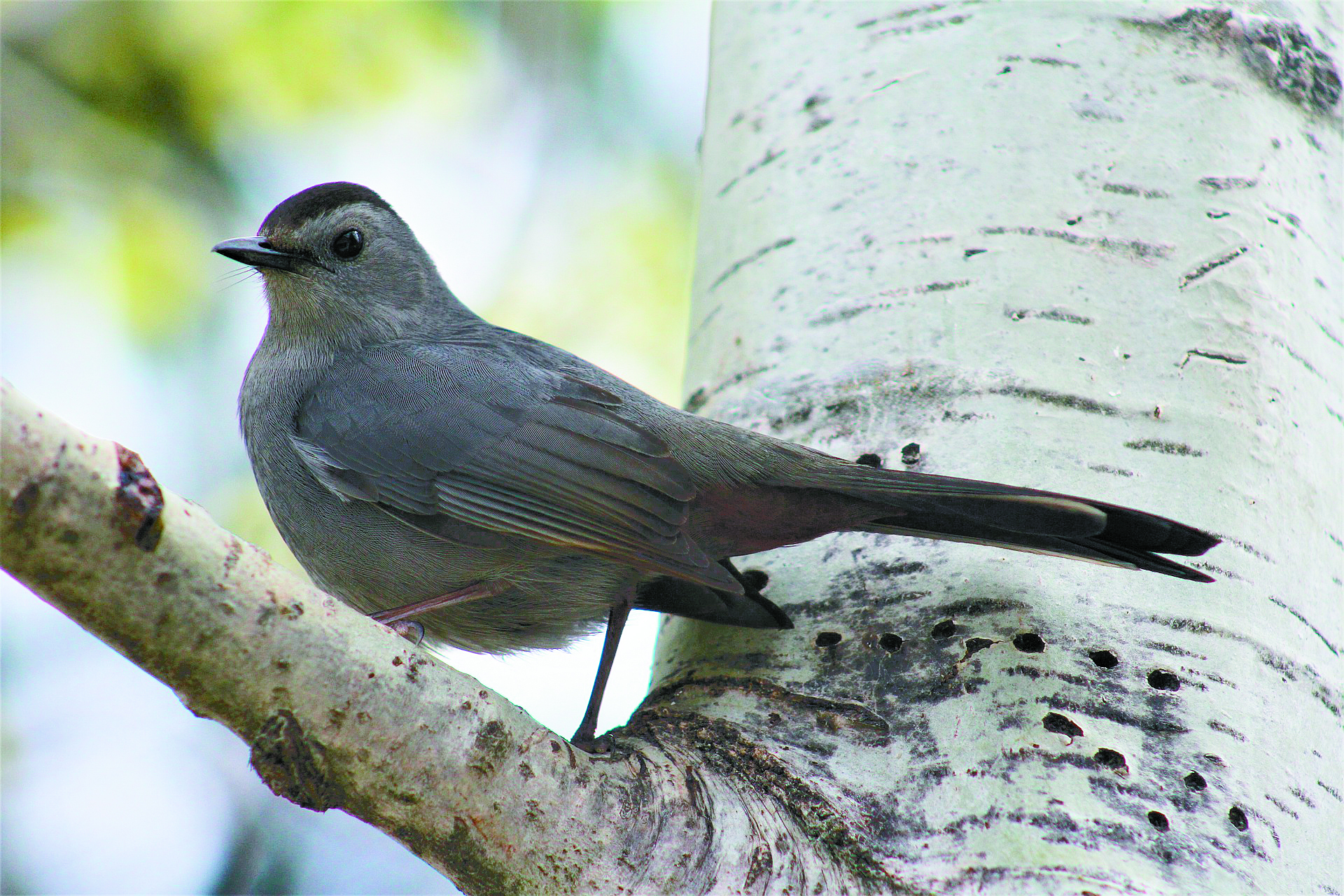
Photo by Bryan Stevens • Although often considered shy, skulking birds, some catbirds show a great deal of curiosity about and trust in humans.

I received an email on June 15 from Linda Durette, who lives in Townsend, Massachusetts, which is on the New Hampshire border.

“I live in a country environment with thickets and fields,” she noted.

Linda informed me that she had run across an article I wrote in 2019 about gray catbirds.
“I have always been mildly intrigued by the catbird,” she wrote. ‘Working around the yard and having a cat myself, I always got a kick out of their vocal annoyance with my cat.”

She said the catbirds begin squawking at her cat the minute he steps out the door.

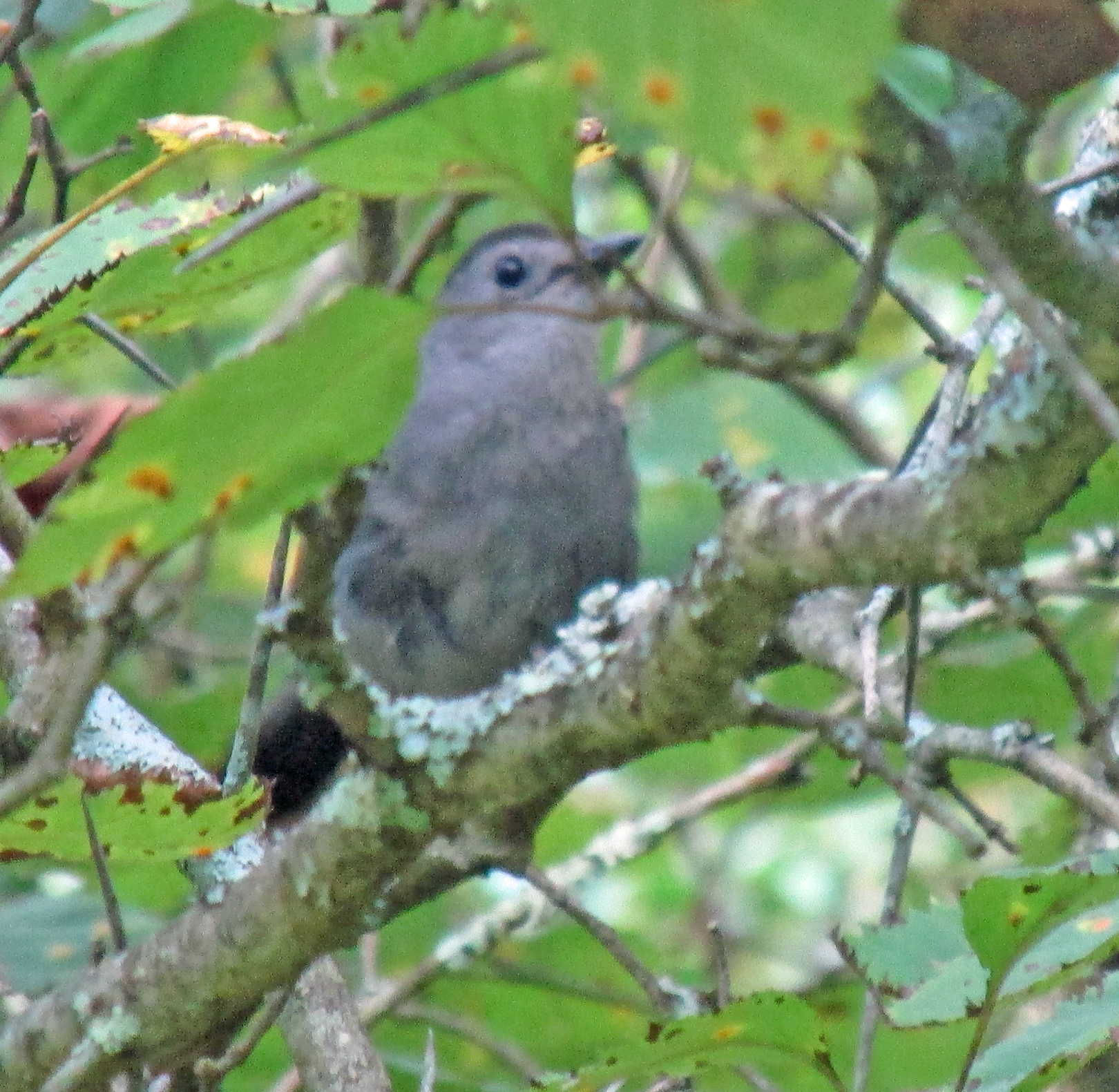
Photo by by Jennifer Beebe from Pixabay • Gray catbirds have a reputation for being either shy skulkers or bold scolders. In fact, these birds are known for being individuals with unique and distinctive personalities. Like mockingbirds and thrashers, the gray catbird is considered a mimic thrush and can imitate snippets of the songs of other birds.

“I always kept him away from any nesting area, although he isn’t a particularly adventurous cat, anyway,” she noted.

“This year was the same,” she said. “My cat seemed to almost ignore the bird. He just sat there and allowed the bird to squawk loudly. I think the bird was miffed.”

She said she finally put her cat back in the house.

“But I have been noticing that the bird comes very close to me,” she wrote.

She wrote that the catbird appears to watch what she does when she is outdoors.

“I have been talking with him, chattering while I garden,” she wrote. “It’s a riot. He lands on the wheelbarrow handle after I walk away or allows me to walk pretty close to him as he watches.”
Linda concluded that this individual catbird, at least, seems to have quite the personality.
I’d mentioned in my previous column on catbirds about the fondness of these birds for fruit and how I occasionally offered berries to them.

“I will attempt some fruit, too,” she said. “It is so interesting. We’ll see what happens.”
Perhaps readers will recall the folksy expression “sitting in the catbird’s seat” that denotes self-satisfaction and perhaps a degree of smugness. As expressions go, it’s not a bad fit for this charming, somewhat eccentric bird.

Photo by Bryan Stevens A curious Gray Catbird peeks from dense cover. Attendees at the fall rally can look for catbirds and other species at any of the offered bird hikes.

The gray catbird is a baffling bird with a personality that runs the gamut from introverted to extroverted, sometimes depending on the season and at other times seemingly just on a whim. With some gentle persuasion, however, people can gain a catbird’s trust – as Linda has done with the bird in her Massachusetts garden – and develop a fun friendship with these clever songbirds.

One summer, all I needed to do to win over the catbirds was to offer some less-than-perfect strawberries and blueberries. A few blemishes on the fruit didn’t bother the resident catbirds at all, and they soon became accustomed to receiving such treats.

A person’s first introduction to the catbird is likely going to occur when one hears what sounds like an irritable feline hiding in a hedge, thicket or dense shrub. Upon closer examination, observers may get a glimpse of a charcoal gray bird roughly the shape of a Northern mockingbird but smaller. A black cap and a patch of rusty-red feathers under the tail are the only exceptions to this bird’s overall gray plumage.

The catbird is related to thrashers and mockingbirds, but scientists find the gray catbird just different enough to warrant placing it in its own genus. The genus name Dumetella means “small thicket.” It’s an apt name for this secretive skulker. Catbirds only feel secure in dense cover such as hedges, brush piles and dense thickets.

A relative known as the black catbird, which ranges throughout the Yucatan Peninsula of Mexico, as well as northern Guatemala and northern Belize, also belongs to a genus of its own. The genus name Melanoptila for this close relative is a compound word created from two Greek words: melas, meaning “black” and ptilon, meaning “plumage.” Both of these catbirds are classified as “mimic thrushes,” or Mimidae, of which there are about 30 species in the New World. There is a totally unrelated family of catbirds that ranges through Australia, Asia and parts of Africa.

The gray catbird is not as an accomplished mimic as some of its relatives, such as the Northern mockingbird. Males have motivation to constantly expand their repertoire, however, as doing so increases the likelihood of attracting a mate. They imitate other birds, but some have been recorded imitating frogs and other non-avian singers.

The website All About Birds also offers some helpful advice for attracting gray catbirds. To entice these birds, plant native fruit-bearing trees and shrubs such as dogwood, winterberry and serviceberry.

While the closely related brown thrasher and Northern mockingbird have both been honored with recognition as official state birds, this designation has never been bestowed on the gray catbird.

The female catbird constructs the nest, but her mate may helpfully provide some of the nesting materials. She may spend as long as a week building a rather bulky nest. She usually lays one to six eggs, which require an incubation period of about two weeks. Once the young hatch, both parents are kept busy bringing food to the young. Hatchlings will remain in the nest for about 10 days, but parents continue to care for and feed young even after they have fledged and departed the nest. Catbirds nest two or three time in a season.

According to the website All About Birds, the oldest known gray catbird was at least 17 years and 11 months old when it was recaptured and rereleased during banding operations in New Jersey in 2001. That individual had been banded in Maryland in 1984. So, if you do manage to strike up your own friendship with a catbird, there’s a good possibility that it could become a long-term relationship, especially since many birds like to return to a home territory year after year.

To share an observation, make a comment or ask a question, please send email to ahoodedwarbler@aol.com. I enjoy hearing from readers about shared interests in birds.

Hummingbird numbers normally fluctuate from year to year

Photo by Bryan Stevens • A ruby-throated hummingbird perches at a feeder for a sip of sugar water.

Russ MacIntyre, Jonesborough, Tennessee, emailed me recently with a question about hummingbirds.

“Are there fewer around this year?” Russ wrote in his email. “My neighbor hasn’t seen any for a month and neither have we. Both of us have feeders and usually have hummingbirds all summer.”

I responded to Russ’s question by sharing with him that I have not seen as many hummingbirds as usual myself.

It’s important to note, however, that hummingbird numbers always fluctuate from year to year. While Russ and I may not be seeing as many hummingbirds, someone else in Jonesborough, Erwin or other small towns might be overwhelmed with these tiny gems. For instance, numbers might appear down in Northeast Tennessee but could be booming across the border in Western North Carolina.

I get these questions every year. Last year was a great year for hummingbirds based on my personal experience. I was also staying at home a lot more last year due to COVID-19, so I might simply have had more leisure time to observe the hummingbirds in my yard and garden.

Photo by Bryan Stevens • Despite a perceived disadvantage of size, ruby-throated hummingbirds are quite capable of thriving in a giant world.

I usually tell people a decline in numbers one year doesn’t mean hummingbird numbers might not boom next year. Quite simply, all the hummingbirds could be a few miles down the road having a great time in someone else’s yard and garden. One thing that all hummingbird enthusiasts should do is plant more nectar-providing flowers, in addition to providing sugar water feeders. Flowers can help persuade hummers to stay put.

To recognize the importance of native, nectar-bearing flowers, simply consider a few facts about hummingbirds from an article by Lisa M. Genier for the Adirondack Council.

“Hummingbirds have a very high metabolism and must eat all day long just to survive,” wrote Genier, a program analyst for the Adirondack Council. “They consume about half their body weight in bugs and nectar, feeding every 10 to 15 minutes and visiting 1,000 to 2,000 flowers throughout the day.”

It’s not just the sugary treat that waits in each bloom that draws in hummingbirds.

“In addition to nectar from flowers and feeders, these birds eat small insects, beetles, ants, aphids, gnats, mosquitoes and wasps,” Genier wrote in her article, which was published on July 3, 2018, on the website for the Adirondack Council. The organization was founded in 1975 with a mission to ensure the ecological integrity and wild character of the Adirondack Park near Lake Placid in New York.

Photo by Bryan Stevens • Ruby-throated hummingbirds such as this male make themselves at home in yards and gardens throughout the eastern United States from spring to fall each year. .

If you’re disappointed with seemingly low numbers of hummingbirds this spring, my best advice is to wait until late July and early August when young birds are out of the nest and parents and young start the slow-paced migration back south. Invariably, I see more hummingbirds in late summer and early fall than in the spring.

Hummingbirds are a lovely diversion for nature enthusiasts, but they also play a crucial role in the ecosystems where they make their homes. Hummingbirds are pollinators. Every time they visit a flower, they will carry away some pollen on their bills or foreheads. If they carry the pollen to the correct plant, they fulfill their role as one of nature’s many pollinators.

There’s even an entire week dedicated to pollinators and their importance in nature. Pollinator Week was initiated in 2007 when the United States Senate unanimously approved a week in June to be designated as “National Pollinator Week”. This decision was a critical step to address the decline in pollinators across the globe.

Now an international celebration, Pollinator Week raises awareness on the plight of pollinators and celebrates all of the benefits provided by the thousands of insect, bird, and small mammal pollinator species. As people learn more about pollinators, they become advocates – indeed voices – for the pollinators they come to love and understand. We can all play our part to secure a healthier, more sustainable future for pollinators. Pollinator week was started and is managed by the Pollinator Partnership. For more information explore the Pollinator Partnership website.

According to the website, Pollinator Week was initiated and is managed by Pollinator Partnership, and fourteen years ago the U.S. Senate’s unanimous approval and designation of a week in June as “National Pollinator Week” marked a necessary step toward addressing the urgent issue of declining pollinator populations. Pollinator Week has now grown into an international celebration, promoting the valuable ecosystem services provided by bees, birds, butterflies, bats and beetles.

While this year might not be a typical Pollinator Week due to the COVID-19 pandemic, people across the planet have pledged to continue promoting pollinator health and well-being through socially distant and responsible events. Through the numerous virtual gatherings, webinars, responsible planting sessions, socially distant garden and farm walks and monument lightings, Pollinator Week 2021 is geared to be the busiest and best one yet.

This year, Pollinator Week is being observed Monday-Sunday, June 21–27. For more information, email info@pollinator.org.

Photo by Bryan Stevens
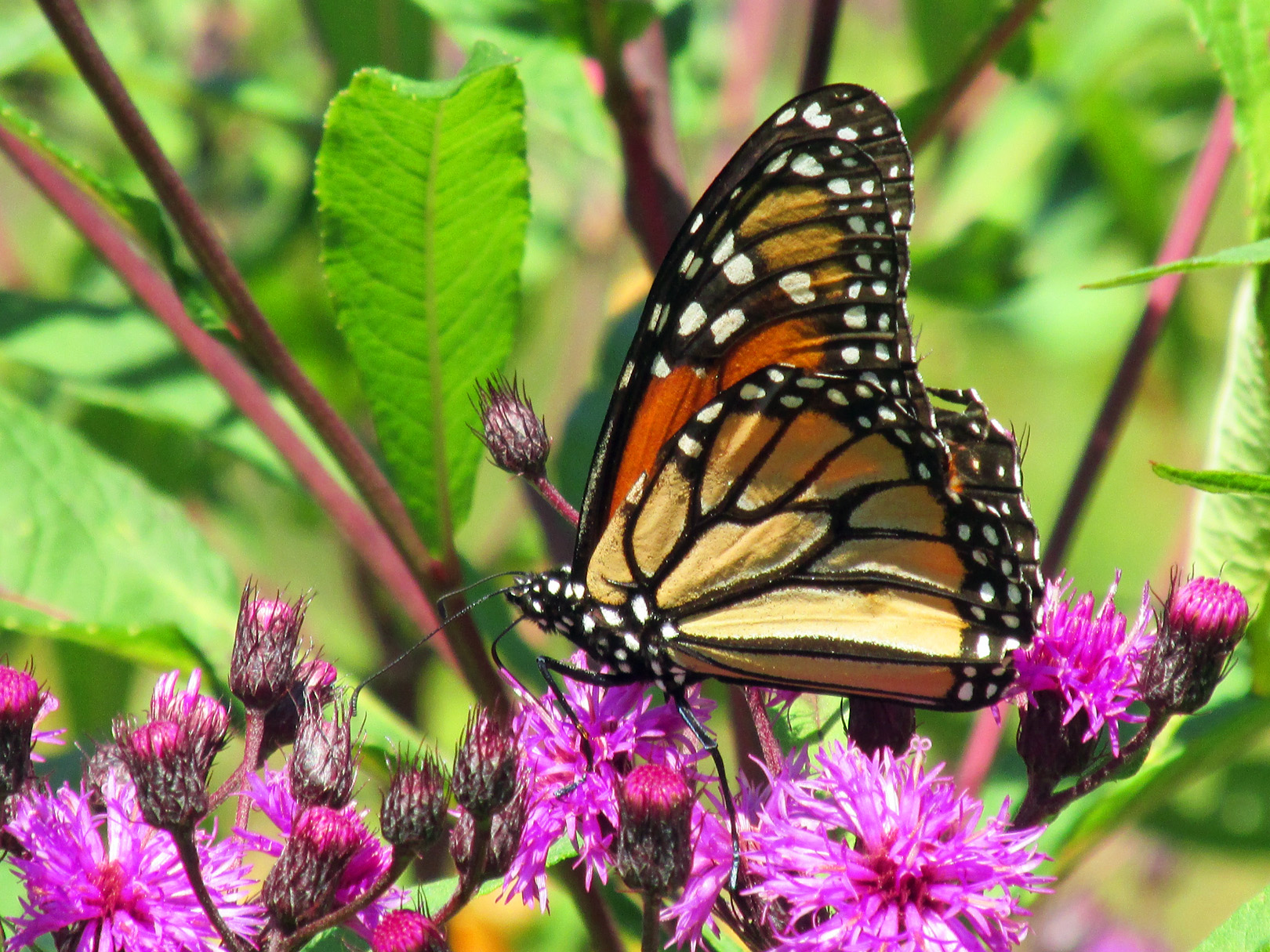
A Monarch sips nectar from blooming Ironweed. Butterflies are important pollinators for many plants.

Blue of indigo bunting’s plumage is a trick of the light

Photo by Bryan Stevens • The male indigo bunting is a resplendent bird.

The indigo bunting is one of the reasons I love to pay attention to the clientele visiting my feeders. This small songbird likes to reside in the boundary region where forests and woodlands meet fields and pastures. Personally, the indigo bunting has always been a bird that is suggestive of the long, hot days of summer.

One of my earliest and still quite vivid birding memories is a recollection of a shockingly blue bird atop a blue spruce tree in my yard. Several decades later, the tree is no longer standing, but these beautiful birds — I now know these summer visitors were indigo buntings — still return each year to my yard and gardens.

Indigo buntings usually arrive in the region in late April, and I’ve seen them linger until late October, although most indigo buntings have left the region by late September.

Upon arrival, male indigo buntings become tenacious singers, repeating their jumbled notes even during the hottest hours of summer afternoons. The preference of this small songbird is to sing from the tops of tall trees, where they are often concealed by the green leaves. When I do get a glimpse of the obscured songster, often all I see is a dark shape silhouetted against the bright sky. Sometimes, if he plunges from the upper branches into the woodland understory, I get that telltale glimpse of blue feathers.

Photon by Bryan Stevens • Indigo Buntings will perch on wires and sing for hours even during hot summer days.

The male indigo bunting is the only solid blue bird in the eastern United States, but it’s all an illusion — literally a trick of the light. The indigo bunting’s feathers are not really blue; the male’s brilliant azure plumage is caused by the process of diffraction of light around the structure of the bird’s feathers. This process scatters all but the blue light, and the resulting color shifts from black to blue to turquoise as the angle of reflected light changes. In bright light, it can even look unnaturally vivid blue. In poor light, however, an indigo bunting male can appear black. Fortunately, indigo buntings have both a characteristic body shape and song, so even if the birds are not seen at their best, they can still be recognized.

Soon after returning to the eastern United States each spring, female buntings begin to gather materials to construct a well-crafted, cup-shaped nest. The male usually stays close to her, but he offers no assistance with nest building. She usually lays a clutch of three to four eggs, but she may nest another two times in a single season. She will incubate the eggs for almost two weeks, but the young remain in the nest another two weeks after being hatched as featherless, blind and helpless young completely dependent on the care of attentive parents. The task of raising so many broods in the space of only a few months requires the participation of both the female and her mate, who must work hard to bring enough insects to the nest to keep the young fed.

Like many species of songbirds, the male is by far the most colorful. In this instance, the male is also responsible for the species’ name. Indigo is a blue dye that was once an important crop in the South. The drab female may boast some blue highlights in her plumage. Juvenile birds just out of the nest also resemble the female. Pay close attention to any indigo buntings you observe as summer progresses. Juvenile birds will look mostly brown with just a hint of blue in the wings and the tail. These will be the young buntings that were hatched in spring and early summer. They will often accompany their parents to feeders.

Photo by Dan Sudia/USFWS • Female and young indigo bunting do not show the intense blue of adult males.

Indigo buntings are particularly fun birds to observe in late summer. Indigo bunting juveniles, like the young of many other birds, beg for tidbits from parents by “bowing,” spreading their wings and shivering. These actions usually prompt a parent to pop some morsel into an impatient youngster’s open bill. Indigo buntings are relatively easy to view. They frequent weedy fields and roadside brush. During the breeding season, males can also be seen singing from prominent perches. The song, a distinctive jumble of notes, can help observers find these dedicated singers.

The indigo bunting belongs to a genus of birds known as Passerina, which is included the family Cardinalidae, which includes birds like Northern cardinal and rose-breasted grosbeak. They are often lumped into a group known as North American buntings, although they are not closely related to such birds as snow bunting and lark bunting. The latter is even recognized as the official state bird for Colorado, a unique honor for this group of birds. The other members of the Passerina genus include lazuli bunting, varied bunting, painted bunting, rose-bellied bunting, orange-breasted bunting and blue grosbeak.

Worldwide, other birds known as buntings include such descriptively named species as slaty bunting, corn bunting, white-capped bunting, gray-necked bunting, cinereous bunting, lark-like bunting, cinnamon-breasted bunting, chestnut-eared bunting, little bunting, yellow-throated bunting, golden-breasted bunting, black-headed bunting, red-headed bunting and yellow bunting.

Photo by Bryan Stevens • Although bright blue, a male indigo bunting will often blend with its surroundings.

The male indigo bunting is one of the most colorful birds to visit feeders in the region. This species is also extremely fond of millet seed. I like to have some feeders stocked with millet when the buntings begin to return each spring. They will also feed on thistle and sunflower seeds. Away from our feeders, they also devour plenty of seeds from various noxious weeds. Because of the indigo bunting’s appetite for the seeds of destructive weeds, it is considered a beneficial bird.