Tag Archives: Spring migration

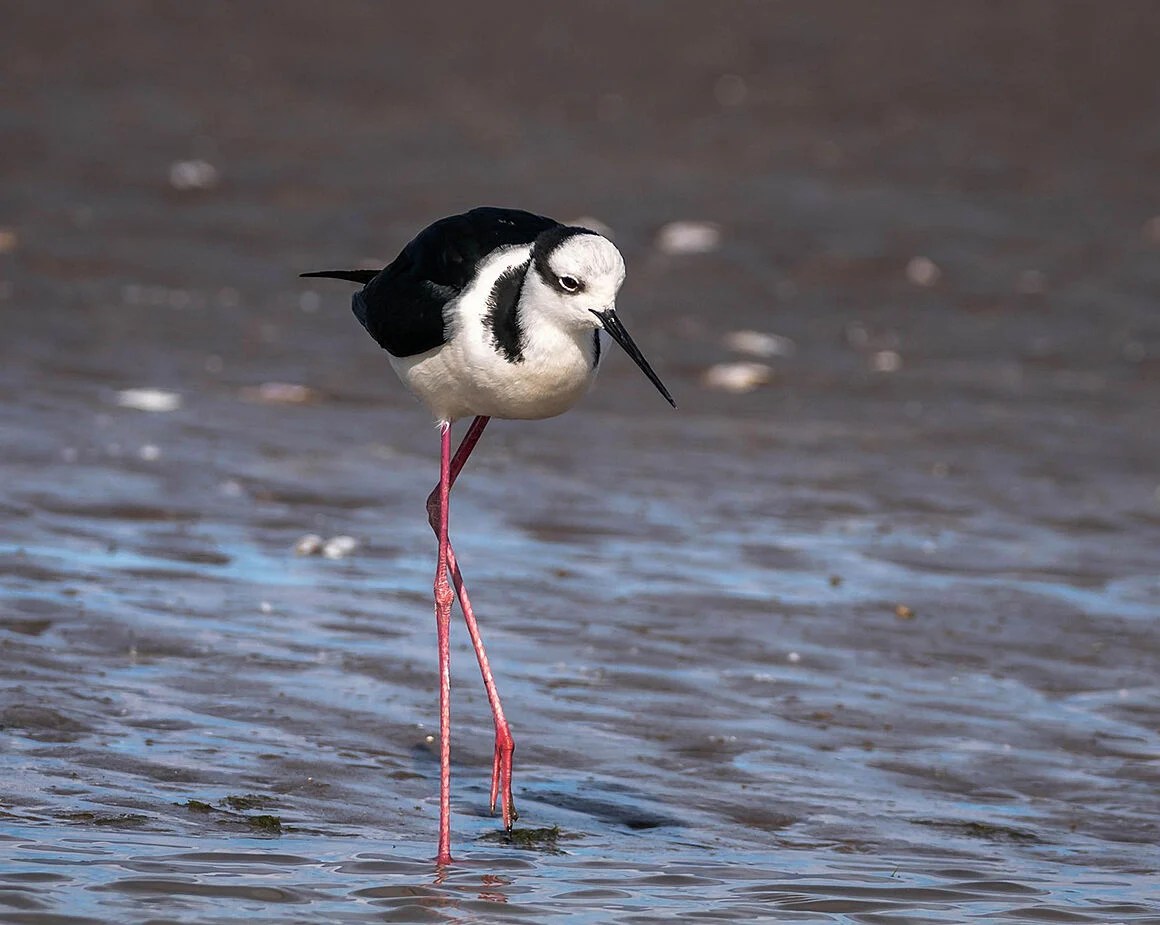
Black-necked stilt a gangly member of the windbird clan

Beto/Pixabay. • A black-necked stilt wades through a wetland area.

I received an email from Brayden Paulk updating me on his new birding adventures since moving to Gulf Shores in Alabama. I wrote a few weeks ago about Brayden and his plans for a Global Big Day of birding.

“I wanted to give you an update on the Big Day,” he wrote, informing me that he has been undergoing a lot of training for a new job and has had lots of 10-plus hour days. But birding has been productive.

“I got down here and I’ve had lots of success,” he wrote. “Where I live there are black-bellied whistling ducks hanging out by the pond, and prothonotary warblers in the swamp behind the apartment,” he said.

Unfortunately, his new job needed him to work on the date of his Big Day.

“So I was not able to do my plans,” he wrote. “However, I did get to go out for a few hours that afternoon to a nearby sod farm. I picked up several good birds, including spotted sandpiper, solitary sandpiper and, most importantly, black-necked stilt.”

Brayden reported that he observed two stilts working the edge of a flooded corner of the field along with dozens of other shorebirds that were too small to identify in low light.

“I was glad that I could do my part to submit one checklist on the Big Day, even if I couldn’t do a 24-hour birding marathon like I had planned,” he added.

He added that his best birding day recently took place two days prior to his planned Global Big Day.

“I got to meet some folks from Alabama Audubon when they came to the Eco Center,” he said. “After the tour, I was invited to go do some sea watching with them at Gulf State Park.”

He noted that the three guys on the impromptu session included Scott Duncan, the director of Alabama Audubon, and two top birders in Baldwin County.

“They were very helpful and wonderful people,” Brayden shared. “While we were out birding, I picked up two lifers: Gull-billed tern and semipalmated sandpiper.”

Bryan Stevens • Black-necked skimmers take flights along the South Carolina coast.

He also reported that they saw lots of other cool coastal birds, such as black skimmer, least tern and osprey.

“The coolest species, though, were two red knots,” he said. “I had only seen them once before, but this was my first time seeing them in breeding plumage. I was very excited to see it, and get two lifers in one day!”

He is also anticipating some future birding.

“My friend Don has a rare shiny cowbird at his house a few miles away from me, as well as Inca doves.”

I enjoyed hearing about Brayden’s sightings of shorebirds, a family of birds also known with a little more creative flair as “wind birds.” They are so named because so many species are capable of incredible long-distance migrations. His success with the black-necked stilts reminded me of how this can be an elusive species for birders.

My last sighting of black-necked stilts took place more than a decade ago in May of 2014 during a South Carolina vacation. I observed three black-necked stilts at Huntington Beach State Park while walking on a marsh boardwalk near the park’s Nature Center. They flew toward the causeway, so I got into my car and drove there to try to re-locate them. I did find two of the stilts feeding along the causeway, but I never managed to re-locate the third bird.

Photo by Bryan Stevens
Two Black-necked Stilts forage along the causeway wetland at Huntington Beach State Park in 2014. 

I watched the two stilts foraging for food in shallow water shared by egrets and alligators. The two birds, despite a somewhat gangly appearance, moved with elegantly efficient strides on their long pink legs.

I have seen this unusual shorebird in Tennessee only once on Oct. 13, 2004, at Austin Springs on Boone Lake in Washington County. The bird, first found by Rick Knight, drew many excited birders to the location for looks at this shorebird before it departed to continue its migration flight south.

As you might imagine, land-locked Tennessee is not an ideal location for finding shorebirds, but spring and fall migration brings a surprising variety of these birds through Northeast Tennessee. Black-necked stilts, however, are a rarity. I have also seen this species of shorebird on Fripp Island, South Carolina, as well as just outside of Wendover, Nevada, on a visit to the Bonneville Salt Flats.

The world of shorebirds has produced many look-alike species, including many of the small sandpipers often collectively labeled as “peeps” by birders. The black-necked stilt, however, is not at all likely to be confused with any other shorebird. It is a slender bird atop a pair of extremely long pink legs. It has a two-tone appearance with black upper parts and white underparts. The black and white dichotomy continues along the bird’s long neck and head. This bird also has a thin, needle-shaped bill that it uses to delicately pluck aquatic insects and other prey from water or mud. The black-necked stilt’s long pink legs are exceptional. In fact, this species has he second-longest legs in proportion to their bodies of any bird, exceeded only by flamingos, according to the website All About Birds.

The black-necked stilt is closely related to the American avocet, another long-legged shorebird. The two species are classified together in the family, recurvirostridae. There’s also a Hawaiian sub-species of the black-necked stilt known as the “aeʻo.”

•••

To share a sighting, make a comment or ask a question, email me at ahoodedwarbler@aol.com.
Black-and-white warbler won’t be confused with other birds

Photo by Hans Toom/Pxabay A black-and-white warbler would be almost impossible to confuse with any other bird.

I’m thinking that most people have probably heard of a “gaggle” of geese or a “murder” of crows as a way to describe a flock of these particular birds. Warblers also have their collective names. A flock of warblers is often referred to as a bouquet, a confusion, a fall, a cord or a wrench of warblers, according to the Birdorable Blog.

I personally like “wrench” of warblers. It has alliteration and describes how these amazing little songbirds can definitely “wrench” one’s attention from other matters. That’s been happening a lot at home. Since arriving in early April, the resident warblers have added their songs to the soundscape that makes the woodlands surrounding my home come alive every morning.

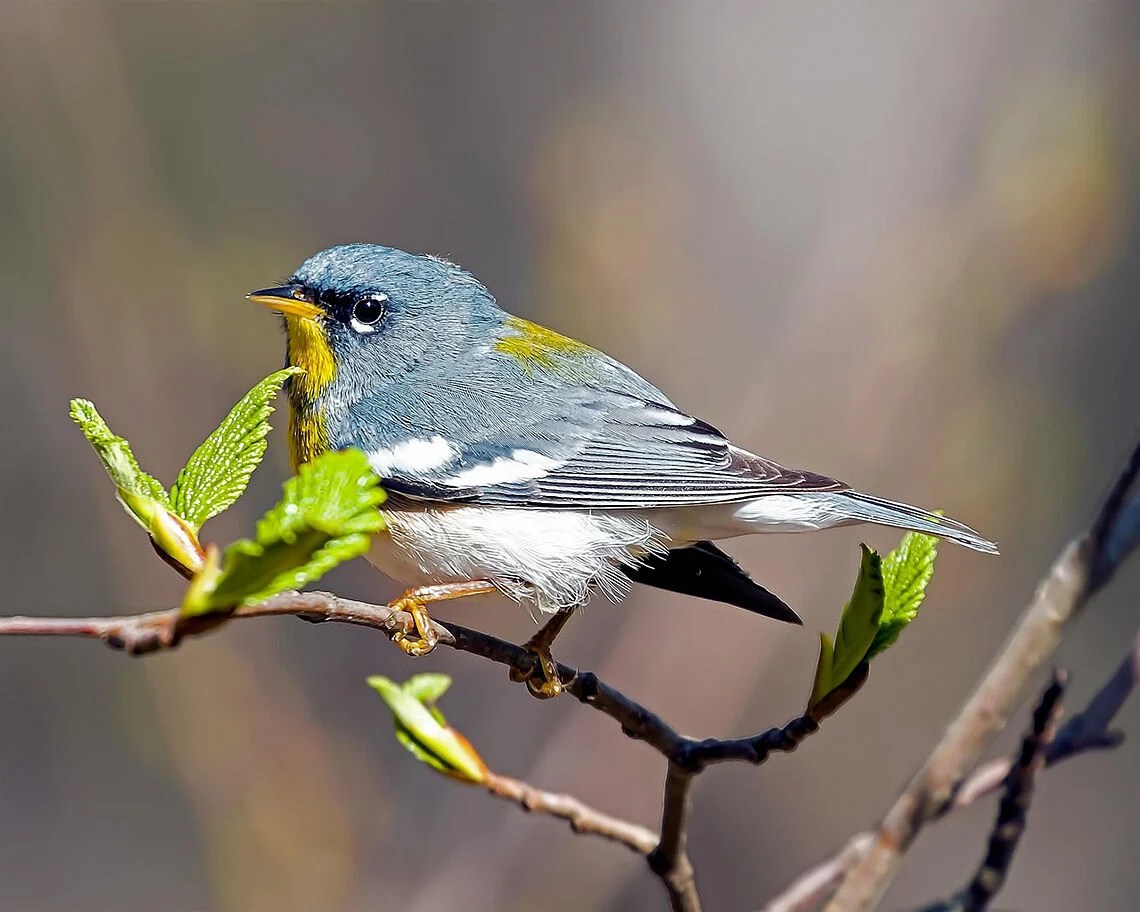
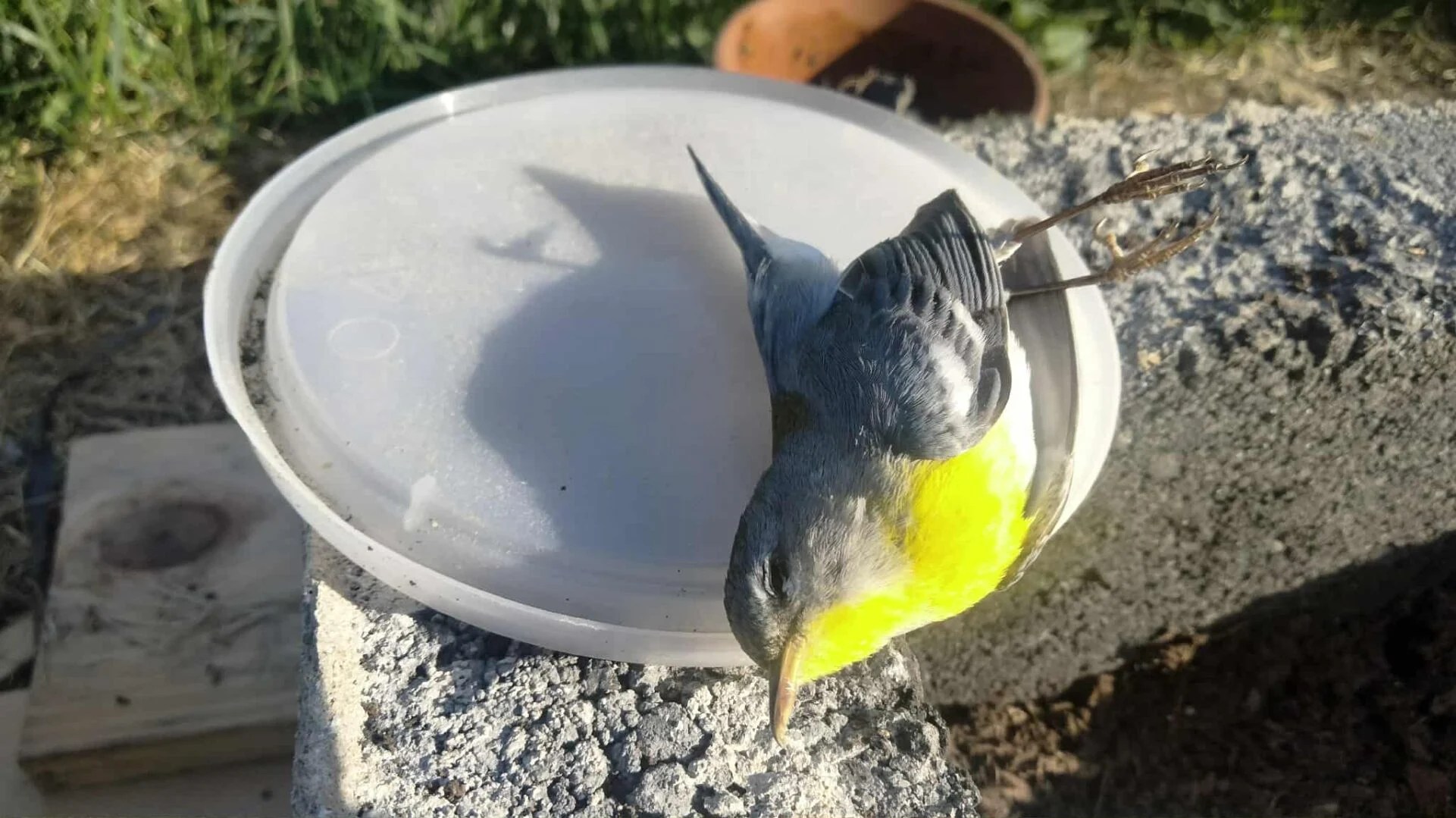
I wrote last week about the sad incident of a male Northern parula killed after an impact with a window. I wondered if I’d have to go the spring and summer season without hearing the excitable little trill of syllables that comprises this warbler’s song. I’m happy to report that less than a week passed before another male Northern parula showed up and began adding his song to the daily chorus. The circle of life continues.

On Saturday, May 3, I got to branch out from the handful of warbler species in residence around my home to warblers in other locations. I birded with Chris Soto, a Johnson City resident and fellow member of the Elizabethton Bird Club, on Holston Mountain and Sycamore Shoals State Historic Park as part of the annual Spring Bird Count conducted by the EBC. Despite some rain while conducting our survey of Holston Mountain, we encountered a variety of warbler species.

We didn’t observe any large warbler flocks, or wrenches, but we did find numerous species, including ovenbird, worm-eating warbler, Louisiana waterthrush, black-and-white warbler, Swainson’s warbler, hooded warbler, American redstart, Cape May warbler, Northern parula, yellow warbler, chestnut-sided warbler, black-throated blue warbler, yellow-throated warbler, black-throated green warbler and Canada warbler.

We added most of these species to the list by hearing them singing their springtime songs, including the “squeaky wheel” of the black-and-white warbler and the loud, ringing notes of the Louisiana waterthrush. If the latter wants to be heard, it is essential that it produce a loud song. The waterthrush resides near rushing mountain streams, which could easily overpower songs projected at a lower volume.

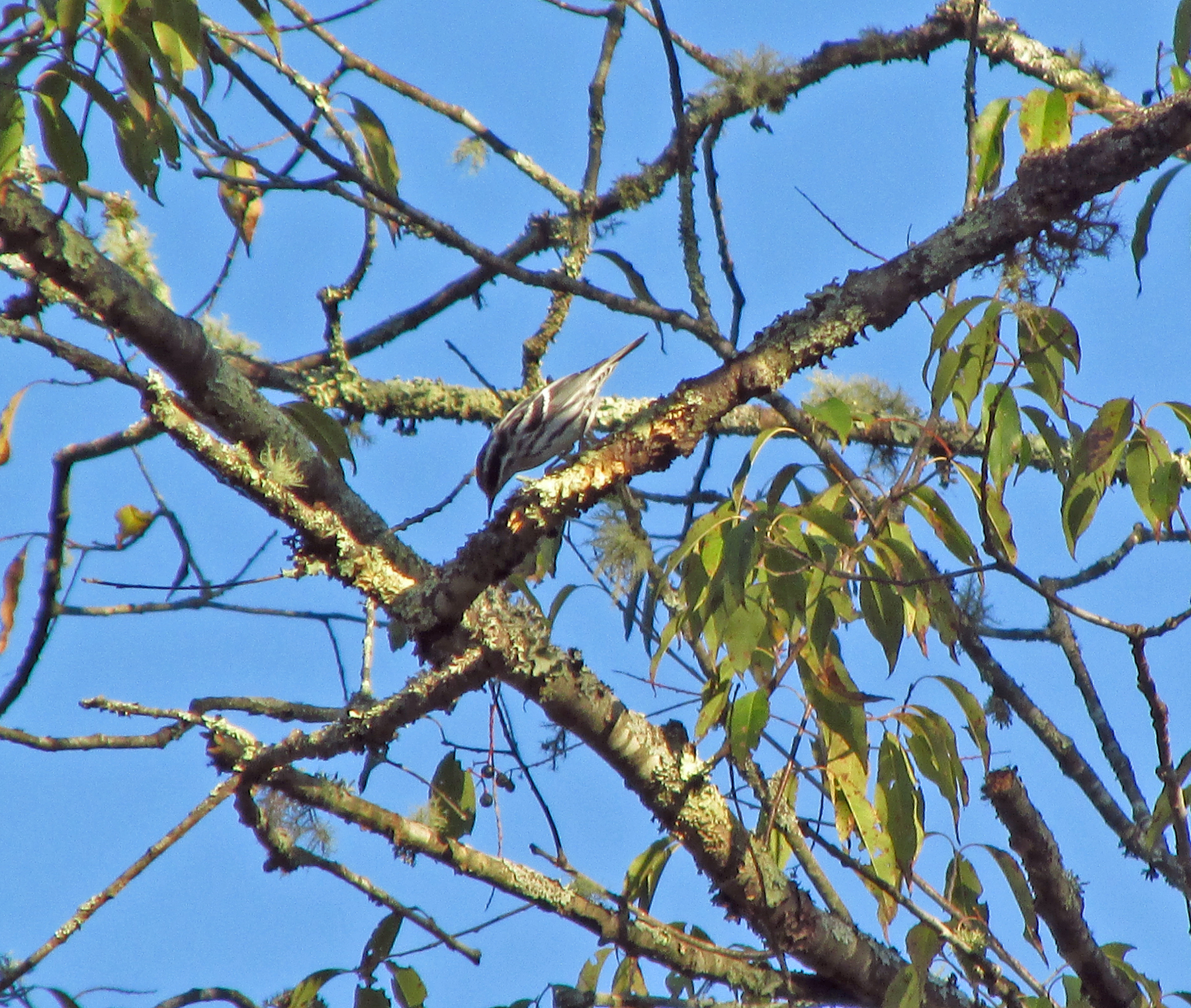
The black-and-white warbler is arguably the most aptly named of all the warblers. Both males and females have glossy black and white plumage. That’s it – there are no other colors present in the bird’s feathers.

Photo by Bryan Stevens • A black-and-white warbler creeps over the bark of a pine in search of insect prey.

The black-and-white warbler breeds in northern and eastern North America. It ranges from the Northwest Territories to the northwest and Newfoundland and Labrador to the northeast, to North Carolina to the southeast and Texas to the southwest. This species is migratory, wintering in Florida, Central America, the West Indies and northern South America down to Peru.

Once arriving for the spring, these warbler go about the business of nesting. The female black-and-white warbler selects a well-hidden nesting location at the base of a tree, rock, stump or fallen log, or under a bush or shrub, according to the website All About Birds. I discovered a black-and-white warbler nest, quite by accident, several years ago. The nest was wedged in a crevice beneath a large fallen pine resting on a steep ridge. Besides being rather inaccessible, I had no wish to disturb the nest so I enjoyed watching the birds through binoculars from a distance.

Photo by Hans Toom/Pxabay • A male black-and-white warbler sings its squeaky wheel song.

In its tendency to hug the trunk of trees as it seeks out insect prey, the black-and-white warbler is similar to unreleased species such as brown creeper and white-breasted nuthatch. In fact, an old common name for this bird was black-and-white creeper. It does venture farther out into a tree than the trunk, however, and will flit among branches as good as any other warbler.

For beginners just getting into the hang of birding, the black-and-white warbler is a dream when it comes to identification. It’s unlikely to be mistaken for any other bird. One good look through binoculars is usually all it takes to recognise the species. There’s no poring over the pages of a field guide for subtle field marks to help when trying to identify the black-and-white warbler. The same is true for the bird’s song, which is very similar in pattern to a squeaky wheel spinning round and round.

Enjoy the springtime and get outdoors and see what feathered friends are winging their way into your neighborhood.

Photo by Bryan Stevens
A Black-and-white Warbler forages along a branch.

Tiny songbird’s collision with window leaves gap in spring soundscape


Hans Toom/Pixabay • Male Northern paroles are a member of the warbler family. They are amazing vocalists producing an easily recognised trill of a song.

The male Northern parula is a persistent songster once arriving on its nesting territory each spring.

Since arriving in early April, a male Northern parula had been a tireless singer. I often heard the bird as I departed for work each weekday morning and was welcomed home in early evening by the bird’s song.

On April 29, I returned home. I followed my usual routine and dropped off my mother’s newspaper and mail at her home. Unfortunately, on her porch was the lifeless form of the Northern parula. I know it was “my” parula because the bird had been so faithful in its singing. I have not heard the song of a Northern parula in the days following the sad discovery.

Northern parulas sing two different types of songs, according to the website All About Birds. The most common is a rising buzzy trill with a final sharp note. This song rises up and pinches off sharply at the end. The second song has distinct pauses in between bouts of the rising buzzy trill. My parula had mostly sang the song best described as a rising buzzy trill, but it had also practiced at the second version, as well.

The tragic end for this little songster has really put a damper on my enjoyment of the spring season. Unlike many of our birds, this species of warbler has been thriving. Northern parulas are common, and their populations have actually increased by over 1% per year from 1966 to 2019 for a cumulative increase of about 47% according to the North American Breeding Bird Survey.

Bryan Stevens • This Northern parula died after a collision with a glass window.

But the incident is a reminder of the perils that our feathered friends face daily. An article titled “Getting Clear on Birds and Glass,” first published January 14, 2023, by Christine Sheppard and Bryan Lenz brings the detrimental impact glass has had on birds into focus.

The article noted that Smithsonian researches in 2014 attempted to determined how many birds are killed annually due to hitting windows. The study estimated, conservatively, that collisions with glass likely kill between 365 million and 1 billion birds annually in the United States. The authors of the article emphasized that they believe the number is closer to a billion birds, if not more, that die each year from hitting windows and other glass surfaces.

That’s a scary number, but also a testament to the resilience of birds. Of course, all living things have their limits, and we should try to do something to bring down this gruesome toll.

The little parula had struck a large picture window. We have placed decals in the window in an effort to break up the reflection, but the sun has bleached these over the years, and now it is evident they should be replaced. Clouds, sky or vegetation reflected in a window are perceived by birds as the real deal. A screen over a window or hanging strips or other items to break up the reflection will help birds avoid collision.

To examine a database with various possible solutions, please visit https://abcbirds.org/glass-collisions/products-database/

I am hopeful that another Northern parula will visit and find my yard to its liking. I’ve had Northern parulas residing consistently around my home from April to September for many years. The absence of this bird’s song from the daily soundscape has been distressing.

•••

Readers have continued to share their spring hummingbird sightings.

•••

Joe McGuiness in Erwin saw his first hummingbird back on April 9 at 5:45 p.m. Joe texted me that the bird came back to feed again around 7 p.m.

•••

Charlotte Carter, who resides in the Bloomingdale community in Kingsport, emailed me on Friday, April 25. “First hummingbird sighted at my home today at 12:45,” she wrote.

•••

Mack Hayes sent me a message on Facebook to report his first hummingbird arrived on Friday, April 25. “Saw first hummingbird this morning,” he wrote. He noted that he lives on the corner of Oakland Road and Bowmantown Road in Washington County.

•••

Hummingbirds are now back throughout the region. In the past couple of weeks the numbers have increased at my home. I have now seen as many as four hummingbirds at one time, and they duel all day long with each other, chasing each other from one corner of the yard to another. It’s good to have them back.

•••

Share sightings, ask questions or make comments by emailing me at ahoodedwarbler@aol.com.

Male rose-breasted grosbeaks are always a stunning sight

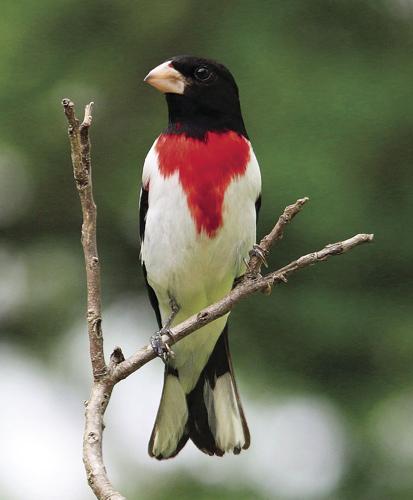
Photo by Edbo23/Pixabay • A male rose-breasted grosbeak is arguably one of the most impressive of the migrating birds making spring stops at lucky households offering feeders stocked with an ample supply of sunflower and other seeds.

Susan Westall emailed me on Sunday, April 21, for help identifying a new bird at her feeders.

Susan wrote, “We spotted this bird today (April 21) around 2:45 p.m. This bird has never been to visit that we’re aware of. We didn’t find the identity.”

Susan, who noted that she resides in Marion, North Carolina, asked if I could help identify the bird. She helpfully enclosed three photographs.

Photo provided by Susan Westall • A male rose-breasted grosbeak at a feeder at the Westall home.

One glimpse at her snapshots of the feathered visitor showed me that her mystery bird was none other than a rose-breasted grosbeak, one of the many splashy and impressive migrants that travel through Northeast Tennessee, Southwestern Virginia and Western North Carolina every spring.

Other than ruby-throated hummingbirds, the one bird whose return in the spring is guaranteed to generate excitement is the rose-breasted grosbeak. Every spring, I get phone calls and emails from people wanting to share the thrill of seeing these vibrant birds in their back yards.

A few people, like Susan, are completely stumped that such a flamboyant feathered visitor has landed in their own yard like an out-of-place inhabitant of a tropical jungle.

For most of us, these spring visits by rose-breasted grosbeaks is a fleeting and temporary stay. After finding the local arrangements, which can consist of well-stocked feeders and perhaps a convenient water source, to their liking, these migrants may linger for several days.

However, rose-treated grosbeaks nest at higher elevations and are usually impatient to continue the journey to where they will spend the summer months tending to their young.

Single birds are occasionally the first to arrive, but rose-breasted grosbeaks do form flocks when migrating. Even if a scout shows up alone at your feeders, he will often soon be joined by other grosbeaks.

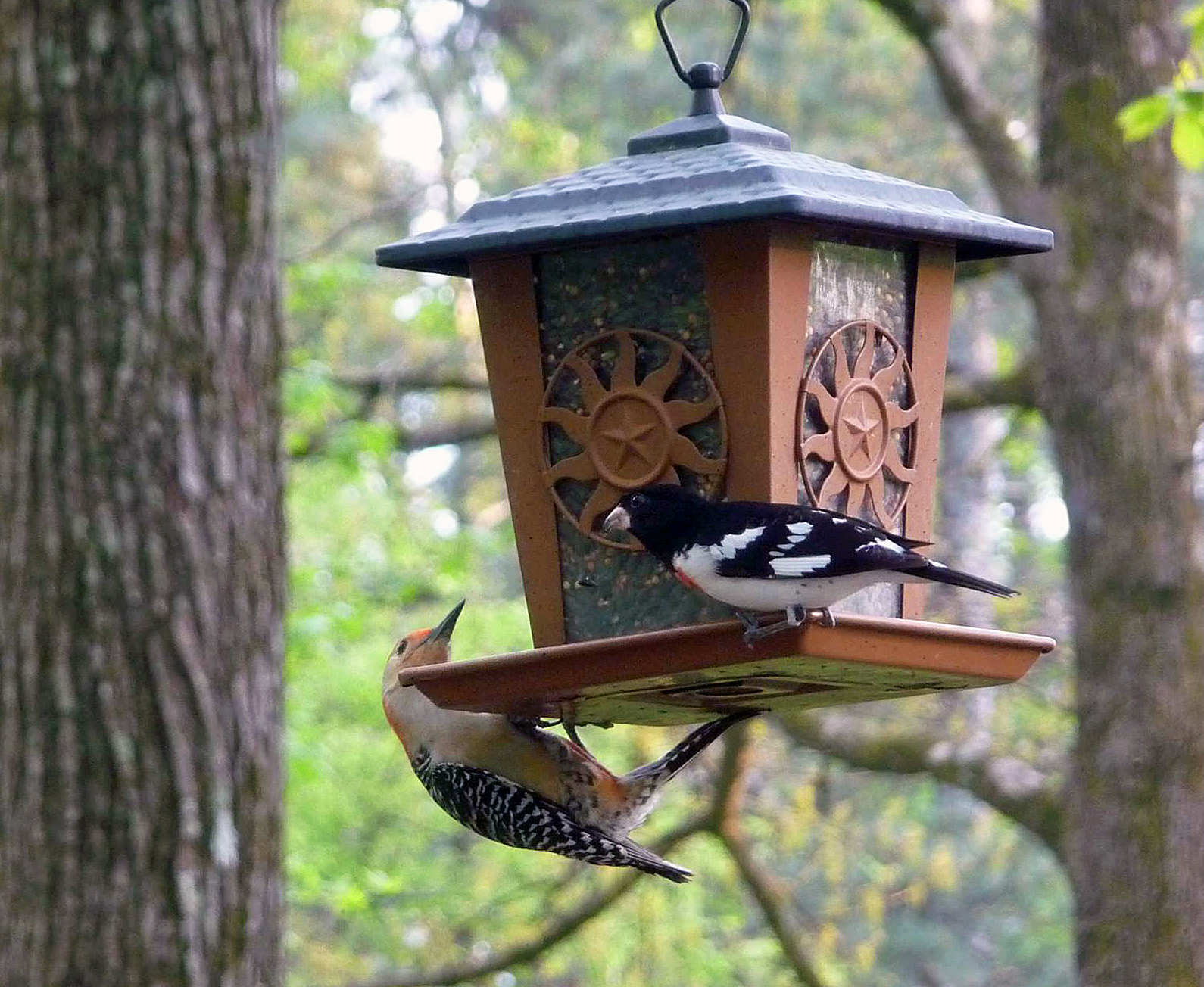
Photo provided by Byron Tucker • A male rose-breasted grosbeak has a showdown with a red-bellied woodpecker for access to a feeder.

Plenty of rose-breasted grosbeaks pass through the area, and a few even decide to make the region’s mountains their summer home. Rose-breasted grosbeaks spread out widely across the eastern half of the North American continent, ranging from northeastern British Columbia to Quebec and Nova Scotia in Canada. They also range south from New Jersey to Georgia. The rose-breasted grosbeak also reaches Colorado, Oklahoma and Kansas.

Farther west, the rose-breasted grosbeak is replaced by the closely related black-headed grosbeak. I saw black-headed grosbeaks on a trip to Salt Lake City, Utah, in 2006.

In many bird species males and females differ considerably. This is certainly true of male and female rose-breasted grosbeaks. The genders in this species are considered dimorphic, which is a scientific term which means that certain male and female birds of the same species may vary widely in size, plumage coloration, song or other secondary sexual traits.

They also have some things in common. Both sexes have a massive bill, which they use to hull sunflower seeds at feeders or glean insects from leaves and branches. It’s the heavy, blunt bill for which the term “grosbeak” is derived. “Gros” is a German term for large or big, so grosbeak simply means a large-beaked bird.

People who band birds to further the study of them will tell you that rose-breasted grosbeaks have a wicked bite and are capable of delivering quite a nip. Bird banders frequently encounter rose-breasted grosbeaks in their mist nets — and bear the scars to prove it.

Only the male rose-breasted grosbeak displays the namesake splash of rosy-red feathers across a white breast. The rest of the male’s plumage consists of a dramatic contrast of black and white feathers. The female grosbeak, however, doesn’t stand out in the same way. She is much less colorful than the male. With her brown and white plumage, she is often mistaken for a large sparrow or finch.

At our feeders, this bird’s extremely fond of sunflower seeds. Away from our feeders, grosbeaks feed on insects, seeds, fruit and even some leaf buds and flowers. I’ve seen these birds satisfying a sweet tooth — or should that be sweet beak? — by feeding on jewelweed flowers and apple blossoms. If sugar’s good for hummingbirds, I am sure it is a valuable energy source for rose-breasted grosbeaks, too.

The rose-breasted grosbeak is a cherished spring visitor that never fails to impress by bringing a hint of the tropics to the mountains of Northeast Tennessee. If you are disappointed in hopes of seeing the species this spring, take heart. The rose-breasted grosbeak migrates through the region again in the fall, often from mid-September to late October. The males sometimes look less vibrant by autumn, but it’s always a treat to see this bird.

I’m hoping many readers are also enjoying their own opportunities for hosting this delightful songbird.

Photo by Bryan Stevens • A male rose-breasted grosbeak perched in a tree on Holston Mountain in Tennessee.

Other songbirds are also on the move. Warblers, vireos, tanager, flycatchers, orioles and more are migrating through the region. Some will stay and make a home in the region for the summer. Others will push on beyond the Southern Appalachians. Keep your eyes open for what may show up next.

•••

Mark this on your schedule: Bristol Bird Club will host a presentation by Kera and George Brewster of Wild Birds Unlimited in Johnson City on Tuesday, May 21.

They couple had been scheduled to give a program at the club’s January meeting, but a snowstorm prevented it.

The club meeting will take place at 7 p.m. at The Summit at 1227 Volunteer Parkway in Bristol, Tennessee. Attendees can also join the meeting and view the program on Zoom. For a Zoom invite, email Larry McDaniel at bristolbirdclub2022@gmail.com.

•••

Share a sighting, ask a question or make a comment by emailing me at ahoodedwarbler@aol.com.

Photo by Pixabay.com • A well-stocked feeder is a first step toward attracting more birds to your yard.

Ruby-throated hummingbirds mark their spring return

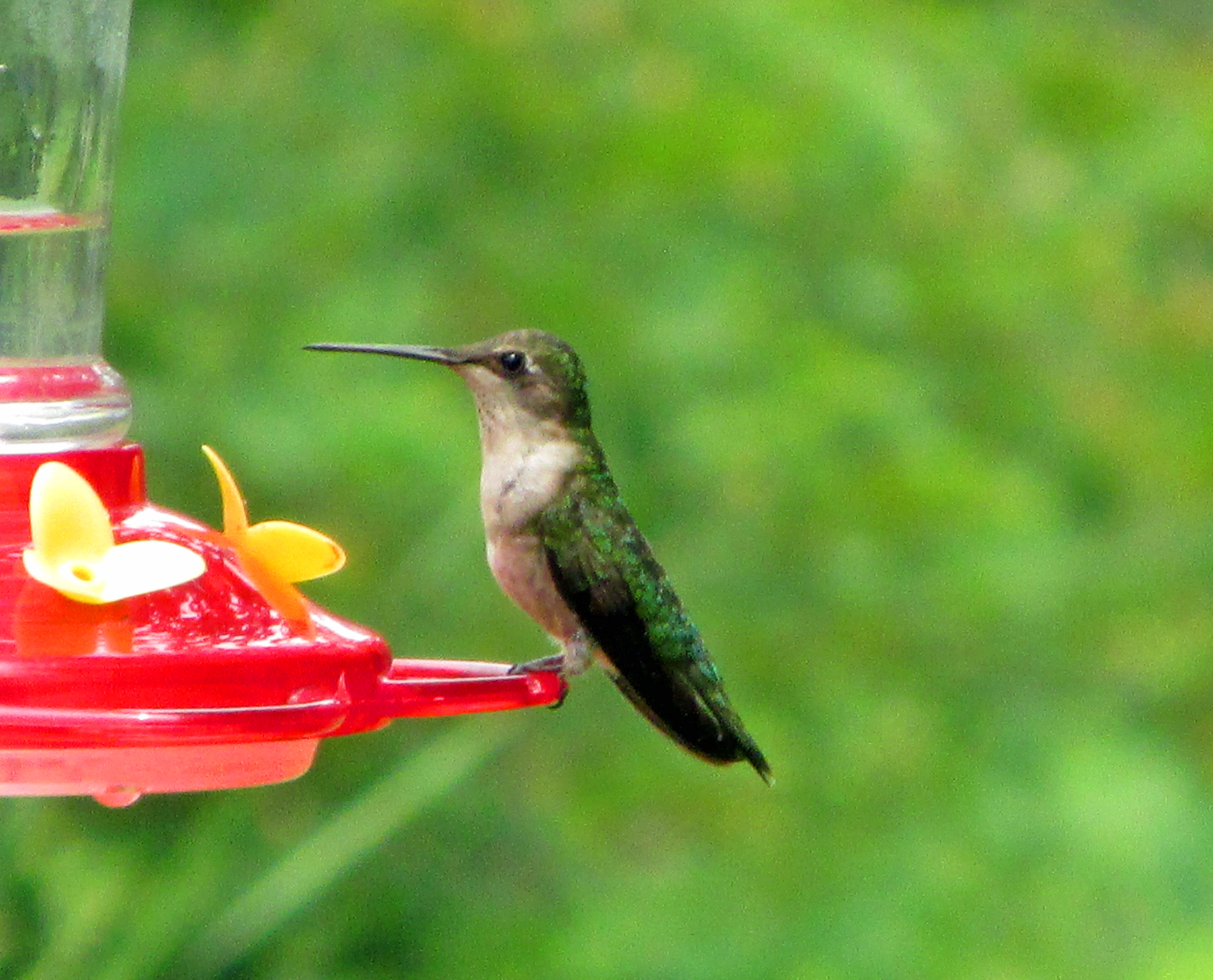
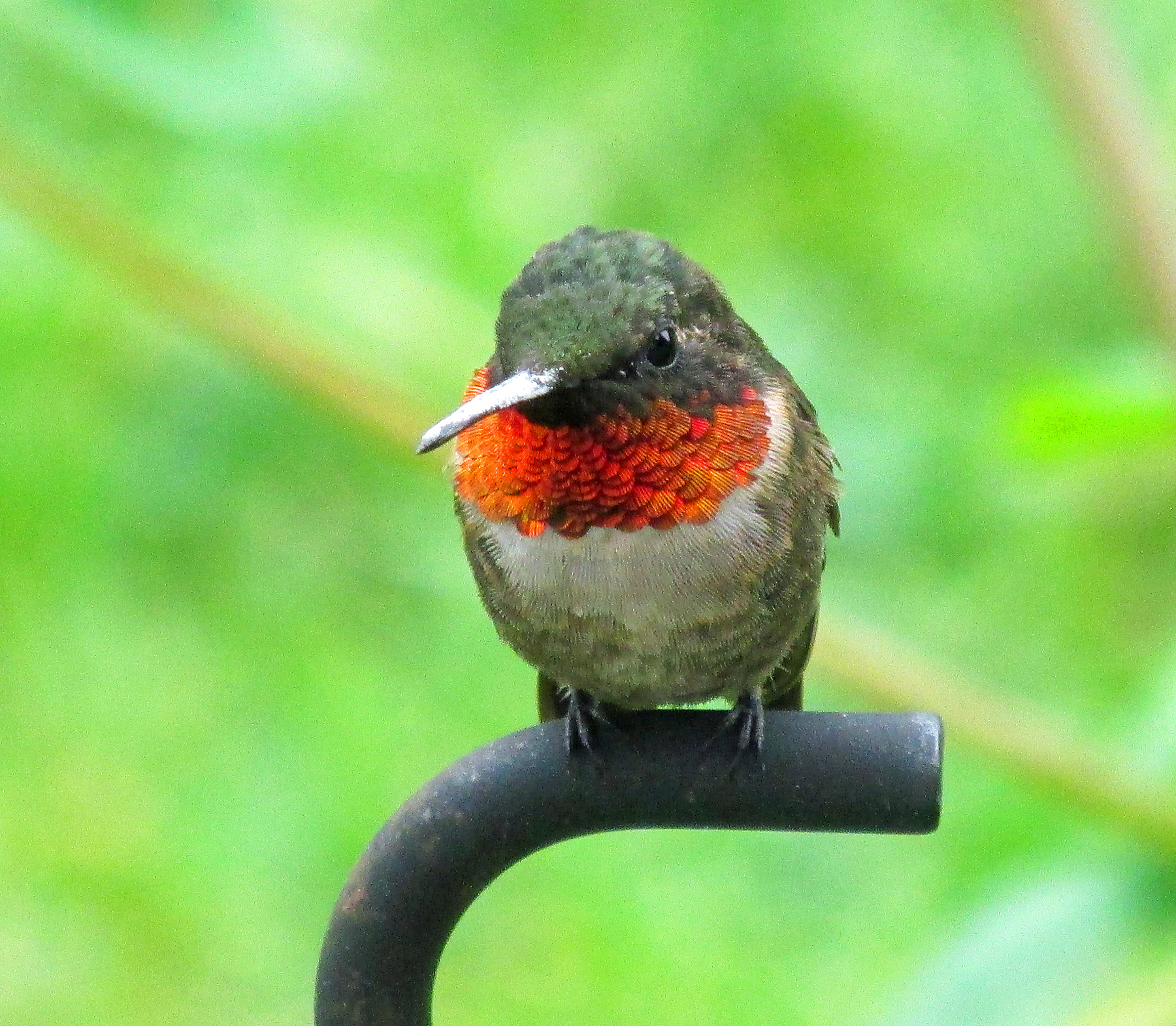
Photo by Bryan Stevens • A male ruby-throated hummingbird surveys his surroundings.

I am still waiting (at the time this post was written) for the first ruby-throated hummingbird of spring. Every year I hope they will make an early appearance, but I am almost always disappointed. These tiny birds always arrive in their own good time and my home is apparently not located within their primary migratory path.

As a consolation prize, however, I have welcomed the first of the spring warblers. I had two black-and-white warblers singing at home on April 9. The black-and-white warbler sings a repetitive song that has been described as a “squeaky wheel” based on the rising pattern of the song’s notes.

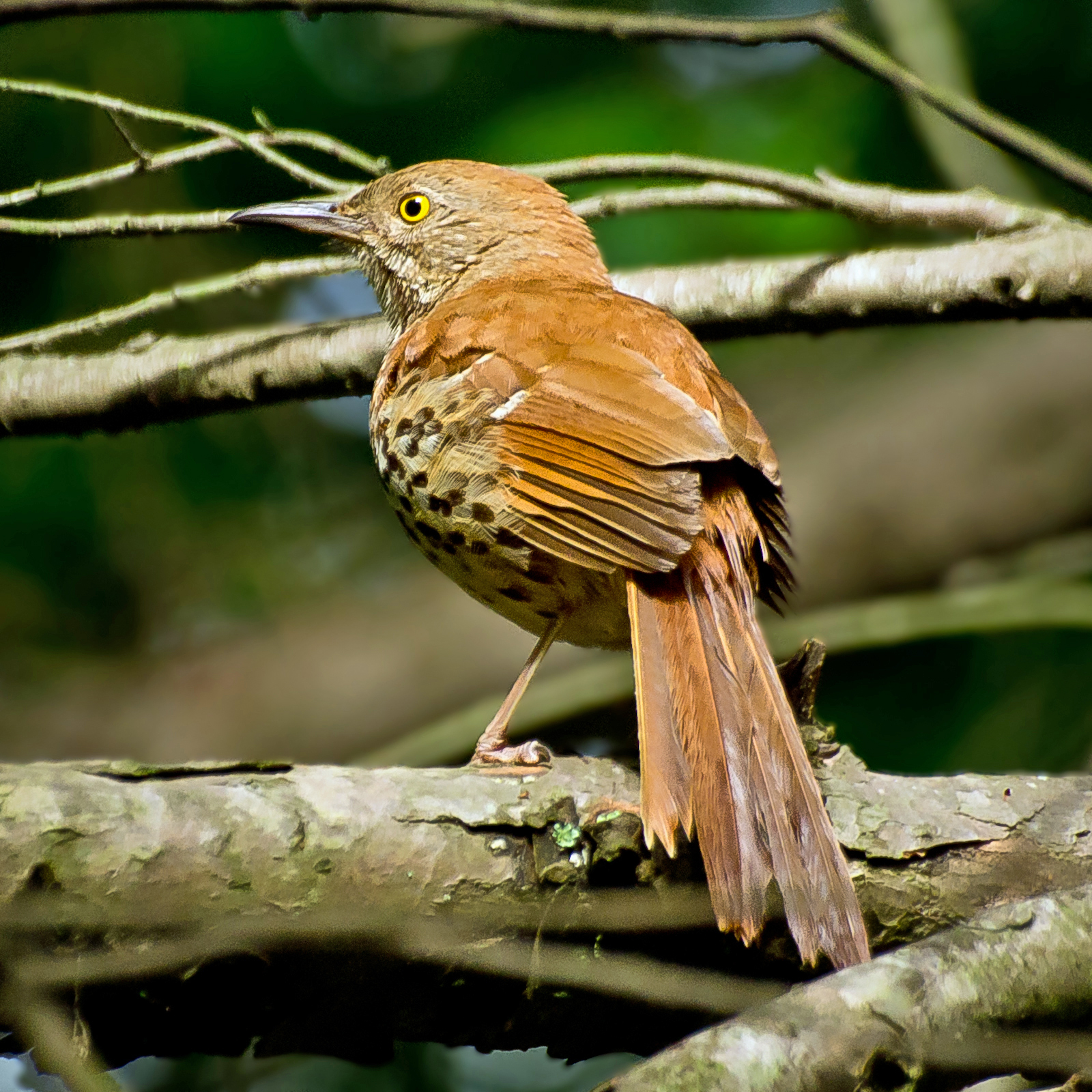
Other recent arrivals have included brown thrasher and tree swallow.

Photo by Ken Thomas
The Brown Thrasher is an alert, sharp-eyed observer of its surroundings.

While I cannot claim to have seen my first spring hummingbird – yet – I can report that hummingbirds are officially back. Some of my Facebook friends have reported their first sightings. Other readers have emailed me to share their sightings.

Nancy Light welcomed back a ruby-throated hummingbird on Sunday, April 7. “I have my sugar water feeders hanging off my fruit trees in the front yard,” Nancy wrote in an email. “I live in Kingsport, but this sighting was at my farm in Duffield, Virginia, in the Fairview community.”

•••

Patricia Faye Wagers in Kingsport saw her first hummingbird of spring on April 8.

“With one, I know more are on the way,” she wrote in a Facebook post announcing her sighting.

•••

Dianne Draper in Jonesborough reported her first hummingbird sighting of spring on April 9 in a Facebook post.

“Never did get a picture of the bird,” she wrote. “Also saw the first broad-winged hawk in the yard,” she added.

Broad-winged hawks, like ruby-throated hummingbirds, are migratory and return to the region in late March and early April.

•••

It’s in Central and South America where the world’s more than 300 species of hummingbirds reach their greatest diversity. In Eastern North America, the only hummingbird known to nest is the ruby-throated hummingbird.

The western half of the United States and Canada can claim about a dozen nesting species, including rufous hummingbird, Allen’s hummingbird, Anna’s hummingbird, broad-tailed hummingbird, black-chinned hummingbird, calliope hummingbird, buff-bellied hummingbird, broad-billed hummingbird and violet-crowned hummingbird.

Hummingbirds, regardless of species, occupy a tough spot in the food chain. A bird not much bigger than many large insects is going to be a target for opportunistic predators that will attempt to kill and consume anything small enough for them to make the effort.

To make matters worse for ruby-throated hummingbirds, some large spiders and mantids, as well as bigger dragonflies, have also been documented as hummingbird predators. When ruby-throated hummingbirds retreat to Central America for the winter months, they also face threats from lizards and snakes.

The list of predators that have been known to eat ruby-throated hummingbirds extends to bullfrogs, as well as many raptors, including kestrels, merlins and sharp-shinned hawks. Blue jays and other birds will raid hummingbird nests for eggs or young. Squirrels and chipmunks are also nest predators.

Photo by Bryan Stevens • Every hummingbird that arrives at your feeder is a survivor.

In essence, every hummingbird visiting your feeders and gardens is a survivor.

And evading an assortment of predators is not their only obstacle. These tiny birds make an awesome yet grueling migratory flight – twice a year – across the Gulf of Mexico. This achievement is a grueling finale for such a tiny creature’s migration. This direct flight alone can take 18 to 22 hours of non-stop flying before reaching land on the other side of the Gulf in states like Mississippi and Texas.

Hummingbirds have fascinated for centuries. Early European explorers sent back reports of amazing little birds that seemed halfway between birds and insects.

In the 1550s, French explorer Jean de Léry published a journal of his travels in Brazil. His account provided the first written description of hummingbirds to reach readers back in the Old World.

This painting, “The Inspiration of Christopher Columbus” by José María Obregón, was painted in 1856 well after the explorer sailed the ocean blue. It’s a reminder that from the moment that European explorers arrived, they were amazed at many discoveries in the New World, including tiny birds that buzzed and hummed around their heads like insects.

Of course, the natives of North America also knew about hummingbirds. In fact, many native tribes held hummingbirds in high regard. Some regarded them as healers. An Aztec deity by the name of Huitzilopochtli had a physical form supposedly comprised of hummingbird feathers that fell from the sky. The Aztecs also believed that fallen warriors were reincarnated as hummingbirds, no doubt because of the feisty and often downright militant attitudes of these tiny birds. Anyone who has ever witnessed hummingbirds dueling at their feeders will know what I mean.

It won’t be long before we have these tiny flying jewels back with us. Once they return, their antics will entertain us for several months before it’s time for them to head south again this fall.

•••

Feel free to continue to share hummingbird sightings with me. Provide the time and date of their arrival. Email me at ahoodedwarbler@aol.com to share a sighting, ask a question or make a comment.

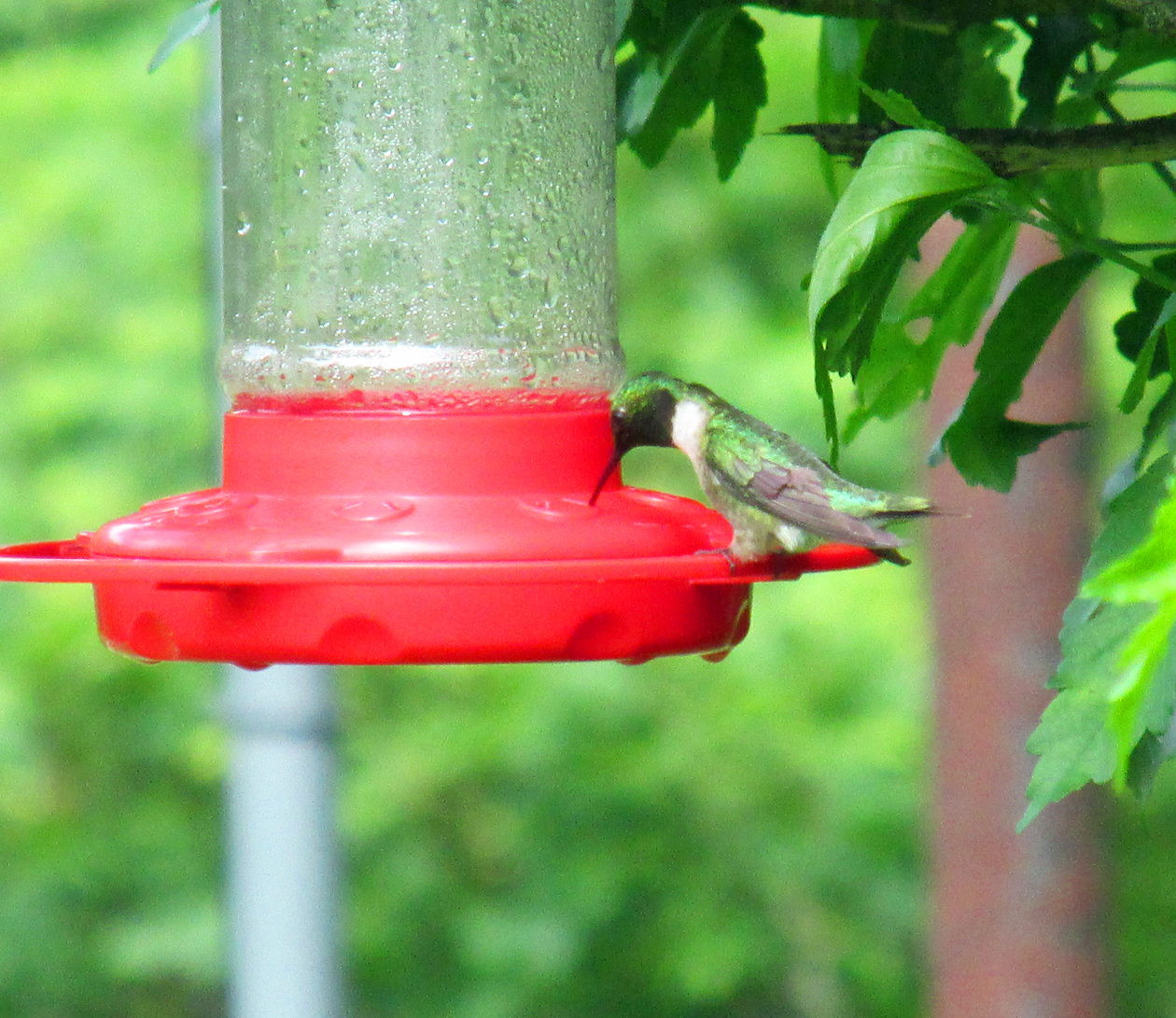
Photo by Bryan Stevens • A ruby-throated hummingbird sips from a sugar water feeder.


Sounds of spring remain one of the season’s pleasures

Photo by Bryan Stevens • Blue-headed vireos, such as this bird, are high-elevation summer residents in the region. In the fall, they are also common migrants.

In modern life, it can seem like we’re always looking for ways to relax and de-stress. For me, nothing works quite so well as letting nature’s sounds, as well as sights, provide some measure of relief from stressful situations and anxious thoughts.

I instantly notice when a new vocalization is added to the usual mix. Such occurred on March 26 when I heard the syllabic song of a blue-headed vireo from the upper reaches of a large tree near the fish pond.

The blue-headed vireo’s song has been described as “Hear me! See me! Here I am!” It’s similar to the song of the related red-eyed vireo, but it’s slower and the paired syllables are separated by a brief pause.

În a couple more weeks, the songs of blue-headed vireos will ring out all over the high-elevation forested slopes of many of our local mountains, but these are just starting to get back to the region after an absence during the colder months. Many other feathered singers will be arriving in their wake, including warblers, tanagers and grosbeaks.

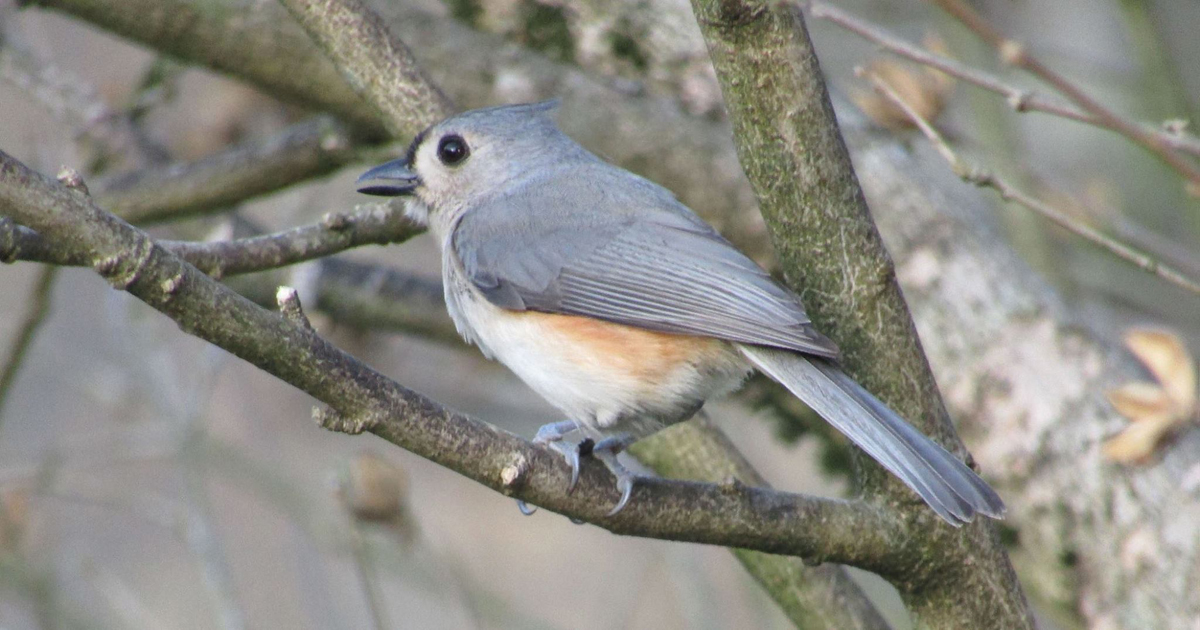
Photo by Bryan Stevens • The tufted titmouse is a backyard bird with an impish personality and a loud song.

The mornings around my home often begin with a loud, insistent “Peter! Peter! Peter!” uttered from the woods or even from shrubbery just outside my bedroom window. Male tufted titmice, little gray relatives of chickadees with a distinctive crest and large, dark eyes, sing their urgent “Peter! Peter! Peter!” as a constant refrain in their efforts to attract mates now that they feel spring in their blood.

A series of rat-a-tat-tats echoes from deeper in the woods as woodpeckers tap their sturdy bills against the trunks of trees. The three most common woodpeckers at my home are red-bellied, downy, and pileated, and they all have their own unique vocalizations, as well.

The pileated woodpecker produces clear, far-carrying resonant piping sounds that can last for a few seconds each blast. The much smaller downy woodpecker produces a whinny of high-pitched notes that descend in pitch toward their conclusion. The red-bellied call is probably the one that stands out the most. The call’s a harsh, rolling “Churr, churr, churr” given almost like an expression of exasperation as they circle tree trunks and explore branches.

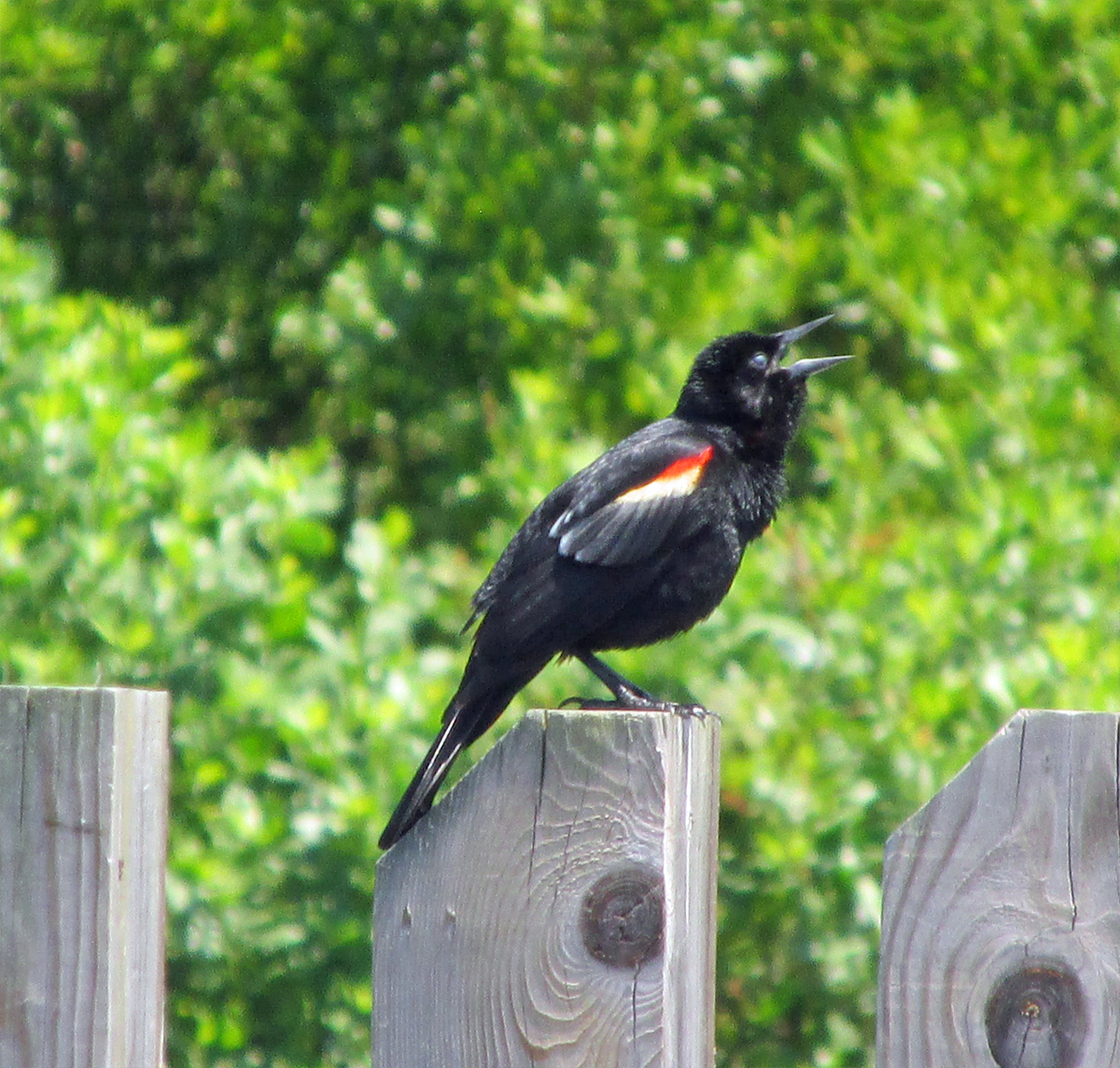
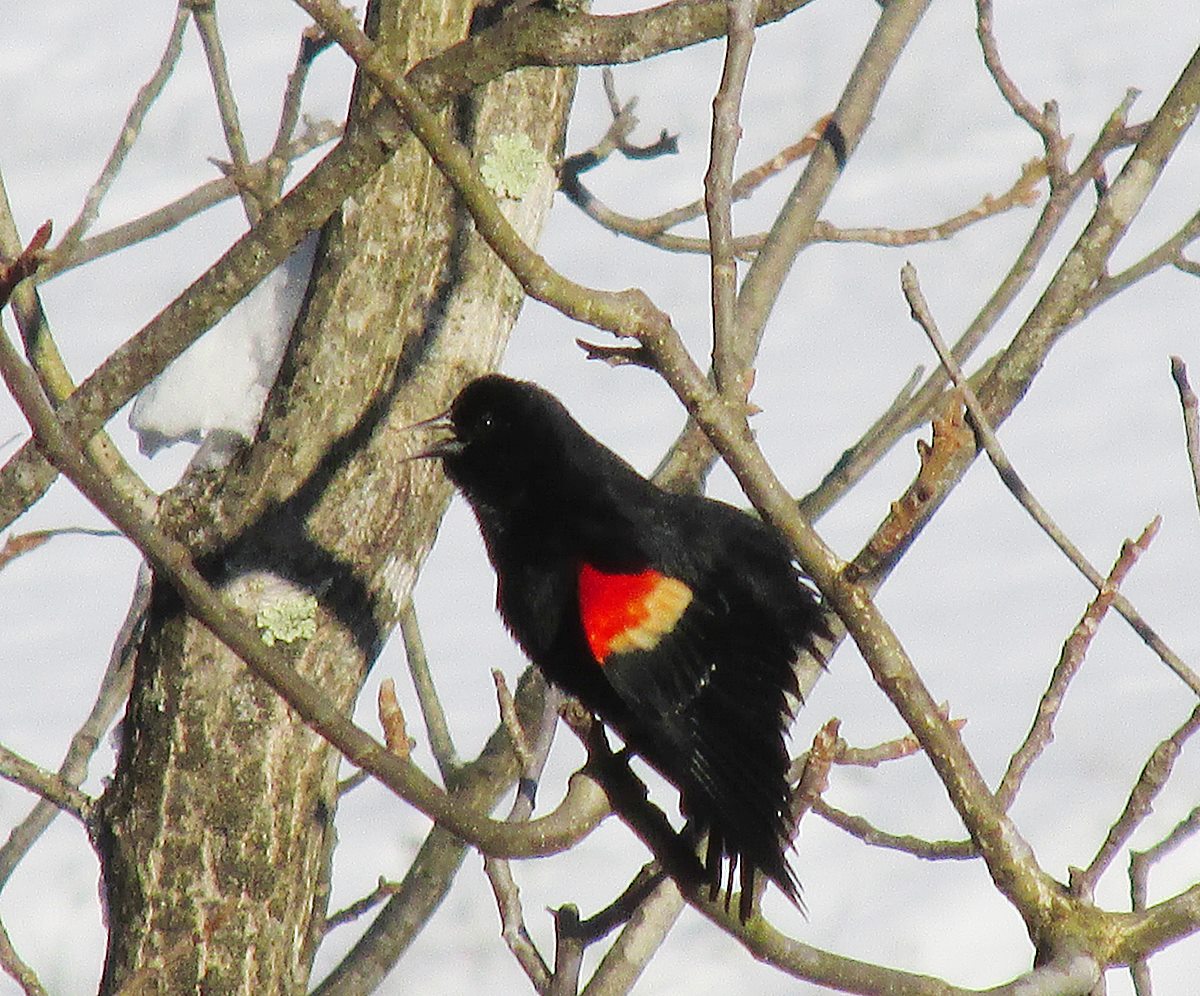
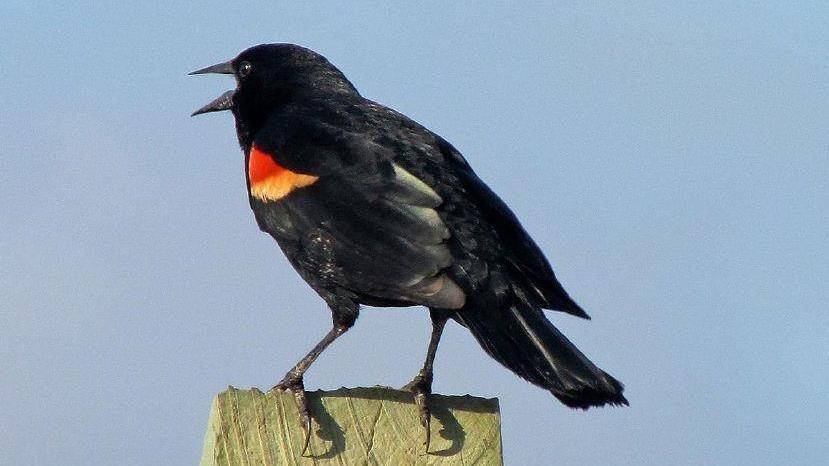
Since their return earlier this month, the resident red-winged blackbirds are often some of the earliest singers these days. According to the website All About Birds, the male red-winged blackbird’s “conk-la-ree!” is a classic sound of wetlands across the continent of North America. According to the website, the one-second song starts with an abrupt note that transforms quickly into a musical trill.

Photo by Bryan Stevens • A male red-winged blackbird sings to attract mates and ward off rivals.

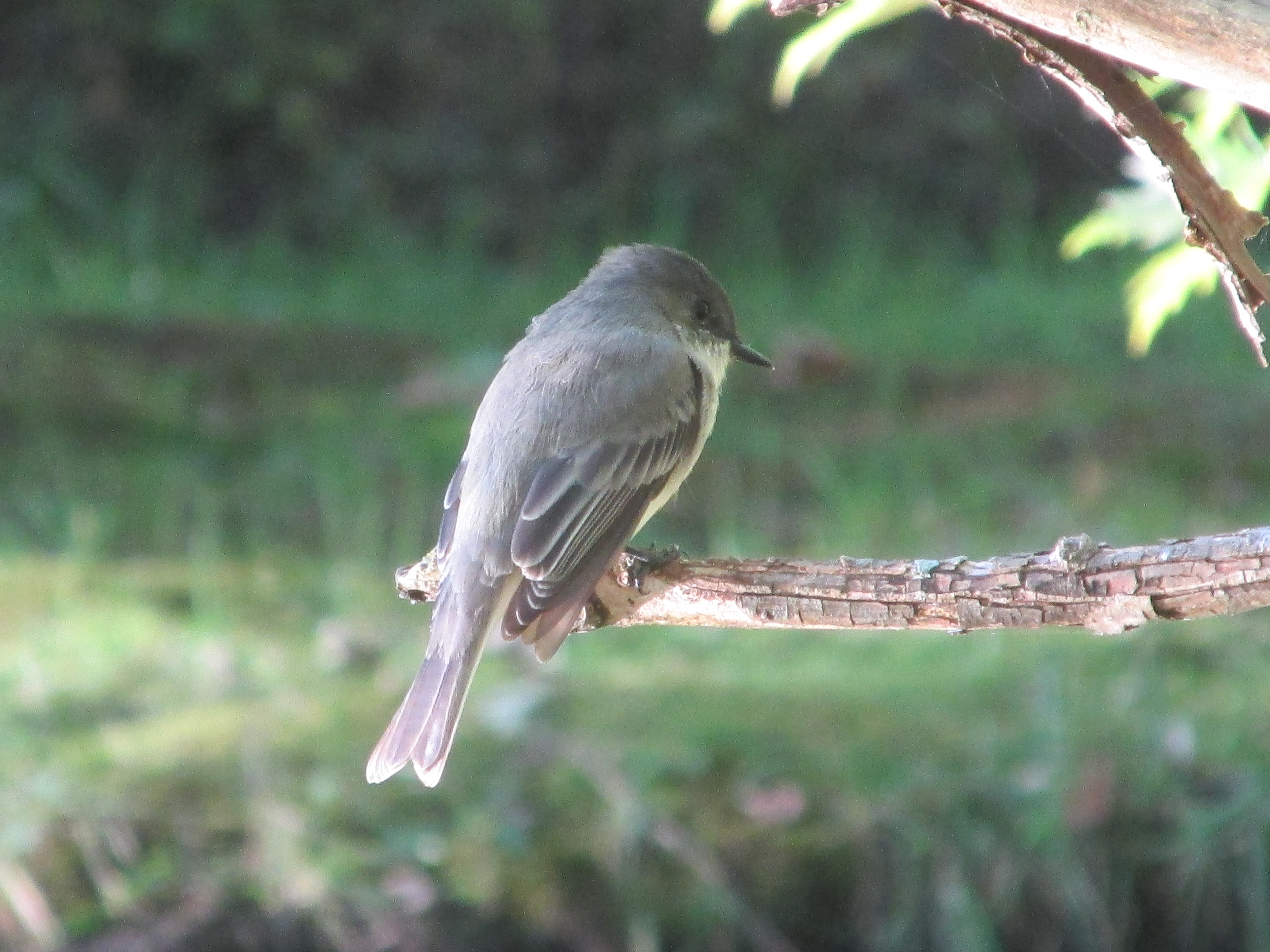
Some birds helpfully introduce themselves with a song that repeats their name. One such common bird is the Eastern phoebe. In recent weeks, a pair has been checking out possible nesting sites. In past years, they have made use of the rafters of my garage and blades on a porch ceiling fan for potential nest sites. The male spends much of the day producing his strident “fee-bee” call, which is a perfect phonetic rendition of the bird’s common name.

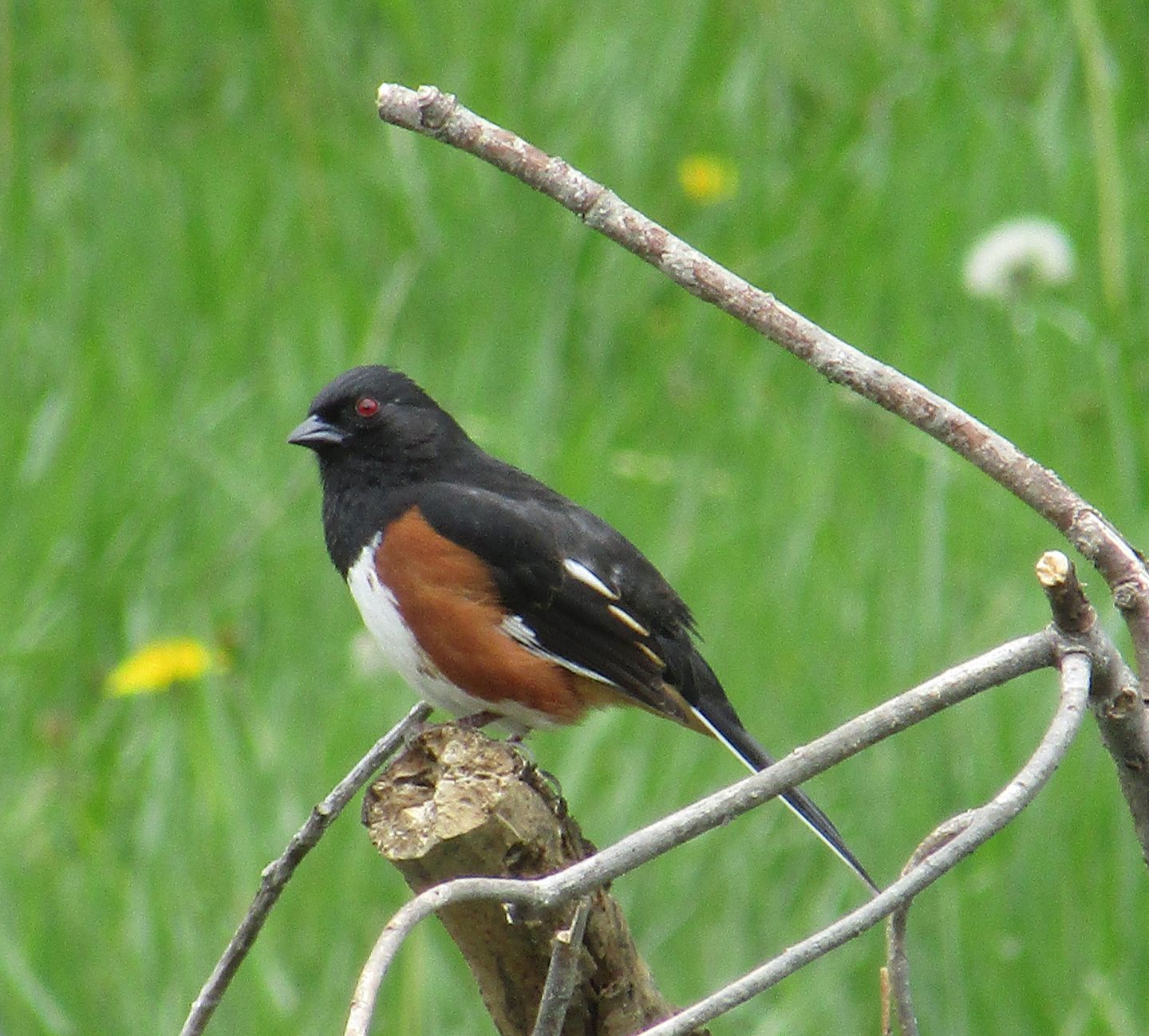
Then there’s one of my favorite songs of spring, which is produced by the Eastern towhee, also known by such common names as “ground robin” and “swamp robin.” These birds, which are actually a species of sparrow, also have some instantly recognizable vocalizations. With the arrival of spring, the males seek elevated perches for extensive singing bouts to attract mates and establish territories. Their song has been interpreted, quite accurately, as “drink your tea!” They also have some alarm notes, such as “€œChew-ink”€ and “€œToe-Hee,” of which the latter provides the basis for this bird’s common name.

Photo by Bryan Stevens • Male Eastern towhees are persistent singers once they establish  a spring territory.

Towhees occasionally spend the winter, but I’ve not noticed any during the winter of 2023-24. They are back now, and have been keeping a high profile for the past couple of weeks.

Of course, other wildlife is keen to join the springtime chorus. I have so many spring peepers at the fish pond and in the wet fields around my house that the noise from these tiny amphibians can reach deafening levels. The chorus is bound to grow more diverse and louder as spring advances. Take some time to enjoy the sounds of nature at your own home.

••••••

To share your own sighting, make a comment or ask a question, send email to ahoodedwarbler@aol.com. I’m also on Facebook.

New arrivals include spring’s first warblers

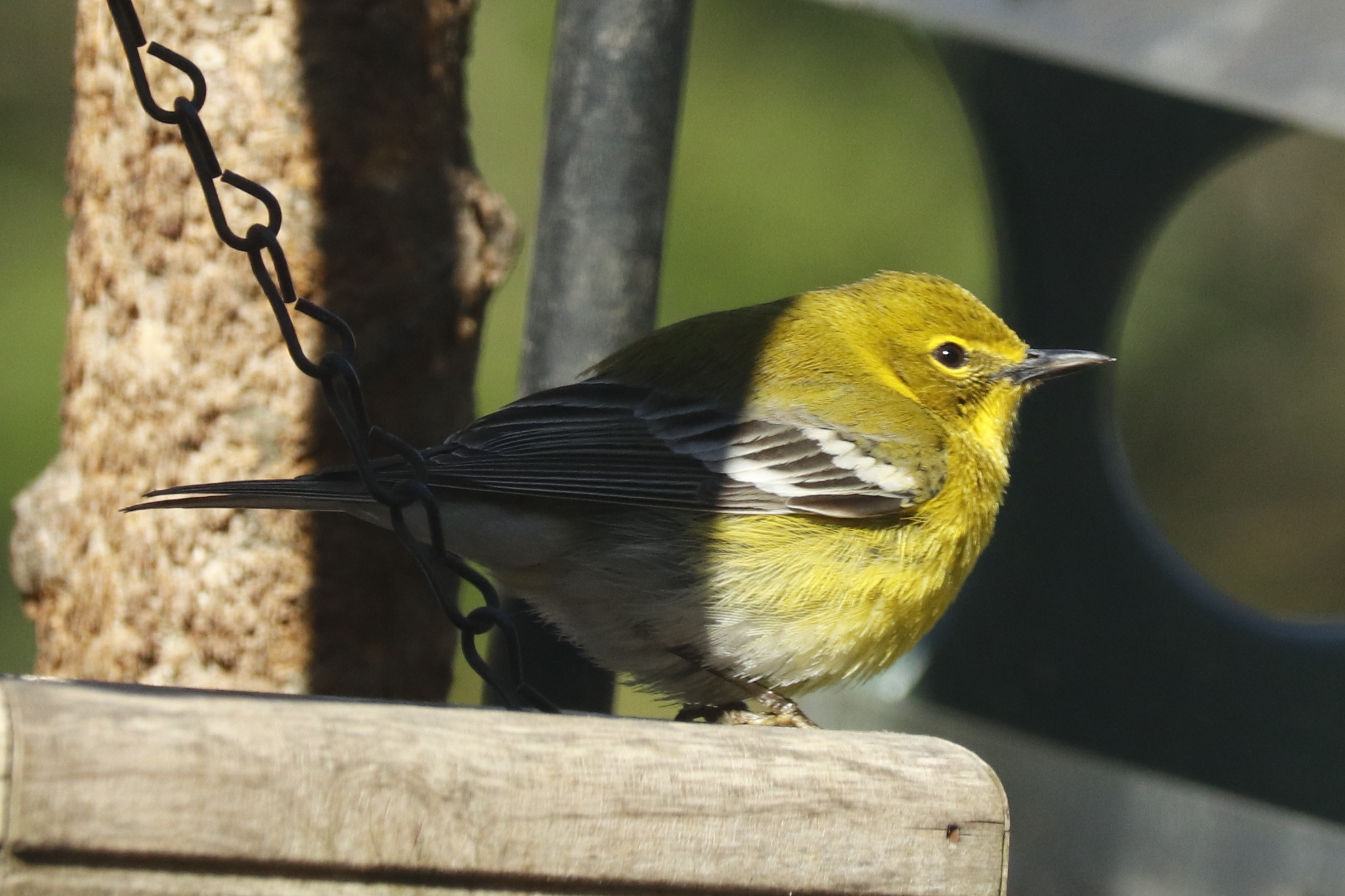
Photo by Kaylynn Wilster • Pine warblers, like this individual, have become more adaptable, learning to accept food at feeders and helping them remain in the United States during the winter season.

Mystery bird
Kaylynn Wilster, who lives in Piney Flats, Tennessee, emailed me recently for help with an identification on a bird visiting her feeders. When she described the bird and mentioned its fondness for suet at her feeders, I immediately suspected the identity of her visitor. A photo she provided gave instant verification that her visiting bird is, as she suspected, a warbler. To be exact, she is hosting a pine warbler.

The pine warbler is an attractive member of its clan with a plumage consisting mostly of various hues of yellow, olive and gray. Some males will show extremely bright yellow feathers, but females and young birds may show only a bare minimum of yellow coloration.
Unlike warblers such as the magnolia warbler and the palm warbler, the pine warbler truly does have an affinity for the tree for which it’s named. Magnolia warblers, on the other hand, are really more at home gleaning the branches of spruce trees while a weedy field is often the preferred habitat of a palm warbler.

Photo by Kaylynn Wilster • A pine warbler feeds on suet at a hanging feeder.

Look in the pines
The pine warbler is rarely found away from pine trees, but the bird is not too particular about the type of pine, being known to frequent about a dozen different varieties of pine trees. According to the website All About Birds, some of the favored pines include jack, pitch, red, white, Virginia, loblolly, shortleaf, slash, sand and pond pines.

The pine warbler is slightly less of an insect-eater than other warblers. This warbler will also feed on fruits, berries and some seeds. All About Birds states that some favored fruit includes bayberry, flowering dogwood, grape, sumac, persimmon and Virginia creeper.

When a pine warbler visits feeders, however, it’s often looking for supplemental protein. This fact explains why suet cakes, as well as homemade or commercial mixtures of suet and peanut butter, are one of the best ways to lure these warblers to feeding stations.

The population of this warbler has actually been on the increase since 1966, according to various surveys conducted on pine warbler numbers. Almost the entire population spreads out across the eastern United States, with much lesser numbers of pine warbler making their home in Canada.

Warbler migration
Kaylynn’s pine warbler is likely an early spring migrant or a pine warbler that elected to spend the winter months in the region. While warblers are scarce between October and March, their numbers are about to take off in a big way.

In April and continuing into May, a couple of dozen warbler species will pass through Tennessee. Some of these warblers find area woodlands and other habitats to their liking. They will pause, explore and perhaps decide to spend their summer nesting season in Northeast Tennessee and Western North Carolina rather than continue migrating farther north.

Many of the warblers that pass through each spring, however, are destined to travel a much longer distance before settling down in their favored habitats for the summer nesting season. These warblers include the Tennessee warbler, Nashville warbler, Cape May warbler, blackpoll warbler and Blackburnian warbler. Most of these species nest as far north as New England and Canada.

Others find the Southern Appalachians to their liking. Some of the first warblers to return each year include the Louisiana waterthrush, which favors rushing mountain streams, as well as species such as black-throated green warbler, hooded warbler, ovenbird, worm-eating warbler and common yellowthroat.

Photo by Jean Potter • A male hooded warbler flits through the foliage of a rhododendron thicket.

Kaylynn mentioned that her pine warbler has graced her with frequent bursts of song. This fact indicates that her bird is a male. Pine warblers are persistent singers, but they often sing their songs from the upper branches of tall pines, effectively camouflaging themselves from view. Pine warblers have become more frequent feeders visitors in recent decades, which brings them into closer proximity to humans than would otherwise be the case.

New Arrivals
A pair of wood ducks brought company when they returned to the fish pond on April 2. They were accompanied by a pair of mallards. Although our most common duck, mallards haven’t visited my pond for several years. It felt good to have them back. I’m hoping both the wood ducks and mallards might decide to use the pond as a home base throughout the spring and summer.

On April 7, I heard the first chipping sparrow of spring. This small, dapper sparrow has an easily recognizable song. All About Birds describes the song as “a long, dry trill of evenly spaced, almost mechanical-sounding chips,” to which I concur.

A pair of tree swallows arrived at my home on April 8. I wrote in last week’s column about these swallows and their anticipated return.

The first warbler of spring – a male Northern parula – arrived April 9. I heard his trademark buzzy song as I left for work.

Photo by Bryan Stevens • A Northern parula hides in the canopy while singing its buzzy song.

I still haven’t seen the first spring ruby-throated hummingbird, but I have received a report from North Carolina.

Susie Parks, who lives in North Cove in McDowell County, North Carolina, emailed me to report that she saw her first hummingbird of the season at 9:30 a.m. on Thursday, April 1.

She even elaborated on the “funny” timing.

“I assure you this is not an April Fool’s joke,” Susie wrote. “We are, indeed, thrilled to have seen this amazing little creature on such a chilly morning.”

I wrote back congratulating her on her sighting, which only makes me more impatient to have these delightful little birds back in my own yard.

Photo by Bryan Stevens • Despite a perceived disadvantage of size, ruby-throated hummingbirds are quite capable of thriving in a giant world.

Journey North, a website that tracks hummingbird migration, as well as the migratory journeys of other wild creatures, reports that hummingbirds have reached Tennessee. A posting for a woman in Clinton, Tennessee, reported a ruby-throated hummingbird on Monday, April 5.

Hummingbird Anticipation

The arrival of ruby-throated hummingbirds is one of the most anticipated returns each spring. As I’ve done in years past, I want to hear from readers when they see their first hummingbird of spring. Email me your observations at ahoodedwarbler@aol.com or post them on my Facebook page. Please include the date and the approximate time of your sighting.


Mississippi kite glimpsed on spring count becomes latest listed ‘life bird’

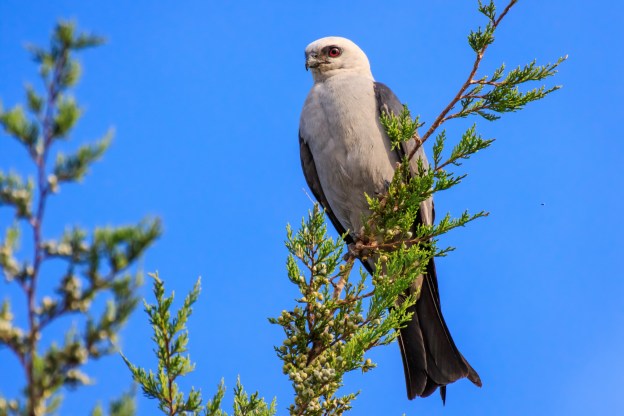
Photo by Richard/Adobe Stock • A solitary Mississippi Kite sits perched in a lakeside tree. These graceful raptors take their prey mostly while on the wing.

If you know many birders, you have likely heard them talk about “life birds.” These are any species that a birder has seen and identified in the wild for the very first time. It can be any bird species at all that the birder observes for the first time, whether it is a commonplace bird like a song sparrow or something slightly more exotic.

While taking part in the 77th consecutive Elizabethton Spring Count on Saturday, May 2, I saw something that, for our region, could be considered a little more exotic. The sighting certainly ranked as unexpected.

Unless one travels extensively, life birds can be hard to get once people have added to their lists most of the common birds around their homes. Finding a life bird during the ongoing pandemic brings its own challenges. I haven’t added a new life bird to my own list since a visit to South Carolina in June 0f 2016. During that visit to Huntington Beach State Park, I added a least bittern to my list of “life birds.”

My most recent “life bird” appeared closer to home and might qualify as my most unexpected life bird ever. The bird flew into view and onto my life list during the annual Spring Bird Count, which was conducted by members and friends of the Elizabethton Bird Club. Due to social distancing, many participants counted solo this year, myself included, although a few married couples birded together. I’ll always remember my pandemic spring count, especially for the 46th bird on my tally list for the day.

I found myself in the parking lot at Sycamore Shoals State Historic Park in Elizabethton around 11 in the morning. I wanted to scan the evergreens in that vicinity for Cape May warblers, a migrant that finds the tall conifers to its liking. I didn’t find any warblers, but I did surprise a perched raptor into making a short flight.

The instant I saw the bird launch itself into flight, I knew I was watching something out of the ordinary. The bird flew with a combination of grace and power that reminded me of a falcon, but I also glimpsed a barred tail that reminded me of one of the accipiter hawks. Then it landed on a dead branch in a tall sycamore that must have permitted the raptor an unobstructed view of the entire park. Although I’d never until that moment seen a Mississippi kite, I have studied illustrations and photographs. I felt fairly certain of the bird’s identity even before I used my phone to call up some birding sites to confirm my identification.

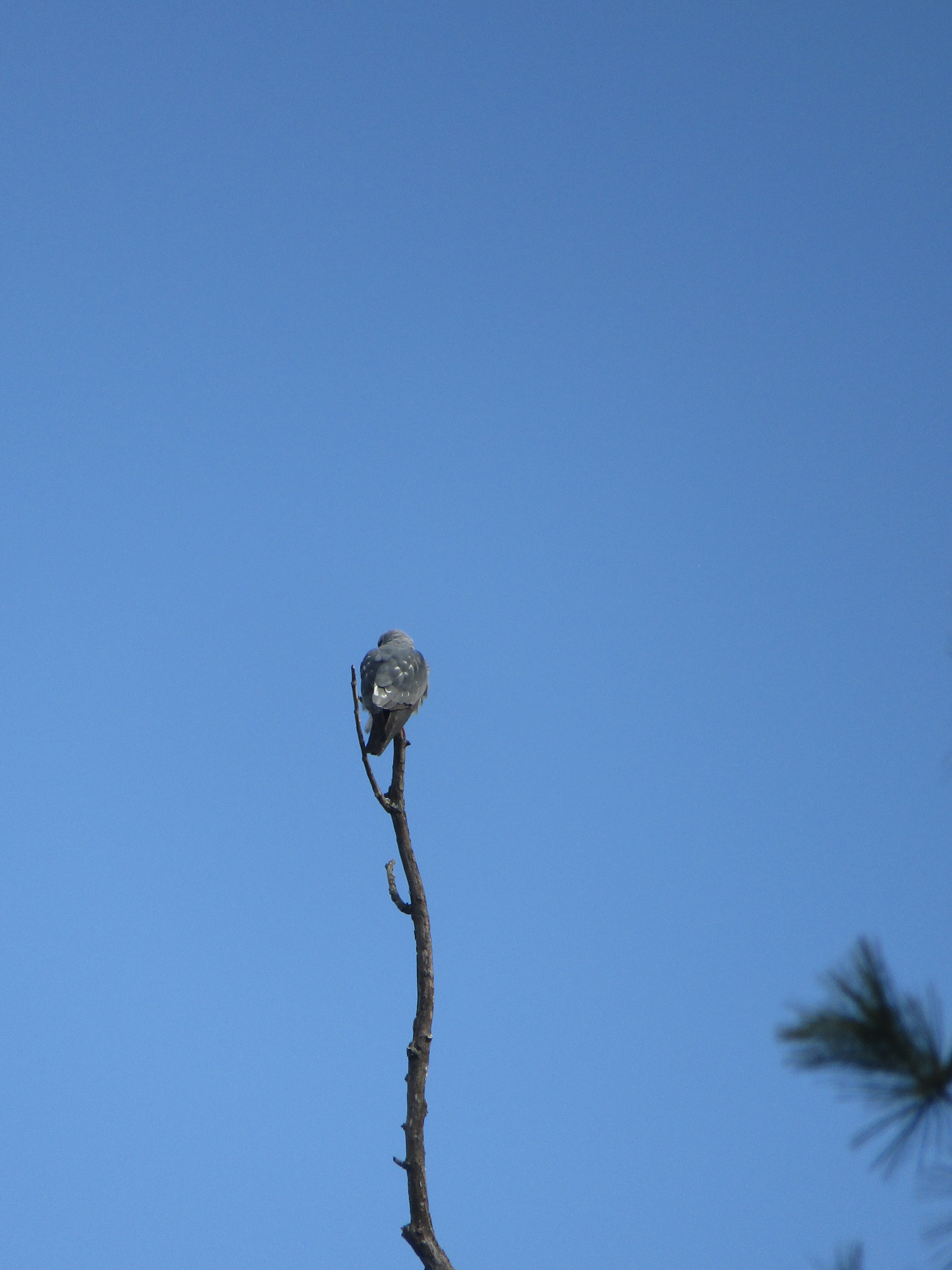
Photo by Bryan Stevens • This Mississippi Kite became the first of its kind ever observed on one of the Elizabethton Bird Club’s Spring Bird Counts for Northeast Tennessee.

That’s when the fact I was birding solo hit home. I wanted some additional witnesses to this very unexpected find. In lieu of other observers, I turned to my camera. The bird had turned its back to me, but I snapped some photos and then made my way to a position that I hoped would allow for better photographs.

Alas, the resident American crows at the park had different ideas. Detecting a raptor in their midst, about a half dozen crows gathered to harass the perched kite. Before I could snap a new round of photos, the kite took flight and flew into a stand of tall trees located between the park and Sycamore Shoals Hospital.

Only a few years ago, a Mississippi kite in Northeast Tennessee would have been unheard of. The hills and mountains of the region are simply not the expected habitat for these graceful raptors. Faith Reeves, a resident of Elizabethton, Tennessee, a Facebook friend and fellow birder, saw the first two Mississippi Kites ever found in Northeast Tennessee. She saw and photographed the birds in her own yard on May 20, 2014, and May 13, 2016.

In addition, Don Holt observed a Mississippi kite in Washington County, Tennessee, on April 16, 2017.

Rick Knight and several other birders also saw several Mississippi Kites for about a week in late August of 2016. Observers estimated that these sightings involved from two to five different kites.

“The August observations are our only fall records,” said Rick Knight, a long-time compiler of birds sightings in the region. He added that fall is the season when kites are likely to linger.

“All spring records are overshooting migrants and are one-day-wonders,” Knight explained.

Hearing his explanation, I felt even more privileged to have witnessed this “one-day wonder” in my home county.

Photo by Myriams-Fotos/Pixabay.com • The red kite is an abundant member of the kite family in Europe and northwest Africa.

The Mississippi kite is a beautiful raptor. Adults are grayish-white with the head often appearing pale gray or almost white. Although the Mississippi kite can attain a wingspan of three feet, these birds weigh only seven to thirteen ounces. They feed almost exclusively on insects, which they capture in flight. Some of the insects, such as cicadas and grasshoppers, are ones that damage crops, making the Mississippi kite a friend to farmers.

These kites breed and nest in the central and southern United States, but they have expanded their range north in recent years. They leave the United States in fall to spend the winter in southern South America.

Several years ago I got the thrill of adding a swallow-tailed kite to my life list in some agricultural fields in southwestern Washington County. I’ve also seen swallow-tailed kites in Florida. There is one other member of the kite family that I’d like to add to my list. The snail kite is a dark bird with a hooked beak designed for feeding on snails found in wetlands. This specialist resides in Florida, as well as the Caribbean and Central and South America.

Other kites found around the world include the double-toothed kite, plumbeous kite, whistling kite, square-tailed kite, red kite and black kite.

It’s been a spring filled with many amazing bird observations. I can’t speak for others, but thanks to that remarkable kite sighting and glimpses of some other fascinating birds, not even having to bird solo in a pandemic can bring me down. I’ll provide more details on this year’s Spring Bird Count for Northeast Tennessee in next week’s column.

Photo by Bryan Stevens • Mississippi Kite perched in a tree prior to being dispersed by some defensive American crows.

Migrating rose-breasted grosbeaks thrill observers with recent visits

Photo provided by Shannon Stimson • A male rose-breasted grosbeak checks out some well-stocked feeders.

They’re not as dependable as ruby-throated hummingbirds, but they are every bit as impressive. Of course, I am referring to rose-breasted grosbeaks, which have been delighted people across the eastern half of the United States for the past couple of weeks.

Among these grosbeaks, it’s the male that wears the exquisite apparel. Males have a black head, wings, back and tail, with a bright splash of rose coloring across the front of their breast. Males and females exhibit marked sexual dimorphism, which is simply a scientific way of saying that males and females are quite different in their appearance.

The female rose-breasted grosbeak lacks the male’s showy plumage. She could easily be mistaken for a large, chunky sparrow with her brown, streaked feathers. She does have the large beak in common with the male. In fact, the term “grosbeak” is derived from German and simply means “big beak.” Incidentally, I’m told by bird banders that rose-breasted grosbeaks can give a nasty nip with that sizable and sturdy beak.

My email in-box and my Facebook page have been active this migration season with reports from people eager to share observations of these showy songbirds.

Carla Honaker sent me an email on Monday, April 27, about visiting rose-breasted grosbeaks.

“Two days ago I ran out of bird seed and changed from a mix to a black oil seed,” Carla reported. “I had heavy bird traffic yesterday and this morning my mother went over to open the blind that faces the front yard where the bird feeder hangs on a limb in a dogwood tree. To her surprise, there was a rose-breasted grosbeak sitting on the feeder eating the sunflower seeds.”

Understandably, Carla and her mother were very excited to see this unknown visitor at the feeder. Curious about the bird’s identity, Carla used the app Cornell Lab Merlin and made the identification.

Photo by Paintspreader/Pixabay.com • Male rose-breasted grosbeaks provide a jolt of excitement during migratory stopovers in yards and gardens throughout the eastern United States every spring.

Carla said the grosbeak stayed around for a few more minutes, long enough for her to take a picture of the side of his wing and back and tail.

She also had a question, asking if there are many rose-breasted grosbeaks in this area and whether there is a chance he will be a regular at her feeder.

Photo by Bryan Stevens • A male rose-breasted grosbeak perches in a tree on Roan Mountain in Tennessee.

Alas, rose-breasted grosbeaks are usually only spring and fall migrants unless one lives in the higher elevations of some of our local mountains. Visit area mountains in summer if you want to see these birds away from your feeders. They’re still fairly common in the region, but sadly, their numbers have declined overall.

I also let Carla know that grosbeaks are very fond of sunflower seed, so changing the mixed seed to black oil sunflower was probably helpful in attracting the visitor.

Elizabeth “Liz” Wynacht, who lives outside Atlanta in the town of Roswell, Georgia, also shared her own rose-breasted grosbeak story in an email she sent to me on Wednesday, April 29.

Elizabeth provided some interesting background to preface her story. “A few years ago, I looked up and saw this bright red “kiss” on this creamy colored breast of a bird,” she wrote. “I ran in to get my camera but he was gone when I got back. After researching what I thought I saw, my guess was a grosbeak. I have been looking for him ever since.”

Photo Provided by Byron Tucker • A male rose-breasted grosbeak squares off with a red-bellied woodpecker in the suburbs of Atlanta, Georgia.

After a couple of years, her wait ended. “This past Friday, while sitting on my porch, I looked up from my phone, and I saw that beautiful red kiss coming toward the feeder,” she wrote. “Of course, my movement startled him and he flew away.”

Once again, she fetched her camera and waited. Liz reported that the male grosbeak showed up again along with his little wife. They visited for three days.

“He was a wonderful surprise in the midst of this crazy pandemic,” Liz wrote. “Really lifts the spirit to see such a beautiful bird.”

Shannon Stimson sent me an email on Monday, May 4, with some attached photos of male rose-breasted grosbeaks. “I had three males at my feeders two days ago followed by one female,” Shannon wrote. “One male that looked less mature stayed on for two days gorging on nuts and seeds for hours and engaging in a slight disagreement with a red-headed woodpecker over possession of the feeder.”

Sadly, Shannon reported that the grosbeaks moved on, but noted that their visit brought a great deal of cheer in this isolating time.

Photo by Bryan Stevens
A rose-breasted grosbeak finds a meal of sunflower seeds at a feeder.

Kaylynn Wilster, who lives in Jonesborough, Tennessee, emailed me on Thursday, April 30, about her own rose-breasted grosbeak sighting. “He was not afraid of me and let me walk around the yard,” she wrote.

The very same day that Kaylynn saw her grosbeak, I looked out my window and saw one at my feeders. There had been a storm the previous night, so I suspect that helped “persuade” the bird to visit.

I posted on Facebook about my sighting and several friends shared their own.

“I was just reading an old article of yours about rose-breasted grosbeaks and, lo and behold, I have a flock of them hanging out on my feeders for the first time ever,” wrote Mary Ragland in a Facebook message to me.

Carolyn Grubb in Washington County, Virginia, reported seeing one.

Amy Wallin Tipton, who lives in Unicoi County, Tennessee, reported that her parents had been hosting a male and female rose-breasted grosbeak for the past two days.

James and Pattie Rowland, of Erwin, Tennessee, also reported on Facebook sightings of rose-breasted grosbeaks.

Keep the reports coming. If nothing else, sharing bird sightings is a way to feel less socially distant from others.

Photo Provided by Elizabeth “Liz” Wynacht  • A male rose-breasted grosbeak visits a feeder in a suburban area near Atlanta, Georgia.

Stunning summer tanager a lesser-known relative of scarlet tanager

Photo Provided by Helen Whited • A male summer tanager visits a feeder during a migration stop in southwest Virginia.

Helen Whited, a resident of Richlands, Virginia, recently emailed me a photo of a feathered visitor in her yard asking for help with identification. She had already narrowed down the possibilities. “I’m thinking a tanager of some kind,” Helen wrote in her email.

When I opened Helen’s attached photo file, I recognized the plump, red bird perched on her feeder near a suet cage. I wrote an email back, informing Helen that her visitor was indeed a tanager. The summer tanager is not rare, per se, but these birds do not seem as common in the region as the related and better known scarlet tanager. Farther south, summer tanagers are much more prevalent in the spring and summer months.

Helen also reported seeing her first ruby-throated hummingbird of spring on April 25. “It’s later than usual, but they’re here,” she wrote in an email.

She added that several neighbors in Richlands, Virginia, reported seeing hummingbirds as early as April 21, but they seemed to be shunning her until the morning of April 25.

Since the last couple of columns have been about hummingbirds, I want to shift the focus this week to Helen’s other visitor.

If the casual birder or nature enthusiast is aware of the summer tanager, it’s usually as the less showy cousin of the more fiery and vibrant scarlet tanager, one of the most striking birds inhabiting woodlands in the eastern United States.

That’s a shame, for many reasons.

Photo by Ronald Plett/Pixabay.com • A male summer tanager perches in the leafy canopy.

First and foremost, the summer tanager holds one unique distinction. The male summer tanager is the only completely red bird in North America. Other birds known for their red plumage — Northern cardinal, house finch, vermillion flycatcher — show other colors in their feathers besides red.

The strawberry-colored male summer tanager is often difficult to spot due to a propensity to keep hidden against the green leaves of the forest canopy. The website “All About Birds” describes the female as “mustard yellow” in her coloration, which is rather apt. Female summer tanagers are usually less greenish than female scarlet tanagers. The female is even harder to spot than the male, though both sexes have a very distinctive chuckling call note.

Over the years, different local spots have proven reliable for finding summer tanagers. Large trees near the Steele Creek Park Nature Center in Bristol, Tennessee, used to be a fairly dependable location for these tanagers during late spring and summer.

Early American naturalist and artist John James Audubon painted this work featuring a family of summer tanagers.

The summer tanager is classified in the genus Piranga, which includes the scarlet tanager as well as the western tanager of the states west of the Rocky Mountains. This genus also includes the flame-colored tanager, white-winged tanager and red-headed tanager. Experts now classify this genus with members of the cardinal family and have separated the Piranga tanagers from other New World tanagers.

The song of the summer tanager has been described as similar to that of the American robin. Like the scarlet tanager, the summer tanager is fond of fruit and berries, but it also eats insects, often catching them on the wing.

Confined mostly to the eastern United States during the nesting season, the summer tanager doesn’t range as far north as the scarlet tanager, making its stronghold in the Gulf and southern states.

The summer tanager’s scientific name, Piranga rubra, translates as “red bird.” It’s not really clear why this tanager acquired the word “summer” in its common name. After all, both the summer tanager and scarlet tanager are only present in North America for a brief nesting season from late April to early September.

Other birds besides tanagers are on the move as spring migration continues. Get outdoors and see what wanders into your yard or garden. To share your own observations, email me at ahoodedwarbler@aol.com. I’m also on Facebook.
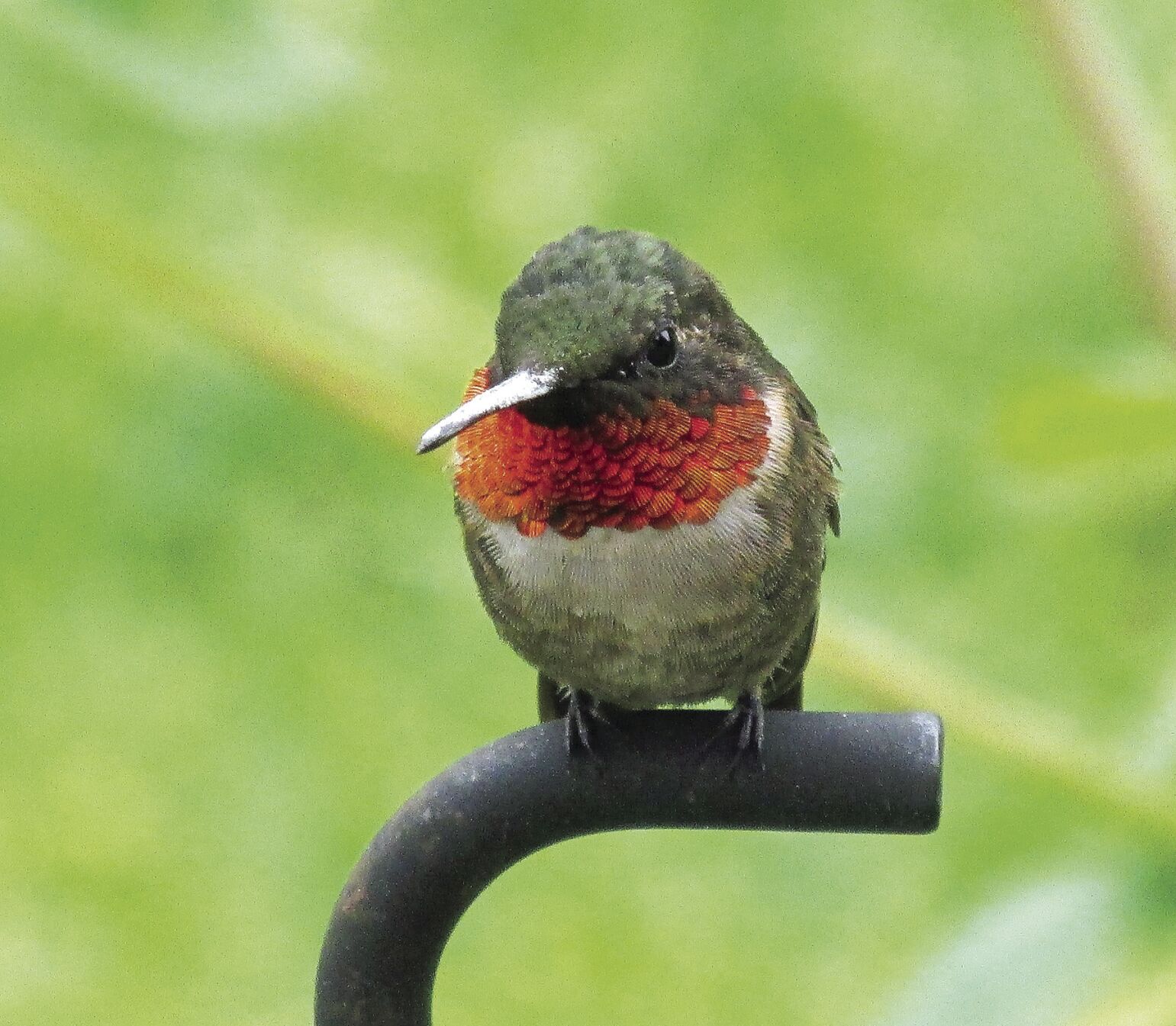
Photo Courtesy of Jean Potter • The summer tanager is the only all-red bird in North America. It is less common in Northeast Tennessee than the related scarlet tanager.