Author Archives: Bryan Stevens

Unknown's avatar

About Bryan Stevens

Bryan Stevens lives in Northeast Tennessee. He is an editor, writer and columnist. He has written food columns for the Johnson City Press, Elizabethton Star and Carter County Compass since 2003.

Elizabethton summer bird count sets new record

The Lee and Lois Herndon Chapter of Tennessee Ornithological Society, also known as the Elizabethton Bird Club, conducts two summer surveys of area bird life. Last week, the results of the Unicoi County Summer Bird Count were explored. This week, the focus is on the Carter County Summer Bird Count, which set a new record. The 24th Carter County Summer Bird Count was held Saturday, June 10, under favorable weather conditions with twenty observers in six parties. A record high of 123 species were tallied, besting the previous high of 121 species set in 2013. The average over the previous 23 years was 112 species, ranging from a low of 105 to as many as 121.

Long-time count compiler Rick Knight said highlights of the count included seven Ruffed Grouse, including chicks, as well as such species as Yellow-crowned Night-heron, Bald Eagle, Red-shouldered Hawk and 21 species of warblers.

The American Robin, with 392 individuals counted, barely edged out European Starling, with 389 individuals counted, for most numerous bird on this year’s summer count.

Making the Summer Bird Count for the first time was Red-headed Woodpecker, represented by a pair of birds nesting at Watauga Point Recreation Area on Watauga Lake near Hampton. Other notable songbirds found included Vesper Sparrow, Blue Grosbeak, Red Crossbill and Pine Siskin. I counted birds with Chris Soto, Mary Anna Wheat, and Brookie and Jean Potter at such locations as Wilbur Lake, Holston Mountain and Sycamore Shoals State Historic Park.
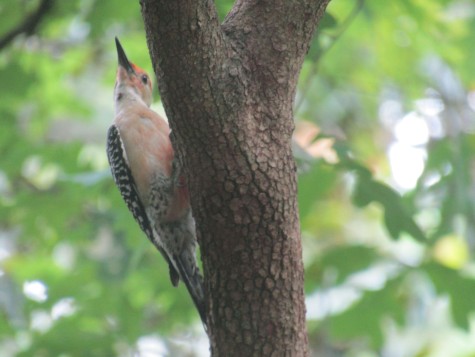
IMG_4530

Photo by Bryan Stevens • Birds like this Red-bellied Woodpecker helped set a new record for most species on one of the Elizabethton Summer Bird Counts.

The count’s total follows:
Canada Goose, 258; Wood Duck, 7; Mallard, 125; Ruffed Grouse, 7; Wild Turkey, 21; and Double-crested Cormorant, 1.
Great Blue Heron, 10; Green Heron, 1; Yellow-crowned Night-heron, 1; Black Vulture, 7; and Turkey Vulture, 28.
Sharp-shinned Hawk, 1; Cooper’s Hawk, 7; Bald Eagle, 2; Red-shouldered Hawk, 3; Broad-winged Hawk, 7; and Red-tailed Hawk, 5.
Killdeer, 2; Rock Pigeon, 37; Eurasian Collared Dove, 1; Mourning Dove, 137; Yellow-billed Cuckoo, 4; Eastern Screech-owl, 2; Great Horned Owl, 2; Barred Owl, 2; Common Nighthawk, 1; Chuck-will’s-widow, 5; and Whip-poor-will, 8.
Chimney Swift, 80; Ruby-throated Hummingbird, 17; Belted Kingfisher, 3; Red-headed Woodpecker, 2; Red-bellied Woodpecker, 16; Yellow-bellied Sapsucker, 2; Downy Woodpecker, 12; Hairy Woodpecker, 4; Northern Flicker, 18; and Pileated Woodpecker, 24.
American Kestrel, 1; Eastern Wood-Pewee, 17; Eastern Phoebe, 71; Acadian Flycatcher, 20; Alder Flycatcher, 2; Willow Flycatcher, 1; Least Flycatcher, 5; Great Crested Flycatcher, 5; and Eastern Kingbird, 17.
White-eyed Vireo, 2; Yellow-throated Vireo, 2; Warbling Vireo, 1; Blue-headed Vireo, 41; Red-eyed Vireo, 126; Blue Jay, 69; American Crow, 227; and Common Raven, 7.
Northern Rough-winged Swallow, 45; Purple Martin, 53; Tree Swallow, 149; Barn Swallow, 129; and Cliff Swallow, 113.
Carolina Chickadee, 54; Tufted Titmouse, 71; Red-breasted Nuthatch, 12; White-breasted Nuthatch, 16; Brown Creeper, 2; House Wren, 79; Carolina Wren, 67; Blue-gray Gnatcatcher, 28; and Golden-crowned Kinglet, 12.
Eastern Bluebird, 88; Veery, 32; Hermit Thrush, 4; Wood Thrush, 43; American Robin, 392; Gray Catbird, 38; Brown Thrasher, 21; Northern Mockingbird, 42; European Starling, 389; and Cedar Waxwing, 64.
Ovenbird, 70; Worm-eating Warbler, 9; Louisiana Waterthrush, 9; Golden-winged Warbler, 13; Black-and-white Warbler, 26; Swainson’s Warbler, 2; Common Yellowthroat, 28; Hooded Warbler, 95; American Redstart, 6; Northern Parula, 25; Magnolia Warbler, 3; Blackburnian Warbler, 7; Yellow Warbler, 13; Chestnut-sided Warbler, 36; Black-throated Blue Warbler, 38; Pine Warbler, 3; Yellow-rumped Warbler, 1; Yellow-throated Warbler, 14; Black-throated Green Warbler, 26; Canada Warbler, 16; and Yellow-breasted Chat.
Eastern Towhee, 121; Chipping Sparrow, 78; Field Sparrow, 50; Vesper Sparrow, 1; Song Sparrow, 178; Dark-eyed Junco, 69; Scarlet Tanager, 31; Northern Cardinal, 94; Rose-breasted Grosbeak, 12; Blue Grosbeak, 2; and Indigo Bunting, 169.
Red-winged Blackbird, 77; Eastern Meadowlark, 11; Common Grackle, 84; Brown-headed Cowbird, 22; Orchard Oriole, 10; and Baltimore Oriole, 2.
House Finch, 26; Red Crossbill, 1; Pine Siskin, 5; American Goldfinch, 134; and House Sparrow, 27.

•••••

I had a recent phone call with Erwin resident Don Dutton, who wanted to know why hummingbirds have been scarce around his home this summer. I’ve noticed fewer hummers at my own home this summer, but it’s natural for numbers to fluctuate from year to year. I anticipate that numbers will rise as hummingbirds begin migrating south again in the coming weeks. At that time, the adult hummers will be joined by the young birds from this season’s successful nesting attempts.

Ruby-throated-WILLOWS

Photo by Bryan Stevens • Numbers of Ruby-throated Hummingbird in the region tend to fluctuate each year, but people should see a spike in their numbers as the hummingbirds end summer nesting and start migrating south again.

Don shared that when he lived out west, he often visited Mount Charleston near Las Vegas, Nevada, where he saw swarms of hummingbirds comprised of various different species. In the eastern United States, the only nesting species is the Ruby-throated Hummingbird.

If you have felt slighted by hummers so far this year, keep a sugar water feeder available to attract them on their way south later this summer and into the fall. To share a sighting, make a comment, or ask a question, send email to ahoodedwarbler@aol.com.



County’s Summer Bird Count finds 104 species

Members and friends of the Lee & Lois Herndon Chapter of the Tennessee Ornithological Society enjoyed a busy June, conducting its two annual summer bird counts last month. To the satisfaction of everyone involved, these counts encountered normal temperature after a spring count this past May that actually saw some snowfall when it was held on May 6.

IMG_4140

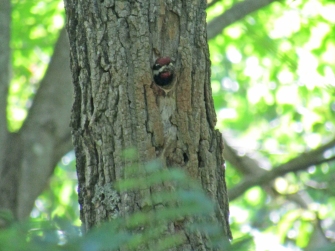
Photo by Bryan Stevens • Nesting Yellow-bellied Sapsuckers can be found at higher elevations in Unicoi County. This woodpecker is usually considered a winter bird in the region, but a few nest in the mountains.

According to long-time compiler Rick Knight, the chapter holds these summer counts in the counties of Carter and Unicoi to provide a set of baseline data on the diversity and numbers of breeding birds in these two local counties. This supplements other summertime data collection projects, such as the long-running Breeding Bird Survey (one route in Carter County) and the Nightjar Survey (three local routes).

The Carter County Summer Bird Count was initiated shortly after the conclusion of the Tennessee Breeding Bird Atlas project. The Unicoi County Summer Bird Count’s origins are more recent, with this survey making its debut in June of 2014. The fourth consecutive Unicoi County Summer Count was held June 17 with 21 observers in five parties looking for birds on Unaka Mountain, as well as such locations as Erwin, Limestone Cove and Flag Pond. Morning weather was favorable, but scattered rain in the afternoon hindered some efforts. A total of 104 species were tallied, down slightly from the three-year average of 111 species. Highlights included a Bald Eagle, Merlin and six Yellow-bellied Sapsuckers, including a nest with young. A total of 20 species of warblers were tallied, including Swainson’s Warbler, Magnolia Warbler, Blackburnian Warbler and Prairie Warbler. Other notable birds include Hermit Thrush and Blue Grosbeak.

I took part on the count, looking for birds in the Limestone Cove area of the county with Brookie and Jean Potter, Charles Moore, and David and Connie Irick. Beyond bird, we saw other wildlife, including skunks, white-tailed deer, rabbits, groundhogs and various butterflies.

IMG_4146

Photo by Bryan Stevens • A young Red-winged Blackbird begs food from its attentive mother.

A highlight of our count took place near the Appalachian Trail along Highway 107 at Iron Mountain Gap where we found a pair of Yellow-bellied Sapsuckers delivering food to young inside a nesting cavity in a tree easily viewed from the roadside. In addition, a singing Chestnut-sided Warbler put on quite a show for a group of admiring birders enchanted with this bird’s dazzling plumage and energetic antics.

The total for the count follows:

Canada Goose, 73; Wood Duck, 22; Mallard; Wild Turkey, 19; Great Blue Heron, 13; and Green Heron, 3.
Black Vulture, 300; Turkey Vulture, 28; Sharp-shinned Hawk, 2; Cooper’s Hawk, 1; Bald Eagle, 1; Broad-winged Hawk, 7; Red-tailed Hawk, 4; American Kestrel, 2; and Merlin, 1.
Rock Pigeon, 67; Mourning Dove, 87; Great Horned Owl, 1; Barred Owl, 2; Chuck-will’s-Widow, 4; Whip-poor-will, 9; and Chimney Swift, 61.
Ruby-throated Hummingbird, 15; Belted Kingfisher, 4; Red-bellied Woodpecker, 13; Yellow-bellied Sapsucker, 6; Downy Woodpecker, 10; Hairy Woodpecker, 3; Northern Flicker, 7; and Pileated Woodpecker, 8.
Eastern Wood-Pewee, 7; Acadian Flycatcher, 24; Eastern Phoebe, 30; Great Crested Flycatcher, 3; and Eastern Kingbird, 14.
White-eyed Vireo, 4; Yellow-throated Vireo, 1; Blue-headed Vireo, 26; Red-eyed Vireo, 95; Blue Jay, 53; American Crow, 88; Fish Crow, 7; and Common Raven, 7.
Northern Rough-winged Swallow, 36; Purple Martin, 14; Tree Swallow, 70; Barn Swallow, 77; and Cliff Swallow, 149.
Carolina Chickadee, 51; Tufted Titmouse, 43; Red-breasted Nuthatch, 1; White-breasted Nuthatch, 18; Brown Creeper, 3; House Wren, 14; Carolina Wren, 42.

IMG_4172

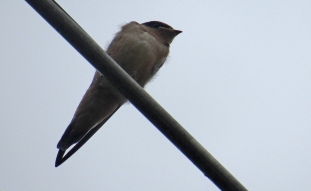
Photo by Bryan Stevens • Most swallows, like this Barn Swallow, have fledged and will join their parents in migrating south in the coming weeks of late summer.

Blue-gray Gnatcatcher, 5; Golden-crowned Kinglet, 7; Eastern Bluebird, 33; Veery, 25; Hermit Thrush, 4; Wood Thrush, 37; American Robin, 281; Gray Catbird, 31; Brown Thrasher, 12; Northern Mockingbird, 24; European Starling, 534; and Cedar Waxwing, 49.
Ovenbird, 29; Worm-eating Warbler, 2; Louisiana Waterthrush, 4; Black-and-white Warbler, 12; Swainson’s Warbler, 6; Common Yellowthroat, 2; Hooded Warbler, 37; American Redstart, 4; Northern Parula, 19; Magnolia Warbler, 3; Blackburnian Warbler, 2; Yellow Warbler, 1; Chestnut-sided Warbler, 15; Black-throated Blue Warbler, 29; Pine Warbler, 1; Yellow-throated Warbler, 3; Prairie Warbler, 3; Black-throated Green Warbler, 16; Canada Warbler, 9; and Yellow-breasted Chat, 2.
Eastern Towhee, 55; Chipping Sparrow, 49; Field Sparrow, 8; Song Sparrow, 120; Dark-eyed Junco, 37; Scarlet Tanager, 27; Northern Cardinal, 83; Rose-breasted Grosbeak, 4; Blue Grosbeak, 2; and Indigo Bunting, 82.
Red-winged Blackbird, 84; Common Grackle, 58; Eastern Meadowlark, 9; Brown-headed Cowbird, 29; and Orchard Oriole, 1.
House Finch, 33; American Goldfinch, 96; and House Sparrow, 17.

YoungCardinal

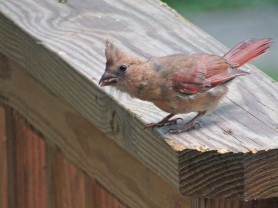
Photo by Bryan Stevens • Young birds, like this Northern Cardinal, point to a successful nesting season for most of the region’s birds.

Next week, I’ll post results from the Elizabethton Summer Bird Count.


••••••

To ask a question, make a comment or share a sighting, email ahoodedwarbler@aol.com or friend Stevens on Facebook.

Fruit increases chances of visit from scarlet tanagers


Last summer, Annette Bryant emailed me some beautiful photos she had taken of birds at her home in Marion, North Carolina.

“Photographing birds has been a passion of mine for many years,” Annette wrote to me. “I look forward to our blueberries getting ripe because I see certain birds only at that time.”

ScarletTanager-Bryant

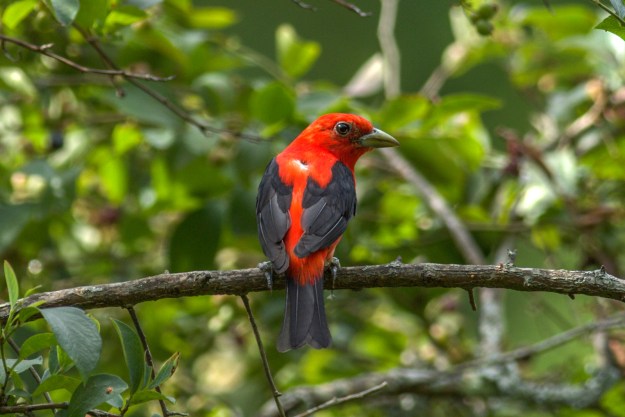
Photo Courtesy of Annette Bryant • This male Scarlet Tanager adds a splash of tropical color whenever he appears.

One of those birds, she noted, is the scarlet tanager. Anyone who has beheld a scarlet tanager is hardly likely to forget the observation. Thanks to a recent observation I made of one of these birds, I have been reminded of some of the breathtaking birds — including the scarlet tanager — that make the mountains of northeast Tennessee, western North Carolina and southwest Virginia their summer home. The extraordinary appearance of the male scarlet tanager is certainly one that sets it apart from most other songbirds.

This tanager is not typically a feeder visitor, but bird enthusiasts can lure these birds with fruit, such as orange slices placed in special feeders or simply spiked onto the branches of backyard trees. As an added bonus, orange slices can also attract birds such as brown thrashers, Baltimore orioles and gray catbirds. The scarlet tanager indulges its fondness for fruit by incorporating various berries into its diet. In addition to the blueberries mentioned by Annette, other fruit-bearing trees and shrubs — mulberry, elderberry, serviceberry and wild cherry — will make your yard or garden more inviting to this somewhat elusive bird.

I usually have a few scarlet tanagers in residence around my home during the summer months, but I haven’t seen one so far this spring. However, my luck changed while taking part in the Summer Bird Count for Carter County, Tennessee. The count, conducted by members and friends of the Elizabethton Bird Club, has been a long-running survey of summer birds in the region. Along with fellow birders Jean and Brookie Potter, Chris Soto and Mary-Anna Wheat, I got a timely reminder of the beauty of the scarlet tanager while we searched for birds on Holston Mountain near Elizabethton, Tennessee. A stunning male tanager showed up and entertained us with fantastic looks for several moments.

The male scarlet tanager boasts a brilliant plumage of crimson red paired with black wings and tail. Of course, like many other birds, the female scarlet tanager makes no real claim to the common name with her comparatively drab greenish plumage. However, the scientific name, Piranga olivacea, gives a nod to the olive-green plumage of females, young males and even adult males when they’re molting their feathers.

So, why is it so difficult to lay eyes on such a brightly colored bird? The answer rests with this bird’s daily routine, which is usually conducted among the upper woodland canopy in such tall trees as oaks and poplars.

Scarlet-Tanager

Photo Courtesy of Jean Potter A male Scarlet Tanager brightens shadowy woodlands with a flash of tropical colors.

Fortunately, male tanagers produce a distinctive song. Upon first hearing it, listeners might mistake the hidden singer for an American robin. Listen a little closer, however, and the song sounds as if it is being delivered by a hoarse robin with a sore throat. The male tanager also makes a vocalization described as “chip-burr” that is easily heard.

If we were to see a scarlet tanager in a rain forest in South America, we might not be so surprised by its vibrant plumage, usually associated with many tropical birds. The scarlet tanager is certainly better attired than most birds to provide observers a glimpse of a creature that would indeed look more at home in the jungle.

Worldwide, there have traditionally been about 240 species of tanagers. Experts have changed some of the ways they classify tanagers, so that figure is no longer set in stone. Tanagers are a New World family of birds, concentrated mainly in the tropics of Central and South America. Some of the world’s other tanagers are known by extremely descriptive names, including yellow-backed tanager, blue-and-yellow tanager, seven-coloured tanager, gilt-edged tanager, green-capped tanager, beryl-spangled tanager, opal-rumped tanager and blue-gray tanager.

Scarlet

A print of Scarlet Tanagers by early North American naturalist and painter John James Audubon.

Osprey’s fishy diet sets it apart from most other raptors

Jim and Tammie Kroll emailed me about a very interesting bird observation on the Virginia Creeper Trail last month.

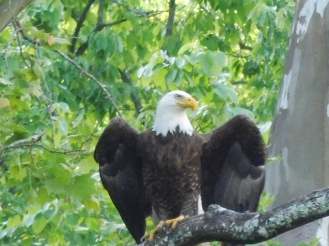
They saw a bald eagle along the Virginia Creeper Trail on May 14. “It was between Alvarado and Damascus,” Jim wrote in the email. We got to see it at two different locations and watched it around 15 minutes at each location.”

DSCN3266

Photo by Jim and Tammie Kroll • This adult bald eagle was seen along the Virginia Creeper Trail.

He added that they talked to a woman who informed them that she also sees an eagle in the same area on the Creeper Trail.

The Krolls also shared a photo of the eagle. I’m always glad that to hear that observing the nation’s official bird is no longer a rare occurrence in the region. While I haven’t seen any bald eagles this year, I have observed a raptor that shares many characteristics with them.

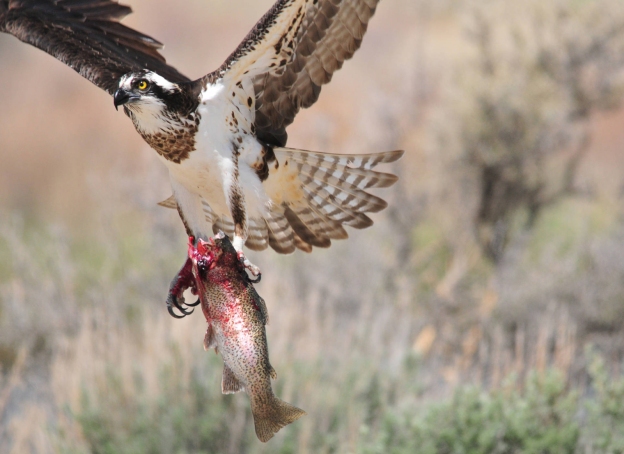
Ospreys, also known by the common name of “fish hawk,” occur worldwide. Ospreys migrate through the region in spring and fall, making sightings more likely along some lakes and larger rivers. I see them even more often when I travel to South Carolina, where these medium-sized raptors are common along the coast and in wetlands.

Some recently published books provide insight into the lives of bald eagles and ospreys. Teena Ruark Gorrow and Craig A. Koppie are the authors of the recent book, The DC Eagle Cam Project: Mr President and First Lady. This book profiles a celebrity pair of eagles that have nested for the past few years in U.S. National Arboretum in Washington, D.C.

osprey-book-Cover

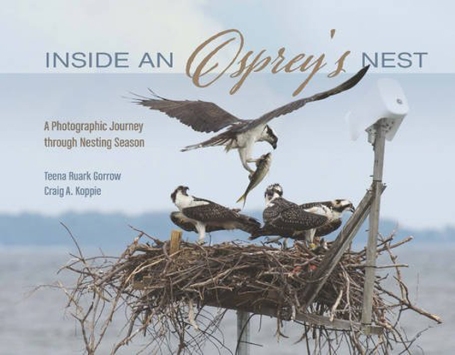
Front cover of a book by Teena Ruark Gorrow and Craig A. Koppie featuring photos of a nesting season in the life of a family of ospreys.

Gorrow and Koppie have also written other books together, including one offering a pictorial journey through an osprey nesting season. Titled “Inside an Osprey’s Nest,” this book provides an account of two fostered osprey chicks that receive new parents in a heartwarming, real-life account of a family of ospreys associated with the Chesapeake Conservancy Osprey Nest Cam.

During a recent interview, Gorrow shared that bald eagles and ospreys share more than a few things in common.

“The bald eagle, Haliaeetus leucocephalus, is America’s national bird and symbol,” Gorrow said. “It is a large raptor, or bird of prey, found only in North America. Also a raptor, the osprey, Pandion Haliaetus, is a large hawk found on every continent across the globe except Antarctica.”

Like the American bald eagle, Gorrow noted that ospreys experienced devastating health effects and reproductive failures from widespread human use of dangerous pesticides like DDT.

“By the 1970s, population numbers had plummeted to catastrophic levels for both eagles and ospreys,” she said. “Federal actions were put into place which imposed migratory bird protection and banned DDT. These measures, along with the work of dedicated scientists, conservationists and citizens, have helped these magnificent raptors recover.”

Gorrow said that when selecting a nest site, bald eagles and ospreys identify an area near water with a plentiful food supply and nearby trees. “With diets consisting mostly of fish, both require foraging areas rich in fishery resources,” she said.
During nesting season, ospreys and eagles are seen as competitors, even though food is abundant in the Chesapeake Bay region. “Bald eagles are opportunists and will usually pirate fish prey from osprey when given the chance,” Gorrow said.

Nesting season for eagles begins earlier than ospreys, so they have the upper hand in defending territories. “Eagle pairs in the Chesapeake Bay area usually lay eggs in mid-February, while the ospreys return from their southern wintering destinations around mid-March,” Gorrow said. “Ospreys generally build nests in March or April and lay eggs soon after.”

3cm358

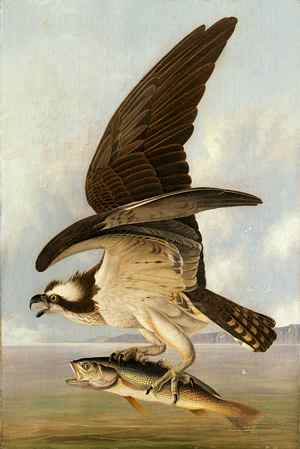
Early naturalist and artist John James Audubon painted this work of art featuring an osprey with a fish held in its talons.

The two large raptors also demonstrate other distinct preferences.

“Bald eagles utilize living and dead (known as snags) trees as nest sites,” she said. “Eagles rarely tolerate humans near their nests.

“On the other hand, ospreys are relatively tolerant of humans and sometimes build nests on private pavilions or docks beside waterfront properties,” Gorrow continued. “They seem to favor artificial structures and often construct over-water nests on the steel supports of bridges, channel markers, navigational buoys, fishing piers, jetties, and manmade nesting platforms. Ospreys sometimes choose snags with an open treetop or claim tall, artificial structures resembling dead trees, such as towers, utility poles, television antennas, road signs and stadium lights. They also sometimes nest on chimneys and rooftops on uninhabited buildings.”

A more in-depth glance into the lives of ospreys is available in the book “Inside an Osprey’s Nest,” which retails for $24.99. When purchased through the Chesapeake Conservancy at http://www.chesapeakeconservancy.org, $10 from every purchase supports conservation programs along the Chesapeake Bay Watershed. The book is also available at http://www.schifferbooks.com, Amazon.com and other booksellers.

•••••

To learn more about birds and other topics from the natural world, friend him on Facebook at https://www.facebook.com/ahoodedwarbler. He is always posting about local birds, wildlife, flowers, insects and much more.

Osprey-LYNNValley

Photo by Bryan Stevens • An osprey perches in a tree along the Watauga River in Elizabethton, Tennessee.

Warblers exert special pull for many birders

KirtlandsWarbler

Photo by U.S. Fish & Wildlife Service • The Kirtland’s Warbler, while endangered, is slowly building its numbers with intensive human assistance. Nearly 50 different warbler species nest in the eastern half of the continental United States. The rest of the world’s warblers reside mostly in Central and South America.

I’ve been fascinated with the group of small, energetic songbirds known as warblers almost from the start of my time as a birder. Many birds have inspired poetry, but to me, the warblers are poetry. I suppose another, more down-to-earth part of my fascination is that a little effort is usually required to see these birds. Although many species of warblers spend the summer months in the region, few of them would really be described as backyard birds. That being said, I am also fortunate to live in a location surrounded by woodlands that are inhabited by several species of warblers in the months spanning April to September on the calendar.

Of course, it’s always gratifying to hear from readers who have also caught the “warbler bug” and find these tiny, colorful songbirds as fascinating as I do. Graham Gardner of Abingdon, Virginia, sent me a recent email about the warblers, an extensive family of neotropical migrants that happen to be among my favorite birds.

CanadaWarbler

Photo by Graham Gardner • A Canada warbler wears a dark necklace of feathers across its yellow breast.

“I just wanted to share another great birding experience that I recently had with my father this past weekend,” Graham wrote in an email sent on May 1. “As you know, the spring migration of neotropical migrants is upon us. My father and I decided to take a trip to Peaks of Otter Lodge in the heart of the Blue Ridge Mountains to attempt to observe some of the more difficult-to-find warblers that I had not yet checked off my life list.”
He reported that the trip was wildly successful.

“We observed 10 warbler species in total in just under two days of birding.” Among them were three species that were new for him: cerulean warbler, Blackburnian warbler, and bay-breasted warbler.

He also shared some photos. “These guys are really quite difficult to photograph,” he wrote. “They are either constantly on the move, bouncing from branch to branch, or they are high in the canopy staying mostly out of sight.”

Graham wrote that he looks forward to searching for warblers in the coming weeks as they continue to pass through, and in some cases settle in, our Appalachian Mountains.
I congratulated Graham for his success with some of my favorite birds. I also let him know that he succeeded with a bird — the cerulean warbler — that has been elusive for me over the years. It’s one of the few warblers that spend time in the eastern United States that I haven’t managed to add to my life list. The other two warblers I need are the Connecticut warbler and Kirtland’s warbler.

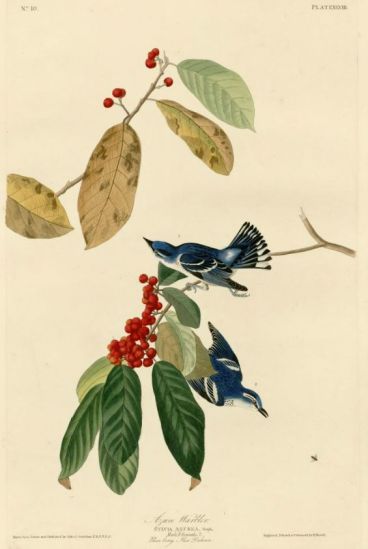
Cerulean 2

Early naturalist and artist John James Audubon painted this pair of cerulean warblers, a bird that he knew as the “Azure Warbler.”


“The cerulean was definitely the highlight of the trip for me,” Graham noted in a second email to me.

The cerulean warbler makes infrequent appearances in the region, but it has been observed as recently as the spring of 2016 at Steele Creek Park in Bristol, Tennessee. Some other locations — Frozen Head State Park, Edgar Evins State Park and Falls Creek Falls State Park — support breeding populations of this warbler within the Volunteer State.

Unfortunately, the cerulean warbler is one of the fastest declining songbirds in the United States. Habitat destruction in its breeding range in the Appalachian Mountains and its wintering range in South America is to blame for its plummeting numbers.

Among a family of several breathtakingly beautiful species, the cerulean warbler is one of the most exquisite of its kind in terms of appearance. Adult males have pale cerulean blue upperparts — hence the bird’s common name — and white underparts with a black necklace across the breast. They also show black streaking on the back and flanks.

Beyond its uncommon status, there are other reasons why it’s difficult to lay eyes on a cerulean warbler. First and foremost, cerulean warblers prefer to forage in the treetops. In that leafy, lofty habitat, observing these warblers can be difficult for ground-bound humans.

NoWaterthrush

Photo by Bryan Stevens • The Northern waterthrush is a warbler fond of foraging near slow, flowing water.

I’ve been very close to seeing a cerulean warbler twice. During a past Spring Naturalists Rally at Roan Mountain, Tennessee, several people watched a cerulean warbler flitting in some tall trees while I struggled unsuccessfully to get my binoculars on the rapidly moving bird. More recently, I was looking for birds with fellow birder Jean Potter along the Watauga River in Elizabethton, Tennessee, for a Fall Bird Count. She found a female cerulean warbler in a tree overhanging the river, but I failed to get my binoculars on the bird in time.

So, while my luck with cerulean warblers hasn’t changed (yet), I have seen several warblers at my home this spring, including hooded warbler, ovenbird, black-throated green warbler, black-and-white warbler and Northern parula. In addition, I’ve seen other warblers — yellow-breasted chat, Cape May warbler, yellow warbler and chestnut-sided warbler — at other locations in the region.

Black-and-WhiteWarbler

Photo by Graham Gardner • The black-and-white warbler, which is aptly named, is one of the most easily identified warblers.

The warblers are poetry written with splashes of movement and hints of color written across an often green background. While not easy to observe, they’re worth seeking out. Glimpsing one of these energetic songbirds is always a moment that puts a smile on my face — and in my heart.

•••••

Bryan Stevens lives near Roan Mountain, Tennessee. To learn more about birds and other topics from the natural world, friend Stevens on Facebook at http://www.facebook.com/ahoodedwarbler. He is always posting about local birds, wildlife, flowers, insects and much more. If you have a question, wish to make a comment or share a sighting, email ahoodedwarbler@aol.com.

Readers report on robin, purple martin that stand out from other members of their flocks


Albino-Swallow

Photo by Jean Potter • Two barn swallows in typical plumage perch on a wire with an albino individual.

Birds of a feather, as the old saying goes, tend to flock together, but what happens when a member of the flock stands out from the rest? Although conventional wisdom mandates that being conspicuous is not helpful for most wild creatures, some of them can’t help but get attention. Different readers have brought to my attention some birds at their homes that instantly stood out.

Sara and Ed Gschwind, residents of Bristol, Tennessee, have been keeping tabs on an American robin in their yard that is showing an extensive amount of white feathers in its plumage. For the most part, this particular robin has a white head, largely white wings and extensive white in the typically red breast. “My 88-year-old mother, Nora Rockett, suggested I send a photo to you,” Sara wrote in an email.

Robin-PartialAlbino

Photo by Ed Gschwind • A leucistic American robin enjoy time in a bird bath. Albino and leucistic birds are rather rare in nature.

Sara said that her mother, who has lived in Bristol all her life, has never seen anything like it. I replied to Sara’s email, asking for a few more details.

While the robin interacts with others of its kind, the Gschwinds haven’t seen any evidence this particular robin is attempting to nest. Ed took a photograph of the robin enjoying the water in a bird bath in the Gschwind yard.

“The robin bathes every day, and loves the water like all robins do,” Sara wrote. “The robin has been here since the robins returned three months ago. I’m trying to keep it happy.” Since the robin is a regular visitor, I agree that they’re doing a good job keeping the bird happy, since it’s not shown any inclination to leave their yard.

Tom Brake, who lives in Abingdon, Virginia, contacted me through Facebook about a male purple martin with extensive white feathers residing at the purple martin colony he has established at his home.

Purple martins are the largest member of the swallow family in the United States. Like many other swallow species, they nest in colonies. Martins are cavity-nesting birds that readily accept hollow gourds or special purple martin condominiums for nesting.

“Currently I have nests in 43 compartments with 20 being active (eggs having been laid),” Tom wrote. “Last year I had 51 pairs, and I hope to get close to being back to 60 or 70 active pairs this year. The next two weeks will be the busy time for completion of nests and laying.”

PurpleMartin-Albino-TomBrake

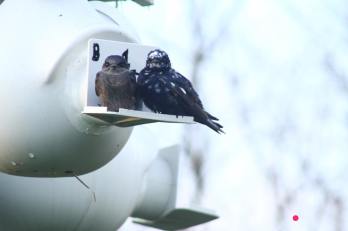
Photo by Tom Brake • A leucistic male purple martin perches with its mate, a typical female purple martin, near a hollow gourd they may use for nesting purposes.

As for the bird showing the white feathers, Tom has named him “Leuie” because the bird is an example of leucism, a condition related to albinism.

Albinism is a genetic, or inherited, condition resulting in a complete lack of production of pigmentation. Albino birds are, for the most part, extremely uncommon. I’ve heard of a variety of birds, ranging from hummingbirds and American robins to various ducks and swallows, that have a tendency to produce albino individuals.

Leucism is another genetic mutation that causes affected birds to grow feathers that are pale or whitish overall. A faint pattern may be visible. Leucism is also uncommon, but is more common that albinism. Both the robin in the Gschwind yard and the purple martin at Tom’s home are examples of leucistic birds.

Tom noted that “Leuie” is doing well so far. “He has a mate, but their first clutch of four eggs was either thrown out by a second year male martin or discarded by themselves because they sensed non-viability,” Tom wrote in a Facebook message. “Maybe the cold, wet weather had something to do with the loss.” He noted that the same thing happened recently to two other nests.

“Leuie and mate are still using their gourd, so I expect they will re-clutch,” Tom wrote. The term “re-clutch” means that Leuie’s mate will lay a new batch of eggs and Leuie will be ready to carry out his own paternal duties to help raise any resulting young.

Albinism and leucism are not the only conditions that can affect pigment in a bird’s feathers. Some birds have the opposite problem in that they produce too much pigment, resulting in a much darker bird than what would be typical. The plumage of such affected birds is described as melanistic, which is in stark contrast to an albino bird. With a melanistic bird, the feathers are much darker than usual because of an abundance of pigment. In rare albino birds, the opposite occurs and the lack of pigment in the feathers leave them looking white. Completely albino birds also tend to have red eyes. It’s probably better for a bird to be melanistic. Albino birds tend to stick out like sore thumbs, attracting the attention of predators.

Robins-AlbinoAndRegular

Photo by Ed Gschwind • Compare the leucistic American robin in the bird bath with the typical robin perched in a nearby chair. Albino birds are rather rare in nature.

I’ve only seen a few albino or partial albino birds in person, although I have observed videos and photographs of such birds. During a trip to Salt Lake City, Utah, in 2006, I observed an albino Brewer’s blackbird. An albino blackbird is almost an oxymoron. This particular blackbird had a white upper body and head and a black lower body. At first, I thought it might be a small tern, but closer observation — and identification of the birds with which it was associating — eventually confirmed that it was a Brewer’s blackbird, a common species in Salt Lake City.

Those observations remain my best looks at albino birds in the wild. I’ve also seen partial albinos, including an American Crow with white feathers in its wings that inhabited the woodlands and fields at my home for several years. I’ve also observed a couple of American goldfinches over the years that would probably qualify as leucistic birds.

A few years ago, I saw an albino Red-tailed hawk while driving between Erwin, Tennessee, and Asheville, North Carolina, on Interstate 26. The hawk was often present near the North Carolina Visitors Center. I’ve also heard from readers over the years about birds such as American goldfinches and downy woodpeckers exhibiting albino tendencies.

Albino-Hawk

Photo by Jean Potter • This partial albino red-tailed hawk was spotted for several years near the state line dividing northeast Tennessee and western North Carolina.

These issues involving the absence or abundance of pigment can complicate bird identification. After all, all-white birds, from snowy owls and tundra swans to great egrets and snow geese, do exist in nature. Even in these birds, however, there’s usually some other color present to break up the uniformity of the bird’s plumage. Keep in mind that such rarities as albino individuals of such common species as house finches and American robins can show up at your feeders or in your yard. It’s just another way birds constantly surprise us.

•••••

To learn more about birds and other topics from the natural world, friend him on Facebook at https://www.facebook.com/ahoodedwarbler. He is always posting about local birds, wildlife, flowers, insects and much more.

Spring Bird Count participants deal with unseasonal cold snap

The 74th annual Elizabethton Spring Bird Count was held on Saturday, May 6. A total of 43 observers in nine parties took part in the annual survey, which consists Carter County and parts of adjacent Johnson, Sullivan, Unicoi and Washington counties. In addition to Elizabethton, the count includes territory in such cities as Elizabethton, Erwin, Kingsport, Bristol and Johnson City.

Count-Gobbler

Photo by Bryan Stevens • A male gobbler seeks the attention of hens, as all these Wild Turkeys add to the number of this species found during the count.

The most unusual aspect of this year’s count involved rather cold conditions, according to long-time count compiler Rick Knight. Although held nearly a week into May, this was one of the coldest days ever experienced on a spring count. The temperature range was 36 to 54 degrees. Light rain fell before sunrise; the morning was partly cloudy to cloudy, then the afternoon saw light rain, with light snow showers at the higher elevations and a half-inch accumulation of snow on Roan Mountain.

Knight noted that previous cold spring counts included: 32 to 55 degrees in 1979, 44 to 52 degrees in 1987, and 27 to 54 degrees in 1992. Despite the weather, participants managed to find 148 species, which is exactly the average over the last 30 years, but below the average over the last decade, which stands at 154 species.

The most common species on this year’s Spring Bird Count was the Cliff Swallow with 1,046 individuals — a new record for this species — found this year. Other common species include European Starling (704), American Robin (693) and Tree Swallow (526).

A Stilt Sandpiper found in Washington County represented only the third time this species has been observed during the Elizabethton Spring Bird Count. As always, Knight said there were a few notable misses, such as Northern Bobwhite, Ruffed Grouse, Pied-billed Grebe, Brown Creeper, Winter Wren, Swamp Sparrow and Pine Siskin. In addition, no gulls were found on any of the area lakes.

Count-MaleMartin

Photo by Bryan Stevens • Purple Martins, like this male, were sluggish on the day of the count thanks to cold temperatures and steady rainfall.

In addition, several species of warblers that nest in the region showed rather low numbers. Some of the low numbers for some species may be attributable to the weather. Nevertheless, the count produced observations of 28 different warbler species.

The total is listed below:
Canada Goose, 390; Wood Duck, 27; Mallard, 93; Blue-winged Teal, 5; and Hooded Merganser, 2.
Wild Turkey, 54; Common Loon, 2; Double-crested Cormorant, 42; Great Blue Heron, 115; Great Egret, 1; Green Heron, 13; Yellow-crowned Night-Heron, 8; and Black-crowned Night-heron, 1.
Black Vulture, 74; Turkey Vulture, 108; Osprey, 10; Sharp-shinned Hawk, 1; Cooper’s Hawk, 5; Bald Eagle, 13; Broad-winged Hawk, 5; Red-winged Hawk, 25; and American Kestrel, 11.
Virginia Rail, 4; Killdeer, 35; Spotted Sandpiper, 27; Solitary Sandpiper, 19; Greater Yellowlegs, 1; Lesser Yellowlegs, 1; Stilt Sandpiper, 1; and Least Sandpiper, 6.
Forster’s Tern, 1; Rock Pigeon, 155; Eurasian Collared-Dove, 3; Mourning Dove, 224; Yellow-billed Cuckoo, 4; Black-billed Cuckoo, 1; Eastern Screech-owl, 6; Great Horned Owl, 1; Barred Owl, 2; Common Nighthawk, 1; Chuck-will’s-widow, 2; Whip-poor-will, 10.
Chimney Swift, 66; Ruby-throated Hummingbird, 23; Belted Kingfisher, 23; Red-headed Woodpecker, 5; Red-bellied Woodpecker, 54; Yellow-bellied Sapsucker, 3; Downy Woodpecker, 23; Hairy Woodpecker, 5; Northern Flicker, 30; and Pileated Woodpecker, 34.

Count-NightHeron

Several species of herons, including this Yellow-crowned Night Heron, were found for this year’s Spring Bird Count.

Eastern Wood-pewee, 1; Acadian Flycatcher, 5; Willow Flycatcher, 1; Least Flycatcher, 6; Eastern Phoebe, 42; Great Crested Flycatcher, 13; Eastern Kingbird, 43; and Loggerhead Shrike, 1.
White-eyed Vireo, 5; Yellow-throated Vireo, 10; Blue-headed Vireo, 41; Warbling Vireo, 9; Red-eyed Vireo, 122; Blue Jay, 138; American Crow, 301; Fish Crow, 2; and Common Raven, 22.
Northern Rough-winged Swallow, 345; Purple Martin, 36; Tree Swallow, 526; Barn Swallow, 259; and Cliff Swallow, 1,046.
Carolina Chickadee, 82; Tufted Titmouse, 140; Red-breasted Nuthatch, 3; White-breasted Nuthatch, 13; House Wren, 30; Marsh Wren, 1; Carolina Wren, 99; Blue-gray Gnatcatcher, 39; Golden-crowned Kinglet, 11; and Ruby-crowned Kinglet, 2.
Eastern Bluebird, 136; Veery, 44; Swainson’s Thrush, 5; Hermit Thrush, 1; Wood Thrush, 82; American Robin, 693; Gray Catbird, 35; Brown Thrasher, 51; Northern Mockingbird, 95; European Starling, 704; and Cedar Waxwing, 272.
Ovenbird, 117; Worm-eating Warbler, 19; Louisiana Waterthrush, 18, Northern Waterthrush, 1; Golden-winged Warbler, 3; Black-and-White Warbler, 47; Swainson’s Warbler, 2; Tennessee Warbler, 1; Kentucky Warbler, 1; Common Yellowthroat, 17; Hooded Warbler, 95; American Redstart, 6; Cape May Warbler, 7; Northern Parula, 25; Bay-breasted Warbler, 4; Blackburnian Warbler, 1; Yellow Warbler, 3; Chestnut-sided Warbler, 9; Blackpoll Warbler, 1; Black-throated Blue Warbler, 25; Palm Warbler, 1; Pine Warbler, 15; Yellow-rumped Warbler, 18; Yellow-throated Warbler, 20; Prairie Warbler, 4; Black-throated Green Warbler, 53; Canada Warbler, 1; and Yellow-breasted Chat, 11.

SolitarySandpiper-One

Photo by Bryan Stevens • Migrating shorebirds, such as this Solitary Sandpiper, added diversity to this year’s Spring Bird Count in Northeast Tennessee.

Eastern Towhee, 132; Chipping Sparrow, 67; Field Sparrow, 35; Savannah Sparrow, 4; Grasshopper Sparrow, 1; Song Sparrow, 166; White-throated Sparrow, 4; White-crowned Sparrow, 2; Dark-eyed Junco, 28; Summer Tanager, 2; Scarlet Tanager, 60; Northern Cardinal, 212; Rose-breasted Grosbeak, 19; Blue Grosbeak, 5; Indigo Bunting, 79; Bobolink, 22; Red-winged Blackbird, 271; Eastern Meadowlark, 89; Common Grackle, 327; Brown-headed Cowbird, 97; Orchard Oriole, 21; Baltimore Oriole, 16; House Finch, 64; American Goldfinch, 228; and House Sparrow, 52.

•••••

To learn more about birds and other topics from the natural world, friend Stevens on Facebook at https://www.facebook.com/ahoodedwarbler. He is always posting about local birds, wildlife, flowers, insects and much more. If you have a question, wish to make a comment or share a sighting, email ahoodedwarbler@aol.com.

Count-IndigoBunting

Photo by Bryan Stevens • Newly-returned neotropical migrants, such as this Indigo Bunting, increased the total number of species for the annual spring count.

Grosbeaks, bluebirds focus of questions from readers arising from spring sightings

I’m hearing from readers on a range of subjects relating to birds. Although I am still hearing from readers about their hummingbirds returning after a lengthy absence, other readers have contacted me about other birds, ranging from rose-breasted grosbeaks to “blue” birds of differing varieties.

RB-Grosbeak-BOYD

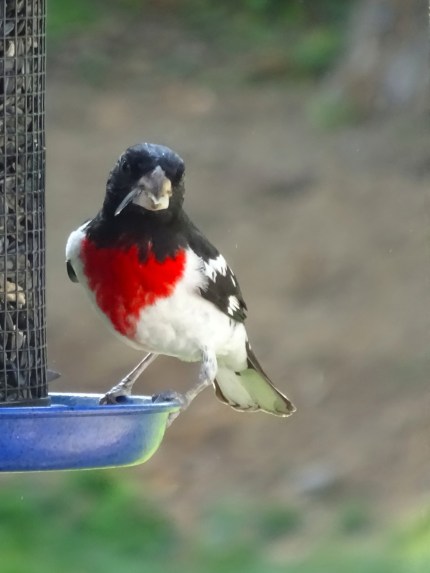
Photo by Rebecca Boyd • A male rose-breasted grosbeak shells sunflower seeds with his large, heavy beak. Rose-breasted grosbeaks, especially the more colorful males, never fail to impress observers.

These shared observations reinforce my theory on birds. They have wings, and they know how to use them. There’s nothing to stop an unexpected bird from making a migration layover in your yard. Keep your eyes open, especially during the remaining weeks of May. A surprise could be winging its way toward you!
•••••
Constance Tate, who lives in Bristol, Tennessee, sent me a Facebook message on April 24. “I just saw a rose-breasted grosbeak at my feeder,” she wrote. “I had to look it up as this is the first one I have ever seen. Are they uncommon in our area?”
Rebecca Boyd of Knoxville, Tennessee, emailed me, also on the subject of rose-breasted grosbeaks.
Rebecca said at least two pairs made frequent visits to her feeder last month, but the visits stopped abruptly on Sunday, April 30.
“Should I assume they have moved on already to cooler areas north of here?” Rebecca asked.
In my response, I congratulated Constance and Rebecca on seeing this stunning bird. The rose-breasted grosbeak is one of our many neotropical migrants, which are birds that winter in the American tropics but migrate to North America for the summer nesting season.
These grosbeaks are not exactly uncommon. However, they usually just migrate through the area for a few weeks in spring and fall, limiting the window of opportunity for seeing them. It’s possible to find rose-breasted grosbeaks nesting on some of our higher mountains during the summer season.
Rebecca took photos of her visiting grosbeaks. In addition, she shared with me that the Tennessee Wildlife Resource Agency’s Watchable Wildlife web page is featuring some of her bird photos this month.
View the gallery by visiting tnwatchablewildlife.org/gallery.cfm. Among the photos by Rebecca on the page are some beautiful photos of American goldfinches.
•••••
Anne and Ben Cowan contacted me to share an observation of a close relative of the rose-breasted grosbeak.
“My husband and I live about three-fourths of a mile from Tennessee High School in Bristol,” Anne wrote. “On April 30 we had the most amazing bird sighting.”
Anne described herself and her husband as avid birdwatchers and bicyclists.
They had been hoping to see a hummer at their feeder (none had shown up as of the date she wrote to me) when they saw a “blue” bird fly into an oak tree near their driveway.

1-blue-grosbeak-john-james-audubon

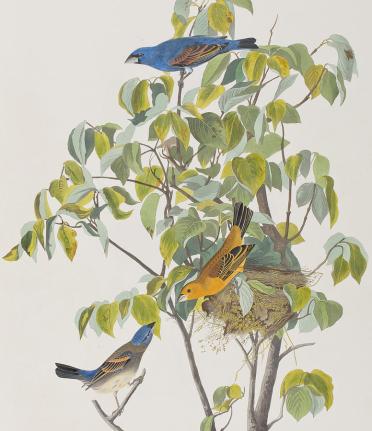
Early naturalist and artist John James Audubon painted this family of blue grosbeaks.

“It seemed too large to be an indigo bunting and clearly wasn’t a bluebird, so out came the binoculars and there it was, a blue grosbeak,” she wrote. “What a gorgeous bird!”
They looked it up in their trusty bird book, where they found images of the blue grosbeak in all his splendor. The bird also had all the necessary field marks, including the large grosbeak beak, rusty coloration in the wing bars, and a patch of black feathers between the eye and beak.
“It was a definite,” she said of their identification. “His range is not far off here, but it was definitely a rare one for us. We have never seen one.”
The Cowans also informed me they finally saw their first spring hummingbird on a cold, rainy Saturday, May 5.
I wrote the Cowans back, congratulating them on their sightings.  In all the years I have been watching birds, only a single blue grosbeak has visited my feeders, so I know what an unexpected treat a visit from one of these birds can be.
Blue grosbeaks are somewhat uncommon, so it’s definitely a sighting the Cowans can cherish.
This grosbeak is a bird of fields featuring lots of shrubs and small trees. Although fairly widespread, this bird isn’t considered abundant anywhere in its range. The bird is another neotropical migrant and will stop at feeders or birth baths to refuel or rehydrate during their seasonal migration journeys.
•••••
Rhonda Eller of Chilhowie, Virginia, contacted me on Facebook with a question about bluebirds.
“Have you ever heard of changing a bluebird’s nest after the eggs hatch?” Rhonda asked. “We have five baby bluebirds and someone told us maggots get in the nest after the eggs hatch and will eat the babies if you don’t alter the nest.”
In my response, I told Rhonda that I have always made a habit of cleaning out nest boxes after bluebirds are finished nesting. Their nests are so smashed down and dirty after a nesting, it just makes sense to clean out the old nest.

Bleubird-One

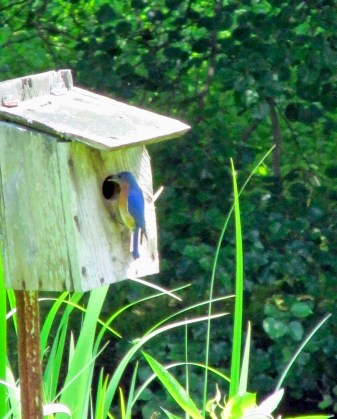
Photo by Bryan Stevens • As a rule of thumb, clean out a nest box after bluebirds or other cavity-nesting birds have fledged their young.

I heard back from Rhonda, who had good news. The first nesting attempt by her bluebirds proved a success and five young bluebirds left the nest box in early May.
“We will be cleaning out that nest and hoping for another brood,” she added.
•••••
A few more readers have also shared their first-of-season hummingbird sightings.
Susan Gossett sent me details about her parents and their hummingbird sighting in a Facebook message. “My parents, Harold and Elizabeth Willis, just read your article today in The McDowell News and they saw their first hummingbird April 12 around 5 p.m. They live at 80 Willis Drive in Marion, N.C.”
Guy Davies shared information about his father’s first spring hummingbird sighting. “My father Is Richard “Bud” Davies, Retired 1st Sgt., U.S. Army,” Guy wrote in his message. “He saw his first hummingbird April 14 at 7:10 p.m. at his home in Bluff City, Tennessee. They’re back!”
David and Judy Brown live in Damascus, Virginia. They saw their first spring hummingbird back on April 18 at 11 a.m. at their home they informed me in a Facebook message.
Dee Sims also contacted me by Facebook. “I saw my first hummingbird April 20,” she wrote. “live in Belfast, Virginia, which is between Lebanon and Richlands.”
Jane Arnold sent me an email to let me know her mom, Betty Poole, saw her first spring hummer at 1 p.m. on Sunday, April 23. Betty lives on Lincoln Road in Bristol, Virginia.
As for Jane, who lives on Hearst Road in Bristol, Virginia, she’s still waiting for the hummers to arrive, although she has had a feeder waiting for them since April 1.
Wilma Sexton messaged me on Facebook in regards to my article in the McDowell newspaper about sightings on hummingbirds. “I had just finished your article and I had already put out a fresh hummingbird feeder the weekend before,” she said. “My husband and I really enjoy watching and waiting for them to return. We saw our first one April 26.”
Wilma and her husband live in Union Mills, N.C.
••••••
To learn more about birds and other topics from the natural world, friend Stevens on Facebook at http://www.facebook.com/ahoodedwarbler. He is always posting about local birds, wildlife, flowers, insects and much more.


Egg laying has proven reliable for world’s birds


Which came first? The bird or the egg?

That long-running philosophical mystery hasn’t been solved, but it does clearly focus on one thing that makes birds unique: All birds lay eggs in order to reproduce; no birds give live birth to their young. On the other hand, all but a handful of mammals do give live birth to their young. These exceptions are the duck-billed platypus and the echidna (a species of spiny anteater) that are definitely odd-ball mammals in that they lay eggs.

Still, it’s birds that are such dedicated egg layers. From the largest to the smallest, all birds start out life by hatching from eggs.

Yellow_warbler_nest_with_eggs

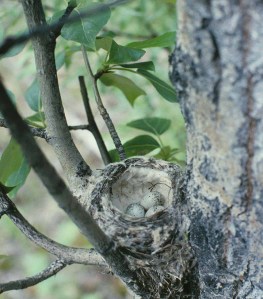
Photo by U.S. Fish & Wildlife • Eggs of a yellow warbler snug in the nest.

The world’s largest bird, the ostrich, produces the largest egg of all birds. Each egg weighs a little more than three pounds. An ostrich hen can lay about 20 eggs, but several hens may share a communal nest. Ostrich eggs require an incubation period of about 40 days. The ostrich is native to Africa, but domestication has spread this bird around the globe. The emu, the second-largest bird on the planet, needs about 56 days to incubate eggs. Native to Australia, the emu can produce an egg that weighs 1.4 pounds.

On the other end of the scale, the world’s smallest bird — the bee hummingbird of Cuba — lays only two eggs. The female will incubate her pair of eggs for about three weeks before they hatch. All hummingbirds lay two eggs. Female hummingbirds bear all the responsibility for raising young, including building the nest, incubating the eggs and feeding hungry young. Without assistance from the male, it simply isn’t possible for a female hummingbird to feed herself and any more than two young.

Here are some other examples of common birds in regards to their eggs.

The American robin lays three to five eggs. The female robin does most of the incubating of the eggs, which will take about 12 to 14 days. A female robin, along with many other songbirds, develops a brood patch that helps her keep eggs warm during the incubation process. The patch consists of a section of bare skin that transfers thermal heat from the female’s body to keep the eggs warm.

Hooded_Warbler

Photo by U.S. Fish & Wildlife • Female hooded warbler sits on her nest.

A mallard hen needs almost a month to incubate her clutch of eight to 13 eggs. Mallards do not develop a brood patch, but a hen will pull feathers from her own breast so her skin makes contact with her eggs and keeps them warm. The feathers and down pulled from her breast are not wasted. She will use them to line the nest and to help insulate the eggs. Although she does not lay all her eggs on the same day, incubation is such that all the eggs hatch at the same time — usually about 28 days after the mallard hen lays the last egg.

Female Northern cardinals lay three or four eggs in a single clutch. She will incubate her eggs for only 12 to 13 days. Occasionally her mate will help with the incubation duties.

For a tiny bird, the house wren is known for producing large families. Female house wrens lay as many as 10 eggs and incubate the eggs from nine to 16 days. The house wren nests in some odds nooks and crannies, including discarded cans and buckets, cavities created by woodpeckers and nest boxes provided by humans.

Female tree swallows lay four to seven eggs, which are incubated for 14 days. Female Eastern bluebirds lay four to seven eggs, which usually hatch after an incubation period of 13 to 16 days. Cavity-nesting tree swallows and bluebirds are both common users of nest boxes.

A wild turkey hen lays about 10 to 14 eggs in a nest formed by a depression in the dirt that is hidden by thick vegetation. The eggs are incubated for about 28 days, all hatching at the same time so the precocial young can leave the nest 12 to 24 hours after hatching. A turkey egg can weigh 3.5 ounces. By comparison, a jumbo chicken egg usually weighs 2.5 ounces.

California_Least_tern-2

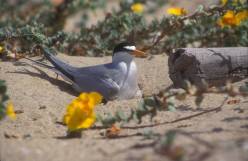
Photo by U.S. Fish & Wildlife • Least tern sits on her nest.

Gender roles are somewhat fluid for some shorebirds. The female red-necked phalarope — a species of shorebird — lays her four eggs and her duties are done. With phalaropes, it’s the male that incubates the eggs and raises the young. The eggs usually hatch 18 to 23 days after the laying of the third egg in the clutch. The male will tend to his offspring for another 20 days after the brood departs the nest.

The female mute swan waits for the male to begin building their nest before she commits herself. Then, working together, they finish the nest, sometimes taking ten days or longer to finish the job. At that point, the female lays two to five eggs, which will require an incubation period of 35 to 41 days.

Male and female pileated woodpeckers share many nesting duties, including excavating a nesting cavity in a tree, feeding the young and incubating the three to five eggs laid by the female. The eggs usually hatch in about 15 to 16 days.

Great blue herons are communal nesting birds, which means several pairs will build nests in a common vicinity. The female lays two to six eggs and incubates them for 27 to 29 days. The young herons spend a considerable amount of time in the nest. Depending on the number of young, herons may not depart the nest for 49 to 80 days after hatching.

A female red-tailed hawks typically lays two to three eggs, although a single egg or as many as five are possible. After an incubation period of 28 to 35 days, the parents must still feed and protect the young in the nest for another six to seven weeks. After young hawks leave the nest, they still rely on their parents to show them the ropes for a few additional weeks.

Killdeer-Eggs

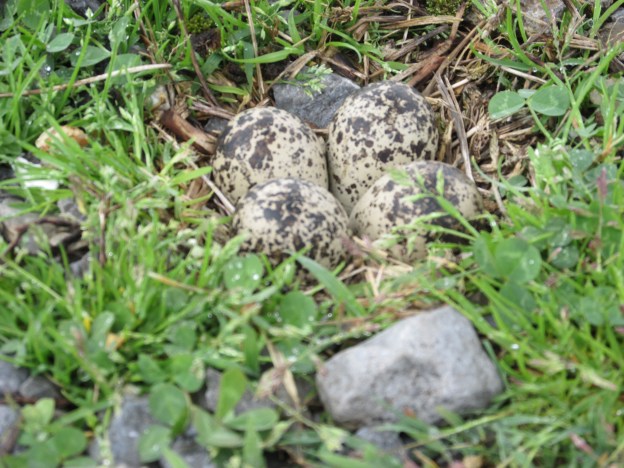
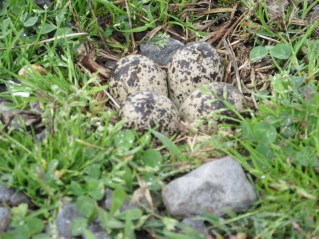
Photo by Bryan Stevens • Four eggs contained in a killdeer’s nest.

A female great horned owl lays one to four eggs in a nest, which is often renovated from a nest previously built and occupied by red-tailed hawks. After incubating the eggs for 30 to 37 days, she and her mate will care for the young in the nest for another 42 days.

Bird eggs are fragile, so it’s an advantage to hatch eggs as quickly as possible. Various animals also love to make a meal of bird eggs. In general, the larger the bird the more time they can afford for their eggs to hatch. Most small songbirds have eggs that hatch quickly, often in less than two weeks.

Spring is definitely the season of the egg. Eastern bluebirds and tree swallows are nesting at my home. I suspect that American robins, Northern cardinals, song sparrows and Eastern towhees are also on nests hidden in shrubs and trees. I’m hopeful the nesting season’s successful for all of them.

The next time you see your favorite bird, just remember that it all began with a single, delicate egg that hatched into a feathered miracle.

••••••

To learn more about birds and other topics from the natural world, friend Stevens on Facebook at https://www.facebook.com/ahoodedwarbler. He is always posting about local birds, wildlife, flowers, insects and much more. If you have a question, wish to make a comment or share a sighting, email ahoodedwarbler@aol.com.
BLUE JAY

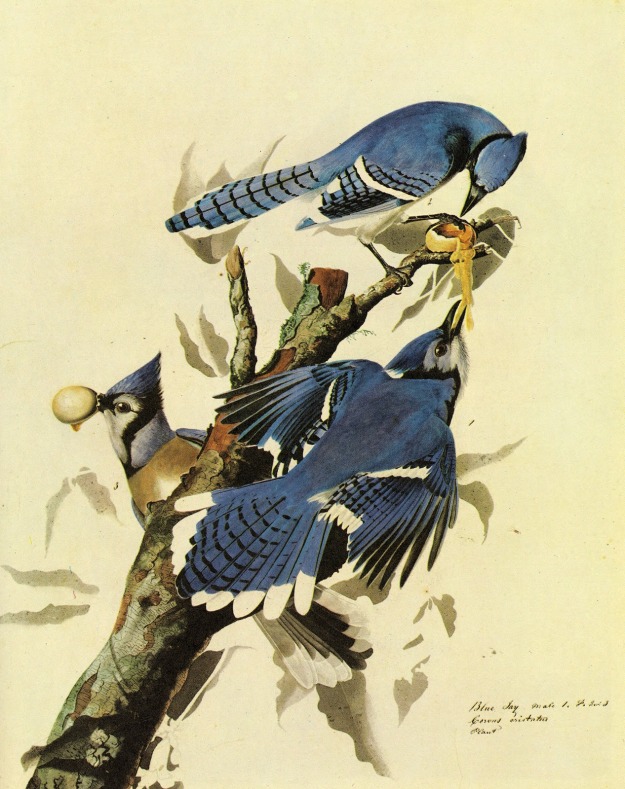
Early American naturalist and artist John James Audubon depicted blue jays raiding the nests of other birds to consume eggs in his painting of the species.

Readers share more hummingbird sightings, including some featuring dramatic twists

Ruby-throated

Photo by Bill Buchanan/U.S. Fish & Wildlife Service • Hummingbirds visit flowers for nectar, but they will also visit feeders filled with sugar water. The recommended ratio for the sugar water mixture is four parts water to one part sugar. Because of possible health hazards to these tiny birds, do not add red dyes or other artificial coloring to the mixture.


Readers are still sharing hummingbird arrival stories, and a few of those stories boasted some extra drama. For instance, one of these tiny birds arrived with such gusto that it soon ran afoul of a screen door. No need to worry, though. The story has a happy ending, as do all of these tales of fascination with the most tiny feathered visitor to our yards and gardens.
Read on and enjoy a tale about the love of nature and hummingbirds shared by a daughter and her 88-year-old mother. Another story highlights the hummer that provided a welcome home greeting for a couple returning home after a recent trip.
Perhaps Janet James said it best when telling how she felt after seeing her first hummingbird this spring. “Happy! Happy!” Janet wrote in an email.
I think that’s the secret of the appeal of these tiny birds. They spread happiness as they zip through our lives on their swiftly beating wings. As one reader discovered, just a quick glimpse of a hummingbird can chase away the gloom of a rainy day.Hummer-CloserUp

Don Holt and Dianne Draper saw their first hummingbird of spring at Dianne’s home on Cherokee Road in Jonesborough, Tennessee, on Tuesday, April 11.


Susan Gossett sent me details about her parents and their hummingbird sighting in a Facebook message. “My parents, Harold and Elizabeth Willis, just read your article today in The McDowell News and they saw their first hummingbird April 12 around 5 p.m. They live at 80 Willis Drive in Marion, N.C.”
Guy Davies shared information about his father’s first spring hummingbird sighting. “My father Is Richard “Bud” Davies, Retired 1st Sgt., U.S. Army,” Guy wrote in his message. “He saw his first hummingbird April 14 at 7:10 p.m. at his home in Bluff City, Tennessee. They’re back!”
“I saw my first hummer of the season at my feeder on Saturday, April 15,” Daniel Callahan wrote in an email. Daniel, who lives on Mendota Road in Washington County, Virginia, said the observation involved two male hummingbirds.
Steven Hopp saw his first hummingbird — a male — on Saturday, April 15.
“We have a feeder on our patio and even though the feeder was empty, it zipped in and went right to it,” Steven wrote in his email. “I think that suggests it was a returning male. I also heard a scarlet tanager and indigo bunting on Saturday, April 15.”
Graham Gardner sent me an email to let me know of his Easter Sunday hummingbird sighting. “While sitting on my back porch in Abingdon mid-morning on April 16, I saw, for the first time this season, a male ruby-throated hummingbird visit our feeder three times before buzzing off,” Graham wrote in the email.

Hummer-Print_edited-1
Toni Shaffer, who lives off Gate City Highway in Washington County, Virginia, sent me an email to let me know she saw her first hummer at 7:30 a.m. on the morning of Monday, April 17.  “He has remained near the feeder all day,” she added. “The hummingbirds are about four days later than usual here.”
Deborah Clark sent me an email about hummingbird arrivals.
“My mother, Louise Hiler Tilson, has asked that I email you to let you know that she and I both have seen hummingbirds at our homes,” Deborah wrote in the email. “Mom lives in the community of Riverside, between Marion and Chilhowie along the banks of the South Fork of the Holston in Smyth County.” She said her mom saw her first ruby-throated hummingbird on the morning of April 17.
Deborah said her mother has been an avid birder for most of her 88 years. “Mother will put up several feeders (to join the seed feeders that already enliven her backyard) soon, and expects to have her usual hoard of tiny warriors buzzing around her door,” she added.
Deborah lives in Grayson County, near the little village of Troutdale, Virginia. Her own first-of-the-season hummer — a male with the ruby throat — hovered just outside her kitchen window, apparently looking at her as she was washing dishes. “Although he might have been seeing his own reflection in the window glass,” Deborah added.


Mary Jane McClellan sent me an email to let me know she put her sugar water feeders out at 4:30 p.m. on Monday, April 17 — two days later than she normally does. Mary Jane, who lives near South Holston Dam on Rooty Branch Road in Bristol, Tennessee, saw her first hummingbird less than two hours later when a hummer showed up at 6:11 p.m.

Some hummingbirds have a flair for making a dramatic entrance.
Linda Kessinger Rhodes, a resident of Bristol, Tennessee, said in a Facebook post to my page that she had been anxious for the hummers to appear at her home about two miles north of Bristol Motor Speedway. “Today (April17) was the day,” she wrote in her post.
“However, at first, it wasn’t the joyous moment I had envisioned,” she added.
The tiny male hummingbird flew right into the screen door and his bill got stuck.
“My husband pushed it back and freed the poor little thing,” Linda said. She joked that the tiny bird may never come back to these parts again after that adventure!

Janet James, a resident of Bluff City, Tennessee, put out her feeder a week before she got any visitors. “I saw my first hummer on Monday, April 17,” she said in an email. “Happy! Happy!” Lego-Hummer

Don and Donna Morrell shared the news of their first hummingbird of spring in an email.
“We saw our first hummer at 6 p.m. on Sunday, April 16,” Don wrote. “We live behind South Holston Dam and had just gotten back from vacation.”
He added that Donna had put out the feeder a week earlier before they left on their trip.
“We were eating supper and it came and had supper with us,” he added.

Cecilia Murrell emailed me about her hummer sighting. She said that her first spring sighting of a hummingbird — a male — brightened a gloomy, rainy day at her home in Abingdon, Virginia, on Tuesday, April 18.

When he emailed me on Tuesday, April 18, Randy Smith, who lives in Abington, Virginia, said he still hadn’t seen any hummingbirds. However, he has seen several warblers. “I saw Black-and-white warblers, Northern parulas, hooded warblers, yellow-rumped warblers and a Louisiana waterthrush on Saturday, April 15, at Hungry Mother State Park in Marion, Virginia.
Randy, who volunteers at the Abingdon Public Library, said Karen Northrup, one of the library’s employees, was at home with her husband when they saw their first hummingbirds of the season on Saturday, April 15.

Lois Cox and Wilma Boy on Riverside Road in Bluff City, Tennessee, saw their first hummingbird on Tuesday, April 18. They also reported in the same email that their first spring sighting of an indigo bunting — a male eating millet seed from a feeder — took place the same day.


David and Judy Brown live in Damascus, Virginia. They saw their first spring hummingbird back on April 18 at 11 a.m. at their home they informed me in a Facebook message.
“Just thought I’d let you know I sighted our first hummingbird on April 18 feeding on our deck feeder sometime before noon,” wrote Linda K. Sproles in an email. “I also have noted on our calendar that the first hummingbird was sighted on April 22 in 2016 and April 19 in 2015.
Linda resides on Hunter Hills Circle in Bristol, Tennessee.
Wayne Miller, a resident of Abingdon, Virginia, emailed me about his first hummer sighting. “Our first hummingbird of the season arrived to check out our feeder on the deck about 7:30 p.m. on Wednesday, April 19,” he wrote.FemaleRuby-April28


Dee Sims also contacted me by Facebook. “I saw my first hummingbird April 20,” she wrote. “live in Belfast, Virginia, which is between Lebanon and Richlands.”

Mark Martin of Abingdon, Virginia, saw two hummingbirds, a male and a female, at 1:20 p.m. on Saturday, April 22.
Don Holt, a naturalist at Steele Creek Park in Bristol, Tennessee, reported that the first hummingbird seen in the park this spring arrived on Earth Day, Saturday, April 22.

“I had my first hummingbird this morning,” wrote Dianne Bisig in an email sent to me on Sunday, April 23. “It looked like it was trying to find a spot out of the wind. It stayed on the porch for a while.”
Dianne resides in Millbrooke Estates in Abingdon, Virginia.
Marty Huber and Jo Ann Detta of Abingdon, Va., emailed me to let me know they heard their first hummingbird on April 21, but they didn’t actually see one of these tiny birds until April 23.
“It’s 7:40 on Sunday night (April 24) and I’ve just seen our first hummer, sitting on a feeder in the rain,” wrote Bettie Hite, who lives on Overbrook Road in Bristol, Tennessee, wrote in an email.


Wilma Sexton messaged me on Facebook in regards to my article in the McDowell newspaper on about sightings on hummingbirds. “I had just finished your article and I had already put out a fresh hummingbird feeder the weekend before,” she said. “My husband and I really enjoy watching and waiting for them to return. We saw our first one April 26.”

Wilma and her husband live in Union Mills, N.C.

••••••

If you have a question, wish to make a comment or share a sighting, email ahoodedwarbler@aol.com.

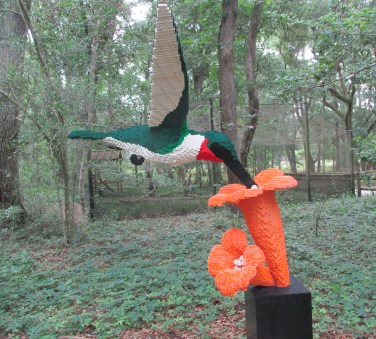
Lego-Hummer