Author Archives: Bryan Stevens

Unknown's avatar

About Bryan Stevens

Bryan Stevens lives in Northeast Tennessee. He is an editor, writer and columnist. He has written food columns for the Johnson City Press, Elizabethton Star and Carter County Compass since 2003.

Summer’s swallows are graceful, aerodynamic birds

Tom Koerner/USFWS • A perched tree swallow surveys its surroundings..

They took their time this year, but the tree swallows are finally putting in appearances almost daily, especially on the string of sunny, hot days the region has experience lately. This pair of swallows has become frequent visitors since the middle of last month.

Based on their behavior, which primarily consists of aerial foraging over fields and a pond at my home, I’m convinced they are feeding young. They don’t, however, appear to be residing in any of my nest boxes. I’m simply glad they are nesting close enough to ensure frequent visits. It probably won’t be long before their young are soaring over the fields with them.

No matter where you live, you probably don’t have to go far to see one of the members of the bird family known as swallows. These graceful, aerodynamic birds are quite familiar to most people. If you spend much time at all outdoors during the summer months, chances are you’ve observed some members of this family.

Vincent Simard from Pixabay. • A tree swallow peeks from a nest box.

It’s usually not too difficult to find five of the six species that are known to make Northeast Tennessee and Southwest Virginia their home from spring to fall. The more commonplace swallows are barn swallow and tree swallows, but during the summer months purple martins, cliff swallows and northern rough-winged swallows also call the region home.

Barn swallow and tree swallow are the two members of the family that are probably best known to people. They have adapted to life in both suburban and rural areas, which brings them into frequent contact with people.

These days, the barn swallow is as apt to nest in a parking garage or on an apartment balcony as inside a barn in the countryside. Once young swallows leave the nest, parents will park them on a perch as they continue to feed the still dependent young. Adults fly over nearby fields, foraging for insects that they catch on the wing and deliver back to the waiting, always hungry, young birds.

A freshly mown field is a magnet for swallows. I don’t know how the word spreads so quickly among these birds, but I’ve observed dozens of these birds descending on fields soon after they have been mowed for hay. At times, the birds arrive while the mowing is still taking place, swooping after insects stirred up in the tractor’s wake.

I haven’t observed any bank swallows in the region this year, but these members of the swallow family are rather hit-or-miss in the region. Because of their specialized nesting needs, bank swallows are localized in their distribution and not as widespread as their kin.

Cliff swallows nest beneath many local bridges. These swallows, which at one time nested primarily on rocky cliffs, hence their name, now frequently nest under man-made structures. These swallows make their jug-shaped nests out of mud and clay. These nesting “jugs” are all located in clusters beneath bridges and other structures. It’s a wonder that the parents flying in with food are able to tell their nests apart from the nearby seemingly identical nests of their neighbors.

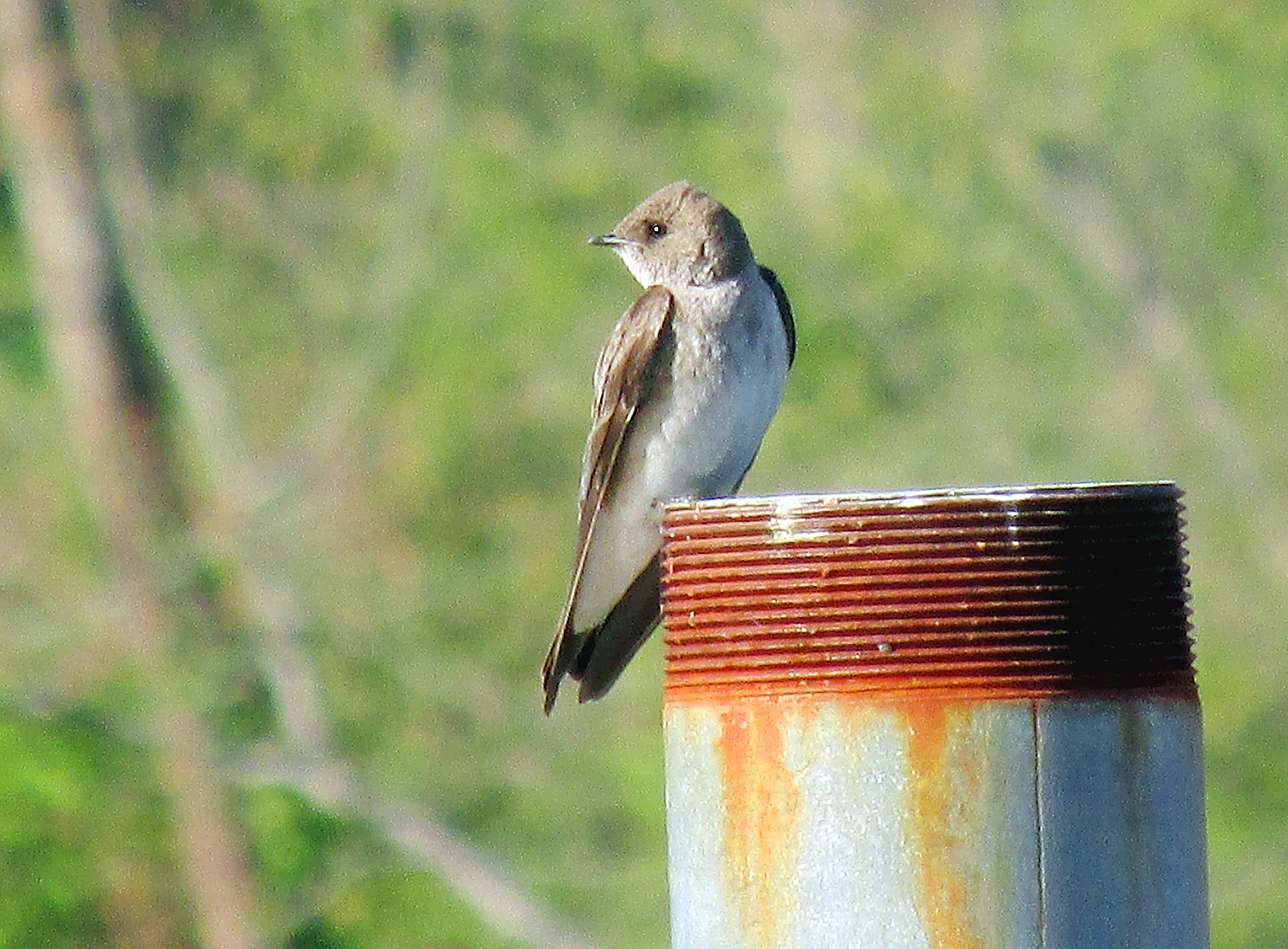
Photo by Bryan Stevens • A Northern rough-winged swallow perches on a rusty pole.

Northern rough-winged swallows are opportunists when it comes to nesting. According to a profile written by Mark Johns with North Carolina Wesleyan College, this small swallow nests near rocky gorges, shale banks, stony road cuts, railroad embankments, gravel pits, eroded margins of streams and other exposed banks of clay, sand or gravel. They will also nest in old kingfisher burrows, protruding drainpipes, crevices in brick or stone structures such as dams, bridges or tunnels, gutters and culverts. Their nests are often built near open water.

The Northern rough-winged swallow ranks as one of the species with the longest common names in North America. It’s name consists of 26 letters and a hyphen, which ranks it one letter below both the Northern beardless-tyrannulet and a recently-created species — the saltmarsh sharp-tailed sparrow — which each have 27 letters and a hyphen. Formerly known as sharp-tailed sparrow, the species was renamed with “salt marsh” added to distinguish it from a relative, Nelson’s sparrow.

Purple martins, which rank as the largest member of the swallow family in North America, are famous for nesting in large colonies. Nesting facilities range from groupings of natural or artificial gourds fashioned into a nesting chamber, as well as large, multi-level condominium dwellings tailored for the specific needs of this communal bird. A colony can consist of several dozen to several hundred pairs of these birds. Only the adult male purple martin shows the iridescent, dark blue-purple plumage that provides the species with its name.

The tree swallow is my favorite, probably because a pair of these birds has nested in my yard for many years. Unlike other swallows, these cavity-nesting birds will readily accept nesting boxes. They compete with Eastern bluebirds for boxes, but the two species usually can work out a truce and settle down to nest in close proximity to each other. The iridescent blue-green male tree swallow, complete with white underparts and a forked tail, is a handsome bird and a welcome addition to the bird population in any yard or garden. Tree swallows enjoy water, so a nearby pond or creek is a boon for attracting these birds.

While only a few swallows range into the United States and Canada, a total of 83 species of swallows can be found worldwide. Some of the common names for these different swallows (and martins) are quite descriptive. A sampling includes white-eyed river martin, square-tailed saw-wing, white-headed saw-wing, grey-rumped swallow, white-backed swallow, banded martin, violet-green swallow, golden swallow, brown-chested martin, brown-bellied swallow, pale-footed swallow, white-bibbed swallow, pearl-breasted swallow, greater striped swallow, mosque swallow, fairy martin and chestnut-collared swallow.

Enjoy swallows while you can. They depart earlier than most of our other summer nesting birds. Once their young are out of the nest, they are soon forming large flocks in preparation for flying south.

•••

To share a sighting, ask a question or make a comment, email me at ahoodedwarbler@aol.com.


Summer bird count finds 114 species

Hans Toom/Pixabay • A chestnut-sided warbler was one of 18 species of warblers tallied on the annual survey.

The 31st Carter County Summer Bird Count was held on the first day of June with 23 observers in nine parties. The weather was generally favorable, but somewhat cool early in the morning and breezy at times.

Participants tallied 114 species, which is exactly the 30 year average, but slightly below the average of the last decade of 117 species. The all-time high was 123 species in 2017.

Abundant birds included European starling (471), American robin (372), cliff swallow (330), Canada goose (270), song sparrow (240) and American crow, 208.

The list:

Canada goose, 270; wood duck, 5; mallard, 52; and wild turkey, 13.

Photo by Bryan Stevens • Five wood ducks were found on count day.

Rock pigeon, 61; Eurasian collared-dove, 1; mourning dove, 130; yellow-billed cuckoo, 1; and chuck-will’s-widow, 1.

Eastern whip-poor-will, 13; chimney swift, 61; and ruby-throated hummingbird, 15.

Killdeer, 11; American woodcock, 4; double-crested cormorant, 7; great blue heron, 18; and green heron, 4.

Black vulture, 14; turkey vulture, 59; sharp-shinned hawk, 3; Cooper’s hawk, 1; bald eagle, 3; red-shouldered hawk 1; broad-winged hawk, 8; red-tailed hawk, 12; Eastern screech-owl 8; and barred owl, 2.

Belted kingfisher, 11; red-bellied woodpecker, 31; yellow-bellied sapsucker, 6; hairy woodpecker, 6; Northern flicker, 13; pileated woodpecker, 22; and American kestrel, 1.

Great crested flycatcher, 5; Eastern kingbird, 24; Eastern wood-pewee, 28;

Acadian flycatcher, 19; alder flycatcher, 1; least flycatcher, 10; and Eastern phoebe, 65.

White-eyed vireo, 6; blue-headed vireo, 47; warbling vireo, 1; and red-eyed vireo, 205.

Blue jay, 80; American crow, 208; fish crow, 5; and common raven, 14.

Photo by Bryan Stevens • A young titmouse visits a suet feeder.

Carolina chickadee, 49; tufted titmouse, 91; tree swallow, 88; Northern rough-winged swallow, 32; purple martin, 21; barn swallow, 135; and cliff swallow, 330.

Golden-crowned kinglet, 20; cedar waxwing, 58; Red-breasted nuthatch, 16 white-breasted nuthatch, 17; brown creeper, 6; and blue-gray gnatcatcher, 15.

Carolina wren, 126; house wren 48; and winter wren, 7.

Gray catbird, 36; brown thrasher, 34; Northern mockingbird, 62; European starling, 471; Eastern bluebird, 86; veery, 21; hermit thrush, 5; wood thrush, 56; and American robin, 372.

House sparrow, 40; house finch 86; pine siskin, 8; and American goldfinch, 77.

Chipping sparrow, 85; field sparrow, 25; dark-eyed junco, 51; song sparrow, 240; Eastern towhee, 135; yellow-breasted chat, 9; Eastern meadowlark, 9; orchard oriole, 7; Baltimore oriole, 7; red-winged blackbird, 68; brown-headed cowbird, 27; and common grackle, 87.

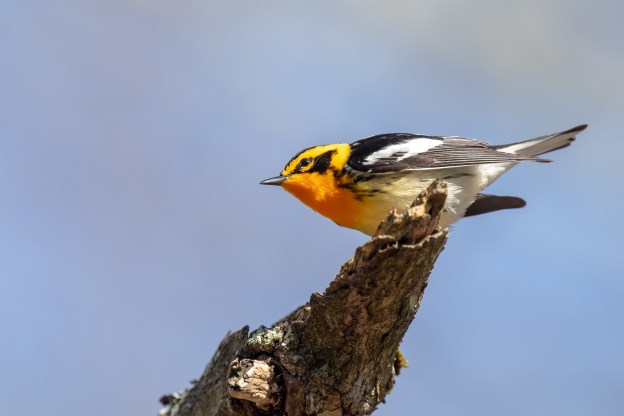
Ovenbird, 73; worm-eating warbler, 12; Louisiana waterthrush, 6; black-and-white warbler, 44; Swainson’s warbler, 9; common yellowthroat, 27; hooded warbler, 145; American redstart, 9; Northern parula, 48; blackburnian warbler, 4; yellow warbler, 5; chestnut-sided warbler, 30; black-throated blue warbler, 61; pine warbler, 4; yellow-rumped warbler, 4; yellow-throated warbler, 18; black-throated green warbler, 50; and Canada warbler, 20.

Scarlet tanager 28; Northern cardinal, 135; rose-breasted grosbeak, 13 blue grosbeak, 4; and indigo bunting, 141.

According to long-time count compiler Rick Knight, a few species were missed on count day, usually because they are very localized in distribution or occur in very low densities. And sometimes, he noted, the birds just don’t cooperate.

Some exciting observations include a family group of four American woodcocks at Carvers Gap on Roan Mountain. In addition, 18 species of warblers were found on the count.

Missed species: Common merganser – although a female with a brood of ducklings was seen the day prior to the count – as well as ruffed grouse, common niighthawkhawk, yellow-crowned night-heron, great horned owl, yellow-throated vireo, grasshopper sparrow, golden-winged warbler, Kentucky warbler, magnolia warbler and prairie warbler.

•••

To share a sighting, ask a question or make a comment, email ahoodedwarbler@aol.com. 


Unicoi County summer bird count finds 109 species

Photo Hans Toom/ Pixabay • The aptly named yellow warbler was one of 18 warbler species found on this year’s Unicoi County Summer Bird Count.

The 11th annual Unicoi County summer bird count was held Saturday, June 8, with 19 observers in seven parties. The count has been conducted yearly since its inception by members of the Elizabethton Bird Club.

I have taken part on this count from the first one held, missing only once when I was out of town. It’s an enjoyable count and, for me, it’s very close to home. This count also provides a reliable snapshot of the birds present in Unicoi County in early summer. 

Counters tallied 109 species which is slightly above the average of 108 species. The all-time high was 112 species in 2016. 

Abundant birds included European starling (314), American robin (246), song sparrow (175), American crow (174), red-eyed vireo (172), Northern cardinal (128) and cliff swallow, 126. Eighteen species of warblers were found, the most abundant being hooded warbler with 84 individuals tallied. 

As always a few low-density or very localized species were missed, including yellow-billed cuckoo, bald eagle, great horned owl, American kestrel, grasshopper sparrow, golden-winged warbler and prairie warbler.

The list:

Canada goose, 18; wood duck, 3; mallard, 20; wild turkey, 7; and ruffed grouse, 1.

Rock pigeon, 61; mourning dove, 56; chuck-will’s-widow,1; Eastern whip-poor-will, 18; chimney swift, 29; and ruby-throated hummingbird, 8.

Killdeer, 8; great blue heron, 3; and green heron, 2.

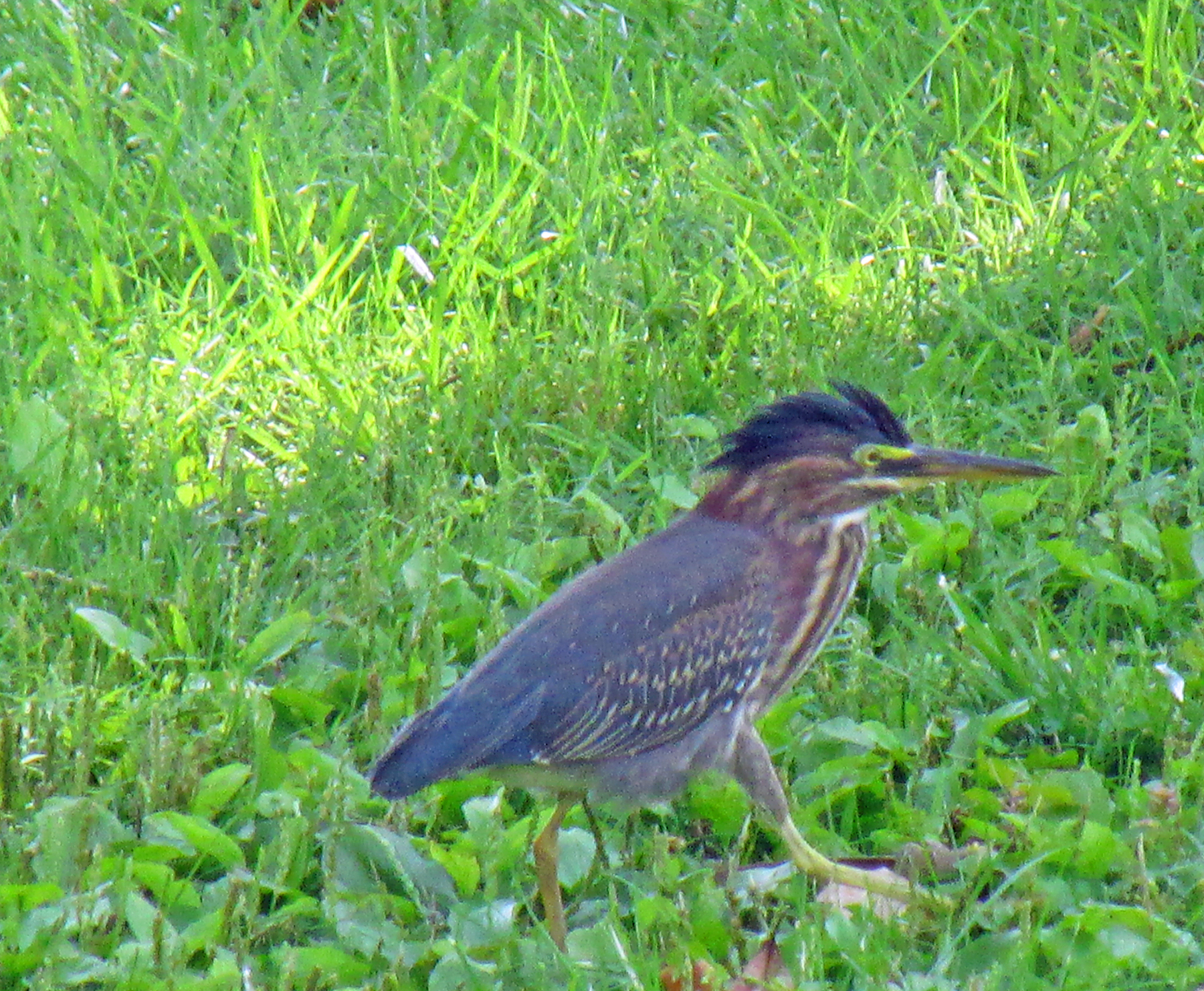
Photo by Bryan Stevens
A green heron elevates a shaggy crest of feathers, a behavior often initiated when the bird feels alarmed.

Black vulture, 1; turkey vulture 37; sharp-shinned hawk, 1;

Cooper’s hawk 3; red-shouldered hawk, 4; broad-winged hawk, 10; red-tailed hawk, 2; Eastern screech-owl, 5; barred owl, 4; and Northern saw-whet owl, 1.

Belted kingfisher, 5; red-bellied woodpecker, 15; yellow-bellied sapsucker, 9;

downy woodpecker, 8; hairy woodpecker, 5; Northern flicker, 10; and pileated woodpecker, 20.

Great crested flycatcher, 3; Eastern kingbird, 11; Eastern wood-pewee, 10; Acadian flycatcher, 32; least flycatcher, 5; and Eastern phoebe, 65.

White-eyed vireo, 3; yellow-throated vireo, 1; blue-headed vireo, 38; warbling vireo, 3; and red-eyed vireo, 172.

Blue jay, 61; American crow, 174; fish crow, 5; common raven, 8; Carolina chickadee, 71; and tufted titmouse, 60.

Photo by Bryan Stevens • A tree swallow visits a nest box to check on young.

Tree swallow, 49; Northern rough-winged swallow, 20; purple martin, 25; barn swallow, 78; and cliff swallow, 126.

Golden-crowned kinglet, 2; cedar waxwing, 36; red-breasted nuthatch, 2; white-breasted nuthatch, 18; brown creeper, 4; and blue-gray gnatcatcher, 23.

Carolina wren, 84; house wren, 31; and winter wren, 3.

Gray catbird, 34; brown thrasher, 14; Northern mockingbird, 17; European starling, 314; Eastern bluebird, 59; veery, 12; hermit thrush, 2; wood thrush, 34; and American robin, 246.

House sparrow, 14; house finch, 33; American goldfinch, 56; chipping sparrow, 54; field sparrow, 6; dark-eyed junco, 20; song sparrow, 175; Eastern towhee, 6; and yellow-breasted chat, 1.

Eastern meadowlark, 14; orchard oriole, 4; Baltimore oriole, 1; red-winged blackbird, 60; brown-headed cowbird, 16; and common grackle, 63.

Ovenbird, 38; worm-eating warbler, 10; Louisiana waterthrush, 10; black-and-white warbler, 19; Swainson’s warbler, 16; Kentucky warbler, 1; common yellowthroat, 6; hooded warbler, 84; American redstart, 12; Northern parula, 41; magnolia warbler, 2; Blackburnian warbler, 10; yellow warbler, 3; chestnut-sided warbler, 17; black-throated blue warbler, 45; yellow-throated warbler, 17; black-throated green warbler, 45; and Canada warbler, 13.

Scarlet tanager, 20; Northern cardinal, 128; rose-breasted grosbeak, 4; blue grosbeak, 1; and indigo bunting, 77.

•••

Bryan Stevens has birded since the early 1990s and has written about birds and birding since 1995. To ask a question, make a comment or share a sighting, email him at ahoodedwarbler@aol.com.


Indigo buntings speak to the summer season

Photo courtesy of George Stone • Indigo buntings range from southern Canada to northern Florida during the summer months, occasionally even expanding beyond this wide range.

George Stone emailed me after finding my weekly bird column online.

“I live approximately 90 miles west of Edmonton, Alberta, Canada,” he wrote in his email. “This morning (June 6) I had my first ever sighting of an indigo bunting at my feeder!”

He also asked a question, wanting to know if indigo buntings are rare in his location in Canada.

I did some digging online and found that indigo buntings range from southern Canada to northern Florida in the summer. I relayed this information to George in a reply to his email, congratulating him on his sighting.

I informed him that I reside in Northeast Tennessee, close to the borders with Virginia and North Carolina. I also told him that in summer, indigo bunting is not rare at all here in Northeast Tennessee. I saw and heard several while doing a summer bird count on June 8 in the Limestone Cove community of Unicoi County.

Photo by Bryan Stevens • The male indigo bunting is a resplendent bird.

The male indigo bunting is the only solid blue bird in the eastern United States, but it’s all an illusion — literally a trick of the light. The indigo bunting’s feathers are not really blue; the male’s brilliant azure plumage is caused by the process of diffraction of light around the structure of the bird’s feathers. This process scatters all but the blue light, and the resulting color shifts from black to blue to turquoise as the angle of reflected light changes. In bright light, it can even look unnaturally vivid blue. In poor light, however, an indigo bunting male can appear black. Fortunately, indigo buntings have both a characteristic body shape and song, so even if the birds are not seen in their best light, they can still be recognized.

For such a bright blue bird, indigo buntings are not easy to detect. Males like to find an elevated perch and sing to proclaim their territory and pitch their availability to potential mates. Learn the song, which consists of a burst of jumbled, high-pitched notes, and use that knowledge to help pinpoint singing males. Once you zero in on the singing bird’s location, it’s easy to focus binoculars and enjoy peeking at such a pretty bird.

The indigo bunting belongs to a genus of birds known as Passerina, which is included the family Cardinalidae, which includes birds like Northern cardinal and rose-breasted grosbeak. They are often lumped into a group known as North American buntings, although they are not closely related to such birds as snow bunting and lark bunting. The latter is even recognized as the official state bird for Colorado, a unique honor for this group of birds. The other members of the Passerina genus include lazuli bunting, varied bunting, painted bunting, rose-bellied bunting, orange-breasted bunting and blue grosbeak.

Photo by Bryan Stevens • Newly-returned neotropical migrants, such as this Indigo Bunting, increased the total number of species for the annual spring count.

Worldwide, other birds known as buntings include such descriptively named species as slaty bunting, corn bunting, white-capped bunting, gray-necked bunting, cinereous bunting, lark-like bunting, cinnamon-breasted bunting, chestnut-eared bunting, little bunting, yellow-throated bunting, golden-breasted bunting, black-headed bunting, red-headed bunting and yellow bunting.

For me, the indigo bunting has always been a bird of the summer season. Not even the heat of mid-day tires out a persistently singing male indigo bunting. They linger into the early October, but later in the season the bird begin to molt feathers and take on a more shabby look. Enjoy them while they’re here.

•••

To ask a question, make a comment or share a sighting, email me at ahoodedwarbler@aol.com.


Bluebirds making good progress as season advances

Photo by Bryan Stevens
A male Eastern Bluebird perches on a chain-link fence to watch for insect prey.

A pair of Eastern bluebirds in your yard or garden will have no trouble with minor intrusions into their lives as they go about their daily routine, and the payoff for you is hours of free entertainment.

Birds, including bluebirds, are busy nesting. I’ve already seen this season’s first generation of young bluebirds, just out of the nest and ready to stretch their wings.

Departing the security of a nest box or tree cavity is a doozy of a first step for these charming birds. After all, for the first month or so of their lives, that’s been the only home they’ve known since hatching. Now, they’re expected to venture into the wider world of field and woodland.

The parent bluebirds have remained diligent about keeping their young fed, even after these first steps toward independence. I’ve observed a couple of young bluebirds impatiently awaiting food deliveries from their parents, who for the moment are happy to oblige with such tidbits as caterpillars, moths and other insects and spiders.

The Eastern bluebird is one of North America’s best-known cavity-nesting birds. About 85 species of North American birds use cavities in trees for nesting purposes. Cavity-nesters include ducks, such as buffleheads and wood ducks, as well as birds of prey such as Eastern screech-owls and American kestrels.

Some of these species, such as woodpeckers and nuthatches, can excavate their own cavity in a dead or decaying tree. Others, such as the bluebirds, must find a cavity already in existence. Such cavities are scarce real estate and can be subject to some intense competition. The Eastern bluebird is at a disadvantage when forced to compete with non-native introduced birds such as aggressive European starlings and house sparrows.

About a decade ago, I found bluebirds nesting in a cavity in a wooden fence post that was part of an enclosure for a field. The fence post nest reinforced how changing landscapes have also affected these birds. Instead of wooden fence posts, many farmers now use metal ones. Dead or dying trees – a much sought-after resource for cavity-nesting birds — are often removed from woodlands. During a recent spring bird count, I happened to revisit that field and, sure enough, the fence post with the cavity is still present. I saw some indications that bluebirds are still using the post cavity, but I didn’t see any bluebirds present during my visit.

Photo by Bryan Stevens
A male Eastern Bluebird perched on playground equipment at Winged Deer Park in Johnson City.

Bluebirds are not too fussy and will accept lodging in a nest box, or birdhouse, provided for them by human landlords. Because of their trusting nature when it comes to their human neighbors, the Eastern bluebird is one of our most beloved birds. In fact, bluebirds are such popular birds that interest in them and their well-being has inspired the foundation of such organizations as the North American Bluebird Society.

In addition, the Eastern bluebird has also been designated the official state bird for New York and Missouri.

There are two other species of bluebirds found in North America. The Western bluebird is found throughout the year in California, the southern Rocky Mountains, Arizona and New Mexico, as well as part of Mexico. The species ranges in the summer as far north as the Pacific Northwest, British Columbia and Montana.

The mountain bluebird nests in open country in the western United States as far north as Alaska. They are short-distance migrants, retreating as far south as Mexico during the winter season.

Except for a whitish-grayish belly, the male mountain bluebird is a brilliant sky blue above with paler blue on his underparts. The female looks similar if duller in her coloration.

Some people in the region mistakenly assume that Eastern bluebirds are “mountain” bluebirds because they will reside in open areas at higher elevations. The simplest way to tell the two species apart — although not necessary since the range of the mountain bluebird is hundreds of miles to the west — is the reddish undersides present in both sexes of the Eastern bluebird. Mountain bluebirds lack this reddish coloration.

The states of Nevada and Idaho have selected the mountain bluebird as their official state bird. I saw this species in 2006 during a trip that took me to different parts of Utah and Idaho.

Bluebirds are members of the extended family of thrushes, making them relatives of such birds as American robin, wood thrush and veery. The relationship of the Eastern bluebird to the American robin can best be seen in the red breast sported by both species. In addition, young robins and bluebirds both have spotted breasts, providing more evidence of their affiliation with many of the thrushes. The thrush family numbers more than 100 species worldwide and extends into Europe, Asia and Africa, as well as various islands.

Photo by Bryan Stevens
The female Eastern Bluebird is not quite as brightly colored as her mate.

Inviting the Eastern bluebird into your yard and gardens is not usually too difficult. It helps if you live in an open, spacious habitat bordered with small trees. Providing a nesting box constructed to the specifications for this bird is another way to attract them. With natural cavities in trees and fence posts a rare commodity, this bird will readily accept boxes. It’s not a sure-fire means of bring bluebirds closer. Plenty of other native birds, including Carolina chickadees, tree swallows and house wrens, will also make use of a box designated for bluebirds.

The NABS recommends a box that is well ventilated, watertight and equipped with drainage holes. The box should also be easy to open, monitor and clean.

For more specific and very valuable information about becoming a landlord for bluebirds, please visitwww.nabluebirdsociety.org. The website offers nest box designs and other valuable information for would-be bluebird landlords.

In addition to housing, food and water can be used to lure Eastern Bluebirds closer. This bird doesn’t eat seeds, but it can be attracted with an offering of mealworms — live or freeze-dried – or commercially prepared peanut butter nuggets. A water feature in a yard is also a magnet for bluebirds and a host of other bird species.

If your home doesn’t provide suitable bluebird habitat, it’s still easy to enjoy these beautiful birds. An afternoon or evening drive into open country, such as agricultural farmland, is likely to yield sightings of this bird on fences and utility lines. Golf courses, some of which go the extra mile to accommodate bluebirds, also provide habitat for these lovely birds.

It’s with good reason that the bluebird has been deemed a symbol of happiness. You simply can’t look at these birds and not feel happier afterwards.

•••

To share a sighting, ask a question or make a comment, email me at ahoodedwarbler@aol.com.


Great auk’s story ended 180 years ago this week

Although he never saw the species in person, famous naturalist and artist John James Audubon painted this pair of great auks about the time the species was heading toward extinction.

It’s summer and the birds are busy nesting in the mountains and valleys of the Southern Appalachians. Eighteen decades ago, during a summer nesting season far away in the North Atlantic, the story of an unusual seabird came to a brutal end.
The last pair of great auks was killed on Eldey, off the coast of Iceland, on June 3, 1844. This little-known tragedy ended the last known breeding attempt for the species 180 years ago this week.


The great auk, also known as the great Northern penguin, once inhabited the Atlantic coasts of both North America and Europe. This flightless bird achieved the status of “great” due to its size. Adult great auks reached a height of about 32 inches and could weigh as much as 11 pounds, making them much larger than any of their close relatives. This bird had a black back and a white belly in a two-tone plumage that does indeed resemble the appearance of many penguins. The bird’s black beak was heavy and hooked, with grooves on its surface, excellent for catching fish.


The great auk belonged to the bird family of Alcidae, which also includes such birds as auks, auklets, murres, murrelets, puffins, razorbills and guillemots. The family is not closely related to penguins, which are only found in the Southern Hemisphere. The great auk’s scientific name – Pinguinus impennis – has reinforced the misconception that penguins and the great auk were closely related.

Photo by Kevin/Pixabay • The razorbill, also known as the lesser auk, is probably the member of the Alcidae that most resembles the great auk, albeit on a diminished scale.


Today, one close relative of the great auk still swims in the North Atlantic off the coasts of both North America and Europe. The razorbill (Alca torda) is the sole species in the genus Alca since the extinction of the great auk in the mid-19th century.


Razorbills, as did their larger relative, nest in colonies. Razorbill nesting colonies exist off the coasts of Canada, Iceland, Norway, Wales and the United Kingdom. After the nesting season, razorbills abandon the land and spend the winter months at sea. Razorbills are occasionally spotted as far south as the Carolinas, Georgia and Florida during the winter season.
Razorbills have a body length of almost 17 inches and weigh from one to two pounds, placing them well shy of the size of their extinct relative.


Great auks figured prominently in the cultures of some native sea-going tribes. Although Native Americans did hunt the birds, their efforts had been sustainable.
The coming of European explorers and settlers threw the balance out of whack for this species, which nested in large colonies. Explorers in North America plundered the great auks as a food source and also used the flesh of the birds as fish bait. In Europe, a demand developed for the great auk’s down, those dense, insulating feathers that provided a warm, protective layer against the chill of North Atlantic waters.


These factors quickly led to a steep decline in numbers as early as the 1700s. Sadly, museums and private collectors began to clamor for specimens as the great auk became more rare. The collecting of the birds, as well as their eggs, for this purpose is blamed by some experts with the ultimate extinction of the species.


Pairs of great auk, which mated for life, focused their nesting efforts on raising one chick at a time, which made the species even more vulnerable. A report of a single great auk in 1852 off the Grand Banks of Newfoundland is accepted by some experts, which means this bird was the last known individual of its kind.


The bird’s legacy has lived on, especially with naturalists and birders. The scientific journal of the American Ornithological Society was titled “The Auk” in honor of the species until 2021 when the name of the publication changed to simply “Ornithology.”
The presence of skins and bones in museums around the world have encouraged speculation that modern technological advances in genetics and cloning could possibly revive the great auk from preserved DNA.


Such scenarios seem a little too Hollywood and reminiscent of the “Jurassic Park” and “Jurassic World” films. The reality is that the great auk is part of a lamentable extinction club with such members as Labrador duck, passenger pigeon, Carolina parakeet, Bachman’s warbler and many others, dating back to birds like the moas and the dodos.


It would be nice, especially for birders, if cruises in the North Atlantic could still offer the opportunity to view these fantastic birds swimming in the cold waters. It is still possible to view nesting colonies of birds like the Atlantic puffin, black guillemot and razorbill. If I do get the chance to view these sea-going birds some day, I’ll be thinking of the great auk when I do so.


•••


To share a sighting, make a comment or ask a question, please email me at ahoodedwarbler@aol.com.
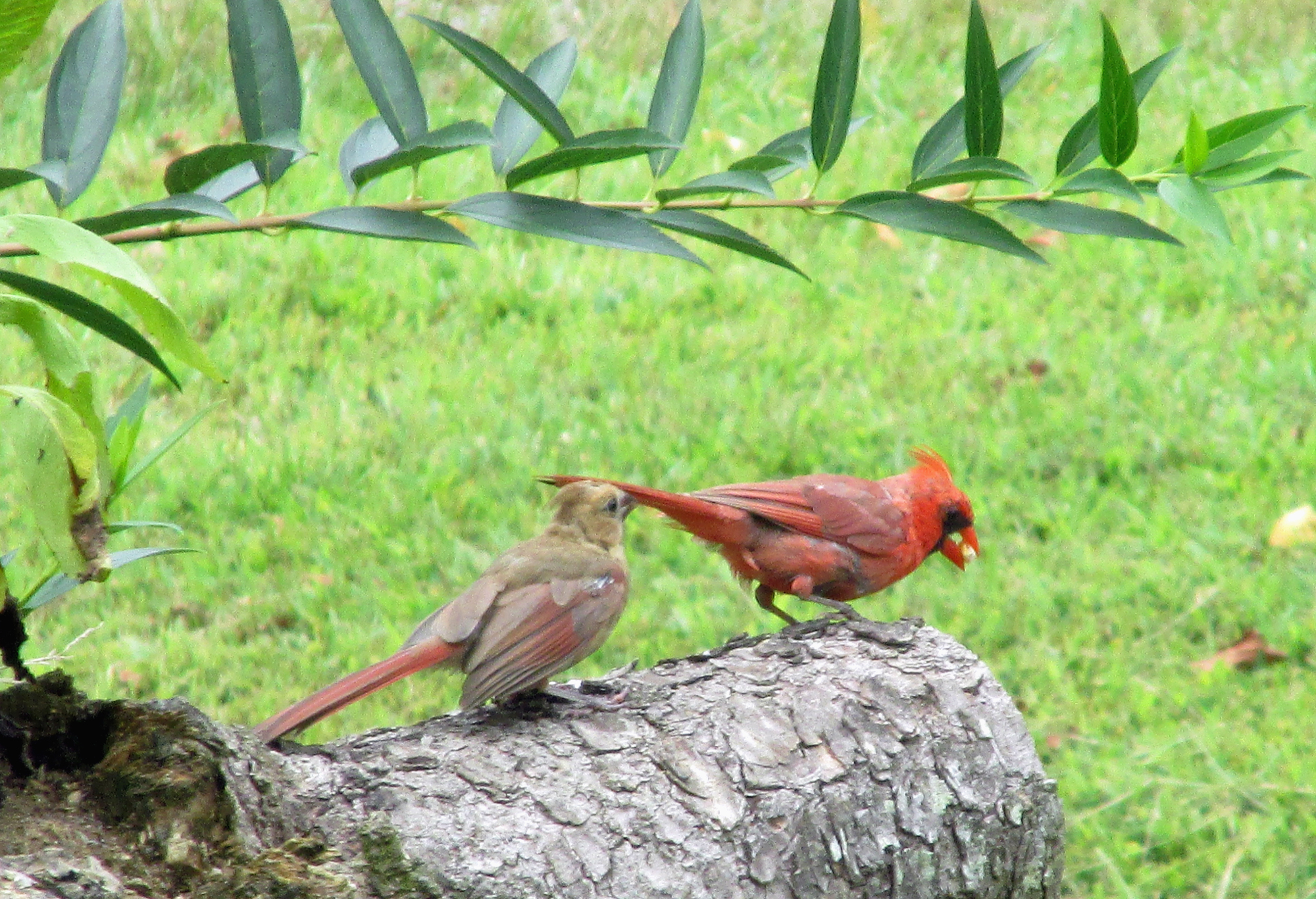
Hooded warbler easily wins fans among birders

Photo by Jean Potter • A male hooded warbler flits through the foliage of a rhododendron thicket.

The woods surrounding my home have been alive with birdsong. We’re almost ready to turn the calendar to June, but there’s been no diminishment in the fervor of the daily chorus.

The main members of the feathered choir are warblers. I’ve heard yellow-throated warbler, black-throated green warbler, black-and-white warbler, Northern parula, ovenbird, common yellowthroat and, my favorite, hooded warbler, morning and evening.

During the winter months when the hooded warbler absents itself from Northeast Tennessee, the species resides in the forests of Mexico, as well as in Belize, Costa Rica and other Central American nations.

Like many of the ruby-throated hummingbirds that make their home in the United States for the summer, the hooded warbler’s seasonal migrations take it across the vast open waters of the Gulf of Mexico. After that amazing crossing, these small songbirds disperse throughout the southeastern United States.

That birds as small as hummingbirds and warblers make this incredible migration twice yearly is one of nature’s most phenomenal feats of endurance. In a presentation by Kenn and Kimberly Kaufman that I attended six years ago, I learned that these tiny birds put on incredible fat reserves to help fuel their valiant Gulf crossings.

The warblers, also known as wood-warblers, are an exclusively New World family, numbering approximately 116 species. About 50 of these species make their home in the eastern United States and Canada for the spring and summer, departing in the fall and returning to tropical wintering grounds. Some are extremely bright and colorful birds. The hooded warbler is somewhere in the middle in a sliding scale that goes from dull to wow.

Other colorful warblers that share similar tastes in range and habitat with the hooded warbler include the American redstart, black-throated blue warbler and black-throated green warbler.

Readers who make it to the end of this weekly column will know that even my email address is a testament to my enthusiasm for the hooded warbler.

Hooded warblers nest in the woodlands around my home. So, from the time my favorite warbler returns in April until the last individual departs in October, I enjoy regular glimpses of this colorful and interesting bird. Like all warblers, the hooded warbler is quite energetic, dashing after tiny insects in the branches of shrubs and trees. Hooded warblers often forage close to the ground, which makes observing them easier.

Of course, birds are free to break the rules. One of my most memorable sightings of a hooded warbler involved a male singing from the upper branches of a dead pine tree. I’d estimate that the bird was at least 40 feet off the ground, singing his little heart out to attract a mate. I was standing on an elevated rise of land while the tree providing the warbler its perch was lower in a gully that actually placed bird and observer on a roughly level playing field.

The bird sang for many moments, which is not always the case with warblers. These birds tend to dash for cover at the slightest disturbance, but this enthusiastic male didn’t seem to pay and heed to the fact that most of its kin prefer to skulk in shrubs and dense rhododendron thickets no more than a few feet off the ground.

Back in the late 1990s, when I had just started out in birding, I observed two adult hooded warblers feeding a couple of young birds only recently out of the nest.

I was enjoying observing the sweet scene as the parent birds carried foods to the young birds, which begged incessantly and loudly when, unexpectedly, a song sparrow wandered into the scene.

The sparrow was brutally beset by the parent warblers, which attacked the intruder from all sides. The poor sparrow, having no clue to the reason for their ire, beat a hasty retreat. Sparrows are no threat, but that didn’t matter to these zealous parents.

When I first began birding, I was only dimly aware there was a family of birds known as warblers, which are now hands-down my overall favorite birds. The hooded warbler was one of the first birds I managed to identify on my own.

It’s one bird unlikely to be mistaken for any other. Every time I behold a hooded warbler, I marvel at the bird’s exquisite appearance. The gold and green feathers seem to glow brightly in the dim light of the shadowy thickets of rhododendron they prefer to inhabit. The black hood and bib surrounding the male’s yellow face stands out by virtue of its stark contrast from the brighter feathers. Large coal-black eyes complete the effect. The appearance of the male bird provides this species with its common name. The female has an identical yellow-green coloration as the male, although she is slightly more drab. She lacks the black hood and bib, although older females may acquire some dark plumage on the head and around the face. Both sexes also show white tail feathers that they constantly fan and flick as they move about in thick vegetation and shrubbery.

The warblers are, in short, an incredible family of birds. I’ve seen all but a handful of the species that reside for part of the year in the eastern United States. I still want to see a Connecticut warbler and cerulean warbler, as well as the endangered Kirtland’s warbler of Michigan and the golden-cheeked warbler of Texas.

I’ve come to think of the hooded warblers at my home as “my warblers.” There may be a kernel of truth to my belief. The website All About Birds in a profile on the species notes that a seven-year study conducted in Pennsylvania gave evidence that male hooded warblers are faithful to nesting territories from previous years. Approximately 50% of banded males were shown to return to the same area to breed again year after year.

So, some of those hooded warblers singing from the rhododendron thickets at my home are probably birds returning for consecutive spring seasons. Some of the warblers that returned back in April could be great-great-great grandchildren of those warblers that attacked the unfortunate song sparrow. At the least, it gives me pleasure to think so.

•••

To share a sighting, ask a question or make a comment, email me at ahoodedwarbler@aol.com, an address that shows my profound fascination for this particular bird.

Photo by Bryan Stevens • A male hooded warbler peers from a tangle of branches.

Annual spring bird count finds 151 species


Photo by Hans Toom/Pixabay • A male common yellowthroat, a species of warbler, is resident in the region spring through fall. The black mask of the males makes this bird quite distinctive.

The 81st consecutive Elizabethton Spring Bird Count was held on Saturday, May 4, with 40 observers in 16 parties.

Participants covered Carter County plus parts of adjacent Johnson, Sullivan, Unicoi and Washington counties. Temperatures were mild with little wind;

however, light rain just before sunrise and light to moderate rain during much of the afternoon hampered birding to some degree. Despite these conditions, good numbers were counted.

This year’s count tallied 151 species, including 28 species of warblers. The average number of

species over the last 20 years was 153 species. The all-time high was 166 species in 2016.

These yearly spring counts provide an amazing snapshot of the birds that can be found living in or migrating through the region. Some exceptional finds for this year’s count included Virginia rail, green-winged teal, grasshopper sparrow, golden-winged warbler and dickcissel.

The most abundant birds included cliff swallow (790), American robisparrown (742), European starling (500), Canada goose (391), red-eyed vireo (343), song sparrow (338), Northern Cardinal (321), Common Grackle (315), Red-winged Blackbird (282), American Crow (280), American Goldfinch (279), Hooded warbler (231) and Mourning Dove (223).

The list:

Canada goose, 391; wood duck, 35; blue-winged teal, 4; mallard, 96; green-winged teal,1; and common merganser, 2. 

https://www.youtube.com/watch?v=hp-CrM–HSU

Wild turkey, 23; ruffed grouse, 1; pied-billed grebe, 1; rock pigeon, 117; Eurasian collared-dove, 1; mourning dove, 223; yellow-billed cuckoo, 4; chuck-will’s-widow, 8; Eastern whip-poor-will, 28; chimney swift, 168; and ruby-throated hummingbird, 9.

Virginia rail, 1; killdeer, 29; least sandpiper, 27; pectoral sandpiper, 2; semipalmated sandpiper, 3; spotted sandpiper, 49; solitary sandpiper, 27; lesser yellowlegs 5; and greater yellowlegs, 1.

Double-crested cormorant, 80; great blue heron, 76; great egret, 2; green heron, 21; and yellow-crowned night-heron, 4.

Black vulture, 111; turkey vulture, 96; osprey, 13;

Cooper’s hawk, 3; bald eagle, 7; red-shouldered hawk, 6; broad-winged hawk, 8; red-tailed hawk, 14; Eastern screech-owl, 11; great horned owl,1; and barred owl, 8.

Belted kingfisher, 25; red-headed woodpecker, 16; red-bellied woodpecker, 87; yellow-bellied sapsucker, 9; downy woodpecker, 31; hairy woodpecker, 8; Northern flicker, 52; and pileated woodpecker, 46.

American kestrel, 9; great crested flycatcher, 30; Eastern kingbird, 66; Eastern wood-pewee, 31; Acadian flycatcher, 16; least flycatcher, 15; and Eastern phoebe, 96.

White-eyed vireo, 18; yellow-throated vireo, 12; blue-headed vireo, 49; warbling vireo, 15; and red-eyed vireo, 343.

Blue jay, 151; American crow, 280; fish crow, 12;  common raven, 13. Carolina chickadee, 143; tufted titmouse, 158; tree swallow, 154; Northern rough-winged swallow, 49; purple martin, 68; barn swallow, 213; and cliff swallow, 780.

Ruby-crowned kinglet, 3; golden-crowned kinglet, 2; cedar waxwing, 64; red-breasted nuthatch, 8; white-breasted nuthatch, 27; brown creeper, 2; blue-gray gnatcatcher, 77; Carolina wren, 203; house wren, 50; winter wren, 5; and marsh wren, 1.

Gray catbird, 54; brown thrasher, 64; Northern nockingbird, 94; European starling, 500; Eastern bluebird, 134; veery, 14; gray-cheeked thrush, 2; Swainson’s thrush, 9; Hermit thrush, 1; Wood thrush, 118; and American robin, 742.

House sparrow 30; house finch, 79; pine siskin, 1; American goldfinch, 279; grasshopper sparrow, 1; chipping sparrow, 123; field sparrow, 43;

dark-eyed junco, 48; white-crowned sparrow, 1;

White-throated sparrow, 5; Savannah sparrow, 6; song sparrow, 338; swamp sparrow, 1; and Eastern towhee, 179.

Yellow-breasted chat, 11; Eastern meadowlark, 81; orchard oriole, 24; Baltimore oriole, 18; red-winged blackbird, 282; brown-headed cowbird, 61; and common grackle, 315.

Ovenbird, 162; worm-eating warbler, 28; Louisiana waterthrush, 34; Northern waterthrush, 4; golden-winged warbler, 1; black-and-white warbler, 103; Swainson’s warbler,15; Tennessee warbler, 15; Kentucky warbler, 7; common yellowthroat, 48; hooded warbler, 231; American redstart, 33; Cape May warbler, 9; Northern parula, 89; magnolia warbler, 4; bay-breasted warbler, 7; Blackburnian warbler, 24; yellow warbler, 15; chestnut-sided warbler, 30; blackpoll warbler, 8; black-throated blue warbler, 89; palm warbler, 3; pine warbler, 8; yellow-rumped warbler, 21; yellow-throated warbler, 54; prairie warbler, 1; black-throated green warbler, 81; and Canada warbler, 37.

Summer tanager, 1; scarlet tanager, 97; Northern cardinal, 321; rose-breasted grosbeak, 30; blue grosbeak, 10; indigo bunting, 184; and dickcissel, 1.

https://www.youtube.com/watch?v=EI3pZ3t2i4E

•••

To share a sighting, ask a question or make a comment, email me at ahoodedwarbler@aol.com. 
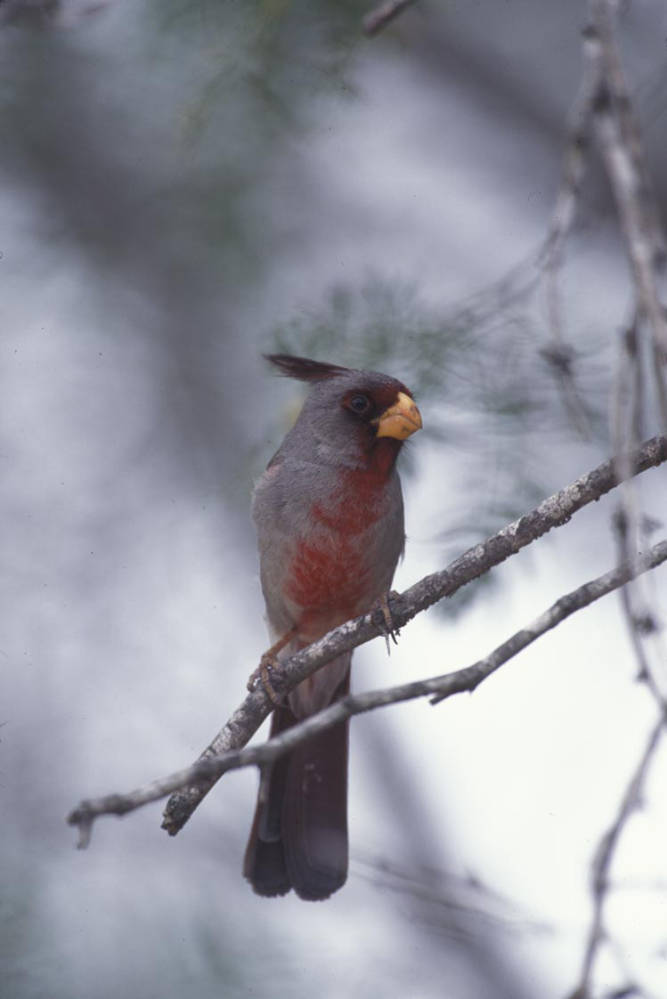
Fish crow is the new bird in town at locations across region

Fish crows painted by John James Audubon.

Sharp-eared birders may be detecting some unfamiliar crow calls in downtown Erwin during strolls around town.

While the caws of American crows are rather harsh and raucous to the ear, the smaller and related fish crow has a caw with a higher, more nasal tone that is just different enough to stand out.

Fish crows have been expanding their presence in the region for several years, joining some other newcomers such as common mergansers and Eurasian collared doves.

The fish crow is a native species of the southeastern United States that has been pushing its range farther north and west.

I first got to know fish crows on visits to coastal South Carolina starting in the 1990s. These small crows can be quite abundant along the coastline of the Palmetto State.

It’s only been in the last six years that I’ve added fish crow to my list of birds observed in my home state.

I began to hear fish crows around the campus of East Tennessee State University in Johnson City during daily strolls while teaching in the literature and language department at ETSU back in late fall of 2018.

For months before that sighting, I’d begun to notice postings about the presence of fish crows on the campus of the Mountain Home Veterans Administration adjacent to the ETSU campus. I’d heard about the fish crows from some of my birding friends, too. I had not stirred myself to look for these slightly smaller relatives of the American crow. So, when I heard a familiar “caw” that was a bit too nasal for an American crow, I stopped for a closer look.

Photo by Pixabay • The American crow, pictured, is larger than the related fish crow and has a more raucous caw.

I heard the vocalizations again and found a couple of fish crows perched atop the parking garage behind the Carnegie Hotel, which is located between ETSU and the VA campus. With some surprise and delight, I realized that the birds were fish crows.

Fast-forward six years. In recent weeks I’ve been hearing fish crows in downtown Erwin on a fairly regular basis. This past week I heard the nasally caw of this crow as I approached the back door of the offices of The Erwin Record. I looked up and spotted a fish crow perched in one of the trees bordering the parking lot. I wonder how long before I get one of these small crows paying a visit to the fish pond at my home.

As I mentioned earlier, I’m familiar with fish crows from trips to coastal South Carolina, where these members of the corvid family are quite common. Fish crows have expanded inland away from coastal areas in recent decades. Fish crows showing up here in Northeast Tennessee originated from that expansion, which likely followed river systems like the Tennessee River.

The easiest way to detect a fish crow’s presence is to keep your ears open. Fish crows make a distinctive vocalization that is quite different from the typical “caw” of an American crow or the harsh croak of a common raven. The website All About Birds describes the call as a “distinctive caw that is short, nasal and quite different-sounding from an American crow.”

The website also makes note of the fact that the call is sometimes doubled-up with an inflection similar to someone saying “uh-uh.”

Although their name suggests a fondness for fish, they’re not finicky about their food and will eat about anything they can swallow. Fish crows are also known for raiding nests to steal the eggs of other birds. They will also dig up sea turtle eggs, which are buried in sand dunes by female turtles.

Fish crows don’t scruple at stealing food from other birds and have been observed harassing birds ranging from gulls to ospreys. Fish crows also harass American crows and, if they are successful, don’t hesitate to skedaddle with any morsel that they’re able to “persuade” their slightly larger relative to surrender.

The fish crow ranges in various coastal and wetland habitats along the eastern seaboard from Rhode Island south to Key West, and west along the northern coastline of the Gulf of Mexico.

It’s been fun to find these birds closer to home in Erwin and Johnson City.

It’s not been easy for crows in recent years. The West Nile virus has been particularly hard on American crows, which seem to have very little immunity to this mosquito-spread disease.

According to the research I’ve conduced, the fish crow, however, is more resistant to the virus, with close to half the birds exposed to the disease able to shake off the effects and fully recover.

According to the website Tennessee Watchable Wildlife, the first recorded sighting of a fish crow in Tennessee took place in 1931. Half a century later, the first nest record was documented in 1980. Both of these records took place in Shelby County.

The oldest known fish crow in the wild reached an age of 14 years 6 months old. Visit tnwatchablewildlife.com for more information about fish crows and other state birds.

Fish crows and other crows around the world are sometimes regarded more darkly than is usual for our fine feathered friends. We invent lore and superstition, mostly inspired by the crow’s dark plumage and some rather unsavory eating habits. Some people even consider crows a bad omen.

I’ve never been concerned personally with keeping crows, or any bird for that matter, at a distance. I always try to stay alert for any surprise these winged creatures bring my way.

Worldwide, there are about 50 species of crows in the Corvus genus. Some other crows include carrion crow, hooded crow, rook, small crow, white-necked crow, Eastern jungle crow, large-billed crow, violet crow and white-billed crow.

Why have fish crows expanded their range in recent decades? The answer is not clear, but it’s good to have them here. I’m glad to welcome them to the Valley Beautiful.

•••

To share a sighting, make a comment or ask a question, email me at ahoodedwarbler@aol.com. 

No shortage of contenders to vie for most beautiful bird status

Karen Burke/Pixabay • A Baltimore oriole feeds from a dish of grape jelly. Male orioles show off vibrant feathers during the spring season.

Last week’s column focused on rose-breasted grosbeaks. Males of this species are a stunning sight every spring. People seeing them for the first time are always blown away.

After a link to last week’s column was posted to Facebook, Daisy Scism in Damascus, Virginia, commented that she had a visit from a rose-breasted grosbeak at her feeder recently.

The arrival of rose-breasted grosbeaks got me to thinking of other colorful birds that spend the summer months in Northeast Tennessee, Western North Carolina and Southwest Virginia.

Here’s my list of must-see birds sure to knock your socks off with their dramatic appearance.

Scarlet Tanager

In late April and early May, once the oaks, the maples, the poplars and other tall deciduous trees begin spreading out new green leaves to create a concealing woodland canopy, a familiar song can be heard coming from the treetops. Upon first hearing it, listeners might mistake the hidden singer for an American robin. Listen a little closer, however, and the song sounds as if it is being delivered by a hoarse robin with a sore throat.

Photo Courtesy of Jean Potter
A male scarlet tanager brightens shadowy woodlands with a flash of tropical colors yet remains mostly inconspicuous in the forest canopy.

The producer of the hoarse but melodic song is a scarlet tanager, one of the most showy birds of Eastern woodlands from April to early October. The scarlet tanager also has an easily recognized call note, best described as a distinctive “chip-burr” or “chip-churr.”

Photo by Bryan Stevens • Despite the brilliant scarlet and black feathers, tanagers are more often heard than seen,

The male scarlet tanager boasts a brilliant plumage of crimson red paired with black wings and tail. Of course, this describes only the male. The female tanager makes no real claim to the common name with her comparatively drab greenish plumage. However, the scientific name, Piranga olivacea, gives a nod to the olive-green plumage of females, young males and even adult males when molting their feathers.

Baltimore Oriole

The Baltimore oriole would stand out among North American birds even without its colorful plumage and its long association with the city of Baltimore and its affiliated Major League Baseball team.

For instance, few other birds can match the Baltimore oriole for the sheer elaborate nature of the woven nest these birds construct for the purpose of sheltering eggs and young. The nests resemble hanging baskets that the female oriole weaves from a variety of collected strips of grass. The lining inside is even more elaborate and features soft materials such as plant down, feathers or even wool that can insulate and cushion the eggs. The nest itself is anchored securely in the fork of a tree branch.

Again, credit for being on a list of stunning regional birds goes to the males. The adult male Baltimore oriole is orange on the underparts, shoulder patch and rump, with some individual birds appearing a very deep flaming orange and others appearing yellowish orange. All of the rest of the male’s plumage is black. Adult female are yellow brown on the upper parts with darker wings and dull orange yellow on the breast and belly. The juvenile oriole is similar looking to the female, with males taking until the fall of their second year to reach adult plumage.

Photo by Bryan Stevens • The male indigo bunting is a resplendent bird.

Indigo Bunting

The indigo bunting is one of the reasons I love to pay attention to the clientele visiting my feeders. This small songbird likes to reside in the boundary region where forests and woodlands meet fields and pastures. Personally, the indigo bunting has always been a bird that is suggestive of the long, hot days of summer.

One of my earliest and still quite vivid birding memories is a recollection of a shockingly blue bird atop a blue spruce tree in my yard. Several decades later, the tree is no longer standing, but these beautiful birds — I now know those long-ago summer visitors were indigo buntings — still return each year to my yard and gardens.

The male indigo bunting is the only solid blue bird in the eastern United States, but it’s all an illusion — literally a trick of the light. The indigo bunting’s feathers are not really blue; the male’s brilliant azure plumage is caused by the process of ;right diffraction around the structure of the bird’s feathers. This process scatters all but the blue light, and the resulting color shifts from black to blue to turquoise as the angle of reflected light changes. In bright light, it can even look unnaturally vivid blue. In poor light, however, an indigo bunting male can appear black.

Indigo buntings usually arrive in the region in late April, and I’ve seen them linger until late October, although most indigo buntings have left the region by late September.

•••

Do you have your own candidates for most beautiful birds. Feel free to email me your choice at ahoodedwarbler@aol.com. Share sightings, ask questions or make comments as well.