Category Archives: Birdosng

Remember the po’ouli in fight to conserve our birds

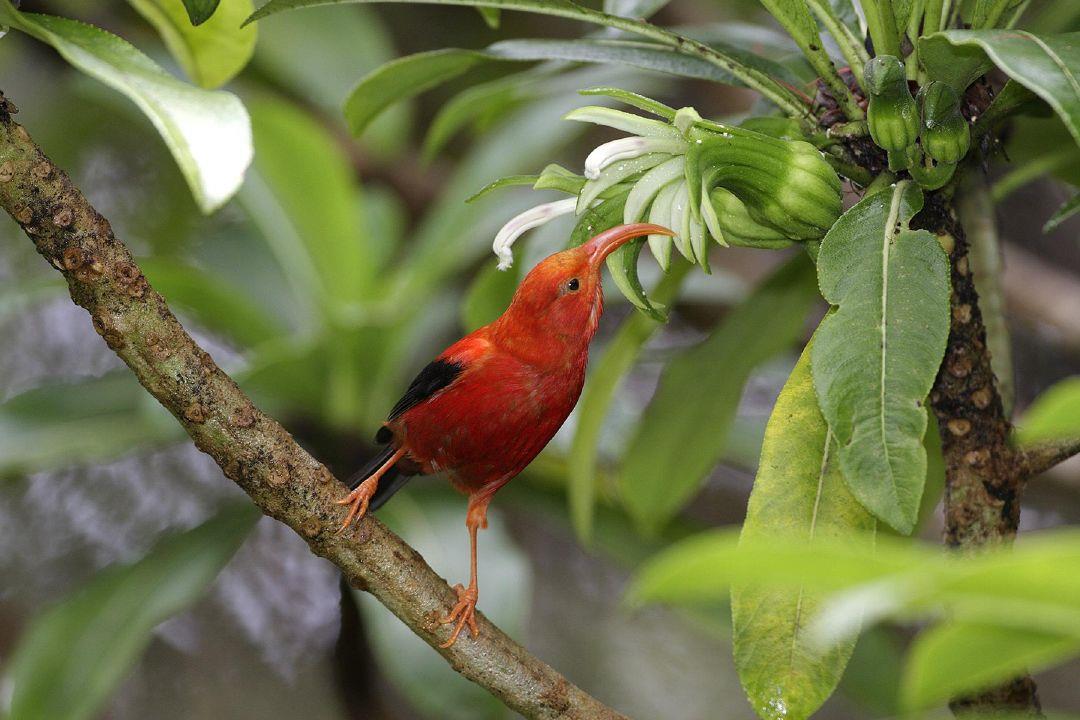
Photo by Jack Jeffrey/USFWS • A po’ouli relative, an ‘I’iwi forages in the Hakalau Forest National Wildlife Refuge, Hawaii. The bird’s long, downcurved, orange bill is specialized for sipping nectar from tubular flowers.

I’m celebrating 30 years of writing my weekly “Feathered Friends” column by occasionally showcasing some vintage compositions from throughout that time period. I published this column on Jan. 2, 2005. I’ve made some revisions and edits to this version. I’m more saddened now than at the time I wrote the original column, but I still think there is some cause for optimism that we’ll be able to share the planet without causing any more tragic stories for our birds. I think that message is just as important as ever.

•••

A tiny bird called the po’ouli, no bigger than some of the sparrows that visit bird feeders here in East Tennessee, failed to move forward into the year 2005.

A bird native to the Hawaiian island of Maui, the po’ouli went undiscovered by modern science until 1973. Barely three decades later, what may very well have been the last po’ouli in the world died Nov. 26, 2004.

The exact date of the demise of both the species and this last survivor can be known because the individual bird had been living in captivity in a research center on Maui. The hope had been to secure two other individuals known to exist in the wild in order to initiate a last-ditch attempt to save the po’ouli through a captive breeding program.

Nature moved faster than man. The other two po’ouli living in the wild hadn’t been seen in several months when the search launched. The lives of all small birds are fleeting and precarious. In all likelihood, these two individuals were gone even before the search commenced. With their demise, another thread had simply been snipped from nature’s tapestry.

The irony is that we knew this small bird, seen in the wild by a relatively small number of people, for only a blink in the overall scope of the universe. We did manage to learn a few things about the po’ouli in the span of time from 1973 to its extinction in late 2004.

According to a U.S. Fish and Wildlife Service press release, the po’ouli’s name in Hawaiian meant “black head,” a reference to the bird’s black mask and its other common name of black-faced honeycreeper. Its scientific name was Melamprosops phaeosoma. A Po’ouli’s most distinctive feature was a large black face mask accented by white cheeks, throat and underparts with brown wings and back; no other Hawaiian forest bird was similarly colored. Females were similar in appearance, displaying a grayish throat and breast.

The po’ouli belonged to a family known as the Hawaiian honeycreepers. Unlike other forest birds in Hawaii, the po’ouli’s diet included many native tree snails. The fact that many Hawaiian tree snails are endangered or threatened may have played a role in the rapid decline of the po’ouli.

The U.S. Fish and Wildlife Service tried to look for a silver lining in the wake of this tragedy.

“Our goal of saving the po’ouli is now very difficult and may not be achievable,” said Gina Shultz, acting field supervisor for the Fish and Wildlife Service’s Pacific Islands office, in a remark that can be fairly described as classic understatement.

She added, “But we must continue to try to save the species we have left.”

At that time, Hawaii had 31 other endangered bird species threatened by loss of habitat, introduced predators and disease.

In the years since 2004, eight more species have been lost, including the Maui ʻakepa, Maui nukupuʻu, Kauai ʻŌʻō, Kauai akialoa, large Kauai thrush, Kauai nukupuʻu and Molokai creeper, also known as Kākāwahie. Some of these species had not been seen for decades when officially declared extinct in 2023.

The demise of the little-known po’ouli probably didn’t mean much to many people. It’s hard to get excited about a small, drab bird that once lived on an island thousands of miles away.

We should, however, learn a lesson from its story. When it comes to the rapid decline in birds, we’re a major part of the problem. We’re going to need to be a part of the solution, too.

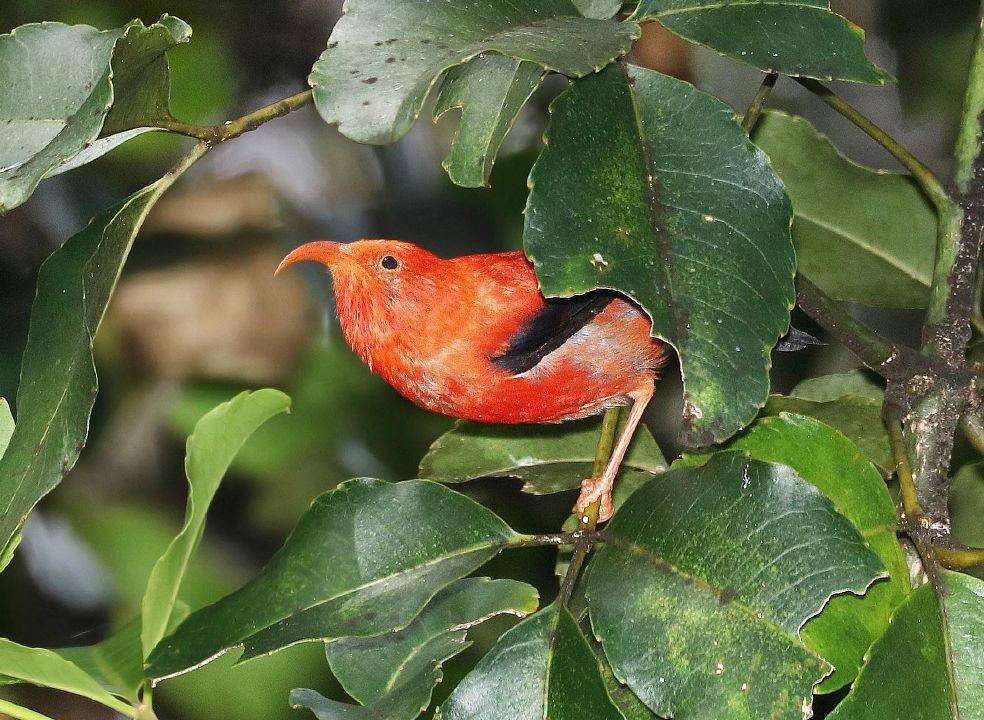
Photo by Alan Schmierer • The ‘I’iwi, a relative of the po’ouli, is another of the Hawaiian honeycreeper species. These birds evolved in the forests of Hawai’i and are found nowhere else in the world. Unlike ‘the po’ouli, a few thousand I’iwi still survive but face existential threats that have intensified in recent years.

What will we do? Will we wait until another bird species dwindles to a mere three individuals in the entire world and take desperate, unsuccessful measures?

We are more than a quarter way through this new century. These problems require new thinking. The issues are too complex to be more than hinted at in one column. But perhaps we can adopt a slogan: “Remember the po’ouli.” Keep this lost little bird in mind to help us in this constant battle to see to it that no other birds follow the po’ouli into the darkness of extinction.

•••

Bryan Stevens has been writing about birds, birding and birders since 1995. Email him at ahoodedwarbler@aol.com to share a sighting, ask a question or make a comment.

Phoebe’s return a signal other arrivals due soon

An Eastern phoebe has returned to the woodlands around my home.

I’m not sure when the resident phoebes departed last fall. They were still prominent in their daily activities in late October and early November. I think they probably slipped off, unnoticed, around Thanksgiving. Some winters, a few Eastern phoebes linger throughout the cold months, often near an open source of water that’s unlikely to freeze.

With the arrival of March and warmer weather, at least one Eastern phoebe, a male, is back and singing tirelessly every morning. The song is easy to memorise. The singing bird simply repeats its name — fee bee, fee bee — in scratchy, descending sets of tones.

Considering the bright finery worn by some of the more colorful spring arrivals, Eastern phoebes are comparatively drab. The gray and white plumage of this species of flycatcher pales in comparison with vibrant birds like rose-breasted grosbeak, ruby-throated hummingbird, scarlet tanager and yellow warbler.

Nevertheless, this member of the flycatcher clan has earned itself a favorite spot in the hearts of many a birdwatcher. It’s one of those birds that even beginning birders find surprisingly easy to recognize and identify. While it may not have a dramatic plumage pattern to hint at its identity, the Eastern phoebe is quite at home around human dwellings and comes into close contact with people going about their daily routines. Rather tame — or at least not too bothered by close proximity with humans — the Eastern phoebe has one behavior that sets it apart from all the other similar flycatchers. When this bird lands on a perch, it cannot resist a vigorous bobbing of its tail. Every time that a phoebe lands on a perch, it will produce this easily recognized tail wag. It’s this tell-tale action that makes this bird almost instantly recognizable among birders with the knowledge of this behavioral trait.

Photo by Bryan Stevens • A young Eastern Phoebe perches in the shelter of some branches.

The Eastern phoebe, known by the scientific name of Sayornis phoebe, has two relatives in the genus Sayornis. The genus is named after Thomas Say, an American naturalist. The Eastern phoebe’s close relatives include the black phoebe and Say’s phoebe. The black phoebe ranges throughout Oregon, Washington and California and as far south as Central and South America. As its name suggests, this bird has mostly black feathers instead of the gray plumage of its relatives. The Say’s phoebe, also named for the man who gave the genus its name, is the western counterpart to the Eastern phoebe.

Since they belong to the vast family of New World flycatchers, it’s probably no surprise that these phoebes feed largely on insects. That’s why phoebes overwintering in the region are always found near water. The open water also attracts flying insects. The birds will often perch patiently until an insect’s flight brings it within easy range. A quick flight from its perch usually allows the skillful bird to return with a morsel snatched on the wing. In the winter months, however, the Eastern phoebe also eats berries and other small fruit when insect scarcity makes this exclusive diet almost impossible.

Phoebes are fond of nesting on human structures, including culverts, bridges and houses. With the latter, they were once known for their habit of placing their nests under sheltering eaves. At my home, a pair of Eastern phoebes often chooses to nest on the wooden rafters in my family’s garage. Phoebes also like to reside near a water source, such as a creek, stream or pond.

Although the species is migratory, a few hardy individuals will usually try to tough out winters in the region. The others that depart in the autumn will migrate to the southern United States and as far south as Central America. On some rare occasions, Eastern phoebes have flown far off their usual course and ended up in western Europe. I can usually count on Eastern phoebes returning to my home in early March, making them one of the first migrants to return each year.

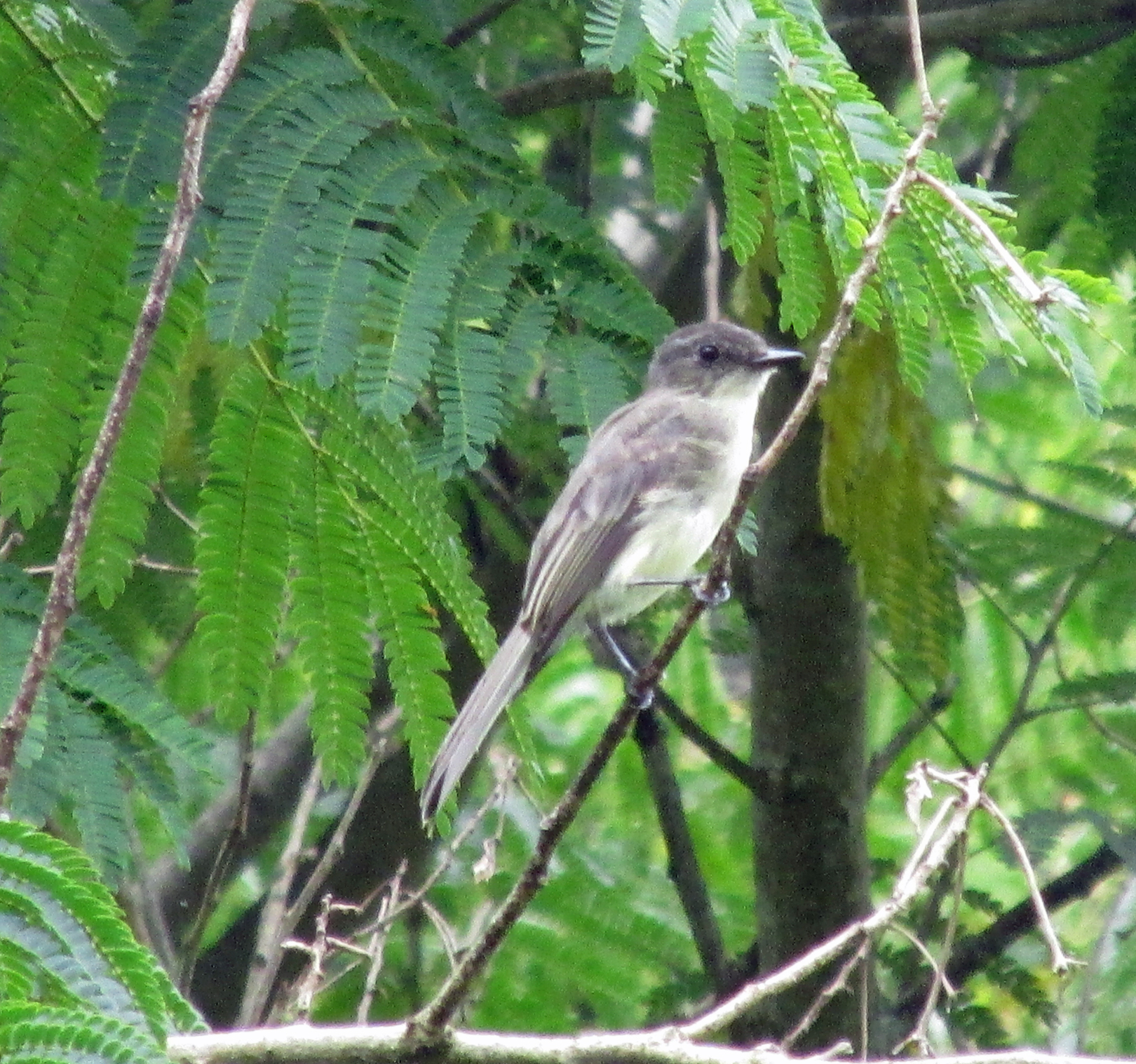
Photo by Bryan Stevens • An Eastern Phoebe perches in a mimosa tree.

This year, like the dependability of clockwork, I began hearing that easily recognized song on mornings during the first days of March when I walked to my car to depart for work. It’s due to their noisy nature that their arrival rarely goes unnoticed. Males tend to start singing persistently as soon as they arrive. I doubt it will take the male residing near my home long to attract a mate.

John James Audubon, an early naturalist and famed painter of North America’s birds, conducted an experiment with some young phoebes. His simple test represents the first-ever bird banding in the United States of America. His novel experiment, which he carried out in 1803, involved tying some silver thread to the legs of the phoebes he captured near his home in Pennsylvania. He wanted to answer a question he had about whether birds are faithful to home locations from year to year. The following year Audubon again captured two phoebes and found the silver thread had remained attached to their legs. Today ornithologists still conduct bird banding to gather information on birds and the mystery of their migrations.

So, that pair of phoebes that returned to your backyard this spring — they just might be the same ones that have spent past summer seasons providing you with an enlightening glimpse into their lives.

Over the past few years, I’ve had a pair of Eastern phoebes nest on the blades of a ceiling fan on my front porch. Other past nesting locations have included the rafters in my garage. If a pair happens to take up residence on your own front porch or in your garage, I hope you’ll welcome them. The pleasure of observing them raising their family will more than compensate for a slight mess and a few weeks of inconvenience.

••••••

To learn more about birds and other topics from the natural world, friend Bryan Stevens on Facebook at https://www.facebook.com/ahoodedwarbler. He is always posting about local birds, wildlife, flowers, insects and much more. If you have a question, wish to make a comment or share a sighting, email ahoodedwarbler@aol.com.

Smallest of birds lead the spring migration charge

Photo by Bryan Stevens • Welcoming back hummingbirds also involves making sure that they remain healthy and safe while spending the next six months in our yards and gardens. Readers are also invited to share the time and date of their first spring hummingbird arrivals.


We’ve reached the middle of March. Some of our favorite birds are on their way back to spend the warmer months with us. I’ve always been impressed that our smallest birds — ruby-throated hummingbird, blue-grey gnatcatcher and ruby-crowned kinglets — lead the charge in returning to the region after an absence of several months.

Of course, a few larger birds also tend to arrive early. The most prominent of these is probably the broad-winged hawk. These medium-sized raptors usually arrive in late March and early April.

But it’s the noisy and bold brigade of tiny birds that will capture our attention. By the end of March, the blue-grey gnatcatcher will be back, buzzing its zee-zee notes as it flits about branches budding with new green leaves. These tiny birds seem to time their arrival to coincide with the emergence of some of the first greenery of the season.

In the first days of April, ruby-throated hummingbirds will return, checking to see whether the feeders or a stand of early spring flowers are still in place.

Ruby-crowned kinglets, which make a similar passage in the fall, will transit through the region again in the spring as they make their way north to breeding grounds in spruce-fir forests in the northern regions of the United States and Canada.

These are not the only small “early birds.” Some other pint-sized songbirds that arrive in early spring include Louisiana waterthrush and yellow-throated warbler.

There are 17 species of gnatcatchers. Most of these species reside in Central and South America. Some of the other species found in North America include California gnatcatcher and black-capped gnatcatcher.

Kinglets are very active birds. If warblers can be described as energetic, the kinglets are downright frenetic in their activities. The kinglets almost never pause for long, flitting from branch to branch in trees and shrubs as they constantly flick their wings over their backs. These bursts of hyperactivity can make them difficult to observe. Although small in size, these birds more than compensate for it with a feisty spirit that does them well through the harsh winter months.

Gnatcatchers are also constantly on the move, flicking their tails and darting through the branches of trees just starting to put out new green leaves. They glean caterpillars and small insects from the undersides of leaves to help fuel a demanding metabolism.

Photo Courtesy of Jean Potter • Blue-gray Gnatcatchers are tiny, energetic bundles of feathers.

Kinglets and gnatcatchers often join mixed flocks comprised of other species of birds, some of which are regular feeder visitors. Perhaps by observing their flock counterparts, some kinglets have learned to accept feeder fare such as suet, meal worms and chopped nuts. Away from feeders, kinglets mostly feed on a range of small insects and arachnids. Gnatcatchers are strictly eaters of insects, but while a feeder holds no attraction for them, their curious nature often makes these tiny birds quite approachable.

Normally, kinglets have a rather fleeting lifespan. They pay a price for their frantic, fast-paced lifestyles and can be considered old if they live three or four years. There are always exceptions. The oldest golden-crowned kinglet on record was six years and four months old. That individual, a male, was documented by a bird bander in 1976, according to the website All About Birds.

Likewise, gnatcatchers live brief lives. The oldest known blue-gray gnatcatcher was a male, and at least four years, two months old, when it was recaptured at a banding station in Pennsylvania and rereleased, according to the All About Birds website.

Of course, the smallest of the small is the ruby-throated hummingbird, which is officially the most diminutive of all birds found in the Eastern United States. This hummingbird is only 2.8 to 3.5 inches in length and weighs less than half an ounce.

The oldest known ruby-throated hummingbird, according to All About Birds, was a female, and at least 9 years, 2 months old when she was recaptured and rereleased in 2014 during banding operations in West Virginia.

The effort these tiny birds expend to return each year to entertain us during the warmer months is nothing short of extraordinary.

Information on the website for Perky Pet, which markets hummingbird feeders and other items for birds, describes the stages of spring migration. Once they respond to the urge to head north, most ruby-throated hummingbirds have reached Mexico’s Yucatan Peninsula by February.

The jungles of the Yucatan are rich with food and these tiny birds begin to feast on insects as they prepare for one of the toughest migrations for any bird. The majority of these hummingbirds will make a nonstop crossing of the Gulf of Mexico. This epic journey can take them 18 to 22 hours to complete. Some individuals cross the Gulf as early as February, but most of these little birds will wait to cross in March. A month or so later, the first wave of these migrants have usually reached Northeast Tennessee, Southwest Virginia and Western North Carolina.

•••

As always, I like to track the arrival dates of ruby-throated hummingbirds and appreciate readers sharing this information with me every spring. To share your first hummingbird sighting of spring, email me at ahoodedwarbler@aol.com. Please provide the date and time of the bird’s arrival. Other details, such as whether the bird is a male or female, is also appreciated.

•••

Bryan Stevens has written about birds and birding since 1995. Contact him at ahoodedwarbler@aol.com.

Projects can help welcome back spring arrivals

Photo by Pixabay.com • A well-stocked feeder is a first step toward attracting more birds to your yard.

I’ve welcomed March with open arms. I know it’s too early to guarantee we’ve seen the last of winter, but I’m hopeful that the worst is behind us.

While birds don’t follow calendars, they are punctual, and thanks to their boundless energies, the grand spectacle of spring migration is already upon us. The pace will quicken in April and early May as many of our favorite summer birds, including species ranging from hummingbirds and warblers to swifts and swallows, wing their way back to the region.

Now is the time to conduct some spring tasks to make our feathered friends feel more welcome when they do return.

Place birdhouses

Many birds are cavity-nesting species, which means they utilize natural nooks and crannies as locations for nests. Nesting in a natural tree cavity or in a human-provided birdhouse offers an extra degree of security not available to birds that build traditional cup-shape nests, not to mention all the birds that simply lay their eggs right on the ground without going to much effort to construct an actual nest.

Some of the cavity-nesting species in the region that will readily accept quarters in a bird house include Carolina chickadee, Eastern bluebird, white-breasted nuthatch, tree swallow, tufted titmouse, great crested flycatcher, prothonotary warbler and house wren.

Cavity-nesting isn’t restricted to songbirds. Wood ducks, Eastern screech-owls and American kestrels will make use of birdhouses built to their unique specifications. Plans for constructing your own bird houses tailored to individual species can be found at various online sites. For those not as good with do-it-yourself projects, department stores, gardening centers and other other shops sell pre-made houses.

Clean your feeders

Frigid cold snaps brought birds flocking to our feeders. As returning birds mingle with lingering winter visitors at our feeders this spring, the chance of spreading disease will increase.

Now is definitely the time to be proactive, cleaning feeders and bird baths regularly and keeping alert to any sign that ill birds might be among the visiting flocks.

Cleaning need not be laborious. Fill a spray bottle with a dilute solution of bleach water. A good ratio is no more than 1 part bleach to 9 parts water. Remove feeders, give them a quick rinse, and then spritz them with the bleach solution. Rinse thoroughly and allow to dry before refilling with seed for the birds.

Enhance brush piles

This past winter with its heavy snow and ice, as well as fierce winds, no doubt brought down many branches. When cleaning your yard of branches, consider adding them to an existing brush pile. I’ve long been a fan of keeping a brush pile in order to provide the resident songbirds with shelter and security from the elements, as well as from predators.

If you don’t have a brush pile, spring’s the perfect time to create one. If an unkempt pile of sticks offends your aesthetic sensibilities, tuck the brush pile into an obscure corner or locate it at the margins of the lawn or garden.

Personally, I like to locate brush piles near my busier feeders. A brush pile gives visiting birds a quick retreat if a predatory hawk arrives unexpectedly. For some birds, the need for dense cover is paramount.

Offering brush piles, as well as hedges and dense shrubbery, will help welcome visitors such as gray catbirds, Eastern towhees, brown thrashers and some sparrows. Wide, open spaces make many songbirds nervous.

Photo by Jean Potter • An American crow visits a bird bath.

Install water features

With a large fish pond, a flowing creek and a couple of mountain seeps on my property, I’ve never needed to introduce an additional water source. For those with properties that don’t offer ready access to water, adding an ornamental pool or fountain, or even a bird bath or artificial waterfall, will act as a magnet for many birds. American robins and cedar waxwings love a place to splish and splash, as well as take a refreshing sip. Migrating warblers, which for the most part ignore feeders, are almost magically drawn to water features. There is also something relaxing for the human psyche when it comes to water features.

Refurbish the landscape

Spring’s a great time to plan ahead. While a handout of sunflower seed is appreciated by many birds, there’s nothing that beats organic sources of food.

Add plants and trees to the landscape of your yard and garden with the express purpose of providing birds with seeds, fruits and berries. Most experts urge native plant varieties that meet the nutritional needs of many bird species.

Flowers can be chosen that provide that desired burst of color for an interval but then go on to produce fruit or seeds craved by many birds. Native flowers can also be planted that offer a natural source of nectar for ruby-throated hummingbirds. Do some homework. Some nurseries specialize in native plants.

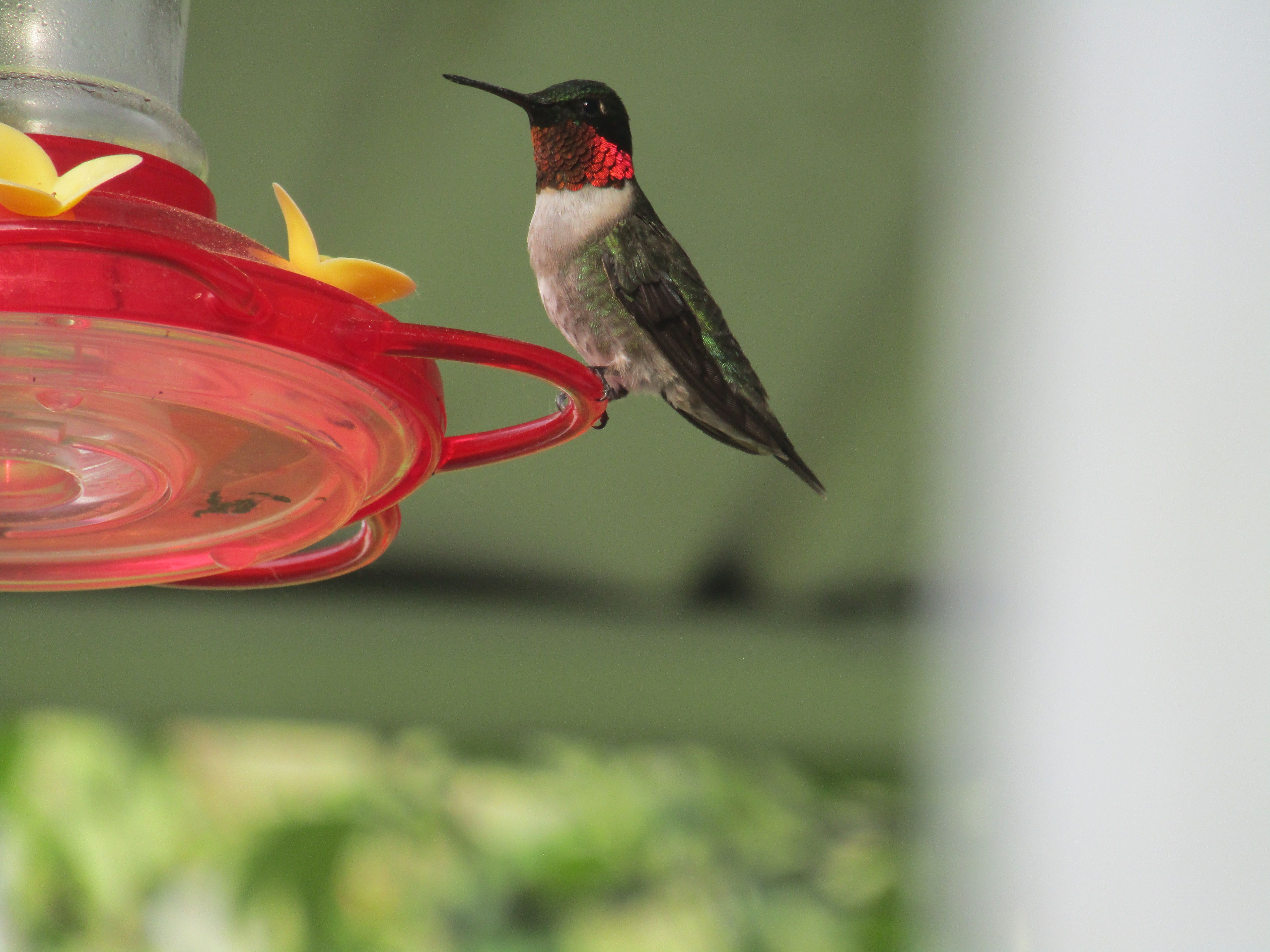
Photo by Bryan Stevens • A ruby-throated hummingbird visits a feeder for a sip of sugar water.

Get hummingbird feeders out early

Various websites track the annual spring return of hummingbirds. Journey North is one site that relies on citizen scientists to share their first sightings of this tiny, beloved bird.

The first reports of ruby-throated hummingbirds usually surface in early March along the Gulf Coast after these tiny birds make their incredible non-stop flight across the Gulf of Mexico. This arduous journey is their first step to returning points all across eastern North America for the spring and summer nesting season. Those first arrivals are still hundreds of miles away from Northeast Tennessee. There will always be “early birds” even among hummingbirds. Increase the likelihood of seeing one of these tiny gems by putting out a sugar water feeder soon. I’d encourage anyone hoping to attract these birds to have feeders ready for them by the last week of March.

Treat Yourself

Now is also the perfect time to indulge in a purchase that will enhance your enjoyment of the returning birds. If you have been wanting some new birding field guides, a new pair of binoculars, a new software app to help identify birds or a camera to let you document bird sightings with photographs, there’s no time like the present.

Welcome spring and the returning birds at the same time while ensuring maximum enjoyment of both.

•••

Bryan Stevens has written about birds and birding since 1995. Email him at ahoodedwarbler@aol.com to share a sighting, ask a question or make a comment.


Red-bellied woodpeckers, other birds raise their profile during recent snowstorm

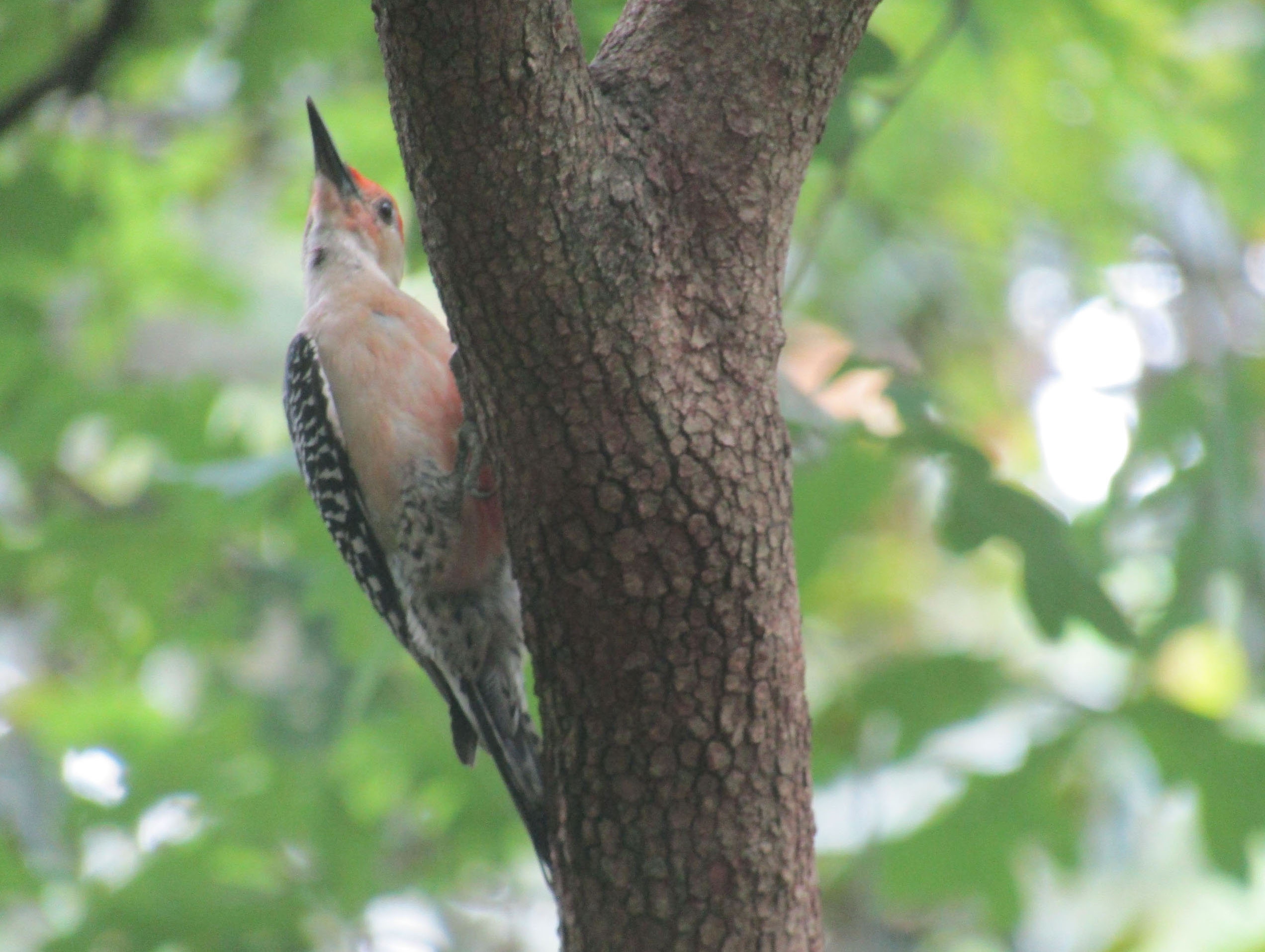
Photo by Bryan Stevens • A red-bellied woodpecker makes a tentative approach to a feeder stocked with sunflower seeds. Red-bellied woodpeckers are fairly common in the region.

I’m sure many share my sentiment that with February almost in the rear-view mirror it could be hoped that winter might be nearly at an end.

That misguided hope was dashed last week when another winter storm struck the region, accompanied by another blast of Arctic chill. At least the birds didn’t seem to mind terribly.

Dark-eyed juncos, Eastern towhees, song sparrows and American goldfinches flocked to my feeders. Another bird’s persistent “churr” call made the presence of a red-bellied woodpecker known even before I managed to sight one visiting one of my feeders.

Among the woodpecker family, the red-bellied and red-headed woodpeckers are close cousins, belonging to a genus of those tree-clinging birds known as Melanerpes. The term, translated from Latin, means “black creeper.” Indeed, many of the two dozen members of the Melanerpes genus have an extensive amount of black feathers in their plumage.

Other members of the genus include woodpeckers from the Caribbean, as well as from Central and South America. Some of them have quite colorful names, such as yellow-tufted woodpecker, golden-cheeked woodpecker and the accurately named beautiful woodpecker, a native of Colombia.

Photo by Bryan Stevens • Red-bellied woodpeckers are common throughout the southeastern United States.

The red-bellied woodpecker is one of the most widespread members of this genus with a range that extends from southern Canada to northeastern Mexico, as well as the eastern United States as far south as Florida and as far west as Texas. A century ago the red-bellied woodpecker was almost exclusively a southeastern bird, but it has expanded its range northward and westward considerably in the last 100 years. Its southern origins are hinted at in its scientific name of Melanerpes carolinus, which can be roughly translated as “black creeper of the Carolinas.”

It’s also named for a characteristic of its appearance that is not particularly prominent and difficult to observe. The faint tint of red that tinges the white belly feathers is extremely difficult to observe when this woodpecker is hitching up the trunk of a large tree. Because males, and females to a certain extent, have a red cap, the species has been erroneously referred to as a “red-headed woodpecker” by many casual observers. The true red-headed woodpecker, however, has an entirely red head and a plumage pattern that, considering its color trio of red, white and blue-black, is downright patriotic. The red-headed woodpecker (Melanerpes erythrocephalus) is about the same size as the red-bellied woodpecker.

All woodpeckers are noisy when the mood strikes them, but the red-headed and red-bellied have always struck me as rather more clamorous than some of their relatives. The most common call of the red-bellied woodpecker is a sort of rolling “churr” repeated frequently while the bird is on the move from tree to tree.

To enjoy close views of the red-bellied woodpecker, provide plenty of peanuts, sunflower seeds and suet cakes. During the recent snowstorm I would no doubt have enjoyed even more views of the visiting red-bellied woodpecker if I hadn’t been out of suet cakes. The offerings of sunflower seeds and peanuts, I’m happy to report, were gratefully accepted.

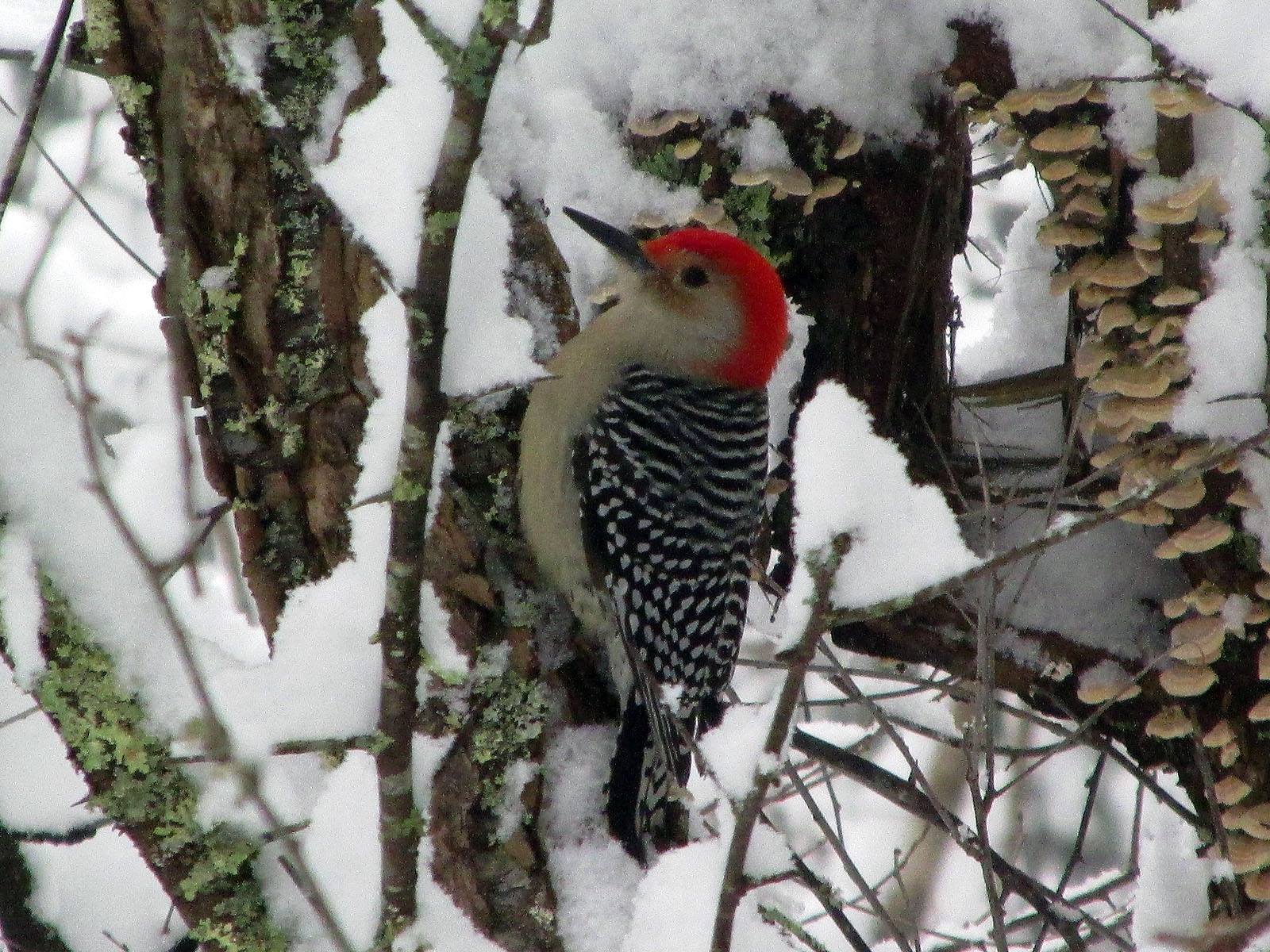
Photo by Bryan Stevens • A red-bellied woodpecker climbs snow-covered branches.

If there are any of these woodpeckers in the woods nearby, they will find these food offerings in short order. All my research indicates the same is true of red-headed woodpeckers, but I’ve never observed this woodpecker at my home. I’ve seen red-headed woodpeckers in Tennessee, Virginia and South Carolina, but their populations are somewhat localized. Woodlands dominated by oak trees are often inhabited by both these woodpeckers, which are fond of the acorns produced by these trees.

One reason the red-headed woodpecker may be less common than its cousin relates to its fondness for hawking for flying insects along roadsides. The woodpeckers are frequently struck by cars when swooping after their winged prey. Historically, the American chestnut and beech trees also provided much of the mast crops consumed by these birds. With the extermination of the chestnut and the scarcity of beech in some locations, the red-headed woodpecker now depends on oaks and acorns. In fact, this woodpecker is rarely encountered outside of woodlands with an abundance of oak trees.

At feeders, red-bellied woodpeckers are prickly customers that often refuse to play nice with other birds. I’ve seen them stare down other large feeder birds, including blue jays, mourning doves and evening grosbeaks. With its large bill, the red-bellied woodpecker commands some respect.

Anyone who has hosted these birds knows they are a welcome visitor to any yard. Who knows? Some day I may even get a visit from the elusive red-headed woodpecker, which is the only woodpecker that resides in the region to thus far avoid my yard.

•••

To ask a question, make a comment or share a bird sighting, email me at ahoodedwarbler@aol.com.

Birds make use of various strategies to attract and keep mates

Shauna Fletche/Pixabay • Some birds, like waxwings, like to present tasty treats to their potential mates.


With Valentine’s Day around the corner, it’s an opportune time to see how courtship is handled among our fine feathered friends. Most birds don’t bring a box of chocolates or a bouquet of roses when they take up courtship of a prospective mate, but birds have several equivalent behaviors that they employ to attract the attentions of the opposite sex. In honor of Valentine’s Day I thought a look at some of the more unusual courtship rituals of some of our feathered friends would be appropriate.

Aerial acrobatics designed to impress

In late winter and early spring, a true oddball begins courting. The American woodcock, also known by such whimsical names as “bog sucker” and “timberdoodle,” is a shorebird that has completely abandoned the shore in favor of woodlands and fields. Beginning as early as February, American woodcocks in the region conduct nightly courtship displays, starting at dusk, that combine aerial acrobatics with an assortment of unusual acoustical flourishes. Any wet field adjacent to a wooded area could offer a stage for these evening displays, but unless you know where to look and make an effort to do so, the American woodcock might as well remain a phantom of the night.

These mating rituals provide almost the only time of the year during which this bird makes itself available for observation. It’s only during this brief window that opens into their lives that we can be assured a glimpse. Even then, our peeks at woodcocks often consist of a fuzzy twilight escapade as the bird flings itself heavenward only to make a spiraling descent a few seconds later. The displays begin with a distinct vocalization, a type of “pent,” that also has the quality of sounding like some sort of mechanical buzzer.

Once the displays conclude for the season, the birds assume nesting duties, usually unobserved by humans. The rest of the year, almost nothing but blind, sheer luck would allow a birder to stumble across an American woodcock. It’s almost as if they disappear after these spring flights of fancy.

Birds bearing gifts

Many birds present small trinkets to a prospective mate. For instance, many male penguins make a present of a stone or pebble to female penguins. There could be more than a simple bribe behind this gift. Female penguins don’t build elaborate nests. In fact, a scrape on the bare ground, perhaps encircled by a collection of pebbles, marks the extent of their nest construction. So, the perfect pebble could be the way to winning a female penguin’s heart.

The way to the heart is through the stomach

Observant birders may have witnessed a male Northern cardinal slip a female a morsel of food, such as a peanut or a shelled sunflower kernel. It’s a marked change for this bird. During the winter months, a male cardinal is more likely to chase a female away from a feeder rather than share food with her. However, as spring approaches, his behavior undergoes a change and he becomes content to feed next to a female cardinal, often slipping her some choice tidbits.

Sabine van Erp/Pixabay • Bow to your partner: Grey-crowned cranes perform an elaborate dance designed to strengthen their bond.

May I have this dance?

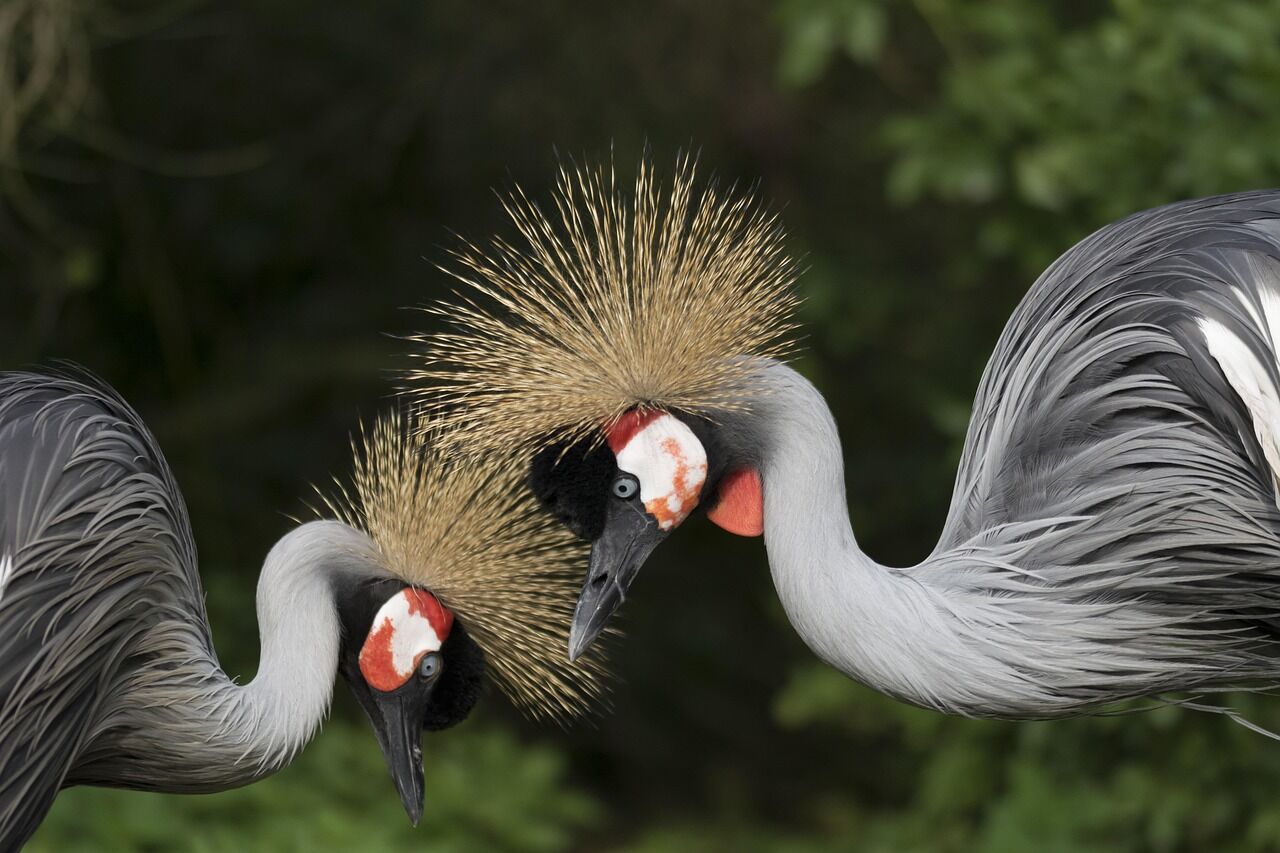
Many species of birds perform elaborate and ritualistic dance displays. Among birds known for tripping the light fantastic are flamingoes, cranes, grouse and grebes. Cranes are one of the oldest families of birds on earth. They’re also some of the most accomplished dancers in the animal kingdom. Pairs perform very ritualistic dances that, if the performers were human, would no doubt require the services of an accomplished choreographer. Cranes mate for life and the ritual of dancing is a way to strengthen the bonds between a mated pair. The ability to dance is, apparently, not instinctive. Young cranes must practice their dance moves, a process that can take years before they master the elaborate dance.

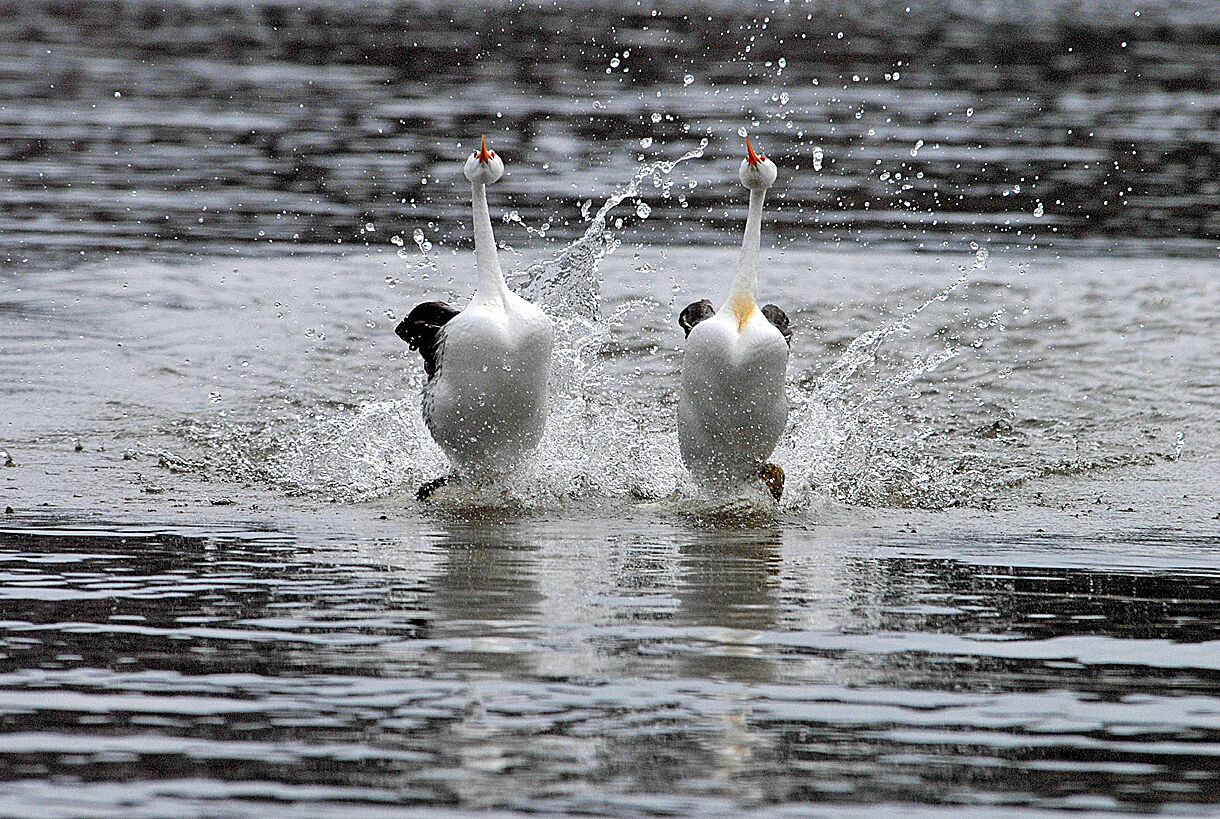
Dave Menke/U.S. Fish & Wildlife Service • A pair of Clark’s Grebes displays in a courtship ritual known as “rushing” or “weed dance.” Birds use a variety of strategies to attract and keep mates.

Synchronized swimming

While many birds dance to impress a mate or strengthen pair bonds, grebes perform a dance that takes place completely on the surface of the water. A pair will engage in this intricate performance, perfectly mirroring the moves of the other as they literally race across the surface of the water. These dances by grebes are also known as “rushing” or “weed dance.” It’s called as a weed dance because at the culmination of the ritual, the birds usually hold some type of aquatic plants in their bills while racing swiftly over the surface of the water. Pairs that perform well together stay together, building a nest and raising young.

Good housekeeping seal of approval

The tropical family of bowerbirds are famous for complex nests built by males and then decorated with bright and colorful objects to catch the eye of a potential mate. The nests of these birds are actually referred to as a “bower.” Usually constructed on the ground, the male will line the approachs to the bower with items such as shells, leaves, flowers, feathers, stones, berries, and even discarded garbage, including plastic scraps or bits of glass. Unusually odd items pressed into these decorative displays have included coins and spent rifle shells. This habit of male bowerbirds must rank as the ultimate in trying to impress a mate with shiny bling.

These are just a few of the inventive ways that birds go about attracting and keeping mates. Perhaps you can pick up some pointers from our feathered friends to ensure you have a great Valentine’s Day this year.

•••

If you have a question, wish to make a comment or share a sighting, email me at ahoodedwarbler@aol.com.

Birds share fall skies with migrating butterflies, dragonflies

During a stop at the Unicoi Walmart to visit the pharmacy on Wednesday, Sept. 3, I spied an energetic fluttering of wings in the garden center. Although I’ve spied various birds, including Carolina wrens and house sparrows, making themselves at home in this garden center, this winged creature was quite a bit smaller.

I watched the butterfly flit from marigold to zinnia to fall mums, feasting on the nectar the blooms provided. A closer look revealed the butterfly’s identity as a long-tailed skipper, a species more likely found in South Carolina, Georgia and Florida than Northeast Tennessee.

Photo by Bryan Stevens • A long-tailed skipper sips nectar from a marigold at the garden center at the Unicoi Walmart.

According to Wikipedia, the long-tailed skipper is a spread-winged skipper butterfly found throughout tropical and subtropical South America, south to Argentina and north into the eastern United States and southern Ontario. It cannot live in areas with prolonged frost. I have seen lots of them in South Carolina and Georgia; this is my second sighting of one in Northeast Tennessee. I found the first one in a garden in Elizabethton near the Covered Bridge.
The sighting reminded me that it’s not only birds using the skies for migration as we advance toward the autumn season. I also remembered a question I got from a reader back in 2014. Rhonda Eller of Chilhowie, Virginia, posted a question on my Facebook page about some dragonflies that appeared in her yard on Sept. 10.

“We have had a sudden breakout of dragonflies in our yard,” Rhonda explained. “We seldom see more than one or two at a time.”

Rhonda wondered if the dragonflies might have been drawn to her yard in pursuit of some sort of favorite insect prey. She also speculated that the recent dry conditions might have attracted the dragonflies.

Photo by Bryan Stevens • The wandering glider is a migratory species of dragonfly.

I responded at the time to her query by explaining that birds share the skies at this time of year with many other migrants. Some dragonflies, just like birds, migrate. A species known as green darner is one that migrates. These darners are rather large, for a dragonfly, and travel in swarms. A couple of years ago I observed thousands of these dragonflies swarming over a municipal swimming pool and a nearby fish pond at Erwin Fishery Park.

The WSLS Channel 10 television station out of Roanoke, Virginia, reported on swarms of dragonflies so large that they got picked up by local radar. Rhonda shared a link to the station’s story on my Facebook page.

Of course, swarms of migrating insects are bound to get the attention of predatory birds. The same day that Rhonda experienced the influx of migrating dragonflies, I witnessed dozens of common nighthawks and chimney swifts swooping through the skies over my home. With a little more attention to detail, I also noticed the dragonflies sharing the skies with these birds.

I suspect that the nighthawks were feeding on the large darners while the swifts, which are much smaller birds, focused their foraging efforts on smaller winged insects. Tom McNeil, a neighbor and fellow member of the Elizabethton Bird Club, reported seeing nighthawks and swifts, too. Tom lives on the other side of a mountain ridge that separates our homes.

Tim Morris, a Facebook friend from Australia, noted in a comment on my post about the nighthawks that his country is home to a bird known as the tawny frogmouth, a relative of the common nighthawk. Tim noted that frogmouths are big birds with camouflage markings that allow them to pretend to be dead tree boughs by day. “They feed not only on insects but mice and lizards, too,” he added.

Evidence of fall migration continued the next day when I detected a small wave of warblers foraging in trees at the edge of my yard. I saw five different species — American redstart, worm-eating warbler, Cape May warbler, Blackburnian warbler and Tennessee warbler — in the space of half an hour. Of the warblers in the flock, the Blackburnian and Cape May are some of the more vibrant ones.

So far in 2024, warblers have absented themselves from my yard this fall. It’s started to aggravate me, but I’ll try to be patient.

The Blackburnian warbler’s common name commemorates Anna Blackburne, an English naturalist who lived from 1726 to 1793. Her brother, Ashton, had immigrated to the United States, which made it possible for him to send his sister many specimens, especially birds. Their father, a salt merchant by trade, was also a well-respected amateur naturalist. In addition to the warbler that bears her name, Anna Blackburne also had a species of beetle named in her honor.

Both the Cape May and Tennessee warblers are named for the locations from which they were first collected. Neither of these small songbirds are closely affiliated with Cape May, New Jersey, or the Volunteer State. The Cape May warbler is also known as the “tiger warbler” for the dramatic black striping across its bright yellow breast. A green back and chestnut cheek patch make the Cape May warbler quite unlike any of its close kin. Even its former scientific name — Setophaga tigrina — paid homage to the striped big cat. The term “setophaga” translates to “moth eater” and is a reference to this warbler’s intense fondness for the caterpillars known as spruce budworms that occasionally produce outbreaks in the northern spruce forests that serve as the nesting range for the Cape May warbler.

According to the website, “All About Birds,” Cape May warblers have unusually shaped tongues that allow them to sip nectar from tropical flowers during the winter months spent in Central America and the Caribbean. Their unique tongues also make it possible for them to enjoy sips of sugar water from hummingbird feeders.

Whether its dragonflies, nighthawks, warblers, hummingbirds or a long-tailed skipper in a Walmart garden center, plenty of birds and other flying creatures will be moving through the region for the next few weeks. Now’s the time to get outdoors and look for some of these migrants.

•••

Bryan Stevens has been birding actively for about 30 years. He has written a weekly column on birds and birding since 1995. To ask a question, make a comment or share a sighting, email him at ahoodedwarbler@aol.com.

Elizabethton Bird Club announces speakers for fall programs

Brayden Paulk will speak to the Elizabethton Bird Club on Sept. 3 on the topic of microfishing.

The Lee and Lois Herndon Chapter of Tennessee Ornithological Society, also known as the Elizabethton Bird Club, will soon begin its schedule of monthly meetings for 2024-25.

The brief business meetings are always accompanied by an informative and entertaining program on birds, birding or other subjects from the natural world.

These programs are a great way to learn more about our feathered friends as well as other related subjects from the natural world. They are free, open to the public and hosted by a welcoming group of people.

Here’s the schedule for Fall 2024:

September

Brayden Paulk, a young naturalist with family ties in Unicoi County, will present the first program on Tuesday, Sept. 3, with a talk on “Microfishing,” which involves anglers focusing on a diverse array of tiny species of fish.

Paulk has also been working as a naturalist with Lamar Alexander Rocky Fork State Park this summer and fall. He gave a program a couple of years ago for the club on “Trash Fishing,” which explored other angling options other than the typical gamefish species. As both fishing and birding are among his interests, he will no doubt find a way to work something into his program about birds.

October

The guest speaker for the meeting on Tuesday, Oct. 1, will be Mark Stevens. A former publisher for The Erwin Record, he will present a program titled “Building a Birding Festival” that will focus on his development of the Hammock Coast Birding Festival in South Carolina. Stevens, who works as tourism director for the Georgetown County Chamber of Commerce, will be giving the program remotely from his home in South Carolina, but the hybrid meeting also offers a chance to attend in-person with other birding enthusiasts. The festival is organized by the South Carolina Hammock Coast, the marketing arm for the Georgetown County Chamber. The third annual Hammock Coast Birding Festival is scheduled for Feb. 6-9, 2025.

November

Vern Maddux, the treasurer for the club, will be the speaker on Tuesday, Nov. 5. Maddux is a world traveler when it comes to seeing birds and will present a program on one of his recent international birding adventures to South Georgia and Falklands. South Georgia is a mountainous barren island in the South Atlantic Ocean, 800 miles east-southeast of the remote South Atlantic archipelago that makes up the Falkland Islands. With rugged terrain and cliff-lined coasts, the hundreds of islands and islets in the Falklands are home to sheep farms and abundant birdlife.

December

In the busy month of December, yours truly will give the program. I will present a powerpoint presentation titled “What’s in a Name?” on North American birds named after people. Among our native birds, we have quail, woodpeckers, sparrows, finches, warblers, hawks and other birds are known by names of historical figures ranging from John James Audubon to William Clark and Meriwether Lewis.

My program will be held on Tuesday, Dec. 3. I will discuss the American Ornithological Society’s decision in 2023 to end what are known as eponyms, in which species names honor people. The renaming of dozens of species will be a gradual process.

The club’s 2025 schedule has not been completed, but will include a program by local naturalist Lewis Tester in the spring on dragonflies.

The public is always welcome to attend these programs. Programs begin at 7 p.m.

The club meets at the Elizabethton campus of Northeast State Community College in Room 135 when the school’s schedule permits. When school is not in session, meetings are held on Zoom or at other announced locations. To receive updates on the club’s schedule, events and activities, email elizabethtonbirtdingclub@gmail.com and ask to be placed on a free mailing list.

The Elizabethton Bird Club holds seasonal birds count in spring, summer, fall and winter. The club also organizes and sponsors regular field trips to destinations through Northeast Tennessee. These activities are also open to interested members of the public.

•••

To share a sighting, make a comment or ask a question, email me at ahoodedwarbler@aol.com.

Goldfinches much more than another pretty bird

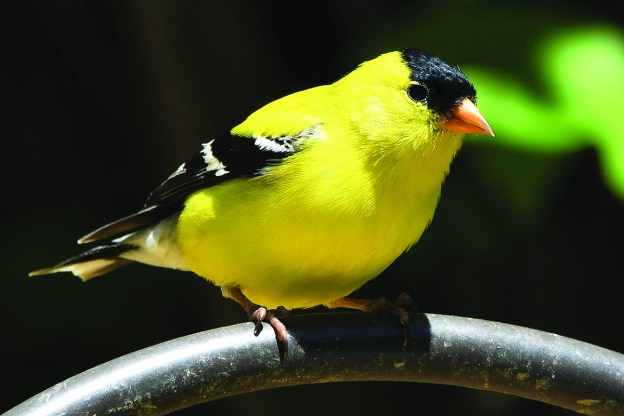
Miles Moody from Pixabay • A male American goldfinch in summer nesting plumage is one of the region’s most vibrant songbirds. 

Johnson City resident Jo Wheeler posted a comment on Facebook on July 15 under a weekly posting promoting the “Feathered Friends” weekly column.

“We saw the American goldfinch in out backyard over the weekend,” Jo wrote. “It was amazing.”

I was so pleased to hear Jo’s excitement about the goldfinch. The American goldfinch is a commonplace bird, but once you take a close look at this bird it’s readily apparent that there’s really noting common about it at all. 

Goldfinches are extraordinary in appearance, particularly at this time of the year. The plumage of the male goldfinch during the nesting season is a bold pattern of black and white against a backdrop of golden-yellow feathers. These birds also form fussy but sociable flocks that congregate at bird feeders or bird baths in many a backyard. 

A sighting of a goldfinch can be memorable. I still retain vivid imagery of these birds from childhood, long before I could identify them by name. They would always appear in late summer, perching atop the three blue spruces in our yard. The trees are no longer standing, but the memories of those colorful yellow and black birds endure.

Summer is the season of plenty for American goldfinches. Roadside ditches are choked with chicory, evening primrose and other seed-producing plants often dismissed as “weeds.” Simply driving local roads can, and often does, produce sightings of flocks of American goldfinches as they forage for seeds.

These small, colorful finches are also regular visitors to my feeders, although they don’t really need my offering of black oil sunflower seeds to supplement the natural smorgasbord available to them.

Their fondness for seeds has inspired many of the common names for this bird, including lettuce bird, thistle-bird, yellow-bird and wild canary. My late grandmother, Bertha Sneyd, introduced me to the term “lettuce bird” as an alternative name for goldfinch. As she explained, the finches would come to gardens once lettuce had gone to seed. 

This fondness and dependence on seeds for its dietary needs has even shaped the nesting habits of this species. The American goldfinch is also one of the last songbirds to nest each season. 

According to a profile of the American goldfinch posted at the website for the Tennessee Wildlife Resources Agency, goldfinches don’t even start to think about nesting until late July and early August. Their nesting season is timed deliberately to coincide with this season of natural abundance. Goldfinches feed their young mostly on seeds, as opposed to most songbirds that work so hard to gather insects to feed their young a protein-rich diet.

It’s a satisfying irony that, although brown-headed cowbird females sometimes slip their eggs into a goldfinch nest, any cowbirds hatched in those nests rarely survive. While goldfinch hatchlings are adapted to thrive on a diet of seeds, the fostered young cowbirds fail to thrive on a diet so lacking in the protein derived from insects.

While the male American goldfinch during the breeding season is unmistakable in his bright yellow, black and white plumage, the female goldfinch is more subdued in coloration. Males also sing a bubbly, cheerful song when seeking to win the attention of a potential mate.  

According to the profile on the TWRA website, the goldfinch’s song is a variable series of musical trills and twitters, often interspersed with a bay beephrase. The distinctive flight call is described as sounding like “potato chip” or “per chicory.”

For these and other reasons, goldfinches are favorites of many bird lovers. There are actually three species of goldfinches in North America. The two related species are Lawrence’s goldfinch of California and the lesser goldfinch, which ranges through the southwestern United States as well as Central and South America.

Lawrence’s goldfinch was named by John Cassin in 1850 for his colleague George Lawrence, a New York businessman and amateur ornithologist. His enthusiasm for birds must have impressed his colleagues. One bird genus and 20 species were named in his honor. Lawrence’s goldfinch, known by the scientific name Spinus lawrencei, honors him doubly with both the scientific and common names for the bird.

The American goldfinch is also known by other common names, including wild canary, yellowbird and willow goldfinch. I’ve also heard the goldfinch referred to as “lettuce bird.” This nickname, which was one my maternal grandmother applied to the bird, relates to the bird’s fondness for seeds. Apparently the goldfinches would flock to lettuce plants in the garden once they had gone to seed.

Photo by Bryan Stevens • A male American goldfinch perched.

Come winter, this vibrant American goldfinch undergoes a transformation into a dull, drab bird with grayish feather. In fact, this annual molt usually begins in September. During the fall and winter, the American goldfinch looks almost like an entirely different bird.

It’s understandable why people love to entertain flocks of these finches in their yards and gardens. Three states — Washington, Iowa and New Jersey — have gone so far as to make the American goldfinch their official state bird.

The best strategy for attracting goldfinches is to provide some of their favorite foods. Black oil sunflower seed and the seeds of nyjer thistle are highly favored. The tiny thistle seeds require special feeders. Mesh “socks” can also be used to dispense the thistle seed.

An alternative is to plant a garden that offers an abundance of fresh seeds. A stand of sunflowers will attract goldfinches, as well as other birds such as indigo bunting and house finch. Liatris, also known as gay feather, produces flower spikes that are sought out by goldfinches for their seeds. Other favorites include asters and coneflowers. The bonus is that even after the beautiful blooms are past, the birds can still benefit from the seeds left behind after flowering.

To share an observation, make a comment or ask a question, email me at ahoodedwarbler@aol.com.

Surprise! Hummingbirds come in variety of sizes

This week’s column is about hummingbirds, the big and the small ones. Frances Lamberts in Jonesborough sent me an email earlier this month that got the ball rolling for this week’s hummingbird column.

“Two hummingbirds were here for a good week long,

at the end of April,” Frances wrote. “Then they were gone, and I haven’t seen any since. Despite the heat/drought (and with some watering), the

property has many favorite flowers in bloom, including the blue salvia, red pole beans, monarda, many others come and gone, the cardinal flowers about to bloom.”

Her question was a simple one: “Where are the hummers?”

She noted that she has kept a “first sightings” record for about 20 year. One year the hummingbirds didn’t arrive until mid June, which worried her at the time.

“What is happening now?” Frances asked.

The simple and honest answer is that it’s not really possible to land on any single answer. Birds have wings, and hummingbirds are capable to long-distance flights.

Still, a setting such as the one Frances described with such a wide variety of blooms should be teeming with hummingbirds.

Personally, it’s been a perplexing season. My hummingbirds arrived back in April, stuck around for perhaps a week, and then almost disappeared. They returned in mid-June, remained visible for a couple of weeks, but have since pulled another vanishing act.

In any given year, the numbers of hummingbirds passing thorough is going to fluctuate. Some years, these tiny flying gems will be present in good numbers on an almost daily basis. Other years, hummingbirds can become quite scarce.

I usually enjoy my best hummingbird numbers in the fall as these little birds begin their leisurely journey back south. Late August and the month of September is usually a great time to watch hummingbirds. I’m optimistic that the same will hold true this fall.

In some other hummingbird news, the world added another species of hummingbird this year when the giant hummingbird of South America got split into two distinct species.

Abi Cole, writing for Audubon Magazine, reported in an article on June 7, 2024, that scientists have considered two distinct populations of giant hummingbird — a migratory southern population in Chile, Argentina and Bolivia, and a non-migratory northern population in Chile, Ecuador and Peru — to be the same species.

Now, scientists have reconsidered that belief and learned that the two species have been able to fool scientists for so long by basically, as Cole’s article phrases it, by hiding in plain sight.

Cole’s article details the elaborate process by which giant hummingbirds were captured and fitted with geolocator devices. The article credits Jessie Williamson, lead author of the new study and a National Science Foundation postdoctoral research fellow, with unraveling the mystery.

Williamson did so by intensively studying the Chilean population. The resulting research also revealed some huge surprises.

For centuries, there has been speculation about where the Chilean giant hummingbirds go to spend the winter. Now we know – they make an astonishing, record-breaking 5,200-mile round trip to spend several months with their cousins in the Peruvian Andes.

Because the Chilean and Peruvian birds look so much alike, no one had ever realized that they were co-existing with each other during the winter season.

Of course, the name “giant hummingbird” is almost an oxymoron for a family of birds famous for their diminutive size. Now that we have two species of giant hummingbirds, they can’t both hold the title of world’s biggest hummingbird.

So, which is the bigger bird? As it turns out, the giant hummingbirds living year round in the Andes, now known as the northern giant hummingbird, is slightly bigger than the migratory southern giant hummingbird.

The article about these discoveries is fascinating. To read it for yourself, visit http://www.audubon.org/magazine/scientists-discover-worlds-largest-hummingbird-hiding-plain-sight.

The giant hummingbird does earn the right to that name. Both of the two species weigh between 18 and 24 grams and have a wingspan of about 8.5 inches. They have a body length of 9.1 inches. For a useful comparison, they are about equal to the size of a European starling or a Northern cardinal.

They are not the dazzling beauties most people associate with hummingbirds. Giant hummingbirds have a drab greenish plumage above with a whitish rump patch and dingy coloration below with variable rusty tones and dusky spotting. They do have the long bills and overall physical shape of other hummingbirds. The scientific name is Patagona gigas, roughly translated as the giant of Patagonia.

Photo by Bryan Stevens • Welcoming hummingbirds also involves making sure that they remain healthy and safe while spending time in our yards and gardens.

Count the giant hummingbird (either of the two species) as birds I’d like to see some day. The world’s diversity of hummingbirds is dazzling, but I feel fortunate to enjoy the ruby-throated hummingbird from April to October every year. As anyone knows who hosts these tiny birds, ruby-throated hummingbirds are dazzling and engaging guests during their all-too-brief.

•••

To ask a question, make a comment or share a sighting, email me at ahoodedwarbler@aol.com.