Category Archives: Jonesborough Herald and Tribube

Cardinal has rivals when it comes to depiction on Christmas cards

Although many articles have been penned about the demise of the Christmas card, I still receive plenty of these paper greetings each holiday season. My friends and acquaintances, knowing me well, I suppose, often select cards featuring a variety of birds. Regardless of rising postal costs and hectic schedules during a busy season, the Christmas card appears to be an enduring tradition.
Northern_cardinal

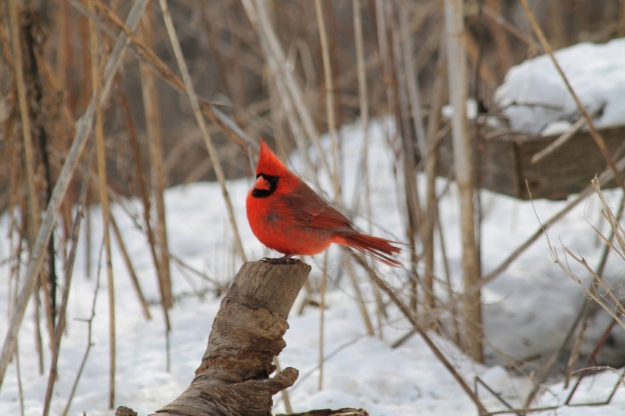
Photo by Nathan Rathbun/USFWS • An observation of a bright red male Northern cardinal is sure to put some cheer into the holidays.

Many of the cards I have received this year and in past holiday seasons have featured the Northern cardinal, which has long been one of my favorite birds. During the winter months, particularly during the holiday season, the Northern cardinal seems to take on even more significance. Anyone who received many Christmas cards this year will probably confirm that the cardinal often appears on them. The origins of the cardinal’s affiliation with the holiday of Christmas are a bit murky. After all, the Northern cardinal is a North American bird that would have been unknown in Europe until the 1600s, when the first explorers and settlers arrived from Europe.

Chinstrap5-HR

Photo by Jeff Keller/National Science Foundation • Chinstrap penguins (Pygoscelis antarctica) are also known as the bearded penguin and the ringed penguin. They reach about two feet tall and weigh less than 10 pounds. Chinstraps form strong bonds with their mates and will wait long periods for their mates to return to the breeding ground each year, rather than take a new mate.

The cardinal is hardly the only species of wildlife, let alone bird, that has become closely associated with the holiday. Everything from polar bears and seals to doves and penguins are also popular motifs for designers who craft Christmas cards. In recent years, I’ve even seen other birds — owls, chickadees, and even sandpipers — begin to decorate cards.

Often, when we think of the birds of the winter season, our thoughts focus on some of the less-than-colorful feeder visitors — the brown sparrows and wrens, the black and white chickadees and the drab American goldfinches that are such a contrast in winter to their vibrant summer appearance. The Northern Cardinal, especially the brilliant red male, stands out against a winter backdrop of snow white, deep green or drab gray. Could there be a better bird to brighten a Christmas card?

Well, as it turns out, there are other birds beyond the picture-perfect Northern cardinal that are worthy of gracing the front of Christmas cards. As previously mentioned, penguins are popular featured birds on many a Christmas card. Thanks to major motion pictures like Happy Feet (2006) and Mr. Popper’s Penguins (2011), as well as documentaries like 2005’s March of the Penguins, these dapper birds have enjoyed an enhanced profile in recent years and earned a place on our Christmas cards.

Emperor_Penguins

Photo by Kelly Falkner/National Science Foundation • Two emperor penguins greet each other near Ross Island in Antarctica. Emperors are the largest of all penguins, reaching nearly four feet tall.

Of course, there’s not one single “penguin” species. There are about 20 different penguin species, ranging in size from the emperor penguin, which weighs 75 pounds and stands three feet seven inches tall, to the little blue penguin, also whimsically known as the fairy penguin, which weighs 2.2 pounds and stands about 16 inches tall. Other species include the king penguin, yellow-eyed penguin and macaroni penguin.

While at first glance owls are an unlikely species for depiction on a Christmas card, I can understand why people have embraced these nocturnal birds. With their big eyes and a reputation that has improved as we are less likely to embrace superstitious myths, owls are a good choice for gracing the cover of a card. One species — the snowy owl — is a perfect bird to depict the wintry season. With its white plumage, contrasted with varying amounts of black or brown markings on the body and wings, this owl of the Far North is a good symbol for the Christmas season. It’s no surprise at all to find an image of a snowy owl staring with piercing yellow eyes from the front of a Christmas card. Other species of owls that I’ve seen featured on cards include barn owl, great horned owl, Northern saw-whet owl, and burrowing owl.

In real life, the snowy owl is a denizen of the treeless tundra regions of the Arctic. Some winters see these owls staging massive migrations that bring them south of the Canadian border. While they are more likely to spend the winter months in such Canada-bordering states as Minnesota, Michigan and Wisconsin, snowy owls have surprised and delighted birders by winging their way as far south as Tennessee, Virginia and North Carolina during some winters.

Snowy-OWL

Photo by Tom Koerner/USFWS • This snowy owl was photographed at Sand Lake National Wildlife Refuge in South Dakota. Some winters see great numbers of this owl surge out of the tundra to winter south of the Canadian border.

While owls and penguins are definite contenders, I’d wager that the Northern cardinal is the bird most often depicted on Christmas and other greeting cards. As further evidence to explain the popularity of the Northern cardinal, consider that it’s the official state bird of seven states — Virginia, North Carolina, West Virginia, Ohio, Illinois, Indiana, and Kentucky. Only the Northern mockingbird, which represents five states as official state bird, even comes close to the Northern Cardinal in this respect. Being designated an official state bird is also an honor that’s eluded any species of owl, let alone any of the world’s various penguins.
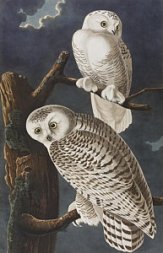
5-snowy-owl-john-james-audubon

Snowy owl pair painted by John James Audubon.

Finally, one last thing works in favor of the Northern cardinal. Once the holidays are past, and the Christmas cards are packed away, there’s nothing like a glimpse of a Northern Cardinal to add some cheer to a bleak winter day.

•••••

Bryan Stevens lives near Roan Mountain, Tennessee. To learn more about birds and other topics from the natural world, friend Stevens on Facebook at https://www.facebook.com/ahoodedwarbler. If you have a question, wish to make a comment or share a sighting, email ahoodedwarbler@aol.com.
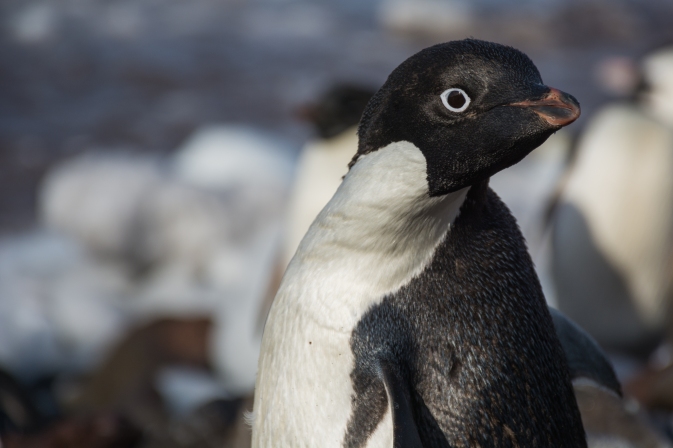
Crozier_Adelie_Penguin_Adult_looking-HR

Photo by Mike Lucibella/National Science Foundation • An adult Adelie penguin turns its head. The Cape Crozier penguin colony is one of the largest known Adelie penguin colonies in the world, home to roughly half a million birds.
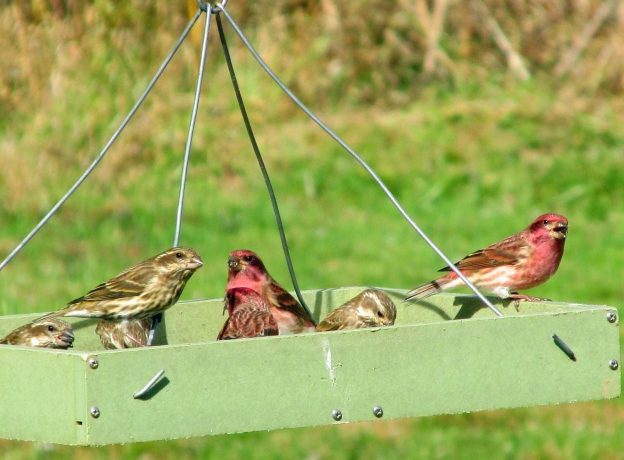
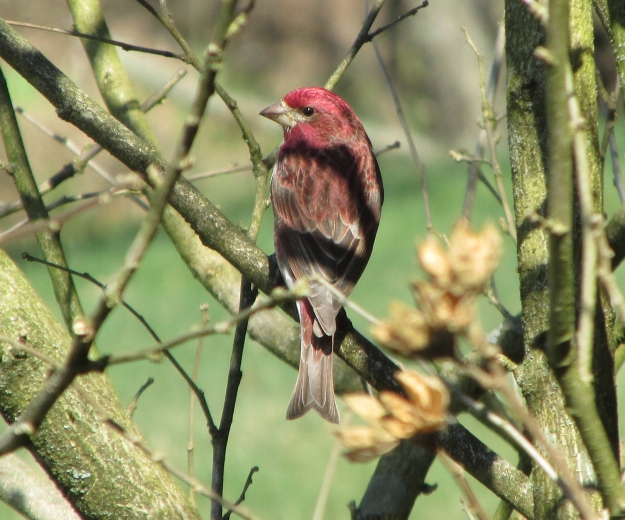
 

Purple finches always welcome winter visitors when snow and cold drives them to feeders

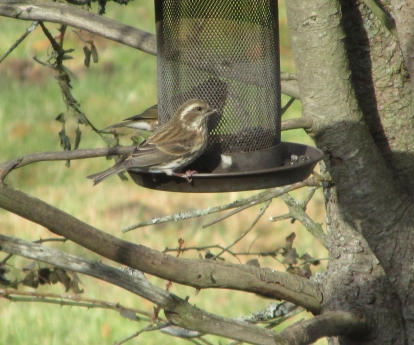
Purple-March30

Photo by Bryan Stevens • Purple finches are mainly winter visitors in the region, although they may make appearances during their fall and spring migrations. Although similar to house finches, purple finches have their own unique appearance once observers become familiar with them. The notched tail, evident in this bird, is a good way to distinguish purple finches from very similar house finches.

The region experienced its first brush with wintry weather with the snowstorm that arrived Dec. 8. With a few inches of snow on the ground, some birds that had been ignoring my feeders decided to give them a second look. American goldfinches, dark-eyed juncos and a red-bellied woodpecker made frequent visits to the feeders over the weekend as more snow and cold temperatures put a temporary stop to the mild start of the 2017-2018 winter season.

So far, the feathered clientele at my feeders are the expected visitors, including Carolina chickadees, downy woodpeckers, song sparrows and white-breasted nuthatches. Some birds, such as pine siskin and purple finch, which can make feeder watching an exciting winter pastime, have not yet made an appearance. Both these species belong to a group of birds known in birding circles as “Northern finches” that also includes species like red crossbill, evening grosbeak and common redpoll.

Evening_Grosbeak

Photo by George Gentry/U.S. Fish & Wildlife Service • A male evening grosbeak perches on the side of a sunflower-stocked feeder.

The purple finch, which is a winter visitor to northeast Tennessee, southwest Virginia and western North Carolina is apparently not as common as in past years. Some experts have speculated that the decline in the numbers of purple finches each winter can be attributed, at least in part, to the closely related house finch. Today, the house finch is quite widespread, found across the United States. Originally, however, the house finch was a bird of the western part of the country, living in Mexico and the southwestern United States.

About 1940, the house finch became established in the eastern United States. In violation of federal law, these small finches were being sold in New York City as pet birds described as “Hollywood Finches.” To avoid trouble with authorities, vendors and even some owners released their “Hollywood Finches” into the wild. Finding the area around New York City to their liking, house finches spread. Within a few decades, they were common birds throughout the eastern United States, including Tennessee, Virginia and North Carolina. The house finch had also been introduced into Hawaii about 1870, and is still present today, along with many other species of birds not native to the island.

HousieFinch

Photo by Bryan Stevens • A male house finch perched on a cable. These finches are native to the western United States but became established in the eastern states thanks to the illicit pet trade.

As the house finch claimed a new range, they inevitably encountered the related purple finch. During the winter, both finches are often present at feeders in the region. When both are available for observation, bird enthusiasts should take advantage of the opportunity to compare and contrast these birds. Personally, I have never had any difficulty distinguishing a purple finch from a house finch. The two species, at least in my eyes, are easily recognized. I can understand why some people might have trouble separating the two birds. The late Roger Tory Peterson once described the purple finch as a bird “dipped in raspberry juice.” Think about that imagery for a moment and you’ve got a good start to distinguishing a male purple finch from a male house finch. Unfortunately, the description does nothing to distinguish females of the two species.

Let’s deal first with the males. Male purple finches are delicate pink-red (that raspberry coloration) on the head and breast, mixing with brown on the back and cloudy white on the belly. The red of a male purple finch is definitely a color I have not observed with many other birds. Even “red” birds such as male Northern cardinals and male scarlet tanagers do not show the same red color. Once you learn the way the red appears in the plumage of a male purple finch, you are on your way to telling this bird apart from its relative.

purple-finch-john-james-audubon

Early naturalist and artist John James Audubon painted this depiction of purple finches.

The red in the plumage of male house finches is surprisingly variable. In most cases, the heads, necks and shoulders of male birds are reddish and the red at times extends to the stomach and between the wings on the bird’s back. The intensity of the red changes with the seasons and is also derived from the berries and fruits in the bird’s diet. Pale yellow and bright orange are alternatives to the typical red plumage.

Look closely at the photograph of the purple finches accompanying this column. There’s a distinctive facial pattern evident on the birds. The strong facial markings include a whitish eye stripe and a dark line down the side of the throat. This pattern simply doesn’t exist with the male house finch. When I make a snap identification of these two birds, I always look for the facial pattern even before I study any other aspects of the appearance of the bird. In addition, purple finches have powerful, conical beaks and a tail that appears short and is clearly notched at the tip. Rounding out the description of a male house finch is the fact that they have a long, square-tipped brown tail and are brown or dull-brown across the back with some shading into gray on the wing feathers. The breast and stomach feathers may be streaked.

Females of both house finches and purple finches are dull brown birds that could easily be mistaken for sparrows. Again, the facial pattern is much more apparent on a female purple finch than on the related female house finch. In addition, I have always noticed that female purple finches are usually a darker shade of brown than the dull brown female house finches. Both male and female house finches are more slender than their more chunky-bodied counterparts.

PurpleFinches

Photo by Bryan Stevens • A study of the facial pattern of a female purple finch helps contrast her from similar female house finches. Again, the notched tail is also a good indication of the bird’s identity.

In the United States, another close relative of the house finch and purple finch is the Cassin’s finch of the western United States. Together, the three species make up a classification known as the American rosefinches. Formerly placed in the genus Carpodacus, these three birds are now in the genus known as Haemorhous. The new classification separates them from the Eurasian rosefinches, which includes more than two dozen species including scarlet finch, great rosefinch and crimson-browed finch.

Purple finches occupy a variety of winter habitats, including fields and woodland edges, as well as yards and gardens. All it takes to lure these finches to your feeder is a plentiful offering of sunflower seeds. If you are lucky enough to have both of these finches visiting your feeders, take time to study the differences. It takes some practice, but they can be distinguished quite confidently.

Merry Christmas to all my fellow bird enthusiasts! 

Winter weather events can adversely affect birds, too

Although the weather has been mild thus far this winter, that can change in the blink of an eye. Inclement weather affects humans, but it can also have adverse affects on birds. Snow, sleet, ice, wind and other forces can play havoc on the lives of our feather friends. Birds have many adaptations to help them deal with the worst the elements can throw at them, but sometimes events can overtake them.

LaplandLongspur-Auk

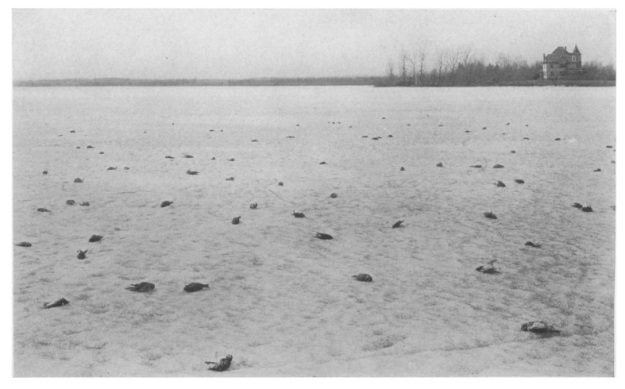
Bodies of the fallen Lapland longspurs are shown scattered on a frozen lake after a 1904 weather-related catastrophe overtook hundreds of thousands of migrating longspurs.

One such event took place on the night of March 13-14, 1904, when hundreds of thousands of one small songbird species perished as circumstances came together in a perfect storm. This infamous event in the annals of ornithology mystified residents living around the town of Worthington, Minnesota, when they awoke on the morning of March 14 to find thousands of dead birds strewn across the landscape. Birds fell onto everything from yards and gardens to street and rooftops, as well as numerous frozen lakes.

In an article in the ornithological publication The Auk, the affected songbird was identified as the Lapland longspur, a bird that nests in the Arctic tundra and spends winters on the expansive prairies and plains of the United States and Canada. The Lapland longspur, also known as the Lapland bunting, also ranges into Russia and the Northern Scandinavian countries of Europe. The term “longspur” refers to the long hind claws on this small songbird’s feet. Two other longspurs — Smith’s longspur and chestnut-collared longspur — are found in North America.

The Lapland longspur disaster on the night of March 13, 1904, originated with a massive migration flight taking these songbirds back to their tundra nesting grounds. The author of the Auk article speculated that the longspurs migrating northward encountered a winter storm in the darkness. Heavy snow accumulated on the feathers of the exhausted migrants, forcing them to crash to the ground by the hundreds of thousands across the terrain of southwestern Minnesota and northwestern Iowa. From the point of view of the disoriented birds, the lights from the towns dotted across the landscape added to the chaos and confusion. Many of the bird suffered blunt force traumas, including ruptured organs, crushed skulls, bone fractures and other such injuries incurred when falling to the ground from great heights.

The Auk article comes to a total of a million birds lost in a single night, although the author admits the toll could have been even higher. Although this is an immense figure, consider that a survey dating to 2004 estimated 8 million Lapland longspurs in Alaska alone during the nesting season.

aul152-871

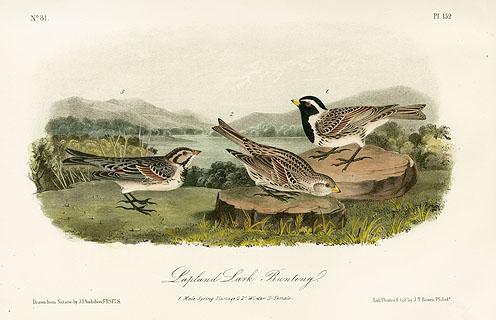
Early naturalist and artist John James Audubon painted Lapland Longspurs or, as he knew them, Lapland Lark Buntings.

The 1904 disaster didn’t seem to dent the overall numbers of the Lapland longspur. The populations of many species of birds can survive such catastrophes, but other species already struggling could be adversely affected by such events. For example, in February of 2007 a flock of year-old whooping cranes was exterminated by severe storms that overwhelmed them in a shelter at the Chassahowitzka National Wildlife Refuge in Florida. A total of 18 young whooping cranes, part of a flock trained to follow an ultralight aircraft from their birthplace in Wisconsin to the refuge in Florida salt marshes, were killed during the storm. The loss of that many young birds also robs the endangered species of much needed vitality. As of February 2015, the total whooping crane population stood at 603 individuals, including 161 captive birds.

Weather disasters extract a toll on both humans and birds. Sometimes they may affect hundreds of thousands of individuals, although the consequences are often confined to smaller segments of a population.

In early May of 2013, dozens of common loons migrating through Wisconsin encountered an unseasonable ice storm. Many of the birds found ice forming on their feathers, weighting them down and causing emergency landings. Wildlife rehabilitation workers rescued more than 50 birds, but there were probably many other loons affected by the freak storm that were lost without a trace.

Common_Loon_on_Water

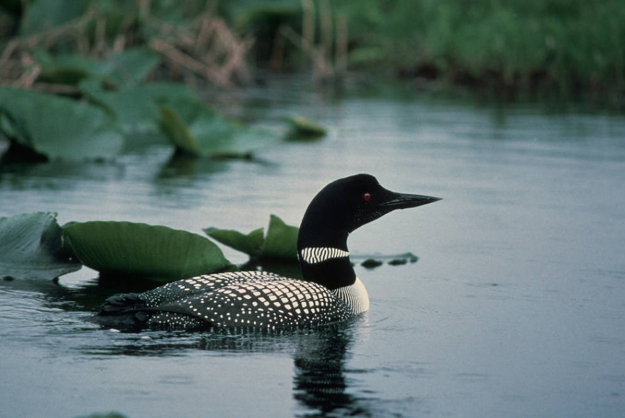
Photo by U.S. Fish & Wildlife Service • Common loons are quite at home in the air and on the water, but these birds are awkward if weather forces them to set down on land.

Loons crashing onto land or even small ponds are doomed. Agile and graceful in water because of strong legs and webbed feet, loons are almost incapable of movement on land. Landing on a small body of water is not much better since loons must run along a stretch of waters — sometimes for hundreds of yards — in order to get their relatively heavy bodies aloft.

Loons are not the only birds that sometimes face forced landings. In March of this year, a winter storm raged through most of the Northeastern United States. The wakes of these storms resulted in wildlife agencies in the region being flooded with reports of dead or injured American woodcocks in the region. Most of the reports were concentrated in and around New York City. Not only did the storm interrupt the migration flight of the woodcocks, but cold temperatures caused the ground to freeze, preventing the stranded birds from finding food.

The woodcock is an unusual shorebird, also known by such whimsical names as “bog sucker” and “timberdoodle,” that has completely abandoned the shore in favor of woodlands and fields. The American woodcock is not a rare bird, but the species is rarely seen due to its retiring habits and inaccessible habitats.

Closer to home, an unusual February event back in 2014 resulted in equally unusual numbers of red-necked grebes on area lakes, rivers, and ponds. This grebe, a rare visitor to the region, was apparently forced by weather conditions to make a stopover on bodies of water in the region. Reports of red-necked grebes persisted for about a week before they eventually departed to continue their flight to more favored locations.

Back in 2011, it wasn’t a winter storm that killed thousands of birds in Arkansas. The birds — red-winged blackbirds, European starlings, brown-headed cowbirds, and common grackles — shared a communal roost near the town of Beebe.

On New Year’s Eve, just as 2011 was dawning, about 5,000 of these birds died after crashing into trees, buildings and automobiles, according to a National Geographic News article by Charles Q. Choi. Apparently these birds were frightened into flight by the explosive booms from a professional fireworks display celebrating the arrival of a New Year. In the chaos after thousands of birds not suited for nocturnal flight took to the air, they began to impact various stationary objects and crash back to the ground.

Summer-Pelicans

Photo by Bryan Stevens • Brown pelicans fly in a line over the Atlantic Ocean on the South Carolina coast.

Incidentally, in the same article, mention was made of a 2010 incident when hundreds of pelicans washed up on the border between Washington and Oregon. The article blamed a cold front that caused ice to form on the feathers of the bodies and wings of the pelicans.

Birds, much like their human admirers, live in a world greatly affected by the vagaries of weather. All things considered, birds manage to ride out most of what Mother Nature throws their way. It’s one of their many admirable qualities.

Winter wren one of the season’s low-profile visitors

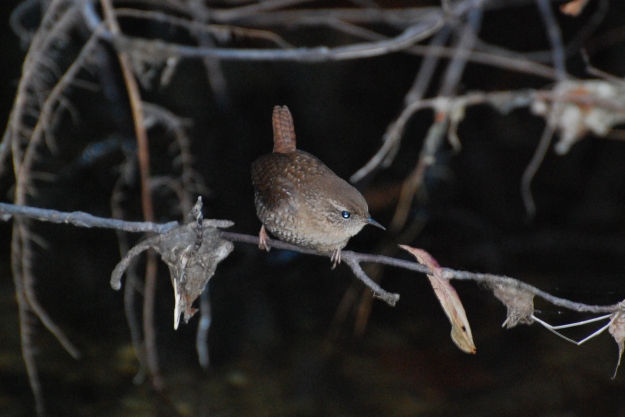
WinterWren

Photo by Jean Potter
What the winter wren lacks in size, it makes up for with its voice. A boisterous and exuberant singer during the spring nesting season,  winter wrens are also quick to scold intruders into their winter territories.


Of late, every time I step outside my front door I’ve incurred the ire of a winter wren that’s taken up residency in my yard. This wren is a tiny bird among a family of birds known for small size, but it makes its presence known in unmistakable terms.

For starters, the winter wren is a noisy bird. The one living at my home arrived in late November and immediately claimed a niche to call its own. Any intrusion is met with a scolding chatter as the wren scurries low to the ground to drop out of view. In fact, the winter wren’s a very terrestrial bird. Observers are just as likely to see one of these wrens run across the ground as they are to see it take flight. I’m hopeful he will remain as winter’s grip tightens for the next couple of months.

The website All About Birds, managed by The Cornell Lab of Ornithology, offers advice on making a wren-friendly yard. “Landscaping with native plants is a good way to provide habitat for Winter Wrens,” according to the website. Other steps to take could extend to creating brush piles and ensuring some sections of the yard offers dense vegetation. The website also notes that this wren is often found making its home near streams.

In the summer, the winter wren often nests atop some of the high-elevation mountains in the region, especially ones with abundant fir and spruce trees. Otherwise, it’s mostly a winter visitor in the region. Other wrens common to the region include the Carolina wren and the house wren. In suitable habitats, especially during fall and spring migration, two other wrens — marsh wren and sedge wren — are observed occasionally in the region. Other wrens native to the United States include the rock wren, canyon wren, cactus wren, Pacific wren and Bewick’s wren.

The world’s 88 species of wrens are, for the most part, the quintessential “little brown birds,” but that hasn’t kept them from acquiring some interesting and descriptive common names. Some examples include the tooth-billed wren, flutist wren, riverside wren, whiskered wren, happy wren, musician wren, timberline wren, speckle-breasted wren, white-breasted wood wren and giant wren. The last species on the list resides in Mexico and is indeed a “giant” among a family of tiny birds, reaching a length of almost nine inches and weighing all of 1.8 ounces.

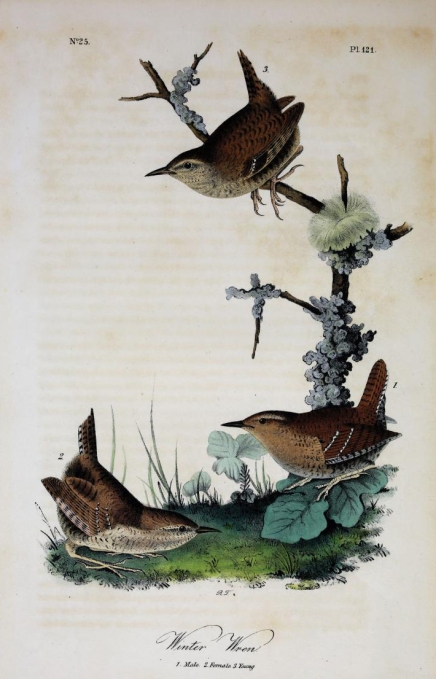
For the most part, wrens are birds of the New World. In fact, only the Eurasian wren represents the family in Europe, Asia and Africa. Experts recently split the winter wren into several different species, including the Pacific wren of the west coast of North America and the Eurasian wren of Europe, Asia and Africa.WinterWren_edited-1

Just as the winter wren thinks nothing of acting like a mouse when scurrying through leaf litter and over fallen logs in search of insect prey, this bird doesn’t hesitate to imitate mice by poking into shadowy holes in the ground or exploring the dark crevices of fallen logs. When winter temperatures drop sharply, many of these birds may cram themselves into a roosting hole to benefit from the communal heat from so many tiny feathered bodies in such close proximity. Winter wrens eat mostly insects and spiders, but in winter these birds will also eat some seeds and berries. Winter wrens rarely visit feeders, but a suet cake often attracts birds with similar dietary preferences, including kinglets and chickadees. A larger relative, the Carolina wren, is a common visitor to feeders.

In English and German lore, the winter wren was known as the “king of the birds.” Different tales provide varying explanations for how such a small bird earned such an inflated title. Ritual hunts were enacted in some European locations. These hunts, known as “wren hunts,” were conducted by “wren boys” who would parade through town on their quests. Wren Day fell on Dec. 26, which coincided with the holiday St. Stephen’s Day. Some myths blame the noisy bird for betraying the hiding place of Stephen, who was delivered up as a Christian martyr to his enemies due to the bird’s treachery. In some European cultures, various superstitions sprang up about wrens. For instance, in Scotland it is considered extremely unlucky to kill a wren.

Personally, I feel lucky to have the tiny winter wren spending time around my home and can guarantee no “wren hunts” will be staged here. At a time of year when feathered friends can be scarce, a winter wren is a welcome visitor.

••••••

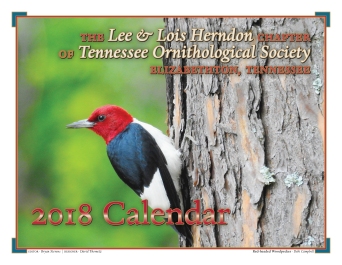
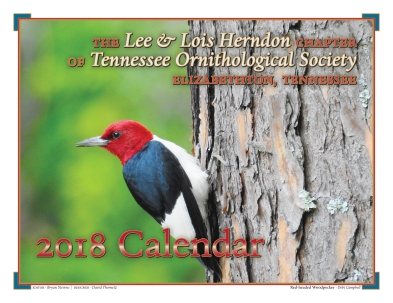
The Lee and Lois Herndon Chapter of Tennessee Ornithological Society produces an annual calendar featuring some exceptional bird photography from its members. This year’s calendar features full-color photographs of some colorful and engaging birds. The club sells the calendars for $15 each. All proceeds are used to support birding opportunities and bird-related causes. For instance, the club pays for bird seed to stock the feeders at Sycamore Shoals State Historic Park in Elizabethton, Tennessee. The club also regularly supports causes that benefit birds.HerndonCalendar2018(Cover)

The calendar also features an informative calendar grid with highlights for major holidays, as well as important bird-related dates. The calendar’s pages feature more than 80 full-color photographs of area birds, including common favorites, as well as a few more exotic birds. The front cover features a dazzling photograph of a red-headed woodpecker. The photo was taken by Debi Campbell, a resident of Bluff City, Tennessee, and current president of the Herndon chapter. If you’re interested in obtaining a calendar, contact ahoodedwarbler@aol.com by email. Calendars will also be available for purchase by cash or check only at the offices of the Bristol Herald Courier located at 320 Bob Morrison Blvd. in Bristol, Virginia.

If you’re interested in obtaining a calendar, contact ahoodedwarbler@aol.com by email. Calendars will also be available for purchase by cash or check only at the offices of the Bristol Herald Courier located at 320 Bob Morrison Blvd. in Bristol, Virginia.

•••••

Bryan Stevens lives near Roan Mountain, Tennessee. If you have a question, wish to make a comment or share a sighting, email ahoodedwarbler@aol.com.


Good intentions can have ill effects for ducks, geese, other waterfowl


Pattie Rowland contacted me on Facebook recently with a valid concern, especially now that the temperatures are turning a little cooler. People with good intentions often visit parks to feed the ducks and geese that reside at ponds and creeks.


“I see people with bags of bread thinking they are helping the ducks and geese,” she explained.

Despite the good intentions, Pattie, a resident of Erwin, Tennessee, has some concerns about the practice and requested that I help raise awareness about the possible unintended consequences.

While I’m not an expert, I applaud her attempt to raise the issue about what foods are nutritional and which are not when it comes to feeding wild or domesticated waterfowl. So, I did some research into the topic.

Dave McRuer, the director of Wildlife Medicine at the Wildlife Center of Virginia, wrote about the risks associated with feeding waterfowl in a 2015 article on the center’s website.

McRuer noted that wild ducks and geese feed on a variety of natural foods, such as wild grains and grasses, aquatic plants, and invertebrates. This varied diet provides the essentials waterfowl need to thrive.

Mallard-Drakes

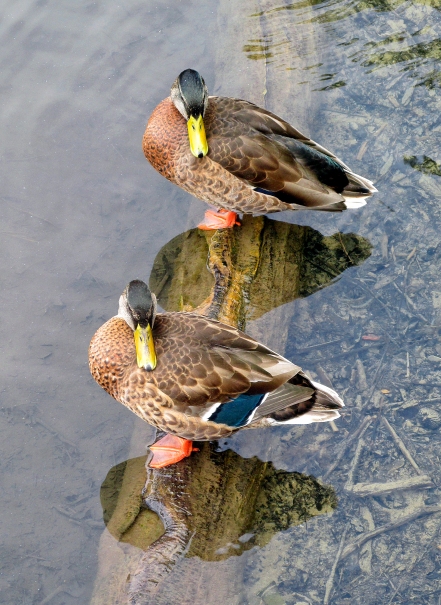
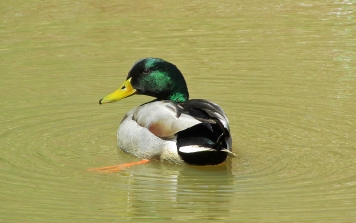
Photo by Bryan Stevens • Mallard drakes share a log during a period of relaxation. Mallards, Canada Geese, and some other waterfowl have voluntarily semi-domesticated themselves in exchange for an easy, but not always healthy, life based on human handouts.

On the other hand, McRuer warned about some of the foods commonly fed to waterfowl in public parks, such as bread, popcorn and corn, are typically low in protein and essential nutrients and minerals. Waterfowl feeding heavily on such fare are at risk for developing nutritional disorders.


His ultimate conclusion was that any benefits are far outweighed by risks when it comes to the feeding of waterfowl at public parks. His recommendation was to stop all forms of supplemental feeding.


He based his recommendation on more than nutritional concerns. Supplemental feeding can also lead to overcrowding, disease concerns, habitat degradation, and an unhealthy habituation to humans or animals associated with humans.


There are some alternatives to the quitting “cold turkey” option when it comes to feeding ducks and geese. Melissa Mayntz, a birder with more than 30 years of experience, penned an article for the website, The Spruce, recommending some foods that will not expose waterfowl to potential harm.


In an article titled “What to Feed Ducks,” Mayntz wrote that it is important to realize that waterfowl are capable of fending for themselves and do not require human handouts to survive, no matter what the season nor how much they seem to beg for treats. She did offer some tips on choosing nutritious treats to supplement the wild diet of park waterfowl.


Various grains, such as cracked corn, wheat, barley, oats, and rice can safely be offered as an occasional treat. In addition, she recommended grapes (sliced in half), chopped lettuce or other greens and vegetable trimmings or peels chopped into small, easily eaten pieces.

Mallard-March28

Photo by Bryan Stevens • A Mallard drake still shows some caution toward humans, arguing that this individual has not become dependent on human handouts.

Mayntz’s article basically echoes many of the warnings from the one by McRuer. Some of the foods commonly offered, such as bread, crackers, cereal and popcorn, offer very little nutritional value. In addition, bread and other similar foods are dangerous if they are moldy. Increasing the disk is the fact that any excess bread that isn’t eaten can quickly mold. Molded food can kill waterfowl, which is the last thing people would want to happen to these birds.


I agree with Mayntz in her conclusion, which admits that feeding waterfowl at local ponds and parks can be a fun experience in wildlife viewing for people of all ages. By avoiding potentially dangerous foods and restricting treats to items that actually provide nutritional value, birders can continue to enjoy this pastime without risking the lives of the birds they love so much.


As a general rule, I don’t feed the waterfowl at local parks. Many years ago I fed a flock of semi-domesticated mallards that took up residence at my fish pond. From a half dozen birds, the flock eventually grew to about two dozen ducks. The only food I fed them was cracked corn during the winter season. They foraged quite successfully for the rest of their food from the pond, the nearby creek and the fields. I’m convinced they helped control the numbers of pest insects during their stay. To this day, an occasional pair of mallards will visit on cold winter days. At times, they look at me like they’re expecting a handout and I wonder if they could be descendants of some of those mallards from the original flock.

Canada_Geese

Photo by Bryan Stevens • In some areas, Canada Geese have become so prevalent that they are considered pests. Human handouts to waterfowl are not always compatible with good health for the birds that receive them.


So, don’t let good intentions cause problems for any of our feathered friends. If you want to feed ducks at the local park, consider the healthy alternatives instead of providing bread. After all, people cannot live on bread alone, and neither can ducks.


•••••

Calendars make fun Christmas presents

The Lee and Lois Herndon Chapter of Tennessee Ornithological Society produces an annual calendar featuring some exceptional bird photography from its members. This year’s calendar features full-color photographs of some colorful and engaging birds. The club sells the calendars for $15 each. All proceeds are used to support birding opportunities and bird-related causes. For instance, the club pays for bird seed to stock the feeders at Sycamore Shoals State Historic Park in Elizabethton, Tennessee. The club also regularly supports causes that benefit birds.HerndonCalendar2018(Cover)

The calendar also features an informative calendar grid with highlights for major holidays, as well as important bird-related dates. The calendar’s pages feature more than 80 full-color photographs of area birds, including common favorites, as well as a few more exotic birds. The front cover features a dazzling photograph of a red-headed woodpecker. The photo was taken by Debi Campbell, a resident of Bluff City, Tennessee, and current president of the Herndon chapter. If you’re interested in obtaining a calendar, contact ahoodedwarbler@aol.com by email. Calendars will also be available for purchase by cash or check only at the offices of the Bristol Herald Courier located at 320 Bob Morrison Blvd. in Bristol, Virginia.

If you’re interested in obtaining a calendar, contact ahoodedwarbler@aol.com by email. Calendars will also be available for purchase by cash or check only at the offices of the Bristol Herald Courier located at 320 Bob Morrison Blvd. in Bristol, Virginia.


It’s not difficult to find reasons to admire America’s wild turkey

WildTurkey-TOM

Photo by Jean Potter • A male wild turkey struts his stuff while fanning his impressive tail feathers.

I’ve seen a few small flocks of wild turkeys this fall, although larger flocks have been elusive so far. As the fields and woods grow more stark as the cold season advances, I am confident I will start seeing more turkeys. I am even thinking of spending part of my upcoming Thanksgiving holiday looking for some of these very American birds.

The wild turkey has been venerated as an example of an American success story almost from the time the first Europeans settlers set foot on the continent of North America. Even prior to the arrival of Europeans, Native Americans hunted the wild turkey and also made a place for the bird in their myths and lore. Here are my top three reasons to celebrate the wild turkey, one of America’s most fascinating birds:

First, who doesn’t like to root for a contender? Many people have heard accounts of how the wild turkey was a candidate for America’s national bird. It’s a well-known example of historic trivia that the wild turkey had its supporters among the nation’s founding fathers, but was it ever seriously considered for the elevated status as America’s official bird? The answer’s not cut and dry.

96669-004-5F592F06

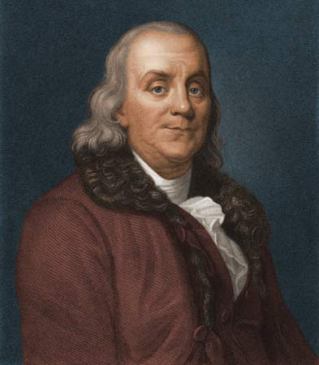
Ben Franklin wasn’t enthusiastic about the bald eagle as the national bird, but perhaps it’s best we don’t eat our national bird every Thanksgiving.

Benjamin Franklin, Thomas Jefferson and John Adams formed a committee assigned the task of designing an official seal for the new United States of America. As is often the case with government committees, the job of designing the seal took longer than expected. After three different committees came up with different designs, Pennsylvania lawyer named Thomas Barton eventually came up with one featuring a white eagle. Secretary of Congress Charles Thomson recommended replacing that eagle design with one depicting the native bald eagle. Eventually, the bald eagle received designation as the nation’s official bird.

Nevertheless, some of the committee members had second thoughts. Franklin later wrote a letter to his daughter that seemed to bemoan the choice of the bald eagle. He labeled the eagle “a bird of bad moral character” and lauded the wild turkey as a “bird of courage.”

Perhaps Franklin suffered some buyer’s remorse. “I wish the bald eagle had not been chosen as the representative of our country,” he wrote in his letter. “The turkey is a much more respectable bird.” He also noted that the turkey is a true and original American native. Of course, the bald eagle is also a bird unique to North America. So while there’s no direct evidence that Franklin did anything to actively promote the turkey as the nation’s official bird, he didn’t exactly provide a ringing endorsement of the bald eagle.

6_Wild_Turkey

Early naturalist and painter John James Audubon must have been very familiar with turkeys to have painted this lively scene of a hen and chicks.

Second, the wild turkey has a wide range of experience, both foreign and domestic, as a representative of the United States. While wild turkeys still roam through North America, to the tune of seven million individuals, their domesticated kin are farmed in huge numbers. Native tribes in the Americas began domesticating the wild turkey centuries ago. When early Spanish explorers conquered the Aztec empire in Mexico they found that turkeys were among the domesticated animals kept by the Aztecs. The Spaniards returned to Europe with domesticated turkeys around 1520. In the next few decades, domesticated turkeys spread into other European countries, arriving in England between 1525 and 1540.

OldDesignShop_GreetingsOfThanksgivingPC1 2

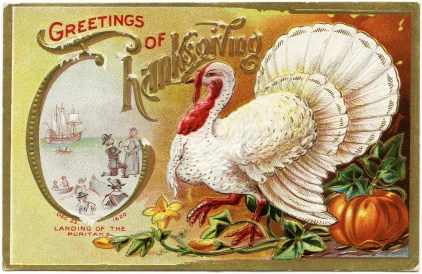
The first European colonists brought turkeys to the New World with them only to discover the ancestors of their domesticated fowl already existed in America.

In a strange twist of fate, colonists in New England and Virginia brought domestic turkeys with them to the New World in the early decades of the 1600s only to be surprised to find the native forests already populated by wild turkeys, which were the ancestors of their domesticated fowls. Today, that back-and-forth saga regarding the turkey continues. One of the most important customers for U.S turkey farmers is the nation of Mexico. Almost 70 percent of U.S. turkey exports go to Mexico.

Finally, the wild turkey has that “in-your-face” attitude that is so American and helps turkeys thrive no matter where they live. In recent decades, some turkeys have taken to suburban living. An article by Brian Handwerk on the National Geographic website puts the spotlight on these turkeys that have taken so readily to living in the ‘burbs.

Massachusetts and Connecticut, former strongholds of the first settlements by Europeans in the New World, are home to densely populated cities like Boston and Hartford. These days, however, turkeys demand their share of the pie, figuratively speaking, when it comes to prime real estate. All a turkey really needs is some cover, which is adequately provided by landscaped lawns in the suburbs, and a few trees that provide nightly roosts. As social birds, they roam in flocks that don’t particularly pay attention to property lines.

Turkey_two

Photo by Bryan Stevens • A wild turkey forages for food.

In addition, a wild turkey’s a fairly big bird. A male turkey, or tom, can weigh between 16 and 24 pounds. The females, or hens, are usually about half that size. Human-turkey conflicts occur most often in the spring when the boisterous toms are focused intently on besting rivals and impressing potential mates. Unfortunately, these hormone-addled tom turkeys sometimes mistake humans going about their daily lives as rivals.

Turkey Silhouette Clip Art Free 27 (1) 2In addition, many human residents of the suburbs have a tendency to offer food to wildlife ranging from squirrels and deer to perhaps a flock of resident turkeys. Providing food can make turkeys expectant and demanding. To put it mildly, a turkey can be a little intimidating. They’re not likely to harm a human being, but occasionally turkeys will also stand their ground, refuse to back down and even give chase to any human who crosses them. Sounds like a proud American, right?

Now, one last thing for which Americans can be thankful. We don’t chow down on bald eagles every Thanksgiving. It would be awful, wouldn’t it, to eat our national bird?

••••••

Bryan Stevens lives in Roan Mountain, Tennessee. If you have a question, wish to make a comment or share a sighting, email ahoodedwarbler@aol.com. He also welcomes friend requests on Facebook at https://www.facebook.com/ahoodedwarbler.

Annual Fall Bird Count finds 122 species in Northeast Tennessee

Heron-UnderBridge

Photo by Bryan Stevens • A Great Blue Heron wades through the creek running through downtown historic Jonesborough on a warm afternoon this past summer. These large herons, helped by recent nesting colonies in Erwin, Elizabethton and other locations, have become more commonplace in the region. The 66 Great Blue Herons found on the recent Fall Bird Count represented a new high number for the species on this annual autumn survey of bird populations in the region.


The 48th annual Elizabethton Fall Count was held on Saturday, Sept. 30, with 54 observers in 12 parties covering Carter County and parts of the adjacent counties of Johnson, Sullivan, Unicoi and Washington. The participants tallied 122 species, which is slightly below the recent 30-year average of 126 species. The all-time high for this count was 137 species, which was reached in 1993.

Shorebirds were in very short supply due to a shortage of suitable habitat. Aside from killdeer, a solitary sandpiper was true to his name. In particular, two sites that formerly attracted shorebirds have undergone alterations that have essentially eliminated such conditions: Austin Springs and Bush Hog Pond.

This year’s count featured some other notable misses, as well, according to long-time count compiler Rick Knight. Birds missed include Northern Bobwhite (which has been found only four times in the last 24 years), Broad-winged Hawk, Spotted Sandpiper (first miss in last decade), Winter Wren, and Blue-gray Gnatcatcher.

Several birds set new high records for the number of individuals tallied, including Double-crested Cormorant (70); Great Blue Heron (66); Black Vulture (330); Turkey Vulture (215); Red-shouldered Hawk (6); Belted Kingfisher (40); and Red-bellied Woodpecker (90).

Bryan-KingfisherSunny

Photo by Bryan Stevens • The 40 Belted Kingfishers found during the Fall Bird Count represented a new high count for this long-running survey.

Fish Crow made its debut on a Fall Bird Count debut when two individuals were found in Kingsport along the Holston River.

The count total follows:

Canada Goose, 957; Wood Duck, 24; Mallard, 378; Blue-winged Teal, 2; Hooded Merganser, 1; Ruffed Grouse, 5; Wild Turkey, 79; Pied-billed Grebe, 11; and Double-crested Cormorant, 70.
Great Blue Heron, 66; Great Egret, 1; Green Heron, 4; Black-crowned Night-Heron, 2; Black Vulture, 330; and Turkey Vulture, 215.

Osprey, 12; Bald Eagle, 6; Northern Harrier, 2; Sharp-shinned Hawk, 7; Cooper’s Hawk, 7; Red-shouldered Hawk, 6; Red-tailed Haw, 27; American Kestrel, 16; Merlin, 1; and Peregrine Falcon, 1.

Killdeer 50; Solitary Sandpiper, 1; Ring-billed Gull, 1; Forster’s Tern, 1; Rock Pigeon, 404; Eurasian Collared-Dove, 2; Mourning Dove, 356; Yellow-billed Cuckoo, 1; Eastern Screech-Owl, 12; Great Horned Owl; 10; Barred Owl; 4; and Northern Saw-whet Owl; 1.

Common Nighthawk, 1; Chimney Swift, 254; Ruby-throated Hummingbird 8; Belted Kingfisher, 40; Red-headed Woodpecker, 7; Red-bellied Woodpecker, 90; Yellow-bellied Sapsucker, 16; Downy Woodpecker, 46; Hairy Woodpecker, 8; Northern Flicker, 63; and Pileated Woodpecker, 37.

Eastern Wood-Pewee 6; Eastern Phoebe, 76; Eastern Kingbird, 1; Loggerhead Shrike, 1; White-eyed Vireo; 2; Yellow-throated Vireo, 1; Blue-headed Vireo, 14; Red-eyed Vireo, 6; Blue Jay, 447; American Crow, 424; Fish Crow, 2; and Common Raven, 19.

SolitarySandpiper-One

Photo by Bryan Stevens • Migrating shorebirds, such as this Solitary Sandpiper, added diversity to this year’s Fall Bird Count in Northeast Tennessee.

Northern Rough-winged Swallow, 3; Tree Swallow, 68; Carolina Chickadee, 174; Tufted Titmouse,93; Red-breasted Nuthatch, 6; White-breasted Nuthatch, 44; Brown Creeper, 2; House Wren, 2; and Carolina Wren,180.

Golden-crowned Kinglet, 4; Ruby-crowned Kinglet,14; Eastern Bluebird, 163; Veery, 7; Gray-cheeked Thrush, 26; Swainson’s Thrush, 70; Hermit Thrush, 1; Wood Thrush, 19; American Robin, 301; Gray Catbird, 34; Brown Thrasher, 11; Northern Mockingbird, 100; European Starling, 2,106; and Cedar Waxwing, 205.

Ovenbird, 2; Black and White Warbler, 6; Tennessee Warbler, 32; Common Yellowthroat, 9; Hooded Warbler, 2; American Redstart, 5; Cape May Warbler, 8; Northern Parula, 3; Magnolia Warbler, 29; Bay-breasted Warbler, 10; Blackburnian Warbler, 2; Chestnut-sided Warbler, 2; Black-throated Blue Warbler, 5; Palm Warbler, 21; Pine Warbler, 11; Yellow-rumped Warbler, 5; Yellow-throated Warbler, 4; Prairie Warbler, 1; and Black-throated Green Warbler, 8.

grosbeak-photo

Photo by Bryan Stevens • Migrating Rose-breasted Grosbeaks were among the 122 species tallied for this year’s Fall Bird Count.

Eastern Towhee, 50; Chipping Sparrow, 57; Field Sparrow, 14; Song Sparrow,144; Lincoln’s Sparrow, 1; Swamp Sparrow, 1; Dark-eyed Junco, 75; Summer Tanager, 1; Scarlet Tanager, 11; Northern Cardinal, 173; Rose-breasted Grosbeak, 19; Indigo Bunting, 15.

Red-winged Blackbird, 41; Eastern Meadowlark, 17; Common Grackle, 859; Brown-headed Cowbird, 78; House Finch, 44; Pine Siskin, 1; American Goldfinch, 138; and House Sparrow, 33.

•••••

Bryan Stevens has been writing about birds on a weekly basis since 1995. If you have a question, wish to make a comment or share a sighting, email ahoodedwarbler@aol.com.

Dark-eyed junco faithful visitor to feeders during wintry weather

Junco-Ground

Photo by Kenneth Thomas / Dark-eyed juncos, often referred to as “snow birds,” flock to feeders in winter during periods of inclement weather.

I recently took part in the 48th annual Elizabethton Fall Count. Although part of the count’s focus is on Carter County, significant attention is paid to the adjacent counties of Johnson, Sullivan, Unicoi and Washington in Northeast Tennessee. This year’s count, which was held Saturday, Sept. 30, with 54 observers in 12 parties, tallied 122 species, which is slightly below the recent 30-year average of 126 species. The all-time high for this count was 137 species, which was reached in 1993.

Together with Brenda Richards, I travelled the Forest Service road on Holston Mountain to seek out some species that prefer higher elevation habitats, including dark-eyed juncos. The junco is also a winter visitor to yards and gardens throughout the region and should be returning any day now for a seasonal stay during the colder months of the year. During our progress up the mountain, we glimpsed several dark-eyed juncos as well as other birds such as blue-headed vireo and black-and-white warbler.

I have always had a fondness for juncos. In fact, I wrote my first birding column on Sunday, Nov. 5, 1995, which means that I recently celebrated the 22nd anniversary of my weekly accounts of birds and birding. The column has appeared weekly without interruption in various newspapers in the last 22 years. The column has also been a great conduit for getting to know other people interested in our “feathered friends.” I always enjoy hearing from readers, and I hope to continue to do so in the coming years. Since February of 2014, I’ve also been posting the column as a weekly blog on birds and birding.

Here, with some revisions I have made through the years, is that first column that has now involved into a look that is all “For the Birds.”
…..

Of all the birds associated with winter weather, few are as symbolic as the Dark-eyed Junco, or “snow bird.” The junco occurs in several geographic variations.dennisjl 2

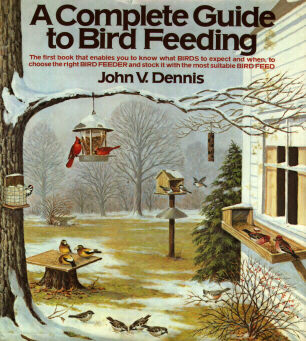
John V. Dennis, author of “A Complete Guide to Bird Feeding,” captures the essence of the junco in the following description: “Driving winds and swirling snow do not daunt this plucky bird. The coldest winter days see the junco as lively as ever and with a joie de vivre that bolsters our sagging spirits.” The Dark-eyed Junco’s scientific name, hyemalis, is New Latin for “wintry,” an apt description of this bird.

Most people look forward to the spring return of some of our brilliant birds — warblers, tanagers and orioles — and I must admit that I also enjoy the arrival of these birds. The junco, in comparison to some of these species, is not in the same league. Nevertheless, the junco is handsome in its slate gray and white plumage, giving rise to the old saying “dark skies above, snow below.”

Just as neotropical migrants make long distance journeys twice a year, the junco is also a migrating species. But in Appalachia, the junco is a special type of migrant. Most people think of birds as “going south for the winter.” In a basic sense this is true. But some juncos do not undertake a long horizontal (the scientific term) migration from north to south. Instead, these birds merely move from high elevations, such as the spruce fir peaks, to the lower elevations. This type of migration is known as vertical migration. Other juncos, such as those that spend their breeding season in northern locales, do make a southern migration and, at times, even mix with the vertical migrants.

Juncos are usually in residence around my home by early November. Once they make themselves at home I can expect to play host to them until at least late April or early May of the following year. So, for at least six months, the snow bird is one of the most common and delightful feeder visitors a bird enthusiast could want.

john-james-audubon-limited-centennial-edition-giclee-on-paper-dark-eyed-junco-2

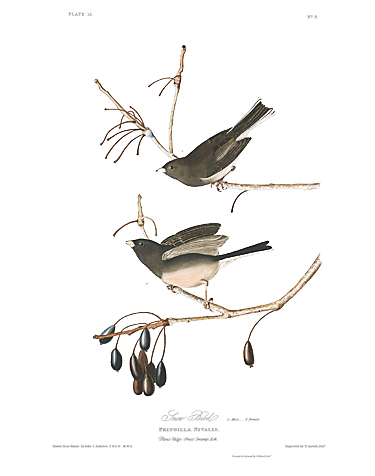
Early American naturalist and artist John James Audubon painted this pair of Dark-eyed Juncos.

Juncos flock to feeders where they are rather mild-mannered — except among themselves. There are definite pecking orders in a junco flock, and females are usually on the lower tiers of the hierarchy. Females can sometimes be distinguished from males because of their paler gray or even brown upper plumage.

Since juncos are primarily ground feeders, they tend to shun hanging feeders. But one winter I observed a junco that had mastered perching on a hanging “pine cone” feeder to enjoy a suet and peanut butter mixture.

Dark-eyed juncos often are content to glean the scraps other birds knock to the ground. Juncos are widespread. They visit feeders across North America. The junco is the most common species of bird to visit feeding stations. They will sample a variety of fare, but prefer such seeds as millet, cracked corn or black oil sunflower.

There’s something about winter that makes a junco’s dark and light garb an appropriate and even striking choice, particularly against a backdrop of newly fallen snow.

Junco-AtFeeder

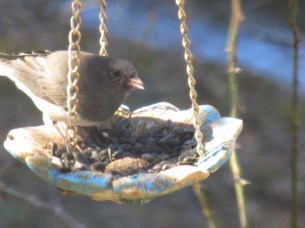
Photo by Bryan Stevens / A Dark-eyed Junco perches on the side of a hanging feeder offering sunflower seeds.

Of course, the real entertainment from juncos come from their frequent visits to our backyard feeders. When these birds flock to a feeder and begin a furious period of eating, I don’t even have to glance skyward or tune in the television weather forecast. I know what they know. Bad weather is on the way!

•••••

If you have a question, wish to make a comment or share a sighting, email ahoodedwarbler@aol.com.

Dark reputation of world’s owls is being rehabilitated as people learn more about them and their habits


greathornedowl-2

Photo by Bryan Stevens / A great horned owl perches on a post during its part in a wild bird show at Callaway Gardens in Pine Mountain, Georgia.

As I sit at my computer working on this week’s post, I can hear the low, sonorous call of a great horned owl from the woods located behind my house. The great horned owl is one of two species I often hear near my home. In addition, I regularly hear the much smaller Eastern screech-owl calling from the same woods. The intervals around dusk and dawn are popular times for owls to produce their eerie calls. At present, there’s a pair of great horned owls living in the woods near my home. If I hear one, I usually hear the other. These large owls call to each other to communicate their whereabouts. Perhaps it helps them avoid surprise encounters with each other once they begin hunting after the sun sets.

The great horned owl lives and hunts in the woodlands of northeast Tennessee, southwest Virginia and western North Carolina. These large owls thrive in rural areas, but these adaptable predatory birds have also learned to survive in the suburbs and even city parks. While quite at home in the region, the great horned owl is not confined to the Southern Appalachians. These owls also make their home in the wetlands along the southern Atlantic coast, as well as arid deserts of the American southwest. If nothing else, the great horned owl has shown amazing resilience and adaptability.

With about 200 different species, the world’s owls form an order known as Strigiformes. Characteristics that define owls include a mostly solitary and nocturnal existence. These predatory birds are also typified by such physical traits as an upright stance, binocular vision, exceptional hearing, sharp talons, and feathers adapted for silent flight.

BarredOwl-Perched

Photo by Bryan Stevens / A Barred Owl blends with the background in this photo taken of a wild owl at Brookgreen Gardens in South Carolina.

The smallest owl — weighing as little as an ounce and measuring a mere five inches) — is the elf owl (Micrathene whitneyi). To give you some perspective, that DVD of your favorite movie also weighs about an ounce. The common house sparrow that flocks in shopping center parking lots is slightly bigger than this tiny owl. According to the website, The Owl Page, the elf owl was originally known as Whitney’s Owl. The scientific name whitneyi is a Latinized word formed from the last name of Josiah Dwight Whitney, a prominent American geologist for whom the diminutive owl was named. Whitney was considered the foremost authority of his day on the economic geology of the United States. In addition to having a tiny owl named in his honor, Whitney’s name graces Mount Whitney, the highest point in the continental United States, and the Whitney Glacier, which was the first confirmed glacier in the United States.

The miniature elf owl is every bit the predator, but its prey generally consists of various insects as well as such desert dwellers as scorpions and spiders. Despite the extremes of the environment in which it lives, the elf owl does just fine. It prefers areas offering plenty of saguaro cactus. Cavities in these iconic desert plants provide roosting and nesting locations for this tiny owl. The elf owl range from the southwest regions of the United States to Central Mexico and Baja California. Unfortunately, the numbers of this owl in Texas and California have declined in recent times.33ecc634b6bf2f56939e0c28a1e0c6c0

To find the world’s largest owl, head to the other side of the world to the islands of Japan, as well as remote areas of Siberia, Manchuria and Korea. With a body comparable in size to that of a young child and a wingspan wider than six feet, the Blakiston’s fish owl (Bubo blakistoni) earns its distinction as the largest owl in the world. The fish owls are part of a larger grouping of birds known as eagle owls, which specialize in hunting in habitats found along large rivers. Female Blakiston’s fish owls are larger than males, and a large female can weigh as much as 10 pounds and attain a 6.5-foot wingspan. This big owl was named after English naturalist Thomas Blakiston (1832-1891) who found the first specimen on Japan’s northern island of Hokkaido in 1883. According to Paul Frost of The Raptor Foundation, this owl is sacred to the Ainu, a native people residing on Hokkaidu. The Ainu refer to this owl as “kotan kor kamuy,” which means “god of the village” or “god who defends the village”.

While many culture view owls with misgivings, often associating their nocturnal tendencies with more sinister motives, that’s not always the case. For instance, the Japanese people believe that owls bring good fortune. In addition, owls offer protection from suffering. Other cultures have feared and reviled owls. The ancient Romans share much of the blame for the negative image owls are still overcoming. Romans considered owls as harbingers of death, defeat and other disasters. To ward off the evil caused by an owl, Romans advised that the offending owl should be killed and nailed to a door. Such a bloodthirsty solution leads me to think that owls had more to fear from Romans than Romans had to fear from them.

The need for common names for the 200 species of owls has resulted in some creative monikers. Some of the most descriptive common names for some of the world’s owls include ashy-faced barn owl, barking owl, brown owl, cuckoo owlet, fearful owl, giant eagle owl, Christmas Island hawk owl, snowy owl, laughing owl, rufous owl, tawny-bellied screech owl, winking owl, and spotted wood owl.

great_horned_owl_and_chick-2

Photo by George Gentry/U.S. Fish and Wildlife Service / A Great Horned Owl is shown on the nest with one of her chicks.

Many relatives of the great horned owl have proven equally adaptive, carving out niches for themselves in habitats as diverse as jungles, deserts and the frozen tundra. Indeed, the great horned owl has many relatives living in our region. The Eastern screech owl is a tiny cousin, but some other large owls that live in the area include the barred owl and the barn owl. More rare to the region are visits by such owls as the short-eared owl and the long-eared owl. There’s even another tiny relative — the Northern saw whet owl — that is rarely heard and even more seldom seen.

Regardless of the species, the activities of owls are invariably cloaked in darkness. Despite electric lights and other trappings of civilization, people still delight in the shivers that result from hearing the hoots of an owl. It’s truly no surprise that owls have become popular motifs in the weeks leading up to our recent celebration of the Halloween holiday. Owls may live alongside us, but we’ll never truly belong to their world, which consists of all the spooky things that go bump in the night.

•••••

Bryan Stevens lives near Roan Mountain, Tennessee. If you have a question, wish to make a comment or share a sighting, email ahoodedwarbler@aol.com. Find him on Facebook at https://www.facebook.com/ahoodedwarbler.

Crows show intelligence yet can’t shake dark reputation

Crow-Waxwings

Photo by Bryan Stevens
Red-winged blackbirds mob an American crow. In turn, crows often mob large raptors,           such as red-tailed hawks and great horned owls.

There’s something rather autumnal about watching a flock of American crows glean the last scattered kernels of corn from a harvested field as a sentry stands guard ready to utter the alarm with some guttural “caws” should anything potentially threatening appear on the scene. Crows are such a part of the landscape that they would almost escape our notice if they didn’t come with centuries of accumulated baggage that makes us distrust them and suspect their every action.

The crow, largely thanks to its black plumage, but perhaps also with a nod to its avian intelligence, has long been associated with Halloween. Greeting cards and decorations for the holiday often feature depictions of bats, owls and black cats, as well as the inevitable crow and the accompanying scarecrow. It’s not like the straw-filled sentries that stand guard over a farmer’s fields do anything to intimidate or even discourage crows. With a brain about as big as a man’s thumb, the crow is renowned among ornithologists and other scientists for its keen intelligence. Crows are not fooled for a second by the masquerade of a scarecrow propped in a field.

crows-dec-21

Photo by Bryan Stevens / Wary American crows survey their surroundings.

The intelligence of this bird has long been known. Early American naturalist William Bartram wrote about a crow named Tom in a unique naturalist essay titled “Anecdotes of an American Crow.” Bartram, who lived from 1739 to 1823, brought humor and insight to his subject as he wrote about the joys, as well as tribulations, of living with Tom, a crow that enjoyed tormenting Bartram’s dog and stealing the writer’s spectacles and trying to hide them.

The essay demonstrates that almost as soon as Europeans arrived in North America, some of those with a bent toward the natural world recognized the intelligence and amazing adaptability of the American crow. As well as writing about the natural world, Bartram earned widespread acclaim for his drawings of botanical and ornithological subjects. Tom, the featured crow in Bartram’s brief essay, certainly exhibited intelligence of an impressive degree. Not only did the crow steal his owners eyeglasses, he foiled Bartram’s first attempt to reclaim them. Noting Bartram’s attention to his efforts to hide the purloined spectacles, Tom snatched the eyeglasses a second time when Bartram made a premature attempt to reclaim them. The situation makes very humorous reading.

What else have crows done down through the ages to gain such a dark and much undeserved reputation? It probably doesn’t help matters that a flock of crows is known as a “murder.” Ancient Greeks considered crows as omens, which often foretold death and other disasters. On the positive side, many Native American tribes revere crows as communicators between worlds. Crows have been documented using tools and solving problems, which shows an uncanny ability to analyze and strategize. Early Celtic people also noted and admired these traits in crows.

sclaudubon_sclib_audubon_v2_2_p156_full_5398_8151__0_native

Early naturalist and artist John James Audubon painted this American crow.

In addition, crows forage beyond the cornfield for their food. Many crows scavenge road-killed wildlife, such as squirrels, opossums and rabbits. While they eat carrion, they do so less often than birds such as turkey vultures, black vultures and the crow’s fellow corvid, the common raven.

The kinship to the raven is evident, but even moderately experienced birders rarely confuse these similar species. The raven is a large bird with a heavy beak, a distinctive profile and a wedge-shaped tail. In a direct comparison with a raven, a crow looks downright puny. Both are members of the corvid family, which consists of 120 species including jays, rooks, magpies and jackdaws.

Many years ago I fed a flock of ducks that took up residence at my fish pond. Before long, the crows arrived within minutes after I tossed shelled corn on the ground for the benefit of the ducks. If the ducks took too long consuming the corn, the impatient crows crowded closer and competed directly with the ducks for the kernels. The crows that live around my home are usually too cautious and wary to visit feeders situated near my home. Feeders set farther from the house receive occasional hurried visits by crows.

Crow-Trio

Photo by Bryan Stevens / A trio of American crows forages on a grassy lawn.

American author and abolitionist Henry Ward Beecher summed up the American crow in the frequently quoted remark, “If men had wings and bore black feathers, few of them would be clever enough to be crows.” It’s an apt tribute and comes from the man whose sister, Harriet Beecher Stowe, wrote “Uncle Tom’s Cabin,” a book often credited with helping to launch the American Civil War.

Crows, perhaps more than any other North American bird, have learned to co-exist with human beings. Make an effort to get past some pre-supposed superstitions about these interesting birds and learn to appreciate them for their many good qualities.

••••••

To ask a question, make a comment or share a sighting, send an email to ahoodedwarbler@aol.com.

funny-pumpkin-head-scare-crow-halloween-wallpaper