Category Archives: Bird

Carolina chickadees are easy birds to befriend and bring into your daily life

Winter-Chickadee-Confused

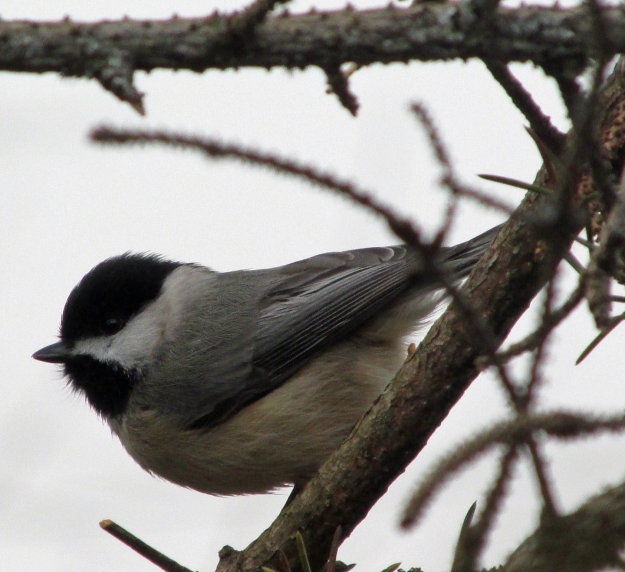
Photo by Bryan Stevens • A Carolina chickadee perches on a branch.

In last week’s post, I pointed out that Eastern bluebirds have already started seeking nesting locations for the upcoming spring nesting season. They’re hardly the only cavity-nesting birds already checking out every nook and cranny for the perfect place to raise a family of young.

I’ve been hearing the familiar “fee-bee-fee-bo” song of the Carolina chickadee from the woodlands around my home. With the recent turn in the weather, the male chickadees are persistent singers, making the woods ring with their attempts to woo a mate.

The Carolina chickadee is at home in mixed or deciduous woods in the United States from New Jersey west to southern Kansas and south to Florida and Texas. The Carolina chickadee also ranges along the Appalachian Mountains, but on some of the higher peaks they are replaced by their cousin, the black-capped chickadee. In Tennessee, birders need to visit some of the higher peaks in the Great Smoky Mountains National Park to find black-capped chickadees.

Winterchickadee

Photo by Bryan Stevens • A Carolina chickadee visits a feeder for sunflower seeds.

Once a pair of chickadees settles down into domestic bliss, they almost at once start work upon constructing a nest. These little songbirds, looking quite smart in their handsome black, white and gray feathers, build an exquisite nest. The primary nesting material is green moss, which they stuff into a natural cavity or bird box in great quantities. The female chickadee fashions a depression in the collection of moss. She lines this shallow basin with plant fibers as well as strands of fur or hair to provide soft cushioning for her eggs.

Chickadee-Feb9

Photo by Bryan Stevens • A Carolina chickadee endures a cold winter’s day.

A female chickadee can lay a large number of eggs, with the clutch size ranging between three and ten eggs. Once the young hatch, both parents are kept busy delivering food to a large brood of hungry, noisy chicks. The young grow quickly, but they take advantage of the safety of their cavity nest and don’t depart for the wider world until 20 days after their hatching.

Energetic chickadees, birds of the most engaging antics, make wonderful feeder visitors. With their tame and trusting natures, chickadees are one of the birds I welcome to my feeders. Chickadees are daily visitors to my feeders in the winter season as well as other times of the year. I love to watch a chickadee land on a feeder, snatch a single sunflower seed and fly to a perch close at hand to hack open the seed’s shell and devour the kernel before they repeat the entire process again.

Chickadee-FeedTwo

Photo by Bryan Stevens • A Carolina chickadee makes a food delivery to nestlings.

North America’s other chickadees include the aforementioned black-capped chickadee, as well as boreal chickadee, chestnut-backed chickadee, grey-headed chickadee, Mexican chickadee, and mountain chickadee. On a trip to Utah in 2003 and 2006, I saw both black-capped chickadee and mountain chickadee.

In other parts of the world, chickadees are known as “tits,” which is from an Old English word denoting small size. Worldwide, there are about 60 species of chickadees and tits, which are classified collectively under the scientific family name, Paridae. Other members of this family range into Europe, Asia and Africa, including species with colorful names like fire-capped tit, yellow-bellied tit, azure tit, green-backed tit and cinnamon-breasted tit.
CarolinaChickadee-1

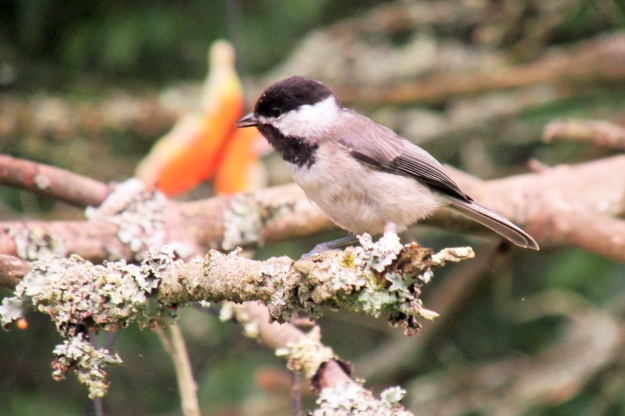
Photo by Bryan Stevens • Caroline chickadee waits for a chance to visit a crowded feeder.

It’s easy to attract chickadees to your yard. Shrubs and small trees, feeders stocked with sunflower seeds and perhaps a mesh cage offering a suet cake are sure to make these small birds feel welcome. If you want to witness the family life of chickadees, build or buy a box suitable for wrens and other smaller birds. Chickadees will happily take up residence. These birds often comprise the nucleus of mixed flocks of various species, so they will also bring other birds into your yard and within easy viewing range.

••••••

If you have a question, wish to make a comment or share a sighting, email ahoodedwarbler@aol.com.

CaroChickadee-Three

Photo by Bryan Stevens • A Carolina chickadee grasps a branch near a feeder.


American robins become more prominent with shifting of seasons


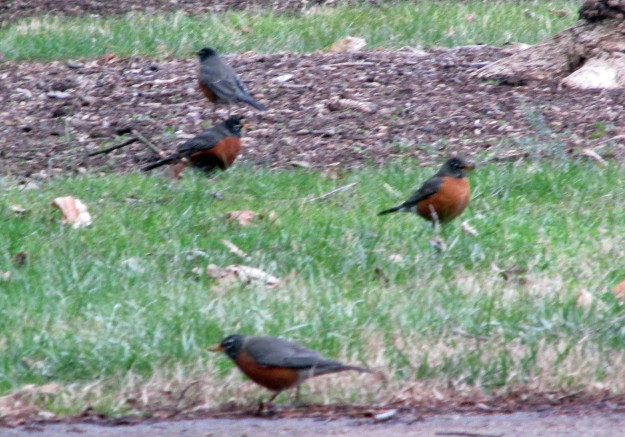
Robins-ETSU-Feb

Photo by Bryan Stevens • Returning American robins, prominent in lawns and gardens during their annual spring migration, will soon turn their attention to nesting duties.

I don’t think I’m alone in doing what I can to speed along the process of spring’s arrival. I’ve heard from different people, all eager to share their observations of one of the sure signals — the arrival of flocks of American robins — of the shifting of the winter season to spring.

Bobby Howser phoned me to let me know of a large flock of American Robins he encountered at the Sullins College building in Bristol, Virginia.

He said the flock “swarmed like bees” into a tall holly tree. He was surprised to see so many robins in a single tree and asked if it was an unusual occurrence.

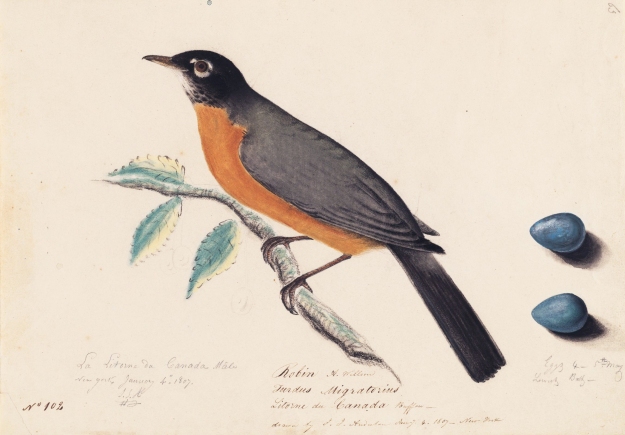
Houghton_MS_Am_21_(46)_-_John_James_Audubon,_robin 3

Early American naturalist and painter John James Audubon painted this American robin with a couple of the bird’s eggs.

Ernie Marburg in Abingdon, Virginia, emailed me about the same time.

“I just wanted to report that we have been inundated with a huge flock of mostly robins,” he wrote. He estimated that the flock contained 300 to 500 individuals.

“They ate all the red berries from my neighbor’s large holly tree yet appear to avoid other holly trees with many red berries just a short distance away,” Ernie wrote. The flock remained active in the tree from morning into early afternoon.

Not long after he first emailed me, Ernie contacted me again. “I wanted to give you an update on the robin invasion,” he wrote. “They have been here two additional mornings since I first reported to you. Their pattern is different now though. They are spaced apart and appear to be ground feeding individually.”

Robin-OnNest

Photo by Bryan Stevens • American robin sitting on its nest in the shelter of a side of a bridge spanning the Doe River in Elizabethton, Tennessee.

Ernie proposed a theory about the behavior of the robins.

“I think they followed the south to north weather pattern we had recently that provided significant rainfall,” he explained. “The rainfall, in turn, caused the ground to thaw and the earth worms to come to the surface thus providing a food source for the robins. In summary, the robins are following their food source.”

I responded to Ernie and congratulated him on what I thought was an excellent theory.

Ernie also wrote me that he had read an article some time ago that said robins would eat cooked elbow macaroni if put out for them.

“We did that, but not one robin ate the macaroni,” he said. “Moral of the story is, as you would expect, don’t believe everything you read.”

I’ve read similar suggestions of unusual items to try to tempt birds not prone to visit feeders. I told Ernie that I wasn’t too surprised that the robins ignored the macaroni. The observations of robin feeding habits made by Bobby and Ernie also correspond to the changing seasons. Holly trees retain their berries into late winter, which provide an abundant food source for robins, as well as other birds. As the temperatures begin to rise in early spring, the birds switch their diet in favor of earthworms. This protein-rich food source fuels the impressive migration made by robins each year.

Robin-Hunter

Photo by Bryan Stevens • An American robin scans for prey in the grass and clover of a lawn.

I posted on my Facebook page about the flocks of robins I’d observed, which resulted in several comments on my original post.

Johnny Mann, who lives in Bristol, Tennessee, shared on my Facebook page after I posted about seeing flocks of robins almost everywhere I have gone recently. He noted that he has been seeing Eastern bluebirds, which are a smaller relative of robins. He noted in his comment that the bluebirds are feeding on suet.

Jackie Lynn, who lives in Wytheville, Virginia, also posted a comment on my Facebook page. Jackie saw a large flock of robins feeding in a field, enjoying the worms brought to the surface by recent rains. “Dinner was served,” Jackie reported.

Several other people responded optimistically on my Facebook page, sharing the hope that the influx of robins does indeed signal the approach of spring.

The American robin is known by the scientific name Turdus migratorius, which can be translated as “migratory thrush.” Indeed, this well-known American bird is related to other thrushes, including the Eastern bluebird, wood thrush and veery. The relationship to other thrushes is quite visible in young birds, which display a spotted breast until they mature and acquire the familiar red breast associated with robins.

There are 82 other species in the genus, which ranges not only in the Americas, but Europe, Asia, Africa and Australia, as well. Some of the American robin’s fellow genus members include the olive thrush, the bare-eyed thrush, pale thrush, great thrush, black-billed thrush and cocoa thrush.

AmericanRobin

Photo by Bryan Stevens • While American robins like fruit when its available, they also spend a lot of time feeding on earthworms and insects.

When the first European settlers arrived in North America, the robin was still a bird living in the forests. Robins proved incredibly capable of adapting to the presence of humans. Soon enough, these once shy forest birds began to frequent lawns and city parks. The robin soon became one of America’s most popular songbirds. Three states — Connecticut, Michigan and Wisconsin — have conferred official state bird status on the American robin.

Robins begin nesting almost as soon as they return each spring. Nesting success in a previous season instills fidelity to the location where the birds nested, resulting in many robins returning to the same nesting area year after year. Although some robins invariably spent the entire winter season in the region, it is still a welcome sight to see migrating flocks of these birds in February and early March. The sudden resurgence of the American robin each spring is a reminder that another winter will soon be history. I know I’m always pleased to welcome them back.

•••••

Bryan Stevens lives near Roan Mountain, Tennessee. To learn more about birds and other topics from the natural world, friend him on Facebook at https://www.facebook.com/ahoodedwarbler. If you have a question, wish to make a comment or share a sighting, email ahoodedwarbler@aol.com.

american_robin

Early American naturalist and painter John James Audubon captured this family of American robins in one of his masterful paintings.

Unlikely orange-crowned warbler becomes daily visitor this winter at woman’s feeders

After you have fed the birds long enough, you’re going to get visits from “mystery” birds. No matter how thoroughly you thumb through the pages of your field guides or how many online Google searches you conduct, it can be hard to pin down the identity of certain birds, especially when you encounter them for the first time.

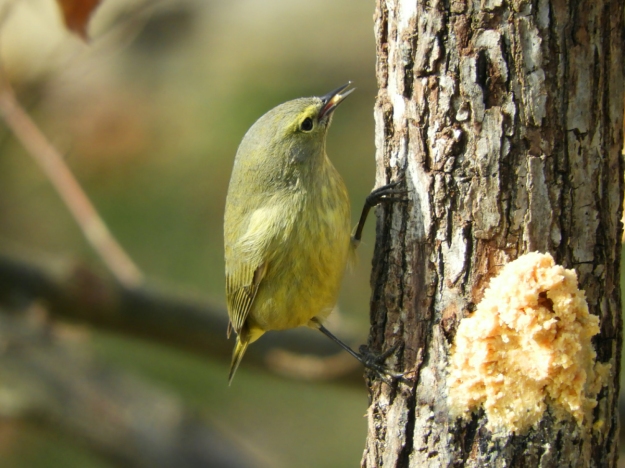
Orange-crowned-Two-BOYD

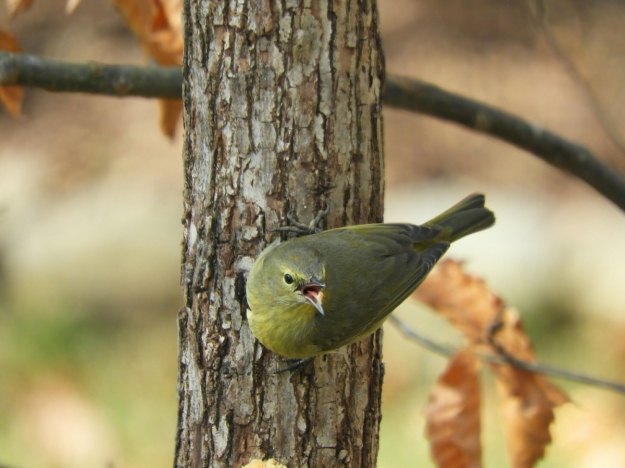
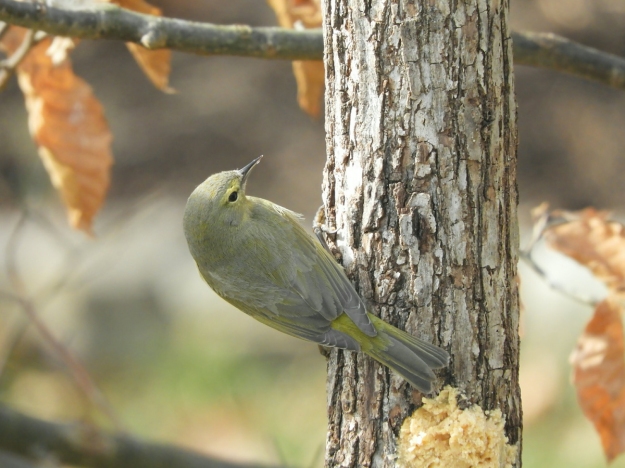
Photo by Rebecca Boyd • This orange-crowned warbler has found a favorable winter residence at the home of Rebecca Boyd in Knoxville, Tennessee, making frequent visits to suet feeders to supplement its usual diet of insects and berries.

In the summer and fall, young birds recently out of the nest can cause some confusion when they show up in the company of their parents at feeders. In the winter, often a season characterized by subdued plumages and nomadic wanderers, the surprise visitors can be one of the many “little brown birds” in the sparrow clan or a summer bird like an oriole or thrush that has decided to take a shot at overwintering.

Or, with greater frequency each winter, it might be one of the warblers. That was the case when Rebecca Boyd, a resident of Knoxville, Tennessee, contacted me recently via Facebook asking for assistance with a bird identification.

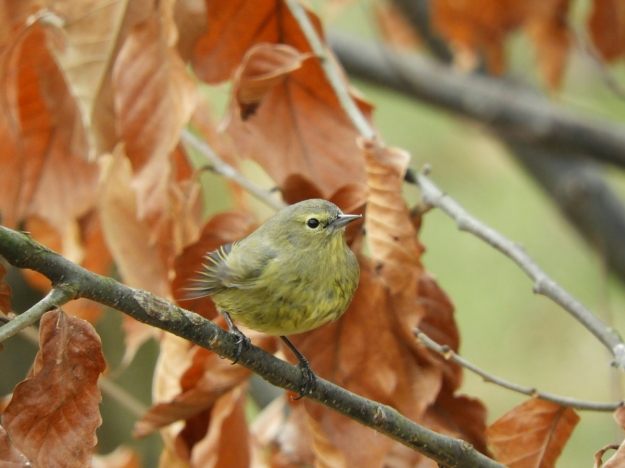
27583340_337866090062351_24195392_n

Photo by Rebecca Boyd • This orange-crowned warbler is one of the more nondescript members of the warbler family.

Although most of the warblers beat a hasty retreat from North America every fall, a handful of species have increasingly begun to spend the winter months far north of their usual tropical haunts. Some of these species include yellow-rumped warbler, pine warbler and palm warbler, but the low-profile orange-crowned warbler is also becoming more common between November and March, especially in yards and gardens offering supplemental food such as suet cakes.

The small greenish-yellow bird that showed up at Rebecca’s home was easily identified, thanks to some great photographs that she took of her visitor. I communicated to her that I believed her bird to be an orange-crowned warbler. She had also conducted her own research, which had also led her to that conclusion.

Orange-crowned-Four-BOYD

Photo by Rebecca Boyd • This orange-crowned warbler has found a home at the residence of Rebecca Boyd in Knoxville, Tennessee, this winter.

Rebecca said she also shared some photos with birding groups on Facebook, which brought some helpful feedback. “I’ve gotten numerous responses that orange-crowned warblers are becoming a lot more common on the east side of the Mississippi, with quite a few people saying they are seeing them in their yards, too,” Rebecca wrote.

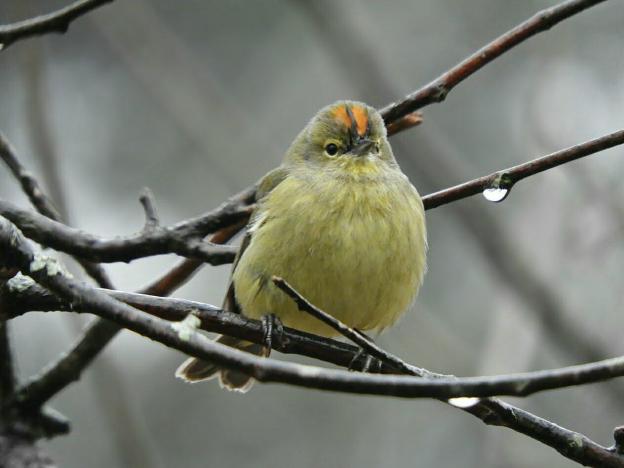
The orange-crowned warbler is one of the more undistinguished members of this New World family of birds that numbers about 115 species. The bird gains its common name from a physical feature that is rarely seen — an orange patch of feathers that, unless the bird is extremely excited or agitated, is usually concealed beneath its dull greenish-yellow feathers. It’s not a field mark that’s considered reliable for identifying the bird.

Rebecca got a lucky break and managed to photograph this elusive feature on her visiting bird. She said the feathers on the bird’s head appeared wet, which may have explained the appearance of the orange crown.

28033440_343701942812099_429716009_o 2

Photo by Rebecca Boyd • Wet feathers made the rarely seen orange crown visible on this orange-crowned warbler that has taken up residence at the home of Rebecca Boyd in Knoxville, Tennessee, this winter.

So, what does signify an orange-crowned warbler? The lack of wing bars, as well as the absence of a strong facial pattern is a strong indicator. The bird in Rebecca’s photo is not nearly as drab as this warbler can appear. Some appear very gray with only a hint of yellow or green in their plumage. There is often faint gray streaking evident in their yellow-green breast feathers. This warbler always shows yellow beneath its tail, a feature that is often only glimpsed as an observed bird is diving into cover. These birds also have sharp, thin bills. It’s usually a process of eliminating other suspects that brings birders to identify one of these warblers.

Unlike some warblers restricted to either the eastern or western United States, the orange-crowned warbler migrates and winters throughout the nation, east and west, although it primarily only nests within the western United States, as well as Alaska and Canada.

Although Rebecca said she has only been bird-watching and taking pictures for a little over a year, she has been a general point-and-shoot photography hobbyist for years. “My backyard is a bird paradise that attracts numerous and varied species,” Rebecca noted. “My favorites are bluebirds and hummingbirds, but the little warblers are also very special.”

Orange-crowned-One-BOYD

Photo by Rebecca Boyd • Besides orange-crowned warbler, like this individual, other warblers on occasion winter in the United States. Species most often attempting to spend the winter months in the United States include palm warbler, pine warbler, and yellow-rumped warbler.

Most of the warblers are currently residing on the island of the the Caribbean, or far south in Central and South America. A few others spend the winter in Florida or other southern states. The 50 or so species that nest in the United States and Canada will begin arriving as early as next month, although the majority of these summer residents will arrive or pass through the region in late April and May.

So, while it has a colorful name, the orange-crowned warbler is one of the more drab and nondescript members of its family. Other warblers living throughout the Americas include flame-throated warbler, crescent-chested warbler, citrine warbler and arrowhead warbler.

I’ll just keep daydreaming on the occasional snowy day of the approach of spring, which signals that the kin of the orange-crowned warbler will be winging their way north again in only a couple more months. I, for one, can’t wait.

••••••

If you have a question, wish to make a comment or share a sighting, email ahoodedwarbler@aol.com.

Orange-crowned-THREE-BOYD

Photo by Rebecca Boyd • This orange-crowned warbler grabs a bit of suet from a feeder at the home of Rebecca Boyd in Knoxville, Tennessee.

Visit by Yellow-headed blackbird, last seen in region in 1994, creates a stir

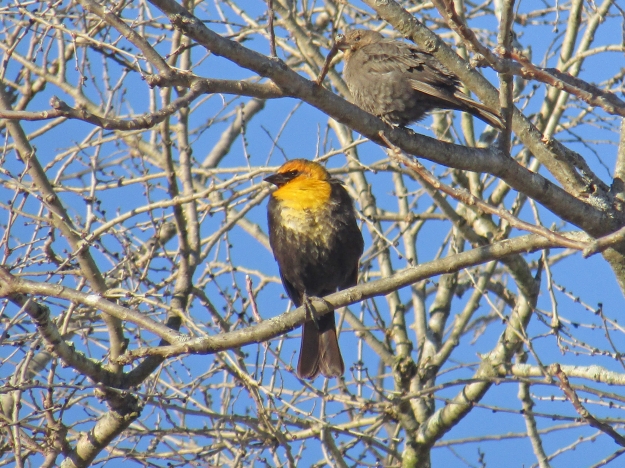
Bugaboo Springs Road near Jonesborough, Tennessee, saw some heavier vehicular traffic in mid-January after the exciting observation of a yellow-headed blackbird associating with a sizable flock of brown-headed cowbirds.

Yellow-headedBlackbird-JBoro

Photo by Bryan Stevens • This yellow-headed blackbird has been residing with flocks of brown-headed cowbirds and European starlings at a cattle pasture near Jonesborough, Tennessee. The bird, the first of its kind seen in Northeast Tennessee since 1994, has generated excitement among birders. Some people have traveled from as far as Knoxville, Tennessee, and Roanoke, Virginia, to see the bird.

The bird came to the attention of Dawn Peters, a resident along Bugaboo Springs Road, who noticed the unusually colorful bird at her feeders while looking out the window of her laundry room. At first, she thought the bird might be an oddball member of the cowbird flock.

“I’d never seen one before,” she said. “I knew it was something strange and something new.”

Dawn took the time to take a photograph of the bird and then contacted friends Jean and Brookie Potter, who also happened to be birders. They alerted her to the rare status of her feeder visitor.

“He really stood out,” Dawn said of the blackbird with a yellow head.

The yellow-headed blackbird arrived at her feeders on a snowy day when the temperatures had plunged. Dawn said she has been feeding birds for 20 years since she and her husband moved to Bugaboo Springs Road near Jonesborough, Tennessee. “The birds know where to come for food,” she said. “I try to feed them all, but they can eat you out of house and home.”

IMG_2235

Photo by Bryan Stevens This yellow-headed blackbird and several brown-headed cowbirds perch in a tree after foraging for food in a cattle lot near Jonesborough, Tennessee.

Dawn said she gets a variety of birds at her feeders, ranging from sparrows and cardinals to mourning doves and finches. “I also get downy woodpeckers and towhees,” she added.

On occasion, she will notice a hawk in the yard. In the summer, she puts out several feeders with sugar water to attract hummingbirds. “Last summer, I had brown thrashers raise a family in my yard,” she said.

Although the yellow-headed blackbird arrived with a flock of brown-headed cowbirds, the other flock members didn’t exactly embrace him. “Some of the cowbirds would peck at him,” she said.

While the yellow-headed blackbird hasn’t been back to her feeders since Jan. 13, the bird was rediscovered less than a mile from her home in a feed lot for cattle. The yellow-headed blackbird has continued to associate with large flocks of cowbirds and European starlings and has been observed by dozens of birders.

The yellow-headed blackbird, known by the scientific name Xanthocephalus xanthocephalus, is a relative of cowbirds, as well as the familiar red-winged blackbird. It’s a unique species in that it is the only member of the genus, Xanthocephalus. Breaking this word down from its ancient Greek origins, the name means, quite literally “yellow headed.”

Yellow-headedBlackbird-Copy

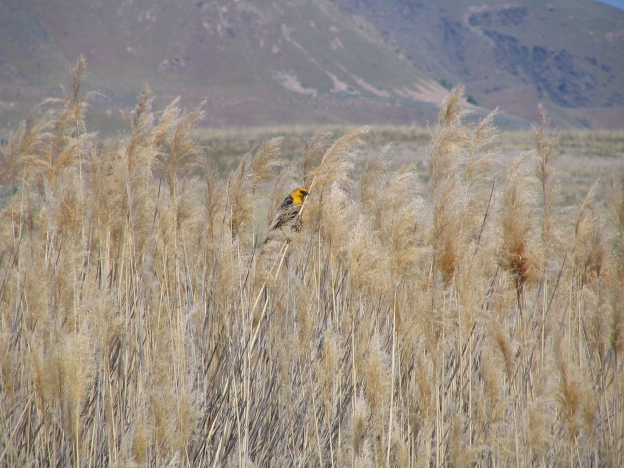
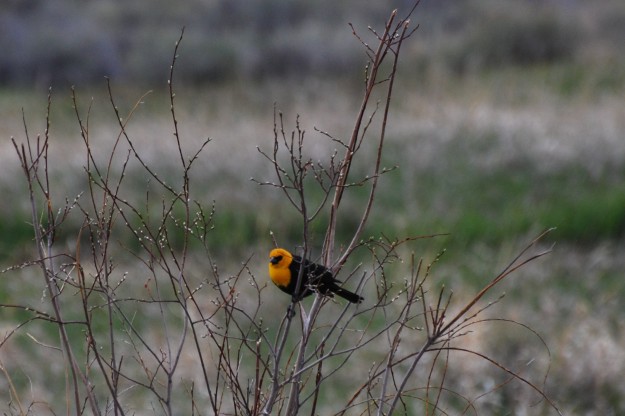
Photo by Bryan Stevens This yellow-headed blackbird was photographed at Antelope Island State Park in Utah in 2006.

The yellow-headed blackbird’s also a species that has been only a rare visitor to the region. While a common bird in wetland habitats west of the Great Lakes, the yellow-head blackbird has not been reported often in East Tennessee. In fact, there are only a handful of records since the 1930s, the most recent sightings being reported and documented in 1990 and 1994. Since it has been almost a quarter of a century since the last time a yellow-headed blackbird was found in East Tennessee, one could argue that a visit from a vagrant individual of this species was long overdue. In southwest Virginia, there are a couple of records from Smyth County dating back to July of 1985 and March of 1988.

It’s not quite clear why a yellow-headed blackbird ventured into the region in mid-January. Normally, these birds spend the winter months in the southwestern United States and Mexico. They often migrate in huge flocks with other species of birds, which could explain why the bird found itself an honorary member of a flock of cowbirds estimated to number about 300 individuals.

My first attempt to add this species to my Tennessee list ended in failure, although I did enjoy seeing several white-crowned sparrows, a handsome bird that definitely doesn’t deserve being classified as one of the “little brown birds” that so often serves as an offhand designation for sparrows. That attempt was made on the morning of Jan. 18 and may have been ended prematurely. When I got access to a computer later, I checked to see if any other observations had been reported. I noticed a report from local birder Michelle Sparks, who saw the bird probably less than 90 minutes after I had ended my first attempt.

7ee8ab76db6c1c18d9bac62d3c602b30--john-james-audubon-blackbird 2

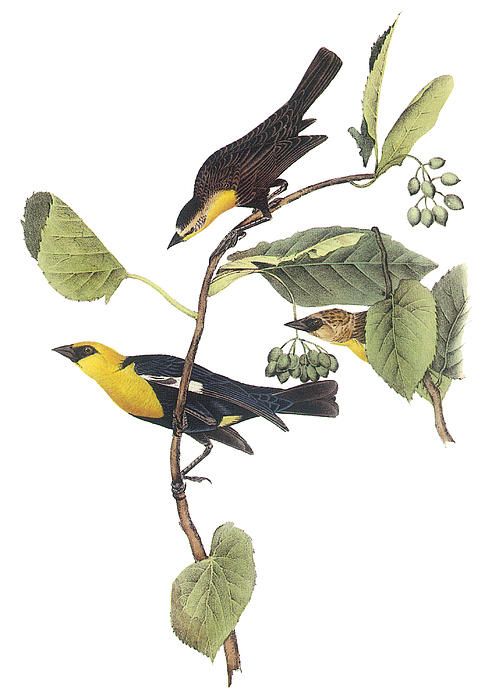
Early American naturalist and painter John James Audubon painted these yellow-headed blackbirds.

Speculating that the yellow-headed blackbird and its accompanying flocks of brown-headed cowbirds and European starlings would return to the feedlot to forage before dark, I returned at 4 p.m. to try again. I found the feedlot overwhelmed by hundreds of cowbirds and starlings, but I didn’t see any sign of a bird with a yellow head. Many of the cowbirds carpeted the pasture as they gleaned seeds and other food items. Many of the starlings were perched in the branches of trees and on the roof of an old farmhouse. At some point, almost every bird in the chaotic flock spooked and took to the air. The flock wheeled and turned, with most of the birds settling into the upper branches of some of the taller trees at the location. I soon detected a flash of yellow. I’m not sure where the bird had been hiding earlier, but the yellow-headed blackbird proved unmistakable, perched high in the trees with the sun shining brightly. He couldn’t hide from my binoculars or camera, which I used to snap several photos of this rare visitor to the region.

I have this species on my life list, having seen yellow-headed blackbirds during visits to Utah in 2003 and 2006. While in Utah, I also saw red-winged blackbird, brown-headed cowbirds and Brewer’s blackbirds, including a partial albino individual that presented a challenge in identifying.

While technically a songbird, the yellow-headed blackbird routinely ranks as one of the worst singers among North America’s songbirds. The yellow-headed blackbird is not all musical, with its song repertoire ranging from what has been described as “cacophonous strangling noises” and “honking gurgles” on the website for the publication, “Birdwatcher’s Digest.”

JEAN-Yellow-headed Blackbird

Photo by Jean Potter • This yellow-headed blackbird was photographed in Colorado in 2016.

The New World’s blackbirds belong to the family of birds, Icteridae, which also consists of birds such as meadowlarks, orioles, cowbirds, grackles, bobolinks and oropendolas. Although many blackbirds show predominantly black plumage, these birds often contrast their dark coloration with yellow, orange or red feathers. The name of the genus stems from Ancient Greek and Latin words that, translated into English, mean roughly, “jaundiced ones,” which stems from the yellow feathers present in the plumage of many species. Other blackbirds in the New World include tawny-shouldered blackbird, saffron-cowled blackbird, melodious blackbird, oriole blackbird and scarlet-headed blackbird. In the United States, other nesting species in the family include Brewer’s blackbird, tri-colored blackbird and rusty blackbird. The last of these species has shown chronic long-term and acute short-term population declines, based both on breeding season and wintering ground surveys. Some estimates suggest that the rusty blackbird population has declined by 80 percent, which could soon endanger the species.

I’m hoping the yellow-headed blackbird on Bugaboo Springs Road is liking where it has found itself this winter and will continue to delight observant birders over the upcoming weeks.

•••••

Bryan Stevens lives near Roan Mountain, Tennessee. If you have a question, wish to make a comment or share a sighting, email ahoodedwarbler@aol.com.

IMG_2236 2

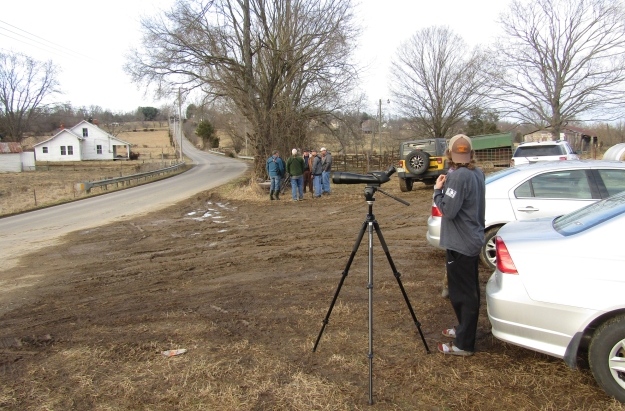
Photo by Bryan Stevens • Birders from near and far converged on Bugaboo Springs Road near Jonesborough, Tennessee, to search for the yellow-headed blackbird.

Red-shouldered hawk makes a fascinating, if somewhat shy, guest

People who feed the birds soon get to know the feisty personalities from the retiring wallflowers when it comes to the visitors to their yards. Northern mockingbirds, male ruby-throated hummingbirds and American robins are usually counted among the more boisterous birds.

Then there are the birds that shrink from interaction and hang back on the fringes, including wood thrushes, Eastern towhees and the large but shy pileated woodpecker. The latter example just goes to show that size doesn’t always equate with an extroverted personality when it comes to birds.

Redshouldered_Hawk-LeeKarney

Photo by U.S. Fish and Wildlife Service/Lee Karney • Red-shouldered hawks prefer to perch and ambush prey. They drop on unsuspecting prey, which varies from reptiles and amphibians to rodents, that come within reach.

That’s certainly the case with a red-shouldered hawk that has taken up residence for the winter at my home. The hawk usually favors a stand of trees near the fish pond at my home when it visits the yard. The hawk made its initial appearances in December and then lingered into the new year. So far, the hawk has been a very shy guest. I’ve wanted to photograph the bird, but that’s difficult to do when it spooks and flies off the instant I step outside the door of my home. I’m not too disappointed because I know that raptors that are too comfortable around humans are at risk of running afoul of misinformed individuals who may regard all predatory birds as “bad.” The reality is that all hawks are valuable components of a healthy, working ecosystem with each species filling a certain niche.

According to a factsheet published by the New York State Department of Environmental Conservation, this raptor breeds in moist woodlands, riverine forests, the borders of swamps, open pine woods and similar habitats. Nesting almost always occurs near water, such as a swamp, river or pond.

Red-shoulderHawk

Photo by Bryan Stevens • This captive red-shouldered hawk was rehabilitated after suffering an injury and now works in an educational program at Brookgreen Gardens in South Carolina to teach the public about raptors, other birds, and various types of wildlife.


The red-shouldered hawk is an ambush predator. This raptor usually selects a favorable perch and remains still while scanning for possible prey. The hawk will drop rapidly onto any prey that wanders carelessly within range. In the summer, prey items largely consist of reptiles and amphibians, including snakes and frogs, as well as some insects and crayfish. Most of these creatures are scarce during the colder months of the year, which prompts these hawks to adopt a diet that focuses on rodents and the occasional songbird. Other than the altercations with the resident crows, I haven’t observed any encounters between the hawk at my home and any other birds — with one exception.

On a recent morning, the hawk was on its usual perch — a branch of a large willow adjacent to the fish pond — when seven Canada geese, another rare visitor to my home, suffered some sort of fright and took flight. The noisy geese flew directly over the willow, which spooked the raptor into taking flight in the opposite direction of the departing geese.

Red-shoulder-Pawleys 3

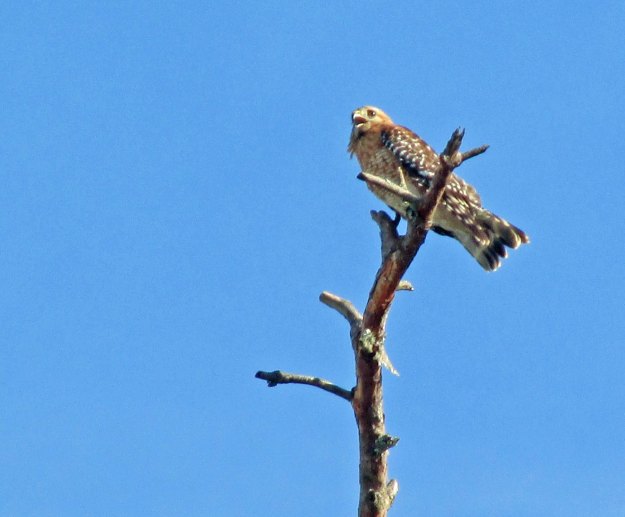
Photo by Bryan Stevens • A calling red-shouldered hawk perched in a dead tree on Pawleys Island in South Carolina.

The red-shouldered hawk produces a distinctive, piercing whistle that reminds me of the shrill call of a killdeer. The hawk at my house has been silent so far, perhaps not wishing to draw attention. The few times the local crows have noticed the hawk’s presence, they’ve flocked together to mob the unfortunate hawk. It’s also not the right time of year. During courtship and the subsequent nesting period, these hawks are vocal. At other times of the year, they are rarely heard. It’s also possible to mistakenly think you have heard one of these large hawks. Blue jays have apparently learned to imitate the “kee-yar” call of this hawk, often working a flawless rendition of the whistled notes of this large raptor.

In contrast to the related red-tailed hawk, the red-shouldered hawk soars less and prefers to perch hidden in the cover of trees. This hawk’s name comes from the reddish-brown shoulder patches in the bird’s wings. Adults show a tail marked with vivid bands of black and white that is quite distinctive.

The red-shouldered hawk belongs to the same genus of raptors as its larger relative, the red-tailed hawk. The genus, buteo, includes about two dozen large raptors that are often dominant avian predators in their respective habitats. The red-shouldered hawk is known by the scientific name Buteo lineatus.

red-shouldered-hawk-john-james-audubon

Early naturalist and artist John James Audubon painted this pair of red-shouldered hawk.

The red-shouldered hawk is less common in the region than some of the other raptors. This hawk’s stronghold is in Florida and other southern states like South Carolina and Georgia. I’ve seen many of these hawks on visits to both the Sunshine State and Palmetto State.

Some of the buteo species have adapted to life on islands, including the Galapagos hawk and the Hawaiian hawk. Some of these hawks have quite descriptive names, including the white-throated hawk, gray-lined hawk, zone-tailed hawk and short-tailed hawk. Outside the United States, raptors in the buteo genus are often known as buzzards. When the first European colonists came to the New World, they applied the term buzzard to both native vultures, as well as the large raptors like Swainson’s hawk and broad-winged hawk that reminded them of the ones back in Europe.

It’s been nice hosting this beautiful raptor, although the crows might disagree with me. A neighbor who lives close to me has had red-shouldered hawks spend the summer months on her property, so I’m hopeful that my visitor might even like the surroundings well enough to become a full-time resident.

•••••

Bryan Stevens lives near Roan Mountain, Tennessee. To learn more about birds and other topics from the natural world, friend him on Facebook at https://www.facebook.com/ahoodedwarbler. If you have a question, wish to make a comment or share a sighting, email ahoodedwarbler@aol.com.

Red-shouldered-Finally

Photo by Bryan Stevens • In a timely fashion, this red-shouldered hawk, which has avoided the camera for weeks, arrived on this rainy day in late January on the same date this post inspired by this bird was published.