Category Archives: Songbirds

Berry-rich diet makes waxwings profuse water drinkers

Waxwing-Sept11

Photo by Bryan Stevens • A cedar waxwing perches on a branch while taking a break from flycatching insect prey near a community park pond.

Ernie Marburg, a resident of Abingdon, Virginia, shared an interesting observation about a flock of cedar waxwings he observed recently in his yard.

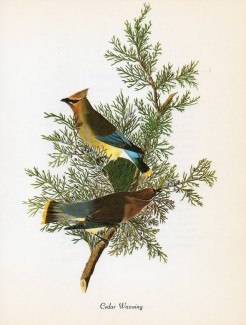
Waxwings have a brown and gray silky plumage, a black mask and a perky crest. Some of the wing feathers show red tips. The similarity of these wing tips to melted drops of wax gives these birds the common name of waxwing.
Waxwing-Audubon

Early American naturalist and artist John James Audubon painted this pair of cedar waxwings.

“The typical flock of waxwings has arrived,” he wrote in his email. He added that the birds exhibited an unusual behavior during their visit.

“From their roosts in the tops of some tall nearby trees, they appeared to be leaving their roosts briefly and returning to the trees as though they were catching flies,” Ernie noted. “There were, however, no flies available.”

The waxwings, he went on to explain, appeared to be going after snowflakes. “Could they have been going after the snowflakes to drink water?” Ernie asked.

While I wasn’t sure that catching snowflakes is an energy-efficient way to relieve thirst, the waxwings might have had a different motivation for their behavior. As I informed Ernie in my reply to his email, waxwings are very social with each other. These birds form large flocks that travel, feed, roost and bathe together. They have also come up with interesting “rituals” to reinforce their social ties with each other.

Waxwing-Erwin

Photo by Bryan Stevens • The waxy tips to the wing feathers are evident in this photograph of a cedar waxwing.

These rituals, or games, they “play” with each other include a flock of perched birds passing a single berry or fruit in a line, one bird to another, without any of the birds eating the item. I speculated that snowflake catching was their idea of a fun game and a way to practice for fly-catching season, which is just around the corner.

Perhaps I should have conducted some research. As it turns out, other people have witnessed this snowflake-catching behavior, which has led those who have studied the birds to determine that the birds do indeed eat snowflakes to ease thirst. Apparently their diet, which is rich in sugar thanks to the various berries that provide a huge percentage of their food, waxwings are often afflicted with intense thirst. In addition to catching snowflakes, they have been observed eating fallen snow. A single Bohemian waxwing — a relative of the cedar waxwing — can gobble down 300 berries in a couple of hours. According to some statistics, one of these birds can eat up to three times its weight in fruit in a single day. The next time I am lucky enough to observe waxwings in a snowstorm, you can bet I will be watching for this snowflake-eating behavior.

The cedar waxwing has few relatives. Worldwide, there are only two other species: the Bohemian waxwing, which is native to the northern forests of Eurasia and North America; and the Japanese waxwing, found in such northeast Asian countries as Japan, Korea and China.
Ruby-throated-WILLOWS

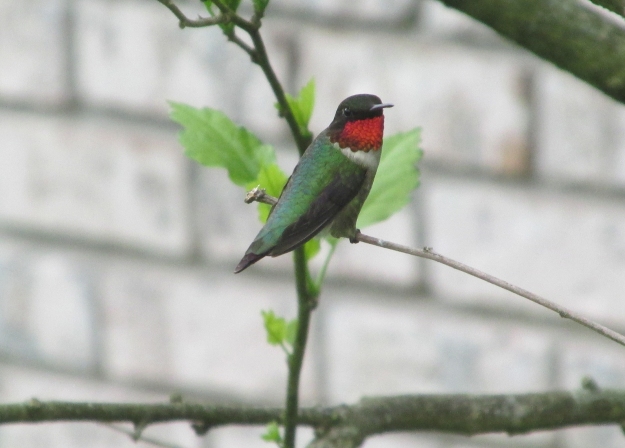
Photo by Bryan Stevens • Numbers of Ruby-throated Hummingbird in the region tend to fluctuate each year, but people should see a spike in their numbers as the hummingbirds end summer nesting and start migrating south again.

Hummingbirds due back soon

Waxwings are rather nomadic, coming and going with a maddening unpredictability. Other birds are more dependable, arriving and departing at roughly the same time year after year. One such bird should soon make its triumphant and welcome return to yards and gardens throughout the region. According to the website Hummingbird Guide, ruby-throated hummingbirds usually return to Tennessee and Virginia the first week of April. These tiny flying jewels arrive earlier in North and South Carolina, typically arriving the third week of March in those states.

The popularity of hummingbirds in general, and the ruby-throated hummingbird specifically, is simple to understand. These tiny birds are perfectly willing to insert themselves into our lives, offering hours of fascinating entertainment as they visit our gardens, duel at our sugar water feeders and occasionally even nest in trees and shrubs in our yards.

Individuals who feed birds know that it can be an expensive undertaking. The cost of providing sunflower seeds and suet cakes for hungry flocks during the winter months can nibble at the monthly budget, but hardly anyone would begrudge the sparrows, finches, wrens and woodpeckers. After all, they return the favor, putting on daily shows just outside our windows.
Rubythroated_Hummingbird

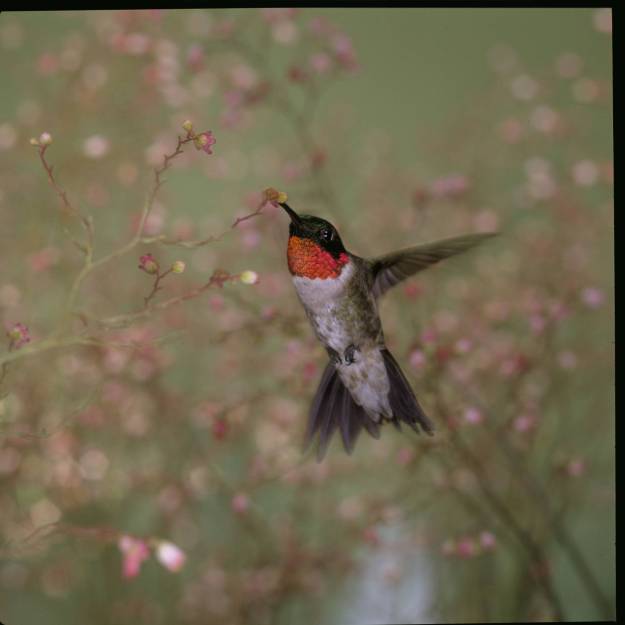
Photo by U.S. Fish & Wildlife Service • A male Ruby-throated Hummingbird hovers in front of the camera as it seeks nectar from tiny flower blossoms.

The same is true of hummingbirds. For a relatively modest investment, people putting out feeders or planting nectar-producing flowers are rewarded with the fun and amusing antics of these pint-sized and hyperactive birds.

Attracting hummingbirds is generally much less expensive than feeding other birds. After all, you need only a mixture of sugar water — four parts water to one part sugar — to fill a feeder and catch the attention of a visiting hummer. A few pounds of sugar will last a lot longer than that bag of sunflower seeds, and it’s much less expensive to purchase at the grocery store.

Do not add red coloring or dyes to your sugar water mixture. Some studies have indicated these substances are harmful to hummingbird health. This means tossing out many of the pre-packaged mixtures sold with sugar water feeders. After all, the entire purpose is to attract hummingbirds. Risking their health is simply not acceptable. If you do want to take extra steps to attract these diminutive, feathered sugar junkies, consider supplementing your landscape with a variety of flowering plants. To explore some of the best choices for flowers to tempt hummingbirds, visit the website of The Hummingbird Society at http://www.hummingbirdsociety.org.
Ruby-throatedFemale-EYE

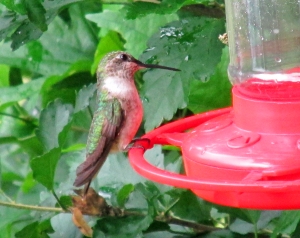
Photo by Bryan Stevens • A ruby-throated hummingbird visits a feeder for a sip of sugar water.

I always put out my sugar water feeders in early April. I usually end up waiting a couple of weeks before the first hummingbird appears, but it’s worth the wait. I miss these tiny birds during the winter months, which they spend in much warmer surroundings in southern Mexico and Central America. A male with the namesake red throat is usually the first to appear at my feeders. However, female ruby-throated hummingbirds, which lack the dazzling ruby throat patch, are migrating, too. The females usually lag a week or two behind the pace of the migration for the males.

As always, I enjoy hearing from readers about their first spring sighting of a ruby-throated hummingbird. Readers are encouraged to jot down the date and the time of arrival when they observe their first hummingbird of the season. If the sighting’s duration allows you to verify, note whether the hummingbird was a male or female. These reports can be emailed to me at ahoodedwarbler@aol.com. Together, we’ll track the arrival of these tiny birds as they return to the region.


North America’s bluebirds never fail to impress with their winning ways

A famous song declares that “somewhere over the rainbow, bluebirds fly,” so you’ll have to excuse me if I have been looking for those elusive rainbows during the unseasonably warm weather the region’s enjoyed in recent weeks.

Also, like the song promises, “dreams really do come true,” which was fulfilled by the arrival of this year’s first pair of Eastern bluebirds at my home on Friday, Feb. 23. The presence of a pair of these beautiful and trusting birds is always sure to put people in a good mood. People have known for generations that bluebirds make good neighbors. A pair of bluebirds in your yard or garden provides hour upon hour of free entertainment as one watches these birds go about their daily routine. At this time of the year, much of that routine is focused on finding and claiming the best possible nesting location for the upcoming spring season.

Bluebird-Comic

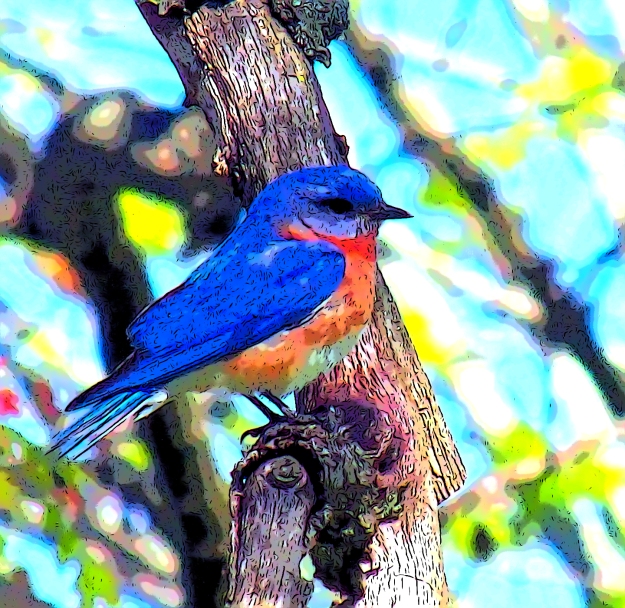
The Eastern bluebird is one of the most beloved American songbirds.

The Eastern bluebird is one of North America’s best-known cavity-nesting birds. About 85 species of North American birds use cavities in trees for nesting purposes. Cavity-nesters include ducks, such as buffleheads and wood ducks, as well as birds of prey such as Eastern screech-owls and American kestrels.

Woodpeckers and nuthatches can excavate their own cavity in a dead or decaying tree. Others, such as the bluebirds, must find a cavity already in existence. Such cavities are scarce real estate and can be subject to some intense competition. The Eastern bluebird is at a disadvantage when forced to compete with non-native introduced birds such as aggressive European starlings and house sparrows. Even native competitors such as house wrens and tree swallows are serious rivals when it comes down to staking a claim to prime nesting real estate.

Over the years, I have found bluebirds nesting in cavities inside wooden fence posts, but there are fewer wooden fence posts every year. This reinforces the idea of how changing landscapes have affected these birds. Instead of wooden fence posts, many farmers now use metal ones, and dead or dying trees — a much sought-after resource for cavity-nesting birds — are often removed from woodlands.

Bluebird-withPineNeedles

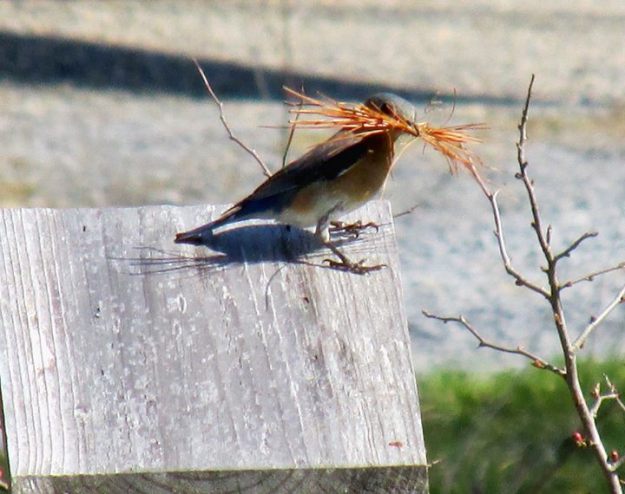
Photo by Bryan Stevens • A female Eastern Bluebird gathers pine needles to use as nesting material.

Fortunately for bluebirds, this species will also accept lodging in a nest box, or birdhouse, provided for them by human landlords. One of the simplest ways to bring bluebirds close is to offer wooden boxes, constructed to their specific requirements, for their use as nesting locations. Because of their trusting nature when it comes to their human neighbors, the Eastern bluebird is one of our most beloved birds. In fact, bluebirds are such popular birds that interest in them and their well-being has inspired the foundation of organizations such as the North American Bluebird Society. The Eastern bluebird has also been designated the official state bird for New York and Missouri, which provides more testimony to the immense popularity of this bird.

Bluebirds-One

Photo by Bryan Stevens • A flock of Eastern bluebirds perches on fenceposts.

There are two other species of bluebirds found in North America. The Western bluebird is found throughout the year in California, the southern Rocky Mountains, Arizona and New Mexico, as well as in part of Mexico. The species ranges in the summer as far north as the Pacific Northwest, British Columbia and Montana. The Mountain bluebird nests in open country in the western United States as far north as Alaska. They are short-distance migrants, retreating as far south as Mexico during the winter season.

Other than these three species, North America offers few others birds with mostly “blue” plumages. Some examples include indigo bunting, blue grosbeak, and blue jay, as well as birds like great blue heron and belted kingfisher.

In addition to housing, food and water can be used to lure Eastern bluebirds closer. This bird doesn’t eat seeds, but it can be attracted with an offering of mealworms — live or freeze-dried – or commercially prepared peanut butter nuggets. A water feature in a yard is also a magnet for bluebirds and a host of other bird species.

Bluebird-Pool

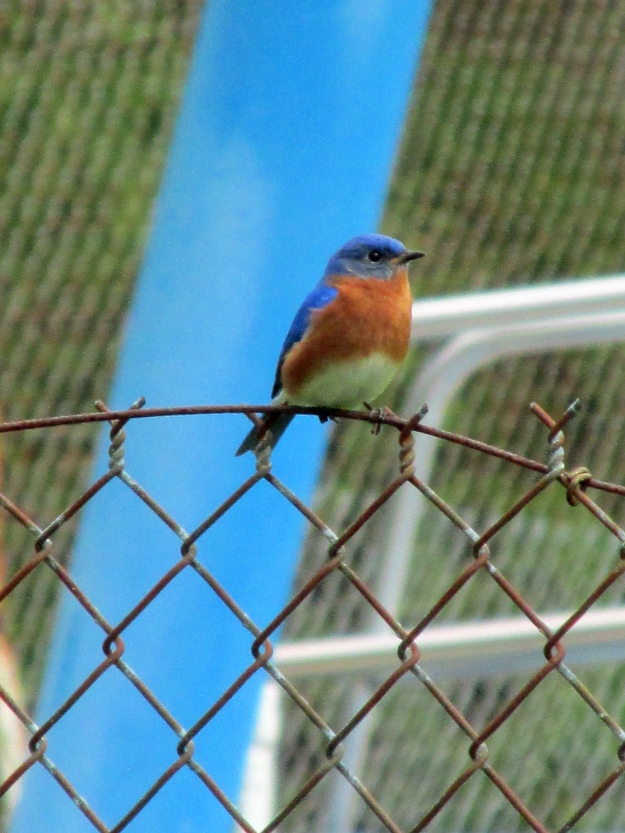
Photo by Bryan Stevens • A handsome male Eastern bluebird perches on a chain-link fence.

If your home doesn’t provide suitable open, spacious bluebird habitat, it’s still easy to enjoy these beautiful birds. An afternoon or evening drive into open country, such as agricultural farmland, is likely to yield sightings of this bird on fences and utility lines. Golf courses, some of which go the extra mile to accommodate bluebirds, also provide habitat for these lovely birds.

The Eastern bluebird is present in the region in all seasons and is one of our more common birds. If you’re already an experienced landlord and host for these birds, you probably already know they joys they can bring. If not, why not try to attract them closer to you? Most bluebirds in the region have already started looking for a nesting site. Many of these birds may nest two or even three times in a single season. March has only just arrived, so there’s still time to place a nest box or two on your property to get their attention.

••••••

If you have a question, wish to make a comment or share a sighting, email ahoodedwarbler@aol.com.

Bluebiord-Male-Playground

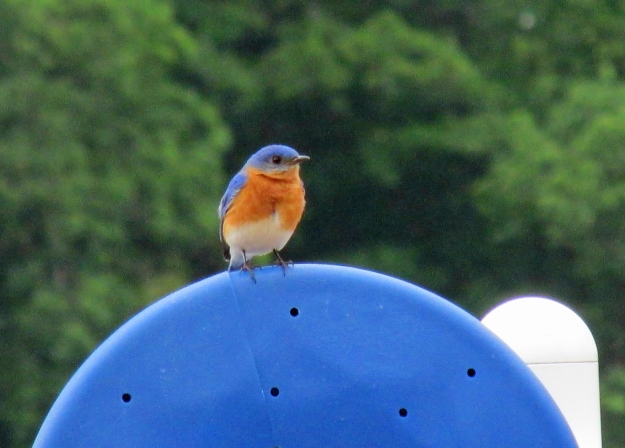
Photo by Bryan Stevens A male Eastern Bluebird perched on playground equipment at Winged Deer Park in Johnson City.

America’s lost parakeet remains poignant symbol of need to protect our birds

A century ago this week, a caged bird died in Cincinnati, Ohio. However, this was not simply a case of an untimely death of a beloved family pet. Instead, that bird represented the last of its kind.

The bird belonged to the Psittacidae, a family of tropical birds that includes macaws, parrots, caiques, amazons and parrotlets. The bird, a male named Incas, was the last captive Carolina parakeet (the only species of parrot native to the eastern United States) in existence when he died at the Cincinnati Zoo on Feb. 21, 1918, in the same aviary where Martha, the last passenger pigeon, had died four years earlier.


The demise of Incas came about a year after the death of his mate, who had been named Lady Jane by their zookeepers. In a time before the forces of social media and round-the-clock mass media, the death of Incas likely went unnoticed by other than a few people.

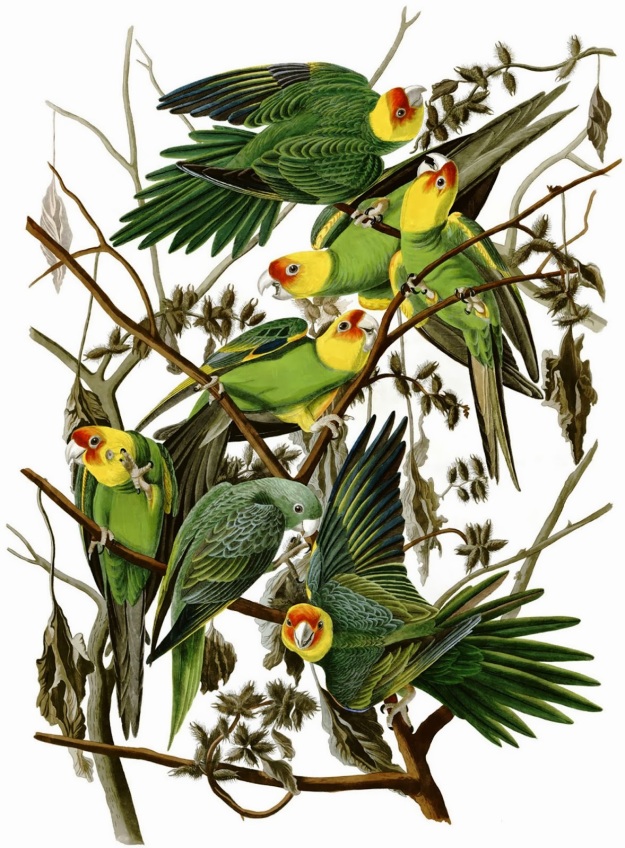
Carolina parakeets, John James Audubon


If few noticed the passing of Incas at the time, surely today we can mourn the loss of one of the most abundant birds to ever roam the continent. Few people even realize that North America was once home to its own species of parakeet. A few individuals — all that remained of once massive flocks of colorful, noisy native parakeets — made it into the 20th century. Despite the death of Incas in 1918, the Carolina parakeet as a species was not officially declared extinct until 1939. It was a classic example of going out with a whimper, not a bang, when the entire population of the Carolina parakeet crashed suddenly and for reasons still not fully understood.

For instance, large flocks of these birds still flew free until the final years of the 1800s, but in the first decade of the 1900s, these flocks disappeared. The only other native parrot — the thick-billed parrot of the American southwest — no longer flies north of the Mexican border. An attempt to re-introduce this parrot to Arizona in the 1980s ended in disappointing failure. Of course, thick-billed parrots still fly free south of the border.

il_fullxfull.603620894_qnpu

It would be wonderful to have native parrots still flying free. The extinct Carolina parakeet ranged throughout the eastern United States, including the states of Virginia, Tennessee and North Carolina. These parrots strayed on occasion as far north as Wisconsin and New York and ranged as far west as Colorado. Florida provided a stronghold for this colorful species, which also made its last stand in the Sunshine State. The last flock of thirteen wild birds was documented in Florida in 1904.

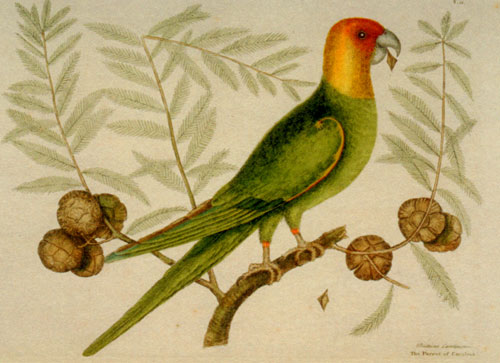
These birds have attracted attention since the arrival of the first Europeans. English explorer George Peckham mentioned the presence of Carolina parakeets in an account he wrote of his 1583 expedition in Florida. In the 1700s, English naturalist Mark Catesby described the species for science in a two-volume work titled “The Natural History of Carolina, Florida and the Bahama Islands.”

The parrots were evidently numerous, often encountered in large flocks. Few early naturalists attempted to properly study them, resulting in a sad dearth of knowledge. Much of what we do know is quite intriguing. The diet of these parakeets made them toxic, as early naturalist and artist John James Audubon observed when cats sickened and died after dining on fresh parakeets. One of the parakeet’s favorite foods — cockleburs —imparted the toxicity into the flesh of the birds.

wilsondummy

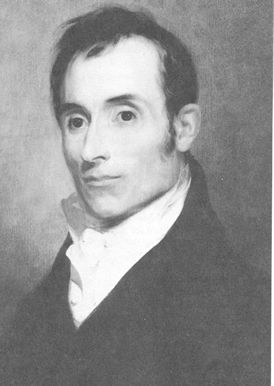
Alexander Wilson

An unusual empathy and loyalty may have contributed to the downfall of the species. Early naturalist Alexander Wilson wrote of an 1808 encounter with a large flock of these parakeets. After noting how the bird covered almost every twig in a tree, Wilson raised a gun and shot several of the birds. Some of the shot birds were only wounded. “The whole flock swept repeatedly around their prostrate companions, and again settled on a low tree, within twenty yards of the spot where I stood,” Wilson wrote. “At each successive discharge, although showers of them fell, yet the affection of the survivors seemed rather to increase.”

The same tendency to rally to the side of fallen companions made Carolina parakeets easy targets for people capturing them in the late 1800s for the exotic pet trade. This flocking together and unwillingness to abandon wounded members made the birds easy targets when farmers shot them. It certainly didn’t help matters that the parakeets were also hunted for their brightly colored feathers, which were used to adorn women’s hats. It remains unclear what exactly annihilated a once abundant bird, although it was likely a combination of all of the aforementioned factors.

Changes to the landscape encouraged the parakeets to shift their diet from weed seeds to cultivated fruit, which won them the ire of farmers. Logging of extensive forests may have impacted their numbers, too. Experts have even theorized that the parakeets fell victim to some sort of epidemic spread by domestic fowl.

carolina-parakeet-ii

Painting by Alexander Wilson of a Carolina Parakeet.

If only the dawning of a more environmentally aware age had arrived slightly sooner, the Carolina parakeet might have been saved along with species like the bald eagle and whooping crane. This native parakeet, if it had endured, might today be considered an ordinary backyard bird jostling for space at your feeders with birds like blue jays and purple finches.

Incas and his fellow Carolina parakeets may be gone, but they’ve not been forgotten. Their story is a reminder of why it remains crucial to protect all birds. Let that devotion to preservation be the legacy of America’s lost parakeets.

•••••

Bryan Stevens lives near Roan Mountain, Tennessee. To learn more about birds and other topics from the natural world, friend Stevens on Facebook at https://www.facebook.com/ahoodedwarbler. If you have a question, wish to make a comment or share a sighting, email ahoodedwarbler@aol.com.

BaldEagle-February

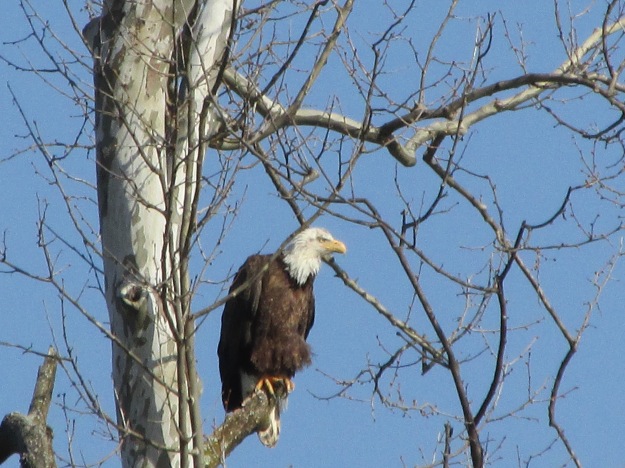
Photo by Bryan Stevens • Although protections came too late to help the Carolina Parakeet, laws like the Endangered Species Act did save birds like the Bald Eagle from possible extinction.


Winter weather events can adversely affect birds, too

Although the weather has been mild thus far this winter, that can change in the blink of an eye. Inclement weather affects humans, but it can also have adverse affects on birds. Snow, sleet, ice, wind and other forces can play havoc on the lives of our feather friends. Birds have many adaptations to help them deal with the worst the elements can throw at them, but sometimes events can overtake them.

LaplandLongspur-Auk

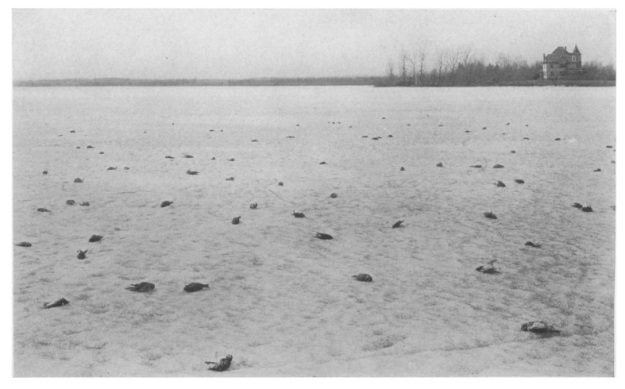
Bodies of the fallen Lapland longspurs are shown scattered on a frozen lake after a 1904 weather-related catastrophe overtook hundreds of thousands of migrating longspurs.

One such event took place on the night of March 13-14, 1904, when hundreds of thousands of one small songbird species perished as circumstances came together in a perfect storm. This infamous event in the annals of ornithology mystified residents living around the town of Worthington, Minnesota, when they awoke on the morning of March 14 to find thousands of dead birds strewn across the landscape. Birds fell onto everything from yards and gardens to street and rooftops, as well as numerous frozen lakes.

In an article in the ornithological publication The Auk, the affected songbird was identified as the Lapland longspur, a bird that nests in the Arctic tundra and spends winters on the expansive prairies and plains of the United States and Canada. The Lapland longspur, also known as the Lapland bunting, also ranges into Russia and the Northern Scandinavian countries of Europe. The term “longspur” refers to the long hind claws on this small songbird’s feet. Two other longspurs — Smith’s longspur and chestnut-collared longspur — are found in North America.

The Lapland longspur disaster on the night of March 13, 1904, originated with a massive migration flight taking these songbirds back to their tundra nesting grounds. The author of the Auk article speculated that the longspurs migrating northward encountered a winter storm in the darkness. Heavy snow accumulated on the feathers of the exhausted migrants, forcing them to crash to the ground by the hundreds of thousands across the terrain of southwestern Minnesota and northwestern Iowa. From the point of view of the disoriented birds, the lights from the towns dotted across the landscape added to the chaos and confusion. Many of the bird suffered blunt force traumas, including ruptured organs, crushed skulls, bone fractures and other such injuries incurred when falling to the ground from great heights.

The Auk article comes to a total of a million birds lost in a single night, although the author admits the toll could have been even higher. Although this is an immense figure, consider that a survey dating to 2004 estimated 8 million Lapland longspurs in Alaska alone during the nesting season.

aul152-871

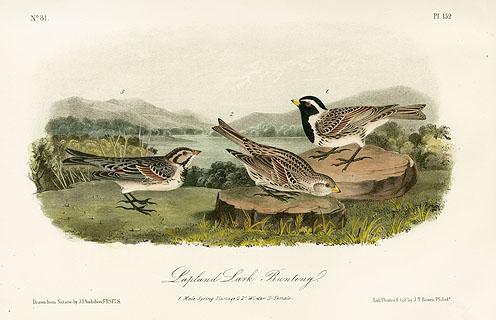
Early naturalist and artist John James Audubon painted Lapland Longspurs or, as he knew them, Lapland Lark Buntings.

The 1904 disaster didn’t seem to dent the overall numbers of the Lapland longspur. The populations of many species of birds can survive such catastrophes, but other species already struggling could be adversely affected by such events. For example, in February of 2007 a flock of year-old whooping cranes was exterminated by severe storms that overwhelmed them in a shelter at the Chassahowitzka National Wildlife Refuge in Florida. A total of 18 young whooping cranes, part of a flock trained to follow an ultralight aircraft from their birthplace in Wisconsin to the refuge in Florida salt marshes, were killed during the storm. The loss of that many young birds also robs the endangered species of much needed vitality. As of February 2015, the total whooping crane population stood at 603 individuals, including 161 captive birds.

Weather disasters extract a toll on both humans and birds. Sometimes they may affect hundreds of thousands of individuals, although the consequences are often confined to smaller segments of a population.

In early May of 2013, dozens of common loons migrating through Wisconsin encountered an unseasonable ice storm. Many of the birds found ice forming on their feathers, weighting them down and causing emergency landings. Wildlife rehabilitation workers rescued more than 50 birds, but there were probably many other loons affected by the freak storm that were lost without a trace.

Common_Loon_on_Water

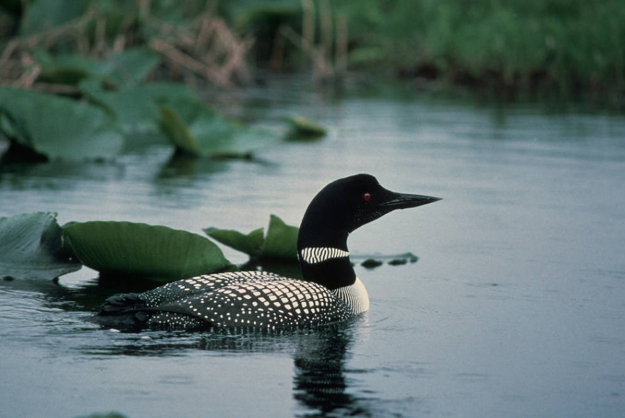
Photo by U.S. Fish & Wildlife Service • Common loons are quite at home in the air and on the water, but these birds are awkward if weather forces them to set down on land.

Loons crashing onto land or even small ponds are doomed. Agile and graceful in water because of strong legs and webbed feet, loons are almost incapable of movement on land. Landing on a small body of water is not much better since loons must run along a stretch of waters — sometimes for hundreds of yards — in order to get their relatively heavy bodies aloft.

Loons are not the only birds that sometimes face forced landings. In March of this year, a winter storm raged through most of the Northeastern United States. The wakes of these storms resulted in wildlife agencies in the region being flooded with reports of dead or injured American woodcocks in the region. Most of the reports were concentrated in and around New York City. Not only did the storm interrupt the migration flight of the woodcocks, but cold temperatures caused the ground to freeze, preventing the stranded birds from finding food.

The woodcock is an unusual shorebird, also known by such whimsical names as “bog sucker” and “timberdoodle,” that has completely abandoned the shore in favor of woodlands and fields. The American woodcock is not a rare bird, but the species is rarely seen due to its retiring habits and inaccessible habitats.

Closer to home, an unusual February event back in 2014 resulted in equally unusual numbers of red-necked grebes on area lakes, rivers, and ponds. This grebe, a rare visitor to the region, was apparently forced by weather conditions to make a stopover on bodies of water in the region. Reports of red-necked grebes persisted for about a week before they eventually departed to continue their flight to more favored locations.

Back in 2011, it wasn’t a winter storm that killed thousands of birds in Arkansas. The birds — red-winged blackbirds, European starlings, brown-headed cowbirds, and common grackles — shared a communal roost near the town of Beebe.

On New Year’s Eve, just as 2011 was dawning, about 5,000 of these birds died after crashing into trees, buildings and automobiles, according to a National Geographic News article by Charles Q. Choi. Apparently these birds were frightened into flight by the explosive booms from a professional fireworks display celebrating the arrival of a New Year. In the chaos after thousands of birds not suited for nocturnal flight took to the air, they began to impact various stationary objects and crash back to the ground.

Summer-Pelicans

Photo by Bryan Stevens • Brown pelicans fly in a line over the Atlantic Ocean on the South Carolina coast.

Incidentally, in the same article, mention was made of a 2010 incident when hundreds of pelicans washed up on the border between Washington and Oregon. The article blamed a cold front that caused ice to form on the feathers of the bodies and wings of the pelicans.

Birds, much like their human admirers, live in a world greatly affected by the vagaries of weather. All things considered, birds manage to ride out most of what Mother Nature throws their way. It’s one of their many admirable qualities.

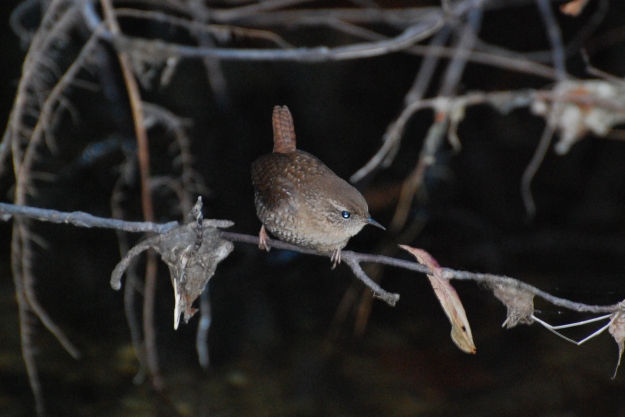
Winter wren one of the season’s low-profile visitors

WinterWren

Photo by Jean Potter
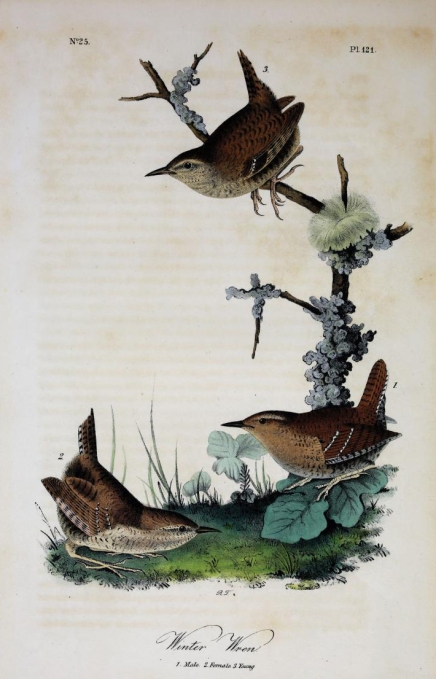
What the winter wren lacks in size, it makes up for with its voice. A boisterous and exuberant singer during the spring nesting season,  winter wrens are also quick to scold intruders into their winter territories.


Of late, every time I step outside my front door I’ve incurred the ire of a winter wren that’s taken up residency in my yard. This wren is a tiny bird among a family of birds known for small size, but it makes its presence known in unmistakable terms.

For starters, the winter wren is a noisy bird. The one living at my home arrived in late November and immediately claimed a niche to call its own. Any intrusion is met with a scolding chatter as the wren scurries low to the ground to drop out of view. In fact, the winter wren’s a very terrestrial bird. Observers are just as likely to see one of these wrens run across the ground as they are to see it take flight. I’m hopeful he will remain as winter’s grip tightens for the next couple of months.

The website All About Birds, managed by The Cornell Lab of Ornithology, offers advice on making a wren-friendly yard. “Landscaping with native plants is a good way to provide habitat for Winter Wrens,” according to the website. Other steps to take could extend to creating brush piles and ensuring some sections of the yard offers dense vegetation. The website also notes that this wren is often found making its home near streams.

In the summer, the winter wren often nests atop some of the high-elevation mountains in the region, especially ones with abundant fir and spruce trees. Otherwise, it’s mostly a winter visitor in the region. Other wrens common to the region include the Carolina wren and the house wren. In suitable habitats, especially during fall and spring migration, two other wrens — marsh wren and sedge wren — are observed occasionally in the region. Other wrens native to the United States include the rock wren, canyon wren, cactus wren, Pacific wren and Bewick’s wren.

The world’s 88 species of wrens are, for the most part, the quintessential “little brown birds,” but that hasn’t kept them from acquiring some interesting and descriptive common names. Some examples include the tooth-billed wren, flutist wren, riverside wren, whiskered wren, happy wren, musician wren, timberline wren, speckle-breasted wren, white-breasted wood wren and giant wren. The last species on the list resides in Mexico and is indeed a “giant” among a family of tiny birds, reaching a length of almost nine inches and weighing all of 1.8 ounces.

For the most part, wrens are birds of the New World. In fact, only the Eurasian wren represents the family in Europe, Asia and Africa. Experts recently split the winter wren into several different species, including the Pacific wren of the west coast of North America and the Eurasian wren of Europe, Asia and Africa.WinterWren_edited-1

Just as the winter wren thinks nothing of acting like a mouse when scurrying through leaf litter and over fallen logs in search of insect prey, this bird doesn’t hesitate to imitate mice by poking into shadowy holes in the ground or exploring the dark crevices of fallen logs. When winter temperatures drop sharply, many of these birds may cram themselves into a roosting hole to benefit from the communal heat from so many tiny feathered bodies in such close proximity. Winter wrens eat mostly insects and spiders, but in winter these birds will also eat some seeds and berries. Winter wrens rarely visit feeders, but a suet cake often attracts birds with similar dietary preferences, including kinglets and chickadees. A larger relative, the Carolina wren, is a common visitor to feeders.

In English and German lore, the winter wren was known as the “king of the birds.” Different tales provide varying explanations for how such a small bird earned such an inflated title. Ritual hunts were enacted in some European locations. These hunts, known as “wren hunts,” were conducted by “wren boys” who would parade through town on their quests. Wren Day fell on Dec. 26, which coincided with the holiday St. Stephen’s Day. Some myths blame the noisy bird for betraying the hiding place of Stephen, who was delivered up as a Christian martyr to his enemies due to the bird’s treachery. In some European cultures, various superstitions sprang up about wrens. For instance, in Scotland it is considered extremely unlucky to kill a wren.

Personally, I feel lucky to have the tiny winter wren spending time around my home and can guarantee no “wren hunts” will be staged here. At a time of year when feathered friends can be scarce, a winter wren is a welcome visitor.

••••••

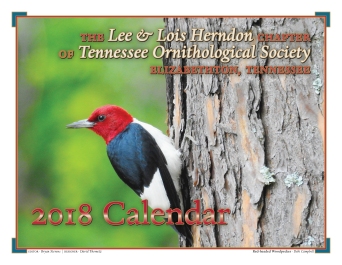
The Lee and Lois Herndon Chapter of Tennessee Ornithological Society produces an annual calendar featuring some exceptional bird photography from its members. This year’s calendar features full-color photographs of some colorful and engaging birds. The club sells the calendars for $15 each. All proceeds are used to support birding opportunities and bird-related causes. For instance, the club pays for bird seed to stock the feeders at Sycamore Shoals State Historic Park in Elizabethton, Tennessee. The club also regularly supports causes that benefit birds.HerndonCalendar2018(Cover)

The calendar also features an informative calendar grid with highlights for major holidays, as well as important bird-related dates. The calendar’s pages feature more than 80 full-color photographs of area birds, including common favorites, as well as a few more exotic birds. The front cover features a dazzling photograph of a red-headed woodpecker. The photo was taken by Debi Campbell, a resident of Bluff City, Tennessee, and current president of the Herndon chapter. If you’re interested in obtaining a calendar, contact ahoodedwarbler@aol.com by email. Calendars will also be available for purchase by cash or check only at the offices of the Bristol Herald Courier located at 320 Bob Morrison Blvd. in Bristol, Virginia.

If you’re interested in obtaining a calendar, contact ahoodedwarbler@aol.com by email. Calendars will also be available for purchase by cash or check only at the offices of the Bristol Herald Courier located at 320 Bob Morrison Blvd. in Bristol, Virginia.

•••••

Bryan Stevens lives near Roan Mountain, Tennessee. If you have a question, wish to make a comment or share a sighting, email ahoodedwarbler@aol.com.


Writer and artist Julie Zickefoose to share wisdom at Abingdon program, nature walk


With the nesting season for some of our favorite birds kicking off, the timing is especially fortuitous for an upcoming program. Acclaimed nature writer and wildlife illustrator Julie Zickefoose will be the a featured speaker for Sunday with Friends at the Washington County Public Library in Abingdon, Virginia, later this month. Her talk will be followed by a book sale and signing.

JulieZickefoose

Julie Zickefoose and a feathered friend. — Photo Contributed

In addition, Zickefoose will take part in a bird walk along the Virginia Creeper Trail at 8 a.m. on Saturday, April 22. Those wishing to participate in this Earth Day event are invited to meet at the trailhead in downtown Abingdon. I’m planning on attending the walk, which I hope will produce many interesting migrant birds. The walk is free and open to the public.

Zickefoose, the author of the new book, “Baby Birds: An Artist Looks into the Nest,” will speak Sunday, April 23, at 3 p.m. at the Washington County Public Library. Her event is free and will be held in the Conference Room at the Main Library in Abingdon, Virginia.

The public is invited to meet Zickefoose on the day after Earth Day to celebrate her new book. Life-sized baby birds wriggle, crawl and flutter off the pages of this beautiful book, the product of 13 years of deep involvement and close observation of nesting birds. Lively writing describes the development of 17 bird species from egg to fledgling, with the wonder, humor and relentless curiosity that Zickefoose is known for. She provided commentary on National Public Radio’s “All Things Considered” for five years and for 12 years has written a thrice-weekly natural history blog.

She has written several other books, including “The Bluebird Effect: Uncommon Bonds with Common Birds,” “Natural Gardening for Birds: Create a Bird-friendly Habitat in Your Backya26312954._UY1628_SS1628_rd,” and “The Young Birder’s Guide to Birds of North America,” a co-writing venture with Bill Thompson.
 

According to Zickefoose’s website, she began her career as a field biologist for The Nature Conservancy. She became a magazine and book illustrator. Eventually, she began illustrating her own stories. She writes and paints from Indigo Hill, her 80-acre sanctuary in Appalachian Ohio. Zickefoose also writes a blog. To read entries, visit juliezickefoose.blogspot.com.

Ben Jennings helped secure Zickefoose’s lecture. He has worked for the past 15 years organizing “Sunday with Friends,” a series of book and author events hosted by the Washington County Public Library’s Friends of the Library organization.

“I get tips from lots of folks about writers, as well as doing research on my own,” Jennings said.

He also noted that Kate Foreman persuaded him to invite Zickefoose to take part in the series. “Kate is a longtime friend, and currently the director of advancement at Barter Theatre,” Jennings said. “I certainly trust her judgment. Kate had to remind me — but I did remember — Julie’s commentary on NPR several years ago. Julie was thrilled to come to be with Kate for the weekend.”

The Friends of the Washington County Public Library is a voluntary, non-profit organization whose purpose is to help strengthen the resources of the library and to make it a dynamic force in the community. Friends’ activities generally fall into four main categories— advocacy, fundraising, programming and volunteerism. First organized in the mid-1960s, the Friends groups has made an important contribution over the years by helping to raise funds to improve library facilities and providing financial support for special projects. The Washington County Public Library is located at 205 Oak Hill St., Abingdon, Virginia. For more information, visit http://www.wcpl.net.

Bluebird-Box

A female bluebird checks out a potential nesting box. — Photo by Bryan Stevens

••••••

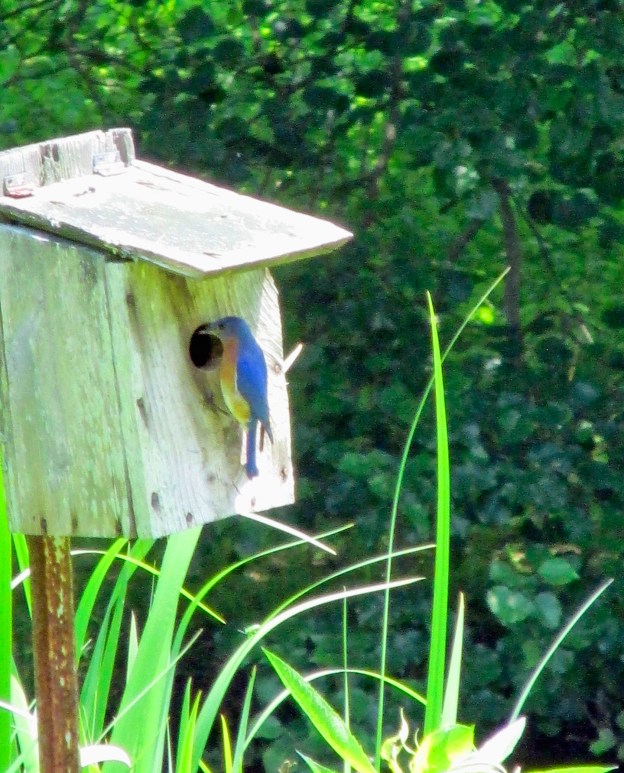
A pair of Eastern bluebirds, a species of birds often featured in Zickefoose’s writings, has been exploring the nest box options available at my home. The bluebirds actually started checking the boxes in late February. With the arrival of March, the pair has had to contend with as many as three tree swallow interlopers. I’m not sure of the status of the third tree swallow, but it definitely gives the swallows an edge in numbers.

While bluebirds are not totally loyal to previous nesting locations, studies indicate that as many as 30 percent of bluebirds return to previous nesting sites the following season. So, if you can attract a pair of bluebirds to your yard, that’s half the battle. The same pair, or perhaps some of their offspring, will quite possibly return to yard in future years.

Habitats with spacious areas of short grass are perfect for bluebirds. So, homes with large lawns or that are located adjacent to fields, will attract bluebirds looking for a place to nest. If you lack any trees with natural cavities, a bluebird nesting box is necessary to secure their extended stay. Nesting box plans are easily obtained online if you want to build your own boxes, or you can purchase boxes at many farm supply stores and garden centers.

To keep the bluebirds happy and safe, avoid using herbicides or pesticides on your lawn to prevent accidental poisoning of adult bluebirds and their young. A few small trees and shrubs spaced throughout the yard will provide convenient perches for bluebirds as they hunt for insects to feed themselves and their young.

Ovenbird often a difficult bird to get to know

Last week, I discussed the worm-eating warbler, which is one of the more drab warblers in terms of appearance. I think that must have started a trend, because so far this migration season has been dominated by some of the less colorful — but still very interesting — warblers. The opening days of September brought with them the annual fall parade of migrating warblers. As usual, this yearly opportunity to view visiting warblers began as a trickle of species but has picked up in intensity as each day passed.

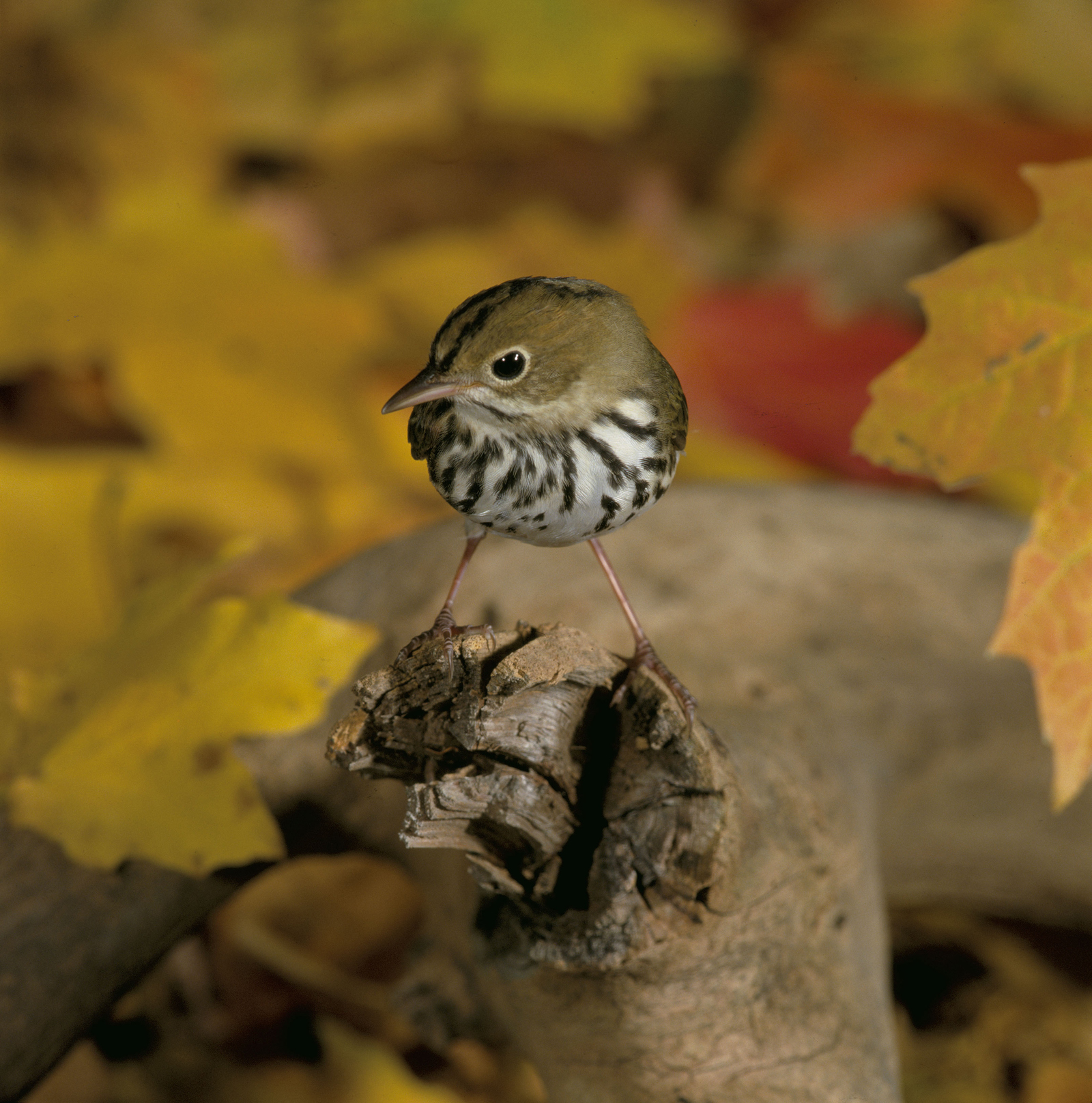
ovenbird

Photo by Jean Potter                                         Ovenbird sings from an elevated perch in the woodland canopy.

 By Sunday, Sept. 11, I had already observed close to a dozen species of warblers, including hooded warbler, black-throated green warbler, Northern waterthrush, ovenbird, magnolia warbler, chestnut-sided warbler, black-and-white warbler, Tennessee warbler, and American redstart. 
 
One of the first warblers to arrive at my home this spring was the enigmatic ovenbird. With its loud, ringing song — “Teacher! Teacher! Teacher!” — it’s impossible not to notice the arrival of this warbler.  Why describe this warbler as enigmatic? For starters, ovenbirds do not easily permit even stealthy birders to glimpse them. I have gotten good looks at ovenbirds throughout the years, but they are still difficult to observe. They are one of the warblers more easily heard than seen. When they are observed, it’s usually no more than a fleeting look before the bird dives back into heavy cover. That’s not always the case, however.
ovenbird-warbler

Photo by U.S. Fish & Wildlife Service/Steve Maslowski                      The ovenbird is not named for its plumage or its habitat preference. Instead, its name refers to the shape of its nest. Ovenbirds and other warblers are currently migrating through the region.

 
I’ve actually seen three different ovenbirds this fall, with increasingly good looks at this warbler each time I have encountered it. The ovenbird is not one of the brightly colored warblers, such as black-throated blue warbler or yellow warbler. The ovenbird is a small brown bird with a white breast with dark streaking — an appearance that bears a superficial resemblance to the larger thrushes that share the same woodland habitat. The only hint of color is an orange crown bordered by dark stripes atop the bird’s head. Even this orange crown patch is not easily seen. When agitated, an ovenbird may raise its head feathers, which makes this orange mark easier to detect. The ovenbirds I’ve observed recently have all shown off that orange crown patch to great effect. The ovenbird also has a distinct white ring around its eyes, as well as pink legs and a pinkish bill.
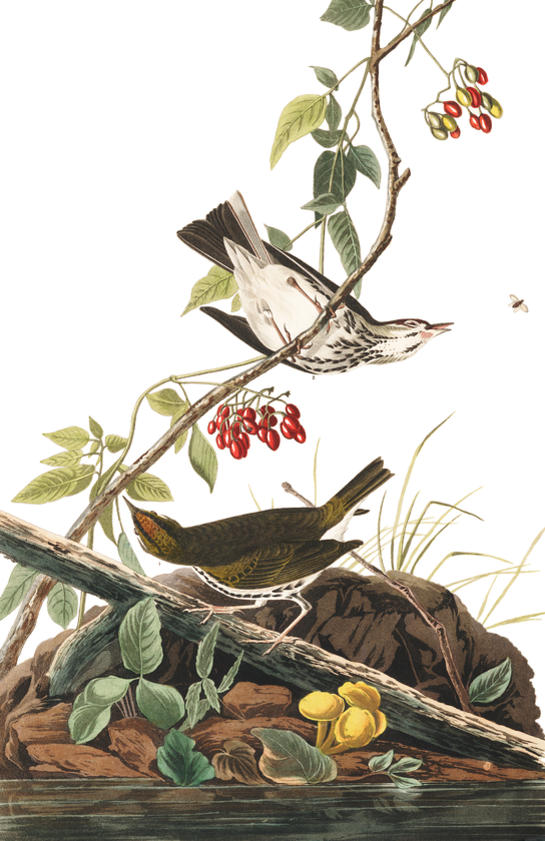
plate-143-golden-crowned-thrush-final

Early naturalist John James Audubon painted a pair of Ovenbirds, which he knew as “Golden-crowned Thrushes.”

 
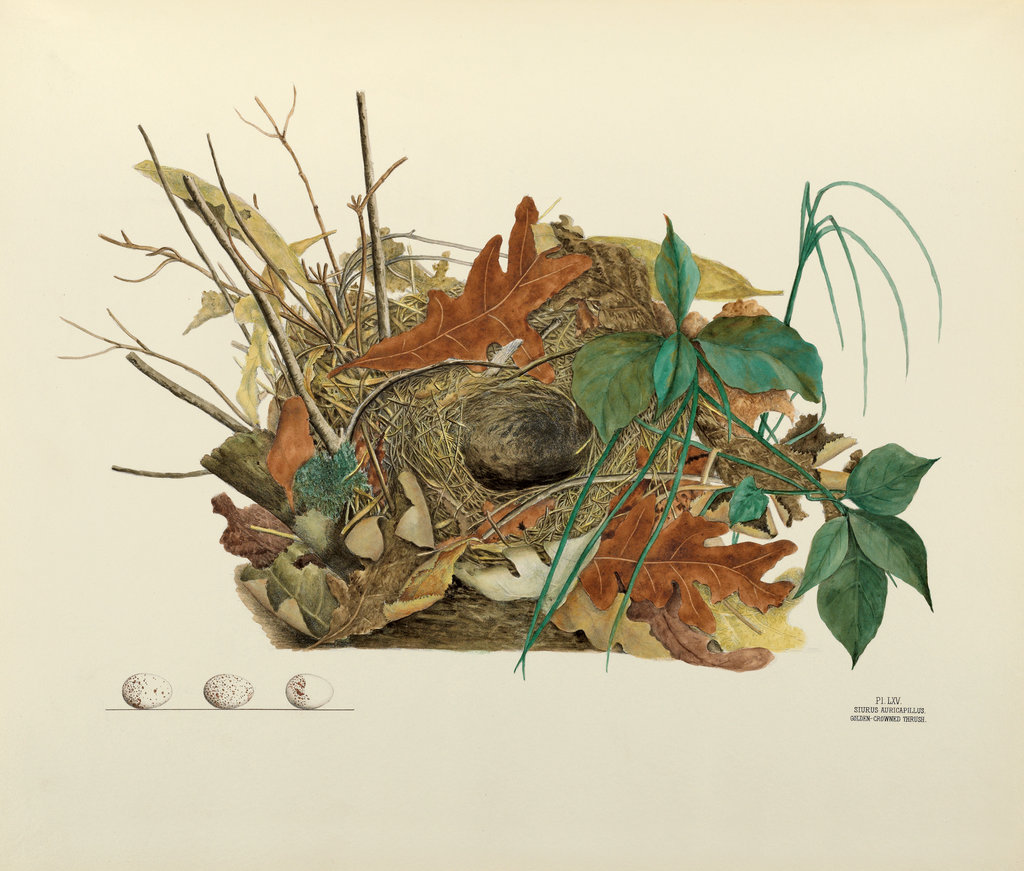
The ovenbird, unlike many warblers, is not named for its appearance. Instead, the bird’s name derives from the shape of the nest it builds. The nest is a domed structure placed on the ground, woven from vegetation and containing a side entrance. Early European settlers in North America thought the nest looked like a Dutch oven, hence the name “ovenbird” for the small warbler with the intricate nest.
 
Rather than hopping along the length of a branch or limb, an ovenbird walks in a deliberate fashion. This bird feeds on insects, spiders and other small prey items foraged from the woodland floor. On rare occasions, a lingering ovenbird shows up at feeders during the winter months.
 
Ovenbirds spend the summer nesting season in mature deciduous and mixed forests across Canada and the eastern United States. They do not make as lengthy a migration as that undertaken by some of their relatives. Ovenbirds migrate each fall to the southeastern United States, the West Indies, and from Mexico to northern South America for the winter season. 
  
The two warblers most closely related to the ovenbird are the Louisiana waterthrush and Northern waterthrush. These atypical warblers share a preference for leading lives spent mostly near the ground adjacent to streams. The Louisiana waterthrush seeks out the rushing water of our mountain streams during early spring while the Northern waterthrush prefers quiet pools of water farther north during its nesting season. The ovenbird, however, is not as closely associated with water.
09audubon-ensha-slide-4jho-jumbo

Amateur ornithologist and artist Genevieve Jones painted this depiction of the Ovenbird’s namesake nest.

 
While I have used the adjective “drab” to describe some of these brown warblers, it is not truly accurate. Although these warblers lack bright colors like orange, yellow and blue, they have an incredible, subtle beauty all their own. In the coming weeks, I will discuss some of the brighter warblers in this fascinating family of migratory songbirds.
 
Warblers are not the only birds migrating through the region. Other notable migrants I’ve observed recently have included common nighthawks, red-eyed vireos and green herons. 
 
•••••
 
Bryan Stevens lives near Roan Mountain, Tennessee. To learn more about birds and other topics from the natural world, friend Stevens on Facebook at https://www.facebook.com/ahoodedwarbler. He is always posting about local birds, wildlife, flowers, insects and much more. If you have a question, wish to make a comment or share a sighting, email ahoodedwarbler@aol.com.

Worm-eating warbler less conspicuous member of family of bright, active migratory songbirds

worm-eating-warbler

Photo by U.S. Fish & Wildlife Service                The worm-eating warbler is one of the more nondescript warblers.

It’s September, which for me signals the autumn migration season of warblers and other neotropical birds. The warblers are a family of small songbirds that also happens to be the main reason I enjoy bird watching. Although warblers can be a challenge to observe and a puzzler to identify, they’re bundles of multi-colored feathers brimming with high-octane energy as they forage in treetops, along woodland edges, in weedy fields and around ponds and streams.

Like all migrating birds, warblers face numerous obstacles and hazards as they fly back south every fall after spending most of the spring and the entire summer spread across the United States and Canada for the season of nesting and raising young. Storms, such as the recent Hurricane Hermine, can be a hazard. Predatory raptors, like peregrine falcons and merlins, follow the migration routes and pick off various migrants. Even something as mundane as a window pane can bring a tragic halt to migration each year for thousands of our smaller songbirds.

worm-eating-2

Photo Courtesy of Dianna Lynne Tucker           This worm-eating warbler perched on a flower pot while recovering from an impact with a window.

I recently received an email from Chris Soto, a fellow member of the Lee and Lois Herndon Chapter of the Tennessee Ornithological Society. Her sister, Dianna Lynne Tucker, resides in Elizabethton, Tennessee, near Holston Mountain. Her home has a yard that is a magnet for a variety of songbirds. One of the birds passing through her yard had an unfortunate impact with a window. Chris and Dianna already suspected the identity of the bird, but they emailed me asking for help to confirm it. I concurred that the bird was a worm-eating warbler.

“After a brief rest, the bird recovered,” Chris noted in the email. I always like a story with a happy ending.

The scientific name for this warbler is interesting. The worm-eating warbler, or Helmitheros vermivorum, is in a genus of one. It’s the only species contained within the genus. Vermi means “of or relating to worms” while vorum is related to eating. Hence, vermivorum is quite literally an “eater of worms.” The worms in this warbler’s diet, however, are not earthworms. Instead this bird feeds on caterpillars, the larval form of moths and caterpillars. The worm-eating warbler has one unusual foraging method to look for caterpillars. This warbler will often cling to a cluster of dead leaves while probing into the tangle to seek out any concealed caterpillars, as well as small insects and spiders. All in all, the worm-eating warbler doesn’t feed any more exclusively on caterpillars than other warblers.

worm-eating-1

Photo Courtesy of Dianna Lynne Tucker         Like other songbirds, the migratory worm-eating warbler faces many perils during its annual fall migration.

This warbler’s non-musical song is a dry trill that compares with the songs of chipping sparrows and dark-eyed juncos. Since these other birds can be found in similar habitats, it can be a bit of a challenge for beginners to identify this warbler by sound alone. The worm-eating warbler isn’t one of the more colorful members of the family. It has a subtle beauty, however, with a plumage of brown and buff feathers. The most distinctive part of its appearance are the black stripes that run along the crown and a dark stripe through the eye. This warbler has a pinkish bill. Both males and females look alike.

abc-worm-eaterprogram

Photo Courtesy of Brian Rovira                        This worm-eating warbler recovered after striking a window at the home of Brian Rovira in Unicoi, Tennessee.

According to the website All About Birds, the oldest worm-eating warbler ever documented was a male that was at least eight years, one month old when he was recaptured and rereleased during banding operations in Connecticut. I’ve seen fewer of this particular warbler over the past ten years, but the overall population figures for this species have actually trended slightly upward. The worm-eating warbler’s population is concentrated in the southeastern United States. It favors deciduous woodland habitat with shaded banks, steep gullies and ravines. The habitat around my home must have changed enough that they are no longer a frequent visitor. The worm-eating warblers will migrate to Mexico and Central America this fall, electing to spend the winter months in warmer terrain.

1-brown-headed-worm-eating-warbler-john-james-audubon

Early American naturalist and painter John James Audubon painted the worm-eating warbler in company with some native butterflies.

Warblers and their active lifestyles can be a challenge for human observers. Nevertheless, it’s worth the effort to seek out these colorful, energetic and interesting songbirds. Many people like to look for returning spring warblers, but I’ve always found the fall season the best time to look for these birds. September is the month when the majority of these warblers will migrate through our region. Warblers ignore offerings of seeds at our feeders, but a bird bath, ornamental fountain, pond or stream is like a magnet drawing these migrants to stop, enjoy a cool drink and a vigorous splash in the inviting water.

Keep a pair of binoculars at hand and your eyes open. If you’d like to share your observations of migrants passing through your yard this fall, I’d love to hear from you.

•••••

Bryan Stevens lives near Roan Mountain, Tennessee. To learn more about birds and other topics from the natural world, friend Stevens on Facebook at https://www.facebook.com/ahoodedwarbler. He is always posting about local birds, wildlife, flowers, insects and much more. If you have a question, wish to make a comment or share a sighting, email ahoodedwarbler@aol.com.

Moths, songbirds share top billing for programs at this year’s Roan Mountain Fall Naturalists Rally

BALTIMORE-MOTH

Photo by Bryan Stevens                                       The Baltimore Snout Moth, or Baltimore Hypena, is a moth found in the Eastern part of the United States, west and south to Wisconsin, Missouri and Florida and Texas. The larvae feed on maple leaves, mainly red and silver maple.

For 54 years the annual Roan Mountain Fall Naturalists Rally has brought nature enthusiasts from near and far to the slopes of Roan on the weekend after Labor Day. The tradition continues this year Friday-Sunday, Sept. 9-11, with two area naturalists presenting evening program on moths and songbird behavior.


For this year’s rally, the program spotlight will shine on local moths and songbirds. As always, a variety  of walks, hikes, strolls and workshops will also be offered on Saturday and Sunday. Top naturalists volunteer their time and energy to make the event both enjoyable and educational for people of all ages.

Larry-McDaniel

Larry McDaniel and some goats in residence at the farm he owns with his wife, Janet Brown.

This fall rally continues to celebrate the natural world by providing two top speakers for this year’s event. Larry McDaniel, a naturalist at Steele Creek Park in Bristol, Tennessee and a long-time member of the Friends of Roan Mountain, will deliver the program on “Moths of Roan Mountain and Northeast Tennessee.” Dr. Steven Hopp, naturalist and teacher at Emory and Henry College in Virginia, will present a program titled “Beyond Birding: A Look at the Life History of Local Songbirds.”


shopp

Steven Hopp teaches at Emory and Henry College in Virginia.

Because of the continued support of the Friends of Roan Mountain, the seasonal rallies have the resources they need to prosper and grow and the FORM provides support for research and restoration projects on the Roan, as well as support for Roan Mountain State Park. Consider joining the Friends of Roan Mountain, if you are not a member. Members get free admission to all Naturalists Rally events and the organization’s newsletter, “Friends of Roan Mountain.” Gary Barrigar, director for the fall rally, said many thanks are due to Roan Mountain State Park’s staff for long-time support of the rallies, as well as the speakers and the trip leaders who donate their time and expertise.


HaploaMoth

Clymene Moth

Evening and lunch programs will take place in Roan Mountain State Park’s Conference Center and field trips will leave from the field located on the left before the cabins in the park. A variety of morning and afternoon field trips are planned on topics ranging from butterflies and salamanders to birds and wildflowers.

 
McDaniel, the Friday evening speaker, grew up in College Park, Maryland, where he spent a great deal of time exploring in the woods. It was there that he developed a lifelong love for nature. He started birding while in high school and has been going at it ever since. He spent 15 years living and birding in Florida. It was during those years that he started traveling all over North America to see birds. He moved to Bristol, Tennessee, in 1993 and started attending the Roan Mountain Naturalists Rallies within weeks of having moved to the area. Legendary Bristol birder Wallace Coffey introduced him to the area and the birding community where he has met and spent time in the field with many outstanding birders and naturalists. While working as a letter carrier in Bristol he began volunteering to lead bird walks in the area.


Large Maple Spanworm Moth

Large Maple Spanworm Moth

He eventually became involved with the Bristol and Elizabethton bird clubs and served several years as the president of the Bristol club. Like many birders, during the 1990s he branched out and began studying butterflies, dragonflies and damselflies, reptiles and amphibians, wildflowers and a little of just about everything. Soon he began leading bird hikes for the Roan rallies and before long became a board member of the Friends of Roan Mountain. In 2006, having retired from the Postal Service, he started working as a naturalist at Steele Creek Park, where he has been for ten years. He increased his interest of insects during this time and in 2008 he started studying and photographing moths. Local naturalist Don Holt helped to get him started in that endeavor.


10514455_10203509534131390_8664880627904952175_o

Hummingbird Moth

McDaniel, lives with his wife, Janet Brown, on a hobby farm near Johnson City, where they tend a menagerie of mini-farm animals. Larry and Janet met at a Roan Rally and in 2003 got married in Roan Mountain State Park.

 
His presentation will discuss many aspects of the natural history of moths and the growing trend of studying them. It will include many of his photographs of moths from Roan Mountain State Park and the Tri-Cities area. He has photographed about a thousand species of moths, but he promises he won’t include them all in the presentation.

 
Dr. Steven Hopp will be the feature Saturday evening speaker. Hopp is broadly trained in the life sciences, and received his Ph.D. in Animal Behavior from Indiana University. He moved to southwest Virginia in 1984 to teach at Emory and Henry College, and has been tied to this region ever since. He taught ornithology courses at the University of Arizona from 1994 to 2004, at which time he moved back to Virginia full time. He teaches courses in wildlife management and sustainable agriculture in the Environmental Studies program at Emory and Henry.


Blue-headedVireo

Blue-headed Vireo

Dr. Hopp has studied different species of vireos for over 25 years. His main interest is in their vocal behavior, but he has broadly studied their natural history including life history strategies, breeding ecology and behavior on their wintering grounds. More recently, he has become interested in Sustainable Agriculture, and is co-author of the national best-selling book, Animal Vegetable Miracle, with his wife, Barbara Kingsolver. The book is about local food systems and sustainable agriculture. He is founder and director of The Meadowview Farmers’ Guild, a community development project devoted to promoting local products, with an emphasis on agriculture. He serves on the board of Appalachian Sustainable Development. Hopp and his wife live in Meadowview, Virginia, on a mostly wooded farm with Icelandic Sheep and Dexter Cattle.

 
The evening programs are scheduled for 7:30 p.m. Prior to the programs, evening meals catered by City Market of Elizabethton, Tennessee, will also be served on Friday and Saturday, Sept. 9-10. Cost is $9.50 for adults and $5 for children 12 and under. A bag lunch is also available on Saturday for field trip participants for $6. Advance reservations are required for the meals and bag lunch.

Eight-spottedForesterMoth

Eight-spotted Forester Moth

For a brochure with information on making reservations, write to: Treasurer Nancy Barrigar, 708 Allen Ave., Elizabethton, TN 37643, or visit the organization’s website at http://www.friendsofroanmtn.org/Fall%20Rally%20Brochure%202016web.pdf for a downloadable PDF of the brochure. For more information about the fall rally, call Gary Barrigar at 543-7576 or email him at gbarrigar@friendsofroanmtn.org.

White-spottedSableMoth

White-spotted Sable Moth


Returning birds add their songs to the spring’s chorus

Singing-Towhee

Photo by Bryan Stevens                                Eastern Towhee sings from a limb on a sapling.

As we welcome April, I’ve noticed the additions to the early morning chorus produced by the birds in residence around my home. From American robins and Eastern towhees to song sparrows and Carolina chickadees, all our feathered friends produce their own unique serenades to greet each new day.

Songbirds sing to attract mates, discourage rivals, establish territories and for a variety of other reasons.

Of course, the songs of birds play important roles in their daily lives. Half of the world’s bird species are known as passerines, or songbirds; in itself a good indication of the importance of song in the day-to-day routines of birds.

The scientific definition of a songbird is that it is a species with a specialized voice box known as a syrinx. This amazing organ allows for the production of some of the melodic and complex songs characteristic of birds such as wood thrush, Northern cardinal and Carolina wrens. Many of the warblers — a family of birds that should be beginning to returning to the region — produce a diverse range of songs.

Singiong-Grackle

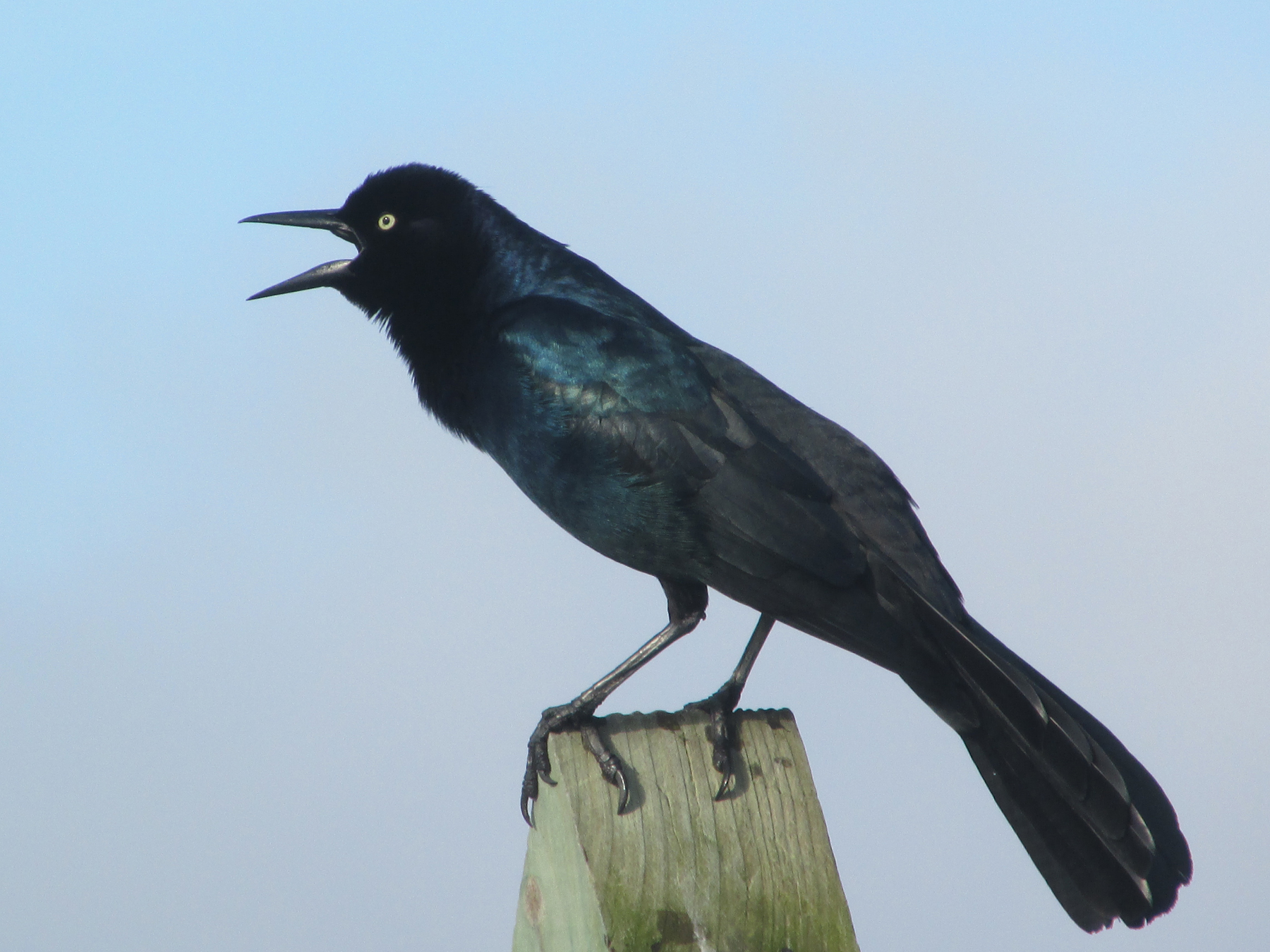
Photo by Bryan Stevens                                        A Boat-tailed Grackle sings from a South Carolina wetland.

Among other purposes, attracting mates, intimidating rivals and signaling territorial borders are some of the reasons birds sing. For human listeners, it’s easy to think that birds also sing for the sheer joy of producing these amazing choruses. That belief, however, is probably based more on the ear of the beholder.

We would probably be unaware of the presence of many birds if it wasn’t for their vocalizations. This fact is particularly true of nocturnal birds or denizens of inaccessible habitats such as swamps and marshes.

I was reminded of this fact when Facebook friend Kenneth Oakes sent me a message on March 23 about the arrival of the first whip-poor-will of the spring.

Caprimulgus_vociferus-Louis-Agassiz-Fuertes-390x264

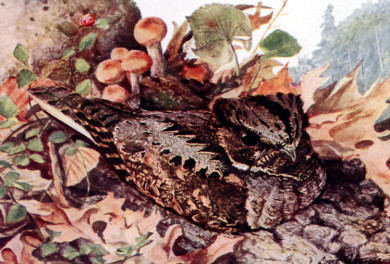
A painting of a Whip-poor-will by the artist Louis Agassiz Fuertes.

“A whip-poor-will has just arrived,” he wrote in his message. “It is about 12 days early.” Kenneth noted that usually the arrival date for whip-poor-wills, as well as for hummingbirds, is about April 5.

“This is the earliest I’ve ever seen them arrive in this area,” Kenneth wrote. For the past two years, he noted that whip-poor-wills have been a week to 12 days late in arriving in the spring.

Kenneth is not the only person who has reported “early bird” whip-poor-wills. Brookie Potter, who lives with his wife, Jean, near Wilbur Lake in Carter County, Tennessee, heard two calling whip-poor-wills near his home on Easter Sunday, March 27. He reported his observation on bristol-birds, an online list-serve forum for sharing area bird sightings.

Ironically, the whip-poor-will is not one of the world’s many passerine, or songbird, species. Nevertheless, this bird’s nocturnal serenades are one of my fondest childhood memories. I remember sitting on my grandparents’ front porch to listen for hours to the whip-poor-wills as they sang the syllables of their own names from the nearby edges of the woodlands.

Kenneth also reported that he thinks the juncos have departed. “Winter is not over until they leave,” he wrote. “Let’s hope for an early spring.”

All indications, such as the early arrivals of birds such as whip-poor-wills, are that an early spring could be in the works. This is also the time of year when I keep my eyes open for the arrival of the first ruby-throated hummingbirds of spring. In fact, I put out my sugar water feeders the last week of March.

According to websites that track the annual northward migration of these tiny birds, the first hummingbirds should start arriving in Tennessee, Virginia and North Carolina any day now. As always, I invite readers to share with me the date and time of these first sightings.

Email me at ahoodedwarbler@aol.com or send me a message on Facebook to notify me when you observe your first hummingbird of spring 2016.

••••••

WoodDucks-1

Photo by Bryan Stevens                                        A pair of Wood Ducks visited the fish pond several times in March and April.

While I haven’t yet seen hummingbirds, plenty of other birds have been making appearances. My fish pond has been visited twice by pairs of wood ducks. My other recent sightings have included tree swallows, brown thrashers and chipping sparrows. I love spring for the simple fact you never know when a new bird will surprise you with an unanticipated arrival.

••••••

Bryan Stevens lives near Roan Mountain, Tennessee. To learn more about birds and other topics from the natural world, friend Stevens on Facebook at https://www.facebook.com/ahoodedwarbler. He is always posting about local birds, wildlife, flowers, insects and much more. If you have a question, wish to make a comment or share a sighting, email ahoodedwarbler@aol.com.