Tag Archives: Elizabethton Star

Hoping to invite many birds to my yard in 2015

The first day of 2015 produced some excitement in the yard here on Simerly Creek Road. I was watching a female Northern Cardinal — the first cardinal I had observed in the new year — as she foraged on the ground beneath one of the feeders. I even used my camera to take a few photos of her through the window.
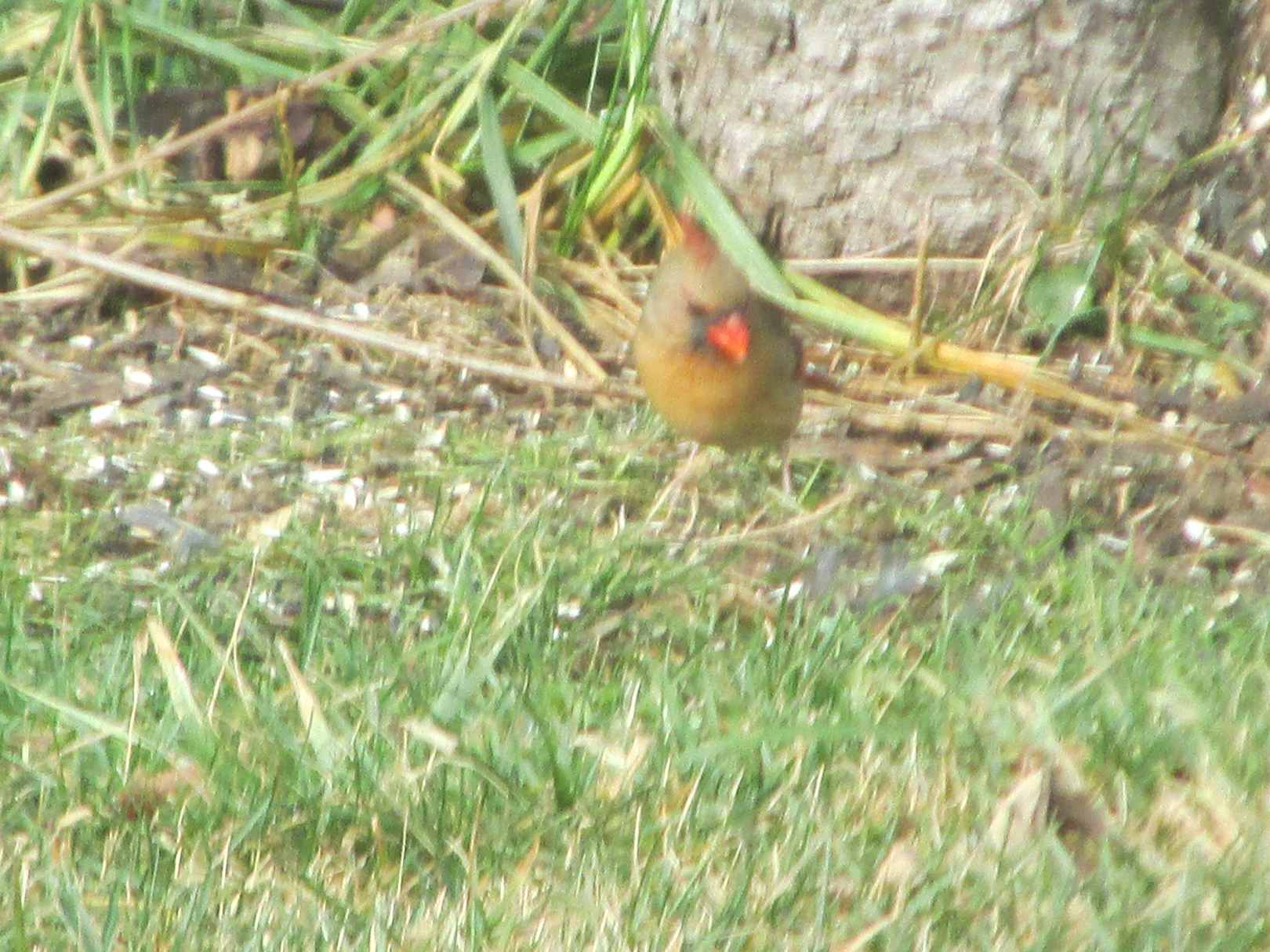
FirstCardinal

Photo by Bryan Stevens                                                                         A female Northern Cardinal foraging on the ground beneath a feeder.

I was getting ready to snap another picture when an intruder violently inserted itself into the scene, scattering other birds at the feeders. Everything happened so quickly I needed an instant to figure out what was happening.
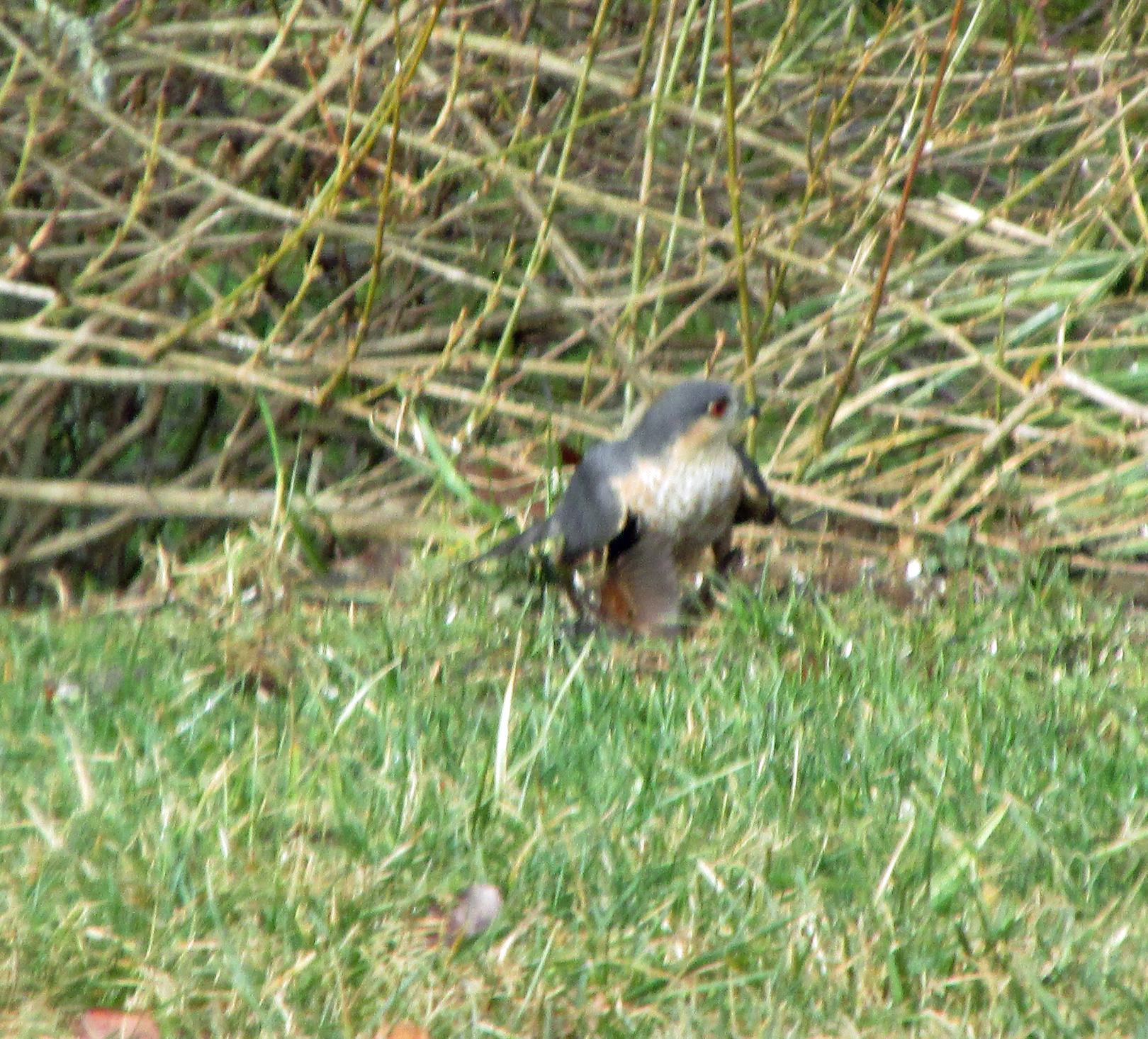
FirstHawk

Photo by Bryan Stevens                                  The visiting Sharp-shinned Hawk is pictured only seconds after capturing the cardinal in its talons.

A pair of spread wings eventually transformed into a full bird as my brain identified the intruder as an adult Sharp-shinned Hawk — and one that had just captured itself a meal, albeit at the expense of the cardinal.
With the cardinal secured in its talons, the hawk looked ready to consume its prey when an American Crow flew to a tree and perched overhead making its displeasure with the hawk very clear. The hawk hesitated and then took off, taking its prey with it and leaving with such velocity that it left the protesting crow far behind.
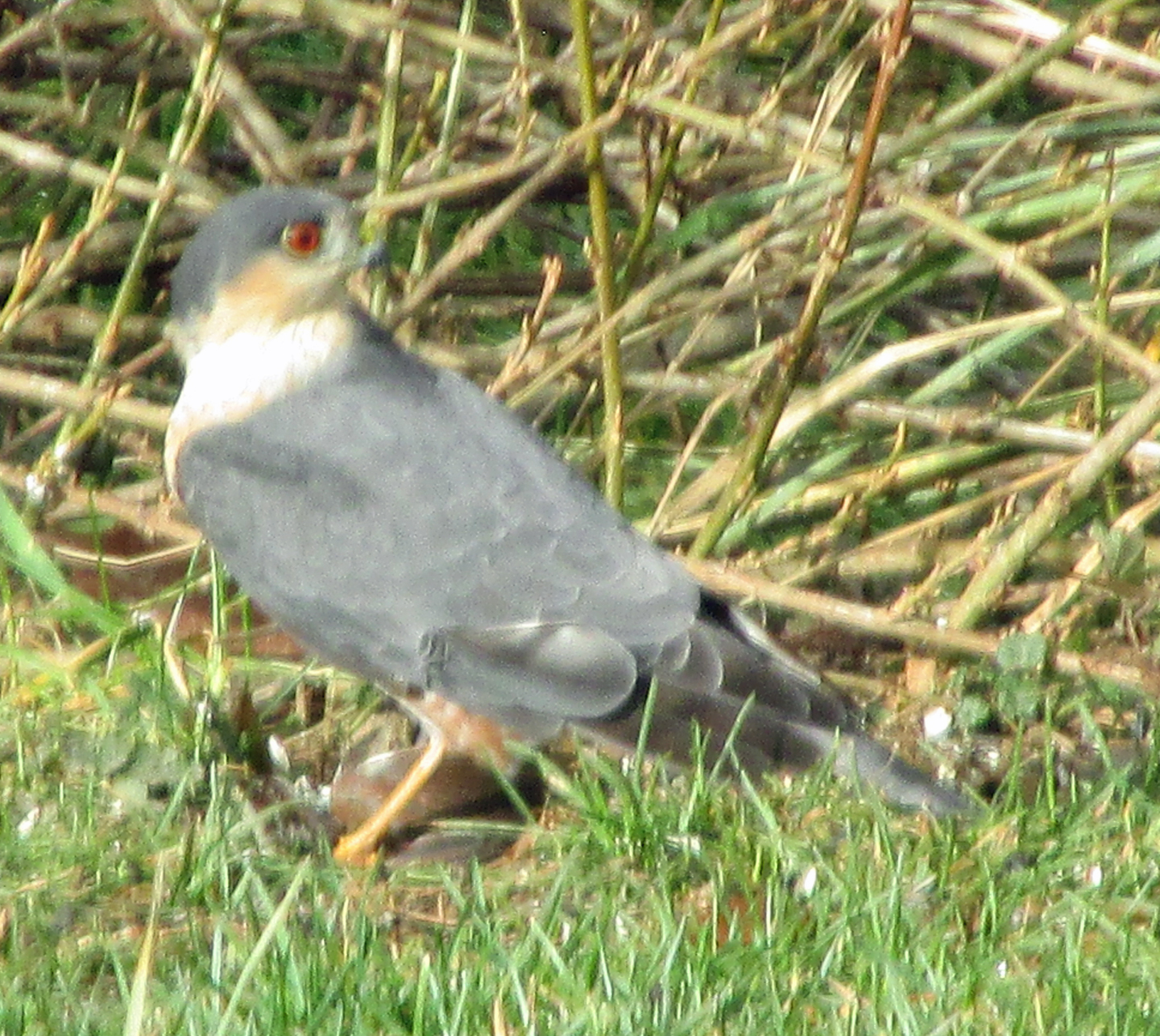
Sharpie-Two

Photo by Bryan Stevens                                  The Sharp-shinned Hawk is a stealthy, efficient and determined predator.

The Sharp-shinned Hawk became one of the first birds on a yard list I will be keeping in 2015. A couple of years ago I did a list of all the species of birds I observed in the five-county area of Northeast Tennessee. Such a list is fun to compile, but it takes a lot of dedication. I figure counting the birds that make an appearance in my yard from Jan. 1 to Dec. 31 in 2015 is a more feasible goal.

Sharpie-Jan1

Photo by Bryan Stevens                                                      The Sharp-shinned Hawk is a small raptor, often described as similar in size to a dove.

In addition to the Sharp-shinned Hawk, Northern Cardinal and American Crow, the other birds I’ve already added to my 2015 yard list are Mourning Dove, Great Horned Owl, Downy Woodpecker, Pileated Woodpecker, Blue Jay, Tufted Titmouse, Carolina Chickadee, White-breasted Nuthatch, Carolina Wren, Eastern Bluebird, Eastern Towhee, Song Sparrow, White-throated Sparrow, Dark-eyed Junco, Purple Finch, House Finch, Pine Siskin and American Goldfinch.

That’s more than 20 species and the year is not yet a week old. My goal is to find at least 100 species in 2015. The tally will probably proceed slowly, but I will provide regular updates as I add new species to the list.

••••••

15947504279_0227db8e25_o

Photo Courtesy of Jean Potter          An immature Sharp-shinned Hawk perches on a limb. These raptors often ambush their prey.

The Sharp-shinned Hawk and its larger relative, the Cooper’s Hawk, are the two raptors most often encountered by people who feed birds. Part of the family of Accipiter hawks, these two species are widespread in woodlands.

The Cooper’s Hawk is larger, often described as similar in size to an American Crow. The Sharp-shinned, on the other hand, is usually described as the size of a dove. There’s some overlap in size, so it is not the only reliable means of identifying these hawks. For example, female Sharp-shinned Hawks are roughly equivalent in size to a male Cooper’s Hawk. As with many raptors, the female is larger than the male in both these species.

There are some other things to look for in telling these species apart. For instance, adult Sharp-shinned Hawks often look like they have a dark cap or hood. The eyes on a Sharp-shinned Hawk also look like they are halfway between the front and back of the head. In addition, the head itself looks small in comparison to the overall size of this hawk’s body.

These two species feed heavily on songbirds, which causes some bird-lovers distress. When I posted photos of the incident with the cardinal and hawk to my Facebook page, a few friends were definitely upset that the cardinal’s stay in 2015 proved so brief.
I like to view these incidents as good examples of proper balance in the natural world. The Sharp-shinned is really beautiful, especially for a hawk. Preying on songbirds doesn’t make them “bad” birds. They’re doing exactly what nature intends for them to do. They’re extremely efficient predators, and I was impressed by both the power and precision deployed by the Sharp-shinned Hawk in capturing the unfortunate cardinal.

In case you’re worried about the cardinal population, later that same day a flock of about a dozen cardinals visited my feeders about a half hour before dusk. Predatory hawks are part of the balance in nature. It’s a balance that we should strive not to upset.
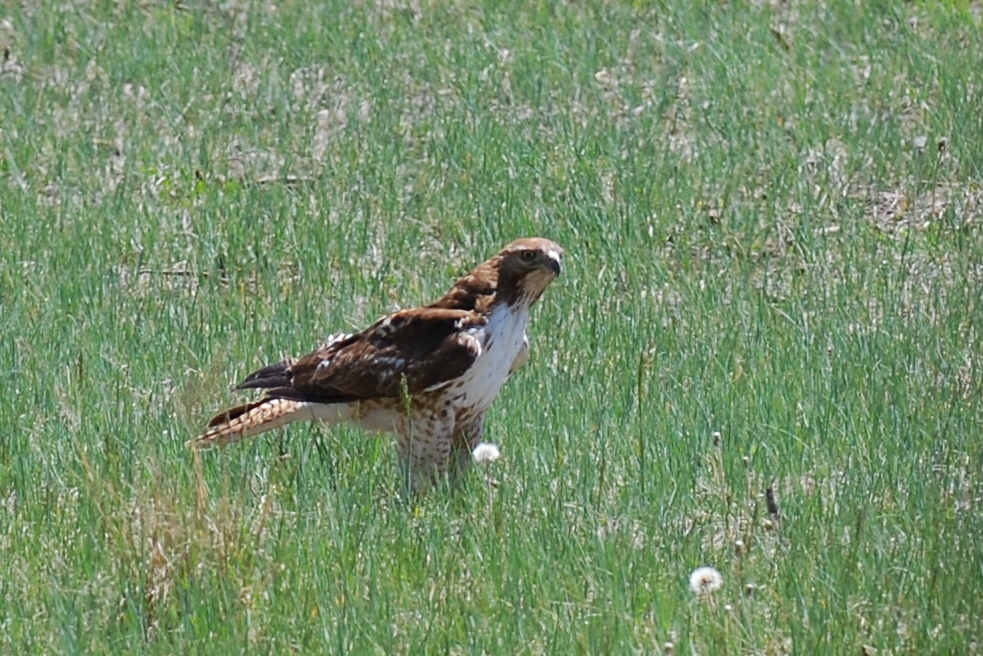
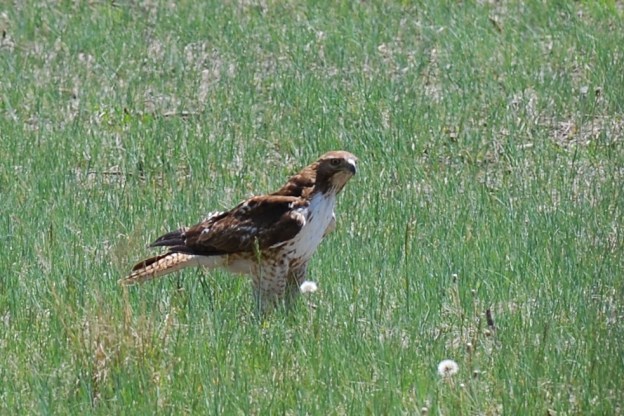
Red-tailed-Field

Photo Courtesy of Jean Potter                           A Red-tailed Hawk is shown standing in a field.

In the past few days, I have seen Red-tailed Hawk, Great Horned Owl and Cooper’s Hawk here at home (or within a few miles of my home) and I take that as a good sign. The absence of predators can be a sign that something’s wrong with the food chain. If the chain gets broken, everything (prey and predators) will suffer.

••••••

The Accipiter genus of hawks includes about 50 species. In Northeast Tennessee, as well as across much of North America, the two common species are Sharp-shinned Hawk and Cooper’s Hawk. A third species, the Northern Goshawk, is a rare visitor to the region.

The Northern Goshawk is a large, powerful hawk, and it is also fiercely defensive of its nest. This hawk is known to attack other raptors, mammals and even humans that stray too close to its nesting site.

Goshawk is a term derived from “goose hawk,” referring to the ability of this bird when utilized in falconry to take down such large prey as geese.
Other Accipiter hawks around the world include Spot-tailed Sparrowhawk, Rufous-chested Sparrowhawk, Grey-headed Goshawk, Semi-collared Hawk and Tiny Hawk, which is one of the world’s smallest raptors. This diminutive hawk is about the size of a European Starling and lives in Central and South America.

The Sharp-shinned Hawk will feed on a variety of birds, ranging in size from sparrows, warblers and thrushes to birds as large as Ruffed Grouse and Mourning Dove. This hawk also feeds on small mammals, reptiles and insects.
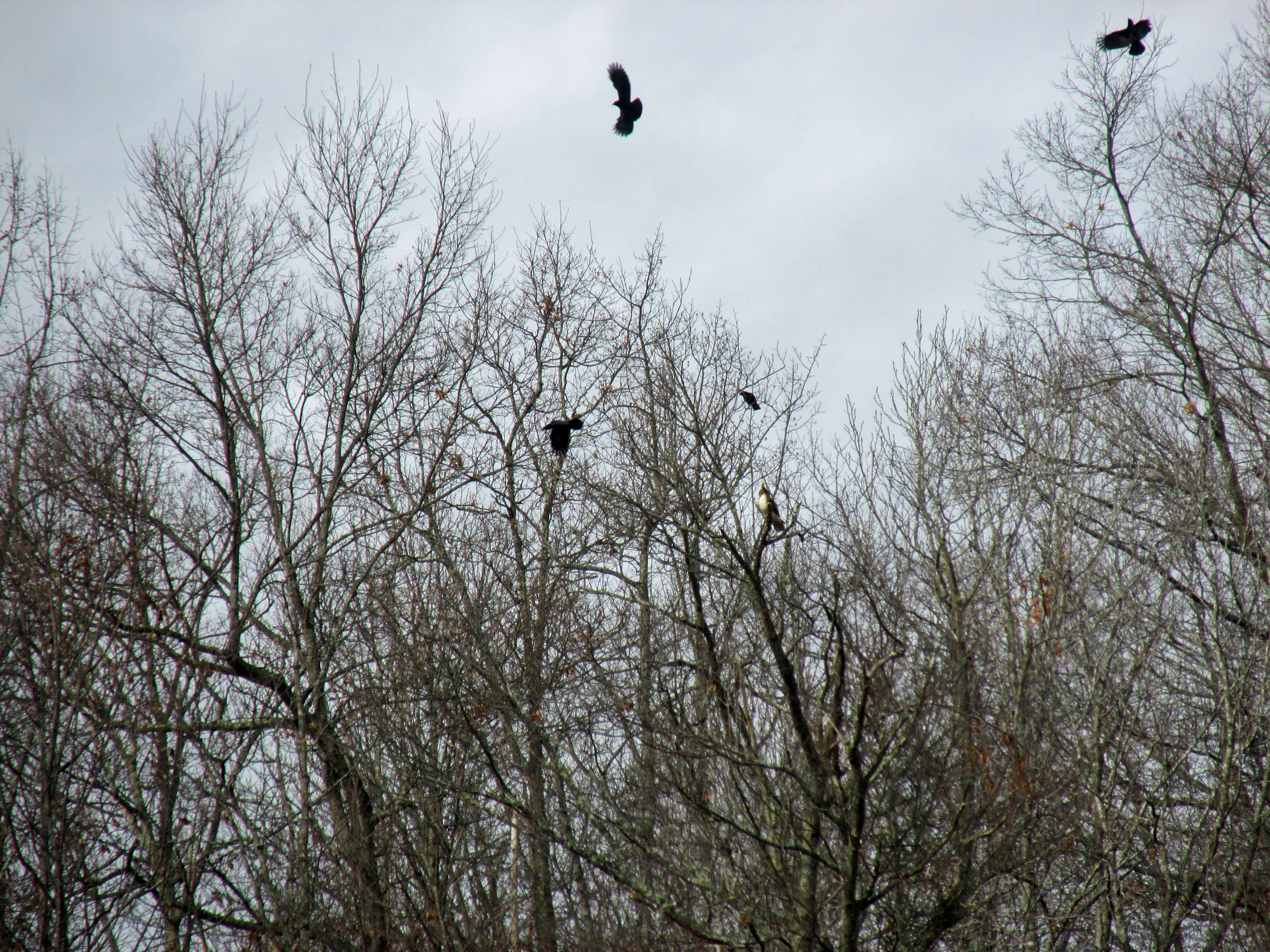
Hawk-Crowsss

Photo by Bryan Stevens                                     A flock of American Crows mobs a perched Red-tailed Hawk.

••••••

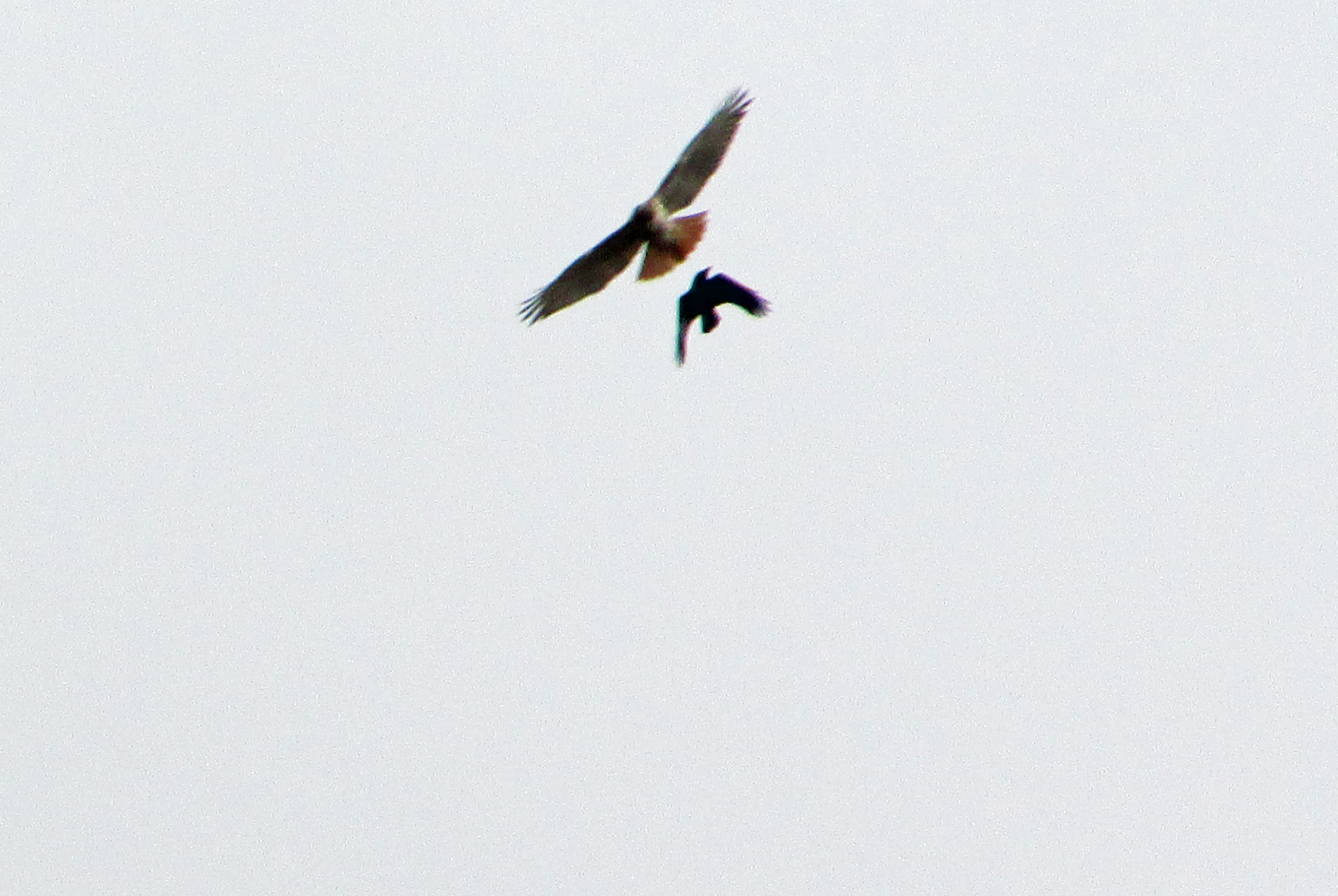
On Dec. 27, the resident flock of American Crows confronted a Red-tailed Hawk, eventually forcing the large raptor to leave it perch and depart the area. I’m hoping the Red-tailed Hawk will soon put in its first 2015 appearance. The first clue is usually a mob of angry and very vocal crows.

With safety in numbers, many smaller birds will gang up on raptors to drive them away. Crows can be quite merciless to both Red-tailed Hawks and any Great Horned Owls that they locate during the day.

Hawk-TakesFlight

Photo by Bryan Stevens                                                                                                               Mobbing crows force a Red-tailed Hawk to take flight from a perch in a tall tree.
Annual Christmas Bird Counts offer some surprises

The Lee and Lois Herndon Chapter of Tennessee Ornithological Society held its 72nd consecutive Elizabethton Christmas Bird Count on Sunday,  Dec. 14. A total of 25 observers in six parties tallied 69 species. Inn addition, counters observed another three species during Count Week.

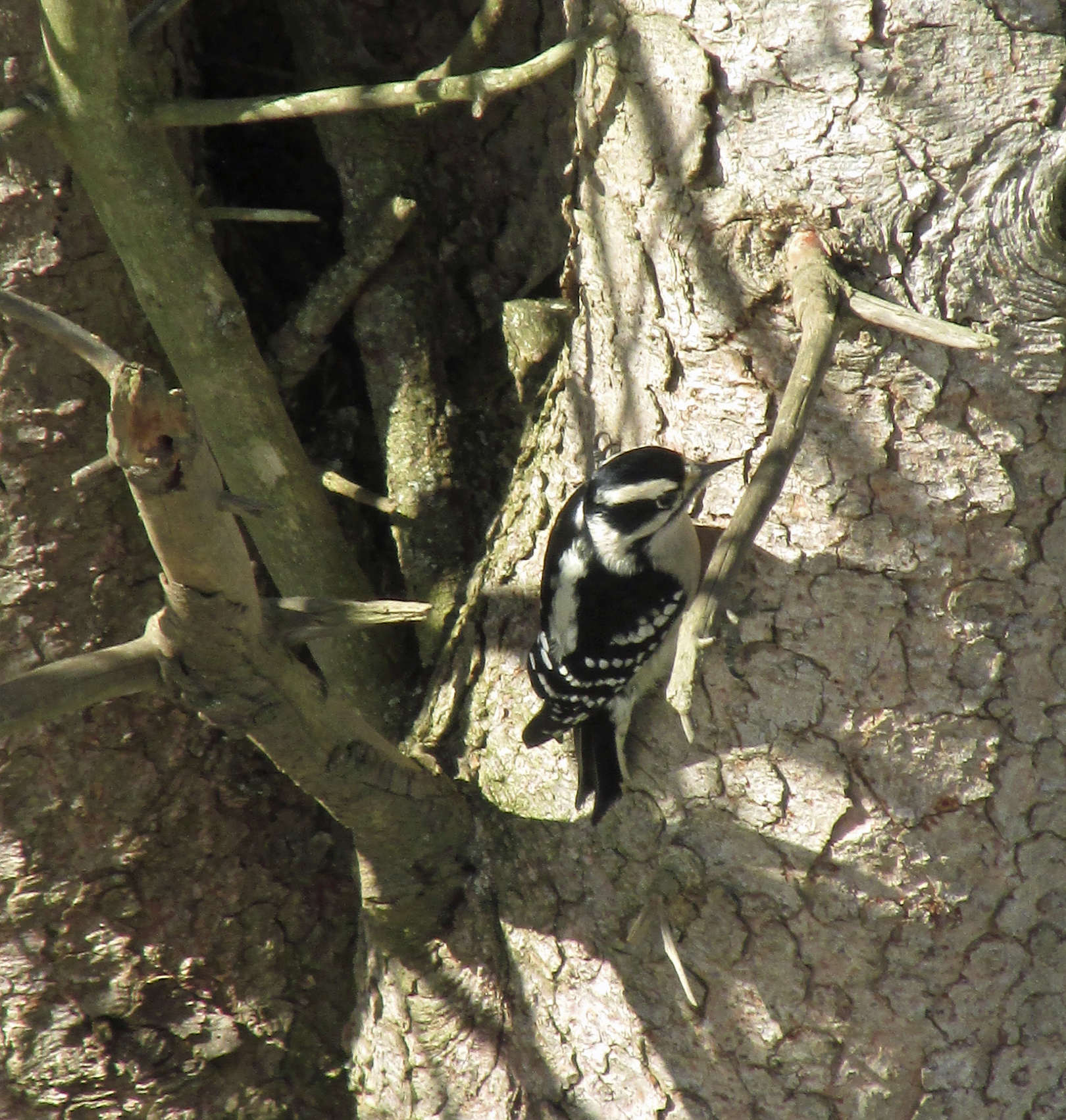
Female-Downy1

Photo by Bryan Stevens                              Downy Woodpecker, such as this female, were found on both the Elizabethton and Roan Mountain Christmas Bird Counts.

According to long-time count compiler Rick Knight, this year’s total was slightly below the recent 30-year average of 72 species. The all-time high for the Elizabethton CBC took place in 2012 when a total of 80 species was recorded.

Highlights from this year’s Elizabethton CBC included a Greater White-fronted Goose, American Woodcock and Palm Warbler. Other notable finds include five Purple Finches and 18 Pine Siskins. Notable absences included Red-breasted Nuthatch, Ruby-crowned Kinglet and Eastern Meadowlark.

Photo by Bryan Stevens

Photo by Bryan Stevens                                     A Greater White-fronted Goose and Canada Goose forage in a field during the Elizabethton Christmas Bird Count.

•••••

The 62nd Roan Mountain CBC took place Monday, Dec. 15. A total of eight observers in two parties found 53 species. This was above the recent 30-year average of 45 species and the most since 1995 when 54 species was recorded for this count.

According to Knight, an immature Northern Goshawk proved the highlight of this year’s Roan Mountain CBC. Other notable finds included Red-breasted Nuthatch, Purple Finch and Pine Siskin.

Knight also noted that Common Ravens were found on both counts. A total of 11 Common Ravens was found on the Elizabethton CBC with 24 Common Ravens found during the Roan Mountain CBC.

•••••

The 2,050 European Starlings reported on the Elizabethton CBC represented the most common species on this survey. Other common birds on the Elizabethton CBC included American Crow (725), Canada Goose (526) and Rock Pigeon (467).

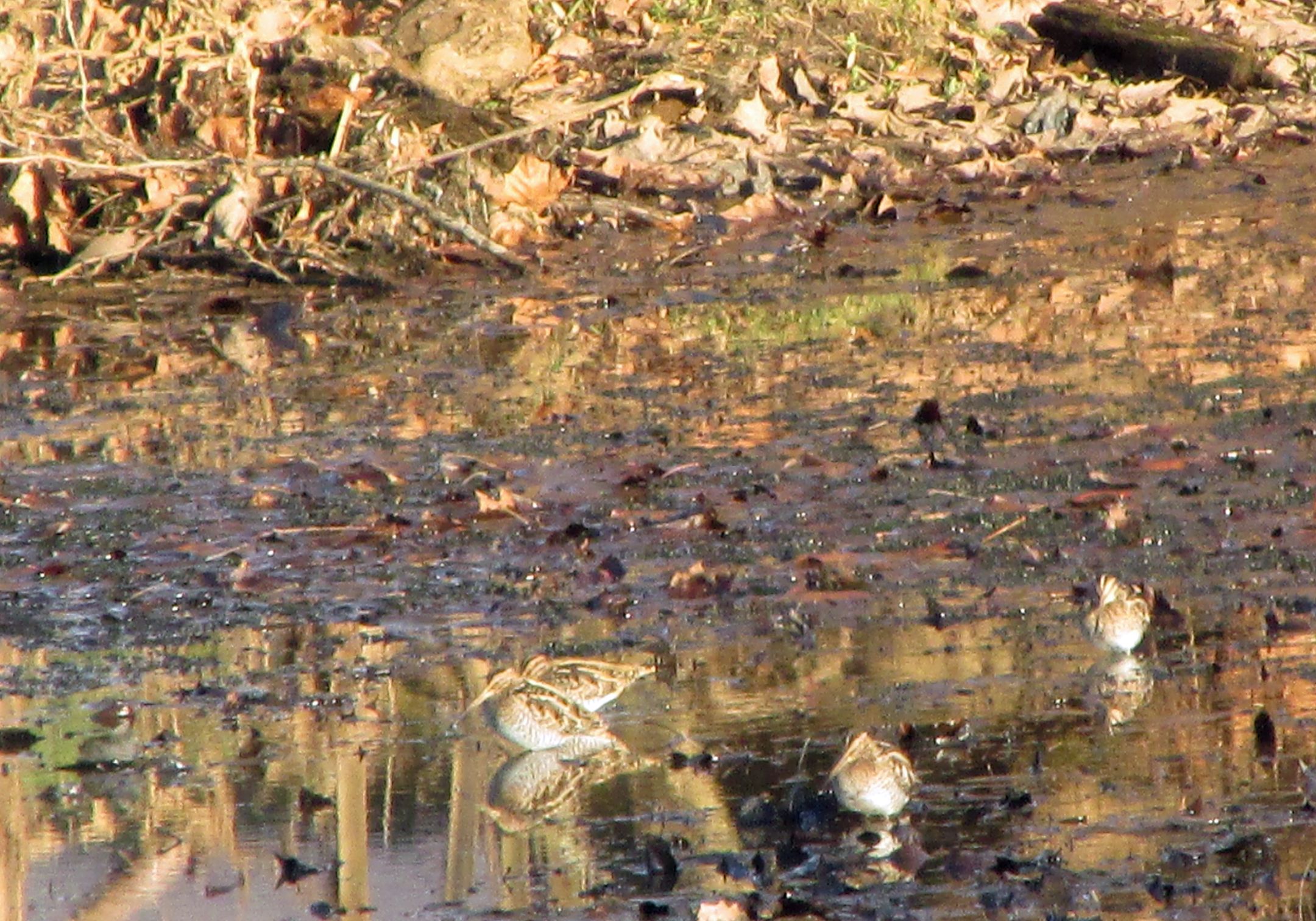
CBC-Snipes

Photo by Bryan Stevens                            Wilson’s Snipes were found along the Watauga River during the Elizabethton Christmas Bird Count.

The American Crow, with 146 individuals found, ranked as the most abundant species on the Roan Mountain CBC. Only 47 European Starlings were tallied for this count. Other common birds for the Roan Mountain CBC included Song Sparrow (80), Mourning Dove (46) and Carolina Chickadee (42).

••••••

The results for the Elizabethton CBC follows:

Greater White-fronted Goose, 1; Canada Goose, 526; Mallard, 302; Ring-necked Duck, 2; Bufflehead, 251; and Hooded Merganser, 12.

Wild Turkey, 106; Common Loon, 2; Pied-billed Grebe, 10; Horned Grebe, 8; and Great Blue Heron, 23.

Black Vulture, 6; Turkey Vulture, 6; Bald Eagle, 1; Sharp-shinned Hawk, 4; Cooper’s Hawk, 9; Red-tailed Hawk, 23; and American Kestrel, 12.

American Coot, 3; Killdeer, 3; Wilson’s Snipe, 7; American Woodcock, 1; and Ring-billed Gull, 36.

Rock Pigeon, 467; Mourning Dove, 282; Eastern Screech-Owl, 14; Great Horned Owl, 4; and Barred Owl, 1.

Belted Kingfisher, 17; Red-bellied Woodpecker, 46; Yellow-bellied Sapsucker, 10; Downy Woodpecker, 34; Hairy Woodpecker, 5; Northern Flicker, 42; and Pileated Woodpecker, 28.

Eastern Phoebe, 9; Blue Jay, 237; American Crow, 725; Common Raven, 11; Carolina Chickadee, 137; Tufted Titmouse, 74; White-breasted Nuthatch, 29; and Brown Creeper, 1.

Count-Thrush

Photo by Bryan Stevens                                        Hermit Thrushes were found during both the Elizabethton and Roan Mountain Christmas Bird Counts.

Carolina Wren, 121; Winter Wren, 8; Golden-crowned Kinglet, 17;  Eastern Bluebird, 140; Hermit Thrush, 9; and American Robin, 28.

Northern Mockingbird, 84; European Starling, 2,050; Cedar Waxwing, 27; Palm Warbler, 1; and Yellow-rumped Warbler, 73.

Eastern Towhee, 22; Chipping Sparrow, 12; Field Sparrow, 16; Fox Sparrow, 1; Song Sparrow, 168; Swamp Sparrow, 1; White-throated Sparrow, 115; White-crowned Sparrow, 23; and Dark-eyed Junco, 129.

Northern Cardinal, 231; Purple Finch, 5; House Finch, 33; Pine Siskin, 18; American Goldfinch, 107; and House Sparrow, 96.

••••••

The results for the Roan Mountain CBC follows:

Mallard, 3; Bufflehead, 12; Hooded Merganser, 4; Wild Turkey, 7; Pied-billed Grebe, 2; and Great Blue Heron, 3.

Northern Goshawk, 1; Turkey Vulture, 4; Sharp-shinned Hawk, 2; Cooper’s Hawk, 1; Red-shouldered Hawk, 1; Red-tailed Hawk, 7; and American Kestrel, 1.

Rock Pigeon, 3; Mourning Dove, 46; Eastern Screech-Owl, 1; Barred Owl, 3; and Belted Kingfisher, 2.

Red-bellied Woodpecker, 1; Yellow-bellied Sapsucker, 3; Downy Woodpecker, 13; Hairy Woodpecker, 3; Northern Flicker, 5; and Pileated Woodpecker, 7.

Eastern Phoebe, 2; Blue Jay, 22; American Crow, 146; and Common Raven, 24.

CBC-Bufflehead

Photo by Bryan Stevens                        Bufflehead was one of the few ducks found on both the Elizabethton and Roan Mountain Christmas Bird Counts.

Carolina Chickadee, 42; Tufted Titmouse, 29; Red-breasted Nuthatch, 1; White-breasted Nuthatch, 15; and Brown Creeper, 1.

Carolina Wren, 25; Winter Wren, 3; Golden-crowned Kinglet, 10; Eastern Bluebird, 16; Hermit Thrush, 1; and Northern Mockingbird, 6.

European Starling, 47; Eastern Towhee, 2; Field Sparrow, 15; Fox Sparrow, 3; Song Sparrow, 80; White-throated Sparrow, 8; White-crowned Sparrow, 5; and Dark-eyed Junco, 24.

Count-Coot

Photo by Bryan Stevens                         Common Coots were found at only one location on this year’s Elizabethton Christmas Bird Count.

Northern Cardinal, 16; Purple Finch, 2; House Finch, 4; Pine Siskin, 4; American Goldfinch 30; and House Sparrow, 31.

•••••

According to the website of the National Audubon Society, the annual Christmas Bird Count evolved from another holiday tradition. In the 1800s, people engaged in a holiday custom known as the Christmas “Side Hunt.” This event saw participants choose sides and go afield with their guns; whoever brought in the biggest pile of feathered (and furred) quarry won.

Conservation was in its beginning stages around the turn of the 20th century, and many observers and scientists were becoming concerned about declining bird populations. Beginning on Christmas Day 1900, ornithologist Frank M. Chapman, an early officer in the then budding Audubon Society, proposed a new holiday tradition — a “Christmas Bird Census” — that would count birds during the holidays rather than hunt them.

Frank Chapman organized the very first Christmas Bird Count back in

Frank Chapman organized the very first Christmas Bird Count back in 1900.

Thanks to Chapman’s inspiration and the enthusiasm of 27 dedicated birders, 25 Christmas Bird Counts were held that day. The locations ranged from Toronto, Ontario to Pacific Grove, California with most counts in or near the population centers of northeastern North America. Those original 27 Christmas Bird Counters tallied 89 species on all the counts combined. Some of the birds found included such common birds as Northern cardinal, dark-eyed junco, turkey vulture and killdeer. It also included some somewhat unusual species such as Townsend’s warbler, pine grosbeak, Anna’s hummingbird, greater prairie-chicken and white-headed woodpecker.

Cardinal makes a splendid symbol of Christmas season

The shopping days before Christmas are getting fewer, so I hope everyone has had time to find gifts for everyone on their lists. My own sincere wish to readers is that everyone gets to enjoy a great holiday that just might also include watching some birds.

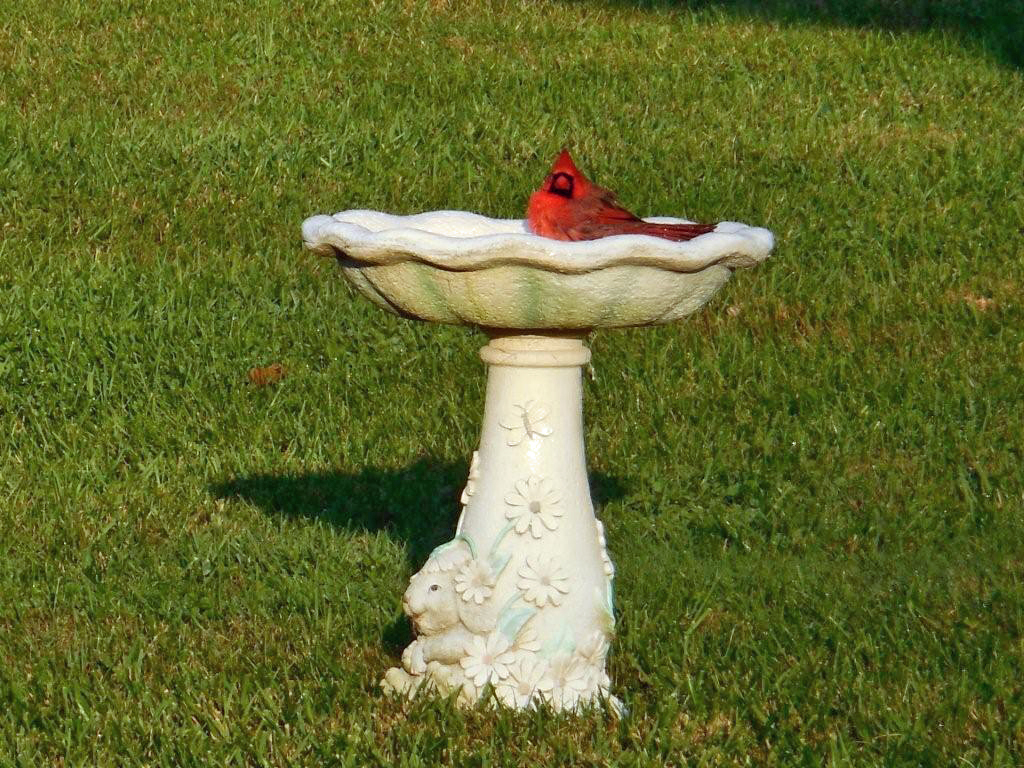
Photo courtesy of Tom and Helen Stetler A male Northern Cardinal takes a bath at the home of Tom and Helen Stetler in Elizabethton.

Photo courtesy of Tom and Helen Stetler
A male Northern Cardinal takes a bath at the home of Tom and Helen Stetler in Elizabethton.

Although I hate to see the colorful birds of spring and summer — scarlet tanagers, Baltimore orioles, indigo buntings, rose-breasted grosbeaks — depart every fall, the winter season offers some compensation.

Often, when we think of the birds of the winter season, our thoughts focus on some of the less-than-colorful feeder visitors — the brown sparrows and wrens, the black and white chickadees, the drab American goldfinches so unlike their summer appearance.

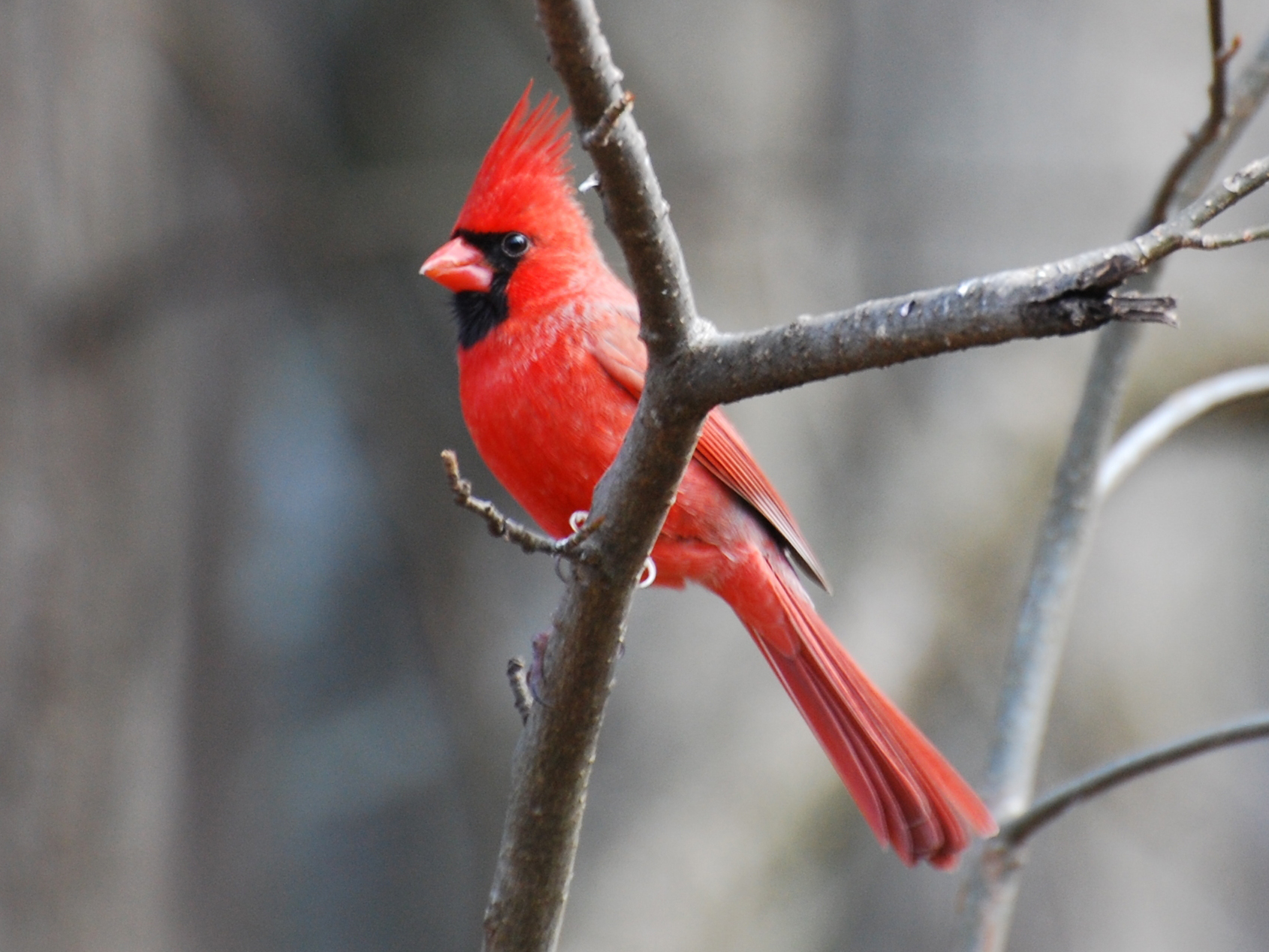
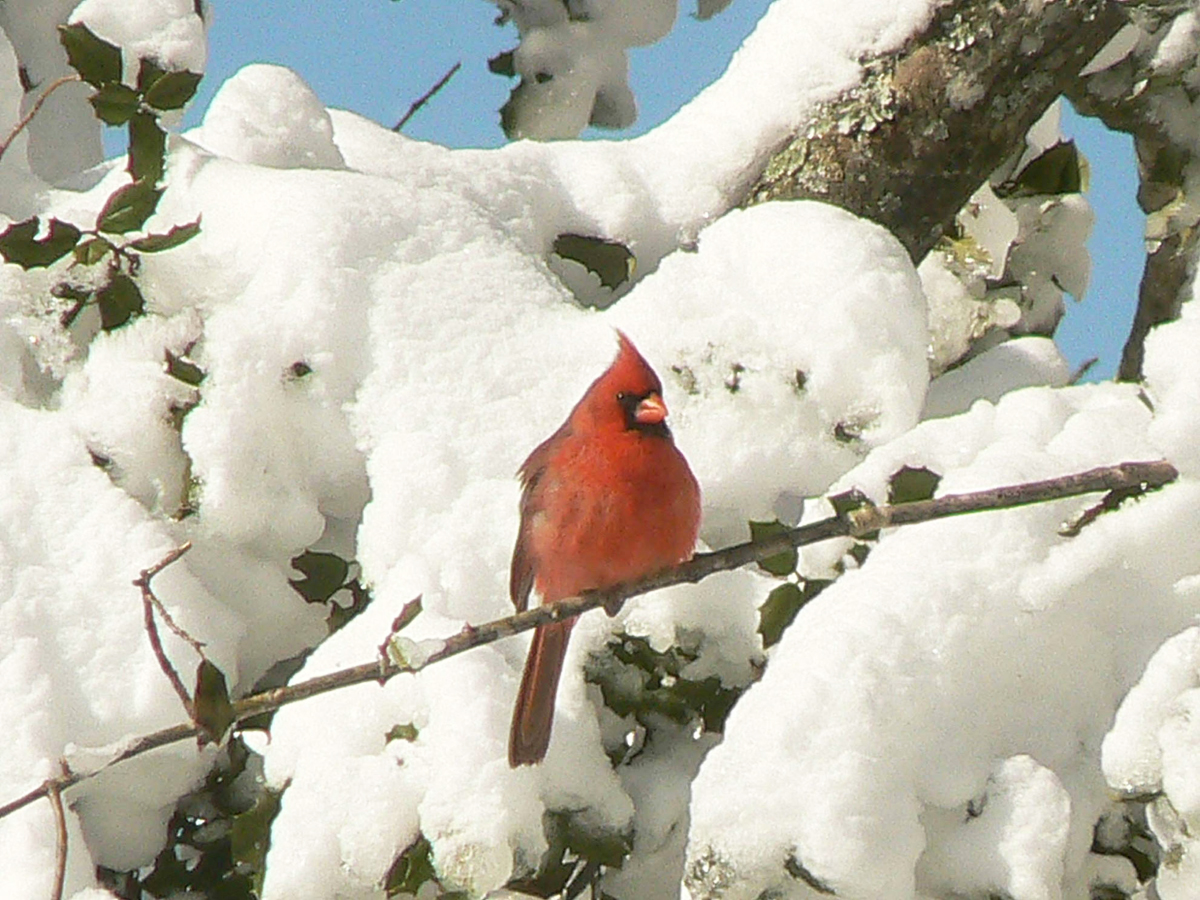
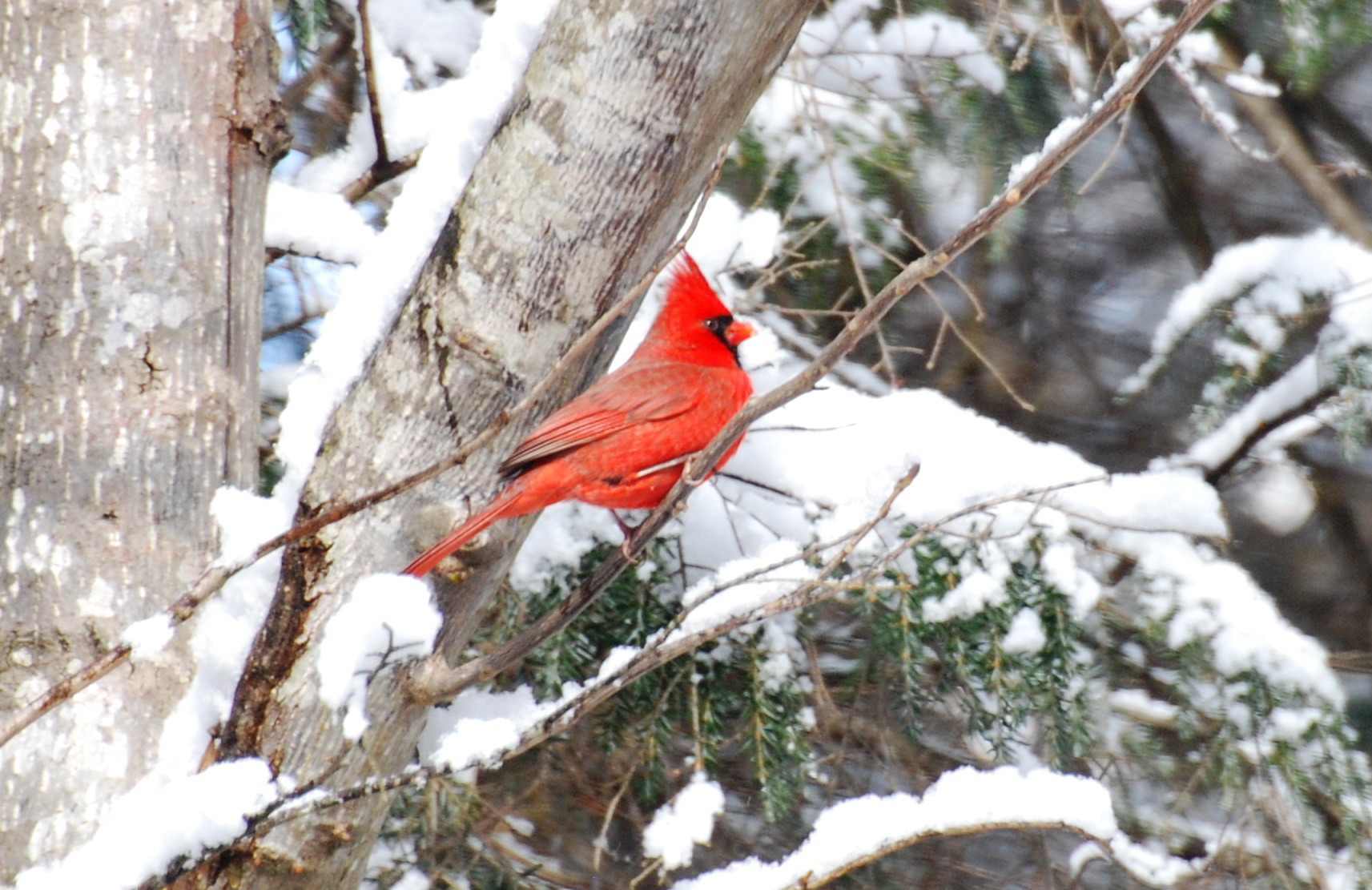
There’s one bird, however, that makes an impression in any season. The Northern cardinal, especially the brilliant red male, stands out against a winter backdrop of snow white, deep green or drab gray.

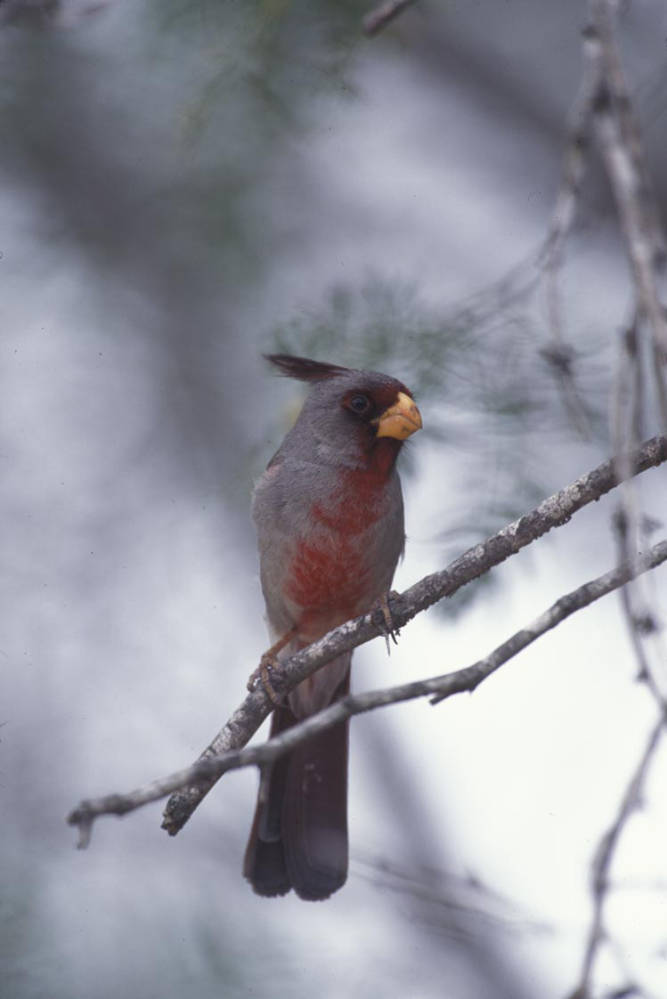
Photo by U.S. Fish & Wildlife Service  Pyrrhuloxia

Photo by U.S. Fish & Wildlife Service
The Pyrrhuloxia is a relative of the Northern Cardinal found in the southwestern United States.

The Northern cardinal belongs to a genus of birds known as Cardinalis in the family Cardinalidae. There are only two other species in this genus, and they range across North America and into northern South America. The two relatives are the pyrrhuloxia, or Cardinalis sinuatus, of the southwestern United States, and the Vermilion Cardinal, or phoeniceus, a bird found in Colombia and Venezuela.

Two other South American birds — red-crested cardinal and yellow-billed cardinal — are more closely related to tanagers than to our familiar Northern cardinal. Both the Northern cardinal and red-crested cardinal have been introduced into the state of Hawaii, so two non-native birds from different parts of the globe are now resident in the Aloha State.

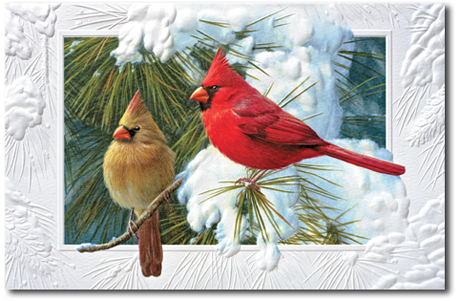
Over the years, the Northern cardinal has also become associated with the Christmas season. How many Christmas cards have you received this holiday season with a cardinal featured in the artwork? I’d wager that at least a few cards in any assortment of holiday greetings will feature the likeness of a bright red cardinal.

This sample Christmas card from cardinalchristmascards.com is a good example of the way Christmas cards often depict this beautiful bird.

This sample Christmas card from cardinalchristmascards.com is a good example of the way Christmas cards often depict this beautiful bird.

Cardinals, also known by such common names as redbird and Virginia nightingale, are easily recognized backyard birds. I never tire of observing these colorful birds. Cardinals are easily lured to any backyard with plentiful cover to provide a sense of security and a generous buffet of sunflower seed.

Cardinals accept a wide variety of food at feeders. Sunflower seed is probably their favorite, but they will also sample cracked corn, peanuts, millet, bakery scraps and even suet. The cardinal is also one of only a few birds that I have noticed will consistently feed on safflower seed.

While we may get the idea that cardinals feed largely on seed, that is a misconception based on our observation of the birds at our feeders. When away from our feeders, cardinals feed on insects and fruit, including the berries of mulberry, holly, pokeberry, elderberry, Russian olive, dogwood and sumac.

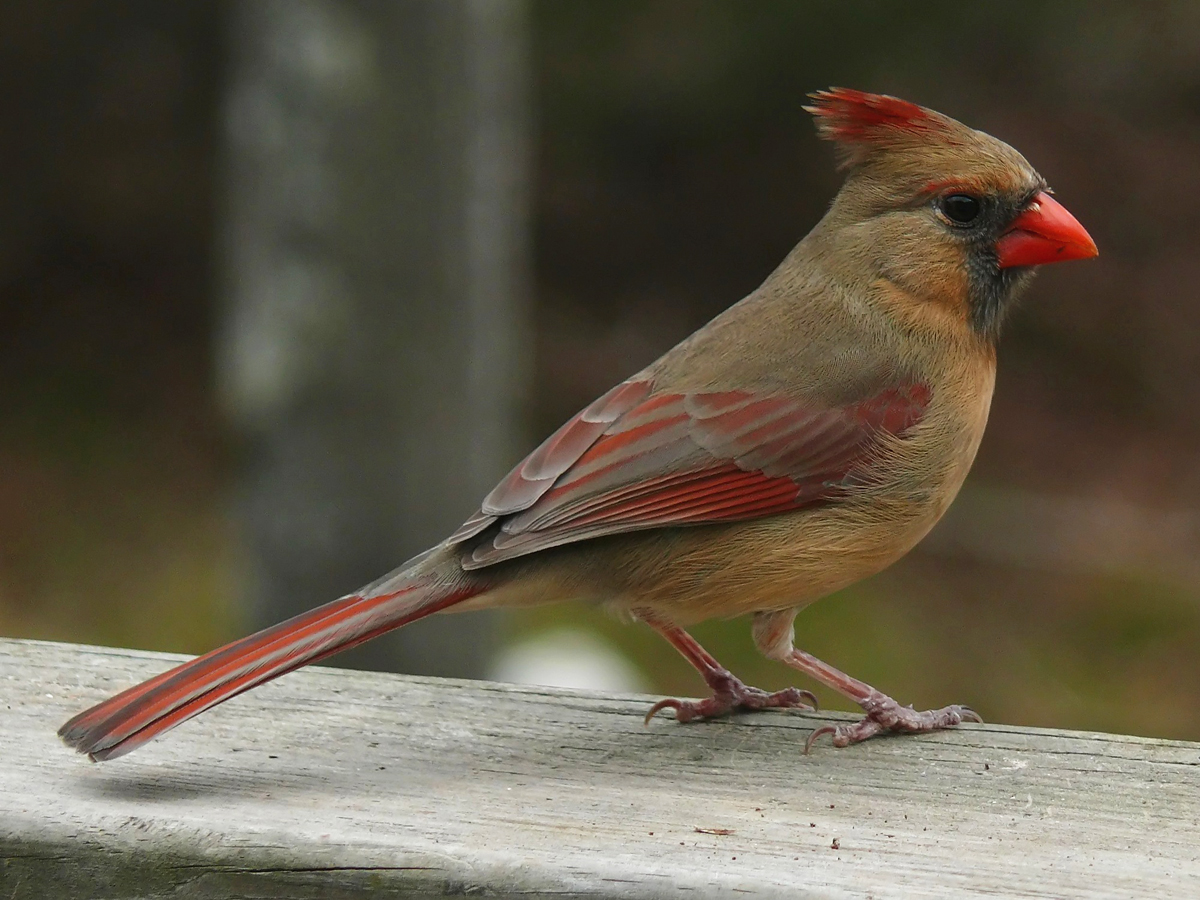
Photo by Ken Thomas Even the female Northern Cardinal offers observers admirable, subtle beauty.

Photo by Ken Thomas
Even the female Northern Cardinal offers observers admirable, subtle beauty.

There’s no difficulty in identifying a cardinal. The male boasts crimson plumage, a crest, a black face and orange bill. The female, although less colorful, is also crested. Female cardinals are soft brown in color, with varying degrees of a reddish tinge in their feathers, particularly in their wings. Immature cardinals resemble females except young cardinals have dark bills.

Cardinals are a widespread species, ranging westward to the Dakotas and south to the Gulf Coast and Texas. The southeastern United States was once the stronghold of the cardinal population. In the past century, however, cardinals have expanded their range into New England and Canada.

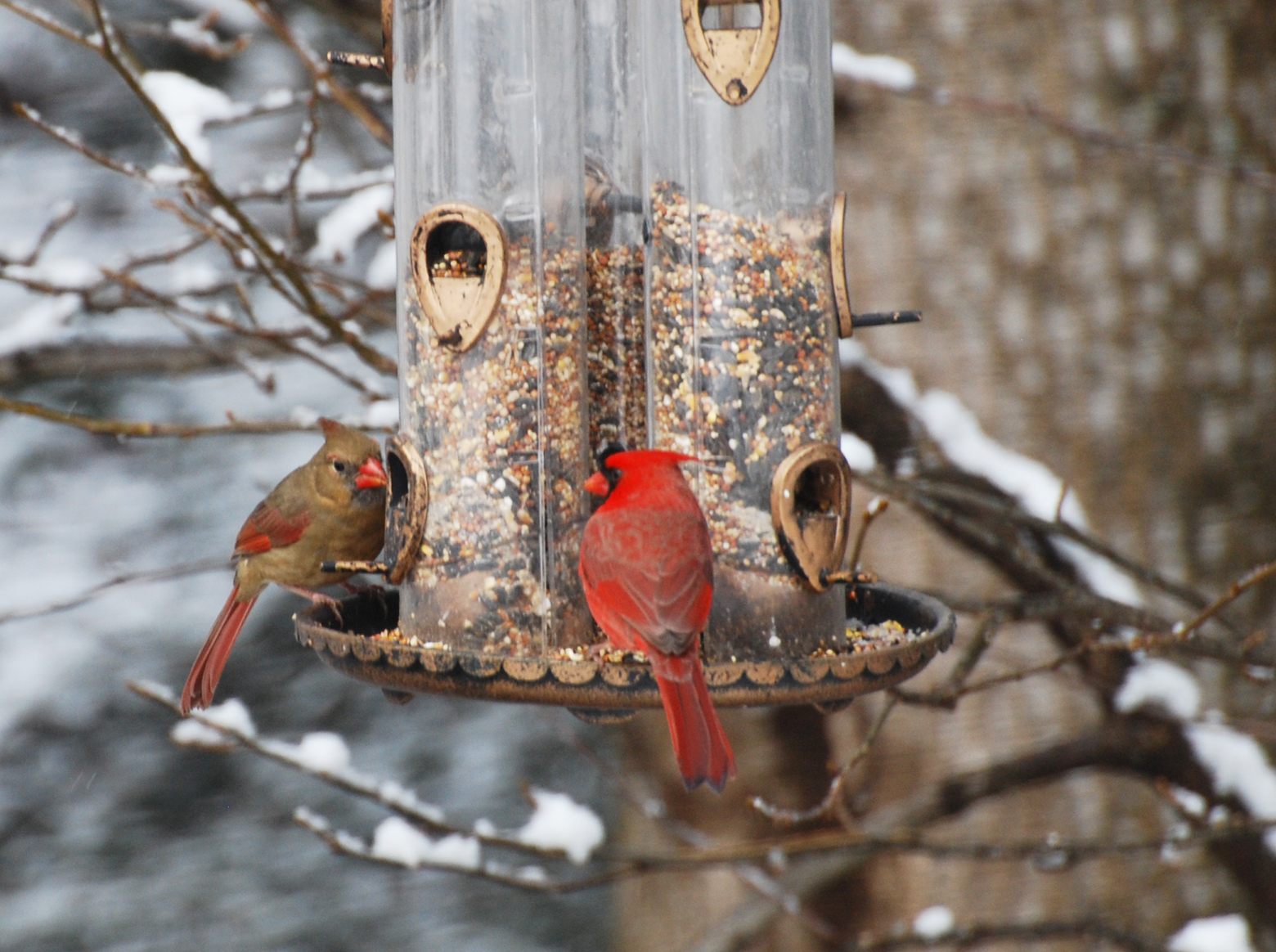
Photo by Jean Potter A pair of Northern Cardinals perch on a feeder for a meal of various seeds.

Photo by Jean Potter
A pair of Northern Cardinals perch on a feeder for a meal of various seeds.

At feeders, cardinals mingle with a variety of other birds. Their preference for dense, tangled habitat is one they share with such birds as brown thrashers, Eastern towhees, Carolina wrens and song sparrows. In general, however, cardinals directly associate only with their own kind. Cardinals will form loose flocks during the winter, but these flocks are never as cohesive as those of such flocking birds as American goldfinches. Cardinals are more often observed in pairs.

Photo by Bryan Stevens Cardinals are common visitors to backyard feeders.

Photo by Bryan Stevens
Cardinals are common visitors to backyard feeders.

For such a bright bird, the male cardinal can be surprisingly difficult to detect as he hides in the thick brush that conceals his presence. Cardinals are nervous birds, however, and usually betray their presence with easily recognized chip notes.

It’s not surprising that such a popular bird has also become associated with many trappings of the Christmas season.
“You see cardinals on greeting cards, stationery, paper plates, paper napkins and tablecloths, doormats, light switch plates, candles, candle holders, coffee mugs, plates, glasses, Christmas tree ornaments and lights, bookmarks, mailboxes, Christmas jewelry,” writes June Osborne in her book The Cardinal. “And the list goes on. Cardinals have become an integral part of the way that many people celebrate the holiday season.”

MaleCardinal-Limb

Photo by Jean Potter                                   Male Cardinals always brighten gloomy winter days.

I can be included among such people. My Christmas decorations include an assortment of cardinal figurines and ornaments. There are other birds — doves and penguins for example — associated with the holiday season, but for me the holidays magnify the importance of one of my favorite birds. The cardinal, in its festive red plumage, appears made to order for a symbol of the holiday season.

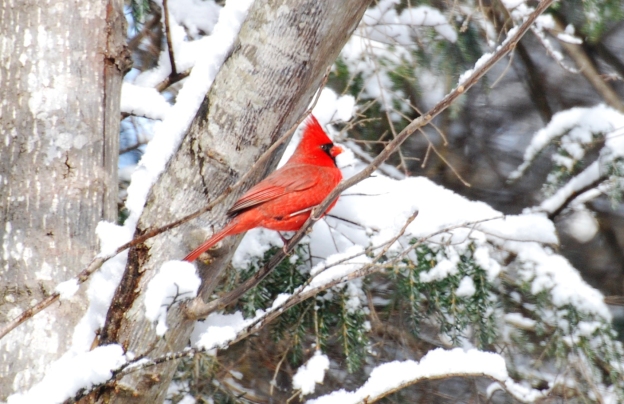
Photo by U.S. Fish and Wildlife Service

Photo by U.S. Fish and Wildlife Service              A male Northern Cardinal perches on a branch on a snowy winter’s day.

There’s additional evidence to put forward as testimony to the popularity of the Northern cardinal. It’s the official state bird of seven states: Virginia, North Carolina, West Virginia, Ohio, Illinois, Indiana and Kentucky. Only the Northern mockingbird, which represents five states as official state bird, even comes close to the Northern cardinal in this respect.

Even once the holidays are past, there’s nothing like a glimpse of a Northern cardinal to add some cheer to a bleak winter day.

Photo by Jean Potter

Photo by Jean Potter                                                                                                                              This male Northern Cardinal’s red plumage makes him stand out against a snowy background.


Kinglets are tiny in size, big in spirit

A flock of American Crows provided some drama on Sunday, Nov. 23. The crows, perhaps with good reason, didn’t appreciate finding a Red-tailed Hawk in their airspace. The flock spent around 20 minutes directing an aerial bombardment against the hawk, which finally got the hint and moved out of the territory claimed by the crows.

CrowChase

Photo by Bryan Stevens                                                           An American Crow mobs a Red-tailed Hawk that intruded into its territory.

I posted on Facebook about the incident, which prompted a response from Rita Schuettler. “I rarely know that a hawk is around until the crows up here start raising a ruckus,” Rita wrote. “It is fun to watch them chase the hawk all the way down the valley and outa here!”

GrayCatbird-Nov22

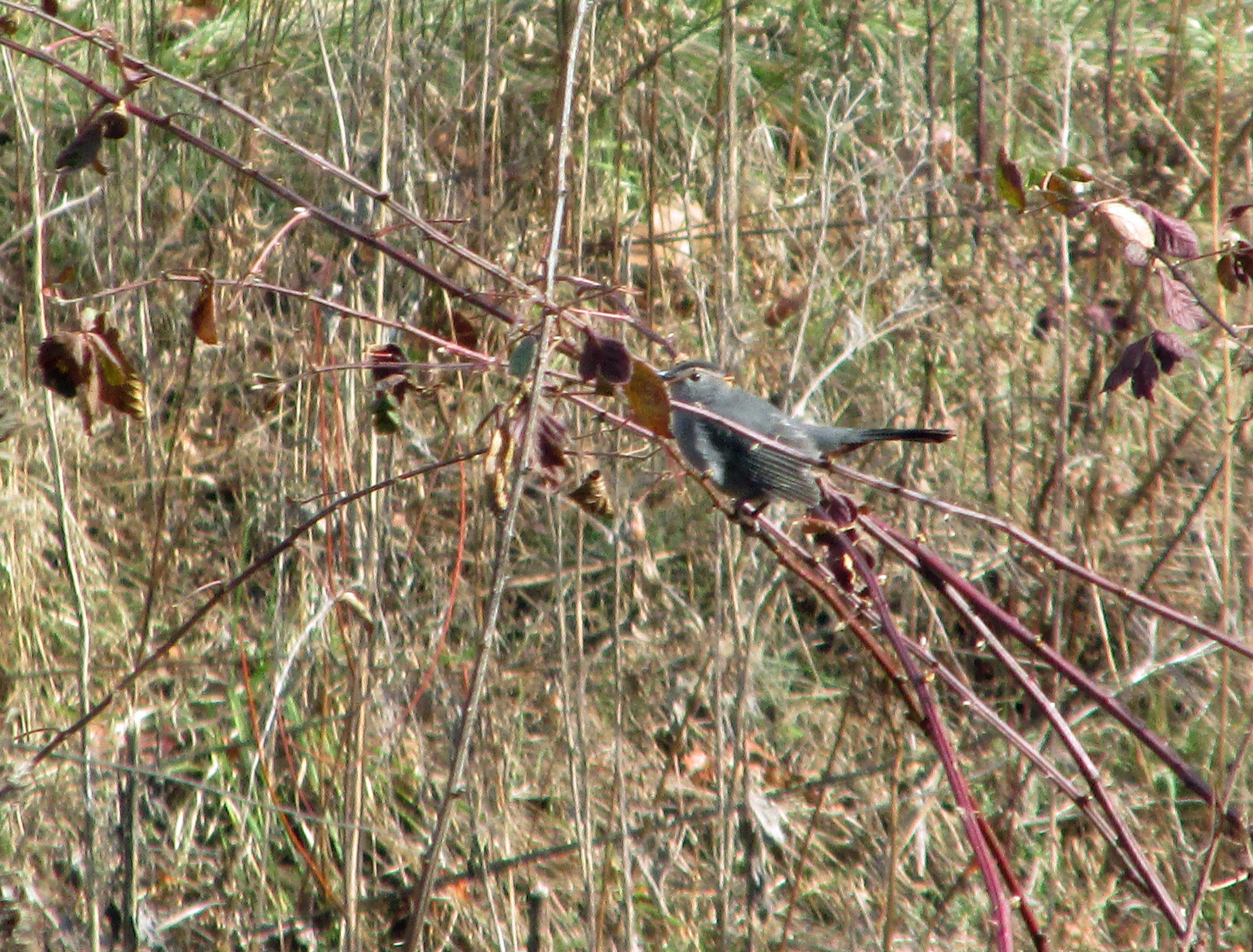
Photo by Bryan Stevens                                                   This Gray Catbird, photographed on Nov. 23, represents a fairly late record of this species in Northeast Tennessee. Most catbirds migrate out of the region each fall to spend the winter farther south.

In addition to the fun observation with the hawk and crows, I discovered an unseasonably late Gray Catbird in my yard. I actually heard the catbird’s namesake cat-like scold vocalizations before I saw the bird. Catbirds are common birds in my yard from spring to fall, but they usually depart in early October. I thought that was the case this year, too, but then this straggler showed up. The catbird has put in some other appearance since its initial appearance on Saturday, Nov. 22.

In recent years, catbirds have been found on several of the Christmas Bird Count conducted in Northeast Tennessee, so it’s a distinct possibility that a few of these birds have taken to spending part of the winter here rather than flying south.

•••••

With the recent cold weather, I’ve been seeing a few golden-crowned kinglets, as well as the closely related ruby-crowned kinglet, at my home.

Jean-Golden-crownKinglet

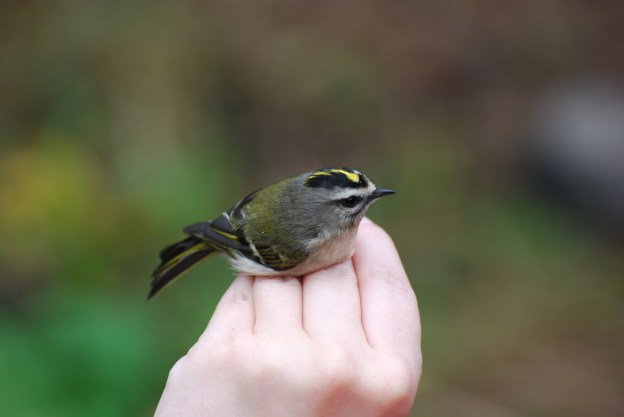
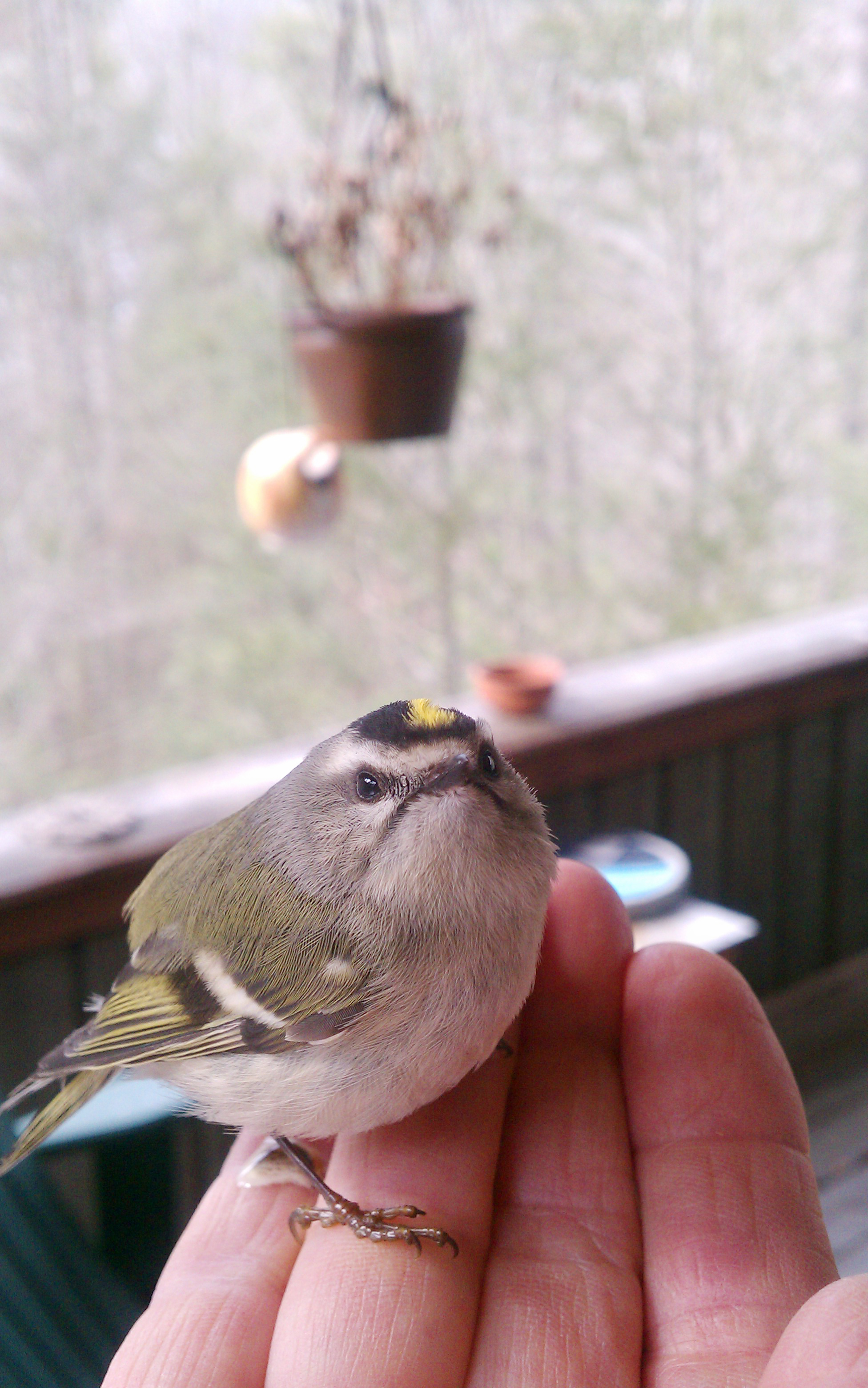
Photo Courtesy of Jean Potter                                      A Golden-crowned Kinglet is held securely during a bird-banding procedure. The crown of golden-yellow feather that gives the bird its name is clearly visible.

Both the golden-crowned and ruby-crowned kinglets are members of a family of tiny birds known collectively as kinglets and firecrests. They’re such tiny, energetic birds that they absolutely excel with the “cuteness” factor.

All kinglets are very tiny birds, as well as extremely active ones. They are also the only members of this family of birds found in North America. Four other species, however, are native to Europe, Asia and North Africa. The remaining species include goldcrest, common firecrest, Madeira firecrest and flamecrest, which is also known as the Taiwan firecrest.

Rubycrowned_Kinglet

Photo by U.S. Fish & Wildlife Service                              Only the male Ruby-crowned Kinglet shows the small patch of red feathers atop the head that gives this bird its common name.

Kinglets, as their name suggests, are tiny birds. In fact, about the only North American birds smaller than kinglets are some of the hummingbirds. The kinglets belong to the family, Regulidae, and the genus, Regulus. The family and genus names are derived from a Latin word, regulus, which means “rex,” or “king.” The name was apparently inspired by the colorful crown patches, often red, orange or gold, that resemble the royal “crowns” of kings.

Although similar in size and overall coloration, the ruby-crowned and golden-crowned kinglets are easily distinguished from each other. Side by side, the two species of North American kinglets are easy to identify. The golden-crowned kinglet has a striped facial pattern formed by bold black and white stripes. The ruby-crowned kinglet, on the other hand, has a bold white eye ring but no striping. The golden-crowned kinglet has an orange crown patch, while the ruby-crowned kinglet has a red crown patch that is, more often than not, kept concealed. Both sexes of the golden-crowned kinglet possess a yellow crown patch, but only the male ruby-crowned kinglet boasts a scarlet patch of feather atop the head.

Beth-Golden-crownKinglet

Photo Courtesy of Beth McPherson  This Golden-crowned Kinglet was in good hands as it recovered from striking a window.

Kinglets are active birds, foraging vigorously for small insects, and spiders. When foraging, both kinglet species have a habit of flicking their wings over the backs. Even if you can’t get a good look at the birds, this behavior helps contrast them from other small birds, including some warblers, wrens and the blue-gray gnatcatcher.

Golden-crowned kinglets are widespread in the region during the winter. During the summer months, head to the slopes of some of the region’s higher mountains to look for these tiny birds that nest at the higher elevations of the Southern Appalachians. Ruby-crowned kinglets can also be found in the region during the winter, but extreme cold weather will often force these less cold-hardy birds to eke out the winter months farther south.

Rubycrowned_Kinglet (1)

Photo by U.S. Fish & Wildlife Service  A Ruby-crowned Kinglet forages for insect prey in the branches of a small tree.

Kinglets don’t typically visit feeders, but they do tend to join mixed flocks with membership consisting of such species as tufted titmouse, Carolina chickadee and white-breasted nuthatch. When traveling with such flocks, kinglets may visit the space around feeders but rarely take seeds or other fare offered at feeders.

Kinglets are surprisingly tame at time and often exhibit as much curiosity about us as we display toward them. They’re very active birds, however, constantly moving from perch to perch. These bursts of hyperactivity can make them difficult to observe since they so rarely remain still. Although small in size, these birds more than compensate for it with a feisty spirit that does them well through the harsher weather of the winter months.

Wild turkey epitomizes rugged determination of the American spirit

A Wild Turkey is ama amazingly resilient bird, capable of surviving in a variety of habitats.

A Wild Turkey is an amazingly resilient bird, capable of surviving in a variety of habitats.

Americans will come together this week to celebrate Thanksgiving, so I thought I’d focus this week’s column on the wild turkey.

It’s usually in early November that I begin encountering wild turkey flocks, whether I’m in the field to look for birds or simply driving to and from work. I saw a group of four wild turkeys on Nov. 4 as they foraged in a field near my home. Over the years, I’ve also found other locations that are dependable for turkey sightings. In some areas, flocks comprised of dozens or even hundreds of turkeys are commonplace.

E._migratorius

This bird, one of the last Passenger Pigeons, was photographed in 1899.

Surprisingly, despite its current abundance across North America, the wild turkey almost didn’t survive the 19th century. It’s almost miraculous that the wild turkey didn’t join the unfortunate ranks of such extinct birds as the passenger pigeon and Carolina parakeet. In fact, only an estimated 30,000 wild turkeys were alive about 1930. The same forces that wiped out the immense flocks of passenger pigeons and America’s only wild parakeet almost drove the wild turkey to extinction. Habitat destruction and a merciless commercial slaughter almost claimed the wild turkey, another uniquely American bird.

Passenger_pigeon_shoot (1)

The same market forces that slaughtered Passenger Pigeons nearly decimated America’s Wild Turkey, too.

Ironically, the wild turkey’s valued status as a gamebird helped persuade many Americans to fight for its conservation. It’s an effort that succeeded admirably. Today, there are about seven million wild turkeys roaming North America. The wild turkey is now abundant enough to be legally hunted in most states, including Virginia and Tennessee.

Interest in the wild turkey as a game bird has even inspired the establishment of the National Wild Turkey Federation, which is a national nonprofit organization that serves as a leader in upland wildlife habitat conservation in North America. The NWTF was founded in 1973 in the Commonwealth of Virginia. The NWTF is now headquartered in Edgefield, South Carolina, and has local chapters in every state. The NWTF remains dedicated to the conservation of the wild turkey and the preservation of a sustainable hunting heritage.

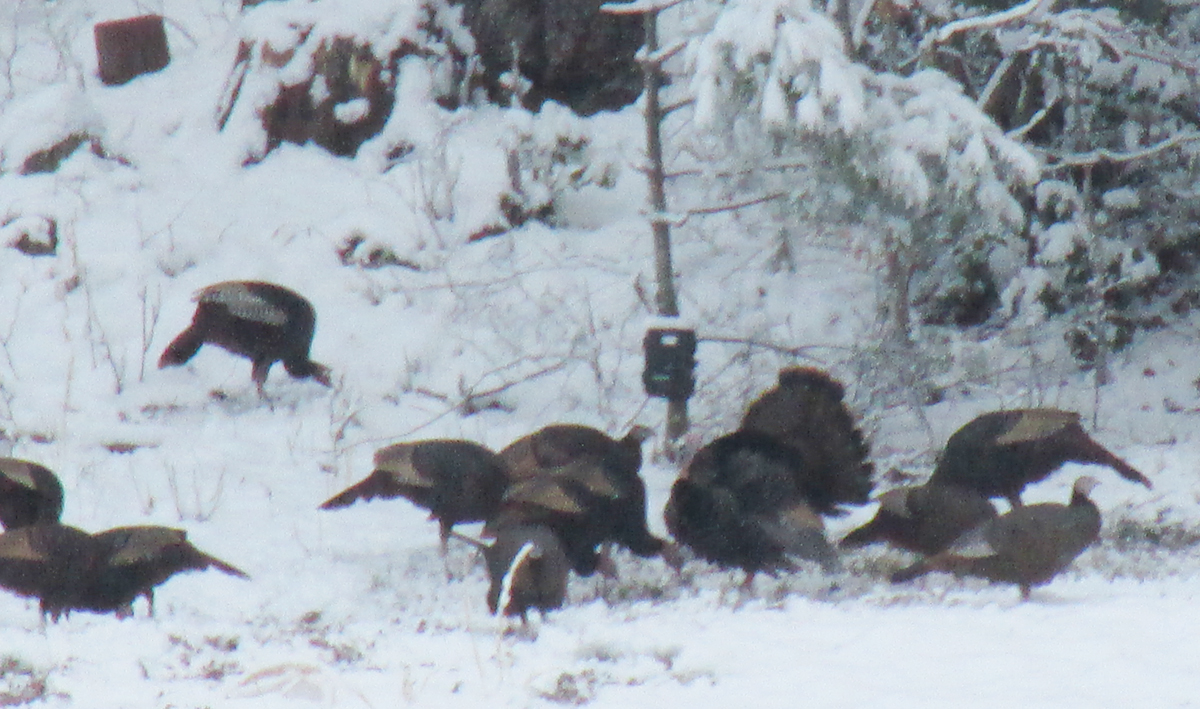
Photo by Bryan Stevens A flock of turkeys forage for food while a few of the males, or Toms, display to attract the attention of females in the flock.

Photo by Bryan Stevens
A flock of turkeys forage for food while a few of the males, or Toms, display to attract the attention of females in the flock.

The wild turkey, for which the NWTF was formed, is a large bird. Males, or tom turkeys, can reach a length of 46 inches, weigh 16 pounds and boast a wingspan of 60 inches. It’s a widely held misconception that the wild turkey cannot fly. The turkey is perfectly capable of flying at speeds up to 55 miles per hour, but they often prefer to walk and run over the ground. They’re good sprinters, in fact, and can reach a running speed of 25 miles per hour.

The female turkey, or hen, nests, incubates eggs and rears young without any help from her mate. The hen may lay as many as a dozen eggs. The clutch usually hatches within a month. Newly-hatched turkeys are known as poults. The poults are capable of finding their own food after leaving the nest, which they do within 12 hours of hatching. They are supervised, however, by the hen. Wild turkeys require a mixture of woodlands with clearings and fields to thrive. They roost in trees at night, but feed in more open habitats.

Early naturalist John James Audubon painted this wild turkey hen accompanied by her poults, or young.

Early naturalist John James Audubon painted this wild turkey hen accompanied by her poults, or young.

The wild turkey’s scientific name is Meleagris gallopavo. The wild bird is exclusively resident in North America, but domesticated turkeys are now raised around the globe.

The wild turkey has only one close relative, the ocellated turkey, or Meleagris ocellata, which ranges throughout the Yucatán Peninsula in Mexico as well as the northern parts of Belize and Guatemala. The extent of this fowl’s range is only about 50,000 square miles while the wild turkey ranges throughout the United States, as well as Canada and Mexico. Tail feathers in both sexes are bluish-gray in color with a well defined, eye-shaped, blue-bronze colored spot near the end followed by a bright gold tip. These “eyespots” in the feathers provide the basis for the use of the term “ocellated” in this fowl’s common name. The tail feather spots are reminiscent of those seen in peacock feathers.

Few birds have featured so prominently in the history of the United States as the wild turkey. In fact, the turkey came close to being named the official bird of the United States.

Benjamin Franklin, who proposed the turkey as the official United States bird, was distraught when the bald eagle was chosen over the turkey. Franklin wrote to his daughter, referring to the eagle’s “bad moral character,” saying, “I wish the bald eagle had not been chosen as the Representative of our country! The turkey is a much more respectable bird, and withal a true original native of America.” George Washington, the nation’s first president, also shared Franklin’s opinion, and pointed out the bald eagle’s lifestyle as a carrion eater.

Photo by Bryan Stevens The Wild Turkey has become closely associated with the Thanksgiving holiday.

Photo by Bryan Stevens
The Wild Turkey has become closely associated with the Thanksgiving holiday.

If not as our national symbol, the wild turkey is still deserving of respect. This bird, found only in North America, is a survivor.

Here’s some additional turkey trivia:

• The Aztecs first domesticated the wild turkey. Spaniards brought this tamed fowl back to Europe with them in the mid-16th century and from Spain, domestic turkeys spread to France and later Britain as a farmyard animal.

• At Thanksgiving, humans consume many turkeys. In the wild, turkeys are preyed upon by coyotes, bobcats, cougars, golden eagles, great horned owls and red foxes.

• Today, the wild turkey population stands at about 7 million. This bird, an adaptable species, now thrives in suburban areas, as well as the rural countryside.

• The feathers of turkeys were important in Native American cultures. Tribes as diverse as the Sioux, the Wampanoag, the Powhatan and the Hopi all wore turkey feathers or used feathers in their rituals.

Photo by Bryan Stevens The thaw after a snow makes it easier for wild turkeys to forage for food.

Photo by Bryan Stevens
The thaw after a snow makes it easier for wild turkeys to forage for food.

• Turkeys belong to an order of birds known as the galliformes, which includes grouse, ptarmigans, pheasants, quail, partridges and chickens. The only other native galliformes in the regions are ruffed grouse and Northern bobwhite.

• The wild turkey is the largest of North America’s game birds. The largest wild turkey on record weighed 37 pounds, but a domestic turkey holds the record, tipping the scales at 86 pounds. That bird certainly could have fed a lot of people gathered around the Thanksgiving dining table.

•••••

To learn more about birds and other topics from the natural world, friend Stevens on Facebook at https://www.facebook.com/ahoodedwarbler. He is always posting about local birds, wildlife, flowers, insects and much more. If you have a question, wish to make a comment or share a sighting, email ahoodedwarbler@aol.com.

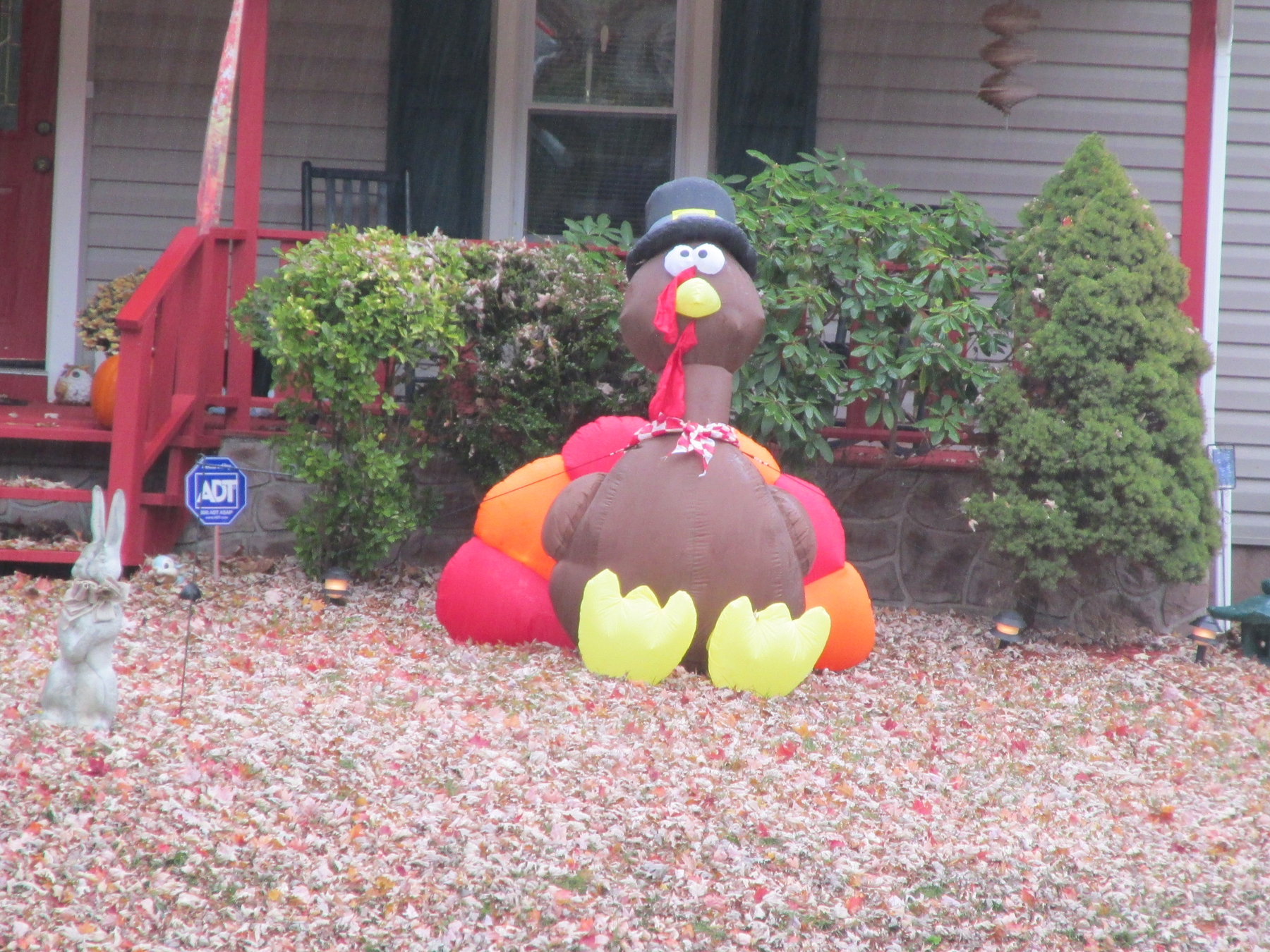
Photo by Bryan Stevens A decorate turkey pays homage to the real bird.

Photo by Bryan Stevens
A decorative turkey made from plywood and a haybale pays homage to the real bird.

Ruffed Grouse manages to keep low profile

While driving to work on Nov. 5, I was surprised with a wonderful observation of a Ruffed Grouse, which flew across Simerly Creek Road. I got a great look at the grouse as it coasted over a field, crossed the creek and landed in the woods. It’s my first grouse sighting near home in probably more than a year.

Early naturalist John James Audubon painted this scene dominated by a group of Ruffed Grouse.

Early naturalist John James Audubon painted this scene dominated by a group of Ruffed Grouse.

The Ruffed Grouse is named for the male’s neck ruff. These feathers around the neck can be erected in mating displays, creating an impressive “collar.”

Males do not vocalize during mating displays, which sets them apart from other species of grouse. Instead, they beat their wings at high speeds to create a thumping sound known as “drumming.” The low-frequency sound carries a good distance even in thick woodlands.

Photo by Jean Potter Ruffed Grouse thrive in second-growth woodlands.

Photo by Jean Potter
Ruffed Grouse thrive in second-growth woodlands.

The Ruffed Grouse has been officially recognized as the state bird of Pennsylvania. Legislation enacting the recognition was passed by the General Assembly on June 22, 1931. In the recognition, the Ruffed Grouse is described as a plump bird with mottled reddish-brown feathers. This protective coloring makes it possible for the grouse to conceal itself in the wilds.

As a game bird, the Ruffed Grouse has been studied more extensively than some other birds. This bird is not known for longevity. Few survive to three years of age, according to research conducted by the late Gordon Gullion, head of the Forest Wildlife Project at the University of Minnesota’s Cloquet Forestry Center.

Guillion showed in his research that of 1,000 eggs laid in spring, only about 250 Ruffed Grouse will survive to their first autumn, 120 to their first spring, about 50 to a second spring and less than 20 will still be alive the third spring. These statistics emphasize the many enemies and other perils faced by this game bird. Yet, despite dismal numbers, it’s enough to continue the survival of the species.

According to the website for the National Ruffed Grouse Society, Ruffed Grouse typically have a short life span. A brood consisting of 10 to 12 young are hatched in the spring, but by mid-August about half of them have perished. The cold months of late fall and winter will claim more of them.

Photo by Jean Potter This Ruffed Grouse has inflated its namesake ruff of feathers.

Photo by Jean Potter
This Ruffed Grouse has inflated its namesake ruff of feathers.

Studies have also revealed that Ruffed Grouse populations undergo a cycle of peaks and crashes. This population cycle of peaks and valleys repeats about every 10 years. What this means is that Ruffed Grouse numbers decline to a low point every decade, but there is also a corresponding peak when the local population of Ruffed Grouse surges.

Other related grouse in North America include the Greater Prairie Chicken, also known as the Pinnated Grouse, as well as the Lesser Prairie Chicken, Spruce Grouse and Sharp-tailed Grouse.

Photo by U.S. Fish & Wildlife Service A Sharp-tailed Grouse, a relative of the Ruffed Grouse, prefers prairies rather than woodlands for its habitat.

Photo by U.S. Fish & Wildlife Service
A Sharp-tailed Grouse, a relative of the Ruffed Grouse, prefers prairies rather than woodlands for its habitat.

Despite some superficial similarities, grouse are not closely related to quails and turkeys. They are important as a game bird, but careful management is necessary.

Particularly during the nesting season, individual Ruffed Grouse may lose their fear of humans. Many years ago, a Ruffed Grouse boldly walked into my front yard and then ventured onto the front porch. Only my timely intervention rescued the visiting grouse from a cat that belonged to my parents.

Holston Mountain in Carter County has long been one of the more reliable locations for finding Ruffed Grouse, especially during the nesting season.

Photo by U.S. Fish & Wildlife Service The Spruce Grouse is a distinctive looking relative of the Ruffed Grouse.

Photo by U.S. Fish & Wildlife Service
The Spruce Grouse is a distinctive looking relative of the Ruffed Grouse.


Orange-crowned Warbler sighting punctuates fall’s parade of migrants

The annual migratory parade of warblers has ended, but not without a few final surprises. By the arrival of the region’s only winter warbler — the Yellow-rumped Warbler — it’s a foregone conclusion that the migration season for this colorful family of birds is almost at an end.

Photo by U.S Fish & Wildlife Service An Orange-crowned Warbler perches on a branch.

Photo by U.S Fish & Wildlife Service
An Orange-crowned Warbler perches on a branch.

There is, however, one final exception. One of the warblers tends to migrate later in the season than its kin. In a family of colorful birds like the Cape May Warbler and the Black-throated Blue Warbler, it’s also at a decided disadvantage when it comes to considerations like appearance.

Although it has a striking name — Orange-crowned Warbler — the patch of orange feathers atop this warbler’s head are rarely seen by observers in the field. In fact, the most conspicuous thing about the Orange-crowned Warbler is its lack of conspicuousness. This is a grayish-greenish warbler with only two dashes of color. It can also show some surprisingly bright yellow plumage under the tail. Only once, however, have I noticed the namesake orange crown patch that is usually kept concealed beneath a layer of gray-green feathers.

“Warblers of the Americas,” an identification guide written by Jon Curson, David Quinn and David Beadle, stipulates that the crown patch that this warbler’s common name derives from is visible only when the warbler raises its crown feathers. This little twist makes the orange crown patch a very unreliable field mark.

Photo by U.S. Fish & Wildlife Service The faint gray streaks on the breast helps distinguish the Orange-crowned Warbler from the related Tennessee Warbler.

Photo by U.S. Fish & Wildlife Service
The faint gray streaks on the breast helps distinguish the Orange-crowned Warbler from the related Tennessee Warbler.

In fact, over the years, I’ve only observed a handful of these warblers. They tend to migrate through the region long after most other warblers. They’re also easily confused with Tennessee Warblers, which are another drab, greenish warbler that migrates through in large numbers in the autumn.

In my limited experience with these warblers, I’ve found they spend less time in trees and more time foraging in tall shrubs, such as Joe-pye weed and goldenrod. In many of my guide books, the text also indicates that this warbler prefers shrubby, weedy habitats.

This is a continent-ranging warbler, but it is much more common in the western United States than it is in the eastern half of the nation. A few of these warblers migrate into the southern United States for the winter. I’ve observed this warbler on a couple of occasions during late winter trips to the coastal areas of South Carolina. Other Orange-crowned Warblers push as far south as Guatemala for the winter season.

The orange-crowned warbler is related to the Tennessee warbler, and both species share a similar appearance. The Tennessee warbler is usually more greenish. The Tennessee also lacks the faint gray streaking that is present on the breast and flanks of the Orange-crowned Warbler.

Orangecrowned_warblerMENKE

Photo by U.S. Fish & Wildlife Service                                                     An Orange-crowned Warbler forages for insects in a shrub’s bare branches.

I usually manage to see an Orange-crowned Warbler once a year, usually in the late fall. This year’s sighting took place during the final bird walk conducted each Saturday during October by members of the Elizabethton Bird Club at Sycamore Shoals State Historic Park in Elizabethton, Tennessee.

Orangecrowned_warbler-Menke

Photo by U.S. Fish & Wildlife Service              The Orange-crowned Warbler is more common in the western half of the United States.

Some other good birds on this final walk of the 2014 season included Common Merganser, White-crowned Sparrow, Swamp Sparrow and Blue-headed Vireo.

Other species found on the walk included Canada Goose, Mallard, Blue-winged Teal, Pied-billed Grebe, Cooper’s Hawk, with captured starling in its talons, Killdeer, Mourning Dove, Red-bellied Woodpecker, Downy Woodpecker, Northern Flicker, American Kestrel, Eastern Phoebe, Blue Jay, American Crow, Carolina Chickadee, Tufted Titmouse, White-breasted Nuthatch, Carolina Wren, Eastern Bluebird, American Robin, Gray Catbird, Brown Thrasher, Northern Mockingbird, European Starling, Cedar Waxwing, Yellow-rumped Warbler, Northern Cardinal, Common Grackle, House Finch and American Goldfinch.

As usual for a late October walk, it was also a very good day for sparrows. We found Eastern Towhee, Field Sparrow, Song Sparrow, Swamp Sparrow, White-throated Sparrow and White-crowned Sparrow.

Photo by Bryan Stevens A Field Sparrow perches on a briar's stem.

Photo by Bryan Stevens
A Field Sparrow perches on a branch.

I suppose it’s a little strange to get so excited about getting a brief look at a bird that I usually see once a year during a rather brief window of a couple of weeks. Of course, it’s that very scarcity of the bird in East Tennessee that makes these typically annual sightings so wonderful to experience.

••••••

I visited Wilbur Lake with my mother on Nov. 8 for the first time this fall. We wanted to see for ourselves that the flocks of Buffleheads had returned. We were rewarded with looks at about 50 Buffleheads, as well as 10 Gadwalls and seven Ring-necked Ducks. Plenty of Canada Geese and Mallards were also present on the lake.

Photo by Bryan Stevens Buffleheads, such as these, have spent the winter on Wilbur Lake for decades.

Photo by Bryan Stevens
Buffleheads, such as these, have spent the winter on Wilbur Lake for decades.

Column marks 19th anniversary this week

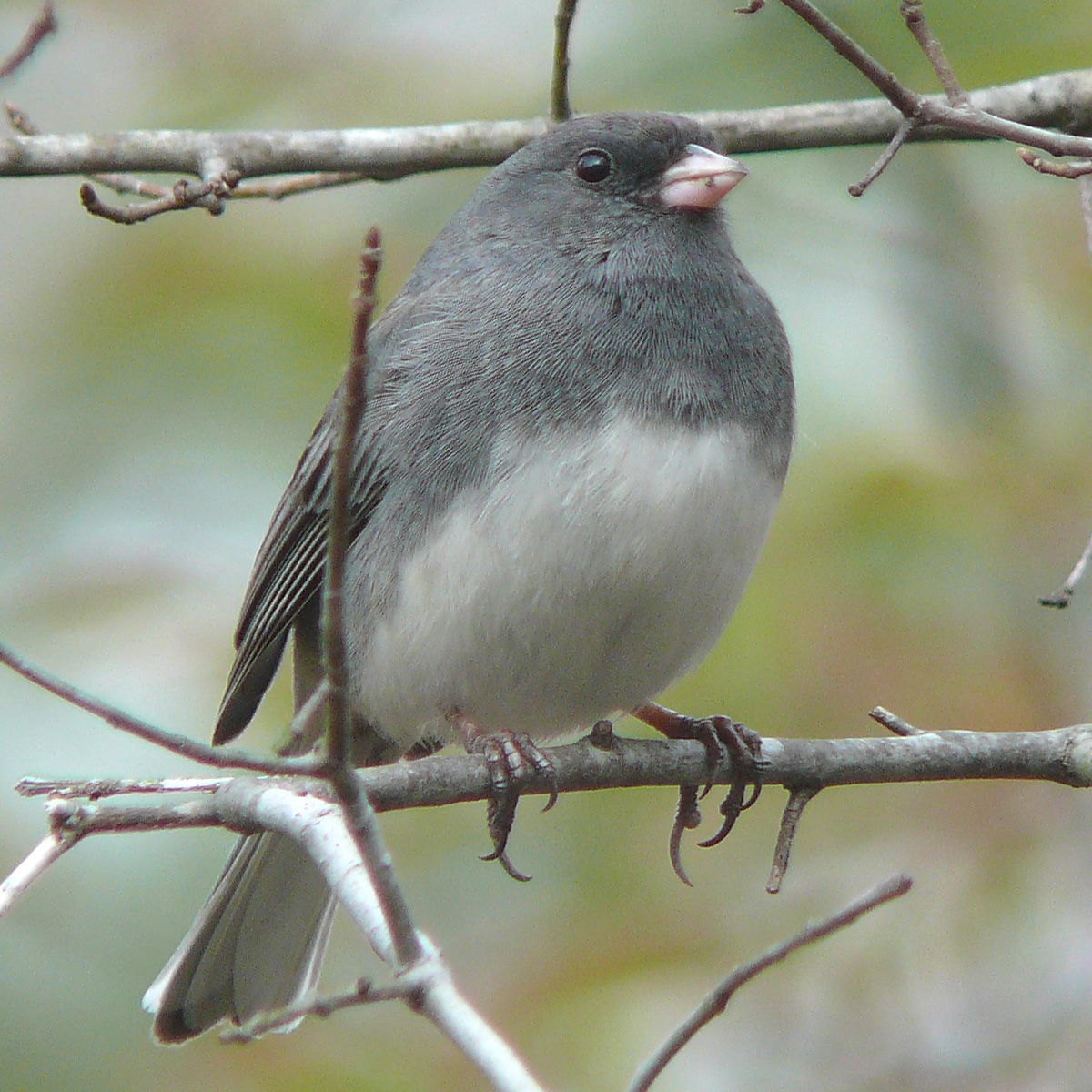
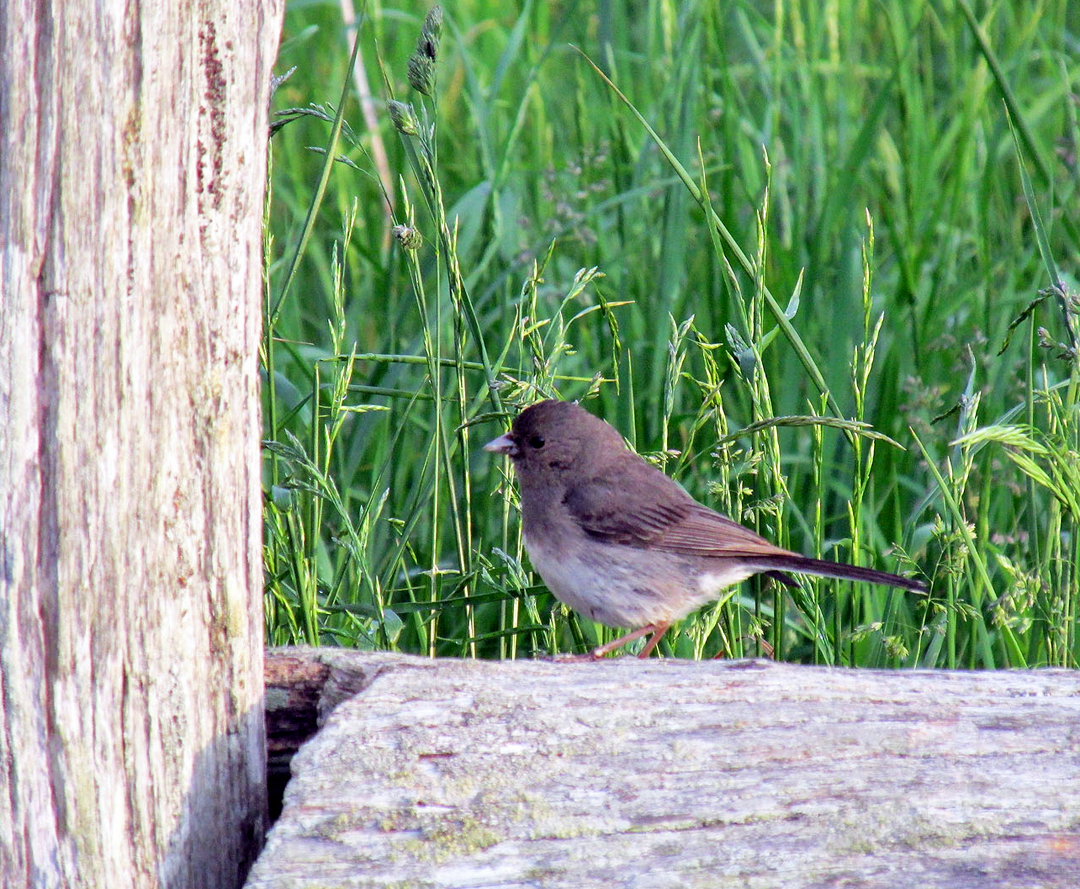
Photo by Ken Thomas Cutline: Dark-eyed Juncos are also known as "snow birds" because of their tendency to flock to feeders ahead of a bout of snowy weather.

Photo by Ken Thomas
Dark-eyed Juncos are also known as “snow birds” because of their tendency to flock to feeders ahead of a bout of snowy weather.

I wrote my first “Feathered Friends” column on Sunday, Nov. 5, 1995. Over the years, the column has appeared in various newspapers. I’ve also been posting weekly blogs on the subject of birds since this past February.
It’s with some irony that I can now reflect in just the few months since the paper that gave the column its start decided to rudely cut ties with both the column and me, other news outlets have stepped forward to carry my weekly thoughts on birds and birding.
The column is currently published weekly in three different newspapers: the Bristol Herald Courier, the Erwin Record and The McDowell News in Marion, N.C. The column also runs weekly in the Carter County Compass, an online news source for the citizens of Elizabethton and Carter County.
 
Sometimes, I wonder where the time has gone as I reflect on the fact that I am celebrating the 19th anniversary of my writing this weekly column, which has appeared in four different newspapers. These days, I also write a weekly online blog about birds while also making bird-related and nature-related posts to my Facebook page.
 
I constantly wonder what I am going to write about each week. Fortunately, I seem to have enough interested readers that someone is usually calling or e-mailing me with an interesting observation or a question that helps get the ball rolling for another column.
 
In that respect, writing “Our Fine Feathered Friends” has also been a great means of getting to know other people interested in birds and nature. So, too, has “For the Birds” and “Feathered Friends.”
I always enjoy hearing from readers, and I hope to continue to do so in the coming years as well.

Photo by Bryan Stevens This Dark-eyed Junco was the first of its kind to return to my yard this fall. This individual arrived on Oct. 28.

Photo by Bryan Stevens
This Dark-eyed Junco was the first of its kind to return to my yard this fall. This individual arrived on Oct. 28.

 
That first column I wrote back in 1995 focused on one of the region’s most prevalent winter residents — the Dark-eyed Junco. The first Dark-eyed Junco to put in an appearance in my yard this year did so on Oct. 28, just a few days ahead of the first winter storm.
 
Here, with some revisions I have made through the years, is the very first “Feathered Friends” column.
••••••
 
Of all the birds associated with winter weather, few are as symbolic as the Dark-eyed Junco, or “snow bird.” The junco occurs in several geographic variations.
 
John V. Dennis, author of “A Complete Guide to Bird Feeding,” captures the essence of the junco in the following description: “Driving winds and swirling snow do not daunt this plucky bird. The coldest winter days see the junco as lively as ever and with a joie de vivre that bolsters our sagging spirits.” The Dark-eyed Junco’s scientific name, hyemalis, is New Latin for “wintry,” an apt description of this bird.a52e51c88da04850ee7b1210.L
 
Most people look forward to the spring return of some of our brilliant birds — warblers, tanagers and orioles — and I must admit that I also enjoy the arrival of these birds. The junco, in comparison to some of these species, is not in the same league. Nevertheless, the junco is handsome in its slate gray and white plumage, giving rise to the old saying, “dark skies above, snow below.”
 
Just as neotropical migrants make long distance journeys twice a year, the junco is also a migrating species. But in Appalachia, the junco is a special type of migrant. Most people think of birds as “going south for the winter.” In a basic sense this is true. But some juncos do not undertake a long horizontal (the scientific term) migration from north to south. Instead, these birds merely move from high elevations, such as the spruce fir peaks, to the lower elevations. This type of migration is known as vertical migration. Other juncos, such as those that spend their breeding season in northern locales, do make a southern migration and, at times, even mix with the vertical migrants.
Junco-Carver

Photo by Bryan Stevens                                     A Dark-eyed Junco on a fence at Carver’s Gap on Roan Mountain.

 
Juncos are usually in residence around my home by early November. Once they make themselves at home I can expect to play host to them until at least late April or early May of the following year. So, for at least six months, the snow bird is one of the most common and delightful feeder visitors a bird enthusiast could want.
 
Juncos flock to feeders where they are rather mild-mannered — except among themselves. There are definite pecking orders in a junco flock, and females are usually on the lower tiers of the hierarchy. Females can sometimes be distinguished from males because of their paler gray or even brown upper plumage.
 
Since juncos are primarily ground feeders they tend to shun hanging feeders. But one winter I observed a junco that had mastered perching on a hanging “pine cone” feeder to enjoy a suet and peanut butter mixture. Still, most Dark-eyed Juncos often are content to glean the scraps other birds knock to the ground.

Junco-AtFeeder

Photo by Bryan Stevens                                     A Dark-eyed Junco feeds on sunflower seeds in a hanging feeder.

 
Juncos are widespread. They visit feeders across North America. The junco is the most common species of bird to visit feeding stations. They will sample a variety of fare, but prefer such seeds as millet, cracked corn or black oil sunflower.
 
There’s something about winter that makes a junco’s dark and light garb an appropriate and even striking choice, particularly against a backdrop of newly fallen snow. Of course, the real entertainment from juncos come from their frequent visits to our backyard feeders. When these birds flock to a feeder and begin a furious period of eating, I don’t even have to glance skyward or tune in the television weather forecast. I know what they know. Bad weather is on the way!
Junco

Photo by Bryan Stevens                                                                                                                          A Dark-eyed Junco feeds on the ground beneath a feeder.

Owls perfectly suited to reign once the sun sets

It was a frosty morning on Simerly Creek on Oct. 20, and the sunrise had given a pink hue to some overhead clouds for a nice enhancement of the morning. From the wooded hollow across the road, I heard a very vocal Eastern Screech-Owl greeting the day with trembling wails. Although Eastern Screech-Owls are normally nocturnal, they can be most active within a couple of hours of both sunset and sunrise. Although I was headed to work, perhaps this particular owl was, in its own way, sending a message of “Good night and sleep tight.”

Photo by U.S. Fish and Wildlife Service The tiny Northern Saw-whet Owl nests on several of the region's higher mountains.

Photo by U.S. Fish and Wildlife Service
The tiny Northern Saw-whet Owl nests on several of the region’s higher mountains.

The calling owl also reminded me that we’ll celebrate Halloween later this week. It’s the one night of the year that we become acutely aware of things that go bump in the night. Of course, what you must also take into consideration are those nocturnal birds that glide through the darkness on nearly silent wings.

Ghouls and goblins can be dismissed as mere apparitions of the imagination. Some real-life feathered phantoms, however, do roam the darkness, perhaps even in your own backyard. Chances are, you have more likely heard them rather than to have seen them.

If you do happen to hear anything slightly unusual this coming Halloween night, listen carefully. It’s a safe bet that the sound — whether it’s a deep, resonant hoot or a trembling wail — might just be produced by an owl.
Several species of owls reside in Southwest Virginia and Northeast Tennessee, including Eastern screech-owl, barred owl, barn owl and great horned owl. A fifth owl, the tiny Northern saw-whet owl, can be found at some high-elevation locations. A few other owls have made sporadic appearances in the region, including long-eared owl, short-eared owl and even snowy owl.

Photo by Bryan Stevens An Eastern Screech-Owl perches in the branches of an Eastern hemlock.

Photo by Bryan Stevens
An Eastern Screech-Owl perches in the branches of an Eastern hemlock.

The most common — and two of my favorites — are the large great horned owl and the small Eastern screech-owl.

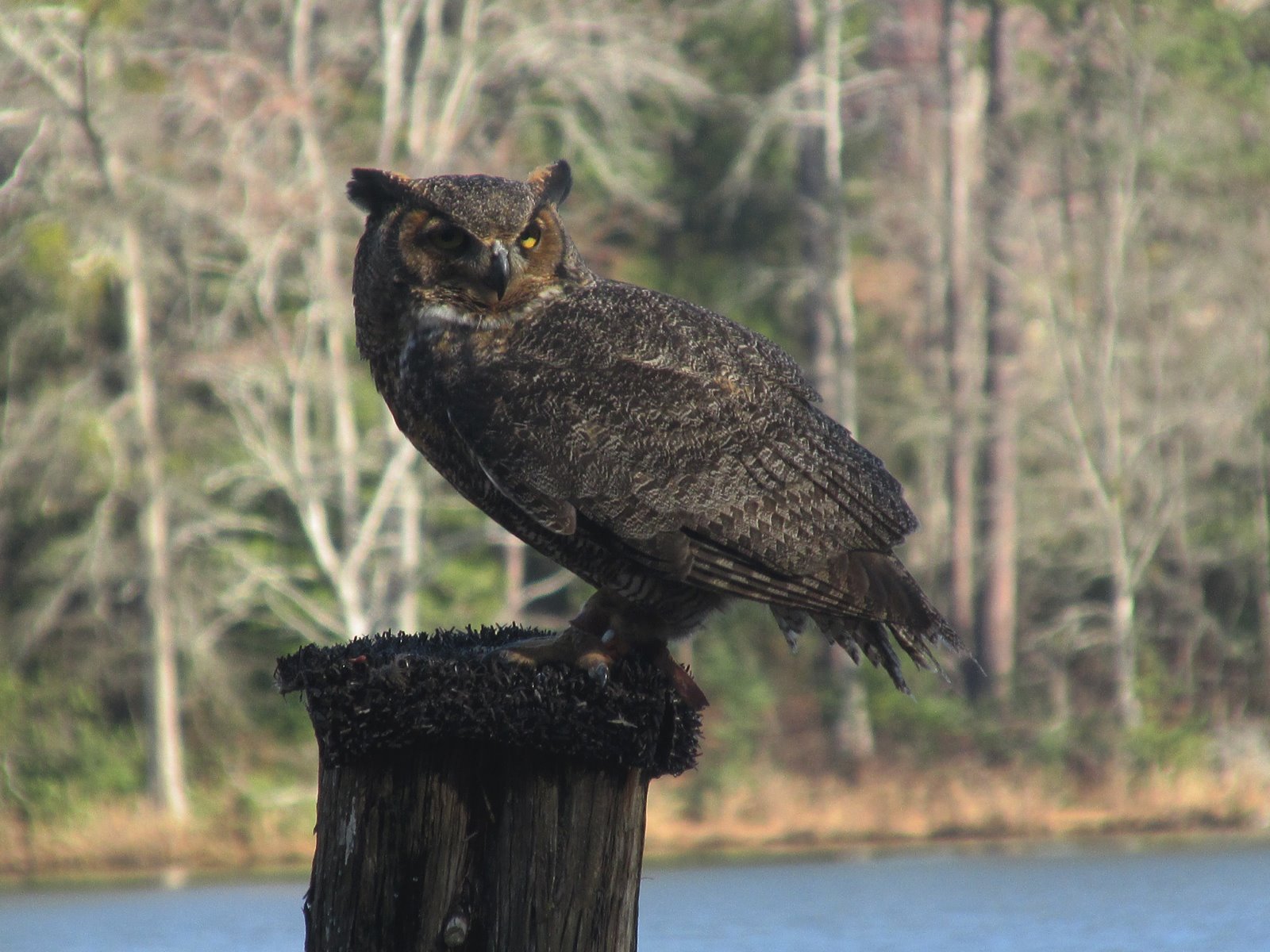
The great horned owl is widespread in the Americas and is one of the more frequently encountered owls in the region. A fearsome nocturnal predator, the great horned owl has rightly earned the name “Tiger of the Night.”

1602056_10202525845179781_102132457_o

Photo by Bryan Stevens A Great Horned Owl surveys the audience during a raptor show at Callaway Gardens in Pine Mountain, Ga.

Although rabbits are its most common prey, this large owl is not a finicky predator. This owl has been known to capture and consume everything from armadillos and muskrats to great blue herons and young American alligators. They will also prey on various amphibians, fish, crustaceans and even insects. The great horned owl is also known to prey on smaller owls, which includes almost all of the other owls found in the region.
All owls are extremely beneficial predators. The tiny Eastern screech-owl feeds on mice, insects, lizards, crayfish and the occasional bird. If not for owls and other predators, prey species — whether rodents or insects — would multiply beyond the means of the environment to support them. Anyone facing the problem of mice and rats seeking an easier living inside a human home can appreciate the role played by predatory owls.
Although the Eastern screech-owl’s only about 10 inches long, it has a wingspan of 20 to 24 inches. By comparison, the great horned owl is about 25 inches long with an equally impressive wingspan of between three and five feet. The structure of an owl’s feathers are what enables these winged predators to fly silently through the shadows.

Otus_asio_audubon

Early naturalist John James Audubon painted this family of Eastern Screech-Owls.

Many species of owls have proven capable of thriving even in the face of human alteration of the environment. Both the great horned owl and the Eastern screech-owl are known to hunt in both rural and urban areas. They also can make a home in a suburban park. In fact, the great horned owl has proven extremely adaptable and can be found in such varied habitats as forests, swamps and deserts.
For the average person the term “owl” is representative of what is actually an extremely diverse family of birds. Worldwide, there are about 220 species of owls varying in size and habits.
In North America owls range in size from such tiny species as the sparrow-sized elf owl of the southwestern United States to the continent-ranging great horned owl. Humans have come up with some descriptive names for various owls around the world. A sampling of these names includes fearful owl, pharaoh eagle-owl, collared owlet, pearl-spotted owlet, least pygmy-owl, red-chested owlet, buff-fronted owl, Stygian owl, vermiculated fishing-owl, black-and-white owl, bare-legged owl, maned owl, bearded screech-owl, spectacled owl and golden-masked owl.
Most people become aware of the presence of an owl by hearing its call. Not all owls, however, produce a “who who” call. For instance, the Eastern screech-owl’s calls are haunting, shivering wails. The deep hoots of a great horned owl are incredibly impressive. The barred owl boasts quite a vocabulary of calls, including hoots, cackles and chilling screams.

Photo by Bryan Stevens A Barred Owl rests on a perch during an educational raptor program offered at Callaway Gardens in Pine Mountain, Ga.

Photo by Bryan Stevens
A Barred Owl rests on a perch during an educational raptor program offered at Callaway Gardens in Pine Mountain, Ga.

I’ve seen great horned owls in Tennessee, Virginia, South Carolina and Utah in environments ranging from woodlands to coastal wetlands. This owl is one of the first birds to nest each year, starting as early as late January and early February.

Owls, according to Linda Spencer, author of “Knock on Wood: A Serendipitous Selection of Superstitions,” have inspired a mixed bag of superstitions ever since humans stood up. Owls have long been associated with the forces of both good and evil. The “hoot” or call of an owl is believed by people of many cultures to foretell death. There are some interesting ways to counter the ominous hoot of an owl, according to Spencer. Means of warding off the evil owl power include putting irons in your fire, throwing salt, pepper and vinegar on the fire, tying a knot or taking one’s clothes off, turning them inside out and putting them back on.

According to Laura Martin, author of “The Folklore of Birds,” one of the earliest human drawings depicting owls dates back to the early Paleolithic period. The scene is of a family of snowy owls painted on a cave wall in France.

13922

Owls have also entered the culture as symbols of wisdom and goodness. The wise old owl, Martin writes, dates back to the time of King Arthur. Martin also notes that the sorcerer Merlin was always shown with an owl on his shoulder. She also explains that during the Middle Ages owls became symbols of learning and intelligence. Martin also reveals that Greeks didn’t fear owls as did the Romans. In fact, the owl was the sacred mascot of the Greek goddess of wisdom, Athena.
She also delves into owl lore in Japan, where pictures and figures of owls are placed in homes to ward off famine or epidemics. There is some logic to this practice since owls can help prevent such disasters by keeping rodents in check. As well as being carriers of disease, rodents can deplete stores of grain.

Photo by Bryan Stevens A Burrowing Owl photographed in 2006 at Antelope Island State Park in Utah.

Photo by Bryan Stevens
A Burrowing Owl photographed in 2006 at Antelope Island State Park in Utah.

The main fascination humans hold for owls rests in their mystery. Owls, as mainly nocturnal creatures, rarely cross paths with us.

Owls have many adaptations that help them stake out their claim on the night hours. Owls possess large eyes with binocular vision and extremely accurate depth perception — which also make them seem more expressive to human observers.
Owls cannot completely rotate their heads, but they come close. Owls are flexible enough to be able to turn their heads in a 270-degree arc, or three-quarters of the way around.
Owls have keen hearing to go with their excellent eyesight. In fact, owls don’t even need to see their prey to capture it. Tests with barn owls in total darkness have shown that they are capable of catching mice by hearing alone. An owl’s prominent facial disk directs sounds toward their ears. The “ear tufts” on the great horned owl and some other relatives are ornamental feathers, and not actual ears.
There’s one more owl-related myth I forgot to mention. There’s a Chinese belief that owls snatch the souls of unwary people — just something you should know if you are out and about after dark on Halloween night.

Photo by Bryan Stevens An Eastern Screech-Owl at rest in a roosting hole in a large sycamore tree.

Photo by Bryan Stevens
An Eastern Screech-Owl at rest in a roosting hole in a large sycamore tree.

Pileated Woodpecker has inspired various common names

Photo courtesy of Tom and Helen Stetler A Pileated Woodpecker forages on a willow tree at the Elizabethton home of Tom and Helen Stetler.

Photo courtesy of Tom and Helen Stetler
A Pileated Woodpecker forages on a willow tree at the Elizabethton home of Tom and Helen Stetler.

I received an email recently from Tom and Helen Stetler. The Stetlers live in Elizabethton and often attend bird walks offered by the Elizabethton Bird Club.

“We have a Pileated Woodpecker working on our dead willow tree for the past two days,” Tom wrote in the email. “It has made a fairly large hole at the base of the tree. The diameter at the base is about eight inches. It looks like there are some bugs inside the tree, maybe some termites.”

He added an interesting tidbit of information about Pileated Woodpeckers.

“Our old-timey neighbor calls it a wood hen,” Tom wrote in the email.

The Pileated Woodpecker has actually had an abundance of common names associated with it.

English naturalist Mark Catesby, who died in 1749, gave this large bird the name of “Large Red-crested Woodpecker.” The Swedish botanist apparently gave the woodpecker the scientific name of Dryocopus pileatus.

A painting of an Ivory-billed Woodpecker by Mark Catesby, an English naturalist.

A painting of an Ivory-billed Woodpecker by Mark Catesby, an English naturalist.

Another English naturalist, John Latham, apparently gave the bird the common name of Pileated Woodpecker, basing the name on the scientific name established by Linnaeus.

Beyond this history of how the bird eventually got the name Pileated Woodpecker, there are a lot of folk names for this particular bird, including such interesting ones as “King of the Woods” and “Stump Breaker.”

The loud vocalization of this woodpecker has also inspired names such as Wood Hen as mentioned by Tom in his email. Other names along these lines include “Indian Hen” and “Laughing Woodpecker.”

If anyone knows of other common names for the Pileated Woodpecker, I’d enjoy hearing about them.

Depending on whether you believe that the Ivory-billed Woodpecker still exists somewhere in Cuba or Arkansas, the Pileated Woodpecker is the largest of North America’s woodpeckers.

Pileated Woodpeckers are cavity-nesting birds, and they use their large, stout bills to efficiently excavate their own nesting cavities in dead or dying trees. These cavities can be used in later nesting seasons by such cavity-nesting birds, such as Eastern Screech-owls and Wood Ducks, that are incapable of excavating their own nesting cavities.

Male Pileated Woodpecker show a red whisker stripe on the side of the face that is absent in the female. Otherwise, they look similar.

These large woodpeckers — they can reach a length of about 19 inches — often forage close to the ground on old stumps or fallen logs.

The Pileated Woodpecker is widespread in the United States and Canada, favoring wooded areas in both countries. This woodpecker has proven adaptable, now thriving even in suburban areas offering sufficient woodland habitat.

•••••

Photo by Bryan Stevens A Northern Flicker calls from atop a utility pole.

Photo by Bryan Stevens
A Northern Flicker calls from atop a utility pole.

Pileated Woodpecker was among the 49 species of birds found during the third of the four Saturday Bird Walks being held in October. This walk took place on Oct. 18 at Sycamore Shoals State Historic Park in Elizabethton.

A total of 10 participants took part in the Saturday bird walk at Sycamore Shoals. A persistent wind made it feel cool, and we spent some of the walk enjoying sunshine that gradually gave way to overcast skies.

The walk yielded observations of 49 species of birds, including quite a few surprises.

A flock of 18 Great Egrets that flew over our heads, following the course of the Watauga River, was perhaps one of the more unanticipated moments.

Photo by Bryan Stevens An American Coot on the Watauga River.

Photo by Bryan Stevens
An American Coot on the Watauga River.

I also enjoyed some seasonal firsts, including the first American Coot I have seen this fall. The Ring-billed Gull that soared repeatedly overhead was also a first autumn observation. Both coots and gulls spend the winter months at area lakes, rivers and, quite often, parking lots. The winter of 2013-2014 saw a large flock of Ring-billed Gulls spending its days in the parking lot at the Elizabethton Wal-Mart.

For this far into October, we also did fairly well with warblers, finding five species — Tennessee, Chestnut-sided, Northern Parula, Yellow-rumped and Palm — during the walk along the park’s trails.

Photo by Bryan Stevens A Palm Warbler forages along a chain-link fence.

Photo by Bryan Stevens
A Palm Warbler forages along a chain-link fence.

In addition to Pileated Woodpecker, other woodpeckers found during the walk included Red-bellied Woodpecker, Downy Woodpecker, Northern Flicker and Yellow-bellied Sapsucker.

Other species found included Canada Goose, Mallard, Pied-billed Grebe, Great Blue Heron, Black Vulture, Turkey Vulture, Cooper’s Hawk, Red-tailed Hawk, American Kestrel, Killdeer, Mourning Dove, Chimney Swift, Belted Kingfisher, Eastern Phoebe, Blue-headed Vireo, Blue Jay, American Crow, Carolina Chickadee, Tufted Titmouse, White-breasted Nuthatch, Carolina Wren, Eastern Bluebird, American Robin, Gray Catbird, Northern Mockingbird, Brown Thrasher, European Starling, Cedar Waxwing, Eastern Towhee, Chipping Sparrow, Field Sparrow, Song Sparrow, Northern Cardinal, Common Grackle, House Finch and American Goldfinch.

The last of the planned October Saturday bird walks will begin at 8 a.m. from the parking lot at Sycamore Shoals State Historic Park on Oct. 26. The public is welcome. Bring binoculars to increase your viewing enjoyment.

For more information, email ahoodedwarbler@aol.com or call the park at 543-5808. Readers are welcome to follow me on Facebook at https://www.facebook.com/ahoodedwarbler.

Photo by Bryan Stevens An Eastern Phoebe perches in a sapling.

Photo by Bryan Stevens
An Eastern Phoebe perches in a sapling.