Tag Archives: facebook

Long-running count tallies summer’s nesting bird species

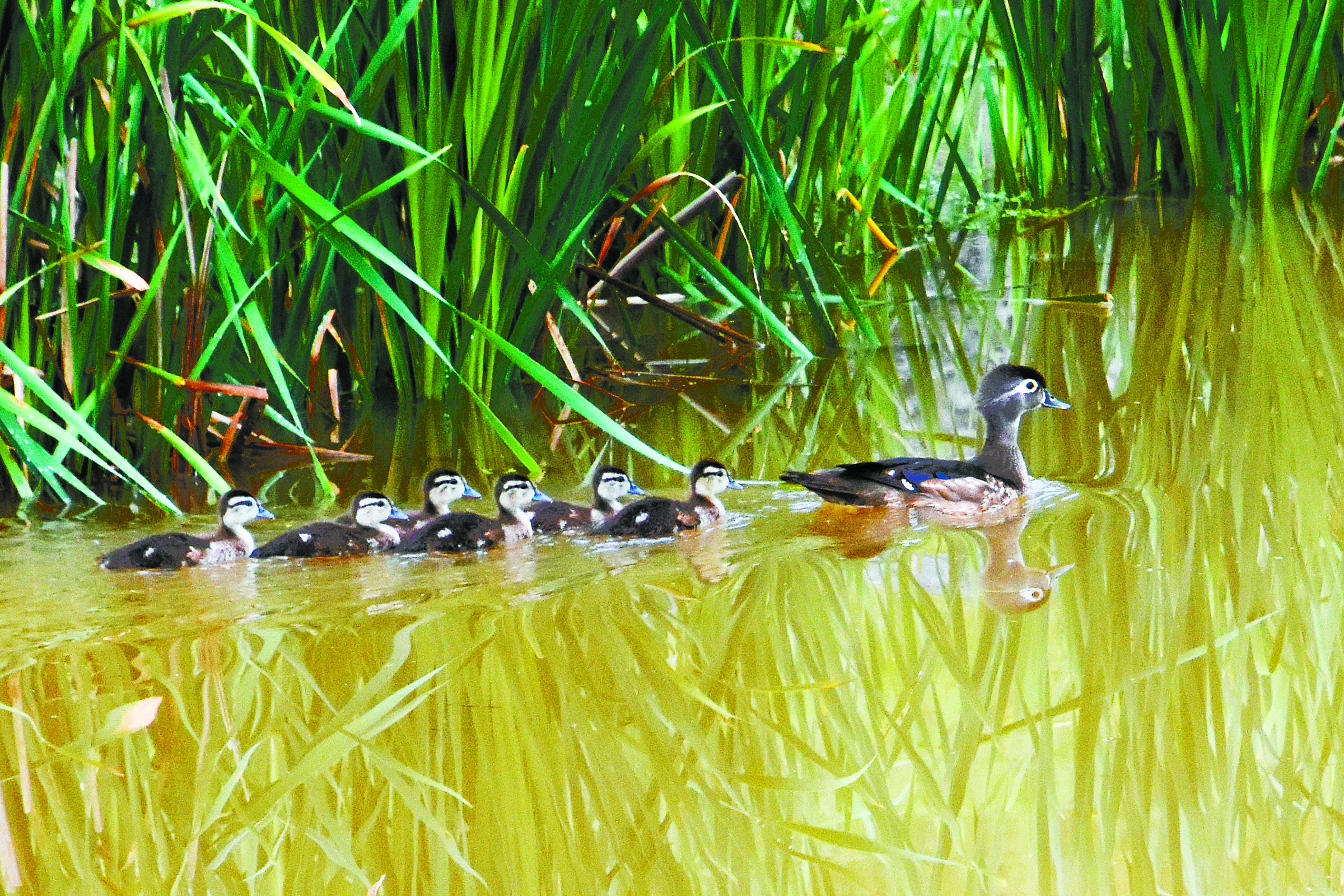
Photo by Jean Potter • Counters found 116 species on the recent Carter County Summer Bird Count, including this female wood duck and ducklings photographed on the Watauga River in Elizabethton, Tennessee. A total of 13 wood ducks were found on the day of the count.

The 28th Carter County Summer Bird Count was held Saturday, June 12, with 28 observers taking part.

The weather, which was less than optimal, challenged observers. Rain held steady for much of the day. The rain, along with dense fog on Roan Mountain and other high elevations, resulted in reduced birdsong in many areas. Thus, numbers of individuals were low for many species, especially songbirds.

Despite these hurdles, the count tallied 116 species, which is just one species shy of the recent 10-year average and actually two above the average of the previous 27 years, so, it was not bad considering the weather.
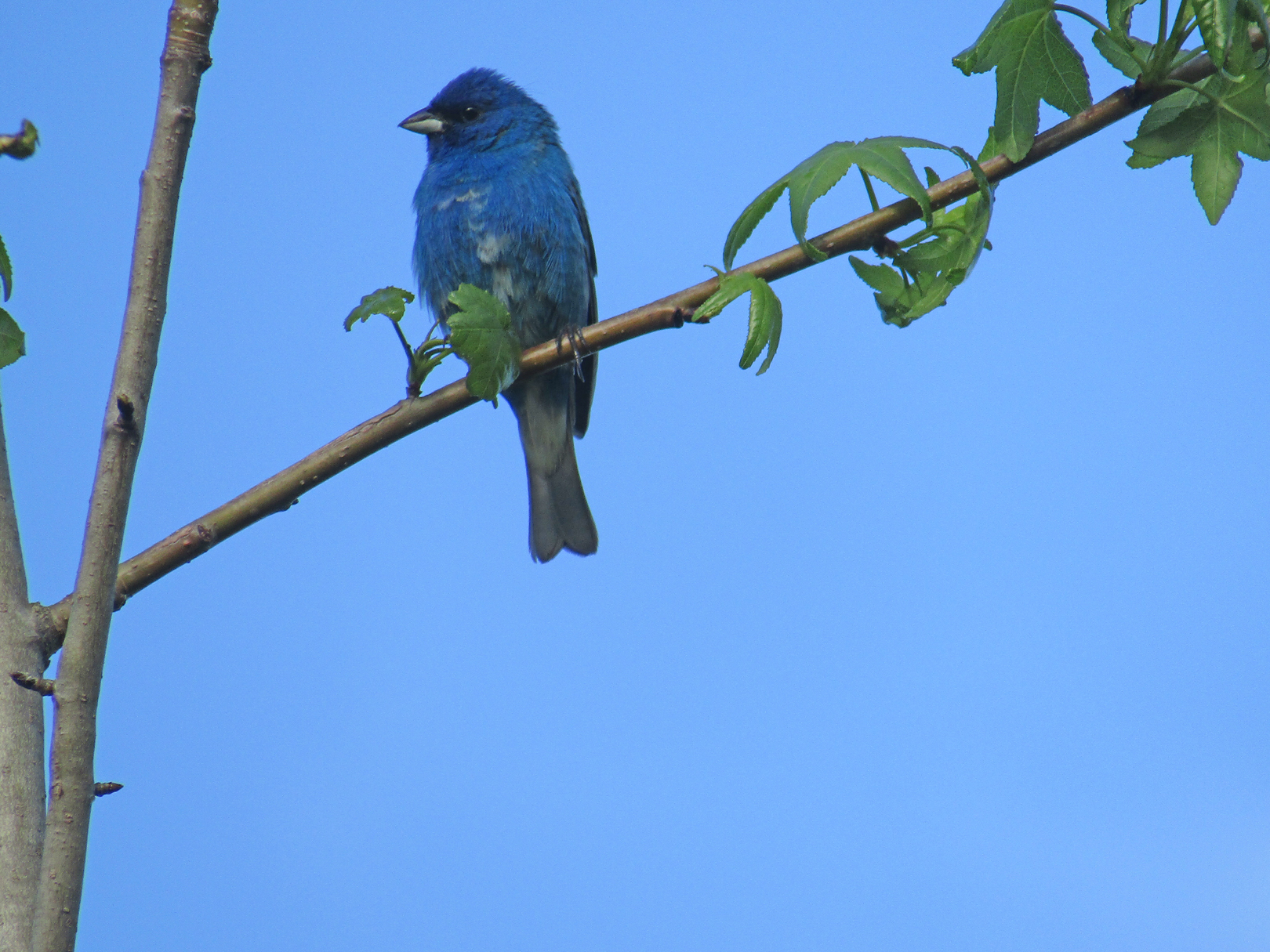
Photo by Bryan Stevens • Nesting neotropical migrants, such as this Indigo Bunting, increased the total number of species for the annual summer count.

Participants included Fred Alsop, Rob Biller, Catherine Cummins, Dianne Draper, Dave Gardner, Tammy Griffey, Don Holt, David Kirschke, Rick Knight (compiler), Roy Knispel, Richard Lewis, Dianna Lynn, Vern Maddux, Larry McDaniel, Joe McGuiness, Tom and Cathy McNeil, Brookie and Jean Potter, Judith Reid, Brenda Richards, Judi Sawyer, Michele Sparks, Bryan Stevens, Kim Stroud, Scott Turner, Charles Warden and John Whinery.

Some species were missed, including yellow-crowned night-heron, great horned owl, chuck-will’s-widow, willow flycatcher, brown creeper, hermit thrush, Kentucky warbler and magnolia warbler. These species are often, but not always, found on this count, according to long-time count compiler Rick Knight.

See if one of your favorite birds was hit or miss, common or uncommon, by scanning over the listing of the total.

The tally follows:
Canada goose, 218; wood duck, 13; mallard, 92; ruffed grouse, 1; wild turkey, 40; double-crested cormorant, 16; great blue heron, 23; and green heron, 2.
Black vulture, 7; turkey vulture, 25; osprey, 1; Cooper’s hawk, 3; bald eagle, 2; red-shouldered hawk, 4; broad-winged hawk, 7; and red-tailed hawk, 10.
Killdeer, 8; American woodcock, 1; rock pigeon, 101; Eurasian collared-dove, 2; mourning dove, 177; yellow-billed cuckoo, 5; Eastern screech-owl, 5; barred owl, 2; common nighthawk, 2; and Eastern whip-poor-will, 7.
Chimney swift, 99; ruby-throated hummingbird, 28; belted kingfisher, 11; red-bellied woodpecker, 24; yellow-bellied sapsucker, 2; downy woodpecker, 19; hairy woodpecker, 3; Northern flicker, 36; pileated woodpecker, 15; and American kestrel, 1.
Eastern wood-pewee, 24; Acadian flycatcher, 9; alder flycatcher, 2; least flycatcher, 13; Eastern phoebe, 48; great crested flycatcher, 7; and Eastern kingbird, 21.
White-eyed vireo, 5; yellow-throated vireo, 2; blue-headed vireo, 38; warbling vireo, 1; red-eyed vireo, 117; blue jay, 77; American crow, 185; fish crow, 4; and common raven, 5.
Purple martin, 38; Northern rough-winged swallow, 34; tree swallow, 109; barn swallow, 154; and cliff swallow, 137.
Carolina chickadee, 32; tufted titmouse, 65; red-breasted nuthatch, 3; white-breasted nuthatch, 10; house wren, 60; winter wren, 3; Carolina wren, 84; blue-gray gnatcatcher, 8; and golden-crowned kinglet, 2.
Eastern bluebird, 113; veery, 23; wood thrush, 35; American robin, 510; gray catbird, 42; brown thrasher, 38; Northern mockingbird, 62; European starling, 1,203; and cedar waxwing, 45.
Ovenbird, 50; worm-eating warbler, 4; Louisiana waterthrush, 10; golden-winged warbler 1; black-and-white warbler 27; Swainson’s warbler, 2; common yellowthroat, 12; hooded warbler, 67; American redstart, 8; Northern parula, 30; Blackburnian warbler, 4; yellow warbler, 1; chestnut-sided warbler, 12; black-throated blue warbler, 20; pine warbler, 2; yellow-throated warbler, 9; prairie warbler, 3; black-throated green warbler, 14; Canada warbler; 5; and yellow-breasted chat, 9.
Eastern towhee; 112; chipping sparrow, 61; field sparrow, 58; savannah sparrow, 1; song sparrow, 253; dark-eyed junco, 46; scarlet tanager, 25; Northern cardinal, 157; rose-breasted grosbeak, 5; blue grosbeak, 5; and indigo bunting, 102.
Red-winged blackbird, 109; Eastern meadowlark, 15; common grackle, 67; brown-headed cowbird, 43; orchard oriole, 4; and Baltimore oriole, 2.
House finch, 132; pine siskin, 1; American goldfinch, 97; and house sparrow, 44.

•••••


I received a phone call from Marian Swanson of Aldie, Virginia, this past week. Marian was looking for advice on feeders for attracting indigo buntings, which she had observed near her home. She was specifically seeking a feeder that would prevent the seed from getting wet during rainstorms.

At her request, I provided Marian with some links to websites offering a variety of feeders for sale.

It’s always great to hear from readers. If you have a bird-related question, email me at bstevens@erwinrecord.net or ahoodedwarbler@aol.com. I also enjoy hearing about bird observations or general comments from readers.

Couple glimpses odd bird at Unaka Mountain’s Beauty Spo


This American woodcock was photographed by Erwin resident Amy Tipton during a stop that she and her husband made recently at the Unaka Mountain Beauty Spot.

Known for migrating incredible distances, the shorebirds are often referred to as “wind birds,” a romantic allusion to their habit of taking wing for the epic journeys that astound scientists and birders alike.

Among the far-flung family known as the shorebirds are species known as sandpipers and plovers, as well as whimbrels, willets, tattlers, godwits, turnstones and an array of others.

Still, among the general public, as well as some birders, the shorebirds are a much misunderstood group of birds. For example, most people could hardly be blamed for believing that shorebirds are inhabitants of only the beach and shore.

In fact, some species are at home in a variety of habitats, ranging from woodlands and prairies to the Arctic tundra and mudflats. Some are notoriously elusive, their camouflage and low-key behavior allowing them to escape casual notice at most times.

In late winter and early spring, a true oddball among the shorebirds begins courting. The American woodcock, also known by such whimsical names as “bog sucker” and “timberdoodle,” is a shorebird that has completely abandoned the shore in favor of woodlands and fields. Beginning as early as February, American woodcocks in the region conduct nightly courtship displays, starting at dusk, that combine aerial acrobatics with an assortment of unusual acoustical flourishes. Any wet field adjacent to a wooded area could offer a stage for these evening displays, but unless you know where to look and make an effort to do so, the American woodcock might as well remain a phantom of the night.

These mating rituals provide almost the only time of the year during which this bird makes itself available for observation. It’s only during this brief window that opens into their lives that we can be assured a glimpse. Even then, our peeks at woodcocks often consist of a fuzzy twilight escapade as the bird flings itself heavenward only to make a spiraling descent a few seconds later. The displays begin with a distinct vocalization, a type of “pent,” that also has the quality of sounding like some sort of mechanical buzzer.

Once the displays conclude for the season, the birds assume nesting duties, usually unobserved by humans. The rest of the year, almost nothing but blind, sheer luck would allow a birder to stumble across an American woodcock. It’s almost as if they disappear after these spring flights of fancy.

Of course, they don’t actually disappear. They are still out there, going about their daily lives. On occasion, someone can stumble across one without even trying.

Amy Tipton can claim to be so fortunate after she and her husband, Paul, recently encountered an “unusual bird” on Unaka Mountain near the well-known Beauty Spot.

“We had gone to the Beauty Spot to watch the sunset on Sunday, June 27,” Amy wrote in a Facebook message to me. “It was the 20th anniversary of our first date.”

On the way back to the Jeep, Paul noticed a very unusual bird. He pointed out the bird and asked Amy if she knew what it was.

“It was just sitting at the edge of the parking area where the gravel/dirt road meets the tall grass,” Amy wrote. “It was not dark enough to keep us from seeing it, but plenty dark enough to keep me from getting a good photo.”

Amy said that she knew she only had one chance to get a photo.

“I set the flash and hoped for the best,” she wrote. “It’s blurry, but I’m thankful I was able to get anything. As soon as the flash fired, it made a funny noise and flew into the trees.”

Amy added, “It looked more like a sea bird to me, and we thought it might have flown off course. We had no idea such a strange bird lived on Unaka Mountain. We’ll always remember the first time we saw a timberdoodle.”

An American woodcock patrols a patch of bare ground in a photo by U.S. Fish & Wildlife.

One look at Amy’s photo confirmed that she and her husband had encountered a woodcock. With its big head and large eyes, the American woodcock is rather gnome-like in its appearance. There’s something downright odd about this shorebird that has chosen to exile itself so far from seashores.

Its chosen lifestyle, however, has proven advantageous for the species. The woodcock is an efficient forager, feeding on earthworms, as well as insects, millipedes and spiders. Scientists theorize that the woodcocks can actually hear and feel the earthworms as they move underground.

About 20 years ago, Joe McGuiness, an Erwin resident and a fellow member of the Elizabethton Bird Club, found an American woodcock one summer making itself at home in his neighborhood of Rolling Hills. I got to see that bird, which to date is my only upclose and personal observation of an American woodcock.

I have traveled to locations such as Shady Valley in Johnson County and Persimmon Ridge Park in Jonesborough to witness the courting flights of these unusual birds. Of course, since these flights do not commence until dusk, the experience is more auditory than visual.

The woodcock is closely related to the snipes. The only snipe species usually found in the United States is Wilson’s snipe, formerly known as the common snipe.

There is also a Eurasian woodcock and several species endemic to islands. These include the Amami woodcock of Japan, the Bukidnon woodcock of the Philippines, the Javan woodcock, New Guinea woodcock, the Moluccan woodcock of the Malaku Islands in Indonesia and the Sulawesi woodcock, also of Indonesia.

Worldwide, there are about 20 snipe species, including species with such descriptive name as giant snipe, noble snipe, pin-tailed snipe and imperial snipe.

So, if the legend of the snipe hunt ever made you doubt the actual existence of snipe, rest assured that both snipes and their odd cousins, the woodcocks, do exist.

Among feathered friends, catbirds are individuals

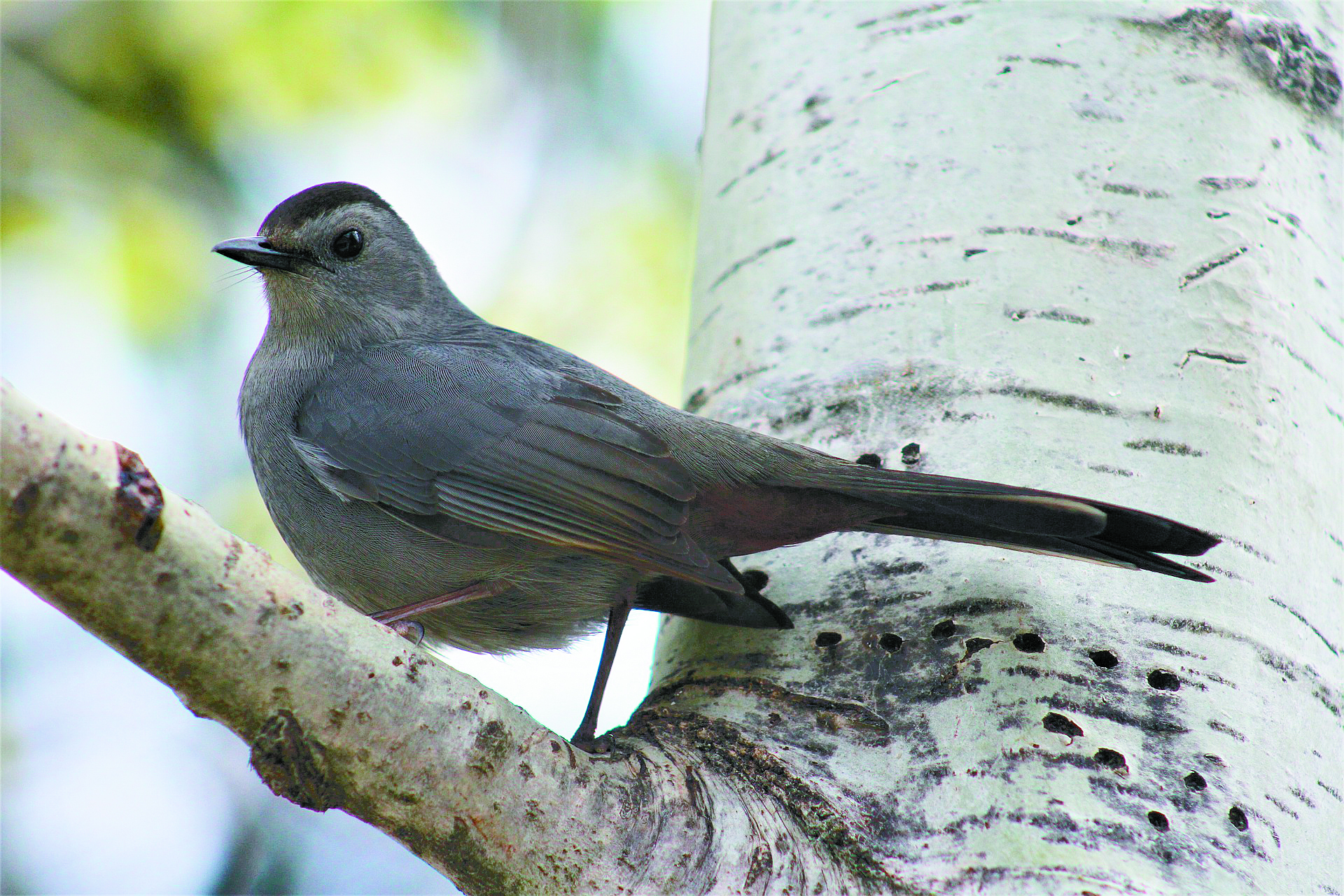
Photo by Bryan Stevens • Although often considered shy, skulking birds, some catbirds show a great deal of curiosity about and trust in humans.

I received an email on June 15 from Linda Durette, who lives in Townsend, Massachusetts, which is on the New Hampshire border.

“I live in a country environment with thickets and fields,” she noted.

Linda informed me that she had run across an article I wrote in 2019 about gray catbirds.
“I have always been mildly intrigued by the catbird,” she wrote. ‘Working around the yard and having a cat myself, I always got a kick out of their vocal annoyance with my cat.”

She said the catbirds begin squawking at her cat the minute he steps out the door.

Photo by by Jennifer Beebe from Pixabay • Gray catbirds have a reputation for being either shy skulkers or bold scolders. In fact, these birds are known for being individuals with unique and distinctive personalities. Like mockingbirds and thrashers, the gray catbird is considered a mimic thrush and can imitate snippets of the songs of other birds.

“I always kept him away from any nesting area, although he isn’t a particularly adventurous cat, anyway,” she noted.

“This year was the same,” she said. “My cat seemed to almost ignore the bird. He just sat there and allowed the bird to squawk loudly. I think the bird was miffed.”

She said she finally put her cat back in the house.

“But I have been noticing that the bird comes very close to me,” she wrote.

She wrote that the catbird appears to watch what she does when she is outdoors.

“I have been talking with him, chattering while I garden,” she wrote. “It’s a riot. He lands on the wheelbarrow handle after I walk away or allows me to walk pretty close to him as he watches.”
Linda concluded that this individual catbird, at least, seems to have quite the personality.
I’d mentioned in my previous column on catbirds about the fondness of these birds for fruit and how I occasionally offered berries to them.

“I will attempt some fruit, too,” she said. “It is so interesting. We’ll see what happens.”
Perhaps readers will recall the folksy expression “sitting in the catbird’s seat” that denotes self-satisfaction and perhaps a degree of smugness. As expressions go, it’s not a bad fit for this charming, somewhat eccentric bird.

Photo by Bryan Stevens A curious Gray Catbird peeks from dense cover. Attendees at the fall rally can look for catbirds and other species at any of the offered bird hikes.

The gray catbird is a baffling bird with a personality that runs the gamut from introverted to extroverted, sometimes depending on the season and at other times seemingly just on a whim. With some gentle persuasion, however, people can gain a catbird’s trust – as Linda has done with the bird in her Massachusetts garden – and develop a fun friendship with these clever songbirds.

One summer, all I needed to do to win over the catbirds was to offer some less-than-perfect strawberries and blueberries. A few blemishes on the fruit didn’t bother the resident catbirds at all, and they soon became accustomed to receiving such treats.

A person’s first introduction to the catbird is likely going to occur when one hears what sounds like an irritable feline hiding in a hedge, thicket or dense shrub. Upon closer examination, observers may get a glimpse of a charcoal gray bird roughly the shape of a Northern mockingbird but smaller. A black cap and a patch of rusty-red feathers under the tail are the only exceptions to this bird’s overall gray plumage.

The catbird is related to thrashers and mockingbirds, but scientists find the gray catbird just different enough to warrant placing it in its own genus. The genus name Dumetella means “small thicket.” It’s an apt name for this secretive skulker. Catbirds only feel secure in dense cover such as hedges, brush piles and dense thickets.

A relative known as the black catbird, which ranges throughout the Yucatan Peninsula of Mexico, as well as northern Guatemala and northern Belize, also belongs to a genus of its own. The genus name Melanoptila for this close relative is a compound word created from two Greek words: melas, meaning “black” and ptilon, meaning “plumage.” Both of these catbirds are classified as “mimic thrushes,” or Mimidae, of which there are about 30 species in the New World. There is a totally unrelated family of catbirds that ranges through Australia, Asia and parts of Africa.

The gray catbird is not as an accomplished mimic as some of its relatives, such as the Northern mockingbird. Males have motivation to constantly expand their repertoire, however, as doing so increases the likelihood of attracting a mate. They imitate other birds, but some have been recorded imitating frogs and other non-avian singers.

The website All About Birds also offers some helpful advice for attracting gray catbirds. To entice these birds, plant native fruit-bearing trees and shrubs such as dogwood, winterberry and serviceberry.

While the closely related brown thrasher and Northern mockingbird have both been honored with recognition as official state birds, this designation has never been bestowed on the gray catbird.

The female catbird constructs the nest, but her mate may helpfully provide some of the nesting materials. She may spend as long as a week building a rather bulky nest. She usually lays one to six eggs, which require an incubation period of about two weeks. Once the young hatch, both parents are kept busy bringing food to the young. Hatchlings will remain in the nest for about 10 days, but parents continue to care for and feed young even after they have fledged and departed the nest. Catbirds nest two or three time in a season.

According to the website All About Birds, the oldest known gray catbird was at least 17 years and 11 months old when it was recaptured and rereleased during banding operations in New Jersey in 2001. That individual had been banded in Maryland in 1984. So, if you do manage to strike up your own friendship with a catbird, there’s a good possibility that it could become a long-term relationship, especially since many birds like to return to a home territory year after year.

To share an observation, make a comment or ask a question, please send email to ahoodedwarbler@aol.com. I enjoy hearing from readers about shared interests in birds.

Blue of indigo bunting’s plumage is a trick of the light

Photo by Bryan Stevens • The male indigo bunting is a resplendent bird.

The indigo bunting is one of the reasons I love to pay attention to the clientele visiting my feeders. This small songbird likes to reside in the boundary region where forests and woodlands meet fields and pastures. Personally, the indigo bunting has always been a bird that is suggestive of the long, hot days of summer.

One of my earliest and still quite vivid birding memories is a recollection of a shockingly blue bird atop a blue spruce tree in my yard. Several decades later, the tree is no longer standing, but these beautiful birds — I now know these summer visitors were indigo buntings — still return each year to my yard and gardens.

Indigo buntings usually arrive in the region in late April, and I’ve seen them linger until late October, although most indigo buntings have left the region by late September.

Upon arrival, male indigo buntings become tenacious singers, repeating their jumbled notes even during the hottest hours of summer afternoons. The preference of this small songbird is to sing from the tops of tall trees, where they are often concealed by the green leaves. When I do get a glimpse of the obscured songster, often all I see is a dark shape silhouetted against the bright sky. Sometimes, if he plunges from the upper branches into the woodland understory, I get that telltale glimpse of blue feathers.

Photon by Bryan Stevens • Indigo Buntings will perch on wires and sing for hours even during hot summer days.

The male indigo bunting is the only solid blue bird in the eastern United States, but it’s all an illusion — literally a trick of the light. The indigo bunting’s feathers are not really blue; the male’s brilliant azure plumage is caused by the process of diffraction of light around the structure of the bird’s feathers. This process scatters all but the blue light, and the resulting color shifts from black to blue to turquoise as the angle of reflected light changes. In bright light, it can even look unnaturally vivid blue. In poor light, however, an indigo bunting male can appear black. Fortunately, indigo buntings have both a characteristic body shape and song, so even if the birds are not seen at their best, they can still be recognized.

Soon after returning to the eastern United States each spring, female buntings begin to gather materials to construct a well-crafted, cup-shaped nest. The male usually stays close to her, but he offers no assistance with nest building. She usually lays a clutch of three to four eggs, but she may nest another two times in a single season. She will incubate the eggs for almost two weeks, but the young remain in the nest another two weeks after being hatched as featherless, blind and helpless young completely dependent on the care of attentive parents. The task of raising so many broods in the space of only a few months requires the participation of both the female and her mate, who must work hard to bring enough insects to the nest to keep the young fed.

Like many species of songbirds, the male is by far the most colorful. In this instance, the male is also responsible for the species’ name. Indigo is a blue dye that was once an important crop in the South. The drab female may boast some blue highlights in her plumage. Juvenile birds just out of the nest also resemble the female. Pay close attention to any indigo buntings you observe as summer progresses. Juvenile birds will look mostly brown with just a hint of blue in the wings and the tail. These will be the young buntings that were hatched in spring and early summer. They will often accompany their parents to feeders.

Photo by Dan Sudia/USFWS • Female and young indigo bunting do not show the intense blue of adult males.

Indigo buntings are particularly fun birds to observe in late summer. Indigo bunting juveniles, like the young of many other birds, beg for tidbits from parents by “bowing,” spreading their wings and shivering. These actions usually prompt a parent to pop some morsel into an impatient youngster’s open bill. Indigo buntings are relatively easy to view. They frequent weedy fields and roadside brush. During the breeding season, males can also be seen singing from prominent perches. The song, a distinctive jumble of notes, can help observers find these dedicated singers.

The indigo bunting belongs to a genus of birds known as Passerina, which is included the family Cardinalidae, which includes birds like Northern cardinal and rose-breasted grosbeak. They are often lumped into a group known as North American buntings, although they are not closely related to such birds as snow bunting and lark bunting. The latter is even recognized as the official state bird for Colorado, a unique honor for this group of birds. The other members of the Passerina genus include lazuli bunting, varied bunting, painted bunting, rose-bellied bunting, orange-breasted bunting and blue grosbeak.

Worldwide, other birds known as buntings include such descriptively named species as slaty bunting, corn bunting, white-capped bunting, gray-necked bunting, cinereous bunting, lark-like bunting, cinnamon-breasted bunting, chestnut-eared bunting, little bunting, yellow-throated bunting, golden-breasted bunting, black-headed bunting, red-headed bunting and yellow bunting.

Photo by Bryan Stevens • Although bright blue, a male indigo bunting will often blend with its surroundings.

The male indigo bunting is one of the most colorful birds to visit feeders in the region. This species is also extremely fond of millet seed. I like to have some feeders stocked with millet when the buntings begin to return each spring. They will also feed on thistle and sunflower seeds. Away from our feeders, they also devour plenty of seeds from various noxious weeds. Because of the indigo bunting’s appetite for the seeds of destructive weeds, it is considered a beneficial bird.

Ovenbird part of the returning warbler lineup

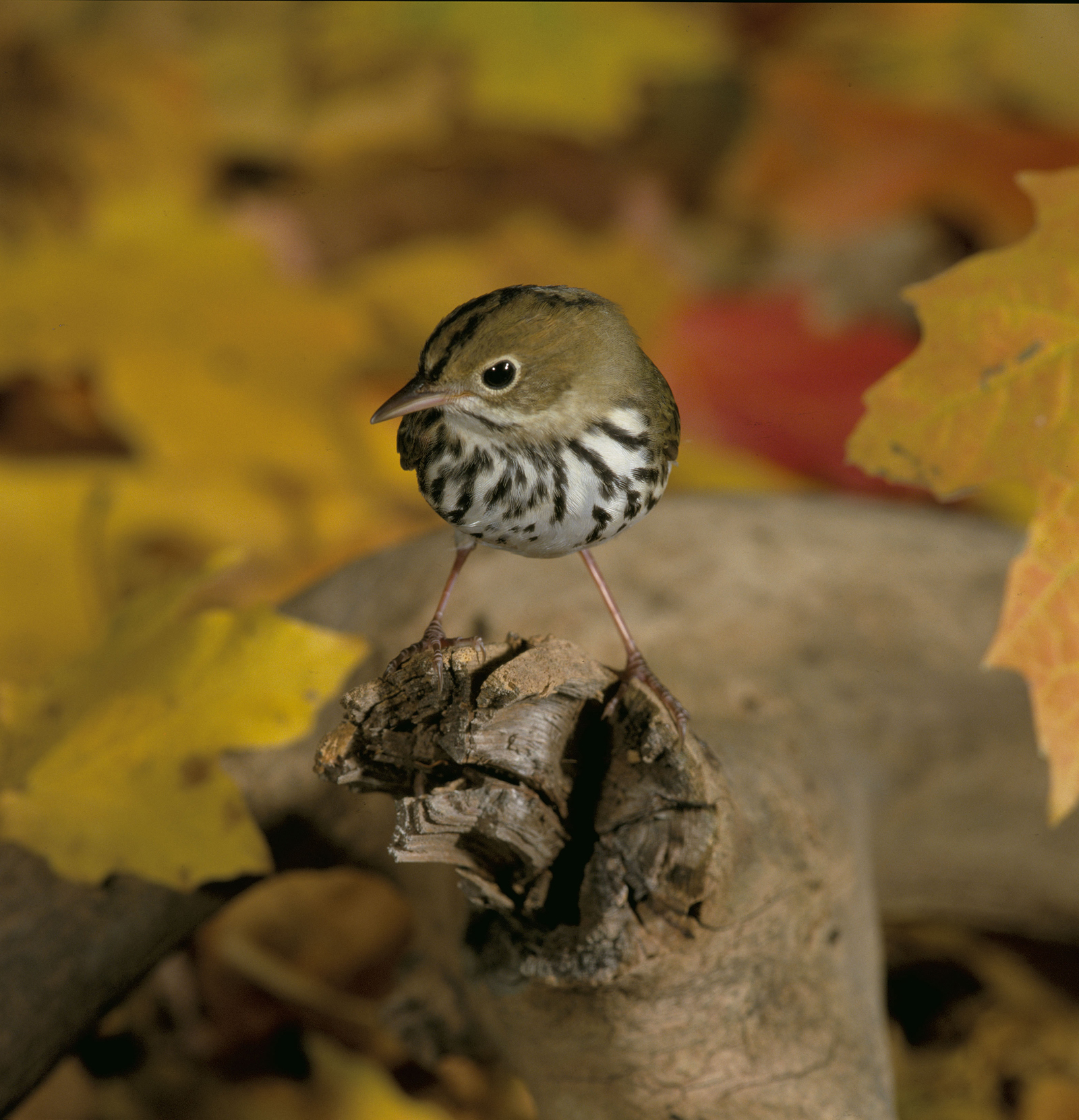
Photo by U.S. Fish & Wildlife Service • Ovenbirds are content to spend most of their time near the forest floor.

It’s been a week of arrivals at my home. Several species of warblers made their spring debuts, including a handful of male ovenbirds.

These warblers arrived on April 14 and immediately began singing their loud and ringing “Teacher! Teacher! Teacher!” song from concealment within the woodlands surrounding my home.

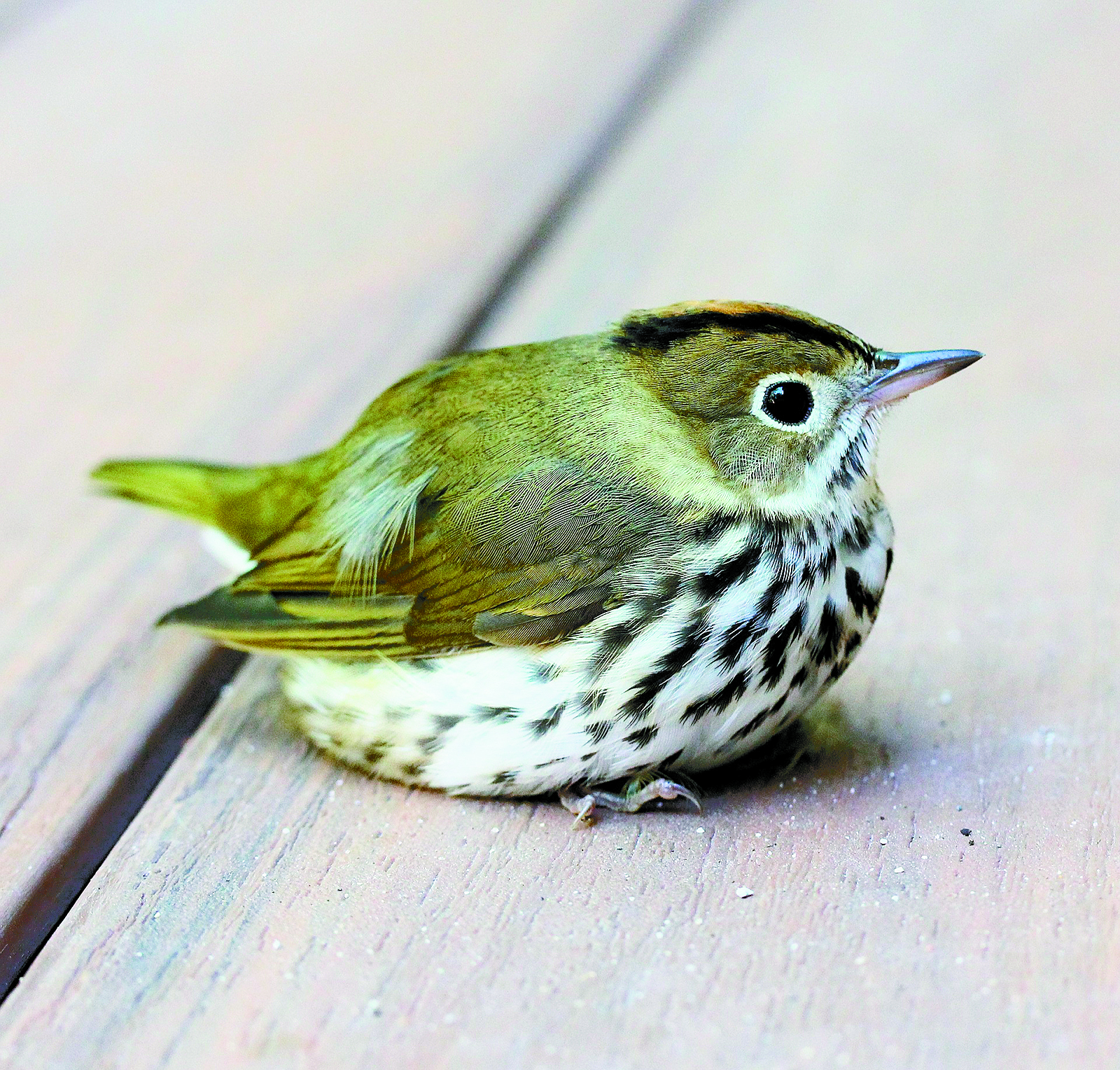
The ovenbird is not one of the brightly colored warblers, such as black-throated blue warbler or yellow warbler. The ovenbird is a small brown bird with a white breast with dark streaking — an appearance that bears a superficial resemblance to the larger thrushes that share the same woodland habitat. The only hint of color is an orange crown bordered by dark stripes atop the bird’s head. Even this orange crown patch is not easily seen. When agitated, an ovenbird may raise its head feathers, which makes this orange mark easier to detect. The ovenbird also shows a distinct white ring around each eye, as well as pink legs and a pinkish bill.

The resemblance to North America’s brown thrushes didn’t go unnoticed by some early American naturalists. Painter and famous naturalist John James Audubon painted a pair of ovenbirds, which he knew as “golden-crowned thrushes.” When comparing the two names, one can’t help but wish that the inaccurate but more romantically descriptive golden-crowned thrush had stuck.

While not likely to take an observer’s breath away with an unexpected explosion of vibrant plumage, the ovenbird’s not a drab bird. These warblers possess a subtle beauty all their own that is worth taking the time to behold.

Photo by Peggy Dyar from Pixabay • Despite the oliver-brown plumage, a closer look shows that the overbird is a bird with a subtle beauty, including an inconspicuous orange crown.

Unfortunately, ovenbirds are stubborn about letting themselves be seen. They’re easily heard. The males begin singing a loud, rollicking “Teacher! Teacher! Teacher” song almost as soon as they arrive on potential nesting grounds.

The ovenbird, unlike many warblers, is not named for its appearance. Instead, the bird’s name derives from the shape of the nest it builds. The nest is a domed structure placed on the ground, woven from vegetation and containing a side entrance. Early European settlers in North America thought the nest looked like a Dutch oven, hence the name “ovenbird” for the small warbler with the intricate nest.

Rather than hopping along the length of a branch or limb, an ovenbird walks in a deliberate fashion. This bird feeds on insects, spiders and other small prey items foraged from the woodland floor. On rare occasions, a lingering ovenbird shows up at feeders during the winter months.

Again, the most persistent characteristic of this warbler is the fact that it’s shy. It’s not as notoriously shy as warblers like mourning warbler of Connecticut warbler, but the ovenbird spends much of the time near the woodland floor and out of sight. The best time to catch a look at this warbler is once they begin nesting. Parents are extremely protective and defensive of their nest and young. Intruding too close is sure to bring some sharp alarm notes. The parents will often confront an intruder, flitting from branch to branch in nearby trees, utterly neglecting their usual preference for remaining unseen if not unheard.

Photo by Jean Potter • An ovenbird sings from a perch in the leaf canopy.

Ovenbirds spend the summer nesting season in mature deciduous and mixed forests across Canada and the eastern United States. They do not make as lengthy a migration as that undertaken by some of their relatives. Ovenbirds migrate each fall to the southeastern United States, the West Indies and also spreads out from Mexico to northern South America for the winter season.

It’s one of several warblers that nest in Northeast Tennessee and Western North Carolina. Others include Louisiana waterthrush, Kentucky warbler, common yellowthroat, Swainson’s warbler, black-throated blue warbler and American redstart, among others.

•••••

My mom saw her first hummingbird of spring on April 16 at 9:34 a.m. Of course, the bird waited until I’d left for work to make an appearance.

My solace has been an influx of other migrants in the past week. A blue-gray gnatcatcher’s fussy buzz alerted me to its return on April 10. I eventually got binoculars focused on the fidgety bird as it flitted in the upper branches of a cherry tree.

I heard the familiar chittering cries overhead while walking in downtown Erwin on April 14. Looking skyward, I watched a flock of chimney swifts flying gracefully over the rooftops of downtown buildings.

New warblers at home this week, other than the ovenbird, have included hooded warbler and black-throated green warbler, both of which put in their first spring appearance on April 15.

•••••

As noted, hummingbirds are returning. I’ve had reports from Western North Carolina and all across Northeast Tennessee. I will compile a listing of those who have shared their first sightings with me for next week’s column.
Keep sharing your hummingbird observations at ahoodedwarbler@aol.com or post them on my Facebook page. Please include the date and the approximate time of your sighting.

Hermit thrushes brave East Tennessee winters

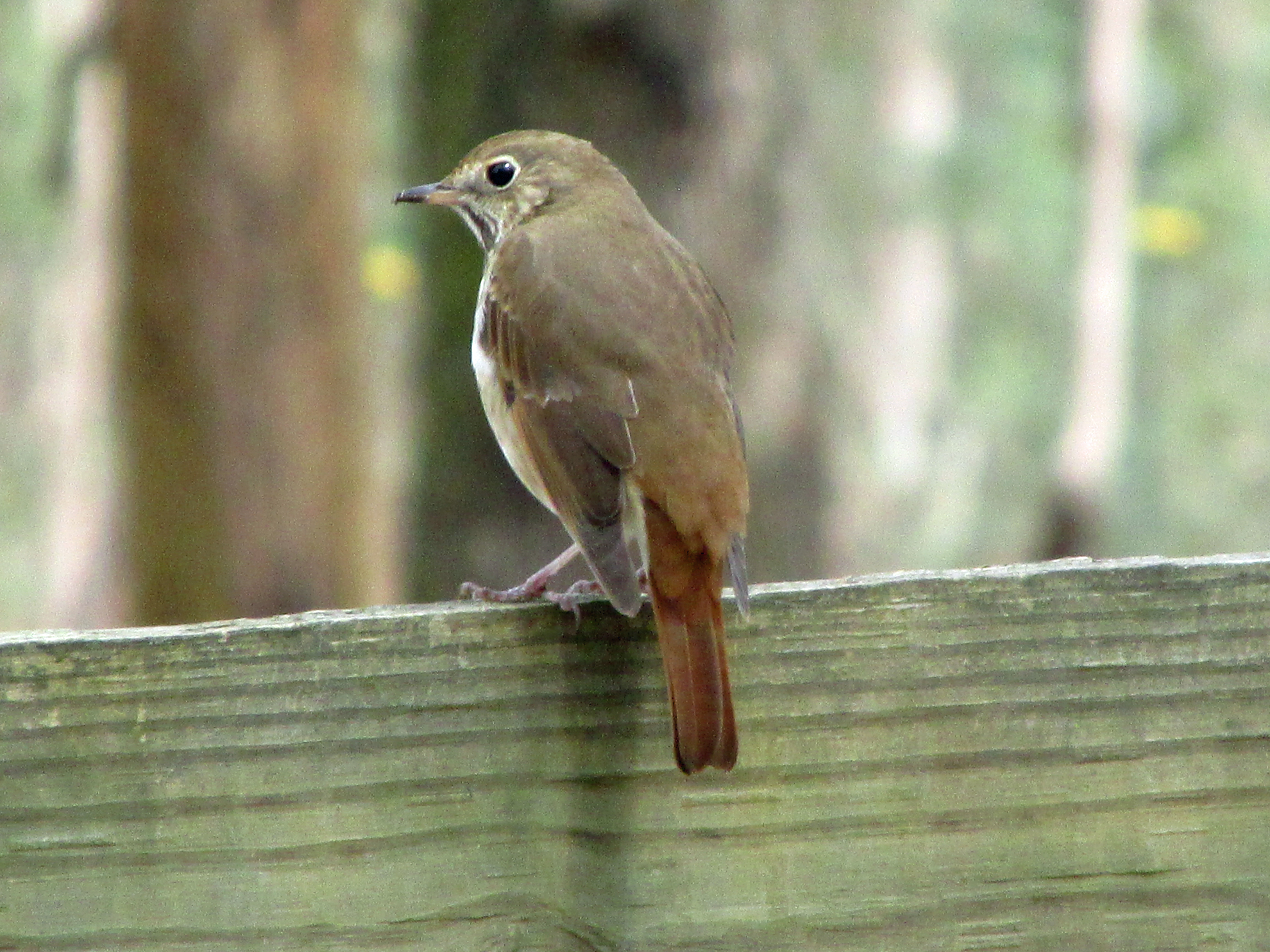
Photo by Bryan Stevens • A hermit thrush perched on a fence rail shows the reddish tail, a reliable field mark to separate this species from close relatives. The tail contrasts from the rest of the bird’s plumage.

Karen Miller sent me an email about a winter visitor in her yard at her home in Parrottsville, Tennessee. “I have seen a hermit thrush eating holly berries for 10 days,” Karen wrote. “Is he migrating or is he perhaps a winter visitor here in Parrottsville?”

To answer her question, I replied and informed her that the thrush is a winter visitor. The hermit thrush takes up residence after its kin have already departed the region in the fall, making it one of the few thrushes to remain in Northeast Tennessee during the winter months. I’ve always thought a good nickname for this bird would be the “winter thrush” because of its presence during the colder months of the year. Of course, for those who know where to look, a few hermit thrushes spend the summer nesting season at high elevation peaks such as Roan Mountain on the Tennessee and North Carolina border.

The hermit thrush is one of the larger brown thrushes, which also includes such related birds as Swainson’s thrush, veery, gray-cheeked thrush and wood thrush. Other less closely related members of the thrush family include the American robin, Eastern bluebird and Townsend’s solitaire.

USFWS • Hermit thrushes like to keep to the shadows.

The poet Walt Whitman employed a hermit thrush as a symbol in his poem, “When Lilacs Last in the Dooryard Bloom’d,” a moving pastoral elegy in honor of the assassinated President Abraham Lincoln. Whitman evidently knew his birds, and it’s not difficult for naturalists and bird enthusiasts to identify that he referred to the hermit thrush when he wove this songbird as a symbol into his stanzas honoring Lincoln. “Sing on there in the swamp,” Whitman wrote in his poem. “O singer bashful and tender, I hear your notes, I hear your call. I hear, I come presently, I understand you…”

Whitman evidently knew of this bird’s bashful, retiring habits, and he had obviously enjoyed the flute-like notes of the hermit thrush’s call. Whitman and many other Americans have been made fans of this gifted songbird. In fact, the citizens of Vermont even proclaimed the hermit thrush as their official state bird. The hermit thrush is well known for its song — a series of clear, musical notes, each on a different pitch, consisting of a piping introductory note and a reedy tremolo. The song had often been described as melancholy by various bird experts. The birds don’t usually sing in winter, but they do produce a call note when disturbed or alarmed that is described as a low “chuck.”

The visiting hermit thrush at her home has allowed Karen Miller to get to know this somewhat reclusive bird better. “He sits on the ground, cocks his head, spies a berry and then jumps up and gets it,” she wrote. She noted that her visitor has a good appetite. “He eats four or five at a time,” she said. “I’m so glad to see him.”

Photo by USFWS • Like many thrushes, the hermit thrush is fond of fruit and berries, especially during the winter.

According to the Smoky Mountains Visitors Guide website, the hermit thrush forages for most of its food from the ground. This bird’s diet includes insects, spiders, snails, and earthworms, plus considerable amounts of wild fruits during the fall and winter. Hermit thrushes may join up with mixed flocks of birds during the winter, often associating with such songbirds as kinglets, brown creepers, chickadees and titmice. For those not fortunate enough to host a wintering hermit thrush, this bird can be found during the summer months atop some high-elevation peaks. Close to home, look for this thrush in the Roan Mountain Rhododendron Gardens. The hermit thrush is also found at some locations in the Great Smoky Mountain National Park.

Female hermit thrushes collect nesting materials and construct the nest, within which she will lay three to six eggs. These thrushes nest once or twice a season. According to the website All About Birds, nesting habits differ between hermit thrushes in the western North America and their counterparts in the eastern half of the continent. Eastern thrushes tend to nest on the ground, but those in the west often place their nests in shrubs or tree branches.

At home on Simerly Creek Road, my first hermit thrush of the winter arrived in early November of last year. During a woodland stroll with neighbor Beth McPherson, the resident thrush put on an impressive show, hopping and scraping on the woodland floor beneath a rhododendron thicket bordering a mountain spring. In such surroundings, it’s not difficult to fathom why this bird has developed such a subtle plumage of muted browns and grays. Even when foraging actively, the bird blended remarkably with the background of fallen leaves and other woodland debris.

The hermit thrush is known by the scientific name, Catharus guttatus. The term guttatus is Latin for “spotted,” which seems appropriate. Surprisingly, the hermit thrush is not closely related to the other North American migrant species of Catharus thrushes. Instead, the hermit thrush is more closely related to the russet nightingale-thrush, a Mexican songbird. The hermit thrush could accurately be called the “red-tailed thrush” for the fact that this species has a rusty-red tail that stands apart from the warm brown-gray tones of the rest of its plumage. A white eye ring, pink legs and a heavily spotted breast complete the rest of this bird’s understated appearance.

Photo by Bryan Stevens • A hermit thrush perches on a branch in a winter woodland.

The wintering hermit thrushes in the region will likely stay put for the next couple of months, but they will mostly depart the area in April or early May. If you want to look for them, now’s the time.

••••• Bryan Stevens lives near Roan Mountain, Tennessee. To learn more about birds and other topics from the natural world, friend Stevens on Facebook at https://www.facebook.com/ahoodedwarbler. He is always posting about local birds, wildlife, flowers, insects and much more. If you have a question, wish to make a comment or share a sighting, email ahoodedwarbler@aol.com.


Sapsucker an odd bird out among woodpeckers

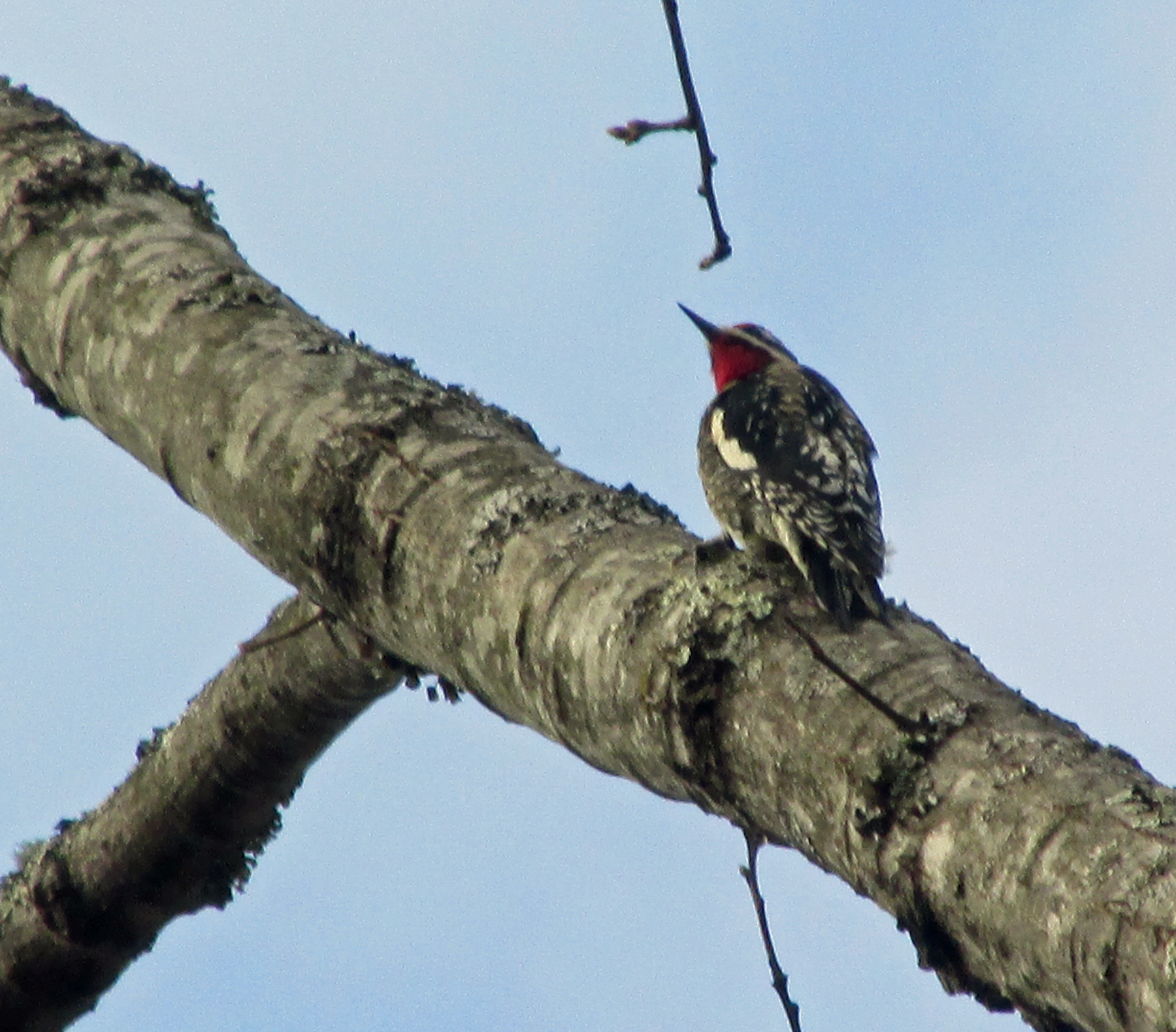
Photo by Jean Potter • A yellow-bellied sapsucker visits a suet feeder.

I heard the whiny “mews” coming from a nearby tree and scanned with binoculars until I located a calling yellow-bellied sapsucker. I always think sapsuckers sound whiny, but I still celebrated seeing one from my front porch on the afternoon of Jan. 11. The new year is still young, which makes me eager to see what other birding surprises may arrive.

I’ve kept track of the birds in my yard since the winter of 1992-1993, and my recent observation is only the second sapsucker I have seen at home. I’ve found the evidence of their presence in sapsucker rings drilled in bands of holes around tree trunks and branches, but the actual flesh and feather sapsuckers have been extremely evasive.

Photo by Bryan Stevens • A yellow-bellied sapsucker hitches its way up a tree trunk.

The aforementioned rings or bands are the visible evidence of a sapsucker’s penchant for drilling evenly spaced holes, or wells, into the trunk of a sap-bearing tree. These holes even form patterns completely encircling a tree’s trunk. The sticky wells trap insects. When sapsuckers return to the scene of the crime, they enjoy a sweet treat of oozing sap and a protein snack from the mired bugs.

I don’t think my lack of success with sapsuckers at home is for lack of effort. I heard the sapsucker the moment I stepped outside to fill up the feeders. The sapsucker blended almost perfectly into its surroundings, becoming almost invisible against the bark until making little hitching movements up the trunk. I wish I could report that I see yellow-bellied sapsuckers on a regular basis. I think they would be fascinating to observe in the same way I watch downy woodpeckers and red-bellied woodpeckers.


Worldwide, there are almost 10,000 species of birds. After awhile, one may begin to wonder if thinking of unique names for each of these species began to deplete creative reserves.

Then again, some of the names given to birds suggest someone really wanted just to have fun at the expense of birders and nature enthusiasts. After all, you have to be careful about shouting out bird names like blue-footed booby, great bustard and hoary redpoll in mixed company.

There are also bird names that just don’t make a lot of sense — dickcissel and phainopepla, for example — even to birders. Then there are names that are oxymoronic, including greater pewee and giant hummingbird.

There are some bird names that sound like fighting words that bring into question concepts like courage and honor. Indeed, I sometimes think people are waiting for a punchline when I inform them there truly is a species of bird known as the yellow-bellied sapsucker. This bird’s humorous name is only one of the ways the yellow-bellied sapsucker stands out as an oddball among the region’s clan of woodpeckers.

In profile clinging to the trunk of a tree, the yellow-bellied sapsucker is a rather pudgy, especially for a woodpecker. The sapsucker has black and white plumage enhanced by red foreheads in both sexes. Male sapsuckers also have a bright red throat patch. Both sexes also show a large white stripe on their black wings. And yes, there is enough of a pale yellow wash on the stomach of this odd woodpecker to justify the descriptive “yellow-bellied” as part of its common name.

As mentioned, sapsuckers harvest sap by using their bills to drill various sorts of holes into the bark of a tree. Some of the more shallow holes, which are usually made in a rectangular fashion, must be maintained on a frequent basis for the bird to continue to derive sap from the tree. These sap wells not only provide nourishment to the sapsucker but to other birds, including hummingbirds, that appreciate a quick sugar fix.

In the early 1800s, early naturalist and artist John James Audubon painted the yellow-bellied sapsucker, known during his time as the yellow-bellied woodpecker. Although they tend to prefer trees like maple and birch, sapsuckers are known to feed on more than 250 different varieties of trees. Indeed, they actually do feed on the trees. Not only do these birds subsist largely on sap, they also feed on the cambium layer in the bark of a tree. The sapsucker also supplements its diet with insects, fruits and seeds. Unlike other members of the woodpecker clan, sapsuckers do not visit feeders all that frequently. When a sapsucker does visit a feeder, it is often lured there by the promise of suet.


While most woodpeckers attempt to tough out the winter season in the same region where they spent the summer, the yellow-bellied sapsucker is migratory. Ahead of the coldest months of the year, sapsuckers migrate to the southeastern United States, as well as the West Indies and Central America. During the summer months, most sapsuckers nest in forests across Canada, Alaska and the northeastern U.S. states. There is also a small population of breeding sapsuckers in the Appalachian Mountains of Virginia, Tennessee and North Carolina.

The yellow-bellied sapsucker has a call that sounds amazingly like the meow of a cat. I know about this call from personal experience. While birding in South Carolina a few years ago, I searched diligently for the source of such a call. It sounded somewhat like a gray catbird — another mimic of the common household feline — but not quite. Now I know that when I hear this unusual call I can train my binoculars on the branches and trunks of nearby trees to scan for a sapsucker.

There are actually another three sapsucker species — Williamson’s, red-breasted and red-naped — in North America, but they are all birds of the western half of the continent.

It is true of many species of birds that males and females look different. In the case of the Williamson’s sapsucker, males and females look so different that early naturalists mistakenly believed the male and female were entirely different species! Only two decades after the initial discovery of this bird did scientists finally realize that both male and female Williamson’s sapsuckers were the same species. This particular sapsucker was named in honor of Lt. Robert Stockton Williamson, who led a surveying expedition that collected the first male. The intent of the expedition wasn’t focused on collecting birds. Williamson and his men had actually been assigned the job of identifying the best route west for a railway to the Pacific Ocean.

Although I haven’t been too lucky with this bird at my home, it isn’t too difficult to find this bird during fall migration and in the winter months at city and state parks in the region. If you observe a yellow-bellied sapsucker in your own yard, consider yourself lucky to get a glimpse of this oddball woodpecker.

Club holds 51st annual Fall Bird Count

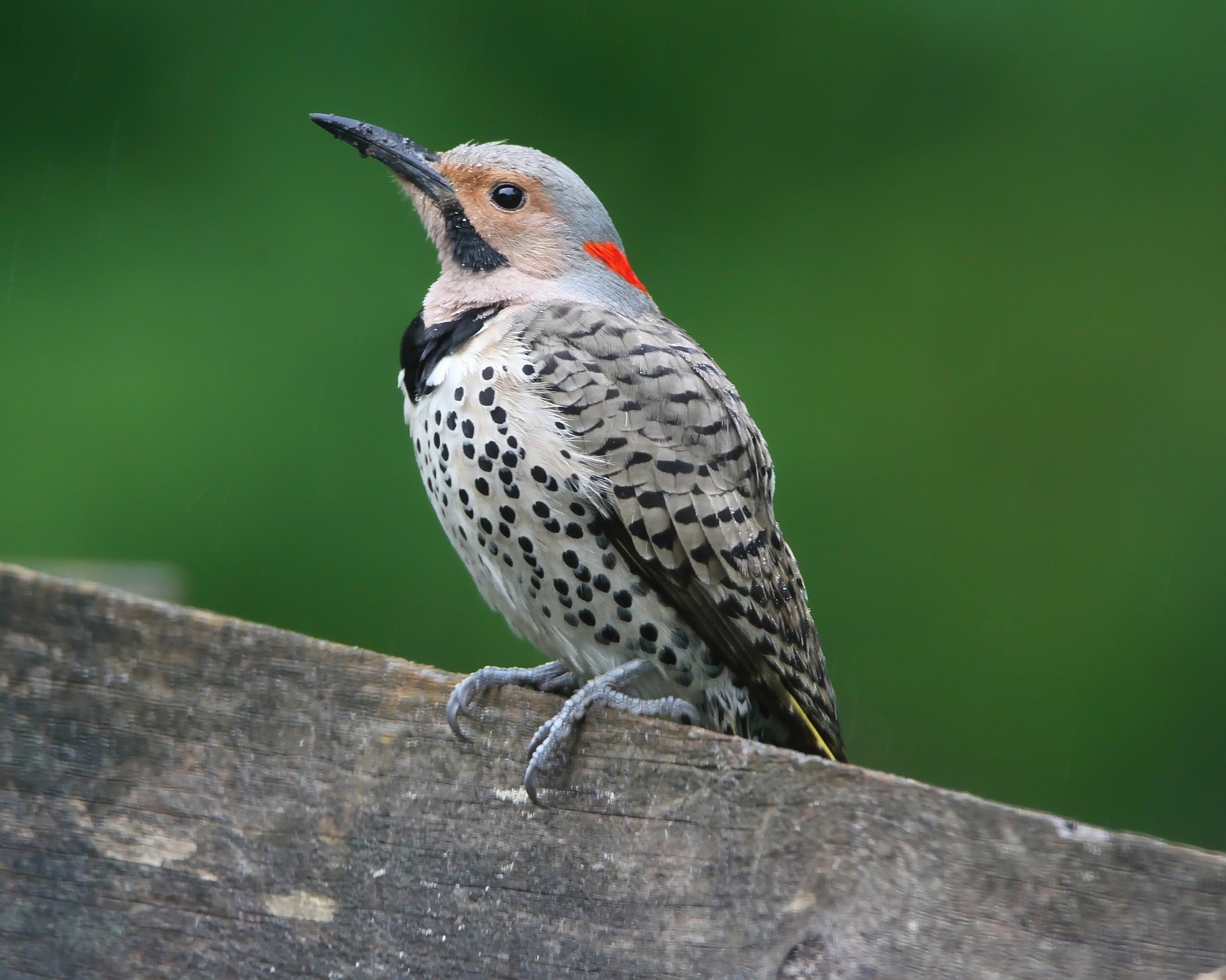
Photo by NatureLady/Pixabay.com • Northern flickers made a strong showing on the 51st consecutive Fall Bird Count. Eighty of these woodpeckers were found by count participants spread across the five-county area of Northeast Tennessee.

The 51st  consecutive Elizabethton Fall Count was held on Saturday, Sept. 26, with 48 observers in 18 parties. The participants were dispersed more than normal due to social distancing protocols. This is the third seasonal count conducted since the start of the Covid 19 pandemic.

The area covered included all of Carter County, as well as parts of the adjacent counties of Johnson, Sullivan, Unicoi and Washington.

A total of 132 species were tallied, which is above the recent 30-year average of 125 species. The all-time high on this count was 137 species set in 1993.

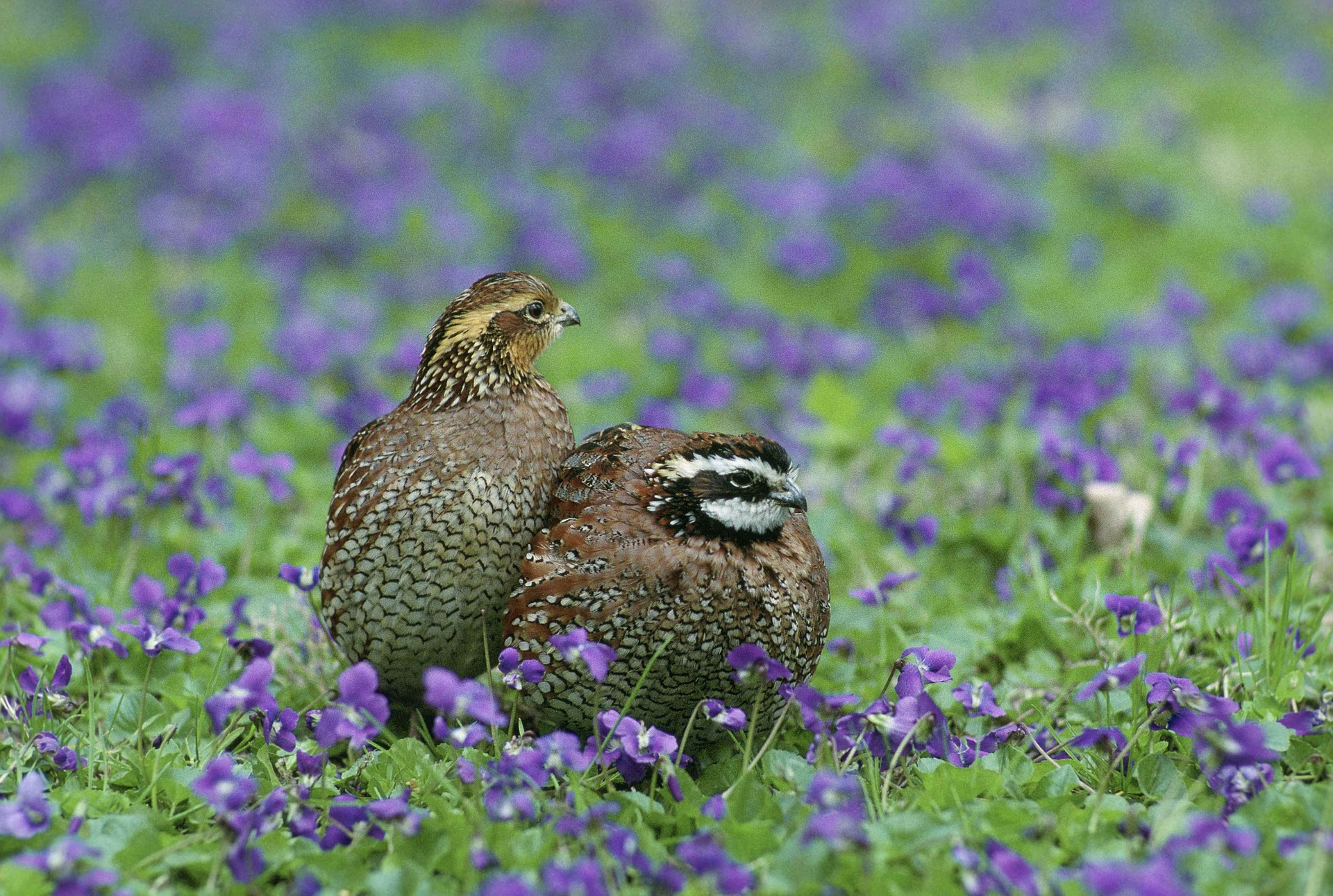
Photo by U.S. FWS   Many birds, such as Northern bobwhites, have seen alarming population crashes in the last half century.

Some interesting finds included a Northern bobwhite covey near the community of Bowmantown in Washington County. Such high numbers of bobwhites have become increasingly rare in recent years.Thirteen unidentified species of Empidonax flycatchers were found, but these birds do not count into the total of species. These small flycatchers are so similar in appearance that their song is usually needed to confirm identification. In fall migration, however, these flycatcher go silent for the most part. A yellow-bellied flycatcher and two least flycatchers were identified.

A total of 23 species of warblers were found, including such interesting finds as golden-winged warbler, blackpoll warbler and Wilson’s warbler.

European starling proved the most abundant bird with 1,757b individuals counted. Other common birds for the count included Canada goose (1,220), Rock Pigeon (629) and Chimney Swift (478).

Photo by Jean Potter • The rock pigeon is one of the most successful members of the bird family Columbidae, which is comprised of some 310 species of doves and pigeons. One of the most famous representatives of the family is the dodo, an extinct relative of such common birds as the mourning dove and rock pigeon.

The participants for the 2020 Fall Bird Count included: Fred Alsop, Rob Armistead, Betty Bailey, Gary Bailey, Jerry Bevins, Rob Biller, Debi Campbell, J.G. Campbell, Ron Carrico, Robin Cooper, Catherine Cummins, Dianne Draper, Glen Eller, Harry Lee Farthing, Bambi Fincher, Dave Gardner, Tammy Griffey, Bill Grigsby, Jean Henson, Neal Henson, Jacki Hinshaw, Don Holt, David Kirschke, Rick Knight, Roy Knispel, Richard Lewis, Dianna Lynne, Vern Maddux, Joe McGuiness, Cathy McNeil, Tom McNeil, Eric Middlemas, Harry Norman, Susan Peters, Brookie Potter, Jean Potter, Sherrie Quillen, Pete Range, Ken Rea, Judith Reid, Judi Sawyer, Chris Soto, Michele Sparks, Bryan Stevens, Kim Stroud, Scott Turner, Charles Warden, Joyce Watson; plus Connie Irick, David Irick, and Peggy Stevens as feeder watchers.

There were no glaring misses, but shorebirds were scarce with not much available habitat this year. Birds that might have been expected for a fall count but were not found included Loggerhead Shrike, Winter Wren, Yellow-rumped Warbler, Savannah Sparrow, Blue Grosbeak and Bobolink.

“All in all, it was a very good count,” said long-time compiler Rick Knight. “Thanks to all who participated.”

The list:

Canada Goose, 1,220; Wood Duck, 71; Mallard, 219; Blue-winged Teal, 27, Northern Bobwhite, 10; Ruffed Grouse, 2; and Wild Turkey, 66.

Common Loon, 1; Pied-billed Grebe, 11; Double-crested Cormorant, 62; Great Blue Heron, 37; Great Egret, 5; Green Heron  4; Black-crowned Night-Heron, 2; and Yellow-crowned Night-Heron, 1.

Black Vulture, 141; Turkey Vulture, 191; Osprey, 14; Northern Harrier, 1; Sharp-shinned Hawk, 3; Cooper’s Hawk, 11; Bald Eagle, 15; Red-shouldered Hawk, 2; Broad-winged Hawk, 4; and Red-tailed Hawk, 14.

Killdeer, 54; Greater Yellowlegs, 1; American Woodcock, 1; Caspian Tern, 3; Rock Pigeon, 629; Eurasian Collared-Dove, 11; and Mourning Dove, 355.

Yellow-billed Cuckoo, 4; Eastern Screech-Owl, 28; Great Horned Owl, 2; Barred Owl, 6; Northern Saw-whet Owl, 1; and Common Nighthawk, 46.

Chimney Swift, 478; Ruby-throated Hummingbird, 34; Belted Kingfisher, 29; Red-headed Woodpecker, 2; Red-bellied Woodpecker, 103; Yellow-bellied Sapsucker,  6; Downy Woodpecker, 82; Hairy Woodpecker, 18; Northern Flicker, 80; and Pileated Woodpecker, 36.

American Kestrel, 17; Merlin, 2; Peregrine Falcon, 1; Eastern Wood-Pewee, 34; Yellow-bellied Flycatcher, 1; Least Flycatcher, 2; Empidonax species, 13; Eastern Phoebe, 124; and Eastern Kingbird, 4.

White-eyed Vireo, 3; Yellow-throated Vireo, 5; Blue-headed Vireo, 16; Warbling Vireo, 1; Philadelphia Vireo, 1; Red-eyed Vireo, 34; Blue Jay, 578; American Crow, 503; Common Raven, 14.

Tree Swallow, 274; Barn Swallow, 15; Carolina Chickadee,  251; Tufted Titmouse, 208; Red-breasted Nuthatch, 18; White-breasted Nuthatch, 80; and Brown Creeper, 1.

House Wren, 10; Carolina Wren, 285; Blue-gray Gnatcatcher, 10; Golden-crowned Kinglet, 7; and Ruby-crowned Kinglet.

Eastern Bluebird, 246; Veery, 3; Gray-cheeked Thrush, 10; Swainson’s Thrush, 193; Hermit Thrush, 1; Wood Thrush, 19; American Robin,  574; Gray Catbird,  85; Brown Thrasher, 27; Northern Mockingbird, 126; European Starling, 1,757; American Pipit, 2; and Cedar Waxwing, 312.

Ovenbird, 2; Northern Waterthrush, 12; Golden-winged warbler, 1; Black-and-white warbler, 2; Tennessee warbler, 52; Common Yellowthroat, 32; Hooded warbler, 9; American Redstart, 90; Cape May Warbler, 32; Northern Parula,12; Magnolia  warbler, 29; Bay-breasted warbler, 45; Blackburnian Warbler,16; Chestnut-sided warbler, 15; Blackpoll warbler, 3; Black-throated Blue  Warbler, 4; Palm warbler,  65; Pine warbler, 16; Yellow-throated warbler, 7; Prairie warbler, 2; Black-throated Green warbler, 18; Canada warbler,  2; and Wilson’s warbler,  2.

Eastern Towhee, 80; Chipping Sparrow,  41; Field Sparrow, 26; Song Sparrow, 116; Swamp Sparrow, 1; and Dark-eyed Junco, 26.

Summer Tanager,  3; Scarlet Tanager. 40; Northern Cardinal, 251; Rose-breasted Grosbeak, 119; and Indigo Bunting, 37.

Red-winged Blackbird, 209; Eastern Meadowlark,  17; Common Grackle,  54; Brown-headed Cowbird,  8; House Finch, 76; Pine Siskin, 4; American Goldfinch, 303; and House Sparrow, 18.

Legends of fearsome birds grounded in distant reality

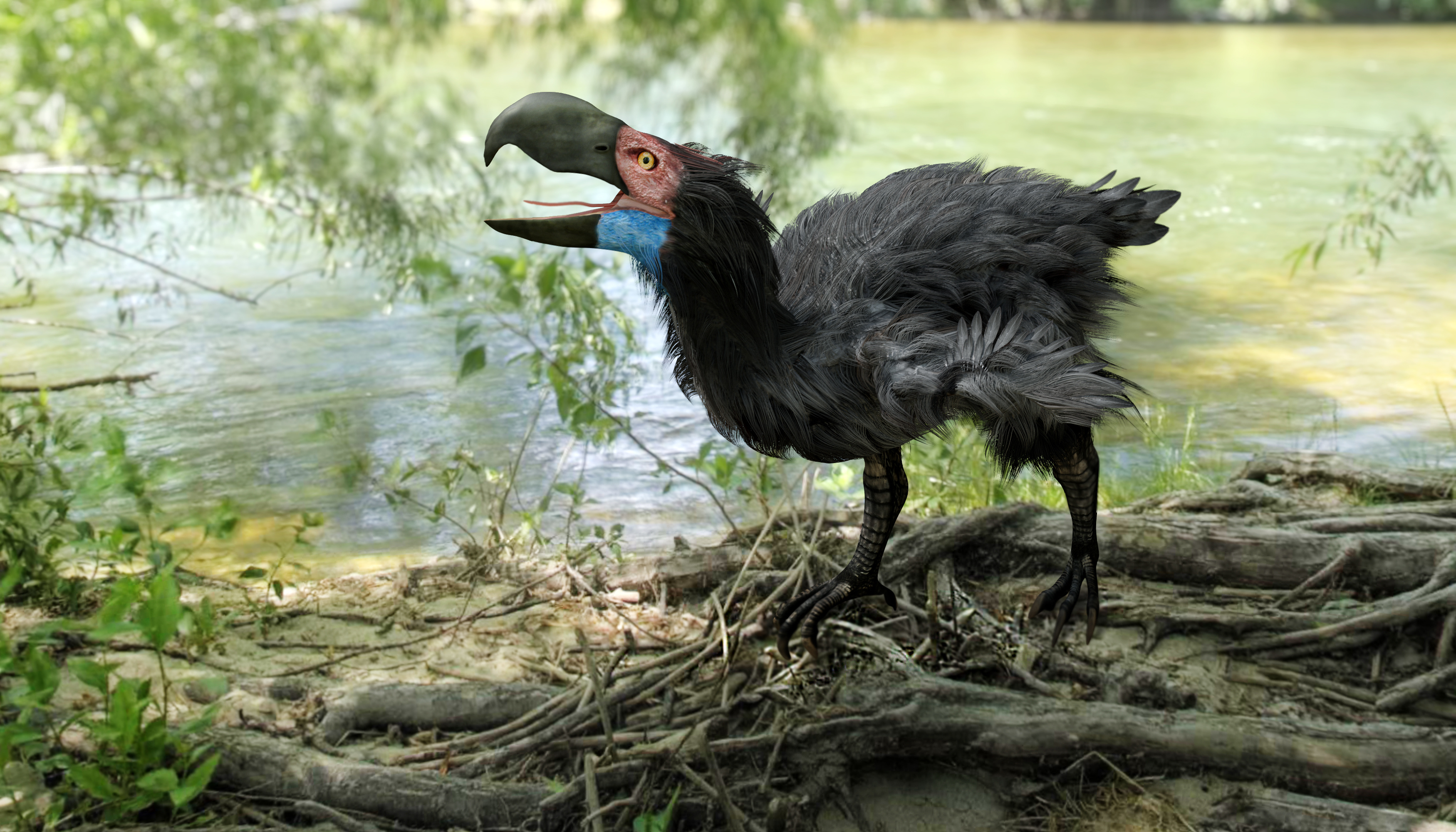
Illustration by Auntspray/Adobe Stock A lone gastornis walks by the edge of a river in this artist’s illustration of a member of an extinct avian family known as “Terror Birds.” These large flightless birds arose as apex predators in much of their domain.

Giant eagles, terror birds, and rocs! Oh my! While begging the pardon of the clever writers of 1939’s film “The Wizard of Oz,” I thought I’d focus on some of the more terrifying birds to ever roam the planet as we move closer to Halloween later this month.

Photo by Couleur/Pixabay.com • A white-tailed eagle is one of the world’s larger eagles, but even this large raptor would have been dwarfed by the now-extinct Haast’s eagle that once hunted giant moas in New Zealand.

Giant Eagles

In the not-so-distant past, an eagle in New Zealand achieved status as an apex feathered predator that specialized in preying on some of the largest birds to ever live.

Known as Haast’s eagle, this now-extinct raptor had a body size about 40 percent larger than even the largest of today’s eagles. Females probably reached a weight of 22 to 33 pounds. Males, as is the case with most living eagles today, were smaller than females but still probably weighed between 20 to 26 pounds. This gigantic eagle, however, possessed a relatively short wingspan of roughly 8 to 10 feet wide, which compares to that recorded for large specimens of golden eagle and Steller’s sea eagle.

This huge raptor was a major predator on the population of New Zealand moas, a large flightless and wingless bird somewhat reminiscent of modern ostriches. In direct comparison with the moas, these New Zealand eagles were almost puny. Some moas reached a height of 12 feet tall and a weight of more than 500 pounds. Despite their superior size and weight, however, moas simply lacked any defense against the huge razor-like talons and sharp beak of the Haast’s Eagle. An attack by such a well-equipped bird of prey must have been devastating to their prey. If Haast’s eagle was anything like many modern predators, it probably chose to hunt young, infirm or elderly moas rather than an adult moa in prime health.

Back in 2009, Associated Press writer Michael Casey speculated in an article on Haast’s eagle that this bird of prey might have included humans on the menu. Casey wrote that in recent years the scientific opinion on Haast’s eagle has evolved. Once thought to be a mere scavenger like vultures, most experts now think Haast’s eagle was a capable and efficient predator.

There is no direct evidence that the eagle, which went extinct about 500 years ago, ever dined on humans. Casey does mention the legend of the pouakai, which was a giant bird with a reputation for launching sudden attacks on people and fully capable of killing a small child.

If the Haast’s eagle did snatch a few unfortunate children, the Maori who colonized New Zealand about 750 years soon returned the favor. Both the moa and Haast’s eagle disappeared from New Zealand soon after humans arrived on the remote island.

Artist Charles Knight, famous for now outdated depictions of dinosaurs, illustrated his version of a “terror bird” back in 1901.

Terror Birds

Terror birds were prehistoric forebears to Haast’s eagle. More accurately known as Phorusrhacids, the “terror birds” were an extinct clade of large carnivorous flightless birds that were the largest species of apex predators in South America during the period of prehistory known as “The Age of Mammals.”

Unlike Haast’s eagle, which was fully capable of flight, the terror birds were flightless like the extinct moas and our modern ostriches, emus and cassowaries. The tallest of the terror birds stood 10 feet tall, but some members of the family were considerably smaller, reaching a height between two and three feet.

The larger species included birds such as Titanis walleri, Phorusrhacos ameghino and Kelenken guillermoi. With a skull more than 28 inches long, Kelenken possessed the largest head of any known bird. Some members of the diverse terror bird family even ranged into what is now the southern United States. Fossils of some of these ancient birds have been found in Florida and Texas. As the saying goes, everything’s bigger in Texas.

Mammals of various sizes provided a smorgasbord for the terror birds, which were more than capable of running down prey and dispatching it with a heavy, hooked beak. While it would be fascinating to still have terror birds roaming the globe, I have to admit that I prefer that the birds content themselves with sunflower seeds and suet cakes rather than considering whether I might make a nice addition to the menu.

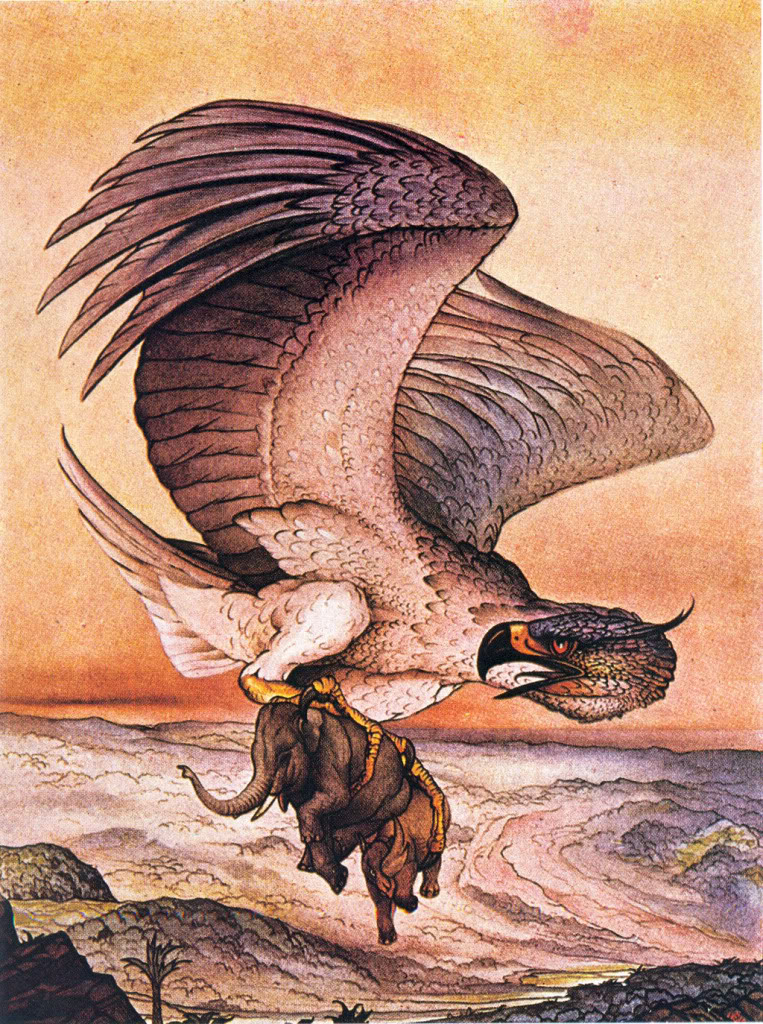
This color illustration by Charles Maurice Detmold depicts the legendary roc and its elephant prey.

Legend of the Roc

While descriptions of the mythical roc make this bird sound like a truly horrifying feathered terror, the actual creature behind the origins of this incredible beast was actually a placid herbivore.

The roc arose in the fabulous fables of the Middle East. The famous compilation of stories known as One Thousand and One Nights features accounts of the monstrous roc, a bird deemed capable of seizing and carrying off prey as large as a fully grown elephant.

In reality, discoveries of the eggs of a bird now known to science as the extinct Vorombe titan likely inspired the myth of the roc. Vorombe titan stood almost 10 feet tall and weighed 1,600 pounds. The largest living bird today is the common ostrich. Males ostriches can reach a height of 9 feet and weigh 250 pounds, which means Vorombe titan would have dwarfed modern ostriches.

Native to the island of Madagascar, Vorombe titan and its relatives went extinct about a thousand years ago. Explorers from Middle Eastern countries returned from the island of Madagascar with egg shells that provided strong evidence of a giant bird and led to the legend of the roc, or elephant bird. The eggs of this bird were indeed impressive. The eggs were 13 inches long and 3 feet, 3 inches in circumference. About 160 chicken eggs could have fit inside a Vorombe titan’s egg.

The family of birds known as kiwis are considered the closest living relatives of the giant moas.

Once thought to be related to ratites, which includes modern ostriches, emus and cassowaries, Vorombe titan’s closest living relatives are probably the kiwis, a family of flightless birds that still exists in New Zealand. Like the kiwi, Vorombe titan, or the legendary roc, was a gentle, near-sighted herbivore.

While the imaginative mind can spin interesting scenarios with these gone-but-not-forgotten monsters, I think I’ll confine my birding to warblers, hummingbirds and other backyard birds.


Two types of black-throated warblers number among New World bird family

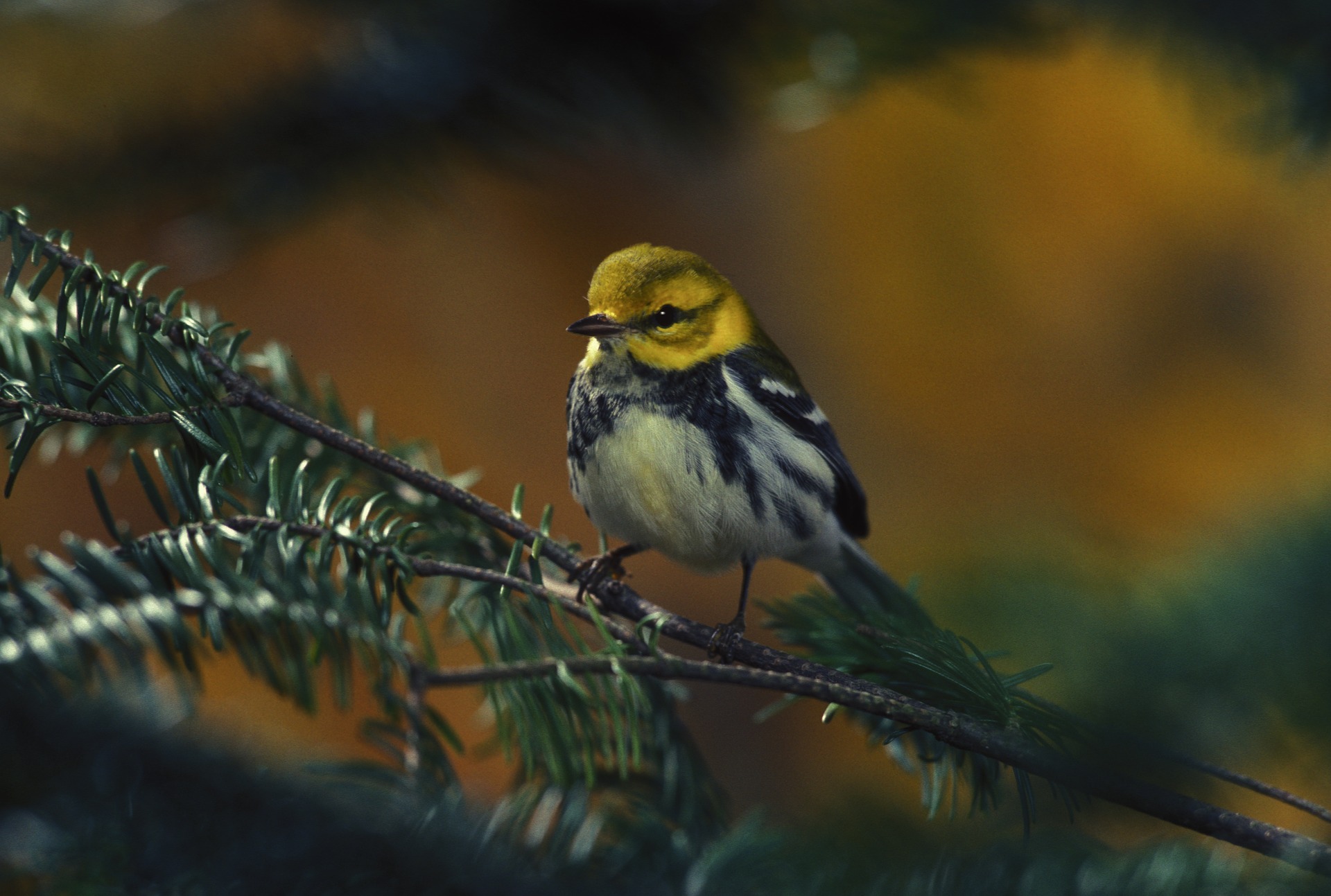
Photo by Skeeze/Pixabay.com The female black-throated green warbler lacks the male’s all-black throat, but she is a striking bird in her own right. Black-throated green warblers and the related black-throated blue warbler are common birds in the Southern Appalachians from April to October.

I’ve enjoyed some lawn chair birding on recent September evenings, delighting in my observations of birds ranging from flycatchers and catbirds to warblers, vireos and hummingbirds. I enjoy my casual study of the daily changes in the bird population present in my yard and adjacent woods. The parade of warblers hasn’t been as productive as in past autumns, but I have managed to spot and identify hooded warbler, American redstart, chestnut-sided warbler, magnolia warbler, Northern parula, and black-throated green warbler visitors.


The black-throated green appeared suddenly in a fast-paced burst of foraging in a cherry tree. Alongside birds such as an Eastern wood-pewee and red-eyed vireo, the warbler gleaned the leaves of the trees for concealed caterpillars. I watched the bird swallow with gusto several of the caterpillars so skillfully plucked with its thin, pointed bill.

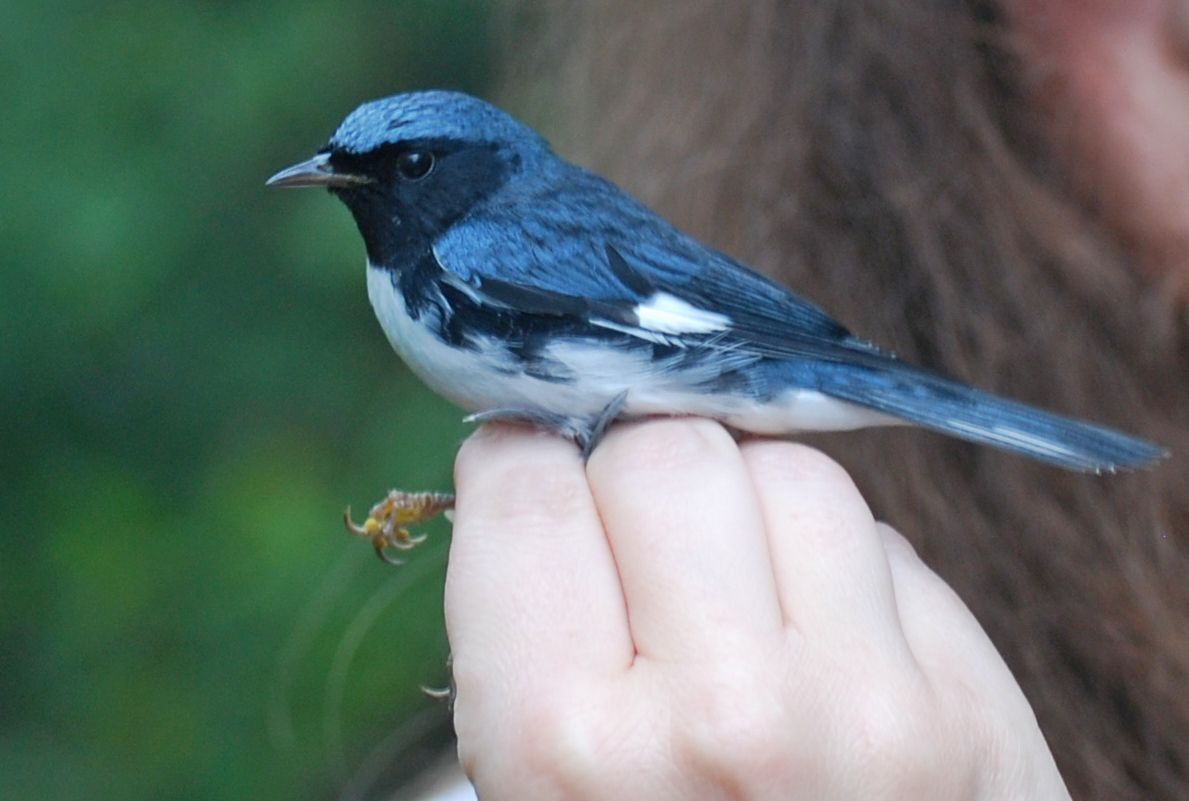
The black-throated green warbler and one other species, the black-throated blue warbler, share the appellation of “black-throated,” and rightfully so. Males in the spring look their best with a dark black throat in striking contrast to the rest of their plumage. The female black-throated green shows some black on the throat, but female black-throated blue warblers exhibit no black throat patch. In fact, black-throated blue males and females are extremely different in appearance. Scientists call such dramatic appearances differences “sexual dimorphism.” Among the warblers, this species provides the most striking example of sexual dimorphism of any of the warblers. The male and female do share one identifying mark — a white square near the outer edge of the middle of each wing. This square is usually more pronounced in the male, but it stands out enough that it helps distinguish the female black-throated blue from similar dull-plumaged birds such as vireos. 


German naturalist Johann Friedrich Gmelin described the black-throated blue warbler in 1789. I noted in last week’s column that Gmelin woefully misnamed such warblers as palm warbler and magnolia warbler. With the black-throated blue warbler, Gmelin did a better job. This bird’s scientific name name is the Latin term caerulescens, which translates into English as “turning blue.” The male is a stunning bird. Arguably, the black-throated blue warbler is one of the most distinctive members of the family of wood warblers. The adult male has a black face and cheeks, deep blue upperparts and a clean white underbelly. In contrast, the adult female is olive-brown above and light yellow below. 


When one’s binoculars first focus on a black-throated green warbler, the first impression is likely to be the black, yellow and white feathers in the bird’s plumage. The greenish-yellow coloration that gives this species part of its common name is mostly limited to the bird’s back, which is often not as evident when the bird’s being watched through binoculars.  
Both of the black-throated warblers nest in northeast Tennessee, western North Carolina, and southwestern Virginia. In the spring, the males of both these warblers are persistent singers from prominent perches in the green woodland canopy. Male black-throated greens contribute to the avian chorus by frequently singing a high-pitched song often described as a buzzy zee-zee-zee-zooo-zeet. Male black-throated blues produce a buzzy zee-zee-zeeee. 

The black-throated green warblers currently departing the region will likely travel as far as Mexico, Central America, the West Indies and southern Florida for the colder winter months. Black-throated blue warblers, on the other hand, migrate to the Caribbean for the winter, making their homes on Cuba, Jamaica, Hispaniola and Puerto Rico, as well as other islands. 
Nearly half of the world’s New World warblers spend the months between spring and fall in North America. The other half reside exclusively in Central and South Americas, as well as the Caribbean. Some of the more descriptively named individuals residing in the tropical areas south of North America include flame-throated warbler, crescent-chested warbler, arrowhead warbler, white-rimmed warbler, buff-rumped warbler, golden-bellied warbler, fan-tailed warbler, pink-headed warbler and pale-legged warbler. 


The warblers bring some exciting tropical flair into the hills and hollows of Southern Appalachia for several months every year. I miss them once they’re gone for the winter season, but the promise of their return keeps my spirits buoyed during the cold, darker months until spring.