Tag Archives: Our Fine Feathered Friends

Unicoi County Summer Bird Count finds 107 species

Ken Silvers • A great blue heron wades in a wetland along Erwin Linear Trail.

The 12th annual Unicoi County Summer Count took place Saturday, June 14, with 15 observers in six parties. Sharp-eyed counters tallied 107 species, which is near the average of 108 species.

Conducted by members of the Elizabethton Bird Club, the survey gives a summer snapshot of the bird life present in the county. The organization also conducts a Carter County Summer Bird Count. I’ll discuss the results of that count in an upcoming column.

Notable sightings, according to count compiler Rick Knight, included black-billed cuckoo, red crossbill, pine siskin, Savannah sparrow and yellow-rumped warbler. The count also found 19 species of warblers.

The list:

Canada goose, 37; mallard, 34; wild turkey, 21; and ruffed grouse, 1.

Rock pigeon, 19; mourning dove, 53; black-billed cuckoo, 1; chuck-will’s-widow. 1; Eastern whip-poor-will, 7; chimney swift, 17; and ruby-throated hummingbird, 8.

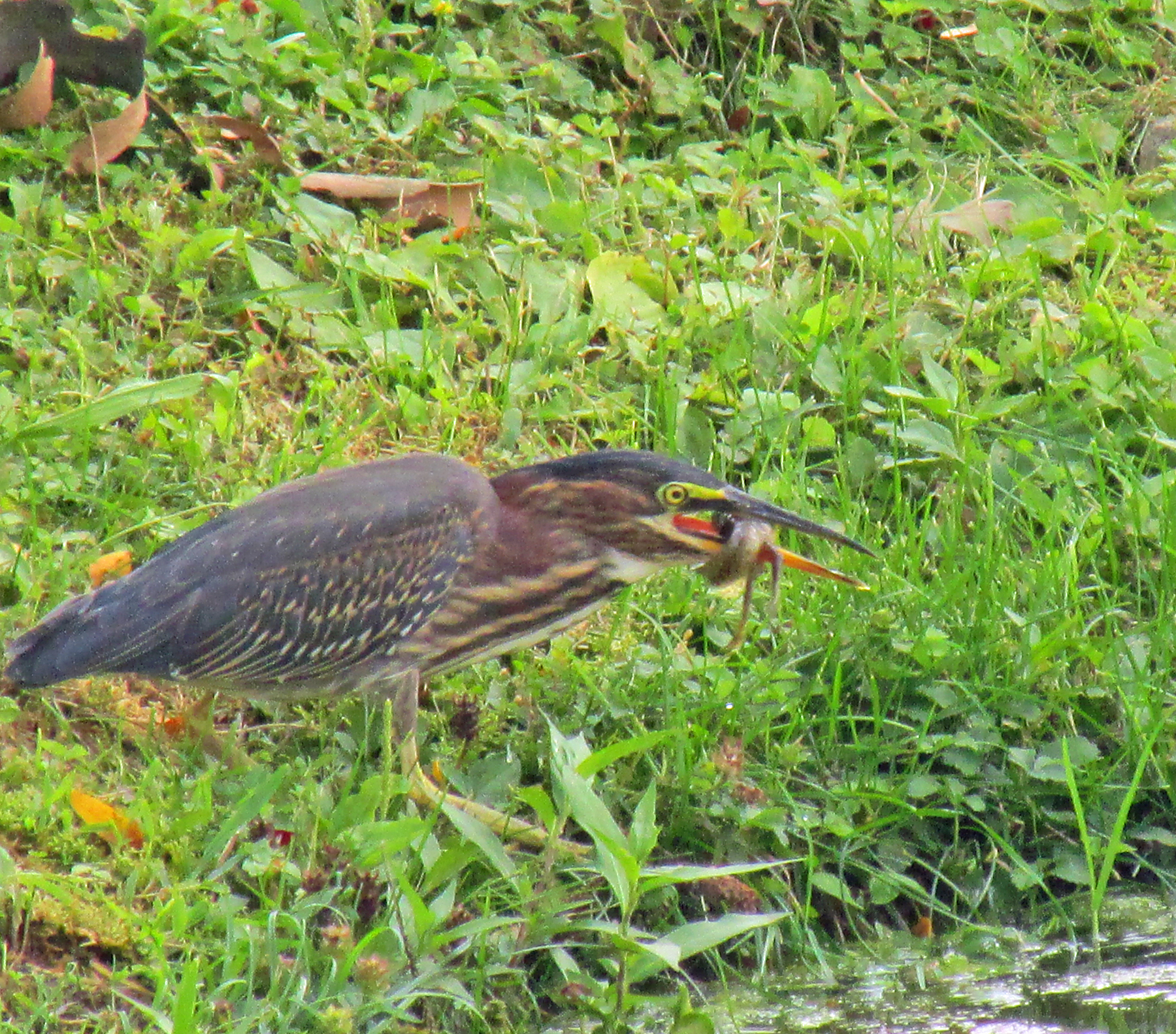
Killdeer, 3; green heron, 1; and great blue heron, 4.

Bryan Stevens • A małe downy woodpecker visits a feeder for peanuts.

Black vulture, 3; turkey vulture, 47; red-shouldered hawk, 1; broad-winged hawk, 2; red-tailed hawk, 1; Eastern screech owl, 2; and barred owl, 1.

Belted kingfisher, 3; red-bellied woodpecker, 10; yellow-bellied sapsucker, 3; downy woodpecker, 9; hairy woodpecker, 4; Northern flicker, 6; and pileated woodpecker, 10.

Great crested flycatcher, 6; Eastern kingbird, 6; Eastern wood-pewee, 6; Acadian flycatcher, 52; least flycatcher, 3; and Eastern phoebe, 39.

White-eyed vireo, 1; blue-headed vireo, 25; warbling vireo, 2; red-eyed vireo, 135; blue jay, 48; American crow, 89; fish crow, 3; and common raven, 2.

Carolina chickadee, 37; tufted titmouse, 51; tree swallow, 34; N. rough-winged swallow, 16; purple martin, 16; barn swallow, 46; and cliff swallow, 48.

Golden-crowned kinglet, 1; cedar waxwing, 28; red-breasted nuthatch, 9; white-breasted nuthatch, 9; and blue-gray gnatcatcher, 16.

Jean Potter • A Carolina wren creeps along a fence.

Carolina wren, 50; house wren, 20; and winter wren, 3.

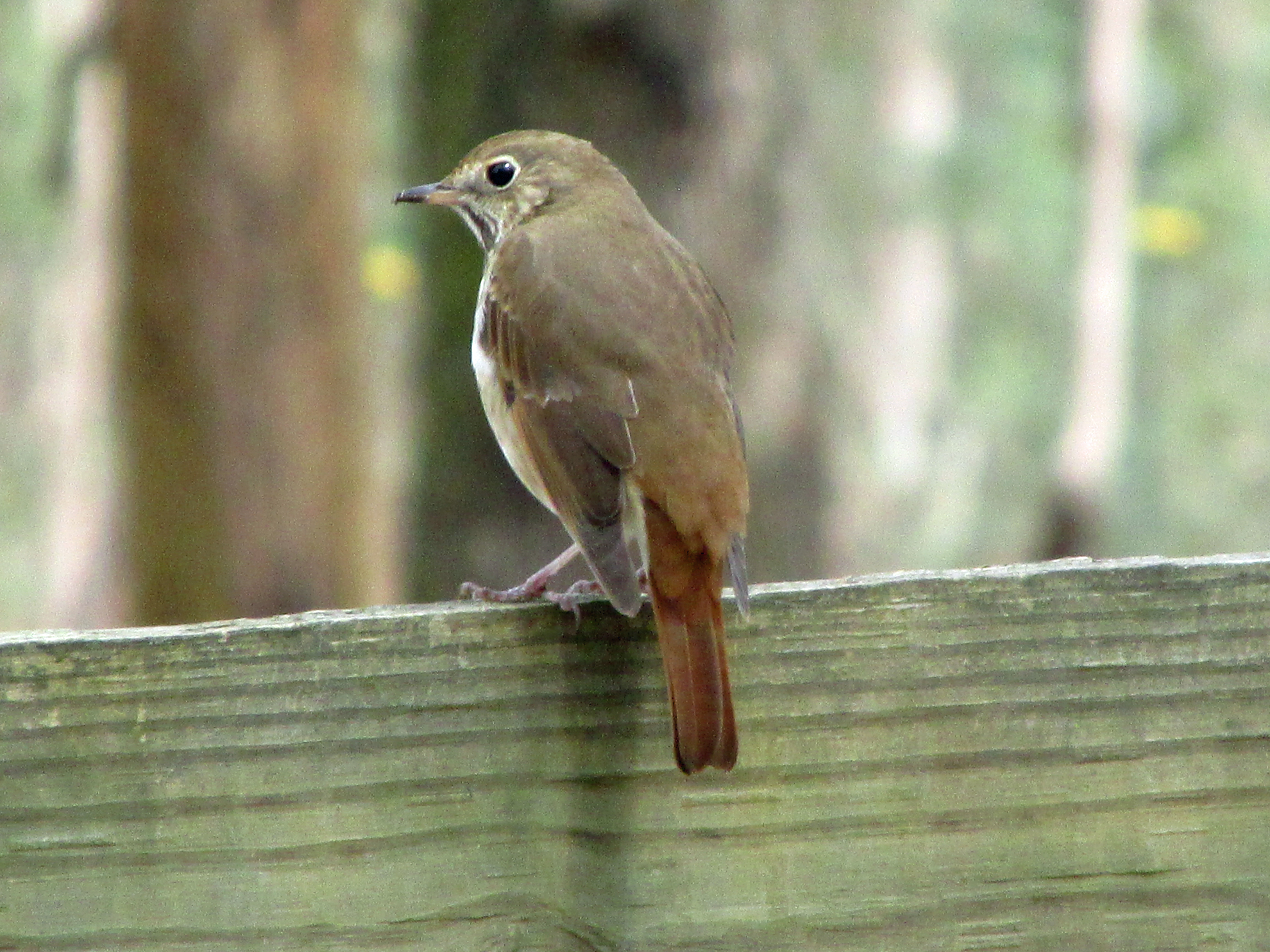
Gray catbird, 15; brown thrasher, 8; Northern mockingbird, 10; European starling, 347; Eastern bluebird, 26; veery, 24; hermit thrush, 5; wood thrush, 46; and Amercian robin, 195.

House sparrow, 17; house finch, 2; red crossbill, 5; pine siskin, 3; and American goldfinch, 37.

Chipping sparrow, 44; field sparrow, 6; dark-eyed junco, 28; Savannah sparrow, 1; song sparrow, 81; and Eastern towhee, 5.

Eastern meadowlark, 5; orchard oriole, 4; Baltimore oriole, 1; red-winged blackbird, 43; brown-headed cowbird, 8; and common grackle, 30.

Photo by Bryan Stevens • A male brown-headed cowbird displays the brown head that gives this bird its common name.

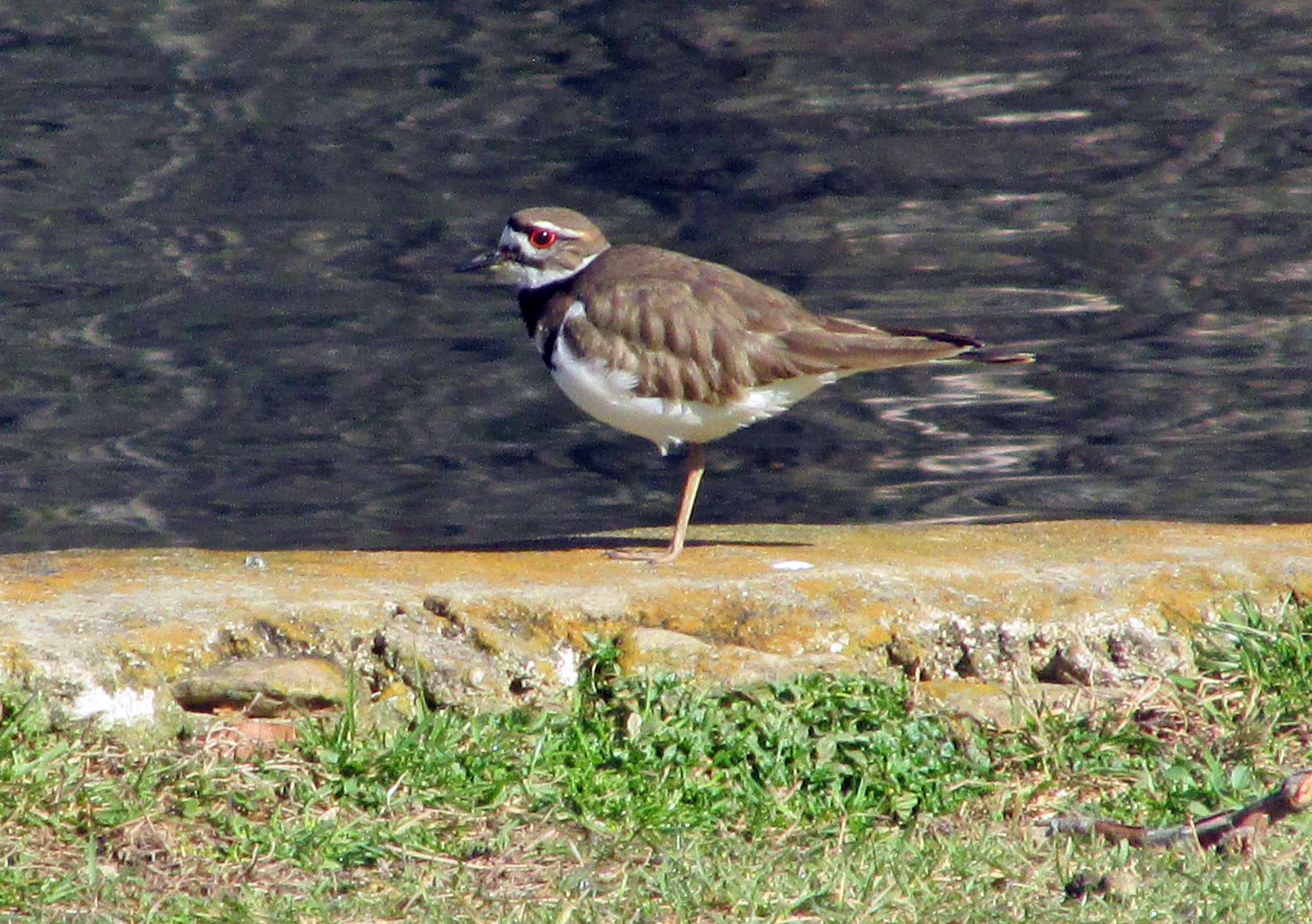
Ovenbird, 46; worm-eating warbler, 7; Louisiana waterthrush, 10; black-and-white warbler, 22; Swainson’s warbler, 16; Kentucky warbler, 1; Common yellowthroat, 9; hooded warbler, 52; American redstart, 1; Northern parula, 32; magnolia warbler, 1; Blackburnian warbler, 2; yellow warbler, 1; chestnut-sided warbler, 12; black-throated blue warbler, 29; yellow-rumped, 1; yellow-throated warbler, 21; black-throated green warbler, 40; and Canada warbler, 18.

Scarlet tanager, 16; Northern cardinal, 63; rose-breasted grosbeak, 3; blue grosbeak, 3; and indigo bunting, 64.

Knight noted that some species, as always happens, were missed by counters. These included wood duck, yellow-billed cuckoo, the accipiter hawks, bald eagle, great horned owl, American kestrel, yellow-throated vireo, brown creeper and yellow-breasted chat.

I counted with Chris Soto from the Limestone Cove area to the top of Iron Mountain Gap along Highway 107. This was my first observation of the blow Hurricane Helene dealt Iron Mountain Gap. The scenery at the top of the mountain on the line between North Carolina and Tennessee has been changed radically. So many trees were toppled by the storm’s passage. But the birds appeared unaffected by the changes, with an assortment of warblers, indigo buntings and yellow-bellied sapsuckers.

•••

Bryan Stevens has written about birds and birding since 1995. To send him a question, make a comment or share a sighting, email him at ahoodedwarbler@aol.com.

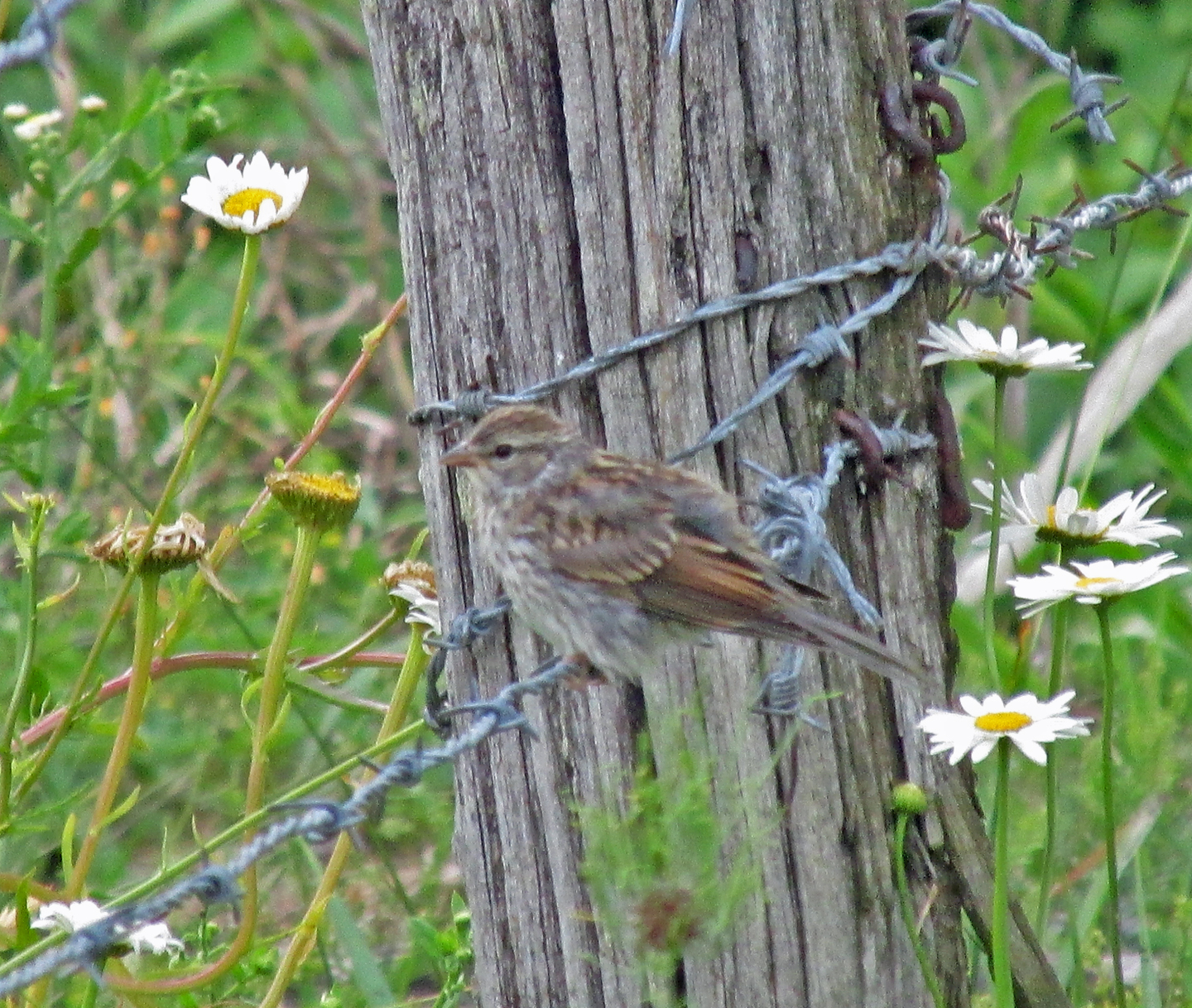
Photo by Bryan Stevens
A young Chipping Sparrow perches on a barbed wire fence at the Bell Cemetery in Limestone Cove.

Regional spring bird count finds 148 species

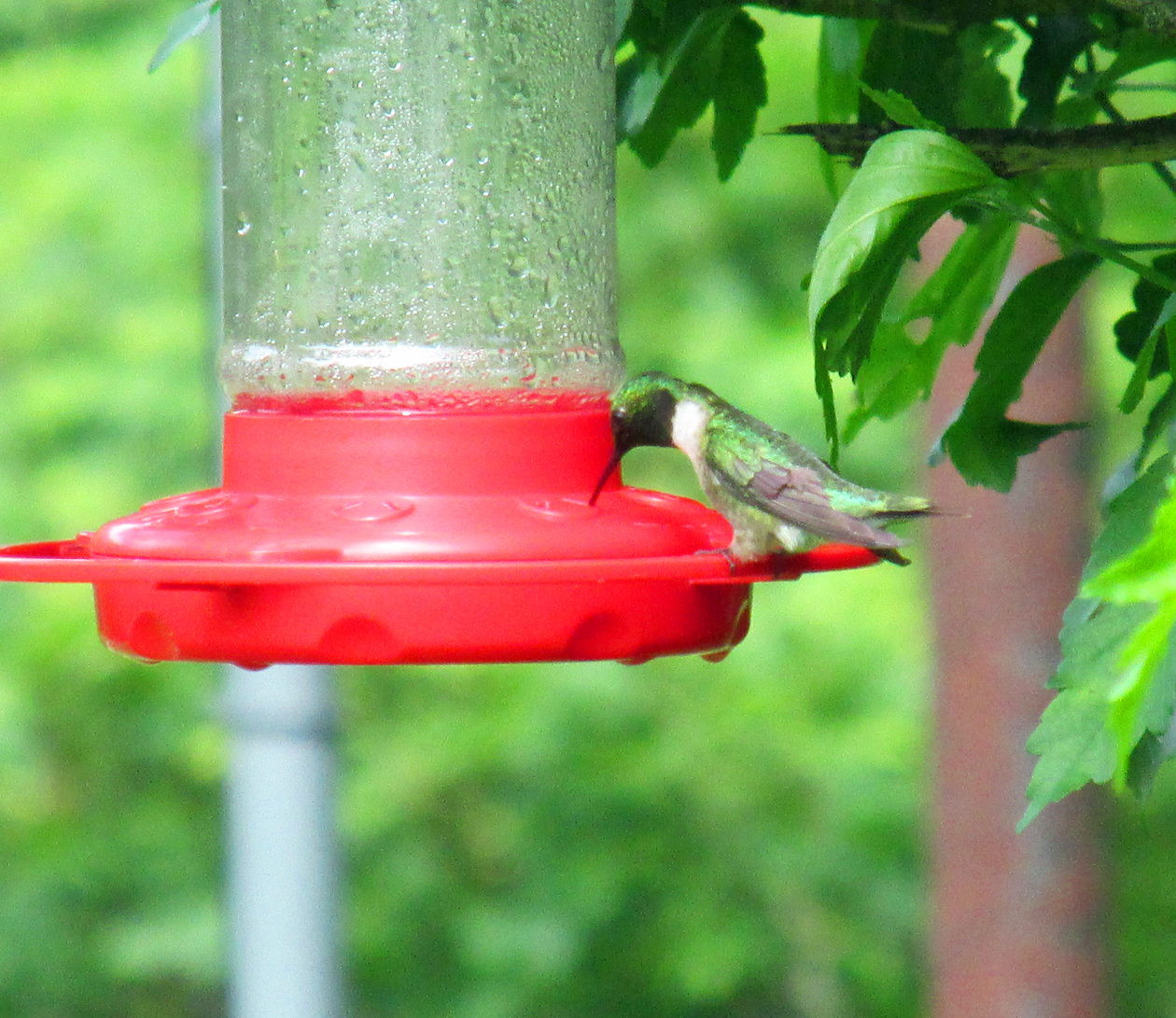
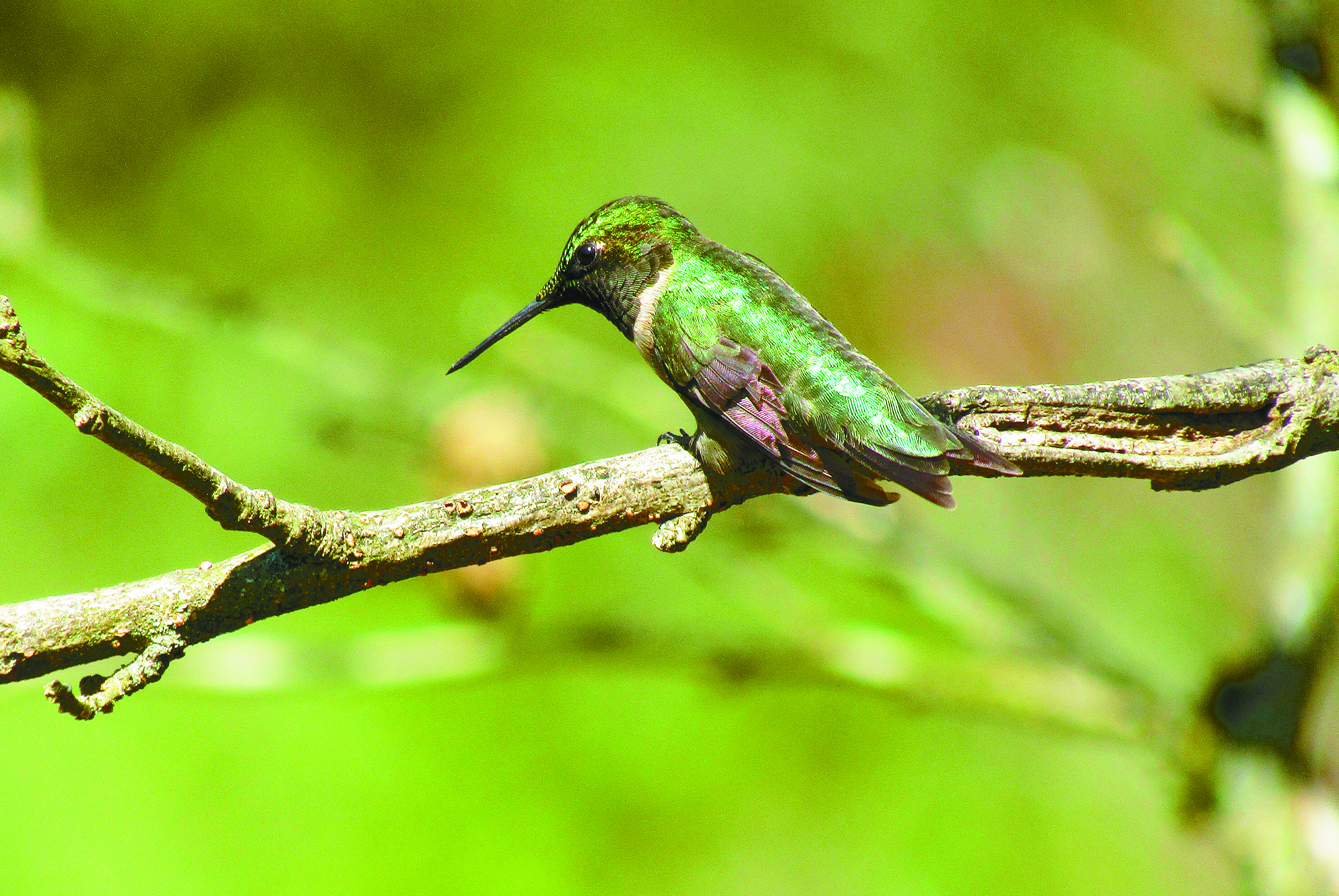
Photo by Bryan Stevens • Ruby-throated hummingbirds have settled into a comfortable summer routine throughout the Northeast Tennessee region.

The 82nd consecutive spring bird count was held Saturday, May 3, with 44 observers in 15 parties. The survey tallied 148 species, which is slightly below the recent 30 year average of 150 species. The count is conducted by the Elizabehton Bird Club, which will also conduct two summer counts this month. One of these counts is held in Carter County and the other in Unicoi County.

The spring count is a regional survey that includes all Northeast Tennessee counties: Carter, Johnson, Sullivan, Unicoi and Washington.

Compiler Rick Knight shared some observations. Noteworthy sightings included common merganser, black-billed cuckoo, willow flycatcher, vesper sparrow and bobolink, as well as prothonotary and cerulean warblers. A total of 31 species of warblers made this year’s count. A record number (24) for Swainson’s warbler provided an indication that this species is locally abundant during the nesting season.

The 17 fish crows reported by six parties provided a good example of the local expansion of this species. The 17 common ravens, once not so common in the region, were reported by eight of the count parties.

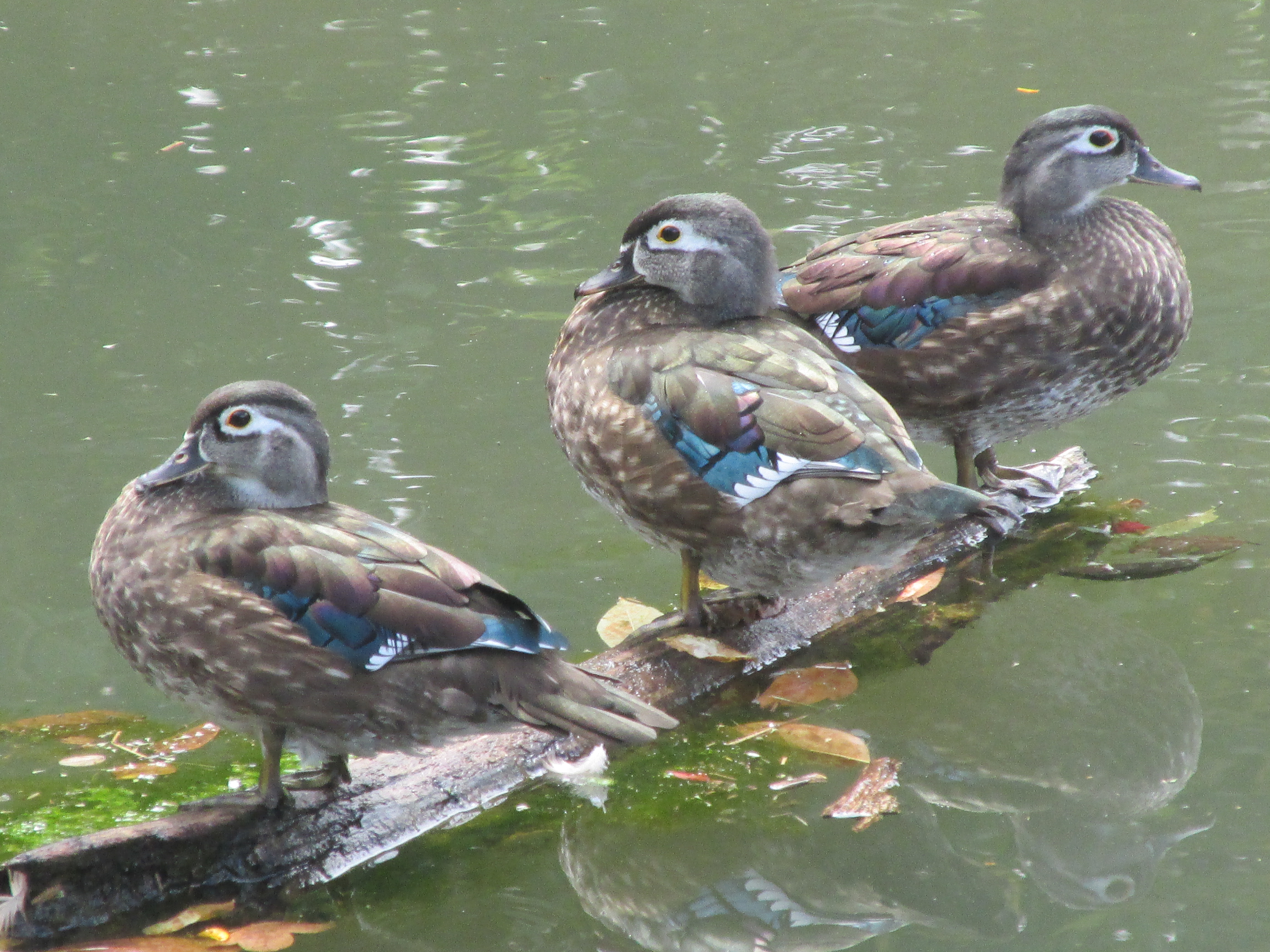
Photo by Bryan Stevens • Young wood ducks share a perch on a submerged log.

The list:

Canada goose, 208; wood duck, 31; blue-winged teal, 2; mallard, 86; and common merganser, 7.

Wild turkey, 16; ruffed grouse, 1; rock pigeon, 92; Eurasian collared-dove, 1; mourning dove, 176; yellow-billed cuckoo, 3; and black-billed cuckoo, 2.

Photo by Hans Toom/Pixabay • A male yellow warbler is aptly named.

Chuck-will’s-widow, 9; Eastern whip-poor-will, 32; Chimney swift, 149; ruby-throated hummingbird, 18.

Killdeer, 32; least sandpiper, 16; pectoral sandpiper; 1; spotted sandpiper, 42; solitary sandpiper, 39; and lesser yellowlegs, 6.


Double-crested cormorant 28; green heron 8; great egret, 1; and great blue heron, 50.

Black vulture, 38; turkey vulture, 96; osprey, 4; Cooper’s hawk, 6; bald eagle, 1; red-shouldered hawk, 4; broad-winged hawk, 7; red-tailed hawk, 14; Eastern screech owl, 15; great horned owl, 2; and barred owl, 4;

Belted kingfisher, 15; red-headed woodpecker, 2; red-bellied woodpecker, 68; yellow-bellied sapsucker, 7; downy woodpecker, 33; hairy woodpecker, 6; Northern flicker, 37; and pileated woodpecker, 36.

Photo by Bryan Stevens • Downy woodpeckers will visit feeders in any season.

American kestrel, 5; great crested flycatcher, 28; Eastern kingbird, 42; Eastern wood-pewee, 16; Acadian flycatcher, 27; willow flycatcher, 1; least flycatcher, 10; and Eastern phoebe, 64.

White-eyed vireo, 19; yellow-throated vireo, 12; blue-headed vireo, 42; warbling vireo, 10; and red-eyed vireo, 364.

Blue jay, 175; American crow, 218; fish crow, 17; and common raven,17.

Tree swallow, 107; Northern rough-winged swallow, 81; purple martin, 29; barn swallow, 144; and cliff swallow, 482.

Carolina chickadee, 144; tufted titmouse, 189; ruby-crowned kinglet, 1; golden-crowned kinglet, 2; red-breasted nuthatch, 9; and white-breasted nuthatch, 26.

Brown creeper, 6; blue-gray gnatcatcher, 62; Carolina wren, 159; house wren, 39; and winter wren, 1.

Gray catbird, 68; brown thrasher, 43; Northern mockingbird, 97; cedar waxwing, 122; Eurasian starling, 539; Eastern bluebird, 97; veery, 15; Swainson’s thrush, 8; wood thrush, 116; and American robin, 654.

House sparrow, 55; house finch, 78; pine siskin, 7; and American goldfinch, 252.

Chipping sparrow, 139; field sparrow, 34; dark-eyed junco, 48; white-crowned sparrow, 3; white-throated sparrow, 4; vesper sparrow, 1; Savannah sparrow, 4; song sparrow, 287; swamp sparrow, 1; and Eastern towhee, 203.

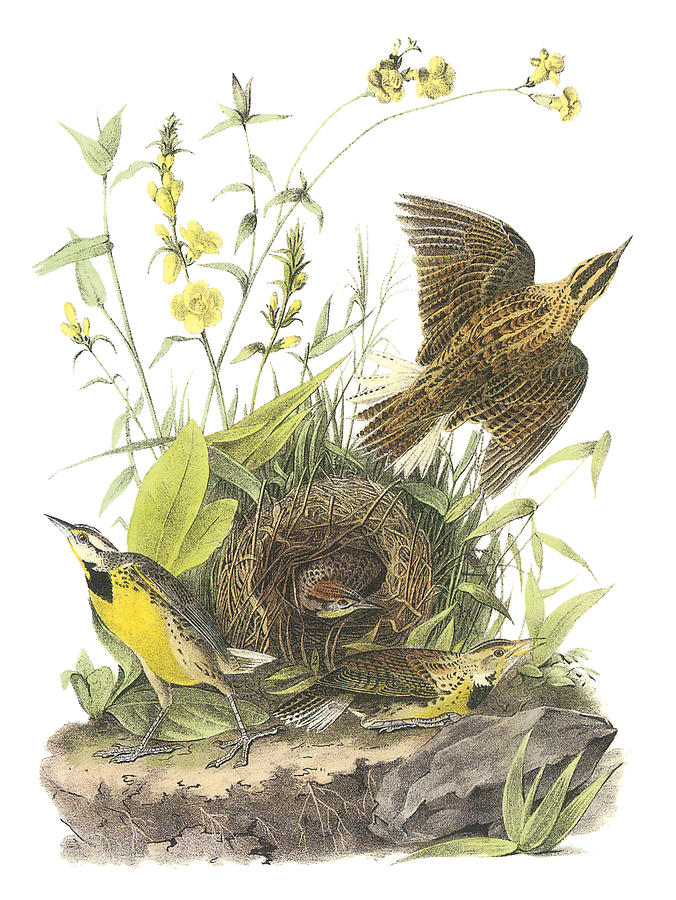
Early American naturalist and painter John James Audubon painting this scene depicting nesting meadowlarks.

Yellow-breasted chat, 9; bobolink, 6; Eastern meadowlark, 108; orchard oriole, 28; Baltimore oriole, 26; red-winged blackbird, 211; brown-headed cowbird, 65; and common grackle, 195.

Ovenbird, 169; worm-eating warbler, 42; Louisiana waterthrush, 45; Northern waterthrush, 4; golden-winged warbler, 2; blue-winged warbler, 1; black-and-white warbler, 104; prothonotary warbler, 1; Swainson’s warbler, 24; Tennessee warbler, 13; Kentucky warbler, 4; common yellowthroat, 25; hooded warbler, 234; American Redstart 27; Cape May warbler, 14; cerulean warbler, 2; Northern parula, 88; magnolia warbler, 4; bay-breasted warbler, 6; Blackburnian warbler, 16; yellow warbler, 10; chestnut-sided warbler, 32; blackpoll warbler, 6; black-throated blue warbler, 97; palm warbler, 5; pine warbler, 7; yellow-rumped warbler, 17; yellow-throated warbler, 52; prairie warbler, 1; black-throated green warbler, 100; and Canada warbler, 50.

Summer tanager, 2; scarlet tanager, 92; Northern cardinal, 284; Rose-breasted grosbeak, 30; blue grosbeak, 11; indigo bunting, 164; and dickcissel, 1.

I counted with Chris Soto and Brookie and Jean Potter around Sycamore Shoals State Historic Park, on the greenbelt along the Watauga River and on Holston Mountain.

•••

To share a sighting, make a comment or ask a question, email me at ahoodedwarbler@aol.com.

Photo by Hans Toom/Pixabay • A male Blackburnian warbler looks splendid in the dappled sunlight that appears to make his orange throat patch almost glow.

Noisy killdeer parents have mastered the art of deception

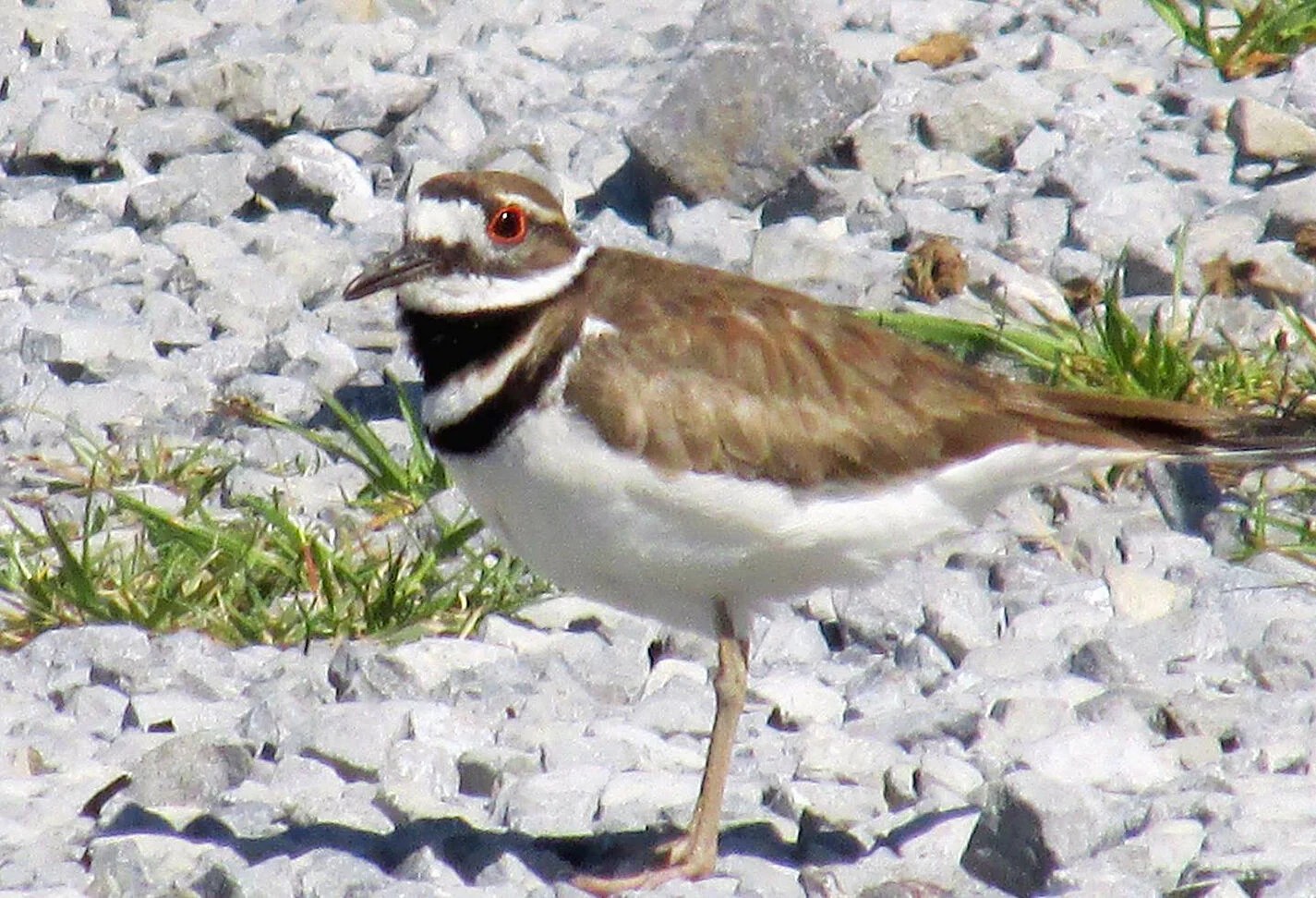
Photo by Bryan Stevens • A killdeer stands near the edge of a stream.

In last week’s column, I focused on the black-necked stilt, an oddity in the shorebird family that few non-birders would have ever heard of. This week, my focus will be on the killdeer, which is probably the shorebird most people know. Even non-birders have probably encountered this wide ranging bird that resides across much of North America.

While killdeers are considered shorebirds, they are certainly not confined to shorelines but can be found in a variety of habitats from school yards to golf courses to prairies and fields.

About 11 inches in length, the killdeer is brown above and white below with two black bands across the white chest. Males and females look alike.

These birds, despite their common name, are not antagonistic toward deer. The name killdeer refers to the loud, strident vocalization these birds produce when alarmed or disturbed. Early naturalists also noticed the noisy nature of killdeer, giving them names such as chattering plover and noisy plover, according to the website All About Birds.

The female killdeer usually lays up to four eggs on a spot on the bare ground that she may or may not have lined with some grass. Both parents attempt to guard the nest from predators. They are reliably zealous in their duties. In fact, the killdeer is famous for faking a display of injury whenever intruders draw too close. The display is meant to lure potential predators away from the location of the nest.

Photo by Bryan Stevens • A killdeer stands sentry duty near its nest in a gravel parking lot.

The predator, thinking the “injured” killdeer will be easy prey, follows the bird away from the nest’s vicinity. Killdeer will also put on the show for humans who venture too close to the nest. They drag their wings in a convincing display of serious injury. Of course, once the ruse has worked, the killdeer miraculously recovers and returns to its nest.

I learned about the killdeer early in life. I had a wise teacher for my first grade year. When a nesting killdeer built its home in the school yard, the teacher turned the discovery of this feathered neighbor into a teaching event.

I remember the bird performing the broken wing display and our teacher patiently explaining the rationale for the bird’s antics. The teacher must have been protective of the bird. I do recall that my fellow students and I were forbidden to approach the nest. Considering the natures of first-grade students, that was probably a smart precaution.

Photo by Bryan Stevens • A killdeer stands at the edge of a large pond at Fishery Park in Erwin, Tennessee.

The class followed the progress of the killdeer family as the eggs hatched and the school grounds became the home turf for the pair of killdeers and their young. I don’t recall a conclusion to the story. Since killdeer nest in spring, I suspect that the school year came to an end ahead of the nesting season.

The killdeer is a member of the plover family, which includes shorebirds distinctly different from related sandpipers.

There are more than 60 species of plovers worldwide, with several different species spending at least part of the year in North America. Close relatives of the killdeer include Wilson’s plover, semipalmated plover, snowy plover, mountain plover and the endangered piping plover.

Killdeers utilize some unusual nesting locations, including gravel parking lots and building rooftops covered with gravel or pebbles. Young killdeers can leave the nest site soon after hatching and follow their parents as they forage for food. They look like fuzzy golf balls with toothpick legs.


I’ll always remember my first encounters with this large, loud plover while a student at Hampton Elementary School many years ago. Observing that killdeer family no doubt planted the seed that eventually sprouted into my enthusiasm for watching birds. Witnessing the trickery the birds deployed to foil predators — and curious kids — away from their nests remains fresh in the memory.

Photo by Bryan Stevens • The killdeer is a plover, placing it within the family of shorebirds. They are more often found on open fields instead of along coastal shores.

Somewhat more recently, I encountered another fuzzy golf ball at rest on the ground toward the back of Erwin Fishery Park. Thinking the tiny bird was dead, I picked it up for a closer look. Even as I handled the bird, it remained motionless in my hand. When I returned the tiny “body” to the ground, however, the bird performed an amazing resurrection and fled the vicinity as quick at those toothpick legs could carry it.

Numerous people have called or written me throughout the years to report unusual nesting locations used by killdeers. I’ve seen nests in hotel parking lots, local parks and construction sites. As I mentioned earlier, the female killdeer is content to lay her eggs directly on bare soil, although she will occasionally line the nest.

These birds are opportunists. The nest lining often consists of what is most readily available. I once inspected a killdeer nest lined with discarded cigarette butts. I’m hopeful the babies didn’t hatch with instant nicotine addictions.

•••

Bryan Stevens has written about birds since 1995. Share a sighting, ask a question or make a comment by emailing him at ahoodedwarbler@aol.com.
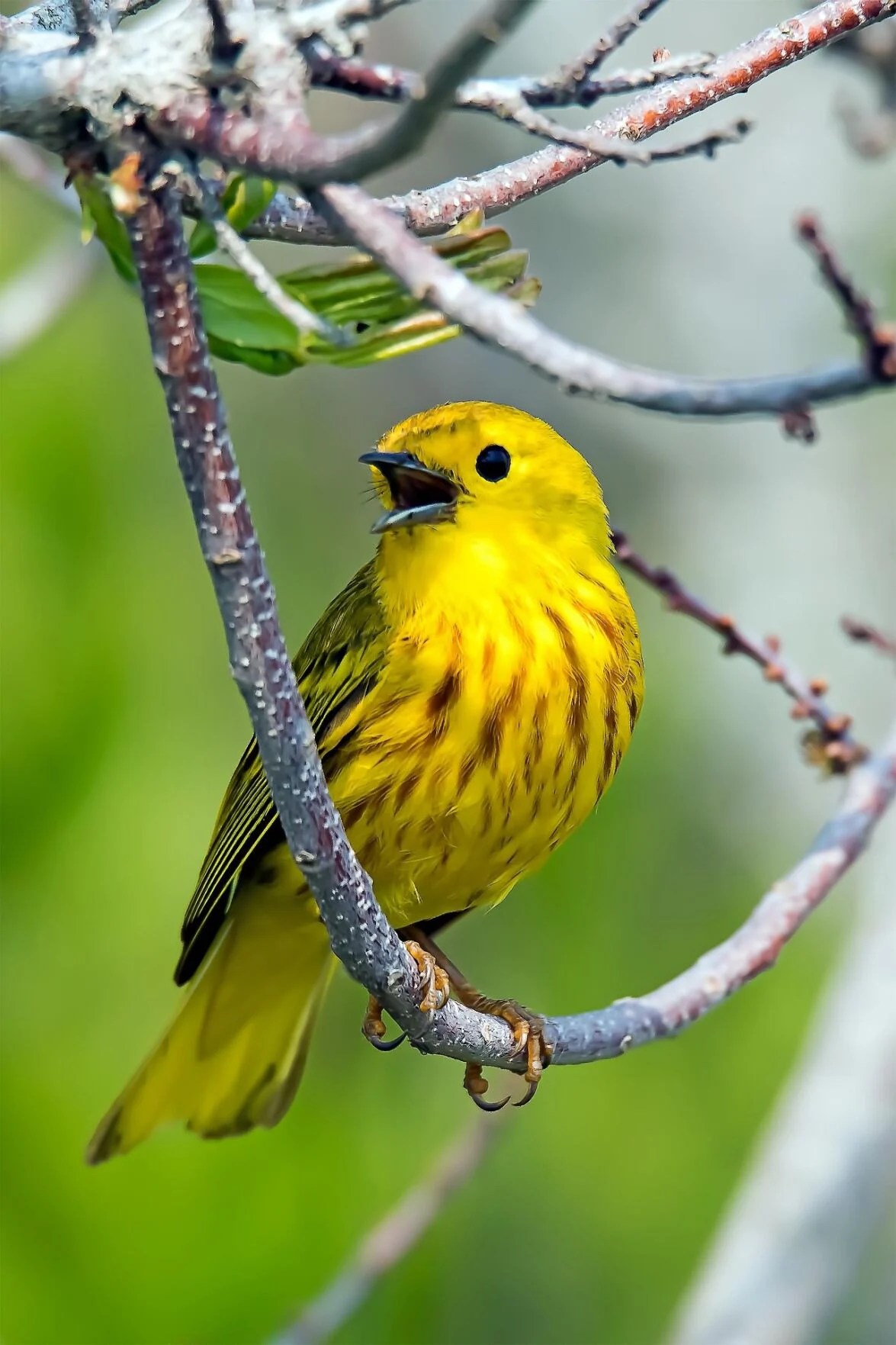
Photo by Bryan Stevens • A killdeer covers its egg during a light rain.

Black-and-white warbler won’t be confused with other birds

Photo by Hans Toom/Pxabay A black-and-white warbler would be almost impossible to confuse with any other bird.

I’m thinking that most people have probably heard of a “gaggle” of geese or a “murder” of crows as a way to describe a flock of these particular birds. Warblers also have their collective names. A flock of warblers is often referred to as a bouquet, a confusion, a fall, a cord or a wrench of warblers, according to the Birdorable Blog.

I personally like “wrench” of warblers. It has alliteration and describes how these amazing little songbirds can definitely “wrench” one’s attention from other matters. That’s been happening a lot at home. Since arriving in early April, the resident warblers have added their songs to the soundscape that makes the woodlands surrounding my home come alive every morning.

I wrote last week about the sad incident of a male Northern parula killed after an impact with a window. I wondered if I’d have to go the spring and summer season without hearing the excitable little trill of syllables that comprises this warbler’s song. I’m happy to report that less than a week passed before another male Northern parula showed up and began adding his song to the daily chorus. The circle of life continues.

On Saturday, May 3, I got to branch out from the handful of warbler species in residence around my home to warblers in other locations. I birded with Chris Soto, a Johnson City resident and fellow member of the Elizabethton Bird Club, on Holston Mountain and Sycamore Shoals State Historic Park as part of the annual Spring Bird Count conducted by the EBC. Despite some rain while conducting our survey of Holston Mountain, we encountered a variety of warbler species.

We didn’t observe any large warbler flocks, or wrenches, but we did find numerous species, including ovenbird, worm-eating warbler, Louisiana waterthrush, black-and-white warbler, Swainson’s warbler, hooded warbler, American redstart, Cape May warbler, Northern parula, yellow warbler, chestnut-sided warbler, black-throated blue warbler, yellow-throated warbler, black-throated green warbler and Canada warbler.

We added most of these species to the list by hearing them singing their springtime songs, including the “squeaky wheel” of the black-and-white warbler and the loud, ringing notes of the Louisiana waterthrush. If the latter wants to be heard, it is essential that it produce a loud song. The waterthrush resides near rushing mountain streams, which could easily overpower songs projected at a lower volume.

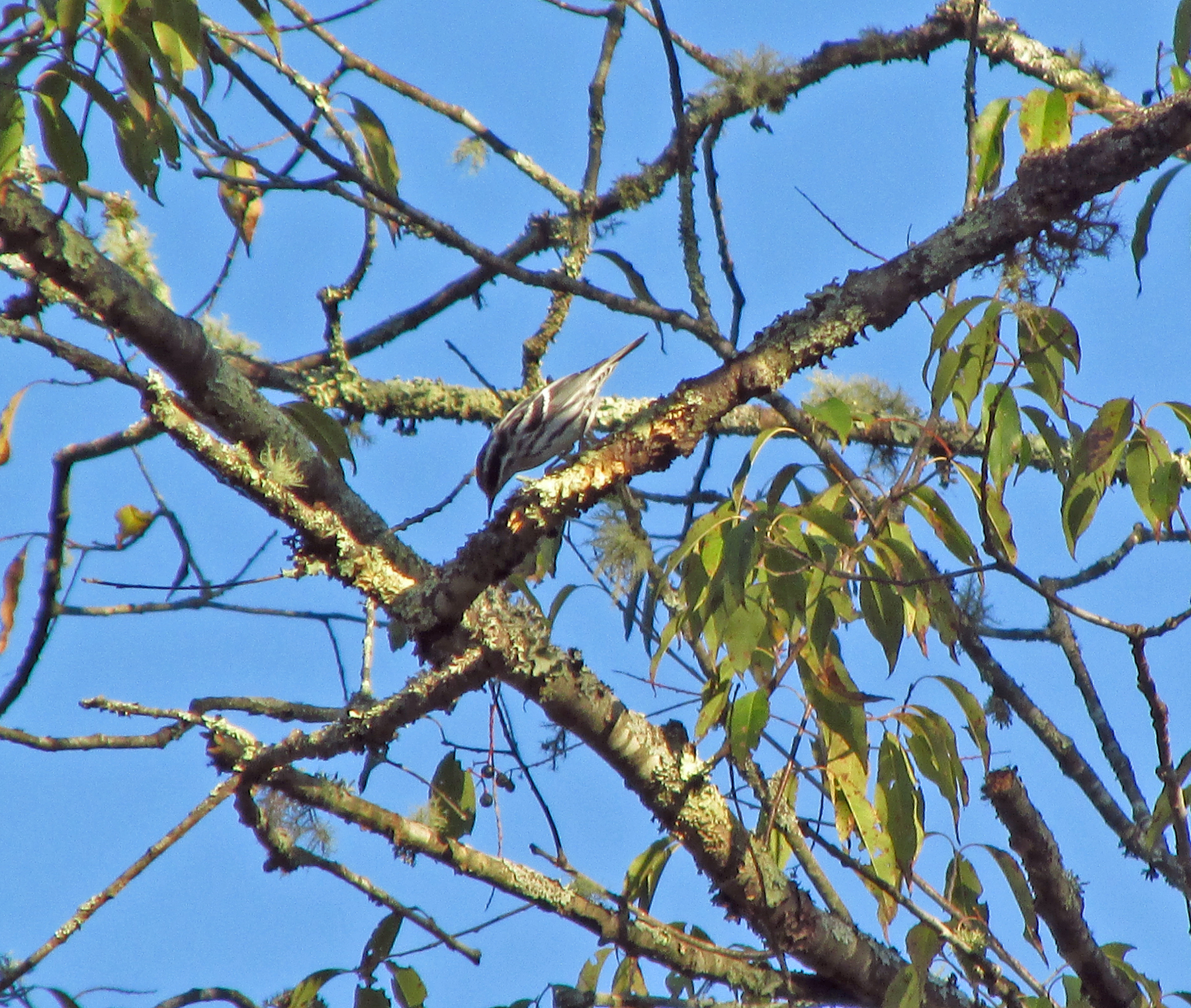
The black-and-white warbler is arguably the most aptly named of all the warblers. Both males and females have glossy black and white plumage. That’s it – there are no other colors present in the bird’s feathers.

Photo by Bryan Stevens • A black-and-white warbler creeps over the bark of a pine in search of insect prey.

The black-and-white warbler breeds in northern and eastern North America. It ranges from the Northwest Territories to the northwest and Newfoundland and Labrador to the northeast, to North Carolina to the southeast and Texas to the southwest. This species is migratory, wintering in Florida, Central America, the West Indies and northern South America down to Peru.

Once arriving for the spring, these warbler go about the business of nesting. The female black-and-white warbler selects a well-hidden nesting location at the base of a tree, rock, stump or fallen log, or under a bush or shrub, according to the website All About Birds. I discovered a black-and-white warbler nest, quite by accident, several years ago. The nest was wedged in a crevice beneath a large fallen pine resting on a steep ridge. Besides being rather inaccessible, I had no wish to disturb the nest so I enjoyed watching the birds through binoculars from a distance.

Photo by Hans Toom/Pxabay • A male black-and-white warbler sings its squeaky wheel song.

In its tendency to hug the trunk of trees as it seeks out insect prey, the black-and-white warbler is similar to unreleased species such as brown creeper and white-breasted nuthatch. In fact, an old common name for this bird was black-and-white creeper. It does venture farther out into a tree than the trunk, however, and will flit among branches as good as any other warbler.

For beginners just getting into the hang of birding, the black-and-white warbler is a dream when it comes to identification. It’s unlikely to be mistaken for any other bird. One good look through binoculars is usually all it takes to recognise the species. There’s no poring over the pages of a field guide for subtle field marks to help when trying to identify the black-and-white warbler. The same is true for the bird’s song, which is very similar in pattern to a squeaky wheel spinning round and round.

Enjoy the springtime and get outdoors and see what feathered friends are winging their way into your neighborhood.

Photo by Bryan Stevens
A Black-and-white Warbler forages along a branch.

Tiny songbird’s collision with window leaves gap in spring soundscape


Hans Toom/Pixabay • Male Northern paroles are a member of the warbler family. They are amazing vocalists producing an easily recognised trill of a song.

The male Northern parula is a persistent songster once arriving on its nesting territory each spring.

Since arriving in early April, a male Northern parula had been a tireless singer. I often heard the bird as I departed for work each weekday morning and was welcomed home in early evening by the bird’s song.

On April 29, I returned home. I followed my usual routine and dropped off my mother’s newspaper and mail at her home. Unfortunately, on her porch was the lifeless form of the Northern parula. I know it was “my” parula because the bird had been so faithful in its singing. I have not heard the song of a Northern parula in the days following the sad discovery.

Northern parulas sing two different types of songs, according to the website All About Birds. The most common is a rising buzzy trill with a final sharp note. This song rises up and pinches off sharply at the end. The second song has distinct pauses in between bouts of the rising buzzy trill. My parula had mostly sang the song best described as a rising buzzy trill, but it had also practiced at the second version, as well.

The tragic end for this little songster has really put a damper on my enjoyment of the spring season. Unlike many of our birds, this species of warbler has been thriving. Northern parulas are common, and their populations have actually increased by over 1% per year from 1966 to 2019 for a cumulative increase of about 47% according to the North American Breeding Bird Survey.

Bryan Stevens • This Northern parula died after a collision with a glass window.

But the incident is a reminder of the perils that our feathered friends face daily. An article titled “Getting Clear on Birds and Glass,” first published January 14, 2023, by Christine Sheppard and Bryan Lenz brings the detrimental impact glass has had on birds into focus.

The article noted that Smithsonian researches in 2014 attempted to determined how many birds are killed annually due to hitting windows. The study estimated, conservatively, that collisions with glass likely kill between 365 million and 1 billion birds annually in the United States. The authors of the article emphasized that they believe the number is closer to a billion birds, if not more, that die each year from hitting windows and other glass surfaces.

That’s a scary number, but also a testament to the resilience of birds. Of course, all living things have their limits, and we should try to do something to bring down this gruesome toll.

The little parula had struck a large picture window. We have placed decals in the window in an effort to break up the reflection, but the sun has bleached these over the years, and now it is evident they should be replaced. Clouds, sky or vegetation reflected in a window are perceived by birds as the real deal. A screen over a window or hanging strips or other items to break up the reflection will help birds avoid collision.

To examine a database with various possible solutions, please visit https://abcbirds.org/glass-collisions/products-database/

I am hopeful that another Northern parula will visit and find my yard to its liking. I’ve had Northern parulas residing consistently around my home from April to September for many years. The absence of this bird’s song from the daily soundscape has been distressing.

•••

Readers have continued to share their spring hummingbird sightings.

•••

Joe McGuiness in Erwin saw his first hummingbird back on April 9 at 5:45 p.m. Joe texted me that the bird came back to feed again around 7 p.m.

•••

Charlotte Carter, who resides in the Bloomingdale community in Kingsport, emailed me on Friday, April 25. “First hummingbird sighted at my home today at 12:45,” she wrote.

•••

Mack Hayes sent me a message on Facebook to report his first hummingbird arrived on Friday, April 25. “Saw first hummingbird this morning,” he wrote. He noted that he lives on the corner of Oakland Road and Bowmantown Road in Washington County.

•••

Hummingbirds are now back throughout the region. In the past couple of weeks the numbers have increased at my home. I have now seen as many as four hummingbirds at one time, and they duel all day long with each other, chasing each other from one corner of the yard to another. It’s good to have them back.

•••

Share sightings, ask questions or make comments by emailing me at ahoodedwarbler@aol.com.

Birder with ties to Northeast Tennessee plans Global Big Day

Photo by Bryan Stevens • Brayden Paulk introduces Rufous, a surprisingly tame ruffed grouse that lived on his grandfather’s farm for several years.

Brayden Paulk recently sent me an email to share some recent bird sightings he has made in Georgia.

As background, I’ve known Brayden since the summer of 2016. At the time, he was 17 years old and visiting with his grandparents in Flag Pond for the summer. We got acquainted thanks to an amazing ruffed grouse hanging out at a barn.

Brayden named the grouse Rufous who, as it turned out, was a remarkable bird. Ruffed grouse are, as a rule, shy and retiring birds. Not Rufous. He was an in-your-face sort of grouse. Getting to meet and observe this amazing bird was a privilege.

After we met so that I could make acquaintance with Rufous, Brayden and I did some birding at Rock Creek Recreation Area and then some stops on U.S. Forest Service lands along Highway 107 between Limestone Cove and the North Carolina line. Brayden wanted very much to add a black-throated blue warbler to his life list, and I very much wanted to help him find it.

We did manage to locate a singing veery, a scarlet tanager and a dark-eyed junco. We also found several warblers, including black-and-white warbler, worm-eating warbler and black-throated green warbler, but I began to fear we wouldn’t manage to locate his target bird.

But I am happy to report that we managed to find a male black-throated blue warbler. So, that productive morning back in 2016 resulted in my meeting with a grouse with a lot of personality and Brayden getting a new species for his life list of birds.

When we first met, Brayden was living with his family in Oxford, Alabama. During our first in-person meeting he made a point to tell me that his grandparents, Leon and Janice Rhodes, mailed him every one of my bird columns.

Photo by Bryan Stevens • The late Leon Rhodes teases Rufous the ruffed grouse.

These days he is living in Georgia, which is also providing the focus for most of his birding. He returns often to Tennessee. In fact, he has given a couple of talks to the Elizabethton Bird Club over the years, impressing his audience with his enthusiasm and engaging way of presenting information.

His talk were, surprisingly, not about birds. He spoke about his other passion, fishing, but still managed to make a few mentions of birds in the process.

Brayden has also worked for a couple of summers at Lamar Alexander Rocky Fork State Park in Flag Pond as a seasonal interpretive ranger.

Anyway, enough with the background and back to his recent email.

“I hope everything is going well with you and the bird club,” he wrote. “I wanted to contact you about some interesting recent sightings I have had that I thought you would be interested in. I have been able to put a lot of effort into birding so far this spring and it has turned up some fantastic finds.”

Photo by Bryan Stevens • Rufous, a rather tame ruffed grouse, who made his home in Unicoi County for several years.

His finds have even established some records in Laurens County in Georgia where he now lives.

His local birding loop in his home county has been very productive.

On April 7, his observations of common loons resulted in a county high count for the species. He found 14 loons on one lake and six on another nearby lake. The next highest count before his sighting had stood at two birds.

“That loop has also been very productive for shorebirds, as there are some flooded areas in nearby fields where I have seen lots of greater and lesser yellowlegs and snipe,” he wrote.

“I also got excellent views of a Swainson’s warbler within feet of me at an area on the loop with some swamp and cane thicket habitat,” Brayden added.

On April 7 while running his llocal birding loop in Laurens County, Georgia, Brayden Paulk saw the county high count for common loons with 14 on one lake and 6 on another nearby.

That sighting alone is something that would make many birders envious. I have been birding since 1993 and I can count on one hand the number of looks I’ve had of Swainson’s warbler. The species is often localized, meaning it takes some effort to locate. It’s easy to hear them. The Swainson’s warbler has a loud, ringing song similar to a Louisiana waterthrush. I’ve heard Swainson’s warblers much more frequently than I have seen them.

Brayden also shared his excitement about seeing his first first Horned Lark in the county. He saw the lark, a bird of open fields, at a different location. “It seems to be one of those birds you have to try to find by going to a sod farm or open country,” he noted.

“The Laurens County Loop has also been great for me in the past, and one particular pond turned up the first eBird county records for American avocet, white-rumped sandpiper and long billed dowitcher,” he wrote. “I have also found breeding painted buntings on the loop as well and had an excellent view of them with my dad.”

Brayden also wanted to share some more exciting news.

“I will be moving to Gulf Shores in coastal Alabama in a few weeks, which is one of my favorite places to go birding,” he wrote. “I plan on going to Dauphin Island on the Global Big Day because it is an incredible place to see migrants, and my goal is to find 150 species on that day.”

This year’s Global Big Day is scheduled for Saturday, May 10. Global Big Day is an annual birdwatching event hosted by eBird and Cornell Lab of Ornithology to celebrate and document bird migration. The event was created as a fun and engaging way for bird enthusiasts of all levels to contribute to science and conservation by reporting their bird sightings.

Brayden also hopes to visit Unicoi County again soon to do some birding there and look for some of the species he missed last Summer.

“Thank you for writing your bird articles,” he wrote at the conclusion of his email. “They have inspired me since I was young!”

It’s not easy to put into words how much that unexpected praise made me feel. I am incredibly gratified that I could have provide some inspiration to get such a gifted young man into the field looking for birds.

Readers may recall that I’ve had some deterioration of vision in recent years. With a pair of binoculars, I can still bring birds close enough to enjoy and appreciate their beauty and vivacity. Spotting birds, which is a skill that takes some practice to achieve, is no longer easy for me. Ah, the things we take for granted…

My hearing remains unimpaired. I have enjoyed making note of returning warblers and other birds simply by hearing their familiar songs ringing through the woodlands at my home for yet another spring.

For the past couple of weeks I’ve also had the pleasure of watching daily as a feisty male ruby-throated hummingbird visits the feeders arranged around my front porch.

In closing, I invite everyone to wish Brayden luck with his upcoming Global Big Day. I hope to update everyone with how he does.

•••

To share a sighting, ask a question or make a comment, email me at ahoodedwarbler@aol.com.

Phoebe’s return a signal other arrivals due soon

An Eastern phoebe has returned to the woodlands around my home.

I’m not sure when the resident phoebes departed last fall. They were still prominent in their daily activities in late October and early November. I think they probably slipped off, unnoticed, around Thanksgiving. Some winters, a few Eastern phoebes linger throughout the cold months, often near an open source of water that’s unlikely to freeze.

With the arrival of March and warmer weather, at least one Eastern phoebe, a male, is back and singing tirelessly every morning. The song is easy to memorise. The singing bird simply repeats its name — fee bee, fee bee — in scratchy, descending sets of tones.

Considering the bright finery worn by some of the more colorful spring arrivals, Eastern phoebes are comparatively drab. The gray and white plumage of this species of flycatcher pales in comparison with vibrant birds like rose-breasted grosbeak, ruby-throated hummingbird, scarlet tanager and yellow warbler.

Nevertheless, this member of the flycatcher clan has earned itself a favorite spot in the hearts of many a birdwatcher. It’s one of those birds that even beginning birders find surprisingly easy to recognize and identify. While it may not have a dramatic plumage pattern to hint at its identity, the Eastern phoebe is quite at home around human dwellings and comes into close contact with people going about their daily routines. Rather tame — or at least not too bothered by close proximity with humans — the Eastern phoebe has one behavior that sets it apart from all the other similar flycatchers. When this bird lands on a perch, it cannot resist a vigorous bobbing of its tail. Every time that a phoebe lands on a perch, it will produce this easily recognized tail wag. It’s this tell-tale action that makes this bird almost instantly recognizable among birders with the knowledge of this behavioral trait.

Photo by Bryan Stevens • A young Eastern Phoebe perches in the shelter of some branches.

The Eastern phoebe, known by the scientific name of Sayornis phoebe, has two relatives in the genus Sayornis. The genus is named after Thomas Say, an American naturalist. The Eastern phoebe’s close relatives include the black phoebe and Say’s phoebe. The black phoebe ranges throughout Oregon, Washington and California and as far south as Central and South America. As its name suggests, this bird has mostly black feathers instead of the gray plumage of its relatives. The Say’s phoebe, also named for the man who gave the genus its name, is the western counterpart to the Eastern phoebe.

Since they belong to the vast family of New World flycatchers, it’s probably no surprise that these phoebes feed largely on insects. That’s why phoebes overwintering in the region are always found near water. The open water also attracts flying insects. The birds will often perch patiently until an insect’s flight brings it within easy range. A quick flight from its perch usually allows the skillful bird to return with a morsel snatched on the wing. In the winter months, however, the Eastern phoebe also eats berries and other small fruit when insect scarcity makes this exclusive diet almost impossible.

Phoebes are fond of nesting on human structures, including culverts, bridges and houses. With the latter, they were once known for their habit of placing their nests under sheltering eaves. At my home, a pair of Eastern phoebes often chooses to nest on the wooden rafters in my family’s garage. Phoebes also like to reside near a water source, such as a creek, stream or pond.

Although the species is migratory, a few hardy individuals will usually try to tough out winters in the region. The others that depart in the autumn will migrate to the southern United States and as far south as Central America. On some rare occasions, Eastern phoebes have flown far off their usual course and ended up in western Europe. I can usually count on Eastern phoebes returning to my home in early March, making them one of the first migrants to return each year.

Photo by Bryan Stevens • An Eastern Phoebe perches in a mimosa tree.

This year, like the dependability of clockwork, I began hearing that easily recognized song on mornings during the first days of March when I walked to my car to depart for work. It’s due to their noisy nature that their arrival rarely goes unnoticed. Males tend to start singing persistently as soon as they arrive. I doubt it will take the male residing near my home long to attract a mate.

John James Audubon, an early naturalist and famed painter of North America’s birds, conducted an experiment with some young phoebes. His simple test represents the first-ever bird banding in the United States of America. His novel experiment, which he carried out in 1803, involved tying some silver thread to the legs of the phoebes he captured near his home in Pennsylvania. He wanted to answer a question he had about whether birds are faithful to home locations from year to year. The following year Audubon again captured two phoebes and found the silver thread had remained attached to their legs. Today ornithologists still conduct bird banding to gather information on birds and the mystery of their migrations.

So, that pair of phoebes that returned to your backyard this spring — they just might be the same ones that have spent past summer seasons providing you with an enlightening glimpse into their lives.

Over the past few years, I’ve had a pair of Eastern phoebes nest on the blades of a ceiling fan on my front porch. Other past nesting locations have included the rafters in my garage. If a pair happens to take up residence on your own front porch or in your garage, I hope you’ll welcome them. The pleasure of observing them raising their family will more than compensate for a slight mess and a few weeks of inconvenience.

••••••

To learn more about birds and other topics from the natural world, friend Bryan Stevens on Facebook at https://www.facebook.com/ahoodedwarbler. He is always posting about local birds, wildlife, flowers, insects and much more. If you have a question, wish to make a comment or share a sighting, email ahoodedwarbler@aol.com.

Projects can help welcome back spring arrivals

Photo by Pixabay.com • A well-stocked feeder is a first step toward attracting more birds to your yard.

I’ve welcomed March with open arms. I know it’s too early to guarantee we’ve seen the last of winter, but I’m hopeful that the worst is behind us.

While birds don’t follow calendars, they are punctual, and thanks to their boundless energies, the grand spectacle of spring migration is already upon us. The pace will quicken in April and early May as many of our favorite summer birds, including species ranging from hummingbirds and warblers to swifts and swallows, wing their way back to the region.

Now is the time to conduct some spring tasks to make our feathered friends feel more welcome when they do return.

Place birdhouses

Many birds are cavity-nesting species, which means they utilize natural nooks and crannies as locations for nests. Nesting in a natural tree cavity or in a human-provided birdhouse offers an extra degree of security not available to birds that build traditional cup-shape nests, not to mention all the birds that simply lay their eggs right on the ground without going to much effort to construct an actual nest.

Some of the cavity-nesting species in the region that will readily accept quarters in a bird house include Carolina chickadee, Eastern bluebird, white-breasted nuthatch, tree swallow, tufted titmouse, great crested flycatcher, prothonotary warbler and house wren.

Cavity-nesting isn’t restricted to songbirds. Wood ducks, Eastern screech-owls and American kestrels will make use of birdhouses built to their unique specifications. Plans for constructing your own bird houses tailored to individual species can be found at various online sites. For those not as good with do-it-yourself projects, department stores, gardening centers and other other shops sell pre-made houses.

Clean your feeders

Frigid cold snaps brought birds flocking to our feeders. As returning birds mingle with lingering winter visitors at our feeders this spring, the chance of spreading disease will increase.

Now is definitely the time to be proactive, cleaning feeders and bird baths regularly and keeping alert to any sign that ill birds might be among the visiting flocks.

Cleaning need not be laborious. Fill a spray bottle with a dilute solution of bleach water. A good ratio is no more than 1 part bleach to 9 parts water. Remove feeders, give them a quick rinse, and then spritz them with the bleach solution. Rinse thoroughly and allow to dry before refilling with seed for the birds.

Enhance brush piles

This past winter with its heavy snow and ice, as well as fierce winds, no doubt brought down many branches. When cleaning your yard of branches, consider adding them to an existing brush pile. I’ve long been a fan of keeping a brush pile in order to provide the resident songbirds with shelter and security from the elements, as well as from predators.

If you don’t have a brush pile, spring’s the perfect time to create one. If an unkempt pile of sticks offends your aesthetic sensibilities, tuck the brush pile into an obscure corner or locate it at the margins of the lawn or garden.

Personally, I like to locate brush piles near my busier feeders. A brush pile gives visiting birds a quick retreat if a predatory hawk arrives unexpectedly. For some birds, the need for dense cover is paramount.

Offering brush piles, as well as hedges and dense shrubbery, will help welcome visitors such as gray catbirds, Eastern towhees, brown thrashers and some sparrows. Wide, open spaces make many songbirds nervous.

Photo by Jean Potter • An American crow visits a bird bath.

Install water features

With a large fish pond, a flowing creek and a couple of mountain seeps on my property, I’ve never needed to introduce an additional water source. For those with properties that don’t offer ready access to water, adding an ornamental pool or fountain, or even a bird bath or artificial waterfall, will act as a magnet for many birds. American robins and cedar waxwings love a place to splish and splash, as well as take a refreshing sip. Migrating warblers, which for the most part ignore feeders, are almost magically drawn to water features. There is also something relaxing for the human psyche when it comes to water features.

Refurbish the landscape

Spring’s a great time to plan ahead. While a handout of sunflower seed is appreciated by many birds, there’s nothing that beats organic sources of food.

Add plants and trees to the landscape of your yard and garden with the express purpose of providing birds with seeds, fruits and berries. Most experts urge native plant varieties that meet the nutritional needs of many bird species.

Flowers can be chosen that provide that desired burst of color for an interval but then go on to produce fruit or seeds craved by many birds. Native flowers can also be planted that offer a natural source of nectar for ruby-throated hummingbirds. Do some homework. Some nurseries specialize in native plants.

Photo by Bryan Stevens • A ruby-throated hummingbird visits a feeder for a sip of sugar water.

Get hummingbird feeders out early

Various websites track the annual spring return of hummingbirds. Journey North is one site that relies on citizen scientists to share their first sightings of this tiny, beloved bird.

The first reports of ruby-throated hummingbirds usually surface in early March along the Gulf Coast after these tiny birds make their incredible non-stop flight across the Gulf of Mexico. This arduous journey is their first step to returning points all across eastern North America for the spring and summer nesting season. Those first arrivals are still hundreds of miles away from Northeast Tennessee. There will always be “early birds” even among hummingbirds. Increase the likelihood of seeing one of these tiny gems by putting out a sugar water feeder soon. I’d encourage anyone hoping to attract these birds to have feeders ready for them by the last week of March.

Treat Yourself

Now is also the perfect time to indulge in a purchase that will enhance your enjoyment of the returning birds. If you have been wanting some new birding field guides, a new pair of binoculars, a new software app to help identify birds or a camera to let you document bird sightings with photographs, there’s no time like the present.

Welcome spring and the returning birds at the same time while ensuring maximum enjoyment of both.

•••

Bryan Stevens has written about birds and birding since 1995. Email him at ahoodedwarbler@aol.com to share a sighting, ask a question or make a comment.
 

Red-winged blackbird, other birds set to return in coming weeks

Photo by Bryan Stevens • A male red-winged blackbird sings to attract mates and ward off rivals.

February’s the shortest month, and it is more than halfway over. There are already signs that some birds are ready to embrace the shift in seasons as winter advances, albeit in fits and starts, toward spring.

On Feb.11, three mallards visited my fish pond. The presence of mallards at any pond is not all that surprising. The mallard is arguably the most recognized of North America’s native ducks. But these were wild birds, as indicated by their wary behavior and their ability to spring into strong flight when I surprised them quite by accident.

Spring migration begins as early as February and March. Eastern bluebirds, which for the most part are not migratory, are already checking out nesting boxes.

The months of March, April and May will bring an influx of migrants. Ruby-throated hummingbirds will soon make their annual crossing of the Gulf of Mexico. These tiny birds usually make landfall in the United States as early as February, but they don’t usually venture as far north as Northeast Tennessee, Western North Carolina and Southwest Virginia until early April.

Bryan Stevens • On Feb.11, three mallards visited my fish pond. I am hoping they are the start of more migrating birds arriving in the coming weeks.

Warblers, orioles, thrushes, flycatchers, tanagers and many other migrants also return in April and May. A variety of waterfowl, raptors and shorebirds pass through the region during these months, as well.

March brings the early birds, including species such as brown thrasher, blue-gray gnatcatcher and red-winged blackbird.

Red-winged blackbirds return with a venegeance in early March or sometimes in late February.

I’m ready to hear their loud, familiar “kon-ke-ree” sounds again from the tops of the cypress trees at the fish pond. It’s always a fun moment to welcome these birds back.

Red-winged blackbirds return yearly in early spring and begin to seek out nesting habitat in local wetland areas, such as the cattail marshes near my fish pond.

My first returning male red-winged blackbird arrived on the evening of March 3 in 2022. The first red-winged blackbird arrived on the morning of March 6 the following year. I heard his unmistakable song from inside my house.

The showy and loud red-winged blackbird males soon take up residence at my fish pond and adjacent stands of cattails after their return.

Male blackbirds arrive ahead of the females. They immediately search out prominent perches and begin singing every day in anticipation of an intended audience. Female blackbirds lag a week or so behind the males in returning to their familiar territory.

Any wet field or marsh, especially those offering a stand of cattails, is almost certain to attract red-winged blackbirds at this time of year. I’d almost wager on that certainty.

The blackbirds arriving in spring behave much differently than the quiet, furtive flocks that often make brief visits to feeders during late winter snowstorms.

“The kon-ke-ree song of the male red-winged blackbird is a sure indication that spring is on the way,” according to a profile located at the Tennessee Watchable Wildlife website.

At this time of year, the male red-winged blackbirds seek elevated perches to display and vocalize. Their loud antics are not designed solely to attract mates. Male red-winged blackbirds also sing to warn rival males from intruding into their territories.

The male red-winged blackbird is a very aptly named bird. Glossy black males sport red wing patches that are often trimmed with a narrow band of yellow feathers. By contrast, female red-winged blackbirds are mostly brown birds that could easily be mistaken for large sparrows. Both sexes have sharply pointed bills.

Red-winged blackbirds are fond of wetlands. Any marsh or even a damp field or flooded pasture is likely to attract a few resident red-winged blackbirds. Females choose nesting locations in cattails or other marsh vegetation. She usually lays three or four eggs. Although she does receive some help from the male, most of the responsibility for raising the young is left to her.

There is a reason that male red-winged blackbirds are not always quite as engaged as females in feeding and tending their young. Males are often polygynous, which means that males will often court multiple mates. His time is often occupied defending females and their respective nests from the advances of other male red-winged blackbirds.

According to the website All About Birds, male red-winged blackbirds spend much of the breeding season sitting on a high perch over their territories and singing almost without ceasing from dawn to dusk.

The website also notes that female blackbirds shirk the high profile of the males. They tend to skulk in wetland vegetation as they collect food or nest material.

Bryan Stevens • Female red-winged blackbirds lack the showy plumage of males. They look more like an overgrown sparrow.

Both males and females defend nests from intruders and predators. They take this duty quite seriously, as I know personally from being dive-bombed by parent blackbirds when I have gotten a little too close to their nests.

Other relatives of the red-winged blackbird in the United States include the tricolored blackbird found along the Pacific Coast and the yellow-headed blackbird resident in wetlands west of the Great Lakes. Rusty blackbird, common grackle and brown-headed cowbird are other species of blackbirds found in Tennessee, Virginia and North Carolina.

For birders, the weeks ahead are an exciting time. In spirit, I think others often join our excitement if for no other reason than to celebrate that spring is just around the corner. These “early bird” arrivals are merely the harbingers of the season.

Share a sighting, ask a question or make a comment by emailing me at ahoodedwarbler@aol.com.

Bryan Stevens • In fall, male red-winged blackbird are bereft of the striking glossy plumage of spring.


Birds make use of various strategies to attract and keep mates

Shauna Fletche/Pixabay • Some birds, like waxwings, like to present tasty treats to their potential mates.


With Valentine’s Day around the corner, it’s an opportune time to see how courtship is handled among our fine feathered friends. Most birds don’t bring a box of chocolates or a bouquet of roses when they take up courtship of a prospective mate, but birds have several equivalent behaviors that they employ to attract the attentions of the opposite sex. In honor of Valentine’s Day I thought a look at some of the more unusual courtship rituals of some of our feathered friends would be appropriate.

Aerial acrobatics designed to impress

In late winter and early spring, a true oddball begins courting. The American woodcock, also known by such whimsical names as “bog sucker” and “timberdoodle,” is a shorebird that has completely abandoned the shore in favor of woodlands and fields. Beginning as early as February, American woodcocks in the region conduct nightly courtship displays, starting at dusk, that combine aerial acrobatics with an assortment of unusual acoustical flourishes. Any wet field adjacent to a wooded area could offer a stage for these evening displays, but unless you know where to look and make an effort to do so, the American woodcock might as well remain a phantom of the night.

These mating rituals provide almost the only time of the year during which this bird makes itself available for observation. It’s only during this brief window that opens into their lives that we can be assured a glimpse. Even then, our peeks at woodcocks often consist of a fuzzy twilight escapade as the bird flings itself heavenward only to make a spiraling descent a few seconds later. The displays begin with a distinct vocalization, a type of “pent,” that also has the quality of sounding like some sort of mechanical buzzer.

Once the displays conclude for the season, the birds assume nesting duties, usually unobserved by humans. The rest of the year, almost nothing but blind, sheer luck would allow a birder to stumble across an American woodcock. It’s almost as if they disappear after these spring flights of fancy.

Birds bearing gifts

Many birds present small trinkets to a prospective mate. For instance, many male penguins make a present of a stone or pebble to female penguins. There could be more than a simple bribe behind this gift. Female penguins don’t build elaborate nests. In fact, a scrape on the bare ground, perhaps encircled by a collection of pebbles, marks the extent of their nest construction. So, the perfect pebble could be the way to winning a female penguin’s heart.

The way to the heart is through the stomach

Observant birders may have witnessed a male Northern cardinal slip a female a morsel of food, such as a peanut or a shelled sunflower kernel. It’s a marked change for this bird. During the winter months, a male cardinal is more likely to chase a female away from a feeder rather than share food with her. However, as spring approaches, his behavior undergoes a change and he becomes content to feed next to a female cardinal, often slipping her some choice tidbits.

Sabine van Erp/Pixabay • Bow to your partner: Grey-crowned cranes perform an elaborate dance designed to strengthen their bond.

May I have this dance?

Many species of birds perform elaborate and ritualistic dance displays. Among birds known for tripping the light fantastic are flamingoes, cranes, grouse and grebes. Cranes are one of the oldest families of birds on earth. They’re also some of the most accomplished dancers in the animal kingdom. Pairs perform very ritualistic dances that, if the performers were human, would no doubt require the services of an accomplished choreographer. Cranes mate for life and the ritual of dancing is a way to strengthen the bonds between a mated pair. The ability to dance is, apparently, not instinctive. Young cranes must practice their dance moves, a process that can take years before they master the elaborate dance.

Dave Menke/U.S. Fish & Wildlife Service • A pair of Clark’s Grebes displays in a courtship ritual known as “rushing” or “weed dance.” Birds use a variety of strategies to attract and keep mates.

Synchronized swimming

While many birds dance to impress a mate or strengthen pair bonds, grebes perform a dance that takes place completely on the surface of the water. A pair will engage in this intricate performance, perfectly mirroring the moves of the other as they literally race across the surface of the water. These dances by grebes are also known as “rushing” or “weed dance.” It’s called as a weed dance because at the culmination of the ritual, the birds usually hold some type of aquatic plants in their bills while racing swiftly over the surface of the water. Pairs that perform well together stay together, building a nest and raising young.

Good housekeeping seal of approval

The tropical family of bowerbirds are famous for complex nests built by males and then decorated with bright and colorful objects to catch the eye of a potential mate. The nests of these birds are actually referred to as a “bower.” Usually constructed on the ground, the male will line the approachs to the bower with items such as shells, leaves, flowers, feathers, stones, berries, and even discarded garbage, including plastic scraps or bits of glass. Unusually odd items pressed into these decorative displays have included coins and spent rifle shells. This habit of male bowerbirds must rank as the ultimate in trying to impress a mate with shiny bling.

These are just a few of the inventive ways that birds go about attracting and keeping mates. Perhaps you can pick up some pointers from our feathered friends to ensure you have a great Valentine’s Day this year.

•••

If you have a question, wish to make a comment or share a sighting, email me at ahoodedwarbler@aol.com.