Category Archives: Birding
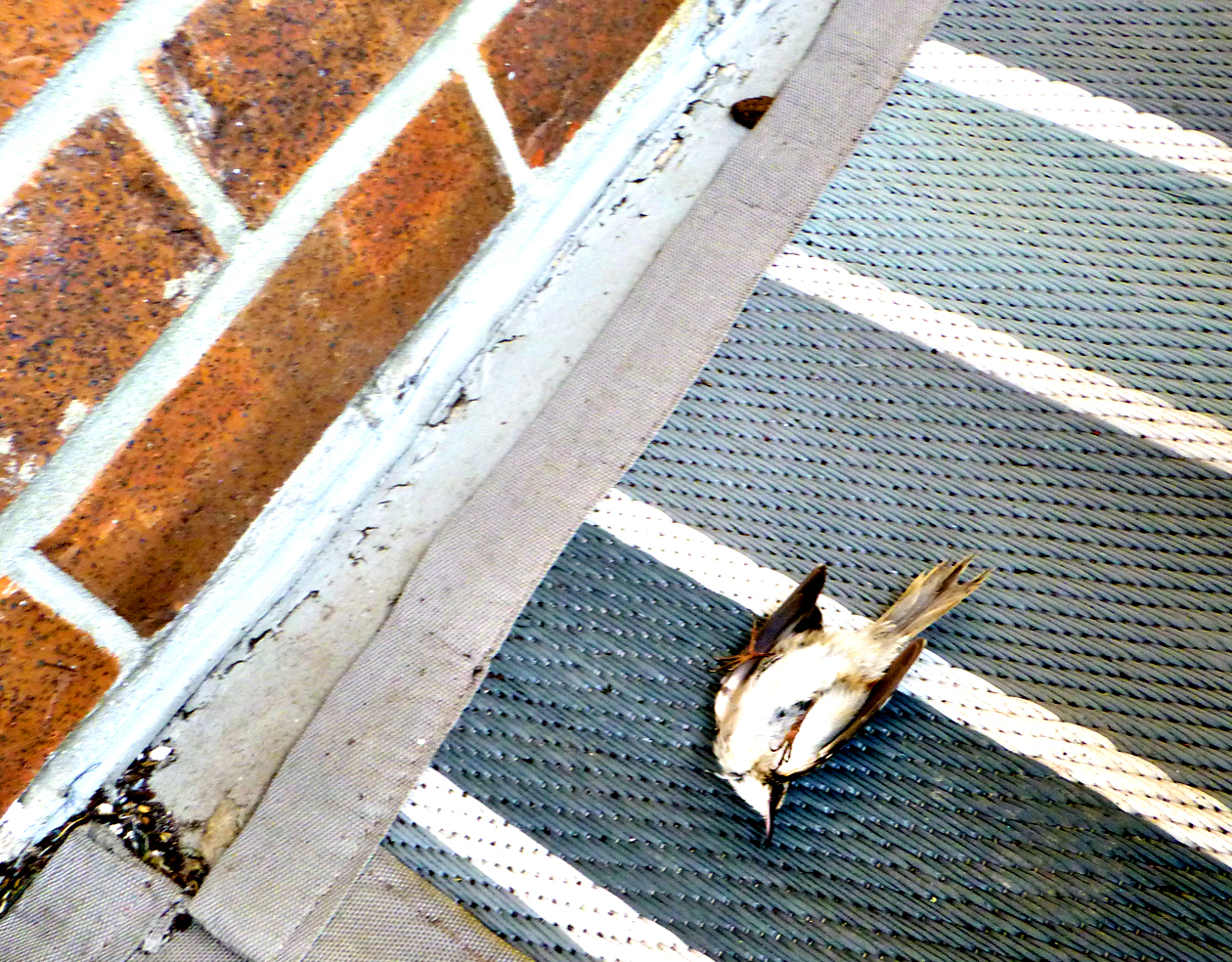
First-ever Unicoi County Summer Bird Count tallies 111 species
Members of the Lee and Lois Herndon Chapter of Tennessee Ornithological Society conducted the first-ever Unicoi County Summer Bird Count on Saturday, June 14.
Rick Knight, a long-time compiler for the chapter’s seasonal bird counts, organized and launched the count as a means to collect valuable information about the local distribution of birds in an often overlooked county in the region.
Nineteen observers in five parties logged 53 party hours, plus three nocturnal party hours, searching for birds from Flag Pond to Limestone Cove within Unicoi County.
A total of 111 species were tallied during the count by the following observers: Jim Anderson, Rob Armistead, Harry Lee Farthing, Don Holt, Rick Knight, Roy Knispel, Richard Lewis, Vern Maddux, Joe McGuiness, Tom McNeil, Charles Moore, Cathy Myers, Kathy Noblet, Brookie and Jean Potter, Bryan Stevens, Kim Stroud, Gary Wallace and John Whinery.
Species found during the count included:
Canada Goose, 76; Wood Duck, 17; Mallard, 31; Ruffed Grouse,1; Wild Turkey, 29; Great Blue Heron, 12; and Green Heron, 6.
Black Vulture, 3; Turkey Vulture, 28; Bald Eagle, 3 ; Sharp-shinned Hawk, 1; Cooper’s Hawk, 1; Red-shouldered Hawk, 1; Broad-winged Hawk, 3; Red-tailed Hawk, 5; American Kestrel, 2; and Peregrine Falcon, 3.
Killdeer,17; Rock Pigeon, 75; Mourning Dove, 77; Yellow-billed Cuckoo, 3; Eastern Screech-Owl, 2; Great Horned Owl, 1; Chuck-will’s-widow, 6; Eastern Whip-poor-will, 3; Chimney Swift, 44; Ruby-throated Hummingbird, 17; and Belted Kingfisher, 4.

Photo Courtesy of Jean Potter
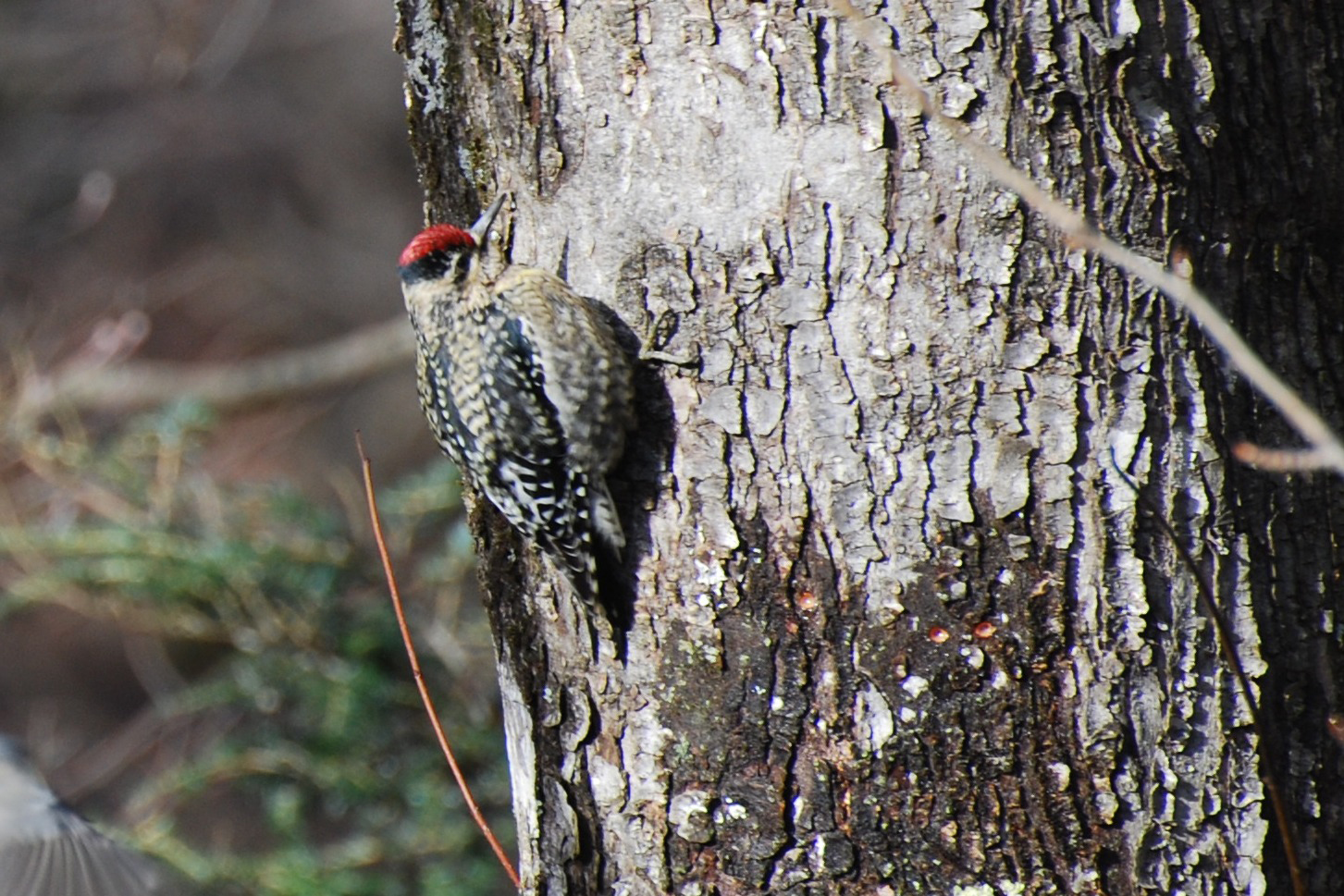
The Yellow-bellied Sapsuckers found during the count indicate that this species is nesting at high-elevation locations in Unicoi County.
Red-bellied Woodpecker, 20; Yellow-bellied Sapsucker 3; Downy Woodpecker 15; Hairy Woodpecker 5; Northern Flicker, 12; Pileated Woodpecker, 16; Eastern Wood-Pewee 8; Acadian Flycatcher 29; Least Flycatcher 5; Eastern Phoebe, 44; Great Crested Flycatcher, 2; and Eastern Kingbird, 13.
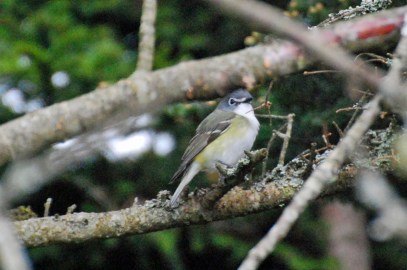
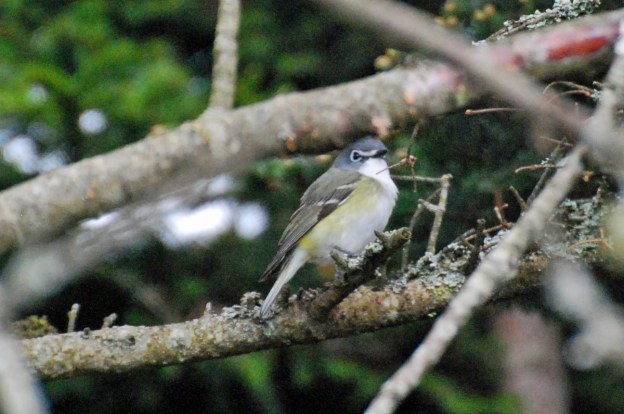
White-eyed Vireo, 1; Yellow-throated Vireo, 1; Blue-headed Vireo, 29; Warbling Vireo, 1; Red-eyed Vireo, 157; Blue Jay, 59; American Crow, 139; Common Raven, 8; Purple Martin, 36; Tree Swallow, 94; Northern Rough-winged Swallow, 68; Cliff Swallow, 64; and Barn Swallow, 139.
Carolina Chickadee, 63; Tufted Titmouse, 47; Red-breasted Nuthatch, 3; White-breasted Nuthatch, 20; Brown Creeper, 1; Carolina Wren, 80; House Wren, 31; Winter Wren, 2; and Blue-gray Gnatcatcher, 27.
Eastern Bluebird, 46; Veery, 35; Wood Thrush, 37; American Robin, 435; Gray Catbird, 37; Northern Mockingbird, 37; Brown Thrasher, 14; European Starling, 464; and Cedar Waxwing, 71.
Ovenbird, 56; Worm-eating Warbler, 9; Louisiana Waterthrush, 5; Golden-winged Warbler, 1; Black-and-white Warbler, 19; Swainson’s Warbler, 6; Kentucky Warbler, 1; Common Yellowthroat, 2; Hooded Warbler, 78; American Redstart, 8; Northern Parula, 13; Magnolia Warbler, 1; Blackburnian Warbler, 2; Yellow Warbler, 1; Chestnut-sided Warbler, 23; Black-throated Blue Warbler, 20; Yellow-throated Warbler, 4; Prairie Warbler, 7; Black-throated Green Warbler, 30; Canada Warbler, 9; and Yellow-breasted Chat, 5.

Photo by Bryan Stevens
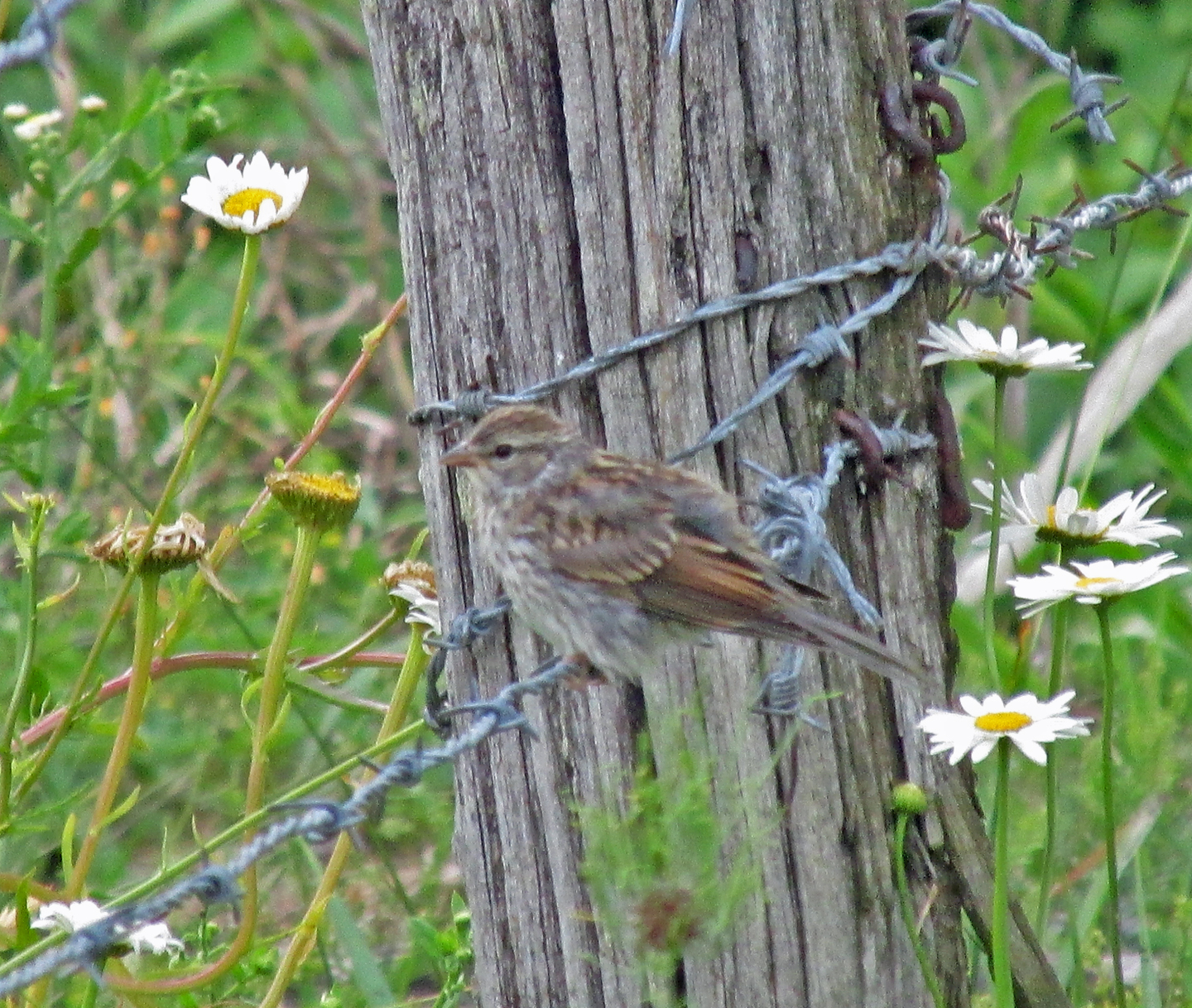
A young Chipping Sparrow perches on a barbed wire fence at the Bell Cemetery in Limestone Cove.
Eastern Towhee, 70; Chipping Sparrow, 60; Field Sparrow, 12; Song Sparrow, 214; Dark-eyed Junco, 28; Scarlet Tanager, 20; Northern Cardinal, 138; Rose-breasted Grosbeak, 2; Blue Grosbeak, 1; and Indigo Bunting, 197.
Red-winged Blackbird, 101; Eastern Meadowlark, 13; Common Grackle, 94; Brown-headed Cowbird, 34; Orchard Oriole, 1; Baltimore Oriole, 1; House Finch, 8; American Goldfinch, 84; and House Sparrow, 64.
Knight noted that all 111 species found during the count are known or suspected to nest in Unicoi County. For instance, the three Bald Eagles found on the count included an adult bird and two recently fledged young. Eagles have been documented nesting near the Devil’s Looking Glass above the Nolichucky River for the past couple of years.
•••••
During the count, I stayed close to home with the territory of Limestone Cove and the portion of Sciota Road located within Unicoi County. Gary Wallace and John Whinery joined me for several hours of productive birding.
We found some birds I would never have expected to find so close to home, including singing Prairie Warblers and a noisy, scolding Yellow-breasted Chat. On Bean Creek Road near the state line with North Carolina, we also found a male Yellow-bellied Sapsucker while walking a section of the Appalachian Trail. This was my first summer sighting of what is normally a winter bird in the region. In recent years, however, a few sapsuckers have started nesting in some of the local mountains.
We also missed some target birds. We checked out every pond we could view in our territory and failed to find a Green Heron.
Summer is also an extremely busy time of year for birds as they go about the business of bringing up a new generation of birds. Most birds have completed spring migration and have settled into locations they will call home for the next few months. During the recent Summer Bird Count in Unicoi County, we saw numerous young birds, ranging from Chipping Sparrows and Eastern Bluebirds to American Robins and Barn Swallows.

Photo by Bryan Stevens
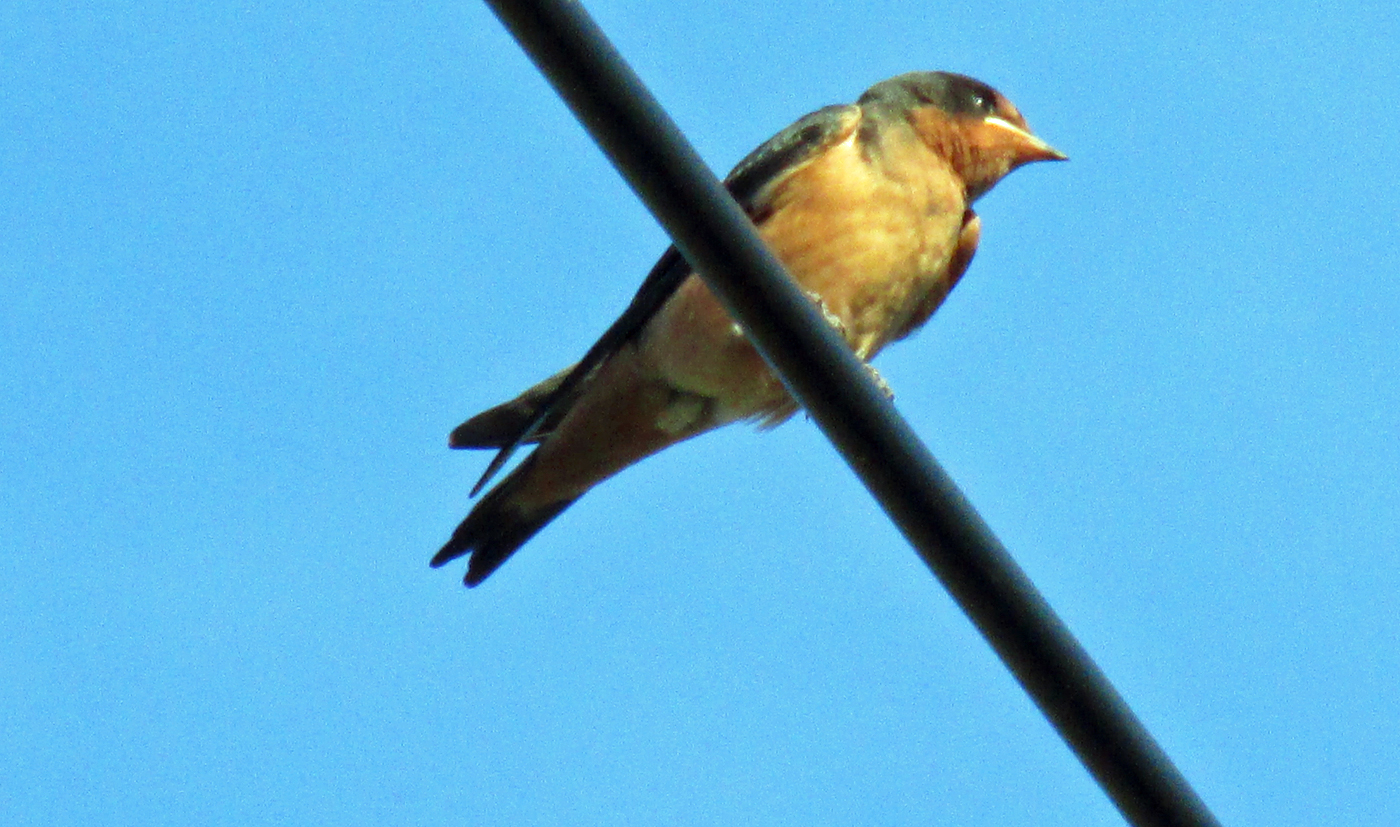
A young Barn Swallow perched on a utility line at the Bell Cemetery in Limestone Cove awaits a delivery of food from its parents.
•••••
To ask a question, make a comment or share an observation, email me at ahoodedwarbler@aol.com or leave a remark here at “Our Fine Feathered Friends.”
Other things with wings

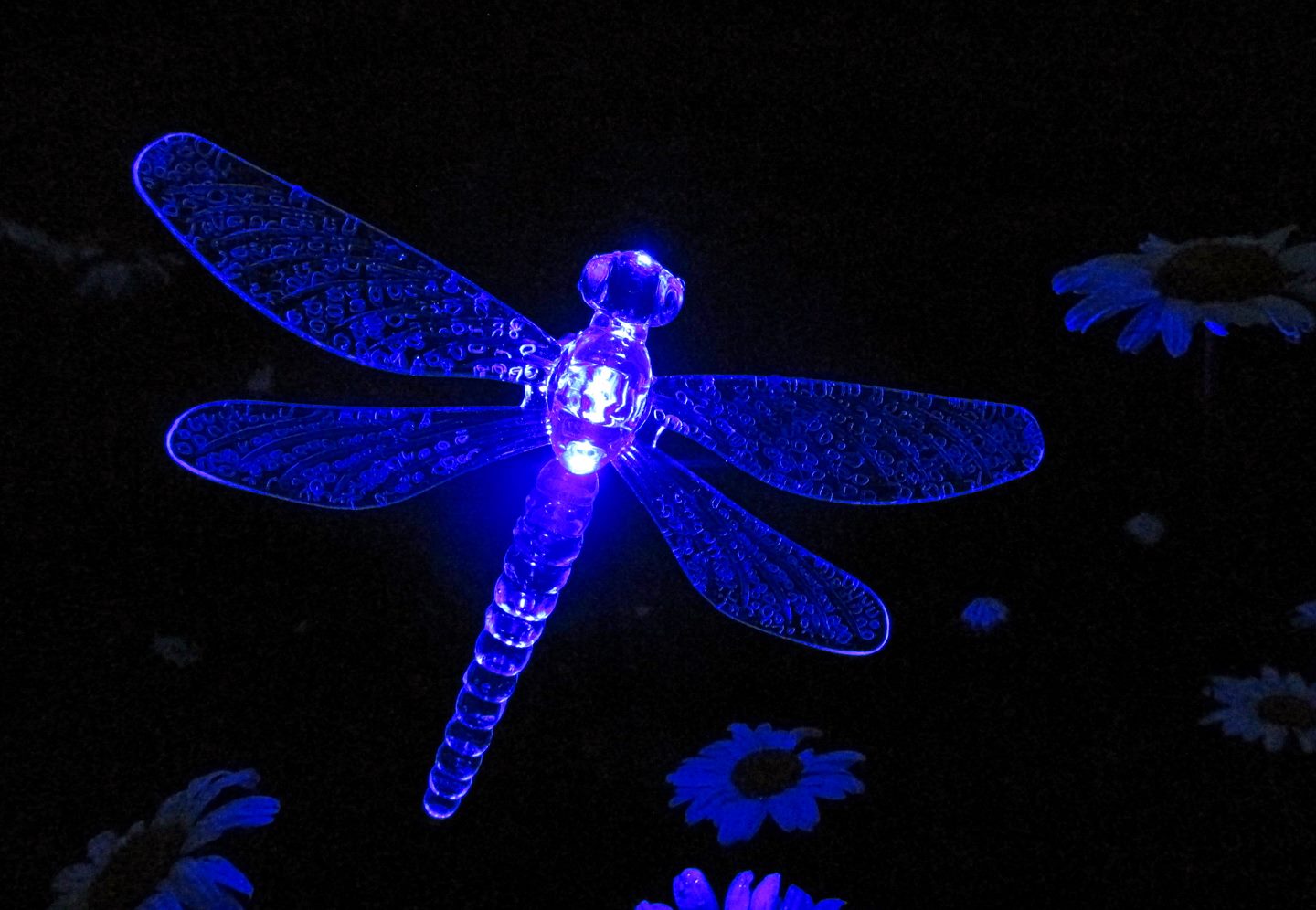
Photo by Bryan Stevens Don’t believe all you hear. Dragonflies and damselflies are harmless to humans. They can’t sting. They can’t sew your lips shut. People have invented many scary names for these winged insects, including “snake killer,” “water witch” and “devil’s darning needle.” Don’t be fooled by the bad press and all the myths. Dragonflies and their kin are some of the world’s most beneficial insects. Pictured, a decorative and illuminating dragonfly owned by a fan of these valuable insects.
I’m taking a hiatus from the birds for one week to bring you some other things with wings in the form of a pictorial essay of dragonflies and damselflies, otherwise known as “odes,” or members of the insect order of Odonata.
I hope you enjoy this diversion. I know I’ve had much fun this spring photographing the odes at the fish pond at my home on Simerly Creek Road in Hampton. I’ve also visited some other locations to find and photograph them, including Erwin Fishery Park in Unicoi County.

Photo by Bryan Stevens
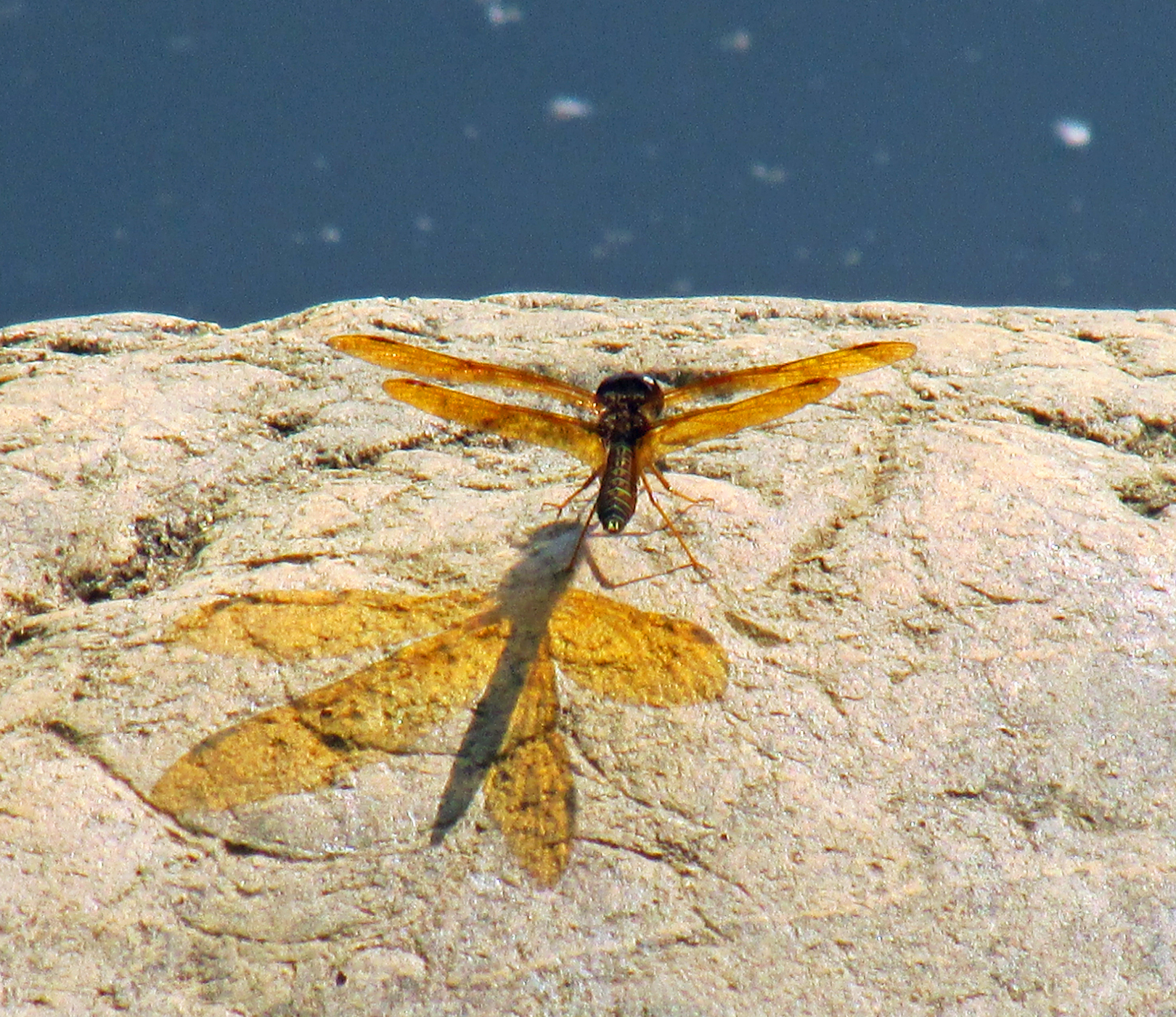
An Eastern Amberwing casts an amber shadow on this rock at the edge of a pond in Erwin, Tennessee. This is one of the smaller dragonflies in the Southern Appalachians. The largest dragonfly to ever live was Meganeura monyi, which lived during the Carboniferous period about 300 million years ago. It resembled and was related to present-day dragonflies. With a wingspan of almost 26 inches, it is one of the largest known flying insect species. Like modern dragonflies, Meganeura monyi was predatory and fed on other insects.

Photo by Bryan Stevens
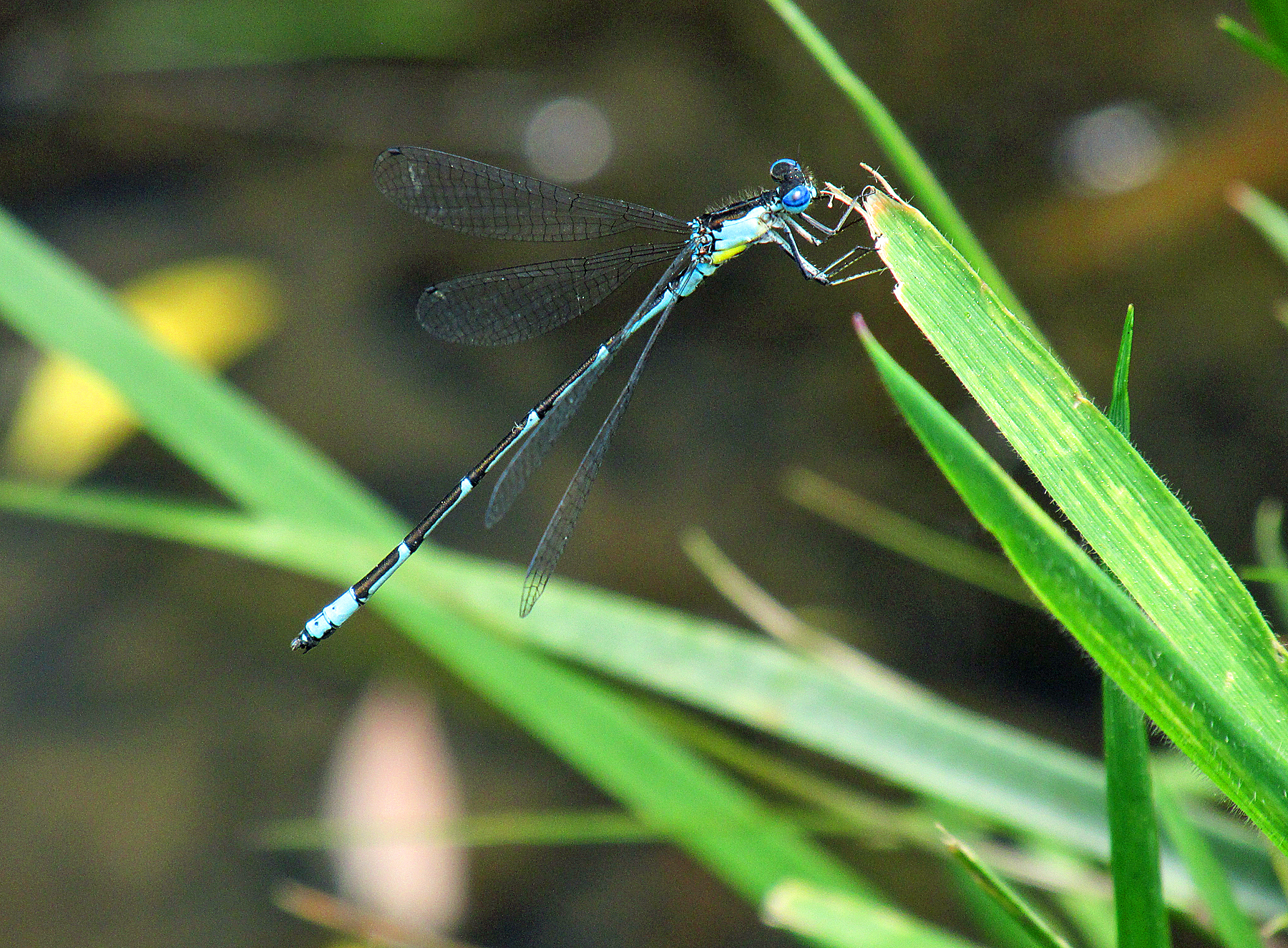
The Aurora Damselfly is a study in simple elegance. Damselflies are typically weaker flyers than dragonflies.

Photo by Bryan Stevens
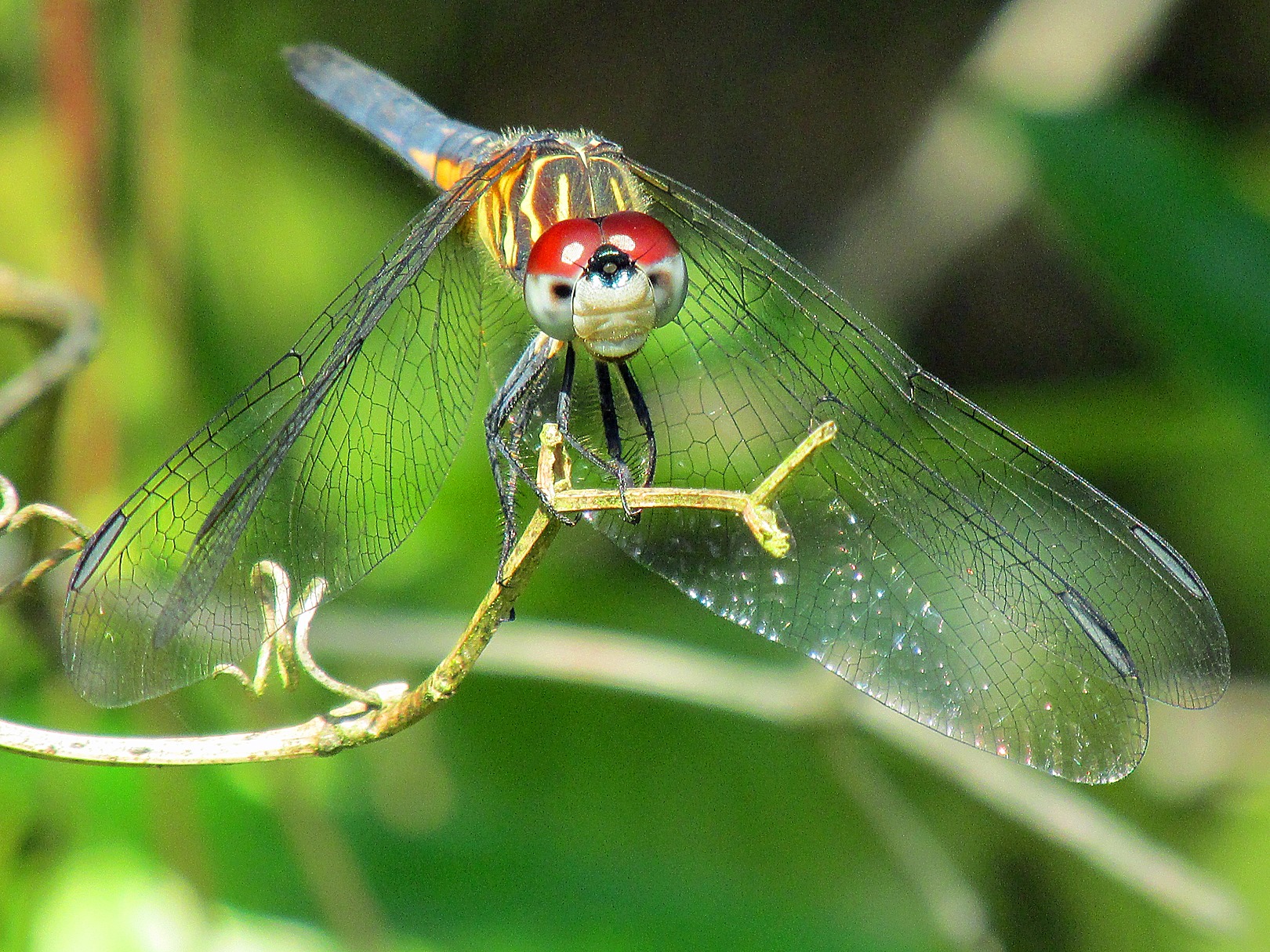
A glimpse through the vegetation at one of the pond’s most voracious predators. Dragonflies consume many other species of insects, including some that are considered pests. Pictured is a female Blue Dasher.

Photo by Bryan Stevens Dragonflies and damselflies have been around longer than birds. Scientists estimate that these insects have been flying our skies for 300 million years.

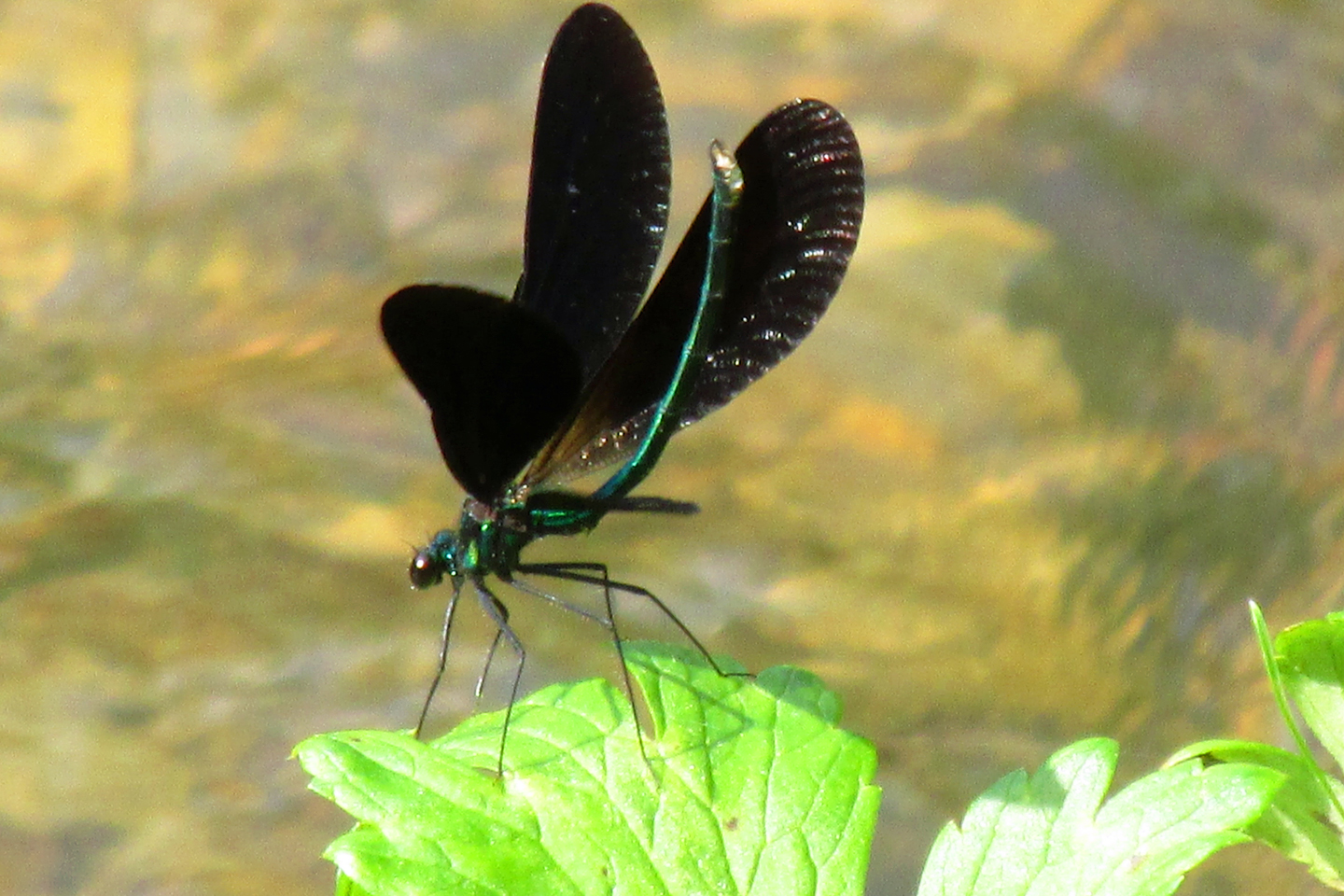
Photo by Bryan Stevens Pictured, a male Ebony Jewelwing displays along the edge of Simerly Creek. Most, but not all, damselflies are fairly small. Megaloprepus caerulatus, which belongs to the Forest Giant family of damselflies, is the world’s largest damselfly. This damselfly inhabits rain forests in Central and South America. It has the greatest wingspan — 7.5 inches for large males — of any living damselfly or dragonfly.

Photo by Bryan Stevens What big eyes they have! Not surprisingly, it’s the better to see you with that has pushed the evolution of the dragonfly eye. A dragonfly’s head is comprised almost entirely of two large, compound eyes. Pictured, a Blue Dasher.

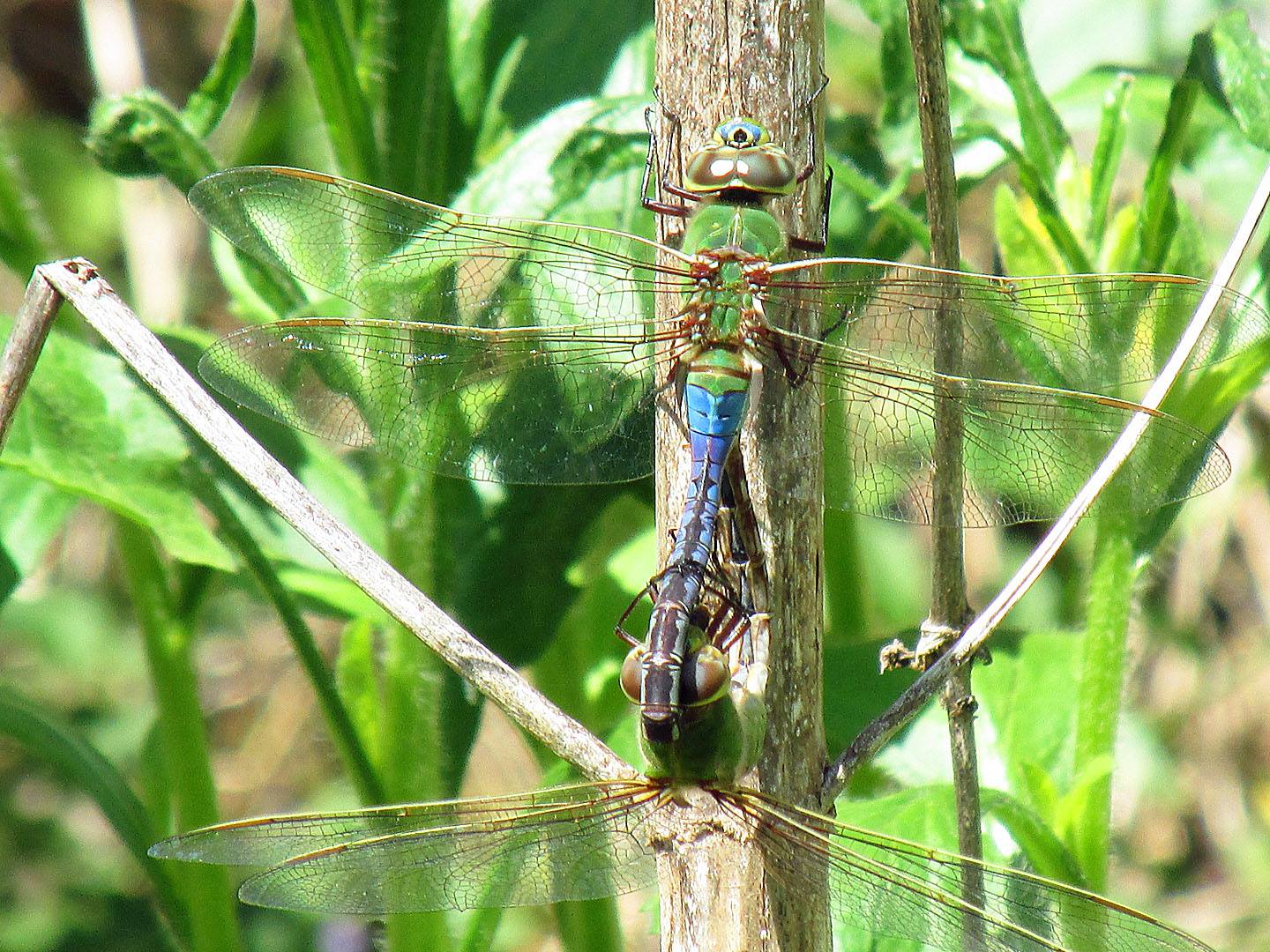
Photo by Bryan Stevens Common Green Darners photographed in early May on Holston Mountain in Elizabethton. At least 5,000 species of dragonflies and damselflies have been documented by scientists. There are probably more yet to be discovered.

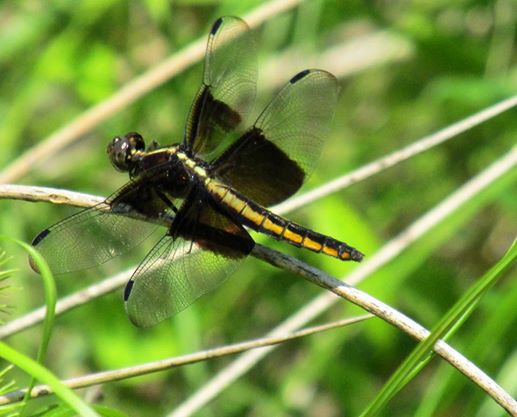
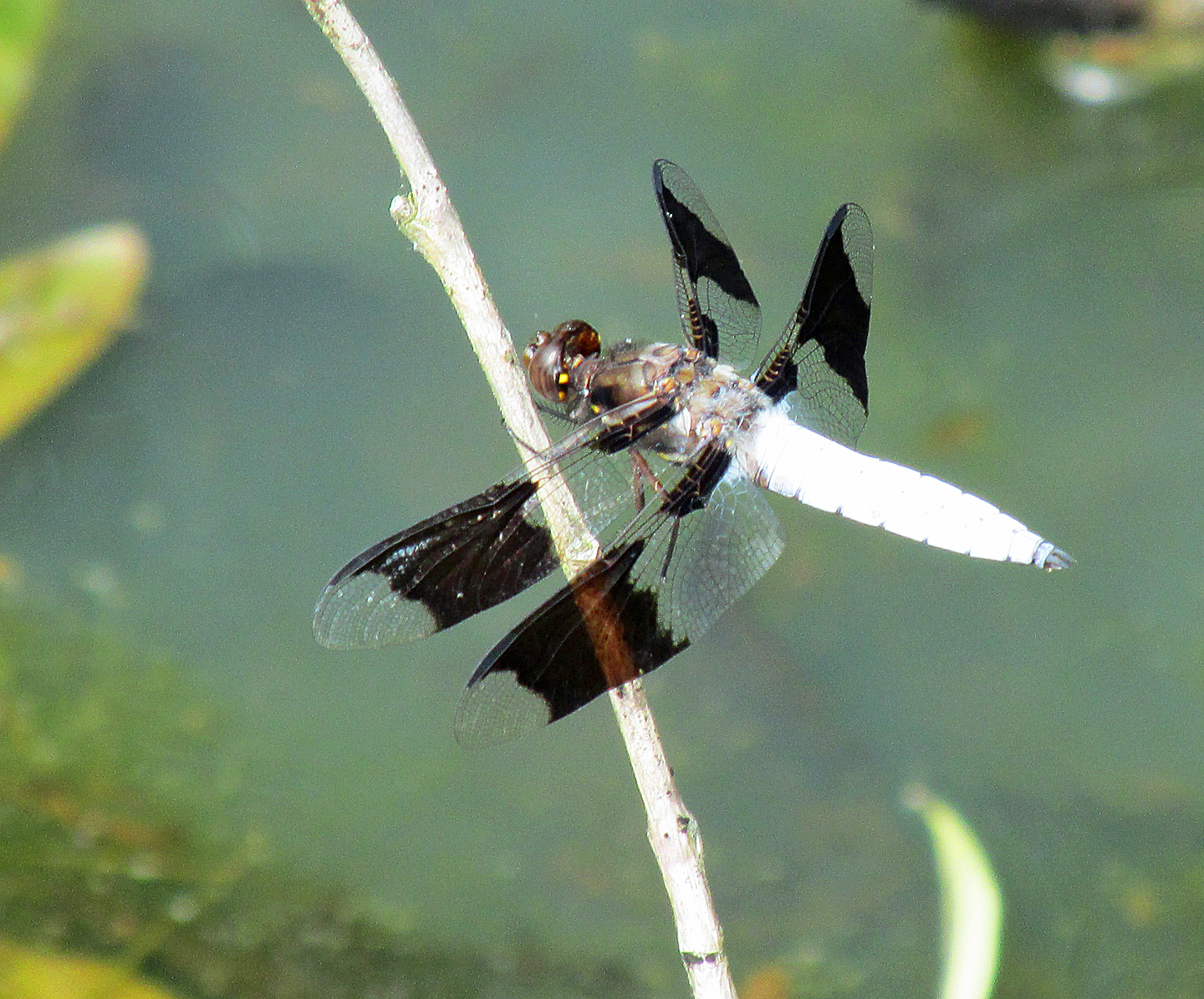
Photo by Bryan Stevens There are no vegetarian dragonflies. Adult dragonflies feed on other insects that they catch in flight. Larval dragonflies, called nymphs, are aggressive underwater predators that feed on almost anything they can catch, including tadpoles, small fish, other aquatic insects and even each other. If mosquitoes are a nuisance, be sure to welcome dragonflies. They’re a major predator of mosquitoes. Pictured, a Widow Skimmer perches at the edge of a pond, resting until her next flight to prey on other insects.
Like birds, some species of dragonflies migrate. They may also form swarms — the equivalent of a flock of birds — as they stage their migratory flights.

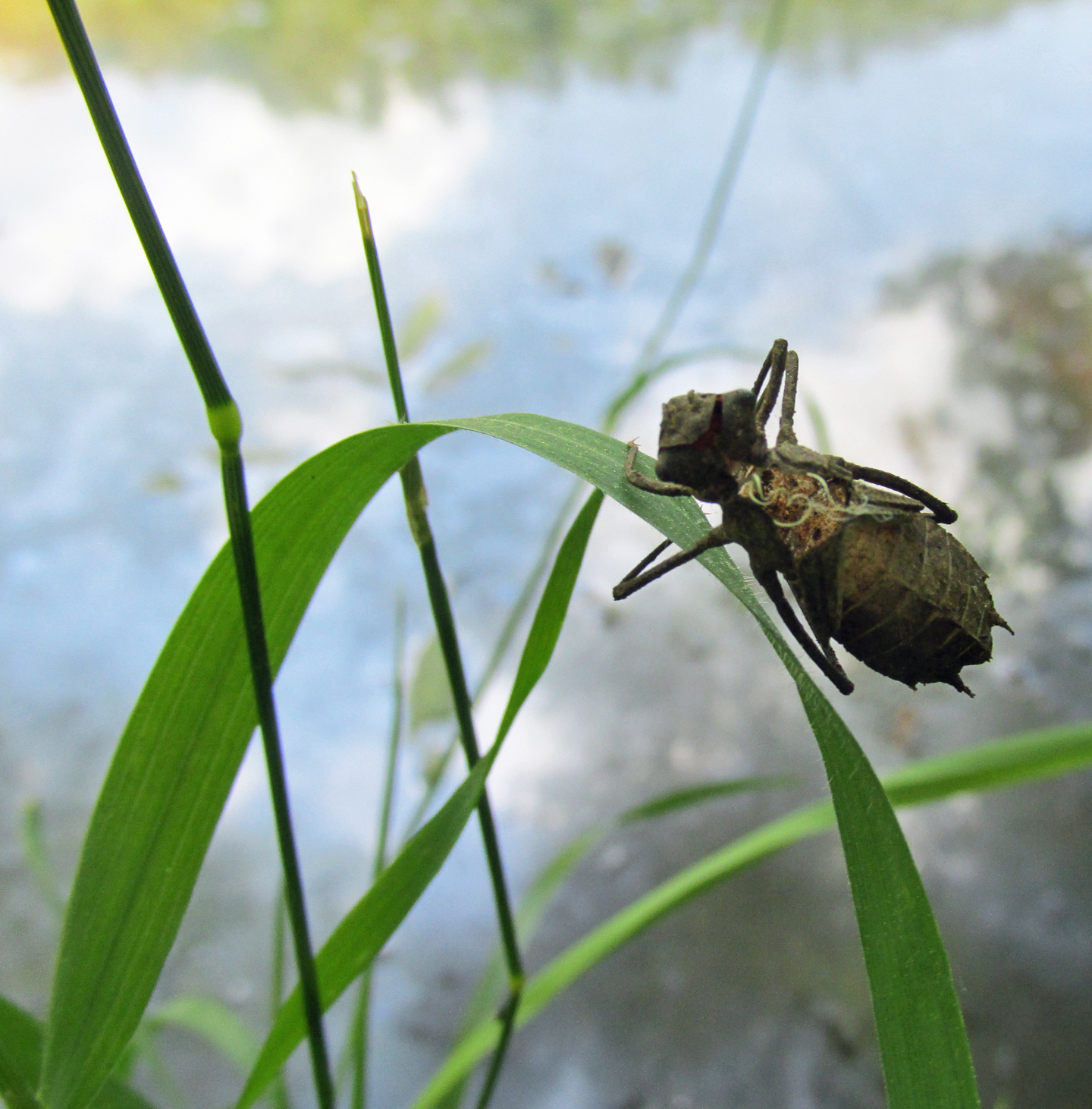
Photo by Bryan Stevens This empty shell once housed a voracious dragonfly nymph until it emerged as an adult dragonfly.
For more information on dragonflies in the Volunteer State, please visit http://www.pbase.com/rconnorsnaturephoto/tennessee_odonata to learn more.
Happiness is an Eastern Bluebird
Bluebirds make good neighbors. A pair of Eastern Bluebirds in your yard or garden will have no trouble with minor intrusions into their lives as they go about their daily routine, and the payoff for you is hours of free entertainment.

Photo by Bryan Stevens
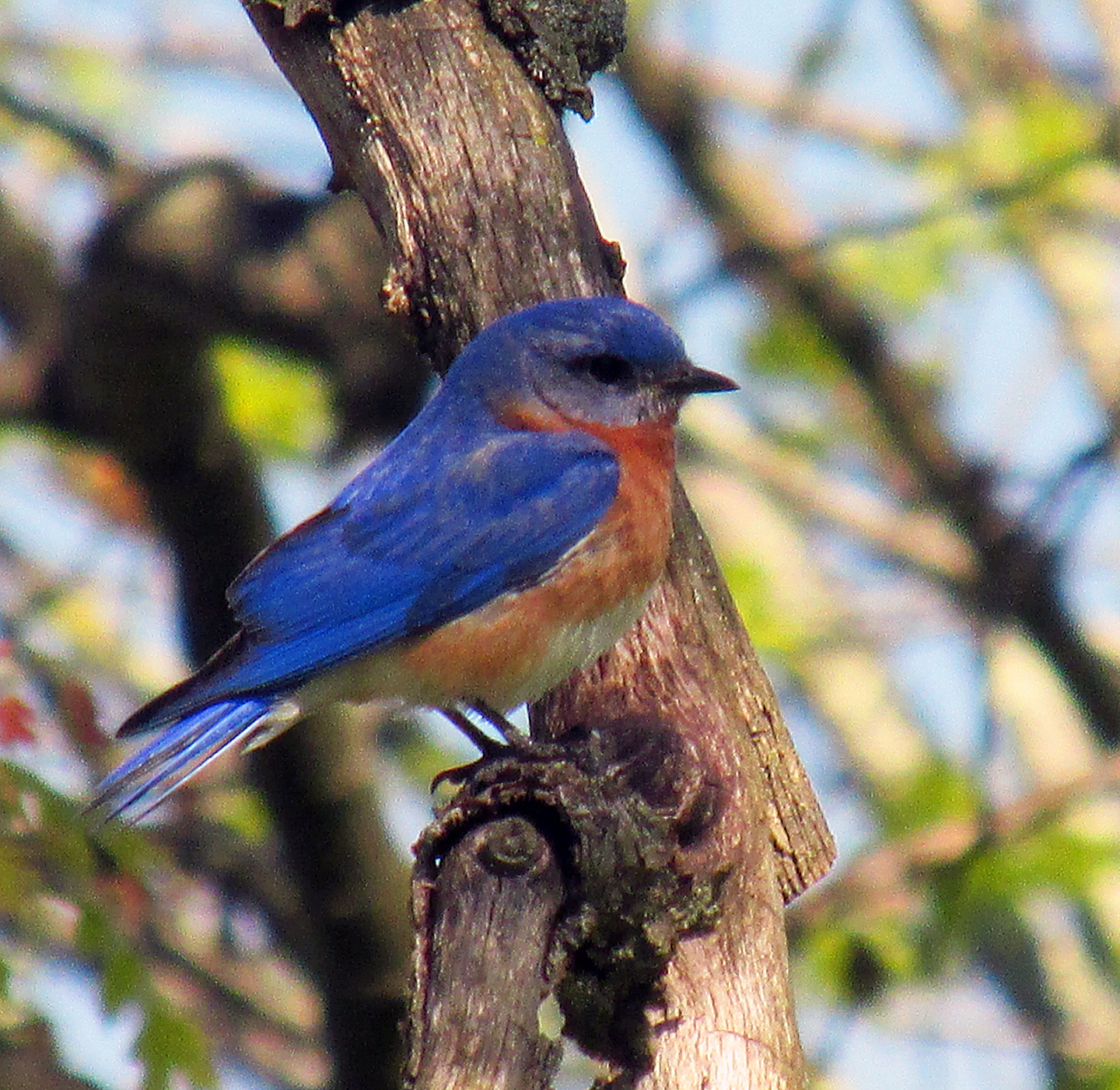
A male Eastern Bluebird perched on playground equipment at Winged Deer Park in Johnson City.
I’m pleased to report that the first of the season’s young Eastern Bluebirds have left the security of their nest box in our yard – the only home they’ve known since hatching – for the wider world of field and woodland.
As has usually been the case, I didn’t witness their departure. In the days after the fledglings departed the wooden nest box, I’ve observed them perched and waiting, impatiently usually, for their parents to arrive with caterpillars, moths or other morsels of food.
The Eastern Bluebird is one of North America’s best-known cavity-nesting birds. About 85 species of North American birds use cavities in trees for nesting purposes. Cavity-nesters include ducks, such as Buffleheads and Wood Ducks, as well as birds of prey such as Eastern Screech-owls and American Kestrels.
Some of these species, such as woodpeckers and nuthatches, can excavate their own cavity in a dead or decaying tree. Others, such as the bluebirds, must find a cavity already in existence. Such cavities are scarce real estate and can be subject to some intense competition. The Eastern Bluebird is at a disadvantage when forced to compete with non-native introduced birds such as aggressive European Starlings and the House Sparrows.
Last month, I found bluebirds nesting in a cavity in a wooden fence post that was part of an enclosure for a field. The fence post nest reinforced how changing landscapes have also affected these birds. Instead of wooden fence posts, many farmers now use metal ones. Dead or dying trees – a much sought-after resource for cavity-nesting birds — are often removed from woodlands.
Fortunately for bluebirds, this species will also accept lodging in a nest box, or birdhouse, provided for them by human landlords. Because of their trusting nature when it comes to their human neighbors, the Eastern Bluebird is one of our most beloved birds. In fact, bluebirds are such popular birds that interest in them and their well-being has inspired the foundation of such organizations as the North American Bluebird Society. The Eastern Bluebird has also been designated the official state bird for New York and Missouri.
There are two other species of bluebirds found in North America.
The Western Bluebird is found throughout the year in California, the southern Rocky Mountains, Arizona and New Mexico, as wells part of Mexico. The species ranges in the summer as far north as the Pacific Northwest, British Columbia and Montana.
The Mountain Bluebird nests in open country in the western United States as far north as Alaska. They are short-distance migrants, retreating as far south as Mexico during the winter season.
Except for a whitish-grayish belly, the male Mountain Bluebird is a brilliant sky blue above with paler blue on his underparts. The female looks similar if duller in her coloration.
Some people in the region mistakenly assume that Eastern Bluebirds are “mountain” bluebirds because they will reside in higher elevation open areas. The simplest way to tell the two species apart — although not necessary since the range of the Mountain Bluebirds is hundreds of miles to the west — is the reddish undersides of both sexes of the Eastern Bluebird.
The states of Nevada and Idaho have selected the Mountain Bluebird as their official state bird. I saw this species in 2006 during a trip that took me to Utah and Idaho.
Bluebirds are members of the extended family of thrushes, making them relatives of such birds as American Robin, Wood Thrush and Veery. The relationship of the Eastern Bluebird to the American Robin can be seen in the red breast sported by both species. In addition, young robins and bluebirds both have spotted breasts, providing more evidence of their affinity with many of the thrushes. The thrush family numbers more than 100 species worldwide and extends into Europe, Asia and Africa, as well as various islands.
Inviting the Eastern Bluebird into your yard and gardens is not usually too difficult. It helps if you live in an open, spacious habitat bordered with small trees. Providing a nesting box constructed to the specifications for this bird is another way to attract them. With natural cavities in trees and fence posts a rare commodity, this bird will readily accept boxes. It’s not a sure-fire means of bring bluebirds closer. Plenty of other native birds, including Carolina Chickadees, Tree Swallows and House Wrens, will also make use of a box designated for bluebirds.
The NABS recommends a box that is well ventilated, watertight and equipped with drainage holes. The box should also be easy to open, monitor and clean.
For more specific and very valuable information about becoming a landlord for bluebirds, please visit http://www.nabluebirdsociety.org/PDF/FAQ/NABS%20factsheet%20-%20Getting%20Started%20-%2024May12%20DRAFT.pdf to access an informative fact sheet.
Starlings and House Sparrows are not native species and are not protected by law. When present, these two introduced species will probably be your biggest challenge to successfully hosting Eastern Bluebirds. On its website, NABS encourages the control of starlings and House Sparrows. The website – http://www.sialis.org – also provides beneficial information for would-be bluebird landlords.
Tree Swallows and House Wrens, both native birds, will probably be the biggest rivals for nesting boxes intended for Eastern Bluebirds. If you should find that a pair of Tree Swallows or House Wrens has claimed a box, consider yourself fortunate and benefit from the opportunity to view the habits of these two interesting species for a few weeks.
In addition to housing, food and water can be used to lure Eastern Bluebirds closer. This bird doesn’t eat seeds, but it can be attracted with an offering of mealworms — live or freeze-dried – or commercially prepared peanut butter nuggets. A water feature in a yard is also a magnet for bluebirds and a host of other bird species.
If your home doesn’t provide suitable bluebird habitat, it’s still easy to enjoy these beautiful birds. An afternoon or evening drive into open country, such as agricultural farmland, is likely to yield sightings of this bird on fences and utility lines. Golf courses, some of which go the extra mile to accommodate bluebirds, also provide habitat for these lovely birds.
The Eastern Bluebird is present in the region in any season and is one of our more common birds. If you’re already an experienced landlord and host for these birds, you probably already know they joys they can bring. If not, why not try to attract them closer to you? Most bluebirds in the region have already completed the first nesting of the season, but these birds are known to nest two or even three times in a single season. There’s still time to place a nest box or two on your property to get their attention.
Landscaping with fruit-bearing trees and shrubs can also pay dividends when its comes to the Eastern Bluebird. Although this bird feeds heavily on insects, almost a third of its diet consists of fruits, including blackberry, mulberry and pokeberry.
Inviting bluebirds to become a part of your life isn’t difficult, and you’ll be delighted to have them. Trust someone who has lived with bluebirds in his yard and gardens for more than 20 years.
•••••
To ask a question, make a comment or share a bird observation, reach me at ahoodedwarbler@aol.com.
‘Wind birds’ make their way through region during annual migrations
Since the Volunteer State has no access to the sea, it is sometimes amazing how many birds affiliated with coastal areas can be found if you know when and where to look.
A recent seven-day visit to coastal South Carolina reinforced the romance of a group of related birds known collectively as shorebirds or, in a somewhat more adventuresome context, “wind birds.” This diverse family of birds range in size from sparrow-sized sandpipers to larger species such as American Avocet, Long-billed Curlew and Marbled Godwit.
During daily visits to Huntington Beach State Park, located within five minutes of my brother’s new home on Pawleys Island, S.C., I observed plenty of these “wind birds.” I saw a range of species, including Wilson’s Plover, Short-billed and Long-billed Dowitcher, Greater Yellowlegs, Sanderling, Least Sandpiper, Ruddy Turnstone, Spotted Sandpiper, Semipalmated Sandpiper, Black-bellied Plover, Semipalmated Plover, Dunlin and even the gangly Black-necked Stilt.
Known as “wind birds” for the propensity of many members of this extended family to stage long-distance migrations, some species fly through Northeast Tennessee each spring and fall as they migrate to and from distant nesting grounds.
I have seen several species — Wilson’s Snipe, Greater Yellowlegs, Pectoral Sandpiper, Least Sandpiper, Solitary Sandpiper and Spotted Sandpiper — in the region this spring. Their stays are usually of brief duration as they are eager to push farther north. Many of them will not stop until they reach the edge of the Arctic tundra.
While I was enjoying seeing a wide range of shorebirds in South Carolina, two Stilt Sandpipers put in a rare appearance in Northeast Tennessee. I hated to miss them. I’ve only seen one other Stilt Sandpiper in the region, and that observation took place back in 2000 at Austin Springs on Boone Lake.
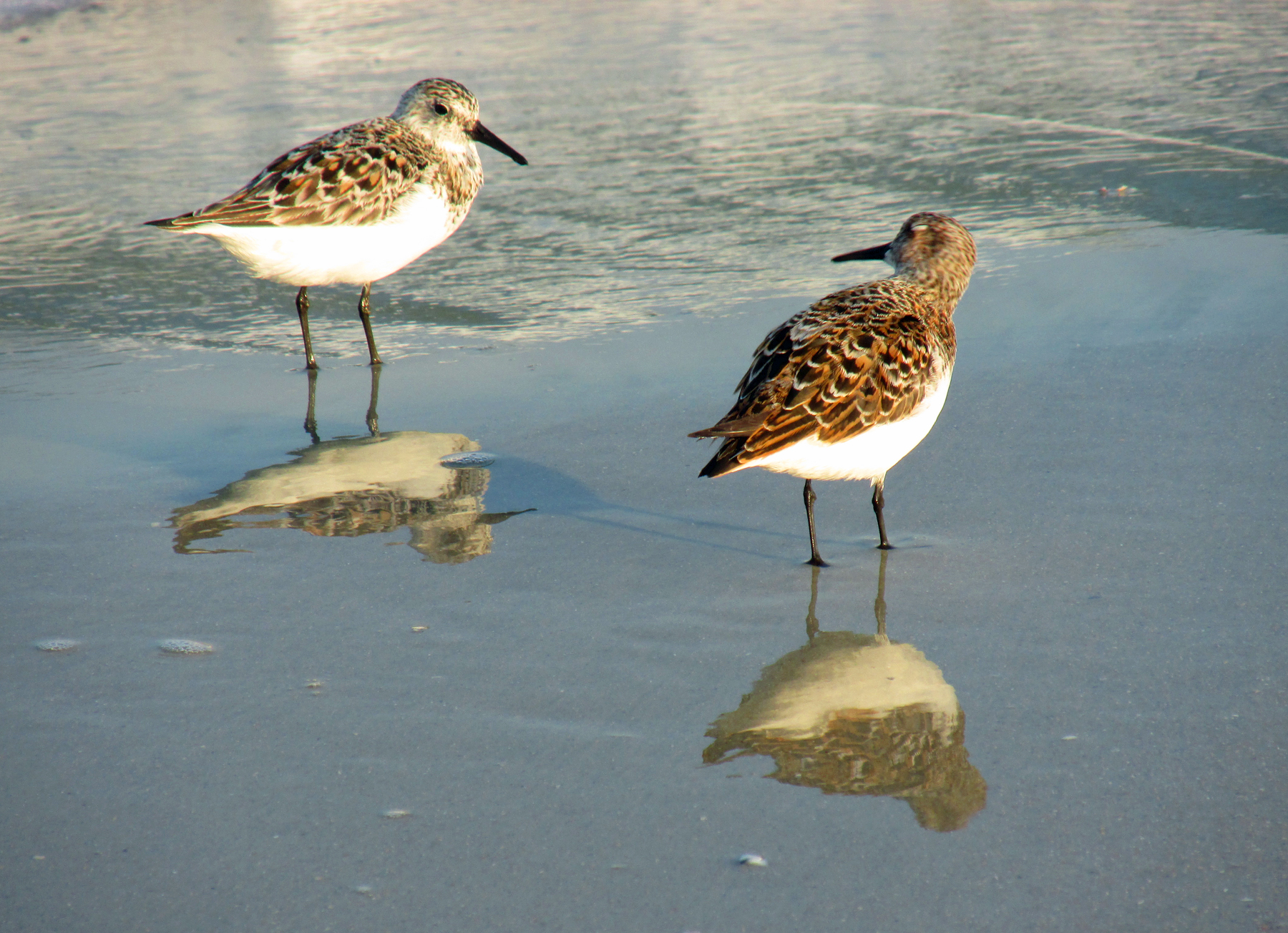
The Stilt Sandpipers were found by Brookie and Jean Potter on the Watauga River at Rasar’s Farm in Elizabethton. The couple reported that it was their first spring sighting of Stilt Sandpipers, as well as their first Carter County sighting of this species. The photo at the start of the column, provided by Jean Potter, shows the two Stilt Sandpipers bordered by a pair of Greater Yellowlegs.
Stilt Sandpipers making migration stops in Tennessee still have a long way to travel. These shorebirds nest on the Arctic tundra beyond the tree line. Wet sedge-meadows with raised ridges and hummocks provide nesting habitat. After the nesting season they fly south as far as northern South America and can be found at fresh water ponds, marshes, lagoons and flooded fields.
This medium-sized sandpiper stands out from most of the sandpipers in its size range. It has long, greenish legs, as well as a long neck and bill, which is drooped at the tip. In breeding plumage, this shorebird has a distinctive chestnut cheek patch.
••••••
During my South Carolina stay, I didn’t encounter any Stilt Sandpipers. I did, however, find three Black-necked Stilts.
The only time I have seen this unusual shorebird in Tennessee took place on Oct. 13, 2004, at Austin Springs on Boone Lake in Washington County. The bird, first found by Rick Knight, drew many excited birders to the location for looks at this shorebird before it departed to continue its migration flight south.

Photo by Bryan Stevens
Two Black-necked Stilts forage along the causeway wetland at Huntington Beach State Park.
I have also seen Black-necked Stilt on Fripp Island, S.C, as well as in Utah.
The world of shorebirds has produced many look-alike species, including many of the small sandpipers often collectively labeled as “peeps” by birders. The Black-necked Stilt, however, is not at all likely to be confused with any other shorebird. It is a slender bird atop a pair of extremely long pink legs. It has a two-tone appearance with black upper parts and white underparts. The black and white dichotomy continues along the bird’s long neck and head. This bird also has a thin, needle-shaped bill that it uses to delicately pluck aquatic insects and other prey from water or mud.
I first spied the Black-necked Stilts at Huntington Beach State Park while walking on a marsh boardwalk near the park’s Nature Center. They flew toward the causeway, so I got into my car and drove there to try to re-locate them. I did find two of the stilts feeding along the causeway, but I never managed to find the third bird.
I watched the two Black-necked Stilts foraging for food in shallow water shared by egrets and alligators. The two birds, despite a somewhat gangly appearance, moved with elegantly efficient strides on their long pink legs. This bird feeds on an assortment of aquatic creatures, including small fish, insects and tadpoles. The seeds of aquatic plants also provides some of the food in its diet.
I also saw several plovers, another group of shorebirds, while in South Carolina. Wilson’s Plover was one that stood out during my visits to Huntington Beach State Park. Wilson’s Plover is a coastal shorebird that breeds on both coasts of the Americas from the equator northwards. Its range extends north to include much of the U.S. eastern seaboard as well as the Pacific coast of Mexico.
I’ve observed Wilson’s Plovers on Fripp Island, S.C., in the past, but those sightings have been rather sporadic. I have also observed this bird at one other location — at Douglas Lake in Cocke County back in the late 1990s.
The Wilson’s Plovers at Huntington Beach State Park were nesting in the dunes, which also gave me an opportunity to see some young plovers. A young Wilson’s Plover looks like a ball of downy feathers standing on toothpicks. This plover nests on a bare scrape on sandy beaches or sandbars. To protect the plovers, as well as other nesting species, this section of dunes on Huntington Beach State Park bars the entry of dogs. It is also roped off to prevent accidental intrusion by people.

Photo by Bryan Stevens
A pair of Wilson’s Plover chicks at Huntington Beach State Park in South Carolina.
Most of the Wilson’s Plovers that spend the summer in the United States retreat each fall, although a few migrate only as far as Florida. The rest spend the winter as far south as Brazil.
For a small shorebird, the Wilson’s Plover sports a thick, blunt and relatively large bill. In fact, this bill — that looks too big for its body — is a good way to identify this shorebird at a glance. The Wilson’s Plover forages for food on beaches. It has a fondness for crabs, which may explain the size and shape of its bill, but this bird will also eat insects, marine worms and other small organisms.
The Wilson’s Plover is larger than the related Semipalmated Plover and Piping Plover but considerably smaller than such relatives as Killdeer and Black-bellied Plover. This shorebird weighs only a couple of ounces, with a length of about eight inches and a wingspan of 19 inches. The Wilson’s Plover has a dark neck ring, grayish-brown upper parts, a white underside and pinkish legs.
This bird was named after the Scottish-American ornithologist Alexander Wilson. Wilson collected the type specimen during a trip in May of 1813 to Cape May, N.J. Other birds named for this pioneering bird expert include Wilson’s Warbler, Wilson’s Phalarope, Wilson’s Snipe and Wilson’s Storm Petrel.
•••••
With a few exceptions, most of the shorebirds that I have found along the Atlantic Coast I have also observed here in land-locked Tennessee during spring and fall migration. It’s one of those little known facts I enjoy sharing with people, who are often surprised that these “beach birds” also make visits to our state.
•••••
Make a comment, ask a question or share an observation by sending an email to ahoodedwarbler@aol.com or posting a comment here on my blog. I am also on Facebook.

A mixed flock of Short-billed and Long-billed Dowitchers and a Ruddy Turnstone at Huntington Beach State Park.
Taste of tropics arrives with Scarlet Tanagers
In late April and early May, once the oaks, the maples, the poplars begin spreading out new green leaves to create a concealing woodland canopy, a familiar song can be heard from the treetops. Upon first hearing it, listeners might mistake the hidden singer for an American Robin. Listen a little closer, however, and the song sounds as if it is being delivered by a hoarse robin with a sore throat.
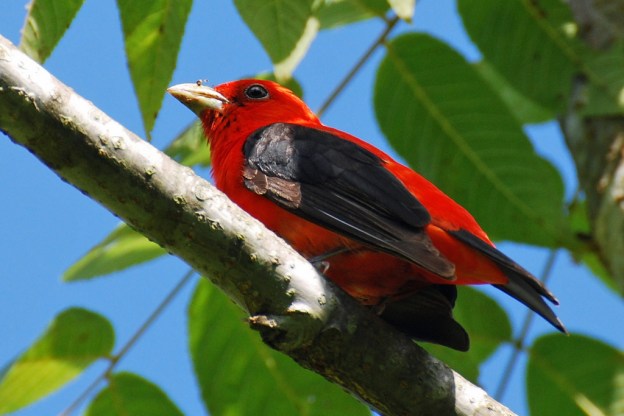
The producer of the hoarse but melodic song is a Scarlet Tanager, one of the most showy birds of Eastern woodlands from April to early October. Like the warblers, vireos, flycatchers and other songbirds, the Scarlet Tanager is migratory. They spend the winter months in the tropical forests of Central and South America. The Scarlet Tanager is better attired than most birds to provide us a glimpse of what life must be like in the tropical rain forests, which are a riot of color and sound.
It takes only one sighting to sear the vision of these vibrant birds into our retinas, as well as into our memories. The Scarlet Tanager boasts a brilliant plumage of crimson red paired with black wings and tail. Of course, this is the male. The female Scarlet Tanager makes no real claim to the common name with her comparatively drab greenish plumage. However, the scientific name, Piranga olivacea, gives a nod to the olive-green plumage of females, young males and even adult males when molting their feathers.
Although once nominated as a candidate for state bird by the school children of Minnesota, the Scarlet Tanager ultimately failed to gain the designation. Instead, as perhaps is fitting for the “Land of 10,000 Lakes,” the Common Loon represents Minnesota as official state bird.
The related Summer Tanager is less widespread in Northeast Tennessee, but males of this species are no less dramatic in appearance than the Scarlet Tanager. Male Summer Tanagers are a rosy-red over all their body. Females, with a dull greenish plumage, are relegated to the background. She can be distinguished from her counterpart, the Scarlet Tanager, because of their darker wings and larger bills.

Photo Courtesy of Jean Potter
The Summer Tanager is the only all-red bird in North America. It is less common in Northeast Tennessee than the related Scarlet Tanager.
The Summer Tanager holds the distinction of being the only all-red bird in North America. Birds like Northern Cardinals and Scarlet Tanagers also have some black in their plumage.
I’ve seen Summer Tanagers at Steele Creek Park in Bristol and Willow Springs Park in Johnson City. Sadly, over the years my sightings of this attractive songbird have been few and far between. My best sighting of a male Summer Tanager took place during a spring visit to Fripp Island, S.C., many years ago. Most of the Summer Tanagers I have observed in Northeast Tennessee have been females.
On the other hand, I usually have a few Scarlet Tanagers in residence around my home during the summer months. If the woodlands at my home fail to attract this bird, I can usually make a visit to higher elevations on Roan Mountain and Holston Mountain to gain an exciting glimpse of this beautiful bird.
Worldwide, there have traditionally been about 240 species of tanagers. Experts have changed some of the ways they classify tanagers, so that figure is no longer set in stone. Tanagers are a New World family of birds, concentrated mainly in the tropics.
In the western United States, the Scarlet and Summer Tanagers are replaced by Western Tanagers and Hepatic Tanagers. During a visit to Salt Lake City in Utah in 2006 I saw several Western Tanagers.
Some of the world’s other tanagers are known by extremely descriptive names, including Flame-colored Tanager, Green-headed Tanager, Golden-chevroned Tanager, Azure-shouldered Tanager, Fawn-breasted Tanager, Saffron-crowned Tanager, Metallic-green Tanager, Turquoise Tanager, Scarlet-bellied Mountain Tanager and Diademed Tanager.
Scientists, who have to occupy themselves, have recently given fresh consideration to the relationship of many tanagers to the other birds of the world. As a result, many of the North American tanagers are now closely allied with such birds as Northern Cardinals and more remote from tropical tanagers.
The Scarlet Tanager is not typically a feeder visitor, but you can lure these birds with orange slices placed in special feeders or simply spiked onto the branches of backyard trees. As an added bonus, orange slices can also attract birds such as Baltimore Orioles and Gray Catbirds.
Fond of fruit, the Scarlet Tanager incorporates various berries into its diet. Landscape around your home with fruit-bearing trees such as mulberry, serviceberry and wild cherry to make your yard more inviting to these elusive bird.
Yes, the Scarlet Tanager is more often heard than seen, but it is a bird worth seeking out. A sighting of one will amaze you.
•••••
I love to hear from readers. Just post comments on my blog at ourfinefeatheredfriends.wordpress.com. You can also reach me on Facebook or send email to ahoodedwarbler@aol.com. Please share the link to the blog with others who might be interested in the topic of birds and birding in Northeast Tennessee.
Northeast Tennessee Spring Bird Count finds 157 species
Members of the Lee and Lois Herndon Chapter of Tennessee Ornithological Society held the annual Spring Bird Count on Saturday, May 3. The count has now been held for several decades and is conducted in the five-county area of Northeast Tennessee that includes the counties of Carter, Johnson, Sullivan, Unicoi and Washington.

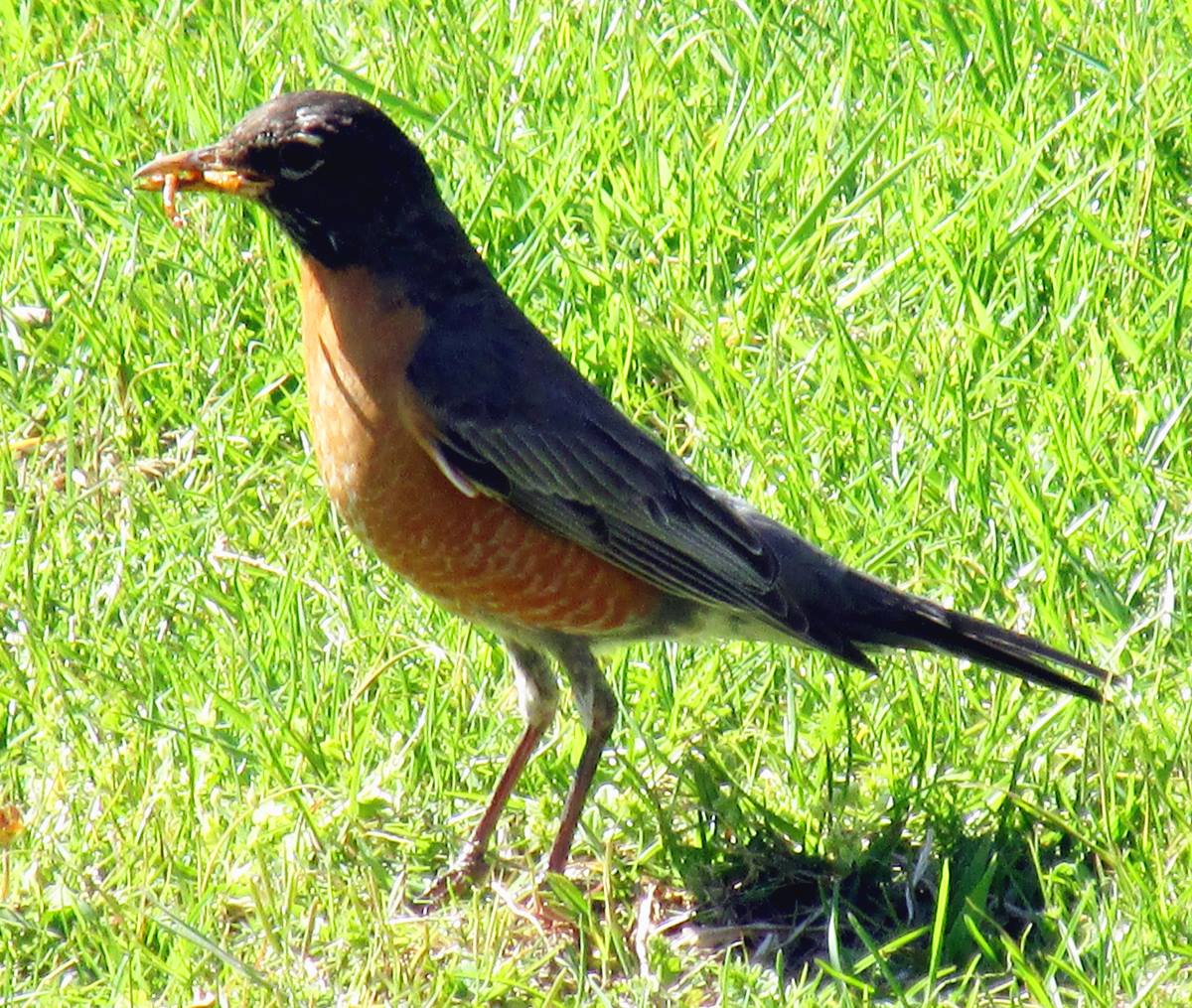
Photo by Bryan Stevens The American Robin ranked as the most abundant bird on this year’s Spring Bird Count for Northeast Tennessee.
A total of 40 individuals in nine parties looked for birds on a beautiful May day, which in itself was a slight change from the way the count has been conducted in the past. The count has traditionally been conducted the last weekend in April but was moved back this year so as not to compete with the Roan Mountain Spring Naturalists Rally, which was held a week earlier than its usual date.
Those taking part in the count were Fred and JoAnn Alsop, Jim Anderson, Paul and Emily Bayes, Jerry Bevins, Rob Biller, Kevin and Dallas Brooks, Ron Carrico, Harry Lee Farthing, Paul Haynes, Don Holt, Heather Jones, Caitlyn King, David Kirschke, Rick Knight (compiler), Roy Knispel, Tom Laughlin, Richard Lewis, Vern Maddux, Larry McDaniel, Joe McGuiness, Tom McNeil, Charles Moore, Cathy Myers, Kathy Noblet, Brookie and Jean Potter, Amy and Scott Reys, Chris Soto, Bryan Stevens, Kim Stroud, Byron Tucker, Gary and Brenda Wallace, Mary Anna Wheat, John Whinery and Rex Whitfield.
I know I am always enthusiastic on the day of a spring count, and I suspect the same holds true for other participants. You never know what unexpected bird might make an appearance for this annual survey. Some of my own good finds this year included Yellow-crowned Night-heron, Yellow-breasted Chat, Yellow-billed Cuckoo and Orchard Oriole.
A total of 157 species found fell somewhat short of the all-time record of 161 species, which was established back in 2005. The average number of species for this count is 147.
My friend, Byron Tucker, who was visiting from Atlanta, Ga., got to take part and also make his first visit to Holston Mountain in Carter County. He said he enjoyed the outing. We counted with Elizabethton residents Gary and Brenda Wallace.
My favorite warbler – Hooded Warbler – tied with Ovenbird as the most abundant warbler tallied for this year’s spring count with 173 individuals counted for both these species. A total of 27 warbler species made the count, as well as one Brewster’s Warbler, which is a hybrid between a Blue-winged Warbler and Golden-winged Warbler.
I’m thrilled to report that the most abundant bird on the count wasn’t the European Starling. That honor went to the American Robin with 960 individuals reported by counters. The European Starling came in second with 865 individuals.
Other common species included Cliff Swallow (806), Canada Goose (580), Red-winged Blackbird (469), Common Grackle (401) and American Crow (341).
A Canvasback found on a pond in Washington County established a new late date for this duck in Northeast Tennessee. Other species of interest making the count included Western Sandpiper, Gray-cheeked Thrush, Blackpoll Warbler and Sora.
The total number of species follows:
Canada Goose, 580; Wood Duck, 53; Mallard, 183; Blue-winged Teal, 11; Canvasback, 1; Lesser Scaup, 1; Hooded Merganser, 1; Ruffed Grouse, 4; Wild Turkey, 40; Common Loon, 11; Horned Grebe, 1; and Double-crested Cormorant, 53.
Great Blue Heron, 79; Green Heron, 11; Black-crowned Night-heron, 1; Yellow-crowned Night-heron, 1; Black Vulture, 62; and Turkey Vulture, 214.
Osprey, 11; Sharp-shinned Hawk, 3; Cooper’s Hawk, 10; Bald Eagle, 11; Red-shouldered Hawk, 3; Broad-winged Hawk, 10; Red-tailed Hawk, 41; American Kestrel, 11; and Merlin, 2.
Virginia Rail, 1; Sora, 1; American Coot, 1; Killdeer, 32; Spotted Sandpiper, 68; Solitary Sandpiper, 43; Greater Yellowlegs, 1; Lesser Yellowlegs, 2; Western Sandpiper, 1; Least Sandpiper, 21; White-rumped Sandpiper, 4; and Wilson’s Snipe, 4.
Bonaparte’s Gull, 3; Ring-billed Gull, 54; Rock Pigeon, 182; Eurasian Collared-Dove, 1; Mourning Dove, 204; and Yellow-billed Cuckoo, 2.
Eastern Screech-Owl, 8; Great Horned Owl, 6; Barred Owl, 10; Northern Saw-whet Owl, 2; Common Nighthawk, 4; Chuck-Will’s-Widow, 8; and Whip-Poor-Will, 31.
Chimney Swift, 238; Ruby-throated Hummingbird, 28; Belted Kingfisher, 19; Red-headed Woodpecker, 2; Red-bellied Woodpecker, 82; Yellow-bellied Sapsucker, 5; Downy Woodpecker, 20; Hairy Woodpecker, 10; Northern Flicker, 41; and Pileated Woodpecker, 42.
Eastern Wood-Pewee, 11; Yellow-bellied Flycatcher, 1; Acadian Flycatcher, 27; Willow Flycatcher, 3; Least Flycatcher, 7; Eastern Phoebe, 54; Great Crested Flycatcher, 11; and Eastern Kingbird, 82.
White-eyed Vireo, 17; Yellow-throated Vireo, 10; Blue-headed Vireo, 63; Warbling Vireo, 6; Red-eyed Vireo, 151; Blue Jay, 225; American Crow, 341; and Common Raven, 16.
Horned Lark, 2; Northern Rough-winged Swallow, 223; Purple Martin, 61; Tree Swallow, 271; Barn Swallow, 284; and Cliff Swallow, 806.

Photo by Bryan Stevens
The Northern Rough-winged Swallow was represented on the spring count by 223 individuals.
Carolina Chickadee, 147; Tufted Titmouse, 165; Red-breasted Nuthatch, 7; White-breasted Nuthatch, 25; and Brown Creeper, 7.
House Wren, 45; Winter Wren, 5; Carolina Wren, 134; Blue-gray Gnatcatcher, 84; Golden-crowned Kinglet, 2; and Ruby-crowned Kinglet, 8.
Eastern Bluebird, 151; Veery, 12; Gray-cheeked Thrush, 1; Wood Thrush, 67; American Robin, 960; Gray Catbird, 37; Northern Mockingbird, 128; Brown Thrasher, 43; European Starling, 865; and Cedar Waxwing, 59.
Ovenbird, 173; Worm-eating Warbler, 25; Louisiana Waterthrush, 19; Northern Waterthrush, 2; Golden-winged Warbler, 1; Black-and-white Warbler, 53; Swainson’s Warbler, 6; Kentucky Warbler, 4; Common Yellowthroat, 22; Hooded Warbler, 173; American Redstart, 10; Cape May Warbler, 2; Northern Parula, 28; Magnolia Warbler, 2; Blackburnian Warbler, 12; Yellow Warbler, 10; Chestnut-sided Warbler, 25; Blackpoll Warbler, 1; Black-throated Blue Warbler, 61; Palm Warbler, 3; Pine Warbler, 9; Yellow-rumped Warbler, 42; Yellow-throated Warbler, 34; Prairie Warbler, 3; Black-throated Green Warbler, 97; Canada Warbler, 30; Yellow-breasted Chat, 19; and Brewster’s Warbler, a hybrid of Blue-winged and Golden-winged Warblers, 1.
Eastern Towhee, 179; Chipping Sparrow, 166; Field Sparrow, 55; Savannah Sparrow, 3; Song Sparrow, 259; Swamp Sparrow, 2; White-throated Sparrow, 11; White-crowned Sparrow, 24; and Dark-eyed Junco, 56.
Summer Tanager, 4; Scarlet Tanager, 78; Northern Cardinal, 212; Rose-breasted Grosbeak, 40; and Indigo Bunting, 69.
Bobolink, 1; Red-winged Blackbird, 469; Eastern Meadowlakrk, 100; Common Grackle, 401; Brown-headed Cowbird, 88; Orchard Oriole, 27; and Baltimore Oriole, 27.
House Finch, 38; Pine Siskin, 1; American Goldfinch, 301; and House Sparrow, 93.
Rose-breasted Grosbeaks provide splash of springtime excitement
Other than Ruby-throated Hummingbirds, the one bird whose return in the spring is guaranteed to generate excitement is the Rose-breasted Grosbeak. Every spring, I get phone calls and emails from people wanting to share the thrill of seeing these vibrant birds in their back yards.
The spring arrival of Rose-breasted Grosbeaks is a temporary visit. Finding the arrangements, which can consist of well-stocked feeders and perhaps a convenient water source, the migrating birds may linger for several days. These birds nest at higher elevations, however, and are usually impatient to continue the journey to where they will spend the summer months tending to their young.
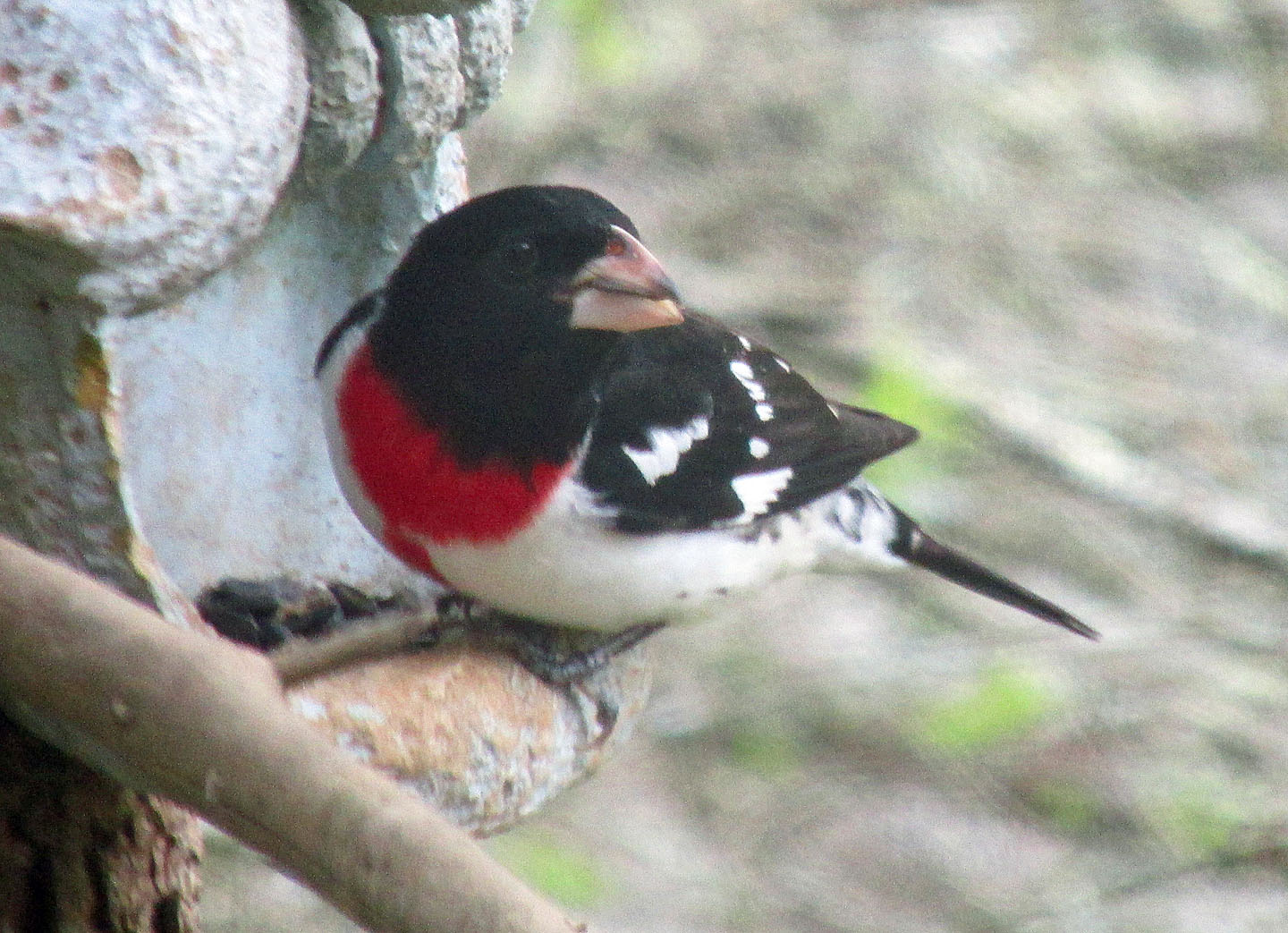
This year, my first Rose-breasted Grosbeak arrived at my home on Simerly Creek Road in Hampton around 3:30 p.m. on Friday, April 25. I saw a glimpse of black and white with a hint of red that lifted my spirits instantly. I had been hoping for about a week that migrating grosbeaks would visit as they often do in the spring. The lone male settled onto a small hanging feeder and began enjoying an offering of black-oil sunflower seeds. He made repeated trips throughout the afternoon and evening, allowing me to take several photos through a window.
Some of my posted photos drew enthusiastic comments from my Facebook friends. Dani Sue Thompson shared that the beautiful Rose-breasted Grosbeak is one of her favorite birds. Her mother, the late Donna Adams, was a huge fan of the related Blue Grosbeak, which is a less common visitor to Northeast Tennessee than the related Rose-breasted Grosbeak. Donna and I share many a grosbeak story over the years.
Byron Tucker, a friend from Atlanta, notified me on Facebook the day before the Rose-breasted Grosbeak arrived at my home that he was hosting them in Georgia. From a single bird to a flock of three males and three females, these visitors were a first for Byron. He was excited to host these colorful birds for several days at his feeders.

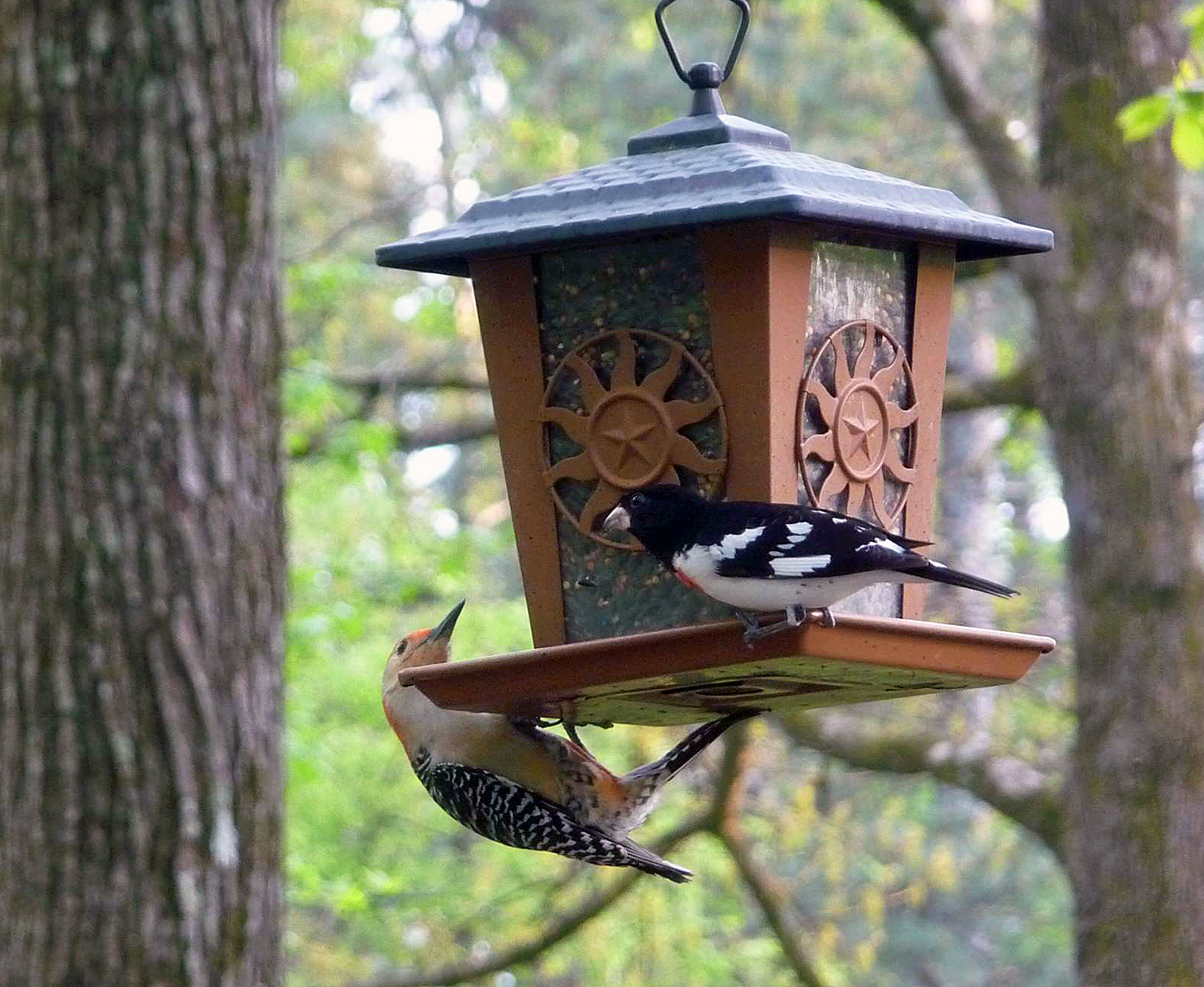
Photo Courtesy of Byron Tucker
A Rose-breasted Grosbeak joins a Red-bellied Woodpecker at a feeder in Atlanta.
Single birds are occasionally the first to arrive, but Rose-breasted Grosbeaks do form flocks when migrating. Even if a scout shows up alone at your feeders, he will often soon be joined by other grosbeaks. My recent visit by a single male led to two and then three males visiting the feeders. Eventually a female Rose-breasted Grosbeak also made an appearance.
Plenty of Rose-breasted Grosbeaks pass through Northeast Tennessee, and a few even decide to make mountains like Unaka, Holston and Roan their home for the summer. However, these birds spread out widely across the eastern half of the North American continent, ranging from northeastern British Columbia to Quebec and Nova Scotia in Canada. They also range south from New Jersey to Georgia. The Rose-breasted Grosbeak also reaches Colorado, Oklahoma and Kansas.
For the most part, however, the Rose-breasted Grosbeak is replaced in the western United States by the closely related Black-headed Grosbeak.
As fall approaches, the Rose-breasted Grosbeak migrates south to a winter range that spans central Mexico, Central America and northern South America. As they depart, many of these migrating birds will make autumn visits to again partake of offerings of sunflower seeds at backyard feeders. So, if you don’t get to see these showy birds in the spring, you get another chance in September and October.
The male Rose-breasted Grosbeak gives this species it name. Males are the epitome of the birds that make their home for part of the year in the American tropics. The contrasting black and white plumage is emphasized by a triangular slash of rosy-red color on the breast. Put all those elements together and the male Rose-breasted Grosbeak is not a bird that would be mistaken for any other.
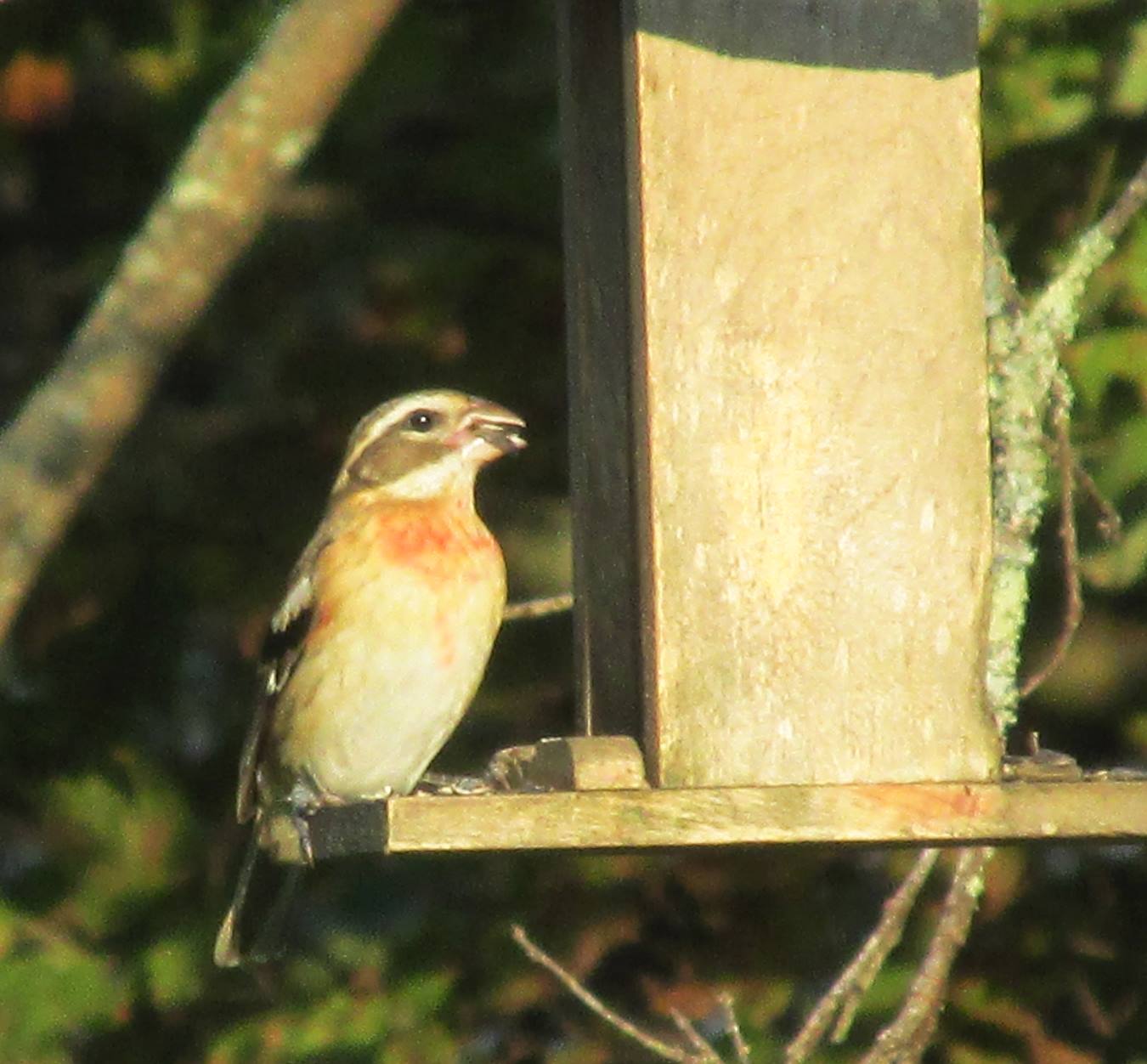
The female grosbeak, however, doesn’t quite stand out in the same way. She is much less colorful than the male. With her brown and white plumage, she is often mistaken for a large sparrow or finch.

Photo by Bryan Stevens
A young male Rose-breasted Grosbeak visits a feeder in September of 2013. Young males resemble females but show a splash of orange on the breast that will be replaced the following spring by the familiar rosy-red patch.
Both sexes have a massive bill, which they use to hull sunflower seeds at feeders or glean insects from leaves and branches. It’s the heavy, blunt bill for which the term “grosbeak” is derived. “Gros” is a German term for large or big, so grosbeak simply means a large-beaked bird. People who band birds to further the study of them will tell you that Rose-breasted Grosbeaks have a wicked bite and are capable of delivering quite a nip. In Northeast Tennessee, bird banders frequently encounter Rose-breasted Grosbeaks in their mist nets — and bear the scars to prove it.
With some birds, males play only a minor role in the nesting process. That’s not the case with the Rose-breasted Grosbeak male. The males help with nest-building chores and share responsibility with the female for incubating the eggs.
The female lays three to five eggs in a cup-shaped nest. It’s not easy to locate the nests since the birds usually place them in trees at least 20 feet above the ground. Within two weeks, the eggs have hatched and the parents are kept extremely busy finding enough food to satisfy the voracious nestlings. Well fed by both parents, the young grow quickly and usually are ready to leave the nest within 12 days. Often, when a first brood of young departs the nest, the male will care for the rowdy group of fledglings as the female starts a second nest to capitalize on the long days of summer.
Away from our feeders, Rose-breasted Grosbeaks feed on insects, seeds, fruit and even some leaf buds and flowers. I’ve seen these birds satisfying a sweet tooth — or should that be sweet beak? — by feeding on jewelweed flowers and apple blossoms. If sugar’s good for hummingbirds, I am sure it is a valuable energy source for Rose-breasted Grosbeaks, too.
The Rose-breasted Grosbeak is a cherished spring visitor that never fails to disappoint by bringing a hint of the tropics to the mountains of Northeast Tennessee. I’m hoping many readers are also enjoying their own opportunities for hosting this delightful songbird.
•••••
The bird walk at Tipton-Haynes Historic Site on Saturday, April 26, yielded a good range of birds, including American Robin, House Wren, Cardinal, Song Sparrow, Carolina Chickadee, American Goldfinch, Tufted Titmouse, Crow, Canada Goose, Chimney Swift, Brown Thrasher, Barn Swallow, Eastern Towhee, European Starling, Yellow-rumped Warbler, Chipping Sparrow, Mallard, Red-winged Blackbird, Red-bellied Woodpecker, Turkey Vulture, Black Vulture, Northern Flicker, Grackle, Gray Catbird, Blue Jay, Mourning Dove and Eastern Bluebird.

Photo by Bryan Stevens
A pair of Brown Thrashers provided quite a show for attendees at a recent bird walk at Tipton-Haynes Historic Site.
Attending the walk were Heather Jones, Charles Moore, David Thometz and myself. We enjoyed perfect spring weather and also admired the many wildflowers in the gardens and woodlands at the Johnson City historic site.
Members of the Lee and Lois Herndon Chapter of the Tennessee Ornithological Society will also hold a bird walk at 8 a.m. on Saturday, May 10, at Sycamore Shoals State Historic Park in Elizabethton. This walk is held in honor of International Migratory Bird Day and should provide participants with an excellent opportunity for seeing some fine birds.
•••••
I enjoy hearing from readers. Share a sighting, ask a question or make a comment by emailing me at ahoodedwarbler@aol.com or posting to my Facebook page.
Brown Creeper, Rusty Blackbirds part of spring migration excitement
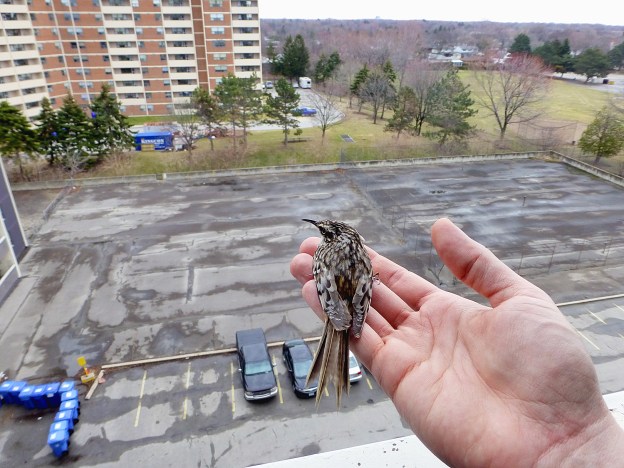
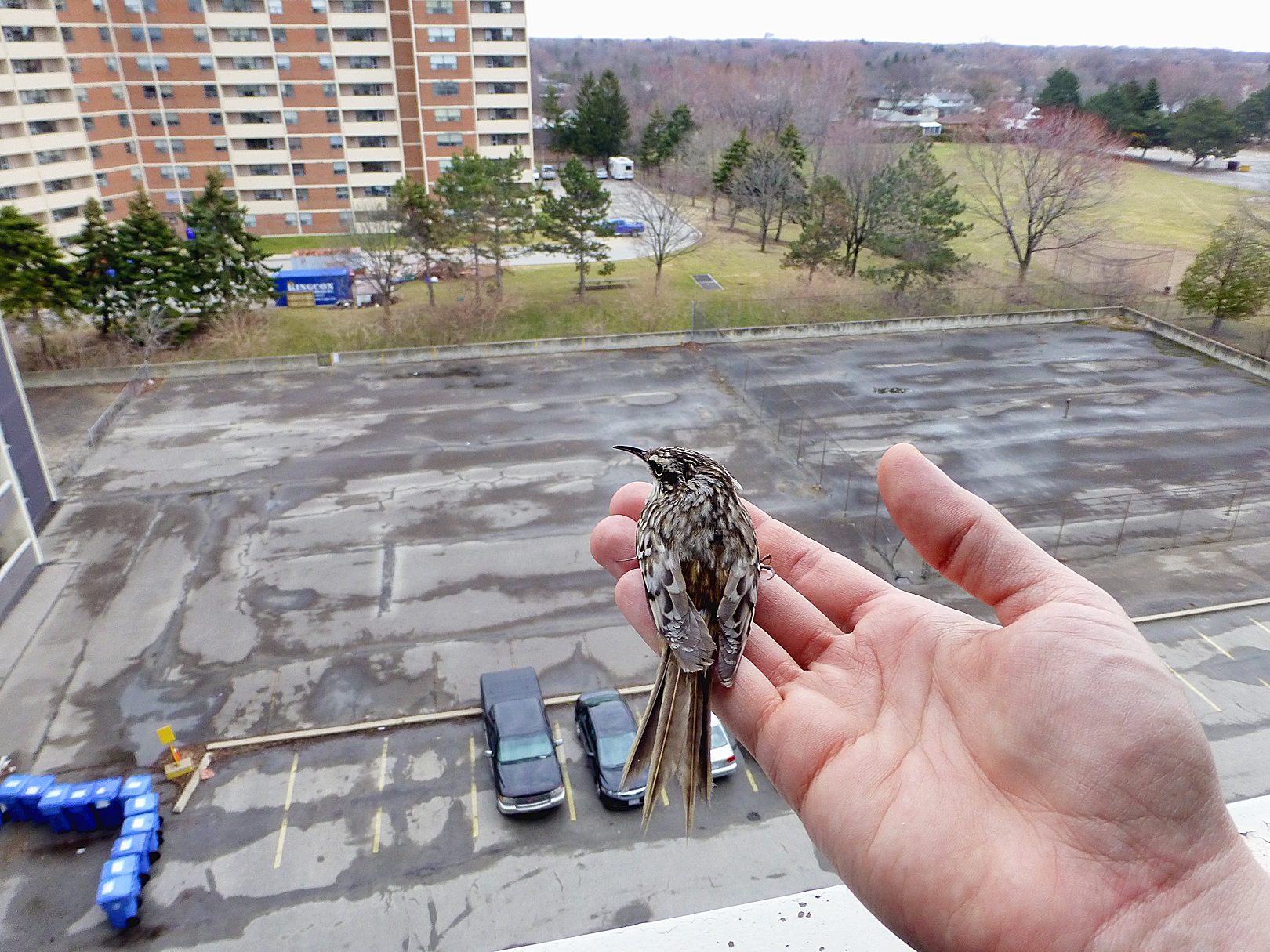
I’ve welcomed followers of my blog on birds and birding from as far afield as Canada and England. The love of birds, apparently, knows no borders. This past week, Ontario resident Rob Hicks shared a fascinating rescue story about a Brown Creeper that crashed into a window of his upper-floor apartment dwelling.
He found the bird on the floor of his eighth-floor balcony on April 13.
“I heard a bang outside, so I went to see if something had fallen over,” he said. “I saw the bird, and I thought it was dead.”
Rob said he gently picked up the bird.
“A few seconds later I could see it moving slightly,” he recalled. “His head seemed a bit stuck facing right for a while, and his right eye was closed. The left eye opened so I knew he was alive.”
Rob took the bird inside the apartment.
“I left him on the windowsill while I got water for him, but he didn’t seem interested in that.”
After about 20 minutes, the bird began to get more active.
“He finally opened his other eye and fluttered his wings a bit and stumbled,” Rob said.
Fortunately, Rob caught him and took him outside to the balcony edge. “But he was just gripping my fingers with his claws, so he didn’t seem to want to go anywhere,” he added.
After another five minutes or so, the bird got bold enough and in a second he’d leapt off his hand and flew off like nothing was wrong at all.
Brown Creepers are woodland birds and not usually found far from trees. As is evident in some of the photographs provided by Rob, his apartment is located adjacent to some Canadian woodlands that would provide suitable habitat for a Brown Creeper.
The bird, possibly a migrant, collided with a pane of glass, possibly the door onto Rob’s balcony. Fortunately, the impact didn’t prove fatal and the bird, perhaps a little wiser, was able to fly away from the incident.
The Brown Creeper is a widespread bird across the United States and Canada. Its nesting range extends from Alaska, Ontario and Newfoundland southward throughout western mountains, as well as the Great Lakes region, Southern Appalachians and New England.
In Northeast Tennessee, this bird is considered uncommon. According to the book, The Birds of Northeast Tennessee by Rick Knight, the Brown Creeper is a winter resident at lower elevations in the region. It nests at higher elevations, such as Roan Mountain on the Tennessee/North Carolina border, during the summer months.
Brown Creepers locate their nests behind a peeling piece of bark on a tree trunk. In behavior, this bird is similar the nuthatches. However, instead of inching its way headfirst down a tree trunk, the Brown Creeper typically hitches its way up a tree before flying to the base of a nearby tree trunk and repeating the process.

Photo Courtesy of Rob Hicks
The moment of truth arrived when the Brown Creeper successfully flew away to nearby woods when carried to the edge of the eighth-floor balcony.
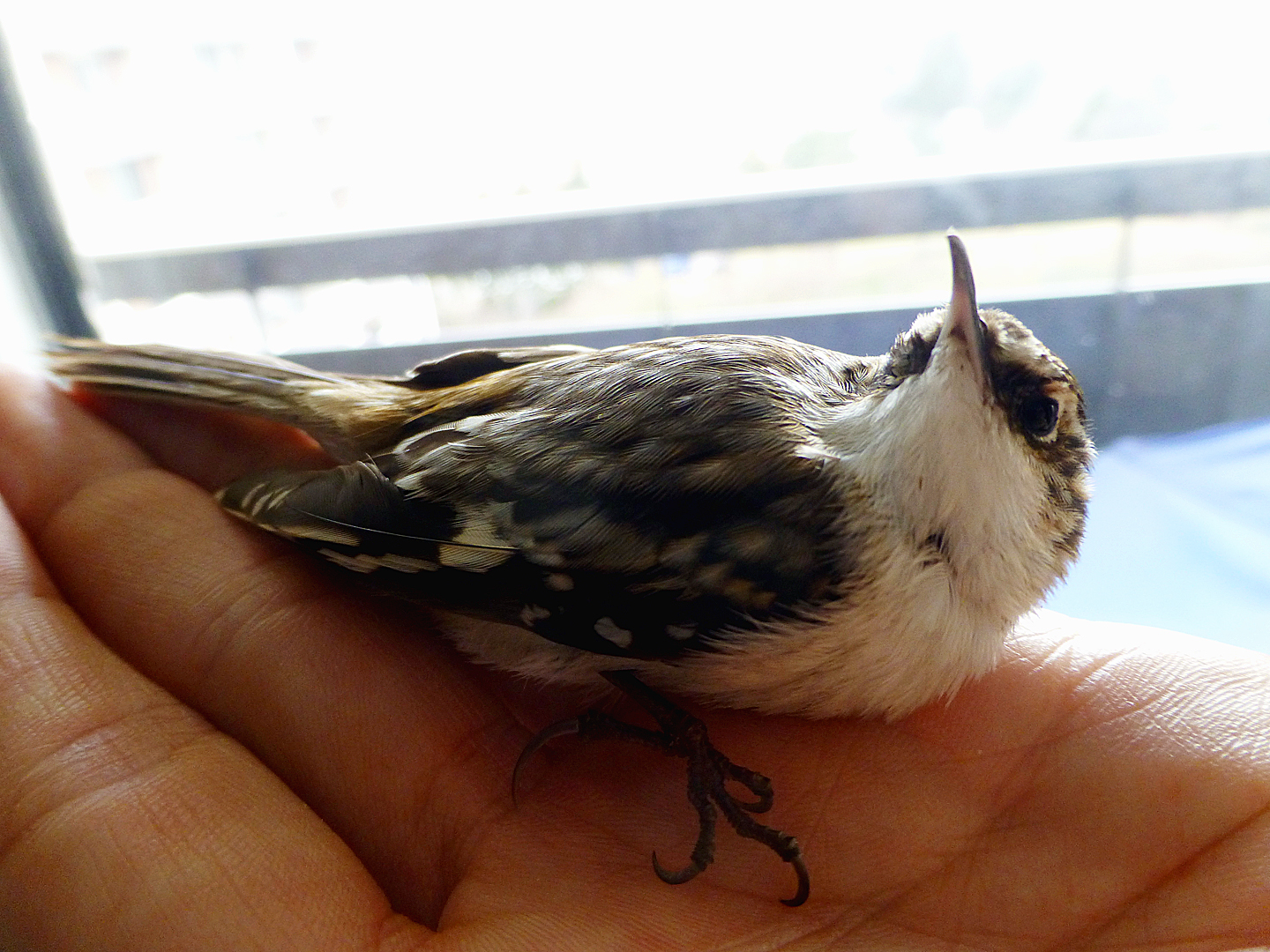
Against the bark of a tree, the Brown Creeper is extremely well camouflaged. These small birds are often first detected by sharp-eared individuals capable of discerning its soft, lisping call notes. During the breeding season, this bird also produces a thin, musical warble that serves as its song.
The Brown Creeper has long, stiff tail feathers to help support itself against the vertical surface of a tree trunk. It also has a curved bill that is an excellent tool for probing for hidden insects, which provide its food.
It’s scientific name is Certhia americana, which is appropriate since it is the only North American representative of the creeper family. Beyond the New World, eight other creepers reside on the continents of Europe and Asia. The other members of the family include the Eurasian or Common Treecreeper, as well as Short-toed Treecreeper, Hodgson’s Treecreeper, Bar-tailed Treecreeper, Sichuan Treecreeper, Rusty-flanked Treecreeper, Sikkim or Brown-throated Treecreeper and Hume’s Treecreeper.
•••••
I’ve had so many new spring arrivals in the past couple of weeks that it is difficult to keep track of them all.
On April 10, I saw my first Black-throated Green Warbler of spring at Limestone Cove Recreation Area. That same day, I observed my first Green Heron of the season while visiting a small pond on Anderson Road near the Okolona exit from Interstate 26.
I witnessed a Ruby-crowned Kinglet in a Norway Spruce on April 13.
I’ve been hearing Black-and-white Warblers since the second week of April, but I got a good look at one on April 18. These warblers behave much like nuthatches and Brown Creepers, clinging to tree trunks and branches as they explore nooks and crannies for small insects and spiders.
While visiting Austin Springs on Boone Lake on April 19, I got a good look at the first Eastern Kingbird I’ve seen this spring. I also saw my first Spotted Sandpiper of the year.
I saw my first Chimney Swifts of the season on April 24, which also happens to be my mother’s birthday. We saw the swifts flying over downtown Johnson City while meeting other family members for her birthday lunch.
On April 25, I looked out the bedroom window at my home on Simerly Creek Road in Hampton and saw a stunning male Rose-breasted Grosbeak feeding on sunflower seeds contained in a feeder hanging in a Blue Spruce. Later that same day, two male grosbeaks arrived at the feeders at the same time.
That same day, I first started seeing female Ruby-throated Hummingbirds. The males arrived two weeks earlier, as is often the case with these tiny winged wonders.
My sighting of the grosbeaks came a couple of days after my friend, Byron Tucker, reported Rose-breasted Grosbeaks at his home in Atlanta.
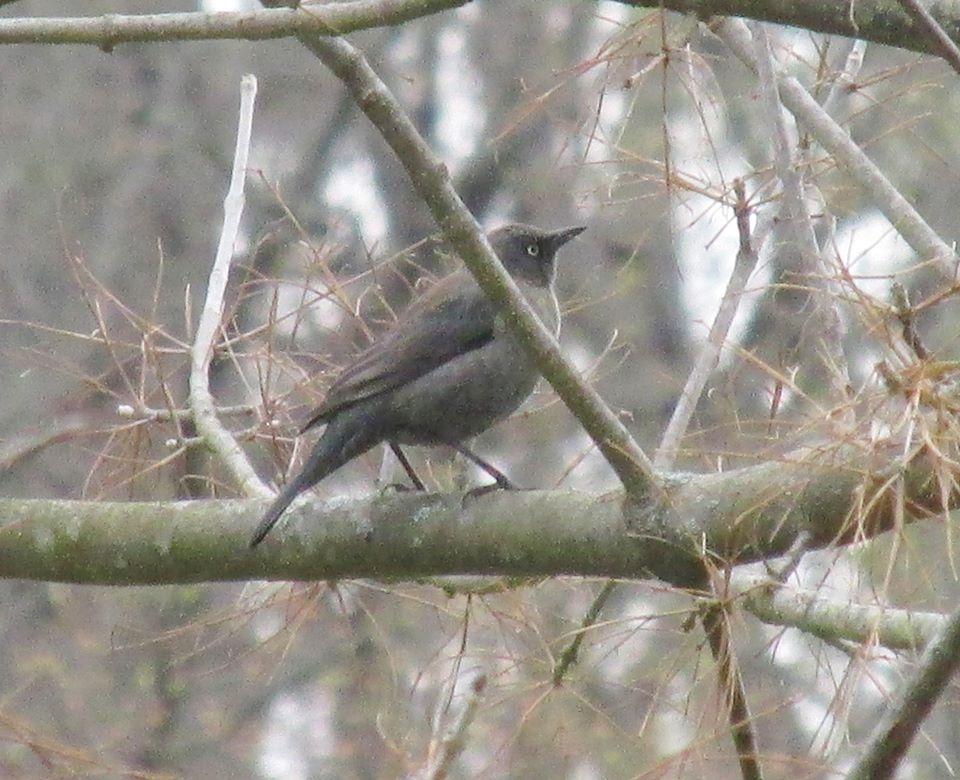
One of the most impressive observations during April involved a flock of Rusty Blackbirds that I encountered on April 8 during a visit to the pond at Erwin Fishery Park in Unicoi County. These small blackbirds are of particular concern to many birders and bird experts because of the distressed population decline the species has suffered during the past few decades.
The website, rustyblackbird.org, provides this excellent summary of the threat facing this bird:
“The Rusty Blackbird (Euphagus carolinus) is a widespread North American species that has shown chronic long-term and acute short-term population declines, based both on breeding season and wintering ground surveys. Rusty Blackbirds are ecologically distinct from other blackbirds, depending upon boreal wetlands for breeding and bottomland wooded-wetlands for wintering.”
The decline has been shocking and mysterious. The flock of perhaps a little more than a dozen individuals at Erwin represented one of North America’s most rapidly declining species. The population of Rusty Blackbirds has plunged an estimated 85 to 99 percent over the past 40 years and scientists are completely puzzled as to what is the cause.
During migration, watch for Rusty Blackbirds in wet areas, such as flooded woodlands, swamps, marshes and pond edges. These moist habitats are their favorite foraging areas in winter and during migration.
During the summer nesting season, this blackbird favors northern bogs, beaver ponds and wet woods in boreal forest.
••••••
I enjoy hearing from readers. Email me at ahoodedwarbler@aol.com or leave a comment here. I’m also on Facebook.
Sora observation spring surprise as pace of migration increases
The hummingbirds, as I reported last week, are back. I’m hearing from readers across the region about the arrival of these tiny flying gems.
• Nata Jackson, who lives in Greene County, sent me an email to let me know that she saw her first Ruby-throated Hummingbird of spring on April 14. She had put up her feeders at about 2 p.m. Five hours later, she walked by the window and saw a male hummingbird at one of the feeders.
• April Kerns Fain of Erwin reported on Facebook that her hummingbirds returned on April 16, which was a very chilly day. “My hummingbirds are back and I had to thaw their sugar water for them,” she wrote. “Yuk!”
• Patricia Faye Wagers, who lives in Kingsport, saw her first hummingbird — a male — of spring on April 16, as well.
However, after I saw my first hummingbird of spring on Friday, April 11, I haven’t seen one since. Maybe the cold snap persuaded them to keep journeying north, or maybe they turned back south for a few days. I’m hopeful a few hummingbirds, as they usually do, will take up residence in the yard for the rest of the summer.
•••••
I spent the morning of Friday, April 11, birding with Margaret Roy along the linear walking trail in Erwin. She wanted to get an introduction to a guided birding experience in advance of a planned fall birding tour that we plan to offer through Mountain Inn & Suites of Erwin, where Margaret is the general manager.

Photo by Bryan Stevens
A Solitary Sandpiper seeks food at the water’s edge in a wetland at Erwin Fishery Park.
We had a fantastic morning, highlighted by a lengthy observation of a Sora from the wetland boardwalk near the industrial park. The Sora is a member of the rail family, which includes such species as Clapper Rail, Virginia Rail, King Rail, Yellow Rail and Black Rail.
We also saw a Greater Yellowlegs, Solitary Sandpiper, Yellow Warbler, Yellow-rumped Warbler, American Coots, Pied-billed Grebes, Brown Thrasher, Song Sparrows, Mallards, Canada Geese, Blue-gray Gnatcatchers, Northern Rough-winged Swallows, American Robins, Downy Woodpeckers and a pair of Red-bellied Woodpeckers excavating a nesting cavity in a sycamore tree.
Several of the birds – Greater Yellowlegs, Solitary Sandpiper and Yellow Warbler – represented my first spring sightings.
Our observation of the Sora, however, provided the most excitement of the morning. This is a bird that is only infrequently encountered, especially in this region. Rails, the Sora included, are shy, elusive and designed with the primary purpose of avoiding notice.
Worldwide, there are more than 130 species of rails. Many members of the family are called rails or crakes, but the family Rallidae also includes coots, moorhens, swamp-hens and gallinules.
Many species of rails have evolved into flightless species of birds. All the species encountered in North America, however, are capable of flight and long-distance migrations. Many of the world’s flightless rails have gone extinct in the past few centuries. Many are considered endangered, including Lord Howe Woodhen, the Takahē and the Guam Rail.
The Sora is a small bird that’s not much bigger than an American Robin. While many rails are plain-looking birds, the Sora is fairly distinctive in its appearance with a slaty gray body, a short, yellow bill, long legs and a short tail, often held upright showing white underneath. Soras also have a black face and throat.
As we watched the Sora foraging among cattails and other vegetation beneath the boardwalk spanning the wetland along the linear trail, the bird moved deliberately and alertly. As we watched, the Sora flipped over leaves and other debris with its bill, often snatching small prey organisms. This bird enjoys a varied diet that can include seeds, insects, crustaceans and snails.

Photo by Bryan Stevens
A Sora finds a meal in a wetland spanned by a boardwalk along the Erwin linear walking trail.
At the end of our observation, the Sora turned and simply walked into the cattails, fading from view almost instantly. The sudden disappearance of a bird so capable of navigating effortlessly between reeds and cattails reminded me of the phrase, “as thin as a rail,” which seems particularly apt for the Sora.
This normally secretive bird makes its home in freshwater marshes throughout Canada and the central United States. The Sora is the most common and widely distributed rail in North America. The Sora also ranges into Central and South America. Like many rails, it is quite vocal with a distinctive descending whinny call can be easily heard from marsh vegetation, but actually seeing a Sora is often a fluke of being in the right place at the right time.
The sighting recently in Erwin is the best I’ve ever had of a Sora in Northeast Tennessee. Another memorable observation of a Sora took place years ago on Fripp Island, S.C., when my mother and I watched a bird wading at the edge of a waterway on one of the island’s many golf courses.
In addition, during a field trip many years ago with members of the Lee and Lois Herndon Chapter of Tennessee Ornithological Society, I saw a Sora wading in a flooded ditch in a pasture at Austin Springs on Boone Lake.
Many of my encounters with this species have been represented only by hearing them call from wetlands in Bowmantown and Shady Valley.
The book, “The Birds of Northeast Tennessee” by Rick Knight, classifies the Sora as a transient bird in the region that is occasional to uncommon in spring and fall.

Photo by Bryan Stevens
The Sora is an elusive member of the rail family that is more often heard than seen.
•••••
Two days after Margaret and I saw the Sora in Erwin, Elizabethton residents Cathy Myers and Tom McNeil found a Sora and a Common Yellowthroat at Henderson Marsh, which is located in on Crestview Road in Bowmantown in Washington County.
Of course, Soras are only one of many species migrating through the region. Vireos, warblers, shorebirds and flycatchers are among those arriving with every passing day.
••••••
Many birds are already nesting. A female Northern Cardinal is sitting on a nest in a yew tree at my home on Simerly Creek Road in Hampton.
I also visited the Great Blue Heron nesting colony along Blevins Road on the Watauga River in Elizabethton. I found several more nests have been added since my last visit a couple of weeks ago.
•••••
I would love to hear from readers. You can also reach me on Facebook or send email to ahoodedwarbler@aol.com. Please share a link to the column with others who might be interested in the topic of birds and birding in Northeast Tennessee.