Category Archives: Birds

Birds provide visible evidence of transition of seasons

We are midway through March, and the birds are on the move. We’ve been fortunate to enjoy some beautiful spring weather and all the accompanying flowers in the last couple of weeks. The next month or so will feature a lot of transition as our winter resident birds prepare to depart and some of our beloved summer residents return to spend the next few months with us.

For instance, the Buffleheads that congregate on Wilbur Lake in Carter County are already dispersing to local rivers and ponds. After spending some time on these other waterways, they will be flying farther north. Buffleheads are cavity-nesting birds, so they will look for wooded lakes and seek out a tree with a large cavity or cranny. There, the female will lay her eggs and renew the cycle of life before the adults and a new generation return to winter in the region in several months.

These little two-toned ducks with a dark and light plumage pattern have long been a favorite of mine. Patsy Schang sent me a photo of a pair of Buffleheads that visited a pond at her neighbor’s Roan Mountain home. As you can see from the accompanying photograph, the two Buffleheads look quite at home.

“I was so excited to see these ducks on our neighbor’s pond,” Patsy wrote in her email. “I think they are Buffleheads – my first!”
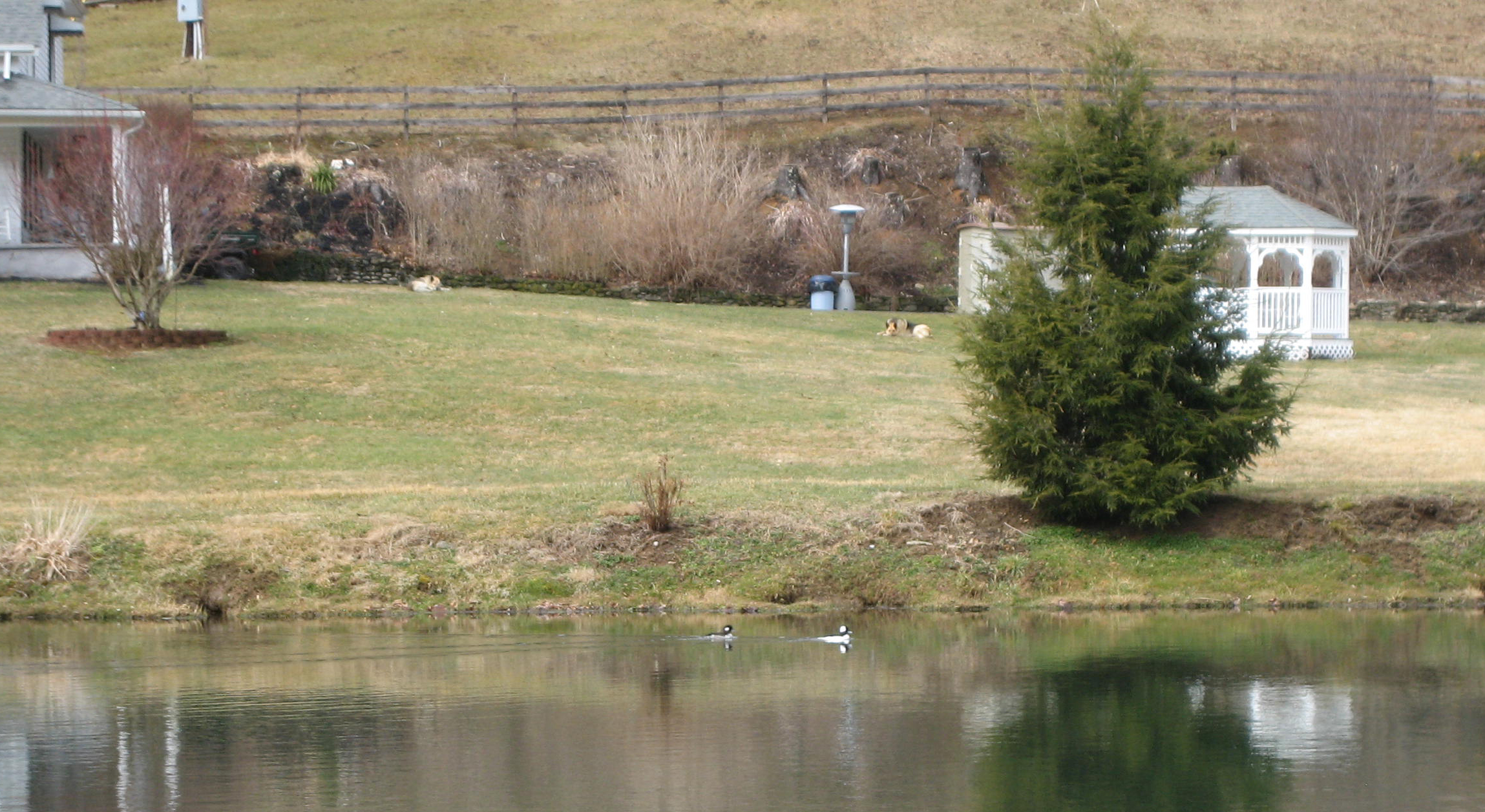
Image

Photo courtesy of Patsy Schang
These Buffleheads visited a Roan Mountain pond earlier this month.

Patsy had no trouble identifying the ducks, and I congratulated her on her first sighting of Buffleheads, It’s always fun to see a new bird, especially so close to home.

According to the Ducks Unlimited website, Buffleheads breed from southern Alaska through the forested areas of western Canada, central Ontario and eastern Quebec.

The website notes that 90 percent of the population is believed to breed from Manitoba westward. So, these little ducks travel a long way to spend the winter on Wilbur Lake, Ripshin Lake and other locations in Northeast Tennessee.

•••••

Karla Smith sent me an email about a nesting colony of Great Blue Herons in Elizabethton.

Image

Photo by Bryan Stevens
This colony of nesting Great Blue Herons is located behind the Elizabethton Municipal Airport.

“I didn’t know if you had heard about the herons that are nesting in the tops of two trees behind the airport in Elizabethton,” Karla wrote in her email. “I believe they are herons. I am not an avid bird watcher, but do enjoy them and sighted these a few weeks ago. There are six nests total in the two trees and it is quite a sight to see.”

I went the next day and found the nests and several herons exactly where Karla informed me they would be. This is only the second time I have observed nesting Great Blue Herons in Carter County.

I counted six nests and seven herons during my brief visit to the location. The two trees are on a steep hillside at the back of a field behind the Elizabethton Municipal Airport. From this location, the adult herons can spread out along the nearby Watauga River to find plenty of food once the young are born.

In addition to the herons near the airport, there are at least two active Great Blue Heron nests along Blevins Road on the other side of Elizabethton. This location also served as a nesting place last year for Yellow-crowned Night-Herons.

I posted about the heron nesting colony at the airport on my Facebook page and several friends shared interesting stories.
Image

Photo by Bryan Stevens
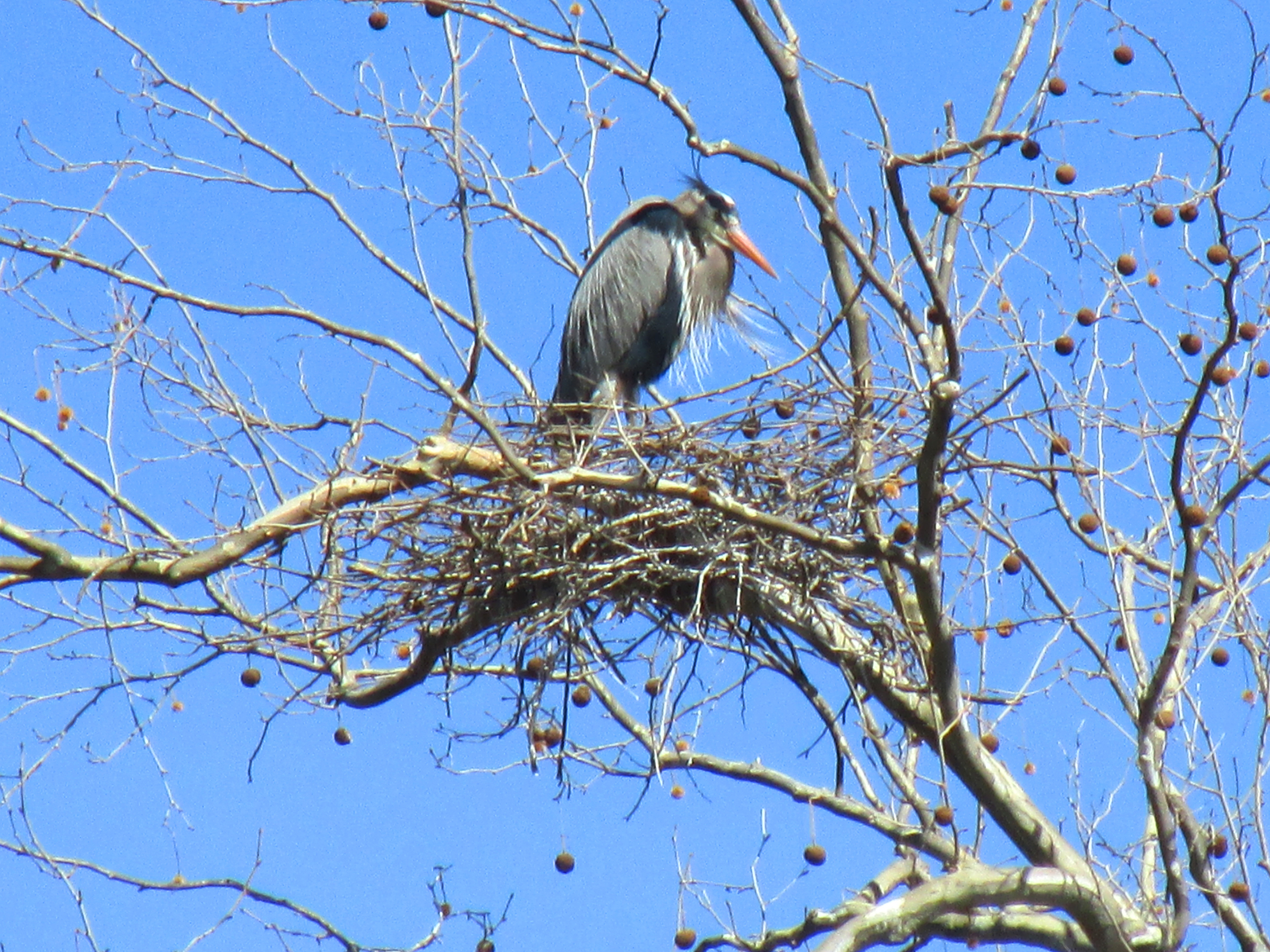
A Great Blue Heron stands in a nest built in a tree over the Watauga River along Blevins Road in Elizabethton.

Sandra “Snad” Garrett said she plans to check out the colony, which is not far from the Stoney Creek home she shares with her husband.

“We used to enjoy watching a huge rookery on the Mississippi River in North Minneapolis when we lived there,” she wrote. “I had no idea there was a rookery so close to us here.”

Seeing the post reminded Elizabethton resident Rita F. Schuettler of a previous close encounter with a Great Blue Heron.

“I was fishing on the Watauga River when I saw my first Great Blue Heron,” she said. “It was close by and staring at me. Scared me to death, but I was thrilled to see it.”

In a follow-up moment, I congratulated Rita, telling her that it’s difficult to sneak up on a Great Blue Heron and that it sounded like they both got surprised.

“I was sitting there motionless fishing and he was standing there motionless fishing,” Rita wrote in another post. “I don’t know who was there first. It might have scared him also, because he flew away!”

•••••

I saw my first Barn Swallow of the spring on March 19 at Anderson Marsh on the old Johnson City Highway near the Okolona exit. There was also a Great Blue Heron in the creek at the same location.

The previous day, it was all about the raptors, as I found a Sharp-shinned Hawk on Simerly Creek Road, an American Kestrel in Unicoi and a Red-tailed Hawk and a Cooper’s Hawk both soaring in the same vicinity in Johnson City. Once I tossed in both Black Vultures and Turkey Vultures, it capped off what amounted to a pretty good raptor day.

On March 17, the only wild waterfowl lingering at the pond at Erwin Fishery Park turned out to be a pair of American Wigeon. On land, I also enjoyed watching a large mixed flock that consisted of Common Grackles, Red-winged Blackbirds and European Starlings. They were feeding on shelled corn that some good-hearted person had probably left for the domestic ducks and geese that make their home at the pond.

All this activity is proof that the seasons are changing, and with them the makeup of the birds that share our yards and gardens.

••••••

Image

Photo by Bryan Stevens
A male Eastern Towhee feeds on the ground beneath a feeder hanging in a tree.

Elizabethton resident Dee Obrien contacted me on Facebook with a question about a bird she saw recently at her home.

“I have an unusual bird in the yard,” she wrote in her message. “He’s about the size of a robin or mockingbird. Is black on top with white bars on his wings. Rust color on outer sides of his belly, but is off white in the middle of his belly. He is a ground feeder.”

I was glad Dee included the information on the bird’s behavior. Details like that are just as important as size and coloration. From her detailed description, including the information about its ground-feeding habits, I was able to figure out that she had seen an Eastern Towhee. Later, she notified me that she had consulted a field guide and agreed with my identification.

•••••

It’s great to hear from so many fellow bird enthusiasts. That’s been one of my goals with this blog. I hope to continue to receive communications from readers. Otherwise, it’s just me writing about the birds I have seen. I’d much rather have this blog become more engaging and interactive where people can share their enthusiasm for our fine feathered friends.

It’s easy to post comments on my new blog at ourfinefeatheredfriends.wordpress.com. You can also reach me on Facebook or send email to ahoodedwarbler@aol.com. Please share the link to the blog with others who might be interested in the topic of birds and birding in Northeast Tennessee.

•••••

There’s a new poll this week. Here’s the answer to last week’s poll. Which of the red-necked birds in the list specified in the poll isn’t a real bird? Well, the answer is Red-necked Goose. I hope everyone got the correct answer.

What’s in a name? Long-tailed Ducks stage late winter invasion of Northeast Tennessee

Experts in ornithology are always changing the common and scientific names of many of our favorite birds. That’s why since I began birding I have had to adjust myself to accept the Eastern Towhee for the bird I first learned as a Rufous-sided Towhee – still a much more accurate and interesting name – and Blue-headed Vireo in place of Solitary Vireo. Blue-headed is more descriptive of the appearance of this bird, but as someone who can be a bit of a loner, I also appreciated the “solitary” moniker.

Name changes, however, rarely inspire the controversy that one did more than a decade ago when a duck formerly known as “Oldsquaw” had its name changed to “Long-tailed Duck.” In 2000, the American Ornithologists’ Union Committee on Classification and Nomenclature was petitioned to make the name change. Biologists with the U.S. Fish and Wildlife Service in Alaska requested that the English name, or common name, of Clangula hyemalis be changed from Oldsquaw to Long-tailed Duck, the name that had long been used for the species outside of North America. The biologists noted that the species was declining in numbers in Alaska and that their conservation management plans required the help and cooperation of Native Americans.  The biologists expressed concerns that the name Oldsquaw would offend the Native Americans they were trying to recruit to assist them with efforts to protect this particular duck.

Photo by Bryan Stevens Six Long-tailed Ducks photographed last month on Holston Lake.

Photo by Bryan Stevens
Six Long-tailed Ducks photographed last month on Holston Lake.

It wasn’t the first request to change the name, but it was the one that convinced the members of the committee to approve the petition. The members did state a reluctance to consider political correctness alone as a reason for changing long-standing English names of birds. In essence, the committee was willing in this particular instance to adopt an alternative name already in use in much of the world.

How did this duck ever get saddled with the name “oldsquaw” in the first place? The name was apparently inspired by the rolling three-noted call made by (here’s irony for you) the male ducks. In flocks, drake Long-tailed Ducks are very sociable and excitable. They like to “talk” with each other. Somewhere, back in the early days of ornithology in North America, someone apparently felt these vocal ducks reminded them of “old squaws” engaged in gossip. When I think about it, I can see why the name did have some heavy baggage regarding racism and sexism.

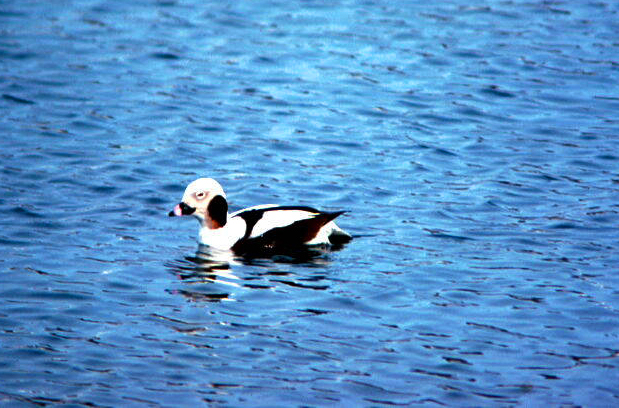
Photo by U.S. Fish & Wildlife Service  The Long-tailed Duck, pictured here, was once known as the "Oldsquaw."

Photo by U.S. Fish & Wildlife Service
The Long-tailed Duck, pictured here, was once known as the “Oldsquaw.”

Long-tailed Ducks range the far northern regions of North America, Europe and Asia. In North America, these ducks breed in the high Arctic regions of Alaska and Canada. They winter in the Great Lakes and along both coasts as far south as northern California and the Carolinas. It was the fact that the severe cold this winter has frozen solid the Great Lakes that pushed Long-tailed Ducks south in almost unprecedented numbers. I am thankful for this unanticipated consequence of the severe cold snaps in January and February. After all, it allowed me to finally get an excellent look at Long-tailed Ducks 14 years after I first added this species to my life list.

I have a few birds checked on my life list that I have technically observed in the field without enjoying particularly satisfying observations of the birds. Often, such unsatisfactory observations stem from either a fleeting glimpse of a bird or a look at one from a great distance. For instance, I observed Buff-breasted Sandpipers only one time several years ago during a visit to Rankin Bottoms at Douglas Lake. My look at the distant sandpipers through a spotting scope gave me only a blurry image of the birds on mud flats shimmering with waves of August heat. That observation didn’t exactly burn itself with great clarity into my memories. That happens, although thankfully not too often. I usually just patiently await a second sighting of these listed birds and hope that the next encounter will offer a more memorable experience.

That’s what happened a couple of weeks ago when I took my mother, Peggy, to Holston Lake. We visited a boat launch on Highway 421 to scan for some visiting Long-tailed Ducks. My first sighting of Long-tailed Ducks dates back to 2000, when I compiled an admirable list of 220 species of birds in a single year in Northeast Tennessee. I saw several Long-tailed Ducks from the overlook at Boone Dam while birding with the late Howard Langridge. Even peering at the birds through Howard’s powerful Questar spotting scope, it was difficult for me to detect anything significant about the birds. They were little white and black dots bobbing up and down on the choppy waters of the lake. A cold, howling wind and snow flurries also made conditions less than perfect for observing anything at a distance. If my memory can be trusted, those Long-tailed Ducks were one of the last birds we found in 2000. I think we saw them in late November of that year.

Photo by U.S. Fish & Wildlife Service A female Long-tailed Duck is shown on her nest on the Alaskan tundra.

Photo by U.S. Fish & Wildlife Service
A female Long-tailed Duck is shown on her nest on the Alaskan tundra.

Since that time, I have followed up on the occasional report of a Long-tailed Duck. These rare visitors pop up at some dependable locations, such as Middlebrook Lake in Bristol and Musick’s Campground on South Holston Lake. By the time I have received posts about such sightings, the duck has inevitably flown the coop by the time of my arrival.

The six Long-tailed Ducks at Holston Lake, however, didn’t conform to the usual pattern of a quick visit by a single duck. In fact, they lingered for several days before I even motivated myself to make the long drive from Hampton to Holston Lake to look for them. When my mom and I arrived at the boat launch, we were astounded by the sheer number of Ring-billed Gulls present. There were hundreds of these medium-sized gulls flying over the lake and floating on the water. In addition, we also quickly detected several dozen Buffleheads as we scanned for Long-tailed Ducks. After about 20 minutes of finding only gulls and Buffleheads, I began to feel my luck hadn’t changed at all when it came to Long-tailed Ducks. I began taking photos of some of the cooperative Ring-billed Gulls. Once I had some snapshots of the rollicking gulls, I scanned the lake one more time with my binoculars. While looking in an area I had already scanned, I spotted six ducks that didn’t look at all like Buffleheads. When I got a good look, I realized I had found my target birds. I rushed back to my car and removed my spotting scope from the trunk. It took a few minutes to get the tripod steady. As soon as I focused the scope, I found myself enjoying a fantastic look at two adult male Long-tailed Ducks and four females or perhaps immature specimens.

These six Long-tailed Ducks were part of a massive and unusual movement of this species into Tennessee lakes and reservoirs this winter. Throughout February, it seemed that these ducks were popping up everywhere throughout the Volunteer State. Count yourself fortunate any time you spot a Long-tailed Duck. Of all the diving ducks in North America, it spends more of its time diving beneath the surface of the water than any of its relatives. Experts have determined that this duck spends at least two-thirds of its time diving for food. So, perhaps all those fruitless searches can be explained quite simply. I arrived when the ducks were hungry and not present above the surface!

Early North American naturalist John James Audubon painted the Long-tailed Duck in various life stages, including ducklings.

Early North American naturalist John James Audubon painted the Long-tailed Duck in various life stages, including ducklings.

I read one account about this duck that suggests the term “Long-tailed Duck” is sexist on the account that only the males possess the namesake long tail feathers that provide the inspiration for the common name. I don’t completely buy that argument. Many birds with descriptive names only describe the male bird. Think of the Black-throated Blue Warbler or the Scarlet Tanager, to name a couple. Anyone seeing female Black-throated Blue Warblers or Scarlet Tanagers would have a difficult time trying to match the bird’s name with what they are seeing. A drab brownish warbler and a greenish tanager don’t look at all like their male counterparts.

•••••

I spoke by phone this past week with Linda Powell, who lives on nearby Tiger Creek Road between Hampton and Roan Mountain. Linda called me to inform me that her neighbor found an unusual bird after it flew into a fence and was killed. She believed the bird might have been a duck, but she had never seen anything like it. As she described the bird to me, including its black coloration and large, green feet, I began to suspect that the unfortunate bird was probably an American Coot. She also noted that the bird’s bill was light in coloration, which was another indication of a coot. The habitat also seemed favorable for a migrating coot. Although there isn’t a pond in the pasture where the bird was found, there is a wet, marshy area that would probably have been sufficient to attract this bird. The coot was killed after it ran into a section of barbed wire fence. Unfortunately, it probably didn’t see the barbed wire until it was too late.

•••••

I made some first spring sightings of a couple of birds this past week. Three European Starlings made an appearance with a flock of American Robins on March 4. A few starlings are usually present from spring to early fall. At least they are never common and don’t extend their visit into the winter season. On March 3, when a light snow covered the ground at my home on Simerly Creek Road in Hampton, a female Red-winged Blackbird fed on the ground under my feeders. She was the first of her species to make an appearance this spring and is right on schedule.

•••••

Elizabethton resident Rita F. Schuettler‎ also spotted her first Red-winged Blackbird of spring coming to the feeders at 3:50 p.m. on Saturday, March 8. “I heard one last Saturday while working outside,” she added in her Facebook post announcing the sighting. “I heard this one also as I was reloading the feeders. After I was back in the house, he came in! Good to see him!”

•••••

I would love to hear from readers. Just post comments on my new blog at ourfinefeatheredfriends.wordpress.com. You can also reach me on Facebook or send email to ahoodedwarbler@aol.com. Please share the link to the blog with others who might be interested in the topic of birds and birding in Northeast Tennessee.

Increased global effort makes 2014 Great Backyard Bird Count a huge success

Image

Photo by Bryan Stevens
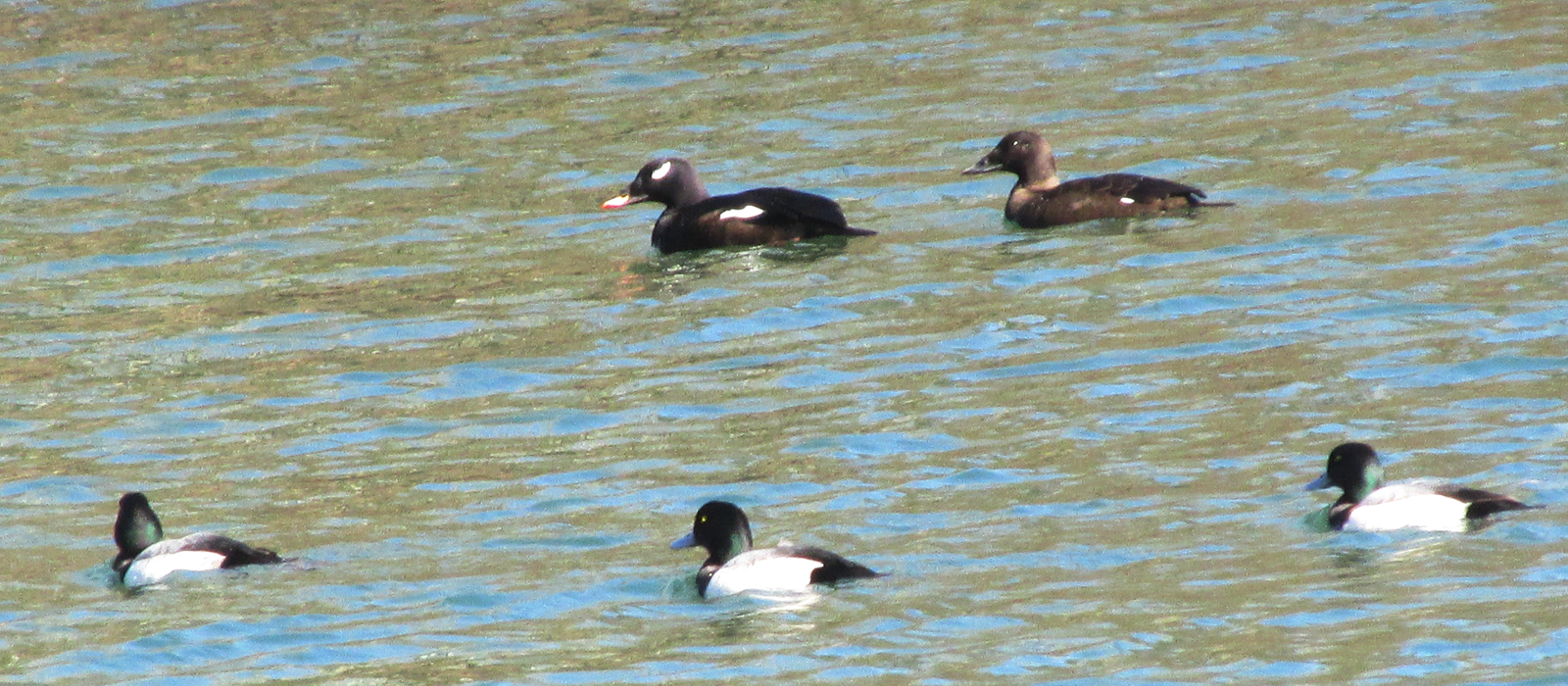
A pair of White-winged Scoters, back, swim on the Watauga River in Elizabethton with three Greater Scaups.

Last month’s Great Backyard Bird Count certainly merited description as a global affair. Checklists came in from more than 103 countries, including Australia, China, Argentina, Kazakhstan, Iceland, India, Kenya, as well as Canada, the United States and Mexico. Birders fanned out at hot spots around the world to count birds from Friday, Feb. 14 to Monday, Feb. 17.

Participants in the 2013 GBBC tallied more than 40 percent of the world’s bird species, with organizers setting a goal to take that figure to 50 percent this year.

A total of 644 species were found within the United States during the 2014 GBBC. California, Texas and Florida led the count with 364, 349 and 305 species found within those states, respectively.

In Tennessee, a total of 139 species were found during the GBBC. That’s a far cry from the 201 species located by sharp-eyed birders in Georgia, 200 species found in North Carolina, 184 species identified in both Alabama and Mississippi, as well as the 180 species counted in Virginia.

Arkansas eked past Tennessee with 141 species found, but Tennesseans did better than Missouri, where GBBC participants tallied 133 species, and Kentucky, where counters found 128 species.

A total of 2,357 checklists were completed by Tennessee GBBC participants, which provided some extensive coverage across the Volunteer State.

With 100 species, Hamilton County proved the most productive Tennessee county, followed closely by Shelby and Knox, with 98 and 97 species, respectively.

Closer to home, results were less dramatic but still important.

In Unicoi County, nine participants, including myself, found 39 species of birds during the four-day count period. In Carter County, 49 species of birds were found by 14 participants, including myself.

I mostly counted at home during this year’s GBBC, but I did make trips to the pond at Erwin Fishery Park and Roan Mountain State Park to expand my birding territory.

•••••

As checklists poured in from GBBC participants, a few trends became clear from the early stages of this year’s count. For instance, this year lacked any evidence of a “superflight” of irruptive finches.  Last year the GBBC documented such a phenomenon, which was driven by food shortages in Canada. Ten species of irruptive birds (mostly finches) staged a record invasion in areas where they don’t usually show up.

This year lacked huge numbers of White-winged Crossbills, Red Crossbills, Common and Hoary Redpolls, Pine and Evening grosbeaks, Pine Siskin, Purple Finch, Red-breasted Nuthatch and Bohemian Waxwing, birds that were more numerous farther south last year as well.

On the other hand, the 2014 GBBC has confirmed that this has been a great year for spotting Snowy Owls across the United States.

A massive irruption of Snowy Owls into the northeastern, mid-Atlantic and Great Lakes states had already been producing headlines for the past several months.

Halfway through the GBBC, with 327 checklists reporting a total of 476 Snowy Owls in 20 states and provinces of the United States and Canada, it was clear that many of the Snowy Owls had found their winter homes to their liking. Last year, 392 owls from eight provinces and 14 states were all that were counted during all four days of the 2013 GBBC.

As an illustration of how the owls have moved, in 2013 Canada had 46 percent of the Snowy Owl reports, but this year that number has dropped to 32 percent. Despite this year’s impressive numbers, these large, white owls can still be hard to find. Many GBBC participants succeeded by checking seashores and lakeshores, farm fields and even cities, where the owls often choose a prominent perch with a good view, such as a utility pole or even the roof of a city building.

In much of North America, people (and birds) have been shivering through bone-chilling blasts of arctic air also called the “polar vortex” phenomenon. The impact of this extended cold on birds has beens most apparent in areas such as the Great Lakes, which are almost completely frozen. Only Lake Ontario has any significant open water now and that has resulted in major movements of waterfowl such as ducks, geese and grebes. The GBBC is capturing these patterns well.

For example, the White-winged Scoter is not usually found inland in February, but has been widely reported from interior locations over the past few days as has the Long-tailed Duck. Both these species showed up in unusual numbers in Northeast Tennessee during late January and throughout February.

Image

Photo by Bryan Stevens
These two White-winged Scoters spent several days in late January and early February on the Watauga River near Meredith Cabins in Elizabethton.

A pair of White-winged Scoters spent several days on the Watauga River near Meredith Cabins in late January and early February. My mom and I managed to get good looks at the two ducks on Feb. 1. By climbing down a tangled bank, I also managed to get some decent photographs of them.

White-winged Scoters are large, solidly built ducks. Males can weigh three-and-a-half pounds while females can reach a weight of two-and-a-half pounds. Both sexes have the vivid white wing patch that gives the duck its common name.

This duck nests on freshwater lakes and wetlands in the northwestern interior of the United States and Canada.

Other scoters include Surf Scoter, Velvet Scoter, Black Scoter and Common Scoter. Surf and Black Scoters are also occasional visitors to Northeast Tennessee.

A total of 62 White-winged Scoters were found in Tennessee during this year’s GBBC. Three Surf Scoters were also found.

••••••

The scoters are classified with the diving ducks. To learn more about scoters and other diving ducks, here’s a helpful link to a PDF with detailed information about various species, including White-winged Scoter.

http://extension.umd.edu/sites/default/files/_docs/programs/riparianbuffers/FS611.pdf

••••••

According to an update regarding the GBBC posted at birdcount.org, one of the more exciting rare birds reported in this year’s GBBC was spotted across the pond. A Yellow-rumped Warbler has been visiting a feeder in, of all places, central England! This is the first New World warbler ever recorded for the GBBC from the Eastern Hemisphere.

Image

Photo by Bryan Stevens
This Yellow-rumped Warbler was photographed on Fripp Island, S.C., several years ago.

In northeast Tennessee, the Yellow-rumped Warbler, many years ago known as Myrtle’s Warbler, is a common winter bird. Indeed, it is the only warbler that typically attempts to spend the winter months in the eastern United States.

••••••

I would love to hear from readers. Just post comments on my new blog at ourfinefeatheredfriends.wordpress.com. You can also reach me on Facebook or send email to ahoodedwarbler@aol.com. Please share the link to the blog with others who might be interested in the topic of birds and birding in Northeast Tennessee.

Windows can pose danger to kinglets, other songbirds

A thin pane of glass can be bad news for many of our songbirds. Trees and other vegetation reflected in a glass window can confused birds, leading to window strikes. When startled, birds instinctively take flight for the nearest cover. If a window fools them, they may fly toward perceived shelter only to collide with the unforgiving glass.

Beth-Golden-crownKinglet

Photo courtesy of Beth McPherson
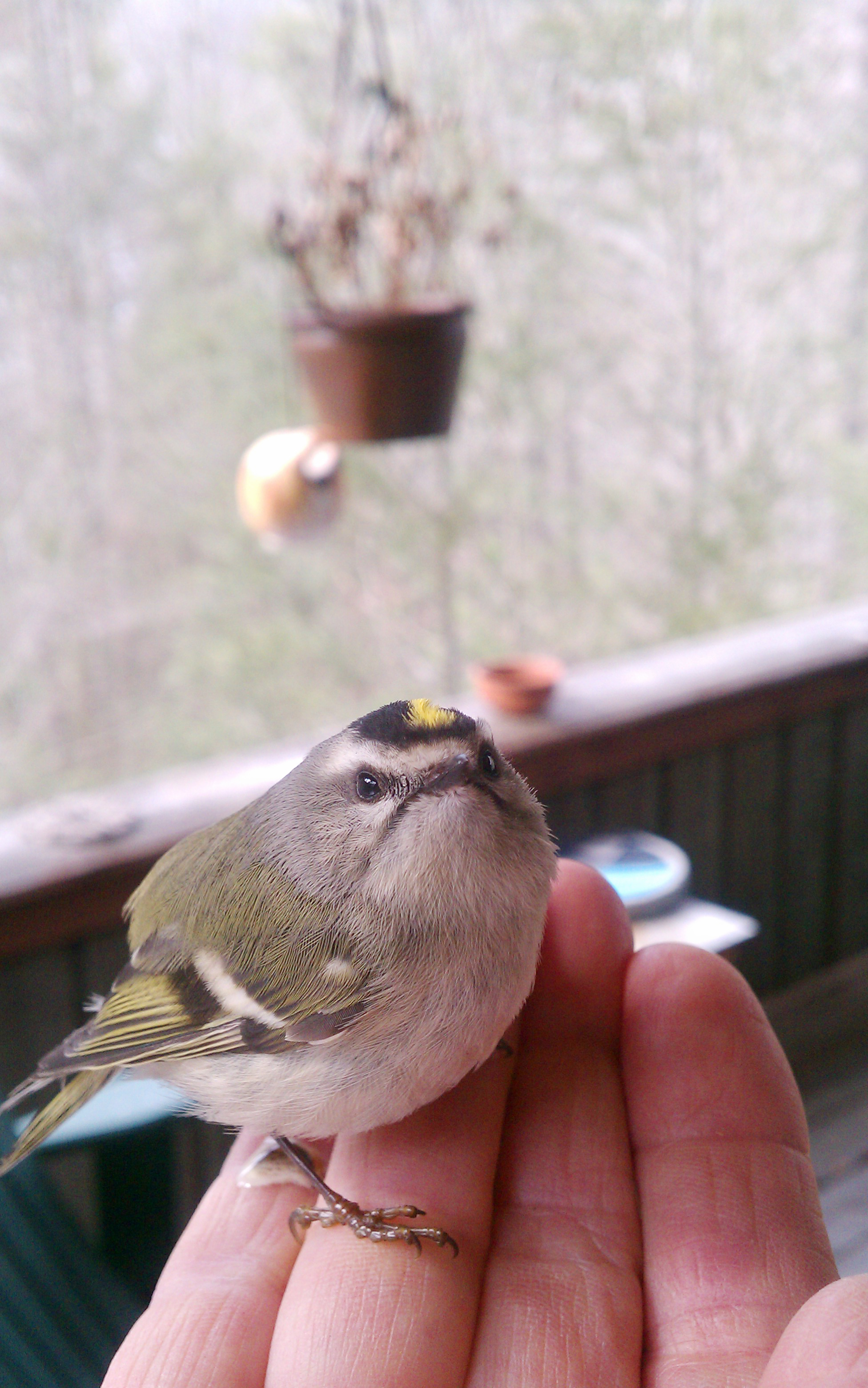
This Golden-crowned Kinglet recovered after a collision with a window. Not all birds are so lucky after striking windows, which they have difficulty seeing.

That’s apparently what happened last week at the home of one of my neighbors. According to some estimates, millions of birds perish each year from window strikes. At least the story I’m sharing this week has a happy ending.

I received an email and photo this past week from my Simerly Creek neighbor, Beth McPherson. Beth and her husband, Steve, have a wonderful home on Simerly Creek Road in Hampton. Surrounded by woodlands, their home is like a magnet for a variety of birds.

“I have another simple bird for you to identify,” Beth wrote in her email.

She explained that the bird ran into a window at her home. Fortunately, after a brief rest on her upper porch, the bird recovered completely from its impact with the window.

She described the bird as not much bigger than a hummingbird and estimated that the bird was 3 inches long and about 1.5 inches wide.

“Is it a warbler?” Beth asked.

Actually, although warbler was a good guess, Beth’s bird was a member of a family of tiny birds known as kinglets and firecrests.

Her bird turned out to be a Golden-crowned Kinglet, a fairly common winter visitor. All the large hemlock trees on Beth’s property are probably very attractive to visiting kinglets.

There are two types of kinglets present in Northeast Tennessee, including the Golden-crowned Kinglet and the Ruby-crowned Kinglet. They are indeed very tiny birds, as well as extremely active ones. They are also the only member of this family of birds found in North America.

Four other species, however, are native to Europe, Asia and North Africa. The remaining species include Goldcrest, Common Firecrest, Madeira Firecrest and Flamecrest, which is also known as the Taiwan Firecrest.

It was significant that Beth compared the small size of the kinglet that hit her window to  hummingbirds, which are probably the only birds that are smaller than kinglets.

The kinglets belong to the family, Regulidae, and the genus, Regulus. The family and genus names are derived from a Latin word, regulus, which means “rex,” or “king.” The name was apparently inspired by the colorful crown patches, often red, orange or gold, that resembled the royal “crowns” of kings.

Although similar in size and overall coloration, the Ruby-crowned and Golden-crowned Kinglets are easily distinguished from each other.

Side by side, the two species of North American Kinglets are easy to distinguish. The Golden-crowned Kinglet has a striped facial pattern formed by bold black and white stripes. The Ruby-crowned Kinglet, on the other hand, has a bold white eye ring but not striping. The Golden-crowned Kinglet has an orange crown patch, while the Ruby-crowned Kinglet has a red crown patch that is, more often than not, kept concealed.

Kinglets are active birds, foraging vigorously for small insects, and spiders. When foraging, both kinglet species have a habit of flicking their wings over the backs. Even if you can’t get a good look at the birds, this behavior helps contrast them from other small birds.

Golden-crowned Kinglets are widespread in the region during the winter. During the summer months, head to the slopes of Roan Mountain to look for these tiny birds that nest in the higher elevations of the Appalachian Mountains.

Kinglets don’t typically visit feeders, but they do tend to join mixed flocks with membership consisting of such species as Tufted Titmouse, Carolina Chickadee and White-breasted Nuthatch. When traveling with such flocks, kinglets may visit the space around feeders but rarely take seeds or other fare offered at feeders.

••••••

If you’ve ever experience repeated window strikes at your home, the American Bird Conservancy offers some helpful tips for avoiding this tragedy. Just click the following link to learn more how to avoid window strikes:

Click to access collisions_flyer.pdf

••••••

I enjoyed receiving the email from Beth. I would love to hear from other readers, too. Just post comments on my new blog at ourfinefeatheredfriends.wordpress.com. You can also reach me on Facebook or send email to ahoodedwarbler@aol.com. Please share the link to the blog with others who might be interested in the topic of birds and birding in Northeast Tennessee.

‘Tooth’ of the matter: Sawbills harken back to days when birds still had teeth

Everyone has probably heard the phrase “as scarce as hen’s teeth.” It means almost exactly what you think. Birds don’t have teeth, so it’s a way to describe something exceptionally rare. It’s a characteristic that sets birds apart from other creatures, such as mammals.

There are some birds, however, that come closer to having teeth than their other beaked counterparts. Mergansers would definitely fall into that category. The mergansers are a type of duck known collectively as “sawbills,” a reference to their long, thin bills with serrated edges that help them grip prey. The “sawbills” come closer than any of our other birds in having teeth, although not in the same sense as mammals have teeth.

Photo by Bryan Stevens • This female Common Merganser was photographed during this year’s Spring Bird Count.

Although classified as sea ducks, the mergansers are more at home in river habitats. There are six closely related species in three genera: Mergus, Mergellus and Lophodytes. The latter two genera have only a single species, the Hooded Merganser (Lophodytes cucullatus) and the Smew (Mergellus albellus).

The other mergansers in the Mergus genus consist of four species, Common Merganser, Brazilian Merganser, Red-breasted Merganser and Scaly-sided Merganser. The latter is an endangered species with only about 2,500 adult birds in the worldwide population. These remaining Scaly-sided Mergansers are found in the border regions of China, North Korea and Russia.

Mergs-OnWatauga

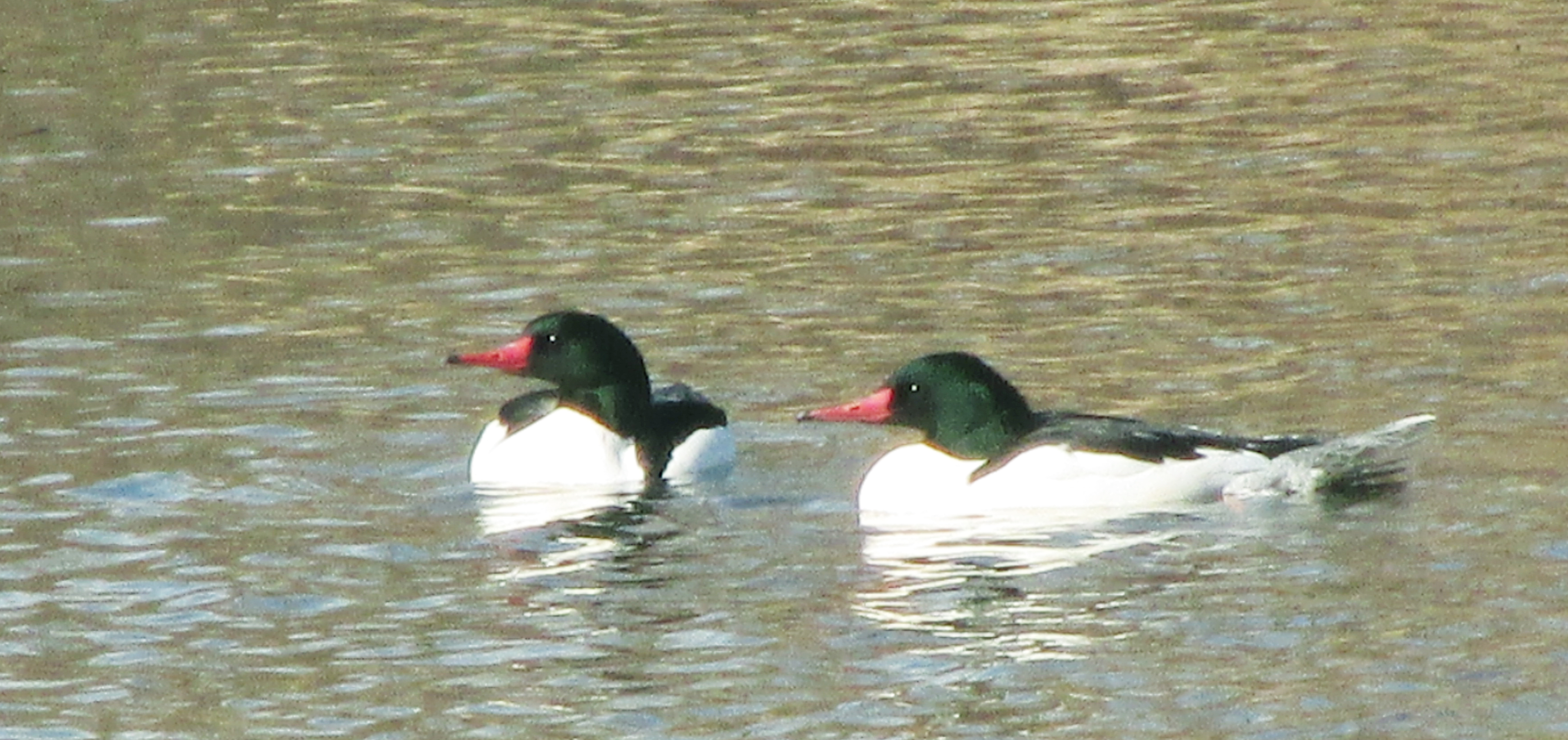
Photo by Bryan Stevens • A pair of Common Mergansers on the Watauga River in the Lynn Valley community of Elizabethton.

Another species, the Auckland Merganser, became extinct in the early 1900s. Sadly, the last evidence of this species dates back to Jan. 9, 1902, when the last wild pair was shot. After that time, this bird native to the Auckland Islands was never seen again.

In recent weeks, a couple of Common Mergansers spent a few days on the Watauga River in the Lynn Valley community. I saw them on a couple of occasions and also managed to get some photographs of the two handsome drakes.

In Europe, the Common Merganser is called a Goosander, probably a nod to its large size that makes this bird superficially more similar to geese than ducks. Early naturalists such as John James Audubon also provided this bird with a different name, referring to it as the “Buff-breasted Merganser.”

For many years, the Common Merganser was one of my target birds. Finally, more than 10 years ago, I saw my first Common Mergansers during a visit to Middlebrook Lake in Bristol with Reece Jamerson, Gil Derouen and the late Howard Langridge. Despite the word “common” in its name, this merganser isn’t particularly common in Northeast Tennessee. Its relatives, Hooded Merganser and Red-breasted Merganser, are much more regular visitors to the region.

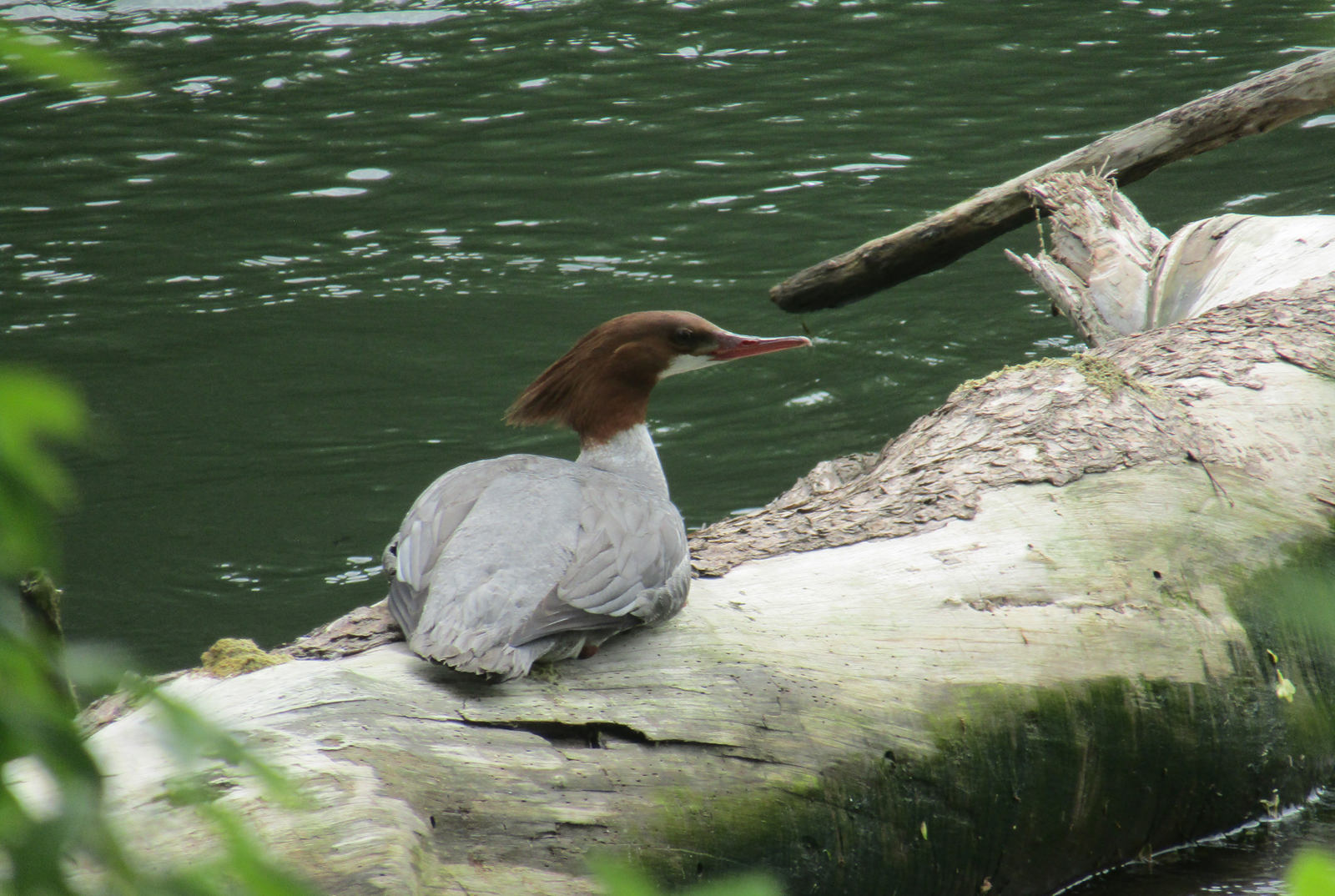
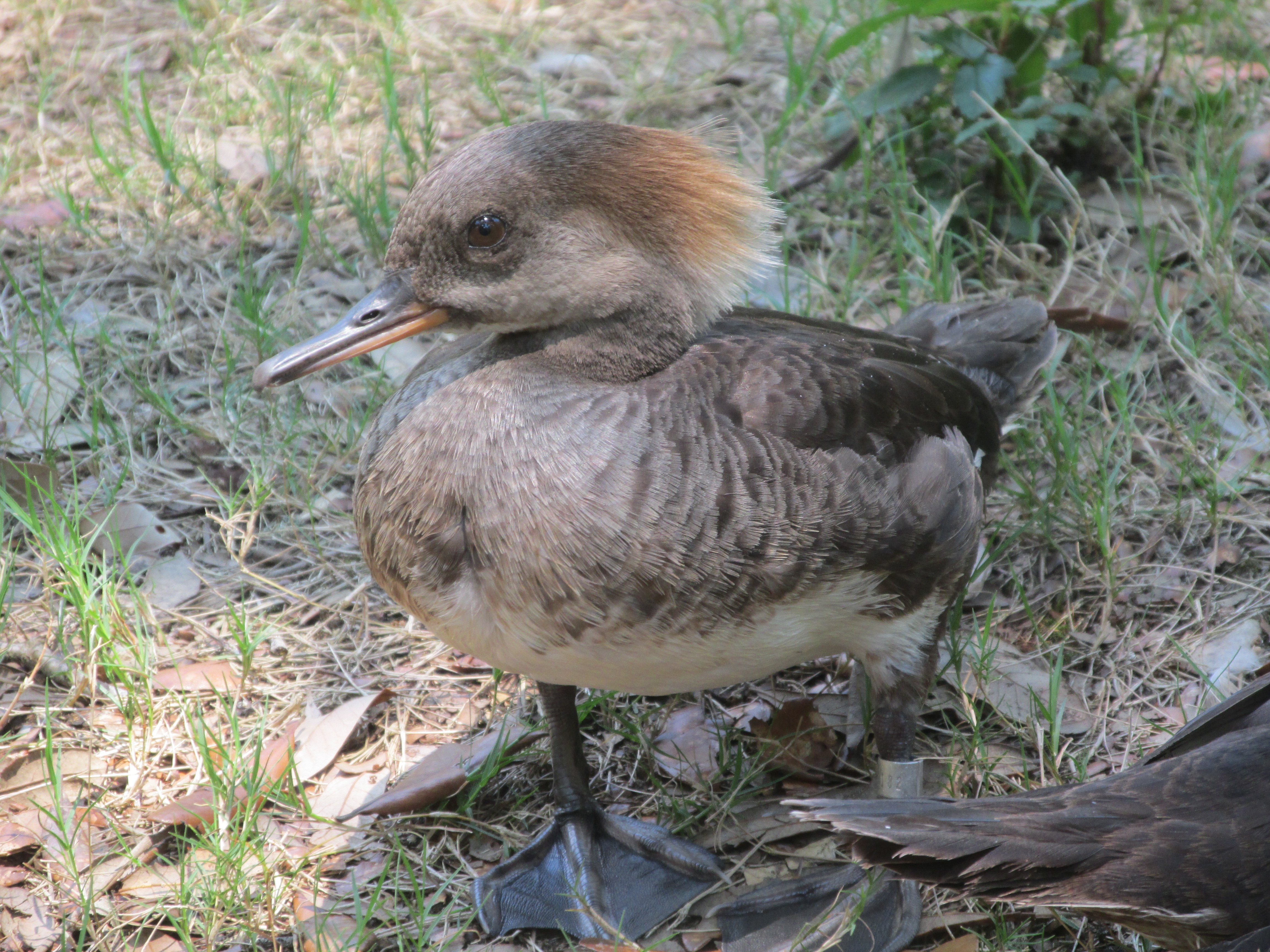
Photo by Bryan Stevens • Hooded merganser females, or hens, have a gray-brown head and neck with a reddish-brown crest, which marks quite a contrast from the male’s appearance.

In addition to Bristol’s Middlebrook Lake, I have seen Common Mergansers on Watauga Lake and on the Holston River in Kingsport.

The Common Merganser, particularly the males, are easily identified. Apart from their large size, which is about 26 inches long for males, males of this duck have a dark green head and upper neck. The lower neck, breast and underparts are creamy-white with a varying amounts of a pink or reddish wash. The back is black, while the bill, legs and feet are red. Females are similar to female Red-breasted Mergansers but show a clearly defined white chin patch lacking in their close relative.

According to the website Ducks Unlimited, Common Mergansers breed from Alaska, the southern Yukon, Labrador and Newfoundland south to central California, Arizona, New Mexico, southern Chihuahua and east of the Rockies to Minnesota, Michigan, New York, New England and Nova Scotia.

Photo by Bryan Stevens • A female hooded merganser flaps her wings as another preens her feathers behind her.

They are also one of the biggest of North America’s cavity-nesting birds, utilizing natural cavities in trees, as well as man-made nesting boxes. They will also nest on the ground.

Common mergansers feed mainly on fish, amphibians, crustaceans, mollusks and other aquatic organisms. The last extensive population surveys of Common Mergansers took place during the 1970s, when the population in North America was estimated at 1.5 million birds.

••••••

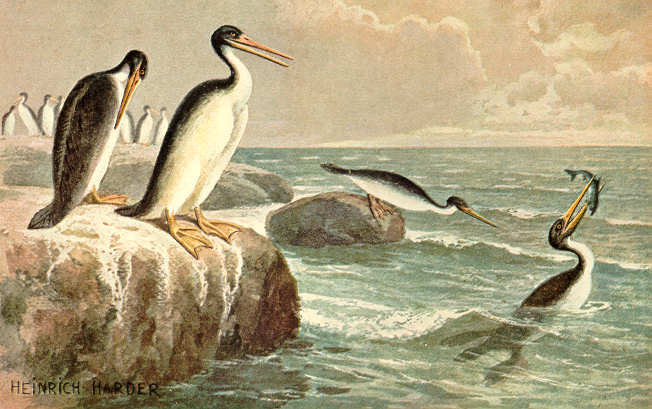
While today’s birds, even mergansers, all lack teeth, that hasn’t always been the case. About 80 million years ago, a bird known as Hesperornis (“western bird”) swam the inland seas that stretched over areas from Kansas to Canada. They swam through those ancient seas because they could not fly.

This early 20th century illustration of Hesperornis is no longer considered scientifically accurate by scientists, but it does demonstrate one striking feature - the toothed jaws of this ancient bird.

This early 20th century illustration of Hesperornis is no longer considered scientifically accurate by scientists, but it does demonstrate one striking feature – the toothed jaws of this ancient bird.

The body plan of Hesperornis was similar to modern loons and even the mergansers. Instead of a serrated bill, however, this ancient bird had actual teeth in its long beak. Just like today’s loons and mergansers, it probably fished for its food.

At almost six feet in length, however, it dwarfed our modern mergansers and loons and probably fed on larger piscine prey. So, why don’t today’s birds have teeth? The best answer I have found is that teeth (and other solid bones) were lost in order to make the avian form more streamlined and lightweight.

The power of flight demands a great deal of energy, and teeth are an unnecessary weight. As a result, birds grew hollow bones and lost their teeth.

••••••

I have been taking part in the Great Backyard Bird Count and have enjoyed some interesting observations that I’ll discuss in future columns. I would love to hear from readers. Just post comments on my new blog at ourfinefeatheredfriends.wordpress.com. You can also reach me on Facebook or send email to ahoodedwarbler@aol.com. Please share the link to the blog with others who might be interested in the topic of birds and birding in Northeast Tennessee.

Birding the Big Apple brings surprises

I am posting this column in observance of “Throwback Thursday.” I wrote this column for the Herald & Tribune of Jonesborough in July of 2002. It won me a second-place Tennessee Press Association award for “Best Column” the following year.

••••••••

During a recent trip to New York City, mainly for the purpose of visiting friends and seeing the sights, I also availed myself of the opportunity of trying to see a few birds in the Big Apple.

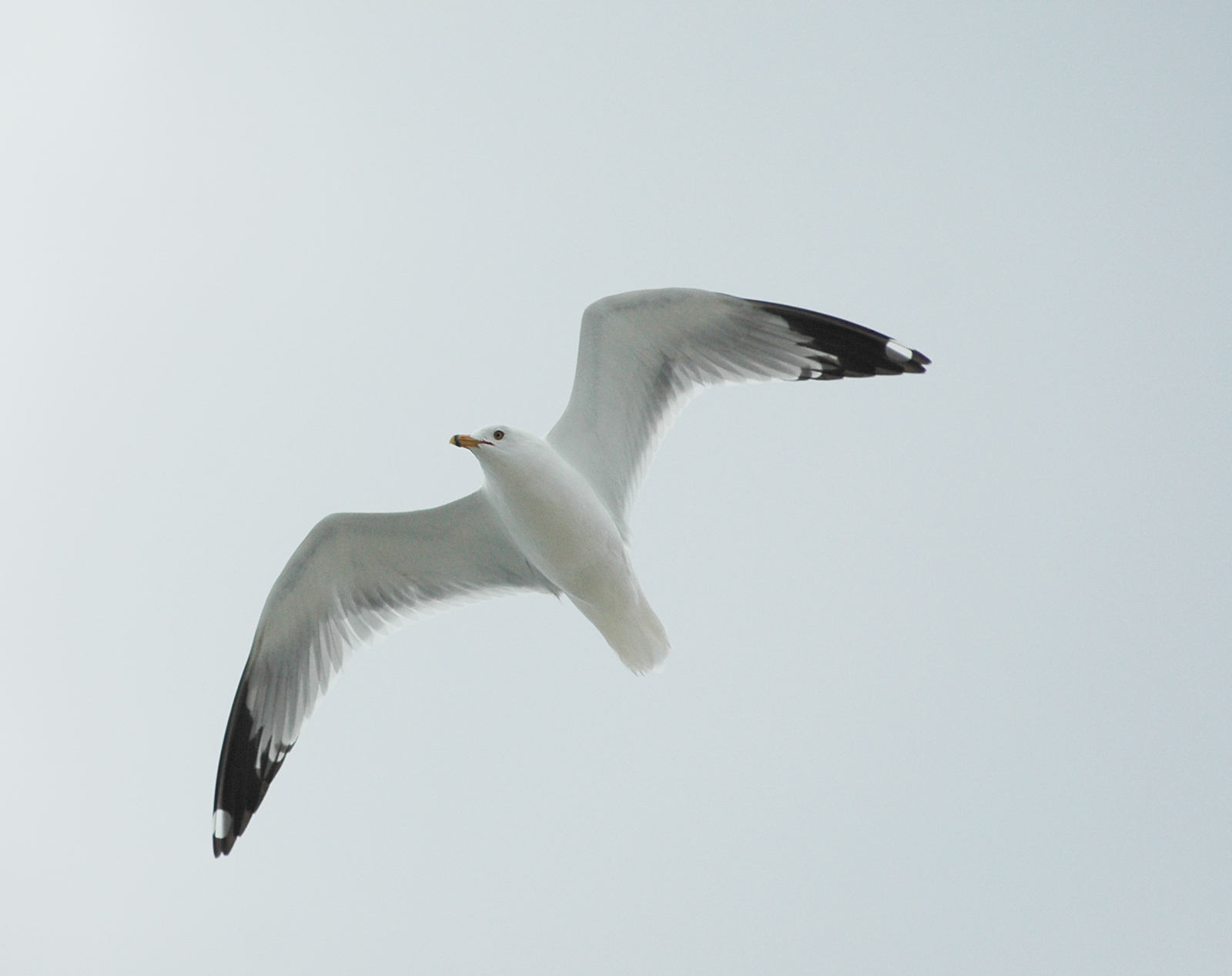
Photo by Bryan Stevens A Ring-billed Gull in flight.

Photo by Bryan Stevens
A Ring-billed Gull in flight. Several of these gulls were seen during my 2002 trip to New York City.

At first glance, New York City doesn’t seem a haven for birds or any other sort of wildlife. Without any serious effort on my part, however, I managed to see 15 different species of birds. My tour guide and friend, David, remained courteous enough to indulge my occasional lapses into birding. David, perhaps like many New Yorkers, is familiar on a daily basis with the Big Apple’s three most prominent members of the bird family — the House Sparrow, the European Starling and the Rock Dove, or pigeon.

Everyone who has visited a city park, whether in Jonesborough or New York City, is probably familiar with the Rock Dove. Commonly called pigeon, the Rock Dove is not a native American bird. But their introduction to this continent paralleled the arrival of European colonists. Pigeons came to this country along with other farmyard animals, such as cattle and sheep. But, once here, the Rock Dove, which is a wild bird in Africa and in the Mediterranean, also managed to establish itself outside the farmyard. Nevertheless, more than most other birds, the Rock Dove still only thrives in the company of humans. In New York City, pigeons are a part of the landscape. They are everywhere! As a result, these birds can cause some problems. Their droppings can damage buildings and statues. They can also spread various diseases to humans. Efforts have been made to curb their numbers, but the pigeon looks to be a permanent part of the New York City landscape.

It’s no longer a paradise for pigeons in the Big Apple, however. The Peregrine Falcon, once endangered, has rebounded with protection from the government. The skyscrapers of New York City have replaced cliff faces as nesting sites for these sleek, aerodynamic predators. While I wasn’t fortunate enough to see a Peregrine Falcon while in New York City, they are there. Their presence has put some balance back into the food chain. The pigeons now have a natural predator.

Earlier this summer, David called me looking for advice about a problem with birds. Seems that a pair of House Sparrows had built a nest beneath his air conditioning unit at his apartment. The problem involved timing. David recently moved to a new apartment and he needed to take the air conditioner with him. In the end, David’s need for the air conditioner outpaced the nesting progress of the sparrows. Now, he’s convinced that the sparrows, like the gulls, are out to get him. More about the gulls later.

The House Sparrow is an non-native species introduced to the United States. The House Sparrow was released intentionally in the United States in the 1850s at different points between New York and New England. Other introductions of this species occurred at other points in the United States. The introductions were huge mistakes. By 1910, the House Sparrow had invaded the entire continent. The House Sparrow is also an aggressive bird. Soon, the House Sparrow came into conflict with a beloved American favorite, the Eastern Bluebird. The major competition between Eastern Bluebirds and House Sparrows is for nesting cavities. House Sparrows have the tenacity to evict even the larger Easter Bluebirds from occupied nests. Occasionally, the sparrows even kill nestling or adult bluebirds. I found the House Sparrow almost as numerous as Rock Doves in most areas of New York City.

But, there was still a third common bird — the European Starling. I encountered the first starlings of my trip in New York City’s famous Central Park. Ironically, Central Park is where the European Starling, now considered the most numerous bird in North America, got its start. The Rock Dove and House Sparrow got here first, but the European Starling didn’t waste any time once the first starlings were released in 1890. The first European Starlings were released at that time in Central Park because some fans of William Shakespeare wanted to release all the birds mentioned in The Bard’s plays. Apparently, only the release of the European Starling had any lasting consequence. Even today, starlings and Shakespeare are very much associated with Central Park. During the summer there is a popular Shakespeare festival held in Central Park. And, on any summer day, there will always be plenty of starlings in the park.

Those were three of the 15 birds I managed to observe on my trip. The remaining 12 species comprised a diverse and at times surprising list. I found American Robins, American Crow, Blue Jay, Chimney Swift, Carolina Wren and Downy Woodpecker within Central Park. In addition, at a large pond within the park I also observed a Green Heron and Mallards. The Robins, in particular, appeared as they would in any park setting. They hopped about on grassy lawns while foraging for food. David told me he recently saw a Roadrunner in the park. I told him that would be an extraordinary discovery since that bird is native to the western United States.

There’s a lot of water in and around New York City. Perhaps it isn’t a surprise to discover birds such as Double-crested Cormorants swimming in the East River. I also saw plenty of gulls. In fact, I saw three different species of gulls — Herring Gulls, Ring-billed Gulls and Laughing Gulls.

Surprisingly, gulls haven’t always been common in the vicinity of New York City. According to the book Wild New York: A Guide to the Wildlife, Wild Places and Natural Phenomena of New York City by Margaret Mittelbach and Michael Crewdon, gulls did not frequent New York City 100 years ago. Now, there are as many as one million gulls in New York City. The book also mentions one of the attractions: Staten Island’s Fresh Kills Landfill, the largest garbage dump in the world.

The cover of the book Wild New York: A Guide to the Wildlife, Wild Places and Natural Phenomena of New York City by Margaret Mittelbach and Michael Crewdon

The cover of the book Wild New York: A Guide to the Wildlife, Wild Places and Natural Phenomena of New York City by Margaret Mittelbach and Michael Crewdon

My friend David considers gulls evil omens. I tried to do some research into the role of gulls in folklore. I turned to the book by Laura C. Martin titled The Folklore of Birds. Her entry on gulls proved sketchy. Here’s some of what I learned. The word “gull” comes from a Welsh word, “gwylan,” which can be translated as “wailing.” The term “gull” apparently derived from the bird’s wailing or plaintive call. The Latin genus name, Larus, for gull is translated as “ravenous seabird.” So, that leaves us with a ravenous, wailing seabird. Apt descriptions, but not exactly a rich folklore. Birds such as crows and the various species of owls have much more ominous superstitions surrounding them.

••••••••

New York City has a “New York Rare Bird Alert.” If you would like to know what rare birds are being seen in New York City, dial (212) 979-3070. I dialed the number during my visit and received information about excitement regarding large flocks of migrating shorebirds, a Common Raven and nesting Blue Grosbeaks.

••••••••

My friend David now lives in Baltimore. I haven’t visited him there, but he has visited me in the mountains near Asheville, N.C. I’d like to thank him again for my taste of the Big Apple.

••••••••

I’d still love to hear from readers. Just post your thoughts here or email me at ahoodedwarbler@aol.com. Keep up with me on Facebook, too.

Get ready to take part in this week’s 2014 Great Backyard Bird Count

Welcome to my new blog, “Our Fine Feathered Friends.” I hope everyone who has enjoyed reading my columns through the years will flock here to keep up to date with our birds and birding opportunities in the region.

•••••

From Afghanistan to Zimbabwe, bird watchers from more than 100 countries are expected to participate in the 17th annual Great Backyard Bird Count, Feb. 14–17, 2014.

I have plenty of time to participate this year, and that’s exactly what I plan to do. Anyone anywhere in the world can count birds for at least 15 minutes on one or more days of the count and enter their sightings at http://www.BirdCount.org.

The information gathered by tens of thousands of volunteers helps track the health of bird populations at a scale that would not otherwise be possible. The GBBC is a joint project of the Cornell Lab of Ornithology and the National Audubon Society with partner Bird Studies Canada.

“People who care about birds can change the world,” said Audubon chief scientist Gary Langham. “Technology has made it possible for people everywhere to unite around a shared love of birds and a commitment to protecting them.”

In North America, GBBC participants will add their data to help define the magnitude of a dramatic irruption of magnificent Snowy Owls. Bird watchers will also be on the lookout for the invasive Eurasian Collared-Dove to see if it has expanded its range again. GBBC observations may help show whether or not numbers of American Crows will continue to rebound after being hit hard by the West Nile virus and whether more insect-eating species are showing up in new areas, possibly because of changing climate.

Last year’s GBBC shattered records after going global for the first time, thanks to integration with the eBird online checklist program launched in 2002 by the Cornell Lab and Audubon. Participants reported their bird sightings from all seven continents, including 111 countries and independent territories. More than 34.5 million birds and 3,610 species were recorded—nearly one-third of the world’s total bird species documented in just four days.

“This is a milestone for citizen science in so many respects—number of species, diversity of countries involved, total participants, and number of individual birds recorded. We hope this is just the start of something far larger, engaging the whole world in creating a detailed annual snapshot of how all our planet’s birds are faring as the years go by,” said Cornell Lab director Dr. John Fitzpatrick.

“Canadian participation in the Great Backyard Bird Count has increased tremendously in recent years, and it’s wonderful to see this program growing globally,” said Bird Studies Canada President Dr. George Finney. “The count is introducing unprecedented numbers of people to the exciting field of bird watching.”

The GBBC is a great way for people of all ages and backgrounds to connect with nature and make a difference for birds. It’s free and easy. To learn more about how to join the count, visit www.birdcount.org and view the winning photos from the 2013 GBBC photo contest. The Great Backyard Bird Count is made possible in part by sponsor Wild Birds Unlimited.

I had a great time participating in last year’s GBBC, and I plan to do so again this year. If recent weeks are any indication, there could be plenty of interesting birds out there.

••••••

Image

Photo courtesy of Toy James
An albino American Robin at the home of Don and Toy James.

Don and Toy James shared a photo of an albino American Robin at their home in the Danner Subdivision on Jan. 15.

“My wife snapped this photo of an albino robin in our back yard,” Don wrote. “I have never seen one and thought it was interesting.”

Don said the robin was feeding on worms with the other robins in the yard.

“My wife said they all ate together and he flew away with them,” Don said. “They seemed to treat him as any other robin.”

I had inquired about any interactions they observed since sometimes birds will shun an albino invidual. Apparently, that wasn’t the case with this robin.

During a trip to Salt Lake City, Utah, in 2006, I observed an albino Brewer’s Blackbird. An albino blackbird is almost an oxymoron. That observation remains my best look at an albino bird in the wild.

••••••

I would love to hear from readers. Just post comments on my new blog at ourfinefeatheredfriends.wordpress.com.

You can also reach me on Facebook or send email to ahoodedwarbler@aol.com.