Category Archives: Bryan Stevens Feathered Friends

Dark-eyed junco faithful visitor to feeders during wintry weather

Junco-Ground

Photo by Kenneth Thomas / Dark-eyed juncos, often referred to as “snow birds,” flock to feeders in winter during periods of inclement weather.

I recently took part in the 48th annual Elizabethton Fall Count. Although part of the count’s focus is on Carter County, significant attention is paid to the adjacent counties of Johnson, Sullivan, Unicoi and Washington in Northeast Tennessee. This year’s count, which was held Saturday, Sept. 30, with 54 observers in 12 parties, tallied 122 species, which is slightly below the recent 30-year average of 126 species. The all-time high for this count was 137 species, which was reached in 1993.

Together with Brenda Richards, I travelled the Forest Service road on Holston Mountain to seek out some species that prefer higher elevation habitats, including dark-eyed juncos. The junco is also a winter visitor to yards and gardens throughout the region and should be returning any day now for a seasonal stay during the colder months of the year. During our progress up the mountain, we glimpsed several dark-eyed juncos as well as other birds such as blue-headed vireo and black-and-white warbler.

I have always had a fondness for juncos. In fact, I wrote my first birding column on Sunday, Nov. 5, 1995, which means that I recently celebrated the 22nd anniversary of my weekly accounts of birds and birding. The column has appeared weekly without interruption in various newspapers in the last 22 years. The column has also been a great conduit for getting to know other people interested in our “feathered friends.” I always enjoy hearing from readers, and I hope to continue to do so in the coming years. Since February of 2014, I’ve also been posting the column as a weekly blog on birds and birding.

Here, with some revisions I have made through the years, is that first column that has now involved into a look that is all “For the Birds.”
…..

Of all the birds associated with winter weather, few are as symbolic as the Dark-eyed Junco, or “snow bird.” The junco occurs in several geographic variations.dennisjl 2
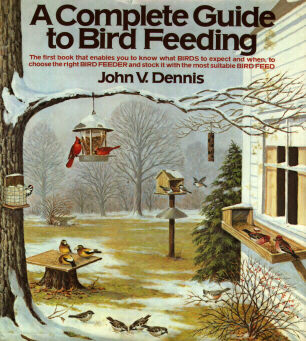
John V. Dennis, author of “A Complete Guide to Bird Feeding,” captures the essence of the junco in the following description: “Driving winds and swirling snow do not daunt this plucky bird. The coldest winter days see the junco as lively as ever and with a joie de vivre that bolsters our sagging spirits.” The Dark-eyed Junco’s scientific name, hyemalis, is New Latin for “wintry,” an apt description of this bird.

Most people look forward to the spring return of some of our brilliant birds — warblers, tanagers and orioles — and I must admit that I also enjoy the arrival of these birds. The junco, in comparison to some of these species, is not in the same league. Nevertheless, the junco is handsome in its slate gray and white plumage, giving rise to the old saying “dark skies above, snow below.”

Just as neotropical migrants make long distance journeys twice a year, the junco is also a migrating species. But in Appalachia, the junco is a special type of migrant. Most people think of birds as “going south for the winter.” In a basic sense this is true. But some juncos do not undertake a long horizontal (the scientific term) migration from north to south. Instead, these birds merely move from high elevations, such as the spruce fir peaks, to the lower elevations. This type of migration is known as vertical migration. Other juncos, such as those that spend their breeding season in northern locales, do make a southern migration and, at times, even mix with the vertical migrants.

Juncos are usually in residence around my home by early November. Once they make themselves at home I can expect to play host to them until at least late April or early May of the following year. So, for at least six months, the snow bird is one of the most common and delightful feeder visitors a bird enthusiast could want.
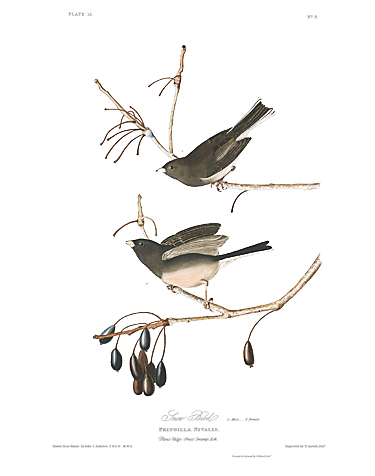
john-james-audubon-limited-centennial-edition-giclee-on-paper-dark-eyed-junco-2

Early American naturalist and artist John James Audubon painted this pair of Dark-eyed Juncos.

Juncos flock to feeders where they are rather mild-mannered — except among themselves. There are definite pecking orders in a junco flock, and females are usually on the lower tiers of the hierarchy. Females can sometimes be distinguished from males because of their paler gray or even brown upper plumage.

Since juncos are primarily ground feeders, they tend to shun hanging feeders. But one winter I observed a junco that had mastered perching on a hanging “pine cone” feeder to enjoy a suet and peanut butter mixture.

Dark-eyed juncos often are content to glean the scraps other birds knock to the ground. Juncos are widespread. They visit feeders across North America. The junco is the most common species of bird to visit feeding stations. They will sample a variety of fare, but prefer such seeds as millet, cracked corn or black oil sunflower.

There’s something about winter that makes a junco’s dark and light garb an appropriate and even striking choice, particularly against a backdrop of newly fallen snow.
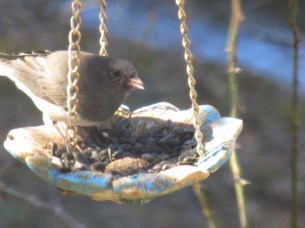
Junco-AtFeeder

Photo by Bryan Stevens / A Dark-eyed Junco perches on the side of a hanging feeder offering sunflower seeds.

Of course, the real entertainment from juncos come from their frequent visits to our backyard feeders. When these birds flock to a feeder and begin a furious period of eating, I don’t even have to glance skyward or tune in the television weather forecast. I know what they know. Bad weather is on the way!

•••••

If you have a question, wish to make a comment or share a sighting, email ahoodedwarbler@aol.com.

Crows show intelligence yet can’t shake dark reputation

Crow-Waxwings

Photo by Bryan Stevens
Red-winged blackbirds mob an American crow. In turn, crows often mob large raptors,           such as red-tailed hawks and great horned owls.

There’s something rather autumnal about watching a flock of American crows glean the last scattered kernels of corn from a harvested field as a sentry stands guard ready to utter the alarm with some guttural “caws” should anything potentially threatening appear on the scene. Crows are such a part of the landscape that they would almost escape our notice if they didn’t come with centuries of accumulated baggage that makes us distrust them and suspect their every action.

The crow, largely thanks to its black plumage, but perhaps also with a nod to its avian intelligence, has long been associated with Halloween. Greeting cards and decorations for the holiday often feature depictions of bats, owls and black cats, as well as the inevitable crow and the accompanying scarecrow. It’s not like the straw-filled sentries that stand guard over a farmer’s fields do anything to intimidate or even discourage crows. With a brain about as big as a man’s thumb, the crow is renowned among ornithologists and other scientists for its keen intelligence. Crows are not fooled for a second by the masquerade of a scarecrow propped in a field.

crows-dec-21

Photo by Bryan Stevens / Wary American crows survey their surroundings.

The intelligence of this bird has long been known. Early American naturalist William Bartram wrote about a crow named Tom in a unique naturalist essay titled “Anecdotes of an American Crow.” Bartram, who lived from 1739 to 1823, brought humor and insight to his subject as he wrote about the joys, as well as tribulations, of living with Tom, a crow that enjoyed tormenting Bartram’s dog and stealing the writer’s spectacles and trying to hide them.

The essay demonstrates that almost as soon as Europeans arrived in North America, some of those with a bent toward the natural world recognized the intelligence and amazing adaptability of the American crow. As well as writing about the natural world, Bartram earned widespread acclaim for his drawings of botanical and ornithological subjects. Tom, the featured crow in Bartram’s brief essay, certainly exhibited intelligence of an impressive degree. Not only did the crow steal his owners eyeglasses, he foiled Bartram’s first attempt to reclaim them. Noting Bartram’s attention to his efforts to hide the purloined spectacles, Tom snatched the eyeglasses a second time when Bartram made a premature attempt to reclaim them. The situation makes very humorous reading.

What else have crows done down through the ages to gain such a dark and much undeserved reputation? It probably doesn’t help matters that a flock of crows is known as a “murder.” Ancient Greeks considered crows as omens, which often foretold death and other disasters. On the positive side, many Native American tribes revere crows as communicators between worlds. Crows have been documented using tools and solving problems, which shows an uncanny ability to analyze and strategize. Early Celtic people also noted and admired these traits in crows.

sclaudubon_sclib_audubon_v2_2_p156_full_5398_8151__0_native

Early naturalist and artist John James Audubon painted this American crow.

In addition, crows forage beyond the cornfield for their food. Many crows scavenge road-killed wildlife, such as squirrels, opossums and rabbits. While they eat carrion, they do so less often than birds such as turkey vultures, black vultures and the crow’s fellow corvid, the common raven.

The kinship to the raven is evident, but even moderately experienced birders rarely confuse these similar species. The raven is a large bird with a heavy beak, a distinctive profile and a wedge-shaped tail. In a direct comparison with a raven, a crow looks downright puny. Both are members of the corvid family, which consists of 120 species including jays, rooks, magpies and jackdaws.

Many years ago I fed a flock of ducks that took up residence at my fish pond. Before long, the crows arrived within minutes after I tossed shelled corn on the ground for the benefit of the ducks. If the ducks took too long consuming the corn, the impatient crows crowded closer and competed directly with the ducks for the kernels. The crows that live around my home are usually too cautious and wary to visit feeders situated near my home. Feeders set farther from the house receive occasional hurried visits by crows.

Crow-Trio

Photo by Bryan Stevens / A trio of American crows forages on a grassy lawn.

American author and abolitionist Henry Ward Beecher summed up the American crow in the frequently quoted remark, “If men had wings and bore black feathers, few of them would be clever enough to be crows.” It’s an apt tribute and comes from the man whose sister, Harriet Beecher Stowe, wrote “Uncle Tom’s Cabin,” a book often credited with helping to launch the American Civil War.

Crows, perhaps more than any other North American bird, have learned to co-exist with human beings. Make an effort to get past some pre-supposed superstitions about these interesting birds and learn to appreciate them for their many good qualities.

••••••

To ask a question, make a comment or share a sighting, send an email to ahoodedwarbler@aol.com.

funny-pumpkin-head-scare-crow-halloween-wallpaper

Although graceful in the water, life gets awkward for grebes on land

As the calendar moves into the months of October and November, migrating waterfowl will replace the exodus of songbirds that evacuate the North American continent every fall in preparation for their winter season in the tropics. The umbrella term of waterfowl can include such birds as ducks, geese, loons and grebes.

Pond-Edge-Grebe

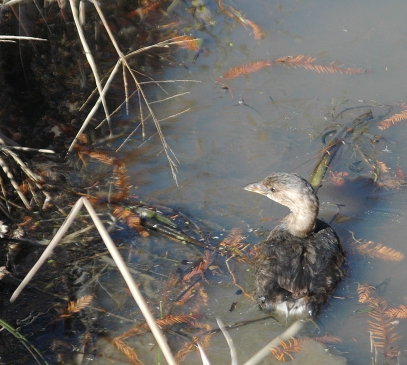
Photo by Bryan Stevens • This pied-billed grebe stranded itself on a wet lawn during fall migration. A grebe’s legs are positioned so far back on their bodies that grebes have difficult walking on land. Once released in a pond, the grebe was able to take flight and continue its migration.

That last family keeps one of the lowest profiles among the grouping of birds lumped together as waterfowl. Worldwide, there are 22 species of grebes. This family also includes three extinct species — Alaotra grebe, Atitlán grebe and Colombian grebe.

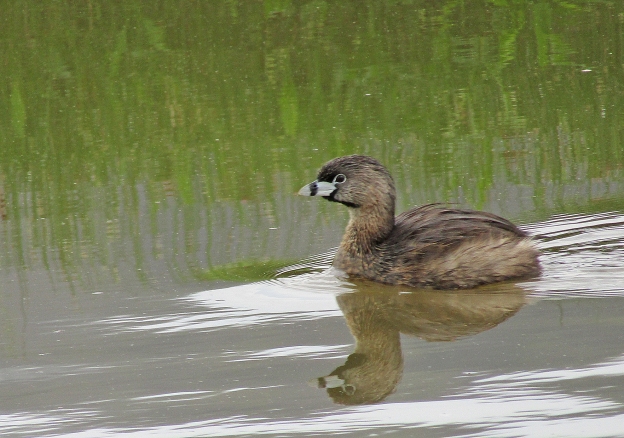
Many people are unaware of the grebes. After all, they are oddball birds with not a lot in common with other waterfowl such as loons and ducks. In eastern Tennessee, southwestern Virginia and western North Carolina, the pied-billed grebe is the most likely member of the grebe family to come into contact with humans. The pied-billed grebe’s scientific name, Podilymbus podiceps, can be roughly translated as “rear-footed diver.” The reference is to the fact that this grebe, as well as others of its kind, have their feet positioned so far back on their bodies that movement on land is difficult and awkward.

The pied-billed grebe has inspired a variety of other common names, including American dabchick, dabchick, Carolina grebe, devil-diver, dive-dapper, hell-diver, pied-billed dabchick, pied-bill, thick-billed grebe and water witch, all of which reflect this grebe’s almost exclusively aquatic lifestyle.

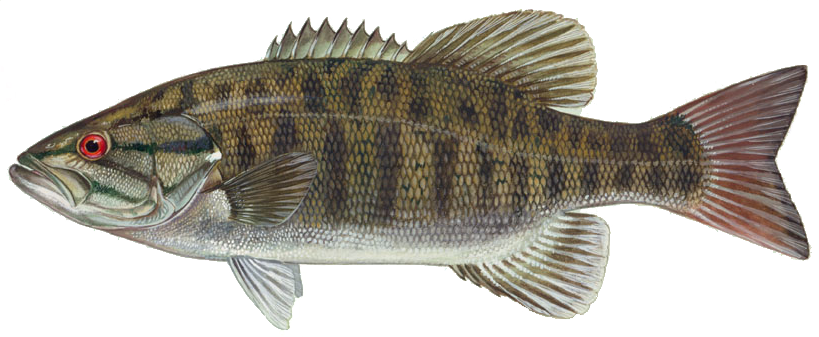
The pied-billed grebe is a world-class survivor. Already a member of an ancient family of birds, this species has outlasted the others in its genus. The Atitlán grebe, which was also known as the giant grebe, went extinct around 1989 after a series of catastrophic setbacks, including a devastating earthquake and the introduction of smallmouth and largemouth bass to Lake Atitlán in Guatemala. The bass consumed the prey this grebe needed for its survival, and large bass occasionally ate young grebes.

Smallmouth bass.png

Bass introduced into Lake Atitlán consumed the small fish that the Atitlán Grebe              required as a food source. Large bass also ate young grebes.


These birds range in size from the least grebe, which weighs only about six ounces, to the great grebe, which can tip the scales at four pounds. North American grebes include red-necked grebe, horned grebe, eared grebe, Clark’s grebe and Western grebe. In extreme southern Texas, birders can find least grebes in suitable wetland habitats.

With the exception of the least grebe, I’ve seen all of North America’s grebes. During visits to Utah in 2003 and 2006, I observed the sleek, long-necked Clark’s grebe and Western grebe. On a 2006 trip to Utah, I visited Antelope Island State Park and observed tens of thousands of Eared Grebes gathered on the Great Salt Lake for the nesting season. In Tennessee, one of the most reliable locations to find eared grebes is from viewing areas at Musick’s Campground on South Holston Lake, where a small number of these grebes have wintered for many years.

An unusual February fallout back in 2014 resulted in equally unusual numbers of red-necked grebes on area lakes, rivers, and ponds. I’d previously observed this grebe on Boone Lake, South Holston Lake and Watauga Lake in northeast Tennessee.

Grebe-Mallards

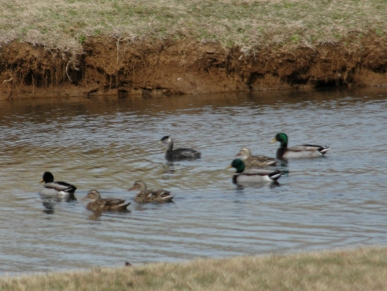
Photo by Bryan Stevens • A Red-necked Grebe mixes with Mallards at a pond on the campus of Northeast State Community College in Elizabethton.

Grebes are prone to landing on glistening surfaces — lawns, asphalt parking lots and even paved roads — during migration flights, especially at night during heavy rain. A serious problem arises when the grebe, with those rear-positioned feet, finds itself stranded, unable to take flight again without a paddling run across the surface of a body of water.

One of these strandings was recounted in Rick Knight’s book, The Birds of Northeast Tennessee. On Feb. 13, 1994, a red-necked grebe grounded itself with one of these crash landings onto a parking lot in Elizabethton, Tennessee. The fortunate grebe received a human-assisted rescue, being transported to a small lake near the town for release.

In November of 2011, a neighbor delivered a bird that had landed in his yard and could not take flight. The bird, put into a cardboard box for its own safety, didn’t appear to have any injuries. Once I saw the bird, I realized it was a pied-billed grebe. We released the bird on my fish pond, where the grebe dived and swam extensively before resting for a long period on a muddy edge of the pond. Overnight, the grebe disappeared. I believe the grebe took flight during the night and continued with its fall migration. The incident remains one of my closest encounters with a grebe.

Rescue-GREBE

Photo by Bryan Stevens The pied-billed grebe paddles through the water after it was rescued after a stranding on a lawn.


In the coming weeks and all throughout the winter months, look for pied-bill grebes, as well well as more uncommon grebes like horned grebe and red-necked grebe, on lakes and rivers throughout the region.

•••••
Bryan Stevens lives near Roan Mountain, Tennessee. To ask a question, make a comment or share a sighting, email him at ahoodedwarbler@aol.com.

Reader reports visit from rufous hummingbird

An email from Bristol resident Ralph Beamer offered a timely reminder about the need to keep a watchful eye on our sugar water feeders even as most of the ruby-throated hummingbirds depart the region.

“For the past week, I have had a red humming bird coming to the feeder,” Ralph explained in his email. He added that he had never seen a hummingbird like this recent visitor.

“Have you had any reports of a similar sighting?” Ralph asked.

Ralph is the first person to make such a report this fall, but sightings of a species of hummingbird other than the expected ruby-throated hummingbird are becoming more commonplace each year. Once the numbers of ruby-throated hummingbirds are reduced as these tiny birds migrate from the region, noticing an unusual hummingbird at a feeder becomes even easier.

In a reply to Ralph’s email, I sought more information on the hummingbird’s coloration. He confirmed that the bird’s feathers looked more reddish brown than bright red, which supports my belief that he has received a visit from a rufous hummingbird.Ruf-Drawing

I speak from personal experience. My yard has attracted rufous hummingbirds on a couple of occasions. In October of 2016 I received my most recent visit from a rufous hummingbird, which lingered into November and was banded by Mark Armstrong. A former curator of birds for the Knoxville Zoo, Armstrong has devoted several years to studying the phenomenon of rufous hummingbirds that appear to migrate on a regular basis through the eastern United States every fall and early winter. Mark’s efforts have largely focused on Tennessee reports of rufous hummingbirds, but other banders operating from the Gulf Coast to New England have confirmed rufous hummingbirds in their respective regions.

The possibility of attracting a rufous hummingbird is the reason I encourage others to keep a sugar water feeder available into October and November. Experts who have studied the matter note that the presence of a feeder will not encourage ruby-throated hummingbirds to linger. These tiny birds know instinctively when it’s time to depart. Without the attraction of a feeder, however, a visiting rufous hummingbird might reject any extended stay in your yard.

Selasphorus rufus, or the rufous hummingbird, is about the same size as the ruby-throated hummingbird. Both species reach a body length of a little more than three inches and weigh only a few grams. In fact, one of these small hummingbirds might weigh the equivalent of a dime. Female rufous hummingbirds are slightly bigger than males, so a well-fed female rufous hummingbird might weigh as much as a nickel. So, to get an accurate impression of this sort of size, simply think of these tiny birds as weighing less than some of the spare change in your pocket.

Although hummingbirds are not known for their longevity, the website for Tennessee Watchable Wildlife notes that the oldest rufous hummingbird on record reached an age of eight years and 11 months. For the most part, hummingbirds blaze like tiny comets and enjoy typically brief but fast-paced lives. Despite a prevalent impression, hummingbirds are not delicate creatures. For instance, the rufous hummingbird’s tolerance for cold allows it to survive temperatures that dip briefly below zero. This adaptation has allowed the rufous hummingbird to breed as far north as Alaska.

The Selasphorus genus of hummingbirds consists of the rufous and six other species. Of those species, the Allen’s hummingbird, broad-tailed hummingbird and calliope hummingbird are known to also migrate through the eastern United States although with less frequency than the rufous. The remaining Selaphorus hummers — scintillant hummingbird, glow-throated hummingbird and volcano hummingbird — range in the tropical regions of Costa Rica and Panama. Those rufous hummingbirds that don’t spend the fall and early winter in the southeastern United States choose to overwinter in the region of Mexico around the city of Acapulco. This majority of the rufous hummingbird population migrates north again in the spring to claim nesting territory that can range from the Rocky Mountains of the western United States, as well as the Pacific Coast states of California, Oregon and Washington, all the way north to southern Alaska, as well as British Columbia in Canada.

Those rufous hummingbirds that continue to migrate through the southeastern United States each autumn constitute more evidence that we still have a lot to learn about birds. Even an abundant species like the rufous hummingbird offers mysteries that curious humans can attempt to understand.

While I can’t guarantee hummingbirds, I want to remind readers of the bird walks at 8 a.m. each Saturday in October at Sycamore Shoals State Historic Park in Elizabethton, Tennessee. Remaining walks, which are free and open to the public, are scheduled for Oct. 21 and Oct. 28. Meet at the parking lot at the park’s visitors center. Bring binoculars to increase your viewing pleasure.

•••••

Bryan Stevens lives near Roan Mountain, Tennessee. To ask a question, make a comment or share a sighting, email him at ahoodedwarbler@aol.com.

Hurricanes: bane for birds, boon for birders

During a program I presented on birds and birding at the Elizabethton/Carter County Public Library, an attendee asked me if I knew what happens to birds in a hurricane? The question, no doubt prompted by such recent storms as Harvey and Irma, is of particular concern now that many of our favorite birds are migrating south along paths that could take them into harm’s way.


Well-known birder Kenn Kaufman shared his knowledge about birds and hurricanes when interviewed back in 2011 on the Audubon website. Among some fascinating insight he shared, Kaufman noted that the way intense storms affect birds depends on the species. He noted that a whimbrel, a large shorebird, would be more likely to fly through a major hurricane and live to tell the tale. On the other hand, such a storm would likely prove lethal for songbirds like warblers and thrushes.


To the questioner at my program, I also admitted that dedicated birders are, at times, rather atypical people. For a birder looking to find a totally unexpected bird, every hurricane comes with a proverbial silver lining. In the case of birders, that lining involves some of those stronger flyers — birds like whimbrels, noddies, terns, jaegers or tropicbirds — that get swept into the eye of the storm, carried far inland and dropped onto large lakes as the storm weakens.


My first direct observation of one of these hurricane-transported displaced birds took place back on Sept. 8, 2004. I had been drawn to Musick’s Campground on South Holston Lake by reports of an incredible fallout of such birds, which included species like whimbrel and red knot. More than a dozen fellow birders were present in the swirl of wind, mist and rain when a graceful bird with a dramatic two-toned black and white plumage flew overhead. I had no idea of the bird’s identity, but I knew instantly it was a species I’d never observed. I heard someone yell “sooty tern” — the identity of the shouter turned out to be area birding legend Rick Knight — and then pandemonium broke out as birders in rain gear got their binoculars into position to track the bird before it flew out of sight.

OLYMPUS DIGITAL CAMERA

Photo by U.S. Fish & Wildlife Service Sooty Terns nests in the Dry Tortugas in the Florida Keys. One was blown into Northeast Tennessee with Hurricane Frances in 2004.


We needn’t have worried. The bird lingered long enough for all those present to get a good look. I was accompanied that day by the late Howard P. Langridge, a well-known birder in both Florida and Tennessee. Howard had seen sooty terns, but he had found them when visiting the islands of the Dry Tortugas, west of the Florida Keys.


Two months after the exciting observation of that sooty tern, Howard passed away at age 81. So, even to this day, memories of that bird are tinged with some bittersweetness from the fact it was one of my last birding adventures with a man who served as a bit of a birding mentor for me. On our drive back home after that exciting encounter with the storm-driven tern, Howard talked excitedly about sooty terns and some of the other rare birds he had seen in a birding career that spanned more than 50 years.


In addition, we learned a valuable lesson that day. It’s an accepted fact that no bird is worth risking life or limb. It’s also a good idea to be careful where you park when going out to a rain-drenched lakeshore to look for birds from a diminished hurricane. Howard and I lingered after the other birders departed. When we started to leave, he discovered his car’s back tires had gotten stuck in the clay mud. With Howard behind the wheel, I pushed his car as the tires spun madly for traction. I ruined a new pair of denim jeans, but I got the car out of the mud. It’s one more memory that will put a smile on my face to this day.

JEAN-Caspian Terns

Photo by Jean Potter Caspian Terns at Holston Lake in Northeast Tennessee.


The sooty tern, blown to a Bristol lake in 2004 by Hurricane Frances, remains a highlight of my birding; however, it’s hardly the only unusual bird to be dumped on area lakes thanks to hurricanes that formed in tropic waters.


Hurricane Hugo back in 1989 remains one of the most legendary storms in the minds of most long-time birders in the area. I hadn’t yet taken up birding, but birders like Howard made sure I knew all about the bird bounty stirred up by Hugo. Two species of jaegers — parasitic and pomarine — were among the birds blown inland to Watauga Lake in Carter County. Seeing these birds usually requires a seat on a boat capable of traveling far out to sea to look for birds that hardly ever venture near the shoreline except for nesting.


BS-ForsterTern

Photo by Bryan Stevens A Forster’s Tern observed at Boone Lake in Northeast Tennessee.

Hurricane Hugo also blew more than 50 Forster’s terns — a record number for the region — to Watauga Lake. In addition, a single royal tern — a first record for Tennessee — was also detected by birders looking for birds displaced by Hurricane Hugo.


Much farther back, a high count of Caspian terns was recorded Sept. 5, 1964, at Boone Lake in the wake of Hurricane Cleo. The late Wallace Coffey, a well-known birder in Bristol, was present to witness those 130 Caspian terns. Both Caspian and royal terns are birds usually found along the Atlantic Coast in places like Florida, Georgia and the Carolinas.


As I write this week’s post, I’m keeping track of the progress of more hurricanes forming in the Atlantic. The season has already produced some historically powerful storms. Could the projected path of one of these hurricanes bring storm remnants over Tennessee. Will area lakes see another incredible fallout of birds uprooted from their tropical homes? Time will tell. If something unusual does make an appearance, I hope to bring it to the attention of readers in an upcoming column.


•••••


Join Bryan Stevens on Saturday, Sept. 30, for a one-hour morning bird walk on the trails at Sycamore Shoals State Historic Park in Elizabethton. The walk will begin at 8 a.m. from the parking lot at the park’s visitors center. Bring binoculars to help increase your chances of seeing some migrating birds along the park’s trails.

Green herons will depart from region in coming weeks as cooler conditions return

With the arrival of September, migration’s pace will quicken. In late August, I started seeing warblers passing through my yard. In other locations in the region, birders have shared reports of shorebirds and wading birds.

13435451_10208227244911211_1254837562662583452_n

Photo by Bryan Stevens • Green herons are short, stocky herons that can assume some comical poses.

Jonesborough resident Julia Ellis wrote about her own observation of a green heron that took place recently. She had seen a photo of a green heron with one of my recent columns, which helped her identify the bird.

She explained in her email that she saw the heron at along a creek on her Cherokee Road farm. “I was at a loss as to what it was,” Julia wrote. “It showed up several times a few weeks ago very close to dusk. The picture in the newspaper cleared up the mystery for me.”

Although not unusual at this time of year, green herons have been lurking along the linear trail’s waterways in Erwin. The scientific name — Butorides virescens – of this bird comes from a mix of Middle English and Ancient Greek and roughly translates as “greenish bittern.”

The green in the bird’s plumage appears as a dark green cap, as well as a greenish back and wings. Adult birds also have chestnut-colored neck feathers and a line of white feathers along the throat and belly. These herons often assume a hunched position, which can make them look smaller than they actually are.

Keep alert when walking along the trails in Erwin and you may catch sight of one of these interesting herons, too. Farm ponds in the countryside around Jonesborough, as well as wetland habitat around Persimmon Ridge Park, are also good places to look for this small heron. Most green herons will depart in late September and early October. This small heron retreats from the United States during the winter season but will return next spring in April and May.

A few herons — great blue heron and black-crowned night heron — remain in the region throughout the year, even enduring the cold winter months in Northeast Tennessee, Southwest Virginia and Western North Carolina.

Upcoming programs offer insight into birds and birding

Fall migration has begun. The pace may be a trickle at present, but the floodgates will open in September and October as a multitude of neotropical migrants — birds that spend the summer nesting season in North America — make their way back to warmer territory in Central and South America.

GREENHeron-Aug26

Photo by Bryan Stevens • Upcoming programs in the region will focus on topics such as songbirds, raptors and the basics of beginning birdwatching. Plan to attend one or more of the programs to learn more about birds, such as this green heron.

A few of the “early birds” are already well on their way. At home, I am already seeing evidence of the increasing pace of migration as hummingbird numbers increase daily at my feeders and thrushes and warblers make stopovers in the surrounding woodlands. In the coming weeks, I fully expect to see even more of these migrating birds. It’s one of the major reasons that autumn’s my favorite season. The birds that were in such a rush to get to nesting grounds back in April and May take a more leisurely pace as they journey back south in September and October.

September will also offer some opportunities to learn more about our feathered friends at some upcoming programs that aim to provide some unique insights into the birds that share the world with us. Consider attending some or all of these events, and then be sure to get outdoors in the next couple of months to discover the diversity of the birds that pass through the region every fall.

I will be presenting a free program titled “Bold Birding in the Backyard and Beyond” at the Elizabethton/Carter County Public Library at 1 p.m. on Wednesday, Sept. 6. The program, which is part of the library’s Adult Services program, is designed as an introduction for beginners to the pastimes of birding and birdwatching.

 
My presentation will feature photographs taken around my home, as well as from some of my birding adventures during my travels. I took many of the photographs that will be presented in Tennessee, Virginia and North Carolina, but I will also show some photos from trips to Utah, Georgia, South Carolina and Florida.

 
I will offer some basic steps people can take to increase their enjoyment of the experience of birdwatching. I will also highlight the opportunities and advantages that membership in a local birding organization can bring.

IMG_7559 2

Photo by Bryan Stevens • Tufted titmouse checks out a feeder.


The library will provide light refreshments and a display of books on birds and birding that are available through the library’s collection. The library is located at 201 N. Sycamore St., Elizabethton. For more information, call 547-6360.

The annual Roan Mountain Fall Naturalists Rally brings together nature enthusiasts from throughout the region and beyond for a weekend of nature programs, walks and other activities. This year’s rally — the 55th consecutive one in the event’s history — will be held Friday-Sunday, Sept. 8-10. Most activities will be based at the Roan Mountain State Park Conference Center in Roan Mountain, Tennessee.

While the focus of the annual rally is always on a wide range of topics in the natural world, this year’s two evening programs on Friday and Saturday will put the spotlight on birds.

Dr. Andy Jones has worked at the Cleveland Museum of Natural History for more than a decade. He was hired in 2006 as the William A. and Nancy R. Klamm Endowed Chair of Ornithology, thanks to a donation from the Klamms to the museum. In 2011, he was also named Director of Science, overseeing all activities in the Collections and Research Division. A native of Kingsport, Tennessee, he has ties to several members in area birding organizations, including the Bristol Bird Club. His program, titled, “Using Sequences, Songs, and Serendipity to Understand Eastern North American Birds,” will explore birds and their songs, which are more complicated than anyone expected.

Andy Jones - Friday evening speaker

Photo Courtesy of FORM • Dr. Andy Jones holds a Northern saw-whet owl.

Ranger Marty Silver has worked as an environmental educator and conservation officer for Tennessee State Parks for more than 38 years, most of that time at Warriors Path State Park in Kingsport. He is responsible for the park’s interpretive programming, resource protection, trail maintenance, habitat management and outdoor education. Silver works with people of all ages, especially school children, and shares nature discovery and conservation awareness with more than 30,000 students each year. In addition, he has presented numerous teacher training workshops and has received a number of state-wide and national environmental education awards.

Silver will bring some rehabilitated captive raptors that he employs in educational programs. These birds suffered injuries in the past that made it impossible to return them to the wild, but they now serve as feathered ambassadors to help people learn about a family of birds that is often misunderstood. These raptors (with a little help from Ranger Silver) share new insights into how everyone can play a role in resource protection through nature education.

Marty Silver - Saturday evening speaker

Photo Courtesy of FORM • Marty Silver and a great horned owl present an educational program on birds.

Both evening programs begin at 7:30 p.m. and follow buffet meals that will be held at 6:30 p.m. There is an additional cost to attend the meals, and reservations are necessary. There are registration fees to attend any of the activities, including the evening programs, at the Roan Mountain Fall Naturalists Rally. Membership in the organization will result in fees being waived. For information on joining Friends of Roan Mountain or a complete schedule for this year’s Rally, please visit http://www.friendsofroanmtn.org for a downloadable brochure, registration form and contact information. In addition to the evening programs, the three-day rally will feature bird walks, as well as hikes featuring a variety of topics, including butterflies, mushrooms, wildflowers, salamanders and spiders.

•••••

Attending these programs could offer some helpful information to prepare for this year’s fall migration. However, even if you’re unable to fit any of the programs into your schedule, plan on getting outdoors this fall. Birds are going to be much easier to find and observe as they migrate, so keep your eyes open.
•••••

If you have a question, wish to make a comment or share a sighting, email ahoodedwarbler@aol.com.

Great white heron pays unexpected area visit to Steele Creek Park

I wrote a few weeks ago about the tendency of long-legged wading birds to wander far afield from their usual coastal haunts in late summer. In the ensuing weeks, numerous sightings of some unexpected waders have been reported throughout the region and beyond. 
Jeremy Stout, the manager of the Nature Center at Steele Creek Park in Bristol, reported that a great white heron generated some birding excitement among park visitors. Stout noted that the heron was first reported by Sherry Willinger on Monday and Tuesday, Aug. 7-8, and then found again by Ruth and Mary Clark on Friday, Aug. 11. Stout also managed to get a photograph of the heron, which has been seen just outside the park grounds between Ralph Harr Bridge and Highway 126. Steele Creek Park Naturalist Don Holt saw the heron again on Aug. 15. He invited others who see the heron to share their sightings by calling the park’s Nature Center at (423) 989-5616. Reports will help the park staff document the duration of the rare visitor’s stay and keep interested birders informed of its presence. 
GreatWhiteHeron-STOUT

Photo by Jeremy Stout
This great white heron was photographed near Steele Creek Park in Bristol. Currently considered the same species as the great blue heron, there is debate among experts about granting the great white heron status as a species in its own right. 

In early August, Cheryl Livingston reported a great white heron and a great egret at Watauga Lake in Hampton. While only a handful of records exist for the great white heron in this region, these observations will not help boost the lists of any area birders. The great white heron and the great blue heron, scientifically speaking, are the same species — at least for the moment.
According to the website for the U.S. Fish and Wildlife Service, this large wading bird, originally thought to be just a white color morph of the great blue heron, might actually deserve consideration as its own species. The website’s profile of the great white heron notes that recent research about the great white suggests that it is at least a subspecies of the great blue heron. Some preliminary unpublished data suggests that the bird may even be a completely separate species. That would be exciting news for many birders, who would be able to quickly add an unexpected bird to their life lists. 
The majestic great white heron usually ranges throughout south Florida and the Florida Keys, but individuals wander far from those parts of the Sunshine State after the nesting season. 
lcp_160728_1061_1024x1024 (1) 2

Painting by John James Audubon of the iconic Great White Heron of Florida.

The great white heron — as its name suggests — differs dramatically in appearance from a great blue heron, mostly in having all-white plumage. In addition, the great white heron has a yellow bill, which is heavier and more solid than the slender bill of the smaller great egret, for which it could be confused at a casual glance. The great blue heron, known by the scientific named of Ardea herodias, can stand 54 inches tall and weigh close to eight pounds. 
Waders other than great white herons have been wandering this summer. Farther afield, Michael Sledjeski has been reporting little blue herons and great egrets at Rankin Bottoms, which is a birding hot spot at Douglas Lake in East Tennessee. The location is well known among birders as a magnet for shorebirds and wading birds. Sightings of wood storks have been somewhat widespread in Tennessee and Virginia this summer. 
In addition, other waders are showing up far from their usual ranges. For instance, a roseate spoonbill — a large, pink wading bird — has shown up as far north as Pennsylvania, marking the first time the species has been sighted in the Keystone State since 1968.  
13350311_10208196961794152_4694016517040025689_o

Photo by Bryan Stevens • Identifying white herons and egrets can be a tricky business. This immature Little Blue Heron is just starting to get the          blue feathers of adulthood. 

I’ve not seen anything as exciting as a wood stork or roseate spoonbill at home, but on several occasions in the past couple of weeks my fish pond has been visited by great blue herons. A couple of these visitors were young birds, which are probably wandering widely during their first summer out of the nest. I’ve also seen green herons at the pond and in the creeks along the linear trail in Erwin. 
If the great white heron eventually gains recognition as a separate species, I will already have the bird on my Tennessee bird list thanks to a sighting of one several years ago at Musick’s Campground on Holston Lake in Bristol. Ironically, I’ll not have this bird on my Florida list, as I’ve not seen it in its southern stronghold. 
••••••
To learn more about birds and other topics from the natural world, friend Stevens on Facebook at https://www.facebook.com/ahoodedwarbler.  If you have a question, wish to make a comment or share a sighting, email ahoodedwarbler@aol.com.

Elizabethton summer bird count sets new record

The Lee and Lois Herndon Chapter of Tennessee Ornithological Society, also known as the Elizabethton Bird Club, conducts two summer surveys of area bird life. Last week, the results of the Unicoi County Summer Bird Count were explored. This week, the focus is on the Carter County Summer Bird Count, which set a new record. The 24th Carter County Summer Bird Count was held Saturday, June 10, under favorable weather conditions with twenty observers in six parties. A record high of 123 species were tallied, besting the previous high of 121 species set in 2013. The average over the previous 23 years was 112 species, ranging from a low of 105 to as many as 121.

Long-time count compiler Rick Knight said highlights of the count included seven Ruffed Grouse, including chicks, as well as such species as Yellow-crowned Night-heron, Bald Eagle, Red-shouldered Hawk and 21 species of warblers.

The American Robin, with 392 individuals counted, barely edged out European Starling, with 389 individuals counted, for most numerous bird on this year’s summer count.

Making the Summer Bird Count for the first time was Red-headed Woodpecker, represented by a pair of birds nesting at Watauga Point Recreation Area on Watauga Lake near Hampton. Other notable songbirds found included Vesper Sparrow, Blue Grosbeak, Red Crossbill and Pine Siskin. I counted birds with Chris Soto, Mary Anna Wheat, and Brookie and Jean Potter at such locations as Wilbur Lake, Holston Mountain and Sycamore Shoals State Historic Park.

IMG_4530

Photo by Bryan Stevens • Birds like this Red-bellied Woodpecker helped set a new record for most species on one of the Elizabethton Summer Bird Counts.

The count’s total follows:
Canada Goose, 258; Wood Duck, 7; Mallard, 125; Ruffed Grouse, 7; Wild Turkey, 21; and Double-crested Cormorant, 1.
Great Blue Heron, 10; Green Heron, 1; Yellow-crowned Night-heron, 1; Black Vulture, 7; and Turkey Vulture, 28.
Sharp-shinned Hawk, 1; Cooper’s Hawk, 7; Bald Eagle, 2; Red-shouldered Hawk, 3; Broad-winged Hawk, 7; and Red-tailed Hawk, 5.
Killdeer, 2; Rock Pigeon, 37; Eurasian Collared Dove, 1; Mourning Dove, 137; Yellow-billed Cuckoo, 4; Eastern Screech-owl, 2; Great Horned Owl, 2; Barred Owl, 2; Common Nighthawk, 1; Chuck-will’s-widow, 5; and Whip-poor-will, 8.
Chimney Swift, 80; Ruby-throated Hummingbird, 17; Belted Kingfisher, 3; Red-headed Woodpecker, 2; Red-bellied Woodpecker, 16; Yellow-bellied Sapsucker, 2; Downy Woodpecker, 12; Hairy Woodpecker, 4; Northern Flicker, 18; and Pileated Woodpecker, 24.
American Kestrel, 1; Eastern Wood-Pewee, 17; Eastern Phoebe, 71; Acadian Flycatcher, 20; Alder Flycatcher, 2; Willow Flycatcher, 1; Least Flycatcher, 5; Great Crested Flycatcher, 5; and Eastern Kingbird, 17.
White-eyed Vireo, 2; Yellow-throated Vireo, 2; Warbling Vireo, 1; Blue-headed Vireo, 41; Red-eyed Vireo, 126; Blue Jay, 69; American Crow, 227; and Common Raven, 7.
Northern Rough-winged Swallow, 45; Purple Martin, 53; Tree Swallow, 149; Barn Swallow, 129; and Cliff Swallow, 113.
Carolina Chickadee, 54; Tufted Titmouse, 71; Red-breasted Nuthatch, 12; White-breasted Nuthatch, 16; Brown Creeper, 2; House Wren, 79; Carolina Wren, 67; Blue-gray Gnatcatcher, 28; and Golden-crowned Kinglet, 12.
Eastern Bluebird, 88; Veery, 32; Hermit Thrush, 4; Wood Thrush, 43; American Robin, 392; Gray Catbird, 38; Brown Thrasher, 21; Northern Mockingbird, 42; European Starling, 389; and Cedar Waxwing, 64.
Ovenbird, 70; Worm-eating Warbler, 9; Louisiana Waterthrush, 9; Golden-winged Warbler, 13; Black-and-white Warbler, 26; Swainson’s Warbler, 2; Common Yellowthroat, 28; Hooded Warbler, 95; American Redstart, 6; Northern Parula, 25; Magnolia Warbler, 3; Blackburnian Warbler, 7; Yellow Warbler, 13; Chestnut-sided Warbler, 36; Black-throated Blue Warbler, 38; Pine Warbler, 3; Yellow-rumped Warbler, 1; Yellow-throated Warbler, 14; Black-throated Green Warbler, 26; Canada Warbler, 16; and Yellow-breasted Chat.
Eastern Towhee, 121; Chipping Sparrow, 78; Field Sparrow, 50; Vesper Sparrow, 1; Song Sparrow, 178; Dark-eyed Junco, 69; Scarlet Tanager, 31; Northern Cardinal, 94; Rose-breasted Grosbeak, 12; Blue Grosbeak, 2; and Indigo Bunting, 169.
Red-winged Blackbird, 77; Eastern Meadowlark, 11; Common Grackle, 84; Brown-headed Cowbird, 22; Orchard Oriole, 10; and Baltimore Oriole, 2.
House Finch, 26; Red Crossbill, 1; Pine Siskin, 5; American Goldfinch, 134; and House Sparrow, 27.

•••••

I had a recent phone call with Erwin resident Don Dutton, who wanted to know why hummingbirds have been scarce around his home this summer. I’ve noticed fewer hummers at my own home this summer, but it’s natural for numbers to fluctuate from year to year. I anticipate that numbers will rise as hummingbirds begin migrating south again in the coming weeks. At that time, the adult hummers will be joined by the young birds from this season’s successful nesting attempts.

Ruby-throated-WILLOWS

Photo by Bryan Stevens • Numbers of Ruby-throated Hummingbird in the region tend to fluctuate each year, but people should see a spike in their numbers as the hummingbirds end summer nesting and start migrating south again.

Don shared that when he lived out west, he often visited Mount Charleston near Las Vegas, Nevada, where he saw swarms of hummingbirds comprised of various different species. In the eastern United States, the only nesting species is the Ruby-throated Hummingbird.

If you have felt slighted by hummers so far this year, keep a sugar water feeder available to attract them on their way south later this summer and into the fall. To share a sighting, make a comment, or ask a question, send email to ahoodedwarbler@aol.com.


Origins of the name of Muscovy duck shrouded in mystery

Joan Stenger sent me an email recently about an unusual waterfowl observation. On a recent  Saturday, she visited downtown Bristol where the creek widens a bit near the fire station and beside the park. Joan wrote that she saw a flock of ducks and Canada geese and enjoyed watching them.

muscovy-ducks

Photo by Bryan Stevens                                                             Muscovy ducks seen outside of Texas are domesticated versions of the wild waterfowl. Male Muscovy ducks sport red carbuncles around their bills.

“One fellow stood on the opposite bank and had bright red marks on his face,” she added. “My daughter and I went over the bridge and into the park to get closer and hopefully get a better view.”

Joan described the odd duck as larger than the other ducks but not as big as the geese. “Its back was dark dark blue with teal,” she wrote. “I had never seen such a duck! “
She said they continued to watch the flock of Canada geese and then returned home.  There she consulted her bird books and only found one small mention and picture of a Muscovy duck. Armed with that information, she conducted an online search for more information about Muscovy ducks.
 “Have you seen many of these fellows?” Joan asked in her email.
In my reply to her email, I informed Joan that Muscovy ducks are becoming more common. However, outside of Texas, most Muscovy Ducks seen are “feral” domesticated versions of the wild bird. Many people have probably also seen feral mallards that are content to reside year-round with us. The Muscovy ducks have probably decided the same thing.
In southern Texas, it is possible to observe wild Muscovy ducks, but sightings of these ducks outside of the Lonestar State involve domesticated ducks. Like mallards, Muscovy ducks have long been domesticated, and some of the domesticated individuals have gone feral. These ducks, descendants of their wild ancestors, have become more common, both nationwide and locally.

I’ve heard from other curious people over the years about encounters with Muscovy ducks. The birds behave unusually for a duck. For instance, they often pant like a dog and strut around more like a wild turkey than a typical duck. Most of these feral Muscovy ducks are also relatively tame in association with people, long ago having learned to connect humans with free handouts of bread, popcorn and other foods.

muscovy-three

Photo by Bryan Stevens                                                            Wild Muscovy ducks are dark waterfowl with white wing patches. Domesticated Muscovy ducks exhibit a wide variety of plumage colors, including brown and white feathers.

In the wild, Muscovy ducks are native to Mexico, as well as Central and South America. Before Christopher Columbus reached the New World in 1492, natives had long domesticated this duck. When Columbus first visited the New World, he even took back to Europe some of these ducks.
The term “Muscovy” is a reference to the Russian city of Moscow, but the reasons behind the connection of this duck’s common name to Moscow are obscure. One theory is that the duck acquired the name in association with the Company of Merchant Adventurers to New Lands, later shortened to the Muscovy Company. Perhaps this chartered trading outfit sold some of these ducks to European customers in the 1500s.
After all, Columbus and early explorers named the wild turkey for the faraway country of Turkey, mistakenly believing that the New World provided a more direct route to this realm so important to trade. Perhaps the Muscovy duck also acquired a name connected with Moscow for no better reason. It does appear that the origins of the name are one of history’s odd mysteries.
Adding to the mystery is the fact that the duck’s scientific name also refers to a city — Cairo in Egypt — far from this bird’s native home. Translated, the Muscovy duck’s scientific name means “musky bird from Cairo.” Another common name for the duck is Barbary duck, which refers to a region of Africa home to modern-day Libya.

While the wild Muscovy duck is a tropical bird, the domestic ones are perfectly capable of weathering cold temperatures as low as 10 degrees Fahrenheit.

muscovy-two

Photo by Bryan Stevens                                                       Domesticated and feral Muscovy ducks are widespread across North America. These ducks were first discovered by Europeans arriving in the New World, although native tribes had long raised them as domestic animals.

The Muscovy Duck has only one other close relative, the white-winged wood duck of India and Bangladesh, One of the world’s largest ducks, the white-winged wood duck is a seriously endangered species. One curious fact about this duck is its tendency to only forage for food after dark.

Wild Muscovy ducks are large waterfowl with a black plumage accented with big white wing patches. They can be almost 34 inches long and weigh as much as nine pounds. It’s the heads of these ducks that really make them stand apart. Both sexes have bare black-and-red or all-red faces. Males also sport pronounced caruncles at the base of the bill, as well a a slight crest of feathers. The appearance of domestic Muscovy ducks is quite variable, with some birds sporting almost entirely white plumage.
Muscovy ducks and mallards will also hybridize, producing sterile offspring that are known as “mullards.” I’ve observed both domestic Muscovy ducks and “mullard” hybrids at local parks, but I haven’t yet seen any wild Muscovy ducks. The domestic version of this duck has also established feral populations around the globe in locations such as Europe, New Zealand, Canada and Australia.henry_charles_bryant00
•••••••
In addition to asking her question about Muscovy ducks, Joan shared a story about bluebirds at her home.
“We feed the birds year round and enjoy their antics at the feeders,” she reported. “We were pleased to have bluebirds raise a nest full of babies this year, although I was told that we would not have bluebirds because we live in town.” Apparently “no one told the bluebirds,” Joan joked.
Because of her feeders and the bird baths, she receives visits from a good variety of birds, mostly dominated by the cardinals.