Category Archives: Fall migration

Hooded warbler and its kin bring tropical splash to area woodlands

Photo by Jean Potter • A male hooded warbler flits through the foliage of a rhododendron thicket.

I came away from a recent program on bird migration given by Kenn and Kimberly Kaufman learning a few new nuggets of information about warblers, which are one of my favorite bird families. The Kaufmans, well-known birders and activists on the behalf of birds, spoke Saturday, Aug. 31, on the topic of bird migration during the evening program at the Roan Mountain Fall Naturalists Rally. They confirmed some things I have always suspected to be true about fall migration in the region. For instance, warbler migration in the Southern Appalachians is indeed often more productive in the fall than in the spring. The Kaufmans also noted that fall migration takes place at a more leisurely pace for most of the migrating warblers. They even pointed out that some of the warblers, such as magnolia warbler and Tennessee warbler, which are uncommon fall migrants at their home in Ohio, are actually quite common in East Tennessee.

Hooded warblers nest in the woodlands around my home. So, from the time my favorite warbler returns in April until the last individual departs in October, I enjoy regular glimpses of this colorful and interesting bird. Like all warblers, the hooded warbler is quite energetic, dashing after tiny insects in the branches of shrubs and trees. Hooded warblers often forage close to the ground, which makes observing them easier.

Every time I behold a hooded warbler, I marvel at the bird’s exquisite appearance. The gold and green feathers seem to glow brightly in the dim light of the shadowy thickets of rhododendron they prefer to inhabit. The black hood and bib surrounding the male’s yellow face stands out by virtue of its stark contrast from the brighter feathers. Large coal-black eyes complete the effect. The appearance of the male bird provides this species with its common name. The female has an identical yellow-green coloration as the male, although she is slightly more drab. She lacks the black hood and bib, although older females may acquire some dark plumage on the head and around the face. Both sexes also show white tail feathers that they constantly fan and flick as they move about in thick vegetation and shrubbery.

Photo by Bryan Stevens  • Only males show the well-formed black hood and bib that gives the hooded warbler its common name.

I know that every migrant passing through my yard at this time of year is making its way southward, and it will likely be another five to six months before I again see any of my favorite songbirds. The hooded warbler will make itself at home in the forests of Mexico, as well as in Belize, Costa Rica and other Central American nations, throughout the winter season. Most hooded warblers begin returning to their winter haunts as early as mid-September, but lingering individuals continue to entertain birders in the United States throughout October.

Like many of the ruby-throated hummingbirds that make their home in the United States for the summer, the hooded warbler’s fall migration takes it across the vast open waters of the Gulf of Mexico, crossing to the Yucatan and then dispersing from there to various points in Central America. That birds as small as hummingbirds and warblers make this incredible migration twice yearly is one of nature’s most phenomenal feats of endurance. In their presentation, the Kaufmans explained that these tiny birds put on incredible fat reserves to help fuel their efforts.

The warblers, also known as wood-warblers, are an exclusively New World family of birds, numbering approximately 116 species. About 50 of these species of warblers make their home in the eastern United States and Canada for the spring and summer, departing in the fall and returning to tropical wintering grounds. Some of them are extremely bright and colorful birds. The hooded warbler would have to be included among the more brightly colored warblers.

Other colorful warblers that share similar tastes in range and habitat with the hooded warbler include the American redstart, black-throated blue warbler and black-throated green warbler.

While some of the neotropical migrants that venture into North America boast even brighter kin in the tropics, we need not feel cheated with the warblers that make their home in the United States for half of the year. Some of their relatives are beautiful birds, including the white-faced whitestart, golden-bellied warbler, three-striped warbler and rose-breasted chat, but few can really hold a candle to their relatives that venture north and brighten our lives.

The warblers are, in short, an incredible family of birds. I’ve seen all but a handful of the species that reside for part of the year in the eastern United States. I still want to see a Connecticut warbler and cerulean warbler, as well as the endangered Kirtland’s warbler of Michigan and the golden-cheeked warbler of Texas. I’ll miss the warblers once fall migration has run its course. For those months they are here, the warblers belong to us. They seem like “our” birds. They’re only on loan, though. Our winter birds will offer some compensation in their absence, but I’ll be impatiently awaiting that flash of gold from the recesses of a rhododendron thicket next April.

Photo by U.S. Fish & Wildlife Service • A female hooded warbler sits tightly on her eggs in the cup-shaped nest she has build within the concealing branches of a shrub.
Gray catbirds require some gentle coaxing to give up shy habits

The gray catbird is a baffling bird with a personality that runs the gamut from introverted to extroverted, sometimes depending on the season and at other times seemingly just on a whim. With some gentle persuasion, however, people can gain a catbird’s trust and develop a fun friendship with these clever songbirds.

One summer, all I needed to do to win over the catbirds was to offer some less-than-perfect strawberries and blueberries. A few blemishes on the fruit didn’t bother the resident catbirds at all, and they soon became accustomed to receiving such treats.

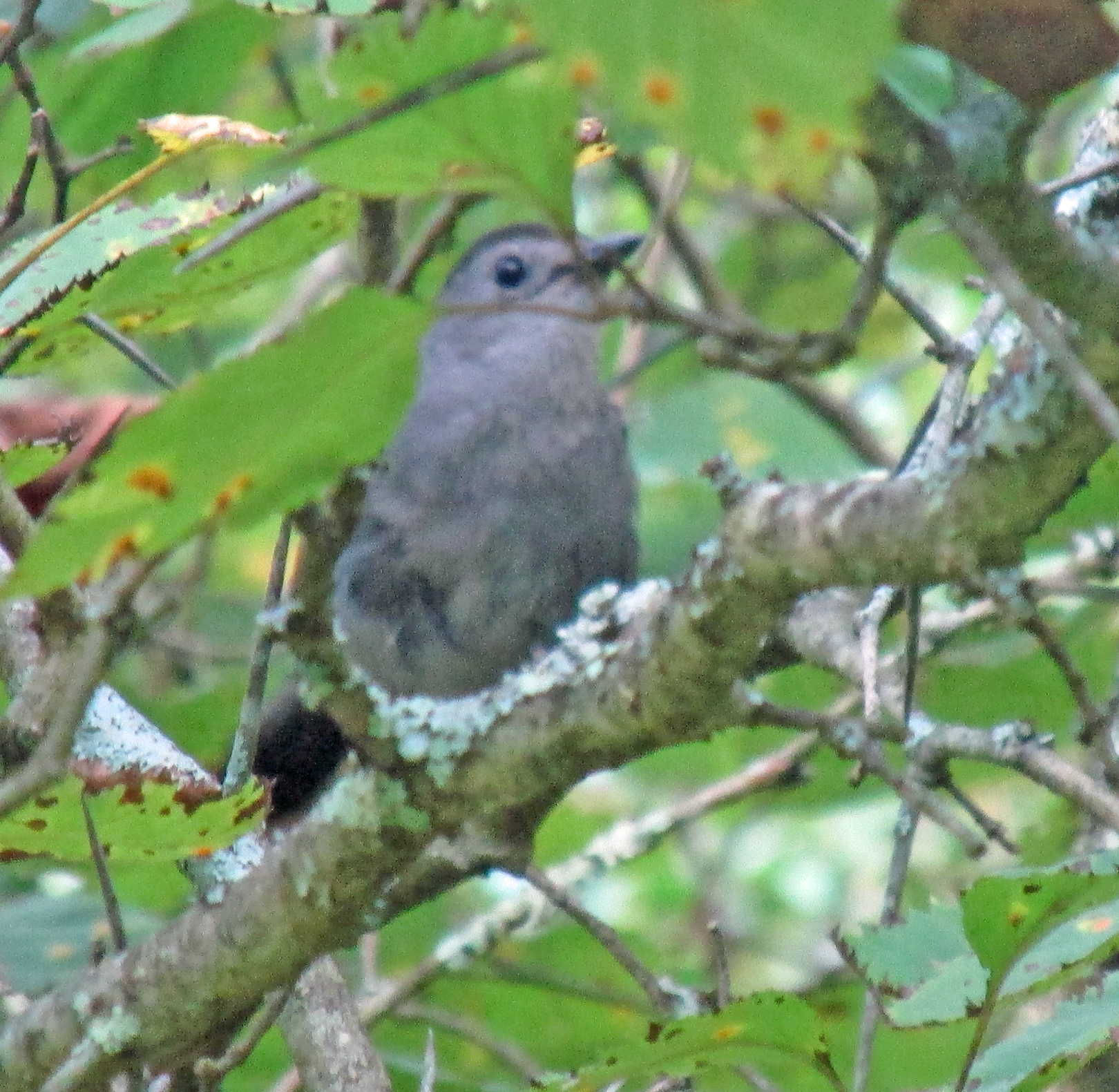
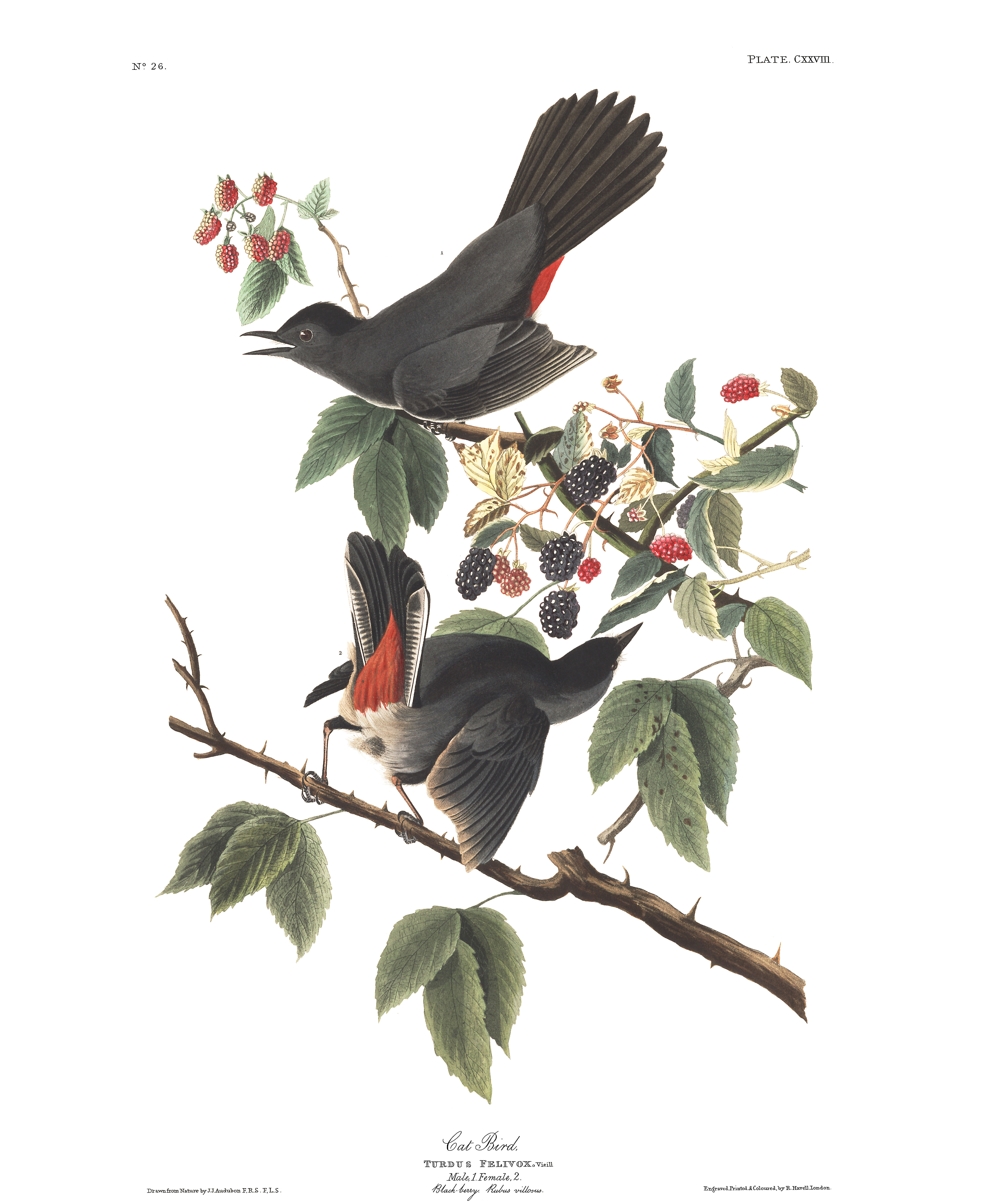
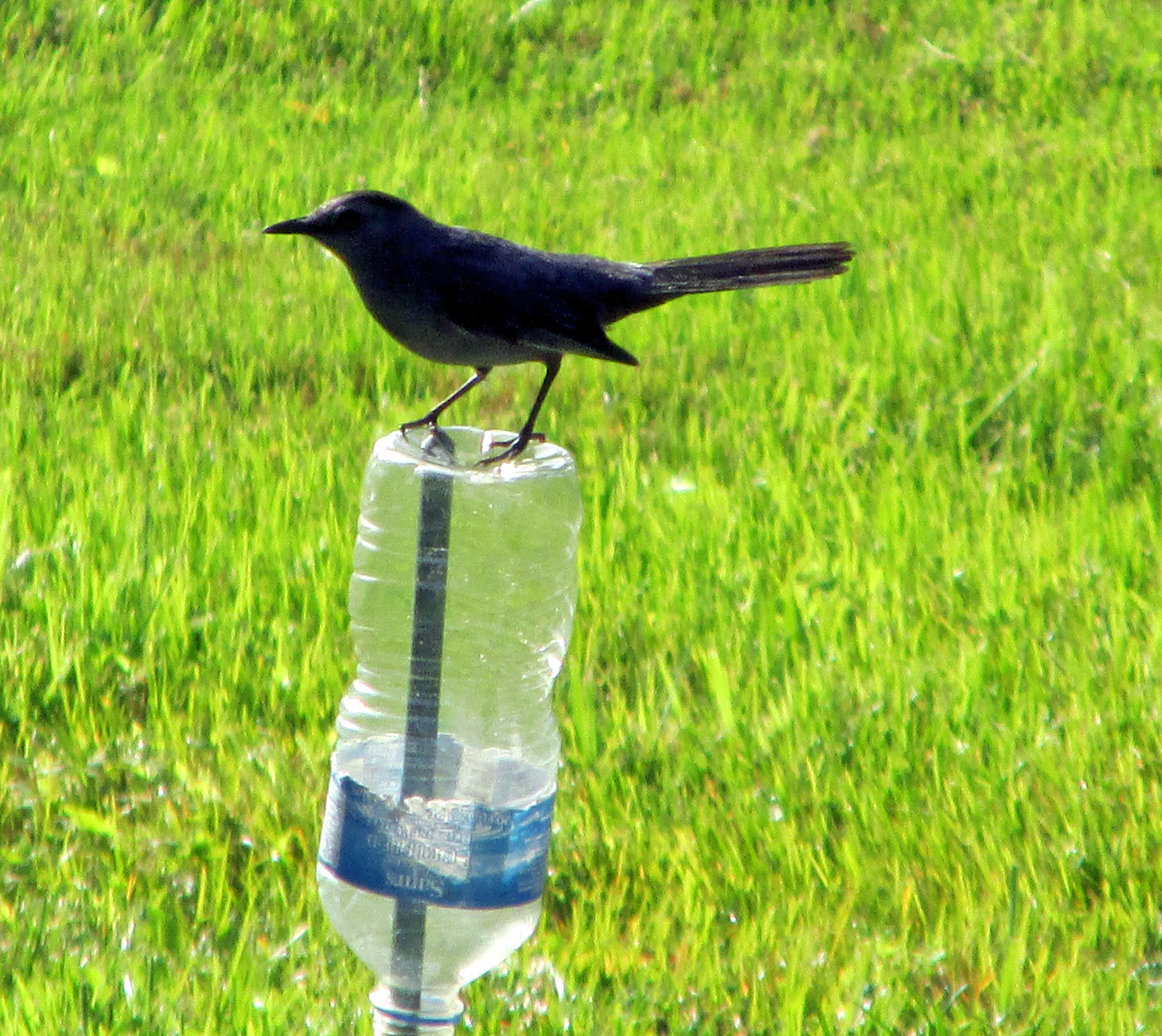
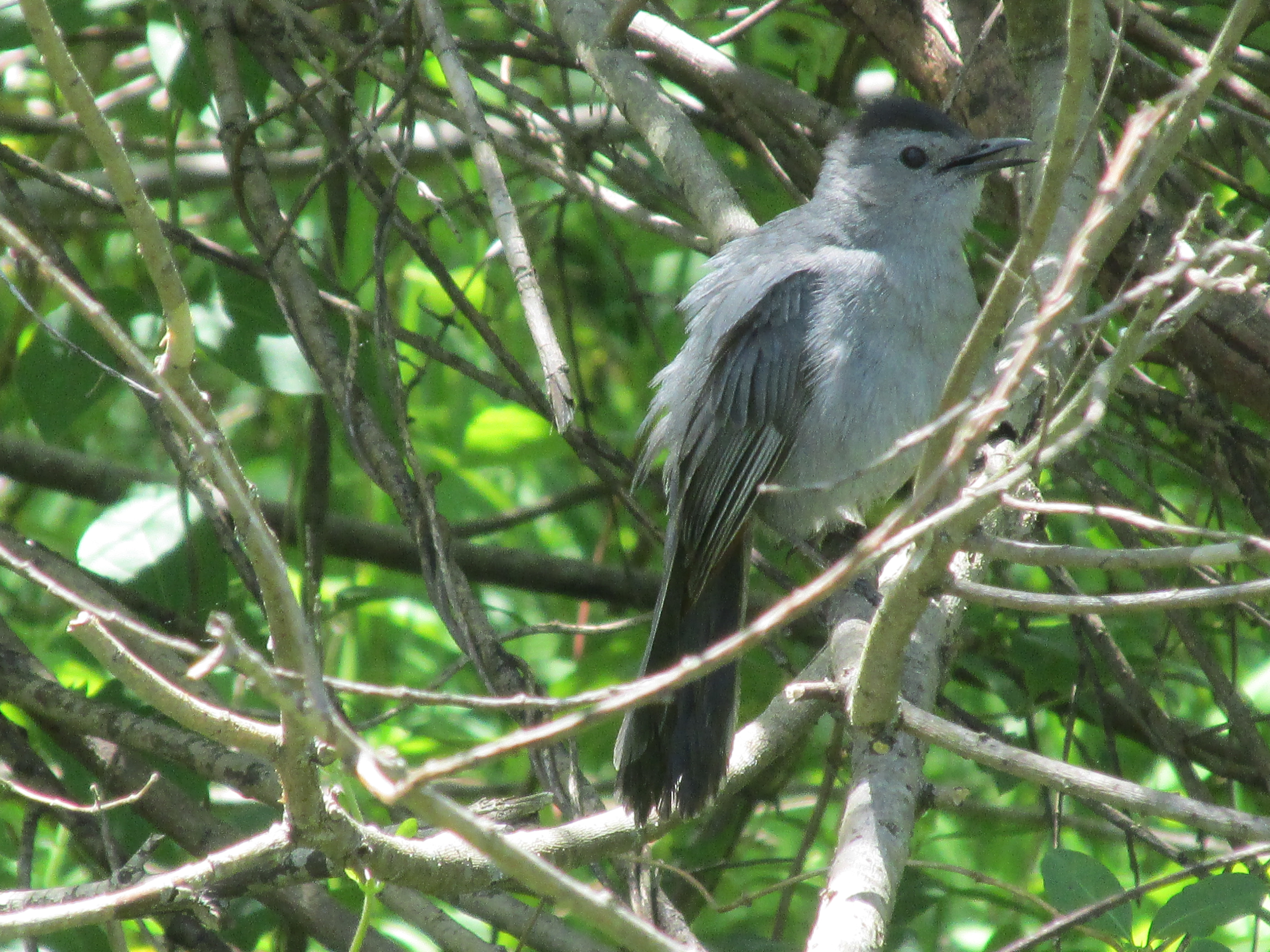
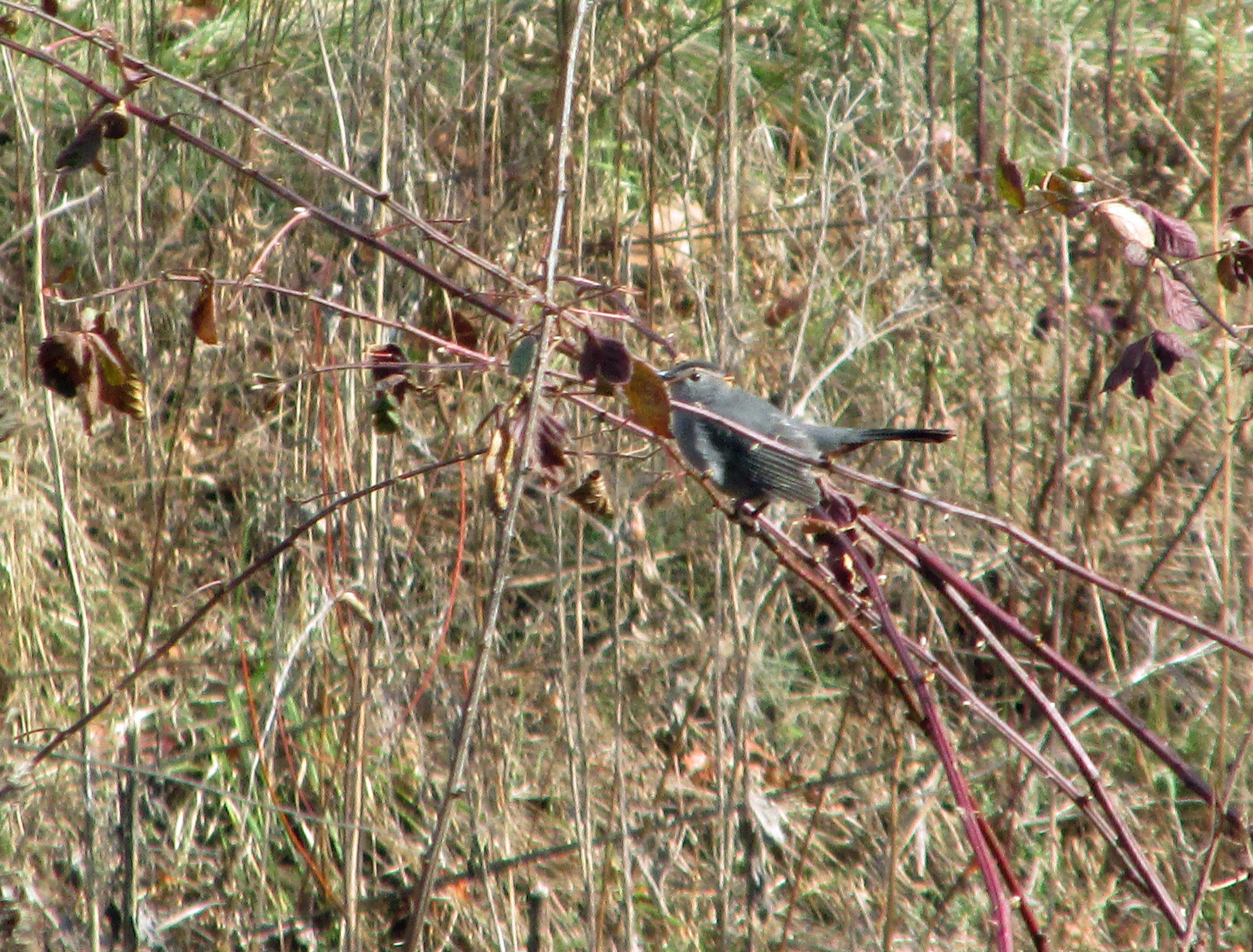
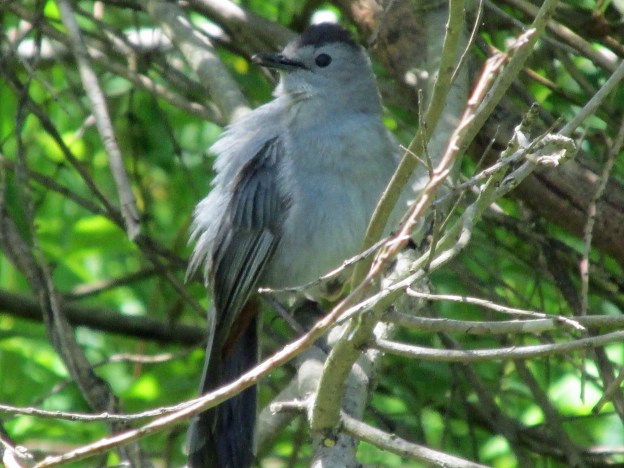
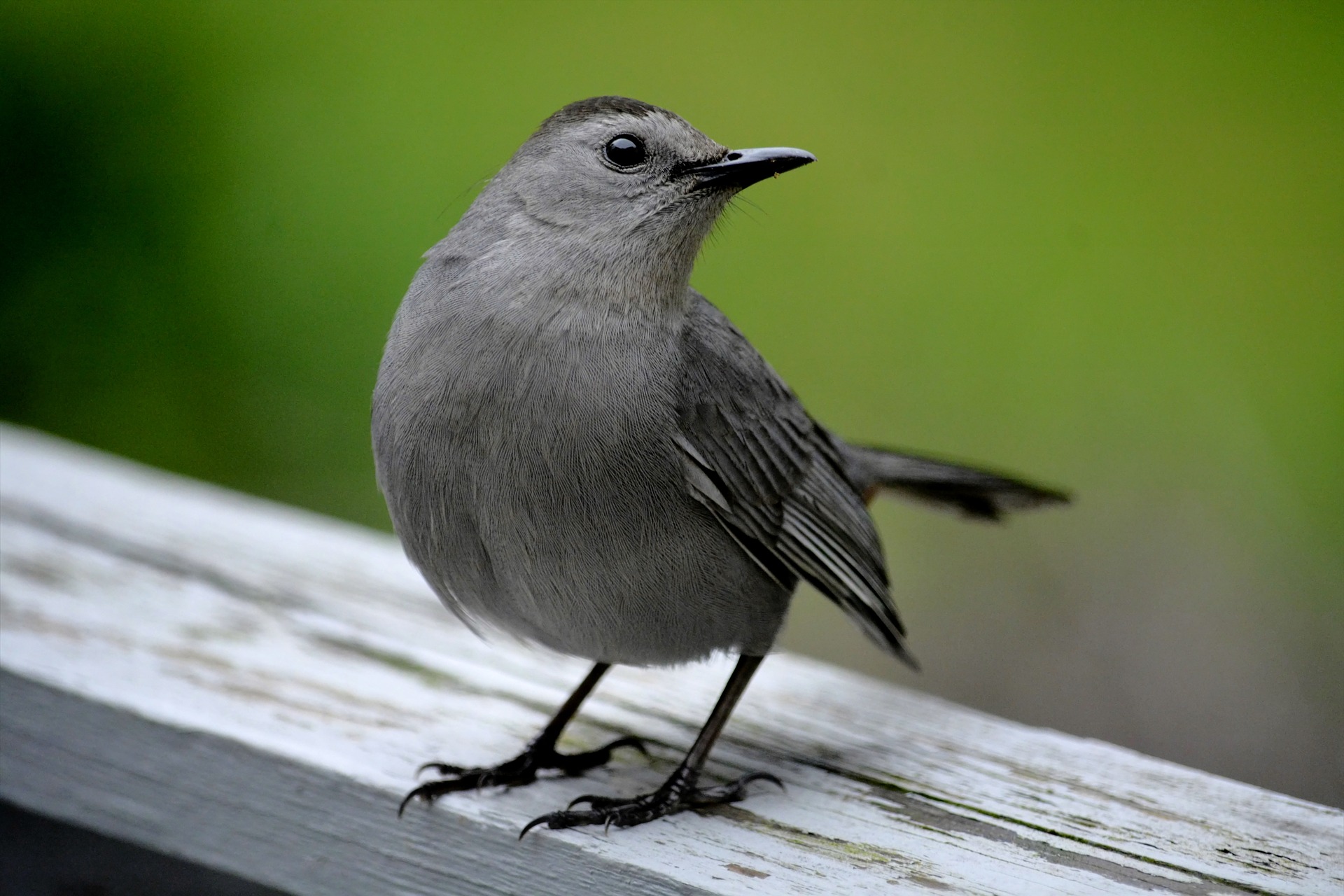
Your first introduction to the catbird is likely going to occur when you hear what sounds like an irritable feline hiding in a hedge, thicket or dense shrub. Upon closer examination, you may get a glimpse of a charcoal gray bird roughly the shape of a Northern mockingbird but smaller. A black cap and a patch of rusty-red feathers under the tail are the only exceptions to this bird’s overall gray plumage.
Photo by Bryan Stevens A curious Gray Catbird peeks from dense cover. Attendees at the fall rally can look for catbirds and other species at any of the offered bird hikes.

Catbirds are experts at concealing themselves from prying eyes. The gray plumage blends into the shadowy sections of the tangles and thickets where the bird likes to hide itself. However, even when gray catbirds are reluctant to be seen, they’re almost eager to be heard. The catbird is extremely vocal, with several calls and songs in its repertoire, including the rather faithful rendering of a fussy cat’s meow that provides this bird its common name.

They’re part of a family related to thrushes that are known as “mimic thrushes.” Besides its surprisingly accurate rendition of a feline, the catbird has several other common vocalizations. Despite their shy nature, they’re extremely curious. Imitating their calls or simply producing a squeaky sound will usually persuade the bird to move out of cover and search for the source of the noise.

Catbirds are part of the parade of returning birds each spring that includes species like rose-breasted grosbeaks, scarlet tanagers, Baltimore orioles and indigo buntings, but because they lack the brilliant plumages of these other birds their arrival would probably go unnoticed if not for the fact they are extremely noisy for the first few weeks they are back. Then they go silent again and remain quieter as they take up the serious business of raising young.

However, in a mood that appears to swing with the seasons, gray catbirds emerge again in late summer and early fall when they feast on such fruit as elderberries and wild cherries while making their whiny cacophony of calls from any tangle or thicket where they happen to be.

The catbird belongs to the genus Dumetella. The name is based upon the Latin term dūmus, which roughly translated means “thorny thicket.” Dumetella, in turn, means “dweller in the thornbushes” or “small bird of the thornbushes.” It’s a rather apt description for a bird fond of habitats often dominated by thorny vegetation. Older common names for the gray catbird included cat thrush and slate-colored mockingbird.

They are related to thrashers and mockingbirds, but scientists find them just different enough to warrant placing the gray catbird in its own genus. A relative known as the black catbird, which ranges throughout the Yucatan Peninsula of Mexico, as well as northern Guatemala and northern Belize, also belongs to a genus of its own. Both catbirds are classified as “mimic thrushes,” or Mimidae, of which there are about 30 species in the New World. There is a totally unrelated family of catbirds that ranges through Australia, Asia and parts of Africa.

The gray catbird is not as an accomplished mimic as some of its relatives, such as the Northern mockingbird. Males have motivation to constantly expand their repertoire, however, as doing so increases the likelihood of attracting a mate. They imitate other birds, but some have been recorded imitating frogs and other non-avian singers.

While not generally considered a bird to visit feeders, people have succeeded in attracting catbirds to feeders designed to offer grape jelly or orange slices. Planting fruit-bearing shrubs and trees is the best means of attracting these fascinating birds to your yard and garden.


Some birds stand out from the flock with their amazing migratory feats

Photo by jasonjdking/Pixabay.com • The bobolink is also known as the “rice bird” for its tendency to feed on cultivate grains such as rice. Even the bird’s scientific name, oryzivorus, means “rice eating” and refers to this bird’s appetite for many of the same grains consumed by humans. This small songbird also undertakes yearly migration flights equalling more than 12,400 miles.

The peak of fall migration is approaching. Birds of all species are winging their way southward ahead of the months of cold and scarcity. September and October are months of flux and transition. Like a bear fattening for hibernation, I gorge on sightings of warblers, hummingbirds, tanagers and other favorites, knowing that I won’t be seeing many of these birds again until next spring. Their memories will sustain me, as will my feeders, which will still bring plenty of colorful and entertaining birds into my yard even in times of snow and ice.
Bird migration at any season is a spectacle. Many of the birds that nested in mountain hollows or vegetation-choked wetlands will winter in Central and South America, the Caribbean or other distant but warmer destinations. The following snapshots of fall’s bird migration capture the phenomenon’s drama.

Bobolink
The bobolink is a small bird in the family of blackbirds, which includes grackles, orioles and cowbirds. Nesting across North America during the summer, bobolinks retreat to South America for the winter. These small birds undertake amazing migrations, making a round-trip of about 12,400 miles to regions south of the equator in Bolivia, Paraguay and Argentina each fall. Come spring, they make the trip again, but in a northerly direction.
According to the website All About Birds, migrating bobolinks orient themselves with the earth’s magnetic field. These small birds are able to accomplish this feat due to iron oxide in bristles of its nasal cavity and in tissues around the olfactory bulb and nerve. Bobolinks also use the stars scattered across the night sky to guide their migratory flights. Capable of living as long as nine years, a long-lived bobolink will rack up some serious miles simply migrating to its nesting grounds and back to its wintering habitat each year.

Bar-tailed godwit
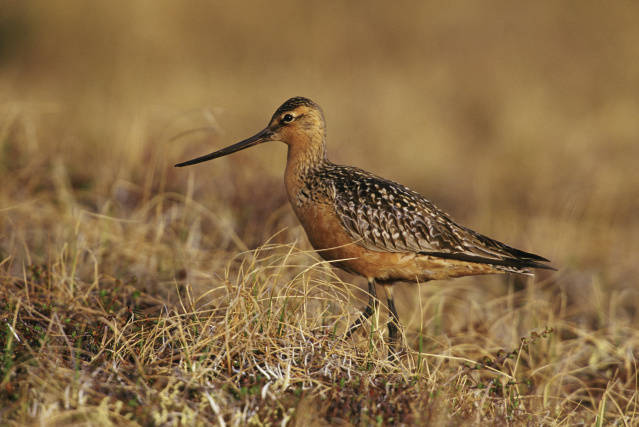
Shorebirds, which in North America can consist of birds ranging from turnstones and sandpipers to willets and avocets, are champion migrants. For instance, the bar-tailed godwit makes an impressive non-stop migratory flight. This shorebird nests in the United States only in parts of remote Alaska, but this godwit also ranges into Scandinavia and northern Asia. Some of these godwits make a nine-day, non-stop migratory flight that takes them from New Zealand to the Yellow Sea of China and beyond, a distance of almost 6,000 miles each way.
Needless to say, since the godwits make no stops along the way, they must also go without food for the duration of their journey. The female godwit is larger than the male, but she still weighs only 12 ounces. The long-billed, long-legged bird is about 17 inches in length from the tip of the bill to its tail. That a creature so small can make such a distant, arduous trip and be the none the worse for wear is truly inspiring.

Broad-winged hawk
Many North American raptors migrate, but the broad-winged hawk dislikes the lonely aspects of solitary travel. Instead, these hawks form large flocks during migration, and in autumn the majority of these raptors travel past human-staffed hawk migration observation points, which are dubbed “hawk watches,” during a brief and concentrated period of only a few weeks. Observing the phenomenon locally is possible at the Mendota Fire Tower Hawk Watch site atop Clinch Mountain at an abandoned fire tower near Mendota, Virginia.
Broad-winged hawks are part of the family Accipitridae, which includes 224 species of hawks, eagles, vultures and other birds of prey. Broad-winged hawks are truly long-distance migrants. Many hawks passing over Mendota may end their migration as far south as Brazil. These hawks travel in flocks that can consist of hundreds or thousands of individuals. The birds conserve energy by soaring on thermals and mountain updrafts.

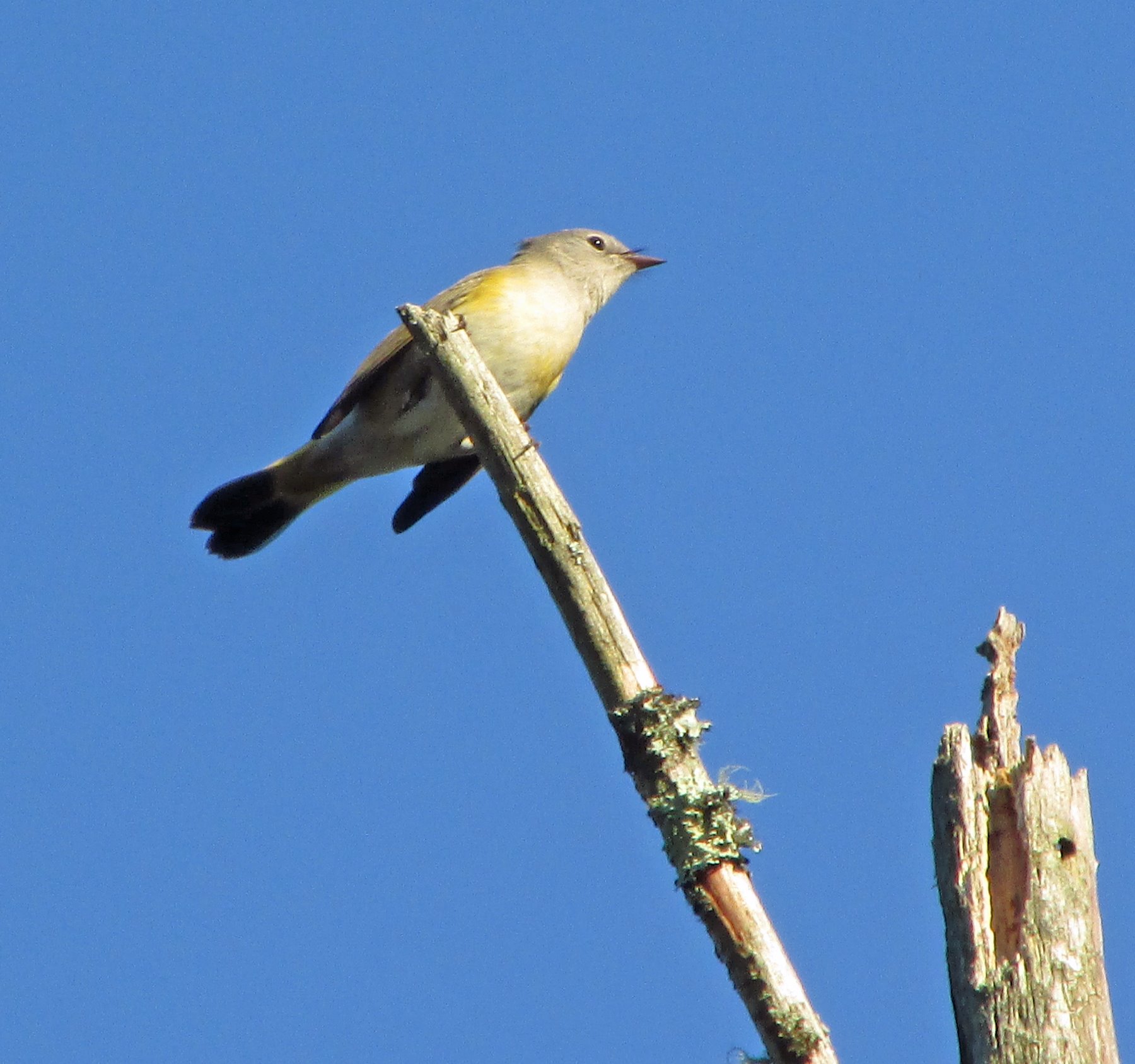
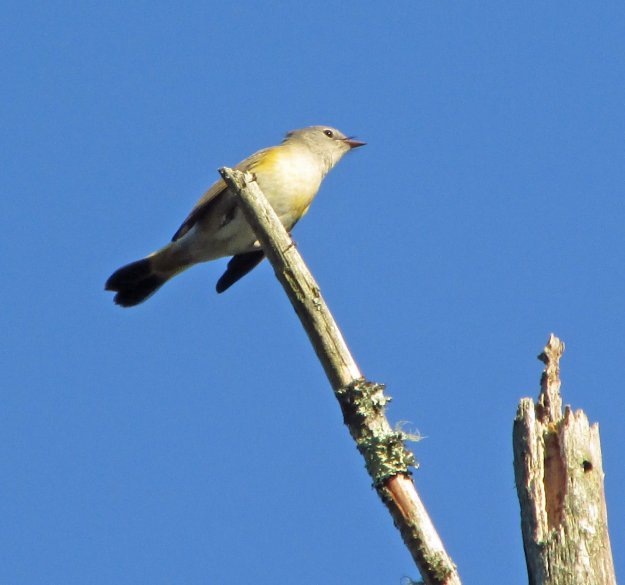
Photo by Bryan Stevens • Warblers, such as this American redstart, stage impressive migratory flights. The blackpoll warbler makes an incredibly arduous journey for a bird that is less than five inches long.

Blackpoll warbler
Most of the warblers that nest in North America retreat to Central and South America during the winter months. Few warblers, however, make as great a journey as the blackpoll warbler. Instead of migrating over land, this five-inch-long warbler undertakes a two-stage migration. The first half of the migration is a non-stop flight of about 1,500 miles. Every fall, these tiny birds fly over the ocean during this part of their migration, departing from Canada or the northern United States and not stopping until they reach various locations in the Caribbean. There they will spend some time recovering from the exhausting first half of their journey before they continue their way to such South American countries as Colombia and Venezuela. Once again, during the time they spend flying over open ocean, these tiny warblers do not feed.

* * * * *

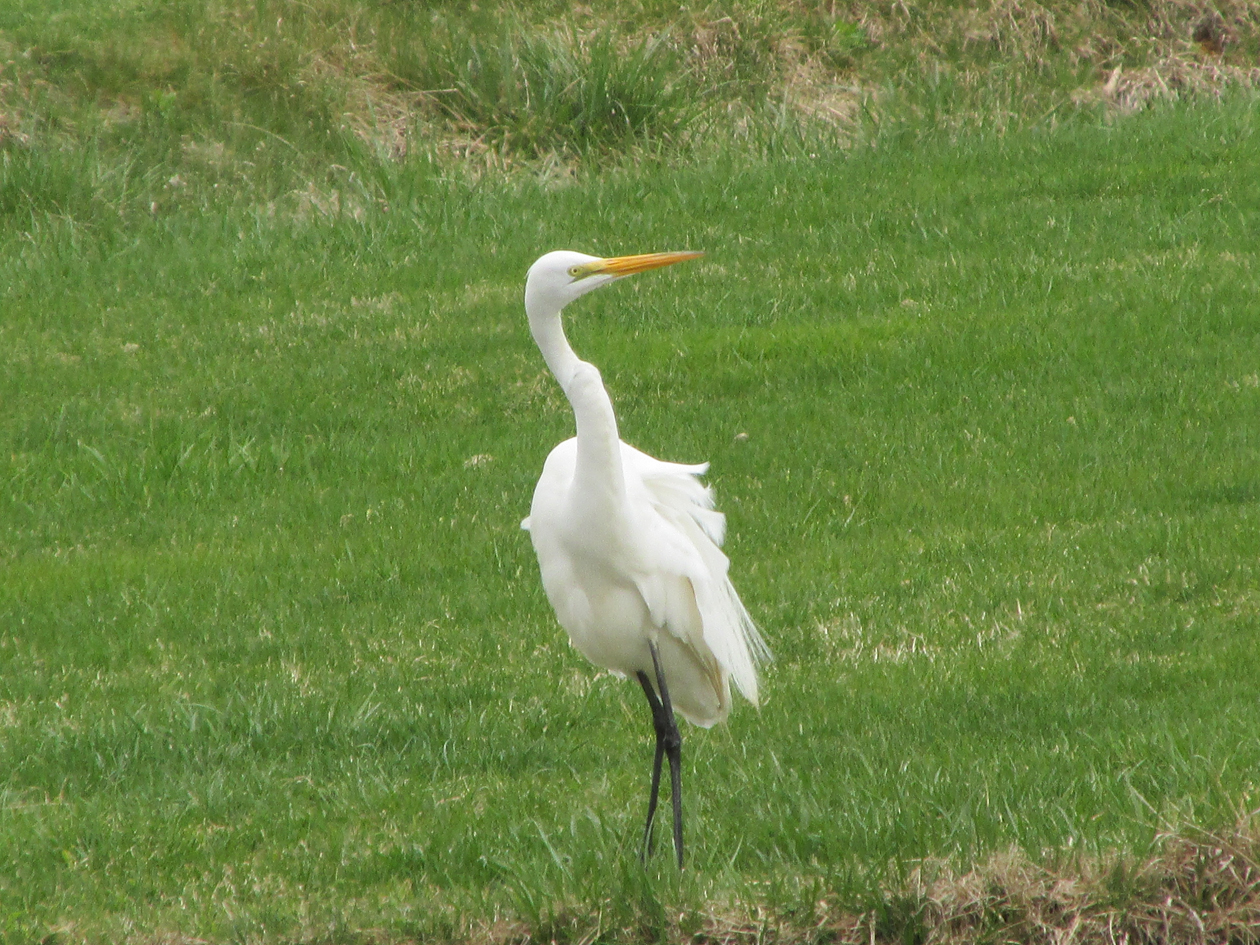
Photo by Bryan Stevens • A migrating Great Egret makes a stop at a golf course pond.

Wading birds topic for program
I’ll be presenting a program on herons, egrets and other wading birds at the September meeting of the Elizabethton Bird Club. The meeting will be held at 7 p.m. Tuesday, Sept. 6, at the Elizabethton campus of Northeast State Community College, 386 Highway 91. The meeting will be held on the second floor in Room 208. The free program is open to the public and will follow a brief business meeting.

Readers with questions are welcome to email me at ahoodedwarbler@aol.com or send a friend request on Facebook at facebook.com/ahoodedwarbler. I also love to receive comments and hear about bird observations.

Photo by Bryan Stevens • A spotted sandpiper and a solitary sandpiper rest at the edge of a pond during a migration rest stop.

Fall Bird Count finds 127 species

rthawk-one

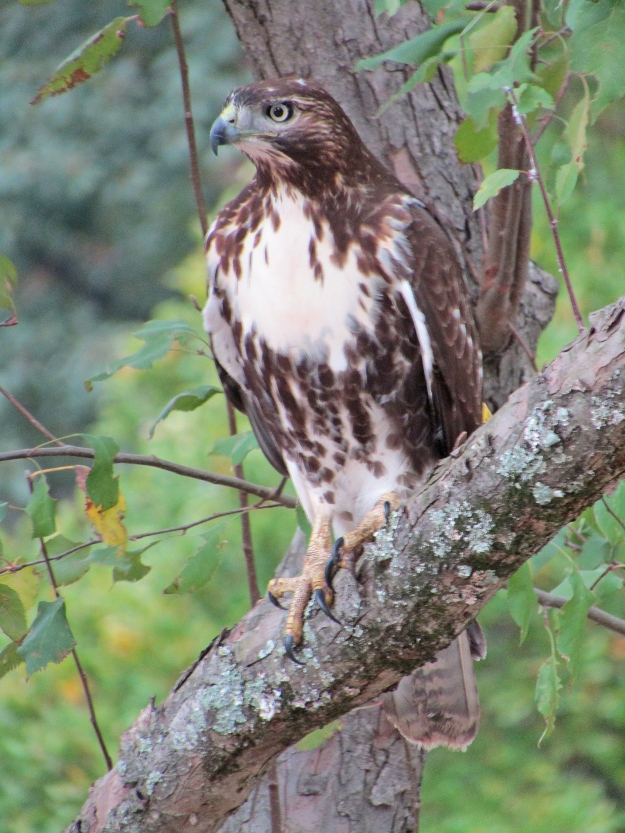
Photo by Bryan Stevens • Raptors, like this Red-tailed Hawk, proved plentiful on count day. Broad-winged Hawk, a relative of the Red-tailed Hawk, even set a new record for most individuals found.

The 49th consecutive Elizabethton Fall Count was held Saturday, Sept. 29, with 50 observers in 13 parties covering parts of five adjacent counties.

According to count compiler Rick Knight, a total of 127 species were tallied (plus Empidonax species), slightly higher than the average of the last 30 years, which was 125. The all-time high was 137 species in 1993.

Two very rare species were found: Purple Gallinule at Meadowview Golf Course in Kingsport and Black-legged Kittiwake on South Holston Lake. The kittiwake had been found Sept. 27 and lingered until count day.

Shorebird habitat was scarce due to high water levels at most sites, thus only one species was found (other than Killdeer).Broad-winged Hawks were numerous, part of a notable late flight likely due to unfavorable weather conditions preceeding the count.
Warblers were generally in low numbers, although 23 species were seen. No migrant sparrows had arrived yet. Blackbirds, too, were scarce. Some regular species were tallied in record high numbers, likely due to the above average number of field parties.

turkey_two

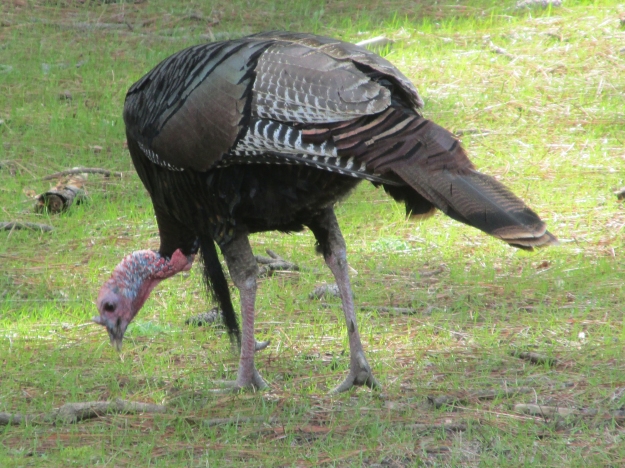
Photo by Bryan Stevens • Wild Turkeys and Ruffed Grouse were found on this year’s count, but participants failed to locate any Northern Bobwhites.

The list of species follows:

Canada Goose, 781; Wood Duck, 79; Mallard, 345; Blue-winged Teal, 110;  Com. Merganser, 2;  Ruffed Grouse, 2; and Wild Turkey, 56.

Pied-billed Grebe 32; Double-crested Cormorant, 78; Great Blue Heron, 49; Great Egret, 2; Green Heron, 2; and Black-crowned Night-Heron, 5.

Wild-NightHeron-Adult

Photo by Bryan Stevens • Several species of herons and egrets were located, including Black-crowned Night Heron.

Black Vulture 71; Turkey Vulture 203; and Osprey, 27. This represented a new record for the number of Osprey found on this count.

 
Bald Eagle 8; Northern Harrier, 1; Sharp-shinned Hawk, 3; Cooper’s Hawk, 9; Red-shouldered Hawk, 6; Broad-winged Hawk, 321; (most ever on this count) and Red-tailed Hawk, 19.

 
Virginia Rail 1; Purple Gallinule, 1; Killdeer, 43; Spotted Sandpiper, 1; Black-legged Kittiwake, 1; Caspian Tern, 1; and Common Tern, 2.


Rock Pigeon, 597; Eurasian Collared-Dove, 2; Mourning Dove, 330; Yellow-billed Cuckoo, 4; E. Screech-Owl, 24; Great Horned Owl, 10; Barred Owl, 5; Northern Saw-whet Owl, 1; and Common Nighthawk, 1.

 
Chimney Swift, 481; Ruby-throated Hummingbird, 31; Belted Kingfisher, 32; Red-headed Woodpecker, 5; Red-bellied Woodpecker, 92; Yellow-bellied Sapsucker, 5; Downy Woodpecker, 59; Hairy Woodpecker, 12; Northern Flicker, 67; Pileated Woodpecker, 54; American Kestrel, 13; and Merlin, 2. The figures for Red-bellied and Pileated Woodpeckers mark new high counts for these two species.

red-bellied-bryan

Photo by Bryan Stevens • A record number of Red-bellied Woodpeckers were found on this year’s Fall Bird Count.

Eastern Wood-Pewee 15; Empidonax species, 2; Eastern Phoebe, 79; Eastern Kingbird, 9; White-eyed Vireo, 1; Yellow-throated Vireo, 2; Blue-headed Vireo, 21; Philadelphia Vireo, 3; Red-eyed Vireo, 4; Blue Jay, 646; American Crow, 364; and Common Raven, 1.
Northern Rough-winged Swallow, 3; Tree Swallow, 465; Barn Swallow, 1; and Cliff Swallow, 3.

Carolina Chickadee, 177; Tufted Titmouse, 133; Red-breasted Nuthatch, 4; White-breasted Nuthatch, 71; Brown Creeper, 1; House Wren, 4; Winter Wren, 1; and Carolina Wren, 218. Both Tufted Titmouse and White-breasted Nuthatch were found in record numbers, as was the Carolina Wren, too

Golden-crowned Kinglet, 8, Eastern Bluebird, 187;  Gray-cheeked, Thrush 12; Swainson’s Thrush, 46;  Wood Thrush, 9; American Robin, 591; Gray Catbird, 64; Brown Thrasher, 23; and Northern Mockingbird, 111; European Starling 1,226;  and Cedar Waxwing, 294. The number of Gray Catbirds set a new record for the species.

Worm-eating Warbler 1; Northern Waterthrush, 1; Black-and-white Warbler, 7; Prothonotary Warbler, 1; Tennessee Warbler, 42; Orange-crowned Warbler, 2; Kentucky Warbler, 2; Common Yellowthroat, 9; Hooded Warbler, 7; American Redstart, 16; Cape May Warbler, 6; Northern Parula, 8; Magnolia Warbler, 18; Bay-breasted Warbler, 15; Blackburnian Warbler, 8; Yellow Warbler, 1; Chestnut-sided Warbler, 1; Black-throated Blue Warbler, 4; Palm Warbler, 63; Pine Warbler, 11; Yellow-throated Warbler, 1; Prairie Warbler, 1; and Black-throated Green Warbler, 7.

Fall-AmRedstart

Photo by Bryan Stevens • Participants found a total of 23 different species of warblers, including American Redstarts.

Eastern Towhee, 66; Chipping Sparrow, 94; Field Sparrow, 16; Song Sparrow, 97; and Dark-eyed Junco, 42.

Summer Tanager 2; Scarlet Tanager, 11;  N. Cardinal, 149; Rose-breasted Grosbeak, 125; and Indigo Bunting, 14.

Bobolink, 2; Red-winged Blackbird, 132; Eastern Meadowlark, 7; Common Grackle, 8; Brown-headed Cowbird, 5; House Finch, 41; Pine Siskin, 11; American Goldfinch, 220; and House Sparrow, 69.

Goldfinch 5

Photo by Bryan Stevens • American Goldfinches were among the smaller songbirds found during the annual Fall Bird Count.

Mother Nature’s whims can produce major impacts on birds

Sooty_tern_flying

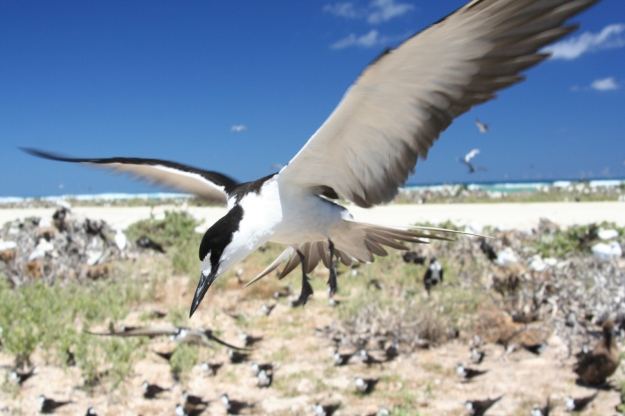
Photo by U.S. Fish and Wildlife Service/Duncan Wright The sooty tern, pictured, nests mainly in Hawaii, but some also nest on the islands of the Dry Tortugas, west of the Florida Keys. In 2004, Hurricane Frances blew one of these tropical birds to Holston Lake in Bristol. Severe storms also present devastating obstacles for other birds.

With Hurricane Florence dominating the headlines in recent weeks, it’s only natural to speculate on whether such storms can impact birds in a negative way.

According to a 2011 blog post made on the National Wildlife Federation website, hurricanes can be bad news for some birds. Naturally enough, sea birds and waterfowl are most exposed to the forces of a hurricane. Some birds will move inland to avoid the incoming storm. The birds that inhabit our yards and gardens will ride out the storm using special adaptations. Songbirds will automatically tighten their toes around their perches, riding out the winds of a hurricane by holding onto a branch with a death grip. It’s the same adaptation that lets them sleep on a branch without letting go and falling off during the night.

The blog points out that the news often covers the appearance of rare species after a major storm. Some of these birds transported to unusual locations are probably younger or weaker birds. Once transported far from their usual range by a hurricane, it can take weeks to return home — if they can find the right foods on their way back.

John-James-Audubon-Bachman_s-Swamp-Warbler.-1.-Male.-2.-Female.-Gordonia-pubescens.- (1)

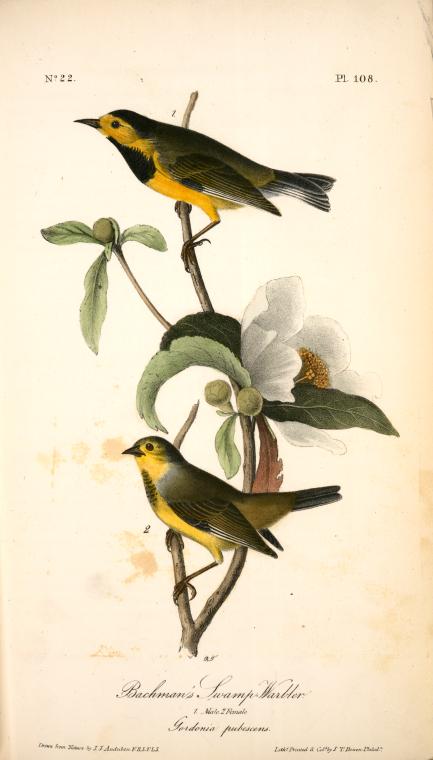
Early naturalist and accomplished artist John James Audubon painted Bachman’s warbler without ever seeing a living one. A friend sent him some skins of the warbler collected near Charleston, South Carolina. A hurricane may have contributed to the extinction of Bachman’s warbler.

In a worst case scenario, hurricanes may have dealt fatal blows to some bird species. For instance, a hurricane may have delivered the knock-out blow to a species of warbler that went extinct last century, according to the website, Field Guide to Extinct Birds. A hurricane that slammed into Cuba in the 1930s when most of the Bachman’s warbler population was wintering on the island might have wiped out enough of the population to make the survivors too rare and far-flung to find each other to breed. The warbler, sensitive to habitat destruction from logging and already in a steep decline, never seemed to recover. It was the ultimate example of keeping all of one’s eggs — or birds — in one unlucky basket.

Discovered in 1832 near Charleston, South Carolina, by the Reverend John Bachman, this warbler attracted little attention for the first half century after its discovery. Bachman sent some skins of the bird to his friend, the artist and early naturalist John James Audubon. Subsequently, Audubon painted this warbler by using those skins and Bachman’s description of the bird’s habits for inspiration. Ironically, considering he described the species for science, Audubon never actually laid eyes on an actual living Bachman’s warbler.

The last specimens of Bachman’s warbler were collected in Mississippi in the early 1940s. The last strongholds for breeding Bachman’s warblers in the United States were Fairfax County, Virginia, in the 1950s and South Carolina’s I’on Swamp in the early 1960s. The last photograph documenting a Bachman’s warbler was taken in 1954. in Charleston, South Carolina, bringing the story of this warbler full circle from its discovery in the same vicinity back in 1832. No Bachman’s warbler sightings have been confirmed since 1961, despite reports in the 1970s and 1980s, as well as reports made in the spring of 2000 and 2001 in the Congaree Swamp National Monument in Richland County, South Carolina. None of those sightings could be confirmed.

Like the ivory-billed woodpecker and Eskimo curlew, Bachman’s warbler is another bird likely to be labeled for the near future with the tag “likely extinct” associated with its name. Like the large woodpecker and the shorebird with a penchant for long-distance migration, the Bachman’s warbler went out with a whimper, not a bang, with most of its viable population snuffed out by an October hurricane just as the species returned to Cuba for the winter season.

Ruby-throat

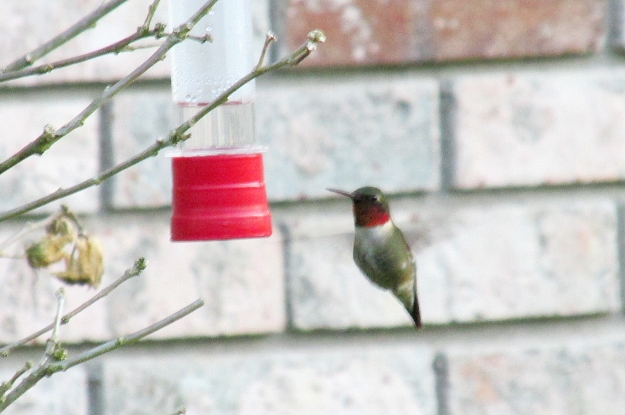
Photo by Bryan Stevens • Ruby-throated Hummingbirds make a non-stop crossing of the Gulf of Mexico. A hurricane in the Gulf during migration could have serious consequences for this small bird.

More recently, experts worried Hurricane Irma might have delivered a knockout blow to the population of another tiny species of warbler. The Barbuda warblers on the tiny Caribbean island of Barbuda were feared exterminated in the wake of Irma. When the storm hit the island in September of 2017, its path affected more than 90 percent of the island and nearly wiped out the available habitat for the warbler, which already had a Near Threatened status. After the passage of the storm, participants in searches for the warbler turned up sightings of the bird. Nevertheless, the population status and ability to fully recover remains uncertain.

Science keeps adding to its knowledge of how birds are affected by hurricanes and other storms. A 2017 study showed possible consequences for a seabird known as the sooty tern in relation to hurricanes.

The study, published in the peer-reviewed open-access journal PeerJ, is the first to map the birds’ annual migratory path and demonstrate how its timing and trajectory place them in the direct path of hurricanes moving into the Caribbean after forming over the Atlantic.

Climate change threatens to bring about more frequent and powerful hurricanes, which could be bad news for the terns. Migration is a stressful undertaking for birds. If they encounter a strong storm in a weakened state, the results could be catastrophic. The study revealed a strong relationship between the numbers and locations of bird deaths and the numbers and locations of hurricanes. The study also showed that it isn’t just monster storms with the potential to cause devastation. Tropical Storm Delia, a small storm in the Gulf of Mexico in 1973, killed a lot of sooty terns. Essentially, the terns were in the wrong place at the wrong time.

Shorebirds

Photo by Bryan Stevens • A mixed flock of Short-billed and Long-billed Dowitchers and a Ruddy Turnstone at Huntington Beach State Park in South Carolina. Hurricanes can interrupt the migrations of even these long-distance migrants.

Of course, the sooty tern is not a rare bird. About 80,000 or more of these terns are estimated to breed in the Dry Tortugas each year. That’s the entire point, however; Bachman’s warbler was also once considered a common bird.

All of these examples point to the resilience of birds, but there’s also a lesson to learn. We should never take any of our feathered friends for granted. While the winds and rains from a hurricane can decimate human lives, wildlife is not immune. Sadly, birds can weather many a storm, but sometimes they get swamped.


The world can be a big, bad place for tiny hummingbirds

Mantis-Four

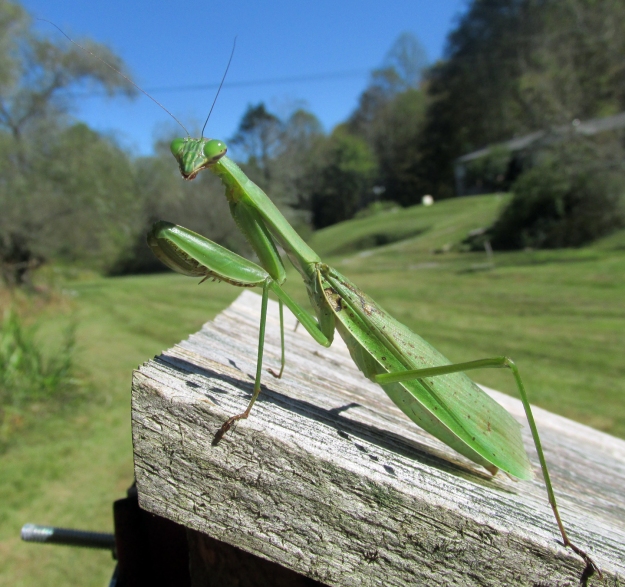
Photo by Bryan Stevens • Large mantises have been known to prey on ruby-throated hummingbirds.

Many years ago I read an account of a scarlet tanager making a snack of a ruby-throated hummingbird. Memory being what it is, I am no longer sure if that account was corroborated or one of those urban legends of birding.

A few pertinent facts should be considered. Male scarlet tanagers look striking in their red and black plumage. Ruby-throated hummingbirds are attracted to the color red. In the details I recall of the story about the predatory tanager, the hummingbird kept flying close to the tanager as if attracted to the red plumage. If so, it was a case of curiosity kills the cat or, in this case, the hummingbird. The tanager seized the hummingbird in its bill and, for good measure and to “tenderize” its prey, beat the hummingbird against the side of a branch. All of this took place before a crowd of birders who observed the incident through their binoculars. I don’t recall anyone taking a photo of the hummingbird’s tragic demise.

An email from Gene Counts reminded me of the tale of the tanager and the hummingbird. Gene, who lives in Haysi, Virginia, sent me a photograph and a short note about a praying mantis that stalks hummingbirds as they visit his feeders for a sip of sugar water.

MantisVsHummer

Photo by Gene Counts • This photo was shared by Gene Counts, who described how the mantis stalked hummingbirds that came to his feeder.

Gene told me of his excitement upon capturing the large insect’s behavior in a photograph.

“I just had to share this picture with you,” Gene wrote. “After all, my wife, Judy, was more excited today than the day we married in Chicago 54 years ago.”

He certainly hooked my attention with that introduction.

“A praying mantis is using our feeder as his own private hunting preserve,” Gene continued in his email. “The mantis follows and stalks the hummingbirds all the way around 360 degrees.”

So far, the stalking has only resulted in “several near misses,” but Gene declared that he is ready to pounce in case the mantis gets lucky.

“It has been four hours and he has lowered his goal,” Gene wrote of the patient mantis. “He is now clinging to the bottom (of the feeder) waiting for an insect. Now I can expel my breath as he no longer an avian threat.”

While Gene’s mantis may not be an immediate threat to hummingbirds visiting his yard in Haysi, does that mean we can be complacent when these large insects share our yards and gardens with hummingbirds?

Ruby-throated-WILLOWS

Photo by Bryan Stevens • Numbers of Ruby-throated Hummingbird in the region tend to fluctuate each year, but people should usually see a spike in their numbers as the hummingbirds end summer nesting and start migrating south again.


Documented evidence exists to identify large praying mantises as predators on ruby-throated hummingbirds. A brief foray online found numerous instances of hummers falling victims to these large carnivorous insects.

There are two species of mantises in the region — the European, or praying mantis, and the Chinese mantis — capable of capturing hummingbirds. Both species were introduced in the 1800s to act as a predator of insect pests detrimental to crops and gardens. The Chinese mantis can reach a length of 4.3 inches, while the European mantis achieves a length of about 3.5 inches. A third species — Carolina mantis — reaches only a length of 2.5 inches and should not pose a threat to ruby-throated hummingbirds, which are about 3.5 inches long.

Although introduced from Europe, the European mantis (Mantis religiosa) has earned recognition as the official state insect of Connecticut. The native Carolina mantis is the official state insect for South Carolina.

In Central and South America, where the world’s more than 300 species of hummingbirds reach their greatest diversity, there are also more species of predatory mantises. Some of these tropical insects prey on the tropical counterparts to the ruby-throated hummingbird.

Consider the way the mantis makes a perfect predator. It’s spiky forelimbs are spiky and serrated, making them perfect for seizing and grasping. This insect’s triangular head can turn their heads 180 degrees to scan its surroundings with two large compound eyes. A mantis also has three other simple eyes to increase its keen vision. Brutal mouthparts can easily tear apart and devour any prey the mantis manages to catch with its ambush hunting style.

Hummingbirds, regardless of species, are in a tough spot in the food chain. A bird not much bigger than many large insects is going to be a target for opportunistic predators like a mantis that will attempt to kill and consume anything small enough for them to make the effort.

p03mnqtd

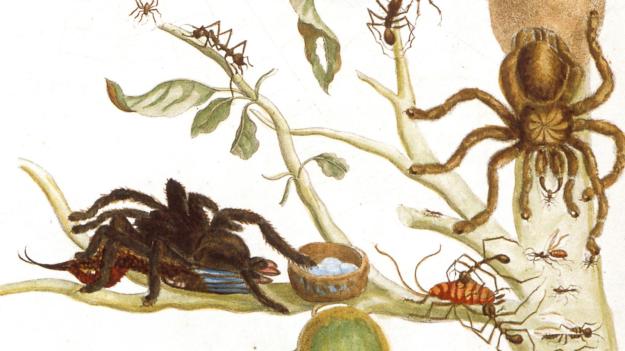
Maria Sibylla Merian, a German-born naturalist and scientific illustrator, was one of the first naturalists to observe insects directly. She painted this horrific work featuring a large spider preying on a hummingbird that had been dutifully incubating her eggs. When she died in 1717, she was recognized as one of the world’s foremost entomologists.

To make matters worse for ruby-throated hummingbirds, some large spiders and the bigger dragonflies have also been documented as hummingbird predators. When ruby-throated hummingbirds retreat to Central America for the winter months, they also face threats from lizards and snakes.

The list of predators that have been known to eat ruby-throated hummingbirds extends to bullfrogs, as well as many raptors, including kestrels, merlins and sharp-shinned hawks. Blue jays and other birds will raid hummingbird nests for eggs or young. Squirrels and chipmunks are also nest predators.

nature water eyes pond

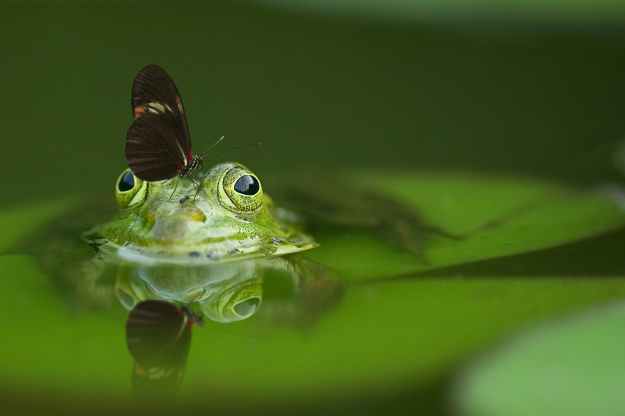
Photo by Pixabay on Pexels.com. Large frogs have also been known to prey on hummingbirds.

Despite all these perils, some ruby-throated hummingbirds have achieved a “long” life. The oldest on record was a ruby-throated hummingbird banded at the age of nine years and one month. Most elder hummingbirds are females. Few male hummingbirds, perhaps because of the energy they expend dueling with each other, reach their fifth birthday.

It’s definitely not easy being as tiny as a hummingbird in a world of fearsome giants, but birders who have seen a hummingbird hover boldly in front of their faces know how these tiny birds take life in stride. They may have a disadvantage in size, but that doesn’t keep them from living life as if they were as big as an eagle.

Rubythroat

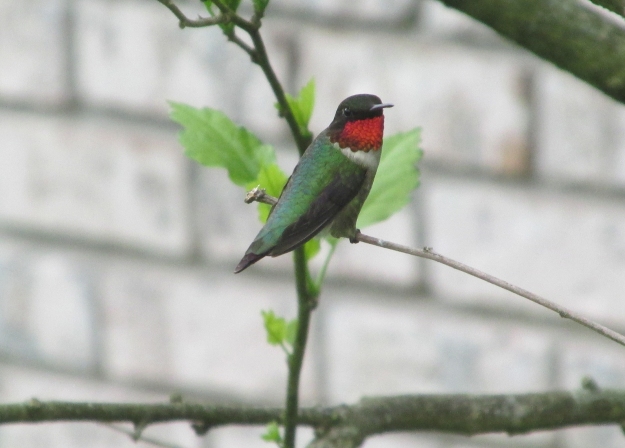
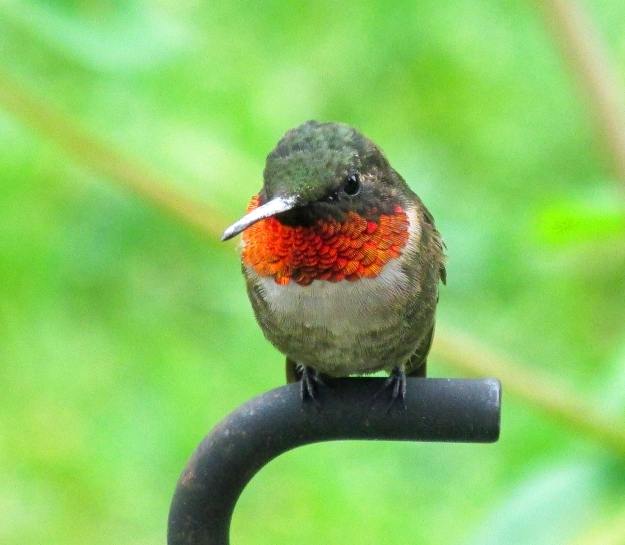
Photo by Bryan Stevens • Despite a perceived disadvantage of size, ruby-throated hummingbirds are quite capable of thriving in a giant world.

Chipping sparrow a common summer nesting bird

ChippingSparrow-ONE

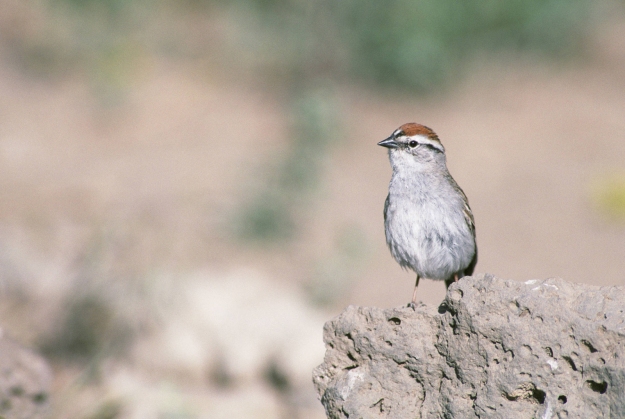
Photo by Dave Menke/USFWS • A black line running through the eye bordered by a white stripe, as well as a rusty-red cap, helps distinguish the chipping sparrow from other “little brown birds” that belong in the sparrow family.

I needed to do some homework before I could answer a question posed to me by Frances Rosenbalm of Bristol, Tennessee. As she communicated to me in an email, she had discovered a bird’s nest in her garden and wanted help identifying the species that built the nest.

“I have a bird that made a nest in the top of my tomato vines,” Frances explained in her email. “It had four turquoise speckled eggs in it.”

Frances described the nest as being made with large twigs and moss. “What kind of bird do you think it may be?” she wrote. She also noted that her garden is located near a farm field.

“I was so surprised to find this nest,” she wrote. “In all of all the years I have put a garden out, this has never happened,” Frances concluded.

51bUn1kQ7XL._SY291_BO1,204,203,200_QL40_ 2

After doing some research, which included poring over the pages of a great book by Hal H. Harrison titled, “A Field Guide to Birds’ Nests: United States East of the Mississippi River,” a work in the Peterson Field Guides series, I was able to write back to Frances with the news that I might have solved the mystery of the nest in the tomato vines.

The Harrison field guide is an exceptional book and one that’s perfect for someone who wants to know a little more about the birds other than their names. Entries for each bird include photographs depicting both the nest and the eggs as well as informative text with supplemental information about nesting birds in the Eastern United States.

Based on the description of the nest and its eggs, as well as its location near a farm field, I identified the nest described by Frances as belonging to chipping sparrows. I found some photographs online of chipping sparrow eggs in a nest and sent that in an email for her to consider.

Frances responded in another email. “I do believe you are right,” she wrote. “The eggs look a lot like the photo, and I have seen some birds that look like (chipping sparrows) flying around.”

For a species often lumped under the grouping of “Little Brown Birds,” the chipping sparrow is quite distinctive. In spring and summer, chipping sparrows sport a crisp, neat plumage with frosty gray underparts, a gray and white face and a striking black line through the eye. An easily recognizable field mark is the bright rusty crown atop the bird’s head.

ChippingSparrow-TWO

Photo by Dave Menke/USFWS • Chipping sparrows will form flocks for the winter season.

When horses were more common in daily American life, the chipping sparrow took advantage of this resource to almost invariably line their nests with horsehair. Now that not all nesting chipping sparrows have access to horses, these birds use fine plant fibers or hair gathered from other sources, including people, to line their nests.

Once a nest is constructed, a female chipping sparrow lays and incubates three to four eggs, which take about 14 days to hatch. Chipping sparrows often attempt to raise two broods in a single nesting season. Although dense evergreen trees are a preferred nesting location, these birds will also nest in vines.

During the warm months of the summer nesting season, chipping sparrows feed almost exclusively on insects. When winter makes insects scarce, these small birds switch their diet to one of seeds. Chipping sparrows will also feed on small fruits and berries.

Chipping sparrows will sometimes nest as many as three times in a single season. Although territorial during the nesting season, these birds form sizable flocks for migration and during the winter season. In making reference to these flocks, observers can use other descriptive terms. Flocks of sparrows have also been called a crew, a flutter, a host, a tournament and a quarrel. I am partial to a flutter of sparrows, but anyone who has watched the pecking order at the feeders will also understand the origins of a quarrel of sparrows.

Chipping-sparrow-john-james-audubon

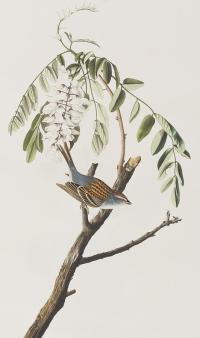
John James Audubon painted this chipping sparrow.

There are a couple of well-known Biblical passages using sparrows for powerful pieces of symbolism. One alludes to the fact that if God provides for small songbirds like sparrows, he will certainly provide for human beings. In addition, there is a passage that maintains that not a single sparrow falls without God being aware of the loss. A famous hymn, “His Eye is on the Sparrow,” is based on such biblical verses.

The world’s sparrows are divided into two large groupings — the Old World, or true sparrows, and the American sparrows of the New World.

Although largely considered rather dull, plain birds in appearance, some of them have earned descriptive names such as great sparrow, Arabian golden sparrow, green-backed sparrow, five-striped sparrow, yellow-browed sparrow and golden-crowned sparrow.

FieldSparrow-One

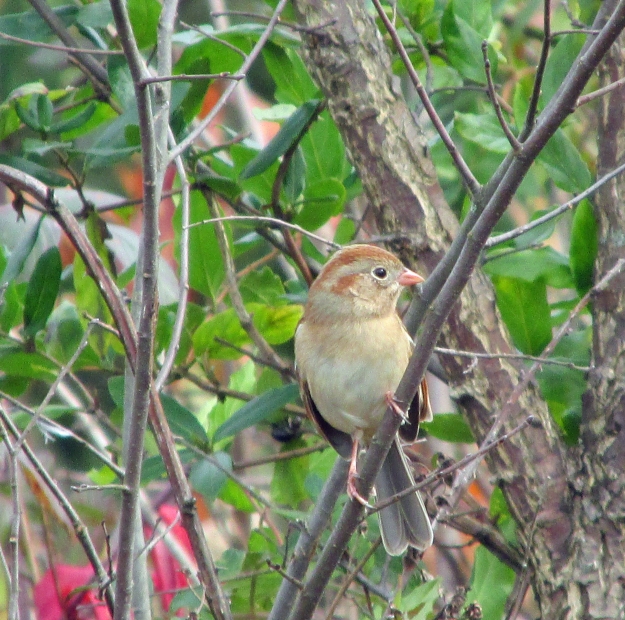
Photo by Bryan Stevens • A field sparrow perches on a branch. These sparrows are closely related to chipping sparrows and relatively common in Northeast Tennessee.

Welcome chipping sparrows and their kin with a well-stocked feeder and perhaps some thick tomato vines for concealing a nest. Unfairly dismissed by some as plain, dull songbirds, the sparrows reward a closer look with some subtle behaviors and plumages as worthy of additional attention as much as some of their more colorful relatives.

Rally to offer sneak peek at bird migration, other nature activities

CapeMayWarbler

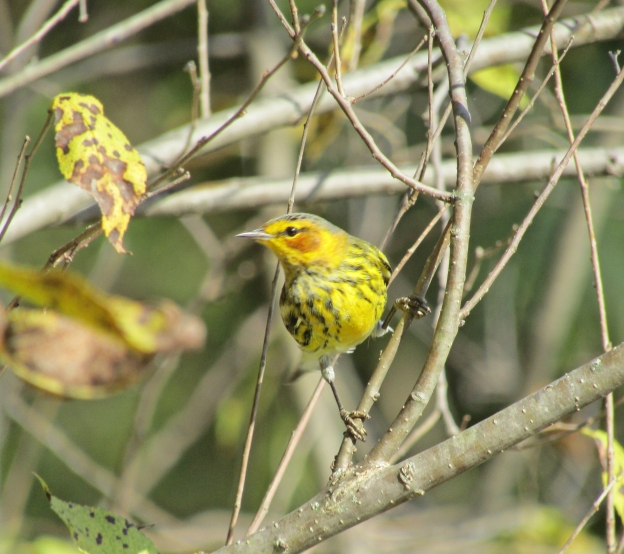
Photo by Bryan Stevens • While the Cape May warbler doesn’t breed locally, these warblers are fairly common spring and fall migrants in the region.

The 56th Roan Mountain Fall Naturalists Rally will draw nature enthusiasts from far and wide to this jewel of the Southern Appalachians on the first weekend after Labor Day with programs, nature walks, catered meals, and much more.

The annual Fall Naturalists Rally is always a great opportunity to enjoy the outdoors and, for birders, get a sneak peek at fall migration with any of the walks and programs focusing on our fine feathered friends. The best naturalists in the region volunteer their time and energy to make this a landmark event for people of all ages.

This year’s rally, which is scheduled for Friday-Sunday, Sept. 7-9, will feature guest speakers, Gabrielle Zeiger and Dr. Joey Shaw, for the main programs on Friday and Saturday evenings.

Zeiger’s Friday program, “Zen and the Art of Mushroom Hunting,” will get underway at 7:30 p.m. following a catered dinner at 6:30. Zeiger has been studying mushrooms in the region for 23 years. She considers herself more of a mushroom enthusiast than an expert. She is a member of the North American Mycological Association, and attends their national forays. She is involved in the association’s annual Wildacres foray in the Blue Ridge Mountains near Mount Mitchell in North Carolina.


Photos by Bryan Stevens • Mushrooms will feature in one of this year’s evening programs at the Fall Naturalists Rally.


Her program will focus on the two basic approaches — looking for good edibles and scientific study — to mushroom hunting. Her talk will touch on both approaches and include basic information on common mushrooms found in the area, species diversity and poisonous versus edible mushrooms. The program will include various types of fungi from gilled mushrooms, boletes, corals, stinkhorns and polypores, as well as the roles that they play in the environment such as decomposition and forest ecology. She will also talk about what mycologists do at forays. Findings will be included regarding 20 years of record keeping at Roan Mountain and scientific information on studies at Mount Mitchell regarding amount of rainfall and diversity of fruiting.

Photos Contributed • From left: Gabrielle Zeiger and Joey Shaw are this year’s featured speakers.


Saturday’s program on “Digitizing Tennessee’s One Million Herbarium Specimens,” will also start at 7:30 p.m. followed by a catered meal at 6:30. Dr. Joey Shaw received a bachelor’s of science in biology from the University of Tennessee at Chattanooga in 1998, and that same year began his graduate education in the Department of Botany at the University of Tennessee, Knoxville. In 2001, he received his master’s in botany for a floristic investigation of the Big South Fork National River and Recreation Area in Tennessee and Kentucky. In 2005 he received his Ph.D. from the University of Tennessee, Knoxville, for his work on the phylogeny and phylogeography of the North American plums and molecular evolution of different genetic regions of the chloroplast genome.

Shaw is currently serving the Association of Southeastern Biologists as Past President and will rotate off this Executive Committee in April 2019, after having served for over ten years and in all ranks of that committee. He is also serving as Chair of the Wildflower Pilgrimage Organizing Committee, and in this capacity he organizes this annual event that brings together more than 120 professional biologists with 850 members of the public to participate in more than 150 different events over four days every spring in the Great Smoky Mountains National Park.

Blue-headedVireo

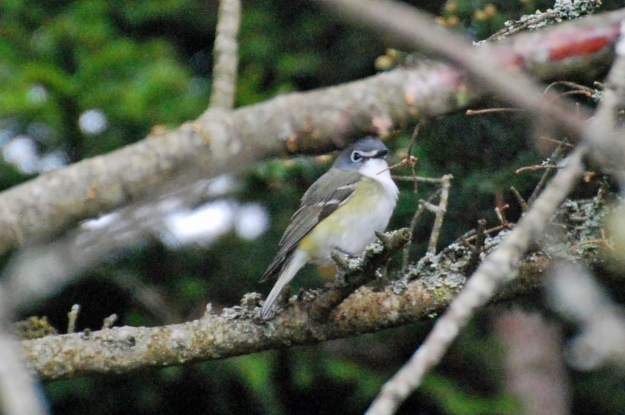
Photo by Bryan Stevens • Blue-headed vireos, such as this bird, are high-elevation summer residents in the region. In the fall, they are also common migrants.

Evening and lunch programs will take place in Roan Mountain State Park’s Conference Center and unless other noted, field trips will leave from the field on the left before the cabins in the park.

In addition to the programs, morning and afternoon walks will be held Saturday and Sunday on a vast array of subjects, including birds, salamanders, butterflies, spiders, snakes, geology, mosses and liverworts. A “moth party” will be held after the Friday and Saturday programs. Larry McDaniel will host this party taking a look at these winged nocturnal insects outside the Conference Center.

Consider joining the Friends of Roan Mountain, if you are not a member. Members get free admission to all Naturalists Rally events and the newsletter, “Friends of Roan Mountain.”

The rally offers catered evening meals by City Market of Elizabethton, as well as brown bag lunches on Saturday. All meals must be pre-paid in advance.

Registration and payment for meals and other activities can be made at the website for Friends of Roan Mountain at friendsofroanmtn.org. The website can also provide a brochure for download that offers a complete schedule and details all the available activities at this year’s rally. Whatever your interest, the Roan Mountain Fall Naturalists Rally is sure to have an activity available. For local birders, it’s often the kick-off to the fall migration season as warblers, vireos, thrushes, tanagers, birds of prey and many other species pass through the region on their way to their wintering grounds.

Tanager-Sept18

Photo by Bryan Stevens • A female scarlet tanager is a study in contrast from her mate with her dull greenish-yellow plumage being much less vibrant than the male’s bright red and black feathers.

Reader’s mystery bird turns out to be Louisiana waterthrush

On occasion, readers seek out my help with identifying birds they encounter. I am always glad to assist. Photographs, a recording of the bird’s song, or even a well-written description are often all that’s necessary to pinpoint the identities of mystery birds.

Lewis and Jeana Chapman, residents of Laurel Bloomery, Tennessee, notified me in an email that they have been enjoying some good birdwatching trips. They also wanted some help with the identity of a bird they observed last summer.

NoWaterthrush

Photo by Bryan Stevens • The Northern waterthrush, pictured, has a beige eye line rather than the white one usually shown by the Louisiana waterthrush.

“My wife and I love to go to the Creeper Trail in Virginia and enjoy the creek,” Lewis wrote in an email. “On these trips in the summer months, we have watched this bird run along the rocks of the shore feeding.”

He also mentioned that he had attached in his email some photos, which proved extremely helpful. “Our closest guess at what type of bird it is was a spotted sandpiper, but its beak/bill seems too short. Any help you can give us would be greatly appreciated.”

A quick scan of the photos the Chapmans sent with their email helped me narrow the options down to two related birds — a Louisiana waterthrush and a Northern waterthrush. I used three criteria — location, season and plumage — to identify the bird in their photos as a Louisiana waterthrush.

Louisiana Waterthrush

Photo by Adobe Stock • Subtle plumage differences, as well as habitat, behavior and seasonal presence, are factors in distinguishing the Louisiana waterthrush, pictured, from the closely related Northern waterthrush. The Louisiana waterthrush nests along fast-moving streams in the area while the Northern waterthrush does not breed in the region.


The Chapmans had good reason to suspect the bird might have been a spotted sandpiper, but for the true identity of the bird in question, it’s necessary to delve into the family of warblers, which includes species such as American redstart, ovenbird, common yellowthroat, Northern parula and black-throated blue warbler.

The two waterthrushes are very similar in appearance. Louisiana Waterthrushes has a heavier bill and a white eye line, while the Northern Waterthrush’s eye line is usually somewhat yellowish-beige. A Louisiana waterthrush typically also has a whiter belly and underparts.

Appearance wasn’t even the most important element of the criteria. Location and season more readily helped confirm the identity. The Louisiana waterthrush has a range concentrated on the southern part of the eastern half of the United States, mostly south of the states of New York, Michigan and Wisconsin. In this region, only the Louisiana waterthrush is known to nest. The Northern waterthrush is strictly a spring and fall migrant, electing to nest near bogs and slow streams in Canada and the northern tier of states in the United States.

The Louisiana waterthrush also attracts attention with its characteristic “teetering” gait. Much like the spotted sandpiper, this waterthrush bobs the rear half of its body up and down as it walks and forages by the sides of streams. In their behavior, this shorebird and this warbler are very much alike. The waterthrush will often turn over wet leaves or other stream debris to search for prey items, such as aquatic insect larvae, crustaceans, snails and even small fish. The Louisiana waterthrush was once known as the water wagtail, which makes reference to the aforementioned teetering gait.

Waterthrush-Painting 2

Early artist and naturalist John James Audubon painted this Louisiana waterthrush.

Many warblers have shown signs of decline in recent years. The Louisiana waterthrush, however, appears to have bucked that trend. According to the website All About Birds, Louisiana waterthrush populations were stable between 1966 and 2015, based on statistics from the North American Breeding Bird Survey. Partners in Flight estimates a global breeding population of 360,000, with almost all of those individuals spending at least part of the year in the United States. About a quarter of the population retreats into Mexico during the winter season. The rest winter in Florida and some of the Gulf Coast states, as well as the islands of the Caribbean.

While most songbirds are fortunate to survive two or three years in the wild, at least one Louisiana waterthrush lived to the age of at least 11 years and 11 months. The bird, a male, was seen in New Jersey in the wild and identified by a band on one of his legs. He had been banded in the same state, according to All About Birds.

The two waterthrushes are the only species in the genus Parkesia, so named to honor American ornithologist Kenneth C. Parkes, who was for many years Curator of Birds at Carnegie Museum of Natural History. The common name of the Louisiana waterthrush is not a very apt one, as this bird does not have any special affinity for the state of Louisiana. Someone collected some of the early specimens of the Louisiana waterthrush in its namesake location, and the name has stuck through the years.

Waterthrush

Photo by Bryan Stevens • Even in migration, both waterthrushes like to stay near water.

Not every bird mystery that comes my way via Facebook or in an email is so easily resolved. This identification, which happened to involve the New World warblers, my favorite family of birds, once again showed me the amazing diversity of this group of birds. From the terrestrial Louisiana waterthrush to the treetop-dwelling cerulean warbler, it’s an amazing group of songbirds I’m always happy to introduce to bird enthusiasts.

Although graceful in the water, life gets awkward for grebes on land

As the calendar moves into the months of October and November, migrating waterfowl will replace the exodus of songbirds that evacuate the North American continent every fall in preparation for their winter season in the tropics. The umbrella term of waterfowl can include such birds as ducks, geese, loons and grebes.

Pond-Edge-Grebe

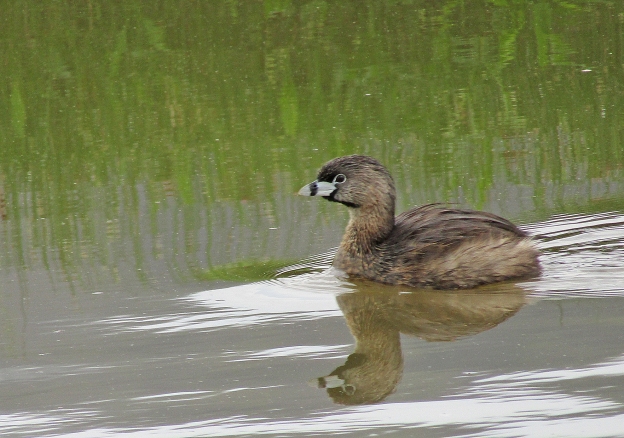
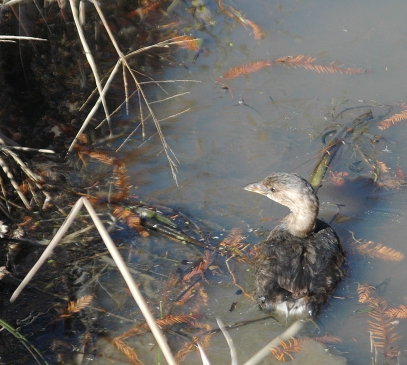
Photo by Bryan Stevens • This pied-billed grebe stranded itself on a wet lawn during fall migration. A grebe’s legs are positioned so far back on their bodies that grebes have difficult walking on land. Once released in a pond, the grebe was able to take flight and continue its migration.

That last family keeps one of the lowest profiles among the grouping of birds lumped together as waterfowl. Worldwide, there are 22 species of grebes. This family also includes three extinct species — Alaotra grebe, Atitlán grebe and Colombian grebe.

Many people are unaware of the grebes. After all, they are oddball birds with not a lot in common with other waterfowl such as loons and ducks. In eastern Tennessee, southwestern Virginia and western North Carolina, the pied-billed grebe is the most likely member of the grebe family to come into contact with humans. The pied-billed grebe’s scientific name, Podilymbus podiceps, can be roughly translated as “rear-footed diver.” The reference is to the fact that this grebe, as well as others of its kind, have their feet positioned so far back on their bodies that movement on land is difficult and awkward.

The pied-billed grebe has inspired a variety of other common names, including American dabchick, dabchick, Carolina grebe, devil-diver, dive-dapper, hell-diver, pied-billed dabchick, pied-bill, thick-billed grebe and water witch, all of which reflect this grebe’s almost exclusively aquatic lifestyle.

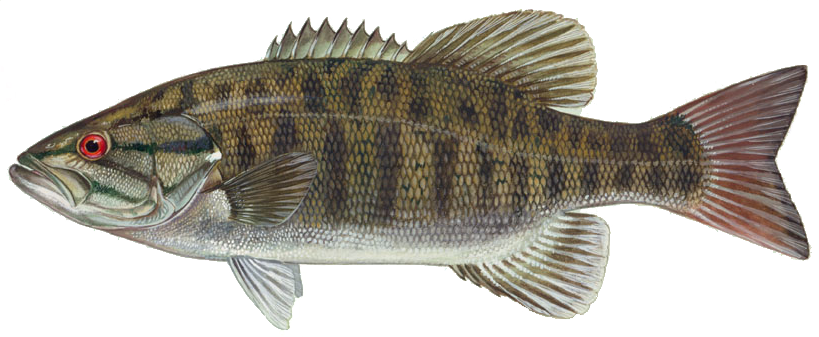
The pied-billed grebe is a world-class survivor. Already a member of an ancient family of birds, this species has outlasted the others in its genus. The Atitlán grebe, which was also known as the giant grebe, went extinct around 1989 after a series of catastrophic setbacks, including a devastating earthquake and the introduction of smallmouth and largemouth bass to Lake Atitlán in Guatemala. The bass consumed the prey this grebe needed for its survival, and large bass occasionally ate young grebes.

Smallmouth bass.png

Bass introduced into Lake Atitlán consumed the small fish that the Atitlán Grebe              required as a food source. Large bass also ate young grebes.


These birds range in size from the least grebe, which weighs only about six ounces, to the great grebe, which can tip the scales at four pounds. North American grebes include red-necked grebe, horned grebe, eared grebe, Clark’s grebe and Western grebe. In extreme southern Texas, birders can find least grebes in suitable wetland habitats.

With the exception of the least grebe, I’ve seen all of North America’s grebes. During visits to Utah in 2003 and 2006, I observed the sleek, long-necked Clark’s grebe and Western grebe. On a 2006 trip to Utah, I visited Antelope Island State Park and observed tens of thousands of Eared Grebes gathered on the Great Salt Lake for the nesting season. In Tennessee, one of the most reliable locations to find eared grebes is from viewing areas at Musick’s Campground on South Holston Lake, where a small number of these grebes have wintered for many years.

An unusual February fallout back in 2014 resulted in equally unusual numbers of red-necked grebes on area lakes, rivers, and ponds. I’d previously observed this grebe on Boone Lake, South Holston Lake and Watauga Lake in northeast Tennessee.

Grebe-Mallards

Photo by Bryan Stevens • A Red-necked Grebe mixes with Mallards at a pond on the campus of Northeast State Community College in Elizabethton.

Grebes are prone to landing on glistening surfaces — lawns, asphalt parking lots and even paved roads — during migration flights, especially at night during heavy rain. A serious problem arises when the grebe, with those rear-positioned feet, finds itself stranded, unable to take flight again without a paddling run across the surface of a body of water.

One of these strandings was recounted in Rick Knight’s book, The Birds of Northeast Tennessee. On Feb. 13, 1994, a red-necked grebe grounded itself with one of these crash landings onto a parking lot in Elizabethton, Tennessee. The fortunate grebe received a human-assisted rescue, being transported to a small lake near the town for release.

In November of 2011, a neighbor delivered a bird that had landed in his yard and could not take flight. The bird, put into a cardboard box for its own safety, didn’t appear to have any injuries. Once I saw the bird, I realized it was a pied-billed grebe. We released the bird on my fish pond, where the grebe dived and swam extensively before resting for a long period on a muddy edge of the pond. Overnight, the grebe disappeared. I believe the grebe took flight during the night and continued with its fall migration. The incident remains one of my closest encounters with a grebe.

Rescue-GREBE

Photo by Bryan Stevens The pied-billed grebe paddles through the water after it was rescued after a stranding on a lawn.


In the coming weeks and all throughout the winter months, look for pied-bill grebes, as well well as more uncommon grebes like horned grebe and red-necked grebe, on lakes and rivers throughout the region.

•••••
Bryan Stevens lives near Roan Mountain, Tennessee. To ask a question, make a comment or share a sighting, email him at ahoodedwarbler@aol.com.