Category Archives: Tennessee

Phoebe’s return a signal other arrivals due soon

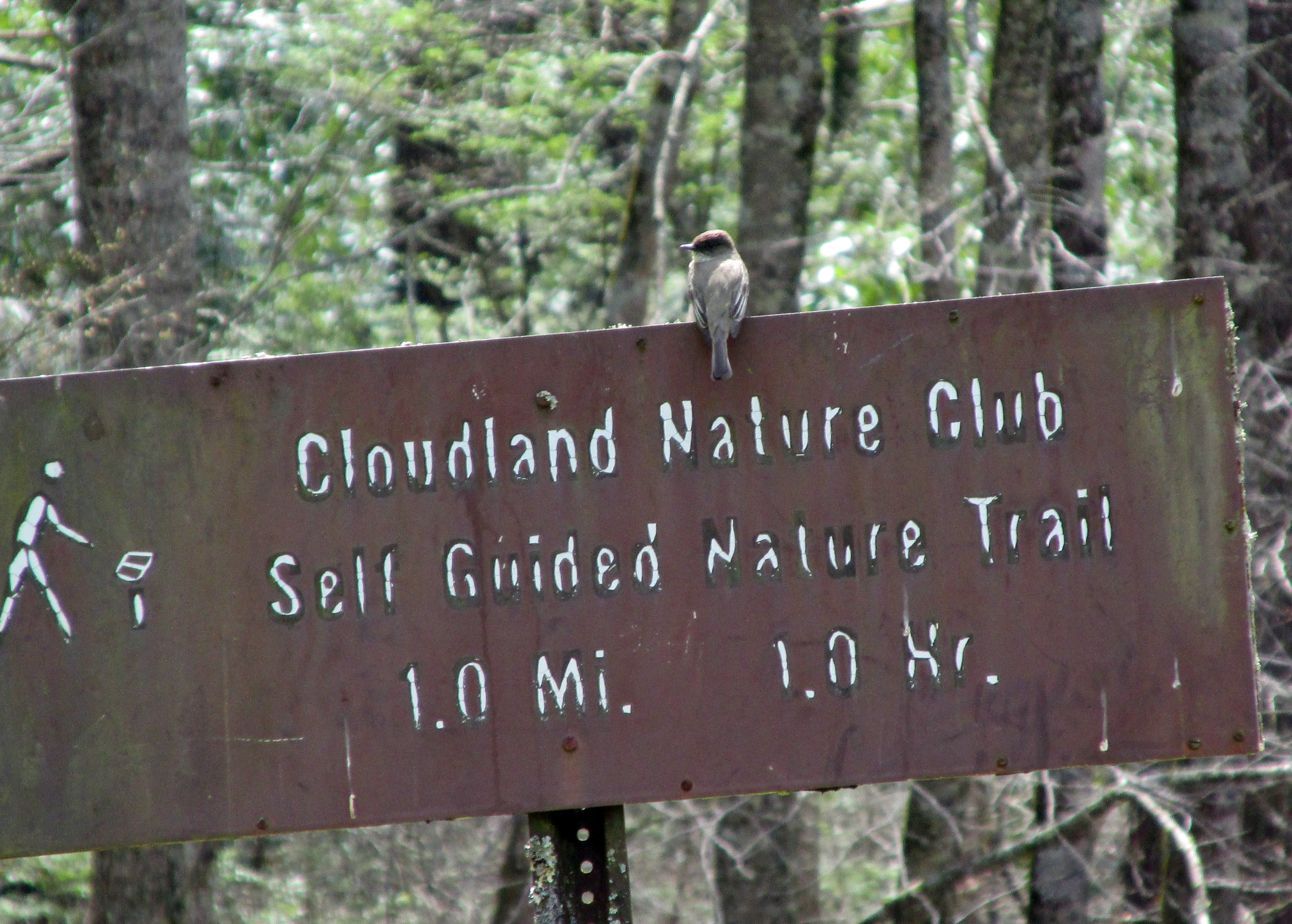
An Eastern phoebe has returned to the woodlands around my home.

I’m not sure when the resident phoebes departed last fall. They were still prominent in their daily activities in late October and early November. I think they probably slipped off, unnoticed, around Thanksgiving. Some winters, a few Eastern phoebes linger throughout the cold months, often near an open source of water that’s unlikely to freeze.

With the arrival of March and warmer weather, at least one Eastern phoebe, a male, is back and singing tirelessly every morning. The song is easy to memorise. The singing bird simply repeats its name — fee bee, fee bee — in scratchy, descending sets of tones.

Considering the bright finery worn by some of the more colorful spring arrivals, Eastern phoebes are comparatively drab. The gray and white plumage of this species of flycatcher pales in comparison with vibrant birds like rose-breasted grosbeak, ruby-throated hummingbird, scarlet tanager and yellow warbler.

Nevertheless, this member of the flycatcher clan has earned itself a favorite spot in the hearts of many a birdwatcher. It’s one of those birds that even beginning birders find surprisingly easy to recognize and identify. While it may not have a dramatic plumage pattern to hint at its identity, the Eastern phoebe is quite at home around human dwellings and comes into close contact with people going about their daily routines. Rather tame — or at least not too bothered by close proximity with humans — the Eastern phoebe has one behavior that sets it apart from all the other similar flycatchers. When this bird lands on a perch, it cannot resist a vigorous bobbing of its tail. Every time that a phoebe lands on a perch, it will produce this easily recognized tail wag. It’s this tell-tale action that makes this bird almost instantly recognizable among birders with the knowledge of this behavioral trait.

Photo by Bryan Stevens • A young Eastern Phoebe perches in the shelter of some branches.

The Eastern phoebe, known by the scientific name of Sayornis phoebe, has two relatives in the genus Sayornis. The genus is named after Thomas Say, an American naturalist. The Eastern phoebe’s close relatives include the black phoebe and Say’s phoebe. The black phoebe ranges throughout Oregon, Washington and California and as far south as Central and South America. As its name suggests, this bird has mostly black feathers instead of the gray plumage of its relatives. The Say’s phoebe, also named for the man who gave the genus its name, is the western counterpart to the Eastern phoebe.

Since they belong to the vast family of New World flycatchers, it’s probably no surprise that these phoebes feed largely on insects. That’s why phoebes overwintering in the region are always found near water. The open water also attracts flying insects. The birds will often perch patiently until an insect’s flight brings it within easy range. A quick flight from its perch usually allows the skillful bird to return with a morsel snatched on the wing. In the winter months, however, the Eastern phoebe also eats berries and other small fruit when insect scarcity makes this exclusive diet almost impossible.

Phoebes are fond of nesting on human structures, including culverts, bridges and houses. With the latter, they were once known for their habit of placing their nests under sheltering eaves. At my home, a pair of Eastern phoebes often chooses to nest on the wooden rafters in my family’s garage. Phoebes also like to reside near a water source, such as a creek, stream or pond.

Although the species is migratory, a few hardy individuals will usually try to tough out winters in the region. The others that depart in the autumn will migrate to the southern United States and as far south as Central America. On some rare occasions, Eastern phoebes have flown far off their usual course and ended up in western Europe. I can usually count on Eastern phoebes returning to my home in early March, making them one of the first migrants to return each year.

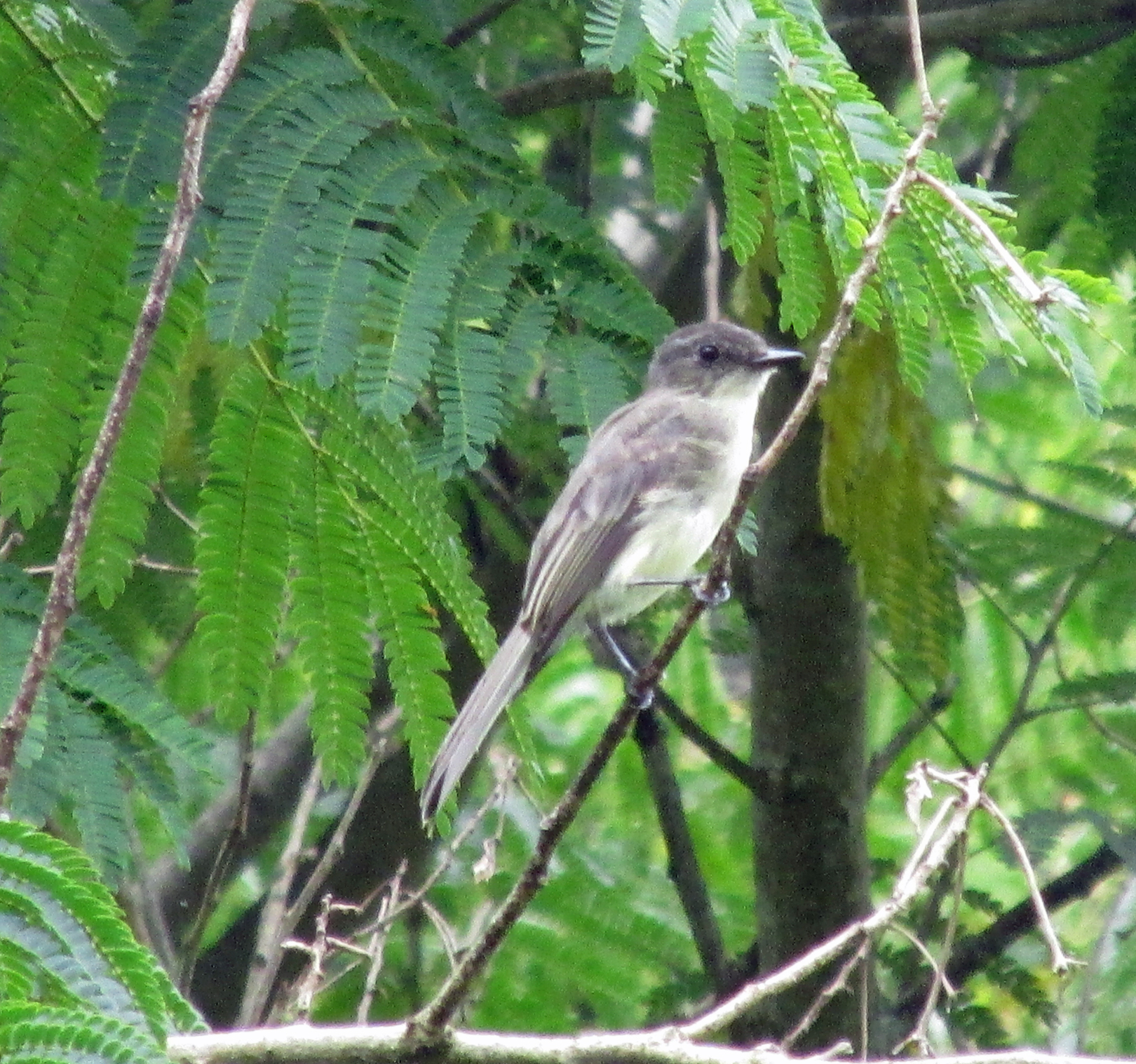
Photo by Bryan Stevens • An Eastern Phoebe perches in a mimosa tree.

This year, like the dependability of clockwork, I began hearing that easily recognized song on mornings during the first days of March when I walked to my car to depart for work. It’s due to their noisy nature that their arrival rarely goes unnoticed. Males tend to start singing persistently as soon as they arrive. I doubt it will take the male residing near my home long to attract a mate.

John James Audubon, an early naturalist and famed painter of North America’s birds, conducted an experiment with some young phoebes. His simple test represents the first-ever bird banding in the United States of America. His novel experiment, which he carried out in 1803, involved tying some silver thread to the legs of the phoebes he captured near his home in Pennsylvania. He wanted to answer a question he had about whether birds are faithful to home locations from year to year. The following year Audubon again captured two phoebes and found the silver thread had remained attached to their legs. Today ornithologists still conduct bird banding to gather information on birds and the mystery of their migrations.

So, that pair of phoebes that returned to your backyard this spring — they just might be the same ones that have spent past summer seasons providing you with an enlightening glimpse into their lives.

Over the past few years, I’ve had a pair of Eastern phoebes nest on the blades of a ceiling fan on my front porch. Other past nesting locations have included the rafters in my garage. If a pair happens to take up residence on your own front porch or in your garage, I hope you’ll welcome them. The pleasure of observing them raising their family will more than compensate for a slight mess and a few weeks of inconvenience.

••••••

To learn more about birds and other topics from the natural world, friend Bryan Stevens on Facebook at https://www.facebook.com/ahoodedwarbler. He is always posting about local birds, wildlife, flowers, insects and much more. If you have a question, wish to make a comment or share a sighting, email ahoodedwarbler@aol.com.

Birds make use of various strategies to attract and keep mates

Shauna Fletche/Pixabay • Some birds, like waxwings, like to present tasty treats to their potential mates.


With Valentine’s Day around the corner, it’s an opportune time to see how courtship is handled among our fine feathered friends. Most birds don’t bring a box of chocolates or a bouquet of roses when they take up courtship of a prospective mate, but birds have several equivalent behaviors that they employ to attract the attentions of the opposite sex. In honor of Valentine’s Day I thought a look at some of the more unusual courtship rituals of some of our feathered friends would be appropriate.

Aerial acrobatics designed to impress

In late winter and early spring, a true oddball begins courting. The American woodcock, also known by such whimsical names as “bog sucker” and “timberdoodle,” is a shorebird that has completely abandoned the shore in favor of woodlands and fields. Beginning as early as February, American woodcocks in the region conduct nightly courtship displays, starting at dusk, that combine aerial acrobatics with an assortment of unusual acoustical flourishes. Any wet field adjacent to a wooded area could offer a stage for these evening displays, but unless you know where to look and make an effort to do so, the American woodcock might as well remain a phantom of the night.

These mating rituals provide almost the only time of the year during which this bird makes itself available for observation. It’s only during this brief window that opens into their lives that we can be assured a glimpse. Even then, our peeks at woodcocks often consist of a fuzzy twilight escapade as the bird flings itself heavenward only to make a spiraling descent a few seconds later. The displays begin with a distinct vocalization, a type of “pent,” that also has the quality of sounding like some sort of mechanical buzzer.

Once the displays conclude for the season, the birds assume nesting duties, usually unobserved by humans. The rest of the year, almost nothing but blind, sheer luck would allow a birder to stumble across an American woodcock. It’s almost as if they disappear after these spring flights of fancy.

Birds bearing gifts

Many birds present small trinkets to a prospective mate. For instance, many male penguins make a present of a stone or pebble to female penguins. There could be more than a simple bribe behind this gift. Female penguins don’t build elaborate nests. In fact, a scrape on the bare ground, perhaps encircled by a collection of pebbles, marks the extent of their nest construction. So, the perfect pebble could be the way to winning a female penguin’s heart.

The way to the heart is through the stomach

Observant birders may have witnessed a male Northern cardinal slip a female a morsel of food, such as a peanut or a shelled sunflower kernel. It’s a marked change for this bird. During the winter months, a male cardinal is more likely to chase a female away from a feeder rather than share food with her. However, as spring approaches, his behavior undergoes a change and he becomes content to feed next to a female cardinal, often slipping her some choice tidbits.

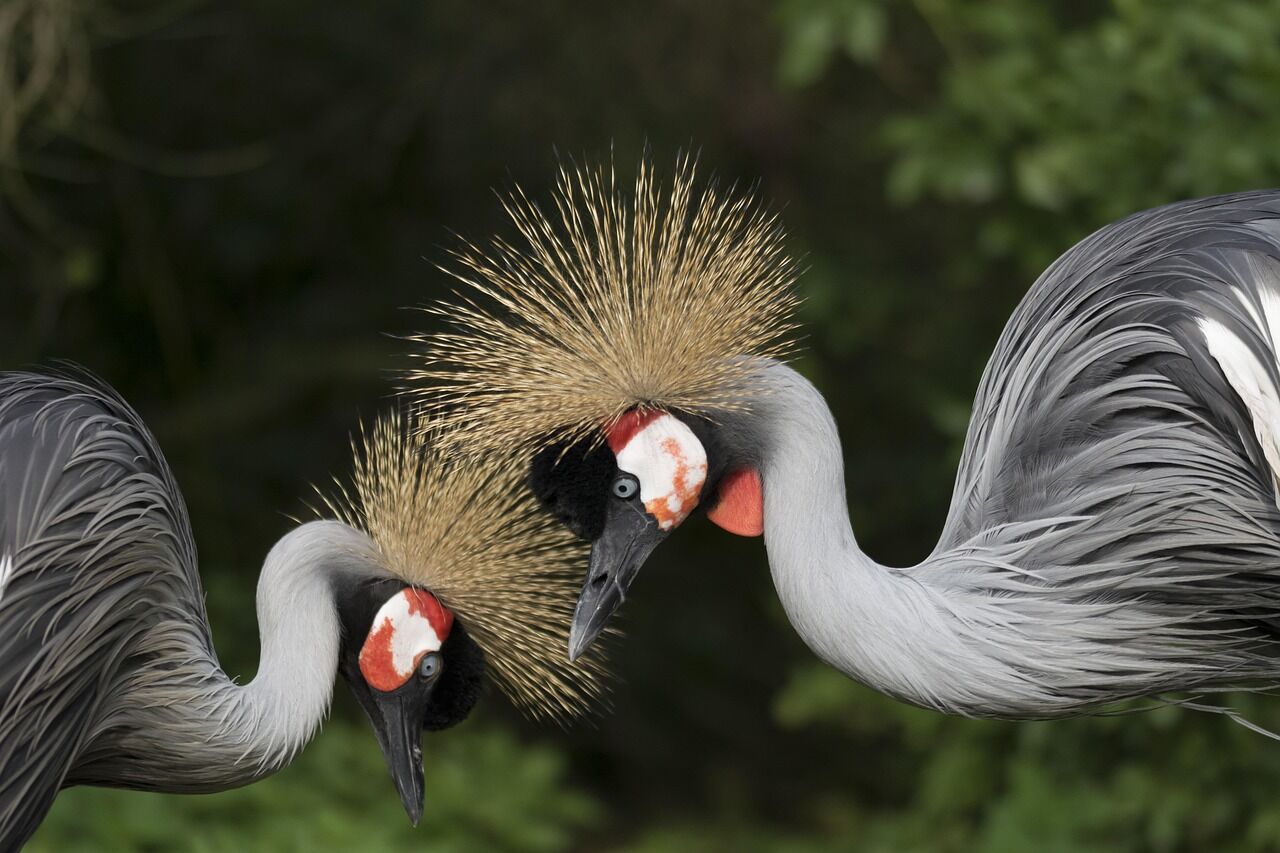
Sabine van Erp/Pixabay • Bow to your partner: Grey-crowned cranes perform an elaborate dance designed to strengthen their bond.

May I have this dance?

Many species of birds perform elaborate and ritualistic dance displays. Among birds known for tripping the light fantastic are flamingoes, cranes, grouse and grebes. Cranes are one of the oldest families of birds on earth. They’re also some of the most accomplished dancers in the animal kingdom. Pairs perform very ritualistic dances that, if the performers were human, would no doubt require the services of an accomplished choreographer. Cranes mate for life and the ritual of dancing is a way to strengthen the bonds between a mated pair. The ability to dance is, apparently, not instinctive. Young cranes must practice their dance moves, a process that can take years before they master the elaborate dance.

Dave Menke/U.S. Fish & Wildlife Service • A pair of Clark’s Grebes displays in a courtship ritual known as “rushing” or “weed dance.” Birds use a variety of strategies to attract and keep mates.

Synchronized swimming

While many birds dance to impress a mate or strengthen pair bonds, grebes perform a dance that takes place completely on the surface of the water. A pair will engage in this intricate performance, perfectly mirroring the moves of the other as they literally race across the surface of the water. These dances by grebes are also known as “rushing” or “weed dance.” It’s called as a weed dance because at the culmination of the ritual, the birds usually hold some type of aquatic plants in their bills while racing swiftly over the surface of the water. Pairs that perform well together stay together, building a nest and raising young.

Good housekeeping seal of approval

The tropical family of bowerbirds are famous for complex nests built by males and then decorated with bright and colorful objects to catch the eye of a potential mate. The nests of these birds are actually referred to as a “bower.” Usually constructed on the ground, the male will line the approachs to the bower with items such as shells, leaves, flowers, feathers, stones, berries, and even discarded garbage, including plastic scraps or bits of glass. Unusually odd items pressed into these decorative displays have included coins and spent rifle shells. This habit of male bowerbirds must rank as the ultimate in trying to impress a mate with shiny bling.

These are just a few of the inventive ways that birds go about attracting and keeping mates. Perhaps you can pick up some pointers from our feathered friends to ensure you have a great Valentine’s Day this year.

•••

If you have a question, wish to make a comment or share a sighting, email me at ahoodedwarbler@aol.com.

Tree swallows are the latest spring arrivals

Photo by Bryan Stevens • A tree swallow checks out a nesting box soon after returning in the spring.

Waiting for spring? Join the club. Between alternating bouts of unseasonably warm temperatures and frigid blasts, the weather cannot seem to decide if winter’s hanging in there a little longer or if it’s time to proceed with spring’s arrival.

I’m hopeful it’s the latter. I enjoyed a stroll in the spring sunshine on March 30 along the section of the trail near the industrial park. From the boardwalk over the water I saw my first spring swallows (a purple martin and a couple of Northern rough-winged swallows) as well as a belted kingfisher and several American robins. I also saw my first dragonflies and butterflies of spring, as well as one muskrat enjoying a leisurely swim.

Early Birds

One might think that the wild swings in weather would translate into a messy arrival timetable for some of our returning birds, but so far my own personal observations indicate a different story. At home, the usual spring “early birds,” including wood duck, red-winged blackbird, blue-headed vireo, ruby-crowned kinglet and brown thrasher, have been their usual punctual selves.

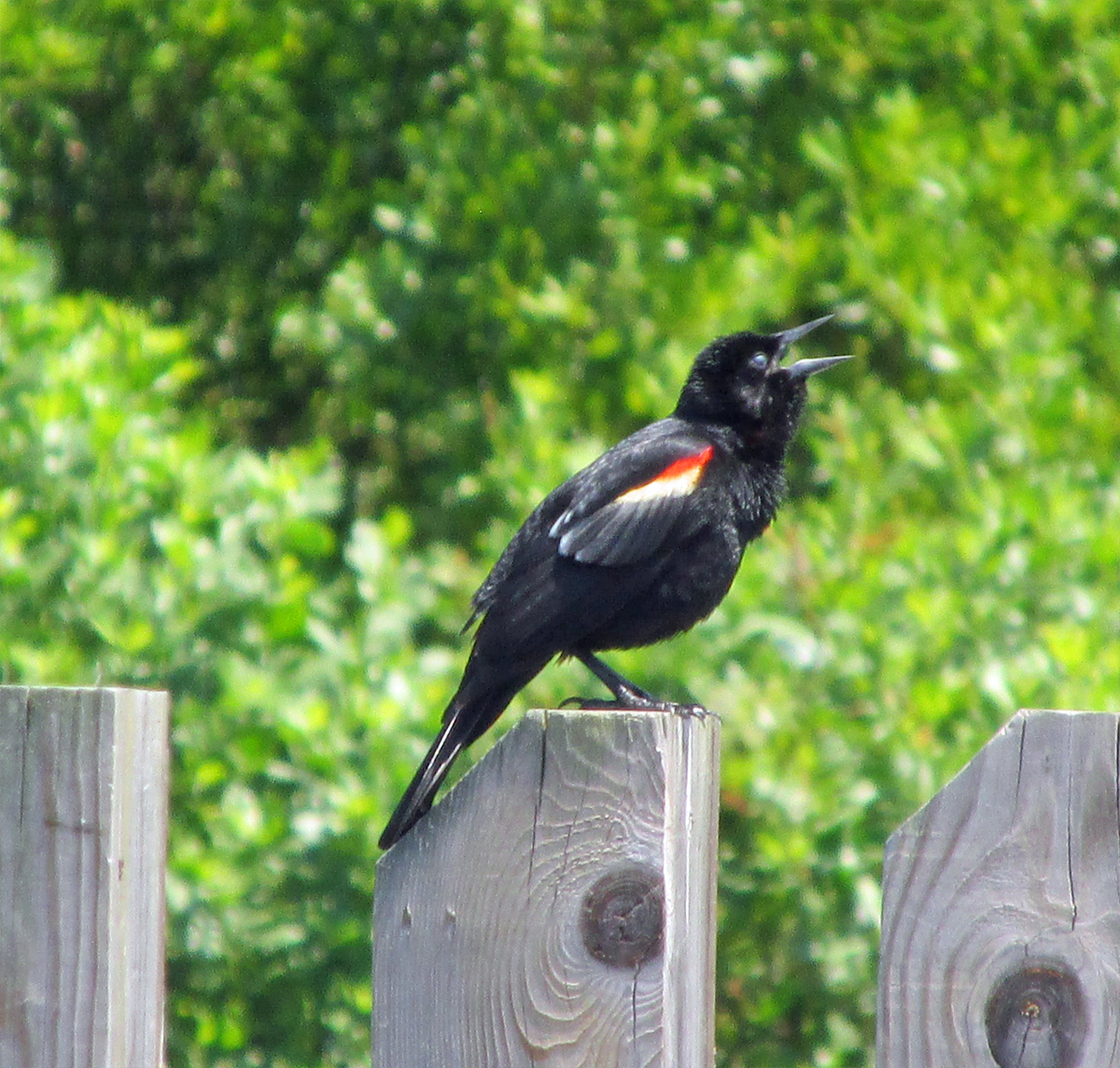
Photo by Bryan Stevens • A male red-winged blackbird sings to attract mates and ward off rivals.

The swallows I saw during my Erwin stroll, however, reminded me that one bird hasn’t returned at my home. The early American naturalist and artist John James Audubon knew this particular bird as “white-bellied swallow,” which is a descriptive name, but today the species is known simply as tree swallow.

Tree swallows have been back in the region for weeks, but they sometimes take their time finding their way to the waiting birdhouses at my fish pond. Their return dates in years past have ranged from early March to the middle of April.

Insect-heavy Diet

Swallows are insectivores, so those that return early in the spring must deal with temperature fluctuations. In prolonged cold spells, these insect-eating birds can be hard pressed to locate their usual prey. At such times, they are often forced to retreat to the area’s lakes and larger rivers, where they can swoop over the water and have an easier time plucking cold-numbed flying insects out of the air.

https://www.youtube.com/watch?v=O9-NARokjQI

Once milder spring temperatures prevail, the flocks of swallows forced into these necessary habitats will disperse as pairs begin seeking nesting sites. Tree swallows are cavity-nesting birds, which often puts them into competition with Eastern bluebirds. The two species usually manage to work out a truce and settle down to nest in close proximity to each other.

The iridescent blue-green male tree swallow, complete with white underparts and a forked tail, is a handsome bird and a welcome addition to the bird population in any yard or garden. Tree swallows enjoy water, so a nearby pond or creek is a boon for attracting these birds.

Tree swallows haven’t always nested in Northeast Tennessee. Only in the last 40 years have these birds become regular nesting birds in the region. The first nesting record took place in the early 1980s at Austin Springs on Boone Lake in Washington County, Tennessee, according to The Birds of Northeast Tennessee by Rick Knight. Tree swallows soon became regular nesting birds every summer in all five counties that comprise Northeast Tennessee.

Other Swallows

It’s usually not too difficult to find five of the six species of swallows that are known to make Northeast Tennessee and Western North Carolina their home from spring to fall. In addition to tree swallow, the region’s other swallow species include: barn swallow, purple martin, cliff swallow and northern rough-winged swallow. These are all fairly common summer birds in the region. The sixth species, the bank swallow, is a bit of a specialist when it comes to nesting and occurs only sporadically in the region.

While only a handful of swallows range into the United States and Canada, a total of 83 species of swallows can be found worldwide. Some of the common names for these different swallows (also called martins in other parts of the world) are quite descriptive. A sampling includes white-eyed river martin, grey-rumped swallow, white-backed swallow, banded martin, blue swallow, violet-green swallow, golden swallow, brown-throated martin, brown-bellied swallow, pale-footed swallow, white-bibbed swallow, pearl-breasted swallow, red-breasted swallow, mosque swallow, fairy martin, pale martin, tawny-headed swallow and streak-throated swallow.

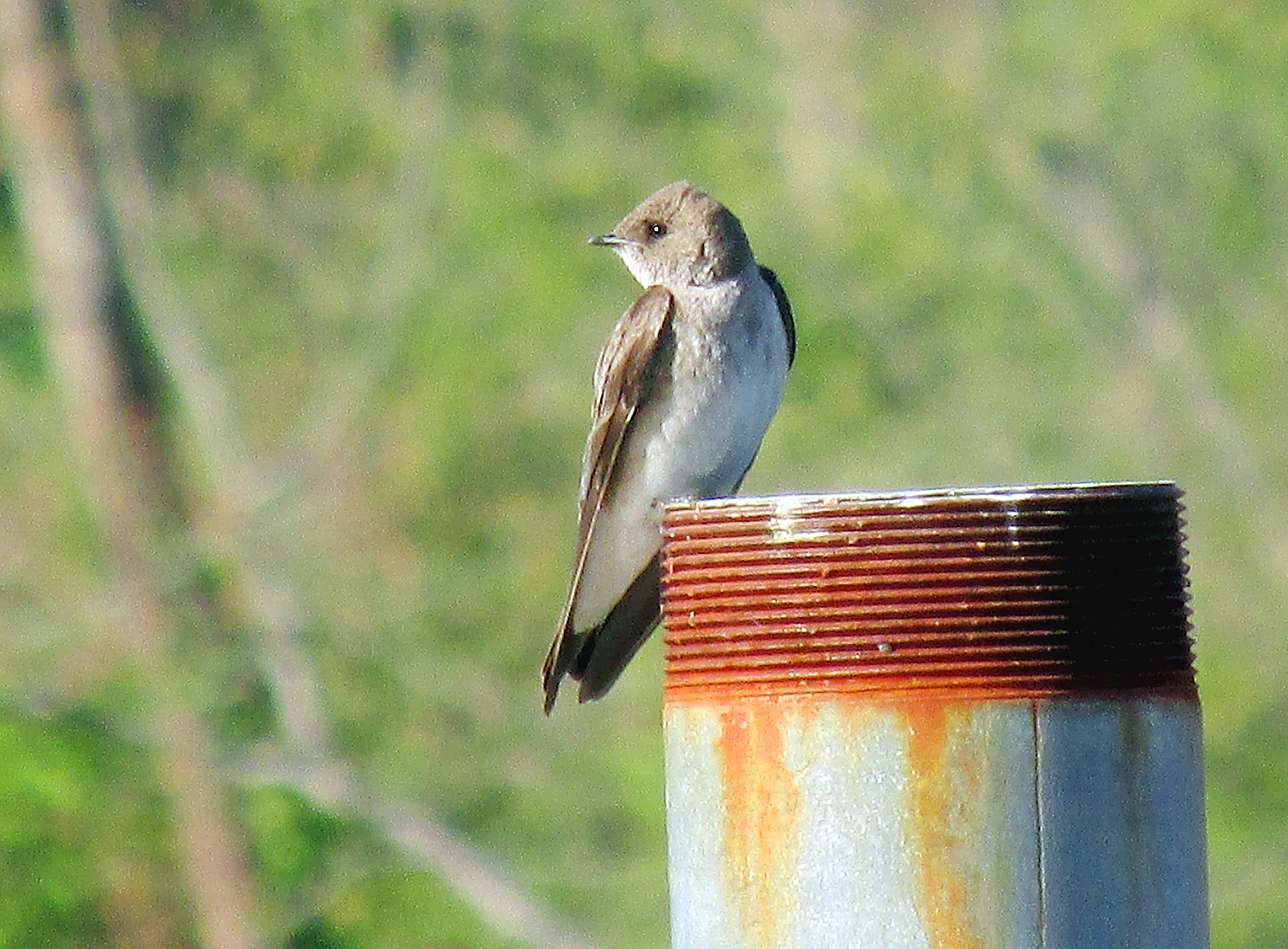
Photo by Bryan Stevens • A Northern rough-winged swallows perches on a metal pipe.

While many swallows and martins have proven highly adaptive when faced with human disturbances to their habitat, a few species have experienced declines. One species — the white-eyed river martin — was last seen in Thailand in the 1980s and very well may be extinct. Closer to home, the golden swallow is now found only on the island of Hispaniola after disappearing from Jamaica in the 1980s. The Bahama swallow, which nests on only four islands in the Bahamas, is also vulnerable. Incidentally, both these swallows are closely related to the tree swallow, with all of them belonging to the genus Tachycineta. Translated from Greek, the genus name means “fast mover,” a quite accurate description of these graceful and agile flyers.

Good 

Neighbors

With their enthusiastic twittering to each other, tree swallows make for friendly neighbors. The local bluebirds may disagree, at first, but they’ll get their feathers unruffled eventually. It’s also a pleasant diversion to watch them swoop over fields and ponds as they help control the insect population.

To increase your chances of hosting your own tree swallows, offer a bird box placed in an open area. Right now is the time to attract their attention with some prime real estate. Plans are available online to help construct your own or pick up one at a gardening center, hardware store or farm supply outlet.

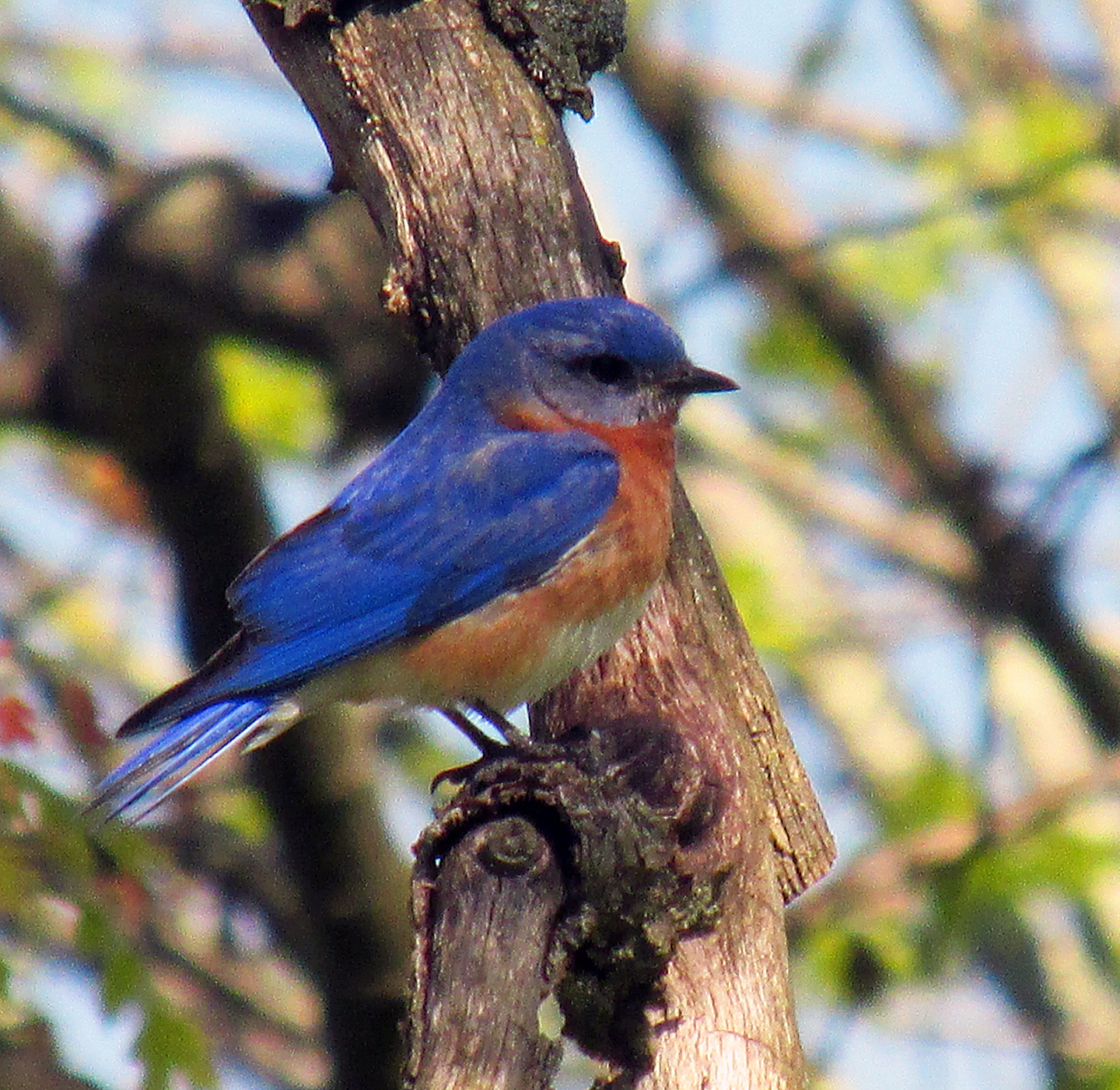
Photo by Bryan Stevens • A male Eastern Bluebird perched on playground equipment at Winged Deer Park in Johnson City.

Many would-be hosts for Eastern bluebirds express disappointment when a pair of tree swallows become tenants instead. The remedy to the disappointment is simple: provide an additional nesting box.  Although there will be some initial squabbles, tree swallows and Eastern bluebirds will co-exist if they don’t have to compete for the same nesting box.

There’s one last selling point I want to mention on behalf of tree swallows. While not exactly songsters, they do produce an energetic, chirpy trill that they vocalize persistently when in the company of their fellow tree swallows. It’s hard not to be cheerful when hearing such a jubilant noise issuing from one of our feathered friends.

Hummingbird Observations

While tree swallows and their kin are great to have back, one of the most anticipated returns each year is the ruby-throated hummingbird. As I’ve done in years past, I want to hear from readers when they see their first hummingbird of spring. Email me your observations at ahoodedwarbler@aol.com or post them on my Facebook page. Please include the date and the approximate time of your sighting. Email me at ahoodedwarbler@aol.com or post on my Facebook to share your first sightings. You can also leave a comment here on the blog.

Common grackles part of November’s changing bird lineup


Photo by Bernell MacDonald/Pixabay.com • Common grackles are quite accomplished at foraging for food in a variety of habitats.

November is a month of transition. The birds of summer have all “flown the coop,” returning to warmer climes to the south in Central and South America, as well as the Caribbean. Of course, even as hummingbirds, warblers, tanagers, vireos, and others have fled North America in advance of winter’s imminent arrival, other birds are arriving to take their place.

Many of the newcomers don’t offer the vibrant plumage of a scarlet tanager or a rose-breasted grosbeak, but they make up for the lack of striking feathers by remaining quite faithful to our feeders during the bleak, short days of winter. A hermit thrush and a dark-eyed junco represented some first-of-autumn arrivals when they showed up Nov. 6, followed the next day by a swamp sparrow. In addition to the sparrow, three ravenous common grackles descended on my suet feeders that same day.

For many bird enthusiasts, the “common” in this particular bird’s name is particularly apt. Tending to form large, noisy flocks, common grackles can easily wear out even the most generous welcome. Perhaps because I live at a mid-elevation area, common grackles are extremely infrequent visitors to my yard. I can be a little more welcoming to a bird that I know is not likely to linger.

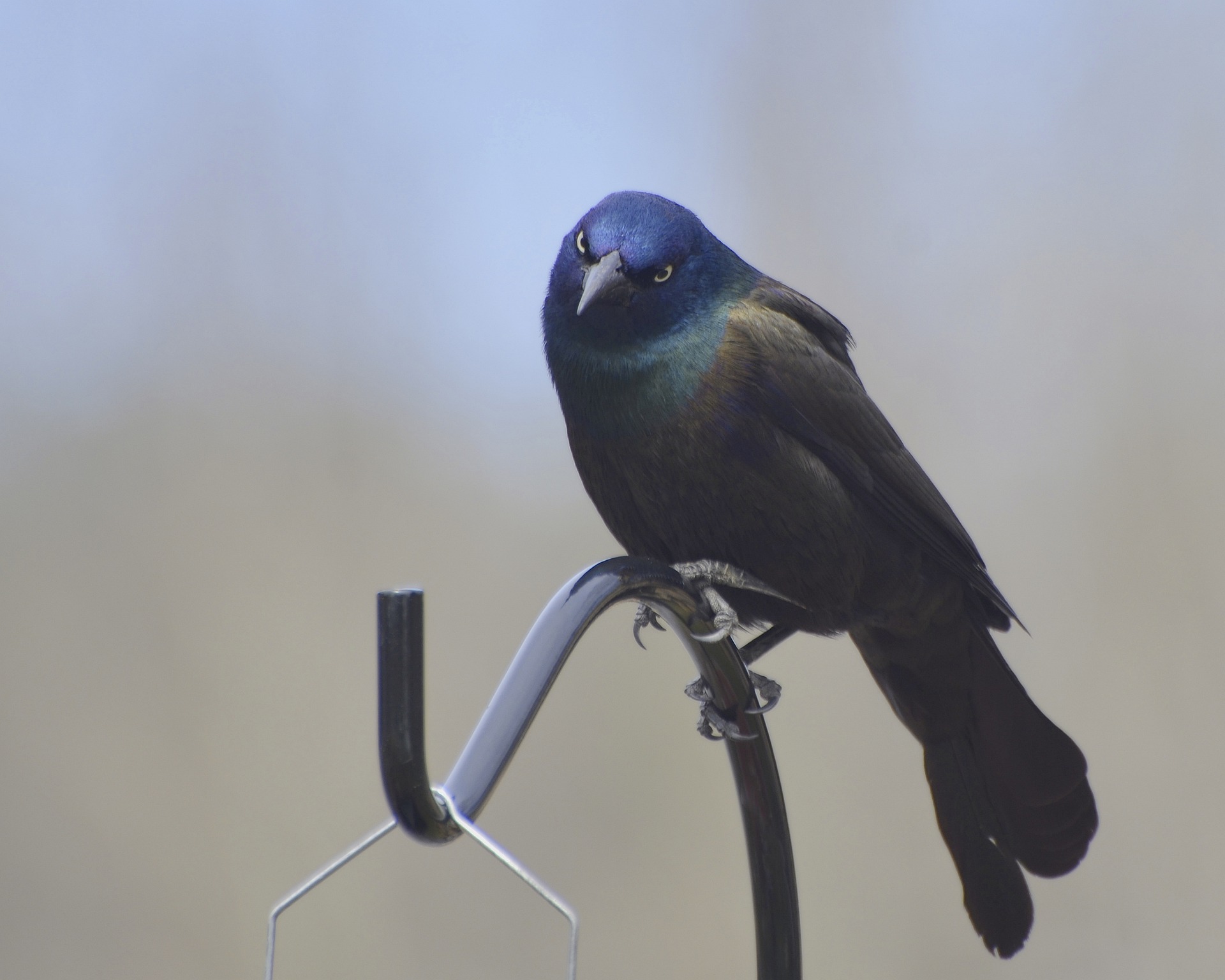
Photo by diapicard/Pixabay.com • A common grackle perches on a shepherd’s hook in a garden. These large birds, which are part of the blackbird family, form flocks and bring big appetites to feeders during migratory stops.

Nevertheless, that same evening these three grackles must have spread the word because a flock of about 30 of these birds arrived. If I needed a reminder, the flock provided a quick one. A handful of grackles isn’t too disruptive, but a large flock can quickly overwhelm and intimidate smaller feeder birds.

Even so, I remain inclusive in my embrace of all feathered friends. A much maligned bird if ever there was one, the common grackle is worth a second look. For those who are able to overlook the occasional bad habits of birds such as Northern mockingbirds, mourning doves, or even cantankerous ruby-throated hummingbirds, there may be hope for this large member of the diverse family of blackbirds, known by scientific types as a member of the family Icteridae. This grouping of New World species, also known as New World blackbirds, includes such members as orioles, meadowlarks, cowbirds, bobolinks, marshbirds, orependolas, caciques and, of course, blackbirds.

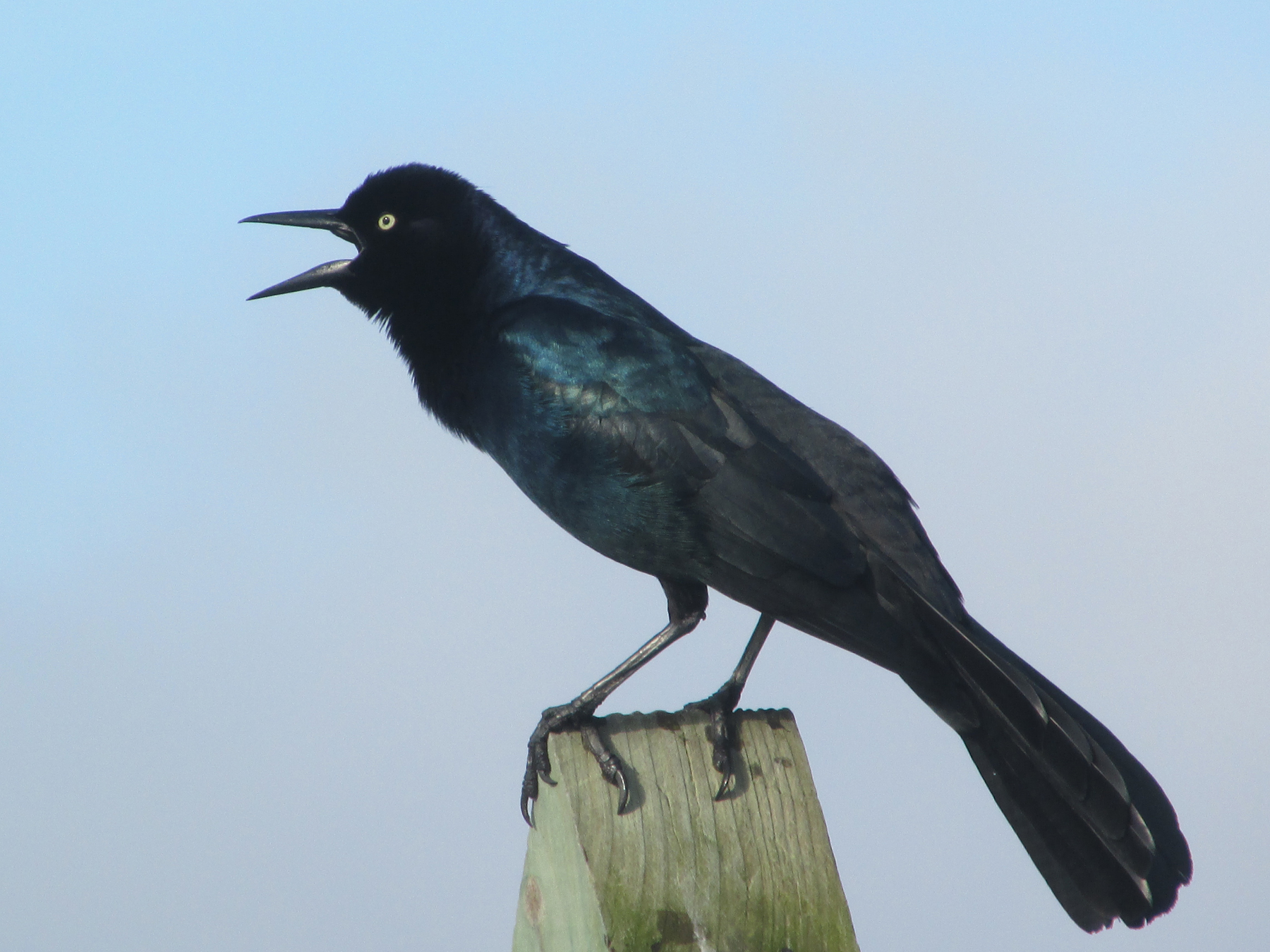
Photo by Bryan Stevens • A boat-tailed grackle sings, if the bird’s harsh, grating notes can be considered a song, from a perch in a wetland in South Carolina.

The common grackle is known by the scientific name Quiscalus quiscula. In the southeast, in particular along the coast and in wetland areas, a common and related species is the boat-tailed grackle. Other species of grackles found in the New World include the great-tailed grackle, Nicaraguan grackle, Great Antillean grackle and the Carib grackle. A little more distantly related are the South American species golden-tufted mountain grackle and the Colombian mountain grackle.

One species — the slender-billed grackle of Mexico — suffered extinction at the dawn of the 20th century. Reasons for this bird’s disappearance are not clearly understood, but habitat destruction of Mexican wetlands and hunting pressures have been theorized as causes. Like others of its kind, the slender-billed grackle may also have been persecuted as an agricultural pest.

Like many other birds dependent on wetlands, common grackles have experienced population declines in recent decades. Although it seems odd to refer to a bird with a population estimated at around 73 million individuals in North America as on the decline, common grackles have suffered an estimated population loss of about 60 percent from historic highs.

Male grackles stand out from other blackbirds due to their sheer size. Males can reach a length of 13 inches, although much of that can be measured in an exceptionally long tail. A grackle’s plumage has a black sheen that can shine with brilliant iridescence that tends to appear purple, green or blue when the sun shines just right on the feathers. Females tend to be smaller than males and are a muted black and brown. Both sexes have long, sturdy bills and yellow eyes.

Most rural residents don’t have to worry about common grackles overwhelming their feeders, but some people living in urban and suburban settings have found grackles to be difficult guests. The birds have bottomless appetites and are aggressive toward more desirable feeder birds. Fortunately, migrating flocks in the fall tend not to linger. After a brief visit, which can still deplete supplies of seed and suet cakes, the grackles continue migrating.

Grackles are usually one of the earliest birds to return each spring. In fact, it’s not at all unusual for these large birds to make their way back to the region as early as late February. I am usually glad to welcome them back since I know that their return is a strong indication that some more favored species are certain to follow in their wake and that winter’s grip is waning.

Are you seeing new arrivals in your yard or at your feeders? Let me know by emailing ahoodedwarbler@aol.com.

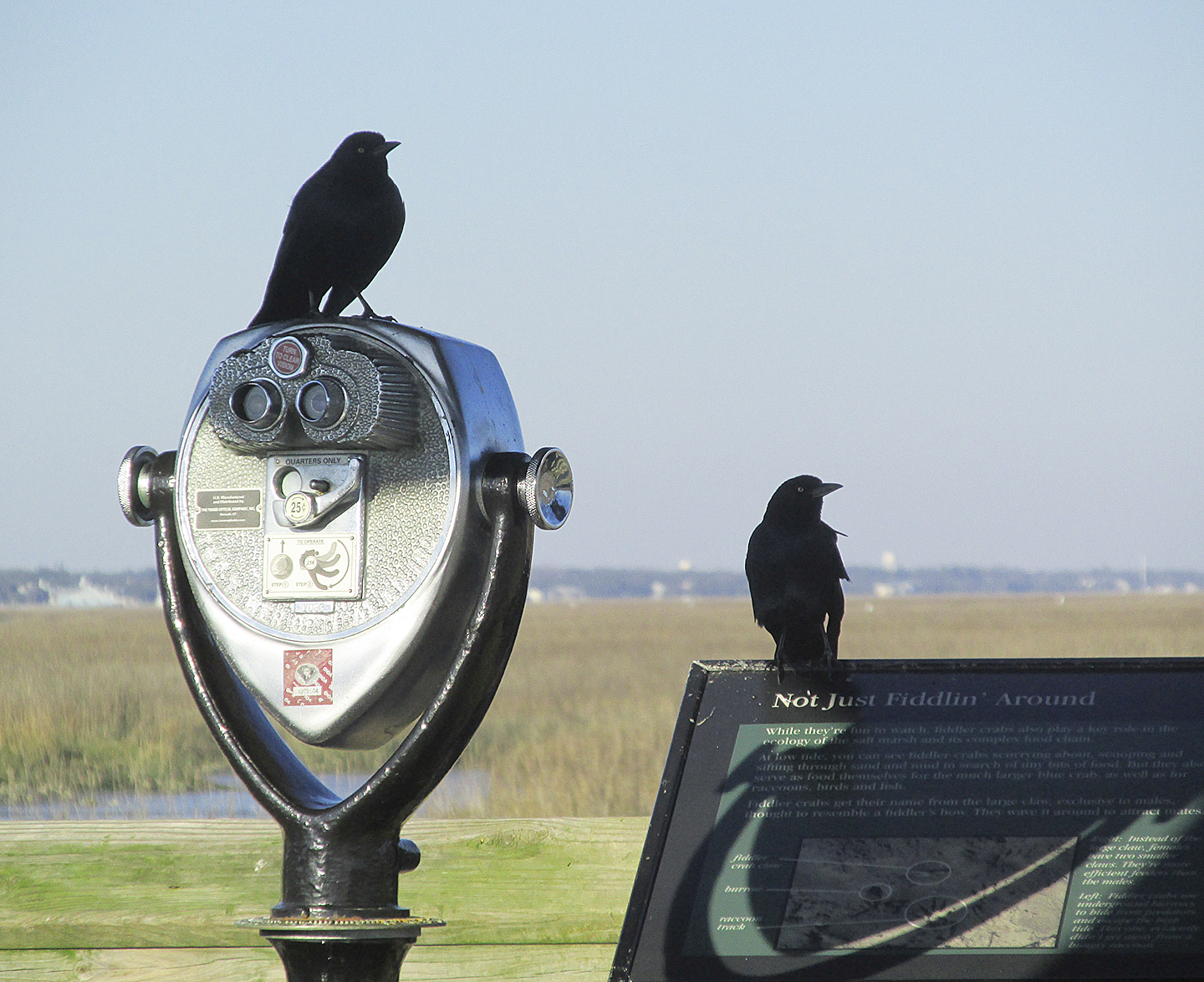
Photo by Bryan Stevens • Boat-tailed grackles perch on viewing equipment at an observation platform at Huntington Beach State Park in South Carolina.

Hummingbirds complete another nesting season before starting south on annual fall migration

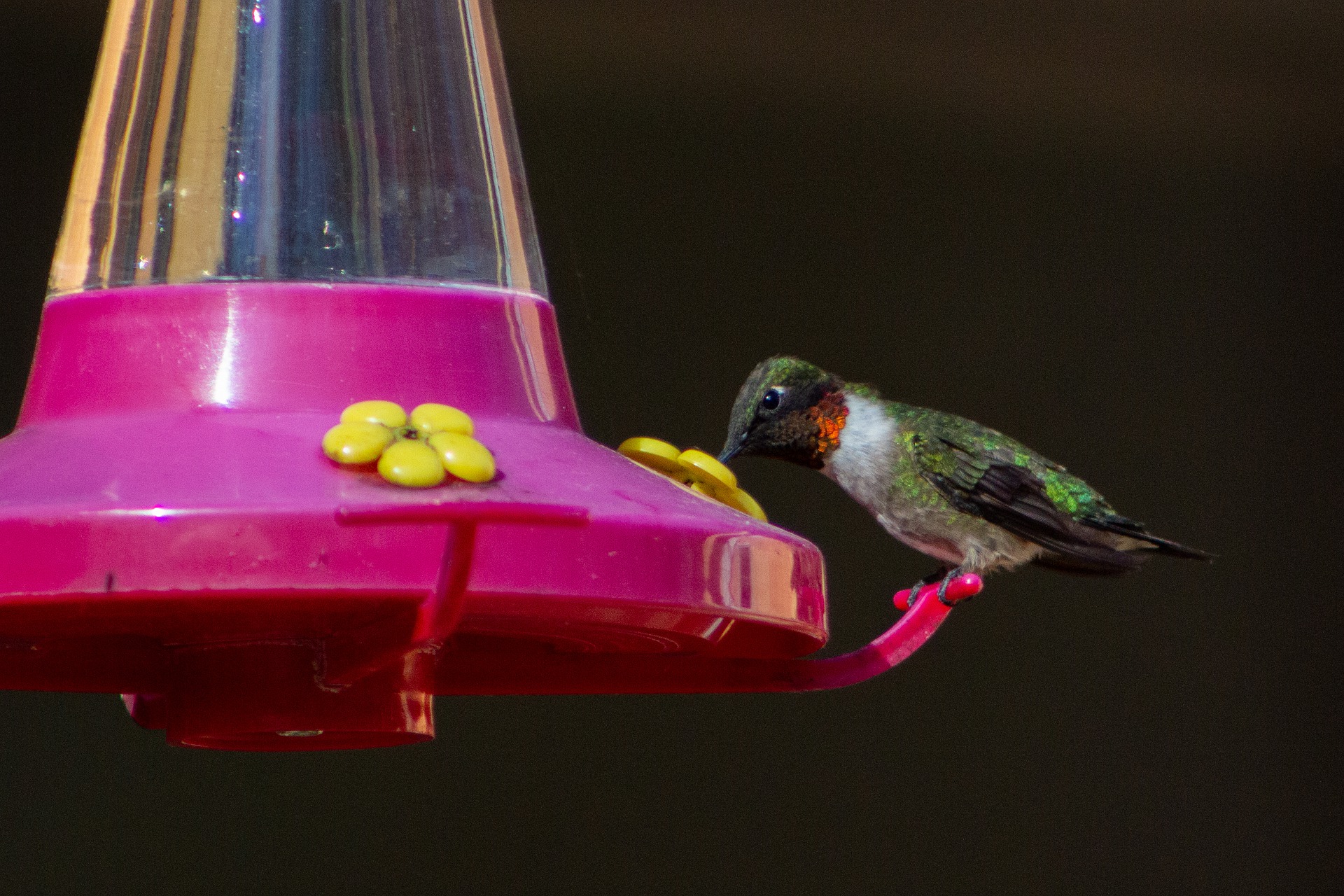
Photo by Katy Jefferson/Pixabay.com • A ruby-throated hummingbird sips sugar water at a feeder. During migration, blooming flowers and sugar water feeders are valuable sources of quick energy for these tiny flying gems.

Mildred Wright of Fall Branch, Tennessee, recently shared a story through Facebook about a nesting hummingbird in her yard.

In this photo provided by Mildred Wright, the young hummingbirds can be glimpsed in their nest.

“I discovered this hummingbird nest in a tree in my front yard,” she wrote in a Facebook message. “I have watched mom take excellent care of her babies through some really rough weather.”

She explained that she found the nest on June 8 and has observed as the female hummingbird incubated her eggs and then raised her two hatchlings.

Interestingly, there are a few simple reasons it’s always two eggs for hummingbirds. First, the nest is so small — about the size of a walnut half-shell — that there is barely room for two eggs, let alone more. Second, once the young hatch, the nest has just enough room to accommodate them as they grow, fed well by their mother. Third, feeding two hungry young hummingbirds is a demanding task. A female hummingbird has to find enough food to fuel her own body and help her young in the nest grow and thrive. It’s a full-time job during the daylight hours. She’s pressed hard to succeed at raising two young. Attempting to care for more would most likely prove impossible.

In this photo provided by Mildred Wright, two eggs are shown snug inside the female ruby-throated hummingbird’s nest.

Now that many female hummingbirds are finishing up the task of bringing forth a new generation of hummingbirds, the leisurely fall migration can begin. Hummingbirds are not as frantic about moving south in the fall as they are single-minded about heading north every spring. Numbers of these birds always reach a peak in late summer and early fall at my home, and this year’s shaping up to be a repeat of past ones.

Hummingbird species number around 340, making the family second in species only to the tyrant flycatchers in sheer size. Both of these families consist of birds exclusive to the New World.

With so many hummingbird species, people have been hard pressed to give descriptive names to all these tiny gems. Some of the dazzling array of names include little hermit, hook-billed hermit, fiery topaz, sooty barbthroat, white-throated daggerbill, hyacinth visorbearer, sparkling violetear, horned sungem, black-eared fairy, white-tailed goldenthroat, green mango, green-throated carib, amethyst-throated sunangel, green-backed firecrown, wire-crested thorntail, festive coquette, bronze-tailed comet, black-breasted hillstar, black-tailed trainbearer, blue-mantled thornbill, bearded mountaineer, colorful puffleg, marvelous spatuletail, bronzy inca, rainbow starfrontlet, velvet-purple coronet, pink-throated brilliant, coppery emerald, snowcap, golden-tailed sapphire and violet-bellied hummingbird.

Photo by Peggy_Marco/Pixabay.com • The “Doctor Bird,” which is also known as the swallow-tailed hummingbird, resides only on Jamaica.

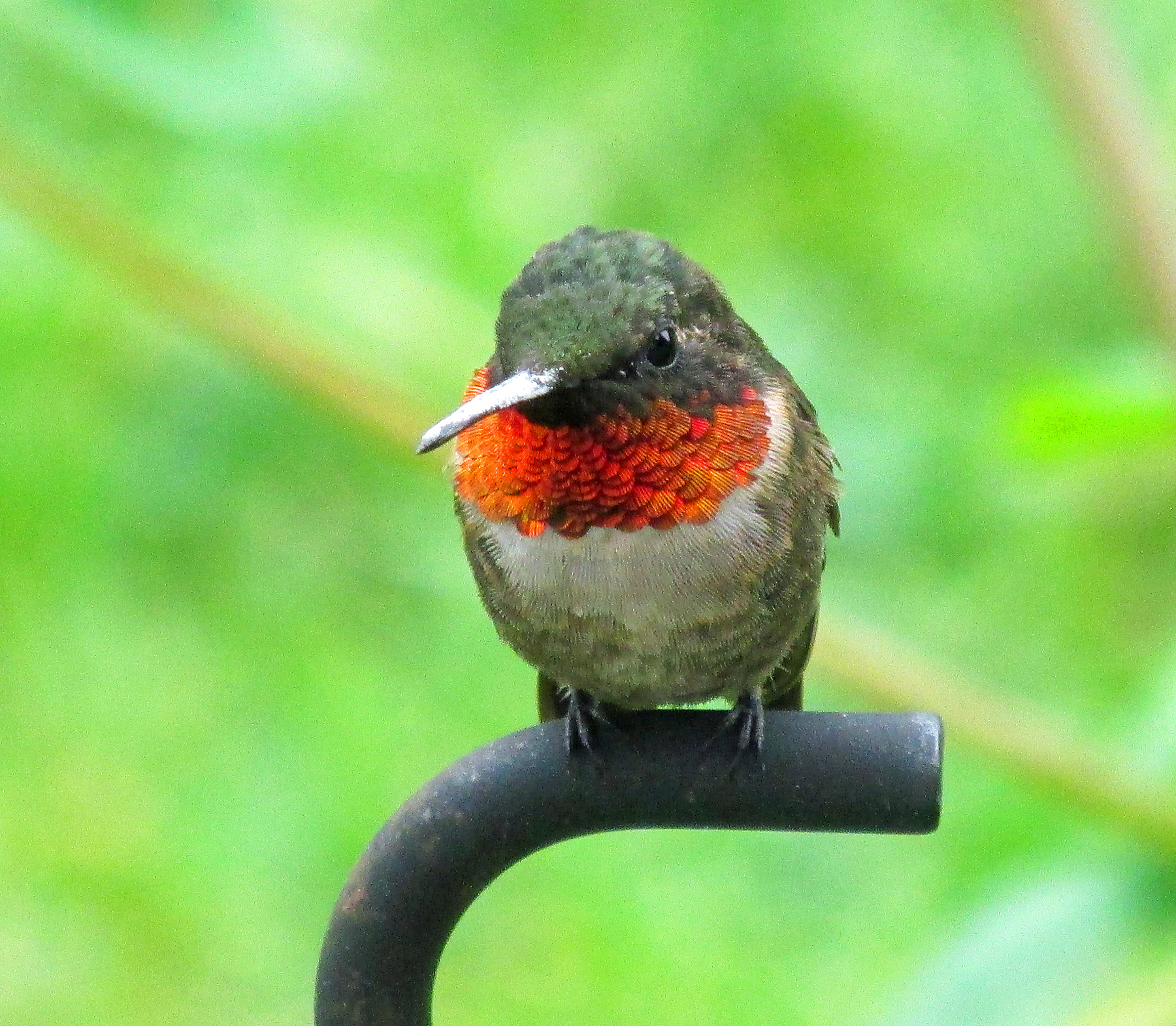
Our own hummingbird, which we can claim from April through October every year, is the ruby-throated hummingbird. Ruby-throats are remarkable birds that nest throughout the eastern United States as well as southern Canada. In winter, most ruby-throats withdraw to Central America and Mexico, although a few winter in Florida. They are famous for the amazing feat of crossing the Gulf of Mexico twice each year as they travel to their nesting grounds and then back to their overwintering homes.

Photo by BarbeeAnne/Pixabay.com • The bee hummingbird of Cuba is the smallest bird in the world.

The next generation of hummingbirds always helps swell the number of these tiny birds in our yards in late summer and early fall. It’s our duty as host to keep them safe as they stop in our yards and gardens during their fall migration. Many of the hummingbirds in the fall will be making their first migration, so they will need all the help we can provide to make a successful journey.

Perhaps consider enhancing your plantings of summer flowers while also continuing to offer multiple sugar water feeders. Keep the sugar water mix at a four parts water to one part sugar ratio. Don’t offer honey in your feeders. When mixed with water, it can spoil and spread fungal diseases. Remember that hummingbirds don’t subsist on sugar water alone. They also eat numerous tiny insects and spiders to obtain the protein they need for their dietary needs, so don’t use insecticides near feeders or flowers that hummers are likely to visit.

So, until October frosts eventually drive them out of the region, enjoy the ruby-throated hummingbirds while you can.

Photo by Geschenkpanda/Pixabay.com • The buff-bellied coronet is a hummingbird native to Colombia, Ecuador and Venezuela.

Unicoi County’s Summer Bird Count finds 110 species

Photo by Bryan Stevens • A trio of Northern Rough-winged Swallows perch on a branch. A total of 39 of these swallows were found on the seventh annual Unicoi County Summer Bird Count.

For the past seven summers, the members of the Elizabethton Bird Club have conducted a Summer Bird Count for Unicoi County.

The seventh annual survey of Unicoi County’s bird life was made more memorable due to the fact it was conducted during a global pandemic with counters practicing social distancing protocols. The Unicoi County Summer Count was held on Saturday, June 6, with 26 observers in 10 parties. The weather was favorable with a temperature range between 62 and 82, mostly to partly cloudy skies, and little wind.

Photo by Bryan Stevens
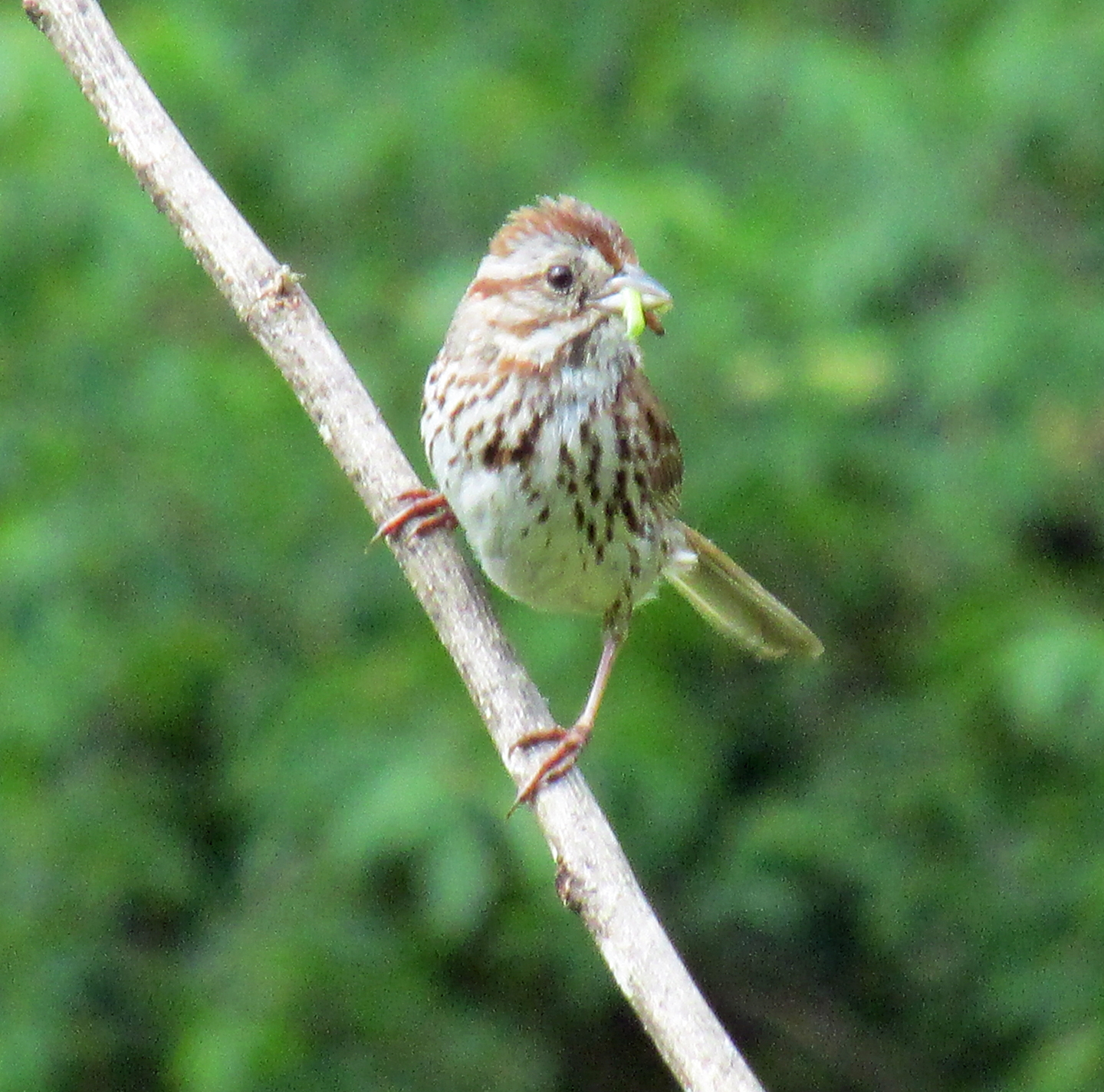
A Song Sparrow brings a beakful of caterpillars back to the nest to feed young.

 Counters tallied 110 species, which is near the six-year average of 109. Total species for this count has ranged from 104 to 112 species. Participants included Joe McGuiness, Vern Maddux, Kim Stroud, Dave Gardner, Don Holt, Dianne Draper, Debi and J.G. Campbell, Bryan Stevens, Brookie and Jean Potter, Eric Middlemas, Ken Rea, Roy Knispel, Jerry Bevins, Michele Sparks, Tammy Griffey, Jim Anderson, Pete Range, Harry Lee Farthing, Tom McNeil, Cathy McNeil, Fred Alsop, Catherine Cummins, Larry McDaniel and long-time count compiler Rick Knight. 

The bird found in most abundance was the European Starling with 536 individuals counted. Other common birds included Red-eyed Vireo (226) and Song Sparrow (245). A few birds went undetected, including Great Horned Owl.

This annual count covers territory such as Unaka Mountain, the Lamar Alexander Rocky Fork State Park, Limestone Cove, the Erwin Linear Trail, and much more. Unicoi County offers many natural treasures, not the least of which being the varied and interesting birds that reside within its borders.

 The List:

 Canada Goose, 54; Wood Duck, 23; Mallard, 42; Ruffed Grouse, 3; Wild Turkey, 5; Great Blue Heron, 5; and Green Heron, 4.

Black Vulture, 6; Turkey Vulture, 45; Sharp-shinned Hawk, 2; Cooper’s Hawk, 1; Broad-winged Hawk, 6; and Red-tailed Hawk, 9.

Photo by Skeeze/Pixabay.com • The Cooper’s hawk, like this individual, is a larger relative of the sharp-shinned hawk. It’s larger size allows this raptor to prey on larger birds, such as mourning doves.

Killdeer, 14; Rock Pigeon, 111; Mourning Dove, 152; Yellow-billed Cuckoo, 6; Eastern Screech-Owl, 3; Barred Owl, 1; Chuck-will’s-widow, 5; and Eastern Whip-poor-will, 9.

Chimney Swift, 45; Ruby-throated Hummingbird, 8; Belted Kingfisher, 2; Red-bellied Woodpecker, 33; Yellow-bellied Sapsucker, 1; Downy Woodpecker, 14; Hairy Woodpecker, 2; Northern Flicker, 13; and Pileated Woodpecker, 26.

American Kestrel,1; Eastern Wood-Pewee, 13; Acadian Flycatcher, 56; Least Flycatcher, 6; Eastern Phoebe, 81; Great Crested Flycatcher, 2; and Eastern Kingbird, 11.

White-eyed Vireo, 2; Yellow-throated Vireo, 1; Blue-headed Vireo, 35; Warbling Vireo, 3; Red-eyed Vireo, 226; Blue Jay, 108; American Crow, 122; and Common Raven, 8.

Northern Rough-winged Swallow, 39; Purple Martin, 30; Tree Swallow, 65; Barn Swallow, 79; and Cliff Swallow, 106.

Carolina Chickadee, 102; Tufted Titmouse; 100; Red-breasted Nuthatch, 3; White-breasted Nuthatch, 17; Brown Creeper, 4; House Wren, 54; Winter Wren, 1; Carolina Wren, 146; Blue-gray Gnatcatcher, 15; and Golden-crowned Kinglet, 12.

Photo by Bryan Stevens
The male Eastern Bluebird is beloved by many bird enthusiasts.

Eastern Bluebird, 94; Veery, 15; Hermit Thrush, 3; Wood Thrush, 57; American Robin, 397; Gray Catbird, 27; Brown Thrasher, 24; Northern Mockingbird, 48; European Starling, 536; and Cedar Waxwing, 48.

Ovenbird, 63; Worm-eating Warbler, 40; Louisiana Waterthrush, 14; Black-and-white Warbler, 34; Swainson’s Warbler, 3; Common Yellowthroat, 3; Hooded Warbler, 64; American Redstart, 8; Northern Parula, 39; Magnolia Warbler, 1; Blackburnian Warbler, 3; Yellow Warbler, 9; Chestnut-sided Warbler, 32; Black-throated Blue Warbler, 29; Pine Warbler, 5; Yellow-throated Warbler, 30; Prairie Warbler, 4; Black-throated Green Warbler, 52; Canada Warbler, 6; and Yellow-breasted Chat, 2.

Eastern Towhee, 80; Chipping Sparrow, 68; Field Sparrow,  21; Song Sparrow, 245; Dark-eyed Junco,  33; Scarlet Tanager, 33; Northern Cardinal, 163; Rose-breasted Grosbeak, 6; Blue Grosbeak, 4; and Indigo Bunting, 131.

Red-winged Blackbird, 71; Eastern Meadowlark, 15; Common Grackle, 156; Brown-headed Cowbird, 23; Orchard Oriole, 6; Baltimore Oriole, 2; House Finch, 70; Red Crossbill, 1; American Goldfinch, 110; and House Sparrow,  33.

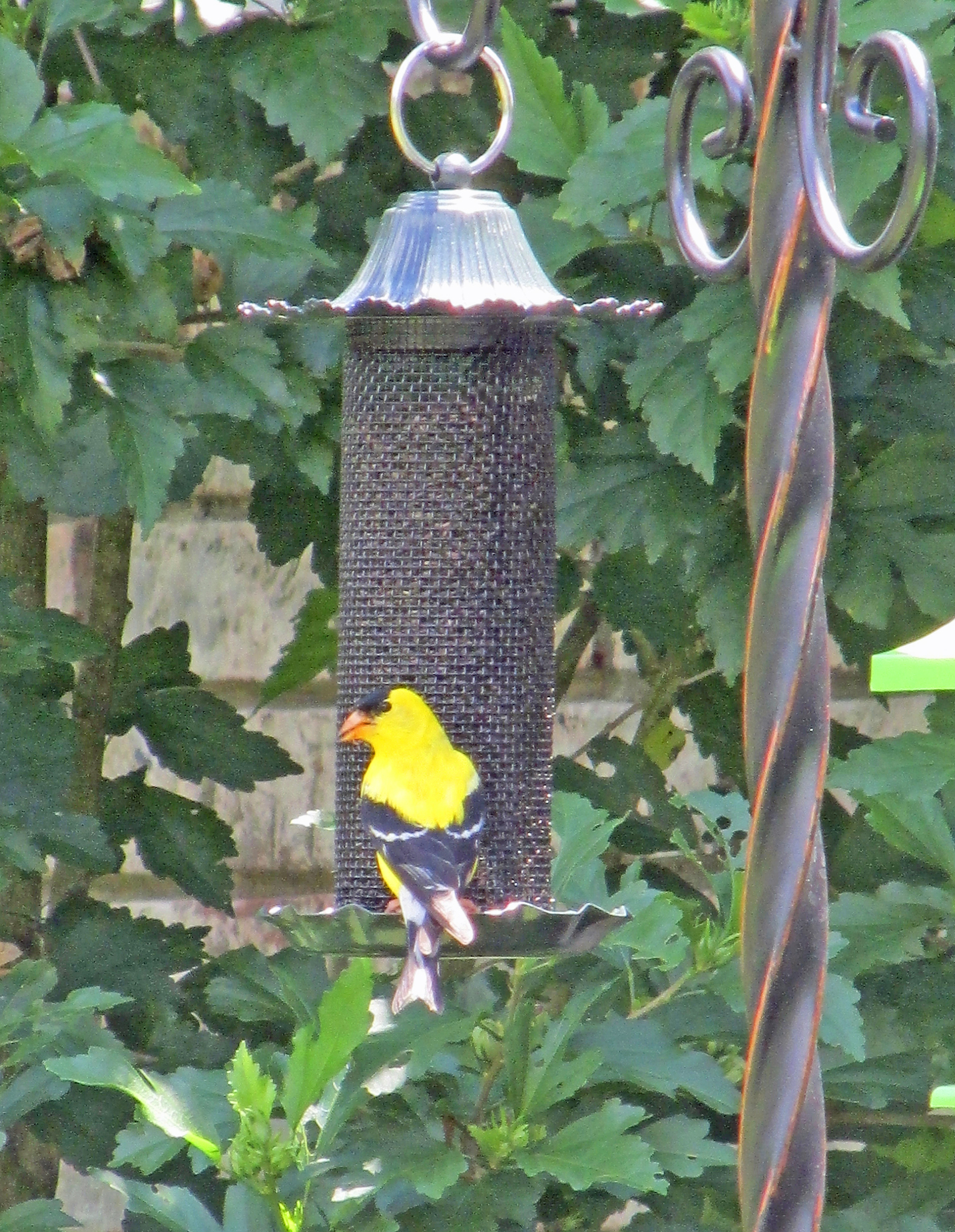
Photo by Bryan Stevens • An American goldfinch visits a feeder for a meal of thistle seeds.

Woman documents special relationship with pine warblers in photographs

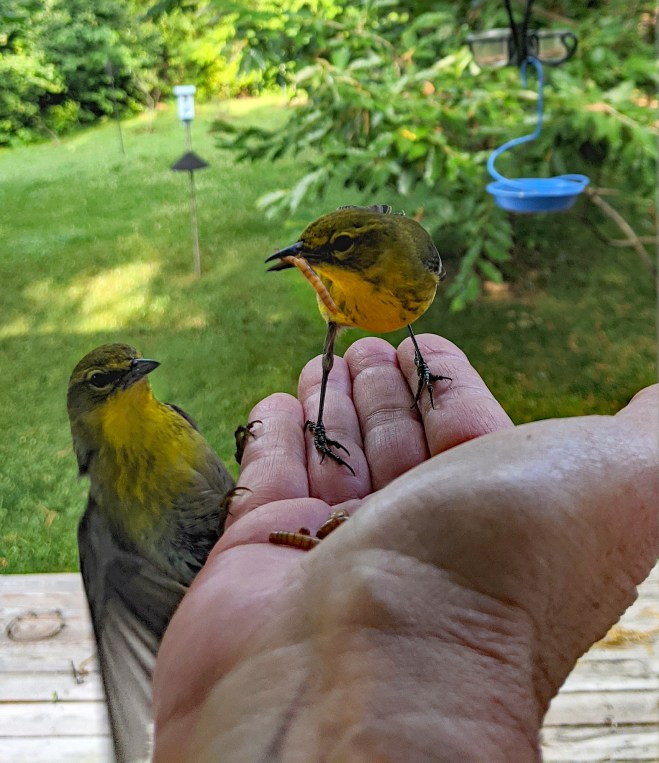
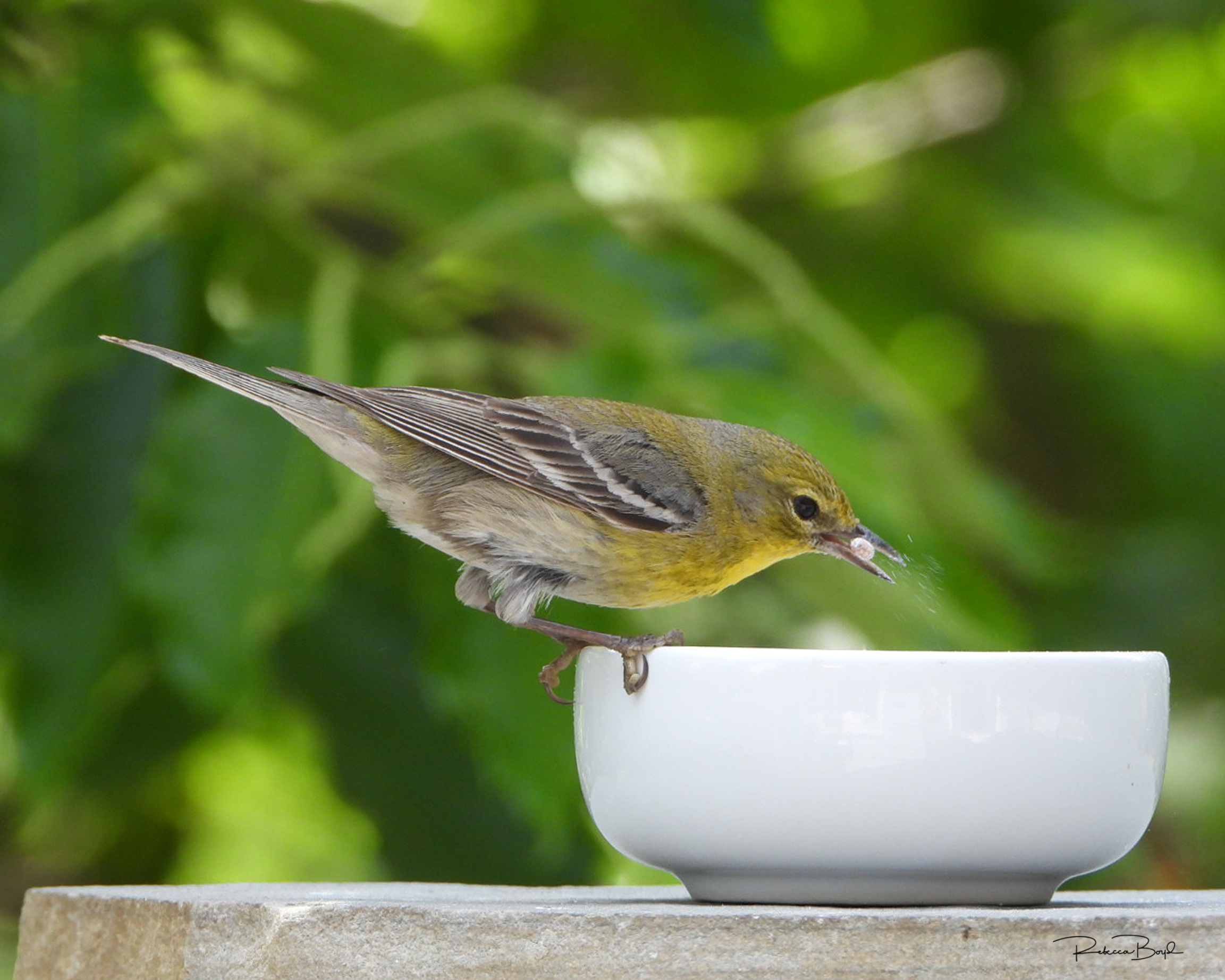
Photo by Rebecca Boyd • Pine warblers Petey and Petunia take mealworms from a waiting hand. These two warblers have learned to trust Rebecca “Becky” Boyd in order to get a quick meal.

For Becky Boyd, the ongoing pandemic has provided an unexpected opportunity to get to know some of her resident birds on a more personal basis. She has even won the trust of some of her backyard birds, succeeding at persuading them to take food right from her hands. She has posted photographs of some of these up close and personal engagements with birds to her Facebook page, where I first began to look with awe at her success.

Boyd, who resides in Knoxville, Tennessee, discussed some of her incredible stories involving some of her own feathered friends. “First, I feel like I should explain my bird-feeding station,” she said. “My bedroom window is on the second story, adjacent to a deck.”

She noted that there is a flower box under the window that she placed a board across so that she could set food containers right outside the window. “I also have a mealworm feeder hanging from a swing arm near this window,” Becky said.

She removed the screen covering the window so that she could pull the window open to take pictures up close. “This window is next to my home office work desk, where I sit every day during the COVID pandemic while working from home,” Becky continued. “The birds have become accustomed to seeing me at the window, and the first bird that I was able to feed by hand was a ruby-throated hummingbird.”

The process didn’t take all that much effort. “I got one of those little ‘button’ feeders’ that I held out the window next to the regular feeder,” she explained. “After a half dozen attempts, it worked!”

She added that she was even able to take a video of the experience.

Boyd also spoke about her relationship with the Eastern bluebirds living in her yard. “I have a bonded pair of bluebirds that live in my yard year round, and produce three broods of babies every year,” she said. “During time periods when natural food is scarce and when they are raising offspring, I provide live mealworms in addition to dried mealworms.”

She also has a section of a tree limb with recessed holes in which she spreads Wild Birds Unlimited’s Bark Butter (a specially formulated suet) onto. The limb hangs from a hook outside the same window.

Photo by Rebecca Boyd • Petey the pine warbler grabs a mealworm from a waiting hand. Petey’s trust eventually helped introduce his mate, Petunia, to the concept of a “free lunch” at the Knoxville home of Rebecca Boyd.

Most birding enthusiasts know that bluebirds and hummingbirds are among the most trusting of birds in regard to people, but Becky has enjoyed success with some species that are usually more aloof. For instance, the limb with the “bark butter” attracted the notice of a male pine warbler earlier this year.

“Sometimes when I would spread new butter on the stick, he would flutter around close by, being impatient to get something to eat,” she explained. “A few times he landed on my hand or arm during the process.”

Then the warbler discovered the little white dish that Becky keeps filled with live mealworms intended for the bluebirds. “At first, I would reach out to take the bowl away,” she said. “Live worms are sort of expensive.”

But the persistent warbler, who she named Petey, started landing on the lip of the bowl while she held it in her hand to protect the mealworms for the bluebirds.

“Once he associated that white bowl with yummy live worms, he started watching from a nearby tree for me to open the window to put out worms,” Becky said. “He would fly over immediately to grab some.”

His forward nature inspired her to conduct an experiment.

“Often, he would helicopter over the bowl in my hand with impatience, so I tried keeping the bowl in my hand instead of setting it on the ledge,” Becky continued. “He adapted right away, and before long his mate, Petunia, started copying his behavior.”

Becky expanded the experiment. “Within a week or so, I decided to try just putting the worms in the palm of my hand instead of in the bowl,” she said. “Petey adapted right away, but Petunia was a bit more reluctant.”

Becky noted with pride that Petey will perch on her hand for quite a while to gobble up some worms for himself. He will then grab a few in his beak to take back to the nest for their offspring.

“Petunia is more tentative and strategic, and will typically land just long enough to grab a few worms,” Becky said. “I’ve noticed that oftentimes they will take their worms and squish them into the bark butter or dunk them in the birdbath before taking them back to the nest. I wonder if that makes the worms stop wiggling to make it easier for the babies to eat them.”

Becky assumed that the warblers would only eat from her hand stuck out through the window opening, but one day she was sitting in a lawn chair in her back yard.

Photo by Rebecca Boyd • Pine warbler Petey ducks his beak into a bowl of mealworms for a quick snack.

“Petey found me and started fluttering around looking for food,” she recalled. “He followed me back to the house and waited on the deck ledge for me to fetch him some worms.”

He has become quite insistent. “When I would sit on the deck to read or watch the birds, he would land on the table and trill at me with a loud, shrill song until I met his requirements,” Becky said.

Now, when she is sitting at her desk working, Petey often gets her attention by pecking on the window to let her know he’s there and waiting for worms.

“So, I keep a cup with some worms next to the window so I can quickly slide the window open and shake a few into my hand to offer him,” Becky said. “Once the first brood of fledglings started coming to the window, they chose to only eat the bark butter instead of gravitating to the mealworm feeder.”

Becky added that the fledglings have moved on now, and Petey and Petunia are working on their second brood.

Becky has some aspirations about other resident birds. “I would love to be able to hand-feed the bluebirds,” she shared. “They will come very close to me — sometimes almost nose to beak through the closed window — but they are not willing to get close enough to hand-feed.”

She has had some success getting a few of her resident tufted titmice to accept food from her hands. Petey and Petunia deserve some of the credit.

“The titmice watched how the pine warblers ate from my hand and picked up the routine very quickly,” Becky said. “One of them is so bold, I sometimes have to try to shake him off my hand like he’s a housefly, but he comes right back to latch onto my fingers!”

She often names some of the regular cast of characters among her feathered friends.

Pine warbler pair Petey and Petunia have raised two fledglings, which Becky dubbed Posey and Pansy.

She has given her Eastern bluebird pair the names of Bogie and Bacall.

“They lost all but one fledgling from their first brood this year, so I named her Solo,” Becky added. “This pair has nested in my yard for four years in a row.

Her two reliable ruby-throated hummingbirds have been given the names LeRoy and Loretta.
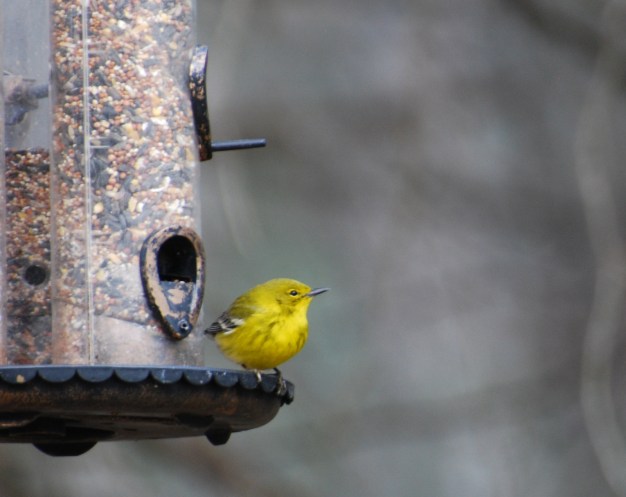
Photo by Jean Potter • A pine warbler visits a seed feeder at the home of Brookie and Jean Potter near Wilbur Lake in Elizabethton, Tennessee.

I asked if she has ever been described as a “bird whisperer” by her friends. “All the time!” Becky responded. “Many of my friends and Facebook Birding Group members are as amazed as I am about this experience.

Becky noted that her backyard attracts a wide variety, as well as volume, of birds. “I try to make it attractive to the birds versus pretty for the people,” she said. “I always keep two clean birdbaths available to them, and consistently keep feeders full of different types of seeds.”

In addition, she said that she plants bird-loving trees and shrubs and even left a couple of dead trees standing in the yard for the woodpeckers to enjoy. “I also try to make myself visible to the birds on a regular basis so that they understand that I’m not a threat,” Becky said. “I’m not sure if I have an actual gift, or if this is all just a wonderful result of spending so much time at home in their environment.”

Her special encounters with backyard birds provides a “rewarding feeling of awe and intrigue,” she said. “Having such a personal relationship with wild birds deepens my awareness of nature and makes me even more determined to help our songbird populations survive and thrive. That being said, I do recognize that wild birds should not be tamed such that they lose their fear of humans. Understanding this risk, I feel a mixture of joy and a little guilt. I don’t plan to encourage this behavior with any new birds, but I sure am enjoying my bond with this pine warbler pair.

Friends don’t always fully understand her enthusiasm for birds.

“Some don’t understand my passion for this or recognize how rare it is to have a personal relationship with wild birds, but most of my friends are also nature lovers who are in awe of this and wish they could do it, too,” Becky said.

“I joke that I should build a solid fence around my property and charge admission to my bird park,” Becky said. “My friends have encouraged me to start my own website to display and sell my bird photos, and I am in the process now of building my website, which will be named RidgeRockArts.com.”

In the meantime, Petey is on the verge of achieving a taste of international fame.

“An accomplished artist in Amsterdam recently saw one of my photos of Petey perched on my hand and asked to paint him to add to her portfolio,” Becky said.

Petey even crowded into the interview’s conclusion. “Here he is right now pecking on the window during this interview,” Becky said. “I must stop what I’m doing and get him a handful of worms right this instant. I think he is the one that trained me versus me training him.”


Mississippi kite glimpsed on spring count becomes latest listed ‘life bird’

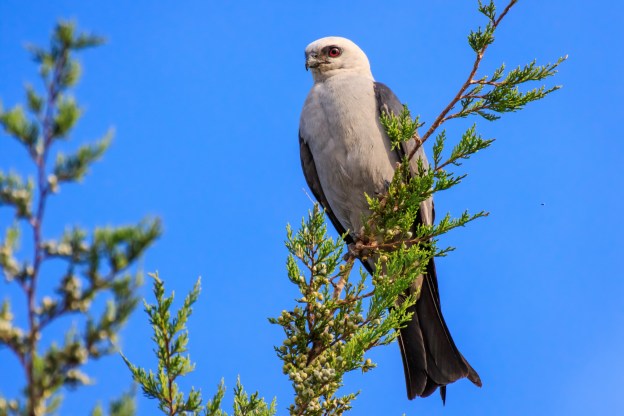
Photo by Richard/Adobe Stock • A solitary Mississippi Kite sits perched in a lakeside tree. These graceful raptors take their prey mostly while on the wing.

If you know many birders, you have likely heard them talk about “life birds.” These are any species that a birder has seen and identified in the wild for the very first time. It can be any bird species at all that the birder observes for the first time, whether it is a commonplace bird like a song sparrow or something slightly more exotic.

While taking part in the 77th consecutive Elizabethton Spring Count on Saturday, May 2, I saw something that, for our region, could be considered a little more exotic. The sighting certainly ranked as unexpected.

Unless one travels extensively, life birds can be hard to get once people have added to their lists most of the common birds around their homes. Finding a life bird during the ongoing pandemic brings its own challenges. I haven’t added a new life bird to my own list since a visit to South Carolina in June 0f 2016. During that visit to Huntington Beach State Park, I added a least bittern to my list of “life birds.”

My most recent “life bird” appeared closer to home and might qualify as my most unexpected life bird ever. The bird flew into view and onto my life list during the annual Spring Bird Count, which was conducted by members and friends of the Elizabethton Bird Club. Due to social distancing, many participants counted solo this year, myself included, although a few married couples birded together. I’ll always remember my pandemic spring count, especially for the 46th bird on my tally list for the day.

I found myself in the parking lot at Sycamore Shoals State Historic Park in Elizabethton around 11 in the morning. I wanted to scan the evergreens in that vicinity for Cape May warblers, a migrant that finds the tall conifers to its liking. I didn’t find any warblers, but I did surprise a perched raptor into making a short flight.

The instant I saw the bird launch itself into flight, I knew I was watching something out of the ordinary. The bird flew with a combination of grace and power that reminded me of a falcon, but I also glimpsed a barred tail that reminded me of one of the accipiter hawks. Then it landed on a dead branch in a tall sycamore that must have permitted the raptor an unobstructed view of the entire park. Although I’d never until that moment seen a Mississippi kite, I have studied illustrations and photographs. I felt fairly certain of the bird’s identity even before I used my phone to call up some birding sites to confirm my identification.

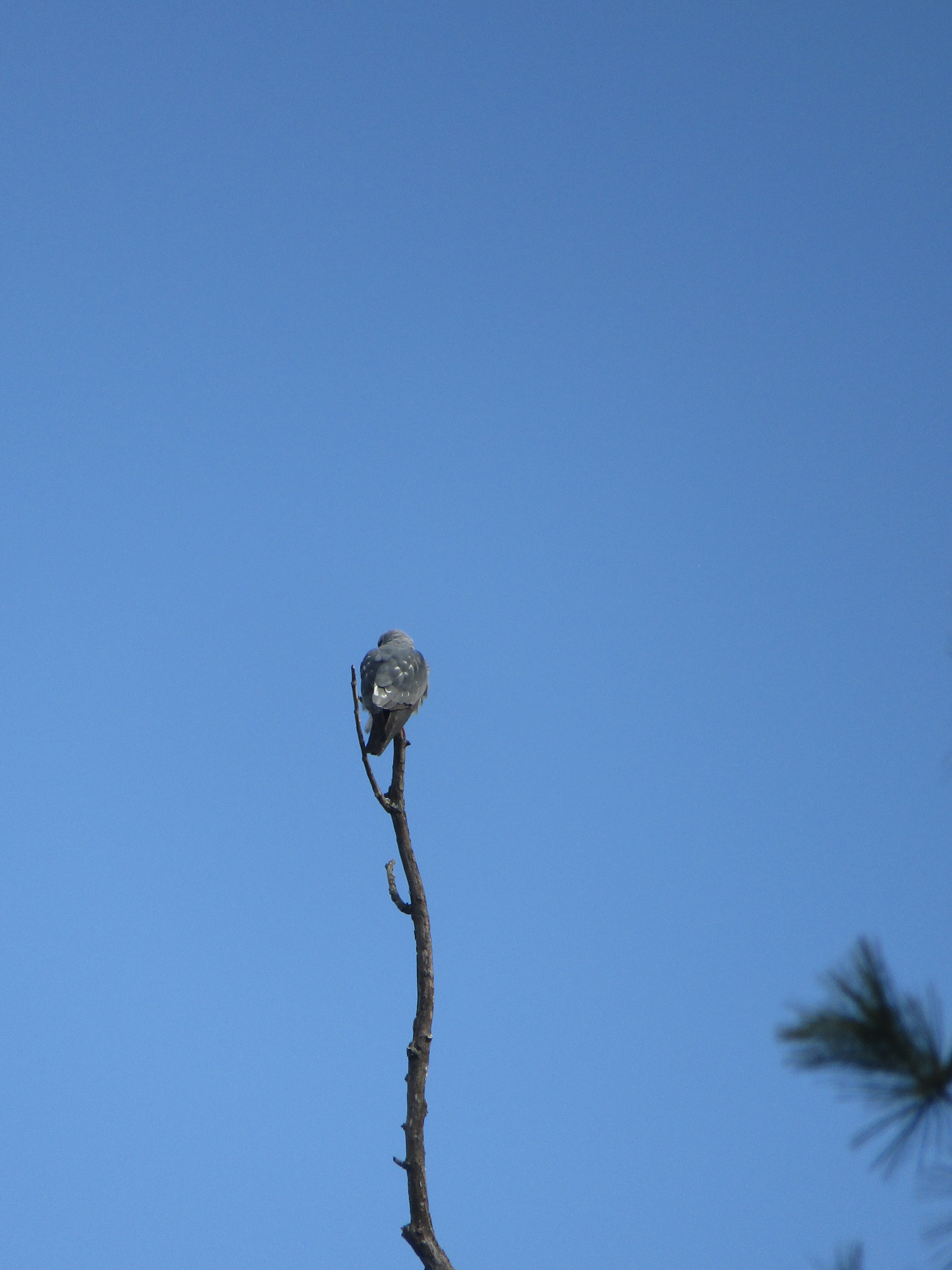
Photo by Bryan Stevens • This Mississippi Kite became the first of its kind ever observed on one of the Elizabethton Bird Club’s Spring Bird Counts for Northeast Tennessee.

That’s when the fact I was birding solo hit home. I wanted some additional witnesses to this very unexpected find. In lieu of other observers, I turned to my camera. The bird had turned its back to me, but I snapped some photos and then made my way to a position that I hoped would allow for better photographs.

Alas, the resident American crows at the park had different ideas. Detecting a raptor in their midst, about a half dozen crows gathered to harass the perched kite. Before I could snap a new round of photos, the kite took flight and flew into a stand of tall trees located between the park and Sycamore Shoals Hospital.

Only a few years ago, a Mississippi kite in Northeast Tennessee would have been unheard of. The hills and mountains of the region are simply not the expected habitat for these graceful raptors. Faith Reeves, a resident of Elizabethton, Tennessee, a Facebook friend and fellow birder, saw the first two Mississippi Kites ever found in Northeast Tennessee. She saw and photographed the birds in her own yard on May 20, 2014, and May 13, 2016.

In addition, Don Holt observed a Mississippi kite in Washington County, Tennessee, on April 16, 2017.

Rick Knight and several other birders also saw several Mississippi Kites for about a week in late August of 2016. Observers estimated that these sightings involved from two to five different kites.

“The August observations are our only fall records,” said Rick Knight, a long-time compiler of birds sightings in the region. He added that fall is the season when kites are likely to linger.

“All spring records are overshooting migrants and are one-day-wonders,” Knight explained.

Hearing his explanation, I felt even more privileged to have witnessed this “one-day wonder” in my home county.

Photo by Myriams-Fotos/Pixabay.com • The red kite is an abundant member of the kite family in Europe and northwest Africa.

The Mississippi kite is a beautiful raptor. Adults are grayish-white with the head often appearing pale gray or almost white. Although the Mississippi kite can attain a wingspan of three feet, these birds weigh only seven to thirteen ounces. They feed almost exclusively on insects, which they capture in flight. Some of the insects, such as cicadas and grasshoppers, are ones that damage crops, making the Mississippi kite a friend to farmers.

These kites breed and nest in the central and southern United States, but they have expanded their range north in recent years. They leave the United States in fall to spend the winter in southern South America.

Several years ago I got the thrill of adding a swallow-tailed kite to my life list in some agricultural fields in southwestern Washington County. I’ve also seen swallow-tailed kites in Florida. There is one other member of the kite family that I’d like to add to my list. The snail kite is a dark bird with a hooked beak designed for feeding on snails found in wetlands. This specialist resides in Florida, as well as the Caribbean and Central and South America.

Other kites found around the world include the double-toothed kite, plumbeous kite, whistling kite, square-tailed kite, red kite and black kite.

It’s been a spring filled with many amazing bird observations. I can’t speak for others, but thanks to that remarkable kite sighting and glimpses of some other fascinating birds, not even having to bird solo in a pandemic can bring me down. I’ll provide more details on this year’s Spring Bird Count for Northeast Tennessee in next week’s column.

Photo by Bryan Stevens • Mississippi Kite perched in a tree prior to being dispersed by some defensive American crows.

Returning ruby-throats, like the rest of world’s hummingbirds, never fail to dazzle

Photo by Anne and Saturnino Miranda/Pixabay.com • The Cuban emerald is a species of hummingbird found in a wide range of semi-open habitats in Cuba, as well as the Isle of Pines and the western Bahamas. Numbering 330 species, the world’s hummingbirds dazzle humans with their incredibly diverse plumages.

Experts estimate that there are 330 species of hummingbirds, all of which are found in the New World. Consider that these dazzling little birds have been given vividly descriptive names, such as cinnamon-throated hermit, red-tailed comet, blue-chinned sapphire, lazuline sabrewing, sparkling violetear, fiery topaz, green-tailed goldenthroat, bronze-tailed plumeleteer,  amethyst-throated mountain-gem, peacock coquette, red-billed emerald, empress brilliant, purple-backed sunbeam, green-backed hillstar, orange-throated sunangel, black metaltail, marvelous spatuletail and blue-tufted starthroat.

The only reliable species to inhabit the eastern United States from spring to fall each year is the ruby-throated hummingbird, which is currently arriving at various points from Florida to Maine and westward to states like Illinois, Minnesota and Oklahoma.

Photo by Bryan Stevens • Numbers of Ruby-throated Hummingbird in the region tend to fluctuate each year, but people should see a spike in their numbers when the hummingbirds end summer nesting and start migrating south again this autumn.

One of my most memorable hummingbird sightings took place in January of 1999 during a cruise in the Bahamas. A stopover in Nassau and a visit to the Paradise Island Resort permitted me a fleeting glimpse of a Bahama woodstar, a small hummingbird with a superficial resemblance to the ruby-throated hummingbird. The real beauty from my visit to the Bahamas, however, took place on a private cay maintained by the Disney Cruise line. While many passengers enjoyed the sun and sand of the beach, I walked nature trails to find birds. 

Photo by Daniel Roberts/Pixabay.com • The calliope hummingbird is the smallest of its kind known to reside in North America.

I found Western spindalis, then known as stripe-headed tanager, as well as black-faced grassquits and bananaquits, and I got several close looks at male and female Cuban emeralds, a hummingbird found in a wide range of semi-open habitats in Cuba, the Isle of Pines and the western Bahamas. The male is almost entirely metallic or iridescent green and measures almost four inches long. The ones I encountered were also curious and quite tame, often flying within inches of my face. 

Other than the two hummingbirds I saw during that trip, my remaining hummingbird observations have been confined to the United States. That hasn’t prevented me from seeing such unexpected hummingbirds as green-breasted mango, calliope hummingbird, black-chinned hummingbird, rufous hummingbird, Allen’s hummingbird, and broad-tailed hummingbird. 

Photo by Anne and Saturnino Miranda/Pixabay.com • It’s not difficult at all to see how the male Cuban emerald in such vibrant green plumage acquired its common name.

If I ever win the lottery, I plan to see as many hummingbirds as I can. For now, I am happy to report that ruby-throated hummingbirds are returning to northeast Tennessee, southwest Virginia, and western North Carolina.

I received an email from Susie Parks, who lives in the North Cove section of McDowell County in North Carolina. “My daughter, Luanne Graham, and I sighted our first hummer on March 28,” Priscilla noted. 

“I read your column in the McDowell News,” she added. “I am 84 years old and have been a birder most of my life.” 

Susie added that she and her daughter are both retired teachers who live next to each other. “We put our feeders out earlier than usual because she had heard that the hummers might be arriving earlier this year,” Susie wrote.

Susie noted that the first hummingbird sighted at her own feeder arrived on the first day of April, a few days after the hummingbird that visited her daughter’s feeder. “I keep a journal and I always note the first sighting,” she added, “and this is the earliest hummer I have ever recorded.”

This sightings by Susie and Luanne are the earliest I’ve had reported to me this year. 

•••••

Facebook friend Jimmie Daniels in Newland, North Carolina, reported on her Facebook page that the first hummingbird of spring arrived at 6:24 p.m. on Wednesday, April 8.  “We just saw our first hummingbird and that always makes me happy,” she wrote. “If you have not put out feeders yet, it is a good time to do that.”

•••••

Bob Cheers of Bristol, Virginia, reported a ruby-throated female arrived at his home at 7:55 a.m. on Friday, April 10. He speculated that the hummingbird was possibly “the same gal that arrived last year on the same day but 10 hours later.” Bob added that hummingbirds are amazing and that it was almost inconceivable to him that it could be the same bird. Bob, who had read in previous columns that downy woodpeckers and Carolina chickadees occasionally take a sip of sugar water from hummingbird feeders, also asked if I had ever heard of a red-bellied woodpecker feeding regularly at a hummingbird feeder. I’ve not personally witnessed this, but perhaps some readers have seen red-bellied woodpeckers at sugar water feeders. Let me know!

Photo by Bryan Stevens • Despite a perceived disadvantage of size, ruby-throated hummingbirds are quite capable of thriving in a giant world.

•••••

Brenda Hickman Dishner posted on my Facebook page that she spotted her first hummer of spring on Friday, April 10. “We live near Highway 421 and Houston Dam in Bristol, Tennessee,” she added.

•••••

Philip Laws, who lives in Limestone Cove in Unicoi County, reported to me on Facebook that he saw his first hummingbirds on April 10. “Hummers returned to Limestone Cove on Good Friday,” Philip noted.

•••••

Jeanne Siler Lilly reported her first spring hummingbird with a comment on my Facebook page. “I saw one at my feeder on April 10,” she wrote, adding that the bird visited a couple of times.

•••••

Mary Jones in Johnson City said her first hummingbird this year arrived on April 11. “I had one show up the Saturday before Easter and every day since,” she wrote in a Facebook comment. 

•••••

Dianna Lynne in Elizabethton saw her first hummingbird this spring on April 11. “They stopped in on Easter morning at the porch feeder here in Stoney Creek,” Dianne said in a comment on Facebook.

•••••

Erwin resident Amy Wallin Tipton saw her first ruby-throated hummingbird on Easter Sunday.  “I just wanted to let you know I just saw my first male ruby-throat of the season,” Amy wrote in a Facebook message. “It was at 11:55 a.m.”
•••••

Lia Pritchard saw her first hummer of the season on Easter Sunday at her home in Fall Branch, Tennessee. Her father, Glen Eller, shared the report of Lia’s sighting.

Photo by Bryan Stevens • Keep hummingbirds happy with a sugar water solution of four parts water to one part sugar.

•••••

Lynda Carter, who lives in Jonesborough, saw her first hummingbird at 8:45 a.m. on Monday, April 13, after a stormy night. “The bird may have blown in sideways from Arkansas last night,” Lynda joked in an email.

•••••

Richard Lewis in Bristol sent me a message on Facebook to announce the arrival of his first spring hummingbird. “I had my first ruby-throated hummingbird Monday, April 13, at 6 p.m. at my home in Bristol, Tennessee,” he wrote.

•••••

Joneen Sargent, who lives in Sullivan County west of Holston Lake off Highway 421, emailed me at 8:06 p.m. on Monday, April 13, to report her first spring hummingbird. “Just saw my first hummingbird of the season,” Joneen wrote. “Gives me hope.”

•••••

Jane Arnold emailed me to notify me of her mother’s hummingbird sighting. Her mother, Betty Poole, who lives in Abingdon, Virginia, saw her first hummingbird — a female — on Wednesday, April 15. Jane’s still awaiting her first spring hummer. 

•••••

Priscilla Gutierrez saw the first hummingbirds of spring the morning of Wednesday, April 15. “I put out a feeder and by 6 p.m. they were coming to [the] feeder,” Priscilla added in a comment on my Facebook page. 

•••••

Erwin resident April Kerns Fain posted on her Facebook page at 5:32 p.m. on Thursday, April 16, that she saw her first hummingbird. 

Erwin resident Pattie Rowland posted on my Facebook page that she saw her first ruby-throated hummingbird on Friday, April 17. “Just saw a hummer in Erwin,” Pattie wrote. 

•••••

Sharee Bowman reported her first hummingbird of spring in a Facebook message. “I saw my first hummingbird in Cedar Bluff, Virginia, on Friday, April 17,” she wrote. 

Photo by Bryan Stevens • A ruby-throated hummingbird lifts its wings to shake water droplets off its back.

Sounds of spring grow more varied as season advances

Photo by Bryan Stevens • Former common name rufous-sided towhee became Eastern towhee, which is far less descriptive of the bird’s appearance. In spring, male towhees become persistent singers. Listen for their “drink-your-tea” song as the males perch on elevated branches and twigs.

The sounds of spring surround us from sunrise to sunset with much of this seasonal chorus being provided by our feathered friends, the birds. In these weird weeks in need of something distracting, I’ve been letting nature’s sounds, as well as sights, provide some measure of relief from stressful headlines and anxious thoughts.

The mornings around my home often begin with a loud, insistent “Peter! Peter! Peter!” uttered from the woods or even just outside my bedroom window. Male tufted titmice, little gray relatives of chickadees with a distinctive crest and large, dark eyes, sing their urgent “Peter! Peter! Peter!” as a constant refrain in their efforts to attract mates now that they feel spring in their blood.

A series of rat-a-tat-tats echoes from deeper in the woods as woodpeckers tap their sturdy bills against the trunks of trees. The three most common woodpeckers at my home are red-bellied, downy, and pileated, and they all have their own unique vocalizations, as well.

Photo by Bryan Stevens • Woodpeckers not only vocalize, they also add to the spring cacophony by drumming against the trunks of trees.

The pileated woodpecker produces clear, far-carrying resonant piping sounds that can last for a few seconds each blast. The much smaller downy woodpecker produces a whinny of high-pitched notes that descend in pitch toward their conclusion. The red-bellied call is probably the one that stands out the most. The call’s a harsh, rolling “Churr, churr, churr” given almost like an expression of exasperation as they circle tree trunks and explore branches.

Since their return earlier this month, the resident red-winged blackbirds are often some of the earliest singers these days. According to the website All About Birds, the male red-winged blackbird’s “conk-la-ree!” is a classic sound of wetlands across the continent of North America. According to the website, the one-second song starts with an abrupt note that transforms quickly into a musical trill.

Photo by Bryan Stevens • A male red-winged blackbird sings to attract mates and ward off rivals.

Some birds helpfully introduce themselves with a song that repeats their name. One such common bird is the Eastern phoebe. In recent weeks, a pair has been checking out the rafters of my garage for potential nest sites. The male spends much of the day producing his strident “fee-bee” call, which is a perfect phonetic rendition of the bird’s common name.

Photo by Bryan Stevens • The Eastern Phoebe’s song is a repetitive rendition of its own name — “fee-bee” — given over and over.

Then there’s one of my favorite songs of spring, which is produced by the Eastern towhee, which is also known by such common names as “ground robin” and “swamp robin.” These birds, which are actually a species of sparrow, also have some instantly recognizable vocalizations. With the arrival of spring, the males seek elevated perches for extensive singing bouts to attract mates and establish territories. Their song has been interpreted, quite accurately, as “drink your tea!” They also have some alarm notes, such as “€œChew-ink”€ and “€œToe-Hee,” of which the latter provides the basis for this bird’s common name.

Of course, other wildlife joins the chorus. I have so many spring peepers at the fish pond and in the wet fields around my house that the noise from these tiny amphibians can reach deafening levels. The chorus is bound to grow more diverse and louder as spring advances. Take some time to enjoy the sounds of nature at your own home.

••••••

To share your own sighting, make a comment or ask a question, send email to ahoodedwarbler@aol.com. I’m also on Facebook.

Photo by Bryan Stevens • An alert Eastern towhee female forages on a lawn.