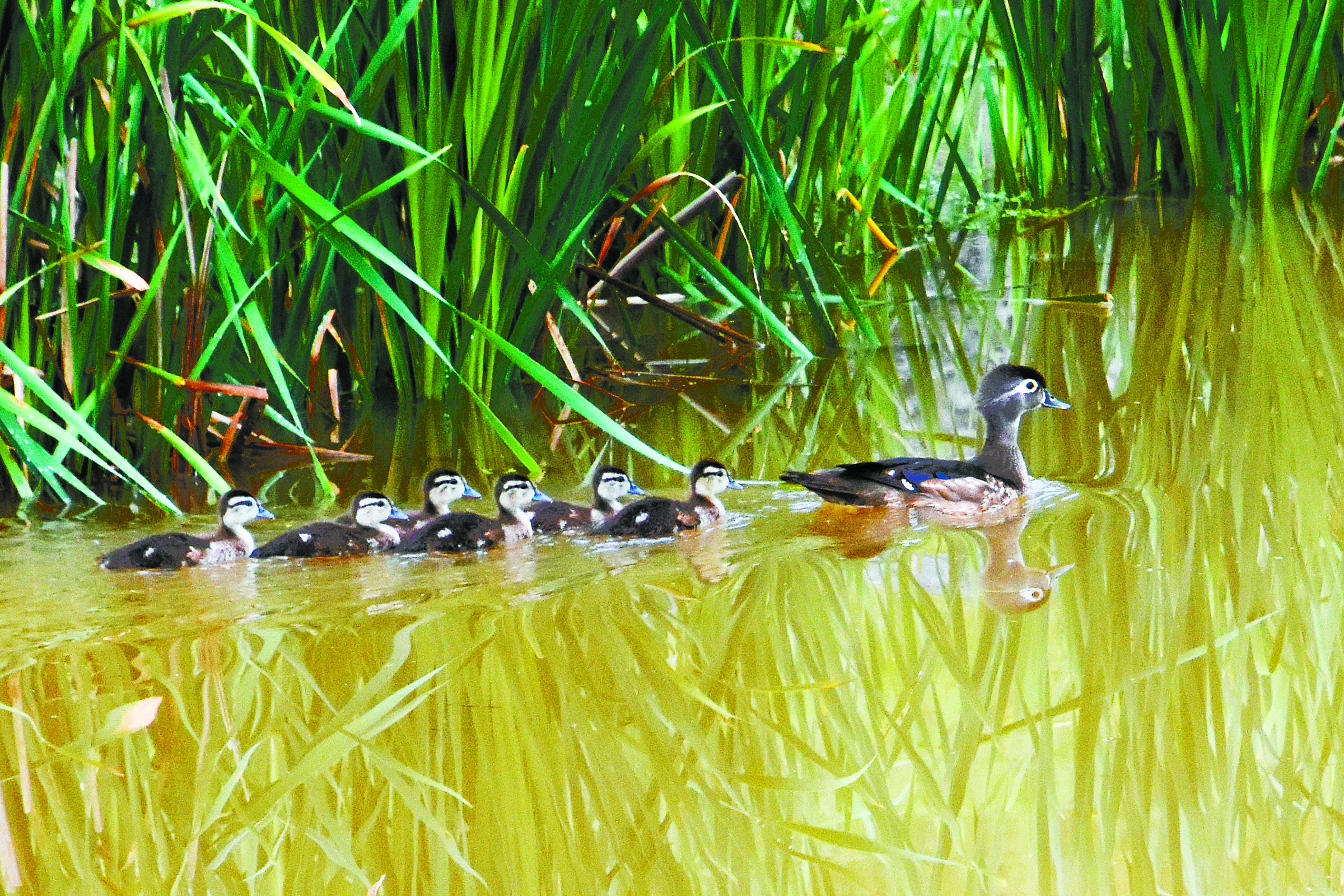
Photo by Jean Potter • Counters found 116 species on the recent Carter County Summer Bird Count, including this female wood duck and ducklings photographed on the Watauga River in Elizabethton, Tennessee. A total of 13 wood ducks were found on the day of the count.
The 28th Carter County Summer Bird Count was held Saturday, June 12, with 28 observers taking part.
The weather, which was less than optimal, challenged observers. Rain held steady for much of the day. The rain, along with dense fog on Roan Mountain and other high elevations, resulted in reduced birdsong in many areas. Thus, numbers of individuals were low for many species, especially songbirds.
Despite these hurdles, the count tallied 116 species, which is just one species shy of the recent 10-year average and actually two above the average of the previous 27 years, so, it was not bad considering the weather.
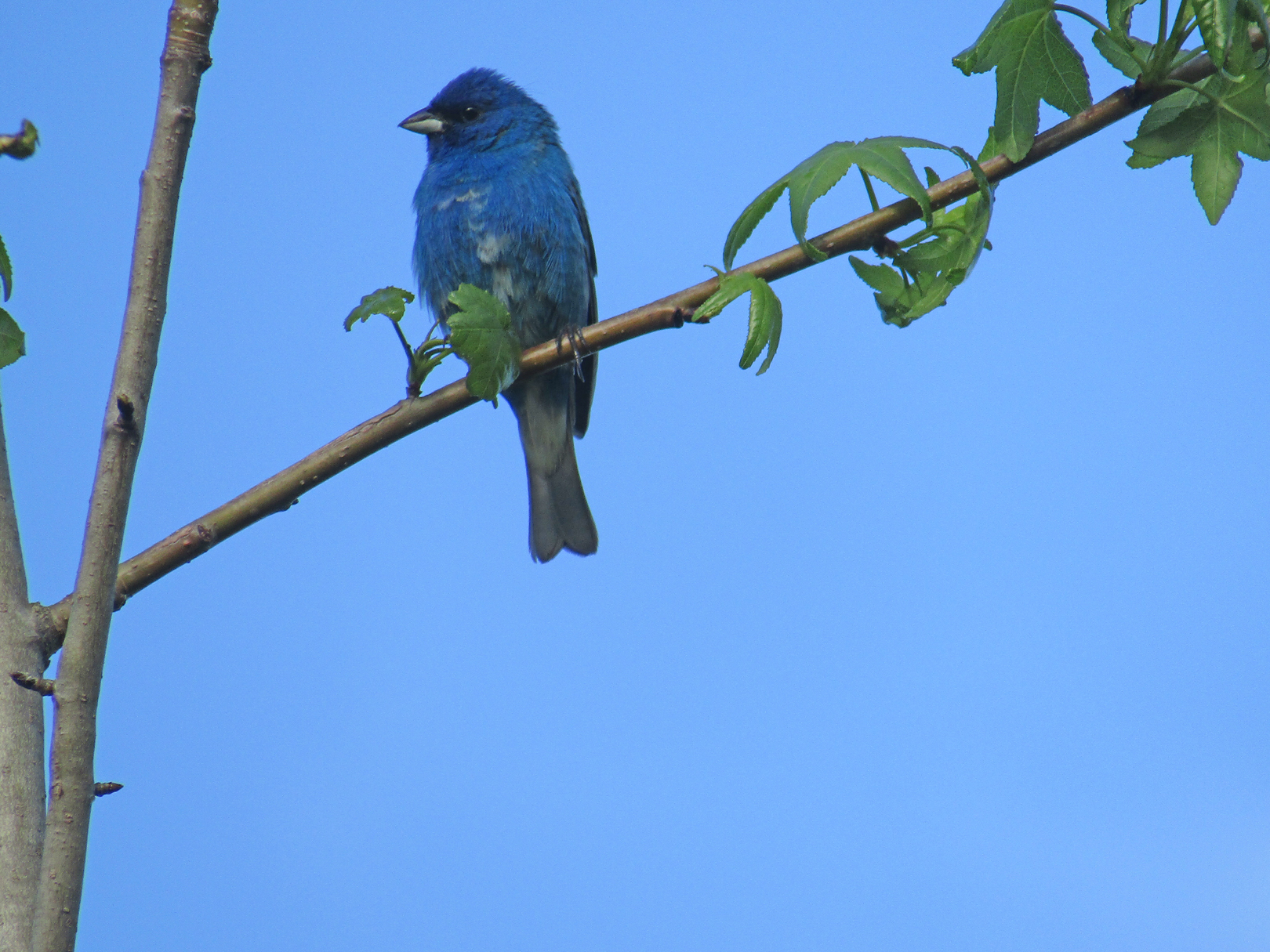
Photo by Bryan Stevens • Nesting neotropical migrants, such as this Indigo Bunting, increased the total number of species for the annual summer count.
Participants included Fred Alsop, Rob Biller, Catherine Cummins, Dianne Draper, Dave Gardner, Tammy Griffey, Don Holt, David Kirschke, Rick Knight (compiler), Roy Knispel, Richard Lewis, Dianna Lynn, Vern Maddux, Larry McDaniel, Joe McGuiness, Tom and Cathy McNeil, Brookie and Jean Potter, Judith Reid, Brenda Richards, Judi Sawyer, Michele Sparks, Bryan Stevens, Kim Stroud, Scott Turner, Charles Warden and John Whinery.
Some species were missed, including yellow-crowned night-heron, great horned owl, chuck-will’s-widow, willow flycatcher, brown creeper, hermit thrush, Kentucky warbler and magnolia warbler. These species are often, but not always, found on this count, according to long-time count compiler Rick Knight.
See if one of your favorite birds was hit or miss, common or uncommon, by scanning over the listing of the total.
The tally follows:
Canada goose, 218; wood duck, 13; mallard, 92; ruffed grouse, 1; wild turkey, 40; double-crested cormorant, 16; great blue heron, 23; and green heron, 2.
Black vulture, 7; turkey vulture, 25; osprey, 1; Cooper’s hawk, 3; bald eagle, 2; red-shouldered hawk, 4; broad-winged hawk, 7; and red-tailed hawk, 10.
Killdeer, 8; American woodcock, 1; rock pigeon, 101; Eurasian collared-dove, 2; mourning dove, 177; yellow-billed cuckoo, 5; Eastern screech-owl, 5; barred owl, 2; common nighthawk, 2; and Eastern whip-poor-will, 7.
Chimney swift, 99; ruby-throated hummingbird, 28; belted kingfisher, 11; red-bellied woodpecker, 24; yellow-bellied sapsucker, 2; downy woodpecker, 19; hairy woodpecker, 3; Northern flicker, 36; pileated woodpecker, 15; and American kestrel, 1.
Eastern wood-pewee, 24; Acadian flycatcher, 9; alder flycatcher, 2; least flycatcher, 13; Eastern phoebe, 48; great crested flycatcher, 7; and Eastern kingbird, 21.
White-eyed vireo, 5; yellow-throated vireo, 2; blue-headed vireo, 38; warbling vireo, 1; red-eyed vireo, 117; blue jay, 77; American crow, 185; fish crow, 4; and common raven, 5.
Purple martin, 38; Northern rough-winged swallow, 34; tree swallow, 109; barn swallow, 154; and cliff swallow, 137.
Carolina chickadee, 32; tufted titmouse, 65; red-breasted nuthatch, 3; white-breasted nuthatch, 10; house wren, 60; winter wren, 3; Carolina wren, 84; blue-gray gnatcatcher, 8; and golden-crowned kinglet, 2.
Eastern bluebird, 113; veery, 23; wood thrush, 35; American robin, 510; gray catbird, 42; brown thrasher, 38; Northern mockingbird, 62; European starling, 1,203; and cedar waxwing, 45.
Ovenbird, 50; worm-eating warbler, 4; Louisiana waterthrush, 10; golden-winged warbler 1; black-and-white warbler 27; Swainson’s warbler, 2; common yellowthroat, 12; hooded warbler, 67; American redstart, 8; Northern parula, 30; Blackburnian warbler, 4; yellow warbler, 1; chestnut-sided warbler, 12; black-throated blue warbler, 20; pine warbler, 2; yellow-throated warbler, 9; prairie warbler, 3; black-throated green warbler, 14; Canada warbler; 5; and yellow-breasted chat, 9.
Eastern towhee; 112; chipping sparrow, 61; field sparrow, 58; savannah sparrow, 1; song sparrow, 253; dark-eyed junco, 46; scarlet tanager, 25; Northern cardinal, 157; rose-breasted grosbeak, 5; blue grosbeak, 5; and indigo bunting, 102.
Red-winged blackbird, 109; Eastern meadowlark, 15; common grackle, 67; brown-headed cowbird, 43; orchard oriole, 4; and Baltimore oriole, 2.
House finch, 132; pine siskin, 1; American goldfinch, 97; and house sparrow, 44.
•••••
I received a phone call from Marian Swanson of Aldie, Virginia, this past week. Marian was looking for advice on feeders for attracting indigo buntings, which she had observed near her home. She was specifically seeking a feeder that would prevent the seed from getting wet during rainstorms.
At her request, I provided Marian with some links to websites offering a variety of feeders for sale.
It’s always great to hear from readers. If you have a bird-related question, email me at bstevens@erwinrecord.net or ahoodedwarbler@aol.com. I also enjoy hearing about bird observations or general comments from readers.
This American woodcock was photographed by Erwin resident Amy Tipton during a stop that she and her husband made recently at the Unaka Mountain Beauty Spot.
Known for migrating incredible distances, the shorebirds are often referred to as “wind birds,” a romantic allusion to their habit of taking wing for the epic journeys that astound scientists and birders alike.
Among the far-flung family known as the shorebirds are species known as sandpipers and plovers, as well as whimbrels, willets, tattlers, godwits, turnstones and an array of others.
Still, among the general public, as well as some birders, the shorebirds are a much misunderstood group of birds. For example, most people could hardly be blamed for believing that shorebirds are inhabitants of only the beach and shore.
In fact, some species are at home in a variety of habitats, ranging from woodlands and prairies to the Arctic tundra and mudflats. Some are notoriously elusive, their camouflage and low-key behavior allowing them to escape casual notice at most times.
In late winter and early spring, a true oddball among the shorebirds begins courting. The American woodcock, also known by such whimsical names as “bog sucker” and “timberdoodle,” is a shorebird that has completely abandoned the shore in favor of woodlands and fields. Beginning as early as February, American woodcocks in the region conduct nightly courtship displays, starting at dusk, that combine aerial acrobatics with an assortment of unusual acoustical flourishes. Any wet field adjacent to a wooded area could offer a stage for these evening displays, but unless you know where to look and make an effort to do so, the American woodcock might as well remain a phantom of the night.
These mating rituals provide almost the only time of the year during which this bird makes itself available for observation. It’s only during this brief window that opens into their lives that we can be assured a glimpse. Even then, our peeks at woodcocks often consist of a fuzzy twilight escapade as the bird flings itself heavenward only to make a spiraling descent a few seconds later. The displays begin with a distinct vocalization, a type of “pent,” that also has the quality of sounding like some sort of mechanical buzzer.
Once the displays conclude for the season, the birds assume nesting duties, usually unobserved by humans. The rest of the year, almost nothing but blind, sheer luck would allow a birder to stumble across an American woodcock. It’s almost as if they disappear after these spring flights of fancy.
Of course, they don’t actually disappear. They are still out there, going about their daily lives. On occasion, someone can stumble across one without even trying.
Amy Tipton can claim to be so fortunate after she and her husband, Paul, recently encountered an “unusual bird” on Unaka Mountain near the well-known Beauty Spot.
“We had gone to the Beauty Spot to watch the sunset on Sunday, June 27,” Amy wrote in a Facebook message to me. “It was the 20th anniversary of our first date.”
On the way back to the Jeep, Paul noticed a very unusual bird. He pointed out the bird and asked Amy if she knew what it was.
“It was just sitting at the edge of the parking area where the gravel/dirt road meets the tall grass,” Amy wrote. “It was not dark enough to keep us from seeing it, but plenty dark enough to keep me from getting a good photo.”
Amy said that she knew she only had one chance to get a photo.
“I set the flash and hoped for the best,” she wrote. “It’s blurry, but I’m thankful I was able to get anything. As soon as the flash fired, it made a funny noise and flew into the trees.”
Amy added, “It looked more like a sea bird to me, and we thought it might have flown off course. We had no idea such a strange bird lived on Unaka Mountain. We’ll always remember the first time we saw a timberdoodle.”
An American woodcock patrols a patch of bare ground in a photo by U.S. Fish & Wildlife.
One look at Amy’s photo confirmed that she and her husband had encountered a woodcock. With its big head and large eyes, the American woodcock is rather gnome-like in its appearance. There’s something downright odd about this shorebird that has chosen to exile itself so far from seashores.
Its chosen lifestyle, however, has proven advantageous for the species. The woodcock is an efficient forager, feeding on earthworms, as well as insects, millipedes and spiders. Scientists theorize that the woodcocks can actually hear and feel the earthworms as they move underground.
About 20 years ago, Joe McGuiness, an Erwin resident and a fellow member of the Elizabethton Bird Club, found an American woodcock one summer making itself at home in his neighborhood of Rolling Hills. I got to see that bird, which to date is my only upclose and personal observation of an American woodcock.
I have traveled to locations such as Shady Valley in Johnson County and Persimmon Ridge Park in Jonesborough to witness the courting flights of these unusual birds. Of course, since these flights do not commence until dusk, the experience is more auditory than visual.
The woodcock is closely related to the snipes. The only snipe species usually found in the United States is Wilson’s snipe, formerly known as the common snipe.
There is also a Eurasian woodcock and several species endemic to islands. These include the Amami woodcock of Japan, the Bukidnon woodcock of the Philippines, the Javan woodcock, New Guinea woodcock, the Moluccan woodcock of the Malaku Islands in Indonesia and the Sulawesi woodcock, also of Indonesia.
Worldwide, there are about 20 snipe species, including species with such descriptive name as giant snipe, noble snipe, pin-tailed snipe and imperial snipe.
So, if the legend of the snipe hunt ever made you doubt the actual existence of snipe, rest assured that both snipes and their odd cousins, the woodcocks, do exist.
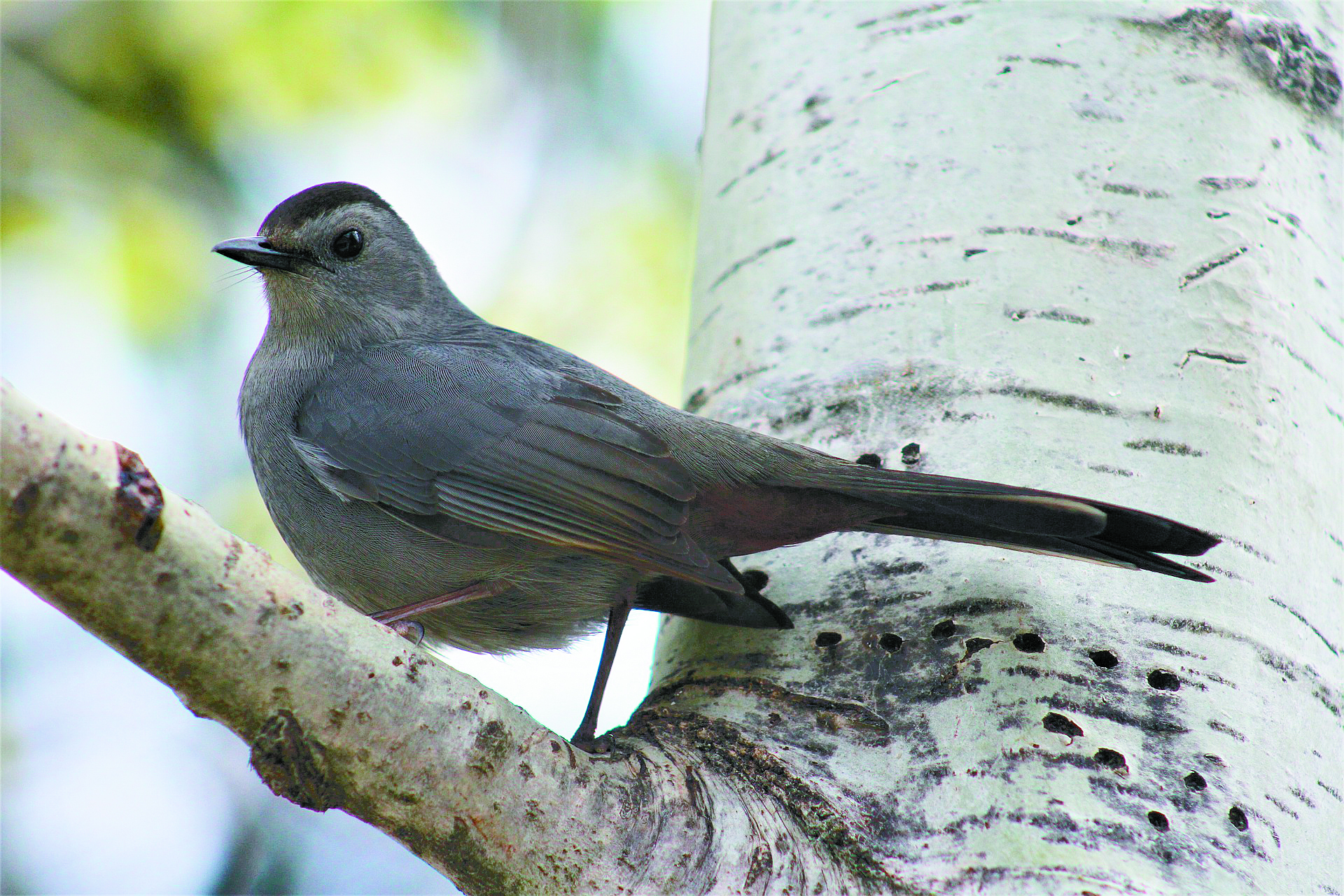
Photo by Bryan Stevens • Although often considered shy, skulking birds, some catbirds show a great deal of curiosity about and trust in humans.
I received an email on June 15 from Linda Durette, who lives in Townsend, Massachusetts, which is on the New Hampshire border.
“I live in a country environment with thickets and fields,” she noted.
Linda informed me that she had run across an article I wrote in 2019 about gray catbirds.
“I have always been mildly intrigued by the catbird,” she wrote. ‘Working around the yard and having a cat myself, I always got a kick out of their vocal annoyance with my cat.”
She said the catbirds begin squawking at her cat the minute he steps out the door.
Photo by by Jennifer Beebe from Pixabay • Gray catbirds have a reputation for being either shy skulkers or bold scolders. In fact, these birds are known for being individuals with unique and distinctive personalities. Like mockingbirds and thrashers, the gray catbird is considered a mimic thrush and can imitate snippets of the songs of other birds.
“I always kept him away from any nesting area, although he isn’t a particularly adventurous cat, anyway,” she noted.
“This year was the same,” she said. “My cat seemed to almost ignore the bird. He just sat there and allowed the bird to squawk loudly. I think the bird was miffed.”
She said she finally put her cat back in the house.
“But I have been noticing that the bird comes very close to me,” she wrote.
She wrote that the catbird appears to watch what she does when she is outdoors.
“I have been talking with him, chattering while I garden,” she wrote. “It’s a riot. He lands on the wheelbarrow handle after I walk away or allows me to walk pretty close to him as he watches.”
Linda concluded that this individual catbird, at least, seems to have quite the personality.
I’d mentioned in my previous column on catbirds about the fondness of these birds for fruit and how I occasionally offered berries to them.
“I will attempt some fruit, too,” she said. “It is so interesting. We’ll see what happens.”
Perhaps readers will recall the folksy expression “sitting in the catbird’s seat” that denotes self-satisfaction and perhaps a degree of smugness. As expressions go, it’s not a bad fit for this charming, somewhat eccentric bird.
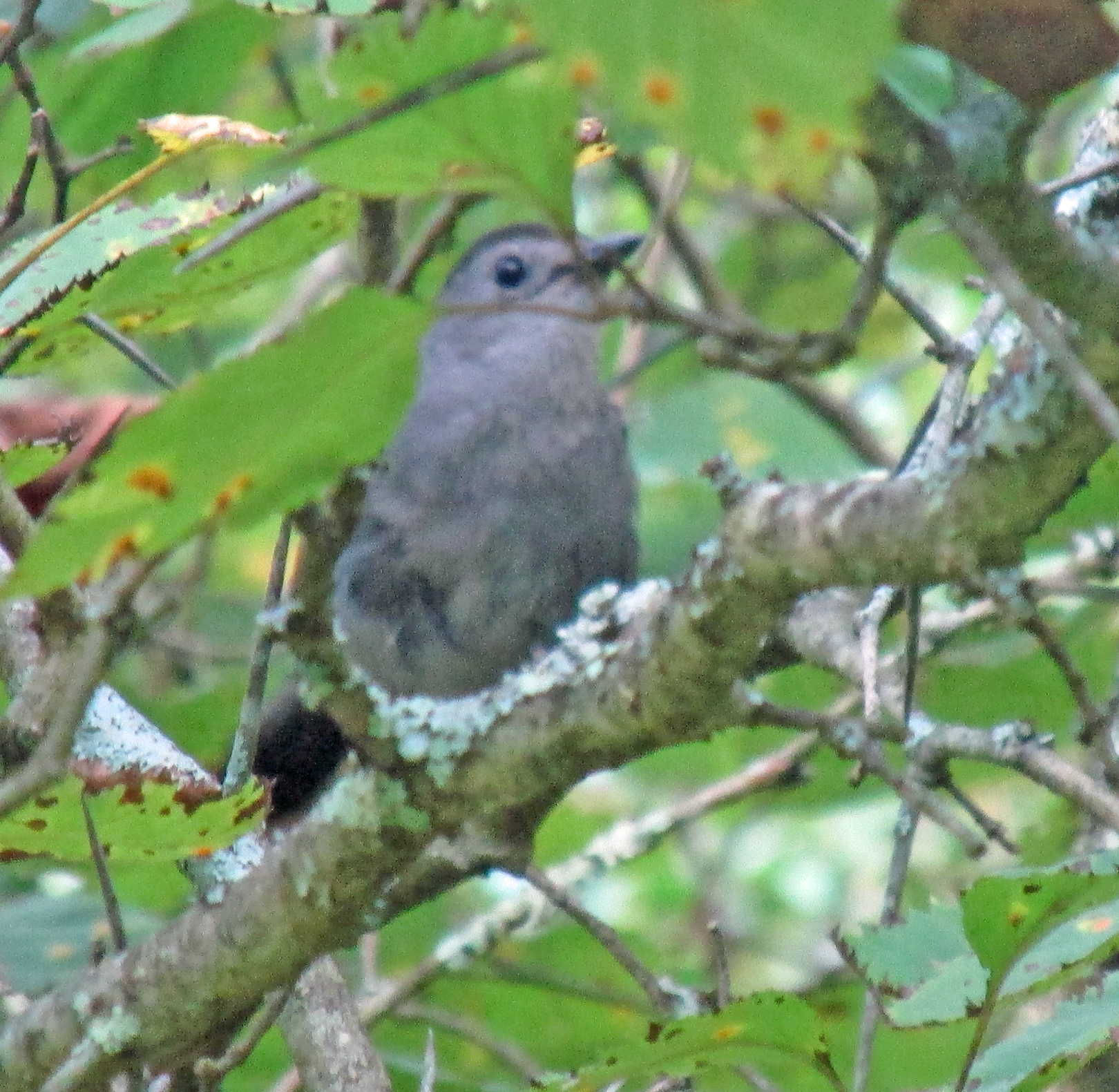
Photo by Bryan Stevens A curious Gray Catbird peeks from dense cover. Attendees at the fall rally can look for catbirds and other species at any of the offered bird hikes.
The gray catbird is a baffling bird with a personality that runs the gamut from introverted to extroverted, sometimes depending on the season and at other times seemingly just on a whim. With some gentle persuasion, however, people can gain a catbird’s trust – as Linda has done with the bird in her Massachusetts garden – and develop a fun friendship with these clever songbirds.
One summer, all I needed to do to win over the catbirds was to offer some less-than-perfect strawberries and blueberries. A few blemishes on the fruit didn’t bother the resident catbirds at all, and they soon became accustomed to receiving such treats.
A person’s first introduction to the catbird is likely going to occur when one hears what sounds like an irritable feline hiding in a hedge, thicket or dense shrub. Upon closer examination, observers may get a glimpse of a charcoal gray bird roughly the shape of a Northern mockingbird but smaller. A black cap and a patch of rusty-red feathers under the tail are the only exceptions to this bird’s overall gray plumage.
The catbird is related to thrashers and mockingbirds, but scientists find the gray catbird just different enough to warrant placing it in its own genus. The genus name Dumetella means “small thicket.” It’s an apt name for this secretive skulker. Catbirds only feel secure in dense cover such as hedges, brush piles and dense thickets.
A relative known as the black catbird, which ranges throughout the Yucatan Peninsula of Mexico, as well as northern Guatemala and northern Belize, also belongs to a genus of its own. The genus name Melanoptila for this close relative is a compound word created from two Greek words: melas, meaning “black” and ptilon, meaning “plumage.” Both of these catbirds are classified as “mimic thrushes,” or Mimidae, of which there are about 30 species in the New World. There is a totally unrelated family of catbirds that ranges through Australia, Asia and parts of Africa.
The gray catbird is not as an accomplished mimic as some of its relatives, such as the Northern mockingbird. Males have motivation to constantly expand their repertoire, however, as doing so increases the likelihood of attracting a mate. They imitate other birds, but some have been recorded imitating frogs and other non-avian singers.
The website All About Birds also offers some helpful advice for attracting gray catbirds. To entice these birds, plant native fruit-bearing trees and shrubs such as dogwood, winterberry and serviceberry.
While the closely related brown thrasher and Northern mockingbird have both been honored with recognition as official state birds, this designation has never been bestowed on the gray catbird.
The female catbird constructs the nest, but her mate may helpfully provide some of the nesting materials. She may spend as long as a week building a rather bulky nest. She usually lays one to six eggs, which require an incubation period of about two weeks. Once the young hatch, both parents are kept busy bringing food to the young. Hatchlings will remain in the nest for about 10 days, but parents continue to care for and feed young even after they have fledged and departed the nest. Catbirds nest two or three time in a season.
According to the website All About Birds, the oldest known gray catbird was at least 17 years and 11 months old when it was recaptured and rereleased during banding operations in New Jersey in 2001. That individual had been banded in Maryland in 1984. So, if you do manage to strike up your own friendship with a catbird, there’s a good possibility that it could become a long-term relationship, especially since many birds like to return to a home territory year after year.
To share an observation, make a comment or ask a question, please send email to ahoodedwarbler@aol.com. I enjoy hearing from readers about shared interests in birds.
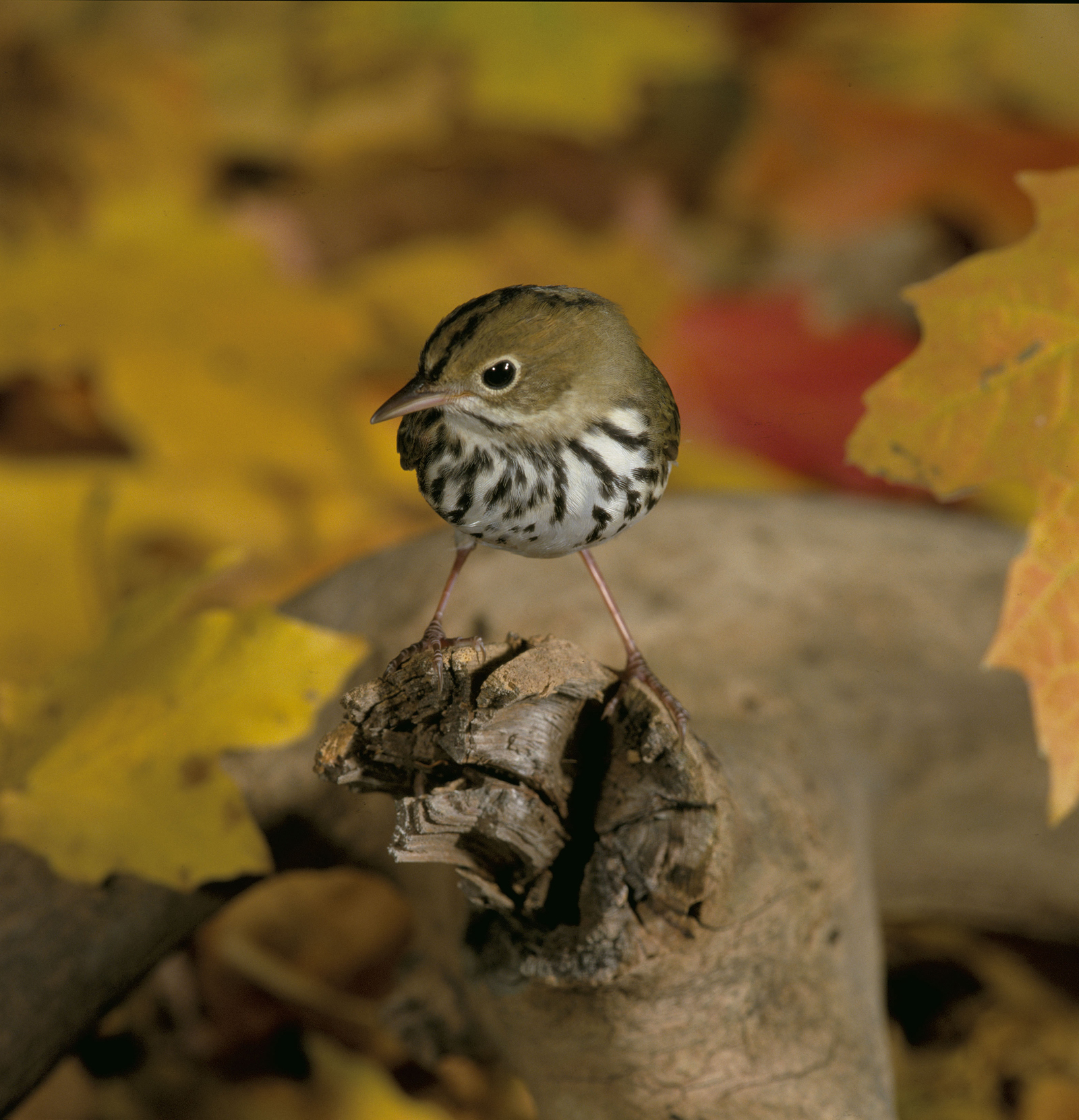
Photo by U.S. Fish & Wildlife Service • Ovenbirds are content to spend most of their time near the forest floor.
It’s been a week of arrivals at my home. Several species of warblers made their spring debuts, including a handful of male ovenbirds.
These warblers arrived on April 14 and immediately began singing their loud and ringing “Teacher! Teacher! Teacher!” song from concealment within the woodlands surrounding my home.
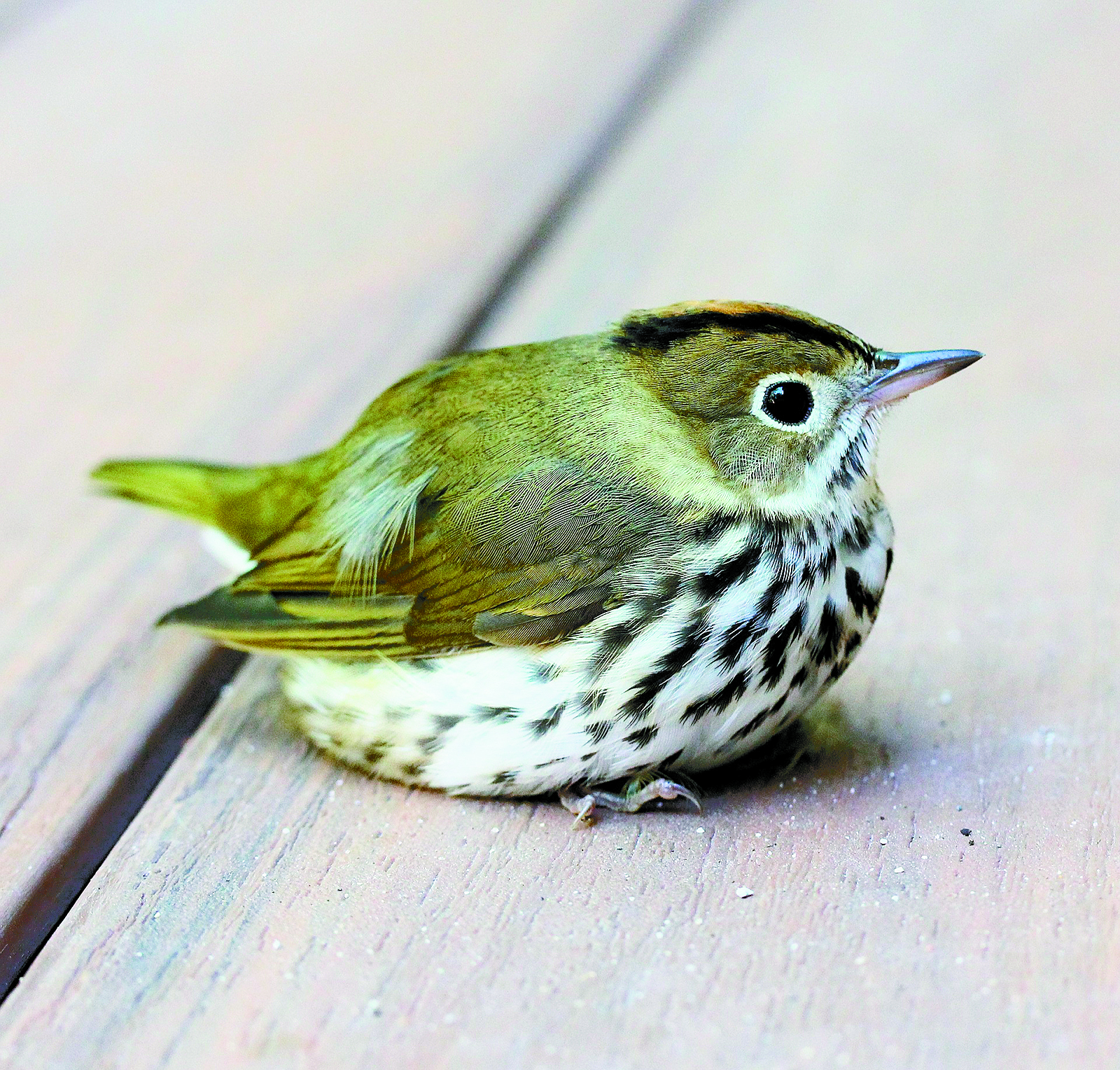
The ovenbird is not one of the brightly colored warblers, such as black-throated blue warbler or yellow warbler. The ovenbird is a small brown bird with a white breast with dark streaking — an appearance that bears a superficial resemblance to the larger thrushes that share the same woodland habitat. The only hint of color is an orange crown bordered by dark stripes atop the bird’s head. Even this orange crown patch is not easily seen. When agitated, an ovenbird may raise its head feathers, which makes this orange mark easier to detect. The ovenbird also shows a distinct white ring around each eye, as well as pink legs and a pinkish bill.
The resemblance to North America’s brown thrushes didn’t go unnoticed by some early American naturalists. Painter and famous naturalist John James Audubon painted a pair of ovenbirds, which he knew as “golden-crowned thrushes.” When comparing the two names, one can’t help but wish that the inaccurate but more romantically descriptive golden-crowned thrush had stuck.
While not likely to take an observer’s breath away with an unexpected explosion of vibrant plumage, the ovenbird’s not a drab bird. These warblers possess a subtle beauty all their own that is worth taking the time to behold.
Photo by Peggy Dyar from Pixabay • Despite the oliver-brown plumage, a closer look shows that the overbird is a bird with a subtle beauty, including an inconspicuous orange crown.
Unfortunately, ovenbirds are stubborn about letting themselves be seen. They’re easily heard. The males begin singing a loud, rollicking “Teacher! Teacher! Teacher” song almost as soon as they arrive on potential nesting grounds.
The ovenbird, unlike many warblers, is not named for its appearance. Instead, the bird’s name derives from the shape of the nest it builds. The nest is a domed structure placed on the ground, woven from vegetation and containing a side entrance. Early European settlers in North America thought the nest looked like a Dutch oven, hence the name “ovenbird” for the small warbler with the intricate nest.
Rather than hopping along the length of a branch or limb, an ovenbird walks in a deliberate fashion. This bird feeds on insects, spiders and other small prey items foraged from the woodland floor. On rare occasions, a lingering ovenbird shows up at feeders during the winter months.
Again, the most persistent characteristic of this warbler is the fact that it’s shy. It’s not as notoriously shy as warblers like mourning warbler of Connecticut warbler, but the ovenbird spends much of the time near the woodland floor and out of sight. The best time to catch a look at this warbler is once they begin nesting. Parents are extremely protective and defensive of their nest and young. Intruding too close is sure to bring some sharp alarm notes. The parents will often confront an intruder, flitting from branch to branch in nearby trees, utterly neglecting their usual preference for remaining unseen if not unheard.
Photo by Jean Potter • An ovenbird sings from a perch in the leaf canopy.
Ovenbirds spend the summer nesting season in mature deciduous and mixed forests across Canada and the eastern United States. They do not make as lengthy a migration as that undertaken by some of their relatives. Ovenbirds migrate each fall to the southeastern United States, the West Indies and also spreads out from Mexico to northern South America for the winter season.
It’s one of several warblers that nest in Northeast Tennessee and Western North Carolina. Others include Louisiana waterthrush, Kentucky warbler, common yellowthroat, Swainson’s warbler, black-throated blue warbler and American redstart, among others.
•••••
My mom saw her first hummingbird of spring on April 16 at 9:34 a.m. Of course, the bird waited until I’d left for work to make an appearance.
My solace has been an influx of other migrants in the past week. A blue-gray gnatcatcher’s fussy buzz alerted me to its return on April 10. I eventually got binoculars focused on the fidgety bird as it flitted in the upper branches of a cherry tree.
I heard the familiar chittering cries overhead while walking in downtown Erwin on April 14. Looking skyward, I watched a flock of chimney swifts flying gracefully over the rooftops of downtown buildings.
New warblers at home this week, other than the ovenbird, have included hooded warbler and black-throated green warbler, both of which put in their first spring appearance on April 15.
•••••
As noted, hummingbirds are returning. I’ve had reports from Western North Carolina and all across Northeast Tennessee. I will compile a listing of those who have shared their first sightings with me for next week’s column.
Keep sharing your hummingbird observations at ahoodedwarbler@aol.com or post them on my Facebook page. Please include the date and the approximate time of your sighting.
Photo by Bryan Stevens • A tree swallow checks out a nesting box soon after returning in the spring.
Waiting for spring? Join the club. Between alternating bouts of unseasonably warm temperatures and frigid blasts, the weather cannot seem to decide if winter’s hanging in there a little longer or if it’s time to proceed with spring’s arrival.
I’m hopeful it’s the latter. I enjoyed a stroll in the spring sunshine on March 30 along the section of the trail near the industrial park. From the boardwalk over the water I saw my first spring swallows (a purple martin and a couple of Northern rough-winged swallows) as well as a belted kingfisher and several American robins. I also saw my first dragonflies and butterflies of spring, as well as one muskrat enjoying a leisurely swim.
Early Birds
One might think that the wild swings in weather would translate into a messy arrival timetable for some of our returning birds, but so far my own personal observations indicate a different story. At home, the usual spring “early birds,” including wood duck, red-winged blackbird, blue-headed vireo, ruby-crowned kinglet and brown thrasher, have been their usual punctual selves.
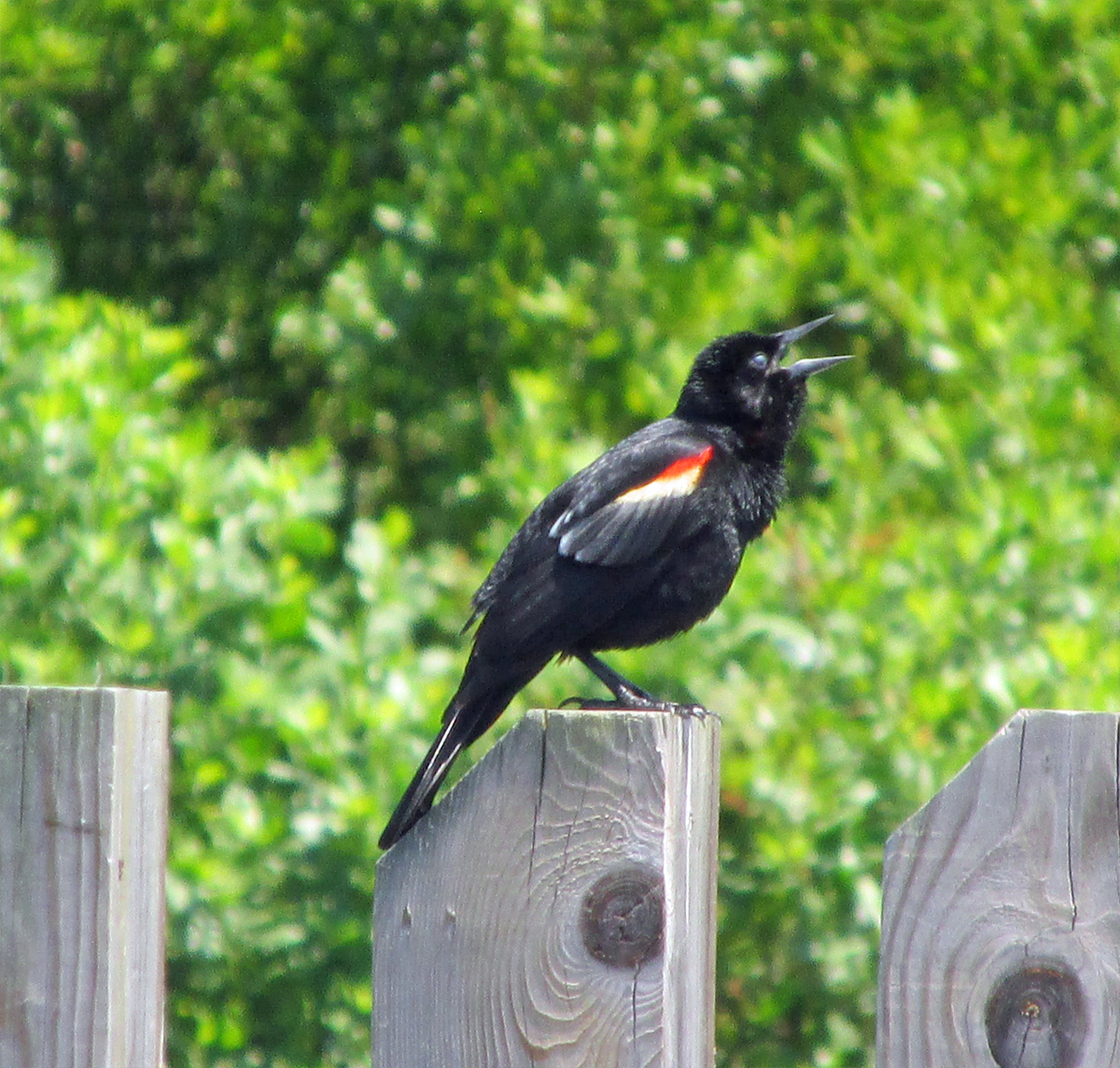
Photo by Bryan Stevens • A male red-winged blackbird sings to attract mates and ward off rivals.
The swallows I saw during my Erwin stroll, however, reminded me that one bird hasn’t returned at my home. The early American naturalist and artist John James Audubon knew this particular bird as “white-bellied swallow,” which is a descriptive name, but today the species is known simply as tree swallow.
Tree swallows have been back in the region for weeks, but they sometimes take their time finding their way to the waiting birdhouses at my fish pond. Their return dates in years past have ranged from early March to the middle of April.
Insect-heavy Diet
Swallows are insectivores, so those that return early in the spring must deal with temperature fluctuations. In prolonged cold spells, these insect-eating birds can be hard pressed to locate their usual prey. At such times, they are often forced to retreat to the area’s lakes and larger rivers, where they can swoop over the water and have an easier time plucking cold-numbed flying insects out of the air.
Once milder spring temperatures prevail, the flocks of swallows forced into these necessary habitats will disperse as pairs begin seeking nesting sites. Tree swallows are cavity-nesting birds, which often puts them into competition with Eastern bluebirds. The two species usually manage to work out a truce and settle down to nest in close proximity to each other.
The iridescent blue-green male tree swallow, complete with white underparts and a forked tail, is a handsome bird and a welcome addition to the bird population in any yard or garden. Tree swallows enjoy water, so a nearby pond or creek is a boon for attracting these birds.
Tree swallows haven’t always nested in Northeast Tennessee. Only in the last 40 years have these birds become regular nesting birds in the region. The first nesting record took place in the early 1980s at Austin Springs on Boone Lake in Washington County, Tennessee, according to The Birds of Northeast Tennessee by Rick Knight. Tree swallows soon became regular nesting birds every summer in all five counties that comprise Northeast Tennessee.
Other Swallows
It’s usually not too difficult to find five of the six species of swallows that are known to make Northeast Tennessee and Western North Carolina their home from spring to fall. In addition to tree swallow, the region’s other swallow species include: barn swallow, purple martin, cliff swallow and northern rough-winged swallow. These are all fairly common summer birds in the region. The sixth species, the bank swallow, is a bit of a specialist when it comes to nesting and occurs only sporadically in the region.
While only a handful of swallows range into the United States and Canada, a total of 83 species of swallows can be found worldwide. Some of the common names for these different swallows (also called martins in other parts of the world) are quite descriptive. A sampling includes white-eyed river martin, grey-rumped swallow, white-backed swallow, banded martin, blue swallow, violet-green swallow, golden swallow, brown-throated martin, brown-bellied swallow, pale-footed swallow, white-bibbed swallow, pearl-breasted swallow, red-breasted swallow, mosque swallow, fairy martin, pale martin, tawny-headed swallow and streak-throated swallow.
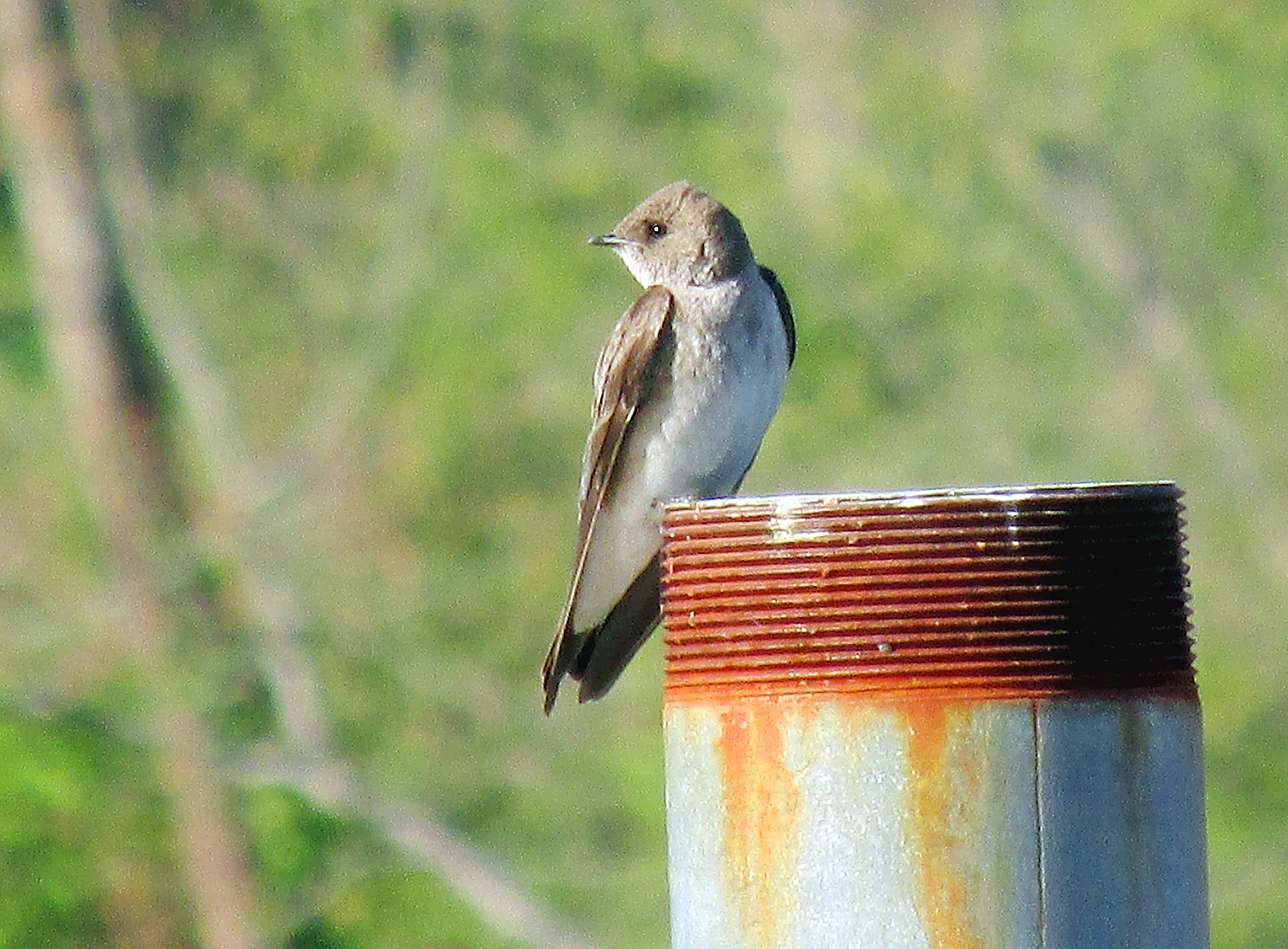
Photo by Bryan Stevens • A Northern rough-winged swallows perches on a metal pipe.
While many swallows and martins have proven highly adaptive when faced with human disturbances to their habitat, a few species have experienced declines. One species — the white-eyed river martin — was last seen in Thailand in the 1980s and very well may be extinct. Closer to home, the golden swallow is now found only on the island of Hispaniola after disappearing from Jamaica in the 1980s. The Bahama swallow, which nests on only four islands in the Bahamas, is also vulnerable. Incidentally, both these swallows are closely related to the tree swallow, with all of them belonging to the genus Tachycineta. Translated from Greek, the genus name means “fast mover,” a quite accurate description of these graceful and agile flyers.
Good
Neighbors
With their enthusiastic twittering to each other, tree swallows make for friendly neighbors. The local bluebirds may disagree, at first, but they’ll get their feathers unruffled eventually. It’s also a pleasant diversion to watch them swoop over fields and ponds as they help control the insect population.
To increase your chances of hosting your own tree swallows, offer a bird box placed in an open area. Right now is the time to attract their attention with some prime real estate. Plans are available online to help construct your own or pick up one at a gardening center, hardware store or farm supply outlet.
Photo by Bryan Stevens • A male Eastern Bluebird perched on playground equipment at Winged Deer Park in Johnson City.
Many would-be hosts for Eastern bluebirds express disappointment when a pair of tree swallows become tenants instead. The remedy to the disappointment is simple: provide an additional nesting box. Although there will be some initial squabbles, tree swallows and Eastern bluebirds will co-exist if they don’t have to compete for the same nesting box.
There’s one last selling point I want to mention on behalf of tree swallows. While not exactly songsters, they do produce an energetic, chirpy trill that they vocalize persistently when in the company of their fellow tree swallows. It’s hard not to be cheerful when hearing such a jubilant noise issuing from one of our feathered friends.
Hummingbird Observations
While tree swallows and their kin are great to have back, one of the most anticipated returns each year is the ruby-throated hummingbird. As I’ve done in years past, I want to hear from readers when they see their first hummingbird of spring. Email me your observations at ahoodedwarbler@aol.com or post them on my Facebook page. Please include the date and the approximate time of your sighting. Email me at ahoodedwarbler@aol.com or post on my Facebook to share your first sightings. You can also leave a comment here on the blog.
Photo Illustration by nayansolanki/Pixabay • A phone will be helpful during the upcoming iNaturalist City Nature Challenge.
Many new arrivals are making spring an exciting time for birders. At my home, Eastern phoebes have been back for several weeks. They make quite the racket every morning with their incessant “fee-bee” calls that commence just after sunrise. A pair of wood ducks made a stopover at the fish pond on March 16. By the end of the month, swallows, warblers, vireos and perhaps even hummingbirds should start showing up.
If you like to record and document these yearly returns, there is also a way that your record-keeping can benefit science and its knowledge of the world around us. Anyone with a phone or a computer with internet access can take part in an upcoming survey of flora and fauna in Northeast Tennessee.
Organizers for the upcoming iNaturalist City Nature Challenge point out that a cellphone can be a great citizen science tool.
The extent of the Challenge goes far beyond East Tennessee. The iNaturalist City Nature Challenges pits cities around the world against each other in a rivalry to see who can report the most observations of wild flora and fauna during a four-day period.
One of the world’s most popular nature apps, iNaturalist helps users identify the plants and animals they encounter on a daily basis. Get connected with a community of over a million scientists and naturalists who can help everyone learn more about nature. What’s more, by recording and sharing observations, users of the app help create research quality data for scientists working to better understand and protect nature. iNaturalist is a joint initiative by the California Academy of Sciences and the National Geographic Society.
Before the end of April, interested naturalists are urged to download and learn to use the iNaturalist app to contribute to scientific knowledge of Northeast Tennessee trees, plants and animals.
Melanie Kelley, a volunteer with Johnson City Parks and Recreation, has helped organize this year’s City Nature Challenge.
“JCPR is the main City Nature Challenge organizer for our ten county area,” Kelley said.
Parks in other locations are also participating. For instance, Warriors Path State Park in Kingsport is participating, according to Marty Silver, a ranger with WPSP.
According to Kelley, other parks and groups are co-organizers for the event.
Kelley said that taking part in the challenge is simple.
A smartphone or computer is needed to input the data.
“Using either a phone with the iNaturalist app or uploading photos to the http://www.inaturalist.org website, everyone is invited to go out and record wild species,” Kelley said. “From birds to grasses, trees to snakes.
“Wild is the key,” she added. “Any place it can be found! Backyards, schools, parks and gardens.”
Kelley said the City Nature Challenge is a global effort to get a worldwide snapshot of all life on earth during a four-day period.
“It is the world’s largest multi-species BioBlitz,” Kelley said.
Identifications are also crucial, according to Kelley. “This part of the challenge encourages folks to log into the website and review and confirm identifications of what others have uploaded,” she said.
Kelley noted that iNaturalist requires users to be 13 or older but that there is a parental consent method for younger users for both the app and the website.
“Each participating park/group will likely have their own age rules,” she noted.
“Last year was the first year JCPR participated in the CNC,” Kelley said. “If COVID-19 was not an issue, the CNC would be back to its roots as a direct city to city or area to area challenge.”
The rivalries can get intense.
“Last year, our good friends at Zoo Knoxville directly challenged us, so it was Knox vs Washington Counties,” Kelley said. “It was also the first year Knox participated. “
Kelley said that JCPR and Zoo Knoxville knew they would expand their areas after their first successful year taking part in the challenge.
“This allows us to better compete with Nashville’s seven-county project and Chattanooga’s 16 counties over two states,” Kelley explained.
She hopes the COVID-19 shadow over the event is felt less this year.
“Last year, we had daily group events scheduled and all those, of course, had to be cancelled,’ Kelley said.
“This year, the main CNC is again, less of a competition and more of a collaboration worldwide,“ she said. “However, this year, under a hybrid model, those that wish to have head to head challenges can do so. Oh, and yes, we do so want to take on Knox, which includes the Great Smoky Mountains National Park. We can do this!”
Kelley said that expanding the project area to the upper ten Northeast Tennessee counties means partnering with local state and city parks.
Some of the other parks on board include Bristol’s Steele Creek Park, Kingsport’s Warrior’s Path, Elizabethton’s Sycamore Shoals and Roan Mountain’s Roan Mountain State Park.
Kelley noted that Johnson City Parks are all planning on some type of group-led events to help folks who are new to iNaturalist get their feet wet with the program.
“Each park will have its own guidelines as to how they need to handle such events,” she added.
The upcoming event is both valuable to science and an entertaining way to enjoy nature.
“Overall, as a regular iNaturalist user, it is fun,” Kelley said. “More importantly to me, it is such a great way to introduce folks to the native world.
“People walk by and see a flower or a tree or anything and they probably don’t know what it is other than a bird/flower/tree,” she continued. “The app has a really good identification tool where you learn right there what that species is.”
Once identification is made easy, Kelley said that the next big challenge is getting them to the next step of understanding that species role in the larger ecology.
“This is where these group-led observation hikes play a critical role,” she said.
Kelley said that plenty of reports that show up from iNaturalist users are from Unicoi County.
She noted that there are some 4,552 individual observations recorded from Unicoi County.
“These observations represent 1,339 unique species have been recorded by 404 individual iNaturalist users,” Kelley said.
The possibilities of what can be observed and reported are seemingly endless. Everything from birds and insects to salamanders and ferns is fair game as observers scramble to make reports. Grab a phone and start taking snapshots of snakes, squirrels, sassafras trees or anything else that crosses your path. Organizers hope to get plenty of public participation for this year’s City Nature Challenge.
Kelley also quoted Doug Tallamy, a professor in the department of entomology and wildlife ecology at the University of Delaware, where he has authored eighty research articles and has taught numerous classes, including behavioral ecology and humans and nature, for more than 30 years.
Kelley said that Tallamy has been quoted saying, “Knowledge generates interest, and interest generates compassion.”
She added that iNaturalist is a great way to generate knowledge.
“Birders can upload a spreadsheet from their eBird reports for the event days and those will count in our totals,” Kelley said. “These are the only observations made during the CNC that do not require photos to count.”
Observations for the challenge must be submitted between April 30 and May 3. All observations are required to be found within the upper 10 northeast Tennessee counties of Washington, Sullivan, Unicoi, Carter, Greene, Johnson, Hancock, Cocke, Hawkins and Hamblen.
To learn more about the event, Unicoi County residents or people living in or near Northeast Tennessee can visit https://bit.ly/CityNatureChallengeNETN.
Below are events corresponding with the challenge:
• Warriors Path State Park in Kingsport will offer City Nature Challenge 2021, a friendly competition open to nature lovers. The main event at the park will be held Saturday, April 10, from 10 a.m. to noon. The park’s event is sort of an informative preview of the actual Challenge. Observations for the challenge itself must be submitted between April 30 and May 3. Ranger Brian Glover will teach participants how to use the iNaturalist app to photograph, identify, and share their nature observations with a worldwide community of scientists and nature enthusiasts. He’ll also show those taking part how to join the region’s 2021 City Nature Challenge. Be sure to download the iNaturalist app from your app store, and create an iNaturalist account before arriving at the event. Come dressed for the weather and wear good walking footwear. This is not a hike, but attendees will be wandering over some rocky and uneven ground.
• Sycamore Shoals State Historic Park in Elizabethton will offer an educational hike about better ways to enjoy interacting with nature through handy apps and tools on the average smart phone. “Tech in Nature” will be taught by Park Ranger Cory Franklin from 2 to 3 p.m. on Friday, March 26. Most people are inseparable from their smart phones and mobile devices. Franklin wants participants to embrace this cultural change and will show how to better use technology on a day to day basis in nature. Using tools such as GPS locating, plant identification and other easily accessible resources and apps, he will show ways to enhance the experience rather than take away from it. Join him for a walk around the park to better understand the tools everyone carries with them daily. The program will meet and begin at the picnic area beside the visitor center. Cost is $5, but those six and under can participate for free. For more information, call 543-5808.
Note: Although this event has already happened, perhaps Sycamore Shoals will offer this walk again in the future.
•••••
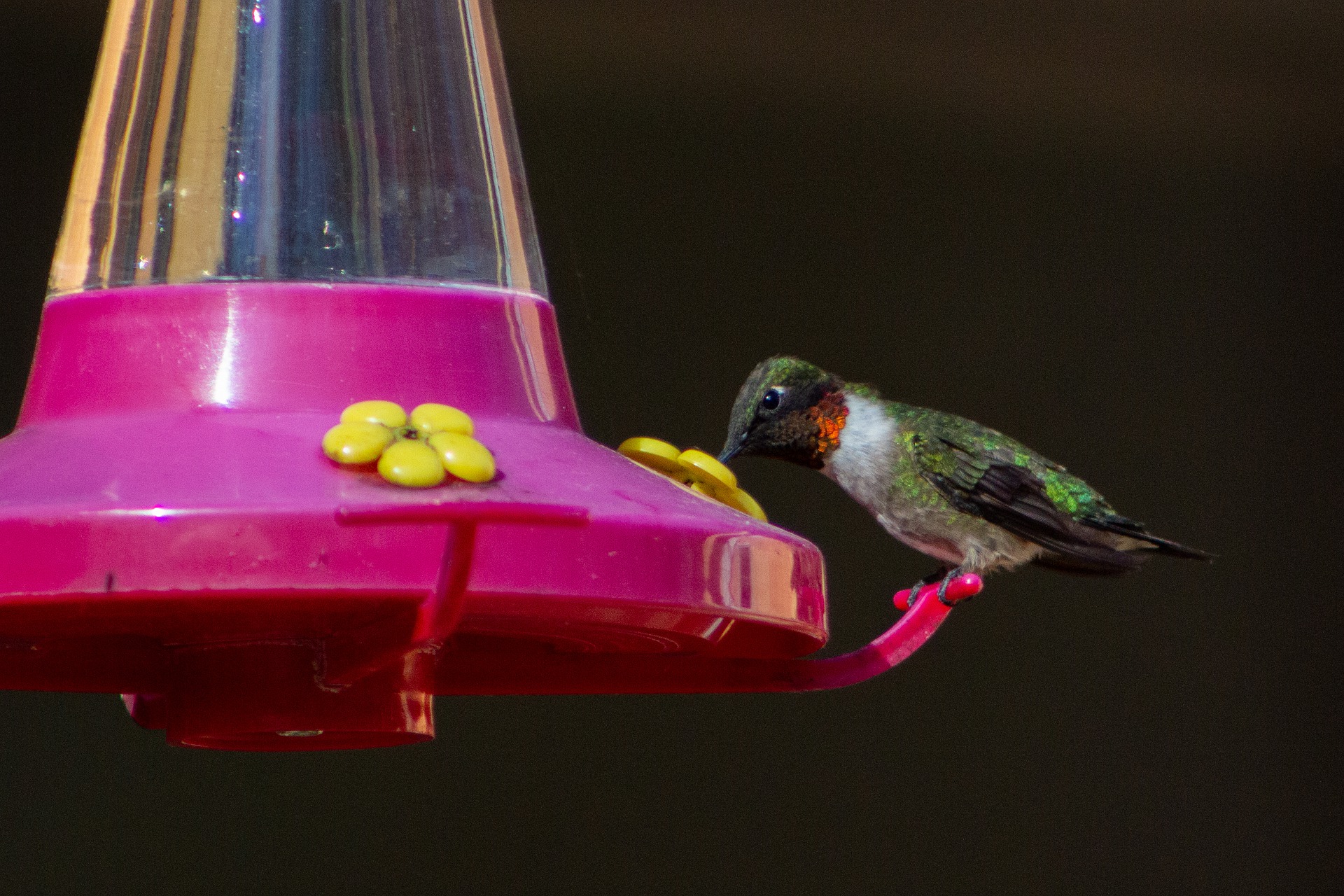
Photo by Bryan Stevens • A male Ruby-throated Hummingbird perches for a leisurely drink of sugar water.
As mentioned at the start of the column, spring is bringing back many of our favorite wildflowers, insects and, of course, birds. One of the most anticipated returns each year is the ruby-throated hummingbird. As I’ve done in years past, I want to hear from readers when they see their first hummingbird of spring. Email me your observations at ahoodedwarbler@aol.com or post them on my Facebook page. Please include the date and the approximate time of your sighting.
This year, there’s more incentive to share your sighting. The Erwin Record and Jonesborough Herald & Tribune will be giving away a hummingbird-related prize from a drawing of all the individuals who report hummingbirds. If you don’t happen to be one of the lucky people to see one of the first hummingbirds of 2021, don’t worry. To be eligible for the contest, email me at ahoodedwarbler@aol.com or post on my Facebook page a sentence or two explaining why you love hummingbirds.
Observations will be accepted through April 18. Winners will be announced in this column on April 28.
Photo by reitz27/Pixabay.com • While one of the smaller falcons, the American kestrel is also one of the this family of raptors more colorful members.
I enjoyed a drive through Limestone Cove in Unicoi, Tennessee, on the afternoon of the next-to-the-last day of 2020. In addition to finding a total of 13 Eastern bluebirds, I saw an American kestrel perched on utility lines near Bell Cemetery. The sighting was the first I’ve had of a kestrel so far during the 2020-21 winter season. Over the years, the cemetery and adjacent fields have been a reliable location for finding this small falcon during the winter.
The American kestrel, although present throughout the year in the region, is somewhat more prominent during the winter months when kestrels from farther north migrate into the region. However, this falcon also nests in the region and can be found at any time of the year in suitable habitat, which is usually open countryside.
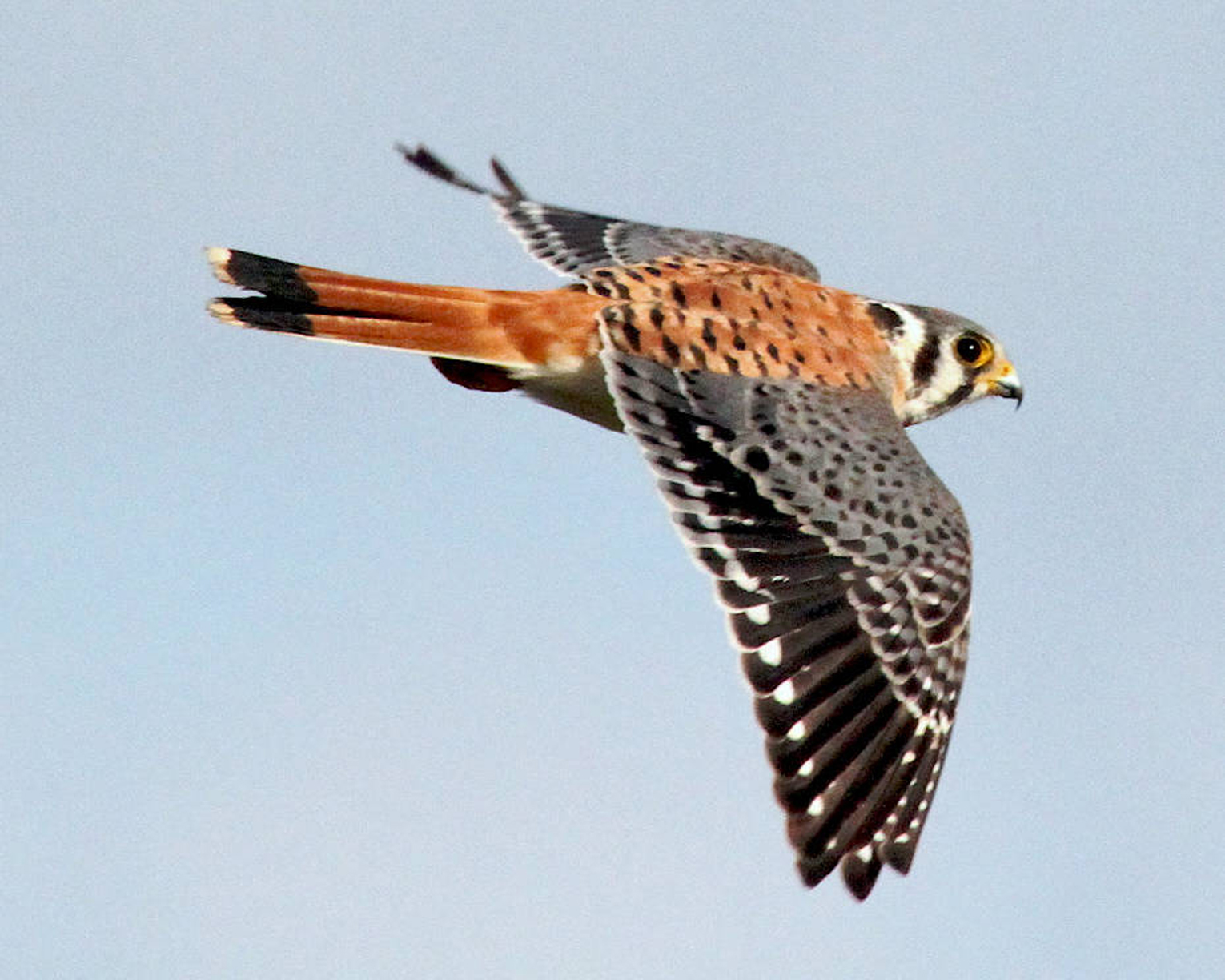
The American kestrel is a small member of the falcon family, which includes such relatives as merlin, peregrine falcon and gyrfalcon. All falcons, regardless of size, share a similar aerodynamic design that includes sleek, streamlined bodies and long, slim wings which taper to pointed tips. They fly with rapid wingbeats and are capable of swift flight.
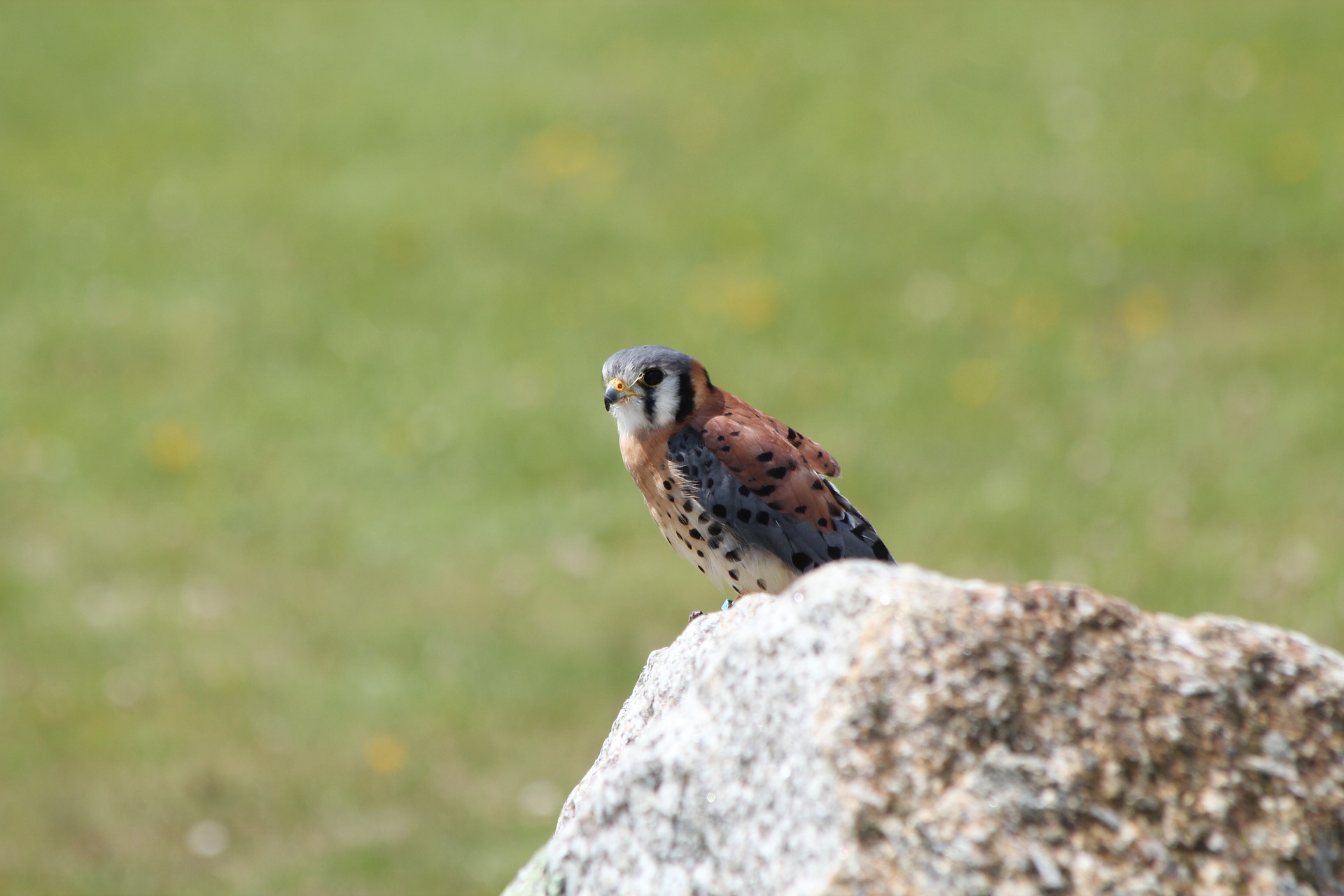
Photo by PBarlowArt/Pixabay.com • An American kestrel uses a rock outcrop as a convenient perch.
The male American kestrel is a colorful bird. He shows a rusty back with some black barring, a rusty tail and steel blue-gray wings. The female kestrel is brownish with black barring on her back and tail. She also shows a buff-colored wash streaked with brown on her under- parts. Both sexes show a strong facial pattern marked by two black “sideburns” on the side of the face.
The American kestrel has long been one of my favorite raptors. They’re seldom as skittish as many other raptors and will permit close observation. Formerly known by the name “Sparrow Hawk,” the American kestrel does not feed entirely on other birds. In fact, a large part of this small falcon’s diet includes rodents and insects.
In its nesting preference, the American kestrel is unusual among other native falcons and hawks. Kestrels nest in cavities, including abandoned woodpecker holes and nest boxes provided by humans.
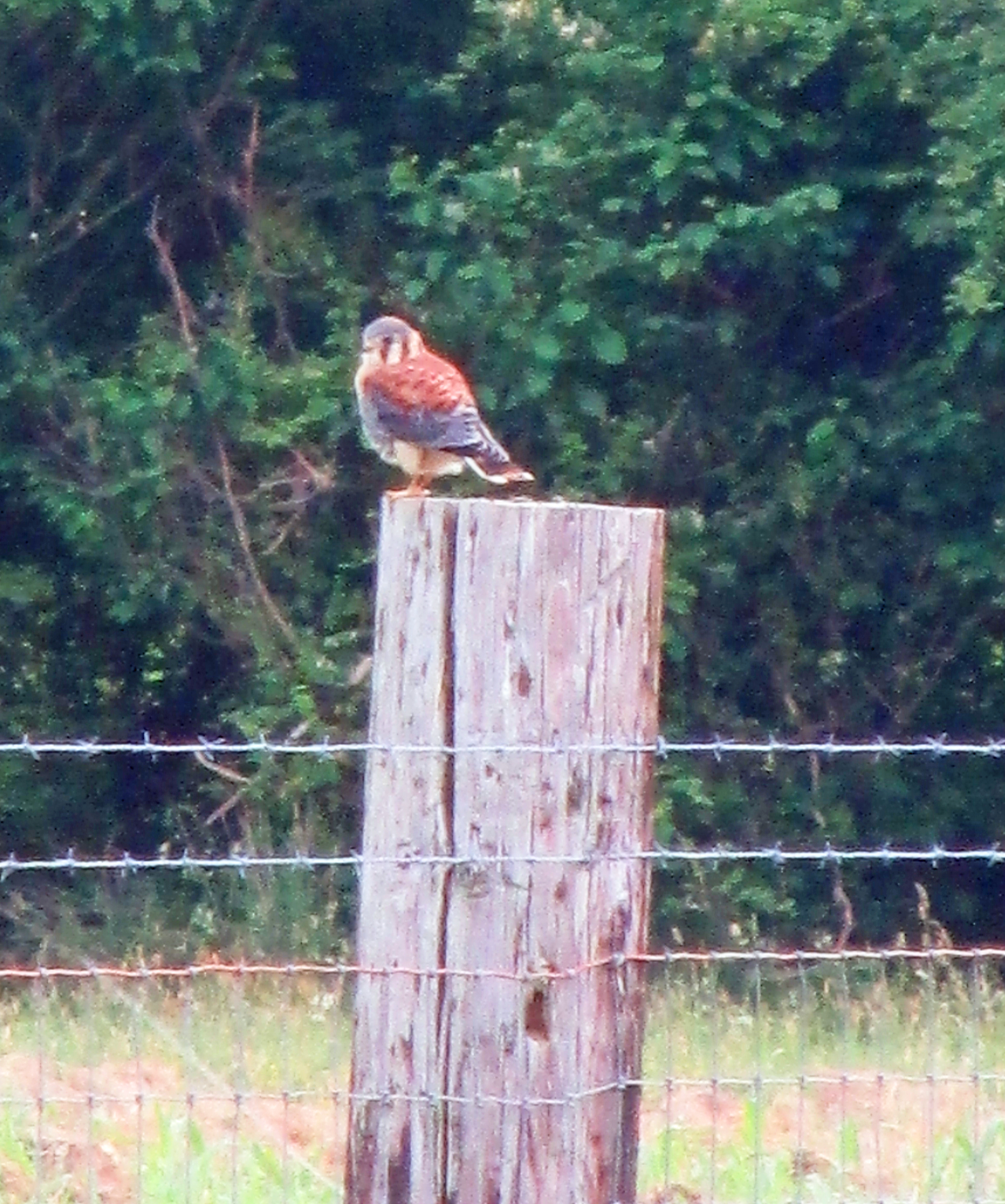
Photo by Bryan Stevens • An American Kestrel uses a fence post for a perch.
Like many raptors, the American kestrel likes to hunt from a perch, swooping down on unsuspecting prey. The kestrel, however, is also capable of hovering, a type of flight that only a relatively few birds, including the belted kingfisher and the ruby-throated hummingbird, are capable of performing.
The falcons comprise a family of birds with a long history with humans. The sport of falconry, although not as widely practiced today, long ago became associated with royalty and nobility. In fact, falconry has been called “the sport of kings.” The sport basically involved hunting prey, usually other birds, with birds of prey such as falcons. As a pastime, falconry never became as popular in the United States as in other parts of the world.
There are more than 60 species of falcons found worldwide. While the peregrine falcon’s endangered status became well-known in the United States, other falcons have been threatened with extinction. The Mauritius Kestrel once dwindled to a population of only six individuals. Today, the population, due to intensive human effort, has greatly recovered.
Other members of the falcon family can be found in the region, including the peregrine falcon and the merlin. Other falcons in North America include the prairie falcon and the Aplomado falcon. Worldwide, some of the more descriptively named falcons include spotted kestrel, rock kestrel, greater kestrel, lesser kestrel, red-footed falcon, red-necked falcon, sooty falcon and brown falcon.
To share observations, ask questions, or make a comment, email me at ahoodedwarbler@aol.com.
Photo by USFWS/Robert Burton • An American kestrel in flight shows the aerodynamic design that earned this small falcon the common name of sparrow hawk.
I’ve a feeling that when we look back on the year 2020, we’re not going to have an abundance of happy memories. Fortunately, I have birds and birding to keep me sane during a year of often dismal news. If nothing else, I will always remember 2020 as the year the evening grosbeaks returned to the region after a 20-year absence.
Evening grosbeaks are large, gregarious, noisy, showy members of the finch family, which includes several more commonplace feeder visitors as house finches, American goldfinches, pine siskins, and purple finches. During the 1980s and 1990s, flocks of dozens, sometimes hundreds, of these birds descended on feeders in the region. I knew a man in the Piney Grove community of Hampton, Tennessee, who converted the metal lids of trash cans into makeshift feeders arranged around his deck to accommodate a flock of more than 100 evening grosbeaks.
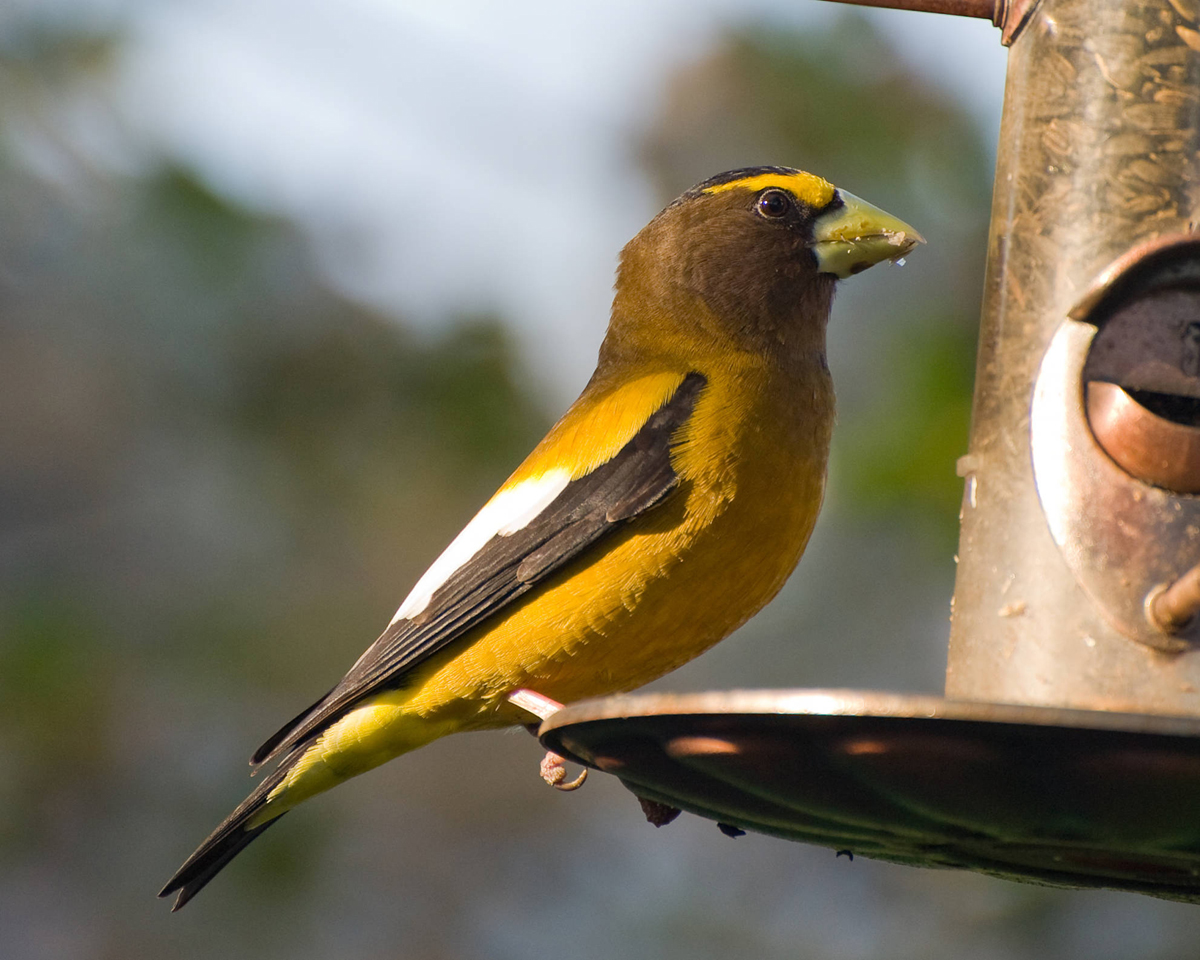
Photo by George Gentry/U.S. Fish & Wildlife Service • A male evening grosbeak perches on the side of a sunflower-stocked feeder.
Then, like a switch being flipped, the great flocks of grosbeaks ceased winter visits to the region after 2000. Birders needed a few years to realize that this bird was no longer to be expected as a fixture of the season. Different theories, none ever confirmed, were put forward to explain the sudden absence.
As years went on, I always held out hope at the start of the winter season that this could be the year they returned, only to be perennially disappointed. Then, in 2020, a year when I could hardly be blamed for anticipating a positive happening, I began to hear reports.
Flocks of evening grosbeaks were spotted in Virginia, North Carolina, and even farther afield in different parts of the Volunteer State. I dared to hope they would make it back to Northeast Tennessee. I even dreamed this might be the year I’d get them back at my feeders.
On Saturday, Nov. 14, Judi Sawyer in Roan Mountain, Tennessee, posted on her Facebook page that a single evening grosbeak had visited her feeders. “Unfortunately, it flew away when I reached for my camera,” Judi said.
Photo Courtesy of Barbara Lake • Two male evening grosbeaks claim a feeder as a female Northern cardinal waits patiently in the background.
On Friday, Nov. 27, I received an email from Barbara Lake in Hampton, Tennessee. “I’m pretty sure we have a flock of evening grosbeaks visiting us,” Barbara wrote in her email.“They are definitely in the cardinal/grosbeak family.”
Barbara added that she and her husband, Jerry, had never before seen evening grosbeaks at their home.“The colors remind me of the American goldfinch, but they’re bigger with a cardinal-type beak.”
She gave such an apt description that I really didn’t need to confirm her observation, but she helpfully provided a photograph of a couple of the grosbeaks at her feeder. “Are they just passing through, like the rose-breasted grosbeaks do?” Barbara asked.
In answer to Barbara’s question, the intent of this influx of evening grosbeaks is still to be determined. The Lakes live atop a high hill that provides a great lookout over the surrounding terrain. “Your home on the hill is probably a beacon for migrating birds,” I informed Barbara in a reply to her email.
Photo by Jean Potter • A male evening grosbeak enjoys black oil sunflower seed from a hanging feeder.
Friends Brookie and Jean Potter announced the arrival of grosbeaks at their home near Wilbur Lake in Elizabethton, Tennessee, on Jean’s Facebook page on Dec. 3.“Five Evening Grosbeaks paid us a surprise visit this morning,” Jean wrote on her post.“We’re ecstatic! This is life bird No. 461 for us and we were able to host it in our backyard.”
Jean also noted that the winter of 2020-21 is turning out to be an irruption year for some species of birds more often associated with Canada and the northern parts of the United States. These irruptive migrations, she noted, are motivated by a scarce food supply for some northern birds, resulting in them coming south.
The small flock visited for only the afternoon, but the next daya single grosbeak returned and fed briefly at the feeders at the Potter home.
I’ve only been feeding birds since the winter of 1993, so I started in time to enjoy the evening grosbeak boom of the 1990s. Over the years, an incredible diversity of species have visited my feeders. This winter season has already seen a drive south by several so-called winter finches, including pine siskin, common redpoll, red crossbills, and purple finches. Although not a finch, red-breasted nuthatches have been prevalent at feeders throughout the region for the past couple of months.Back in October, pine siskins and purple finches began to visit my feeders. Their visits have since diminished considerably. I had hoped the recent snowfall might motivate them to return, but it didn’t happen.
I’ve never seen a common redpoll, although I spent several hours 20 years ago staking out a yard in Shady Valley, Tennessee, in an unsuccessful bid to observe a redpoll that had been a reliable visitor at a feeder in that small community. I have seen red crossbills, but my observations of these birds have always taken place during the summer months near Carver’s Gap in Roan Mountain and the Unaka Mountain in Unicoi County.
Photo by Alain Audet/Pixabay.com • A male evening grosbeak grips a perch on a cold day.
So, as the weather turns cold each year, hope springs eternal that perhaps this will be the winter that will bring some of these northern finches to my feeders, or at least to a feeder in the general area.
Photo by George Gentry/U.S. F&WS • Male evening grosbeaks brings some vibrant color to any place they choose to visit.
I am still waiting for an evening grosbeak to return to my home. I am happy reminiscing about the flocks of dozens of individuals that gathered at my feeders in the ’90s.
The evening grosbeak belongs to the genus Coccothraustes in the finch family. There are only two other species in the genus: the hawfinch of Europe and temperate Asia and the hooded grosbeak of Central America.
One word of advice in case evening grosbeaks show up at your own feeders: These are some of the most fun visitors you will ever host, but they have huge appetites. Be prepared to earmark more of your budget for purchasing sunflower seed, which is a favorite food of these always-hungry birds.
Photo by Pixabay.com
A couple of wild turkeys stroll through an autumn woodland. Although quite capable of flight, turkeys prefer to walk or run over the ground.
NOTE: I wrote this column back in November of 2015. With some revisions, here’s a timely column on one of the nation’s premier fowls.
As Americans, we all have our holiday traditions. Although this year’s pandemic may interfere with the annual lavish meals shared with family and friends, there is one tradition I will not forego. I will carve 30 minutes from my schedule to watch one of my favorite holiday sitcom episodes.
Photo by Bryan Stevens • A flock of Wild Turkeys make their way across a snowy field.
Not surprisingly, there’s an element linked to birds in the episode, which is often cited as one of the most ingenious sitcom episodes in the history of television. The episode is “Turkeys Away” from the first season of WKRP in Cincinnati, a sitcom that aired from 1978 to 1982 and revolved around the antics of the staff of a down-and-out radio station. The “Turkeys Away” episode originally aired Oct. 30, 1978, early in the first season of the series. I especially like that every member of the ensemble cast was woven into the storyline for this classic Thanksgiving episode.
In the event that there are readers who haven’t seen the episode, I’ll try to avoid any blatant spoilers. The action involves a radio promotion that, in hindsight, was destined for disaster. The episode unfolds at the perfect pace, finally culminating in a hilarious series of scenes as the promotion backfires in spectacular fashion. I’ve memorized most of the lines of dialogue, but I still enjoy hearing them delivered by the talented actors Richard Sanders, Loni Anderson, Howard Hesseman and the late Gordon Jump. It’s Jump who gets the pivotal line with his perfectly delivered, “As God is my witness, I thought turkeys could fly!”
The actors on WKRP in Cincinnati truly came together as an ensemble cast for the famous Thanksgiving episode.
It’s that classic line that provides my segue into the subject of this week’s column, which is America’s wild turkey. I sometimes wonder if my favorite episode of WKRP, which aired more than 40 years ago, has had some influence in persuading many people that turkeys cannot fly. It’s a widely held misconception that the wild turkey cannot fly. The turkey is perfectly capable of flying at speeds up to 55 miles per hour, but they often prefer to walk and run over the ground. They’re good sprinters, in fact, and can reach a running speed of 25 miles per hour. Turkeys can even swim!
On the other hand, the domesticated barnyard turkey is a fowl of a completely different kind than its wild cousin. Although the wild turkey — the largest of North America’s game birds — can weigh as much as 37 pounds, it’s the domestic turkey that holds the record as a heavyweight. The largest domestic turkey on record tipped the scales at 86 pounds. That bird certainly could have provided an ample banquet for your Thanksgiving meal. Domestic turkeys are bred to be big, which means they are incapable of flight and are also poor runners. Of course, these domestic kin of wild turkeys don’t face a gauntlet of predators.
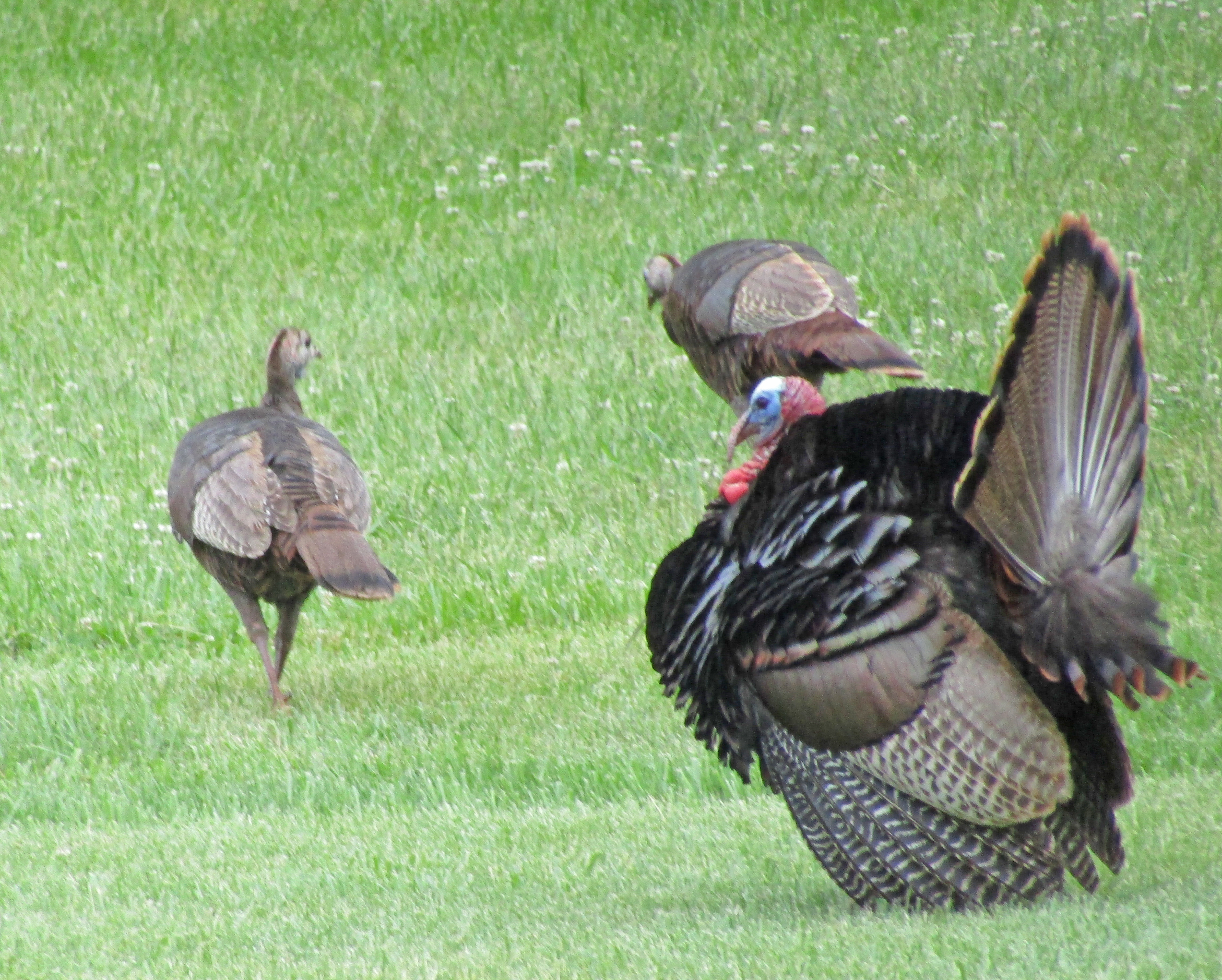
Photo by Bryan Stevens • A male gobbler seeks the attention of hens, but they seem more intent on foraging for food.
The wild turkey is a paradoxical fowl, fully capable of shifting from bravado to timidity to meet the situation. Strutting toms have no hesitancy about making themselves the center of attention when the reward is making a favorable impression on a bevy of hens. At other times, these same turkeys, both the performers and their audiences, adopt a more stealthy mode of life. Wild turkeys know that the world’s a dangerous place.
Wild turkeys face various perils at all points in their life cycles, from eggs to newly-hatched young to adult birds. Turkey eggs are a favorite food of such wild animals as raccoons, skunks, opossums and some snakes. Young turkeys, known as poults, are often the prey of domestic dogs and cats, a range of raptors, and other birds such as crows and ravens. Larger predators — bobcats, cougars, coyotes, foxes and eagles — prey on adult turkeys.
I remember the first time that I observed wild turkeys in flight. I was driving near Persimmon Ridge Park in Jonesborough, Tennessee, when about a dozen large, dark birds flew across the road just above the roof of my vehicle. I was definitely perplexed as my mind worked to figure out the identity of these birds. I had almost settled on vultures — although the flight pattern had been all wrong — when I saw that some of these flyers had landed in a field adjacent to the road. On the ground, they were easily recognized as wild turkeys.
The wild turkey’s scientific name is Meleagris gallopavo. The wild bird is exclusively resident in North America, but domesticated turkeys are now raised around the globe. The wild turkey has only one close relative, the ocellated turkey, or Meleagris ocellata, which ranges throughout the Yucatán Peninsula in Mexico as well as the northern parts of Belize and Guatemala. The extent of this fowl’s range is only about 50,000 square miles, while the wild turkey ranges throughout the United States, Canada and Mexico.
It’s simply too bad that Jump’s WKRP character, bumbling but amiable station manager Arthur Carlson, lacked some crucial knowledge about the differences between wild turkeys and their domestic relatives. If he had gathered a flock of wild turkeys instead of directing his sales manager to acquire domestic fowl, his radio promotion might not have been such a stupendous flop. Of course, we would then have never had this classic episode of comedic television and I wouldn’t have my familiar Thanksgiving ritual to enjoy annually.
Photo by Bryan Stevens A decorative turkey pays homage to the real bird.
Photo by Bernell MacDonald/Pixabay.com • Common grackles are quite accomplished at foraging for food in a variety of habitats.
November is a month of transition. The birds of summer have all “flown the coop,” returning to warmer climes to the south in Central and South America, as well as the Caribbean. Of course, even as hummingbirds, warblers, tanagers, vireos, and others have fled North America in advance of winter’s imminent arrival, other birds are arriving to take their place.
Many of the newcomers don’t offer the vibrant plumage of a scarlet tanager or a rose-breasted grosbeak, but they make up for the lack of striking feathers by remaining quite faithful to our feeders during the bleak, short days of winter. A hermit thrush and a dark-eyed junco represented some first-of-autumn arrivals when they showed up Nov. 6, followed the next day by a swamp sparrow. In addition to the sparrow, three ravenous common grackles descended on my suet feeders that same day.
For many bird enthusiasts, the “common” in this particular bird’s name is particularly apt. Tending to form large, noisy flocks, common grackles can easily wear out even the most generous welcome. Perhaps because I live at a mid-elevation area, common grackles are extremely infrequent visitors to my yard. I can be a little more welcoming to a bird that I know is not likely to linger.
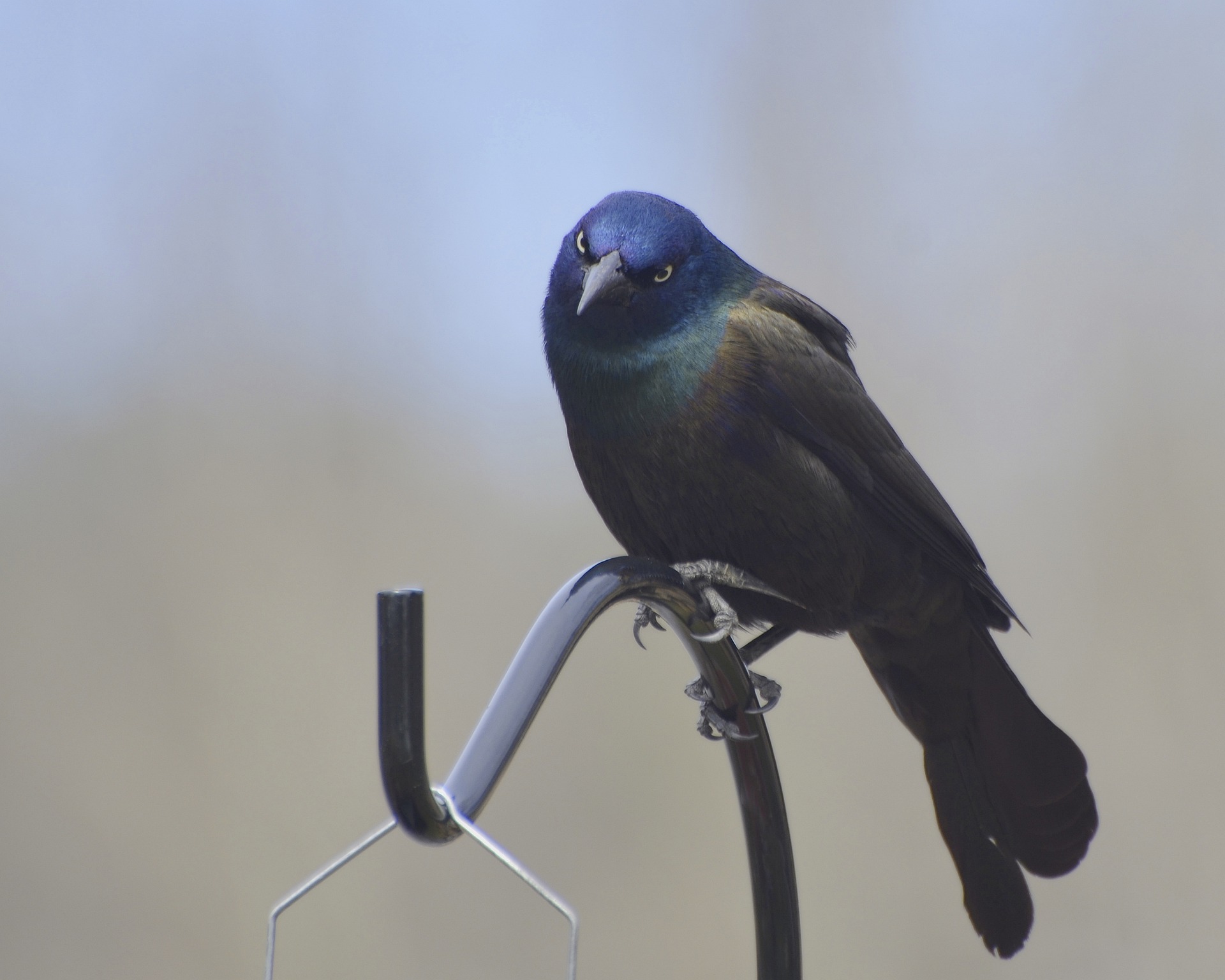
Photo by diapicard/Pixabay.com • A common grackle perches on a shepherd’s hook in a garden. These large birds, which are part of the blackbird family, form flocks and bring big appetites to feeders during migratory stops.
Nevertheless, that same evening these three grackles must have spread the word because a flock of about 30 of these birds arrived. If I needed a reminder, the flock provided a quick one. A handful of grackles isn’t too disruptive, but a large flock can quickly overwhelm and intimidate smaller feeder birds.
Even so, I remain inclusive in my embrace of all feathered friends. A much maligned bird if ever there was one, the common grackle is worth a second look. For those who are able to overlook the occasional bad habits of birds such as Northern mockingbirds, mourning doves, or even cantankerous ruby-throated hummingbirds, there may be hope for this large member of the diverse family of blackbirds, known by scientific types as a member of the family Icteridae. This grouping of New World species, also known as New World blackbirds, includes such members as orioles, meadowlarks, cowbirds, bobolinks, marshbirds, orependolas, caciques and, of course, blackbirds.
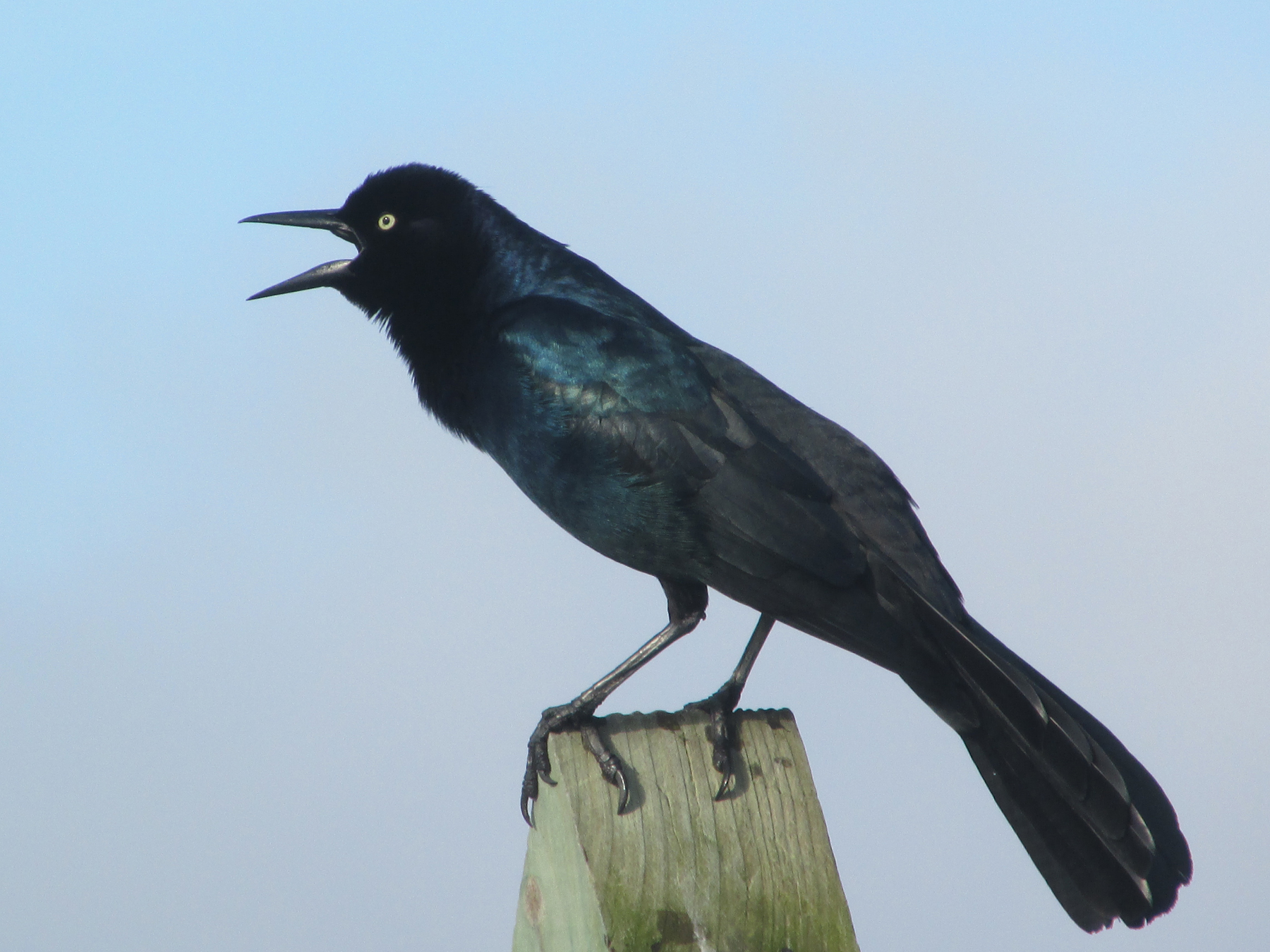
Photo by Bryan Stevens • A boat-tailed grackle sings, if the bird’s harsh, grating notes can be considered a song, from a perch in a wetland in South Carolina.
The common grackle is known by the scientific name Quiscalus quiscula. In the southeast, in particular along the coast and in wetland areas, a common and related species is the boat-tailed grackle. Other species of grackles found in the New World include the great-tailed grackle, Nicaraguan grackle, Great Antillean grackle and the Carib grackle. A little more distantly related are the South American species golden-tufted mountain grackle and the Colombian mountain grackle.
One species — the slender-billed grackle of Mexico — suffered extinction at the dawn of the 20th century. Reasons for this bird’s disappearance are not clearly understood, but habitat destruction of Mexican wetlands and hunting pressures have been theorized as causes. Like others of its kind, the slender-billed grackle may also have been persecuted as an agricultural pest.
Like many other birds dependent on wetlands, common grackles have experienced population declines in recent decades. Although it seems odd to refer to a bird with a population estimated at around 73 million individuals in North America as on the decline, common grackles have suffered an estimated population loss of about 60 percent from historic highs.
Male grackles stand out from other blackbirds due to their sheer size. Males can reach a length of 13 inches, although much of that can be measured in an exceptionally long tail. A grackle’s plumage has a black sheen that can shine with brilliant iridescence that tends to appear purple, green or blue when the sun shines just right on the feathers. Females tend to be smaller than males and are a muted black and brown. Both sexes have long, sturdy bills and yellow eyes.
Most rural residents don’t have to worry about common grackles overwhelming their feeders, but some people living in urban and suburban settings have found grackles to be difficult guests. The birds have bottomless appetites and are aggressive toward more desirable feeder birds. Fortunately, migrating flocks in the fall tend not to linger. After a brief visit, which can still deplete supplies of seed and suet cakes, the grackles continue migrating.
Grackles are usually one of the earliest birds to return each spring. In fact, it’s not at all unusual for these large birds to make their way back to the region as early as late February. I am usually glad to welcome them back since I know that their return is a strong indication that some more favored species are certain to follow in their wake and that winter’s grip is waning.
Are you seeing new arrivals in your yard or at your feeders? Let me know by emailing ahoodedwarbler@aol.com.
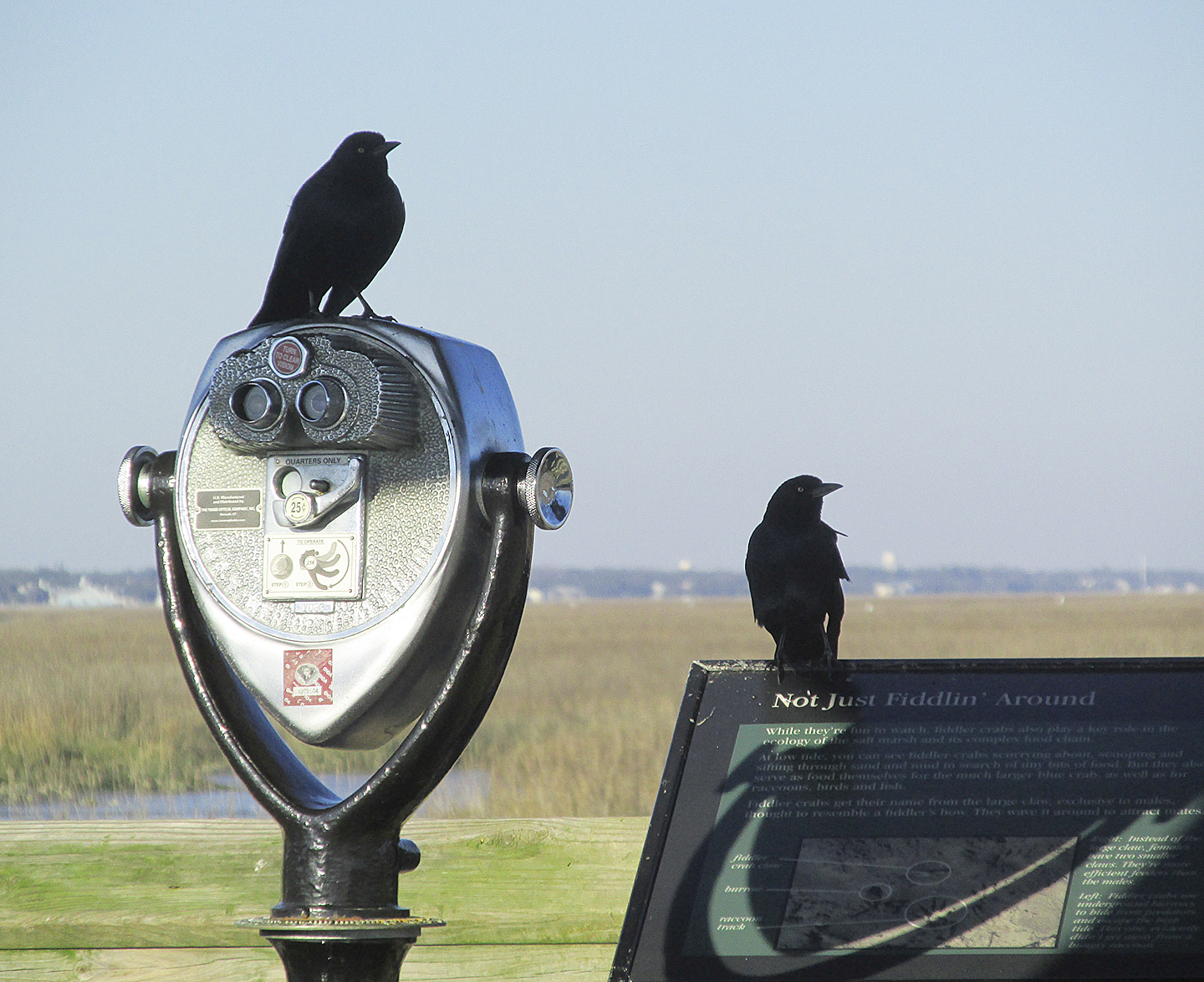
Photo by Bryan Stevens • Boat-tailed grackles perch on viewing equipment at an observation platform at Huntington Beach State Park in South Carolina.














 Our Fine Feathered Friends