
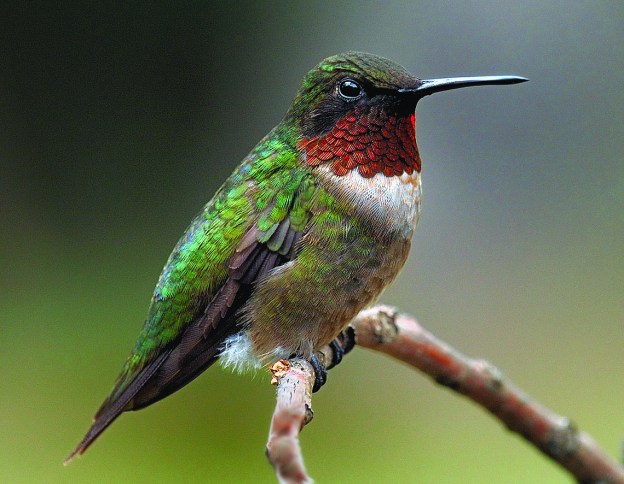

This week’s column is about hummingbirds, the big and the small ones. Frances Lamberts in Jonesborough sent me an email earlier this month that got the ball rolling for this week’s hummingbird column.
“Two hummingbirds were here for a good week long,
at the end of April,” Frances wrote. “Then they were gone, and I haven’t seen any since. Despite the heat/drought (and with some watering), the
property has many favorite flowers in bloom, including the blue salvia, red pole beans, monarda, many others come and gone, the cardinal flowers about to bloom.”
Her question was a simple one: “Where are the hummers?”
She noted that she has kept a “first sightings” record for about 20 year. One year the hummingbirds didn’t arrive until mid June, which worried her at the time.
“What is happening now?” Frances asked.
The simple and honest answer is that it’s not really possible to land on any single answer. Birds have wings, and hummingbirds are capable to long-distance flights.
Still, a setting such as the one Frances described with such a wide variety of blooms should be teeming with hummingbirds.
Personally, it’s been a perplexing season. My hummingbirds arrived back in April, stuck around for perhaps a week, and then almost disappeared. They returned in mid-June, remained visible for a couple of weeks, but have since pulled another vanishing act.
In any given year, the numbers of hummingbirds passing thorough is going to fluctuate. Some years, these tiny flying gems will be present in good numbers on an almost daily basis. Other years, hummingbirds can become quite scarce.
I usually enjoy my best hummingbird numbers in the fall as these little birds begin their leisurely journey back south. Late August and the month of September is usually a great time to watch hummingbirds. I’m optimistic that the same will hold true this fall.
In some other hummingbird news, the world added another species of hummingbird this year when the giant hummingbird of South America got split into two distinct species.
Abi Cole, writing for Audubon Magazine, reported in an article on June 7, 2024, that scientists have considered two distinct populations of giant hummingbird — a migratory southern population in Chile, Argentina and Bolivia, and a non-migratory northern population in Chile, Ecuador and Peru — to be the same species.
Now, scientists have reconsidered that belief and learned that the two species have been able to fool scientists for so long by basically, as Cole’s article phrases it, by hiding in plain sight.
Cole’s article details the elaborate process by which giant hummingbirds were captured and fitted with geolocator devices. The article credits Jessie Williamson, lead author of the new study and a National Science Foundation postdoctoral research fellow, with unraveling the mystery.
Williamson did so by intensively studying the Chilean population. The resulting research also revealed some huge surprises.
For centuries, there has been speculation about where the Chilean giant hummingbirds go to spend the winter. Now we know – they make an astonishing, record-breaking 5,200-mile round trip to spend several months with their cousins in the Peruvian Andes.
Because the Chilean and Peruvian birds look so much alike, no one had ever realized that they were co-existing with each other during the winter season.
Of course, the name “giant hummingbird” is almost an oxymoron for a family of birds famous for their diminutive size. Now that we have two species of giant hummingbirds, they can’t both hold the title of world’s biggest hummingbird.
So, which is the bigger bird? As it turns out, the giant hummingbirds living year round in the Andes, now known as the northern giant hummingbird, is slightly bigger than the migratory southern giant hummingbird.
The article about these discoveries is fascinating. To read it for yourself, visit http://www.audubon.org/magazine/scientists-discover-worlds-largest-hummingbird-hiding-plain-sight.
The giant hummingbird does earn the right to that name. Both of the two species weigh between 18 and 24 grams and have a wingspan of about 8.5 inches. They have a body length of 9.1 inches. For a useful comparison, they are about equal to the size of a European starling or a Northern cardinal.
They are not the dazzling beauties most people associate with hummingbirds. Giant hummingbirds have a drab greenish plumage above with a whitish rump patch and dingy coloration below with variable rusty tones and dusky spotting. They do have the long bills and overall physical shape of other hummingbirds. The scientific name is Patagona gigas, roughly translated as the giant of Patagonia.
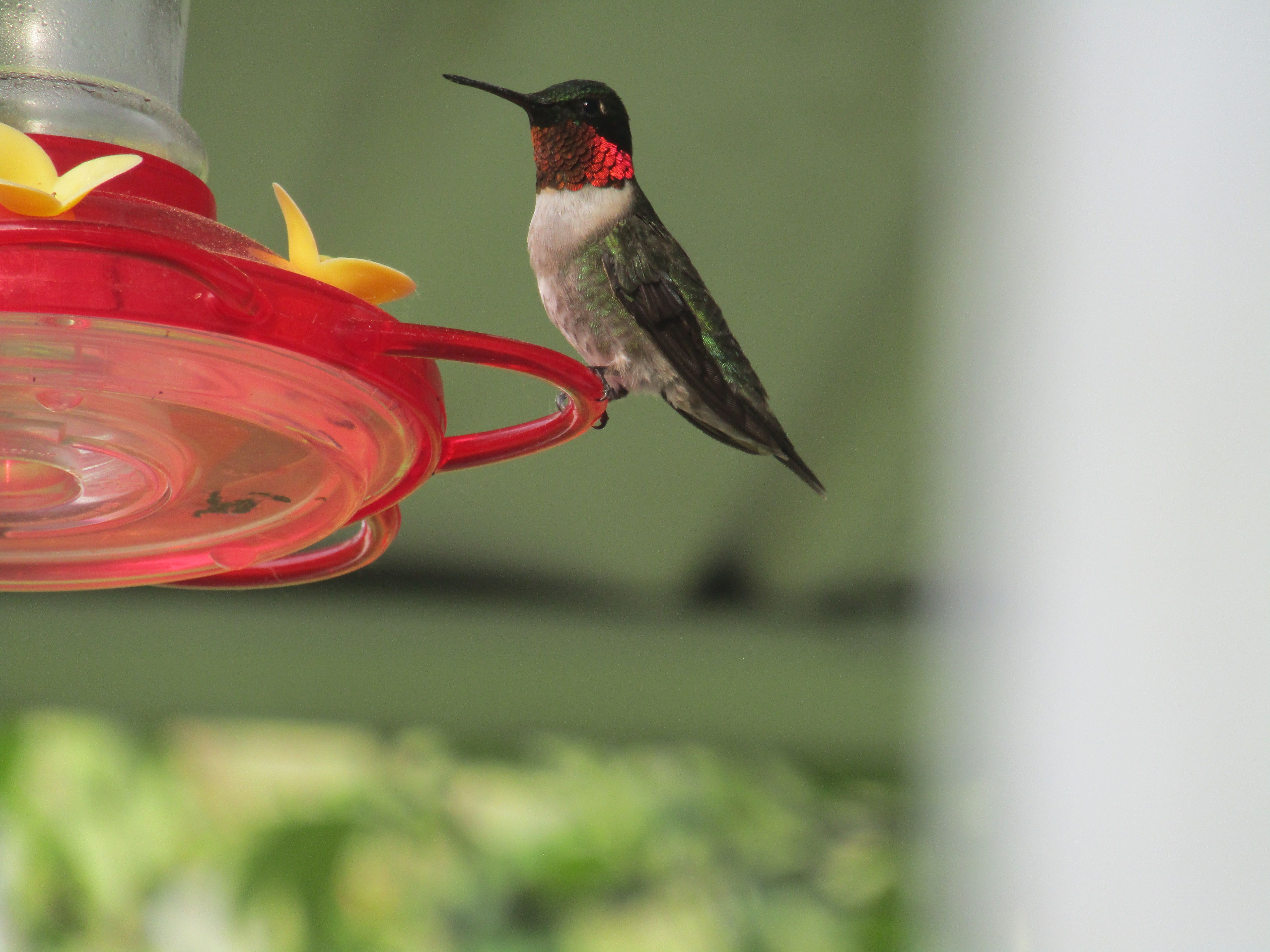
Photo by Bryan Stevens • Welcoming hummingbirds also involves making sure that they remain healthy and safe while spending time in our yards and gardens.
Count the giant hummingbird (either of the two species) as birds I’d like to see some day. The world’s diversity of hummingbirds is dazzling, but I feel fortunate to enjoy the ruby-throated hummingbird from April to October every year. As anyone knows who hosts these tiny birds, ruby-throated hummingbirds are dazzling and engaging guests during their all-too-brief.
•••
To ask a question, make a comment or share a sighting, email me at ahoodedwarbler@aol.com.
 Our Fine Feathered Friends
Beautiful.
LikeLike