
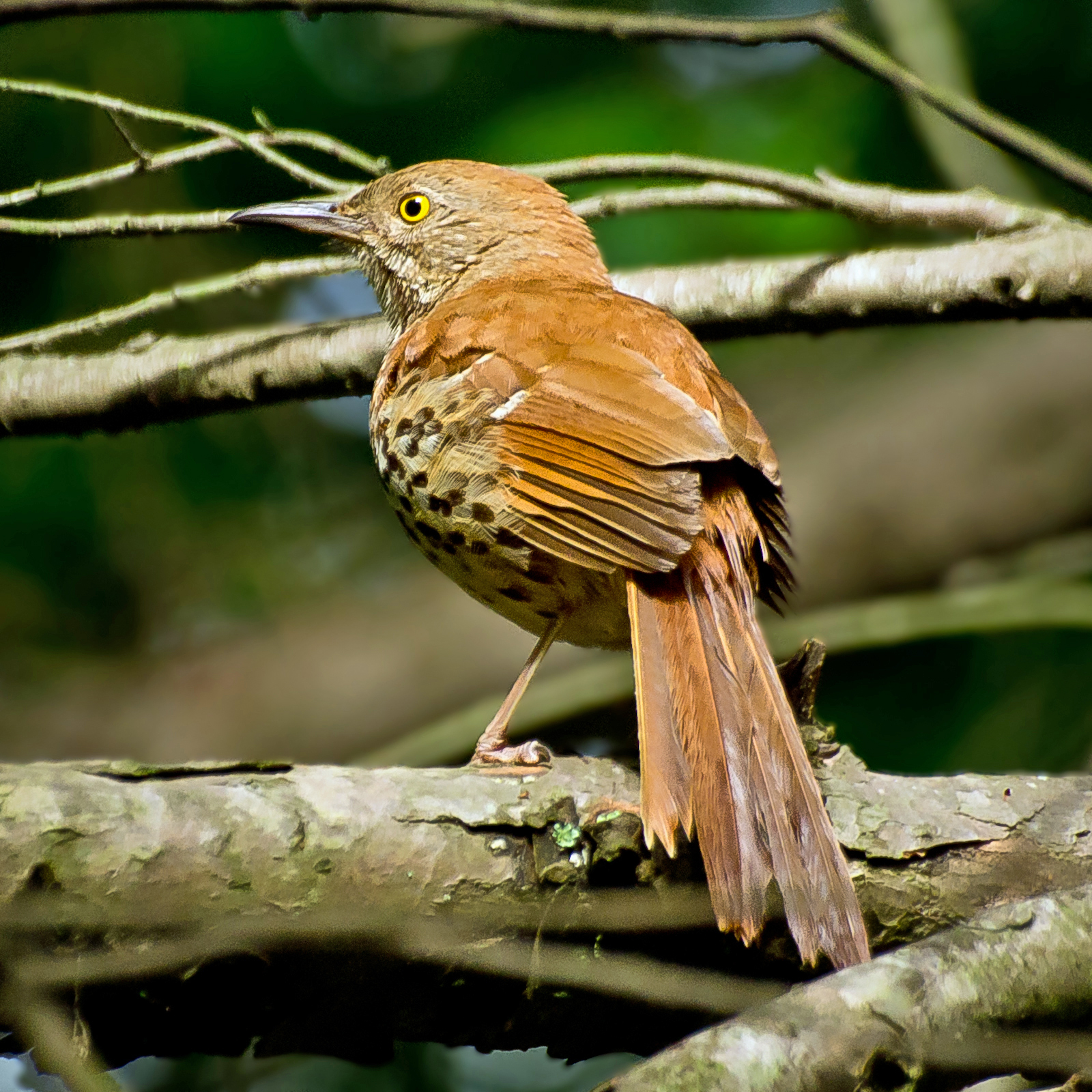
Photo by Ken Thomas • The Brown Thrasher is an alert, sharp-eyed observer of its surroundings.
I heard the paired notes of a signing male brown thrasher on Saturday, March 29, confirming the return of this large songbird. The thrasher was signing from a dead blue spruce tree surrounded by a thicket of forsythia in full golden bloom. I’ve usually celebrated the return of brown thrashers in the final days of March.
This year’s brown thrasher was slightly tardy. For instance, this species returned on March 24 in 2021 and 2023. Back in 2018, I had a “early bird” when a shy brown thrasher put in its first appearance of the year on Feb. 21. Back in 2020, a pair of brown thrashers returned on March 12. Last year, I didn’t see the first brown thrasher until the first week of April.
The brown thrasher (Toxostoma rufum) belongs to the family of “mimic thrushes,” which provides a label for a group of songbirds capable of imitating the songs of other birds. Mimidae, the Latin root for “mimic,” provides the scientific name for the family, which includes mockingbirds and the New World catbirds, as well as thrashers. The Northern mockingbird is best known for the ability to mimic, but relatives like the gray catbird and brown thrasher are also talented mimics.

Early American naturalist and artist John James Audubon painted a dramatic scene of Brown Thrashers defending their nest from an attacking snake.
The thrasher is a fairly large songbird about 11.5 inches long with a wingspan of 13 inches. Much of the body length comes from the bird’s long tail feathers. A thrasher weighs, however, only about 2.5 ounces, which is equivalent to a stack of about two dozen pennies. The brown thrasher is not a picky eater. It’s known to eat everything from berries and nuts to insects and small salamanders.
It’s also aggressive in defending its nest and young. John James Audubon, a French-American ornithologist, naturalist and painter, painted quite the dramatic scene of a group of brown thrashers valiantly defending a nest from an attacking snake. The painting is so detailed that one has to imagine Audubon based his work on a real-life experience. His work, originally painted in the early decades of the 1800s, still holds up today.
Incidentally, Audubon knew the brown thrasher as the “ferruginous thrush.” Another former common name for this species was “brown thrush.” The brown thrasher breeds across the United States and Canada east of the Rocky Mountains. Thrashers withdraw from the northern part of their range in the winter months, spending the season in the southeastern United States.
This species is a familiar bird in southern gardens. In fact, the brown thrasher is the official state bird of Georgia and also provided the name for Atlanta’s National Hockey League team, the Atlanta Thrashers. The thrasher became Georgia’s state bird due to passage of a Joint Resolution of the Georgia General Assembly in 1970.
According to the website All About Birds, brown thrashers, like catbirds and mockingbirds, are mimics with extremely varied repertoires consisting of more than 1,100 song types.
According to the website, male brown thrashers sing a loud, long series of doubled phrases with no definite beginning or end. The song has been described as “plant a seed, plant a seed, bury it, bury it, cover it up, cover it up, let it grow, let it grow, pull it up, pull it up, eat it, eat it.” I’m not sure I would have come up with that same phrasing, but I can detect some of it when listening to a singing thrasher.
All About Birds points out that while mockingbirds tend to repeat phrases three or more times, brown thrashers typically sing phrases only twice.
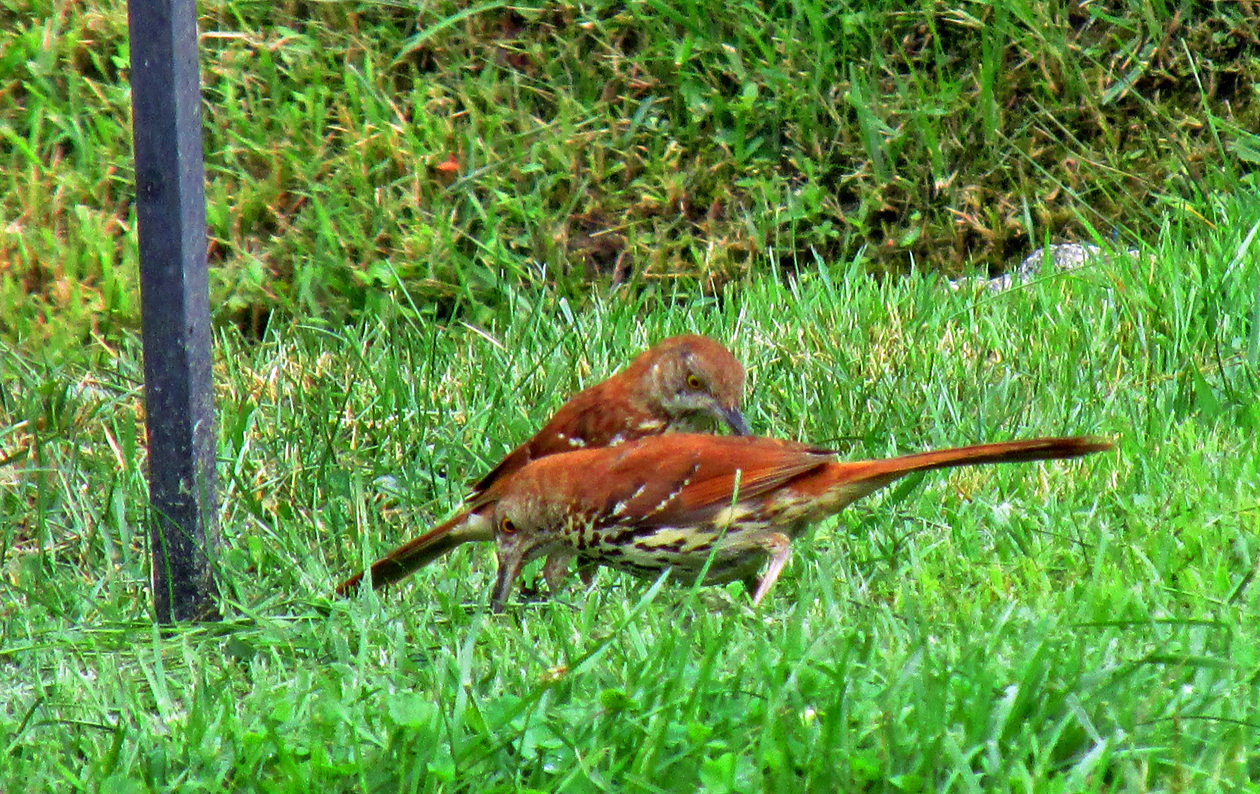
Photo by Bryan Stevens
A pair of Brown Thrashers forage for food on the ground below a feeder.
They also mimic the songs of other species, including chuck-will’s-widow, Northern flicker, white-eye vireo, tufted titmouse, wood thrush, and Northern cardinal.
The New World is home to less than a dozen thrasher species. Other relatives of the brown thrasher include Bendire’s thrasher, LeConte’s thrasher, gray thrasher and long-billed thrasher.
Other new arrivals have included blue-grey gnatcatcher, which showed up on April 2. I placed two sugar water feeders outdoors for the hummingbirds on the first day of April. This year, I Have not had to wait long for their return. The first male ruby-throated hummingbird showed up at my feeder on Sunday, April 6. I will write more on this year’s first hummingbird arrivals in next week’s post. Remember to let me know when the hummingbirds arrive at your home. Share your first spring sighting by emailing me at ahoodedwarbler@aol.com.

Brown Thrasher visits a suet feeder. The thrasher diet consists of everything from berries and seeds to insects and even small reptiles.
 Our Fine Feathered Friends
Bryan Stevens I am so happy that you saw your first sighting of the Ruby-throated Hummingbird in your yard yesterday!!! I’m excited to hear more in your next post!
Here’s my first sightings for the migration season in Corpus Christi Texas:
Wednesday March 26, 2025 2:34 p.m. central time, a ruby-throated hummingbird male stopped at my feeder on my front porch a mile from Corpus Christi Bay after an hour of a rain shower. Corpus Christi, TX 78404. This is a male continuing daily visits several times a day. Distinctive coloring: complete black head, iridescent bright green back, grey lower belly, white breast, iridescent ruby red around neck resembles a scarf. I named him Texas Tuxedo.
Wednesday April 2, 2025 7:15 a.m. Female ruby-throated hummingbird. Tiny, slim, completely grey belly, iridescent green back. Shy flutters around feeder before feeling safe to perch for feeding.
Monday April 7, 2025 11:00 a.m. Ruby-throated hummingbird; unknown male or female. Small, rounded, black chin, white collar, iridescent green top of head and iridescent green back in sunshine. Did not see any red ruby. Very sleek and handsome. Perched to feed.
Monday April 7, 2025 11:15 a.m. (twice). Female, rounded light gray belly, no black or red on neck, iridescent green back that appears a bit ragged like perhaps rough wind traveling. Perched to feed.
This is my first season to watch their migration and have 4 feeders. Last summer was my first time placing hummingbird 2 feeders on the large front porch.
Thank you, Teri
LikeLike
Thank you, TD. Brown thrashers are nice to have around, in my opinion. Thanks for sharing more about your hummers, too!
LikeLike
I have not seen any Brown Thrashers here yet, but I will be watching for them from your description! A few minutes ago I saw my very first lifetime Yellow Warbler eating a caterpillar in my Texas Oak tree with my window binoculars! I understand that they are migrating through here too. This is wonderful to pay attention and notice.
LikeLike
Update to Bryan Stevens if you want to include in your migration report.
😘Here’s my first sightings for the migration season in Corpus Christi Texas:
Wednesday March 26, 2025 2:34 p.m. central time, a ruby-throated hummingbird male stopped at my feeder on my front porch a mile from Corpus Christi Bay after an hour of a rain shower. Corpus Christi, TX 78404. This is a male continuing daily visits several times a day. Distinctive coloring: complete black head, iridescent bright green back, grey lower belly, white breast, iridescent ruby red around neck resembles a scarf. I named him Texas Tuxedo. March 26-March 21st every day several times a day.
🥹Wednesday April 2, 2025 7:15 a.m. Female ruby-throated hummingbird. Small, slim, completely grey belly, iridescent green back. Shy, flutters around feeder before feeling safe to perch for feeding. April 11, 2025 3:10 p.m.
🤗Monday April 7, 2025 11:00 a.m. Ruby-throated hummingbird; unknown male or female. Small, rounded, black chin, white collar, iridescent green top of head and iridescent green back in sunshine. Did not see any red ruby. Very sleek. Perched to feed. Only saw once.
😵💫Monday April 7, 2025 11:15 a.m. (twice). Female, rounded light gray belly, no black or red on neck, iridescent green back that appears a bit ragged like perhaps rough wind traveling. Perched to feed. April 11 still feeds often (almost every 30 minutes) I have named her Ragedy Ann. I believe that she will stay to nest here.
April 11 lots of activity today !!
2 at same time, several times: 😵💫Raggedy Ann (female) & McSteamy or McDreamy (males handsome!) have not gotten a video of theses males yet.
9:50 a.m.
A new migrator Hummer twice today but I haven’t been able to get a video.
3:05 🥹Hummer Flutter
I have not seen my Winter Hummers 😊Joy & 😍Kelly Green, but I am continuing to see 🤩Tiny Slim who I saw today.
A lot of activity today! I didn’t make notes on all, but this is a good sample of descriptions. I’m having so much fun!
LikeLike