Category Archives: Bristol

American robins become more prominent with shifting of seasons


Robins-ETSU-Feb

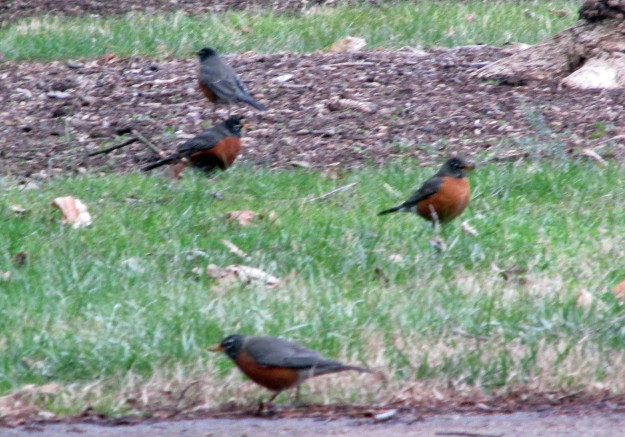
Photo by Bryan Stevens • Returning American robins, prominent in lawns and gardens during their annual spring migration, will soon turn their attention to nesting duties.

I don’t think I’m alone in doing what I can to speed along the process of spring’s arrival. I’ve heard from different people, all eager to share their observations of one of the sure signals — the arrival of flocks of American robins — of the shifting of the winter season to spring.

Bobby Howser phoned me to let me know of a large flock of American Robins he encountered at the Sullins College building in Bristol, Virginia.

He said the flock “swarmed like bees” into a tall holly tree. He was surprised to see so many robins in a single tree and asked if it was an unusual occurrence.
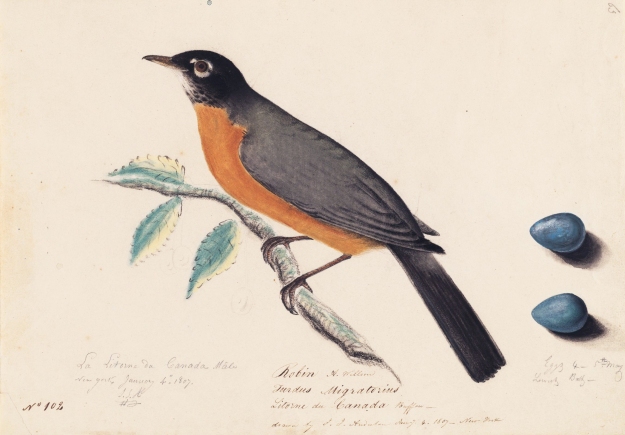
Houghton_MS_Am_21_(46)_-_John_James_Audubon,_robin 3

Early American naturalist and painter John James Audubon painted this American robin with a couple of the bird’s eggs.

Ernie Marburg in Abingdon, Virginia, emailed me about the same time.

“I just wanted to report that we have been inundated with a huge flock of mostly robins,” he wrote. He estimated that the flock contained 300 to 500 individuals.

“They ate all the red berries from my neighbor’s large holly tree yet appear to avoid other holly trees with many red berries just a short distance away,” Ernie wrote. The flock remained active in the tree from morning into early afternoon.

Not long after he first emailed me, Ernie contacted me again. “I wanted to give you an update on the robin invasion,” he wrote. “They have been here two additional mornings since I first reported to you. Their pattern is different now though. They are spaced apart and appear to be ground feeding individually.”

Robin-OnNest

Photo by Bryan Stevens • American robin sitting on its nest in the shelter of a side of a bridge spanning the Doe River in Elizabethton, Tennessee.

Ernie proposed a theory about the behavior of the robins.

“I think they followed the south to north weather pattern we had recently that provided significant rainfall,” he explained. “The rainfall, in turn, caused the ground to thaw and the earth worms to come to the surface thus providing a food source for the robins. In summary, the robins are following their food source.”

I responded to Ernie and congratulated him on what I thought was an excellent theory.

Ernie also wrote me that he had read an article some time ago that said robins would eat cooked elbow macaroni if put out for them.

“We did that, but not one robin ate the macaroni,” he said. “Moral of the story is, as you would expect, don’t believe everything you read.”

I’ve read similar suggestions of unusual items to try to tempt birds not prone to visit feeders. I told Ernie that I wasn’t too surprised that the robins ignored the macaroni. The observations of robin feeding habits made by Bobby and Ernie also correspond to the changing seasons. Holly trees retain their berries into late winter, which provide an abundant food source for robins, as well as other birds. As the temperatures begin to rise in early spring, the birds switch their diet in favor of earthworms. This protein-rich food source fuels the impressive migration made by robins each year.

Robin-Hunter

Photo by Bryan Stevens • An American robin scans for prey in the grass and clover of a lawn.

I posted on my Facebook page about the flocks of robins I’d observed, which resulted in several comments on my original post.

Johnny Mann, who lives in Bristol, Tennessee, shared on my Facebook page after I posted about seeing flocks of robins almost everywhere I have gone recently. He noted that he has been seeing Eastern bluebirds, which are a smaller relative of robins. He noted in his comment that the bluebirds are feeding on suet.

Jackie Lynn, who lives in Wytheville, Virginia, also posted a comment on my Facebook page. Jackie saw a large flock of robins feeding in a field, enjoying the worms brought to the surface by recent rains. “Dinner was served,” Jackie reported.

Several other people responded optimistically on my Facebook page, sharing the hope that the influx of robins does indeed signal the approach of spring.

The American robin is known by the scientific name Turdus migratorius, which can be translated as “migratory thrush.” Indeed, this well-known American bird is related to other thrushes, including the Eastern bluebird, wood thrush and veery. The relationship to other thrushes is quite visible in young birds, which display a spotted breast until they mature and acquire the familiar red breast associated with robins.

There are 82 other species in the genus, which ranges not only in the Americas, but Europe, Asia, Africa and Australia, as well. Some of the American robin’s fellow genus members include the olive thrush, the bare-eyed thrush, pale thrush, great thrush, black-billed thrush and cocoa thrush.

AmericanRobin

Photo by Bryan Stevens • While American robins like fruit when its available, they also spend a lot of time feeding on earthworms and insects.

When the first European settlers arrived in North America, the robin was still a bird living in the forests. Robins proved incredibly capable of adapting to the presence of humans. Soon enough, these once shy forest birds began to frequent lawns and city parks. The robin soon became one of America’s most popular songbirds. Three states — Connecticut, Michigan and Wisconsin — have conferred official state bird status on the American robin.

Robins begin nesting almost as soon as they return each spring. Nesting success in a previous season instills fidelity to the location where the birds nested, resulting in many robins returning to the same nesting area year after year. Although some robins invariably spent the entire winter season in the region, it is still a welcome sight to see migrating flocks of these birds in February and early March. The sudden resurgence of the American robin each spring is a reminder that another winter will soon be history. I know I’m always pleased to welcome them back.

•••••

Bryan Stevens lives near Roan Mountain, Tennessee. To learn more about birds and other topics from the natural world, friend him on Facebook at https://www.facebook.com/ahoodedwarbler. If you have a question, wish to make a comment or share a sighting, email ahoodedwarbler@aol.com.

american_robin

Early American naturalist and painter John James Audubon captured this family of American robins in one of his masterful paintings.

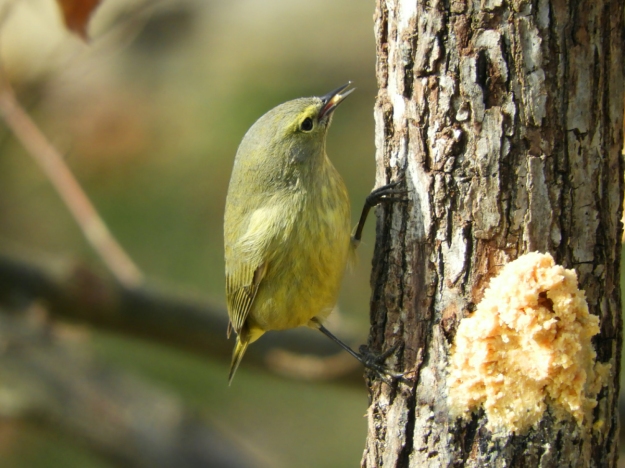
Unlikely orange-crowned warbler becomes daily visitor this winter at woman’s feeders

After you have fed the birds long enough, you’re going to get visits from “mystery” birds. No matter how thoroughly you thumb through the pages of your field guides or how many online Google searches you conduct, it can be hard to pin down the identity of certain birds, especially when you encounter them for the first time.

Orange-crowned-Two-BOYD

Photo by Rebecca Boyd • This orange-crowned warbler has found a favorable winter residence at the home of Rebecca Boyd in Knoxville, Tennessee, making frequent visits to suet feeders to supplement its usual diet of insects and berries.

In the summer and fall, young birds recently out of the nest can cause some confusion when they show up in the company of their parents at feeders. In the winter, often a season characterized by subdued plumages and nomadic wanderers, the surprise visitors can be one of the many “little brown birds” in the sparrow clan or a summer bird like an oriole or thrush that has decided to take a shot at overwintering.

Or, with greater frequency each winter, it might be one of the warblers. That was the case when Rebecca Boyd, a resident of Knoxville, Tennessee, contacted me recently via Facebook asking for assistance with a bird identification.

27583340_337866090062351_24195392_n

Photo by Rebecca Boyd • This orange-crowned warbler is one of the more nondescript members of the warbler family.

Although most of the warblers beat a hasty retreat from North America every fall, a handful of species have increasingly begun to spend the winter months far north of their usual tropical haunts. Some of these species include yellow-rumped warbler, pine warbler and palm warbler, but the low-profile orange-crowned warbler is also becoming more common between November and March, especially in yards and gardens offering supplemental food such as suet cakes.

The small greenish-yellow bird that showed up at Rebecca’s home was easily identified, thanks to some great photographs that she took of her visitor. I communicated to her that I believed her bird to be an orange-crowned warbler. She had also conducted her own research, which had also led her to that conclusion.

Orange-crowned-Four-BOYD

Photo by Rebecca Boyd • This orange-crowned warbler has found a home at the residence of Rebecca Boyd in Knoxville, Tennessee, this winter.

Rebecca said she also shared some photos with birding groups on Facebook, which brought some helpful feedback. “I’ve gotten numerous responses that orange-crowned warblers are becoming a lot more common on the east side of the Mississippi, with quite a few people saying they are seeing them in their yards, too,” Rebecca wrote.

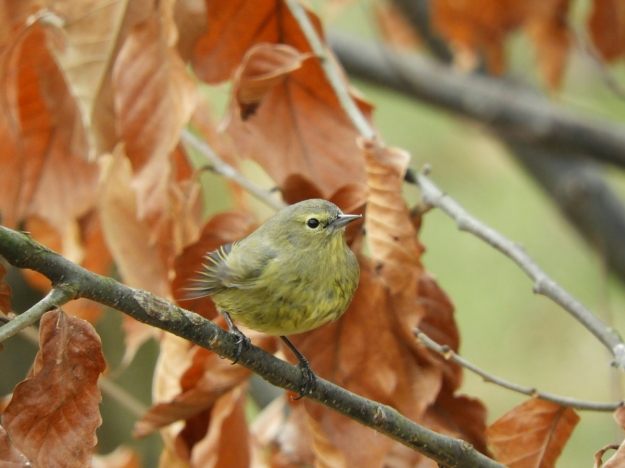
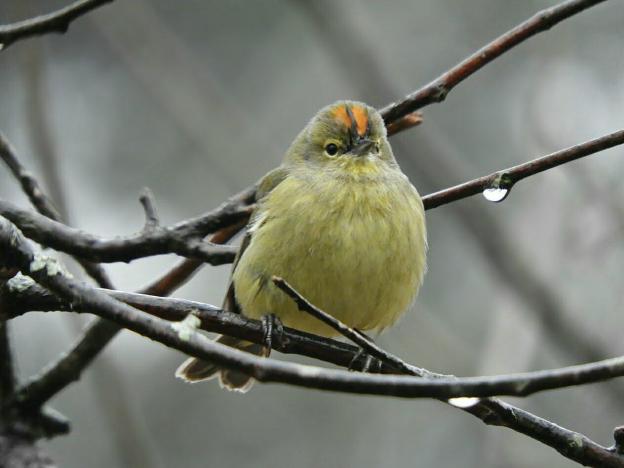
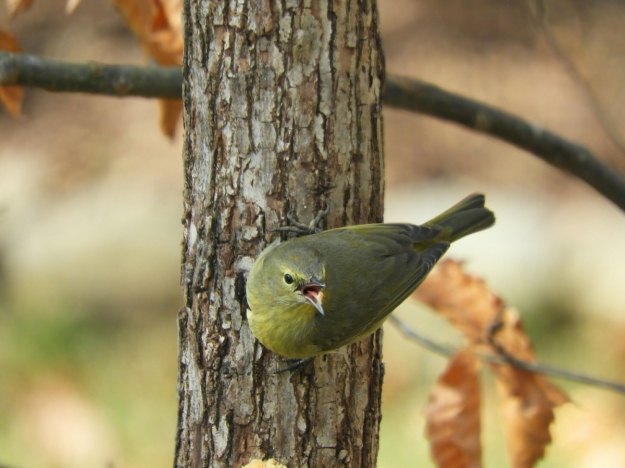
The orange-crowned warbler is one of the more undistinguished members of this New World family of birds that numbers about 115 species. The bird gains its common name from a physical feature that is rarely seen — an orange patch of feathers that, unless the bird is extremely excited or agitated, is usually concealed beneath its dull greenish-yellow feathers. It’s not a field mark that’s considered reliable for identifying the bird.

Rebecca got a lucky break and managed to photograph this elusive feature on her visiting bird. She said the feathers on the bird’s head appeared wet, which may have explained the appearance of the orange crown.

28033440_343701942812099_429716009_o 2

Photo by Rebecca Boyd • Wet feathers made the rarely seen orange crown visible on this orange-crowned warbler that has taken up residence at the home of Rebecca Boyd in Knoxville, Tennessee, this winter.

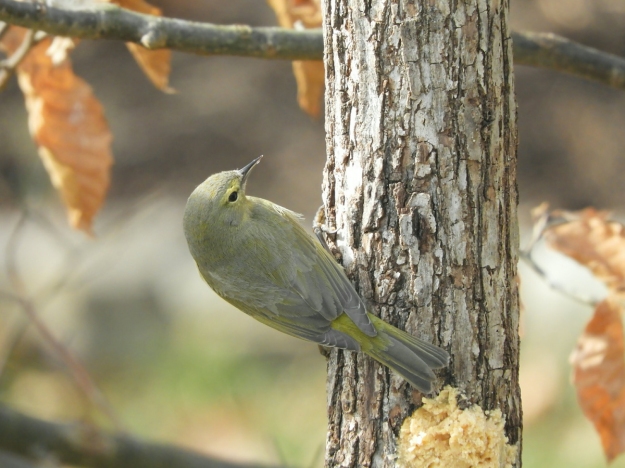
So, what does signify an orange-crowned warbler? The lack of wing bars, as well as the absence of a strong facial pattern is a strong indicator. The bird in Rebecca’s photo is not nearly as drab as this warbler can appear. Some appear very gray with only a hint of yellow or green in their plumage. There is often faint gray streaking evident in their yellow-green breast feathers. This warbler always shows yellow beneath its tail, a feature that is often only glimpsed as an observed bird is diving into cover. These birds also have sharp, thin bills. It’s usually a process of eliminating other suspects that brings birders to identify one of these warblers.

Unlike some warblers restricted to either the eastern or western United States, the orange-crowned warbler migrates and winters throughout the nation, east and west, although it primarily only nests within the western United States, as well as Alaska and Canada.

Although Rebecca said she has only been bird-watching and taking pictures for a little over a year, she has been a general point-and-shoot photography hobbyist for years. “My backyard is a bird paradise that attracts numerous and varied species,” Rebecca noted. “My favorites are bluebirds and hummingbirds, but the little warblers are also very special.”

Orange-crowned-One-BOYD

Photo by Rebecca Boyd • Besides orange-crowned warbler, like this individual, other warblers on occasion winter in the United States. Species most often attempting to spend the winter months in the United States include palm warbler, pine warbler, and yellow-rumped warbler.

Most of the warblers are currently residing on the island of the the Caribbean, or far south in Central and South America. A few others spend the winter in Florida or other southern states. The 50 or so species that nest in the United States and Canada will begin arriving as early as next month, although the majority of these summer residents will arrive or pass through the region in late April and May.

So, while it has a colorful name, the orange-crowned warbler is one of the more drab and nondescript members of its family. Other warblers living throughout the Americas include flame-throated warbler, crescent-chested warbler, citrine warbler and arrowhead warbler.

I’ll just keep daydreaming on the occasional snowy day of the approach of spring, which signals that the kin of the orange-crowned warbler will be winging their way north again in only a couple more months. I, for one, can’t wait.

••••••

If you have a question, wish to make a comment or share a sighting, email ahoodedwarbler@aol.com.

Orange-crowned-THREE-BOYD

Photo by Rebecca Boyd • This orange-crowned warbler grabs a bit of suet from a feeder at the home of Rebecca Boyd in Knoxville, Tennessee.

Duck…duck…goose? Winter season good time for finding rare geese in the region

SnowGoose-Jan21

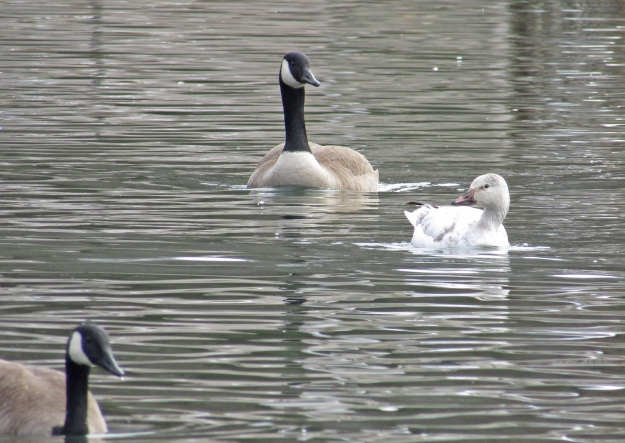
Photo by Bryan Stevens • A snow goose swims amid Canada geese at the pond at Fishery Park in Erwin, Tennessee.


Of the geese found in the region, the well-known Canada goose is nearly ubiquitous. That’s not always been the case. For instance, in his book The Birds of Northeast Tennessee, Rick Knight points out that the geese now present throughout the year resulted from stocking programs conducted in the 1970s and 1980s. In earlier decades, the Canada goose was considered a rare winter visitor to the region.

Seeing the Canada goose in every sort of habitat from golf courses to grassy margins along city walking trails, it’s hard to imagine a time when this goose wasn’t one of the region’s most common waterfowl.

2-canada-goose-john-james-audubon

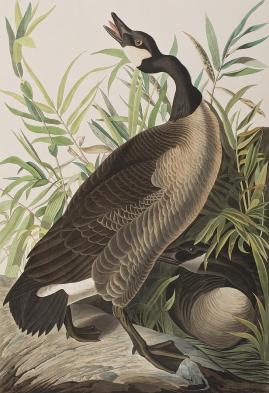
Early American naturalist and artist John James Audubon captured this pair of Canada geese in a most realistic painting.

The world’s geese are not as numerous as ducks, but there are still about 20 species of geese worldwide, compared to about 120 species of ducks. While both ducks and geese are lumped together as waterfowl, most geese are more terrestrial than ducks. Birders are just as likely to spot geese in a pasture or on the greens of a golf course as they are on a lake or pond.

There have been several species of geese usually considered rare to uncommon in the region that have been spotted by birders thus far this winter season. I personally observed greater white-fronted geese at several different locations in November and December.

The greater white-fronted goose is considerably smaller than a Canada goose. The bird is named for the distinctive white band found at the base of bill. This white band also helps distinguish this goose from similar domestic geese. The sexes are similar in appearance, but females are usually smaller than males. The head, neck and upper back of white-fronted geese are grayish-brown. The lower back and rump are dark brown, and the tail is dark brown and edged with white. The chest and breast are grayish with dark brown to black blotches and bars on the breast, giving this goose the nickname “specklebelly.” The bill is pinkish and the legs and feet are orange.

Canada-Greater

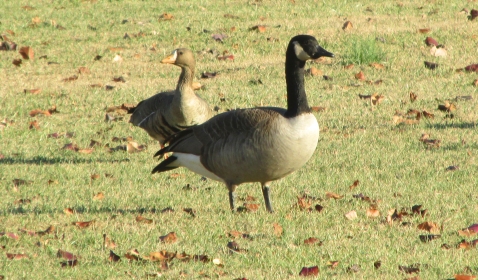
Photo by Bryan Stevens The Greater White-fronted Goose, in background, is much smaller than the typical Canada Goose, which is shown in the foreground of this photograph.

The greater white-fronted goose breeds in North America as well as in Europe and Asia, and they spend the winter throughout the United States and even in Japan. Most nesting in North America takes place on the North Slope of Alaska and across the western and central Canadian Arctic. Wintering habitats include coastal marshes, wet fields and and freshwater wetlands.

Only a couple of weeks ago, I spotted a snow goose at the fish pond located at Erwin Fishery Park. The snow goose is a North American goose known for its white plumage that gives the bird its common name; however, the snow goose actually comes in two versions: the white phase and a blue phase, which is often referred to as a “blue goose.”

The snow goose breeds in regions in the far north, including Alaska, Canada, Greenland and even the northeastern tip of Siberia. They may spend the winter as far south as Texas and Mexico, although some will migrate no farther than southwestern British Columbia in Canada.

The snow goose bucks the trends that show many species of waterfowl declining. Recent surveys show that the population of the snow goose exceeds five million birds, which is an increase of more than 300 percent since the mid-1970s. In fact, this goose is thriving to such a degree that the large population has begun to inflict damage on its breeding habitat in some tundra regions.

A smaller relative to the snow goose is the Ross’s goose, which for all practical purposes looks like a snow goose in miniature. The common name of this goose honors Bernard R. Ross, who was associated with the Hudson’s Bay Company in Canada’s Northwest Territories.

Ross-onWater

Photo by Bryan Stevens • A visiting Ross’s goose takes a swim on the large pond at Northeast State Community College in Elizabethton, Tennessee, a few winters ago.

Here’s a quick history lesson. Hudson’s Bay Company is the oldest commercial corporation in North America. The company has been in continuous operation for more than 340 years, which ranks it as one of the oldest in the world. The company began as a fur-trading enterprise, thanks to an English royal charter in back in 1670 during the reign of King Charles II. These days, Hudson’s Bay Company owns and operates retail stores throughout Canada and the United States.

In addition to his trade in furs, Ross collected specimens for the Smithsonian Institution in Washington, D.C. Ross is responsible for giving the goose that now bears his name one of its early common names – the Horned Wavy Goose of Hearne. I wonder why that never caught on?

Ross repeatedly insisted that this small goose was a species distinct from the related and larger lesser snow goose and greater snow goose. His vouching for this small white goose eventually convinced other experts that this bird was indeed its own species.

Ross was born in Ireland in 1827. He died in Toronto, Ontario, in 1874. He was described by other prominent early naturalists as “enthusiastic” and “a careful observer” in the employ of Hudson’s Bay Company. When John Cassin gave the Ross’s Goose its first scientific name of Anser rossii in 1861, he paid tribute to the Hudson’s Bay Company’s Ross.

Canada_Geese

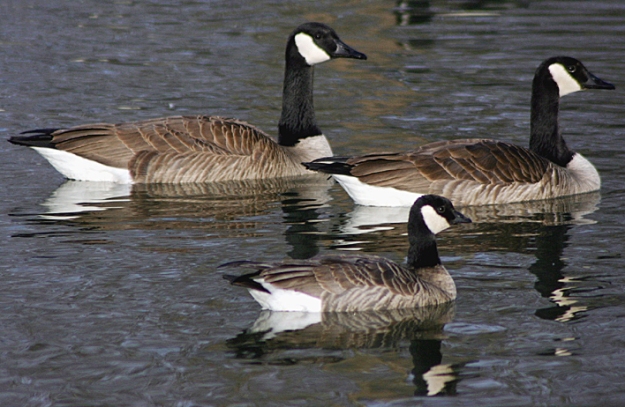
Photo by Bryan Stevens • In some areas, Canada geese have become so prevalent that they are considered pests. Human handouts to waterfowl are not always compatible with good health for the birds that receive them.

The Ross’s goose has a “cuteness” factor working in its favor. For a goose, it is rather small. It could best be described as a snow goose in miniature. In fact, it isn’t much larger than such ducks as mallards and is considered the smallest of North America’s geese.

The Ross’s goose has also acquired some other common names, including “galoot” and “scabby-nosed wavey.” This latter name was inspired by the bird’s bill, which is covered with rough bumps around the base. I have to admit that “scabby-nosed wavey” is a name likely to stick in the memory. Today, the Ross’s goose’s scientific name is Chen rossii.

Other geese found worldwide include the pink-footed goose, bar-headed goose, emperor goose, red-breasted goose and barnacle goose.

So, does this inspire you to try a wild goose chase of your own? If it does, best of luck in your efforts.

•••••

To learn more about birds and other topics from the natural world, friend Stevens on Facebook at https://www.facebook.com/ahoodedwarbler. If you have a question, wish to make a comment or share a sighting, email ahoodedwarbler@aol.com.

A-Cackling Goose 1

Photo by Bryan Stevens • A Cackling goose, foreground, is shown in relation to some larger Canada geese, at a pond at Fishery Park in Erwin, Tennessee.

What’s in a name? Vernacular designations for some birds lack imagination

I took part in a Christmas Bird Count last month. These annual mid-December surveys of bird populations are not quite as exciting as counts held during the spring or fall migration periods each year, but they can produce some interesting results. One exciting post-count activity after taking part in a CBC is getting together to compile the results tallied by the various participating groups and individuals. The results are usually compiled on field checklists for birds of Tennessee. These checklists, which are produced by the Tennessee Wildlife Resources Agency and the Tennessee Ornithological Society, feature a listing of the common name of every bird species likely to be encountered in the state.

AmKestrel-Flight

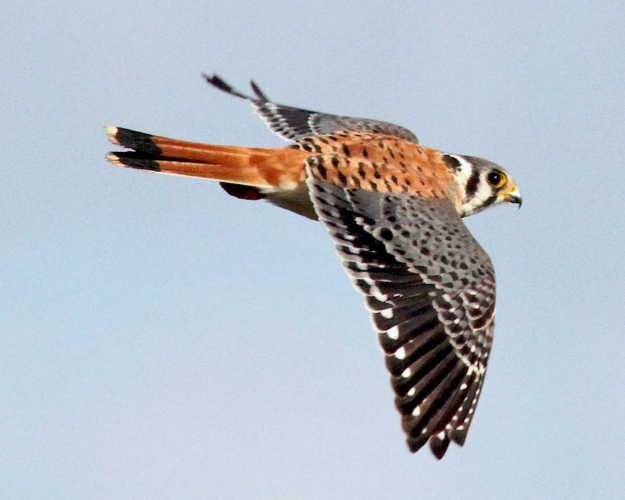
Photo by USFWS/Robert Burton • An American kestrel in flight shows the aerodynamic design that earned this small falcon the common name of sparrow hawk.

The compiler generally reads out the various names on the checklist, which lists all the local birds, beginning with black-bellied whistling duck and ending with house sparrow, and the spokespersons for the various parties respond as each bird’s name is called with the number of birds seen for each species. Over the years, some of the common names of birds featured on the list have changed, as has the position on the list for some of the species. For instance, the American kestrel and other falcons are no longer listed on the card in a grouping with the other raptors found in the state. This doesn’t make much sense to me. But, as I understand it, the falcons have been re-classified for scientific reasons, changing their relationship with the other birds listed on the checklists.

The falcons are not the only birds demoted from the grouping of raptors. The two native vultures — turkey vulture and black vulture — are now listed with herons and ibises instead of raptors. The falcons are now listed between the groupings of woodpeckers and flycatchers.

MaleTowhee-PIC

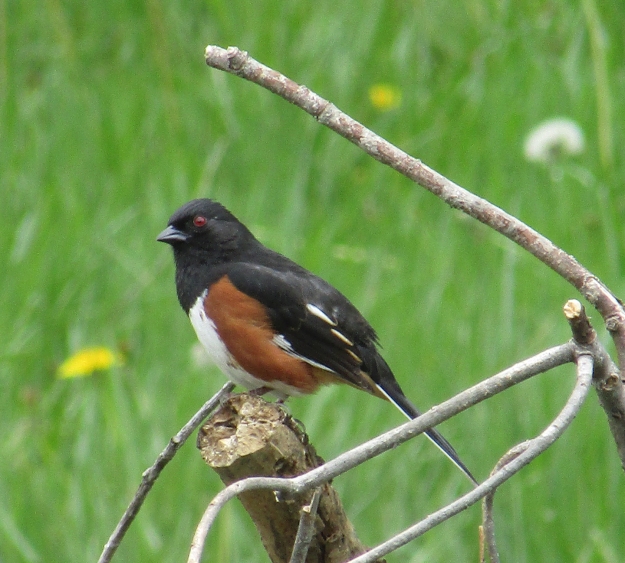
Photo by Bryan Stevens • Former common name rufous-sided towhee became Eastern towhee, which is far less descriptive of the bird’s appearance.

At least no expert has suggested a name change for any of the falcons. I dislike name changes, especially when we lose a descriptive name for a mundane one. That’s how we got relatively bland names like Eastern towhee instead of rufous-sided towhee and Northern flicker in place of yellow-shafted flicker. In fact, the American kestrel was once known as the sparrow hawk. The merlin and peregrine falcon, larger relatives of the kestrel, were once known as the pigeon hawk and duck hawk, respectively.

Common names are also known as “vernacular” names. Vernacular can be defined as the language or dialect spoken by the ordinary people, which contrasts with the scientific names for species of birds that are usually only recognized by ornithologists or other experts. However, just like dialects, there can be a great deal of variety among common names for the same birds. Many of the common names for some of our favorite birds lack any vivid descriptiveness.

IMG_4080

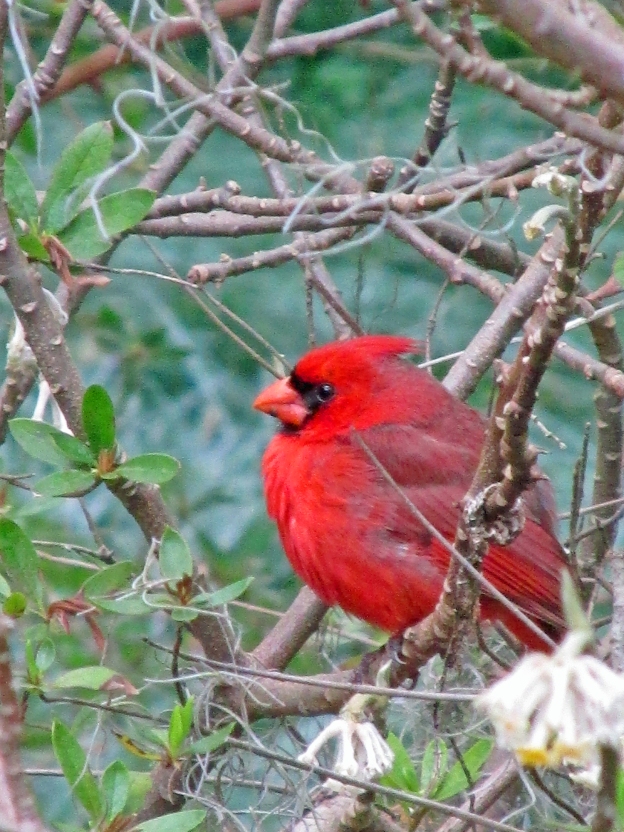
Photo by Bryan Stevens • Northern cardinal seems much less descriptive of this popular bird than such common names as Virginia nightingale and cardinal grosbeak.

For instance, let’s take a look at the Northern cardinal, which has been known by such common names as cardinal bird, cardinal grosbeak, crested redbird, Kentucky cardinal, redbird, Virginia redbird and Virginia nightingale. The first thing that irritates me about the common name of this bird is that there is no Southern cardinal. So, why is this bird the “Northern” cardinal? The only other birds in the Cardinalis genus are the desert cardinal, also known as the pyrrhuloxia, and the vermilion cardinal. Both these relatives have arguably more interesting and descriptive names than their relative, which is a favorite of many birders and arguably better known to many people.

I can understand why Kentucky cardinal and Virginia redbird are not inclusive names since the Northern cardinal ranges far beyond the borders of these two states. On the other hand, cardinal grosbeak with its reference to the cardinal’s large beak, as well as crested redbird, are both more descriptive and creative than the rather nondescript Northern cardinal.

Of course, a literary great summed up the confusing attitude toward common names. “What’s in a name?” William Shakespeare had Juliet ponder. “That which we call a rose by any other name would smell as sweet.”800px-Title_page_William_Shakespeare's_First_Folio_1623

I think The Bard was on to something. Whether we call a cardinal a redbird or a Virginia nightingale, it’s song will sound as sweet to our ears. The appearance of one of these birds on a gloomy day will elevate our mood whether we know the bird as cardinal grosbeak, Kentucky cardinal or, in scientific terminology, Cardinalis cardinalis.


BRISTOL HUMMERS DEPART

As promised, here’s an update on the hummingbirds that proved dutiful daily visitors to a sugar water feeder at the Bristol home of Ralph Beamer through Halloween, Thanksgiving and Christmas.

Early in the new year, Ralph notified me that the hummingbirds departed ahead of 2018’s arrival.

“We had a surprise on New Year’s Day,” Ralph wrote in an email. “The hummingbirds were gone. I am glad they left ahead of the extreme cold we have had the last few days.”

Ralph noted that he had a wonderful time watching them for the past three months. He is hopeful they will come back in the future, but figured that is probably wishful thinking.

Actually, some of these winter hummingbirds, which often turn out to be rufous hummingbirds, have proven quite faithful to favorite locations. Bird banders have recaptured some individual hummingbirds year after year in the same yards. During the stay of his visitors, Ralph shared photographs and videos with me of their visits to his feeders. I enjoyed receiving his periodic updates about them.

I emailed Ralph back and told him that these hummingbirds seem to also have a knack for knowing when to leave and suggested he keep an eye out for them again next fall.

••••••

Bryan Stevens lives near Roan Mountain, Tennessee. To learn more about birds and other topics from the natural world, friend Stevens on Facebook at https://www.facebook.com/ahoodedwarbler. If you have a question, wish to make a comment or share a sighting, email ahoodedwarbler@aol.com.

75 years strong, annual Elizabethton Christmas Bird Count breaks old records

GreaterWF-Goose

The 75th consecutive Elizabethton Christmas Bird Count held last month shattered records for this long-running survey. This year’s CBC was held on Saturday, Dec. 16, with 25 observers in six parties participating. The 85 species tallied established a new high for this count, shattering the old mark of 80 species set in 2012 and again in 2016. The average total over the last 30 years of the Elizabethton CBC is 72 species.

Participants included Fred Alsop, Jim Anderson, Jerry Bevins, Rob Biller, Rick Blanton, Kevin Brooks, Gil Derouen, Harry Lee Farthing, Dave Gardner, Carl Hacker, Jacki Hinshaw, David Irick, Rick Knight (compiler), Roy Knispel, Richard Lewis, Joe McGuiness, Charles Moore, Brookie and Jean Potter, Brenda Richards, Chris Soto, Amber Stanley, Bryan Stevens, Kim Stroud, and Scott Turner.

I took part in this CBC, as I have for many years, with fellow members and friends of the Elizabethton Bird Club. Participation in this annual survey has been a part of my holiday traditions for the past 20 years. The tradition of the CBC, however, goes much farther back.

According to the National Audubon Society’s website, the tradition of the Christmas Bird Count arose from a less than bird-friendly custom. By the turn of the 20th century, so-called sportsmen would conduct a “Side Hunt,” a rather bloodthirsty Christmas custom that saw hunters competing to see who could score the largest amount of feathered and furred corpses. It was a huge step forward for conservation when preeminent ornithologist Frank M. Chapman proposed a new holiday tradition. His radical idea was to count birds during the Christmas season rather than hunting and killing them.

chapman

Ornithologist Frank Chapman organized the very first Christmas Bird Count back   in December of 1900.

The Christmas Bird Count is now conducted each year on dates between Dec. 14 and Jan. 5. The first CBC took place in December of 1900 with 27 observers participating at 25 locations in the United States and Canada. Fifteen of the counts were conducted in the northeastern United States in an area ranging from Massachusetts to Philadelphia, Pennsylvania. Results from that first count in 1900 didn’t truly reflect the diversity of North America’s birds, but they were nonetheless interesting. The Greater Boston CBC consisted of only one participant and found only 17 species. However, some of those species included such good birds as American tree sparrow, brown creeper, Northern shrike and Northern bobwhite.

The Elizabethton Bird Club traditionally compiles the results from its two annual CBCs (Roan Mountain as well as Elizabethton) at its yearly Christmas party. This year when the tallies were added up, count participants were delighted to learn the count had set a new record with an amazing total of 85 species tallied, which is hard to come by in mid-December in Northeast Tennessee. An abundance of waterfowl helped push up the number of species found.

A few species are becoming more expected on this annual December count. For instance, greater white-fronted goose was found for the third time in the last five years. Before that, this goose had never been found on this count.

The bufflehead, the smallest of the diving ducks, set a new record with 293 individuals found. Four Northern Shovelers represented only the eight time this duck has appeared on the count. Greater Scaup were found for only the seventh time in the last 25 years. Ruddy Duck has now been found three times in the last 25 years, which matches the three occasions it was found prior to that time.

Bald eagles, thanks to locations like Watauga Lake and Wilbur Lake, are also becoming more common. Eagles have been found 20 of the last 25 years, but only once prior. Red-shouldered Hawk, which is uncommon in the region, was found for the sixth time in the last quarter-century.

Redshouldered_Hawk-LeeKarney

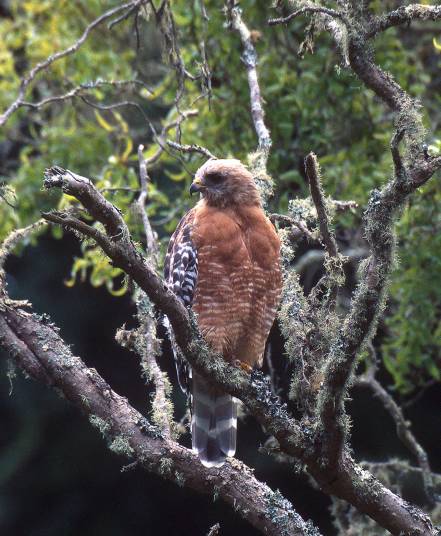
Photo by U.S. Fish & Wildlife Service/Lee Karney • A Red-shouldered Hawk perches in branches.

Eurasian Collared-Dove appears established in Elizabethton. This dove has been found six of the last nine years since it first made an appearance on the count.

All seven of the region’s woodpecker were found on this year’s CBC. The Red-headed Woodpecker has shown up on four counts in the last 25 years. This woodpecker was only found seven times in the years prior to 1992.

A Blue-headed Vireo spotted on this year’s count represented only the third time this species has been found. A flock of 75 American Pipits marked only the third time this species has been seen since 1992 on a CBC. Prior to that date, the species appeared only twice on an Elizabethton CBC.

Gray Catbird has been found five of the last 25 years, including this year, but only once prior to 1992. Palm Warbler, found only once prior to 1992, has now been found eight of the last 25 years. The single Pine Warbler seen means that this species has now been found four of the last 25 years, but only four times prior to 1992.

The European Starling with 1,335 individuals found on count day was easily the most common species on this year’s CBC. The 16 Dark-eyed Juncos, usually a relatively common species on the Elizabethton CBC, represented the fewest juncos ever found on this long-running survey.

Below is the complete species list:

Greater White-fronted Goose, 1; Canada Goose, 532; Wood Duck,1; Gadwall, 5; American Wigeon, 1; American Black Duck, 2; Mallard, 366; Northern Shoveler, 4; Green-winged Teal, 2; Ring-necked Duck, 14; Greater Scaup, 2; Lesser Scaup, 3; Bufflehead, 293; Hooded Merganser, 4; and Ruddy Duck, 1.

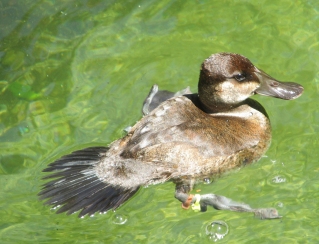
Ruddy-Hen

Photo by Bryan Stevens • A female Ruddy Duck.

Wild Turkey, 33; Common Loon, 2; Pied-billed Grebe, 14; Horned Grebe, 27; Great Blue Heron, 18; Black Vulture, 3; Turkey Vulture, 12; Bald Eagle, 3; Sharp-shinned Hawk, 1; Cooper’s Hawk, 2; Red-shouldered Hawk, 2; and Red-tailed Hawk, 25.

Killdeer,17; Ring-billed Gull, 27; Rock Pigeon, 305; Eurasian Collared-Dove, 1; Mourning Dove, 157; Eastern Screech-Owl, 12; Great Horned Owl, 2; Barred Owl, 1; and Belted Kingfisher, 10.

Red-headed Woodpecker, 1; Red-bellied Woodpecker, 33; Yellow-bellied Sapsucker, 8; Downy Woodpecker, 27; Hairy Woodpecker, 3; Northern Flicker, 26; and Pileated Woodpecker, 21.

American Kestrel, 16; Eastern Phoebe, 12; Blue-headed Vireo,1; Blue Jay, 162; American Crow, 223; and Common Raven, 4.

Red-breastedNutHatchYAHOO

Photo by Bryan Stevens • A Red-breasted Nuthatch at a feeder.

Carolina Chickadee, 117; Tufted Titmouse, 84; Red-breasted Nuthatch, 1; White-breasted Nuthatch, 25; Brown Creeper, 4; House Wren, 1; Winter Wren, 6; and Carolina Wren, 75.

Golden-crowned Kinglet, 41; Ruby-crowned Kinglet, 8; Eastern Bluebird, 111; Hermit Thrush, 11; Amercian Robin, 277; Gray Catbird, 1; Brown Thrasher, 1; and N. Mockingbird, 49.

Eurasian Starling, 1,335; American Pipit, 75; Cedar Waxwing, 154; Palm Warbler, 2; Pine Warbler, 1; and Yellow-rumped Warbler, 154.

Eastern Towhee, 22; Chipping Sparrow, 4; Field Sparrow, 8; Song Sparrow, 142; Swamp Sparrow, 5; White-throated Sparrow,102; Dark-eyed Junco, 16; and Northern Cardinal, 111.

Red-winged Blackbird, 1; Eastern Meadowlark, 1; Brown-headed Cowbird, 2; House Finch, 100; American Goldfinch, 90; and House Sparrow, 41.

The Audubon-sponsored CBC allows counts to also list birds not found on the count day that are seen during count week. This year participants found Redhead ducks, which were not present on count day. Notable misses this year include Ruffed Grouse, American Coot, Wilson’s Snipe, and White-crowned Sparrow.

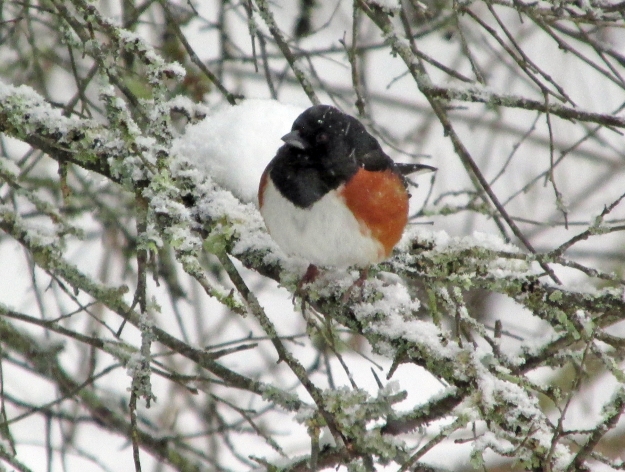
Towhee-Feb12

Photo by Bryan Stevens • A male Eastern Towhee waits out a snowstorm.

Winter weather events can adversely affect birds, too

Although the weather has been mild thus far this winter, that can change in the blink of an eye. Inclement weather affects humans, but it can also have adverse affects on birds. Snow, sleet, ice, wind and other forces can play havoc on the lives of our feather friends. Birds have many adaptations to help them deal with the worst the elements can throw at them, but sometimes events can overtake them.

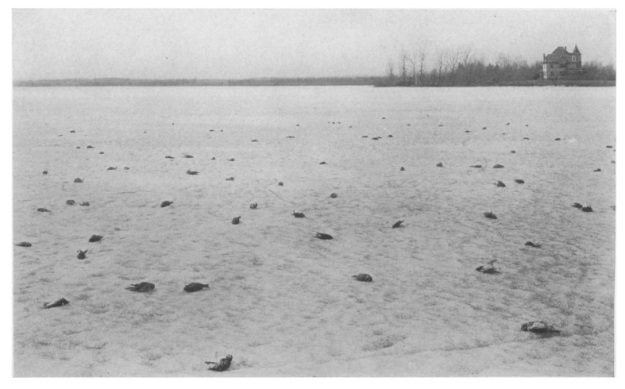
LaplandLongspur-Auk

Bodies of the fallen Lapland longspurs are shown scattered on a frozen lake after a 1904 weather-related catastrophe overtook hundreds of thousands of migrating longspurs.

One such event took place on the night of March 13-14, 1904, when hundreds of thousands of one small songbird species perished as circumstances came together in a perfect storm. This infamous event in the annals of ornithology mystified residents living around the town of Worthington, Minnesota, when they awoke on the morning of March 14 to find thousands of dead birds strewn across the landscape. Birds fell onto everything from yards and gardens to street and rooftops, as well as numerous frozen lakes.

In an article in the ornithological publication The Auk, the affected songbird was identified as the Lapland longspur, a bird that nests in the Arctic tundra and spends winters on the expansive prairies and plains of the United States and Canada. The Lapland longspur, also known as the Lapland bunting, also ranges into Russia and the Northern Scandinavian countries of Europe. The term “longspur” refers to the long hind claws on this small songbird’s feet. Two other longspurs — Smith’s longspur and chestnut-collared longspur — are found in North America.

The Lapland longspur disaster on the night of March 13, 1904, originated with a massive migration flight taking these songbirds back to their tundra nesting grounds. The author of the Auk article speculated that the longspurs migrating northward encountered a winter storm in the darkness. Heavy snow accumulated on the feathers of the exhausted migrants, forcing them to crash to the ground by the hundreds of thousands across the terrain of southwestern Minnesota and northwestern Iowa. From the point of view of the disoriented birds, the lights from the towns dotted across the landscape added to the chaos and confusion. Many of the bird suffered blunt force traumas, including ruptured organs, crushed skulls, bone fractures and other such injuries incurred when falling to the ground from great heights.

The Auk article comes to a total of a million birds lost in a single night, although the author admits the toll could have been even higher. Although this is an immense figure, consider that a survey dating to 2004 estimated 8 million Lapland longspurs in Alaska alone during the nesting season.

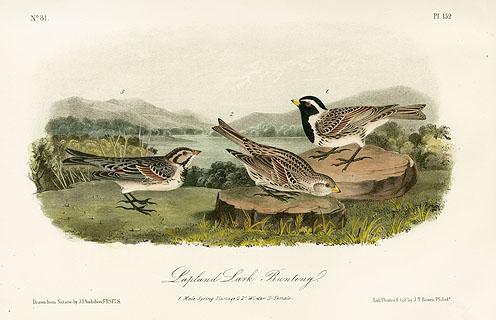
aul152-871

Early naturalist and artist John James Audubon painted Lapland Longspurs or, as he knew them, Lapland Lark Buntings.

The 1904 disaster didn’t seem to dent the overall numbers of the Lapland longspur. The populations of many species of birds can survive such catastrophes, but other species already struggling could be adversely affected by such events. For example, in February of 2007 a flock of year-old whooping cranes was exterminated by severe storms that overwhelmed them in a shelter at the Chassahowitzka National Wildlife Refuge in Florida. A total of 18 young whooping cranes, part of a flock trained to follow an ultralight aircraft from their birthplace in Wisconsin to the refuge in Florida salt marshes, were killed during the storm. The loss of that many young birds also robs the endangered species of much needed vitality. As of February 2015, the total whooping crane population stood at 603 individuals, including 161 captive birds.

Weather disasters extract a toll on both humans and birds. Sometimes they may affect hundreds of thousands of individuals, although the consequences are often confined to smaller segments of a population.

In early May of 2013, dozens of common loons migrating through Wisconsin encountered an unseasonable ice storm. Many of the birds found ice forming on their feathers, weighting them down and causing emergency landings. Wildlife rehabilitation workers rescued more than 50 birds, but there were probably many other loons affected by the freak storm that were lost without a trace.

Common_Loon_on_Water

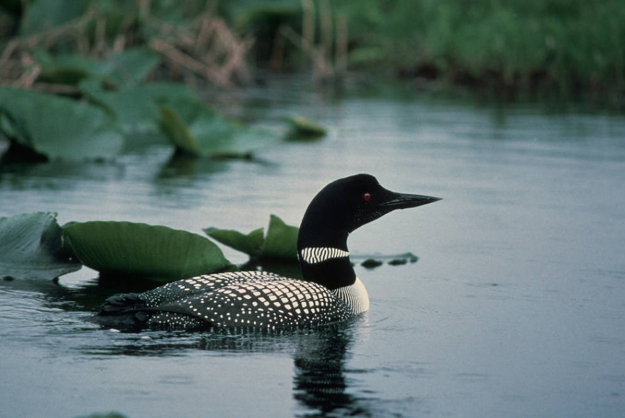
Photo by U.S. Fish & Wildlife Service • Common loons are quite at home in the air and on the water, but these birds are awkward if weather forces them to set down on land.

Loons crashing onto land or even small ponds are doomed. Agile and graceful in water because of strong legs and webbed feet, loons are almost incapable of movement on land. Landing on a small body of water is not much better since loons must run along a stretch of waters — sometimes for hundreds of yards — in order to get their relatively heavy bodies aloft.

Loons are not the only birds that sometimes face forced landings. In March of this year, a winter storm raged through most of the Northeastern United States. The wakes of these storms resulted in wildlife agencies in the region being flooded with reports of dead or injured American woodcocks in the region. Most of the reports were concentrated in and around New York City. Not only did the storm interrupt the migration flight of the woodcocks, but cold temperatures caused the ground to freeze, preventing the stranded birds from finding food.
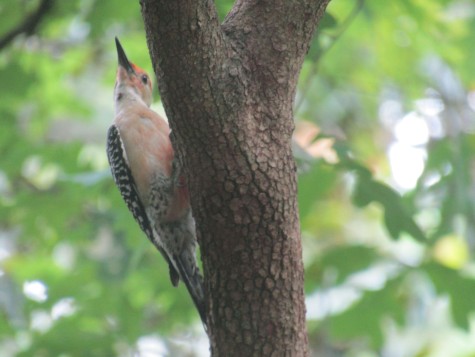
The woodcock is an unusual shorebird, also known by such whimsical names as “bog sucker” and “timberdoodle,” that has completely abandoned the shore in favor of woodlands and fields. The American woodcock is not a rare bird, but the species is rarely seen due to its retiring habits and inaccessible habitats.

Closer to home, an unusual February event back in 2014 resulted in equally unusual numbers of red-necked grebes on area lakes, rivers, and ponds. This grebe, a rare visitor to the region, was apparently forced by weather conditions to make a stopover on bodies of water in the region. Reports of red-necked grebes persisted for about a week before they eventually departed to continue their flight to more favored locations.

Back in 2011, it wasn’t a winter storm that killed thousands of birds in Arkansas. The birds — red-winged blackbirds, European starlings, brown-headed cowbirds, and common grackles — shared a communal roost near the town of Beebe.

On New Year’s Eve, just as 2011 was dawning, about 5,000 of these birds died after crashing into trees, buildings and automobiles, according to a National Geographic News article by Charles Q. Choi. Apparently these birds were frightened into flight by the explosive booms from a professional fireworks display celebrating the arrival of a New Year. In the chaos after thousands of birds not suited for nocturnal flight took to the air, they began to impact various stationary objects and crash back to the ground.

Summer-Pelicans

Photo by Bryan Stevens • Brown pelicans fly in a line over the Atlantic Ocean on the South Carolina coast.

Incidentally, in the same article, mention was made of a 2010 incident when hundreds of pelicans washed up on the border between Washington and Oregon. The article blamed a cold front that caused ice to form on the feathers of the bodies and wings of the pelicans.

Birds, much like their human admirers, live in a world greatly affected by the vagaries of weather. All things considered, birds manage to ride out most of what Mother Nature throws their way. It’s one of their many admirable qualities.

Great white heron pays unexpected area visit to Steele Creek Park

I wrote a few weeks ago about the tendency of long-legged wading birds to wander far afield from their usual coastal haunts in late summer. In the ensuing weeks, numerous sightings of some unexpected waders have been reported throughout the region and beyond. 
Jeremy Stout, the manager of the Nature Center at Steele Creek Park in Bristol, reported that a great white heron generated some birding excitement among park visitors. Stout noted that the heron was first reported by Sherry Willinger on Monday and Tuesday, Aug. 7-8, and then found again by Ruth and Mary Clark on Friday, Aug. 11. Stout also managed to get a photograph of the heron, which has been seen just outside the park grounds between Ralph Harr Bridge and Highway 126. Steele Creek Park Naturalist Don Holt saw the heron again on Aug. 15. He invited others who see the heron to share their sightings by calling the park’s Nature Center at (423) 989-5616. Reports will help the park staff document the duration of the rare visitor’s stay and keep interested birders informed of its presence. 
GreatWhiteHeron-STOUT

Photo by Jeremy Stout
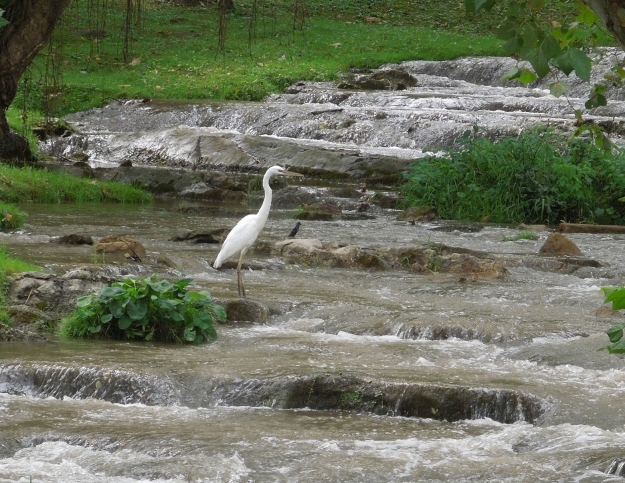
This great white heron was photographed near Steele Creek Park in Bristol. Currently considered the same species as the great blue heron, there is debate among experts about granting the great white heron status as a species in its own right. 

In early August, Cheryl Livingston reported a great white heron and a great egret at Watauga Lake in Hampton. While only a handful of records exist for the great white heron in this region, these observations will not help boost the lists of any area birders. The great white heron and the great blue heron, scientifically speaking, are the same species — at least for the moment.
According to the website for the U.S. Fish and Wildlife Service, this large wading bird, originally thought to be just a white color morph of the great blue heron, might actually deserve consideration as its own species. The website’s profile of the great white heron notes that recent research about the great white suggests that it is at least a subspecies of the great blue heron. Some preliminary unpublished data suggests that the bird may even be a completely separate species. That would be exciting news for many birders, who would be able to quickly add an unexpected bird to their life lists. 
The majestic great white heron usually ranges throughout south Florida and the Florida Keys, but individuals wander far from those parts of the Sunshine State after the nesting season. 
lcp_160728_1061_1024x1024 (1) 2

Painting by John James Audubon of the iconic Great White Heron of Florida.

The great white heron — as its name suggests — differs dramatically in appearance from a great blue heron, mostly in having all-white plumage. In addition, the great white heron has a yellow bill, which is heavier and more solid than the slender bill of the smaller great egret, for which it could be confused at a casual glance. The great blue heron, known by the scientific named of Ardea herodias, can stand 54 inches tall and weigh close to eight pounds. 
Waders other than great white herons have been wandering this summer. Farther afield, Michael Sledjeski has been reporting little blue herons and great egrets at Rankin Bottoms, which is a birding hot spot at Douglas Lake in East Tennessee. The location is well known among birders as a magnet for shorebirds and wading birds. Sightings of wood storks have been somewhat widespread in Tennessee and Virginia this summer. 
In addition, other waders are showing up far from their usual ranges. For instance, a roseate spoonbill — a large, pink wading bird — has shown up as far north as Pennsylvania, marking the first time the species has been sighted in the Keystone State since 1968.  
13350311_10208196961794152_4694016517040025689_o

Photo by Bryan Stevens • Identifying white herons and egrets can be a tricky business. This immature Little Blue Heron is just starting to get the          blue feathers of adulthood. 

I’ve not seen anything as exciting as a wood stork or roseate spoonbill at home, but on several occasions in the past couple of weeks my fish pond has been visited by great blue herons. A couple of these visitors were young birds, which are probably wandering widely during their first summer out of the nest. I’ve also seen green herons at the pond and in the creeks along the linear trail in Erwin. 
If the great white heron eventually gains recognition as a separate species, I will already have the bird on my Tennessee bird list thanks to a sighting of one several years ago at Musick’s Campground on Holston Lake in Bristol. Ironically, I’ll not have this bird on my Florida list, as I’ve not seen it in its southern stronghold. 
••••••
To learn more about birds and other topics from the natural world, friend Stevens on Facebook at https://www.facebook.com/ahoodedwarbler.  If you have a question, wish to make a comment or share a sighting, email ahoodedwarbler@aol.com.

Elizabethton summer bird count sets new record

The Lee and Lois Herndon Chapter of Tennessee Ornithological Society, also known as the Elizabethton Bird Club, conducts two summer surveys of area bird life. Last week, the results of the Unicoi County Summer Bird Count were explored. This week, the focus is on the Carter County Summer Bird Count, which set a new record. The 24th Carter County Summer Bird Count was held Saturday, June 10, under favorable weather conditions with twenty observers in six parties. A record high of 123 species were tallied, besting the previous high of 121 species set in 2013. The average over the previous 23 years was 112 species, ranging from a low of 105 to as many as 121.

Long-time count compiler Rick Knight said highlights of the count included seven Ruffed Grouse, including chicks, as well as such species as Yellow-crowned Night-heron, Bald Eagle, Red-shouldered Hawk and 21 species of warblers.

The American Robin, with 392 individuals counted, barely edged out European Starling, with 389 individuals counted, for most numerous bird on this year’s summer count.

Making the Summer Bird Count for the first time was Red-headed Woodpecker, represented by a pair of birds nesting at Watauga Point Recreation Area on Watauga Lake near Hampton. Other notable songbirds found included Vesper Sparrow, Blue Grosbeak, Red Crossbill and Pine Siskin. I counted birds with Chris Soto, Mary Anna Wheat, and Brookie and Jean Potter at such locations as Wilbur Lake, Holston Mountain and Sycamore Shoals State Historic Park.

IMG_4530

Photo by Bryan Stevens • Birds like this Red-bellied Woodpecker helped set a new record for most species on one of the Elizabethton Summer Bird Counts.

The count’s total follows:
Canada Goose, 258; Wood Duck, 7; Mallard, 125; Ruffed Grouse, 7; Wild Turkey, 21; and Double-crested Cormorant, 1.
Great Blue Heron, 10; Green Heron, 1; Yellow-crowned Night-heron, 1; Black Vulture, 7; and Turkey Vulture, 28.
Sharp-shinned Hawk, 1; Cooper’s Hawk, 7; Bald Eagle, 2; Red-shouldered Hawk, 3; Broad-winged Hawk, 7; and Red-tailed Hawk, 5.
Killdeer, 2; Rock Pigeon, 37; Eurasian Collared Dove, 1; Mourning Dove, 137; Yellow-billed Cuckoo, 4; Eastern Screech-owl, 2; Great Horned Owl, 2; Barred Owl, 2; Common Nighthawk, 1; Chuck-will’s-widow, 5; and Whip-poor-will, 8.
Chimney Swift, 80; Ruby-throated Hummingbird, 17; Belted Kingfisher, 3; Red-headed Woodpecker, 2; Red-bellied Woodpecker, 16; Yellow-bellied Sapsucker, 2; Downy Woodpecker, 12; Hairy Woodpecker, 4; Northern Flicker, 18; and Pileated Woodpecker, 24.
American Kestrel, 1; Eastern Wood-Pewee, 17; Eastern Phoebe, 71; Acadian Flycatcher, 20; Alder Flycatcher, 2; Willow Flycatcher, 1; Least Flycatcher, 5; Great Crested Flycatcher, 5; and Eastern Kingbird, 17.
White-eyed Vireo, 2; Yellow-throated Vireo, 2; Warbling Vireo, 1; Blue-headed Vireo, 41; Red-eyed Vireo, 126; Blue Jay, 69; American Crow, 227; and Common Raven, 7.
Northern Rough-winged Swallow, 45; Purple Martin, 53; Tree Swallow, 149; Barn Swallow, 129; and Cliff Swallow, 113.
Carolina Chickadee, 54; Tufted Titmouse, 71; Red-breasted Nuthatch, 12; White-breasted Nuthatch, 16; Brown Creeper, 2; House Wren, 79; Carolina Wren, 67; Blue-gray Gnatcatcher, 28; and Golden-crowned Kinglet, 12.
Eastern Bluebird, 88; Veery, 32; Hermit Thrush, 4; Wood Thrush, 43; American Robin, 392; Gray Catbird, 38; Brown Thrasher, 21; Northern Mockingbird, 42; European Starling, 389; and Cedar Waxwing, 64.
Ovenbird, 70; Worm-eating Warbler, 9; Louisiana Waterthrush, 9; Golden-winged Warbler, 13; Black-and-white Warbler, 26; Swainson’s Warbler, 2; Common Yellowthroat, 28; Hooded Warbler, 95; American Redstart, 6; Northern Parula, 25; Magnolia Warbler, 3; Blackburnian Warbler, 7; Yellow Warbler, 13; Chestnut-sided Warbler, 36; Black-throated Blue Warbler, 38; Pine Warbler, 3; Yellow-rumped Warbler, 1; Yellow-throated Warbler, 14; Black-throated Green Warbler, 26; Canada Warbler, 16; and Yellow-breasted Chat.
Eastern Towhee, 121; Chipping Sparrow, 78; Field Sparrow, 50; Vesper Sparrow, 1; Song Sparrow, 178; Dark-eyed Junco, 69; Scarlet Tanager, 31; Northern Cardinal, 94; Rose-breasted Grosbeak, 12; Blue Grosbeak, 2; and Indigo Bunting, 169.
Red-winged Blackbird, 77; Eastern Meadowlark, 11; Common Grackle, 84; Brown-headed Cowbird, 22; Orchard Oriole, 10; and Baltimore Oriole, 2.
House Finch, 26; Red Crossbill, 1; Pine Siskin, 5; American Goldfinch, 134; and House Sparrow, 27.

•••••

I had a recent phone call with Erwin resident Don Dutton, who wanted to know why hummingbirds have been scarce around his home this summer. I’ve noticed fewer hummers at my own home this summer, but it’s natural for numbers to fluctuate from year to year. I anticipate that numbers will rise as hummingbirds begin migrating south again in the coming weeks. At that time, the adult hummers will be joined by the young birds from this season’s successful nesting attempts.

Ruby-throated-WILLOWS

Photo by Bryan Stevens • Numbers of Ruby-throated Hummingbird in the region tend to fluctuate each year, but people should see a spike in their numbers as the hummingbirds end summer nesting and start migrating south again.

Don shared that when he lived out west, he often visited Mount Charleston near Las Vegas, Nevada, where he saw swarms of hummingbirds comprised of various different species. In the eastern United States, the only nesting species is the Ruby-throated Hummingbird.

If you have felt slighted by hummers so far this year, keep a sugar water feeder available to attract them on their way south later this summer and into the fall. To share a sighting, make a comment, or ask a question, send email to ahoodedwarbler@aol.com.


Warblers exert special pull for many birders

KirtlandsWarbler

Photo by U.S. Fish & Wildlife Service • The Kirtland’s Warbler, while endangered, is slowly building its numbers with intensive human assistance. Nearly 50 different warbler species nest in the eastern half of the continental United States. The rest of the world’s warblers reside mostly in Central and South America.

I’ve been fascinated with the group of small, energetic songbirds known as warblers almost from the start of my time as a birder. Many birds have inspired poetry, but to me, the warblers are poetry. I suppose another, more down-to-earth part of my fascination is that a little effort is usually required to see these birds. Although many species of warblers spend the summer months in the region, few of them would really be described as backyard birds. That being said, I am also fortunate to live in a location surrounded by woodlands that are inhabited by several species of warblers in the months spanning April to September on the calendar.

Of course, it’s always gratifying to hear from readers who have also caught the “warbler bug” and find these tiny, colorful songbirds as fascinating as I do. Graham Gardner of Abingdon, Virginia, sent me a recent email about the warblers, an extensive family of neotropical migrants that happen to be among my favorite birds.

CanadaWarbler

Photo by Graham Gardner • A Canada warbler wears a dark necklace of feathers across its yellow breast.

“I just wanted to share another great birding experience that I recently had with my father this past weekend,” Graham wrote in an email sent on May 1. “As you know, the spring migration of neotropical migrants is upon us. My father and I decided to take a trip to Peaks of Otter Lodge in the heart of the Blue Ridge Mountains to attempt to observe some of the more difficult-to-find warblers that I had not yet checked off my life list.”
He reported that the trip was wildly successful.

“We observed 10 warbler species in total in just under two days of birding.” Among them were three species that were new for him: cerulean warbler, Blackburnian warbler, and bay-breasted warbler.

He also shared some photos. “These guys are really quite difficult to photograph,” he wrote. “They are either constantly on the move, bouncing from branch to branch, or they are high in the canopy staying mostly out of sight.”

Graham wrote that he looks forward to searching for warblers in the coming weeks as they continue to pass through, and in some cases settle in, our Appalachian Mountains.
I congratulated Graham for his success with some of my favorite birds. I also let him know that he succeeded with a bird — the cerulean warbler — that has been elusive for me over the years. It’s one of the few warblers that spend time in the eastern United States that I haven’t managed to add to my life list. The other two warblers I need are the Connecticut warbler and Kirtland’s warbler.

Cerulean 2

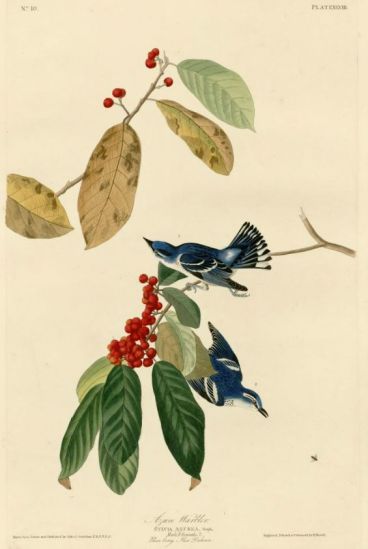
Early naturalist and artist John James Audubon painted this pair of cerulean warblers, a bird that he knew as the “Azure Warbler.”


“The cerulean was definitely the highlight of the trip for me,” Graham noted in a second email to me.

The cerulean warbler makes infrequent appearances in the region, but it has been observed as recently as the spring of 2016 at Steele Creek Park in Bristol, Tennessee. Some other locations — Frozen Head State Park, Edgar Evins State Park and Falls Creek Falls State Park — support breeding populations of this warbler within the Volunteer State.

Unfortunately, the cerulean warbler is one of the fastest declining songbirds in the United States. Habitat destruction in its breeding range in the Appalachian Mountains and its wintering range in South America is to blame for its plummeting numbers.

Among a family of several breathtakingly beautiful species, the cerulean warbler is one of the most exquisite of its kind in terms of appearance. Adult males have pale cerulean blue upperparts — hence the bird’s common name — and white underparts with a black necklace across the breast. They also show black streaking on the back and flanks.

Beyond its uncommon status, there are other reasons why it’s difficult to lay eyes on a cerulean warbler. First and foremost, cerulean warblers prefer to forage in the treetops. In that leafy, lofty habitat, observing these warblers can be difficult for ground-bound humans.

NoWaterthrush

Photo by Bryan Stevens • The Northern waterthrush is a warbler fond of foraging near slow, flowing water.

I’ve been very close to seeing a cerulean warbler twice. During a past Spring Naturalists Rally at Roan Mountain, Tennessee, several people watched a cerulean warbler flitting in some tall trees while I struggled unsuccessfully to get my binoculars on the rapidly moving bird. More recently, I was looking for birds with fellow birder Jean Potter along the Watauga River in Elizabethton, Tennessee, for a Fall Bird Count. She found a female cerulean warbler in a tree overhanging the river, but I failed to get my binoculars on the bird in time.

So, while my luck with cerulean warblers hasn’t changed (yet), I have seen several warblers at my home this spring, including hooded warbler, ovenbird, black-throated green warbler, black-and-white warbler and Northern parula. In addition, I’ve seen other warblers — yellow-breasted chat, Cape May warbler, yellow warbler and chestnut-sided warbler — at other locations in the region.

Black-and-WhiteWarbler

Photo by Graham Gardner • The black-and-white warbler, which is aptly named, is one of the most easily identified warblers.

The warblers are poetry written with splashes of movement and hints of color written across an often green background. While not easy to observe, they’re worth seeking out. Glimpsing one of these energetic songbirds is always a moment that puts a smile on my face — and in my heart.

•••••

Bryan Stevens lives near Roan Mountain, Tennessee. To learn more about birds and other topics from the natural world, friend Stevens on Facebook at http://www.facebook.com/ahoodedwarbler. He is always posting about local birds, wildlife, flowers, insects and much more. If you have a question, wish to make a comment or share a sighting, email ahoodedwarbler@aol.com.

Readers share arrival stories about spring’s hummingbirds

Ruby-throated hummingbirds have returned. The annual first sighting of a hummingbird is one of my most cherished spring moments. Invariably, the first hummingbird to show up in my yard is a male with the gorget — or throat patch — of red, iridescent feathers that gives his species its common name.

4934219635_1db9c900c4_o

Photo by Bryan Stevens • Ruby-throated Hummingbirds swarm to a feeder filled with a sugar water mixture.

As I indicated in a recent column, the ruby-throated hummingbird is one of more than 300 species of hummingbirds. All hummingbirds are found in the New World and are absent from the Old World. Male ruby-throated hummingbirds launch their spring migration about 10 days prior to female hummingbirds.

Based on the number of people who shared hummingbird sightings with me, these tiny birds have a lot of big fans. If you would like to host your own hummingbirds, here are some crucial tips.

• Make your yard a zone that’s free of insecticides and pesticides. Residues of these chemicals can remain on blossoms, which then run the risk of sickening a hummingbird. In addition, hummingbirds subsist on more than nectar. They consume many tiny insects and spiders. Eating bugs that have been contaminated with dangerous chemicals can also sicken or kill hummingbirds.

• Provide shrubs and trees to your landscape to make your yard more inviting. Hummingbirds claim favorite posts and perches, where they will rest when they are not visiting our gardens or feeders. Shrubs and trees can also provide locations for concealing nests built by female hummingbirds.

• Cultivate plants that offer nectar-producing blooms. While hummingbirds are known to favor the color red, these nectar-sipping birds will also visit blooms of other colors. Some favorite spring blooms include the flowers of red buckeye, wild columbine, crossvine and native varieties of azaleas. As spring advances into summer, the diversity of flowers available to lure hummingbirds into your garden will increase dramatically.

Ruby-throated

Photo by Bill Buchanan/U.S. Fish & Wildlife Service • Hummingbirds visit flowers for nectar, so be sure your garden offers a variety of blooms.


Thursday, April 6

Eddie and Delores Phipps of Bluff City, Tennessee, reported seeing their first hummingbird.

“We were excited to see our first hummingbird at the feeder on the morning of April 6,” the couple wrote in an email.  “It was the earliest we have ever seen one. He has been back every day since!”

Eddie and Delores provided me with the report of the earliest arriving hummingbird. Soon after the couple reported their hummingbird, I began to receive more sightings from throughout northeast Tennessee and southwest Virginia.

Sunday, April 9

Monica Black, a resident of Unicoi, Tennessee, saw her first hummingbird of the season about 5 p.m.

“Near the chairs in the back garden there is a spillway created from the koi pond down to the frog pond,” Monica said in the email she sent me. “The hummers like to drink and bathe in it.”

The visiting hummingbird also treated her to a viewing of the first bathing hummingbird of the season.

“The male is the only hummer spotted so far,” she added.

•••••

Facebook friend Phyllis Moore informed me that her friend, Janie Compton, saw her first hummingbird at 6:34 p.m. on Sunday, April 9, in Chesterfield, Virginia.

•••••

Nata Jackson, a resident of Greene County, Tennessee, shared details about her first sighting of spring. In her email, she said she had just put up her feeder when the bird arrived.

IMG_2786

Photo by Bryan Stevens • Only the male Ruby-throated Hummingbird has the brilliant red throat patch, or gorget, that gives the species its common name.

Tuesday, April 11

Nancy and Walt Vernon, of Bristol, Tennessee, emailed details of their first sighting. “We saw it about 12:30 while having lunch,” Nancy wrote in her email. “We have three feeders which we keep filled all summer.”

•••••

Jeanie Campbell, who lives on Mendota Road in Abingdon, Virginia, also sent me an email. Her first spring hummer — a tiny female — wasn’t very active at first. “Then she began drinking away,” Jeanie wrote.

A few days later on April 15, a male — or “Mr. Red Throat” as Jeanie described him — appeared. “He buzzed around all day,” she said.

•••••

Glen Eller, a fellow member of the Lee and Lois Herndon Chapter of Tennessee Ornithological Society, posted on Bristol-Birds — a mailing list archive for area bird sightings — that his daughter, Lia, saw her first hummingbird at 6:55 a.m. Glen’s daughter lives in Fall Branch, Tennessee.

“It’s seemingly a little bit late in this warm spring,” Glen wrote in his post.

Wednesday, April 12

Philip Laws saw his first hummingbird of spring at 4:15 p.m. in the Limestone Cove community in Unicoi County. In his Facebook post to my page, Philip said the arrival served as a reminder that he had meant to put his feeders out a few days earlier, but had failed to do so. He quickly got out feeders to welcome the birds.

•••••

Amy Wallin Tipton, in Erwin, posted on her Facebook page about the return of her hummingbirds.

•••••

Kristy Dunn, who lives in Johnson City, sent me an email to share her first hummingbird sighting of spring.

•••••

Bill and Judith Beckman sent me an email to report their first hummingbird of the season. The hummer arrived around 4 p.m. at their home on Spivey Mountain in Unicoi County.

••••••

Preston Bowers emailed to let me know he saw his first hummingbird at about 5:30 p.m.

“I have lived in Blountville since 1970,” he wrote. “Oddly enough, I never noticed hummingbirds on this property until about three years ago.”

A creek in front of his house has an abundance of jewelweed, which the ruby-throat seems to like quite well.

“So I installed a hummingbird feeder at the corner of my porch where I sit in the porch swing and play ukulele,” he added. “What a joy to watch these amazing birds as they fly by at lightning speeds or hover ever so gracefully.” Preston noted that some of their antics seem like an aerial battle. “I hear sounds that are so similar to the sound of a World War II fighter plane in tactical operations,” he wrote.

Rubythroat

Photo by Bryan Stevens • A male Ruby-throated Hummingbird perches on the tip of a garden post.

•••••

Sandra Loving sent an email notifying me that she got her first sighting of a spring hummer at her feeders at her home on South Holston Lake at 7:50 p.m.

•••••

Sharon Foster, who lives on Friendship Drive at South Holston Lake, emailed me about the date of her first hummer’s arrival. “We’ve had hummingbirds at our feeders all week,” she added.

Friday, April 14

Lynne Reinhard saw her first hummingbird at 8:15 a.m. near the upper end of South Holston Lake in Bristol. She posted the news of her sighting on my Facebook page.

•••••

Jill Henderson, who lives on Poor Valley Road in Saltville, Virginia, emailed about her first hummer sighting: “Just wanted to let you know that I saw my first hummingbird of the spring season at approximately 9:15 a.m. at my home.”

•••••

Beverly Puerckhauer in the Graystone area of Bristol, Tennessee,

RT-Male-April15

Photo by Bryan Stevens • A Ruby-throated Hummingbird must share a feeder with hungry honeybees.

saw her first hummingbird and shared news of the arrival in a comment on my Facebook page.

Saturday, April 15

Linda Quinn Cauley posted on my Facebook page that she saw her first hummingbird at 9:30 a.m. Linda lives off Sciota Road near Unicoi, Tennessee.

•••••

Karen Fouts, of Marion, Virginia, saw her first hummingbird of spring — a male — and posted a comment on my Facebook page. Karen said she refers to these early arrival hummingbirds as the “advance scouts.”

•••••

Mary Beierle, a resident of the Stoney Creek community in Elizabethton, Tennessee, sent me an email telling me she saw her first hummingbird around 3 p.m. “Only one so far, but we’re excited,” she added.

•••••

Don and Shirley Cook, who reside on the upper end of South Holston Lake in Washington County, Virginia, sent me an email to notify me that they saw their first hummer at 3 p.m.

•••••

Glenna Kiser, who lives near Lebanon, Virginia, informed me in an email of her first hummingbird this spring at 1 p.m.

••••••

Several readers enjoyed their first spring sightings of hummingbirds on Easter Sunday.

Sunday, April 16

Nancy Estes emailed me just after she saw her first hummingbird of the season.

“I didn’t get a close look since I was inside my house, but I am assuming it is a ruby-throated hummingbird,” Nancy wrote. “I live in Bristol’s Middlebrook subdivision.”

•••••

Reva Russell, who lives in the Lynnwood Hills subdivision in Bristol, Virginia, notified me in an email that she saw her first hummingbird of the season at 2 p.m.

•••••

Terry Fletcher, who lives at First Colony Condominiums near the Bristol Country Club, sent an email about the first hummingbird of spring. Terry also photographed the hummingbird through a screen door and shared the photo in an email.

•••••

Debbie Oliver, who resides in Bristol, Tennessee, emailed me about her first sighting.

“It wasn’t a visit from the Easter Bunny but a delightful visit from a ruby-throated hummingbird at our deck feeders around 2:30 in the afternoon,” she wrote in her email.

•••••

Cheryl Jones in Damascus, Virginia, saw her first hummingbird of spring at 5:02 p.m. In her email, she said she was beginning to wonder what was keeping them.

Hummer-Farm

Photo by Bryan Stevens • Ruby-throated Hummingbirds have officially returned to the region as of the first week of April.

•••••

The first hummingbird of spring showed up at at the home of Ken Croghan on Walden Road east of Abingdon, Virginia, while he was sitting on the front deck having dinner. He shared news of the arrival in an email.

•••••

Lynn Heller and her husband were having dinner at their home in Holston Hills in Bristol, Tennessee, when they looked out the window at their hummingbird feeder. “I was telling my husband about your article and that you asked readers to share sightings of their first hummingbird,” she wrote in her email.  “About five minutes later, there he was — a ruby throated hummingbird at 6:31 p.m. on Easter Sunday. What a treat!”

•••••

Donald Elliott Rice of Elizabethton, Tennessee, filled up his feeders on Easter Sunday. “Within a half hour, they showed up,” he posted on Facebook.

•••••

Julie Carter Grason saw her first hummingbird at her home in the Clear Creek community of Bristol, Virginia. She shared the news in a comment on my Facebook page.

•••••

Shirley Jenkins of Bluff City, Tennessee, saw her first ruby-throated hummingbird this spring and shared details in an email. “My family and I were sitting on the back porch about 3:30 when out of nowhere, a ruby red throat came zooming by,” she wrote in her email.

Shirley added that the bird checked out a wind chime hanging on the porch before he went on his way.

“I was thrilled to see it, since I love those adorable little creatures,” she noted. “I will definitely be putting my feeder out pronto.”

•••••

I saw my own first ruby-throated hummingbird — a male — on Saturday, April 15. Although he acted somewhat tentative at first, he became more at ease with me as I watched him at the feeders during repeated visits throughout the day. In 2016, the first hummingbird arrived on April 12, so the arrival date was slightly later this year.