Category Archives: nature

Family of pigeons, doves features one famous member

Vivian Tester of Bristol, Tennessee, sent me an email seeking help with a pigeon problem.

“I need your advice on trying to keep the pigeons off my bird feeders,” Vivian wrote. “They are chasing off the birds I want to feed and devouring all the seed. My neighbor says they are doves but whatever they are, they are annoying. I don’t know if the squirrel-proof feeder would work or not. I would appreciate any help.”

animal animal photography avian beak

Photo of a rock pigeon by Pixabay on Pexels.com

I recommended that Vivian offer only black oil sunflower seeds to see if that might can discourage the unwanted guests. While pigeons will eat sunflower seeds, they much prefer smaller seeds like milo and millet often found in mixed seed packages. If their preferred food source dries up, they may be convinced to move elsewhere.

Stopping feeding for a trial period is another possibility. Remove food for a week and then slowly start offering seeds again. If the pigeons have moved to other feeding grounds, perhaps they will be slow to return.

It’s a tough problem to solve. Although some feeders can be designed to prevent a large bird like a pigeon or dove from perching, the birds are going to still make the attempt. In doing so, they knock seed to the ground below and will happily feed on the spillage. The best option for avoiding pigeons would be to use tube feeders designed for minimal spillage if jostled. Doves and pigeons prefer to feed on the ground, so scattering seeds there, intentionally or inadvertently, is an invitation for flocks to gather.

PIGEON-PIC

Photo by Jean Potter • The widespread rock pigeon is one of the most successful members of the bird family Columbidae, which is comprised of some 310 species of doves and pigeons. One of the most famous representatives of the family is the dodo, an extinct relative of such common birds as the mourning dove and rock pigeon.

Nature, too, offers a solution. Several species of raptors prey readily on doves and pigeons. Peregrine falcons and Cooper’s hawks are two effective controls on such birds, but it is not easy to issue an invitation for one of these birds to take up residence in your yard.

The two mostly likely offenders in the region are the mourning dove and the rock pigeon. Mourning doves are an abundant native species at home in both rural areas and suburbs. The rock pigeon is not a native species but has thrived in the United States since it first arrived with early colonists from Europe. Rock pigeons are mostly a problem for people attempting to feed birds in urban and suburban areas.

Pigeons and doves constitute the animal family Columbidae, which is comprised of some 310 species. One of the most famous members of this family is the extinct bird known as the dodo. The well-known story of the dodo doesn’t often make reference to the relations this bird had to living doves and pigeons.

Roelant_Savery_-_Landscape_with_Birds_-_WGA20885 2

In the lower right corner of this illustration, a dodo is visible along with such birds                        as macaws, cranes, and even a wild turkey. Titled “Landscape with Birds,” this painting            was done by artist Roelant Savery in 1628.

Early scientists did not know what to make of the dodo and theorized that the unusual flightless bird was everything from a small ostrich to flightless versions of an albatross or a vulture. Johannes Theodor Reinhardt, a zoologist from Denmark, hinted at the dodo’s relationship to the world’s pigeons and doves as early as 1842. At first his theory was ridiculed, but other biologists and zoologists eventually came to accept the fact that the dodo was indeed a large, flightless pigeon.

The dodo stood a few inches over three feet tall and could weigh close to 40 pounds. Most of what is known about the dodo comes from paintings and drawings of the bird made by early explorers in the 17th century. Some of the humans who observed the bird also left behind valuable written accounts. First discovered by Dutch sailors who visited the Indian Ocean island of Mauritius in 1598, the dodo became extinct only 64 years later. So about the same time the rock pigeon was establishing itself as an introduced species of bird in North America, around the world one of its cousins slid quietly into extinction.800px-Van_den_Venne_dodo 2

The dodo has acquired a reputation in popular culture as slow-witted, lethargic, fat, clumsy and stupid, dooming the bird as a creature too ill-suited to exist. Today, most scientists believe that the dodo was adapted perfectly to its island habitat. Having evolved as a flightless bird, the arrival of humans in its paradise meant its doom. The reputation for stupidity is unfair. Having never encountered humans, dodos did not have an instinctive fear of them. This lack of fear made it easy for the early explorers of their island home to quickly render them extinct.

Modern science has even pinpointed the dodo’s closest living relative. Thanks to DNA analysis, the Nicobar pigeon of southeast Asia has been identified as the closest relation of the dodo. The Nicobar pigeon is much smaller (only 16 inches long) and, unlike its famous relative, is capable of flight. This pigeon feeds mostly on fruit and seed. When grain of any kind is available, it will also make use of such a food source.

Most contemporary sources reveal that the dodo enjoyed a diet rich in fruit, but modern biologists speculate the dodo probably also foraged for nuts, seeds and tubers. It’s ironic that the dodos were slaughtered to extinction to provide food for early explorers of their island. An English explorer by the name of Sir Thomas Herbert recognized the dodo’s exploitation as a food source, but disparaged the bird’s taste. “To the delicate they are offensive and of no nourishment,” Herbert wrote in his published work, “A Relation of Some Years Travel into Africa and the Greater Asia.”

Lophopsittacus.mauritianus

This sketch, completed in 1634 by Sir Thomas Herbert, shows a broad-billed parrot, a red rail and possibly one of the last dodos to exist on the planet. Herbert described the dodo as a rather poor food source for early explorers to its island home. 

Like the pigeons that have become a scourge on Vivian’s feeders, it’s very likely that, had they survived, dodos might visit feeders today on the island of Mauritius. For the most part, the world’s doves and pigeons are considered successful birds.

In the United States, some other native doves include the widespread mourning dove, as well as white-winged dove, common ground dove and Inca dove. The Eurasian collared-dove, introduced into the Bahamas and Florida, has now spread extensively into the United States and is known to have established populations through northeast Tennessee and southwest Virginia.

Dove-Wing

Photo by Bryan Stevens • A mourning dove stretches a wing while perched on a feeder.

Some descriptive names for some of the world’s doves include purple-winged ground dove, lemon dove, zebra dove, ochre-bellied dove, tambourine dove, white-faced cuckoo-dove, ring-necked dove, little cuckoo-dove and sapphire quail-dove. Pigeons have also been bestowed with such colorful names as snow pigeon, speckled pigeon, yellow-eyed pigeon, pale-capped pigeon, metallic pigeon, crested pigeon, pink pigeon and squatter pigeon.

We all like to attract as many birds as possible to our yards and gardens. A variety of food will help achieve that objective. Be aware, though, that such free buffets will also encourage messy birds like pigeons that make feathered pigs of themselves and almost always overstay their welcome. There’s also the option to admire pigeons and doves as survivors with a lineage worthy of some admiration. Hang some tube feeders accessible to smaller songbirds but toss some seeds into a corner of the yard for the ground-feeding pigeons and doves. They’re birds, too, after all.

Dodo_head

English naturalists dissected a dodo skull, shown in this sketch, in 1848 to help prove the relationship of the dodo to pigeons.

Roelandt_Savery_-_'Dodo_Birds',_Chalk,_black_and_amber_on_cream_paper


Indigo bunting one of summer’s common songbirds

IMG_6700

Photo by Bryan Stevens • The male indigo bunting is a resplendent bird.

Two recent summer bird counts emphasized some of the more commonplace birds in the region. While American robins and European starlings were extremely abundant, these two birds are permanent residents and are present year-round. A few other summer songbirds also helped swell the ranks of some of the seasonally common birds. For instance, the Unicoi County Summer Bird Count found a total of 141 indigo buntings while the Elizabethton Summer Bird Count tallied 82 of these little blue beauties. Both of these Northeast Tennessee surveys are conducted by members of the Lee and Lois Herndon Chapter of Tennessee Ornithological Society.

The indigo bunting likes to reside in the boundary region where forests and woodlands meet fields and pastures. Personally, the indigo bunting has always been a bird that is suggestive of the long, hot days of summer. One of my earliest and still quite vivid birding memories is a recollection of a shockingly blue bird atop a blue spruce tree in my yard. Several decades later, the tree is no longer standing, but these beautiful birds — I now know these summer visitors were indigo buntings — return year after year to my yard and gardens.

Count-IndigoBunting

Photo by Bryan Stevens • Neotropical migrants, such as this Indigo Bunting, increase the variety of bright and colorful birds in eastern North America from spring until fall each year.

These birds usually arrive in the region in late April and I’ve seen them in late October, although most indigo buntings have left the region by late September.

Male indigo buntings are persistent singers, and in the past couple of weeks one very enthusiastic male has been singing even during the hottest hours of recent July afternoons. The preference of this small songbird is to sing from the tops of tall trees. They are often concealed by the green leaves. When I do get a glimpse of the obscured songster, often all I see is a dark shape silhouetted against the bright sky. Sometimes, if he plunges from the upper branches into the woodland understory, I get that telltale glimpse of blue feathers.
The indigo bunting is the only solid blue bird in the eastern United States. It’s all an illusion, of course. The indigo bunting’s feathers are not really blue. The male’s brilliant azure plumage is caused by the process of refraction. This process absorbs all but blue light, which explains why the indigo bunting appears blue. In bright light, it can even look unnaturally vivid blue. In poor light, however, an indigo bunting male can appear black. Fortunately, indigo buntings have both a characteristic body shape and song, so even if the birds are not seen at their best, they can still be recognized.

Indigo-Count

Photon by Bryan Stevens • Indigo Buntings will perch on wires and sing for hours even during hot summer days.

Like many species of songbirds, the male is by far the most colorful. In this instance, the male is also responsible for the species’ name. Indigo is a blue dye that was once an important crop in the South. The drab female may boast some blue highlights in her plumage. Juvenile birds just out of the nest also resemble the female. Pay close attention to any indigo buntings you observe as summer progresses. Juvenile birds will look mostly brown with just a hint of blue in the wings and the tail. These will be the young buntings that were hatched this spring and early summer. They will often accompany their parents to feeders.

Indigo buntings are particularly fun birds to observe in late summer. Although some books indicate that males are not very active in rearing young, I have on numerous occasions witnessed male buntings feeding fledglings at feeders. Indigo bunting juveniles, like the young of many other birds, beg for tidbits from parents by “bowing,” spreading their wings and shivering. These actions usually prompt a parent to pop some morsel into an impatient youngster’s open bill. Indigo buntings are relatively easy to view. They frequent weedy fields and roadside brush. During the breeding season, males can also be seen singing from prominent perches. The song, a distinctive jumble of notes, can help observers find these dedicated singers.

IndigoBunt

Photo by Bryan Stevens • Although bright blue, a male indigo bunting will often blend with its surroundings.

The male indigo bunting is one of the most colorful birds to visit feeders in the region. This species is also extremely fond of millet seed. I like to have some feeders stocked with millet when the buntings begin to return each spring. They will also feed on thistle and sunflower seeds. Away from our feeders, they also devour plenty of seeds from various noxious weeds. Because of the indigo bunting’s appetite for the seeds of destructive weeds, it is considered a very beneficial bird.

One of the most attractive summer scenes is to observe American goldfinches and indigo buntings feeding together on the nodding heads of summer sunflowers. The goldfinch males, resplendent in their bright yellow and black plumage, compete with the blue indigo bunting males for the fresh sunflower seeds. When bright red male Northern cardinals join in, observers have a complete artists’s palette for summer viewing.

The indigo bunting will usually respond to human squeaks that imitate a bird’s call. When a flock or family group of buntings are disturbed by a human observer, they usually begin a chorus of alarmed “chipping.”indigo-bunting-john-james-audubon

As I indicated earlier, indigo buntings remain in the region until late September. Although this bird typically winters in Mexico, Panama and the Caribbean, in recent decades some indigo buntings have only gone as far south as Florida to spend the winter. There in the Sunshine State, the indigo buntings may mingle with a close relative, the splendidly multi-colored painted bunting. I usually see these vibrant songbirds whenever I visit coastal South Carolina in spring or summer. Male painted buntings are probably one of the most colorful birds in the United States with hues of red, green, purple and blue in their feathers.

PaintedBunting-Male (1)

Photo by Bryan Stevens • The male painted bunting is one of North America’s most colorful birds.

Other North American buntings include the snow bunting, the lazuli bunting and the lark bunting, which is also the official state bird for Colorado. Some of the common but descriptive names for some of the world’s other buntings include striolated bunting, cinnamon-breasted bunting, cinereous bunting, white-capped bunting, lark-like bunting, ochre-rumped bunting, golden-breasted bunting, chestnut-bunting, red-headed bunting, yellow bunting, little bunting, brown-rumped bunting, meadow bunting, corn bunting and crested bunting.

Keep your feeders stocked with millet and sunflower seeds if you want to increase your chances of seeing indigo buntings. They will need some dependable places to re-fuel and rest during their upcoming fall migration.

Male scarlet tanager stands out from other birds

Scarlet Tanager02

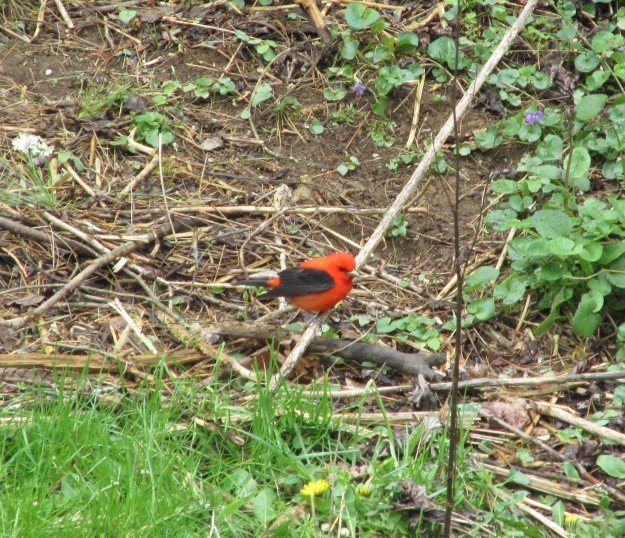
Photo by Jeana Chapman • A male scarlet tanager forages close to the ground, which is not typical behavior for these birds. Tanagers, although brightly colored, spend most of their time in the tree canopy obscured from view.

I received an email from Lewis and Jeana Chapman detailing a dazzling discovery they made.

The couple have been adding a few new birds to their bird list and decided to give me an update on what they’ve been seeing. The Chapmans reside in the community of Laurel Bloomery in Johnson County, Tennessee. The wooded slopes of Pond Mountain where they make their home provide an attractive location for migrating birds, as well a summer residents.

“The tree swallows returned this spring to nest in our bluebird box,” Lewis wrote in his email reporting his new sightings. “The great crested flycatcher has moved its nest from the front porch to the barn. Last year the flycatchers raised five chicks on the front porch. The nest got so full the chicks were perched around the edge.”

Some new additions to their list have included golden-crowned kinglet and the Northern flicker. “Most recently we spotted a scarlet tanager,” Lewis continued.

Scarlet-Tanager

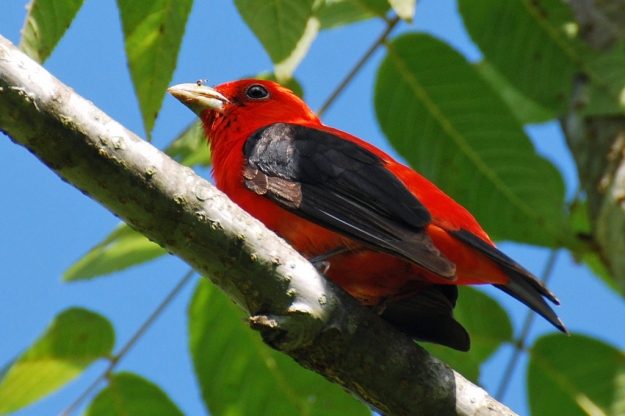
Photo Courtesy of Jean Potter A male scarlet tanager brightens shadowy woodlands with a flash of tropical colors yet remains mostly inconspicuous in the forest canopy.

They had never seen a scarlet tanager at their home. Over the years I have heard from other readers left stunned by the tropical beauty of the male scarlet tanager. That description would not be that far off. While the scarlet tanager resides in the United States and Canada from April to October each year, this bird spends the rest of the year in South America. Citizens of the United States and Canada get the better part of the bargain when it comes to hosting this bird. After the summer nesting season, male scarlet tanagers lose their brilliant red plumage and look more like the greenish females. By the time they get back to the tropics for the winter, this striking bird has transformed into a rather drab specimen.

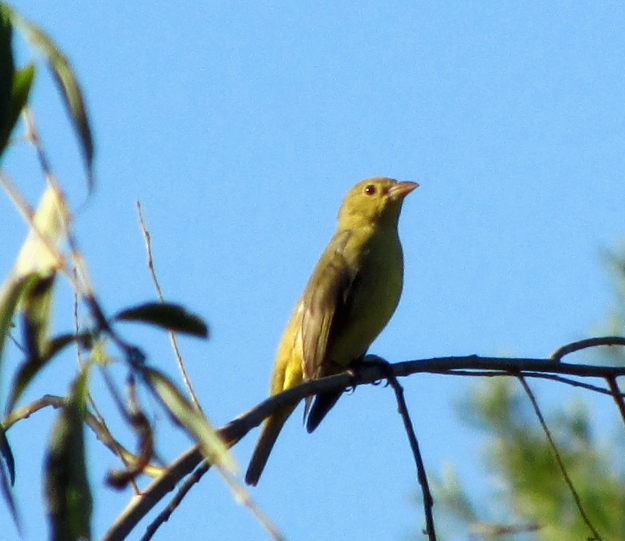
I’ve written in previous columns about the scarlet tanager, which is one of those birds that always takes an observer’s breath away upon first seeing it. Of course, it’s the male scarlet tanager that bewitches observers with his dazzling feathers of vivid red and jet black. Female and immature tanagers are a dull olive-yellow in coloration with dark wings and tails.

Tanager-Sept18

A female scarlet tanager is a study in contrast from her mate with her dull greenish-yellow plumage being much less vibrant than the male’s bright red and black feathers.

During their summer stay in the region, scarlet tanagers largely prey on insects. Although renowned as a fruit-eating bird, the scarlet tanager primarily feeds on fruit during its migration flights and on its wintering range in the tropics. This tanager breeds in deciduous and mixed deciduous-evergreen woodlands across the eastern half of North America. I’ve often heard that oaks are a favorite tree for this woodland dweller.

It’s unlikely that you’ll run across the nest of a scarlet tanager. These birds nest high in trees, often locating their nests 50 feet or more above the ground. After building a nest, a female tanager will incubate her three to five eggs for about two weeks. It’s during this time that her inconspicuous appearance is a plus, helping her blend well with her surroundings. After the young hatch, the parents are kept busy feeding the nestlings for another 10 to 15 days.

The website All About Birds notes that the population of scarlet tanagers has declined in the last half-century. Between 1966 and 2014, according to the North American Breeding Bird Survey, scarlet tanager numbers declined by 14 percent. The environmental organization Partners in Flight estimates a global breeding population of 2.2 million, with 93 percent of these birds spending some part of the year in the United States and the other seven percent breeding in Canada. These birds do poorly in forests that have been harvested for lumber. Other causes of habitat fragmentation probably also affect the well-being of scarlet tanagers. It’s worth keeping an eye out for any other signs of decline in this beautiful birds.

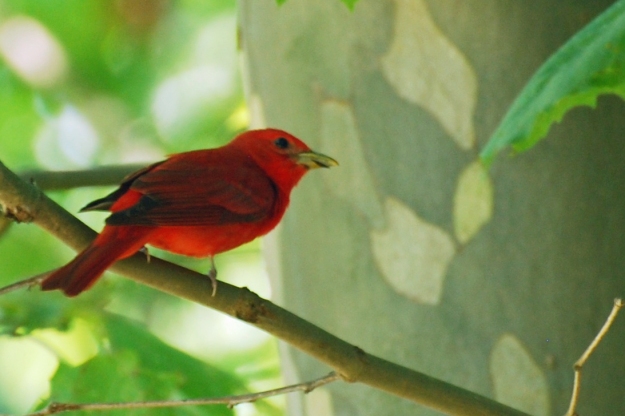
The scarlet tanager is a fairly common songbird during the summer months, but it also has a less common relative that can be found in northeast Tennessee, southwest Virginia and western North Carolina. The male summer tanager is the only entirely red bird found in North America. Lacking the scarlet tanager’s black wings, the summer tanager’s red feathers are also of a rosier hue.

Summer-Tanager

Photo Courtesy of Jean Potter The Summer Tanager is the only all-red bird in North America. It is less common in Northeast Tennessee than the related Scarlet Tanager.


While I have seen summer tanagers in Tennessee on occasion, most recently at Steele Creek Park in Bristol, Tennessee, I saw my first summer tanager during a spring trip to South Carolina many years ago. Overall, the summer tanager has more of a southern stronghold than the scarlet tanager, as the summer tanager’s range also extends into the southwestern United States.

Both of these tanagers are birds fond of dense, undisturbed woodlands. Most of the time, unfortunately, these tanagers reside in the dense woodland canopy. They’re more often heard than seen, producing a song similar to an American robin’s, but usually described as somewhat more raspy. The apt description I like for these two tanagers is that their songs sound like one sung by a hoarse robin with a sore throat.

Some of the world’s other tanagers are known by extremely descriptive names, including seven-colored tanager, flame-colored tanager, lemon-rumped tanager, green-headed tanager, golden-chevroned tanager, azure-shouldered tanager, fawn-breasted tanager, metallic-green tanager, emerald tanager, gilt-edged tanager, golden-naped tanager, opal-crowned tanager, blue-gray tanager and silver-beaked tanager.

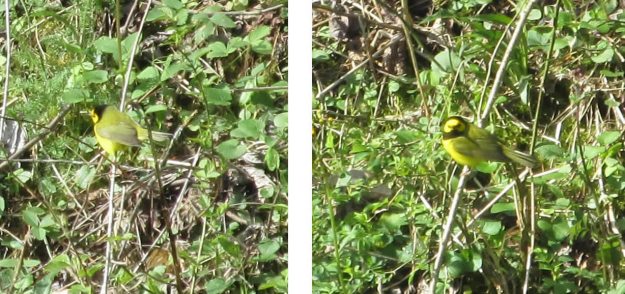
The tanager wasn’t the only unexpected feathered visitor to the Chapman home this spring. The same week the tanager made its appearance, a male hooded warbler also visited with the Chapmans. “This we found ironic because of your email address,” Lewis wrote. For readers who may not have noticed, my email address is ahoodedwarbler@aol.com. I’ve used this email address for many years to celebrate one of my favorite birds.
HoodedWarbler01 (5)

Photo by Lewis Chapman • A male hooded warbler also impressed the Chapmans during this small songbird’s recent visit.

The Chapmans also provided me with photos of all their colorful birds. In subsequent emails, they also informed me of some other unusual visitors. “One of our strangest visitors was an albino American goldfinch,” Lewis also revealed in his email. “Over this past weekend, we had rose-breasted grosbeak and indigo bunting show up.”

Many of these birds — the rose-breasted grosbeak, the scarlet tanager, the indigo bunting — always wow observers experiencing their first observation of them. Our two native tanagers — scarlet and summer — are definitely two memorable birds for anyone who has had the pleasure of seeing one. It’s a great time of year to get outdoors and keep your eyes open for a splash of bright color. You never know what you may see when you lift your binoculars.


White-faced ibis creates birding stir with rare visit to region

When I awoke on April 19, I didn’t expect that I’d end up seeing a new state bird before the day ended. Thanks to timely notices of a new bird sighting by email, I used my work break to drive to Elizabethton, Tennessee, to see a white-faced ibis at the Carter County Rescue Squad pond. The opportunity for unexpected appearances by birds like the white-faced ibis is why I love spring migration.

White-FacedIbis

Photo by Bryan Stevens • The red eye of this white-faced ibis allowed observers to confirm the identity of the bird. The similar glossy ibis does not have red eyes.

Tom McNeil spotted the bird at a much larger pond on the campus of Northeast State Community College in Elizabethton. After he reported the bird, I was able to use a work break to travel to the location and find the bird nearby at the smaller pond, where several area birders had already arrived. The ibis had moved to this smaller pond after departing the larger pond where it was first detected.

This is only the second record of a white-faced ibis for Northeast Tennessee.

The white-faced ibis is a widespread wading bird, nesting from the western United States and Canada south through Mexico, as well as from southeastern Brazil and southeastern Bolivia south to central Argentina, and along the coast of central Chile.

I saw white-faced ibises for the first time during a trip to Utah in May of 2006. The state had enjoyed a spring with ample rainfall, and every flooded field and pasture contained flocks of these distinctive wading birds. These flooded fields provided temporary habitat for numerous other birds, including cinnamon teal and Wilson’s phalarope.

UtahIbis

Photo by Bryan Stevens • A flooded field in northern Utah near the border with Wyoming provided foraging habitat for this white-faced ibis.

The white-faced ibis is almost identical in appearance to the glossy ibis, which is the most widespread ibis in the world. The glossy ibis ranges across six continents, absent only from Antarctica. In the United States, the glossy ibis ranges mostly along the southern Atlantic coastal area. I have observed this bird at several locations in South Carolina.

The similar appearances of white-faced and glossy ibis presents challenges to identification, which was the case with this recent visitor. The bird found in Elizabethton lacked the white plumage in the face that gives the species its common name. Fortunately, the bird did plainly show one physical trait — red eyes — that easily distinguishes it from the related glossy ibis. Sometimes, all it takes to clinch an identification is a simple physical characteristic such as, in this case, a red eye.

A third ibis native to North America is the white ibis. The Audubon Society identifies the white ibis as one of the most numerous wading birds in Florida, but the bird is common also in other parts of the southeast with appropriate wetland habitat. Like the wood stork, the ibis has declined in Florida in recent decades largely as a result of human encroachment.

BRYAN-IBIS

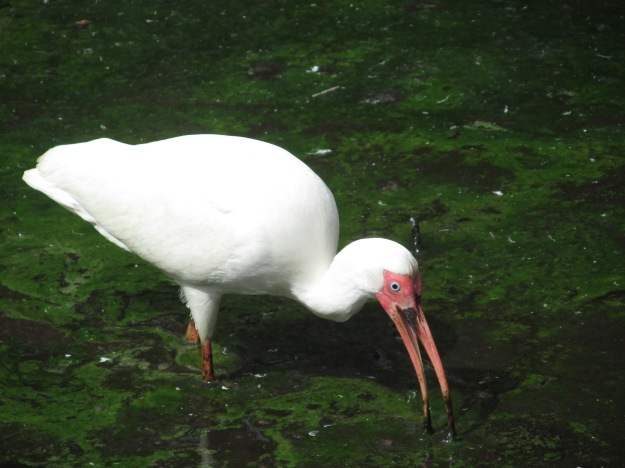
Photo by Bryan Stevens • A white ibis forages for food by probing in water and mud.

The white ibis looks like a humorously absurd bird that could have been invented by Dr. Seuss. The extravagant, all-white plumage is contrasted by pinkish-orange legs, an extremely long, downcurved, reddish-pink bill and bright blue eyes. In flight, the white ibis shows black feathers on the edges of its wings.

I’ve seen white ibises in Tennessee as well as in South Carolina and Florida. In the Sunshine State, another relative — the unmistakable scarlet ibis — is sometimes observed in the wild. The scarlet ibis inhabits tropical South America and islands of the Caribbean, but the species if often held in zoos and other attractions. Escaped birds rather than strays are often the source of sightings in Florida of this vibrant scarlet-feathered ibis.

Glossy-Flock

Photo by Bryan Stevens • A glossy ibis flock feeds in a wetland located at Huntington Beach State Park in South Carolina.

All ibises have long, downcurved bills. These birds usually feed in small flocks, probing wetlands for prey such as crustaceans, small fish, amphibians, insects, and various invertebrates. Worldwide, there are about 34 species of ibis, including the red-naped ibis, black-faced ibis, green ibis, straw-necked ibis and African sacred ibis, which is the bird often depicted in tombs and other monuments of ancient Egypt. This ibis was associated with the Egyptian god, Thoth, who was often depicted as a man with the head of an ibis.

The brief visit from the white-faced ibis provides a good reminder that we’re in the midst of spring migration. Stay alert for those unexpected birds. You never know what you might see.

IMG_5931

Photo by Bryan Stevens • The white-faced ibis found in Elizabethton, Tennessee, is shown walking past a domestic duck and a mallard.

Readers continue to report hummer arrivals

A few other readers have shared their first spring hummingbird sightings.
• Bunny Medeiros of Abingdon, Virginia sent me an email to announce her first sighting. “To my delight, the day after I put out my feeder a hummer appeared,” she wrote. The bird, a male, made his appeared on April 14.
• Rhonda Eller of Chilhowie, Virginia, saw her first ruby-throated hummingbird of spring on April 18. “Surely spring is going to come and stay!” Rhonda predicted on her post of my Facebook page.

Bird survey seeks volunteers

The Virginia Breeding Bird Atlas is getting ready for a third year of surveying the state’s birds. The atlas is a citizen science project, and volunteers conduct most of the key data collection. Organizers are hopeful that Virginia’s strong birding community will partner with the Virginia Ornithological Society and Virginia Department of Game and Inland Fisheries to accomplish the largest bird conservation effort in the state to date.
“This is our third year, and we can always use more volunteers to participate,” said Steven Hopp with Environmental Studies at Emory and Henry College. “Our region down here in the corner is one of the least-covered areas of the state.”
Anyone interested in participating and learning more about the atlas is welcome to email Hopp at shopp@ehc.edu.

IMG_5909

Photo by Bryan Stevens • The white-faced ibis probed the edge of a pond in its search for food, occasionally catching and consuming tadpoles.

Upcoming Roan Mountain Spring Naturalists Rally will offer chances to enjoy migrating birds and much more

TreeSwallow-April13

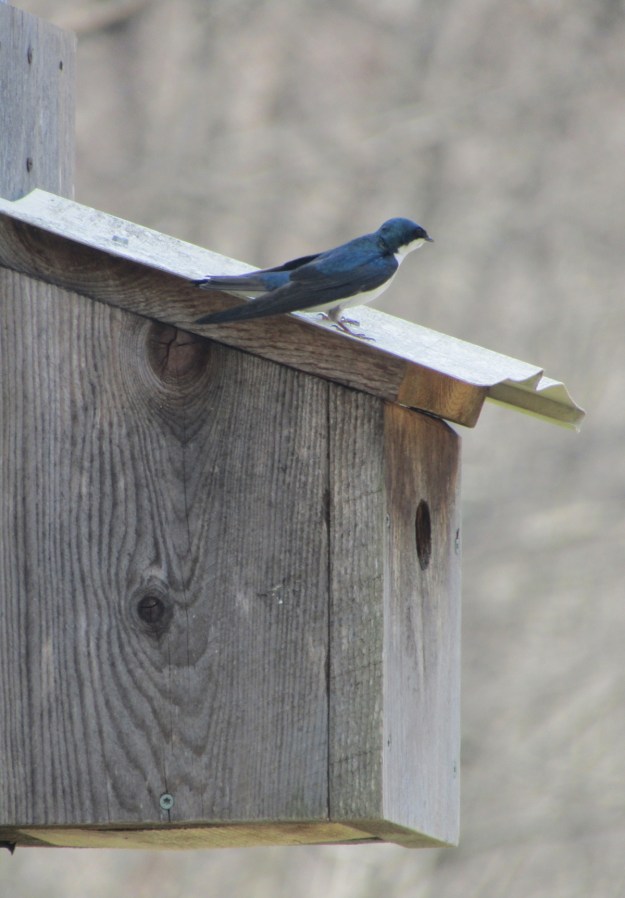
Photo by Bryan Stevens • A tree swallow checks out a nesting box soon after returning for the nesting season on Friday, April 13 to Hampton, Tennessee.

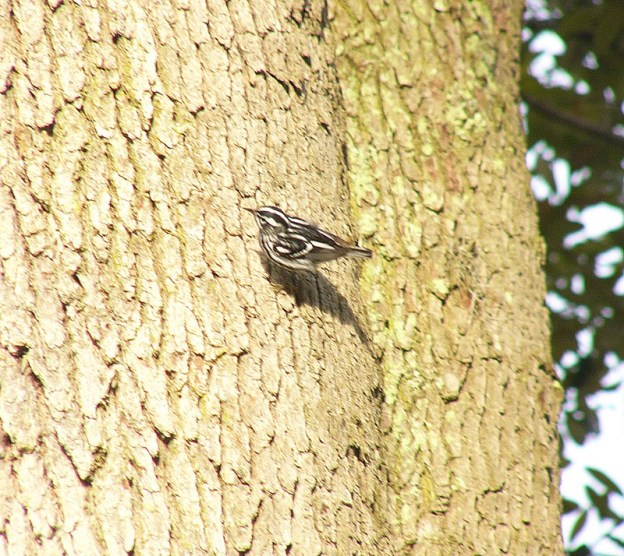
Spring has certainly sprung. In the past week, several birds have made their return after a long absence, including broad-winged hawk, brown thrasher, blue-gray gnatcatcher, tree swallow and black-and-white warbler. It’s a good time to get outside and see what birds one can see without even really trying.

One long-running annual event will help interested people see birds and experience other aspects of the natural world. The upcoming 60th annual Roan Mountain Spring Naturalists Rally promises three days of nature-packed activities and events for people of all ages. This year’s rally will be held Friday-Sunday, April 27-29.

As always, in addition to bird walks and other nature hikes, the rally will offer evening programs by guest speakers on Friday and Saturday after a catered dinner.

Kris_hike_Germany

Photo Courtesy of Friends of Roan Mountain • Kris Light is shown during a nature walk while on a trip to Germany.

Kris Light will speak on Friday at 7:30 p.m. on “The Birds and Bees of Wildflowers: Pollination Strategies of Flowers.” Light is a lifetime Tennessean who grew up in Nashville and graduated from University of Tennessee-Knoxville. She has experience teaching classroom science for elementary school students and is an outreach educator for the American Museum of Science and Energy in Oak Ridge. She is a lifelong student of nature and a favorite leader of wildflower walks for various parks around the state.

Light described her program as focusing on the fascinating interaction between flowers and their pollinators and how colors, odors, shape, and even the presence of stripes or spots on the petals can greatly influence the type of pollinators that will be attracted to them.

DrKevinHamed

Photo Courtesy of Friends of Roan Mountain • Kevin Hamed is shown holding a salamander. These amphibians will be the focus of his upcoming presentation at the Roan Mountain Springs Naturalists Rally.

Dr. Kevin Hamed will discuss the diversity of salamanders on Roan and other neighboring mountains during his Saturday program at 7:30 p.m. His presentation is titled “The Future of Appalachian Salamanders: What the Past Tells Us.”

Hamed is a professor of biology at Virginia Highlands Community College where he is dedicated to getting his students out of the classroom and into nature, where they gain experience collecting specimens and recording data. This field data has been useful to various local, state, and federal organizations in making important land management decisions.

Hamed is recognized as an expert on salamanders of the southern Appalachians. For his program Saturday night he will discuss the unique environment of the area’s mountains which makes this area “holy ground” for salamander study, present his research on the nesting behavior of salamanders, and discuss the importance of salamanders as indicators of environmental change.

Bloodroot-Last

Photo by Bryan Stevens • Spring’s ephemeral wildflowers, like these bloodroots, are a major attraction during the Roan Mountain Spring Naturalists Rallies.

All activities and programs are free to members of the Friends of Roan Mountain. There is a charge, however, for the Friday and Saturday evening meals, which are scheduled for 6:30 p.m. Visit friendsofroanmtn.org to register and pay online to reserve meals for Friday and Saturday. Deadline to reserve a meal is April 24. The website also offers a complete listing of morning and afternoon hikes, as well as other programs and activities. Charges do apply for attendees who are not members of FORM.

••••••

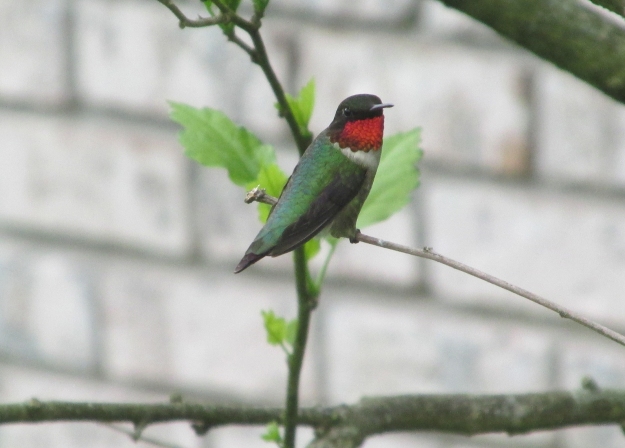
Ruby-throated hummingbirds are back. My first ruby-throated hummingbird, a feisty male, zipped into the yard while I was on the front porch grading papers. He sipped at four different feeders before he zoomed off. He arrived at 5:40 p.m. on April 14. I’ve heard from other people who have already seen one of these tiny flying gems. I’ll provide more details on their arrival in next week’s blog post. Keep those reports coming to me by sending an email to ahoodedwarbler@aol.com. Please list the date and time when you saw your first spring hummer.

Hummer-CloserUp

Photo by Bryan Stevens • Ruby-throated hummingbirds such as this male are returning to the region.


Berry-rich diet makes waxwings profuse water drinkers

Waxwing-Sept11

Photo by Bryan Stevens • A cedar waxwing perches on a branch while taking a break from flycatching insect prey near a community park pond.

Ernie Marburg, a resident of Abingdon, Virginia, shared an interesting observation about a flock of cedar waxwings he observed recently in his yard.

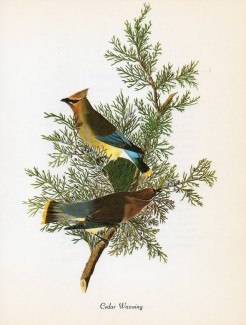
Waxwings have a brown and gray silky plumage, a black mask and a perky crest. Some of the wing feathers show red tips. The similarity of these wing tips to melted drops of wax gives these birds the common name of waxwing.

Waxwing-Audubon

Early American naturalist and artist John James Audubon painted this pair of cedar waxwings.

“The typical flock of waxwings has arrived,” he wrote in his email. He added that the birds exhibited an unusual behavior during their visit.

“From their roosts in the tops of some tall nearby trees, they appeared to be leaving their roosts briefly and returning to the trees as though they were catching flies,” Ernie noted. “There were, however, no flies available.”

The waxwings, he went on to explain, appeared to be going after snowflakes. “Could they have been going after the snowflakes to drink water?” Ernie asked.

While I wasn’t sure that catching snowflakes is an energy-efficient way to relieve thirst, the waxwings might have had a different motivation for their behavior. As I informed Ernie in my reply to his email, waxwings are very social with each other. These birds form large flocks that travel, feed, roost and bathe together. They have also come up with interesting “rituals” to reinforce their social ties with each other.

Waxwing-Erwin

Photo by Bryan Stevens • The waxy tips to the wing feathers are evident in this photograph of a cedar waxwing.

These rituals, or games, they “play” with each other include a flock of perched birds passing a single berry or fruit in a line, one bird to another, without any of the birds eating the item. I speculated that snowflake catching was their idea of a fun game and a way to practice for fly-catching season, which is just around the corner.

Perhaps I should have conducted some research. As it turns out, other people have witnessed this snowflake-catching behavior, which has led those who have studied the birds to determine that the birds do indeed eat snowflakes to ease thirst. Apparently their diet, which is rich in sugar thanks to the various berries that provide a huge percentage of their food, waxwings are often afflicted with intense thirst. In addition to catching snowflakes, they have been observed eating fallen snow. A single Bohemian waxwing — a relative of the cedar waxwing — can gobble down 300 berries in a couple of hours. According to some statistics, one of these birds can eat up to three times its weight in fruit in a single day. The next time I am lucky enough to observe waxwings in a snowstorm, you can bet I will be watching for this snowflake-eating behavior.

The cedar waxwing has few relatives. Worldwide, there are only two other species: the Bohemian waxwing, which is native to the northern forests of Eurasia and North America; and the Japanese waxwing, found in such northeast Asian countries as Japan, Korea and China.

Ruby-throated-WILLOWS

Photo by Bryan Stevens • Numbers of Ruby-throated Hummingbird in the region tend to fluctuate each year, but people should see a spike in their numbers as the hummingbirds end summer nesting and start migrating south again.

Hummingbirds due back soon

Waxwings are rather nomadic, coming and going with a maddening unpredictability. Other birds are more dependable, arriving and departing at roughly the same time year after year. One such bird should soon make its triumphant and welcome return to yards and gardens throughout the region. According to the website Hummingbird Guide, ruby-throated hummingbirds usually return to Tennessee and Virginia the first week of April. These tiny flying jewels arrive earlier in North and South Carolina, typically arriving the third week of March in those states.

The popularity of hummingbirds in general, and the ruby-throated hummingbird specifically, is simple to understand. These tiny birds are perfectly willing to insert themselves into our lives, offering hours of fascinating entertainment as they visit our gardens, duel at our sugar water feeders and occasionally even nest in trees and shrubs in our yards.

Individuals who feed birds know that it can be an expensive undertaking. The cost of providing sunflower seeds and suet cakes for hungry flocks during the winter months can nibble at the monthly budget, but hardly anyone would begrudge the sparrows, finches, wrens and woodpeckers. After all, they return the favor, putting on daily shows just outside our windows.

Rubythroated_Hummingbird

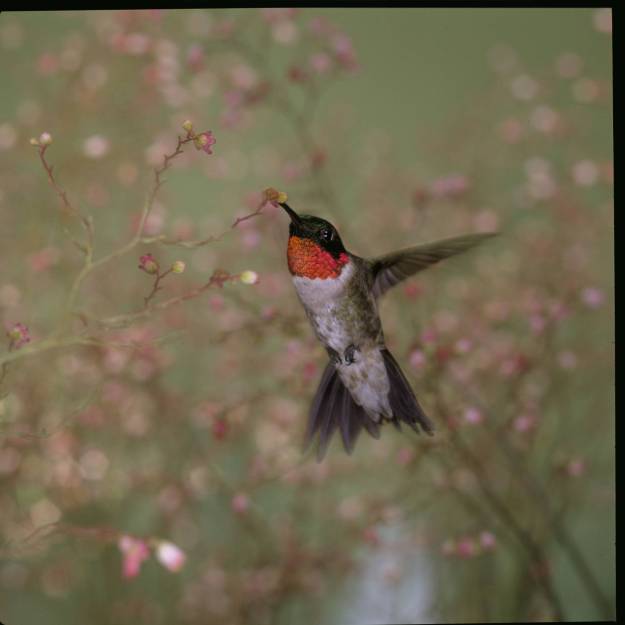
Photo by U.S. Fish & Wildlife Service • A male Ruby-throated Hummingbird hovers in front of the camera as it seeks nectar from tiny flower blossoms.

The same is true of hummingbirds. For a relatively modest investment, people putting out feeders or planting nectar-producing flowers are rewarded with the fun and amusing antics of these pint-sized and hyperactive birds.

Attracting hummingbirds is generally much less expensive than feeding other birds. After all, you need only a mixture of sugar water — four parts water to one part sugar — to fill a feeder and catch the attention of a visiting hummer. A few pounds of sugar will last a lot longer than that bag of sunflower seeds, and it’s much less expensive to purchase at the grocery store.

Do not add red coloring or dyes to your sugar water mixture. Some studies have indicated these substances are harmful to hummingbird health. This means tossing out many of the pre-packaged mixtures sold with sugar water feeders. After all, the entire purpose is to attract hummingbirds. Risking their health is simply not acceptable. If you do want to take extra steps to attract these diminutive, feathered sugar junkies, consider supplementing your landscape with a variety of flowering plants. To explore some of the best choices for flowers to tempt hummingbirds, visit the website of The Hummingbird Society at http://www.hummingbirdsociety.org.

Ruby-throatedFemale-EYE

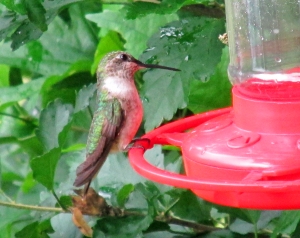
Photo by Bryan Stevens • A ruby-throated hummingbird visits a feeder for a sip of sugar water.

I always put out my sugar water feeders in early April. I usually end up waiting a couple of weeks before the first hummingbird appears, but it’s worth the wait. I miss these tiny birds during the winter months, which they spend in much warmer surroundings in southern Mexico and Central America. A male with the namesake red throat is usually the first to appear at my feeders. However, female ruby-throated hummingbirds, which lack the dazzling ruby throat patch, are migrating, too. The females usually lag a week or two behind the pace of the migration for the males.

As always, I enjoy hearing from readers about their first spring sighting of a ruby-throated hummingbird. Readers are encouraged to jot down the date and the time of arrival when they observe their first hummingbird of the season. If the sighting’s duration allows you to verify, note whether the hummingbird was a male or female. These reports can be emailed to me at ahoodedwarbler@aol.com. Together, we’ll track the arrival of these tiny birds as they return to the region.


Tufted titmouse small songbird with big personality

In last week’s post I wrote about chickadees. These friendly little birds have an impish cousin that is also a frequent visitor to feeders in the region. If chickadees are active woodland sprites, their relative, the titmouse, is a curious imp with mischievous tendencies.

Titmouse-2

Photo by Bryan Stevens • A tufted titmouse puffs up its feathers on a cold day.

The tufted titmouse’s song — a persistent repetition of “Peter! Peter! Peter!” — is ringing through the woodlands around my home along with the urgent “fee-be fee-bo” of the Carolina chickadee. These birds form mixed flocks with each other and other species to explore their surroundings and search for food. They know that spring, despite the usual false starts, is drawing nearer with each passing day.

In addition to singing, titmice are enthusiastic scolders. They will scold over any transgression, real or imagined, focusing their ire on their fellow titmice or other birds, potential predators and even human observers. They’re quite persistent at their raucous scolding, which is just another reason I label them as imps of the woods.

Titmouse-Suet

Photo by Bryan Stevens • A young titmouse visits a suet feeder.

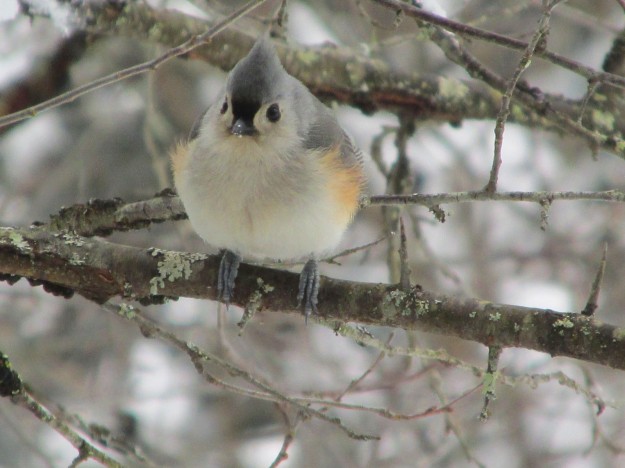
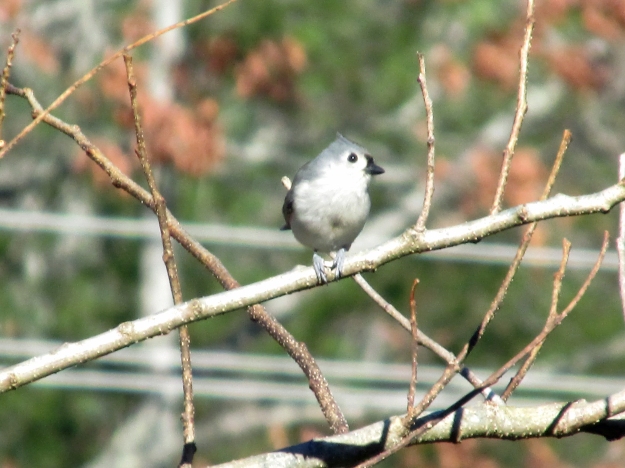
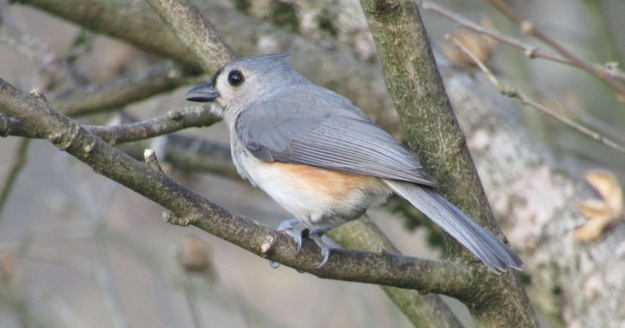
The tufted titmouse is a mostly gray bird with a distinctive crest and a pinkish-rusty coloration along the flanks. Titmouse eyes are black as coal and look large in proportion to their heads, which lends them an expressive appearance as they explore in yards and gardens. The term “titmouse” refers to the old English word “tit” meaning “small,” as well as the old English “mase,” also a reference to small size. Eventually, probably because of the bird’s small size and gray coloration, “mase” evolved into “mouse” and combined to form the word “titmouse.”

The titmice living in my yard visit my house windows at times, which drives my cats to distraction. I’ve wondered if the titmice are curious and trying to peek inside the house, but I believe I have a more down-to-earth explanation. These little birds are very thorough when foraging for food, and I’ve watched them pluck spiders and other insects from the window frames.

Titmouse-Creek

Photo by Bryan Stevens • A tufted titmouse approaches a stream for a quick drink.

Like chickadees, titmice are fond of sunflower seeds. No other offering will so readily lure them to feeders, although they do develop a fondness for suet cakes. I’ve also had great success attracting titmice to my feeders by offering unsalted, shelled peanuts. I sometimes break up the peanuts into smaller, more manageable pieces for the benefit of the titmice. These foods and a few trees or saplings around your home is all you really need to welcome titmice.

In the early 1900s, the tufted titmouse would have been considered a southern bird with its stronghold in states like Tennessee, Virginia, the Carolinas and Georgia. Perhaps it is the titmouse’s innate curiosity that has pushed the species to expand successfully beyond the southern United States. The titmouse has steadily expanded its range northward, thriving in new locations. Experts credit this expansion to more readily available access to supplemental food at feeders.

Titmouse-Eye

Photo by Bryan Stevens • A tufted titmouse turns an eye on the camera.

During the nesting season, titmice forage for a variety of insects. Many spiders, beetles, caterpillars and other small bugs will be fed to hungry young titmice in a tree cavity or a nesting box. Like chickadees, titmice build exquisite nests, often using mostly moss with other materials, such as bark, cloth scraps, dry leaves and shed snakeskins. These small birds line their nests with hair or fur of other animals.

Over the years, many readers have shared observations documenting the fur-collecting skills of tufted titmice. The birds are not content to simply collect shed fur. They seem to prefer collecting the fur fresh from a living animal. Many dogs fall victim to impish titmice that boldly pluck strands of fur from the canine’s coat.

In another funny story, a woman once told me about a titmouse that flew onto her head every time she stepped outside her home. Perhaps the bird sensed her affection for birds since it never failed to pluck strands of hair from her head to carry back to its nest. For any would-be skeptics, the woman provided photographic documentation of the incidents. In addition to dogs and humans, animals ranging from squirrels and opossums to mice and woodchucks have also been observed “sacrificing” fur for the nesting success of tufted titmice.

Titmouse-PHOTO

Photo by Bryan Stevens • The tufted titmouse is a backyard bird with an impish personality.

The female tufted titmouse incubates the eggs. She lays between three and nine eggs, although a usual clutch size is five to six eggs. The female titmouse is protective of her nest and is known for a behavior known as a “snake display.” I’ve observed titmice perform this display when I’ve peeked into nesting boxes. She remains tightly seated on her eggs, or young, while she hisses loudly and strikes in a manner very much like a striking serpent. Not all titmice engage in this display. Some remain still and try to “blend” with the nest, while others will fly away if a nest box is opened. Regardless, it’s a convincing display of bravado on the part of such a small bird. If it looks scary to people, I am sure it could succeed at repelling a squirrel or mouse. I’m uncertain if the behavior would deter an actual snake.

Other titmice in North America include bridled titmouse in Arizona and New Mexico; oak titmouse of the Pacific Coast region; juniper titmouse from the Great Basin, which consists of Wyoming, Idaho, Utah, Nevada, Oregon and California; and the black-crested titmouse, which ranges from Missouri into east-central Mexico.

Titmouse-WithPeanut

Photo by Bryan Stevens • A tufted titmouse pounds at a peanut held in its feet.

Titmice occur exclusively in North America and belong to the genus Baeolophus. Europe, Asia and Africa are home to some other crested birds in the family of chickadees and titmice. For instance, the European crested tit and the grey crested tit are species that sport a crest of feathers like titmice but are more closely related to chickadees.

Yes, the tufted titmouse is one of nature’s imps, but it’s also one of our more entertaining birds. Get to know these visitors by offering sunflower seeds or other fare and, if you want to go the extra step, place some bird boxes around your yard as potential nesting sites. By next winter, you may have an entire flock of these feathered imps as your guests.

•••••

Bryan Stevens lives near Roan Mountain, Tennessee. To learn more about birds and other topics from the natural world, friend Stevens on Facebook at https://www.facebook.com/ahoodedwarbler. If you have a question, wish to make a comment or share a sighting, email ahoodedwarbler@aol.com.

Titmouse-OnSuet

Photo by Bryan Stevens • A tufted titmouse makes a quick visit to a suet feeder.

North America’s bluebirds never fail to impress with their winning ways

A famous song declares that “somewhere over the rainbow, bluebirds fly,” so you’ll have to excuse me if I have been looking for those elusive rainbows during the unseasonably warm weather the region’s enjoyed in recent weeks.

Also, like the song promises, “dreams really do come true,” which was fulfilled by the arrival of this year’s first pair of Eastern bluebirds at my home on Friday, Feb. 23. The presence of a pair of these beautiful and trusting birds is always sure to put people in a good mood. People have known for generations that bluebirds make good neighbors. A pair of bluebirds in your yard or garden provides hour upon hour of free entertainment as one watches these birds go about their daily routine. At this time of the year, much of that routine is focused on finding and claiming the best possible nesting location for the upcoming spring season.

Bluebird-Comic

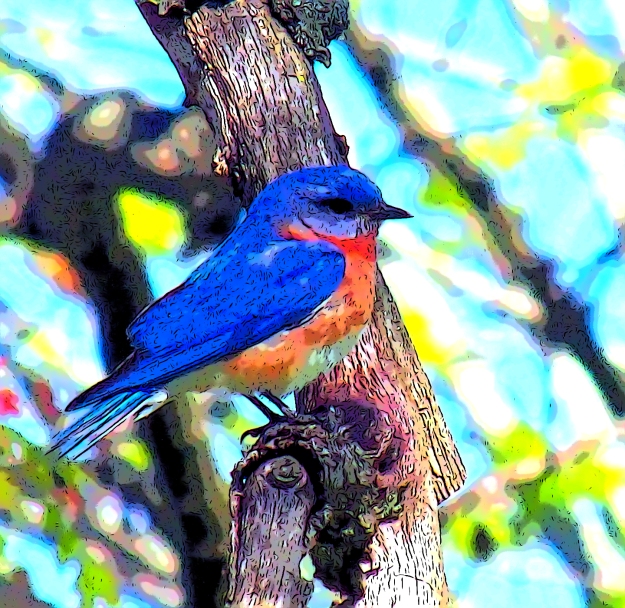
The Eastern bluebird is one of the most beloved American songbirds.

The Eastern bluebird is one of North America’s best-known cavity-nesting birds. About 85 species of North American birds use cavities in trees for nesting purposes. Cavity-nesters include ducks, such as buffleheads and wood ducks, as well as birds of prey such as Eastern screech-owls and American kestrels.

Woodpeckers and nuthatches can excavate their own cavity in a dead or decaying tree. Others, such as the bluebirds, must find a cavity already in existence. Such cavities are scarce real estate and can be subject to some intense competition. The Eastern bluebird is at a disadvantage when forced to compete with non-native introduced birds such as aggressive European starlings and house sparrows. Even native competitors such as house wrens and tree swallows are serious rivals when it comes down to staking a claim to prime nesting real estate.

Over the years, I have found bluebirds nesting in cavities inside wooden fence posts, but there are fewer wooden fence posts every year. This reinforces the idea of how changing landscapes have affected these birds. Instead of wooden fence posts, many farmers now use metal ones, and dead or dying trees — a much sought-after resource for cavity-nesting birds — are often removed from woodlands.

Bluebird-withPineNeedles

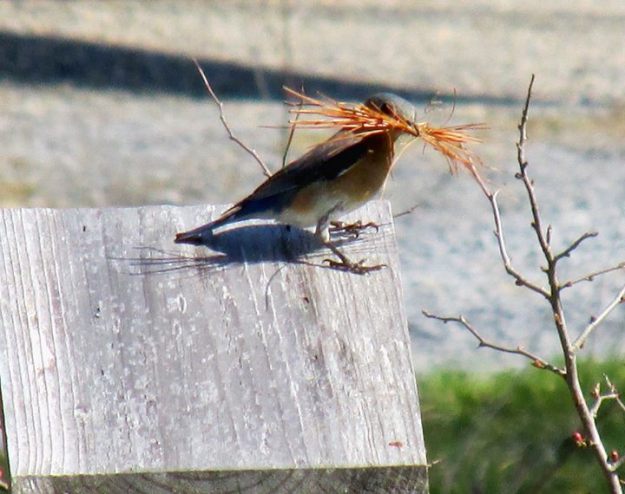
Photo by Bryan Stevens • A female Eastern Bluebird gathers pine needles to use as nesting material.

Fortunately for bluebirds, this species will also accept lodging in a nest box, or birdhouse, provided for them by human landlords. One of the simplest ways to bring bluebirds close is to offer wooden boxes, constructed to their specific requirements, for their use as nesting locations. Because of their trusting nature when it comes to their human neighbors, the Eastern bluebird is one of our most beloved birds. In fact, bluebirds are such popular birds that interest in them and their well-being has inspired the foundation of organizations such as the North American Bluebird Society. The Eastern bluebird has also been designated the official state bird for New York and Missouri, which provides more testimony to the immense popularity of this bird.

Bluebirds-One

Photo by Bryan Stevens • A flock of Eastern bluebirds perches on fenceposts.

There are two other species of bluebirds found in North America. The Western bluebird is found throughout the year in California, the southern Rocky Mountains, Arizona and New Mexico, as well as in part of Mexico. The species ranges in the summer as far north as the Pacific Northwest, British Columbia and Montana. The Mountain bluebird nests in open country in the western United States as far north as Alaska. They are short-distance migrants, retreating as far south as Mexico during the winter season.

Other than these three species, North America offers few others birds with mostly “blue” plumages. Some examples include indigo bunting, blue grosbeak, and blue jay, as well as birds like great blue heron and belted kingfisher.

In addition to housing, food and water can be used to lure Eastern bluebirds closer. This bird doesn’t eat seeds, but it can be attracted with an offering of mealworms — live or freeze-dried – or commercially prepared peanut butter nuggets. A water feature in a yard is also a magnet for bluebirds and a host of other bird species.

Bluebird-Pool

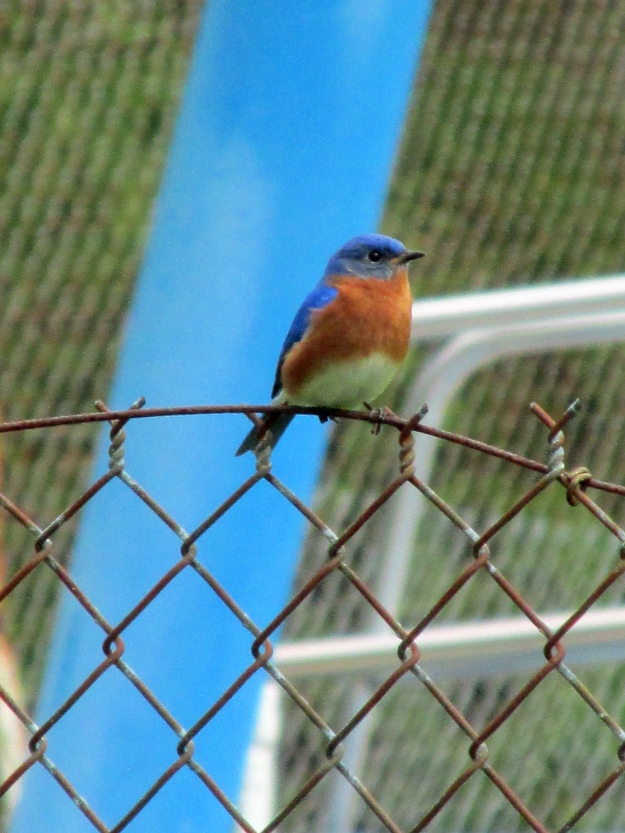
Photo by Bryan Stevens • A handsome male Eastern bluebird perches on a chain-link fence.

If your home doesn’t provide suitable open, spacious bluebird habitat, it’s still easy to enjoy these beautiful birds. An afternoon or evening drive into open country, such as agricultural farmland, is likely to yield sightings of this bird on fences and utility lines. Golf courses, some of which go the extra mile to accommodate bluebirds, also provide habitat for these lovely birds.

The Eastern bluebird is present in the region in all seasons and is one of our more common birds. If you’re already an experienced landlord and host for these birds, you probably already know they joys they can bring. If not, why not try to attract them closer to you? Most bluebirds in the region have already started looking for a nesting site. Many of these birds may nest two or even three times in a single season. March has only just arrived, so there’s still time to place a nest box or two on your property to get their attention.

••••••

If you have a question, wish to make a comment or share a sighting, email ahoodedwarbler@aol.com.

Bluebiord-Male-Playground

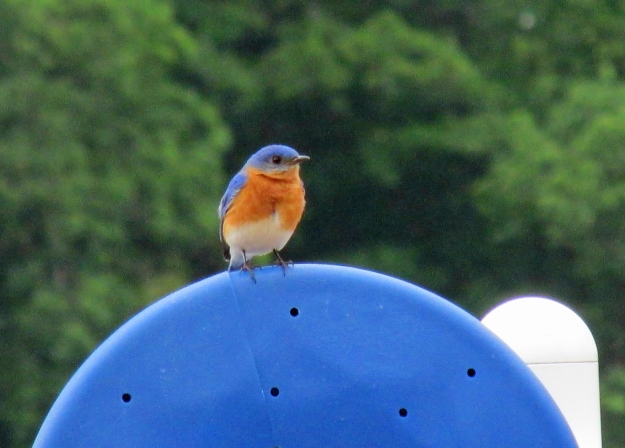
Photo by Bryan Stevens A male Eastern Bluebird perched on playground equipment at Winged Deer Park in Johnson City.

American robins become more prominent with shifting of seasons


Robins-ETSU-Feb

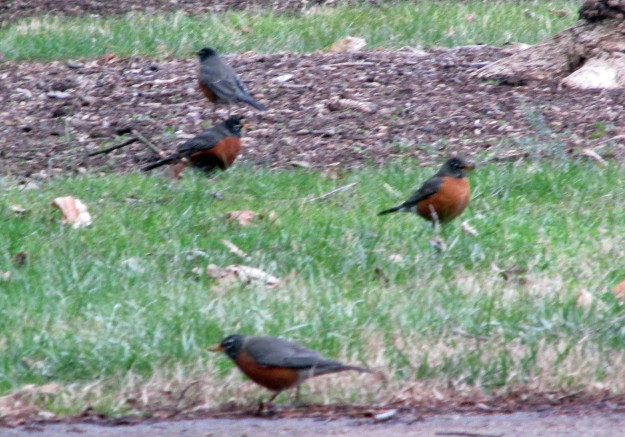
Photo by Bryan Stevens • Returning American robins, prominent in lawns and gardens during their annual spring migration, will soon turn their attention to nesting duties.

I don’t think I’m alone in doing what I can to speed along the process of spring’s arrival. I’ve heard from different people, all eager to share their observations of one of the sure signals — the arrival of flocks of American robins — of the shifting of the winter season to spring.

Bobby Howser phoned me to let me know of a large flock of American Robins he encountered at the Sullins College building in Bristol, Virginia.

He said the flock “swarmed like bees” into a tall holly tree. He was surprised to see so many robins in a single tree and asked if it was an unusual occurrence.

Houghton_MS_Am_21_(46)_-_John_James_Audubon,_robin 3

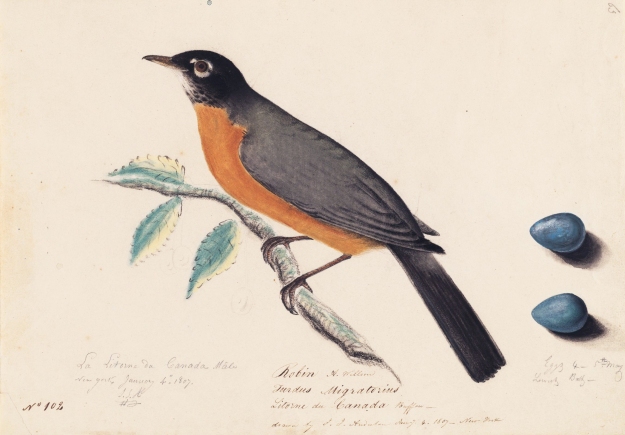
Early American naturalist and painter John James Audubon painted this American robin with a couple of the bird’s eggs.

Ernie Marburg in Abingdon, Virginia, emailed me about the same time.

“I just wanted to report that we have been inundated with a huge flock of mostly robins,” he wrote. He estimated that the flock contained 300 to 500 individuals.

“They ate all the red berries from my neighbor’s large holly tree yet appear to avoid other holly trees with many red berries just a short distance away,” Ernie wrote. The flock remained active in the tree from morning into early afternoon.

Not long after he first emailed me, Ernie contacted me again. “I wanted to give you an update on the robin invasion,” he wrote. “They have been here two additional mornings since I first reported to you. Their pattern is different now though. They are spaced apart and appear to be ground feeding individually.”

Robin-OnNest

Photo by Bryan Stevens • American robin sitting on its nest in the shelter of a side of a bridge spanning the Doe River in Elizabethton, Tennessee.

Ernie proposed a theory about the behavior of the robins.

“I think they followed the south to north weather pattern we had recently that provided significant rainfall,” he explained. “The rainfall, in turn, caused the ground to thaw and the earth worms to come to the surface thus providing a food source for the robins. In summary, the robins are following their food source.”

I responded to Ernie and congratulated him on what I thought was an excellent theory.

Ernie also wrote me that he had read an article some time ago that said robins would eat cooked elbow macaroni if put out for them.

“We did that, but not one robin ate the macaroni,” he said. “Moral of the story is, as you would expect, don’t believe everything you read.”

I’ve read similar suggestions of unusual items to try to tempt birds not prone to visit feeders. I told Ernie that I wasn’t too surprised that the robins ignored the macaroni. The observations of robin feeding habits made by Bobby and Ernie also correspond to the changing seasons. Holly trees retain their berries into late winter, which provide an abundant food source for robins, as well as other birds. As the temperatures begin to rise in early spring, the birds switch their diet in favor of earthworms. This protein-rich food source fuels the impressive migration made by robins each year.

Robin-Hunter

Photo by Bryan Stevens • An American robin scans for prey in the grass and clover of a lawn.

I posted on my Facebook page about the flocks of robins I’d observed, which resulted in several comments on my original post.

Johnny Mann, who lives in Bristol, Tennessee, shared on my Facebook page after I posted about seeing flocks of robins almost everywhere I have gone recently. He noted that he has been seeing Eastern bluebirds, which are a smaller relative of robins. He noted in his comment that the bluebirds are feeding on suet.

Jackie Lynn, who lives in Wytheville, Virginia, also posted a comment on my Facebook page. Jackie saw a large flock of robins feeding in a field, enjoying the worms brought to the surface by recent rains. “Dinner was served,” Jackie reported.

Several other people responded optimistically on my Facebook page, sharing the hope that the influx of robins does indeed signal the approach of spring.

The American robin is known by the scientific name Turdus migratorius, which can be translated as “migratory thrush.” Indeed, this well-known American bird is related to other thrushes, including the Eastern bluebird, wood thrush and veery. The relationship to other thrushes is quite visible in young birds, which display a spotted breast until they mature and acquire the familiar red breast associated with robins.

There are 82 other species in the genus, which ranges not only in the Americas, but Europe, Asia, Africa and Australia, as well. Some of the American robin’s fellow genus members include the olive thrush, the bare-eyed thrush, pale thrush, great thrush, black-billed thrush and cocoa thrush.

AmericanRobin

Photo by Bryan Stevens • While American robins like fruit when its available, they also spend a lot of time feeding on earthworms and insects.

When the first European settlers arrived in North America, the robin was still a bird living in the forests. Robins proved incredibly capable of adapting to the presence of humans. Soon enough, these once shy forest birds began to frequent lawns and city parks. The robin soon became one of America’s most popular songbirds. Three states — Connecticut, Michigan and Wisconsin — have conferred official state bird status on the American robin.

Robins begin nesting almost as soon as they return each spring. Nesting success in a previous season instills fidelity to the location where the birds nested, resulting in many robins returning to the same nesting area year after year. Although some robins invariably spent the entire winter season in the region, it is still a welcome sight to see migrating flocks of these birds in February and early March. The sudden resurgence of the American robin each spring is a reminder that another winter will soon be history. I know I’m always pleased to welcome them back.

•••••

Bryan Stevens lives near Roan Mountain, Tennessee. To learn more about birds and other topics from the natural world, friend him on Facebook at https://www.facebook.com/ahoodedwarbler. If you have a question, wish to make a comment or share a sighting, email ahoodedwarbler@aol.com.

american_robin

Early American naturalist and painter John James Audubon captured this family of American robins in one of his masterful paintings.

Unlikely orange-crowned warbler becomes daily visitor this winter at woman’s feeders

After you have fed the birds long enough, you’re going to get visits from “mystery” birds. No matter how thoroughly you thumb through the pages of your field guides or how many online Google searches you conduct, it can be hard to pin down the identity of certain birds, especially when you encounter them for the first time.

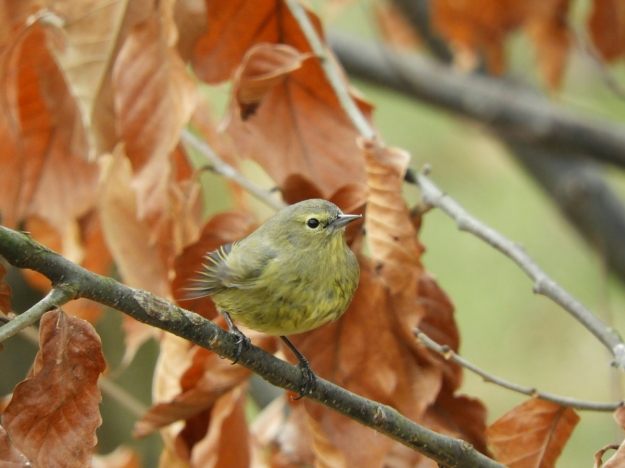
Orange-crowned-Two-BOYD

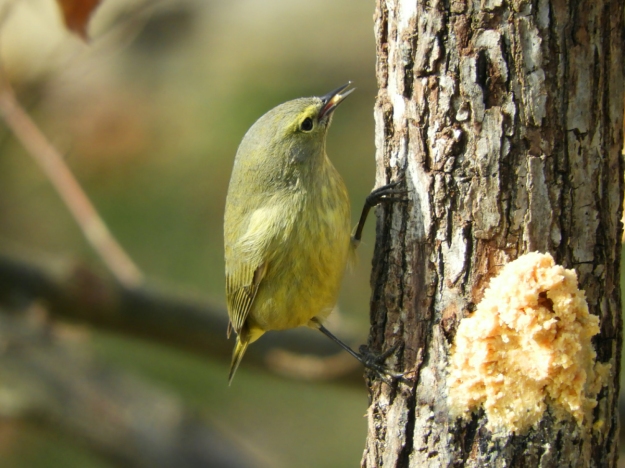
Photo by Rebecca Boyd • This orange-crowned warbler has found a favorable winter residence at the home of Rebecca Boyd in Knoxville, Tennessee, making frequent visits to suet feeders to supplement its usual diet of insects and berries.

In the summer and fall, young birds recently out of the nest can cause some confusion when they show up in the company of their parents at feeders. In the winter, often a season characterized by subdued plumages and nomadic wanderers, the surprise visitors can be one of the many “little brown birds” in the sparrow clan or a summer bird like an oriole or thrush that has decided to take a shot at overwintering.

Or, with greater frequency each winter, it might be one of the warblers. That was the case when Rebecca Boyd, a resident of Knoxville, Tennessee, contacted me recently via Facebook asking for assistance with a bird identification.

27583340_337866090062351_24195392_n

Photo by Rebecca Boyd • This orange-crowned warbler is one of the more nondescript members of the warbler family.

Although most of the warblers beat a hasty retreat from North America every fall, a handful of species have increasingly begun to spend the winter months far north of their usual tropical haunts. Some of these species include yellow-rumped warbler, pine warbler and palm warbler, but the low-profile orange-crowned warbler is also becoming more common between November and March, especially in yards and gardens offering supplemental food such as suet cakes.

The small greenish-yellow bird that showed up at Rebecca’s home was easily identified, thanks to some great photographs that she took of her visitor. I communicated to her that I believed her bird to be an orange-crowned warbler. She had also conducted her own research, which had also led her to that conclusion.

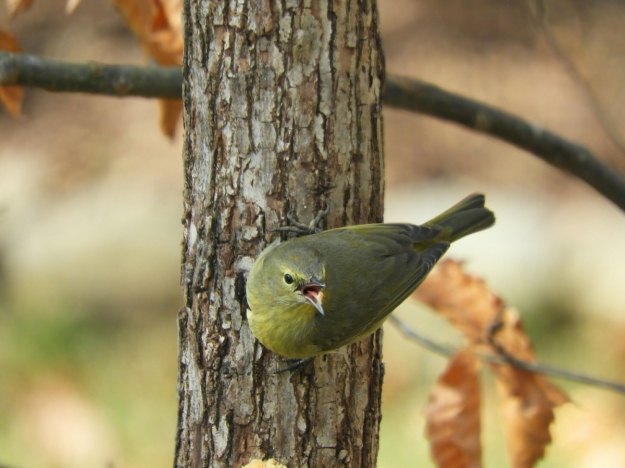
Orange-crowned-Four-BOYD

Photo by Rebecca Boyd • This orange-crowned warbler has found a home at the residence of Rebecca Boyd in Knoxville, Tennessee, this winter.

Rebecca said she also shared some photos with birding groups on Facebook, which brought some helpful feedback. “I’ve gotten numerous responses that orange-crowned warblers are becoming a lot more common on the east side of the Mississippi, with quite a few people saying they are seeing them in their yards, too,” Rebecca wrote.

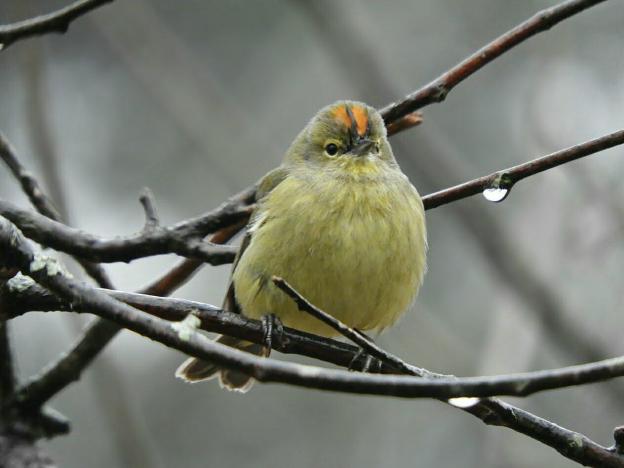
The orange-crowned warbler is one of the more undistinguished members of this New World family of birds that numbers about 115 species. The bird gains its common name from a physical feature that is rarely seen — an orange patch of feathers that, unless the bird is extremely excited or agitated, is usually concealed beneath its dull greenish-yellow feathers. It’s not a field mark that’s considered reliable for identifying the bird.

Rebecca got a lucky break and managed to photograph this elusive feature on her visiting bird. She said the feathers on the bird’s head appeared wet, which may have explained the appearance of the orange crown.

28033440_343701942812099_429716009_o 2

Photo by Rebecca Boyd • Wet feathers made the rarely seen orange crown visible on this orange-crowned warbler that has taken up residence at the home of Rebecca Boyd in Knoxville, Tennessee, this winter.

So, what does signify an orange-crowned warbler? The lack of wing bars, as well as the absence of a strong facial pattern is a strong indicator. The bird in Rebecca’s photo is not nearly as drab as this warbler can appear. Some appear very gray with only a hint of yellow or green in their plumage. There is often faint gray streaking evident in their yellow-green breast feathers. This warbler always shows yellow beneath its tail, a feature that is often only glimpsed as an observed bird is diving into cover. These birds also have sharp, thin bills. It’s usually a process of eliminating other suspects that brings birders to identify one of these warblers.

Unlike some warblers restricted to either the eastern or western United States, the orange-crowned warbler migrates and winters throughout the nation, east and west, although it primarily only nests within the western United States, as well as Alaska and Canada.

Although Rebecca said she has only been bird-watching and taking pictures for a little over a year, she has been a general point-and-shoot photography hobbyist for years. “My backyard is a bird paradise that attracts numerous and varied species,” Rebecca noted. “My favorites are bluebirds and hummingbirds, but the little warblers are also very special.”

Orange-crowned-One-BOYD

Photo by Rebecca Boyd • Besides orange-crowned warbler, like this individual, other warblers on occasion winter in the United States. Species most often attempting to spend the winter months in the United States include palm warbler, pine warbler, and yellow-rumped warbler.

Most of the warblers are currently residing on the island of the the Caribbean, or far south in Central and South America. A few others spend the winter in Florida or other southern states. The 50 or so species that nest in the United States and Canada will begin arriving as early as next month, although the majority of these summer residents will arrive or pass through the region in late April and May.

So, while it has a colorful name, the orange-crowned warbler is one of the more drab and nondescript members of its family. Other warblers living throughout the Americas include flame-throated warbler, crescent-chested warbler, citrine warbler and arrowhead warbler.

I’ll just keep daydreaming on the occasional snowy day of the approach of spring, which signals that the kin of the orange-crowned warbler will be winging their way north again in only a couple more months. I, for one, can’t wait.

••••••

If you have a question, wish to make a comment or share a sighting, email ahoodedwarbler@aol.com.

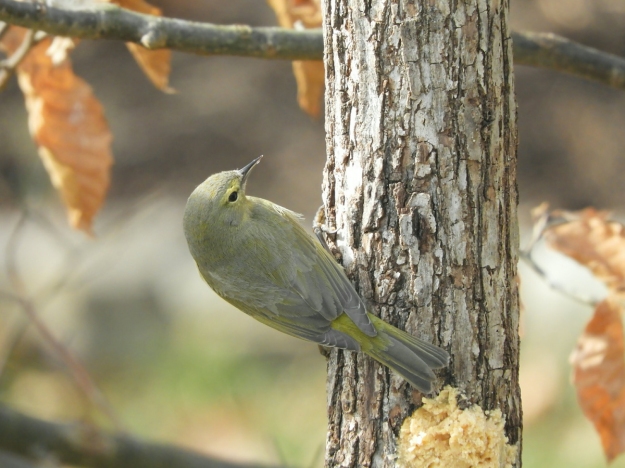
Orange-crowned-THREE-BOYD

Photo by Rebecca Boyd • This orange-crowned warbler grabs a bit of suet from a feeder at the home of Rebecca Boyd in Knoxville, Tennessee.