Sparrows keep things hopping at feeders during snowstorms

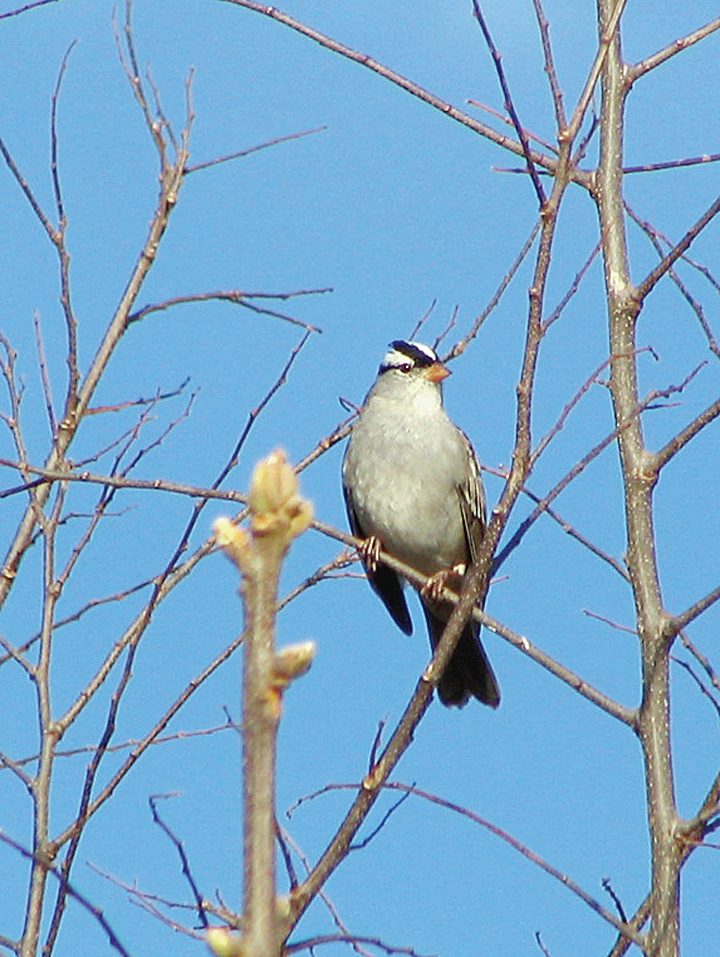
Photo by Bryan Stevens • The white-crowned sparrow is a very aptly named bird.

I recently received an email from a reader in New York.

“I just read your article about juncos and saw it is from November 2021,” wrote Alice H. Poundstone. “I just wanted to drop you a note.”
Alice wrote that the juncos were late arriving at her home.

“They did not arrive until about a month ago,” she said. “Normally we get them closer to early November. I live in Congers, New York, in the Hudson Valley.”
Alice’s email got me to thinking about the winter sparrows at my feeders. Along with juncos, I’ve been hosting song sparrows and white-throated sparrows, especially during the recent snowstorms. They are sometimes timid visitors. In addition, there can be squabbles among these flocking birds. It keeps feeder watching entertaining on snowy days.

On a trip to Roan Mountain, I also saw the first white-crowned sparrow that I’ve observed in many years. The white-crowned sparrow and the white-throated sparrow are both members of the genus known as  Zonotrichia, which refers to two ancient Greek words for zone and hair, which refers to the pattern of streaks on the backs of these five sparrow species. The Zonotrichia sparrows belong to a large group of birds known as Passerellidae, or American sparrows, which also includes birds such as juncos, towhees and brush finches. Some of the more descriptive names for American sparrows include orange-billed sparrow, white-eared ground sparrow, green-backed sparrow, olive sparrow, cinnamon-tailed sparrow, five-striped sparrow and golden-winged sparrow.

Many sparrows, including the white-throated sparrow, prefer to forage for food on the ground. It’s often helpful to purchase a supply of millet seed. When filling feeders with sunflower seeds, scatter a couple of handfuls of millet seed on the ground beneath the feeders or at the edge of a brushy area. Sparrows like to have quick access to dense cover, so they will feed more securely if the scattered seeds are within quick reach of shelter.
Although they are fairly common winter visitors in the region, the white-throated sparrow makes its presence known most strongly each spring when the birds begin to sing a familiar refrain that has been transcribed in a couple of different ways. Many Americans render the song of the white-throated sparrow as “Ol’ Sam Peabody, Peabody, Peabody.” For those living north of the border, the white-throated sparrow sings “O’Canada, O’Canada, O’Canada.” No matter how you translate this sparrow’s song, it’s a sweet and welcome addition to the spring aural landscape.
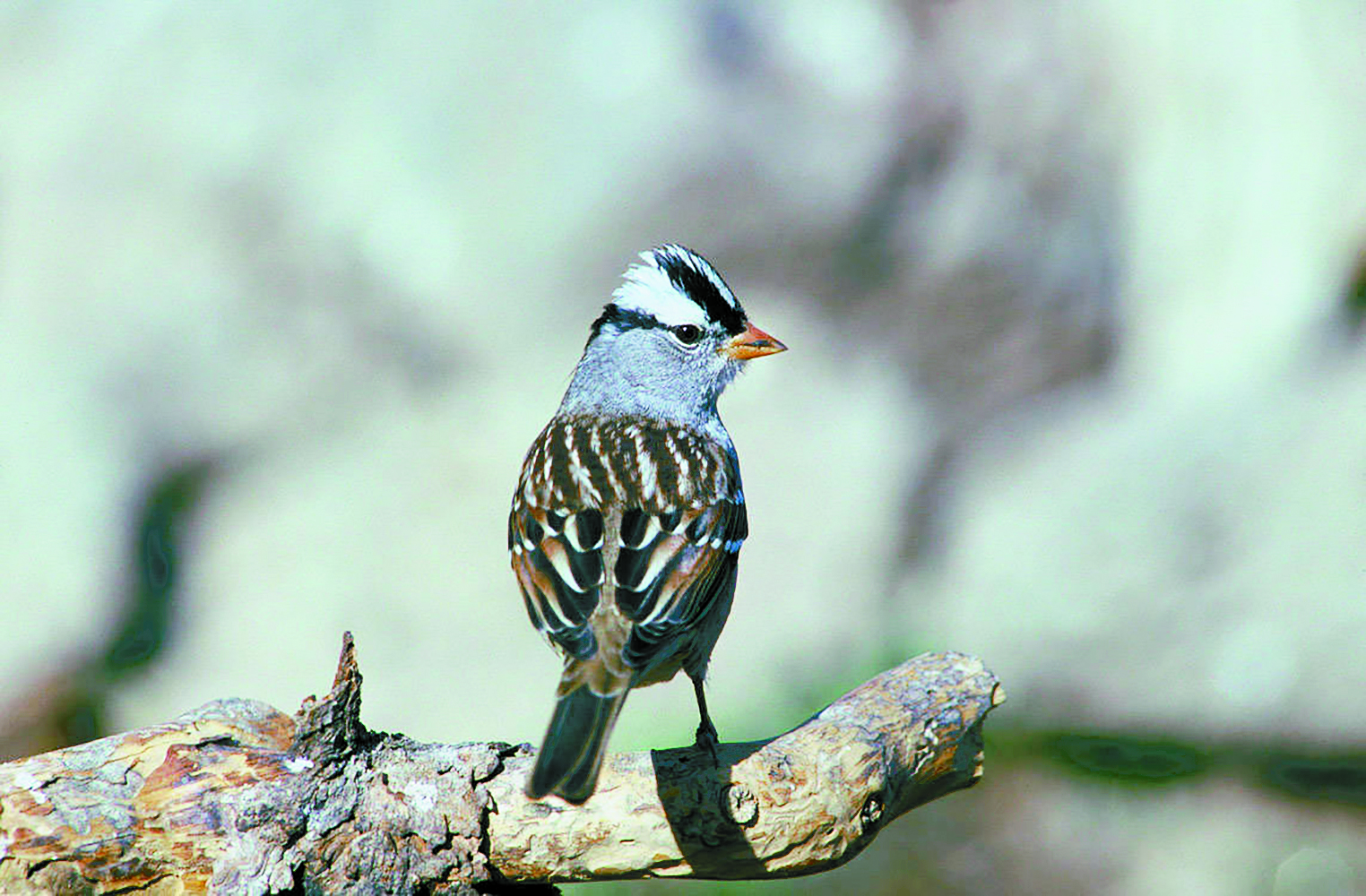
Photo by Dave Menke/USFWS • The aptly-named white-crowned sparrow is not easy confused with the more drab “little brown birds” that comprise a family of birds known as American sparrows.

Most white-throated sparrows depart the region by late April to reach their summer nesting grounds throughout the forests across Canada, the northeastern U.S. and the northern Midwest. In the influx of more showy birds each spring, their absence sometimes goes unnoticed. Nevertheless, it always feels good to welcome them when they return in late October and early November as winter begins extending its grip for the season.
White-crowned sparrows are a little more erratic with their presence in the region. I’ve found them in Roan Mountain on previous visits. I’ve also observed these sparrows in rural western Washington County and at Musick’s Campground at Holston Lake in Sullivan County.

White-crowned sparrows are medium-sized sparrows with considerable gray on breast and back of the neck. Adults of both sexes are adorned with bold black and white head stripes, which gives this bird its common name. Thanks to this distinctive feature, this sparrow truly stands out among a family of birds often labeled as “little brown birds” by birders.
The white-crowned sparrow is known by the scientific name Zonotrichia leucophrys, which translates into English from Ancient Greek as “white eyebrow.”

During the winter season, white-crowned sparrows are known for forming large flocks. They prefer to feed on the ground beneath feeders but will visit platform feeders if they don’t face too much crowding from other birds. In winter, they feed mostly on seeds. In warmer weather, these sparrows will forage for flying insects.

Although this sparrow usually ranges across the United States and Canada, it has been documented as an unusual vagrant to Western Europe. Sightings have taken place in England, Scotland, Ireland and even Norway.

White-crowned sparrows have shown up at my home on a handful of occasions. Their visits have usually been brief affairs during spring and fall migration.
White-crowned sparrows do not nest in the region. They nest far to the north in brushy areas of the taiga and tundra in Alaska and Northern Canada.
It’s not difficult to attract sparrows. White-crowned sparrows can best be encouraged to visit a yard or garden if there is plenty of dense brush and other cover. In this regard, they are similar to Eastern towhees, fox sparrows and dark-eyed juncos.

Readers in Georgia, Tennessee, Rhode Island are hosting winter hummingbirds

Photo Courtesy of Eli Mulligan • A rufous hummingbird, named Little Green by her human landlord, poses for a snapshot. Rufous hummingbirds routinely migrate through the eastern United States during fall and early winter. Some may spend the entire winter season. 

I recently heard from readers from as far afield as Atlanta, Georgia, and Greene, Rhode Island. They were writing to share stories about over-wintering hummingbirds at their respective homes. But the first report I received this year came from a much closer source.

Darlene Kerns, a Unicoi resident, contacted me on Facebook two days before Christmas.

“We live in Unicoi and I just had to share with you,” Darlene wrote. “We had a hummingbird feeding this morning. It’s 22 degrees!”

She went on to tell me that there have actually been two winter hummingbirds at her feeders.

“We usually bring the feeders in by mid-October but kept one out with fresh food because of continually seeing hummingbirds feeding,” she said.

That’s often how it starts. It’s easy to miss these different hummingbird species when they mingle with the abundant fall ruby-throated hummingbirds, but they tend to stand out once the last of the ruby-throated hummingbirds depart.

“I’m just amazed that these sweet little birds are still around in this cold weather,” Darlene wrote in her message.

Almost every year since beginning to write this column, I have been contacted by others who, much like Darlene, are stunned to glimpse a hummingbird at their home in the winter months. I’ve penned several articles about the phenomenon of wintering hummingbirds. As we are now mid-way through the 2021-2022 winter season, I wasn’t too surprised to receive more confirmation that these tiny birds continue to surprise us.

I replied to Darlene’s Facebook message by asking her if the hummingbird at her home had an abundance of brown feathers in its plumage. I also suggested she use Google to research “rufous hummingbird.”

She did as I suggested and discovered the identity of her visitors.

“Yes! It is the rufous hummingbird,” Darlene confirmed after looking at photos online.

Through the years, I have seen several of these seemingly out-of-place hummingbirds. I’ve received reports from such far-flung locales as Ohio and New York. Some of them remain at their host’s feeders for a brief stay of a few days or a couple of weeks, but some of these hummingbirds have extended their stay for several months, lingering throughout the winter months before eventually departing in February or March. I’ve even hosted rufous hummingbirds twice at my own home.

The big question concerns whether these hummingbirds are truly lost and out of place. The answer, based on everything I have managed to learn, is that these hummingbirds are precisely where they want to be. For still unknown reasons, some of these western hummingbirds make a migration swing through the eastern United States. The vast majority turn out to be a species known as the rufous hummingbird.

I’ll now turn the spotlight onto the individual stories of Eli Mulligan and Pam Price.

Eli Mulligan emailed me about a rufous hummingbird that recently departed from his home in New England.

“I am not sure if you are still following the wintering rufous hummingbirds,” Eli wrote in his email. “If so, I have an interesting story for you.”

He went on to mention that he is a resident of Greene, Rhode Island.

“This year, we had a confirmed rufous hummingbird show up in mid-September, mingling with the remaining rubies (ruby-throated hummingbirds),” he wrote.  “Well, this little rufous decided to stay for some time.  She literally just left us a day ago on the morning of Jan. 18, 2022.  During her stay, she had endured heavy rains, high winds, snow and even routine blustery cold nights with temperatures falling as low as 1 degree and wind chills of minus 15 degrees.”

Eli described his visitor’s routine.

“While she was here, I would get up before the sun, every morning and put out fresh nectar for her,” he wrote. “When we hit the colder days, I invested in a plug-in heated feeder and a mushroom-shaped heat lamp that I would hang the feeders underneath.This definitely helped her on many December and January mornings as she camped right underneath to warm herself.”

Eli said he caught numerous glimpses of her feed from nearby suet cakes most likely to supplement her protein needs during the colder days,” he wrote.

“What an incredibly resilient bird,” Eli wrote. “We ended up naming her ‘Little Greene.’”

Eli said that his recently departed rufous hummingbird was absolutely one of the most remarkable birds that he has ever seen or known.

“She will definitely be missed,” he concluded.

Eli created postings throughout Little Greene’s visit on eBird regarding his observations and general information about her while she remained at his home.”

Readers can look up the name Eli Mulligan on eBird and views postings and photos of Little Greene.

“This is truly an amazing creature and I just wanted to share that with those who would have an appreciation for her,” Eli wrote.

Photo Courtesy of Pam Price • This rufous hummingbird has been spending time at a home near Atlanta, Georgia.

Pam Price in Atlanta, Georgia, found out how to contact me when a column I’d previously written on rufous hummingbirds popped into her news feed.

She wrote in her email that she has had a little rufous hummingbird visiting her feeder since Dec. 14.

As of the Jan. 23, the hummingbird was still present.

“I worry about it constantly as I wonder where it is getting any bugs,” she said.  “Temperatures have been in the 20s.”

She even took steps to ensure the bird’s safety when she went on vacation.

“I took a feeder to my neighbor next door and made her promise to keep up the feeder and bring in at night so it does not freeze,” Pam wrote.

Her recent visitor is not Pam’s first experience with rufous hummingbirds.

She noted that she had two rufous hummingbirds banded in her backyard when she lived in the Tallahassee, Florida, area.

“So I am familiar with that process,” she wrote. “I did post on Ebird alerts with pictures but have not tried to find someone to band her as she does not visit as frequently as other hummers.”

For those who do worry about rufous hummigbirds braving cold winter temperatures, keep in mind that the species spends the nesting season from Baja California to chilly Alaska in its native range. Hummingbirds can also enter torpor, an adaptation that lets them slow down their metabolism when conditions are too exacting.

I enjoyed hearing from Eli, Pam and Darlene.  Winter hummingbirds, while always a delightful surprise for their hosts, no longer shock long-time birders. We’ve grown to expect them. If anything, I’d be surprised more by the absence of reports of these tiny wonders during the bleak winter season. If any readers are still hosting lingering hummingbirds at their feeders, I’d love to hear their stories. Email me at ahoodedwarbler@aol.com.

Great Backyard Bird Count returns in February for 25th year of counting birds

Photo by Jack Bulmer/Pixabay • Red-breasted nuthatches have not been prevalent this winter in Northeast Tennessee. Many people with bird feeders are more likely hosting the related white-breasted nuthatch. Next month, the Great Backyard Bird Count returns for a 25th year. Birders and nature enthusiasts will be invited to count common and not so common birds in their own yards, gardens or other favorite birding spots in order to contribute to scientific knowledge of bird population trends.

I look forward every year to the annual Great Backyard Bird Count, a survey established as a citizen science project back in 1998. This year’s GBBC will celebrate its silver anniversary as the yearly survey observes 25 years of monitoring bird populations.

Since 2013, the GBBC has been a global effort, allowing birders around the world to take part. Participants in 2015 observed almost half of the world’s known bird species, and that effort was surpassed the next year. Momentum has built ever since. Last year, GBBC participants identified 6,436 species of birds. When you consider that scientists estimate between 9,000 to 10,000 different species of birds throughout the world, that’s a lot of coverage that the GBBC provides each year.

The GBBC is a joint project of the Cornell Lab of Ornithology and the National Audubon Society with partner Bird Studies Canada. With its global perspective, a great many exotic bird species are now tallied on the annual GBBC, but the survey remains firmly established as a grassroots effort to compile data crucial for the conservation of the world’s beloved birds. The information gathered by tens of thousands of volunteers helps track the health of bird populations at a scale that would not otherwise be possible.

It’s incredibly easy to take part in the GBBC. Anyone anywhere in the world can count birds for at least 15 minutes on one or more days of the four-day count period and enter their sightings at http://www.BirdCount.org. There’s no charge or fee for taking part in the GBBC, which is a fun way to observe a variety of birds. Thanks to the flexible count criteria, it is also an easy way to make a contribution to science. The data delivered by the thousands of participants is now collected and compiled by the website ebird.org.

In 2021, the GBBC broke records once again. Here are some interesting tidbits from last year’s survey:

• 6,436 species of birds identified

• 190 participating countries

• 379,726 eBird checklists

• 479,842 Merlin Bird IDs

• 151,393 photos added to Macaulay Library

• More than 300,000 estimated global participants

The United States had the highest number of checklists with more than 250,000 checklists submitted from all 50 U.S. states, five territories and the District of Columbia. California led all states with 20,715 checklists submitted. New York, Pennsylvania, Texas and Florida rounded out the Top Five. Tennessee didn’t fare too poorly. The Volunteer State ranked 19th with 5,360 checklists submitted. Internationally, people living in the nations of Canada and India submitted a lot of checklists.

Over my years taking part in the GBBC, I have counted many interesting and unexpected birds, including green-winged teal, Ross’s goose, snow goose, red-shouldered hawk and Cooper’s hawk.

This year’s GBBC will be held over a four-day period, starting on Friday, Feb. 18, and continuing through Monday, Feb. 21. Participants are invited to count birds at their own homes in their yards and gardens.

Counters can also travel farther into the field, birding in their favorite parks, wildlife refuges or other birding hot spots. Participants can count alone or join with groups of fellow birders. Those taking part in the GBBC are invited to count in as many locations as they like. The reported results will help create a real-time snapshot of where birds are distributed during the winter months. Visit www.birdcount.org for more details on how to take part in the 2022 GBBC.

Common raven is no bird brain

Photo by Alexas-Fotos/Pixabay • Common ravens, although native to the region, were not so common only a few decades ago. This much larger relative of the American crow is slowly becoming more commonplace in the area once again.

Since back in November, a common raven has been lurking in the woodlands around my home. I even hear the raven’s loud croaking when I’m inside the house. The local American crows have not rolled out a warm welcome for the interloping raven, but there seems to be an uneasy truce between the crows and the much larger raven.

Ravens are vocal birds. I got reminded of the many unusual vocalizations a raven’s capable of when the resident bird flew over, croaking loudly, on a recent brisk and sunny late afternoon. Between the croaks, the raven produced an uncanny imitation of a tinkling bell. The bird produced this bell sound several times before flying out of sight.

I’m not pulling any legs. Among their vocal repertoire, ravens can produce, usually in flight, a “bell” call. I’m not sure if this is a common vocalization. I only remember ever hearing a raven’s “bell” on only one other occasion. I was with a group of more established birders at Roan Mountain State Park when a raven flew overhead. Someone called out, “Listen to that.” I listened and heard my first raven “bell” call.

The strange thing is that I can find little about this strange vocalization when I researched the subject. According to the website “All About Birds,” common ravens calls vary from a low, gurgling croak to harsh grating sounds and shrill alarm calls. Scientists have placed their vocalizations into as many as 33 different categories based on sound and context. The most commonly heard is the classic gurgling croak, rising in pitch and seeming to come from the back of the throat.

The croak is their standby vocalization, which they produce often. The raven’s croak can be heard from a mile away. And, in defense of the poet Edgar Allan Poe and his “ominous bird of yore,” ravens are accomplished mimics. According to “All About Birds,” ravens can imitate other birds. Raven raised in captivity can even learn words. “Nevermore?”

From the opening refrain of “once upon a midnight dreary” in his poem, “The Raven,” Edgar Allan Poe established a somber mood and also helped cement the dark reputation of one of North America’s most misunderstood birds. Poe describes the bird that provides the title of his famous poem with adjectives such as “grim, ungainly, ghastly, gaunt and ominous.” His raven also speaks, although it has the limited vocabulary of a single word, “Nevermore.”

How else does the real common raven resemble the “bird of yore” in Poe’s classic poem? For starters, the raven is an intelligent bird. Authors of a scientific study conducted about 15 years ago posited the claim that ravens and crows are just as intelligent as some of the great apes. Although parrots are more famous for the ability to mimic human speech, captive ravens have proven capable of learning more words than even the most impressive vocabulary-endowed parrots. So, Poe was not wide of the mark when he gave the gift of gab to the raven in his poem.

In the United States, the raven is quite common in Alaska. In the lower 48 states, raven populations are somewhat more sporadic. These large birds have established strongholds along the Appalachian Mountains and in the American Southwest. The raven is a cosmopolitan bird known to range from North America and Greenland to Europe and Asia, as well as North Africa and the Canary Islands.

The common raven is mainly a scavenger, but this bird is also an opportunistic predator and will prey on a wide variety of animals, including arthropods, amphibians, small mammals, birds, reptiles, and carrion. Ravens are attracted to carrion and are not finicky eaters. They adapt quickly and are known to even consume garbage.

Its black plumage has undoubtedly contributed to the raven’s sinister reputation and its affiliation with many dark superstitions. According to Laura C. Martin’s book, “The Folklore of Birds,” notes that the raven is “loathed throughout Europe as a symbol of impending death and war.” She explains that the raven probably acquired these connotations because these birds fed on battlefield corpses. As indicated earlier, the raven is not a picky eater. Martin also points out that legend maintains that England will remain a powerful nation as long as ravens live in the infamous Tower of London.

Establishing the raven’s closest relatives is helpful in fully becoming acquainted with this species. The raven is a member of the corvid family, which includes birds such as crows, magpies, nutcrackers and jackdaws. The common raven is the largest bird among the corvids. This bird can achieve a wingspan of almost four feet. The average raven weighs about two-and-a-half pounds. Large individuals have been recorded with a weight of slightly more than four pounds, making the raven a contender for the title of world’s largest songbird.

Poe’s poem offers a dramatic introduction to a bird that has once again become rather common in the region, particularly at higher elevations. This bird is well-known for nesting on inaccessible cliffs. However, ravens are proving adaptable. In recent years, a pair of ravens has repeatedly nested beneath the grandstands at Bristol Motor Speedway. Ravens have nested annually at this location at least since the spring of 2013.

Poe’s well-known poem, first published in 1845, is often cited as evidence for Poe’s genius for rhyme and his ability to create a believable supernatural universe populated by dark forces and one particularly persistent raven. It’s more than a little sad and ironic that the magazine that chose to publish Poe’s poem paid him a mere pittance of $9 for his brilliant contribution to literature.

The Bible also offers some interesting tales involving ravens. The prophet Elijah, after falling afoul of a wicked king, went into hiding and was provided food by cooperative ravens. In the story of the Biblical flood, Noah first released a raven to determine if the waters had receded. When the raven didn’t return to the ark, Noah next released a dove. This bird later returned to the ark clutching an olive leaf, which proved that the flood waters had subsided.

Many cultures also consider the raven as a “bringer of magic,” and the bird is associated with many creation stories in Native American cultures. Unlike the European custom of designating black as an “evil” color, Native Americans teach that black can hold various meanings, including resting, healing and prophetic dreaming, but evil is not one of them.

Ravens and crows are similar, but ravens are much larger birds. In addition, ravens have wedge-shaped tails and crows have fan-shaped tails. The common raven also has a well-developed ruff of feathers on the throat, commonly called its “hackles.”

A “murder of crows” is a fairly well known collective noun for a flock of these birds. On the other hand, a group of ravens has many collective nouns, including a “bazaar,” “constable” and “rant” of ravens. For its alliteration, I’m fond of “a rant of ravens” and think it’s a shame that Poe’s raven was apparently a solitary bird.

Other species of ravens found around the world include dwarf raven, thick-billed raven, fan-tailed raven, brown-necked raven, little raven and forest raven.

I like ravens. I find them fascinating, but there’s still something that causes some shivers when one hears the guttural, loud croak of a raven. It remains difficult to completely dismiss the raven’s long history of association with the darker niches of the world.

On that note, here’s one final tidbit regarding the raven taken from Martin’s book. Cherokee tribes believed that ravens would visit villages where ill or dying people were present. In the absence of a village shaman to drive away the bird, the raven would invariably snatch the life of the ailing individual.

••••••

To learn more about birds and other topics from the natural world, friend Bryan Stevens on Facebook at https://www.facebook.com/ahoodedwarbler. He is always posting about local birds, wildlife, flowers, insects and much more. If you have a question, wish to make a comment or share a sighting, email ahoodedwarbler@aol.com.

Christmas Bird Counts long tradition for local club

The first Christmas Bird Counts were conducted on Christmas Day (Dec. 25) 1900. The annual census arose from a proposal made by famed ornithologist Frank M. Chapman. According to Audubon.org, these yearly counts, conducted throughout the country, have provided a wealth of data over the past century.

Observations made due to CBCs have helped Audubon researchers, conservation biologists, wildlife agencies and other interested individuals to study the long-term health and status of bird populations across North America. When combined with other surveys such as the Breeding Bird Survey, the data provides a picture of how the continent’s bird populations have changed in time and space over the past hundred years.

The Lee and Lois Herndon Chapter of Tennessee Ornithological Society, otherwise known as the Elizabethton Bird Club, has a long history of participation in the annual Christmas Bird Count. In fact, the club has conducted two different counts — one for Elizabethton and another for Roan Mountain — for decades. The 2021 CBC marked 79 unbroken years in conducting a CBC for Elizabethton. The club has also conducted 69 Roan Mountain CBCs, but inclement weather on the unpredictable Roan has forced cancellation of this annual count on a few occasions.
Many of the birds found on these two winter surveys can also be found throughout other counties in Western North Carolina and East Tennessee.

•••••

The 79th consecutive Elizabethton Christmas Bird Count was held Saturday, Dec. 18, with 27 observers in seven parties. Counters tallied 69 species of birds, which is below the recent 30-year average of 73 species. The all-time high was 85 species counted in 2017.
The weather on count day, light rain for much of the day, contributed heavily to the lower total. Few ducks due to a mild season also was a factor.

Notably absent were species such as double-crested cormorant, turkey vulture, palm warbler, white-crowned sparrow, Eastern meadowlark, common grackle and brown-headed cowbird. Several species were found in low numbers, also largely due to the rain.

The list for the Elizabethton CBC follows:
Canada goose,  562; Mallard, 162; redhead, 11; ring-necked duck, 1; bufflehead, 179.
Wild turkey, 31; common loon, 2; pied-billed grebe, 7; horned grebe, 20; and great blue heron, 19.
Black vulture, 1; sharp-shinned hawk, 2; Cooper’s hawk, 10; bald eagle, 3; red-shouldered hawk, 1; red-tailed hawk, 4; and American kestrel, 12.
Killdeer, 3; Wilson’s snipe, 1; ring-billed gull, 1; rock pigeon, 329; Eurasian collared-dove, 1; and mourning Dove, 205.
Eastern screech-owl, 4; great horned owl, 1; barred owl, 1; and belted kingfisher, 14.
Red-bellied woodpecker, 36; yellow-bellied sapsucker, 12; downy woodpecker, 25; hairy woodpecker, 6; Northern flicker, 23; and pileated woodpecker, 16;
Eastern phoebe, 16; blue jay, 182; American crow,  373; and common raven,  6.
Carolina chickadee,  145; tufted titmouse,  99; white-breasted nuthatch, 13; red-breasted nuthatch, 1; and brown creeper, 4.
Winter wren,  6; Carolina wren,  110; golden-crowned kinglet, 29; ruby-crowned kinglet, 20; Eastern bluebird, 128; hermit thrush, 4; and American robin,  443.
Gray catbird, 1; brown thrasher, 3; Northern mockingbird, 69; Eurasian starling, 1,110; cedar waxwing, 120; orange-crowned warbler, 1; and yellow-rumped warbler, 176.
Eastern towhee, 13; chipping sparrow,  3; field sparrow, 19; fox sparrow, 1; song sparrow, 193; swamp sparrow,  3; white-throated sparrow, 62; dark-eyed junco,  48; and Northern cardinal,  176.
Red-winged blackbird, 5; house finch, 57; American goldfinch, 83; and house sparrow, 16.
Observers for this count were  Fred Alsop, Rob Armistead, Judith Baird, Jerry Bevins, Tammy Bright, Kevin Brooks, Cade Campbell, Debi and J. G. Campbell, Catherine Cummins, Harry Lee Farthing, Dave Gardner, David and Connie Irick, Rick and Jacki Knight, Roy Knispel, Vern Maddux, Tom McNeil, Brookie and Jean Potter, Pete Range, Judi Sawyer, Bryan Stevens, Kim Stroud, Scott Turner and Charlie Warden.

••••••
The 69th Roan Mountain Christmas Bird  Count was held Sunday, Dec. 19, with seven observers in three count parties participating in the event.
The participants tallied 53 species, well above the recent 30-year average of 46 species. The all-time high on this count was 55 species found in 1987.
The weather was slightly better than the day before on the Elizabethton CBC, but conditions remained overcast with occasional periods of mist, with colder and breezy periods.
Observers for the Roan Mountain CBC were Fred Alsop, Kevin Brooks, Cade Campbell, Rick Knight, Roy Knispel, Tom McNeil and Judi Sawyer.
The list for the Roan Mountain CBC follows:
Canada goose, 77; American black duck,  9; mallard, 1; bufflehead, 23; hooded merganser, 3; and pied-billed grebe, 2.
Great blue heron, 2; black vulture, 9; turkey vulture, 50; red-tailed hawk, 2; and American  kestrel, 1.
Rock pigeon, 33; mourning dove, 42; barred Owl, 2; and belted kingfisher, 5.
Red-bellied woodpecker, 7; yellow-bellied sapsucker, 7; downy woodpecker, 6; Northern flicker, 5; and pileated woodpecker, 6.
Eastern phoebe, 11; blue jay, 41; American  crow, 256; and common raven, 20.
Carolina chickadee, 61; tufted titmouse, 25; red-breasted nuthatch, 20; white-breasted nuthatch, 18; and brown creeper, 3.
Winter wren, 1; Carolina wren, 31; golden-crowned kinglet, 15; ruby-crowned kinglet, 1; Eastern bluebird, 21; hermit thrush, 3; American  robin, 332; Northern mockingbird, 5; European starling, 121; cedar waxwing, 13; and yellow-rumped warbler,  1.
Eastern towhee, 3; field sparrow, 40; fox sparrow, 1; song sparrow, 116; swamp sparrow, 3; White-throated Sparrow, 5; dark-eyed junco, 150; and Northern cardinal, 48.
House finch, 34; red crossbill, 5; pine siskin, 2; American  goldfinch, 31; and house sparrow, 4.

A total of 332 American robins were found on the Roan Mountain Christmas Bird Count and another 443 robins were tallied during the Elizabethton Christmas Bird Count. 

Although birds made headlines in ’21, stories for some species come to an end

Photo by Bob Peyton/USFWS • At 70, Wisdom, a female Laysan albatross and the world’s oldest known breeding bird in the wild, became a mother once again in 2021. In this photo from a previous nesting in 2018, when she was then 67 years old, Wisdom cares for a chick in her nest on Midway Atoll.

Our feathered friends made the headlines in 2021. For a few, the final curtain dropped. For others, their stories offer a ray of hope in some occasionally bleak times.

Feathered time capsule

Testing conducted by scientists identified the bird as a female horned lark, a species that can be found in a few locations in Northeast Tennessee, mostly during winter and early spring. I find it amazing that this bird lived during the same era as now extinct Ice Age beasts, including mastodons, mammoths and woolly rhinos. The horned lark is a small songbird. Males have black masks and a yellowish wash on the head and throat. Males also have the namesake “horns” that are actually dark feather tufts atop the sides of the head giving them the look of a small feathered comical devil. The bird is known as “horned lark” in North America and “shore lark” in Europe.

A mother again

Motherhood suits a Laysan albatross known as Wisdom. She hatched her most recent chick in February of 2021. Why is that worthy of a headline? Well, Wisdom is at least 70 years old, making her the world’s oldest known bird. She was first documented when she was banded in 1956 on Midway Atoll in the Pacific. Since that time, she has weathered storms, earthquakes and tsunamis. In her lifetime to date, Wisdom has flown millions of miles in search of food at sea. She still returns faithfully to Midway Atoll, which is home to the world’s largest colony of albatrosses, when it’s time to nest. Biologists estimate that Wisdom has hatched at least 30 to 36 chicks in her lifetime, according to the U.S. Fish and Wildlife Service.

Bell tolls for the ‘Lord God Bird’

The ivory-billed woodpecker was officially declared extinct in 2021. More accurately, the species was proposed for removal from the Endangered Species Act. This decision came 17 years after the largest of North America’s woodpeckers was “rediscovered” in 2004 in the Big Woods region of Arkansas. Despite a resurgence of interest in a bird also known dramatically as the “Lord God Bird,” the scientific community, no further evidence surfaced to support the belief in some quarters that ivory-billed woodpeckers still exist. The U.S. Fish & Wildlife Service made the extinction declaration in a press release issued on Sept. 29, 2021. The release also identified other birds as candidates for a declaration of extinction, including Bachman’s warbler. Like the woodpecker, the warbler’s last stronghold was in Southern swamps. Several species of native Hawaiian birds have also likely passed into oblivion. Other candidates for de-listing from the Endangered Species Act included several species of fish and mussels. The press release acknowledges that while protections were provided too late for the 23 species mentioned within its pages, the ESA has been successful at preventing the extinction of more than 99% of species listed. In total, 54 species have been delisted from the ESA due to recovery, and another 56 species have been downlisted from endangered to threatened. The Service’s current work plan includes planned actions that encompass 60 species for potential downlisting or delisting due to successful recovery efforts. It’s still cold comfort to fans of North America’s largest woodpecker and the mysterious Bachman’s warbler.

Silver Linings

If you’re looking for evidence that the COVID-19 lockdowns came with a silver lining, turn your gaze to our fine feathered friends. There’s growing evidence that some birds thrived during strict lockdown periods because they experienced less pressure to cope with human disturbances. Scientists also agree, however, that these benefits will likely prove fleeting for birds as the pace of human activity returns to normal levels.

The babbler babbles again

A living black-browed babbler was captured in 2020 by a pair of researchers. They found the bird on the island of Borneo. Before releasing the bird, they documented their find with photographs. In February of 2021, they published their findings in the journal, BirdingASIA. The rediscovery of the black-browed babbler is significant because the only other time the bird had ever been documented was between 1843 and 1848 when the naturalist Carl Schwaner captured one on the island of Java. After that one “blip” on the radar screens of naturalists and ornithologists, Schwaner’s specimen was put into storage and not much attention paid to the species in the intervening 170 years.

Photographic evidence

A tiny songbird known as the Urich’s tyrannulet has been documented with photos and audio recordings by a research team during an expedition to Venezuela. According to a press release from American Bird Conservancy, the tyrannulet (a species of flycatcher) was first described by science in 1899. Second and third sightings of the bird occurred in the 1940s and in 2005, respectively.

Mystery outbreak fades away

An outbreak of disease among birds across the United States surged in spring and summer of 2021 before gradually fading away by fall. A joint statement of the Cornell Lab of Ornithology and the Cornell University College of Veterinary Medicine on Sept. 17, 2021, all states affected by the mysterious bird illness earlier in the year had lifted their do-not-feed recommendation. No cause has yet been determined, but cases are no longer being reported. Symptoms of the illness included crusty eyes, tremors and paralysis among songbirds. The species most frequently affected were fledgling (juvenile) blue jays, common grackles, European starlings and American robins, along with a few other species. While the cause of the outbreak is still unidentified, several possibilities — West Nile, salmonella, avian influenza, house finch eye disease and trichomonas parasites — have been ruled out as possible causes.


Northern cardinals serve as wonderful Christmas ambassadors

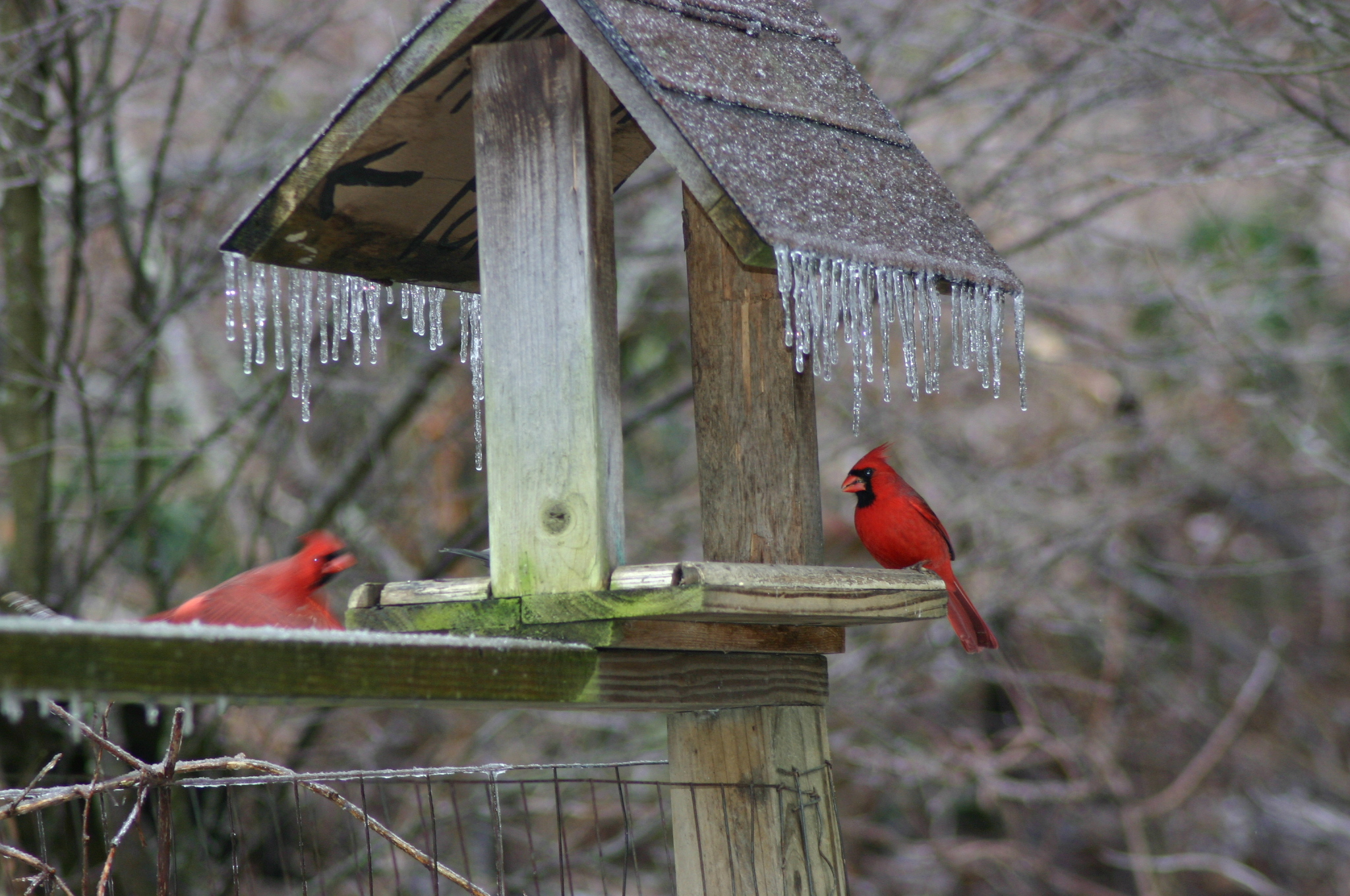
Photo by Jack Bulmer/Pixabay • With sunlight shining on this male Northern cardinal’s wing, the bird looks even more splendid. These beloved birds have been made the official birds for seven U.S. states, a recognition not surpassed by any other North American bird.

Christmas 2021 is almost upon us. If you’ve not finished your holiday shopping, you’d best get moving.

As is my usual custom, I want to share my enthusiasm for the Northern cardinal, one of my favorite birds and a deserving bird to serve as a symbol for the Christmas season.

I have enjoyed watching as cardinals visit my feeders in recent weeks. The beauty of both male and female cardinals is undeniable, but it’s their behavior that’s worth a second look. Nervous, twitchy birds, they are always anxiously surveying their surroundings even as they linger on a feeder long enough to hull a sunflower kernel from its shell. It’s almost as if they know their bright plumage stands out in a drab winter landscape dominated by shades of gray.

One particular male cardinal over the past few months has grown accepting of my close presence. When I stock my feeders with sunflower seed, he barely gives me time to get back to the front porch before he is landing on the feeder to enjoy a meal of seeds. It’s great to see that these beautiful birds can be acclimated to be less timid.

The Northern cardinal, especially the brilliant red male, stands out against a winter backdrop of snow white, deep green or drab gray. Over the years, the cardinal has also become associated with the Christmas season. How many Christmas cards have you received this holiday season with a cardinal featured in the artwork? I’d wager that at least a few cards in any assortment of holiday greetings will feature the likeness of a Northern cardinal.

Photo by Skeeze/Pixabay.com • A male Northern cardinal lands on a snowy perch. Cardinals are perfect symbols for the Christmas season with their bright red plumage.

The Northern cardinal belongs to a genus of birds known as Cardinalis in the family Cardinalidae. There are only two other species in this genus, and they range across North America and into northern South America.

The two relatives are the pyrrhuloxia, or Cardinalis sinuatus, of the southwestern United States, and the Vermilion cardinal, or phoeniceus, a bird found in Colombia and Venezuela. Two other South American birds — red-crested cardinal and yellow-billed cardinal — are more closely related to tanagers than to our familiar Northern cardinal. Both the Northern cardinal and red-crested cardinal have been introduced into the state of Hawaii, so two non-native birds from different parts of the globe are now resident in the Aloha State.

The Northern cardinal is a native and abundant bird. Cardinals are a widespread species, ranging westward to the Dakotas and south to the Gulf Coast and Texas. The southeastern United States was once the stronghold of the cardinal population. In the past century, however, cardinals have expanded their range into New England and Canada.

The cardinal accepts a wide variety of food at feeders. Sunflower seed is probably their favorite, but they will also sample safflower seed, cracked corn, peanuts, millet, bakery scraps and even suet. While we may get the idea that cardinals feed largely on seed, that is a misconception based on our observation of the birds at our feeders. Cardinals away from our feeders eat insects and fruit, including the berries of mulberry, holly, pokeberry, elderberry, Russian olive, dogwood and sumac.

The cardinal uses its large beak to efficiently hull sunflower seeds or deal with other foods foraged in field and forest away from our feeders. The large, heavy beak hints at the cardinal’s kinship with birds such as tanagers and grosbeaks. In fact, some of America’s early naturalists referred to the bird as “cardinal grosbeak.” Other common names include the apt “redbird” moniker and “Virginia nightingale.”

Even once the holidays are past, there’s nothing like a glimpse of a Northern cardinal to add some cheer to a bleak winter day. People can also choose to further the cause of science by taking part in studies such as Project FeederWatch, a nationwide survey of bird populations focused on birds coming to feeders maintained by project participants. In the 2015-16 winter season, 1,373 individuals participated in Project FeederWatch in the southeastern United States. The most common birds reported by observers were Northern cardinal, Carolina chickadee, mourning dove, American goldfinch and tufted titmouse. Finishing out the Top 10 feeder birds in this section of the nation were Carolina wren, house finch, blue jay, red-bellied woodpecker and downy woodpecker. Almost 98 percent of participants reported Northern cardinals at their feeders, which means the cardinal has become an almost universal feeder visitor in the southeast.

It’s not surprising that such a popular bird has also become associated with many trappings of the Christmas season.

“You see cardinals on greeting cards, stationery, paper plates, paper napkins and tablecloths, doormats, light switch plates, candles, candle holders, coffee mugs, plates, glasses, Christmas tree ornaments and lights, bookmarks, mailboxes, Christmas jewelry,” writes June Osborne in her book The Cardinal. “And the list goes on. Cardinals have become an integral part of the way that many people celebrate the holiday season.”

I can be included among such people. My Christmas decorations include an assortment of cardinal figurines and ornaments. There are other birds — doves and penguins for example — associated with the holiday season, but for me the holidays magnify the importance of one of my favorite birds. The cardinal, in its festive red plumage, appears made to order for a symbol of the holiday season.

Photo by Bryan Stevens • Northern cardinal seems much less descriptive of this popular bird than such common names as Virginia nightingale and Kentucky redbird.

Here’s some more cardinal trivia:

• Cardinals differ in appearance based on gender. The male boasts crimson plumage, a crest, a black face and orange bill. The female, although less colorful, is also crested. Female cardinals are soft brown in color, with varying degrees of a reddish or rosy tinge in their feathers, particularly in their wings.

The cardinal is a beloved bird. As testimony to the popularity of the Northern cardinal, just consider the fact that it’s the official state bird of seven states: North Carolina, West Virginia, Ohio, Illinois, Indiana, Kentucky and Virginia. Only the Northern mockingbird, which represents five states as official state bird, even comes close to the Northern cardinal in this respect.

• The cardinal’s preference for dense cover makes them likely neighbors for such birds as Carolina wrens, Eastern towhees and brown thrashers.

• The oldest recorded Northern Cardinal was a female, and she was 15 years, nine months old when she was found in Pennsylvania, according to the website, All About Birds.

• An uncommon genetic variation sometimes produces a cardinal with yellow or orange feathers instead of the typical red. The scientific name for the condition that produces yellow cardinals is known as xanthochroism.

• Nests are built by the female cardinal, but her mate delivers food as she incubates her clutch of eggs, which usually numbers three or four.

Photo by Bryan Stevens
Cardinals are common visitors to backyard feeders.

Take a second glance at the tufted titmouse: you’ll be glad you did

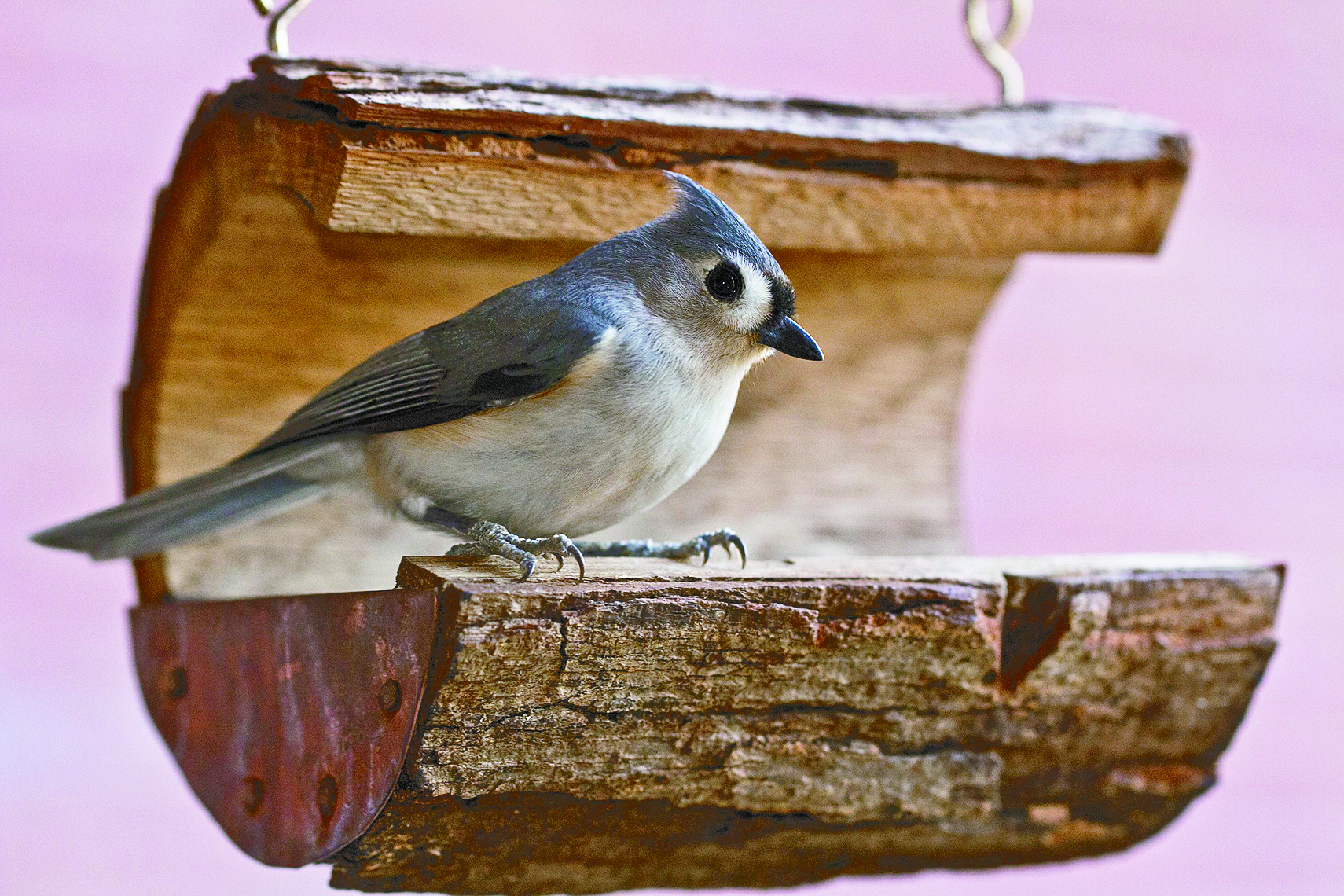
Photo by Anne773/Pixabay • A tufted titmouse visits a feeder.

Don’t dismiss our feathered friends as “bird brains.” They’re smart. They demonstrate that fact in various ways.

For an impish cousin of the chickadee, that intelligence shines through when they visit my feeders. I’m referring to the tufted titmouse, a curious sprite with some mischievous tendencies.

When I go outdoors to fill the feeders with another helping of black oil sunflower, the titmice appear seemingly out of the woodwork or, in their case, out of the woods. Small flocks of titmice show up and perch in the branches of nearby tree and watch me at my task.

There’s also a fascinating and ingrained hierarchy regarding which titmouse gets to approach the feeder first. I’m not aware of how they come to their mutually understood ranking, but when one of their number transgresses, the offense can set off a round of bitter scolding. I’ve also seen two titmice accidentally arrive at a feeder at the same time. When that happens, one of the birds will usually flinch and depart. After the higher-ranking individual grabs a seed and leaves, the other bird can return.

It’s all neat and orderly. In the long run, this structure probably prevents needless waste of energy on birds coming into conflict. Winter’s a lean time. Although the birds can count on my supplemental source of food, they continue to act as if there are no guarantees.

Photo by Bryan Stevens • The tufted titmouse is a backyard bird with an impish personality.

Although they’re most prevalent in the winter, titmice are present throughout the year. Like chickadees and bluebirds, they are cavity-nesting birds and will gladly take up nesting duties inside a bird box.

They are one of the first and most enthusiastic birds to greet the spring with joyous song each year. The tufted titmouse’s song — a persistent repetition of “Peter! Peter! Peter!” — rings through the woodlands around my home along with the urgent “fee-be fee-bo” of the Carolina chickadee. These birds form mixed flocks with each other and other species to explore their surroundings and search for food.

In addition to singing, titmice are enthusiastic scolders. They will scold over any transgression, real or imagined, focusing their ire on their fellow titmice or other birds, potential predators and even human observers. They’re quite persistent at their raucous scolding, which is just another reason I label them as imps of the woods.

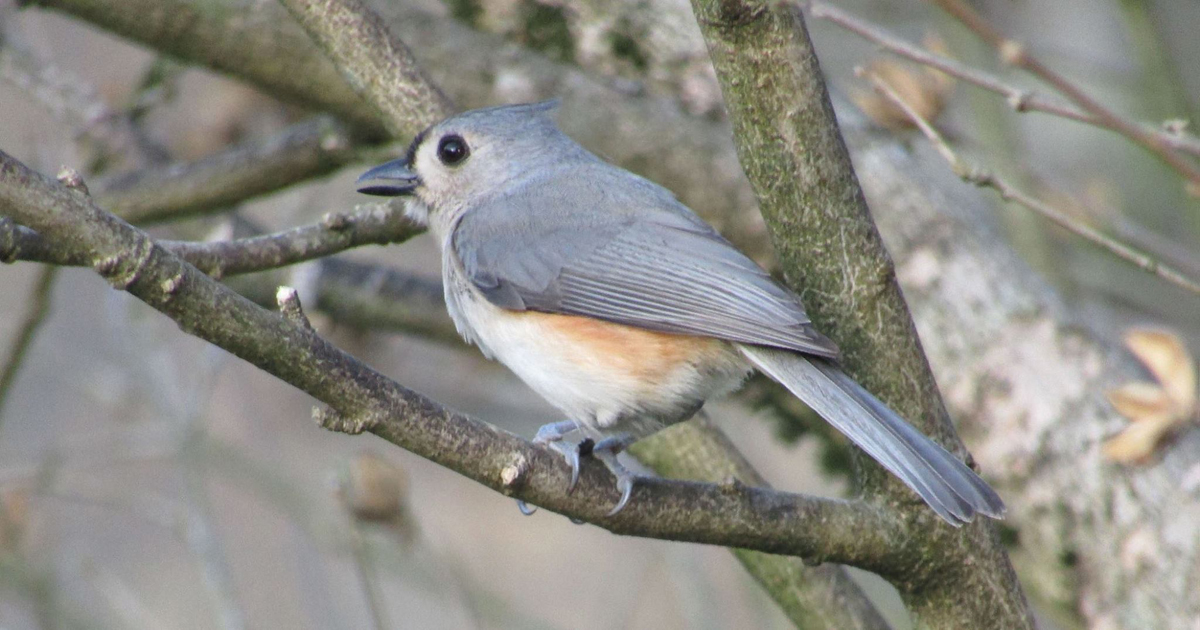
In appearance, the tufted titmouse is a drab bird that could easily slip beneath the radar. The bird’s appearance does, however, offer a few distinctive qualities. Although mostly a gray bird, the titmouse sports a distinctive crest and a rusty-pinkish coloration along the flanks. Titmouse eyes are black as coal and look large in proportion to their heads, which lends them an expressive appearance as they explore in yards and gardens.

The term “titmouse” refers to the old English word “tit” meaning “small,” as well as the old English “mase,” also a reference to small size. Probably because of the bird’s small size and gray coloration, “mase” evolved into “mouse” and combined to form the word “titmouse.”

The titmice living in my yard visit my house windows at times, which drives my cats to distraction. I’ve wondered if the titmice are curious and trying to peek inside the house, but I believe I have a more down-to-earth explanation. These little birds are very thorough when foraging for food, and I’ve watched them pluck spiders and other insects from the window frames.

Like chickadees, titmice are fond of sunflower seeds. No other offering will so readily lure them to feeders, although they do develop a fondness for suet cakes. I’ve also had success attracting titmice to my feeders by offering unsalted, shelled peanuts. I sometimes break up the peanuts into smaller, more manageable pieces for the benefit of the titmice. These foods and a few trees or saplings around your home is all you really need to welcome titmice.

Photo by Bryan Stevens • A young titmouse visits a suet feeder.

In the early 1900s, the tufted titmouse would have been considered a southern bird with its stronghold in states like Tennessee, Virginia, the Carolinas and Georgia. Perhaps it was the titmouse’s innate curiosity that pushed the species to expand successfully beyond the southern United States. The titmouse has steadily expanded its range northward, thriving in new locations. Some experts credit this expansion to more readily available access to supplemental food at feeders.

During the nesting season, titmice forage for a variety of insects. Many spiders, beetles, caterpillars and other small bugs will be fed to hungry young titmice in a tree cavity or a nesting box. Like chickadees, titmice build exquisite nests, often using mostly moss with other materials, such as bark, cloth scraps, dry leaves and shed snakeskins. These small birds line their nests with hair or fur of other animals.

Over the years, many readers have shared observations documenting the fur-collecting skills of tufted titmice. The birds are not content to simply collect shed fur. They seem to prefer collecting the fur fresh from a living animal. Many dogs fall victim to impish titmice that boldly pluck strands of fur from the canine’s coat.

In another funny story, a woman once told me about a titmouse that flew onto her head every time she stepped outside her home. Perhaps the bird sensed her affection for birds since it never failed to pluck strands of hair from her head to carry back to its nest. For any would-be skeptics, the woman provided photographic documentation of the incidents. In addition to dogs and humans, animals ranging from squirrels and opossums to mice and woodchucks have also been observed “sacrificing” fur for the nesting success of tufted titmice.

The female tufted titmouse incubates the eggs. She lays between three and nine eggs, although a usual clutch size is five to six eggs. The female titmouse is protective of her nest and is known for a behavior known as a “snake display.” I’ve observed titmice perform this display when I’ve peeked into nesting boxes. She remains tightly seated on her eggs, or young, while she hisses loudly and strikes in a manner very much like a striking serpent. Not all titmice engage in this display. Some remain still and try to “blend” with the nest, while others will fly away if a nest box is opened. Regardless, it’s a convincing display of bravado on the part of such a small bird. If it looks scary to people, I am sure it could succeed at repelling a squirrel or mouse. I’m uncertain if the behavior would deter an actual snake.

Other titmice in North America include bridled titmouse in Arizona and New Mexico; oak titmouse of the Pacific Coast region; juniper titmouse from the Great Basin, which consists of Wyoming, Idaho, Utah, Nevada, Oregon and California; and the black-crested titmouse, which ranges from Missouri into east-central Mexico.

Titmice occur exclusively in North America and belong to the genus Baeolophus. Europe, Asia and Africa are home to some other crested birds in the family of chickadees and titmice. For instance, the European crested tit and the grey crested tit are species that sport a crest of feathers like titmice but are more closely related to chickadees.

The tufted titmouse, for the reasons I’ve mentioned and more, is one of nature’s imps, but it’s also an entertaining neighbor. Get to know these visitors by offering sunflower seeds or other fare and, if you want to go the extra step, place some bird boxes around your yard as potential nesting sites. By next winter, you may have an entire flock of these feathered imps as your guests.

•••••

Need a last-minute Christmas gift? The Elizabethton Bird Club is selling its 2022 bird calendar again this holiday season.

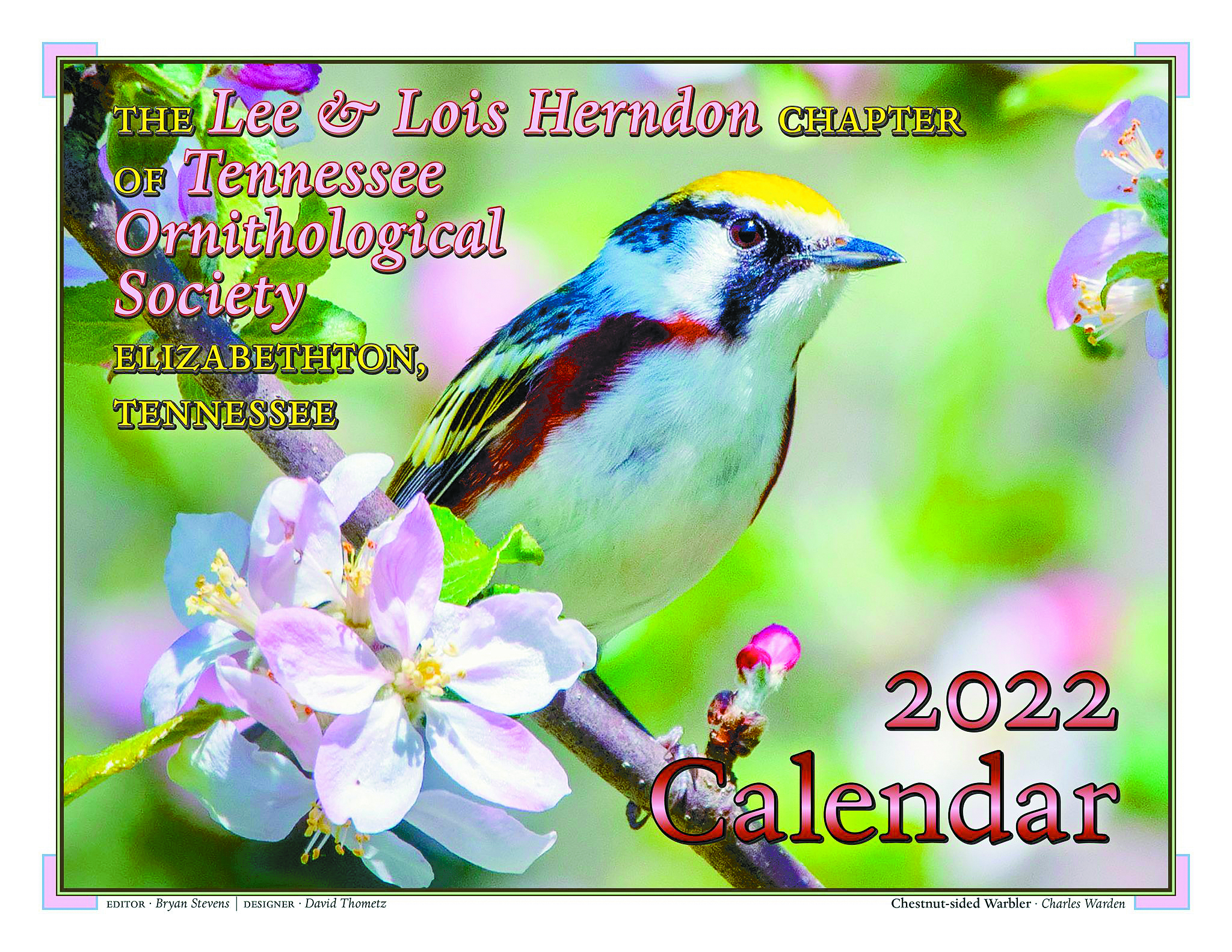
The front cover features a stunning photo of a chestnut-sided warbler. The inside pages of the professionally produced calendar feature dozens more full-color photographs and an informative and educational grid.

These calendars sell for $15 plus $2 for shipping. All sales help the club fund birding programs, public park feeders, conservation efforts and other activities in upper Northeast Tennessee.

For more information on how to obtain a calendar, email me at ahoodedwarbler@aol.com or stop by the office of The Erwin Record at 218 Gay St., Erwin.

Tiny kinglets brighten  the bleakest of seasons

Photo from Pixabay.com • Only the male ruby-crowned kinglet shows the red crown patch. In almost every other way, females are identical in appearance.

On one of our recent frosty mornings, the chickadees, the wrens, the titmice and other small birds were chattering and chirping in tree branches around my feeders. As I paused a moment to watch their antics, I noticed a tiny grayish bird that flashed a patch of ruby red feathers as it flitted among the branches.

The visitor turned out to be a ruby-crowned kinglet, one of North America’s smallest bird. This tiny bird is typically about four inches long and doesn’t even weigh half an ounce. How is it that one of the smallest North American birds chooses to spend the harsh cold months of winter in our yards and gardens?

Chickadees, titmice and other familiar winter birds eke out an existence by supplementing some their diet with fare from bird feeders. Although kinglets often associate with roaming mixed species flocks, they’re rarely interested in the offerings at our feeders. The kinglets are dedicated to gleaning tiny insects and spiders, as well as insects eggs and larvae, from branches and plantings in our yards. They’re so successful at it that they don’t need to turn to even a well-stocked feeder. A kinglet will on occasion sample an offering of suet or peanut butter, but this bird doesn’t make a habit of visiting feeders.

Since mid-October, I’ve been seeing a few golden-crowned kinglets, as well as the closely related ruby-crowned kinglet, at my home. Both the golden-crowned and ruby-crowned kinglets are members of a family of diminutive birds known collectively as kinglets and firecrests. They’re such tiny, energetic bundles of feathers that they absolutely excel with the “cuteness” factor.

All kinglets are very small birds, as well as extremely active ones. The ruby-crowned and golden-crowned are also the only members of this family of birds found in North America. Four other species, however, are native to Europe, Asia and North Africa. The remaining species include goldcrest, common firecrest, Madeira firecrest and flamecrest, which is also known as the Taiwan firecrest.

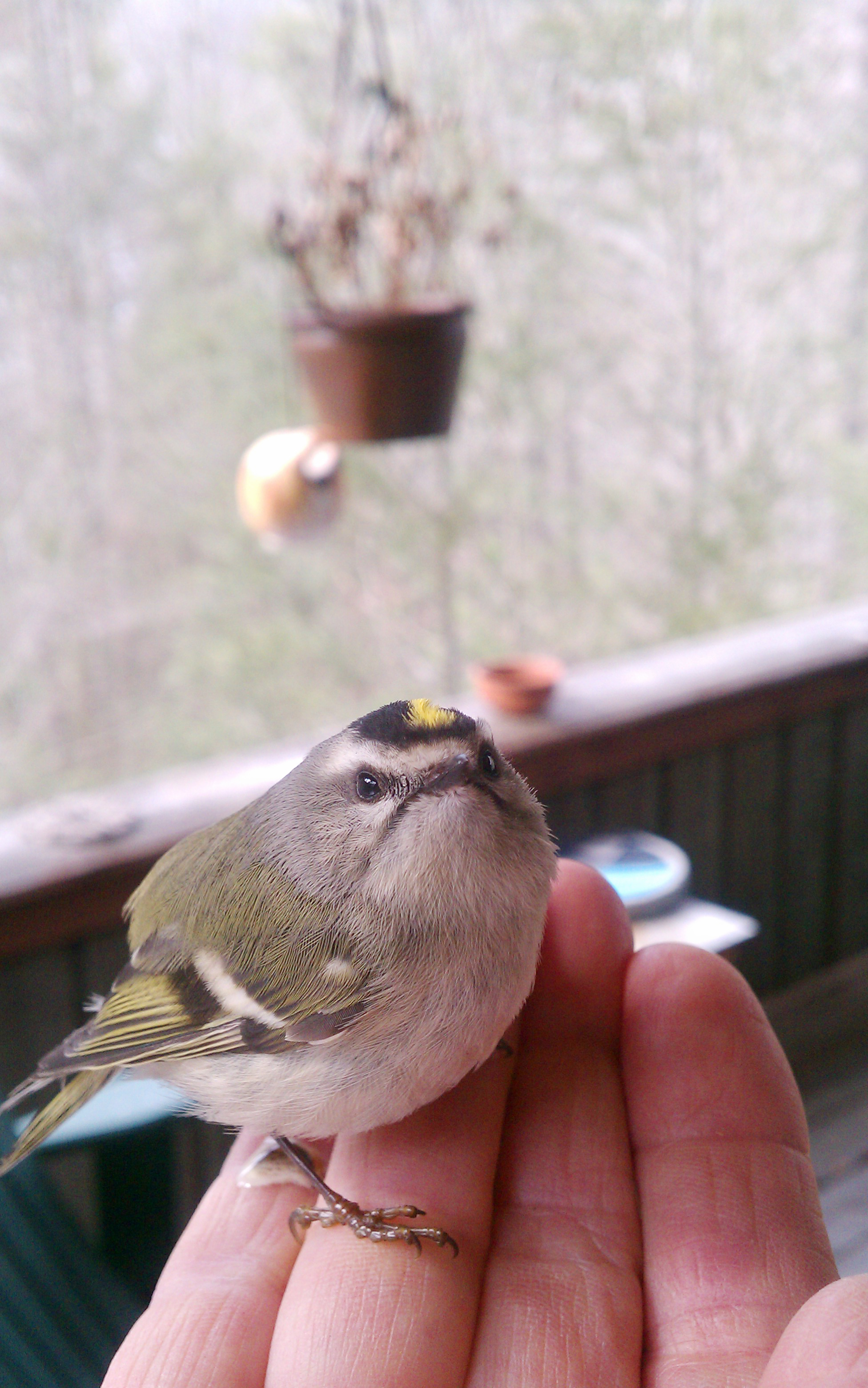
Photo Courtesy of Beth McPherson • A golden-crowned kinglet survived an impact with a window pane.

Kinglets, as their name suggests, are such tiny birds that about the only North American birds smaller than kinglets are some of the hummingbirds. The kinglets belong to the family, Regulidae, and the genus, Regulus. The family and genus names are derived from a Latin word, regulus, which means “rex,”or “king” The name was apparently inspired by the colorful crown patches, often red, orange or gold, that resemble the royal “crowns” of kings.

Although similar in size and overall coloration, the ruby-crowned and golden-crowned kinglets are easily distinguished from each other. Side by side, the two species of North American kinglets are easy to identify. The golden-crowned kinglet has a striped facial pattern formed by bold black and white stripes. The ruby-crowned kinglet, on the other hand, has a bold white eye ring but no striping. The golden-crowned kinglet has an orange crown patch, while the ruby-crowned kinglet has a red crown patch that is, more often than not, kept concealed. Both sexes of the golden-crowned kinglet possess a yellow crown patch, but only the male ruby-crowned kinglet boasts a scarlet patch of feather atop the head.

Kinglets are active birds, foraging vigorously for small insects, and spiders. When foraging, both kinglet species have a habit of flicking their wings over the backs. Even if you can’t get a good look at the birds, this behavior helps contrast them from other small birds, including some warblers, wrens and the blue-gray gnatcatcher. They’re often curious birds and can be coaxed into a closer approach if a human observer make squeaking noises to attract their attention.

Golden-crowned kinglets are widespread in the region during the winter. During the summer months, head to the slopes of some of the region’s higher mountains to look for these tiny birds that nest at the higher elevations of the Southern Appalachians. Ruby-crowned kinglets can also be found in the region during the winter, but extreme cold weather will often force this less cold-hardy species to eke out the winter months farther south.

On a January visit to Hilton Head Island, South Carolina, about 20 years ago, I chanced into what must have been a winter invasion of the Low Country by ruby-crowned kinglets. These tiny birds were extremely abundant at every location I visited.

In summer, ruby-crowned kinglets are absent from the region due to their preference for nesting much farther north in spruce-fir forests in the northwestern United States and across Canada.

Kinglets are surprisingly tame at times and often exhibit as much curiosity about us as we display toward them. They’re very active birds, however, constantly moving from perch to perch. These bursts of hyperactivity can make them difficult to observe since they so rarely remain still. Although small in size, these birds more than compensate for it with a feisty spirit that does them well through the harsher weather of the winter months.

•••••

Looking for a beautiful Christmas gift for the bird enthusiast on your shopping list? Members of the Elizabethton Bird Club are selling a professionally-produced calendar that features dozens of full-color photographs and an informative and educational grid. These calendars sell for $15 plus $2 for shipping. All sales help the club fund birding programs, public park feeders, conservation efforts and other activities in upper Northeast Tennessee.

For more information on how to obtain a calendar, email me at ahoodedwarbler@aol.com.

Sales of local calendar fund bird-worthy aims


The front cover of the 2022 bird calendar produced by the Elizabethton Bird Club features a photo of a chestnut-sided warbler taken by club member Charles Warden. The calendar is available for purchase for $15, plus $2 for shipping and handling. They make great Christmas gifts for nature and bird enthusiasts. For more information, email ahoodedwarbler@aol.com. 

If you didn’t find all you needed on Black Friday for those on your shopping list, here’s a suggestion. The Lee and Lois Herndon Chapter of Tennessee Ornithological Society, also known as the Elizabethton Bird Club, has produced its annual calendar featuring bird photographs by its members and friends of the organization.

These calendars make wonderful Christmas gifts and stocking stuffers. This year’s front cover features a gorgeous photo of a chestnut-sided warbler taken by club member Charles Warden. This is Warden’s first year contributing photographs to the club’s yearly calendar project. More of his photos are on display through the calendar. He is a resident of Johnson City.

“I took the photo on the Spring Bird Count with Fred Alsop and Judi Sawyer on May 1 of this year at Hampton Creek Cove,” Warden said.

He said that the bird was among the blooms of what he thinks was an apple tree.

“We heard the warbler and chased it down,” he said. “It came out in the open and posed nicely for pictures.”

He has been interested in photography since he took a beginning photography class at East Tennessee State University on a lark in 1977.

“I am lucky enough to be making a living as a photographer for ETSU marketing.”

Bird photography is certainly a challenge, he said, and requires much patience, decent equipment and a lot of luck.

“It’s been a learning curve for sure, and it’s still a tough call when to take the binoculars down and put the camera up as it’s so mesmerizing to watch the birds,” Warden said.

The chestnut-sided warbler is a summer resident in the region and can be found at middle and higher elevations on many of the area’s mountains, including Unaka and Roan. Unlike many warblers, both males and females are brightly colored, with the female being slightly less so. Males during the summer nesting season show a yellow crown, black mask, white cheeks, throat and breast and the namesake chestnut flanking on his sides.

He’s also a cheery and persistent singer when he arrives on his nesting territory. His song is usually transcribed as “Pleased, pleased, pleased to meetcha!” For birders, it’s like a welcoming reintroduction each spring when this particular song is heard from the branches of trees in local woodlands.

For the singing male, there’s a more personal reason for singing his song. The “pleased, pleased, pleased to meetcha” refrain is a way of attracting the attention of potential mates. Males sing an entirely different song once settled into nesting activities with a mate. The song used to attract mates is more heavily accented, according to the website, All About Birds. Some males sing only unaccented songs and thus have a lower success rate at attracting mates.

Chestnut-sided warblers are classified by scientists as birds that favor successional habitats for nesting purposes. These sorts of habitats are usually disturbed by human activities such as logging. However, disturbed habitats can be created by natural occurrences, including fires, flooding and storm damage. During the winter months, this warbler withdraws into Central America with many individuals finding suitable habitat on shade-coffee plantations.

Female chestnut-sided warblers will weave a nest of bark, grass and other components all bound together with gathered spider silk. She will lay three to five eggs. These warblers make the most of the summer season, often nesting a second time after raising their first brood.

Chestnut-sided warblers feed largely on insects, but the birds also incorporate seeds and fruits into their diet. Young are fed by both parents on a diet of small insects, spiders and caterpillars. The chestnut-sided warbler’s scientific name, Setophaga pensylvanica, roughly translates as “eater of moths from Pennsylvania,” which is a nod to the bird’s insect-rich diet.

Other warblers that can be found in the mountains of Northeast Tennessee — and in the pages of the calendar — include black-throated blue warbler, golden-winged warbler, worm-eating warbler, hooded warbler, prairie warbler and common yellowthroat.

Like most small songbirds, the New World warblers, to which the chestnut-sided warbler belongs, don’t have long lifespans. A few individuals, however, defy the odds. According to the website, All About Birds, the longest-lived chestnut-sided warbler documented by scientists was a nearly seven-year-old bird banded in Rhode Island in 1980. The bird had been banded in the same state six years and 11 months earlier in 1973.

Of course, with the exception of the yellow-rumped warbler, most of the warblers don’t spend the winter months in the region. With one of these calendars, however, you can enjoy beautiful photos of some of our most lovely warblers while awaiting their return this spring in mid-April and early May.

The inside pages of the professionally-produced calendar feature dozens more full-color photographs and an informative and educational grid. These calendars sell for $15 plus $2 for shipping. All sales help the club fund birding programs, public park feeders, conservation efforts and other activities in upper Northeast Tennessee.

For more information on how to obtain a calendar, email me at ahoodedwarbler@aol.com.