Belted kingfisher is a member of an interesting family of birds

Photo by Pexels/Pixabay A common kingfisher, also known as river kingfisher, perches near a water source. The common kingfisher ranges widely across Europe, Asia and North Africa.

Fishing is a favorite pastime for many people, who like nothing better than to spend a lazy summer afternoon trying their luck at their favorite fishing spot. Some of our feathered friends are skilled anglers.

The belted kingfisher’s nature as an angler rules out this bird ever visiting feeders in the backyard, but that doesn’t mean you’re unlikely to see this bird. For most of June and now July a belted kingfisher has been lurking around the creek and pond at my home.  With a little strategic effort, an observation of a belted kingfisher is fairly easy to obtain, especially during the summer months. If you live near a stream, pond, river or other body of water, you have probably been fortunate enough to observe a belted kingfisher as it goes about its daily routine.

If you are a fishing enthusiast yourself, you’ve likely shared some favorite fishing holes with this bird. The belted kingfisher is patient in its pursuit of fish. The birds prefer to perch on an exposed branch or a wire that overlooks a body of water that offers ample fishing opportunities. The belted kingfisher, however, is capable of hovering in place in order to spot and then capture its prey in an impressive plunge and lunge into the water.

Most of my observations of hunting kingfishers have involved the birds in their ambush approach to fishing — perching and diving on the unsuspecting fish. I have on a few occasions, however, also observed kingfishers as they hover over the water in a quest for a meal.

The belted kingfisher, like most of its kin, looks to have a head and bill that are slightly too large for the rest of the body. It’s the long, heavy bill that the kingfishers uses to snatch fish from their watery homes.

Photo by Bryan Stevens • A belted kingfisher perches on a branch along the Erwin Linear Trail.

Speaking of kin, the belted kingfisher is only one of 114 species found worldwide. Worldwide, these amazing birds range in size from the 16-inch-long laughing kookaburra of Australia to the tiny African dwarf kingfisher, which at four inches in length is smaller than most sparrows. This family of birds is divided into three groupings, the river kingfishers, the tree kingfishers and the water kingfishers. Kingfishers are a cosmopolitan family of birds with species present on every continent except Antarctica.

Despite the name “kingfisher,” not all kingfishers exist on a diet of fish. Some members of the kingfisher family instead prey on other quarry, such as snakes, lizards and insects.

Some interesting common names have been used to identify the world’s kingfishers, including half-collared kingfisher, shining blue kingfisher, blue-eared kingfisher, azure kingfisher, indigo-banded kingfisher, silvery kingfisher, malachite kingfisher, white-bellied kingfisher, cerulean kingfisher, rufous-backed kingfisher, spangled kookaburra, rufous-bellied kookaburra, shovel-billed kookaburra, lilac kingfisher, brown-winged kingfisher, stork-billed kingfisher, great-billed kingfisher, striped kingfisher, lazuli kingfisher, ultramarine kingfisher, cinnamon-banded kingfisher, sacred kingfisher, mewing kingfisher, chattering kingfisher, glittering kingfisher, red-breasted paradise kingfisher, pied kingfisher and green-and-rufous kingfisher.

The three North American kingfishers, however, are exclusively fish-eaters. The belted kingfisher, with a range that spans most of the United States, is the only kingfisher encountered by most Americans. Two others, the ringed kingfisher and the green kingfisher, are found in Texas and occasionally in other locations near the Mexican border.

In her book “The Folklore of Birds,” Laura C. Martin writes that in some accounts the kingfisher, not the dove, was the second bird Noah released from the ark after the Biblical flood. Instead of looking for land, the kingfisher flew too high and the sun scorched the bird’s feathers. After his setback with the raven and now the kingfisher, Noah made the kingfisher remain on the ark’s deck to catch its food from the water.

Halcyon days, a term meaning a period of peaceful quiet, is derived from Greek legend. According to the legend, the god Zeus restrained the storms during the period when the kingfishers nest. The scientific name for the belted kingfisher is Megaceryle alcyon, a variation on the term “halcyon.”

Again in Martin’s book, there is an account of a Cherokee legend about how the kingfisher acquired its angling lifestyle. The poor bird wanted to be a waterbird, but lacked the equipment to make a living at fishing. The other animals convened a council and, in pity for the kingfisher’s plight, endowed the bird with its spear-like bill. Since that time, the bird has been known as “king of the fishers.”

The “king of the fishers” is indeed to be envied by human anglers. Although not successful in every attempt, the belted kingfisher is certainly exceptional in its pursuit of fish. According to John Eastman in his book, “Birds of Lake, Pond and Marsh,” the belted kingfisher typically captures about 10 fish per day. Some human anglers would envy a success rate like that.

To observe this bird for yourself, stake out a pond or section of river -— the linear trail in Erwin and the pond at Fishery Park are good locations. In my experience, however, the belted kingfisher is somewhat wary of humans, so observe from a respectful distance or you’re likely to scare off the bird, which will depart giving its rattling call that sounds so much like a sound of pure annoyance.

Eastern phoebe pair returns to familiar nest location

Photo by Bryan Stevens • A young Eastern phoebe not long out of the nest.

A pair of Eastern phoebes is nesting on one of the blades of my front porch ceiling fan. It’s the second time phoebes have selected the fan blades for a nesting site. Nothing was left of the previous nest, which was constructed several years ago. Suddenly, almost overnight, a new nest appeared.

The female phoebe sat diligently on the nest at night, and for the past couple of weeks I’ve avoided turning on the porch light at night so as not to disturb her.

Considering the bright finery worn by some of the more colorful summer birds, the Eastern phoebe can easily escape notice. In comparison with vibrant birds like rose-breasted grosbeak, ruby-throated hummingbird, scarlet tanager and yellow warbler, the Eastern phoebe is downright drab.

Nevertheless, this member of the flycatcher clan has earned itself a favorite spot in the hearts of many a birdwatcher. It’s one of those birds that even beginning birders find surprisingly easy to recognize and identify. While it may not have a dramatic plumage pattern to hint at its identity, the Eastern phoebe is quite at home around human dwellings and comes into close contact with people going about their daily routines. Rather tame — or at least not too bothered by close proximity with humans — the Eastern phoebe has one behaviorism that sets it apart from all the other similar flycatchers. When this bird lands on a perch, it cannot resist a vigorous bobbing of its tail. Every time that a phoebe lands on a perch, it will produce this easily recognized tail wag. It’s a behavior that makes this bird almost instantly recognizable among birders with the knowledge of this behavioral trait.

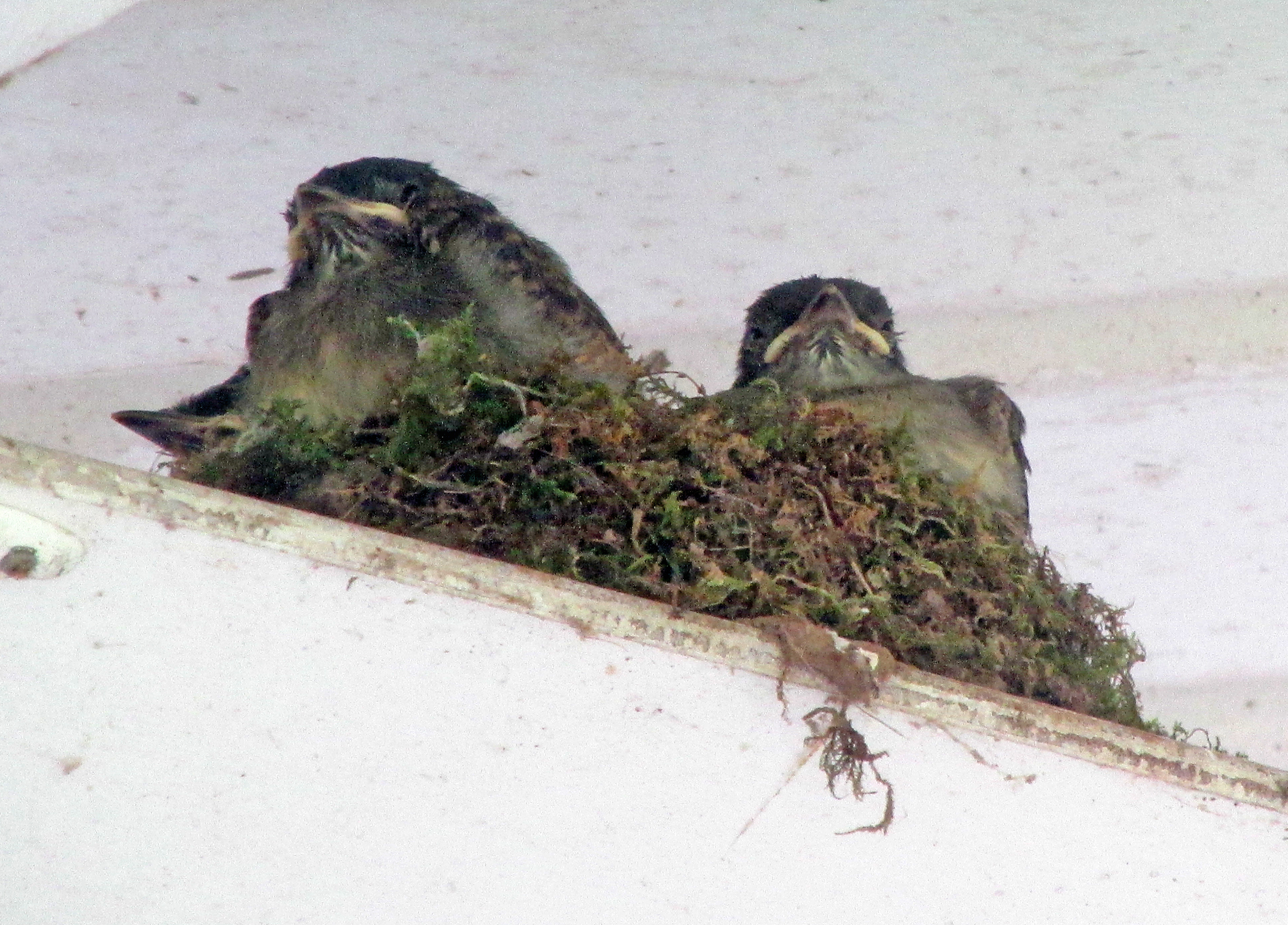
Photo by Bryan Stevens • Young phoebes occupy a nest previously build on a blade of a porch ceiling fan.

The Eastern phoebe is also an enthusiastic springtime singer, and the song it chooses to sing is an oft-repeated two-syllable call “FEE-bee” that provides the inspiration for this bird’s common name.

The Eastern phoebe, known by the scientific name of Sayornis phoebe, has two relatives in the genus Sayornis. The genus is named after Thomas Say, an American naturalist. The Eastern phoebe’s close relatives include the black phoebe and Say’s phoebe. The black phoebe ranges throughout Oregon, Washington and California and as far south as Central and South America. As its name suggests, this bird has mostly black feathers instead of the gray plumage of its relatives. The Say’s phoebe, also named for the man who gave the genus its name, is the western counterpart to the Eastern phoebe.

Since they belong to the vast family of New World flycatchers, it’s probably no surprise that these phoebes feed largely on insects. The birds will often perch patiently until an insect’s flight brings it within easy range. A quick flight from its perch usually allows the skillful bird to return with a morsel snatched on the wing. In the winter months, the Eastern phoebe also eats berries and other small fruit.

Phoebes are fond of nesting on human structures, including culverts, bridges and houses. With the latter, they were once known for their habit of placing their nests under sheltering eaves. At my home, a pair of Eastern phoebes often chooses to nest on the wooden rafters in my family’s garage.  In fact, a pair nested in the garage earlier this year. Phoebes also like to reside near a water source, such as a creek, stream or pond.

I suspect this nesting is a second attempt since it began in mid June. I got my first glimpse of the babies in the best when two fuzzy heads and beaks appeared over the rim of the nest on Thursday, July 7. 

Photo by Bryan Stevens • An Eastern phoebe perches on a sign by a trail in Roan Mountain, Tennessee.

Plants are great lures to increase bird diversity

Photo by Bryan Stevens • Bee Balm is a great attractor for butterflies and hummingbirds.

A mulberry tree overhanging the creek at my home produced a bonanza of fruit in mid-June. Some birds that hadn’t put in recent appearances suddenly became daily visitors. Cedar waxwings, gray catbirds, American robins, Northern cardinals and even a scarlet tanager feasted while the mulberries lasted.

Cedar waxwings win fans almost anywhere they go. Chances of luring these birds to your home and property can increase by offering some essential requirements. Tall trees, especially those that bear fruit, are attractive to these sociable birds. It’s more often water, not food, however, that will bring a flock of these birds close. They love a good splash in a bath, whether the source is a shallow stream or an ornamental pool set into the landscape.

Waxwings tend to travel in sizable flocks, usually in search of new food sources. The many members comprising a flock can deplete resources in a remarkably short time. Once the mulberry harvest is finished, they will seek out other fruit, including wild cherries and elderberries.

•••

In a garden plot dozens of common milkweed blooms began attracting butterflies, bees and other pollinators a few week ago. More recently, naturalized scarlet bee balm, which has spread vociferously through the woodland edge, has persuaded the finicky ruby-throated hummingbirds to return. Rhododendron maximus, often called “laurel,” is also in bloom, attracting its fair share of pollinators.

It’s important to note, however, that hummingbird numbers always fluctuate from year to year. Someone in Roan Mountain or Flag Pond might be overwhelmed with these tiny gems while people living in Erwin or Johnson City are still hoping to attract visits from these little birds. For instance, numbers might appear down in Northeast Tennessee but could be booming across the border in Western North Carolina.

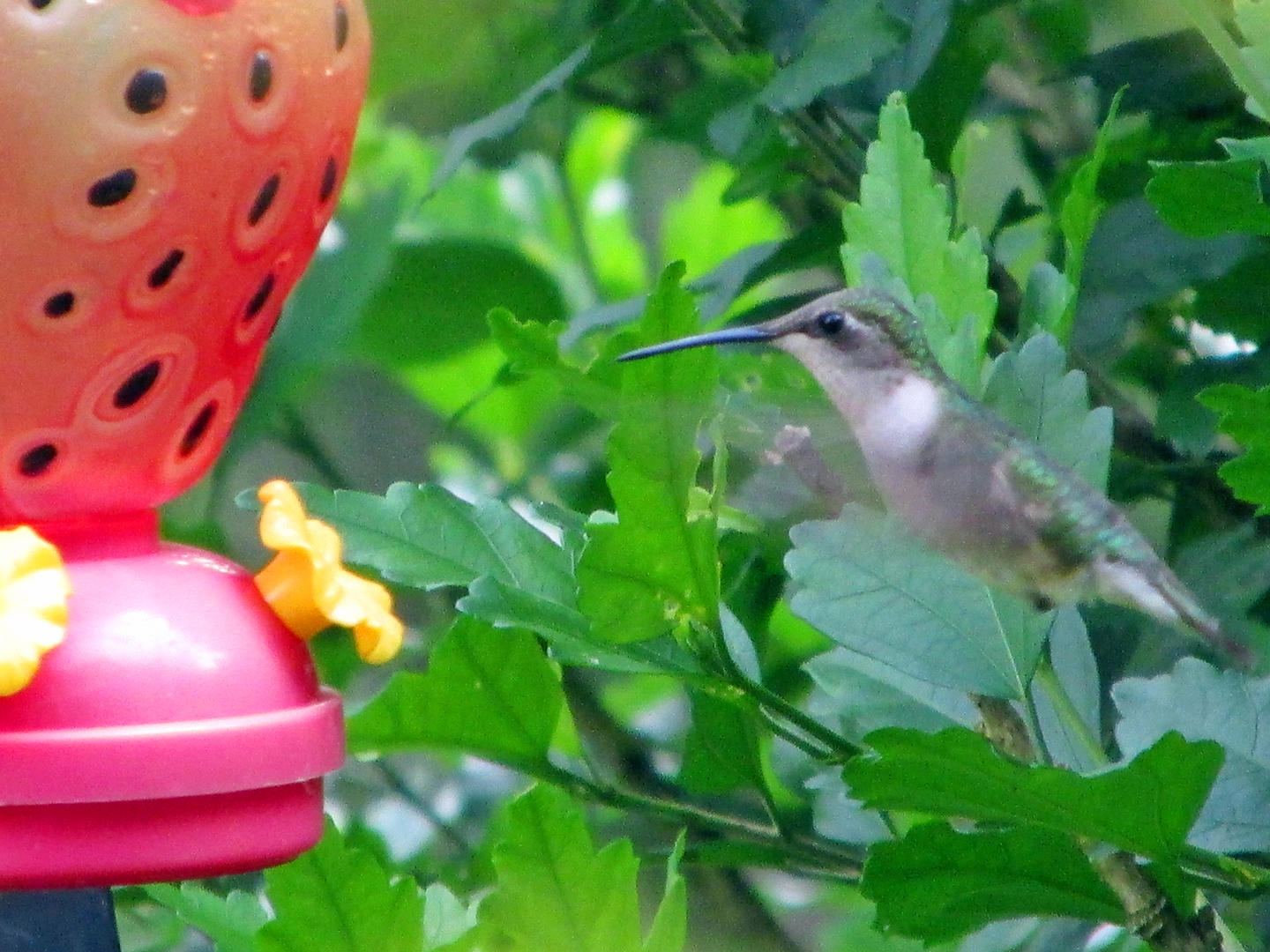
Photo by Bryan Stevens • Feeders with sugar water are great, but some nectar-bearing plants will increase the appeal from the point of view of the hummingbirds visiting.

The bee balm bloom is just the start. Those flowers will be replaced at my home by crocosmia’s red blooms and the orange blossoms of native jewelweed, also known as touch-me-not for its exploding seed pods. Hummingbirds are wild about these plants, as well as other summer garden favorites like canna, pineapple sage and 

If, like myself, you’ve been disappointed with seemingly low numbers of hummingbirds this spring, my best advice is to wait until late July and early August when young birds are out of the nest and parents and young start the slow-paced migration back south. Invariably, I see more hummingbirds in late summer and early fall than in the spring.

•••

Plots of wildflowers, sunflowers and day lilies are in bloom again at the Erwin National Fish Hatchery. While stopped there to take some photos with my phone, I heard American goldfinches twittering in the trees, probably attracted to the prospect of a bountiful spread of fresh seeds. The wildflowers include coneflowers, coreopsis and gaillardia, all different wildflowers that produced seeds sought by seed-eating birds like finches and sparrows.

To attract a diversity of feathered friends, its productive to move beyond simply offering a bird bath and well-stocked feeder. Landscaping lawns and gardens to offer plants that can provide a source of seeds, nectar or berries is also a great way to attract birds.

Summer is a season of plenty for American goldfinches. Even roadside ditches are choked with chicory, evening primrose and other seed-producing plants often dismissed as “weeds.” Simply driving local roads has produced several sightings of flocks of American goldfinches in recent weeks.

These small, vibrant finches are also regular visitors to my feeders, although they don’t really need my offering of black oil sunflower seeds to supplement the natural smorgasbord available to them.

The American goldfinch is also one of the last songbirds to nest each season. Some goldfinches don’t even start to think about nesting until late July and early August. Learn more about how the plants you select for inclusion in your landscape can benefit our feathered friends. The Audubon Society’s website had a helpful article online at http://www.audubon.org/news/how-make-your-yard-bird-friendly-0. 

To ask a question, share a sighting or make a comment, email me at ahoodedwarbler@aol.com. 

Unicoi County Summer Bird Count finds 109 species

The ninth annual Unicoi County Summer Count was held Saturday, June 18, with 15 observers in five parties. Participants tallied 102 species, which is below the average of 109 species for this count.

My party of counters included Brookie and Jean Potter, Rob Armistead and myself. We counted in the Limestone Cove community, which meant I had the convenience of counting practically in my own back yard.

Some good birds were found by the count parties, including yellow-billed cuckoo, yellow-bellied sapsucker, warbling vireo and fish crow, which was found for a second consecutive year. Fish crows have been expanding their presence in counties throughout Northeast Tennessee.

My group was pleased to get good looks at birds like rose-breasted grosbeak and yellow-bellied sapsucker.

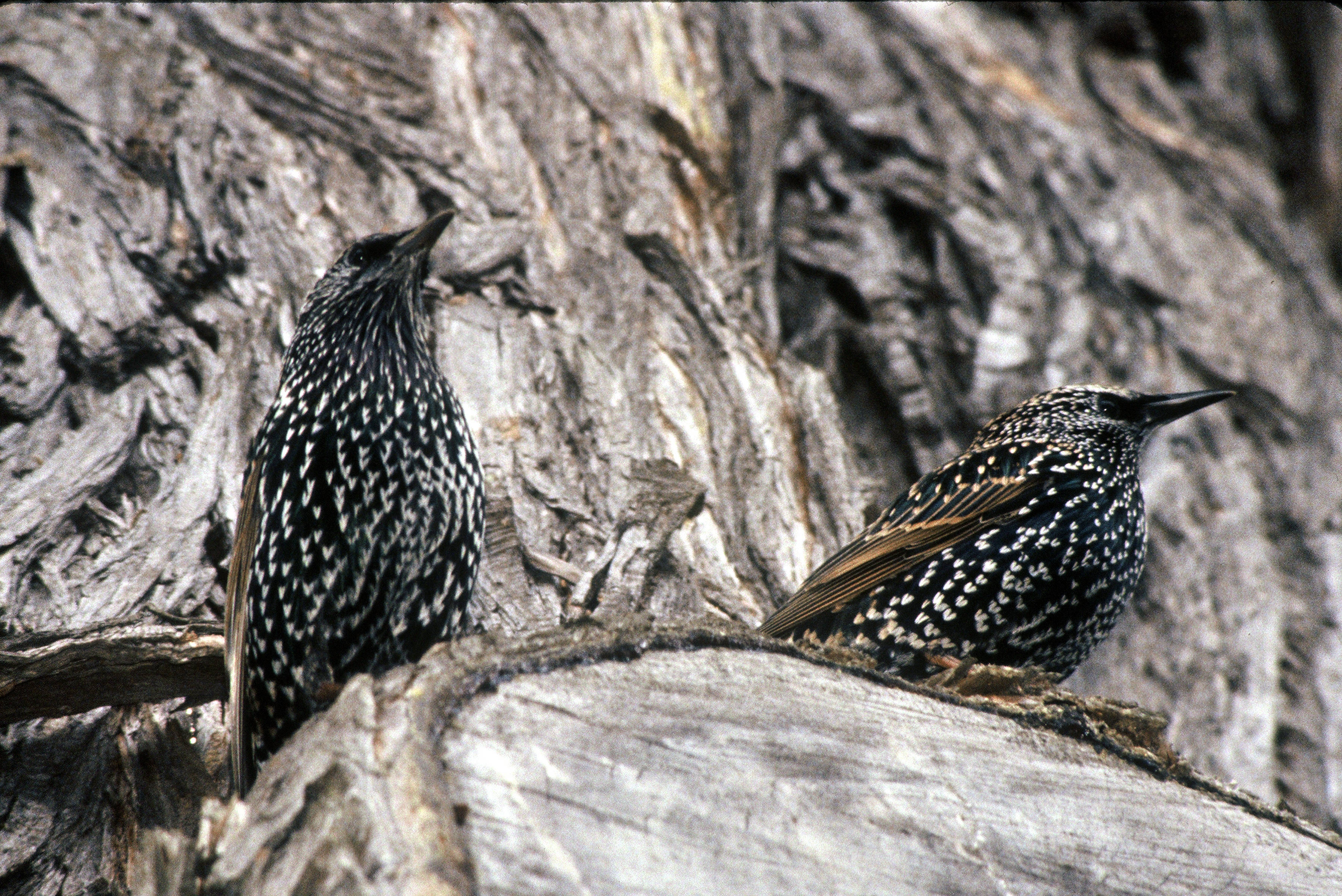
European starling came out on top as most abundant bird with 339 individuals counted. The American robin came in a distant second with 269 individual robins found.

Photo by U.S. Fish & Wildlife Service
The European Starling ranked as the most common species on the count.

The list:

Canada goose, 54; wood duck, 6; mallard, 47; wild turkey, 1; rock pigeon, 86; mourning dove, 100; and yellow-billed cuckoo, 1.

Chuck-will’s-widow, 2; Eastern whip-poor-will, 12; chimney swift, 19; ruby-throated hummingbird, 7; and killdeer, 13.

Great blue heron, 3; green heron, 1; black vulture, 10; turkey vulture, 48; Cooper’s hawk, 1; red-shouldered hawk, 1; broad-winged hawk, 6, and red-tailed hawk, 3.

Eastern Screech-Owl, 2; barred owl, 1; belted kingfisher, 3; red-bellied woodpecker, 13; yellow-bellied sapsucker, 4; downy woodpecker, 10; Northern flicker, 5, and pileated woodpecker, 9.

Great crested flycatcher, 1; Eastern kingbird, 13; Eastern wood-pewee, 6; Acadian flycatcher, 23; least flycatcher, 2; and Eastern phoebe, 65.

White-eyed vireo, 4; blue-headed vireo, 36; warbling vireo, 2; red-eyed vireo, 108; blue jay, 56; American crow, 173; fish crow, 2; and common raven, 4.

Tree swallow, 78; Northern rough-winged swallow, 25; purple martin, 40; barn swallow,  50; cliff Swallow  100; Carolina chickadee, 50; tufted titmouse, 37; red-breasted nuthatch, 1; white-breasted nuthatch, 2; and brown creeper, 3.

House wren, 26; Carolina wren, 92; blue-gray gnatcatcher, 12; golden-crowned kinglet, 4; Eastern bluebird, 82; veery, 10; hermit thrush, 1; wood thrush, 36; American robin, 269; gray catbird, 20; brown thrasher, 14; and Northern mockingbird, 25.

European starling, 339; cedar waxwing, 35; house sparrow, 16; house finch, 32; and American goldfinch, 80.

Chipping sparrow, 67; field sparrow, 13; dark-eyed junco, 10; song sparrow, 166; Eastern towhee, 32.

Yellow-breasted chat, 1; Eastern meadowlark, 6; orchard oriole, 2; red-winged blackbird, 67; Brown-headed cowbird, 21; and common grackle, 54.

Ovenbird  37; worm-eating Warbler, 13; Louisiana waterthrush, 6; black-and-white warbler, 10; Swainson’s warbler, 5; Kentucky warbler, 1; common yellowthroat, 3; hooded warbler, 45; American redstart, 1; Magnolia warbler, 1; Northern parula, 20; Blackburnian warbler; 2; yellow warbler; 1; chestnut-sided warbler, 6; black-throated blue warbler, 26; yellow-throated warbler, 7; black-throated green warbler, 27; and Canada warbler, 1.

Scarlet tanager, 17; Northern cardinal, 98; rose-breasted grosbeak, 3; and indigo bunting, 108.

Sandpiper a surprise addition for summer bird count

Photo by USFWS • A baby least sandpiper shelters beneath its dutiful mother. The aptly named least sandpiper is the smallest species of shorebird.

It’s not too often I get a chance to make a historic bird sighting, but that’s what happened on a recent Saturday while seated on a bench with Rob Armistead having a breakfast break while taking part in a seasonal bird survey in Elizabethton along the Watauga River.

I chose the location for the break because I knew that it has traditionally been a good spot to observe some unexpected species. Past good birds that I’ve observed along this section of the Watauga River have included orange-crowned warbler, yellow-throated vireo, sora, Baltimore oriole and red-headed woodpecker.

On this occasion, a tiny shorebird made an appearance, settling on some exposed rock formations. In April and May, these same rocks are great locations to find migrating spotted sandpipers and solitary sandpipers. 

The bird was smaller than these sandpipers and immediately stood out as a “peep,” a nickname that birders give to a group of small sandpipers that are all similar in appearance.

The one physical trait that help distinguish a least sandpiper from other “peeps” is leg coloration. Least sandpipers have greenish or yellowish legs in contrast to the black legs of other similar “peeps.”

In good light and at close range, Rob and I confirmed that the bird had greenish legs and were thrilled to add a least sandpiper to our own tally of observed birds.

The least sandpiper, as suggested by its name, is the smallest member of the sandpiper family. In fact, this sandpiper, which is not much bigger than a sparrow, is the world’s smallest shorebird. The least sandpiper weighs only a single ounce and is only five to six inches long. 

According to the website All About Birds, the least sandpiper migrates thousands of miles between its Arctic breeding grounds and wintering grounds as far south as Chile and Brazil.

In releasing the count compilation, official compiler Rick Knight made note of the fact that the least sandpiper represents a late migrant and the first-ever June record for the species in the five-county area. 

During the course of the day, Rob and I joined Brookie and Jean Potter for a trip to Holston Mountain, where we added some mid- to high-elevation species such as scarlet tanager, rose-breasted grosbeak, veery, Eastern wood-pewee, dark-eyed junco, ruffed course and chestnut-sided warbler. 

Photo by Bryan Stevens • A male rose-breasted grosbeak perched on a branch on Roan Mountain, Tennessee.

This year’s survey was the 29th annual Carter County Summer Bird Count and was conducted by members and friends of the Elizabethton Bird Club. I’ve been participating on this yearly survey of local birds since the late 1990s.

This year’s count was held Saturday, June 11. A total of 22 observers took part in this year’s count. 

A total of 116 species was tallied, which is right on average for the last decade and slightly above the average of 114 over the previous 28 years, according to Knight.

He noted that the all-time high for this count was 123 species in 2017.

Here’s the total:

 Canada goose, 131; wood duck, 9; mallard, 53; ruffed grouse, 3; and wild turkey, 20.

Rock pigeon, 49; Eurasian collared-dove, 1; mourning dove, 155; yellow-billed cuckoo, 1; Chuck-will’s-widow, 4; Eastern whip-poor-will, 9; chimney swift, 116; and ruby-throated hummingbird, 22.

Killdeer, 18; least sandpiper, 1; double-crested cormorant, 13; great Blue heron, 22; and green heron, 2.

Black vulture, 5; turkey vulture, 65; Cooper’s hawk, 4; bald eagle, 1; red-shouldered hawk, 2; broad-winged hawk, 5; red-tailed hawk, 5; Eastern screech-owl, 6; and barred owl, 3.

Belted kingfisher, 5; red-bellied woodpecker, 32; downy Woodpecker, 23; hairy woodpecker, 4; Northern flicker, 27; and pileated woodpecker, 16.

American kestrel, 1; great crested flycatcher, 2; Eastern kingbird, 27; Eastern wood-pewee, 31; Acadian flycatcher, 20; alder flycatcher, 2; least flycatcher, 12; and Eastern phoebe, 73.

White-eyed vireo, 5; yellow-throated vireo, 1; blue-headed vireo, 54; warbling vireo, 1; and red-eyed vireo, 165.

Blue jay, 110; American crow, 259; fish crow, 2; and common raven, 10.

Tree swallow, 118; Northern rough-winged swallow, 45; purple martin, 22; barn swallow, 173; and cliff swallow, 265.

Carolina chickadee, 73; tufted titmouse, 93; red-breasted nuthatch, 14; white-breasted nuthatch, 23; house wren, 57; winter wren,  4; and Carolina wren,  116.

Blue-gray gnatcatcher,  23; golden-crowned kinglet, 7; Eastern bluebird, 152; veery,  29; hermit thrush, 1; wood thrush, 66; American robin,  581; gray catbird, 60; brown thrasher,  22; and Northern mockingbird, 70

European starling, 411; cedar waxwing, 61; house sparrow, 98; house finch, 51; pine siskin, 10; and American goldfinch, 170.

Grasshopper sparrow, 1; chipping sparrow,  80; field sparrow, 43, dark-eyed junco, 70; song sparrow, 348; Eastern towhee, 150; yellow-breasted chat, 7.

Eastern meadowlark, 13; orchard oriole, 2; Baltimore oriole , 1; red-winged blackbird, 73; brown-headed cowbird, 49; and common grackle,143.

Ovenbird, 77; worm-eating warbler  3; Louisiana waterthrush, 12; golden-winged warbler,  2; black-&-white warbler, 31; Swainson’s warbler, 6; common yellowthroat, 31; hooded warbler,  110; American redstart , 6; Northern parula, 47; magnolia warbler, 1; Blackburnian warbler,  5; yellow warbler, 3; chestnut-sided warbler, 31; black-throated blue warbler, 49; pine warbler,  3; yellow-rumped warbler, 1; yellow-throated warbler, 16; black-throated green warbler, 19; and Canada warbler,  10.

Scarlet tanager, 42; Northern cardinal, 173; rose-breasted grosbeak, 7; blue grosbeak, 4; and indigo bunting, 161.

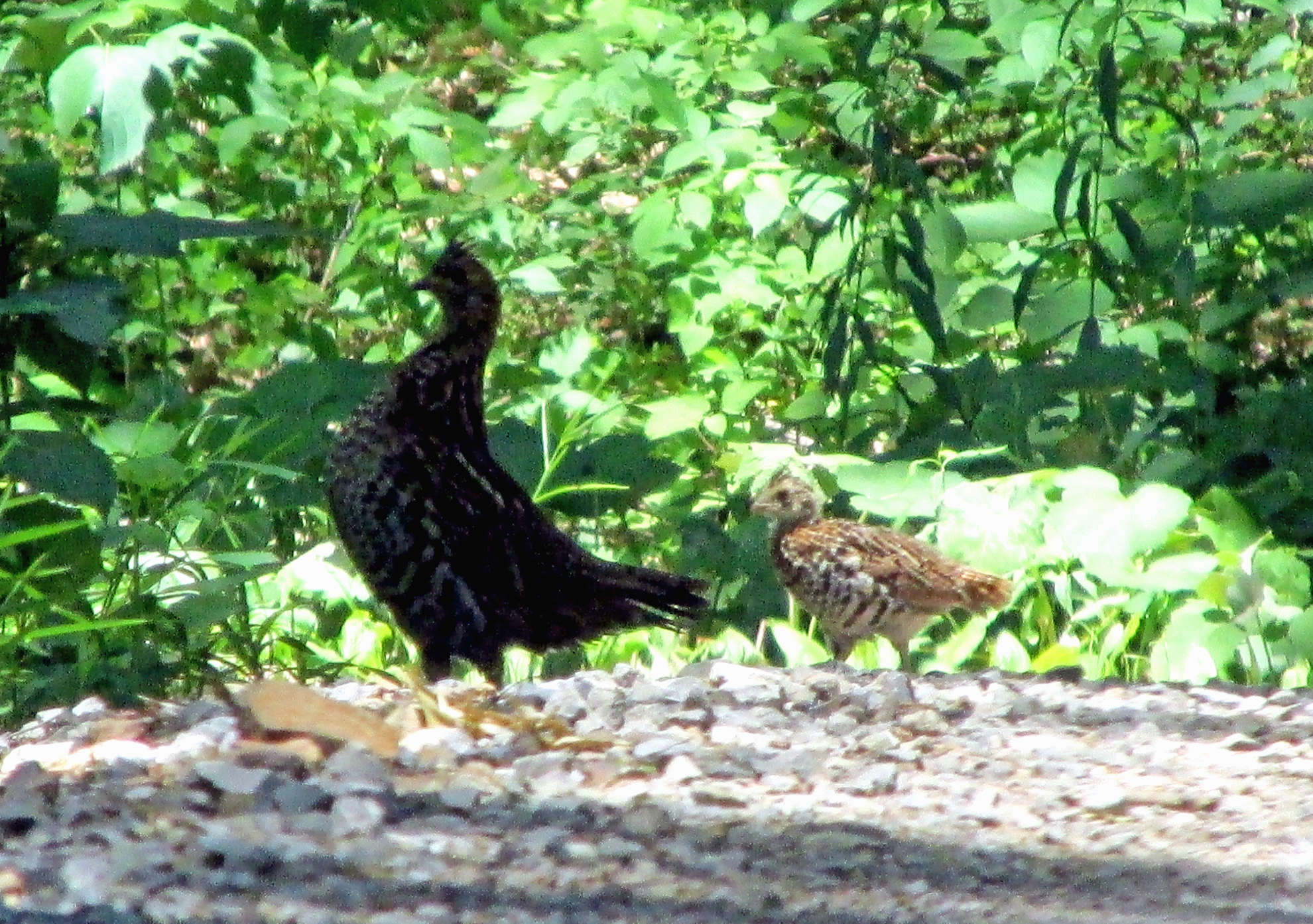
Photo by Bryan Stevens • A young grouse follows its mother into concealment by the edge of a road on Holston Mountain, Tennessee.

My other personal highlight on this count was seeing three young Ruffed Grouse darting  across the road, one at a time, while riding on Panhandle Road to the top of Holston Mountain. Those three young grouse turned out to be the only grouse counted by any participants on the count.

The Unicoi County Summer Bird Count was conducted Saturday, June 18. I’ll provide the results of that count in an upcoming column. 

Tanagers are among world’s most colorful birds

Photo Courtesy of Jean Potter
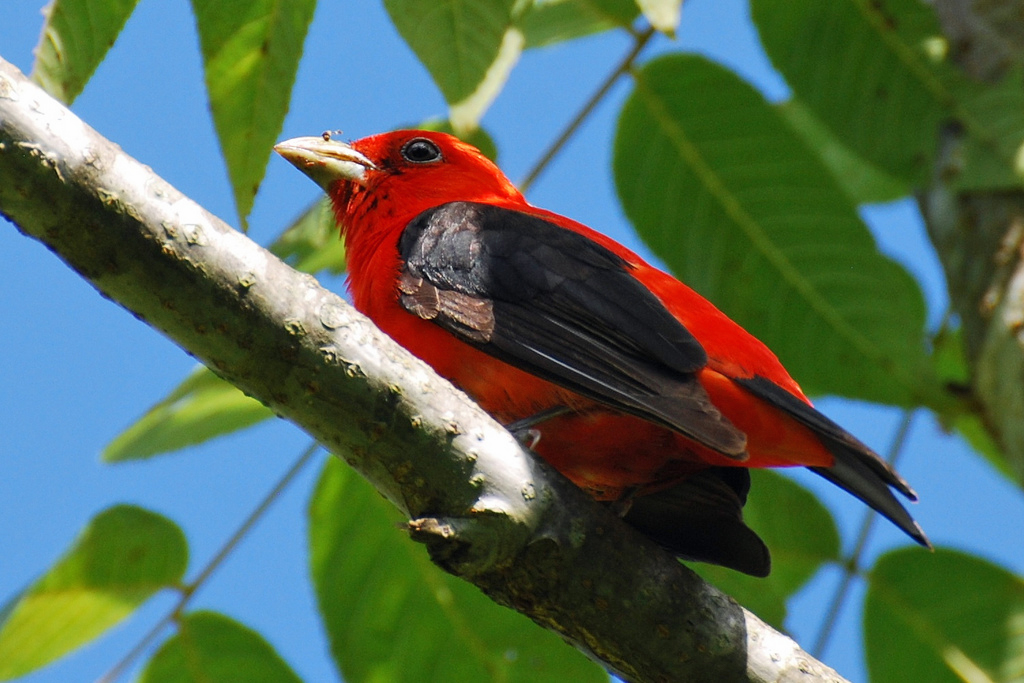
A male scarlet tanager brightens shadowy woodlands with a flash of tropical colors yet remains mostly inconspicuous in the forest canopy.

The daily chorus of songbirds greeting the dawn is usually welcome unless I’m feeling particularly sleepy. Carolina wrens are one of the first birds in residence to sing each day. This time of year they get plenty of accompanists, including American robins, Eastern phoebes, Carolina chickadees, Northern cardinals, Eastern towhees, red-eyed vireos, indigo buntings, hooded warblers, ovenbirds and others.

As June arrived, however, I began to take notice of the absent voice of scarlet tanagers. It wasn’t until June 9 that I heard the first male scarlet tanager of the season singing from the wooded ridge behind my home.

In late April and throughout May, once the oaks, the maples, the poplars and other trees begin spreading out new green leaves to create a concealing woodland canopy, a familiar song can be heard from the treetops. 

Upon first hearing it, listeners might mistake the hidden singer for an American robin. Listen a little closer, however, and the song sounds as if it is being delivered by a robin stricken a bit hoarse with a sore throat.

The producer of the hoarse but melodic song is a scarlet tanager, one of the most showy birds of Eastern woodlands from April to early October. Like the warblers, vireos, flycatchers and other songbirds, the scarlet tanager is migratory. They spend the winter months in the tropical forests of Central and South America. The scarlet tanager is better attired than most birds to provide us a glimpse of what life must be like in the tropical rain forests, which are a riot of color and sound.

It takes only one sighting to sear the vision of these vibrant birds into our retinas, as well as into our memories. The scarlet tanager boasts a brilliant plumage of crimson red paired with black wings and tail. Of course, this is the male. The female scarlet tanager makes no real claim to the common name with her comparatively drab greenish plumage. However, the scientific name, Piranga olivacea, gives a nod to the olive-green plumage of females, young males and even adult males when molting their feathers.

Although once nominated as a candidate for state bird by the school children of Minnesota, the scarlet tanager ultimately failed to gain the designation. Instead, as perhaps is fitting for the “Land of 10,000 Lakes,” the common loon represents Minnesota as official state bird.

The related summer tanager is less widespread in Northeast Tennessee, but males of this species are no less dramatic in appearance than the Scarlet Tanager. Male summer tanagers are a rosy-red over all their body. Females, with a dull greenish plumage, are relegated to the background. She can be distinguished from her counterpart, the scarlet tanager, because of their darker wings and larger bills.

The summer tanager holds the distinction of being the only all-red bird in North America. Birds like Northern cardinals and scarlet tanagers also have some black in their plumage.

I’ve seen summer tanagers at Steele Creek Park in Bristol and Willow Springs Park in Johnson City. Sadly, over the years my sightings of this attractive songbird have been few and far between. My most memorable observation of a male summer tanager took place many years ago during a spring visit to Fripp Island, South Carolina. Most of the summer tanagers I have observed in Northeast Tennessee have been females.

On the other hand, I usually have a few scarlet tanagers in residence around my home during the summer months. If the woodlands at my home fail to attract this bird, I can usually make a visit to higher elevations on Roan Mountain, Unaka Mountain or Holston Mountain to gain an exciting glimpse of this beautiful bird.

Worldwide, there have traditionally been about 240 species of tanagers. Experts have changed some of the ways they classify tanagers, so that figure is no longer set in stone. Tanagers are a New World family of birds, concentrated mainly in the tropics.

In the western United States, the scarlet and summer tanagers are replaced by Western tanagers and hepatic tanagers. During a visit to Salt Lake City in Utah in 2006 I saw several Western tanagers.

Some of the world’s other tanagers are known by extremely descriptive names, including flame-colored tanager, green-headed tanager, golden-chevroned tanager, azure-shouldered tanager, fawn-breasted tanager, saffron-crowned tanager, metallic-green tanager, turquoise tanager, scarlet-bellied mountain tanager and diademed tanager.

A print of Scarlet Tanagers by early North American naturalist and painter John James Audubon.

Scientists have recently given fresh consideration to the relationship of many tanagers to the other birds of the world. As a result, many of the North American tanagers are now closely allied with such birds as Northern cardinal and have been pushed into a tenuous relationship with tropical tanagers.

The scarlet tanager is not typically a feeder visitor, but you can lure these birds with orange slices placed in special feeders or simply spiked onto the branches of backyard trees. As an added bonus, orange slices can also attract birds such as baltimore orioles and gray catbirds.

Fond of fruit, the scarlet tanager incorporates various berries into its diet. Landscape around your home with fruit-bearing trees such as mulberry, serviceberry and wild cherry to make your yard more inviting to these elusive bird.

Yes, the scarlet tanager is more often heard than seen, but it is a bird worth seeking out. A sighting is guaranteed to impress. Seeing a scarlet tanager will almost make observers feel like they’ve been dropped into a tropical jungle instead of standing beneath a woodland canopy in the Southern Appalachians.

I’ll be participating in some summer bird counts over the next few weeks, so I am hopeful that my 2022 drought of scarlet tanager sightings will soon be at an end.

Culprit emerges in ‘murder mystery’

Photo by Tom Ferguson/Pixabay • A sharp-shinned hawk perches at the edge of a bird bath. The raptor’s talons, which are on full display, help explain this bird’s efficiency as a predator. 

Darlene Bloomfield emailed me from her home in Parry Sound, Ontario, in Canada. She wanted my help in solving an avian “whodunnit” type of mystery. 

“We had both a robin and a brown thrasher nesting in our cedar hedge,” Darlene wrote in her email.

“Both seemed to have babies,” she added. “The other morning we found a mound of robin feathers on the ground in front of the hedge along with many tiny feathers.”

She also noted that the robins are no longer around.

“Would a thrasher kill a robin?” Darlene asked. “We have seen them chasing each other.”

She also noted that they didn’t find the bodies of the dead robins.

So, in a case perhaps best filed under NCIS Ontario, I looked at the clues and responded.

Robins and thrashers are about the same size and will skirmish if they have to defend their territory, but sadly the evidence points to another culprit.

The little mound of feathers sounds like what a hawk (likely a sharp-shinned hawk or Cooper’s hawk) would leave behind after grabbing a meal in a yard or garden.

The absence of the bodies is also explained. The predatory hawk likely dined on robin and left only the plucked feathers as evidence. 

I expressed sympathy that the incident happened. I’ve been somewhat light-hearted in my relation of the mystery in this column, but it’s important to note that hawks and other predatory creature are not evil. They are not villains. They are doing what they were designed to do. 

The sharp-shinned hawk and its larger relative, the Cooper’s hawk, are classified as accipiter hawks. The sharp-shinned hawk and Cooper’s hawk are the two raptors most often encountered by people who feed birds. Part of the family of Accipiter hawks, these two species are widespread in woodlands.

The Cooper’s hawk is larger, often described as similar in size to an American crow. The Sharp-shinned, on the other hand, is usually described as the size of a dove. There’s some overlap in size, so it is not the only reliable means of identifying these hawks. For example, female Sharp-shinned hawks are roughly equivalent in size to a male Cooper’s hawk. As with many raptors, the female is larger than the male in both these species.

There are some other things to look for in telling these species apart. For instance, adult Sharp-shinned hawks often look like they have a dark cap or hood. The eyes on a sharp-shinned hawk also look like they are halfway between the front and back of the head. In addition, the head itself looks small in comparison to the overall size of this hawk’s body.

These two species feed heavily on songbirds, which causes some bird-lovers distress. I like to view predation incidents as good examples of how the the natural world is good at keeping things balanced. 

The sharp-shinned is really beautiful, especially for a hawk. Preying on songbirds doesn’t make them “bad” birds. They’re extremely efficient predators, and if you’ve ever witnessed one of these raptors in action, you can’t help but be impressed by both the power and precision deployed by these raptors in capturing prey.

The Accipiter genus of hawks includes about 50 species. In Northeast Tennessee, as well as across much of North America, the two common species are sharp-shinned hawk and Cooper’s hawk. A third species, the Northern goshawk, is a rare visitor to the region.


The Northern goshawk is a large, powerful hawk, and it is also fiercely defensive of its nest. This hawk is known to attack other raptors, mammals and even humans that stray too close to its nesting site.

Goshawk is a term derived from “goose hawk,” referring to the ability of this bird when utilized in falconry to take down such large prey as geese.

Other Accipiter hawks around the world include spot-tailed sparrowhawk, rufous-chested sparrowhawk, grey-headed goshawk, chestnut-flanked sparrowhawk, semi-collared hawk, red-thighed sparrowhawk and tiny hawk, which is one of the world’s smallest raptors. This diminutive hawk is about the size of a European starling and lives in Central and South America.

The sharp-shinned hawk will feed on a variety of birds, ranging in size from sparrows, warblers and thrushes to birds as large as ruffed grouse and mourning dove. This hawk also feeds on small mammals, reptiles and insects.

•••

To share a sighting, make a comment or ask a question, please email me at ahoodedwarbler@aol.com.

Region’s ‘blue’ birds stand out from feathered kin

Photo by Doug Alspaugh/Pixabay • A male blue grosbeak can be distinguished from the similar but smaller male indigo bunting thanks to a large, heavy beak and chestnut striping on the wings.

A male indigo bunting, after a late spring arrival, has taken to signing most persistently from the tops of some of the tallest trees in my yard and at the edges of some of the surrounding fields.

When I refer to the indigo bunting singing, I am being generous. The bird’s song is a jumble of one-syllable chip notes delivered in machine-gun fashion, over and over, usually from elevated perches. It’s not musical, but it is certainly recognizable and admirable in the sheer persistence of the male’s delivery. 

One of my earliest memories of a songbird involves sightings of these electric blue birds on hot summer afternoons in my childhood. I didn’t know the identity of the bird at that time, but the image of that feathered beauty has stuck with me. 

The indigo bunting belongs to a genus of birds known as Passerina that is wedged into the family Cardinalidae, which includes birds like Northern cardinal and rose-breasted grosbeak. They are often lumped into a group known as North American buntings, although they are not closely related to such birds as snow bunting and lark bunting. The latter is even recognized as the official state bird for Colorado, a unique honor for this group of birds. 

The other members of the Passerina genus include lazuli bunting, varied bunting, painted bunting, rose-bellied bunting, orange-breasted bunting and blue grosbeak.

Photo by Bryan Stevens • The male indigo bunting is a resplendent bird.

It’s the blue grosbeak that has always interested me, although I see them infrequently. I’ve had blue grosbeaks only visit my home feeders on a couple of occasions in the 30 years I’ve been watching birds and keeping records of my sightings.

Birds sporting entirely blue plumages are decidedly rare. In fact, the indigo bunting and blue grosbeak are the only contenders in the region. I don’t count blue jay, Eastern bluebirds or belted kingfishers because all of these species have white or other colors featured prominently among their blue feathers.

A couple of warblers — cerulean warbler and black-throated blue warblers — feature significant amounts of blue feathers, but it’s not a uniform blue.

A glimpse of a blue blur as an indigo bunting or blue grosbeaks flies across a field, pasture or meadow will reward the onlooker with a look at one of these pretty birds. 

The website All About Birds reports that blue grosbeaks have been expanding their range northward for the past century. The website also describes this bird as widespread but uncommon, which in my experience also applies to the status of the blue grosbeak in northeast Tennessee, western North Carolina and southwest Virginia. 

The blue grosbeak is picky about choosing a habitat. These birds prefer old fields choked with vine tangles and some shrubs, but they can also get comfortable in such habitats as mesquite savannas, salt cedar forests, and southern pine forests. Most evidence, according to All About Birds, points to a slight increase in the overall numbers of this bird in the past few decades.

Both indigo buntings and blue grosbeaks will visit feeders, which is probably the most reliable way to attract these birds. Black oil sunflower or other small seeds, such as millet or thistle, are suitable for both species.

Photo by Bryan Stevens
A male Eastern bluebird perched on playground equipment at Winged Deer Park in Johnson City. Male and female Eastern bluebirds are not uniformly blue. Their plumage also includes white and rusty-red feathers.

•••

Beth Payne sent me an email about hummingbirds, or the lack thereof, at her home in central Alabama. 

Beth noted that she used to see many hummingbirds but now sees only one at her feeders. As an avid hummingbird fan, this decline has dismayed her.

She also shared that she knew the late Bob Sargent. With his wife, Martha, With his wife, Martha, Sargent was the co-founder of the The Hummer/Bird Study Group. This non-profit organization founded by the Sargents was based in their hometown of Clay, Alabama. They dedicated the group to the study and preservation of hummingbirds and other neotropical migrants.

When I responded, I told Beth how happy I was that she had known Bob Sargent. I was also pleased to meet another hummingbird fan.

Although I can’t speak specifically to Alabama, I have noticed that I’m not hosting many hummingbirds this spring at my now home. That being said, I am not sure there’s any rhyme or reason to explain the numbers of hummingbirds that will decide to call a certain yard or garden their summer home.

I did offer some suggestions. Hummingbirds, even those that come to feeders, appreciate a nice perch for resting. I asked Beth if she has any shrubs or trees near her feeders. 

If  feasible, I advised she plant some flowers that would be attractive to hummingbirds. I recommended that she check with a nursery or garden center for ideas on blooming plants that grow best in her area.

Many of the birds that people would see early in Alabama are going to be pushing to get farther north to Tennessee and even far beyond to New England and even Canada. 

One thing that almost invariably happens is that by June and early July, hummingbird numbers usually pick back up. Of course, that will to a degree depend on how many hummingbirds stay in the surrounding area for the nesting season.

To share a sighting, ask a question or make a comment, email me at ahoodedwarbler@aol.com.


Bird count finds 147 species in region

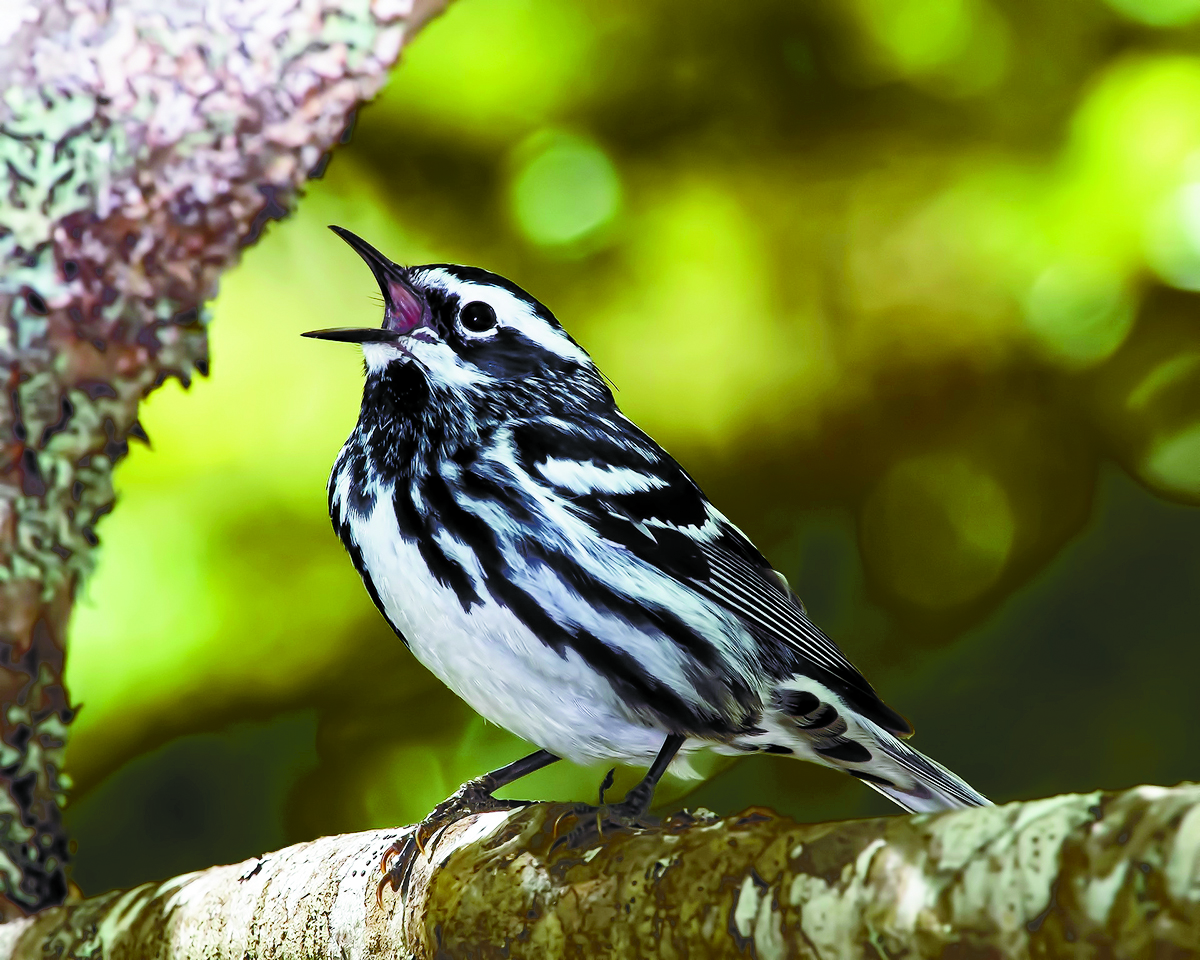
Photo Hans Tooms/ Pixabay • A male black-and-white warbler sings his buzzy song from a woodland perch. A total of 37 individual black-and-white warblers were found during the recent Spring Bird Count conducted by the Elizabethton Bird Club in Northeast Tennessee.


The 79th consecutive Elizabethton Spring Count was held Saturday, May 7, with 28 observers in about a dozen parties, plus two feeder watchers. The area covered included Carter County and parts of the adjacent counties of Johnson, Sullivan, Washington and Unicoi.

The weather was less than ideal, with cool temperatures ranging from 45 to 60 and mist or light rain for part or most of the day. The mountainous areas had the most rain.

Long-time compiler Rick Knight noted that participants tallied 147 species, which is slightly below the recent 30 year average of 150 species.

In addition, most species were in reduced numbers, likely due to the difficulties presented by the weather (less singing, fewer soaring birds) during the count. On the other hand, the weather may have grounded some of the shorebirds. Large numbers of swallows and swifts were foraging low over the water in different locations due to the cool temperatures.

Also significant were some of the species missed by participants, including ruffed grouse, sora, American woodcock, both night-herons, sharp-shinned hawk, red-shouldered hawk, brown creeper, ruby-crowned kinglet and hermit thrush.

Some of the more abundant birds included American robin (924), European starling (730), Canada goose (482) and red-winged blackbird (302).

The list follows:

Canada goose, 482; wood duck,  58, blue-winged teal,  4; mallard, 113; bufflehead, 1; hooded merganser,  3; and common merganser,  1.

Wild turkey, 41; rock pigeon, 124; Eurasian collared-dove, 4; mourning dove, 259; yellow-billed cuckoo, 2; common nighthawk, 1; chuck-will’s-widow, 6; Eastern whip-poor-will, 12; chimney swift, 401; and ruby-throated hummingbird, 19.

Killdeer, 32; least sandpiper, 16; pectoral sandpiper, 2; semipalmated sandpiper, 1; spotted sandpiper, 34; solitary sandpiper, 13; lesser yellowlegs, 5;  greater yellowlegs, 1; and ring-billed gull,  3.

Common loon, 3; double-crested cormorant, 75; great blue heron, 51; great egret, 3; and green heron, 10.

Black vulture,  40; turkey vulture, 56; osprey, 4; cooper’s hawk, 3; bald eagle, 5; broad-winged hawk, 2; red-tailed hawk, 8; Eastern screech-owl, 3; great horned owl, 2;  and barred owl,  1.

Belted kingfisher, 11; red-headed woodpecker,  2; red-bellied woodpecker, 46; yellow-bellied sapsucker, 3; downy woodpecker,  20; hairy woodpecker,  7; Northern flicker,  36; and pileated woodpecker,  29.

American Kestrel,  8; great crested flycatcher, 14; Eastern kingbird, 30; Eastern wood-pewee, 11; Acadian flycatcher,  15; least flycatcher, 2; and Eastern phoebe,  61.

White-eyed vireo, 7; Yellow-throated vireo, 4; Blue-headed vireo,  25; warbling vireo,  8; red-eyed vireo,  149; blue jay,  192; American crow,  280; fish crow,  4  (present third year in a row) and common raven,  8.

Bank swallow, 6; tree swallow, 399; northern rough-winged swallow,  168; purple martin,  94; barn swallow,  405; and cliff swallow,  499.

Carolina chickadee, 123; tufted titmouse,  140; red-breasted nuthatch, 1; white-breasted nuthatch,  11; house wren,  53; winter wren,  1; Carolina wren, 161; and blue-gray gnatcatcher, 51.

Golden-crowned kinglet,  2; Eastern bluebird, 141; veery, 19; gray-cheeked thrush, 1; Swainson’s thrush, 3; wood thrush,  51; American robin,  924; gray catbird, 75; brown thrasher,  64; Northern mockingbird,  93; European starling, 730; and cedar waxwing,  75.

House sparrow, 50; house finch, 62; pine siskin, 3; and American goldfinch,  224.

Grasshopper Sparrow, 1; chipping sparrow, 95; field sparrow,  29; dark-eyed junco, 19; white-crowned sparrow, 1; white-throated sparrow, 1; savannah sparrow,  1; song sparrow, 290; Lincoln’s sparrow, 1; and Eastern towhee,  151.

Yellow-breasted chat, 11; Eastern meadowlark,  91; orchard oriole,  20; Baltimore oriole, 11; red-winged blackbird,  302; brown-headed cowbird, 101; and common grackle,  281.

Ovenbird,  88; worm-eating warbler, 13; Louisiana waterthrush, 25; Northern waterthrush, 1; golden-winged warbler, 1; black-and-white warbler, 37; Swainson’s warbler, 6; Tennessee warbler, 1; Kentucky warbler, 5; common yellowthroat, 17; hooded warbler,  85; American redstart,  14; Cape May warbler, 1; Northern parula, 46; magnolia warbler,  2; bay-breasted warbler, 2; Blackburnian warbler,  3; yellow warbler, 9; chestnut-sided warbler, 15; blackpoll warbler,  2; black-throated blue warbler,  33; palm warbler, 1; pine warbler,  9; yellow-rumped warbler,  9; yellow-throated warbler,  44; prairie warbler,  1; black-throated green warbler, 33; and Canada warbler, 10.

Summer tanager, 1; scarlet tanager,  60; Northern cardinal,  270;  rose-breasted grosbeak,  11; blue grosbeak,  8; indigo bunting , 104; and dickcissel,  2.

•••

Based on the count results, it’s not difficult to see that many birds are moving through the region as part of the yearly phenomenon of spring migration. Share a sighting, ask a question or make a comment by emailing ahoodedwarbler@aol.com.

Red-headed woodpeckers more uncommon than some of their kin


Photo by Pixabay • The red-headed woodpecker is accurately named for its entirely red head. Male and female red-headed woodpeckers are identical in appearance, but young birds lack the red head.

Some readers asked for help in determining the identity of some birds that they have encountered. I tried to offer some insight into each query.

First, Lynda Carter in the Lamar community of Washington County emailed me recently with a question about a possible sighting of a red-headed woodpecker.

“I know they are uncommon and I did not get my binoculars on the bird,” Lynda wrote. “I saw the bird land in a large open-crowned oak after hearing a call very like (a) red-bellied (woodpecker) but different somehow.”

Lynda noted that she could see a lot of red on head and when the bird flew across her pasture to a pine tree, she could see big blocks of black and white in the plumage.

“I shared my sighting with my sister who lives up the mountain from me and she thought she spotted the same bird on a telephone pole in her yard a few days later,” Lynda said.

Lynda added that she and her sister live on the end of Embreeville Mountain. “We are interested in your thoughts concerning our mystery bird,” she wrote.

I responded to Lynda with my absolute confidence that she and her sister did see a red-headed woodpecker. Here are a few reasons for my belief in the identification she came up with.

The large patches of black and white are trademark characteristics of a red-headed woodpecker. The black is actually almost a glossy blue-black.

Of course, the entirely red head also separates the aptly-named red-headed woodpecker from all other members of the family in the region.

She and her sister also live in a section of Washington County near some known locations for finding red-headed woodpeckers.

Photo by USFWS • The red-headed woodpecker is an easily identified bird for anyone getting a good look.

It’s also spring. Red-headed woodpeckers are partly migratory, so her sighting could have involved a migrating bird. I’ve seen several red-headed woodpeckers in the spring in some surprising locations over the years.

We corresponded a bit more and Lynda shared more about the birds around her home.

“I do live in a great spot for birding,” she wrote.  “We have open pasture, wooded gullies and the mountain behind us. Cherokee National Forest is my neighbor to the south and the Nolichucky River is just down the road.”

Lynda hosts nesting wood thrushes that return to the same open wooded patch behind her house. “I just love hearing their song in early morning hours and again in the evening,” she wrote.

She also wrote that she has seen more scarlet tanagers, which is always a thrill, in the last year or two.

“I have had male and female rose-breasted grosbeak at my bin feeder,” she added.

She has recently heard Eastern meadowlarks, red-eyed vireo and ovenbird. She also provides several nest boxes currently occupied by Eastern bluebirds and tree swallows.

The red-headed woodpecker and its relative, the red-bellied woodpecker, belong to a genus of tree-clinging birds known as Melanerpes. The term, translated from Latin, means “black creeper.” Indeed, many of the two dozen members of the Melanerpes genus have an extensive amount of black feathers in their plumage. Other members of the genus include woodpeckers from the Caribbean, as well as from Central and South American. Some of them have quite colorful names, such as yellow-tufted woodpecker, golden-cheeked woodpecker and the accurately named beautiful woodpecker, a native of Colombia.

The red-bellied is a common bird in the region, but some effort or simple good luck is needed to find red-headed woodpeckers. These woodpeckers, which often form family flocks, have localized populations that shift from year to year.

One reason the red-headed woodpecker may be less common than its cousin relates to its fondness for hawking for flying insects along roadsides. The woodpeckers are frequently struck by cars when swooping after their winged prey. Historically, the American chestnut and beech trees also provided much of the mast crops consumed by these birds. With the extermination of the chestnut and the scarcity of beech in some locations, the red-headed woodpecker now depends on oaks and acorns. In fact, this woodpecker is rarely encountered outside of woodlands offering an abundance of oak trees.

https://www.youtube.com/watch?v=Is6MB_8-7ro

•••

Ed Wells, who lives in Nebo, North Carolina, near Lake James, emailed me recently and presented me with another identification challenge.

“I enjoy reading your feature each week,” Wells wrote.  “You always inform and teach me.”

He  also attached some photographs of a bird that flew into the side of his house in 2021.

“I have not been able to make a positive ID,” he said.  “It appeared to be a small shorebird with a straight bill of medium length. Wing span was probably 10 inches or less and perhaps about the same from bill to tail.”

“I moved the stunned bird out of the cold wind and placed it on some mulch,” Ed wrote. “It eventually recovered and flew away.”

Ed also shared that while boating on the lake recently, he saw a bird that he believes might be the same species as his mystery bird. The shorebird was perched on rocks near the waterline.

“My boat startled it and it flew rapidly away,” he added.

https://www.youtube.com/watch?v=gD6nQm1CFKI

Based on his photos, the best I could do was determine the bird was some sort of “peep,” which is a birding nickname for a group of small- to medium-sized sandpipers.

I speculated that the bird might have been a stilt sandpiper, but I also consulted Rick Knight, a veteran birder with much more experience with shorebirds.

“The bill looks too short for stilt sandpiper,” Rick concluded. He said that he would lean toward the bird being a least sandpiper or pectoral sandpiper.

Many shorebirds have been migrating through the region in recent weeks. During the recent five-county Spring Bird Count conducted by the Elizabethton Bird Club, counters found several shorebird species, including least sandpiper, pectoral sandpiper, semipalmated sandpiper, spotted sandpiper, solitary sandpiper, lesser yellowlegs greater yellowlegs and killdeer.

•••

Have questions about birds? Email me at ahoodedwarbler@aol.com. Feel free to make comments and share observations, too.