Tag Archives: Elizabethton Star

Gift suggestions for the bird-lovers on your Christmas shopping list

Although some people like to get an early start on holiday shopping, I’m certain some, like myself, are still in the process of checking those lists. If you’re looking for some ideas for bird and nature enthusiasts on your list, I’ll make a few modest suggestions that could result in making the season merry and bright.
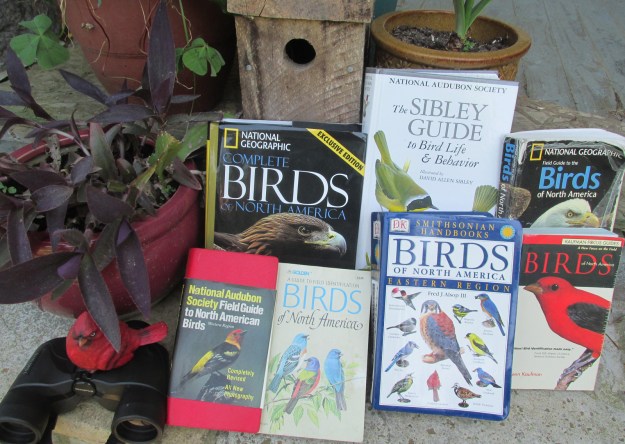
Photo-FieldGuides

Photo by Bryan Stevens • Field guides are an essential tool for bird identification.

Field guides
If you’ve enjoyed watching the birds that congregate at your feeders or noticing the visitors to your yard and gardens, but you’ve also become curious about the identities of all your feathered visitors, it might be time for a helpful and informative field guide. I prefer field guides illustrated with paintings rather than photographs, but I have a varied collection of guides. I started a long time ago with the Golden Guide to Birds. It’s a classic and still a great guide to help interest children in the birds around them.
Some of the guides I recommend and use myself these days are National Geographic Field Guide to the Birds of North America, The Sibley Field Guide to Birds of Eastern North America, and Peterson Field Guide to Birds of Eastern and Central North America. Any of these field guides should be easily found online or in stores at a cost of under $20.
If you have already acquired a good basic field guide, perhaps you’re ready for more specialized field guides that focus on particular families of birds or on the behavior of backyard birds.
For the warblers, there are several field guides available, including the Stokes Field Guide to Warblers, A Field Guide to Warblers of North America (Peterson Field Guides), and the Warbler Guide.
For a handy guide to identify some of the birds seen on beach and coastal vacations, consider such titles as Stokes Beginner’s Guide to Shorebirds and Shorebirds: An Identification Guide to the Waders of the World, and National Audubon Society Pocket Guide to Familiar Birds of Sea and Shore.
For fans of hawks and allied raptors, several guides exist including A Field Guide to Hawks of North America (Peterson Field Guides), Birds of Prey: Hawks, Eagles, Falcons, and Vultures of North America, and Hawks from Every Angle: How to Identify Raptors In Flight.
In short, there’s a field guide for every family and grouping of birds. With expertly rendered illustrations or photographs, brief and concise text, and helpful range maps, nothing beats a good field guide forYea, improving one’s ability to identify birds. I recommend thumbing through the pages of a good guide over trying to randomly use Google to search online for a bird glimpsed for a brief time.

bird-Feeder

Photo by Pixabay.com • A well-stocked feeder is a first step toward attracting more birds to your yard.

Feeders
Bird feeders come in an astounding variety of shapes and sizes. Nothing will do more to bring birds into our daily lives than maintaining a well-stocked feeder. Be certain to include a bag of sunflower seeds so that your gift will allow the recipient to immediately begin to enjoy the parade of birds sure to flock to the feeder.

Bluebird-2

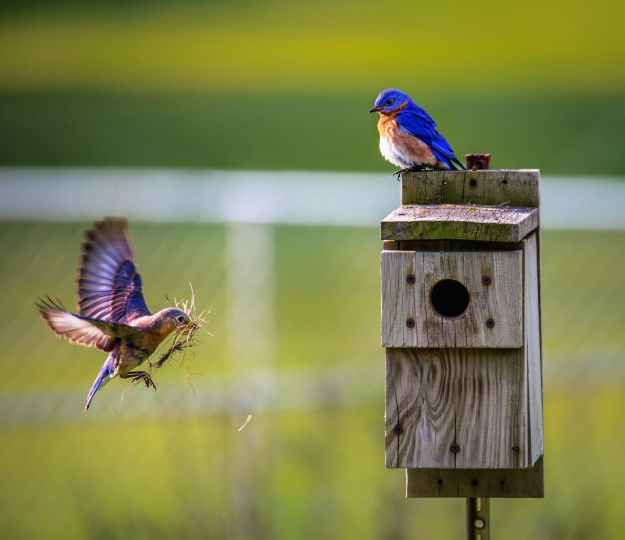
Photo by Bryan Stevens • Birds, like this Eastern bluebird, appreciate nest boxes.

Houses
It’s never too early to start thinking about spring and the return of many of our favorite birds. To bring more birds into our lives, it doesn’t hurt to encourage them by providing man-made nesting and roosting boxes. Many of our favorite birds — Eastern bluebird, tree swallow, tufted titmouse, white-breasted nuthatch — are cavity-nesting species but will just as readily raise their young in nesting boxes as in a hole in a tree. With boxes customized to their own particular needs, other birds such as Eastern screech-owl, wood duck and great crested flycatcher will also make use of bird boxes. Many gardening centers, produce stands, feed stores and other shopping outlets sell bird boxes of various designs, shapes and sizes. If you’re shopping for a bluebird box, be certain that the recipient’s yard is a spacious one. Bluebirds feel more comfortable in open surroundings. If the yard is more overgrown and woodsy, consider a box tailored more for a woodland bird like a chickadee or a nuthatch.

binoculars-2164526_1920

Photo by Pixabay.com • A good pair of binoculars will bring birds much closer.

Binoculars
Unless requested, don’t buy binoculars for an adult. Most birders would prefer to pick out their own pair to use to make up-close and personal bird observations. An inexpensive pair, however, could be perfect for fostering in a child an interest in birds and nature. If you have grandchildren, children, or even nephews and nieces, a beginner’s pair of binoculars could make a life-altering gift that lets the recipient view the world in a whole new light.

CalendarCover

Calendars
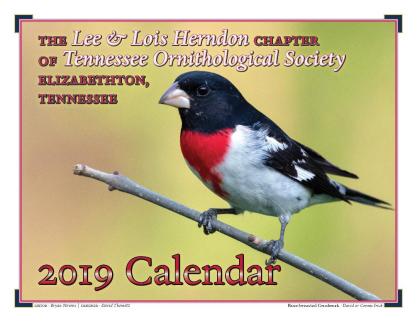
Birds have always been a popular photography subject for calendars. There’s an almost endless variety of bird calendars, but I’m partial to one produced by the Lee and Lois Herndon Chapter of Tennessee Ornithological Society, of which I am a member. This annual fundraising endeavor features some exceptional bird photography from club members. This year’s calendar features full-color photographs of some of the region’s most colorful and engaging birds. The club sells the calendars for $15 each. For an additional $2 shipping fee, calendars can be sent to any address in the United States. All proceeds are used to support birding opportunities and bird-related causes.
The calendar also features an informative calendar grid with highlights for major holidays as well as important bird-related dates. The calendar’s pages feature more than 80 full-color photographs of area birds, including common favorites and some not-so-common visitors. The front cover features a dazzling photograph of a male rose-breasted grosbeak. If you’re interested in obtaining a calendar, email ahoodedwarbler@aol.com or look up Elizabethton Bird Club on Facebook.
 

Hummingbird-Ornament

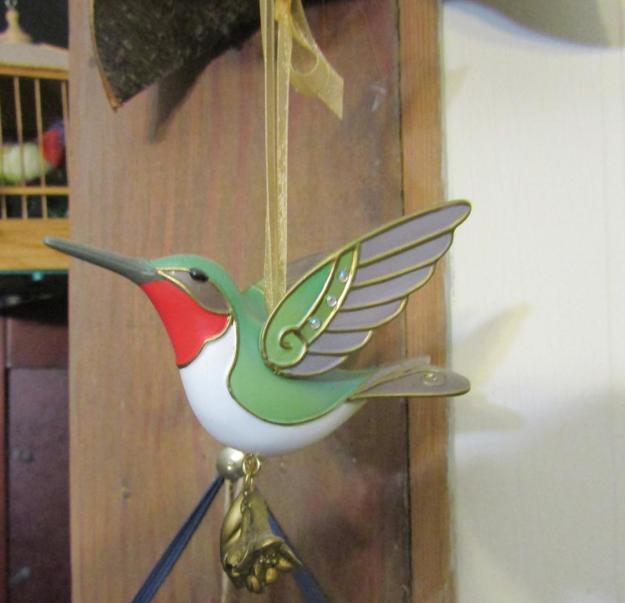
Photo by Bryan Stevens • A bird-related Christmas ornament makes a nice gift.

Ornaments

The branches of my Christmas tree are always weighted heavily with a variety of bird-related Christmas ornaments. Holiday tinsel and baubles make the season look a lot like Christmas if they feature some of our favorite birds such as cardinals, chickadees, hummingbirds, penguins, doves, geese, eagles or any of the other popular species of birds. Choose a fun and unique bird ornament for the enthusiast on your Christmas list.
animals avian beaks birdhouse

Photo by Kevin Blanzy on Pexels.com

Hawk spoils start of winter bird feeding season

According to a recent Census Report, Americans are feeding birds in epic numbers — 63 million people in this country make life less of a struggle for birds by filling bird feeders with sunflower seeds, peanuts and other goodies. In fact, watching and feeding birds ranks second only to gardening as one of America’s popular pastimes.

Unfortunately, bringing wild birds into our lives means we are occasional witnesses to the darker side of nature that dictates there’s a survival of the fittest competition taking place in our own backyards and gardens.

sharp-shinned-hawk-dbadry

Photo by Dbadry/Pixabay.com • A sharp-shinned hawk visits a bird bath during the Christmas season. These small hawks, designed to prey on songbirds, sometimes learn to stalk feeders, which creates distress for the human landlords.

Welcoming birds into our yards and lives means inviting all birds, include predatory raptors such as sharp-shinned hawk, merlin, Cooper’s hawk and American kestrel. It’s a problem Elizabeth Laing has had to cope with in recent weeks. We’ve commiserated over Facebook about her conflicted feelings about the predatory nature of the hawk that’s been stalking birds at her feeders.

Elizabeth sent me a message via Facebook on Nov. 21 about a situation unfolding at her home in Abingdon, Virginia.

“Please help me to know what to do,” she wrote as the start of her message. “Right now I an absolutely devastated and in tears. I have about eight feeders up year round. I feed a lot of small birds in my backyard and even crows in my front yard. I have at least 15 American goldfinches right now at several sunflower chip feeders.”

Elizabeth noted that for the past few days she had seen a small hawk in her backyard for the first time ever.

“I was worried and tried to scare it off,” she wrote. “I realize they have to eat, too, and are beautiful birds, but I don’t want them killing birds on my feeders.”

1-sharp-shinned-hawk-john-james-audubon

John James Audubon painted this pair of sharp-shinned hawk and shows the size difference between males and females. Many people are surprised to learn that female hawks are typically much larger than males, which is also true of the Cooper’s hawk.

Unfortunately, that’s what happened right as she watched through a window as a goldfinch feeding at her feeder.

“The hawk swooped in and grabbed him off the feeder,” she reported.In the wake of the hawk’s action, Elizabeth took some sensible steps, including immediately taking down her feeders.

Some of her birds, such as the tufted titmice, came back quickly and perched on the empty feeder poles. “I felt so bad,” she said. “I want to feed them, but I can’t stand the thought of them being snatched off my feeders.”

She concluded her message by asking my advice. I responded and told her that when hawks do make a habit of raiding feeders, it can be necessary to curtail feeding for a couple of weeks or longer. Most authorities on birding insist that the hawks will lose interest and move to more productive feeding grounds. Unfortunately, the raptor visiting Elizabeth’s yard proved persistent.

bird-2154147_1920

Photo by NatureLady/Pixabay.com Immature sharp-shinned hawk look different than adults, but once they learn to hunt, they are very efficient predators.


“I wanted to update you on my hawk problem,” Elizabeth wrote back in another message on Nov. 26. “I took all my feeders down, but not long enough. After five days, I put them back.

She had also invested in brand new, expensive caged feeders. She purchased the caged feeders thinking the goldfinches would be safe inside.

For flocking birds, like American goldfinches, the caged feeders offered security only to birds inside the caging. Those birds waiting outside of the caging for their own turns at the feeder remained vulnerable.

“I found feathers on the side of one cage this morning,” she wrote. “Then, as I was watching a bunch eat, that hawk swooped in and took another one off the side.”

The entire situation has made her discouraged and sad. “I hope this doesn’t mean I will have to stop feeding birds entirely. I actually have bags of seeds and peanuts (for the titmice) coming in the mail later this week,” she wrote.

In the wake of the latest attacks, she has taken down the feeders again. “I will leave them down for two weeks this time,” she wrote. “I know the hawk has to eat, too, and it’s a beautiful bird, but I can’t do this to my little goldfinches.”

I agreed that it would be senseless, as well as rather cruel, to provide food for songbirds while knowing a hawk is lurking in the vicinity.

FirstHawk

Photo by Bryan Stevens • A sharp-shinned hawk photographed after capturing and killing a Northern cardinal feeding on the ground beneath a feeder.


Elizabeth also asked if I have had birds killed at my feeders. Although it has been a thankfully rare occurrence, hawks have snatched birds visiting my feeders. I’ve not often witnessed the actual predation, often finding only a pile of feathers on the ground as evidence of the hawk’s success.

A few years ago, however, I witnessed a rather dramatic attack on New Year’s Day. As I watched a female Northern cardinal feeding on sunflower seeds spilled onto the ground by the birds visiting a hanging feeder, a sharp-shinned hawk suddenly slammed into the cardinal. In an instant, I saw my first and second bird species of the New Year. The cardinal, however, didn’t get to live and enjoy the unfolding year.

The website allaboutbirds.org described the sharp-shinned hawk as “a tiny hawk that appears in a blur of motion — and often disappears in a flurry of feathers.” It’s an apt description of this pint-sized predatory bird.

The website also notes that studies indicate that feeders don’t make it more likely that our favorite songbirds will be preyed upon by a sharp-shinned hawk or other raptor. Although feeders might temporarily attract a raptor, these birds will catch the majority of their prey elsewhere.

The sharp-shinned hawk belongs to a genus of raptors known as accipiters, which are slender raptors with rounded wings and long tails. They are highly maneuverable in flight. A characteristic of accipiters is long legs and sharp talons. In fact, the genus is named from the Latin word for hawk, “accipere,” which can be translated as, “to grasp.”

shikra-336751_1920

Photo by Sarangib/Pixabay.com • A shikra (Accipiter badius) is a small bird of prey in the family Accipitridae found widely distributed in Asia and Africa where it is also called the little banded goshawk.

Other members of the accipiters in North America include the Cooper’s hawk and Northern goshawk. Other accipiters around the world include such raptors as chestnut goshawk, red-chested goshawk, crested goshawk, little sparrowhawk, spot-tailed sparrowhawk, black sparrowhawk and red-thighed sparrowhawk.

Elizabeth sent me one other message, informing me that she had also advised her neighbor to take down his feeder, which he did. Shortly after he did so, Elizabeth saw the hawk attack a squirrel, which, thanks to Elizabeth rapping on a windowpane, apparently survived the attack.

coopers-hawk-570341_1920

Photo by Skeeze/Pixabay.com The Cooper’s hawk, like this individual, is a larger relative of the sharp-shinned hawk. It’s larger size allows this raptor to prey on larger birds, such as mourning doves.

In addition, if the hawk in her yard is attacking squirrels, her visitor is probably a Cooper’s hawk, a bird almost identical to a sharp-shinned hawk except for its larger size. I’m hopeful that an extended hiatus will convince the hawk to leave Elizabeth and her goldfinches in peace.

It’s still good to remember that hawks view smaller birds flocking to a feeder in the same way those small songbirds view the abundance of seeds. For both hawks and songbirds, our offerings represent easy meals. It’s not easy, but the best choice is to co-exist — if not at peace, then at terms with nature’s reality.

CalendarCover

Bird club selling calendars

The Lee & Lois Herndon Chapter of Tennessee Ornithological Society is selling its 2019 calendar for $15 each. All proceeds are used to support birding opportunities and bird-related causes in Northeast Tennessee. The calendar’s pages feature more than 80 full-color photographs of area birds, including common favorites and some not-so-common visitors. The front cover features a dazzling photograph of a gorgeous male rose-breasted grosbeak. If you’re interested in obtaining a calendar, contact ahoodedwarbler@aol.com by email or send a message via Facebook at http://www.facebook.com/ahoodedwarbler. Calendars can be mailed to any destination in the United States for an additional charge of $2 for shipping and postage.

Overwintering birds make their return to some familiar area haunts

Mergansers

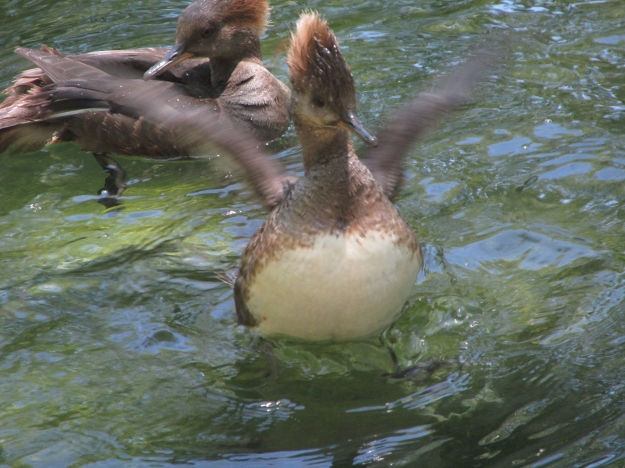
Photo by Bryan Stevens • A female hooded merganser flaps her wings as another preens her feathers behind her.

Now that the warblers, hummingbirds and other birds of summer have, for the most part, departed, new arrivals have filtered into the region to take their place and prevent the winter months from seeming too bleak.

At my own home, these new arrivals have included a field sparrow — the first I’ve seen at home in several years — and a swamp sparrow. I’ve not caught sight of white-throated sparrows or dark-eyed juncos so far, but these hardy sparrows often don’t arrive until the first incidents of truly snowy weather. However, Helen Whited of Richlands, Virginia, emailed me to let me know that she saw her first dark-eyed junco of the season on Monday, Nov. 5.

Different species of waterfowl have also returned to some familiar haunts, and I’m grateful to readers who have kept me informed about some of these arrivals. Joanne Campbell of Bristol, Tennessee, posted on my Facebook page that hooded mergansers have returned to Middlebrook Lake near her home on Saturday, Nov. 3. The hooded merganser, Joanne noted, is one of her favorite birds. Brookie and Jean Potter of Elizabethton, Tennessee, reported that four male buffleheads returned to Wilbur Lake near their home on Oct. 27.

Middlebrook Lake has served as a winter home for hooded mergansers since 1987, while buffleheads have congregated on Wilbur Lake for decades. Another good location to look for buffleheads during the winter months is in the weir below South Holston Dam around the Osceola Island Recreation Area. Several hundred of these ducks have been reported in past winters at these various locations.

Although classified as sea ducks, the mergansers are more at home in river habitats. There are six closely related species in three genera: Mergus, Mergellus and Lophodytes. The latter two genera have only a single species each: the hooded merganser (Lophodytes cucullatus) and the smew (Mergellus albellus).

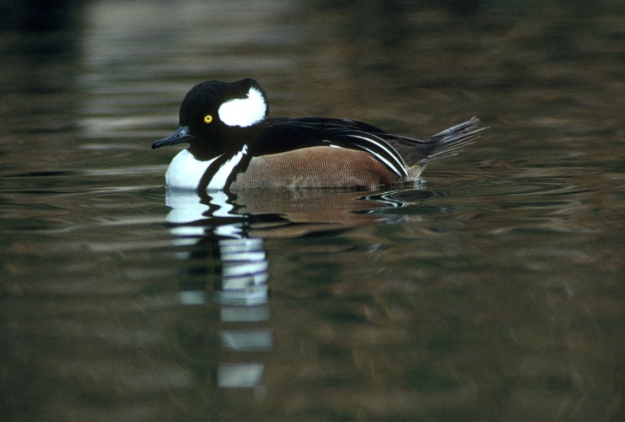
The typical mergansers are fish-eating waterfowl in the genus known as Mergus. The hooded merganser’s genus name of Lophodytes is derived from Greek and, roughly translated, means “crested diver.” Both male and female hooded mergansers have crests capable of being raised or lowered. Females are mostly brown, but males have a striking plumage in a pattern of brown, white and black.

Hooded_Merganser___Drake

Photo by Photo by Tim McCabe/U.S. Fish & Wildlife Service • The male hooded merganser stands out among ducks with his black, white, and brown plumage.

Everyone has probably heard the phrase “as scarce as hen’s teeth.” It means almost exactly what you think. Birds don’t have teeth, so it’s a way to describe something exceptionally rare. It’s a characteristic that sets birds apart from other creatures, such as mammals.

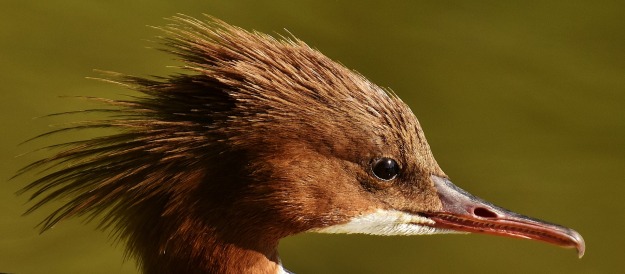
There are some birds, however, that come closer to having teeth than their other beaked counterparts. Mergansers would definitely fall into that category. The mergansers are a type of duck known collectively as “sawbills,” a reference to their long, thin bills with serrated edges that help them grip prey. The “sawbills” come closer than any of our other birds in having teeth, although not in the same sense as mammals have teeth.

merganser-Bill-ALexas-fotos

Photo by Alexas-fotos/Pixabay.com • This closeup of a female common merganser shows in detail the serrated bill, which assists this duck in seizing and grasping the fish that makes up a good portion of the bird’s diet.

The other mergansers in the Mergus genus consist of four species: common merganser, Brazilian merganser, red-breasted Merganser and scaly-sided Merganser. The last of these is an endangered species with only about 5,000 birds in the worldwide population. These remaining scaly-sided mergansers are found in the border regions of China, North Korea and Russia.

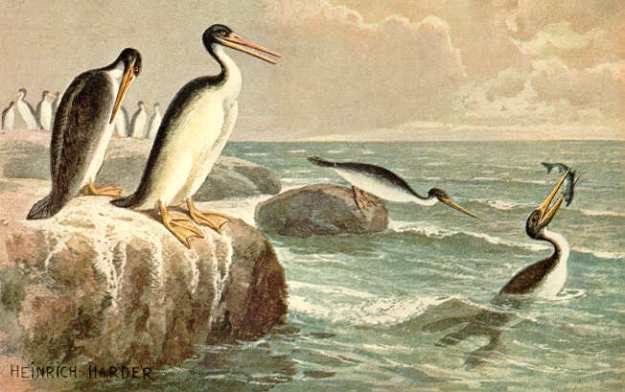
While today’s birds, even mergansers, all lack teeth, that hasn’t always been the case. About 80 million years ago, a bird known as Hesperornis (“western bird”) swam the inland seas that stretched over areas from Kansas to Canada. They swam through those ancient seas because they could not fly.

The body plan of Hesperornis was similar to modern loons and mergansers. Instead of a serrated bill, however, this ancient bird had actual teeth in its long beak. Just like today’s loons and mergansers, it probably fished for its food. At almost six feet in length, however, it dwarfed our modern mergansers and loons and probably fed on larger piscine prey.

Hesperornis_Heinrich_Harder

This early 20th century illustration of Hesperornis is no longer considered scientifically accurate by scientists, but it does demonstrate one striking feature – the toothed jaws of this ancient bird.

Hooded mergansers are content to seek smaller fish. According to the website for the Ducks Unlimited organization, the hooded merganser is the smallest of the three North American mergansers. In addition to fish, hooded mergansers feed on crayfish and other crustaceans, as well as aquatic insects.

The hooded merganser prefers forested wetlands. As a cavity-nesting bird, it seeks out natural cavities in trees for nesting, although it will also accept nest boxes provided by human landlords. This duck breeds from as far north as Alaska and Canada and as far south as Louisiana and Georgia.

IMG_5909

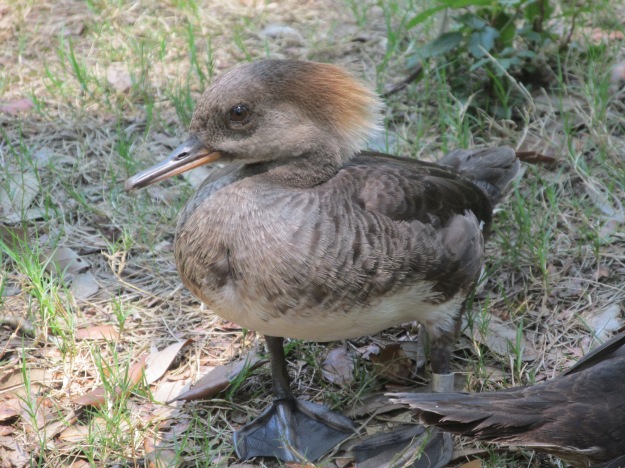
Photo by Bryan Stevens • Hooded merganser females, or hens, have a gray-brown head and neck with a reddish-brown crest, which marks quite a contrast from the male’s appearance.

Late fall and winter are good times to see ducks in the region. Some will spend a good portion of the winter season on area lakes, rivers and ponds, while others will make only brief stops during their migration to their preferred wintering grounds. Some of the other ducks that are usually somewhat common in the region in winter include ring-necked duck and American wigeon. If you live or work near a body of water, stay alert for the comings and goings of waterfowl as winter approaches. You may be afforded an opportunity to see a hooded merganser or bufflehead for yourself.

IMG_5191

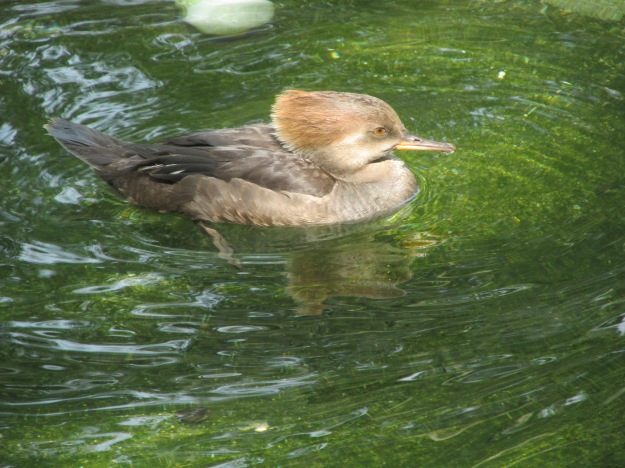
Photo by Bryan Stevens • Female hooded merganser enjoys a swim.

•••••

The Lee & Lois Herndon Chapter of Tennessee Ornithological Society produces an annual calendar featuring some exceptional bird photography from its members. This 2019 calendar will feature full-color photographs of some of the region’s most colorful and engaging birds. The club sells the calendars for $15 each. All proceeds are used to support birding opportunities and bird-related causes here in Northeast Tennessee. For instance, the club pays for bird seed to stock the feeders at Sycamore Shoals State Historic Park in Elizabethton, Tennessee. The club also regularly supports causes that benefit birds.HerndonCalendar2019(Cover) (1)
The calendar also features an informative calendar grid with highlights for major holidays, as well as important bird-related dates. The calendar’s pages feature more than 80 full-color photographs of area birds, including common favorites and some not-so-common visitors. The front cover features a dazzling photograph of a gorgeous male rose-breasted grosbeak. If you’re interested in obtaining a calendar, contact ahoodedwarbler@aol.com by email or send a message via Facebook at http://www.facebook.com/ahoodedwarbler. Calendars can be mailed to any destination in the United States for an additional charge of $2 for shipping and postage.


Dark-eyed junco heralds winter’s approach and marks milestone in weekly bird musings

junco-feb9

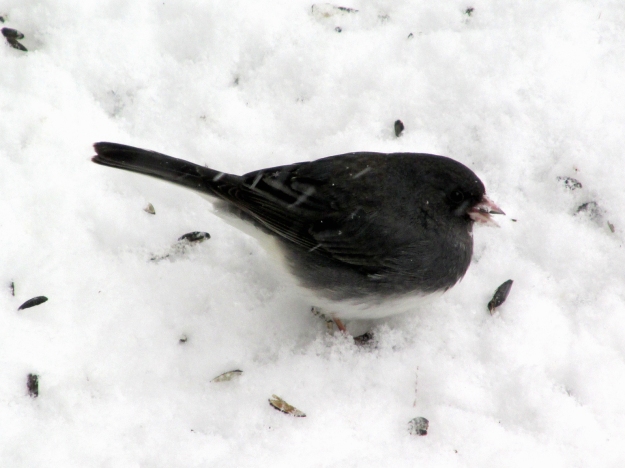
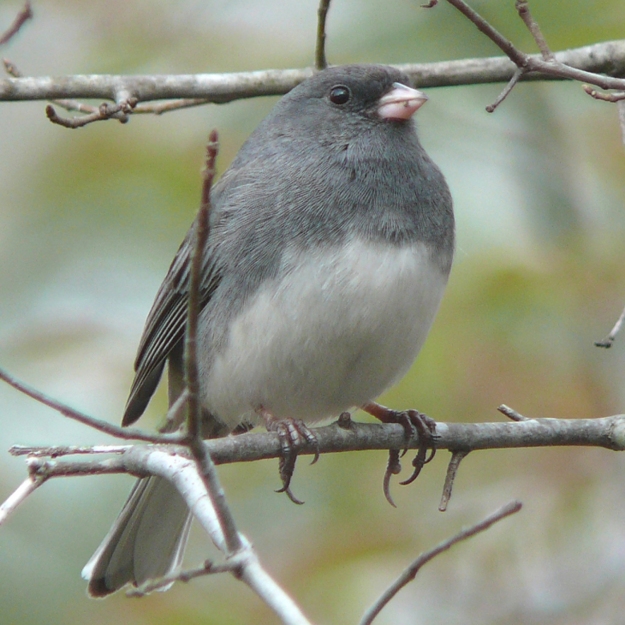
Photo by Bryan Stevens • A dark-eyed junco, usually a harbinger of wintry weather and snowy days, shells sunflower seeds beneath a feeder.

I wrote my first column about our “feathered friends” on Sunday, Nov. 5, 1995, which means this column will soon celebrate its 23rd anniversary.

This column has appeared on a weekly basis for the last 23 years in a total of five different newspapers, and in recent years it has been syndicated to several more. The column has also been a great conduit for getting to know other people interested birds and birding. I always enjoy hearing from readers, and I hope to continue to do so in the coming years as well. Since February 2014, I’ve also been posting the column as a weekly blog on birds and birding.

I saw my first swamp sparrow of the fall on Oct. 23. Autumn’s a time when many of those so-called “little brown birds,” also known as the sparrows, return to live in the fields, gardens, yards and woodlands around our home. Two of the other anticipated arrivals are white-throated sparrows and dark-eyed juncos.

SwampSparrow-April11

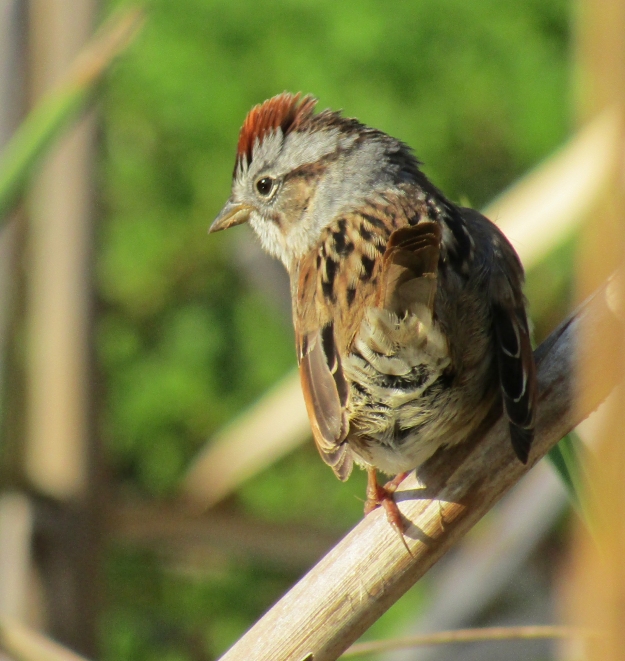
Photo by Bryan Stevens • Sparrows, like this swamp sparrow, often spend the winter months in fields, woods, and wetlands, sometimes visiting feeders in our homes and gardens.

In fact, that first column I wrote back in 1995 focused on one of the region’s most prevalent winter residents— the dark-eyed junco. Experts place juncos among the varied sparrow family. All juncos are resident of the New World, ranging throughout North and Central America. Scientists are continually debating precisely how many species of junco exist, with estimates ranging from a mere three species to about a dozen species.

Some of the other juncos include the volcano junco, yellow-eyed junco, Chiapas junco, Guadalupe junco, pink-sided junco, Oregon junco and Baird’s junco, which is named in honor Spencer Fullerton Baird, a 19th century American naturalist and a former Secretary of the Smithsonian Institution.

With that introduction and with some revisions I have made through the years, here is that very first column that I ever wrote about birds.

dark-eyed-junco-Skeeze-Pixabay

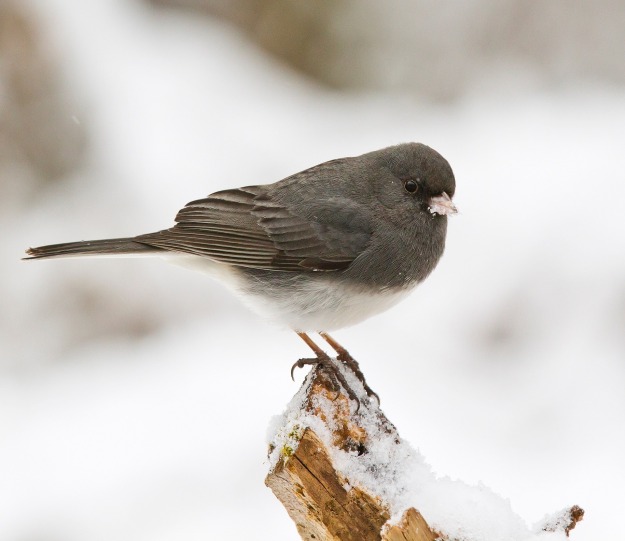
Photo by Skeeze-Pixabay • A dark-eyed junco clings to a snowy perch.

…..

Of all the birds associated with winter weather, few are as symbolic as the dark-eyed junco, or “snow bird.” The junco occurs in several geographic variations.

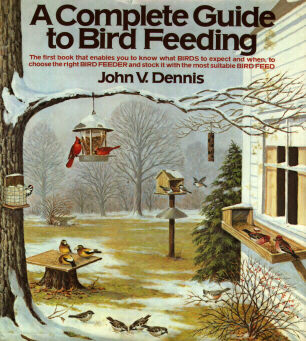
John V. Dennis, author of “A Complete Guide to Bird Feeding,” captures the essence of the junco in the following description: “Driving winds and swirling snow do not daunt this plucky bird. The coldest winter days see the junco as lively as ever and with a joie de vivre that bolsters our sagging spirits.” The dark-eyed junco’s scientific name, hyemalis, is New Latin for “wintry,” an apt description of this bird.

dennisjl 2

Most people look forward to the spring return of some of our brilliant birds — warblers, tanagers and orioles — and I must admit that I also enjoy the arrival of these birds. The junco, in comparison to some of these species, is not in the same league. Nevertheless, the junco is handsome in its slate gray and white plumage, giving rise to the old saying “dark skies above, snow below.”

Just as neotropical migrants make long distance journeys twice a year, the junco is also a migrating species. But in Appalachia, the junco is a special type of migrant. Most people think of birds as “going south for the winter.” In a basic sense this is true. But some juncos do not undertake a long horizontal (the scientific term) migration from north to south. Instead, these birds merely move from high elevations, such as the spruce fir peaks, to the lower elevations. This type of migration is known as vertical migration. Other juncos, such as those that spend their breeding season in northern locales, do make a southern migration and, at times, even mix with the vertical migrants.

Juncos are usually in residence around my home by early November. Once they make themselves at home I can expect to play host to them until at least late April or early May of the following year. So, for at least six months, the snow bird is one of the most common and delightful feeder visitors a bird enthusiast could want.

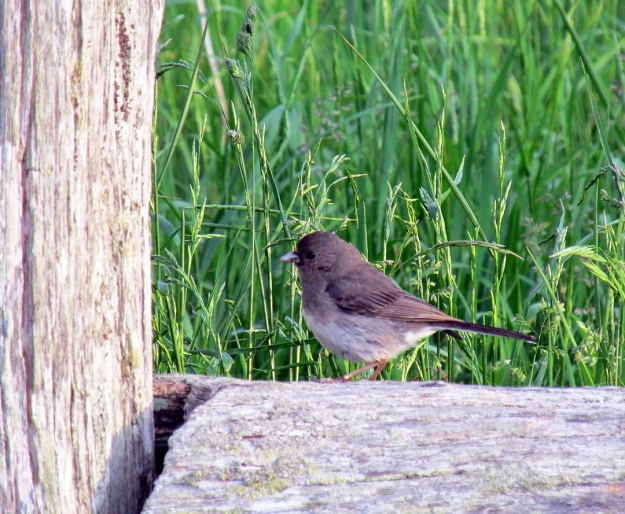
Juncos flock to feeders where they are rather mild-mannered — except among themselves. There are definite pecking orders in a junco flock, and females are usually on the lower tiers of the hierarchy. Females can sometimes be distinguished from males because of their paler gray or even brown upper plumage.

Junco

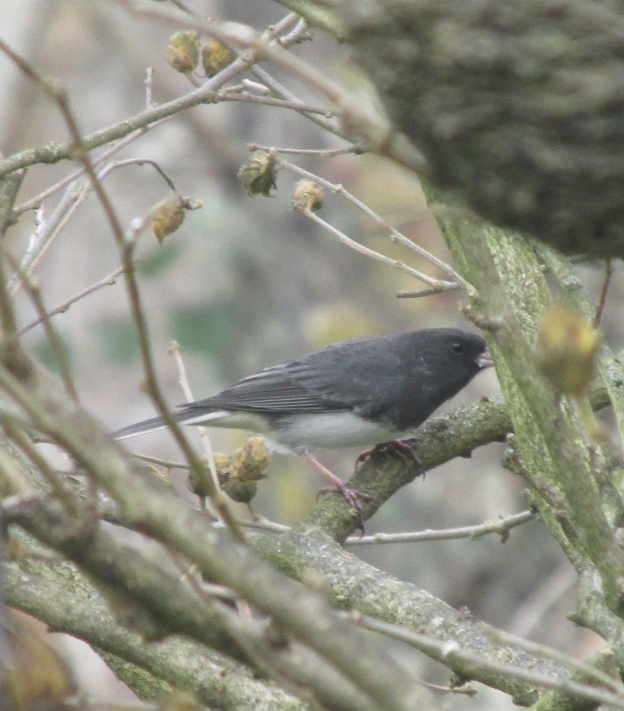
Photo by Ken Thomas • A dark-eyed junco perches on some bare branches on a winter’s day.

Since juncos are primarily ground feeders, they tend to shun hanging feeders. But one winter I observed a junco that had mastered perching on a hanging “pine cone” feeder to enjoy a suet and peanut butter mixture.

Dark-eyed juncos often are content to glean the scraps other birds knock to the ground. Juncos are widespread. They visit feeders across North America. The junco is the most common species of bird to visit feeding stations. They will sample a variety of fare, but prefer such seeds as millet, cracked corn or black oil sunflower.

There’s something about winter that makes a junco’s dark and light garb an appropriate and even striking choice, particularly against a backdrop of newly fallen snow.

Junco-Carver

Photo by Bryan Stevens • Dark-eyed junco nests on high mountain slopes during the summer month. This dark-eyed junco was photographed at Carver’s Gap on Roan Mountain during the summer nesting season.

Of course, the real entertainment from juncos come from their frequent visits to our backyard feeders. When these birds flock to a feeder and begin a furious period of eating, I don’t even have to glance skyward or tune in the television weather forecast. I know what they know. Bad weather is on the way!

•••••

Back when I wrote that original column, juncos often returned each fall in the final days of October or first days of November. In the last few years, however, their arrival times have grown consistently later in November. At times, it takes a serious snowfall to drive these hardy birds to seek out easy fare at my feeders. I’m hoping they’ll return soon. In the meantime, if you want to share your first dark-eyed junco sighting of the fall, I’d love to hear from you. If you want to share a sighting, have a question or wish to make a comment, email ahoodedwarbler@aol.com.

dark-eyedjunco-female

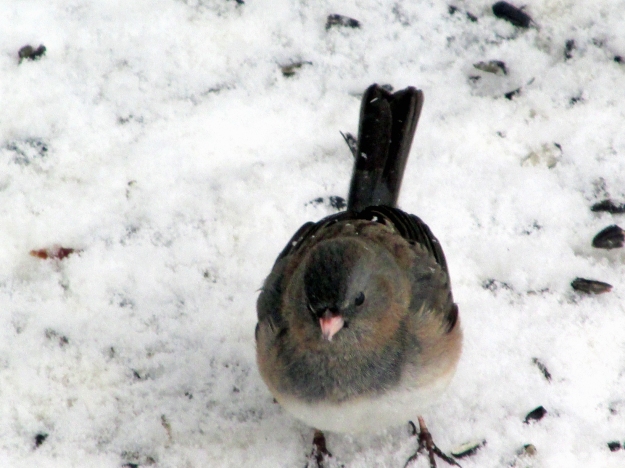
Photo by Bryan Stevens • A female dark-eyed junco scrambles for sunflowers seeds in the snow.

Some birds expert at conjuring Halloween-style thrills and chills

nature bird cute wildlife

The  greater tit, a European relative of the Carolina chickadee, has learned to hunt and kill a species of small bat in the Hungarian mountains. • Photo by Pixabay on Pexels.com

Here’s a repost from November of 2018. The timing seems appropriate. 

My ruby-throated hummingbirds set a new record this year, lingering until Oct. 17. Although present on the morning of that date, I didn’t see any that evening. The next morning, their absence — quite notable and somewhat saddening — continued. In all likelihood, I won’t see any more ruby-throated hummingbirds until next April. I hope they arrive early.

Carolyn Baker Martin commented on the post I made on Facebook about the departure of the hummers. Carolyn noted that 2018 has been an interesting year for birds and flowers. Carolyn, who lives in Elizabethton, Tennessee, also shared a recent observation she made of a hummingbird behavior that I’ve never personally witnessed.

“I had a hummer recently in torpor,” Carolyn wrote in her post. “It sat on the feeder a long time without moving or feeding. Finally, a tail feather began to move. It fed constantly for one more day and was gone.”

Despite their small size, most hummingbirds, including the ruby-throated hummingbirds, are less frail than they appear. Torpor is a biological adaptation possessed by hummingbirds and some other creatures that lets them survive a serious cold spell. It’s not quite the same thing, but think of these tiny birds as voluntarily going into a coma when they enter torpor. Comatose or catatonic creatures are a staple of some horror and suspense films, so perhaps a look at how some birds can induce shivers along the spine is in order in view of the celebration of Halloween this week.

Image by Josep Monter Martinez from Pixabay • Bats, like birds, have the power of flight. Scientists have also learned that some unlikely birds have also developed a liking for feasting on bat brains.

The ultimate coma victim is the fabled zombie, but that’s not likely to afflict any of our feathered friends, right? Well, consider the great tits of Hungary, which are relatives of our tufted titmouse and Carolina chickadee. These birds — at least the Hungarian ones — have apparently acquired a taste for brains.

Not human brains, thankfully. The victims of these brain-hungry great tits are a species of bat — a flying creature often associated with the modern celebration of Halloween, as well as legends about vampires — that shared the habitat of these birds in the Bükk Mountains of Hungary. As it turns out, the tits only hunted bats, in this case a tiny species known as common pippistrelle, out of dire necessity.

Bat ecologists Péter Estók and Björn M. Siemers, after observing the odd behavior of the great tits during some winter seasons, conducted a study to see if great tits are consistent devourers of bats’ brains. They discovered that the birds did hunt the bats and had even learned to detect a special call the bats make as they emerge from hibernation. The ecologists conducted their study over two years and learned that the great tits teach others of their kind the special art of hunting bats. They also learned that the birds made efficient killers, dragging the bats from their roosts and cracking their skulls to get at their brains.

However, when provided with plenty of alternative food, including such favorite items as bacon and sunflower seeds, the great tits chose to eat these items rather than actively hunt bats. The researchers concluded that great tits only resort to harvesting the brains of small bats during times of scarcity during harsh winters. The bizarre story is even featured in the title of a fascinating book by Becky Crew titled “Zombie Birds, Astronaut Fish, and Other Weird Animals.”

Cassowary

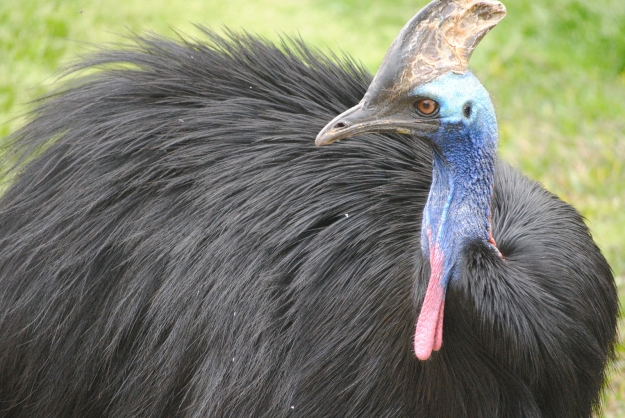
Photo by lailajuliana / Pixabay.com • The southern cassowary reaches a height of more than five feet and weighs 120 pounds. The bird has a fearsome but perhaps undeserved reputation for attacks on humans.
So, if humans have nothing to fear from brain-hungry birds, are there any birds that we should fear? Some experts suggest that precautions might be in order if one expects to come into close proximity with a southern cassowary, which is the third-tallest and second-heaviest living bird, smaller only than the ostrich and emu.
The cassowary, a native of New Guinea and northeastern Australia, has developed a reputation as a fearsome bird capable of injuring or killing humans. According to ornithologist Ernest Thomas Gilliard, cassowaries deserve their reputation. In his 1958 book, “Living Birds of the World,” he explained that the second of the three toes of a cassowary is fitted with a long, straight, dagger-like claw which can sever an arm or eviscerate an abdomen with ease. According to Gilliard, there have been many records of natives being killed by this bird.
A thorough study, however, has partly exonerated the cassowary from these misdeeds. In a total of 150 documented attacks against humans, cassowaries often acted in self-defense or in defense of a nest or chicks. The only documented death of a human took place in 1926 when two teenaged brothers attacked a cassowary with clubs. The 13-year-old brother received a serious kick from the bird, but he survived. His 16-year old brother tripped and fell during the attack, which allowed the cassowary to kick him in the neck and sever the boy’s jugular vein.

Mesembriornis_model

Model of the terror bird Mesembriornis at the Chicago Field Museum, prepared by taxidermist Leon L. Pray, seen on the left.

So we can rest easier knowing that murderous birds that reach a height of almost six feet tall are unlikely to terrorize us should we travel to the lands down under. A more ancient relative of the cassowary, however, might have been a different story had humans lived during the same time period. Phorusrhacids, also known as “terror birds,” were a group of large carnivorous flightless birds that once had some members reign as an apex predator in South America before they went extinct around two million years ago. The tallest of the terror birds reached a height of almost 10 feet. Titanis walleri, one of the larger species, even ranged into what is now the United States in Texas and Florida.

web-terror

Terror birds were equipped with large, sharp beaks, powerful necks and sharp talons. Their beaks, which would have been used to kill prey, were attached to exceptionally large skulls. Despite their fearsome appearance, these birds probably fed on prey about the size of rabbits. Perhaps not knowing this, Hollywood has cast these birds as monsters in such films as 2016’s “Terror Birds” and 2008’s “10,000 BC.”

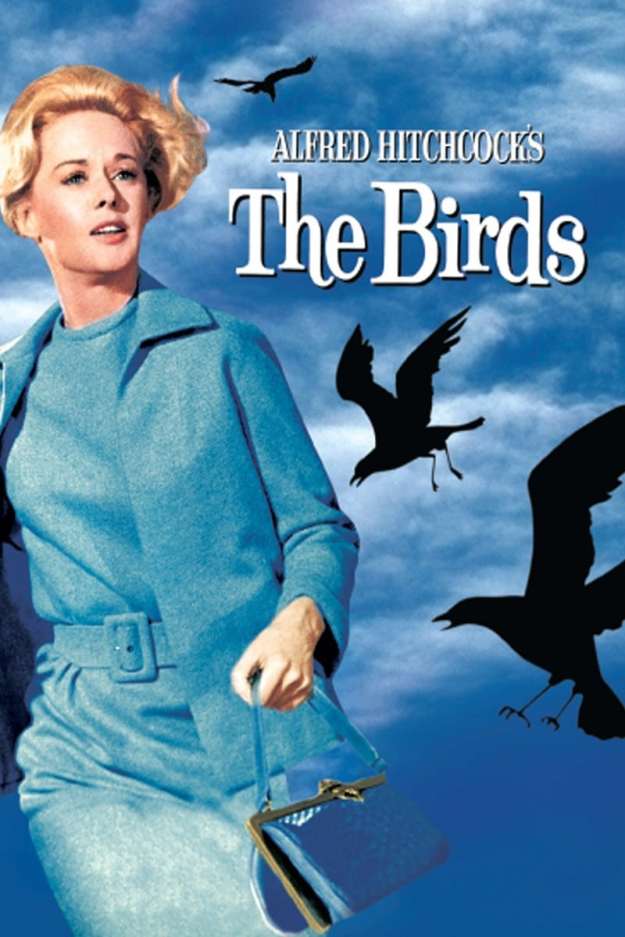
Besides, casting birds as the villains had already been done back in 1963 when Alfred Hitchcock released his film, “The Birds,” based loosely on a short story by Daphne du Maurier. The film, which starred some big Hollywood names such as Rod Taylor, Tippi Hedren, Jessica Tandy, Suzanne Pleshette and Veronica Cartwright, cast a whole new light on a “murder” of crows. Today, the film has achieved the status of a Hollywood classic. I guess it just goes to show that werewolves, zombies, and other Halloween monsters have nothing on our fine feathered friends.

TheBIRDS!

Mother Nature’s whims can produce major impacts on birds

Sooty_tern_flying

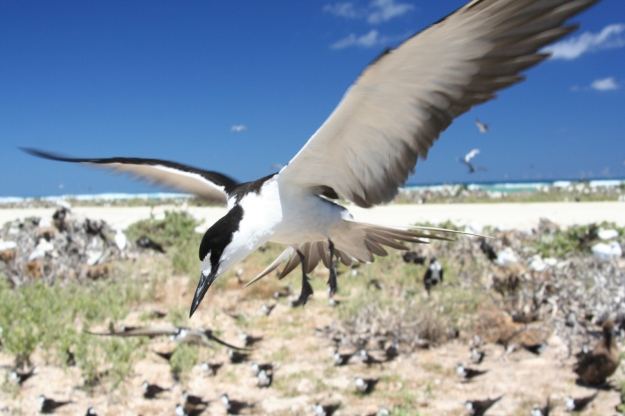
Photo by U.S. Fish and Wildlife Service/Duncan Wright The sooty tern, pictured, nests mainly in Hawaii, but some also nest on the islands of the Dry Tortugas, west of the Florida Keys. In 2004, Hurricane Frances blew one of these tropical birds to Holston Lake in Bristol. Severe storms also present devastating obstacles for other birds.

With Hurricane Florence dominating the headlines in recent weeks, it’s only natural to speculate on whether such storms can impact birds in a negative way.

According to a 2011 blog post made on the National Wildlife Federation website, hurricanes can be bad news for some birds. Naturally enough, sea birds and waterfowl are most exposed to the forces of a hurricane. Some birds will move inland to avoid the incoming storm. The birds that inhabit our yards and gardens will ride out the storm using special adaptations. Songbirds will automatically tighten their toes around their perches, riding out the winds of a hurricane by holding onto a branch with a death grip. It’s the same adaptation that lets them sleep on a branch without letting go and falling off during the night.

The blog points out that the news often covers the appearance of rare species after a major storm. Some of these birds transported to unusual locations are probably younger or weaker birds. Once transported far from their usual range by a hurricane, it can take weeks to return home — if they can find the right foods on their way back.

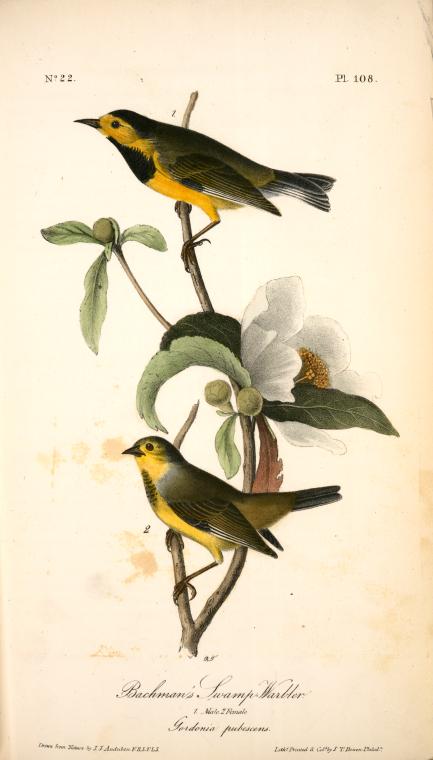
John-James-Audubon-Bachman_s-Swamp-Warbler.-1.-Male.-2.-Female.-Gordonia-pubescens.- (1)

Early naturalist and accomplished artist John James Audubon painted Bachman’s warbler without ever seeing a living one. A friend sent him some skins of the warbler collected near Charleston, South Carolina. A hurricane may have contributed to the extinction of Bachman’s warbler.

In a worst case scenario, hurricanes may have dealt fatal blows to some bird species. For instance, a hurricane may have delivered the knock-out blow to a species of warbler that went extinct last century, according to the website, Field Guide to Extinct Birds. A hurricane that slammed into Cuba in the 1930s when most of the Bachman’s warbler population was wintering on the island might have wiped out enough of the population to make the survivors too rare and far-flung to find each other to breed. The warbler, sensitive to habitat destruction from logging and already in a steep decline, never seemed to recover. It was the ultimate example of keeping all of one’s eggs — or birds — in one unlucky basket.

Discovered in 1832 near Charleston, South Carolina, by the Reverend John Bachman, this warbler attracted little attention for the first half century after its discovery. Bachman sent some skins of the bird to his friend, the artist and early naturalist John James Audubon. Subsequently, Audubon painted this warbler by using those skins and Bachman’s description of the bird’s habits for inspiration. Ironically, considering he described the species for science, Audubon never actually laid eyes on an actual living Bachman’s warbler.

The last specimens of Bachman’s warbler were collected in Mississippi in the early 1940s. The last strongholds for breeding Bachman’s warblers in the United States were Fairfax County, Virginia, in the 1950s and South Carolina’s I’on Swamp in the early 1960s. The last photograph documenting a Bachman’s warbler was taken in 1954. in Charleston, South Carolina, bringing the story of this warbler full circle from its discovery in the same vicinity back in 1832. No Bachman’s warbler sightings have been confirmed since 1961, despite reports in the 1970s and 1980s, as well as reports made in the spring of 2000 and 2001 in the Congaree Swamp National Monument in Richland County, South Carolina. None of those sightings could be confirmed.

Like the ivory-billed woodpecker and Eskimo curlew, Bachman’s warbler is another bird likely to be labeled for the near future with the tag “likely extinct” associated with its name. Like the large woodpecker and the shorebird with a penchant for long-distance migration, the Bachman’s warbler went out with a whimper, not a bang, with most of its viable population snuffed out by an October hurricane just as the species returned to Cuba for the winter season.

Ruby-throat

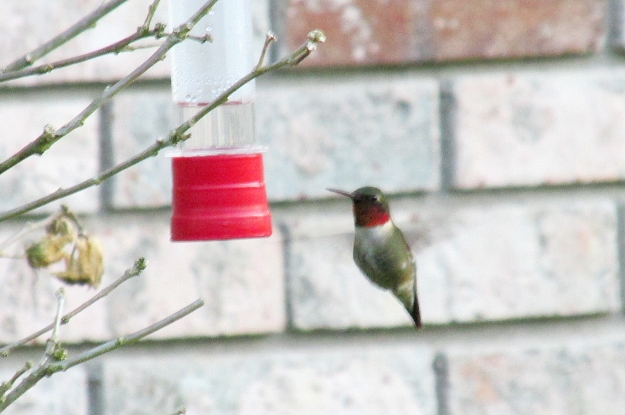
Photo by Bryan Stevens • Ruby-throated Hummingbirds make a non-stop crossing of the Gulf of Mexico. A hurricane in the Gulf during migration could have serious consequences for this small bird.

More recently, experts worried Hurricane Irma might have delivered a knockout blow to the population of another tiny species of warbler. The Barbuda warblers on the tiny Caribbean island of Barbuda were feared exterminated in the wake of Irma. When the storm hit the island in September of 2017, its path affected more than 90 percent of the island and nearly wiped out the available habitat for the warbler, which already had a Near Threatened status. After the passage of the storm, participants in searches for the warbler turned up sightings of the bird. Nevertheless, the population status and ability to fully recover remains uncertain.

Science keeps adding to its knowledge of how birds are affected by hurricanes and other storms. A 2017 study showed possible consequences for a seabird known as the sooty tern in relation to hurricanes.

The study, published in the peer-reviewed open-access journal PeerJ, is the first to map the birds’ annual migratory path and demonstrate how its timing and trajectory place them in the direct path of hurricanes moving into the Caribbean after forming over the Atlantic.

Climate change threatens to bring about more frequent and powerful hurricanes, which could be bad news for the terns. Migration is a stressful undertaking for birds. If they encounter a strong storm in a weakened state, the results could be catastrophic. The study revealed a strong relationship between the numbers and locations of bird deaths and the numbers and locations of hurricanes. The study also showed that it isn’t just monster storms with the potential to cause devastation. Tropical Storm Delia, a small storm in the Gulf of Mexico in 1973, killed a lot of sooty terns. Essentially, the terns were in the wrong place at the wrong time.

Shorebirds

Photo by Bryan Stevens • A mixed flock of Short-billed and Long-billed Dowitchers and a Ruddy Turnstone at Huntington Beach State Park in South Carolina. Hurricanes can interrupt the migrations of even these long-distance migrants.

Of course, the sooty tern is not a rare bird. About 80,000 or more of these terns are estimated to breed in the Dry Tortugas each year. That’s the entire point, however; Bachman’s warbler was also once considered a common bird.

All of these examples point to the resilience of birds, but there’s also a lesson to learn. We should never take any of our feathered friends for granted. While the winds and rains from a hurricane can decimate human lives, wildlife is not immune. Sadly, birds can weather many a storm, but sometimes they get swamped.


Common nighthawk flocks form part of fall migration spectacle

Nighthawk

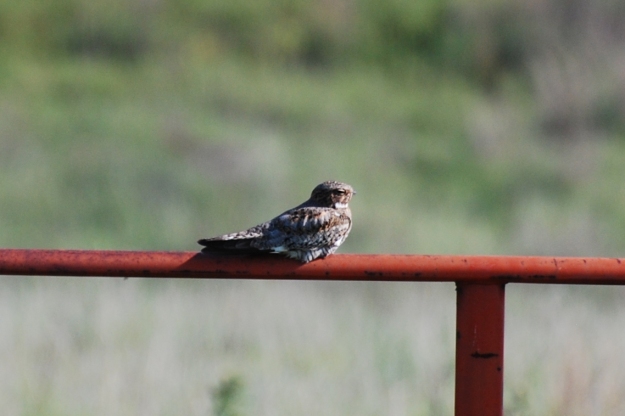
Photo by Jean Potter • A common nighthawk rests on a metal railing.

With September advancing on the calendar, I have been keeping an eye on the skies. For the most part, I focus on the upper branches of trees and feeders during the migration season, but I don’t forget the need to look skyward from time to time.

The reason? Well, that’s the best way to detect soaring raptors or flocks of migrating common nighthawks. The autumn sky is also a popular flyway for other birds, including chimney swifts and swallows.

So, what is a common nighthawk? First, this bird, despite what is implied by its name, is not a hawk. It’s also not strictly nocturnal. Particularly in the fall, nighthawks are active during daylight hours when engaged in catching winged insects. Outside of fall migration, these birds can often be observed over large parking lots or well-lit streets, snatching up insects swarming around the light poles.

The common nighthawk is one of three members of the nightjar family found in the region during the summer months. The other two nightjars are the whip-poor-will and chuck-will’s-widow, birds that produce their namesake vocalizations in the nocturnal hours. Both of these species migrate, but they don’t take the dramatic approach employed by nighthawks. Each fall, common nighthawks form large flocks, ranging in size from dozens to hundreds or even thousands of individuals, as they migrate south for the winter.

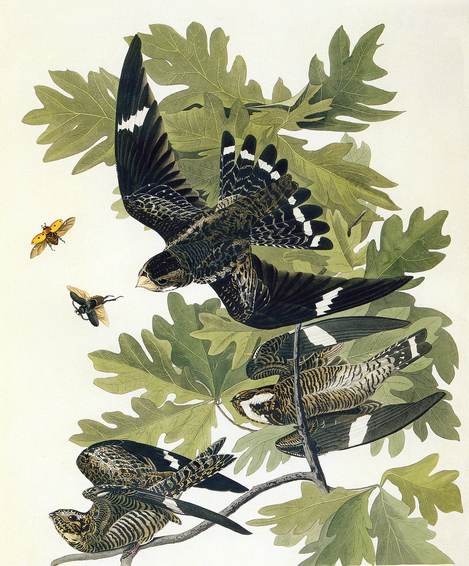
john_james_audubon_common_nighthawk_bird_print

Early American naturalist and artist painted this dynamic scene of common nighthawks.

The whip-poor-will, after the common nighthawk, is the second most widespread member of its family to spend its breeding season in North America. The whip-poor-will ranges from southern Canada to the Gulf states. This bird also occurs in Arizona, New Mexico and southwestern Texas. The whip-poor-will favors habitat consisting of deciduous woodlands and the edges of forests.

All members of the nightjar family feed exclusively on insects that are caught on the wing. In this respect, the nightjars can be considered the nocturnal counterparts of the swallows. The nightjars have comparatively large, gaping mouths they use to scoop up flying insects. They also have large eyes, an adaptation to their nocturnal lifestyle.

Whip-poor-will numbers have been declining in the past few decades. These nocturnal birds frequent woodland edges, but they seem to be rather particular about such habitats. A forest that is too mature seems to hold little interest for them. Disturbed habitats, such as those created by logging, are acceptable to the birds once secondary growth begins. As this new growth matures, however, the whip-poor-will apparently abandons such territory. Because of these requirements, whip-poor-wills can be somewhat localized in their distribution and sometimes difficult to locate.

Nighthawk-PHOTO

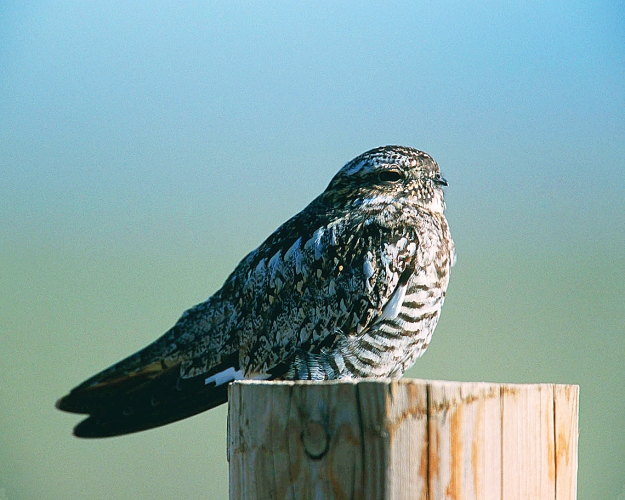
Photo by U.S. Fish and Wildlife Service • A common nighthawk finds a perch for a brief rest.

When I was a kid, one of my favorite summer activities was sitting on the front porch of my grandparents’ home and listening to the whip-poor-wills call after dark. I remember how the plaintive call would be repeated for long intervals before a passing automobile’s headlights might frighten the bird into silence. Then, after a brief pause, the “whip-poor-will” calls would, tentatively at first, begin again and continue throughout the night.

Today, I’m living in my grandparents’ old home, and the whip-poor-wills no longer call. I heard a single individual that called for a single evening back in May of 1997, but that was apparently a migrating bird that did not remain in the surrounding woodlands. The only member of the nightjar family that I dependably encounter at home these days is the common nighthawk, and then only during that narrow window of late summer and early autumn.

Unlike whips and chucks, the common nighthawk isn’t active only after dark, which makes it much easier to observe these birds. They look somewhat like swifts and swallows but are much larger. They are brownish-gray birds with pointed wings and forked tails. They are easily identified by distinctive white patches on the underside of their wings.

The nightjar, or Caprimulgidae, family of birds is also sometimes known as “goatsuckers.” There are almost 80 species of nightjars in the world. Less than 10 occur in North America. The common nighthawk, whip-poor-will and the chuck-will’s widow are neotropical migrants. While they breed in a wide range of territory in North America, they spend their winters in Central and South America. Like all nightjars, nighthawks feed almost exclusively on insects, which they catch on the wing.

Many of the common nighthawk’s relatives have been given descriptive names, such as long-trained nightjar, collared nightjar, spot-tailed nightjar, red-necked nightjar, golden nightjar, fiery-necked nightjar, swamp nightjar, pennant-winged nightjar, lyre-tailed nightjar, little nightjar, sickle-winged nightjar, rufous-bellied nighthawk, short-tailed nighthawk, sand-coloured nighthawk and least nighthawk.

So, keep looking skyward. The next flock of migrating common nighthawks may fly over your home. These flocks are usually on the move throughout September although they begin to appear as early as late August. They can also appear almost magically, as if out of thin air. First, observers may see one of two birds, then several, followed quickly by dozens or sometimes hundreds as they wheel and cavort in the skies overhead with impressive grace and agility. I’ve seen flocks that would easily number more than 500 birds in locations throughout the region, although flocks often number only a couple of dozen birds. The two flocks I’ve observed so far this migration season numbered about thirty and fifty birds, respectively.

41004068_10215014667832542_3336138056443887616_o

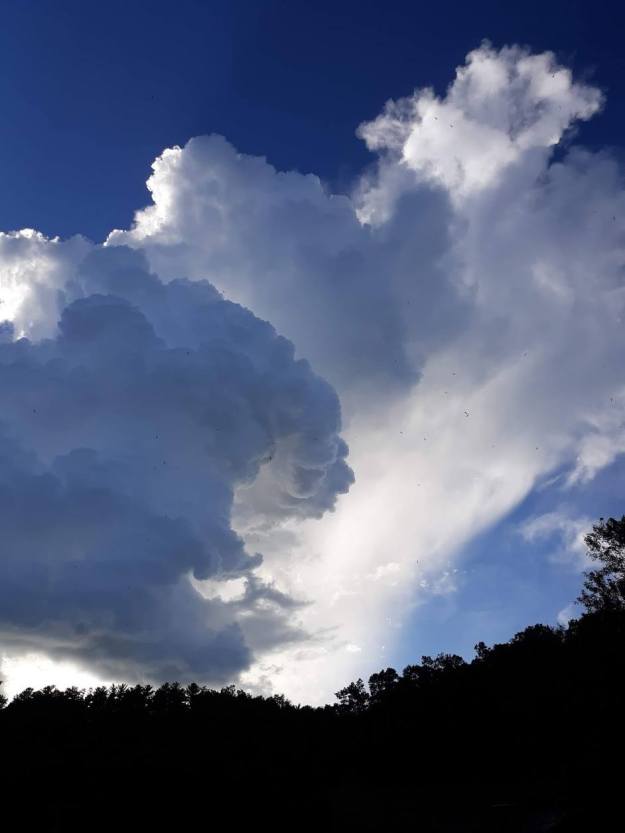
Photo by Bryan Stevens • Rising clouds provide a backdrop for a flock of migrating nighthawks.


Chipping sparrow a common summer nesting bird

ChippingSparrow-ONE

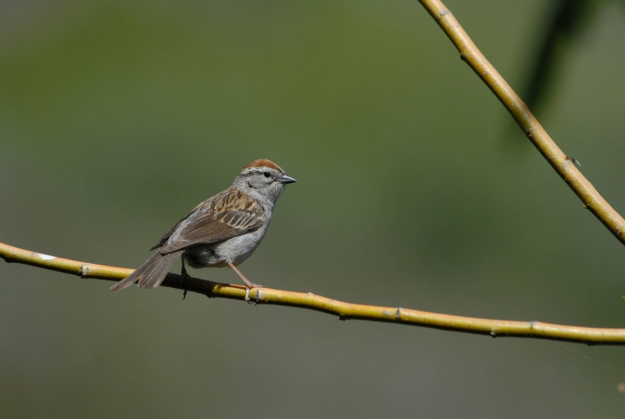
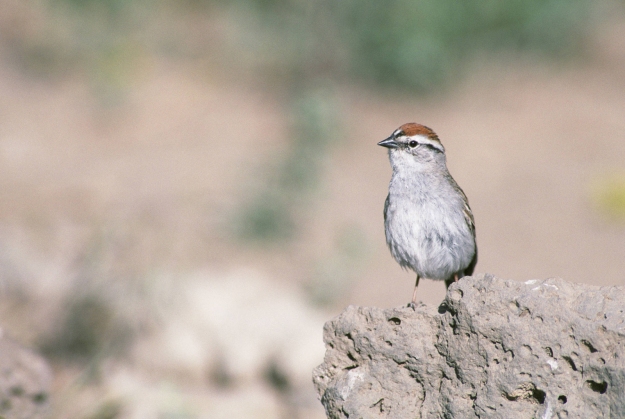
Photo by Dave Menke/USFWS • A black line running through the eye bordered by a white stripe, as well as a rusty-red cap, helps distinguish the chipping sparrow from other “little brown birds” that belong in the sparrow family.

I needed to do some homework before I could answer a question posed to me by Frances Rosenbalm of Bristol, Tennessee. As she communicated to me in an email, she had discovered a bird’s nest in her garden and wanted help identifying the species that built the nest.

“I have a bird that made a nest in the top of my tomato vines,” Frances explained in her email. “It had four turquoise speckled eggs in it.”

Frances described the nest as being made with large twigs and moss. “What kind of bird do you think it may be?” she wrote. She also noted that her garden is located near a farm field.

“I was so surprised to find this nest,” she wrote. “In all of all the years I have put a garden out, this has never happened,” Frances concluded.

51bUn1kQ7XL._SY291_BO1,204,203,200_QL40_ 2

After doing some research, which included poring over the pages of a great book by Hal H. Harrison titled, “A Field Guide to Birds’ Nests: United States East of the Mississippi River,” a work in the Peterson Field Guides series, I was able to write back to Frances with the news that I might have solved the mystery of the nest in the tomato vines.

The Harrison field guide is an exceptional book and one that’s perfect for someone who wants to know a little more about the birds other than their names. Entries for each bird include photographs depicting both the nest and the eggs as well as informative text with supplemental information about nesting birds in the Eastern United States.

Based on the description of the nest and its eggs, as well as its location near a farm field, I identified the nest described by Frances as belonging to chipping sparrows. I found some photographs online of chipping sparrow eggs in a nest and sent that in an email for her to consider.

Frances responded in another email. “I do believe you are right,” she wrote. “The eggs look a lot like the photo, and I have seen some birds that look like (chipping sparrows) flying around.”

For a species often lumped under the grouping of “Little Brown Birds,” the chipping sparrow is quite distinctive. In spring and summer, chipping sparrows sport a crisp, neat plumage with frosty gray underparts, a gray and white face and a striking black line through the eye. An easily recognizable field mark is the bright rusty crown atop the bird’s head.

ChippingSparrow-TWO

Photo by Dave Menke/USFWS • Chipping sparrows will form flocks for the winter season.

When horses were more common in daily American life, the chipping sparrow took advantage of this resource to almost invariably line their nests with horsehair. Now that not all nesting chipping sparrows have access to horses, these birds use fine plant fibers or hair gathered from other sources, including people, to line their nests.

Once a nest is constructed, a female chipping sparrow lays and incubates three to four eggs, which take about 14 days to hatch. Chipping sparrows often attempt to raise two broods in a single nesting season. Although dense evergreen trees are a preferred nesting location, these birds will also nest in vines.

During the warm months of the summer nesting season, chipping sparrows feed almost exclusively on insects. When winter makes insects scarce, these small birds switch their diet to one of seeds. Chipping sparrows will also feed on small fruits and berries.

Chipping sparrows will sometimes nest as many as three times in a single season. Although territorial during the nesting season, these birds form sizable flocks for migration and during the winter season. In making reference to these flocks, observers can use other descriptive terms. Flocks of sparrows have also been called a crew, a flutter, a host, a tournament and a quarrel. I am partial to a flutter of sparrows, but anyone who has watched the pecking order at the feeders will also understand the origins of a quarrel of sparrows.

Chipping-sparrow-john-james-audubon

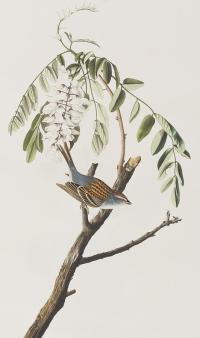
John James Audubon painted this chipping sparrow.

There are a couple of well-known Biblical passages using sparrows for powerful pieces of symbolism. One alludes to the fact that if God provides for small songbirds like sparrows, he will certainly provide for human beings. In addition, there is a passage that maintains that not a single sparrow falls without God being aware of the loss. A famous hymn, “His Eye is on the Sparrow,” is based on such biblical verses.

The world’s sparrows are divided into two large groupings — the Old World, or true sparrows, and the American sparrows of the New World.

Although largely considered rather dull, plain birds in appearance, some of them have earned descriptive names such as great sparrow, Arabian golden sparrow, green-backed sparrow, five-striped sparrow, yellow-browed sparrow and golden-crowned sparrow.

FieldSparrow-One

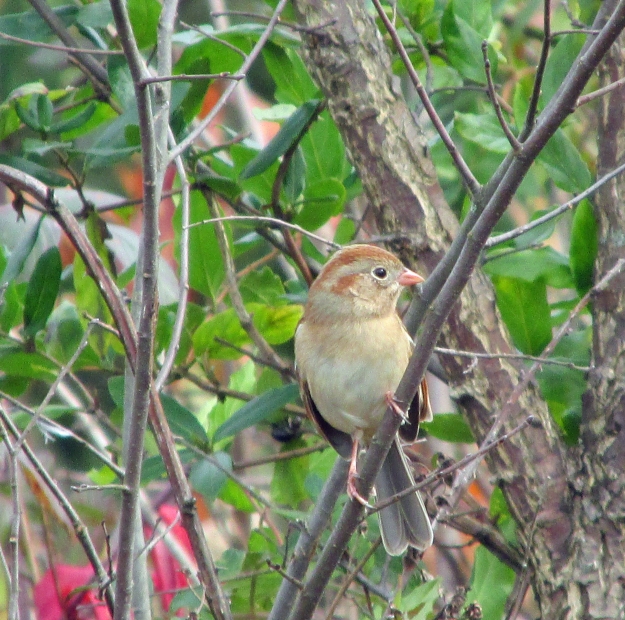
Photo by Bryan Stevens • A field sparrow perches on a branch. These sparrows are closely related to chipping sparrows and relatively common in Northeast Tennessee.

Welcome chipping sparrows and their kin with a well-stocked feeder and perhaps some thick tomato vines for concealing a nest. Unfairly dismissed by some as plain, dull songbirds, the sparrows reward a closer look with some subtle behaviors and plumages as worthy of additional attention as much as some of their more colorful relatives.

Rally to offer sneak peek at bird migration, other nature activities

CapeMayWarbler

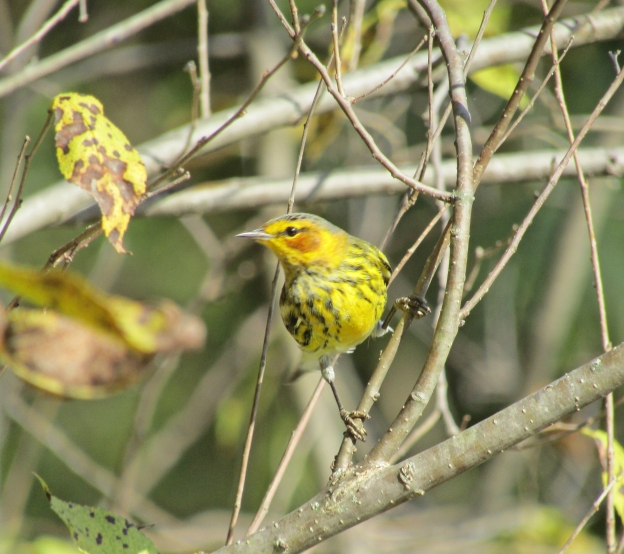
Photo by Bryan Stevens • While the Cape May warbler doesn’t breed locally, these warblers are fairly common spring and fall migrants in the region.

The 56th Roan Mountain Fall Naturalists Rally will draw nature enthusiasts from far and wide to this jewel of the Southern Appalachians on the first weekend after Labor Day with programs, nature walks, catered meals, and much more.

The annual Fall Naturalists Rally is always a great opportunity to enjoy the outdoors and, for birders, get a sneak peek at fall migration with any of the walks and programs focusing on our fine feathered friends. The best naturalists in the region volunteer their time and energy to make this a landmark event for people of all ages.

This year’s rally, which is scheduled for Friday-Sunday, Sept. 7-9, will feature guest speakers, Gabrielle Zeiger and Dr. Joey Shaw, for the main programs on Friday and Saturday evenings.

Zeiger’s Friday program, “Zen and the Art of Mushroom Hunting,” will get underway at 7:30 p.m. following a catered dinner at 6:30. Zeiger has been studying mushrooms in the region for 23 years. She considers herself more of a mushroom enthusiast than an expert. She is a member of the North American Mycological Association, and attends their national forays. She is involved in the association’s annual Wildacres foray in the Blue Ridge Mountains near Mount Mitchell in North Carolina.


Photos by Bryan Stevens • Mushrooms will feature in one of this year’s evening programs at the Fall Naturalists Rally.


Her program will focus on the two basic approaches — looking for good edibles and scientific study — to mushroom hunting. Her talk will touch on both approaches and include basic information on common mushrooms found in the area, species diversity and poisonous versus edible mushrooms. The program will include various types of fungi from gilled mushrooms, boletes, corals, stinkhorns and polypores, as well as the roles that they play in the environment such as decomposition and forest ecology. She will also talk about what mycologists do at forays. Findings will be included regarding 20 years of record keeping at Roan Mountain and scientific information on studies at Mount Mitchell regarding amount of rainfall and diversity of fruiting.

Photos Contributed • From left: Gabrielle Zeiger and Joey Shaw are this year’s featured speakers.


Saturday’s program on “Digitizing Tennessee’s One Million Herbarium Specimens,” will also start at 7:30 p.m. followed by a catered meal at 6:30. Dr. Joey Shaw received a bachelor’s of science in biology from the University of Tennessee at Chattanooga in 1998, and that same year began his graduate education in the Department of Botany at the University of Tennessee, Knoxville. In 2001, he received his master’s in botany for a floristic investigation of the Big South Fork National River and Recreation Area in Tennessee and Kentucky. In 2005 he received his Ph.D. from the University of Tennessee, Knoxville, for his work on the phylogeny and phylogeography of the North American plums and molecular evolution of different genetic regions of the chloroplast genome.

Shaw is currently serving the Association of Southeastern Biologists as Past President and will rotate off this Executive Committee in April 2019, after having served for over ten years and in all ranks of that committee. He is also serving as Chair of the Wildflower Pilgrimage Organizing Committee, and in this capacity he organizes this annual event that brings together more than 120 professional biologists with 850 members of the public to participate in more than 150 different events over four days every spring in the Great Smoky Mountains National Park.

Blue-headedVireo

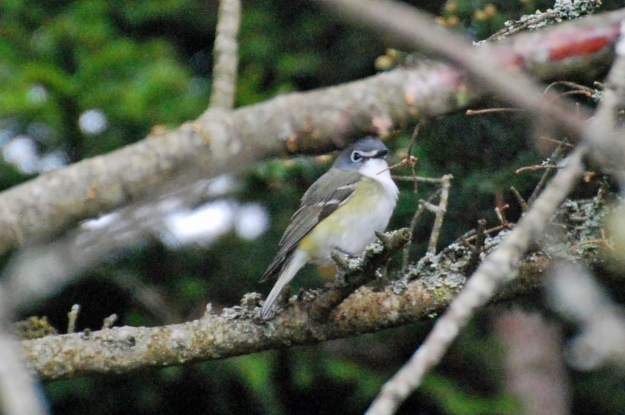
Photo by Bryan Stevens • Blue-headed vireos, such as this bird, are high-elevation summer residents in the region. In the fall, they are also common migrants.

Evening and lunch programs will take place in Roan Mountain State Park’s Conference Center and unless other noted, field trips will leave from the field on the left before the cabins in the park.

In addition to the programs, morning and afternoon walks will be held Saturday and Sunday on a vast array of subjects, including birds, salamanders, butterflies, spiders, snakes, geology, mosses and liverworts. A “moth party” will be held after the Friday and Saturday programs. Larry McDaniel will host this party taking a look at these winged nocturnal insects outside the Conference Center.

Consider joining the Friends of Roan Mountain, if you are not a member. Members get free admission to all Naturalists Rally events and the newsletter, “Friends of Roan Mountain.”

The rally offers catered evening meals by City Market of Elizabethton, as well as brown bag lunches on Saturday. All meals must be pre-paid in advance.

Registration and payment for meals and other activities can be made at the website for Friends of Roan Mountain at friendsofroanmtn.org. The website can also provide a brochure for download that offers a complete schedule and details all the available activities at this year’s rally. Whatever your interest, the Roan Mountain Fall Naturalists Rally is sure to have an activity available. For local birders, it’s often the kick-off to the fall migration season as warblers, vireos, thrushes, tanagers, birds of prey and many other species pass through the region on their way to their wintering grounds.

Tanager-Sept18

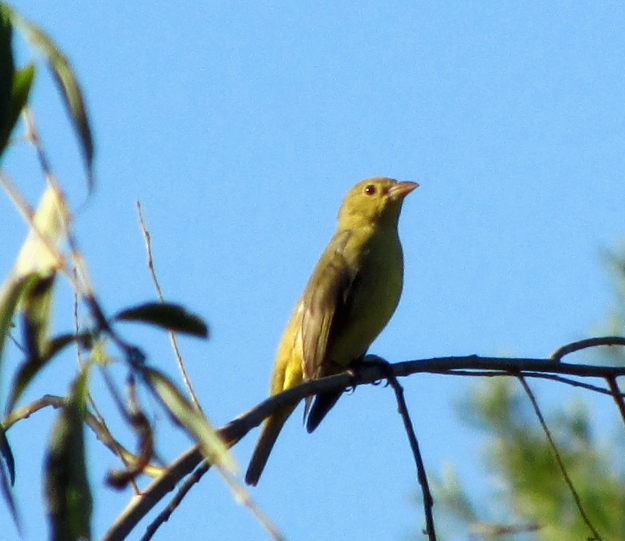
Photo by Bryan Stevens • A female scarlet tanager is a study in contrast from her mate with her dull greenish-yellow plumage being much less vibrant than the male’s bright red and black feathers.

Meadowlarks fond of grassland habitats

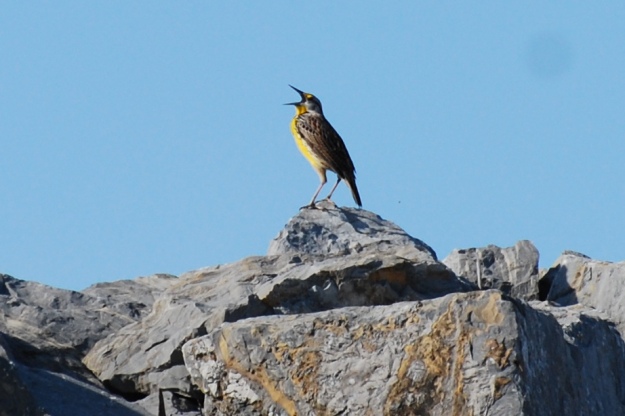
Jean-MeadowlarkPhoto by Jean Potter • A rocky outcrop provides a perch for this singing male Eastern meadowlark.
 

It’s always fun to add another notch to one’s list of birds. Whether you’re a casual lister or a devoted birder, a new species always offers a burst of excitement in the wake of a first-time observation.

Sharon Foster sent me an email recently to share her excitement about a sighting.

“I’m excited to say my daughter and I spotted a meadowlark up on Cross Mountain last week,” Sharon wrote in her email.

Sharon said she hadn’t been able to do a lot of bird watching other than in her yard and nearby places.

“I never thought I was going to see a meadowlark,” she noted. They are fantastic. We were thrilled. He was just sitting on the fence.’

She added that she didn’t have her good zoom camera with her, or else she could have taken a picture. She will still have her memory of her first sighting, and that’s what is important.

BaltimoreOriole-Two

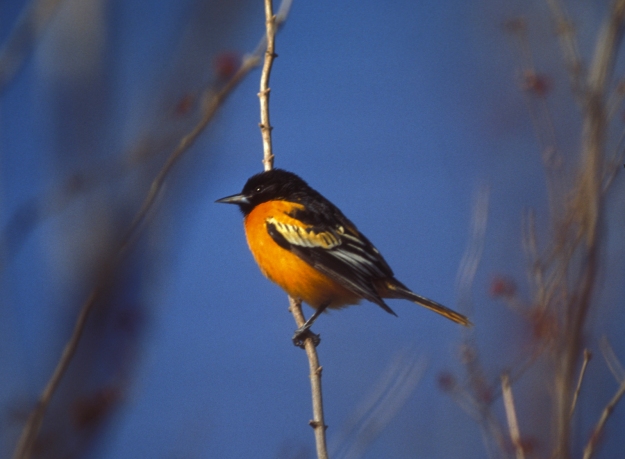
Photo by USFWS • Baltimore orioles, like this male, are members of the blackbird family, making them relatives of species such as Eastern meadowlarks, brown-headed cowbirds, common grackles and red-winged blackbirds.

She also told me about a Baltimore oriole feeder she bought last fall late in the season.

“I read they usually come around early in spring,” Sharon wrote. She added that she spotted one in her yard by South Holston Lake several years ago.

Of course, when spring rolled around she nearly forgot about the feeder. “It was around mid-April when I thought about it and thought it was too late,” she wrote. “But I put it up anyway and lo and behold the next day there was an oriole in our pine tree.”

It was another memorable birding moment. “Talk about being excited,” Sharon wrote. “Wow! Birds can do that to you!”

WesternMeadowlark

Both the Baltimore oriole and the Eastern meadowlark belong to the family of birds known as icterids, or blackbirds, which also includes species like bobolink, brown-headed cowbird, common grackle and red-winged blackbird.

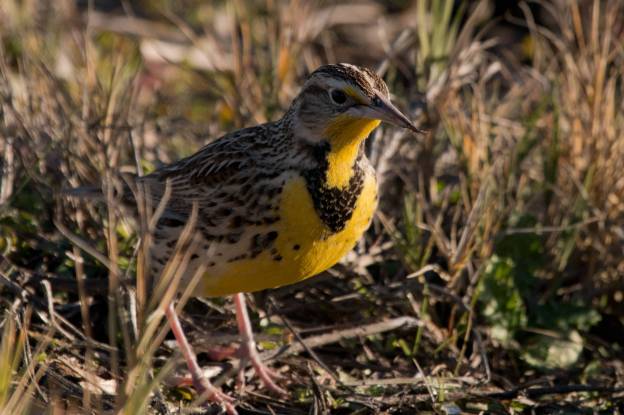
The Eastern meadowlark is a distinctive bird. It has brown plumage accented by black, with bright-yellow underparts and a bold black V across the chest. Though most of the tail is brown with blackish barring, the outer feathers are white and are a conspicuous trait to look for when the bird is in flight.

The Eastern meadowlark is considered a grassland bird and remains common in habitats such as prairies and other native grasslands. The meadowlark has proven adaptable as long as it can occupy unbroken grassland of about six acres or more. Pastures, fields and even airports have proven suitable habitats for meadowlarks. As suburban areas and subdivisions expand into rural areas, meadowlarks can hang on unless the grassland habitat becomes too segmented and broken into sections too small to be of value.

Meadowlark-USFWS

Photo by Peter Pearsall/USFWS • Eastern meadowlarks spend a lot of time on the ground while searching for insects.

Meadowlarks eat mostly insects, especially in summer. For the winter months, these birds will adapt their diet to include seeds, spilled corn and fruit. Meadowlarks, unlike other relatives among the Icterids, or blackbirds, do not typically visit feeders.

These birds construct nests close to the ground. Meadowlarks nesting in fields mown for hay face disaster if the grass is cut before their young have left the nest. The female meadowlark constructs the nest and lays two to seven eggs, which will require an incubation period of about two weeks. Even after hatching, the young are not capable of leaving the nest for another 10 to 12 days. Consequently, young meadowlarks are vulnerable for a month, not only to predators but to a farmer deciding to mow a hayfield.

While the Eastern meadowlark remains common, its numbers have suffered severe declines. such that they are considered to be a declining species. Populations fell more than 3 percent a year between 1966 and 2015, resulting in a cumulative decline of 89 percent, according to the North American Breeding Bird Survey. According to the website All About Birds, early mowing, overgrazing by livestock and pesticide use are all detrimental to meadowlark survival.

The highest population densities for the Eastern meadowlark are found in the Central Mixed Grass Prairie and the Eastern Tallgrass Prairie regions of the central United States. As the name suggests, the Eastern meadowlark has a counterpart in the western half of the United States. This is reflected in the fact that five central and western states — Kansas, Montana, Nebraska, North Dakota, Oregon and Wyoming — have made the Western meadowlark their official state bird. Ironically, the Eastern meadowlark has not been honored with that designation by any of the states it inhabits.

The difference in the two species rests not so much in their appearance as in their songs. The western meadowlark has distinctive vocalizations described as rather flute-like, which distinguish it from the closely related eastern meadowlark. Male Eastern meadowlarks seek out elevated perches to produce a musical, flute-like song in the spring. Utility wires, treetops and fence posts provide some of their favorite perches. Their singing is mostly used to define the borders of their grassland territory.

Finally getting your binoculars on a bird you’ve never seen is always an exciting moment. As we draw closer to the fall season, many different birds will migrate through the region. Fall migration is a great time to spend some time outdoors and try to see some birds that are new. Do some advance homework with a good field guide and study the birds that migrate through the region. Then, simply monitor your yard or a favorite park and wait to see some new species as they make migratory stops in the region.

eastern-meadowlark-john-james-audubon-

Early American naturalist and painter John James Audubon painting this scene depicting nesting meadowlarks.