Tag Archives: migrating birds

Birds make use of various strategies to attract and keep mates

Shauna Fletche/Pixabay • Some birds, like waxwings, like to present tasty treats to their potential mates.


With Valentine’s Day around the corner, it’s an opportune time to see how courtship is handled among our fine feathered friends. Most birds don’t bring a box of chocolates or a bouquet of roses when they take up courtship of a prospective mate, but birds have several equivalent behaviors that they employ to attract the attentions of the opposite sex. In honor of Valentine’s Day I thought a look at some of the more unusual courtship rituals of some of our feathered friends would be appropriate.

Aerial acrobatics designed to impress

In late winter and early spring, a true oddball begins courting. The American woodcock, also known by such whimsical names as “bog sucker” and “timberdoodle,” is a shorebird that has completely abandoned the shore in favor of woodlands and fields. Beginning as early as February, American woodcocks in the region conduct nightly courtship displays, starting at dusk, that combine aerial acrobatics with an assortment of unusual acoustical flourishes. Any wet field adjacent to a wooded area could offer a stage for these evening displays, but unless you know where to look and make an effort to do so, the American woodcock might as well remain a phantom of the night.

These mating rituals provide almost the only time of the year during which this bird makes itself available for observation. It’s only during this brief window that opens into their lives that we can be assured a glimpse. Even then, our peeks at woodcocks often consist of a fuzzy twilight escapade as the bird flings itself heavenward only to make a spiraling descent a few seconds later. The displays begin with a distinct vocalization, a type of “pent,” that also has the quality of sounding like some sort of mechanical buzzer.

Once the displays conclude for the season, the birds assume nesting duties, usually unobserved by humans. The rest of the year, almost nothing but blind, sheer luck would allow a birder to stumble across an American woodcock. It’s almost as if they disappear after these spring flights of fancy.

Birds bearing gifts

Many birds present small trinkets to a prospective mate. For instance, many male penguins make a present of a stone or pebble to female penguins. There could be more than a simple bribe behind this gift. Female penguins don’t build elaborate nests. In fact, a scrape on the bare ground, perhaps encircled by a collection of pebbles, marks the extent of their nest construction. So, the perfect pebble could be the way to winning a female penguin’s heart.

The way to the heart is through the stomach

Observant birders may have witnessed a male Northern cardinal slip a female a morsel of food, such as a peanut or a shelled sunflower kernel. It’s a marked change for this bird. During the winter months, a male cardinal is more likely to chase a female away from a feeder rather than share food with her. However, as spring approaches, his behavior undergoes a change and he becomes content to feed next to a female cardinal, often slipping her some choice tidbits.
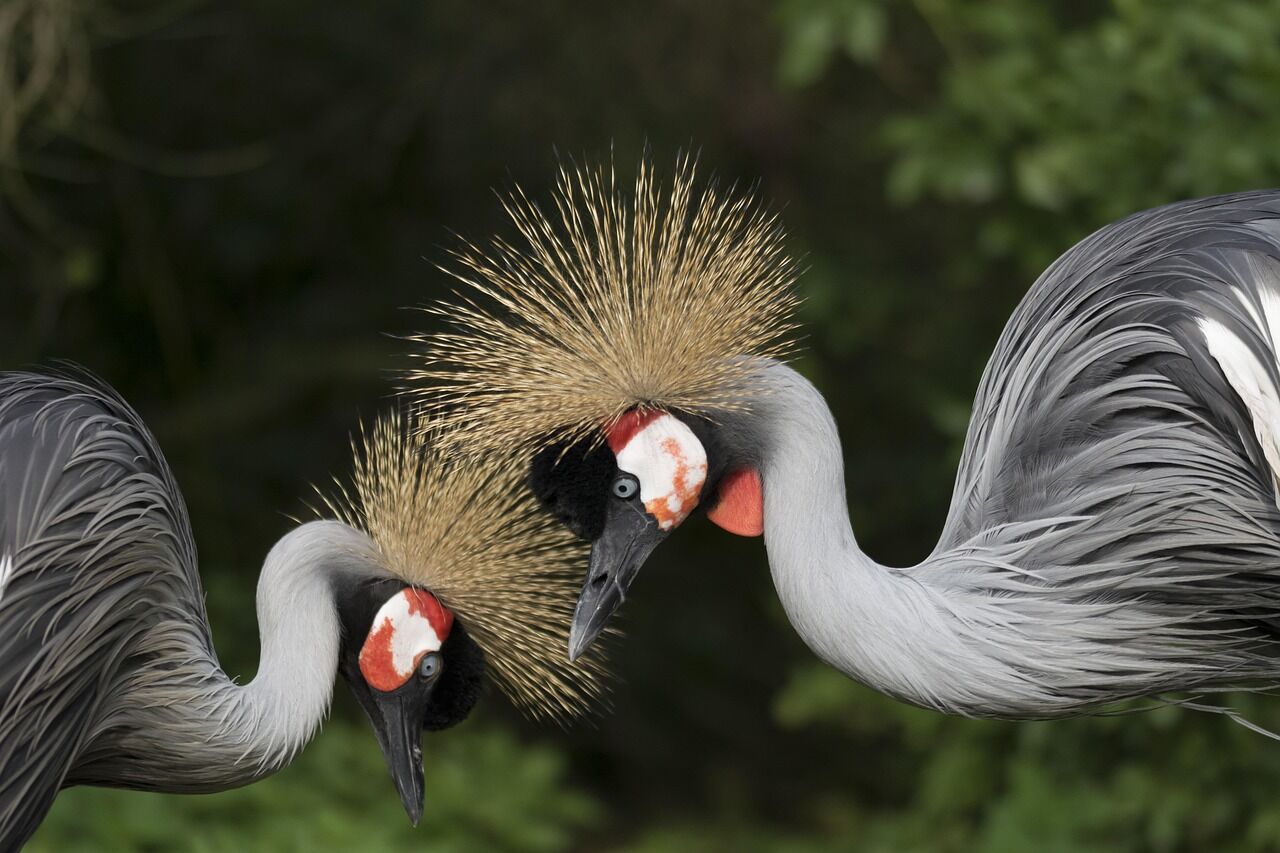
Sabine van Erp/Pixabay • Bow to your partner: Grey-crowned cranes perform an elaborate dance designed to strengthen their bond.

May I have this dance?

Many species of birds perform elaborate and ritualistic dance displays. Among birds known for tripping the light fantastic are flamingoes, cranes, grouse and grebes. Cranes are one of the oldest families of birds on earth. They’re also some of the most accomplished dancers in the animal kingdom. Pairs perform very ritualistic dances that, if the performers were human, would no doubt require the services of an accomplished choreographer. Cranes mate for life and the ritual of dancing is a way to strengthen the bonds between a mated pair. The ability to dance is, apparently, not instinctive. Young cranes must practice their dance moves, a process that can take years before they master the elaborate dance.

Dave Menke/U.S. Fish & Wildlife Service • A pair of Clark’s Grebes displays in a courtship ritual known as “rushing” or “weed dance.” Birds use a variety of strategies to attract and keep mates.

Synchronized swimming

While many birds dance to impress a mate or strengthen pair bonds, grebes perform a dance that takes place completely on the surface of the water. A pair will engage in this intricate performance, perfectly mirroring the moves of the other as they literally race across the surface of the water. These dances by grebes are also known as “rushing” or “weed dance.” It’s called as a weed dance because at the culmination of the ritual, the birds usually hold some type of aquatic plants in their bills while racing swiftly over the surface of the water. Pairs that perform well together stay together, building a nest and raising young.

Good housekeeping seal of approval

The tropical family of bowerbirds are famous for complex nests built by males and then decorated with bright and colorful objects to catch the eye of a potential mate. The nests of these birds are actually referred to as a “bower.” Usually constructed on the ground, the male will line the approachs to the bower with items such as shells, leaves, flowers, feathers, stones, berries, and even discarded garbage, including plastic scraps or bits of glass. Unusually odd items pressed into these decorative displays have included coins and spent rifle shells. This habit of male bowerbirds must rank as the ultimate in trying to impress a mate with shiny bling.

These are just a few of the inventive ways that birds go about attracting and keeping mates. Perhaps you can pick up some pointers from our feathered friends to ensure you have a great Valentine’s Day this year.

•••

If you have a question, wish to make a comment or share a sighting, email me at ahoodedwarbler@aol.com.

Elizabethton Bird Club announces speakers for fall programs

Brayden Paulk will speak to the Elizabethton Bird Club on Sept. 3 on the topic of microfishing.

The Lee and Lois Herndon Chapter of Tennessee Ornithological Society, also known as the Elizabethton Bird Club, will soon begin its schedule of monthly meetings for 2024-25.

The brief business meetings are always accompanied by an informative and entertaining program on birds, birding or other subjects from the natural world.

These programs are a great way to learn more about our feathered friends as well as other related subjects from the natural world. They are free, open to the public and hosted by a welcoming group of people.

Here’s the schedule for Fall 2024:

September

Brayden Paulk, a young naturalist with family ties in Unicoi County, will present the first program on Tuesday, Sept. 3, with a talk on “Microfishing,” which involves anglers focusing on a diverse array of tiny species of fish.

Paulk has also been working as a naturalist with Lamar Alexander Rocky Fork State Park this summer and fall. He gave a program a couple of years ago for the club on “Trash Fishing,” which explored other angling options other than the typical gamefish species. As both fishing and birding are among his interests, he will no doubt find a way to work something into his program about birds.

October

The guest speaker for the meeting on Tuesday, Oct. 1, will be Mark Stevens. A former publisher for The Erwin Record, he will present a program titled “Building a Birding Festival” that will focus on his development of the Hammock Coast Birding Festival in South Carolina. Stevens, who works as tourism director for the Georgetown County Chamber of Commerce, will be giving the program remotely from his home in South Carolina, but the hybrid meeting also offers a chance to attend in-person with other birding enthusiasts. The festival is organized by the South Carolina Hammock Coast, the marketing arm for the Georgetown County Chamber. The third annual Hammock Coast Birding Festival is scheduled for Feb. 6-9, 2025.

November

Vern Maddux, the treasurer for the club, will be the speaker on Tuesday, Nov. 5. Maddux is a world traveler when it comes to seeing birds and will present a program on one of his recent international birding adventures to South Georgia and Falklands. South Georgia is a mountainous barren island in the South Atlantic Ocean, 800 miles east-southeast of the remote South Atlantic archipelago that makes up the Falkland Islands. With rugged terrain and cliff-lined coasts, the hundreds of islands and islets in the Falklands are home to sheep farms and abundant birdlife.

December

In the busy month of December, yours truly will give the program. I will present a powerpoint presentation titled “What’s in a Name?” on North American birds named after people. Among our native birds, we have quail, woodpeckers, sparrows, finches, warblers, hawks and other birds are known by names of historical figures ranging from John James Audubon to William Clark and Meriwether Lewis.

My program will be held on Tuesday, Dec. 3. I will discuss the American Ornithological Society’s decision in 2023 to end what are known as eponyms, in which species names honor people. The renaming of dozens of species will be a gradual process.

The club’s 2025 schedule has not been completed, but will include a program by local naturalist Lewis Tester in the spring on dragonflies.

The public is always welcome to attend these programs. Programs begin at 7 p.m.

The club meets at the Elizabethton campus of Northeast State Community College in Room 135 when the school’s schedule permits. When school is not in session, meetings are held on Zoom or at other announced locations. To receive updates on the club’s schedule, events and activities, email elizabethtonbirtdingclub@gmail.com and ask to be placed on a free mailing list.

The Elizabethton Bird Club holds seasonal birds count in spring, summer, fall and winter. The club also organizes and sponsors regular field trips to destinations through Northeast Tennessee. These activities are also open to interested members of the public.

•••

To share a sighting, make a comment or ask a question, email me at ahoodedwarbler@aol.com.

More readers share their hummingbird arrival stories

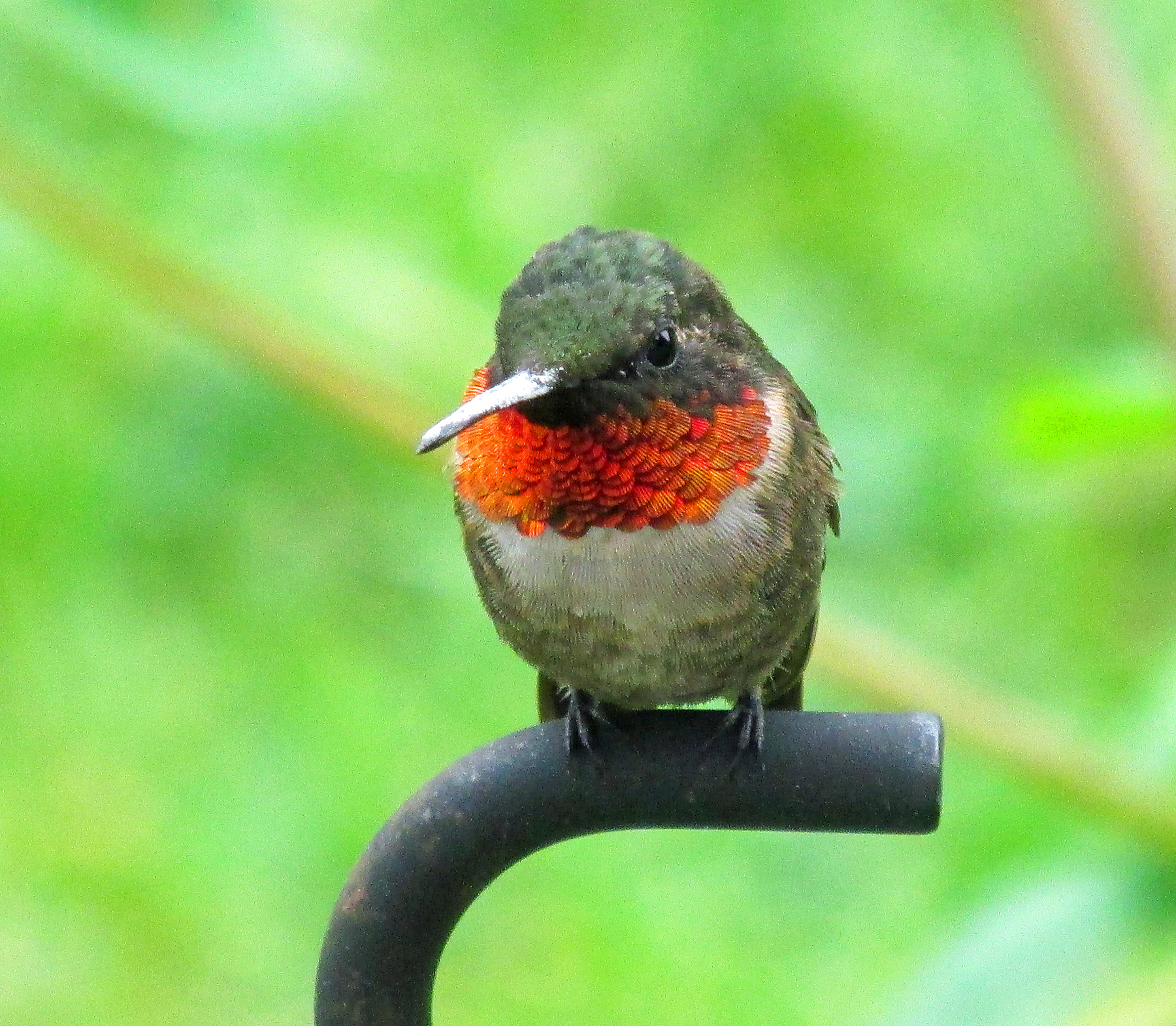
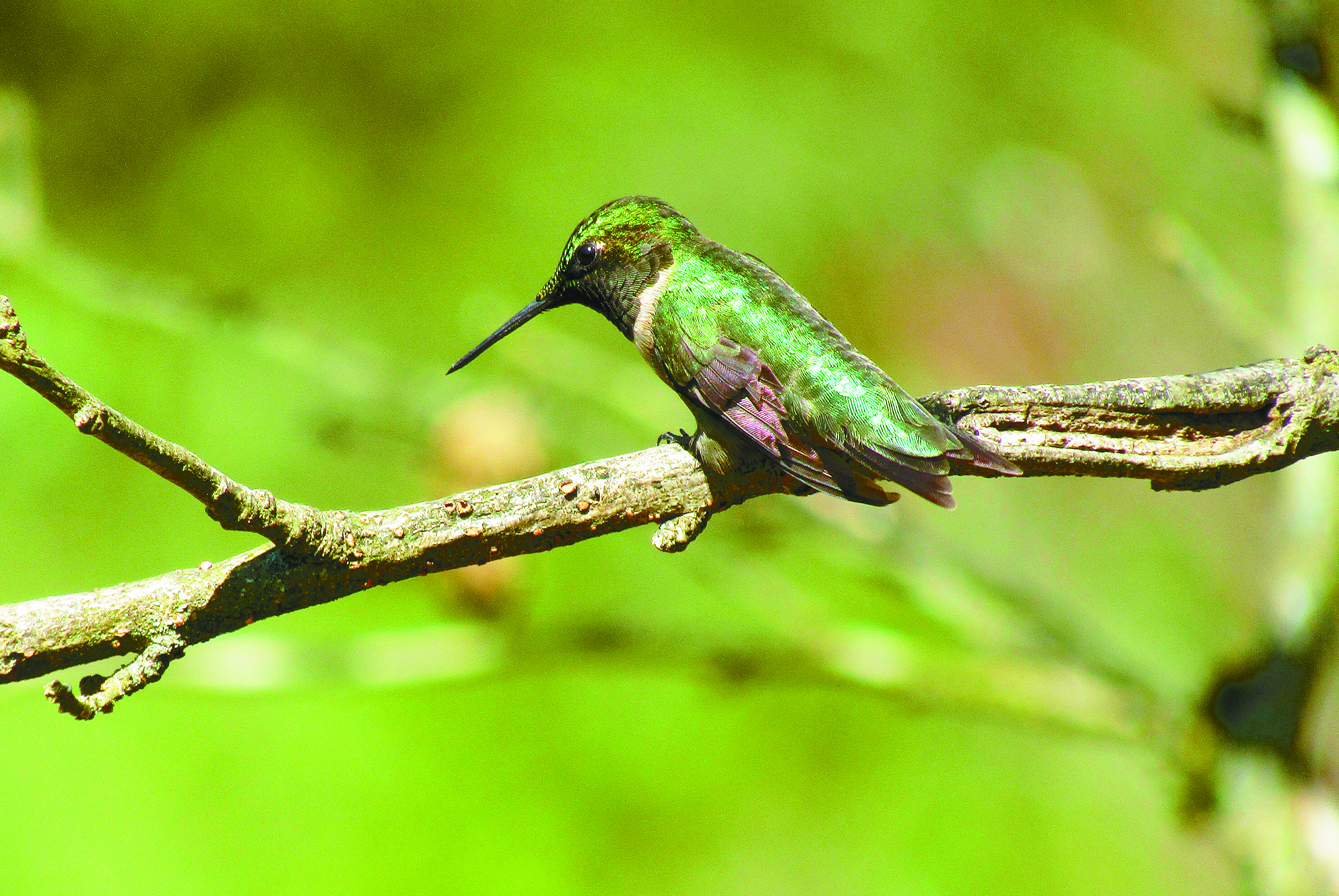
Photo by Bryan Stevens • A male ruby-throated hummingbird perches on a branch. These tiny birds returned to the region earlier this month.

Ruby-throated hummingbirds are back in the region for another season. This male takes a sip of nectar from the blooms of a potted plant.

I reported last week on a handful of people who saw the “early bird” ruby-throated hummingbirds making their return to local yards and gardens. Many more readers have contacted me this past week to share more hummingbird sightings.

For those who haven’t seen a hummingbird yet, just remain patient. They’re definitely arriving for another season with us. 

•••

Gina Kinney emailed me on behalf of her mom, Ginger Brackins, as she has done for several years, to share news of her mom’s hummingbird sighting.

“She said she saw her first hummingbird on Saturday, April 13, at around 5:30 p.m. in Erwin,” Ginger wrote.

•••

Only the male ruby-throated hummingbird shows the bright red throat patch.

“I put my feeder out on April 1 and took it down this morning (April 14) to clean it and put new feed in it,” wrote Joan Chipokas in an email. “About 30 minutes later, a male hummer came to the feeder. Didn’t see him again today, but I was busy so really wasn’t watching. Hopefully I’ll start seeing him on a regular basis and the female will show up too.”

Joan wrote that she lives on Suncrest Village Lane in Gray.

•••

Kingsport resident Ray Chandler reported a sighting of a first spring hummingbird on April 14 . “They are regular visitors to the feeders now,” he shared in an email.

•••

Lonnie Hale reported a first of spring hummingbird sighting in an email to me.

“We saw our first hummingbird yesterday (April 14),” Lonnie wrote. “I put the feeders out in the morning, bought four hanging baskets of flowers and BAM.”

Lonnie lives near Big Stone Gap, Virginia. “Love these little guys,” Lonnie added.

•••

April Fain in Unicoi also saw her first ruby-throated hummingbird of the season on April 14. “We had our first hummingbird this morning,” April wrote in a Facebook message to me. “I saw him three times.”

•••

Photo by Bryan Stevens • Despite a perceived disadvantage of size, ruby-throated hummingbirds are quite capable of thriving in a giant world.

Amy Tipton sent me a message on Facebook to report that her parents had observed their first spring hummingbird.

“The hummingbirds are back in Unicoi County,” she wrote. “My parents, Edison and Emma Jean Wallin, spotted their first one of the season this evening (April 14) at 6:30 at the feeder on their front porch in Limestone Cove. Mama just put her feeder out today.”

•••

“My first hummer just came in,” Karen and Bobby Andis of Kingsport reported via Facebook Messenger on April 14. “A small female…very hungry.”

I got a followup message the following day. “A male showed this morning,” they wrote.

•••

Erwin resident Donna Barnes Kilday shared a post on my Facebook page to report the arrival of her first hummingbird. “Saw my first hummingbird today,” she wrote on April 15.

•••

Priscilla Gutierrez shared in a Facebook comment that she saw her first hummingbird of spring on April 16.

•••

“I’ve had my feeder out for 2 weeks,” Virginia Martin commented on a Facebook post. Virginia, who resides in East Carters Valley in Scott County, added that she saw her first ruby-throated hummingbird on April 13 at 3:15 p.m.

“I believe they are a couple of days behind schedule for my area, possibly weather-related since we’ve had a spell of cooler temperatures and a few very windy storms recently,” she added.

Virginia noted that she has fed hummers for years, and use only the homemade sugar water in a common inexpensive feeder.

“It’s located just outside my dining area window, so I have literally a ‘bird’s eye’ view,” she wrote. “There’s a dogwood tree close by, and other good perching places for them to monitor and protect their territory.”

•••

Jan Bostrom sent me an email to share her first spring hummingbird sighting. She wrote, “I saw my first hummingbird yesterday (April 17) around 6 p.m.” Jan wrote that she been on the lookout because her neighbor saw her first hummingbird on April 15.

“I’m thrilled to be retired and to have time to enjoy God’s beauty around me,” Jan shared.

•••

I’ve finally joined the ranks of those who have welcomed hummingbirds back for another season.

The hummingbirds returned to my own home on April 17 at 7:15 p.m. I heard the telltale buzz of the bird’s wings before I spotted him. I stayed still and he zipped to my feeders for a quick sip. He returned a few times before dusk. When I posted my success on Facebook, several other people commented to let me know that hummingbirds had returned at their homes on April 17.

The following day I enjoyed watching two male ruby-throated hummingbirds in a prickly standoff about control of the front porch feeders.

•••

Vivian C. Tester in Bristol, Tennessee, posted a comment on one of my Facebook posts to let me know of her first spring sighting.

“Just saw my first hummingbird of spring,” she wrote on April 17.

•••

Rosalie Sisson in Jackson, Tennessee, commented on my Facebook page that she saw her first hummingbird of the season at about 6 Central time on April 17.

•••

Lauri Sneyd Garland in Unicoi, also on April 17, noted in a comment on my Facebook page she has been seeing hummingbirds for the last couple of days.

•••

Tina Jefferson Reese in Bristol, Tennessee, reported via a comment on my Facebook page that she also saw her first hummingbird on April 17.

•••

Linda C. Robinette wrote, “Ours fluttered in around 11:30 this morning (April 17),” in a comment on my Facebook page.

•••

Kaylynn Sanford Wilster at Boone Lake saw her first spring hummingbird on April 18. “Saw my first one yesterday,” she wrote on April 19 in a Facebook comment on a post of mine.

•••

Spring migration is in full swing. At least six different species of warblers have returned to the woodlands around my home. A broad-winged hawk has also returned to a favorite field less than a quarter of a mile from my home. Keep your eyes open for new arrivals. Chimney swifts have been zipping over the rooftops of downtown Erwin since April 17.

To share a sighting, make a comment or ask a question, email me at ahoodedwarbler@aol.com.
 

Common grackles part of November’s changing bird lineup


Photo by Bernell MacDonald/Pixabay.com • Common grackles are quite accomplished at foraging for food in a variety of habitats.

November is a month of transition. The birds of summer have all “flown the coop,” returning to warmer climes to the south in Central and South America, as well as the Caribbean. Of course, even as hummingbirds, warblers, tanagers, vireos, and others have fled North America in advance of winter’s imminent arrival, other birds are arriving to take their place.

Many of the newcomers don’t offer the vibrant plumage of a scarlet tanager or a rose-breasted grosbeak, but they make up for the lack of striking feathers by remaining quite faithful to our feeders during the bleak, short days of winter. A hermit thrush and a dark-eyed junco represented some first-of-autumn arrivals when they showed up Nov. 6, followed the next day by a swamp sparrow. In addition to the sparrow, three ravenous common grackles descended on my suet feeders that same day.

For many bird enthusiasts, the “common” in this particular bird’s name is particularly apt. Tending to form large, noisy flocks, common grackles can easily wear out even the most generous welcome. Perhaps because I live at a mid-elevation area, common grackles are extremely infrequent visitors to my yard. I can be a little more welcoming to a bird that I know is not likely to linger.

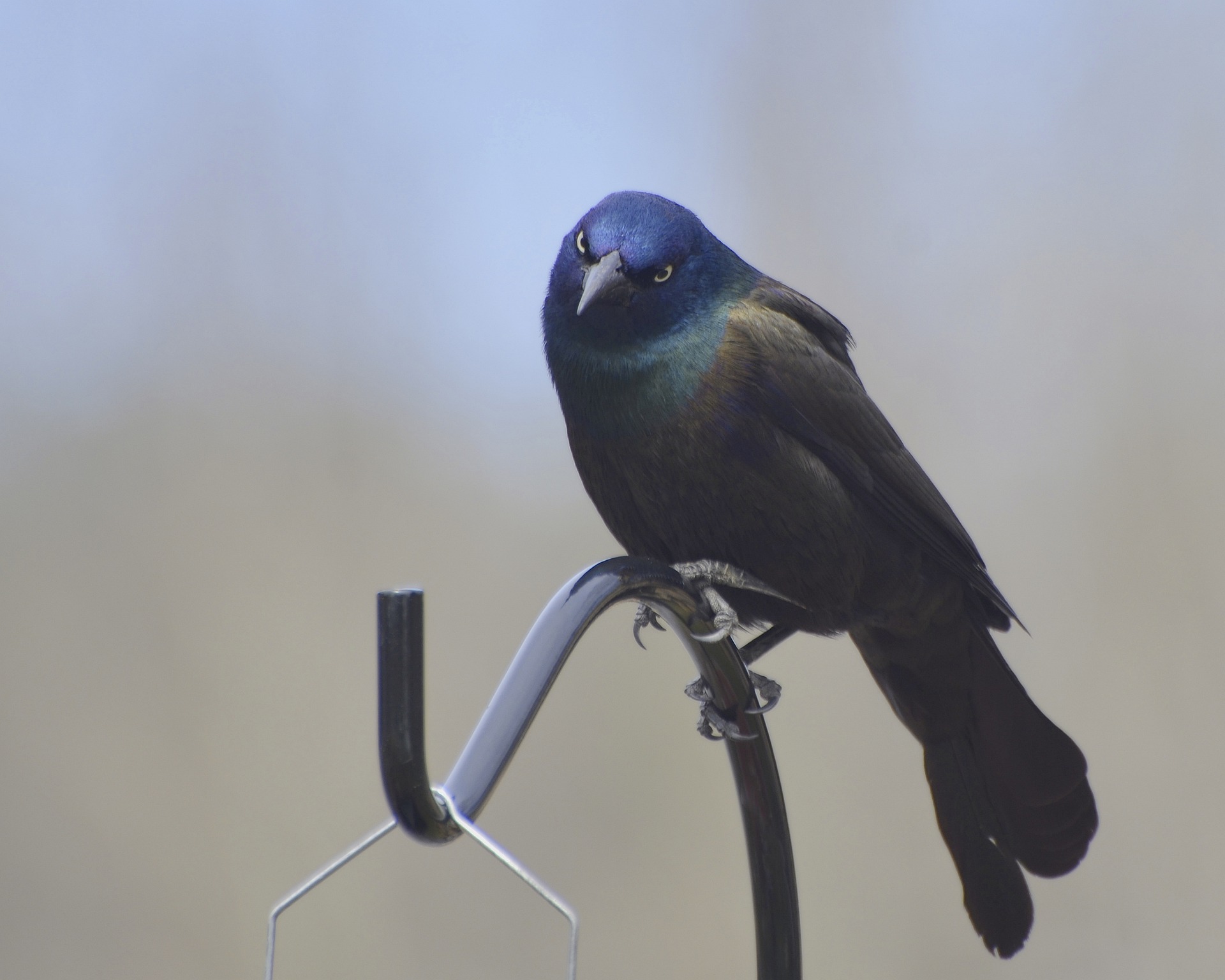
Photo by diapicard/Pixabay.com • A common grackle perches on a shepherd’s hook in a garden. These large birds, which are part of the blackbird family, form flocks and bring big appetites to feeders during migratory stops.

Nevertheless, that same evening these three grackles must have spread the word because a flock of about 30 of these birds arrived. If I needed a reminder, the flock provided a quick one. A handful of grackles isn’t too disruptive, but a large flock can quickly overwhelm and intimidate smaller feeder birds.

Even so, I remain inclusive in my embrace of all feathered friends. A much maligned bird if ever there was one, the common grackle is worth a second look. For those who are able to overlook the occasional bad habits of birds such as Northern mockingbirds, mourning doves, or even cantankerous ruby-throated hummingbirds, there may be hope for this large member of the diverse family of blackbirds, known by scientific types as a member of the family Icteridae. This grouping of New World species, also known as New World blackbirds, includes such members as orioles, meadowlarks, cowbirds, bobolinks, marshbirds, orependolas, caciques and, of course, blackbirds.

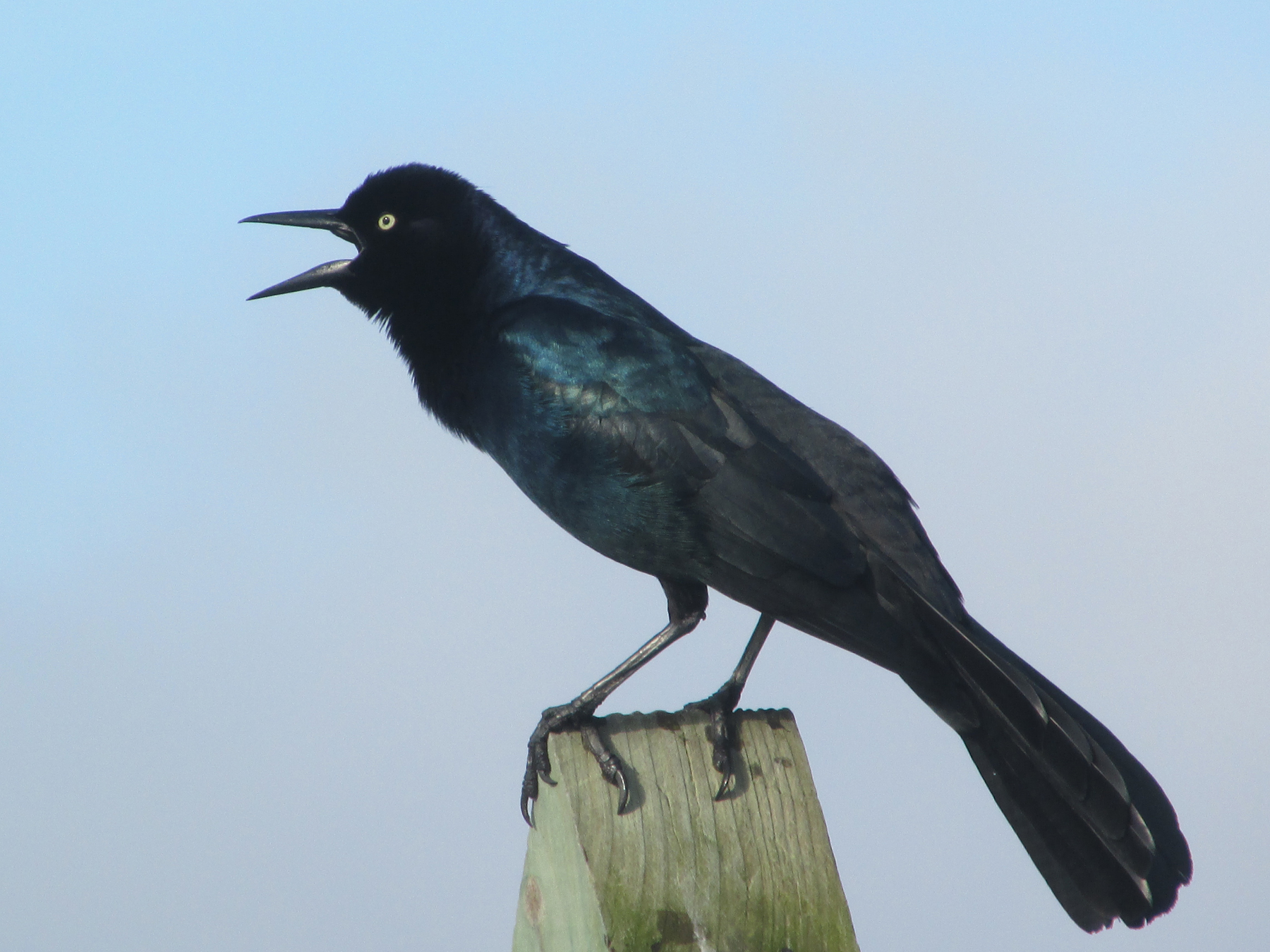
Photo by Bryan Stevens • A boat-tailed grackle sings, if the bird’s harsh, grating notes can be considered a song, from a perch in a wetland in South Carolina.

The common grackle is known by the scientific name Quiscalus quiscula. In the southeast, in particular along the coast and in wetland areas, a common and related species is the boat-tailed grackle. Other species of grackles found in the New World include the great-tailed grackle, Nicaraguan grackle, Great Antillean grackle and the Carib grackle. A little more distantly related are the South American species golden-tufted mountain grackle and the Colombian mountain grackle.

One species — the slender-billed grackle of Mexico — suffered extinction at the dawn of the 20th century. Reasons for this bird’s disappearance are not clearly understood, but habitat destruction of Mexican wetlands and hunting pressures have been theorized as causes. Like others of its kind, the slender-billed grackle may also have been persecuted as an agricultural pest.

Like many other birds dependent on wetlands, common grackles have experienced population declines in recent decades. Although it seems odd to refer to a bird with a population estimated at around 73 million individuals in North America as on the decline, common grackles have suffered an estimated population loss of about 60 percent from historic highs.

Male grackles stand out from other blackbirds due to their sheer size. Males can reach a length of 13 inches, although much of that can be measured in an exceptionally long tail. A grackle’s plumage has a black sheen that can shine with brilliant iridescence that tends to appear purple, green or blue when the sun shines just right on the feathers. Females tend to be smaller than males and are a muted black and brown. Both sexes have long, sturdy bills and yellow eyes.

Most rural residents don’t have to worry about common grackles overwhelming their feeders, but some people living in urban and suburban settings have found grackles to be difficult guests. The birds have bottomless appetites and are aggressive toward more desirable feeder birds. Fortunately, migrating flocks in the fall tend not to linger. After a brief visit, which can still deplete supplies of seed and suet cakes, the grackles continue migrating.

Grackles are usually one of the earliest birds to return each spring. In fact, it’s not at all unusual for these large birds to make their way back to the region as early as late February. I am usually glad to welcome them back since I know that their return is a strong indication that some more favored species are certain to follow in their wake and that winter’s grip is waning.

Are you seeing new arrivals in your yard or at your feeders? Let me know by emailing ahoodedwarbler@aol.com.

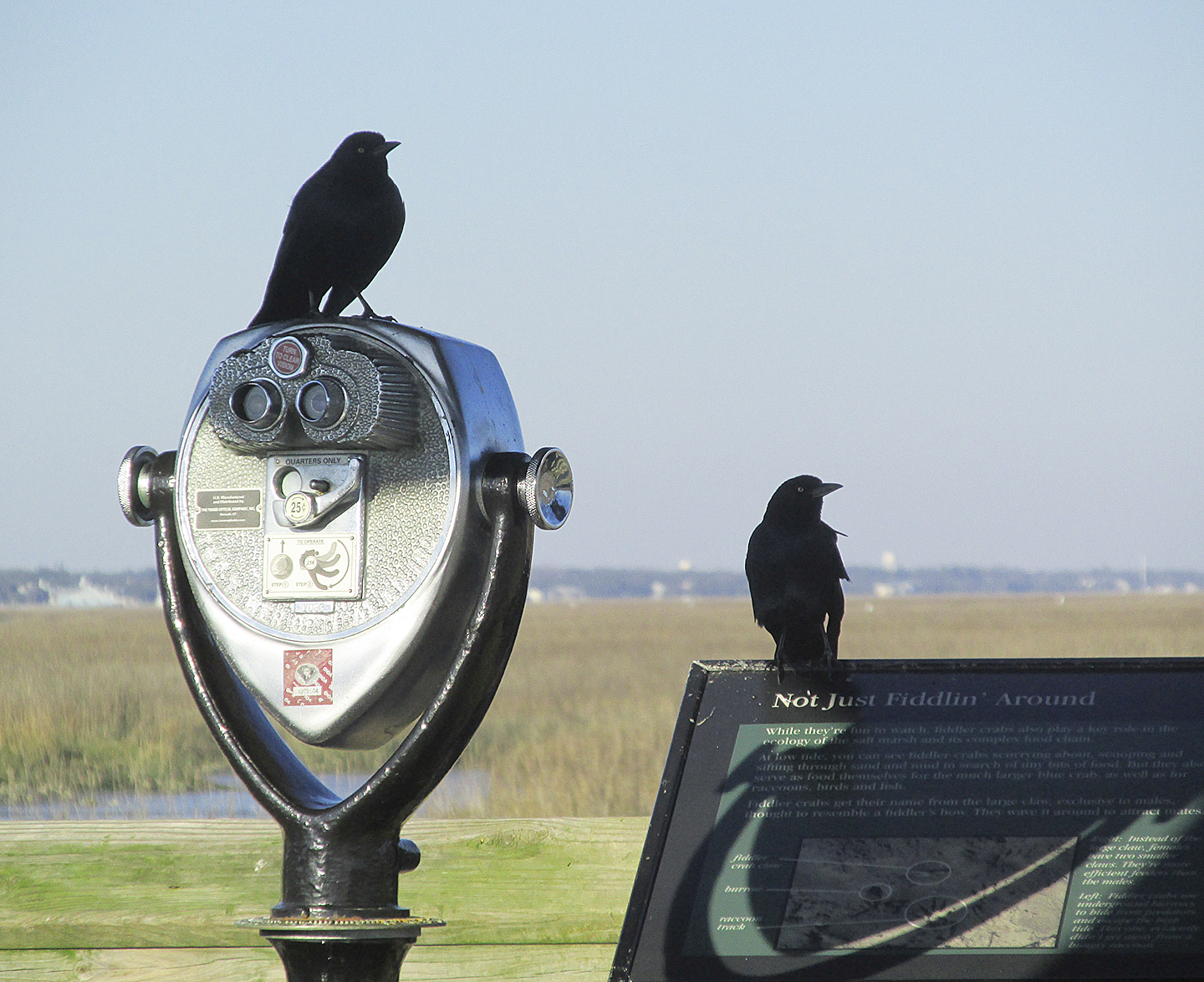
Photo by Bryan Stevens • Boat-tailed grackles perch on viewing equipment at an observation platform at Huntington Beach State Park in South Carolina.

Nighthawks share the skies with many other migrants

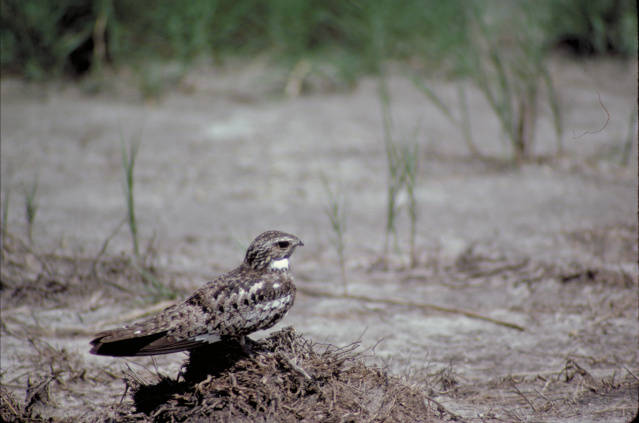
Photo by Dr. Thomas G. Barnes/ USFWS • A common nighthawk perches on a low clump of vegetation during a rest period. Nighthawks are known for migrating in large flocks.

Autumn’s a chance for me to indulge my passion for warblers, with a few dozen species of these songbirds passing through the region in the span of a few weeks. They’re not the only migrating birds worth watching, however, as a recent Facebook post reminded me.

John Whinery, a fellow birder who resides in Fall Branch, Tennessee, reported some interesting observations Sept. 6 on Facebook.

“Been watching several hundred common nighthawks the last few nights fly down the valley next to the farm,” John wrote in his post. He also reported that he saw a female Northern harrier fly by at eye level about 20 feet from him as he watched the migrating nighthawks. The Northern harrier, once known as the “marsh hawk,” is one of many raptors known to migrate. 

Like such birds as warblers, vireos, thrushes, tanagers, flycatchers and hummingbirds, the common nighthawk, is a neotropical migrant. In addition, the common nighthawk has one of the longest migration routes of any North American bird. Twice a year, these birds migrate for distances ranging from 1,600 to 4,200 miles. Nighthawks that spend the spring and summer in Canada travel to southern South America for the winter months. 

With September advancing on the calendar, I have been keeping an eye on the treetops for passing warblers, vireos and tanagers, but I also remember to direct my gaze to the skies. Forgetting to look skyward could result in missing the passage of such varied migrants as chimney swifts, broad-winged hawks and common nighthawks.

So, what is a common nighthawk? First, this bird, despite what is implied by its name, is not a hawk. It’s also not strictly nocturnal. Particularly in the fall, nighthawks are active during daylight hours when engaged in catching winged insects. Outside of fall migration, these birds can often be observed over large parking lots or well-lit streets, snatching up insects swarming around the light poles.

The common nighthawk is one of three members of the nightjar family found in the region during the summer months. The other two nightjars are the whip-poor-will and chuck-will’s-widow, birds that produce their namesake vocalizations in the nocturnal hours. Both of these species migrate, but they don’t take the dramatic approach employed by nighthawks. Each fall, common nighthawks form large flocks, ranging in size from dozens to hundreds or even thousands of individuals, as they migrate south for the winter.

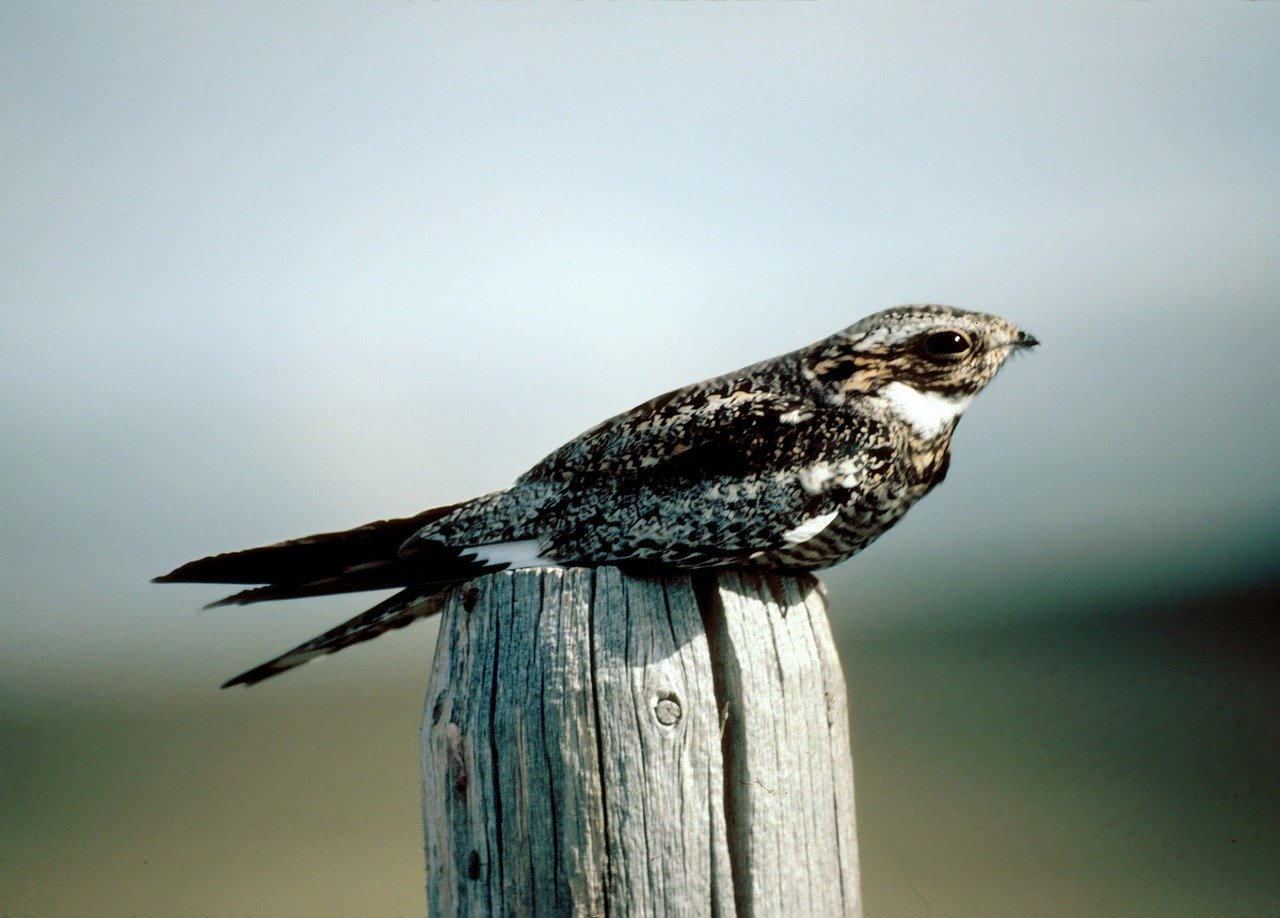
Photo by Skeeze/Pixabay.com • A common nighthawk chooses a perch atop a fence post for a survey of its surroundings.

Unlike whips and chucks, the common nighthawk isn’t active only after dark, which makes it much easier to observe these birds. They look somewhat like swifts and swallows but are much larger. They are brownish-gray birds with pointed wings and forked tails. They are easily identified by distinctive white patches on the underside of their wings.

The nightjar, or Caprimulgidae, family of birds is also sometimes known as “goatsuckers.” Apparently, in trying to explain the nocturnal tendencies of these birds, the Greeks came up with the imaginative but erroneous idea that birds like nighthawks liked to sneak into barns and have a meal of fresh goat’s milk. In reality, nighthawks feed almost exclusively on insects, including ants, wasps, beetles, caddisflies, moths, mayflies, flies, crickets, grasshoppers, and other insects. They capture much of their insect prey on the wing.

There are almost 80 species of nightjars in the world. Less than 10 occur in North America. Many of the common nighthawk’s relatives have been given descriptive names, such as long-trained nightjar, collared nightjar, spot-tailed nightjar, red-necked nightjar, golden nightjar, fiery-necked nightjar, swamp nightjar, pennant-winged nightjar, lyre-tailed nightjar, little nightjar, sickle-winged nightjar, rufous-bellied nighthawk, short-tailed nighthawk, sand-coloured nighthawk and least nighthawk.

So, keep looking skyward. The next flock of migrating common nighthawks may fly over your home. These flocks are usually on the move throughout September.  I’ve managed only three sightings of solitary nighthawks so far this migration season, which falls far short of the number John Whinery reported at his farm. 

I will keep watching the skies. Nighthawks can also appear almost magically, as if out of thin air. First, observers may see one of two birds, then several, followed quickly by dozens or sometimes hundreds as they wheel and cavort in the skies overhead with impressive grace and agility. I’ve seen flocks that would easily number more than 500 birds in locations throughout the region, although flocks often number only a couple of dozen birds. 

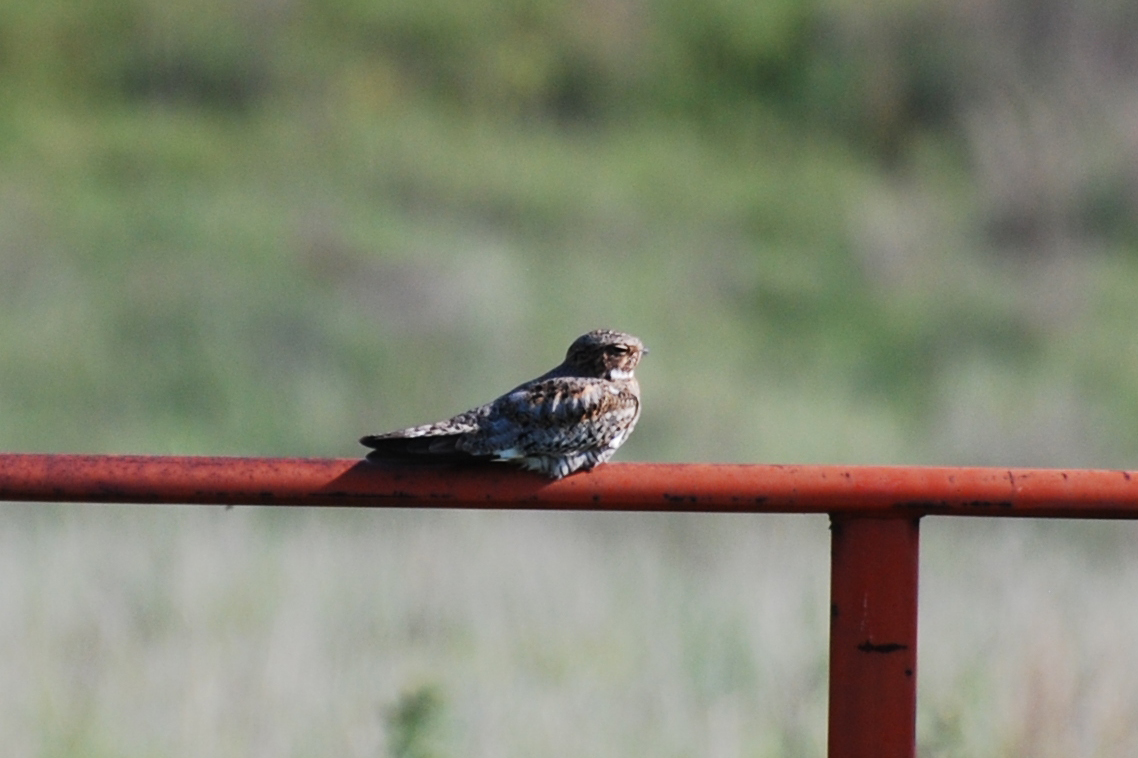
Photo by Jean Potter • A common nighthawk rests on a metal railing.

Warbler parade imminent as September advances

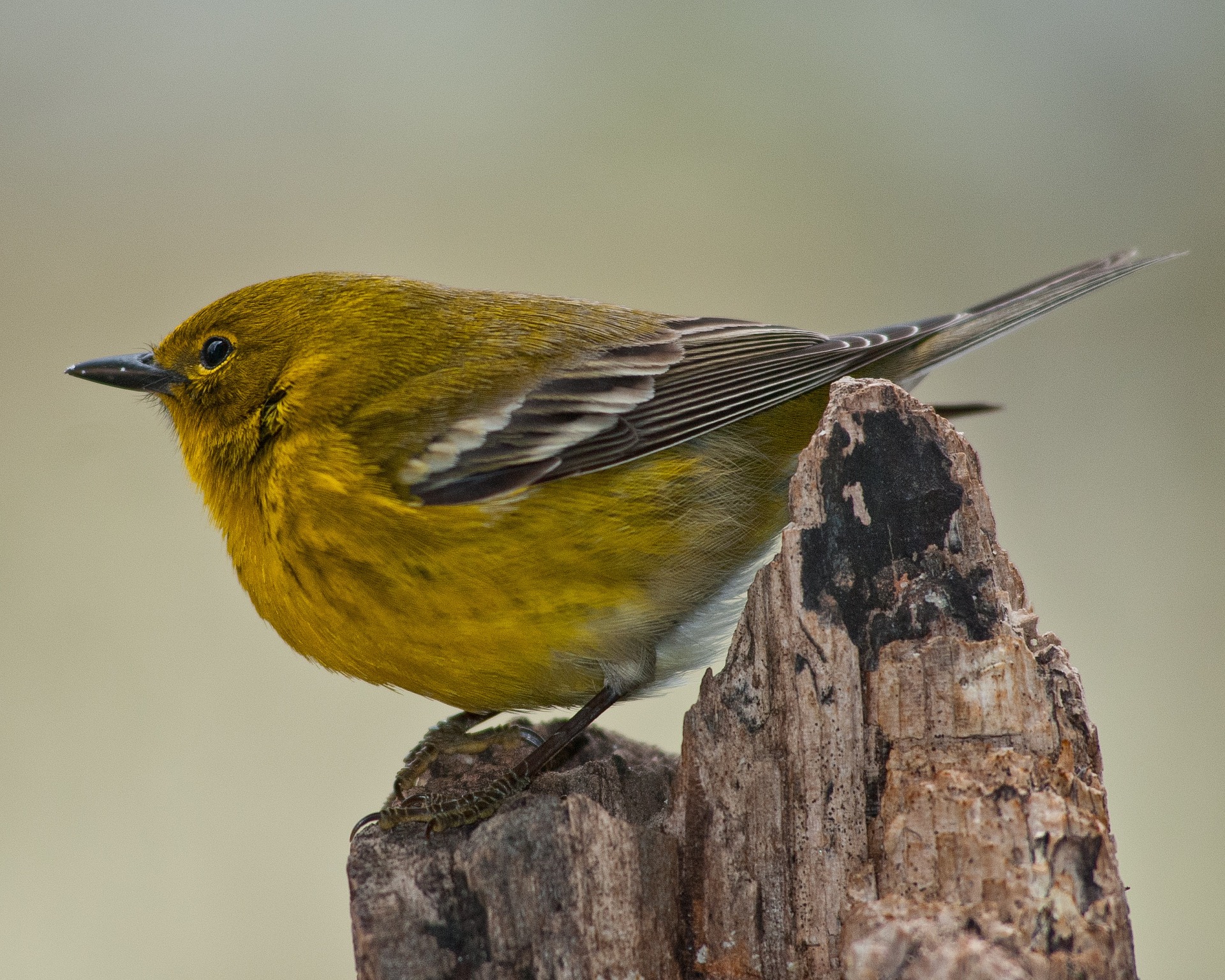
Photo by Mickey Estes/Pixabay.com • A pine warbler takes a brief rest on a perch during a break from foraging for insects.

I detected some signs of migration during a backyard lawn chair birding session on Thursday, Sept. 3. A croaking great blue heron circling the property, the shrill cries of cedar waxwings, scolding vireos, and the intermittent buzz of hummingbird wings all contributed to the background noise. 

The first warbler of the season, a quick blur of yellow and white, disappeared into the green and thus escaped identification. That’s the way of it: Sometimes, you identify the bird, but at other times it slips past without lingering enough for that moment of confidence. You have to love September, even if the birds are entirely ignorant of pages on a calendar. As summer wanes, the pace of migration has spiked. If that first warbler got away, I know others will follow behind it.

Some of them will have fanciful names like blue-winged warbler, black-throated blue warbler, Blackburnian warbler and American redstart. Each of the warblers exists as a sort of magnet to induce me to keep binoculars always close at hand.


The 50 or so species of warblers that make their home in the eastern parts of the United States and Canada during the spring and summer months are now winging their way south.  The blackpoll warbler, which holds the distinction for the longest migration of any species of New World warbler, will journey from the forests of Canada to spend the colder months in northern South America. Because of a peculiarity of this bird’s fall migratory habits, birders in Northeast Tennessee are far more likely to see this late-arriving warbler in May than in the autumn.

A few warblers — pine warbler, magnolia warbler and palm warbler — are named for trees for the simple reason that their European discoverers happened to first observe them in the branches of their namesake trees.

Photo by Bryan Stevens • A Palm Warbler forages along a chain-link fence.

For most of these warblers named to honor various trees,  their common names are, at best, a misnomer. Throughout most of its life, the palm warbler doesn’t even encounter palm trees. Johann Friedrich Gmelin, a German naturalist who lived from 1748 to 1804, saddled the palm warbler with its inappropriate name. Gmelin based his naming of the bird on the fact that a specimen had been collected on Hispaniola, an island in the Caribbean with an abundance of palm trees. Gmelin published several textbooks in the fields of chemistry, pharmaceutical science, mineralogy, and botany. He also had a hand in publishing a catalog of scientific names for various species, including some birds that had until that point never been given a species classification. Thanks to his efforts, the palm warbler has forever been linked with a type of tree that is, at best, entirely incidental to the bird’s life cycle.

The same is true for the Magnolia Warbler, which would have been more suitably named the spruce or fir Warbler, as the species is highly dependent on northern coniferous forests as nesting habitat. The pine warbler, at least, restores credibility to some of the early experts who have these tiny birds their common names. The pine warbler does indeed prefer stands of pine trees, showing particular favor for pitch pines.

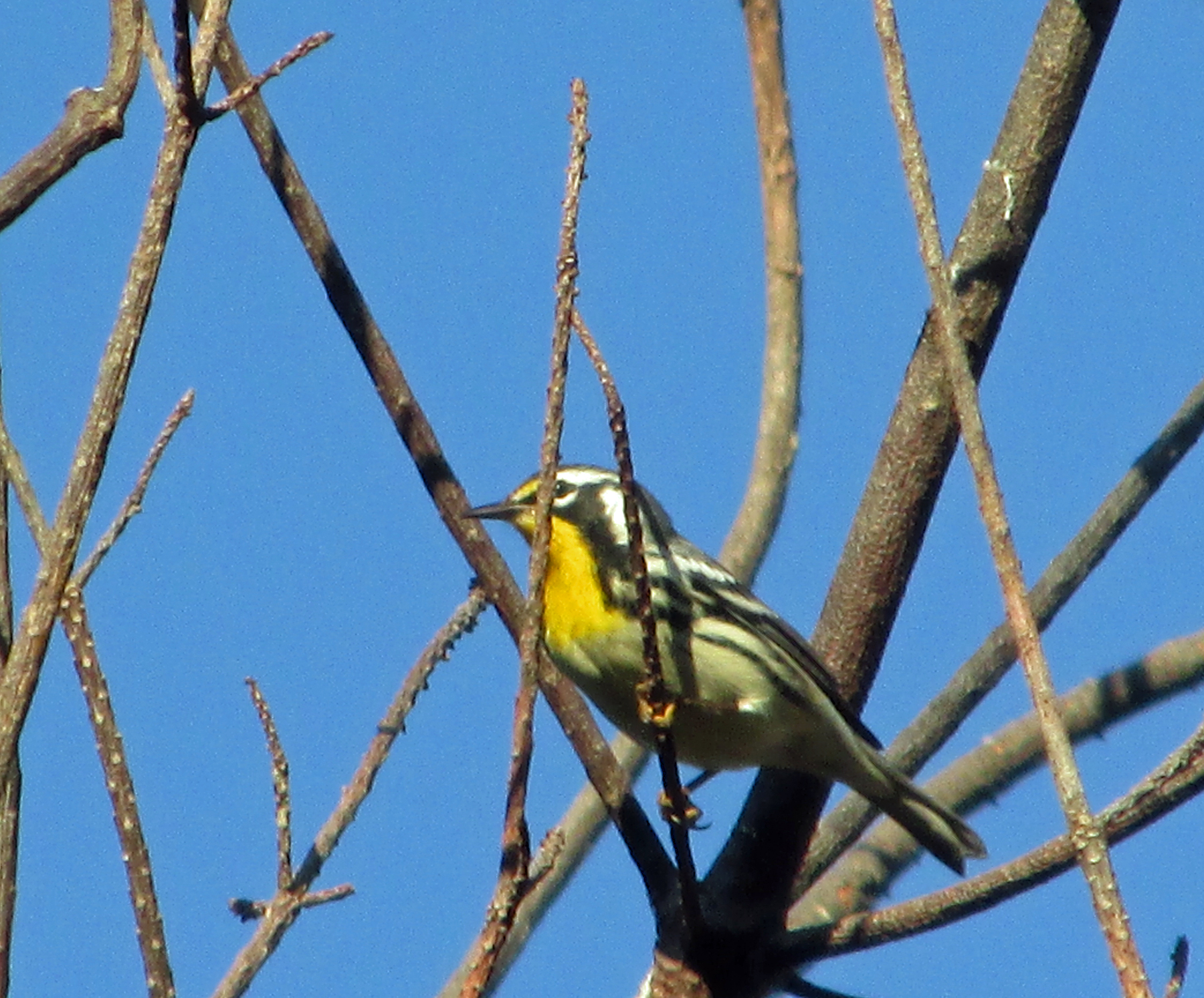
Photo by Bryan Stevens A Yellow-throated Warbler makes a migratory stop in my yard on the first day of September.

These three “tree warblers” are all fairly common fall migrants, making stops in gardens, backyards and woodland edges throughout Northeast Tennessee, southwest Virginia, and western North Carolina. They and their relatives will make the remaining weeks of September and early October an exciting time for warbler enthusiasts. 


Green herons, one of the smaller wading birds, often overlooked as they lurk near water’s edge

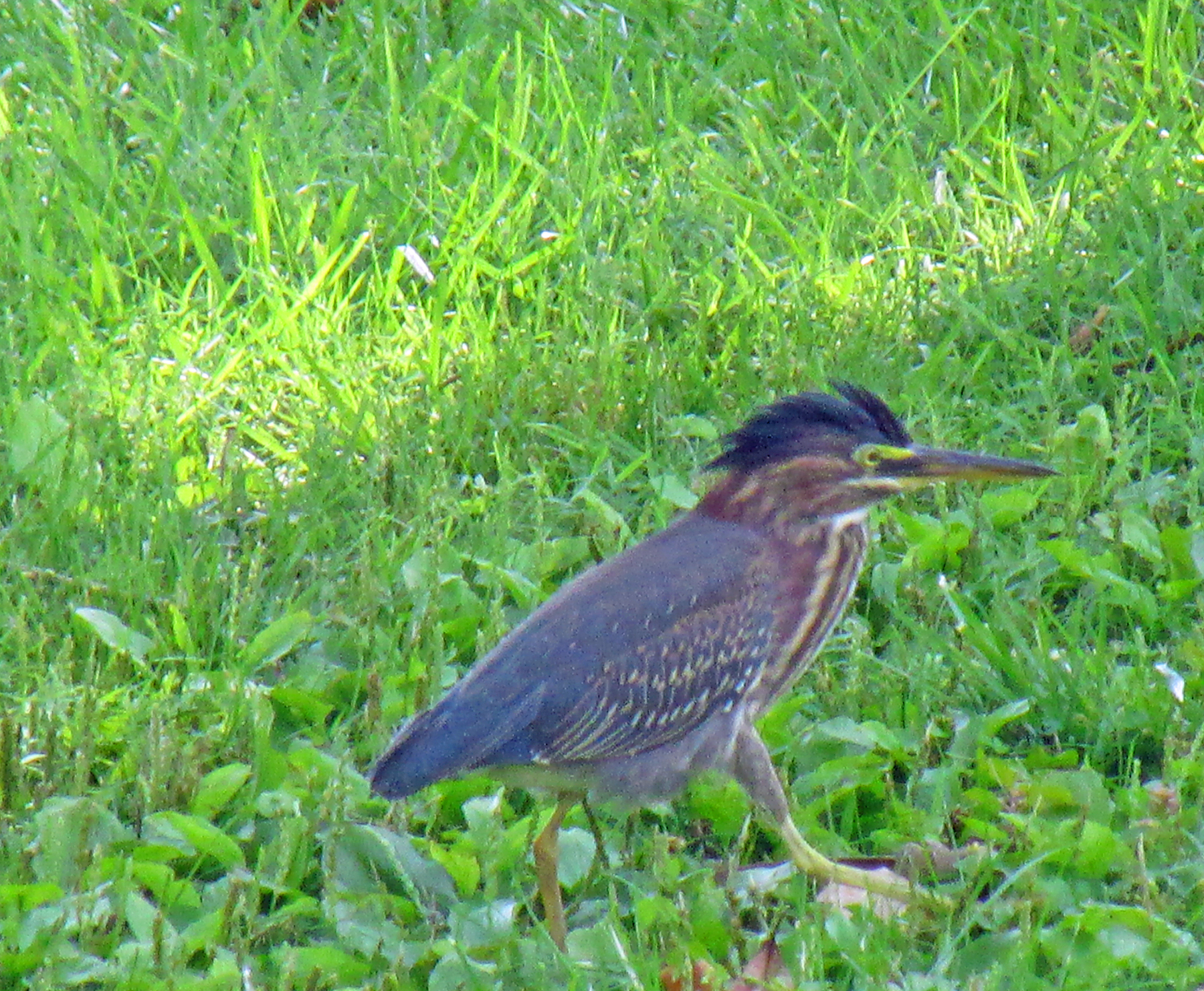
Photo by Bryan Stevens • A Green Heron elevates a shaggy crest of feathers, a behavior often initiated when the bird feels alarmed.

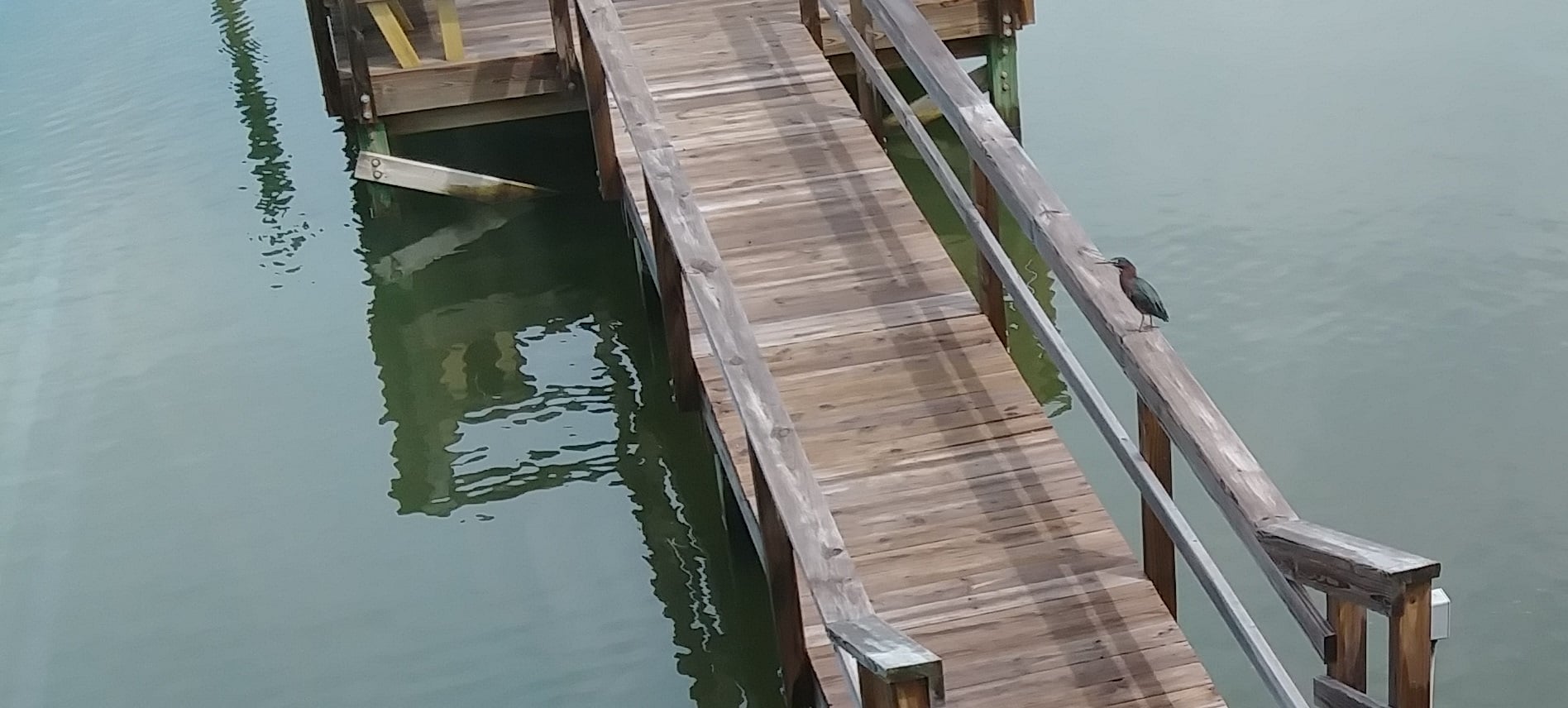
Byron Tucker and Ricky Dunklin, friends from Atlanta, contacted me on Facebook to ask if I could help identify a bird they had photographed during a trip to Sunset Beach in North Carolina in early August. When I saw the photographs I recognized that the visitor to a small dock at their vacation spot was a green heron.

Photo Contributed by Byron Tucker/Ricky Dunklin • A Green Heron visits a dock at Sunset Beach in North Carolina.

Green herons are not restricted to coastal areas, but it was still somewhat unexpected when I stepped onto my front porch on Aug. 19 and saw a green heron flying at treetop level. I suspect the bird had been perched in one of the tall trees on the ridge behind my house. The slamming of my front door probably spooked the bird into flight.

Green herons and other wading birds are usually quite abundant in wetlands across the country in late summer. The scientific name — Butorides virescens – of this bird comes from a mix of Middle English and Ancient Greek and roughly translates as “greenish bittern.”

Photo by Bryan Stevens • A Green Heron grasps a perch overlooking a small creek in Erwin, Tennessee.

There are only two other species in the genus Butorides — the lava heron, which occurs on some of the Galapagos Islands of Ecuador, and the striated heron, which is found in wetlands throughout the Old World tropics from West Africa to Japan and Australia. This heron, which is also known as the mangrove heron, also occurs in South America.

The green in the bird’s plumage appears as a dark green cap, as well as a greenish back and wings. Adult birds also have chestnut-colored neck feathers and a line of white feathers along the throat and belly. These herons often assume a hunched position, which can make them look smaller than they actually are.

It’s been a good summer for wading birds. In addition to the green heron, a great blue heron has been lurking in the creek in front of my home and at my fish pond. Much larger than the green heron, the great blue heron has not escaped the notice of a local flock of American crows. The crows harass the heron whenever the larger bird takes flight.

On the first day of August, I stopped with my mom at the pond at Erwin Fishery Park. We were treated with an observation of a great egret fishing along the edges of the pond. Egrets and herons are known for wandering outside their normal range in late summer after the nesting season has concluded.

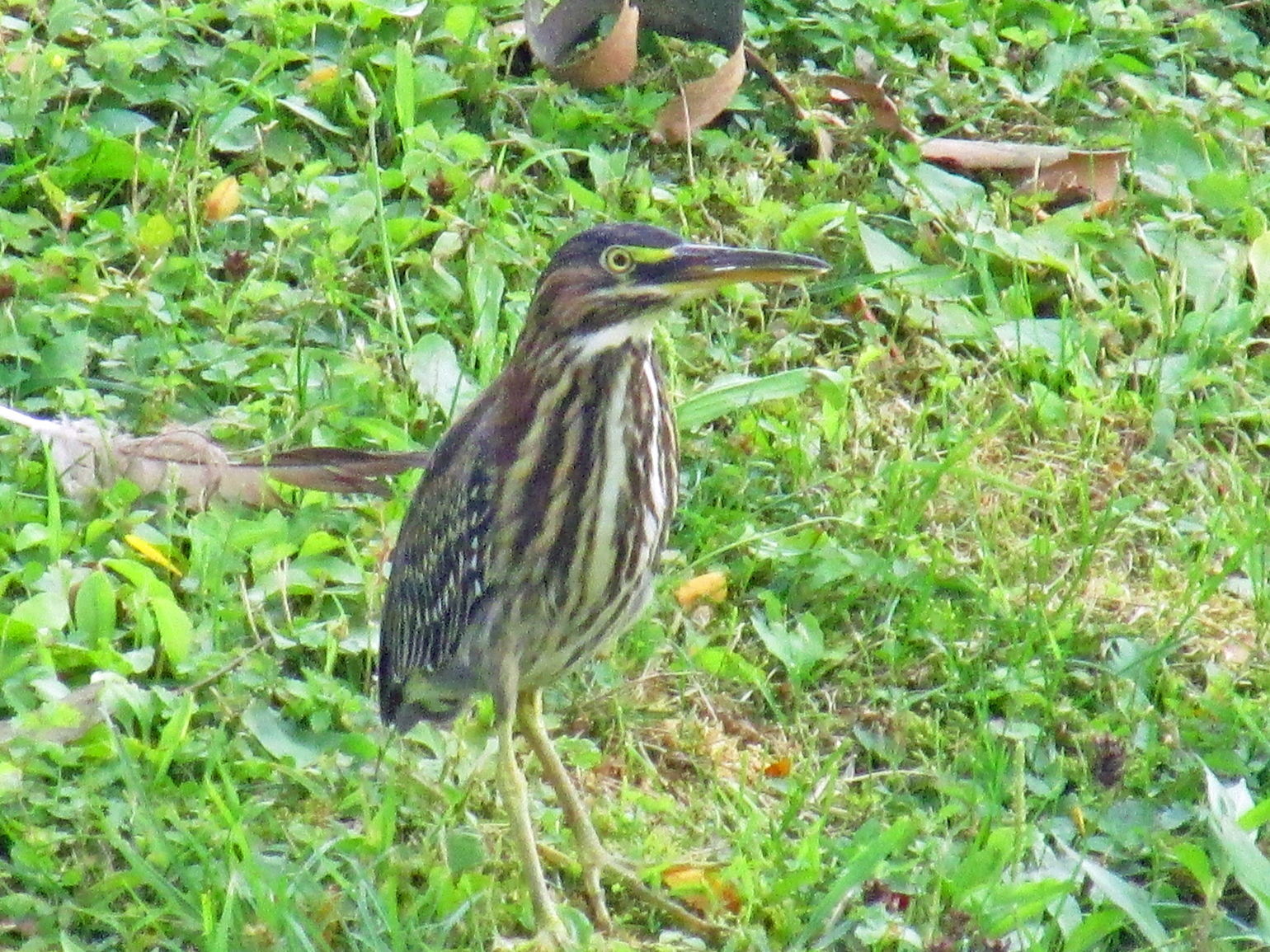
Photo by Bryan Stevens • A young Green Heron rests at the edge of a pond.

Keep alert when walking along the trails in Erwin, Tennessee, and you may catch sight of one of these interesting herons or egrets, too. The edges of the fish pond at Erwin Fishery Park is also a reliable haunt for green herons. Farm ponds in the countryside around Jonesborough, Tennessee, as well as wetland habitat around the town’s Persimmon Ridge Park, are also good places to look for this small heron. The wetlands at Sugar Hollow Park in Bristol, Virginia, is another dependable location for seeing this small heron. Most green herons will depart in late September and early October. This small heron retreats from the United States during the winter season but will return next spring in April and May.

Photo by Bryan Stevens • Green herons are short, stocky herons that can assume some comical poses.

The green heron’s range during the nesting season includes Canada and much of the United States. Green herons will sometimes form loose nesting colonies, but at other times a pair will choose a secluded location as a nest site. The female will usually lay from three to five eggs. Snakes, raccoons and other birds such as crows and grackles are potential threats to eggs.

For the most part, the population migrates to Central and South America for the winter months. A few herons — great blue heron and black-crowned night heron — remain in the region throughout the year, even enduring the cold winter months in Northeast Tennessee, Southwest Virginia and Western North Carolina.

These herons are probably more common than we realize. They are skilled at blending with their surroundings, but sharp eyes can find these herons around almost any body of water, whether it is pond, marsh, river, creek or lake.

They usually depart the region in October, so the remaining days of August and September provide opportunities to observe both resident green herons and their migrating kin.

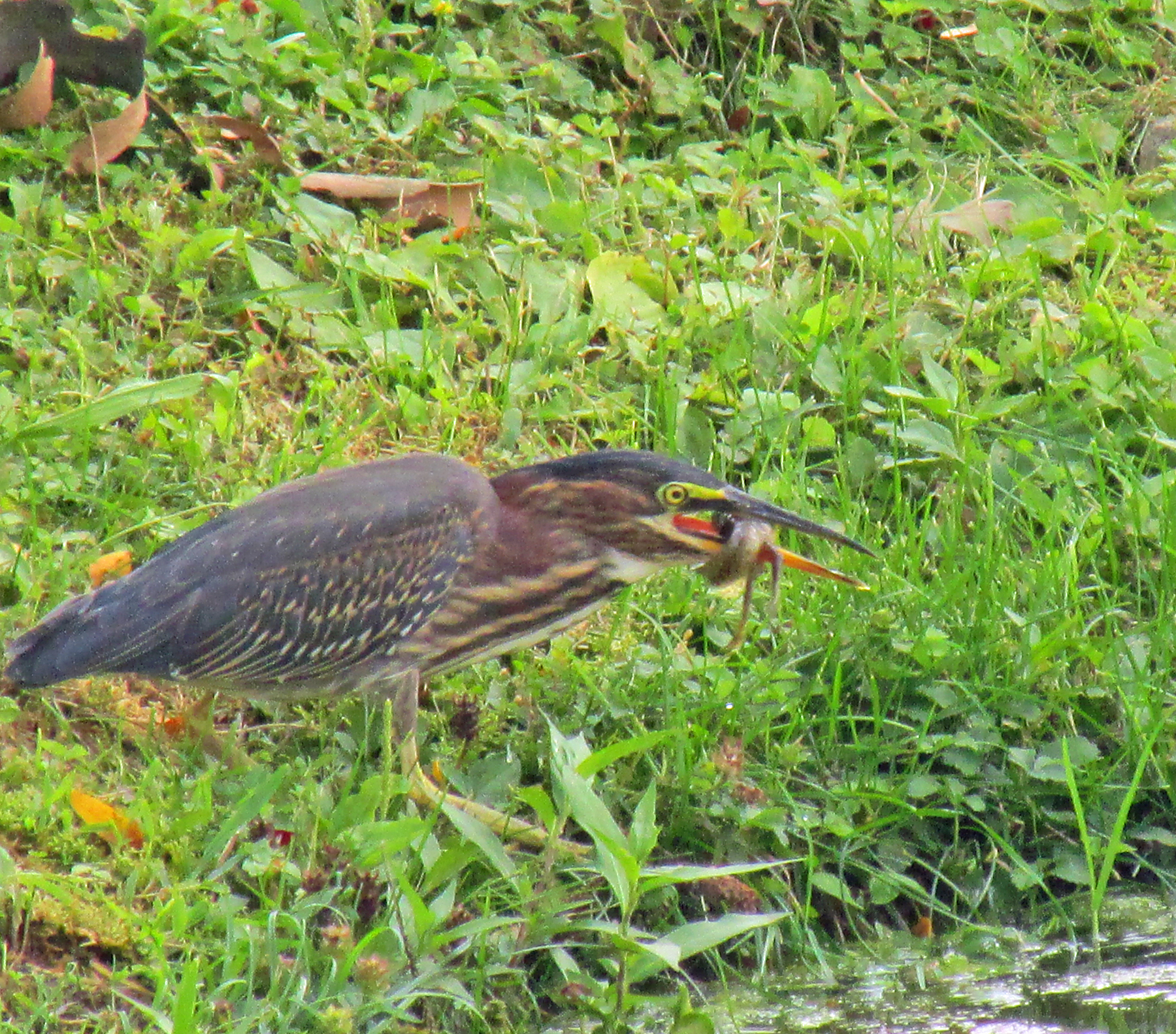
Photo by Bryan Stevens • A Green Heron finesses a captured tadpole in its bill.

Mississippi kite glimpsed on spring count becomes latest listed ‘life bird’

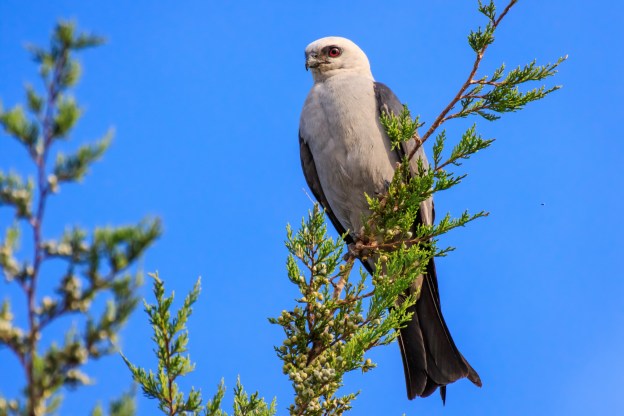
Photo by Richard/Adobe Stock • A solitary Mississippi Kite sits perched in a lakeside tree. These graceful raptors take their prey mostly while on the wing.

If you know many birders, you have likely heard them talk about “life birds.” These are any species that a birder has seen and identified in the wild for the very first time. It can be any bird species at all that the birder observes for the first time, whether it is a commonplace bird like a song sparrow or something slightly more exotic.

While taking part in the 77th consecutive Elizabethton Spring Count on Saturday, May 2, I saw something that, for our region, could be considered a little more exotic. The sighting certainly ranked as unexpected.

Unless one travels extensively, life birds can be hard to get once people have added to their lists most of the common birds around their homes. Finding a life bird during the ongoing pandemic brings its own challenges. I haven’t added a new life bird to my own list since a visit to South Carolina in June 0f 2016. During that visit to Huntington Beach State Park, I added a least bittern to my list of “life birds.”

My most recent “life bird” appeared closer to home and might qualify as my most unexpected life bird ever. The bird flew into view and onto my life list during the annual Spring Bird Count, which was conducted by members and friends of the Elizabethton Bird Club. Due to social distancing, many participants counted solo this year, myself included, although a few married couples birded together. I’ll always remember my pandemic spring count, especially for the 46th bird on my tally list for the day.

I found myself in the parking lot at Sycamore Shoals State Historic Park in Elizabethton around 11 in the morning. I wanted to scan the evergreens in that vicinity for Cape May warblers, a migrant that finds the tall conifers to its liking. I didn’t find any warblers, but I did surprise a perched raptor into making a short flight.

The instant I saw the bird launch itself into flight, I knew I was watching something out of the ordinary. The bird flew with a combination of grace and power that reminded me of a falcon, but I also glimpsed a barred tail that reminded me of one of the accipiter hawks. Then it landed on a dead branch in a tall sycamore that must have permitted the raptor an unobstructed view of the entire park. Although I’d never until that moment seen a Mississippi kite, I have studied illustrations and photographs. I felt fairly certain of the bird’s identity even before I used my phone to call up some birding sites to confirm my identification.

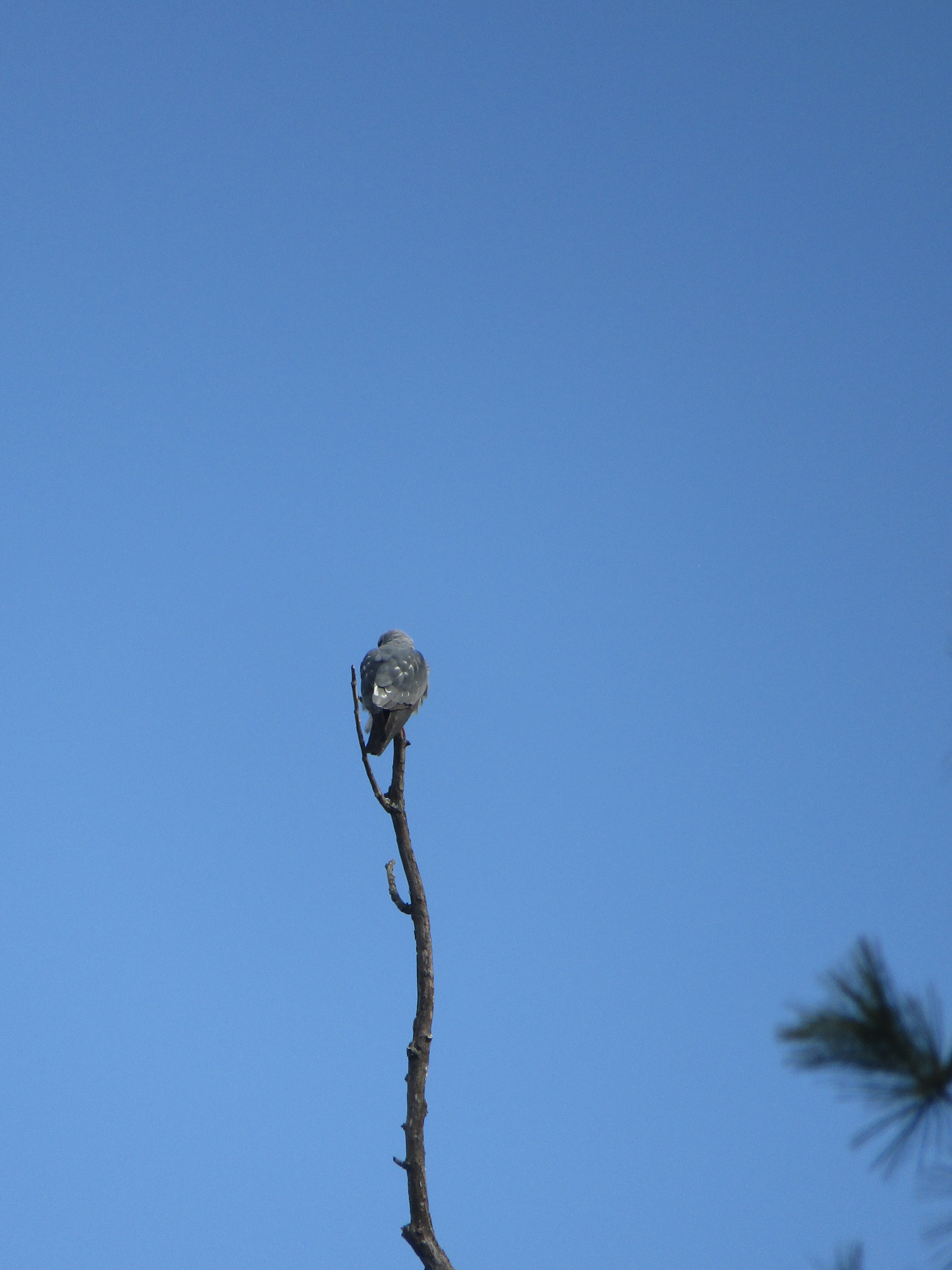
Photo by Bryan Stevens • This Mississippi Kite became the first of its kind ever observed on one of the Elizabethton Bird Club’s Spring Bird Counts for Northeast Tennessee.

That’s when the fact I was birding solo hit home. I wanted some additional witnesses to this very unexpected find. In lieu of other observers, I turned to my camera. The bird had turned its back to me, but I snapped some photos and then made my way to a position that I hoped would allow for better photographs.

Alas, the resident American crows at the park had different ideas. Detecting a raptor in their midst, about a half dozen crows gathered to harass the perched kite. Before I could snap a new round of photos, the kite took flight and flew into a stand of tall trees located between the park and Sycamore Shoals Hospital.

Only a few years ago, a Mississippi kite in Northeast Tennessee would have been unheard of. The hills and mountains of the region are simply not the expected habitat for these graceful raptors. Faith Reeves, a resident of Elizabethton, Tennessee, a Facebook friend and fellow birder, saw the first two Mississippi Kites ever found in Northeast Tennessee. She saw and photographed the birds in her own yard on May 20, 2014, and May 13, 2016.

In addition, Don Holt observed a Mississippi kite in Washington County, Tennessee, on April 16, 2017.

Rick Knight and several other birders also saw several Mississippi Kites for about a week in late August of 2016. Observers estimated that these sightings involved from two to five different kites.

“The August observations are our only fall records,” said Rick Knight, a long-time compiler of birds sightings in the region. He added that fall is the season when kites are likely to linger.

“All spring records are overshooting migrants and are one-day-wonders,” Knight explained.

Hearing his explanation, I felt even more privileged to have witnessed this “one-day wonder” in my home county.

Photo by Myriams-Fotos/Pixabay.com • The red kite is an abundant member of the kite family in Europe and northwest Africa.

The Mississippi kite is a beautiful raptor. Adults are grayish-white with the head often appearing pale gray or almost white. Although the Mississippi kite can attain a wingspan of three feet, these birds weigh only seven to thirteen ounces. They feed almost exclusively on insects, which they capture in flight. Some of the insects, such as cicadas and grasshoppers, are ones that damage crops, making the Mississippi kite a friend to farmers.

These kites breed and nest in the central and southern United States, but they have expanded their range north in recent years. They leave the United States in fall to spend the winter in southern South America.

Several years ago I got the thrill of adding a swallow-tailed kite to my life list in some agricultural fields in southwestern Washington County. I’ve also seen swallow-tailed kites in Florida. There is one other member of the kite family that I’d like to add to my list. The snail kite is a dark bird with a hooked beak designed for feeding on snails found in wetlands. This specialist resides in Florida, as well as the Caribbean and Central and South America.

Other kites found around the world include the double-toothed kite, plumbeous kite, whistling kite, square-tailed kite, red kite and black kite.

It’s been a spring filled with many amazing bird observations. I can’t speak for others, but thanks to that remarkable kite sighting and glimpses of some other fascinating birds, not even having to bird solo in a pandemic can bring me down. I’ll provide more details on this year’s Spring Bird Count for Northeast Tennessee in next week’s column.

Photo by Bryan Stevens • Mississippi Kite perched in a tree prior to being dispersed by some defensive American crows.

Region’s two oriole species make their spring return

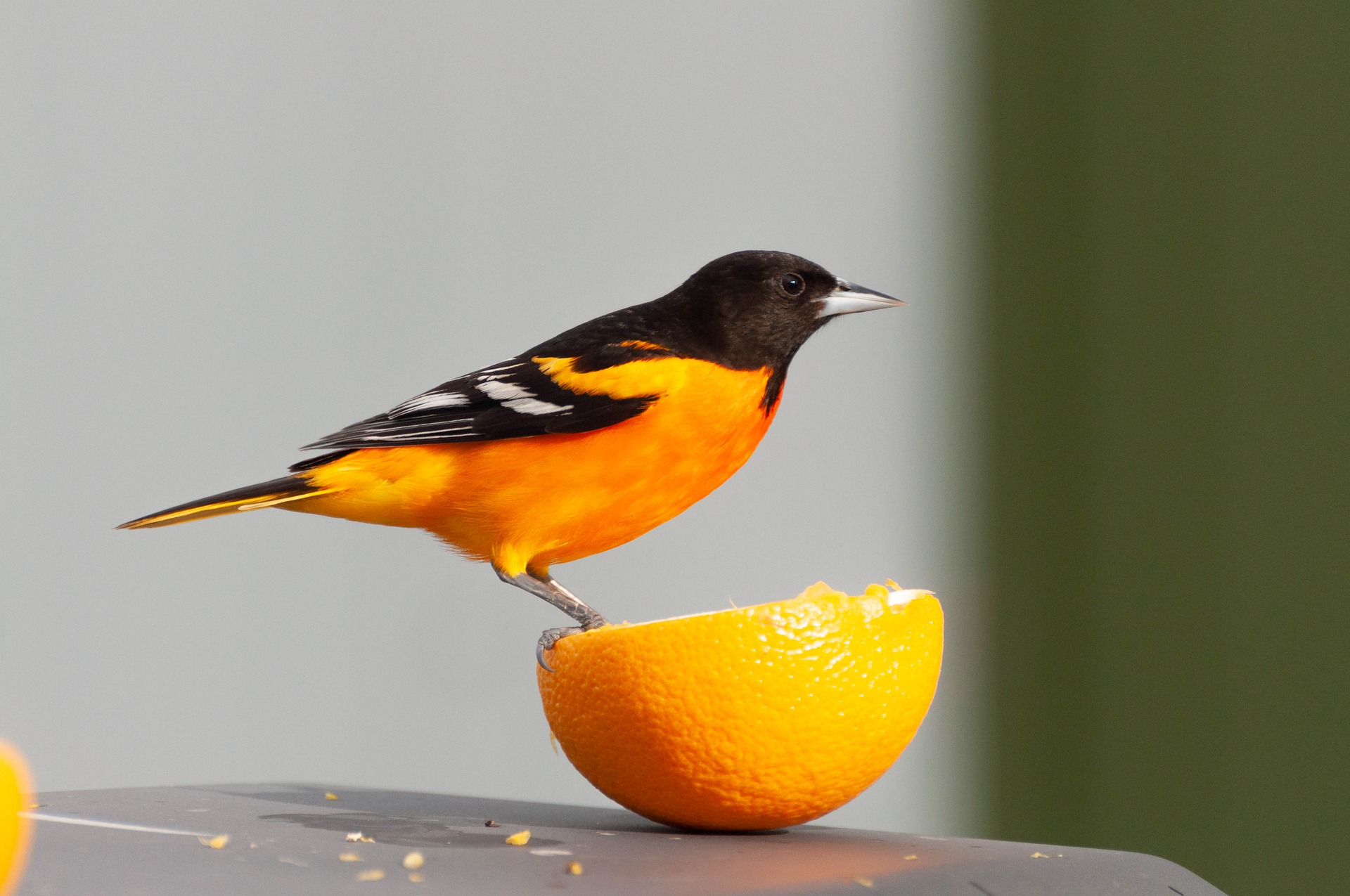
Photo by MillionPM/Pixabay.com • Oranges, as well as offerings of grape jelly, are often successful at luring Baltimore orioles to feeders.

Earlier this spring, Kaylynn Wilster, who resides in Jonesborough, Tennessee, emailed me for information about orioles.

“Do you know when the orioles return to our area?” Kaylynn asked. In her email, she also shared that she had a female Baltimore oriole gathering nesting materials in her yard last summer.

“I put out an oriole feeder this year,” she added. So far, she noted, only chickadees have discovered the grape jelly.

In addition, Brenda Hickman Dishner, who lives near Holston Dam in Bristol, Tennessee, contacted me through Facebook to ask if I have seen orioles in the area.

Brenda added that she has put out oriole feeders for the past three years with no luck.

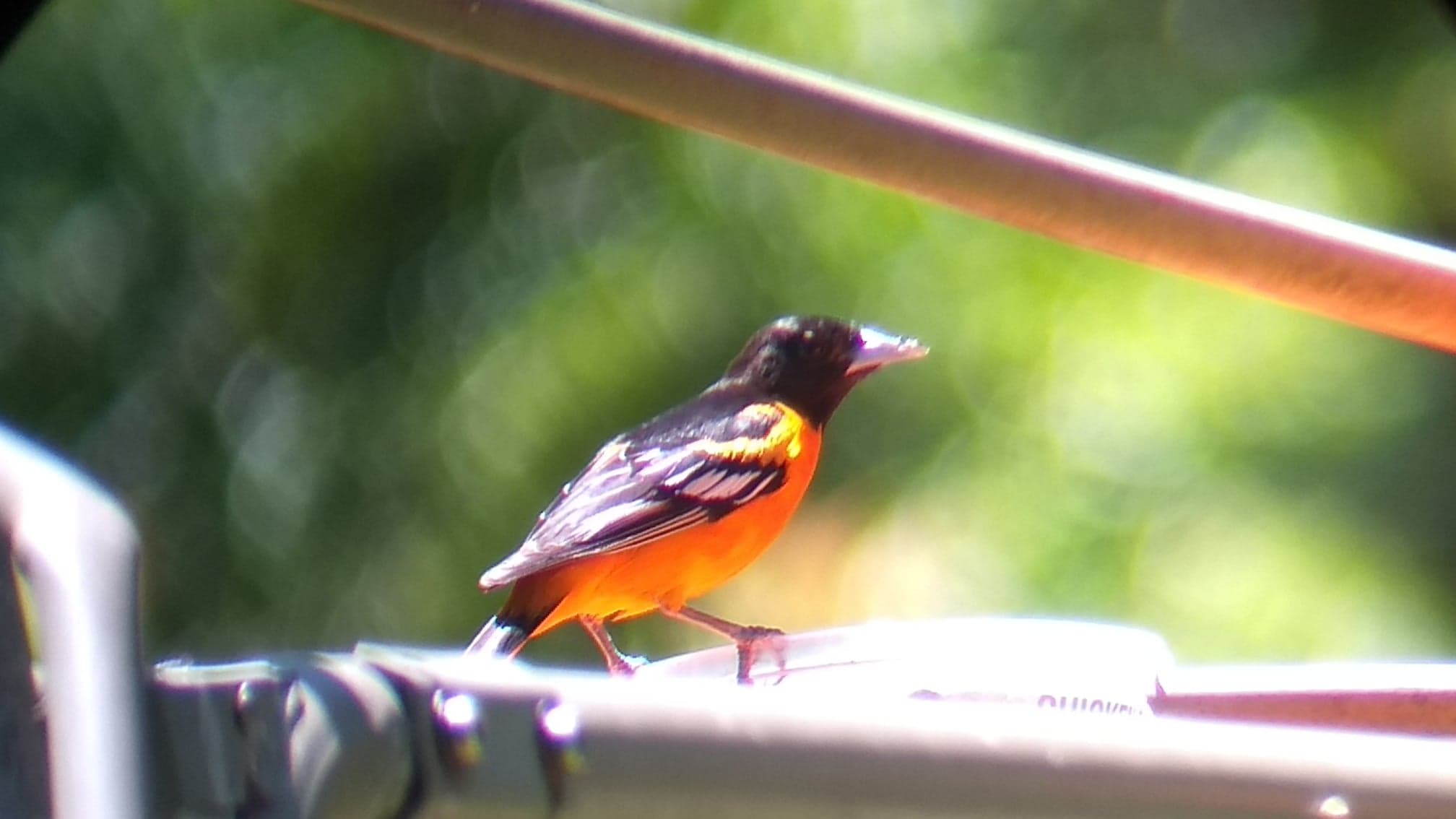
Photo provided by Gloria Blevins • A male Baltimore Oriole visits a feeder at the Blevins home in Damascus, Virginia.

It seems many people are hoping to welcome these bright orange and black birds to their feeders. In my reply to Kaylynn and Brenda, I told them to expect orioles to arrive in late April and early May. I’ve found orioles uncommon visitors to my home, but my prediction on timing proved more or less correct.

Gloria Blevins shared a photo of the Baltimore orioles that have been visiting her home in Damascus, Virginia. In a Facebook message, she shared that the orioles have been feeding on grape jelly that she had provided them since May 2.

Although she no longer lives locally, Kathy Noblet has been seeing lots of Baltimore orioles at her home in Mount Vernon, Ohio, since late April. Her photographs of these colorful birds have been nothing short of amazing. She has shared new photographs on Facebook on an almost daily basis for the past couple of weeks.

“The orioles continue to come to my deck and pig out on grape jelly,” Kathy posted on May 6. “They are fun to watch!”

I also heard back from Kaylynn on May 15. “There was a male oriole getting a drink at my pond about four days ago,” she informed me in an email.

Photo by USFWS • Baltimore orioles, like this male, are members of the blackbird family, making them relatives of species such as Eastern meadowlarks, brown-headed cowbirds, common grackles and red-winged blackbirds.

The Baltimore oriole, despite its bright plumage, is a member of one of the blackbird clans, known in scientific circles as the Icterus genus. In his book, “Birds of Forest, Yard, and Thicket,” John Eastman notes that there are 26 species in the genus, eight of which nest in the United States.

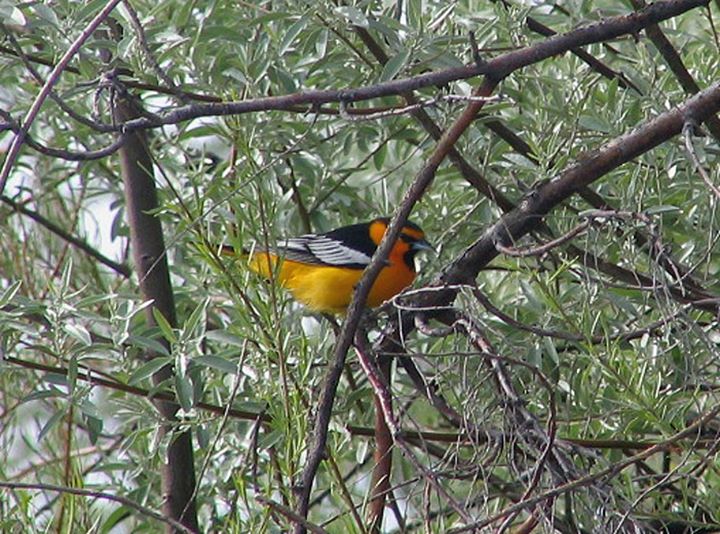
In the eastern United States, there are only two orioles — the Baltimore oriole and its smaller relative, the orchard oriole. The western half of the nation is home to a half dozen orioles, including Bullock’s oriole, Scott’s oriole, Audubon’s oriole, hooded oriole and Altamira oriole. I saw several gaudy, noisy Bullock’s orioles during a trip to Utah in May of 2006.

Tall trees are an essential part of the Baltimore oriole’s favored habitat. Baltimore orioles are well-known for their colorful appearance, but their fame also rests with a sack-like nest that Eastman describes as a “durable marvel of tight-woven plant fibers” in his informational book. Eastman also notes that during another era in America, the Baltimore oriole often built its marvelous nests in American elms before Dutch elm disease almost eradicated these trees from the landscape. He reports that maples, willows and apples have served as nesting trees in the absence of elms. Once the hard-working female oriole sets to work, she may spend eight days or longer weaving plant fibers into a strong pouch suspended from the outer ends of drooping branches. The durability of the nest means that other birds, including house finches, may occupy the old nest once abandoned by the original inhabitant.

Orioles are present in the region from April to October, retreating to the American tropics for the winter. There they may live on plantations that produce such much-coveted crops as bananas, coffee and cacao, which is the essential ingredient for chocolate.

George Calvert, Lord Baltimore

The Baltimore oriole is named in honor of one of the founding fathers of the state of Maryland. George Calvert, or Baron Baltimore, was an influential English colonist instrumental in establishing the colony of Maryland. His servants wore orange and black uniforms, which inspired early American naturalist Mark Catesby to name the bird the Baltimore oriole. The bird’s association with the the city of Baltimore and the state of Maryland have continued to this day. The bird is also famous as the namesake of one of America’s professional baseball teams.

Baltimore orioles eat insects and fruit, but these adaptive birds have also developed a fondness for sweet nectar. Orioles no longer have to raid sugar water feeders meant for hummingbirds. Many manufacturers of bird-feeding equipment now produce affordable sugar water feeders specifically designed for use by orioles. Many bird enthusiasts also use orange slices and grape jelly to lure orioles into their yards. I’ve tried these tricks, but I’ve attracted more gray catbirds and scarlet tanagers than I have orioles. In my book, that’s not a disappointment. I happen to like catbirds and tanagers.

With orioles, I’ve had better luck by refraining from a bit of pest control. Back in the late 1990s, I observed a male Baltimore oriole visiting a large caterpillar tent in the branches of a cherry tree. The bird methodically plucked the caterpillars from the silken tent, eating them one after the other. I’ve since learned that this is not an odd occurrence for Baltimore orioles. While many birds avoid spiny and hairy caterpillars, orioles actively seek them out and do a great service by reducing the damage these hungry caterpillars can inflict on the environment.

If you’re wanting to see orioles, I can share some area “hot spots” for these colorful birds. The waterfront at Winged Deer Park in Johnson City, Tennessee, has fewer tall trees than it did a few years ago, but the remaining trees still attract orioles. Warriors Path State Park in Kingsport, Tennessee, has long been a place that local birders depend on for sightings of Baltimore orioles. I also had some impressive sightings of both orioles at Hungry Mother State Park a few years ago. Although those birds could have been spring migrants, this park in Marion, Virginia, certainly offers habitat that orioles would find attractive.

Want more details on how to attract orioles to your yard using specialized feeders? Check out this helpful article from Birds and Blooms. https://www.birdsandblooms.com/birding/attracting-birds/bird-nesting/how-to-attract-orioles/

Photo by Bryan Stevens • In the western part of the United States, the Baltimore oriole is replaced by Bullock’s oriole.

Stunning summer tanager a lesser-known relative of scarlet tanager

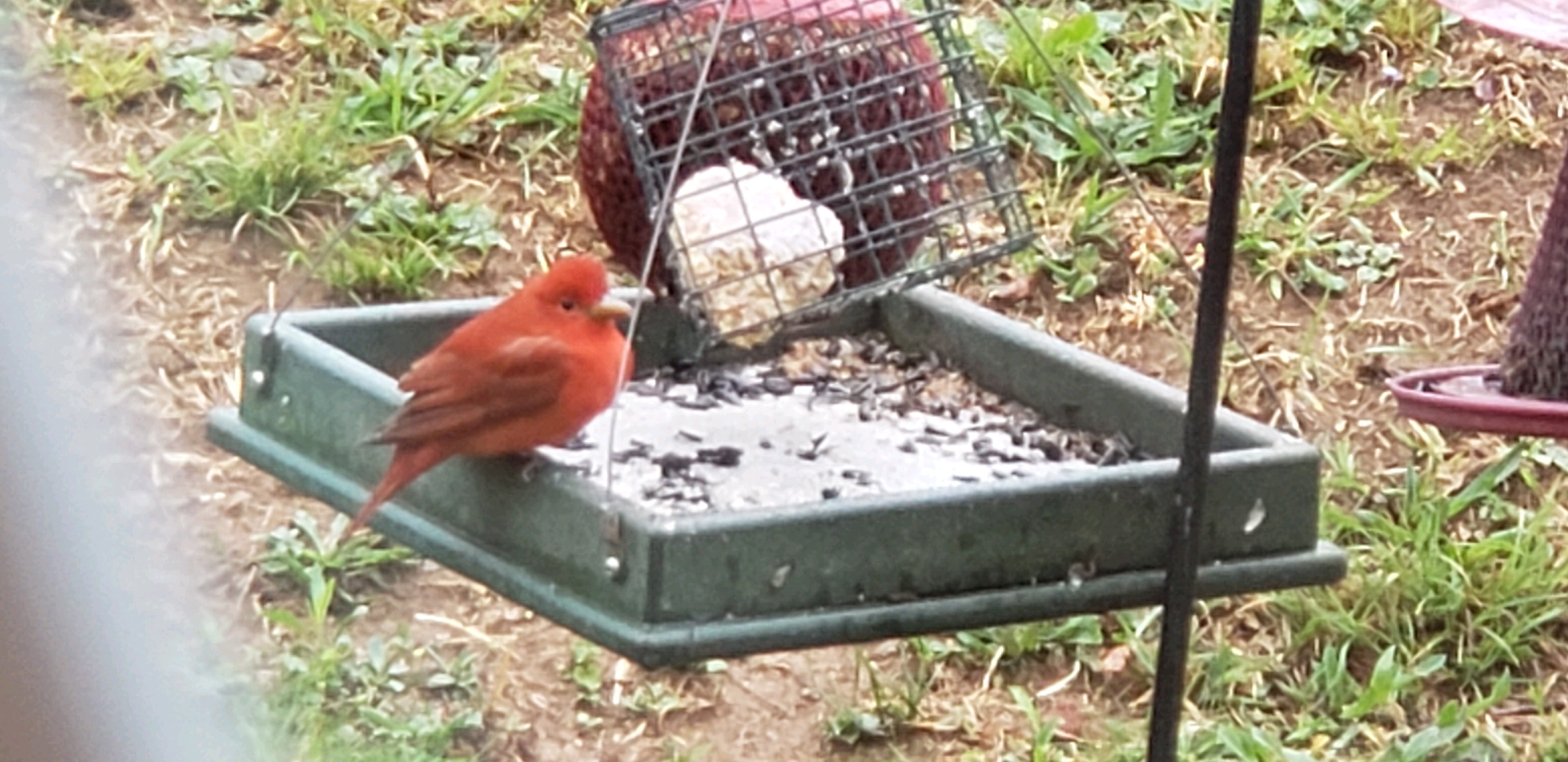
Photo Provided by Helen Whited • A male summer tanager visits a feeder during a migration stop in southwest Virginia.

Helen Whited, a resident of Richlands, Virginia, recently emailed me a photo of a feathered visitor in her yard asking for help with identification. She had already narrowed down the possibilities. “I’m thinking a tanager of some kind,” Helen wrote in her email.

When I opened Helen’s attached photo file, I recognized the plump, red bird perched on her feeder near a suet cage. I wrote an email back, informing Helen that her visitor was indeed a tanager. The summer tanager is not rare, per se, but these birds do not seem as common in the region as the related and better known scarlet tanager. Farther south, summer tanagers are much more prevalent in the spring and summer months.

Helen also reported seeing her first ruby-throated hummingbird of spring on April 25. “It’s later than usual, but they’re here,” she wrote in an email.

She added that several neighbors in Richlands, Virginia, reported seeing hummingbirds as early as April 21, but they seemed to be shunning her until the morning of April 25.

Since the last couple of columns have been about hummingbirds, I want to shift the focus this week to Helen’s other visitor.

If the casual birder or nature enthusiast is aware of the summer tanager, it’s usually as the less showy cousin of the more fiery and vibrant scarlet tanager, one of the most striking birds inhabiting woodlands in the eastern United States.

That’s a shame, for many reasons.

Photo by Ronald Plett/Pixabay.com • A male summer tanager perches in the leafy canopy.

First and foremost, the summer tanager holds one unique distinction. The male summer tanager is the only completely red bird in North America. Other birds known for their red plumage — Northern cardinal, house finch, vermillion flycatcher — show other colors in their feathers besides red.

The strawberry-colored male summer tanager is often difficult to spot due to a propensity to keep hidden against the green leaves of the forest canopy. The website “All About Birds” describes the female as “mustard yellow” in her coloration, which is rather apt. Female summer tanagers are usually less greenish than female scarlet tanagers. The female is even harder to spot than the male, though both sexes have a very distinctive chuckling call note.

Over the years, different local spots have proven reliable for finding summer tanagers. Large trees near the Steele Creek Park Nature Center in Bristol, Tennessee, used to be a fairly dependable location for these tanagers during late spring and summer.

Early American naturalist and artist John James Audubon painted this work featuring a family of summer tanagers.

The summer tanager is classified in the genus Piranga, which includes the scarlet tanager as well as the western tanager of the states west of the Rocky Mountains. This genus also includes the flame-colored tanager, white-winged tanager and red-headed tanager. Experts now classify this genus with members of the cardinal family and have separated the Piranga tanagers from other New World tanagers.

The song of the summer tanager has been described as similar to that of the American robin. Like the scarlet tanager, the summer tanager is fond of fruit and berries, but it also eats insects, often catching them on the wing.

Confined mostly to the eastern United States during the nesting season, the summer tanager doesn’t range as far north as the scarlet tanager, making its stronghold in the Gulf and southern states.

The summer tanager’s scientific name, Piranga rubra, translates as “red bird.” It’s not really clear why this tanager acquired the word “summer” in its common name. After all, both the summer tanager and scarlet tanager are only present in North America for a brief nesting season from late April to early September.

Other birds besides tanagers are on the move as spring migration continues. Get outdoors and see what wanders into your yard or garden. To share your own observations, email me at ahoodedwarbler@aol.com. I’m also on Facebook.
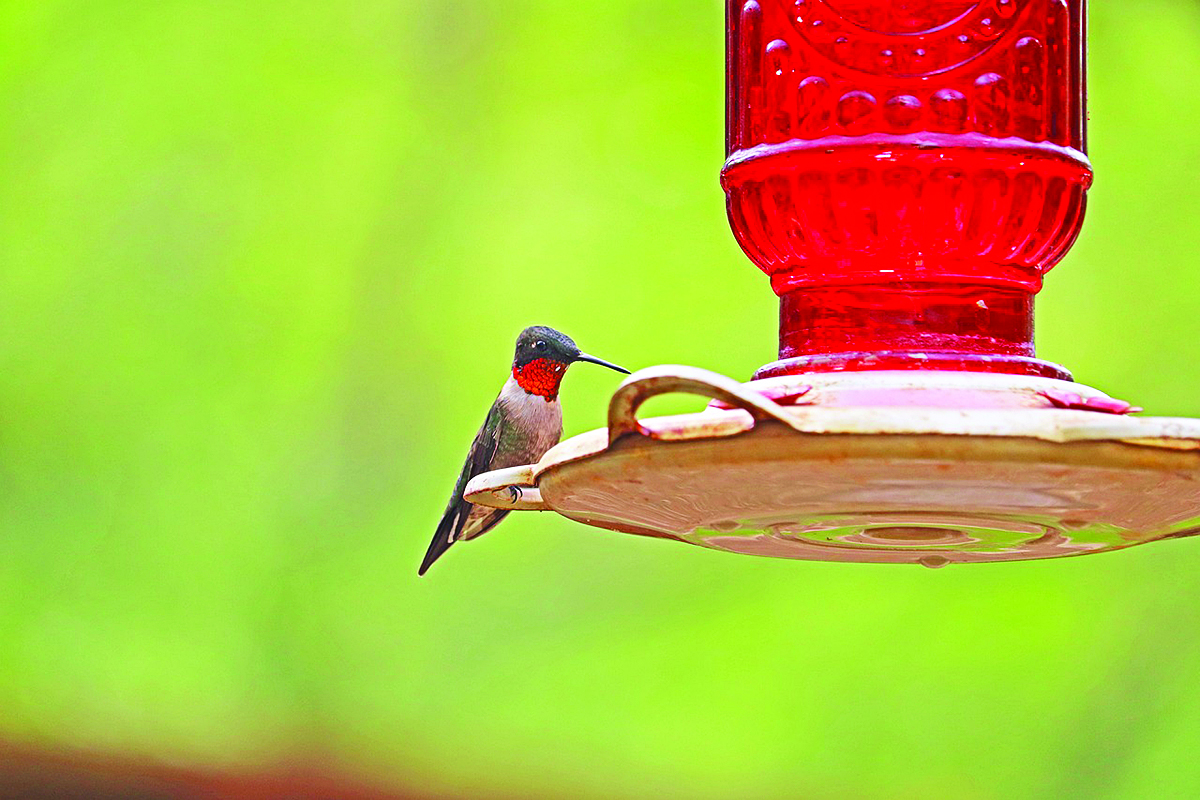
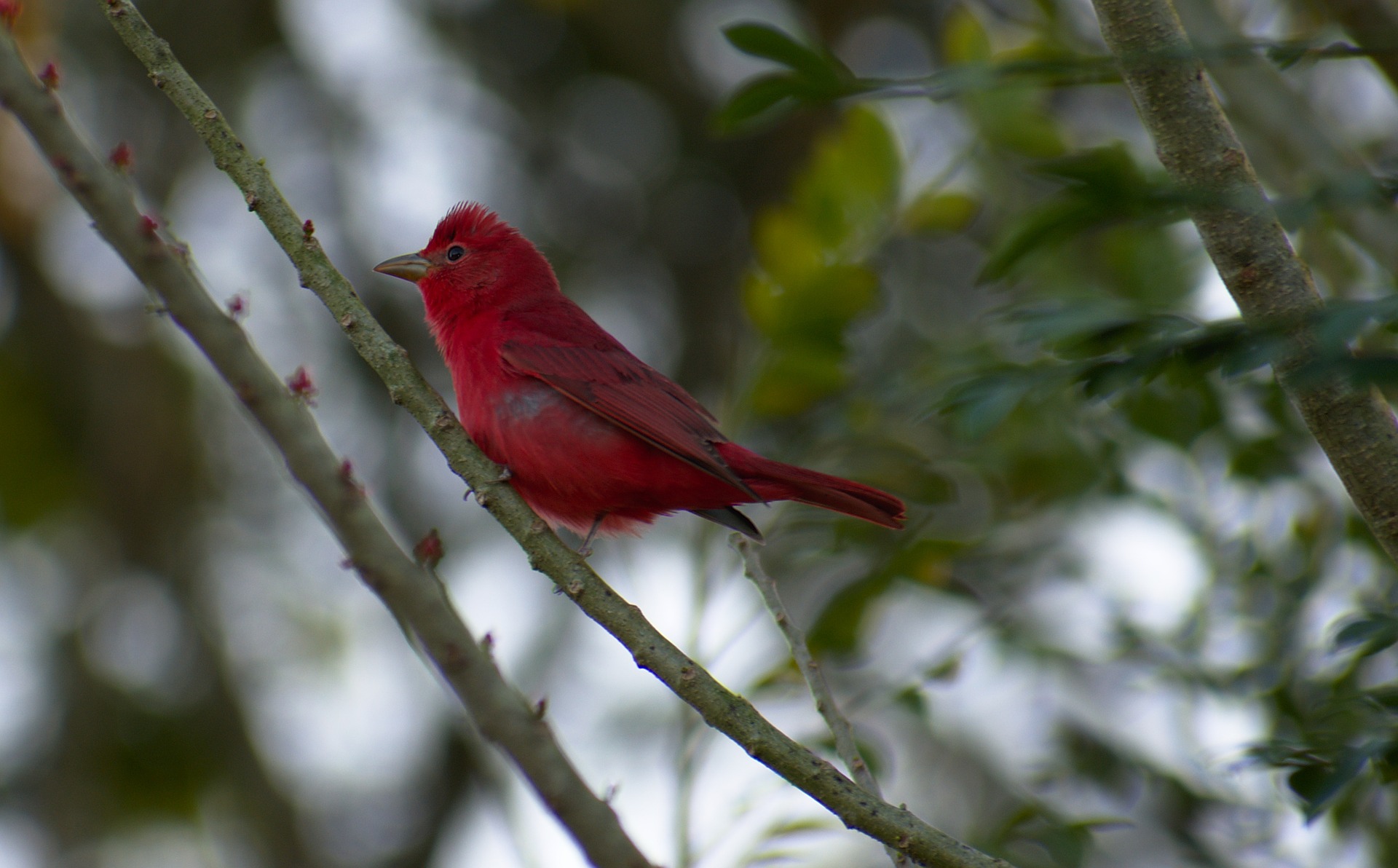
Photo Courtesy of Jean Potter • The summer tanager is the only all-red bird in North America. It is less common in Northeast Tennessee than the related scarlet tanager.