Tag Archives: Songbirds

Red-winged blackbirds making their presence felt in region

Redwing-2

Photo by Bryan Stevens                                      A male red-winged blackbird sings from an elevated perch in a wetland habitat.

I recently received an email from Tom and Helen Stetler in Elizabethton, Tennessee. The couple reported seeing several “early birds” in their yard recently, including American robins and a total of six red-winged blackbirds. “One even went up on the bird feeder,” they wrote.

The couple noted that red-winged blackbirds are usually harbingers of spring, but these birds arrived with some of the last of the wintry weather in February.

“Oh well, better days are coming, Lord willing,” the Stetlers wrote. They also added they have seen Song Sparrows and an Eastern Towhee at their feeder in recent days.

Stetler-Blackbirds

Photo Courtesy of Tom and Helen Stetler            A male red-winged visits a feeder at the Stetler home in Elizabethton.

I’ve long come to associate red-winged blackbirds with early spring. I also had a single red-winged blackbird make a one-day visit in February during a snowstorm. Those February visitors are the vanguard of large numbers of red-winged blackbirds that return in impressive numbers every March. The blackbirds arriving now behave much differently than the quiet, furtive ones that often make brief visits to feeders during late winter snowstorms.

The showy and loud red-winged blackbirds that have returned to my fish pond and adjacent stands of cattails immediately made themselves at home.

“The kon-ke-ree song of the male red-winged blackbird is a sure indication that spring is on the way,” according to a profile located at the Tennessee Watchable Wildlife website.

At this time of year, the male red-winged blackbirds seek elevated perches to display and vocalize. Their loud antics are not designed solely to attract mates. Male red-winged blackbirds also sing to warn rival males from intruding into their territories.

The male red-winged blackbirds is a very aptly named bird. Glossy black males sport red wing patches that are often trimmed with a narrow band of yellow feathers. By contrast, female red-winged blackbirds are mostly brown birds that could easily be mistaken for large sparrows. Both sexes have sharply pointed bills.

RW-Blackbird-Erwin

Photo by Bryan Stevens                                    Male red-winged blackbirds sing to proclaim territories and attract mates.

Red-winged blackbirds are fond of wetlands. Any marsh or even a damp field or flooded pasture is likely to attract a few resident red-winged blackbirds. Females choose nesting locations in cattails or other marsh vegetation. She usually lays three or four eggs. Although she does receive some help from the male, most of the responsibility for raising the young is left to her.

There is a reason that male red-winged blackbirds are not always quite as engaged in feeding and tending their young. Male red-winged blackbirds are often polygynous, which means that males will often court multiple mates. His time is often occupied defending females and their respective nests from the advances of other male red-winged blackbirds.

Other relatives of the red-winged blackbird in the United States include the tri colored blackbird found along the Pacific Coast and the yellow-headed blackbird resident in wetlands west of the Great Lakes. Rusty blackbird, common grackle and brown-headed cowbird are other species of blackbirds found in Tennessee, Virginia and North Carolina.

Some other signs of spring I’ve detected at home have included a bonanza of spring blooms, choruses of spring peeper frogs and even the fluttery flights of a few early butterflies.

Of course, even as I write this week’s column, an unwelcome cold front has plunged temperatures below freezing. It’s only a temporary setback, so I know that spring will continue to advance. My evidence? A range of other birds are poised to return in the coming weeks. Once again, birds like red-winged blackbirds and American robins are just part of the vanguard of returning spring migrants. Spring migration begins as a trickle in March only to explode into a torrent in April and early May.

Hunt-Redwing

Photo by Bryan Stevens                      Red-winged blackbirds generally return to Northeast Tennessee as the weather turns milder in the spring.

If you would like to share your own spring sightings, send me an email at ahoodedwarbler@aol.com.

I am especially interested in hearing about the first arrival dates of ruby-throated hummingbirds. If you’ve seen your first ruby-throated hummingbird of the spring, contact me with the date and time you saw your first hummer of the season.

••••••

Bryan Stevens lives near Roan Mountain, Tennessee. To learn more about birds and other topics from the natural world, friend Stevens on Facebook at https://www.facebook.com/ahoodedwarbler. He is always posting about local birds, wildlife, flowers, insects and much more.

New bird arrivals signal spring’s imminent approach

Ring-neckedDuck

Photo by Bryan Stevens                                        A Ring-necked Duck visits a pond at Erwin Fishery Park.

The recent extremely warm weather — well, warm for the month of March — may have finally broken the back of winter. Signs of spring are becoming easier to detect, especially among our feathered friends. The pond at Erwin Fishery Park had been a great location to view migrating waterfowl for the past few weeks, but most of the visiting ducks — redheads, ring-necked ducks and American wigeon — appear to have concluded their late-winter visit.

Redheads-Erwin

Photo by Bryan Stevens                                        A raft of Redheads floats on the surface of the pond at Erwin Fishery Park in Unicoi County, Tennessee.

Signs of spring are becoming easier to detect, especially among our feathered friends. I’ve heard from numerous readers about flocks of American robins making welcome visits. While not the only harbinger of spring among our birds, robins are probably foremost among the birds we like to associate with the arrival of spring weather. The numerous large flocks of robins I observed during the last couple of weeks of February and early March, however, consisted mostly of birds coping with heavy snowfalls.

AmericanRobin

Photo by Bryan Stevens                                American robins are a familiar sight on lawns in spring. While the robin is widely believed to be a harbinger of spring, many other birds can also lay claim to this distinction.

The month of March is usually a time of transition, with many winter birds making ready to depart as some of our summer favorites return from their more southern wintering grounds. At home, I have noted the spring arrivals of Eastern phoebes and belted kingfishers. On March 6, a wary pair of wood ducks made a brief visit to the fish pond on my property. A couple of other bird species will probably make their appearance at some point in March. At my home, brown thrashers, tree swallows and red-winged blackbirds have returned and are already making themselves comfortable. These species and a handful of others are usually in the vanguard of spring arrivals. Let me know what you’re seeing as spring advances. I always enjoy hearing from readers.

Among the readers who have written to me recently was Shelly Jones, a resident of north Abingdon, Virginia.

LookinAmirror

Photo by Bryan Stevens                                    Song Sparrows are already making efforts to attract mates for the first spring nesting attempts.

“I have many bird feeders, with all kinds of seeds and suet cakes to attract as many different bird species that I can,” Shelly wrote in an email. “Like you, I have had all the common woodpeckers come to my feeders.”

Shelly commiserated with my never having been fortunate enough to get a visit from a red-headed woodpeckers at my home. She added that not only has she never been visited by a red-headed woodpecker at home, she has never seen one of these woodpeckers at all.

“I have seen the great pileated woodpecker flying through the tree tops,” she noted.

TreesWallows

Photo by Bryan Stevens                                   Tree Swallows perch on a wire over a pond in Hampton, Tennessee.

Her luck changed shortly after I ran the last installment on a series focused on the members of the woodpecker family.

“Today, when looking out at my feeders, there it was!” Shelly reported. It turned out to be a red-headed woodpecker. “My husband saw it, too,” she wrote. “I tried to get a photo, but it flew away before I could capture it. I’ll keep trying.”

Shelly and her husband live on five acres, mostly pasture for their two horses, but they are surrounded by woods on three sides, with many oak trees thriving in the woods. The habitat she described sounded imminently suitable for attracting red-headed woodpeckers.

I wrote an email back to Shelly congratulating her on the home visit from this woodpecker and joked that I was a little envious of her good fortune.

•••••••


BeckyGale-Eagle

Photo Courtesy of Gayle Riddervold      This photo of an adult Bald Eagle was taken this past winter along Simerly Creek Road.

Gayle Riddervold and Rebecca Kinder recently shared a photo of an adult Bald Eagle that they had taken along Simerly Creek Road in Hampton. They had been leaving for a trip to Gatlinburg, Tennessee, when they saw the eagle and stopped to get a photo.  Bald Eagles are often seen along lakes and rivers in Carter County during the winter, but finding an eagle at higher elevations is somewhat unusual.

••••••

Other readers have been sharing bird sightings that, if we’re fortunate, offer a signal of the changing seasons as winter wanes and spring nears.

Adelaide Moss in Abingdon, Virginia, wrote with a question about vultures. Vultures, by the way, are considered a harbinger of spring in some sections of the country. The two species — turkey vulture and black vulture — are year-round residents in our region.

“I am very curious about the vultures that hang out in trees in winter,” Adelaide wrote. “What on earth do they all eat? There are so many of them I can’t imagine there is enough roadkill to feed them all.

She added that she never sees vultures eating except occasionally on roads where they are eating roadkill.

“I would love to know more about them,” she wrote.

Bryan-Vulture

Photo by Bryan Stevens                    Turkey Vultures, unlike most birds, have a well-developed sense of smell.

I’ll focus on the turkey vulture, which benefits from a sense of smell that is absent in most other birds, the related black vulture included. With its finely-tuned olfactory senses, the turkey vulture can detect roadkill and other carrion from a distance of a mile.

These birds can also use their large wings to soar for hours. Soaring is much more energy-efficient than the flapping of wings. Experts who have studied turkey vultures estimate the birds may travel 200 miles or more in a single day in foraging for a meal such as a deer’s carcass or even an opossum squashed on the side of the road. Like many a scavenger, the turkey vulture’s not finicky and will eat almost anything. Pairing excellent eyesight with a good sense of smell means very little edible roadkill goes unnoticed by these birds.

••••••

I recently received an email from Tom and Helen Stetler in Elizabethton, Tennessee.

They reported seeing several “early birds” in their yard recently, including a total of six Red-winged Blackbirds. “One even went up on the bird feeder,” they wrote.

Stetler-Blackbirds

Photo courtesy of Tom and Helen Stetler     Red-winged Blackbirds, such as this bird, began returning to the region in February.

The couple noted that Red-winged Blackbirds are usually harbingers of spring, but they arrived with some of the last of the winter weather in February.

“Oh well, better days are coming, Lord willing,” the Stetlers wrote. They also added they have seen Song Sparrows and an Eastern Towhee at their feeder in recent days.

••••••

To learn more about birds and other topics from the natural world, friend Stevens on Facebook at https://www.facebook.com/ahoodedwarbler. He is always posting about local birds, wildlife, flowers, insects and much more. If you have a question, wish to make a comment or share a sighting, email ahoodedwarbler@aol.com.

Elizabethton Christmas Bird Count tallies 73 species

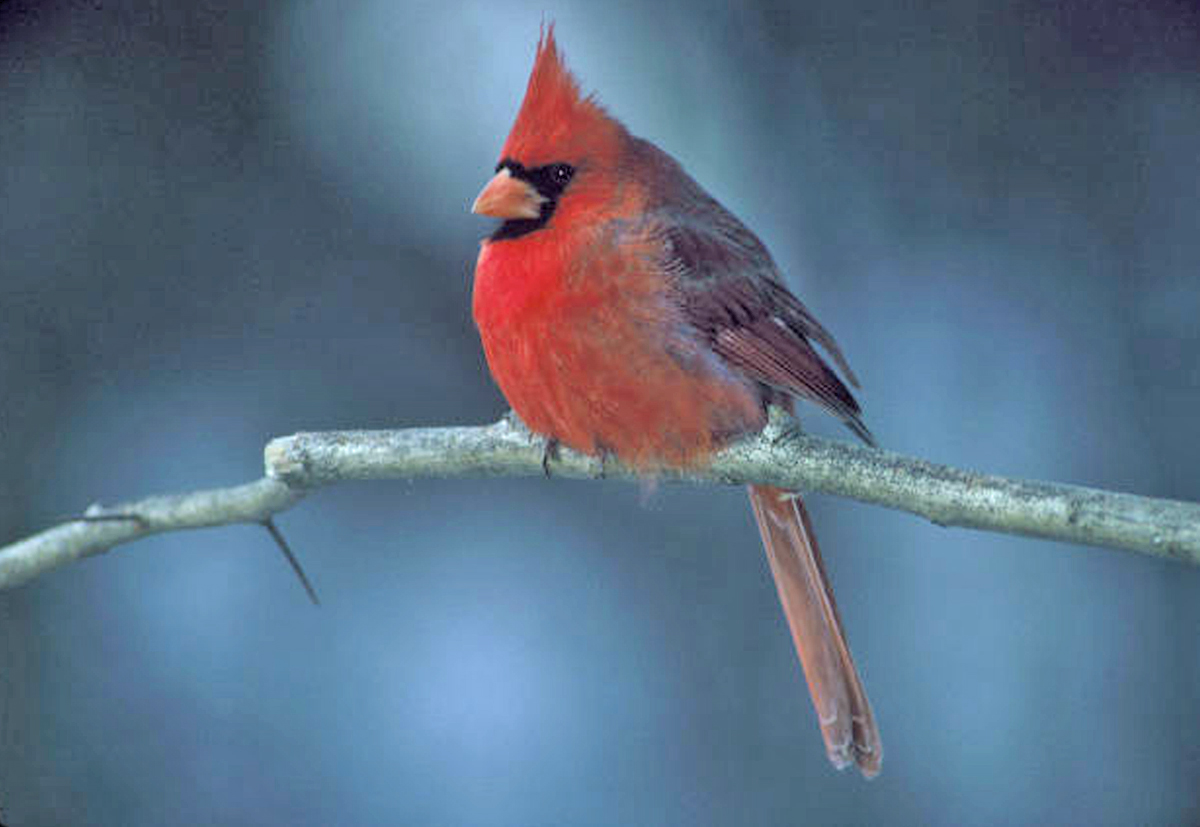
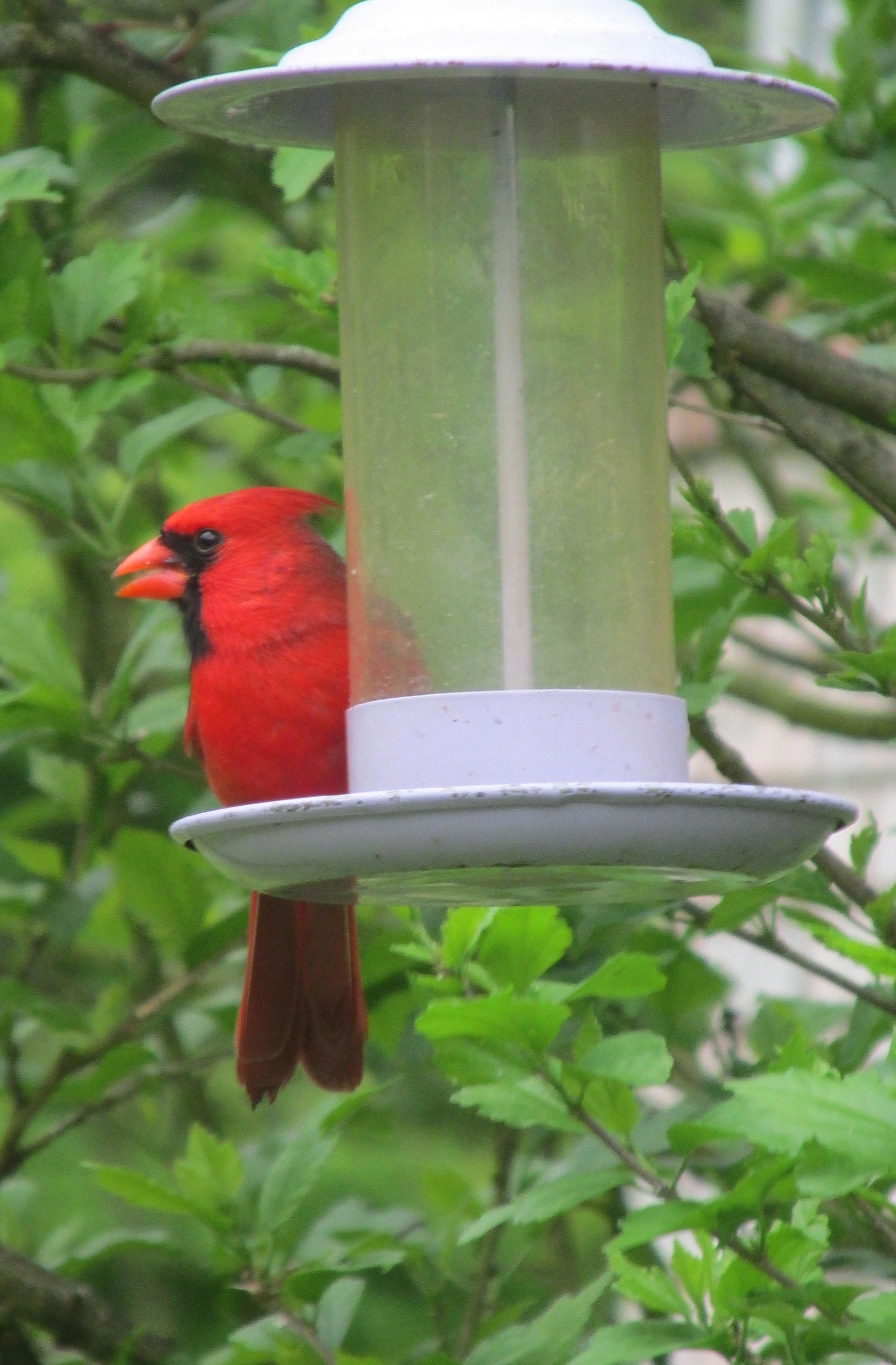
Cardinal-Blur

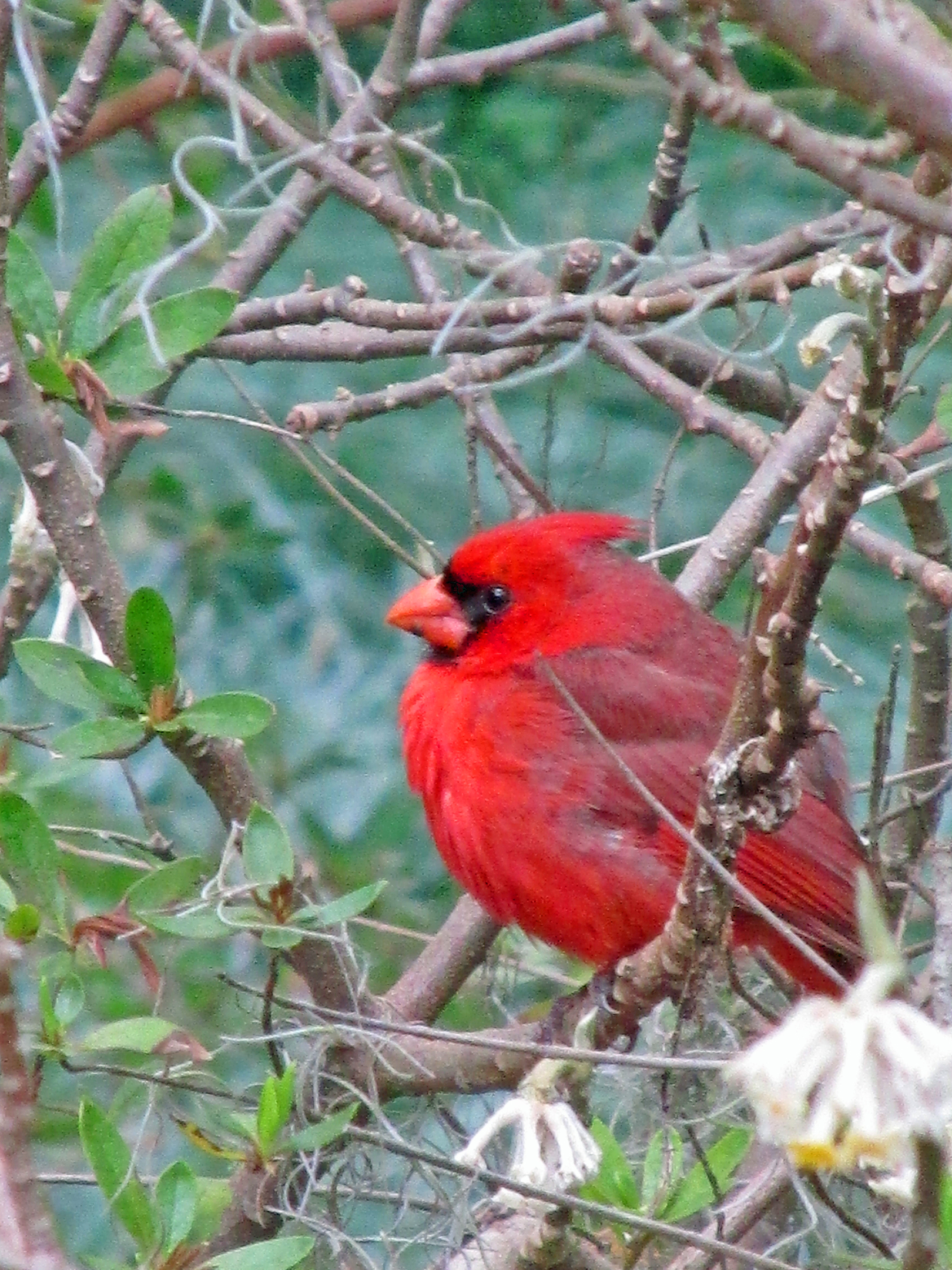
A blur of red feather signals the arrival of a male Northern Cardinal at a feeder. A total of 123 cardinals were found on the recent Elizabethton CBC.

The 73rd consecutive Elizabethton Christmas Bird Count was held on Saturday, Dec. 19, with 24 observers in six parties plus one feeder watcher.  A total of 73 species was tallied, with an additional four count-week species. This is slightly above the recent 30-year average of 71.7 species. The all-time high for this CBC was 80 species in 2012.

Long-time count compiler Rick Knight noted that some of the highlights from this year’s Elizabethton CBC included: five Blue-winged Teal, which represented only the fourth time this duck has been found for this count, as well as  Northern Shoveler and Greater Scaup.

BaldEagle-Sunning

Bald Eagle was represented by five individual birds on the recent CBC conducted by members of the Elizabethton Bird Club.

Other highlights included Bald Eagle, Eurasian Collared-Dove, Red-breasted Nuthatch, American Pipit and Palm Warbler.

The 72 Chipping Sparrows found during the CBC represented the most individuals of this species ever tallied for this count.

A few winter finches have also arrived in the area, based on the Purple Finch and Pine Siskins detected during the CBC.

Red-breastedNutHatchYAHOO

A single Red-breasted Nuthatch was found, assuring that this species made it onto the annual survey of bird populations in Elizabethton, Tennessee.

The European Starling was the most common bird with a total of 1,707 individual starlings represented on the count. Other common birds included American Crow (987), Canada Goose (511) and American Robin (450).

The total for the 2015 Elizabethton CBC follows:

Canada Goose, 511; Mallard, 129; Blue-winged Teal, 5; Northern Shoveler, 12; Greater Scaup, 2; Lesser Scaup, 1; Bufflehead, 172; and Hooded Merganser, 10.

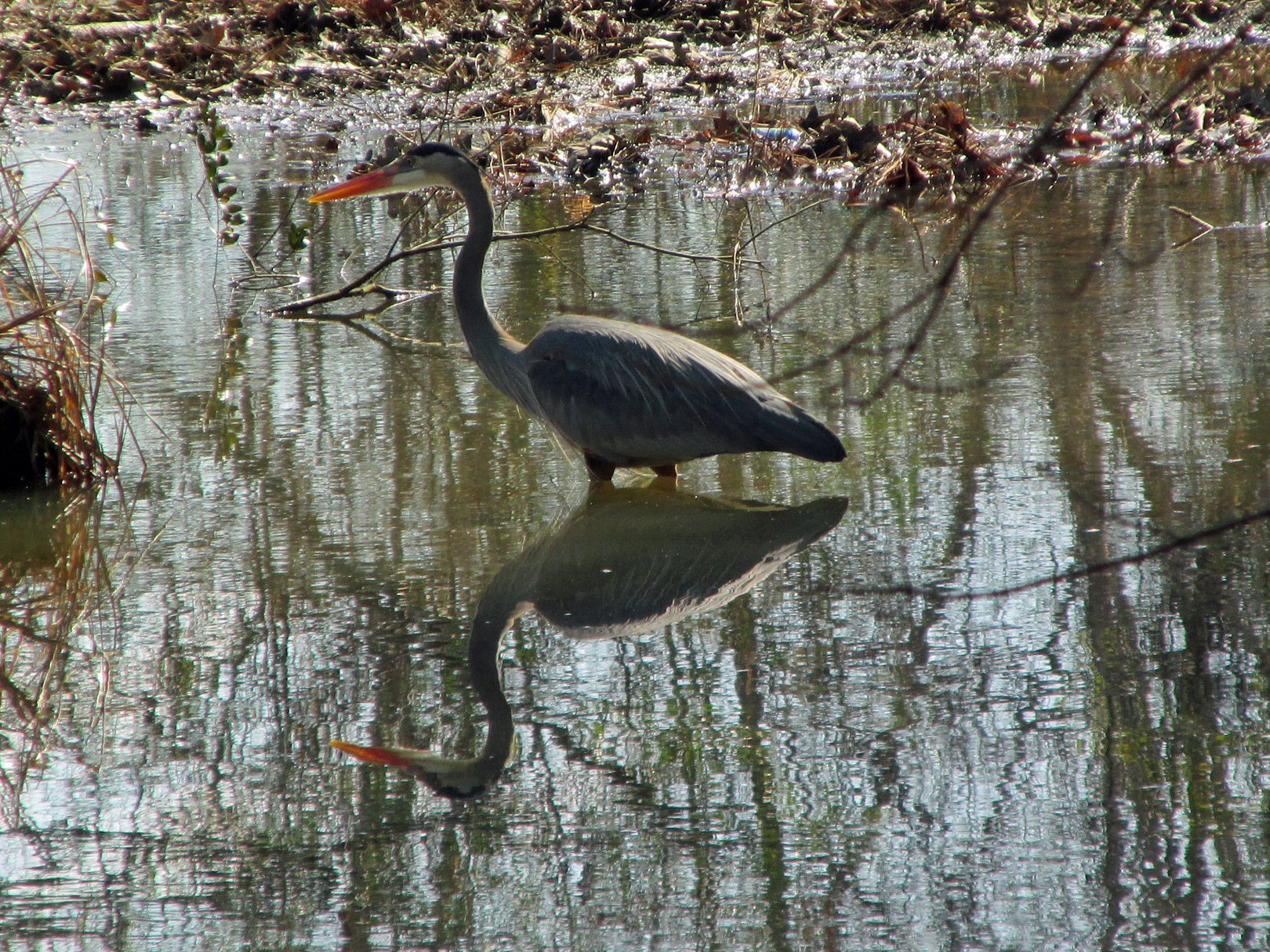
Wild Turkey, 30; Pied-billed Grebe, 15; Horned Grebe, 10; and Great Blue Heron, 13.

Black Vulture, 16; Turkey Vulture, 26; Sharp-shinned Hawk, 2; Cooper’s Hawk, 5; Bald Eagle, 5; Red-shouldered Hawk, 2; Red-tailed Hawk, 22; and American Kestrel, 18.

American Coot, 7; Killdeer, 5; Ring-billed Gull, 65; Rock Pigeon, 349; Eurasian Collared Dove, 7; and Mourning Dove, 114.

Eastern Screech-Owl, 7; Great Horned Owl, 4; Barred Owl, 1; Belted Kingfisher, 13; Red-bellied Woodpecker, 27; Yellow-bellied Sapsucker, 7; Downy Woodpecker, 23; Hairy Woodpecker, 3; Northern Flicker, 11; and Pileated Woodpecker, 10.

Eastern Phoebe, 7; Blue Jay, 76; American Crow, 987; Common Raven, 6; Carolina Chickadee, 111; and Tufted Titmouse, 110.

Red-breasted Nuthatch, 1; White-breasted Nuthatch, 31; Brown Creeper, 2; Winter Wren, 3; and Carolina Wren, 60.

IMG_8437

Five Hermit Thrushes were among the many species found during the Elizabethton CBC.

Golden-crowned Kinglet, 32; Ruby-crowned Kinglet, 2; Eastern Bluebird, 114; Hermit Thrush, 5; American Robin, 450; and Northern Mockingbird, 27.

European Starling, 1,707; American Pipit, 40; Cedar Waxwing, 116; Palm Warbler, 3; and Yellow-rumped Warbler, 106.

Eastern Towhee, 12; Chipping Sparrow, 72; Field Sparrow, 31; Fox Sparrow, 3; Song Sparrow, 104; Swamp Sparrow, 104; White-throated Sparrow, 78; and Dark-eyed Junco, 74.

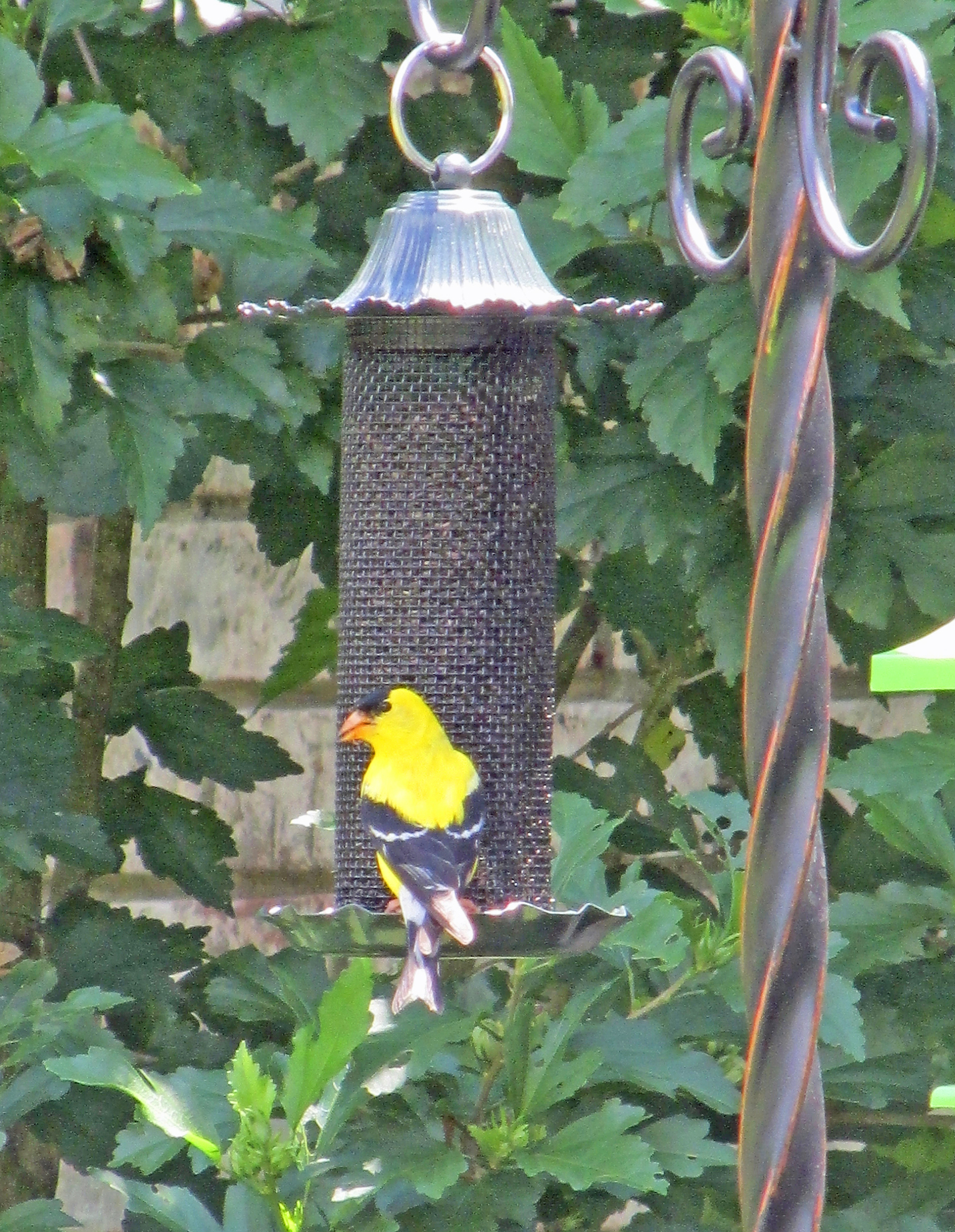
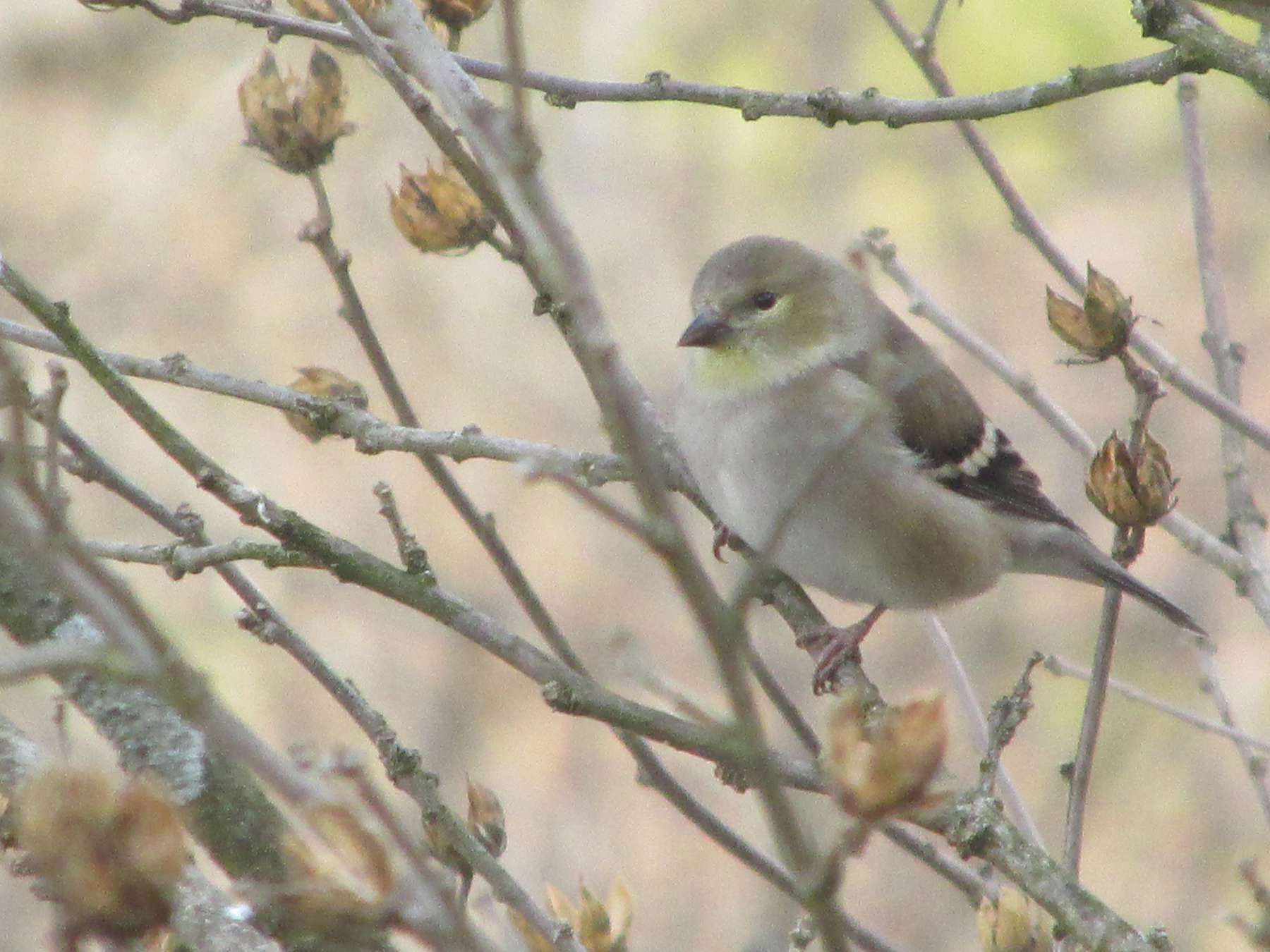
Northern Cardinal, 123; Eastern Meadowlark, 4; House Finch, 51; Purple Finch, 1; Pine Siskin, 25; American Goldfinch, 101; and House Sparrow, 41.

•••••

Fall-Yellowthroat

A Common Yellowthroat is a rare bird in Northeast Tennessee during the winter months.

It was strange to walk outside in short sleeves this past Christmas. This weird winter weather has also led to some unexpected bird sightings. I saw my first-ever winter warbler (other than Yellow-rumped Warbler) at home ton Dec. 30. The warbler was a male Common Yellowthroat lurking in the cattails near the fish pond. Several years ago, I found a female Common Yellowthroat at Wilbur Lake on a Christmas Bird Count. In addition to the yellowthroat, I found a Swamp Sparrow in the cattails. I also had a flock of Dark-eyed Juncos (as opposed to just one bird) in the backyard that same day.

I am pleased to find that the winter birds are gradually arriving. Now that it looks like more typical winter temperatures might prevail for awhile, I expect activity to increase at my feeders.

•••••

To learn more about birds and other topics from the natural world, friend Stevens on Facebook at https://www.facebook.com/ahoodedwarbler. He is always posting about local birds, wildlife, flowers, insects and much more. If you have a question, wish to make a comment or share a sighting, email ahoodedwarbler@aol.com.

••••••

This week’s post is dedicated to Sassy, a one-of-a-kind cat that shared my life from the summer of 2002 until Dec. 26, 2015.Sassy

Birds adopt many strategies for care of their young

One question that tends to pop up every June in my email or on Facebook concerns the presence of hummingbirds.  The status of hummingbirds at my own home since their arrival back in April has been somewhat sporadic. I think this has been noticed by some other people, too.

MommyHummer

Photo by Bryan Stevens                                                                  A female Ruby-throated Hummingbird visits a feeders. Female hummingbirds in our yards in June and July are probably nesting residents.

The hummingbirds were scarce in April and May. When June arrived, their numbers began to increase.

However, this pattern that I saw this year is usually just the opposite. The hummingbirds are usually abundant in early spring, taper off in June and July, and then increase again in August and September. Basically, I think their numbers just naturally fluctuate. Some years we have more of them than other years.

There are other possibilities to explain the absence of hummingbirds. It’s always possible that hummingbirds, adhering to the philosophy that “the grass is always greener” elsewhere have taken to exploring a neighbor’s yard and gardens.

Hummingbirds, like many of the songbirds that spend the summer season with us, keep busy this time of year with the task of raising offspring. That alone could explain a temporary lull in their numbers in our yards and gardens.

BabyTowhee

Photo by Bryan Stevens                                                A young Eastern Towhee, not long out of the nest, looks for sunflower seeds in the grass beneath a feeder.

Many species of birds attempt to nest two or even three times during the summer nesting season. So far this year, I’ve observed nesting activity by a wide variety of birds, including Northern cardinals, brown thrashers, Eastern towhees, Eastern bluebirds, tree swallows, song sparrows, white-breasted nuthatches, Carolina wrens and downy woodpeckers.

All birds, from tiny hummingbirds that are mere inches long to an ostrich that can stand more than nine feet tall, start out as eggs. Birds have developed a range of ways to protect and incubate eggs to ensure the continuance of the species.

For many birds, the strategy is to produce as many young as possible in a limited amount of time. The hooded warbler, which spends the winter months in Central America, will usually make multiple nesting attempts in a season. The female constructs a cup-shaped nest, which is a design common to many of our songbirds. She will lay three to five eggs in the nest. Incubation of the eggs is a duty usually performed solely by the female, but her mate helps by guarding the nest and surrounding territory. Both parents feed the young once they have hatched after about two weeks.

Not all birds share in the task of caring for helpless young. For instance, the male ruby-throated hummingbird shows not the slightest inclination to assist the female with the duties of rearing young. All ruby-throated hummingbirds are raised by single mothers. Male hummingbirds spend the summer sipping nectar, dueling with other male hummers and courting multiple females.

Hooded warbler pairs, as is the case with many songbirds, share the work of feeding and tending young. Many of these young birds spend very little time in the nest after hatching. Hooded warblers have typically left the nest within nine days of hatching, although parents continue to feed the young as they learn to fly and care for themselves.

BS-Phoebe-Baby

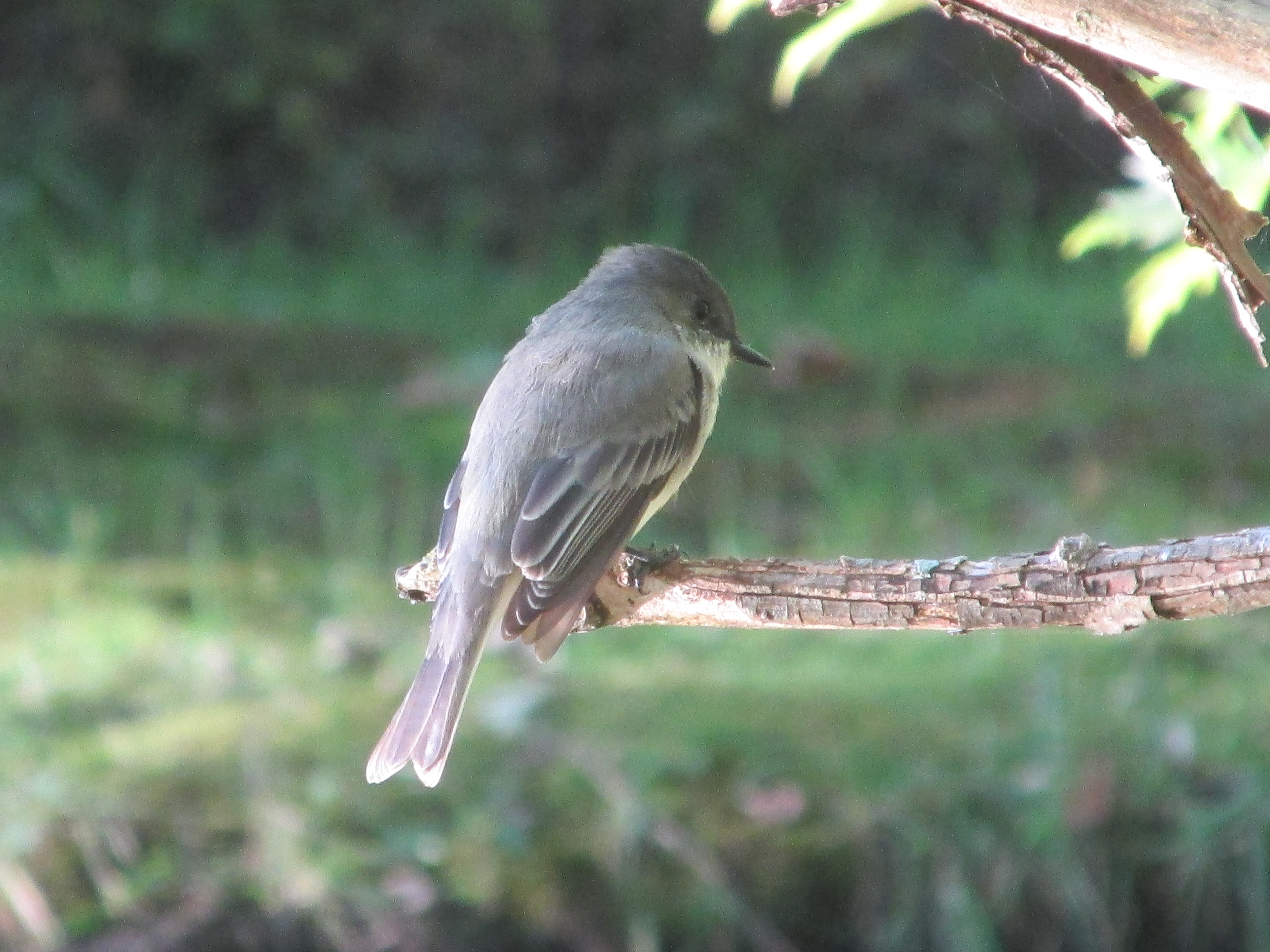
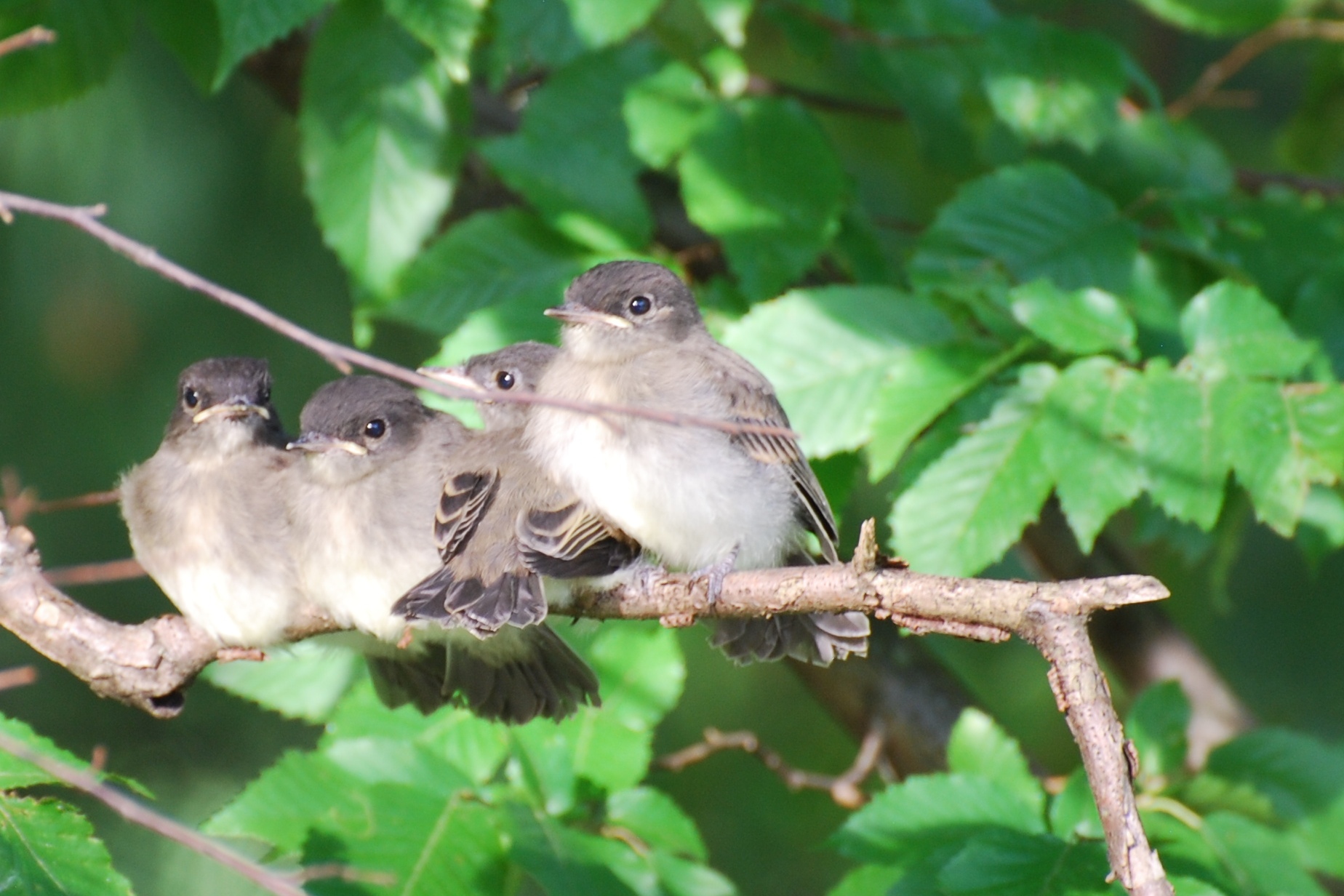
Photo by Bryan Stevens                                    An Eastern phoebe fledgling perches on a tree branch.

Some birds, such as Northern Cardinals, often delegate the duty to the male for caring for young that have fledged from the nest. As the male trains and continues to feed the maturing young, the female cardinal often begins the work of building a second nest, laying another clutch of eggs and incubating them. Time is scarce. By getting a jump-start on a second nest, the female cardinal, if successful, may produce eight to ten new cardinals in a single nesting season.

John-James-Audubon-Common-Cow-bird.-1.-Male.-2.-Female.-3.-Young

A painting of Brown-headed Cowbirds by John James Audubon.

Some birds, however, have bypassed the necessity of nesting altogether. If all hummingbirds are reared by females, then all young cowbirds are from foster homes, or nests. Female cowbirds slip their eggs into the nest of other unsuspecting songbirds. The hooded warbler is often a victim of this practice, which is known as “nest parasitism.” Some experts have conducted studies that indicate as many as 75 percent of hooded warblers in some areas are parents to cowbirds foisted on them.

BarnSwallows.jpg

Photo by Bryan Stevens                                Young barn swallows in their nest await a delivery of food by their parents.

It’s not wise to condemn cowbirds for a behavior that would strike us as immoral. The peculiar reproduction strategy for the cowbird came about as a natural necessity. Cowbirds once followed the massive herds of bison across the North American continent, feeding on the insects and seeds displaced by the hooves of these huge animals. Since the bison herds stayed on the move, the cowbirds didn’t have the luxury of staying put for a couple of months to raise young.

The decimation of the bison herds could have proven a disaster for the cowbirds. That wasn’t the case, however, since these adaptable birds simply switched from following bison herd to doing the same with the enormous numbers of domestic cattle that inherited the range of the buffalo, or bison.

These are just a select few ways that birds succeed year after year in the never-ending effort to ensure the survival of the species for another generation. Many obstacles stand in their way. Any time you see birds bringing their babies to a feeder in your yard or a shrub in your garden, recognize this moment as a singular triumph for the labor and dedication our fine feathered friends have invested in this outcome.

JP-RedEyedVireo-Fledgling

Photo Courtesy of Jean Potter                                                                                                                A young Red-eyed Vireo calls for food while concealed on the ground after leaving the nest. As is the case with most songbirds, parents continue to care for young even after they have left the nest.

Summer counts reflect busy time of year for local birds

Photo by Bryan Stevens  Many young birds, such as this Chipping Sparrow on a barbed wire fence in Limestone Cove in Unicoi County, look almost nothing like their parent.

Photo by Bryan Stevens
Above: Many young birds, such as this Chipping Sparrow on a barbed wire fence in Limestone Cove in Unicoi County, look almost nothing like their parent. Upper: Young Tree Swallows test perching skills.

I took part in the two Summer Bird Counts conducted recently by the Lee and Lois Herndon Chapter of Tennessee Ornithological Society in Carter County and Unicoi County on consecutive June Saturdays.

Photo by Bryan Stevens A young Eastern Phoebe perches patiently on a branch while waiting for a parent to bring food.

Photo by Bryan Stevens
A young Eastern Phoebe perches patiently on a branch while waiting for a parent to bring food.

One thing I enjoy about participating in Summer Bird Counts is the prevalence of young birds. It’s only to be expected since the summer season is the time when most local birds build nest, lay eggs and rear young. Some birds got started with the business of raising young back in April and are already attempting second nestings.

Photo by Bryan Stevens A male Northern Cardinal tends to a fledgling hidden near the ground in thick brush.

Photo by Bryan Stevens
A male Northern Cardinal tends to a fledgling hidden near the ground in thick brush.

This year’s counts reported a variety of young birds among the totals, including numerous Wild Turkey poults, as well as species as diverse as Ruffed Grouse and Chipping Sparrow to Northern Cardinal and Barn Swallow.

I counted birds on Holston Mountain in Elizabethton with Chris Soto and Robert Armistead during the Carter County survey. For the Unicoi County, I teamed with Gary Wallace and John Whinery to count birds in the community of Limestone Cove.

Photo by Bryan Stevens A Song Sparrow brings a beakful of caterpillars back to the nest to feed young.

Photo by Bryan Stevens
A Song Sparrow brings a beakful of caterpillars back to the nest to feed young.

The Carter County and Unicoi County Summer Bird Counts are the only surveys conducted during the summer in Northeast Tennessee and Southwest Virginia. Christmas Bird Counts are more common and include the long-running Bristol CBC and more recent surveys such as the Glade Spring CBC and Shady Valley CBC.

In next week’s post, I will explore the results of the counts in more detail. You might very well be surprised what birds can be found in the region. I know I always am!

Photo by Bryan Stevens A Barn Swallow makes a food delivery to young waiting somewhat patiently on a utility line.

Photo by Bryan Stevens
A Barn Swallow makes a food delivery to young waiting somewhat patiently on a utility line.