Tag Archives: Tennessee

Family of pigeons, doves features one famous member

Vivian Tester of Bristol, Tennessee, sent me an email seeking help with a pigeon problem.

“I need your advice on trying to keep the pigeons off my bird feeders,” Vivian wrote. “They are chasing off the birds I want to feed and devouring all the seed. My neighbor says they are doves but whatever they are, they are annoying. I don’t know if the squirrel-proof feeder would work or not. I would appreciate any help.”

animal animal photography avian beak

Photo of a rock pigeon by Pixabay on Pexels.com

I recommended that Vivian offer only black oil sunflower seeds to see if that might can discourage the unwanted guests. While pigeons will eat sunflower seeds, they much prefer smaller seeds like milo and millet often found in mixed seed packages. If their preferred food source dries up, they may be convinced to move elsewhere.

Stopping feeding for a trial period is another possibility. Remove food for a week and then slowly start offering seeds again. If the pigeons have moved to other feeding grounds, perhaps they will be slow to return.

It’s a tough problem to solve. Although some feeders can be designed to prevent a large bird like a pigeon or dove from perching, the birds are going to still make the attempt. In doing so, they knock seed to the ground below and will happily feed on the spillage. The best option for avoiding pigeons would be to use tube feeders designed for minimal spillage if jostled. Doves and pigeons prefer to feed on the ground, so scattering seeds there, intentionally or inadvertently, is an invitation for flocks to gather.

PIGEON-PIC

Photo by Jean Potter • The widespread rock pigeon is one of the most successful members of the bird family Columbidae, which is comprised of some 310 species of doves and pigeons. One of the most famous representatives of the family is the dodo, an extinct relative of such common birds as the mourning dove and rock pigeon.

Nature, too, offers a solution. Several species of raptors prey readily on doves and pigeons. Peregrine falcons and Cooper’s hawks are two effective controls on such birds, but it is not easy to issue an invitation for one of these birds to take up residence in your yard.

The two mostly likely offenders in the region are the mourning dove and the rock pigeon. Mourning doves are an abundant native species at home in both rural areas and suburbs. The rock pigeon is not a native species but has thrived in the United States since it first arrived with early colonists from Europe. Rock pigeons are mostly a problem for people attempting to feed birds in urban and suburban areas.

Pigeons and doves constitute the animal family Columbidae, which is comprised of some 310 species. One of the most famous members of this family is the extinct bird known as the dodo. The well-known story of the dodo doesn’t often make reference to the relations this bird had to living doves and pigeons.

Roelant_Savery_-_Landscape_with_Birds_-_WGA20885 2

In the lower right corner of this illustration, a dodo is visible along with such birds                        as macaws, cranes, and even a wild turkey. Titled “Landscape with Birds,” this painting            was done by artist Roelant Savery in 1628.

Early scientists did not know what to make of the dodo and theorized that the unusual flightless bird was everything from a small ostrich to flightless versions of an albatross or a vulture. Johannes Theodor Reinhardt, a zoologist from Denmark, hinted at the dodo’s relationship to the world’s pigeons and doves as early as 1842. At first his theory was ridiculed, but other biologists and zoologists eventually came to accept the fact that the dodo was indeed a large, flightless pigeon.

The dodo stood a few inches over three feet tall and could weigh close to 40 pounds. Most of what is known about the dodo comes from paintings and drawings of the bird made by early explorers in the 17th century. Some of the humans who observed the bird also left behind valuable written accounts. First discovered by Dutch sailors who visited the Indian Ocean island of Mauritius in 1598, the dodo became extinct only 64 years later. So about the same time the rock pigeon was establishing itself as an introduced species of bird in North America, around the world one of its cousins slid quietly into extinction.800px-Van_den_Venne_dodo 2

The dodo has acquired a reputation in popular culture as slow-witted, lethargic, fat, clumsy and stupid, dooming the bird as a creature too ill-suited to exist. Today, most scientists believe that the dodo was adapted perfectly to its island habitat. Having evolved as a flightless bird, the arrival of humans in its paradise meant its doom. The reputation for stupidity is unfair. Having never encountered humans, dodos did not have an instinctive fear of them. This lack of fear made it easy for the early explorers of their island home to quickly render them extinct.

Modern science has even pinpointed the dodo’s closest living relative. Thanks to DNA analysis, the Nicobar pigeon of southeast Asia has been identified as the closest relation of the dodo. The Nicobar pigeon is much smaller (only 16 inches long) and, unlike its famous relative, is capable of flight. This pigeon feeds mostly on fruit and seed. When grain of any kind is available, it will also make use of such a food source.

Most contemporary sources reveal that the dodo enjoyed a diet rich in fruit, but modern biologists speculate the dodo probably also foraged for nuts, seeds and tubers. It’s ironic that the dodos were slaughtered to extinction to provide food for early explorers of their island. An English explorer by the name of Sir Thomas Herbert recognized the dodo’s exploitation as a food source, but disparaged the bird’s taste. “To the delicate they are offensive and of no nourishment,” Herbert wrote in his published work, “A Relation of Some Years Travel into Africa and the Greater Asia.”

Lophopsittacus.mauritianus

This sketch, completed in 1634 by Sir Thomas Herbert, shows a broad-billed parrot, a red rail and possibly one of the last dodos to exist on the planet. Herbert described the dodo as a rather poor food source for early explorers to its island home. 

Like the pigeons that have become a scourge on Vivian’s feeders, it’s very likely that, had they survived, dodos might visit feeders today on the island of Mauritius. For the most part, the world’s doves and pigeons are considered successful birds.

In the United States, some other native doves include the widespread mourning dove, as well as white-winged dove, common ground dove and Inca dove. The Eurasian collared-dove, introduced into the Bahamas and Florida, has now spread extensively into the United States and is known to have established populations through northeast Tennessee and southwest Virginia.

Dove-Wing

Photo by Bryan Stevens • A mourning dove stretches a wing while perched on a feeder.

Some descriptive names for some of the world’s doves include purple-winged ground dove, lemon dove, zebra dove, ochre-bellied dove, tambourine dove, white-faced cuckoo-dove, ring-necked dove, little cuckoo-dove and sapphire quail-dove. Pigeons have also been bestowed with such colorful names as snow pigeon, speckled pigeon, yellow-eyed pigeon, pale-capped pigeon, metallic pigeon, crested pigeon, pink pigeon and squatter pigeon.

We all like to attract as many birds as possible to our yards and gardens. A variety of food will help achieve that objective. Be aware, though, that such free buffets will also encourage messy birds like pigeons that make feathered pigs of themselves and almost always overstay their welcome. There’s also the option to admire pigeons and doves as survivors with a lineage worthy of some admiration. Hang some tube feeders accessible to smaller songbirds but toss some seeds into a corner of the yard for the ground-feeding pigeons and doves. They’re birds, too, after all.

Dodo_head

English naturalists dissected a dodo skull, shown in this sketch, in 1848 to help prove the relationship of the dodo to pigeons.

Roelandt_Savery_-_'Dodo_Birds',_Chalk,_black_and_amber_on_cream_paper


Indigo bunting one of summer’s common songbirds

IMG_6700

Photo by Bryan Stevens • The male indigo bunting is a resplendent bird.

Two recent summer bird counts emphasized some of the more commonplace birds in the region. While American robins and European starlings were extremely abundant, these two birds are permanent residents and are present year-round. A few other summer songbirds also helped swell the ranks of some of the seasonally common birds. For instance, the Unicoi County Summer Bird Count found a total of 141 indigo buntings while the Elizabethton Summer Bird Count tallied 82 of these little blue beauties. Both of these Northeast Tennessee surveys are conducted by members of the Lee and Lois Herndon Chapter of Tennessee Ornithological Society.

The indigo bunting likes to reside in the boundary region where forests and woodlands meet fields and pastures. Personally, the indigo bunting has always been a bird that is suggestive of the long, hot days of summer. One of my earliest and still quite vivid birding memories is a recollection of a shockingly blue bird atop a blue spruce tree in my yard. Several decades later, the tree is no longer standing, but these beautiful birds — I now know these summer visitors were indigo buntings — return year after year to my yard and gardens.

Count-IndigoBunting

Photo by Bryan Stevens • Neotropical migrants, such as this Indigo Bunting, increase the variety of bright and colorful birds in eastern North America from spring until fall each year.

These birds usually arrive in the region in late April and I’ve seen them in late October, although most indigo buntings have left the region by late September.

Male indigo buntings are persistent singers, and in the past couple of weeks one very enthusiastic male has been singing even during the hottest hours of recent July afternoons. The preference of this small songbird is to sing from the tops of tall trees. They are often concealed by the green leaves. When I do get a glimpse of the obscured songster, often all I see is a dark shape silhouetted against the bright sky. Sometimes, if he plunges from the upper branches into the woodland understory, I get that telltale glimpse of blue feathers.
The indigo bunting is the only solid blue bird in the eastern United States. It’s all an illusion, of course. The indigo bunting’s feathers are not really blue. The male’s brilliant azure plumage is caused by the process of refraction. This process absorbs all but blue light, which explains why the indigo bunting appears blue. In bright light, it can even look unnaturally vivid blue. In poor light, however, an indigo bunting male can appear black. Fortunately, indigo buntings have both a characteristic body shape and song, so even if the birds are not seen at their best, they can still be recognized.

Indigo-Count

Photon by Bryan Stevens • Indigo Buntings will perch on wires and sing for hours even during hot summer days.

Like many species of songbirds, the male is by far the most colorful. In this instance, the male is also responsible for the species’ name. Indigo is a blue dye that was once an important crop in the South. The drab female may boast some blue highlights in her plumage. Juvenile birds just out of the nest also resemble the female. Pay close attention to any indigo buntings you observe as summer progresses. Juvenile birds will look mostly brown with just a hint of blue in the wings and the tail. These will be the young buntings that were hatched this spring and early summer. They will often accompany their parents to feeders.

Indigo buntings are particularly fun birds to observe in late summer. Although some books indicate that males are not very active in rearing young, I have on numerous occasions witnessed male buntings feeding fledglings at feeders. Indigo bunting juveniles, like the young of many other birds, beg for tidbits from parents by “bowing,” spreading their wings and shivering. These actions usually prompt a parent to pop some morsel into an impatient youngster’s open bill. Indigo buntings are relatively easy to view. They frequent weedy fields and roadside brush. During the breeding season, males can also be seen singing from prominent perches. The song, a distinctive jumble of notes, can help observers find these dedicated singers.

IndigoBunt

Photo by Bryan Stevens • Although bright blue, a male indigo bunting will often blend with its surroundings.

The male indigo bunting is one of the most colorful birds to visit feeders in the region. This species is also extremely fond of millet seed. I like to have some feeders stocked with millet when the buntings begin to return each spring. They will also feed on thistle and sunflower seeds. Away from our feeders, they also devour plenty of seeds from various noxious weeds. Because of the indigo bunting’s appetite for the seeds of destructive weeds, it is considered a very beneficial bird.

One of the most attractive summer scenes is to observe American goldfinches and indigo buntings feeding together on the nodding heads of summer sunflowers. The goldfinch males, resplendent in their bright yellow and black plumage, compete with the blue indigo bunting males for the fresh sunflower seeds. When bright red male Northern cardinals join in, observers have a complete artists’s palette for summer viewing.

The indigo bunting will usually respond to human squeaks that imitate a bird’s call. When a flock or family group of buntings are disturbed by a human observer, they usually begin a chorus of alarmed “chipping.”indigo-bunting-john-james-audubon

As I indicated earlier, indigo buntings remain in the region until late September. Although this bird typically winters in Mexico, Panama and the Caribbean, in recent decades some indigo buntings have only gone as far south as Florida to spend the winter. There in the Sunshine State, the indigo buntings may mingle with a close relative, the splendidly multi-colored painted bunting. I usually see these vibrant songbirds whenever I visit coastal South Carolina in spring or summer. Male painted buntings are probably one of the most colorful birds in the United States with hues of red, green, purple and blue in their feathers.

PaintedBunting-Male (1)

Photo by Bryan Stevens • The male painted bunting is one of North America’s most colorful birds.

Other North American buntings include the snow bunting, the lazuli bunting and the lark bunting, which is also the official state bird for Colorado. Some of the common but descriptive names for some of the world’s other buntings include striolated bunting, cinnamon-breasted bunting, cinereous bunting, white-capped bunting, lark-like bunting, ochre-rumped bunting, golden-breasted bunting, chestnut-bunting, red-headed bunting, yellow bunting, little bunting, brown-rumped bunting, meadow bunting, corn bunting and crested bunting.

Keep your feeders stocked with millet and sunflower seeds if you want to increase your chances of seeing indigo buntings. They will need some dependable places to re-fuel and rest during their upcoming fall migration.

Birds deploy amazing strategies for nest construction

bird zoo beak tropical

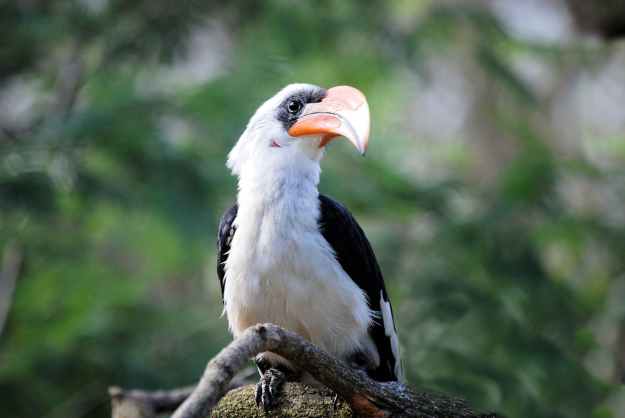
Photo by Pixabay on Pexels.com • Exotic birds such as the hornbill often employ ingenious nesting methods to ensure successful reproduction.

I received a letter from Wayne and Dot Ballard sharing information about an ingenious but unexpected roosting location they provided for a wren at their home in Marion, North Carolina.

Wayne found the an old bird’s nest attached to the limb of a cedar tree. Dot tied a piece of twine around the ends of the limb and let it hang from a hook under the eave of their porch.

A few days later, the limb and nest attracted the notice of a Carolina wren. The bird, finding this snug nest in a convenient location, adopted it as a nighttime roost. “We watched, and every evening just as the sun was setting, a wren came and set on the porch swing and then hopped right up into the nest, head first,” Dot wrote. “This continued every evening for six or seven weeks, with its arrival times adjusted as the days got shorter.”The couple couldn’t verify if their observation involved the same bird nightly, but I suspect it did. “With its head stuck into the nest, it must have rested pretty good,” Dot said. “My husband said he had seen it leave when he got up early in the morning.”

Wayne and Dot felt fortunate to enjoy this peek into the wren’s life. “We always enjoy God’s nature, especially when we are allowed to witness it so close,” Dot wrote.

The couple did ask if I thought the nest had been built by wrens. I believe that, although a Carolina wren adopted the nest for its roost, another species of bird probably built the nest. The photos the Ballards enclosed with their letter show a cup-shaped nest of the sort that might have been built by a sparrow or warbler.

Their letter persuaded me to explore some of the unusual ways some of our feathered friends go about creating a nest, or home, for their young. The ingenuity of some birds in building a nest is quite remarkable.

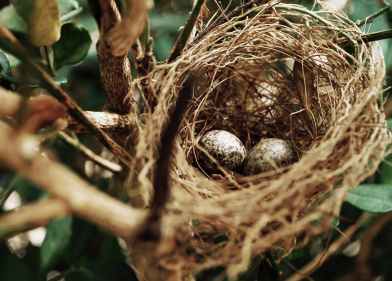
The majority of our common backyard birds build the familiar “cup-shaped” nest that is tucked away in a shrub or the fork of a tree. Birds that build nests in such a fashion include everything from blue-grey gnatcatchers and scarlet tanagers to indigo buntings and American goldfinches.
Other birds, such as Eastern bluebirds and tree swallows, accept human-provided nesting boxes. In the past, these birds relied on natural cavities, such as a rotten knothole in a tree’s trunk or a weathered fence post that had gone hollow. Many cavity-nesting birds do not or cannot excavate their own cavities. Some birds are better equipped to excavate their own cavities or burrows in everything from tree trunks to river banks. Cavity-nesting offers an added degree of protection in comparison with an exposed and vulnerable cup nest tucked in a hedge or dense shrub. Some birds, however, have taken cavity-nesting practices to the extreme.
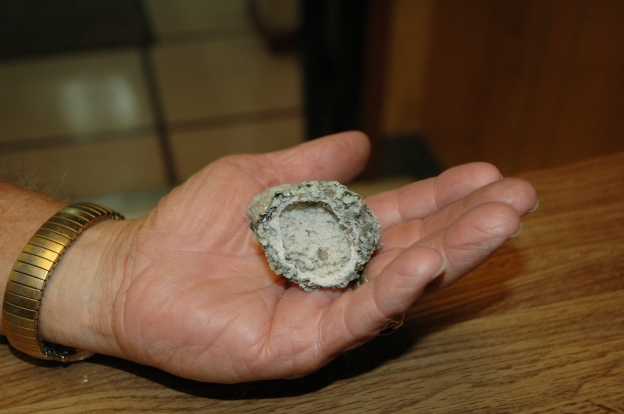
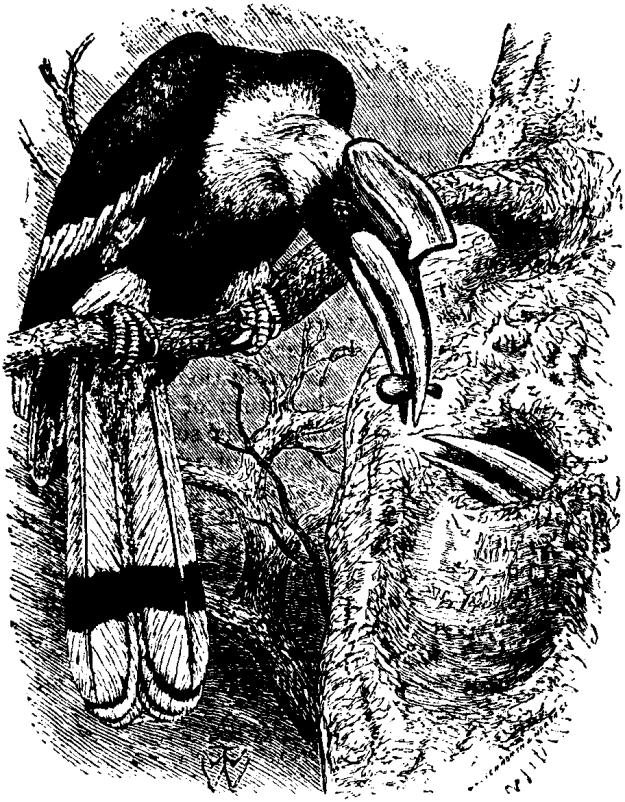
For instance, the female great hornbill builds her nest in the hollow centers of large tree trunks, and the opening is sealed with a plaster made up mainly of mud, droppings and fruit pulp. She remains imprisoned in her nest until the chicks are semi- developed, relying on the male to bring her food. During this period the female undergoes a complete molt. The young squabs are devoid of feathers and appear very plump. She is fed by her mate through a slit in the seal. The clutch consists of one or two eggs she incubates for 38-40 days. Once the female emerges out of the nest, it is sealed again by the chicks. In some species, the young depart with their mother, and are tended outside of the former nesting cavity by both parents. The great hornbill resides in the forests of India, the Malay Peninsula and Sumatra, Indonesia. There are about 55 species in the hornbill family, which ranges through Africa, Asia and some of the islands of Melanesia.

Britannica_Hornbill_Buceros_bicornis

Megapodes — also known as “incubator birds” or “mound-builders” — do not incubate their eggs with their body heat as other birds do, but bury them. Their eggs are unique in having a large yolk, making up 50-70 percent of the weight of the egg. They are best known for building massive nest-mounds of heat-producing, decaying vegetation, which the male attends, adding or removing litter to regulate the internal heat while the eggs hatch.

This method of incubation is something practiced by some reptiles, including crocodiles and alligators, but it is definitely unusual among birds. Once hatched, young birds are fully feathered and active, already able to fly and live without any care or assistance from their parents.

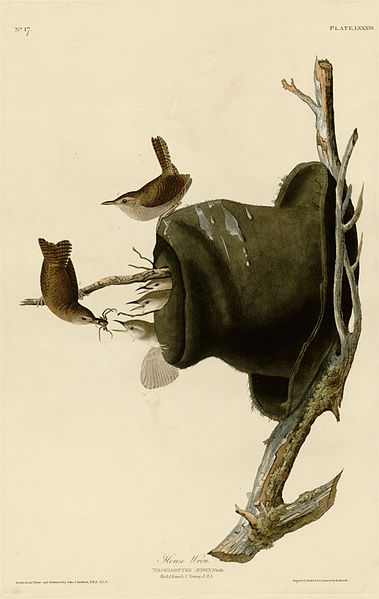
83_House_Wren_cropped-to-the-plate-only

Wrens are known to nest and roost in some unusual places, as shown in this painting of wrens nesting in an old hat by artist John James Audubon.

Two of the better-known species, both from Australia, are the malleefowl and the Australian brush-turkey. There are about 20 species of birds classified as Megapodes, and they are concentrated in the Australasian region, including islands in the western Pacific, Australia, New Guinea and the islands of Indonesia east of the Wallace Line. They also occur on the Andaman and Nicobar Islands in the Bay of Bengal.

The white tern is a small seabird found across the tropical oceans of the world. Although other terns build nests, the White Tern no longer bothers to construct even a rudimentary nest. Instead, the female lays a single egg on bare branches or in a small fork in a tree. Nothing else is added to the location where the egg is deposited.

The behavior is not typical of terns, which generally nest on the ground and construct the nest of such materials as shells or other debris.

Of course, both the eggs and chicks of white terns are vulnerable to becoming dislodged by heavy winds. Newly-hatched chicks have well developed feet they use to hang on to their precarious nesting site.

White_Tern_with_Egg

Photo by U.S. Fish & Wildlife Service • A white tern incubates a single egg but doesn’t build an actual nest.

The sparrow-sized sociable weaver (Philetairus socius) of Africa enjoys company, which explains how and why such a small bird constructs a huge nest. Actually, many of these birds working together construct a huge structure — sometimes described as similar to a bale of hay — that hangs from sturdy trees and other tall structures. Such a “compound nest” is rather rare among birds.

The communal nests built by sociable weavers can house 100 pairs of birds and are quite spectacular. They are also considered the largest bird-built structures in the world. Other birds also benefit from these huge structures, which are built mostly of grass and sticks. Other species of the Ploceidae, or weavers, also build communal nests, but their efforts are not quite as impressive as those constructed by the sociable weaver. Other small birds may also nest or roost in the structure, and large birds, such as vultures, have been known to build their own nests on top of these compound nests.

In nature, nothing gets wasted. A Carolina wren using another bird’s used nest is not all that rare. These birds are fond of a cozy nook. If they can find one ready-made, it’s all the better.

sparrow making nest

Photo by Cathy Visser on Pexels.com


Male scarlet tanager stands out from other birds

Scarlet Tanager02

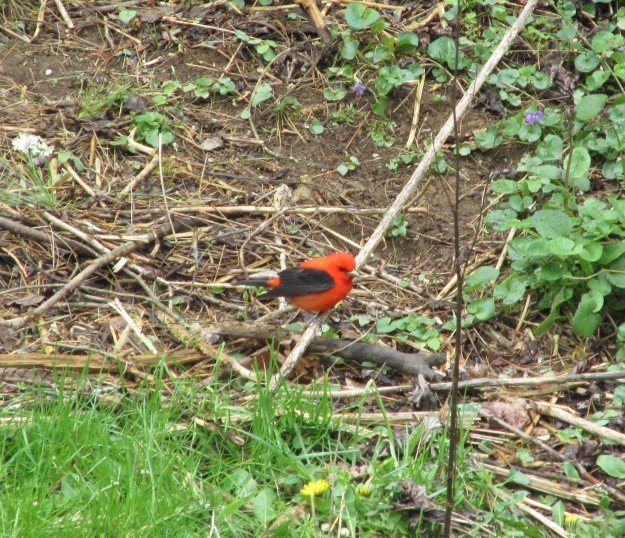
Photo by Jeana Chapman • A male scarlet tanager forages close to the ground, which is not typical behavior for these birds. Tanagers, although brightly colored, spend most of their time in the tree canopy obscured from view.

I received an email from Lewis and Jeana Chapman detailing a dazzling discovery they made.

The couple have been adding a few new birds to their bird list and decided to give me an update on what they’ve been seeing. The Chapmans reside in the community of Laurel Bloomery in Johnson County, Tennessee. The wooded slopes of Pond Mountain where they make their home provide an attractive location for migrating birds, as well a summer residents.

“The tree swallows returned this spring to nest in our bluebird box,” Lewis wrote in his email reporting his new sightings. “The great crested flycatcher has moved its nest from the front porch to the barn. Last year the flycatchers raised five chicks on the front porch. The nest got so full the chicks were perched around the edge.”

Some new additions to their list have included golden-crowned kinglet and the Northern flicker. “Most recently we spotted a scarlet tanager,” Lewis continued.

Scarlet-Tanager

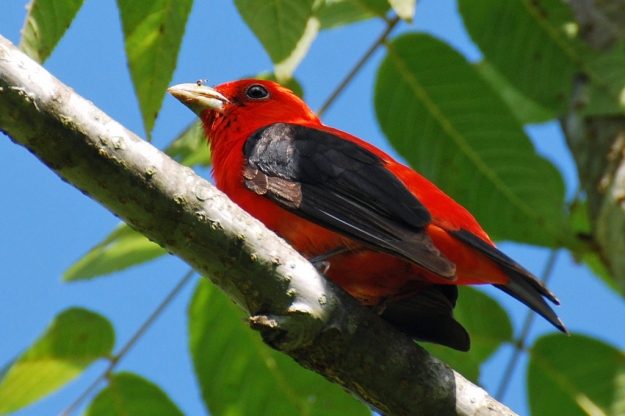
Photo Courtesy of Jean Potter A male scarlet tanager brightens shadowy woodlands with a flash of tropical colors yet remains mostly inconspicuous in the forest canopy.

They had never seen a scarlet tanager at their home. Over the years I have heard from other readers left stunned by the tropical beauty of the male scarlet tanager. That description would not be that far off. While the scarlet tanager resides in the United States and Canada from April to October each year, this bird spends the rest of the year in South America. Citizens of the United States and Canada get the better part of the bargain when it comes to hosting this bird. After the summer nesting season, male scarlet tanagers lose their brilliant red plumage and look more like the greenish females. By the time they get back to the tropics for the winter, this striking bird has transformed into a rather drab specimen.

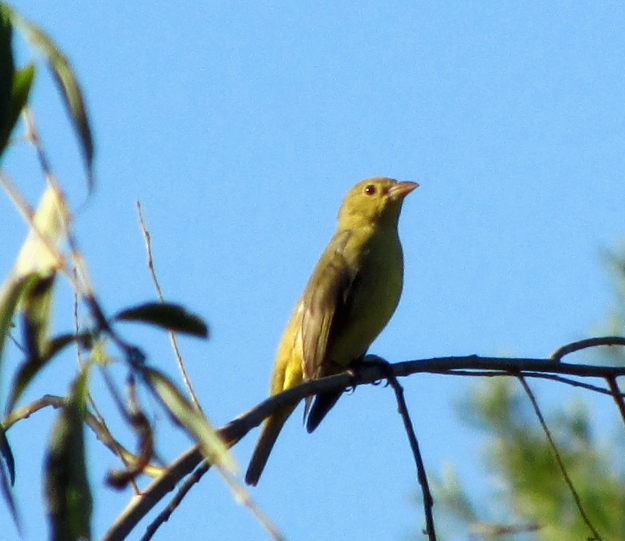
I’ve written in previous columns about the scarlet tanager, which is one of those birds that always takes an observer’s breath away upon first seeing it. Of course, it’s the male scarlet tanager that bewitches observers with his dazzling feathers of vivid red and jet black. Female and immature tanagers are a dull olive-yellow in coloration with dark wings and tails.

Tanager-Sept18

A female scarlet tanager is a study in contrast from her mate with her dull greenish-yellow plumage being much less vibrant than the male’s bright red and black feathers.

During their summer stay in the region, scarlet tanagers largely prey on insects. Although renowned as a fruit-eating bird, the scarlet tanager primarily feeds on fruit during its migration flights and on its wintering range in the tropics. This tanager breeds in deciduous and mixed deciduous-evergreen woodlands across the eastern half of North America. I’ve often heard that oaks are a favorite tree for this woodland dweller.

It’s unlikely that you’ll run across the nest of a scarlet tanager. These birds nest high in trees, often locating their nests 50 feet or more above the ground. After building a nest, a female tanager will incubate her three to five eggs for about two weeks. It’s during this time that her inconspicuous appearance is a plus, helping her blend well with her surroundings. After the young hatch, the parents are kept busy feeding the nestlings for another 10 to 15 days.

The website All About Birds notes that the population of scarlet tanagers has declined in the last half-century. Between 1966 and 2014, according to the North American Breeding Bird Survey, scarlet tanager numbers declined by 14 percent. The environmental organization Partners in Flight estimates a global breeding population of 2.2 million, with 93 percent of these birds spending some part of the year in the United States and the other seven percent breeding in Canada. These birds do poorly in forests that have been harvested for lumber. Other causes of habitat fragmentation probably also affect the well-being of scarlet tanagers. It’s worth keeping an eye out for any other signs of decline in this beautiful birds.

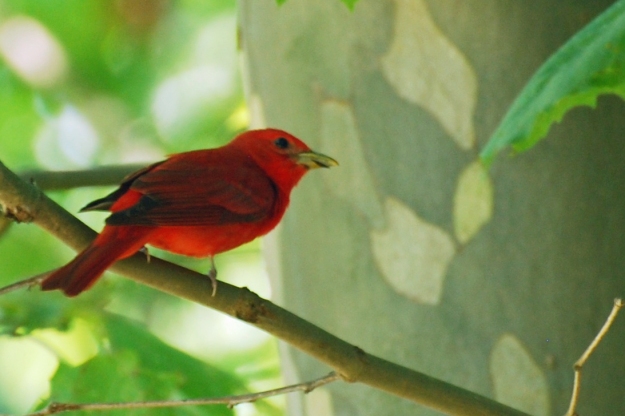
The scarlet tanager is a fairly common songbird during the summer months, but it also has a less common relative that can be found in northeast Tennessee, southwest Virginia and western North Carolina. The male summer tanager is the only entirely red bird found in North America. Lacking the scarlet tanager’s black wings, the summer tanager’s red feathers are also of a rosier hue.

Summer-Tanager

Photo Courtesy of Jean Potter The Summer Tanager is the only all-red bird in North America. It is less common in Northeast Tennessee than the related Scarlet Tanager.


While I have seen summer tanagers in Tennessee on occasion, most recently at Steele Creek Park in Bristol, Tennessee, I saw my first summer tanager during a spring trip to South Carolina many years ago. Overall, the summer tanager has more of a southern stronghold than the scarlet tanager, as the summer tanager’s range also extends into the southwestern United States.

Both of these tanagers are birds fond of dense, undisturbed woodlands. Most of the time, unfortunately, these tanagers reside in the dense woodland canopy. They’re more often heard than seen, producing a song similar to an American robin’s, but usually described as somewhat more raspy. The apt description I like for these two tanagers is that their songs sound like one sung by a hoarse robin with a sore throat.

Some of the world’s other tanagers are known by extremely descriptive names, including seven-colored tanager, flame-colored tanager, lemon-rumped tanager, green-headed tanager, golden-chevroned tanager, azure-shouldered tanager, fawn-breasted tanager, metallic-green tanager, emerald tanager, gilt-edged tanager, golden-naped tanager, opal-crowned tanager, blue-gray tanager and silver-beaked tanager.

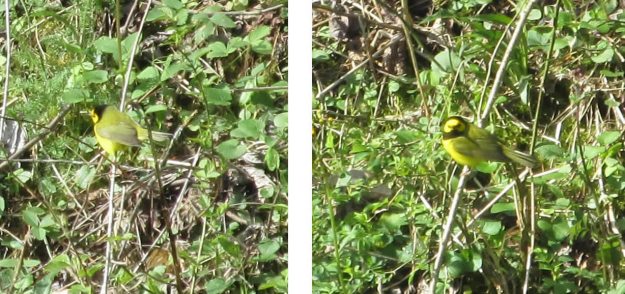
The tanager wasn’t the only unexpected feathered visitor to the Chapman home this spring. The same week the tanager made its appearance, a male hooded warbler also visited with the Chapmans. “This we found ironic because of your email address,” Lewis wrote. For readers who may not have noticed, my email address is ahoodedwarbler@aol.com. I’ve used this email address for many years to celebrate one of my favorite birds.

HoodedWarbler01 (5)

Photo by Lewis Chapman • A male hooded warbler also impressed the Chapmans during this small songbird’s recent visit.

The Chapmans also provided me with photos of all their colorful birds. In subsequent emails, they also informed me of some other unusual visitors. “One of our strangest visitors was an albino American goldfinch,” Lewis also revealed in his email. “Over this past weekend, we had rose-breasted grosbeak and indigo bunting show up.”

Many of these birds — the rose-breasted grosbeak, the scarlet tanager, the indigo bunting — always wow observers experiencing their first observation of them. Our two native tanagers — scarlet and summer — are definitely two memorable birds for anyone who has had the pleasure of seeing one. It’s a great time of year to get outdoors and keep your eyes open for a splash of bright color. You never know what you may see when you lift your binoculars.


Tufted titmouse small songbird with big personality

In last week’s post I wrote about chickadees. These friendly little birds have an impish cousin that is also a frequent visitor to feeders in the region. If chickadees are active woodland sprites, their relative, the titmouse, is a curious imp with mischievous tendencies.

Titmouse-2

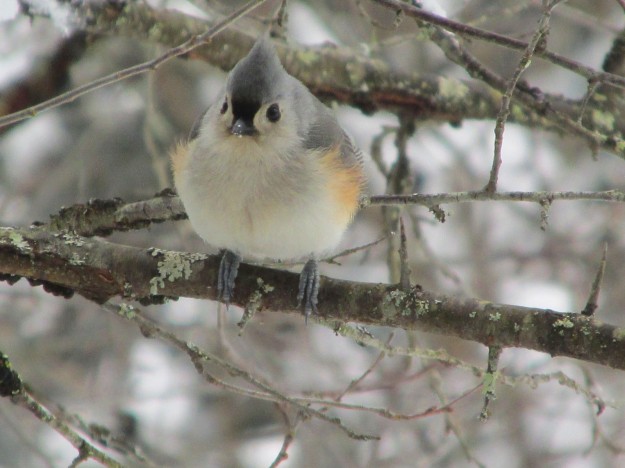
Photo by Bryan Stevens • A tufted titmouse puffs up its feathers on a cold day.

The tufted titmouse’s song — a persistent repetition of “Peter! Peter! Peter!” — is ringing through the woodlands around my home along with the urgent “fee-be fee-bo” of the Carolina chickadee. These birds form mixed flocks with each other and other species to explore their surroundings and search for food. They know that spring, despite the usual false starts, is drawing nearer with each passing day.

In addition to singing, titmice are enthusiastic scolders. They will scold over any transgression, real or imagined, focusing their ire on their fellow titmice or other birds, potential predators and even human observers. They’re quite persistent at their raucous scolding, which is just another reason I label them as imps of the woods.

Titmouse-Suet

Photo by Bryan Stevens • A young titmouse visits a suet feeder.

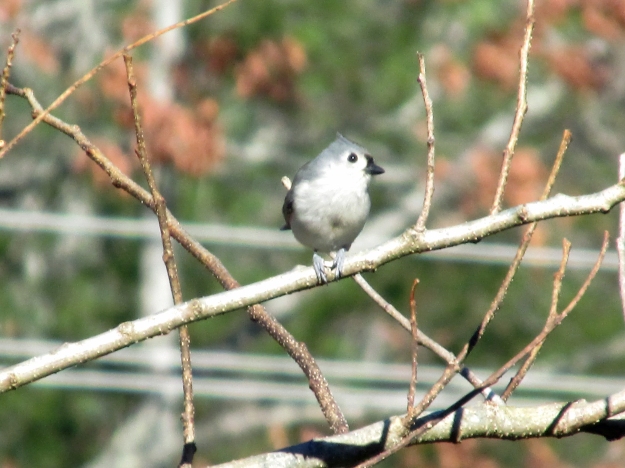
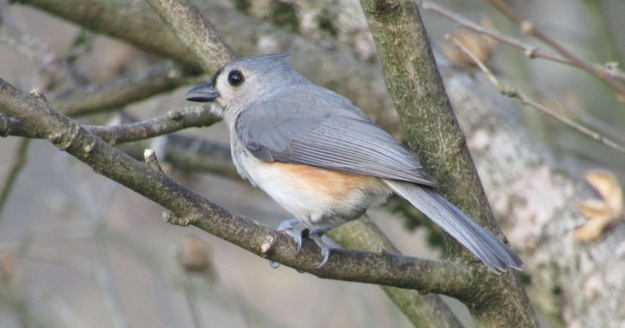
The tufted titmouse is a mostly gray bird with a distinctive crest and a pinkish-rusty coloration along the flanks. Titmouse eyes are black as coal and look large in proportion to their heads, which lends them an expressive appearance as they explore in yards and gardens. The term “titmouse” refers to the old English word “tit” meaning “small,” as well as the old English “mase,” also a reference to small size. Eventually, probably because of the bird’s small size and gray coloration, “mase” evolved into “mouse” and combined to form the word “titmouse.”

The titmice living in my yard visit my house windows at times, which drives my cats to distraction. I’ve wondered if the titmice are curious and trying to peek inside the house, but I believe I have a more down-to-earth explanation. These little birds are very thorough when foraging for food, and I’ve watched them pluck spiders and other insects from the window frames.

Titmouse-Creek

Photo by Bryan Stevens • A tufted titmouse approaches a stream for a quick drink.

Like chickadees, titmice are fond of sunflower seeds. No other offering will so readily lure them to feeders, although they do develop a fondness for suet cakes. I’ve also had great success attracting titmice to my feeders by offering unsalted, shelled peanuts. I sometimes break up the peanuts into smaller, more manageable pieces for the benefit of the titmice. These foods and a few trees or saplings around your home is all you really need to welcome titmice.

In the early 1900s, the tufted titmouse would have been considered a southern bird with its stronghold in states like Tennessee, Virginia, the Carolinas and Georgia. Perhaps it is the titmouse’s innate curiosity that has pushed the species to expand successfully beyond the southern United States. The titmouse has steadily expanded its range northward, thriving in new locations. Experts credit this expansion to more readily available access to supplemental food at feeders.

Titmouse-Eye

Photo by Bryan Stevens • A tufted titmouse turns an eye on the camera.

During the nesting season, titmice forage for a variety of insects. Many spiders, beetles, caterpillars and other small bugs will be fed to hungry young titmice in a tree cavity or a nesting box. Like chickadees, titmice build exquisite nests, often using mostly moss with other materials, such as bark, cloth scraps, dry leaves and shed snakeskins. These small birds line their nests with hair or fur of other animals.

Over the years, many readers have shared observations documenting the fur-collecting skills of tufted titmice. The birds are not content to simply collect shed fur. They seem to prefer collecting the fur fresh from a living animal. Many dogs fall victim to impish titmice that boldly pluck strands of fur from the canine’s coat.

In another funny story, a woman once told me about a titmouse that flew onto her head every time she stepped outside her home. Perhaps the bird sensed her affection for birds since it never failed to pluck strands of hair from her head to carry back to its nest. For any would-be skeptics, the woman provided photographic documentation of the incidents. In addition to dogs and humans, animals ranging from squirrels and opossums to mice and woodchucks have also been observed “sacrificing” fur for the nesting success of tufted titmice.

Titmouse-PHOTO

Photo by Bryan Stevens • The tufted titmouse is a backyard bird with an impish personality.

The female tufted titmouse incubates the eggs. She lays between three and nine eggs, although a usual clutch size is five to six eggs. The female titmouse is protective of her nest and is known for a behavior known as a “snake display.” I’ve observed titmice perform this display when I’ve peeked into nesting boxes. She remains tightly seated on her eggs, or young, while she hisses loudly and strikes in a manner very much like a striking serpent. Not all titmice engage in this display. Some remain still and try to “blend” with the nest, while others will fly away if a nest box is opened. Regardless, it’s a convincing display of bravado on the part of such a small bird. If it looks scary to people, I am sure it could succeed at repelling a squirrel or mouse. I’m uncertain if the behavior would deter an actual snake.

Other titmice in North America include bridled titmouse in Arizona and New Mexico; oak titmouse of the Pacific Coast region; juniper titmouse from the Great Basin, which consists of Wyoming, Idaho, Utah, Nevada, Oregon and California; and the black-crested titmouse, which ranges from Missouri into east-central Mexico.

Titmouse-WithPeanut

Photo by Bryan Stevens • A tufted titmouse pounds at a peanut held in its feet.

Titmice occur exclusively in North America and belong to the genus Baeolophus. Europe, Asia and Africa are home to some other crested birds in the family of chickadees and titmice. For instance, the European crested tit and the grey crested tit are species that sport a crest of feathers like titmice but are more closely related to chickadees.

Yes, the tufted titmouse is one of nature’s imps, but it’s also one of our more entertaining birds. Get to know these visitors by offering sunflower seeds or other fare and, if you want to go the extra step, place some bird boxes around your yard as potential nesting sites. By next winter, you may have an entire flock of these feathered imps as your guests.

•••••

Bryan Stevens lives near Roan Mountain, Tennessee. To learn more about birds and other topics from the natural world, friend Stevens on Facebook at https://www.facebook.com/ahoodedwarbler. If you have a question, wish to make a comment or share a sighting, email ahoodedwarbler@aol.com.

Titmouse-OnSuet

Photo by Bryan Stevens • A tufted titmouse makes a quick visit to a suet feeder.

North America’s bluebirds never fail to impress with their winning ways

A famous song declares that “somewhere over the rainbow, bluebirds fly,” so you’ll have to excuse me if I have been looking for those elusive rainbows during the unseasonably warm weather the region’s enjoyed in recent weeks.

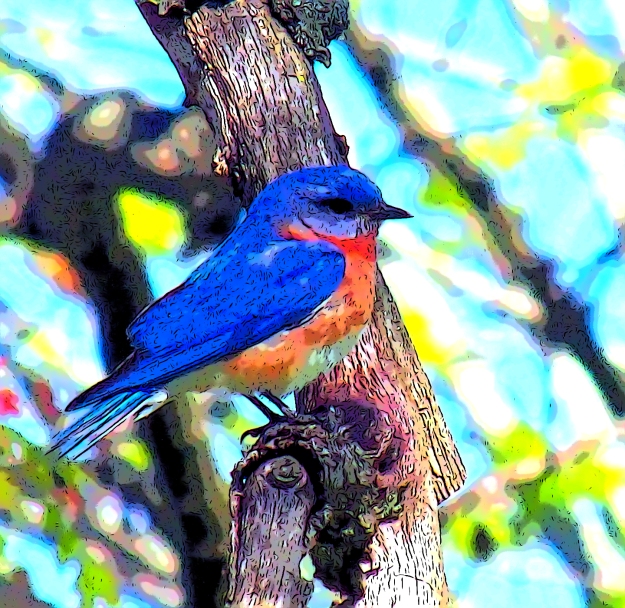
Also, like the song promises, “dreams really do come true,” which was fulfilled by the arrival of this year’s first pair of Eastern bluebirds at my home on Friday, Feb. 23. The presence of a pair of these beautiful and trusting birds is always sure to put people in a good mood. People have known for generations that bluebirds make good neighbors. A pair of bluebirds in your yard or garden provides hour upon hour of free entertainment as one watches these birds go about their daily routine. At this time of the year, much of that routine is focused on finding and claiming the best possible nesting location for the upcoming spring season.

Bluebird-Comic

The Eastern bluebird is one of the most beloved American songbirds.

The Eastern bluebird is one of North America’s best-known cavity-nesting birds. About 85 species of North American birds use cavities in trees for nesting purposes. Cavity-nesters include ducks, such as buffleheads and wood ducks, as well as birds of prey such as Eastern screech-owls and American kestrels.

Woodpeckers and nuthatches can excavate their own cavity in a dead or decaying tree. Others, such as the bluebirds, must find a cavity already in existence. Such cavities are scarce real estate and can be subject to some intense competition. The Eastern bluebird is at a disadvantage when forced to compete with non-native introduced birds such as aggressive European starlings and house sparrows. Even native competitors such as house wrens and tree swallows are serious rivals when it comes down to staking a claim to prime nesting real estate.

Over the years, I have found bluebirds nesting in cavities inside wooden fence posts, but there are fewer wooden fence posts every year. This reinforces the idea of how changing landscapes have affected these birds. Instead of wooden fence posts, many farmers now use metal ones, and dead or dying trees — a much sought-after resource for cavity-nesting birds — are often removed from woodlands.

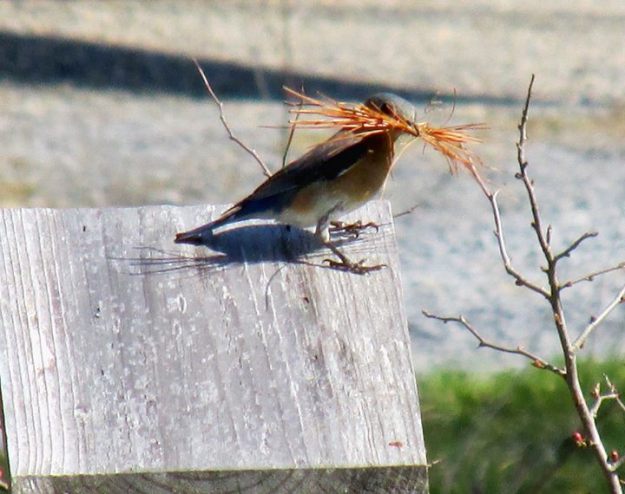
Bluebird-withPineNeedles

Photo by Bryan Stevens • A female Eastern Bluebird gathers pine needles to use as nesting material.

Fortunately for bluebirds, this species will also accept lodging in a nest box, or birdhouse, provided for them by human landlords. One of the simplest ways to bring bluebirds close is to offer wooden boxes, constructed to their specific requirements, for their use as nesting locations. Because of their trusting nature when it comes to their human neighbors, the Eastern bluebird is one of our most beloved birds. In fact, bluebirds are such popular birds that interest in them and their well-being has inspired the foundation of organizations such as the North American Bluebird Society. The Eastern bluebird has also been designated the official state bird for New York and Missouri, which provides more testimony to the immense popularity of this bird.

Bluebirds-One

Photo by Bryan Stevens • A flock of Eastern bluebirds perches on fenceposts.

There are two other species of bluebirds found in North America. The Western bluebird is found throughout the year in California, the southern Rocky Mountains, Arizona and New Mexico, as well as in part of Mexico. The species ranges in the summer as far north as the Pacific Northwest, British Columbia and Montana. The Mountain bluebird nests in open country in the western United States as far north as Alaska. They are short-distance migrants, retreating as far south as Mexico during the winter season.

Other than these three species, North America offers few others birds with mostly “blue” plumages. Some examples include indigo bunting, blue grosbeak, and blue jay, as well as birds like great blue heron and belted kingfisher.

In addition to housing, food and water can be used to lure Eastern bluebirds closer. This bird doesn’t eat seeds, but it can be attracted with an offering of mealworms — live or freeze-dried – or commercially prepared peanut butter nuggets. A water feature in a yard is also a magnet for bluebirds and a host of other bird species.

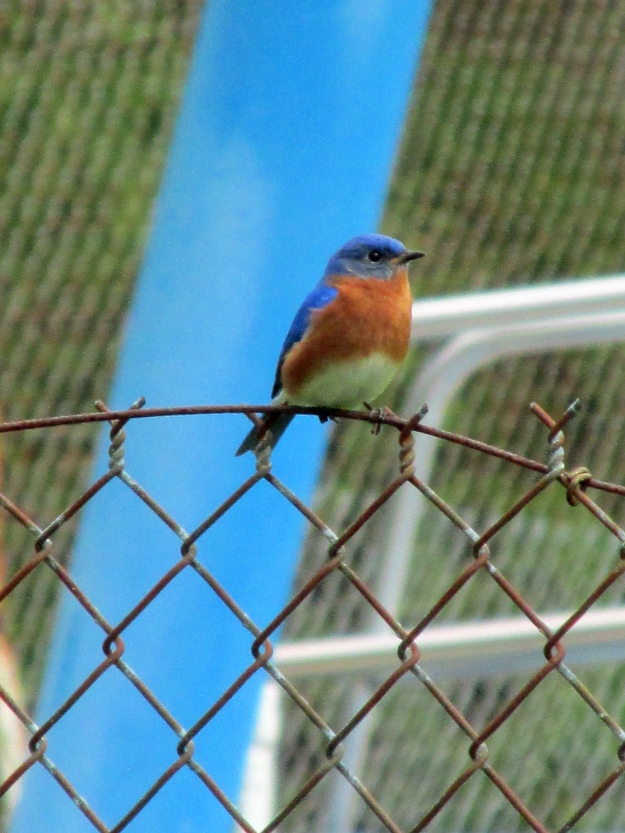
Bluebird-Pool

Photo by Bryan Stevens • A handsome male Eastern bluebird perches on a chain-link fence.

If your home doesn’t provide suitable open, spacious bluebird habitat, it’s still easy to enjoy these beautiful birds. An afternoon or evening drive into open country, such as agricultural farmland, is likely to yield sightings of this bird on fences and utility lines. Golf courses, some of which go the extra mile to accommodate bluebirds, also provide habitat for these lovely birds.

The Eastern bluebird is present in the region in all seasons and is one of our more common birds. If you’re already an experienced landlord and host for these birds, you probably already know they joys they can bring. If not, why not try to attract them closer to you? Most bluebirds in the region have already started looking for a nesting site. Many of these birds may nest two or even three times in a single season. March has only just arrived, so there’s still time to place a nest box or two on your property to get their attention.

••••••

If you have a question, wish to make a comment or share a sighting, email ahoodedwarbler@aol.com.

Bluebiord-Male-Playground

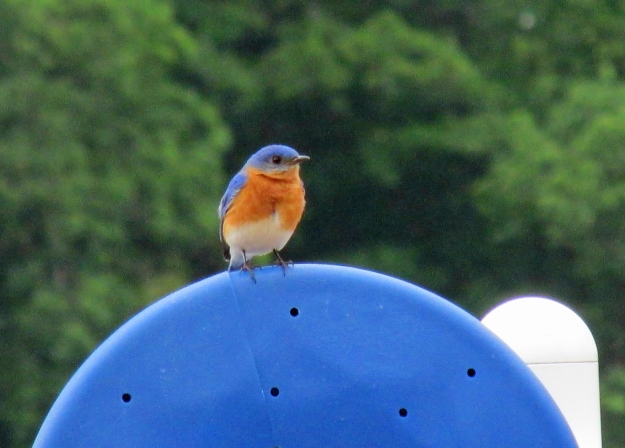
Photo by Bryan Stevens A male Eastern Bluebird perched on playground equipment at Winged Deer Park in Johnson City.

Visit by Yellow-headed blackbird, last seen in region in 1994, creates a stir

Bugaboo Springs Road near Jonesborough, Tennessee, saw some heavier vehicular traffic in mid-January after the exciting observation of a yellow-headed blackbird associating with a sizable flock of brown-headed cowbirds.

Yellow-headedBlackbird-JBoro

Photo by Bryan Stevens • This yellow-headed blackbird has been residing with flocks of brown-headed cowbirds and European starlings at a cattle pasture near Jonesborough, Tennessee. The bird, the first of its kind seen in Northeast Tennessee since 1994, has generated excitement among birders. Some people have traveled from as far as Knoxville, Tennessee, and Roanoke, Virginia, to see the bird.

The bird came to the attention of Dawn Peters, a resident along Bugaboo Springs Road, who noticed the unusually colorful bird at her feeders while looking out the window of her laundry room. At first, she thought the bird might be an oddball member of the cowbird flock.

“I’d never seen one before,” she said. “I knew it was something strange and something new.”

Dawn took the time to take a photograph of the bird and then contacted friends Jean and Brookie Potter, who also happened to be birders. They alerted her to the rare status of her feeder visitor.

“He really stood out,” Dawn said of the blackbird with a yellow head.

The yellow-headed blackbird arrived at her feeders on a snowy day when the temperatures had plunged. Dawn said she has been feeding birds for 20 years since she and her husband moved to Bugaboo Springs Road near Jonesborough, Tennessee. “The birds know where to come for food,” she said. “I try to feed them all, but they can eat you out of house and home.”

IMG_2235

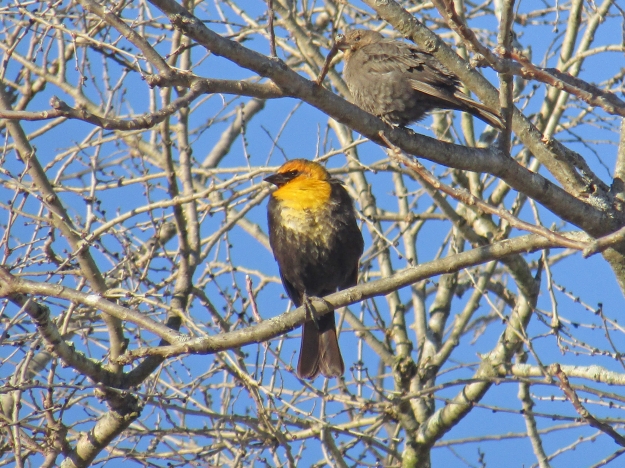
Photo by Bryan Stevens This yellow-headed blackbird and several brown-headed cowbirds perch in a tree after foraging for food in a cattle lot near Jonesborough, Tennessee.

Dawn said she gets a variety of birds at her feeders, ranging from sparrows and cardinals to mourning doves and finches. “I also get downy woodpeckers and towhees,” she added.

On occasion, she will notice a hawk in the yard. In the summer, she puts out several feeders with sugar water to attract hummingbirds. “Last summer, I had brown thrashers raise a family in my yard,” she said.

Although the yellow-headed blackbird arrived with a flock of brown-headed cowbirds, the other flock members didn’t exactly embrace him. “Some of the cowbirds would peck at him,” she said.

While the yellow-headed blackbird hasn’t been back to her feeders since Jan. 13, the bird was rediscovered less than a mile from her home in a feed lot for cattle. The yellow-headed blackbird has continued to associate with large flocks of cowbirds and European starlings and has been observed by dozens of birders.

The yellow-headed blackbird, known by the scientific name Xanthocephalus xanthocephalus, is a relative of cowbirds, as well as the familiar red-winged blackbird. It’s a unique species in that it is the only member of the genus, Xanthocephalus. Breaking this word down from its ancient Greek origins, the name means, quite literally “yellow headed.”

Yellow-headedBlackbird-Copy

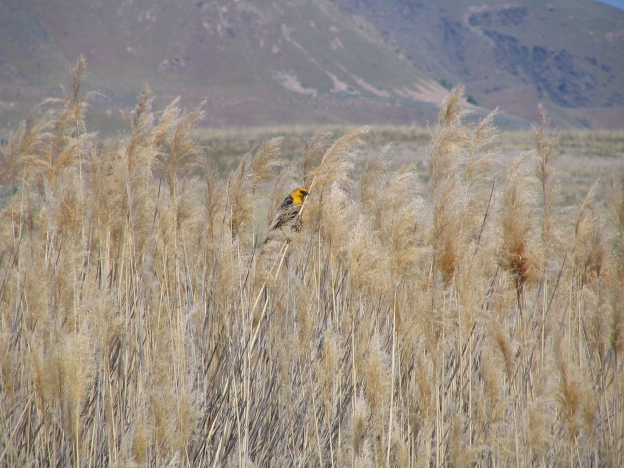
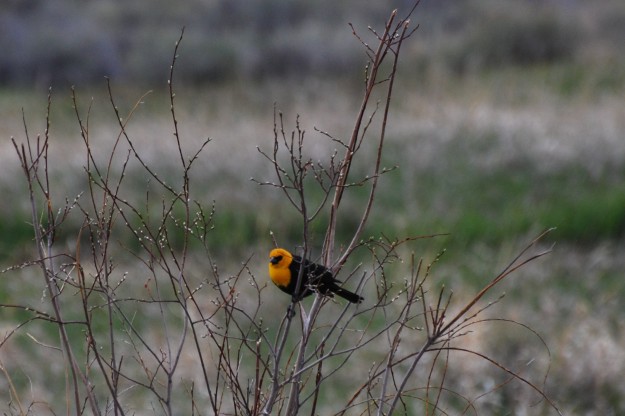
Photo by Bryan Stevens This yellow-headed blackbird was photographed at Antelope Island State Park in Utah in 2006.

The yellow-headed blackbird’s also a species that has been only a rare visitor to the region. While a common bird in wetland habitats west of the Great Lakes, the yellow-head blackbird has not been reported often in East Tennessee. In fact, there are only a handful of records since the 1930s, the most recent sightings being reported and documented in 1990 and 1994. Since it has been almost a quarter of a century since the last time a yellow-headed blackbird was found in East Tennessee, one could argue that a visit from a vagrant individual of this species was long overdue. In southwest Virginia, there are a couple of records from Smyth County dating back to July of 1985 and March of 1988.

It’s not quite clear why a yellow-headed blackbird ventured into the region in mid-January. Normally, these birds spend the winter months in the southwestern United States and Mexico. They often migrate in huge flocks with other species of birds, which could explain why the bird found itself an honorary member of a flock of cowbirds estimated to number about 300 individuals.

My first attempt to add this species to my Tennessee list ended in failure, although I did enjoy seeing several white-crowned sparrows, a handsome bird that definitely doesn’t deserve being classified as one of the “little brown birds” that so often serves as an offhand designation for sparrows. That attempt was made on the morning of Jan. 18 and may have been ended prematurely. When I got access to a computer later, I checked to see if any other observations had been reported. I noticed a report from local birder Michelle Sparks, who saw the bird probably less than 90 minutes after I had ended my first attempt.

7ee8ab76db6c1c18d9bac62d3c602b30--john-james-audubon-blackbird 2

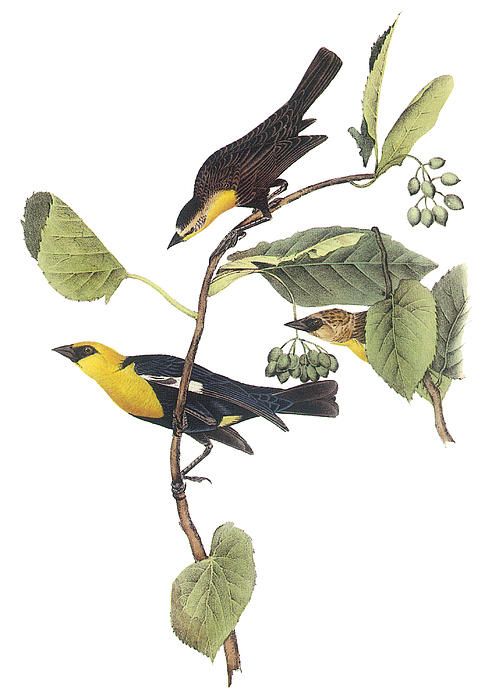
Early American naturalist and painter John James Audubon painted these yellow-headed blackbirds.

Speculating that the yellow-headed blackbird and its accompanying flocks of brown-headed cowbirds and European starlings would return to the feedlot to forage before dark, I returned at 4 p.m. to try again. I found the feedlot overwhelmed by hundreds of cowbirds and starlings, but I didn’t see any sign of a bird with a yellow head. Many of the cowbirds carpeted the pasture as they gleaned seeds and other food items. Many of the starlings were perched in the branches of trees and on the roof of an old farmhouse. At some point, almost every bird in the chaotic flock spooked and took to the air. The flock wheeled and turned, with most of the birds settling into the upper branches of some of the taller trees at the location. I soon detected a flash of yellow. I’m not sure where the bird had been hiding earlier, but the yellow-headed blackbird proved unmistakable, perched high in the trees with the sun shining brightly. He couldn’t hide from my binoculars or camera, which I used to snap several photos of this rare visitor to the region.

I have this species on my life list, having seen yellow-headed blackbirds during visits to Utah in 2003 and 2006. While in Utah, I also saw red-winged blackbird, brown-headed cowbirds and Brewer’s blackbirds, including a partial albino individual that presented a challenge in identifying.

While technically a songbird, the yellow-headed blackbird routinely ranks as one of the worst singers among North America’s songbirds. The yellow-headed blackbird is not all musical, with its song repertoire ranging from what has been described as “cacophonous strangling noises” and “honking gurgles” on the website for the publication, “Birdwatcher’s Digest.”

JEAN-Yellow-headed Blackbird

Photo by Jean Potter • This yellow-headed blackbird was photographed in Colorado in 2016.

The New World’s blackbirds belong to the family of birds, Icteridae, which also consists of birds such as meadowlarks, orioles, cowbirds, grackles, bobolinks and oropendolas. Although many blackbirds show predominantly black plumage, these birds often contrast their dark coloration with yellow, orange or red feathers. The name of the genus stems from Ancient Greek and Latin words that, translated into English, mean roughly, “jaundiced ones,” which stems from the yellow feathers present in the plumage of many species. Other blackbirds in the New World include tawny-shouldered blackbird, saffron-cowled blackbird, melodious blackbird, oriole blackbird and scarlet-headed blackbird. In the United States, other nesting species in the family include Brewer’s blackbird, tri-colored blackbird and rusty blackbird. The last of these species has shown chronic long-term and acute short-term population declines, based both on breeding season and wintering ground surveys. Some estimates suggest that the rusty blackbird population has declined by 80 percent, which could soon endanger the species.

I’m hoping the yellow-headed blackbird on Bugaboo Springs Road is liking where it has found itself this winter and will continue to delight observant birders over the upcoming weeks.

•••••

Bryan Stevens lives near Roan Mountain, Tennessee. If you have a question, wish to make a comment or share a sighting, email ahoodedwarbler@aol.com.

IMG_2236 2

Photo by Bryan Stevens • Birders from near and far converged on Bugaboo Springs Road near Jonesborough, Tennessee, to search for the yellow-headed blackbird.

Red-shouldered hawk makes a fascinating, if somewhat shy, guest

People who feed the birds soon get to know the feisty personalities from the retiring wallflowers when it comes to the visitors to their yards. Northern mockingbirds, male ruby-throated hummingbirds and American robins are usually counted among the more boisterous birds.

Then there are the birds that shrink from interaction and hang back on the fringes, including wood thrushes, Eastern towhees and the large but shy pileated woodpecker. The latter example just goes to show that size doesn’t always equate with an extroverted personality when it comes to birds.

Redshouldered_Hawk-LeeKarney

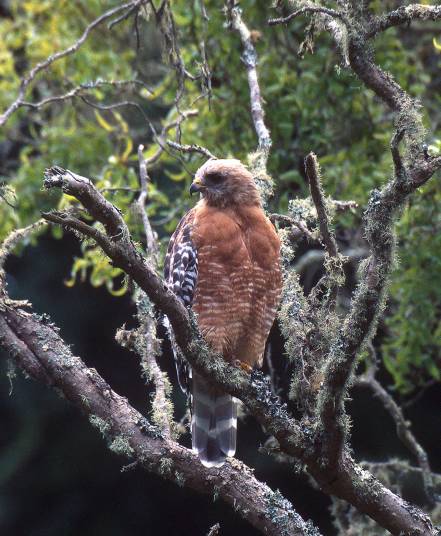
Photo by U.S. Fish and Wildlife Service/Lee Karney • Red-shouldered hawks prefer to perch and ambush prey. They drop on unsuspecting prey, which varies from reptiles and amphibians to rodents, that come within reach.

That’s certainly the case with a red-shouldered hawk that has taken up residence for the winter at my home. The hawk usually favors a stand of trees near the fish pond at my home when it visits the yard. The hawk made its initial appearances in December and then lingered into the new year. So far, the hawk has been a very shy guest. I’ve wanted to photograph the bird, but that’s difficult to do when it spooks and flies off the instant I step outside the door of my home. I’m not too disappointed because I know that raptors that are too comfortable around humans are at risk of running afoul of misinformed individuals who may regard all predatory birds as “bad.” The reality is that all hawks are valuable components of a healthy, working ecosystem with each species filling a certain niche.

According to a factsheet published by the New York State Department of Environmental Conservation, this raptor breeds in moist woodlands, riverine forests, the borders of swamps, open pine woods and similar habitats. Nesting almost always occurs near water, such as a swamp, river or pond.

Red-shoulderHawk

Photo by Bryan Stevens • This captive red-shouldered hawk was rehabilitated after suffering an injury and now works in an educational program at Brookgreen Gardens in South Carolina to teach the public about raptors, other birds, and various types of wildlife.


The red-shouldered hawk is an ambush predator. This raptor usually selects a favorable perch and remains still while scanning for possible prey. The hawk will drop rapidly onto any prey that wanders carelessly within range. In the summer, prey items largely consist of reptiles and amphibians, including snakes and frogs, as well as some insects and crayfish. Most of these creatures are scarce during the colder months of the year, which prompts these hawks to adopt a diet that focuses on rodents and the occasional songbird. Other than the altercations with the resident crows, I haven’t observed any encounters between the hawk at my home and any other birds — with one exception.

On a recent morning, the hawk was on its usual perch — a branch of a large willow adjacent to the fish pond — when seven Canada geese, another rare visitor to my home, suffered some sort of fright and took flight. The noisy geese flew directly over the willow, which spooked the raptor into taking flight in the opposite direction of the departing geese.

Red-shoulder-Pawleys 3

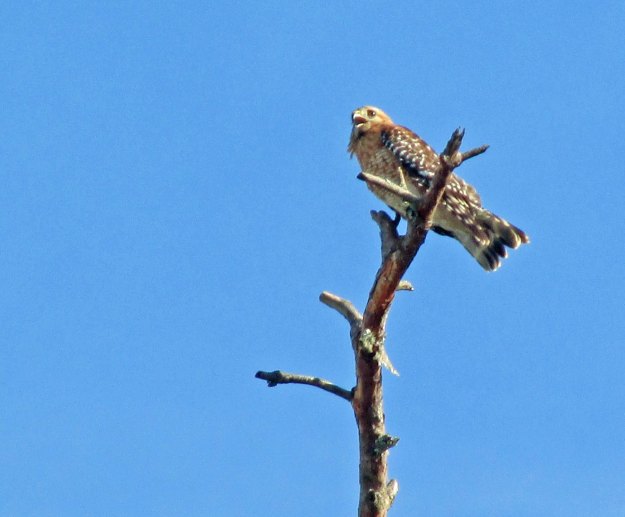
Photo by Bryan Stevens • A calling red-shouldered hawk perched in a dead tree on Pawleys Island in South Carolina.

The red-shouldered hawk produces a distinctive, piercing whistle that reminds me of the shrill call of a killdeer. The hawk at my house has been silent so far, perhaps not wishing to draw attention. The few times the local crows have noticed the hawk’s presence, they’ve flocked together to mob the unfortunate hawk. It’s also not the right time of year. During courtship and the subsequent nesting period, these hawks are vocal. At other times of the year, they are rarely heard. It’s also possible to mistakenly think you have heard one of these large hawks. Blue jays have apparently learned to imitate the “kee-yar” call of this hawk, often working a flawless rendition of the whistled notes of this large raptor.

In contrast to the related red-tailed hawk, the red-shouldered hawk soars less and prefers to perch hidden in the cover of trees. This hawk’s name comes from the reddish-brown shoulder patches in the bird’s wings. Adults show a tail marked with vivid bands of black and white that is quite distinctive.

The red-shouldered hawk belongs to the same genus of raptors as its larger relative, the red-tailed hawk. The genus, buteo, includes about two dozen large raptors that are often dominant avian predators in their respective habitats. The red-shouldered hawk is known by the scientific name Buteo lineatus.

red-shouldered-hawk-john-james-audubon

Early naturalist and artist John James Audubon painted this pair of red-shouldered hawk.

The red-shouldered hawk is less common in the region than some of the other raptors. This hawk’s stronghold is in Florida and other southern states like South Carolina and Georgia. I’ve seen many of these hawks on visits to both the Sunshine State and Palmetto State.

Some of the buteo species have adapted to life on islands, including the Galapagos hawk and the Hawaiian hawk. Some of these hawks have quite descriptive names, including the white-throated hawk, gray-lined hawk, zone-tailed hawk and short-tailed hawk. Outside the United States, raptors in the buteo genus are often known as buzzards. When the first European colonists came to the New World, they applied the term buzzard to both native vultures, as well as the large raptors like Swainson’s hawk and broad-winged hawk that reminded them of the ones back in Europe.

It’s been nice hosting this beautiful raptor, although the crows might disagree with me. A neighbor who lives close to me has had red-shouldered hawks spend the summer months on her property, so I’m hopeful that my visitor might even like the surroundings well enough to become a full-time resident.

•••••

Bryan Stevens lives near Roan Mountain, Tennessee. To learn more about birds and other topics from the natural world, friend him on Facebook at https://www.facebook.com/ahoodedwarbler. If you have a question, wish to make a comment or share a sighting, email ahoodedwarbler@aol.com.

Red-shouldered-Finally

Photo by Bryan Stevens • In a timely fashion, this red-shouldered hawk, which has avoided the camera for weeks, arrived on this rainy day in late January on the same date this post inspired by this bird was published.

Even during winter season, activity on the Roan doesn’t slow much

RM-Sunset-Dec17

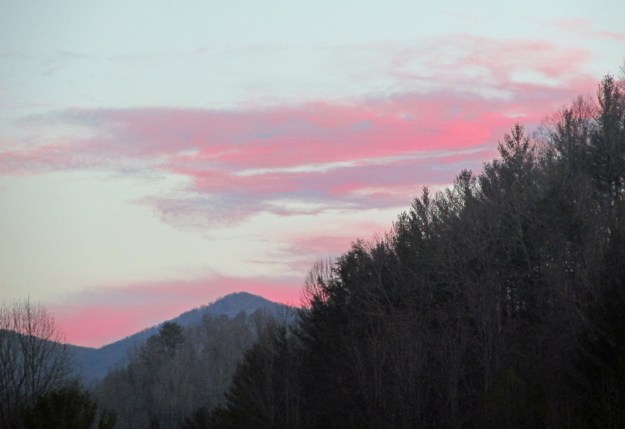
Photo by Bryan Stevens • The setting sun casts a pink glow to the winter sky near the village of Roan Mountain. The 11th annual Roan Mountain Winter Naturalists Rally is set for Saturday, Feb. 11, at the Roan Mountain State Park Conference Center.

Activities last month and planned events for February are just some of the evidence that, no matter the season, things are always happening on Roan Mountain.

For instance, the 65th Roan Mountain Christmas Bird Count was held Sunday, Dec. 17, with nine observers in two parties. Up to four inches of snow blanketed most of the area, but the roads were clear. These weather conditions highlight the fact that over the years a couple of Roan Mountain CBCs had to be cancelled due to weather conditions.

Participants included Fred Alsop, Jim Anderson, Rick Blanton, Kevin Brooks, compiler Rick Knight, Roy Knispel, Guy McGrane, Amber Stanley, and Charles Warden. A total of 44 species were tallied, near the 30 year average of 46. The all-time high of 55 species was established back in 1987.

SNowbird-Feb18

Photo by Bryan Stevens • A total of 50 Dark-eyed Juncos made the tally during the Roan Mountain Christmas Bird Count held Dec. 17, 2017.

A list of the species follows:

Canada Goose, 24; Pied-billed Grebe, 1; Great Blue Heron, 3; Cooper’s Hawk, 1; Red-shouldered Hawk, 1; and Red-tailed Hawk, 6.

Rock Pigeon, 19; Mourning Dove, 58; Eastern Screech-Owl, 2; Barred Owl, 1; Red-bellied Woodpecker, 3; Yellow-bellied Sapsucker, 2; Downy Woodpecker, 10; Hairy Woodpecker, 2; Northern Flicker, 1; and Pileated Woodpecker, 7.

American Kestrel, 1; Eastern Phoebe, 6; Blue Jay, 23; American Crow, 82; and Common Raven, 11.

Carolina Chickadee, 25; Tufted Titmouse, 20; Red-breasted Nuthatch, 5; White-breasted Nuthatch, 15; Brown Creeper, 2; Winter Wren, 2; Carolina Wren, 15; Golden-crowned Kinglet, 13; Eastern Bluebird, 30; American Robin, 12; Northern Mockingbird, 6; European Starling, 65; and Cedar Waxwing, 2.

Winter-Cardinal

Photo by Bryan Stevens • A total of 15 Northern Cardinals were found the day of the Roan Mountain Christmas Bird Count last month.

Eastern Towhee, 9; Field Sparrow, 11; Song Sparrow, 80; Swamp Sparrow, 2; White-throated Sparrow, 11; Dark-eyed Junco, 50; Northern Cardinal, 15; House Finch, 3; American Goldfinch, 46; and House Sparrow, 41.

Some interesting incidents on this count included finding an Eastern Phoebe at an elevation of 4,450 feet surrounded by snow. The most abundant birds included Common Crow with 83 individuals found and European Starling with 65 individuals counted.

•••••••

The focus will be on botany for the upcoming Roan Mountain Winter Naturalists Rally, scheduled for Saturday, Feb. 11.

Huff

Lisa Huff

According to Richard Broadwell, director for the winter rally, the event has drawn hardy nature enthusiasts from far and wide to Roan Mountain for the past 11 winter seasons. Top naturalists volunteer their time and energy to make the event both enjoyable and educational for people of all ages. Parents are encouraged to bring the kids.

Broadwell noted that the 2018 Winter Rally continues this celebration of the natural world by providing top speakers on topics concerning the environs of the Roan Highlands. Speakers for morning programs will be Ben Jarrett, Southern Regional Science Coordinator, for The American Chestnut Foundation; Lisa Huff, Stewardship Ecologist with the Tennessee State Natural Areas Program; and Dwayne Estes, professor of biology at Austin Peay State University.

Jarrett will speak about the historical significance of the American chestnut in a program tilted “Restoration of American Chestnut: A Marriage of Breeding and Biotechnology.” He will take a look at the American chestnut and its economic, ecological and social importance). He will also educate about the chestnut blight and subsequent downfall of the species, as well as the ongoing restoration efforts through backcross breeding and genetic engineering.

Jarrett

Ben Jarrett

Huff will present a history of the shortleaf pine and bluestem vegetation community in Tennessee in a program titled “The Mystery of the Missing Shortleaf Pine.” She started working for the Tennessee State Natural Areas Program in 2000. She is tasked with the daily operations and management of over 42,000 acres in 21 natural areas in East Tennessee.

Estes will speak about southeastern United States grasslands, such as savannas, prairies, glades, barrens, bald, bogs, fens, and meadows, all of which are imminently threatened. He will also educate about the work of the Southeastern Grasslands Initiative in Clarksville, which aims to focus grassland conservation efforts across a 21-state region. SGI will use a multi-faceted approach combining restoration, preservation, recreation, research, rescue, seed banking, education and market-driven strategies. SGI is currently working with and seeking support from private philanthropic foundations, corporations, non-profit conservation organizations and government agencies. His program is titled “The Southeastern Grasslands Initiative: Charting a New Course for Conservation in the 21st Century.”

ESTES

Dwayne Estes

All programs will be held at the Roan Mountain State Park Conference Center. Jarrett will speak at 9:30 a.m. followed by Huff at 10:30 a.m. The program by Estes at 11:40 a.m. will conclude the slate of presentations. Lunch, which requires a pre-paid reservation, will be served at 12:30 p.m. Sarah Sanford, candidate for Master’s of Environmental Management at Duke University, will present a lunchtime program on “Grassy Balds Management in the Roan Highlands.”

Four different hikes are planned for the afternoon, starting at 1:30 p.m. Hike options include:

• Lisa Huff will lead a hike in the Hampton Creek Cove Natural Area. Binoculars are recommended. The moderately strenuous hike should not take more than three hours.

• Jamey Donaldson, ETSU John C. Warden Herbarium Adjunct Curator, will lead a hike to the alder balds on the ridgeline of Roan Mountain. Dress warmly for this strenuous hike.

Sisken-Spruce

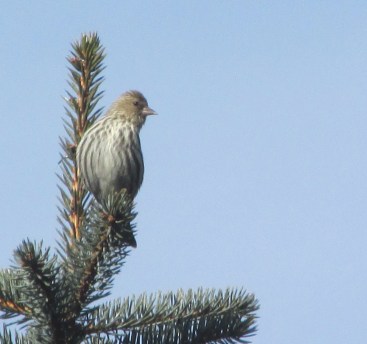
Photo by Bryan Stevens • A Pine Siskin in a spruce at Carver’s Gap on Roan Mountain.

• Marty Silver, Ranger with Warriors Path State Park, will lead a wildlife tracking and animal signs hike down near the Doe River in Roan Mountain State Park. This is a moderately strenuous and kid-friendly activity.

• Dr. Frosty Levy, Professor Emeritus of Biology at East Tennessee State University, will lead an easy winter tree identification hike in Roan Mountain State Park.

For more information and a downloadable brochure, visit http://friendsofroanmtn.org/2018%20Winter%20Rally%20Brochure.pdf or email Broadwell at rbroadwell@gmail.com. The event is free to members of Friends of Roan Mountain and children. Adults who are not members of FORM can register for all activities for $10.

75 years strong, annual Elizabethton Christmas Bird Count breaks old records

GreaterWF-Goose

The 75th consecutive Elizabethton Christmas Bird Count held last month shattered records for this long-running survey. This year’s CBC was held on Saturday, Dec. 16, with 25 observers in six parties participating. The 85 species tallied established a new high for this count, shattering the old mark of 80 species set in 2012 and again in 2016. The average total over the last 30 years of the Elizabethton CBC is 72 species.

Participants included Fred Alsop, Jim Anderson, Jerry Bevins, Rob Biller, Rick Blanton, Kevin Brooks, Gil Derouen, Harry Lee Farthing, Dave Gardner, Carl Hacker, Jacki Hinshaw, David Irick, Rick Knight (compiler), Roy Knispel, Richard Lewis, Joe McGuiness, Charles Moore, Brookie and Jean Potter, Brenda Richards, Chris Soto, Amber Stanley, Bryan Stevens, Kim Stroud, and Scott Turner.

I took part in this CBC, as I have for many years, with fellow members and friends of the Elizabethton Bird Club. Participation in this annual survey has been a part of my holiday traditions for the past 20 years. The tradition of the CBC, however, goes much farther back.

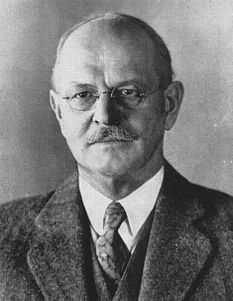
According to the National Audubon Society’s website, the tradition of the Christmas Bird Count arose from a less than bird-friendly custom. By the turn of the 20th century, so-called sportsmen would conduct a “Side Hunt,” a rather bloodthirsty Christmas custom that saw hunters competing to see who could score the largest amount of feathered and furred corpses. It was a huge step forward for conservation when preeminent ornithologist Frank M. Chapman proposed a new holiday tradition. His radical idea was to count birds during the Christmas season rather than hunting and killing them.

chapman

Ornithologist Frank Chapman organized the very first Christmas Bird Count back   in December of 1900.

The Christmas Bird Count is now conducted each year on dates between Dec. 14 and Jan. 5. The first CBC took place in December of 1900 with 27 observers participating at 25 locations in the United States and Canada. Fifteen of the counts were conducted in the northeastern United States in an area ranging from Massachusetts to Philadelphia, Pennsylvania. Results from that first count in 1900 didn’t truly reflect the diversity of North America’s birds, but they were nonetheless interesting. The Greater Boston CBC consisted of only one participant and found only 17 species. However, some of those species included such good birds as American tree sparrow, brown creeper, Northern shrike and Northern bobwhite.

The Elizabethton Bird Club traditionally compiles the results from its two annual CBCs (Roan Mountain as well as Elizabethton) at its yearly Christmas party. This year when the tallies were added up, count participants were delighted to learn the count had set a new record with an amazing total of 85 species tallied, which is hard to come by in mid-December in Northeast Tennessee. An abundance of waterfowl helped push up the number of species found.

A few species are becoming more expected on this annual December count. For instance, greater white-fronted goose was found for the third time in the last five years. Before that, this goose had never been found on this count.

The bufflehead, the smallest of the diving ducks, set a new record with 293 individuals found. Four Northern Shovelers represented only the eight time this duck has appeared on the count. Greater Scaup were found for only the seventh time in the last 25 years. Ruddy Duck has now been found three times in the last 25 years, which matches the three occasions it was found prior to that time.

Bald eagles, thanks to locations like Watauga Lake and Wilbur Lake, are also becoming more common. Eagles have been found 20 of the last 25 years, but only once prior. Red-shouldered Hawk, which is uncommon in the region, was found for the sixth time in the last quarter-century.

Redshouldered_Hawk-LeeKarney

Photo by U.S. Fish & Wildlife Service/Lee Karney • A Red-shouldered Hawk perches in branches.

Eurasian Collared-Dove appears established in Elizabethton. This dove has been found six of the last nine years since it first made an appearance on the count.

All seven of the region’s woodpecker were found on this year’s CBC. The Red-headed Woodpecker has shown up on four counts in the last 25 years. This woodpecker was only found seven times in the years prior to 1992.

A Blue-headed Vireo spotted on this year’s count represented only the third time this species has been found. A flock of 75 American Pipits marked only the third time this species has been seen since 1992 on a CBC. Prior to that date, the species appeared only twice on an Elizabethton CBC.

Gray Catbird has been found five of the last 25 years, including this year, but only once prior to 1992. Palm Warbler, found only once prior to 1992, has now been found eight of the last 25 years. The single Pine Warbler seen means that this species has now been found four of the last 25 years, but only four times prior to 1992.

The European Starling with 1,335 individuals found on count day was easily the most common species on this year’s CBC. The 16 Dark-eyed Juncos, usually a relatively common species on the Elizabethton CBC, represented the fewest juncos ever found on this long-running survey.

Below is the complete species list:

Greater White-fronted Goose, 1; Canada Goose, 532; Wood Duck,1; Gadwall, 5; American Wigeon, 1; American Black Duck, 2; Mallard, 366; Northern Shoveler, 4; Green-winged Teal, 2; Ring-necked Duck, 14; Greater Scaup, 2; Lesser Scaup, 3; Bufflehead, 293; Hooded Merganser, 4; and Ruddy Duck, 1.

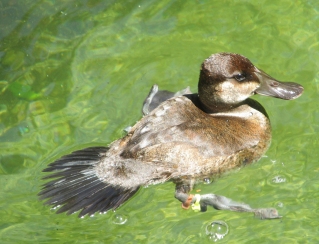
Ruddy-Hen

Photo by Bryan Stevens • A female Ruddy Duck.

Wild Turkey, 33; Common Loon, 2; Pied-billed Grebe, 14; Horned Grebe, 27; Great Blue Heron, 18; Black Vulture, 3; Turkey Vulture, 12; Bald Eagle, 3; Sharp-shinned Hawk, 1; Cooper’s Hawk, 2; Red-shouldered Hawk, 2; and Red-tailed Hawk, 25.

Killdeer,17; Ring-billed Gull, 27; Rock Pigeon, 305; Eurasian Collared-Dove, 1; Mourning Dove, 157; Eastern Screech-Owl, 12; Great Horned Owl, 2; Barred Owl, 1; and Belted Kingfisher, 10.

Red-headed Woodpecker, 1; Red-bellied Woodpecker, 33; Yellow-bellied Sapsucker, 8; Downy Woodpecker, 27; Hairy Woodpecker, 3; Northern Flicker, 26; and Pileated Woodpecker, 21.

American Kestrel, 16; Eastern Phoebe, 12; Blue-headed Vireo,1; Blue Jay, 162; American Crow, 223; and Common Raven, 4.

Red-breastedNutHatchYAHOO

Photo by Bryan Stevens • A Red-breasted Nuthatch at a feeder.

Carolina Chickadee, 117; Tufted Titmouse, 84; Red-breasted Nuthatch, 1; White-breasted Nuthatch, 25; Brown Creeper, 4; House Wren, 1; Winter Wren, 6; and Carolina Wren, 75.

Golden-crowned Kinglet, 41; Ruby-crowned Kinglet, 8; Eastern Bluebird, 111; Hermit Thrush, 11; Amercian Robin, 277; Gray Catbird, 1; Brown Thrasher, 1; and N. Mockingbird, 49.

Eurasian Starling, 1,335; American Pipit, 75; Cedar Waxwing, 154; Palm Warbler, 2; Pine Warbler, 1; and Yellow-rumped Warbler, 154.

Eastern Towhee, 22; Chipping Sparrow, 4; Field Sparrow, 8; Song Sparrow, 142; Swamp Sparrow, 5; White-throated Sparrow,102; Dark-eyed Junco, 16; and Northern Cardinal, 111.

Red-winged Blackbird, 1; Eastern Meadowlark, 1; Brown-headed Cowbird, 2; House Finch, 100; American Goldfinch, 90; and House Sparrow, 41.

The Audubon-sponsored CBC allows counts to also list birds not found on the count day that are seen during count week. This year participants found Redhead ducks, which were not present on count day. Notable misses this year include Ruffed Grouse, American Coot, Wilson’s Snipe, and White-crowned Sparrow.

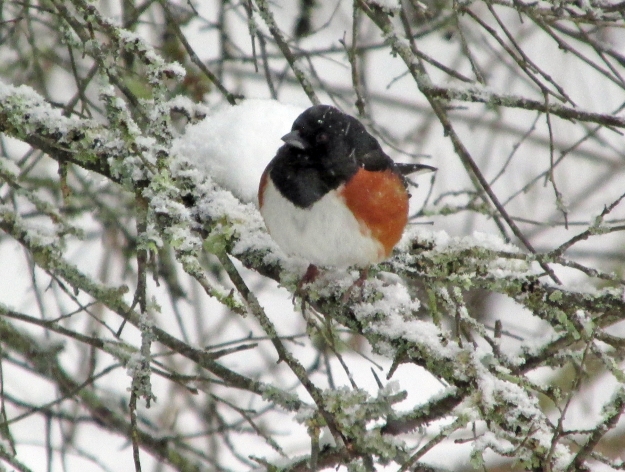
Towhee-Feb12

Photo by Bryan Stevens • A male Eastern Towhee waits out a snowstorm.