
 An Eastern phoebe has returned to the woodlands around my home.
I’m not sure when the resident phoebes departed last fall. They were still prominent in their daily activities in late October and early November. I think they probably slipped off, unnoticed, around Thanksgiving. Some winters, a few Eastern phoebes linger throughout the cold months, often near an open source of water that’s unlikely to freeze.
With the arrival of March and warmer weather, at least one Eastern phoebe, a male, is back and singing tirelessly every morning. The song is easy to memorise. The singing bird simply repeats its name — fee bee, fee bee — in scratchy, descending sets of tones.
Considering the bright finery worn by some of the more colorful spring arrivals, Eastern phoebes are comparatively drab. The gray and white plumage of this species of flycatcher pales in comparison with vibrant birds like rose-breasted grosbeak, ruby-throated hummingbird, scarlet tanager and yellow warbler.
Nevertheless, this member of the flycatcher clan has earned itself a favorite spot in the hearts of many a birdwatcher. It’s one of those birds that even beginning birders find surprisingly easy to recognize and identify. While it may not have a dramatic plumage pattern to hint at its identity, the Eastern phoebe is quite at home around human dwellings and comes into close contact with people going about their daily routines. Rather tame — or at least not too bothered by close proximity with humans — the Eastern phoebe has one behavior that sets it apart from all the other similar flycatchers. When this bird lands on a perch, it cannot resist a vigorous bobbing of its tail. Every time that a phoebe lands on a perch, it will produce this easily recognized tail wag. It’s this tell-tale action that makes this bird almost instantly recognizable among birders with the knowledge of this behavioral trait.

Photo by Bryan Stevens • A young Eastern Phoebe perches in the shelter of some branches.
The Eastern phoebe, known by the scientific name of Sayornis phoebe, has two relatives in the genus Sayornis. The genus is named after Thomas Say, an American naturalist. The Eastern phoebe’s close relatives include the black phoebe and Say’s phoebe. The black phoebe ranges throughout Oregon, Washington and California and as far south as Central and South America. As its name suggests, this bird has mostly black feathers instead of the gray plumage of its relatives. The Say’s phoebe, also named for the man who gave the genus its name, is the western counterpart to the Eastern phoebe.
Since they belong to the vast family of New World flycatchers, it’s probably no surprise that these phoebes feed largely on insects. That’s why phoebes overwintering in the region are always found near water. The open water also attracts flying insects. The birds will often perch patiently until an insect’s flight brings it within easy range. A quick flight from its perch usually allows the skillful bird to return with a morsel snatched on the wing. In the winter months, however, the Eastern phoebe also eats berries and other small fruit when insect scarcity makes this exclusive diet almost impossible.
Phoebes are fond of nesting on human structures, including culverts, bridges and houses. With the latter, they were once known for their habit of placing their nests under sheltering eaves. At my home, a pair of Eastern phoebes often chooses to nest on the wooden rafters in my family’s garage. Phoebes also like to reside near a water source, such as a creek, stream or pond.
Although the species is migratory, a few hardy individuals will usually try to tough out winters in the region. The others that depart in the autumn will migrate to the southern United States and as far south as Central America. On some rare occasions, Eastern phoebes have flown far off their usual course and ended up in western Europe. I can usually count on Eastern phoebes returning to my home in early March, making them one of the first migrants to return each year.
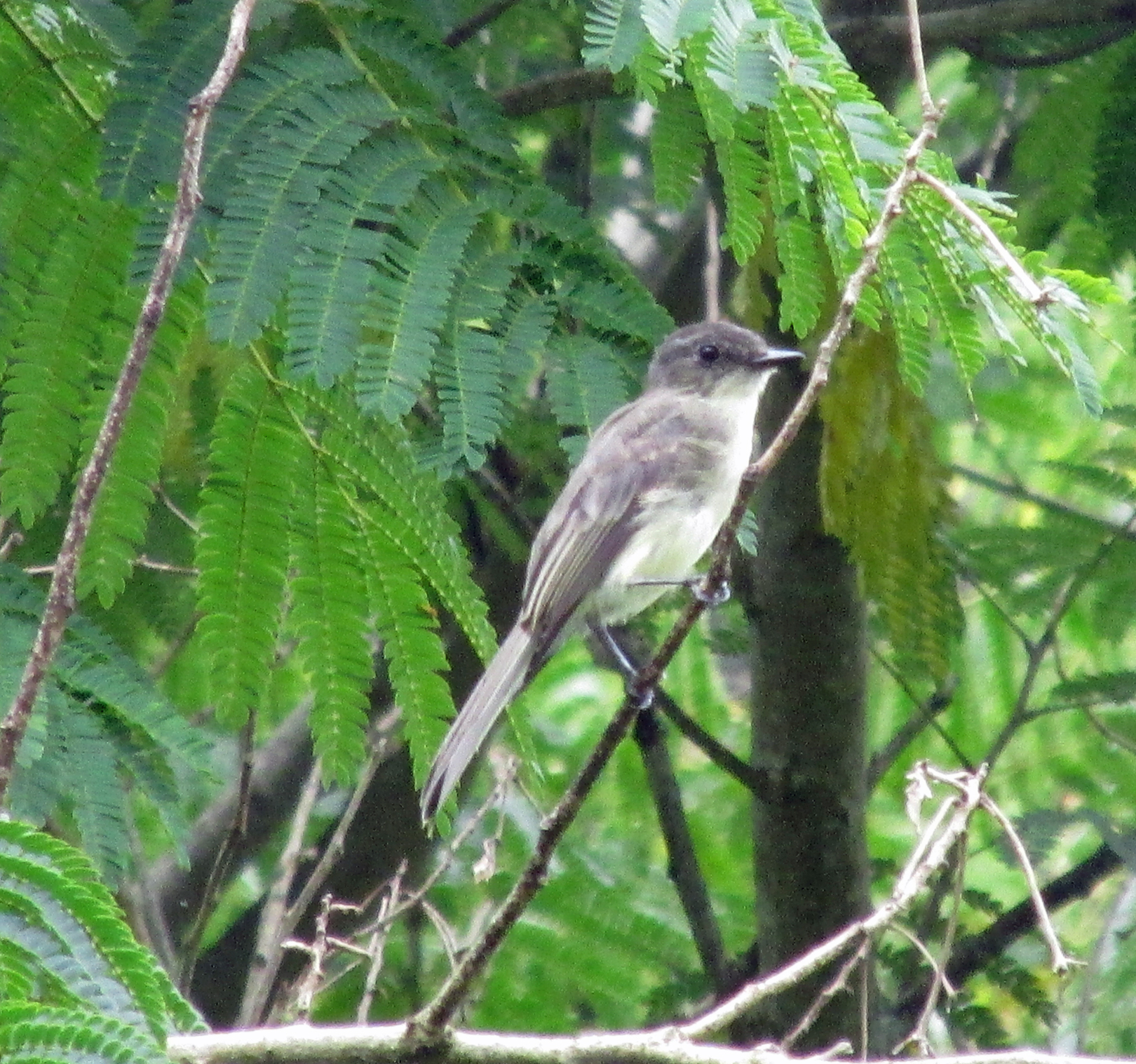
Photo by Bryan Stevens • An Eastern Phoebe perches in a mimosa tree.
This year, like the dependability of clockwork, I began hearing that easily recognized song on mornings during the first days of March when I walked to my car to depart for work. It’s due to their noisy nature that their arrival rarely goes unnoticed. Males tend to start singing persistently as soon as they arrive. I doubt it will take the male residing near my home long to attract a mate.
John James Audubon, an early naturalist and famed painter of North America’s birds, conducted an experiment with some young phoebes. His simple test represents the first-ever bird banding in the United States of America. His novel experiment, which he carried out in 1803, involved tying some silver thread to the legs of the phoebes he captured near his home in Pennsylvania. He wanted to answer a question he had about whether birds are faithful to home locations from year to year. The following year Audubon again captured two phoebes and found the silver thread had remained attached to their legs. Today ornithologists still conduct bird banding to gather information on birds and the mystery of their migrations.
So, that pair of phoebes that returned to your backyard this spring — they just might be the same ones that have spent past summer seasons providing you with an enlightening glimpse into their lives.
Over the past few years, I’ve had a pair of Eastern phoebes nest on the blades of a ceiling fan on my front porch. Other past nesting locations have included the rafters in my garage. If a pair happens to take up residence on your own front porch or in your garage, I hope you’ll welcome them. The pleasure of observing them raising their family will more than compensate for a slight mess and a few weeks of inconvenience.
••••••
To learn more about birds and other topics from the natural world, friend Bryan Stevens on Facebook at https://www.facebook.com/ahoodedwarbler. He is always posting about local birds, wildlife, flowers, insects and much more. If you have a question, wish to make a comment or share a sighting, email ahoodedwarbler@aol.com.
 Our Fine Feathered Friends
The pheobe has the colorings of a Tufted Titmouse, grays and black eyes. But I’ve not seen a pheobe in my parts. I wonder if they are in S Carolina, N Carolina, or Virginia?
LikeLike