Tag Archives: Birding

Birding is a popular pastime for many Americans.

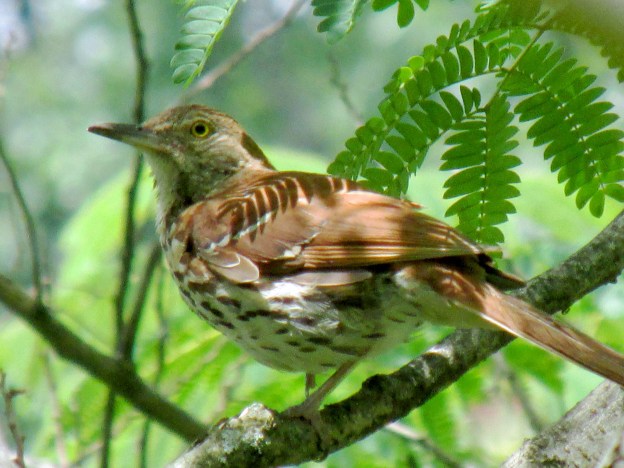
Brown thrashers make first spring appearance


Photo by Bryan Stevens • A brown thrasher visits a feeder for a helping of suet. These large songbirds are usually among spring’s early arrivals.

In this time of social distancing when the daily routine can become flat and dull, I’m rejoicing that many of my favorite birds are returning after their long winter absence. One of the first to return has been brown thrashers, which made a first spring appearance on March 25. I suppose I should use the word “appearance” with reservations since I only heard a thrasher singing from deep in the concealment of a brushy thicket. A few days, later, however, a pair of brown thrashers began visiting my suet feeders.

I posted about the return of this large songbird on Facebook and immediately discovered that the brown thrashers must have returned to the region en masse.

Aubrie Abernethy, a resident of Johnson City, Tennessee, posted that her brown thrasher has arrived a day earlier than mine.

Dianne Draper, a resident of Jonesborough, Tennessee, posted, too. “Ours is back also,” Dianne wrote.
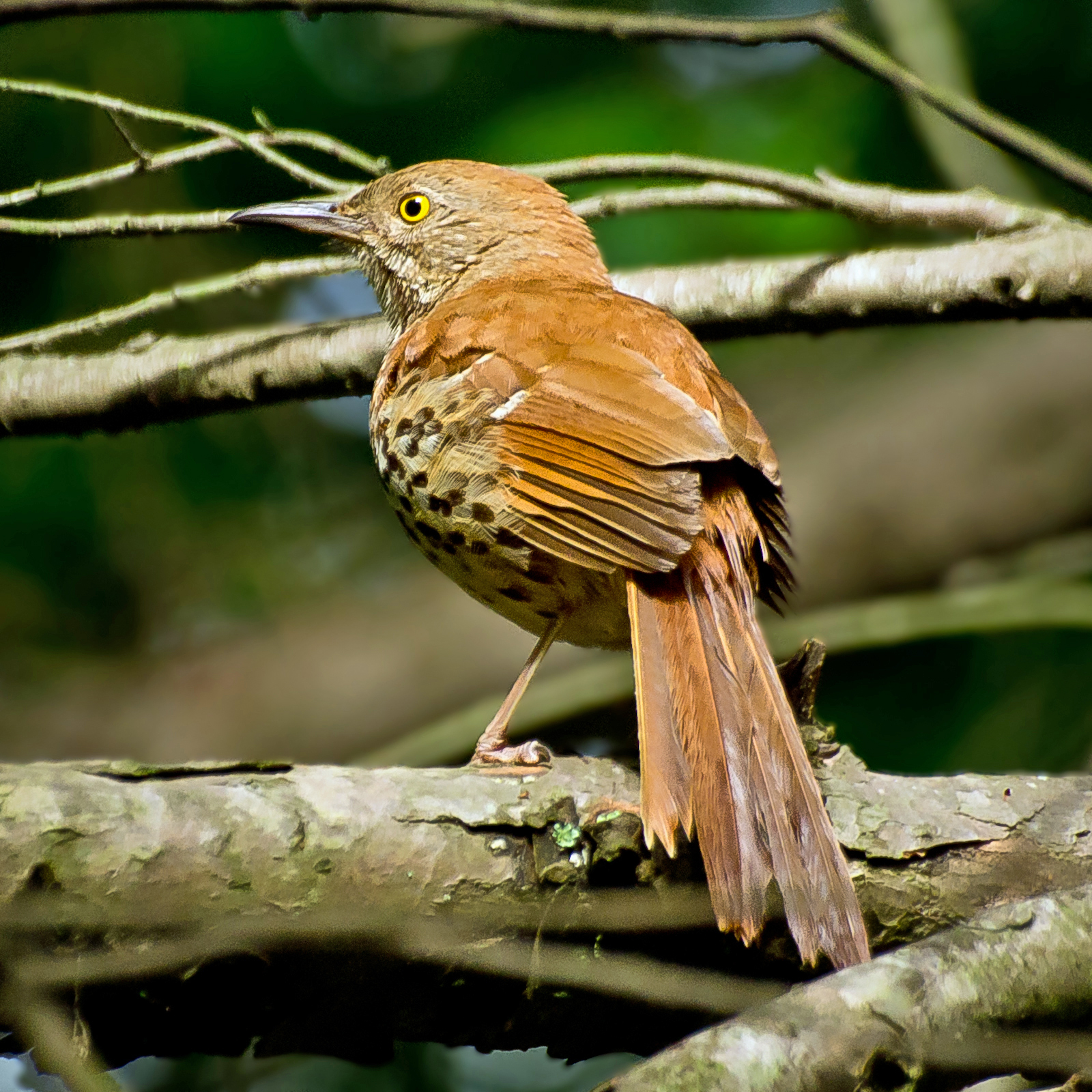
Photo by Ken Thomas
The Brown Thrasher is an alert, sharp-eyed observer of its surroundings.

Michelle Sparks in Bristol, Tennessee, posted on my Facebook page that she had seen her first spring brown thrasher earlier that same week.

Diane Gonzalves from Abingdon, Virginia, responded on the post about brown thrashers by asking about another imminent arrival. “I assume the hummingbirds should be here soon?” Diane asked.

I responded that the first ruby-throated hummingbirds should be arriving at any time. Please watch out for these tiny birds and get your sugar water feeders outside to welcome them. I will do my annual round-up on first hummingbird sightings of the spring again this year. Share your sighting by emailing the time and date of the arrival to ahoodedwarbler@aol.com. Readers can also contact me via Facebook.

The brown thrasher (Toxostoma rufum) belongs to the family of “mimic thrushes,” which provides a label for a group of songbirds capable of imitating the songs of other birds. Mimidae, the Latin root for “mimic,” provides the scientific name for the family, which includes mockingbirds and the New World catbirds, as well as thrashers. The Northern mockingbird is best known for the ability to mimic, but relatives like the gray catbird and brown thrasher are also talented mimics.

The thrasher is a fairly large songbird about 11.5 inches long with a wingspan of 13 inches. Much of the body length comes from the bird’s long tail feathers. A thrasher weighs, however, only about 2.5 ounces.
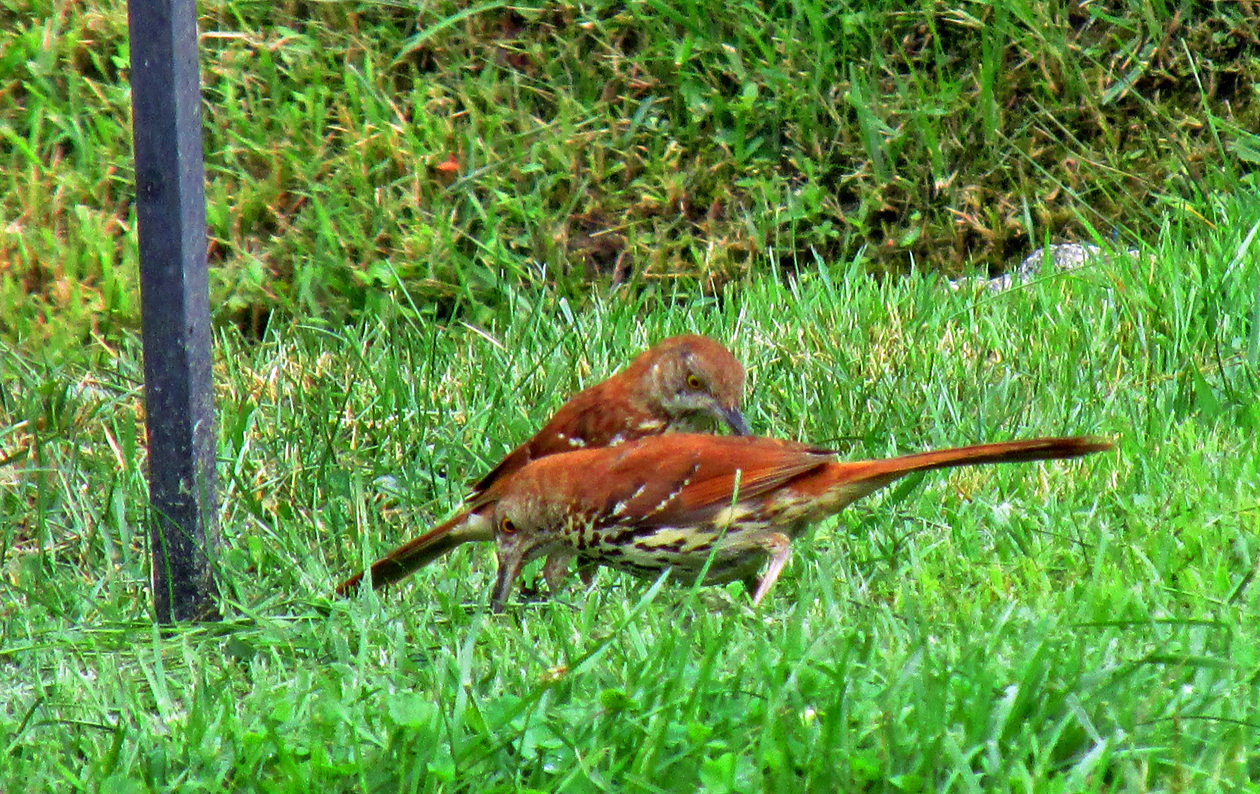
Photo by Bryan Stevens • A pair of Brown Thrashers forage for food on the ground below a feeder.

The brown thrasher is not a picky eater. It’s known to eat everything from berries and nuts to insects and small lizards. It’s also aggressive in defending its nest and young. John James Audubon, a French-American ornithologist, naturalist and painter, painted quite the dramatic scene of a group of brown thrashers valiantly defending a nest from an attacking snake. The painting is so detailed that one has to imagine Audubon based his work on a real-life experience. His work, originally painted in the early decades of the 1800s, still holds up today.

Early American naturalist and artist John James Audubon painted a dramatic scene of brown thrashers defending their nest from an attacking snake.

Incidentally, Audubon knew the brown thrasher as the “ferruginous thrush.” Another former common name for this species was “brown thrush.” The brown thrasher breeds across the United States and Canada east of the Rocky Mountains. Thrashers withdraw from the northern part of their range in the winter months, spending the season in the southeastern United States.

They are familiar birds in southern gardens. In fact, the brown thrasher is the official state bird of Georgia and also provided the name for Atlanta’s National Hockey League team, the Atlanta Thrashers. The thrasher became Georgia’s state bird due to passage of a Joint Resolution of the Georgia General Assembly in 1970.

Other new arrivals in the closing days of March included blue-gray gnatcatcher, blue-headed vireo and broad-winged hawk. So, what are you seeing? Let me know when the hummingbirds arrive.
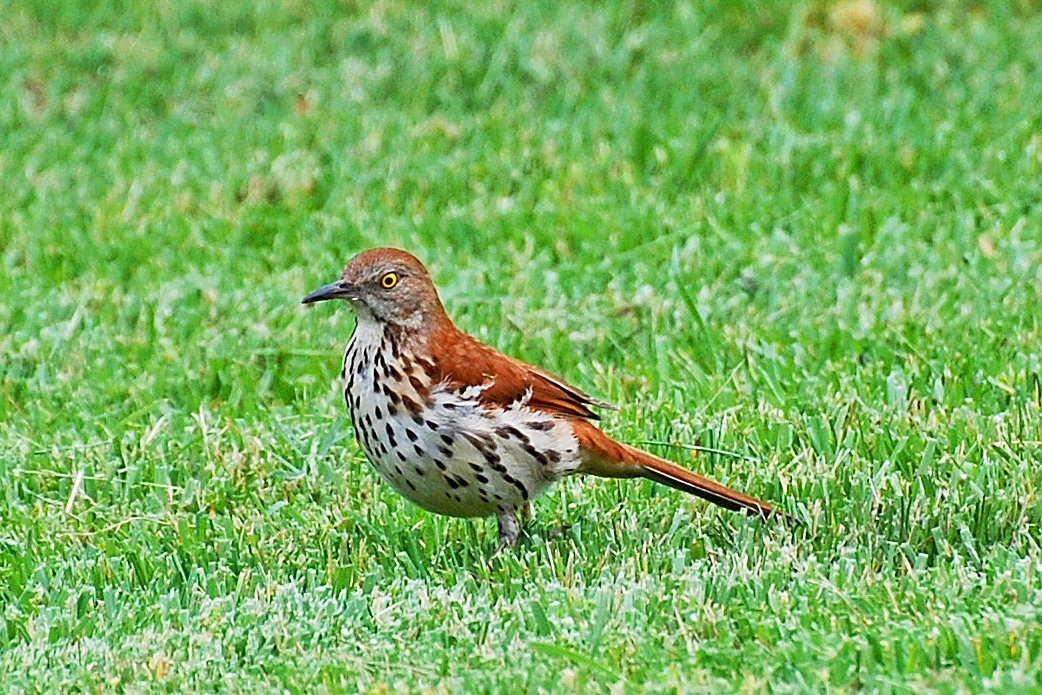
Photo Courtesy of Jean Potter • A brown thrasher scans the grass for insect prey.
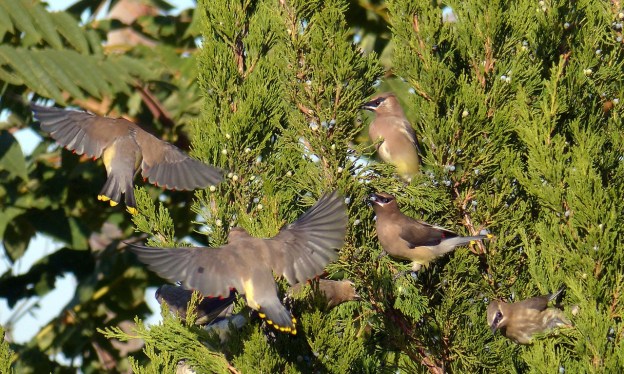
Wandering flocks of cedar waxwings surprise with their visits

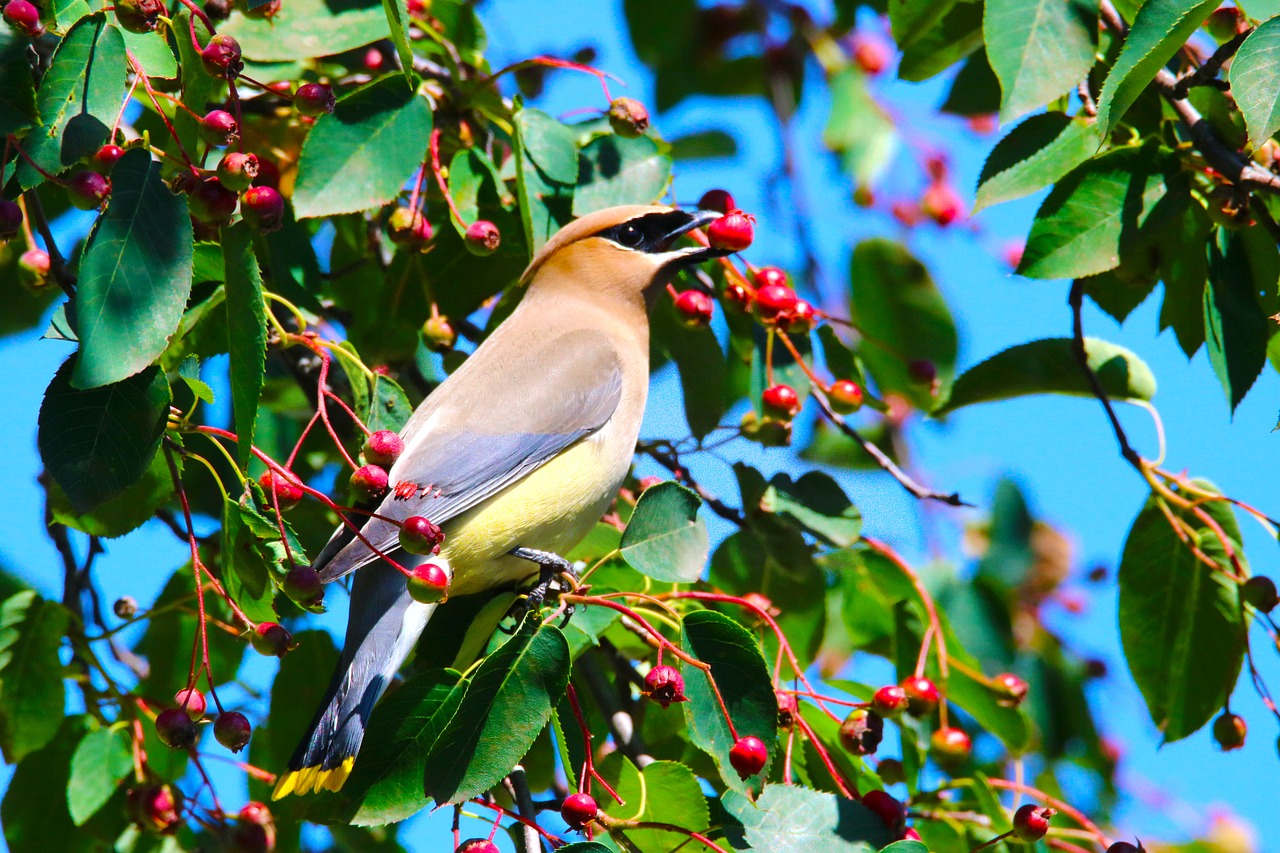
Photo by DivaDan/Pixabay.com • A cedar waxwing plucks a single berry from the laden branches of a fruit-bearing tree.

Early last month I received an email from Ernie Marburg about some visitors at his home in Abingdon, Virginia. “Just wanted to let you know that the Cedar Waxwings are in the neighborhood,” he wrote. “The flocks are looking for berries in the holly trees.” 

Waxwings have a brown and gray silky plumage, a black mask and a perky crest. Some of the wing feathers show red tips. The similarity of these wing tips to melted drops of wax gives these birds the common name of waxwing.

Photo by Bryan Stevens • The waxy tips to the wing feathers are evident in this photograph of a cedar waxwing.

The cedar waxwing has few relatives. Worldwide, there are only two other species: the Bohemian waxwing, of the northern forests of Eurasia and North America; and the Japanese waxwing, found in such northeast Asian countries as Japan, Korea and China.

Although it’s classified as a songbird, the cedar waxwing does’t truly produce a vocalization that anyone would contend qualifies as a song. They are, however, very vocal birds, producing shrill, high-pitched notes as they pass through the upper branches of tall trees.

As much as the waxwing has a fondness for fruit, it’s also a bird that would have made an excellent flycatcher. Flocks of these birds will often congregate in trees near the edge of a pond, garden or yard — anywhere winged insects might be found in good numbers — in order to hawk insects on the wing. A waxwing will sally forth from a branch, snatch its prey in mid-air, and return to its perch for a quick snack.

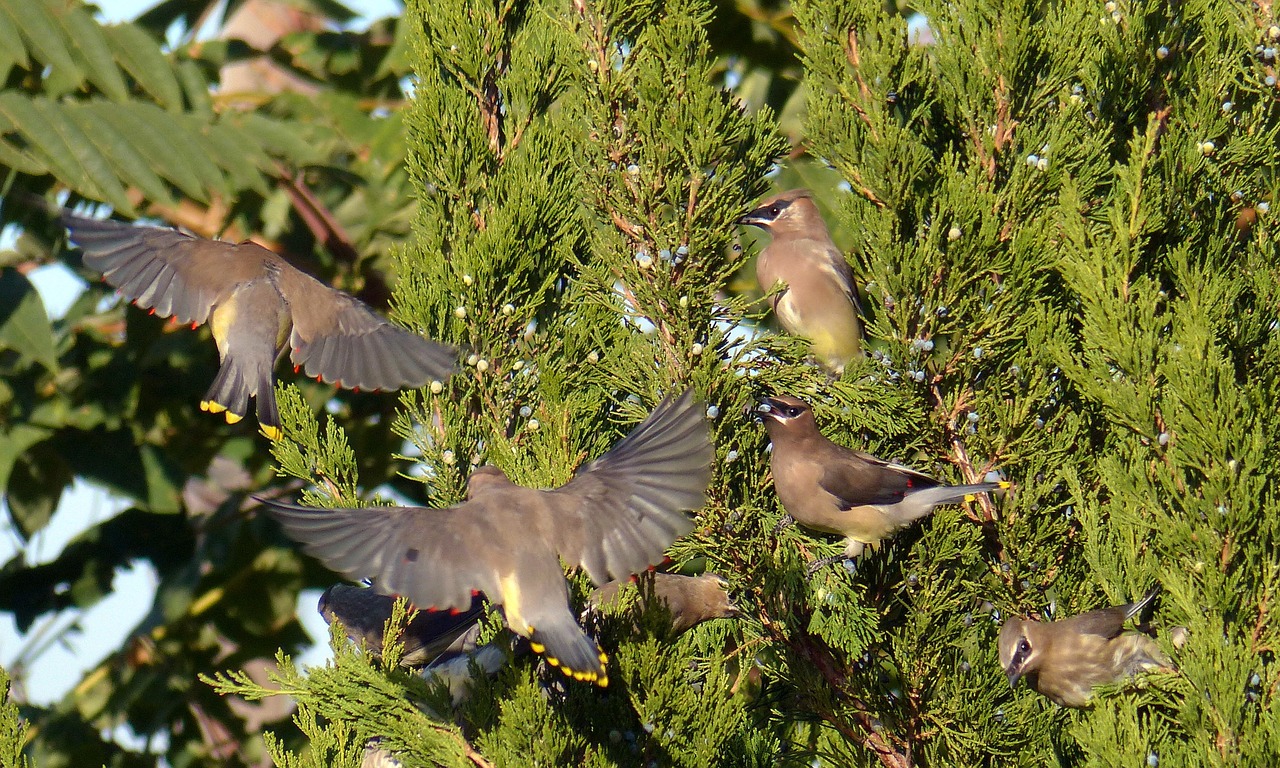
Photo by dmgreen44/Pixabay.com • A flock of cedar waxwings strip berries from the branches of a cedar tree.

Waxwings are rather nomadic, coming and going with a maddening unpredictability. Other birds are more dependable, arriving and departing at roughly the same time year after year. One such bird should soon make its triumphant and welcome return to yards and gardens throughout the region. According to the website Hummingbird Guide, ruby-throated hummingbirds usually return to Tennessee and Virginia the first week of April. These tiny flying jewels arrive earlier in North and South Carolina, typically arriving the third week of March in those states.

Early American naturalist and artist John James Audubon painted this pair of cedar waxwings.

The popularity of hummingbirds in general, and the ruby-throated hummingbird specifically, is simple to understand.

These tiny birds are perfectly willing to insert themselves into our lives, offering hours of fascinating entertainment as they visit our gardens, duel at our sugar water feeders and occasionally even nest in trees and shrubs in our yards.

I’m hoping to hear from readers about their first spring hummingbird observations. Email me at ahoodedwarbler@aol.com. Be sure to include the time and date of your sighting, as well as your locations. You can also find me through Facebook.

Photo by Bryan Stevens • A male ruby-throated hummingbird perches near a feeder that he is ready to defend from all comers.

Sounds of spring grow more varied as season advances

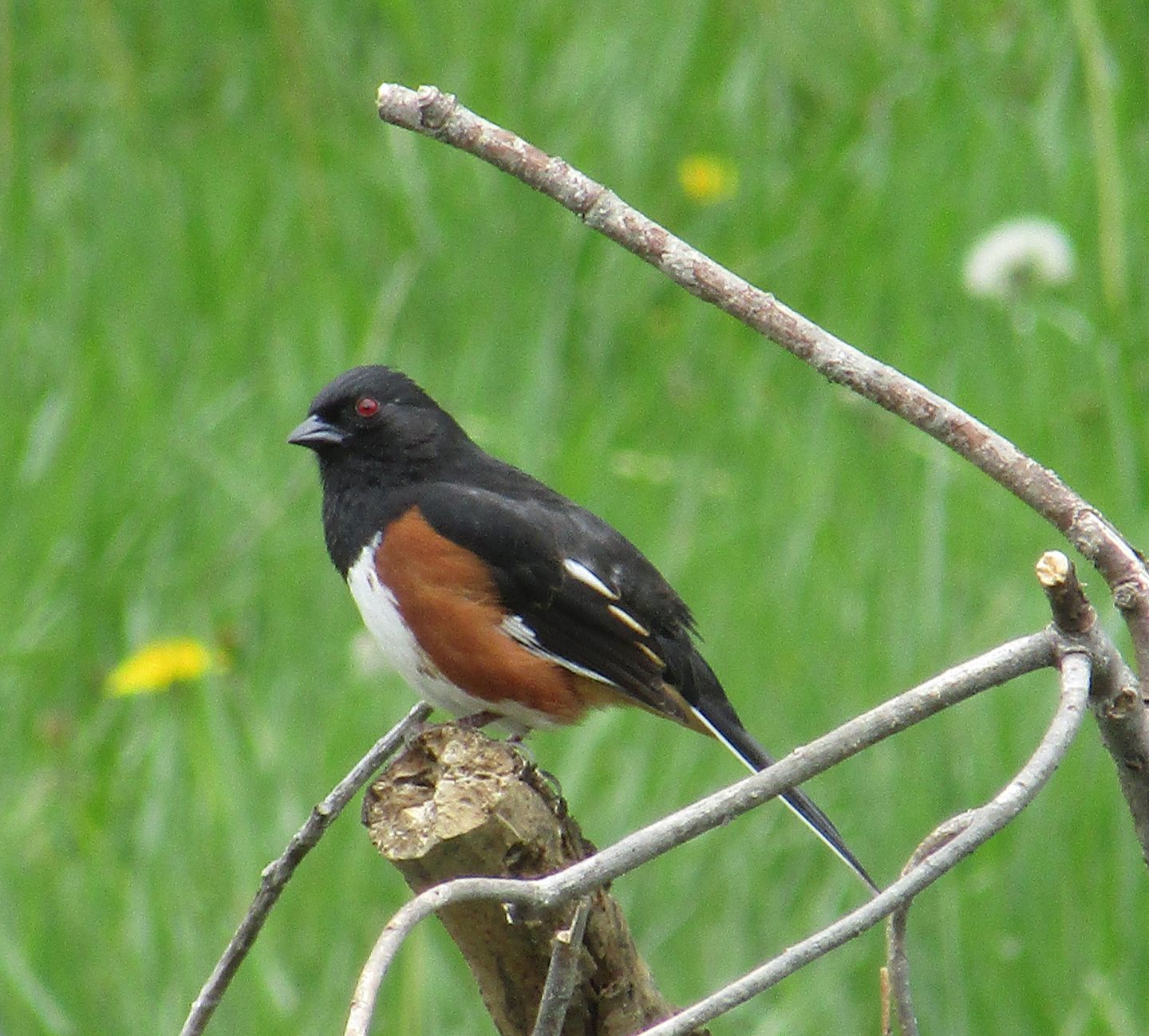
Photo by Bryan Stevens • Former common name rufous-sided towhee became Eastern towhee, which is far less descriptive of the bird’s appearance. In spring, male towhees become persistent singers. Listen for their “drink-your-tea” song as the males perch on elevated branches and twigs.

The sounds of spring surround us from sunrise to sunset with much of this seasonal chorus being provided by our feathered friends, the birds. In these weird weeks in need of something distracting, I’ve been letting nature’s sounds, as well as sights, provide some measure of relief from stressful headlines and anxious thoughts.

The mornings around my home often begin with a loud, insistent “Peter! Peter! Peter!” uttered from the woods or even just outside my bedroom window. Male tufted titmice, little gray relatives of chickadees with a distinctive crest and large, dark eyes, sing their urgent “Peter! Peter! Peter!” as a constant refrain in their efforts to attract mates now that they feel spring in their blood.

A series of rat-a-tat-tats echoes from deeper in the woods as woodpeckers tap their sturdy bills against the trunks of trees. The three most common woodpeckers at my home are red-bellied, downy, and pileated, and they all have their own unique vocalizations, as well.

Photo by Bryan Stevens • Woodpeckers not only vocalize, they also add to the spring cacophony by drumming against the trunks of trees.

The pileated woodpecker produces clear, far-carrying resonant piping sounds that can last for a few seconds each blast. The much smaller downy woodpecker produces a whinny of high-pitched notes that descend in pitch toward their conclusion. The red-bellied call is probably the one that stands out the most. The call’s a harsh, rolling “Churr, churr, churr” given almost like an expression of exasperation as they circle tree trunks and explore branches.

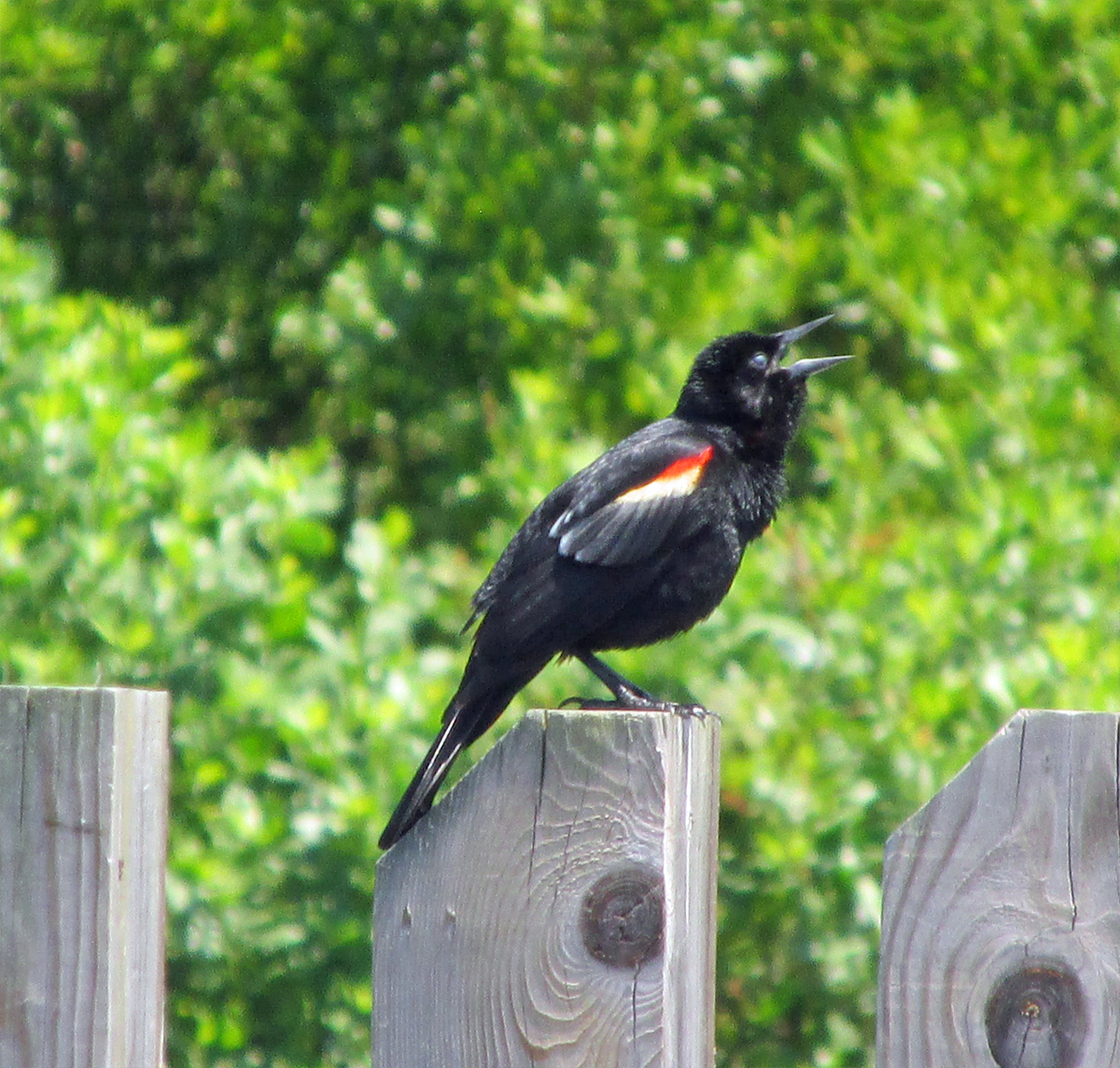
Since their return earlier this month, the resident red-winged blackbirds are often some of the earliest singers these days. According to the website All About Birds, the male red-winged blackbird’s “conk-la-ree!” is a classic sound of wetlands across the continent of North America. According to the website, the one-second song starts with an abrupt note that transforms quickly into a musical trill.

Photo by Bryan Stevens • A male red-winged blackbird sings to attract mates and ward off rivals.

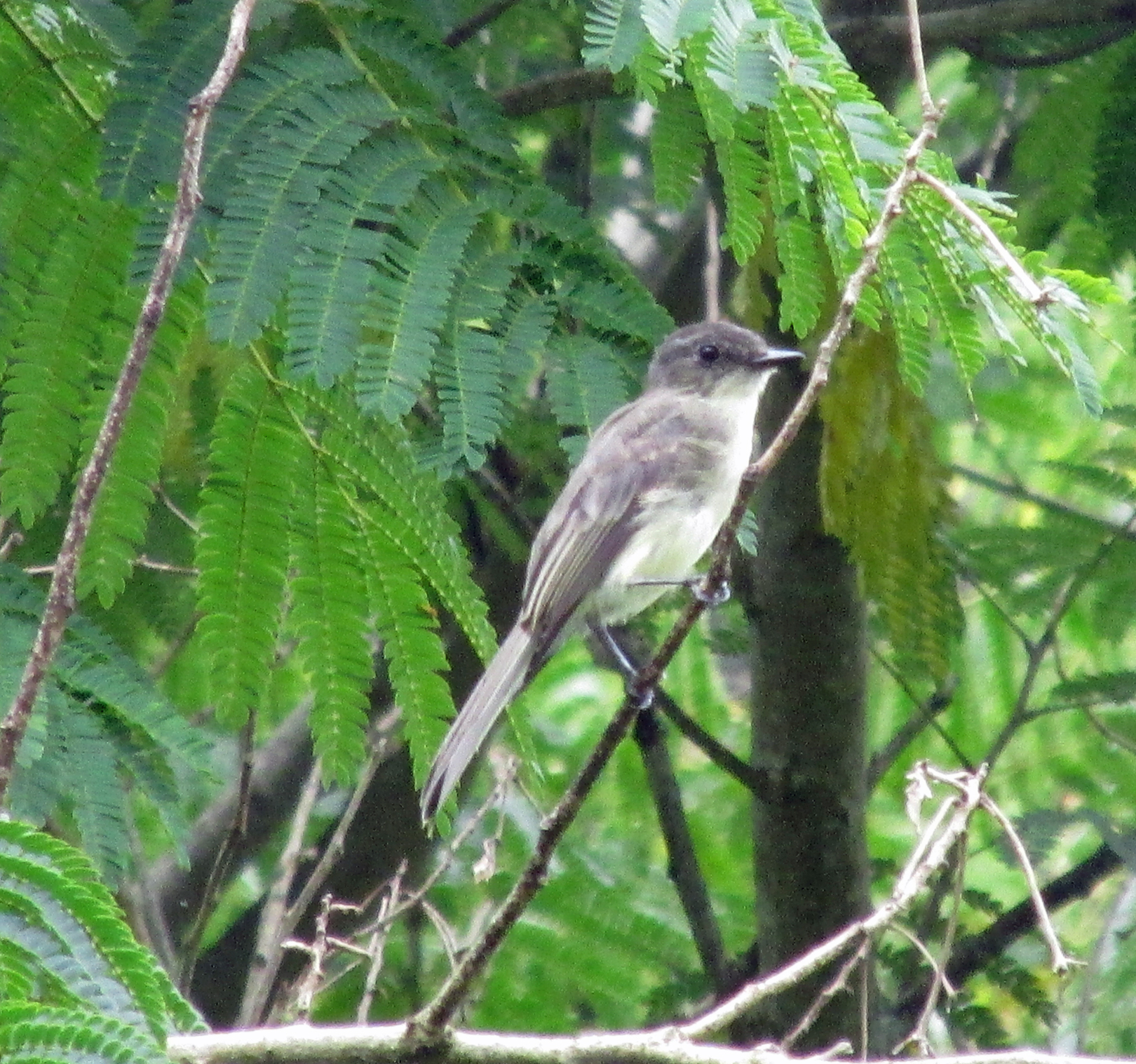
Some birds helpfully introduce themselves with a song that repeats their name. One such common bird is the Eastern phoebe. In recent weeks, a pair has been checking out the rafters of my garage for potential nest sites. The male spends much of the day producing his strident “fee-bee” call, which is a perfect phonetic rendition of the bird’s common name.

Photo by Bryan Stevens • The Eastern Phoebe’s song is a repetitive rendition of its own name — “fee-bee” — given over and over.

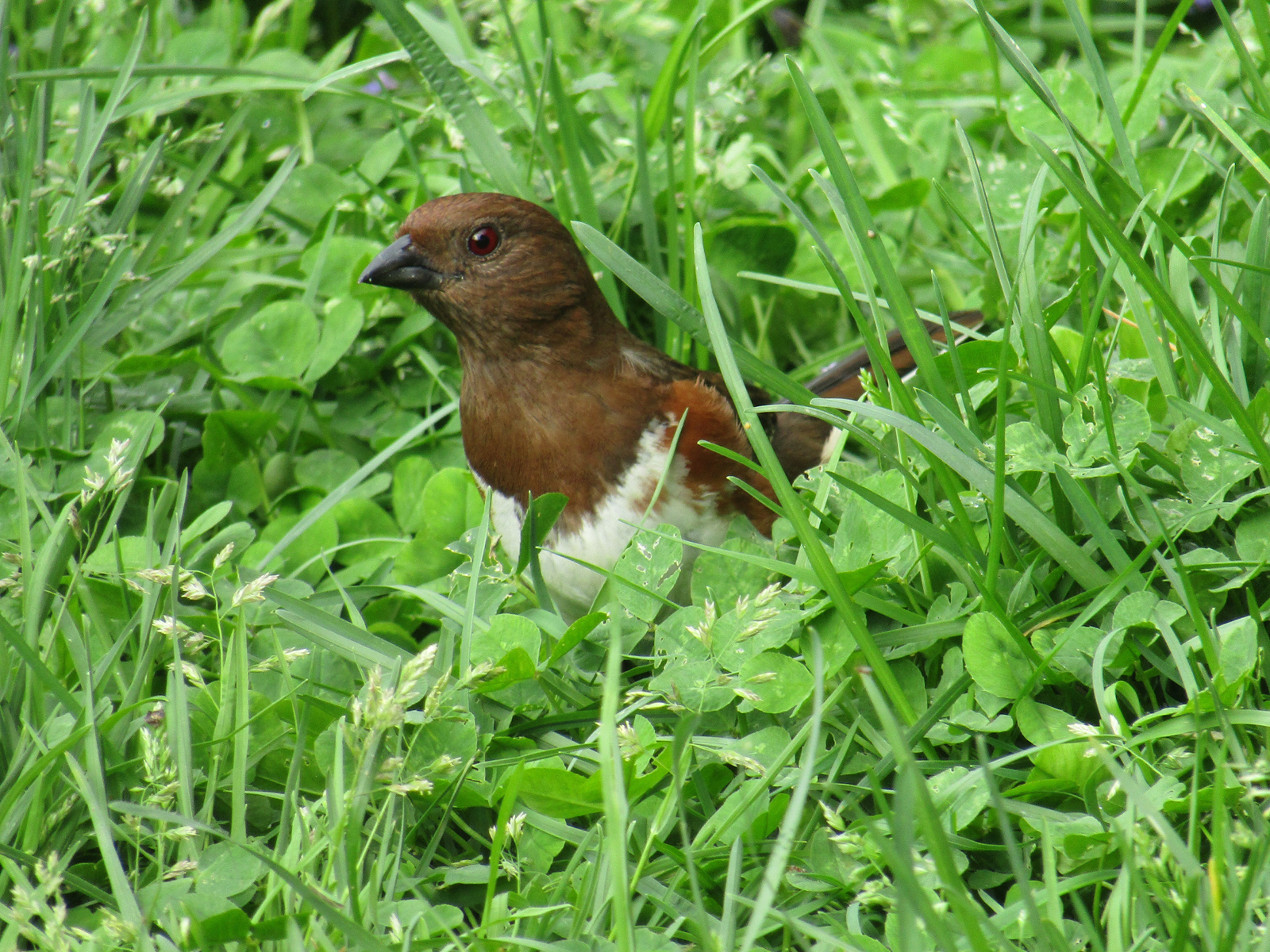
Then there’s one of my favorite songs of spring, which is produced by the Eastern towhee, which is also known by such common names as “ground robin” and “swamp robin.” These birds, which are actually a species of sparrow, also have some instantly recognizable vocalizations. With the arrival of spring, the males seek elevated perches for extensive singing bouts to attract mates and establish territories. Their song has been interpreted, quite accurately, as “drink your tea!” They also have some alarm notes, such as “€œChew-ink”€ and “€œToe-Hee,” of which the latter provides the basis for this bird’s common name.

Of course, other wildlife joins the chorus. I have so many spring peepers at the fish pond and in the wet fields around my house that the noise from these tiny amphibians can reach deafening levels. The chorus is bound to grow more diverse and louder as spring advances. Take some time to enjoy the sounds of nature at your own home.

••••••

To share your own sighting, make a comment or ask a question, send email to ahoodedwarbler@aol.com. I’m also on Facebook.

Photo by Bryan Stevens • An alert Eastern towhee female forages on a lawn.


Buffleheads among delightful winter surprises in region

Marion Howe sent me a stunning photograph of an impressive visitor at her feeders. Shortly after I wrote about Pileated Woodpeckers a few weeks ago, Marion sent me a photo of a Pileated Woodpecker at her suet feeder.

Photo by Marion Howe • This Pileated Woodpecker visited the home of Marion Howe in Kingsport, Tennessee..

“Although I now live in Bristol, I previously lived in Kingsport where I had the pleasure to watch a multitude of birds in my yard, including this one,” Marion wrote. “What a treat when she decided to stop by for a bite to eat!”

Away from our backyard feeders, what sort of birds can one expect to find during the late winter and early spring in northeast Tennessee?

If you’re ready to look a little farther afield, the region offers some great locations for searching for wintering and migrating waterfowl. A variety of ducks and geese pass through the region in late fall and winter. A few species stop to spend the season on area lakes and rivers.

Wilbur Lake in Carter County offers one of the largest wintering populations of Bufflehead in the entire region, if not the state.

Photo by Bryan Stevens • Lingering waterfowl, such as these buffleheads, are found in the region in winter and spring.

The Bufflehead belongs to the genus Bucephala, which also includes Common Goldeneye and Barrow’s Goldeneye. These three ducks are all small tree-hole nesting sea ducks found exclusively in the Northern Hemisphere.

The “sea duck” family consists of several other types of ducks, including scoters, mergansers and eiders. All but two of the 20 species in this grouping occur only in the Northern Hemisphere. Most of the sea ducks, not surprisingly, are adapted to life in salt-water environments.

The Bufflehead stands out from its fellow sea ducks for many reasons. The breeding habitat of this little duck consists of wooded lakes and ponds in Alaska and Canada, almost entirely within the boreal forest, or taiga, habitat. In the winter months, Buffleheads migrate to quiet bays or open inland lakes on both the eastern and western coasts of North America, as well as the southern United States as far as southern Florida and the Gulf of Mexico.

Photo by bryanhanson1956/Pixabay.com • A pair of Buffleheads enjoy a swim together.

Wilbur Lake has hosted a winter population of Buffleheads for decades. This small duck usually arrives in the final days of October and a few will remain until late April or early May. The flock at Wilbur ranges from about 100 to 200 individuals.

There’s another flock of Buffleheads that spends the winter at Osceola Island Recreation Area in the tailwaters below South Holston Dam in Sullivan County. A one-mile recreational trail at this location offers views of the waterways and any waterfowl congregated on them. The Buffleheads usually remain close to the weir dams at this location. Other wintering ducks at this area include American Wigeon, Mallard and Ring-necked Duck.

Carter County’s high-elevation Ripshin Lake often hosts wintering Buffleheads, but usually only a few individuals are present for as long as this small lake remains unfrozen.

The Bufflehead’s name is derived from “Buffalo Head,” which refers to this small duck’s oversized head. Male Buffleheads have a large, white patch across the back of the head that extends from cheek to cheek, forming a bushy crest that gives the head its large appearance. From a distance, the remainder of the head looks blackish, but when viewed from close range in good light the black plumage in the head shows an iridescent green and purple sheen. The back and rump are black, but the rest of the body is glossy white. The black-and-white pattern is quite unique, making a male Bufflehead impossible to mistake for any other bird. The male’s bill is blue-gray and his legs and feet are pink.

Female Buffleheads are brownish-gray, except for an oval white patch that extends from below the eye back towards the nape of the neck. The belly is whitish, and the female’s bill is dark gray and her legs and feet are grayish.

The Bufflehead is the smallest of North America’s diving ducks. One of the dabbling ducks, the Green-winged Teal, rivals the Bufflehead for the distinction as the continent’s smallest duck. The Bufflehead ranges between 12 and 16 inches long and can weigh 13 ounces. Males are larger than females. By comparison, the Green-winged Teal is usually 14 to 15 inches long and weighs 11 to 12 ounces.

Photo by Bryan Stevens • A raft of buffleheads swim on the Watauga River.

Buffleheads spend a lot of time diving for food beneath the water’s surface. Their varied diet consists of insects, crustaceans, some aquatic plants and fish eggs.

The Bufflehead depends on one of our native woodpeckers to provide nesting habitat. The Bufflehead is just the right size to fit into abandoned nesting cavities previously occupied by Northern Flickers.

I’m not sure why the Wilbur Buffleheads choose not to spend the winter months on a salt-water bay farther south, but I am very happy that some of these small, entertaining ducks are so close at hand. I suspect the woodlands around Wilbur Lake may, in fact, resemble some of the wooded lakes on this duck’s summer nesting range.

The Bufflehead is a fairly common duck and appears to be thriving. In 1992, the continent-wide breeding population was estimated at 1,390,000 birds.

Photo by Bryan Stevens • A raft of Buffleheads brave some rough waters on the Watauga River.

Several different species of hawks make their home in region

Photo by Bryan Stevens • This captive red-shouldered hawk was rehabilitated after suffering an injury and now works in an educational program at Brookgreen Gardens in South Carolina to teach the public about raptors, other birds, and various types of wildlife.

In recent weeks, I’ve enjoyed some observations of the region’s larger raptors, including red-tailed hawks and red-shouldered hawks.

Anyone who travels along the region’s Interstate Highway System has probably noticed hawks perched in trees or on utility lines adjacent to the roadway. The section of Interstate 26 that runs between Unicoi and Johnson City is often a productive area for keeping alert for raptors. The raptor I have most often observed along this stretch of road is the Red-tailed Hawk, although I have also observed Cooper’s Hawk, Sharp-shinned Hawk, and American Kestrel. In the time of spring and fall migration, it’s also possible to observe Broad-winged Hawks.

The Red-tailed Hawk is named for its prominent red tail. However, only adults show the characteristic red tail. The affinity for Red-tailed Hawks for roadsides is a double-edged sword. Viewing a large hawk from your car is an easy way to watch birds. For inexperienced or careless raptors, however, roadside living is often rife with the chance for a collision with a car or truck. The Red-tailed Hawk, which prefers open countryside, is attracted to the margins of roads and highways because these locations also attract their favorite prey, which includes rodents like rats, squirrels and mice and other small mammals such as rabbits.

Human behavior contributes to some of the problems that hawks encounter in the zone that brings them too close for comfort to motorized vehicles. When people toss trash from a car, the scent of the litter will lure curious and hungry rodents. In turn, hunting hawks are brought to the edges of roads in search of their preferred prey, increasing the likelihood of colliding with automobiles.

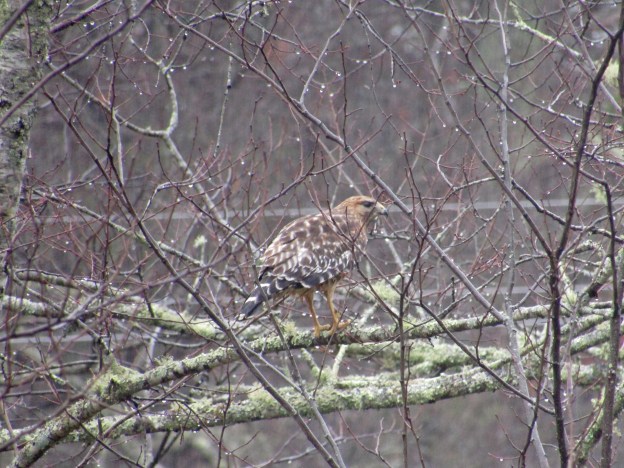
Photo by Bryan Stevens • A calling red-shouldered hawk perched in a dead tree on Pawleys Island in South Carolina.

In recent days, I have also noticed a Red-shouldered Hawk lurking among the branches of the large weeping willow next to the fish pond. The Red-shoulder Hawk typically prefers wetland habitats and is less likely to haunt roadsides. According to a factsheet published by the New York State Department of Environmental Conservation, this raptor breeds in moist woodlands, riverine forests, the borders of swamps, open pine woods and similar habitats. Nesting almost always occurs near water, such as a swamp, river or pond.

The Red-shouldered Hawk produces a distinctive, piercing whistle that reminds me of the shrill call of a Killdeer. The visiting Red-shouldered Hawk has been silent so far, perhaps not wishing to draw attention. The few times the local crows have noticed the presence of any sort of raptor, they’ve flocked together to mob the unfortunate hawk. It’s also not the right time of year; during courtship and the subsequent nesting period, these hawks are vocal, but at other times of the year, they are rarely heard. It’s also possible to mistakenly think you have heard one of these large hawks. Blue Jays have apparently learned to imitate the “kee-yar” call of this hawk, often working a flawless rendition of the whistled notes of this large raptor.

In contrast to the related Red-tailed Hawk, the Red-shouldered Hawk soars less and prefers to perch hidden in the cover of trees. This hawk’s name comes from the reddish-brown shoulder patches in the bird’s wings. Adults show a tail marked with vivid bands of black and white that is quite distinctive. The Red-shouldered Hawk belongs to the same genus of raptors as its larger relative, the Red-tailed Hawk. The genus, buteo, includes about two dozen large raptors that are often the dominant avian predators in their respective habitats.

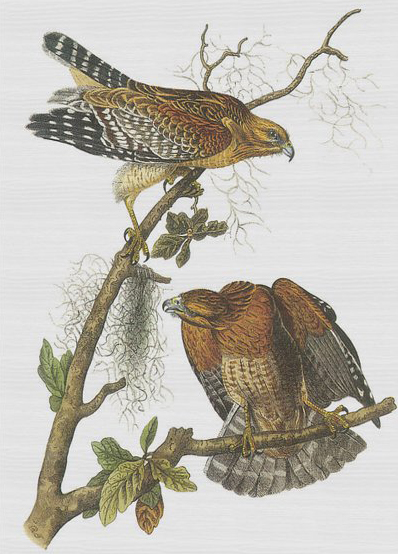
Early naturalist and artist John James Audubon painted this pair of red-shouldered hawk.

Some of the buteo species have adapted to life on islands, including the Galapagos Hawk and the Hawaiian Hawk. Some of these hawks have quite descriptive names, including the White-throated Hawk, Gray-lined Hawk, Zone-tailed Hawk and Short-tailed Hawk. Outside the United States, raptors in the buteo genus are often known as “buzzards.” When the first European colonists came to the New World, they applied the term buzzard to both types of native vultures as well as the large raptors like Swainson’s Hawk and Broad-winged Hawk that reminded them of the ones back in Europe.

All too often, our large hawks don’t receive the love they deserve from the public. They may even run afoul of misinformed individuals who may regard all predatory birds as “bad.” The reality is that all hawks are valuable components of a healthy, working ecosystem, with each species filling a certain niche.

Yearly survey encourages participation of citizen-scientists

Photo by Bryan Stevens • The Eastern Bluebird is one of the most beloved American songbirds.

Birds can bring so much excitement and entertainment into our lives, whether they are flocking to our feeders or we are seeking them out at favorite birding spots. Next month, we can do something to repay birds for all the joy their simple existence provides many of us. All that’s required is looking out your window to peek at a feeder or perhaps driving to a local park to look for birds.

Launched in 1998 by the Cornell Lab of Ornithology and National Audubon Society, the Great Backyard Bird Count (GBBC) was the first online citizen-science project to collect data on wild birds and to display results in near real-time. Bird watchers of all ages count birds to create a real-time snapshot of where birds are during the worldwide effort of the GBBC scheduled this year from Friday-Sunday, Feb. 14-17.

The Great Backyard Bird Count is a truly global undertaking.

As it has nearly every year, the 2019 Great Backyard Bird Count broke more records and attracted more participants than ever before. The GBBC is global in its scale, which provides a greater reach for dedicated citizen-scientists hoping to contribute to the well-being of the planet’s birds.

Last year’s GBBC tallied 6,699 species of birds on 204,921 checklists submitted by an estimated 224,781 participants.

U.S. participants led the way with an estimated 136,903 checklists submitted by birders in the United States. The nation of India took second place with a total of 21,524 checklists, followed by Canada (16,611), Australia (2,811) and Spain (2,391).

A total of 669 bird species were found in the United States, but that was only an eighth place finish. The country boasting the most birds was Colombia with 1,095 species. Other countries with a diversity of bird species reported included Ecuador (948), Brazil (844), India (843) and Mexico (755).

In the United States, Californians led the way in submitting checklists with a total of 10,059 surveys reported, followed by Texas (9,121), New York (8,453), Florida (7,696) and Pennsylvania (7,640). Virginia, with 6,332 checklists, just barely got edged out of the Top 5.

In my own past efforts on behalf of the GBBC, I’ve enjoyed observation of such rare East Tennessee visitors as Ross’s Goose and Canvasbacks, as well as expected birds such as Carolina Chickadees, Red-tailed Hawks and Buffleheads.

If you look no farther than your own yard and garden, please consider taking part in the 2020 GBBC. It’s free, it’s simple to do, and the results can be valuable for scientific knowledge about our fine feathered friends. To learn more about the GBBC, visit gbbc.birdcount.org.

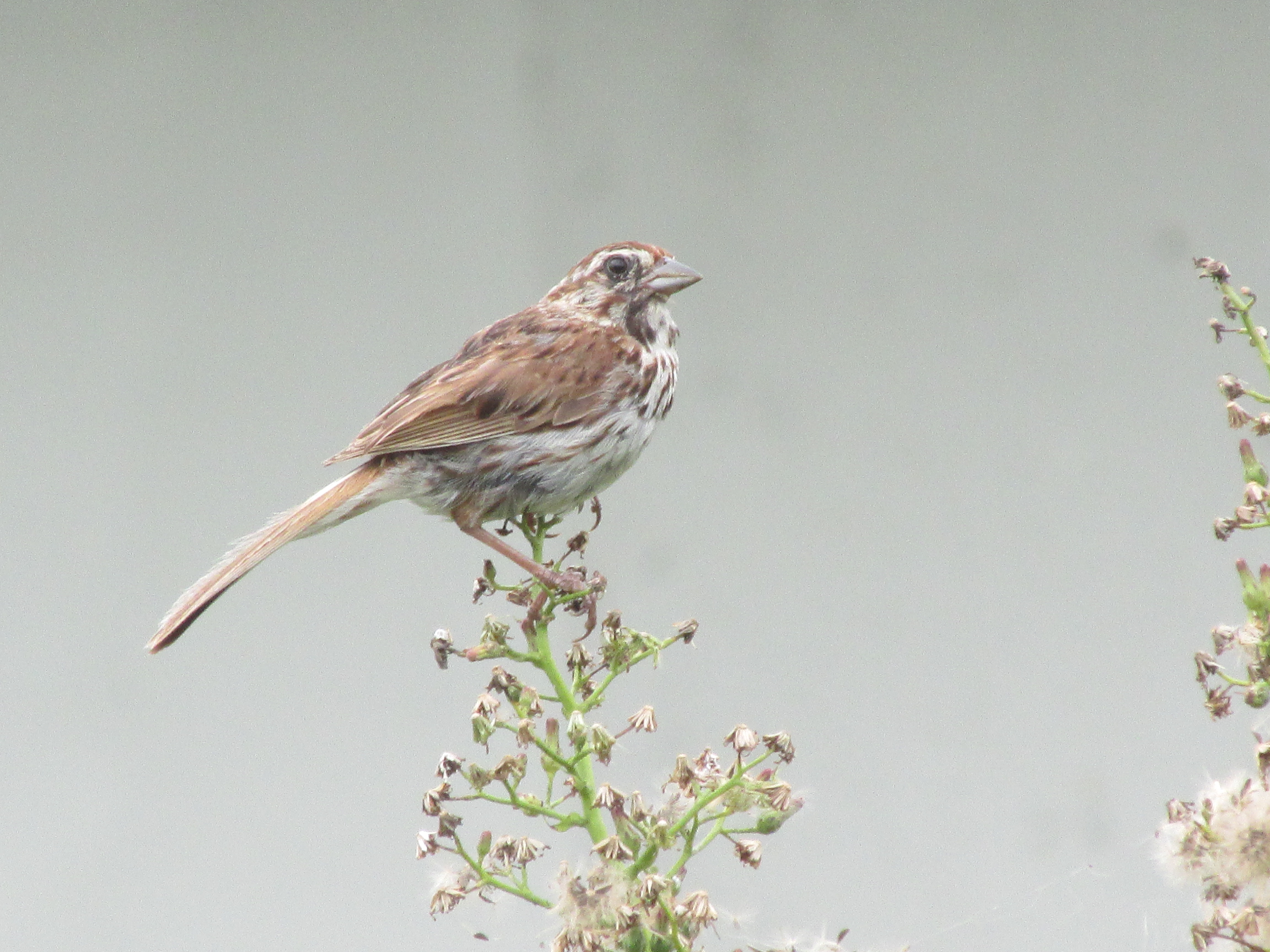
Photo by Bryan Stevens • A Song Sparrow perches on a weed. The annual GBBC helps gather important data for even common birds like Song Sparrows.


Dreaming of winter finches flocking south

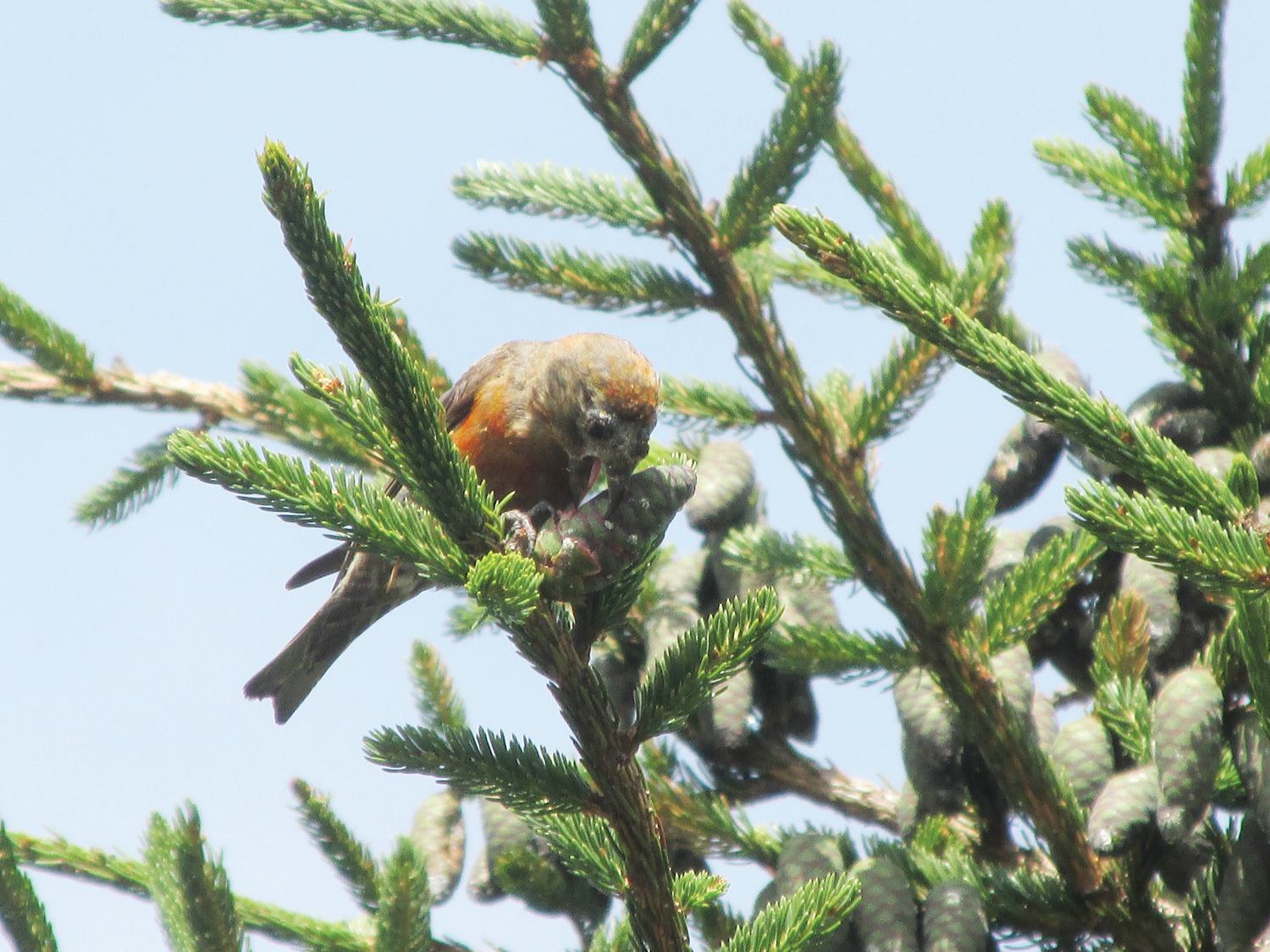
Photo by Bryan Stevens • Red crossbills use unique beaks to pry seeds from a conifer cone. These birds are among the so-called “northern finches” that occasionally stage massive winter migrations fueled by food shortages in their usual range. They are also nomadic residents throughout the year in northeast Tennessee and western North Carolina.

I recently got a shoutout on Facebook from Tom McNeil, a longtime birding friend and a neighbor here in the mountains of Northeast Tennessee. Tom asked if I’d been seeing any red crossbills on my side “of the ridge” and informed me he had been seeing these odd-beaked birds for the past couple of weeks.

I hadn’t noticed any crossbills and told him so, but I am definitely keeping alert for them after Tom’s notification. Every winter I hope my feeders will be visited by representatives of a group of birds known collectively as “northern finches.” This loose grouping consists of a half dozen species — purple finch, pine siskin, evening grosbeak, pine grosbeak, white-winged crossbill, red crossbill and common redpoll — that periodically stage irruptions from their traditional northern ranges to push south in large numbers during the colder months.

Photo by Bryan Stevens • A red crossbill uses its unique beak to pry seeds from a conifer cone. These birds are among the so-called “northern finches” that occasionally stage massive winter migrations fueled by food shortages in their usual range.

I’ve been feeding birds since the winter of 1993, and over the years, the first three species I listed have graced my feeders. Although I haven’t seen any this winter, pine siskins and purple finches have continued to be occasional winter visitors. Sadly, however, I haven’t been visited by showy evening grosbeaks since the late 1990s. The last time I saw an evening grosbeak in the region was back in 2000.

I’ve never laid eyes on a common redpoll, although I spent several hours 20 years ago staking out a yard in Shady Valley, Tennessee, in an unsuccessful bid to observe a redpoll that had been a reliable visitor at a feeder in that small community.

I have seen red crossbills, but my observations of these birds have always taken place during the summer months. Pine grosbeaks and white crossbills are almost unheard of in the region, and I haven’t had opportunity to visit the nesting summer ranges of these birds.

So, as the weather turns cold each year, hope springs eternal that perhaps this will be the winter that will bring some of these northern finches to my feeders, or at least to a feeder in the general area.

The factor that drives these irruptive northern finches to come south is food — or the lack thereof — in their usual ranges. When seed crops are poor in the north, these seed-eating birds may wander as far south as the Gulf States in search of supplemental food sources such as feeders stocked with sunflower seed.

Photo by Public Domain Photos/Pixabay.com • Crossbills and other finches often migrate in source of food.

The red crossbill is a specialist when it comes to foraging for its food. The bird uses its unique bill to open the cones of various conifers. The upper and lower mandibles of the bill are twisted in a way to make them cross when the beak is closed, hence the name “crossbill.”

Worldwide, there are only five species of crossbills — the red crossbill of North America, Asia and Europe; the parrot crossbill of northwest Europe and western Russia; the Scottish crossbill of Scotland; and the white-winged crossbill of Canada, the northern United States, including Alaska, as well as Asia and northeastern Europe. There’s also the endangered Hispaniolan crossbill of the island of Hispaniola in the Caribbean.

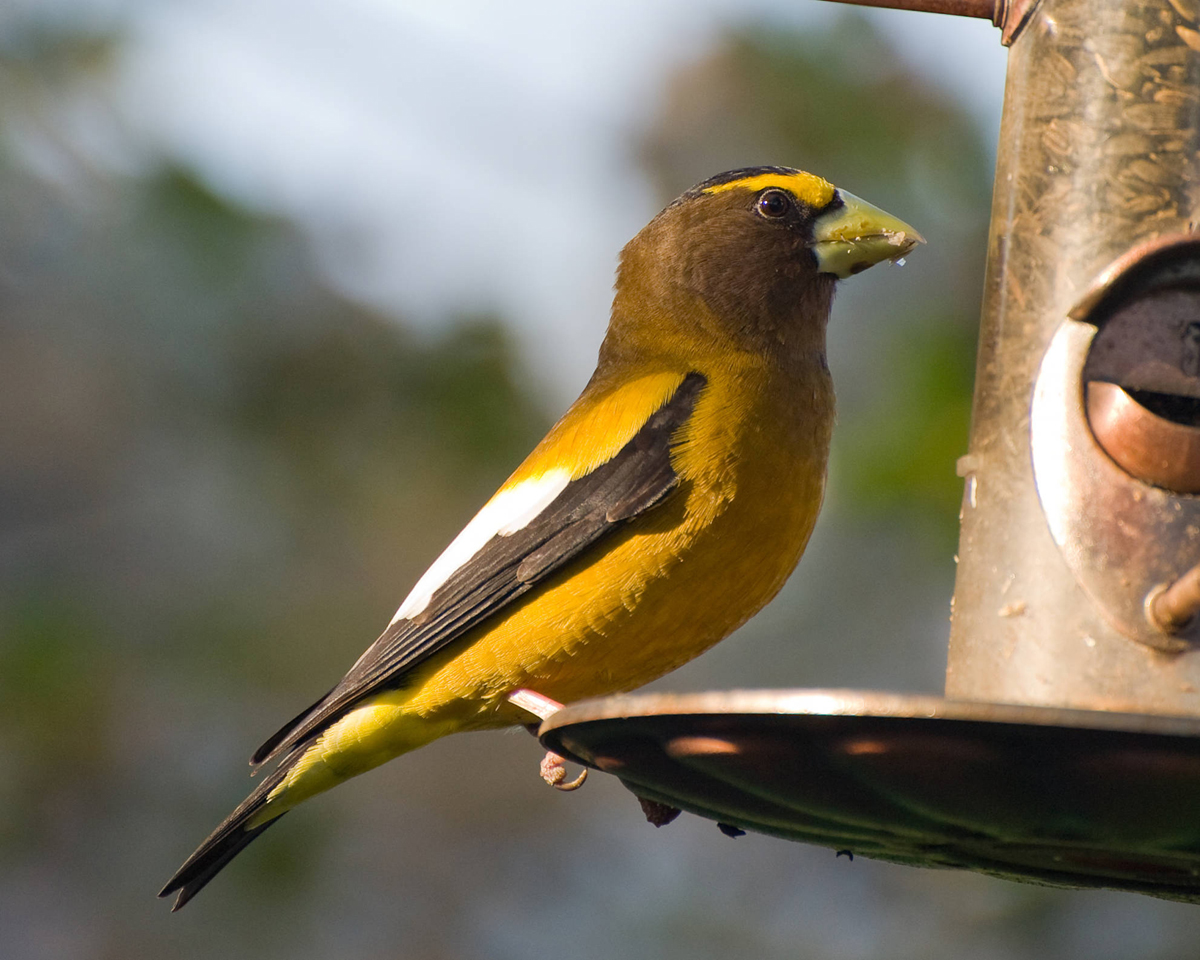
Photo by George Gentry/U.S. Fish & Wildlife Service • A male evening grosbeak perches on the side of a sunflower-stocked feeder.

W. Herbert Wilson Jr. wrote an article about the northern finches for the Oct-Dec. 1999 edition of “North American Bird Bander.” Wilson noted that supplemental food, such as feeder fare, can influence the migratory habits of many birds, including these finches. He cited the example of black-capped chickadees, which have been shown to demonstrate an increased chance of survival during lean winter times when they have access to feeders. He also noted that the provision of food at feeders has helped birds like the tufted titmouse, house finch and Northern cardinal extend their range northward. In part, Wilson theorized that more people are feeding birds closer to the northern climes where these birds live. As a result, the long-distance irruptions are no longer necessary to find supplemental food.

Other theories have also been advanced by other experts, including changing migratory routes, diminishing overall finch numbers and climate change. Theories aside, I will continue to hope some of these birds wing their way toward my feeders this winter. If I’m lucky, this could even be the year the evening grosbeaks return! If anyone is seeing any of these “northern finches,” I’d

love to hear about it. Contact me at ahoodedwarbler@aol.com.

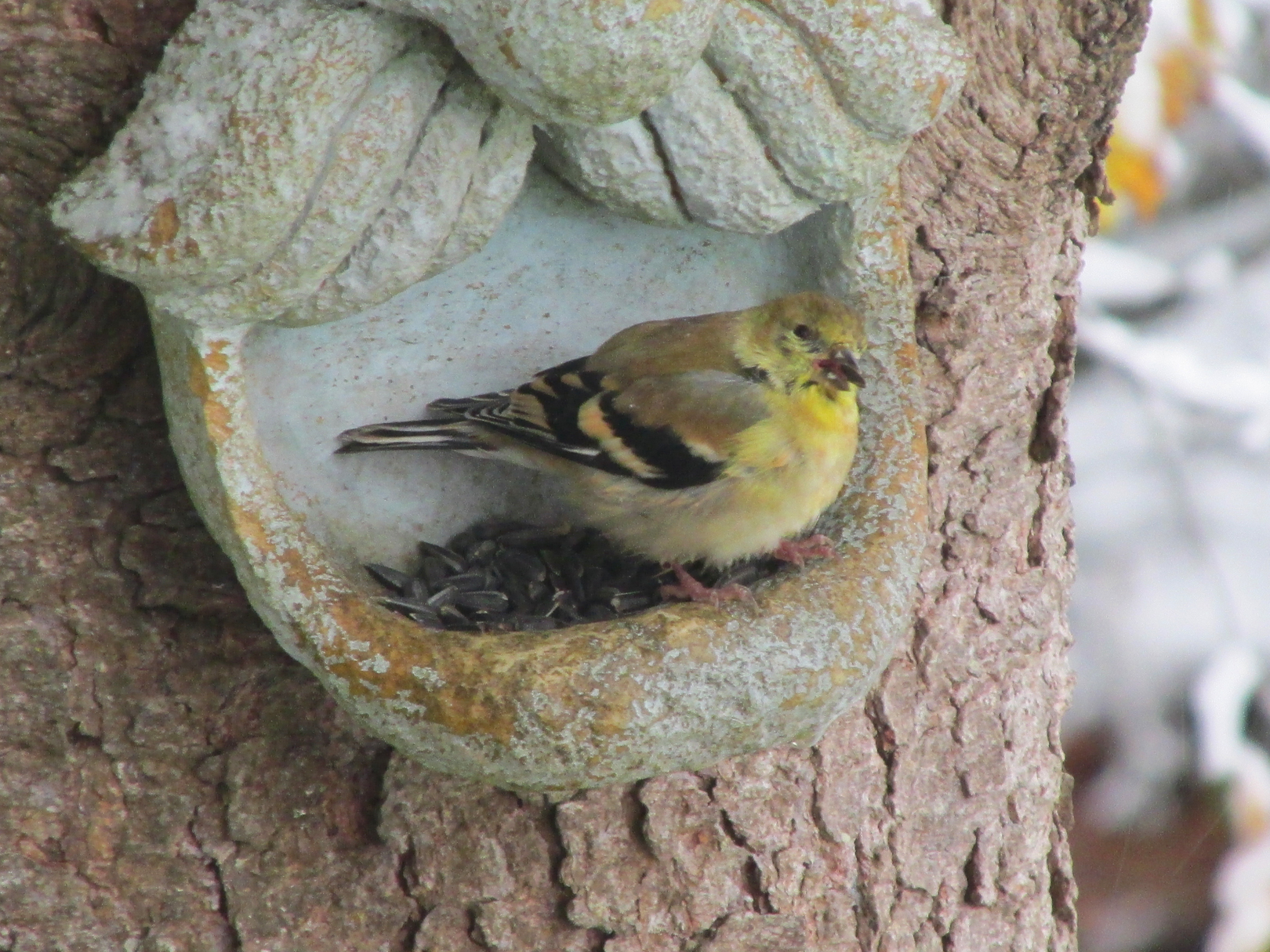
Photo by Bryan Stevens • An American goldfinch visits a feeder for sunflower seeds

Palm warbler’s name an unfortunate misnomer that has stuck

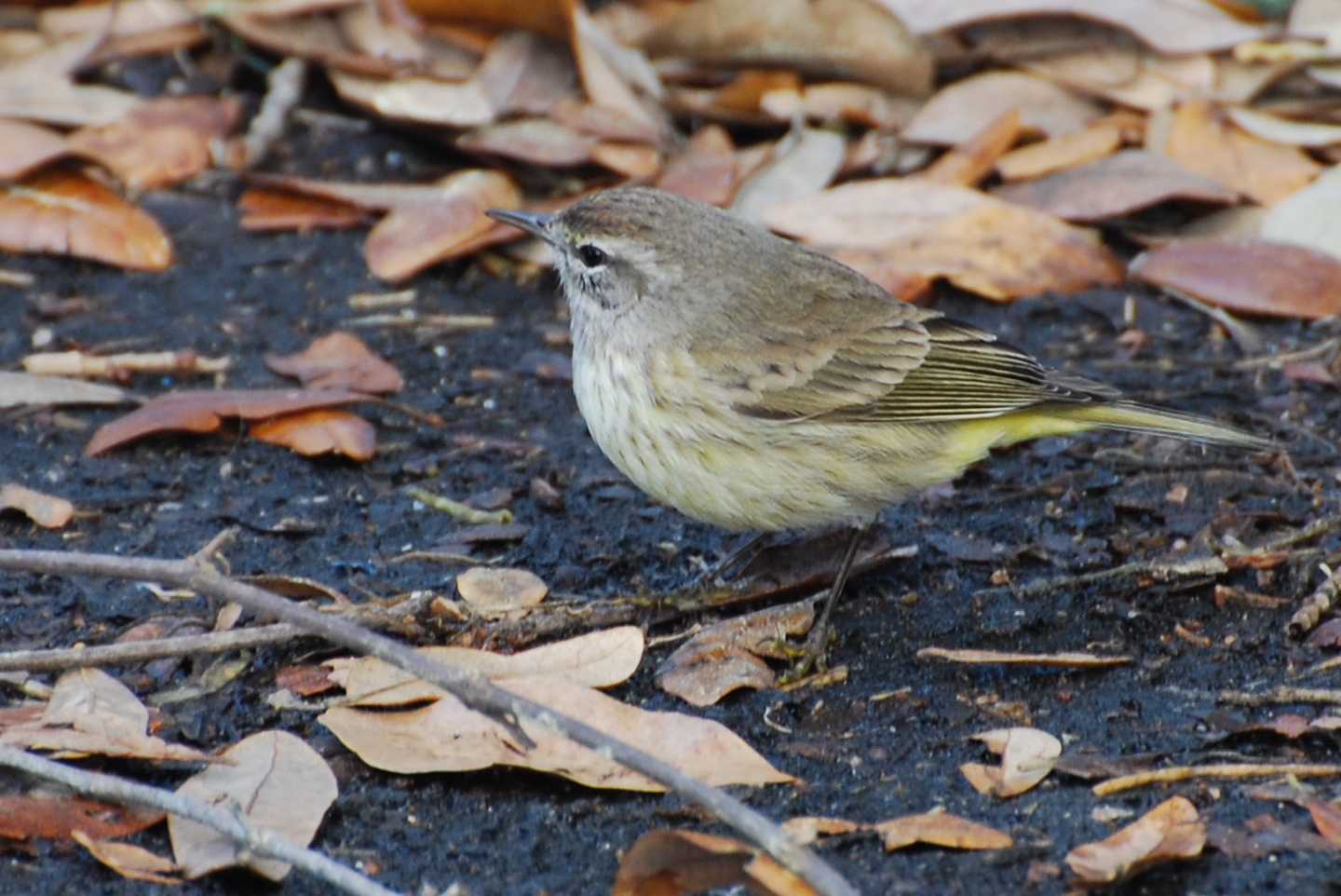
Photo by Jean Potter The palm warbler’s name is a mistaken assumption that this warbler held special affinity for palm trees. It doesn’t.

The warbler parade that begins each autumn with such brightly colored migrants as Blackburnian warbler, black-throated blue warbler and magnolia warbler usually ends with some of the less vibrant members of this family of New World birds.

On a recent bird walk at Sycamore Shoals State Historic Park in Elizabethton, Tennessee, I helped locate a flock of 13 palm warblers and a single yellow-rumped warbler. These two warblers, which look rather brownish and nondescript in the fall, pass through the region later than most other migrating warblers. In fact, the yellow-rumped warbler is one of the few warblers that routinely spends the winter months in the region.

The yellow-rumped warbler has a most suitable name thanks to the yellow patch of feathers on the bird’s rump. The resemblance of the patch to a pat of butter is uncanny enough to have encouraged birders to nickname this often abundant winter warbler the “butter butt.”

The palm warbler’s name is, at best, a misnomer. Throughout most of its life, the palm warbler doesn’t even encounter palm trees. Johann Friedrich Gmelin, a German naturalist who lived from 1748 to 1804, saddled the palm warbler with its inappropriate name. Gmelin based his naming of the bird based on the fact that a specimen had been collected on Hispaniola, an island in the Caribbean with an abundance of palm trees.

Photo by Bryan Stevens
A Palm Warbler forages along a chain-link fence.

Gmelin published several textbooks in the fields of chemistry, pharmaceutical science, mineralogy, and botany. He also had a hand in publishing a catalog of scientific names for various species, including some birds that had until that point never been given a species classification. Thanks to his efforts, a warbler has forever been linked with a type of tree that is, at best, entirely incidental to the bird’s life cycle.

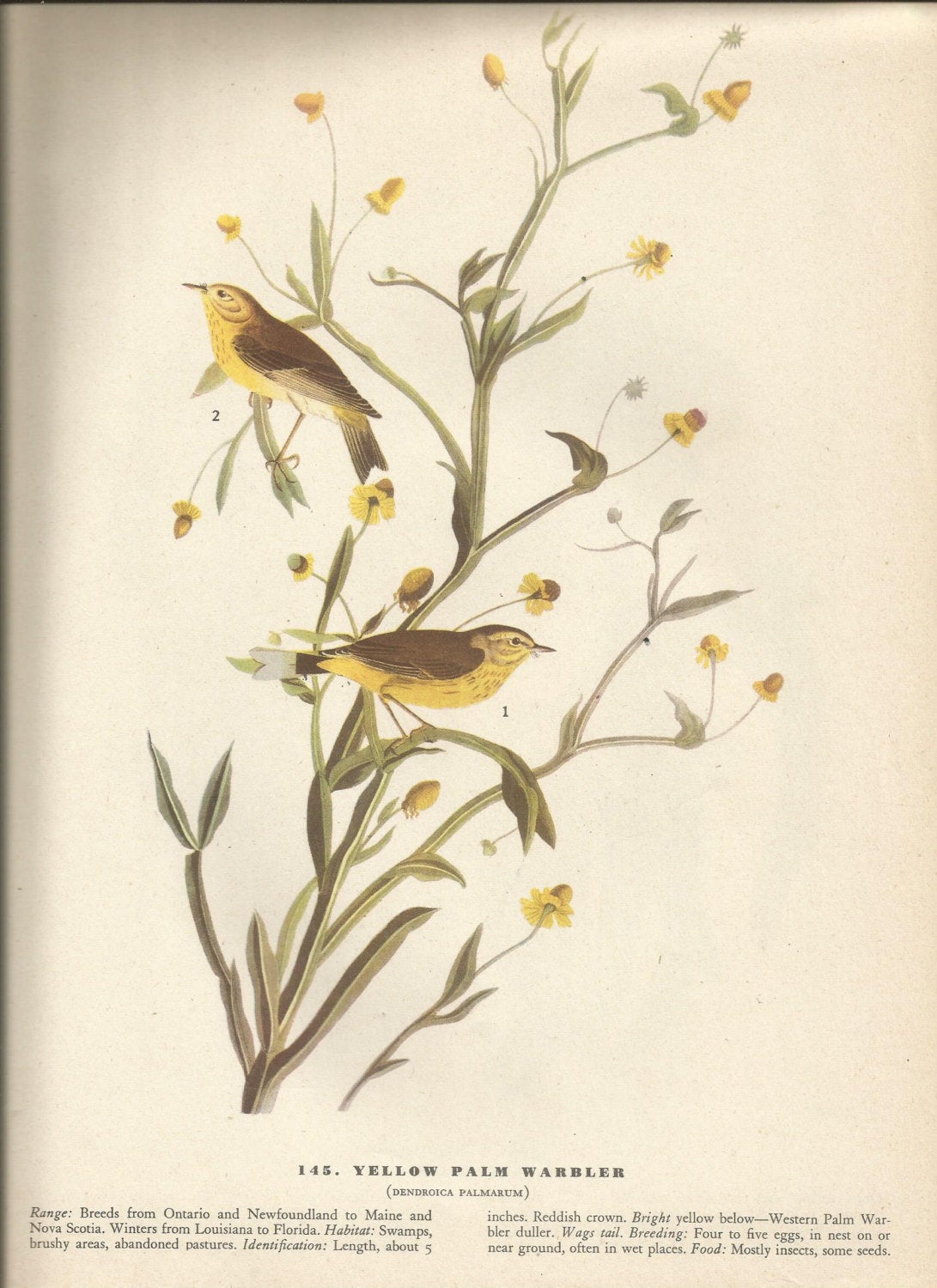
Early naturalist and painter John James Audubon painted these palm warblers.

Palm warblers do seek out warmer domains during the winter months, including the islands of the Caribbean. Some of them do not even migrate that far, choosing to remain along the Gulf and Atlantic coastlines of the southern United States. On occasion, individual palm warblers choose to remain in northeast Tennessee, southwest Virginia or western North Carolina during the winter months.

Every spring, however, palm warblers make a long migration flight north. This warbler is one of the northernmost breeding warblers, spending the summer months in the boreal forests of Canada. They build their nests in the thickets surrounding the many bogs along the edges of the great coniferous forests of this region of Canada.

The female palm warbler lays four to five eggs, but both parents will stay busy collecting insects once the young hatch. On an insect-rich diet, the young birds develop quickly and are able to leave the nest in 12 days. They will remain with their parents as their wings strengthen and they learn to fend for themselves.

While not able to flaunt vibrant plumage like such relatives as the Cape May warbler or the American redstart, the palm warbler is not truly as unattractive as a first glance might suggest. In fact, one subspecies, known as the “yellow palm warbler,” is quite dramatic in appearance with a profusion of yellow feathers accented with a bold russet cap and dramatic rufous striping across the yellow underparts. Even in autumn, the other palm warblers are not devoid of color. Most palm warbler show a splash of bright yellow on the throat and beneath the tail.

Photo by Bryan Stevens • A black-and-white warbler creeps over the bark of a pine in search of insect prey. The reason for this warbler’s common name is self-evident in its appearance.

In fall migration and during the winter season, palm warblers often inhabit weedy fields, grasping the dried stalks of tall weeds as they forage for berries, seeds and insects and their larvae. Look for the spot of yellow beneath the warbler’s tail, which is constantly bobbed up and down as the bird goes about its routine. The tail-bobbing behavior is a good way to distinguish this warbler from the sparrows of similar size and brown coloration that often share the fields and woodland edges.

The last of the October Saturday bird walks will be held at Sycamore Shoals State Historic Park on Oct. 26. Participants should meet in the parking lot at the park’s visitors center at 8 a.m. for a 90-minute stroll along the gravel walking trails. The walks are conducted by the Elizabethton Bird Club and are free and open to the public. Bring binoculars to increase viewing enjoyment. There’s a chance that palm warblers will be seen on the walk, but with our fine feathered friends, nothing is ever guaranteed.

Photo by Jean Potter • A “yellow” palm warbler searches leaf litter for insects and other prey items.


‘Science’ article warns that people need to focus on the needs of disappearing birds

Photo by Pixabay.com • Birds are disappearing. Some populations have seen a dangerous decline. Loggerhead shrikes are declining across the continent, and the reasons are complicated but can ultimately be traced to human activity.

Imagine the sky growing dark and, looking up, you notice that the cause is not approaching storm clouds but a passage of birds — millions of individual birds, their wings darkening the skies as they pass overhead.

The early American naturalist and painter John James Audubon once described the passage of enormous flocks of passenger pigeons that blotted out the light “as by an eclipse” and described the noise of the multitude of wings “like thunder.” His observation of these flocks took place in 1813. A century later, the world’s last passenger pigeon, a species that had ranked as one of the continent’s most numerous birds, died in 1914 at the Cincinnati Zoo.

Photo by Bryan Stevens • Legislation like the Endangered Species Act can and does save birds like the Bald Eagle from possible extinction.

The passenger pigeon was the avian equivalent of the American bison, albeit with a more tragic outcome. Bison, also commonly called buffalo, still survive. As with the bison, we’ve had avian rescue success stories — whooping cranes, Kirtland’s warblers, bald eagles — with efforts to bring some birds back from the brink of extinction. At the same time, we’ve lost others, including the ivory-billed woodpecker, the eskimo curlew and Bachman’s warbler. Now a new study indicates that our birds may be under assault as never before.

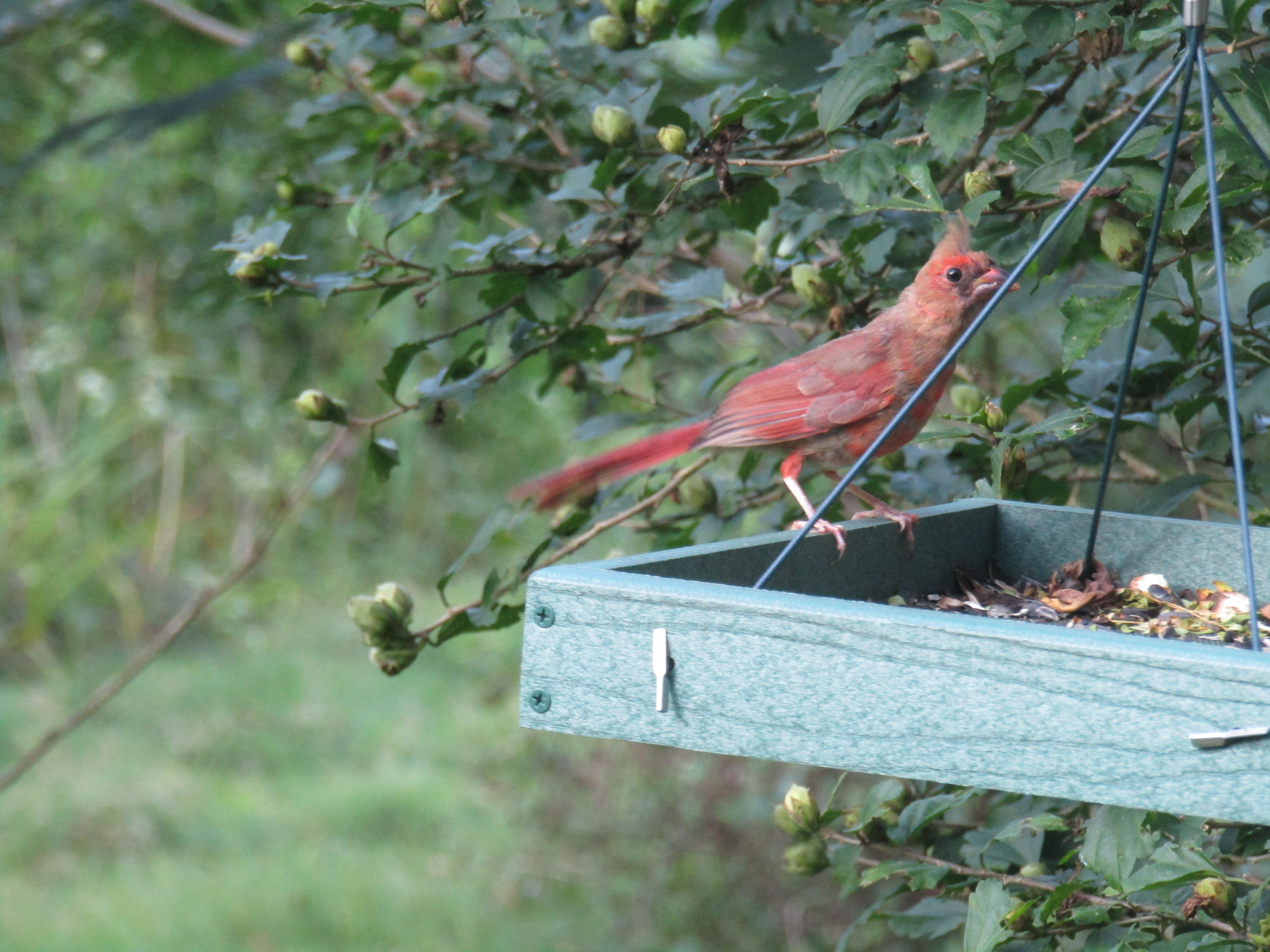
Photo by Bryan Stevens • A young Northern cardinal visits a feeder.

The journal Science dropped a bombshell article recently about declining bird numbers in North America. The article’s claim that nearly 3 billion — that’s billion with a “b” — fewer wild birds exist on the continent than in 1970 is a shocking figure, but the sad fact is that the article probably doesn’t come as a complete surprise to birders or even backyard bird enthusiasts. The evidence of our own eyes and ears confirms the details of the comprehensive study reported in the pages of Science. There are fewer birds, which has been becoming painfully clear over the past few decades.

I first got into birding in 1993. Now, 26 years later, I have noticed some of the declines in just the past quarter of a century. Every autumn, the variety and numbers of migrating warblers that visit my yard has gone down.

The new study in Science focuses on the drop in sheer numbers of birds. According to most experts, the bird population in the United States and Canada was probably around 10.1 billion individual birds nearly half a century ago. That number has fallen 29 percent to about 7.2 billion birds, an alarming loss of nearly 3 billion birds just in North America.

I have personally noticed signs of this dramatic loss. Let me share some personal anecdotes. These stories don’t serve as definitive proof, but they add to my unease about the state of our feathered friends.

For one thing, I no longer host large flocks of birds at my feeders during the winter. One would expect birds to mass in sizable flocks in the vicinity of feeders during a season when resources can be scarce. In the 1990s, I hosted flocks of pine siskins and evening grosbeaks that numbered in the hundreds and dozens, respectively. At times, large flocks of American goldfinches, purple finches and house finches flocked to my feeders, too. I haven’t seen an evening grosbeak since 2001. Pine siskins still visit, but I consider myself fortunate to host a flock that numbers a dozen or more.

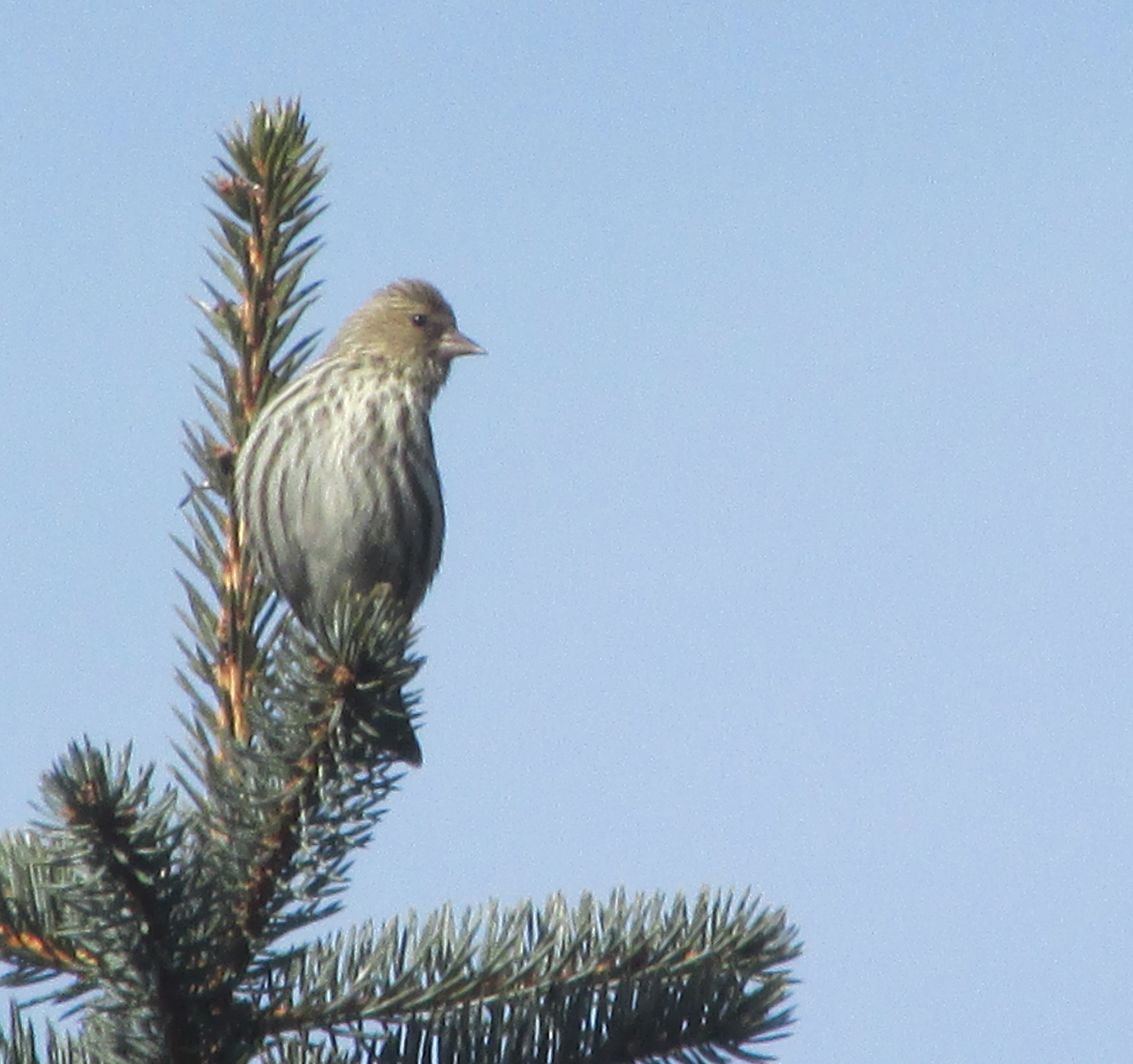
Photo by Bryan Stevens • A pine siskin in a spruce at Carver’s Gap on Roan Mountain.

The sights and sounds of summer have changed, too. Two of the most dependable summer songsters used to be Northern bobwhite by day and Eastern whip-poor-will after dark. I haven’t heard a whip-poor-will at home in more than 20 years. The last time I heard a Northern bobwhite was about a decade ago. I live in a rural area that used to be fairly agricultural. The disappearances of bobwhite quail and whip-poor-wills is reported throughout the ranges of these two species.

Of course, there are always exceptions. Some birds have grown even more common in recent decades. Regionally, look at birds like great blue herons, double-crested cormorants, and cliff swallows, which have also shown an increased presence.

What killed the passenger pigeon? People did. What’s caused the precipitous drop in bird numbers since the 1970s in North America? Once again, people must shoulder most of the blame. We have destroyed or altered habitats essential for birds to thrive. We’ve paid little attention to the signals from some of these kin of the proverbial “canary in the coal mine” that something’s wrong in nature.

Yet “hope is the thing with feathers,” as the poet Emily Dickinson phrased it, and the losses are a signal to pay attention, not to panic. Birds are amazingly resilient. Birds need only the same things as humans — food, shelter, water. Well, perhaps they need one more thing. Birds require a safe and welcoming space in which to unfurl their wings and fly.

The great flocks of passenger pigeons may be no more, but there’s no reason to think our remaining birds can’t continue to soar, so long as we provide them with their essential needs and offer them a degree of protection and compassion.

An artist sketched this scene of hunters firing on one of the last great flocks of passenger pigeons.

Birds are not the only fall migrants sharing the skies

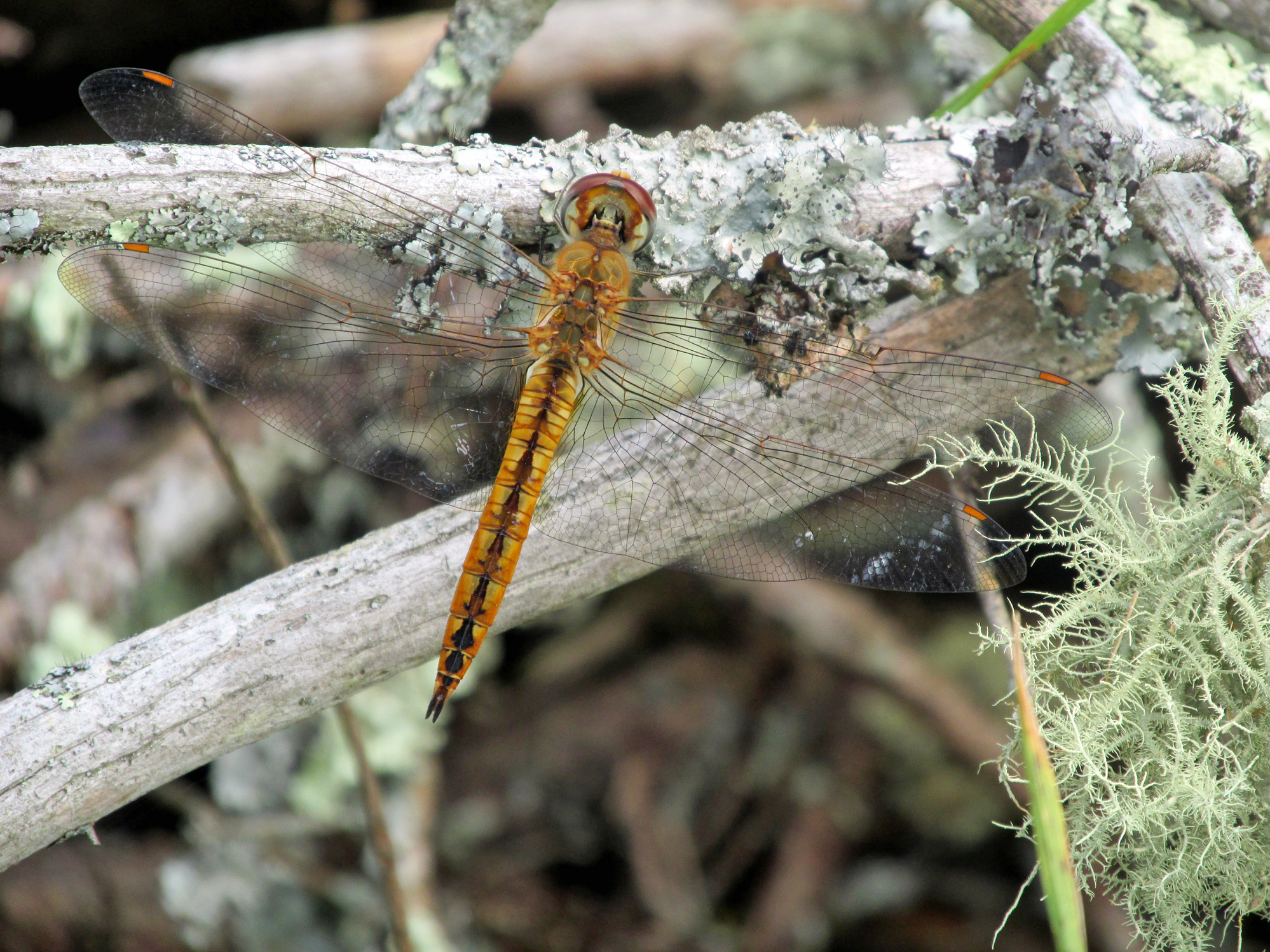
Photo by Bryan Stevens • Experts have documented long-distance migration flights by the Wandering Glider, a species of dragonfly.

Rhonda Eller of Chilhowie, Virginia, posted a question on my Facebook page about some dragonflies that appeared in her yard on Sept. 10.

“We have had a sudden breakout of dragonflies in our yard,” Rhonda explained. “We seldom see more than one or two at a time.”

Rhonda wondered if the dragonflies might have been drawn to her yard in pursuit of some sort of favorite insect prey. She also speculated that the recent dry conditions might have attracted the dragonflies.

I responded to her query by explaining that birds are not the only migrant in the skies at this time of year. Some dragonflies, just like birds, migrate. A species known as green darner is one that migrates. These darners are rather large, for a dragonfly, and travel in swarms. A couple of years ago I observed thousands of these dragonflies swarming over a municipal swimming pool and a nearby fish pond at a park in Erwin, Tennessee.

The WSLS Channel 10 television station out of Roanoke, Virginia, reported on swarms of dragonflies so large that they got picked up by local radar. Rhonda shared a link to the station’s story on my Facebook page.

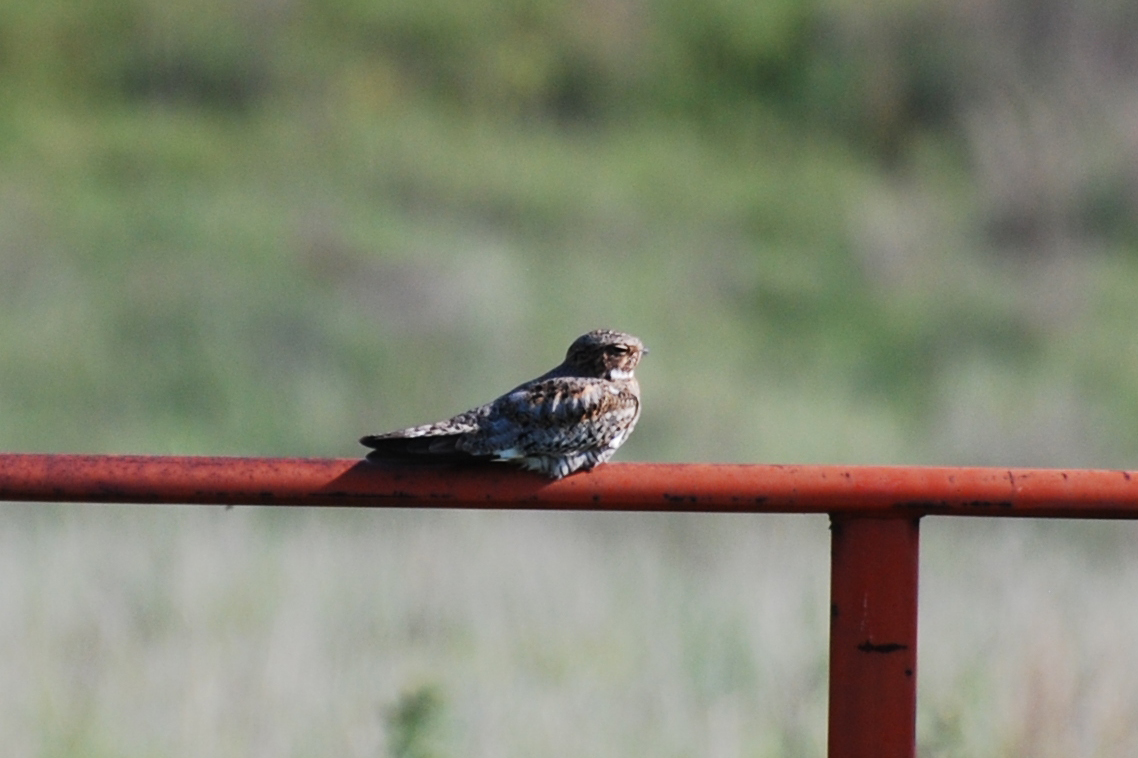
Photo by Jean Potter • A common nighthawk rests on a metal railing.

Of course, swarms of migrating insects are bound to get the attention of predatory birds. The same day that Rhonda experienced the influx of migrating dragonflies, I witnessed dozens of common nighthawks and chimney swifts swooping through the skies over my home. With a little more attention to detail, I also noticed the dragonflies sharing the skies with these birds.

I suspect that the nighthawks were feeding on the large darners while the swifts, which are much smaller birds, focused their foraging efforts on smaller winged insects. Tom McNeil, a neighbor and fellow member of the Elizabethton Bird Club, reported seeing nighthawks and swifts, too. Tom lives on the other side of a mountain ridge that separates our homes.

Tim Morris, a Facebook friend from Australia, noted in a comment on my post about the nighthawks that his country is home a bird known as the tawny frogmouth, a relative of the common nighthawk. Tim noted that frogmouths are big birds with camouflage markings that allow them to pretend to be dead tree boughs by day. “They feed not only on insects but mice and lizards, too,” he added.
Evidence of fall migration continued the next day when I detected a small wave of warblers foraging in trees at the edge of my yard. I saw five different species — American redstart, worm-eating warbler, Cape May warbler, Blackburnian warbler and Tennessee warbler — in the space of half an hour. Of the warblers in the flock, the Blackburnian and Cape May are some of the more vibrant ones.

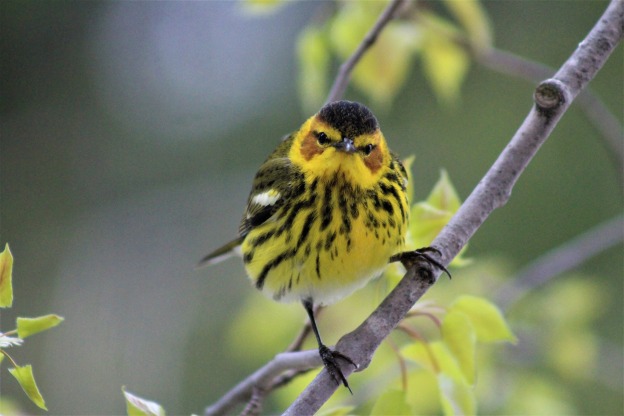
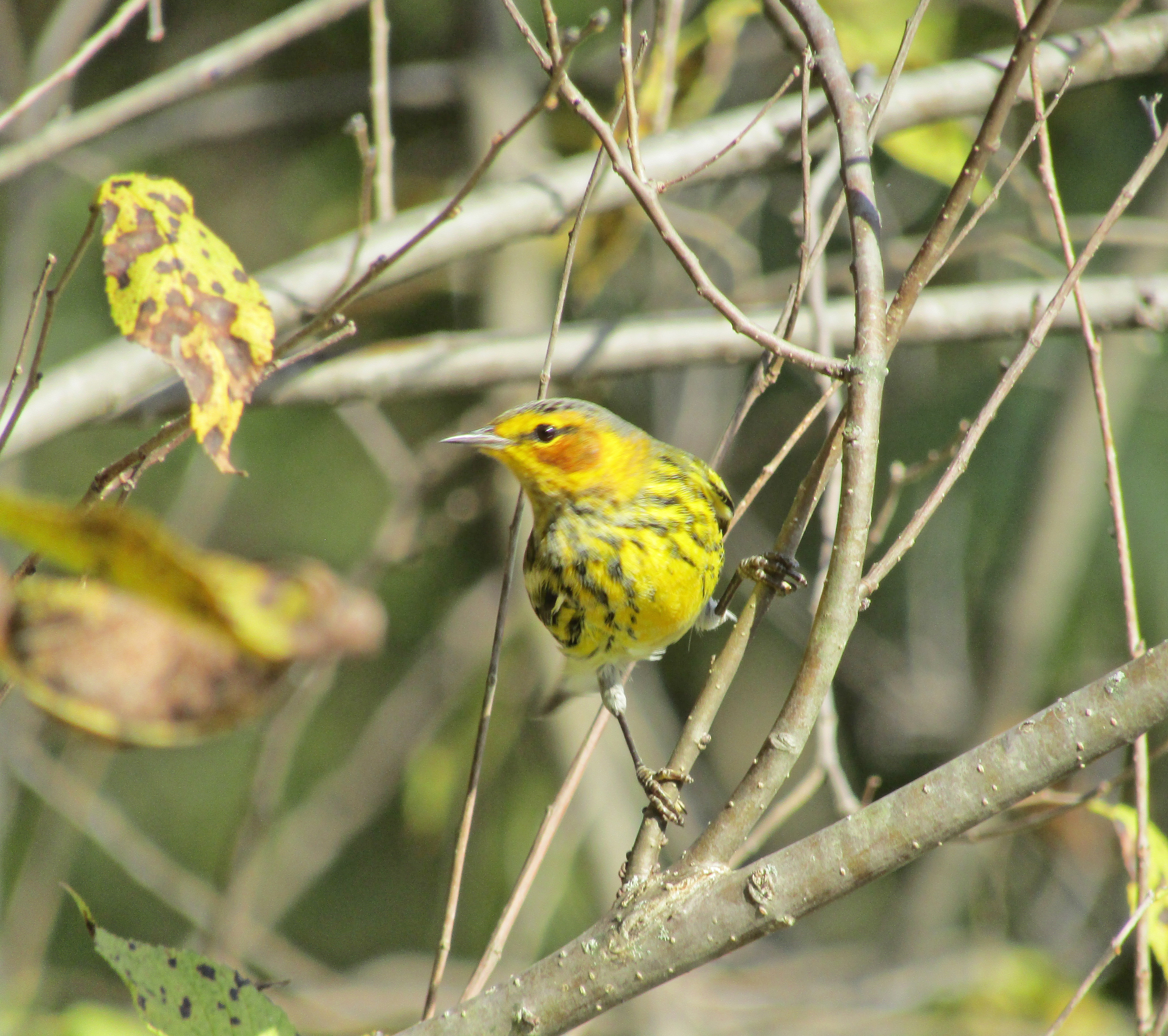
Photo by Bryan Stevens • While the Cape May warbler doesn’t breed locally, these warblers are fairly common spring and fall migrants in the region.

The Blackburnian warbler’s common name commemorates Anna Blackburne, an English naturalist who lived from 1726 to 1793. Her brother, Ashton, had immigrated to the United States, which made it possible for him to send his sister many specimens, especially birds. Their father, a salt merchant by trade, was also a well-respected amateur naturalist. In addition to the warbler that bears her name, Anna Blackburne also had a species of beetle named in her honor.

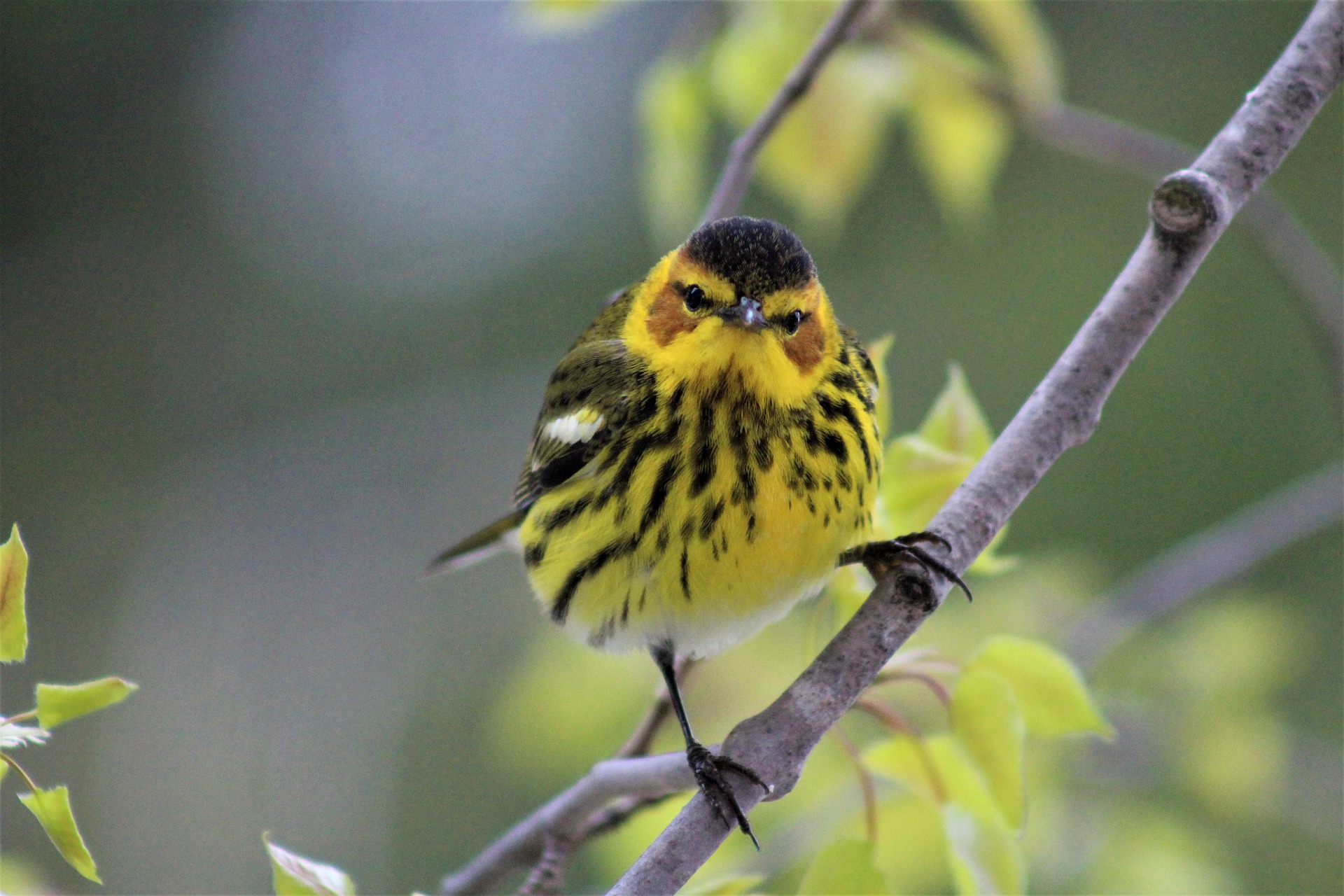
Both the Cape May and Tennessee warblers are named for the locations from which they were first collected. Neither of these small songbirds are closely affiliated with Cape May, New Jersey, or the Volunteer State. The Cape May warbler is also known as the “tiger warbler” for the dramatic black striping across its bright yellow breast. A green back and chestnut cheek patch make the Cape May warbler quite unlike any of its close kin. Even its scientific name — Setophaga tigrina — pays homage to the striped big cat. The term “setophaga” translates to “moth eater” and is a reference to this warbler’s intense fondness for the caterpillars known as spruce budworms that occasionally produce outbreaks in the northern spruce forests that serve as the nesting range for the Cape May warbler.


Photo by insitedesigns/Pixabay • A Cape May warbler peers from its perch on a tree branch.

According to the website, “All About Birds,” Cape May warblers have unusually shaped tongues that allow them to sip nectar from tropical flowers during the winter months spent in Central America and the Caribbean. Their unique tongues also make it possible for them to enjoy sips of sugar water from hummingbird feeders.

Whether its dragonflies, nighthawks, warblers or hummingbirds, plenty of birds and other flying creatures will be moving through the region for the next few weeks. Now’s the time to get outdoors and look for some of these migrants.

Photo by insitedesigns/Pixabay.com • The Cape May warbler migrates out of North America every fall to spend the winter in Central America and the Caribbean.