Tag Archives: Birdwatching

Majesty of bald eagle suitable for America’s official bird

american bald eagle

Photo by David Dibert on Pexels.com A bald eagle comes in for a landing.

Here’s an early “Happy Fourth of July” to all my American readers. I thought this week’s post should focus some attention on our national bird, the American bald eagle, which officially became the national emblem in 1782 when the great seal of the United States was adopted.

Despite elevating this native bird to such lofty status, we have not always been kind to the bald eagle. We allowed habitat destruction and toxic pesticides to bring this eagle to the brink of extinction. With some protection, however, the bald eagle rebounded. In fact, the Department of Interior took the eagle off the endangered species list on June 28, 2007.

bald eagle over the body of water

Photo by Wayne Christensen on Pexels.com A bald eagle scoops a fish from the water with its talons.

The bald eagle has been more frequently observed by birders in Northeast Tennessee in recent years. Some of the area lakes in the region are good places to look for Bald Eagles, particularly in the fall and winter. A few lakes even host nesting bald eagles. For instance, this eagle has been documented nesting at Holston Lake in recent years.

I’ve observed bald eagles in Tennessee, South Carolina, Florida and Virginia. My most unusual observation of a wild bald eagle took place on Labor Day many years ago when an adult eagle flew over my grandparents’ home in Limestone Cove in Unicoi County. North America’s other eagle, the golden eagle, is a very rare visitor to northeast Tennessee. The golden eagle is primarily a bird of the western United States while the bald eagle ranges widely across the United States as well as into Canada and Mexico.
The eagles are incredibly majestic birds and important symbols of the value of natural places and creatures.

close up photography of white black eagle during daytime

Photo by Pixabay on Pexels.com The bald eagle had rebounded in population.

The bald eagle (Haliaeetus leucocephalus) is a member of a genus known as Haliaeetus, or sea eagles. There are seven other living species in the genus: the white-bellied sea eagle, Sanford’s sea eagle, African fish eagle, Madagascar fish eagle, Pallas’s fish eagle, white-tailed eagle and Steller’s sea eagle.

The bald eagle, however, is not considered closely related to eagles in the genus Aquila, or “true eagles,” in which the golden eagle is included.
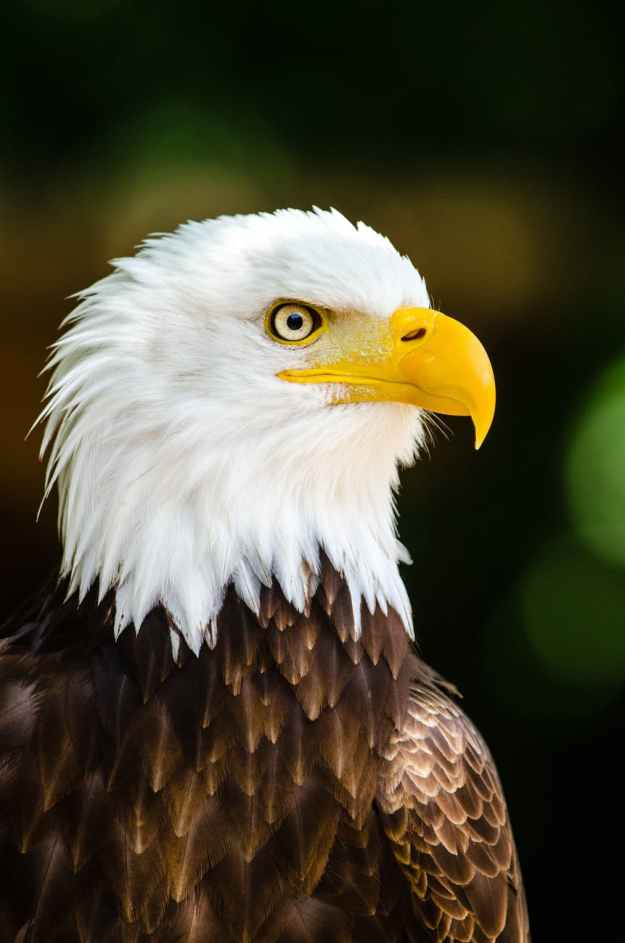
close up photography of bald eagle

Photo by Flickr on Pexels.com The bald eagle’s place as the nation’s symbol seems very well secured.

Both male and female adult bald eagles have a blackish-brown back and breast; a white head, neck and tail; and yellow feet and bill. Juvenile bald eagles are a mixture of brown and white and reach full maturity in four to five years.

The female bald eagle is 35 to 37 inches in length, slightly larger than the male, with a wingspan that ranges from 72 to 90 inches. Bald eagles weigh from 10 to 14 pounds.

bald eagle bird clouds country

Photo by Pixabay on Pexels.com Bald eagles are often associated with wetland habitats.


Despite these impressive characteristics, the bald eagle is dwarfed in comparison to one of its now-extinct relatives. The largest eagle ever to evolve was Haast’s eagle, which once thrived in New Zealand. This eagle was named for the German geologist Julius von Haast, who founded Canterbury Museum at Christchurch in New Zealand. Haast, who died in 1887, was one of the first scientists to study large flightless birds such as the moa family that once roamed New Zealand.

Julius_von_Haast 2

Julius von Haast

In fact, Haast’s eagle was considered a major predator on the population of New Zealand moas, some of which reached a height of 12 feet tall and a weight of more than 500 pounds. By contrast, female Haast eagles probably reached a weight of 22 to 33 pounds. Males, as is the case with most living eagles, are smaller than females and probably weighed between 20 to 26 pounds. This mega-sized eagle possessed a relatively short wingspan of roughly 8 to 10 feet wide. This wingspan compares to that recorded for large specimens of golden eagle and Steller’s sea eagle. Even the largest of today’s eagles, however, are about 40 percent smaller in body size than the size of Haast’s eagles. Despite their superior size, moas simply lacked any defense against the huge razor-like talons and sharp bill of the Haast’s Eagle.

Here are a few other eagle facts:

— Eagle bones are light because they are hollow. The beak, talons and feathers are made of keratin.
— The Madagascar fish eagle is the most rare eagle on earth, and one of the most rare birds. The current population is estimated at less than 400 individual birds, with perhaps around 120 breeding pairs.
— Bald eagles have 7,000 feathers.
— Wild bald eagles are long-lived birds and may live as long as 30 years. In captivity, however, the oldest documented Bald Eagle lived to be 47 years old.
— Bald eagles can lift as much as four pounds. They feed mainly on fish, but they will take advantage of carrion and scavenge for their meals. They will occasionally also take waterfowl as prey.
— The hunting area of bald eagles varies from 1,700 to 10,000 acres. Home ranges are smaller where food is present in great quantity.
— Bald eagles can fly to an altitude of 10,000 feet. During level flight, they can achieve speeds of about 30 to 35 miles per hour.
— All eagles are renowned for their excellent eyesight.
— Once paired, bald eagles remain together until one dies. Bald eagles lay from one to three eggs. The 35 days of incubation duties are shared by both male and female.
— Today, there are about 10,000 breeding pairs of bald eagles.

••••••

I look forward to hearing from readers. Those who wish to ask a question, share an observation or make a comment may reach me at ahoodedwarbler@aol.com.

bald eagle in macro photography

Photo by Pixabay on Pexels.com Happy Fourth of July!
Regional bird count detects population trends

Driveway-Heron

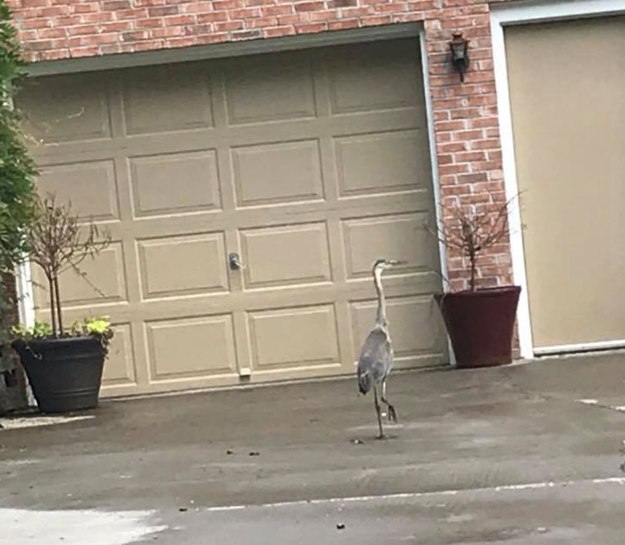
Photo by Pattie Rowland • A Great Blue Heron explores a paved driveway at a home in Erwin, Tennessee. Rookeries, or nesting colonies, in Erwin have expanded the population of this large wading bird locally.

Members of the Elizabethton Bird Club and birding organizations in Kingsport and Bristol fanned out across Northeast Tennessee on Saturday, May 5, for the 75th consecutive Elizabethton Spring Bird Count. A total of 60 observers (a new participation record) looked for birds in Tennessee’s Carter County and parts of the adjacent counties of Johnson, Sullivan, Unicoi and Washington.

Counts like this one, as well as surveys such as the Virginia Breeding Bird Atlas, now in its third season, provide valuable information to assist responsible agencies and organizations with the protection and preservation of the nation’s birds.

This year’s spring count tallied 152 species, slightly better than the overall average of 149 species established over the last 30 years. The most ever species tabulated for this count was 166 species back in 2016.

Downy_Peanuts

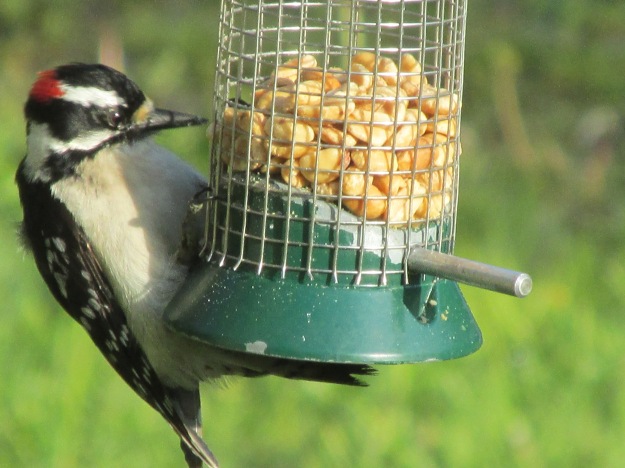
Photo by Bryan Stevens • Many of the birds found during a survey liked the Spring Bird Count are observed at feeders, such as was the case with this downy woodpecker.

I counted birds along the Watauga River in Elizabethton and on Holston Mountain. Some of the better birds I saw during the daylong outing included Baltimore oriole, Blackburnian warbler, warbling vireo, and yellow-billed cuckoo.

I also saw numerous great blue herons. It’s notable that this large wading bird has become much more common in the region, thanks to recent rookeries, or nesting sites, in Erwin, Elizabethton, Bristol and other locations. In recent years, new rookeries have also been established in southwest Virginia in locations such as Saltville and Damascus. A total of 123 great blue herons were found on this year’s spring count.

So it was with much interest that I read on my Facebook page the story of an encounter Pattie Rowland, a resident of Erwin, Tennessee, had with a rather tame great blue heron. Instead of flying away when Pattie stepped outside, a visiting heron strolled around her yard and down her neighbor’s driveway.

Pattie wondered if the heron could be a fledgling from the rookery in Erwin. While that’s certainly a possibility, the bird could also be an adult nesting in the rookery and wandering a little farther afield than usual in search of food for its young. In addition to fish, great blue herons will also feed on earthworms, amphibians, reptiles and even small rodents. As I mentioned to Pattie, herons are like people. Each bird is an individual; some are shy, others are curious and adventurous, which may find a heron exploring a paved driveway instead of a water lily-choked pond.

Heron-OnNest

Photo by Bryan Stevens • Great blue herons have expanded their nesting range into the region.

This heron has only been known to nest in Unicoi County since 2007. In addition, count participants found 144 double-crested cormorants, another bird affiliated with water that has proliferated as a summer nesting bird in the region.

Despite the increasing numbers of great blue herons and double-crested cormorants, they were far from the most numerous bird found on the spring count. The European starling claimed the distinction of most abundant bird on this year’s count with a total of 921 individuals found. Other abundant birds included cliff swallow (864); American robin (844); Canada goose (648); red-winged blackbird (546); and American crow (377). Although the count produced many good birds, it was also notable for some misses, including Northern bobwhite, sharp-shinned hawk and Kentucky warbler.

RW-Blackbird-Erwin

Photo by Bryan Stevens • A male red-winged blackbird sings to attract mates and ward off rivals.

In the wild, great blue herons can live for 15 years. The great blue heron’s diet is often dictated by opportunity with these large birds known to feed on prey that ranges from fish and crustaceans to small alligators and baby turtles. These herons will also feed on insects, rodents, amphibians, reptiles and even nestling birds. A great blue heron will basically try to eat anything that it can capture and swallow.

The great blue heron is the largest North American heron, as well as the world’s third-largest heron species. Other herons around the world with descriptive common names include Goliath heron, black-headed heron, purple heron, zigzag heron, capped heron and whistling heron.

The great blue heron isn’t the only heron found in the region. Other herons that can be found locally include green heron, yellow-crowned night-heron and black-crowned night-heron, all of which were found on the recent bird count.

If you’re interested in observing great blue herons for yourself, consider visits to the wetlands at Sugar Hollow Park in Bristol, Virginia, or the waterways around Osceola Island Recreation Area near Holston Dam in Bristol, Tennessee. These herons can also often be found stalking fish, frogs and other prey around the edges of ponds or streams.

The official results of the Spring Bird Count by the Elizabethton Bird Club are presented below:

Canada goose, 648; wood duck, 70; mallard, 176; Northern shoveler, 1; greater scaup, 1; bufflehead, 1; and red-breasted merganser; 4.

IMG_7687

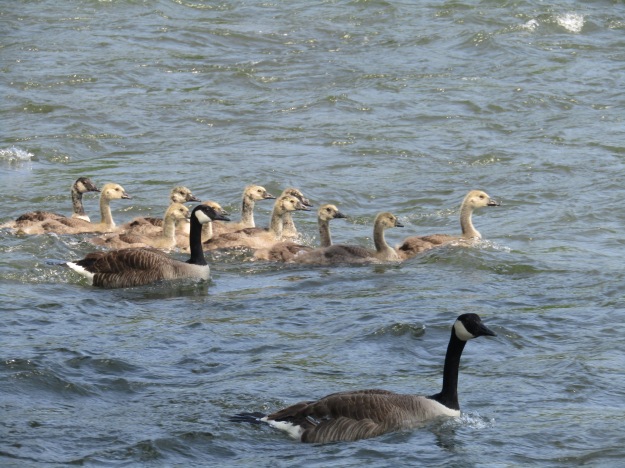
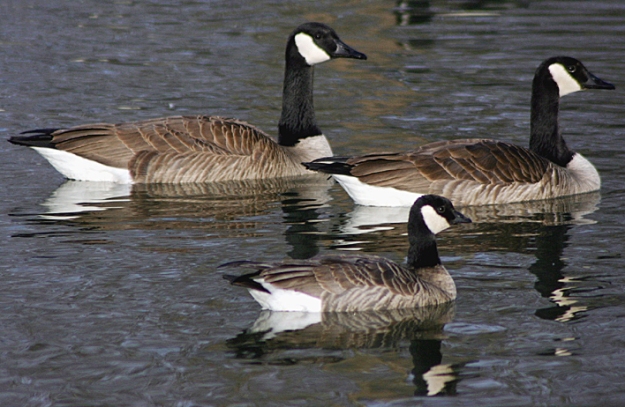
Photo by Bryan Stevens • A family of Canada geese swims in the Watauga River in Elizabethton, Tennessee.

Ruffed grouse, 4; wild turkey, 45; common loon, 5; double-crested cormorant,144; great blue heron, 123; great egret, 2; green heron, 29; black-crowned night-heron, 2; and yellow-crowned night-heron, 8.


Black vulture, 121; turkey vulture,167; osprey,12; bald eagle, 8; cooper’s hawk, 8; red-shouldered hawk, 2; broad-winged hawk, 8; and red-tailed hawk, 27.


Killdeer, 41; spotted sandpiper, 37; solitary sandpiper, 35; greater yellowlegs, 2; lesser yellowlegs, 8; least sandpiper, 10; white-rumped sandpiper, 1; and ring-billed gull, 2.

gbbc-killdeer

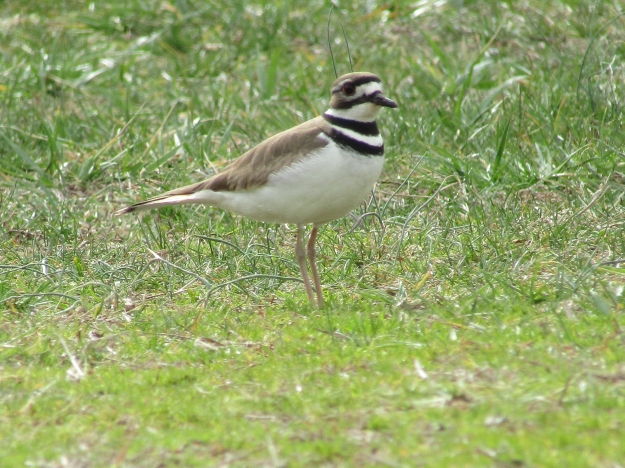
Photo by Bryan Stevens • Killdeer, a species of shorebird in the plover family, is a permanent resident in the region.


Rock pigeon, 217; Eurasian collared-dove,10; mourning dove, 251; yellow-billed cuckoo, 17; black-billed cuckoo, 3; Eastern screech-owl, 8; great horned owl, 2; barred owl, 8; common nighthawk, 5; chuck-will’s-widow, 7; Eastern whip-poor-will, 43; chimney swift, 185; ruby-throated hummingbird, 51; and belted kingfisher, 15.

Red-headed woodpecker,10; red-bellied woodpecker, 129; yellow-bellied sapsucker, 5; downy woodpecker, 55; hairy woodpecker, 6; Northern flicker, 44; and pileated woodpecker, 59.

American kestrel, 19; Eastern wood-pewee, 43; Acadian flycatcher, 32; least flycatcher, 2; Eastern phoebe, 82; great crested flycatcher, 31; Eastern kingbird, 123; and loggerhead shrike, 1.


White-eyed vireo, 21; yellow-throated vireo,10; blue-headed vireo, 86; warbling vireo, 17; red-eyed vireo, 280; blue jay, 231; American crow, 377; fish crow, 2; and common raven, 22.

Purple martin, 82; tree swallow 206; Northern rough-winged swallow, 131; barn swallow, 226; and cliff swallow, 864.

Carolina chickadee, 197; tufted titmouse, 213; red-breasted nuthatch, 11; white-breasted nuthatch, 44; brown creeper, 3; house wren, 53; winter wren, 7; Carolina wren, 225; blue-gray gnatcatcher, 110; golden-crowned kinglet, 5; and ruby-crowned kinglet, 2.

Eastern bluebird,181; veery, 15; gray-cheeked thrush, 1; Swainson’s thrush, 3; wood thrush, 109; American robin, 844; gray catbird, 77; brown thrasher, 72; Northern mockingbird, 138; European starling, 921; and cedar waxwing, 144.

Bluebird-Pool

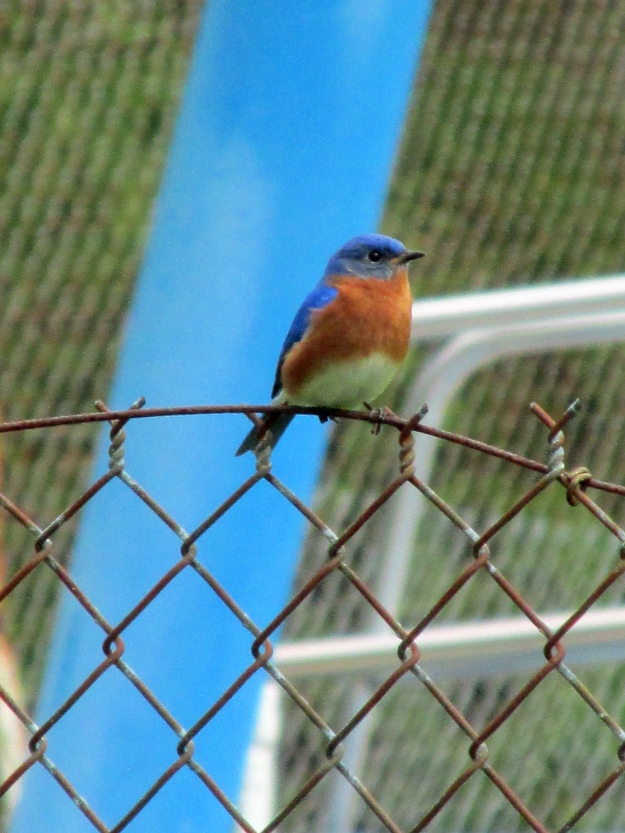
Photo by Bryan Stevens • A handsome male Eastern bluebird perches on a chain-link fence.

Ovenbird, 170; worm-eating warbler, 42; Louisiana waterthrush, 37; Northern waterthrush, 3; golden-winged warbler, 2; black-and-white warbler, 118; Swainson’s warbler, 3; Tennessee warbler, 1; common yellowthroat, 23; hooded warbler, 192; American redstart,12; Cape May warbler, 4; Northern parula, 44; magnolia warbler 7; Blackburnian warbler, 11; yellow warbler, 34; chestnut-sided warbler, 18; blackpoll warbler, 5; black-throated blue warbler, 71; palm warbler, 5; pine warbler, 13; yellow-rumped warbler, 53; yellow-throated warbler, 43; prairie warbler, 14; black-throated green warbler, 97; and Canada warbler, 34.

Eastern towhee, 250; chipping sparrow,137; field sparrow, 74; savannah sparrow, 2; grasshopper sparrow, 4; song sparrow,322; swamp sparrow, 1; white-throated sparrow, 10; white-crowned sparrow, 7; and dark-eyed junco, 74.

Summer tanager, 3; scarlet tanager, 97; Northern cardinal, 376; rose-breasted grosbeak, 37; blue grosbeak, 6; indigo bunting, 148; dickcissel, 2; and yellow-breasted chat, 10.

Bobolink,16; red-winged blackbird, 546; Eastern meadowlark, 144; common grackle, 474; brown-headed cowbird, 144; orchard oriole, 28; Baltimore oriole, 35; house finch, 96; pine siskin, 79; American goldfinch, 382; and house sparrow, 47.

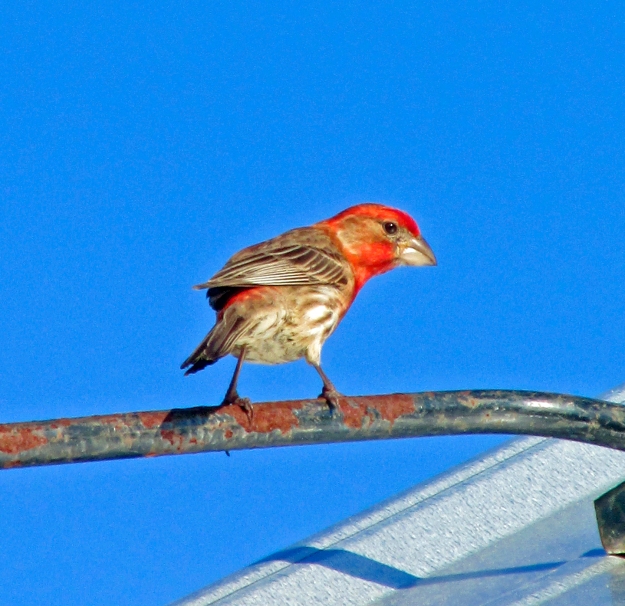
HousieFinch

Photo by Bryan Stevens • A male house finch perched on a cable. These finches are native to the western United States but became established in the eastern states thanks to the illicit pet trade.

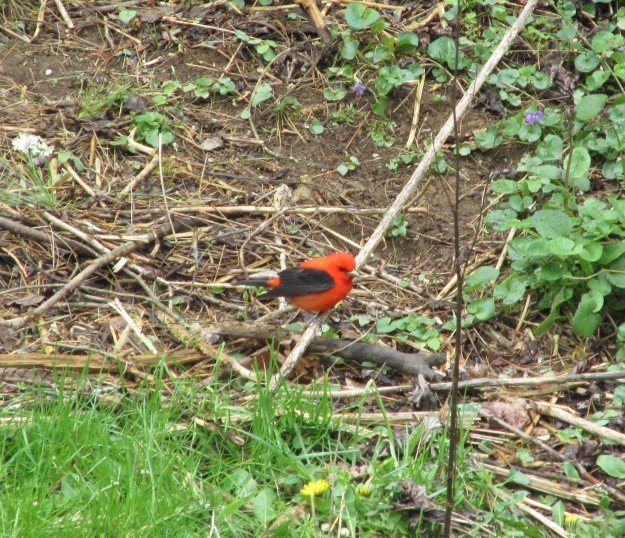
Male scarlet tanager stands out from other birds

Scarlet Tanager02

Photo by Jeana Chapman • A male scarlet tanager forages close to the ground, which is not typical behavior for these birds. Tanagers, although brightly colored, spend most of their time in the tree canopy obscured from view.

I received an email from Lewis and Jeana Chapman detailing a dazzling discovery they made.

The couple have been adding a few new birds to their bird list and decided to give me an update on what they’ve been seeing. The Chapmans reside in the community of Laurel Bloomery in Johnson County, Tennessee. The wooded slopes of Pond Mountain where they make their home provide an attractive location for migrating birds, as well a summer residents.

“The tree swallows returned this spring to nest in our bluebird box,” Lewis wrote in his email reporting his new sightings. “The great crested flycatcher has moved its nest from the front porch to the barn. Last year the flycatchers raised five chicks on the front porch. The nest got so full the chicks were perched around the edge.”

Some new additions to their list have included golden-crowned kinglet and the Northern flicker. “Most recently we spotted a scarlet tanager,” Lewis continued.

Scarlet-Tanager

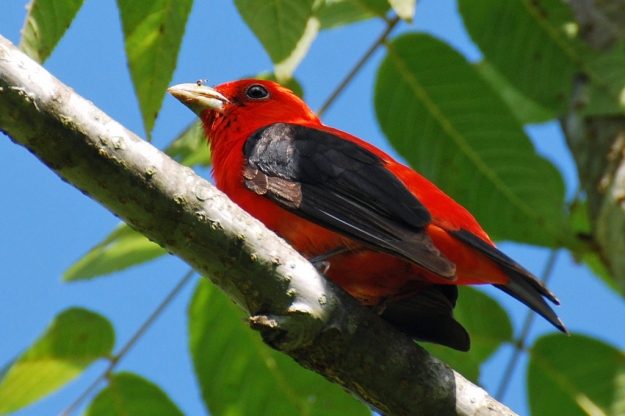
Photo Courtesy of Jean Potter A male scarlet tanager brightens shadowy woodlands with a flash of tropical colors yet remains mostly inconspicuous in the forest canopy.

They had never seen a scarlet tanager at their home. Over the years I have heard from other readers left stunned by the tropical beauty of the male scarlet tanager. That description would not be that far off. While the scarlet tanager resides in the United States and Canada from April to October each year, this bird spends the rest of the year in South America. Citizens of the United States and Canada get the better part of the bargain when it comes to hosting this bird. After the summer nesting season, male scarlet tanagers lose their brilliant red plumage and look more like the greenish females. By the time they get back to the tropics for the winter, this striking bird has transformed into a rather drab specimen.

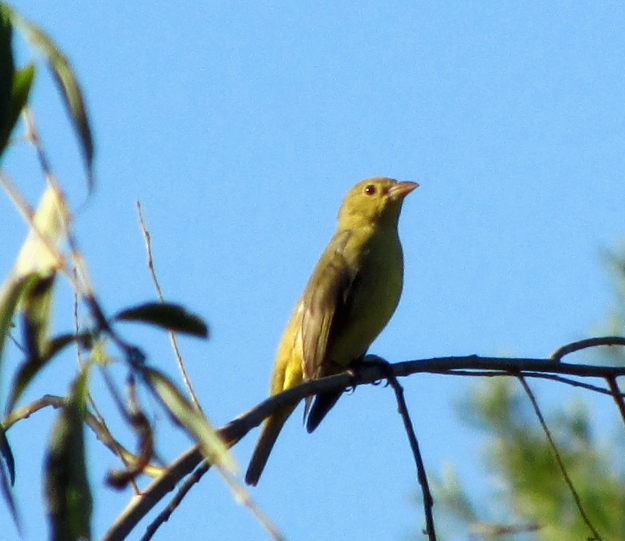
I’ve written in previous columns about the scarlet tanager, which is one of those birds that always takes an observer’s breath away upon first seeing it. Of course, it’s the male scarlet tanager that bewitches observers with his dazzling feathers of vivid red and jet black. Female and immature tanagers are a dull olive-yellow in coloration with dark wings and tails.

Tanager-Sept18

A female scarlet tanager is a study in contrast from her mate with her dull greenish-yellow plumage being much less vibrant than the male’s bright red and black feathers.

During their summer stay in the region, scarlet tanagers largely prey on insects. Although renowned as a fruit-eating bird, the scarlet tanager primarily feeds on fruit during its migration flights and on its wintering range in the tropics. This tanager breeds in deciduous and mixed deciduous-evergreen woodlands across the eastern half of North America. I’ve often heard that oaks are a favorite tree for this woodland dweller.

It’s unlikely that you’ll run across the nest of a scarlet tanager. These birds nest high in trees, often locating their nests 50 feet or more above the ground. After building a nest, a female tanager will incubate her three to five eggs for about two weeks. It’s during this time that her inconspicuous appearance is a plus, helping her blend well with her surroundings. After the young hatch, the parents are kept busy feeding the nestlings for another 10 to 15 days.

The website All About Birds notes that the population of scarlet tanagers has declined in the last half-century. Between 1966 and 2014, according to the North American Breeding Bird Survey, scarlet tanager numbers declined by 14 percent. The environmental organization Partners in Flight estimates a global breeding population of 2.2 million, with 93 percent of these birds spending some part of the year in the United States and the other seven percent breeding in Canada. These birds do poorly in forests that have been harvested for lumber. Other causes of habitat fragmentation probably also affect the well-being of scarlet tanagers. It’s worth keeping an eye out for any other signs of decline in this beautiful birds.

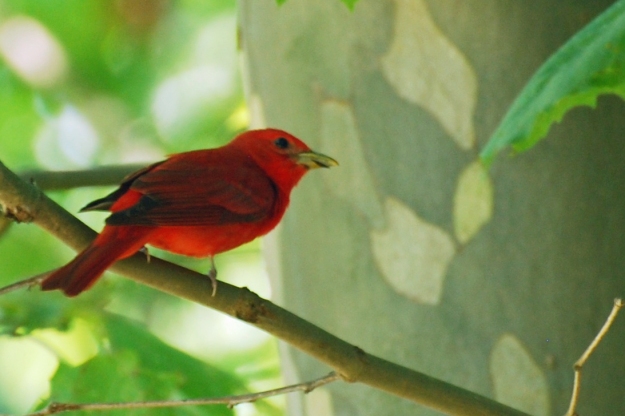
The scarlet tanager is a fairly common songbird during the summer months, but it also has a less common relative that can be found in northeast Tennessee, southwest Virginia and western North Carolina. The male summer tanager is the only entirely red bird found in North America. Lacking the scarlet tanager’s black wings, the summer tanager’s red feathers are also of a rosier hue.

Summer-Tanager

Photo Courtesy of Jean Potter The Summer Tanager is the only all-red bird in North America. It is less common in Northeast Tennessee than the related Scarlet Tanager.


While I have seen summer tanagers in Tennessee on occasion, most recently at Steele Creek Park in Bristol, Tennessee, I saw my first summer tanager during a spring trip to South Carolina many years ago. Overall, the summer tanager has more of a southern stronghold than the scarlet tanager, as the summer tanager’s range also extends into the southwestern United States.

Both of these tanagers are birds fond of dense, undisturbed woodlands. Most of the time, unfortunately, these tanagers reside in the dense woodland canopy. They’re more often heard than seen, producing a song similar to an American robin’s, but usually described as somewhat more raspy. The apt description I like for these two tanagers is that their songs sound like one sung by a hoarse robin with a sore throat.

Some of the world’s other tanagers are known by extremely descriptive names, including seven-colored tanager, flame-colored tanager, lemon-rumped tanager, green-headed tanager, golden-chevroned tanager, azure-shouldered tanager, fawn-breasted tanager, metallic-green tanager, emerald tanager, gilt-edged tanager, golden-naped tanager, opal-crowned tanager, blue-gray tanager and silver-beaked tanager.

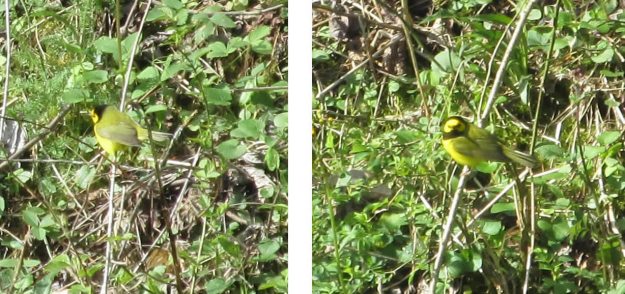
The tanager wasn’t the only unexpected feathered visitor to the Chapman home this spring. The same week the tanager made its appearance, a male hooded warbler also visited with the Chapmans. “This we found ironic because of your email address,” Lewis wrote. For readers who may not have noticed, my email address is ahoodedwarbler@aol.com. I’ve used this email address for many years to celebrate one of my favorite birds.

HoodedWarbler01 (5)

Photo by Lewis Chapman • A male hooded warbler also impressed the Chapmans during this small songbird’s recent visit.

The Chapmans also provided me with photos of all their colorful birds. In subsequent emails, they also informed me of some other unusual visitors. “One of our strangest visitors was an albino American goldfinch,” Lewis also revealed in his email. “Over this past weekend, we had rose-breasted grosbeak and indigo bunting show up.”

Many of these birds — the rose-breasted grosbeak, the scarlet tanager, the indigo bunting — always wow observers experiencing their first observation of them. Our two native tanagers — scarlet and summer — are definitely two memorable birds for anyone who has had the pleasure of seeing one. It’s a great time of year to get outdoors and keep your eyes open for a splash of bright color. You never know what you may see when you lift your binoculars.


Brown pelicans now thrive along nation’s coasts

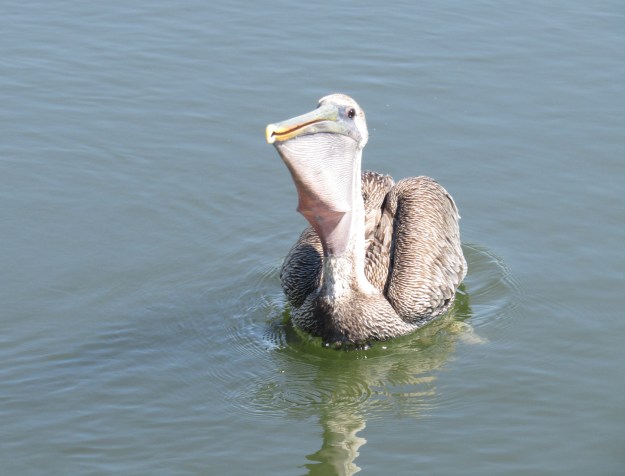
Pelican=Reflected

Photo by Bryan Stevens • A young brown pelican fishes along the causeway at Huntington Beach State Park in South Carolina. These pelicans usually dive into the water, capturing prey in a large pouch that is connected to their bill. Pelicans also snatch fish while floating on the surface.

Back in early March I enjoyed a trip to coastal South Carolina, visiting locations near Pawleys Island such as Huntington Beach State Park, Myrtle Beach State Park and Brookgreen Gardens.

During my six-day stay in the South Carolina Low Country, I observed 95 species of birds, including several that should be making their spring return to our region any day now. I saw blue-gray gnatcatchers, yellow-throated warblers and a few shorebirds, including a greater yellowlegs. All of these birds usually migrate through Northeast Tennessee and Southwest Virginia in April and early May.

I also saw some coastal specialties that don’t usually come close to my landlocked home state of Tennessee, including anhinga, tricolored heron and brown pelican.

IMG_4311

Photo by Bryan Stevens • A young brown pelican floats on the water in a salt-water marsh at Huntington Beach State Park in South Carolina.

The brown pelican is the smallest of the world’s eight species of pelicans, which are grouped in the family Pelecanidae. Saying that a brown pelican is small, however, is a relative term. The brown pelican is about half the size of the related white pelican.

The brown pelican lives on both coasts, from around Seattle, Washington, and Cape Cod, Massachusetts, southward to the tropics. This pelican also lives along the Gulf Coast, as well as ranging south as far as the mouth of the Amazon River in South America.

According to the U.S. Fish & Wildlife Service’s website, there are two geographically and genetically distinct regional populations, or subspecies, of brown pelican that occur in North America. They are the California brown pelican, ranging from California to Chile, and the eastern brown pelican, which occurs along the Atlantic and Gulf coasts, as well as the Caribbean and the Central and South American coasts.

Pelicans have been documented living about 30 years in the wild, but the average age may be much less due to factors such as predation, disease and starvation. Many young pelicans, unskilled at catching fish, sadly do not reach adulthood.

DDT, which negatively affected breeding for birds such as bald eagle, osprey and peregrine falcon, also had a detrimental impact on the brown pelican. According to their website, in 1970, the U.S. Fish and Wildlife Service listed the brown pelican as endangered. The listing was possible through a law that had been passed before 1973’s Endangered Species Act. A recovery plan was published in 1983. In November 2009, the pelican was removed from the Endangered Species List, becoming another success story akin to that of the bald eagle.

Summer-Pelicans

Photo by Bryan Stevens • Brown pelicans fly in a line over the Atlantic Ocean on the South Carolina coast, conjuring forth fantasies of ancient flying creatures.

Visitors to beaches along the Atlantic Coast have probably seen the impressive flight of brown pelicans in a single file formation of birds gliding only a few feet above the surf. The span of the wings can reach seven feet six inches. Seen near dusk, an observer could be forgiven a flight of fancy that allows these pelicans and their graceful flying formations to be compared to the long-extinct flying reptiles, the pterosaurs.

At a distance, the birds can readily be described as majestic and even graceful. On closer inspection, some different adjectives come into play to describe the brown pelican. At close quarters, a brown pelican is an ungainly, almost ugly bird. Pelicans have long necks and bills, and on land, they shuffle awkwardly. Young bird are drab brown and gray, often looking much more disheveled than adult birds.

IMG_4340

Photo by Bryan Stevens • A large pouch that is connected to its bill is one physical trait that makes pelicans distinct from other birds. Although these birds often appear ungainly, they are quite skilled at using their pouch-equipped bill to capture fish.

According to the website All About Birds, the brown pelican feeds mostly on small fish such as menhaden, mullet, anchovies, herring, and sailfin mollies. These large birds may plunge from 65 feet above the surface of the water to capture fish in their famous throat pouch. In addition to fish, a pelican can take up to 2.6 gallons of water into its pouch with every dive. The water gets expelled, leaving behind the fish.

When not feeding, pelicans will rest on sandbars, pilings and rock jetties. These “loafing” spots are important places for pelicans to rest and recuperate after the rigors of diving and fishing for their fish meals.

IMG_4342

Photo by Bryan Stevens • A young brown pelican fishes along the causeway at Huntington Beach State Park. These birds capture fish in an elastic pouch that is attached to their bills.

The closest avian relatives of the pelicans are a couple of oddball birds known as the shoebill and hamerkop. The world’s other species of pelicans include Peruvian pelican, great white pelican, Australian pelican, American white pelican, pink-backed pelican, Dalmatian pelican and spot-billed pelican.

One state — Louisiana — has even made the brown pelican its official state bird. Most state birds are songbirds. The brown pelican is one of the exceptions, along with such birds as Minnesota’s common loon and the wild turkey, which has been adopted by Massachusetts.

IMG_4339

Photo by Bryan Stevens • A young brown pelican dips its bill into the water along the causeway at Huntington Beach State Park. Pelicans are skillful at snatching fish while floating on the surface.

On a handful of occasions, brown pelicans have made brief appearances in the region, usually generating a great deal of excitement among birders. White pelicans are also rare visitors, but they make slightly more stops in the region than their smaller relative. For instance, a white pelican spent a few days at Middlebrook Lake in Bristol around Thanksgiving in 2015. To increase your odds of observing a brown pelican in the wild, it will be much more productive to simply spend a few days along the coasts of Virginia, North Carolina, South Carolina, Georgia or Florida.

••••••

If you have a question, wish to make a comment or share a sighting, email ahoodedwarbler@aol.com.

john-james-audubon-brown-pelican_a-l-6043043-0

Early American naturalist and artist John James Audubon painted this representation of a brown pelican. Today, the state of Louisiana has even made the brown pelican its official state bird.

Tufted titmouse small songbird with big personality

In last week’s post I wrote about chickadees. These friendly little birds have an impish cousin that is also a frequent visitor to feeders in the region. If chickadees are active woodland sprites, their relative, the titmouse, is a curious imp with mischievous tendencies.

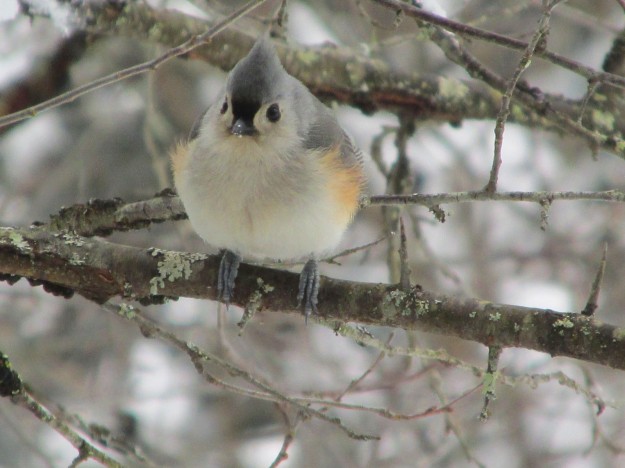
Titmouse-2

Photo by Bryan Stevens • A tufted titmouse puffs up its feathers on a cold day.

The tufted titmouse’s song — a persistent repetition of “Peter! Peter! Peter!” — is ringing through the woodlands around my home along with the urgent “fee-be fee-bo” of the Carolina chickadee. These birds form mixed flocks with each other and other species to explore their surroundings and search for food. They know that spring, despite the usual false starts, is drawing nearer with each passing day.
In addition to singing, titmice are enthusiastic scolders. They will scold over any transgression, real or imagined, focusing their ire on their fellow titmice or other birds, potential predators and even human observers. They’re quite persistent at their raucous scolding, which is just another reason I label them as imps of the woods.

Titmouse-Suet

Photo by Bryan Stevens • A young titmouse visits a suet feeder.

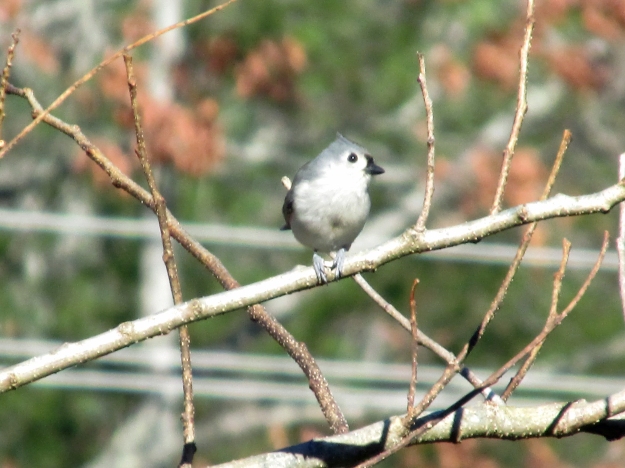
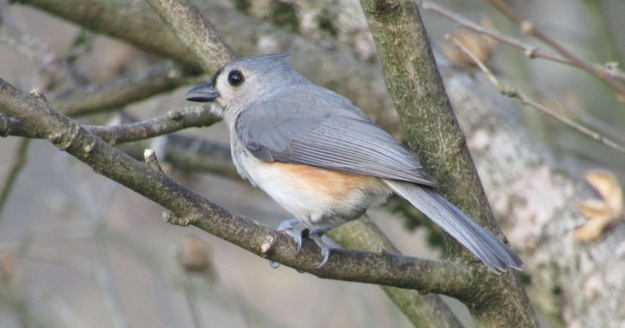
The tufted titmouse is a mostly gray bird with a distinctive crest and a pinkish-rusty coloration along the flanks. Titmouse eyes are black as coal and look large in proportion to their heads, which lends them an expressive appearance as they explore in yards and gardens. The term “titmouse” refers to the old English word “tit” meaning “small,” as well as the old English “mase,” also a reference to small size. Eventually, probably because of the bird’s small size and gray coloration, “mase” evolved into “mouse” and combined to form the word “titmouse.”

The titmice living in my yard visit my house windows at times, which drives my cats to distraction. I’ve wondered if the titmice are curious and trying to peek inside the house, but I believe I have a more down-to-earth explanation. These little birds are very thorough when foraging for food, and I’ve watched them pluck spiders and other insects from the window frames.

Titmouse-Creek

Photo by Bryan Stevens • A tufted titmouse approaches a stream for a quick drink.

Like chickadees, titmice are fond of sunflower seeds. No other offering will so readily lure them to feeders, although they do develop a fondness for suet cakes. I’ve also had great success attracting titmice to my feeders by offering unsalted, shelled peanuts. I sometimes break up the peanuts into smaller, more manageable pieces for the benefit of the titmice. These foods and a few trees or saplings around your home is all you really need to welcome titmice.

In the early 1900s, the tufted titmouse would have been considered a southern bird with its stronghold in states like Tennessee, Virginia, the Carolinas and Georgia. Perhaps it is the titmouse’s innate curiosity that has pushed the species to expand successfully beyond the southern United States. The titmouse has steadily expanded its range northward, thriving in new locations. Experts credit this expansion to more readily available access to supplemental food at feeders.

Titmouse-Eye

Photo by Bryan Stevens • A tufted titmouse turns an eye on the camera.

During the nesting season, titmice forage for a variety of insects. Many spiders, beetles, caterpillars and other small bugs will be fed to hungry young titmice in a tree cavity or a nesting box. Like chickadees, titmice build exquisite nests, often using mostly moss with other materials, such as bark, cloth scraps, dry leaves and shed snakeskins. These small birds line their nests with hair or fur of other animals.

Over the years, many readers have shared observations documenting the fur-collecting skills of tufted titmice. The birds are not content to simply collect shed fur. They seem to prefer collecting the fur fresh from a living animal. Many dogs fall victim to impish titmice that boldly pluck strands of fur from the canine’s coat.

In another funny story, a woman once told me about a titmouse that flew onto her head every time she stepped outside her home. Perhaps the bird sensed her affection for birds since it never failed to pluck strands of hair from her head to carry back to its nest. For any would-be skeptics, the woman provided photographic documentation of the incidents. In addition to dogs and humans, animals ranging from squirrels and opossums to mice and woodchucks have also been observed “sacrificing” fur for the nesting success of tufted titmice.

Titmouse-PHOTO

Photo by Bryan Stevens • The tufted titmouse is a backyard bird with an impish personality.

The female tufted titmouse incubates the eggs. She lays between three and nine eggs, although a usual clutch size is five to six eggs. The female titmouse is protective of her nest and is known for a behavior known as a “snake display.” I’ve observed titmice perform this display when I’ve peeked into nesting boxes. She remains tightly seated on her eggs, or young, while she hisses loudly and strikes in a manner very much like a striking serpent. Not all titmice engage in this display. Some remain still and try to “blend” with the nest, while others will fly away if a nest box is opened. Regardless, it’s a convincing display of bravado on the part of such a small bird. If it looks scary to people, I am sure it could succeed at repelling a squirrel or mouse. I’m uncertain if the behavior would deter an actual snake.

Other titmice in North America include bridled titmouse in Arizona and New Mexico; oak titmouse of the Pacific Coast region; juniper titmouse from the Great Basin, which consists of Wyoming, Idaho, Utah, Nevada, Oregon and California; and the black-crested titmouse, which ranges from Missouri into east-central Mexico.

Titmouse-WithPeanut

Photo by Bryan Stevens • A tufted titmouse pounds at a peanut held in its feet.

Titmice occur exclusively in North America and belong to the genus Baeolophus. Europe, Asia and Africa are home to some other crested birds in the family of chickadees and titmice. For instance, the European crested tit and the grey crested tit are species that sport a crest of feathers like titmice but are more closely related to chickadees.

Yes, the tufted titmouse is one of nature’s imps, but it’s also one of our more entertaining birds. Get to know these visitors by offering sunflower seeds or other fare and, if you want to go the extra step, place some bird boxes around your yard as potential nesting sites. By next winter, you may have an entire flock of these feathered imps as your guests.

•••••

Bryan Stevens lives near Roan Mountain, Tennessee. To learn more about birds and other topics from the natural world, friend Stevens on Facebook at https://www.facebook.com/ahoodedwarbler. If you have a question, wish to make a comment or share a sighting, email ahoodedwarbler@aol.com.

Titmouse-OnSuet

Photo by Bryan Stevens • A tufted titmouse makes a quick visit to a suet feeder.

North America’s bluebirds never fail to impress with their winning ways

A famous song declares that “somewhere over the rainbow, bluebirds fly,” so you’ll have to excuse me if I have been looking for those elusive rainbows during the unseasonably warm weather the region’s enjoyed in recent weeks.

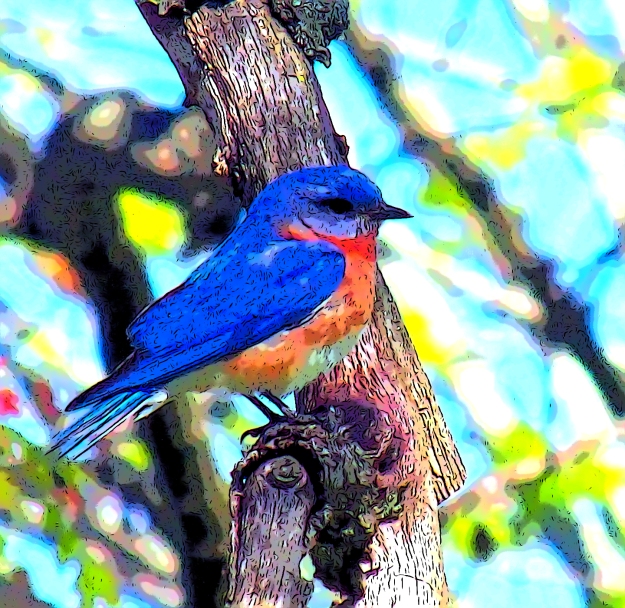
Also, like the song promises, “dreams really do come true,” which was fulfilled by the arrival of this year’s first pair of Eastern bluebirds at my home on Friday, Feb. 23. The presence of a pair of these beautiful and trusting birds is always sure to put people in a good mood. People have known for generations that bluebirds make good neighbors. A pair of bluebirds in your yard or garden provides hour upon hour of free entertainment as one watches these birds go about their daily routine. At this time of the year, much of that routine is focused on finding and claiming the best possible nesting location for the upcoming spring season.

Bluebird-Comic

The Eastern bluebird is one of the most beloved American songbirds.

The Eastern bluebird is one of North America’s best-known cavity-nesting birds. About 85 species of North American birds use cavities in trees for nesting purposes. Cavity-nesters include ducks, such as buffleheads and wood ducks, as well as birds of prey such as Eastern screech-owls and American kestrels.

Woodpeckers and nuthatches can excavate their own cavity in a dead or decaying tree. Others, such as the bluebirds, must find a cavity already in existence. Such cavities are scarce real estate and can be subject to some intense competition. The Eastern bluebird is at a disadvantage when forced to compete with non-native introduced birds such as aggressive European starlings and house sparrows. Even native competitors such as house wrens and tree swallows are serious rivals when it comes down to staking a claim to prime nesting real estate.

Over the years, I have found bluebirds nesting in cavities inside wooden fence posts, but there are fewer wooden fence posts every year. This reinforces the idea of how changing landscapes have affected these birds. Instead of wooden fence posts, many farmers now use metal ones, and dead or dying trees — a much sought-after resource for cavity-nesting birds — are often removed from woodlands.

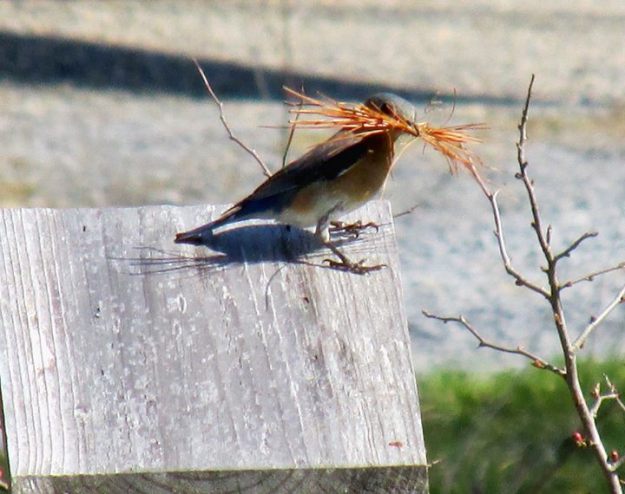
Bluebird-withPineNeedles

Photo by Bryan Stevens • A female Eastern Bluebird gathers pine needles to use as nesting material.

Fortunately for bluebirds, this species will also accept lodging in a nest box, or birdhouse, provided for them by human landlords. One of the simplest ways to bring bluebirds close is to offer wooden boxes, constructed to their specific requirements, for their use as nesting locations. Because of their trusting nature when it comes to their human neighbors, the Eastern bluebird is one of our most beloved birds. In fact, bluebirds are such popular birds that interest in them and their well-being has inspired the foundation of organizations such as the North American Bluebird Society. The Eastern bluebird has also been designated the official state bird for New York and Missouri, which provides more testimony to the immense popularity of this bird.

Bluebirds-One

Photo by Bryan Stevens • A flock of Eastern bluebirds perches on fenceposts.

There are two other species of bluebirds found in North America. The Western bluebird is found throughout the year in California, the southern Rocky Mountains, Arizona and New Mexico, as well as in part of Mexico. The species ranges in the summer as far north as the Pacific Northwest, British Columbia and Montana. The Mountain bluebird nests in open country in the western United States as far north as Alaska. They are short-distance migrants, retreating as far south as Mexico during the winter season.

Other than these three species, North America offers few others birds with mostly “blue” plumages. Some examples include indigo bunting, blue grosbeak, and blue jay, as well as birds like great blue heron and belted kingfisher.

In addition to housing, food and water can be used to lure Eastern bluebirds closer. This bird doesn’t eat seeds, but it can be attracted with an offering of mealworms — live or freeze-dried – or commercially prepared peanut butter nuggets. A water feature in a yard is also a magnet for bluebirds and a host of other bird species.

Bluebird-Pool

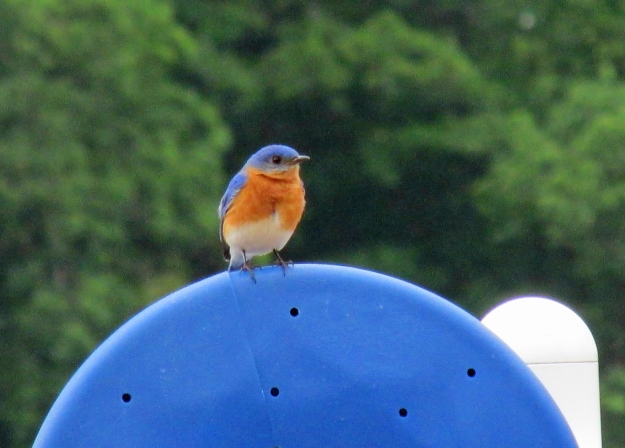
Photo by Bryan Stevens • A handsome male Eastern bluebird perches on a chain-link fence.

If your home doesn’t provide suitable open, spacious bluebird habitat, it’s still easy to enjoy these beautiful birds. An afternoon or evening drive into open country, such as agricultural farmland, is likely to yield sightings of this bird on fences and utility lines. Golf courses, some of which go the extra mile to accommodate bluebirds, also provide habitat for these lovely birds.

The Eastern bluebird is present in the region in all seasons and is one of our more common birds. If you’re already an experienced landlord and host for these birds, you probably already know they joys they can bring. If not, why not try to attract them closer to you? Most bluebirds in the region have already started looking for a nesting site. Many of these birds may nest two or even three times in a single season. March has only just arrived, so there’s still time to place a nest box or two on your property to get their attention.

••••••

If you have a question, wish to make a comment or share a sighting, email ahoodedwarbler@aol.com.

Bluebiord-Male-Playground

Photo by Bryan Stevens A male Eastern Bluebird perched on playground equipment at Winged Deer Park in Johnson City.

American robins become more prominent with shifting of seasons


Robins-ETSU-Feb

Photo by Bryan Stevens • Returning American robins, prominent in lawns and gardens during their annual spring migration, will soon turn their attention to nesting duties.

I don’t think I’m alone in doing what I can to speed along the process of spring’s arrival. I’ve heard from different people, all eager to share their observations of one of the sure signals — the arrival of flocks of American robins — of the shifting of the winter season to spring.

Bobby Howser phoned me to let me know of a large flock of American Robins he encountered at the Sullins College building in Bristol, Virginia.

He said the flock “swarmed like bees” into a tall holly tree. He was surprised to see so many robins in a single tree and asked if it was an unusual occurrence.

Houghton_MS_Am_21_(46)_-_John_James_Audubon,_robin 3

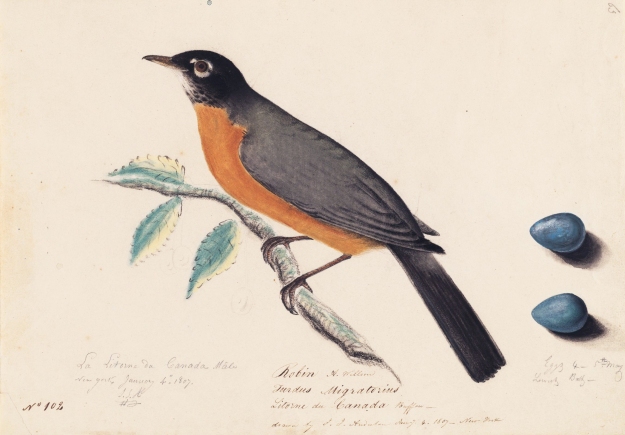
Early American naturalist and painter John James Audubon painted this American robin with a couple of the bird’s eggs.

Ernie Marburg in Abingdon, Virginia, emailed me about the same time.

“I just wanted to report that we have been inundated with a huge flock of mostly robins,” he wrote. He estimated that the flock contained 300 to 500 individuals.

“They ate all the red berries from my neighbor’s large holly tree yet appear to avoid other holly trees with many red berries just a short distance away,” Ernie wrote. The flock remained active in the tree from morning into early afternoon.

Not long after he first emailed me, Ernie contacted me again. “I wanted to give you an update on the robin invasion,” he wrote. “They have been here two additional mornings since I first reported to you. Their pattern is different now though. They are spaced apart and appear to be ground feeding individually.”

Robin-OnNest

Photo by Bryan Stevens • American robin sitting on its nest in the shelter of a side of a bridge spanning the Doe River in Elizabethton, Tennessee.

Ernie proposed a theory about the behavior of the robins.

“I think they followed the south to north weather pattern we had recently that provided significant rainfall,” he explained. “The rainfall, in turn, caused the ground to thaw and the earth worms to come to the surface thus providing a food source for the robins. In summary, the robins are following their food source.”

I responded to Ernie and congratulated him on what I thought was an excellent theory.

Ernie also wrote me that he had read an article some time ago that said robins would eat cooked elbow macaroni if put out for them.

“We did that, but not one robin ate the macaroni,” he said. “Moral of the story is, as you would expect, don’t believe everything you read.”

I’ve read similar suggestions of unusual items to try to tempt birds not prone to visit feeders. I told Ernie that I wasn’t too surprised that the robins ignored the macaroni. The observations of robin feeding habits made by Bobby and Ernie also correspond to the changing seasons. Holly trees retain their berries into late winter, which provide an abundant food source for robins, as well as other birds. As the temperatures begin to rise in early spring, the birds switch their diet in favor of earthworms. This protein-rich food source fuels the impressive migration made by robins each year.

Robin-Hunter

Photo by Bryan Stevens • An American robin scans for prey in the grass and clover of a lawn.

I posted on my Facebook page about the flocks of robins I’d observed, which resulted in several comments on my original post.

Johnny Mann, who lives in Bristol, Tennessee, shared on my Facebook page after I posted about seeing flocks of robins almost everywhere I have gone recently. He noted that he has been seeing Eastern bluebirds, which are a smaller relative of robins. He noted in his comment that the bluebirds are feeding on suet.

Jackie Lynn, who lives in Wytheville, Virginia, also posted a comment on my Facebook page. Jackie saw a large flock of robins feeding in a field, enjoying the worms brought to the surface by recent rains. “Dinner was served,” Jackie reported.

Several other people responded optimistically on my Facebook page, sharing the hope that the influx of robins does indeed signal the approach of spring.

The American robin is known by the scientific name Turdus migratorius, which can be translated as “migratory thrush.” Indeed, this well-known American bird is related to other thrushes, including the Eastern bluebird, wood thrush and veery. The relationship to other thrushes is quite visible in young birds, which display a spotted breast until they mature and acquire the familiar red breast associated with robins.

There are 82 other species in the genus, which ranges not only in the Americas, but Europe, Asia, Africa and Australia, as well. Some of the American robin’s fellow genus members include the olive thrush, the bare-eyed thrush, pale thrush, great thrush, black-billed thrush and cocoa thrush.

AmericanRobin

Photo by Bryan Stevens • While American robins like fruit when its available, they also spend a lot of time feeding on earthworms and insects.

When the first European settlers arrived in North America, the robin was still a bird living in the forests. Robins proved incredibly capable of adapting to the presence of humans. Soon enough, these once shy forest birds began to frequent lawns and city parks. The robin soon became one of America’s most popular songbirds. Three states — Connecticut, Michigan and Wisconsin — have conferred official state bird status on the American robin.

Robins begin nesting almost as soon as they return each spring. Nesting success in a previous season instills fidelity to the location where the birds nested, resulting in many robins returning to the same nesting area year after year. Although some robins invariably spent the entire winter season in the region, it is still a welcome sight to see migrating flocks of these birds in February and early March. The sudden resurgence of the American robin each spring is a reminder that another winter will soon be history. I know I’m always pleased to welcome them back.

•••••

Bryan Stevens lives near Roan Mountain, Tennessee. To learn more about birds and other topics from the natural world, friend him on Facebook at https://www.facebook.com/ahoodedwarbler. If you have a question, wish to make a comment or share a sighting, email ahoodedwarbler@aol.com.

american_robin

Early American naturalist and painter John James Audubon captured this family of American robins in one of his masterful paintings.

America’s lost parakeet remains poignant symbol of need to protect our birds

A century ago this week, a caged bird died in Cincinnati, Ohio. However, this was not simply a case of an untimely death of a beloved family pet. Instead, that bird represented the last of its kind.

The bird belonged to the Psittacidae, a family of tropical birds that includes macaws, parrots, caiques, amazons and parrotlets. The bird, a male named Incas, was the last captive Carolina parakeet (the only species of parrot native to the eastern United States) in existence when he died at the Cincinnati Zoo on Feb. 21, 1918, in the same aviary where Martha, the last passenger pigeon, had died four years earlier.


The demise of Incas came about a year after the death of his mate, who had been named Lady Jane by their zookeepers. In a time before the forces of social media and round-the-clock mass media, the death of Incas likely went unnoticed by other than a few people.

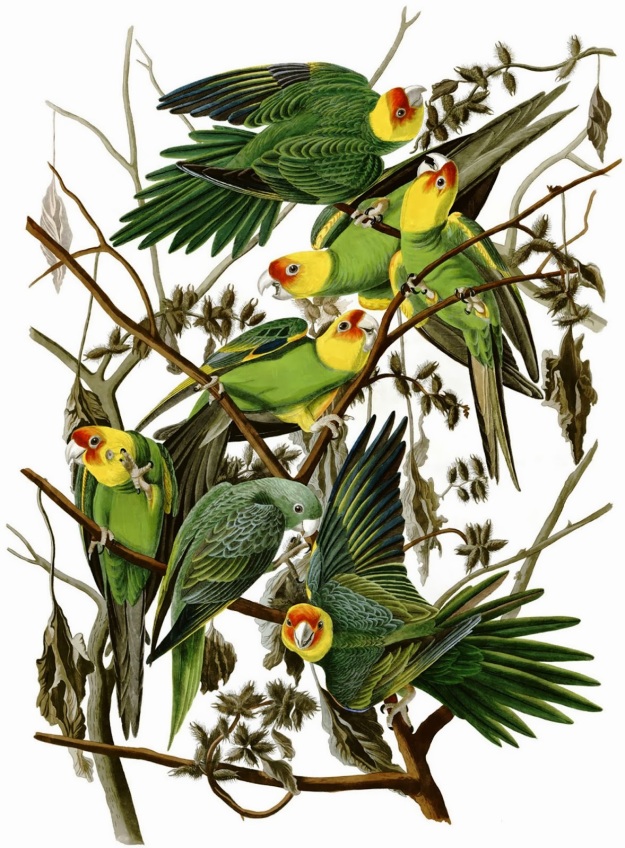
Carolina parakeets, John James Audubon


If few noticed the passing of Incas at the time, surely today we can mourn the loss of one of the most abundant birds to ever roam the continent. Few people even realize that North America was once home to its own species of parakeet. A few individuals — all that remained of once massive flocks of colorful, noisy native parakeets — made it into the 20th century. Despite the death of Incas in 1918, the Carolina parakeet as a species was not officially declared extinct until 1939. It was a classic example of going out with a whimper, not a bang, when the entire population of the Carolina parakeet crashed suddenly and for reasons still not fully understood.

For instance, large flocks of these birds still flew free until the final years of the 1800s, but in the first decade of the 1900s, these flocks disappeared. The only other native parrot — the thick-billed parrot of the American southwest — no longer flies north of the Mexican border. An attempt to re-introduce this parrot to Arizona in the 1980s ended in disappointing failure. Of course, thick-billed parrots still fly free south of the border.

il_fullxfull.603620894_qnpu

It would be wonderful to have native parrots still flying free. The extinct Carolina parakeet ranged throughout the eastern United States, including the states of Virginia, Tennessee and North Carolina. These parrots strayed on occasion as far north as Wisconsin and New York and ranged as far west as Colorado. Florida provided a stronghold for this colorful species, which also made its last stand in the Sunshine State. The last flock of thirteen wild birds was documented in Florida in 1904.

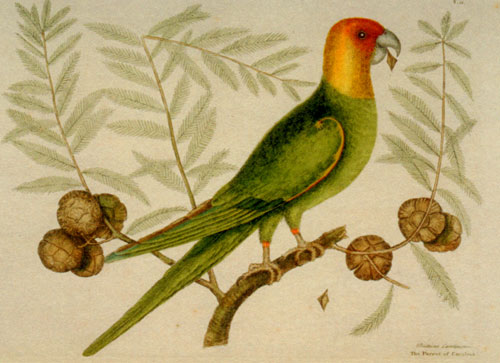
These birds have attracted attention since the arrival of the first Europeans. English explorer George Peckham mentioned the presence of Carolina parakeets in an account he wrote of his 1583 expedition in Florida. In the 1700s, English naturalist Mark Catesby described the species for science in a two-volume work titled “The Natural History of Carolina, Florida and the Bahama Islands.”

The parrots were evidently numerous, often encountered in large flocks. Few early naturalists attempted to properly study them, resulting in a sad dearth of knowledge. Much of what we do know is quite intriguing. The diet of these parakeets made them toxic, as early naturalist and artist John James Audubon observed when cats sickened and died after dining on fresh parakeets. One of the parakeet’s favorite foods — cockleburs —imparted the toxicity into the flesh of the birds.

wilsondummy

Alexander Wilson

An unusual empathy and loyalty may have contributed to the downfall of the species. Early naturalist Alexander Wilson wrote of an 1808 encounter with a large flock of these parakeets. After noting how the bird covered almost every twig in a tree, Wilson raised a gun and shot several of the birds. Some of the shot birds were only wounded. “The whole flock swept repeatedly around their prostrate companions, and again settled on a low tree, within twenty yards of the spot where I stood,” Wilson wrote. “At each successive discharge, although showers of them fell, yet the affection of the survivors seemed rather to increase.”

The same tendency to rally to the side of fallen companions made Carolina parakeets easy targets for people capturing them in the late 1800s for the exotic pet trade. This flocking together and unwillingness to abandon wounded members made the birds easy targets when farmers shot them. It certainly didn’t help matters that the parakeets were also hunted for their brightly colored feathers, which were used to adorn women’s hats. It remains unclear what exactly annihilated a once abundant bird, although it was likely a combination of all of the aforementioned factors.

Changes to the landscape encouraged the parakeets to shift their diet from weed seeds to cultivated fruit, which won them the ire of farmers. Logging of extensive forests may have impacted their numbers, too. Experts have even theorized that the parakeets fell victim to some sort of epidemic spread by domestic fowl.

carolina-parakeet-ii

Painting by Alexander Wilson of a Carolina Parakeet.

If only the dawning of a more environmentally aware age had arrived slightly sooner, the Carolina parakeet might have been saved along with species like the bald eagle and whooping crane. This native parakeet, if it had endured, might today be considered an ordinary backyard bird jostling for space at your feeders with birds like blue jays and purple finches.

Incas and his fellow Carolina parakeets may be gone, but they’ve not been forgotten. Their story is a reminder of why it remains crucial to protect all birds. Let that devotion to preservation be the legacy of America’s lost parakeets.

•••••

Bryan Stevens lives near Roan Mountain, Tennessee. To learn more about birds and other topics from the natural world, friend Stevens on Facebook at https://www.facebook.com/ahoodedwarbler. If you have a question, wish to make a comment or share a sighting, email ahoodedwarbler@aol.com.

BaldEagle-February

Photo by Bryan Stevens • Although protections came too late to help the Carolina Parakeet, laws like the Endangered Species Act did save birds like the Bald Eagle from possible extinction.


Unlikely orange-crowned warbler becomes daily visitor this winter at woman’s feeders

After you have fed the birds long enough, you’re going to get visits from “mystery” birds. No matter how thoroughly you thumb through the pages of your field guides or how many online Google searches you conduct, it can be hard to pin down the identity of certain birds, especially when you encounter them for the first time.

Orange-crowned-Two-BOYD

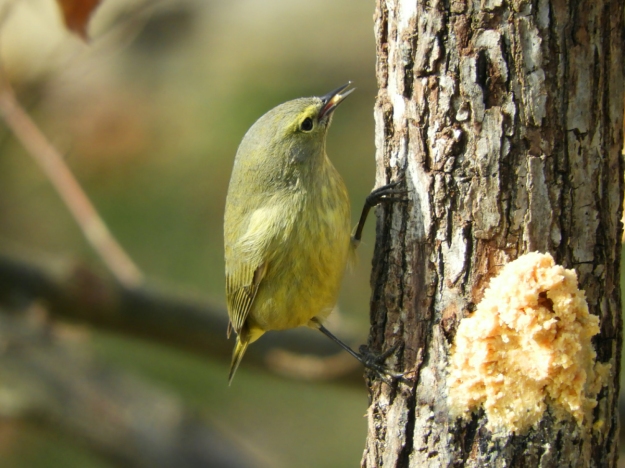
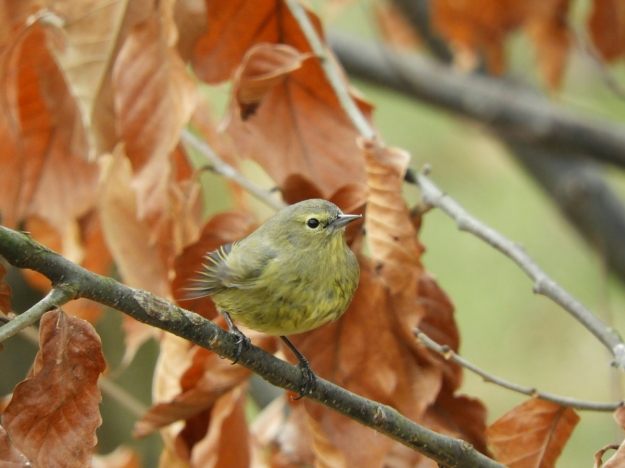
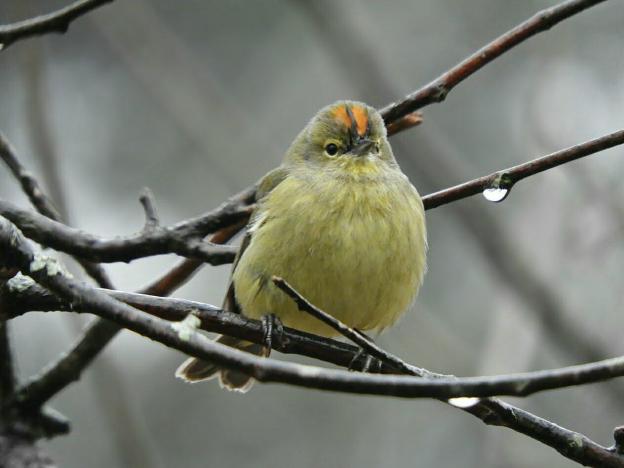
Photo by Rebecca Boyd • This orange-crowned warbler has found a favorable winter residence at the home of Rebecca Boyd in Knoxville, Tennessee, making frequent visits to suet feeders to supplement its usual diet of insects and berries.

In the summer and fall, young birds recently out of the nest can cause some confusion when they show up in the company of their parents at feeders. In the winter, often a season characterized by subdued plumages and nomadic wanderers, the surprise visitors can be one of the many “little brown birds” in the sparrow clan or a summer bird like an oriole or thrush that has decided to take a shot at overwintering.

Or, with greater frequency each winter, it might be one of the warblers. That was the case when Rebecca Boyd, a resident of Knoxville, Tennessee, contacted me recently via Facebook asking for assistance with a bird identification.

27583340_337866090062351_24195392_n

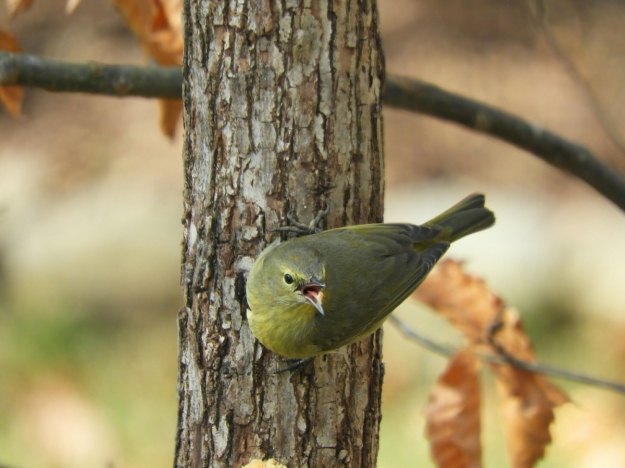
Photo by Rebecca Boyd • This orange-crowned warbler is one of the more nondescript members of the warbler family.

Although most of the warblers beat a hasty retreat from North America every fall, a handful of species have increasingly begun to spend the winter months far north of their usual tropical haunts. Some of these species include yellow-rumped warbler, pine warbler and palm warbler, but the low-profile orange-crowned warbler is also becoming more common between November and March, especially in yards and gardens offering supplemental food such as suet cakes.

The small greenish-yellow bird that showed up at Rebecca’s home was easily identified, thanks to some great photographs that she took of her visitor. I communicated to her that I believed her bird to be an orange-crowned warbler. She had also conducted her own research, which had also led her to that conclusion.

Orange-crowned-Four-BOYD

Photo by Rebecca Boyd • This orange-crowned warbler has found a home at the residence of Rebecca Boyd in Knoxville, Tennessee, this winter.

Rebecca said she also shared some photos with birding groups on Facebook, which brought some helpful feedback. “I’ve gotten numerous responses that orange-crowned warblers are becoming a lot more common on the east side of the Mississippi, with quite a few people saying they are seeing them in their yards, too,” Rebecca wrote.

The orange-crowned warbler is one of the more undistinguished members of this New World family of birds that numbers about 115 species. The bird gains its common name from a physical feature that is rarely seen — an orange patch of feathers that, unless the bird is extremely excited or agitated, is usually concealed beneath its dull greenish-yellow feathers. It’s not a field mark that’s considered reliable for identifying the bird.

Rebecca got a lucky break and managed to photograph this elusive feature on her visiting bird. She said the feathers on the bird’s head appeared wet, which may have explained the appearance of the orange crown.

28033440_343701942812099_429716009_o 2

Photo by Rebecca Boyd • Wet feathers made the rarely seen orange crown visible on this orange-crowned warbler that has taken up residence at the home of Rebecca Boyd in Knoxville, Tennessee, this winter.

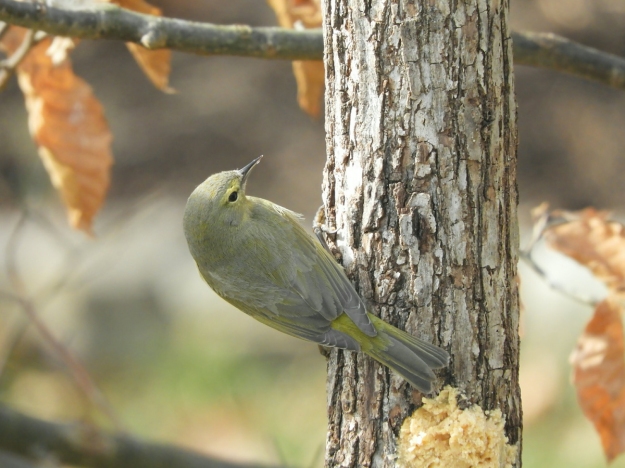
So, what does signify an orange-crowned warbler? The lack of wing bars, as well as the absence of a strong facial pattern is a strong indicator. The bird in Rebecca’s photo is not nearly as drab as this warbler can appear. Some appear very gray with only a hint of yellow or green in their plumage. There is often faint gray streaking evident in their yellow-green breast feathers. This warbler always shows yellow beneath its tail, a feature that is often only glimpsed as an observed bird is diving into cover. These birds also have sharp, thin bills. It’s usually a process of eliminating other suspects that brings birders to identify one of these warblers.

Unlike some warblers restricted to either the eastern or western United States, the orange-crowned warbler migrates and winters throughout the nation, east and west, although it primarily only nests within the western United States, as well as Alaska and Canada.

Although Rebecca said she has only been bird-watching and taking pictures for a little over a year, she has been a general point-and-shoot photography hobbyist for years. “My backyard is a bird paradise that attracts numerous and varied species,” Rebecca noted. “My favorites are bluebirds and hummingbirds, but the little warblers are also very special.”

Orange-crowned-One-BOYD

Photo by Rebecca Boyd • Besides orange-crowned warbler, like this individual, other warblers on occasion winter in the United States. Species most often attempting to spend the winter months in the United States include palm warbler, pine warbler, and yellow-rumped warbler.

Most of the warblers are currently residing on the island of the the Caribbean, or far south in Central and South America. A few others spend the winter in Florida or other southern states. The 50 or so species that nest in the United States and Canada will begin arriving as early as next month, although the majority of these summer residents will arrive or pass through the region in late April and May.

So, while it has a colorful name, the orange-crowned warbler is one of the more drab and nondescript members of its family. Other warblers living throughout the Americas include flame-throated warbler, crescent-chested warbler, citrine warbler and arrowhead warbler.

I’ll just keep daydreaming on the occasional snowy day of the approach of spring, which signals that the kin of the orange-crowned warbler will be winging their way north again in only a couple more months. I, for one, can’t wait.

••••••

If you have a question, wish to make a comment or share a sighting, email ahoodedwarbler@aol.com.

Orange-crowned-THREE-BOYD

Photo by Rebecca Boyd • This orange-crowned warbler grabs a bit of suet from a feeder at the home of Rebecca Boyd in Knoxville, Tennessee.

Duck…duck…goose? Winter season good time for finding rare geese in the region

SnowGoose-Jan21

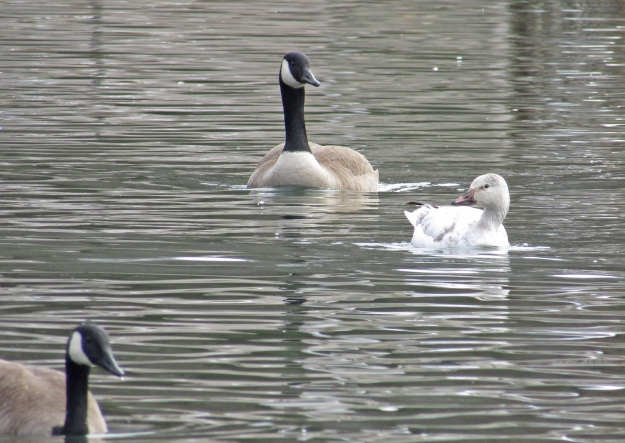
Photo by Bryan Stevens • A snow goose swims amid Canada geese at the pond at Fishery Park in Erwin, Tennessee.


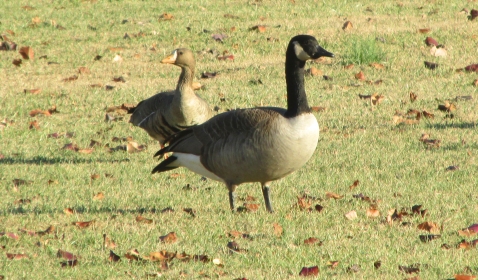
Of the geese found in the region, the well-known Canada goose is nearly ubiquitous. That’s not always been the case. For instance, in his book The Birds of Northeast Tennessee, Rick Knight points out that the geese now present throughout the year resulted from stocking programs conducted in the 1970s and 1980s. In earlier decades, the Canada goose was considered a rare winter visitor to the region.

Seeing the Canada goose in every sort of habitat from golf courses to grassy margins along city walking trails, it’s hard to imagine a time when this goose wasn’t one of the region’s most common waterfowl.

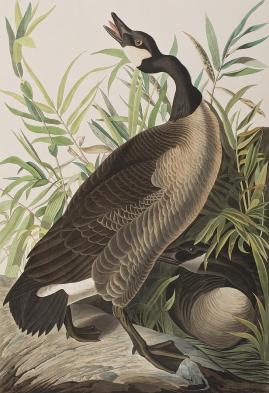
2-canada-goose-john-james-audubon

Early American naturalist and artist John James Audubon captured this pair of Canada geese in a most realistic painting.

The world’s geese are not as numerous as ducks, but there are still about 20 species of geese worldwide, compared to about 120 species of ducks. While both ducks and geese are lumped together as waterfowl, most geese are more terrestrial than ducks. Birders are just as likely to spot geese in a pasture or on the greens of a golf course as they are on a lake or pond.

There have been several species of geese usually considered rare to uncommon in the region that have been spotted by birders thus far this winter season. I personally observed greater white-fronted geese at several different locations in November and December.

The greater white-fronted goose is considerably smaller than a Canada goose. The bird is named for the distinctive white band found at the base of bill. This white band also helps distinguish this goose from similar domestic geese. The sexes are similar in appearance, but females are usually smaller than males. The head, neck and upper back of white-fronted geese are grayish-brown. The lower back and rump are dark brown, and the tail is dark brown and edged with white. The chest and breast are grayish with dark brown to black blotches and bars on the breast, giving this goose the nickname “specklebelly.” The bill is pinkish and the legs and feet are orange.

Canada-Greater

Photo by Bryan Stevens The Greater White-fronted Goose, in background, is much smaller than the typical Canada Goose, which is shown in the foreground of this photograph.

The greater white-fronted goose breeds in North America as well as in Europe and Asia, and they spend the winter throughout the United States and even in Japan. Most nesting in North America takes place on the North Slope of Alaska and across the western and central Canadian Arctic. Wintering habitats include coastal marshes, wet fields and and freshwater wetlands.

Only a couple of weeks ago, I spotted a snow goose at the fish pond located at Erwin Fishery Park. The snow goose is a North American goose known for its white plumage that gives the bird its common name; however, the snow goose actually comes in two versions: the white phase and a blue phase, which is often referred to as a “blue goose.”

The snow goose breeds in regions in the far north, including Alaska, Canada, Greenland and even the northeastern tip of Siberia. They may spend the winter as far south as Texas and Mexico, although some will migrate no farther than southwestern British Columbia in Canada.

The snow goose bucks the trends that show many species of waterfowl declining. Recent surveys show that the population of the snow goose exceeds five million birds, which is an increase of more than 300 percent since the mid-1970s. In fact, this goose is thriving to such a degree that the large population has begun to inflict damage on its breeding habitat in some tundra regions.

A smaller relative to the snow goose is the Ross’s goose, which for all practical purposes looks like a snow goose in miniature. The common name of this goose honors Bernard R. Ross, who was associated with the Hudson’s Bay Company in Canada’s Northwest Territories.

Ross-onWater

Photo by Bryan Stevens • A visiting Ross’s goose takes a swim on the large pond at Northeast State Community College in Elizabethton, Tennessee, a few winters ago.

Here’s a quick history lesson. Hudson’s Bay Company is the oldest commercial corporation in North America. The company has been in continuous operation for more than 340 years, which ranks it as one of the oldest in the world. The company began as a fur-trading enterprise, thanks to an English royal charter in back in 1670 during the reign of King Charles II. These days, Hudson’s Bay Company owns and operates retail stores throughout Canada and the United States.

In addition to his trade in furs, Ross collected specimens for the Smithsonian Institution in Washington, D.C. Ross is responsible for giving the goose that now bears his name one of its early common names – the Horned Wavy Goose of Hearne. I wonder why that never caught on?

Ross repeatedly insisted that this small goose was a species distinct from the related and larger lesser snow goose and greater snow goose. His vouching for this small white goose eventually convinced other experts that this bird was indeed its own species.

Ross was born in Ireland in 1827. He died in Toronto, Ontario, in 1874. He was described by other prominent early naturalists as “enthusiastic” and “a careful observer” in the employ of Hudson’s Bay Company. When John Cassin gave the Ross’s Goose its first scientific name of Anser rossii in 1861, he paid tribute to the Hudson’s Bay Company’s Ross.

Canada_Geese

Photo by Bryan Stevens • In some areas, Canada geese have become so prevalent that they are considered pests. Human handouts to waterfowl are not always compatible with good health for the birds that receive them.

The Ross’s goose has a “cuteness” factor working in its favor. For a goose, it is rather small. It could best be described as a snow goose in miniature. In fact, it isn’t much larger than such ducks as mallards and is considered the smallest of North America’s geese.

The Ross’s goose has also acquired some other common names, including “galoot” and “scabby-nosed wavey.” This latter name was inspired by the bird’s bill, which is covered with rough bumps around the base. I have to admit that “scabby-nosed wavey” is a name likely to stick in the memory. Today, the Ross’s goose’s scientific name is Chen rossii.

Other geese found worldwide include the pink-footed goose, bar-headed goose, emperor goose, red-breasted goose and barnacle goose.

So, does this inspire you to try a wild goose chase of your own? If it does, best of luck in your efforts.

•••••

To learn more about birds and other topics from the natural world, friend Stevens on Facebook at https://www.facebook.com/ahoodedwarbler. If you have a question, wish to make a comment or share a sighting, email ahoodedwarbler@aol.com.

A-Cackling Goose 1

Photo by Bryan Stevens • A Cackling goose, foreground, is shown in relation to some larger Canada geese, at a pond at Fishery Park in Erwin, Tennessee.