Photo by Bryan Stevens Flock of Wild Turkeys forage on a hillside near Hampton, Tennessee.
As January moves into February, I’ve been seeing more of the birds I’ve come to associate with the winter months.
Photo by Bryan Stevens Ring-necked Ducks and Redheads visit a pond at Erwin Fishery Park in Erwin, Tennessee.
During afternoon drives I’ve observed flocks of wild turkeys in fields near my home. The largest of these flocks consisted of at least two dozen birds. In addition to the turkeys, I’ve been seeing waterfowl at various ponds at local park. Some of these observations have included ducks like Redheads, Ring-necked Ducks, American Wigeons, American Black Ducks and Buffleheads, as well as Pied-billed Grebes, Common Coots and Great Blue Heron. I also found a large flock of Ring-billed Gulls at a large pond near the Elizabethton campus of Northeast Tennessee Community College.
Photo by Bryan Stevens A Fox Sparrow arrived at feeders during a recent snowstorm.
Recent snowfall has also changed the makeup of the flocks of birds coming to my feeders. A Fox Sparrow has joined the Eastern Towhees I’ve watched foraging on the ground beneath the feeders hanging from the branches of a blue spruce outside my bedroom window.
Photo by Bryan Stevens Ring-billed Gulls at a pond in Elizabethton, Tennessee.
More Purple Finches, in addition to American Goldfinches, have joined the ranks of birds crowding around my black oil sunflower-stocked feeders. Other recent visitors have included European Starlings (a winter rarity at my home) and a male Red-winged Blackbird, which linger for only one snowy day.
•••••••
David Ramsey
It’s time once again to join the fun for a winter celebration of the Roan Highlands on Saturday, Feb. 13, at the Roan Mountain State Park Conference Center. The event will celebrate Roan Mountain’s grassy balds, rare plants, birds, ancient geology and ongoing conservation efforts. The inclusive event is planned as for all ages, so be sure to bring the kids. Presentations are planned by David Ramsey and Gary Kauffman.
Ramsey is a well-known area conservationist, photographer, and tireless fighter for the protection of the 10,000-acre Rocky Fork tract — now a 2,000-acre Tennessee State Park surrounded by 7,600 acres of U.S. National Forest. Ramsey will present a program on photography being one of the most important items in the conservationist’s toolbox. A native of Unicoi, he was Field & Stream’s 2011 “National Hero of Conservation” and a Southern Appalachian Highlands Conservancy’s Stan Murray award winner. Ramsey, whose great-great-grandfather walked these forest paths, brings a generational love to contemporary times on Roan Mountain.
Photo by U.S. Forest Service Gary Kauffman collects seeds for a project for the U.S. Forest Service.
Gary Kauffman is the botanist/ecologist for the National Forests in North Carolina, which covers 1.1 million acres across four forests, the Nantahala and Pisgah National Forests in the mountains, the Uwharrie National Forest in the Piedmont, and the Croatan National Forest in the Coastal Plain. He will speak on the Roan’s rare plants in the balds and forests and the threats of balsam and hemlock wooly adelgid, beech bark disease, and non-native invasive plants.
Since you’re bringing the kids along, be sure to let them know that Xtreme Roan Adventures will have a table set up for owl pellet dissection. Of course, several afternoon hikes are also on the schedule for this year’s Winter Rally.
Photo by Bryan Stevens The annual Roan Mountain Winter Naturalists Rally returns on Saturday, Feb. 13.
During lunch, Amanda “AJ” Smithson, Seasonal Interpretive Ranger at Roan Mountain State Park, will present a program on forests and fields’ edible plants. Smithson is a graduate from UNC Wilmington and NC State with degrees in Natural Resource Management and GIS.
For more information, on this annual event, visit http://friendsofroanmtn.org/winter%20rally%202016%20brochure.pdf
No matter where you live, you probably don’t have to go far to see one of the members of the swallow family. These graceful, aerodynamic birds are quite familiar to most people. If you spend much time at all outdoors during the summer months, chances are you’ve observed some members of this family.
Overall, it’s been a good year for swallows. It’s usually not too difficult to find five of the six species that are known to make Northeast Tennessee and Southwest Virginia their home from spring to fall. In addition to barn and tree swallows, I have seen purple martins, cliff swallows and northern rough-winged swallows so far this year.
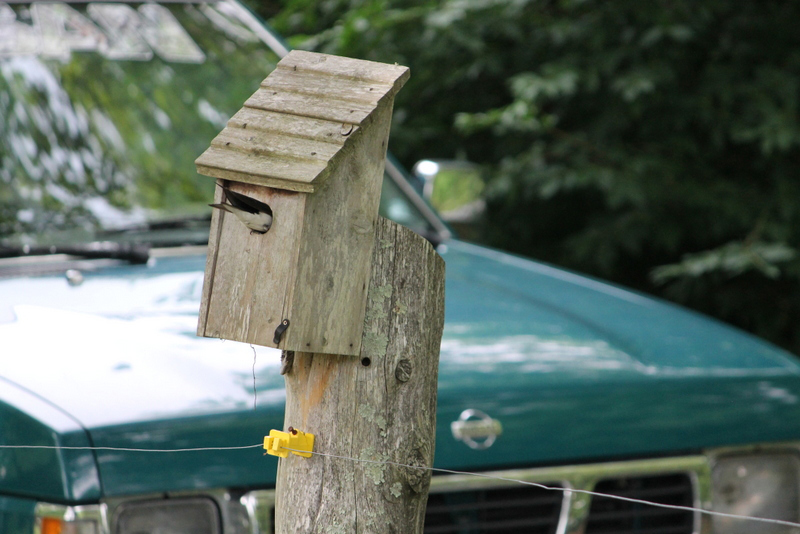
Photo courtesy of Mary Taylor Beierle A tree swallow peeks inside a nest box at the Beierle home.
Barn swallow and tree swallow are the two members of the family that are probably best known to people. They have adapted to life in both suburban and rural areas, which brings them into frequent contact with people.
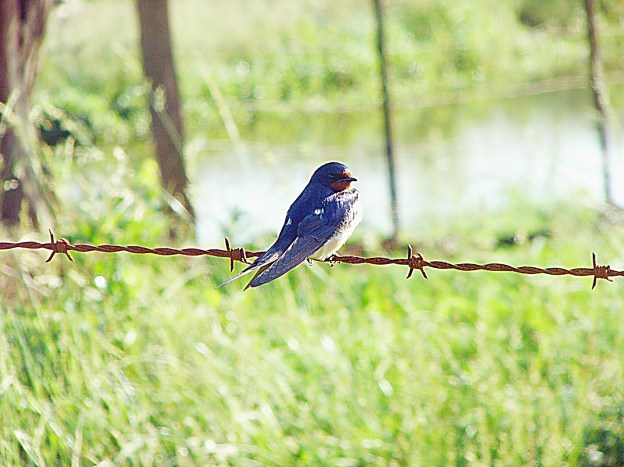
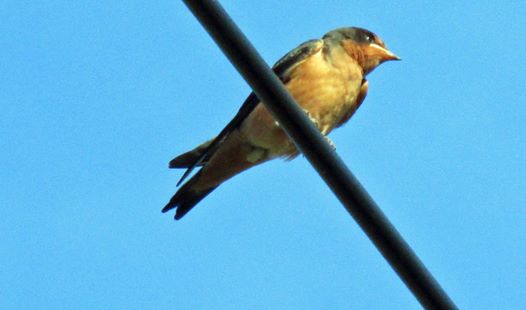
These days, the barn swallow is as apt to nest in a parking garage or on an apartment balcony as inside a barn in the countryside. Once young swallows leave the nest, parents will park them on a perch as they continue to feed the still dependent young. Adults fly over nearby fields, foraging for insects that they catch on the wing and deliver back to the waiting, always hungry, young birds.
A freshly mown field is a magnet for swallows. I don’t know how the word spreads so quickly among these birds, but I’ve observed dozens of these birds descending on fields soon after they have been mowed for hay. At times, the birds arrive while the mowing is still taking place, swooping after insects stirred up in the tractor’s wake.
I haven’t observed any bank swallows in the region this year, but these members of the swallow family are rather hit-or-miss in the region. Because of their specialized nesting needs, bank swallows are localized in their distribution and not as widespread as their kin.
Cliff swallows nest beneath many local bridges. These swallows, which at one time nested primarily on rocky cliffs, hence their name, now frequently nest under man-made structures. These swallows make their jug-shaped nests out of mud and clay. These nesting “jugs” are all located in clusters beneath bridges and other structures. It’s a wonder that the parents flying in with food are able to tell their nests apart from the nearby seemingly identical nests of their neighbors.
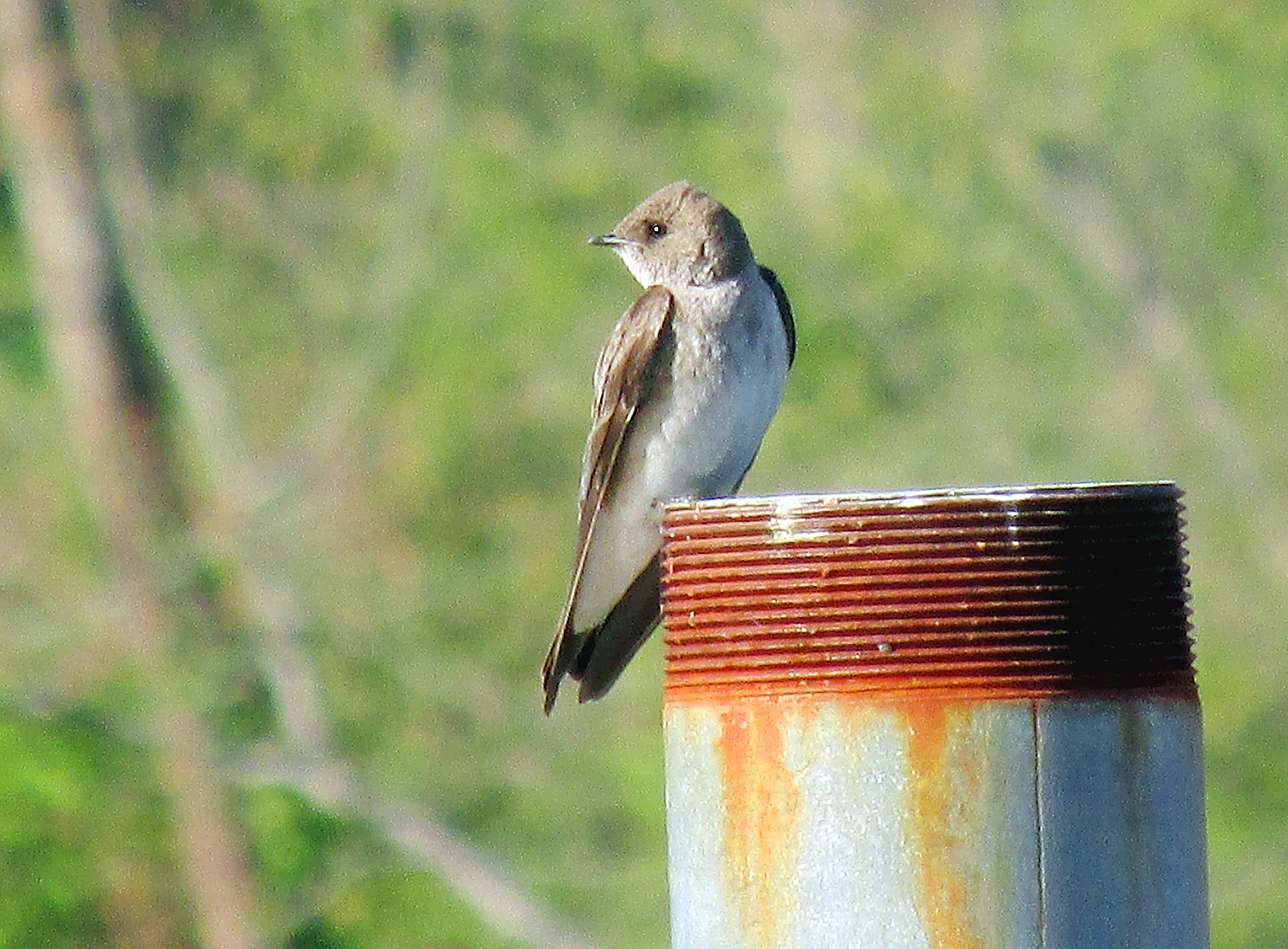
Photo by Bryan Stevens For such a small bird, the Northern rough-winged Swallow has a long name.
Northern rough-winged swallows are opportunists when it comes to nesting. According to a profile written by Mark Johns with North Carolina Wesleyan College, this small swallow nests near rocky gorges, shale banks, stony road cuts, railroad embankments, gravel pits, eroded margins of streams and other exposed banks of clay, sand or gravel. They will also nest in old kingfisher burrows, protruding drainpipes, crevices in brick or stone structures such as dams, bridges or tunnels, gutters and culverts. Their nests are often built near open water.
The Northern rough-winged swallow ranks as one of the species with the longest common names in North America. It’s name consists of 26 letters and a hyphen, which ranks it one letter below both the Northern beardless-tyrannulet and a recently-created species — the saltmarsh sharp-tailed sparrow — which each have 27 letters and a hyphen. Formerly known as sharp-tailed sparrow, the species was renamed with “salt marsh” added to distinguish it from a relative, Nelson’s sparrow.
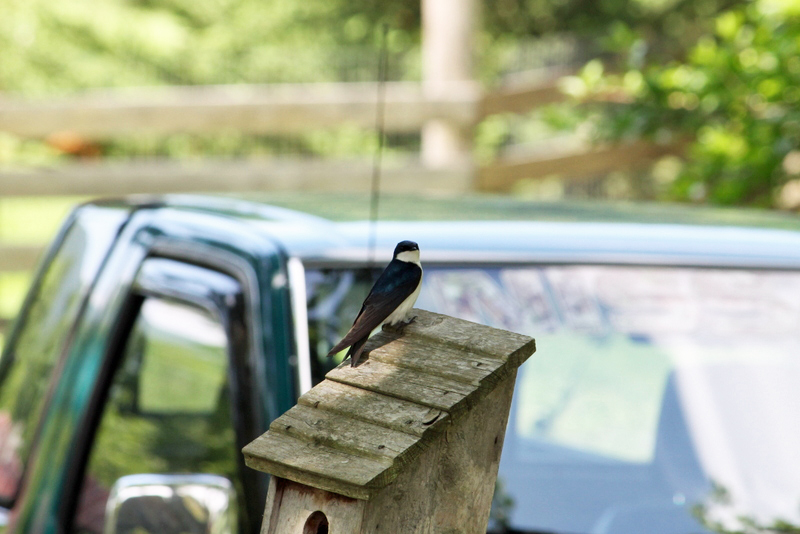
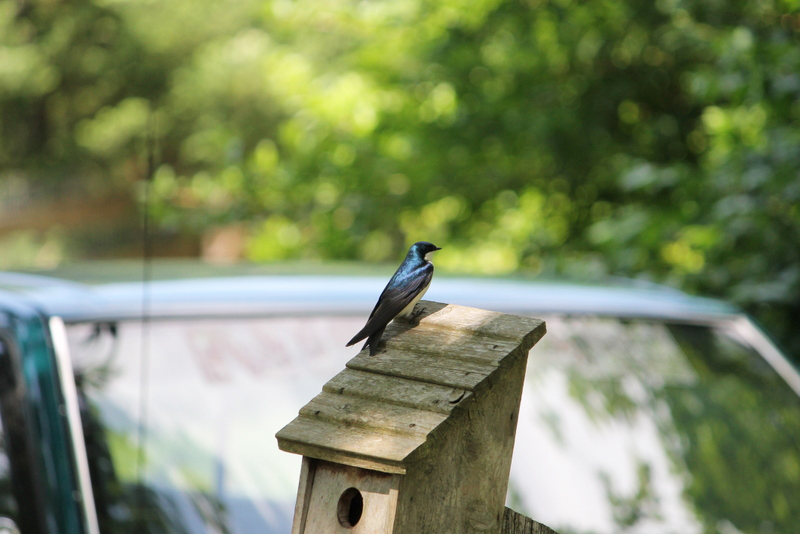
Photo courtesy of Mary Taylor Beierle A male Tree Swallow surveys his territory from atop a nesting box.
Purple martins, which rank as the largest species in the swallow family in North America, are famous for nesting in large colonies. Nesting facilities range from groupings of natural or artificial gourds fashioned into a nesting chamber, as well as large, multi-level condominium dwellings tailored for the specific needs of this communal bird. A colony can consist of several dozen to several hundred pairs of these birds. Only the adult male purple martin shows the iridescent, dark blue-purple plumage that provides the species with its name.
The tree swallow is my favorite, probably because a pair of these birds has nested in my yard for many years. Unlike other swallows, these cavity-nesting birds will readily accept nesting boxes. They compete with Eastern bluebirds for boxes, but the two species usually can work out a truce and settle down to nest in close proximity to each other. The iridescent blue-green male tree swallow, complete with white underparts and a forked tail, is a handsome bird and a welcome addition to the bird population in any yard or garden. Tree swallows enjoy water, so a nearby pond or creek is a boon for attracting these birds.
Photo courtesy of Mary Taylor Beierle Tree swallows readily accept human-provided nesting boxes. They also make delightful neighbors during the summer season.
While only a few swallows range into the United States and Canada, a total of 83 species of swallows can be found worldwide. Some of the common names for these different swallows (and martins) are quite descriptive. A sampling includes white-eyed river martin, square-tailed saw-wing, white-headed saw-wing, grey-rumped swallow, white-backed swallow, banded martin, violet-green swallow, golden swallow, brown-chested martin, brown-bellied swallow, pale-footed swallow, white-bibbed swallow, pearl-breasted swallow, greater striped swallow, mosque swallow, fairy martin and chestnut-collared swallow.
••••••
Several of the photos this week were provided by Mary Taylor Beierle, a resident of Stoney Creek in Carter County. Mary is also the author of the book, “Edmond The Daddy Turkey,” a delightful story about a male turkey who learns how to be a father.
Mary emailed me the photos with a brief note about her visiting swallows. “I am thrilled to have them here as we had never seen them before,” she said. “Good thing I have several bird books so I could identify them.”
Experts in ornithology are always changing the common and scientific names of many of our favorite birds. That’s why since I began birding I have had to adjust myself to accept the Eastern Towhee for the bird I first learned as a Rufous-sided Towhee – still a much more accurate and interesting name – and Blue-headed Vireo in place of Solitary Vireo. Blue-headed is more descriptive of the appearance of this bird, but as someone who can be a bit of a loner, I also appreciated the “solitary” moniker.
Name changes, however, rarely inspire the controversy that one did more than a decade ago when a duck formerly known as “Oldsquaw” had its name changed to “Long-tailed Duck.” In 2000, the American Ornithologists’ Union Committee on Classification and Nomenclature was petitioned to make the name change. Biologists with the U.S. Fish and Wildlife Service in Alaska requested that the English name, or common name, of Clangula hyemalis be changed from Oldsquaw to Long-tailed Duck, the name that had long been used for the species outside of North America. The biologists noted that the species was declining in numbers in Alaska and that their conservation management plans required the help and cooperation of Native Americans. The biologists expressed concerns that the name Oldsquaw would offend the Native Americans they were trying to recruit to assist them with efforts to protect this particular duck.
Photo by Bryan Stevens Six Long-tailed Ducks photographed last month on Holston Lake.
It wasn’t the first request to change the name, but it was the one that convinced the members of the committee to approve the petition. The members did state a reluctance to consider political correctness alone as a reason for changing long-standing English names of birds. In essence, the committee was willing in this particular instance to adopt an alternative name already in use in much of the world.
How did this duck ever get saddled with the name “oldsquaw” in the first place? The name was apparently inspired by the rolling three-noted call made by (here’s irony for you) the male ducks. In flocks, drake Long-tailed Ducks are very sociable and excitable. They like to “talk” with each other. Somewhere, back in the early days of ornithology in North America, someone apparently felt these vocal ducks reminded them of “old squaws” engaged in gossip. When I think about it, I can see why the name did have some heavy baggage regarding racism and sexism.
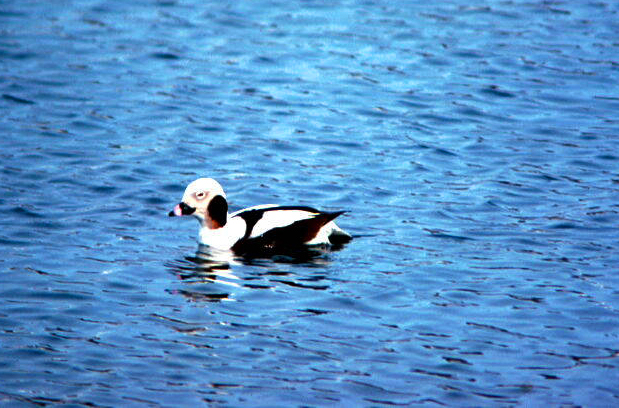
Photo by U.S. Fish & Wildlife Service The Long-tailed Duck, pictured here, was once known as the “Oldsquaw.”
Long-tailed Ducks range the far northern regions of North America, Europe and Asia. In North America, these ducks breed in the high Arctic regions of Alaska and Canada. They winter in the Great Lakes and along both coasts as far south as northern California and the Carolinas. It was the fact that the severe cold this winter has frozen solid the Great Lakes that pushed Long-tailed Ducks south in almost unprecedented numbers. I am thankful for this unanticipated consequence of the severe cold snaps in January and February. After all, it allowed me to finally get an excellent look at Long-tailed Ducks 14 years after I first added this species to my life list.
I have a few birds checked on my life list that I have technically observed in the field without enjoying particularly satisfying observations of the birds. Often, such unsatisfactory observations stem from either a fleeting glimpse of a bird or a look at one from a great distance. For instance, I observed Buff-breasted Sandpipers only one time several years ago during a visit to Rankin Bottoms at Douglas Lake. My look at the distant sandpipers through a spotting scope gave me only a blurry image of the birds on mud flats shimmering with waves of August heat. That observation didn’t exactly burn itself with great clarity into my memories. That happens, although thankfully not too often. I usually just patiently await a second sighting of these listed birds and hope that the next encounter will offer a more memorable experience.
That’s what happened a couple of weeks ago when I took my mother, Peggy, to Holston Lake. We visited a boat launch on Highway 421 to scan for some visiting Long-tailed Ducks. My first sighting of Long-tailed Ducks dates back to 2000, when I compiled an admirable list of 220 species of birds in a single year in Northeast Tennessee. I saw several Long-tailed Ducks from the overlook at Boone Dam while birding with the late Howard Langridge. Even peering at the birds through Howard’s powerful Questar spotting scope, it was difficult for me to detect anything significant about the birds. They were little white and black dots bobbing up and down on the choppy waters of the lake. A cold, howling wind and snow flurries also made conditions less than perfect for observing anything at a distance. If my memory can be trusted, those Long-tailed Ducks were one of the last birds we found in 2000. I think we saw them in late November of that year.
Photo by U.S. Fish & Wildlife Service A female Long-tailed Duck is shown on her nest on the Alaskan tundra.
Since that time, I have followed up on the occasional report of a Long-tailed Duck. These rare visitors pop up at some dependable locations, such as Middlebrook Lake in Bristol and Musick’s Campground on South Holston Lake. By the time I have received posts about such sightings, the duck has inevitably flown the coop by the time of my arrival.
The six Long-tailed Ducks at Holston Lake, however, didn’t conform to the usual pattern of a quick visit by a single duck. In fact, they lingered for several days before I even motivated myself to make the long drive from Hampton to Holston Lake to look for them. When my mom and I arrived at the boat launch, we were astounded by the sheer number of Ring-billed Gulls present. There were hundreds of these medium-sized gulls flying over the lake and floating on the water. In addition, we also quickly detected several dozen Buffleheads as we scanned for Long-tailed Ducks. After about 20 minutes of finding only gulls and Buffleheads, I began to feel my luck hadn’t changed at all when it came to Long-tailed Ducks. I began taking photos of some of the cooperative Ring-billed Gulls. Once I had some snapshots of the rollicking gulls, I scanned the lake one more time with my binoculars. While looking in an area I had already scanned, I spotted six ducks that didn’t look at all like Buffleheads. When I got a good look, I realized I had found my target birds. I rushed back to my car and removed my spotting scope from the trunk. It took a few minutes to get the tripod steady. As soon as I focused the scope, I found myself enjoying a fantastic look at two adult male Long-tailed Ducks and four females or perhaps immature specimens.
These six Long-tailed Ducks were part of a massive and unusual movement of this species into Tennessee lakes and reservoirs this winter. Throughout February, it seemed that these ducks were popping up everywhere throughout the Volunteer State. Count yourself fortunate any time you spot a Long-tailed Duck. Of all the diving ducks in North America, it spends more of its time diving beneath the surface of the water than any of its relatives. Experts have determined that this duck spends at least two-thirds of its time diving for food. So, perhaps all those fruitless searches can be explained quite simply. I arrived when the ducks were hungry and not present above the surface!
Early North American naturalist John James Audubon painted the Long-tailed Duck in various life stages, including ducklings.
I read one account about this duck that suggests the term “Long-tailed Duck” is sexist on the account that only the males possess the namesake long tail feathers that provide the inspiration for the common name. I don’t completely buy that argument. Many birds with descriptive names only describe the male bird. Think of the Black-throated Blue Warbler or the Scarlet Tanager, to name a couple. Anyone seeing female Black-throated Blue Warblers or Scarlet Tanagers would have a difficult time trying to match the bird’s name with what they are seeing. A drab brownish warbler and a greenish tanager don’t look at all like their male counterparts.
•••••
I spoke by phone this past week with Linda Powell, who lives on nearby Tiger Creek Road between Hampton and Roan Mountain. Linda called me to inform me that her neighbor found an unusual bird after it flew into a fence and was killed. She believed the bird might have been a duck, but she had never seen anything like it. As she described the bird to me, including its black coloration and large, green feet, I began to suspect that the unfortunate bird was probably an American Coot. She also noted that the bird’s bill was light in coloration, which was another indication of a coot. The habitat also seemed favorable for a migrating coot. Although there isn’t a pond in the pasture where the bird was found, there is a wet, marshy area that would probably have been sufficient to attract this bird. The coot was killed after it ran into a section of barbed wire fence. Unfortunately, it probably didn’t see the barbed wire until it was too late.
•••••
I made some first spring sightings of a couple of birds this past week. Three European Starlings made an appearance with a flock of American Robins on March 4. A few starlings are usually present from spring to early fall. At least they are never common and don’t extend their visit into the winter season. On March 3, when a light snow covered the ground at my home on Simerly Creek Road in Hampton, a female Red-winged Blackbird fed on the ground under my feeders. She was the first of her species to make an appearance this spring and is right on schedule.
•••••
Elizabethton resident Rita F. Schuettler also spotted her first Red-winged Blackbird of spring coming to the feeders at 3:50 p.m. on Saturday, March 8. “I heard one last Saturday while working outside,” she added in her Facebook post announcing the sighting. “I heard this one also as I was reloading the feeders. After I was back in the house, he came in! Good to see him!”
•••••
I would love to hear from readers. Just post comments on my new blog at ourfinefeatheredfriends.wordpress.com. You can also reach me on Facebook or send email to ahoodedwarbler@aol.com. Please share the link to the blog with others who might be interested in the topic of birds and birding in Northeast Tennessee.





 Our Fine Feathered Friends