

Photo by Hans Toom/Pxabay A black-and-white warbler would be almost impossible to confuse with any other bird.
I’m thinking that most people have probably heard of a “gaggle” of geese or a “murder” of crows as a way to describe a flock of these particular birds. Warblers also have their collective names. A flock of warblers is often referred to as a bouquet, a confusion, a fall, a cord or a wrench of warblers, according to the Birdorable Blog.
I personally like “wrench” of warblers. It has alliteration and describes how these amazing little songbirds can definitely “wrench” one’s attention from other matters. That’s been happening a lot at home. Since arriving in early April, the resident warblers have added their songs to the soundscape that makes the woodlands surrounding my home come alive every morning.
I wrote last week about the sad incident of a male Northern parula killed after an impact with a window. I wondered if I’d have to go the spring and summer season without hearing the excitable little trill of syllables that comprises this warbler’s song. I’m happy to report that less than a week passed before another male Northern parula showed up and began adding his song to the daily chorus. The circle of life continues.
On Saturday, May 3, I got to branch out from the handful of warbler species in residence around my home to warblers in other locations. I birded with Chris Soto, a Johnson City resident and fellow member of the Elizabethton Bird Club, on Holston Mountain and Sycamore Shoals State Historic Park as part of the annual Spring Bird Count conducted by the EBC. Despite some rain while conducting our survey of Holston Mountain, we encountered a variety of warbler species.
We didn’t observe any large warbler flocks, or wrenches, but we did find numerous species, including ovenbird, worm-eating warbler, Louisiana waterthrush, black-and-white warbler, Swainson’s warbler, hooded warbler, American redstart, Cape May warbler, Northern parula, yellow warbler, chestnut-sided warbler, black-throated blue warbler, yellow-throated warbler, black-throated green warbler and Canada warbler.
We added most of these species to the list by hearing them singing their springtime songs, including the “squeaky wheel” of the black-and-white warbler and the loud, ringing notes of the Louisiana waterthrush. If the latter wants to be heard, it is essential that it produce a loud song. The waterthrush resides near rushing mountain streams, which could easily overpower songs projected at a lower volume.
The black-and-white warbler is arguably the most aptly named of all the warblers. Both males and females have glossy black and white plumage. That’s it – there are no other colors present in the bird’s feathers.

Photo by Bryan Stevens • A black-and-white warbler creeps over the bark of a pine in search of insect prey.
The black-and-white warbler breeds in northern and eastern North America. It ranges from the Northwest Territories to the northwest and Newfoundland and Labrador to the northeast, to North Carolina to the southeast and Texas to the southwest. This species is migratory, wintering in Florida, Central America, the West Indies and northern South America down to Peru.
Once arriving for the spring, these warbler go about the business of nesting. The female black-and-white warbler selects a well-hidden nesting location at the base of a tree, rock, stump or fallen log, or under a bush or shrub, according to the website All About Birds. I discovered a black-and-white warbler nest, quite by accident, several years ago. The nest was wedged in a crevice beneath a large fallen pine resting on a steep ridge. Besides being rather inaccessible, I had no wish to disturb the nest so I enjoyed watching the birds through binoculars from a distance.

Photo by Hans Toom/Pxabay • A male black-and-white warbler sings its squeaky wheel song.
In its tendency to hug the trunk of trees as it seeks out insect prey, the black-and-white warbler is similar to unreleased species such as brown creeper and white-breasted nuthatch. In fact, an old common name for this bird was black-and-white creeper. It does venture farther out into a tree than the trunk, however, and will flit among branches as good as any other warbler.
For beginners just getting into the hang of birding, the black-and-white warbler is a dream when it comes to identification. It’s unlikely to be mistaken for any other bird. One good look through binoculars is usually all it takes to recognise the species. There’s no poring over the pages of a field guide for subtle field marks to help when trying to identify the black-and-white warbler. The same is true for the bird’s song, which is very similar in pattern to a squeaky wheel spinning round and round.
Enjoy the springtime and get outdoors and see what feathered friends are winging their way into your neighborhood.
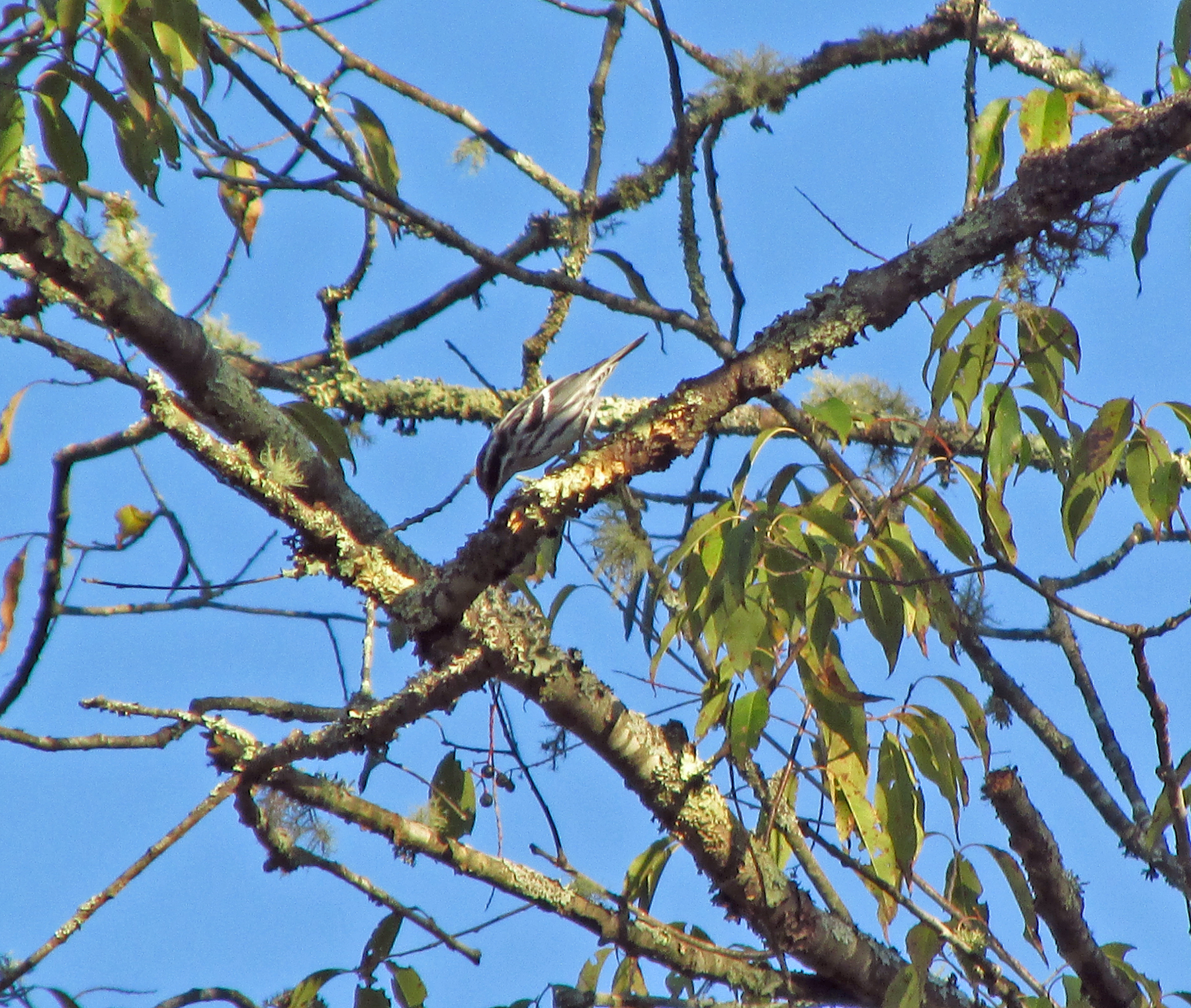
Photo by Bryan Stevens
A Black-and-white Warbler forages along a branch.
 Our Fine Feathered Friends
Thank you for introducing me to the black-and-white warblers! I listened on all about birds to its song and my Yorkie’s ears perked up too!! A new sound for her. I looked further into the black-and-white warblers to see if I might see them here. I found that although black-and-white warblers are not common in Corpus Christi, TX, they are not absent either. I will keep my eyes open for them in my yard! This spring we have had an assortment of unusual migrating birds to watch. It’s fun. 🤩
I love your photo on the tree with its display of contrasting color and texture. Very nice!
LikeLike