Tag Archives: facebook

Late summer offers interesting birding opportunities for birders

Photo by Steven Arnold/Pixabay • A great blue heron attempts to get a handle on a snake in preparation for swallowing its serpentine prey.

A pair of Carolina wrens has taken advantage of what was meant to be the temporary storage of some boxes on the front porch to claim the interior of one of the cardboard containers as a nesting location.

In the latter days of summer, usually a lackluster period for birdwatching, there are still some interesting behaviors or actions on the part of our feathered friends to provide some points of interest.

Wrens already have a reputation for nesting in some unusual locations. My introduction to the Carolina wren took place in my childhood when a pair of these wrens nested in an old apron my grandmother used as a bag for her clothespins. Other unusual locations for wren nests that I have found over the years included the interior of a plastic shopping bag hanging from a nail in my garage and an attempt to nest in the exhaust vent for my clothes dryer. I’ve also seen them nest in hanging flower baskets.

Photo by Jean Potter • A Carolina wren creeps along a fence.

The world’s 88 species of wrens are, for the most part, the quintessential “little brown birds,” but that hasn’t kept them from acquiring some interesting and descriptive common names. Some examples include the tooth-billed wren, flutist wren, riverside wren, whiskered wren, happy wren, musician wren, timberline wren, speckle-breasted wren, white-breasted wood wren and giant wren. The last species on the list resides in Mexico and is indeed a “giant” among a family of tiny birds, reaching a length of almost nine inches and weighing all of 1.8 ounces.

I’ve also been monitoring a great blue heron lurking along the creek that flows past my home. A collapsed foot bridge (thanks to Helene) still spans the creek and provided, at least from the heron’s perspective, a means of concealment from my prying eyes when I stepped onto the front porch. The heron ducked under the bridge and slowly stepped downstream, out of sight and presumably what the bird thought would be out of mind. But I tricked the heron, stepping back inside the house and waiting for It to reappear. I stepped into view again and the heron, instead of taking flight, repeated its earlier actions, skirting beneath the bridge and wading downstream. I could probably have continued this game of peek-a-boo, but I felt that I had imposed on the heron long enough. The bird evidently desired to try its luck fishing upstream beneath a shady overhang of branches from trees growing along the creek banks. I stepped back inside, peeked out a window and watched the heron move in a slow, stately manner, but this time the bird headed up the creek.

All herons are skillful anglers, so I am confident that the bird probably managed to catch an unwary frog or fish. As the tallest heron in North America, the great blue heron boasts a diverse diet. These birds, armed with a dagger-shaped bill, excellent vision and quick reflexed, prey on rodents, amphibians, snakes, fish and even small alligators. Basically, a great blue heron will eat anything it can swallow.

Photo by Bryan Stevens • A great blue heron’s quick reflexed and dagger-like bill make it a formidable predator.

Other herons around the world with descriptive names include purple heron, white-bellied heron, black-headed heron, great-billed heron, whistling heron, pied heron and Goliath heron. The latter, as its name suggests, is a giant among herons.

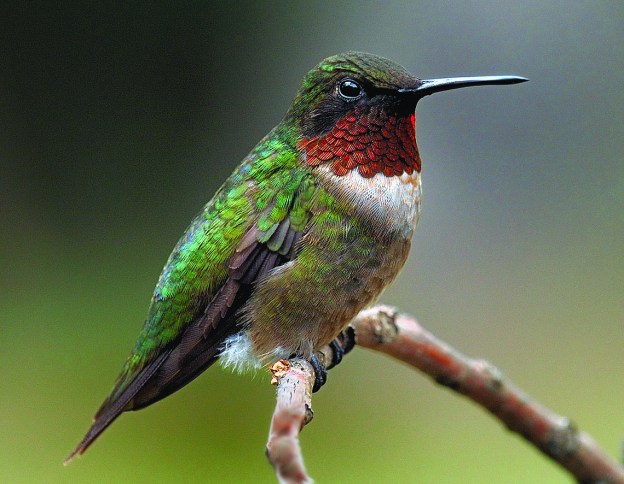
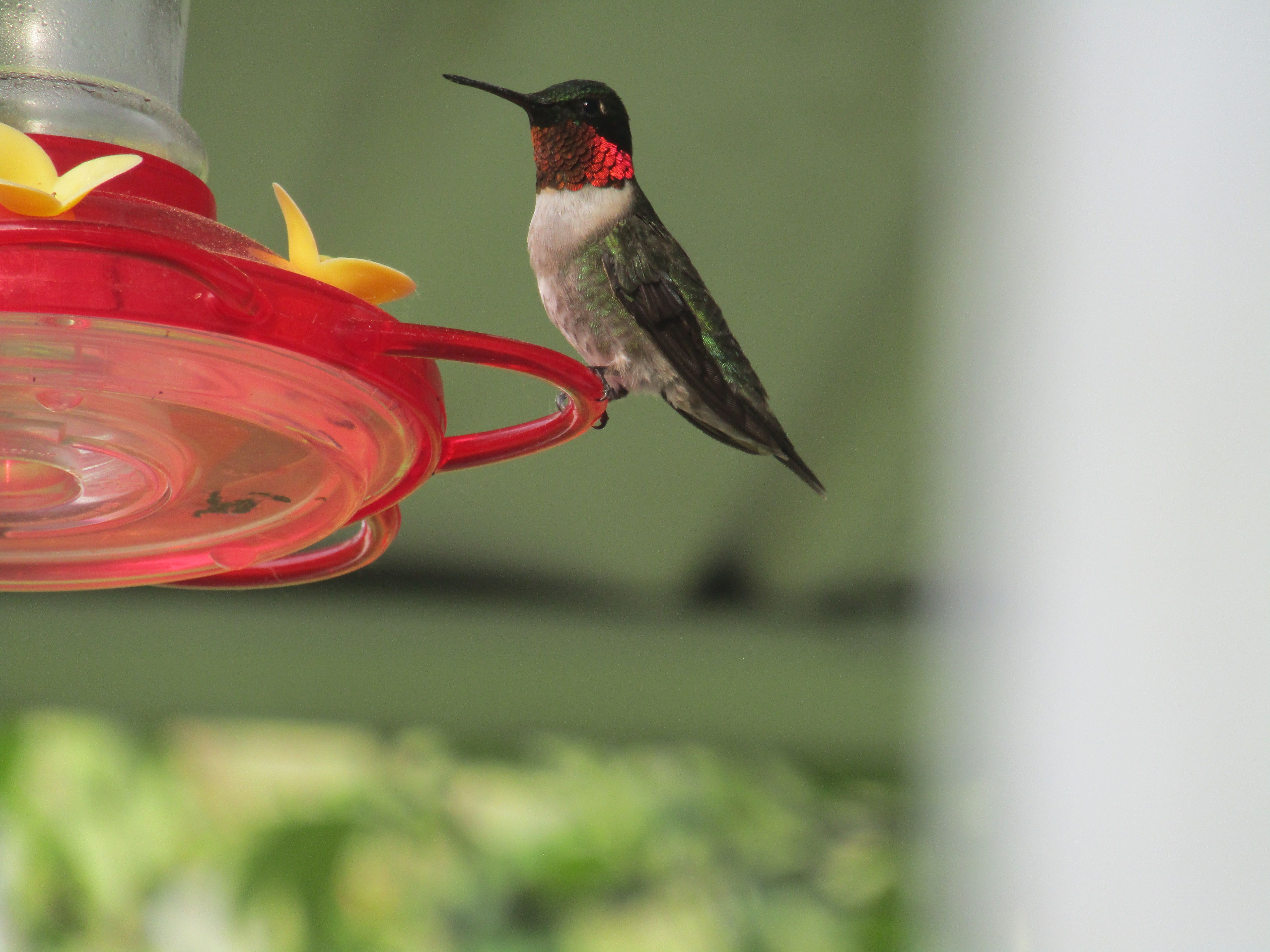
There’s more to report on the birding front. Hummingbird numbers are on the rise again. After the usual summer lull, the resident ruby-throated hummingbirds have raised their profile, visiting daily at feeders as well as blooming flowers. Female hummingbirds have had time to raise their young. In fact, many of the hummingbirds visiting your yards and gardens at this time of year are probably birds born earlier in the season. In a couple of months these young birds will make their inaugural migration across the Gulf of Mexico to reach winter grounds in Central America. Until that time, hang a sugar water feeder, grab a lawn chain and enjoy the hours of no-cost entertainment provided by these feisty, flying gems.

So, although the summer doldrums do make birds scarce at times, just know that they’re still out there. In the meantime, nature offers plenty of other engaing wildlife. During the day, it’s fun to look for butterflies and dragonflies. After dark, there’s always moths and lightning bugs.

Keep in mind, it’s not always the visuals. For instance, the past couple of nights I’ve enjoyed listening to an Eastern screech-owl’s nocturnal serenade with its trembling wailing call that gives this small owl its name.

•••

Bryan Stevens has been writing about birds and birding since 1995. Email him at ahoodedwarbler@aol.com to share a sighting, make a comment or ask a question.

Photo by Bryan Stevens • A ruby-throated hummingbird visits a feeder for a sip of sugar water.


Carter County Summer Bird Count tallies 117 species

Hans Toom/Pixabay • A couple of Canada warbler got tallied with this year’s Carter County Summer Bird Count.

The Lee and Lois Herndon Chapter of Tennessee Ornithological Society, also known as the Elizabethton Bird Club, held its 32nd annual Carter County Summer Bird Count on Saturday, June 7 with 20 observers in nine parties.

Participants tallied 117 species, which is slightly above the average of 114 species.

Most unusual was a Mississippi kite seen for the first time on one of the chapter’s summer bird count. The kite was seen in the Toll Branch vicinity, according to the count’s longtime compiler Rick Knight. He also indicated that other notable finds included common merganser and red crossbill. In addition, counter found 18 species of warblers.

The list:

Canada goose, 90; wood duck, 8; mallard, 56; and common merganser, 2.

Wild turkey, 13; rock Pigeon, 36; Eurasian collared-dove, 3; mourning dove, 142; yellow-billed cuckoo, 5; chuck-will’s-widow, 4; Eastern whip-poor-will, 8; chimney swift, 55; and ruby-throated hummingbird, 20.

Killdeer, 8; double-crested cormorant, 5; green heron, 2; great blue heron, 10; black vulture, 14; and turkey vulture, 46.

Osprey, 3; sharp-shinned hawk, 1; Cooper’s hawk, 3.

Bald eagle, 2; Mississippi kite, 1; red-shouldered hawk, 4; broad-winged hawk, 5; red-tailed hawk, 14; Eastern screech owl, 3; great horned owl, 1; and barred owl, 1.

Belted kingfisher, 9; red-bellied woodpecker, 18; downy woodpecker, 10; hairy woodpecker, 1; Northern flicker, 24; and pileated woodpecker, 16.

Simard Francois/Pixabay • A great crested flycatcher perches on a horizontal branch.

American kestrel, 2; great crested flycatcher, 8; Eastern kingbird, 16; Eastern wood-pewee, 26; Acadian flycatcher, 23; alder flycatcher, 1; least flycatcher, 9; and Eastern phoebe, 46.

White-eyed vireo, 11; yellow-throated vireo, 1; blue-headed vireo, 20; warbling vireo, 4; red-eyed vireo, 130; blue jay, 104; American crow, 180; fish crow, 4; and common raven, 2.

Carolina chickadee, 57; tufted titmouse, 78; tree swallow, 101; Northern rough-winged swallow, 58; purple martin, 23; barn swallow, 106; and cliff swallow, 127.

Golden-crowned kinglet, 2; cedar waxwing, 69; red-breasted nuthatch, 3; white-breasted nuthatch, 13; blue-gray gnatcatcher, 13; Carolina wren, 78; house wren, 23; and winter wren, 1.

Gray catbird, 34; brown thrasher, 31; Northern mockingbird, 83; European starling, 660; Eastern bluebird, 102; veery, 10; hermit thrush, 1; wood thrush, 35; and American robin, 417.

House sparrow, 27; house finch, 84; red crossbill, 3; pine siskin, 5; American goldfinch, 117; chipping sparrow, 91; field sparrow, 26; dark-eyed junco, 34; song sparrow, 204; and Eastern towhee, 105.

Yellow-breasted chat, 4; Eastern meadowlark, 11; orrchard oriole, 8; Baltimore oriole, 6; red-winged blackbird, 88; brown-headed cowbird, 43; and common grackle, 109.

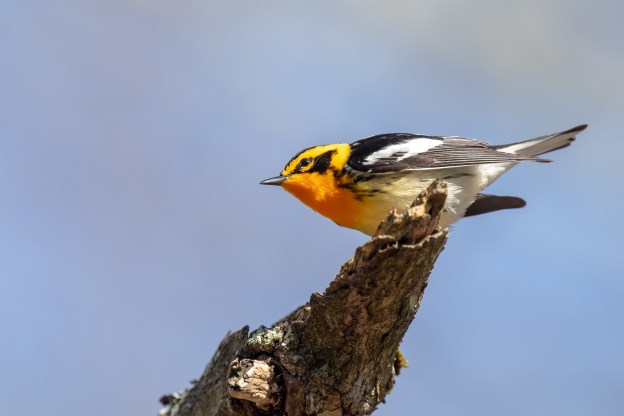
Ovenbird, 65; worm-eating warbler, 5; Louisiana waterthrush, 15; golden-winged warbler, 3; black-and-white warbler, 34; Swainson’s warbler, 9; common yellowthroat, 19; hooded warbler, 104; American redstart, 24; Northern parula, 65; Blackburnian warbler, 6; Yellow warbler, 9; chestnut-sided warbler, 31; black-throated blue warbler, 33; pine warbler, 3; yellow-throated warbler, 20; black-throated green warbler, 27; and Canada warbler, 2.

Scarlet tanager, 34; Northern cardinal, 160; rose-breasted grosbeak, 7; blue grosbeak, 6; and indigo bunting, 154.

Knight noted that it seems like a few species are often missed on a one-day count. He explained that these misses are usually low-density or localized species. Weather or other circumstances may contribute to these misses, as well.

Several species of herons were found for this year’s Summer  Bird Count, but yell0w crowned night-heron was missed. 

Missed species this year included ruffed grouse, common nighthawk, America woodcock, yellow-crowned night-heron, yellow-bellied sapsucker, brown creeper, Kentucky warbler and magnolia warbler.

The chapter will resume meeting in September for its 2025-2026 calendar year. Meetings are usually held the first Tuesday of each month on the Elizabethton campus of Northeast State Community College. Meetings are accompanied by a program on birds, birding and other nature-related topics and begin at 7 p.m. For details, or to share a sighting, ask a question or make a comment, email me at ahoodedwarbler@aol.com.

•••

Bryan Stevens has written about birds and birding since 1995. His weekly “Feathered Friends” column will celebrate its 30th anniversary this year.

Cedar waxwings provide entertainment as they feast on mulberries

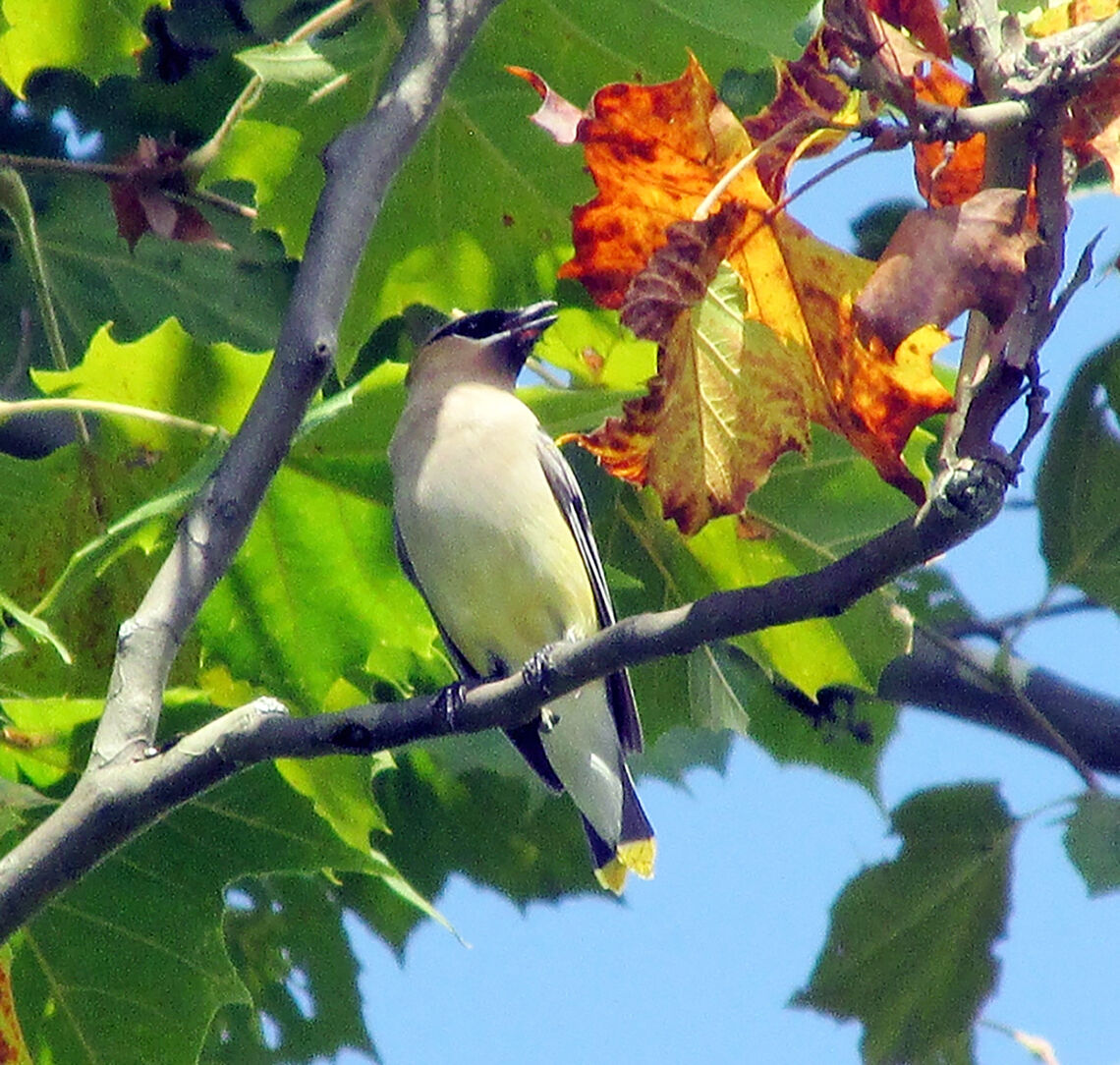
Photo by Jack Bulmer/Pixabay • A cedar waxwings strikes a stately pose on a branch.

Spring turned out to be a rainy season in Northeast Tennessee. As we move into the official summer season as of Friday, June 20, summer’s also looking like it might be wetter than usual.

Rainfall hasn’t stopped the rhythms of the seasons. For instance, two mulberry trees at home have produced a bonanza of ripening berries for our fruit-loving feathered friends.

So far, the main beneficiaries of all this bounty has been the local cedar waxwings. These sleek and distinctive birds have a brown and gray silky plumage, a black mask and a perky crest. Some of the wing feathers show red tips. The similarity of these wing tips to melted drops of wax gives these birds the common name of waxwing.

There’s no absolute explanation of the purpose for these waxy tips. Experts have theorized that the colorful wingtips might help attract mates.

Other birds have competed for access to the berries, including American robins, gray catbirds and at least one scarlet tanager.

Cedar waxwings love their fruit. They’re not quite a frugivore, which is a scientific term for animals that depend mostly on raw fruits for sustenance. The website All About Bird recommends planting native trees and shrubs that bear small fruits, including such species as mulberry, dogwood, serviceberry, cedar, juniper, hawthorn and winterberry, to attract cedar waxwings.

Photo by Bryan Stevens • A cedar waxwing perches in the upper branches of a tree.

The cedar waxwing has few relatives. Worldwide, there are only two other species: the Bohemian waxwing, of the northern forests of Eurasia and North America; and the Japanese waxwing, found in such northeast Asian countries as Japan, Korea and China.

Although it’s classified as a songbird, the cedar waxwing does’t truly produce a vocalization that anyone would contend qualifies as a song. They are, however, very vocal birds, producing shrill, high-pitched notes as they pass through the upper branches of tall trees.

Early American naturalist and artist John James Audubon painted this pair of cedar waxwings.

As much as the waxwing has a fondness for fruit, it’s also a bird that would have made an excellent flycatcher. Flocks of these birds will often congregate in trees near the edge of a pond, garden or yard — anywhere winged insects might be found in good numbers — in order to hawk insects on the wing. A waxwing will sally forth from a branch, snatch its prey in mid-air, and return to its perch for a quick snack. Dragonflies often feed on mayflies and dragonflies but they will also forage on a wide array of other winged insects.

Waxwings are rather nomadic, coming and going with a maddening unpredictability. They often follow the available sources of food, whether that’s the multitude of flying insects attracted by pond and rivers or a particularly bountiful crop of fruit.

They can form large flocks. I once observed a flock that probably consisted of 100 individuals as they stripped berries in early winter from a holly tree. Adding some comic relief to the scene were two Northern mockingbirds making a futile attempt to disperse the waxwings and thus claim all the berries for themselves. The mockingbirds would chase off a dozen or so birds only for twice that number to descend on the vacated spot in the tree’s branches. It was a losing battle, but I am confident that once they settled down, the mockingbirds managed to enjoy the supply of berries alongside the overwhelming numbers of waxwings.

I’ve enjoyed the friendly flock of waxwings as they’ve feasted on mulberries. The only drawback has been that I am usually observing their antics in late evening when the sun is behind these birds. Fortunately, even a waxwing’s sleek silhouette is still a sight to behold and enjoy.

•••

To share a sighting, ask a question or make a comment, send me an email to ahoodedwarbler@aol.com.

Photo by Bryan Stevens • A pair of cedar waxwings hawk for insects near a pond.

Black-and-white warbler won’t be confused with other birds

Photo by Hans Toom/Pxabay A black-and-white warbler would be almost impossible to confuse with any other bird.

I’m thinking that most people have probably heard of a “gaggle” of geese or a “murder” of crows as a way to describe a flock of these particular birds. Warblers also have their collective names. A flock of warblers is often referred to as a bouquet, a confusion, a fall, a cord or a wrench of warblers, according to the Birdorable Blog.

I personally like “wrench” of warblers. It has alliteration and describes how these amazing little songbirds can definitely “wrench” one’s attention from other matters. That’s been happening a lot at home. Since arriving in early April, the resident warblers have added their songs to the soundscape that makes the woodlands surrounding my home come alive every morning.

I wrote last week about the sad incident of a male Northern parula killed after an impact with a window. I wondered if I’d have to go the spring and summer season without hearing the excitable little trill of syllables that comprises this warbler’s song. I’m happy to report that less than a week passed before another male Northern parula showed up and began adding his song to the daily chorus. The circle of life continues.

On Saturday, May 3, I got to branch out from the handful of warbler species in residence around my home to warblers in other locations. I birded with Chris Soto, a Johnson City resident and fellow member of the Elizabethton Bird Club, on Holston Mountain and Sycamore Shoals State Historic Park as part of the annual Spring Bird Count conducted by the EBC. Despite some rain while conducting our survey of Holston Mountain, we encountered a variety of warbler species.

We didn’t observe any large warbler flocks, or wrenches, but we did find numerous species, including ovenbird, worm-eating warbler, Louisiana waterthrush, black-and-white warbler, Swainson’s warbler, hooded warbler, American redstart, Cape May warbler, Northern parula, yellow warbler, chestnut-sided warbler, black-throated blue warbler, yellow-throated warbler, black-throated green warbler and Canada warbler.

We added most of these species to the list by hearing them singing their springtime songs, including the “squeaky wheel” of the black-and-white warbler and the loud, ringing notes of the Louisiana waterthrush. If the latter wants to be heard, it is essential that it produce a loud song. The waterthrush resides near rushing mountain streams, which could easily overpower songs projected at a lower volume.

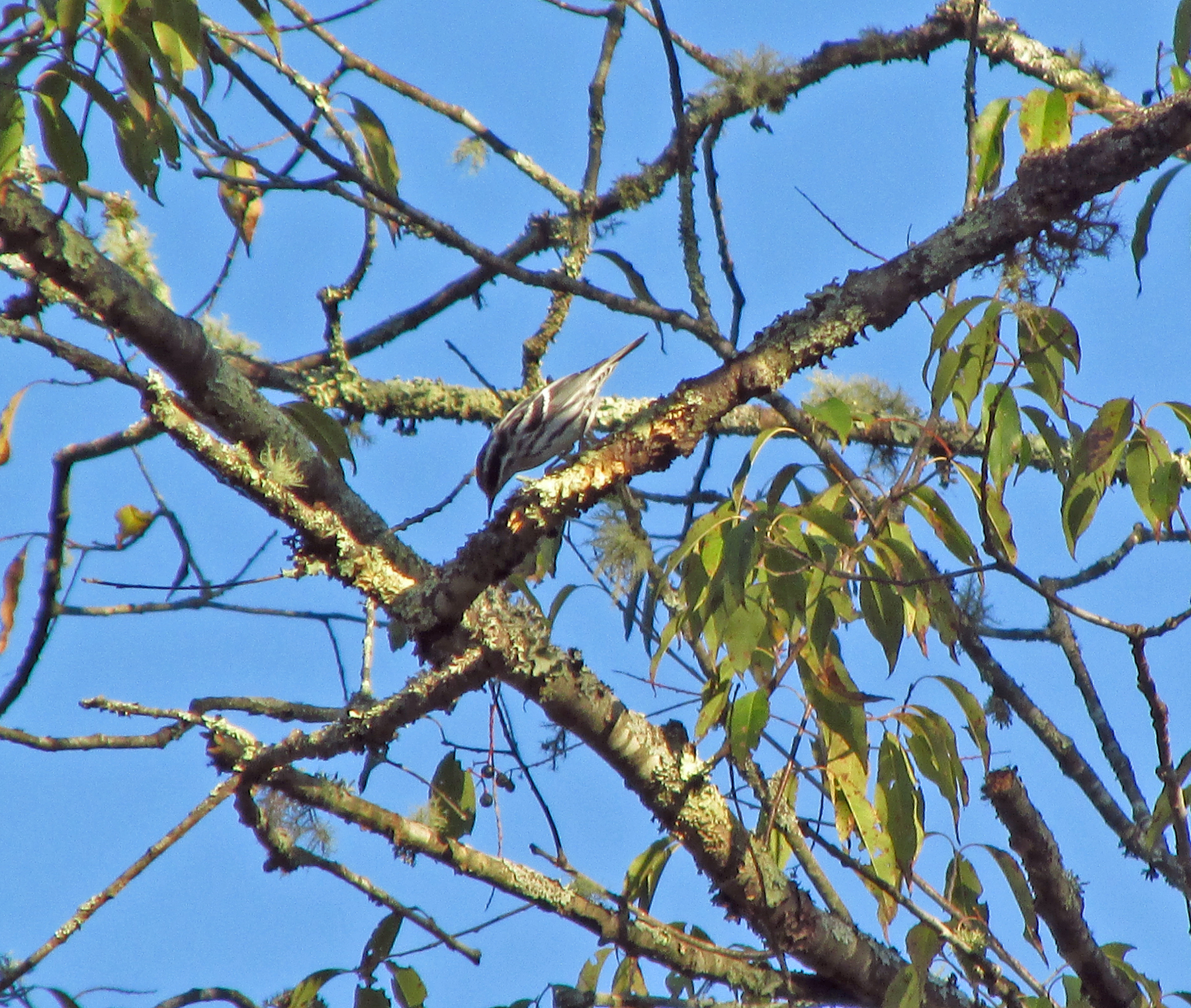
The black-and-white warbler is arguably the most aptly named of all the warblers. Both males and females have glossy black and white plumage. That’s it – there are no other colors present in the bird’s feathers.

Photo by Bryan Stevens • A black-and-white warbler creeps over the bark of a pine in search of insect prey.

The black-and-white warbler breeds in northern and eastern North America. It ranges from the Northwest Territories to the northwest and Newfoundland and Labrador to the northeast, to North Carolina to the southeast and Texas to the southwest. This species is migratory, wintering in Florida, Central America, the West Indies and northern South America down to Peru.

Once arriving for the spring, these warbler go about the business of nesting. The female black-and-white warbler selects a well-hidden nesting location at the base of a tree, rock, stump or fallen log, or under a bush or shrub, according to the website All About Birds. I discovered a black-and-white warbler nest, quite by accident, several years ago. The nest was wedged in a crevice beneath a large fallen pine resting on a steep ridge. Besides being rather inaccessible, I had no wish to disturb the nest so I enjoyed watching the birds through binoculars from a distance.

Photo by Hans Toom/Pxabay • A male black-and-white warbler sings its squeaky wheel song.

In its tendency to hug the trunk of trees as it seeks out insect prey, the black-and-white warbler is similar to unreleased species such as brown creeper and white-breasted nuthatch. In fact, an old common name for this bird was black-and-white creeper. It does venture farther out into a tree than the trunk, however, and will flit among branches as good as any other warbler.

For beginners just getting into the hang of birding, the black-and-white warbler is a dream when it comes to identification. It’s unlikely to be mistaken for any other bird. One good look through binoculars is usually all it takes to recognise the species. There’s no poring over the pages of a field guide for subtle field marks to help when trying to identify the black-and-white warbler. The same is true for the bird’s song, which is very similar in pattern to a squeaky wheel spinning round and round.

Enjoy the springtime and get outdoors and see what feathered friends are winging their way into your neighborhood.

Photo by Bryan Stevens
A Black-and-white Warbler forages along a branch.

Tiny songbird’s collision with window leaves gap in spring soundscape


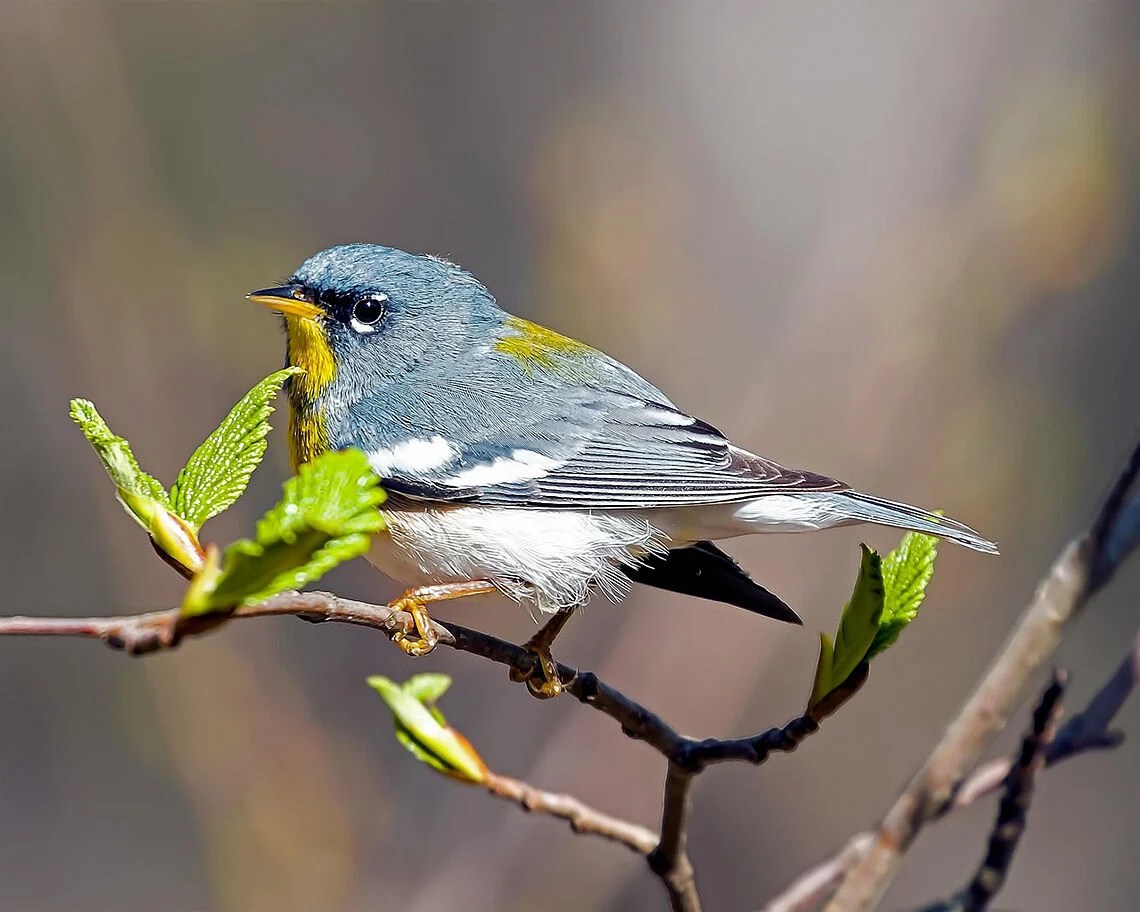
Hans Toom/Pixabay • Male Northern paroles are a member of the warbler family. They are amazing vocalists producing an easily recognised trill of a song.

The male Northern parula is a persistent songster once arriving on its nesting territory each spring.

Since arriving in early April, a male Northern parula had been a tireless singer. I often heard the bird as I departed for work each weekday morning and was welcomed home in early evening by the bird’s song.

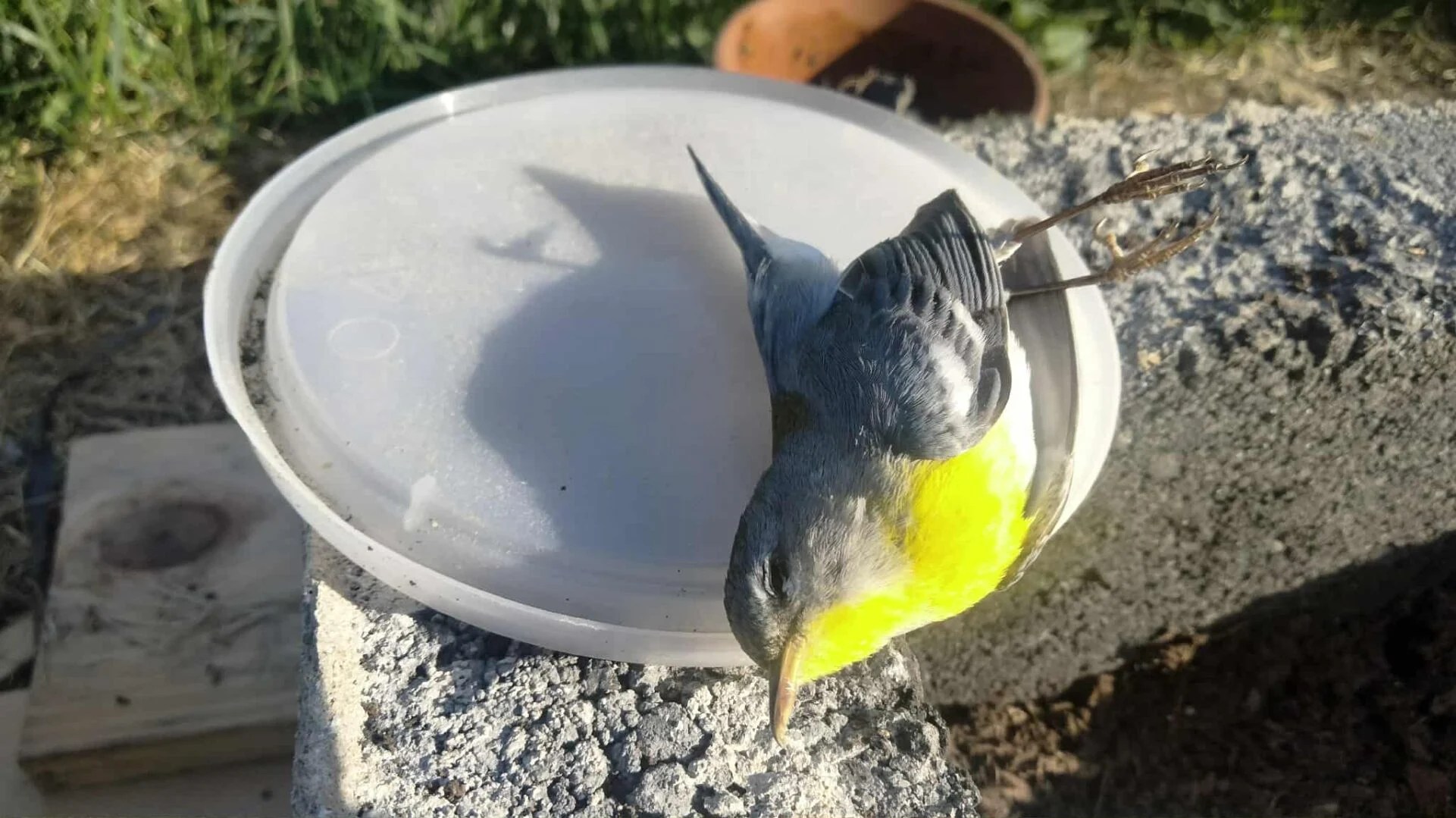
On April 29, I returned home. I followed my usual routine and dropped off my mother’s newspaper and mail at her home. Unfortunately, on her porch was the lifeless form of the Northern parula. I know it was “my” parula because the bird had been so faithful in its singing. I have not heard the song of a Northern parula in the days following the sad discovery.

Northern parulas sing two different types of songs, according to the website All About Birds. The most common is a rising buzzy trill with a final sharp note. This song rises up and pinches off sharply at the end. The second song has distinct pauses in between bouts of the rising buzzy trill. My parula had mostly sang the song best described as a rising buzzy trill, but it had also practiced at the second version, as well.

The tragic end for this little songster has really put a damper on my enjoyment of the spring season. Unlike many of our birds, this species of warbler has been thriving. Northern parulas are common, and their populations have actually increased by over 1% per year from 1966 to 2019 for a cumulative increase of about 47% according to the North American Breeding Bird Survey.

Bryan Stevens • This Northern parula died after a collision with a glass window.

But the incident is a reminder of the perils that our feathered friends face daily. An article titled “Getting Clear on Birds and Glass,” first published January 14, 2023, by Christine Sheppard and Bryan Lenz brings the detrimental impact glass has had on birds into focus.

The article noted that Smithsonian researches in 2014 attempted to determined how many birds are killed annually due to hitting windows. The study estimated, conservatively, that collisions with glass likely kill between 365 million and 1 billion birds annually in the United States. The authors of the article emphasized that they believe the number is closer to a billion birds, if not more, that die each year from hitting windows and other glass surfaces.

That’s a scary number, but also a testament to the resilience of birds. Of course, all living things have their limits, and we should try to do something to bring down this gruesome toll.

The little parula had struck a large picture window. We have placed decals in the window in an effort to break up the reflection, but the sun has bleached these over the years, and now it is evident they should be replaced. Clouds, sky or vegetation reflected in a window are perceived by birds as the real deal. A screen over a window or hanging strips or other items to break up the reflection will help birds avoid collision.

To examine a database with various possible solutions, please visit https://abcbirds.org/glass-collisions/products-database/

I am hopeful that another Northern parula will visit and find my yard to its liking. I’ve had Northern parulas residing consistently around my home from April to September for many years. The absence of this bird’s song from the daily soundscape has been distressing.

•••

Readers have continued to share their spring hummingbird sightings.

•••

Joe McGuiness in Erwin saw his first hummingbird back on April 9 at 5:45 p.m. Joe texted me that the bird came back to feed again around 7 p.m.

•••

Charlotte Carter, who resides in the Bloomingdale community in Kingsport, emailed me on Friday, April 25. “First hummingbird sighted at my home today at 12:45,” she wrote.

•••

Mack Hayes sent me a message on Facebook to report his first hummingbird arrived on Friday, April 25. “Saw first hummingbird this morning,” he wrote. He noted that he lives on the corner of Oakland Road and Bowmantown Road in Washington County.

•••

Hummingbirds are now back throughout the region. In the past couple of weeks the numbers have increased at my home. I have now seen as many as four hummingbirds at one time, and they duel all day long with each other, chasing each other from one corner of the yard to another. It’s good to have them back.

•••

Share sightings, ask questions or make comments by emailing me at ahoodedwarbler@aol.com.

Seasonal transitions raise profiles of flickers, other birds

NatureLady/Pixabay • Northern flickers belong to the woodpecker family. Relatives living in the region include the pileated woodpecker, yellow-bellied sapsucker and downy woodpecker. Unlike most woodpeckers, flickers spend an extensive amount of time foraging on the ground for various insects.

Robin Free, a resident of Scott County, Virginia, emailed me after reading a recent column about owls. She told me she was interested in attracting more owls to her property, which she noted boasts an abundance of ground squirrels and mice.

I congratulated her on the fact that with all those ground squirrels and mice her home should make for happy hunting grounds for any owls in the vicinity.

I suggested she could play a recording of a screech-owl call at dusk to see if she can get a real owl to respond. These small owls are very curious and will readily respond.

Photo by Bryan Stevens
An Eastern Screech-Owl at rest in a roosting hole in a large sycamore tree.

The owl that Robin and most os us are likely to attract is the Eastern screech-owls. Since screech-owls are cavity-nesters, people can offer a roosting/nesting box. Obviously, these boxes have to be a little larger than for songbirds. Simply do a Google search to find screech-owl boxes for purchase.

Here’s some info I found online about screech-owl boxes. Placement is crucial. Mount the box at least 10 feet high in a tree, on a pole or on the edge of woods, fields or wetlands. Keep it away from trees where squirrels can jump to it. Add a couple of inches of wood chips or saw dust for nesting material.


•••

In this transition from fall to winter, some birds have adopted higher profiles around my home. I hear and see ruby-crowned kinglets and white-throated sparrows almost every morning as I leave for work. I am also seeing and hearing Northern flickers.

Flickers are woodpeckers, but there are some differences between them and other members of this clan. While flickers can be found during all seasons in the region, this woodpecker is one of the migratory ones. I see the most Northern flickers during fall migration. This woodpecker is one of the few of its kind that usually migrates to warmer climates during the colder months, although the species is not completely absent from the region in the winter season.

This species also has many other common names, including yellow-hammer — a popular name in the Deep South — and harry-wicket, heigh-ho and gawker bird. The Northern flicker is also the only woodpecker to serve a state — Alabama — as an official bird. The flicker earned this distinction back in 1927. Alabama soldiers who fought for the Confederacy were nicknamed “yellowhammers” because of their grey-and-yellow uniforms, which matched the colors of the bird. Incidentally, Alabama was one of the first states to ever name an official state bird.

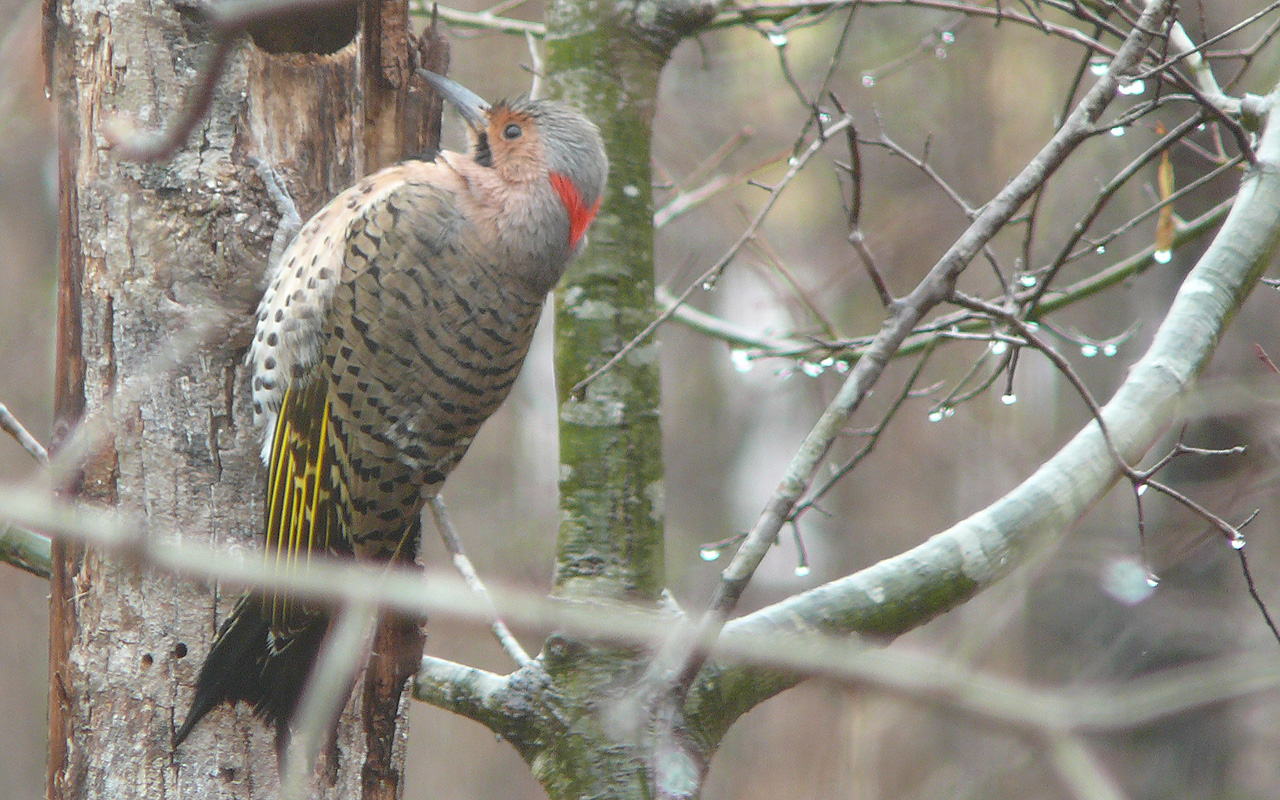
There are two races of Northern flicker — yellow-shafted and red-shafted — found in the United States. Eastern flickers show yellow feather shafts beneath the wings while western counterparts show red beneath the wings. A trip to Utah several years ago gave me a chance to also see the red-shafted race of this bird.

The Northern flicker is also not the only flicker in the United States. The gilded flicker inhabits many of the deserts — Sonoran, Yuma and Colorado — in the United States. Of course, trees are scarce in deserts, but that hasn’t proven an obstacle for this woodpecker. The bird is closely associated with saguaro cactus. Other desert dwellers depend on this woodpecker. Once the flickers are no longer making use of their nest and roost holes in the multi-armed cacti, other wildlife moved into the chambers.

The Northern flicker is an enthusiastic drummer, pounding loudly on the sides of trees with its stout bill. The purpose of the drumming is to communicate with mates and signal potential rivals that they’re intruding. Toward that objective, flickers sometimes substitute metal utility poles or the sides of buildings for the trunks of trees. In addition to drumming, the flicker also employs a variety of loud vocalizations that are fairly distinctive. A loud, repeated vocalization, often translated as “wicka-wicka-wicka,” is similar to the cluck-like call of the larger pileated woodpecker. The flicker is also known for emitting a sharp, loud “kleeer” call that can be heard from a considerable distance. It’s that call that I’ve been hearing most mornings in the woodlands around my home.

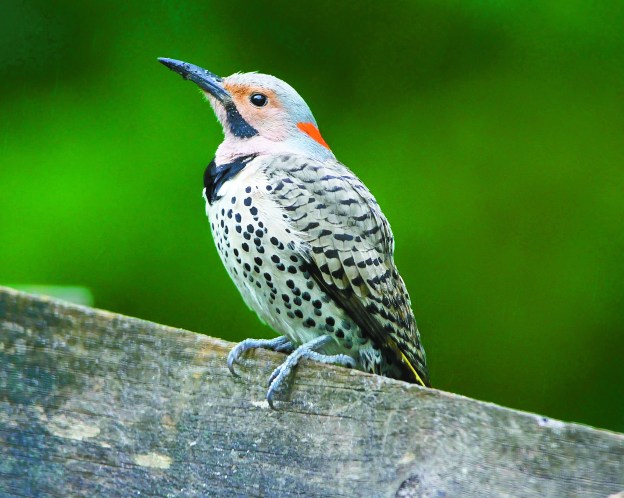
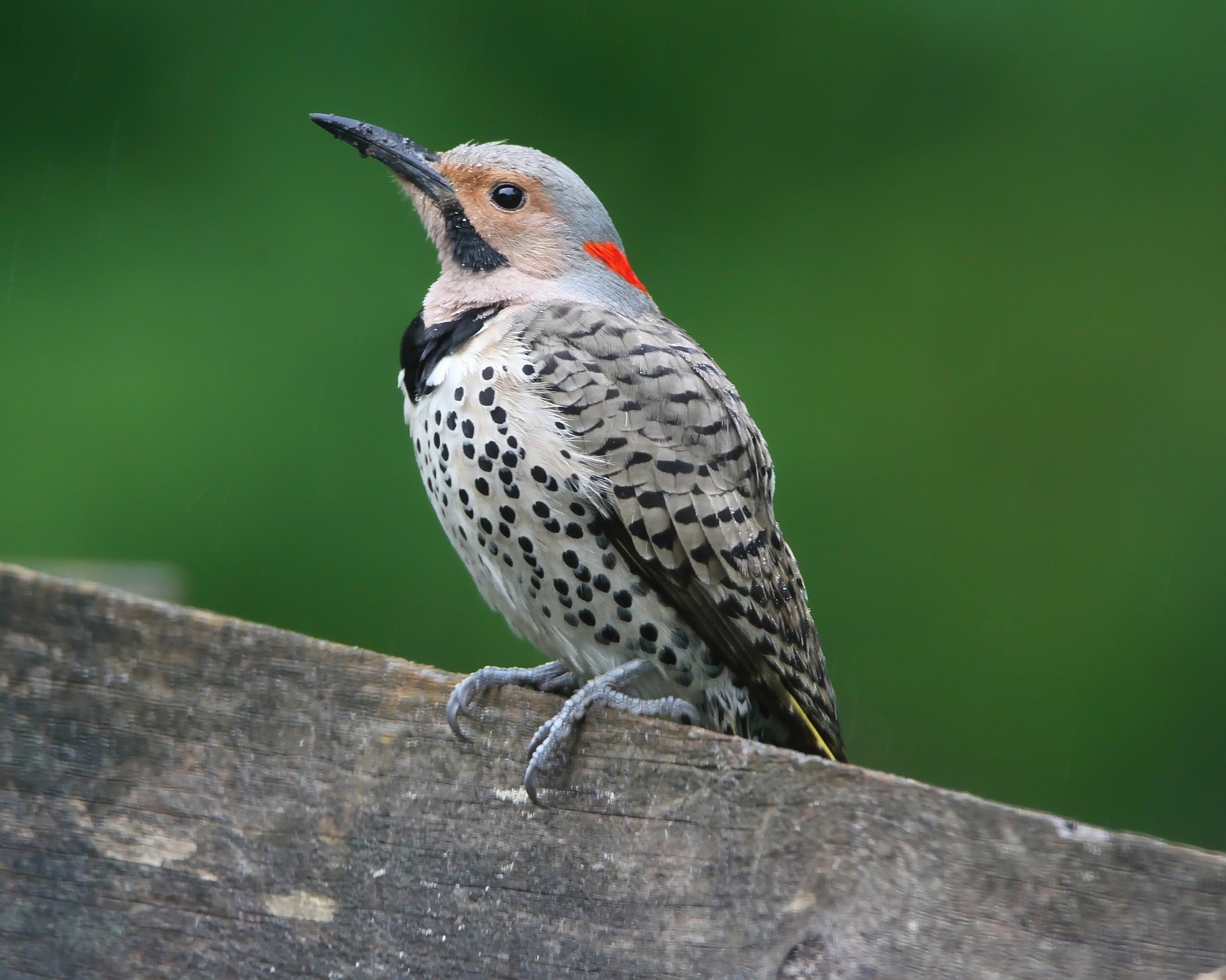
The adult flicker is a brown bird with black bars on the back and wings. A distinctive black patch occupies the upper breast, while the lower breast and belly are beige with black spots. Males can be identified by a black or red mustache stripe at the base of the beak. They also have a red stripe on the back of their gray heads. The flicker’s dark tail is set apart by a white rump patch that is conspicuous when the bird takes flight..

Look for Northern flickers in fields, orchards, city parks and well-planted suburban yards. These woodpeckers are usually not too shy around human observers and will sometimes allow for extended observation. If you’re even more fortunate, you could find one visiting your yard or garden. Just remember to scan the ground. This is one woodpecker that’s not a consistent tree-hugger like many of its kin.

•••

Bryan Stevens has written weekly about birds and birding since 1995. Email him at ahoodedwarbler@aol.com to share sightings, ask questions or make comments.


Spotlight on dark-eyed junco launched weekly column 29 years ago

Pixabay • A dark-eyed junco visits a deck for birdseed.

I wrote my first bird column on Sunday, Nov. 5, 1995, which means this weekly column is marking its 29th anniversary this week.

Looking back, it seems almost unbelievable that I’ve written anything on a regular weekly basis for almost 30 years. This column has appeared in a total of six different newspapers, which I regard as a personal achievement, as well as an accomplishment for our feathered friends. It’s on their behalf that I pen these weekly efforts to promote conservation and good will toward all birds. I have also posted the column as a weekly blog posting since February 2014 at http://www.ourfinefeatheredfriends.com.

I’ve played detective, helping people identify everything from “rain crows,” or cuckoos, to Muscovy ducks, rose-breasted grosbeaks and house finches. I’ve observed unusual birds, including white pelicans, brants and roseate spoonbills, in Northeast Tennessee, Southwest Virginia and Western North Carolina and spotlighted them in these columns.

Photo by Ken Thomas • A dark-eyed junco perches on some bare branches on a winter’s day.

While my vision challenges remain, I find that looking through binoculars works just fine, allowing me to spin the focus wheel and still take delight in the kaleidoscopic parade of colorful warblers that pass through the region each spring and fall as well as the fast-paced duels of ruby-throated hummingbirds. My main problem these days is the inability to spot movement, especially in treetops where many birds like to hang out.

At my home, I continue to provide sunflower seed and other supplemental food for the resident birds like Carolina chickadees, white-breasted nuthatches, song sparrows and downy woodpeckers.

Even as I tweak my anniversary column for “Feathered Friends,” I’m looking forward to the winter bird feeding season. The prognostication of approaching winter weather is a perfect time to dust off this week’s column, which is a revision of the first bird column I ever wrote. This column focused on a common visitor to yards and feeders during the winter months. In fact, dark-eyed juncos should be returning to the region any day. Here, with some revisions I have made through the years, is that first column.

•••

Of all the birds associated with winter weather, few are as symbolic as the dark-eyed junco, or “snow bird.” The junco occurs in several geographic variations.

John V. Dennis, author of “A Complete Guide to Bird Feeding,” captures the essence of the junco in the following description: “Driving winds and swirling snow do not daunt this plucky bird. The coldest winter days see the junco as lively as ever and with a joie de vivre that bolsters our sagging spirits.” The dark-eyed junco’s scientific name, hyemalis, is New Latin for “wintry,” an apt description of this bird.

Most people look forward to the spring return of some of our brilliant birds — warblers, tanagers and orioles — and I must admit that I also enjoy the arrival of these birds. The junco, in comparison to some of these species, is not in the same league. Nevertheless, the junco is handsome in its slate gray and white plumage, giving rise to the old saying “dark skies above, snow below.”

Just as neotropical migrants make long distance journeys twice a year, the junco is also a migrating species. But in Appalachia, the junco is a special type of migrant. Most people think of birds as “going south for the winter.” In a basic sense this is true. But some juncos do not undertake a long horizontal (the scientific term) migration from north to south. Instead, these birds merely move from high elevations, such as the spruce fir peaks, to the lower elevations. This type of migration is known as vertical migration. Other juncos, such as those that spend their breeding season in northern locales, do make a southern migration and, at times, even mix with the vertical migrants.

During the summer months, a visit to higher elevations mountaintops is almost guaranteed to produce sightings of dark-eyed juncos. Juncos may nest as many as three times in a season. A female junco usually lays three to six eggs for each nest, which she constructs without any assistance from her mate.

Juncos are usually in residence around my home by early November. Once they make themselves at home I can expect to play host to them until at least late April or early May of the following year. So, for at least six months, the snow bird is one of the most common and delightful feeder visitors a bird enthusiast could want.

Juncos flock to feeders where they are rather mild-mannered — except among themselves. There are definite pecking orders in a junco flock, and females are usually on the lower tiers of the hierarchy. Females can sometimes be distinguished from males because of their paler gray or even brown upper plumage.

Since juncos are primarily ground feeders they tend to shun hanging feeders. But one winter I observed a junco that had mastered perching on a hanging “pine cone” feeder to enjoy a suet and peanut butter mixture.

Dark-eyed juncos often are content to glean the scraps other birds knock to the ground. Juncos are widespread. They visit feeders across North America. The junco is the most common species of bird to visit feeding stations. They will sample a variety of fare, but prefer such seeds as millet, cracked corn or black oil sunflower.

The juncos are a small branch of the sparrow clan. Some of the other juncos include the endangered Guadalupe junco, yellow-eyed junco, Baird’s junco and volcano junco. The last one on the list is endemic to the Talamancan montane forests of Costa Rica and western Panama. Baird’s junco is named for Spencer Fullerton Baird, an American ornithologist and naturalist.

Baird served as secretary for the Smithsonian Institution from 1878 until his death in 1887. He greatly expanded the natural history collections of the Smithsonian from 6,000 specimens in 1850 to over two million by the time of his death.

I hope you’ve enjoyed this introduction to juncos. There’s something about winter that makes a junco’s dark and light garb an appropriate and even striking choice, particularly against a backdrop of newly fallen snow.

Of course, the real entertainment from juncos comes from their frequent visits to our backyard feeders. When these birds flock to a feeder and began a furious period of eating, I don’t even have to glance skyward or tune in the television weather forecast. I know what they know. Bad weather is on the way!

•••

I’ve already seen the first of the season’s white-throated sparrows, a reliable precursor to juncos. If you’d like to share your first sighting this season of dark-eyed juncos, email me at ahoodedwarbler@aol.com. As always, the column is open as a line of communication with fellow bird enthusiasts. I’ve enjoyed sharing stories about birds with countless readers over the past 29 years. I can also be reached on Facebook at https://www.facebook.com/ahoodedwarbler.


Surprise! Hummingbirds come in variety of sizes

This week’s column is about hummingbirds, the big and the small ones. Frances Lamberts in Jonesborough sent me an email earlier this month that got the ball rolling for this week’s hummingbird column.

“Two hummingbirds were here for a good week long,

at the end of April,” Frances wrote. “Then they were gone, and I haven’t seen any since. Despite the heat/drought (and with some watering), the

property has many favorite flowers in bloom, including the blue salvia, red pole beans, monarda, many others come and gone, the cardinal flowers about to bloom.”

Her question was a simple one: “Where are the hummers?”

She noted that she has kept a “first sightings” record for about 20 year. One year the hummingbirds didn’t arrive until mid June, which worried her at the time.

“What is happening now?” Frances asked.

The simple and honest answer is that it’s not really possible to land on any single answer. Birds have wings, and hummingbirds are capable to long-distance flights.

Still, a setting such as the one Frances described with such a wide variety of blooms should be teeming with hummingbirds.

Personally, it’s been a perplexing season. My hummingbirds arrived back in April, stuck around for perhaps a week, and then almost disappeared. They returned in mid-June, remained visible for a couple of weeks, but have since pulled another vanishing act.

In any given year, the numbers of hummingbirds passing thorough is going to fluctuate. Some years, these tiny flying gems will be present in good numbers on an almost daily basis. Other years, hummingbirds can become quite scarce.

I usually enjoy my best hummingbird numbers in the fall as these little birds begin their leisurely journey back south. Late August and the month of September is usually a great time to watch hummingbirds. I’m optimistic that the same will hold true this fall.

In some other hummingbird news, the world added another species of hummingbird this year when the giant hummingbird of South America got split into two distinct species.

Abi Cole, writing for Audubon Magazine, reported in an article on June 7, 2024, that scientists have considered two distinct populations of giant hummingbird — a migratory southern population in Chile, Argentina and Bolivia, and a non-migratory northern population in Chile, Ecuador and Peru — to be the same species.

Now, scientists have reconsidered that belief and learned that the two species have been able to fool scientists for so long by basically, as Cole’s article phrases it, by hiding in plain sight.

Cole’s article details the elaborate process by which giant hummingbirds were captured and fitted with geolocator devices. The article credits Jessie Williamson, lead author of the new study and a National Science Foundation postdoctoral research fellow, with unraveling the mystery.

Williamson did so by intensively studying the Chilean population. The resulting research also revealed some huge surprises.

For centuries, there has been speculation about where the Chilean giant hummingbirds go to spend the winter. Now we know – they make an astonishing, record-breaking 5,200-mile round trip to spend several months with their cousins in the Peruvian Andes.

Because the Chilean and Peruvian birds look so much alike, no one had ever realized that they were co-existing with each other during the winter season.

Of course, the name “giant hummingbird” is almost an oxymoron for a family of birds famous for their diminutive size. Now that we have two species of giant hummingbirds, they can’t both hold the title of world’s biggest hummingbird.

So, which is the bigger bird? As it turns out, the giant hummingbirds living year round in the Andes, now known as the northern giant hummingbird, is slightly bigger than the migratory southern giant hummingbird.

The article about these discoveries is fascinating. To read it for yourself, visit http://www.audubon.org/magazine/scientists-discover-worlds-largest-hummingbird-hiding-plain-sight.

The giant hummingbird does earn the right to that name. Both of the two species weigh between 18 and 24 grams and have a wingspan of about 8.5 inches. They have a body length of 9.1 inches. For a useful comparison, they are about equal to the size of a European starling or a Northern cardinal.

They are not the dazzling beauties most people associate with hummingbirds. Giant hummingbirds have a drab greenish plumage above with a whitish rump patch and dingy coloration below with variable rusty tones and dusky spotting. They do have the long bills and overall physical shape of other hummingbirds. The scientific name is Patagona gigas, roughly translated as the giant of Patagonia.

Photo by Bryan Stevens • Welcoming hummingbirds also involves making sure that they remain healthy and safe while spending time in our yards and gardens.

Count the giant hummingbird (either of the two species) as birds I’d like to see some day. The world’s diversity of hummingbirds is dazzling, but I feel fortunate to enjoy the ruby-throated hummingbird from April to October every year. As anyone knows who hosts these tiny birds, ruby-throated hummingbirds are dazzling and engaging guests during their all-too-brief.

•••

To ask a question, make a comment or share a sighting, email me at ahoodedwarbler@aol.com.


Unicoi County summer bird count finds 109 species

Photo Hans Toom/ Pixabay • The aptly named yellow warbler was one of 18 warbler species found on this year’s Unicoi County Summer Bird Count.

The 11th annual Unicoi County summer bird count was held Saturday, June 8, with 19 observers in seven parties. The count has been conducted yearly since its inception by members of the Elizabethton Bird Club.

I have taken part on this count from the first one held, missing only once when I was out of town. It’s an enjoyable count and, for me, it’s very close to home. This count also provides a reliable snapshot of the birds present in Unicoi County in early summer. 

Counters tallied 109 species which is slightly above the average of 108 species. The all-time high was 112 species in 2016. 

Abundant birds included European starling (314), American robin (246), song sparrow (175), American crow (174), red-eyed vireo (172), Northern cardinal (128) and cliff swallow, 126. Eighteen species of warblers were found, the most abundant being hooded warbler with 84 individuals tallied. 

As always a few low-density or very localized species were missed, including yellow-billed cuckoo, bald eagle, great horned owl, American kestrel, grasshopper sparrow, golden-winged warbler and prairie warbler.

The list:

Canada goose, 18; wood duck, 3; mallard, 20; wild turkey, 7; and ruffed grouse, 1.

Rock pigeon, 61; mourning dove, 56; chuck-will’s-widow,1; Eastern whip-poor-will, 18; chimney swift, 29; and ruby-throated hummingbird, 8.

Killdeer, 8; great blue heron, 3; and green heron, 2.

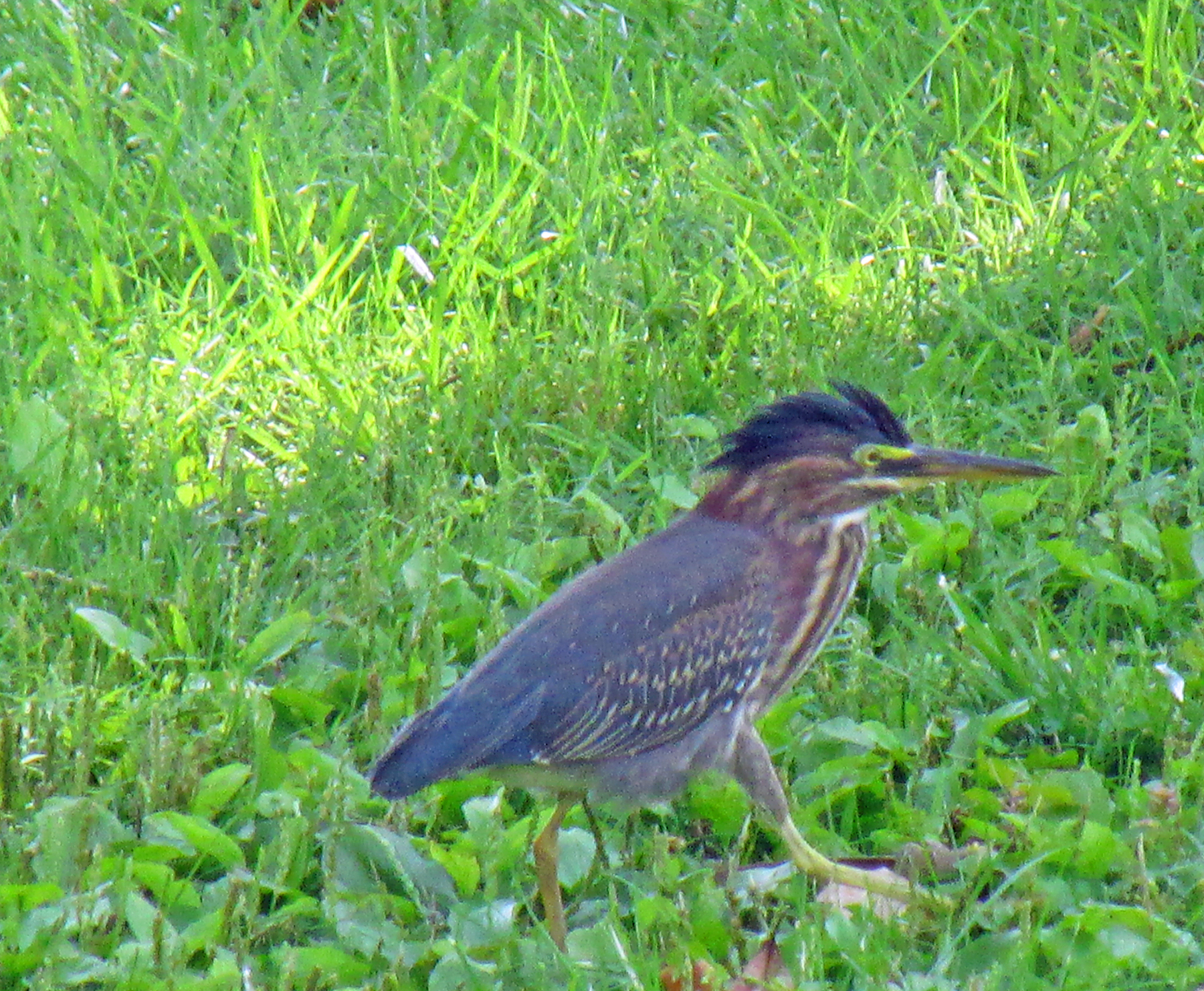
Photo by Bryan Stevens
A green heron elevates a shaggy crest of feathers, a behavior often initiated when the bird feels alarmed.

Black vulture, 1; turkey vulture 37; sharp-shinned hawk, 1;

Cooper’s hawk 3; red-shouldered hawk, 4; broad-winged hawk, 10; red-tailed hawk, 2; Eastern screech-owl, 5; barred owl, 4; and Northern saw-whet owl, 1.

Belted kingfisher, 5; red-bellied woodpecker, 15; yellow-bellied sapsucker, 9;

downy woodpecker, 8; hairy woodpecker, 5; Northern flicker, 10; and pileated woodpecker, 20.

Great crested flycatcher, 3; Eastern kingbird, 11; Eastern wood-pewee, 10; Acadian flycatcher, 32; least flycatcher, 5; and Eastern phoebe, 65.

White-eyed vireo, 3; yellow-throated vireo, 1; blue-headed vireo, 38; warbling vireo, 3; and red-eyed vireo, 172.

Blue jay, 61; American crow, 174; fish crow, 5; common raven, 8; Carolina chickadee, 71; and tufted titmouse, 60.

Photo by Bryan Stevens • A tree swallow visits a nest box to check on young.

Tree swallow, 49; Northern rough-winged swallow, 20; purple martin, 25; barn swallow, 78; and cliff swallow, 126.

Golden-crowned kinglet, 2; cedar waxwing, 36; red-breasted nuthatch, 2; white-breasted nuthatch, 18; brown creeper, 4; and blue-gray gnatcatcher, 23.

Carolina wren, 84; house wren, 31; and winter wren, 3.

Gray catbird, 34; brown thrasher, 14; Northern mockingbird, 17; European starling, 314; Eastern bluebird, 59; veery, 12; hermit thrush, 2; wood thrush, 34; and American robin, 246.

House sparrow, 14; house finch, 33; American goldfinch, 56; chipping sparrow, 54; field sparrow, 6; dark-eyed junco, 20; song sparrow, 175; Eastern towhee, 6; and yellow-breasted chat, 1.

Eastern meadowlark, 14; orchard oriole, 4; Baltimore oriole, 1; red-winged blackbird, 60; brown-headed cowbird, 16; and common grackle, 63.

Ovenbird, 38; worm-eating warbler, 10; Louisiana waterthrush, 10; black-and-white warbler, 19; Swainson’s warbler, 16; Kentucky warbler, 1; common yellowthroat, 6; hooded warbler, 84; American redstart, 12; Northern parula, 41; magnolia warbler, 2; Blackburnian warbler, 10; yellow warbler, 3; chestnut-sided warbler, 17; black-throated blue warbler, 45; yellow-throated warbler, 17; black-throated green warbler, 45; and Canada warbler, 13.

Scarlet tanager, 20; Northern cardinal, 128; rose-breasted grosbeak, 4; blue grosbeak, 1; and indigo bunting, 77.

•••

Bryan Stevens has birded since the early 1990s and has written about birds and birding since 1995. To ask a question, make a comment or share a sighting, email him at ahoodedwarbler@aol.com.


Sounds of spring remain one of the season’s pleasures

Photo by Bryan Stevens • Blue-headed vireos, such as this bird, are high-elevation summer residents in the region. In the fall, they are also common migrants.

In modern life, it can seem like we’re always looking for ways to relax and de-stress. For me, nothing works quite so well as letting nature’s sounds, as well as sights, provide some measure of relief from stressful situations and anxious thoughts.

I instantly notice when a new vocalization is added to the usual mix. Such occurred on March 26 when I heard the syllabic song of a blue-headed vireo from the upper reaches of a large tree near the fish pond.

The blue-headed vireo’s song has been described as “Hear me! See me! Here I am!” It’s similar to the song of the related red-eyed vireo, but it’s slower and the paired syllables are separated by a brief pause.

În a couple more weeks, the songs of blue-headed vireos will ring out all over the high-elevation forested slopes of many of our local mountains, but these are just starting to get back to the region after an absence during the colder months. Many other feathered singers will be arriving in their wake, including warblers, tanagers and grosbeaks.

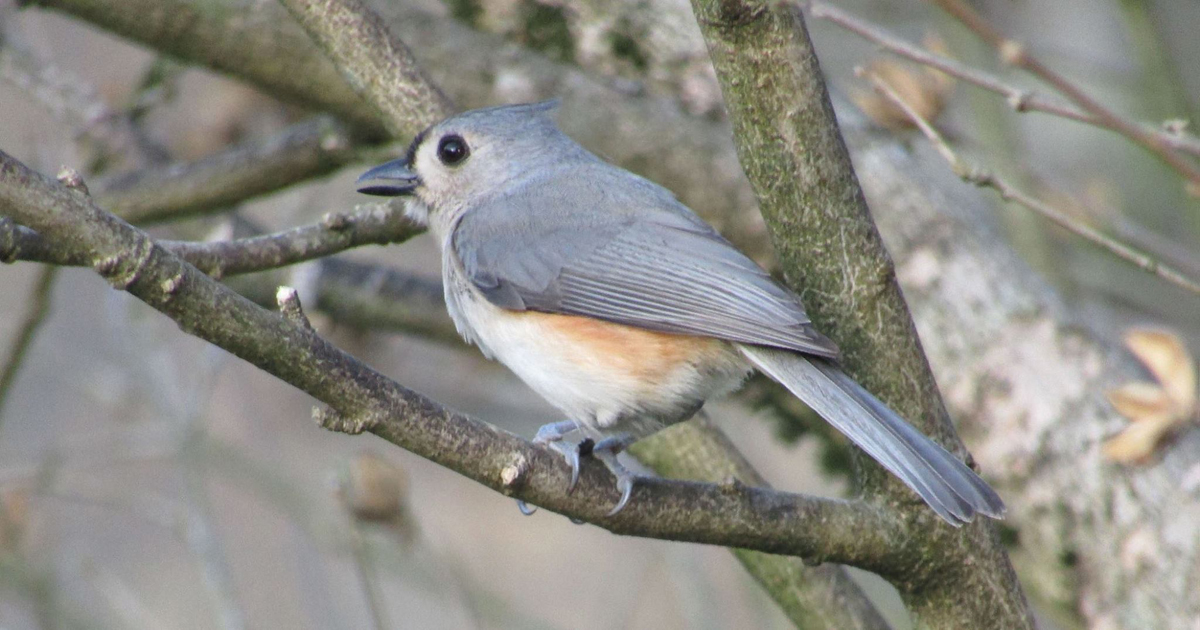
Photo by Bryan Stevens • The tufted titmouse is a backyard bird with an impish personality and a loud song.

The mornings around my home often begin with a loud, insistent “Peter! Peter! Peter!” uttered from the woods or even from shrubbery just outside my bedroom window. Male tufted titmice, little gray relatives of chickadees with a distinctive crest and large, dark eyes, sing their urgent “Peter! Peter! Peter!” as a constant refrain in their efforts to attract mates now that they feel spring in their blood.

A series of rat-a-tat-tats echoes from deeper in the woods as woodpeckers tap their sturdy bills against the trunks of trees. The three most common woodpeckers at my home are red-bellied, downy, and pileated, and they all have their own unique vocalizations, as well.

The pileated woodpecker produces clear, far-carrying resonant piping sounds that can last for a few seconds each blast. The much smaller downy woodpecker produces a whinny of high-pitched notes that descend in pitch toward their conclusion. The red-bellied call is probably the one that stands out the most. The call’s a harsh, rolling “Churr, churr, churr” given almost like an expression of exasperation as they circle tree trunks and explore branches.

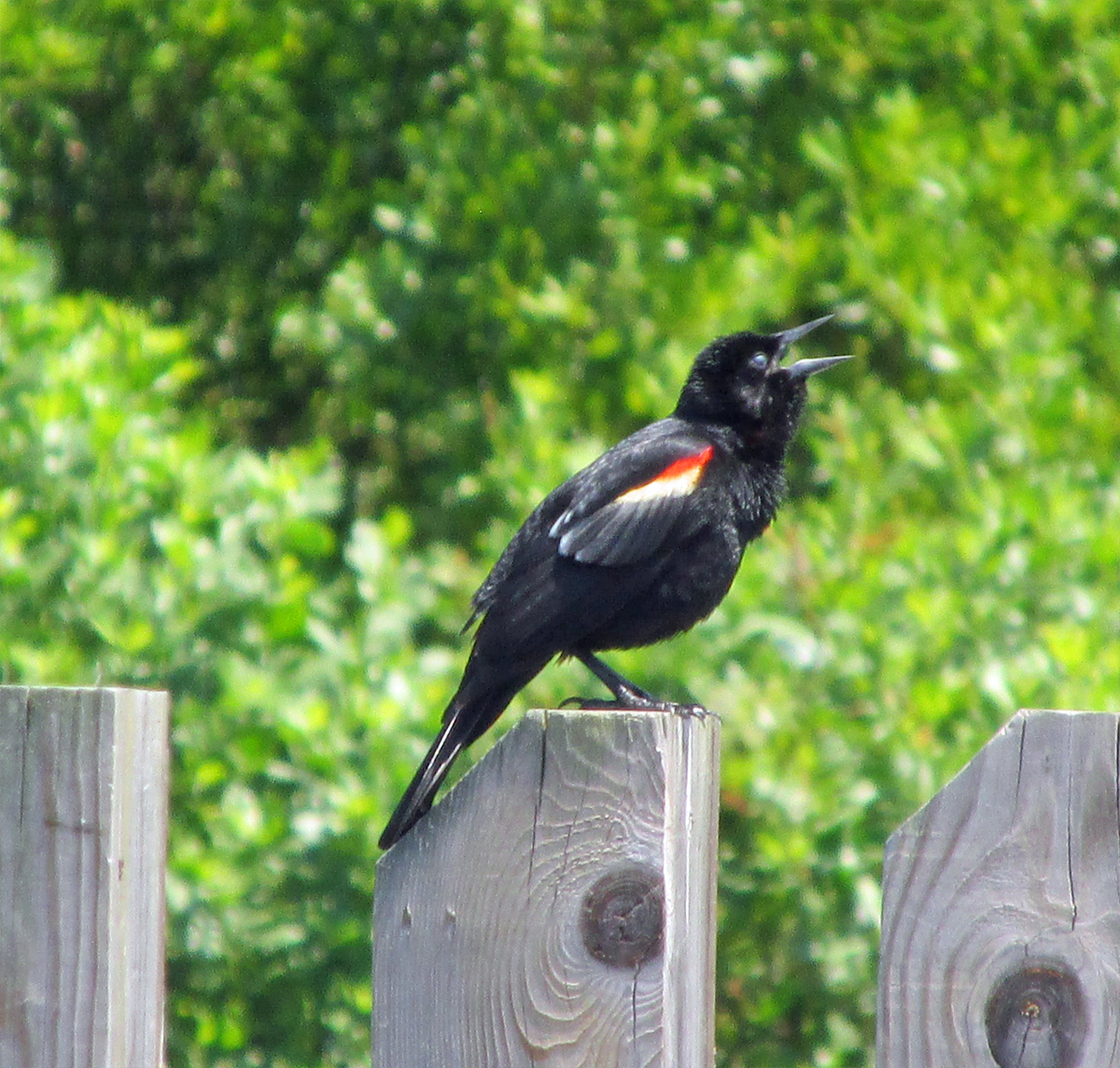
Since their return earlier this month, the resident red-winged blackbirds are often some of the earliest singers these days. According to the website All About Birds, the male red-winged blackbird’s “conk-la-ree!” is a classic sound of wetlands across the continent of North America. According to the website, the one-second song starts with an abrupt note that transforms quickly into a musical trill.

Photo by Bryan Stevens • A male red-winged blackbird sings to attract mates and ward off rivals.

Some birds helpfully introduce themselves with a song that repeats their name. One such common bird is the Eastern phoebe. In recent weeks, a pair has been checking out possible nesting sites. In past years, they have made use of the rafters of my garage and blades on a porch ceiling fan for potential nest sites. The male spends much of the day producing his strident “fee-bee” call, which is a perfect phonetic rendition of the bird’s common name.

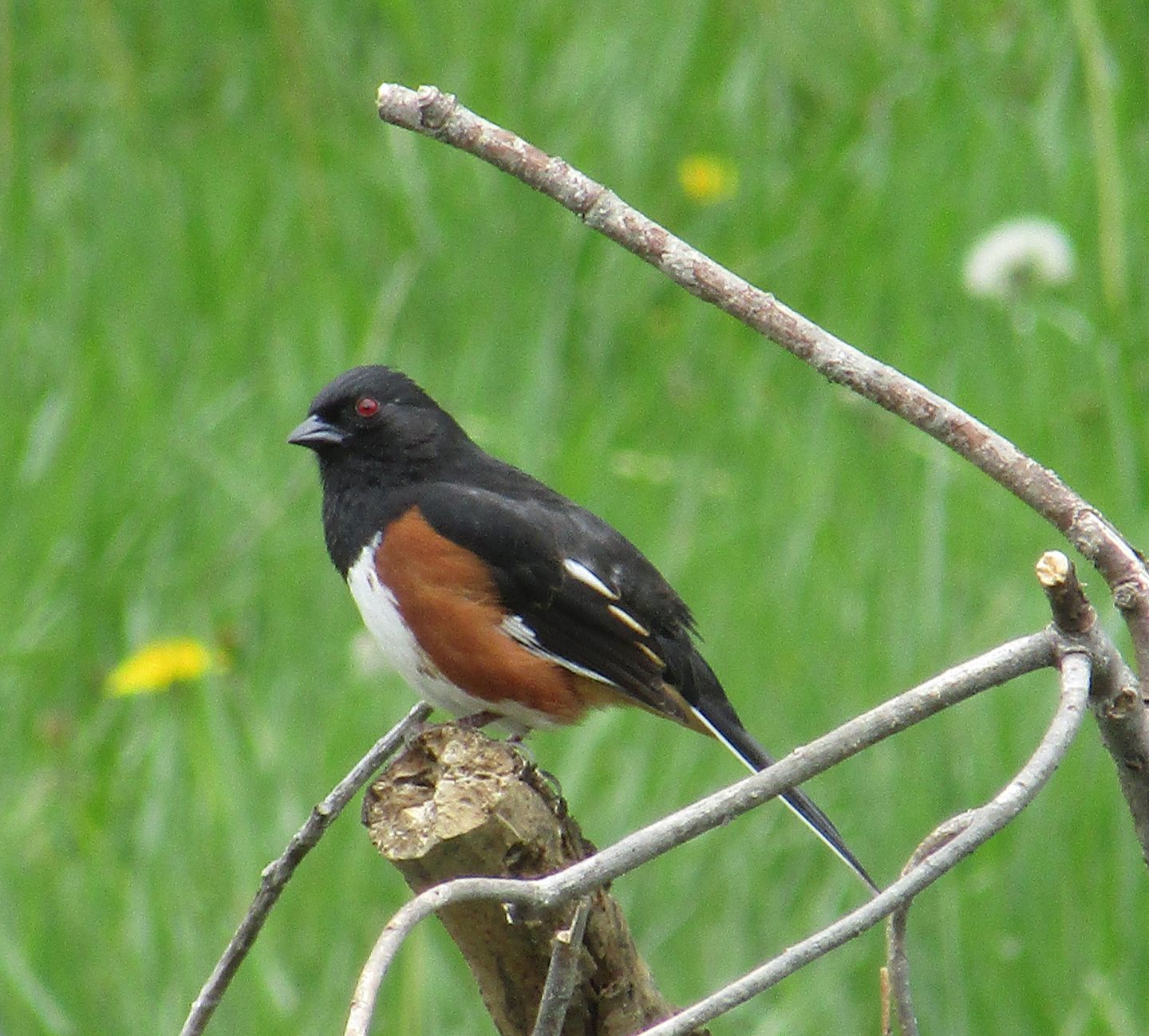
Then there’s one of my favorite songs of spring, which is produced by the Eastern towhee, also known by such common names as “ground robin” and “swamp robin.” These birds, which are actually a species of sparrow, also have some instantly recognizable vocalizations. With the arrival of spring, the males seek elevated perches for extensive singing bouts to attract mates and establish territories. Their song has been interpreted, quite accurately, as “drink your tea!” They also have some alarm notes, such as “€œChew-ink”€ and “€œToe-Hee,” of which the latter provides the basis for this bird’s common name.

Photo by Bryan Stevens • Male Eastern towhees are persistent singers once they establish  a spring territory.

Towhees occasionally spend the winter, but I’ve not noticed any during the winter of 2023-24. They are back now, and have been keeping a high profile for the past couple of weeks.

Of course, other wildlife is keen to join the springtime chorus. I have so many spring peepers at the fish pond and in the wet fields around my house that the noise from these tiny amphibians can reach deafening levels. The chorus is bound to grow more diverse and louder as spring advances. Take some time to enjoy the sounds of nature at your own home.

••••••

To share your own sighting, make a comment or ask a question, send email to ahoodedwarbler@aol.com. I’m also on Facebook.