Tag Archives: Jonesborough Herald and Tribune

World’s coffee drinkers owe debt to pest-eating warbler

Do you like to have a morning cup of coffee as you watch the early-bird arrivals at your backyard feeders? If so, you may want to thank some of the warblers and other neotropical migrants that consume tiny insect pests injurious to coffee farms.

The website Coffeehabitat.com provides an archive of interesting reading material about the connections between coffee farming and many neotropical birds. According to a profile on the black-throated blue warbler at the website, this particular warbler has a strong affinity for wintering on coffee farms.

Coffee.jpg

Photo by Bryan Stevens • Coffee drinkers owe a debt to the black-throated blue warbler.

The black-throated blue warbler is a nesting bird in hardwood and mixed forests in many mountainous regions of eastern Tennessee, southwestern Virginia and western North Carolina. In fact, the species nests as far south as northern Georgia along the Appalachian Mountains. Those birds not nesting in the Appalachians make their summer home in southern Canada, as well as northern states like New York and Pennsylvania.

Thanks to scientific tests of the birds’ feathers, scientists now know that most of the black-throated blue warblers that spend the summer nesting season in the Appalachians are in turn wintering in Puerto Rico and Hispaniola. The black-throated blue warblers from the northern part of the range for the species spend the winter months in Cuba and Jamaica.

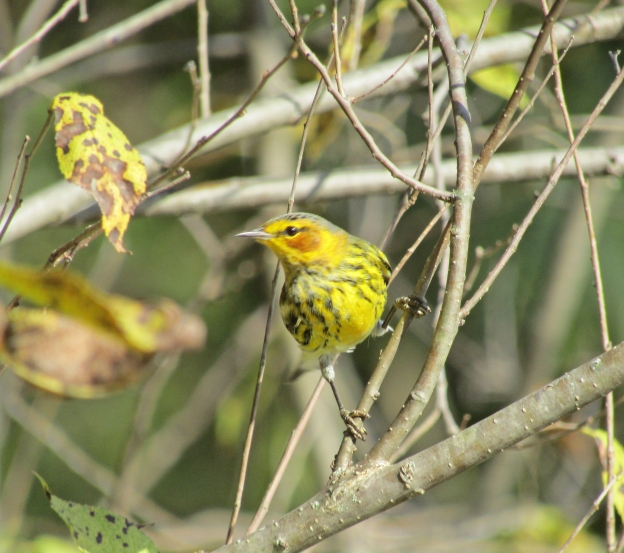
I’ve been spending more time than usual in my yard since the arrival of September, and I’ve been rewarded with glimpses of numerous migrating warblers, including Tennessee warbler, Blackburnian warbler, Cape May warbler, black-and-white warbler, chestnut-sided warbler, hooded warbler, Northern waterthrush and black-throated green warbler, as well as a dazzling male black-throated blue warbler.

Warbler-InHand

Photo by Jean Potter • A male black-throated blue warbler, banded for a study on songbirds, is examined closely. This is one of the most beautiful of the warblers.

If you recall the 1980s hit song, “Sharp Dressed Man,” by ZZ Top, perhaps I can give an accurate impression of the male black-throated blue warbler. He a dapper, sprightly fellow with a blue topcoat that dominates first impressions. It’s only after seeing the shock of blue that the observer takes notice of the black throat and the black feathers forming a dark facial mask, as well as a clean divide between the bird’s blue crown and back and the clean white underparts. The male even carries a fresh pocket “handkerchief” in the form of a white block on each wing. This becomes a diagnostic mark in the female’s less impressive version.
The sexes of black-throated blue warbler are the most markedly different among all the warblers. Even the famous early naturalist and painter John James Audubon got confused by the black-throated blue warbler male and female. He even made the mistake of painting a young black-throated blue warbler and misidentifying it as “pine swamp warbler.” The female black-throated blue has nary a trace of black in her feathers. Her plumage is mainly a dull olive-gray with dingy white underparts. Her only tie to her mate when it comes to appearance is her much more modest version of the “pocket handkerchief” on each wing.
In Jamaica, black-throated blue warblers are identified by Coffeehabitat.com as the number one predator of the dreaded coffee berry borer. So, as you raise that cup of affordable morning coffee, thank the black-throated blue warbler for eating all of those harmful pests that, left unchecked, would cause coffee prices to spike.
••••••
Bryan Stevens lives near Roan Mountain, Tennessee. To learn more about birds and other topics from the natural world, friend Stevens on Facebook at https://www.facebook.com/ahoodedwarbler. He is always posting about local birds, wildlife, flowers, insects and much more. If you have a question, wish to make a comment or share a sighting, email ahoodedwarbler@aol.com.
Blackthroated_Blue_Warbler

Photo by U.S. Fish & Wildlife Service/Mark Musselman • Black-throated Blue Warblers are among the birds than call the mountains of Southern Appalachia home during the summer months.

October walks at state park will offer migrant-viewing opportunities

The autumn season is a great time to practice birdwatching skills. The temperatures are milder, some of the concealing leaves have dropped from the trees and many migrating birds are moving through the region. With those factors in mind, the Lee and Lois Herndon Chapter of Tennessee Ornithological Society, also known as the Elizabethton Bird Club, will conduct morning bird walks every Saturday in October at Sycamore Shoals State Historic Park in Elizabethton, Tennessee.


The walks will begin at 8 a.m. and participants are asked to meet in the parking lot in front of the park’s visitors center. The dates for this year’s walks are Oct. 7, Oct. 14, Oct. 21 and Oct. 28.

Participants are advised to bring binoculars to increase viewing enjoyment. Persons of any skill level are invited to take part in these walks along the park’s walking trails, which offer river, field and woodland habitats. Members of the Elizabethton Bird Club will happily answer questions and help new birders with identification of any birds encountered. Targeted species will include migrants such as warblers, tanagers, thrushes and flycatchers, as well as resident songbirds ranging from Northern cardinals and blue jays to Carolina chickadees and red-bellied woodpeckers.


I enjoy fall birding probably more than any other season. It’s always nice to welcome some of our favorites when they return in the spring, but autumn’s the most productive season (at least in my own experience) when it comes to seeing the greatest diversity of birds in a relatively brief period of time.
Birding in my yard during September produced sightings of several species of warblers, a family of birds that is always one of the anticipated highlights of the migration season. Migrants spotted in my yard this fall have included American redstart, Blackburnian warbler, Cape May warbler, Tennessee warbler, Northern parula, magnolia warbler, hooded warbler, black-and-white warbler, chestnut-sided warbler, black-throated blue warbler, black-throated green warbler and Northern waterthrush.

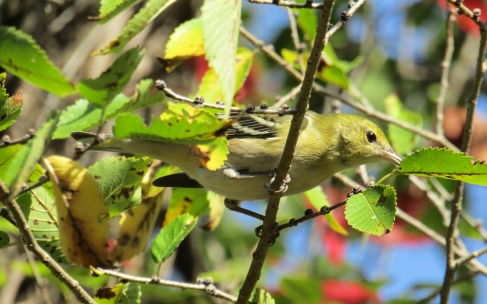
Bay-BreastedWarbler

Photo by Bryan Stevens • Warblers, like this bay-breasted warbler, are experts at remaining hidden in the leaves of trees. Their energetic movements make warblers difficult to follow through binoculars. In addition, bay-breasted warblers are among those species described as “confusing fall warblers,” because their autumn appearance is a dramatic departure from the look they had in the spring.


The warblers are the warmth-chasing retirees of the bird world. Like their human counterparts with summer homes in the mountains to escape the worst of summer’s scorching temperatures, warblers retreat southward every fall, spreading into the southern United States, the Caribbean, and Central and South America for the winter months.


Of course, warblers are not the only neotropical birds to employ this technique of nesting and raising young in the northern latitudes during the summer only to return south for the winter. Tanagers, vireos, flycatchers and some other families do the same, but not with the same niche-exploiting diversity of the warblers. As a family, the warblers boast 114 species. Not quite half of the species make some part of North America their summer home, which leaves the rest of the more sedentary family members living year-round in the American tropics.

Pewee-Sept19

Photo by Bryan Stevens • An Eastern Wood-Pewee perches during a migration stop in the yard.


Warblers pose a worthy challenge for birders. It takes practice to chase their movements in binoculars as they flit among the upper branches of tall trees. They are, for the most part, a family of almost frantically active birds that rarely pause for long while foraging for food, which mostly consists of various insects or insect larvae. Warblers migrating through the region during the autumn season bring another challenge to the table. Many warblers wear completely different plumages in spring and fall, which requires some mental adjustments when trying to match a binoculars view of a warbler to its illustration in a field guide. Known as the “confusing fall warblers,” these tricky cases prompt some novice birders to throw up their arms in defeat. I know because I once felt like that myself. As with all worthwhile pursuits, practice makes perfect.


Come out and join me and other bird club members at one of the Saturday strolls at Sycamore Shoals State Historic Park, which is located at 1651 W. Elk Ave., Elizabethton, Tennessee. We’ll chase some warblers through the treetops. We may not identify every single one, but we’ll have a fun time in the attempt.


•••••

Bryan Stevens lives near Roan Mountain, Tennessee. To ask a question, make a comment or share a sighting, email him at ahoodedwarbler@aol.com.

Green herons will depart from region in coming weeks as cooler conditions return

With the arrival of September, migration’s pace will quicken. In late August, I started seeing warblers passing through my yard. In other locations in the region, birders have shared reports of shorebirds and wading birds.

13435451_10208227244911211_1254837562662583452_n

Photo by Bryan Stevens • Green herons are short, stocky herons that can assume some comical poses.

Jonesborough resident Julia Ellis wrote about her own observation of a green heron that took place recently. She had seen a photo of a green heron with one of my recent columns, which helped her identify the bird.

She explained in her email that she saw the heron at along a creek on her Cherokee Road farm. “I was at a loss as to what it was,” Julia wrote. “It showed up several times a few weeks ago very close to dusk. The picture in the newspaper cleared up the mystery for me.”

Although not unusual at this time of year, green herons have been lurking along the linear trail’s waterways in Erwin. The scientific name — Butorides virescens – of this bird comes from a mix of Middle English and Ancient Greek and roughly translates as “greenish bittern.”

The green in the bird’s plumage appears as a dark green cap, as well as a greenish back and wings. Adult birds also have chestnut-colored neck feathers and a line of white feathers along the throat and belly. These herons often assume a hunched position, which can make them look smaller than they actually are.

Keep alert when walking along the trails in Erwin and you may catch sight of one of these interesting herons, too. Farm ponds in the countryside around Jonesborough, as well as wetland habitat around Persimmon Ridge Park, are also good places to look for this small heron. Most green herons will depart in late September and early October. This small heron retreats from the United States during the winter season but will return next spring in April and May.

A few herons — great blue heron and black-crowned night heron — remain in the region throughout the year, even enduring the cold winter months in Northeast Tennessee, Southwest Virginia and Western North Carolina.

Plovers among migration champions of vast and varied shorebird clan

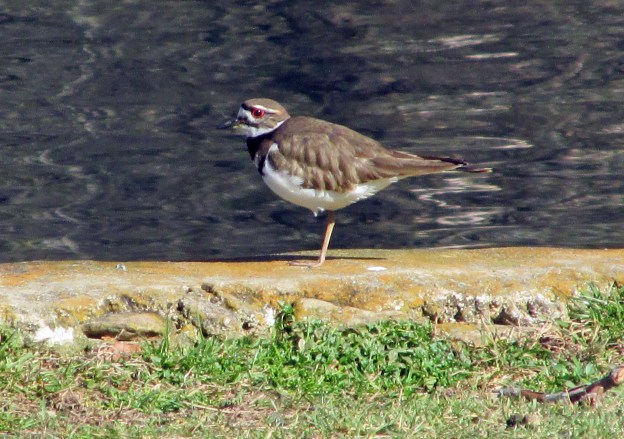
0815171646c (1)

Photo by Janice Humble • A killdeer wanders in a grassy area near the Wal-Mart on Volunteer Parkway in Bristol. The killdeer, a species of plover, is one of the more common shorebirds found in the region.

I’m always glad to lend a hand at identifying birds. If you’re uncertain of a bird’s identification and have a photo of the bird in question, assistance is an email away. Janice Humble emailed me seeking some help with identifying the bird in a photograph attached with her message. She noted that the bird was accompanied by a companion in the grassy area near the Wal-Mart on Volunteer Parkway in Bristol. She also noted that the two birds uttered loud “peeps” during her observation.

The bird turned out to be a killdeer, a species of plover native to North America. Plovers belong to the family of shorebirds that include various sandpipers, curlews, dowitchers, stilts, avocets and other species. The killdeer is a rather common shorebird that finds itself at home far from the seashore, often present in habitats such as pastures and golf courses, as well as the grassy areas near the concrete and asphalt jungles that surround Wal-Marts and other such shopping complexes.

The killdeer’s famous for its faking of an injured wing. When its nest or young is threatened, a killdeer will go into an elaborate display, fluttering the “injured” wing and uttering shrill peeps to distract the potential predator. If successful, the bird will lure the predator away from the nest or vulnerable young. Once at a safe distance, the killdeer undergoes a miraculous recovery and takes wing, leaving behind a bewildered and perhaps chagrined predator.

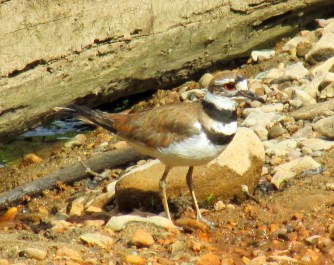
Killdeer_AgainstLog

Photo by Bryan Stevens • A Killdeer explores near a stream bank.

Other North American plovers related to the killdeer include American golden-plover, black-bellied plover, Pacific golden plover, Wilson’s plover, piping plover, snowy plover, mountain plover and semipalmated plover. About 70 different species of plovers exist around the world, including such descriptively named birds as little ringed plover, red-capped plover, three-banded plover and white-fronted plover.

Musick’s Campground on Holston Lake has been one of the best area locations for seeking shorebirds during their migrations. The shore near the campground has been a magnet for persuading unusual shorebirds to pause their journey to rest, refresh and refuel. The location’s privately owned, but individual wishing to bird the shoreline can enter by signing the guest book located a small but well-marked kiosk. Some of the most memorable shorebirds I’ve seen at Musick’s Campground over the years include whimbrel, dunlin, sanderling, greater yellowlegs, short-billed dowitcher, American avocet, black-bellied plover and semipalmated plover. In recent weeks, the location has hosted such unexpected shorebirds as red knot and red-necked phalarope.

While the neighboring states of Virginia and North Carolina offer coastal birding opportunities, my native Tennessee remains quite landlocked. This fact poses a challenge for birders looking to capitalize on the seasonal migrations of shorebirds. Fortunately ponds, mudflats on the shorelines of lakes, riverbanks and even flooded fields offer adequate substitute habitat for many shorebirds. While the Mountain Empire region may lack a seashore, migrating shorebirds have learned to make do.

6300749922_099f28ae81_o (1)

Photo by Jean Potter • The American golden-plover, like this individual, is a long-distance migrant among the varied family of shorebirds.

This varied and far-flung family is also known as “wind birds,” a term which is an allusion to the capacity of many species of shorebirds to undertake nothing less than epic migrations. Many of the shorebirds that pass through in the spring are in haste to reach their nesting grounds as far north as the edge of the Arctic tundra. In fall, many of the same birds are eager to return to destinations in Central and South America ahead of cold weather and times of scarcity.

The plovers — the sedentary killdeer excepted — are among the champions of long-distance migration. According to the Audubon website, the black-bellied plover spends the brief summer season nesting in the world’s high Arctic zones but disperses to spend the winter months on the coasts of six of the globe’s seven continents.

The Pacific golden-plover’s twice yearly migrations represent an even more impressive feat. This shorebird often nests in Alaska and winter in Hawaii. The website Phys.org notes that research on this plover has revealed that the bird is capable of flying almost 3,000 miles in a mere four days. The website also reveals that those plovers wintering in Hawaii cannot lay claim to longest migrations. Some Pacific golden-plovers nest even farther south in the Pacific, reaching the Marshall Islands.

Black-belliedPlover

Photo by Jean Potter • A black-bellied plover stands out from most relatives when it wears its nesting season breeding plumage.

Shorebirds represent only a single family of birds migrating through the region in the fall. Songbirds from warblers and thrushes to vireos and flycatchers, as well as raptors and waterfowl, wing their way through the region every fall. Get outdoors with a pair of binoculars and have a look. It’s almost impossible not to see something, which may turn out to be a delightful and unanticipated surprise.

••••••

To learn more about birds and other topics from the natural world, friend Stevens on Facebook at https://www.facebook.com/ahoodedwarbler. To ask a question, make a comment or share a sighting, email him at ahoodedwarbler@aol.com.

Great white heron pays unexpected area visit to Steele Creek Park

I wrote a few weeks ago about the tendency of long-legged wading birds to wander far afield from their usual coastal haunts in late summer. In the ensuing weeks, numerous sightings of some unexpected waders have been reported throughout the region and beyond. 
Jeremy Stout, the manager of the Nature Center at Steele Creek Park in Bristol, reported that a great white heron generated some birding excitement among park visitors. Stout noted that the heron was first reported by Sherry Willinger on Monday and Tuesday, Aug. 7-8, and then found again by Ruth and Mary Clark on Friday, Aug. 11. Stout also managed to get a photograph of the heron, which has been seen just outside the park grounds between Ralph Harr Bridge and Highway 126. Steele Creek Park Naturalist Don Holt saw the heron again on Aug. 15. He invited others who see the heron to share their sightings by calling the park’s Nature Center at (423) 989-5616. Reports will help the park staff document the duration of the rare visitor’s stay and keep interested birders informed of its presence. 
GreatWhiteHeron-STOUT

Photo by Jeremy Stout
This great white heron was photographed near Steele Creek Park in Bristol. Currently considered the same species as the great blue heron, there is debate among experts about granting the great white heron status as a species in its own right. 

In early August, Cheryl Livingston reported a great white heron and a great egret at Watauga Lake in Hampton. While only a handful of records exist for the great white heron in this region, these observations will not help boost the lists of any area birders. The great white heron and the great blue heron, scientifically speaking, are the same species — at least for the moment.
According to the website for the U.S. Fish and Wildlife Service, this large wading bird, originally thought to be just a white color morph of the great blue heron, might actually deserve consideration as its own species. The website’s profile of the great white heron notes that recent research about the great white suggests that it is at least a subspecies of the great blue heron. Some preliminary unpublished data suggests that the bird may even be a completely separate species. That would be exciting news for many birders, who would be able to quickly add an unexpected bird to their life lists. 
The majestic great white heron usually ranges throughout south Florida and the Florida Keys, but individuals wander far from those parts of the Sunshine State after the nesting season. 
lcp_160728_1061_1024x1024 (1) 2

Painting by John James Audubon of the iconic Great White Heron of Florida.

The great white heron — as its name suggests — differs dramatically in appearance from a great blue heron, mostly in having all-white plumage. In addition, the great white heron has a yellow bill, which is heavier and more solid than the slender bill of the smaller great egret, for which it could be confused at a casual glance. The great blue heron, known by the scientific named of Ardea herodias, can stand 54 inches tall and weigh close to eight pounds. 
Waders other than great white herons have been wandering this summer. Farther afield, Michael Sledjeski has been reporting little blue herons and great egrets at Rankin Bottoms, which is a birding hot spot at Douglas Lake in East Tennessee. The location is well known among birders as a magnet for shorebirds and wading birds. Sightings of wood storks have been somewhat widespread in Tennessee and Virginia this summer. 
In addition, other waders are showing up far from their usual ranges. For instance, a roseate spoonbill — a large, pink wading bird — has shown up as far north as Pennsylvania, marking the first time the species has been sighted in the Keystone State since 1968.  
13350311_10208196961794152_4694016517040025689_o

Photo by Bryan Stevens • Identifying white herons and egrets can be a tricky business. This immature Little Blue Heron is just starting to get the          blue feathers of adulthood. 

I’ve not seen anything as exciting as a wood stork or roseate spoonbill at home, but on several occasions in the past couple of weeks my fish pond has been visited by great blue herons. A couple of these visitors were young birds, which are probably wandering widely during their first summer out of the nest. I’ve also seen green herons at the pond and in the creeks along the linear trail in Erwin. 
If the great white heron eventually gains recognition as a separate species, I will already have the bird on my Tennessee bird list thanks to a sighting of one several years ago at Musick’s Campground on Holston Lake in Bristol. Ironically, I’ll not have this bird on my Florida list, as I’ve not seen it in its southern stronghold. 
••••••
To learn more about birds and other topics from the natural world, friend Stevens on Facebook at https://www.facebook.com/ahoodedwarbler.  If you have a question, wish to make a comment or share a sighting, email ahoodedwarbler@aol.com.

Native wrens offset lack of size with fiercely competitive spirit


Nature’s not always neat and tidy. In fact, nature operates with rough-and-tumble mechanisms that, all too often, put some of our favorite birds at odds with each other. Like any other living creature, birds compete for resources — food, water, prime nesting real estate and even mates. Some of those pretty and entertaining birds at your feeder or bird baths have a dark side that isn’t often glimpsed.

When some insight is gained into these behaviors, it’s only human to feel discouraged, disenchanted or dismayed. Nonetheless, some recent emails have reminded me to look at some of these more distressing incidents as teaching moments.

Joy Stewart emailed me asking for advice on a problem with rival nesting birds in her yard.
HouseWren-JEAN

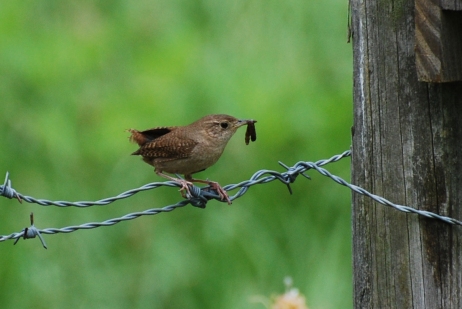
Photo by Jean Potter • A house wren brings a delivery of food to waiting young.

“I have a total of 10 bird houses in my yard,” she wrote. “They are sized for a variety of bird species, and most years nearly all are filled—usually wrens, bluebirds, tree swallows, nuthatches or finches.”

At a recent get-together, she talked with a woman who also puts out bird houses and works hard to attract birds. “She talked at length about how bad house wrens are and how they destroy or kill bluebird eggs and babies,” Joy wrote. “She described how these wrens had just killed a house full of baby bluebirds. The woman also said house wrens are not native to this country.”

Joy noted that she usually tries to keep track of these types of issues, but the woman’s claims were all shocking news to her and made her wonder if such cutthroat competition might explain why her bluebirds seem to have absented themselves from her yard.

She ended her email by asking two questions. “Is the problem as bad as it sounds?” Joy inquired. “Also, how do I now work to get rid of the house wrens that have been coming to my two wren houses for over 10 years?”

She noted that just permanently taking down the houses would likely not work. “If nothing else, they will just move into the slightly larger houses,” she noted.

I replied to Joy’s email, noting that her friend is partly correct, but has confused house wren and house sparrow. From her description, I also noted that it appears she has house wrens in her yard.

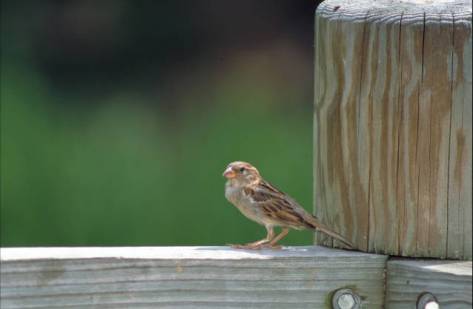
The house wren is a native bird; the house sparrow is not a native bird, but was introduced into the country. Its true origins are Africa/Europe.

However, as cavity-nesting birds, both the sparrow and the wren compete with bluebirds. Legally, Joy can take steps to “control” house sparrows. As non-native birds, they are not protected.
House_sparrow (1)

Photo by U.S. Fish & Wildlife Service • House sparrows, such as this female, are non-native birds that pose a serious threat to native cavity-nesting birds such as Eastern bluebirds.

However, the house wren is a native bird. I also happen to like house wrens. They have such bubbly, happy songs, and they’re good parents. They can raise as many as 10 young in one nest box.

Unfortunately, both the wren and the sparrow engage in ruthless behavior when it comes to nesting. Both species will evict bluebirds and other birds from boxes. They will even destroy eggs and young. Bluebirds can and do fight back, but despite their small size, house wrens are very feisty.

House wrens like brushy habitat that offers a lot of cover. I suggested Joy might consider trimming back or eliminating brush and hedges. Open space is also more attractive to bluebirds. Of course, chickadees and nuthatches also like brushy habitat and woodland edges, just like the house wrens.

It’s complicated, but I come down on the side of our native birds. House wrens have their place, but house sparrows should never have been in this country in the first place. I advised that Joy leave the wren boxes available to forestall the wrens deciding they have to fight other birds for a box. At the same time, I would not place any other boxes close (at least not within easy view) of the wren boxes, as wrens are very territorial.
Bluebird-2

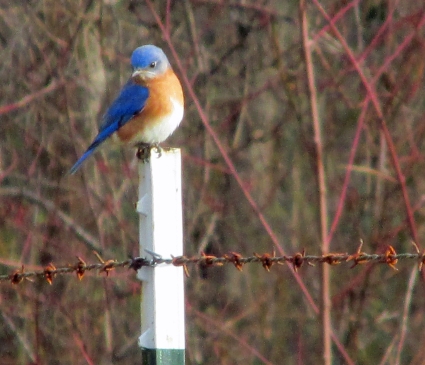
Photo by Bryan Stevens • Eastern bluebirds compete with native cavity-nesting birds such as house wrens and tree swallows for prime nest locations. Non-native birds, such as European starlings and house sparrows, can out-compete native birds for limited resources.

In response to a follow-up query, I suggested that placing the boxes completely out of sight would be the best rule of thumb. Try to have a building, a wall, or perhaps a large tree blocking the wren boxes from other boxes. At least this way, perhaps the adult wrens won’t be viewing the competition. It would be advisable to keep as much space between the wren boxes and the boxes meant for other birds as is practical and possible.

•••••

An email from another reader likely involved a nesting wren. These small birds are rather notorious for choosing odd nesting sites. I’m thinking it is that tendency that explains Vivian Tester’s recent email asking for some suggestions for a somewhat unique problem.

“I’m looking for advice,” Vivian wrote. “I have a bird that has made a nest on my car windshield. I have driven the car a few times and she will fly away when I start the car, but I don’t want to do anything to harm her or the eggs.”

The situation had her baffled. “How long should it take for the process of laying eggs and them hatching and leaving the nest?” Vivian asked.

She noted that she had not been able to see any eggs. She added that the nest’s construction starts at the windshield and goes into the area under the hood. “I haven’t tried to open the hood in case it would destroy the nest,” she wrote.

Surprisingly, Vivian said the same thing happened last year but she just kept removing the nest. “I’m just not sure what I should do,” she wrote.

In my reply, I told Vivian that it sounds like she has a wren or perhaps a sparrow, and it can take 12-16 days for the eggs to hatch. The young must then spend another 10-12 days in the nest, so it could be at least four weeks for the entire process.

I suggested that, unless she could go without her car for a month, she should open the hood and gently remove the nest somewhere close by. A box or crate could hold the nest and the parent birds are likely to simply move from the car over to the new location for the nest. The parents are more attached to the nest itself than they are your car.

I admitted that I was sort of “winging” it on this problem. While a car is an odd choice for nesting, I’ve heard of birds such as swallows that nest on boats and then follow the boats along their river routes.audubon-ix-songsters-and-mimics-house-wren
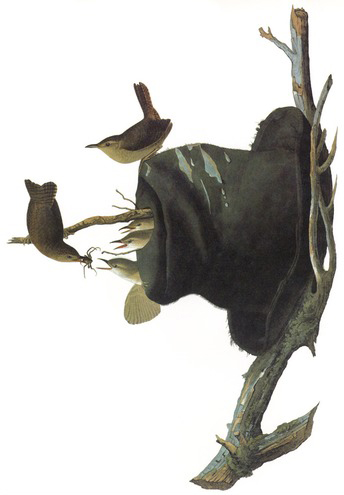
After I responded, Vivian emailed me back. “I wanted to update you on the bird nest,” she wrote. “I did move it today into a hanging basket just above my car.”

The nesting bird flew away when Vivian opened the hood. “I am hoping she will return since I did see four little eggs in it,” she wrote.

I believe Vivian’s bird is probably a Carolina wren. I’ve observed these wrens, a slightly larger relative of the house wren, nesting in an old apron my grandmother used as a bag for her clothespins, as well as a plastic shopping bag hanging from a nail in my garage. A pair also once tried to nest in the exhaust vent for my clothes dryer.

Worldwide, there are about 80 species of wrens. All but one of the world’s wrens are confined to the New World. A variety of common names describe the various species with some creativity, including such monikers as tooth-billed wren, flutist wren, white-headed wren, sepia-brown wren, fawn-breasted wren and moustached wren.

•••••

Bryan Stevens lives near Roan Mountain, Tennessee. To share a sighting, make a comment, or ask a question, send email to ahoodedwarbler@aol.com.