Category Archives: Bryan Stevens Feathered Friends

Sounds of spring remain one of the season’s pleasures

Photo by Bryan Stevens • Blue-headed vireos, such as this bird, are high-elevation summer residents in the region. In the fall, they are also common migrants.

In modern life, it can seem like we’re always looking for ways to relax and de-stress. For me, nothing works quite so well as letting nature’s sounds, as well as sights, provide some measure of relief from stressful situations and anxious thoughts.

I instantly notice when a new vocalization is added to the usual mix. Such occurred on March 26 when I heard the syllabic song of a blue-headed vireo from the upper reaches of a large tree near the fish pond.

The blue-headed vireo’s song has been described as “Hear me! See me! Here I am!” It’s similar to the song of the related red-eyed vireo, but it’s slower and the paired syllables are separated by a brief pause.

În a couple more weeks, the songs of blue-headed vireos will ring out all over the high-elevation forested slopes of many of our local mountains, but these are just starting to get back to the region after an absence during the colder months. Many other feathered singers will be arriving in their wake, including warblers, tanagers and grosbeaks.

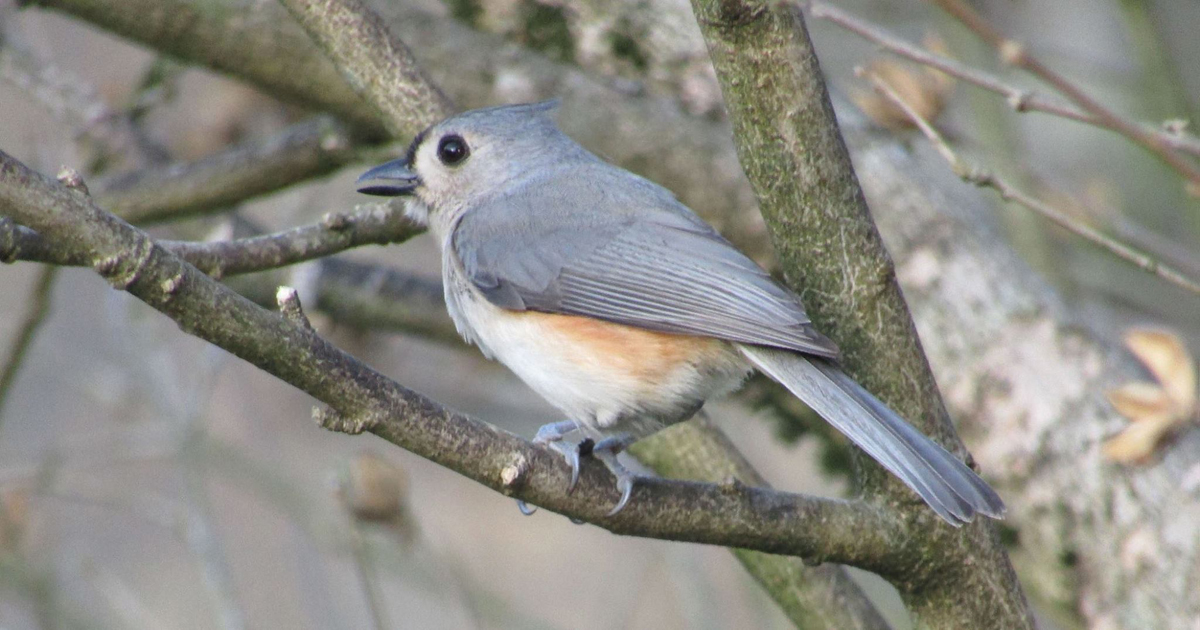
Photo by Bryan Stevens • The tufted titmouse is a backyard bird with an impish personality and a loud song.

The mornings around my home often begin with a loud, insistent “Peter! Peter! Peter!” uttered from the woods or even from shrubbery just outside my bedroom window. Male tufted titmice, little gray relatives of chickadees with a distinctive crest and large, dark eyes, sing their urgent “Peter! Peter! Peter!” as a constant refrain in their efforts to attract mates now that they feel spring in their blood.

A series of rat-a-tat-tats echoes from deeper in the woods as woodpeckers tap their sturdy bills against the trunks of trees. The three most common woodpeckers at my home are red-bellied, downy, and pileated, and they all have their own unique vocalizations, as well.

The pileated woodpecker produces clear, far-carrying resonant piping sounds that can last for a few seconds each blast. The much smaller downy woodpecker produces a whinny of high-pitched notes that descend in pitch toward their conclusion. The red-bellied call is probably the one that stands out the most. The call’s a harsh, rolling “Churr, churr, churr” given almost like an expression of exasperation as they circle tree trunks and explore branches.

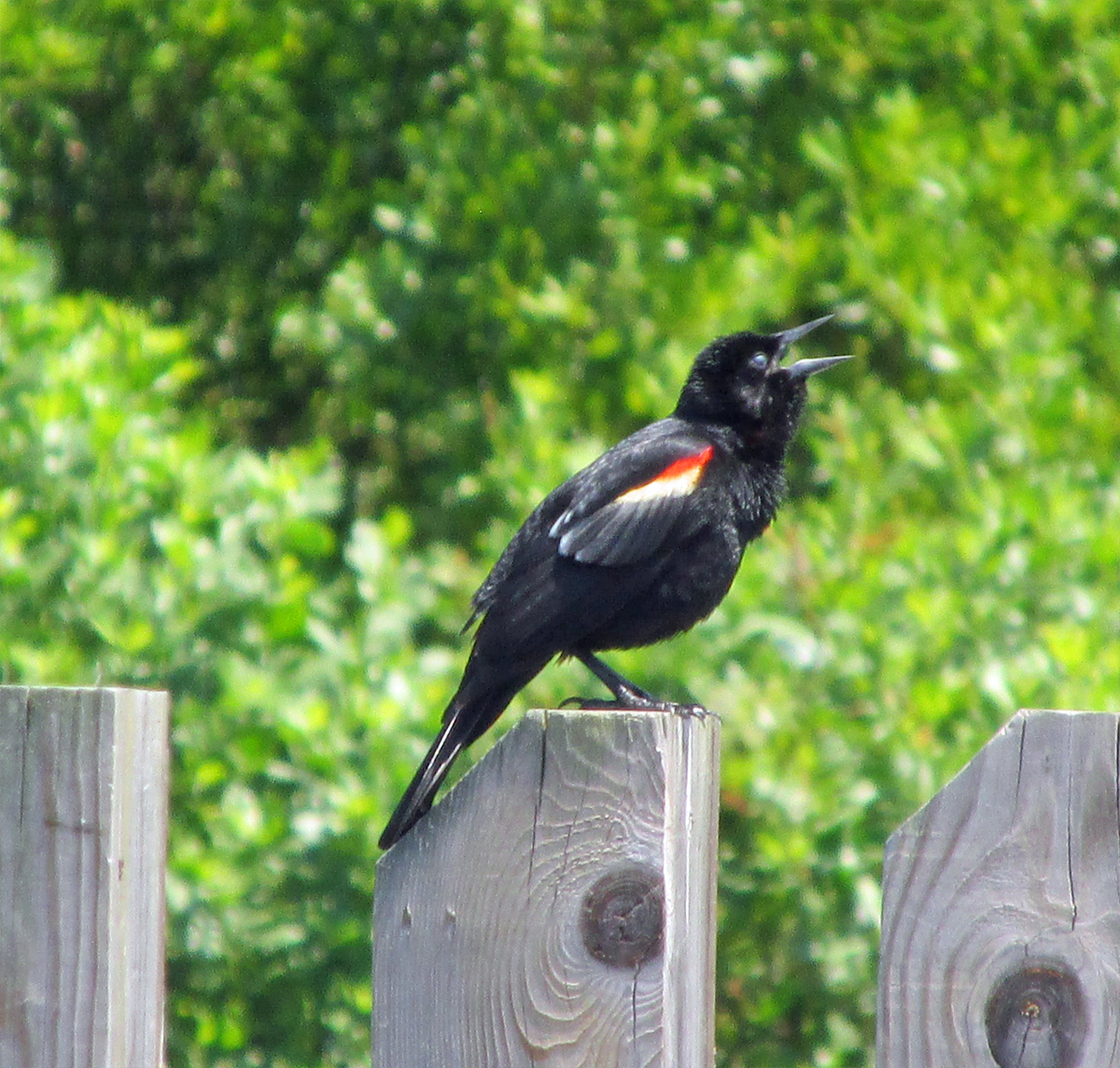
Since their return earlier this month, the resident red-winged blackbirds are often some of the earliest singers these days. According to the website All About Birds, the male red-winged blackbird’s “conk-la-ree!” is a classic sound of wetlands across the continent of North America. According to the website, the one-second song starts with an abrupt note that transforms quickly into a musical trill.

Photo by Bryan Stevens • A male red-winged blackbird sings to attract mates and ward off rivals.

Some birds helpfully introduce themselves with a song that repeats their name. One such common bird is the Eastern phoebe. In recent weeks, a pair has been checking out possible nesting sites. In past years, they have made use of the rafters of my garage and blades on a porch ceiling fan for potential nest sites. The male spends much of the day producing his strident “fee-bee” call, which is a perfect phonetic rendition of the bird’s common name.

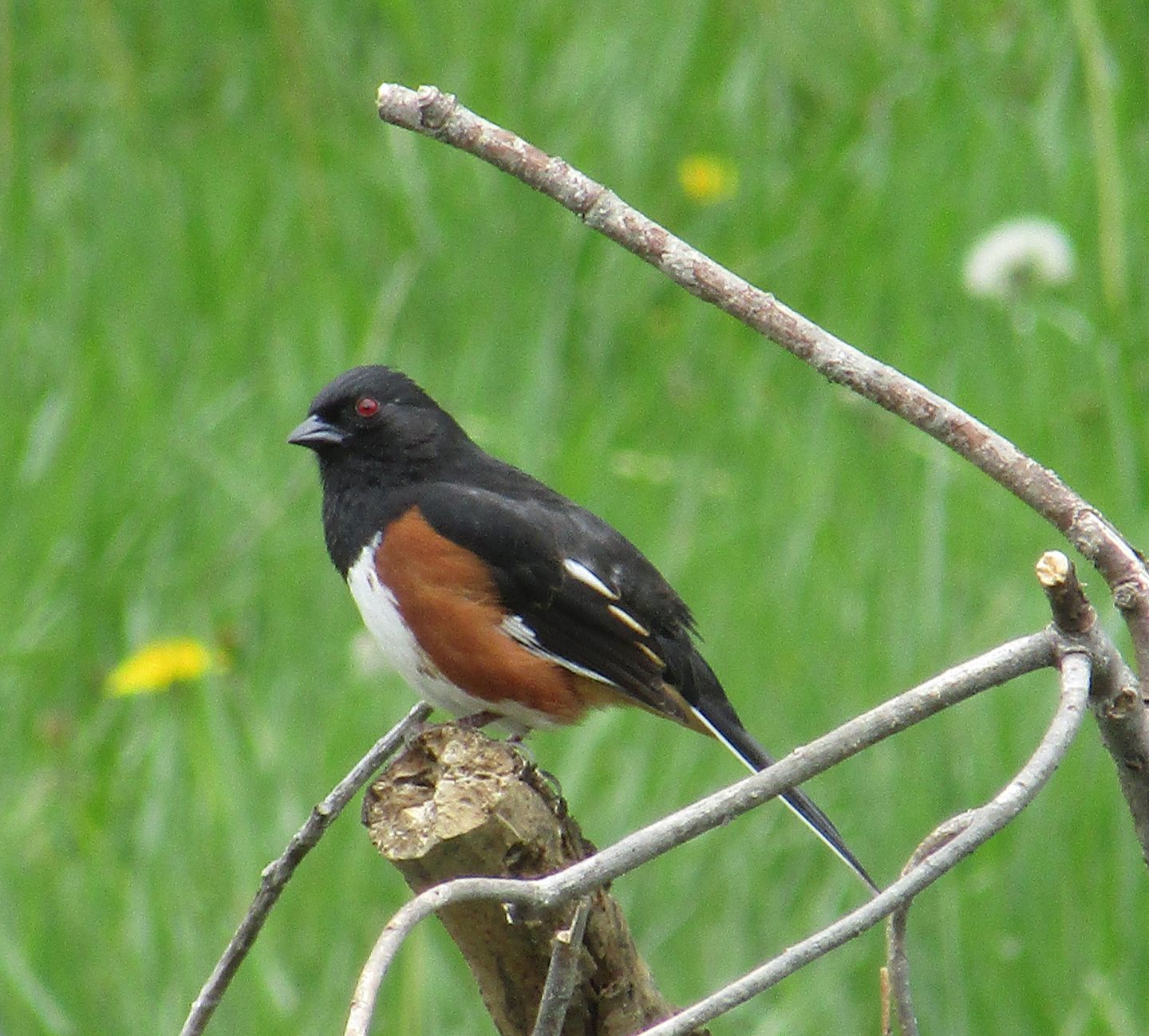
Then there’s one of my favorite songs of spring, which is produced by the Eastern towhee, also known by such common names as “ground robin” and “swamp robin.” These birds, which are actually a species of sparrow, also have some instantly recognizable vocalizations. With the arrival of spring, the males seek elevated perches for extensive singing bouts to attract mates and establish territories. Their song has been interpreted, quite accurately, as “drink your tea!” They also have some alarm notes, such as “€œChew-ink”€ and “€œToe-Hee,” of which the latter provides the basis for this bird’s common name.

Photo by Bryan Stevens • Male Eastern towhees are persistent singers once they establish  a spring territory.

Towhees occasionally spend the winter, but I’ve not noticed any during the winter of 2023-24. They are back now, and have been keeping a high profile for the past couple of weeks.

Of course, other wildlife is keen to join the springtime chorus. I have so many spring peepers at the fish pond and in the wet fields around my house that the noise from these tiny amphibians can reach deafening levels. The chorus is bound to grow more diverse and louder as spring advances. Take some time to enjoy the sounds of nature at your own home.

••••••

To share your own sighting, make a comment or ask a question, send email to ahoodedwarbler@aol.com. I’m also on Facebook.

Blue jays bold, bossy backyard visitors

Photo by edbo23/Pixabay A blue jay grabs a peanut from a feeder.

At my own home, blue jays have an easy life. They’re so much bigger than most of the other birds that visit my feeders that they can be a little bossy toward their smaller kin. All are welcome, though.

The blue jay is the smallest member of the Corvid family in Tennessee. This bird’s larger relatives in the state include the American crow, fish crow and common raven.

The blue jay, which is typically 10 to 12 inches long, is one of the largest songbirds to visit our feeders. They’re fond of sunflower seed, peanuts, suet and other feeder fare. Blue jays are quite noisy and produce a variety of vocalizations. They’re also capable of mimicry and can mimic in convincing fashion the calls of red-tailed and red-shouldered hawks.

While they are primarily woodland birds, blue ays are very adaptable and capable of thriving in suburban parks and other less wild areas. In the fall, acorns are a favorite food. There are times in autumn when almost every blue jay I see has an acorn n its bill. They also tend to stash food for future days, and this habit has also helped re-forest oak woodlands.

Jays are social birds and form flocks, which offers some protection from predators. It only takes one sharp-eyed bird in a flock to sound an alarm to protect the entire group.
Other birds can also detect blue jay alarm calls and react accordingly.

Accipiter hawks — Northern goshawk, Cooper’s hawk, sharp-shinned hawk — are the primary predators on blue jays. They share some of the same habitat and the agile hawks are usually able to outmaneuver the slower flying jays.

I was a little surprised to discover that the blue jay has never been chosen as an official state bird, although it does serve as the official bird for the province of Prince Edward Island in Canada.

Blue jays are undeniably striking birds. They are bright blue on top and white to gray on its throat, chest and belly. They have white wing bars and black and white banding on the tail. Its bill, legs and feet are black. The bird also has a black collar on its lower throat. At a glance, all blue jays — male and female — look alike. However, experts have determined that the black throat collars are subtly different from bird to bird and may help members of a flock recognize each other.

Larger birds typically have longer life spans than small ones. The medium- sized blue jay will probably live longer than a wren or sparrow. The oldest known wild, banded blue jay was at least 26 years, 11 months old when it was found dead after being caught in fishing gear, according to the website All About Birds. It had been banded in 1989 around Saint Pierre and Miquelon, which is a French archipelago south of the Canadian island of Newfoundland. He dead individual was found in the same area in 2016.

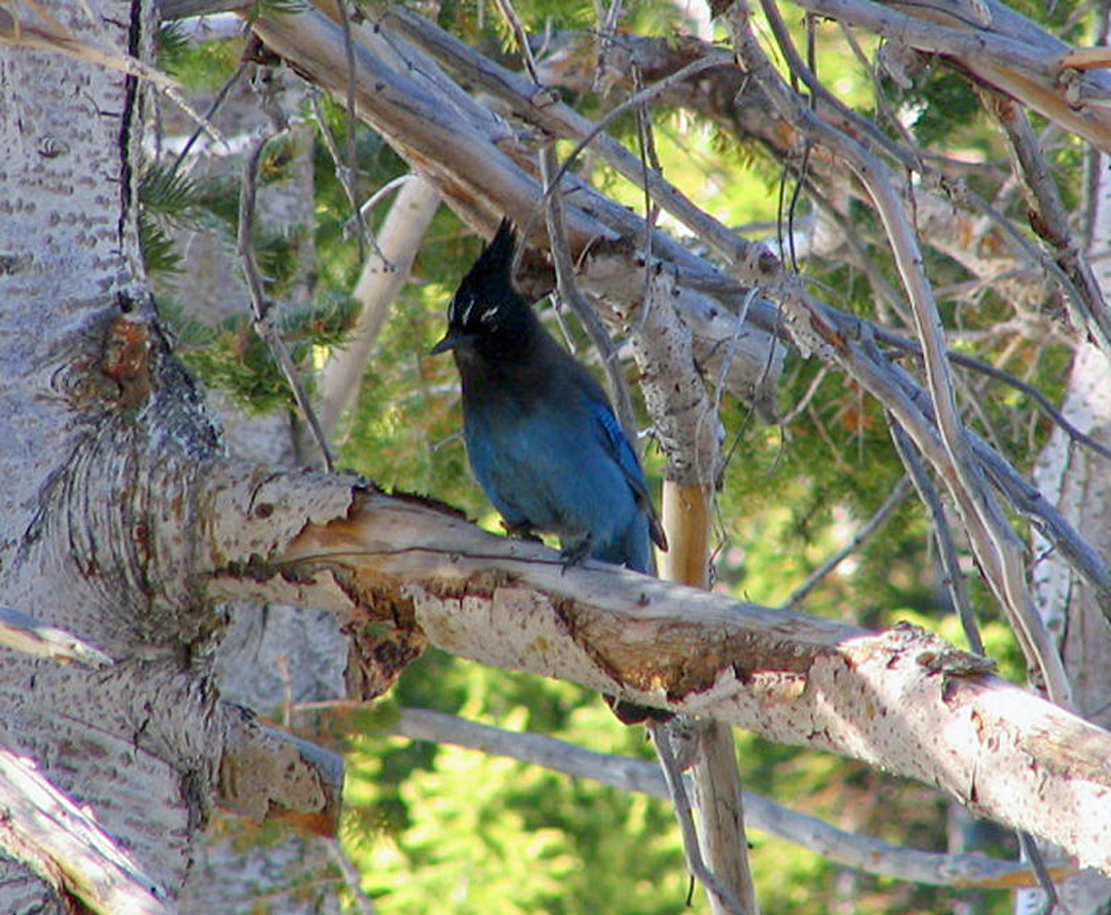
There are other species of jays in the United States, including the Steller’s jay, which is the western counterpart of the bue jay, as well as Western scrub-jay, Florida scrub-jay and pinyon jay. Worldwide, there are about 50 species of jays, which are closely related to crows, magpies and other species in the genus of Corvidae.

Some of the descriptive names for other jays include white-throated magpiejay, gray jay, green jay, purplish jay, azure jay, violaceous jay, turquoise jay, beautiful jay, silvery-throated jay, azure hooded jay and black-headed jay.

The smallest of the world’s jays is, appropriately enough, named the dwarf jay. It is eight to nine inches long and weighs about 1.4 ounces.

During two visits to Salt Lake City in Utah in 2003 and 2006, I added a couple of jays to my life list, including Western scrub-jay and Steller’s jay. I also saw black-billed magpies, a close relative of jays.

Photo by Bryan Stevens • A Steller’s jay found at Snowbird, a ski resort town near Salt Lake City, Utah.

•••

To share sightings, ask a question or make a comment, email me at ahoodedwarbler@aol.com.

Majestic canvasback among region’s wintering waterfowl

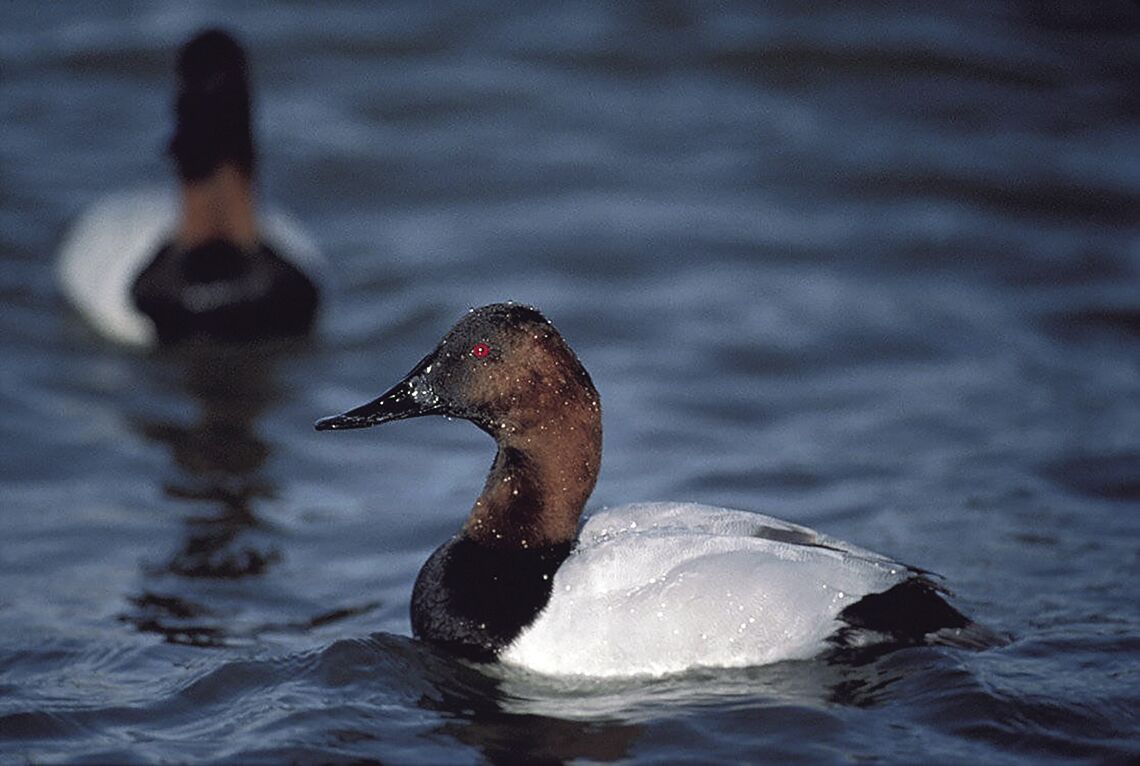
Photo by U.S. Fish & Wildlife/Eugene Hester • The red eye of a male canvasback stands out in as striking a fashion as does the duck’s dark and light plumage.

Erwin resident Joe McGuiness, who is also a fellow member of the Elizabethton Bird Club, alerted me recenntly to the presence of a canvasback drake at a pond along the town’s linear trail.

This duck was with a couple of redheads, also a species of duck, in the pond spanned by a boardwalk in the industrial park on the south side of Erwin. Some birds hold special meaning with me. Although its a natural question for a bird lover to be asked, I have difficulty pinpointing a single bird as my favorite. One of my overall favorite birds is the Northern cardinal. Among the summer-visiting warblers, the hooded warbler has long been my favorite. With shorebirds, the marbled godwit has long been at the top of my rankings. My favorite bird of prey is the American kestrel or, as I first learned of this raptor in the little “Golden Guide to Birds,” the sparrow hawk. Among owls, I have a soft spot for Eastern screech-owls.

I have a favorite duck, too. It’s the canvasback, which is a species of waterfowl that I don’t see very often, which makes observations even more special. I saw my first canvasback in the mid 1990s during a winter visit with my parents to Wilbur Lake near Elizabethton, Tennessee. We always liked visiting this small reservoir during the colder months to view the buffleheads and any other ducks that happened to visit this small mountain lake. On this particular occasion, a flock of redheads had also arrived. While viewing these ducks, we noticed a member of the flock that looked different from the others. Specifically, it was larger and whiter than the redheads. After a brief consultation with my copy of Roger Tory Peterson’s “A Field Guide to the Birds of Eastern and Central North America,” I identified my very first canvasback.

Since that time, I’ve observed canvasbacks at other locations in northeast Tennessee and southwest Virginia. It’s been awhile, but I have observed these ducks at Osceola Island Recreation Area below Holston Dam and at Musick’s Campground at South Holston Lake. Back in January and February of 2014, some canvasbacks took a liking to the pond at Erwin Fishery Park. I’ve also observed canvasbacks on the Watauga River in Elizabethton and on the Holston River in Kingsport. I saw eight canvasbacks on Feb. 22, 2015, on the Watauga River, not very far from where I saw my very first one back in the 1990s. The flock, which consisted of all males, represented a rather high number for this duck in the region.

Recent winter storms that have plowed through the region have brought some unusual ducks. A few days before he notified me of the canvasback, Joe also informed me about a pair of Northern shovelers at Erwin Fishery Park.

A male canvasback is unmistakably regal with a sloping profile that instantly distinguishes it from other ducks. Males, or drakes, have chestnut-red heads, white bodies, black breasts and rears and bright red eyes. The distinctive bill is also black. Females, like many other ducks, are drab and brown but share the distinctive bill, helping to separate them from such relatives as female redheads.

Photo by Bryan Stevens • Canvasbacks on the Watauga River in Elizabethton.

The canvasback is also a fairly large duck with males reaching a body length of 21 inches. Females are only an inch shorter in body length. Drakes weigh an average of 2.7 pounds while hens can weigh 2.5 pounds.

Canvasback breed in prairie potholes in the western United States and Canada. I got the chance to see many of these ducks in their nesting habitat during a trip to Utah in May of 2006. My visit provided very memorable observations of large flocks of these impressive diving ducks. I found them in temporary ponds in flooded fields. Utah had enjoyed abundant rainfall that spring, which was no doubt welcomed by breeding ducks. The trip also yielded observations of such ducks as cinnamon teal, redhead, red-breasted mergansers, ring-necked ducks and gadwalls, as well as other unique wetland-loving species as white-faced ibis, yellow-headed blackbird and Wilson’s phalarope.

During winter, the canvasback usually prefers large open bodies of water, including lakes, ponds and sheltered bays. These ducks are largely vegetarian, although they do consume some animal matter, including insect larvae, snails and other mollusks. This duck’s scientific name, Aythya valisineria, which refers to a species of plant that canvasbacks consume in great quantities. Vallisneria americana, which is often called wild celery or water-celery, doesn’t resemble the vegetable known as celery. These wild plants are long, limp and flat, which led to other common names such as “tape grass” and “eelgrass.”

The canvasback is member of the genus, Aythya, which is comprised of a dozen species of diving ducks. The other members of the genus in North America include greater scaup, lesser scaup, redhead and ring-necked duck. The related tufted duck is a rare visitor to the United States. They’re described diving ducks because they dive under the surface to search for food, rather than dabble around pond edges and shorelines like the ducks known as “dabblers.”

Two members of the genus — Madagascan pochard and Baer’s pochard — are endangered species. In March of 2013, a survey found the population of the Madagascan pochard was about 80 individuals. When surveys found a worldwide population of perhaps fewer than 1,000 individuals, Baer’s pochard was reclassified as “critically endangered” in 2012. The canvasback has never declined to the low levels of these relatives, but it has been a bird that has required some protective oversight from the federal government. At times, this has included exemptions from duck hunting seasons.

Canvasback populations are stronger these days but haven’t been robust for quite some time. According to the Duck Unlimited website, the population of this stately duck has seen some improvement. In 2009, a population survey by the U.S. Department of Fish and Wildlife showed an increase in canvasbacks from 488,000 to 662,000 individuals. According to the Ducks Unlimited website, this population spike took place in the wake of a hunting ban on canvasbacks during the 2008-09 waterfowl season.

•••

To share a sighting, ask a question or make a comment, email me at ahoodedwarbler@aol.com.


Red-breasted nuthatch helps couple achieve milestone

Photo by Bryan Stevens • A red-breasted nuthatch clings to the mesh of a feeding tube to get at the peanuts contained within.

Good friends and fellow members of the Elizabethton Bird Club, Brookie and Jean Potter achieved a personal birding milestone at the end of January.

Both Brookie and Jean managed to see 100 birds in the first month of 2024 in the five-county area. Brookie had already accomplished this feat many years ago, but Jean had never been able to do it – until now.

“We did it today on the last day of the month,” she shared in an email.

Brookie ended the month with 101 species of birds, and Jean reached 100.

Their final bird of the month was red-breasted nuthatch. They had to put in some effort to find the species, finally traveling to Carver’s Gap on the state line between North Carolina and Tennessee on Roan Mountain.

“We kept waiting for this bird to come to our feeder, but when it didn’t come, we had to go to Carver’s Gap, which had snow, fog and a temperature of 29 degrees,” she said.

According to Jean, they located two of these little nuthatches close to the parking area.

“The things we do to find birds,” Jean remarked.

If they can find another 100 or more species of birds in the remaining 11 months of 2024, the couple will be eligible for the Howard P. Langridge Award. The Elizabethton Bird Club presents this award to any member who manages to see 200 or more species in a single year in the five-county area. The award commemorates the contributions of the late Langridge to birding in the region. In 2000, Langridge broke the record for most species seen in a single year in Northeast Tennessee. The record was later broken again by Rick Knight.

Photo by Bryan Stevens • A red-breasted nuthatch picks through seeds and peanuts at a feeder.

In our region, the stubby red-breasted nuthatch is another member of a family that often finds its way to our yards. Smaller than the related white-breasted nuthatch and, as far as I can tell, complacent in the company of chickadees and titmice, the red-breasted nuthatch is always a welcome visitor.

This little feeder visitors has a tell-tale “yank yank” call that it produces when excited that sounds very much like a little tin horn. The red-breasted nuthatch, perhaps because it spends so much of the year in more remote areas, can also be amazingly tame when it pays a winter visit.

Both red-breasted and white-breasted nuthatches can be attracted to feeders by offering peanuts, sunflower seeds and suet. They are also cavity-nesting birds, but are more reluctant about accepting a nesting box as a place to rear young. They will gladly accept an old woodpecker hole or other natural cavity in a tree.

The website All About Birds notes that red-breasted nuthatches are common, and their populations have increased throughout most of their range between 1966 and 2019, according to the North American Breeding Bird Survey.

The website also points out that Partners in Flight estimates a global breeding population of 20 million and rates the species a 6 out of 20 on the Continental Concern Score, indicating a species of low conservation concern.

While the red-breasted nuthatch is a small bird, some members of its family aren’t so petite. On the other end of the size scale is the appropriately named giant nuthatch, which reaches a length of almost eight inches. The giant nuthatch ranges through China, Thailand and Burma and is bigger than a downy woodpecker, another of our more common visitors at backyard feeders in our region.

Worldwide, there are about 25 species of nuthatches, some of which have surprisingly descriptive names for birds that spend most of their lives creeping in obscurity along the trunks and branches of trees. Some of the more creative common names for these little birds include beautiful nuthatch, velvet-fronted nuthatch, sulphur-billed nuthatch, chestnut-bellied nuthatch, snowy-browed nuthatch and chestnut-vented nuthatch.

These birds are named “nuthatch” for the habit of some species to wedge a large seed in a crack and hack at it with their strong bills.

In some winters, red-breasted nuthatches can be quite common in the region. That’s not been the case this winter, as shown by the difficulty Brookie and Jean had in locating this bird.

•••

For those interested, there’s a great chance to get outdoors and look for red-breasted nuthatches and other birds. The annual Great Backyard Bird Count will be held Friday, Feb. 16, through Monday, Feb. 19.

It’s easy to take part in this global survey of bird populations all around the planet.

The first step is to choose a location for looking. A favorite park, walking trail or your own back yard will work.

Next, actively watch for birds for 15 minutes or more, at least once over the four days from February 16–19.

You will need to identify all the birds you see or hear within your planned time/location and use the best tool for sharing your bird sightings.

For a beginning bird admirer and those who are new to bird identification, try using the Merlin Bird ID app to pinpoint what birds you are seeing or hearing.

If you have participated in previous GBBCs before and want to record numbers of birds, try the eBird Mobile app or enter your bird list on the eBird website using a desktop/laptop computer.

If you already contribute to Merlin or eBird, continue what you are doing. All entries over the 4-day period count towards GBBC.

For more information on the GBBC, visit http://www.birdcount.org.

•••

To share a sighting, ask a question or make a comment, email me at ahoodedwarbler@aol.com.
 

Pileated woodpecker never fails to make spectacular first impression

Photo by Jason Gillman from Pixabay • The pileated woodpecker is the largest woodpecker in the region, reaching a length of about 19 inches. By comparison, the region’s smallest, the downy woodpecker, is only about 7 inches long.

The ivory-billed woodpecker barely escaped a declaration of extinction in 2023. Whether this woodpecker, the largest in North America, is still alive is a matter for debate, but a slightly smaller relative remains an abundant and rather visible bird.

Over the years, many readers have emailed me about their encounters with pileated woodpeckers, which can be impressive and even startling when a sighting is unexpected.

The pileated woodpecker has actually had an abundance of common names associated with it. English naturalist Mark Catesby, who died in 1749, gave this large bird the name of “large red-crested woodpecker.” The Swedish botanist Carl Linnaeus apparently gave the woodpecker the scientific name of Dryocopus pileatus.

Another English naturalist, John Latham, apparently gave the bird the common name of pileated woodpecker, basing the name on the scientific name established by Linnaeus. Beyond this history of how the bird eventually got the name pileated woodpecker, there are a lot of folk names for this particular bird, including such interesting ones as “king of the woods” and “stump breaker.”

The loud vocalization of this woodpecker has also inspired names such as “wood hen.” Other names along these lines include “Indian hen” and “laughing woodpecker.” If anyone knows of other common names for the pileated woodpecker, I’d enjoy hearing about them.

Depending on whether you believe that the ivory-billed woodpecker still exists somewhere in Cuba, Arkansas or some other remote pocket of its former range, the pileated woodpecker is the largest of North America’s woodpeckers.

Pileated woodpeckers are cavity-nesting birds, and they use their large, stout bills to efficiently excavate their own nesting cavities in dead or dying trees. These cavities can be used in later nesting seasons by other cavity-nesting birds, such as Eastern screech-owls and wood ducks, that are incapable of excavating their own nesting cavities.

Photo by Bryan Stevens • A pileated woodpecker perches on a branch of a walnut tree.

Male pileated woodpecker show a red whisker stripe on the side of the face that is absent in the female. Otherwise, they look similar.

These large woodpeckers — they can reach a length of about 19 inches — often forage close to the ground on old stumps or fallen logs.

The pileated woodpecker is widespread in the United States and Canada, favoring wooded areas in both countries. This woodpecker has proven adaptable, now thriving even in suburban areas offering sufficient woodland habitat.

•••

I wrote last week about the limpkin in Hampton. Over the Christmas holiday, I managed to observe this remarkable bird. My mom and I both watched the bird while it foraged for food in a yard at a trailer park. Usually not found beyond Florida, this winter visitor has created quite a sensation in the local birding community. Getting to observe this unusual visitor made our holidays a bit brighter.

•••

Share a sighting, ask a question or make a comment by emailing me at ahoodedwarbler@aol.com.

Photo by Bryan Stevens • A limpkin roams in a yard at the River’s Edge trailer park in Hampton, Tennessee, on Christmas Eve 2023.

What’s in a name? Many American birds will get renamed by AOS

Photo by Veronika Andrews from Pixabay • Anna’s hummingbird, a species of hummingbird native to the coastal regions of western North America, is named after a 19th-century duchess. The bird, as well as almost 80 other species, will be renamed by the American Ornithological Society in the future.

What’s in a name? To paraphrase the Bard, a bird’s tweet would still sound as sweet, regardless of the name of the bird.

That theory’s about to get tested. The American Ornithological Society has decided to rename about 80 species of birds named for people. The birds, which can be found in the United States and Canada, range from songbirds to shorebirds, as well as woodpeckers and jays.

The best I can determine after some research is that the new names for some of our birds will be based on appearance or habitat preferences. I’d be more optimistic if it wasn’t the AOS that gave us the boring name of Eastern towhee and took away the accurate and descriptive name of rufous-sided towhee for a familiar backyard bird.

The towhee was renamed in 1995. Some of my birding friends have long memories, because I still hear people refer to this bird as “rufous-sided towhee.”

Photo by Bryan Stevens • A male Eastern towhee forages in the grass beneath a feeder.

I’m sure I will miss some of the former names. I’ll be waiting to see what name is given to Anna’s hummingbird, a species named for Anna Masséna, Duchess of Rivoli. As far as I can determine, the duchess had no particular strikes against her character. A French princess, the duchess was married to amateur ornithologist Prince Victor Masséna, the owner of an impressive collection of bird specimens.

Even royalty needs its hobbies, and birding’s certainly a worthy pursuit in my eyes. I do think the trivia associated with birds named for people can make interesting reading. For example, the duchess served as the Mistress of Robes for the Empress Eugénie, wife of Napoleon III.

Be careful what you find when doing online research. I found one article claiming that the duchess met John James Audubon, the famous American naturalist and painter, in Paris in 1882.

If true, it would have been quite the feat as Audubon died in 1857 in New York.

Then there’s Nuttall’s woodpecker. As explained on the website All About Birds, William Gambel named the small black-and-white woodpecker after Thomas Nuttall, an English botanist and ornithologist, back in 1843.

Photo by Bryan Stevens • The Wilson’s snipe is one of many birds likely to be renamed in the near future.

Nuttall was perhaps better known as a botanist, according to All About Birds, but he also published an early field guide on birds titled “A Manual of the Ornithology of the United States and Canada.”

All About Birds also notes that Nuttall’s book and his passion for nature also inspired the formation of the first organization in North America dedicated to birds in 1873, the Nuttall Ornithological Club.

It seems a shame to me to remove the woodpecker’s name when it honors such a relevant figure in the early history of birding.

Even birds — Clark’s nutcracker and Lewis’s woodpecker — named for the famed Meriwether Lewis and William Clark of the historic Lewis and Clark Expedition will likely lose their long-standing names.

Gambel’s quail also faces renaming. This small desert quail is named for William Gambel, an American naturalist, ornithologist and botanist from Philadelphia. As a young man Gambel worked closely with the renowned naturalist Thomas Nuttall, basically becoming an apprentice to the older man.

Photo by AZArtist from Pixabay • Gambel’s quail is named after William Gambel, an American naturalist, ornithologist and botanist from Philadelphia.

At the age of 18, Gambel traveled to California, becoming the first botanist to collect specimens in Santa Fe, New Mexico, as well as many parts of California. In late 1838, Gambel and Nuttall traveled together on a collecting trip to the Carolinas and the southern Appalachians.

Gambel accomplished a lot in his short lifespan. He tried unsuccessfully to establish a medial practice in Philadelphia and decided, like many Americans, to head west. Shortly after reaching California, he tried to help miners afflicted with typhoid at a camp along the Yuba River. He became sick himself and died Dec. 13, 1849, at age 26.

Animals named in the young man’s honor include Gambel’s quail and Gambelia, a genus of lizards. Also in 1848, a genus of flowering plants, Gambelia, native to California and Mexico, was named after him.

I feel that Shakespeare had it right. The names may change, but the stories of the birds and their namesakes will still be there for anyone who wants to do a little digging.

Some of the stories you might uncover make for interesting reading.

•••

Email Bryan Stevens at ahoodedwarbler@aol.com to share a bird sighting, ask a question or make a comment.

Fall Bird Count detects 121 species

Photo by Hans Room/Pixabay • A blackpoll warbler found during the Fall Bird Count represented a rare appearance by this species on the seasonal count, which has been held for 53 consecutive years. A purple gallinule found in Washington County represented another extremely rare find.

The 53rd consecutive Elizabethton Fall Bird Count was held Saturday, Sept. 30, with 30 observers in about 12 parties. The count area included Carter County, as well as the surrounding counties of Johnson, Sullivan, Unicoi and Washington.

The weather was good, with a temperature range between 54 and 82 F. Participants tallied 121 species, plus one unidentified Empidonax species. The Empidonax flycatchers, or “Empids,” as birders fondly lump them, are birds so similar in appearance they cannot reliably identified in the field unless they are vocalizing. Unfortunately, the Empids are largely silent in autumn.

This total is slightly below the recent 30-year average of 125 species, according to longtime compiler Rick Knight. He noted that the all-time high was 137 species in 1993.

Knight said that a count highlight was a lingering immature purple gallinule in Washington County.

The list:

Canada goose, 850; wood duck, 40; mallard, 179; common merganser, 6; northern bobwhite, 3; ruffed grouse, 1; and wild turkey, 37.

Pied-billed grebe, 4; rock pigeon, 362; Eurasian collared dove, 1; and mourning dove,172.

Yellow-billed cuckoo, 5; black-billed cuckoo, 1; common nighthawk, 2; chimney swift, 246; and ruby-throated hummingbird, 17.

Virginia rail, 1; purple gallinule, 1; killdeer, 45; Wilson’s snipe, 1; and spotted sandpiper, 2.

Double-crested cormorant, 84; great blue heron, 34; great egret, 3; green heron, 3; black vulture, 29; and turkey vulture, 141.

Osprey, 7; northern harrier, 1; sharp-shinned hawk, 5; Cooper’s hawk, 4; bald eagle, 7; red-shouldered hawk, 6; broad-winged hawk, 1; and red-tailed hawk,19.

Barn owl, 2; Eastern screech-owl, 17; great horned owl, 4; barred owl, 4; and Northern saw-whet owl, 1.

Belted kingfisher, 26; red-headed woodpecker, 3; red-bellied woodpecker, 69; yellow-bellied sapsucker, 7; downy woodpecker, 39; hairy woodpecker, 12; northern flicker, 54; and pileated woodpecker, 30.

American kestrel, 16; merlin, 1; great crested flycatcher, 1; Eastern wood pewee, 18; Empidonax species, 1; and Eastern phoebe, 97.

Yellow-throated vireo, 2; blue-headed vireo, 31; red-eyed vireo, 5; blue jay, 438; American crow, 505; fish crow, 7; and common raven, 20.

Tree swallow, 220; barn swallow, 1; Carolina chickadee, 195; tufted titmouse, 168; red-breasted nuthatch, 17; white-breasted Nuthatch, 64; and brown creeper, 3.

House wren, 3; Carolina wren, 177; blue-gray gnatcatcher, 1; golden-crowned kinglet, 5; and ruby-crowned kinglet, 4.

Eastern bluebird, 152; veery, 1; gray-cheeked thrush, 6; Swainson’s thrush, 43; wood thrush, 5; and American robin, 113.

Gray catbird, 38; brown thrasher, 9; Northern mockingbird, 80; European starling, 615; cedar waxwing, 106; and house sparrow, 37.

House finch, 42; pine siskin, 2; American goldfinch, 123; chipping sparrow, 95; field sparrow, 11; dark-eyed junco, 83; Savannah sparrow, 3; song sparrow, 84; and Eastern towhee, 62.

Eastern meadowlark, 17; red-winged blackbird, 10; brown-headed cowbird, 2; and common grackle, 10.

https://www.nps.gov/articles/blackpollmigration.htm

Ovenbird, 6; Northern waterthrush, 3; black-and-white warbler, 2; Tennessee warbler, 73; common yellowthroat, 12; hooded warbler, 13; American redstart, 10; Cape May warbler, 23; northern parula, 11; magnolia warbler, 20; bay-breasted warbler, 28; Blackburnian warbler, 5; chestnut-sided warbler, 6; blackpoll warbler, 1; black-throated blue warbler, 21; palm warbler, 21; pine warbler, 14; yellow-rumped warbler, 6; and black-throated green warbler, 15.

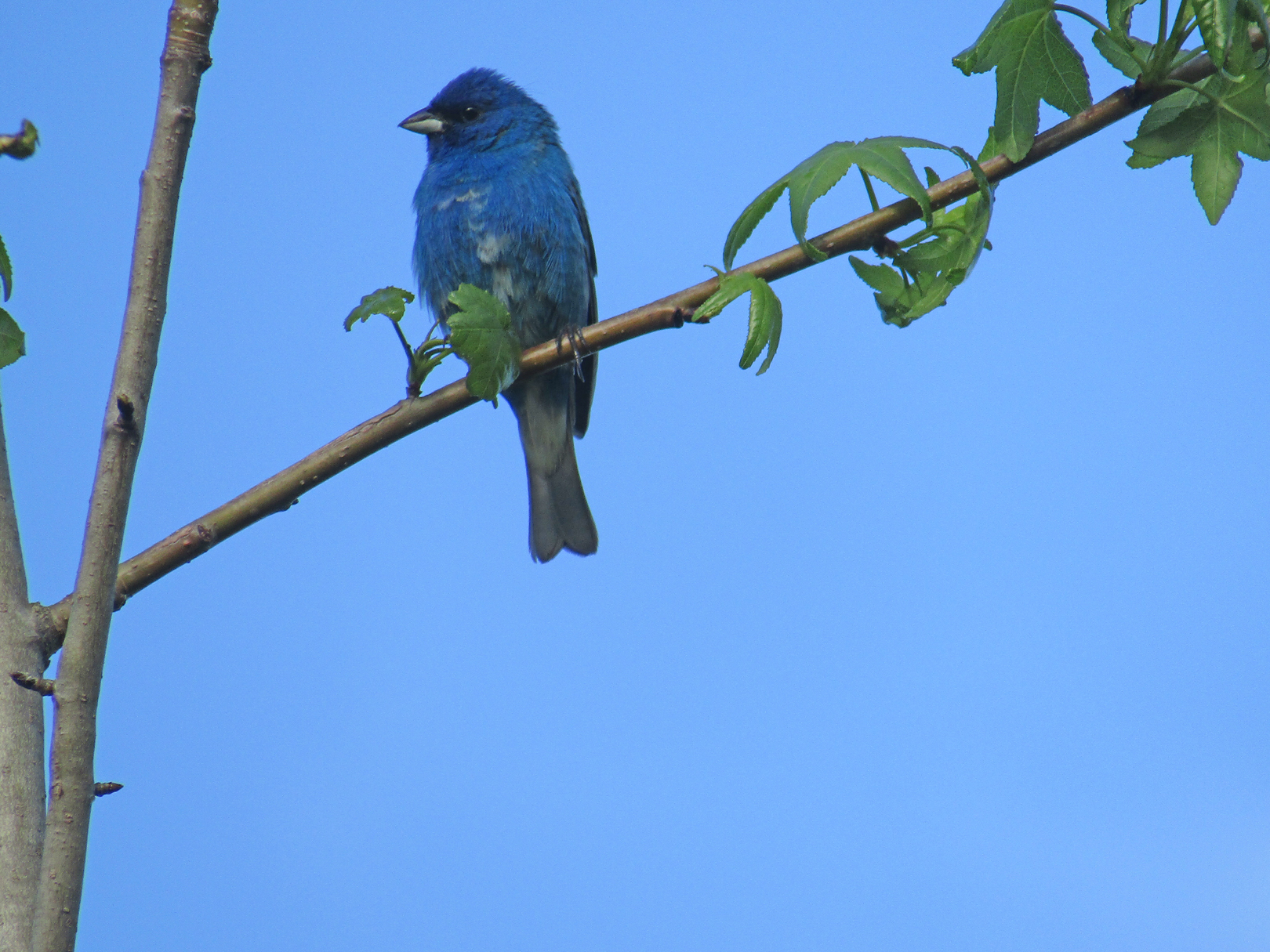
Scarlet tanager, 9; Northern cardinal, 169; rose-breasted grosbeak, 26; blue grosbeak, 3; and indigo bunting, 12.

Observers in this year’s Fall Bird Count included Fred Alsop, Jerry Bevins, Rob Biller, Tammy Bright, Debi and J.G. Campbell, Ron Carrico, Bill and Linda Cauley, Catherine Cummins, Dave Gardner, David and Connie Irick, Rick and Jacki Knight, Roy Knispel, Vern Maddux, Joe McGuiness, Tom McNeil, Alson Ovando, Susan Peters, Brookie and Jean Potter, Lia Prichard, Pete Range, Judith Reid, Judi Sawyer, Bryan Stevens, Kim Stroud and Charlie Warden.

•••

To ask a question, share a sighting or make a comment, email me at ahoodedwarbler@aol.com.
Ovenbird is season’s first returning warbler

By Hans Toom from Pixabay • A patch of orange feathers on the crown of an overbid’s head often goes unseen. This shy and retiring bird is more often heard than seen.

It’s gotten to be a bit of a guessing game every spring about which of the warblers will be the first to return to my home.

In 2021, the first warbler to return in the spring was a male Northern parula that arrived on April 9. In 2022, this same species was the first to return, albeit a few days later than the previous year’s date.

The Northern parula didn’t used to be one of the first returning warblers at my home. That honor used to go to hooded warbler or black-throated green warbler. This year, an ovenbird beat all of its kin to arrive on Friday, April 7, in the woodlands around my home, followed a few days later by a black-throated green warbler. This year’s first hooded warbler was a bit tardy and didn’t return until April 23.

The ovenbird is not one of the brightly colored warblers, such as black-throated blue warbler or yellow warbler. The ovenbird is a small brown bird with a white breast marked with dark streaking — an appearance that bears a superficial resemblance to the larger thrushes that share the same woodland habitat. The only hint of color is an orange crown patch bordered by dark stripes atop the bird’s head. Even this orange crown patch is not easily seen. When agitated, an ovenbird may raise its head feathers, which makes this orange mark easier to detect. The ovenbird also shows a distinct white ring around each eye, as well as pink legs and a pinkish bill.

By Hans Toom from Pixabay • The ovenbird gets its name from the shape of its nest, which is said to resemble an old-fashioned Dutch oven.

The resemblance to North America’s brown thrushes didn’t go unnoticed by some early American naturalists. Painter and famous naturalist John James Audubon painted a pair of ovenbirds, which he knew as “golden-crowned thrushes.” When comparing the two names, one can’t help but wish that the inaccurate but more romantically descriptive golden-crowned thrush had stuck.

Unfortunately, ovenbirds are stubborn about letting themselves be seen. They’re easily heard. The males begin singing a loud, rollicking “Teacher! Teacher! Teacher” song almost as soon as they arrive on potential nesting grounds.

The ovenbird, unlike many warblers, is not named for its appearance. Instead, the bird’s name derives from the shape of the nest it builds. The nest is a domed structure placed on the ground, woven from vegetation and containing a side entrance. Early European settlers in North America thought the nest looked like a Dutch oven, hence the name “ovenbird” for the small warbler with the intricate nest.

In April and continuing into May, a couple of dozen warbler species will pass through Tennessee. Some of these warblers find area woodlands and other habitats to their liking. They will pause, explore and perhaps decide to spend their summer nesting season in Northeast Tennessee and Western North Carolina rather than continue migrating farther north.

Many of the warblers that pass through each spring, however, are destined to travel a much longer distance before settling down in their favored habitats for the summer nesting season. These warblers include the Tennessee warbler, Nashville warbler, Cape May warbler, blackpoll warbler and Connecticut warbler. Most of these species nest as far north as New England and Canada.

Others find the Southern Appalachians to their liking. Some of the first warblers to return each year include the Louisiana waterthrush, which favors rushing mountain streams, as well as species such as black-throated green warbler, hooded warbler, ovenbird, black-and-white warbler, worm-eating warbler and common yellowthroat.

The Northern parula offers an abundance of identifying characteristics. Adult males are bluish gray overall with a yellow-green patch on the back and two white wingbars. A chestnut band separates the male’s bright yellow throat and chest. Adult females are often a bit paler and typically lack the male’s breast band. Both males and females have distinctive white eye crescents.

Most warblers lead frenetic lives. They often sing high in the tops of trees, but they do occasionally venture closer to the ground, particularly when foraging for prey, which consists of a variety of insects and small spiders. The Northern parula is even more restless than most of its kin.

The more reliable means of locating a Northern parula is to listen for the male’s buzzy, ascending song. He is a persistent singer from the time of his arrival until mid-summer.

A quirk involving nesting material is somewhat unique to this warbler. In much of the southern United States, the Northern parula conceals its nest inside strands of Spanish moss draped from the limbs of live oaks and other trees. In the Southern Appalachians and other locations farther to the north, the absence of Spanish moss means that the birds rely on various Usnea lichens, which are sometimes referred to as “Old Man’s Beard.”

A pair of Northern parulas will attempt to raise two broods in a nesting season. The female lays two to seven eggs and does most of the nest construction.

Look for spring’s warblers in the coming weeks. Feel free to share any sightings with me by emailing ahoodedwarbler@aol.com.

Photo by Bryan Stevens • The Northern parula’s geographic location during the nesting season determines its use of nesting materials.


Share your first sightings of spring hummingbirds

Photo by Georgia Lens / Pixabay

The website Journey North noted in a post on March 15, that hummingbird migration along the Pacific Coast has been impacted by the crazy weather that California has experienced in recent weeks.

In the eastern United States, however, the annual migration of ruby-throated hummingbirds is proceeding pretty much on schedule.

According to Journey North, volunteers along the Gulf Coast and in the Southeast have been reporting arriving ruby-throated hummingbirds since early March.
I fully expect that ruby-throated hummingbird migration will bring the first individuals to Northeast Tennessee, Southwest Virginia, and Western North Carolina in early April.

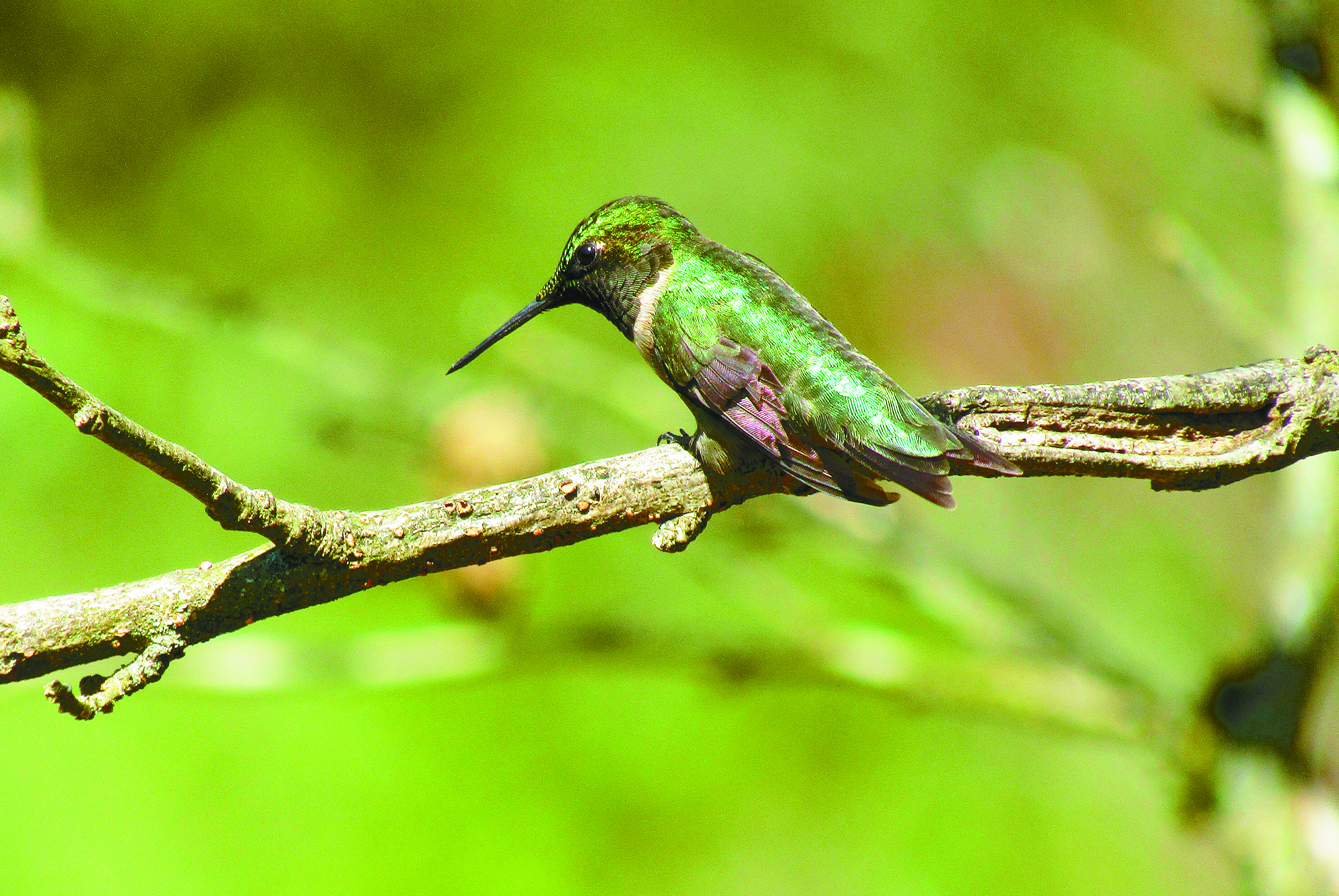
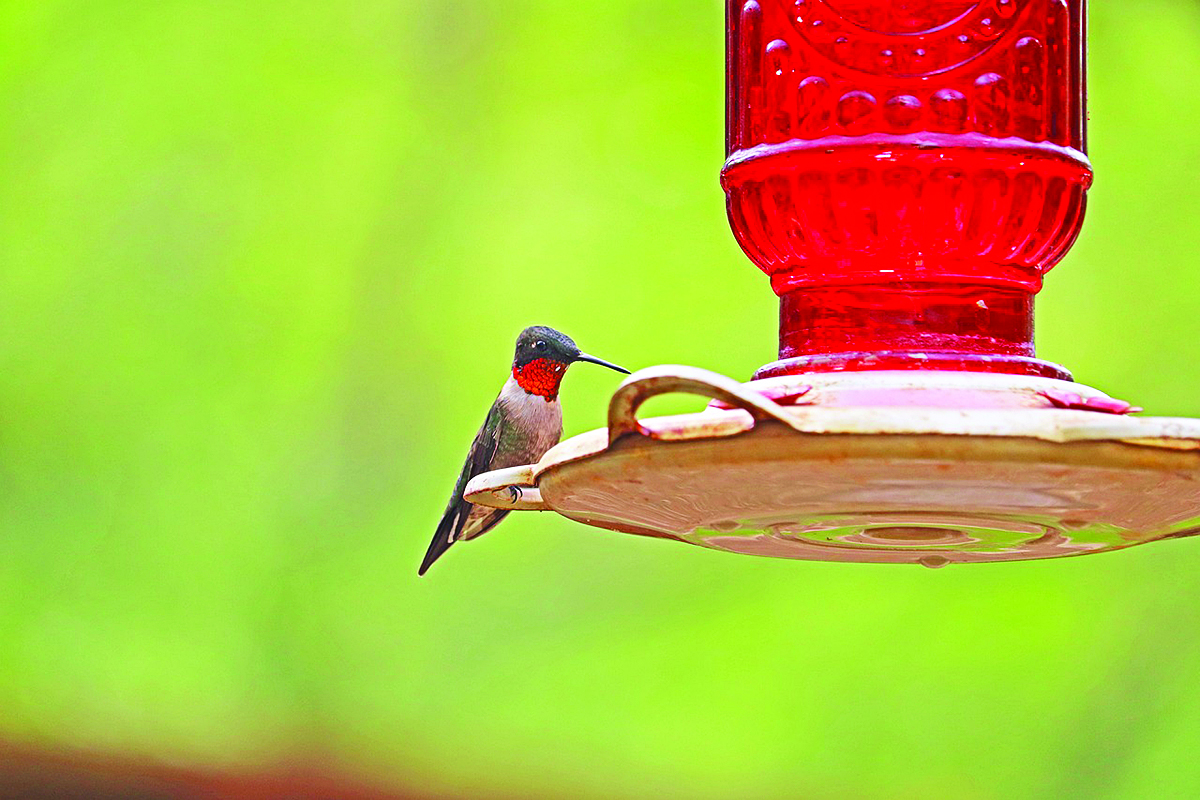
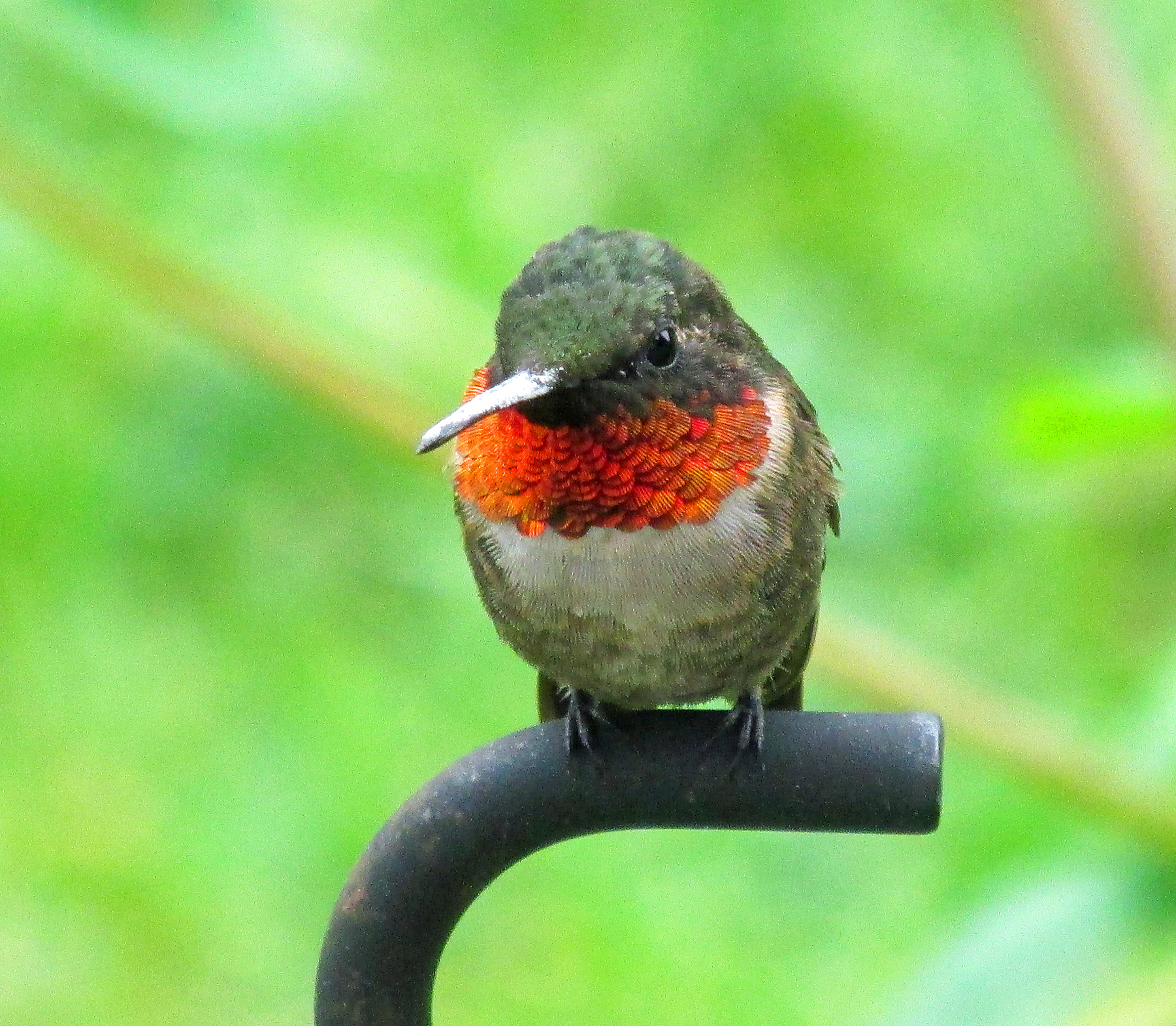
Photo by Bryan Stevens • Male ruby-throated hummingbird show the namesake red throat. The feathers on a male’s throat are iridescent, which means they can change when seen from different angles. In poor light, the ruby-red throat can look almost black.

According to the website, most first spring observations of hummingbirds are males, although a few females are being spotted. Male hummingbirds, the posting noted, arrive first so they can find and defend a territory.

As always, spring migration can be a challenging time for hummingbirds. Temperature, wind patterns and storms can influence the pace of migration.
Even once these tiny birds make their epic spring crossing of the Gulf of Mexico, they will need time to rest and refuel before moving northward. By mid-March, the advance of ruby-throated hummingbirds has usually reached states as Georgia and South Carolina. By the end of March, these tiny flying gems have reached states such as Tennessee and North Carolina.

It’s time to get those sugar water feeders outside and waiting for the early arrivals. Once the chance of late-season freezes has passed, consider planting some colorful native flowers to provide nectar sources for hummingbirds.

Northeast Tennessee usually gets its first spring hummingbirds the first week of April. If you’re seeing hummingbirds, I’d love to know. I have tracked arrivals for several years now. To share your first spring sighting of a ruby-throated hummingbird, email me at ahoodedwarbler@aol.com or contact me on Facebook at http://www.facebook.com/ahoodedwarbler. Please include the date and time of your sighting. I also welcome the sharing of other details about your sightings.
In the meantime, take steps now to welcome hummingbirds back and keep them safe during their stay.

Some ways of ensuring that our hummingbird guests are kept healthy and secure are simply common sense. For instance, don’t use pesticides, herbicides or any other sort of toxin anywhere close to the vicinity of a sugar water feeder or a flower garden. Hummingbirds are such tiny creatures with such intense metabolisms that it only takes a small amount of any harmful substance to sicken or kill one of these little flying gems.

Feeding hummingbirds is easy, but many people try to complicate the process. Only common, pure cane sugar, mixed to a ratio of four parts water to one part sugar, is a safe choice for these birds.

For emphasis, I’ll repeat again that only common, pure cane sugar is safe for hummingbirds. There are no safe substitutes. Do not use organic, raw or brown sugar. Confectioner’s sugar, which contains an anti-caking substance (often corn starch, silicates or stearate salts), is also hazardous to hummingbirds.
The ratio of four parts water to one part sugar utilizing pure cane sugar most closely duplicates the nectar that hummingbirds obtain from some of their favorite flowers. Why try to mess with nature’s perfection?

I cannot imagine why anyone would supplement sugar water for hummingbirds with such human beverages as a sports drink or Kool-aid, but there have been reports of people doing so. Be aware that such additives will only risk the health of these tiny birds.

Photo by Bryan Stevens • Despite a perceived disadvantage of size, ruby-throated hummingbirds are quite capable of thriving in a giant world.

Most experts also suggest avoiding red dyes or food colorings, which are often found in commercially marketed hummingbird sugar water. Don’t risk the health of hummingbirds for a little convenience.

It’s easy to make your own sugar water mix, which can be stored in the refrigerator in an empty plastic juice jug. Boil some water and then add one cup of sugar for every four cups of water in your pot. Stir thoroughly. Bottle the mixture until it cools. Fill your feeders and store any remaining sugar water in the fridge in the aforementioned jug. Refrigerated, the mix should stay good to use for at least a week.

In our milder spring weather, changing the sugar water in feeders can probably be done on a weekly basis. When hotter summer temperatures prevail, it’s usually necessary to change the sugar water every two or three days.

•••

Remember to send me those first sightings of returning spring hummingbirds. I’ll be doing my usual roundup to share who gets graced with a visit from one of these tiny beauties.

Spring signs less clear than in seasons past

Photo by Bryan Stevens * A male mallard lounges by the edge of a fish pond in a previous spring season.

Signs of spring are, as the old saying goes, popping up all over. Daffodils and crocuses unfurling their blooms, a pair of mallards paying a visit to my fish pond and the blue skies overhead on sunny days have signaled the transition toward spring as surely as the turning of the calendar page to March.

Some of these familiar sights have been hazy for me during this season of transition. In early February I lost vision in my right eye. After visits to various medical experts, an MRI, blood tests and other procedures, I got a diagnosis of optic papillitis, a form of optic neuritis. In simpler terms, I suffered a stroke of the eye that aggravated and inflamed the optic nerve.

The good news, as I see it, tests have not found any evidence of underlying conditions like cancer or a brain tumor. The bad news, also as I see it, is that recovery is not guaranteed and can take time. The process is usually measured in weeks and months, not days.

It’s been unsettling, to describe it mildly. Reading requires the assistance of a magnifying glass. Too much time focused on a bright screen brings discomfort.

I’m carrying on with birding as best I can. Binoculars, as birders know, are made for use by two eyes. I have feeders to lure the birds in close, but my favorite cardinals, chickadees and wrens are a bit blurry.

I’ve always tried to stay optimistic. I’m hopeful that by the time the ruby-throated hummingbirds return for a sip of sugar water at my feeders in April, my sight will be good enough to enjoy the beauty of their green and white plumage and the brilliant red throat if the visiting hummer is a male.

Photo by Bryan Stevens • Male ruby-throated hummingbird show the namesake red throat. The feathers on a male’s throat are iridescent, which means they can change when seen from different angles. In poor light, the ruby-red throat can look almost black.

If spring’s too soon, I’ll push the goal farther along in the 2023 calendar and hope to be ready to identify the annual fall parade of warblers.

As I wait, nothing’s stopping me from enjoying the sounds of spring. On rainy days, the chorus of spring peepers produce their amphibious cacophany at dusk and throughout the night. Many of the birds are also singing their hearts out. Eastern phoebes, tufted titmice, Carolina chickadees and Northern cardinals all make their presence with their loud, persistent songs.

On Monday, Feb. 20, I watched as the fuzzy shapes of two dozen red-winged blackbirds dropped down into the cattails in the marshy area near the fish pond. It’s not February for me until I’ve seen a migrating flock of blackbirds benefitting from an overnight stay in the cattails.

Photo by Bryan Stevens * A mallard drake looks vibrant with his green, glossy head.

On Sunday, Feb. 26, a mallard pair visited the fish pond. They were the first mallards that I’ve observed at my fish pond for many years. In full disclosure, my mom spotted them and informed me of their arrival. Mallards are big enough that I saw the male of the pair easily enough. His green head and chestnut breast stood out from the brown cattails and other vegetation bordering the pond. The female mallard blended nicely with the background and evaded my gaze. Regardless, I was thrilled to welcome mallards back to the pond. They only lingered for a single day, but they have me hoping that other ducks, such as blue-winged teal or wood ducks, will make similar visits as the season progresses.

On March 1, I saw my first spring butterfly. The seasonal first was a spring azure, a tiny, delicate butterfly. The sighting reminded me that nature will provide plenty of incentive to work on regaining my full vision. I still have more butterflies, as well as dragonflies, damselflies, moths and June bugs to look forward to seeing as we progress through spring and summer.

I’ve always believed that nature is a restorative force. Now I am going to test that theory in my goal to have my vision back at or near normal capacity by the time I hear the buzzy whir of hummingbird wings in April.

In the meantime, there will still be plenty of time to focus on our myriad feathered friends. I have someone who has been great at taking down my dictated words for my weekly column.

As always, make a comment, share an observation or ask a question by emailing me at ahoodedwarbler@aol.com.