Tag Archives: Hummingbirds

Dark-eyed juncos deserving of affectionate ‘snowbirds’ nickname

Photo by Bryan Stevens Dark-eyed juncos are winter residents in the region.

As I mentioned in last week’s column, I published my first “Feathered Friends” on Sunday, Nov. 5, 1995.

In celebration of that milestone, here’s that first column with a few revisions that have been added over the years.

•••

Of all the birds associated with winter weather, few are as symbolic as the dark-eyed junco, or “snow bird.” The junco occurs in several geographic variations.

The cover of the classic “A Complete Guide to Bird Feeding” by John V. Dennis.

John V. Dennis, author of “A Complete Guide to Bird Feeding,” captures the essence of the junco in the following description: “Driving winds and swirling snow do not daunt this plucky bird. The coldest winter days see the junco as lively as ever and with a joie de vivre that bolsters our sagging spirits.”

The dark-eyed junco’s scientific name, hyemalis, is New Latin for “wintry,” an apt description of this bird.

Most people look forward to the spring return of some of our brilliant birds — warblers, tanagers and orioles — and I must admit that I also enjoy the arrival of these birds. The junco, in comparison to some of these species, is not in the same league. Nevertheless, the junco is handsome in its slate gray and white plumage, giving rise to the old saying “dark skies above, snow below.”

Just as neotropical migrants make long distance journeys twice a year, the junco is also a migrating species. But in Appalachia, the junco is a special type of migrant. Most people think of birds as “going south for the winter.” In a basic sense this is true. But some juncos do not undertake a long horizontal (the scientific term) migration from north to south. Instead, these birds merely move from high elevations, such as the spruce fir peaks, to the lower elevations. This type of migration is known as vertical migration. Other juncos, such as those that spend their breeding season in northern locales, do make a southern migration and, at times, even mix with the vertical migrants.

Photo by Bryan Stevens • Dark-eyed junco nests on high mountain slopes during the summer month. This dark-eyed junco was photographed at Carver’s Gap on Roan Mountain during the summer nesting season.

During the summer months, a visit to higher elevations mountaintops is almost guaranteed to produce sightings of dark-eyed juncos. Juncos may nest as many as three times in a season. A female junco usually lays three to six eggs for each nest, which she constructs without any assistance from her mate.

Juncos are usually in residence around my home by early November. Once they make themselves at home I can expect to play host to them until at least late April or early May of the following year. So, for at least six months, the snow bird is one of the most common and delightful feeder visitors a bird enthusiast could want.

Juncos flock to feeders where they are rather mild-mannered — except among themselves. There are definite pecking orders in a junco flock, and females are usually on the lower tiers of the hierarchy. Females can sometimes be distinguished from males because of their paler gray or even brown upper plumage.

Since juncos are primarily ground feeders they tend to shun hanging feeders. But one winter I observed a junco that had mastered perching on a hanging “pine cone” feeder to enjoy a suet and peanut butter mixture.

Photo by Ken Thomas • A dark-eyed junco perches on some bare branches on a winter’s day.

Dark-eyed juncos, widespread across North America, readily visit feeder but are often content to glean the scraps other birds knock to the ground. The junco is the most common species of bird to visit feeding stations. They will sample a variety of fare, but prefer such seeds as millet, cracked corn or black oil sunflower.

The juncos are a small branch of the sparrow clan. Some of the other juncos include the endangered Guadalupe junco, yellow-eyed junco, Baird’s junco and volcano junco.

The last one on the list is endemic to the Talamancan montane forests of Costa Rica and western Panama.

The endangered Guadalupe junco is confined to an island. Recent efforts to eliminate feral goats and cats from the island have shown some positive results for this species.

Baird’s junco is named for Spencer Fullerton Baird, an American ornithologist and naturalist. Baird served as secretary for the Smithsonian Institution from 1878 until his death in 1887. He greatly expanded the natural history collections of the Smithsonian from 6,000 specimens in 1850 to over two million by the time of his death.

I hope you’ve enjoyed this introduction to juncos. There’s something about winter that makes a junco’s dark and light garb an appropriate and even striking choice, particularly against a backdrop of newly fallen snow.

Of course, the real entertainment value of juncos comes from their frequent visits to our backyard feeders. When these birds flock to a feeder and begin a frenzied bout of feeding, I don’t even have to glance skyward or tune in the television weather forecast. I know what they know. Bad weather is on the way!

••••

I’ve not seen the first junco of the season, but I have observed some other late-autumn migrants, including ruby-crowned kinglets and a swamp sparrow.

If you’d like to share your first sighting this season of dark-eyed juncos, email me at ahoodedwarbler@aol.com. As always, the column is also a line of communication with fellow bird enthusiasts. I’ve enjoyed sharing stories about birds with countless readers over the past 30 years. I can also be reached on Facebook at https://www.facebook.com/ahoodedwarbler.

Photo by Bryan Stevens Dark-eyed juncos embrace feeders when weather takes a turn for the worse.

Why do owls give a hoot? For many reasons

Dave Menke/USFWS Great horned owls, such as this individual, are effective predators after dark.

As September slid into October, the evening serenades began. At first, they consisted of a pair of Eastern screech-owls calling from the surrounding woodlands. On Oct. 2, the low hoots of a great horned owl joined the wailing calls of the two screech-owls.

I’ve gotten into the habit of 10-minute walks in the evening after dinner, and I posted about the owls on my Facebook account.

Several friends responded, including Tom McNeil, a fellow birders and an fellow alumna of Hampton High School.

“We’ve been hearing a pair (of great horned owls) hooting up on the ridge between you and us,” Tom wrote. “We also had a barred owl calling a few weeks ago, which was only the second time ever.”

Tom and his wife, Cathy, reside in the Piney Grove community of Hampton. As he indicated, only a steep mountain ridge separates his property from mine.

That ridge is a magnet for birds, ranging from pileated woodpeckers and wild turkeys to warblers, vireos, tanagers, flycatchers and many other songbirds. The bird population changes with the seasons, but there’s always a diversity of birds making their home on those wooded slopes.

Linda Cauley also responded to my Facebook post, sharing that she also had recently heard a great horned owl.

Larry A. Woodward/USFWS Eastern screech-owl chicks peer from the tree cavity that served as their first home.

Kaylynn Sanford Wilster has also been hearing a great horned owl. “First great horned owl I’ve had here in forever it seems like,” she wrote. “I think there’s just one but I’m not sure.”

Joanne Campbell commented on my post.

“We had a big hoot owl right outside our door last week,” Joanne wrote. “Closest I’ve ever been to one.”

I’d been surprised to hear screech-owls, which are considerably smaller than a great horned owl, calling at the same time as their larger kin. Great horned owls are not finicky and will dine on any smaller creature they can seize in their strong talons. I’d heard that smaller owls usually go silent in the presence of this large nocturnal predator.

Of course, the screech-owls were relatively close to my home while the great horned owl’s calls were notably distant. Perhaps they felt that enough space existed between them to ease any worries.

I also got to wondering why owls are so vocal. A little research came up with some answers.

First, it’s important to note that Eastern screech-owls produce different vocalizations for various purposes. One of my favorites is the “whinny,” a descending call that is, apparently, a territorial display to inform other owls that they have claimed a territory as their own.

At this time of the year, juvenile screech-owls are also striking out on their own away from parental care. These young owls deploy the whinny to establish their own territories. They will need a well-defined territory to ensure they can find enough prey during the lean, cold winter months.

The whinny itself is of short duration, lasting only a couple of seconds. Screech-owls also produce other sounds, which have been described as hoots, barks and squeal.

Another common screech-owl vocalization is an even-pitched trill, often called a “bounce song” or tremolo. I can do a decent job imitating this sound, and I’ve often stirred up songbirds by doing so. A flock will sometimes materialize as if from thin air, as the members of the flock scold and search for the owl. It’s a good way to draw some curious birds closer for observation.

Bryan Stevens Lucy, a rehabilitated owl, helps programmers at Brookgreen Gardens provide educational programs about owls to the public.

Great horned owls, or “hoot owls” as they are widely known, also produce their low, nocturnal calls for many of the same reasons as screech-owls do. These large owls hoot to communicate, with the most common reasons being to define and defend territory, locate and attract a mate during breeding season and stay in contact with their young. Hooting also helps them establish boundaries with other owls and signals their presence, making their calls particularly energetic and frequent in the autumn and winter months when territories are being set up.

Pairs of great horned owls will hoot together as part of their courtship to strengthen their bond. A female owl’s voice is notably higher in pitch than the male’s, according to the website All About Birds. I’m hoping I will soon hear the duet that Tom and Cathy are enjoying on the other side of the ridge. So far, I’ve only detected the one great horned owl. I have heard these mesmerizing duets in the past, however. Listening can produce shivers down the spine. Of course, that is also helped by the fact they most often hoot on evenings once the weather had become more chilly.

The days are shorter, nights are longer, so now is a great time to get familiar with the owls. It can be as easy as stepping onto the front porch and listening.

•••

Bryan Stevens has been writing about birds, birding and birders since 1995. To share a sighting, ask a question or make a comment, email him at ahoodedwarbler@aol.com.

Photo by Irene K-s/Pixabay.com
An Eastern screech owl keeps an eye on its surroundings.

Local couple comes to aid of injured hummingbird

Rex and Linda Mathes • Linda and Rex Mathes came to the aid of this injured hummingbird. Most ruby-throated hummingbirds, like other migratory birds, face many perils and obstacles during their migrations.

Erwin resident Linda Mathes emailed me recently to inquire about wildlife rehabilitators who might be able to help an injured ruby-throated hummingbird.

“We found a hummingbird in the backyard yesterday, alive, so brought into house and put in box,” Linda wrote. “We think its wing is damaged.”

Linda noted that she and her husband, Rex, also brought the hummingbird feeder inside.

“My husband picks it up and holds it up to feeder and it drinks,” Linda explained. “He does this several times a day.”

She added that the hummingbird regained enough strength to also sit on Rex’s finger.

“We were worried the bird would not have any nectar during the night,” she added.

The next morning, the bird still seemed fine other than for the injured wing.

“He is very perky,” Linda note. “He/she is a real fighter.”

I provided Linda with some suggestions on wildlife rehabilitaters, but she found one on her own with the help of a friend. Rex and Linda made a trip on Monday, Sept. 29, to deliver the hummingbird into the care of a licensed wildlife rehabilitation professional.

Bryan Stevens • Ruby-throated hummingbirds have usually departed from the region by early October.

“They gave me a patient number so I could call about the bird.”

When she called on the morning of Tuesday, Sept 30, she got a detailed report.

The vet had prescribed muscle relaxers for the hummingbird,” Linda said. “Her condition was listed as guarded but at least she might have a chance.”

As they were leaving the facility, someone brought in an injured chipmunk.

Linda added that there was no charge for caring for the bird but she planned to send a small donation.

I’m hopeful for the hummingbird’s recovery. Over the years, I’ve encountered several injured birds. Several of the birds stunned themselves after impacts with windows, an all-too-common hazard. Rose-breasted grosbeak and Swainson’s thrush have been among some of these. Most of the birds have recovered after a brief rest period in a shoe box covered with a towel. It’s always a relief when they can fly off under their own power.

Migration can be hazardous and arduous for our feathered friends. Birds face various hazards, including collisions with human-made structures like buildings and power lines, habitat loss and degradation, storms, disorienting light pollution and predation from other animals.

They also need to refuel to keep up their strength, and the lack of food along a migration route can deal the chances of their success a serious blow.

Even birds that cannot fly undertake migrations. For instance, flightless penguins swim hundreds or thousands of miles to reach preferred ranges for feeding or nesting. The Australian emu, a smaller relative of the ostrich, makes seasonal migrations on foot to ensure access to abundant food supplies at all seasons.

Ruby-throated hummingbirds make an awe-inspiring and non-stop crossing of the Gulf of Mexico every fall to reach their wintering grounds. Their flight across the waters of the Gulf can take these tiny birds 18 to 22 hours. Even more incredible, they make the trip in reverse in the spring when they return to their nesting grounds across the Eastern United States.

Photo by Bryan Stevens • A ruby-throated hummingbird visits a feeder for a sip of sugar water.

Ruby-throated hummingbirds lead relatively brief lives, which is understandable considering the perils they face and the incredible migrations they stage twice each year. The oldest known ruby-throated hummingbird was a female, according to the website All About Birds. She was at least 9 years, 2 months old when she was recaptured and rereleased in 2014 during banding operations in West Virginia.

The New World is home to about 360 species of hummingbirds. We’ve expended a lot of energy finding adjectives to provide names for all these hummingbirds. Sometimes, words fail. Mere adjectives are somewhat inadequate in providing common names for many of the world’s more hummingbirds, but that doesn’t keep us from trying to give descriptive names to each hummingbird species. For instance, we have the beautiful hummingbird of Mexico; the charming hummingbird of Costa Rica and Panama; the festive coquette of northwestern South America; and the magnificent hummingbird of the southwestern United States.

•••

To share a sighting, make a comment or ask a question, email me at ahoodedwarbler@aol.com.

Hummingbirds, other summer birds get ready to depart

Photo by Bryan Stevens • A ruby-throated hummingbird visits a feeder for a sip of sugar water.

I always feel some reluctance and regret when I turn the calendar page from August to September.

I don’t have anything against fall – it’s my favorite season. But I know that our ruby-throated hummingbirds, which returned only five months ago in early April, will soon be departing.

It won’t be only the hummingbirds. Warblers, orioles, tanagers and other migrants will also fly south to spend the winter season somewhere more hospitable.

Most of the hummingbirds that visited our gardens over the summer are getting ready to migrate back to their winter homes in Central America.

I’m seeing only a few adult male hummingbirds with the namesake red throat. They are outnumbered by females and young hummingbirds that hatched in late spring and throughout the summer. It’s fun to watch young hummingbirds. They often have something to prove. In many ways, they’re even more feisty than adult birds.

Photo by Bryan Stevens • A male ruby-throated hummingbird perches at a feeder for a sip of sugar water.

In any given year, the numbers of hummingbirds passing thorough is going to fluctuate. Some years, these tiny flying gems will be present in good numbers on an almost daily basis. Other years, hummingbirds can become quite scarce.

I usually enjoy my best hummingbird numbers in the fall as these little birds begin their leisurely journey back south. Late August and the month of September is usually a great time to watch hummingbirds.

During August, the feeders at my home and my mother’s home saw a great deal of activity. Blooms of wildflowers and cultivated flowers also attracted them. Earlier in the summer the hummingbirds went gaga for the crocosmia blooms and the flowering bee balm. For the past month, the tube-shaped flowers of orange jewelweed has kept them coming back for more.

The New World is home to about 360 species of hummingbirds. We’ve expended many adjectives in finding names of them all. Sometimes, words fail. Mere adjectives are somewhat inadequate in providing common names for many of the world’s more hummingbirds, but that doesn’t keep us from trying to give descriptive names to each hummingbird species. For instance, we have the beautiful hummingbird of Mexico; the charming hummingbird of Costa Rica and Panama; the festive coquette of northwestern South America; and the magnificent hummingbird of the southwestern United States.

Photo by Bryan Stevens • A ruby-throated hummingbird sips from a sugar water feeder.

Other names are even more elaborate and occasionally outlandish, such as the white-tufted sunbeam of Peru; the violet-throated metaltail of Ecuador; the violet-throated starfrontlet of Peru and Bolivia; the hyacinth visorbearer of Brazil; and the rainbow-bearded thornbill of Colombia and Ecuador.

As for our own ruby-throated hummingbirds, wish them well as they begin that long trek back to their wintering grounds. For the young birds, this will be their first epic crossing of the Gulf of Mexico, something the species must do twice a year to get to and from their summer home in eastern North America.

•••

Bryan Stevens has written about birds, birding and birders since 1995.

Late summer offers interesting birding opportunities for birders

Photo by Steven Arnold/Pixabay • A great blue heron attempts to get a handle on a snake in preparation for swallowing its serpentine prey.

A pair of Carolina wrens has taken advantage of what was meant to be the temporary storage of some boxes on the front porch to claim the interior of one of the cardboard containers as a nesting location.

In the latter days of summer, usually a lackluster period for birdwatching, there are still some interesting behaviors or actions on the part of our feathered friends to provide some points of interest.

Wrens already have a reputation for nesting in some unusual locations. My introduction to the Carolina wren took place in my childhood when a pair of these wrens nested in an old apron my grandmother used as a bag for her clothespins. Other unusual locations for wren nests that I have found over the years included the interior of a plastic shopping bag hanging from a nail in my garage and an attempt to nest in the exhaust vent for my clothes dryer. I’ve also seen them nest in hanging flower baskets.

Photo by Jean Potter • A Carolina wren creeps along a fence.

The world’s 88 species of wrens are, for the most part, the quintessential “little brown birds,” but that hasn’t kept them from acquiring some interesting and descriptive common names. Some examples include the tooth-billed wren, flutist wren, riverside wren, whiskered wren, happy wren, musician wren, timberline wren, speckle-breasted wren, white-breasted wood wren and giant wren. The last species on the list resides in Mexico and is indeed a “giant” among a family of tiny birds, reaching a length of almost nine inches and weighing all of 1.8 ounces.

I’ve also been monitoring a great blue heron lurking along the creek that flows past my home. A collapsed foot bridge (thanks to Helene) still spans the creek and provided, at least from the heron’s perspective, a means of concealment from my prying eyes when I stepped onto the front porch. The heron ducked under the bridge and slowly stepped downstream, out of sight and presumably what the bird thought would be out of mind. But I tricked the heron, stepping back inside the house and waiting for It to reappear. I stepped into view again and the heron, instead of taking flight, repeated its earlier actions, skirting beneath the bridge and wading downstream. I could probably have continued this game of peek-a-boo, but I felt that I had imposed on the heron long enough. The bird evidently desired to try its luck fishing upstream beneath a shady overhang of branches from trees growing along the creek banks. I stepped back inside, peeked out a window and watched the heron move in a slow, stately manner, but this time the bird headed up the creek.

All herons are skillful anglers, so I am confident that the bird probably managed to catch an unwary frog or fish. As the tallest heron in North America, the great blue heron boasts a diverse diet. These birds, armed with a dagger-shaped bill, excellent vision and quick reflexed, prey on rodents, amphibians, snakes, fish and even small alligators. Basically, a great blue heron will eat anything it can swallow.

Photo by Bryan Stevens • A great blue heron’s quick reflexed and dagger-like bill make it a formidable predator.

Other herons around the world with descriptive names include purple heron, white-bellied heron, black-headed heron, great-billed heron, whistling heron, pied heron and Goliath heron. The latter, as its name suggests, is a giant among herons.

There’s more to report on the birding front. Hummingbird numbers are on the rise again. After the usual summer lull, the resident ruby-throated hummingbirds have raised their profile, visiting daily at feeders as well as blooming flowers. Female hummingbirds have had time to raise their young. In fact, many of the hummingbirds visiting your yards and gardens at this time of year are probably birds born earlier in the season. In a couple of months these young birds will make their inaugural migration across the Gulf of Mexico to reach winter grounds in Central America. Until that time, hang a sugar water feeder, grab a lawn chain and enjoy the hours of no-cost entertainment provided by these feisty, flying gems.

So, although the summer doldrums do make birds scarce at times, just know that they’re still out there. In the meantime, nature offers plenty of other engaing wildlife. During the day, it’s fun to look for butterflies and dragonflies. After dark, there’s always moths and lightning bugs.

Keep in mind, it’s not always the visuals. For instance, the past couple of nights I’ve enjoyed listening to an Eastern screech-owl’s nocturnal serenade with its trembling wailing call that gives this small owl its name.

•••

Bryan Stevens has been writing about birds and birding since 1995. Email him at ahoodedwarbler@aol.com to share a sighting, make a comment or ask a question.

Photo by Bryan Stevens • A ruby-throated hummingbird visits a feeder for a sip of sugar water.


Carter County Summer Bird Count tallies 117 species

Hans Toom/Pixabay • A couple of Canada warbler got tallied with this year’s Carter County Summer Bird Count.

The Lee and Lois Herndon Chapter of Tennessee Ornithological Society, also known as the Elizabethton Bird Club, held its 32nd annual Carter County Summer Bird Count on Saturday, June 7 with 20 observers in nine parties.

Participants tallied 117 species, which is slightly above the average of 114 species.

Most unusual was a Mississippi kite seen for the first time on one of the chapter’s summer bird count. The kite was seen in the Toll Branch vicinity, according to the count’s longtime compiler Rick Knight. He also indicated that other notable finds included common merganser and red crossbill. In addition, counter found 18 species of warblers.

The list:

Canada goose, 90; wood duck, 8; mallard, 56; and common merganser, 2.
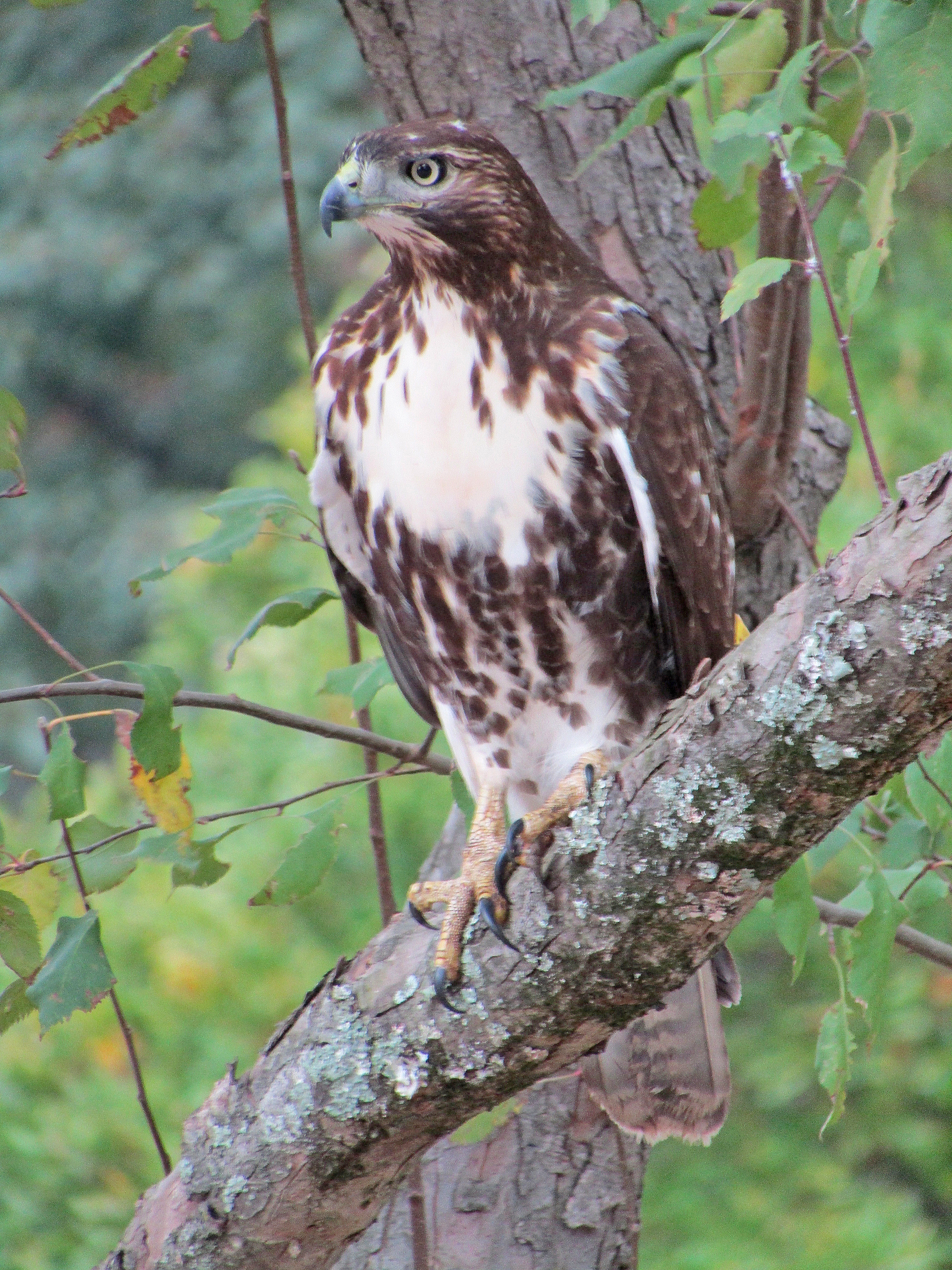
Wild turkey, 13; rock Pigeon, 36; Eurasian collared-dove, 3; mourning dove, 142; yellow-billed cuckoo, 5; chuck-will’s-widow, 4; Eastern whip-poor-will, 8; chimney swift, 55; and ruby-throated hummingbird, 20.

Killdeer, 8; double-crested cormorant, 5; green heron, 2; great blue heron, 10; black vulture, 14; and turkey vulture, 46.

Osprey, 3; sharp-shinned hawk, 1; Cooper’s hawk, 3.

Bald eagle, 2; Mississippi kite, 1; red-shouldered hawk, 4; broad-winged hawk, 5; red-tailed hawk, 14; Eastern screech owl, 3; great horned owl, 1; and barred owl, 1.

Belted kingfisher, 9; red-bellied woodpecker, 18; downy woodpecker, 10; hairy woodpecker, 1; Northern flicker, 24; and pileated woodpecker, 16.

Simard Francois/Pixabay • A great crested flycatcher perches on a horizontal branch.

American kestrel, 2; great crested flycatcher, 8; Eastern kingbird, 16; Eastern wood-pewee, 26; Acadian flycatcher, 23; alder flycatcher, 1; least flycatcher, 9; and Eastern phoebe, 46.

White-eyed vireo, 11; yellow-throated vireo, 1; blue-headed vireo, 20; warbling vireo, 4; red-eyed vireo, 130; blue jay, 104; American crow, 180; fish crow, 4; and common raven, 2.

Carolina chickadee, 57; tufted titmouse, 78; tree swallow, 101; Northern rough-winged swallow, 58; purple martin, 23; barn swallow, 106; and cliff swallow, 127.

Golden-crowned kinglet, 2; cedar waxwing, 69; red-breasted nuthatch, 3; white-breasted nuthatch, 13; blue-gray gnatcatcher, 13; Carolina wren, 78; house wren, 23; and winter wren, 1.

Gray catbird, 34; brown thrasher, 31; Northern mockingbird, 83; European starling, 660; Eastern bluebird, 102; veery, 10; hermit thrush, 1; wood thrush, 35; and American robin, 417.

House sparrow, 27; house finch, 84; red crossbill, 3; pine siskin, 5; American goldfinch, 117; chipping sparrow, 91; field sparrow, 26; dark-eyed junco, 34; song sparrow, 204; and Eastern towhee, 105.

Yellow-breasted chat, 4; Eastern meadowlark, 11; orrchard oriole, 8; Baltimore oriole, 6; red-winged blackbird, 88; brown-headed cowbird, 43; and common grackle, 109.

Ovenbird, 65; worm-eating warbler, 5; Louisiana waterthrush, 15; golden-winged warbler, 3; black-and-white warbler, 34; Swainson’s warbler, 9; common yellowthroat, 19; hooded warbler, 104; American redstart, 24; Northern parula, 65; Blackburnian warbler, 6; Yellow warbler, 9; chestnut-sided warbler, 31; black-throated blue warbler, 33; pine warbler, 3; yellow-throated warbler, 20; black-throated green warbler, 27; and Canada warbler, 2.

Scarlet tanager, 34; Northern cardinal, 160; rose-breasted grosbeak, 7; blue grosbeak, 6; and indigo bunting, 154.

Knight noted that it seems like a few species are often missed on a one-day count. He explained that these misses are usually low-density or localized species. Weather or other circumstances may contribute to these misses, as well.

Several species of herons were found for this year’s Summer  Bird Count, but yell0w crowned night-heron was missed. 

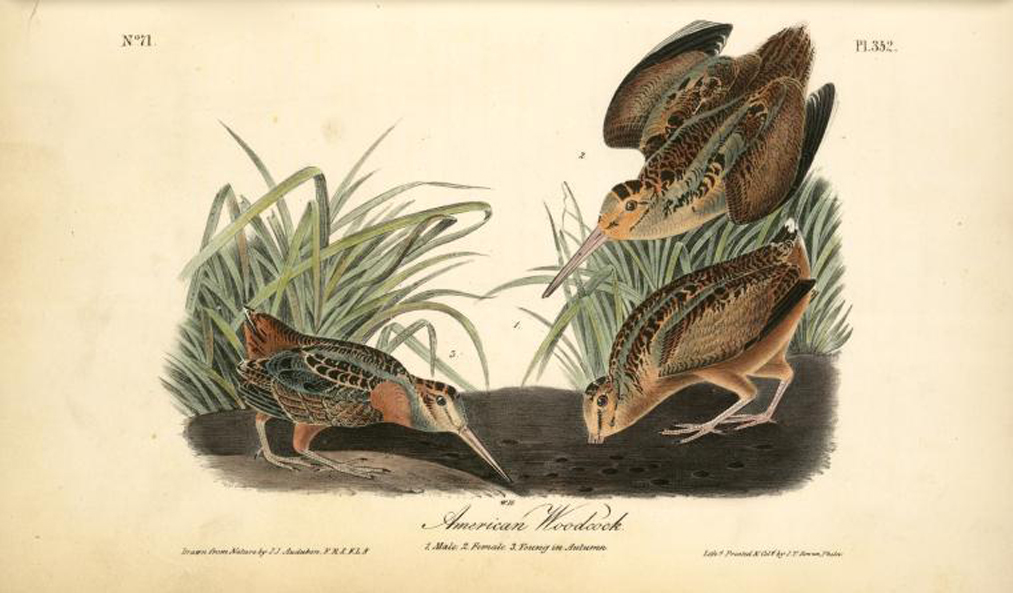
Missed species this year included ruffed grouse, common nighthawk, America woodcock, yellow-crowned night-heron, yellow-bellied sapsucker, brown creeper, Kentucky warbler and magnolia warbler.

The chapter will resume meeting in September for its 2025-2026 calendar year. Meetings are usually held the first Tuesday of each month on the Elizabethton campus of Northeast State Community College. Meetings are accompanied by a program on birds, birding and other nature-related topics and begin at 7 p.m. For details, or to share a sighting, ask a question or make a comment, email me at ahoodedwarbler@aol.com.

•••

Bryan Stevens has written about birds and birding since 1995. His weekly “Feathered Friends” column will celebrate its 30th anniversary this year.

Cedar waxwings provide entertainment as they feast on mulberries

Photo by Jack Bulmer/Pixabay • A cedar waxwings strikes a stately pose on a branch.

Spring turned out to be a rainy season in Northeast Tennessee. As we move into the official summer season as of Friday, June 20, summer’s also looking like it might be wetter than usual.

Rainfall hasn’t stopped the rhythms of the seasons. For instance, two mulberry trees at home have produced a bonanza of ripening berries for our fruit-loving feathered friends.

So far, the main beneficiaries of all this bounty has been the local cedar waxwings. These sleek and distinctive birds have a brown and gray silky plumage, a black mask and a perky crest. Some of the wing feathers show red tips. The similarity of these wing tips to melted drops of wax gives these birds the common name of waxwing.

There’s no absolute explanation of the purpose for these waxy tips. Experts have theorized that the colorful wingtips might help attract mates.

Other birds have competed for access to the berries, including American robins, gray catbirds and at least one scarlet tanager.

Cedar waxwings love their fruit. They’re not quite a frugivore, which is a scientific term for animals that depend mostly on raw fruits for sustenance. The website All About Bird recommends planting native trees and shrubs that bear small fruits, including such species as mulberry, dogwood, serviceberry, cedar, juniper, hawthorn and winterberry, to attract cedar waxwings.

Photo by Bryan Stevens • A cedar waxwing perches in the upper branches of a tree.

The cedar waxwing has few relatives. Worldwide, there are only two other species: the Bohemian waxwing, of the northern forests of Eurasia and North America; and the Japanese waxwing, found in such northeast Asian countries as Japan, Korea and China.

Although it’s classified as a songbird, the cedar waxwing does’t truly produce a vocalization that anyone would contend qualifies as a song. They are, however, very vocal birds, producing shrill, high-pitched notes as they pass through the upper branches of tall trees.

Early American naturalist and artist John James Audubon painted this pair of cedar waxwings.

As much as the waxwing has a fondness for fruit, it’s also a bird that would have made an excellent flycatcher. Flocks of these birds will often congregate in trees near the edge of a pond, garden or yard — anywhere winged insects might be found in good numbers — in order to hawk insects on the wing. A waxwing will sally forth from a branch, snatch its prey in mid-air, and return to its perch for a quick snack. Dragonflies often feed on mayflies and dragonflies but they will also forage on a wide array of other winged insects.

Waxwings are rather nomadic, coming and going with a maddening unpredictability. They often follow the available sources of food, whether that’s the multitude of flying insects attracted by pond and rivers or a particularly bountiful crop of fruit.

They can form large flocks. I once observed a flock that probably consisted of 100 individuals as they stripped berries in early winter from a holly tree. Adding some comic relief to the scene were two Northern mockingbirds making a futile attempt to disperse the waxwings and thus claim all the berries for themselves. The mockingbirds would chase off a dozen or so birds only for twice that number to descend on the vacated spot in the tree’s branches. It was a losing battle, but I am confident that once they settled down, the mockingbirds managed to enjoy the supply of berries alongside the overwhelming numbers of waxwings.

I’ve enjoyed the friendly flock of waxwings as they’ve feasted on mulberries. The only drawback has been that I am usually observing their antics in late evening when the sun is behind these birds. Fortunately, even a waxwing’s sleek silhouette is still a sight to behold and enjoy.

•••

To share a sighting, ask a question or make a comment, send me an email to ahoodedwarbler@aol.com.

Photo by Bryan Stevens • A pair of cedar waxwings hawk for insects near a pond.

Joyas voladoras: Hummingbirds welcomed back to region

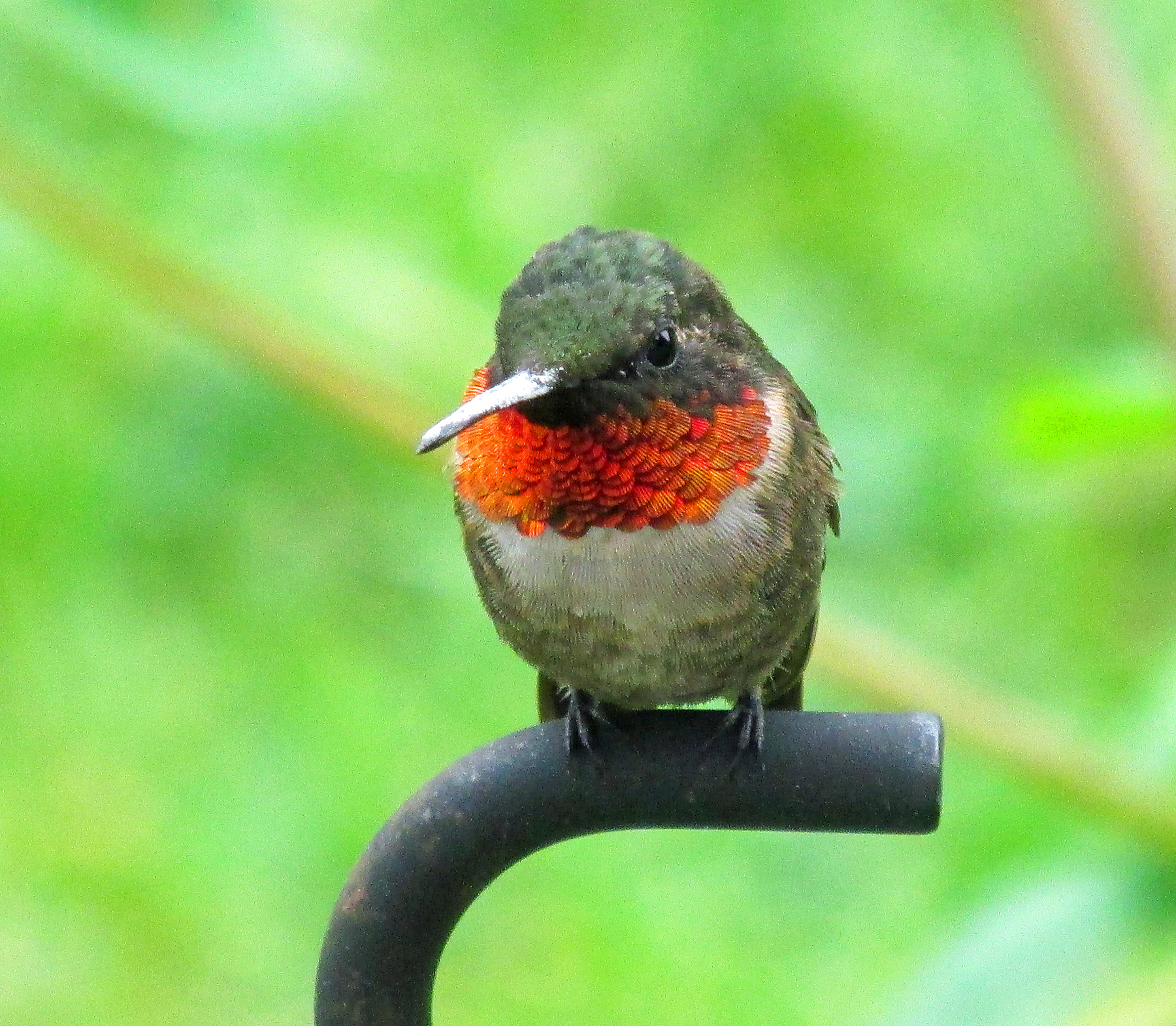
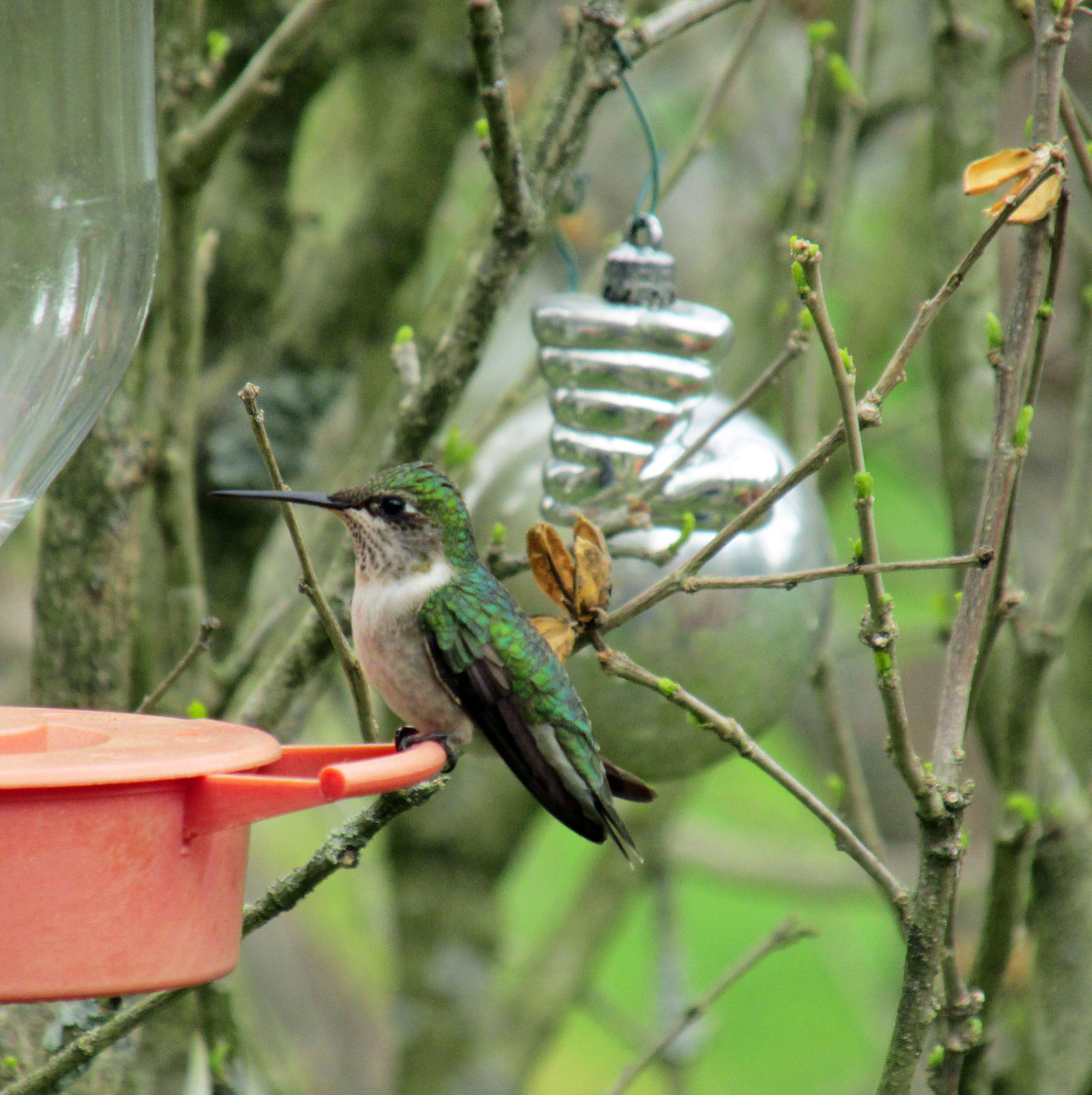
Michele Spark • Female ruby-throated hummingbirds lack the red throat patch, known as a gorget, that is present on adult males.

Readers continue to welcome back hummingbirds and share their first spring sightings of these tiny birds.

•••

“My husband Marvin and I saw our first hummingbird March 31 in Rogersville, Tennessee,” Mary Powers wrote in an email.

“We’ve been seeing them most days since then,” she added.

Mary said she put the feeder up a week before her sighting.

“Of course I change the syrup every week and clean it,” she noted.

•••

Kenneth Oakes commented on my Facebook page about his first sighting.

“I’ve just seen my first this year about 30 minutes ago on April 6 in an area near Sunshine, North Carolina,” Kenneth wrote.

•••

Dianne Rebmann emailed me to share her first spring hummingbird sighting.

“I saw my first hummingbird April 8,” she wrote. “There were actually two of them, and I caught them on Trailcam.”

Dianne lives in the Willowbrook community in Kingsport near the Meadowview Convention Center.

•••

Annie Morton and Pete Fredrick emailed me information about their first spring sighting.

“We wanted to share the news that we saw our first ruby-throated hummingbird (male) at home on April 9,” they wrote. “We live off Dry Creek Road in Unicoi County.”

They added that they hung a feeder last week after reading my article in The Erwin Record about the pending arrival time for hummingbirds.

“What a thrill to see the first one at the feeder while eating our breakfast yesterday morning,” they added to the end of their email.

•••

Diane Graham, a Jonesborough resident, spotted her first little one Wednesday morning (April 9) at her feeder.

“I think he was passing through,” she wrote in her email.

Diane also recorded two other visiting hummingbirds, one each on April 10 and April 11.

“None are yet making multiple visits during the day,” she added.

•••

April Kerns Fain commented on my Facebook page about her first sighting. “I saw the first one on April 9,” commented April, who lives in Unicoi.

•••

Sue Schreiner posted on my Facebook page about her first spring sighting.

“Just spotted my first hummingbird today (April 11) in Bluff City. Yay!” Sue wrote.

•••

Felicia Mitchell in Meadowview, Virginia, shared her first spring hummingbird sighing via a Facebook message. Felicia saw her first hummingbird on Sunday, April 13.

•••

In a Facebook comment on April 13, Flag Pond resident Regina Ray reported that she has seen her first spring hummingbird.

•••

Paula Elam Booher commented on my Facebook page that she saw her first hummingbird of spring in Bristol on April 13.

•••

Gina Kinney emailed to let me know that her mom Ginger Brackins saw her first hummingbird on April 14 at 6:25 p.m. in Erwin.

“She wanted me to email you right away,” Gina wrote.

•••

“I’ve had my hummingbird feeders up for a few weeks, but finally this afternoon (April 14) at 4 p.m. a female hummer had one all to herself,” Michelle Sparks, a resident of Bluff City, wrote to me by email.

•••

“Yesterday (April 14) I saw a hummingbird check out our feeder,” Donald Beck emailed me.

“It did not drink and I have not seen it any time since,” Donald, a resident of Bray Road in Stanley Valley in Rogersville, reported.

“Was it just on its way north?” Donald also asked.

It’s true, I noted in my response to his question, that many of these first hummingbird sightings are not the birds that will spend the summer months with us. Many of these “early” hummingbirds will continue migrating farther north, but others will arrive, like what they see and decide to stick around.

•••

Diane Hensley Silvers posted on April 16 in a Facebook comment that hummingbird numbers have only increased since the first one arrived.

“I have several now,” Diane wrote. “They arrived at my house in Washington County about 10 days ago.”

•••

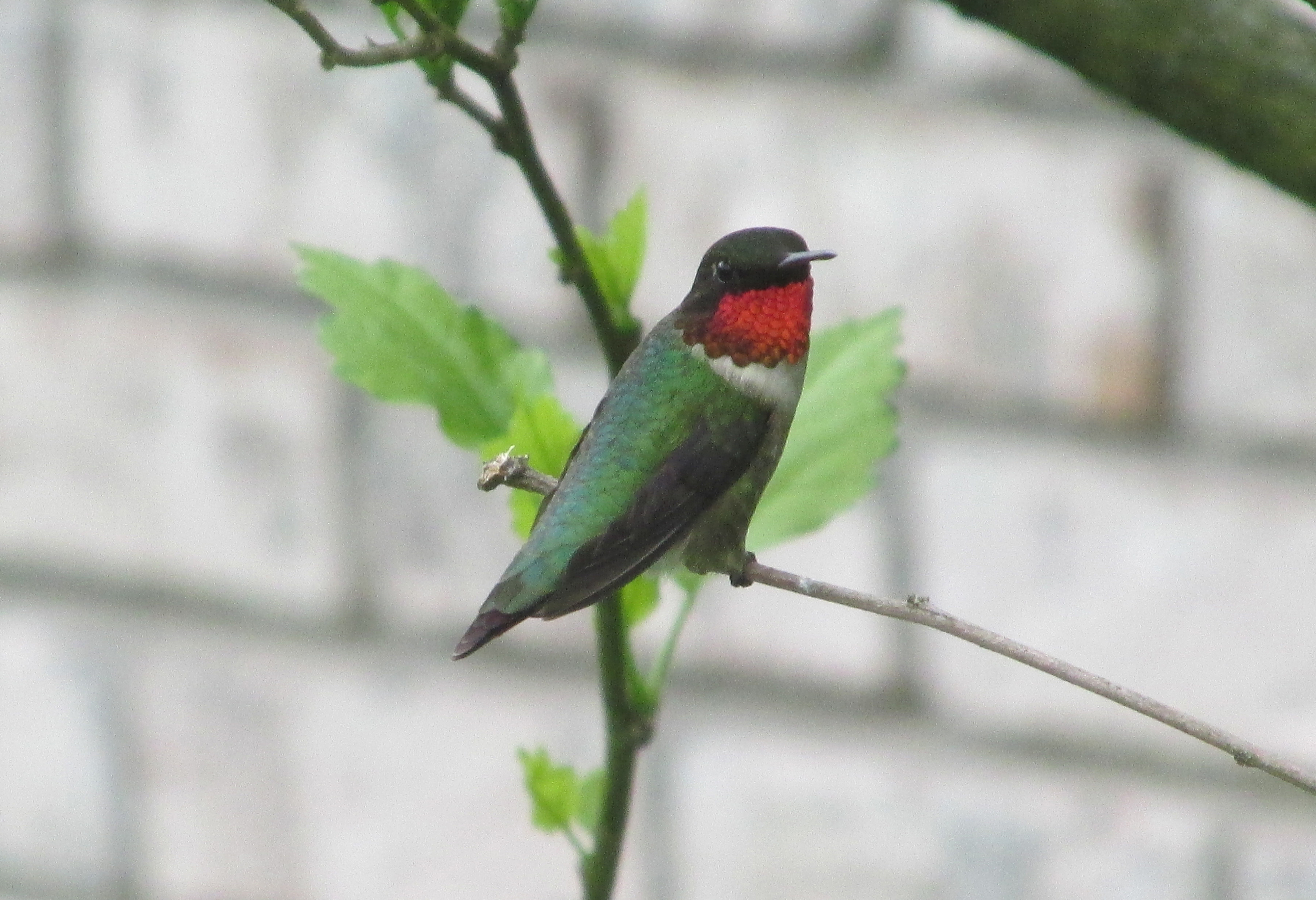
Photo by Bryan Stevens • Ruby-throated hummingbirds such as this male are returning to the region.

Tennessee’s Watchable Wildlife offers an online profile for the ruby-throated hummingbird, including interesting information about how such a tiny bird makes its phenomenal crossing of the Gulf of Mexico each spring to return to the eastern United States.

To accomplish this tremendous migratory crossing, a hummingbird will double its body mass by fattening on nectar and insects in the weeks prior to departure.

No hummingbird species other than ruby-throated hummingbird breeds in Tennessee, but several Western species have been found in the state during the non-breeding season. They arrive anytime after late August and usually depart in April. At least seven western species of hummingbird has been recorded in the Volunteer State, including rufous, black-chinned, Allen’s, Anna’s, calliope and broad-tailed hummingbirds.

There’s also a couple of reports of a green violet-ear, a species that is usually found in forested regions of Mexico and Nicaragua. The species has ventured into Tennessee twice, being documented in Memphis in September of 2007 and in Montgomery County in July of 2020.

I’ve seen several of these western “visitors” throughout the years, but my greatest affection is still attached to the ruby-throated hummingbird.

Most hummingbirds impress with their size, or rather the lack of it. It’s that tiny size that has prompted people to describe them as “miracles” from the time the first European explorers sailed to the New World in the late 1400s. When Spanish explorers first encountered them, they had no equivalent birds in Europe to use as a reference. They referred to hummingbirds as “joyas voladoras,” or flying jewels.

If your yard offers some trees and shrubs, necessary for perching, you can attract ruby-throated hummingbirds. It pays to have a feeder available with a fresh mixture of one part sugar to four parts water. This is the formula that closely matches the sweetness of nectar available from flowers. In warm conditions, you’ll need to change out the mixture every few days. Give the feeders a scrubbing and rinse while changing out the sugar water. Then sit back and enjoy the antics of these pint-sized delights.

•••

To share a sighting, ask a question or make a comment, email me at ahoodedwarbler@aol.com.

Photo by Bryan Stevens • Despite a perceived disadvantage of size, ruby-throated hummingbirds are quite capable of thriving in a giant world.

Ruby-throated hummingbirds stage their spring return to region

Bryan Stevens • A male ruby-throated hummingbird perches on a sugar water feeder.

In an article posted on March 27, Journey North, an organization and website that tracks migrating hummingbirds, announced that so far this spring, bird-watchers in 12 states had reported ruby-throated hummingbirds, but it’s still early in the season.

“So far, we have one sighting each in Kentucky and Tennessee and two in Arkansas, but we’re expecting more in the coming weeks,” noted the blog post by Journey North.

One week later, hummingbirds arrived in locations in Unicoi County, Carter County and Washington County in Northeast Tennessee.

Journey North is a citizen science project that engages citizen scientists in a global study of wildlife migration and seasonal change. It’s a fun way to track the migration of everything from hummingbirds to butterflies like monarchs.

•••

“Hummingbirds are here!” Beverly King, a resident on Marbleton Road in Unicoi, wrote in an email. “We saw our first hummingbird today, Saturday, April 5.”

Beverly noted that she was excited to see hummingbirds slightly early this year.

“We usually see them about the 15th of the month,” she added. “Well, my feeders are now up. We could not tell if it was a female or a male.”

Bryan Stevens • A female ruby-throated hummingbird perches on a feeder.


•••

Erwin resident Amy Tipton sent me a Facebook message announcing that her parents had enjoyed a visit from a returning hummingbird.

“My parents, Edison and Emma Jean Wallin, had their first hummingbird of the season visit today, Saturday, April 5 at 4:30,” Amy wrote. “They live about a mile up Limestone Cove in Unicoi.”

•••

Dianne Draper in Jonesborough shared on my Facebook page about her first hummingbirds of the season.

“Our first ones showed up on April 5,” she noted. “We had two.”

•••

I’ve already seen my first hummingbird, as well. I have a bed of tulips blooming at my home. I planted them last fall and have been thrilled with their performance. I was outdoors admiring the tulips when I heard a brief but tantalizing buzzing noise. Although I scanned all around me, I failed to confirm that I’d heard a hummingbird.

A half hour later, however, while reading on my front porch, I saw my first hummingbird of 2025 when a male zipped up to one of my sugar water feeders. He returned twice while I stayed outdoors reading on a misty afternoon. He arrived at 4:14 p.m. on Sunday, April 6.

In 2024, I saw my first hummingbird on April 17 at 7:15 p.m. This year’s bird is certainly arriving earlier than is typical, but I was thrilled to see him.

•••

Gayle Riddervold, who lives only a few miles from my home on Simerly Creek Road in Hampton, reported that she and Becky Kinder saw their first spring hummingbird on April 8.

“We just saw our first hummingbird today,” Gayle wrote in a Facebook message. “Yesterday we saw a belted kingfisher on our road.”

•••

Brookie and Jean Potter, residents at Wilbur Lake in Elizabethton, sent me a text about the arrival of their first spring hummingbird on Wednesday, April 9, at 5:45 p.m.

They added, “It came back to feed again around 7 p.m.”

•••

Technically, TD, a follower of my “Our Fine Feathered Friends” blog, provided the earliest report of a hummingbird this spring. Of course, TD has the benefit of living in Texas, close to the Gulf of Mexico that these tiny birds must cross to return to the United States each spring.

The bird TD spotted arrived on Wednesday March 26, at 2:34 p.m. central time.

“A ruby-throated hummingbird male stopped at my feeder on my front porch a mile from Corpus Christi Bay after an hour of a rain shower,” TD wrote in a comment.

TD also reported that Corpus Christi has been in a drought so severe that residents have not been allowed to water outside since last fall.

TD’s hummingbird arrived with the first rainfall in more than two months.

“So I was watching the lovely rain when this hummingbird perched onto my hummingbird feeder,” TD wrote. “I have a very large window and hang four hummingbird feeders along the front porch.”

TD noted that the male’s iridescent ruby red around his neck resembled a scarf. “I named him Texas Tuxedo,” TD shared.

TD also saw a female hummingbird on Wednesday, April 2, at 7:15 a.m.

TD said the female hummer acted shy and fluttered around the feeder before feeling safe to perch for feeding.

It’s usually the case that females lag behind males in their annual migration back to the United States.

•••

Photo by Bryan Stevens • A male ruby-throated hummingbird perches at a feeder for a sip of sugar water.

The hummingbirds are an amazing family of birds. There are an estimated 330 species of hummingbirds, all of which are found in the New World. Consider that these dazzling little birds have been given vividly descriptive names, such as cinnamon-throated hermit, red-tailed comet, blue-chinned sapphire, lazuline sabrewing, sparkling violetear, fiery topaz, green-tailed goldenthroat, bronze-tailed plumeleteer, amethyst-throated mountain-gem, peacock coquette, red-billed emerald, empress brilliant, purple-backed sunbeam, green-backed hillstar, orange-throated sunangel, black metaltail, marvelous spatuletail and blue-tufted starthroat.

The only hummingbird species to inhabit the eastern United States from spring to fall each year is the ruby-throated hummingbird, which is currently arriving at various points from Florida to Maine and westward to states like Illinois, Minnesota and Oklahoma and north into Canada.

To return each year, ruby-throated hummingbirds make an awe-inspiring and non-stop crossing of the Gulf of Mexico. Even more incredible, they make the trip again in the fall when they return to warmer locations in Central America to spend the winter months.

Ruby-throated hummingbirds lead relatively brief lives. The oldest known ruby-throated hummingbird was a female, according to the website All About Birds. She was at least 9 years, 2 months old when she was recaptured and rereleased in 2014 during banding operations in West Virginia.

•••

These shared sightings represent some of the “early bird” sightings of hummingbirds. I welcome more reports as other people continue to observe returning hummingbirds. Email me at ahoodedwarbler@aol.com or find me on Facebook to share your sightings. Provide a date and time, if possible. Good luck with the hummingbird watching.

Here are a few birds to look for this spring

Photo by Bryan Stevens • A male hooded warbler perches in a cluster of branches.

Has it been a slow spring? I have felt that it’s been one step forward, two steps back. But April has finally arrived. Although we’re now two days into the month, I’m still waiting on some of my first arrivals among our fine feathered friends.

That’s not an unusual situation. I think the birds like to drag out their springtime arrivals. They know that being tardy is sure to aggravate me as I’m not known for patience.

The first male red-winged blackbird returned to the fish pond in mid-March and has been singing persistently from the tops of the bald cypress trees bordering the pond. I haven’t seen a female red-winged blackbird yet, but they tend to arrive later than males.

Of course, and I don’t think I’m alone in this hope, I’m also eager to welcome back ruby-throated hummingbirds. These tiny flying gems should be back any day now. My sugar water feeders are waiting for them.

I hope readers will once again share the first arrival dates of hummingbirds at their own feeders. Jot down the date and time, as well as any other details you’d like to share, and email me at ahoodedwarbler@aol.com or message me on Facebook at http://www.facebook.com/ahoodedwarbler/

With those preliminary thoughts shared, what else will I look for as the spring advances? Longtime readers will know of my enthusiasm for warblers, also known as New World warblers or wood-warblers.

They’re a group of small, often colorful, passerine birds that make up the family Parulidae. The family, which occurs only in the New World, contains 120 species. They are not closely related to Old World warblers or Australian warblers.

About half of the 120 species reside in Central and South America, but the others migrate north each spring to nest in the United States and Canada. In Northeast Tennessee, we have about two dozen nesting species that make their home with us from April to October.

The warbler I look forward most to seeing is the hooded warbler, partly due to individuals belonging to this species nesting in the woodlands around my home.

Photo by USFWS/A female hooded warbler stays put on her nest.

So, from the time my favorite warbler returns in April until the last individual departs in October, I enjoy regular glimpses of this colorful and interesting bird. Like all warblers, the hooded warbler is quite energetic, dashing after tiny insects in the branches of shrubs and trees. Hooded warblers often forage close to the ground, which makes observing them easier.

Of course, birds are free to break the rules. One of my most memorable sightings of a hooded warbler involved a male singing from the upper branches of a dead pine tree. I’d estimate that the bird was at least 40 feet off the ground, singing his little heart out to attract a mate. I was standing on an elevated rise of land while the tree providing the warbler its perch was lower in a gully that actually placed bird and observer on a roughly level playing field.

That sighting took place 25 years ago, but the image of that male hooded warbler singing so enthusiastically has remained emblazoned in my memory.

This particular bird sang for several moments, which is not always the case with warblers. These birds tend to dash for cover at the slightest disturbance, but this enthusiastic male didn’t seem to pay any heed to the fact that most of its kin prefer to skulk in shrubs and dense rhododendron thickets no more than a few feet off the ground.

It’s one bird unlikely to be mistaken for any other. Every time I behold a hooded warbler, I marvel at the bird’s exquisite appearance. The gold and green feathers seem to glow brightly in the dim light of the shadowy thickets of rhododendron they prefer to inhabit. The black hood and bib surrounding the male’s yellow face stands out by virtue of its stark contrast from the brighter feathers. Large coal-black eyes complete the effect. The appearance of the male bird provides this species with its common name.

The female hooded warbler has an identical yellow-green coloration as the male, although she is slightly more drab. She lacks the black hood and bib, although older females may acquire some dark plumage on the head and around the face. Both sexes also show white tail feathers that they constantly fan and flick as they move about in thick vegetation and shrubbery.

Photo Courtesy of Jean Potter
A male scarlet tanager brightens shadowy woodlands with a flash of tropical colors yet remains mostly inconspicuous in the forest canopy.

In addition to warblers, I also look forward to the return of scarlet tanagers. Males are unmistakable in their bright red plumage accented by black wings. This is one bird that is truly breathtaking when lured into the open for an observation through a pair of binoculars.

During their summer stay in the region, scarlet tanagers largely prey on insects. Although renowned as a fruit-eating bird, the scarlet tanager primarily feeds on fruit during its migration flights and on its wintering range in the tropics. This tanager breeds in deciduous and mixed deciduous-evergreen woodlands across the eastern half of North America. It’s my understanding that oaks are a favorite tree for this woodland dweller.

It’s unlikely that you’ll run across the nest of a scarlet tanager. These birds nest high in trees, often locating their nests 50 feet or more above the ground. After building a nest, a female tanager will incubate her three to five eggs for about two weeks. It’s during this time that her inconspicuous appearance is a plus, helping her blend well with her surroundings.

So, as I wait for warblers, hummingbirds and tanagers, I’ll just have to be a little more patient. I’m also hopeful that the fish pond will attract some nesting birds such as tree swallows and wood ducks. Fingers crossed!

•••

Remember to let me know about your first hummingbird sightings. Email me at ahoodedwarbler@aol.com to notify me of a sighting, ask a question or share a comment.