Tag Archives: Migrants

Birder with ties to Northeast Tennessee plans Global Big Day

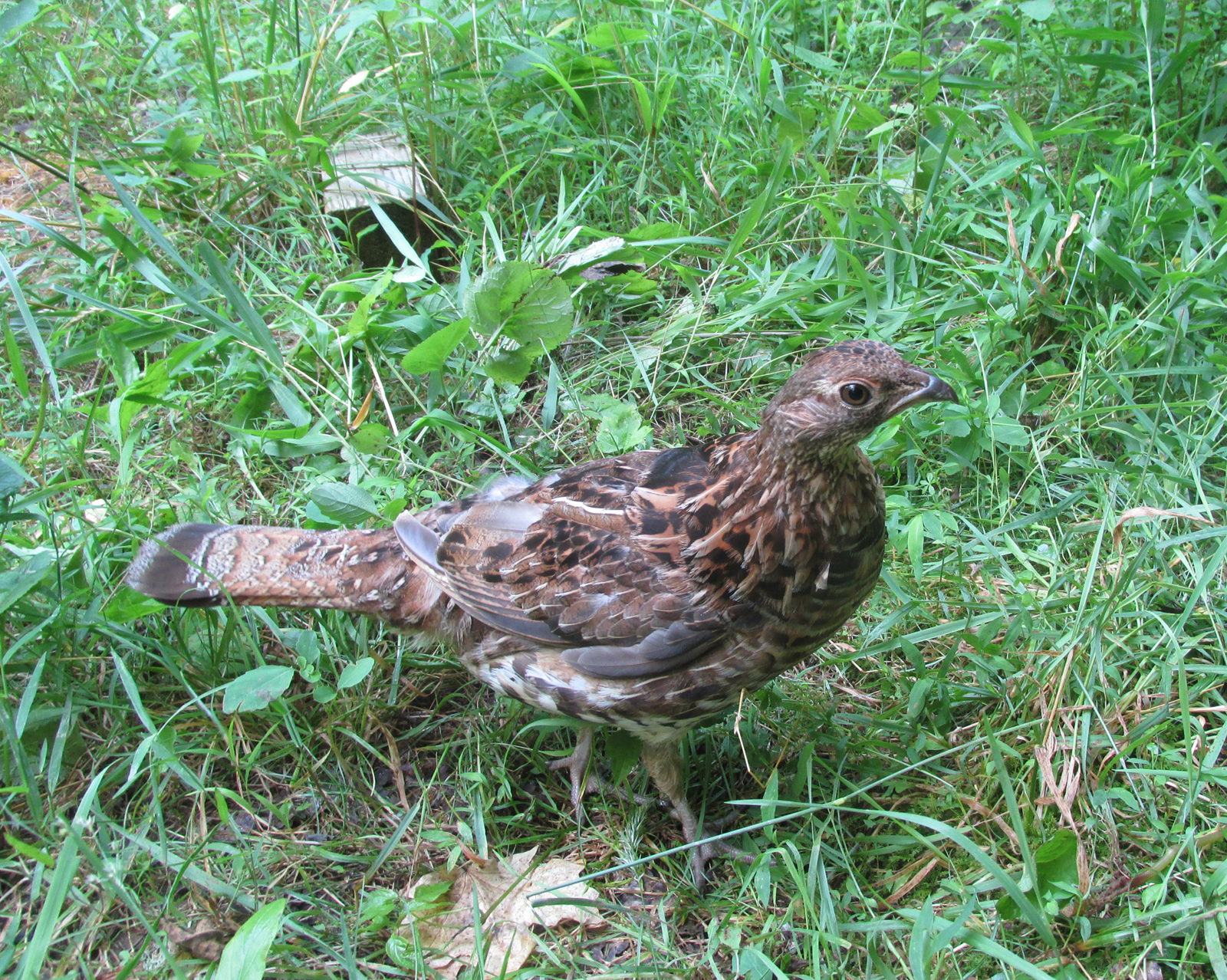
Photo by Bryan Stevens • Brayden Paulk introduces Rufous, a surprisingly tame ruffed grouse that lived on his grandfather’s farm for several years.

Brayden Paulk recently sent me an email to share some recent bird sightings he has made in Georgia.

As background, I’ve known Brayden since the summer of 2016. At the time, he was 17 years old and visiting with his grandparents in Flag Pond for the summer. We got acquainted thanks to an amazing ruffed grouse hanging out at a barn.

Brayden named the grouse Rufous who, as it turned out, was a remarkable bird. Ruffed grouse are, as a rule, shy and retiring birds. Not Rufous. He was an in-your-face sort of grouse. Getting to meet and observe this amazing bird was a privilege.

After we met so that I could make acquaintance with Rufous, Brayden and I did some birding at Rock Creek Recreation Area and then some stops on U.S. Forest Service lands along Highway 107 between Limestone Cove and the North Carolina line. Brayden wanted very much to add a black-throated blue warbler to his life list, and I very much wanted to help him find it.

We did manage to locate a singing veery, a scarlet tanager and a dark-eyed junco. We also found several warblers, including black-and-white warbler, worm-eating warbler and black-throated green warbler, but I began to fear we wouldn’t manage to locate his target bird.

But I am happy to report that we managed to find a male black-throated blue warbler. So, that productive morning back in 2016 resulted in my meeting with a grouse with a lot of personality and Brayden getting a new species for his life list of birds.

When we first met, Brayden was living with his family in Oxford, Alabama. During our first in-person meeting he made a point to tell me that his grandparents, Leon and Janice Rhodes, mailed him every one of my bird columns.

Photo by Bryan Stevens • The late Leon Rhodes teases Rufous the ruffed grouse.

These days he is living in Georgia, which is also providing the focus for most of his birding. He returns often to Tennessee. In fact, he has given a couple of talks to the Elizabethton Bird Club over the years, impressing his audience with his enthusiasm and engaging way of presenting information.

His talk were, surprisingly, not about birds. He spoke about his other passion, fishing, but still managed to make a few mentions of birds in the process.

Brayden has also worked for a couple of summers at Lamar Alexander Rocky Fork State Park in Flag Pond as a seasonal interpretive ranger.

Anyway, enough with the background and back to his recent email.

“I hope everything is going well with you and the bird club,” he wrote. “I wanted to contact you about some interesting recent sightings I have had that I thought you would be interested in. I have been able to put a lot of effort into birding so far this spring and it has turned up some fantastic finds.”

Photo by Bryan Stevens • Rufous, a rather tame ruffed grouse, who made his home in Unicoi County for several years.

His finds have even established some records in Laurens County in Georgia where he now lives.

His local birding loop in his home county has been very productive.

On April 7, his observations of common loons resulted in a county high count for the species. He found 14 loons on one lake and six on another nearby lake. The next highest count before his sighting had stood at two birds.

“That loop has also been very productive for shorebirds, as there are some flooded areas in nearby fields where I have seen lots of greater and lesser yellowlegs and snipe,” he wrote.

“I also got excellent views of a Swainson’s warbler within feet of me at an area on the loop with some swamp and cane thicket habitat,” Brayden added.

On April 7 while running his llocal birding loop in Laurens County, Georgia, Brayden Paulk saw the county high count for common loons with 14 on one lake and 6 on another nearby.

That sighting alone is something that would make many birders envious. I have been birding since 1993 and I can count on one hand the number of looks I’ve had of Swainson’s warbler. The species is often localized, meaning it takes some effort to locate. It’s easy to hear them. The Swainson’s warbler has a loud, ringing song similar to a Louisiana waterthrush. I’ve heard Swainson’s warblers much more frequently than I have seen them.

Brayden also shared his excitement about seeing his first first Horned Lark in the county. He saw the lark, a bird of open fields, at a different location. “It seems to be one of those birds you have to try to find by going to a sod farm or open country,” he noted.

“The Laurens County Loop has also been great for me in the past, and one particular pond turned up the first eBird county records for American avocet, white-rumped sandpiper and long billed dowitcher,” he wrote. “I have also found breeding painted buntings on the loop as well and had an excellent view of them with my dad.”

Brayden also wanted to share some more exciting news.

“I will be moving to Gulf Shores in coastal Alabama in a few weeks, which is one of my favorite places to go birding,” he wrote. “I plan on going to Dauphin Island on the Global Big Day because it is an incredible place to see migrants, and my goal is to find 150 species on that day.”

This year’s Global Big Day is scheduled for Saturday, May 10. Global Big Day is an annual birdwatching event hosted by eBird and Cornell Lab of Ornithology to celebrate and document bird migration. The event was created as a fun and engaging way for bird enthusiasts of all levels to contribute to science and conservation by reporting their bird sightings.

Brayden also hopes to visit Unicoi County again soon to do some birding there and look for some of the species he missed last Summer.

“Thank you for writing your bird articles,” he wrote at the conclusion of his email. “They have inspired me since I was young!”

It’s not easy to put into words how much that unexpected praise made me feel. I am incredibly gratified that I could have provide some inspiration to get such a gifted young man into the field looking for birds.

Readers may recall that I’ve had some deterioration of vision in recent years. With a pair of binoculars, I can still bring birds close enough to enjoy and appreciate their beauty and vivacity. Spotting birds, which is a skill that takes some practice to achieve, is no longer easy for me. Ah, the things we take for granted…

My hearing remains unimpaired. I have enjoyed making note of returning warblers and other birds simply by hearing their familiar songs ringing through the woodlands at my home for yet another spring.

For the past couple of weeks I’ve also had the pleasure of watching daily as a feisty male ruby-throated hummingbird visits the feeders arranged around my front porch.

In closing, I invite everyone to wish Brayden luck with his upcoming Global Big Day. I hope to update everyone with how he does.

•••

To share a sighting, ask a question or make a comment, email me at ahoodedwarbler@aol.com.

Ruby-throated hummingbirds stage their spring return to region

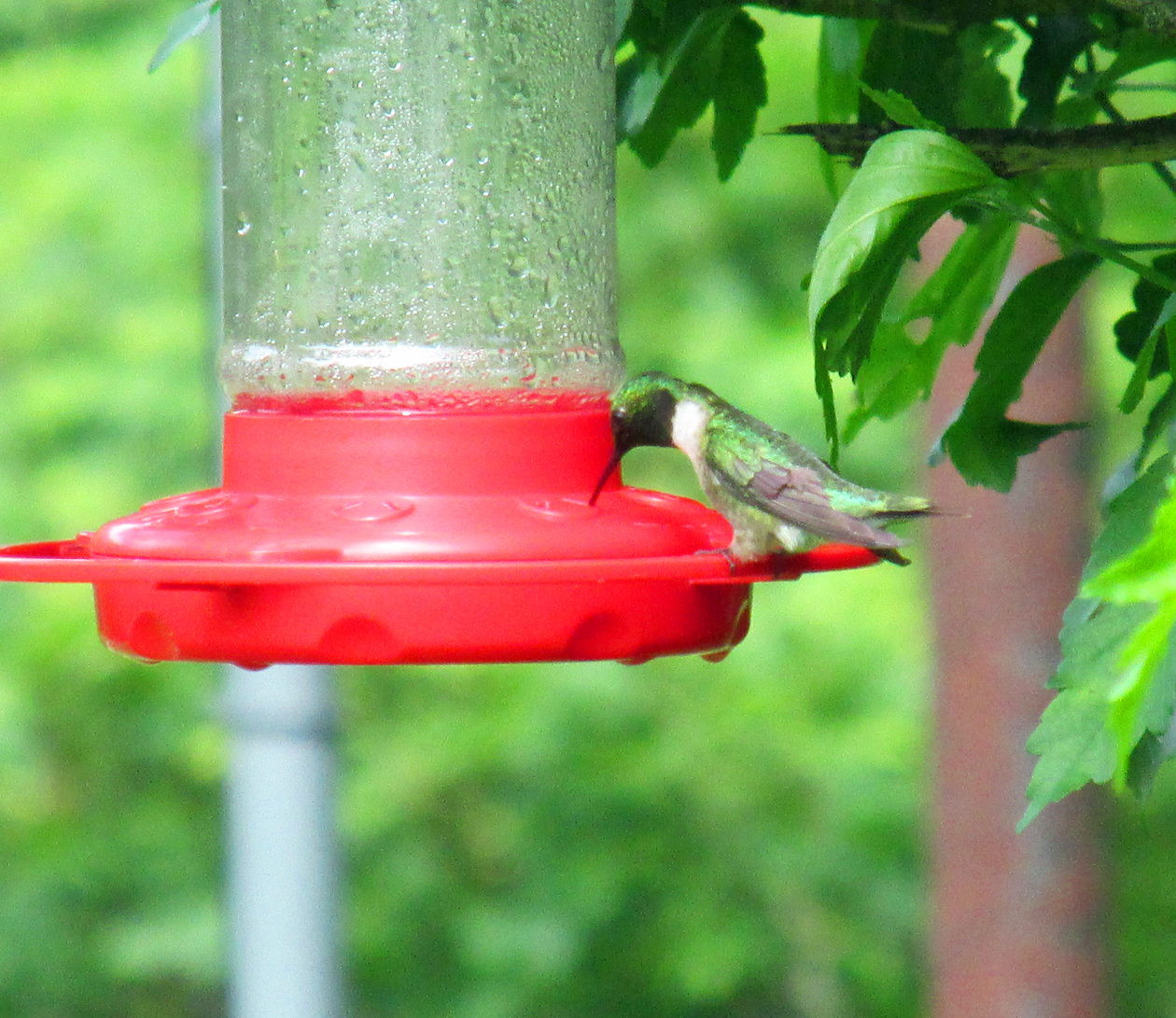
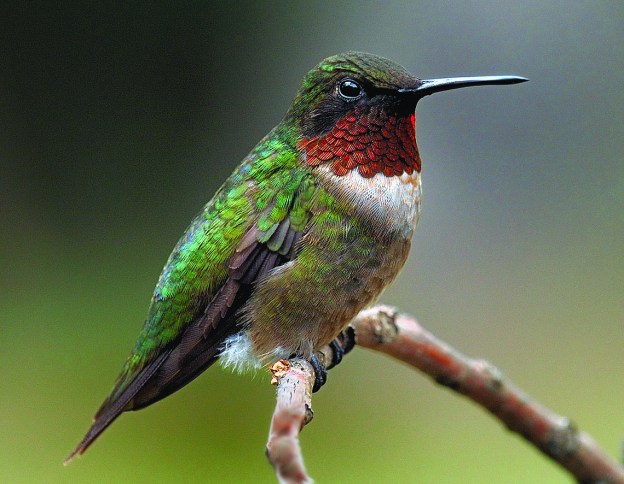
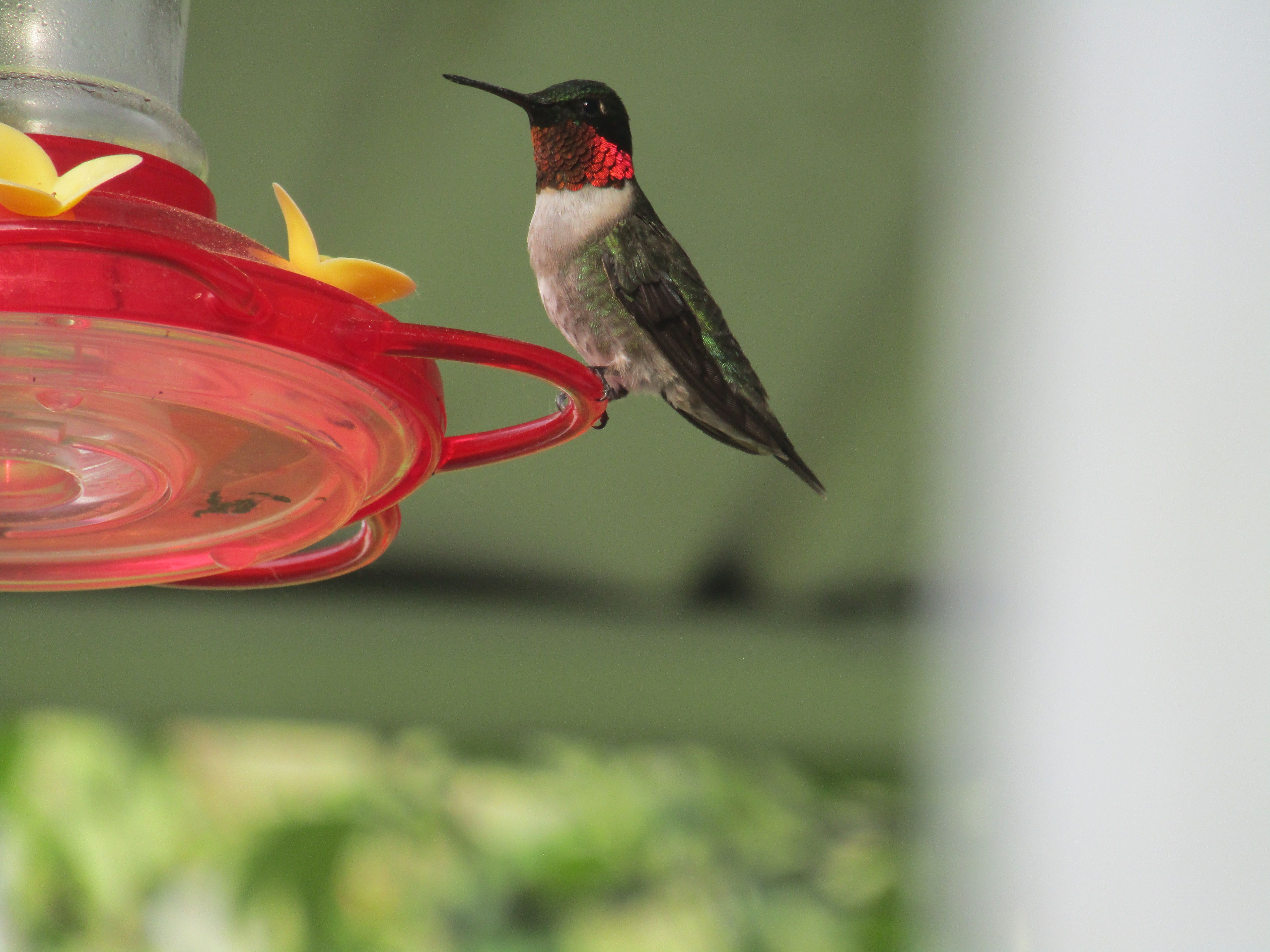
Bryan Stevens • A male ruby-throated hummingbird perches on a sugar water feeder.

In an article posted on March 27, Journey North, an organization and website that tracks migrating hummingbirds, announced that so far this spring, bird-watchers in 12 states had reported ruby-throated hummingbirds, but it’s still early in the season.

“So far, we have one sighting each in Kentucky and Tennessee and two in Arkansas, but we’re expecting more in the coming weeks,” noted the blog post by Journey North.

One week later, hummingbirds arrived in locations in Unicoi County, Carter County and Washington County in Northeast Tennessee.

Journey North is a citizen science project that engages citizen scientists in a global study of wildlife migration and seasonal change. It’s a fun way to track the migration of everything from hummingbirds to butterflies like monarchs.

•••

“Hummingbirds are here!” Beverly King, a resident on Marbleton Road in Unicoi, wrote in an email. “We saw our first hummingbird today, Saturday, April 5.”

Beverly noted that she was excited to see hummingbirds slightly early this year.

“We usually see them about the 15th of the month,” she added. “Well, my feeders are now up. We could not tell if it was a female or a male.”

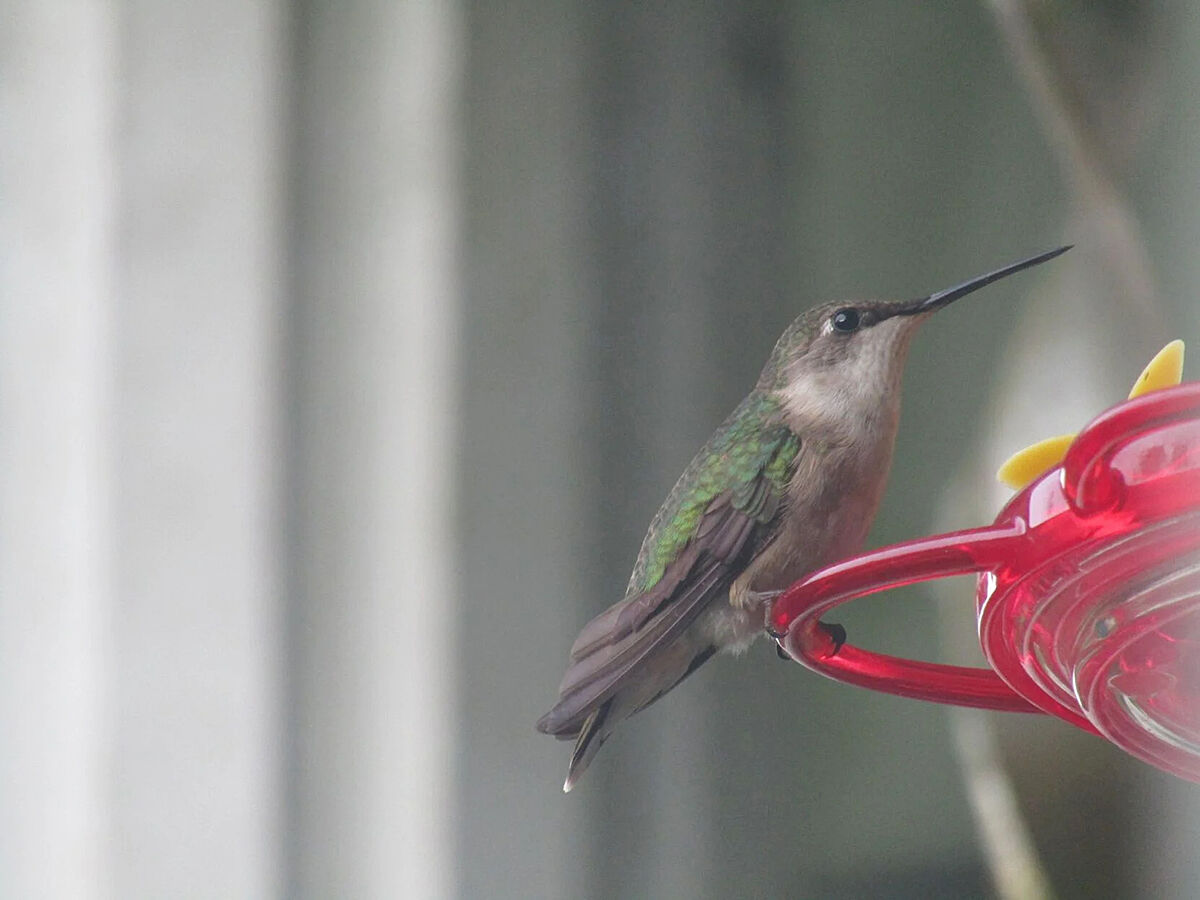
Bryan Stevens • A female ruby-throated hummingbird perches on a feeder.


•••

Erwin resident Amy Tipton sent me a Facebook message announcing that her parents had enjoyed a visit from a returning hummingbird.

“My parents, Edison and Emma Jean Wallin, had their first hummingbird of the season visit today, Saturday, April 5 at 4:30,” Amy wrote. “They live about a mile up Limestone Cove in Unicoi.”

•••

Dianne Draper in Jonesborough shared on my Facebook page about her first hummingbirds of the season.

“Our first ones showed up on April 5,” she noted. “We had two.”

•••

I’ve already seen my first hummingbird, as well. I have a bed of tulips blooming at my home. I planted them last fall and have been thrilled with their performance. I was outdoors admiring the tulips when I heard a brief but tantalizing buzzing noise. Although I scanned all around me, I failed to confirm that I’d heard a hummingbird.

A half hour later, however, while reading on my front porch, I saw my first hummingbird of 2025 when a male zipped up to one of my sugar water feeders. He returned twice while I stayed outdoors reading on a misty afternoon. He arrived at 4:14 p.m. on Sunday, April 6.

In 2024, I saw my first hummingbird on April 17 at 7:15 p.m. This year’s bird is certainly arriving earlier than is typical, but I was thrilled to see him.

•••

Gayle Riddervold, who lives only a few miles from my home on Simerly Creek Road in Hampton, reported that she and Becky Kinder saw their first spring hummingbird on April 8.

“We just saw our first hummingbird today,” Gayle wrote in a Facebook message. “Yesterday we saw a belted kingfisher on our road.”

•••

Brookie and Jean Potter, residents at Wilbur Lake in Elizabethton, sent me a text about the arrival of their first spring hummingbird on Wednesday, April 9, at 5:45 p.m.

They added, “It came back to feed again around 7 p.m.”

•••

Technically, TD, a follower of my “Our Fine Feathered Friends” blog, provided the earliest report of a hummingbird this spring. Of course, TD has the benefit of living in Texas, close to the Gulf of Mexico that these tiny birds must cross to return to the United States each spring.

The bird TD spotted arrived on Wednesday March 26, at 2:34 p.m. central time.

“A ruby-throated hummingbird male stopped at my feeder on my front porch a mile from Corpus Christi Bay after an hour of a rain shower,” TD wrote in a comment.

TD also reported that Corpus Christi has been in a drought so severe that residents have not been allowed to water outside since last fall.

TD’s hummingbird arrived with the first rainfall in more than two months.

“So I was watching the lovely rain when this hummingbird perched onto my hummingbird feeder,” TD wrote. “I have a very large window and hang four hummingbird feeders along the front porch.”

TD noted that the male’s iridescent ruby red around his neck resembled a scarf. “I named him Texas Tuxedo,” TD shared.

TD also saw a female hummingbird on Wednesday, April 2, at 7:15 a.m.

TD said the female hummer acted shy and fluttered around the feeder before feeling safe to perch for feeding.

It’s usually the case that females lag behind males in their annual migration back to the United States.

•••

Photo by Bryan Stevens • A male ruby-throated hummingbird perches at a feeder for a sip of sugar water.

The hummingbirds are an amazing family of birds. There are an estimated 330 species of hummingbirds, all of which are found in the New World. Consider that these dazzling little birds have been given vividly descriptive names, such as cinnamon-throated hermit, red-tailed comet, blue-chinned sapphire, lazuline sabrewing, sparkling violetear, fiery topaz, green-tailed goldenthroat, bronze-tailed plumeleteer, amethyst-throated mountain-gem, peacock coquette, red-billed emerald, empress brilliant, purple-backed sunbeam, green-backed hillstar, orange-throated sunangel, black metaltail, marvelous spatuletail and blue-tufted starthroat.

The only hummingbird species to inhabit the eastern United States from spring to fall each year is the ruby-throated hummingbird, which is currently arriving at various points from Florida to Maine and westward to states like Illinois, Minnesota and Oklahoma and north into Canada.

To return each year, ruby-throated hummingbirds make an awe-inspiring and non-stop crossing of the Gulf of Mexico. Even more incredible, they make the trip again in the fall when they return to warmer locations in Central America to spend the winter months.

Ruby-throated hummingbirds lead relatively brief lives. The oldest known ruby-throated hummingbird was a female, according to the website All About Birds. She was at least 9 years, 2 months old when she was recaptured and rereleased in 2014 during banding operations in West Virginia.

•••

These shared sightings represent some of the “early bird” sightings of hummingbirds. I welcome more reports as other people continue to observe returning hummingbirds. Email me at ahoodedwarbler@aol.com or find me on Facebook to share your sightings. Provide a date and time, if possible. Good luck with the hummingbird watching.

Surprise! Hummingbirds come in variety of sizes

This week’s column is about hummingbirds, the big and the small ones. Frances Lamberts in Jonesborough sent me an email earlier this month that got the ball rolling for this week’s hummingbird column.

“Two hummingbirds were here for a good week long,

at the end of April,” Frances wrote. “Then they were gone, and I haven’t seen any since. Despite the heat/drought (and with some watering), the

property has many favorite flowers in bloom, including the blue salvia, red pole beans, monarda, many others come and gone, the cardinal flowers about to bloom.”

Her question was a simple one: “Where are the hummers?”

She noted that she has kept a “first sightings” record for about 20 year. One year the hummingbirds didn’t arrive until mid June, which worried her at the time.

“What is happening now?” Frances asked.

The simple and honest answer is that it’s not really possible to land on any single answer. Birds have wings, and hummingbirds are capable to long-distance flights.

Still, a setting such as the one Frances described with such a wide variety of blooms should be teeming with hummingbirds.

Personally, it’s been a perplexing season. My hummingbirds arrived back in April, stuck around for perhaps a week, and then almost disappeared. They returned in mid-June, remained visible for a couple of weeks, but have since pulled another vanishing act.

In any given year, the numbers of hummingbirds passing thorough is going to fluctuate. Some years, these tiny flying gems will be present in good numbers on an almost daily basis. Other years, hummingbirds can become quite scarce.

I usually enjoy my best hummingbird numbers in the fall as these little birds begin their leisurely journey back south. Late August and the month of September is usually a great time to watch hummingbirds. I’m optimistic that the same will hold true this fall.

In some other hummingbird news, the world added another species of hummingbird this year when the giant hummingbird of South America got split into two distinct species.

Abi Cole, writing for Audubon Magazine, reported in an article on June 7, 2024, that scientists have considered two distinct populations of giant hummingbird — a migratory southern population in Chile, Argentina and Bolivia, and a non-migratory northern population in Chile, Ecuador and Peru — to be the same species.

Now, scientists have reconsidered that belief and learned that the two species have been able to fool scientists for so long by basically, as Cole’s article phrases it, by hiding in plain sight.

Cole’s article details the elaborate process by which giant hummingbirds were captured and fitted with geolocator devices. The article credits Jessie Williamson, lead author of the new study and a National Science Foundation postdoctoral research fellow, with unraveling the mystery.

Williamson did so by intensively studying the Chilean population. The resulting research also revealed some huge surprises.

For centuries, there has been speculation about where the Chilean giant hummingbirds go to spend the winter. Now we know – they make an astonishing, record-breaking 5,200-mile round trip to spend several months with their cousins in the Peruvian Andes.

Because the Chilean and Peruvian birds look so much alike, no one had ever realized that they were co-existing with each other during the winter season.

Of course, the name “giant hummingbird” is almost an oxymoron for a family of birds famous for their diminutive size. Now that we have two species of giant hummingbirds, they can’t both hold the title of world’s biggest hummingbird.

So, which is the bigger bird? As it turns out, the giant hummingbirds living year round in the Andes, now known as the northern giant hummingbird, is slightly bigger than the migratory southern giant hummingbird.

The article about these discoveries is fascinating. To read it for yourself, visit http://www.audubon.org/magazine/scientists-discover-worlds-largest-hummingbird-hiding-plain-sight.

The giant hummingbird does earn the right to that name. Both of the two species weigh between 18 and 24 grams and have a wingspan of about 8.5 inches. They have a body length of 9.1 inches. For a useful comparison, they are about equal to the size of a European starling or a Northern cardinal.

They are not the dazzling beauties most people associate with hummingbirds. Giant hummingbirds have a drab greenish plumage above with a whitish rump patch and dingy coloration below with variable rusty tones and dusky spotting. They do have the long bills and overall physical shape of other hummingbirds. The scientific name is Patagona gigas, roughly translated as the giant of Patagonia.

Photo by Bryan Stevens • Welcoming hummingbirds also involves making sure that they remain healthy and safe while spending time in our yards and gardens.

Count the giant hummingbird (either of the two species) as birds I’d like to see some day. The world’s diversity of hummingbirds is dazzling, but I feel fortunate to enjoy the ruby-throated hummingbird from April to October every year. As anyone knows who hosts these tiny birds, ruby-throated hummingbirds are dazzling and engaging guests during their all-too-brief.

•••

To ask a question, make a comment or share a sighting, email me at ahoodedwarbler@aol.com.


Observe caution if sick birds visit feeders

Photo by Brent Connelly from Pixabay • Blue jays appear susceptible to the ailment that afflicted birds for the past months.

I received an email from Unicoi residents Judy and Bill Beckman about a distressing situation at their feeders.

“We sadly took down our feeders early this week,” the email read. “We began seeing house finches with swollen, crusty eyes and ruffled and missing feathers. 

The email also indicated that some of the Northern cardinals also had a lot of missing feathers and a ruffled look. The Beckmans noted that they are aware that cardinals molt, but added that it seemed like they were seeing more than usual. 

They’ve also seen some blue jays and a flock of robins with motley appearances and missing feathers.   

They had received an alert earlier this year from the Elizabethton Bird Club about a mysterious  disease that is causing bird die-offs. The alert described the victims having swollen eyes and ruffled feathers. 

“Any confirmation of that happening here now?  Any updates would be appreciated.

Photo by Bryan Stevens • A male house finch perched on a cable. These finches are native to the western United States but became established in the eastern states thanks to the illicit pet trade.

I answered the email, starting with the more immediate problem of the house finches. Back in the 1990s, house finches were decimated by mycoplasmal conjunctivitis. Humans can get infected with conjunctivitis, which is commonly called “pink eye.” 

According to the Project FeederWatch website, infected finches have red, swollen, runny or crusty eyes. In extreme cases the eyes become swollen shut and the bird becomes blind. Observers might find an infected bird sitting quietly while clumsily scratching an eye against its foot or a perch. While some infected birds recover, many die from starvation, exposure or predation. Since the early outbreaks, the disease has affected several other wild bird species, including American goldfinch, evening grosbeak and purple finch.

I recall seeing both house finches and pine siskins suffering from this disease. I haven’t seen it as often in recent years, which has been a relief.

Salmonella is another disease that can affect birds. As most people know, salmonella can also have serious consequences for human health. Finches, especially in the West Coast states of Oregon and California, have been hard hit by salmonella in recent months.

“Salmonellosis occurs periodically in pine siskins in some winters throughout their range. When large numbers of pine siskins congregate, the disease can spread rapidly causing high mortality. Most birds die within 24 hours of infection,” said California Department of Fish and Wildlife Senior Environmental Scientist Krysta Rogers, an avian disease specialist.

Birds become infected with salmonella when they ingest food, water or come into contact with objects, such as bird feeders, perches or soil, contaminated with feces from an infected bird. Sick birds often appear weak, have labored breathing, and may sit for prolonged periods with fluffed or ruffled feathers. Salmonellosis is almost exclusively reported from locations with bird feeders where birds congregate. Rogers advised that residents can help reduce disease transmission by removing bird feeders and bird baths. Allowing birds to feed on natural seeds rather than at bird feeders reduces contact between birds and helps slow spread of the disease. Some of the flocks of finches have been exceptionally large this winter, which is why it’s a good idea to closely monitor the birds at your feeders. At the first sign of illness, take steps to disinfect feeders. It’s a good idea to clean feeders on a regular basis. A spray with a weak bleach water solution followed by a few swipes with a clean towel can help. Once an outbreak is evident, however, the best course would be to stop feeding birds for a short period.

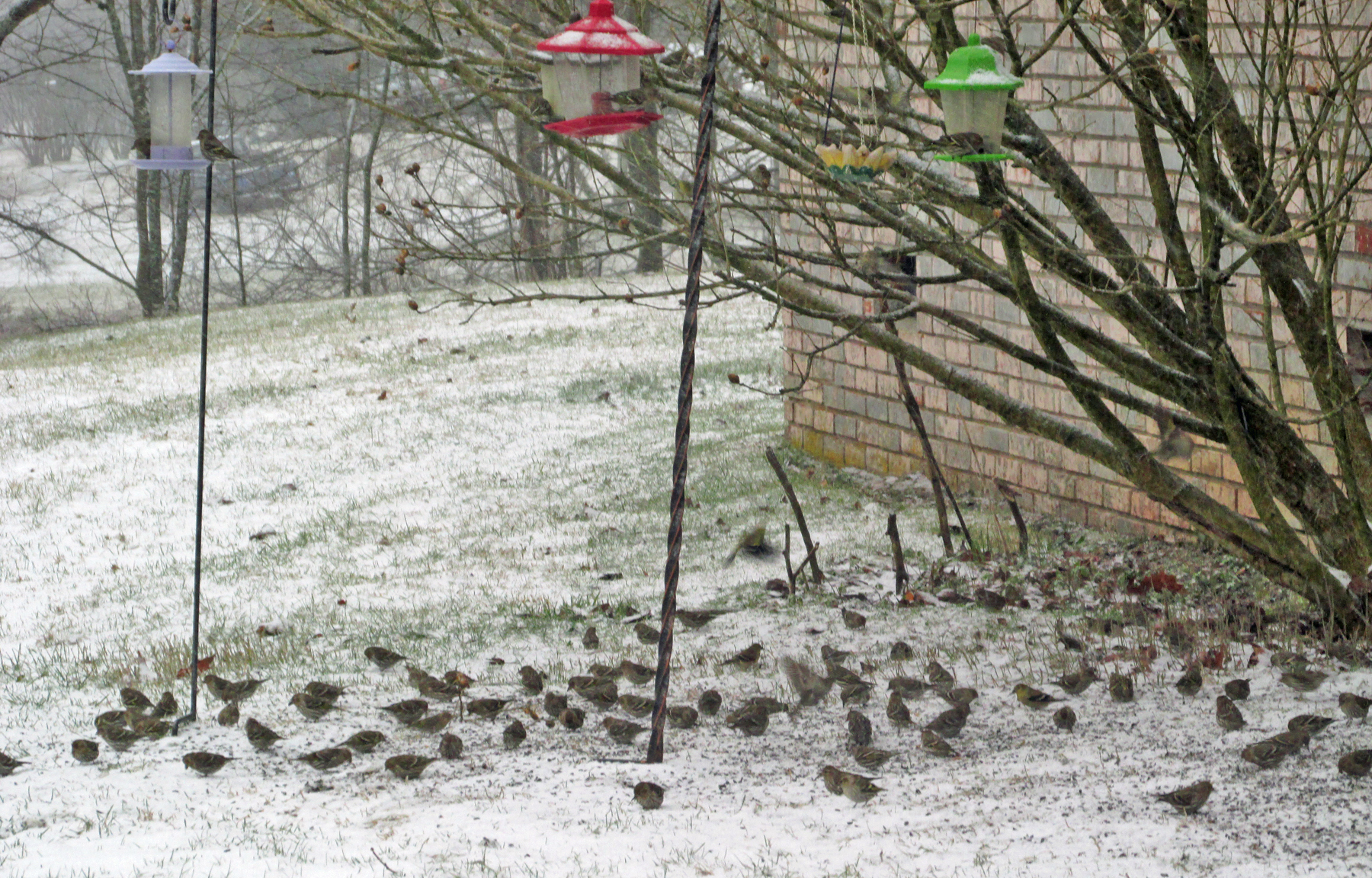
Photo by Bryan Stevens • A flock of pine siskins carpets the ground beneath some feeders as they forage for food.

Songbirds aren’t the only birds affected by disease outbreaks. Waterfowl are often vulnerable. Like finches, many species of ducks and geese also form large flocks. Some of the diseases that can run rampant in waterfowl populations include avian influenza, avian cholera and avian botulism. According to the Ducks Unlimited website, major avian botulism outbreaks have been reported throughout North America for more than a century. In 1910, avian botulism resulted in the deaths of millions of waterfowl in California and Utah, and another incident in 1952 killed an estimated 4 million to 5 million waterfowl across the western United States.

In 1999, the West Nile virus, a mosquito-borne disease, arrived in the United States. This disease is typically a mild nuisance for most infected people, but in some circumstances the virus can be lethal. The virus, which first appeared in the United States in 1999 after being discovered in 1937 in the African nation of Uguanda, also didn’t confine itself to the human population. Soon after its arrival in the United States, the virus began decimating American crows. Two decades later, experts have been able to study the consequences of West Nile virus on both humans and wild birds.

According to an article by Hugh Powell published Oct. 15, 2010, on the All About Birds website, the disease afflicted crows more than any other bird species. “West Nile virus hit American crows particularly hard,” Powell wrote. “When the disease first appeared in New York City, in summer 1999, nearly 5,500 crows died in four months. Tests suggested the disease was 100-percent fatal to crows.” Many other species, from jays and magpies to gulls and chickadees, also proved susceptible, according to the All About Birds article.

Millions of birds died as West Nile swept across the continent in just five years. An interesting thing happened as the virus spread across the country. As viral diseases often tend to do, West Nile apparently became less virulent. The American crow population did hit frightening lows, but the species appears to have managed to rebound.

Where’s the silver lining in regard to all these stories? Here is a sliver of light through the dark clouds. Birds are resilient, just like humans. They can usually overcome anything nature might throw at them.

I suspect there could be several different diseases at work that are causing multiple but unrelated die-offs among certain birds. The house finch bacterial disease is a recurring problem for this species.

I do think that the cardinals, blue jays and perhaps the robins are simply having difficult molts. Molting, or the process of shedding and replacing feathers, doesn’t always go smoothly for crested birds like jays and cardinals. The bald-headed cardinal is a late-summer fixture.

Here’s a significant announcement made on Sept. 13. In a joint statement issued by the Cornell Lab of Ornithology and the Cornell University College of Veterinary Medicine.

“All states affected by the mysterious bird illness of summer 2021 have lifted their do-not-feed recommendations. No cause has yet been determined, but cases are no longer being reported.”

I think the Beckmans made the right decision to remove their feeders. In a couple of  weeks, I think they can put the feeders back out, monitor carefully, and see if any signs of disease return. 

Contagious diseases, particularly among flocking birds, are a fact of life, just like the cold and flu season for humans. We can, however, take steps to mitigate outbreaks.

Keep feeding the birds, but play the diligent host. Put out only the amount of seed that visiting birds can eat in a single day. Monitor the flocks for any sign of illness and respond quickly if such signs are detected. Yes, do keep feeding the birds, but be safe and attentive while doing so.

Photo by dbadry/Pixabay.com • Blue Jays often create food caches for acorns and other items. This jay is leaving a feeder with several peanuts thanks to an expandable esophagus.

Common nighthawks share autumn skies with many other migrants

Autumn’s a chance for me to indulge my passion for warblers, with a few dozen species of these songbirds passing through the region in the span of a few weeks. I always try to keep in mind, however, that the warblers are not the only migrating birds winging through the region.

The Elizabethton Bird Club had planned a “nighthawks and hot dogs” party at the home of Larry McDaniel near Jonesborough, but that event had to be cancelled because of the recent surge in COVID-19 cases in the region.

My silver lining was that I saw a large flock of common nighthawks at my home on Aug. 29. It was an evening of birding dominated by insect-eaters and fruit-eaters.

Cedar waxwings and one American robin perched in the wild cherry trees and plucked ripening fruit from the branches.

Swooping overhead a handful of Chimney Swifts and about 30 Common Nighthawks (the first I have seen this fall) collected insects just over the treetops. Flycatching from a dead blue spruce was an Eastern Wood-Pewee, another fall first.

Other birds included a pair of Northern cardinals feeding three young, an Eastern towhee and one hooded warbler. At one point an irritable ruby-throated hummingbird chased the pewee round and round the trunk of the dead spruce. They almost looked like they were characters in a zany cartoon.

Photo by Jean Potter • A common nighthawk rests on a metal railing.

Like such birds as warblers, vireos, thrushes, tanagers, flycatchers and hummingbirds, the common nighthawk is a neotropical migrant. In addition, this nighthawk has one of the longest migration routes of any North American bird. Twice a year, these birds migrate for distances ranging from 1,600 to 4,200 miles. Nighthawks that spend the spring and summer in Canada travel to southern South America for the winter months.

With September advancing on the calendar, I have been keeping an eye on the treetops for passing warblers, vireos and tanagers, but I also remember to direct my gaze to the skies. Forgetting to look skyward could result in missing the passage of such varied migrants as chimney swifts, broad-winged hawks and common nighthawks.

So, what is a common nighthawk? First, this bird, despite what is implied by its name, is not a hawk. It’s also not strictly nocturnal. Particularly in the fall, nighthawks are active during daylight hours when engaged in catching winged insects. Outside of fall migration, these birds can often be observed over large parking lots or well-lit streets, snatching up insects swarming around the light poles.

Photo by Skeeze/Pixabay • A common nighthawk adopts an elongated pose atop a fencepost.

The common nighthawk is one of three members of the nightjar family found in the region during the summer months. The other two nightjars are the whip-poor-will and chuck-will’s-widow, birds that produce their namesake vocalizations in the nocturnal hours. Both of these species migrate, but they don’t take the dramatic approach employed by nighthawks. Each fall, common nighthawks form large flocks, ranging in size from dozens to hundreds or even thousands of individuals, as they migrate south for the winter.

Unlike whips and chucks, the common nighthawk isn’t active only after dark, which makes it much easier to observe these birds. They look somewhat like swifts and swallows but are much larger. They are brownish-gray birds with pointed wings and forked tails. They are easily identified by distinctive white patches on the underside of their wings.

A perplexing nickname for the common nighthawk is “bull-bat.” This merger of the words “bull” and “bat” makes sense when you explore a little deeper. The common nighthawk earned the nickname “bull-bat” because of its perceived “bat-like” flight and a “bull-like” boom produced by its wings as it pulls out of a dive.

The nightjar, or Caprimulgidae, family of birds is also sometimes known as “goatsuckers.” Apparently, in trying to explain the nocturnal tendencies of these birds, the Greeks came up with the imaginative but erroneous idea that birds like nighthawks liked to sneak into barns and have a meal of fresh goat’s milk. In reality, nighthawks feed almost exclusively on insects, including ants, wasps, beetles, caddisflies, moths, mayflies, flies, crickets, grasshoppers, and other insects. They capture much of their insect prey on the wing.

There are almost 80 species of nightjars in the world. Less than 10 occur in North America. Many of the common nighthawk’s relatives have been given descriptive names, such as long-trained nightjar, collared nightjar, spot-tailed nightjar, red-necked nightjar, golden nightjar, fiery-necked nightjar, swamp nightjar, pennant-winged nightjar, lyre-tailed nightjar, little nightjar, sickle-winged nightjar, rufous-bellied nighthawk, short-tailed nighthawk, sand-coloured nighthawk and least nighthawk.

So, keep looking skyward. The next flock of migrating common nighthawks may fly over your home. These flocks are usually on the move in August and throughout September.

I will keep watching the skies. Nighthawks can also appear almost magically, as if out of thin air. First, observers may see one of two birds, then several, followed quickly by dozens or sometimes hundreds as they wheel and cavort in the skies overhead with impressive grace and agility. I’ve seen flocks that would easily number more than 500 birds in locations throughout the region, although flocks often number only a couple of dozen birds.

To share a sighting, ask a question or make a comment, email me at ahoodedwarbler@aol.com.

Photo by Bryan Stevens • Rising clouds provide a backdrop for a flock of migrating nighthawks.

Wandering birds provide some surprising moments for birders

Photo by Roger Mullins • A little blue heron, right, shares a perch with a white ibis at the Buffalo Valley Golf Course in Unicoi. These wading birds are usually found near the coast, but individuals tend to disperse and wander widely after the summer nesting season comes to an end.

Late summer has a sort of lazy feel. Most birds are finishing up their nesting season. Hungry fledglings appear at feeders in the company of adults. In recent weeks, I’m starting to notice a slight uptick in the number of hummingbirds visiting my feeders and garden flowers. It helps that I’ve got dense stands of naturalized bee balm at the edge of my woods. The cedar waxwings have finished off the mulberries, but I suspect they will stick around for the wild cherries. I’ve also noticed the vanguard of migrant birds that are starting to make appearances as fall migration approaches. It’s not just songbirds, however, that are on the move. Some large and rather conspicuous birds have been attracting attention in recent weeks, including a variety of wading birds.

Sightings this summer of long-legged wading birds in Northeast Tennessee that are outside of their usual range have included little blue herons, white ibis and great egrets. The little blue heron and ibis have been recent visitors to Unicoi County. To toss another species into the mix, Tom and Cathy McNeil recently found an American anhinga near Austin Springs at Boone Lake in Washington County. Their anhinga sighting followed their discovery of seven or eight little blue herons and 14 great egrets at this well-known birding hot spot.

Photo by Bryan Stevens • Adult little blue herons, like this adult preening at Huntington Beach State Park, South Carolina, have a mix of blue and purple feathers.

Roger Mullins discovered both an immature little blue heron and an immature white ibis during one of his regular visits to scan the ponds along the former Buffalo Valley Golf Course in Unicoi.

“I first spotted the little blue on July 5, and then on July 10 I saw the white ibis standing just a few feet away on the same limb.

“Within minutes they were standing next to each other,” he continued. “They were even following each other from place to place, almost like they were siblings.”

Roger noted that the little blue heron gradually learned to trust him, but he could only get so close without making the bird feel uncomfortable.

“Being extremely patient, taking it slow and easy, is pretty much how I approach all wildlife, and it usually pays off well,” Roger shared.

“I first started visiting the golf course ponds back in the winter when someone told me about seeing a male hooded merganser there,” he noted. “There is not always an abundance of wildlife present, but I always check it out just in case. The best thing about these ponds is the consistent peace and tranquility, since people don’t usually go there for family recreation or to walk their dogs.”

Roger added that he doubted that the little blue heron would have lingered at a public park with more activity.

Most of my own observations of little blue herons have taken place in SouthCarolina, Georgia and Florida, although I have seen this species a couple of times in Tennessee. I have also found little blue herons more skittish than some herons and egrets.

Photo by Bryan Stevens • This photo of a little blue heron at Huntington Beach State Park, South Carolina, shows the intermediate phase of plumage that makes identification even more of a challenge.

While diverting storms can’t be ruled out for causing some unexpected birds to detour into the region, it’s also normal behavior for young wading birds to disperse far and wide after leaving the nest. North American waders, or wading birds, include such long-legged species as herons, egrets, bitterns, ibises, storks and spoonbills. Most species are associated with wetlands or coastal areas.

Late summer birding is usually a period of doldrums as heat and humidity can discourage birders as well as diminish bird activity. However, it’s also the time of year when birders can make some unexpected surprises as wandering waders explore uncharted territory.

The great egret – a larger relative of the little blue heron – became a motivational symbol for conservation with the foundation of the National Audubon Society in 1905. Today, the organization has nearly 500 local chapters, each of which is an independent non-profit organization voluntarily affiliated with the National Audubon Society. These chapters often organize birdwatching field trips and conservation-related activities. The National Audubon Society spearheaded efforts to end the mass slaughter of various bird species. Some birds were killed for food, but millions were also killed for their showy feathers that were destined to decorate stylish attire worn as a symbol of high fashion. As early as 1910, some states began passing legislation to abolish trade in bird plumes. The federal government also came to the assistance of birds with the Migratory Bird Treaty Act, which was a law first enacted in 1916 to implement measures to protect and conserve migratory birds.

Photo by Tom McNeil • An American anhinga at Boone Lake found by Tom and Cathy McNeil represents an unusual find for the region. Even more unusual, Tom McNeil found another anhinga in Johnson County, Tennessee, a few days later.

Scientifically speaking, the little blue heron would be more accurately described as an egret. With the scientific name of Egretta caerulea, the little blue heron’s closest relatives are other members of the genus Egretta, which includes such other North American wading birds as snowy egret, reddish egret and tricolored heron. Other members of the genus found in other global localities include little egret, slaty egret and Chinese egret. I’m not sure why the tricolored heron and little blue heron were not named tricolored egret and little blue egret, but there are some Egretta species that also bear the name heron, including black heron, white-faced heron, Pacific reef heron and Western reef heron. It’s probably important to note that there are no real physical differences between herons and egrets. They are all classified together in the family Ardeidae.

I’m fairly confident that Roger’s sighting of a little blue heron is the first documented occurrence of the species in Unicoi County. His white ibis is unexpected but not unprecedented. An immature white ibis spent several days in July of 2011 at the ponds and fields at the home and farm of former Unicoi mayor Johnny Lynch.

Photo by Bryan Stevens • An American Anhinga dries off feathers after a swim at Huntington Beach State Park in South Carolina.

As for the anhinga spotted by the McNeils, this rare visitor was found the following day by several area birders, including Michelle Sparks who relocated the anhinga from her kayak. The anhinga is a large waterbird with a slender neck and a dagger-shaped bill reminiscent of a heron’s bill. These birds spend much of their time swimming beneath the water, often with only their neck and bill above the surface. Apparently the term “anhinga” comes from a native tribe in Brazil. Anhingas prefer fresh water, but they are often found in coastal areas. Most reports from Tennessee come from near Reelfoot Lake in the western portion of the state. Other common names for the anhinga include “water turkey,” “snake bird,” “American darter” and “devil bird.” Worldwide, there are only four species of anhingas, or darters as they are called in other parts of the world. The other three are the Indian darter, the African darter and the Australian darter.

Tom shared an amusing anecdote on Facebook about their sighting of the anhinga.

“Cathy and I found this bird (the anhinga) yesterday evening out of absolute luck,” he wrote. “We had already birded the area and had some great fun observing the little blue herons and great egrets.  We stopped at the Austin Springs bridge for a few moments and saw four river otters playing under the bridge and then just decided to drive back the way we came.”

On their way back, Cathy had Tom stop so she could look at the “white birds” in the top of the trees across the water.

“We both pulled up our binoculars to look at them, but it was the bird perched below them that was the star of the show,” he reported. “We shouted ‘anhinga’  at the exact same time!”

That’s the beauty of birding – those “anhinga” moments. I’m hoping readers are enjoying some fun birds this summer. Share sightings, ask questions or make comments by emailing me at ahoodedwarbler@aol.com.


Long-running count tallies summer’s nesting bird species

Photo by Jean Potter • Counters found 116 species on the recent Carter County Summer Bird Count, including this female wood duck and ducklings photographed on the Watauga River in Elizabethton, Tennessee. A total of 13 wood ducks were found on the day of the count.

The 28th Carter County Summer Bird Count was held Saturday, June 12, with 28 observers taking part.

The weather, which was less than optimal, challenged observers. Rain held steady for much of the day. The rain, along with dense fog on Roan Mountain and other high elevations, resulted in reduced birdsong in many areas. Thus, numbers of individuals were low for many species, especially songbirds.

Despite these hurdles, the count tallied 116 species, which is just one species shy of the recent 10-year average and actually two above the average of the previous 27 years, so, it was not bad considering the weather.

Photo by Bryan Stevens • Nesting neotropical migrants, such as this Indigo Bunting, increased the total number of species for the annual summer count.

Participants included Fred Alsop, Rob Biller, Catherine Cummins, Dianne Draper, Dave Gardner, Tammy Griffey, Don Holt, David Kirschke, Rick Knight (compiler), Roy Knispel, Richard Lewis, Dianna Lynn, Vern Maddux, Larry McDaniel, Joe McGuiness, Tom and Cathy McNeil, Brookie and Jean Potter, Judith Reid, Brenda Richards, Judi Sawyer, Michele Sparks, Bryan Stevens, Kim Stroud, Scott Turner, Charles Warden and John Whinery.

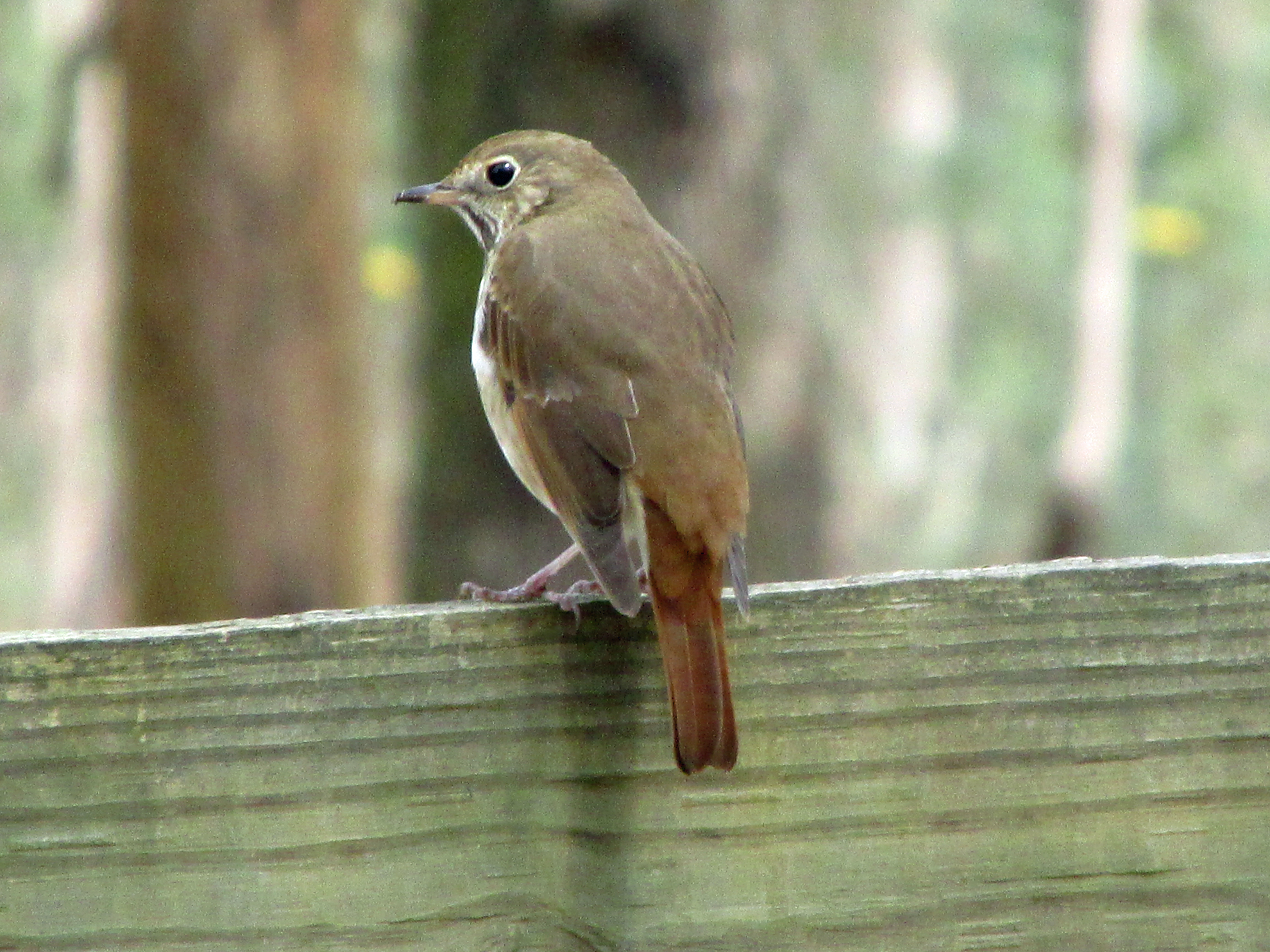
Some species were missed, including yellow-crowned night-heron, great horned owl, chuck-will’s-widow, willow flycatcher, brown creeper, hermit thrush, Kentucky warbler and magnolia warbler. These species are often, but not always, found on this count, according to long-time count compiler Rick Knight.

See if one of your favorite birds was hit or miss, common or uncommon, by scanning over the listing of the total.

The tally follows:
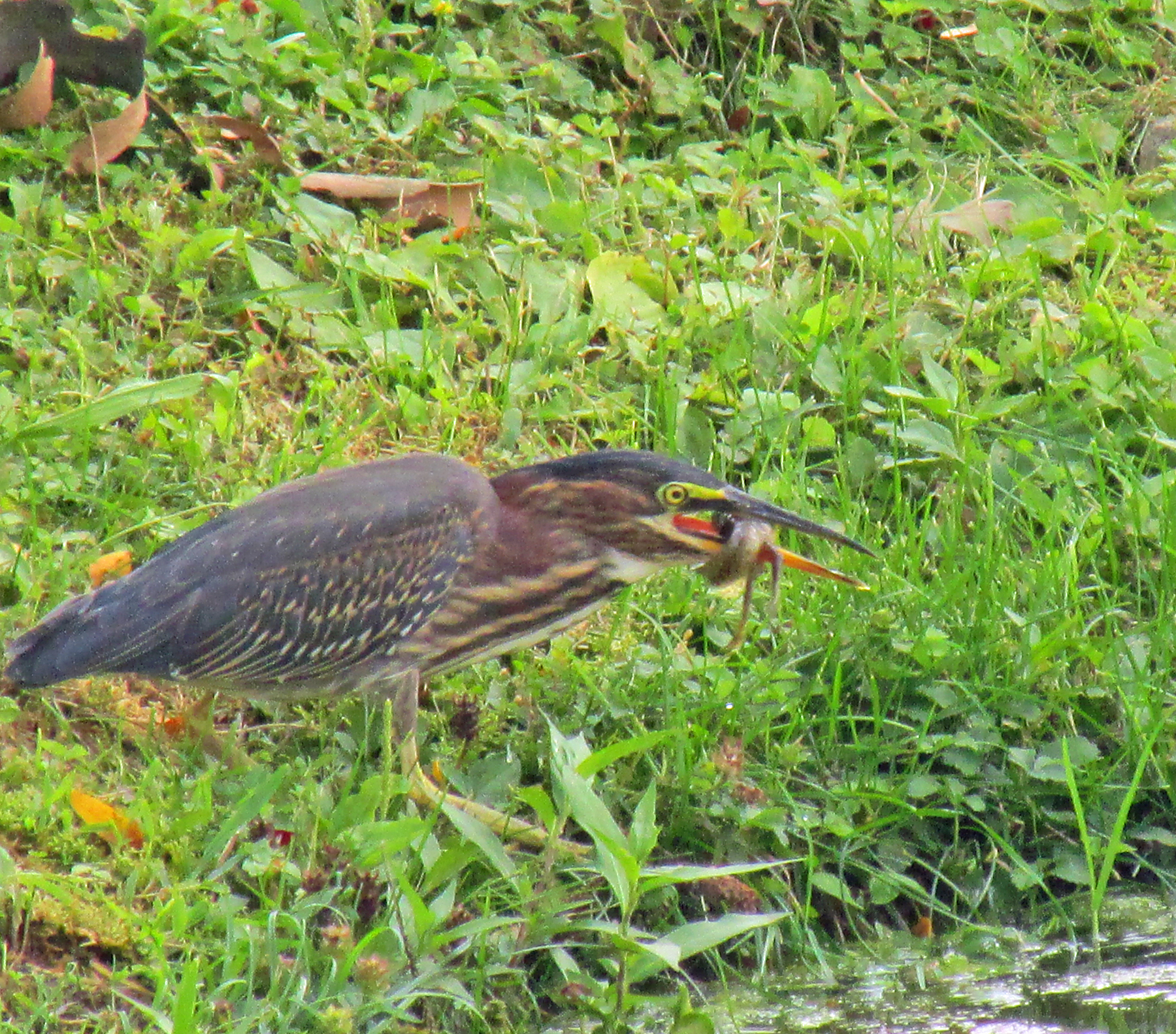
Canada goose, 218; wood duck, 13; mallard, 92; ruffed grouse, 1; wild turkey, 40; double-crested cormorant, 16; great blue heron, 23; and green heron, 2.
Black vulture, 7; turkey vulture, 25; osprey, 1; Cooper’s hawk, 3; bald eagle, 2; red-shouldered hawk, 4; broad-winged hawk, 7; and red-tailed hawk, 10.
Killdeer, 8; American woodcock, 1; rock pigeon, 101; Eurasian collared-dove, 2; mourning dove, 177; yellow-billed cuckoo, 5; Eastern screech-owl, 5; barred owl, 2; common nighthawk, 2; and Eastern whip-poor-will, 7.
Chimney swift, 99; ruby-throated hummingbird, 28; belted kingfisher, 11; red-bellied woodpecker, 24; yellow-bellied sapsucker, 2; downy woodpecker, 19; hairy woodpecker, 3; Northern flicker, 36; pileated woodpecker, 15; and American kestrel, 1.
Eastern wood-pewee, 24; Acadian flycatcher, 9; alder flycatcher, 2; least flycatcher, 13; Eastern phoebe, 48; great crested flycatcher, 7; and Eastern kingbird, 21.
White-eyed vireo, 5; yellow-throated vireo, 2; blue-headed vireo, 38; warbling vireo, 1; red-eyed vireo, 117; blue jay, 77; American crow, 185; fish crow, 4; and common raven, 5.
Purple martin, 38; Northern rough-winged swallow, 34; tree swallow, 109; barn swallow, 154; and cliff swallow, 137.
Carolina chickadee, 32; tufted titmouse, 65; red-breasted nuthatch, 3; white-breasted nuthatch, 10; house wren, 60; winter wren, 3; Carolina wren, 84; blue-gray gnatcatcher, 8; and golden-crowned kinglet, 2.
Eastern bluebird, 113; veery, 23; wood thrush, 35; American robin, 510; gray catbird, 42; brown thrasher, 38; Northern mockingbird, 62; European starling, 1,203; and cedar waxwing, 45.
Ovenbird, 50; worm-eating warbler, 4; Louisiana waterthrush, 10; golden-winged warbler 1; black-and-white warbler 27; Swainson’s warbler, 2; common yellowthroat, 12; hooded warbler, 67; American redstart, 8; Northern parula, 30; Blackburnian warbler, 4; yellow warbler, 1; chestnut-sided warbler, 12; black-throated blue warbler, 20; pine warbler, 2; yellow-throated warbler, 9; prairie warbler, 3; black-throated green warbler, 14; Canada warbler; 5; and yellow-breasted chat, 9.
Eastern towhee; 112; chipping sparrow, 61; field sparrow, 58; savannah sparrow, 1; song sparrow, 253; dark-eyed junco, 46; scarlet tanager, 25; Northern cardinal, 157; rose-breasted grosbeak, 5; blue grosbeak, 5; and indigo bunting, 102.
Red-winged blackbird, 109; Eastern meadowlark, 15; common grackle, 67; brown-headed cowbird, 43; orchard oriole, 4; and Baltimore oriole, 2.
House finch, 132; pine siskin, 1; American goldfinch, 97; and house sparrow, 44.

•••••


I received a phone call from Marian Swanson of Aldie, Virginia, this past week. Marian was looking for advice on feeders for attracting indigo buntings, which she had observed near her home. She was specifically seeking a feeder that would prevent the seed from getting wet during rainstorms.

At her request, I provided Marian with some links to websites offering a variety of feeders for sale.

It’s always great to hear from readers. If you have a bird-related question, email me at bstevens@erwinrecord.net or ahoodedwarbler@aol.com. I also enjoy hearing about bird observations or general comments from readers.

Common grackles part of November’s changing bird lineup


Photo by Bernell MacDonald/Pixabay.com • Common grackles are quite accomplished at foraging for food in a variety of habitats.

November is a month of transition. The birds of summer have all “flown the coop,” returning to warmer climes to the south in Central and South America, as well as the Caribbean. Of course, even as hummingbirds, warblers, tanagers, vireos, and others have fled North America in advance of winter’s imminent arrival, other birds are arriving to take their place.

Many of the newcomers don’t offer the vibrant plumage of a scarlet tanager or a rose-breasted grosbeak, but they make up for the lack of striking feathers by remaining quite faithful to our feeders during the bleak, short days of winter. A hermit thrush and a dark-eyed junco represented some first-of-autumn arrivals when they showed up Nov. 6, followed the next day by a swamp sparrow. In addition to the sparrow, three ravenous common grackles descended on my suet feeders that same day.

For many bird enthusiasts, the “common” in this particular bird’s name is particularly apt. Tending to form large, noisy flocks, common grackles can easily wear out even the most generous welcome. Perhaps because I live at a mid-elevation area, common grackles are extremely infrequent visitors to my yard. I can be a little more welcoming to a bird that I know is not likely to linger.

Photo by diapicard/Pixabay.com • A common grackle perches on a shepherd’s hook in a garden. These large birds, which are part of the blackbird family, form flocks and bring big appetites to feeders during migratory stops.

Nevertheless, that same evening these three grackles must have spread the word because a flock of about 30 of these birds arrived. If I needed a reminder, the flock provided a quick one. A handful of grackles isn’t too disruptive, but a large flock can quickly overwhelm and intimidate smaller feeder birds.

Even so, I remain inclusive in my embrace of all feathered friends. A much maligned bird if ever there was one, the common grackle is worth a second look. For those who are able to overlook the occasional bad habits of birds such as Northern mockingbirds, mourning doves, or even cantankerous ruby-throated hummingbirds, there may be hope for this large member of the diverse family of blackbirds, known by scientific types as a member of the family Icteridae. This grouping of New World species, also known as New World blackbirds, includes such members as orioles, meadowlarks, cowbirds, bobolinks, marshbirds, orependolas, caciques and, of course, blackbirds.

Photo by Bryan Stevens • A boat-tailed grackle sings, if the bird’s harsh, grating notes can be considered a song, from a perch in a wetland in South Carolina.

The common grackle is known by the scientific name Quiscalus quiscula. In the southeast, in particular along the coast and in wetland areas, a common and related species is the boat-tailed grackle. Other species of grackles found in the New World include the great-tailed grackle, Nicaraguan grackle, Great Antillean grackle and the Carib grackle. A little more distantly related are the South American species golden-tufted mountain grackle and the Colombian mountain grackle.

One species — the slender-billed grackle of Mexico — suffered extinction at the dawn of the 20th century. Reasons for this bird’s disappearance are not clearly understood, but habitat destruction of Mexican wetlands and hunting pressures have been theorized as causes. Like others of its kind, the slender-billed grackle may also have been persecuted as an agricultural pest.

Like many other birds dependent on wetlands, common grackles have experienced population declines in recent decades. Although it seems odd to refer to a bird with a population estimated at around 73 million individuals in North America as on the decline, common grackles have suffered an estimated population loss of about 60 percent from historic highs.

Male grackles stand out from other blackbirds due to their sheer size. Males can reach a length of 13 inches, although much of that can be measured in an exceptionally long tail. A grackle’s plumage has a black sheen that can shine with brilliant iridescence that tends to appear purple, green or blue when the sun shines just right on the feathers. Females tend to be smaller than males and are a muted black and brown. Both sexes have long, sturdy bills and yellow eyes.

Most rural residents don’t have to worry about common grackles overwhelming their feeders, but some people living in urban and suburban settings have found grackles to be difficult guests. The birds have bottomless appetites and are aggressive toward more desirable feeder birds. Fortunately, migrating flocks in the fall tend not to linger. After a brief visit, which can still deplete supplies of seed and suet cakes, the grackles continue migrating.

Grackles are usually one of the earliest birds to return each spring. In fact, it’s not at all unusual for these large birds to make their way back to the region as early as late February. I am usually glad to welcome them back since I know that their return is a strong indication that some more favored species are certain to follow in their wake and that winter’s grip is waning.

Are you seeing new arrivals in your yard or at your feeders? Let me know by emailing ahoodedwarbler@aol.com.

Photo by Bryan Stevens • Boat-tailed grackles perch on viewing equipment at an observation platform at Huntington Beach State Park in South Carolina.

Finches arrive ahead of winter in impressive numbers

I’d watched with some degree of envy after friends posted on social media about the arrival of purple finches and pine siskins earlier this fall. What was wrong with my yard?

Fortunately, I only needed to remain patient. People began reporting the arrival of these two species of winter finches at their feeders weeks ago all across Tennessee. The purple finches and pine siskins showed up, finally, at my home on Oct. 23.

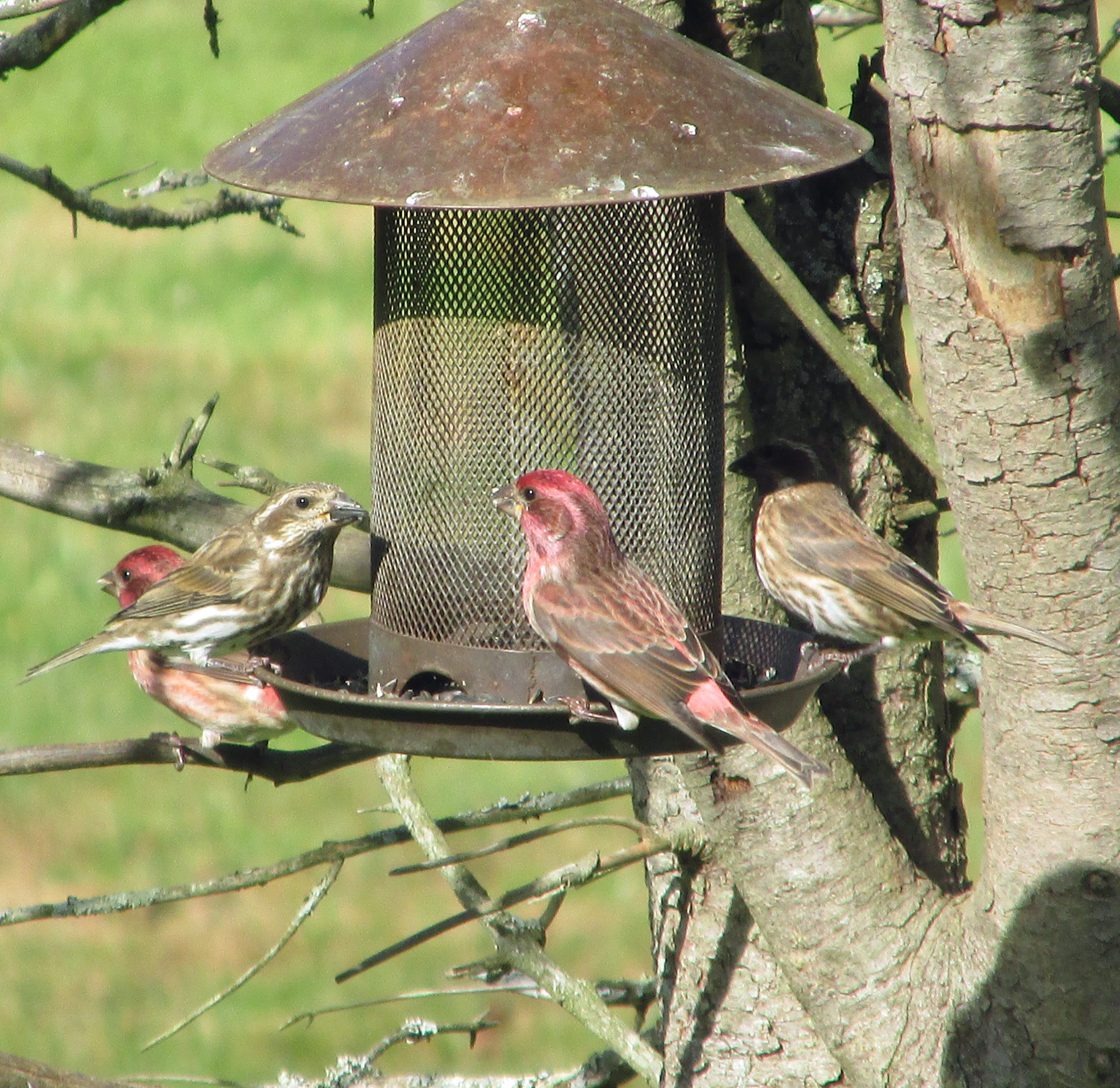
Photo by Bryan Stevens • Male and female purple finches share space at a feeder.

The pine siskin nests during the summer on the higher elevations of Roan Mountain. These small finches, which are related to the American goldfinch, are common winter feeder visitors some years and completely absent other years. This looks to be a year for siskin abundance. Andrew Del-Colle, Site Director and Editor for Audubon Magazine, posted a recent article about this autumn’s dramatic irruption of pine siskins.

Photo by Bryan Stevens • A pine siskin in a spruce at Carver’s Gap on Roan Mountain.

Project FeederWatch, which has monitored North American bird population trends for decades, defines the term irruption as a sudden change in the population density of an organism. In the case of birds, irruptions refer to the movement of northern-wintering species to the south in years of low food availability. Other species that often stage winter irruptions include evening grosbeaks, red-breasted nuthatches and common redpolls. There’s also some indication that some of these other birds may make their way south this winter.

“If you’ve never seen a pine siskin, this is your year,” Del-Colle wrote. “In the past month, the birds have invaded the United States in search of food, inundating backyard feeders across the country. Without question, it’s one of the biggest irruption years in recorded history for the finches.”

Photo by Bryan Stevens • Purple finches jostle for space in a feeder stocked with sunflower seeds.

The pine siskins at my home spend much of their time in weedy fields adjacent to my home and visit my feeders on a semi-regular basis. I suspect their feeder visitation will increase once some truly wintry weather arrives.

The purple finches that arrived on the same day do not rival the siskins in sheer numbers. Nevertheless, the purple finches have lingered, as well. The purple finch, which is a winter visitor to northeast Tennessee, southwest Virginia and western North Carolina, is apparently not as common as in the past. Experts have speculated that the decline in the numbers of purple finches each winter can be attributed, at least in part, to the closely related house finch. The house finch may simply be out-competing the purple finch for scarce natural resources.

Photo by Bryan Stevens • A male house finch perched on a cable. These finches are native to the western United States but became established in the eastern states thanks to the illicit pet trade.

The house finch is quite widespread across the United States. Originally, however, the house finch was a bird of the western part of the country, living in Mexico and the southwestern United States. About 1940, the house finch became established in the eastern United States. In violation of federal law, these small finches were being sold in New York City as pet birds described as “Hollywood Finches.” To avoid trouble with authorities, vendors and even some owners released their “Hollywood Finches” into the wild. Finding the area around New York City to their liking, house finches spread. Within a few decades, they were common birds throughout the eastern United States, including Tennessee, Virginia and North Carolina.

As the house finch claimed a new range, they inevitably encountered the related purple finch. During the winter, both finches are often present at feeders in the region. When both are available for observation, bird enthusiasts should take advantage of the opportunity to compare and contrast these birds. I have never had any difficulty distinguishing a purple finch from a house finch. The two species, at least in my eyes, are easily recognized. I can understand why some people might have trouble separating the two birds. The late Roger Tory Peterson once described the purple finch as a bird “dipped in raspberry juice.” Think about that imagery for a moment and you’ve got a good start to distinguishing a male purple finch from a male house finch. With some practice, observers will come to notice the subtle differences between a purple finch and a house finch.

These two finches belong to the genus Haemorhous, which can be roughly translated as “the color of blood.” The two species are also simply classified as American rosefinches. This grouping also includes a third species, Cassin’s finch, which occurs in the western United States. I have seen all three species, adding Cassin’s finch during a visit to Utah in 2006.

____________

Differentiating purple finches

from house finches can be a challenge

Let’s deal first with the males. Male purple finches are delicate pink-red (that raspberry coloration) on the head and breast, mixing with brown on the back and cloudy white on the belly. The red of a male purple finch is definitely a color I have not observed with many other birds. Even “red” birds such as male Northern cardinals and male scarlet tanagers do not show the same red color. Once you learn the way the red appears in the plumage of a male purple finch, you are on your way to telling this bird apart from its relative.

The red in the plumage of male house finches is surprisingly variable. In most cases, the heads, necks and shoulders of male birds are reddish and the red at times extends to the stomach and between the wings on the bird’s back. The intensity of the red changes with the seasons and is also derived from the berries and fruits in the bird’s diet. Pale yellow and bright orange are alternatives to the typical red plumage.

Look closely at the photograph of the purple finches accompanying this column. There’s a distinctive facial pattern evident on the birds. The strong facial markings include a whitish eye stripe and a dark line down the side of the throat. This pattern simply doesn’t exist with the male house finch. When I make a snap identification of these two birds, I always look for the facial pattern even before I study any other aspects of the appearance of the bird. In addition, purple finches have powerful, conical beaks and a tail that appears short and is clearly notched at the tip. Rounding out the description of a male house finch is the fact that they have a long, square-tipped brown tail and are brown or dull-brown across the back with some shading into gray on the wing feathers. The breast and stomach feathers may be streaked.

Females of both house finches and purple finches are dull brown birds that could easily be mistaken for sparrows. Again, the facial pattern is much more apparent on a female purple finch than on the related female house finch. In addition, I have always noticed that female purple finches are usually a darker shade of brown than the dull brown female house finches. Both male and female house finches are more slender than their more chunky-bodied counterparts.

______________

Although not closely related to our American birds, there is also a group known as rosefinches common to Europe and Asia. Some of these distant relatives include such descriptively named birds as scarlet finch, streaked rosefinch, red-mantled rosefinch, pink-browed rosefinch, long-tailed rosefinch, three-banded rosefinch and Himalayan beautiful rosefinch.

Purple finches occupy a variety of winter habitats, including fields, woodland edges, lawns and gardens. All it takes to lure these finches to feeders is a plentiful offering of sunflower seeds. If you are lucky enough to have both of these finches visiting your feeders, take time to study the differences. It takes some practice, but they can be distinguished quite confidently.


Nighthawks share the skies with many other migrants

Photo by Dr. Thomas G. Barnes/ USFWS • A common nighthawk perches on a low clump of vegetation during a rest period. Nighthawks are known for migrating in large flocks.

Autumn’s a chance for me to indulge my passion for warblers, with a few dozen species of these songbirds passing through the region in the span of a few weeks. They’re not the only migrating birds worth watching, however, as a recent Facebook post reminded me.

John Whinery, a fellow birder who resides in Fall Branch, Tennessee, reported some interesting observations Sept. 6 on Facebook.

“Been watching several hundred common nighthawks the last few nights fly down the valley next to the farm,” John wrote in his post. He also reported that he saw a female Northern harrier fly by at eye level about 20 feet from him as he watched the migrating nighthawks. The Northern harrier, once known as the “marsh hawk,” is one of many raptors known to migrate. 

Like such birds as warblers, vireos, thrushes, tanagers, flycatchers and hummingbirds, the common nighthawk, is a neotropical migrant. In addition, the common nighthawk has one of the longest migration routes of any North American bird. Twice a year, these birds migrate for distances ranging from 1,600 to 4,200 miles. Nighthawks that spend the spring and summer in Canada travel to southern South America for the winter months. 

With September advancing on the calendar, I have been keeping an eye on the treetops for passing warblers, vireos and tanagers, but I also remember to direct my gaze to the skies. Forgetting to look skyward could result in missing the passage of such varied migrants as chimney swifts, broad-winged hawks and common nighthawks.

So, what is a common nighthawk? First, this bird, despite what is implied by its name, is not a hawk. It’s also not strictly nocturnal. Particularly in the fall, nighthawks are active during daylight hours when engaged in catching winged insects. Outside of fall migration, these birds can often be observed over large parking lots or well-lit streets, snatching up insects swarming around the light poles.

The common nighthawk is one of three members of the nightjar family found in the region during the summer months. The other two nightjars are the whip-poor-will and chuck-will’s-widow, birds that produce their namesake vocalizations in the nocturnal hours. Both of these species migrate, but they don’t take the dramatic approach employed by nighthawks. Each fall, common nighthawks form large flocks, ranging in size from dozens to hundreds or even thousands of individuals, as they migrate south for the winter.

Photo by Skeeze/Pixabay.com • A common nighthawk chooses a perch atop a fence post for a survey of its surroundings.

Unlike whips and chucks, the common nighthawk isn’t active only after dark, which makes it much easier to observe these birds. They look somewhat like swifts and swallows but are much larger. They are brownish-gray birds with pointed wings and forked tails. They are easily identified by distinctive white patches on the underside of their wings.

The nightjar, or Caprimulgidae, family of birds is also sometimes known as “goatsuckers.” Apparently, in trying to explain the nocturnal tendencies of these birds, the Greeks came up with the imaginative but erroneous idea that birds like nighthawks liked to sneak into barns and have a meal of fresh goat’s milk. In reality, nighthawks feed almost exclusively on insects, including ants, wasps, beetles, caddisflies, moths, mayflies, flies, crickets, grasshoppers, and other insects. They capture much of their insect prey on the wing.

There are almost 80 species of nightjars in the world. Less than 10 occur in North America. Many of the common nighthawk’s relatives have been given descriptive names, such as long-trained nightjar, collared nightjar, spot-tailed nightjar, red-necked nightjar, golden nightjar, fiery-necked nightjar, swamp nightjar, pennant-winged nightjar, lyre-tailed nightjar, little nightjar, sickle-winged nightjar, rufous-bellied nighthawk, short-tailed nighthawk, sand-coloured nighthawk and least nighthawk.

So, keep looking skyward. The next flock of migrating common nighthawks may fly over your home. These flocks are usually on the move throughout September.  I’ve managed only three sightings of solitary nighthawks so far this migration season, which falls far short of the number John Whinery reported at his farm. 

I will keep watching the skies. Nighthawks can also appear almost magically, as if out of thin air. First, observers may see one of two birds, then several, followed quickly by dozens or sometimes hundreds as they wheel and cavort in the skies overhead with impressive grace and agility. I’ve seen flocks that would easily number more than 500 birds in locations throughout the region, although flocks often number only a couple of dozen birds. 

Photo by Jean Potter • A common nighthawk rests on a metal railing.