Tag Archives: Fall migrants

Gray catbird’s personality veers from shyness to curiosity

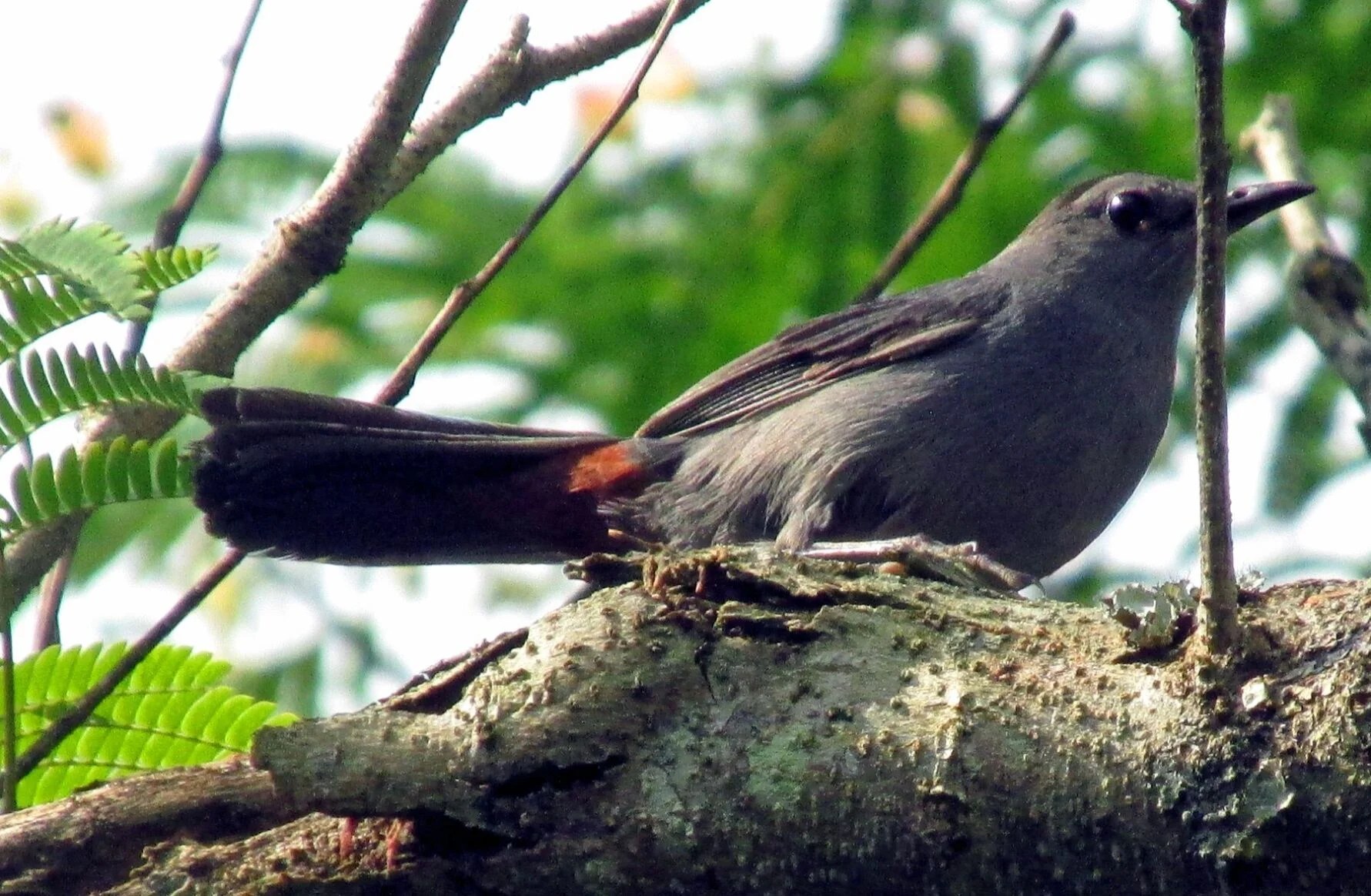
Photo by Bryan Stevens • A gray catbird perches in a mimosa tree. These birds alternate between extreme shyness and determined curiosity.

Catbirds are experts at concealing themselves from prying eyes. This birds charcoal gray plumage blends into the shadowy sections of tangles and thickets where the bird likes to hide itself.

However, even when gray catbirds are reluctant to be seen, they’re almost eager to be heard. The catbird is extremely vocal with several calls and songs in its repertoire, including the rather faithful rendering of a fussy cat’s meow that provides this bird its common name.

This is also a bird with strong curiosity. Despite its retiring nature, curiosity often wins out, as demonstrated when I had a front porch “conversation” with a catbird on a recent morning.

The named catbird came from the fact that this mimic, related to mockingbirds and thrashers, has an uncanny vocalisation that sounds just like a cat’s meow.

Photo by Bryan Stevens • A gray catbird emerged from cover long enough to have its photo taken.

I’m not particularly good at bird imitations. I can do a decent imitation of Eastern screech owls. I’ve even succeeded at getting these small owls to call back, and I’ve incited a mob of small songbirds, convinced that a “real” owl has gotten far too close for comfort.

And I can also do a passable imitation of the catbirds “meow” vocalization, which I proceeded to spontaneously do as I stood on my front porch on a cool early September morning listening to a gray catbird hidden in the dense foliage of a blooming althea, also known as a “rose of Sharon.”

Every time the catbird meowed, I meowed back. The intervals sped up. Within a short time, the bird popped into view, the better to get a look at me. That’s when something remarkable happened. Clearly still in the bird’s view, I called back. The bird called and continued to stare at me, albeit nervously, from its perch. We continued to converse, although I’m not really sure what we were discussing. I claim to be able to imitate the bird’s language, not understand it. Despite what must have been a strong urge to dive back into cover, the bird continued to remain in the open and meow back every time I returned its meow with one of my own.

Only when I moved to go back inside did the bird plunge back into dense cover. Even as I stepped back inside the house, the catbird continued to meow.

This species is part of a family related to thrushes that are known as “mimic thrushes.” Besides its surprisingly accurate rendition of a feline, the catbird has several other common vocalizations. Despite a shy nature, they’re extremely curious. Imitating their calls or simply producing a squeaky sound will usually persuade the bird to move out of cover and search for the source of the noise.

Photo by Bryan Stevens • The gray catbird resides in Northeast Tennessee April through October, although there are a few winter records for the species. Most depart in fall, choosing to spend the winter months in more hospitable locations.

Catbirds are part of the parade of the departing birds like rose-breasted grosbeaks, scarlet tanagers, Baltimore orioles and indigo buntings that will soon wing their way south for the winter.

Because they lack the brilliant plumages of some of these other summer visitors, catbirds could often go unnoticed if not for the fact they are extremely noisy.

Although the catbird is related to thrashers and mockingbirds, scientists find them just different enough to warrant placing the gray catbird in its own genus. A relative known as the black catbird, which ranges throughout the Yucatan Peninsula of Mexico as well as northern Guatemala and northern Belize, also belongs to a genus of its own. Both catbirds are classified as “mimic thrushes,” or Mimidae, of which there are about 30 species in the New World. There is also a totally unrelated family of catbirds that ranges through Australia, Asia and parts of Africa. Some of these birds include the ochre-breasted catbird, tooth-billed catbird and spotted catbird.

The gray catbird is not as an accomplished mimic as some of its relatives, such as the Northern mockingbird. Nevertheless, experts have documented that the gray catbird can produce more than 100 different sounds. Males have motivation to constantly expand their repertoire, however, as doing so increases the likelihood of attracting a mate. They imitate other birds, but some have been recorded imitating frogs and other non-avian singers.
Photo by Bryan Stevens A curious Gray Catbird peeks from dense cover. Attendees at the fall rally can look for catbirds and other species at any of the offered bird hikes.

While not generally considered a bird to visit feeders, people have succeeded in attracting catbirds to feeders designed to offer grape jelly or orange slices. Planting fruit-bearing shrubs and trees is the best means of attracting these fascinating birds to your yard and garden. It’s also best not to clear away brush and tangles from your yard if you wish to attract catbirds. These are shy birds and will avoid areas that are too open and brightly lit.

An occasional catbird lingers in the region into the winter season, but most head out for more comfortable climates by the end of October. Enjoy this entertaining bird while you can but know they’ll return without fail next spring in April and May.

•••

Bryan Stevens has written about birds, birding and birders since 1995. Ask a question, share a sighting or make a comment by emailing him at ahoodedwarbler@aol.com.ahoodedwarbler@aol.com

Hummingbirds, other summer birds get ready to depart

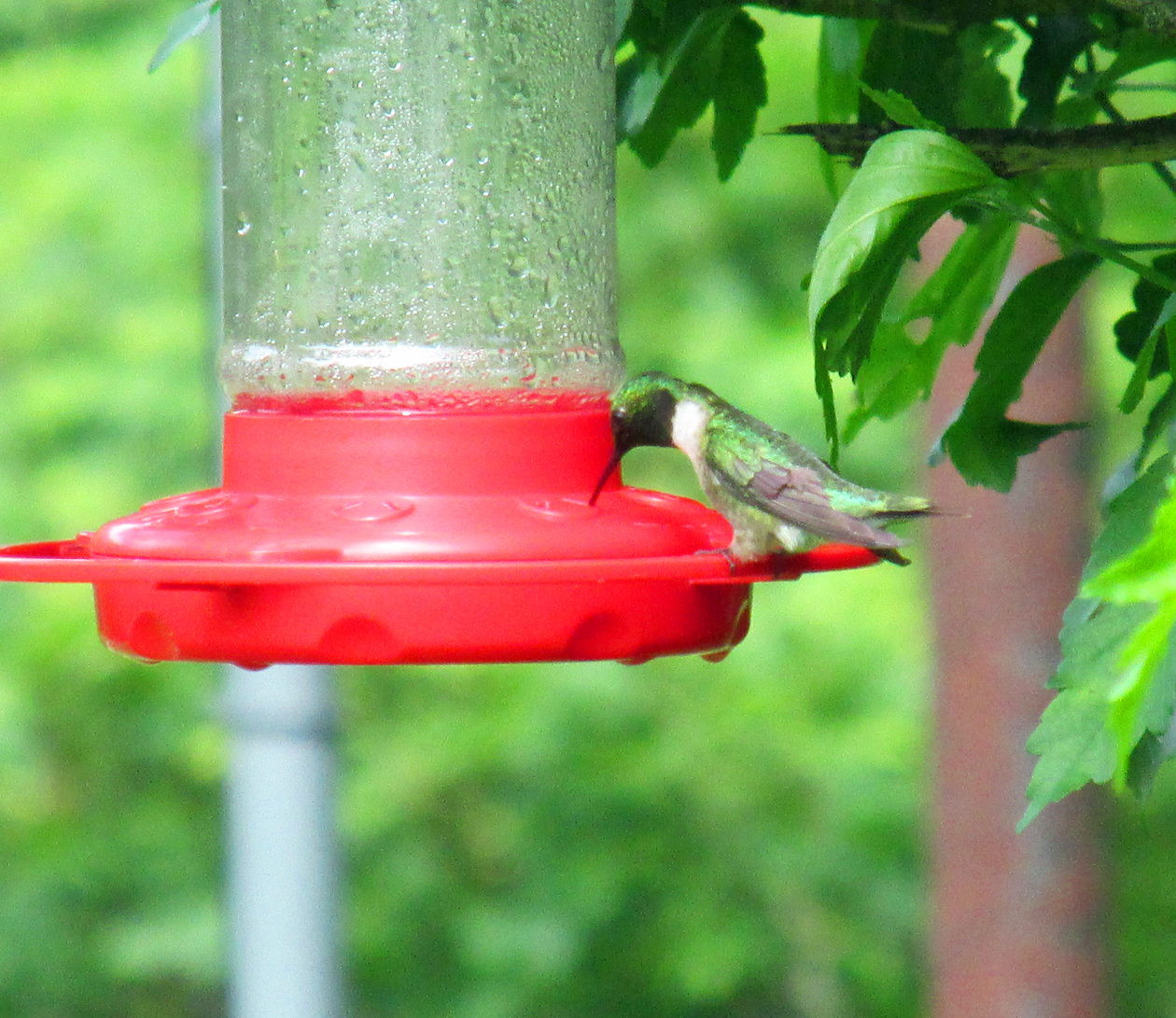
Photo by Bryan Stevens • A ruby-throated hummingbird visits a feeder for a sip of sugar water.

I always feel some reluctance and regret when I turn the calendar page from August to September.

I don’t have anything against fall – it’s my favorite season. But I know that our ruby-throated hummingbirds, which returned only five months ago in early April, will soon be departing.

It won’t be only the hummingbirds. Warblers, orioles, tanagers and other migrants will also fly south to spend the winter season somewhere more hospitable.

Most of the hummingbirds that visited our gardens over the summer are getting ready to migrate back to their winter homes in Central America.

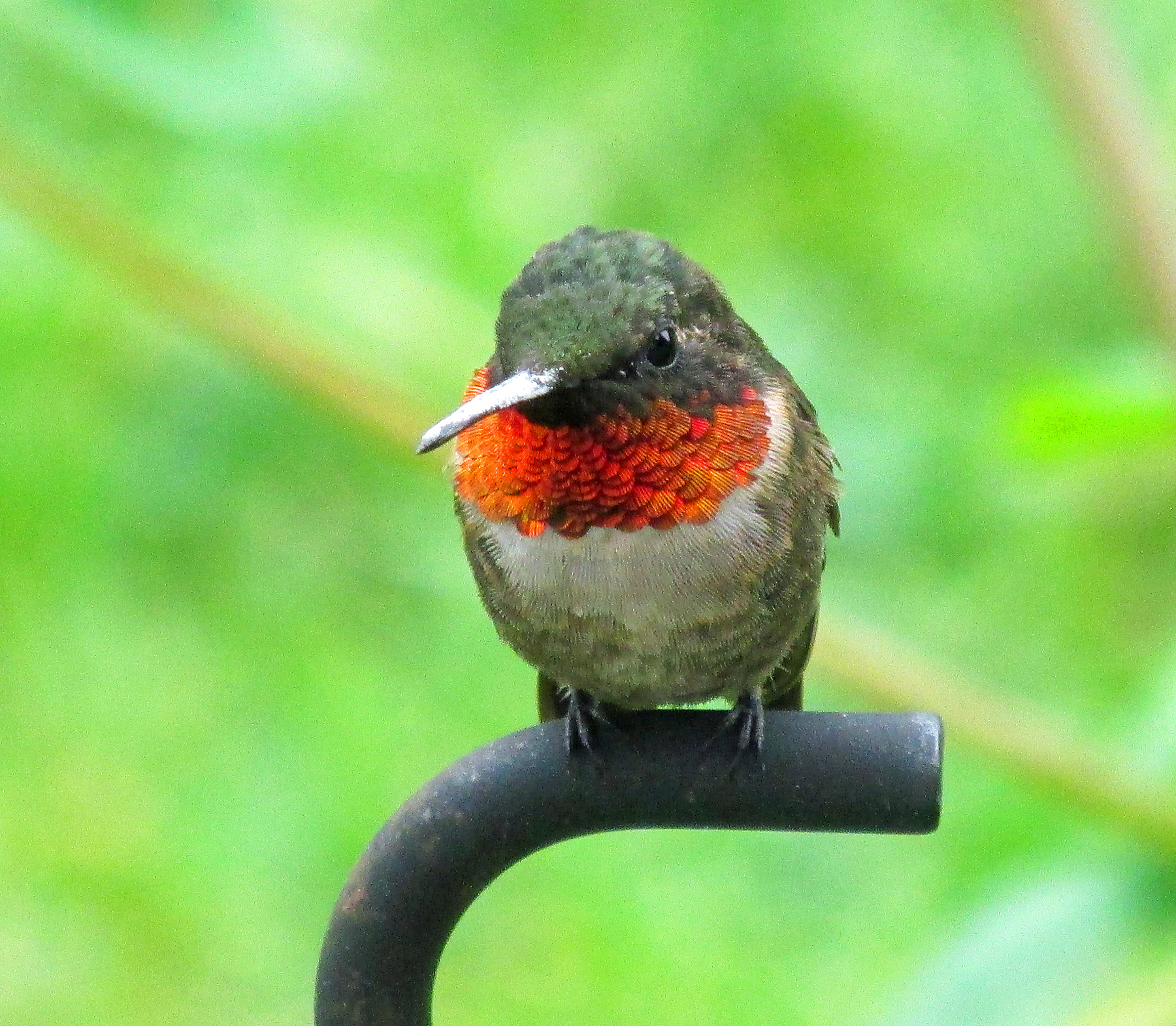
I’m seeing only a few adult male hummingbirds with the namesake red throat. They are outnumbered by females and young hummingbirds that hatched in late spring and throughout the summer. It’s fun to watch young hummingbirds. They often have something to prove. In many ways, they’re even more feisty than adult birds.

Photo by Bryan Stevens • A male ruby-throated hummingbird perches at a feeder for a sip of sugar water.

In any given year, the numbers of hummingbirds passing thorough is going to fluctuate. Some years, these tiny flying gems will be present in good numbers on an almost daily basis. Other years, hummingbirds can become quite scarce.

I usually enjoy my best hummingbird numbers in the fall as these little birds begin their leisurely journey back south. Late August and the month of September is usually a great time to watch hummingbirds.

During August, the feeders at my home and my mother’s home saw a great deal of activity. Blooms of wildflowers and cultivated flowers also attracted them. Earlier in the summer the hummingbirds went gaga for the crocosmia blooms and the flowering bee balm. For the past month, the tube-shaped flowers of orange jewelweed has kept them coming back for more.

The New World is home to about 360 species of hummingbirds. We’ve expended many adjectives in finding names of them all. Sometimes, words fail. Mere adjectives are somewhat inadequate in providing common names for many of the world’s more hummingbirds, but that doesn’t keep us from trying to give descriptive names to each hummingbird species. For instance, we have the beautiful hummingbird of Mexico; the charming hummingbird of Costa Rica and Panama; the festive coquette of northwestern South America; and the magnificent hummingbird of the southwestern United States.

Photo by Bryan Stevens • A ruby-throated hummingbird sips from a sugar water feeder.

Other names are even more elaborate and occasionally outlandish, such as the white-tufted sunbeam of Peru; the violet-throated metaltail of Ecuador; the violet-throated starfrontlet of Peru and Bolivia; the hyacinth visorbearer of Brazil; and the rainbow-bearded thornbill of Colombia and Ecuador.

As for our own ruby-throated hummingbirds, wish them well as they begin that long trek back to their wintering grounds. For the young birds, this will be their first epic crossing of the Gulf of Mexico, something the species must do twice a year to get to and from their summer home in eastern North America.

•••

Bryan Stevens has written about birds, birding and birders since 1995.

Birds boast phenomenal knack for long-distance travel

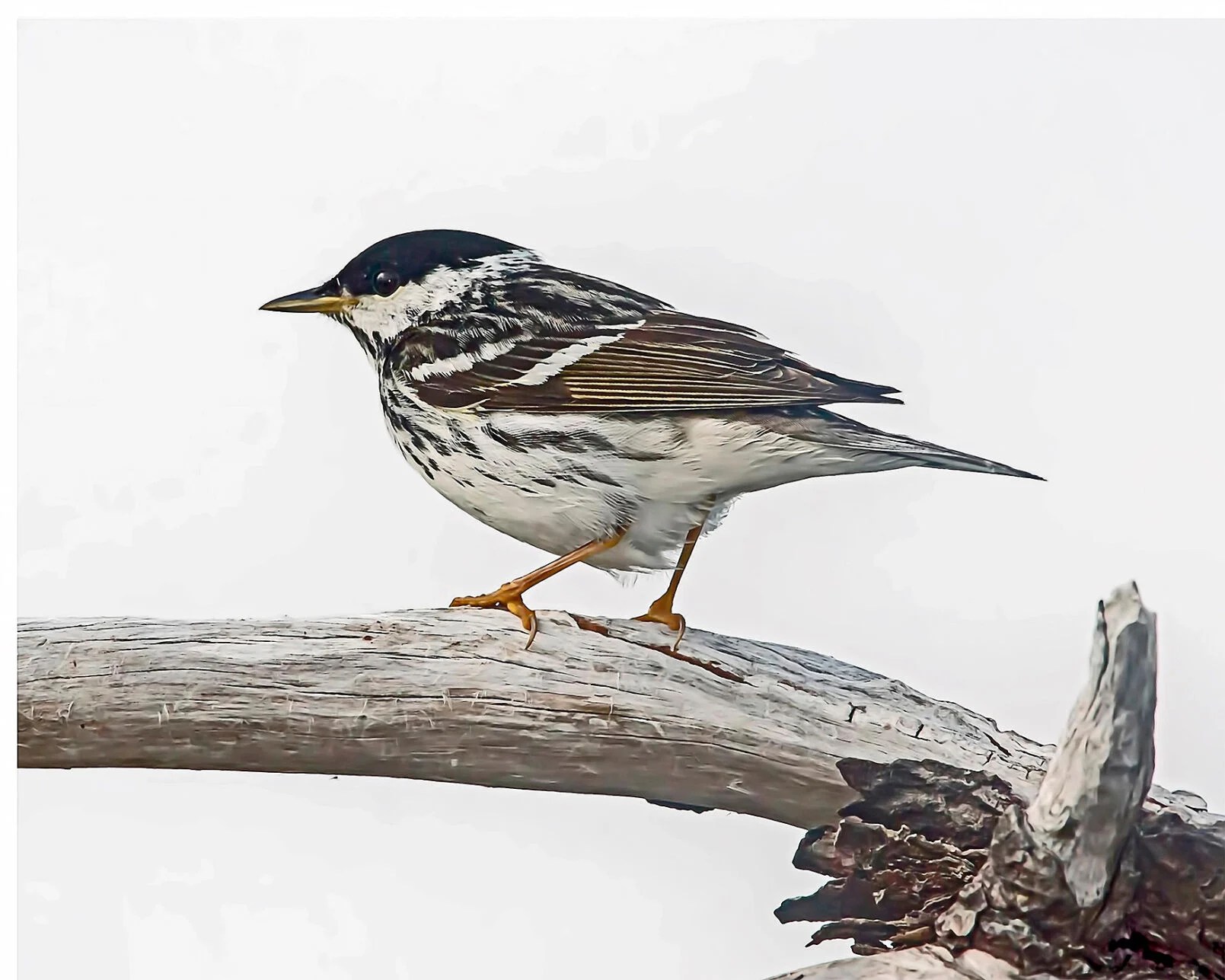
Hans Toom/Pixabay • The blackpoll warbler has one of the more difficult and lengthy migrations of the family of warblers.

The phenomenon of migration isn’t exclusive to the neotropical migrants of the New World. Birds in other parts of the world migrate, too. Waterfowl, shorebirds and raptors are among some of the families of birds that stage impressive migrations.

Of course, I spent most of my birding within Tennessee, particularly in the Northeast Tennessee region. Since the Volunteer State has no access to the sea, it is sometimes amazing how many birds affiliated with coastal areas can be found if you know when and where to look. Fall’s a good time to scan lakeshores, river banks and the edges of farm ponds for migrating shorebirds and wading birds.

I discussed last week some of the species I hope to see this fall. Every time I see some of these migrants I am impressed by what a phenomenal feat each and every single one of these birds represents. As my mother is fond of asking: “How do they do it?”

For such relatively small creatures, many if our birds are world-class travelers. Here are a few profiles of some of these incredible migrants.

Photo by U.S. Fish & Wildlife Service/Kirk Rogers • The Arctic tern is a world champion among migrating birds.


One good tern deserves another

The Arctic tern, for example, truly takes migration to extremes. This small seabird travels each year from its Arctic nesting grounds to the Antarctic region, where it spends the winter months. Put into terms of mileage, the Arctic tern can travel about 50,000 miles in a single year. For a bird with a body length of about 15 inches and a wingspan of about 28 inches, this incredible migration is an astonishing feat. These statistics permit the Arctic tern to easily lay claim to the title of champion migrant among our feathered friends. According to the website for National Geographic, Arctic terns face a serious threat from climate change. In a profile on the tern at its website, National Geographic warns that Arctic terns are projected to lose 20 to 50 percent of their habitat due to the temperature changes linked to climate change. They also face loss of habitat due to encroachment by human activities such as oil drilling.

Photo by Bryan Stevens • Despite a perceived disadvantage of size, ruby-throated hummingbirds are quite capable of thriving in a giant world.

Size matters less than we think

The ruby-throated hummingbird makes an impressive migration each year. It’s even more awesome when one considers the diminutive size of these small travelers. Just to reach the United States, these tiny birds undertake a strenuous journey. They leave their wintering grounds in Central America to return to the United States and Canada for the nesting season. Most of these tiny birds, which are barely four inches long, make a non-stop flight of more than 500 miles across the Gulf of Mexico. The journey can take almost an entire day. With the end of summer, the entire population of ruby-throated hummingbirds, increased by a new generation of young birds, makes the Gulf crossing for a second time in a year to return to the American tropics for the winter months.

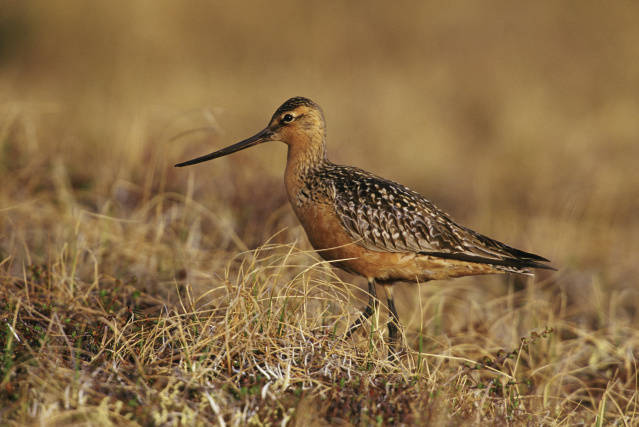
Photo by U.S. Fish & Wildlife Service/Steve Maslowski The bar-tailed godwit stages migrations that can take nine days of non-stop flight spanning nearly 6,000 miles.


Godwits, by Jove!

Shorebirds, which in North America can consist of birds ranging from turnstones and sandpipers to willets and avocets, are champion migrants. For instance, the bar-tailed godwit makes an impressive non-stop migratory flight. This shorebird nests in the United States only in parts of remote Alaska, but this godwit also ranges into Scandinavia and northern Asia. Some of these godwits make a nine-day, non-stop migratory flight that takes them from New Zealand to the Yellow Sea of China and beyond, a distance of almost 6,000 miles each way. Needless to say, since the godwits make no stops along the way, they must also go without food for the duration of their journey. The female godwit is larger than the male, but she still weighs only 12 ounces. The long-billed, long-legged bird is about 17 inches in length from the tip of the bill to its tail. That a creature so small can make such a distant, arduous trip and be the none the worse for wear is truly inspiring.

Bryan Stevens • A broad-winged hawk perches in a woodland in the Southern Appalachians.

A fine kettle of hawks

Many North American raptors migrate, but the broad-winged hawk dislikes the lonely aspects of solitary travel. Instead, these hawks form large flocks, known as kettles, during migration. In autumn the majority of these raptors travel past human-staffed hawk migration observation points, which are dubbed “hawk watches,” during a brief and concentrated period of only a few weeks. Observing the phenomenon locally is possible at the Mendota Fire Tower Hawk Watch site atop Clinch Mountain at an abandoned fire tower near Mendota, Virginia. Broad-winged hawks are part of the family Accipitridae, which includes 224 species of hawks, eagles, vultures and other birds of prey. Broad-winged hawks are truly long-distance migrants. Many hawks passing over Mendota may end their migration as far south as Brazil. These hawks travel in flocks that can consist of hundreds or thousands of individuals. The birds conserve energy by soaring on thermals and mountain updrafts.

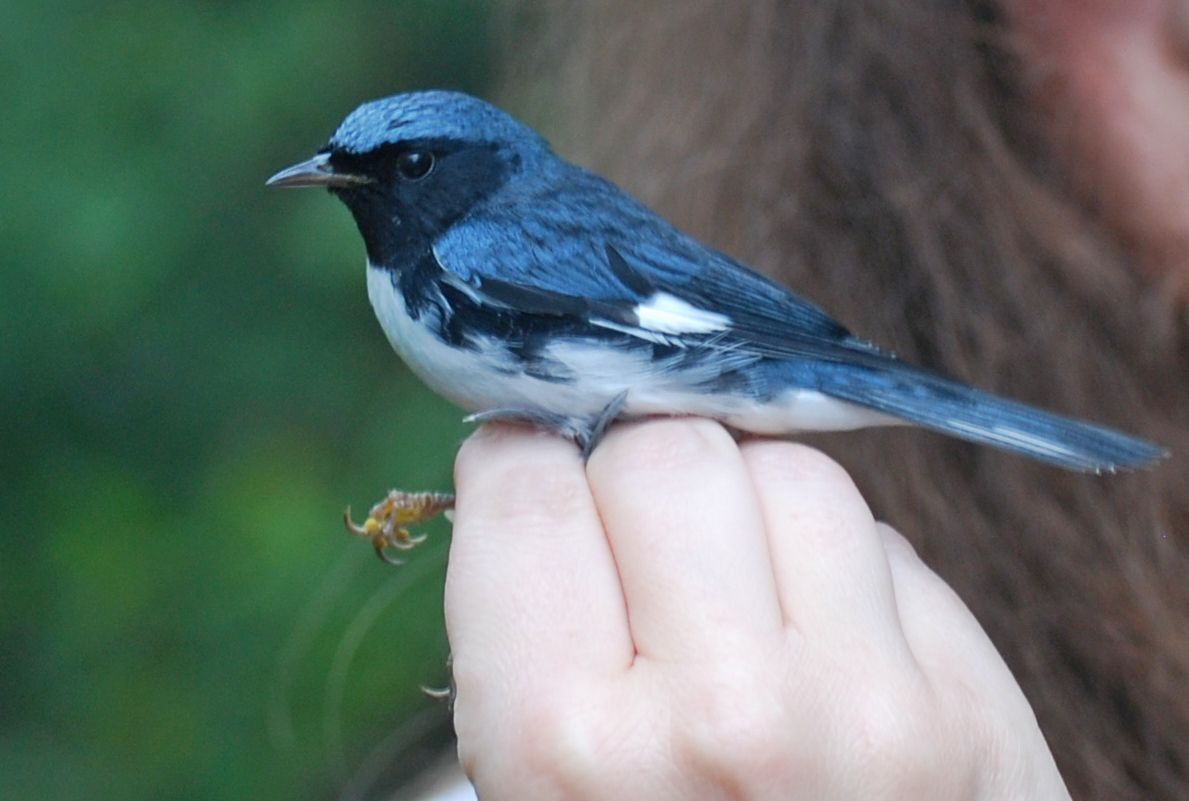
Jean Potter • Warblers, such as this male black-throated blue warbler, migrate into North America each spring to nest and retreat each fall for conditions farther south during the winter.

Traveling in stages

Most of the warblers that nest in North America retreat to Central and South America during the winter months. Few warblers, however, make as great a journey as the blackpoll warbler. Instead of migrating over land, this five-inch-long warbler undertakes a two-stage migration. The first half of the migration is a non-stop flight of about 1,500 miles. Every fall, these tiny birds fly over the ocean during this part of their migration, departing from Canada or the northern United States and not stopping until they reach various locations in the Caribbean. There they will spend some time recovering from the exhausting first half of their journey before they continue their way to such South American countries as Colombia and Venezuela.

•••

Bryan Stevens has written about birds since 1995. To share a sighting, ask a question or make a comment, email him at ahoodedwarbler@aol.com.

Birds share fall skies with migrating butterflies, dragonflies

During a stop at the Unicoi Walmart to visit the pharmacy on Wednesday, Sept. 3, I spied an energetic fluttering of wings in the garden center. Although I’ve spied various birds, including Carolina wrens and house sparrows, making themselves at home in this garden center, this winged creature was quite a bit smaller.

I watched the butterfly flit from marigold to zinnia to fall mums, feasting on the nectar the blooms provided. A closer look revealed the butterfly’s identity as a long-tailed skipper, a species more likely found in South Carolina, Georgia and Florida than Northeast Tennessee.

Photo by Bryan Stevens • A long-tailed skipper sips nectar from a marigold at the garden center at the Unicoi Walmart.

According to Wikipedia, the long-tailed skipper is a spread-winged skipper butterfly found throughout tropical and subtropical South America, south to Argentina and north into the eastern United States and southern Ontario. It cannot live in areas with prolonged frost. I have seen lots of them in South Carolina and Georgia; this is my second sighting of one in Northeast Tennessee. I found the first one in a garden in Elizabethton near the Covered Bridge.

The sighting reminded me that it’s not only birds using the skies for migration as we advance toward the autumn season. I also remembered a question I got from a reader back in 2014. Rhonda Eller of Chilhowie, Virginia, posted a question on my Facebook page about some dragonflies that appeared in her yard on Sept. 10.

“We have had a sudden breakout of dragonflies in our yard,” Rhonda explained. “We seldom see more than one or two at a time.”

Rhonda wondered if the dragonflies might have been drawn to her yard in pursuit of some sort of favorite insect prey. She also speculated that the recent dry conditions might have attracted the dragonflies.

Photo by Bryan Stevens • The wandering glider is a migratory species of dragonfly.

I responded at the time to her query by explaining that birds share the skies at this time of year with many other migrants. Some dragonflies, just like birds, migrate. A species known as green darner is one that migrates. These darners are rather large, for a dragonfly, and travel in swarms. A couple of years ago I observed thousands of these dragonflies swarming over a municipal swimming pool and a nearby fish pond at Erwin Fishery Park.

The WSLS Channel 10 television station out of Roanoke, Virginia, reported on swarms of dragonflies so large that they got picked up by local radar. Rhonda shared a link to the station’s story on my Facebook page.

Of course, swarms of migrating insects are bound to get the attention of predatory birds. The same day that Rhonda experienced the influx of migrating dragonflies, I witnessed dozens of common nighthawks and chimney swifts swooping through the skies over my home. With a little more attention to detail, I also noticed the dragonflies sharing the skies with these birds.

I suspect that the nighthawks were feeding on the large darners while the swifts, which are much smaller birds, focused their foraging efforts on smaller winged insects. Tom McNeil, a neighbor and fellow member of the Elizabethton Bird Club, reported seeing nighthawks and swifts, too. Tom lives on the other side of a mountain ridge that separates our homes.

Tim Morris, a Facebook friend from Australia, noted in a comment on my post about the nighthawks that his country is home to a bird known as the tawny frogmouth, a relative of the common nighthawk. Tim noted that frogmouths are big birds with camouflage markings that allow them to pretend to be dead tree boughs by day. “They feed not only on insects but mice and lizards, too,” he added.

Evidence of fall migration continued the next day when I detected a small wave of warblers foraging in trees at the edge of my yard. I saw five different species — American redstart, worm-eating warbler, Cape May warbler, Blackburnian warbler and Tennessee warbler — in the space of half an hour. Of the warblers in the flock, the Blackburnian and Cape May are some of the more vibrant ones.

So far in 2024, warblers have absented themselves from my yard this fall. It’s started to aggravate me, but I’ll try to be patient.

The Blackburnian warbler’s common name commemorates Anna Blackburne, an English naturalist who lived from 1726 to 1793. Her brother, Ashton, had immigrated to the United States, which made it possible for him to send his sister many specimens, especially birds. Their father, a salt merchant by trade, was also a well-respected amateur naturalist. In addition to the warbler that bears her name, Anna Blackburne also had a species of beetle named in her honor.

Both the Cape May and Tennessee warblers are named for the locations from which they were first collected. Neither of these small songbirds are closely affiliated with Cape May, New Jersey, or the Volunteer State. The Cape May warbler is also known as the “tiger warbler” for the dramatic black striping across its bright yellow breast. A green back and chestnut cheek patch make the Cape May warbler quite unlike any of its close kin. Even its former scientific name — Setophaga tigrina — paid homage to the striped big cat. The term “setophaga” translates to “moth eater” and is a reference to this warbler’s intense fondness for the caterpillars known as spruce budworms that occasionally produce outbreaks in the northern spruce forests that serve as the nesting range for the Cape May warbler.

According to the website, “All About Birds,” Cape May warblers have unusually shaped tongues that allow them to sip nectar from tropical flowers during the winter months spent in Central America and the Caribbean. Their unique tongues also make it possible for them to enjoy sips of sugar water from hummingbird feeders.

Whether its dragonflies, nighthawks, warblers, hummingbirds or a long-tailed skipper in a Walmart garden center, plenty of birds and other flying creatures will be moving through the region for the next few weeks. Now’s the time to get outdoors and look for some of these migrants.

•••

Bryan Stevens has been birding actively for about 30 years. He has written a weekly column on birds and birding since 1995. To ask a question, make a comment or share a sighting, email him at ahoodedwarbler@aol.com.

Summer’s swallows are graceful, aerodynamic birds

Tom Koerner/USFWS • A perched tree swallow surveys its surroundings..

They took their time this year, but the tree swallows are finally putting in appearances almost daily, especially on the string of sunny, hot days the region has experience lately. This pair of swallows has become frequent visitors since the middle of last month.

Based on their behavior, which primarily consists of aerial foraging over fields and a pond at my home, I’m convinced they are feeding young. They don’t, however, appear to be residing in any of my nest boxes. I’m simply glad they are nesting close enough to ensure frequent visits. It probably won’t be long before their young are soaring over the fields with them.

No matter where you live, you probably don’t have to go far to see one of the members of the bird family known as swallows. These graceful, aerodynamic birds are quite familiar to most people. If you spend much time at all outdoors during the summer months, chances are you’ve observed some members of this family.

Vincent Simard from Pixabay. • A tree swallow peeks from a nest box.

It’s usually not too difficult to find five of the six species that are known to make Northeast Tennessee and Southwest Virginia their home from spring to fall. The more commonplace swallows are barn swallow and tree swallows, but during the summer months purple martins, cliff swallows and northern rough-winged swallows also call the region home.

Barn swallow and tree swallow are the two members of the family that are probably best known to people. They have adapted to life in both suburban and rural areas, which brings them into frequent contact with people.

These days, the barn swallow is as apt to nest in a parking garage or on an apartment balcony as inside a barn in the countryside. Once young swallows leave the nest, parents will park them on a perch as they continue to feed the still dependent young. Adults fly over nearby fields, foraging for insects that they catch on the wing and deliver back to the waiting, always hungry, young birds.

A freshly mown field is a magnet for swallows. I don’t know how the word spreads so quickly among these birds, but I’ve observed dozens of these birds descending on fields soon after they have been mowed for hay. At times, the birds arrive while the mowing is still taking place, swooping after insects stirred up in the tractor’s wake.

I haven’t observed any bank swallows in the region this year, but these members of the swallow family are rather hit-or-miss in the region. Because of their specialized nesting needs, bank swallows are localized in their distribution and not as widespread as their kin.

Cliff swallows nest beneath many local bridges. These swallows, which at one time nested primarily on rocky cliffs, hence their name, now frequently nest under man-made structures. These swallows make their jug-shaped nests out of mud and clay. These nesting “jugs” are all located in clusters beneath bridges and other structures. It’s a wonder that the parents flying in with food are able to tell their nests apart from the nearby seemingly identical nests of their neighbors.

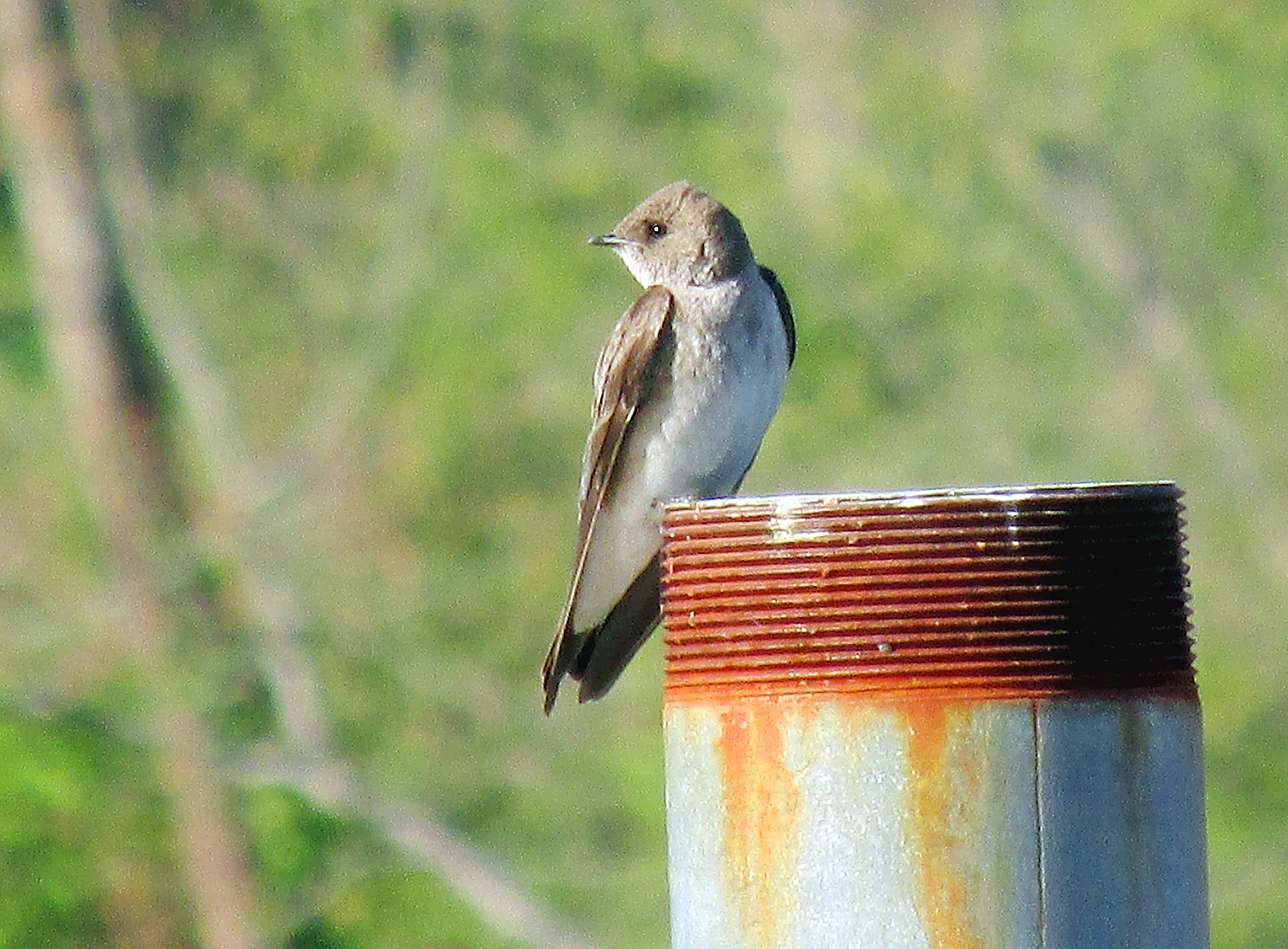
Photo by Bryan Stevens • A Northern rough-winged swallow perches on a rusty pole.

Northern rough-winged swallows are opportunists when it comes to nesting. According to a profile written by Mark Johns with North Carolina Wesleyan College, this small swallow nests near rocky gorges, shale banks, stony road cuts, railroad embankments, gravel pits, eroded margins of streams and other exposed banks of clay, sand or gravel. They will also nest in old kingfisher burrows, protruding drainpipes, crevices in brick or stone structures such as dams, bridges or tunnels, gutters and culverts. Their nests are often built near open water.

The Northern rough-winged swallow ranks as one of the species with the longest common names in North America. It’s name consists of 26 letters and a hyphen, which ranks it one letter below both the Northern beardless-tyrannulet and a recently-created species — the saltmarsh sharp-tailed sparrow — which each have 27 letters and a hyphen. Formerly known as sharp-tailed sparrow, the species was renamed with “salt marsh” added to distinguish it from a relative, Nelson’s sparrow.

Purple martins, which rank as the largest member of the swallow family in North America, are famous for nesting in large colonies. Nesting facilities range from groupings of natural or artificial gourds fashioned into a nesting chamber, as well as large, multi-level condominium dwellings tailored for the specific needs of this communal bird. A colony can consist of several dozen to several hundred pairs of these birds. Only the adult male purple martin shows the iridescent, dark blue-purple plumage that provides the species with its name.

The tree swallow is my favorite, probably because a pair of these birds has nested in my yard for many years. Unlike other swallows, these cavity-nesting birds will readily accept nesting boxes. They compete with Eastern bluebirds for boxes, but the two species usually can work out a truce and settle down to nest in close proximity to each other. The iridescent blue-green male tree swallow, complete with white underparts and a forked tail, is a handsome bird and a welcome addition to the bird population in any yard or garden. Tree swallows enjoy water, so a nearby pond or creek is a boon for attracting these birds.

While only a few swallows range into the United States and Canada, a total of 83 species of swallows can be found worldwide. Some of the common names for these different swallows (and martins) are quite descriptive. A sampling includes white-eyed river martin, square-tailed saw-wing, white-headed saw-wing, grey-rumped swallow, white-backed swallow, banded martin, violet-green swallow, golden swallow, brown-chested martin, brown-bellied swallow, pale-footed swallow, white-bibbed swallow, pearl-breasted swallow, greater striped swallow, mosque swallow, fairy martin and chestnut-collared swallow.

Enjoy swallows while you can. They depart earlier than most of our other summer nesting birds. Once their young are out of the nest, they are soon forming large flocks in preparation for flying south.

•••

To share a sighting, ask a question or make a comment, email me at ahoodedwarbler@aol.com.


Sales of local calendar fund bird-worthy aims


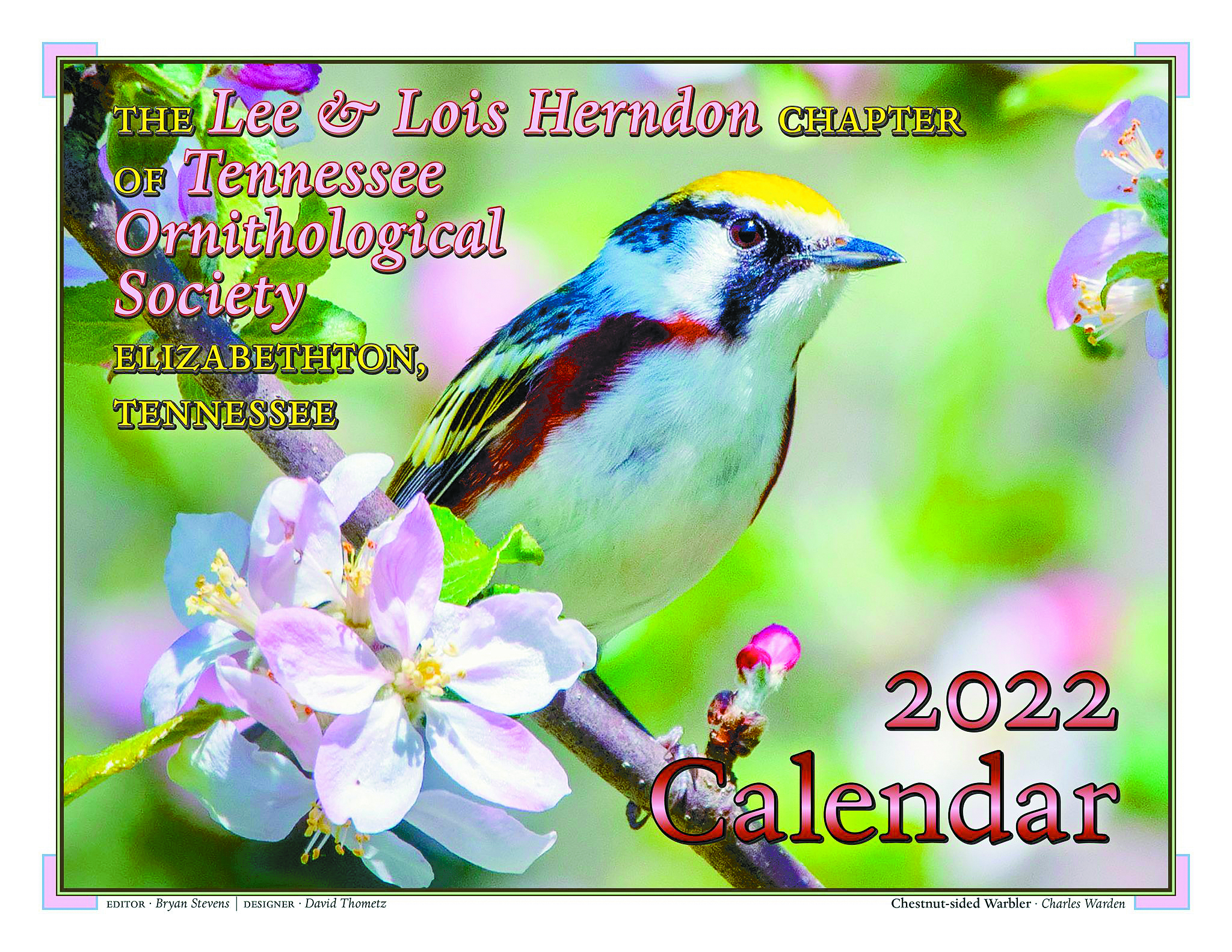
The front cover of the 2022 bird calendar produced by the Elizabethton Bird Club features a photo of a chestnut-sided warbler taken by club member Charles Warden. The calendar is available for purchase for $15, plus $2 for shipping and handling. They make great Christmas gifts for nature and bird enthusiasts. For more information, email ahoodedwarbler@aol.com. 

If you didn’t find all you needed on Black Friday for those on your shopping list, here’s a suggestion. The Lee and Lois Herndon Chapter of Tennessee Ornithological Society, also known as the Elizabethton Bird Club, has produced its annual calendar featuring bird photographs by its members and friends of the organization.

These calendars make wonderful Christmas gifts and stocking stuffers. This year’s front cover features a gorgeous photo of a chestnut-sided warbler taken by club member Charles Warden. This is Warden’s first year contributing photographs to the club’s yearly calendar project. More of his photos are on display through the calendar. He is a resident of Johnson City.

“I took the photo on the Spring Bird Count with Fred Alsop and Judi Sawyer on May 1 of this year at Hampton Creek Cove,” Warden said.

He said that the bird was among the blooms of what he thinks was an apple tree.

“We heard the warbler and chased it down,” he said. “It came out in the open and posed nicely for pictures.”

He has been interested in photography since he took a beginning photography class at East Tennessee State University on a lark in 1977.

“I am lucky enough to be making a living as a photographer for ETSU marketing.”

Bird photography is certainly a challenge, he said, and requires much patience, decent equipment and a lot of luck.

“It’s been a learning curve for sure, and it’s still a tough call when to take the binoculars down and put the camera up as it’s so mesmerizing to watch the birds,” Warden said.

The chestnut-sided warbler is a summer resident in the region and can be found at middle and higher elevations on many of the area’s mountains, including Unaka and Roan. Unlike many warblers, both males and females are brightly colored, with the female being slightly less so. Males during the summer nesting season show a yellow crown, black mask, white cheeks, throat and breast and the namesake chestnut flanking on his sides.

He’s also a cheery and persistent singer when he arrives on his nesting territory. His song is usually transcribed as “Pleased, pleased, pleased to meetcha!” For birders, it’s like a welcoming reintroduction each spring when this particular song is heard from the branches of trees in local woodlands.

For the singing male, there’s a more personal reason for singing his song. The “pleased, pleased, pleased to meetcha” refrain is a way of attracting the attention of potential mates. Males sing an entirely different song once settled into nesting activities with a mate. The song used to attract mates is more heavily accented, according to the website, All About Birds. Some males sing only unaccented songs and thus have a lower success rate at attracting mates.

Chestnut-sided warblers are classified by scientists as birds that favor successional habitats for nesting purposes. These sorts of habitats are usually disturbed by human activities such as logging. However, disturbed habitats can be created by natural occurrences, including fires, flooding and storm damage. During the winter months, this warbler withdraws into Central America with many individuals finding suitable habitat on shade-coffee plantations.

Female chestnut-sided warblers will weave a nest of bark, grass and other components all bound together with gathered spider silk. She will lay three to five eggs. These warblers make the most of the summer season, often nesting a second time after raising their first brood.

Chestnut-sided warblers feed largely on insects, but the birds also incorporate seeds and fruits into their diet. Young are fed by both parents on a diet of small insects, spiders and caterpillars. The chestnut-sided warbler’s scientific name, Setophaga pensylvanica, roughly translates as “eater of moths from Pennsylvania,” which is a nod to the bird’s insect-rich diet.

Other warblers that can be found in the mountains of Northeast Tennessee — and in the pages of the calendar — include black-throated blue warbler, golden-winged warbler, worm-eating warbler, hooded warbler, prairie warbler and common yellowthroat.

Like most small songbirds, the New World warblers, to which the chestnut-sided warbler belongs, don’t have long lifespans. A few individuals, however, defy the odds. According to the website, All About Birds, the longest-lived chestnut-sided warbler documented by scientists was a nearly seven-year-old bird banded in Rhode Island in 1980. The bird had been banded in the same state six years and 11 months earlier in 1973.

Of course, with the exception of the yellow-rumped warbler, most of the warblers don’t spend the winter months in the region. With one of these calendars, however, you can enjoy beautiful photos of some of our most lovely warblers while awaiting their return this spring in mid-April and early May.

The inside pages of the professionally-produced calendar feature dozens more full-color photographs and an informative and educational grid. These calendars sell for $15 plus $2 for shipping. All sales help the club fund birding programs, public park feeders, conservation efforts and other activities in upper Northeast Tennessee.

For more information on how to obtain a calendar, email me at ahoodedwarbler@aol.com.


Annual fall bird count tallies 129 species for Northeast Tennessee

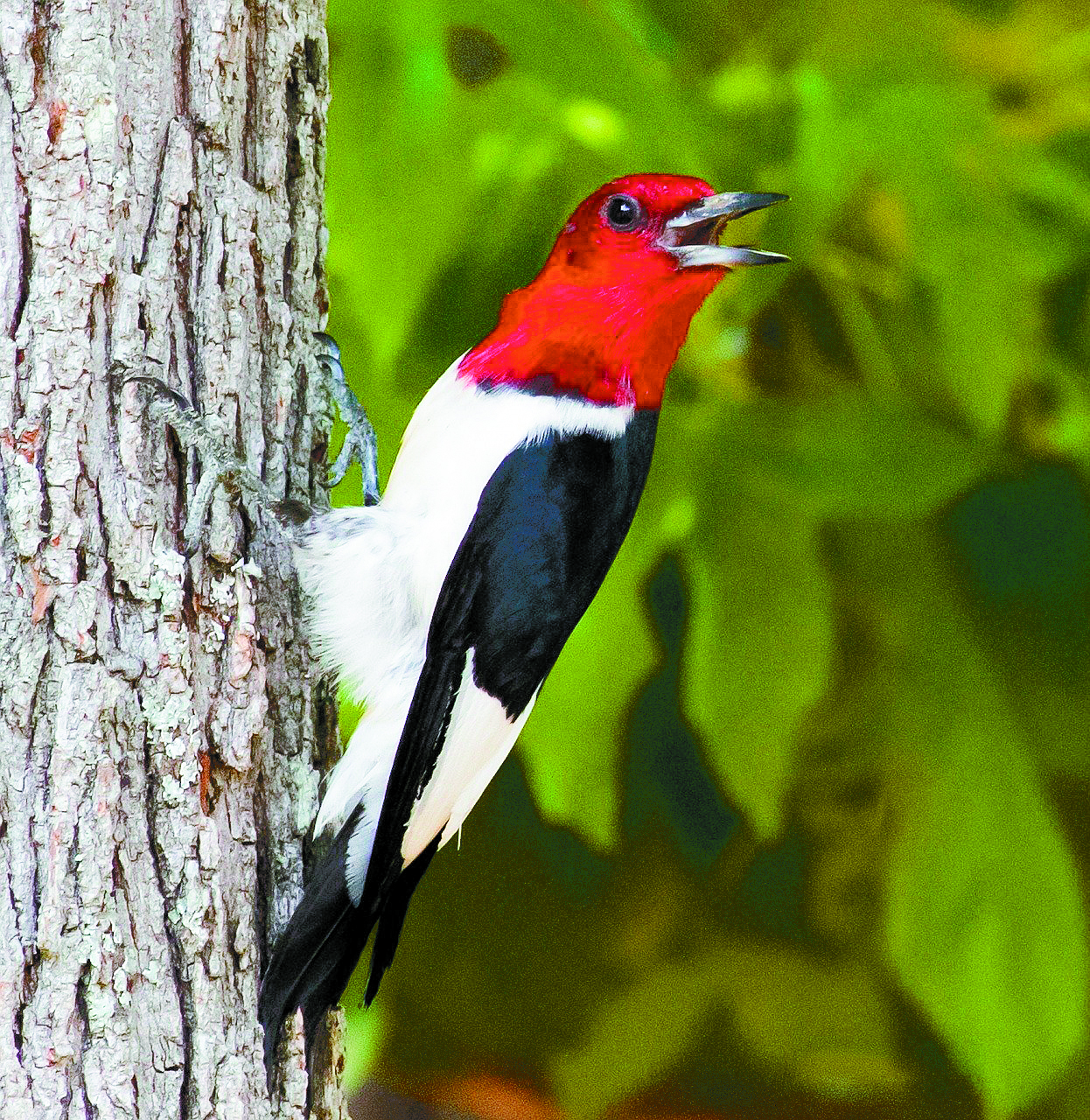
Photo from Pixabay • A red-headed woodpecker clings to the trunk of a tree. During the recent Fall Bird Count for Northeast Tennessee, all the region’s seven woodpecker species were tallied. The medium-sized red-headed woodpecker is found only in isolated locations in the region. They prefer more open country than most of their kin. Habitat containing dead or dying trees is vital if these woodpeckers are to thrive.

I wrote last week about my participation in the recent 52nd annual Fall Bird Count conducted by the Elizabethton Bird Club.

This week I want to dive into the results of what turned out to be a great count. The five-county tally of the birds in Northeast Tennessee was held on Saturday, Sept. 25, with 34 observers in 14 parties, plus two feeder watchers. Participants covered Carter County, as well as parts of adjacent Johnson, Sullivan, Unicoi and Washington counties.

This year’s count tallied 129 species, which is slightly above the recent 30 year average of 125 species. The all-time high was reached in 1993 when 137 species were tallied.

Participants for this year’s count included Fred Alsop, Jerry Bevins, Rob Biller, Debi Campbell, J.G. Campbell, Ron Carrico, Catherine Cummins, Dianne Draper, Cindy Ehrhardt, Harry Lee Farthing, Dave Gardner, Tammy Griffey, Don Holt, Connie Irick, David Irick, David Kirschke, Rick Knight, Roy Knispel, Richard Lewis, Dianne Lynne, Vern Maddux, Joe McGuiness, Tom McNeil, Eric Middlemas, Susan Peters, Brookie Potter, Jean Potter, Pete Range, Judith Reid, Judi Sawyer, Chris Soto, Bryan Stevens, Peggy Stevens, Kim Stroud, Charles Warden and Rex Whitfield.

The four most commonly observed species, in descending order, included European starling, 838; Canada goose, 744; American crow, 502; and blue jay, 437. No surprises there.

Somewhat surprising was the total of 222 brown-headed cowbirds. Other abundant birds that numbered more than 200 individuals included mourning dove (316), rock pigeon (285), chimney swift (227), Eastern bluebird (208), American robin (222), cedar waxwing (230) and American goldfinch (216).

A total of 24 species of warblers was found, including 172 individual Tennessee warblers. These greenish-yellow warblers can be quite abundant as they pass through the region each autumn.

Some families of birds, such as falcons and woodpeckers, were well represented on this count with all the expected species being found by count participants.

Five Empidonax species, often referred to as “empids” by birders were found during the count but do not contribute to the total. These small flycatchers are nearly identical in appearance and silent during the fall. Faced with an inability to positive identify them, birders simply noted that they were seen.

The list follows:

Canada goose, 744; wood duck, 42; mallard, 182; blue-winged teal, 4; Northern shoveler, 2; and common merganser, 4.

Wild turkey, 18; pied-billed grebe, 3; double-crested cormorant, 43; great blue heron, 39; great egret, 4; green heron, 1; black vulture, 61; and turkey vulture, 183.

Osprey, 7; bald eagle, 9; sharp-shinned hawk, 3; Cooper’s hawk, 8; red-shouldered hawk, 6; broad-winged hawk, 11; and red-tailed hawk, 25.

American coot, 1; killdeer, 45; spotted sandpiper, 2; rock pigeon, 285; Eurasian collared-dove, 22; mourning dove,  316; and yellow-billed cuckoo, 2.

Eastern screech-owl, 11; great horned owl  7; barred owl, 3; American kestrel, 28; merlin, 8; and peregrine falcon, 3.

Common nighthawk, 3; chimney swift, 227; ruby-throated hummingbird, 23; and belted kingfisher, 32.

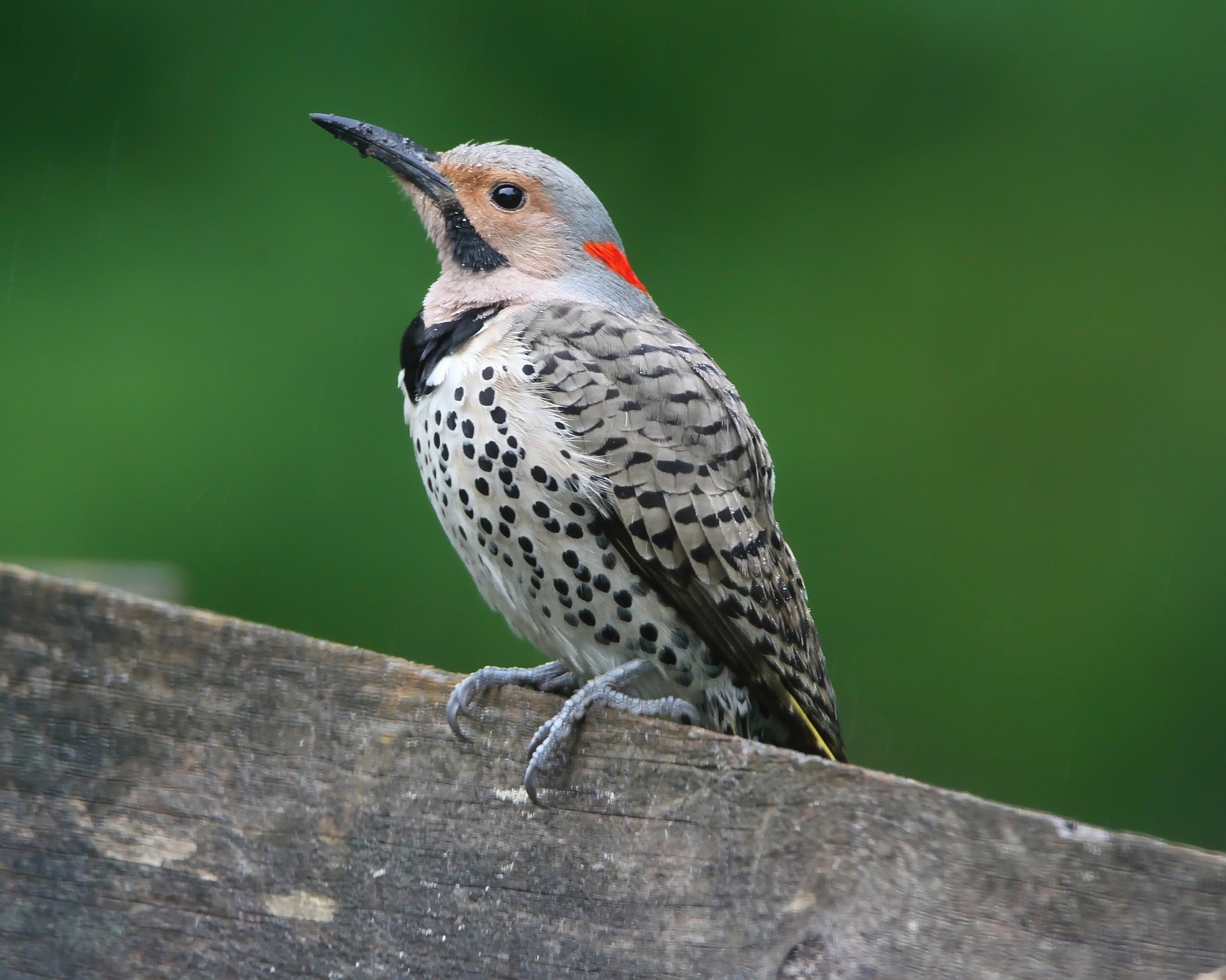
Red-headed woodpecker, 2; red-bellied woodpecker, 83; yellow-bellied sapsucker, 1; downy woodpecker, 51; hairy woodpecker, 11; Northern flicker, 54; and pileated woodpecker, 39.

Eastern wood-pewee, 31; Acadian flycatcher, 1; Eastern phoebe, 92; Eastern kingbird, 1; and loggerhead shrike, 1.

White-eyed vireo, 7; yellow-throated vireo, 5; blue-headed vireo, 21; Philadelphia vireo, 1; and red-eyed vireo, 6.

Blue jay, 437; American crow, 502; fish crow, 3; common raven, 13; tree swallow, 160; barn swallow, 29; and cliff swallow, 1.

Carolina chickadee, 145; tufted titmouse, 109; red-breasted nuthatch, 9; white-breasted nuthatch, 52; brown-headed nuthatch, 3; and brown creeper, 1.

House wren, 8; winter wren, 4; Carolina wren, 179; blue-gray gnatcatcher, 6; golden-crowned kinglet, 5; ruby-crowned kinglet, 9.

Eastern bluebird, 208; veery, 2; gray-cheeked thrush, 2; Swainson’s thrush, 46; wood thrush, 19; American robin, 222; gray catbird, 34; brown thrasher, 14; Northern mockingbird, 80; European starling, 838; and cedar waxwing, 230.

Ovenbird, 2; worm-eating warbler, 4; Northern waterthrush, 1; black-and-white warbler, 3; prothonotary warbler, 1; Tennessee warbler, 172; Nashville warbler, 3; common yellowthroat, 19; hooded warbler, 4; American redstart,  29; Cape May warbler,  40; Northern parula, 5; magnolia warbler, 24; bay-breasted warbler, 76; Blackburnian warbler, 9; chestnut-sided warbler,  9; black-throated blue warbler,  10; palm warbler,  171; pine warbler, 30; yellow-rumped warbler, 2; yellow-throated warbler, 5; prairie warbler  1; black-throated green warbler, 11; and Wilson’s warbler,  1.

Eastern towhee, 71; chipping sparrow, 76; field sparrow, 14; Savannah sparrow, 1; song sparrow, 131; and dark-eyed junco, 45.

Summer tanager, 1; scarlet tanager, 36; Northern cardinal, 160; rose-breasted grosbeak, 89; Blue Grosbeak,  2; and indigo bunting, 13.

Red-winged blackbird  61; Eastern meadowlark, 6; common grackle,  66; and brown-headed cowbird, 222.

House finch, 100; red crossbill, 2; American goldfinch, 216; and house sparrow, 114.

Many of the species observed on this county will be taking a temporary leave of Northeast Tennessee until next spring. Tanagers, warblers, vireos and other birds will seek out locations farther south to spend the winter months.

They’ll be back, though, and just in time for the 2022 Spring Bird Count. To make a comment, ask a question or share an observation, send an email to ahoodedwarbler@aol.com.

Two warblers have names connected with the Volunteer State

Photo by GeorgeB2/Pixabay.com • The Nashville warbler is an attractive bird with more color than the Tennessee warbler.

Tennessee once represented the western frontier for many people in the United States, so the state acted as a beacon for naturalists wanting to make new discoveries. Some of those early naturalists, men such as Alexander Wilson, spent a lot of time in the Volunteer State.

Two of Wilson’s ornithological “discoveries” in Tennessee involved two species of warblers that were  given names to honor the state and its capital after the birds were first observed in Tennessee and near Nashville.

Those birds were both members of one of my absolute favorite bird families — the warblers. It’s necessary to differentiate the New World wood-warblers from a grouping of birds in Europe, Asia and Australia that are also called warblers.

What is a warbler? The Wikipedia entry for these birds describes the New World warblers or wood-warblers as a group of small, often colorful, passerine birds that make up the family Parulidae and are restricted to the New World. They are not closely related to Old World warblers or Australian warblers.

That’s an adequate description, from a scientific standpoint. But warblers are magic. To do them justice, I’m compelled to wax a little more eloquent. They are a combination of color, movement and energy wrapped in a tiny bundle of feathers. Warblers are constantly on the go, hardly ever staying still for long.

The frenetic lifestyle of warblers challenges new birders. These birds don’t often stop and pose long enough for someone to get binoculars focused on them. One doesn’t exactly watch warblers. Following a warbler through tangled vines or the leafy tree canopy isn’t watching so much as anticipating. One gets a “feel” for where the warbler will appear next while tracking them through binoculars. By getting familiar with the way these avian sprites behave is the best way to learn how to observe these birds.

It’s not for nothing that some birders suffer from a malady, particular during the migration seasons, called “warbler neck.” The direct cause is the strain on the neck and back from always looking upward toward the treetops where many warblers like to stay.

Some, but not all, warblers are suffused with bright colors: yellows, oranges, blacks, blues and whites. A few — ovenbird, worm-eating warbler, Northern waterthrush — are various shades of brown. Some of my favorite warblers are the hooded warbler, Blackburnian warbler and black-throated blue warbler.

Then we have the warblers I mentioned earlier, which were discovered in the Volunteer State and to this day bear names honoring the state and its capital city. These two birds are the Tennessee warbler and the Nashville warbler.

Photo by Paul Spark/Adobe Stock • The Tennessee warbler, while named for the Volunteer State, spends very little time within Tennessee. These warblers migrate through the region each spring and fall but nest much farther north in the boreal forests.

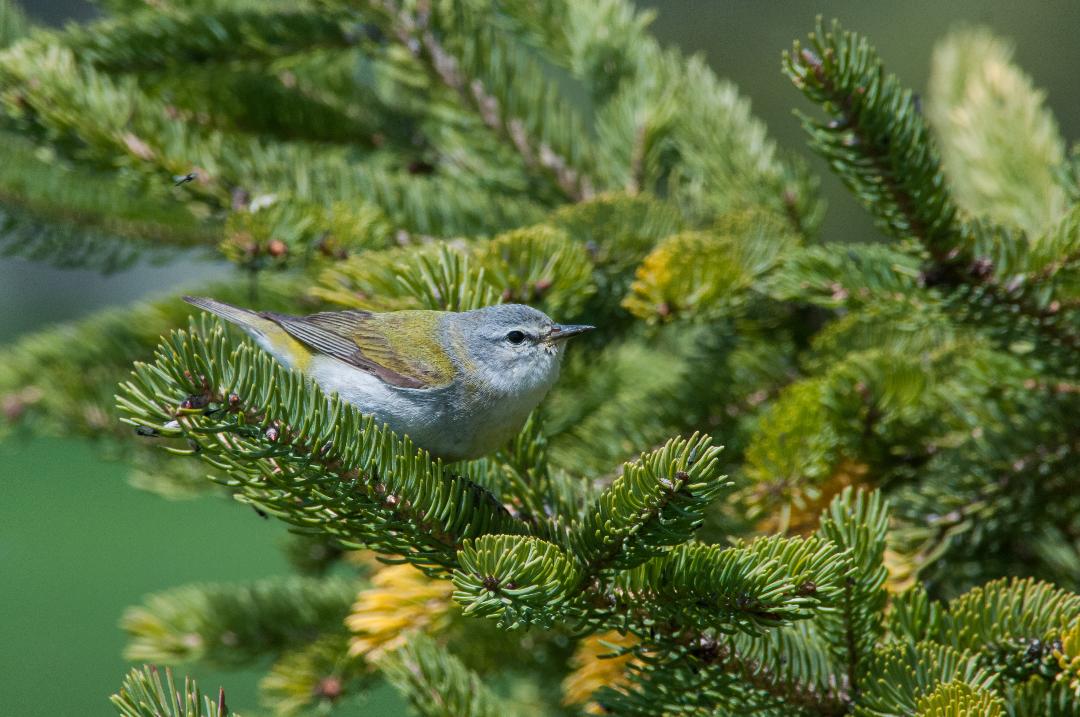
The appearance of the Tennessee warbler varies greatly depending on the season. In autumn, most Tennessee warblers are greenish-yellow birds with whitish-gray underparts. Sometimes that green color ranges into vivid chartreuse territory.

In the spring, the basic green and white pattern remains evident, but both males and females sport a gray head and a black line that runs through the eye and along the side of the bird’s face. The plumage — at least in illustrations and photographs — is shown as more crisp and distinct with spring birds.

The pioneering American ornithologist Alexander Wilson gave the Tennessee warbler its name, which, unfortunately, is not an accurate moniker. Don’t blame Wilson too harshly for the mistake. Even after he “discovered” the first Tennessee warblers back in 1811, it would be almost another century before scientists finally located the bird’s nesting grounds in Canada in 1901. The remote and inaccessible nature of the the region helped prolong this mystery about the Tennessee warbler’s life cycle.

Wilson was an interesting figure in the natural history of the United States. Born in Paisley, Scotland, in 1766. As a young man, he learned the trade of weaving. At the same time, he became interested in poetry and claimed inspiration in particular from the Scottish poet Robert Burns.

In 1794, after not succeeding at poetry or weaving, he departed Scotland for a new life in the United States of America. He settled with a nephew in Pennsylvania, but he found opportunities limited for poet-weavers.

To make a living, he took up teaching. He met the famous naturalist William Bartram, who encouraged Wilson’s interest in ornithology and painting. These two passions took off for Wilson.

He made his life’s work the undertaking of publishing the nine-volume “American Ornithology” that featured his own illustrations of American birds. The work featured 268 species with 26 of them having never previously been described for science.

His fame as an ornithologist grew, and several species of birds were named in his honor, including the Wilson’s storm-petrel, Wilson’s plover, Wilson’s phalarope, Wilson’s snipe and Wilson’s warbler. Wilson’s work probably inspired John James Audubon’s own more extensive and famous collection depicting the birds of North America.

Every autumn I see some of the birds Wilson documented and painted as they stage their fall migration through the Volunteer State to reach destinations farther south.

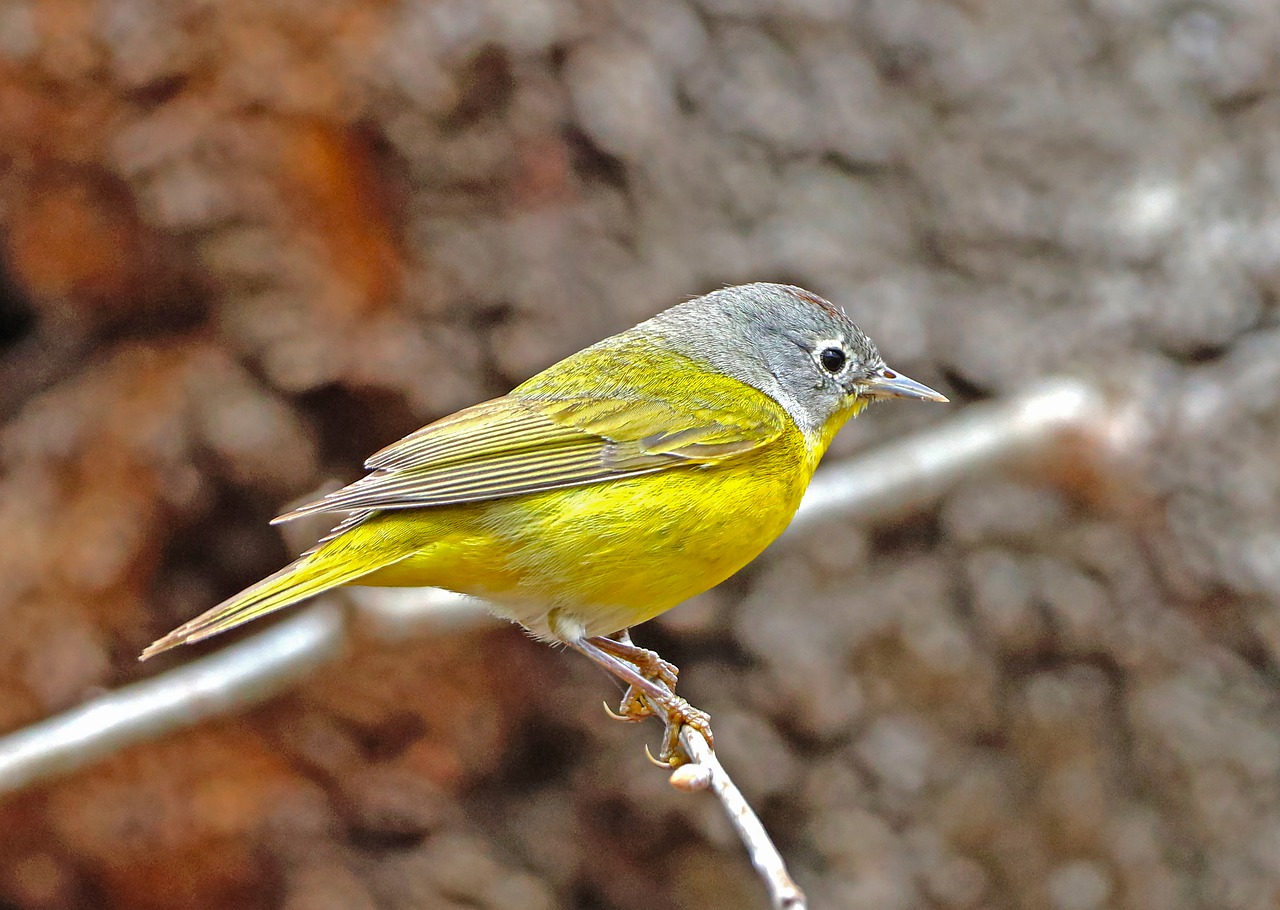
Our capital city of Nashville also provides a common name to one of the warbler clan. The Nashville warbler is a small bird with a rounded head and short tail. The plumage of this warbler consists of yellow below and olive above. The birds have a white eye-ring that stands out against a gray head. The Nashville warbler also has a thin chestnut-brown crown patch, but a really exceptional look is required to see this feature. Most guides don’t mention that the Nashville warbler has a white patch of feathers surrounding the area where its legs join the body. This section of white is completely surrounded by yellow feathers. This is a helpful feature to know when trying to distinguish this warbler from some similar species.

Once again, Wilson bestowed a rather inaccurate name on this species, as the bird in question is only a visitor to Nashville and the surrounding territories during a limited window of time each year. The same is true of the Tennessee warbler. At best, these birds can only be found in the Volunteer State in April and May and again in September and October. Otherwise, Tennesseans would have to travel a good distance to see these birds at other times of the year.

Fortunately, these birds come to us. I’ve already seen the first Tennessee warblers for fall migration, but I’ve not been lucky enough this fall to get binoculars on a Nashville warbler — yet! There’s still time. Migration continues, so get outdoors and see what you can find.

••••

To share an observation, make a comment or ask a question, email me at ahoodedwarbler@aol.com.

Common nighthawks share autumn skies with many other migrants

Autumn’s a chance for me to indulge my passion for warblers, with a few dozen species of these songbirds passing through the region in the span of a few weeks. I always try to keep in mind, however, that the warblers are not the only migrating birds winging through the region.

The Elizabethton Bird Club had planned a “nighthawks and hot dogs” party at the home of Larry McDaniel near Jonesborough, but that event had to be cancelled because of the recent surge in COVID-19 cases in the region.

My silver lining was that I saw a large flock of common nighthawks at my home on Aug. 29. It was an evening of birding dominated by insect-eaters and fruit-eaters.

Cedar waxwings and one American robin perched in the wild cherry trees and plucked ripening fruit from the branches.

Swooping overhead a handful of Chimney Swifts and about 30 Common Nighthawks (the first I have seen this fall) collected insects just over the treetops. Flycatching from a dead blue spruce was an Eastern Wood-Pewee, another fall first.

Other birds included a pair of Northern cardinals feeding three young, an Eastern towhee and one hooded warbler. At one point an irritable ruby-throated hummingbird chased the pewee round and round the trunk of the dead spruce. They almost looked like they were characters in a zany cartoon.

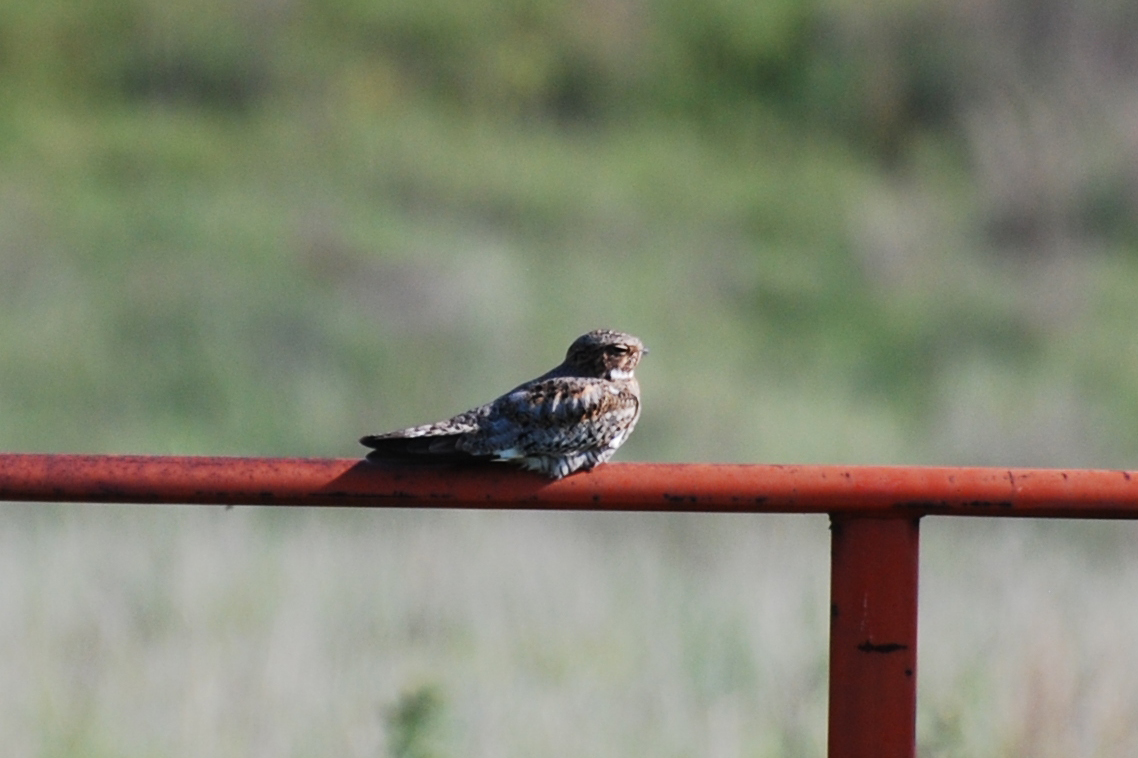
Photo by Jean Potter • A common nighthawk rests on a metal railing.

Like such birds as warblers, vireos, thrushes, tanagers, flycatchers and hummingbirds, the common nighthawk is a neotropical migrant. In addition, this nighthawk has one of the longest migration routes of any North American bird. Twice a year, these birds migrate for distances ranging from 1,600 to 4,200 miles. Nighthawks that spend the spring and summer in Canada travel to southern South America for the winter months.

With September advancing on the calendar, I have been keeping an eye on the treetops for passing warblers, vireos and tanagers, but I also remember to direct my gaze to the skies. Forgetting to look skyward could result in missing the passage of such varied migrants as chimney swifts, broad-winged hawks and common nighthawks.

So, what is a common nighthawk? First, this bird, despite what is implied by its name, is not a hawk. It’s also not strictly nocturnal. Particularly in the fall, nighthawks are active during daylight hours when engaged in catching winged insects. Outside of fall migration, these birds can often be observed over large parking lots or well-lit streets, snatching up insects swarming around the light poles.

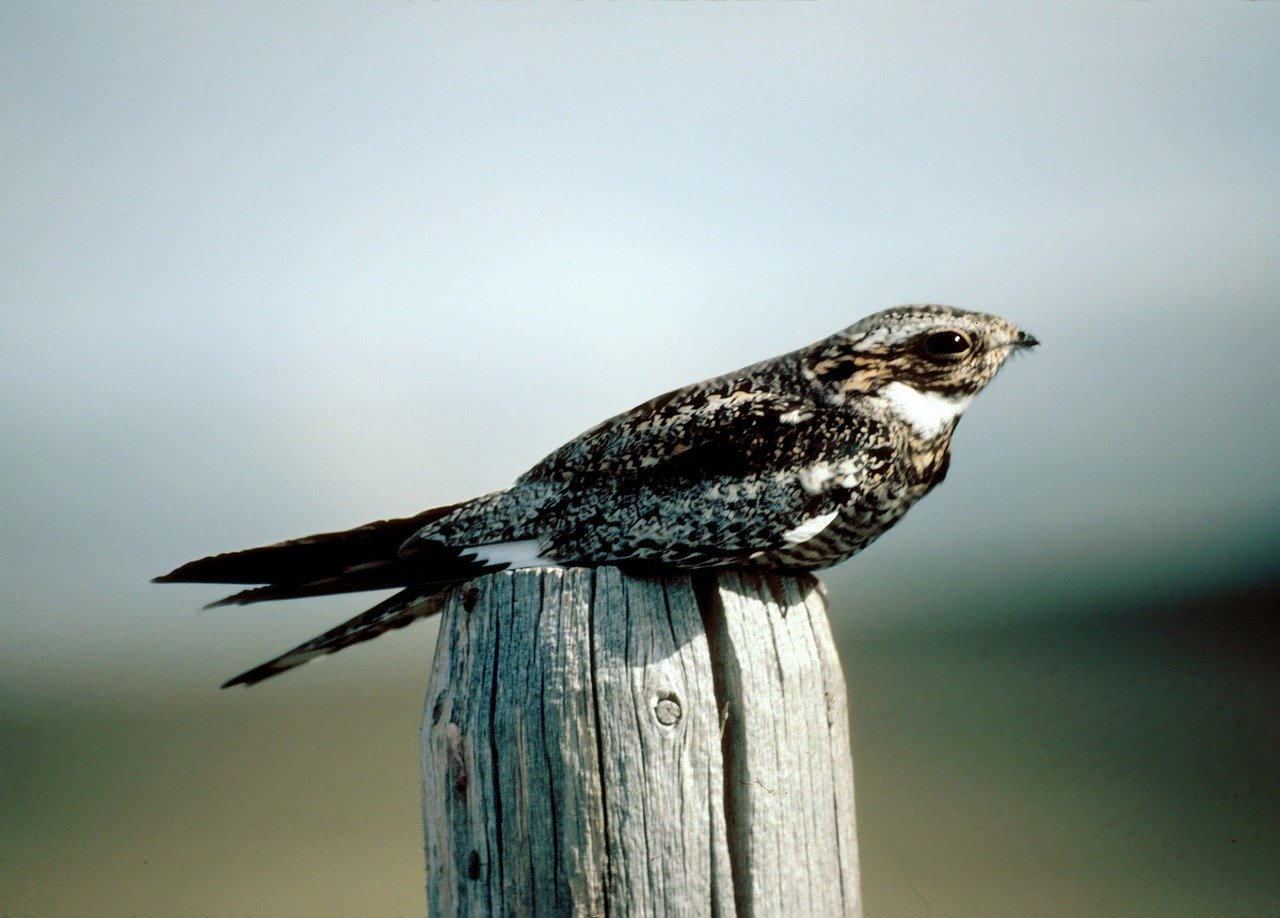
Photo by Skeeze/Pixabay • A common nighthawk adopts an elongated pose atop a fencepost.

The common nighthawk is one of three members of the nightjar family found in the region during the summer months. The other two nightjars are the whip-poor-will and chuck-will’s-widow, birds that produce their namesake vocalizations in the nocturnal hours. Both of these species migrate, but they don’t take the dramatic approach employed by nighthawks. Each fall, common nighthawks form large flocks, ranging in size from dozens to hundreds or even thousands of individuals, as they migrate south for the winter.

Unlike whips and chucks, the common nighthawk isn’t active only after dark, which makes it much easier to observe these birds. They look somewhat like swifts and swallows but are much larger. They are brownish-gray birds with pointed wings and forked tails. They are easily identified by distinctive white patches on the underside of their wings.

A perplexing nickname for the common nighthawk is “bull-bat.” This merger of the words “bull” and “bat” makes sense when you explore a little deeper. The common nighthawk earned the nickname “bull-bat” because of its perceived “bat-like” flight and a “bull-like” boom produced by its wings as it pulls out of a dive.

The nightjar, or Caprimulgidae, family of birds is also sometimes known as “goatsuckers.” Apparently, in trying to explain the nocturnal tendencies of these birds, the Greeks came up with the imaginative but erroneous idea that birds like nighthawks liked to sneak into barns and have a meal of fresh goat’s milk. In reality, nighthawks feed almost exclusively on insects, including ants, wasps, beetles, caddisflies, moths, mayflies, flies, crickets, grasshoppers, and other insects. They capture much of their insect prey on the wing.

There are almost 80 species of nightjars in the world. Less than 10 occur in North America. Many of the common nighthawk’s relatives have been given descriptive names, such as long-trained nightjar, collared nightjar, spot-tailed nightjar, red-necked nightjar, golden nightjar, fiery-necked nightjar, swamp nightjar, pennant-winged nightjar, lyre-tailed nightjar, little nightjar, sickle-winged nightjar, rufous-bellied nighthawk, short-tailed nighthawk, sand-coloured nighthawk and least nighthawk.

So, keep looking skyward. The next flock of migrating common nighthawks may fly over your home. These flocks are usually on the move in August and throughout September.

I will keep watching the skies. Nighthawks can also appear almost magically, as if out of thin air. First, observers may see one of two birds, then several, followed quickly by dozens or sometimes hundreds as they wheel and cavort in the skies overhead with impressive grace and agility. I’ve seen flocks that would easily number more than 500 birds in locations throughout the region, although flocks often number only a couple of dozen birds.

To share a sighting, ask a question or make a comment, email me at ahoodedwarbler@aol.com.

Photo by Bryan Stevens • Rising clouds provide a backdrop for a flock of migrating nighthawks.

Club holds 51st annual Fall Bird Count

Photo by NatureLady/Pixabay.com • Northern flickers made a strong showing on the 51st consecutive Fall Bird Count. Eighty of these woodpeckers were found by count participants spread across the five-county area of Northeast Tennessee.

The 51st  consecutive Elizabethton Fall Count was held on Saturday, Sept. 26, with 48 observers in 18 parties. The participants were dispersed more than normal due to social distancing protocols. This is the third seasonal count conducted since the start of the Covid 19 pandemic.

The area covered included all of Carter County, as well as parts of the adjacent counties of Johnson, Sullivan, Unicoi and Washington.

A total of 132 species were tallied, which is above the recent 30-year average of 125 species. The all-time high on this count was 137 species set in 1993.

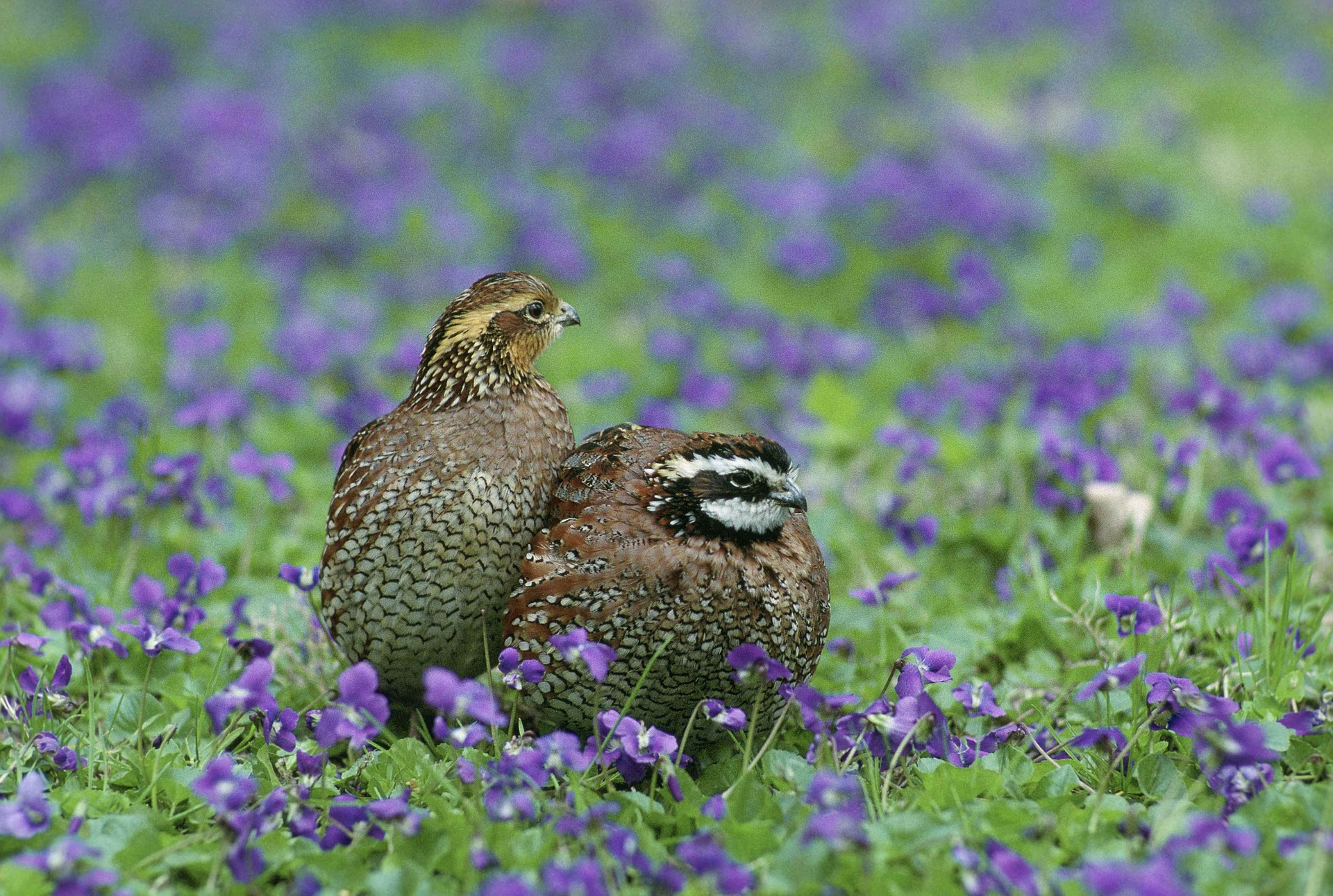
Photo by U.S. FWS   Many birds, such as Northern bobwhites, have seen alarming population crashes in the last half century.

Some interesting finds included a Northern bobwhite covey near the community of Bowmantown in Washington County. Such high numbers of bobwhites have become increasingly rare in recent years.Thirteen unidentified species of Empidonax flycatchers were found, but these birds do not count into the total of species. These small flycatchers are so similar in appearance that their song is usually needed to confirm identification. In fall migration, however, these flycatcher go silent for the most part. A yellow-bellied flycatcher and two least flycatchers were identified.

A total of 23 species of warblers were found, including such interesting finds as golden-winged warbler, blackpoll warbler and Wilson’s warbler.

European starling proved the most abundant bird with 1,757b individuals counted. Other common birds for the count included Canada goose (1,220), Rock Pigeon (629) and Chimney Swift (478).

Photo by Jean Potter • The rock pigeon is one of the most successful members of the bird family Columbidae, which is comprised of some 310 species of doves and pigeons. One of the most famous representatives of the family is the dodo, an extinct relative of such common birds as the mourning dove and rock pigeon.

The participants for the 2020 Fall Bird Count included: Fred Alsop, Rob Armistead, Betty Bailey, Gary Bailey, Jerry Bevins, Rob Biller, Debi Campbell, J.G. Campbell, Ron Carrico, Robin Cooper, Catherine Cummins, Dianne Draper, Glen Eller, Harry Lee Farthing, Bambi Fincher, Dave Gardner, Tammy Griffey, Bill Grigsby, Jean Henson, Neal Henson, Jacki Hinshaw, Don Holt, David Kirschke, Rick Knight, Roy Knispel, Richard Lewis, Dianna Lynne, Vern Maddux, Joe McGuiness, Cathy McNeil, Tom McNeil, Eric Middlemas, Harry Norman, Susan Peters, Brookie Potter, Jean Potter, Sherrie Quillen, Pete Range, Ken Rea, Judith Reid, Judi Sawyer, Chris Soto, Michele Sparks, Bryan Stevens, Kim Stroud, Scott Turner, Charles Warden, Joyce Watson; plus Connie Irick, David Irick, and Peggy Stevens as feeder watchers.

There were no glaring misses, but shorebirds were scarce with not much available habitat this year. Birds that might have been expected for a fall count but were not found included Loggerhead Shrike, Winter Wren, Yellow-rumped Warbler, Savannah Sparrow, Blue Grosbeak and Bobolink.

“All in all, it was a very good count,” said long-time compiler Rick Knight. “Thanks to all who participated.”

The list:

Canada Goose, 1,220; Wood Duck, 71; Mallard, 219; Blue-winged Teal, 27, Northern Bobwhite, 10; Ruffed Grouse, 2; and Wild Turkey, 66.

Common Loon, 1; Pied-billed Grebe, 11; Double-crested Cormorant, 62; Great Blue Heron, 37; Great Egret, 5; Green Heron  4; Black-crowned Night-Heron, 2; and Yellow-crowned Night-Heron, 1.

Black Vulture, 141; Turkey Vulture, 191; Osprey, 14; Northern Harrier, 1; Sharp-shinned Hawk, 3; Cooper’s Hawk, 11; Bald Eagle, 15; Red-shouldered Hawk, 2; Broad-winged Hawk, 4; and Red-tailed Hawk, 14.

Killdeer, 54; Greater Yellowlegs, 1; American Woodcock, 1; Caspian Tern, 3; Rock Pigeon, 629; Eurasian Collared-Dove, 11; and Mourning Dove, 355.

Yellow-billed Cuckoo, 4; Eastern Screech-Owl, 28; Great Horned Owl, 2; Barred Owl, 6; Northern Saw-whet Owl, 1; and Common Nighthawk, 46.

Chimney Swift, 478; Ruby-throated Hummingbird, 34; Belted Kingfisher, 29; Red-headed Woodpecker, 2; Red-bellied Woodpecker, 103; Yellow-bellied Sapsucker,  6; Downy Woodpecker, 82; Hairy Woodpecker, 18; Northern Flicker, 80; and Pileated Woodpecker, 36.

American Kestrel, 17; Merlin, 2; Peregrine Falcon, 1; Eastern Wood-Pewee, 34; Yellow-bellied Flycatcher, 1; Least Flycatcher, 2; Empidonax species, 13; Eastern Phoebe, 124; and Eastern Kingbird, 4.

White-eyed Vireo, 3; Yellow-throated Vireo, 5; Blue-headed Vireo, 16; Warbling Vireo, 1; Philadelphia Vireo, 1; Red-eyed Vireo, 34; Blue Jay, 578; American Crow, 503; Common Raven, 14.

Tree Swallow, 274; Barn Swallow, 15; Carolina Chickadee,  251; Tufted Titmouse, 208; Red-breasted Nuthatch, 18; White-breasted Nuthatch, 80; and Brown Creeper, 1.

House Wren, 10; Carolina Wren, 285; Blue-gray Gnatcatcher, 10; Golden-crowned Kinglet, 7; and Ruby-crowned Kinglet.

Eastern Bluebird, 246; Veery, 3; Gray-cheeked Thrush, 10; Swainson’s Thrush, 193; Hermit Thrush, 1; Wood Thrush, 19; American Robin,  574; Gray Catbird,  85; Brown Thrasher, 27; Northern Mockingbird, 126; European Starling, 1,757; American Pipit, 2; and Cedar Waxwing, 312.

Ovenbird, 2; Northern Waterthrush, 12; Golden-winged warbler, 1; Black-and-white warbler, 2; Tennessee warbler, 52; Common Yellowthroat, 32; Hooded warbler, 9; American Redstart, 90; Cape May Warbler, 32; Northern Parula,12; Magnolia  warbler, 29; Bay-breasted warbler, 45; Blackburnian Warbler,16; Chestnut-sided warbler, 15; Blackpoll warbler, 3; Black-throated Blue  Warbler, 4; Palm warbler,  65; Pine warbler, 16; Yellow-throated warbler, 7; Prairie warbler, 2; Black-throated Green warbler, 18; Canada warbler,  2; and Wilson’s warbler,  2.

Eastern Towhee, 80; Chipping Sparrow,  41; Field Sparrow, 26; Song Sparrow, 116; Swamp Sparrow, 1; and Dark-eyed Junco, 26.

Summer Tanager,  3; Scarlet Tanager. 40; Northern Cardinal, 251; Rose-breasted Grosbeak, 119; and Indigo Bunting, 37.

Red-winged Blackbird, 209; Eastern Meadowlark,  17; Common Grackle,  54; Brown-headed Cowbird,  8; House Finch, 76; Pine Siskin, 4; American Goldfinch, 303; and House Sparrow, 18.