Category Archives: Ruby-throated Hummingbird

Readers share arrival stories about spring’s hummingbirds

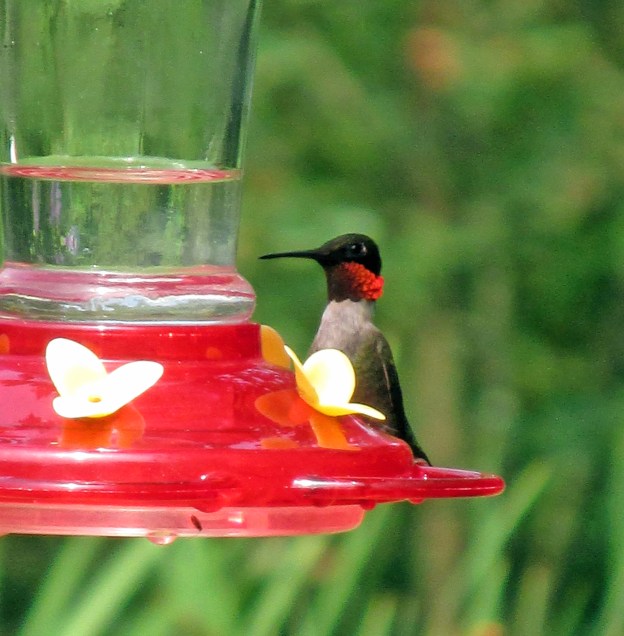
Ruby-throated hummingbirds have returned. The annual first sighting of a hummingbird is one of my most cherished spring moments. Invariably, the first hummingbird to show up in my yard is a male with the gorget — or throat patch — of red, iridescent feathers that gives his species its common name.

4934219635_1db9c900c4_o

Photo by Bryan Stevens • Ruby-throated Hummingbirds swarm to a feeder filled with a sugar water mixture.

As I indicated in a recent column, the ruby-throated hummingbird is one of more than 300 species of hummingbirds. All hummingbirds are found in the New World and are absent from the Old World. Male ruby-throated hummingbirds launch their spring migration about 10 days prior to female hummingbirds.

Based on the number of people who shared hummingbird sightings with me, these tiny birds have a lot of big fans. If you would like to host your own hummingbirds, here are some crucial tips.

• Make your yard a zone that’s free of insecticides and pesticides. Residues of these chemicals can remain on blossoms, which then run the risk of sickening a hummingbird. In addition, hummingbirds subsist on more than nectar. They consume many tiny insects and spiders. Eating bugs that have been contaminated with dangerous chemicals can also sicken or kill hummingbirds.

• Provide shrubs and trees to your landscape to make your yard more inviting. Hummingbirds claim favorite posts and perches, where they will rest when they are not visiting our gardens or feeders. Shrubs and trees can also provide locations for concealing nests built by female hummingbirds.

• Cultivate plants that offer nectar-producing blooms. While hummingbirds are known to favor the color red, these nectar-sipping birds will also visit blooms of other colors. Some favorite spring blooms include the flowers of red buckeye, wild columbine, crossvine and native varieties of azaleas. As spring advances into summer, the diversity of flowers available to lure hummingbirds into your garden will increase dramatically.

Ruby-throated

Photo by Bill Buchanan/U.S. Fish & Wildlife Service • Hummingbirds visit flowers for nectar, so be sure your garden offers a variety of blooms.


Thursday, April 6

Eddie and Delores Phipps of Bluff City, Tennessee, reported seeing their first hummingbird.

“We were excited to see our first hummingbird at the feeder on the morning of April 6,” the couple wrote in an email.  “It was the earliest we have ever seen one. He has been back every day since!”

Eddie and Delores provided me with the report of the earliest arriving hummingbird. Soon after the couple reported their hummingbird, I began to receive more sightings from throughout northeast Tennessee and southwest Virginia.

Sunday, April 9

Monica Black, a resident of Unicoi, Tennessee, saw her first hummingbird of the season about 5 p.m.

“Near the chairs in the back garden there is a spillway created from the koi pond down to the frog pond,” Monica said in the email she sent me. “The hummers like to drink and bathe in it.”

The visiting hummingbird also treated her to a viewing of the first bathing hummingbird of the season.

“The male is the only hummer spotted so far,” she added.

•••••

Facebook friend Phyllis Moore informed me that her friend, Janie Compton, saw her first hummingbird at 6:34 p.m. on Sunday, April 9, in Chesterfield, Virginia.

•••••

Nata Jackson, a resident of Greene County, Tennessee, shared details about her first sighting of spring. In her email, she said she had just put up her feeder when the bird arrived.

IMG_2786

Photo by Bryan Stevens • Only the male Ruby-throated Hummingbird has the brilliant red throat patch, or gorget, that gives the species its common name.

Tuesday, April 11

Nancy and Walt Vernon, of Bristol, Tennessee, emailed details of their first sighting. “We saw it about 12:30 while having lunch,” Nancy wrote in her email. “We have three feeders which we keep filled all summer.”

•••••

Jeanie Campbell, who lives on Mendota Road in Abingdon, Virginia, also sent me an email. Her first spring hummer — a tiny female — wasn’t very active at first. “Then she began drinking away,” Jeanie wrote.

A few days later on April 15, a male — or “Mr. Red Throat” as Jeanie described him — appeared. “He buzzed around all day,” she said.

•••••

Glen Eller, a fellow member of the Lee and Lois Herndon Chapter of Tennessee Ornithological Society, posted on Bristol-Birds — a mailing list archive for area bird sightings — that his daughter, Lia, saw her first hummingbird at 6:55 a.m. Glen’s daughter lives in Fall Branch, Tennessee.

“It’s seemingly a little bit late in this warm spring,” Glen wrote in his post.

Wednesday, April 12

Philip Laws saw his first hummingbird of spring at 4:15 p.m. in the Limestone Cove community in Unicoi County. In his Facebook post to my page, Philip said the arrival served as a reminder that he had meant to put his feeders out a few days earlier, but had failed to do so. He quickly got out feeders to welcome the birds.

•••••

Amy Wallin Tipton, in Erwin, posted on her Facebook page about the return of her hummingbirds.

•••••

Kristy Dunn, who lives in Johnson City, sent me an email to share her first hummingbird sighting of spring.

•••••

Bill and Judith Beckman sent me an email to report their first hummingbird of the season. The hummer arrived around 4 p.m. at their home on Spivey Mountain in Unicoi County.

••••••

Preston Bowers emailed to let me know he saw his first hummingbird at about 5:30 p.m.

“I have lived in Blountville since 1970,” he wrote. “Oddly enough, I never noticed hummingbirds on this property until about three years ago.”

A creek in front of his house has an abundance of jewelweed, which the ruby-throat seems to like quite well.

“So I installed a hummingbird feeder at the corner of my porch where I sit in the porch swing and play ukulele,” he added. “What a joy to watch these amazing birds as they fly by at lightning speeds or hover ever so gracefully.” Preston noted that some of their antics seem like an aerial battle. “I hear sounds that are so similar to the sound of a World War II fighter plane in tactical operations,” he wrote.

Rubythroat

Photo by Bryan Stevens • A male Ruby-throated Hummingbird perches on the tip of a garden post.

•••••

Sandra Loving sent an email notifying me that she got her first sighting of a spring hummer at her feeders at her home on South Holston Lake at 7:50 p.m.

•••••

Sharon Foster, who lives on Friendship Drive at South Holston Lake, emailed me about the date of her first hummer’s arrival. “We’ve had hummingbirds at our feeders all week,” she added.

Friday, April 14

Lynne Reinhard saw her first hummingbird at 8:15 a.m. near the upper end of South Holston Lake in Bristol. She posted the news of her sighting on my Facebook page.

•••••

Jill Henderson, who lives on Poor Valley Road in Saltville, Virginia, emailed about her first hummer sighting: “Just wanted to let you know that I saw my first hummingbird of the spring season at approximately 9:15 a.m. at my home.”

•••••

Beverly Puerckhauer in the Graystone area of Bristol, Tennessee,

RT-Male-April15

Photo by Bryan Stevens • A Ruby-throated Hummingbird must share a feeder with hungry honeybees.

saw her first hummingbird and shared news of the arrival in a comment on my Facebook page.

Saturday, April 15

Linda Quinn Cauley posted on my Facebook page that she saw her first hummingbird at 9:30 a.m. Linda lives off Sciota Road near Unicoi, Tennessee.

•••••

Karen Fouts, of Marion, Virginia, saw her first hummingbird of spring — a male — and posted a comment on my Facebook page. Karen said she refers to these early arrival hummingbirds as the “advance scouts.”

•••••

Mary Beierle, a resident of the Stoney Creek community in Elizabethton, Tennessee, sent me an email telling me she saw her first hummingbird around 3 p.m. “Only one so far, but we’re excited,” she added.

•••••

Don and Shirley Cook, who reside on the upper end of South Holston Lake in Washington County, Virginia, sent me an email to notify me that they saw their first hummer at 3 p.m.

•••••

Glenna Kiser, who lives near Lebanon, Virginia, informed me in an email of her first hummingbird this spring at 1 p.m.

••••••

Several readers enjoyed their first spring sightings of hummingbirds on Easter Sunday.

Sunday, April 16

Nancy Estes emailed me just after she saw her first hummingbird of the season.

“I didn’t get a close look since I was inside my house, but I am assuming it is a ruby-throated hummingbird,” Nancy wrote. “I live in Bristol’s Middlebrook subdivision.”

•••••

Reva Russell, who lives in the Lynnwood Hills subdivision in Bristol, Virginia, notified me in an email that she saw her first hummingbird of the season at 2 p.m.

•••••

Terry Fletcher, who lives at First Colony Condominiums near the Bristol Country Club, sent an email about the first hummingbird of spring. Terry also photographed the hummingbird through a screen door and shared the photo in an email.

•••••

Debbie Oliver, who resides in Bristol, Tennessee, emailed me about her first sighting.

“It wasn’t a visit from the Easter Bunny but a delightful visit from a ruby-throated hummingbird at our deck feeders around 2:30 in the afternoon,” she wrote in her email.

•••••

Cheryl Jones in Damascus, Virginia, saw her first hummingbird of spring at 5:02 p.m. In her email, she said she was beginning to wonder what was keeping them.

Hummer-Farm

Photo by Bryan Stevens • Ruby-throated Hummingbirds have officially returned to the region as of the first week of April.

•••••

The first hummingbird of spring showed up at at the home of Ken Croghan on Walden Road east of Abingdon, Virginia, while he was sitting on the front deck having dinner. He shared news of the arrival in an email.

•••••

Lynn Heller and her husband were having dinner at their home in Holston Hills in Bristol, Tennessee, when they looked out the window at their hummingbird feeder. “I was telling my husband about your article and that you asked readers to share sightings of their first hummingbird,” she wrote in her email.  “About five minutes later, there he was — a ruby throated hummingbird at 6:31 p.m. on Easter Sunday. What a treat!”

•••••

Donald Elliott Rice of Elizabethton, Tennessee, filled up his feeders on Easter Sunday. “Within a half hour, they showed up,” he posted on Facebook.

•••••

Julie Carter Grason saw her first hummingbird at her home in the Clear Creek community of Bristol, Virginia. She shared the news in a comment on my Facebook page.

•••••

Shirley Jenkins of Bluff City, Tennessee, saw her first ruby-throated hummingbird this spring and shared details in an email. “My family and I were sitting on the back porch about 3:30 when out of nowhere, a ruby red throat came zooming by,” she wrote in her email.

Shirley added that the bird checked out a wind chime hanging on the porch before he went on his way.

“I was thrilled to see it, since I love those adorable little creatures,” she noted. “I will definitely be putting my feeder out pronto.”

•••••

I saw my own first ruby-throated hummingbird — a male — on Saturday, April 15. Although he acted somewhat tentative at first, he became more at ease with me as I watched him at the feeders during repeated visits throughout the day. In 2016, the first hummingbird arrived on April 12, so the arrival date was slightly later this year.
Get ready to welcome spring’s returning hummingbirds

All bird enthusiasts have their personal favorites among our feathered friends. Cardinals, bluebirds, robins and chickadees would certainly find a place in any Top 10 lists. What bird would top the list? I have no qualms predicting that the ruby-throated hummingbird would be a frontrunner for such a ranking.

rubythroated_hummingbird

A male Ruby-throated Hummingbird seeks nectar at tiny blooms. — Photo by U.S. Fish & Wildlife Service


The popularity of hummingbirds in general, and the ruby-throated hummingbird specifically, is simple to understand. These tiny birds are perfectly willing to insert themselves into our lives, offering hours of fascinating entertainment as they visit our gardens, duel at our sugar water feeders and occasionally even nest in trees and shrubs in our yards.

Individuals who feed birds know that it can be an expensive undertaking. The cost of providing sunflower seeds and suet cakes for hungry flocks during the winter months can nibble at the monthly budget, but hardly anyone would begrudge the sparrows, finches, wrens and woodpeckers. After all, they return the favor, putting on daily shows just outside our windows.

Attracting hummingbirds is generally much less expensive than feeding other birds. After all, you need only a mixture of sugar water — four parts water to one part sugar — to fill a feeder and catch the attention of a visiting hummer. A few pounds of sugar will last a lot longer than that bag of sunflower seeds and it’s much less expensive to purchase at the grocery store.

If you do want to take extra steps to attract these diminutive, feathered saccharine junkies, consider supplementing your landscape with a variety of flowering plants. To explore some of the best choices for flowers to tempt hummingbirds, visit the website of The Hummingbird Society at http://www.hummingbirdsociety.org.

Hummer-CloserUp

A male ruby-throated hummingbird surveys his territory from a convenient perch. — Photo by Bryan Stevens

Nevertheless, few bird enthusiasts are truly frugal when it comes to our feathered friends. Even if the cost of bringing hummingbirds and other birds was much higher, I don’t think we would abandon the undertaking. Quite simply, the birds mean too much to us. They fascinate us with their speed and agility, their pugnacious relations with each other, and of course their tiny size. The irony is that, although hummingbirds are so small, they don’t seem to recognize that fact as they zig and zag through yard and garden.

While the ruby-throated hummingbird is the only hummer that nests in the eastern United States, which is what brings these tiny birds into our lives every year from April to October, there are more than 300 species of hummingbirds. Much creativity has gone into giving each of these hummingbirds a descriptive common name.

Sometimes, words fail. Mere adjectives are somewhat inadequate in providing common names for many of the world’s more than 300 hummingbirds, but that doesn’t keep us from trying to give descriptive names to each hummingbird species. For instance, we have the beautiful hummingbird of Mexico; the charming hummingbird of Costa Rica and Panama; the festive coquette of northwestern South America; and the magnificent hummingbird of the southwestern United States.

Other names are even more elaborate and occasionally outlandish, such as the white-tufted sunbeam of Peru; the violet-throated metaltail of Ecuador; the violet-throated starfrontlet of Peru and Bolivia; the hyacinth visorbearer of Brazil; and the rainbow-bearded thornbill of Colombia and Ecuador.

RT-Male-April15

A male ruby-throated hummingbird ignores honeybees for a sip of sugar water. — Photo by Bryan Stevens

It would seem then that our own ruby-throated hummingbird is in good company. After spending the winter months in Central America, ruby-throated hummingbirds are already streaming north. Just to reach the United States, these tiny birds undertake an arduous journey. Most of these tiny birds, which are barely four inches long, make a non-stop flight of more than 500 miles across the Gulf of Mexico. The journey can take almost an entire day!

Sightings are already being reported, and ruby-throats typically arrive in the region in early April. In fact, a male ruby-throated hummingbird showed up at my feeders on Saturday, April 15.

If you don’t have your feeders outdoors and waiting for them, it’s time to do so. As always, I love to hear from readers about their first hummingbird sighting of the year. Jot down the time and date and contact me by email at ahoodedwarbler@aol.com. I can hardly wait for one of our favorite birds to get back. Let’s give them a hearty welcome.

••••••

To learn more about birds and other topics from the natural world, friend Bryan Stevens on Facebook at https://www.facebook.com/ahoodedwarbler. He is always posting about local birds, wildlife, flowers, insects and much more.


Woman gets glimpse into life of a nesting ruby-throated hummingbird

eggs-in-nest

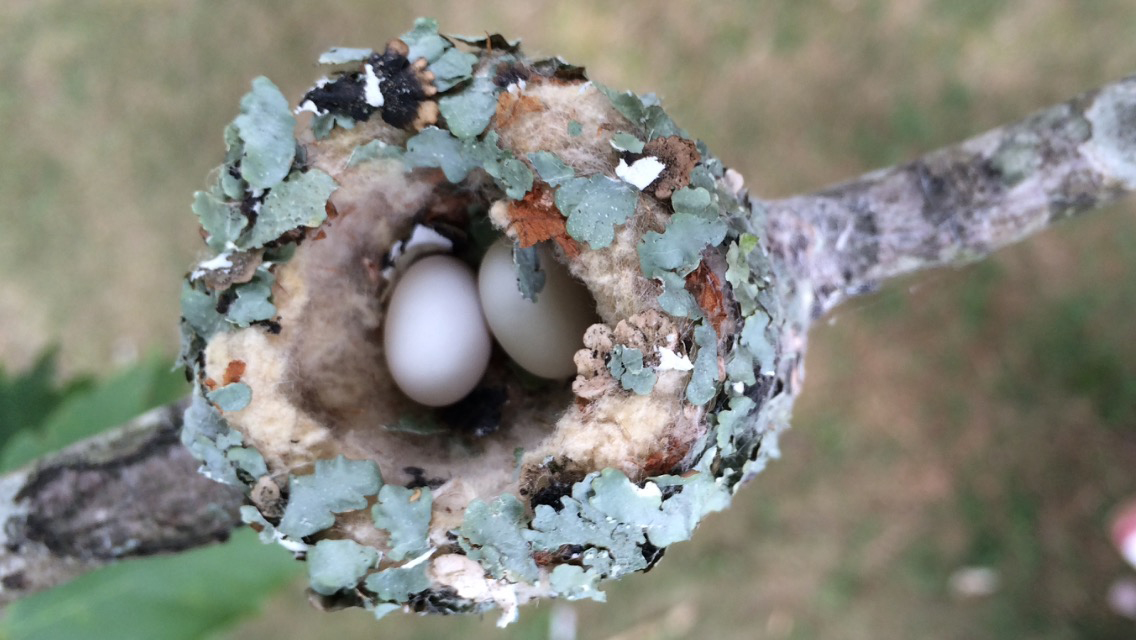
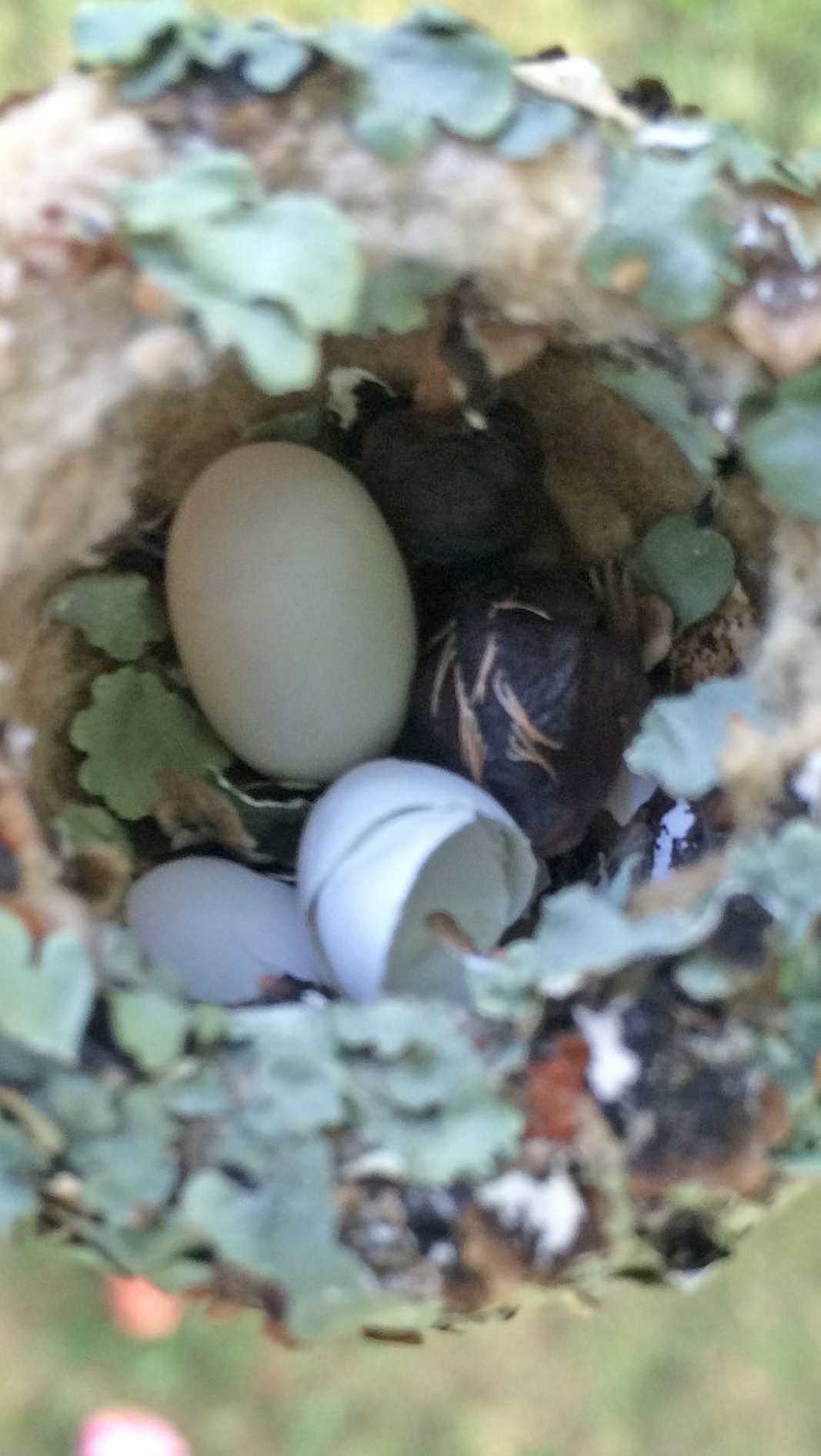
Photo Courtesy of Donna Ottinger                        This nest, filled with two tiny eggs, was discovered in a maple tree in a Bluff City yard by Donna Ottinger.

For Bluff City, Tennessee, resident Donna Ottinger, the show in her front yard beats anything you might find on television this summer. Since late July, Donna has been watching a female ruby-throated hummingbird that she has named Bliss carry out her nesting duties.

bliss-feeder

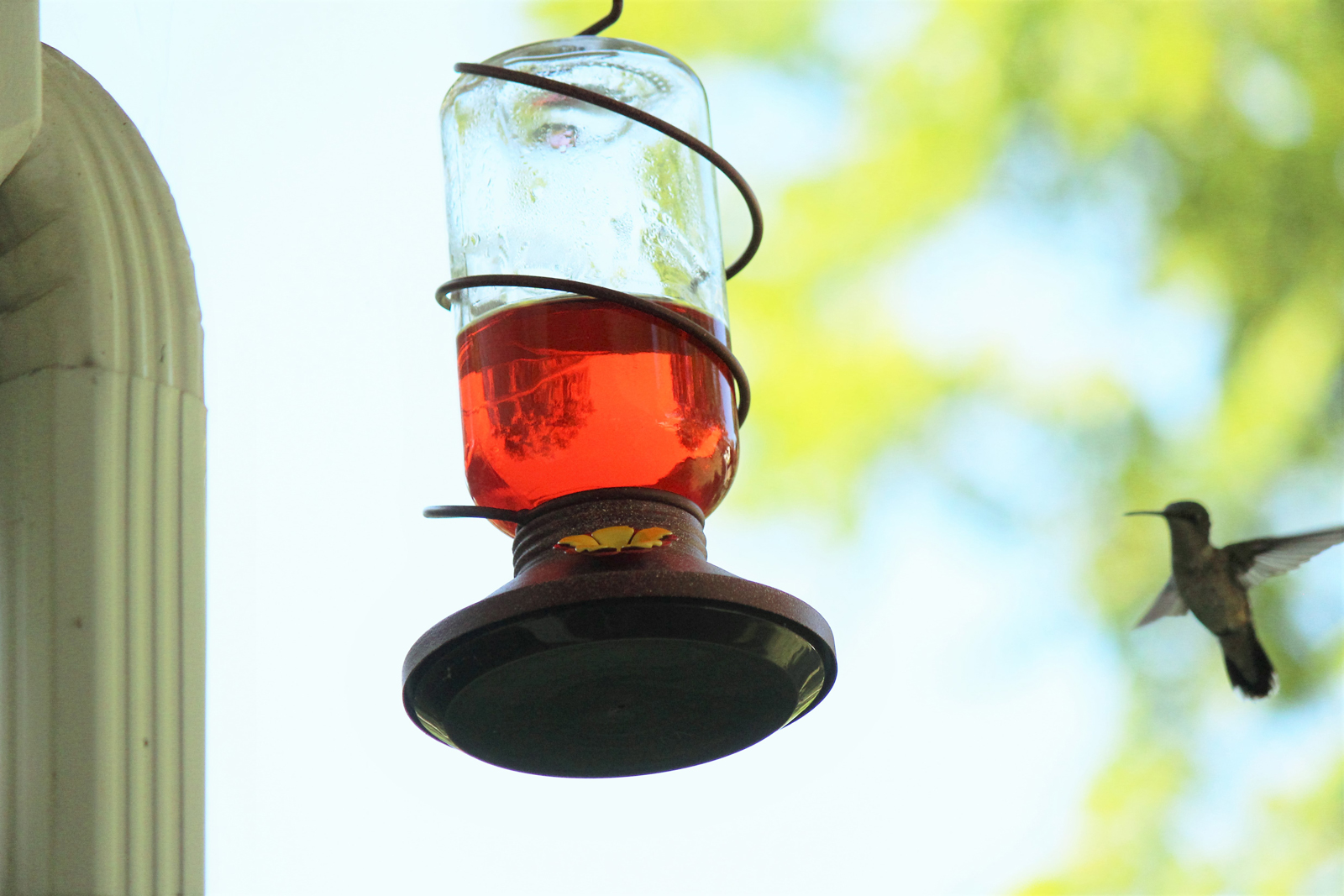
Photo Courtesy of Donna Ottinger                  Bliss the ruby-throated hummingbird visits a feeder for a sip of sugar water.

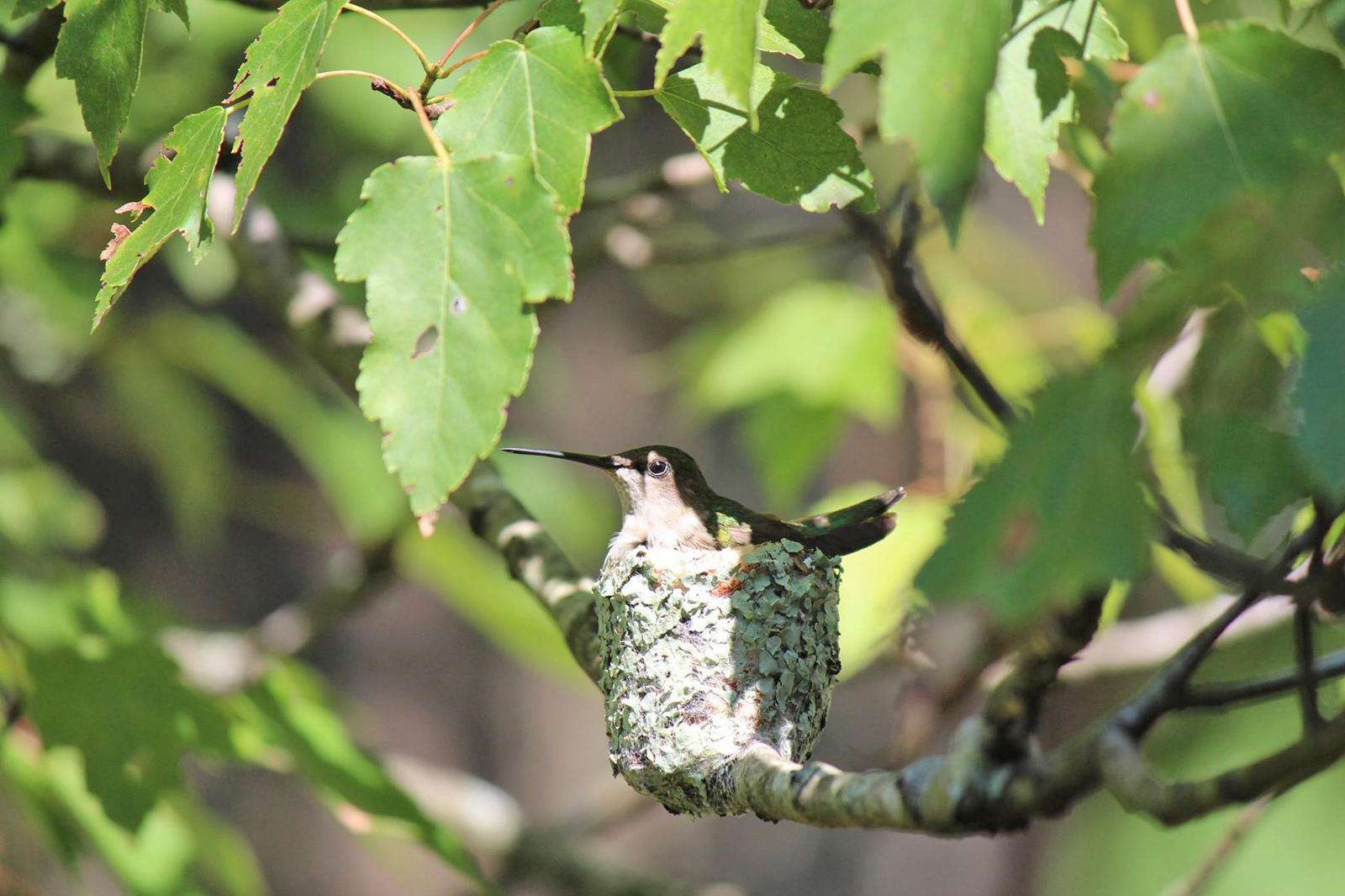
Like all female ruby-throated hummingbirds, Bliss produced two eggs for containment in a delicate nest of spiderweb, lichen and plant fibers woven onto a maple tree branch. There are some reasons why it’s always a pair of eggs for hummingbirds. First, the nest is so small — about the size of a walnut half-shell — that there is barely room for two eggs, let alone more. Second, once the young hatch, the nest has just enough room to accommodate them as they grow, fed well by their mother. Third, feeding two hungry young hummingbirds is a demanding task. A female hummingbird has to find enough food to fuel her own body and help her young in the nest grow and thrive. It’s a full-time job during the daylight hours. She’s pressed hard to succeed at raising two young. Attempting to rear more would most likely prove impossible.

Donna compared the two tiny eggs to Tic Tac mints. The entire process — from building the nest to incubating eggs to tending hatchlings — requires a commitment of more than two months. Donna noted that even after the young hummingbirds hatched, Bliss continued to reinforce the nest with collected silk from spider webs.

Donna kept the nest under observation after she discovered it in late July. As she noted on her Facebook page, finding a hummingbird nest is not an everyday occurrence. The nest is on one of the lower branches of a large maple tree in her front yard only a short distance from her porch. She was able to sit comfortably while watching Bliss come and go to her tiny nest.

bliss-incubating

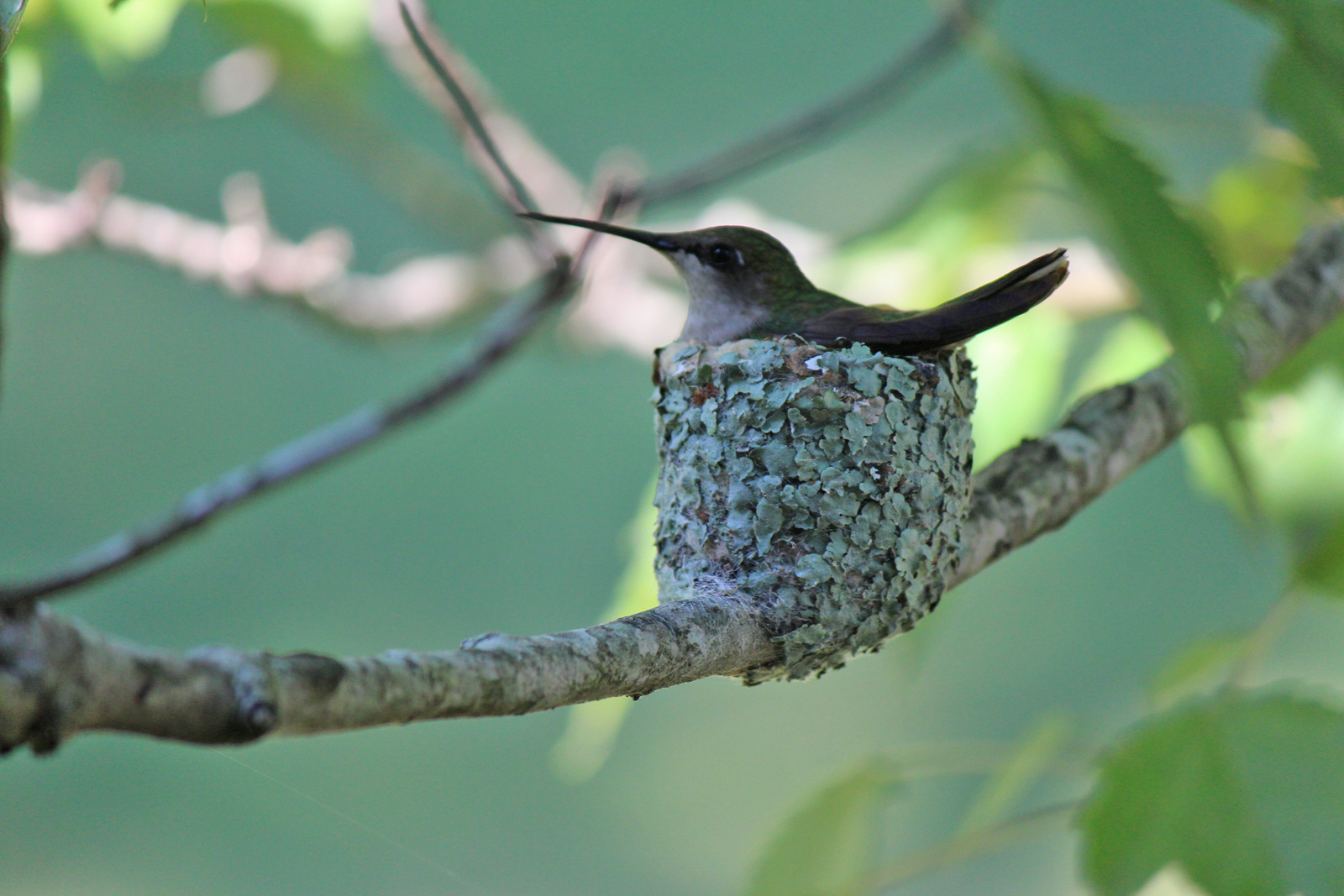
Photo Courtesy of Donna Ottinger                                           Bliss, a ruby-throated hummingbird, sits on her nest to incubate her two eggs.

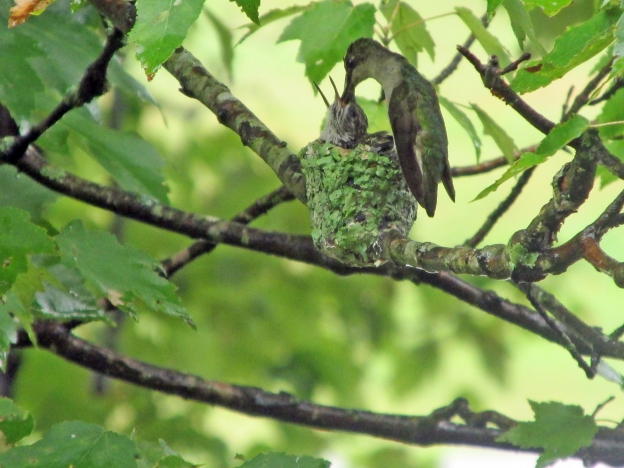
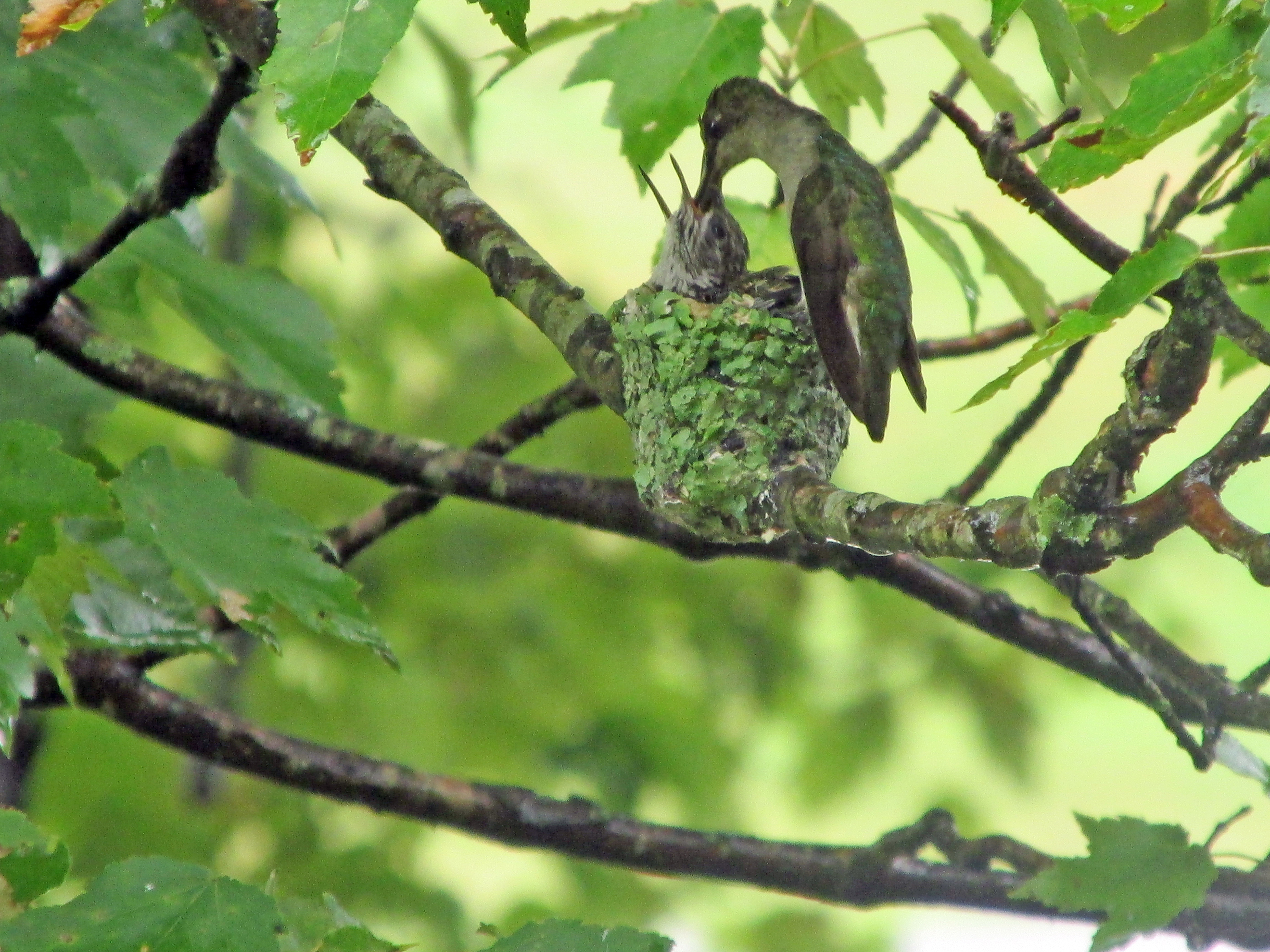
“It’s been a real blessing,” Donna told me when we met in person on Aug. 19. She was gracious enough to permit my mom and me to sit on her front porch and enjoy the show. During our visit, we got to watch as Bliss arrived to feed the babies. It’s not a spectacle for the squeamish. Bliss plunged her long bill deep into the throats of each baby bird in turn and pumped some nutritious contents into the growing youngsters. Despite the fact that it looked like she could easily impale the babies, they suffered no ill effects and looked quite full and satisfied after the visit.

aug-1-monday-just-hatched-this-morning

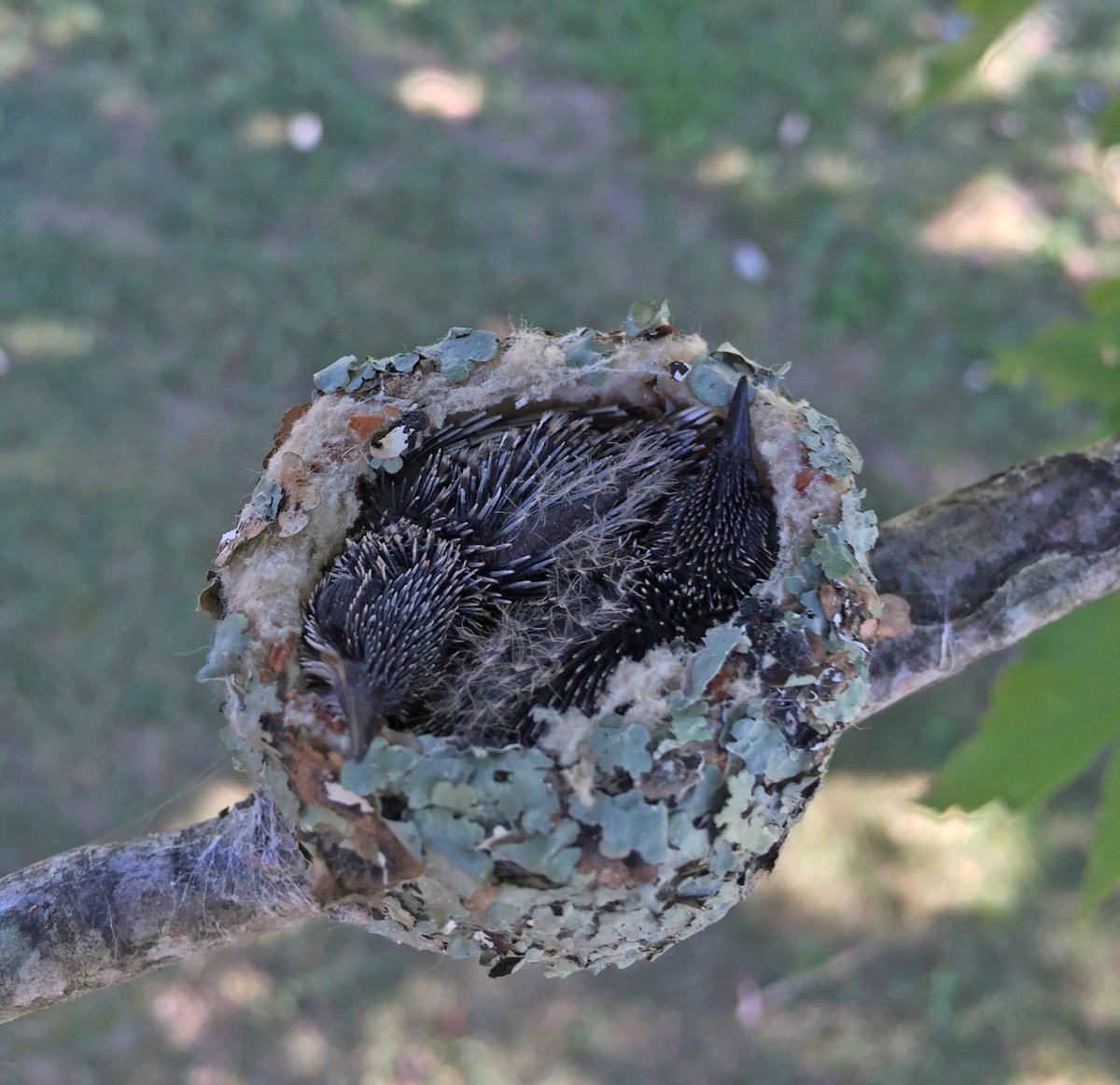
Photo Courtesy of Donna Ottinger              On Aug. 1, one chick hatched. The second chick hatched the following day, making for a very full nest.

The two babies were hatched on Aug. 1 and Aug. 2, respectively. The staggered hatching reflects the fact that Bliss also laid the eggs on separate days. Not knowing the gender of the babies, Donna named the Aug. 1 hatchling Monday for the day of the week hatching took place. In turn, the second baby, which escaped its shell on Aug. 2, was named Tuesday.

Once hatched, young hummingbirds remain in the nest about 28 days (nearly a month) and depend on their mother to bring them regular meals. If that’s not enough, the ruby-throated hummingbird is known to nest twice in a season. It certainly must rank a female hummingbird as one of the busiest of our summer birds. At the time I wrote this column, Monday and Tuesday had still not left the nest.

The young hummers have grown at an astonishing rate and Donna has witnessed their progress day by day. She noted that young hummers start off life with a short bill. Like the rest of their bodies, however, their bills have grown accordingly as Monday and Tuesday received regular feedings from Bliss.

aug-13-monday-and-tuesday-with-more-feathers

Photo Courtesy of Donna Ottinger                Having grown at a rapid pace, hummingbird chicks Monday and Tuesday find their nest growing rather cramped by mid-August.

Female hummingbirds receive no assistance from their mates. Males don’t assist with the rearing of their own young. For male hummingbirds, summer is mainly a time to thrive on the abundance of nectar-bearing blooms, as well as a profusion of tiny insects and spiders that also make up a good portion of their diet.

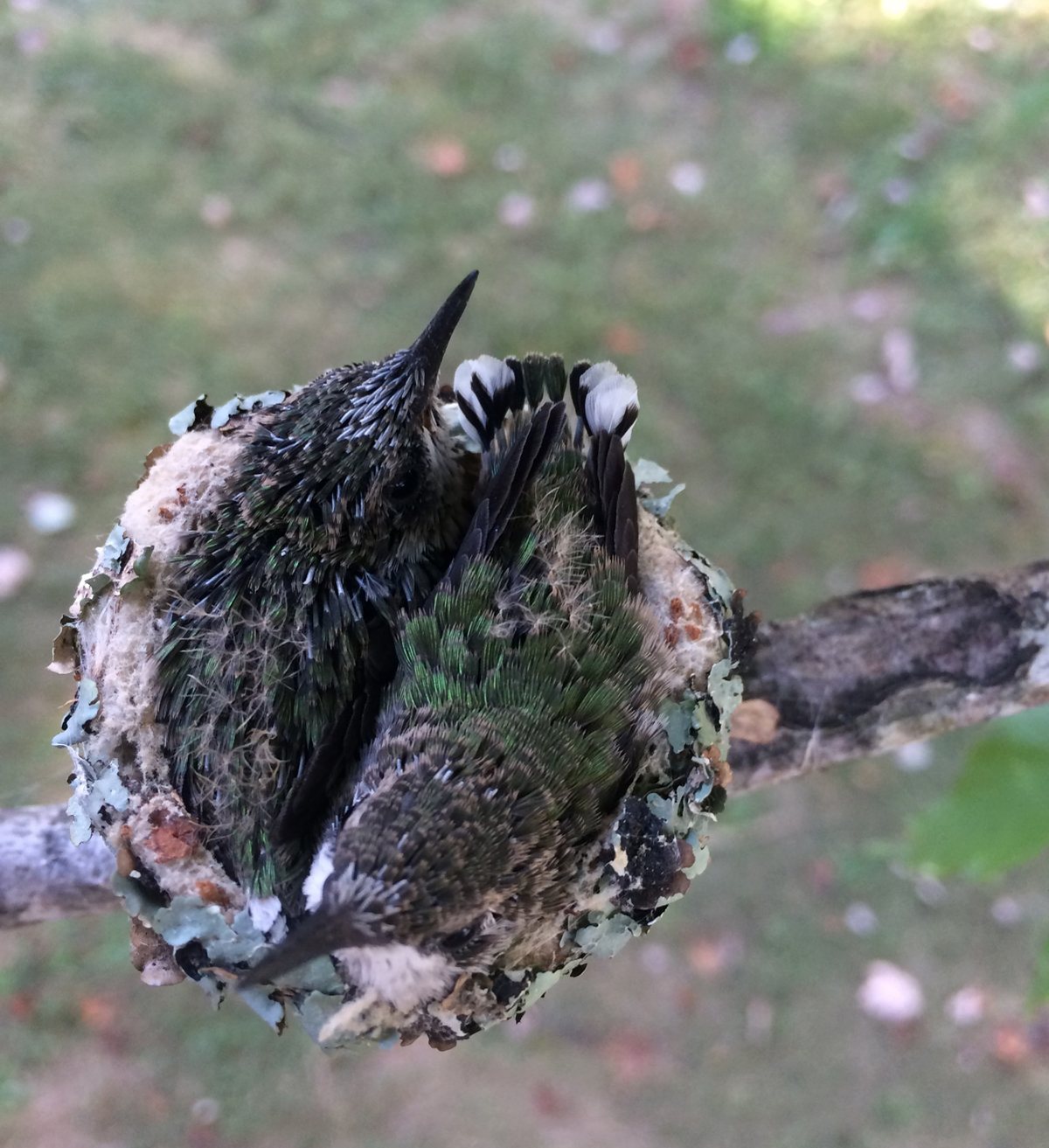
When I saw them, I knew that little Monday and Tuesday would be out of the nest in a short time. It would also be necessary for them to soon begin fall migration. On Aug. 23, Donna reported on her Facebook page that the young hummers had left the nest.

hummer-mother

Photo by Bryan Stevens                                   Bliss feeds her two young hummingbirds.

“Just three weeks after hatching, the baby hummers have both left the nest,” she wrote in her post. “They didn’t go far, and Bliss is still feeding them in a nearby tree where they have taken up new residence.”

The next generation of hummingbirds always helps swell the number of these tiny birds in our yards in late summer and early fall. Keeping visiting ruby-throated hummingbirds can be as simple as planting an abundance of the flowers they love, but offering multiple sugar water feeders also helps. Keep the sugar water mix at a four parts water to one part sugar ratio. Don’t offer honey in your feeders. When mixed with water, it can spoil and spread fungal diseases. Remember that hummingbirds don’t subsist on sugar water alone. They also eat numerous tiny insects and spiders to obtain the protein they need for their dietary needs, so don’t use insecticides near feeders or flowers that hummers are likely to visit.

aug-17-monday-and-tuesday-with-color-showing-on-feathers

Photo Courtesy of Donna Ottinger  Monday and Tuesday find the nest increasingly crowded in the days before they fledged.

It was absolutely wondrous to observe Bliss and her babies. The experience has motivated me to keep a closer watch on the hummingbirds in my yard. There are female hummers present every summer. They have to be nesting somewhere, and I’d like to find a nest in my own yard.

•••••

To learn more about birds and other topics from the natural world, friend Stevens on Facebook at https://www.facebook.com/ahoodedwarbler. He is always posting about local birds, wildlife, flowers, insects and much more. If you have a question, wish to make a comment or share a sighting, email ahoodedwarbler@aol.com.

aug-13-monday-and-tuesday-with-more-feathers

Photos Courtesy of Donna Ottinger            Monday and Tuesday share a compact nest.

13661895_1230239206996666_2874895669499226165_o

Bliss incubates her eggs at her nest in Bluff City, Tennessee.