Category Archives: Uncategorized

Hoping to invite many birds to my yard in 2015

The first day of 2015 produced some excitement in the yard here on Simerly Creek Road. I was watching a female Northern Cardinal — the first cardinal I had observed in the new year — as she foraged on the ground beneath one of the feeders. I even used my camera to take a few photos of her through the window.
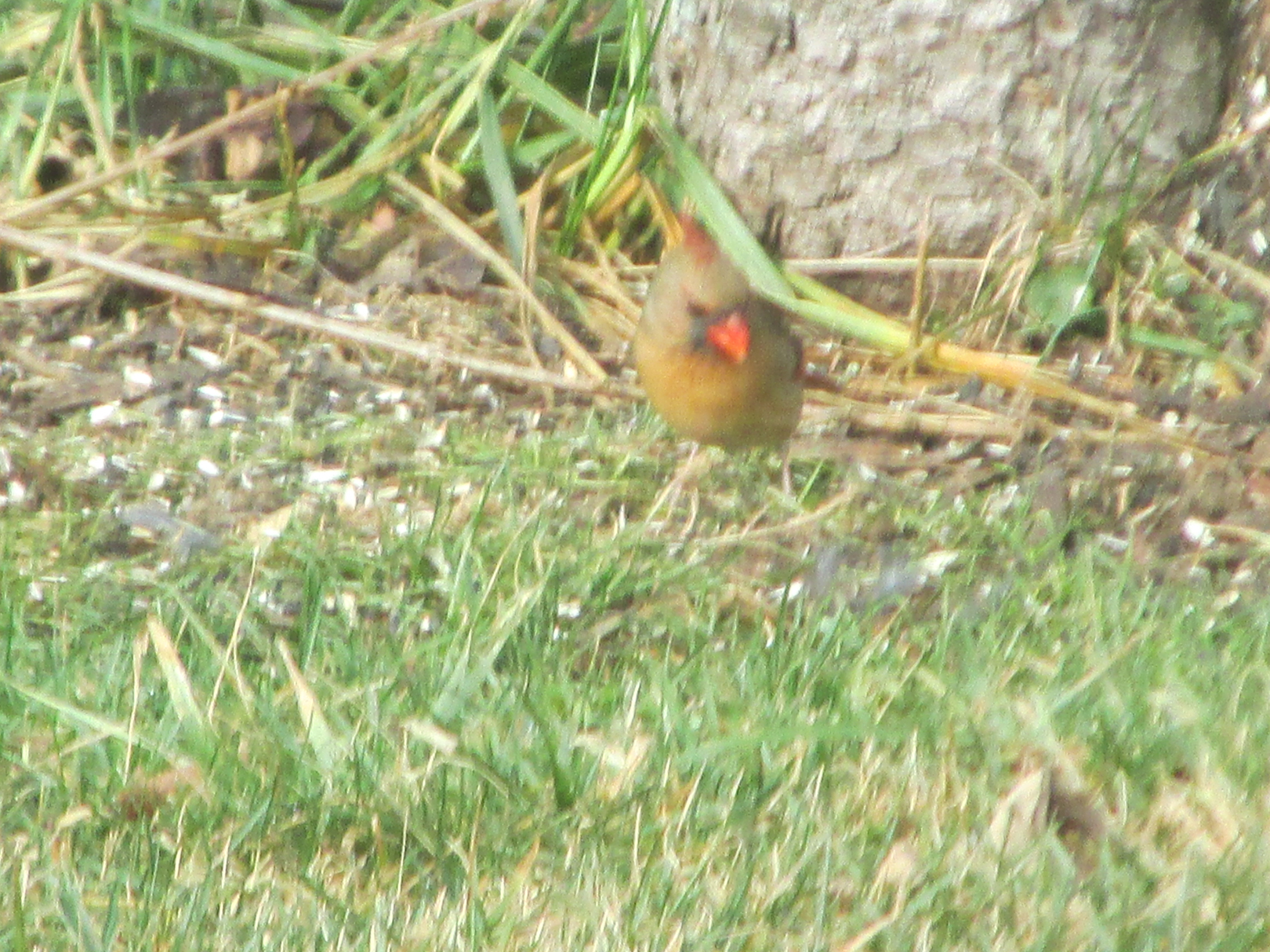
FirstCardinal

Photo by Bryan Stevens                                                                         A female Northern Cardinal foraging on the ground beneath a feeder.

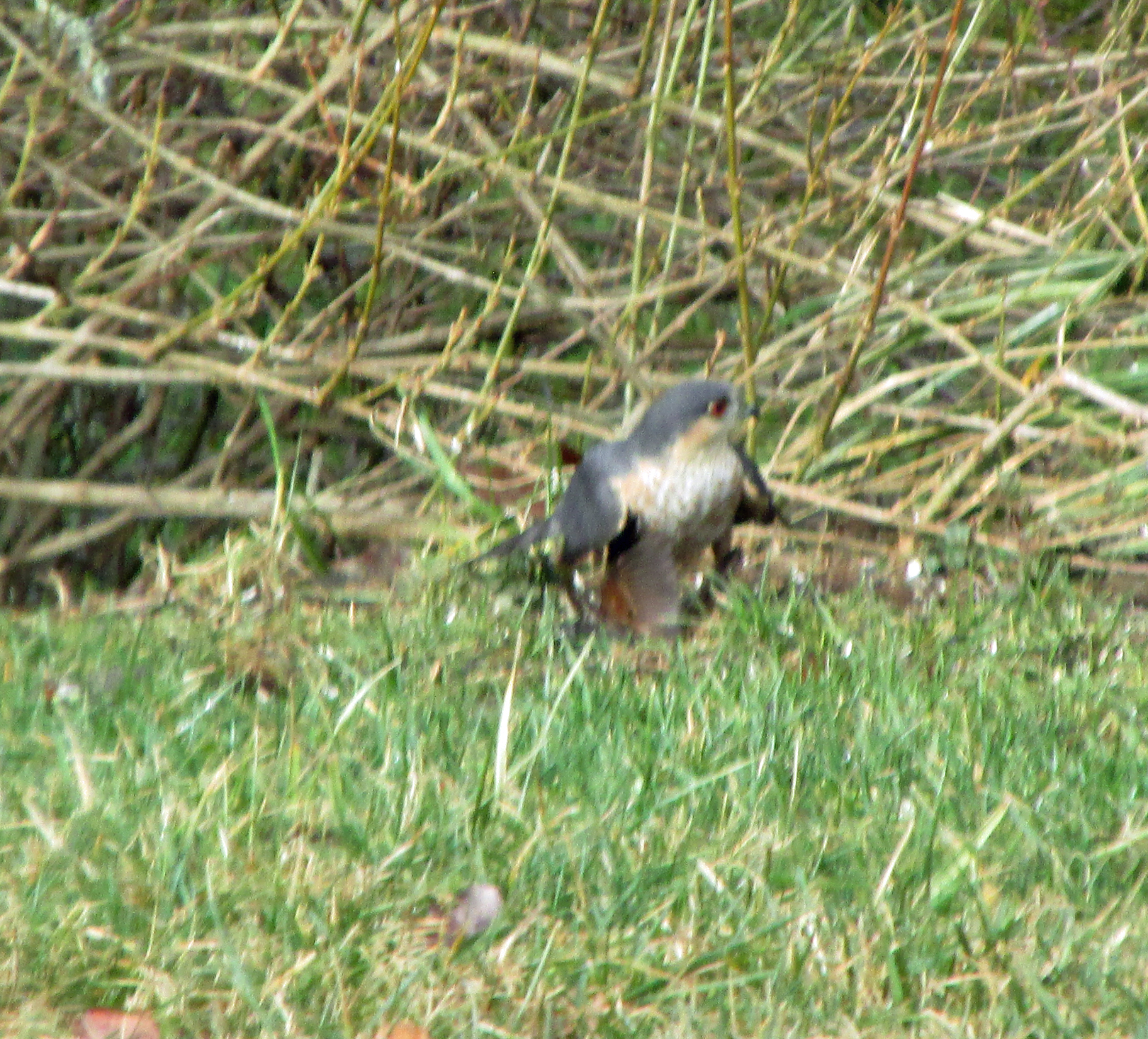
I was getting ready to snap another picture when an intruder violently inserted itself into the scene, scattering other birds at the feeders. Everything happened so quickly I needed an instant to figure out what was happening.
FirstHawk

Photo by Bryan Stevens                                  The visiting Sharp-shinned Hawk is pictured only seconds after capturing the cardinal in its talons.

A pair of spread wings eventually transformed into a full bird as my brain identified the intruder as an adult Sharp-shinned Hawk — and one that had just captured itself a meal, albeit at the expense of the cardinal.
With the cardinal secured in its talons, the hawk looked ready to consume its prey when an American Crow flew to a tree and perched overhead making its displeasure with the hawk very clear. The hawk hesitated and then took off, taking its prey with it and leaving with such velocity that it left the protesting crow far behind.
Sharpie-Two

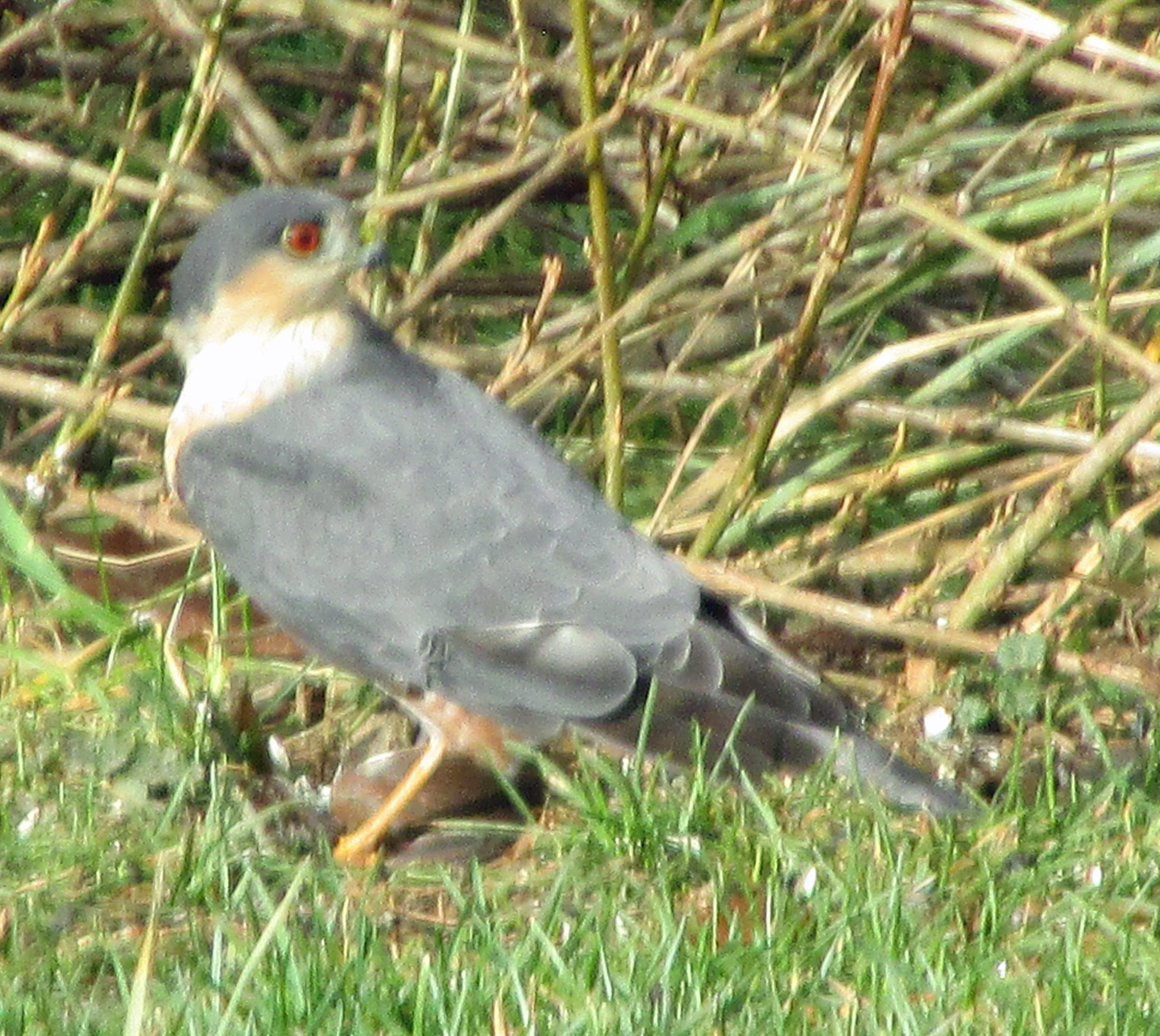
Photo by Bryan Stevens                                  The Sharp-shinned Hawk is a stealthy, efficient and determined predator.

The Sharp-shinned Hawk became one of the first birds on a yard list I will be keeping in 2015. A couple of years ago I did a list of all the species of birds I observed in the five-county area of Northeast Tennessee. Such a list is fun to compile, but it takes a lot of dedication. I figure counting the birds that make an appearance in my yard from Jan. 1 to Dec. 31 in 2015 is a more feasible goal.

Sharpie-Jan1

Photo by Bryan Stevens                                                      The Sharp-shinned Hawk is a small raptor, often described as similar in size to a dove.

In addition to the Sharp-shinned Hawk, Northern Cardinal and American Crow, the other birds I’ve already added to my 2015 yard list are Mourning Dove, Great Horned Owl, Downy Woodpecker, Pileated Woodpecker, Blue Jay, Tufted Titmouse, Carolina Chickadee, White-breasted Nuthatch, Carolina Wren, Eastern Bluebird, Eastern Towhee, Song Sparrow, White-throated Sparrow, Dark-eyed Junco, Purple Finch, House Finch, Pine Siskin and American Goldfinch.

That’s more than 20 species and the year is not yet a week old. My goal is to find at least 100 species in 2015. The tally will probably proceed slowly, but I will provide regular updates as I add new species to the list.

••••••

15947504279_0227db8e25_o

Photo Courtesy of Jean Potter          An immature Sharp-shinned Hawk perches on a limb. These raptors often ambush their prey.

The Sharp-shinned Hawk and its larger relative, the Cooper’s Hawk, are the two raptors most often encountered by people who feed birds. Part of the family of Accipiter hawks, these two species are widespread in woodlands.

The Cooper’s Hawk is larger, often described as similar in size to an American Crow. The Sharp-shinned, on the other hand, is usually described as the size of a dove. There’s some overlap in size, so it is not the only reliable means of identifying these hawks. For example, female Sharp-shinned Hawks are roughly equivalent in size to a male Cooper’s Hawk. As with many raptors, the female is larger than the male in both these species.

There are some other things to look for in telling these species apart. For instance, adult Sharp-shinned Hawks often look like they have a dark cap or hood. The eyes on a Sharp-shinned Hawk also look like they are halfway between the front and back of the head. In addition, the head itself looks small in comparison to the overall size of this hawk’s body.

These two species feed heavily on songbirds, which causes some bird-lovers distress. When I posted photos of the incident with the cardinal and hawk to my Facebook page, a few friends were definitely upset that the cardinal’s stay in 2015 proved so brief.
I like to view these incidents as good examples of proper balance in the natural world. The Sharp-shinned is really beautiful, especially for a hawk. Preying on songbirds doesn’t make them “bad” birds. They’re doing exactly what nature intends for them to do. They’re extremely efficient predators, and I was impressed by both the power and precision deployed by the Sharp-shinned Hawk in capturing the unfortunate cardinal.

In case you’re worried about the cardinal population, later that same day a flock of about a dozen cardinals visited my feeders about a half hour before dusk. Predatory hawks are part of the balance in nature. It’s a balance that we should strive not to upset.
Red-tailed-Field

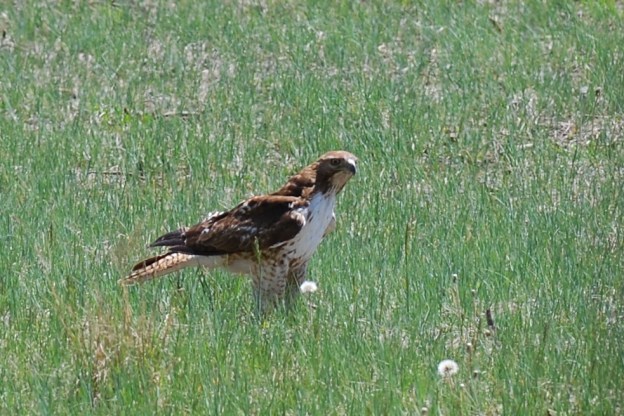
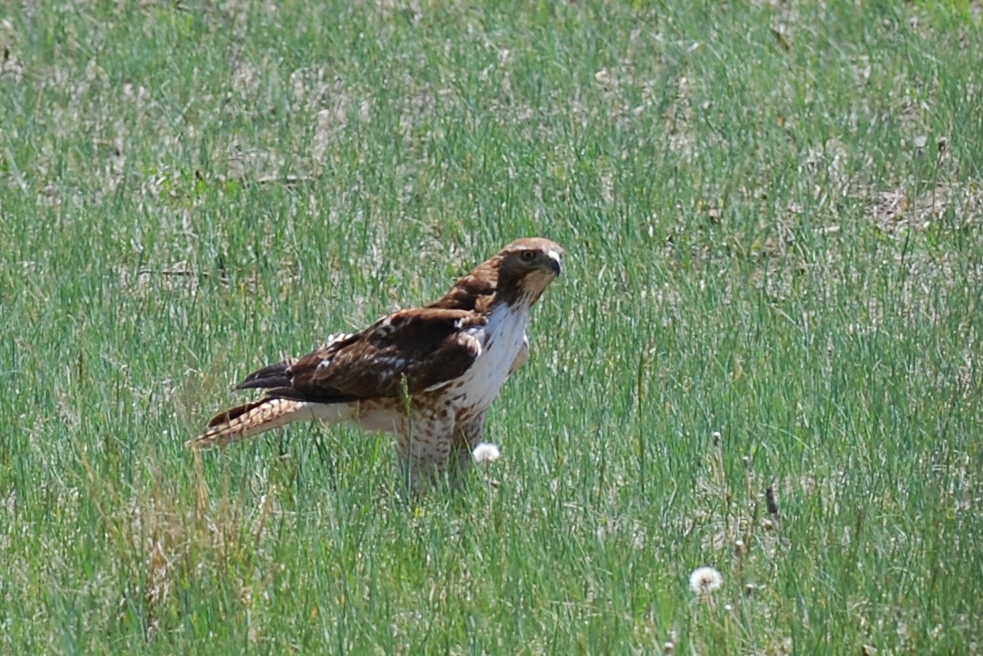
Photo Courtesy of Jean Potter                           A Red-tailed Hawk is shown standing in a field.

In the past few days, I have seen Red-tailed Hawk, Great Horned Owl and Cooper’s Hawk here at home (or within a few miles of my home) and I take that as a good sign. The absence of predators can be a sign that something’s wrong with the food chain. If the chain gets broken, everything (prey and predators) will suffer.

••••••

The Accipiter genus of hawks includes about 50 species. In Northeast Tennessee, as well as across much of North America, the two common species are Sharp-shinned Hawk and Cooper’s Hawk. A third species, the Northern Goshawk, is a rare visitor to the region.

The Northern Goshawk is a large, powerful hawk, and it is also fiercely defensive of its nest. This hawk is known to attack other raptors, mammals and even humans that stray too close to its nesting site.

Goshawk is a term derived from “goose hawk,” referring to the ability of this bird when utilized in falconry to take down such large prey as geese.
Other Accipiter hawks around the world include Spot-tailed Sparrowhawk, Rufous-chested Sparrowhawk, Grey-headed Goshawk, Semi-collared Hawk and Tiny Hawk, which is one of the world’s smallest raptors. This diminutive hawk is about the size of a European Starling and lives in Central and South America.

The Sharp-shinned Hawk will feed on a variety of birds, ranging in size from sparrows, warblers and thrushes to birds as large as Ruffed Grouse and Mourning Dove. This hawk also feeds on small mammals, reptiles and insects.
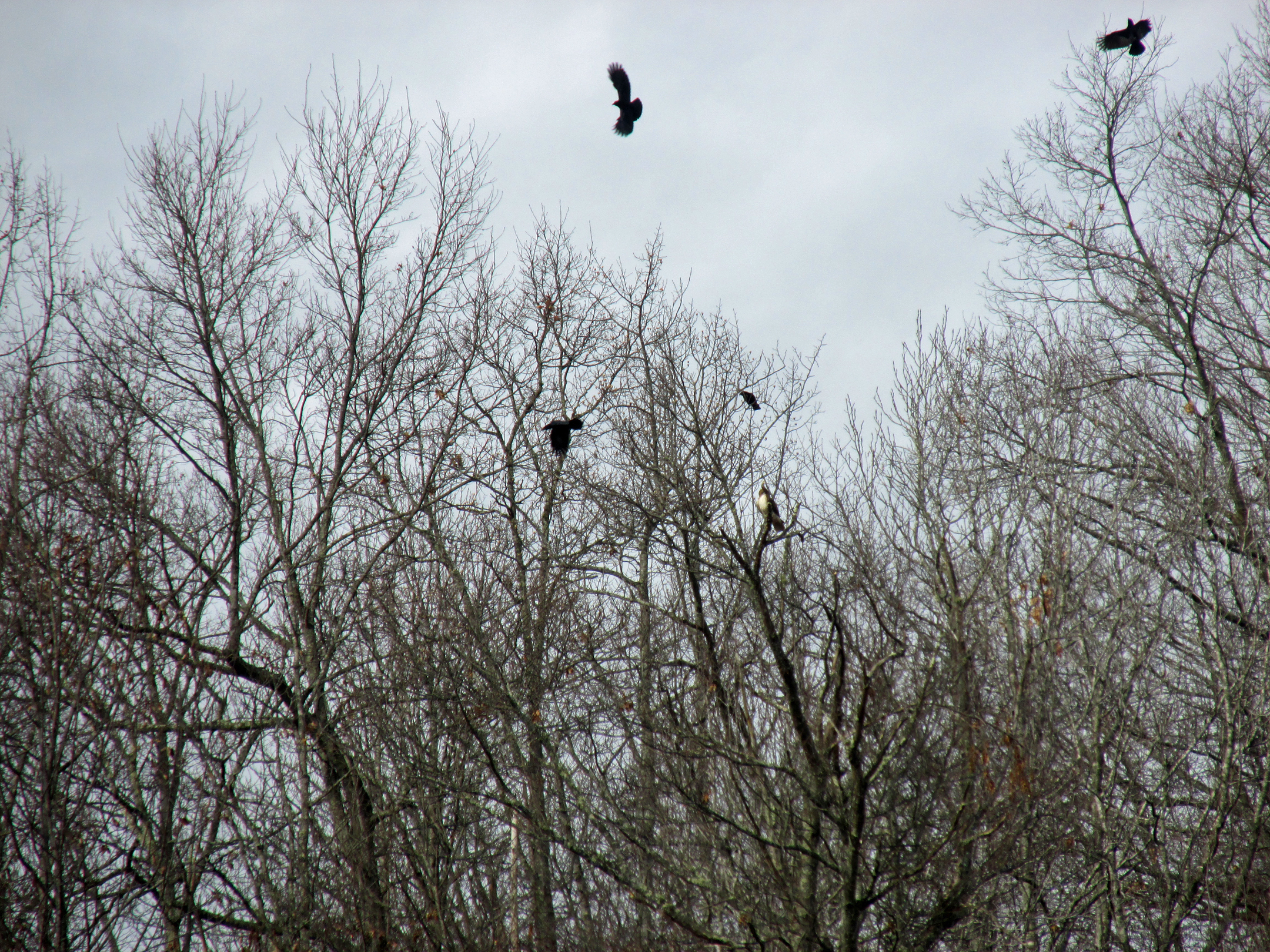
Hawk-Crowsss

Photo by Bryan Stevens                                     A flock of American Crows mobs a perched Red-tailed Hawk.

••••••

On Dec. 27, the resident flock of American Crows confronted a Red-tailed Hawk, eventually forcing the large raptor to leave it perch and depart the area. I’m hoping the Red-tailed Hawk will soon put in its first 2015 appearance. The first clue is usually a mob of angry and very vocal crows.

With safety in numbers, many smaller birds will gang up on raptors to drive them away. Crows can be quite merciless to both Red-tailed Hawks and any Great Horned Owls that they locate during the day.

Hawk-TakesFlight

Photo by Bryan Stevens                                                                                                               Mobbing crows force a Red-tailed Hawk to take flight from a perch in a tall tree.

Jonesborough couple hosting wintering hummingbird

I received a phone call in late November from Elizabethton resident Susan Peters, who informed me that one of her friends in a local hiking organization was hosting a hummingbird.

But hummingbirds are summer birds from the tropics, right? Doesn’t the cold weather present a shock to these visitors?

Actually, many hummingbirds are adapted to frigid conditions. Rufous Hummingbirds are quite capable of surviving freezing conditions, as long as they have access to a source of food. In spring, they migrate through California, before eventually spending the summer in the Pacific Northwest and Alaska.

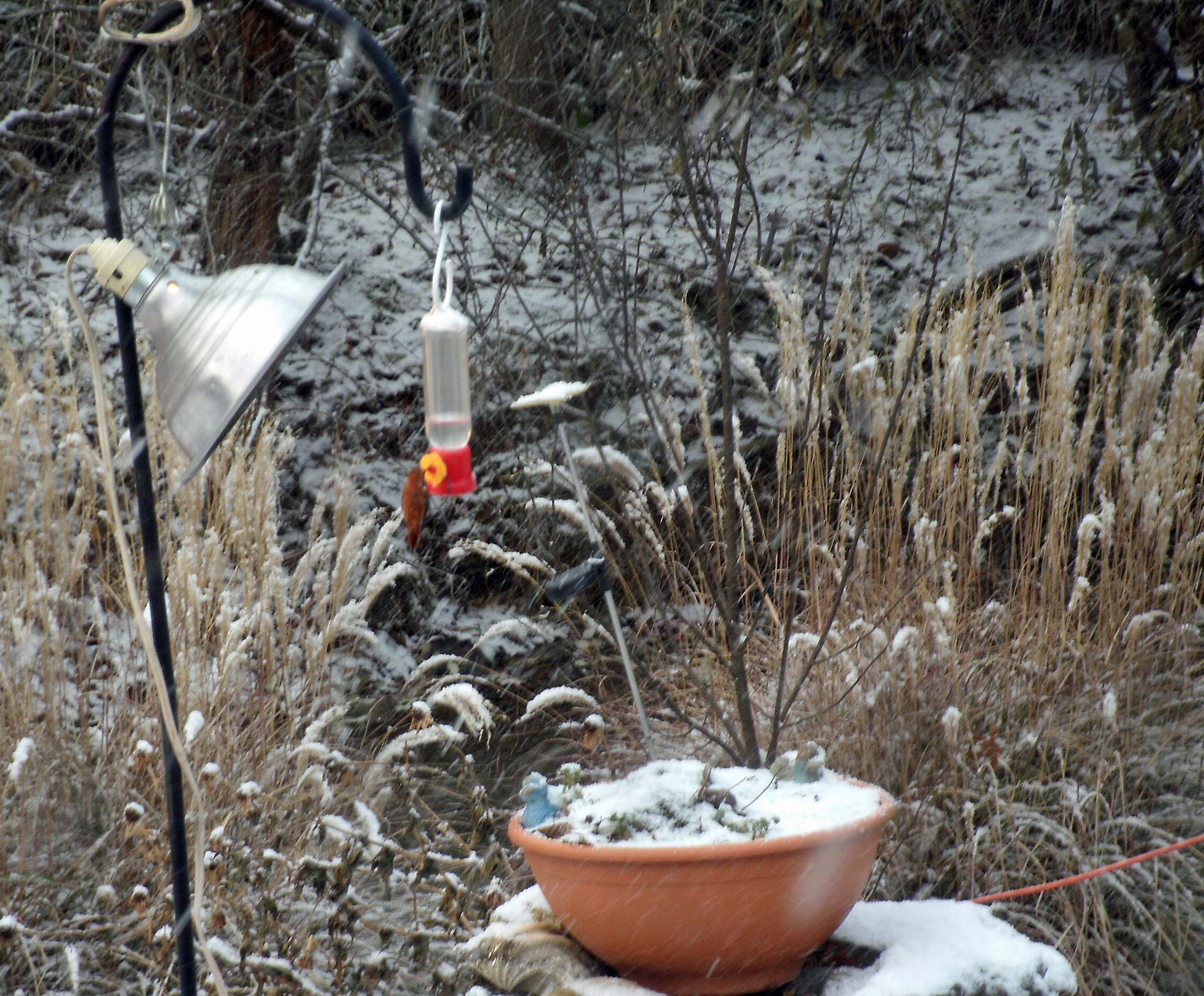
Photo courtesy of Faye Guinn Not even an occasional bout of snowy weather has deterred this hummingbird from visiting a feeder at the home of Howard and Faye Guinn.

Photo courtesy of Faye Guinn
Not even an occasional bout of snowy weather has deterred this hummingbird from visiting a feeder at the home of Howard and Faye Guinn. The brownish hummingbird is hovering in front of the feeder. Notice a male Northern Cardinal is present in the photo’s background.

The bird in question has been coming since Oct. 19 to a feeder at the home of Howard and Faye Guinn, who live near Jonesborough. Faye and I have corresponded by email about her hummingbird, which has already weathered a couple of snowstorms.

“I was delighted to have a late hummingbird but never expected him to stay this long,” Faye wrote.

When Susan contacted me, she said that the Guinns wanted to know if they should continue feeding the hummingbird or remove the feeder to encourage the bird to fly south.

GE DIGITAL CAMERA

Photo Courtesy of Faye Guinn                           A heat lamp positioned near the feeder keeps the sugar water solution from freezing during bouts of frigid weather.

I advised Faye in my email to continue to offer the sugar water, especially since other resources are scarce. These wintering hummingbirds are not entirely dependent on feeders, but they can make the difference during prolonged bouts of freezing weather. These hummingbirds will also sip from sap wells drilled into trees by Yellow-bellied Sapsuckers. Hummingbirds also feed on tiny insects.

“Thanks for letting me know to keep feeding because some friends have said I should stop and he would go, but they are not birders,” Faye responded to my suggestion. “I am only backyard birder but do know a little.

The hummingbird is somewhat camera shy and the photographs Faye has managed to get have been taken from inside her home.

“Any movement outside and he is gone,” she explained. “He comes and goes very quickly. His coming and going has no schedule but in the mornings he is soon there. He looks like he is beefing up so I expect he soon will go.”

She has gone to extra effort to provide for her visiting hummingbird.

“I take the feeders down — I have two so he has a choice — about two hours after dark on the nights it is to freeze and put it back out about 6:30 with a heat lamp,” she wrote.

So far, her efforts have kept the bird healthy and content.

“I never expected him to stay this long,” she said.

When she noticed the hummingbird for the first time on Oct. 19 she saw the bird at her Mexican sage plant. Her feeder was still available at the time, too.

Photo by U.S. Fish & Wildlife Service A male Ruby-throated Hummingbird hovers in front of the camera. Ruby-throated Hummingbirds typically depart the region by mid-October.

Photo by U.S. Fish & Wildlife Service
A male Ruby-throated Hummingbird hovers in front of the camera. Ruby-throated Hummingbirds typically depart the region by the middle of October.

Through the years, I have seen several of these seemingly out-of-place hummingbirds. Some of them remain at their host’s feeders for a brief stay of a few days or a couple of weeks, but some of these hummingbirds have extended their stay for several months, lingering throughout the winter months before eventually departing in February or March.

The big question is: are these hummingbirds truly lost and out of place? The answer, based on everything I have managed to learn, is that these hummingbirds are precisely where they want to be. For still unknown reasons, some of these western hummingbirds make a migration swing through the eastern United States.

The Rufous Hummingbird has basically become an expected winter visitor with a few reports being received each winter. I have observed Rufous Hummingbirds in many different locations, including Bristol, Blountville, Flag Pond, Elizabethton and Hampton. I have also observed Allen’s Hummingbirds in Mountain City and Johnson City. I know of records of these small birds from Erwin, Roan Mountain, Johnson City and many other locations throughout the region.

Photo by Ryan Hagerty/U.S. Fish & Wildlife Service A Ruby-throated Hummingbird is held with its wings spread during a study at the Bon Secour National Wildlife Refuge in Alabama.

Photo by Ryan Hagerty/U.S. Fish & Wildlife Service
A Ruby-throated Hummingbird is held with its wings spread during a study at the Bon Secour National Wildlife Refuge in Alabama.

Mark Armstong, who works at the Knoxville Zoo, has banded many of the western hummingbirds that migrate into the region on an annual basis.

I have continued to correspond with Faye, who confirmed that the bird has remained resident throughout November. As of Dec. 7, the hummingbird was still visiting the feeders at the Guinn residence.

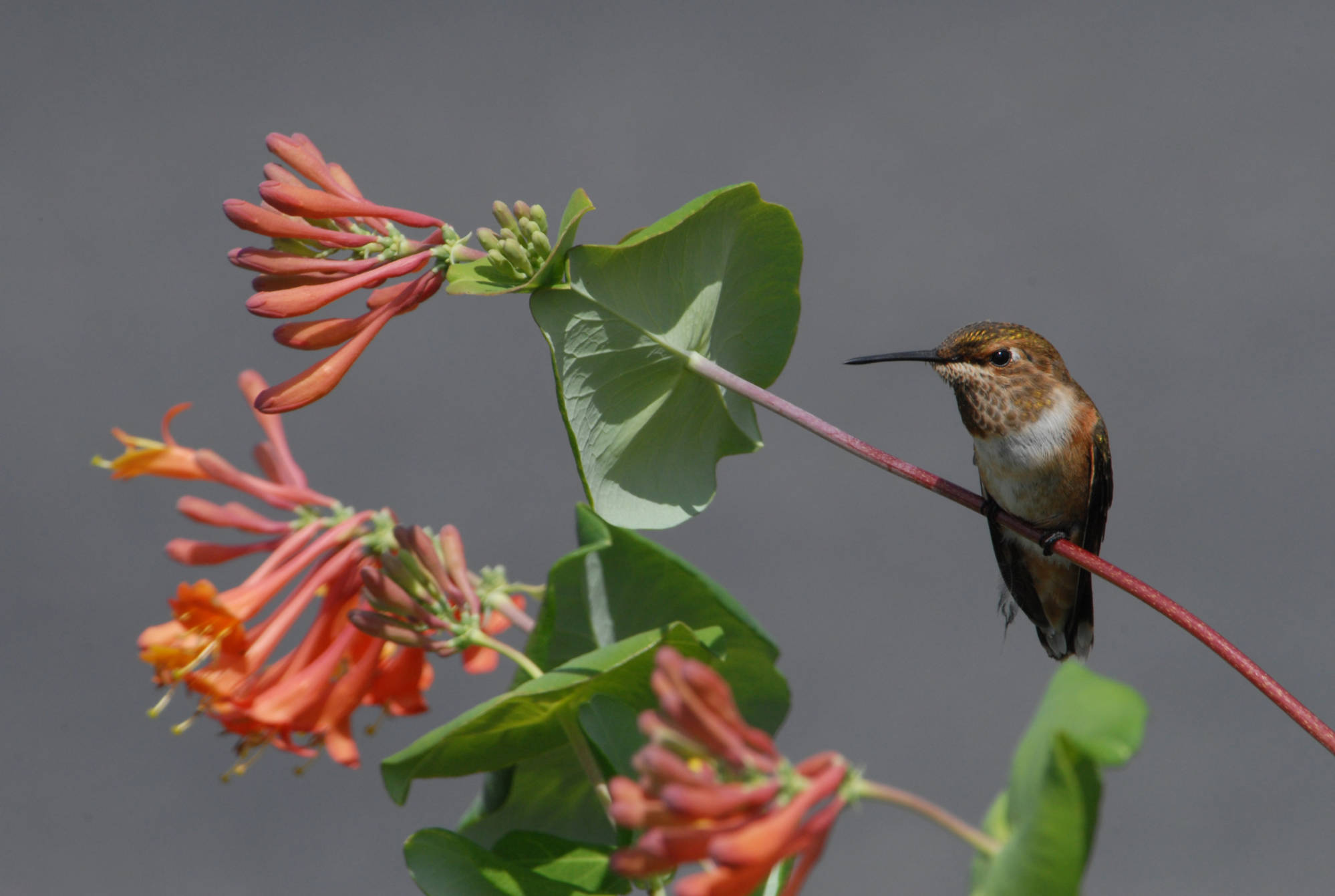
Photo by U.S. Fish & Wildlife Service A Rufous Hummingbird perches on a flowering vine.

Photo by U.S. Fish & Wildlife Service
A Rufous Hummingbird perches on a flowering vine. This hummingbird nests as far north as Alaska.

Invite butterflies into your gardens, yards

Swallowtails_edited-1

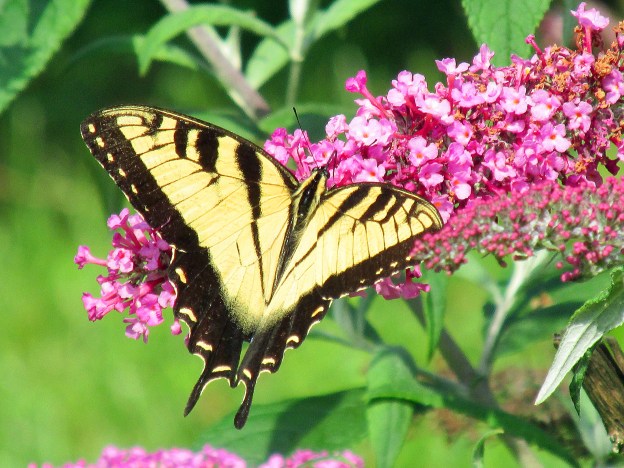
Photo by Bryan Stevens                                                    Spicebush Swallowtail and Tiger Swallowtail seeking salts and minerals from the edge of a gravel driveway.


I’m taking a break from the birds for one week to bring you some other things with wings in the form of a pictorial essay on butterflies, which include such families of winged insects as skippers, swallowtails, fritillaries and much more.

Most of these photos were taken at my home on Simerly Creek Road in Hampton, TN. A few were taken in other locations, including South Carolina and Georgia.

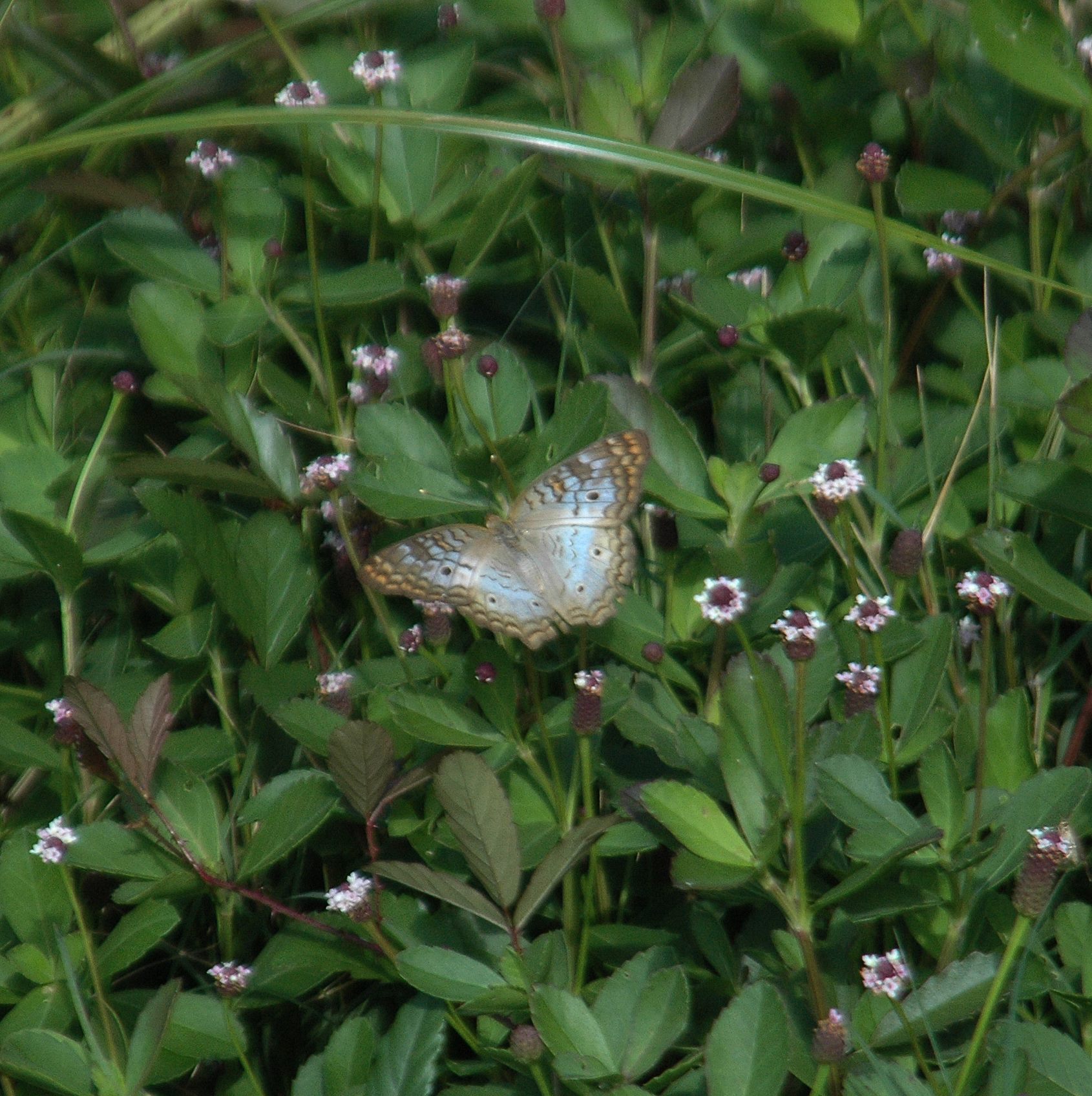
53469_4360543104155_1887969607_o

Photo by Bryan Stevens                             White Peacock found on Fripp Island, S.C., in October of 2012.  Resident from Argentina north through Central America, Mexico and the West Indies to South Texas and southern Florida. This butterfly migrates and temporarily colonizes to central Texas and coastal South Carolina. It is a rare wanderer to North Carolina, Missouri, Nebraska and Kansas.

According to the North American Butterfly Association, there are about 20,000 species of butterflies in the world. About 725 species have occurred in North American north of Mexico, with about 575 of these occurring regularly in the lower 48 states of the United States, and with about 275 species occurring regularly in Canada. Roughly 2,000 species are found in Mexico.

Butterflies are part of the class of Insects in the order Lepidoptera. Moths are also included in this order.

Butterflies are not newcomers to the world of insects. Fossilized butterflies are known to date back to the Eocene epoch, some 40 to 50 million years ago.

10293711_10203217981762763_2929721534219810613_o

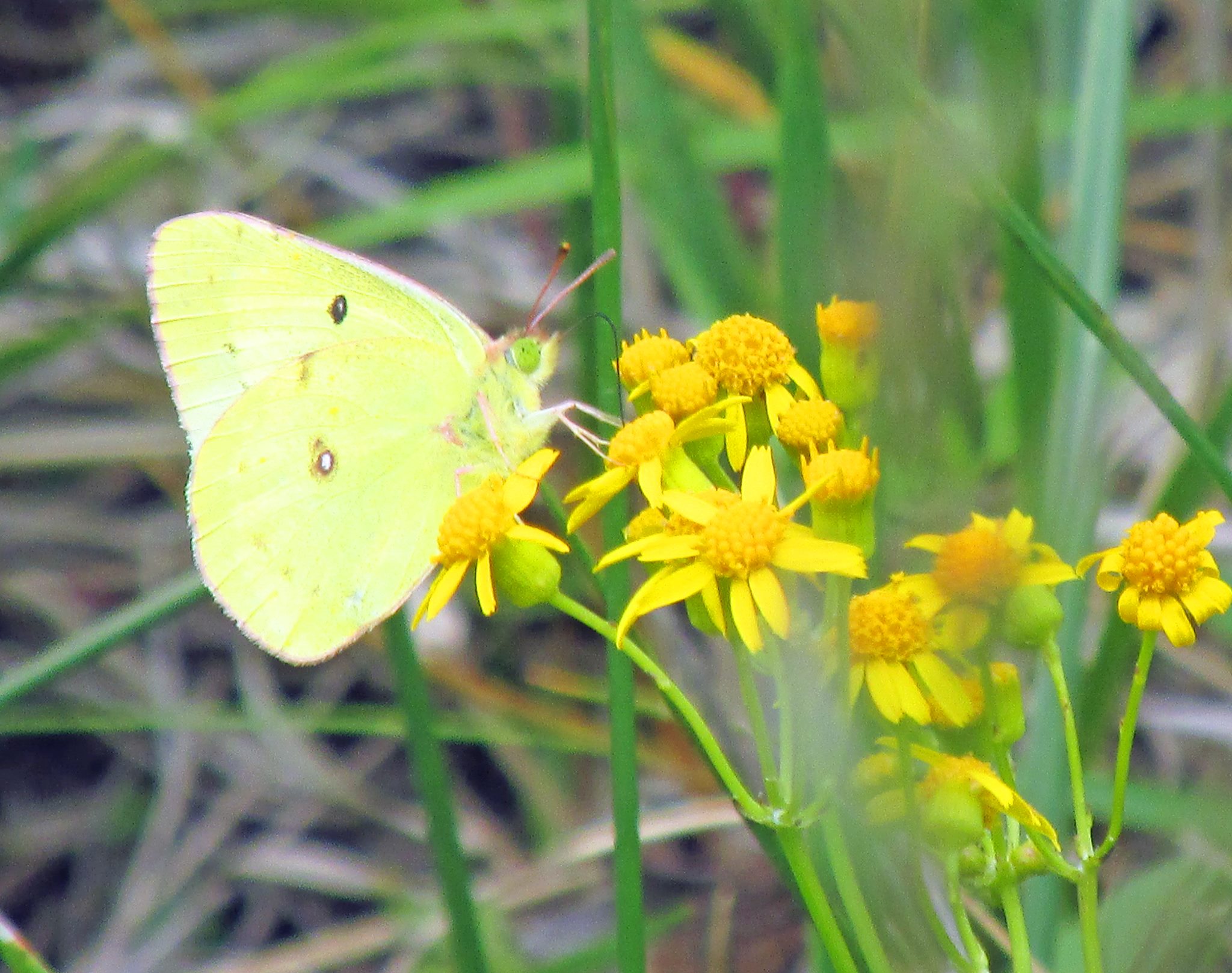
Photo by Bryan Stevens                                Some butterflies, such as the sulphurs, are known to migrate.

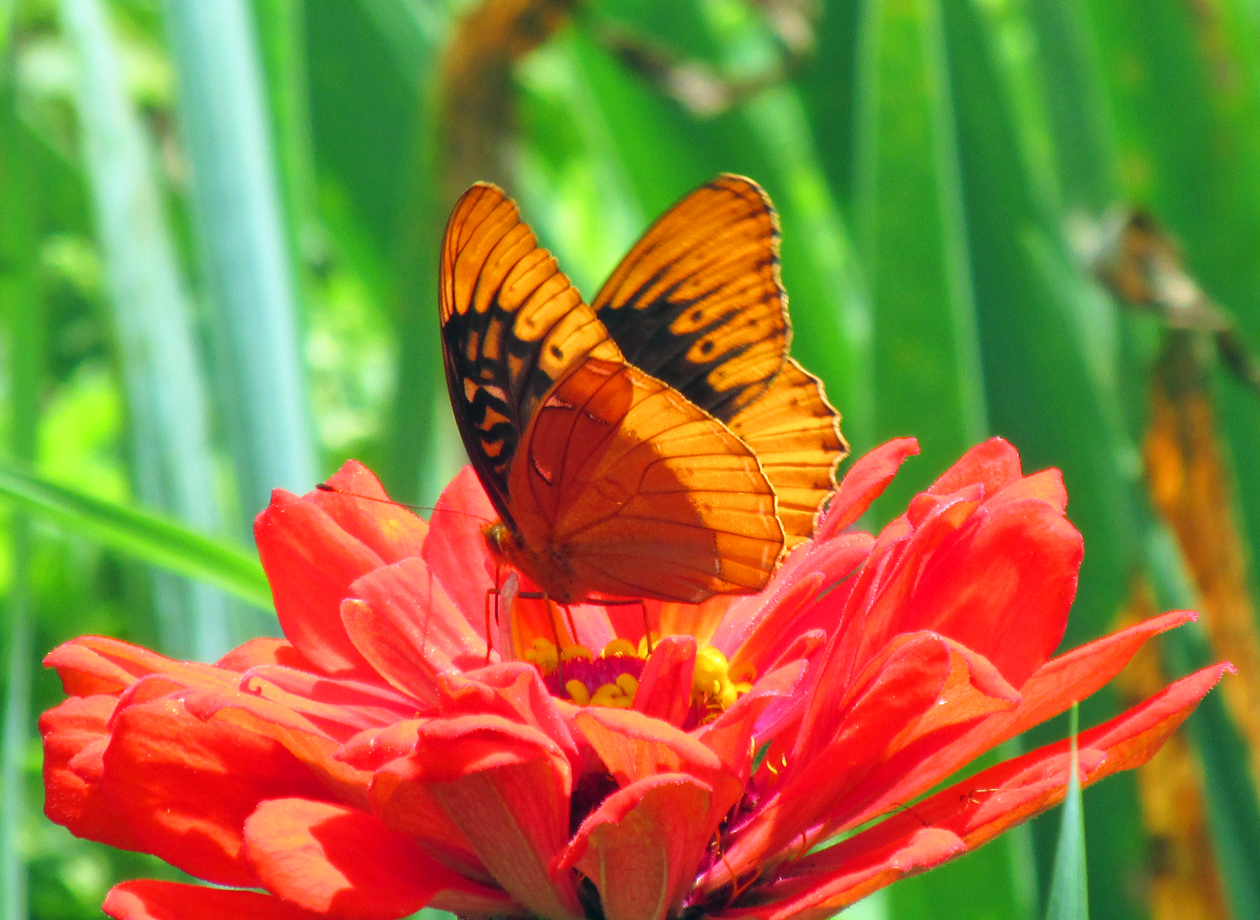
According to NABA, species that move northward each year include Cloudless Sulphur, Little Yellow, Gulf Fritillary, Painted Lady, American Lady, Red Admiral, Common Buckeye, Long-tailed Skipper, Clouded Skipper, Fiery Skipper, Sachem and Ocola Skipper.

In especially good years, one can see Painted Ladies, Cloudless Sulphurs or Clouded Skippers streaming northward along migratory routes. Most years, however, these migrant dispersals are so gradual they don’t attract much notice. During fall trips to coastal South Carolina, I have often noticed hundreds of Cloudless Sulphurs along the edges of the interstate highway system.

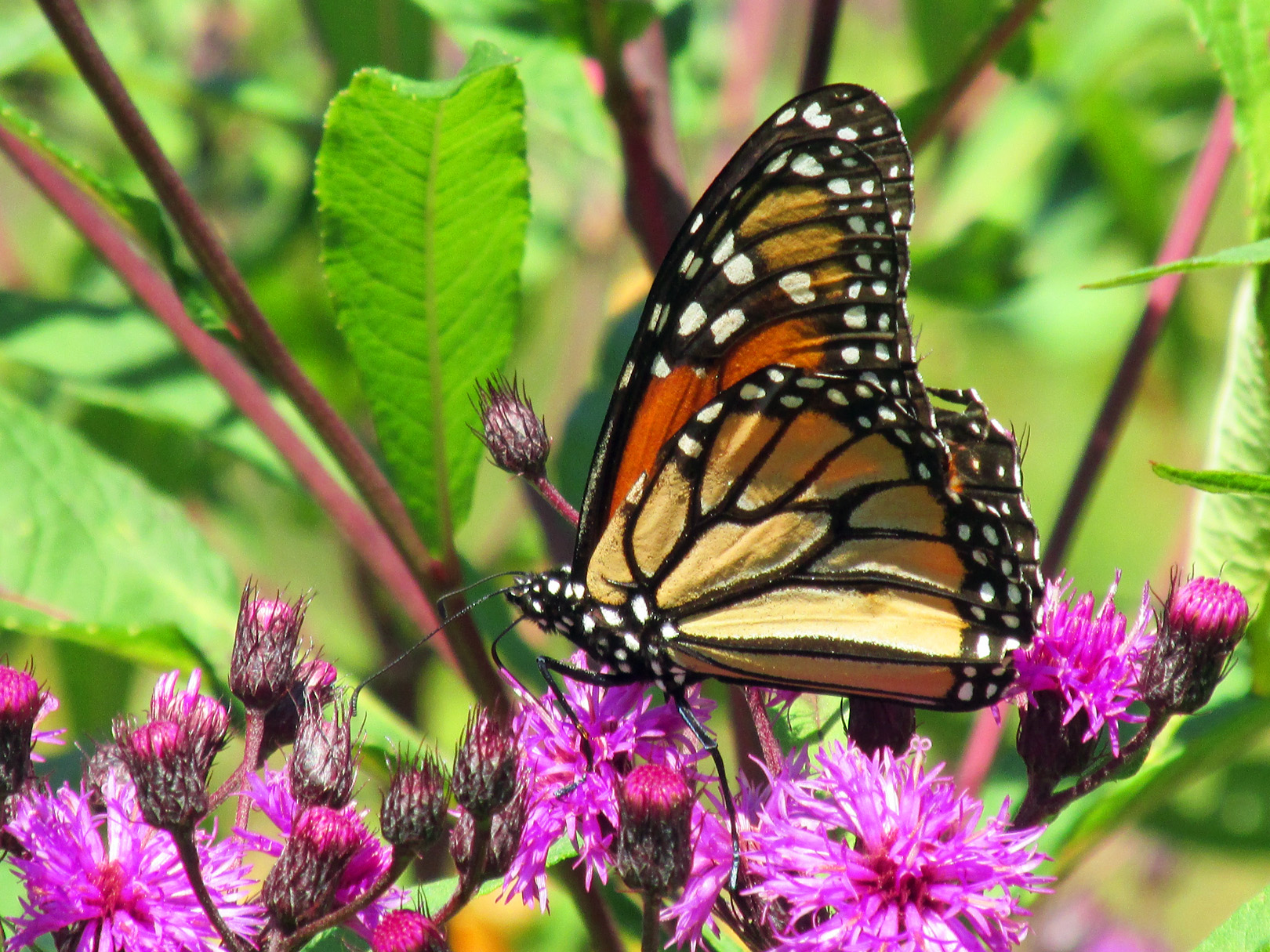
Photo by Bryan Stevens A Monarch sips nectar from blooming Ironweed.

Photo by Bryan Stevens
A Monarch sips nectar from blooming Ironweed.

PipeVineSwallowtails

Photo by Bryan Stevens                            Pipevine Swallowtails seeks nectar from zinnia blooms. This butterfly was the most common one found during the recent Roan Mountain Butterfly Count. A total of 236 individual Pipevine Swallowtails, many located on milkweed in the fields at the Dave Miller Homestead at Roan Mountain State Park, were found.

The North American Butterfly Association holds annual Butterfly Count in much the same manner as the Audubon Society conducts annual Christmas Bird Counts. Locally, an Elizabethton Butterfly Count and a Roan Mountain Butterfly Count are conducted every July and August.

Each count is a compilation of all butterflies observed at sites within a 15-mile diameter count circle in a one-day period. The annually published reports provide a tremendous amount of information about the geographical distribution and relative population sizes of the species counted. Comparisons of the results across years can be used to monitor changes in butterfly populations and study the effects of weather and habitat change on North American butterflies.

This year’s first attempt at conducting the 22nd annual Roan Mountain Butterfly Count was rained out. A week later — July 26 — the count was re-scheduled and enjoyed a convergence of good weather and abundant flowers. A total of 764 individual butterflies were counted. The total of 34 species was considered very high for this count, according to compiler Don Holt.

Diana-Male-Two

Photo by Bryan Stevens                                                                  A male Diana Fritillary seeks nectar from a zinnia bloom.

Holt noted that other common species found on this count included Silver-spotted Skipper, Aphrodite Fritillary, Eastern Tailed Blue and Meadow Fritillary. Some exceptional finds included a male Diana Fritillary at the Dave Miller Homestead and a Harvester at Hampton Creek Cove.

Photo by Bryan Stevens Northern Pearly Eye

Photo by Bryan Stevens                                                                                                                        A Northern Pearly Eye perches on the vertical surface of a concrete step.

CabbageWhite-Joe-Pye

Photo by Bryan Stevens                                                                                                                        The non-native Cabbage White is one of the few butterflies considered an agricultural pest. The butterfly’s caterpillars damage such crops as cabbage, as well as other mustard family plants.

Checkerspot-Dorsal

Photo by Bryan Stevens                                                                                                                              A Northern Checkerspot finds colorful coneflowers a convenient perch.

WoodNymph-ONE

Photo by Bryan Stevens                                                                                                                                A Wood Nymph clings to a leaf near a pond.

To attract more butterflies closer to your home, landscape with a variety of flowers and plants. Don’t forget to provide host plants that will feed hungry caterpillars, as well as nectar-rich flowers to feed adult butterflies. Do not use insecticides! You want to welcome these beautiful insects, not kill them.

To learn more, visit this page provided by the Missouri Botanical Garden.

http://www.missouribotanicalgarden.org/visit/family-of-attractions/butterfly-house/butterflies-and-plants/butterfly-gardening.aspx

LeastSkipper-2

Photo by Bryan Stevens                                                                                                                        The Least Skipper is one of the smallest of butterflies in the eastern United States.

There are several fun Facebook pages for butterfly enthusiasts. Check out https://www.facebook.com/groups/ButterfliesoftheeasternUnitedStates/  and https://www.facebook.com/groups/303259184298/

Red-SpotPurple

Photo by Bryan Stevens                                                                                                                                Red-spotted Purple perches atop a platform provided by a wide poplar leaf.

Buckeye-Spread

Photo by Bryan Stevens                                                                                                                                         A Common Buckeye suns itself in a gravel driveway.

RedAdmiral

Photo by Bryan Stevens                                                                                                                                      Red Admiral in the wetlands along the the Ivy Creek Greenway at George Pierce Park in Suwanee, Ga.


Tennessee sees late-winter ‘red-neck’ invasion

If I wanted to perpetuate a stereotype, I could start off this week’s column with some attempt at humor by noting that Northeast Tennessee has seen more than its share of “rednecks” in recent weeks. No, I’m not talking about the NASCAR fans gathered this weekend at Bristol Motor Speedway!

Of course, in this context I’m referring to a species of grebe that recently staged a remarkable late winter invasion of area lakes and ponds in record numbers.

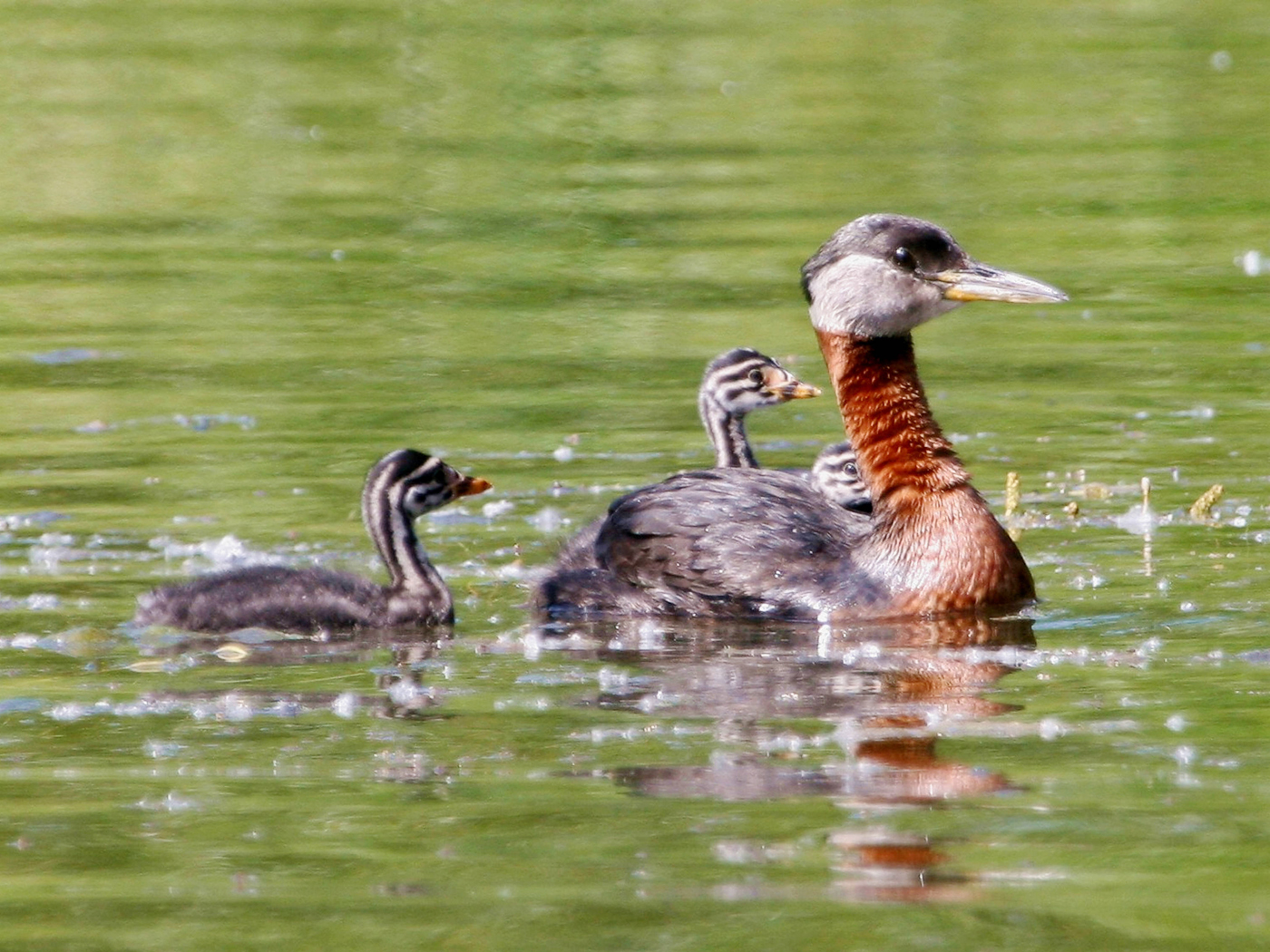
Photo by Donna Dewhurst/U.S. Fish & Wildlife Service A Red-necked Grebe with young is shown on an Alaskan wetland.

Photo by Donna Dewhurst/U.S. Fish & Wildlife Service
A Red-necked Grebe with young is shown on an Alaskan wetland.

Last year, I saw a total of one Red-necked Grebe. Only three months into 2014, I have already seen more than a dozen of these grebes. Although usually rare visitors to Northeast Tennessee, the unusual weather conditions that have already brought such uncommon birds as Long-tailed Ducks, Canvasbacks and Common Mergansers to the region seems to have also resulted in unusually high numbers of Red-necked Grebes in early March throughout the Volunteer State.

The most common grebes for Northeast Tennessee are the Pied-billed Grebe and Horned Grebe. Another species, the Eared Grebe, is an annual but uncommon visitor to South Holston Lake.

The Red-necked Grebe has been reported slightly more often than the Western Grebe, which is known from only a handful of records. In 2012, I added Western Grebe to my state list when I observed this bird at Musick’s Campground at South Holston Lake in late November.

The recent influx of Red-necked Grebes in the Volunteer State record numbers of these birds on various lakes and ponds. The grebes began arriving on March 4.

Rick Knight found 25 Red-necked Grebes found near the dam on Boone Lake. The total of 25 Red-necked Grebes is a Tennessee state record high for that species.

The record didn’t remain in place long. Two days later, Wallace Coffey and Jim Ratchford found 101 Red-necked Grebes on Boone Lake and nine more of these grebes at Fort Patrick Henry Dam.

Sightings have continued from throughout the state, as postings on the Tennessee Birds and Bristol Birds email groups documented the fallout of Red-necked Grebes.

Bryan Musick observed and photographed a Red-necked Grebe on March 5 on Oxbow Lake in Castlewood, Va., in Russell County.

Ron Hoff and Dollyann Myers of Clinton, Tenn., reported a Red-necked Grebe on March 13 at Lenoir City Park, in Loudon County.

Susan Hubley of Rogersville reported a single Red-necked Grebe on John Sevier Lake in Hawkins County on March 15.

Red-necked Grebe reports also came from Chickamauga Lake, Douglas Lake, Melton Hill Dam and Trout Lake along the Blue Ridge Parkway in North Carolina.

I visited Shook Branch Recreation Area on Watauga Lake with my mother on March 5. We found at least a dozen Red-necked Grebes on the lake, as well as a couple of Pied-billed Grebes. All the grebes were too distant for photographs. The next day, however, Tom McNeil reported a Red-necked Grebe on the large pond on the campus of Northeast State Community College in Elizabethton.

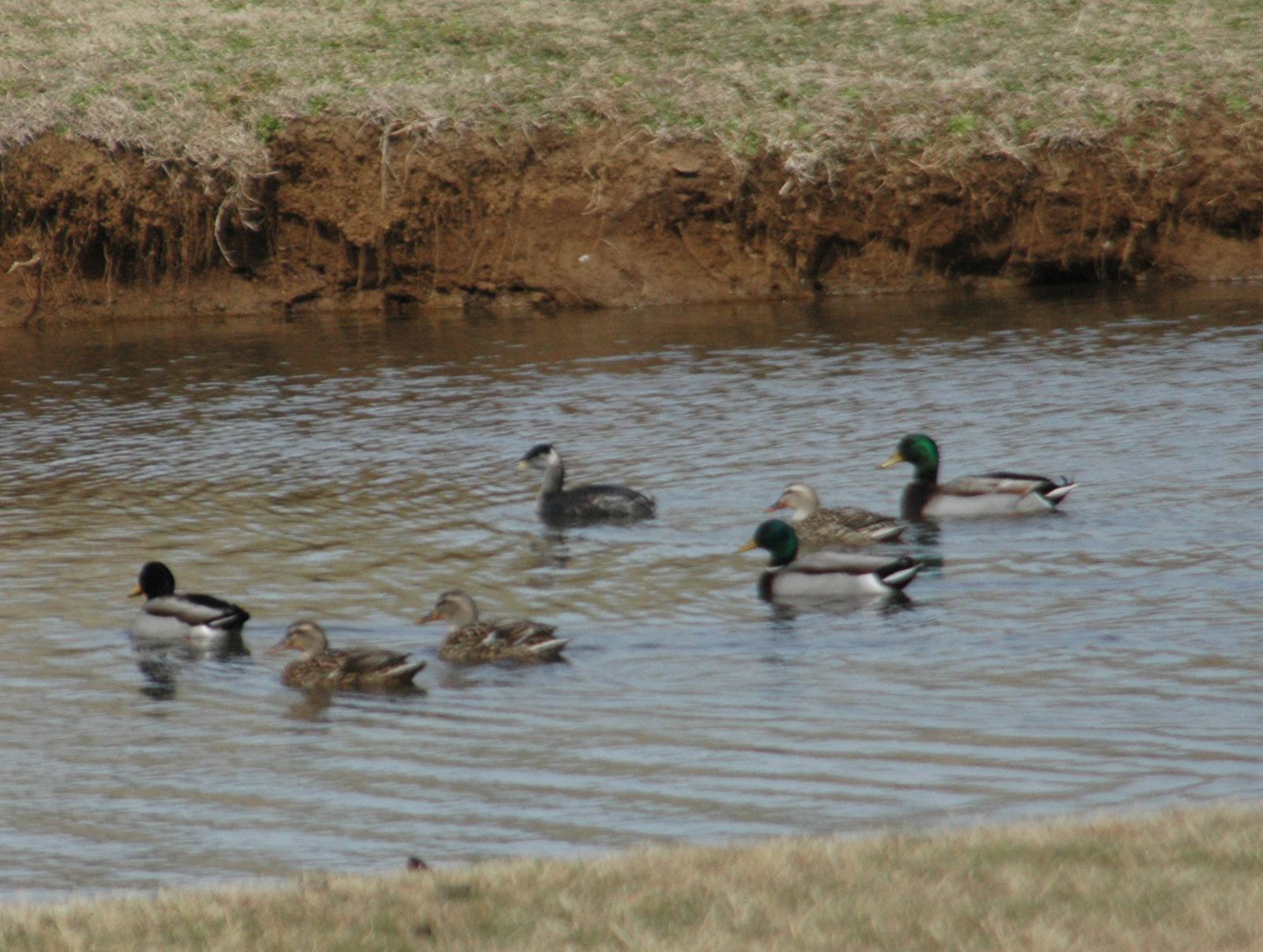
Photo by Bryan Stevens A Red-necked Grebe mixes with Mallards at a pond on the campus of Northeast State Community College in Elizabethton.

Photo by Bryan Stevens
A Red-necked Grebe mixes with Mallards at a pond on the campus of Northeast State Community College in Elizabethton.

My mom and I visited the pond and enjoyed seeing one of these grebes at much closer range. For much of the time, the out-of-place grebe mingled with the Mallards in residence at the pond.

••••••

The Red-necked Grebes that have been visiting Tennessee are likely migrants on their way to summer nesting areas on large freshwater lakes, marshes and other inland bodies of water. This grebe spends the winter on the open ocean or on large lakes.

These aquatic birds feed on a varied died of fish, crustaceans and aquatic insects, as well as some mollusks and amphibians.

The Red-necked Grebe is a rather plain-looked grey bird during the winter season. This bird acquires the distinctive red neck during the breeding season. Males and females look alike. They also sport a black cap and a pale grey face when in their breeding plumage.

Like many grebes, the Red-necked Grebe stages an elaborate courtship display and a wide range of loud mating calls.

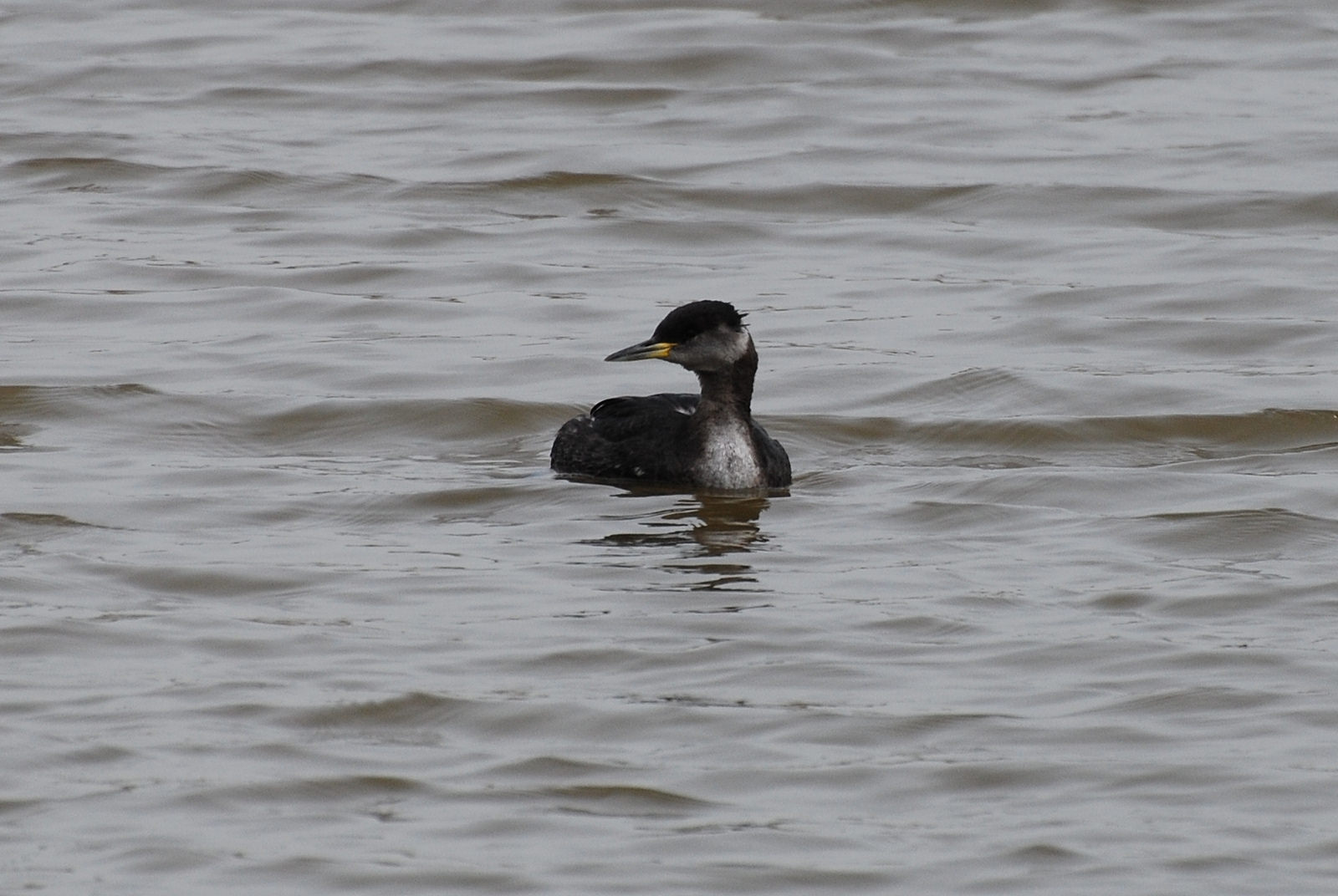
Photo Courtesy of Jean Potter This Red-necked Grebe was one of many observed by birders throughout the region when an unprecedented fallout of this species took place in the first week of March.

Photo Courtesy of Jean Potter
This Red-necked Grebe was one of many observed by birders throughout the region when an unprecedented fallout of this species took place in the first week of March.

Although the bird variety is rare in Northeast Tennessee, “red-neck” birds abound around the world. Some other species would include Red-necked Stint, Red-necked Spurfowl, Red-necked Nightjar, Red-necked Amazon, Red-necked Avocet and Red-necked Phalarope. Actually, the last bird on the list is also an occasional visitor to Tennessee. The others are spread out around the globe.

••••••

Worldwide, there are 22 species of grebes. This family also includes three extinct species — Alaotra Grebe, Atitlán Grebe and Colombian Grebe.

These birds range in size from the Least Grebe, which weighs only about six ounces, to the Great Grebe, which can tip the scales at four pounds.

Other North American grebes include Red-necked Grebe, Eared Grebe, Clark’s Grebe and Western Grebe.

During visits to Utah in 2003 and 2006, I observed the sleek, long-necked Clark’s Grebe and Western Grebe. On my 2006 trip to Utah, I visited Antelope Island State Park and observed tens of thousands of Eared Grebes gathered on the Great Salt Lake for the nesting season.

The grebes most often found in Northeast Tennessee are Pied-billed Grebe and Horned Grebe. In addition, a small number of Eared Grebes have wintered on South Holston Lake in Sullivan County for many years.

Despite the unusually high numbers so far this year, the Red-necked Grebe is only an uncommon winter visitor to the region. I’ve previously observed this grebe on Boone Lake, South Holston Lake and Watauga Lake.

•••••

A week after a female Red-winged Blackbird visited my feeders on March 8, a male Red-winged Blackbird arrived at the fish pond. He immediately claimed a perch in a tall tree and began singing loudly to announce his arrival.

•••••

•••••

I would love to hear from readers. Just post comments on my new blog at ourfinefeatheredfriends.wordpress.com. You can also reach me on Facebook or send email to ahoodedwarbler@aol.com. Please share the link to the blog with others who might be interested in the topic of birds and birding in Northeast Tennessee.

Windows can pose danger to kinglets, other songbirds

A thin pane of glass can be bad news for many of our songbirds. Trees and other vegetation reflected in a glass window can confused birds, leading to window strikes. When startled, birds instinctively take flight for the nearest cover. If a window fools them, they may fly toward perceived shelter only to collide with the unforgiving glass.

Beth-Golden-crownKinglet

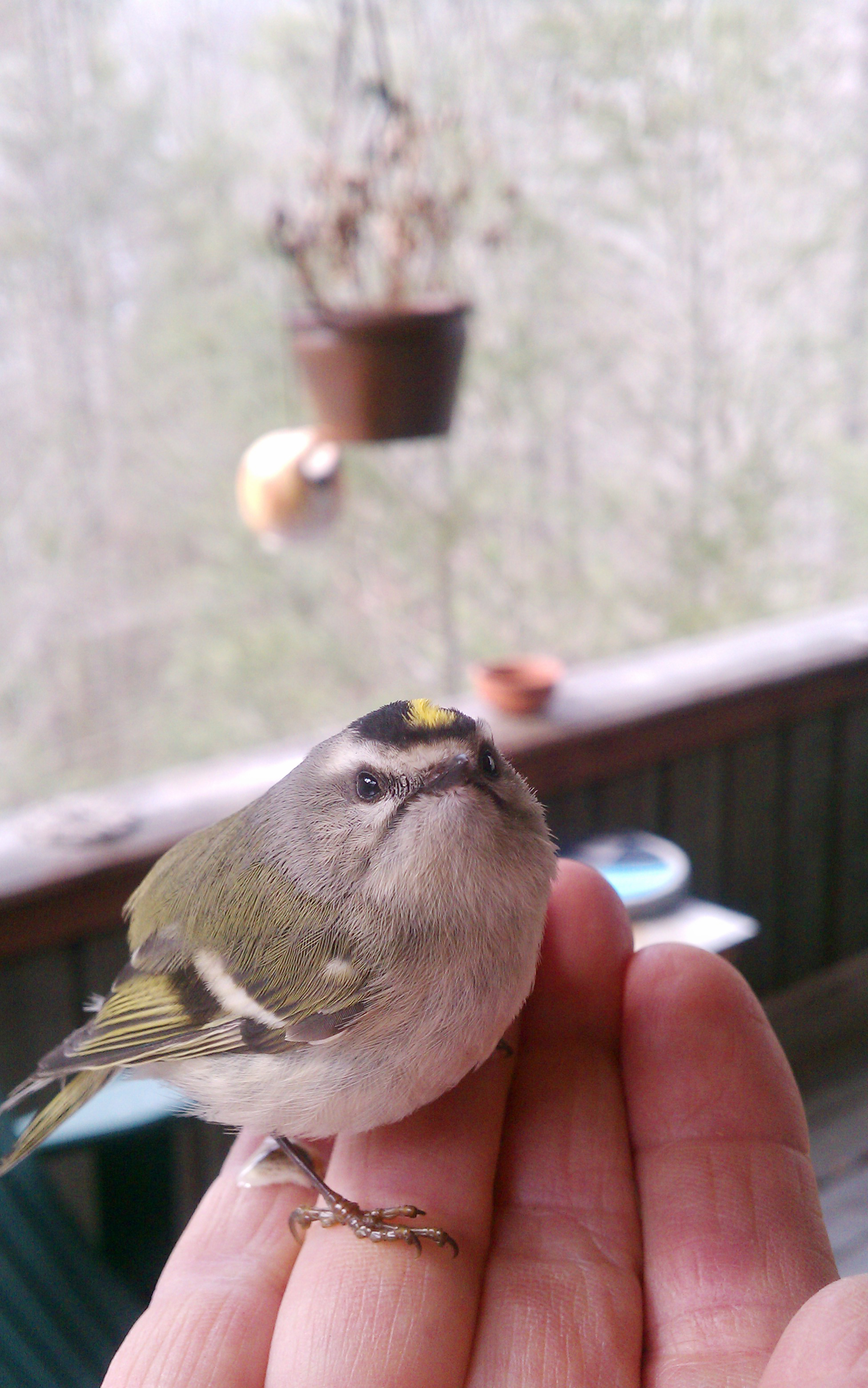
Photo courtesy of Beth McPherson
This Golden-crowned Kinglet recovered after a collision with a window. Not all birds are so lucky after striking windows, which they have difficulty seeing.

That’s apparently what happened last week at the home of one of my neighbors. According to some estimates, millions of birds perish each year from window strikes. At least the story I’m sharing this week has a happy ending.

I received an email and photo this past week from my Simerly Creek neighbor, Beth McPherson. Beth and her husband, Steve, have a wonderful home on Simerly Creek Road in Hampton. Surrounded by woodlands, their home is like a magnet for a variety of birds.

“I have another simple bird for you to identify,” Beth wrote in her email.

She explained that the bird ran into a window at her home. Fortunately, after a brief rest on her upper porch, the bird recovered completely from its impact with the window.

She described the bird as not much bigger than a hummingbird and estimated that the bird was 3 inches long and about 1.5 inches wide.

“Is it a warbler?” Beth asked.

Actually, although warbler was a good guess, Beth’s bird was a member of a family of tiny birds known as kinglets and firecrests.

Her bird turned out to be a Golden-crowned Kinglet, a fairly common winter visitor. All the large hemlock trees on Beth’s property are probably very attractive to visiting kinglets.

There are two types of kinglets present in Northeast Tennessee, including the Golden-crowned Kinglet and the Ruby-crowned Kinglet. They are indeed very tiny birds, as well as extremely active ones. They are also the only member of this family of birds found in North America.

Four other species, however, are native to Europe, Asia and North Africa. The remaining species include Goldcrest, Common Firecrest, Madeira Firecrest and Flamecrest, which is also known as the Taiwan Firecrest.

It was significant that Beth compared the small size of the kinglet that hit her window to  hummingbirds, which are probably the only birds that are smaller than kinglets.

The kinglets belong to the family, Regulidae, and the genus, Regulus. The family and genus names are derived from a Latin word, regulus, which means “rex,” or “king.” The name was apparently inspired by the colorful crown patches, often red, orange or gold, that resembled the royal “crowns” of kings.

Although similar in size and overall coloration, the Ruby-crowned and Golden-crowned Kinglets are easily distinguished from each other.

Side by side, the two species of North American Kinglets are easy to distinguish. The Golden-crowned Kinglet has a striped facial pattern formed by bold black and white stripes. The Ruby-crowned Kinglet, on the other hand, has a bold white eye ring but not striping. The Golden-crowned Kinglet has an orange crown patch, while the Ruby-crowned Kinglet has a red crown patch that is, more often than not, kept concealed.

Kinglets are active birds, foraging vigorously for small insects, and spiders. When foraging, both kinglet species have a habit of flicking their wings over the backs. Even if you can’t get a good look at the birds, this behavior helps contrast them from other small birds.

Golden-crowned Kinglets are widespread in the region during the winter. During the summer months, head to the slopes of Roan Mountain to look for these tiny birds that nest in the higher elevations of the Appalachian Mountains.

Kinglets don’t typically visit feeders, but they do tend to join mixed flocks with membership consisting of such species as Tufted Titmouse, Carolina Chickadee and White-breasted Nuthatch. When traveling with such flocks, kinglets may visit the space around feeders but rarely take seeds or other fare offered at feeders.

••••••

If you’ve ever experience repeated window strikes at your home, the American Bird Conservancy offers some helpful tips for avoiding this tragedy. Just click the following link to learn more how to avoid window strikes:

Click to access collisions_flyer.pdf

••••••

I enjoyed receiving the email from Beth. I would love to hear from other readers, too. Just post comments on my new blog at ourfinefeatheredfriends.wordpress.com. You can also reach me on Facebook or send email to ahoodedwarbler@aol.com. Please share the link to the blog with others who might be interested in the topic of birds and birding in Northeast Tennessee.