Tag Archives: Erwin Record

American robin named for European counterpart


Photo by Andrew Poynton/Pixabay.com • The European robin is a common garden bird in Great Britain and other countries in Europe. The American robin was given its common name when early English colonists were reminded of their own robin back in the Old World. 

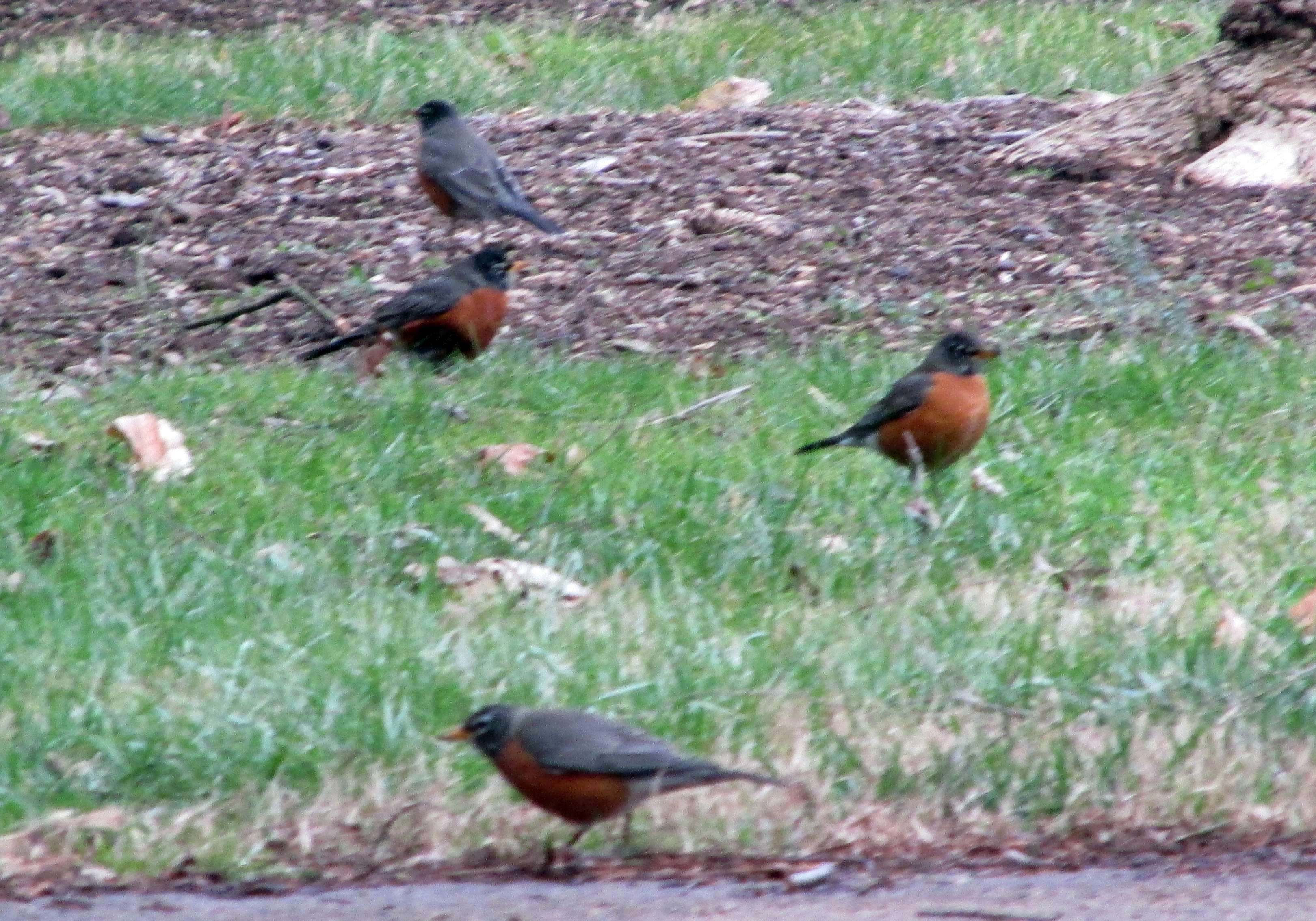
I received emails recently from Terry Fletcher, who lives on Vance Drive in Bristol, and Ernie Marburg from Abingdon, Virginia. Both emails involved flocks of birds, including American robins and cedar waxwings.

The past two days the robins have been going crazy in my small yard,” Terry wrote. “I live in a woodland area off Vance Drive.”

Terry described a flock of at least 40 robins passing through the relatively small yard. “They were also darting back and forth among the trees,” Terry wrote. “Any thoughts about this flurry of activity?

Ernie Marburg also sent me an email with a query about robins and waxwings.

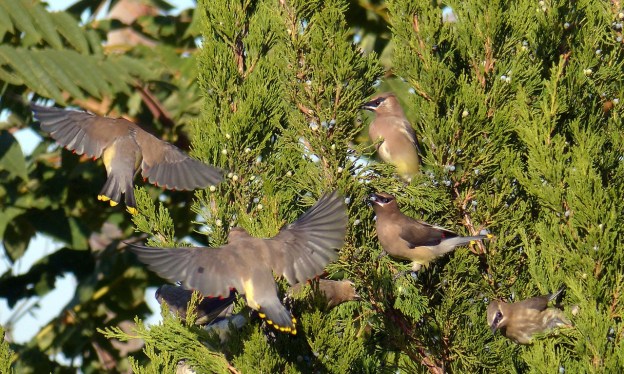
“I haven’t had much to report recently, but yesterday and today I had large flocks of migrating birds,” Ernie noted. “Yesterday’s flock of cedar waxwings was extremely large.”

Ernie estimated the flock consisted of 400 to 500 individuals. He added that the flock rested for a time in his neighbor’s large oak trees and then went on its way.

Photo by Bryan Stevens • A cedar waxwing perches on a branch.

“The flock today was less exciting for me, but somewhat even larger than the waxwings,” Ernie noted. The second flock consisted mostly of European starlings with a few American robins in the mix.

Ernie observed the starlings in some neighboring dogwoods as they consumed red berries. His question involved the migration habits of the starlings, waxwings and robins.

The fact is that, although we don’t think of robins very much in winter, they are still very much present in the region. The same is true of waxwings and is particularly true about starlings.

Terry’s wooded area sounds perfect for robins in winter. In the colder months of the year, robins form large, loosely organized flocks, often taking up residence in wooded lots. Ernie’s neighborhood also sounds like a perfect haven for these flocking birds.

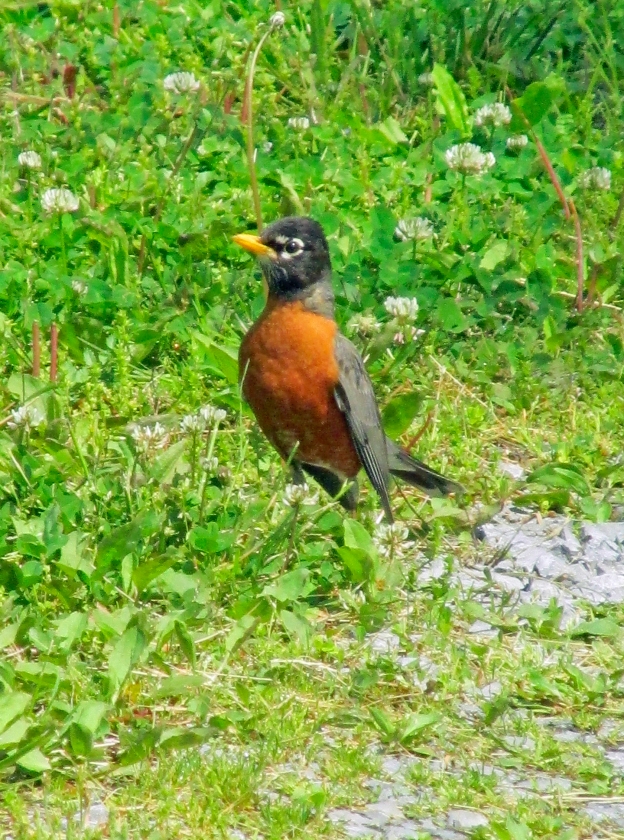
Photo by Bryan Stevens • An American robin scans for prey in the grass and clover of a lawn.

The activity observed by Terry is just the way robins behave at time. The activity could have been an example of the birds sensing the approach of a weather front. The robins, reacting to changing conditions, were simply attempting to feed as much as they could before a change in the weather. arrived.

The American robin is a large bird in the thrush family, which in North America also includes such birds as Eastern bluebird, wood thrush, and Townsend’s solitaire.

In the British Isles, the European robin is simply known as “robin” or “robin redbreast.” When the first English colonists arrived in New England and other parts of colonial-era North America, they took pleasure in finding that some of the birdlife in the New World resembled familiar birds from their homeland. The red-breasted American robin looked like the bird they knew in the Old World as “robin,” which motivated them to name the New World bird “robin,” as well.

Other than the red breast, however, the two robins are not all that similar. The American robin is the larger of the two birds. Farther separating these two birds is the fact that the European robin is not a thrush but rather a member of the family of Old World flycatchers.

Photo by PublicDomainPhotos/Pixabay.com • A European robin sings from a perch.

In some ways, the two robins are similar. Both are fond of earthworms, spending a great deal of their time on the ground foraging for worms. They will also follow human gardeners at their work, waiting patiently for the followed person to disturb the soil with a spade or hoe and expose earthworms for the waiting bird. They are also rather tolerant of humans and have learned to make their own homes close to human dwellings.

Some of the British transplants to North America must have felt homesick for familiar things because several unsuccessful attempts were made to introduce the European robin to the United States and Canada. European robins introduced in New York and Oregon failed to gain a foothold, unlike the introduction of such alien birds as the house sparrow and European starling.

On a few occasions, our American robins have overflown their destinations and ended up in the United Kingdom. For instance, an American robin became a first for London birdwatchers when one was found in that nation’s capital city in March of 2006. Whether of the European or American persuasion, robins have long been a favorite of birdwatchers and nature enthusiasts.

Photo by Bryan Stevens • An American robin perches on a tree branch and surveys its surroundings.

Success of wild turkey’s resurgence leads to foul fowls in New England

Photo by Avia5/Pixabay.com • A male wild turkey, often referred to as a “tom” or a “gobbler,” fans his tail in a display meant to impress hens and intimidate other males.

Celebrated in William Bradford’s written account of the First Thanksgiving in 1621, the wild turkey had all but vanished from Massachusetts and the rest of New England a mere two centuries later. By the time of Henry David Thoreau, who is arguably America’s first environmentalist, the noted author lamented in 1856 that the turkey and other wildlife were difficult to find in his native Massachusetts.

In a journal entry from the spring of 1856, Thoreau decried the part the descendants of those Pilgrims who celebrated the first Thanksgiving more than 200 years earlier had played in the decimation.

“When I consider that the nobler animals have been exterminated here — the cougar, the panther, lynx, wolverine, wolf, bear, moose, dear, the beaver, the turkey and so forth and so forth, I cannot but feel as if I lived in a tamed and, as it were, emasculated country,” Thoreau wrote in his journal. “Is it not a maimed and imperfect nature I am conversing with?”

Henry David Thoreau

Perhaps, but Thoreau would probably be encouraged that many of the animals he mentioned in his journal have now recovered and once again roam throughout New England. The wild turkey has been in the vanguard of that resurgence. In fact, the revival of the wild turkey’s fortunes in New England has had unintended consequences. In short, this venerable fowl has run amok in some parts of its former stronghold.

An article by Brianna Abbott for the Audubon Society’s website estimates that before Europeans first colonized New England in the 1600s, as many as 10 million wild turkeys roamed from Maine to Florida to the Rocky Mountains of the American West.

Today, wild turkeys are back with a vengeance. Turkeys may have grievances, it turns out, for the persecution they suffered at the hands of Americans for the past few centuries. Touted as a major restoration success story, the wild turkey began to be reintroduced to New England about half a century ago.

Now that they’re back, turkeys are part of a dramatically changed landscape. Suburbs now stretch in wide swaths of terrain that once supported forests and associated wildlife. Luckily — for the turkey, anyway — it is a very adaptable bird. Turkeys have taken to life in the suburbs with such enthusiasm that they are now a wildlife management issue for the human residents who must share living space with them. Emboldened problem turkeys chase and intimidate women and small children, as well as pets. Whole flocks have gone rogue.

Photo by Bryan Stevens • Wild turkeys forage on a hillside.

Gone are the turkey’s natural predators — lynxes, cougars and wolves — that had kept America’s premier game bird’s population in balance. As Thoreau pointed out, nature is no longer perfect. More than 170,000 wild turkeys now live in New England and they’re not always at peace with their human neighbors.

Thoreau didn’t have the benefit of environmental science to back him up, but he would probably not be surprised that a “maimed” nature is causing some unexpected problems even as some of the animals he so sorely missed are returning to their former haunts.

The Tennessee Watchable Wildlife Website notes that the wild turkey was once nearly eliminated from the Volunteer State. By the early 1900s, over-hunting eliminated this species from most of its range, including much of Tennessee. Modern wildlife management has reestablished this bird throughout its historic range and into 49 of the 50 United States.

Photo by Bryan Stevens • Wild turkeys have re-established themselves in many areas across the United States, including New England.

According to the website, the natural habitat for the wild turkey consists of mature woodlands with scattered openings or fields. In such areas, turkeys can forage for food such as acorns and other wild nuts, seeds, fruits, insects, buds, fern fronds and even the occasional salamander.

Wild turkeys roam the woods around my home, and I know of other areas that are dependable locations for observing these birds. While their numbers are increasing, the wild turkey has not yet turned the tables. For the foreseeable future, I suspect Americans will continue to dine on turkey every Thanksgiving, and not the other way around.

Who could blame them, however, if turkeys were to feel perfectly justified in biting back at the American public? We’ve not always been the best stewards for our native wildlife. Call me an optimist. I believe turkeys and people can co-exist. As residents in New England have learned, we just have to be prepared for some give and take.

Photo by Bryan Stevens • A male gobbler seeks the attention of hens, as all these Wild Turkeys add to the number of this species found during the count.

Fall bird count celebrates 50 consecutive years, finds 118 species

Photo by Bryan Stevens  • Chipping sparrows, such as this individual, showed up for the Fall Bird Count in good numbers.

The 50th consecutive Elizabethton Fall Bird Count was held on Saturday, Oct. 5, with 29 observers in eight parties. Participants tallied 118 species, which is below the recent 30-year average of 125 species. Windy conditions throughout the day and dense fog on the higher mountain tops contributed to the reduced variety. The all-time high on this count was 137 species in 1993.

The yearly survey is not limited to Carter County and Elizabethton. The long-running count includes parts of the adjacent counties of Unicoi, as well as Johnson Sullivan and Washington.

The total follows:

Canada Goose, 635; Wood Duck, 97; Mallard,173; Blue-winged Teal, 30; and Green-winged Teal, 3;

Ruffed Grouse, 3; Wild Turkey, 56; Common Loon, 1; Pied-billed Grebe, 7; Double-crested Cormorant, 10; and Great Blue Heron, 35.

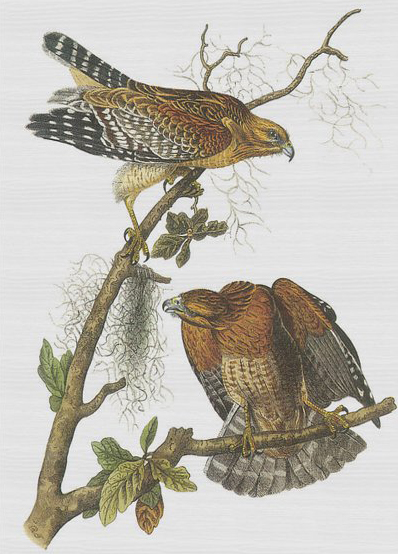
Black Vulture, 78; Turkey Vulture, 139; Osprey, 7; Northern Harrier, 3; Sharp-shinned Hawk, 2; Cooper’s Hawk, 9; Bald Eagle, 12; Red-shouldered Hawk, 5; Broad-winged Hawk, 2; and Red-tailed Hawk, 13.

Killdeer, 35; Spotted Sandpiper, 1; Lesser Yellowlegs, 1; Ring-billed Gull, 1; Rock Pigeon, 402; Eurasian Collared-Dove, 1; Mourning Dove, 153; and Yellow-billed Cuckoo, 1.

Eastern Screech-Owl, 10; Great Horned Owl, 5; Barred Owl, 2; Chimney Swift, 244; Ruby-throated Hummingbird, 7; and Belted Kingfisher, 24.

Photo by Bryan Stevens • Eastern Screech-owls, such as this individual, were the most numerous of the owls found on this year’s Fall Bird Count.

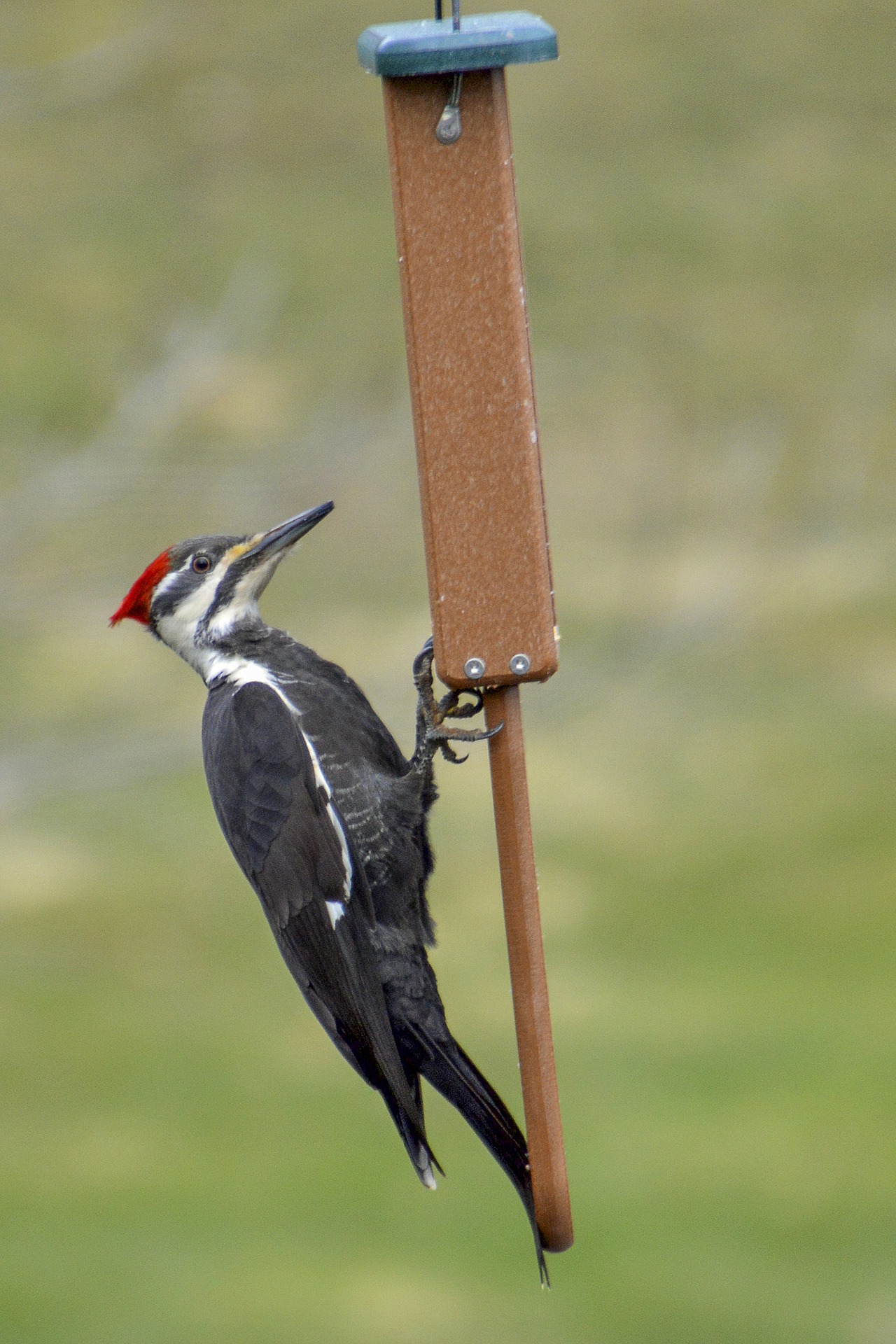
Red-headed Woodpecker, 2; Red-bellied Woodpecker, 50; Yellow-bellied Sapsucker, 7; Downy Woodpecker, 36; Hairy Woodpecker, 6; Northern Flicker, 41; and Pileated Woodpecker, 17.

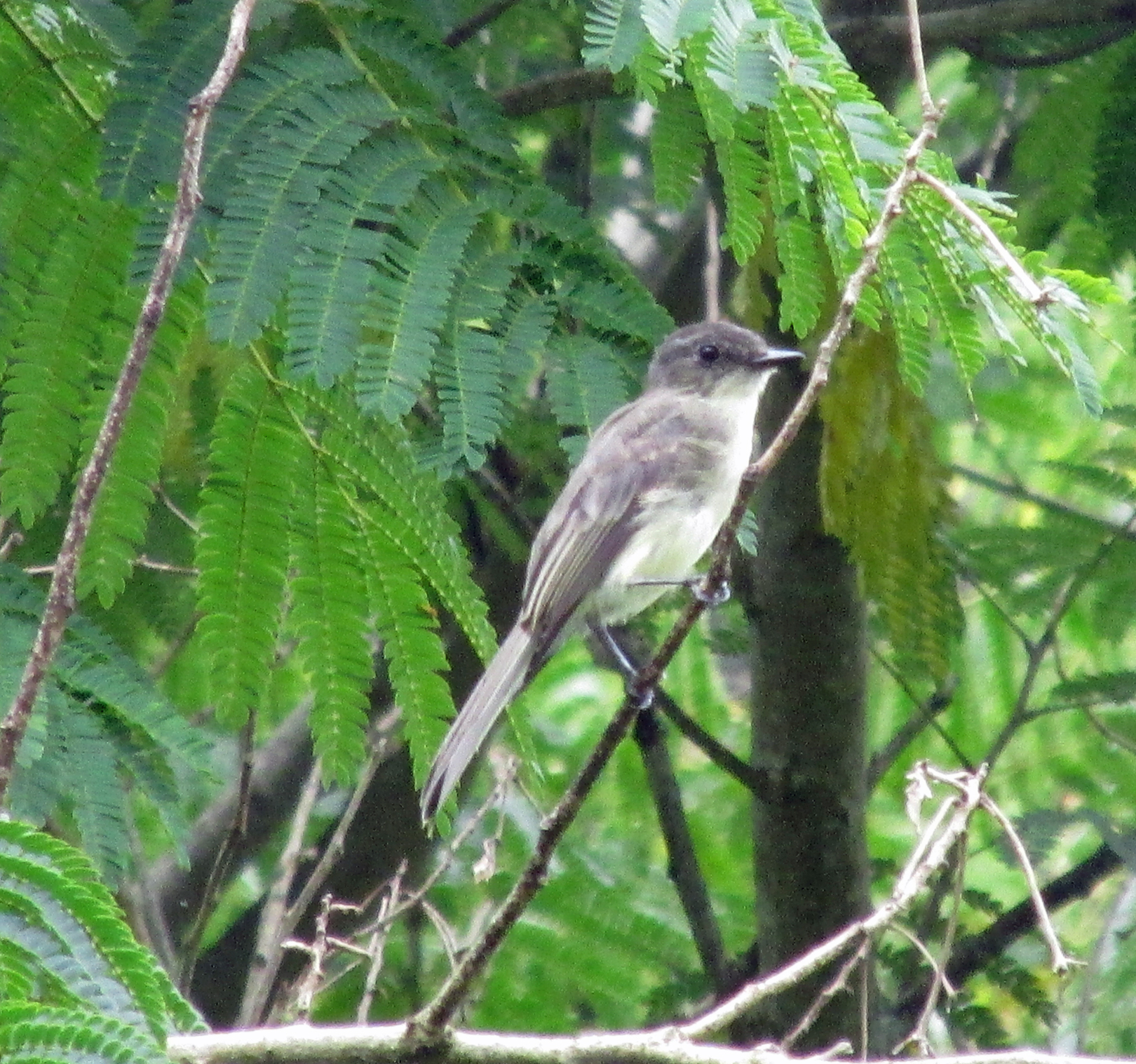
American Kestrel, 16; Merlin, 2; Peregrine Falcon, 1; Eastern Wood-Pewee, 12; Least Flycatcher; 1; and Eastern Phoebe, 82.

Yellow-throated Vireo, 1; Blue-headed Vireo, 18; Philadelphia Vireo, 1; Red-eyed Vireo, 7; Blue Jay, 347; American Crow, 442; and Common Raven, 10.

Tree Swallow, 118; Carolina Chickadee,141; Tufted Titmouse, 82; Red-breasted Nuthatch, 6; White-breasted Nuthatch, 28; Brown Creeper; 1; Winter Wren, 2; Marsh Wren, 1; and Carolina Wren, 114.

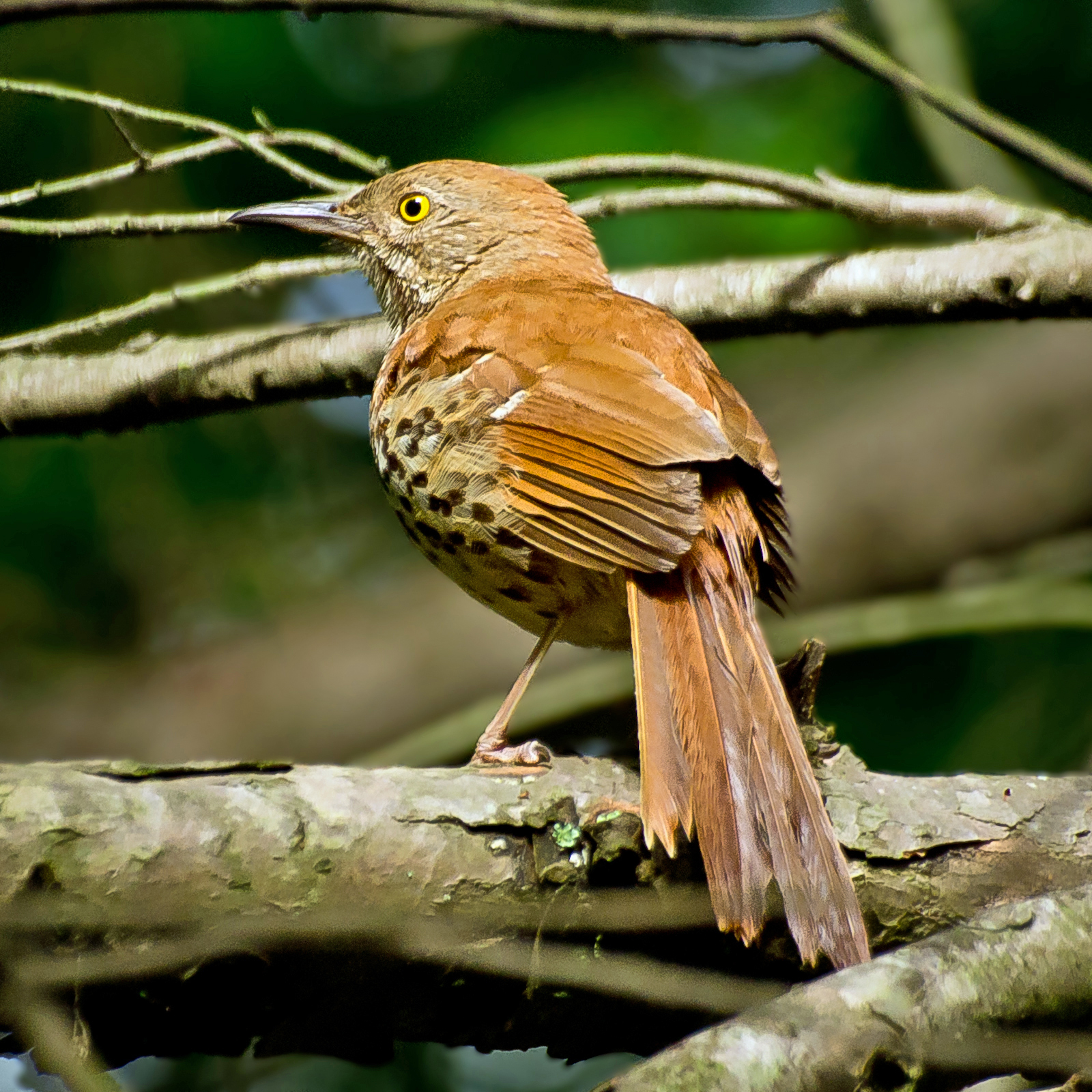
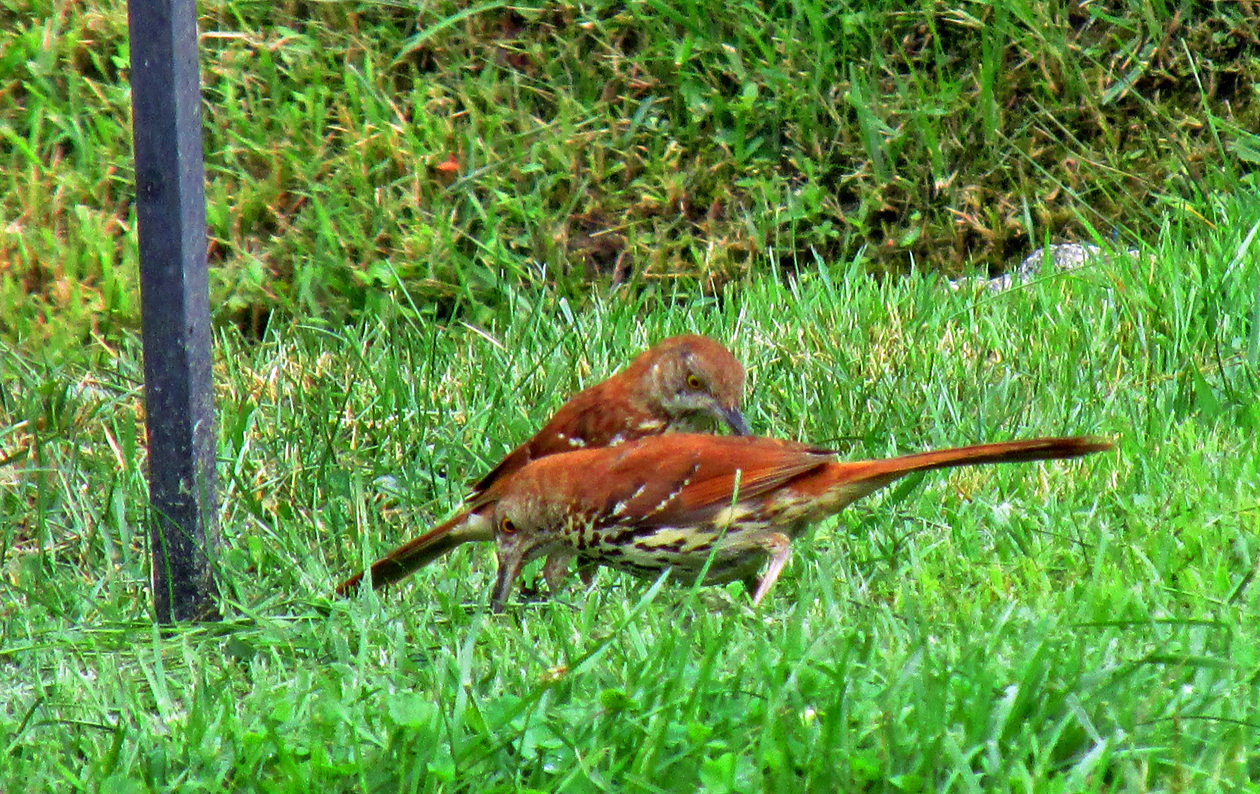
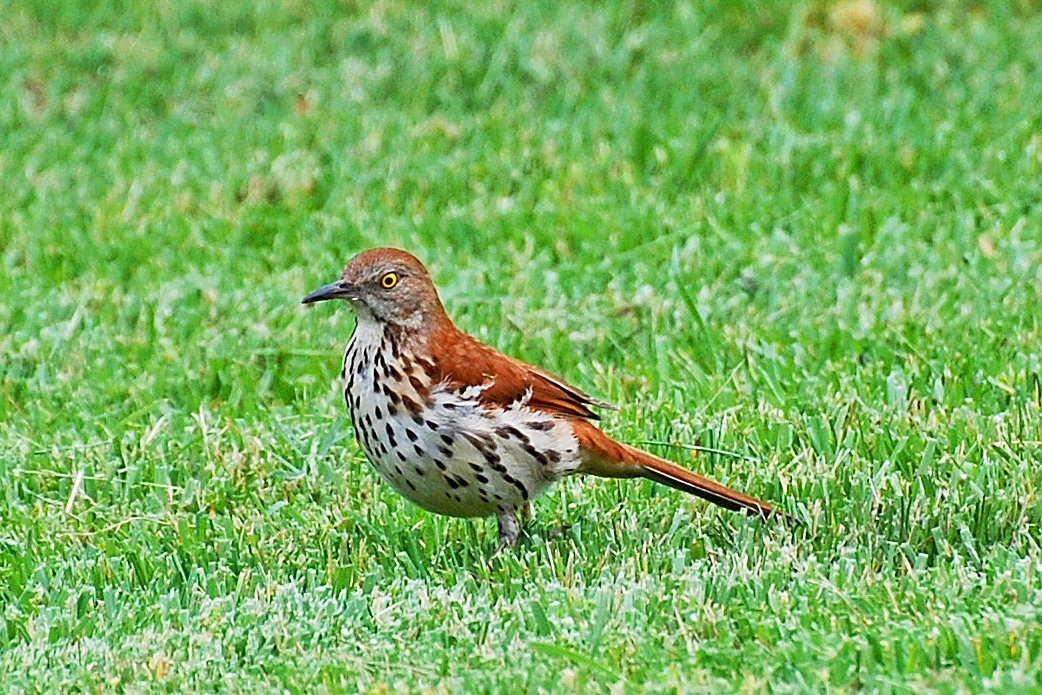
Golden-crowned Kinglet, 5; Ruby-crowned Kinglet, 1; Eastern Bluebird, 114; Veery, 1; Gray-cheeked Thrush, 6; Swainson’s Thrush, 37; Wood Thrush,15; American Robin, 212; Gray Catbird, 23; Brown Thrasher, 9; Northern Mockingbird, 56; Eurasian Starling, 555; and Cedar Waxwing, 70.

Ovenbird, 3; Northern Waterthrush, 3; Black-and-white Warbler, 4; Tennessee Warbler, 51; Kentucky Warbler, 1; Common Yellowthroat, 6; Hooded Warbler, 3; American Redstart, 7; Cape May Warbler, 1; Northern Parula, 4; Magnolia Warbler 6; Bay-breasted Warbler, 36; Blackburnian Warbler, 4; Chestnut-sided Warbler, 4; Blackpoll Warbler, 4; Black-throated Blue Warbler, 8; Palm Warbler, 56; Pine Warbler, 3; Yellow-rumped Warbler, 4; Yellow-throated Warbler, 2; and Black-throated Green Warbler, 7.

Photo by Bryan Stevens • Male American redstarts are unmistakable warblers in their orange, black and white plumage.

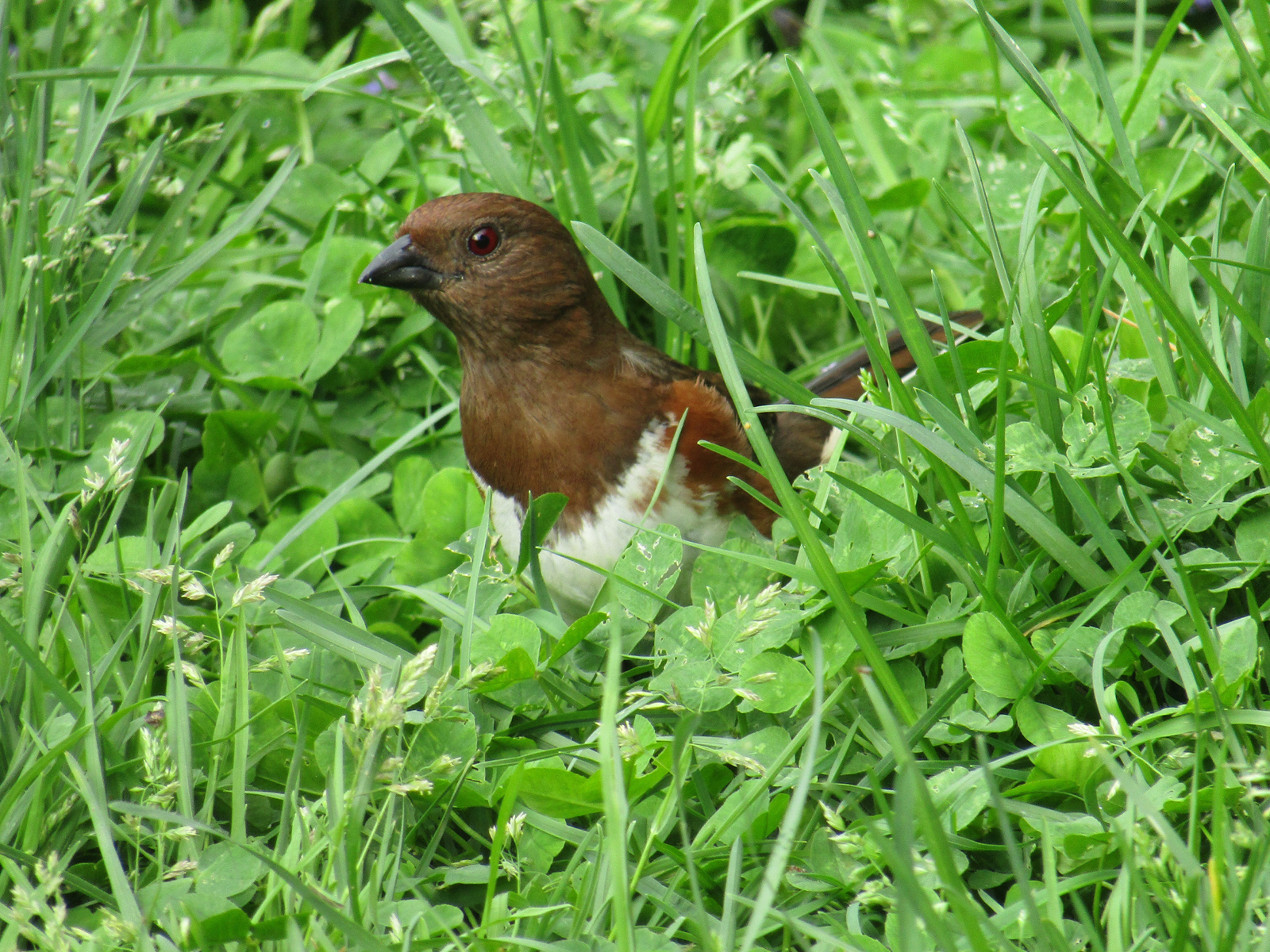
Eastern Towhee, 53; Chipping Sparrow, 46; Field Sparrow, 11; Savannah Sparrow, 2; Song Sparrow, 126; Swamp Sparrow, 4; and Dark-eyed Junco, 73.

Scarlet Tanager, 5; Northern Cardinal, 120; Rose-breasted Grosbeak, 67; Blue Grosbeak, 1; and Indigo Bunting, 27.

Red-winged Blackbird, 194; Eastern Meadowlark, 14; Common Grackle, 1; Brown-headed Cowbird, 11; House Finch, 36; Pine Siskin, 8; American Goldfinch, 99; House Sparrow, 19.

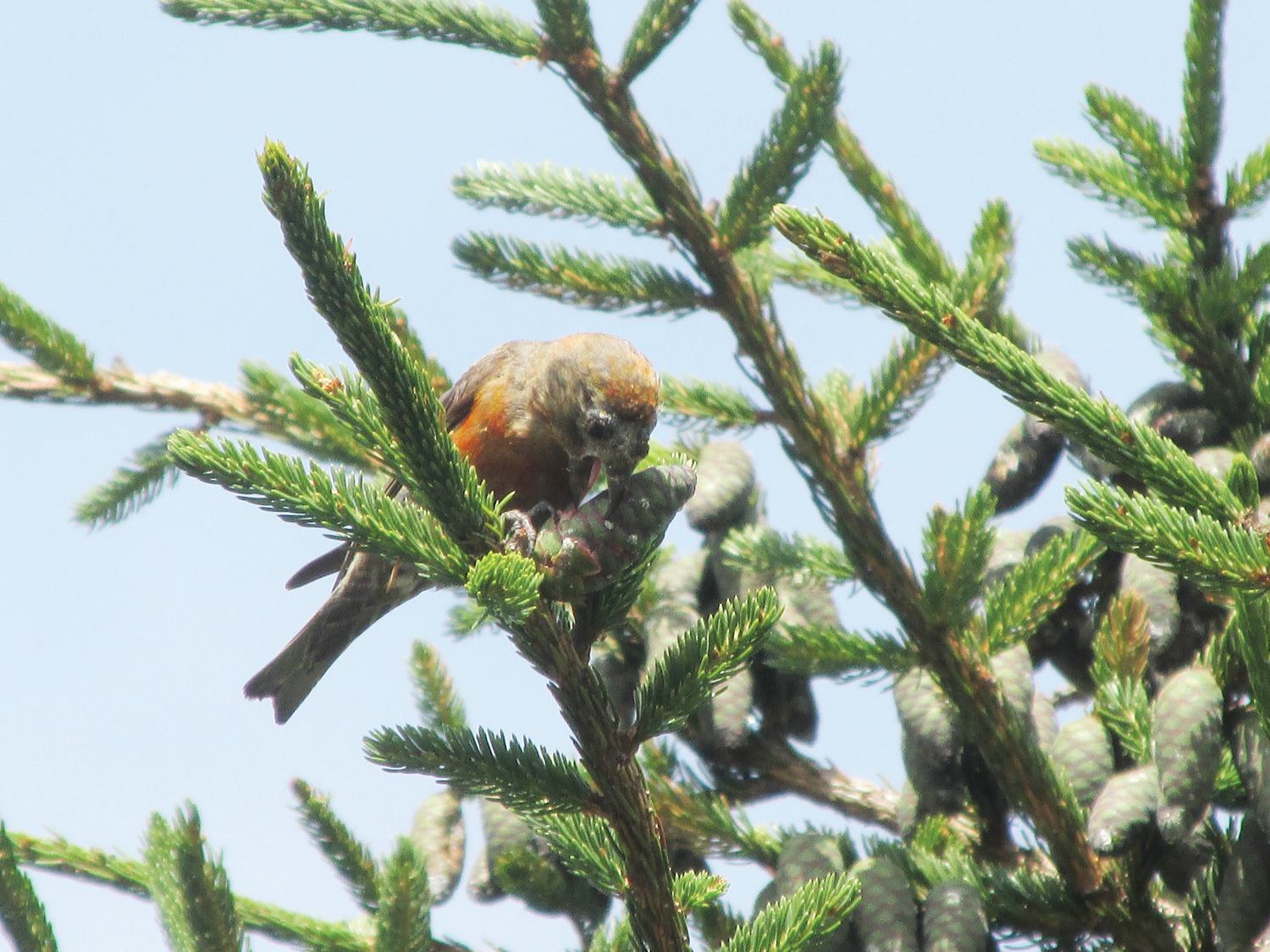
Long-time count compiler Rick Knight spotlighted some notable misses, including Green Heron, Common Nighthawk, Eastern Kingbird, Loggerhead Shrike, White-eyed Vireo, Barn Swallow, House Wren, Blue-gray Gnatcatcher, Hermit Thrush, Prairie Warbler, Lincoln’s Sparrow and Red Crossbill.

“The crossbills were missed because Roan Mountain was completely socked in with fog all day,” Knight explained. He added that only a few shorebirds were found partly due to shortage of habitat as well as the drought in the region at the time of the count.

Photo by Bryan Stevens • Wild turkeys often form flocks in autumn and early winter.

Winter’s dark-eyed junco provided inspiration for first column

Photo by Skeeze/Pixabay.com • The dark-eyed junco is a fairly common winter resident in the region. Rather widespread, different races of the dark-eyed junco are found throughout the North American continent.

I wrote my first bird column on Sunday, Nov. 5, 1995, which means this weekly column will mark its 24th anniversary this week. This column has appeared over the last 20 years in a total of six different newspapers, which I regard as a personal achievement as well as an accomplishment for our feathered friends. It’s on their behalf that I pen these weekly efforts to promote conservation and good will toward all birds. “For the Birds” has appeared in the Bristol Herald Courier since June of 2014.

Photo by Bryan Stevens •  Dark-eyed Juncos often delay their winter arrivals to the first snows of the season.

I’ve played detective, helping people identify everything from “rain crows,” or cuckoos, to Muscovy ducks and double-crested cormorants. I’ve observed unusual birds, including white pelican, brant and roseate spoonbill, in Northeast Tennessee and Southwest Virginia and spotlighted them in these columns. I still take delight in the kaleidoscopic parade of colorful warblers that pass through the region each spring and fall as well as the fast-paced duel of ruby-throated hummingbirds. I also offers to sunflower seed and other supplemental food for the resident birds like Carolina chickadees and white-breasted nuthatches.

Photo by Bryan Stevens • Known as “snowbirds,” Dark-eyed Juncos are hardy birds even in the winter season.

My first column focused on a common visitor to yards and feeders during the winter months. In fact, dark-eyed juncos should be returning to the region any day. Here, with some revisions I have made through the years, is that first column.

•••••

Of all the birds associated with winter weather, few are as symbolic as the dark-eyed junco, or “snow bird.” The junco occurs in several geographic variations.

John V. Dennis, author of “A Complete Guide to Bird Feeding,” captures the essence of the junco in the following description: “Driving winds and swirling snow do not daunt this plucky bird. The coldest winter days see the junco as lively as ever and with a joie de vivre that bolsters our sagging spirits.” The dark-eyed junco’s scientific name, hyemalis, is New Latin for “wintry,” an apt description of this bird.

Most people look forward to the spring return of some of our brilliant birds — warblers, tanagers and orioles — and I must admit that I also enjoy the arrival of these birds. The junco, in comparison to some of these species, is not in the same league. Nevertheless, the junco is handsome in its slate gray and white plumage, giving rise to the old saying “dark skies above, snow below.”

Just as neotropical migrants make long distance journeys twice a year, the junco is also a migrating species. But in Appalachia, the junco is a special type of migrant. Most people think of birds as “going south for the winter.” In a basic sense this is true. But some juncos do not undertake a long horizontal (the scientific term) migration from north to south. Instead, these birds merely move from high elevations, such as the spruce fir peaks, to the lower elevations. This type of migration is known as vertical migration. Other juncos, such as those that spend their breeding season in northern locales, do make a southern migration and, at times, even mix with the vertical migrants.

During the summer months, a visit to higher elevations in southwest Virginia such as Whitetop Mountain or Mount Rogers is almost sure to produce sightings of dark-eyed juncos. Juncos may nest as many three times in a season. A female junco usually lays three to six eggs for each nest, which she constructs without any assistance from her mate.

Photo by Ken Thomas •  Dark-eyed Juncos are also known as “snow birds” because of their tendency to flock to feeders ahead of a bout of snowy weather.

Juncos are usually in residence around my home by early November. Once they make themselves at home I can expect to play host to them until at least late April or early May of the following year. So, for at least six months, the snow bird is one of the most common and delightful feeder visitors a bird enthusiast could want.

Juncos flock to feeders where they are rather mild-mannered — except among themselves. There are definite pecking orders in a junco flock, and females are usually on the lower tiers of the hierarchy. Females can sometimes be distinguished from males because of their paler gray or even brown upper plumage.

Since juncos are primarily ground feeders they tend to shun hanging feeders. But one winter I observed a junco that had mastered perching on a hanging “pine cone” feeder to enjoy a suet and peanut butter mixture.

Dark-eyed juncos often are content to glean the scraps other birds knock to the ground. Juncos are widespread. They visit feeders across North America. The junco is the most common species of bird to visit feeding stations. They will sample a variety of fare, but prefer such seeds as millet, cracked corn or black oil sunflower.

There’s something about winter that makes a junco’s dark and light garb an appropriate and even striking choice, particularly against a backdrop of newly fallen snow.

Of course, the real entertainment from juncos come from their frequent visits to our backyard feeders. When these birds flock to a feeder and began a furious period of eating, I don’t even have to glance skyward or tune in the television weather forecast. I know what they know. Bad weather is on the way!

•••••

If you’d like to share your first sighting of dark-eyed juncos as the temperatures get colder, email me at ahoodedwarbler@aol.com.

Photo by Bryan Stevens • Although more comfortable on the ground, juncos will come to hanging feeders for sunflower seed.

Mysterious owl retains a low profile even during Halloween season

Photo by jeanvdmeulen/Pixabay.com • The barn owl’s heart-shaped face helps this bird, which is also known by such names as death owl, ghost owl, and hobgoblin owl, stand out from the other owls that share the domain of night.

With common names such as cave owl, death owl, ghost owl, night owl and hobgoblin owl, the nocturnal hunter more widely known as the barn owl provides a fitting focus for exploration as the calendar counts down toward Halloween.

Barn owls lurk in the shadows of night, but most people would never know it unless they happen to hear some of the spine-tingling vocalizations produced by this poorly known predatory bird. Shiver-inducing shrieks and screams quite capable of piercing the veil of darkness are often produced by the barn owl. This owl doesn’t utter loud hoots like the great horned owl. Instead, the call of the barn owl is not likely one to be soon forgotten because of its raspy, nails-on-the-chalkboard nature. A hearer could easily be misled into misinterpreting the shrill vocalizations as originating from something far more ghoulish.

According to the website for the Owl Research Institute in Charlo, Montana, barn owls are the most widely distributed owl in the world, and they may be one of the most common, as well. In Montana, where ORI is located, barn owls observations are rather sparse. ORI has documented 12 barn owl nests and made numerous observations in the last 12 years, according to its website. Likewise, the barn owl is not too often observed in Northeast Tennessee and Southwest Virginia.

Photo by dannymoore1973/Pixabay.com A barn owl’s wings and feathers provide almost silent flight for this efficient predatory bird.

The barn owl is often associated with rural, agricultural areas, which is one reason they can often be found in old barns, sheds and farm silos. However, the first barn owl I ever saw in the wild was living beneath the eaves of a building on the campus of Mountain Home Veterans Administration in Johnson City, Tennessee, within walking distance of commercial buildings and the campus of East Tennessee State University.

The barn owl has no close relatives among the other owls found in the region. The barn owl is in its own unique family known as Tytonidae. The family name comes from a Greek word, Tuto, which translates as “night owl.”

Photo by Bryan Stevens • An Eastern Screech Owl, pictured, is considered a member of the family called Strigidae, which consists of the owls described as “typical owls” by experts.

Other owls in our region — great horned owl, barred owl, Eastern screech-owl, short-eared owl— belong to a family called Strigidae, which are often described as “typical owls” by ornithologists and other experts.

The barn owl is one of nature’s most perfect predators. Among animals tested by scientists, the barn owl shows an almost uncanny ability to detect prey animals by sound alone. Prey, which is often small voles or other rodents, often doesn’t know of the danger until it’s too late. The structure of the barn owl’s wings and feathers is such that these predatory birds can fly through the darkness in almost perfect silence.

Early American painter John James Audubon captured this dynamic scene of barn owls with a capture chipmunk.

There’s a heavy cost that the owl must pay for these special adaptations. According to the Barn Owl Trust, an organization founded in 1988 in the United Kingdom to conserve one of the most beautiful birds on Earth, a barn owl’s specially adapted feathers are not particularly waterproof. In addition, barn owls are unable to store a lot of body fat. The Trust’s website notes that barn owls are unable to hunt in heavy rain and are particularly prone to starvation during prolonged periods of severe weather and/or prey shortage.

Much myth and legend have arisen around the world’s owls, including the barn owl. A native tribe in California known as the Newuks believed that warriors who proved courageous and virtuous became great horned owls after death. Men who practiced wicked ways, however, were thought to become barn owls.

This owl with the white heart-shaped face has long spooked humans. The bird’s head and upper body typically vary between pale brown and various shade of gray. Especially in flight, the barn owl can look rather pale.

The barn owl is the most widespread terrestrial bird species in the world, occurring on every continent except Antarctica. In addition to its various spooky common names, barn owls are also known by such descriptive monikers as monkey-faced owl, silver owl and golden owl. Some other common names include church owl and steeple owl. This owl acquired this name for its habit of utilizing steeples or bell towers in churches as roosting locations when barns or caves were lacking.

For a bird so closely associated with people and their dwellings and related structures, the barn owl remains an enigma to many. YouTube offers a variety of videos that showcase the creepy vocalizations of barn owls. Familiarize yourself with their calls, and you’ll be more likely to distinguish a barn owl calling after dark from the more sinister specters on the prowl this Halloween.

To learn more about barn owls or to make a contribution toward their conservation, visit www.barnowltrust.org.uk

Photo by mochawalk/Pixabay.com • A barn owl gives a penetrating stare to the camera.

Water a magnet for waxwings, other birds

Photo by Patrice_Audet/Pixabay.com • Cedar waxwings feed extensively on various fruits and insects, forming large nomadic flocks that can quickly deplete local resources.

The extended spell of dry, hot weather we’ve experienced for the past several weeks threatens to spoil fall colors, but if you’re a person who can offer a water feature or bird bath, this might be the perfect time to observe thirsty flocks of birds. In particular, cedar waxwings, which often travel in large flocks, embrace water with an exceptional avian enthusiasm.

I still remember my first look at a cedar waxwing. Sleek as silk, wearing a mask like a bandit, with a jaunty crest atop its head, this fairly common bird commands attention when making an appearance in a yard or garden. Of course, it’s usually not alone, more often traveling as a member of a larger flock that can number as high as dozens or even hundreds of individuals.

Flocks of these sociable birds win fans almost anywhere they go. Chances of luring these birds to your home and property can increase by offering some essential requirements. Tall trees, especially those that bear fruit, are attractive to these sociable birds. It’s more often water, not food, however, that will bring a flock of these birds close. They love a good splash in a bath, whether the source is a shallow stream or an ornamental pool set into the landscape.

Photo by Bryan Stevens • A pair of cedar waxwings hawk for insects near a pond.

As noted, they travel in often sizable flocks, usually in search of new food sources. The many members comprising a flock can deplete resources in a remarkably short time. During the winter season, I’ve watched a flock of waxwings make short work of a harvest of berries from a holly tree. Their nomadic lifestyles make it nearly impossible to predict where cedar waxwings might make an appearance.

In most years, the wild cherry trees scattered around the edges of my yard are fully laden with berries. As they ripen in late August and into September, waxwings appear and commence harvesting the fruit. Once again, they arrived at just the right time last month to catch the wild cherries at their peak.

As much as the waxwing has a fondness for fruit, it’s also a bird that would have made an excellent flycatcher. Flocks of these birds will often congregate in trees near the edge of a pond, garden or yard — anywhere winged insects might be found in good numbers — in order to hawk insects on the wing. A waxwing will sally forth from a branch, snatch its prey in mid-air, and return to its perch for a quick snack.

Early American naturalist and artist John James Audubon painted this pair of cedar waxwings.

Perhaps because of the late-summer abundance of bugs and berries, cedar waxwings are known for nesting late into the summer. They’re certainly not among the birds impatient to begin nesting as soon as temperatures turn mild in the spring. Some fellow birders recently reported seeing cedar waxwings feeding fledgling just out of the nest as the calendar flipped from September of October.

Why is the term “waxwing” applied to this bird? According to the website All About Birds, the name comes from the waxy red secretions found on the tips of wing feathers. The site also notes that the precise function of these waxy tips is not known. There’s speculation among some experts that the bright red tips on the feathers could play a role in helping waxwings attract mates.

The cedar waxwing has few relatives. Worldwide, there are only two other species: the Bohemian waxwing, of the northern forests of Eurasia and North America; and the Japanese waxwing, found in such northeast Asian countries as Japan, Korea and China.

Although it’s classified as a songbird, the cedar waxwing does’t truly produce a vocalization that anyone would contend qualifies as a song. They are, however, very vocal birds, producing shrill, high-pitched notes as they pass through the upper branches of tall trees. The excitable commotion of an active flocks of these sleek and elegant birds is always a welcome sound at my home.

Photo by Bryan Stevens • The waxy tips to the wing feathers are evident in this photograph of a cedar waxwing.

‘Science’ article warns that people need to focus on the needs of disappearing birds

Photo by Pixabay.com • Birds are disappearing. Some populations have seen a dangerous decline. Loggerhead shrikes are declining across the continent, and the reasons are complicated but can ultimately be traced to human activity.

Imagine the sky growing dark and, looking up, you notice that the cause is not approaching storm clouds but a passage of birds — millions of individual birds, their wings darkening the skies as they pass overhead.

The early American naturalist and painter John James Audubon once described the passage of enormous flocks of passenger pigeons that blotted out the light “as by an eclipse” and described the noise of the multitude of wings “like thunder.” His observation of these flocks took place in 1813. A century later, the world’s last passenger pigeon, a species that had ranked as one of the continent’s most numerous birds, died in 1914 at the Cincinnati Zoo.

Photo by Bryan Stevens • Legislation like the Endangered Species Act can and does save birds like the Bald Eagle from possible extinction.

The passenger pigeon was the avian equivalent of the American bison, albeit with a more tragic outcome. Bison, also commonly called buffalo, still survive. As with the bison, we’ve had avian rescue success stories — whooping cranes, Kirtland’s warblers, bald eagles — with efforts to bring some birds back from the brink of extinction. At the same time, we’ve lost others, including the ivory-billed woodpecker, the eskimo curlew and Bachman’s warbler. Now a new study indicates that our birds may be under assault as never before.

Photo by Bryan Stevens • A young Northern cardinal visits a feeder.

The journal Science dropped a bombshell article recently about declining bird numbers in North America. The article’s claim that nearly 3 billion — that’s billion with a “b” — fewer wild birds exist on the continent than in 1970 is a shocking figure, but the sad fact is that the article probably doesn’t come as a complete surprise to birders or even backyard bird enthusiasts. The evidence of our own eyes and ears confirms the details of the comprehensive study reported in the pages of Science. There are fewer birds, which has been becoming painfully clear over the past few decades.

I first got into birding in 1993. Now, 26 years later, I have noticed some of the declines in just the past quarter of a century. Every autumn, the variety and numbers of migrating warblers that visit my yard has gone down.

The new study in Science focuses on the drop in sheer numbers of birds. According to most experts, the bird population in the United States and Canada was probably around 10.1 billion individual birds nearly half a century ago. That number has fallen 29 percent to about 7.2 billion birds, an alarming loss of nearly 3 billion birds just in North America.

I have personally noticed signs of this dramatic loss. Let me share some personal anecdotes. These stories don’t serve as definitive proof, but they add to my unease about the state of our feathered friends.

For one thing, I no longer host large flocks of birds at my feeders during the winter. One would expect birds to mass in sizable flocks in the vicinity of feeders during a season when resources can be scarce. In the 1990s, I hosted flocks of pine siskins and evening grosbeaks that numbered in the hundreds and dozens, respectively. At times, large flocks of American goldfinches, purple finches and house finches flocked to my feeders, too. I haven’t seen an evening grosbeak since 2001. Pine siskins still visit, but I consider myself fortunate to host a flock that numbers a dozen or more.

Photo by Bryan Stevens • A pine siskin in a spruce at Carver’s Gap on Roan Mountain.

The sights and sounds of summer have changed, too. Two of the most dependable summer songsters used to be Northern bobwhite by day and Eastern whip-poor-will after dark. I haven’t heard a whip-poor-will at home in more than 20 years. The last time I heard a Northern bobwhite was about a decade ago. I live in a rural area that used to be fairly agricultural. The disappearances of bobwhite quail and whip-poor-wills is reported throughout the ranges of these two species.

Of course, there are always exceptions. Some birds have grown even more common in recent decades. Regionally, look at birds like great blue herons, double-crested cormorants, and cliff swallows, which have also shown an increased presence.

What killed the passenger pigeon? People did. What’s caused the precipitous drop in bird numbers since the 1970s in North America? Once again, people must shoulder most of the blame. We have destroyed or altered habitats essential for birds to thrive. We’ve paid little attention to the signals from some of these kin of the proverbial “canary in the coal mine” that something’s wrong in nature.

Yet “hope is the thing with feathers,” as the poet Emily Dickinson phrased it, and the losses are a signal to pay attention, not to panic. Birds are amazingly resilient. Birds need only the same things as humans — food, shelter, water. Well, perhaps they need one more thing. Birds require a safe and welcoming space in which to unfurl their wings and fly.

The great flocks of passenger pigeons may be no more, but there’s no reason to think our remaining birds can’t continue to soar, so long as we provide them with their essential needs and offer them a degree of protection and compassion.

An artist sketched this scene of hunters firing on one of the last great flocks of passenger pigeons.

Birds are not the only fall migrants sharing the skies

Photo by Bryan Stevens • Experts have documented long-distance migration flights by the Wandering Glider, a species of dragonfly.

Rhonda Eller of Chilhowie, Virginia, posted a question on my Facebook page about some dragonflies that appeared in her yard on Sept. 10.

“We have had a sudden breakout of dragonflies in our yard,” Rhonda explained. “We seldom see more than one or two at a time.”

Rhonda wondered if the dragonflies might have been drawn to her yard in pursuit of some sort of favorite insect prey. She also speculated that the recent dry conditions might have attracted the dragonflies.
I responded to her query by explaining that birds are not the only migrant in the skies at this time of year. Some dragonflies, just like birds, migrate. A species known as green darner is one that migrates. These darners are rather large, for a dragonfly, and travel in swarms. A couple of years ago I observed thousands of these dragonflies swarming over a municipal swimming pool and a nearby fish pond at a park in Erwin, Tennessee.

The WSLS Channel 10 television station out of Roanoke, Virginia, reported on swarms of dragonflies so large that they got picked up by local radar. Rhonda shared a link to the station’s story on my Facebook page.

Photo by Jean Potter • A common nighthawk rests on a metal railing.

Of course, swarms of migrating insects are bound to get the attention of predatory birds. The same day that Rhonda experienced the influx of migrating dragonflies, I witnessed dozens of common nighthawks and chimney swifts swooping through the skies over my home. With a little more attention to detail, I also noticed the dragonflies sharing the skies with these birds.

I suspect that the nighthawks were feeding on the large darners while the swifts, which are much smaller birds, focused their foraging efforts on smaller winged insects. Tom McNeil, a neighbor and fellow member of the Elizabethton Bird Club, reported seeing nighthawks and swifts, too. Tom lives on the other side of a mountain ridge that separates our homes.

Tim Morris, a Facebook friend from Australia, noted in a comment on my post about the nighthawks that his country is home a bird known as the tawny frogmouth, a relative of the common nighthawk. Tim noted that frogmouths are big birds with camouflage markings that allow them to pretend to be dead tree boughs by day. “They feed not only on insects but mice and lizards, too,” he added.

Evidence of fall migration continued the next day when I detected a small wave of warblers foraging in trees at the edge of my yard. I saw five different species — American redstart, worm-eating warbler, Cape May warbler, Blackburnian warbler and Tennessee warbler — in the space of half an hour. Of the warblers in the flock, the Blackburnian and Cape May are some of the more vibrant ones.

Photo by Bryan Stevens • While the Cape May warbler doesn’t breed locally, these warblers are fairly common spring and fall migrants in the region.

The Blackburnian warbler’s common name commemorates Anna Blackburne, an English naturalist who lived from 1726 to 1793. Her brother, Ashton, had immigrated to the United States, which made it possible for him to send his sister many specimens, especially birds. Their father, a salt merchant by trade, was also a well-respected amateur naturalist. In addition to the warbler that bears her name, Anna Blackburne also had a species of beetle named in her honor.

Both the Cape May and Tennessee warblers are named for the locations from which they were first collected. Neither of these small songbirds are closely affiliated with Cape May, New Jersey, or the Volunteer State. The Cape May warbler is also known as the “tiger warbler” for the dramatic black striping across its bright yellow breast. A green back and chestnut cheek patch make the Cape May warbler quite unlike any of its close kin. Even its scientific name — Setophaga tigrina — pays homage to the striped big cat. The term “setophaga” translates to “moth eater” and is a reference to this warbler’s intense fondness for the caterpillars known as spruce budworms that occasionally produce outbreaks in the northern spruce forests that serve as the nesting range for the Cape May warbler.


Photo by insitedesigns/Pixabay • A Cape May warbler peers from its perch on a tree branch.

According to the website, “All About Birds,” Cape May warblers have unusually shaped tongues that allow them to sip nectar from tropical flowers during the winter months spent in Central America and the Caribbean. Their unique tongues also make it possible for them to enjoy sips of sugar water from hummingbird feeders.

Whether its dragonflies, nighthawks, warblers or hummingbirds, plenty of birds and other flying creatures will be moving through the region for the next few weeks. Now’s the time to get outdoors and look for some of these migrants.

Photo by insitedesigns/Pixabay.com • The Cape May warbler migrates out of North America every fall to spend the winter in Central America and the Caribbean.

Think of the vireos as ‘Plain Janes’ of songbirds

Photo by FotoRequest/Adobe Stock • A red-eyed vireo grasps a tree branch, a common pose for this bird that spends time concealed in the woodland canopy. The red eye can be difficult to detect unless lighting conditions are optimal for observers.

The start of migration appears to be more of a crawl than a sprint this fall, but I have picked up a few signs. For instance, I’ve been hearing the scolding sounds of red-eyed vireos from woodland edges for the past few weeks. A dedicated singer at most times, this vireo seems more likely to produce a harsh, scolding cry at this time of the year. Other hints of the steady advance of fall migration include flocks of common nighthawks and chimney swifts congregating in the skies over my home and the unmistakable croaking of common ravens from nearby ridges.

So far, I’ve seen only a few warblers, including black-throated blue warbler and hooded warbler. At a glance, vireos would appear related to the wood warblers. Research into DNA, however, has led many experts to contend that vireos are more closely related to crows and shrikes. Like the flycatcher and hummingbird families, the vireo family is exclusive to the New World. With a mere 50 species, vireos and their kin are vastly outnumbered by flycatchers and hummingbirds. The majority of vireos resides in the tropics, but about a dozen species nest in the United States.

In East Tennessee Southwest Virginia and Western North Carolina, vireos resident during the summer months include red-eyed vireo, white-eyed vireo, blue-headed vireo, yellow-throated vireo and warbling vireo. Most people are likely unaware of vireos. Although not uncommon, these birds are more frequently heard than seen. They spend much of their time in the forest canopy or in dense brush. When singing, they can remain at a perch, unmoving, for long periods of time.

Photo by Jean Potter • A red-eyed vireo sits on its carefully woven nest among a canopy of leaves.

The loud scolding calls of red-eyed vireos often heard this time of year are given apparently when the vireo is alarmed or irritated. This scolding vocalization is quite unlike the usual ones produced by this bird. First and foremost, the call is louder than one would think could be produced by a bird that is only about six inches long. During the summer season, the red-eyed vireo is also one of the most persistent of singing songbirds. Another common name for the red-eyed vireo is “preacher bird,” so called because of its tendency to unceasingly deliver its song.
The red-eyed vireo is still considered one of eastern North America’s most common summer breeding birds. At one time, the red-eyed vireo was probably the most common breeding bird in eastern woodlands. That, sadly, is no longer the case. Red-eyed vireos are olive-green above and clean white below. These birds show a distinctive head pattern consisting of a gray crown and white eyebrow stripe bordered above and below by black lines. Adults also have the red eyes that give this particular vireo its common name. The term “vireo,” originating in Latin, can be translated into English as “green bird.” It’s an apt description, as many of these small birds are primarily dull green in coloration. Consider the vireos the “Plain Janes” of songbirds.

Photo by Jean Potter • A red-eyed vireo fledgling calls for a food delivery, which will arrive in the beak of one of the young bird’s parents.

A red-eyed vireo painted by John James Audubon.

Other vireos that can be found in the United States, for at least part of the year, include Philadelphia vireo, plumbeous vireo and Cassin’s vireo. A specialty of Florida is the black-whiskered vireo, while the black-capped vireo is an endangered species found in Texas. Two others, Bell’s vireo and gray vireo, are identified as species of concern on the Audubon Watchlist.

Many species of vireo are also found in the islands of the Caribbean, including Jamaican vireo, Cuban vireo and Puerto Rican Vireo. The thick-billed vireo can be found in the Bahamas, which were recently pulverized by Hurricane Dorian. The thick-billed vireo is very similar to the white-eyed vireo, which is a summer resident in our region.

My only birding outside of the United States took place in the Bahamas 20 years ago. My highlights included two hummingbirds — Bahama woodstar and Cuban emerald — as well as bananaquits, black-faced grassquit, Western spindalis, Cuban pewee and other interesting species. I didn’t see a thick-billed vireo, but I did get my first-ever look at a Cape May warbler. I was visiting the Bahamas in January of 1999, which proved a fortunate time since many warblers migrate to these islands for the cold months. I’m hopeful that both people and birds on the islands Abaco and Grand Bahama and smaller islands most affected by the monster storm are able to recover soon.

Some of the more colorful common names for vireos include the dwarf vireo, golden vireo and yellow-winged vireo.  In Central and South America, the vireo family expands to include many birds with common names such as shrike-vireo, greenlet and peppershrike. Some of the varied species include lemon-chested greenlet, green shrike-vireo and the black-bellied peppershrike.

I still focus most of my birding efforts on warblers in the autumn, but vireos are always a pleasant diversion when the colorful warblers make themselves scarce.

Photo by Jean Potter • The blue-headed vireo prefers wooded habitats at higher elevations.

Hooded warbler and its kin bring tropical splash to area woodlands

Photo by Jean Potter • A male hooded warbler flits through the foliage of a rhododendron thicket.

I came away from a recent program on bird migration given by Kenn and Kimberly Kaufman learning a few new nuggets of information about warblers, which are one of my favorite bird families. The Kaufmans, well-known birders and activists on the behalf of birds, spoke Saturday, Aug. 31, on the topic of bird migration during the evening program at the Roan Mountain Fall Naturalists Rally. They confirmed some things I have always suspected to be true about fall migration in the region. For instance, warbler migration in the Southern Appalachians is indeed often more productive in the fall than in the spring. The Kaufmans also noted that fall migration takes place at a more leisurely pace for most of the migrating warblers. They even pointed out that some of the warblers, such as magnolia warbler and Tennessee warbler, which are uncommon fall migrants at their home in Ohio, are actually quite common in East Tennessee.

Hooded warblers nest in the woodlands around my home. So, from the time my favorite warbler returns in April until the last individual departs in October, I enjoy regular glimpses of this colorful and interesting bird. Like all warblers, the hooded warbler is quite energetic, dashing after tiny insects in the branches of shrubs and trees. Hooded warblers often forage close to the ground, which makes observing them easier.

Every time I behold a hooded warbler, I marvel at the bird’s exquisite appearance. The gold and green feathers seem to glow brightly in the dim light of the shadowy thickets of rhododendron they prefer to inhabit. The black hood and bib surrounding the male’s yellow face stands out by virtue of its stark contrast from the brighter feathers. Large coal-black eyes complete the effect. The appearance of the male bird provides this species with its common name. The female has an identical yellow-green coloration as the male, although she is slightly more drab. She lacks the black hood and bib, although older females may acquire some dark plumage on the head and around the face. Both sexes also show white tail feathers that they constantly fan and flick as they move about in thick vegetation and shrubbery.

Photo by Bryan Stevens  • Only males show the well-formed black hood and bib that gives the hooded warbler its common name.

I know that every migrant passing through my yard at this time of year is making its way southward, and it will likely be another five to six months before I again see any of my favorite songbirds. The hooded warbler will make itself at home in the forests of Mexico, as well as in Belize, Costa Rica and other Central American nations, throughout the winter season. Most hooded warblers begin returning to their winter haunts as early as mid-September, but lingering individuals continue to entertain birders in the United States throughout October.

Like many of the ruby-throated hummingbirds that make their home in the United States for the summer, the hooded warbler’s fall migration takes it across the vast open waters of the Gulf of Mexico, crossing to the Yucatan and then dispersing from there to various points in Central America. That birds as small as hummingbirds and warblers make this incredible migration twice yearly is one of nature’s most phenomenal feats of endurance. In their presentation, the Kaufmans explained that these tiny birds put on incredible fat reserves to help fuel their efforts.

The warblers, also known as wood-warblers, are an exclusively New World family of birds, numbering approximately 116 species. About 50 of these species of warblers make their home in the eastern United States and Canada for the spring and summer, departing in the fall and returning to tropical wintering grounds. Some of them are extremely bright and colorful birds. The hooded warbler would have to be included among the more brightly colored warblers.

Other colorful warblers that share similar tastes in range and habitat with the hooded warbler include the American redstart, black-throated blue warbler and black-throated green warbler.

While some of the neotropical migrants that venture into North America boast even brighter kin in the tropics, we need not feel cheated with the warblers that make their home in the United States for half of the year. Some of their relatives are beautiful birds, including the white-faced whitestart, golden-bellied warbler, three-striped warbler and rose-breasted chat, but few can really hold a candle to their relatives that venture north and brighten our lives.

The warblers are, in short, an incredible family of birds. I’ve seen all but a handful of the species that reside for part of the year in the eastern United States. I still want to see a Connecticut warbler and cerulean warbler, as well as the endangered Kirtland’s warbler of Michigan and the golden-cheeked warbler of Texas. I’ll miss the warblers once fall migration has run its course. For those months they are here, the warblers belong to us. They seem like “our” birds. They’re only on loan, though. Our winter birds will offer some compensation in their absence, but I’ll be impatiently awaiting that flash of gold from the recesses of a rhododendron thicket next April.

Photo by U.S. Fish & Wildlife Service • A female hooded warbler sits tightly on her eggs in the cup-shaped nest she has build within the concealing branches of a shrub.