Tag Archives: Birding

Meet the gravity-defying nuthatches

WBNuthatch-Poised

Photo by Bryan Stevens                                                 A White-breasted Nuthatch perches at the end of a branch.

The power of flight gives most birds a perfectly valid reason to disregard the power of gravity. The family of tree-clinging birds known as nuthatches lives an even more topsy-turvy lifestyle than many other of their winged kin. Nuthatches prefer a headfirst stance as they search for food in the nooks and crannies in tree trunks and branches.

The United States is home to four species of nuthatches: white-breasted, red-breasted, brown-headed and pygmy. White-breasted nuthatches are probably the most familiar nuthatch to backyard birders in this area.

WBNuthatch-WithSeed

Photo by Bryan Stevens                                      A White-breasted Nuthatch plucks a sunflower seed from a feeder.

Because of their gravity-defying antics, the white-breasted nuthatch and other members of the family can provide hours of entertainment at our bird feeders. Individual white-breasted nuthatches will follow a single-minded path along the trunk of a tree or a branch on the way to a feeder. An individual nuthatch rarely varies from this path. It’s amusing to watch the jerky progress along the trunk as this bird prepares for a flight to a feeder holding sunflower seeds or a hanging wire basket of suet.

At my home, nuthatches typically remain aloof from the rivalry always ongoing between the chickadees and titmice. The white-breasted nuthatch is also a no-nonsense visitor. Rarely distracted by disturbances among other birds, this nuthatch is content to grab a seed and go or hang on to the wire frame of a suet basket and peck off chunks of suet.

Red-breastedNuthatch

Photo by Bryan Stevens                                A Red-breasted Nuthatch visits a feeder for peanuts.

The more numerous titmice and chickadees give way when a white-breasted nuthatch claims a feeder. At times, however, among the frantic activity, a tufted titmouse or a Carolina chickadee will forget itself and fly to a position on a feeder already claimed by a nuthatch. If surprised enough to retreat to a nearby perch, the nuthatch will go through a rather comical little dance to express its displeasure. Wings spread out in a rigid pose, the bird will turn around in tight circles, showing definite resentment at being displaced by an offending chickadee or titmouse.

These displays are usually brief, unless they are directed toward another white-breasted nuthatch. A male-female pair of these nuthatches can peaceably visit a feeding area at the same time. Two male nuthatches — or two female nuthatches for that matter — show little toleration for each other. Their little dances of defiance are in these cases demonstrated for each other. Eventually, one nuthatch will give way, but these are stubborn birds, much more set in their ways than chickadees and titmice.

Red-breastedNutHatchYAHOO

Photo by Bryan Stevens                                            Red-breasted Nuthatches are occasional winter feeder visitors in Northeast Tennessee.

In our region, the stubby red-breasted nuthatch is another member of the family that occasionally finds its way to our yards. Smaller than the related white-breasted nuthatch and, as far as I can tell, complacent in the company of chickadees and titmice, the red-breasted nuthatch is always a welcome visitor. It has a tell-tale “yank yank” call that it produces when excited that sounds very much like little tin horns. The red-breasted nuthatch, perhaps because it spends so much of the year in more remote areas, can also be amazingly tame when it pays a winter visit.

Spring-Nuthatch

Photo by Bryan Stevens                                     A Brown-headed Nuthatch seeks out a sunflower seed from a feeder.

Both of these nuthatches can be attracted to feeders by offering peanuts, sunflower seeds and suet. They are also cavity-nesting birds, but are more reluctant about accepting a nesting box as a place to rear young. They will gladly accept an old woodpecker hole or other natural cavity in a tree.

The brown-headed nuthatch is a specialist of pine woodlands throughout the southeastern United States, favoring loblolly-shortleaf pines and longleaf-slash pines. This nuthatch requires standing dead trees for nesting and roosting. They forage for food, however, on live pines. The birds are more abundant in older pine stands.

AWC_1051

A painting of Red-breasted Nuthatches by early naturalist John James Audubon.

This small nuthatch is not at all common in the region, but there are some records. I’ve had much better luck finding the brown-headed nuthatch during visits to coastal South Carolina or suburban Atlanta in Georgia. In these southern locations, it can be a quite common bird.

These small birds will occasionally forage close to the ground, but they are often in the upper branches of pine trees. Their presence is often revealed by their call, which sounds amazingly like a squeeze toy. They produce their “squeaky toy” call persistently when agitated or curious. Brown-headed nuthatches often associate with mixed flocks in company with Carolina chickadees, tufted titmice, pine warblers and other small songbirds.

I also want to complete my list of North American nuthatches by adding the fourth species — pygmy nuthatch — to my life list. I have made two trips to western North America, where this species ranges, but haven’t managed to find this bird. Both the pygmy and brown-headed are among the smallest members of the nuthatch family.

On the other end of the size scale is the appropriately named giant nuthatch, which reaches a length of almost eight inches. The giant nuthatch ranges through China, Thailand and Burma. This nuthatch is bigger than a downy woodpecker, one of our more common visitors at backyard feeders in our region.

Worldwide, there are about 25 species of nuthatches, some of which have surprisingly descriptive names for birds that spend most of their lives creeping in obscurity along the trunks and branches of trees. Some of the more creative common names for these little birds include beautiful nuthatch, velvet-fronted nuthatch, sulphur-billed nuthatch, chestnut-bellied nuthatch, snowy-browed nuthatch and chestnut-vented nuthatch.
These birds are named “nuthatch” for the habit of some species to wedge a large seed in a crack and hack at it with their strong bills. I like to refer to them as “upside-down birds” because gravity doesn’t seem much of a factor in their daily lives. They are content to walk headfirst down a tree trunk or probe the underside of a large branch. It must give them an interesting perspective on the world around them.

WhiteBReastedNuthatchie_edited-1

Photo by Bryan Stevens                                                                                                                A White-breasted Nuthatch recovers after striking a window.


Spruce comes crashing down during recent storm

I felt really bad for the birds when one of the larger blue spruce trees in the yard came crashing to the ground on Thursday, Feb. 12. At the same time, I felt fortunate that the tree collapsed while I was at work, mainly because it came to rest at a location where I usually park my automobile.

Fallen-One

Photo by Bryan Stevens                                                                        The collapse of this blue spruce has left some of the local birds feeling somewhat homeless.

The large tree, which still retained a dense growth of stiff, prickly needles on the upper third of its branches, snapped right at ground level. With the horizontal shelter normally provided by the tree suddenly gone vertical, many of the birds looked dazed and confused in the aftermath. In particular, some of the Carolina Chickadees looked somewhat bewildered and baffled. A couple of Pine Siskins looked as if they were confused by the situation.

Winter-Chickadee-Confused

Photo by Bryan Stevens                                                This Carolina Chickadee, perched in the branches of the fallen blue spruce, looked somewhat confused in the immediate aftermath of the large tree’s collapse.

Most of the birds have adjusted. In fact, they have found the branches of the fallen tree just as capable of offering shelter from the elements and hiding places from potential predators.

The blue spruce was one of five planted by my late father and my late grandfather more than 30 years ago. Two of those five trees are still standing, but two others had already fallen several years ago during storms.

The gusts of wind on Feb. 12 proved too much for the tree. I don’t think blue spruce are particularly suited to life here in northeast Tennessee. They seem more vulnerable to pests and disease than many other conifers. At one time, my father planted some on his Christmas tree farm back in the 1980s and early 1990s. Most people didn’t like the sharp, spiky needles of a blue spruce, although the blue-green coloration often brought admiration from observers.

Until they grew more than 12 feet tall, my grandfather used to decorate the two spruces on each side of his home. He would string multi-colored strands of Christmas lights through the branches of the trees every holiday season.

Downy-Chick

Photo by Bryan Stevens                                                  Although located next to the fallen tree, this suet feeder continued to attract birds even after the tree collapsed on Thursday, Feb. 12.

When the trees grew too big to decorate, the birds became the chief beneficiaries. I positioned many of my feeders in the lower branches of several of the remaining spruces. From nuthatches and woodpeckers to chickadees and titmice, a variety of birds liked to congregate within the tree’s branches. A host of other birds, including Eastern Towhees, Dark-eyed Juncos and White-throated Sparrows liked to feed on the ground beneath the tall trees.

In the summer, birds such as Song Sparrows and Northern Cardinals concealed their nests in the thick boughs of some of these blue spruces.

I hate to lose a good tree. With these spruces, there are many memories tied to them. I’ll get over the loss, and I hope that, once the shock wears off, so will the birds.

After all, if your home came crashing down without warning, you might be a little perplexed, too.

•••••••

The Great Backyard Bird Count continues through Monday, Feb. 16. For more information, visit http://gbbc.birdcount.org/

I’ve been counting since Friday, Feb. 13, when this year’s GBBC kicked off. I’ll be sharing more about my participation in upcoming posts.

To learn more about birds and other topics from the natural world, friend me on Facebook at https://www.facebook.com/ahoodedwarbler. I’m always posting about local birds, wildlife, flowers, insects and much more. If you have a question, wish to make a comment or share a sighting, email ahoodedwarbler@aol.com.

Red-breastedNutHatchYAHOO

Photo by Bryan Stevens                                                                                                                               This whimsical feeder is attached to one of the blue spruce trees still standing. Five of these trees were planted about 40 years ago, but only two of them now remain standing. They’ve been magnets for a variety of birds through the years. In this photo, a Red-breasted Nuthatch enjoys some peanuts.


Annual Great Backyard Bird Count gives everyone a chance to contribute to ‘citizen science’

Organizers are inviting citizen scientists around the world to give Mother Nature a valentine this year and show how much they care about birds by counting them for the yearly Great Backyard Bird Count.

16107820406_680b4c4eda_o

Photo by Jean Potter                                      Pine Siskins flock to a sock filled with thistle seed. These finches, prone to irruptions every few years, could be quite common during this year’s Great Backyard Bird Count.

The 18th annual count is taking place Feb.13-16. Anyone in the world can count birds at any location for at least 15 minutes on one or more days during this four-day count and enter their sightings at http://www.BirdCount.org. The information gathered by tens of thousands of volunteers helps track changes in bird populations on a massive scale. The GBBC is a joint project of the Cornell Lab of Ornithology and the National Audubon Society with partner Bird Studies Canada.

Two years ago, the GBBC shattered records after going global for the first time, thanks to integration with the eBird online checklist program launched in 2002 by the Cornell Lab and Audubon. Participants reported their bird sightings from all seven continents, including 111 countries and independent territories. Participants came from a range of far-flung locations from from Afghanistan to Zimbabwe. More than 34.5 million birds and 3,610 species were recorded, thereby documenting nearly one-third of the world’s total bird species in just four days.

Last year, bird watchers fell in love with the magnificent snowy owl when these impressive birds were reported in unprecedented numbers across southeastern Canada, the Great Lakes states, the Northeast, and along the Atlantic Coast. Organizers anticipate snowy owls will show up in higher numbers during this year’s GBBC, too.

Snowy_Owl

Photo by U.S. Fish & Wildlife Service A Snowy Owl, held in captivity after suffering injuries that left it unreleasable, now educates people about the lives of birds of prey.

“It’s called an ‘echo flight,’” explained Marshall Iliff, eBird Project Leader at the Cornell Lab of Ornithology, in a press release promoting the GBBC. “After a huge irruption like we had last winter, the following year often yields higher-than-usual numbers as well. The abundance of lemmings that produced last year’s Snowy Owl irruption likely continued or emerged in new areas of eastern Canada, more owls may have stayed east after last year’s irruption, and some of last year’s birds that came south are returning.”

Owls are not the only birds that will motivate birding enthusiasts to get into the field this February.

“This may also be a big year for finches,” noted Audubon Chief Scientist Gary Langham. “GBBC participants in North America should be on the lookout for larger numbers of Pine Siskins and redpolls. These birds also push farther south when pine cone seed crops fail in the far north of Canada.”

Bird watchers from 135 countries participated in the 2014 count, documenting nearly 4,300 species on more than 144,000 bird checklists – that’s about 43 percent of all the bird species in the world! In addition to the U.S. and Canada, India, Australia, and Mexico led the way with the greatest number of checklists submitted.

“We especially want to encourage people to share their love of birds and bird watching with someone new this year,” says Dick Cannings at Bird Studies Canada. “Take your sweetheart, a child, a neighbor, or a coworker with you while you count birds for the GBBC. Share your passion and you may fledge a brand new bird watcher!”

Downy_woodpecker

Photo by U.S. Fish & Wildlife Service      The popular photography contest will also be open to Great Backyard Bird Count participants again this year. From common birds, such as this Downy Woodpecker, to more exotic ones such as Snowy Owls, photographers can focus their cameras on a variety of birds.

The Great Backyard Bird Count is a great way for people of all ages and backgrounds to connect with nature and show some love for the birds this Valentine”s Day. Participation is free and easy. To learn more about how to join the count, download instructions, a slide show, web buttons and other materials, visit http://www.birdcount.org. While you’re there, get inspired by viewing the winning photos from the 2014 GBBC photo contest.

I’ve taken part in the GBBC for the past 18 years. It’s easy to do. If you have never participated in the GBBC or any other Cornell Lab citizen-science project, you’ll need to create a new account. If you already created an account for last year’s GBBC, or if you’re already registered with eBird or another Cornell Lab citizen-science project, you can use your existing login information.

On any or all of the days of the GBBC, count birds for at least 15 minutes, although you can count for longer than that if you wish. Count birds in as many places and on as many days as you like—one day, two days, or all four days. Submit a separate checklist for each new day, for each new location, or for the same location if you counted at a different time of day. Estimate the number of individuals of each species you saw during your count period.

IMG_1136

Photo by Byron Tucker                                                                  A Red-tailed Hawk visits a backyard in an Atlanta suburb earlier this month. GBBC participants can count the birds in their own yards or visit their favorite birding locations to look for everything from raptors and sparrows to finches and waterfowl.

Enter your results on the GBBC website by clicking “Submit Observations” on the home page. Or download the free GBBC BirdLog app to enter data on a mobile device. If you already participate in the eBird citizen-science project, please use eBird to submit your sightings during the GBBC. Your checklists will count toward the GBBC.

To learn more, again simply visit http://www.birdsource.org. I’m optimistic you’ll join me this year in taking part in the Great Backyard Bird Count.

•••••

To learn more about birds and other topics from the natural world, friend Stevens on Facebook at https://www.facebook.com/ahoodedwarbler. He is always posting about local birds, wildlife, flowers, insects and much more. If you have a question, wish to make a comment or share a sighting, email ahoodedwarbler@aol.com.

Wrens provide example of resilient spirit of birds

There’s nothing like a wren on a cold, blustery winter’s day to teach a quick lesson in the resilient spirit shared by all our fine feathered friends.

WinterWren

Photo by Jean Potter                                                                  The Winter Wren often skulks near the ground in a manner more in a keeping with a small rodent rather than a bird.

Although not particularly suited to cold temperatures, wrens don’t seem bothered too badly when the mercury sinks in the thermometer. These tiny bundles of feathers move like hyper-active dynamos as they explore tangles of vines or the nooks and crannies of a dark garage as part of their almost constant foraging for food.

Cactus_wren

Photo by U.S. Fish & Wildlife Service      The Cactus Wren is a specialist of arid habitats in the American Southwest.

At first glance, many people might be tempted to lump wrens together with the sparrows, or “little brown birds.” There are some key differences and, as with sparrows, there are several different species of wrens. Wrens are (almost) an exclusively New World family of birds with the single exception of the bird that Americans refer to as the winter wren. Across Europe, the same bird is known simply as “wren” and is the only member of the family to occur outside of the New World.

audubon-ix-songsters-and-mimics-house-wren

John James Audubon painted House Wrens nesting in an old hat. These small wrens are cavity-nesting birds that choose some surprising nesting locations.

Known by the scientific name of Troglodytes hiemalis, roughly translated as “wintry cave-dweller,” the winter wren is a tiny North American bird and a member of the mainly New World wren family Troglodytidae. The “cave-dwelling” description comes from this bird’s habit of skulking near the ground where it explores nooks, crannies and crevices in search of food.

In our region, the tiny winter wren is most likely to be encountered during the winter months although the species is a nesting bird on some of our higher mountains. Those intending to spend the winter at lower elevations in the region usually arrive in October and depart in early spring.

HouseWren

Photo by Jean Potter                                      House Wrens will defend nesting locations from other birds, at times even destroying the eggs or nestlings of other birds.

About the time the winter wren departs, however, a related bird — the house wren — arrives in the region in time for the nesting season. House wrens are native birds, but they often fail to win favor because of their habits of damaging the nests of other cavity-nesting birds such as Eastern bluebirds and Carolina chickadees.

“To a house wren, almost any other nesting bird in its territory threatens competition,” wrote John Eastman in his book, “Birds of Forest, Yard and Thicket.”

Eastman, a wildlife biologist and naturalist, outlined in his chapter on the house wren the territorial nature of the bird. Not only will house wrens puncture the eggs of other birds, they will also kill young birds that are still confined to the nest. Once a pair of house wrens adopts a nesting site, they may remain loyal to it for many years. According to Eastman, these tiny birds display a powerful fidelity to nesting locations from previous seasons.

Marsh_wren

Photo by U.S. Fish & Wildlife Service   A Marsh Wren delivers insects for hungry young in a nest built in a wetland area.

The male house wren will also build several “dummy” nests in his territory, but these nests must be approved by the female. Once she makes her selection, she will line the nest with softer materials and then lay her six to eight eggs.

Other wrens in the United States include Bewick’s wren, rock wren, cactus wren, marsh wren and sedge wren. Several of these wrens are more specialized than the wrens found locally. The marsh and sedge wrens are fond of wetland habitats, while the rock and cactus wrens of the western United States make their home in dry, arid environments.

Wren-vocal

Photo by Bryan Stevens                                                The Carolina Wren is a very vocal bird, scolding and singing quite persistently. Many people have described the song as “tea-kettle, tea-kettle, tea-kettle.”

For most residents of Southwest Virginia and Northeast Tennessee, the most common wren is the Carolina wren. I’ve had good luck attracting Carolina wrens to my feeders by offering fare such as suet and shelled, unsalted peanuts. This wren will also feed on sunflower seeds if other birds have completed the task of hulling the kernel from inside the shell.

One of my earliest introductions to a nesting bird took place many years ago when I was a boy. A small brown bird had claimed a cloth bag hanging on a hook on the back porch at the home of my grandparents. My grandmother used the bag to hold her clothes-pins. My grandmother had to make some adjustments to her laundry routine while the bird raised a family of young.

CaroWren-SuetFEED

Photo by Bryan Stevens                           Carolina Wrens will visit feeders for a meal of suet, peanuts or other fare.

I now realize the bird was most likely a Carolina wren. These birds are known to choose some unusual nesting locations, including mailboxes, overturned flower pots and even old boots. A friend of mine shared a story and photos of a Carolina wren that built a nest in her plastic Halloween pumpkin inside a storage shed.

This wren was once considered an almost exclusive southern species, but it has been steadily expanding its range northward for more than a century. The Carolina wren has served as the official state bird of South Carolina since 1948. The wren took the place of the former state bird, the Northern mockingbird. The same state act that elevated the Carolina wren to its official status also made it a misdemeanor to intentionally kill a Carolina wren (or mockingbird) that is punishable with a $100 fine or a 30-day sentence of imprisonment.

The Carolina wren is a handsome bird with a two-tone plumage of warm brown upperparts and buffy underparts. The sexes are identical in appearance, which includes such traits as a visible white eyebrow and a curved bill. Even more than appearance, the song of this wren helps distinguish it from other wrens. I’ve often heard the song translated as “Tea Kettle, Tea Kettle, Tea Kettle.”

CaroWren

Photo by Jean Potter                                                                                                                                A Carolina Wren creeps along a picket fence. This wren is a common bird in many gardens and yards.

Enjoy these recent birding photos

Bluebirds-One

Eastern Bluebirds perch on a fence.

Bluebird-2

Male Eastern Bluebird surveys his surroundings from a fence post perch.

Bluebirds-Tw0

Eastern Bluebirds enjoy sunshine on a recent January afternoon.

BuffleFlock

A flock of Buffleheads on the Watauga River.

Goldfinches

American Goldfinches visit a feeder.

PurpleFinches

Female Purple Finches visit a feeder.

Purples

A flock of Purple Finches share space at a feeder.

DUo-Downy-Titmouse

Downy Woodpecker and Tufted Titmouse arrive at a suet feeder.


Female-Downy1

A female Downy Woodpecker climbs on a tree trunk.


Wintering hummingbirds are not exclusive to United States

GE DIGITAL CAMERA

Photo Courtesy of Faye Guinn                  The Rufous Hummingbird is shown visiting a feeder at the Guinn home.

The hummingbird that had been at the home of Howard and Faye Guinn since October departed on Dec. 23. Faye informed me of the bird’s departure in an email.

“I got to have a winter hummingbird for two days of winter,” she wrote. “He surely decided to spend the holidays in Mexico. I hope he finds flowers in bloom there. Hummingbirds and flowers just go together.”

••••••

I had written about wintering hummingbirds in previous blog posts, including the one visiting the Guinn home near Jonesborough, Tennessee. After reading one of my recent blog posts on wintering hummingbirds, I received an email from Oscar, a resident of Vancouver, Canada, and a self-proclaimed “bird-lover.”

He also informed me that wintering hummingbirds are not a phenomenon exclusive to the United States. Some of these tiny birds also spend time north of the border during the winter months.

“We are delighted  to have these beautiful little birds visiting our feeder at our window every day,” Oscar wrote. “Every 10 minutes he drinks and goes back to the same tree branch.”

While Vancouver is a rather temperate city, Oscar said the temperature can get cool on some days.

“He doesn’t  go away for long periods,” Oscar reported. “It seems to look like he is afraid to lose his food to another bird, when his partner tries to feed he chases him away like he is very upset and not sharing his food, no matter what. Is this  behavior common among these birds?”

In my reply, I did note that hummingbirds are usually quite territorial. Any readers who hosts more than one hummingbird at a time is probably familiar with the chasing antics Oscar described in his email.

Annas_hummingbird

Photo by U.S. Fish and Wildlife Service                        An Anna’s Hummingbird perches on a branch.

“Watching this is so entertaining , like a gift from God,” Oscar shared. “We can’t have enough of it.”

I did some research, which informed me that Oscar’s visiting hummingbirds are likely Anna’s hummingbirds.

A species native to western North America, the Anna’s

hummingbird is a year-round resident of the Pacific Coast. It ranges from northern Baja to points as far north as Vancouver and southern British Columbia.

Annas_Hummingbird (1)

Photo by U.S. Fish and Wildlife Service              A male Anna’s Hummingbird spreads it wings while settling onto a perch.

René Primevère Lesson, a French ornithologist and author of a manual for ornithology, gave the Anna’s Hummingbird its name.

This bird was named after Anna Masséna, Duchess of Rivoli. She served as an attendant for  Empress Eugenie, the wife of Napoleon III and the last Empress consort of the French.

Another hummingbird — the Magnificent Hummingbird — was also named by Lesson to honor François Victor Masséna, the Duke of Rivoli and husband of the Duchess Anna. Until the 1980s this large hummingbird was known as Rivoli’s Hummingbird.

In the early 20th century, Anna’s hummingbird bred only in northern Baja California and southern California. Modern landscaping techniques, including the planting of exotic shrubs and flowers, has helped this hummingbird expand its range north, especially in urban and suburban areas.

James-Audubon-Art-2

Early naturalist John James Audubon created this painting of Anna’s Hummingbirds.

I’ve seen several of the western species of hummingbirds, but I haven’t had the opportunity to observe an Anna’s Hummingbird. I suppose that species remains near the top of my “bird bucket list.”

•••••••

Until the recent cold snap, it has been a relatively mild winter. Even the Arctic blast produced mostly cold and very little in the way of snow.

The frigid conditions did, not surprisingly, result in increased traffic at my feeders.

DUo-Downy-Titmouse

Photo by Bryan Stevens                                     A Tufted Titmouse and Downy Woodpecker visit a suet feeder.

I haven’t hosted any birds as exotic as an Anna’s Hummingbird this winter, but the flocks of Pine Siskins and Purple Finches continue to grow. The arrival of January has seen as many as 25 Pine Siskins and about a dozen Purple Finches at my feeders.

I always offer suet cakes as well as seeds, an offering that seems much appreciated by birds as diverse as Carolina Chickadees and Downy Woodpeckers to Carolina Wrens and Blue Jays. I usually buy commercially prepared suet/peanut butter cakes, which disappear quickly once the birds find them. The occasional squirrel also helps with making short work of them.

MixedFlock-Gold-Siskens

Photo by Bryan Stevens                                                                                                                              A mixed flock of American Goldfinches and Pine Siskins scour the ground beneath a feeder.

Wild turkey epitomizes rugged determination of the American spirit

A Wild Turkey is ama amazingly resilient bird, capable of surviving in a variety of habitats.

A Wild Turkey is an amazingly resilient bird, capable of surviving in a variety of habitats.

Americans will come together this week to celebrate Thanksgiving, so I thought I’d focus this week’s column on the wild turkey.

It’s usually in early November that I begin encountering wild turkey flocks, whether I’m in the field to look for birds or simply driving to and from work. I saw a group of four wild turkeys on Nov. 4 as they foraged in a field near my home. Over the years, I’ve also found other locations that are dependable for turkey sightings. In some areas, flocks comprised of dozens or even hundreds of turkeys are commonplace.

E._migratorius

This bird, one of the last Passenger Pigeons, was photographed in 1899.

Surprisingly, despite its current abundance across North America, the wild turkey almost didn’t survive the 19th century. It’s almost miraculous that the wild turkey didn’t join the unfortunate ranks of such extinct birds as the passenger pigeon and Carolina parakeet. In fact, only an estimated 30,000 wild turkeys were alive about 1930. The same forces that wiped out the immense flocks of passenger pigeons and America’s only wild parakeet almost drove the wild turkey to extinction. Habitat destruction and a merciless commercial slaughter almost claimed the wild turkey, another uniquely American bird.

Passenger_pigeon_shoot (1)

The same market forces that slaughtered Passenger Pigeons nearly decimated America’s Wild Turkey, too.

Ironically, the wild turkey’s valued status as a gamebird helped persuade many Americans to fight for its conservation. It’s an effort that succeeded admirably. Today, there are about seven million wild turkeys roaming North America. The wild turkey is now abundant enough to be legally hunted in most states, including Virginia and Tennessee.

Interest in the wild turkey as a game bird has even inspired the establishment of the National Wild Turkey Federation, which is a national nonprofit organization that serves as a leader in upland wildlife habitat conservation in North America. The NWTF was founded in 1973 in the Commonwealth of Virginia. The NWTF is now headquartered in Edgefield, South Carolina, and has local chapters in every state. The NWTF remains dedicated to the conservation of the wild turkey and the preservation of a sustainable hunting heritage.

Photo by Bryan Stevens A flock of turkeys forage for food while a few of the males, or Toms, display to attract the attention of females in the flock.

Photo by Bryan Stevens
A flock of turkeys forage for food while a few of the males, or Toms, display to attract the attention of females in the flock.

The wild turkey, for which the NWTF was formed, is a large bird. Males, or tom turkeys, can reach a length of 46 inches, weigh 16 pounds and boast a wingspan of 60 inches. It’s a widely held misconception that the wild turkey cannot fly. The turkey is perfectly capable of flying at speeds up to 55 miles per hour, but they often prefer to walk and run over the ground. They’re good sprinters, in fact, and can reach a running speed of 25 miles per hour.

The female turkey, or hen, nests, incubates eggs and rears young without any help from her mate. The hen may lay as many as a dozen eggs. The clutch usually hatches within a month. Newly-hatched turkeys are known as poults. The poults are capable of finding their own food after leaving the nest, which they do within 12 hours of hatching. They are supervised, however, by the hen. Wild turkeys require a mixture of woodlands with clearings and fields to thrive. They roost in trees at night, but feed in more open habitats.

Early naturalist John James Audubon painted this wild turkey hen accompanied by her poults, or young.

Early naturalist John James Audubon painted this wild turkey hen accompanied by her poults, or young.

The wild turkey’s scientific name is Meleagris gallopavo. The wild bird is exclusively resident in North America, but domesticated turkeys are now raised around the globe.

The wild turkey has only one close relative, the ocellated turkey, or Meleagris ocellata, which ranges throughout the Yucatán Peninsula in Mexico as well as the northern parts of Belize and Guatemala. The extent of this fowl’s range is only about 50,000 square miles while the wild turkey ranges throughout the United States, as well as Canada and Mexico. Tail feathers in both sexes are bluish-gray in color with a well defined, eye-shaped, blue-bronze colored spot near the end followed by a bright gold tip. These “eyespots” in the feathers provide the basis for the use of the term “ocellated” in this fowl’s common name. The tail feather spots are reminiscent of those seen in peacock feathers.

Few birds have featured so prominently in the history of the United States as the wild turkey. In fact, the turkey came close to being named the official bird of the United States.

Benjamin Franklin, who proposed the turkey as the official United States bird, was distraught when the bald eagle was chosen over the turkey. Franklin wrote to his daughter, referring to the eagle’s “bad moral character,” saying, “I wish the bald eagle had not been chosen as the Representative of our country! The turkey is a much more respectable bird, and withal a true original native of America.” George Washington, the nation’s first president, also shared Franklin’s opinion, and pointed out the bald eagle’s lifestyle as a carrion eater.

Photo by Bryan Stevens The Wild Turkey has become closely associated with the Thanksgiving holiday.

Photo by Bryan Stevens
The Wild Turkey has become closely associated with the Thanksgiving holiday.

If not as our national symbol, the wild turkey is still deserving of respect. This bird, found only in North America, is a survivor.

Here’s some additional turkey trivia:

• The Aztecs first domesticated the wild turkey. Spaniards brought this tamed fowl back to Europe with them in the mid-16th century and from Spain, domestic turkeys spread to France and later Britain as a farmyard animal.

• At Thanksgiving, humans consume many turkeys. In the wild, turkeys are preyed upon by coyotes, bobcats, cougars, golden eagles, great horned owls and red foxes.

• Today, the wild turkey population stands at about 7 million. This bird, an adaptable species, now thrives in suburban areas, as well as the rural countryside.

• The feathers of turkeys were important in Native American cultures. Tribes as diverse as the Sioux, the Wampanoag, the Powhatan and the Hopi all wore turkey feathers or used feathers in their rituals.

Photo by Bryan Stevens The thaw after a snow makes it easier for wild turkeys to forage for food.

Photo by Bryan Stevens
The thaw after a snow makes it easier for wild turkeys to forage for food.

• Turkeys belong to an order of birds known as the galliformes, which includes grouse, ptarmigans, pheasants, quail, partridges and chickens. The only other native galliformes in the regions are ruffed grouse and Northern bobwhite.

• The wild turkey is the largest of North America’s game birds. The largest wild turkey on record weighed 37 pounds, but a domestic turkey holds the record, tipping the scales at 86 pounds. That bird certainly could have fed a lot of people gathered around the Thanksgiving dining table.

•••••

To learn more about birds and other topics from the natural world, friend Stevens on Facebook at https://www.facebook.com/ahoodedwarbler. He is always posting about local birds, wildlife, flowers, insects and much more. If you have a question, wish to make a comment or share a sighting, email ahoodedwarbler@aol.com.
Photo by Bryan Stevens A decorate turkey pays homage to the real bird.

Photo by Bryan Stevens
A decorative turkey made from plywood and a haybale pays homage to the real bird.

Owls perfectly suited to reign once the sun sets

It was a frosty morning on Simerly Creek on Oct. 20, and the sunrise had given a pink hue to some overhead clouds for a nice enhancement of the morning. From the wooded hollow across the road, I heard a very vocal Eastern Screech-Owl greeting the day with trembling wails. Although Eastern Screech-Owls are normally nocturnal, they can be most active within a couple of hours of both sunset and sunrise. Although I was headed to work, perhaps this particular owl was, in its own way, sending a message of “Good night and sleep tight.”

Photo by U.S. Fish and Wildlife Service The tiny Northern Saw-whet Owl nests on several of the region's higher mountains.

Photo by U.S. Fish and Wildlife Service
The tiny Northern Saw-whet Owl nests on several of the region’s higher mountains.

The calling owl also reminded me that we’ll celebrate Halloween later this week. It’s the one night of the year that we become acutely aware of things that go bump in the night. Of course, what you must also take into consideration are those nocturnal birds that glide through the darkness on nearly silent wings.

Ghouls and goblins can be dismissed as mere apparitions of the imagination. Some real-life feathered phantoms, however, do roam the darkness, perhaps even in your own backyard. Chances are, you have more likely heard them rather than to have seen them.

If you do happen to hear anything slightly unusual this coming Halloween night, listen carefully. It’s a safe bet that the sound — whether it’s a deep, resonant hoot or a trembling wail — might just be produced by an owl.
Several species of owls reside in Southwest Virginia and Northeast Tennessee, including Eastern screech-owl, barred owl, barn owl and great horned owl. A fifth owl, the tiny Northern saw-whet owl, can be found at some high-elevation locations. A few other owls have made sporadic appearances in the region, including long-eared owl, short-eared owl and even snowy owl.

Photo by Bryan Stevens An Eastern Screech-Owl perches in the branches of an Eastern hemlock.

Photo by Bryan Stevens
An Eastern Screech-Owl perches in the branches of an Eastern hemlock.

The most common — and two of my favorites — are the large great horned owl and the small Eastern screech-owl.

The great horned owl is widespread in the Americas and is one of the more frequently encountered owls in the region. A fearsome nocturnal predator, the great horned owl has rightly earned the name “Tiger of the Night.”

1602056_10202525845179781_102132457_o

Photo by Bryan Stevens A Great Horned Owl surveys the audience during a raptor show at Callaway Gardens in Pine Mountain, Ga.

Although rabbits are its most common prey, this large owl is not a finicky predator. This owl has been known to capture and consume everything from armadillos and muskrats to great blue herons and young American alligators. They will also prey on various amphibians, fish, crustaceans and even insects. The great horned owl is also known to prey on smaller owls, which includes almost all of the other owls found in the region.
All owls are extremely beneficial predators. The tiny Eastern screech-owl feeds on mice, insects, lizards, crayfish and the occasional bird. If not for owls and other predators, prey species — whether rodents or insects — would multiply beyond the means of the environment to support them. Anyone facing the problem of mice and rats seeking an easier living inside a human home can appreciate the role played by predatory owls.
Although the Eastern screech-owl’s only about 10 inches long, it has a wingspan of 20 to 24 inches. By comparison, the great horned owl is about 25 inches long with an equally impressive wingspan of between three and five feet. The structure of an owl’s feathers are what enables these winged predators to fly silently through the shadows.

Otus_asio_audubon

Early naturalist John James Audubon painted this family of Eastern Screech-Owls.

Many species of owls have proven capable of thriving even in the face of human alteration of the environment. Both the great horned owl and the Eastern screech-owl are known to hunt in both rural and urban areas. They also can make a home in a suburban park. In fact, the great horned owl has proven extremely adaptable and can be found in such varied habitats as forests, swamps and deserts.
For the average person the term “owl” is representative of what is actually an extremely diverse family of birds. Worldwide, there are about 220 species of owls varying in size and habits.
In North America owls range in size from such tiny species as the sparrow-sized elf owl of the southwestern United States to the continent-ranging great horned owl. Humans have come up with some descriptive names for various owls around the world. A sampling of these names includes fearful owl, pharaoh eagle-owl, collared owlet, pearl-spotted owlet, least pygmy-owl, red-chested owlet, buff-fronted owl, Stygian owl, vermiculated fishing-owl, black-and-white owl, bare-legged owl, maned owl, bearded screech-owl, spectacled owl and golden-masked owl.
Most people become aware of the presence of an owl by hearing its call. Not all owls, however, produce a “who who” call. For instance, the Eastern screech-owl’s calls are haunting, shivering wails. The deep hoots of a great horned owl are incredibly impressive. The barred owl boasts quite a vocabulary of calls, including hoots, cackles and chilling screams.

Photo by Bryan Stevens A Barred Owl rests on a perch during an educational raptor program offered at Callaway Gardens in Pine Mountain, Ga.

Photo by Bryan Stevens
A Barred Owl rests on a perch during an educational raptor program offered at Callaway Gardens in Pine Mountain, Ga.

I’ve seen great horned owls in Tennessee, Virginia, South Carolina and Utah in environments ranging from woodlands to coastal wetlands. This owl is one of the first birds to nest each year, starting as early as late January and early February.

Owls, according to Linda Spencer, author of “Knock on Wood: A Serendipitous Selection of Superstitions,” have inspired a mixed bag of superstitions ever since humans stood up. Owls have long been associated with the forces of both good and evil. The “hoot” or call of an owl is believed by people of many cultures to foretell death. There are some interesting ways to counter the ominous hoot of an owl, according to Spencer. Means of warding off the evil owl power include putting irons in your fire, throwing salt, pepper and vinegar on the fire, tying a knot or taking one’s clothes off, turning them inside out and putting them back on.

According to Laura Martin, author of “The Folklore of Birds,” one of the earliest human drawings depicting owls dates back to the early Paleolithic period. The scene is of a family of snowy owls painted on a cave wall in France.

13922

Owls have also entered the culture as symbols of wisdom and goodness. The wise old owl, Martin writes, dates back to the time of King Arthur. Martin also notes that the sorcerer Merlin was always shown with an owl on his shoulder. She also explains that during the Middle Ages owls became symbols of learning and intelligence. Martin also reveals that Greeks didn’t fear owls as did the Romans. In fact, the owl was the sacred mascot of the Greek goddess of wisdom, Athena.
She also delves into owl lore in Japan, where pictures and figures of owls are placed in homes to ward off famine or epidemics. There is some logic to this practice since owls can help prevent such disasters by keeping rodents in check. As well as being carriers of disease, rodents can deplete stores of grain.

Photo by Bryan Stevens A Burrowing Owl photographed in 2006 at Antelope Island State Park in Utah.

Photo by Bryan Stevens
A Burrowing Owl photographed in 2006 at Antelope Island State Park in Utah.

The main fascination humans hold for owls rests in their mystery. Owls, as mainly nocturnal creatures, rarely cross paths with us.

Owls have many adaptations that help them stake out their claim on the night hours. Owls possess large eyes with binocular vision and extremely accurate depth perception — which also make them seem more expressive to human observers.
Owls cannot completely rotate their heads, but they come close. Owls are flexible enough to be able to turn their heads in a 270-degree arc, or three-quarters of the way around.
Owls have keen hearing to go with their excellent eyesight. In fact, owls don’t even need to see their prey to capture it. Tests with barn owls in total darkness have shown that they are capable of catching mice by hearing alone. An owl’s prominent facial disk directs sounds toward their ears. The “ear tufts” on the great horned owl and some other relatives are ornamental feathers, and not actual ears.
There’s one more owl-related myth I forgot to mention. There’s a Chinese belief that owls snatch the souls of unwary people — just something you should know if you are out and about after dark on Halloween night.

Photo by Bryan Stevens An Eastern Screech-Owl at rest in a roosting hole in a large sycamore tree.

Photo by Bryan Stevens
An Eastern Screech-Owl at rest in a roosting hole in a large sycamore tree.

October Saturday Bird Walks at Sycamore Shoals producing interesting sightings

Yellowthroated

Photo by Bryan Stevens                                                                    A female Common Yellowthroat entertained bird walk attendees as she foraged among Joe-Pye Weed in the butterfly garden at Sycamore Shoals State Historic Park.

It’s funny how you can go most of the year without seeing a certain bird. Then, the drought ends and you enjoy a spike in the numbers of sighting within a short amount of time.

A female Common Yellowthroat became a highlight of the first of this year’s October bird walks at Sycamore Shoals State Historic Park, which was well attended with nine participants. The bird was foraging in the flower heads of Joe-Pye Weed in the butterfly garden at the park.

The Elizabethton Bird Club has offered these hikes for more than a decade at the park. Prior to conducting the walks at Sycamore Shoals, the club also led October hikes at Winged Deer Park in Johnson City and along the linear walking trail in Erwin.

BWteal-Flock

Photo by Bryan Stevens                                                 A portion of the flock of 104 Blue-winged Teal found on the first of this year’s October Saturday Bird Walks.

Tess Cumbie, a former resident of Buladean, N.C., came up with the idea for the walks back in the late 1990s.

The first of this year’s walks at Sycamore Shoals took place on Saturday, Oct. 4. A raft of 104 Blue-winged Teal on the Watauga River ranked as another highlight of that morning’s bird walk. Pied-billed Grebes, Mallards, Wood Ducks and Canada Geese were also present on the river.

1618145_10203999628743449_4835781711182007808_o

Photo by Bryan Stevens                                     A Maple Spanworm Moth warms itself during the chilly morning bird walk.

Other birds found included  Black Vulture, Turkey Vulture, Chimney Swift, Red-bellied Woodpecker, Yellow-bellied Sapsucker, Downy Woodpecker, Northern Flicker, Eastern Wood-Pewee, Blue Jay, American Crow, Carolina Chickadee, Tufted Titmouse, Carolina Wren, Eastern Bluebird, Swainson’s Thrush, American Robin, Gray Catbird,  European Starling, Cedar Waxwing, Magnolia Warbler,  Song Sparrow, Northern Cardinal, Rose-breasted Grosbeak, Indigo Bunting, Eastern Meadowlark, House Finch and American Goldfinch.

When not looking at birds, participants enjoyed diversions such as the Maple Spanworm Moth blending with the fallen leaves on the gravel walking trails. I had never seen this particular moth, which spent some time warming itself on one of my fingers.

Although well attended by participants from as far as Abingdon, Va., the weather that greeted us was quite frigid. The cold appeared to bother us more than it affected the birds.

••••••

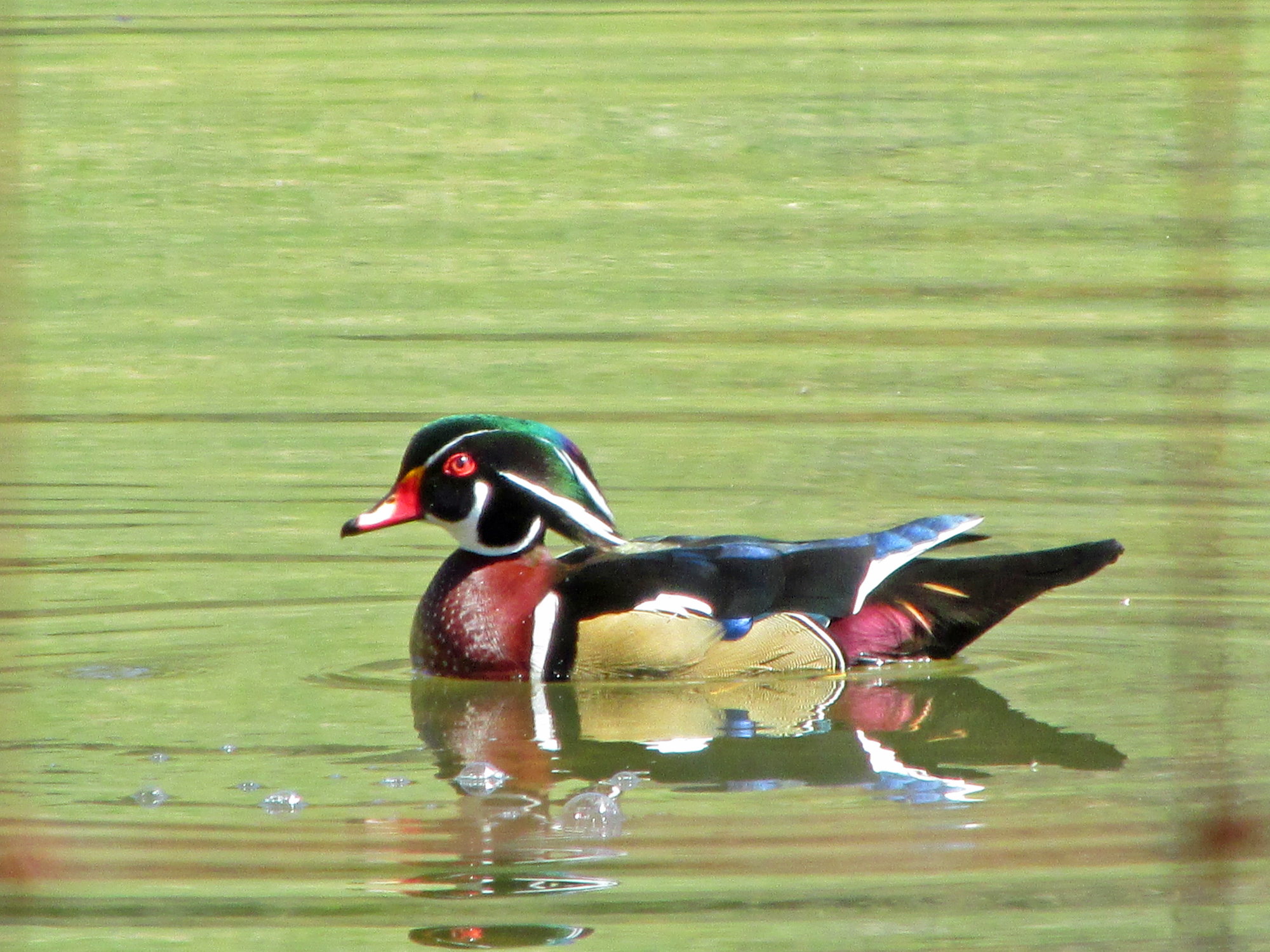
A male Wood Duck landed, briefly, on the fish pond on the morning of Oct. 5. If I hadn’t been outdoors at the time, he might have stayed longer. When I moved, he flew. It’s the first visit here at home from a Wood Duck in several years. Coincidentally, the last visit also took place in early October.

Flower-bed

Photo by Bryan Stevens              This densely-planted flower bed on the ETSU campus provided cover for a migrating Common Yellowthroat.

••••••

I am beginning to find that the campus at East Tennessee State University can produce some fun bird sightings. After witnessing a Cooper’s Hawk nearly catch a squirrel from the top branches of a tall tree near Gilbreath Hall, I have been paying closer attention to those feathered friends that visit the campus.

During a Sunday evening stroll on Oct. 6, I found a Common Yellowthroat in a well-planted flower bed. So, I have added my first warbler to my ETSU list. I also saw a Red-bellied Woodpecker flying over the Culp Center during the same walk.

It also got me to thinking about how many Common Yellowthroats I have been seeing this fall.

When I posted about the sighting on Facebook, Cathy Myers commented and informed me that she had recently observed a Rose-breasted Grosbeak on the campus.

•••••••

Catbird

Photo by Bryan Stevens                                          Gray Catbirds, such as this one, have been found on the first of the Saturday Bird Walks this October at Sycamore Shoals.

At the second of the four Saturday Bird Walks scheduled this October, rain threatened to impede the stroll. Fortunately, the showers held off until after the walk on Oct. 11 concluded at about 9:30 a.m.

The second of the October Saturday Bird Walks produced several highlights, including a duel between an Osprey and an adult Bald Eagle over the Watauga River, as well as four species of warblers — Tennessee, Bay-breasted, Palm and Yellow-rumped — and other birds, including Chimney Swift, Mockingbird, Starling, Northern Flicker, Blue Jay, Carolina Wren, Mourning Dove, Eastern Bluebird, Mallard, Carolina Chickadee, Canada Goose, Goldfinch, Red-tailed Hawk, Red-bellied Woodpecker, Crow, Yellow-bellied Sapsucker, American Robin, Northern Cardinal, Song Sparrow and Downy Woodpecker.

Although we had fewer participants on this walk, we enjoyed better observations of the birds. One exciting moment involved the flock of irate Blue Jays gathered to scold a Red-tailed Hawk that had flown too close for comfort.

••••••

Two more Saturday Bird Walks remain during October. They will be held on Oct. 18 and Oct. 25. The public is welcome to these free strolls along the walking trails at Sycamore Shoals State Historic Park. Bring binoculars to increase your viewing enjoyment.

••••••

Common_Yellowthroat (1)

Photo by U.S. Fish & Wildlife Service                                                  A male Common Yellowthroat surveys his surroundings from a prominent perch.

The Common Yellowthroat is a warbler that is quite fond of weedy, damp habitats. Marshes and other wetlands are preferred habitat during the nesting season, although a few of these birds are also present in more dry habitats.

In migration, any weedy corner might attract one of these warblers. In fact, the one I found on the ETSU campus remained elusive in a raised concrete bed containing a thick planting of flowers and shrubs.

Photo by Bryan Stevens A male Common Yellowthroat visits an overgrown thicket during fall migration. Photo by Bryan Stevens A male Common Yellowthroat visits an overgrown thicket during fall migration.

Photo by Bryan Stevens
A male Common Yellowthroat visits an overgrown thicket during fall migration.

The Common Yellowthroat belongs to the genus of warblers known as Geothlypis, which also includes the related Bahama Yellowthroat, Hooded Yellowthroat, Masked Yellowthroat, Black-polled Yellowthroat and Gray-crowned Yellowthroat. These other species are found in Central and South America, as well as the Caribbean.

Recent classification of the Geothlypis warblers has led to the inclusion of three other warblers — MacGillivray’s, Mourning and Kentucky — being shuffled into this genus.

Although fond of skulking in deep vegetation, most Common Yellowthroats are curious birds and will allow brief glimpses. The males also betray their presence with a loud, easily recognized song that sounds very much like “Witchety, Witchety, Witchety, Witch.”

Yellowthroat-PyeWeeDForage

Photo by Bryan Stevens                                                    The female Common Yellowthroat lacks the male’s black face mask.

Male and female yellowthroats show a bright, yellow throat. Males also sport a black mask bordered with a silvery-white line, and the male’s throat is usually a brighter yellow. Although males will sing in the open during the nesting season, these birds usually prefer to remain hidden from view as they go about their daily routines.

••••••

To learn more about birds and other topics from the natural world, friend Stevens on Facebook at https://www.facebook.com/ahoodedwarbler. He is always posting about local birds, wildlife, flowers, insects and much more. If you have a question, wish to make a comment or share a sighting, email ahoodedwarbler@aol.com.
Photo by Bryan Stevens

Photo by Bryan Stevens                                                                                                                            A flock of Canada Geese forage in a field near the Bell Cemetery in the Limestone Cove community of Unicoi County on a recent October afternoon.

Bob Sargent leaves behind legacy of decades of hummingbird research

n_a (18)

Photo by Bryan Stevens                                                                                                        Bob Sargent works diligently to band a Rufous Hummingbird at the home of Gary and Brenda Wallace in Elizabethton, Tenn.

I was saddened to learn of the recent passing of Bob Sargent. With his wife, Martha, Bob was the co-founder of the The Hummer/Bird Study Group. This non-profit organization founded by the Sargents was based in their hometown of Clay, Alabama, and dedicated to the study and preservation of hummingbirds and other neotropical migrants.

Their research programs with hummingbirds and migrating songbirds got underway back in 1987. The HBSG was formed in 1994. The Sargents have described the HBSG as a child born of the necessity to support their continuing research.

 Photo by Bryan Stevens                                                                                                          A Rufous Hummingbird gets a sip of sugar water midway through the banding process.


Photo by Bryan Stevens                                                                                  A Rufous Hummingbird gets a sip of sugar water midway through the banding process.

It was also a way to reward those who contributed financially to that effort. In the early days the Sargents’ savings account paid the expenses incurred by the HBSG. Many friends and bird conservationists contributed financially to the cause, and the Sargents wanted these donations to be tax-deductible.

The Sargent also became ambassadors in the promotion of hummingbirds. Their specialty became those species of western hummingbirds that have been gradually shifting their migration routes and wintering grounds to include forays into the eastern half of the United States.

n_a (16)

Photo by Bryan Stevens                                                                                            Martha Sargent takes a photo as her husband, Bob, lets Brenda Wallace hold a Rufous Hummingbird ready to be released after the banding process.

In the late 1990s, the Sargents presented a well-attended program sponsored by the Bristol Bird Club. That was the first occasion I had to meet this energetic and dedicated couple. I wrote about the fascinating program in my bird column and shared with readers Bob’s emphasis on keeping sugar water feeders available during the winter months. It was an eye-opening program that tuned me into the phenomenon of wintering hummingbirds.

Not too long after that column ran, I received a call from Bennette Rowan, an artist and Johnson City resident, in November of 1997. She had one of those western hummingbirds at her feeder. After she got in touch with me, the Sargents were also alerted. The couple arrived in Johnson City on Dec. 3, 1997, to band and identify the bird. To the surprise and delight of everyone present, the bird turned out to be an Allen’s hummingbird — the first of its kind ever found in Northeast Tennessee and only the fourth for the entire state. Bennette, who had orginally named her bird “Rusty,” modified the name to Rusty-Allen. The bird remained at her home until Dec. 16 of that year.

n_a (17)

Photo by Bryan Stevens                                                                                                       From left: Bob Sargent, Brenda Wallace, Martha Sargent and Gary Wallace pose for a photo after the Sargents successfully banded a Rufous Hummingbird at the Elizabethton home of the Wallaces.

A few years later I got to watch the Sargents band another hummingbird at the home of Brenda and Gary Wallace in Elizabethton. On that occasion, I also photographed the couple as they went expertly about the precise job of capturing, documenting, identifying and banding the hummingbird. It turned out to be a female Rufous hummingbird.

As more of these reports arrived every late fall and early winter, the Sargents became overwhelmed and could not respond to each and every case. They began to bring other hummingbird banders under their wing, so to speak. Individuals such as Chris Sloan and Mark Armstrong became principally involved with the documentation and banding of hummingbirds found within the Volunteer State.

I feel extremely fortunate to have known Bob Sargent, who died Sept. 7, 2014, at the age of 77.  An electrician by trade, he leaves a lasting legacy of more than a quarter-century of research into the mysteries of some of our tiniest birds.

Several birders across Tennessee posted tributes to Bob on the TN-Birds list-serve forum.

Cyndi Routledge of Montgomery County described him as a “dear friend and mentor” who “positively impacted my life in infinite ways as he did with endless others. He leaves a legacy of hummingbird banders and hummingbird lovers across the United States and even beyond its borders.”

She also made a suggestion to those reading her post.

“And perhaps at some point today, go outside, sit near your hummingbird feeders, listen for the hums and chirps of those tiny miracles and give thanks for Bob, for his life and for those birds,” she wrote in her post.

Jud Johnston of Waynesboro, Tennessee, commented on Bob’s death. “A great loss for birders and birding in the Southeast,” Jud wrote.

In the years since I saw that program, presented in such educational and entertaining fashion by Bob and Martha Sargent, hardly a year has gone by when a reader hasn’t alerted me to the presence of one of those “brown hummingbirds” that show up at their feeders when the Ruby-throated Hummingbirds have already flown south for the winter season.

In the next couple of weeks, the Ruby-throated Hummingbirds that have made our spring, summer and fall so delightful will once again disappear. They’ll return in about six to seven months, but our lives will be a bleaker without them.

This is where things can get interesting. Don’t take down your feeders. Keep a supply of sugar water available as “bait” to attract any Rufous Hummingbirds, or even Allen’s or Black-chinned Hummingbirds that might decide to spend late fall and early winter with you.

So, be very attentive to any hummingbird that arrives at your feeders in late October or early November. Most Ruby-throated Hummingbirds depart the region in early October. Many of these winter-visiting hummingbirds show a great amount of brown plumage instead of the usual green. Any of these conditions may indicate you’ve been gifted with a rare visit from one of these exceptional little birds. If you are so fortunate, please send me an email at ahoodedwarbler@aol.com.

Photo by U.S. Fish & Wildlife Service/Dave Menke The Rufous Hummingbird is increasingly becoming a migrant/winter resident  in the eastern United States.

Photo by U.S. Fish & Wildlife Service/Dave Menke
The Rufous Hummingbird is increasingly becoming a migrant/winter resident in the eastern United States.