Tag Archives: nature

Ruby-throated hummingbirds mark their spring return

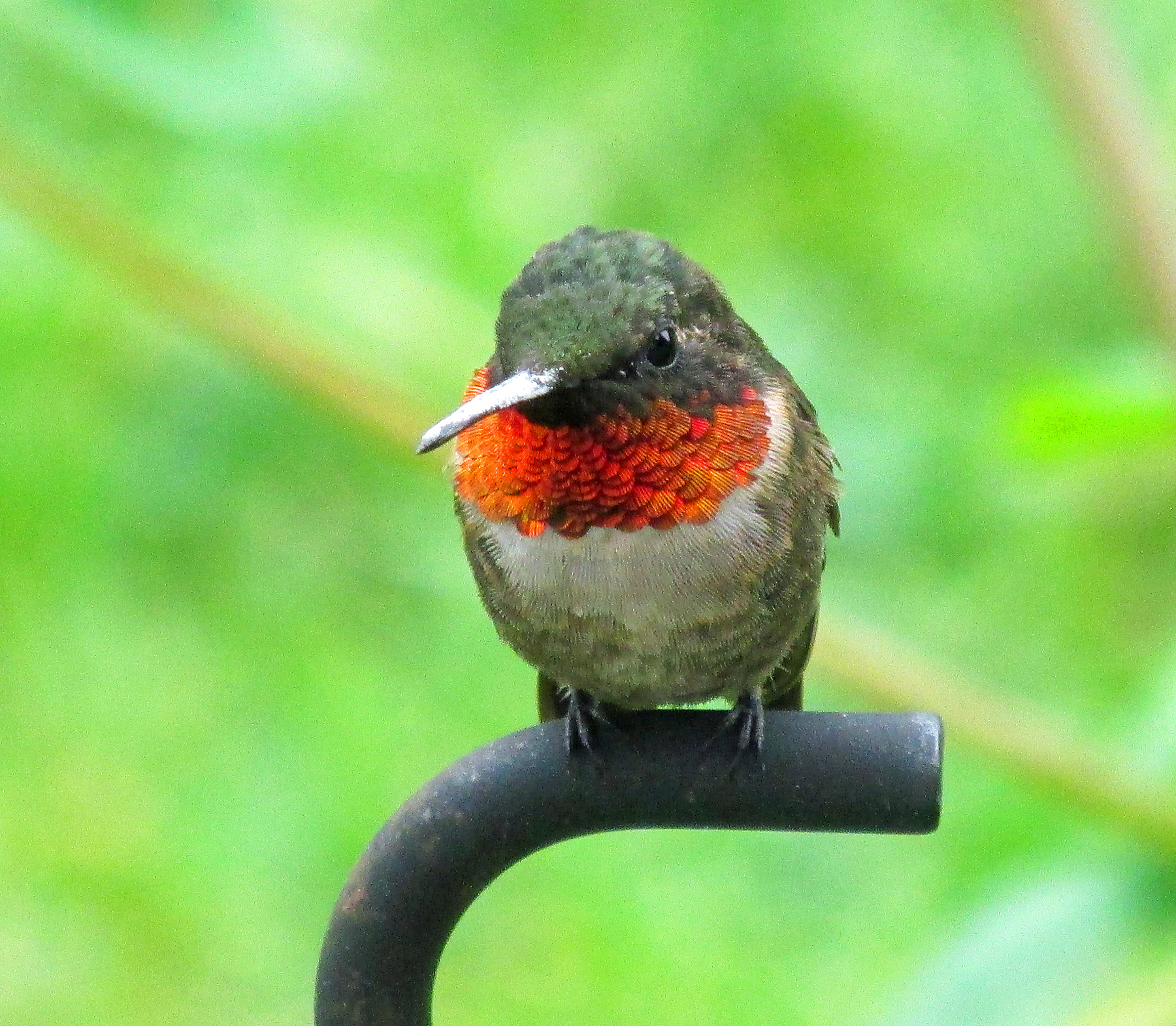
Photo by Bryan Stevens • A male ruby-throated hummingbird surveys his surroundings.

I am still waiting (at the time this post was written) for the first ruby-throated hummingbird of spring. Every year I hope they will make an early appearance, but I am almost always disappointed. These tiny birds always arrive in their own good time and my home is apparently not located within their primary migratory path.

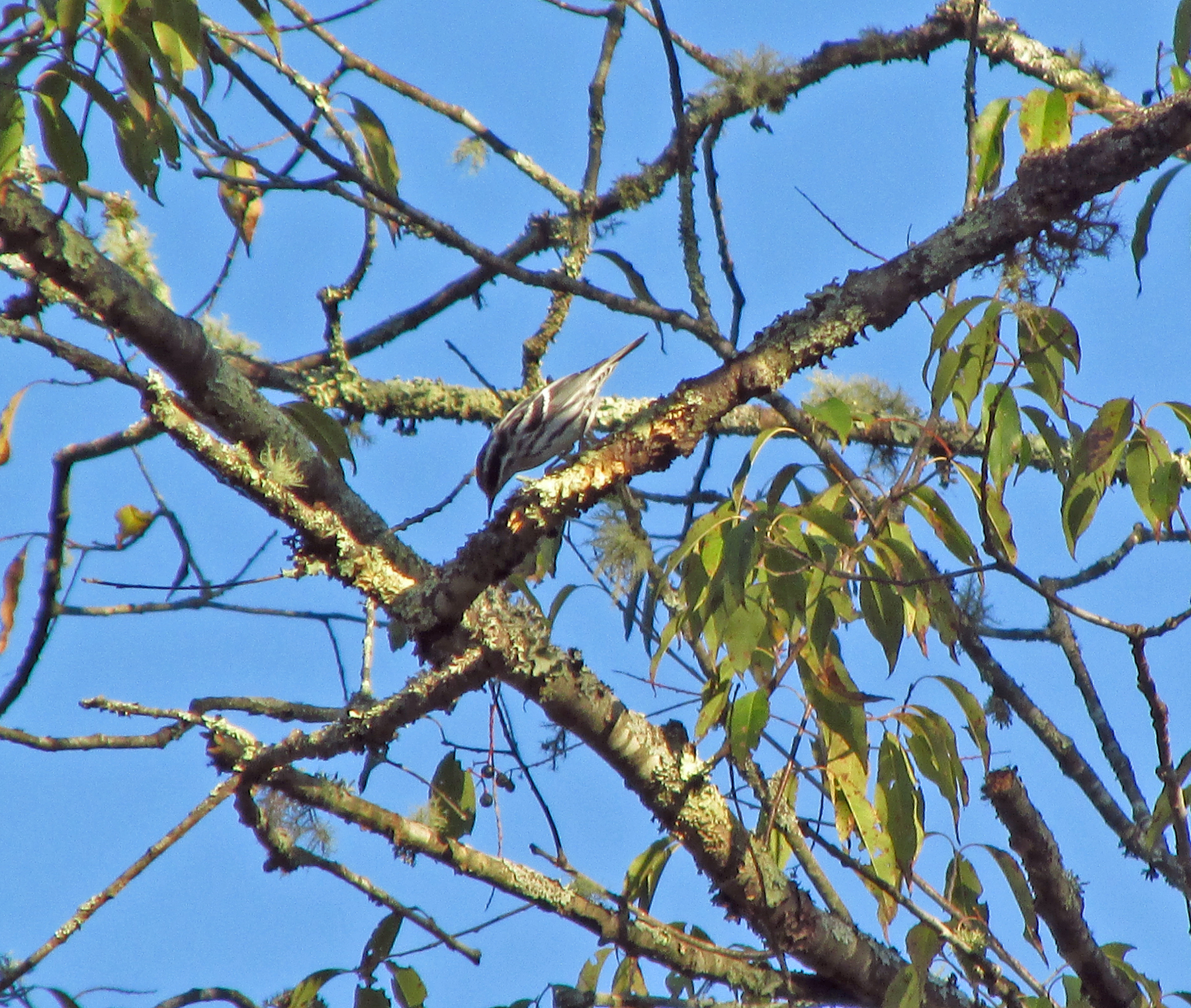
As a consolation prize, however, I have welcomed the first of the spring warblers. I had two black-and-white warblers singing at home on April 9. The black-and-white warbler sings a repetitive song that has been described as a “squeaky wheel” based on the rising pattern of the song’s notes.

Other recent arrivals have included brown thrasher and tree swallow.

Photo by Ken Thomas
The Brown Thrasher is an alert, sharp-eyed observer of its surroundings.

While I cannot claim to have seen my first spring hummingbird – yet – I can report that hummingbirds are officially back. Some of my Facebook friends have reported their first sightings. Other readers have emailed me to share their sightings.

Nancy Light welcomed back a ruby-throated hummingbird on Sunday, April 7. “I have my sugar water feeders hanging off my fruit trees in the front yard,” Nancy wrote in an email. “I live in Kingsport, but this sighting was at my farm in Duffield, Virginia, in the Fairview community.”

•••

Patricia Faye Wagers in Kingsport saw her first hummingbird of spring on April 8.

“With one, I know more are on the way,” she wrote in a Facebook post announcing her sighting.

•••

Dianne Draper in Jonesborough reported her first hummingbird sighting of spring on April 9 in a Facebook post.

“Never did get a picture of the bird,” she wrote. “Also saw the first broad-winged hawk in the yard,” she added.

Broad-winged hawks, like ruby-throated hummingbirds, are migratory and return to the region in late March and early April.

•••

It’s in Central and South America where the world’s more than 300 species of hummingbirds reach their greatest diversity. In Eastern North America, the only hummingbird known to nest is the ruby-throated hummingbird.

The western half of the United States and Canada can claim about a dozen nesting species, including rufous hummingbird, Allen’s hummingbird, Anna’s hummingbird, broad-tailed hummingbird, black-chinned hummingbird, calliope hummingbird, buff-bellied hummingbird, broad-billed hummingbird and violet-crowned hummingbird.

Hummingbirds, regardless of species, occupy a tough spot in the food chain. A bird not much bigger than many large insects is going to be a target for opportunistic predators that will attempt to kill and consume anything small enough for them to make the effort.

To make matters worse for ruby-throated hummingbirds, some large spiders and mantids, as well as bigger dragonflies, have also been documented as hummingbird predators. When ruby-throated hummingbirds retreat to Central America for the winter months, they also face threats from lizards and snakes.

The list of predators that have been known to eat ruby-throated hummingbirds extends to bullfrogs, as well as many raptors, including kestrels, merlins and sharp-shinned hawks. Blue jays and other birds will raid hummingbird nests for eggs or young. Squirrels and chipmunks are also nest predators.

Photo by Bryan Stevens • Every hummingbird that arrives at your feeder is a survivor.

In essence, every hummingbird visiting your feeders and gardens is a survivor.

And evading an assortment of predators is not their only obstacle. These tiny birds make an awesome yet grueling migratory flight – twice a year – across the Gulf of Mexico. This achievement is a grueling finale for such a tiny creature’s migration. This direct flight alone can take 18 to 22 hours of non-stop flying before reaching land on the other side of the Gulf in states like Mississippi and Texas.

Hummingbirds have fascinated for centuries. Early European explorers sent back reports of amazing little birds that seemed halfway between birds and insects.

In the 1550s, French explorer Jean de Léry published a journal of his travels in Brazil. His account provided the first written description of hummingbirds to reach readers back in the Old World.

This painting, “The Inspiration of Christopher Columbus” by José María Obregón, was painted in 1856 well after the explorer sailed the ocean blue. It’s a reminder that from the moment that European explorers arrived, they were amazed at many discoveries in the New World, including tiny birds that buzzed and hummed around their heads like insects.

Of course, the natives of North America also knew about hummingbirds. In fact, many native tribes held hummingbirds in high regard. Some regarded them as healers. An Aztec deity by the name of Huitzilopochtli had a physical form supposedly comprised of hummingbird feathers that fell from the sky. The Aztecs also believed that fallen warriors were reincarnated as hummingbirds, no doubt because of the feisty and often downright militant attitudes of these tiny birds. Anyone who has ever witnessed hummingbirds dueling at their feeders will know what I mean.

It won’t be long before we have these tiny flying jewels back with us. Once they return, their antics will entertain us for several months before it’s time for them to head south again this fall.

•••

Feel free to continue to share hummingbird sightings with me. Provide the time and date of their arrival. Email me at ahoodedwarbler@aol.com to share a sighting, ask a question or make a comment.

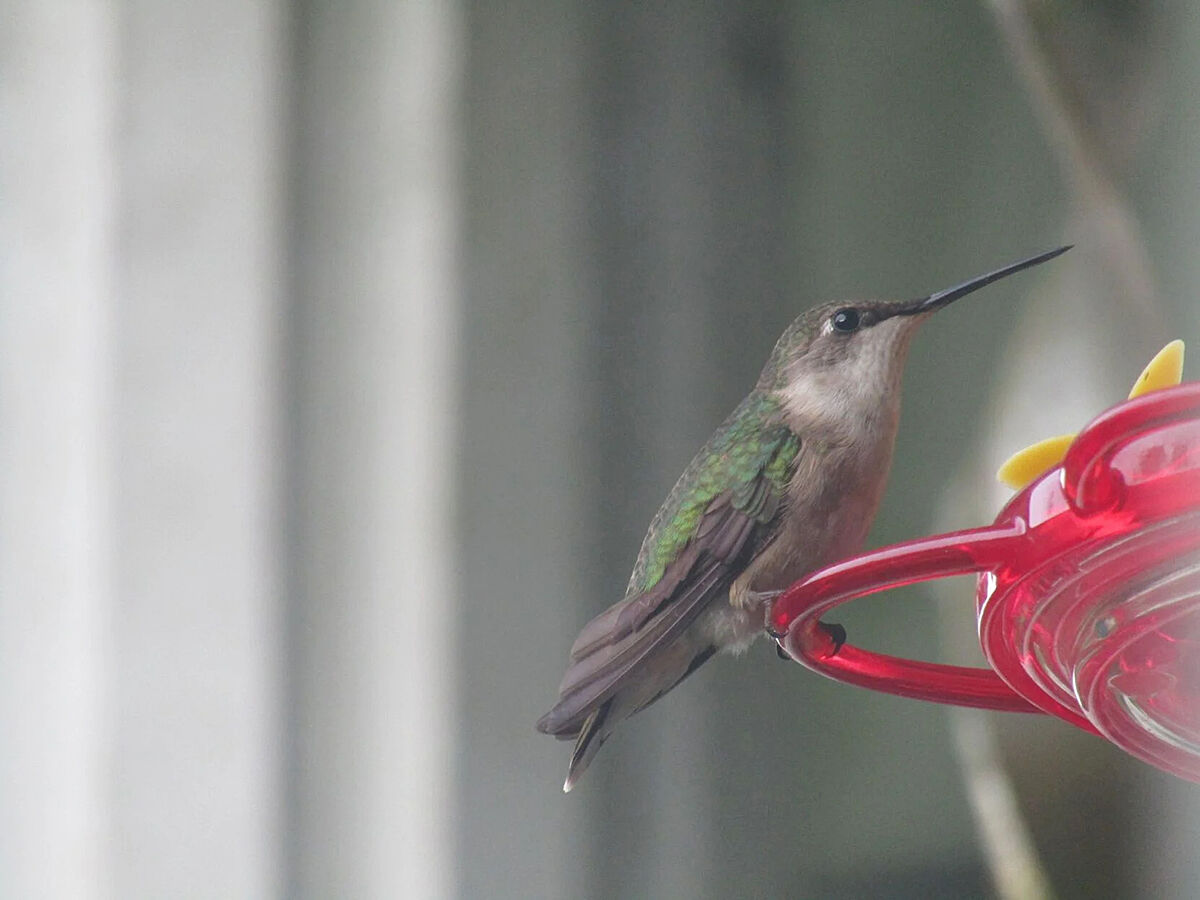
Photo by Bryan Stevens • A ruby-throated hummingbird sips from a sugar water feeder.


Region is home for several species of hawks

Tom Koerner/USFWS • An adult Cooper’s hawk, such as this individual, is a crow-sized woodland raptor that breeds throughout much of the United States, southern Canada and northern Mexico.

Barbara Lake, a resident in Hampton, emailed me recently to share a sighting of a large hawk in her yard.

“This hawk was in our yard today and flew up to a tree when I opened the door,” she wrote. “(Its) back and the back of the head are black and the rest appears to be white. He didn’t cooperate by turning around.”

Barbara enclosed some photos with her email. I’ve known Barbara for about 20 years. We first met when she invited me to her home to view some nesting bluebirds on a television screen. She had placed nest cams in some of her bluebird nesting boxes, capturing real-time footage of the nesting activity of these songbirds.

I’ve enjoyed some observations of the region’s larger raptors, including red-tailed hawks and red-shouldered hawks, as winter has settled in for the long haul. I’ve also spotted a few American kestrels.

Based on the raptor’s relatively long tail in the photos provided by Barbara, I hazarded a guess that her visiting raptor was a Cooper’s hawk.

Anyone who travels along the region’s Interstate Highway System has probably noticed hawks perched in trees or on utility lines adjacent to the roadway. The section of Interstate 26 that runs between Unicoi and Johnson City is often a productive area for keeping alert for raptors. The raptor I have most often observed along this stretch of road is the red-tailed hawk, although I have also observed Cooper’s hawk, sharp-shinned hawk and American kestrel. In the time of spring and fall migration, it’s also possible to observe broad-winged hawks.

Photo by Bryan Stevens • Raptors, like this red-tailed hawk, are  plentiful oin the region.

The red-tailed hawk is named for its prominent red tail. However, only adults show the characteristic red tail. The affinity red-tailed hawks demonstrate for roadsides is a double-edged sword. Viewing a large hawk from your car is an easy way to watch birds. For inexperienced or careless raptors, however, roadside living is often rife with the chance for a collision with a car or truck. The red-tailed hawk, which prefers open countryside, is attracted to the margins of roads and highways because these locations also attract their favorite prey, which includes rodents like rats, squirrels and mice and other small mammals such as rabbits.

Human behavior contributes to some of the problems that hawks encounter in the zone that brings them too close for comfort to motorized vehicles. When people toss trash from a car, the scent of the litter will lure curious and hungry rodents. In turn, hunting hawks are brought to the edges of roads in search of their preferred prey, increasing the likelihood of colliding with automobiles.

The Cooper’s hawk is a large accipiter hawk. A smaller relative, the sharp-shinned hawk, is also found in the region. The accipiter hawks are graceful and aerodynamic, designed to pursue prey through woodlands. Buteo hawks, such as the red-tailed hawk and red-shouldered hawk, are more of an ambush predator and not designed for the agile maneuvers that the accipiters can use to capture prey.

Some of the buteo species have adapted to life on islands, including the Galapagos hawk and the Hawaiian hawk. Some of these hawks have quite descriptive names, including the white-throated hawk, gray-lined hawk, zone-tailed hawk and short-tailed hawk. Outside the United States, raptors in the buteo genus are often known as “buzzards.” When the first European colonists came to the New World, they applied the term buzzard to types of native vultures as well as the large raptors like Swainson’s hawk and broad-winged hawk that reminded them of the ones back in Europe.

USFWS • An immature Cooper’s hawk perches on a branch in a tree located in the Klamath Basin National Wildlife Refuge Complex.

Accipiter hawks are also widespread. Accipiter is a genus of birds of prey in the family Accipitridae. With 49 recognized species, it is the most diverse genus in its family. Most species are called goshawks or sparrowhawks, although almost all New World species (excepting the Northern goshawk) are simply known as hawks.

Most accipiter hawks, including Cooper’s and sharp-shinned, prey mostly on other birds. The website All About Birds notes that small songbirds are usually safe around a Cooper’s hawk. Medium-sized birds, however, are not. Studies list European starlings, mourning doves and rock pigeons as common prey. Other birds that are often targeted by Cooper’s hawk include American robins, blue jay, Northern flicker, quail, grouse and pheasants. Cooper’s hawks sometimes rob nests and also eat chipmunks, rabbits, mice, squirrels and bats. According to All About Birds, mammals are more common in diets of Cooper’s hawks in the western United States.

Some of the more descriptively named accipiter hawks include crested goshawk, grey-bellied hawk, spot-tailed sparrowhawk, plain-brested hawk and little sparrowhawk.

All too often, our large hawks don’t receive the love they deserve from the public. They may even run afoul of misinformed individuals who may regard all predatory birds as “bad.” The reality is that all hawks are valuable components of a healthy, working ecosystem, with each species filling a certain niche.

•••

To share a sighting, ask a question or make a comment, email me at ahoodedwarbler@aol.com.
 

Couple shares story about nesting mourning doves

Contributed Photo by Tim Barto • One of the mourning doves nesting atop a porch column at the home of Star and Tim Barton in Telford arrives with a sprig of nesting material held in its beak. Tim’s photo of the dove even impressed the editors at “Smoky Mountain Living.” The magazine published the photo earlier this year.

Star Barto, a resident of Telford in Washington County, contacted me after reading my column on the Eastern phoebes nesting on my  front porch. Incidentally, the phoebes have now successfully fledged their young.

Star began her email by sharing that she and her husband, Tim, have been blessed with mourning doves building their nests on the top of one of their porch columns.  

“This is our fifth year with a ring side seat,” Star wrote. “They usually have two nestings per season that produce two babies each time.”

This year, the birds changed things up and the Bartos are celebrating  a third nest — atop the same porch column.  

“We call it our special version of an Airbnb,” she noted.

At first, the doves would fly each time Star or Tim opened the front door, but the birds gradually grew accustomed to their human landlords.  

Star wrote that their nest is in such a ideal location — safe, dry, under cover, high up — that the doves return year after year and do not doubt the safety of their habitat.  

“We turn off the porch light, of course, and work hard at minimizing disruption,” she wrote.  

“And they thrive,” Star added. “It is beyond thrilling to be able to see so up close and personal the magic of Mother Nature.”

The mourning dove is a common backyard bird across the country. It’s also considered a game bird.

According to the website, All About Birds, the mourning dove is the most widespread and abundant game bird in North America. According to the website, hunters harvest more than 20 million of these birds every year, but the mourning dove remains one of the most abundant birds with a U.S. population estimated at 350 million. The mourning dove also ranges into Canada and Mexico. 

Photo by Bryan Stevens • A mourning dove stretches a wing while perched on a feeder.

The mourning dove gets its name from its mournful cooing, which has been likened to a lament. Birds are more vocal during the nesting season. 

Former common names for this dove include Carolina pigeon, rain dove and turtle dove. The mourning dove is a member of the dove family, Columbidae, which includes 344 different species worldwide.

From the standpoint of a scientist, there’s no real difference between doves and pigeons. In general, smaller members of the family are known as doves and the larger ones are classified as pigeons, but that’s not a firm rule.

Some of the more descriptively named doves and pigeons include blue-eyed ground dove, purplish-backed quail dove, ochre-bellied dove, red-billed pigeon, emerald-spotted wood dove, pink-necked green pigeon, sombre pigeon, topknot pigeon, white-bellied imperial pigeon, cinnamon ground dove, pheasant pigeon, crested cuckoo-dove and crowned pigeon.

An early illustration of the dodo.

Arguably the most famous dove is the extinct dodo, a bird renowned as being  almost too stupid to live. The dodo almost certainly doesn’t deserve its reputation as a “bird brain.” The reason for the bird’s swift extinction after encountering humans can be explained by the fact that this large, flightless dove evolved on the island of Mauritius in the Indian Ocean. Largely defenseless, the dodo’s fate was sealed from the moment this bird was confronted with new arrivals — humans and affiliated animals such as rats, pigs and cats — at its home.  The results of these first encounters were catastrophic for the species.

The first mention of the three-foot-tall dodo in the historic record occurred in 1598 when Dutch sailors reached Mauritius. By 1662, the bird vanishes from the historic record. The bird disappeared so swiftly that for some time after it was often considered a mythical creature.

Other native doves in the United States include common ground-dove, Inca dove, white-winged dove and Key West quail-dove. The Eurasian collared-dove is an introduced species that has spread rapidly across the country and occurs in Northeast Tennessee. 

Doves are unusual among birds in feeding young a type of milk. Known as “crop milk,” both parents feed young in the nest with this substance produced in the crop, which is simply an enlargement of the bird’s esophagus. The crop is usually used for storage of surplus food, which is usually seeds. 

Young doves are known as squabs, and the crop milk they are fed early in life is rich in antioxidants, fats and proteins, allowing them to thrive and grow quickly. 

To share a sighting, make a comment or ask a question, please email me at ahoodedwarbler@aol.com. 

Sandpiper a surprise addition for summer bird count

Photo by USFWS • A baby least sandpiper shelters beneath its dutiful mother. The aptly named least sandpiper is the smallest species of shorebird.

It’s not too often I get a chance to make a historic bird sighting, but that’s what happened on a recent Saturday while seated on a bench with Rob Armistead having a breakfast break while taking part in a seasonal bird survey in Elizabethton along the Watauga River.

I chose the location for the break because I knew that it has traditionally been a good spot to observe some unexpected species. Past good birds that I’ve observed along this section of the Watauga River have included orange-crowned warbler, yellow-throated vireo, sora, Baltimore oriole and red-headed woodpecker.

On this occasion, a tiny shorebird made an appearance, settling on some exposed rock formations. In April and May, these same rocks are great locations to find migrating spotted sandpipers and solitary sandpipers. 

The bird was smaller than these sandpipers and immediately stood out as a “peep,” a nickname that birders give to a group of small sandpipers that are all similar in appearance.

The one physical trait that help distinguish a least sandpiper from other “peeps” is leg coloration. Least sandpipers have greenish or yellowish legs in contrast to the black legs of other similar “peeps.”

In good light and at close range, Rob and I confirmed that the bird had greenish legs and were thrilled to add a least sandpiper to our own tally of observed birds.

The least sandpiper, as suggested by its name, is the smallest member of the sandpiper family. In fact, this sandpiper, which is not much bigger than a sparrow, is the world’s smallest shorebird. The least sandpiper weighs only a single ounce and is only five to six inches long. 

According to the website All About Birds, the least sandpiper migrates thousands of miles between its Arctic breeding grounds and wintering grounds as far south as Chile and Brazil.

In releasing the count compilation, official compiler Rick Knight made note of the fact that the least sandpiper represents a late migrant and the first-ever June record for the species in the five-county area. 

During the course of the day, Rob and I joined Brookie and Jean Potter for a trip to Holston Mountain, where we added some mid- to high-elevation species such as scarlet tanager, rose-breasted grosbeak, veery, Eastern wood-pewee, dark-eyed junco, ruffed course and chestnut-sided warbler. 

Photo by Bryan Stevens • A male rose-breasted grosbeak perched on a branch on Roan Mountain, Tennessee.

This year’s survey was the 29th annual Carter County Summer Bird Count and was conducted by members and friends of the Elizabethton Bird Club. I’ve been participating on this yearly survey of local birds since the late 1990s.

This year’s count was held Saturday, June 11. A total of 22 observers took part in this year’s count. 

A total of 116 species was tallied, which is right on average for the last decade and slightly above the average of 114 over the previous 28 years, according to Knight.

He noted that the all-time high for this count was 123 species in 2017.

Here’s the total:

 Canada goose, 131; wood duck, 9; mallard, 53; ruffed grouse, 3; and wild turkey, 20.

Rock pigeon, 49; Eurasian collared-dove, 1; mourning dove, 155; yellow-billed cuckoo, 1; Chuck-will’s-widow, 4; Eastern whip-poor-will, 9; chimney swift, 116; and ruby-throated hummingbird, 22.

Killdeer, 18; least sandpiper, 1; double-crested cormorant, 13; great Blue heron, 22; and green heron, 2.

Black vulture, 5; turkey vulture, 65; Cooper’s hawk, 4; bald eagle, 1; red-shouldered hawk, 2; broad-winged hawk, 5; red-tailed hawk, 5; Eastern screech-owl, 6; and barred owl, 3.

Belted kingfisher, 5; red-bellied woodpecker, 32; downy Woodpecker, 23; hairy woodpecker, 4; Northern flicker, 27; and pileated woodpecker, 16.

American kestrel, 1; great crested flycatcher, 2; Eastern kingbird, 27; Eastern wood-pewee, 31; Acadian flycatcher, 20; alder flycatcher, 2; least flycatcher, 12; and Eastern phoebe, 73.

White-eyed vireo, 5; yellow-throated vireo, 1; blue-headed vireo, 54; warbling vireo, 1; and red-eyed vireo, 165.

Blue jay, 110; American crow, 259; fish crow, 2; and common raven, 10.

Tree swallow, 118; Northern rough-winged swallow, 45; purple martin, 22; barn swallow, 173; and cliff swallow, 265.

Carolina chickadee, 73; tufted titmouse, 93; red-breasted nuthatch, 14; white-breasted nuthatch, 23; house wren, 57; winter wren,  4; and Carolina wren,  116.

Blue-gray gnatcatcher,  23; golden-crowned kinglet, 7; Eastern bluebird, 152; veery,  29; hermit thrush, 1; wood thrush, 66; American robin,  581; gray catbird, 60; brown thrasher,  22; and Northern mockingbird, 70

European starling, 411; cedar waxwing, 61; house sparrow, 98; house finch, 51; pine siskin, 10; and American goldfinch, 170.

Grasshopper sparrow, 1; chipping sparrow,  80; field sparrow, 43, dark-eyed junco, 70; song sparrow, 348; Eastern towhee, 150; yellow-breasted chat, 7.

Eastern meadowlark, 13; orchard oriole, 2; Baltimore oriole , 1; red-winged blackbird, 73; brown-headed cowbird, 49; and common grackle,143.

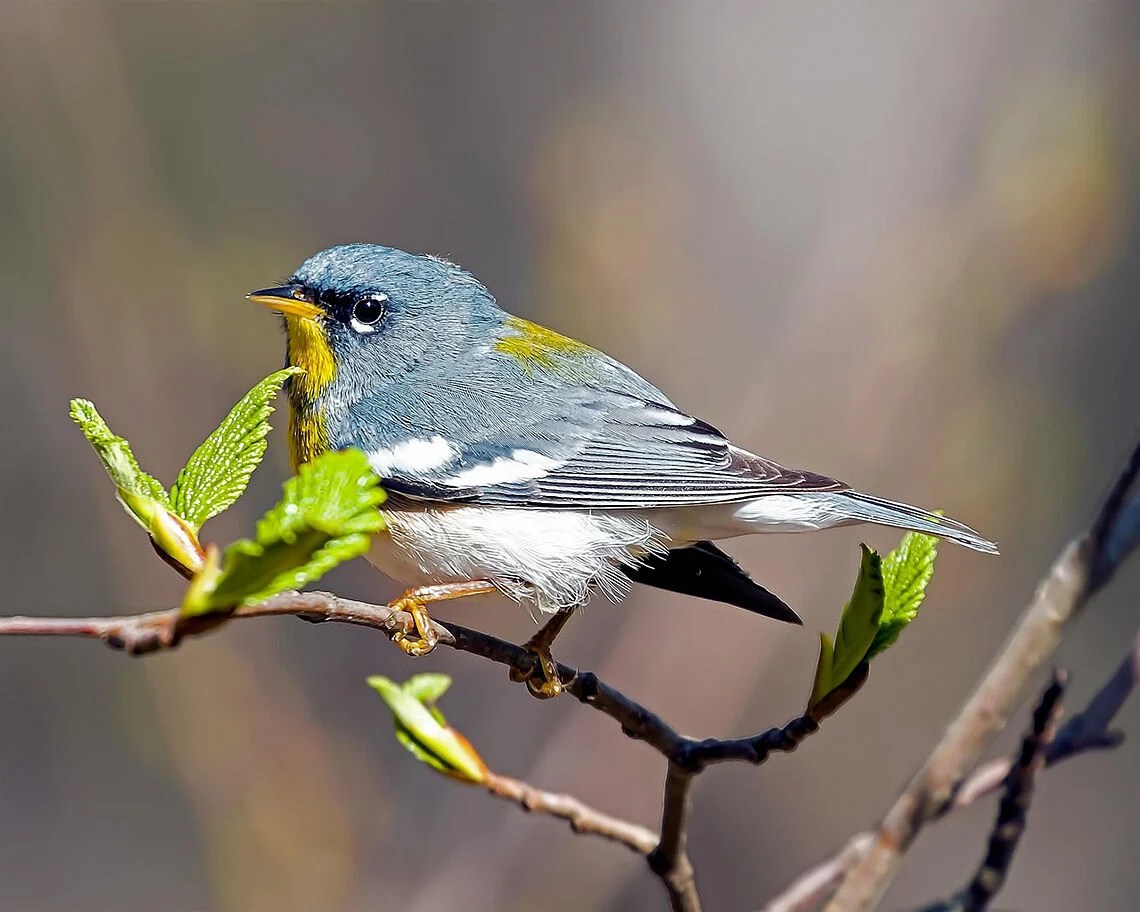
Ovenbird, 77; worm-eating warbler  3; Louisiana waterthrush, 12; golden-winged warbler,  2; black-&-white warbler, 31; Swainson’s warbler, 6; common yellowthroat, 31; hooded warbler,  110; American redstart , 6; Northern parula, 47; magnolia warbler, 1; Blackburnian warbler,  5; yellow warbler, 3; chestnut-sided warbler, 31; black-throated blue warbler, 49; pine warbler,  3; yellow-rumped warbler, 1; yellow-throated warbler, 16; black-throated green warbler, 19; and Canada warbler,  10.

Scarlet tanager, 42; Northern cardinal, 173; rose-breasted grosbeak, 7; blue grosbeak, 4; and indigo bunting, 161.

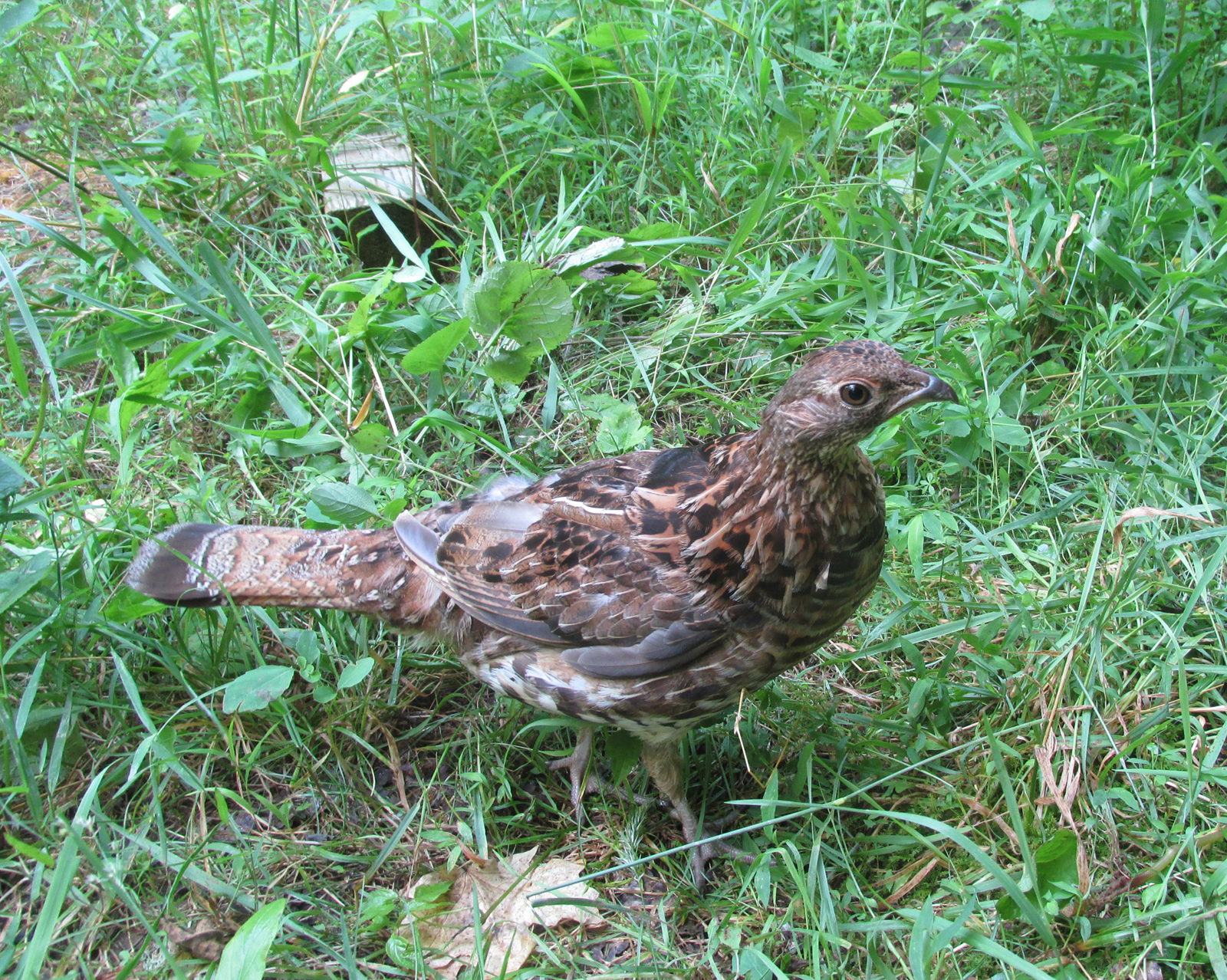
Photo by Bryan Stevens • A young grouse follows its mother into concealment by the edge of a road on Holston Mountain, Tennessee.

My other personal highlight on this count was seeing three young Ruffed Grouse darting  across the road, one at a time, while riding on Panhandle Road to the top of Holston Mountain. Those three young grouse turned out to be the only grouse counted by any participants on the count.

The Unicoi County Summer Bird Count was conducted Saturday, June 18. I’ll provide the results of that count in an upcoming column. 

Tanagers are among world’s most colorful birds

Photo Courtesy of Jean Potter
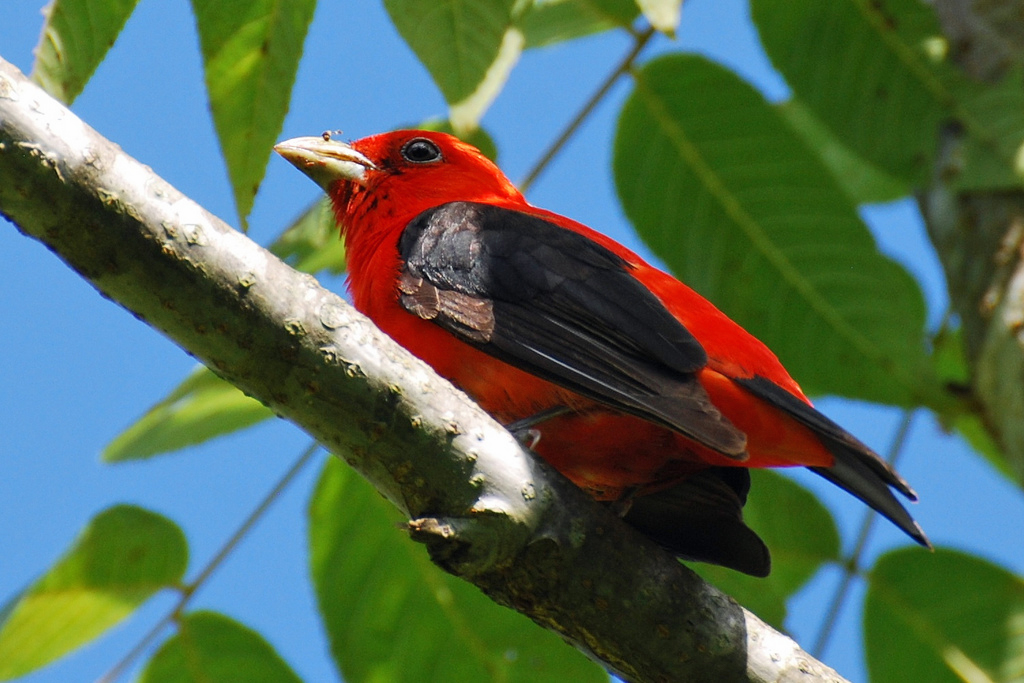
A male scarlet tanager brightens shadowy woodlands with a flash of tropical colors yet remains mostly inconspicuous in the forest canopy.

The daily chorus of songbirds greeting the dawn is usually welcome unless I’m feeling particularly sleepy. Carolina wrens are one of the first birds in residence to sing each day. This time of year they get plenty of accompanists, including American robins, Eastern phoebes, Carolina chickadees, Northern cardinals, Eastern towhees, red-eyed vireos, indigo buntings, hooded warblers, ovenbirds and others.

As June arrived, however, I began to take notice of the absent voice of scarlet tanagers. It wasn’t until June 9 that I heard the first male scarlet tanager of the season singing from the wooded ridge behind my home.

In late April and throughout May, once the oaks, the maples, the poplars and other trees begin spreading out new green leaves to create a concealing woodland canopy, a familiar song can be heard from the treetops. 

Upon first hearing it, listeners might mistake the hidden singer for an American robin. Listen a little closer, however, and the song sounds as if it is being delivered by a robin stricken a bit hoarse with a sore throat.

The producer of the hoarse but melodic song is a scarlet tanager, one of the most showy birds of Eastern woodlands from April to early October. Like the warblers, vireos, flycatchers and other songbirds, the scarlet tanager is migratory. They spend the winter months in the tropical forests of Central and South America. The scarlet tanager is better attired than most birds to provide us a glimpse of what life must be like in the tropical rain forests, which are a riot of color and sound.

It takes only one sighting to sear the vision of these vibrant birds into our retinas, as well as into our memories. The scarlet tanager boasts a brilliant plumage of crimson red paired with black wings and tail. Of course, this is the male. The female scarlet tanager makes no real claim to the common name with her comparatively drab greenish plumage. However, the scientific name, Piranga olivacea, gives a nod to the olive-green plumage of females, young males and even adult males when molting their feathers.

Although once nominated as a candidate for state bird by the school children of Minnesota, the scarlet tanager ultimately failed to gain the designation. Instead, as perhaps is fitting for the “Land of 10,000 Lakes,” the common loon represents Minnesota as official state bird.

The related summer tanager is less widespread in Northeast Tennessee, but males of this species are no less dramatic in appearance than the Scarlet Tanager. Male summer tanagers are a rosy-red over all their body. Females, with a dull greenish plumage, are relegated to the background. She can be distinguished from her counterpart, the scarlet tanager, because of their darker wings and larger bills.

The summer tanager holds the distinction of being the only all-red bird in North America. Birds like Northern cardinals and scarlet tanagers also have some black in their plumage.

I’ve seen summer tanagers at Steele Creek Park in Bristol and Willow Springs Park in Johnson City. Sadly, over the years my sightings of this attractive songbird have been few and far between. My most memorable observation of a male summer tanager took place many years ago during a spring visit to Fripp Island, South Carolina. Most of the summer tanagers I have observed in Northeast Tennessee have been females.

On the other hand, I usually have a few scarlet tanagers in residence around my home during the summer months. If the woodlands at my home fail to attract this bird, I can usually make a visit to higher elevations on Roan Mountain, Unaka Mountain or Holston Mountain to gain an exciting glimpse of this beautiful bird.

Worldwide, there have traditionally been about 240 species of tanagers. Experts have changed some of the ways they classify tanagers, so that figure is no longer set in stone. Tanagers are a New World family of birds, concentrated mainly in the tropics.

In the western United States, the scarlet and summer tanagers are replaced by Western tanagers and hepatic tanagers. During a visit to Salt Lake City in Utah in 2006 I saw several Western tanagers.

Some of the world’s other tanagers are known by extremely descriptive names, including flame-colored tanager, green-headed tanager, golden-chevroned tanager, azure-shouldered tanager, fawn-breasted tanager, saffron-crowned tanager, metallic-green tanager, turquoise tanager, scarlet-bellied mountain tanager and diademed tanager.

A print of Scarlet Tanagers by early North American naturalist and painter John James Audubon.

Scientists have recently given fresh consideration to the relationship of many tanagers to the other birds of the world. As a result, many of the North American tanagers are now closely allied with such birds as Northern cardinal and have been pushed into a tenuous relationship with tropical tanagers.

The scarlet tanager is not typically a feeder visitor, but you can lure these birds with orange slices placed in special feeders or simply spiked onto the branches of backyard trees. As an added bonus, orange slices can also attract birds such as baltimore orioles and gray catbirds.

Fond of fruit, the scarlet tanager incorporates various berries into its diet. Landscape around your home with fruit-bearing trees such as mulberry, serviceberry and wild cherry to make your yard more inviting to these elusive bird.

Yes, the scarlet tanager is more often heard than seen, but it is a bird worth seeking out. A sighting is guaranteed to impress. Seeing a scarlet tanager will almost make observers feel like they’ve been dropped into a tropical jungle instead of standing beneath a woodland canopy in the Southern Appalachians.

I’ll be participating in some summer bird counts over the next few weeks, so I am hopeful that my 2022 drought of scarlet tanager sightings will soon be at an end.

Sales of local calendar fund bird-worthy aims


The front cover of the 2022 bird calendar produced by the Elizabethton Bird Club features a photo of a chestnut-sided warbler taken by club member Charles Warden. The calendar is available for purchase for $15, plus $2 for shipping and handling. They make great Christmas gifts for nature and bird enthusiasts. For more information, email ahoodedwarbler@aol.com. 

If you didn’t find all you needed on Black Friday for those on your shopping list, here’s a suggestion. The Lee and Lois Herndon Chapter of Tennessee Ornithological Society, also known as the Elizabethton Bird Club, has produced its annual calendar featuring bird photographs by its members and friends of the organization.

These calendars make wonderful Christmas gifts and stocking stuffers. This year’s front cover features a gorgeous photo of a chestnut-sided warbler taken by club member Charles Warden. This is Warden’s first year contributing photographs to the club’s yearly calendar project. More of his photos are on display through the calendar. He is a resident of Johnson City.

“I took the photo on the Spring Bird Count with Fred Alsop and Judi Sawyer on May 1 of this year at Hampton Creek Cove,” Warden said.

He said that the bird was among the blooms of what he thinks was an apple tree.

“We heard the warbler and chased it down,” he said. “It came out in the open and posed nicely for pictures.”

He has been interested in photography since he took a beginning photography class at East Tennessee State University on a lark in 1977.

“I am lucky enough to be making a living as a photographer for ETSU marketing.”

Bird photography is certainly a challenge, he said, and requires much patience, decent equipment and a lot of luck.

“It’s been a learning curve for sure, and it’s still a tough call when to take the binoculars down and put the camera up as it’s so mesmerizing to watch the birds,” Warden said.

The chestnut-sided warbler is a summer resident in the region and can be found at middle and higher elevations on many of the area’s mountains, including Unaka and Roan. Unlike many warblers, both males and females are brightly colored, with the female being slightly less so. Males during the summer nesting season show a yellow crown, black mask, white cheeks, throat and breast and the namesake chestnut flanking on his sides.

He’s also a cheery and persistent singer when he arrives on his nesting territory. His song is usually transcribed as “Pleased, pleased, pleased to meetcha!” For birders, it’s like a welcoming reintroduction each spring when this particular song is heard from the branches of trees in local woodlands.

For the singing male, there’s a more personal reason for singing his song. The “pleased, pleased, pleased to meetcha” refrain is a way of attracting the attention of potential mates. Males sing an entirely different song once settled into nesting activities with a mate. The song used to attract mates is more heavily accented, according to the website, All About Birds. Some males sing only unaccented songs and thus have a lower success rate at attracting mates.

Chestnut-sided warblers are classified by scientists as birds that favor successional habitats for nesting purposes. These sorts of habitats are usually disturbed by human activities such as logging. However, disturbed habitats can be created by natural occurrences, including fires, flooding and storm damage. During the winter months, this warbler withdraws into Central America with many individuals finding suitable habitat on shade-coffee plantations.

Female chestnut-sided warblers will weave a nest of bark, grass and other components all bound together with gathered spider silk. She will lay three to five eggs. These warblers make the most of the summer season, often nesting a second time after raising their first brood.

Chestnut-sided warblers feed largely on insects, but the birds also incorporate seeds and fruits into their diet. Young are fed by both parents on a diet of small insects, spiders and caterpillars. The chestnut-sided warbler’s scientific name, Setophaga pensylvanica, roughly translates as “eater of moths from Pennsylvania,” which is a nod to the bird’s insect-rich diet.

Other warblers that can be found in the mountains of Northeast Tennessee — and in the pages of the calendar — include black-throated blue warbler, golden-winged warbler, worm-eating warbler, hooded warbler, prairie warbler and common yellowthroat.

Like most small songbirds, the New World warblers, to which the chestnut-sided warbler belongs, don’t have long lifespans. A few individuals, however, defy the odds. According to the website, All About Birds, the longest-lived chestnut-sided warbler documented by scientists was a nearly seven-year-old bird banded in Rhode Island in 1980. The bird had been banded in the same state six years and 11 months earlier in 1973.

Of course, with the exception of the yellow-rumped warbler, most of the warblers don’t spend the winter months in the region. With one of these calendars, however, you can enjoy beautiful photos of some of our most lovely warblers while awaiting their return this spring in mid-April and early May.

The inside pages of the professionally-produced calendar feature dozens more full-color photographs and an informative and educational grid. These calendars sell for $15 plus $2 for shipping. All sales help the club fund birding programs, public park feeders, conservation efforts and other activities in upper Northeast Tennessee.

For more information on how to obtain a calendar, email me at ahoodedwarbler@aol.com.


American crow’s dark reputation more from plumage than behavior

There’s something rather autumnal about watching a flock of American crows glean the last scattered kernels of corn from a harvested field as one of the flock stands sentry and ready to utter the alarm with some guttural “caws” should anything potentially threatening appear on the scene. Crows are such a part of the landscape that they would almost escape our notice if they didn’t come with centuries of accumulated baggage that makes us distrust them and suspect their every action.

While seeking birds far afield, I have occasionally spotted some innovative scarecrows standing guard in gardens and agricultural fields. I’m not sure if anyone still erects these human effigies for their original purpose of warding off crows and other feathered agricultural pests. These days, scarecrows likely serve an ornamental purpose and are often part of a yard’s whimsical Halloween or autumn decorations.

The crow, largely thanks to its glossy black feathers, but perhaps also with a nod to its avian intelligence, has long been associated with Halloween. Greeting cards and decorations for the holiday often feature depictions of bats, owls and black cats, as well as the inevitable crow and the accompanying scarecrow. With a brain about as big as a man’s thumb, the crow is renowned among ornithologists and other scientists for its keen intelligence. Crows are not fooled for a second by the charade of a straw-stuffed, brainless friend of Dorothy propped in a field.

Photo by Jack Bulmer/Pixabay • An American crow perches on a log. Due to its dark coloration, crows have often been associated with evil and other dark forces. In actuality, crows are admirable, highly intelligent birds.

The intelligence of this bird has long been known. Early American naturalist William Bartram wrote about a crow named Tom in a highly entertaining essay titled “Anecdotes of an American Crow.” Bartram, who lived from 1739 to 1823, brought humorous observations and keen insight to his subject as he wrote about the joys — as well as tribulations — of living with Tom, a crow that enjoyed tormenting Bartram’s dog and purloining the writer’s spectacles and trying to hide them.

The essay demonstrates that almost as soon as Europeans arrived in North America, some of those with a bent toward the natural world recognized the intelligence and amazing adaptability of the American crow. As well as writing about the natural world, Bartram earned widespread acclaim for his drawings of botanical and ornithological subjects. Tom, the featured crow in Bartram’s brief essay, certainly exhibited intelligence of an impressive degree. Not only did the crow steal his owner’s eyeglasses, he foiled Bartram’s first attempt to reclaim them. The story makes very humorous reading. To read Bartram’s account, visit http://www.geocities.ws/jswortham/crow.

What else have crows done down through the ages to gain such a dark and much undeserved reputation? It probably doesn’t help matters that a flock of crows is known as a “murder.” Ancient Greeks considered crows as omens, which often foretold death and other disasters. The warrior goddess known as the Morrighan from Celtic mythology often appears in the form of a crow or raven. She is also often portrayed as being accompanied by a group of these black-plumaged birds. Many Native American tribes revere crows as communicators between worlds. Crows have been documented using tools and solving problems, which shows an uncanny ability to analyze and strategize. The early Celtic people also noted and admired these traits in crows.

I think the Celts and Native tribes had the right idea. Crows are admirable birds for many reasons. For instance, they are very social birds, often forming family flocks. They may also form much larger flocks for the purpose of roosting. When nesting, this social behavior comes in useful for a mated pair. Offspring from previous successful nesting efforts often serve as helpers. In addition to gaining their own life experience on successful nesting and caring for chicks, these older siblings may protect the nest site from predators or even deliver food to fill hungry beaks and bellies.

While famous for their associations to humans and our agriculture, crows forage far beyond the cornfield for their food. Many crows scavenge road-killed wildlife, such as squirrels, opossums and rabbits. While they certainly don’t turn up their beaks at the notion of eating carrion, crows do so less often than birds such as turkey vultures, black vultures and the crow’s fellow corvid, the common raven.

The kinship to the raven is evident, but even moderately experienced birders rarely confuse these similar species. The raven is a large bird with a heavy beak, a distinctive profile and a wedge-shaped tail. In a direct comparison with a raven, a crow looks downright puny. Both are members of the corvid family, which consists of 120 species including jays, rooks, magpies and jackdaws. Some of the world’s other crows include the descriptively named little crow, hooded crow, carrion crow, collared crow, long-billed crow and violet crow. While most of the world’s crows are thriving, the Hawaiian crow has been extinct in the wild since 2002, although the species still exists in captive-breeding programs in various zoos.

Thanks to its resourcefulness and intelligence, the crow is deserving of more respect and even admiration. The American crow is a uniquely American success story. Think more of Bartram’s story about Tom the crow and not the dark, misguided myths and legends about crows this Halloween. Long may the crows fly.

Annual fall bird count tallies 129 species for Northeast Tennessee

Photo from Pixabay • A red-headed woodpecker clings to the trunk of a tree. During the recent Fall Bird Count for Northeast Tennessee, all the region’s seven woodpecker species were tallied. The medium-sized red-headed woodpecker is found only in isolated locations in the region. They prefer more open country than most of their kin. Habitat containing dead or dying trees is vital if these woodpeckers are to thrive.

I wrote last week about my participation in the recent 52nd annual Fall Bird Count conducted by the Elizabethton Bird Club.

This week I want to dive into the results of what turned out to be a great count. The five-county tally of the birds in Northeast Tennessee was held on Saturday, Sept. 25, with 34 observers in 14 parties, plus two feeder watchers. Participants covered Carter County, as well as parts of adjacent Johnson, Sullivan, Unicoi and Washington counties.

This year’s count tallied 129 species, which is slightly above the recent 30 year average of 125 species. The all-time high was reached in 1993 when 137 species were tallied.

Participants for this year’s count included Fred Alsop, Jerry Bevins, Rob Biller, Debi Campbell, J.G. Campbell, Ron Carrico, Catherine Cummins, Dianne Draper, Cindy Ehrhardt, Harry Lee Farthing, Dave Gardner, Tammy Griffey, Don Holt, Connie Irick, David Irick, David Kirschke, Rick Knight, Roy Knispel, Richard Lewis, Dianne Lynne, Vern Maddux, Joe McGuiness, Tom McNeil, Eric Middlemas, Susan Peters, Brookie Potter, Jean Potter, Pete Range, Judith Reid, Judi Sawyer, Chris Soto, Bryan Stevens, Peggy Stevens, Kim Stroud, Charles Warden and Rex Whitfield.

The four most commonly observed species, in descending order, included European starling, 838; Canada goose, 744; American crow, 502; and blue jay, 437. No surprises there.

Somewhat surprising was the total of 222 brown-headed cowbirds. Other abundant birds that numbered more than 200 individuals included mourning dove (316), rock pigeon (285), chimney swift (227), Eastern bluebird (208), American robin (222), cedar waxwing (230) and American goldfinch (216).

A total of 24 species of warblers was found, including 172 individual Tennessee warblers. These greenish-yellow warblers can be quite abundant as they pass through the region each autumn.

Some families of birds, such as falcons and woodpeckers, were well represented on this count with all the expected species being found by count participants.

Five Empidonax species, often referred to as “empids” by birders were found during the count but do not contribute to the total. These small flycatchers are nearly identical in appearance and silent during the fall. Faced with an inability to positive identify them, birders simply noted that they were seen.

The list follows:

Canada goose, 744; wood duck, 42; mallard, 182; blue-winged teal, 4; Northern shoveler, 2; and common merganser, 4.

Wild turkey, 18; pied-billed grebe, 3; double-crested cormorant, 43; great blue heron, 39; great egret, 4; green heron, 1; black vulture, 61; and turkey vulture, 183.

Osprey, 7; bald eagle, 9; sharp-shinned hawk, 3; Cooper’s hawk, 8; red-shouldered hawk, 6; broad-winged hawk, 11; and red-tailed hawk, 25.

American coot, 1; killdeer, 45; spotted sandpiper, 2; rock pigeon, 285; Eurasian collared-dove, 22; mourning dove,  316; and yellow-billed cuckoo, 2.

Eastern screech-owl, 11; great horned owl  7; barred owl, 3; American kestrel, 28; merlin, 8; and peregrine falcon, 3.

Common nighthawk, 3; chimney swift, 227; ruby-throated hummingbird, 23; and belted kingfisher, 32.

Red-headed woodpecker, 2; red-bellied woodpecker, 83; yellow-bellied sapsucker, 1; downy woodpecker, 51; hairy woodpecker, 11; Northern flicker, 54; and pileated woodpecker, 39.

Eastern wood-pewee, 31; Acadian flycatcher, 1; Eastern phoebe, 92; Eastern kingbird, 1; and loggerhead shrike, 1.

White-eyed vireo, 7; yellow-throated vireo, 5; blue-headed vireo, 21; Philadelphia vireo, 1; and red-eyed vireo, 6.

Blue jay, 437; American crow, 502; fish crow, 3; common raven, 13; tree swallow, 160; barn swallow, 29; and cliff swallow, 1.

Carolina chickadee, 145; tufted titmouse, 109; red-breasted nuthatch, 9; white-breasted nuthatch, 52; brown-headed nuthatch, 3; and brown creeper, 1.

House wren, 8; winter wren, 4; Carolina wren, 179; blue-gray gnatcatcher, 6; golden-crowned kinglet, 5; ruby-crowned kinglet, 9.

Eastern bluebird, 208; veery, 2; gray-cheeked thrush, 2; Swainson’s thrush, 46; wood thrush, 19; American robin, 222; gray catbird, 34; brown thrasher, 14; Northern mockingbird, 80; European starling, 838; and cedar waxwing, 230.

Ovenbird, 2; worm-eating warbler, 4; Northern waterthrush, 1; black-and-white warbler, 3; prothonotary warbler, 1; Tennessee warbler, 172; Nashville warbler, 3; common yellowthroat, 19; hooded warbler, 4; American redstart,  29; Cape May warbler,  40; Northern parula, 5; magnolia warbler, 24; bay-breasted warbler, 76; Blackburnian warbler, 9; chestnut-sided warbler,  9; black-throated blue warbler,  10; palm warbler,  171; pine warbler, 30; yellow-rumped warbler, 2; yellow-throated warbler, 5; prairie warbler  1; black-throated green warbler, 11; and Wilson’s warbler,  1.

Eastern towhee, 71; chipping sparrow, 76; field sparrow, 14; Savannah sparrow, 1; song sparrow, 131; and dark-eyed junco, 45.

Summer tanager, 1; scarlet tanager, 36; Northern cardinal, 160; rose-breasted grosbeak, 89; Blue Grosbeak,  2; and indigo bunting, 13.

Red-winged blackbird  61; Eastern meadowlark, 6; common grackle,  66; and brown-headed cowbird, 222.

House finch, 100; red crossbill, 2; American goldfinch, 216; and house sparrow, 114.

Many of the species observed on this county will be taking a temporary leave of Northeast Tennessee until next spring. Tanagers, warblers, vireos and other birds will seek out locations farther south to spend the winter months.

They’ll be back, though, and just in time for the 2022 Spring Bird Count. To make a comment, ask a question or share an observation, send an email to ahoodedwarbler@aol.com.

Observe caution if sick birds visit feeders

Photo by Brent Connelly from Pixabay • Blue jays appear susceptible to the ailment that afflicted birds for the past months.

I received an email from Unicoi residents Judy and Bill Beckman about a distressing situation at their feeders.

“We sadly took down our feeders early this week,” the email read. “We began seeing house finches with swollen, crusty eyes and ruffled and missing feathers. 

The email also indicated that some of the Northern cardinals also had a lot of missing feathers and a ruffled look. The Beckmans noted that they are aware that cardinals molt, but added that it seemed like they were seeing more than usual. 

They’ve also seen some blue jays and a flock of robins with motley appearances and missing feathers.   

They had received an alert earlier this year from the Elizabethton Bird Club about a mysterious  disease that is causing bird die-offs. The alert described the victims having swollen eyes and ruffled feathers. 

“Any confirmation of that happening here now?  Any updates would be appreciated.

Photo by Bryan Stevens • A male house finch perched on a cable. These finches are native to the western United States but became established in the eastern states thanks to the illicit pet trade.

I answered the email, starting with the more immediate problem of the house finches. Back in the 1990s, house finches were decimated by mycoplasmal conjunctivitis. Humans can get infected with conjunctivitis, which is commonly called “pink eye.” 

According to the Project FeederWatch website, infected finches have red, swollen, runny or crusty eyes. In extreme cases the eyes become swollen shut and the bird becomes blind. Observers might find an infected bird sitting quietly while clumsily scratching an eye against its foot or a perch. While some infected birds recover, many die from starvation, exposure or predation. Since the early outbreaks, the disease has affected several other wild bird species, including American goldfinch, evening grosbeak and purple finch.

I recall seeing both house finches and pine siskins suffering from this disease. I haven’t seen it as often in recent years, which has been a relief.

Salmonella is another disease that can affect birds. As most people know, salmonella can also have serious consequences for human health. Finches, especially in the West Coast states of Oregon and California, have been hard hit by salmonella in recent months.

“Salmonellosis occurs periodically in pine siskins in some winters throughout their range. When large numbers of pine siskins congregate, the disease can spread rapidly causing high mortality. Most birds die within 24 hours of infection,” said California Department of Fish and Wildlife Senior Environmental Scientist Krysta Rogers, an avian disease specialist.

Birds become infected with salmonella when they ingest food, water or come into contact with objects, such as bird feeders, perches or soil, contaminated with feces from an infected bird. Sick birds often appear weak, have labored breathing, and may sit for prolonged periods with fluffed or ruffled feathers. Salmonellosis is almost exclusively reported from locations with bird feeders where birds congregate. Rogers advised that residents can help reduce disease transmission by removing bird feeders and bird baths. Allowing birds to feed on natural seeds rather than at bird feeders reduces contact between birds and helps slow spread of the disease. Some of the flocks of finches have been exceptionally large this winter, which is why it’s a good idea to closely monitor the birds at your feeders. At the first sign of illness, take steps to disinfect feeders. It’s a good idea to clean feeders on a regular basis. A spray with a weak bleach water solution followed by a few swipes with a clean towel can help. Once an outbreak is evident, however, the best course would be to stop feeding birds for a short period.

Photo by Bryan Stevens • A flock of pine siskins carpets the ground beneath some feeders as they forage for food.

Songbirds aren’t the only birds affected by disease outbreaks. Waterfowl are often vulnerable. Like finches, many species of ducks and geese also form large flocks. Some of the diseases that can run rampant in waterfowl populations include avian influenza, avian cholera and avian botulism. According to the Ducks Unlimited website, major avian botulism outbreaks have been reported throughout North America for more than a century. In 1910, avian botulism resulted in the deaths of millions of waterfowl in California and Utah, and another incident in 1952 killed an estimated 4 million to 5 million waterfowl across the western United States.

In 1999, the West Nile virus, a mosquito-borne disease, arrived in the United States. This disease is typically a mild nuisance for most infected people, but in some circumstances the virus can be lethal. The virus, which first appeared in the United States in 1999 after being discovered in 1937 in the African nation of Uguanda, also didn’t confine itself to the human population. Soon after its arrival in the United States, the virus began decimating American crows. Two decades later, experts have been able to study the consequences of West Nile virus on both humans and wild birds.

According to an article by Hugh Powell published Oct. 15, 2010, on the All About Birds website, the disease afflicted crows more than any other bird species. “West Nile virus hit American crows particularly hard,” Powell wrote. “When the disease first appeared in New York City, in summer 1999, nearly 5,500 crows died in four months. Tests suggested the disease was 100-percent fatal to crows.” Many other species, from jays and magpies to gulls and chickadees, also proved susceptible, according to the All About Birds article.

Millions of birds died as West Nile swept across the continent in just five years. An interesting thing happened as the virus spread across the country. As viral diseases often tend to do, West Nile apparently became less virulent. The American crow population did hit frightening lows, but the species appears to have managed to rebound.

Where’s the silver lining in regard to all these stories? Here is a sliver of light through the dark clouds. Birds are resilient, just like humans. They can usually overcome anything nature might throw at them.

I suspect there could be several different diseases at work that are causing multiple but unrelated die-offs among certain birds. The house finch bacterial disease is a recurring problem for this species.

I do think that the cardinals, blue jays and perhaps the robins are simply having difficult molts. Molting, or the process of shedding and replacing feathers, doesn’t always go smoothly for crested birds like jays and cardinals. The bald-headed cardinal is a late-summer fixture.

Here’s a significant announcement made on Sept. 13. In a joint statement issued by the Cornell Lab of Ornithology and the Cornell University College of Veterinary Medicine.

“All states affected by the mysterious bird illness of summer 2021 have lifted their do-not-feed recommendations. No cause has yet been determined, but cases are no longer being reported.”

I think the Beckmans made the right decision to remove their feeders. In a couple of  weeks, I think they can put the feeders back out, monitor carefully, and see if any signs of disease return. 

Contagious diseases, particularly among flocking birds, are a fact of life, just like the cold and flu season for humans. We can, however, take steps to mitigate outbreaks.

Keep feeding the birds, but play the diligent host. Put out only the amount of seed that visiting birds can eat in a single day. Monitor the flocks for any sign of illness and respond quickly if such signs are detected. Yes, do keep feeding the birds, but be safe and attentive while doing so.

Photo by dbadry/Pixabay.com • Blue Jays often create food caches for acorns and other items. This jay is leaving a feeder with several peanuts thanks to an expandable esophagus.

Two warblers have names connected with the Volunteer State

Photo by GeorgeB2/Pixabay.com • The Nashville warbler is an attractive bird with more color than the Tennessee warbler.

Tennessee once represented the western frontier for many people in the United States, so the state acted as a beacon for naturalists wanting to make new discoveries. Some of those early naturalists, men such as Alexander Wilson, spent a lot of time in the Volunteer State.

Two of Wilson’s ornithological “discoveries” in Tennessee involved two species of warblers that were  given names to honor the state and its capital after the birds were first observed in Tennessee and near Nashville.

Those birds were both members of one of my absolute favorite bird families — the warblers. It’s necessary to differentiate the New World wood-warblers from a grouping of birds in Europe, Asia and Australia that are also called warblers.

What is a warbler? The Wikipedia entry for these birds describes the New World warblers or wood-warblers as a group of small, often colorful, passerine birds that make up the family Parulidae and are restricted to the New World. They are not closely related to Old World warblers or Australian warblers.

That’s an adequate description, from a scientific standpoint. But warblers are magic. To do them justice, I’m compelled to wax a little more eloquent. They are a combination of color, movement and energy wrapped in a tiny bundle of feathers. Warblers are constantly on the go, hardly ever staying still for long.

The frenetic lifestyle of warblers challenges new birders. These birds don’t often stop and pose long enough for someone to get binoculars focused on them. One doesn’t exactly watch warblers. Following a warbler through tangled vines or the leafy tree canopy isn’t watching so much as anticipating. One gets a “feel” for where the warbler will appear next while tracking them through binoculars. By getting familiar with the way these avian sprites behave is the best way to learn how to observe these birds.

It’s not for nothing that some birders suffer from a malady, particular during the migration seasons, called “warbler neck.” The direct cause is the strain on the neck and back from always looking upward toward the treetops where many warblers like to stay.

Some, but not all, warblers are suffused with bright colors: yellows, oranges, blacks, blues and whites. A few — ovenbird, worm-eating warbler, Northern waterthrush — are various shades of brown. Some of my favorite warblers are the hooded warbler, Blackburnian warbler and black-throated blue warbler.

Then we have the warblers I mentioned earlier, which were discovered in the Volunteer State and to this day bear names honoring the state and its capital city. These two birds are the Tennessee warbler and the Nashville warbler.

Photo by Paul Spark/Adobe Stock • The Tennessee warbler, while named for the Volunteer State, spends very little time within Tennessee. These warblers migrate through the region each spring and fall but nest much farther north in the boreal forests.

The appearance of the Tennessee warbler varies greatly depending on the season. In autumn, most Tennessee warblers are greenish-yellow birds with whitish-gray underparts. Sometimes that green color ranges into vivid chartreuse territory.

In the spring, the basic green and white pattern remains evident, but both males and females sport a gray head and a black line that runs through the eye and along the side of the bird’s face. The plumage — at least in illustrations and photographs — is shown as more crisp and distinct with spring birds.

The pioneering American ornithologist Alexander Wilson gave the Tennessee warbler its name, which, unfortunately, is not an accurate moniker. Don’t blame Wilson too harshly for the mistake. Even after he “discovered” the first Tennessee warblers back in 1811, it would be almost another century before scientists finally located the bird’s nesting grounds in Canada in 1901. The remote and inaccessible nature of the the region helped prolong this mystery about the Tennessee warbler’s life cycle.

Wilson was an interesting figure in the natural history of the United States. Born in Paisley, Scotland, in 1766. As a young man, he learned the trade of weaving. At the same time, he became interested in poetry and claimed inspiration in particular from the Scottish poet Robert Burns.

In 1794, after not succeeding at poetry or weaving, he departed Scotland for a new life in the United States of America. He settled with a nephew in Pennsylvania, but he found opportunities limited for poet-weavers.

To make a living, he took up teaching. He met the famous naturalist William Bartram, who encouraged Wilson’s interest in ornithology and painting. These two passions took off for Wilson.

He made his life’s work the undertaking of publishing the nine-volume “American Ornithology” that featured his own illustrations of American birds. The work featured 268 species with 26 of them having never previously been described for science.

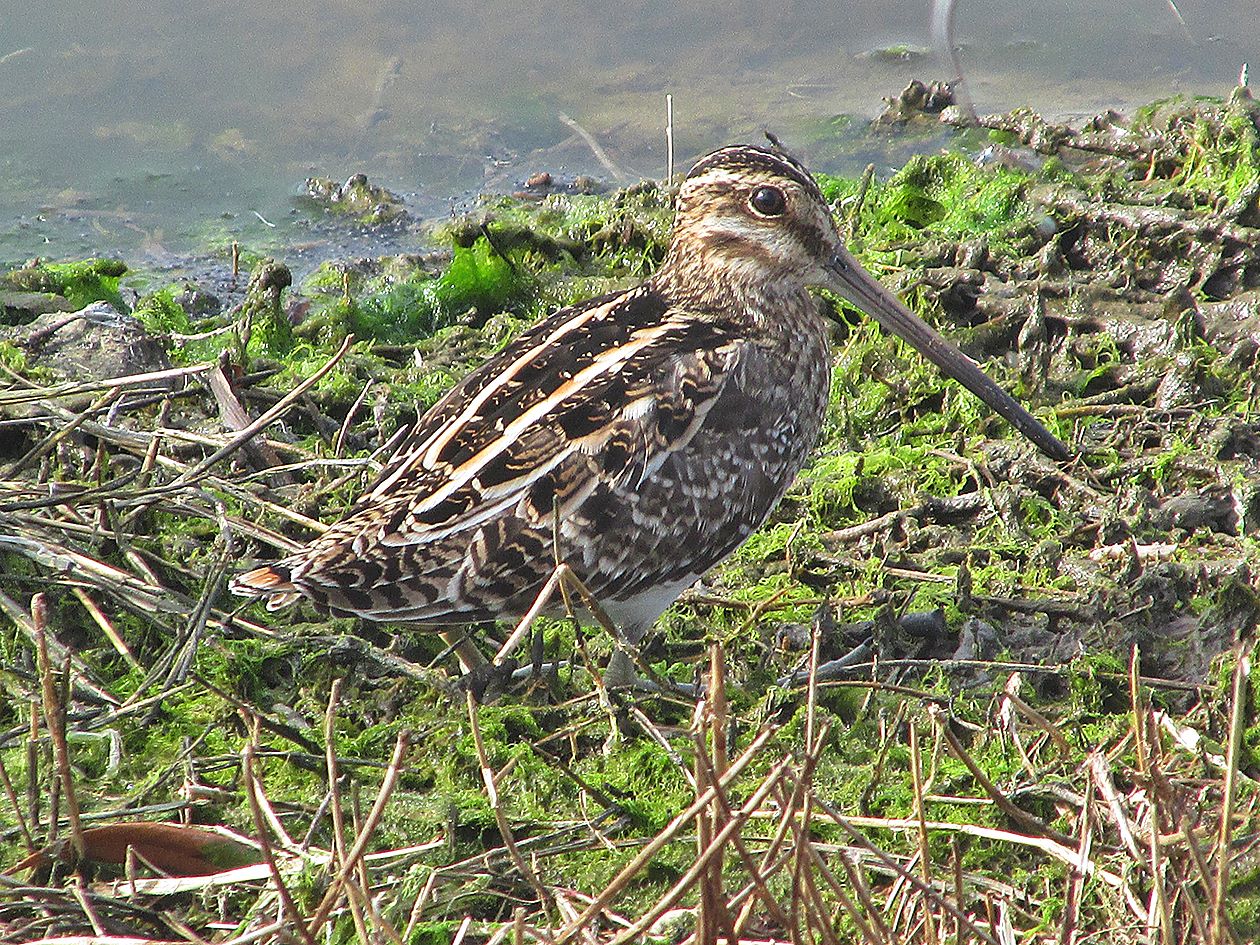
His fame as an ornithologist grew, and several species of birds were named in his honor, including the Wilson’s storm-petrel, Wilson’s plover, Wilson’s phalarope, Wilson’s snipe and Wilson’s warbler. Wilson’s work probably inspired John James Audubon’s own more extensive and famous collection depicting the birds of North America.

Every autumn I see some of the birds Wilson documented and painted as they stage their fall migration through the Volunteer State to reach destinations farther south.

Our capital city of Nashville also provides a common name to one of the warbler clan. The Nashville warbler is a small bird with a rounded head and short tail. The plumage of this warbler consists of yellow below and olive above. The birds have a white eye-ring that stands out against a gray head. The Nashville warbler also has a thin chestnut-brown crown patch, but a really exceptional look is required to see this feature. Most guides don’t mention that the Nashville warbler has a white patch of feathers surrounding the area where its legs join the body. This section of white is completely surrounded by yellow feathers. This is a helpful feature to know when trying to distinguish this warbler from some similar species.

Once again, Wilson bestowed a rather inaccurate name on this species, as the bird in question is only a visitor to Nashville and the surrounding territories during a limited window of time each year. The same is true of the Tennessee warbler. At best, these birds can only be found in the Volunteer State in April and May and again in September and October. Otherwise, Tennesseans would have to travel a good distance to see these birds at other times of the year.

Fortunately, these birds come to us. I’ve already seen the first Tennessee warblers for fall migration, but I’ve not been lucky enough this fall to get binoculars on a Nashville warbler — yet! There’s still time. Migration continues, so get outdoors and see what you can find.

••••

To share an observation, make a comment or ask a question, email me at ahoodedwarbler@aol.com.