Tag Archives: Erwin Record

Invite butterflies into your gardens, yards

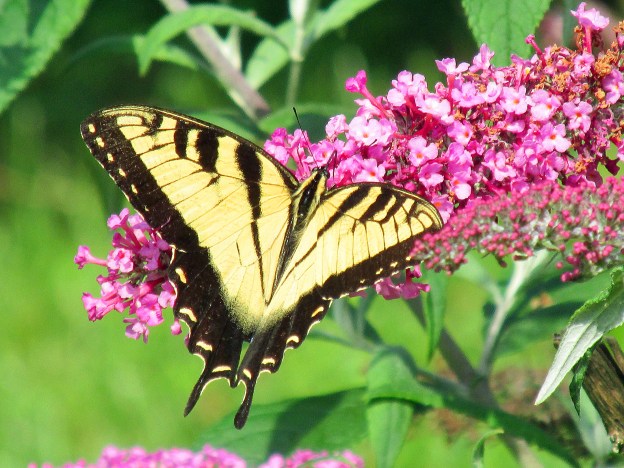
Swallowtails_edited-1

Photo by Bryan Stevens                                                    Spicebush Swallowtail and Tiger Swallowtail seeking salts and minerals from the edge of a gravel driveway.


I’m taking a break from the birds for one week to bring you some other things with wings in the form of a pictorial essay on butterflies, which include such families of winged insects as skippers, swallowtails, fritillaries and much more.

Most of these photos were taken at my home on Simerly Creek Road in Hampton, TN. A few were taken in other locations, including South Carolina and Georgia.
53469_4360543104155_1887969607_o

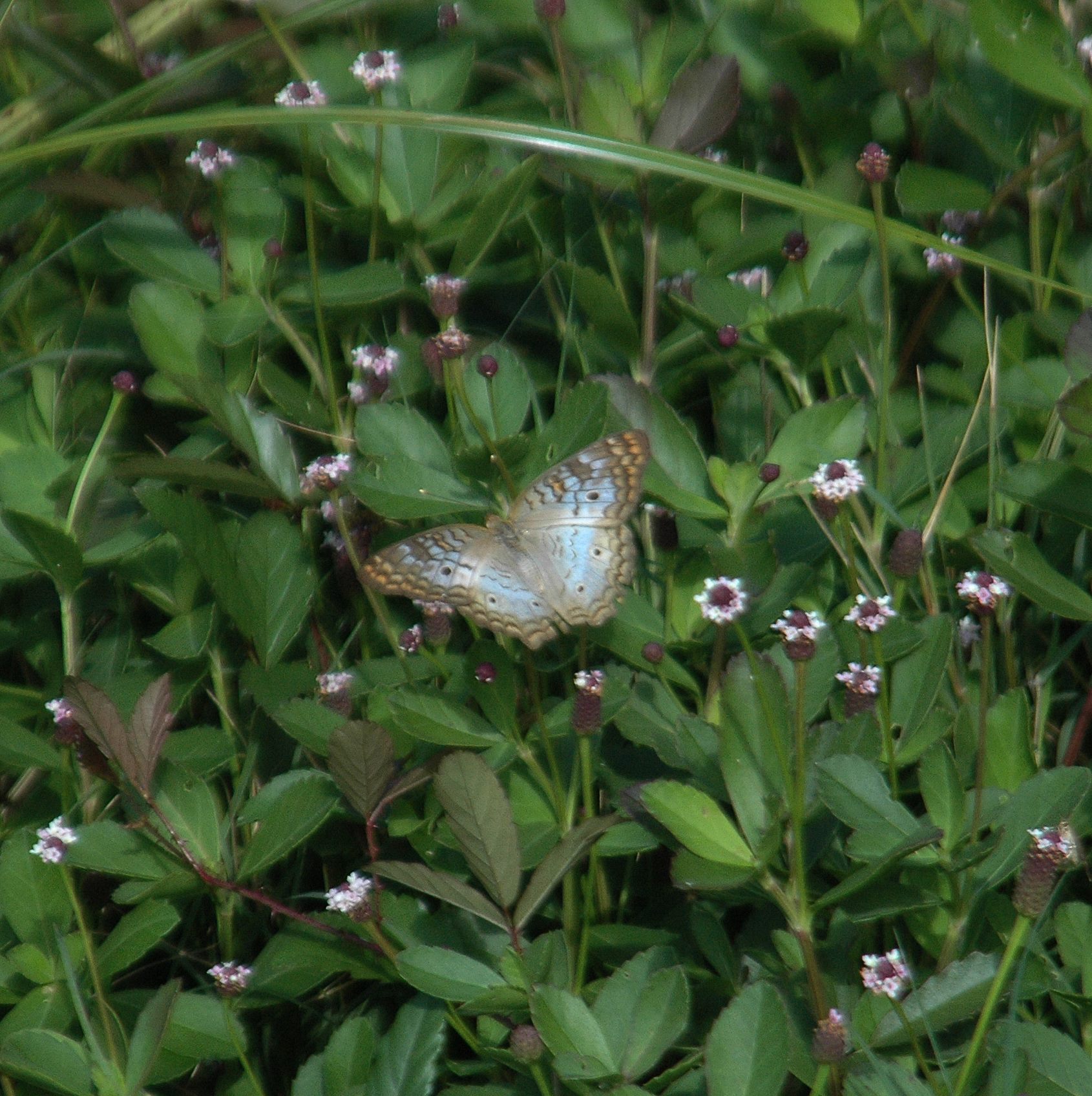
Photo by Bryan Stevens                             White Peacock found on Fripp Island, S.C., in October of 2012.  Resident from Argentina north through Central America, Mexico and the West Indies to South Texas and southern Florida. This butterfly migrates and temporarily colonizes to central Texas and coastal South Carolina. It is a rare wanderer to North Carolina, Missouri, Nebraska and Kansas.

According to the North American Butterfly Association, there are about 20,000 species of butterflies in the world. About 725 species have occurred in North American north of Mexico, with about 575 of these occurring regularly in the lower 48 states of the United States, and with about 275 species occurring regularly in Canada. Roughly 2,000 species are found in Mexico.

Butterflies are part of the class of Insects in the order Lepidoptera. Moths are also included in this order.

Butterflies are not newcomers to the world of insects. Fossilized butterflies are known to date back to the Eocene epoch, some 40 to 50 million years ago.
10293711_10203217981762763_2929721534219810613_o

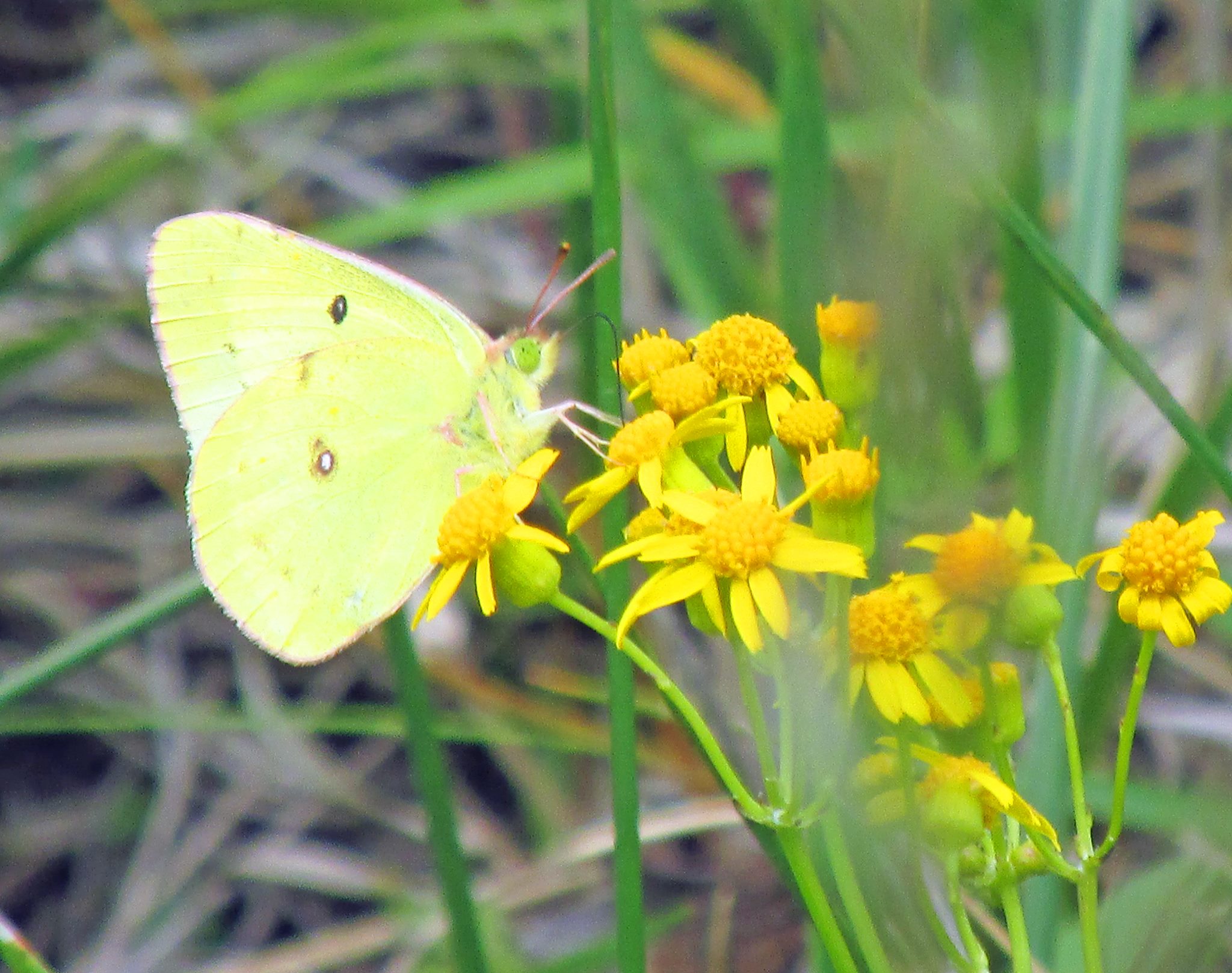
Photo by Bryan Stevens                                Some butterflies, such as the sulphurs, are known to migrate.

According to NABA, species that move northward each year include Cloudless Sulphur, Little Yellow, Gulf Fritillary, Painted Lady, American Lady, Red Admiral, Common Buckeye, Long-tailed Skipper, Clouded Skipper, Fiery Skipper, Sachem and Ocola Skipper.

In especially good years, one can see Painted Ladies, Cloudless Sulphurs or Clouded Skippers streaming northward along migratory routes. Most years, however, these migrant dispersals are so gradual they don’t attract much notice. During fall trips to coastal South Carolina, I have often noticed hundreds of Cloudless Sulphurs along the edges of the interstate highway system.
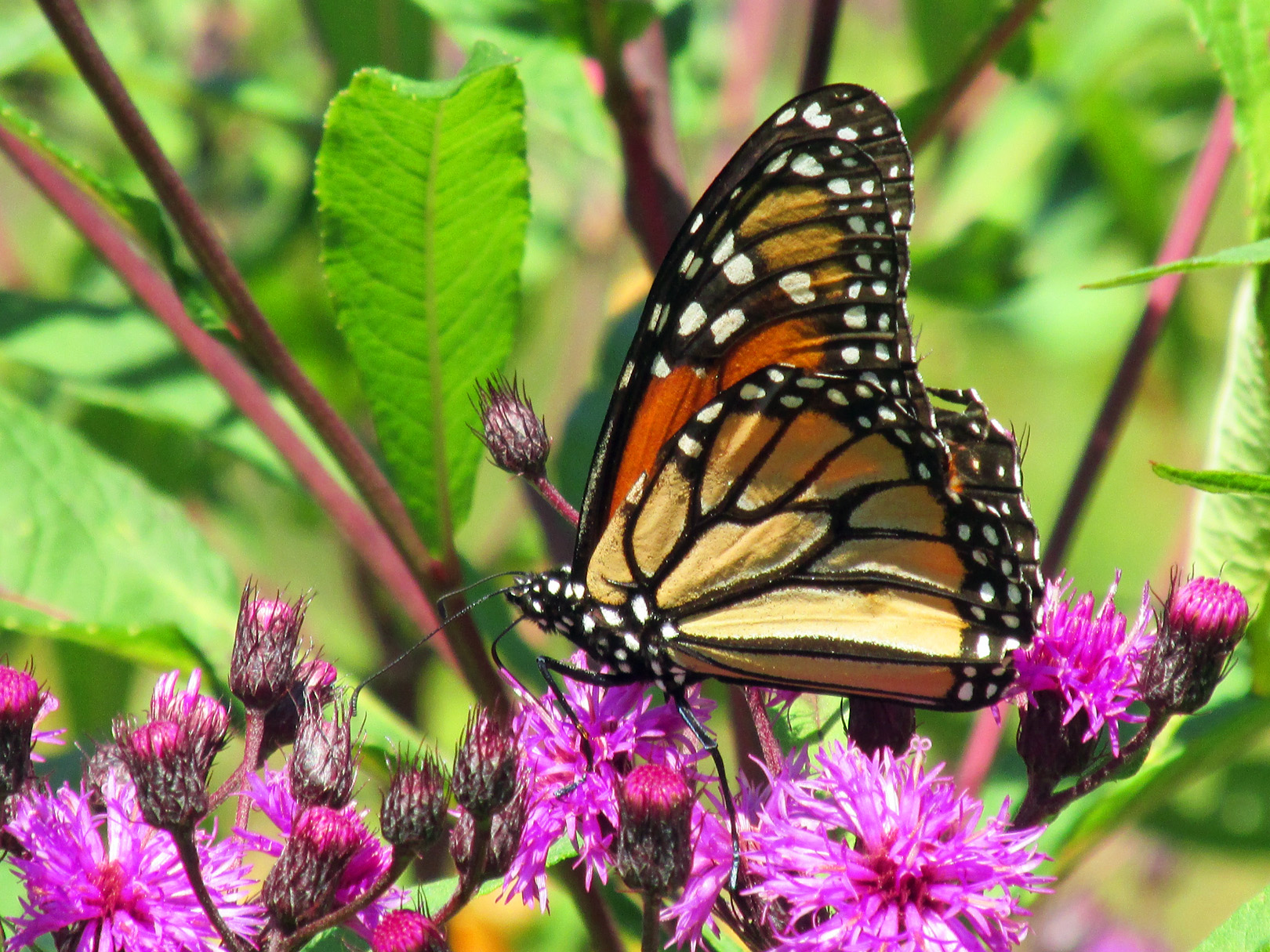
Photo by Bryan Stevens A Monarch sips nectar from blooming Ironweed.

Photo by Bryan Stevens
A Monarch sips nectar from blooming Ironweed.

PipeVineSwallowtails

Photo by Bryan Stevens                            Pipevine Swallowtails seeks nectar from zinnia blooms. This butterfly was the most common one found during the recent Roan Mountain Butterfly Count. A total of 236 individual Pipevine Swallowtails, many located on milkweed in the fields at the Dave Miller Homestead at Roan Mountain State Park, were found.

The North American Butterfly Association holds annual Butterfly Count in much the same manner as the Audubon Society conducts annual Christmas Bird Counts. Locally, an Elizabethton Butterfly Count and a Roan Mountain Butterfly Count are conducted every July and August.

Each count is a compilation of all butterflies observed at sites within a 15-mile diameter count circle in a one-day period. The annually published reports provide a tremendous amount of information about the geographical distribution and relative population sizes of the species counted. Comparisons of the results across years can be used to monitor changes in butterfly populations and study the effects of weather and habitat change on North American butterflies.

This year’s first attempt at conducting the 22nd annual Roan Mountain Butterfly Count was rained out. A week later — July 26 — the count was re-scheduled and enjoyed a convergence of good weather and abundant flowers. A total of 764 individual butterflies were counted. The total of 34 species was considered very high for this count, according to compiler Don Holt.
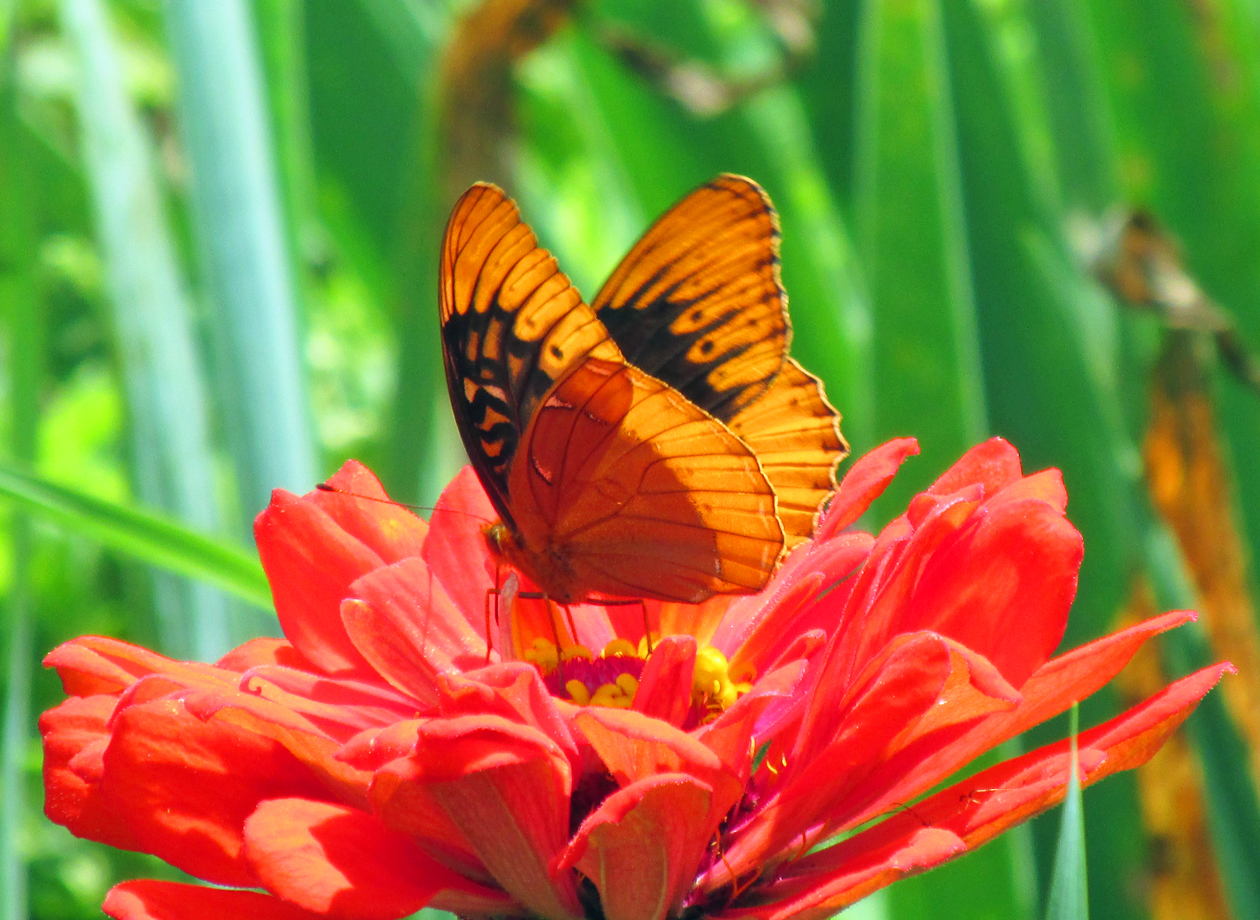
Diana-Male-Two

Photo by Bryan Stevens                                                                  A male Diana Fritillary seeks nectar from a zinnia bloom.

Holt noted that other common species found on this count included Silver-spotted Skipper, Aphrodite Fritillary, Eastern Tailed Blue and Meadow Fritillary. Some exceptional finds included a male Diana Fritillary at the Dave Miller Homestead and a Harvester at Hampton Creek Cove.

Photo by Bryan Stevens Northern Pearly Eye

Photo by Bryan Stevens                                                                                                                        A Northern Pearly Eye perches on the vertical surface of a concrete step.

CabbageWhite-Joe-Pye

Photo by Bryan Stevens                                                                                                                        The non-native Cabbage White is one of the few butterflies considered an agricultural pest. The butterfly’s caterpillars damage such crops as cabbage, as well as other mustard family plants.

Checkerspot-Dorsal

Photo by Bryan Stevens                                                                                                                              A Northern Checkerspot finds colorful coneflowers a convenient perch.

WoodNymph-ONE

Photo by Bryan Stevens                                                                                                                                A Wood Nymph clings to a leaf near a pond.

To attract more butterflies closer to your home, landscape with a variety of flowers and plants. Don’t forget to provide host plants that will feed hungry caterpillars, as well as nectar-rich flowers to feed adult butterflies. Do not use insecticides! You want to welcome these beautiful insects, not kill them.

To learn more, visit this page provided by the Missouri Botanical Garden.

http://www.missouribotanicalgarden.org/visit/family-of-attractions/butterfly-house/butterflies-and-plants/butterfly-gardening.aspx

LeastSkipper-2

Photo by Bryan Stevens                                                                                                                        The Least Skipper is one of the smallest of butterflies in the eastern United States.

There are several fun Facebook pages for butterfly enthusiasts. Check out https://www.facebook.com/groups/ButterfliesoftheeasternUnitedStates/  and https://www.facebook.com/groups/303259184298/

Red-SpotPurple

Photo by Bryan Stevens                                                                                                                                Red-spotted Purple perches atop a platform provided by a wide poplar leaf.

Buckeye-Spread

Photo by Bryan Stevens                                                                                                                                         A Common Buckeye suns itself in a gravel driveway.

RedAdmiral

Photo by Bryan Stevens                                                                                                                                      Red Admiral in the wetlands along the the Ivy Creek Greenway at George Pierce Park in Suwanee, Ga.


Look for herons along edges of local ponds, rivers

I enjoyed a recent trip to Atlanta, Ga. The extended weekend visited gave me the opportunity to see some birds I don’t see often at home in Northeast Tennessee, including Brown-headed Nuthatch and Pine Warbler.
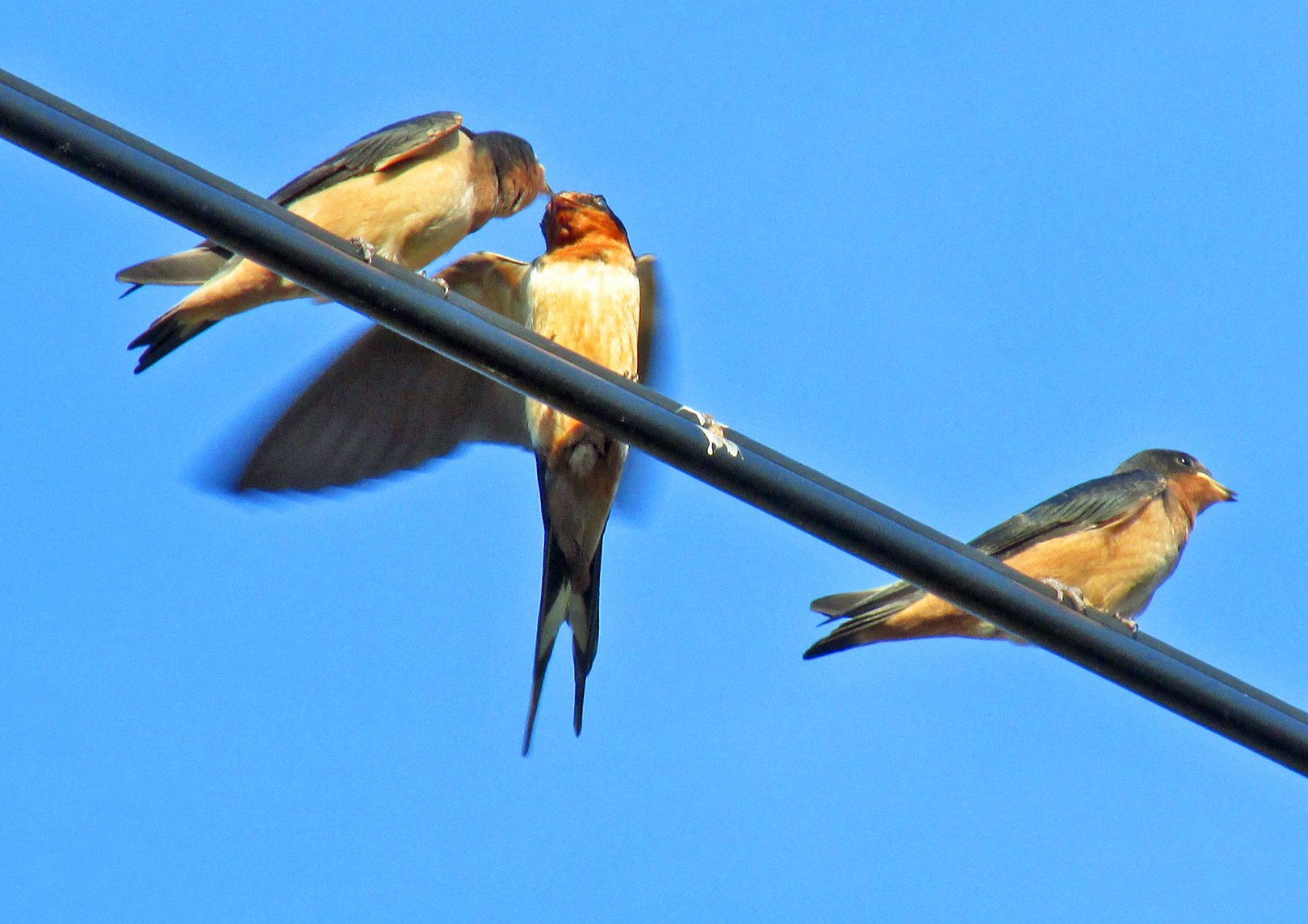
Photo by Bryan Stevens A Great Egret resting on a spit of land in a lake at Murphy Candler Park in Brookhaven, Ga.

Photo by Bryan Stevens
A Great Egret resting on a spit of land in a lake at Murphy Candler Park in Brookhaven, Ga.

I observed a Great Egret at Murphey Candler Park in Brookhaven, Georgia. Hiking trails around a small lake at this park offer some convenient locations for scanning the lake for wading birds and waterfowl. The egret was the first Great Egret I’ve observed in the Atlanta area.
I had visited this park hoping to find dragonflies, but for the most part struck out on finding these winged insects. I was compensated not only with the egret, but with observations of Double-crested Cormorants, Canada Geese, Mallards, Belted Kingfishers, Cedar Waxwings and Song Sparrows.

Photo by Bryan Stevens A Great Blue Heron moves stealthily through a wetland.

Photo by Bryan Stevens
A Great Blue Heron moves stealthily through a wetland.

Egrets are members of a family of birds known as Ardeidae, which includes herons, bitterns and egrets. The Great Egret is a very stately, graceful bird with white plumage, long legs and a sharp, yellow bill. It is smaller than the Great Blue Heron. The Great Egret stands 3.3 feet tall and has a wingspan of 52 to 67 inches. On average, however, they weigh only about 2.2 pounds.

Photo by Bryan Stevens A large flock of Great Egrets flies over the Watauga River in Elizabethton.

Photo by Bryan Stevens
A large flock of Great Egrets flies over the Watauga River in Elizabethton.

These egrets nest in large colonies. In the late 1800s and early 1900s, the colonial nesting habits of these birds made them particularly vulnerable to humans who slaughtered the birds in the millions to harvest their feathers for use in the fashion industry. The Great Egret and other wading birds were almost decimated in order to decorate fashionable hats for women.

The National Audubon Society was founded in 1905, largely as an effort to combat the unregulated slaughter of birds like Great Egrets, Snowy Egrets and Roseate Spoonbills. Now, more than a century later, the Great Egret still serves as the official logo for the National Audubon Society. In addition, the Great Egret has rebounded from those dark years. In fact, this bird now ranges as far north as southern Canada in appropriate wetland habitats. During spring and fall migration, Great Egrets also pass through northeast Tennessee. Look for them along rivers, lakes and on small farm ponds.

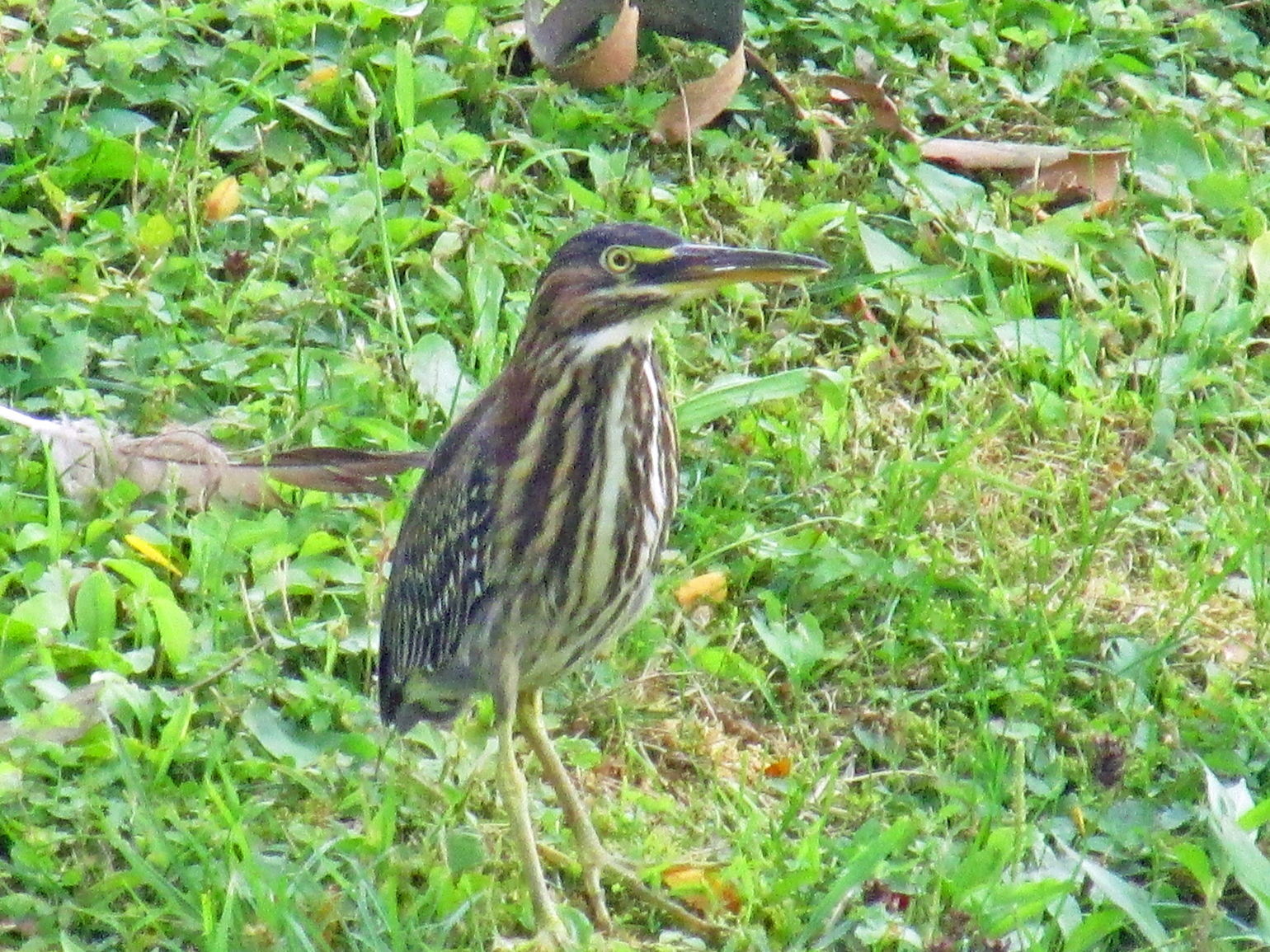
During visits to favorite birding locations in Elizabethton and Erwin, I have also observed Green Herons and Great Blue Herons.

Photo by Bryan Stevens A young Green Heron rests at the edge of a pond.

Photo by Bryan Stevens
A young Green Heron rests at the edge of a pond.

The Green Heron can easily be overlooked as it lurks near a stream’s banks or the edges of a pond. This heron is not tall and stately like the Great Egret or Great Blue Heron. The bird is a patient ambush predator capable of remaining motionless for extended periods as it waits for prey to move within reach of its sharp, pointed bill. I’m always flushing these herons from cover before I even realize they are present.

I do get fortunate on occasion, however, and manage to approach a Green Heron without panicking the bird into a hasty flight. If you stand very still and don’t make sudden movements, you can manage to observe this bird from a respectful distance.

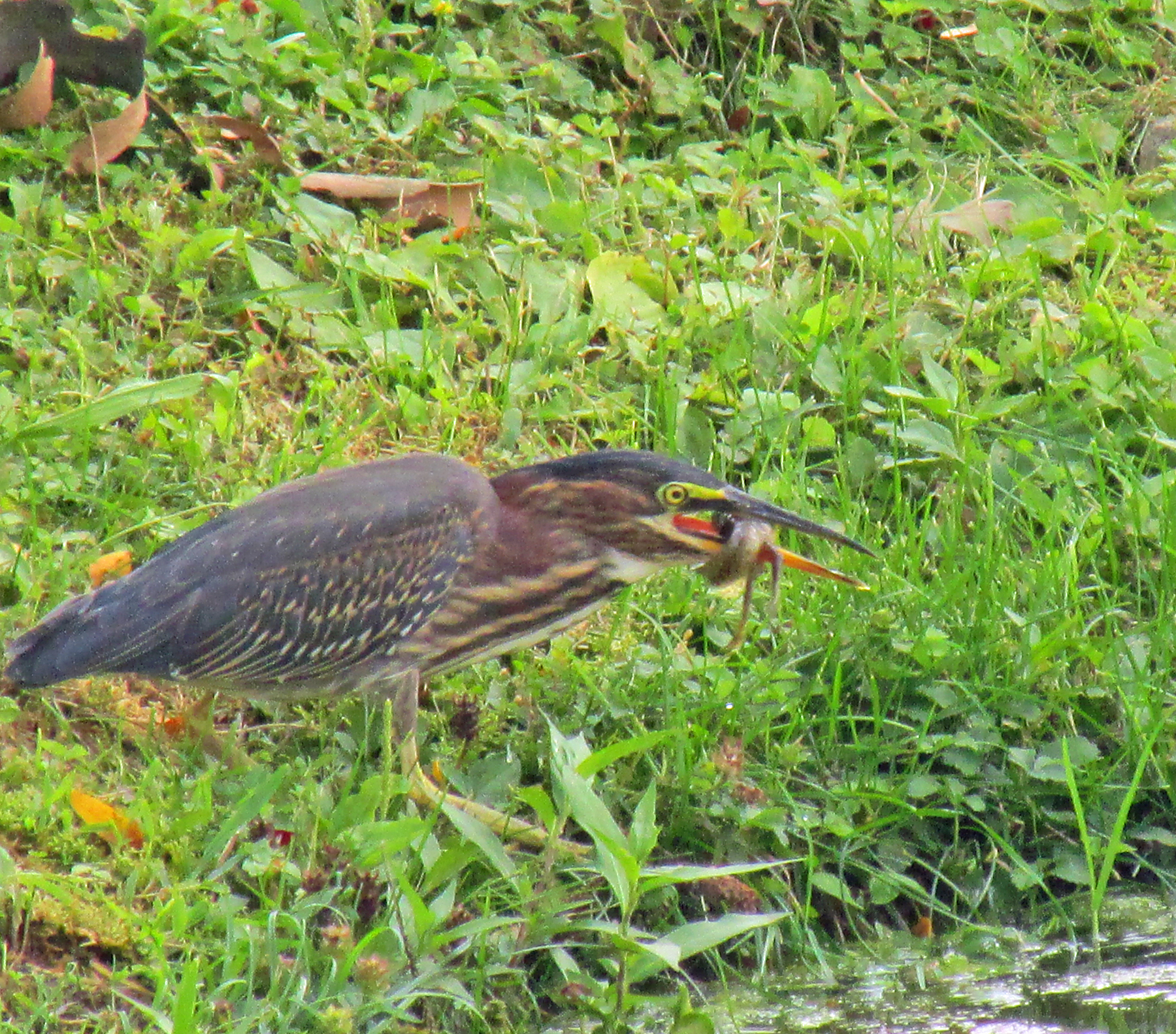
Such was the case of a Green Heron that I found stalking the edges of the pond at Erwin Fishery Park. I had my camera, so I snapped some photographs as I watched the heron’s slow, deliberate steps along the pond’s edge. Then, with a lightning-quick motion, the bird lunged its bill into the water and snatched a large tadpole. The heron required a brief time to get the wiggling tadpole positioned. After that technicality was resolved, the heron swallowed the plump tadpole quickly and almost immediately resumed search for more prey.

Photo by Bryan Stevens A Green Heron finesses a captured tadpole in its bill.

Photo by Bryan Stevens
A Green Heron finesses a captured tadpole in its bill.

The unfortunate tadpole had developed hind legs, which did not prove an obstacle for the bird swallowing it, but still had a tail. Although it was very close to achieving frog-hood, this particular tadpole instead became part of the varied diet of a Green Heron, which can also include fish, crustaceans, insects and even mice. At this same Erwin pond, I once watched another Green Heron patiently stalking and successfully snatching dragonflies that perched on pond vegetation within reach of the bird’s bill.

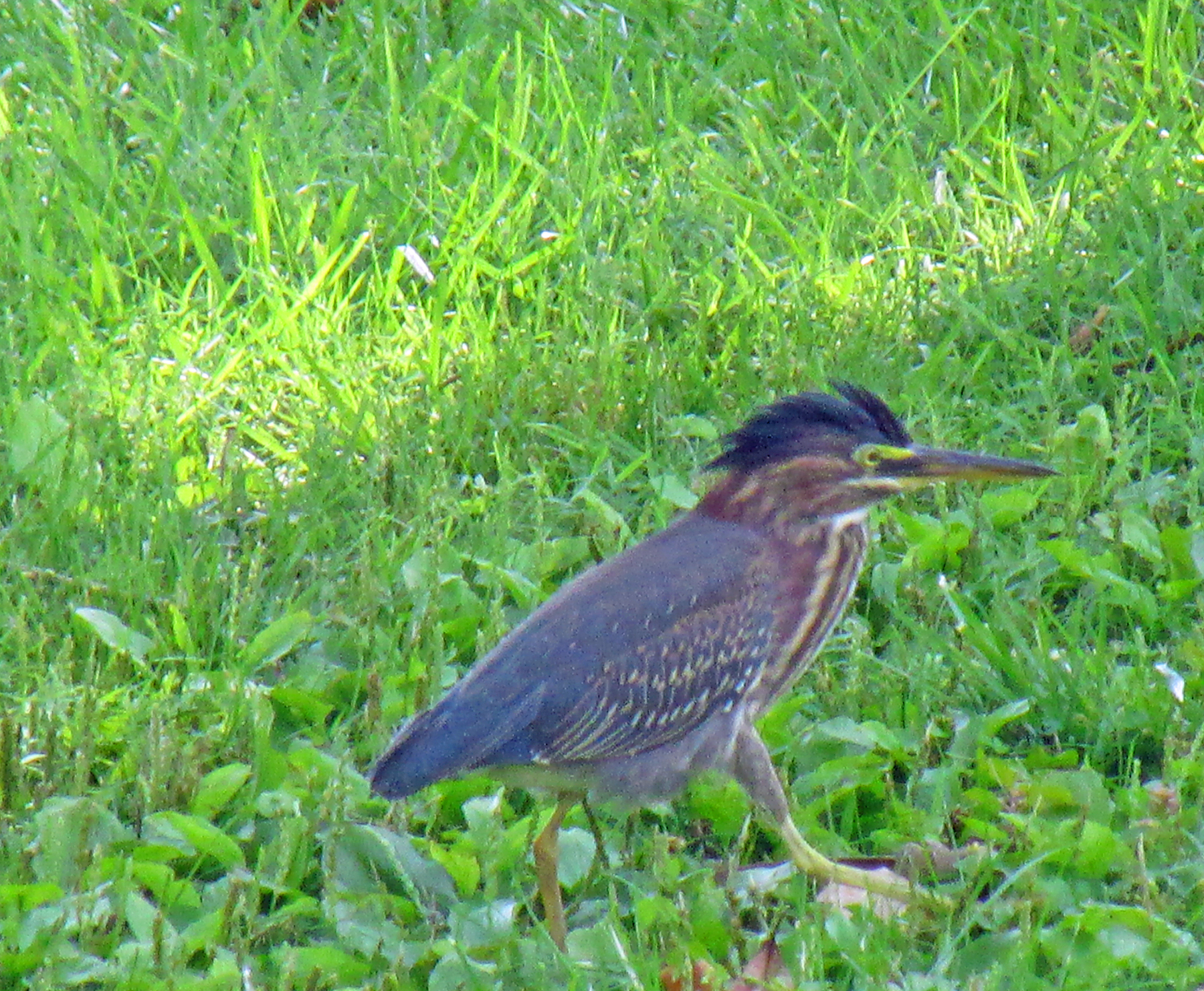
Photo by Bryan Stevens A Green Heron elevates a shaggy crest of feathers, a behavior often initiated when the bird feels alarmed.

Photo by Bryan Stevens
A Green Heron elevates a shaggy crest of feathers, a behavior often initiated when the bird feels alarmed.

The Green Heron is usually present in Northeast Tennessee from April to October. The bird migrates to Central America for the winter months. A few other herons, including the Great Blue Heron and the Black-crowned Night-Heron, live year-round in the region.

Kingfishers are world-class anglers

1622507_10202822806683633_5738404313137626778_o

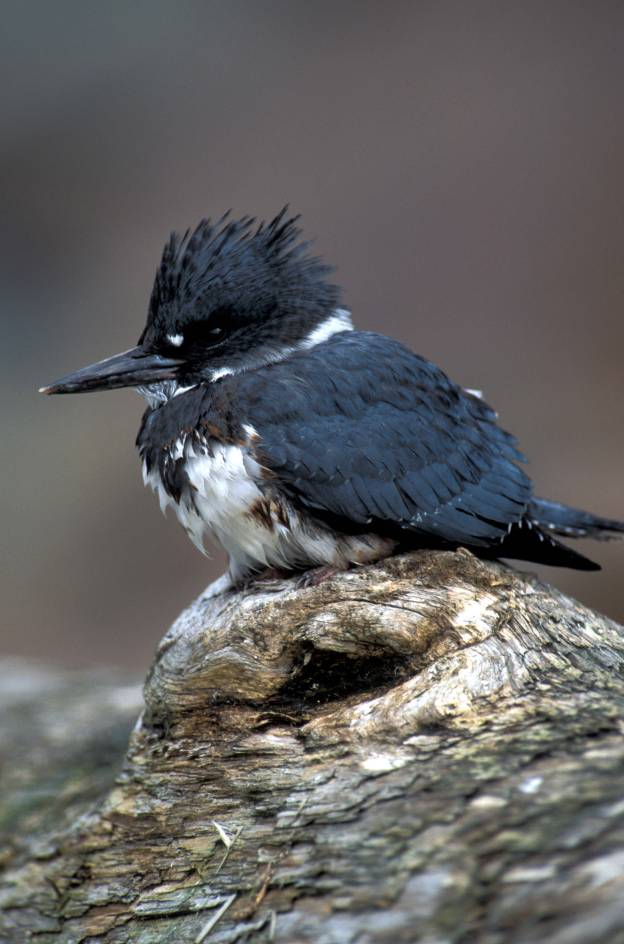
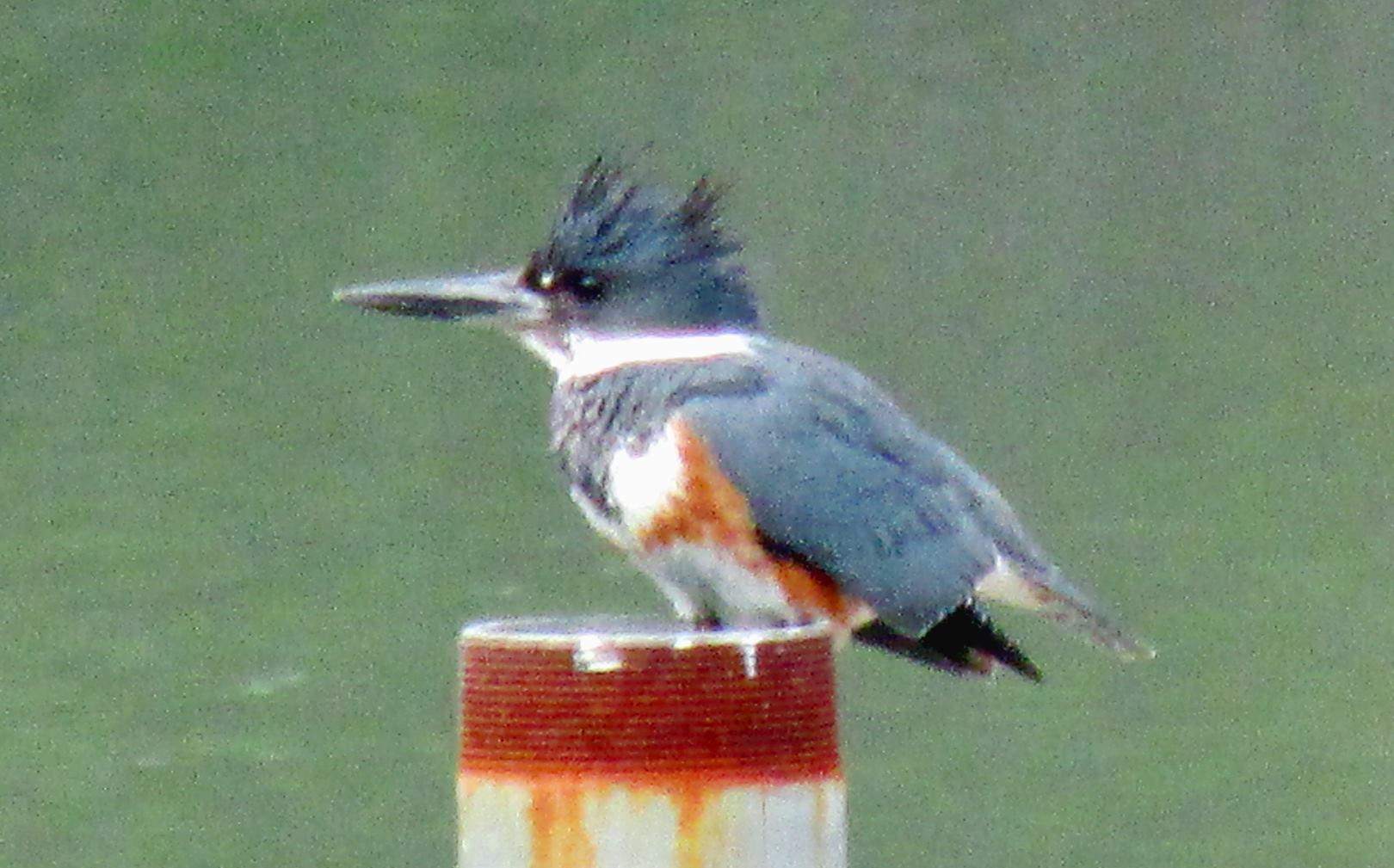
Photo by Bryan Stevens                                                                                                       A perched Belted Kingfisher rests between attempts to catch fish along the waterfront at Winged Deer Park in Johnson City.

Fishing is a favorite pastime for many people, who like nothing better than to spend a lazy summer afternoon trying their luck at their favorite fishing spot.

There’s also an angling counterpart among our feathered friends. The Belted Kingfisher’s nature as an angler rules out this bird visiting feeders in the backyard, but that doesn’t mean you’re unlikely to see this bird. With a little strategic effort, an observation of a Belted Kingfisher is fairly easy to obtain, especially during the summer months. If you live near a stream, pond, river or other body of water, you have probably been fortunate enough to observe a Belted Kingfisher as it completes its daily routine.

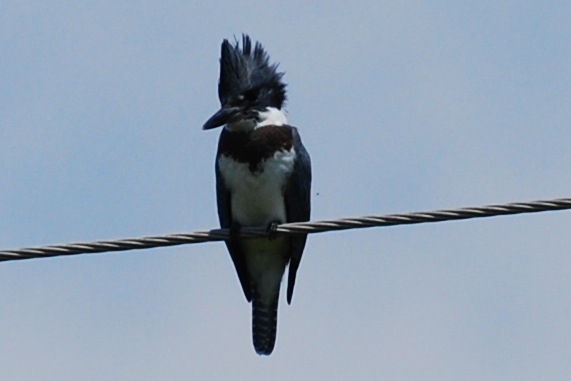
If you are a fishing enthusiast yourself, you’ve likely shared some favorite fishing holes with this bird. The Belted Kingfisher is patient in its pursuit of fish. The birds prefer to perch on an exposed branch or a wire that overlooks a body of water that offers ample fishing opportunities. The Belted Kingfisher, however, is capable of hovering in place in order to spot and then capture its prey in an impressive plunge and lunge into the water.

Most of my observations of hunting kingfishers have involved the birds in their ambush approach to fishing — perching and diving on the unsuspecting fish. I have on a few occasions, however, also observed kingfishers as they hover over the water in a quest for a meal.

The Belted Kingfisher, like most of its kin, looks to have a head and bill that are slightly too large for the rest of the body. It’s the long, heavy bill that the Belted Kingfisher uses to snatch fish from their watery homes.

A walnut tree with some dead branches overlooking my family’s fish pond is a favorite perching site for visiting Belted Kingfishers. A few Belted Kingfishers become regular visitors almost every spring and summer. In past years, I’ve been delighted by pairs of kingfishers that have brought as many as six of their offspring to hunt around the edges of the pond and creek near my home.

When a Belted Kingfisher does manage to capture a fish — not always a certainty, despite their great skill — the bird will usually fly to a perch where they will beat the fish unconscious before swallowing it. I remember one particular kingfisher that liked to catch fish in the creek and then fly to the corner of the metal garage roof where the bird proceeded to beat senseless the unlucky fish.

Worldwide, there are about 90 species of kingfishers that range in size from the 16-inch-long Laughing Kookaburra of Australia to the tiny African Dwarf Kingfisher, which at four inches in length is smaller than most sparrows. This family of birds is divided into three groupings, the river kingfishers, the tree kingfishers and the water kingfishers.

Despite the name “kingfisher,” not all kingfishers exist on a diet of fish. Some members of the kingfisher family instead prey on other quarry, such as snakes, lizards and insects.

Some interesting common names have been used to identify the world’s kingfishers, including Half-collared Kingfisher, Shining Blue Kingfisher, Blue-eared Kingfisher, Azure Kingfisher, Indigo-banded Kingfisher, Silvery Kingfisher, Malachite Kingfisher, White-bellied Kingfisher, Cerulean Kingfisher, Rufous-backed Kingfisher, Spangled Kookaburra, Rufous-bellied Kookaburra, Shovel-billed Kookaburra, Lilac Kingfisher, Brown-winged Kingfisher, Stork-billed Kingfisher, Great-billed Kingfisher, Striped Kingfisher, Lazuli Kingfisher, Ultramarine Kingfisher, Cinnamon-banded Kingfisher, Sacred Kingfisher, Mewing Kingfisher, Chattering Kingfisher, Glittering Kingfisher, Red-breasted Paradise Kingfisher, Pied Kingfisher and Green-and-rufous Kingfisher.

Kingfishers comprise a cosmopolitan family of birds with species present on every continent except Antarctica.

kingfisher

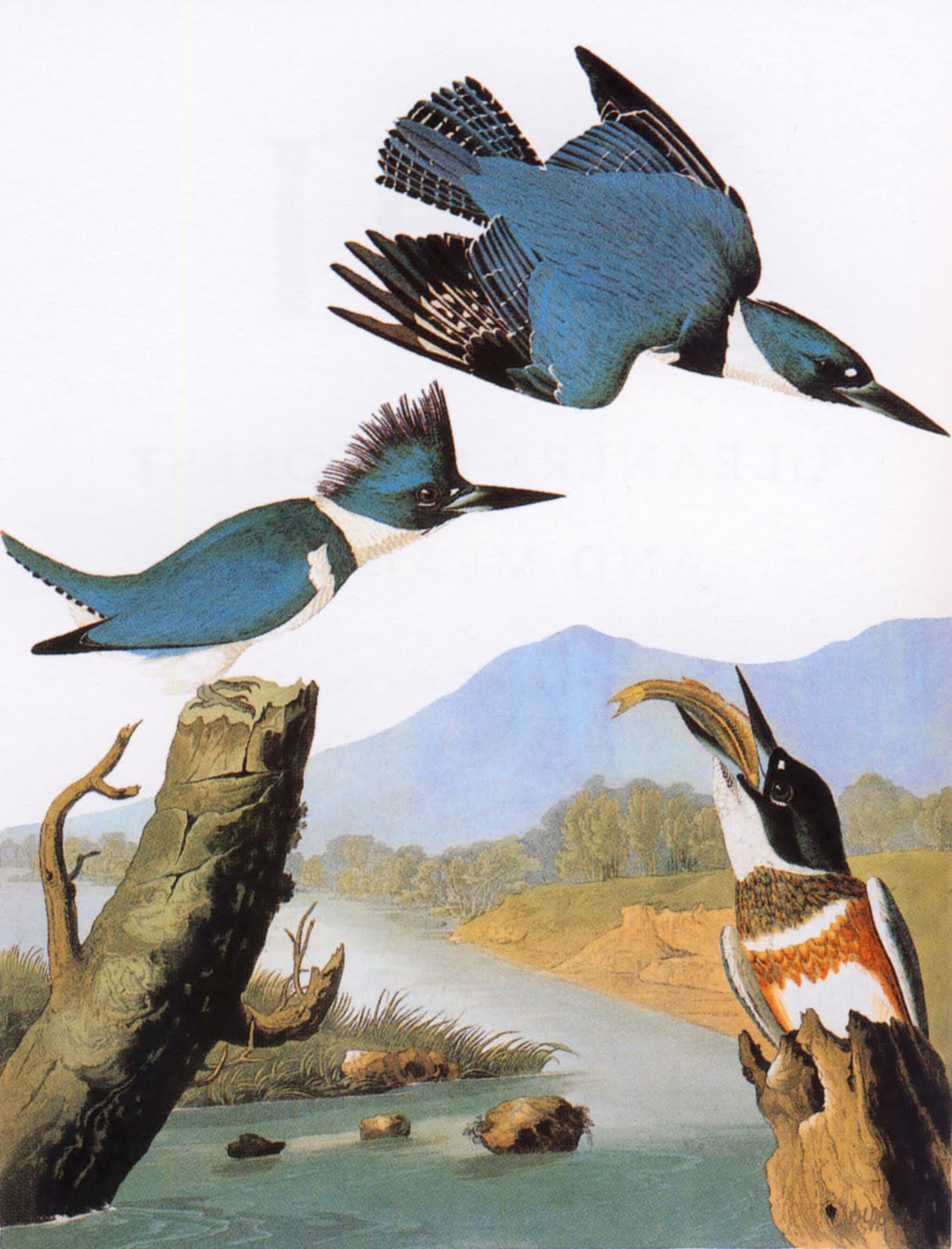
A depiction of Belted KingfisherS painted by John James Audubon.

The three North American kingfishers, however, are exclusively fish-eaters. The Belted Kingfisher, with a range that spans most of the United States, is the only kingfisher encountered by most Americans.

Two others, the Ringed Kingfisher and the Green Kingfisher, are found in Texas and occasionally in other locations near the Mexican border. The Ringed Kingfisher is similar in appearance to the Belted Kingfisher, but is somewhat larger with a rufous-colored belly. The little Green Kingfisher, not quite nine inches long, has the typical kingfisher appearance, but is green rather than blue on its upperparts.

With the Belted Kingfisher, only the female sports a ring of rufous coloration across her breast. She is an exception to the rule that most male birds are more vividly colored than their female companions.

In her book The Folklore of Birds, Laura C. Martin writes that in some accounts the kingfisher, not the dove, was the second bird Noah released from the ark after the Biblical flood. Instead of looking for land, the kingfisher flew too high and the sun scorched the bird’s feathers. After his setback with the raven and now the kingfisher, Noah made the kingfisher remain on the ark’s deck to catch its food from the water.

Halcyon days, a term meaning a period of peaceful quiet, is derived from Greek legend. According to the legend, the god Zeus restrained the storms during the period when the kingfishers nest. The scientific name for the Belted Kingfisher is Megaceryle alcyon, a variation on the term “halcyon.”

2782284667_afa8c0651e_o

Photo Courtesy of Jean Potter                                                                                                          Belted Kingfisher sits on a wire to scan for fish.

Belted Kingfishers nest by excavating a cavity in a dirt bank, usually near water. The tunnel slopes upward from the entrance, and may extend as far as eight feet into the bank.

Again in Martin’s book, there is an account of a Cherokee legend about how the kingfisher acquired its angling lifestyle. The poor bird wanted to be a waterbird, but lacked the equipment to make a living at fishing. The other animals convened a council and, in pity for the kingfisher’s plight, endowed the bird with its spear-like bill. Since that time, the bird has been known as “king of the fishers.”

The “king of the fishers” is indeed to be envied by human anglers. Although not successful in every attempt, the Belted Kingfisher is certainly exceptional in its pursuit of fish. According to John Eastman in his book, Birds of Lake, Pond and Marsh, the Belted Kingfisher typically captures about 10 fish per day.

If you want to observe this bird for yourself, stake out a pond or section of river. You’re not likely to have to wait for long before you are rewarded with an observation. In my experience, however, the Belted Kingfisher is somewhat shy and wary of humans, so observe from a respectful distance or you’re likely to scare off the bird, which will depart giving its rattling call that sounds so much like the sound of annoyance on its part.

Summer is the season of the swallow


No matter where you live, you probably don’t have to go far to see one of the members of the swallow family. These graceful, aerodynamic birds are quite familiar to most people. If you spend much time at all outdoors during the summer months, chances are you’ve observed some members of this family.

Overall, it’s been a good year for swallows. It’s usually not too difficult to find five of the six species that are known to make Northeast Tennessee and Southwest Virginia their home from spring to fall. In addition to barn and tree swallows, I have seen purple martins, cliff swallows and northern rough-winged swallows so far this year.

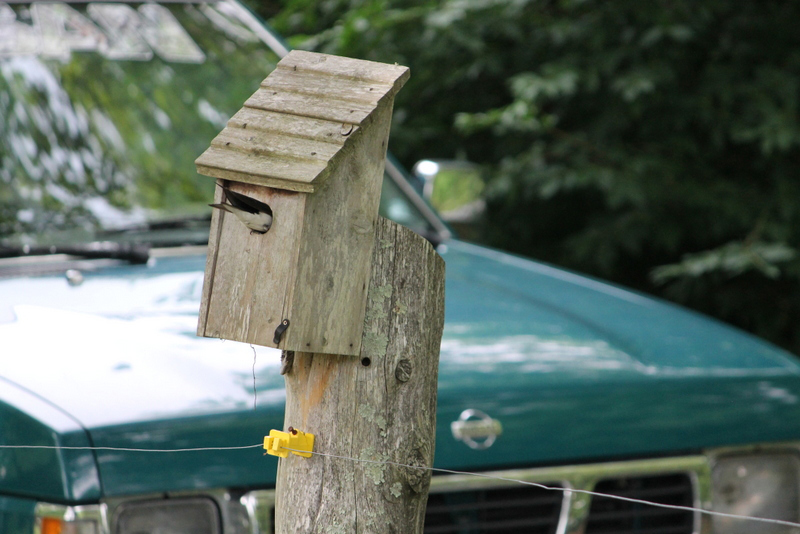
Photo courtesy of Mary Taylor Beierle A tree swallow peeks inside a nest box at the Beierle home.

Photo courtesy of Mary Taylor Beierle
 A tree swallow peeks inside a nest box at the Beierle home.

Barn swallow and tree swallow are the two members of the family that are probably best known to people. They have adapted to life in both suburban and rural areas, which brings them into frequent contact with people.

These days, the barn swallow is as apt to nest in a parking garage or on an apartment balcony as inside a barn in the countryside. Once young swallows leave the nest, parents will park them on a perch as they continue to feed the still dependent young. Adults fly over nearby fields, foraging for insects that they catch on the wing and deliver back to the waiting, always hungry, young birds.

A freshly mown field is a magnet for swallows. I don’t know how the word spreads so quickly among these birds, but I’ve observed dozens of these birds descending on fields soon after they have been mowed for hay. At times, the birds arrive while the mowing is still taking place, swooping after insects stirred up in the tractor’s wake.

I haven’t observed any bank swallows in the region this year, but these members of the swallow family are rather hit-or-miss in the region. Because of their specialized nesting needs, bank swallows are localized in their distribution and not as widespread as their kin.

Cliff swallows nest beneath many local bridges. These swallows, which at one time nested primarily on rocky cliffs, hence their name, now frequently nest under man-made structures. These swallows make their jug-shaped nests out of mud and clay. These nesting “jugs” are all located in clusters beneath bridges and other structures. It’s a wonder that the parents flying in with food are able to tell their nests apart from the nearby seemingly identical nests of their neighbors.

NRW-Swallow

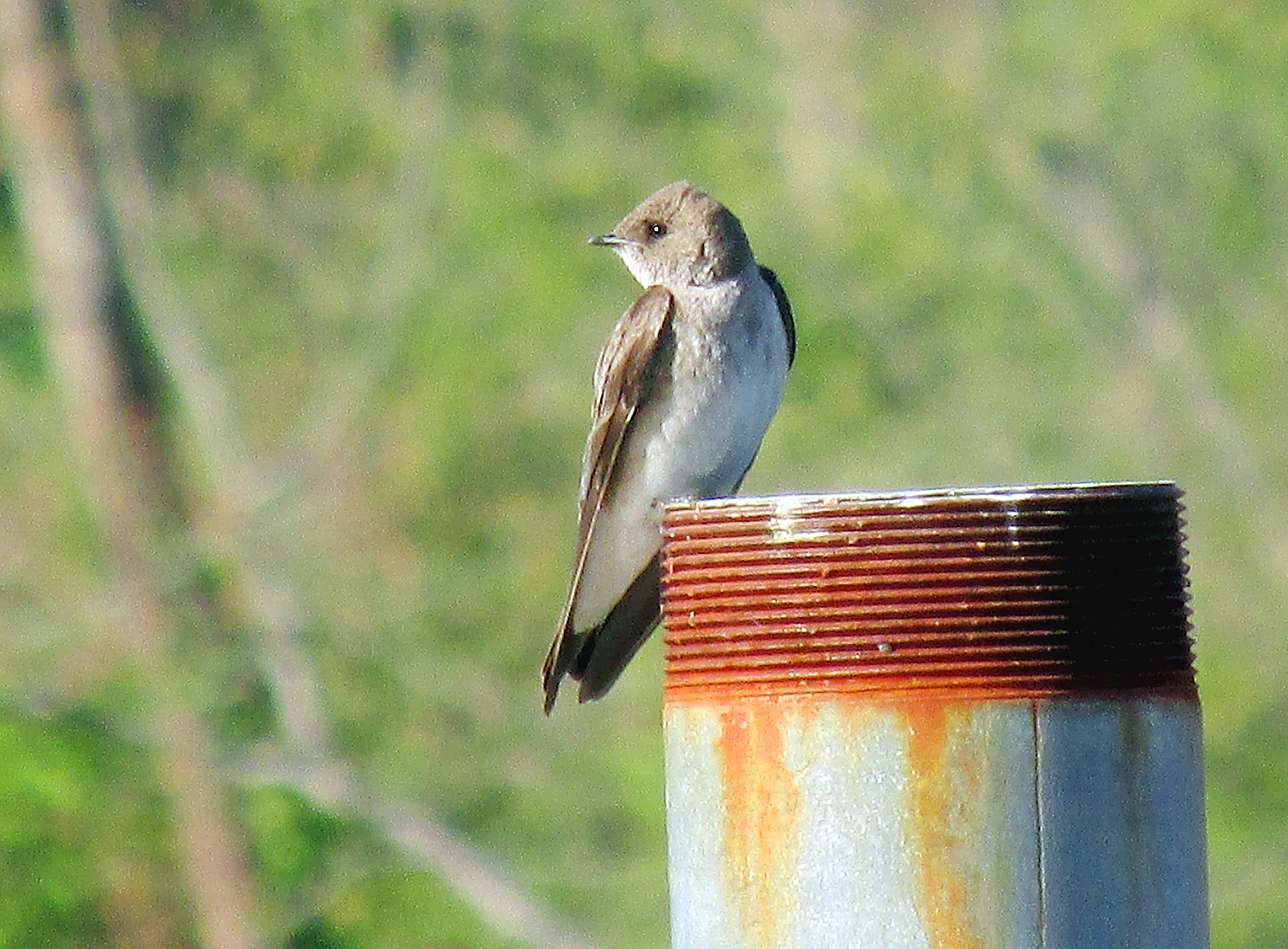
Photo by Bryan Stevens                                  For such a small bird, the Northern rough-winged Swallow has a long name.

Northern rough-winged swallows are opportunists when it comes to nesting. According to a profile written by Mark Johns with North Carolina Wesleyan College, this small swallow nests near rocky gorges, shale banks, stony road cuts, railroad embankments, gravel pits, eroded margins of streams and other exposed banks of clay, sand or gravel. They will also nest in old kingfisher burrows, protruding drainpipes, crevices in brick or stone structures such as dams, bridges or tunnels, gutters and culverts. Their nests are often built near open water.

The Northern rough-winged swallow ranks as one of the species with the longest common names in North America. It’s name consists of 26 letters and a hyphen, which ranks it one letter below both the Northern beardless-tyrannulet and a recently-created species — the saltmarsh sharp-tailed sparrow — which each have 27 letters and a hyphen. Formerly known as sharp-tailed sparrow, the species was renamed with “salt marsh” added to distinguish it from a relative, Nelson’s sparrow.

TreeSwallow-MaryBierlie

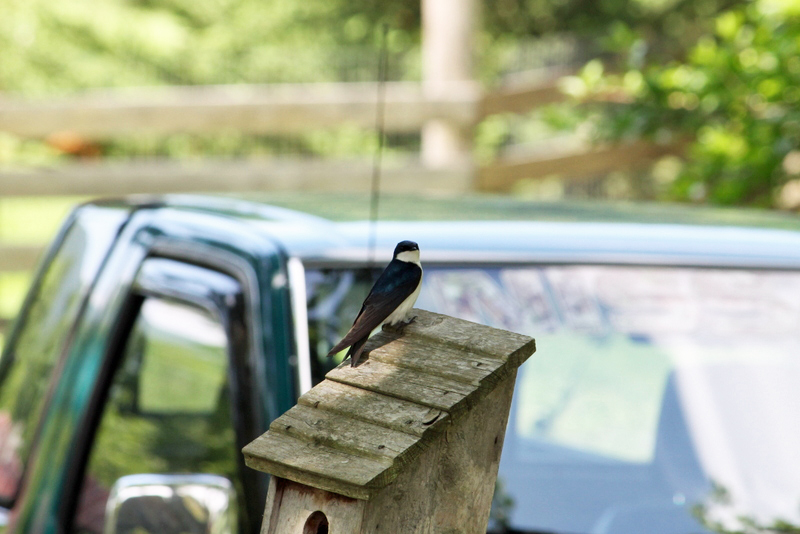
Photo courtesy of Mary Taylor Beierle                                      A male Tree Swallow surveys his territory from atop a nesting box.

Purple martins, which rank as the largest species in the swallow family in North America, are famous for nesting in large colonies. Nesting facilities range from groupings of natural or artificial gourds fashioned into a nesting chamber, as well as large, multi-level condominium dwellings tailored for the specific needs of this communal bird. A colony can consist of several dozen to several hundred pairs of these birds. Only the adult male purple martin shows the iridescent, dark blue-purple plumage that provides the species with its name.

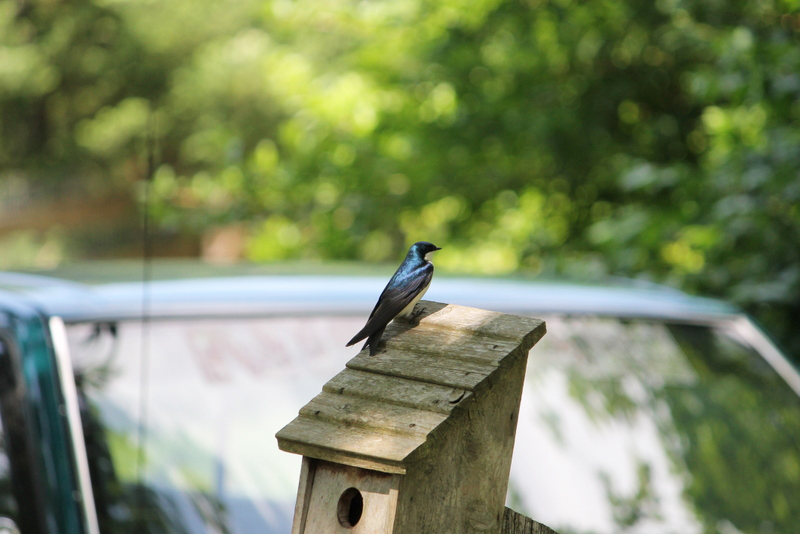
The tree swallow is my favorite, probably because a pair of these birds has nested in my yard for many years. Unlike other swallows, these cavity-nesting birds will readily accept nesting boxes. They compete with Eastern bluebirds for boxes, but the two species usually can work out a truce and settle down to nest in close proximity to each other. The iridescent blue-green male tree swallow, complete with white underparts and a forked tail, is a handsome bird and a welcome addition to the bird population in any yard or garden. Tree swallows enjoy water, so a nearby pond or creek is a boon for attracting these birds.

TreeSwallowPerched-Bierlie

Photo courtesy of Mary Taylor Beierle          Tree swallows readily accept human-provided nesting boxes. They also make delightful neighbors during the summer season.

While only a few swallows range into the United States and Canada, a total of 83 species of swallows can be found worldwide. Some of the common names for these different swallows (and martins) are quite descriptive. A sampling includes white-eyed river martin, square-tailed saw-wing, white-headed saw-wing, grey-rumped swallow, white-backed swallow, banded martin, violet-green swallow, golden swallow, brown-chested martin, brown-bellied swallow, pale-footed swallow, white-bibbed swallow, pearl-breasted swallow, greater striped swallow, mosque swallow, fairy martin and chestnut-collared swallow.

••••••

Several of the photos this week were provided by Mary Taylor Beierle, a resident of Stoney Creek in Carter County. Mary is also the author of the book, “Edmond The Daddy Turkey,” a delightful story about a male turkey who learns how to be a father.

Mary emailed me the photos with a brief note about her visiting swallows.  “I am thrilled to have them here as we had never seen them before,” she said. “Good thing I have several bird books so I could identify them.”

To learn more about Mary’s book, visit http://www.amazon.com/Edmond-Daddy-Turkey-Taylor-Beierle/dp/0985986123

10441231_838490356179548_1093306511537972714_n

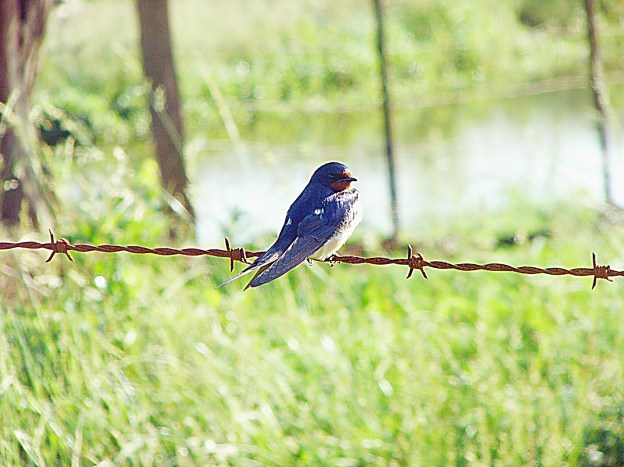
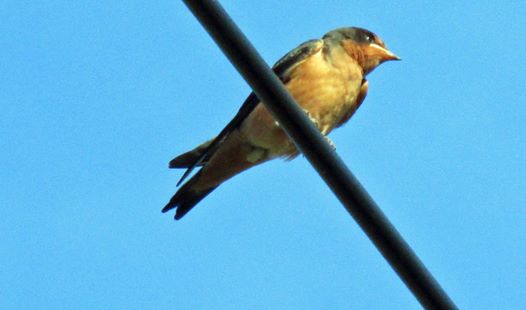
Photo by Bryan Stevens A Barn Swallow perches on a utility wire over a field.

Brown Thrasher’s nesting habits bring this golden-eyed bird into our yards

Photo by Bryan Stevens A fledgling Brown Thrasher perches on a ledge inside a garage.

Photo by Bryan Stevens
A fledgling Brown Thrasher perches on a ledge inside a garage.

It’s been a banner year for brown thrashers at my home. In recent weeks, these large songbirds have provided plenty of entertainment by bringing their young to the feeders. They especially like the suet feeder. The parent birds work to detach chunks of suet. Once they secure these morsels, the parents feed their hungry young.

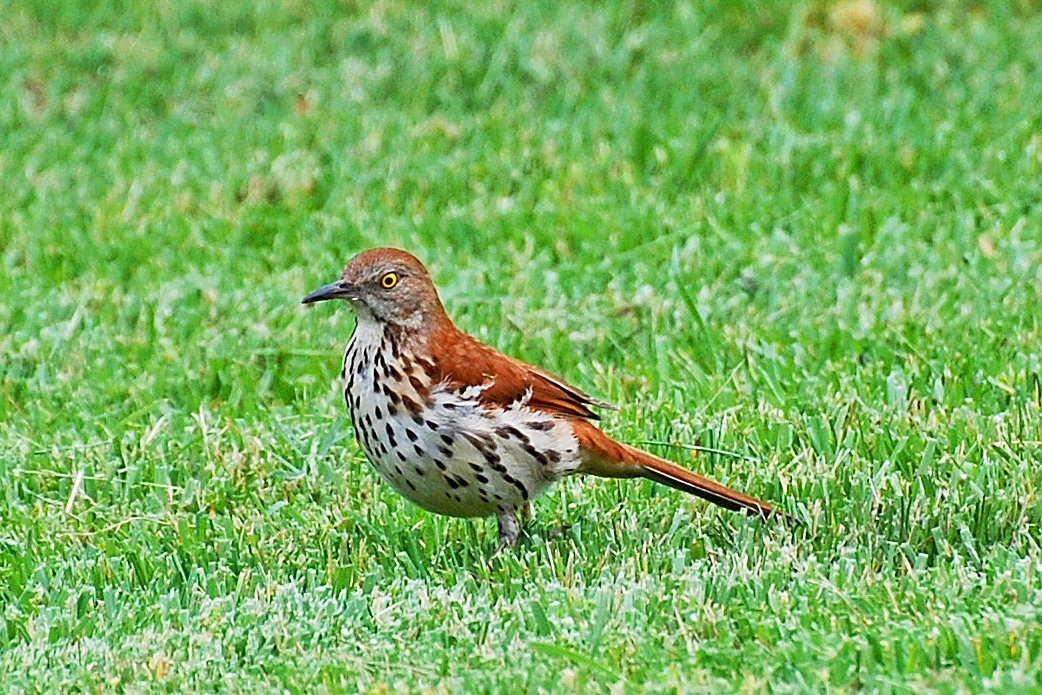
Photo Courtesy of Jean Potter A Brown Thrasher scans the grass for insect prey.

Photo Courtesy of Jean Potter
A Brown Thrasher scans the grass for insect prey.

A few years ago, quite by accident, I came across a brown thrasher nest. I hadn’t gone looking for it. The nest, expertly woven into a thicket of honeysuckle vines, was tucked beneath a sheltering eave of an outdoor storage building. I don’t think anything but a fortunate accident could have ever revealed the nest. I still remember peeking into that tangle of vines and seeing a golden eye staring back. The bird didn’t look in the least pleased that I had accidentally stumbled across her nest.

The otherwise extroverted brown thrasher, which prefers to nest in difficult-to-access, tangled messes, found the cluster of vines a perfect location. I haven’t discovered any thrasher nests this year, but I’ve observed several fledglings when they began visiting the feeders with their parents.  For those not familiar with brown thrashers — relatives of the Northern mockingbird — they are known for their feisty and fearless protection of their nest and young.

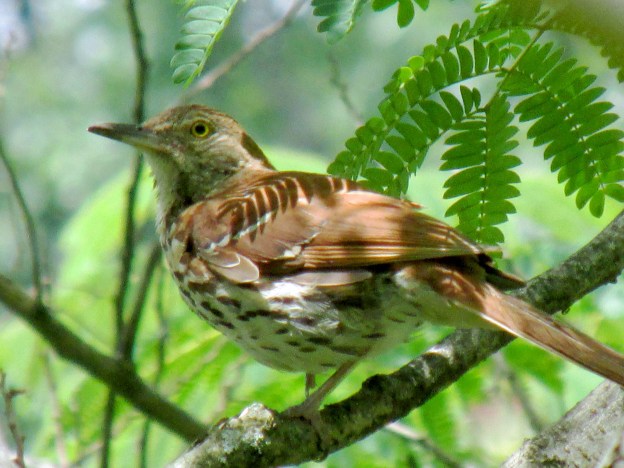
Photo by Bryan Stevens Brown Thrashers prefer thickets and brushy areas that offer security for these somewhat shy birds.

Photo by Bryan Stevens
Brown Thrashers prefer thickets and brushy areas that offer security for these somewhat shy birds.

••The brown thrasher (Toxostoma rufum) belongs to the family of “mimic thrushes,” which provides a label for a group of songbirds capable of imitating the songs of other birds. Mimidae, the Latin root for “mimic,” provides the scientific name for the family, which includes mockingbirds and the New World catbirds, as well as thrashers. The Northern mockingbird is best known for the ability to mimic, but relatives like the gray catbird and brown thrasher are also talented mimics.

The thrasher is a fairly large songbird about 11.5 inches long with a wingspan of 13 inches. Much of the body length comes from the bird’s long tail feathers. A thrasher weighs, however, only about 2.5 ounces.

The brown thrasher is not a picky eater. It’s known to eat everything from berries and nuts to insects and small lizards. It’s also aggressive in defending its nest and young. John James Audubon, a French-American ornithologist, naturalist and painter, painted quite a dramatic scene of a group of brown thrashers valiantly defending a nest from an attacking snake. The painting is so detailed that you have to imagine Audubon based his work on a real-life experience. His work, originally painted in the early decades of the 1800s, still holds up today.

Early American naturalist and artist John James Audubon painted a dramatic scene of Brown Thrashers defending their nest from an attacking snake.

Early American naturalist and artist John James Audubon painted a dramatic scene of Brown Thrashers defending their nest from an attacking snake.

Incidentally, Audubon knew the brown thrasher as the “ferruginous thrush.” Another former common name for this species was “brown thrush.”

This brown thrasher breeds across the United States and Canada east of the Rocky Mountains. Thrashers withdraw from the northern part of their range in the winter months, spending the season in the southeastern United States.

They are familiar birds in southern gardens. In fact, the brown thrasher is the official state bird of Georgia and also provided the name for Atlanta’s National Hockey League team, the Atlanta Thrashers. The thrasher became Georgia’s state bird due to passage of a Joint Resolution of the Georgia General Assembly in 1970.

The brown thrasher is the only member of the thrasher clan in the eastern United States. In Texas and the western half of the country, however, there are several other species of thrasher, including sage thrasher, long-billed thrasher, Crissal thrasher, curve-billed thrasher, Bendire’s thrasher, California thrasher and Le Conte’s thrasher. Many of these thrashers also occur in Mexico.

These New World birds also occur in the Caribbean, including such species as White-breasted Thrasher, Pearly-eyed Thrasher and Scaly-breasted Thrasher.

Photo by Bryan Stevens   A pair of Brown Thrashers perch near a fence at Tipton-Haynes Historic Site in Johnson City.

Photo by Bryan Stevens
 A pair of Brown Thrashers perch near a fence at Tipton-Haynes Historic Site in Johnson City.

•••••

Rebecca Howe, who resides in Kent, Ohio, has sent me an email.

“I am blessed to have rose-breasted grosbeaks come to my house each spring,” she wrote. “I watch males arrive first and then females.”

She has recently been seeing young birds arriving at her feeding station.

“Now the birds seem to be leaving,” she noted. “Do they leave their breeding grounds around this time to move south for the winter?”

I thanked Rebecca for sharing about her rose-breasted grosbeak observations in a follow-up email and informed her that different birds depart at different times to go south for the winter. Some birds do not get into a rush to reach their destination, so the start of migration is more of a slow-paced, casual “wandering” that takes them to different locations in a more or less southern direction.

Brown Thrasher visits a suet feeder. The thrasher diet consists of everything from berries and seeds to insects and even small reptiles.

Photo by Bryan Stevens                                Brown Thrasher visits a suet feeder. The thrasher diet consists of everything from berries and seeds to insects and even small reptiles.

Closer to Southwest Virginia and Northeast Tennessee, birds like yellow warbler, Louisiana waterthrush and a few others are known to depart as early as July and August. Ruby-throated hummingbirds are another good example of slow migrants. Those that pushed to the northern limit of their range are probably already heading back. But they are very nomadic. Maybe they could even be described as “restless,” and it is this time of year when I start to get the highest numbers of these little birds.

••••••

I look forward to hearing from readers. Those who wish to ask a question, share an observation or make a comment may reach me at ahoodedwarbler@aol.com. Follow me on Facebook to see more bird and nature photos at https://www.facebook.com/ahoodedwarbler

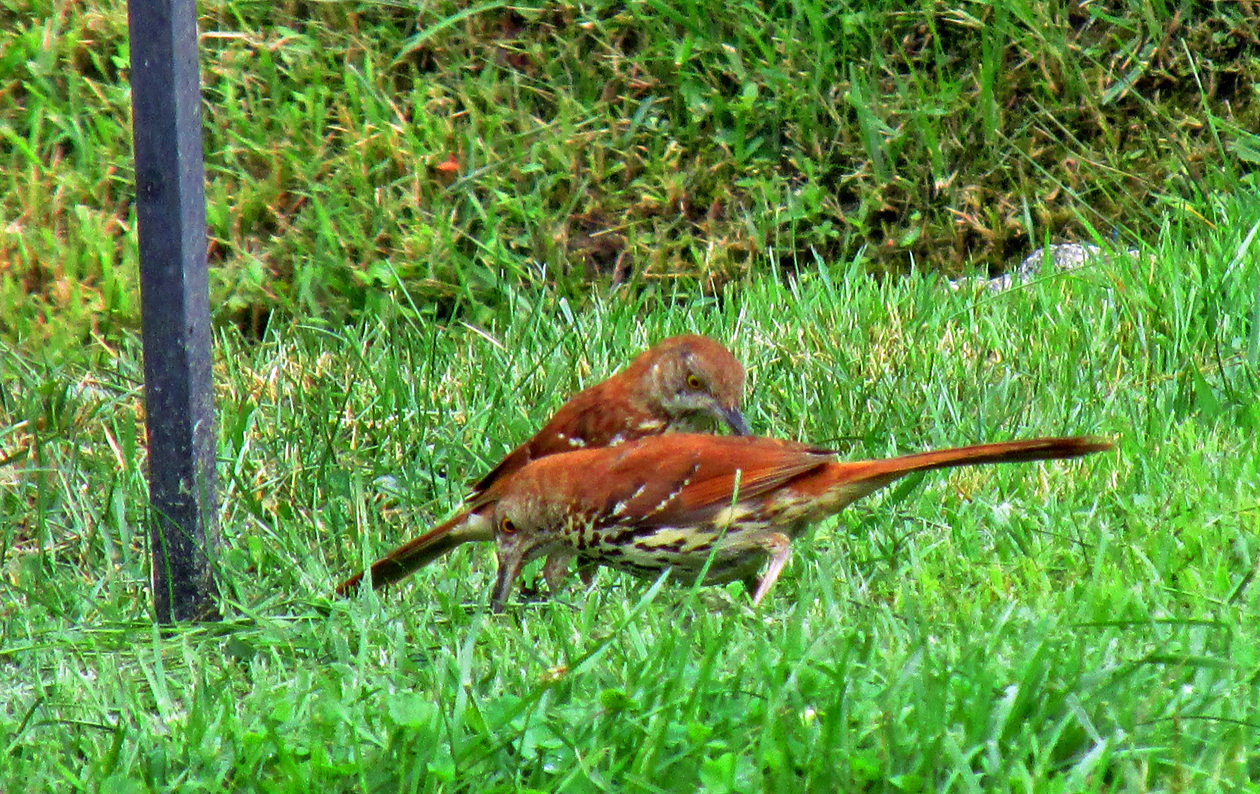
Photo by Bryan Stevens A pair of Brown Thrashers forage for food on the ground below a feeder.

Photo by Bryan Stevens
A pair of Brown Thrashers forage for food on the ground below a feeder.

First-ever Unicoi County Summer Bird Count tallies 111 species

Members of the Lee and Lois Herndon Chapter of Tennessee Ornithological Society conducted the first-ever Unicoi County Summer Bird Count on Saturday, June 14.

Photo by Bryan Stevens A young Eastern Bluebird slowly gains independence after leaving the nest.

Photo by Bryan Stevens
A young Eastern Bluebird slowly gains independence after leaving the nest.

Rick Knight, a long-time compiler for the chapter’s seasonal bird counts, organized and launched the count as a means to collect valuable information about the local distribution of birds in an often overlooked county in the region.

Nineteen observers in five parties logged 53 party hours, plus three nocturnal party hours, searching for birds from Flag Pond to Limestone Cove within Unicoi County.

 A total of 111 species were tallied during the count by the following observers: Jim Anderson, Rob Armistead, Harry Lee Farthing, Don Holt, Rick Knight, Roy Knispel, Richard Lewis, Vern Maddux, Joe McGuiness, Tom McNeil, Charles Moore, Cathy Myers, Kathy Noblet, Brookie and Jean Potter, Bryan Stevens, Kim Stroud, Gary Wallace and John Whinery.

 Species found during the count included:

Canada Goose, 76; Wood Duck, 17; Mallard, 31; Ruffed Grouse,1; Wild Turkey, 29; Great Blue Heron, 12; and Green Heron, 6.

Black Vulture, 3; Turkey Vulture, 28; Bald Eagle, 3 ; Sharp-shinned Hawk, 1; Cooper’s Hawk, 1; Red-shouldered Hawk, 1; Broad-winged Hawk, 3; Red-tailed Hawk, 5; American Kestrel, 2; and Peregrine Falcon, 3.

Killdeer,17; Rock Pigeon,  75; Mourning Dove, 77; Yellow-billed Cuckoo,  3; Eastern Screech-Owl,  2; Great Horned Owl, 1; Chuck-will’s-widow, 6; Eastern Whip-poor-will,  3; Chimney Swift,  44; Ruby-throated Hummingbird, 17; and Belted Kingfisher,  4.

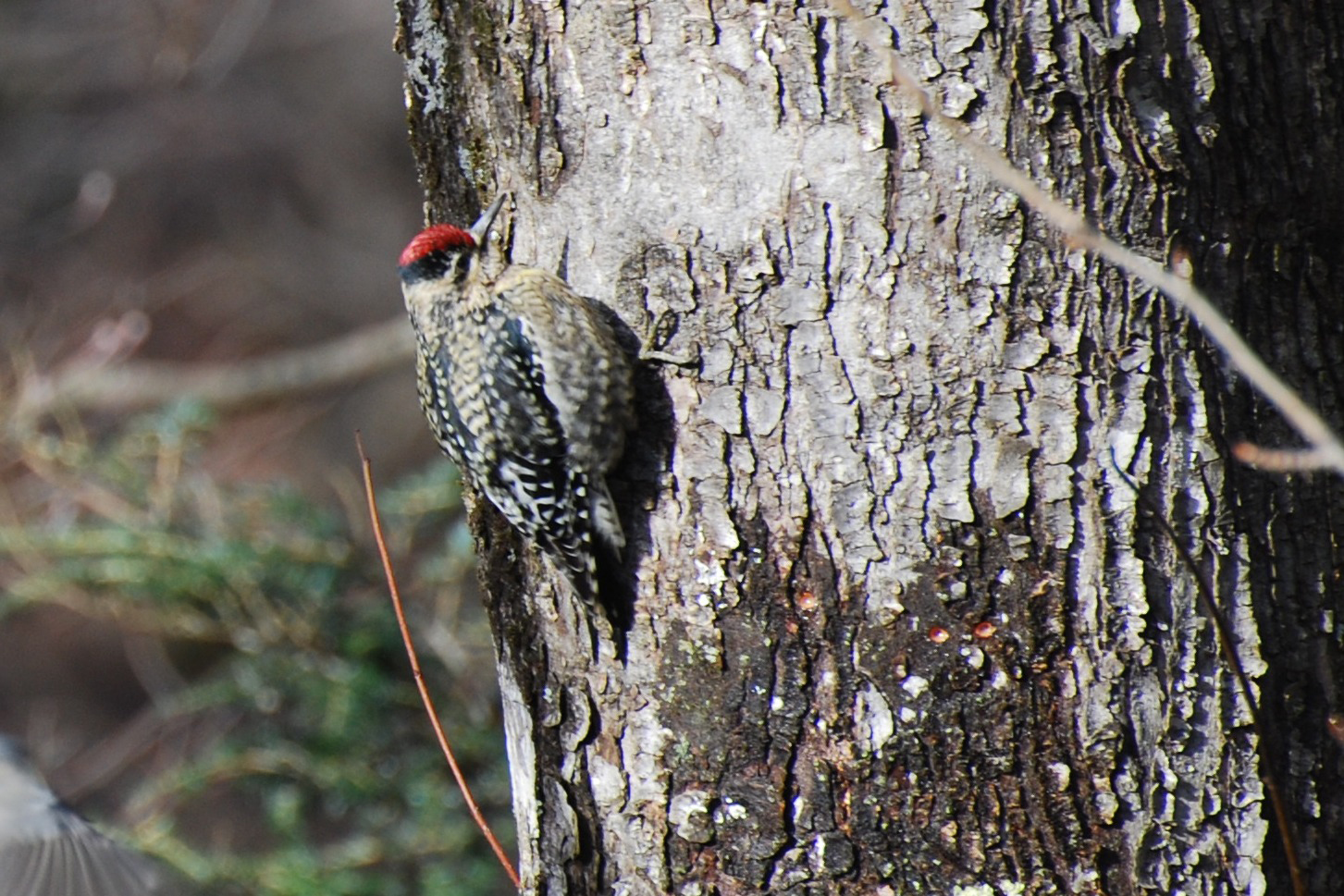
Photo Courtesy of Jean Potter The Yellow-bellied Sapsuckers found during the count indicate that this species is nesting at high-elevation locations in Unicoi County.

Photo Courtesy of Jean Potter
The Yellow-bellied Sapsuckers found during the count indicate that this species is nesting at high-elevation locations in Unicoi County.

Red-bellied Woodpecker,  20; Yellow-bellied Sapsucker  3; Downy Woodpecker  15; Hairy Woodpecker  5; Northern Flicker,  12; Pileated Woodpecker, 16;  Eastern Wood-Pewee  8; Acadian Flycatcher  29; Least Flycatcher  5; Eastern Phoebe,  44; Great Crested Flycatcher,  2; and Eastern Kingbird,  13.

White-eyed Vireo,  1; Yellow-throated Vireo,  1; Blue-headed Vireo,  29; Warbling Vireo,  1; Red-eyed Vireo,  157; Blue Jay, 59; American Crow, 139; Common Raven, 8; Purple Martin, 36; Tree Swallow, 94; Northern Rough-winged Swallow, 68; Cliff Swallow, 64; and Barn Swallow, 139.

Carolina Chickadee,  63; Tufted Titmouse,  47; Red-breasted Nuthatch,  3; White-breasted Nuthatch,  20; Brown Creeper, 1; Carolina Wren, 80; House Wren,  31; Winter Wren,  2; and Blue-gray Gnatcatcher, 27.

Eastern Bluebird, 46; Veery, 35; Wood Thrush, 37; American Robin, 435; Gray Catbird, 37; Northern Mockingbird, 37; Brown Thrasher, 14; European Starling, 464; and Cedar Waxwing,  71.

Ovenbird, 56; Worm-eating Warbler, 9; Louisiana Waterthrush, 5; Golden-winged Warbler, 1; Black-and-white Warbler, 19; Swainson’s Warbler, 6; Kentucky Warbler, 1; Common Yellowthroat,  2; Hooded Warbler, 78; American Redstart,  8; Northern Parula, 13; Magnolia Warbler, 1; Blackburnian Warbler, 2; Yellow Warbler, 1; Chestnut-sided Warbler,  23; Black-throated Blue Warbler, 20; Yellow-throated Warbler, 4; Prairie Warbler, 7; Black-throated Green Warbler,  30; Canada Warbler, 9; and Yellow-breasted Chat, 5.

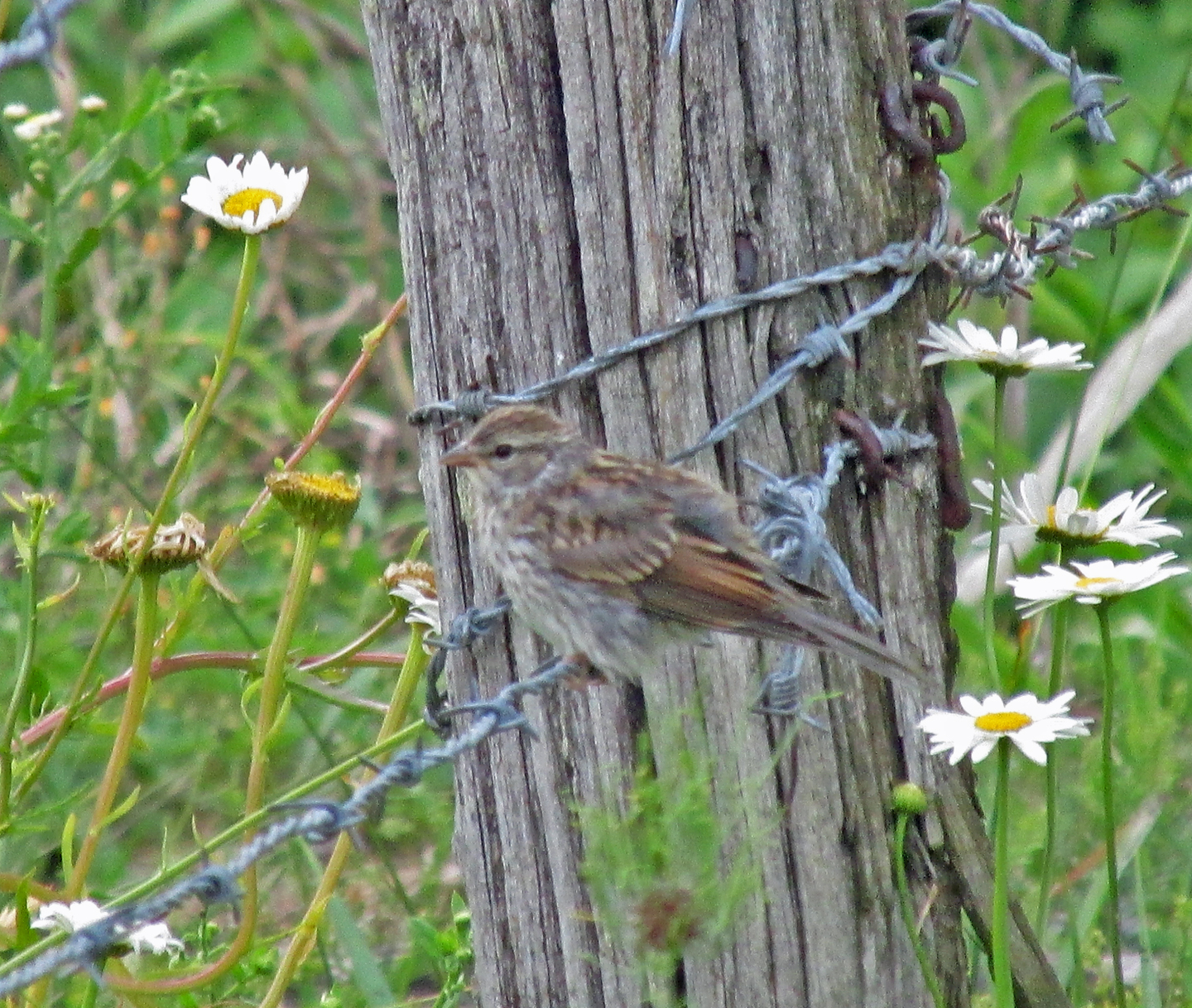
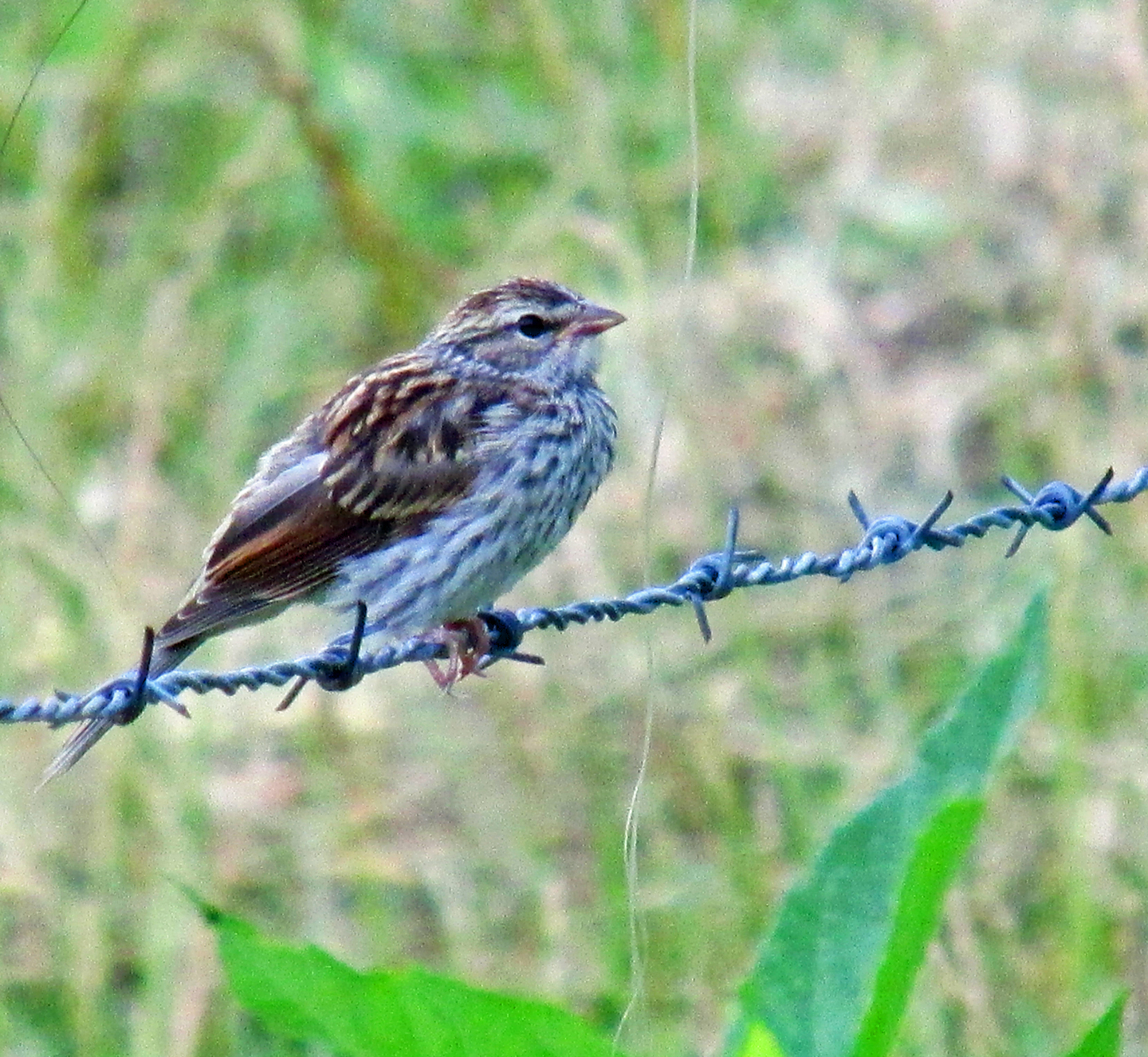
Photo by Bryan Stevens A young Chipping Sparrow perches on a barbed wire fence at the Bell Cemetery in Limestone Cove.

Photo by Bryan Stevens
A young Chipping Sparrow perches on a barbed wire fence at the Bell Cemetery in Limestone Cove.

Eastern Towhee,  70; Chipping Sparrow,  60; Field Sparrow,  12; Song Sparrow,  214; Dark-eyed Junco,  28; Scarlet Tanager,  20; Northern Cardinal,  138; Rose-breasted Grosbeak, 2; Blue Grosbeak, 1; and Indigo Bunting, 197.

Red-winged Blackbird,  101; Eastern Meadowlark,  13; Common Grackle,  94; Brown-headed Cowbird,  34; Orchard Oriole,  1; Baltimore Oriole,  1; House Finch,  8; American Goldfinch,  84; and House Sparrow,  64.

Knight noted that all 111 species found during the count are known or suspected to nest in Unicoi County. For instance, the three Bald Eagles found on the count included an adult bird and two recently fledged young. Eagles have been documented nesting near the Devil’s Looking Glass above the Nolichucky River for the past couple of years.

•••••

During the count, I stayed close to home with the territory of Limestone Cove and the portion of Sciota Road located within Unicoi County. Gary Wallace and John Whinery joined me for several hours of productive birding.

We found some birds I would never have expected to find so close to home, including singing Prairie Warblers and a noisy, scolding Yellow-breasted Chat. On Bean Creek Road near the state line with North Carolina, we also found a male Yellow-bellied Sapsucker while walking a section of the Appalachian Trail. This was my first summer sighting of what is normally a winter bird in the region. In recent years, however, a few sapsuckers have started nesting in some of the local mountains.

We also missed some target birds. We checked out every pond we could view in our territory and failed to find a Green Heron.

Summer is also an extremely busy time of year for birds as they go about the business of bringing up a new generation of birds. Most birds have completed spring migration and have settled into locations they will call home for the next few months. During the recent Summer Bird Count in Unicoi County, we saw numerous young birds, ranging from Chipping Sparrows and Eastern Bluebirds to American Robins and Barn Swallows.

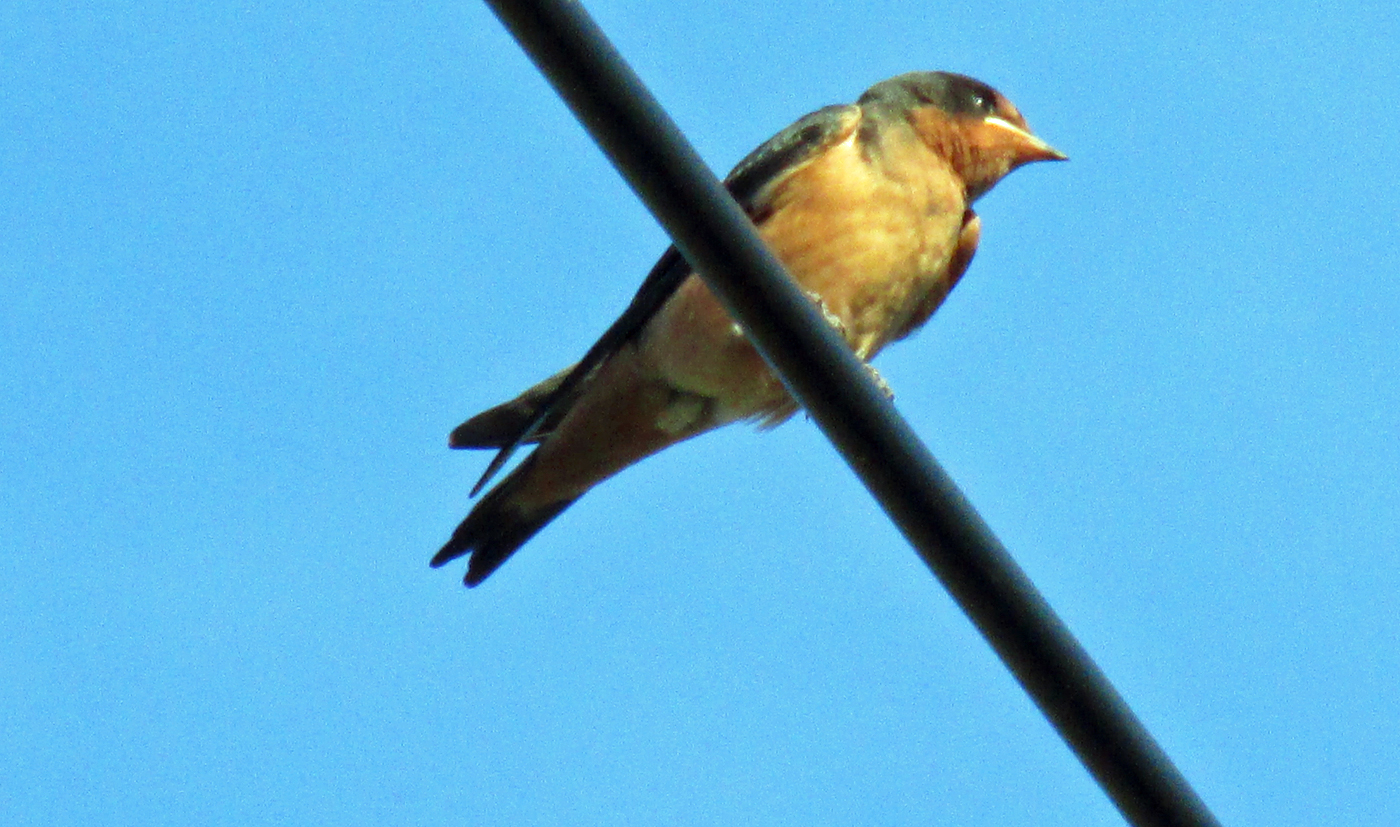
Photo by Bryan Stevens A young Barn Swallow perched on a utility line at the Bell Cemetery in Limestone Cove awaits a delivery of food from its parents.

Photo by Bryan Stevens
A young Barn Swallow perched on a utility line at the Bell Cemetery in Limestone Cove awaits a delivery of food from its parents.

•••••

To ask a question, make a comment or share an observation, email me at ahoodedwarbler@aol.com or leave a remark here at “Our Fine Feathered Friends.”


Summer counts reflect busy time of year for local birds

Photo by Bryan Stevens  Many young birds, such as this Chipping Sparrow on a barbed wire fence in Limestone Cove in Unicoi County, look almost nothing like their parent.

Photo by Bryan Stevens
Above: Many young birds, such as this Chipping Sparrow on a barbed wire fence in Limestone Cove in Unicoi County, look almost nothing like their parent. Upper: Young Tree Swallows test perching skills.

I took part in the two Summer Bird Counts conducted recently by the Lee and Lois Herndon Chapter of Tennessee Ornithological Society in Carter County and Unicoi County on consecutive June Saturdays.

Photo by Bryan Stevens A young Eastern Phoebe perches patiently on a branch while waiting for a parent to bring food.

Photo by Bryan Stevens
A young Eastern Phoebe perches patiently on a branch while waiting for a parent to bring food.

One thing I enjoy about participating in Summer Bird Counts is the prevalence of young birds. It’s only to be expected since the summer season is the time when most local birds build nest, lay eggs and rear young. Some birds got started with the business of raising young back in April and are already attempting second nestings.

Photo by Bryan Stevens A male Northern Cardinal tends to a fledgling hidden near the ground in thick brush.

Photo by Bryan Stevens
A male Northern Cardinal tends to a fledgling hidden near the ground in thick brush.

This year’s counts reported a variety of young birds among the totals, including numerous Wild Turkey poults, as well as species as diverse as Ruffed Grouse and Chipping Sparrow to Northern Cardinal and Barn Swallow.

I counted birds on Holston Mountain in Elizabethton with Chris Soto and Robert Armistead during the Carter County survey. For the Unicoi County, I teamed with Gary Wallace and John Whinery to count birds in the community of Limestone Cove.

Photo by Bryan Stevens A Song Sparrow brings a beakful of caterpillars back to the nest to feed young.

Photo by Bryan Stevens
A Song Sparrow brings a beakful of caterpillars back to the nest to feed young.

The Carter County and Unicoi County Summer Bird Counts are the only surveys conducted during the summer in Northeast Tennessee and Southwest Virginia. Christmas Bird Counts are more common and include the long-running Bristol CBC and more recent surveys such as the Glade Spring CBC and Shady Valley CBC.

In next week’s post, I will explore the results of the counts in more detail. You might very well be surprised what birds can be found in the region. I know I always am!

Photo by Bryan Stevens A Barn Swallow makes a food delivery to young waiting somewhat patiently on a utility line.

Photo by Bryan Stevens
A Barn Swallow makes a food delivery to young waiting somewhat patiently on a utility line.

Happiness is an Eastern Bluebird


Bluebirds make good neighbors. A pair of Eastern Bluebirds in your yard or garden will have no trouble with minor intrusions into their lives as they go about their daily routine, and the payoff for you is hours of free entertainment.

Photo by Bryan Stevens A male Eastern Bluebird perched on playground equipment at Winged Deer Park in Johnson City.

Photo by Bryan Stevens
A male Eastern Bluebird perched on playground equipment at Winged Deer Park in Johnson City.

I’m pleased to report that the first of the season’s young Eastern Bluebirds have left the security of their nest box in our yard – the only home they’ve known since hatching – for the wider world of field and woodland.

As has usually been the case, I didn’t witness their departure. In the days after the fledglings departed the wooden nest box, I’ve observed them perched and waiting, impatiently usually, for their parents to arrive with caterpillars, moths or other morsels of food.

The Eastern Bluebird is one of North America’s best-known cavity-nesting birds. About 85 species of North American birds use cavities in trees for nesting purposes. Cavity-nesters include ducks, such as Buffleheads and Wood Ducks, as well as birds of prey such as Eastern Screech-owls and American Kestrels.

Some of these species, such as woodpeckers and nuthatches, can excavate their own cavity in a dead or decaying tree. Others, such as the bluebirds, must find a cavity already in existence. Such cavities are scarce real estate and can be subject to some intense competition. The Eastern Bluebird is at a disadvantage when forced to compete with non-native introduced birds such as aggressive European Starlings and the House Sparrows.

Photo by Bryan Stevens A male Eastern Bluebird inspects a nesting cavity in a wooden fence post.

Photo by Bryan Stevens
A male Eastern Bluebird inspects a nesting cavity in a wooden fence post.

Last month, I found bluebirds nesting in a cavity in a wooden fence post that was part of an enclosure for a field. The fence post nest reinforced how changing landscapes have also affected these birds. Instead of wooden fence posts, many farmers now use metal ones. Dead or dying trees – a much sought-after resource for cavity-nesting birds — are often removed from woodlands.

Fortunately for bluebirds, this species will also accept lodging in a nest box, or birdhouse, provided for them by human landlords. Because of their trusting nature when it comes to their human neighbors, the Eastern Bluebird is one of our most beloved birds. In fact, bluebirds are such popular birds that interest in them and their well-being has inspired the foundation of such organizations as the North American Bluebird Society. The Eastern Bluebird has also been designated the official state bird for New York and Missouri.

There are two other species of bluebirds found in North America.

The Western Bluebird is found throughout the year in California, the southern Rocky Mountains, Arizona and New Mexico, as wells part of Mexico. The species ranges in the summer as far north as the Pacific Northwest, British Columbia and Montana.

The Mountain Bluebird nests in open country in the western United States as far north as Alaska. They are short-distance migrants, retreating as far south as Mexico during the winter season.

Except for a whitish-grayish belly, the male Mountain Bluebird is a brilliant sky blue above with paler blue on his underparts. The female looks similar if duller in her coloration.

Some people in the region mistakenly assume that Eastern Bluebirds are “mountain” bluebirds because they will reside in higher elevation open areas. The simplest way to tell the two species apart — although not necessary since the range of the Mountain Bluebirds is hundreds of miles to the west — is the reddish undersides of both sexes of the Eastern Bluebird.

The states of Nevada and Idaho have selected the Mountain Bluebird as their official state bird. I saw this species in 2006 during a trip that took me to Utah and Idaho.

Bluebirds are members of the extended family of thrushes, making them relatives of such birds as American Robin, Wood Thrush and Veery. The relationship of the Eastern Bluebird to the American Robin can be seen in the red breast sported by both species. In addition, young robins and bluebirds both have spotted breasts, providing more evidence of their affinity with many of the thrushes. The thrush family numbers more than 100 species worldwide and extends into Europe, Asia and Africa, as well as various islands.

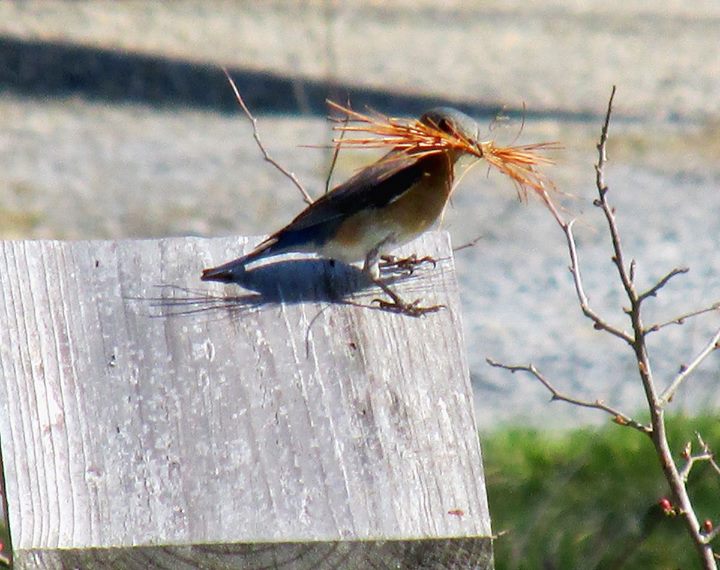
Photo by Bryan Stevens A female Eastern Bluebird gathers pine needles to use as nesting material.

Photo by Bryan Stevens
A female Eastern Bluebird gathers pine needles to use as nesting material.

Inviting the Eastern Bluebird into your yard and gardens is not usually too difficult. It helps if you live in an open, spacious habitat bordered with small trees. Providing a nesting box constructed to the specifications for this bird is another way to attract them. With natural cavities in trees and fence posts a rare commodity, this bird will readily accept boxes. It’s not a sure-fire means of bring bluebirds closer. Plenty of other native birds, including Carolina Chickadees, Tree Swallows and House Wrens, will also make use of a box designated for bluebirds.

The NABS recommends a box that is well ventilated, watertight and equipped with drainage holes. The box should also be easy to open, monitor and clean.

For more specific and very valuable information about becoming a landlord for bluebirds, please visit http://www.nabluebirdsociety.org/PDF/FAQ/NABS%20factsheet%20-%20Getting%20Started%20-%2024May12%20DRAFT.pdf to access an informative fact sheet.

Starlings and House Sparrows are not native species and are not protected by law. When present, these two introduced species will probably be your biggest challenge to successfully hosting Eastern Bluebirds. On its website, NABS encourages the control of starlings and House Sparrows. The website – http://www.sialis.org – also provides beneficial information for would-be bluebird landlords.

Tree Swallows and House Wrens, both native birds, will probably be the biggest rivals for nesting boxes intended for Eastern Bluebirds. If you should find that a pair of Tree Swallows or House Wrens has claimed a box, consider yourself fortunate and benefit from the opportunity to view the habits of these two interesting species for a few weeks.

In addition to housing, food and water can be used to lure Eastern Bluebirds closer. This bird doesn’t eat seeds, but it can be attracted with an offering of mealworms — live or freeze-dried – or commercially prepared peanut butter nuggets. A water feature in a yard is also a magnet for bluebirds and a host of other bird species.

If your home doesn’t provide suitable bluebird habitat, it’s still easy to enjoy these beautiful birds. An afternoon or evening drive into open country, such as agricultural farmland, is likely to yield sightings of this bird on fences and utility lines. Golf courses, some of which go the extra mile to accommodate bluebirds, also provide habitat for these lovely birds.

The Eastern Bluebird is present in the region in any season and is one of our more common birds. If you’re already an experienced landlord and host for these birds, you probably already know they joys they can bring. If not, why not try to attract them closer to you? Most bluebirds in the region have already completed the first nesting of the season, but these birds are known to nest two or even three times in a single season. There’s still time to place a nest box or two on your property to get their attention.

Photo by Bryan Stevens The female Eastern Bluebird is not quite as brightly colored as her mate.

Photo by Bryan Stevens
The female Eastern Bluebird is not quite as brightly colored as her mate.

Landscaping with fruit-bearing trees and shrubs can also pay dividends when its comes to the Eastern Bluebird. Although this bird feeds heavily on insects, almost a third of its diet consists of fruits, including blackberry, mulberry and pokeberry.

Inviting bluebirds to become a part of your life isn’t difficult, and you’ll be delighted to have them. Trust someone who has lived with bluebirds in his yard and gardens for more than 20 years.

•••••

To ask a question, make a comment or share a bird observation, reach me at ahoodedwarbler@aol.com.

Photo by Bryan Stevens The male Eastern Bluebird is beloved by many bird enthusiasts.

Photo by Bryan Stevens
The male Eastern Bluebird is beloved by many bird enthusiasts.


‘Wind birds’ make their way through region during annual migrations

Since the Volunteer State has no access to the sea, it is sometimes amazing how many birds affiliated with coastal areas can be found if you know when and where to look.

A recent seven-day visit to coastal South Carolina reinforced the romance of a group of related birds known collectively as shorebirds or, in a somewhat more adventuresome context, “wind birds.” This diverse family of birds range in size from sparrow-sized sandpipers to larger species such as American Avocet, Long-billed Curlew and Marbled Godwit.

During daily visits to Huntington Beach State Park, located within five minutes of my brother’s new home on Pawleys Island, S.C., I observed plenty of these “wind birds.” I saw a range of species, including Wilson’s Plover, Short-billed and Long-billed Dowitcher, Greater Yellowlegs, Sanderling, Least Sandpiper, Ruddy Turnstone, Spotted Sandpiper, Semipalmated Sandpiper, Black-bellied Plover, Semipalmated Plover, Dunlin and even the gangly Black-necked Stilt.

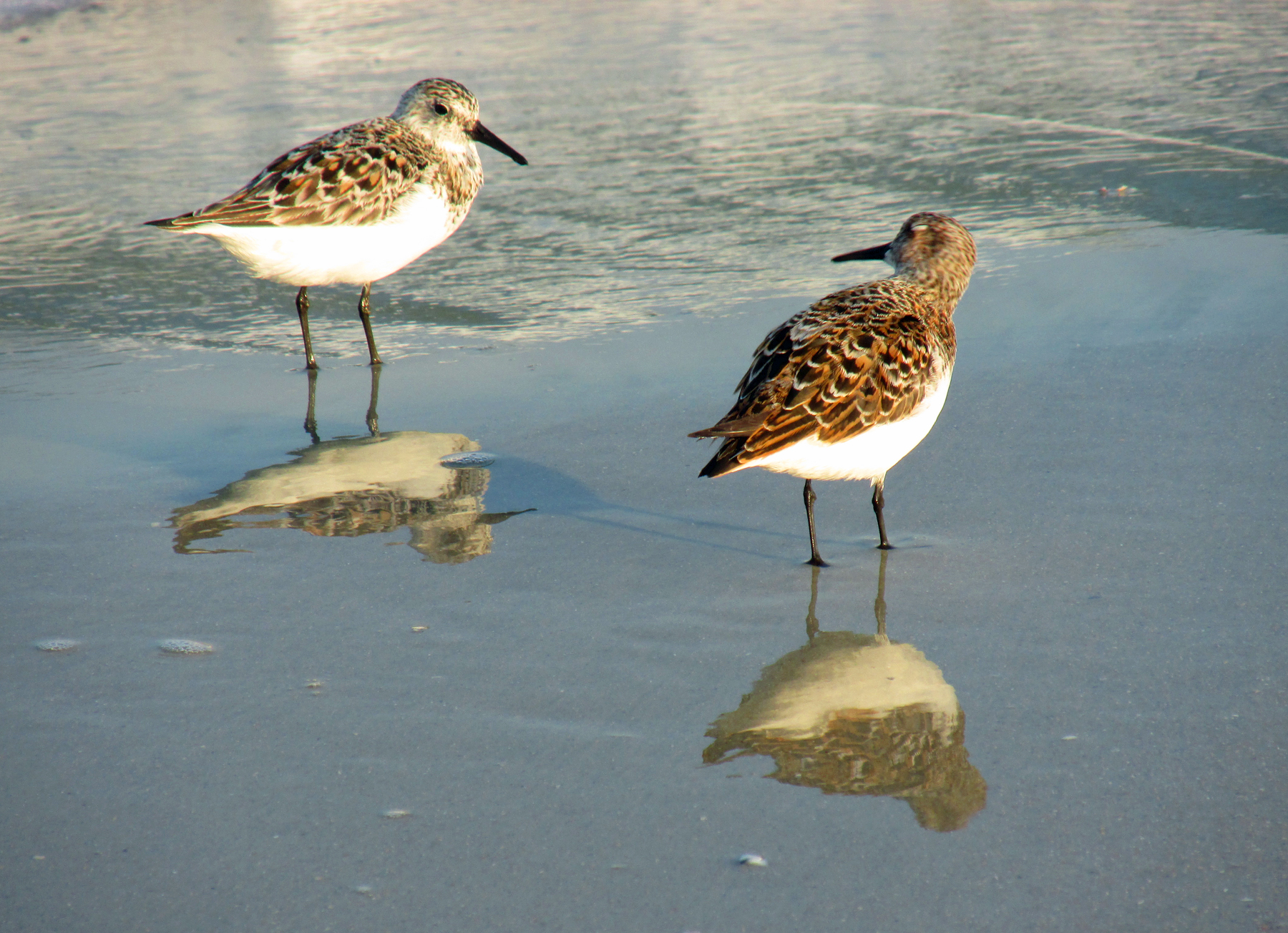
Photo by Bryan Stevens A pair of Sanderlings at surf's edge at Huntington Beach State Park.

Photo by Bryan Stevens
A pair of Sanderlings at surf’s edge at Huntington Beach State Park.

Known as “wind birds” for the propensity of many members of this extended family to stage long-distance migrations, some species fly through Northeast Tennessee each spring and fall as they migrate to and from distant nesting grounds.

I have seen several species — Wilson’s Snipe, Greater Yellowlegs, Pectoral Sandpiper, Least Sandpiper, Solitary Sandpiper and Spotted Sandpiper — in the region this spring. Their stays are usually of brief duration as they are eager to push farther north. Many of them will not stop until they reach the edge of the Arctic tundra.

While I was enjoying seeing a wide range of shorebirds in South Carolina, two Stilt Sandpipers put in a rare appearance in Northeast Tennessee. I hated to miss them. I’ve only seen one other Stilt Sandpiper in the region, and that observation took place back in 2000 at Austin Springs on Boone Lake.

The Stilt Sandpipers were found by Brookie and Jean Potter on the Watauga River at Rasar’s Farm in Elizabethton. The couple reported that it was their first spring sighting of Stilt Sandpipers, as well as their first Carter County sighting of this species. The photo at the start of the column, provided by Jean Potter, shows the two Stilt Sandpipers bordered by a pair of Greater Yellowlegs.

Stilt Sandpipers making migration stops in Tennessee still have a long way to travel. These shorebirds nest on the Arctic tundra beyond the tree line. Wet sedge-meadows with raised ridges and hummocks provide nesting habitat. After the nesting season they fly south as far as northern South America and can be found at fresh water ponds, marshes, lagoons and flooded fields.

This medium-sized sandpiper stands out from most of the sandpipers in its size range. It has long, greenish legs, as well as a long neck and bill, which is drooped at the tip. In breeding plumage, this shorebird has a distinctive chestnut cheek patch.

••••••

During my South Carolina stay, I didn’t encounter any Stilt Sandpipers. I did, however, find three Black-necked Stilts.

The only time I have seen this unusual shorebird in Tennessee took place on Oct. 13, 2004, at Austin Springs on Boone Lake in Washington County. The bird, first found by Rick Knight, drew many excited birders to the location for looks at this shorebird before it departed to continue its migration flight south.

Photo by Bryan Stevens Two Black-necked Stilts forage along the causeway wetland at Huntington Beach State Park.

Photo by Bryan Stevens
Two Black-necked Stilts forage along the causeway wetland at Huntington Beach State Park.

I have also seen Black-necked Stilt on Fripp Island, S.C, as well as in Utah.

The world of shorebirds has produced many look-alike species, including many of the small sandpipers often collectively labeled as “peeps” by birders. The Black-necked Stilt, however, is not at all likely to be confused with any other shorebird. It is a slender bird atop a pair of extremely long pink legs. It has a two-tone appearance with black upper parts and white underparts. The black and white dichotomy continues along the bird’s long neck and head. This bird also has a thin, needle-shaped bill that it uses to delicately pluck aquatic insects and other prey from water or mud.

I first spied the Black-necked Stilts at Huntington Beach State Park while walking on a marsh boardwalk near the park’s Nature Center. They flew toward the causeway, so I got into my car and drove there to try to re-locate them. I did find two of the stilts feeding along the causeway, but I never managed to find the third bird.

I watched the two Black-necked Stilts foraging for food in shallow water shared by egrets and alligators. The two birds, despite a somewhat gangly appearance, moved with elegantly efficient strides on their long pink legs. This bird feeds on an assortment of aquatic creatures, including small fish, insects and tadpoles. The seeds of aquatic plants also provides some of the food in its diet.

I also saw several plovers, another group of shorebirds, while in South Carolina. Wilson’s Plover was one that stood out during my visits to Huntington Beach State Park. Wilson’s Plover is a coastal shorebird that breeds on both coasts of the Americas from the equator northwards. Its range extends north to include much of the U.S. eastern seaboard as well as the Pacific coast of Mexico.

A Wilson's Plover in the dunes at Huntington Beach State Park in South Carolina.

A Wilson’s Plover in the dunes at Huntington Beach State Park in South Carolina.

I’ve observed Wilson’s Plovers on Fripp Island, S.C., in the past, but those sightings have been rather sporadic. I have also observed this bird at one other location — at Douglas Lake in Cocke County back in the late 1990s.

The Wilson’s Plovers at Huntington Beach State Park were nesting in the dunes, which also gave me an opportunity to see some young plovers. A young Wilson’s Plover looks like a ball of downy feathers standing on toothpicks. This plover nests on a bare scrape on sandy beaches or sandbars. To protect the plovers, as well as other nesting species, this section of dunes on Huntington Beach State Park bars the entry of dogs. It is also roped off to prevent accidental intrusion by people.

Photo by Bryan Stevens A pair of Wilson's Plover chicks at Huntington Beach State Park in South Carolina.

Photo by Bryan Stevens
A pair of Wilson’s Plover chicks at Huntington Beach State Park in South Carolina.

Most of the Wilson’s Plovers that spend the summer in the United States retreat each fall, although a few migrate only as far as Florida. The rest spend the winter as far south as Brazil.

For a small shorebird, the Wilson’s Plover sports a thick, blunt and relatively large bill. In fact, this bill — that looks too big for its body — is a good way to identify this shorebird at a glance. The Wilson’s Plover forages for food on beaches. It has a fondness for crabs, which may explain the size and shape of its bill, but this bird will also eat insects, marine worms and other small organisms.

The Wilson’s Plover is larger than the related Semipalmated Plover and Piping Plover but considerably smaller than such relatives as Killdeer and Black-bellied Plover. This shorebird weighs only a couple of ounces, with a length of about eight inches and a wingspan of 19 inches. The Wilson’s Plover has a dark neck ring, grayish-brown upper parts, a white underside and pinkish legs.

This bird was named after the Scottish-American ornithologist Alexander Wilson. Wilson collected the type specimen during a trip in May of 1813 to Cape May, N.J. Other birds named for this pioneering bird expert include Wilson’s Warbler, Wilson’s Phalarope, Wilson’s Snipe and Wilson’s Storm Petrel.

•••••

With a few exceptions, most of the shorebirds that I have found along the Atlantic Coast I have also observed here in land-locked Tennessee during spring and fall migration. It’s one of those little known facts I enjoy sharing with people, who are often surprised that these “beach birds” also make visits to our state.

•••••

Make a comment, ask a question or share an observation by sending an email to ahoodedwarbler@aol.com or posting a comment here on my blog. I am also on Facebook.

A mixed flock of Short-billed and Long-billed Dowitchers and a Ruddy Turnstone at Huntington Beach State Park.

A mixed flock of Short-billed and Long-billed Dowitchers and a Ruddy Turnstone at Huntington Beach State Park.


Rose-breasted Grosbeaks provide splash of springtime excitement


Other than Ruby-throated Hummingbirds, the one bird whose return in the spring is guaranteed to generate excitement is the Rose-breasted Grosbeak. Every spring, I get phone calls and emails from people wanting to share the thrill of seeing these vibrant birds in their back yards.

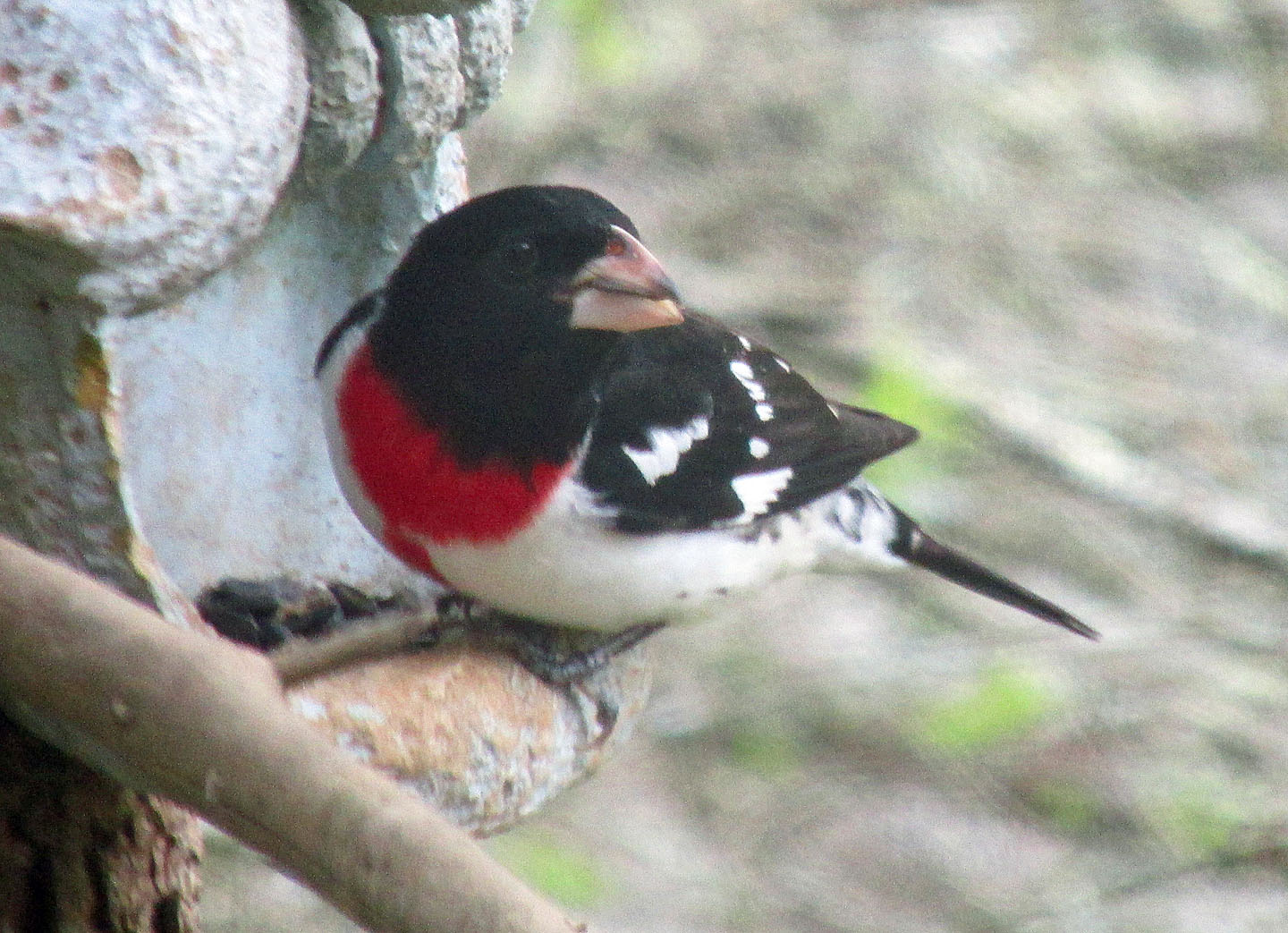
Photo by Bryan Stevens A Rose-breasted Grosbeak finds a meal of sunflower seeds at a feeder.

Photo by Bryan Stevens
A Rose-breasted Grosbeak finds a meal of sunflower seeds at a feeder.

The spring arrival of Rose-breasted Grosbeaks is a temporary visit. Finding the arrangements, which can consist of well-stocked feeders and perhaps a convenient water source, the migrating birds may linger for several days. These birds nest at higher elevations, however, and are usually impatient to continue the journey to where they will spend the summer months tending to their young.

This year, my first Rose-breasted Grosbeak arrived at my home on Simerly Creek Road in Hampton around 3:30 p.m. on Friday, April 25. I saw a glimpse of black and white with a hint of red that lifted my spirits instantly. I had been hoping for about a week that migrating grosbeaks would visit as they often do in the spring. The lone male settled onto a small hanging feeder and began enjoying an offering of black-oil sunflower seeds. He made repeated trips throughout the afternoon and evening, allowing me to take several photos through a window.

Some of my posted photos drew enthusiastic comments from my Facebook friends. Dani Sue Thompson shared that the beautiful Rose-breasted Grosbeak is one of her favorite birds. Her mother, the late Donna Adams, was a huge fan of the related Blue Grosbeak, which is a less common visitor to Northeast Tennessee than the related Rose-breasted Grosbeak. Donna and I share many a grosbeak story over the years.

Byron Tucker, a friend from Atlanta, notified me on Facebook the day before the Rose-breasted Grosbeak arrived at my home that he was hosting them in Georgia. From a single bird to a flock of three males and three females, these visitors were a first for Byron. He was excited to host these colorful birds for several days at his feeders.

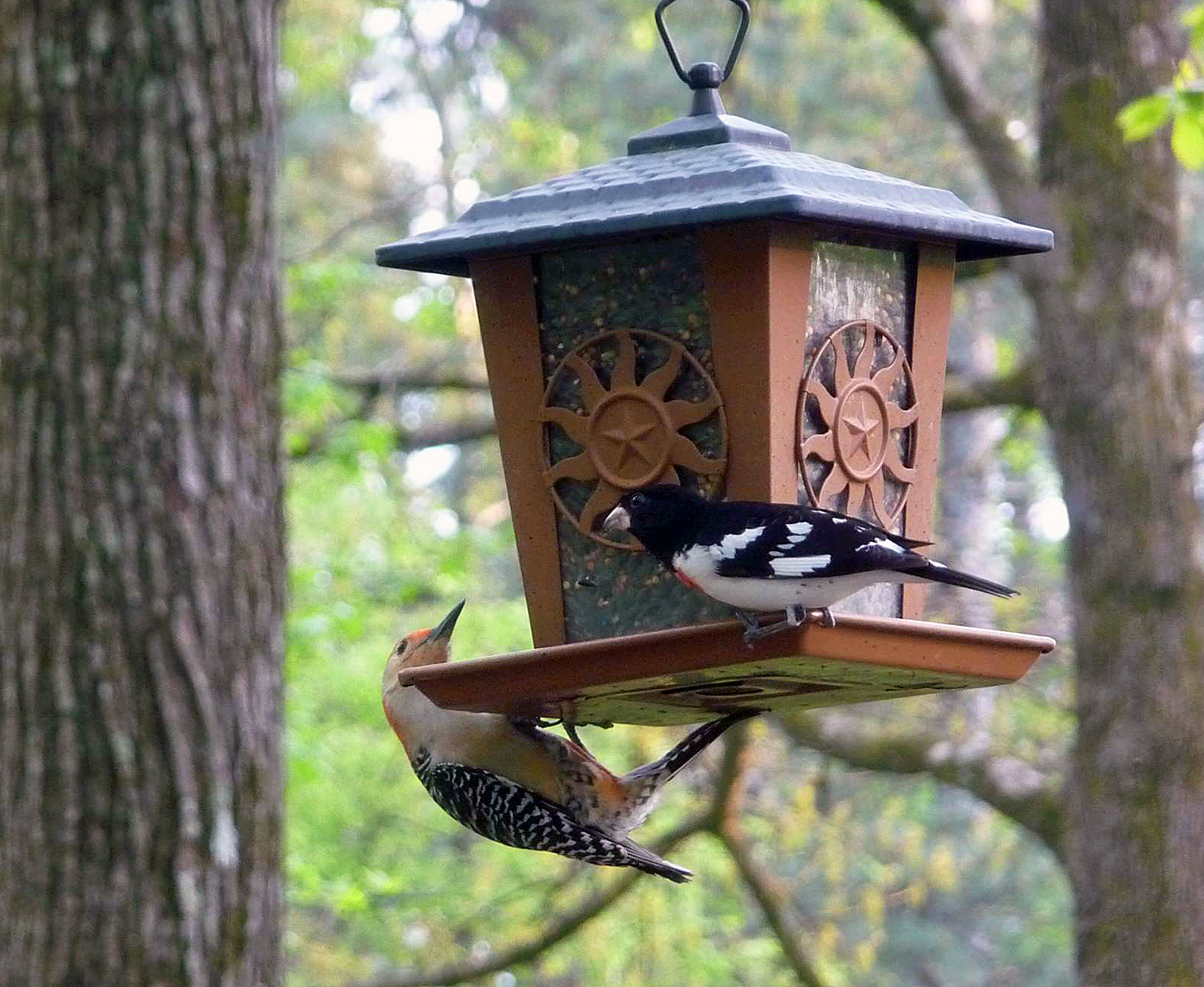
Photo Courtesy of Byron Tucker A Rose-breasted Grosbeak joins a Red-bellied Woodpecker at a feeder in Atlanta.

Photo Courtesy of Byron Tucker
A Rose-breasted Grosbeak joins a Red-bellied Woodpecker at a feeder in Atlanta.

Single birds are occasionally the first to arrive, but Rose-breasted Grosbeaks do form flocks when migrating. Even if a scout shows up alone at your feeders, he will often soon be joined by other grosbeaks. My recent visit by a single male led to two and then three males visiting the feeders. Eventually a female Rose-breasted Grosbeak also made an appearance.

Plenty of Rose-breasted Grosbeaks pass through Northeast Tennessee, and a few even decide to make mountains like Unaka, Holston and Roan their home for the summer. However, these birds spread out widely across the eastern half of the North American continent, ranging from northeastern British Columbia to Quebec and Nova Scotia in Canada. They also range south from New Jersey to Georgia. The Rose-breasted Grosbeak also reaches Colorado, Oklahoma and Kansas.

For the most part, however, the Rose-breasted Grosbeak is replaced in the western United States by the closely related Black-headed Grosbeak.

As fall approaches, the Rose-breasted Grosbeak migrates south to a winter range that spans central Mexico, Central America and northern South America. As they depart, many of these migrating birds will make autumn visits to again partake of offerings of sunflower seeds at backyard feeders. So, if you don’t get to see these showy birds in the spring, you get another chance in September and October.

The male Rose-breasted Grosbeak gives this species it name. Males are the epitome of the birds that make their home for part of the year in the American tropics. The contrasting black and white plumage is emphasized by a triangular slash of rosy-red color on the breast. Put all those elements together and the male Rose-breasted Grosbeak is not a bird that would be mistaken for any other.

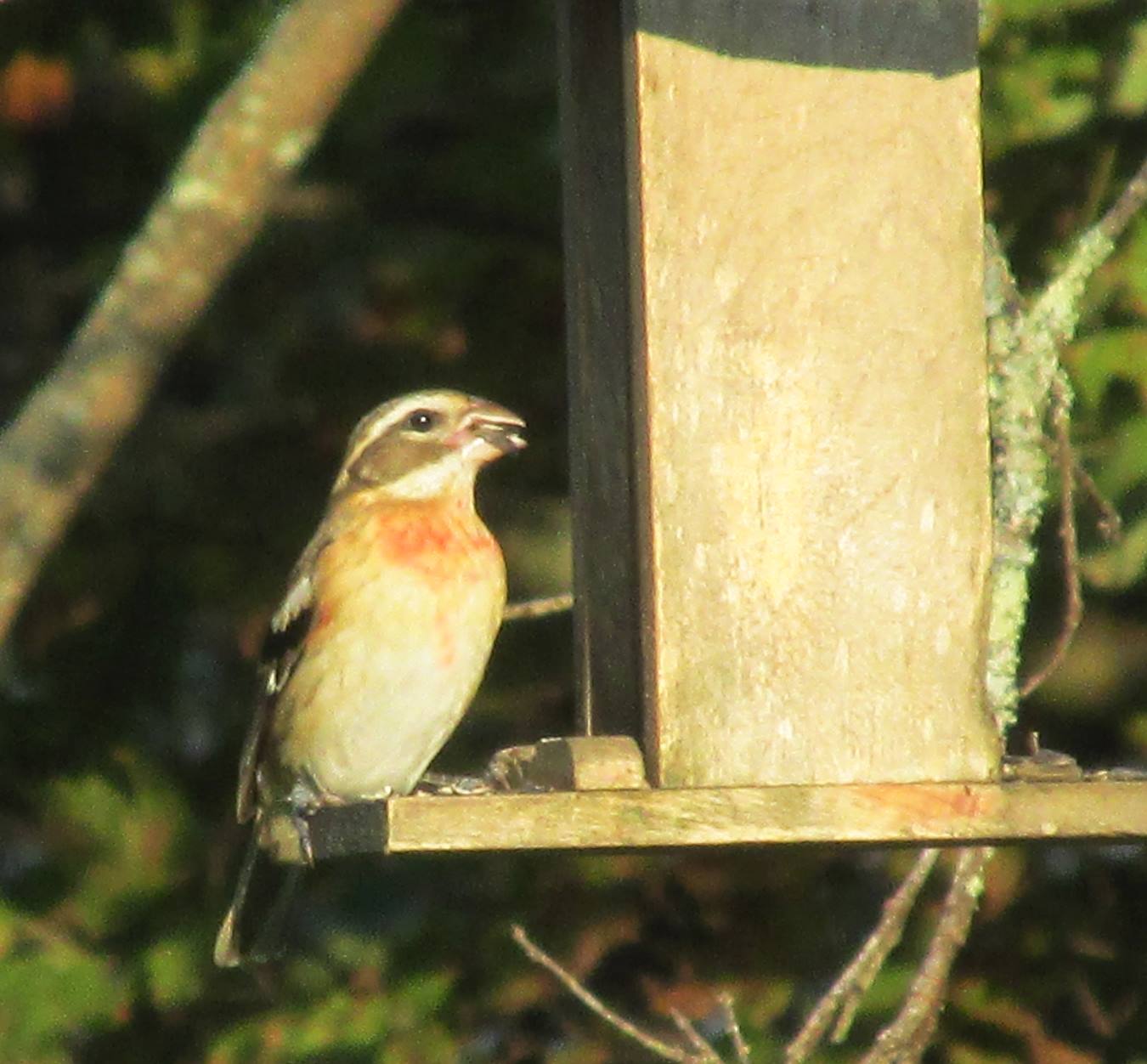
The female grosbeak, however, doesn’t quite stand out in the same way. She is much less colorful than the male. With her brown and white plumage, she is often mistaken for a large sparrow or finch.

Photo by Bryan Stevens A young male Rose-breasted Grosbeak visits a feeder in September of 2013. Young males resemble females but show a splash of orange on the breast that will be replaced the following spring by the familiar rosy-red patch.

Photo by Bryan Stevens
A young male Rose-breasted Grosbeak visits a feeder in September of 2013. Young males resemble females but show a splash of orange on the breast that will be replaced the following spring by the familiar rosy-red patch.

Both sexes have a massive bill, which they use to hull sunflower seeds at feeders or glean insects from leaves and branches. It’s the heavy, blunt bill for which the term “grosbeak” is derived. “Gros” is a German term for large or big, so grosbeak simply means a large-beaked bird. People who band birds to further the study of them will tell you that Rose-breasted Grosbeaks have a wicked bite and are capable of delivering quite a nip. In Northeast Tennessee, bird banders frequently encounter Rose-breasted Grosbeaks in their mist nets — and bear the scars to prove it.

With some birds, males play only a minor role in the nesting process. That’s not the case with the Rose-breasted Grosbeak male. The males help with nest-building chores and share responsibility with the female for incubating the eggs.

The female lays three to five eggs in a cup-shaped nest. It’s not easy to locate the nests since the birds usually place them in trees at least 20 feet above the ground. Within two weeks, the eggs have hatched and the parents are kept extremely busy finding enough food to satisfy the voracious nestlings. Well fed by both parents, the young grow quickly and usually are ready to leave the nest within 12 days. Often, when a first brood of young departs the nest, the male will care for the rowdy group of fledglings as the female starts a second nest to capitalize on the long days of summer.

Away from our feeders, Rose-breasted Grosbeaks feed on insects, seeds, fruit and even some leaf buds and flowers. I’ve seen these birds satisfying a sweet tooth — or should that be sweet beak? — by feeding on jewelweed flowers and apple blossoms. If sugar’s good for hummingbirds, I am sure it is a valuable energy source for Rose-breasted Grosbeaks, too.

The Rose-breasted Grosbeak is a cherished spring visitor that never fails to disappoint by bringing a hint of the tropics to the mountains of Northeast Tennessee. I’m hoping many readers are also enjoying their own opportunities for hosting this delightful songbird.

•••••

The bird walk at Tipton-Haynes Historic Site on Saturday, April 26, yielded a good range of birds, including American Robin, House Wren, Cardinal, Song Sparrow, Carolina Chickadee, American Goldfinch, Tufted Titmouse, Crow, Canada Goose, Chimney Swift, Brown Thrasher, Barn Swallow, Eastern Towhee, European Starling, Yellow-rumped Warbler, Chipping Sparrow, Mallard, Red-winged Blackbird, Red-bellied Woodpecker, Turkey Vulture, Black Vulture, Northern Flicker, Grackle, Gray Catbird, Blue Jay, Mourning Dove and Eastern Bluebird.

Photo by Bryan Stevens A pair of Brown Thrashers provided quite a show for attendees at a recent bird walk at Tipton-Haynes Historic Site.

Photo by Bryan Stevens
A pair of Brown Thrashers provided quite a show for attendees at a recent bird walk at Tipton-Haynes Historic Site.

Attending the walk were Heather Jones, Charles Moore, David Thometz and myself. We enjoyed perfect spring weather and also admired the many wildflowers in the gardens and woodlands at the Johnson City historic site.

Members of the Lee and Lois Herndon Chapter of the Tennessee Ornithological Society will also hold a bird walk at 8 a.m. on Saturday, May 10, at Sycamore Shoals State Historic Park in Elizabethton. This walk is held in honor of International Migratory Bird Day and should provide participants with an excellent opportunity for seeing some fine birds.

•••••

I enjoy hearing from readers. Share a sighting, ask a question or make a comment by emailing me at ahoodedwarbler@aol.com or posting to my Facebook page.

Photo by Bryan Stevens The Rose-breasted Grosbeak never fails to impress.

Photo by Bryan Stevens
The Rose-breasted Grosbeak never fails to impress.