Tag Archives: Our Fine Feathered Friends

Red-winged blackbird, other birds set to return in coming weeks

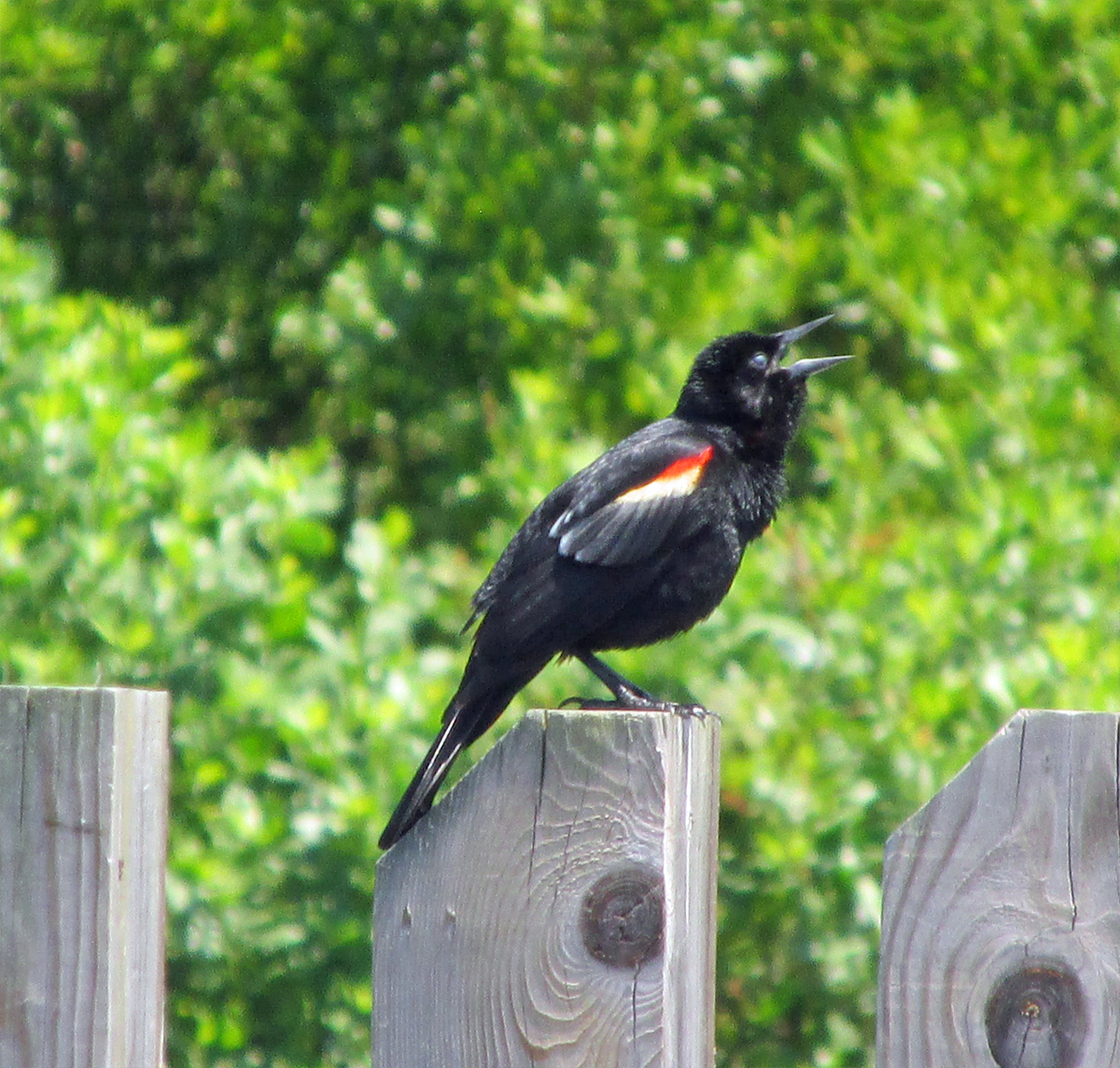
Photo by Bryan Stevens • A male red-winged blackbird sings to attract mates and ward off rivals.

February’s the shortest month, and it is more than halfway over. There are already signs that some birds are ready to embrace the shift in seasons as winter advances, albeit in fits and starts, toward spring.

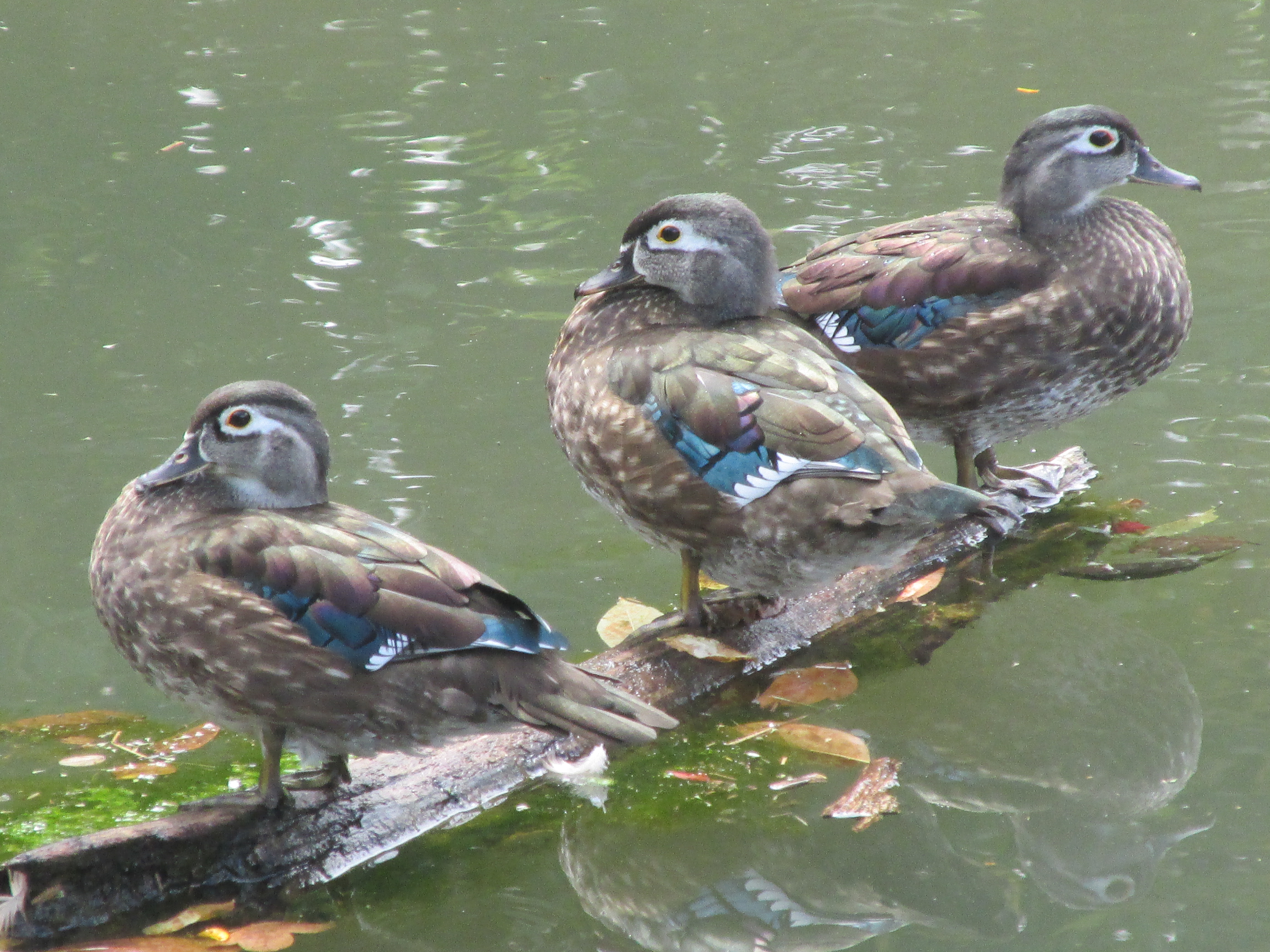
On Feb.11, three mallards visited my fish pond. The presence of mallards at any pond is not all that surprising. The mallard is arguably the most recognized of North America’s native ducks. But these were wild birds, as indicated by their wary behavior and their ability to spring into strong flight when I surprised them quite by accident.

Spring migration begins as early as February and March. Eastern bluebirds, which for the most part are not migratory, are already checking out nesting boxes.

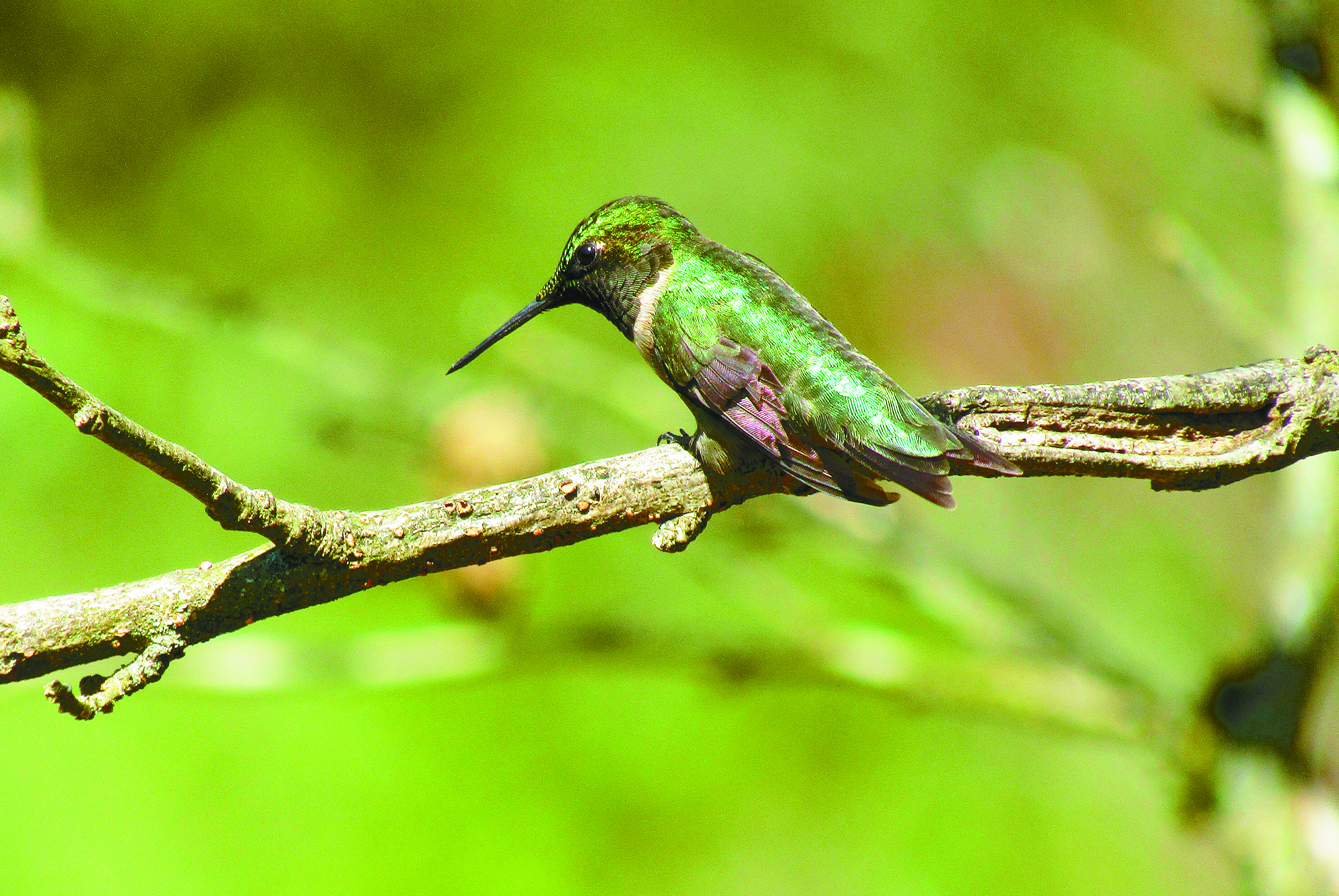
The months of March, April and May will bring an influx of migrants. Ruby-throated hummingbirds will soon make their annual crossing of the Gulf of Mexico. These tiny birds usually make landfall in the United States as early as February, but they don’t usually venture as far north as Northeast Tennessee, Western North Carolina and Southwest Virginia until early April.

Bryan Stevens • On Feb.11, three mallards visited my fish pond. I am hoping they are the start of more migrating birds arriving in the coming weeks.

Warblers, orioles, thrushes, flycatchers, tanagers and many other migrants also return in April and May. A variety of waterfowl, raptors and shorebirds pass through the region during these months, as well.

March brings the early birds, including species such as brown thrasher, blue-gray gnatcatcher and red-winged blackbird.

Red-winged blackbirds return with a venegeance in early March or sometimes in late February.

I’m ready to hear their loud, familiar “kon-ke-ree” sounds again from the tops of the cypress trees at the fish pond. It’s always a fun moment to welcome these birds back.

Red-winged blackbirds return yearly in early spring and begin to seek out nesting habitat in local wetland areas, such as the cattail marshes near my fish pond.

My first returning male red-winged blackbird arrived on the evening of March 3 in 2022. The first red-winged blackbird arrived on the morning of March 6 the following year. I heard his unmistakable song from inside my house.

The showy and loud red-winged blackbird males soon take up residence at my fish pond and adjacent stands of cattails after their return.

Male blackbirds arrive ahead of the females. They immediately search out prominent perches and begin singing every day in anticipation of an intended audience. Female blackbirds lag a week or so behind the males in returning to their familiar territory.

Any wet field or marsh, especially those offering a stand of cattails, is almost certain to attract red-winged blackbirds at this time of year. I’d almost wager on that certainty.

The blackbirds arriving in spring behave much differently than the quiet, furtive flocks that often make brief visits to feeders during late winter snowstorms.

“The kon-ke-ree song of the male red-winged blackbird is a sure indication that spring is on the way,” according to a profile located at the Tennessee Watchable Wildlife website.

At this time of year, the male red-winged blackbirds seek elevated perches to display and vocalize. Their loud antics are not designed solely to attract mates. Male red-winged blackbirds also sing to warn rival males from intruding into their territories.

The male red-winged blackbird is a very aptly named bird. Glossy black males sport red wing patches that are often trimmed with a narrow band of yellow feathers. By contrast, female red-winged blackbirds are mostly brown birds that could easily be mistaken for large sparrows. Both sexes have sharply pointed bills.

Red-winged blackbirds are fond of wetlands. Any marsh or even a damp field or flooded pasture is likely to attract a few resident red-winged blackbirds. Females choose nesting locations in cattails or other marsh vegetation. She usually lays three or four eggs. Although she does receive some help from the male, most of the responsibility for raising the young is left to her.

There is a reason that male red-winged blackbirds are not always quite as engaged as females in feeding and tending their young. Males are often polygynous, which means that males will often court multiple mates. His time is often occupied defending females and their respective nests from the advances of other male red-winged blackbirds.

According to the website All About Birds, male red-winged blackbirds spend much of the breeding season sitting on a high perch over their territories and singing almost without ceasing from dawn to dusk.

The website also notes that female blackbirds shirk the high profile of the males. They tend to skulk in wetland vegetation as they collect food or nest material.

Bryan Stevens • Female red-winged blackbirds lack the showy plumage of males. They look more like an overgrown sparrow.

Both males and females defend nests from intruders and predators. They take this duty quite seriously, as I know personally from being dive-bombed by parent blackbirds when I have gotten a little too close to their nests.

Other relatives of the red-winged blackbird in the United States include the tricolored blackbird found along the Pacific Coast and the yellow-headed blackbird resident in wetlands west of the Great Lakes. Rusty blackbird, common grackle and brown-headed cowbird are other species of blackbirds found in Tennessee, Virginia and North Carolina.

For birders, the weeks ahead are an exciting time. In spirit, I think others often join our excitement if for no other reason than to celebrate that spring is just around the corner. These “early bird” arrivals are merely the harbingers of the season.

Share a sighting, ask a question or make a comment by emailing me at ahoodedwarbler@aol.com.

Bryan Stevens • In fall, male red-winged blackbird are bereft of the striking glossy plumage of spring.


Birds make use of various strategies to attract and keep mates

Shauna Fletche/Pixabay • Some birds, like waxwings, like to present tasty treats to their potential mates.


With Valentine’s Day around the corner, it’s an opportune time to see how courtship is handled among our fine feathered friends. Most birds don’t bring a box of chocolates or a bouquet of roses when they take up courtship of a prospective mate, but birds have several equivalent behaviors that they employ to attract the attentions of the opposite sex. In honor of Valentine’s Day I thought a look at some of the more unusual courtship rituals of some of our feathered friends would be appropriate.

Aerial acrobatics designed to impress

In late winter and early spring, a true oddball begins courting. The American woodcock, also known by such whimsical names as “bog sucker” and “timberdoodle,” is a shorebird that has completely abandoned the shore in favor of woodlands and fields. Beginning as early as February, American woodcocks in the region conduct nightly courtship displays, starting at dusk, that combine aerial acrobatics with an assortment of unusual acoustical flourishes. Any wet field adjacent to a wooded area could offer a stage for these evening displays, but unless you know where to look and make an effort to do so, the American woodcock might as well remain a phantom of the night.

These mating rituals provide almost the only time of the year during which this bird makes itself available for observation. It’s only during this brief window that opens into their lives that we can be assured a glimpse. Even then, our peeks at woodcocks often consist of a fuzzy twilight escapade as the bird flings itself heavenward only to make a spiraling descent a few seconds later. The displays begin with a distinct vocalization, a type of “pent,” that also has the quality of sounding like some sort of mechanical buzzer.

Once the displays conclude for the season, the birds assume nesting duties, usually unobserved by humans. The rest of the year, almost nothing but blind, sheer luck would allow a birder to stumble across an American woodcock. It’s almost as if they disappear after these spring flights of fancy.

Birds bearing gifts

Many birds present small trinkets to a prospective mate. For instance, many male penguins make a present of a stone or pebble to female penguins. There could be more than a simple bribe behind this gift. Female penguins don’t build elaborate nests. In fact, a scrape on the bare ground, perhaps encircled by a collection of pebbles, marks the extent of their nest construction. So, the perfect pebble could be the way to winning a female penguin’s heart.

The way to the heart is through the stomach

Observant birders may have witnessed a male Northern cardinal slip a female a morsel of food, such as a peanut or a shelled sunflower kernel. It’s a marked change for this bird. During the winter months, a male cardinal is more likely to chase a female away from a feeder rather than share food with her. However, as spring approaches, his behavior undergoes a change and he becomes content to feed next to a female cardinal, often slipping her some choice tidbits.

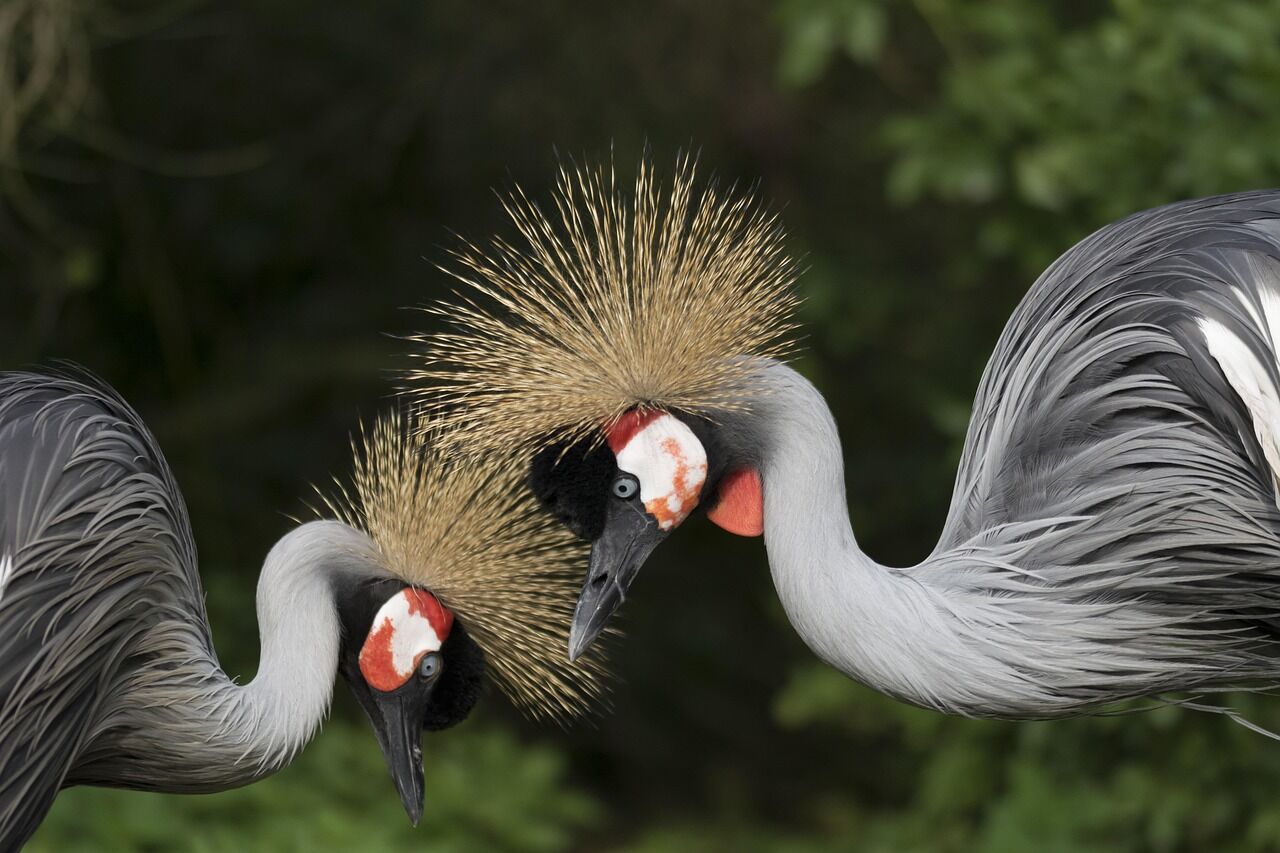
Sabine van Erp/Pixabay • Bow to your partner: Grey-crowned cranes perform an elaborate dance designed to strengthen their bond.

May I have this dance?

Many species of birds perform elaborate and ritualistic dance displays. Among birds known for tripping the light fantastic are flamingoes, cranes, grouse and grebes. Cranes are one of the oldest families of birds on earth. They’re also some of the most accomplished dancers in the animal kingdom. Pairs perform very ritualistic dances that, if the performers were human, would no doubt require the services of an accomplished choreographer. Cranes mate for life and the ritual of dancing is a way to strengthen the bonds between a mated pair. The ability to dance is, apparently, not instinctive. Young cranes must practice their dance moves, a process that can take years before they master the elaborate dance.

Dave Menke/U.S. Fish & Wildlife Service • A pair of Clark’s Grebes displays in a courtship ritual known as “rushing” or “weed dance.” Birds use a variety of strategies to attract and keep mates.

Synchronized swimming

While many birds dance to impress a mate or strengthen pair bonds, grebes perform a dance that takes place completely on the surface of the water. A pair will engage in this intricate performance, perfectly mirroring the moves of the other as they literally race across the surface of the water. These dances by grebes are also known as “rushing” or “weed dance.” It’s called as a weed dance because at the culmination of the ritual, the birds usually hold some type of aquatic plants in their bills while racing swiftly over the surface of the water. Pairs that perform well together stay together, building a nest and raising young.

Good housekeeping seal of approval

The tropical family of bowerbirds are famous for complex nests built by males and then decorated with bright and colorful objects to catch the eye of a potential mate. The nests of these birds are actually referred to as a “bower.” Usually constructed on the ground, the male will line the approachs to the bower with items such as shells, leaves, flowers, feathers, stones, berries, and even discarded garbage, including plastic scraps or bits of glass. Unusually odd items pressed into these decorative displays have included coins and spent rifle shells. This habit of male bowerbirds must rank as the ultimate in trying to impress a mate with shiny bling.

These are just a few of the inventive ways that birds go about attracting and keeping mates. Perhaps you can pick up some pointers from our feathered friends to ensure you have a great Valentine’s Day this year.

•••

If you have a question, wish to make a comment or share a sighting, email me at ahoodedwarbler@aol.com.

Look for wintering kestrels in open habitats

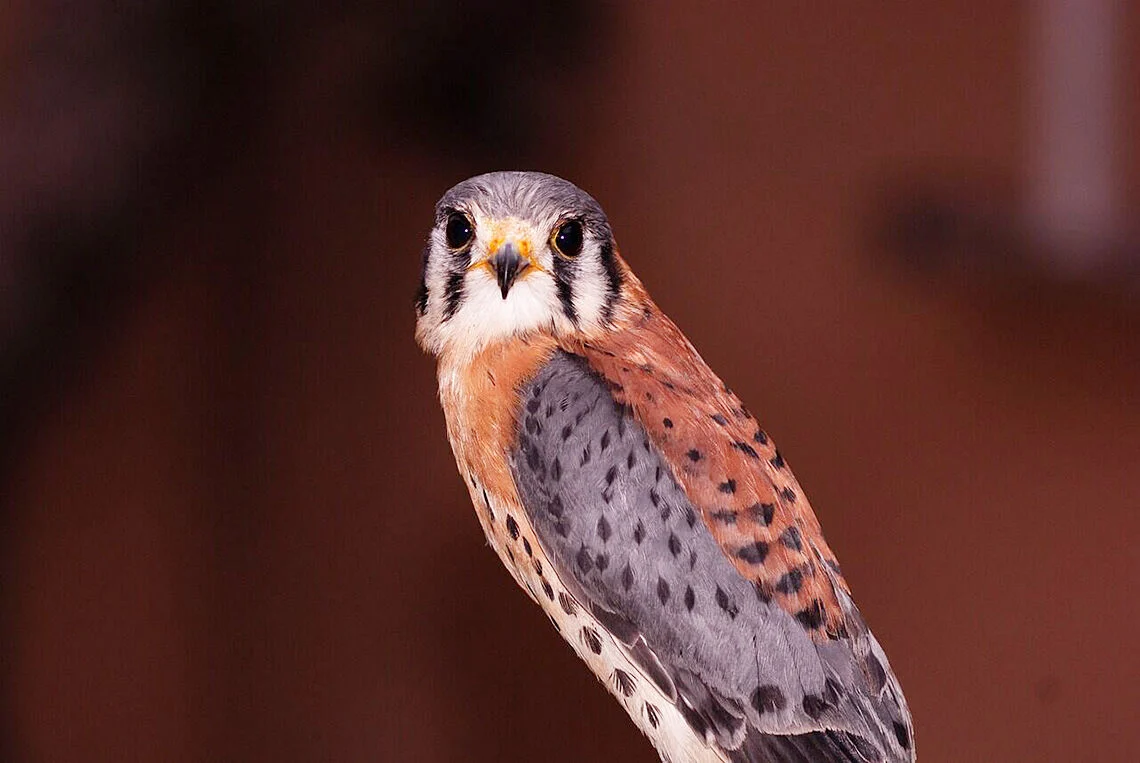
David Antonio Carrillo/Pixabay • American kestrel numbers increase in winter in the region as cold weather farther north usually drives more of these small falcons into the area.

The region’s already had several cold snaps since the new year’s dawning and we’re not even at the end of January. The colder temperatures and snow have helped bring an increase in the number of wintering American kestrels.

These small falcons can be found in the region throughout the year, but their numbers usually rise in early winter as kestrels from other areas take up residence for the colder months.

Any open habitat is enough to attract these falcons. I often find them in Limestone Cove in Unicoi County. The fields near Bell Cemetery are a reliable place to look for them in winter. They are also fairly common in in agricultural fields in western Washington County.

The American kestrel is a small member of the falcon family, which includes such relatives as merlin, peregrine falcon and gyrfalcon. All falcons, regardless of size, share a similar aerodynamic design that includes sleek, streamlined bodies and long, slim wings which taper to pointed tips. They fly with rapid wingbeats and are capable of swift flight.

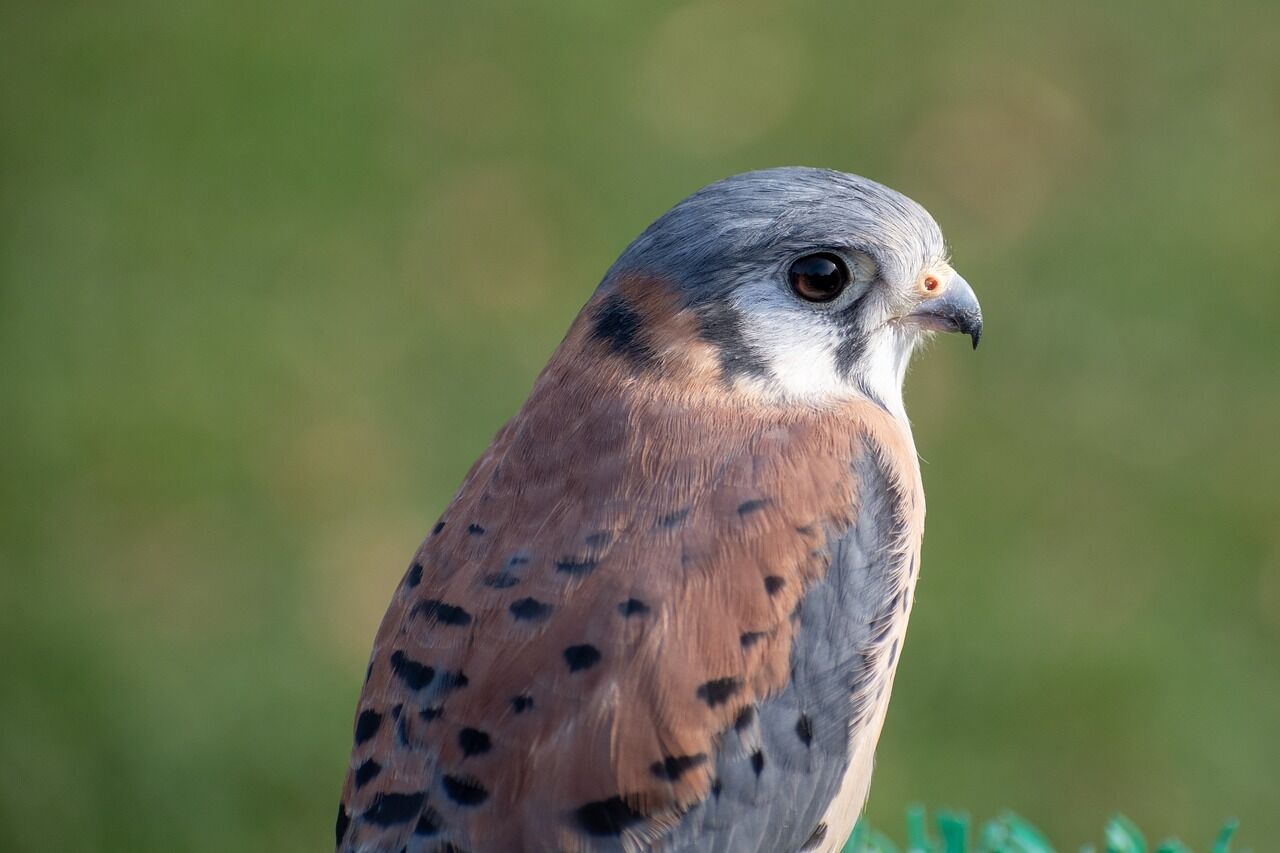
The male American kestrel is a colorful bird. He shows a rusty back with some black barring, a rusty tail and steel blue-gray wings. The female kestrel is brownish with black barring on her back and tail. She also shows a buff-colored wash streaked with brown on her under- parts. Both sexes show a strong facial pattern marked by two black “sideburns” on the side of the face.

reitz27 from Pixabay • Any open, spacious habitat is enough to attract American kestrels.

The American kestrel has long been one of my favorite raptors. They’re seldom as skittish as many other raptors and will permit close observation. Formerly known by the name “Sparrow Hawk,” the American kestrel does not feed entirely on other birds. In fact, a large part of this small falcon’s diet includes rodents and insects.

In its nesting preference, the American kestrel is unusual among other native falcons and hawks. Kestrels nest in cavities, including abandoned woodpecker holes and nest boxes provided by humans.

Like many raptors, the American kestrel likes to hunt from a perch, swooping down on unsuspecting prey. The kestrel, however, is also capable of hovering, a type of flight that only a relatively few birds, including the belted kingfisher and the ruby-throated hummingbird, are capable of performing.

The falcons comprise a family of birds with a long history with humans. The sport of falconry, although not as widely practiced today, long ago became associated with royalty and nobility. In fact, falconry has been called “the sport of kings.” The sport basically involved hunting prey, usually other birds, with birds of prey such as falcons. As a pastime, falconry never became as popular in the United States as in other parts of the world.

There are more than 60 species of falcons found worldwide. While the peregrine falcon’s endangered status became well-known in the United States, other falcons have been threatened with extinction. The Mauritius Kestrel once dwindled to a population of only six individuals. Today, the population, due to intensive human effort, has greatly recovered.

Other members of the falcon family can be found in the region, including the peregrine falcon and the merlin. Other falcons in North America include the prairie falcon and the Aplomado falcon. Worldwide, some of the more descriptively named falcons include spotted kestrel, rock kestrel, greater kestrel, lesser kestrel, red-footed falcon, red-necked falcon, sooty falcon and brown falcon.

•••

To share observations, ask questions, or make a comment, email me at ahoodedwarbler@aol.com.


Winter season offers a chance to get to know special little wren


Willfried Wende/Pixabay • Outside of the Americas, there is only one species of wren. In the Americas, this wren is known as the winter wren.

Note: I’m on vacation. Please enjoy this column originally published in December of 2017.

Of late, every time I step outside my front door I’ve incurred the ire of a winter wren that’s taken up residency in my yard. This wren is a tiny bird among a family of birds known for small size, but it makes its presence known in unmistakable terms.

For starters, the winter wren is a noisy bird. The one living at my home arrived in late November and immediately claimed a niche to call its own. Any intrusion is met with a scolding chatter as the wren scurries low to the ground to drop out of view. In fact, the winter wren’s a very terrestrial bird. Observers are just as likely to see one of these wrens run across the ground as they are to see it take flight. I’m hopeful he will remain as winter’s grip tightens for the next couple of months.

The website All About Birds, managed by The Cornell Lab of Ornithology, offers advice on making a wren-friendly yard. “Landscaping with native plants is a good way to provide habitat for winter wrens,” according to the website. Other steps to take could extend to creating brush piles and ensuring some sections of the yard offers dense vegetation. The website also notes that this wren is often found making its home near streams.

In the summer, the winter wren often nests atop some of the high-elevation mountains in the region, especially ones with abundant fir and spruce trees. Otherwise, it’s mostly a winter visitor in the region. Other wrens common to the region include the Carolina wren and the house wren. In suitable habitats, especially during fall and spring migration, two other wrens — marsh wren and sedge wren — are observed occasionally in the region. Other wrens native to the United States include the rock wren, canyon wren, cactus wren, Pacific wren and Bewick’s wren.

The world’s 88 species of wrens are, for the most part, the quintessential “little brown birds,” but that hasn’t kept them from acquiring some interesting and descriptive common names. Some examples include the tooth-billed wren, flutist wren, riverside wren, whiskered wren, happy wren, musician wren, timberline wren, speckle-breasted wren, white-breasted wood wren and giant wren. The last species on the list resides in Mexico and is indeed a “giant” among a family of tiny birds, reaching a length of almost nine inches and weighing all of 1.8 ounces.

For the most part, wrens are birds of the New World. In fact, only the Eurasian wren represents the family in Europe, Asia and Africa. Experts recently split the winter wren into several different species, including the Pacific wren of the west coast of North America and the Eurasian wren of Europe, Asia and Africa.

Just as the winter wren thinks nothing of acting like a mouse when scurrying through leaf litter and over fallen logs in search of insect prey, this bird doesn’t hesitate to imitate mice by poking into shadowy holes in the ground or exploring the dark crevices of fallen logs. When winter temperatures drop sharply, many of these birds may cram themselves into a roosting hole to benefit from the communal heat from so many tiny feathered bodies in such close proximity. Winter wrens eat mostly insects and spiders, but in winter these birds will also eat some seeds and berries. Winter wrens rarely visit feeders, but a suet cake often attracts birds with similar dietary preferences, including kinglets and chickadees. A larger relative, the Carolina wren, is a common visitor to feeders.

In English and German lore, the winter wren was known as the “king of the birds.” Different tales provide varying explanations for how such a small bird earned such an inflated title. Ritual hunts were enacted in some European locations. These hunts, known as “wren hunts,” were conducted by “wren boys” who would parade through town on their quests. Wren Day fell on Dec. 26, which coincided with the holiday St. Stephen’s Day. Some myths blame the noisy bird for betraying the hiding place of Stephen, who was delivered up as a Christian martyr to his enemies due to the bird’s treachery. In some European cultures, various superstitions sprang up about wrens. For instance, in Scotland it is considered extremely unlucky to kill a wren.

Personally, I feel lucky to have the tiny winter wren spending time around my home and can guarantee no “wren hunts” will be staged here. At a time of year when feathered friends can be scarce, a winter wren is a welcome visitor.

•••

Bryan Stevens has written about birds and birding since 1995. Email him at ahoodedwarbler@aol.com to ask a question, share a bird sighting or make a comment.

Spotlight on dark-eyed junco launched weekly column 29 years ago

Pixabay • A dark-eyed junco visits a deck for birdseed.

I wrote my first bird column on Sunday, Nov. 5, 1995, which means this weekly column is marking its 29th anniversary this week.

Looking back, it seems almost unbelievable that I’ve written anything on a regular weekly basis for almost 30 years. This column has appeared in a total of six different newspapers, which I regard as a personal achievement, as well as an accomplishment for our feathered friends. It’s on their behalf that I pen these weekly efforts to promote conservation and good will toward all birds. I have also posted the column as a weekly blog posting since February 2014 at http://www.ourfinefeatheredfriends.com.

I’ve played detective, helping people identify everything from “rain crows,” or cuckoos, to Muscovy ducks, rose-breasted grosbeaks and house finches. I’ve observed unusual birds, including white pelicans, brants and roseate spoonbills, in Northeast Tennessee, Southwest Virginia and Western North Carolina and spotlighted them in these columns.

Photo by Ken Thomas • A dark-eyed junco perches on some bare branches on a winter’s day.

While my vision challenges remain, I find that looking through binoculars works just fine, allowing me to spin the focus wheel and still take delight in the kaleidoscopic parade of colorful warblers that pass through the region each spring and fall as well as the fast-paced duels of ruby-throated hummingbirds. My main problem these days is the inability to spot movement, especially in treetops where many birds like to hang out.

At my home, I continue to provide sunflower seed and other supplemental food for the resident birds like Carolina chickadees, white-breasted nuthatches, song sparrows and downy woodpeckers.

Even as I tweak my anniversary column for “Feathered Friends,” I’m looking forward to the winter bird feeding season. The prognostication of approaching winter weather is a perfect time to dust off this week’s column, which is a revision of the first bird column I ever wrote. This column focused on a common visitor to yards and feeders during the winter months. In fact, dark-eyed juncos should be returning to the region any day. Here, with some revisions I have made through the years, is that first column.

•••

Of all the birds associated with winter weather, few are as symbolic as the dark-eyed junco, or “snow bird.” The junco occurs in several geographic variations.

John V. Dennis, author of “A Complete Guide to Bird Feeding,” captures the essence of the junco in the following description: “Driving winds and swirling snow do not daunt this plucky bird. The coldest winter days see the junco as lively as ever and with a joie de vivre that bolsters our sagging spirits.” The dark-eyed junco’s scientific name, hyemalis, is New Latin for “wintry,” an apt description of this bird.

Most people look forward to the spring return of some of our brilliant birds — warblers, tanagers and orioles — and I must admit that I also enjoy the arrival of these birds. The junco, in comparison to some of these species, is not in the same league. Nevertheless, the junco is handsome in its slate gray and white plumage, giving rise to the old saying “dark skies above, snow below.”

Just as neotropical migrants make long distance journeys twice a year, the junco is also a migrating species. But in Appalachia, the junco is a special type of migrant. Most people think of birds as “going south for the winter.” In a basic sense this is true. But some juncos do not undertake a long horizontal (the scientific term) migration from north to south. Instead, these birds merely move from high elevations, such as the spruce fir peaks, to the lower elevations. This type of migration is known as vertical migration. Other juncos, such as those that spend their breeding season in northern locales, do make a southern migration and, at times, even mix with the vertical migrants.

During the summer months, a visit to higher elevations mountaintops is almost guaranteed to produce sightings of dark-eyed juncos. Juncos may nest as many as three times in a season. A female junco usually lays three to six eggs for each nest, which she constructs without any assistance from her mate.

Juncos are usually in residence around my home by early November. Once they make themselves at home I can expect to play host to them until at least late April or early May of the following year. So, for at least six months, the snow bird is one of the most common and delightful feeder visitors a bird enthusiast could want.

Juncos flock to feeders where they are rather mild-mannered — except among themselves. There are definite pecking orders in a junco flock, and females are usually on the lower tiers of the hierarchy. Females can sometimes be distinguished from males because of their paler gray or even brown upper plumage.

Since juncos are primarily ground feeders they tend to shun hanging feeders. But one winter I observed a junco that had mastered perching on a hanging “pine cone” feeder to enjoy a suet and peanut butter mixture.

Dark-eyed juncos often are content to glean the scraps other birds knock to the ground. Juncos are widespread. They visit feeders across North America. The junco is the most common species of bird to visit feeding stations. They will sample a variety of fare, but prefer such seeds as millet, cracked corn or black oil sunflower.

The juncos are a small branch of the sparrow clan. Some of the other juncos include the endangered Guadalupe junco, yellow-eyed junco, Baird’s junco and volcano junco. The last one on the list is endemic to the Talamancan montane forests of Costa Rica and western Panama. Baird’s junco is named for Spencer Fullerton Baird, an American ornithologist and naturalist.

Baird served as secretary for the Smithsonian Institution from 1878 until his death in 1887. He greatly expanded the natural history collections of the Smithsonian from 6,000 specimens in 1850 to over two million by the time of his death.

I hope you’ve enjoyed this introduction to juncos. There’s something about winter that makes a junco’s dark and light garb an appropriate and even striking choice, particularly against a backdrop of newly fallen snow.

Of course, the real entertainment from juncos comes from their frequent visits to our backyard feeders. When these birds flock to a feeder and began a furious period of eating, I don’t even have to glance skyward or tune in the television weather forecast. I know what they know. Bad weather is on the way!

•••

I’ve already seen the first of the season’s white-throated sparrows, a reliable precursor to juncos. If you’d like to share your first sighting this season of dark-eyed juncos, email me at ahoodedwarbler@aol.com. As always, the column is open as a line of communication with fellow bird enthusiasts. I’ve enjoyed sharing stories about birds with countless readers over the past 29 years. I can also be reached on Facebook at https://www.facebook.com/ahoodedwarbler.


Vocal screech owls are pint-sized predators

Photo by Bryan Stevens • An Eastern screech owl perches on a hemlock branch. These owls are much smaller than such relatives as great horned owl and barred owl.

It’s been my pleasure to enjoy almost daily serenades by an Eastern screech owl residing in the woods around my home. The small owl’s shivery wailing calls usually start around dusk and can continue at intervals throughout the night.

Back in September while I watched almost daily for migrants from a lawn chair, I heard on a couple of occasions the “early bird” owls calling occasionally from shady wooded areas. The owls tended to call more often during the daytime when conditions were overcast.

I always pause and listen when I hear the wailing and haunting vocalizations of the screech-owls that make their home in the woodlands that surround my home. I’m glad to have this small owl as a neighbor, but I fully realize that owls have suffered from a dark reputation in certain corners. The fact is, unless you are a small rodent or some sort of insect-sized prey, the Eastern screech-owl makes an excellent addition to the neighborhood.

On the verge of Halloween, a closer look at this small owl is warranted. An adult Eastern screech owl is usually only between six and nine inches in length. Many people upon first seeing a screech-owl assume it’s a baby owl. During past trips to Brookgreen Gardens in South Carolina, I have enjoyed attending the daily educational programs conducted by the zoo staff at Brookgreen. These programs are designed to introduce visitors to various examples of native wildlife. The presenter usually introduced a couple of animals to the audience. On several occasions, the show featured birds of prey, including hawks and owls.

Photo by Irene K-s/Pixabay.com • An Eastern screech owl keeps an eye on its surroundings.

Two of the shows during my visit to Brookgreen back in 2019 featured Lucy, an Eastern screech-owl, and people in the audience invariably asked if she was a baby owl. To their astonishment, they learned that Lucy was an adult screech-owl and unlikely to grow any bigger.

There are larger owls in our region, including the great horned owl and barred owl. Lucy and her kin must avoid these much larger owls, which would not scruple at making a meal of the much smaller owl.

Because of their small size, screech-owls prey on some comparatively small creatures, including insects, small rodents, amphibians, songbirds and reptiles. The Eastern screech-owl is also a cavity-nesting bird and will accept bird boxes provided by humans so long as the box’s entrance hole is customized to their size.

The screech owl is the owl most likely to encounter human beings. It’s an adaptable little feathered predator, just as much at home in the backyard and garden as it is in parks and woodlands. In addition to nesting in cavities, this owl roosts in them during the daytime hours. Look for roosting screech-owls in knotholes of trees or in unoccupied wood duck boxes. Although they come in two color phases — red and gray — both variations are quite capable of camouflage. When perched or roosting, these small owls blend remarkably with their surroundings.

The Eastern screech owl also produces a variety of odd wails and other vocalizations including a distinctive, trembling “whinny” call that is often made when the owl feels curious or alarmed. It’s a wavering, haunting call that is made after dark, most often at the hours closer to dawn and dusk. Imitating the call of a screech-owl or playing a recording is also a trick for getting some shy songbirds to show themselves. Screech owls are not-so-welcome co-habitants among my yard’s songbirds, which will flock to this owl’s call and band together to “mob” the predator and try to convince it to depart the immediate area.

As small as the Eastern screech-owl is, the United States is home to several other pint-sized owls, including Western screech-owl, Northern pygmy-owl, Northern saw-whet owl, flammulated owl and elf owl, which at six inches tall and a weight of less than an ounce qualifies as the world’s smallest owl.

Photo by U.S. Fish and Wildlife Service • The tiny Northern Saw-whet Owl nests on several of the region’s higher mountains.

Any time I finish listening to a calling owl and go back indoors for the evening, I reflect on the fact that screech-owls make good neighbors. Their prey preferences remove many nuisance insects and rodents from the habitat they share with humans as well as other wildlife. If you’re hearing an odd, winnowing call from the edge of the woods at your own home, there’s a good chance that you have one of these small owls as a neighbor.

Keep alert for these small owls and their larger kin as we observe this year’s Halloween holiday, as well as other days and nights throughout the year.

•••

To learn more about birds and other topics from the natural world, friend Bryan Stevens on Facebook at https://www.facebook.com/ahoodedwarbler. He enjoys posting about local birds, wildlife, flowers, insects and much more. If you have a question, wish to make a comment or share a sighting, email him at ahoodedwarbler@aol.com.

Holly Keepers/USFWS • A red Eastern screech owl peeks from a perch among some evergreen branches.

Mockingbird has been Tennessee state bird since 1933

By George/Pixabay • The Northern mockingbird serves as the state bird for Tennessee, as well as four other states. These songbirds are renowned for having a spirited nature.

We know some birds by their colorful feathers and others by a distinctive song. The Northern mockingbird demands attention not so much from brilliant plumage or a unique song — this bird actually copies the songs of other birds — but from an indomitable spirit all out of proportion to its size.

The mockingbird is a relatively common bird in most of the region, but it has always been rather scarce bird at my home. This year has been no exception. I’ve observed gray catbirds and brown thrashers as summer transitioned into autumn, but there’s been no sign of any Northern mockingbirds.

Mockingbirds don’t usually visit my yard and gardens outside of late fall and early winter. Close relatives like the gray catbird and brown thrasher, however, are usually fairly common birds in spring, summer and fall. I’ve even had thrashers visit during the winter months, as well as an unexpected December sighting of a catbird in 2015.

These three species are lumped together in a family of birds known as the “mimic thrushes,” so named because of their talent for mimicry. The group provides a convenient umbrella for some related songbirds capable of imitating the songs of other birds.

Mimidae, the Latin root for “mimic,” provides the scientific name for the family, which includes mockingbirds and the New World catbirds, as well as thrashers. The Northern mockingbird is best known for the ability to mimic, but relatives like the gray catbird and brown thrasher are also talented mimics.

The varied repertoire of a mockingbird has always impressed human listeners. Laura C. Martin notes in her book, “The Folklore of Birds,” that the Choctaw Indians referred to the mockingbird as hushi balbaha, or “the bird that speaks a foreign language.”

Mockingbirds will break into song — their own and those of other birds — at almost any time of day or night. Both sexes sing. Biologists have speculated that there might not be a limit to the songs mockingbirds can learn to imitate, while other experts believe that the mockingbird’s mimicry might not be quite so extensive.

The Northern mockingbird is the only mockingbird found in North America, but Central America, South America and some of the Caribbean islands are also home to 16 other species of mockingbirds. Several endemic species of mockingbirds also inhabit some of the islands in the Galápagos archipelago.

Some of these other mockingbirds include brown-backed mockingbird, white-banded mockingbird, blue mockingbird, blue-and-white mockingbird, chalk-browed mockingbird, Bahama mockingbird and tropical mockingbird.

Anyone with much experience with mockingbirds would probably agree that these birds are bold, courageous and sometimes fiercely assertive.

The aggression of the mockingbird was on full display on an occasion when I observed a pair of these birds attempting to defend a berry-laden holly tree from a voracious flock of cedar waxwings. Badly outnumbered, the two mockingbirds would successfully chase off several waxwings only for another dozen or so waxwings to take the place of their vanquished flock mates. Although the flock of waxwings consisted of about 80 individual birds, the mockingbird pair put up a valiant struggle to defend the food represented by those holly berries.

Nesting mockingbirds are also very defensive of both their nest and young. They will attack anything that moves in the vicinity, including domestic cats and dogs, as well as humans.

I once observed a young red-tailed hawk perched in a tree while crows and blue jays were screaming in protest at the large raptor’s presence. The only bird to actually make contact with the hawk, however, was a single mockingbird that swiped the back of the hawk’s head in a persuasive effort to convince the raptor to move along.

Perhaps not surprisingly, these aggressive songbird can reach a ripe old age. According to the website All About Birds, the oldest Northern mockingbird on record was at least 14 years, 10 months old when it was found in Texas.

Early American naturalist and artist John James Audubon painted a famous depiction of mockingbirds attacking a rattlesnake. He painted the dramatic scene to demonstrate the fearless nature of the mockingbird in defending its young.

It’s that feisty attitude that impresses most people about mockingbirds. Even people who don’t like this bird — some consider it a bully — usually give grudging credit that the bird doesn’t lack in courage or spirit.

Perhaps that’s the reason five states — Tennessee, Texas, Florida, Arkansas and Mississippi — have made the mockingbird their official state bird. The southern makeup of these states reflects that the mockingbird has always been a bird of the southern United States even as it has expanded its range northward and westward.

The mockingbird was designated the state bird by the Tennessee General Assembly in 1933. The mockingbird’s designation had been decided earlier that same year in an election conducted by the Tennessee Ornithological Society. Florida and Texas both selected the mockingbird in 1927, Arkansas in 1929, and Mississippi in 1944. The mockingbird was once the official state bird of South Carolina but was replaced by the Carolina wren in 1948.

I find mockingbirds fascinating, partly because they remain a bit of a rarity at my home. I realize that the militant nature of this bird may distress those wanting peace and harmony among the feathered occupants of their yards and gardens.

If the mockingbird had a slogan, it might be something like “don’t mess with me.” The mockingbird in your yard or garden considers the territory its own little kingdom. Intruders beware.

•••

To share a sighting, make a comment or ask a question, email me at ahoodedwarbler@aol.com.


Rare birds are occasional silver linings after hurricanes

Kaleomanuiwa Wong/USFWS • A sooty tern clings to a rocky perch. Hurricane Frances blew a sooty tern to Holston Lake in Bristol on Sept. 8, 2004.

During a program I presented on birds and birding at the Elizabethton/Carter County Public Library many years ago, an attendee asked me if I knew what happens to birds in a hurricane?

The question, no doubt prompted by the 2017 hurricanes Harvey and Irma, is of particular concern now that many of our favorite birds are migrating south along paths that could take them into harm’s way.

Hurricanes are often a factor that fall migrants must face. In 2004, Hurricane Frances blew some unusual tropical birds to Holston Lake in Bristol. Severe storms also present devastating obstacles for other birds.

Well-known birder and author Kenn Kaufman shared his knowledge about birds and hurricanes when interviewed back in 2011 on the Audubon website. Among some fascinating insight he shared, Kaufman noted that the way intense storms affect birds depends on the species. He noted that a whimbrel, a large shorebird, would be more likely to fly through a major hurricane and live to tell the tale. On the other hand, such a storm would likely prove lethal for songbirds like warblers and thrushes.

To the questioner at my program, I also admitted that dedicated birders are, at times, rather atypical people. For a birder looking to find a totally unexpected bird, every hurricane comes with a proverbial silver lining. In the case of birders, that lining involves some of those stronger flyers — birds like whimbrels, noddies, terns, jaegers or tropicbirds — that get swept into the eye of the storm, carried far inland and dropped onto large lakes as the storm weakens.

My first direct observation of one of these hurricane-transported displaced birds took place back on Sept. 8, 2004. I had been drawn to Musick’s Campground on South Holston Lake by reports of an incredible fallout of such birds, which included species like whimbrel and red knot. More than a dozen fellow birders were present in the swirl of wind, mist and rain when a graceful bird with a dramatic two-toned black and white plumage flew overhead.

I had no idea of the bird’s identity, but I knew instantly it was a species I’d never observed. I heard someone yell “sooty tern” — the identity of the shouter turned out to be area birding legend Rick Knight — and then pandemonium broke out as birders in rain gear got their binoculars into position to track the bird before it flew out of sight.

We needn’t have worried. The bird lingered long enough for all those present to get a good look. I was accompanied that day by the late Howard P. Langridge, a well-known birder in both Florida and Tennessee. Howard had seen sooty terns, but he had found them when visiting the islands of the Dry Tortugas, west of the Florida Keys.

Ronald Plett/Pixabay • Royal terns, like the individual pictured, usually stay close to coastlines. In 1989, Hurricane Hugo blew a royal tern all the way to Watauga Lake, establishing the first record for the species in the state.

Two months after the exciting observation of that sooty tern, Howard passed away at age 81. So, even to this day, memories of that bird are tinged with some bittersweetness from the fact it was one of my last birding adventures with a man who served as a bit of a birding mentor for me.

On our drive back home after that exciting encounter with the storm-driven tern, Howard talked excitedly about sooty terns and some of the other rare birds he had seen in a birding career that spanned more than 50 years.

In addition, we learned a valuable lesson that day. It’s an accepted fact that no bird is worth risking life or limb. It’s also a good idea to be careful where you park when going out to a rain-drenched lakeshore to look for birds from a diminished hurricane. Howard and I lingered after the other birders departed. When we started to leave, he discovered his car’s back tires had gotten stuck in the clay mud. With Howard behind the wheel, I pushed his car as the tires spun madly for traction. I ruined a new pair of denim jeans, but I got the car out of the mud. It’s one more memory that will put a smile on my face to this day.

The sooty tern, blown to a Bristol lake in 2004 by Hurricane Frances, remains a highlight of my birding; however, it’s hardly the only unusual bird to be dumped on area lakes thanks to hurricanes that formed in tropic waters.

Hurricane Hugo back in 1989 remains one of the most legendary storms in the minds of most long-time birders in the area. I hadn’t yet taken up birding at that time, but birders like Howard made sure I knew all about the bird bounty stirred up by Hugo. Two species of jaegers — parasitic and pomarine — were among the birds blown inland to Watauga Lake in Carter County. Seeing these birds usually requires a seat on a boat capable of traveling far out to sea to look for birds that hardly ever venture near the shoreline except for nesting.

Hurricane Hugo also blew more than 50 Forster’s terns — a record number for the region — to Watauga Lake. In addition, a single royal tern — a first record for Tennessee — was also detected by birders looking for birds displaced by Hurricane Hugo.

Much farther back, a high count of Caspian terns was recorded Sept. 5, 1964, at Boone Lake in the wake of Hurricane Cleo. The late Wallace Coffey, a well-known birder in Bristol, was present to witness those 130 Caspian terns. Both Caspian and royal terns are birds usually found along the Atlantic Coast in places like Florida, Georgia and the Carolinas.

As I write this week’s post, I did some digging online to see if Hurricane Helene caused any problems for migrating birds.

It’s possible that the storm did drive some unusual species inland. Common gallinules have been spotted in Oak Ridge, as well as Roane County and Anderson County in the days after the storm. American avocets have also shown up in locations across the Volunteer State in the same time period.

Cornell Laboratory of Ornithology did report some displaced birds in the wake of Hurricane Helene, but the reports came mostly from coastal areas that saw some off-shore species like sooty shearwater, Audubon’s shearwater, magnificent frigatebird, brown noddy, bridled tern, sooty tern, Bermuda petrel and American flamingo driven closer to coastlines.

I haven’t heard of any regional migrant fallouts, but then Helene was a rather horrific storm. Even dedicated birders know when to hunker down and look for birds another day.

•••

Email me at ahoodedwarbler@aol.com to share a sighting, make a comment or ask a question.

Catbirds make noisy neighbors during the warmer months

Photo by Bryan Stevens A curious Gray Catbird peeks from dense cover. Attendees at the fall rally can look for catbirds and other species at any of the offered bird hikes.

(NOTE: Hurricane Helene disrupted my weekly posting. I’ve still been writing, so catching up now on the posting.)

I wrote last week about brown thrashers. This week I’m turning the spotlight on a close relative of the thrashers, the gray catbird.

As summer has waned and autumn’s approach has become more inevitable with each passing day, I’ve become more aware of both thrashers and catbirds skulking around the edges of the yard and the nearby woodlands.

These birds have been lured closer by polk berries, wild grapes and pin cherries. Both thrasher and catbirds are fond of fruit. One summer my mom and I “trained” a catbird to come to the discards left behind when strawberries are “capped.” Not as picky as people, the catbird thought the discarded scraps of strawberries provided an unexpected treat.

Catbirds are part of a family related to thrushes that are known as “mimic thrushes.” Besides its surprisingly accurate rendition of a feline, the catbird has several other common vocalizations. Despite their shy nature, they’re extremely curious. Imitating their calls or simply producing a squeaky sound will usually persuade the bird to move out of cover and search for the source of the noise.

Catbirds are part of the annual fall exodus that includes species like rose-breasted grosbeaks, scarlet tanagers, Baltimore orioles and indigo buntings, but because they lack the brilliant plumages of these other birds their passage would probably go unnoticed if not for the fact they are extremely noisy.

Catbirds do get quieter during the nesting season when they take up the serious business of raising young, but after that annual task is completed they immediately slide back into their crotchety vocal habits.

Catbirds are experts at concealing themselves from prying eyes. The bird’s charcoal gray plumage, unbroken except for a patch of maroon feathers beneath the tail, blends into the shadowy sections of the tangles and thickets where they like to lurk. However, even when gray catbirds are reluctant to be seen, they’re almost eager to be heard. As indicated, the catbird is extremely vocal with several calls and songs in its repertoire, including the rather faithful rendering of a fussy cat’s meow that provides this bird its common name.

They are related to thrashers and mockingbirds, but scientists find them just different enough to warrant placing the gray catbird in its own genus.

A relative known as the black catbird, which ranges throughout the Yucatan Peninsula of Mexico as well as northern Guatemala and northern Belize, also belongs to a genus of its own. Both catbirds are classified as “mimic thrushes,” or Mimidae, of which there are about 30 species in the New World.

There is also a totally unrelated family of catbirds that ranges through Australia, Asia and parts of Africa. Some of these birds include the ochre-breasted catbird, tooth-billed catbird and spotted catbird.

The gray catbird is not as an accomplished mimic as some of its relatives, such as the Northern mockingbird. Nevertheless, experts have documented that the gray catbird can produce more than 100 different sounds. Males have motivation to constantly expand their repertoire, however, as doing so increases the likelihood of attracting a mate. They imitate other birds, but some have been recorded imitating frogs and other non-avian singers.

An occasional catbird enjoys surprising longevity. The oldest known gray catbird was at least 17 years, 11 months old when it was recaptured and rereleased during banding operations in New Jersey in 2001, according to the website All About Birds. That individual had been banded originally in Maryland in 1984.

I will miss the catbirds once they depart farther south for the winter, although occasionally a few hardy individuals linger into November and December in the region.

Other birds, including warblers, hummingbirds and most flycatchers will soon take their leave until next spring. Try to enjoy them before they decamp.

•••

To share a sighting, ask a question or make a comment, please email me at ahoodedwarbler@aol.com.


Birds share fall skies with migrating butterflies, dragonflies

During a stop at the Unicoi Walmart to visit the pharmacy on Wednesday, Sept. 3, I spied an energetic fluttering of wings in the garden center. Although I’ve spied various birds, including Carolina wrens and house sparrows, making themselves at home in this garden center, this winged creature was quite a bit smaller.

I watched the butterfly flit from marigold to zinnia to fall mums, feasting on the nectar the blooms provided. A closer look revealed the butterfly’s identity as a long-tailed skipper, a species more likely found in South Carolina, Georgia and Florida than Northeast Tennessee.

Photo by Bryan Stevens • A long-tailed skipper sips nectar from a marigold at the garden center at the Unicoi Walmart.

According to Wikipedia, the long-tailed skipper is a spread-winged skipper butterfly found throughout tropical and subtropical South America, south to Argentina and north into the eastern United States and southern Ontario. It cannot live in areas with prolonged frost. I have seen lots of them in South Carolina and Georgia; this is my second sighting of one in Northeast Tennessee. I found the first one in a garden in Elizabethton near the Covered Bridge.

The sighting reminded me that it’s not only birds using the skies for migration as we advance toward the autumn season. I also remembered a question I got from a reader back in 2014. Rhonda Eller of Chilhowie, Virginia, posted a question on my Facebook page about some dragonflies that appeared in her yard on Sept. 10.

“We have had a sudden breakout of dragonflies in our yard,” Rhonda explained. “We seldom see more than one or two at a time.”

Rhonda wondered if the dragonflies might have been drawn to her yard in pursuit of some sort of favorite insect prey. She also speculated that the recent dry conditions might have attracted the dragonflies.

Photo by Bryan Stevens • The wandering glider is a migratory species of dragonfly.

I responded at the time to her query by explaining that birds share the skies at this time of year with many other migrants. Some dragonflies, just like birds, migrate. A species known as green darner is one that migrates. These darners are rather large, for a dragonfly, and travel in swarms. A couple of years ago I observed thousands of these dragonflies swarming over a municipal swimming pool and a nearby fish pond at Erwin Fishery Park.

The WSLS Channel 10 television station out of Roanoke, Virginia, reported on swarms of dragonflies so large that they got picked up by local radar. Rhonda shared a link to the station’s story on my Facebook page.

Of course, swarms of migrating insects are bound to get the attention of predatory birds. The same day that Rhonda experienced the influx of migrating dragonflies, I witnessed dozens of common nighthawks and chimney swifts swooping through the skies over my home. With a little more attention to detail, I also noticed the dragonflies sharing the skies with these birds.

I suspect that the nighthawks were feeding on the large darners while the swifts, which are much smaller birds, focused their foraging efforts on smaller winged insects. Tom McNeil, a neighbor and fellow member of the Elizabethton Bird Club, reported seeing nighthawks and swifts, too. Tom lives on the other side of a mountain ridge that separates our homes.

Tim Morris, a Facebook friend from Australia, noted in a comment on my post about the nighthawks that his country is home to a bird known as the tawny frogmouth, a relative of the common nighthawk. Tim noted that frogmouths are big birds with camouflage markings that allow them to pretend to be dead tree boughs by day. “They feed not only on insects but mice and lizards, too,” he added.

Evidence of fall migration continued the next day when I detected a small wave of warblers foraging in trees at the edge of my yard. I saw five different species — American redstart, worm-eating warbler, Cape May warbler, Blackburnian warbler and Tennessee warbler — in the space of half an hour. Of the warblers in the flock, the Blackburnian and Cape May are some of the more vibrant ones.

So far in 2024, warblers have absented themselves from my yard this fall. It’s started to aggravate me, but I’ll try to be patient.

The Blackburnian warbler’s common name commemorates Anna Blackburne, an English naturalist who lived from 1726 to 1793. Her brother, Ashton, had immigrated to the United States, which made it possible for him to send his sister many specimens, especially birds. Their father, a salt merchant by trade, was also a well-respected amateur naturalist. In addition to the warbler that bears her name, Anna Blackburne also had a species of beetle named in her honor.

Both the Cape May and Tennessee warblers are named for the locations from which they were first collected. Neither of these small songbirds are closely affiliated with Cape May, New Jersey, or the Volunteer State. The Cape May warbler is also known as the “tiger warbler” for the dramatic black striping across its bright yellow breast. A green back and chestnut cheek patch make the Cape May warbler quite unlike any of its close kin. Even its former scientific name — Setophaga tigrina — paid homage to the striped big cat. The term “setophaga” translates to “moth eater” and is a reference to this warbler’s intense fondness for the caterpillars known as spruce budworms that occasionally produce outbreaks in the northern spruce forests that serve as the nesting range for the Cape May warbler.

According to the website, “All About Birds,” Cape May warblers have unusually shaped tongues that allow them to sip nectar from tropical flowers during the winter months spent in Central America and the Caribbean. Their unique tongues also make it possible for them to enjoy sips of sugar water from hummingbird feeders.

Whether its dragonflies, nighthawks, warblers, hummingbirds or a long-tailed skipper in a Walmart garden center, plenty of birds and other flying creatures will be moving through the region for the next few weeks. Now’s the time to get outdoors and look for some of these migrants.

•••

Bryan Stevens has been birding actively for about 30 years. He has written a weekly column on birds and birding since 1995. To ask a question, make a comment or share a sighting, email him at ahoodedwarbler@aol.com.