Category Archives: Erwin Record

Regional spring bird count finds 148 species

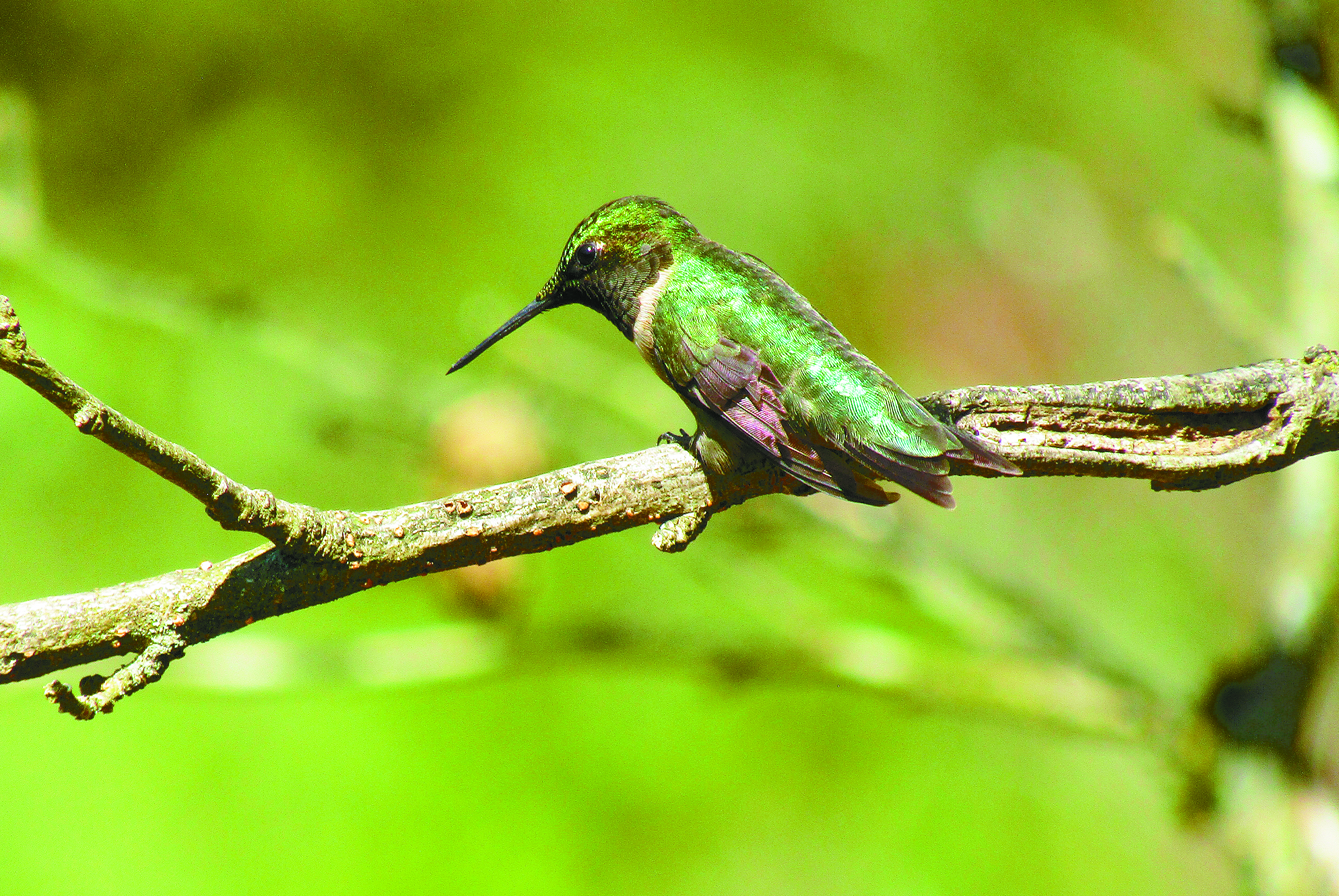
Photo by Bryan Stevens • Ruby-throated hummingbirds have settled into a comfortable summer routine throughout the Northeast Tennessee region.

The 82nd consecutive spring bird count was held Saturday, May 3, with 44 observers in 15 parties. The survey tallied 148 species, which is slightly below the recent 30 year average of 150 species. The count is conducted by the Elizabehton Bird Club, which will also conduct two summer counts this month. One of these counts is held in Carter County and the other in Unicoi County.

The spring count is a regional survey that includes all Northeast Tennessee counties: Carter, Johnson, Sullivan, Unicoi and Washington.

Compiler Rick Knight shared some observations. Noteworthy sightings included common merganser, black-billed cuckoo, willow flycatcher, vesper sparrow and bobolink, as well as prothonotary and cerulean warblers. A total of 31 species of warblers made this year’s count. A record number (24) for Swainson’s warbler provided an indication that this species is locally abundant during the nesting season.

The 17 fish crows reported by six parties provided a good example of the local expansion of this species. The 17 common ravens, once not so common in the region, were reported by eight of the count parties.
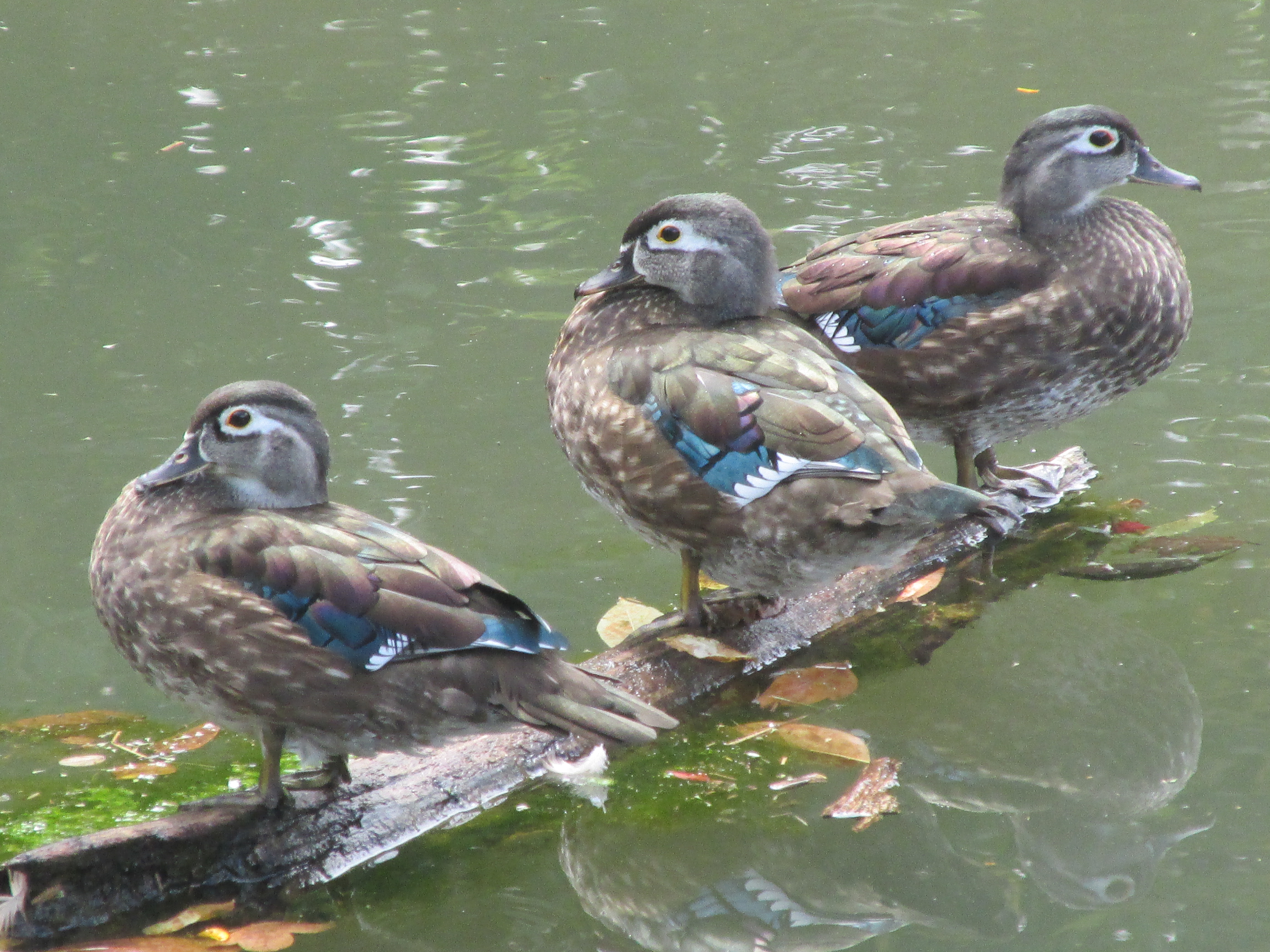
Photo by Bryan Stevens • Young wood ducks share a perch on a submerged log.

The list:

Canada goose, 208; wood duck, 31; blue-winged teal, 2; mallard, 86; and common merganser, 7.

Wild turkey, 16; ruffed grouse, 1; rock pigeon, 92; Eurasian collared-dove, 1; mourning dove, 176; yellow-billed cuckoo, 3; and black-billed cuckoo, 2.
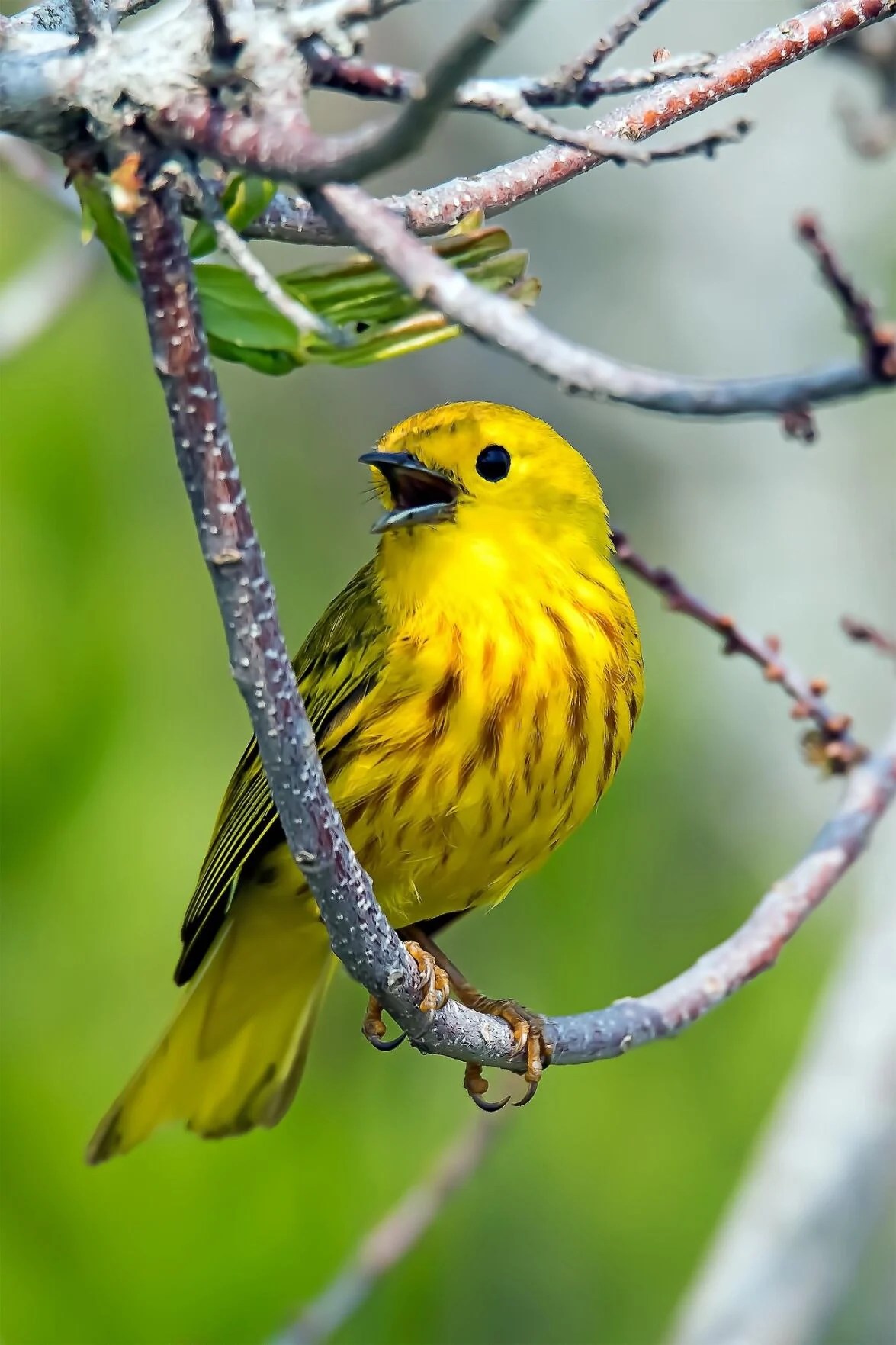
Photo by Hans Toom/Pixabay • A male yellow warbler is aptly named.

Chuck-will’s-widow, 9; Eastern whip-poor-will, 32; Chimney swift, 149; ruby-throated hummingbird, 18.

Killdeer, 32; least sandpiper, 16; pectoral sandpiper; 1; spotted sandpiper, 42; solitary sandpiper, 39; and lesser yellowlegs, 6.


Double-crested cormorant 28; green heron 8; great egret, 1; and great blue heron, 50.

Black vulture, 38; turkey vulture, 96; osprey, 4; Cooper’s hawk, 6; bald eagle, 1; red-shouldered hawk, 4; broad-winged hawk, 7; red-tailed hawk, 14; Eastern screech owl, 15; great horned owl, 2; and barred owl, 4;

Belted kingfisher, 15; red-headed woodpecker, 2; red-bellied woodpecker, 68; yellow-bellied sapsucker, 7; downy woodpecker, 33; hairy woodpecker, 6; Northern flicker, 37; and pileated woodpecker, 36.

Photo by Bryan Stevens • Downy woodpeckers will visit feeders in any season.

American kestrel, 5; great crested flycatcher, 28; Eastern kingbird, 42; Eastern wood-pewee, 16; Acadian flycatcher, 27; willow flycatcher, 1; least flycatcher, 10; and Eastern phoebe, 64.

White-eyed vireo, 19; yellow-throated vireo, 12; blue-headed vireo, 42; warbling vireo, 10; and red-eyed vireo, 364.

Blue jay, 175; American crow, 218; fish crow, 17; and common raven,17.

Tree swallow, 107; Northern rough-winged swallow, 81; purple martin, 29; barn swallow, 144; and cliff swallow, 482.

Carolina chickadee, 144; tufted titmouse, 189; ruby-crowned kinglet, 1; golden-crowned kinglet, 2; red-breasted nuthatch, 9; and white-breasted nuthatch, 26.

Brown creeper, 6; blue-gray gnatcatcher, 62; Carolina wren, 159; house wren, 39; and winter wren, 1.

Gray catbird, 68; brown thrasher, 43; Northern mockingbird, 97; cedar waxwing, 122; Eurasian starling, 539; Eastern bluebird, 97; veery, 15; Swainson’s thrush, 8; wood thrush, 116; and American robin, 654.

House sparrow, 55; house finch, 78; pine siskin, 7; and American goldfinch, 252.

Chipping sparrow, 139; field sparrow, 34; dark-eyed junco, 48; white-crowned sparrow, 3; white-throated sparrow, 4; vesper sparrow, 1; Savannah sparrow, 4; song sparrow, 287; swamp sparrow, 1; and Eastern towhee, 203.
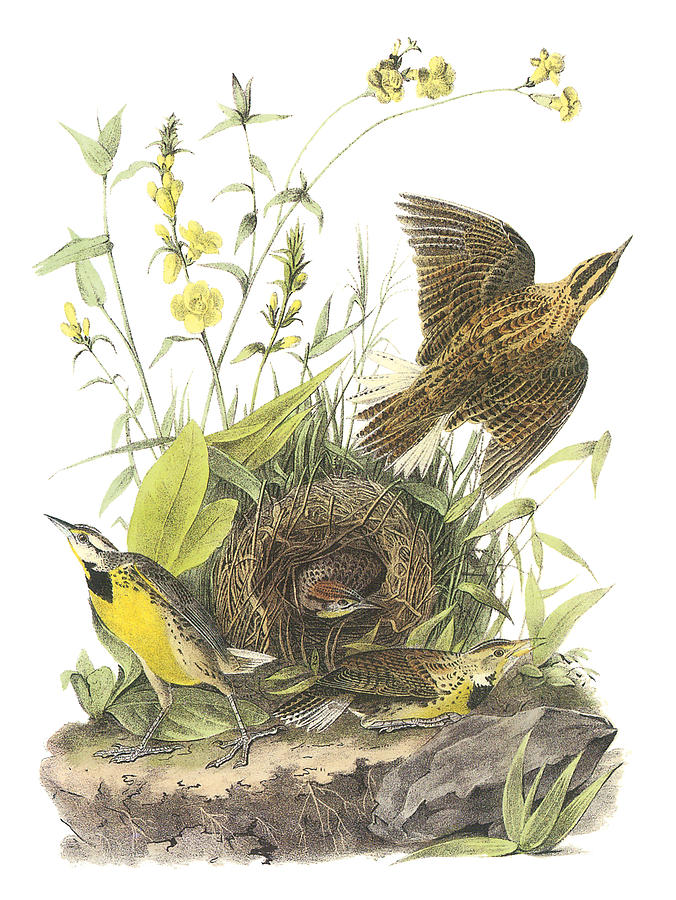
Early American naturalist and painter John James Audubon painting this scene depicting nesting meadowlarks.

Yellow-breasted chat, 9; bobolink, 6; Eastern meadowlark, 108; orchard oriole, 28; Baltimore oriole, 26; red-winged blackbird, 211; brown-headed cowbird, 65; and common grackle, 195.

Ovenbird, 169; worm-eating warbler, 42; Louisiana waterthrush, 45; Northern waterthrush, 4; golden-winged warbler, 2; blue-winged warbler, 1; black-and-white warbler, 104; prothonotary warbler, 1; Swainson’s warbler, 24; Tennessee warbler, 13; Kentucky warbler, 4; common yellowthroat, 25; hooded warbler, 234; American Redstart 27; Cape May warbler, 14; cerulean warbler, 2; Northern parula, 88; magnolia warbler, 4; bay-breasted warbler, 6; Blackburnian warbler, 16; yellow warbler, 10; chestnut-sided warbler, 32; blackpoll warbler, 6; black-throated blue warbler, 97; palm warbler, 5; pine warbler, 7; yellow-rumped warbler, 17; yellow-throated warbler, 52; prairie warbler, 1; black-throated green warbler, 100; and Canada warbler, 50.

Summer tanager, 2; scarlet tanager, 92; Northern cardinal, 284; Rose-breasted grosbeak, 30; blue grosbeak, 11; indigo bunting, 164; and dickcissel, 1.

I counted with Chris Soto and Brookie and Jean Potter around Sycamore Shoals State Historic Park, on the greenbelt along the Watauga River and on Holston Mountain.

•••

To share a sighting, make a comment or ask a question, email me at ahoodedwarbler@aol.com.

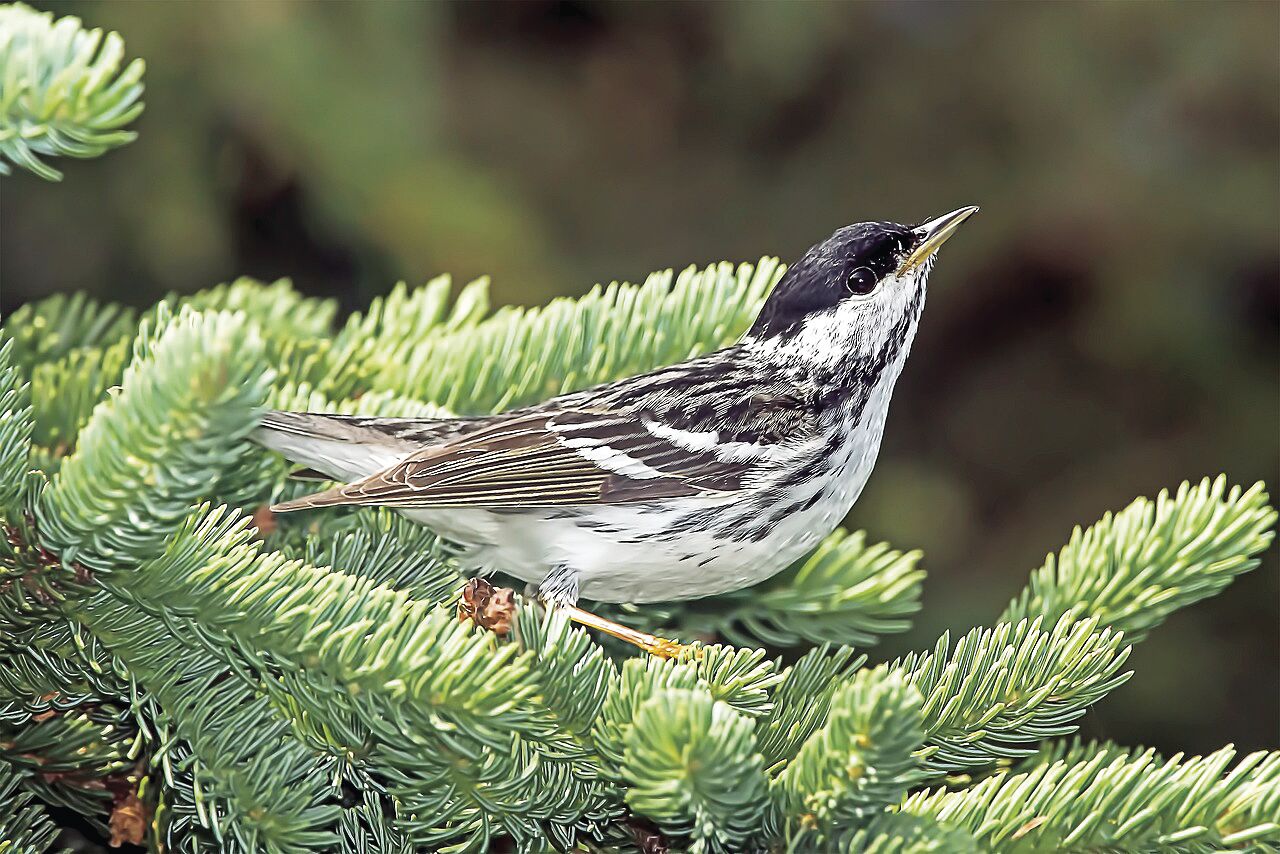
Photo by Hans Toom/Pixabay • A male Blackburnian warbler looks splendid in the dappled sunlight that appears to make his orange throat patch almost glow.

Joyas voladoras: Hummingbirds welcomed back to region

Michele Spark • Female ruby-throated hummingbirds lack the red throat patch, known as a gorget, that is present on adult males.

Readers continue to welcome back hummingbirds and share their first spring sightings of these tiny birds.

•••

“My husband Marvin and I saw our first hummingbird March 31 in Rogersville, Tennessee,” Mary Powers wrote in an email.

“We’ve been seeing them most days since then,” she added.

Mary said she put the feeder up a week before her sighting.

“Of course I change the syrup every week and clean it,” she noted.

•••

Kenneth Oakes commented on my Facebook page about his first sighting.

“I’ve just seen my first this year about 30 minutes ago on April 6 in an area near Sunshine, North Carolina,” Kenneth wrote.

•••

Dianne Rebmann emailed me to share her first spring hummingbird sighting.

“I saw my first hummingbird April 8,” she wrote. “There were actually two of them, and I caught them on Trailcam.”

Dianne lives in the Willowbrook community in Kingsport near the Meadowview Convention Center.

•••

Annie Morton and Pete Fredrick emailed me information about their first spring sighting.

“We wanted to share the news that we saw our first ruby-throated hummingbird (male) at home on April 9,” they wrote. “We live off Dry Creek Road in Unicoi County.”

They added that they hung a feeder last week after reading my article in The Erwin Record about the pending arrival time for hummingbirds.

“What a thrill to see the first one at the feeder while eating our breakfast yesterday morning,” they added to the end of their email.

•••

Diane Graham, a Jonesborough resident, spotted her first little one Wednesday morning (April 9) at her feeder.

“I think he was passing through,” she wrote in her email.

Diane also recorded two other visiting hummingbirds, one each on April 10 and April 11.

“None are yet making multiple visits during the day,” she added.

•••

April Kerns Fain commented on my Facebook page about her first sighting. “I saw the first one on April 9,” commented April, who lives in Unicoi.

•••

Sue Schreiner posted on my Facebook page about her first spring sighting.

“Just spotted my first hummingbird today (April 11) in Bluff City. Yay!” Sue wrote.

•••

Felicia Mitchell in Meadowview, Virginia, shared her first spring hummingbird sighing via a Facebook message. Felicia saw her first hummingbird on Sunday, April 13.

•••

In a Facebook comment on April 13, Flag Pond resident Regina Ray reported that she has seen her first spring hummingbird.

•••

Paula Elam Booher commented on my Facebook page that she saw her first hummingbird of spring in Bristol on April 13.

•••

Gina Kinney emailed to let me know that her mom Ginger Brackins saw her first hummingbird on April 14 at 6:25 p.m. in Erwin.

“She wanted me to email you right away,” Gina wrote.

•••

“I’ve had my hummingbird feeders up for a few weeks, but finally this afternoon (April 14) at 4 p.m. a female hummer had one all to herself,” Michelle Sparks, a resident of Bluff City, wrote to me by email.

•••

“Yesterday (April 14) I saw a hummingbird check out our feeder,” Donald Beck emailed me.

“It did not drink and I have not seen it any time since,” Donald, a resident of Bray Road in Stanley Valley in Rogersville, reported.

“Was it just on its way north?” Donald also asked.

It’s true, I noted in my response to his question, that many of these first hummingbird sightings are not the birds that will spend the summer months with us. Many of these “early” hummingbirds will continue migrating farther north, but others will arrive, like what they see and decide to stick around.

•••

Diane Hensley Silvers posted on April 16 in a Facebook comment that hummingbird numbers have only increased since the first one arrived.

“I have several now,” Diane wrote. “They arrived at my house in Washington County about 10 days ago.”

•••

Photo by Bryan Stevens • Ruby-throated hummingbirds such as this male are returning to the region.

Tennessee’s Watchable Wildlife offers an online profile for the ruby-throated hummingbird, including interesting information about how such a tiny bird makes its phenomenal crossing of the Gulf of Mexico each spring to return to the eastern United States.

To accomplish this tremendous migratory crossing, a hummingbird will double its body mass by fattening on nectar and insects in the weeks prior to departure.

No hummingbird species other than ruby-throated hummingbird breeds in Tennessee, but several Western species have been found in the state during the non-breeding season. They arrive anytime after late August and usually depart in April. At least seven western species of hummingbird has been recorded in the Volunteer State, including rufous, black-chinned, Allen’s, Anna’s, calliope and broad-tailed hummingbirds.

There’s also a couple of reports of a green violet-ear, a species that is usually found in forested regions of Mexico and Nicaragua. The species has ventured into Tennessee twice, being documented in Memphis in September of 2007 and in Montgomery County in July of 2020.

I’ve seen several of these western “visitors” throughout the years, but my greatest affection is still attached to the ruby-throated hummingbird.

Most hummingbirds impress with their size, or rather the lack of it. It’s that tiny size that has prompted people to describe them as “miracles” from the time the first European explorers sailed to the New World in the late 1400s. When Spanish explorers first encountered them, they had no equivalent birds in Europe to use as a reference. They referred to hummingbirds as “joyas voladoras,” or flying jewels.

If your yard offers some trees and shrubs, necessary for perching, you can attract ruby-throated hummingbirds. It pays to have a feeder available with a fresh mixture of one part sugar to four parts water. This is the formula that closely matches the sweetness of nectar available from flowers. In warm conditions, you’ll need to change out the mixture every few days. Give the feeders a scrubbing and rinse while changing out the sugar water. Then sit back and enjoy the antics of these pint-sized delights.

•••

To share a sighting, ask a question or make a comment, email me at ahoodedwarbler@aol.com.

Photo by Bryan Stevens • Despite a perceived disadvantage of size, ruby-throated hummingbirds are quite capable of thriving in a giant world.

Birds make use of various strategies to attract and keep mates

Shauna Fletche/Pixabay • Some birds, like waxwings, like to present tasty treats to their potential mates.


With Valentine’s Day around the corner, it’s an opportune time to see how courtship is handled among our fine feathered friends. Most birds don’t bring a box of chocolates or a bouquet of roses when they take up courtship of a prospective mate, but birds have several equivalent behaviors that they employ to attract the attentions of the opposite sex. In honor of Valentine’s Day I thought a look at some of the more unusual courtship rituals of some of our feathered friends would be appropriate.

Aerial acrobatics designed to impress

In late winter and early spring, a true oddball begins courting. The American woodcock, also known by such whimsical names as “bog sucker” and “timberdoodle,” is a shorebird that has completely abandoned the shore in favor of woodlands and fields. Beginning as early as February, American woodcocks in the region conduct nightly courtship displays, starting at dusk, that combine aerial acrobatics with an assortment of unusual acoustical flourishes. Any wet field adjacent to a wooded area could offer a stage for these evening displays, but unless you know where to look and make an effort to do so, the American woodcock might as well remain a phantom of the night.

These mating rituals provide almost the only time of the year during which this bird makes itself available for observation. It’s only during this brief window that opens into their lives that we can be assured a glimpse. Even then, our peeks at woodcocks often consist of a fuzzy twilight escapade as the bird flings itself heavenward only to make a spiraling descent a few seconds later. The displays begin with a distinct vocalization, a type of “pent,” that also has the quality of sounding like some sort of mechanical buzzer.

Once the displays conclude for the season, the birds assume nesting duties, usually unobserved by humans. The rest of the year, almost nothing but blind, sheer luck would allow a birder to stumble across an American woodcock. It’s almost as if they disappear after these spring flights of fancy.

Birds bearing gifts

Many birds present small trinkets to a prospective mate. For instance, many male penguins make a present of a stone or pebble to female penguins. There could be more than a simple bribe behind this gift. Female penguins don’t build elaborate nests. In fact, a scrape on the bare ground, perhaps encircled by a collection of pebbles, marks the extent of their nest construction. So, the perfect pebble could be the way to winning a female penguin’s heart.

The way to the heart is through the stomach

Observant birders may have witnessed a male Northern cardinal slip a female a morsel of food, such as a peanut or a shelled sunflower kernel. It’s a marked change for this bird. During the winter months, a male cardinal is more likely to chase a female away from a feeder rather than share food with her. However, as spring approaches, his behavior undergoes a change and he becomes content to feed next to a female cardinal, often slipping her some choice tidbits.

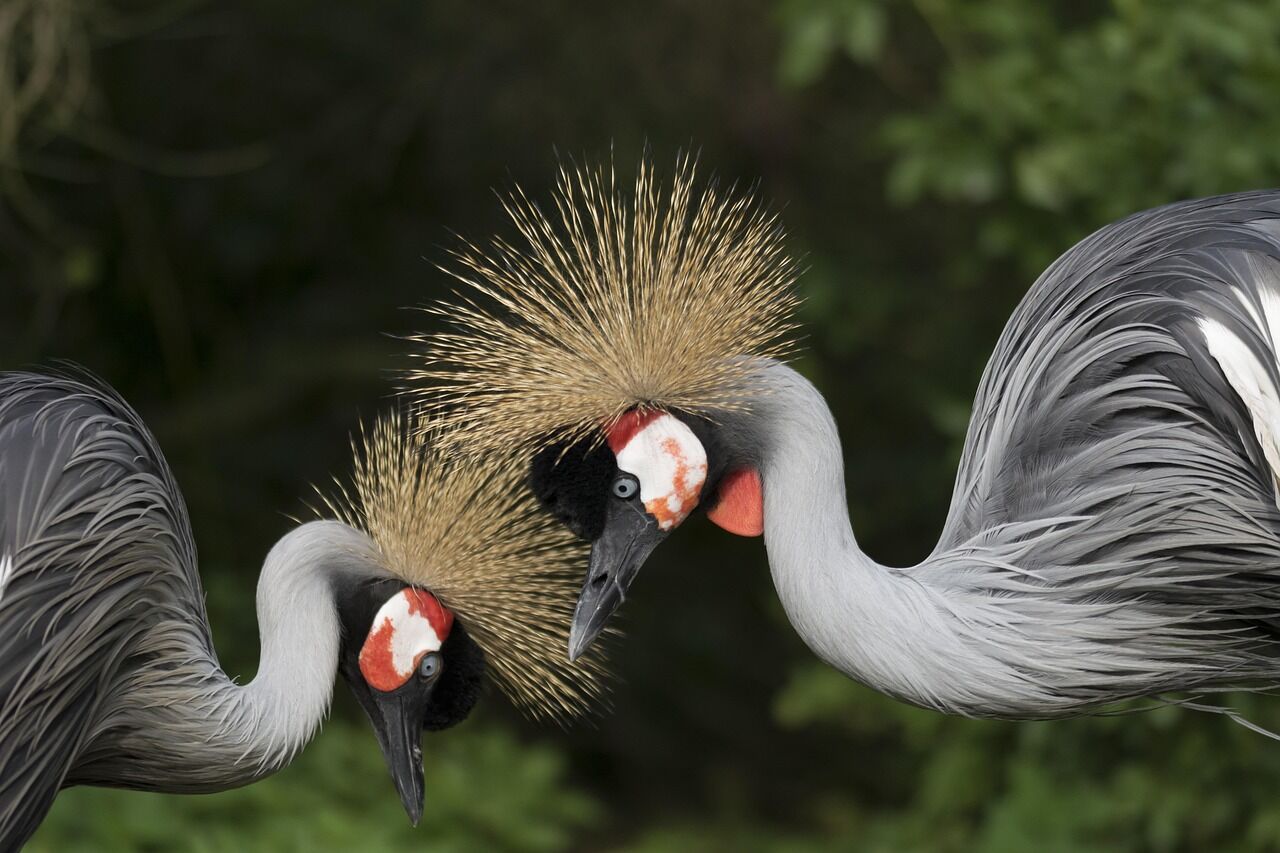
Sabine van Erp/Pixabay • Bow to your partner: Grey-crowned cranes perform an elaborate dance designed to strengthen their bond.

May I have this dance?

Many species of birds perform elaborate and ritualistic dance displays. Among birds known for tripping the light fantastic are flamingoes, cranes, grouse and grebes. Cranes are one of the oldest families of birds on earth. They’re also some of the most accomplished dancers in the animal kingdom. Pairs perform very ritualistic dances that, if the performers were human, would no doubt require the services of an accomplished choreographer. Cranes mate for life and the ritual of dancing is a way to strengthen the bonds between a mated pair. The ability to dance is, apparently, not instinctive. Young cranes must practice their dance moves, a process that can take years before they master the elaborate dance.

Dave Menke/U.S. Fish & Wildlife Service • A pair of Clark’s Grebes displays in a courtship ritual known as “rushing” or “weed dance.” Birds use a variety of strategies to attract and keep mates.

Synchronized swimming

While many birds dance to impress a mate or strengthen pair bonds, grebes perform a dance that takes place completely on the surface of the water. A pair will engage in this intricate performance, perfectly mirroring the moves of the other as they literally race across the surface of the water. These dances by grebes are also known as “rushing” or “weed dance.” It’s called as a weed dance because at the culmination of the ritual, the birds usually hold some type of aquatic plants in their bills while racing swiftly over the surface of the water. Pairs that perform well together stay together, building a nest and raising young.

Good housekeeping seal of approval

The tropical family of bowerbirds are famous for complex nests built by males and then decorated with bright and colorful objects to catch the eye of a potential mate. The nests of these birds are actually referred to as a “bower.” Usually constructed on the ground, the male will line the approachs to the bower with items such as shells, leaves, flowers, feathers, stones, berries, and even discarded garbage, including plastic scraps or bits of glass. Unusually odd items pressed into these decorative displays have included coins and spent rifle shells. This habit of male bowerbirds must rank as the ultimate in trying to impress a mate with shiny bling.

These are just a few of the inventive ways that birds go about attracting and keeping mates. Perhaps you can pick up some pointers from our feathered friends to ensure you have a great Valentine’s Day this year.

•••

If you have a question, wish to make a comment or share a sighting, email me at ahoodedwarbler@aol.com.

Winter’s ducks begin arriving in region

Photo by USFWS • A pair of green-winged teal swim together through a wetland.

Some interesting waterfowl have spent at least part of the winter at the pond at Erwin Fishery Park and a nearby fenced lagoon at the back of the park.

Some of the visitors since the start of the new year have included green-winged teal, American black duck, lesser scaup and Northern pintail. The scaup is a species of diving duck while the others are what are referred to as “dabbling” ducks. Diver and dabbler refers basically to the manner in which these ducks forage for their food.

The familiar mallard is probably the best known dabbling duck, but other dabblers include American wigeon, gadwall and Northern shoveler. Dabbling ducks generally feed in shallow water.

The green-winged teal is the smallest of North America’s dabbling ducks. There are two other close relatives of the green-winged teal in North America – the blue-winged teal and cinnamon teal. I’ve seen the green-winged and blue-winged at many locations in the region. I saw my only cinnamon teal during a trip to Utah and Idaho in 2003.

The Northern pintail that spent some time at Erwin Fishery Park was a hen with a more subtle appearance than adult male pintails.

This can be a species difficult to find in Northeast Tennessee. The website All About Birds notes that Northern Pintails are common, but their populations declined by about 2.6% per year resulting in a cumulative decline of about 75% between 1966 and 2019, according to the North American Breeding Bird Survey. The Partners in Flight organization estimates the global breeding population at 5.1 million.

Photo by Bryan Stevens • The Northern pintail is a dabbling duck, so classified due to its way of foraging for food in shallow water.


Elegant is a useful word for describing pintails. Both sexes have blue-grey bills and grey legs and feet. The drake is more striking, having a thin white stripe running from the back of its chocolate-brown head down its neck to its mostly white undercarriage. The drake also has attractive gray, brown and black patterning on its back and sides. The hen’s plumage is more subtle and subdued, with drab brown feathers similar to those of other female dabbling ducks. She has the same slender shaper as the male. Her tail feathers are long but don’t match the male’s namesake tapered tail feathers.

The Northern pintail is a cosmopolitan duck that also ranges into Europe, the Middle East, India and Asia. Other pintails include white-cheeked pintail, yellow-billed pintail and Eaton’s pintail. The latter species is restricted to the island groups of Kerguelen and Crozet in the southern Indian Ocean. The species was named after the English explorer, naturalist and entomologist Alfred Edwin Eaton. He served as the vicar of Shepton Montague in Somerset in England. Born in 1944, he died in 1929 at age 84.

Our region offers some dependable locations for looking for winter ducks, as well as other wintering waterfowl such as geese, grebes and loons. Accessible locations for looking for ducks during the winter season include Wilbur Lake near Elizabethton and Osceola Island Recreation Area below the tailwaters of Holston Dam in Bristol. Of course, any farm pond not frozen over is a potential location attractive to wandering waterfowl.


A duck known as the common merganser has expanded its summer nesting range to include the Nolichucky River and Watauga River. Twenty years ago this species, despite its name, was far from common in the region. It’s too early to tell whether changes wrought by last fall’s flooding from Hurricane Helene will affect this duck’s nesting attempts along these two rivers.

One difficulty in finding ducks in recent weeks has been the deep freeze gripping the region and turning almost all open water into ice. The widespread cold could help convince waterfowl from farther north to head south in the hope of less frigid conditions. My hope is that at least a few of those ducks will stop off at places like the pond at Erwin Fishery Park.

Ducks that aren’t too difficult to locate during winter in the region include bufflehead, ring-necked duck and hooded merganser. Other possible visitors include redhead and canvasback. If the Northern pintail is the most elegant of the dabbling ducks, the canvasback ranks as the most majestic of the diving ducks.

Ducks are interesting to observe. Binoculars and spotting scopes can make the process easier. Most ducks are social birds. Flocks, or rafts, of ducks display interesting interactions. In addition to the familiar “quack” of the mallard, different ducks produce a variety of hoots, whistles, hisses and other vocalizations.

•••

I’ve written about birds and birding since 1995. To ask a question, make a comment or share a sighting, email me at ahoodedwarbler@aol.com.

Photo by Bryan Stevens • The male mallard is probably the most recognized duck in the United States.

Seeing Yellow: Visit from an odd cardinal surprises local couple

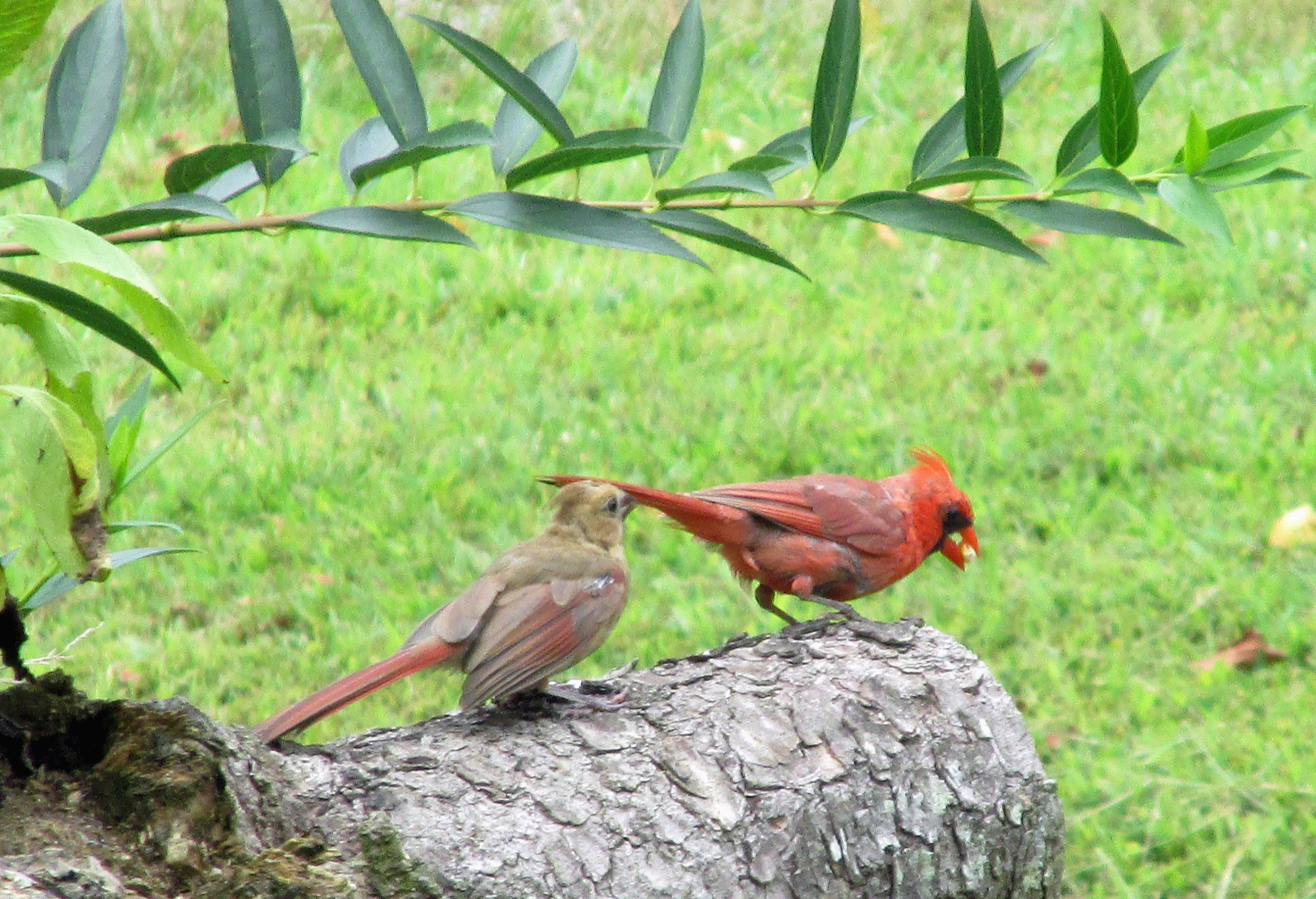
Photo by Bryan Stevens • A male Northern cardinal leads a young cardinal to food sources.

Unicoi resident Bobby Davis called me last week to share news about a sighting of a yellow cardinal. Bobby said that he and his wife, Tressa, have two bird baths and a hummingbird feeder in their yard and are in the habit of watching the comings and goings of their feathered friends. At 1 p.m. on Tuesday, Aug. 8, they noticed a yellow cardinal in the yard near some rhododendrons.

A “yellow” cardinal is simply a Northern cardinal that has inherited a rare genetic condition that causes the bird’s feathers to turn yellow instead of red.

A news item posted to a website for The Wood Thrush Shop in Nashville relates the story of a backyard feeding station in Harriman, Tennessee, in Roane County that was visited by a yellow Northern cardinal on a regular basis.

Yellow Northern cardinals have been seen in at least four different states the last 10 years but remain a rarity.

The article explained that the yellow coloration in affected cardinals is caused by a rare genetic mutation. The colors red, orange and yellow in a bird’s feathers are created with carotenoid pigments derived from the foods they eat. In the male Northern cardinal, yellow pigments from the diet apparently are converted to red by a specific enzyme. In a very rare genetic mutation, probably affecting fewer than one in a million cardinals, that enzyme is lacking, so the conversion to red doesn’t occur and the feathers are bright yellow instead.

Back in May of this year, a yellow cardinal given the name Maize was spotted in Alabama. That sighting took place less than 15 miles from a location that hosted another yellow cardinal in 2018. Was Maize a descendant of that yellow cardinal spotted six years ago?

Perhaps the yellow cardinal will stick around at Bobby and Tressa’s home. Bobby informed me that they have an ordinary pair of red cardinals that resides in their yard, but he noted that the three birds have not interacted.

•••

Interestingly enough, there is a bird with the actual name yellow cardinal, but it is not closely related to the Northern cardinal. This South American bird has the scientific name of Gubernatrix cristata and is a member of the tanager family.

The yellow cardinal was formally described in 1817 by the French ornithologist Louis Pierre Vieillot under the binomial name Coccothraustes cristata. The word “cristata” means crested or plumed.

This yellow cardinal ranges in Argentina, Brazil, Paraguay and Uruguay. Its natural habitats are dry savanna, temperate shrubland, subtropical or tropical moist shrubland and temperate grasslands. The yellow cardinal is threatened by habitat loss and from pet trade trappers for sale as exotic pets. Males are trapped at a higher rate than females, and the yellow cardinal is considered endangered due to the constant entrapment. If recent counts are accurate, only about 1,000 t0 2,000 of these birds still exist.

Photo by U.S. Fish & Wildlife Service
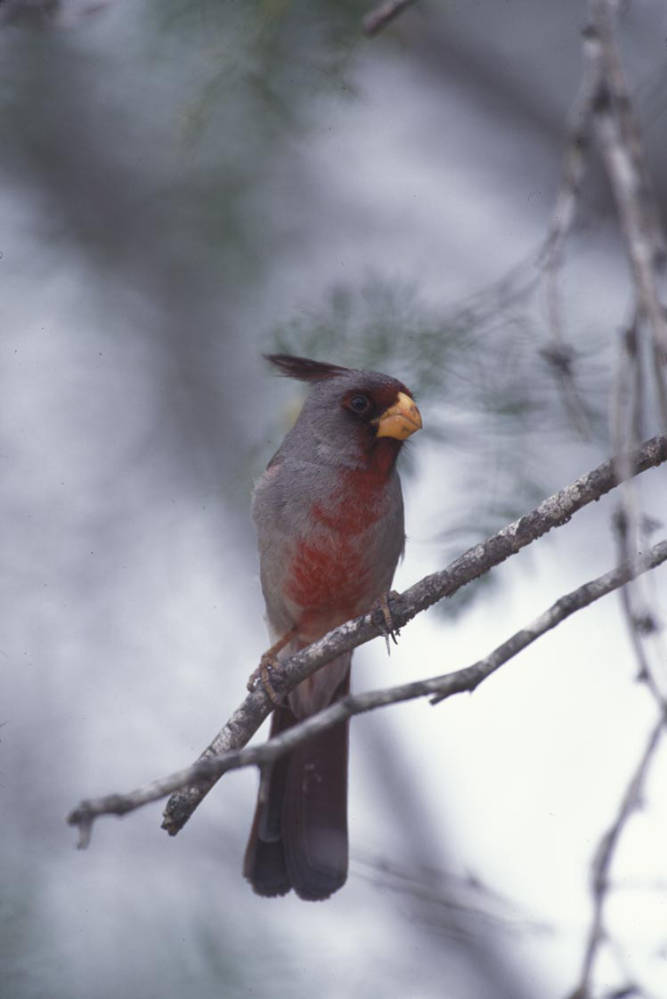
Pyrrhuloxia, also known as desert cardinal, is related to the Northern cardinal. 

The Northern Cardinal, on the other hand, is an abundant, beloved songbird. There’s additional evidence to put forward as testimony to the popularity of the Northern cardinal. It’s the official state bird of seven states: Virginia, North Carolina, West Virginia, Ohio, Illinois, Indiana and Kentucky. Only the Northern mockingbird, which represents five states as official state bird, even comes close to the Northern cardinal in this respect.

Cardinals are a widespread species, ranging westward to the Dakotas and south to the Gulf Coast and Texas. The southeastern United States was once the stronghold of the cardinal population. In the past century, however, cardinals have expanded their range into New England and Canada. These birds have even been introduced to Hawaii.

The Northern cardinal has only two close relative in the genus Cardinalis. The pyrrhuloxia, also known as the desert cardinal, ranges throughout Arizona, New Mexico and Texas, as well as in Mexico. The third relative is known as vermilion cardinal and is found in Colombia and Venezuela. This bird suffers some losses to the exotic pet trade, but its numbers have managed to remain fairly stable.

•••

I’ve been an active birder since the early 1990s. To share a sighting, ask a question or make a comment, email me at ahoodedwarbler@aol.com.

Tiny kinglets, gnatcatchers lead the charge among spring’s returning birds

Photo by Pixabay • The blue-gray gnatcatcher’s diminutive size belies its defiant attitude. These birds are intensely territorial and brooks no intruders.

The ruby-crowned kinglets, which passed through last fall in October and November, have returned, retracing their migratory path for the spring season and making their presence felt at my home with their jittery call notes and songs.

Most of the more recent returning birds have been on the smaller side. In addition to ruby-crowned kinglets, which arrived on April 1, I saw and heard a tiny blue-grey gnatcatcher on March 31.

As their name suggests, kinglets are tiny birds. In fact, about the only North American birds smaller than kinglets are some of the hummingbirds. The kinglets, known outside North America as “flamecrests” or “firecrests,” belong to the family, Regulidae, and the genus, Regulus. The family and genus names are derived from a Latin word, regulus, which means “rex,” or “king.” The name was apparently inspired by the colorful crown patches, often red, orange or gold, that resemble the royal “crowns” of kings. In addition to the two North American species, four other species of kinglets can be found in North Africa, Europe and Asia.

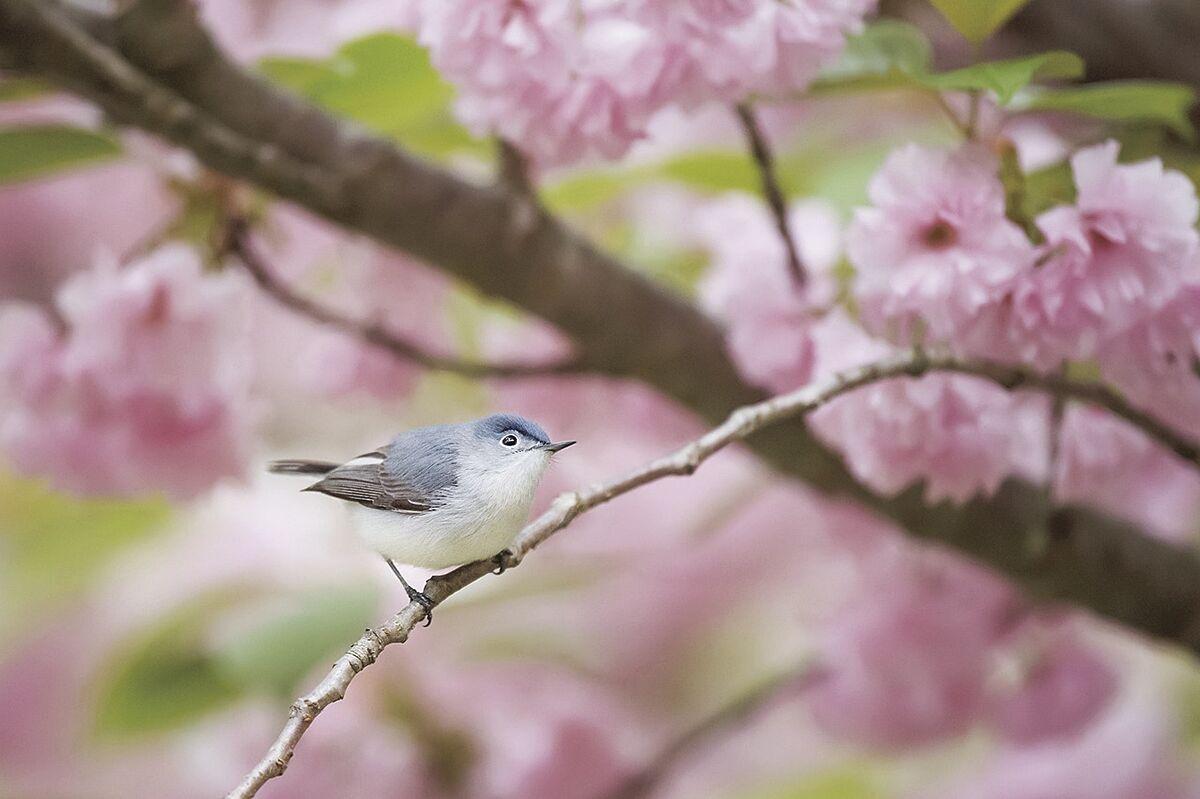
The gnatcatcher is also one of our smaller birds. I’ve always though that blue-gray gnatcatchers resemble a shrunken mockingbird. Like quarrelsome mockingbirds, gnatcatchers are noisy, scolding songbirds.

They are also determined to protect their nesting territories at all costs and will attack much larger birds. In North America, the gnatcatcher ranks in size with birds like kinglets and hummingbirds. Despite its diminutive status, the gnatcatcher acknowledges no superiors. According to the All About Birds website, blue-gray gnatcatchers are “fiercely territorial” and use vocal displays and postures to in intimidate other birds. They may chase a rival as far as 70 feet. If all this fails to deter an intruder, a gnatcatcher will escalate to midair confrontations.

Gnatcatchers don’t hesitate to call for reinforcements when warranted. With persistent squeaking they will drum up a brigade of feisty, feathered fighters to repel intrusions by potential predators too large for a gnatcatcher and its mate to handle on their own.

Ruby-crowned Kinglet

There are two species of kinglets in North America.

Although similar in size and overall coloration, the ruby-crowned and golden-crowned kinglets are easily distinguished from each other. Side by side, the two North American kinglets are easy to identify. The golden-crowned kinglet has a striped facial pattern formed by bold black and white stripes. The ruby-crowned kinglet, on the other hand, has a bold white eye ring but no striping. The golden-crowned kinglet has an orange crown patch, while the ruby-crowned kinglet has a red crown patch that is, more often than not, kept concealed. Both sexes of the golden-crowned kinglet possess a yellow crown patch, but only the male ruby-crowned kinglet boasts a scarlet patch of feathers atop the head. Observers can expend a lot of energy trying to get a look at the crown patches, which are typically only displayed when the bird is agitated.

There are 17 species of gnatcatchers. Most of these species reside in Central and South America. Some of the other species found in North America include California gnatcatcher and black-capped gnatcatcher.

Kinglets are very active birds. If warblers can be described as energetic, the kinglets are downright frenetic in their activities. The kinglets almost never pause for long, flitting from branch to branch in trees and shrubs as they constantly flick their wings over their backs. These bursts of hyperactivity can make them difficult to observe. Although small in size, these birds more than compensate for it with a feisty spirit that does them well through the harsh winter months.

Gnatcatchers are also constantly on the move, flicking their tails and darting through the branches of trees just starting to put out new green leaves. They glean caterpillars and small insects from the undersides of leaves to help fuel their demanding metabolism.

Kinglets and gnatcatchers often join mixed flocks comprised of other species of birds, some of which are regular feeder visitors. Perhaps by observing their flock counterparts, some kinglets have learned to accept feeder fare such as suet, meal worms and chopped nuts. Away from feeders, kinglets mostly feed on a range of small insects and arachnids. Gnatcatchers are strictly eaters of insects, but while a feeder holds no attraction for them, their curious nature often makes these tiny bird quite approachable.

Normally, kinglets have a rather fleeting lifespan. These tiny birds can be considered old if they live three or four years. There are always exceptions. The oldest golden-crowned kinglet on record was six years and four months old. That individual, a male, was documented by a bird bander in 1976, according to the website All About Birds.

Likewise, gnatcatchers live brief lives. The oldest known blue-gray gnatcatcher was a male, and at least four years, two months old, when it was recaught at a banding station in Pennsylvania and rereleased, according to the All About Birds website.

•••

I’m still waiting for the smallest of the small to make its spring appearance. Ruby-throated hummingbirds are back, although I haven’t seen one yet. To share your first hummingbird sighting of spring, email me at ahoodedwarbler@aol.com.


Fall Bird Count detects 121 species

Photo by Hans Room/Pixabay • A blackpoll warbler found during the Fall Bird Count represented a rare appearance by this species on the seasonal count, which has been held for 53 consecutive years. A purple gallinule found in Washington County represented another extremely rare find.

The 53rd consecutive Elizabethton Fall Bird Count was held Saturday, Sept. 30, with 30 observers in about 12 parties. The count area included Carter County, as well as the surrounding counties of Johnson, Sullivan, Unicoi and Washington.

The weather was good, with a temperature range between 54 and 82 F. Participants tallied 121 species, plus one unidentified Empidonax species. The Empidonax flycatchers, or “Empids,” as birders fondly lump them, are birds so similar in appearance they cannot reliably identified in the field unless they are vocalizing. Unfortunately, the Empids are largely silent in autumn.

This total is slightly below the recent 30-year average of 125 species, according to longtime compiler Rick Knight. He noted that the all-time high was 137 species in 1993.

Knight said that a count highlight was a lingering immature purple gallinule in Washington County.

The list:

Canada goose, 850; wood duck, 40; mallard, 179; common merganser, 6; northern bobwhite, 3; ruffed grouse, 1; and wild turkey, 37.

Pied-billed grebe, 4; rock pigeon, 362; Eurasian collared dove, 1; and mourning dove,172.

Yellow-billed cuckoo, 5; black-billed cuckoo, 1; common nighthawk, 2; chimney swift, 246; and ruby-throated hummingbird, 17.

Virginia rail, 1; purple gallinule, 1; killdeer, 45; Wilson’s snipe, 1; and spotted sandpiper, 2.

Double-crested cormorant, 84; great blue heron, 34; great egret, 3; green heron, 3; black vulture, 29; and turkey vulture, 141.

Osprey, 7; northern harrier, 1; sharp-shinned hawk, 5; Cooper’s hawk, 4; bald eagle, 7; red-shouldered hawk, 6; broad-winged hawk, 1; and red-tailed hawk,19.

Barn owl, 2; Eastern screech-owl, 17; great horned owl, 4; barred owl, 4; and Northern saw-whet owl, 1.

Belted kingfisher, 26; red-headed woodpecker, 3; red-bellied woodpecker, 69; yellow-bellied sapsucker, 7; downy woodpecker, 39; hairy woodpecker, 12; northern flicker, 54; and pileated woodpecker, 30.

American kestrel, 16; merlin, 1; great crested flycatcher, 1; Eastern wood pewee, 18; Empidonax species, 1; and Eastern phoebe, 97.

Yellow-throated vireo, 2; blue-headed vireo, 31; red-eyed vireo, 5; blue jay, 438; American crow, 505; fish crow, 7; and common raven, 20.

Tree swallow, 220; barn swallow, 1; Carolina chickadee, 195; tufted titmouse, 168; red-breasted nuthatch, 17; white-breasted Nuthatch, 64; and brown creeper, 3.

House wren, 3; Carolina wren, 177; blue-gray gnatcatcher, 1; golden-crowned kinglet, 5; and ruby-crowned kinglet, 4.

Eastern bluebird, 152; veery, 1; gray-cheeked thrush, 6; Swainson’s thrush, 43; wood thrush, 5; and American robin, 113.

Gray catbird, 38; brown thrasher, 9; Northern mockingbird, 80; European starling, 615; cedar waxwing, 106; and house sparrow, 37.

House finch, 42; pine siskin, 2; American goldfinch, 123; chipping sparrow, 95; field sparrow, 11; dark-eyed junco, 83; Savannah sparrow, 3; song sparrow, 84; and Eastern towhee, 62.

Eastern meadowlark, 17; red-winged blackbird, 10; brown-headed cowbird, 2; and common grackle, 10.

https://www.nps.gov/articles/blackpollmigration.htm

Ovenbird, 6; Northern waterthrush, 3; black-and-white warbler, 2; Tennessee warbler, 73; common yellowthroat, 12; hooded warbler, 13; American redstart, 10; Cape May warbler, 23; northern parula, 11; magnolia warbler, 20; bay-breasted warbler, 28; Blackburnian warbler, 5; chestnut-sided warbler, 6; blackpoll warbler, 1; black-throated blue warbler, 21; palm warbler, 21; pine warbler, 14; yellow-rumped warbler, 6; and black-throated green warbler, 15.

Scarlet tanager, 9; Northern cardinal, 169; rose-breasted grosbeak, 26; blue grosbeak, 3; and indigo bunting, 12.

Observers in this year’s Fall Bird Count included Fred Alsop, Jerry Bevins, Rob Biller, Tammy Bright, Debi and J.G. Campbell, Ron Carrico, Bill and Linda Cauley, Catherine Cummins, Dave Gardner, David and Connie Irick, Rick and Jacki Knight, Roy Knispel, Vern Maddux, Joe McGuiness, Tom McNeil, Alson Ovando, Susan Peters, Brookie and Jean Potter, Lia Prichard, Pete Range, Judith Reid, Judi Sawyer, Bryan Stevens, Kim Stroud and Charlie Warden.

•••

To ask a question, share a sighting or make a comment, email me at ahoodedwarbler@aol.com.

Hummingbird season is approaching its peak

Photo by Bryan Stevens • Keep hummingbirds happy with a sugar water solution of four parts water to one part sugar.

Thomas Hood, who lives near Burnsville, North Carolina, shared a note about his summer hummingbirds.

“We have a bunch of ruby-throated (hummingbirds),” Thomas wrote in an email.

He noted that last year, he hosted as many as 40 individual hummingbirds. This year he estimates he has hosted as many as 20.

“Late visitors this year, but they put on a great airshow,” he added.

He said that he has two feeders up and two handheld ones that he uses to attract hummingbirds to his home in the North Carolina mountains.

Thomas also shared a video of his tiny flying visitors.

In a follow-up email, he noted that the hummingbird population continues to grow.

“We love the entertainment they provide,” he wrote. “After the big storm yesterday, we estimated there are now near 30.”

•••

Thomas’s email was another reminder that it has been a busy season for female hummingbirds. Those that have been successful with their nesting were able to fledge twin hummingbirds and encourage them to spread their wings and leave the nest.

For hummingbirds, it’s invariably two eggs per nest for some good reasons. First, the nest is so small — about the size of a walnut half-shell — that there is barely room for two eggs, let alone more. Second, once the young hatch, the nest has just enough room to accommodate them as they grow, fed well by their mother. Third, feeding two hungry young hummingbirds is a demanding task. A female hummingbird has to find enough food to fuel her own body and help her young in the nest grow and thrive. It’s a full-time job during the daylight hours. She’s pressed hard to succeed at raising two young. Attempting to care for more would most likely prove impossible.

Now that many female hummingbirds have finished the task of bringing forth a new generation of hummingbirds, the leisurely fall migration can begin.

Hummingbirds are not as frantic about moving south in the fall as they are single-minded about heading north every spring. Numbers of these birds always reach a peak in late summer and early fall at my home, and this year’s shaping up to be a repeat of past ones.

Hummingbird species number around 340, making the family second in species only to the tyrant flycatchers in sheer size. Both of these families consist of birds exclusive to the New World.

With so many hummingbird species, people have been hard pressed to give descriptive names to all these tiny gems. Some of the dazzling array of names include little hermit, hook-billed hermit, fiery topaz, sooty barbthroat, white-throated daggerbill, hyacinth visorbearer, sparkling violetear, horned sungem, black-eared fairy, white-tailed goldenthroat, green mango, green-throated carib, amethyst-throated sunangel, green-backed firecrown, wire-crested thorntail, festive coquette, bronze-tailed comet, black-breasted hillstar, black-tailed trainbearer, blue-mantled thornbill, bearded mountaineer, colorful puffleg, marvelous spatuletail, bronzy inca, rainbow starfrontlet, velvet-purple coronet, pink-throated brilliant, coppery emerald, snowcap, golden-tailed sapphire and violet-bellied hummingbird.

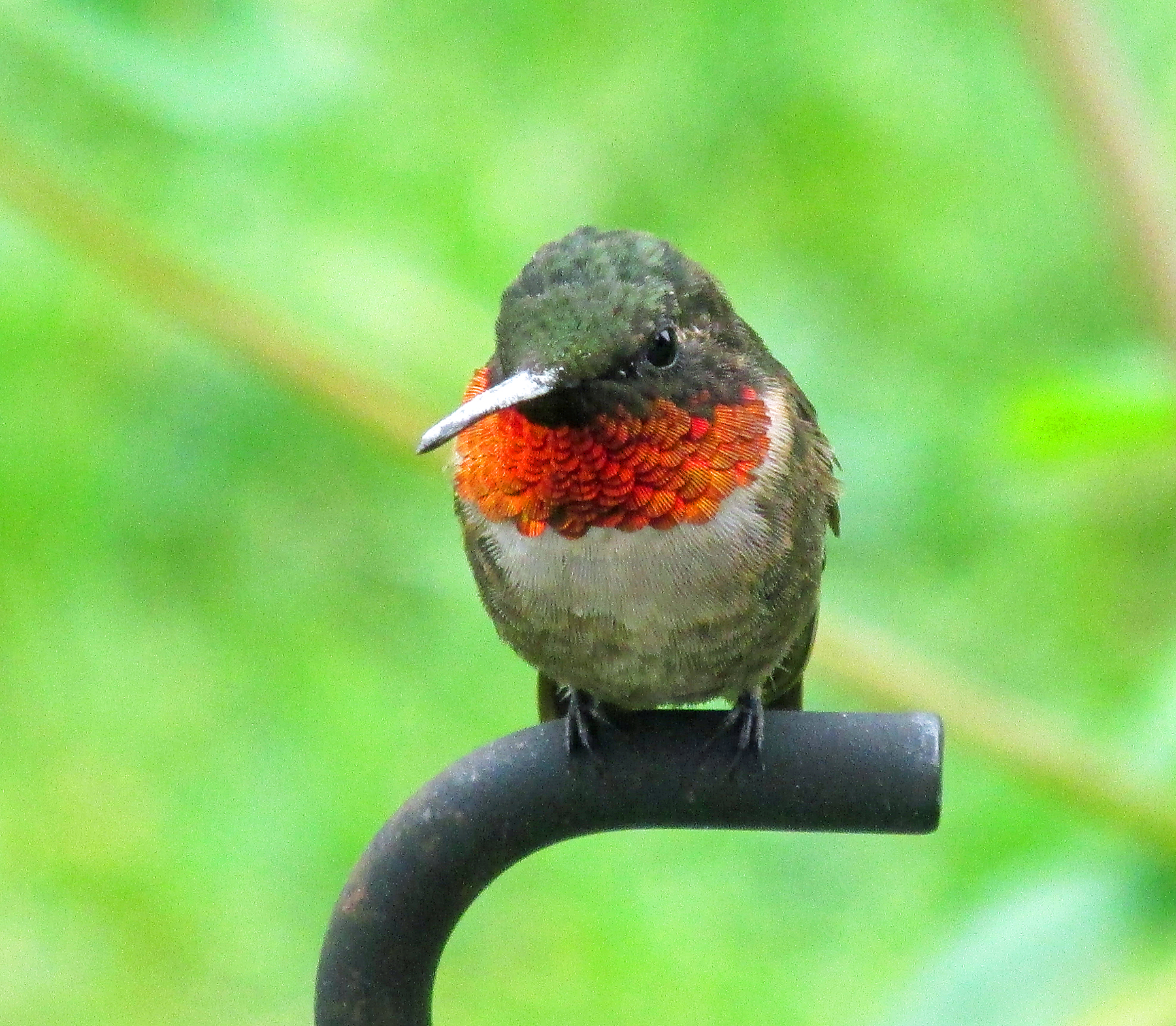
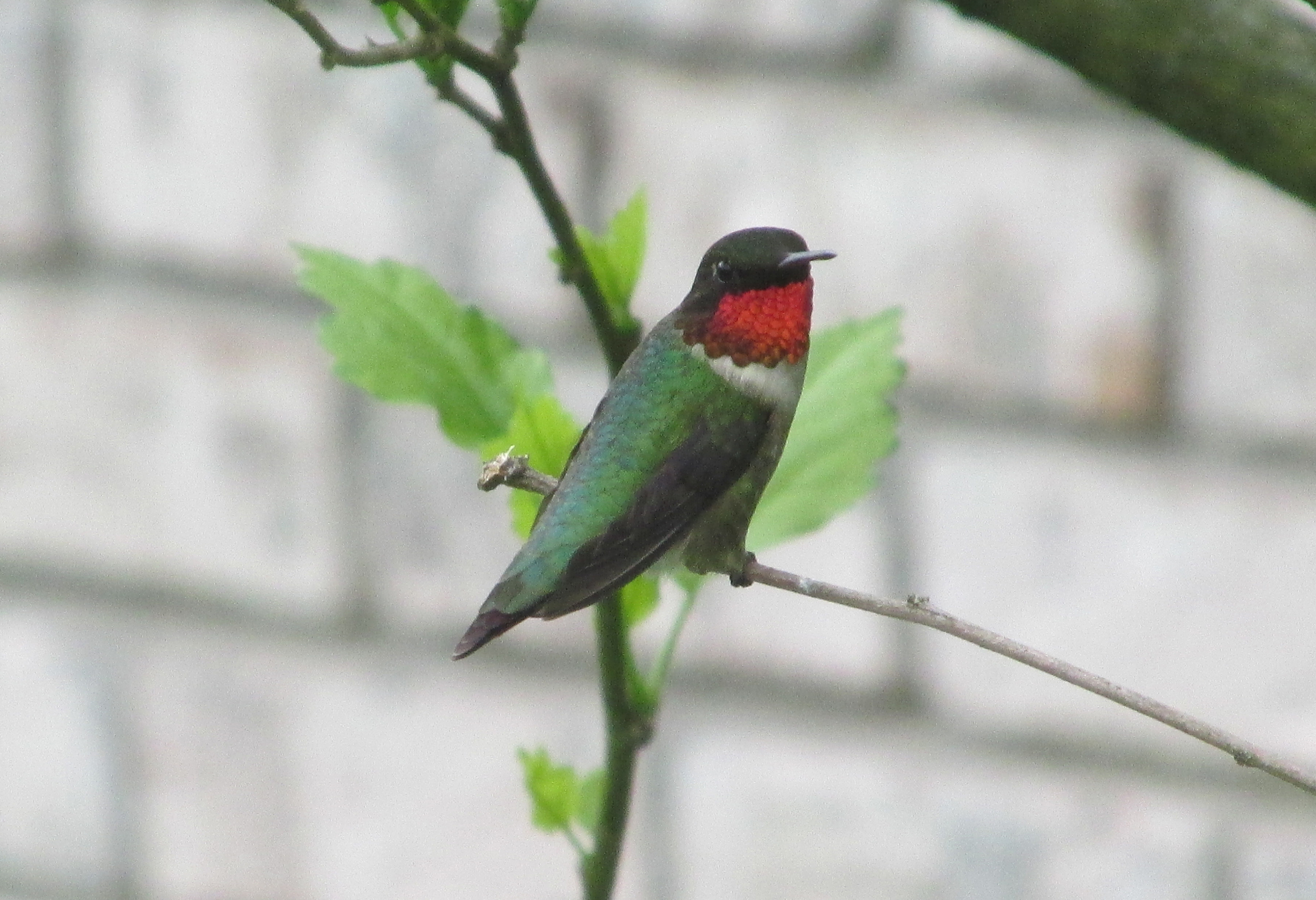
Photo by Bryan Stevens • Male ruby-throated hummingbird show the namesake red throat. The feathers on a male’s throat are iridescent, which means they can change when seen from different angles. In poor light, the ruby-red throat can look almost black.

Our own hummingbird, which we can claim from April through October every year, is the ruby-throated hummingbird. Ruby-throats are remarkable birds that nest throughout the eastern United States, as well as southern Canada. In winter, most ruby-throats withdraw to Central America and Mexico, although a few winter in Florida. They are famous for the amazing feat of crossing the Gulf of Mexico twice each year as they travel to their nesting grounds and then back to their overwintering homes.

The next generation of hummingbirds always helps swell the number of these tiny birds in our yards in late summer and early fall. It’s our duty as hosts to keep them safe as they stop in our yards and gardens during their fall migration. Many of the hummingbirds in the fall will be making their first migration, so they will need all the help we can provide to make a successful journey.

Perhaps consider enhancing your plantings of summer flowers while also continuing to offer multiple sugar water feeders. Keep the sugar water mix at a four parts water to one part sugar ratio. Don’t offer honey in your feeders. When mixed with water, it can spoil and spread fungal diseases.

Remember that hummingbirds don’t subsist on sugar water alone. They also eat numerous tiny insects and spiders to obtain the protein they need for their dietary needs, so don’t use insecticides near feeders or flowers that hummers are likely to visit.

So, until October frosts eventually drive them out of the region, enjoy the ruby-throated hummingbirds while you can.

•••

Bryan Stevens has written about birds since 1995. Share a sighting, make a comment or ask a question by emailing him at ahoodedwarbler@aol.com.

Photo by Bryan Stevens • A ruby-throated hummingbird lifts its wings to shake water droplets off its back.

Ovenbird is season’s first returning warbler

By Hans Toom from Pixabay • A patch of orange feathers on the crown of an overbid’s head often goes unseen. This shy and retiring bird is more often heard than seen.

It’s gotten to be a bit of a guessing game every spring about which of the warblers will be the first to return to my home.

In 2021, the first warbler to return in the spring was a male Northern parula that arrived on April 9. In 2022, this same species was the first to return, albeit a few days later than the previous year’s date.

The Northern parula didn’t used to be one of the first returning warblers at my home. That honor used to go to hooded warbler or black-throated green warbler. This year, an ovenbird beat all of its kin to arrive on Friday, April 7, in the woodlands around my home, followed a few days later by a black-throated green warbler. This year’s first hooded warbler was a bit tardy and didn’t return until April 23.

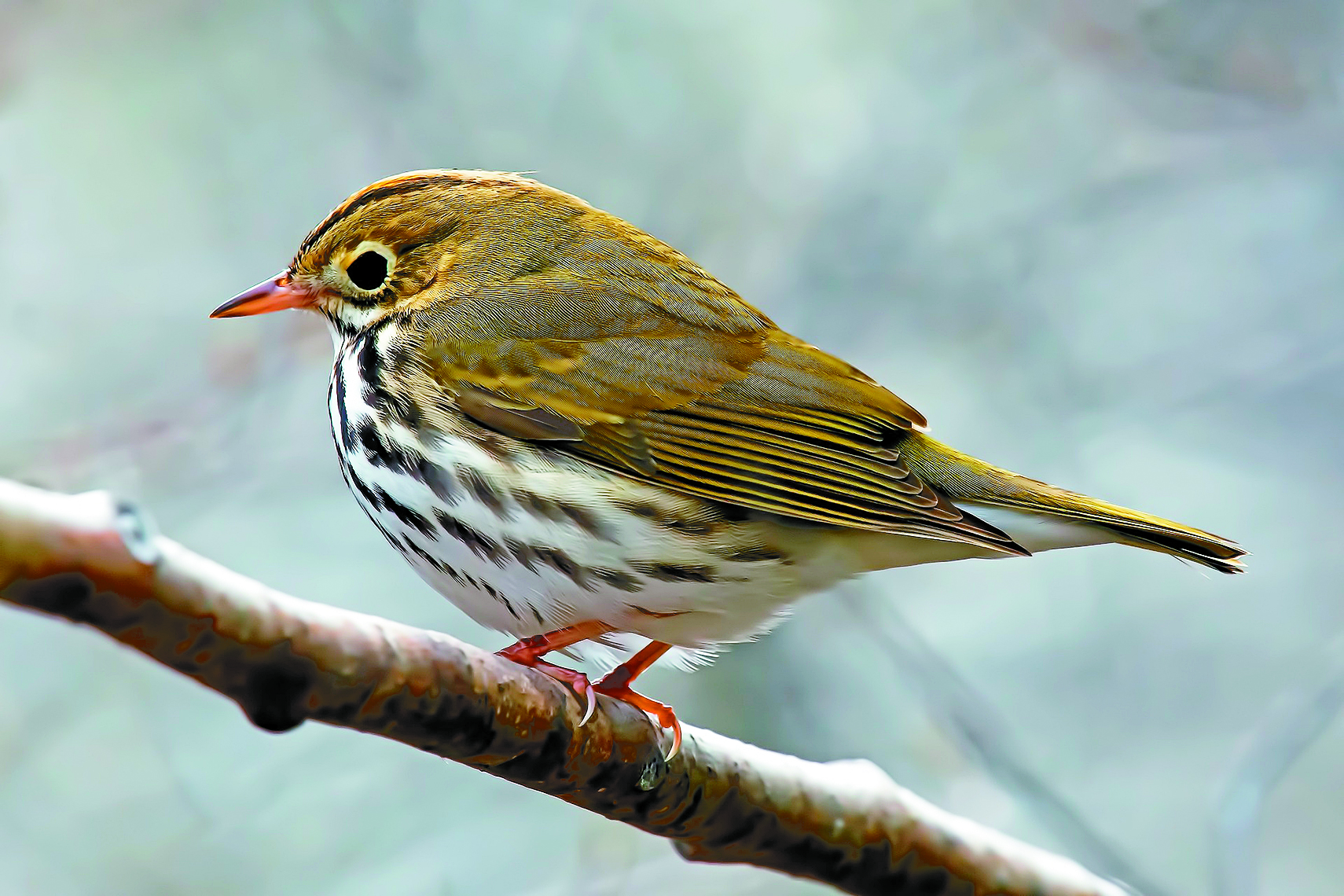
The ovenbird is not one of the brightly colored warblers, such as black-throated blue warbler or yellow warbler. The ovenbird is a small brown bird with a white breast marked with dark streaking — an appearance that bears a superficial resemblance to the larger thrushes that share the same woodland habitat. The only hint of color is an orange crown patch bordered by dark stripes atop the bird’s head. Even this orange crown patch is not easily seen. When agitated, an ovenbird may raise its head feathers, which makes this orange mark easier to detect. The ovenbird also shows a distinct white ring around each eye, as well as pink legs and a pinkish bill.

By Hans Toom from Pixabay • The ovenbird gets its name from the shape of its nest, which is said to resemble an old-fashioned Dutch oven.

The resemblance to North America’s brown thrushes didn’t go unnoticed by some early American naturalists. Painter and famous naturalist John James Audubon painted a pair of ovenbirds, which he knew as “golden-crowned thrushes.” When comparing the two names, one can’t help but wish that the inaccurate but more romantically descriptive golden-crowned thrush had stuck.

Unfortunately, ovenbirds are stubborn about letting themselves be seen. They’re easily heard. The males begin singing a loud, rollicking “Teacher! Teacher! Teacher” song almost as soon as they arrive on potential nesting grounds.

The ovenbird, unlike many warblers, is not named for its appearance. Instead, the bird’s name derives from the shape of the nest it builds. The nest is a domed structure placed on the ground, woven from vegetation and containing a side entrance. Early European settlers in North America thought the nest looked like a Dutch oven, hence the name “ovenbird” for the small warbler with the intricate nest.

In April and continuing into May, a couple of dozen warbler species will pass through Tennessee. Some of these warblers find area woodlands and other habitats to their liking. They will pause, explore and perhaps decide to spend their summer nesting season in Northeast Tennessee and Western North Carolina rather than continue migrating farther north.

Many of the warblers that pass through each spring, however, are destined to travel a much longer distance before settling down in their favored habitats for the summer nesting season. These warblers include the Tennessee warbler, Nashville warbler, Cape May warbler, blackpoll warbler and Connecticut warbler. Most of these species nest as far north as New England and Canada.

Others find the Southern Appalachians to their liking. Some of the first warblers to return each year include the Louisiana waterthrush, which favors rushing mountain streams, as well as species such as black-throated green warbler, hooded warbler, ovenbird, black-and-white warbler, worm-eating warbler and common yellowthroat.

The Northern parula offers an abundance of identifying characteristics. Adult males are bluish gray overall with a yellow-green patch on the back and two white wingbars. A chestnut band separates the male’s bright yellow throat and chest. Adult females are often a bit paler and typically lack the male’s breast band. Both males and females have distinctive white eye crescents.

Most warblers lead frenetic lives. They often sing high in the tops of trees, but they do occasionally venture closer to the ground, particularly when foraging for prey, which consists of a variety of insects and small spiders. The Northern parula is even more restless than most of its kin.

The more reliable means of locating a Northern parula is to listen for the male’s buzzy, ascending song. He is a persistent singer from the time of his arrival until mid-summer.

A quirk involving nesting material is somewhat unique to this warbler. In much of the southern United States, the Northern parula conceals its nest inside strands of Spanish moss draped from the limbs of live oaks and other trees. In the Southern Appalachians and other locations farther to the north, the absence of Spanish moss means that the birds rely on various Usnea lichens, which are sometimes referred to as “Old Man’s Beard.”

A pair of Northern parulas will attempt to raise two broods in a nesting season. The female lays two to seven eggs and does most of the nest construction.

Look for spring’s warblers in the coming weeks. Feel free to share any sightings with me by emailing ahoodedwarbler@aol.com.

Photo by Bryan Stevens • The Northern parula’s geographic location during the nesting season determines its use of nesting materials.


Share your first sightings of spring hummingbirds

Photo by Georgia Lens / Pixabay

The website Journey North noted in a post on March 15, that hummingbird migration along the Pacific Coast has been impacted by the crazy weather that California has experienced in recent weeks.

In the eastern United States, however, the annual migration of ruby-throated hummingbirds is proceeding pretty much on schedule.

According to Journey North, volunteers along the Gulf Coast and in the Southeast have been reporting arriving ruby-throated hummingbirds since early March.
I fully expect that ruby-throated hummingbird migration will bring the first individuals to Northeast Tennessee, Southwest Virginia, and Western North Carolina in early April.

Photo by Bryan Stevens • Male ruby-throated hummingbird show the namesake red throat. The feathers on a male’s throat are iridescent, which means they can change when seen from different angles. In poor light, the ruby-red throat can look almost black.

According to the website, most first spring observations of hummingbirds are males, although a few females are being spotted. Male hummingbirds, the posting noted, arrive first so they can find and defend a territory.

As always, spring migration can be a challenging time for hummingbirds. Temperature, wind patterns and storms can influence the pace of migration.
Even once these tiny birds make their epic spring crossing of the Gulf of Mexico, they will need time to rest and refuel before moving northward. By mid-March, the advance of ruby-throated hummingbirds has usually reached states as Georgia and South Carolina. By the end of March, these tiny flying gems have reached states such as Tennessee and North Carolina.

It’s time to get those sugar water feeders outside and waiting for the early arrivals. Once the chance of late-season freezes has passed, consider planting some colorful native flowers to provide nectar sources for hummingbirds.

Northeast Tennessee usually gets its first spring hummingbirds the first week of April. If you’re seeing hummingbirds, I’d love to know. I have tracked arrivals for several years now. To share your first spring sighting of a ruby-throated hummingbird, email me at ahoodedwarbler@aol.com or contact me on Facebook at http://www.facebook.com/ahoodedwarbler. Please include the date and time of your sighting. I also welcome the sharing of other details about your sightings.
In the meantime, take steps now to welcome hummingbirds back and keep them safe during their stay.

Some ways of ensuring that our hummingbird guests are kept healthy and secure are simply common sense. For instance, don’t use pesticides, herbicides or any other sort of toxin anywhere close to the vicinity of a sugar water feeder or a flower garden. Hummingbirds are such tiny creatures with such intense metabolisms that it only takes a small amount of any harmful substance to sicken or kill one of these little flying gems.

Feeding hummingbirds is easy, but many people try to complicate the process. Only common, pure cane sugar, mixed to a ratio of four parts water to one part sugar, is a safe choice for these birds.

For emphasis, I’ll repeat again that only common, pure cane sugar is safe for hummingbirds. There are no safe substitutes. Do not use organic, raw or brown sugar. Confectioner’s sugar, which contains an anti-caking substance (often corn starch, silicates or stearate salts), is also hazardous to hummingbirds.
The ratio of four parts water to one part sugar utilizing pure cane sugar most closely duplicates the nectar that hummingbirds obtain from some of their favorite flowers. Why try to mess with nature’s perfection?

I cannot imagine why anyone would supplement sugar water for hummingbirds with such human beverages as a sports drink or Kool-aid, but there have been reports of people doing so. Be aware that such additives will only risk the health of these tiny birds.

Photo by Bryan Stevens • Despite a perceived disadvantage of size, ruby-throated hummingbirds are quite capable of thriving in a giant world.

Most experts also suggest avoiding red dyes or food colorings, which are often found in commercially marketed hummingbird sugar water. Don’t risk the health of hummingbirds for a little convenience.

It’s easy to make your own sugar water mix, which can be stored in the refrigerator in an empty plastic juice jug. Boil some water and then add one cup of sugar for every four cups of water in your pot. Stir thoroughly. Bottle the mixture until it cools. Fill your feeders and store any remaining sugar water in the fridge in the aforementioned jug. Refrigerated, the mix should stay good to use for at least a week.

In our milder spring weather, changing the sugar water in feeders can probably be done on a weekly basis. When hotter summer temperatures prevail, it’s usually necessary to change the sugar water every two or three days.

•••

Remember to send me those first sightings of returning spring hummingbirds. I’ll be doing my usual roundup to share who gets graced with a visit from one of these tiny beauties.