Tag Archives: birds

Indigo bunting one of summer’s common songbirds

IMG_6700

Photo by Bryan Stevens • The male indigo bunting is a resplendent bird.

Two recent summer bird counts emphasized some of the more commonplace birds in the region. While American robins and European starlings were extremely abundant, these two birds are permanent residents and are present year-round. A few other summer songbirds also helped swell the ranks of some of the seasonally common birds. For instance, the Unicoi County Summer Bird Count found a total of 141 indigo buntings while the Elizabethton Summer Bird Count tallied 82 of these little blue beauties. Both of these Northeast Tennessee surveys are conducted by members of the Lee and Lois Herndon Chapter of Tennessee Ornithological Society.

The indigo bunting likes to reside in the boundary region where forests and woodlands meet fields and pastures. Personally, the indigo bunting has always been a bird that is suggestive of the long, hot days of summer. One of my earliest and still quite vivid birding memories is a recollection of a shockingly blue bird atop a blue spruce tree in my yard. Several decades later, the tree is no longer standing, but these beautiful birds — I now know these summer visitors were indigo buntings — return year after year to my yard and gardens.

Count-IndigoBunting

Photo by Bryan Stevens • Neotropical migrants, such as this Indigo Bunting, increase the variety of bright and colorful birds in eastern North America from spring until fall each year.

These birds usually arrive in the region in late April and I’ve seen them in late October, although most indigo buntings have left the region by late September.

Male indigo buntings are persistent singers, and in the past couple of weeks one very enthusiastic male has been singing even during the hottest hours of recent July afternoons. The preference of this small songbird is to sing from the tops of tall trees. They are often concealed by the green leaves. When I do get a glimpse of the obscured songster, often all I see is a dark shape silhouetted against the bright sky. Sometimes, if he plunges from the upper branches into the woodland understory, I get that telltale glimpse of blue feathers.

The indigo bunting is the only solid blue bird in the eastern United States. It’s all an illusion, of course. The indigo bunting’s feathers are not really blue. The male’s brilliant azure plumage is caused by the process of refraction. This process absorbs all but blue light, which explains why the indigo bunting appears blue. In bright light, it can even look unnaturally vivid blue. In poor light, however, an indigo bunting male can appear black. Fortunately, indigo buntings have both a characteristic body shape and song, so even if the birds are not seen at their best, they can still be recognized.

Indigo-Count

Photon by Bryan Stevens • Indigo Buntings will perch on wires and sing for hours even during hot summer days.

Like many species of songbirds, the male is by far the most colorful. In this instance, the male is also responsible for the species’ name. Indigo is a blue dye that was once an important crop in the South. The drab female may boast some blue highlights in her plumage. Juvenile birds just out of the nest also resemble the female. Pay close attention to any indigo buntings you observe as summer progresses. Juvenile birds will look mostly brown with just a hint of blue in the wings and the tail. These will be the young buntings that were hatched this spring and early summer. They will often accompany their parents to feeders.

Indigo buntings are particularly fun birds to observe in late summer. Although some books indicate that males are not very active in rearing young, I have on numerous occasions witnessed male buntings feeding fledglings at feeders. Indigo bunting juveniles, like the young of many other birds, beg for tidbits from parents by “bowing,” spreading their wings and shivering. These actions usually prompt a parent to pop some morsel into an impatient youngster’s open bill. Indigo buntings are relatively easy to view. They frequent weedy fields and roadside brush. During the breeding season, males can also be seen singing from prominent perches. The song, a distinctive jumble of notes, can help observers find these dedicated singers.

IndigoBunt

Photo by Bryan Stevens • Although bright blue, a male indigo bunting will often blend with its surroundings.

The male indigo bunting is one of the most colorful birds to visit feeders in the region. This species is also extremely fond of millet seed. I like to have some feeders stocked with millet when the buntings begin to return each spring. They will also feed on thistle and sunflower seeds. Away from our feeders, they also devour plenty of seeds from various noxious weeds. Because of the indigo bunting’s appetite for the seeds of destructive weeds, it is considered a very beneficial bird.

One of the most attractive summer scenes is to observe American goldfinches and indigo buntings feeding together on the nodding heads of summer sunflowers. The goldfinch males, resplendent in their bright yellow and black plumage, compete with the blue indigo bunting males for the fresh sunflower seeds. When bright red male Northern cardinals join in, observers have a complete artists’s palette for summer viewing.

The indigo bunting will usually respond to human squeaks that imitate a bird’s call. When a flock or family group of buntings are disturbed by a human observer, they usually begin a chorus of alarmed “chipping.”indigo-bunting-john-james-audubon

As I indicated earlier, indigo buntings remain in the region until late September. Although this bird typically winters in Mexico, Panama and the Caribbean, in recent decades some indigo buntings have only gone as far south as Florida to spend the winter. There in the Sunshine State, the indigo buntings may mingle with a close relative, the splendidly multi-colored painted bunting. I usually see these vibrant songbirds whenever I visit coastal South Carolina in spring or summer. Male painted buntings are probably one of the most colorful birds in the United States with hues of red, green, purple and blue in their feathers.

PaintedBunting-Male (1)

Photo by Bryan Stevens • The male painted bunting is one of North America’s most colorful birds.

Other North American buntings include the snow bunting, the lazuli bunting and the lark bunting, which is also the official state bird for Colorado. Some of the common but descriptive names for some of the world’s other buntings include striolated bunting, cinnamon-breasted bunting, cinereous bunting, white-capped bunting, lark-like bunting, ochre-rumped bunting, golden-breasted bunting, chestnut-bunting, red-headed bunting, yellow bunting, little bunting, brown-rumped bunting, meadow bunting, corn bunting and crested bunting.

Keep your feeders stocked with millet and sunflower seeds if you want to increase your chances of seeing indigo buntings. They will need some dependable places to re-fuel and rest during their upcoming fall migration.

Reader’s mystery bird turns out to be Louisiana waterthrush

On occasion, readers seek out my help with identifying birds they encounter. I am always glad to assist. Photographs, a recording of the bird’s song, or even a well-written description are often all that’s necessary to pinpoint the identities of mystery birds.

Lewis and Jeana Chapman, residents of Laurel Bloomery, Tennessee, notified me in an email that they have been enjoying some good birdwatching trips. They also wanted some help with the identity of a bird they observed last summer.

NoWaterthrush

Photo by Bryan Stevens • The Northern waterthrush, pictured, has a beige eye line rather than the white one usually shown by the Louisiana waterthrush.

“My wife and I love to go to the Creeper Trail in Virginia and enjoy the creek,” Lewis wrote in an email. “On these trips in the summer months, we have watched this bird run along the rocks of the shore feeding.”

He also mentioned that he had attached in his email some photos, which proved extremely helpful. “Our closest guess at what type of bird it is was a spotted sandpiper, but its beak/bill seems too short. Any help you can give us would be greatly appreciated.”

A quick scan of the photos the Chapmans sent with their email helped me narrow the options down to two related birds — a Louisiana waterthrush and a Northern waterthrush. I used three criteria — location, season and plumage — to identify the bird in their photos as a Louisiana waterthrush.

Louisiana Waterthrush

Photo by Adobe Stock • Subtle plumage differences, as well as habitat, behavior and seasonal presence, are factors in distinguishing the Louisiana waterthrush, pictured, from the closely related Northern waterthrush. The Louisiana waterthrush nests along fast-moving streams in the area while the Northern waterthrush does not breed in the region.


The Chapmans had good reason to suspect the bird might have been a spotted sandpiper, but for the true identity of the bird in question, it’s necessary to delve into the family of warblers, which includes species such as American redstart, ovenbird, common yellowthroat, Northern parula and black-throated blue warbler.

The two waterthrushes are very similar in appearance. Louisiana Waterthrushes has a heavier bill and a white eye line, while the Northern Waterthrush’s eye line is usually somewhat yellowish-beige. A Louisiana waterthrush typically also has a whiter belly and underparts.

Appearance wasn’t even the most important element of the criteria. Location and season more readily helped confirm the identity. The Louisiana waterthrush has a range concentrated on the southern part of the eastern half of the United States, mostly south of the states of New York, Michigan and Wisconsin. In this region, only the Louisiana waterthrush is known to nest. The Northern waterthrush is strictly a spring and fall migrant, electing to nest near bogs and slow streams in Canada and the northern tier of states in the United States.

The Louisiana waterthrush also attracts attention with its characteristic “teetering” gait. Much like the spotted sandpiper, this waterthrush bobs the rear half of its body up and down as it walks and forages by the sides of streams. In their behavior, this shorebird and this warbler are very much alike. The waterthrush will often turn over wet leaves or other stream debris to search for prey items, such as aquatic insect larvae, crustaceans, snails and even small fish. The Louisiana waterthrush was once known as the water wagtail, which makes reference to the aforementioned teetering gait.

Waterthrush-Painting 2

Early artist and naturalist John James Audubon painted this Louisiana waterthrush.

Many warblers have shown signs of decline in recent years. The Louisiana waterthrush, however, appears to have bucked that trend. According to the website All About Birds, Louisiana waterthrush populations were stable between 1966 and 2015, based on statistics from the North American Breeding Bird Survey. Partners in Flight estimates a global breeding population of 360,000, with almost all of those individuals spending at least part of the year in the United States. About a quarter of the population retreats into Mexico during the winter season. The rest winter in Florida and some of the Gulf Coast states, as well as the islands of the Caribbean.

While most songbirds are fortunate to survive two or three years in the wild, at least one Louisiana waterthrush lived to the age of at least 11 years and 11 months. The bird, a male, was seen in New Jersey in the wild and identified by a band on one of his legs. He had been banded in the same state, according to All About Birds.

The two waterthrushes are the only species in the genus Parkesia, so named to honor American ornithologist Kenneth C. Parkes, who was for many years Curator of Birds at Carnegie Museum of Natural History. The common name of the Louisiana waterthrush is not a very apt one, as this bird does not have any special affinity for the state of Louisiana. Someone collected some of the early specimens of the Louisiana waterthrush in its namesake location, and the name has stuck through the years.

Waterthrush

Photo by Bryan Stevens • Even in migration, both waterthrushes like to stay near water.

Not every bird mystery that comes my way via Facebook or in an email is so easily resolved. This identification, which happened to involve the New World warblers, my favorite family of birds, once again showed me the amazing diversity of this group of birds. From the terrestrial Louisiana waterthrush to the treetop-dwelling cerulean warbler, it’s an amazing group of songbirds I’m always happy to introduce to bird enthusiasts.

No cowbird ever knows its biological parents

While many birds are excellent parents, others lack any maternal or paternal instincts altogether. The common cuckoo, a nesting bird in Europe and Asia, is a well-known brood parasite that would rather slip its eggs into the nest of other bird than raise its own young. In scientific terms, “brood parasite” refers to creatures that rely on others to raise their young. In addition to some birds, this tactic is also employed by some species of insects and fish.

COWBIRD-Female

Photo by Bryan Stevens • Female brown-headed cowbirds stay alert to observe bird leaving or coming to a nest. Once they have located a nest, these birds slip their own eggs into the nests of other birds.

The strategy is effective, if, in the human way of thinking, rather heartless. In biological terms, however, this “foster parenting” allows brood parasites to ensure a new generation without expending much energy on the part of the actual parents. Some recent contacts with readers have reminded me that not all of our feathered friends would qualify for “parent of the year.”

Mike Dickenson of Bristol, Tennessee, contacted me on Facebook about a discovery he made in a nest built under the steps of his house.

Cowbird-Female

Photo by Bryan Stevens • A female brown-headed cowbird visits a feeder.

“I noticed two blue eggs,” he said. “I checked a few days later and noticed two gray eggs also. Did another bird sneak her eggs into the nest?” Mike also informed me that some of the eggs hatched shortly after he discovered them.

James Rowland of Erwin, Tennessee, sent me a message on Facebook asking me to identify a bird in a photograph he had taken. “What is this bird?” James asked. “It’s larger than a sparrow.”

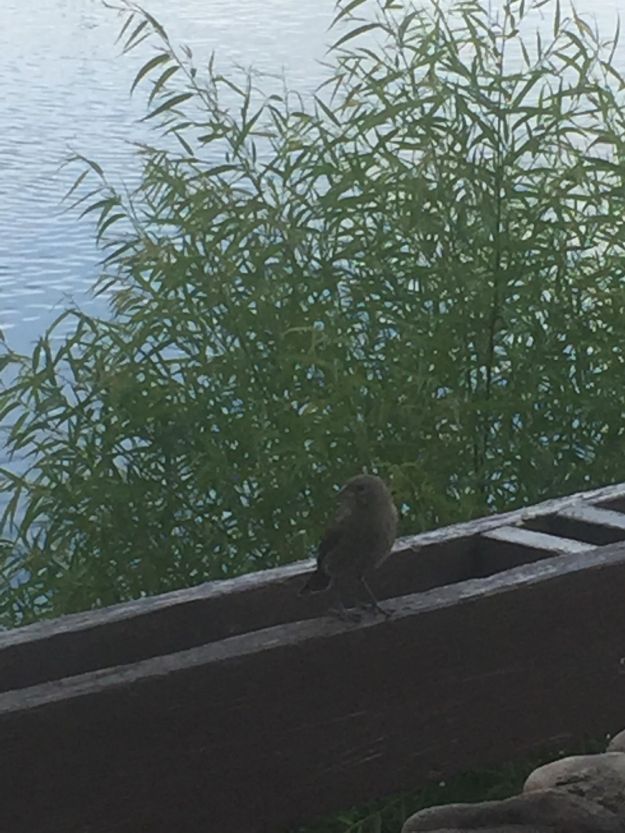
He added that he observed and photographed the bird near the Covered Bridge in Elizabethton, Tennessee. A study of the bird in the photo revealed a very nondescript bird in largely gray plumage. Few of our birds are this plain and gray with almost no standout characteristics.

36043826_277373272833221_1274549914663124992_n

Photo by James Rowland • A brown-headed cowbird, probably a young bird or a female, near the Covered Bridge in Elizabethton, Tennessee.

In both cases, one of North America’s most successful brood parasites was involved. I responded to Mike and told him that is was entirely possible that a female brown-headed cowbird slipped some eggs into the nest beneath his steps. I likewise informed James that the bird in his photo looked like a brown-headed cowbird. I added that the bird was either a female or a young bird, since a male would have the brown head that gives the species its common name.

In North America, one of the best-known feathered brood parasites is the brown-headed cowbird. While many brood parasites are specialists, with females slipping their eggs into the nest of a specific species of host bird, the brown-headed cowbird approaches brood parasitism in a less discriminating manner. Female cowbirds have been known to lay their eggs in the nests of at least 221 different species of birds. No baby brown-headed cowbird ever knows its biological parents.

How did the brown-headed cowbird turn to a life of foisting eggs onto unsuspecting foster parents? The answer is connected with the American bison, also known as buffalo. When the bison roamed the Great Plains of the United States by the millions, flocks of brown-headed cowbirds followed the great herds, feeding on the insects flushed by the hooves of millions of bison. As the herds stayed on the move constantly, the cowbirds also developed a nomadic lifestyle. After the bison herd diminished, the cowbirds survived a potential crisis by simply transferring their bovine affinity from bison to domesticated cattle.

Brown-headedCowbird-Male

Photo by Bryan Stevens • A male brown-headed cowbird displays the brown head that gives this bird its common name.

At times, this random and undiscriminating approach to reproduction fails. Some finches feed their young a diet that consists of a great deal of vegetable matter. Young cowbirds fed this protein deficient diet fail to thrive and ultimately perish.

Other birds blissfully bring a rich assortment of protein snacks — insects, spiders and other small invertebrates — that permits the young foster bird to thrive, at times at the expense of the host bird’s own young. About 20 years ago I observed a willow flycatcher bringing food to a young brown-headed cowbird at least twice the size of the “parent” trying to feed it. I’ve also seen song sparrows, dwarfed by a cowbird changeling, trying to keep their enormous baby bird well fed.

Cowbirds are members of the blackbird family, which includes such relations as orioles, meadowlarks and grackles. All cowbirds are confined to the New World and include species such as the screaming cowbird of Argentina, Bolivia and Brazil, as well as the bronzed cowbird of Central America and the southern United States, especially the states of California, Arizona, New Mexico, Texas, and Louisiana. Other cowbird family members include giant cowbird and the shiny cowbird.

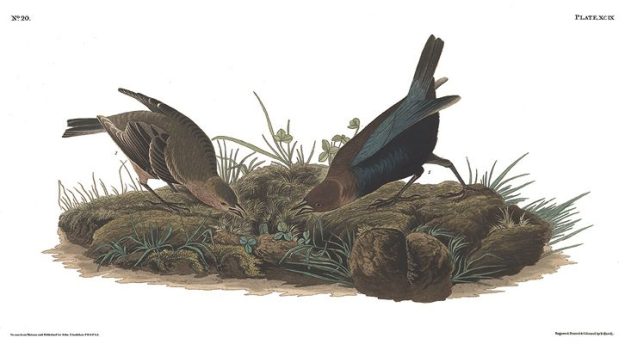
Brown-headed-Cowbird-Audubon-1-726x400

Early naturalist and painter John James Audubon painted this pair of brown-headed cowbirds.

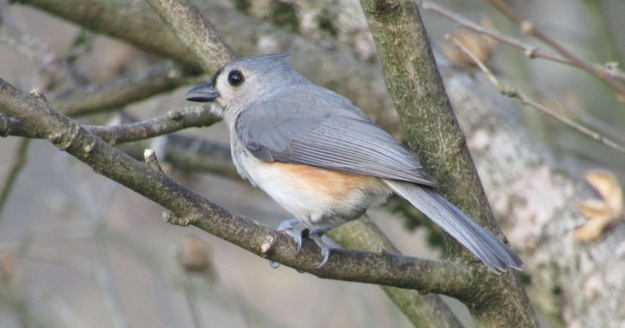
Tufted titmouse small songbird with big personality

In last week’s post I wrote about chickadees. These friendly little birds have an impish cousin that is also a frequent visitor to feeders in the region. If chickadees are active woodland sprites, their relative, the titmouse, is a curious imp with mischievous tendencies.

Titmouse-2

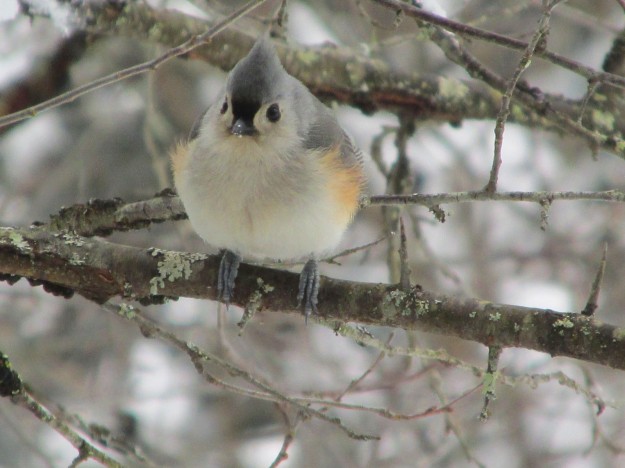
Photo by Bryan Stevens • A tufted titmouse puffs up its feathers on a cold day.

The tufted titmouse’s song — a persistent repetition of “Peter! Peter! Peter!” — is ringing through the woodlands around my home along with the urgent “fee-be fee-bo” of the Carolina chickadee. These birds form mixed flocks with each other and other species to explore their surroundings and search for food. They know that spring, despite the usual false starts, is drawing nearer with each passing day.

In addition to singing, titmice are enthusiastic scolders. They will scold over any transgression, real or imagined, focusing their ire on their fellow titmice or other birds, potential predators and even human observers. They’re quite persistent at their raucous scolding, which is just another reason I label them as imps of the woods.

Titmouse-Suet

Photo by Bryan Stevens • A young titmouse visits a suet feeder.

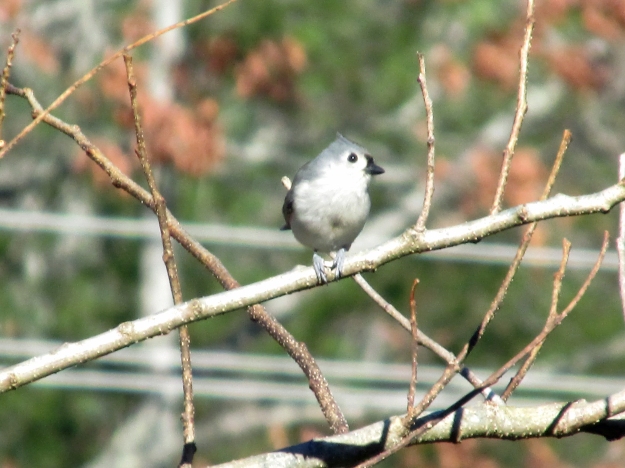
The tufted titmouse is a mostly gray bird with a distinctive crest and a pinkish-rusty coloration along the flanks. Titmouse eyes are black as coal and look large in proportion to their heads, which lends them an expressive appearance as they explore in yards and gardens. The term “titmouse” refers to the old English word “tit” meaning “small,” as well as the old English “mase,” also a reference to small size. Eventually, probably because of the bird’s small size and gray coloration, “mase” evolved into “mouse” and combined to form the word “titmouse.”

The titmice living in my yard visit my house windows at times, which drives my cats to distraction. I’ve wondered if the titmice are curious and trying to peek inside the house, but I believe I have a more down-to-earth explanation. These little birds are very thorough when foraging for food, and I’ve watched them pluck spiders and other insects from the window frames.

Titmouse-Creek

Photo by Bryan Stevens • A tufted titmouse approaches a stream for a quick drink.

Like chickadees, titmice are fond of sunflower seeds. No other offering will so readily lure them to feeders, although they do develop a fondness for suet cakes. I’ve also had great success attracting titmice to my feeders by offering unsalted, shelled peanuts. I sometimes break up the peanuts into smaller, more manageable pieces for the benefit of the titmice. These foods and a few trees or saplings around your home is all you really need to welcome titmice.

In the early 1900s, the tufted titmouse would have been considered a southern bird with its stronghold in states like Tennessee, Virginia, the Carolinas and Georgia. Perhaps it is the titmouse’s innate curiosity that has pushed the species to expand successfully beyond the southern United States. The titmouse has steadily expanded its range northward, thriving in new locations. Experts credit this expansion to more readily available access to supplemental food at feeders.

Titmouse-Eye

Photo by Bryan Stevens • A tufted titmouse turns an eye on the camera.

During the nesting season, titmice forage for a variety of insects. Many spiders, beetles, caterpillars and other small bugs will be fed to hungry young titmice in a tree cavity or a nesting box. Like chickadees, titmice build exquisite nests, often using mostly moss with other materials, such as bark, cloth scraps, dry leaves and shed snakeskins. These small birds line their nests with hair or fur of other animals.

Over the years, many readers have shared observations documenting the fur-collecting skills of tufted titmice. The birds are not content to simply collect shed fur. They seem to prefer collecting the fur fresh from a living animal. Many dogs fall victim to impish titmice that boldly pluck strands of fur from the canine’s coat.

In another funny story, a woman once told me about a titmouse that flew onto her head every time she stepped outside her home. Perhaps the bird sensed her affection for birds since it never failed to pluck strands of hair from her head to carry back to its nest. For any would-be skeptics, the woman provided photographic documentation of the incidents. In addition to dogs and humans, animals ranging from squirrels and opossums to mice and woodchucks have also been observed “sacrificing” fur for the nesting success of tufted titmice.

Titmouse-PHOTO

Photo by Bryan Stevens • The tufted titmouse is a backyard bird with an impish personality.

The female tufted titmouse incubates the eggs. She lays between three and nine eggs, although a usual clutch size is five to six eggs. The female titmouse is protective of her nest and is known for a behavior known as a “snake display.” I’ve observed titmice perform this display when I’ve peeked into nesting boxes. She remains tightly seated on her eggs, or young, while she hisses loudly and strikes in a manner very much like a striking serpent. Not all titmice engage in this display. Some remain still and try to “blend” with the nest, while others will fly away if a nest box is opened. Regardless, it’s a convincing display of bravado on the part of such a small bird. If it looks scary to people, I am sure it could succeed at repelling a squirrel or mouse. I’m uncertain if the behavior would deter an actual snake.

Other titmice in North America include bridled titmouse in Arizona and New Mexico; oak titmouse of the Pacific Coast region; juniper titmouse from the Great Basin, which consists of Wyoming, Idaho, Utah, Nevada, Oregon and California; and the black-crested titmouse, which ranges from Missouri into east-central Mexico.

Titmouse-WithPeanut

Photo by Bryan Stevens • A tufted titmouse pounds at a peanut held in its feet.

Titmice occur exclusively in North America and belong to the genus Baeolophus. Europe, Asia and Africa are home to some other crested birds in the family of chickadees and titmice. For instance, the European crested tit and the grey crested tit are species that sport a crest of feathers like titmice but are more closely related to chickadees.

Yes, the tufted titmouse is one of nature’s imps, but it’s also one of our more entertaining birds. Get to know these visitors by offering sunflower seeds or other fare and, if you want to go the extra step, place some bird boxes around your yard as potential nesting sites. By next winter, you may have an entire flock of these feathered imps as your guests.

•••••

Bryan Stevens lives near Roan Mountain, Tennessee. To learn more about birds and other topics from the natural world, friend Stevens on Facebook at https://www.facebook.com/ahoodedwarbler. If you have a question, wish to make a comment or share a sighting, email ahoodedwarbler@aol.com.

Titmouse-OnSuet

Photo by Bryan Stevens • A tufted titmouse makes a quick visit to a suet feeder.

Unlikely orange-crowned warbler becomes daily visitor this winter at woman’s feeders

After you have fed the birds long enough, you’re going to get visits from “mystery” birds. No matter how thoroughly you thumb through the pages of your field guides or how many online Google searches you conduct, it can be hard to pin down the identity of certain birds, especially when you encounter them for the first time.

Orange-crowned-Two-BOYD

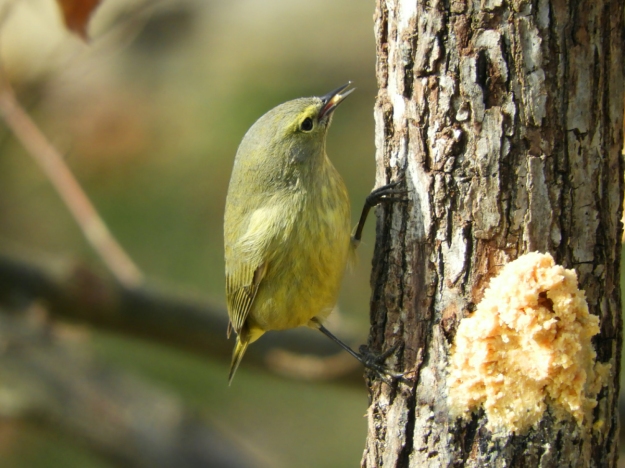
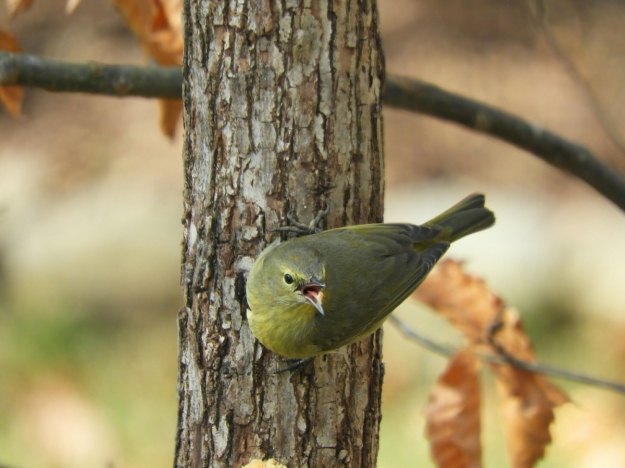
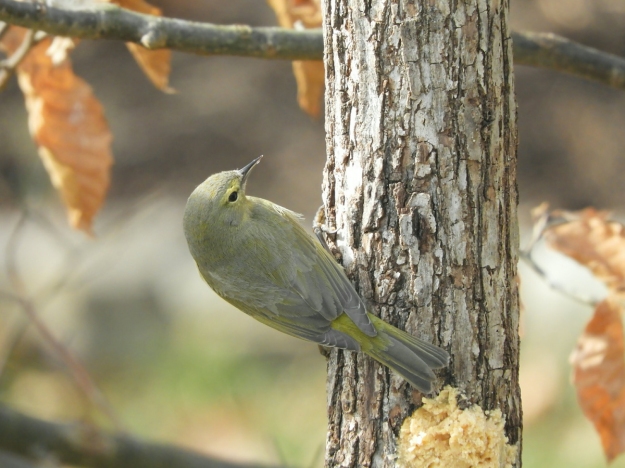
Photo by Rebecca Boyd • This orange-crowned warbler has found a favorable winter residence at the home of Rebecca Boyd in Knoxville, Tennessee, making frequent visits to suet feeders to supplement its usual diet of insects and berries.

In the summer and fall, young birds recently out of the nest can cause some confusion when they show up in the company of their parents at feeders. In the winter, often a season characterized by subdued plumages and nomadic wanderers, the surprise visitors can be one of the many “little brown birds” in the sparrow clan or a summer bird like an oriole or thrush that has decided to take a shot at overwintering.

Or, with greater frequency each winter, it might be one of the warblers. That was the case when Rebecca Boyd, a resident of Knoxville, Tennessee, contacted me recently via Facebook asking for assistance with a bird identification.

27583340_337866090062351_24195392_n

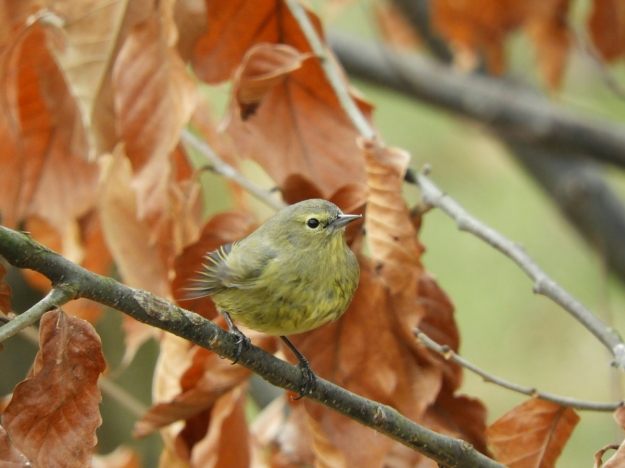
Photo by Rebecca Boyd • This orange-crowned warbler is one of the more nondescript members of the warbler family.

Although most of the warblers beat a hasty retreat from North America every fall, a handful of species have increasingly begun to spend the winter months far north of their usual tropical haunts. Some of these species include yellow-rumped warbler, pine warbler and palm warbler, but the low-profile orange-crowned warbler is also becoming more common between November and March, especially in yards and gardens offering supplemental food such as suet cakes.

The small greenish-yellow bird that showed up at Rebecca’s home was easily identified, thanks to some great photographs that she took of her visitor. I communicated to her that I believed her bird to be an orange-crowned warbler. She had also conducted her own research, which had also led her to that conclusion.

Orange-crowned-Four-BOYD

Photo by Rebecca Boyd • This orange-crowned warbler has found a home at the residence of Rebecca Boyd in Knoxville, Tennessee, this winter.

Rebecca said she also shared some photos with birding groups on Facebook, which brought some helpful feedback. “I’ve gotten numerous responses that orange-crowned warblers are becoming a lot more common on the east side of the Mississippi, with quite a few people saying they are seeing them in their yards, too,” Rebecca wrote.

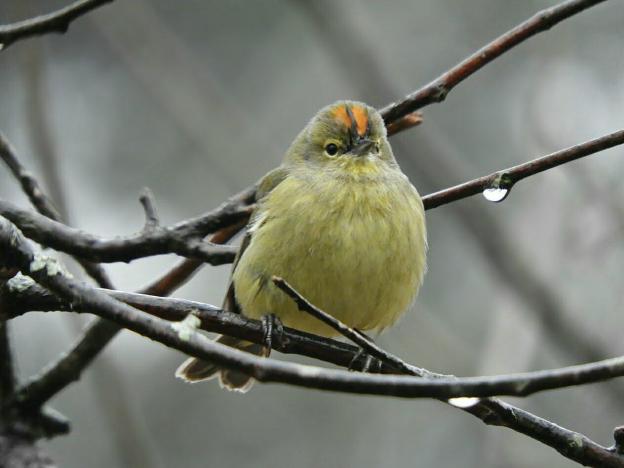
The orange-crowned warbler is one of the more undistinguished members of this New World family of birds that numbers about 115 species. The bird gains its common name from a physical feature that is rarely seen — an orange patch of feathers that, unless the bird is extremely excited or agitated, is usually concealed beneath its dull greenish-yellow feathers. It’s not a field mark that’s considered reliable for identifying the bird.

Rebecca got a lucky break and managed to photograph this elusive feature on her visiting bird. She said the feathers on the bird’s head appeared wet, which may have explained the appearance of the orange crown.

28033440_343701942812099_429716009_o 2

Photo by Rebecca Boyd • Wet feathers made the rarely seen orange crown visible on this orange-crowned warbler that has taken up residence at the home of Rebecca Boyd in Knoxville, Tennessee, this winter.

So, what does signify an orange-crowned warbler? The lack of wing bars, as well as the absence of a strong facial pattern is a strong indicator. The bird in Rebecca’s photo is not nearly as drab as this warbler can appear. Some appear very gray with only a hint of yellow or green in their plumage. There is often faint gray streaking evident in their yellow-green breast feathers. This warbler always shows yellow beneath its tail, a feature that is often only glimpsed as an observed bird is diving into cover. These birds also have sharp, thin bills. It’s usually a process of eliminating other suspects that brings birders to identify one of these warblers.

Unlike some warblers restricted to either the eastern or western United States, the orange-crowned warbler migrates and winters throughout the nation, east and west, although it primarily only nests within the western United States, as well as Alaska and Canada.

Although Rebecca said she has only been bird-watching and taking pictures for a little over a year, she has been a general point-and-shoot photography hobbyist for years. “My backyard is a bird paradise that attracts numerous and varied species,” Rebecca noted. “My favorites are bluebirds and hummingbirds, but the little warblers are also very special.”

Orange-crowned-One-BOYD

Photo by Rebecca Boyd • Besides orange-crowned warbler, like this individual, other warblers on occasion winter in the United States. Species most often attempting to spend the winter months in the United States include palm warbler, pine warbler, and yellow-rumped warbler.

Most of the warblers are currently residing on the island of the the Caribbean, or far south in Central and South America. A few others spend the winter in Florida or other southern states. The 50 or so species that nest in the United States and Canada will begin arriving as early as next month, although the majority of these summer residents will arrive or pass through the region in late April and May.

So, while it has a colorful name, the orange-crowned warbler is one of the more drab and nondescript members of its family. Other warblers living throughout the Americas include flame-throated warbler, crescent-chested warbler, citrine warbler and arrowhead warbler.

I’ll just keep daydreaming on the occasional snowy day of the approach of spring, which signals that the kin of the orange-crowned warbler will be winging their way north again in only a couple more months. I, for one, can’t wait.

••••••

If you have a question, wish to make a comment or share a sighting, email ahoodedwarbler@aol.com.

Orange-crowned-THREE-BOYD

Photo by Rebecca Boyd • This orange-crowned warbler grabs a bit of suet from a feeder at the home of Rebecca Boyd in Knoxville, Tennessee.

Duck…duck…goose? Winter season good time for finding rare geese in the region

SnowGoose-Jan21

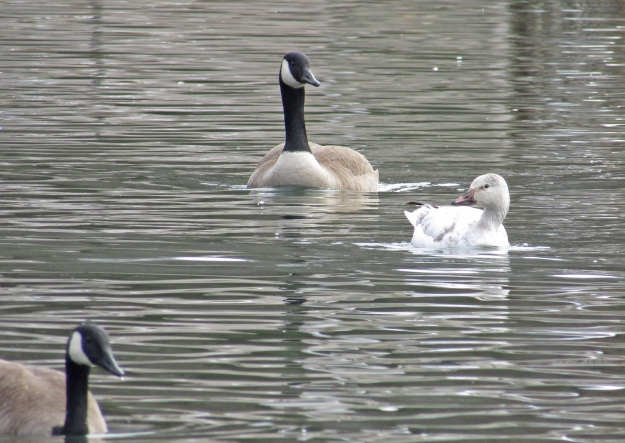
Photo by Bryan Stevens • A snow goose swims amid Canada geese at the pond at Fishery Park in Erwin, Tennessee.


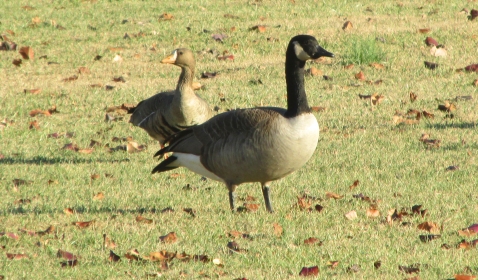
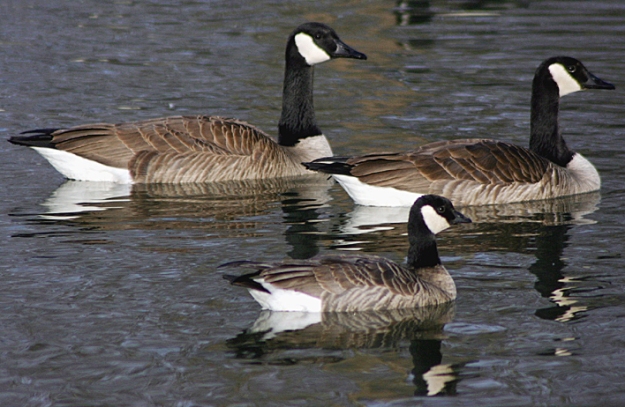
Of the geese found in the region, the well-known Canada goose is nearly ubiquitous. That’s not always been the case. For instance, in his book The Birds of Northeast Tennessee, Rick Knight points out that the geese now present throughout the year resulted from stocking programs conducted in the 1970s and 1980s. In earlier decades, the Canada goose was considered a rare winter visitor to the region.

Seeing the Canada goose in every sort of habitat from golf courses to grassy margins along city walking trails, it’s hard to imagine a time when this goose wasn’t one of the region’s most common waterfowl.

2-canada-goose-john-james-audubon

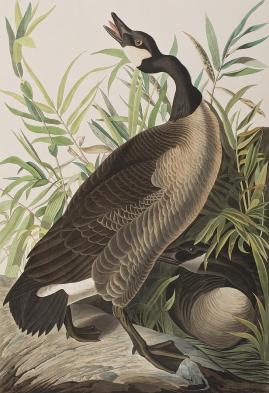
Early American naturalist and artist John James Audubon captured this pair of Canada geese in a most realistic painting.

The world’s geese are not as numerous as ducks, but there are still about 20 species of geese worldwide, compared to about 120 species of ducks. While both ducks and geese are lumped together as waterfowl, most geese are more terrestrial than ducks. Birders are just as likely to spot geese in a pasture or on the greens of a golf course as they are on a lake or pond.

There have been several species of geese usually considered rare to uncommon in the region that have been spotted by birders thus far this winter season. I personally observed greater white-fronted geese at several different locations in November and December.

The greater white-fronted goose is considerably smaller than a Canada goose. The bird is named for the distinctive white band found at the base of bill. This white band also helps distinguish this goose from similar domestic geese. The sexes are similar in appearance, but females are usually smaller than males. The head, neck and upper back of white-fronted geese are grayish-brown. The lower back and rump are dark brown, and the tail is dark brown and edged with white. The chest and breast are grayish with dark brown to black blotches and bars on the breast, giving this goose the nickname “specklebelly.” The bill is pinkish and the legs and feet are orange.

Canada-Greater

Photo by Bryan Stevens The Greater White-fronted Goose, in background, is much smaller than the typical Canada Goose, which is shown in the foreground of this photograph.

The greater white-fronted goose breeds in North America as well as in Europe and Asia, and they spend the winter throughout the United States and even in Japan. Most nesting in North America takes place on the North Slope of Alaska and across the western and central Canadian Arctic. Wintering habitats include coastal marshes, wet fields and and freshwater wetlands.

Only a couple of weeks ago, I spotted a snow goose at the fish pond located at Erwin Fishery Park. The snow goose is a North American goose known for its white plumage that gives the bird its common name; however, the snow goose actually comes in two versions: the white phase and a blue phase, which is often referred to as a “blue goose.”

The snow goose breeds in regions in the far north, including Alaska, Canada, Greenland and even the northeastern tip of Siberia. They may spend the winter as far south as Texas and Mexico, although some will migrate no farther than southwestern British Columbia in Canada.

The snow goose bucks the trends that show many species of waterfowl declining. Recent surveys show that the population of the snow goose exceeds five million birds, which is an increase of more than 300 percent since the mid-1970s. In fact, this goose is thriving to such a degree that the large population has begun to inflict damage on its breeding habitat in some tundra regions.

A smaller relative to the snow goose is the Ross’s goose, which for all practical purposes looks like a snow goose in miniature. The common name of this goose honors Bernard R. Ross, who was associated with the Hudson’s Bay Company in Canada’s Northwest Territories.

Ross-onWater

Photo by Bryan Stevens • A visiting Ross’s goose takes a swim on the large pond at Northeast State Community College in Elizabethton, Tennessee, a few winters ago.

Here’s a quick history lesson. Hudson’s Bay Company is the oldest commercial corporation in North America. The company has been in continuous operation for more than 340 years, which ranks it as one of the oldest in the world. The company began as a fur-trading enterprise, thanks to an English royal charter in back in 1670 during the reign of King Charles II. These days, Hudson’s Bay Company owns and operates retail stores throughout Canada and the United States.

In addition to his trade in furs, Ross collected specimens for the Smithsonian Institution in Washington, D.C. Ross is responsible for giving the goose that now bears his name one of its early common names – the Horned Wavy Goose of Hearne. I wonder why that never caught on?

Ross repeatedly insisted that this small goose was a species distinct from the related and larger lesser snow goose and greater snow goose. His vouching for this small white goose eventually convinced other experts that this bird was indeed its own species.

Ross was born in Ireland in 1827. He died in Toronto, Ontario, in 1874. He was described by other prominent early naturalists as “enthusiastic” and “a careful observer” in the employ of Hudson’s Bay Company. When John Cassin gave the Ross’s Goose its first scientific name of Anser rossii in 1861, he paid tribute to the Hudson’s Bay Company’s Ross.

Canada_Geese

Photo by Bryan Stevens • In some areas, Canada geese have become so prevalent that they are considered pests. Human handouts to waterfowl are not always compatible with good health for the birds that receive them.

The Ross’s goose has a “cuteness” factor working in its favor. For a goose, it is rather small. It could best be described as a snow goose in miniature. In fact, it isn’t much larger than such ducks as mallards and is considered the smallest of North America’s geese.

The Ross’s goose has also acquired some other common names, including “galoot” and “scabby-nosed wavey.” This latter name was inspired by the bird’s bill, which is covered with rough bumps around the base. I have to admit that “scabby-nosed wavey” is a name likely to stick in the memory. Today, the Ross’s goose’s scientific name is Chen rossii.

Other geese found worldwide include the pink-footed goose, bar-headed goose, emperor goose, red-breasted goose and barnacle goose.

So, does this inspire you to try a wild goose chase of your own? If it does, best of luck in your efforts.

•••••

To learn more about birds and other topics from the natural world, friend Stevens on Facebook at https://www.facebook.com/ahoodedwarbler. If you have a question, wish to make a comment or share a sighting, email ahoodedwarbler@aol.com.

A-Cackling Goose 1

Photo by Bryan Stevens • A Cackling goose, foreground, is shown in relation to some larger Canada geese, at a pond at Fishery Park in Erwin, Tennessee.

Visit by Yellow-headed blackbird, last seen in region in 1994, creates a stir

Bugaboo Springs Road near Jonesborough, Tennessee, saw some heavier vehicular traffic in mid-January after the exciting observation of a yellow-headed blackbird associating with a sizable flock of brown-headed cowbirds.

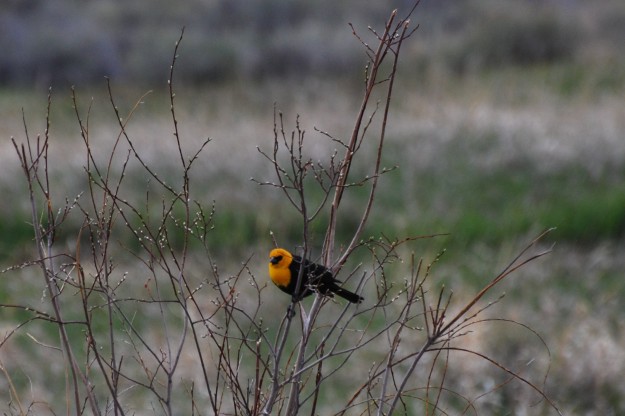
Yellow-headedBlackbird-JBoro

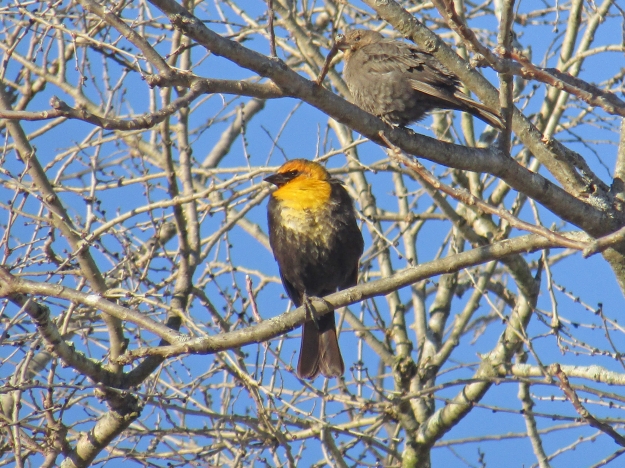
Photo by Bryan Stevens • This yellow-headed blackbird has been residing with flocks of brown-headed cowbirds and European starlings at a cattle pasture near Jonesborough, Tennessee. The bird, the first of its kind seen in Northeast Tennessee since 1994, has generated excitement among birders. Some people have traveled from as far as Knoxville, Tennessee, and Roanoke, Virginia, to see the bird.

The bird came to the attention of Dawn Peters, a resident along Bugaboo Springs Road, who noticed the unusually colorful bird at her feeders while looking out the window of her laundry room. At first, she thought the bird might be an oddball member of the cowbird flock.

“I’d never seen one before,” she said. “I knew it was something strange and something new.”

Dawn took the time to take a photograph of the bird and then contacted friends Jean and Brookie Potter, who also happened to be birders. They alerted her to the rare status of her feeder visitor.

“He really stood out,” Dawn said of the blackbird with a yellow head.

The yellow-headed blackbird arrived at her feeders on a snowy day when the temperatures had plunged. Dawn said she has been feeding birds for 20 years since she and her husband moved to Bugaboo Springs Road near Jonesborough, Tennessee. “The birds know where to come for food,” she said. “I try to feed them all, but they can eat you out of house and home.”

IMG_2235

Photo by Bryan Stevens This yellow-headed blackbird and several brown-headed cowbirds perch in a tree after foraging for food in a cattle lot near Jonesborough, Tennessee.

Dawn said she gets a variety of birds at her feeders, ranging from sparrows and cardinals to mourning doves and finches. “I also get downy woodpeckers and towhees,” she added.

On occasion, she will notice a hawk in the yard. In the summer, she puts out several feeders with sugar water to attract hummingbirds. “Last summer, I had brown thrashers raise a family in my yard,” she said.

Although the yellow-headed blackbird arrived with a flock of brown-headed cowbirds, the other flock members didn’t exactly embrace him. “Some of the cowbirds would peck at him,” she said.

While the yellow-headed blackbird hasn’t been back to her feeders since Jan. 13, the bird was rediscovered less than a mile from her home in a feed lot for cattle. The yellow-headed blackbird has continued to associate with large flocks of cowbirds and European starlings and has been observed by dozens of birders.

The yellow-headed blackbird, known by the scientific name Xanthocephalus xanthocephalus, is a relative of cowbirds, as well as the familiar red-winged blackbird. It’s a unique species in that it is the only member of the genus, Xanthocephalus. Breaking this word down from its ancient Greek origins, the name means, quite literally “yellow headed.”

Yellow-headedBlackbird-Copy

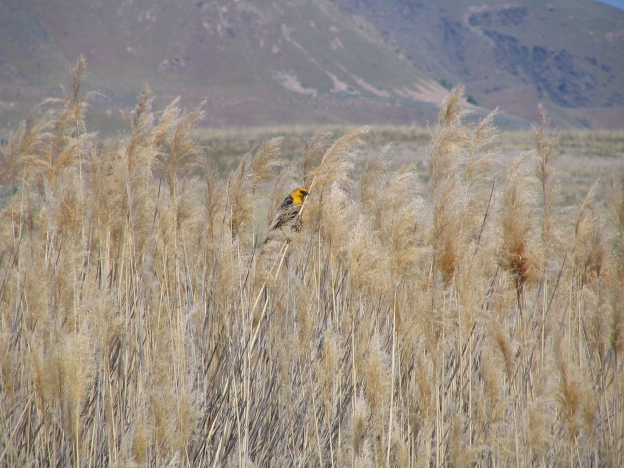
Photo by Bryan Stevens This yellow-headed blackbird was photographed at Antelope Island State Park in Utah in 2006.

The yellow-headed blackbird’s also a species that has been only a rare visitor to the region. While a common bird in wetland habitats west of the Great Lakes, the yellow-head blackbird has not been reported often in East Tennessee. In fact, there are only a handful of records since the 1930s, the most recent sightings being reported and documented in 1990 and 1994. Since it has been almost a quarter of a century since the last time a yellow-headed blackbird was found in East Tennessee, one could argue that a visit from a vagrant individual of this species was long overdue. In southwest Virginia, there are a couple of records from Smyth County dating back to July of 1985 and March of 1988.

It’s not quite clear why a yellow-headed blackbird ventured into the region in mid-January. Normally, these birds spend the winter months in the southwestern United States and Mexico. They often migrate in huge flocks with other species of birds, which could explain why the bird found itself an honorary member of a flock of cowbirds estimated to number about 300 individuals.

My first attempt to add this species to my Tennessee list ended in failure, although I did enjoy seeing several white-crowned sparrows, a handsome bird that definitely doesn’t deserve being classified as one of the “little brown birds” that so often serves as an offhand designation for sparrows. That attempt was made on the morning of Jan. 18 and may have been ended prematurely. When I got access to a computer later, I checked to see if any other observations had been reported. I noticed a report from local birder Michelle Sparks, who saw the bird probably less than 90 minutes after I had ended my first attempt.

7ee8ab76db6c1c18d9bac62d3c602b30--john-james-audubon-blackbird 2

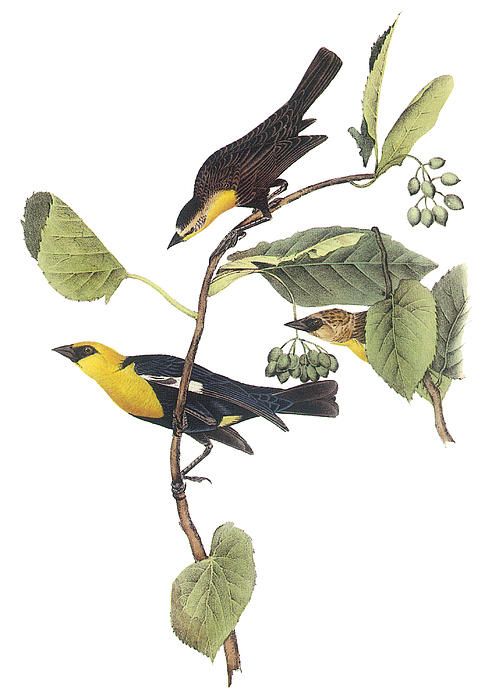
Early American naturalist and painter John James Audubon painted these yellow-headed blackbirds.

Speculating that the yellow-headed blackbird and its accompanying flocks of brown-headed cowbirds and European starlings would return to the feedlot to forage before dark, I returned at 4 p.m. to try again. I found the feedlot overwhelmed by hundreds of cowbirds and starlings, but I didn’t see any sign of a bird with a yellow head. Many of the cowbirds carpeted the pasture as they gleaned seeds and other food items. Many of the starlings were perched in the branches of trees and on the roof of an old farmhouse. At some point, almost every bird in the chaotic flock spooked and took to the air. The flock wheeled and turned, with most of the birds settling into the upper branches of some of the taller trees at the location. I soon detected a flash of yellow. I’m not sure where the bird had been hiding earlier, but the yellow-headed blackbird proved unmistakable, perched high in the trees with the sun shining brightly. He couldn’t hide from my binoculars or camera, which I used to snap several photos of this rare visitor to the region.

I have this species on my life list, having seen yellow-headed blackbirds during visits to Utah in 2003 and 2006. While in Utah, I also saw red-winged blackbird, brown-headed cowbirds and Brewer’s blackbirds, including a partial albino individual that presented a challenge in identifying.

While technically a songbird, the yellow-headed blackbird routinely ranks as one of the worst singers among North America’s songbirds. The yellow-headed blackbird is not all musical, with its song repertoire ranging from what has been described as “cacophonous strangling noises” and “honking gurgles” on the website for the publication, “Birdwatcher’s Digest.”

JEAN-Yellow-headed Blackbird

Photo by Jean Potter • This yellow-headed blackbird was photographed in Colorado in 2016.

The New World’s blackbirds belong to the family of birds, Icteridae, which also consists of birds such as meadowlarks, orioles, cowbirds, grackles, bobolinks and oropendolas. Although many blackbirds show predominantly black plumage, these birds often contrast their dark coloration with yellow, orange or red feathers. The name of the genus stems from Ancient Greek and Latin words that, translated into English, mean roughly, “jaundiced ones,” which stems from the yellow feathers present in the plumage of many species. Other blackbirds in the New World include tawny-shouldered blackbird, saffron-cowled blackbird, melodious blackbird, oriole blackbird and scarlet-headed blackbird. In the United States, other nesting species in the family include Brewer’s blackbird, tri-colored blackbird and rusty blackbird. The last of these species has shown chronic long-term and acute short-term population declines, based both on breeding season and wintering ground surveys. Some estimates suggest that the rusty blackbird population has declined by 80 percent, which could soon endanger the species.

I’m hoping the yellow-headed blackbird on Bugaboo Springs Road is liking where it has found itself this winter and will continue to delight observant birders over the upcoming weeks.

•••••

Bryan Stevens lives near Roan Mountain, Tennessee. If you have a question, wish to make a comment or share a sighting, email ahoodedwarbler@aol.com.

IMG_2236 2

Photo by Bryan Stevens • Birders from near and far converged on Bugaboo Springs Road near Jonesborough, Tennessee, to search for the yellow-headed blackbird.

Red-shouldered hawk makes a fascinating, if somewhat shy, guest

People who feed the birds soon get to know the feisty personalities from the retiring wallflowers when it comes to the visitors to their yards. Northern mockingbirds, male ruby-throated hummingbirds and American robins are usually counted among the more boisterous birds.

Then there are the birds that shrink from interaction and hang back on the fringes, including wood thrushes, Eastern towhees and the large but shy pileated woodpecker. The latter example just goes to show that size doesn’t always equate with an extroverted personality when it comes to birds.

Redshouldered_Hawk-LeeKarney

Photo by U.S. Fish and Wildlife Service/Lee Karney • Red-shouldered hawks prefer to perch and ambush prey. They drop on unsuspecting prey, which varies from reptiles and amphibians to rodents, that come within reach.

That’s certainly the case with a red-shouldered hawk that has taken up residence for the winter at my home. The hawk usually favors a stand of trees near the fish pond at my home when it visits the yard. The hawk made its initial appearances in December and then lingered into the new year. So far, the hawk has been a very shy guest. I’ve wanted to photograph the bird, but that’s difficult to do when it spooks and flies off the instant I step outside the door of my home. I’m not too disappointed because I know that raptors that are too comfortable around humans are at risk of running afoul of misinformed individuals who may regard all predatory birds as “bad.” The reality is that all hawks are valuable components of a healthy, working ecosystem with each species filling a certain niche.

According to a factsheet published by the New York State Department of Environmental Conservation, this raptor breeds in moist woodlands, riverine forests, the borders of swamps, open pine woods and similar habitats. Nesting almost always occurs near water, such as a swamp, river or pond.

Red-shoulderHawk

Photo by Bryan Stevens • This captive red-shouldered hawk was rehabilitated after suffering an injury and now works in an educational program at Brookgreen Gardens in South Carolina to teach the public about raptors, other birds, and various types of wildlife.


The red-shouldered hawk is an ambush predator. This raptor usually selects a favorable perch and remains still while scanning for possible prey. The hawk will drop rapidly onto any prey that wanders carelessly within range. In the summer, prey items largely consist of reptiles and amphibians, including snakes and frogs, as well as some insects and crayfish. Most of these creatures are scarce during the colder months of the year, which prompts these hawks to adopt a diet that focuses on rodents and the occasional songbird. Other than the altercations with the resident crows, I haven’t observed any encounters between the hawk at my home and any other birds — with one exception.

On a recent morning, the hawk was on its usual perch — a branch of a large willow adjacent to the fish pond — when seven Canada geese, another rare visitor to my home, suffered some sort of fright and took flight. The noisy geese flew directly over the willow, which spooked the raptor into taking flight in the opposite direction of the departing geese.

Red-shoulder-Pawleys 3

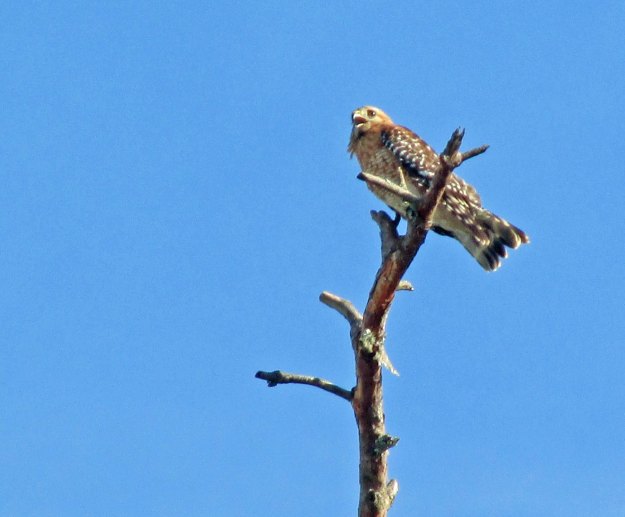
Photo by Bryan Stevens • A calling red-shouldered hawk perched in a dead tree on Pawleys Island in South Carolina.

The red-shouldered hawk produces a distinctive, piercing whistle that reminds me of the shrill call of a killdeer. The hawk at my house has been silent so far, perhaps not wishing to draw attention. The few times the local crows have noticed the hawk’s presence, they’ve flocked together to mob the unfortunate hawk. It’s also not the right time of year. During courtship and the subsequent nesting period, these hawks are vocal. At other times of the year, they are rarely heard. It’s also possible to mistakenly think you have heard one of these large hawks. Blue jays have apparently learned to imitate the “kee-yar” call of this hawk, often working a flawless rendition of the whistled notes of this large raptor.

In contrast to the related red-tailed hawk, the red-shouldered hawk soars less and prefers to perch hidden in the cover of trees. This hawk’s name comes from the reddish-brown shoulder patches in the bird’s wings. Adults show a tail marked with vivid bands of black and white that is quite distinctive.

The red-shouldered hawk belongs to the same genus of raptors as its larger relative, the red-tailed hawk. The genus, buteo, includes about two dozen large raptors that are often dominant avian predators in their respective habitats. The red-shouldered hawk is known by the scientific name Buteo lineatus.

red-shouldered-hawk-john-james-audubon

Early naturalist and artist John James Audubon painted this pair of red-shouldered hawk.

The red-shouldered hawk is less common in the region than some of the other raptors. This hawk’s stronghold is in Florida and other southern states like South Carolina and Georgia. I’ve seen many of these hawks on visits to both the Sunshine State and Palmetto State.

Some of the buteo species have adapted to life on islands, including the Galapagos hawk and the Hawaiian hawk. Some of these hawks have quite descriptive names, including the white-throated hawk, gray-lined hawk, zone-tailed hawk and short-tailed hawk. Outside the United States, raptors in the buteo genus are often known as buzzards. When the first European colonists came to the New World, they applied the term buzzard to both native vultures, as well as the large raptors like Swainson’s hawk and broad-winged hawk that reminded them of the ones back in Europe.

It’s been nice hosting this beautiful raptor, although the crows might disagree with me. A neighbor who lives close to me has had red-shouldered hawks spend the summer months on her property, so I’m hopeful that my visitor might even like the surroundings well enough to become a full-time resident.

•••••

Bryan Stevens lives near Roan Mountain, Tennessee. To learn more about birds and other topics from the natural world, friend him on Facebook at https://www.facebook.com/ahoodedwarbler. If you have a question, wish to make a comment or share a sighting, email ahoodedwarbler@aol.com.

Red-shouldered-Finally

Photo by Bryan Stevens • In a timely fashion, this red-shouldered hawk, which has avoided the camera for weeks, arrived on this rainy day in late January on the same date this post inspired by this bird was published.

Winter wren one of the season’s low-profile visitors

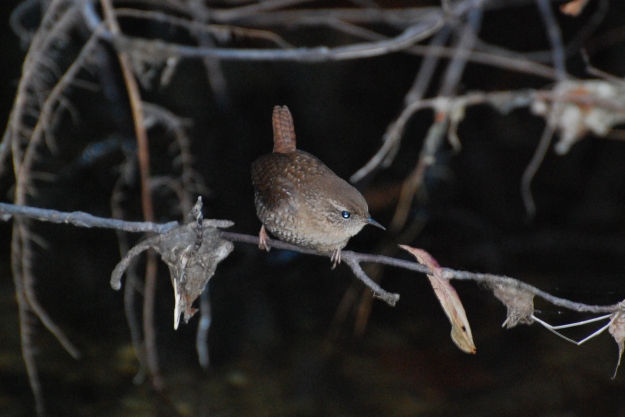
WinterWren

Photo by Jean Potter
What the winter wren lacks in size, it makes up for with its voice. A boisterous and exuberant singer during the spring nesting season,  winter wrens are also quick to scold intruders into their winter territories.


Of late, every time I step outside my front door I’ve incurred the ire of a winter wren that’s taken up residency in my yard. This wren is a tiny bird among a family of birds known for small size, but it makes its presence known in unmistakable terms.

For starters, the winter wren is a noisy bird. The one living at my home arrived in late November and immediately claimed a niche to call its own. Any intrusion is met with a scolding chatter as the wren scurries low to the ground to drop out of view. In fact, the winter wren’s a very terrestrial bird. Observers are just as likely to see one of these wrens run across the ground as they are to see it take flight. I’m hopeful he will remain as winter’s grip tightens for the next couple of months.

The website All About Birds, managed by The Cornell Lab of Ornithology, offers advice on making a wren-friendly yard. “Landscaping with native plants is a good way to provide habitat for Winter Wrens,” according to the website. Other steps to take could extend to creating brush piles and ensuring some sections of the yard offers dense vegetation. The website also notes that this wren is often found making its home near streams.

In the summer, the winter wren often nests atop some of the high-elevation mountains in the region, especially ones with abundant fir and spruce trees. Otherwise, it’s mostly a winter visitor in the region. Other wrens common to the region include the Carolina wren and the house wren. In suitable habitats, especially during fall and spring migration, two other wrens — marsh wren and sedge wren — are observed occasionally in the region. Other wrens native to the United States include the rock wren, canyon wren, cactus wren, Pacific wren and Bewick’s wren.

The world’s 88 species of wrens are, for the most part, the quintessential “little brown birds,” but that hasn’t kept them from acquiring some interesting and descriptive common names. Some examples include the tooth-billed wren, flutist wren, riverside wren, whiskered wren, happy wren, musician wren, timberline wren, speckle-breasted wren, white-breasted wood wren and giant wren. The last species on the list resides in Mexico and is indeed a “giant” among a family of tiny birds, reaching a length of almost nine inches and weighing all of 1.8 ounces.

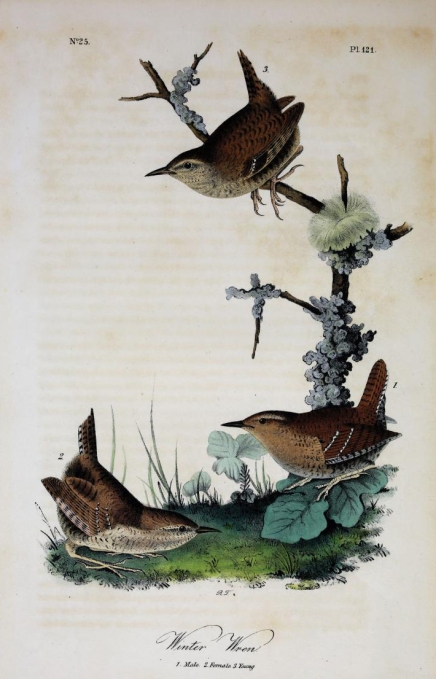
For the most part, wrens are birds of the New World. In fact, only the Eurasian wren represents the family in Europe, Asia and Africa. Experts recently split the winter wren into several different species, including the Pacific wren of the west coast of North America and the Eurasian wren of Europe, Asia and Africa.WinterWren_edited-1

Just as the winter wren thinks nothing of acting like a mouse when scurrying through leaf litter and over fallen logs in search of insect prey, this bird doesn’t hesitate to imitate mice by poking into shadowy holes in the ground or exploring the dark crevices of fallen logs. When winter temperatures drop sharply, many of these birds may cram themselves into a roosting hole to benefit from the communal heat from so many tiny feathered bodies in such close proximity. Winter wrens eat mostly insects and spiders, but in winter these birds will also eat some seeds and berries. Winter wrens rarely visit feeders, but a suet cake often attracts birds with similar dietary preferences, including kinglets and chickadees. A larger relative, the Carolina wren, is a common visitor to feeders.

In English and German lore, the winter wren was known as the “king of the birds.” Different tales provide varying explanations for how such a small bird earned such an inflated title. Ritual hunts were enacted in some European locations. These hunts, known as “wren hunts,” were conducted by “wren boys” who would parade through town on their quests. Wren Day fell on Dec. 26, which coincided with the holiday St. Stephen’s Day. Some myths blame the noisy bird for betraying the hiding place of Stephen, who was delivered up as a Christian martyr to his enemies due to the bird’s treachery. In some European cultures, various superstitions sprang up about wrens. For instance, in Scotland it is considered extremely unlucky to kill a wren.

Personally, I feel lucky to have the tiny winter wren spending time around my home and can guarantee no “wren hunts” will be staged here. At a time of year when feathered friends can be scarce, a winter wren is a welcome visitor.

••••••

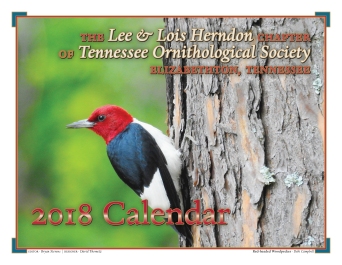
The Lee and Lois Herndon Chapter of Tennessee Ornithological Society produces an annual calendar featuring some exceptional bird photography from its members. This year’s calendar features full-color photographs of some colorful and engaging birds. The club sells the calendars for $15 each. All proceeds are used to support birding opportunities and bird-related causes. For instance, the club pays for bird seed to stock the feeders at Sycamore Shoals State Historic Park in Elizabethton, Tennessee. The club also regularly supports causes that benefit birds.HerndonCalendar2018(Cover)

The calendar also features an informative calendar grid with highlights for major holidays, as well as important bird-related dates. The calendar’s pages feature more than 80 full-color photographs of area birds, including common favorites, as well as a few more exotic birds. The front cover features a dazzling photograph of a red-headed woodpecker. The photo was taken by Debi Campbell, a resident of Bluff City, Tennessee, and current president of the Herndon chapter. If you’re interested in obtaining a calendar, contact ahoodedwarbler@aol.com by email. Calendars will also be available for purchase by cash or check only at the offices of the Bristol Herald Courier located at 320 Bob Morrison Blvd. in Bristol, Virginia.

If you’re interested in obtaining a calendar, contact ahoodedwarbler@aol.com by email. Calendars will also be available for purchase by cash or check only at the offices of the Bristol Herald Courier located at 320 Bob Morrison Blvd. in Bristol, Virginia.

•••••

Bryan Stevens lives near Roan Mountain, Tennessee. If you have a question, wish to make a comment or share a sighting, email ahoodedwarbler@aol.com.


Dark-eyed junco faithful visitor to feeders during wintry weather

Junco-Ground

Photo by Kenneth Thomas / Dark-eyed juncos, often referred to as “snow birds,” flock to feeders in winter during periods of inclement weather.

I recently took part in the 48th annual Elizabethton Fall Count. Although part of the count’s focus is on Carter County, significant attention is paid to the adjacent counties of Johnson, Sullivan, Unicoi and Washington in Northeast Tennessee. This year’s count, which was held Saturday, Sept. 30, with 54 observers in 12 parties, tallied 122 species, which is slightly below the recent 30-year average of 126 species. The all-time high for this count was 137 species, which was reached in 1993.

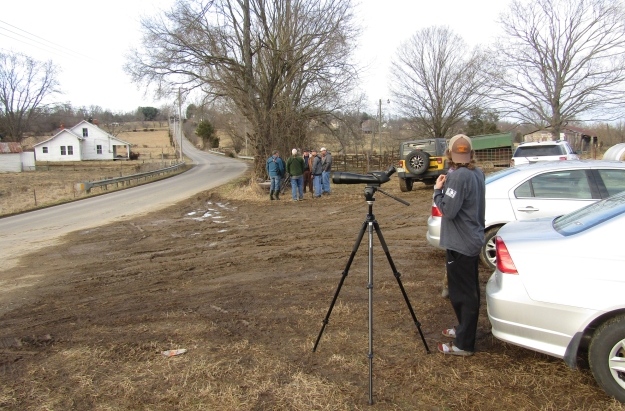
Together with Brenda Richards, I travelled the Forest Service road on Holston Mountain to seek out some species that prefer higher elevation habitats, including dark-eyed juncos. The junco is also a winter visitor to yards and gardens throughout the region and should be returning any day now for a seasonal stay during the colder months of the year. During our progress up the mountain, we glimpsed several dark-eyed juncos as well as other birds such as blue-headed vireo and black-and-white warbler.

I have always had a fondness for juncos. In fact, I wrote my first birding column on Sunday, Nov. 5, 1995, which means that I recently celebrated the 22nd anniversary of my weekly accounts of birds and birding. The column has appeared weekly without interruption in various newspapers in the last 22 years. The column has also been a great conduit for getting to know other people interested in our “feathered friends.” I always enjoy hearing from readers, and I hope to continue to do so in the coming years. Since February of 2014, I’ve also been posting the column as a weekly blog on birds and birding.

Here, with some revisions I have made through the years, is that first column that has now involved into a look that is all “For the Birds.”
…..

Of all the birds associated with winter weather, few are as symbolic as the Dark-eyed Junco, or “snow bird.” The junco occurs in several geographic variations.dennisjl 2

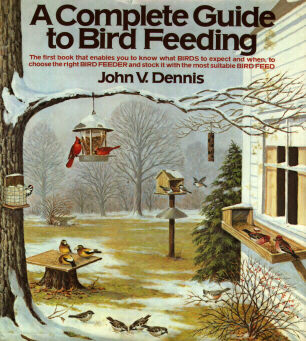
John V. Dennis, author of “A Complete Guide to Bird Feeding,” captures the essence of the junco in the following description: “Driving winds and swirling snow do not daunt this plucky bird. The coldest winter days see the junco as lively as ever and with a joie de vivre that bolsters our sagging spirits.” The Dark-eyed Junco’s scientific name, hyemalis, is New Latin for “wintry,” an apt description of this bird.

Most people look forward to the spring return of some of our brilliant birds — warblers, tanagers and orioles — and I must admit that I also enjoy the arrival of these birds. The junco, in comparison to some of these species, is not in the same league. Nevertheless, the junco is handsome in its slate gray and white plumage, giving rise to the old saying “dark skies above, snow below.”

Just as neotropical migrants make long distance journeys twice a year, the junco is also a migrating species. But in Appalachia, the junco is a special type of migrant. Most people think of birds as “going south for the winter.” In a basic sense this is true. But some juncos do not undertake a long horizontal (the scientific term) migration from north to south. Instead, these birds merely move from high elevations, such as the spruce fir peaks, to the lower elevations. This type of migration is known as vertical migration. Other juncos, such as those that spend their breeding season in northern locales, do make a southern migration and, at times, even mix with the vertical migrants.
Juncos are usually in residence around my home by early November. Once they make themselves at home I can expect to play host to them until at least late April or early May of the following year. So, for at least six months, the snow bird is one of the most common and delightful feeder visitors a bird enthusiast could want.

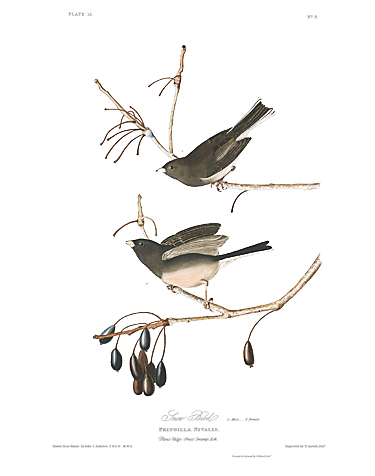
john-james-audubon-limited-centennial-edition-giclee-on-paper-dark-eyed-junco-2

Early American naturalist and artist John James Audubon painted this pair of Dark-eyed Juncos.

Juncos flock to feeders where they are rather mild-mannered — except among themselves. There are definite pecking orders in a junco flock, and females are usually on the lower tiers of the hierarchy. Females can sometimes be distinguished from males because of their paler gray or even brown upper plumage.

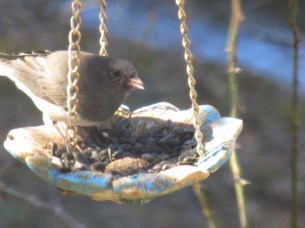
Since juncos are primarily ground feeders, they tend to shun hanging feeders. But one winter I observed a junco that had mastered perching on a hanging “pine cone” feeder to enjoy a suet and peanut butter mixture.

Dark-eyed juncos often are content to glean the scraps other birds knock to the ground. Juncos are widespread. They visit feeders across North America. The junco is the most common species of bird to visit feeding stations. They will sample a variety of fare, but prefer such seeds as millet, cracked corn or black oil sunflower.

There’s something about winter that makes a junco’s dark and light garb an appropriate and even striking choice, particularly against a backdrop of newly fallen snow.

Junco-AtFeeder

Photo by Bryan Stevens / A Dark-eyed Junco perches on the side of a hanging feeder offering sunflower seeds.

Of course, the real entertainment from juncos come from their frequent visits to our backyard feeders. When these birds flock to a feeder and begin a furious period of eating, I don’t even have to glance skyward or tune in the television weather forecast. I know what they know. Bad weather is on the way!

•••••

If you have a question, wish to make a comment or share a sighting, email ahoodedwarbler@aol.com.