Tag Archives: Tennessee

75 years strong, annual Elizabethton Christmas Bird Count breaks old records

GreaterWF-Goose

The 75th consecutive Elizabethton Christmas Bird Count held last month shattered records for this long-running survey. This year’s CBC was held on Saturday, Dec. 16, with 25 observers in six parties participating. The 85 species tallied established a new high for this count, shattering the old mark of 80 species set in 2012 and again in 2016. The average total over the last 30 years of the Elizabethton CBC is 72 species.

Participants included Fred Alsop, Jim Anderson, Jerry Bevins, Rob Biller, Rick Blanton, Kevin Brooks, Gil Derouen, Harry Lee Farthing, Dave Gardner, Carl Hacker, Jacki Hinshaw, David Irick, Rick Knight (compiler), Roy Knispel, Richard Lewis, Joe McGuiness, Charles Moore, Brookie and Jean Potter, Brenda Richards, Chris Soto, Amber Stanley, Bryan Stevens, Kim Stroud, and Scott Turner.

I took part in this CBC, as I have for many years, with fellow members and friends of the Elizabethton Bird Club. Participation in this annual survey has been a part of my holiday traditions for the past 20 years. The tradition of the CBC, however, goes much farther back.

According to the National Audubon Society’s website, the tradition of the Christmas Bird Count arose from a less than bird-friendly custom. By the turn of the 20th century, so-called sportsmen would conduct a “Side Hunt,” a rather bloodthirsty Christmas custom that saw hunters competing to see who could score the largest amount of feathered and furred corpses. It was a huge step forward for conservation when preeminent ornithologist Frank M. Chapman proposed a new holiday tradition. His radical idea was to count birds during the Christmas season rather than hunting and killing them.

chapman

Ornithologist Frank Chapman organized the very first Christmas Bird Count back   in December of 1900.

The Christmas Bird Count is now conducted each year on dates between Dec. 14 and Jan. 5. The first CBC took place in December of 1900 with 27 observers participating at 25 locations in the United States and Canada. Fifteen of the counts were conducted in the northeastern United States in an area ranging from Massachusetts to Philadelphia, Pennsylvania. Results from that first count in 1900 didn’t truly reflect the diversity of North America’s birds, but they were nonetheless interesting. The Greater Boston CBC consisted of only one participant and found only 17 species. However, some of those species included such good birds as American tree sparrow, brown creeper, Northern shrike and Northern bobwhite.

The Elizabethton Bird Club traditionally compiles the results from its two annual CBCs (Roan Mountain as well as Elizabethton) at its yearly Christmas party. This year when the tallies were added up, count participants were delighted to learn the count had set a new record with an amazing total of 85 species tallied, which is hard to come by in mid-December in Northeast Tennessee. An abundance of waterfowl helped push up the number of species found.

A few species are becoming more expected on this annual December count. For instance, greater white-fronted goose was found for the third time in the last five years. Before that, this goose had never been found on this count.

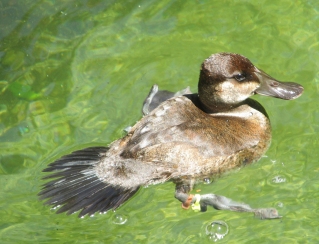
The bufflehead, the smallest of the diving ducks, set a new record with 293 individuals found. Four Northern Shovelers represented only the eight time this duck has appeared on the count. Greater Scaup were found for only the seventh time in the last 25 years. Ruddy Duck has now been found three times in the last 25 years, which matches the three occasions it was found prior to that time.

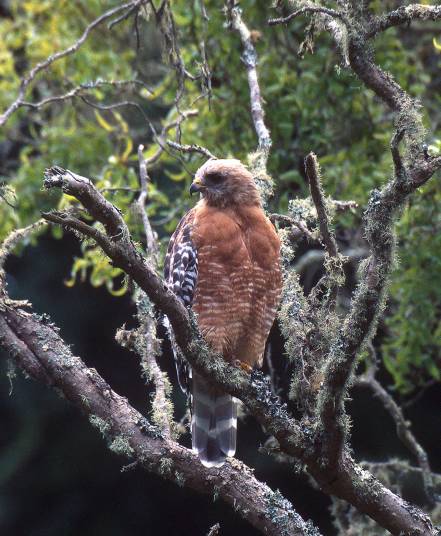
Bald eagles, thanks to locations like Watauga Lake and Wilbur Lake, are also becoming more common. Eagles have been found 20 of the last 25 years, but only once prior. Red-shouldered Hawk, which is uncommon in the region, was found for the sixth time in the last quarter-century.
Redshouldered_Hawk-LeeKarney

Photo by U.S. Fish & Wildlife Service/Lee Karney • A Red-shouldered Hawk perches in branches.

Eurasian Collared-Dove appears established in Elizabethton. This dove has been found six of the last nine years since it first made an appearance on the count.

All seven of the region’s woodpecker were found on this year’s CBC. The Red-headed Woodpecker has shown up on four counts in the last 25 years. This woodpecker was only found seven times in the years prior to 1992.

A Blue-headed Vireo spotted on this year’s count represented only the third time this species has been found. A flock of 75 American Pipits marked only the third time this species has been seen since 1992 on a CBC. Prior to that date, the species appeared only twice on an Elizabethton CBC.

Gray Catbird has been found five of the last 25 years, including this year, but only once prior to 1992. Palm Warbler, found only once prior to 1992, has now been found eight of the last 25 years. The single Pine Warbler seen means that this species has now been found four of the last 25 years, but only four times prior to 1992.

The European Starling with 1,335 individuals found on count day was easily the most common species on this year’s CBC. The 16 Dark-eyed Juncos, usually a relatively common species on the Elizabethton CBC, represented the fewest juncos ever found on this long-running survey.

Below is the complete species list:

Greater White-fronted Goose, 1; Canada Goose, 532; Wood Duck,1; Gadwall, 5; American Wigeon, 1; American Black Duck, 2; Mallard, 366; Northern Shoveler, 4; Green-winged Teal, 2; Ring-necked Duck, 14; Greater Scaup, 2; Lesser Scaup, 3; Bufflehead, 293; Hooded Merganser, 4; and Ruddy Duck, 1.
Ruddy-Hen

Photo by Bryan Stevens • A female Ruddy Duck.

Wild Turkey, 33; Common Loon, 2; Pied-billed Grebe, 14; Horned Grebe, 27; Great Blue Heron, 18; Black Vulture, 3; Turkey Vulture, 12; Bald Eagle, 3; Sharp-shinned Hawk, 1; Cooper’s Hawk, 2; Red-shouldered Hawk, 2; and Red-tailed Hawk, 25.

Killdeer,17; Ring-billed Gull, 27; Rock Pigeon, 305; Eurasian Collared-Dove, 1; Mourning Dove, 157; Eastern Screech-Owl, 12; Great Horned Owl, 2; Barred Owl, 1; and Belted Kingfisher, 10.

Red-headed Woodpecker, 1; Red-bellied Woodpecker, 33; Yellow-bellied Sapsucker, 8; Downy Woodpecker, 27; Hairy Woodpecker, 3; Northern Flicker, 26; and Pileated Woodpecker, 21.

American Kestrel, 16; Eastern Phoebe, 12; Blue-headed Vireo,1; Blue Jay, 162; American Crow, 223; and Common Raven, 4.

Red-breastedNutHatchYAHOO

Photo by Bryan Stevens • A Red-breasted Nuthatch at a feeder.

Carolina Chickadee, 117; Tufted Titmouse, 84; Red-breasted Nuthatch, 1; White-breasted Nuthatch, 25; Brown Creeper, 4; House Wren, 1; Winter Wren, 6; and Carolina Wren, 75.

Golden-crowned Kinglet, 41; Ruby-crowned Kinglet, 8; Eastern Bluebird, 111; Hermit Thrush, 11; Amercian Robin, 277; Gray Catbird, 1; Brown Thrasher, 1; and N. Mockingbird, 49.

Eurasian Starling, 1,335; American Pipit, 75; Cedar Waxwing, 154; Palm Warbler, 2; Pine Warbler, 1; and Yellow-rumped Warbler, 154.

Eastern Towhee, 22; Chipping Sparrow, 4; Field Sparrow, 8; Song Sparrow, 142; Swamp Sparrow, 5; White-throated Sparrow,102; Dark-eyed Junco, 16; and Northern Cardinal, 111.

Red-winged Blackbird, 1; Eastern Meadowlark, 1; Brown-headed Cowbird, 2; House Finch, 100; American Goldfinch, 90; and House Sparrow, 41.

The Audubon-sponsored CBC allows counts to also list birds not found on the count day that are seen during count week. This year participants found Redhead ducks, which were not present on count day. Notable misses this year include Ruffed Grouse, American Coot, Wilson’s Snipe, and White-crowned Sparrow.
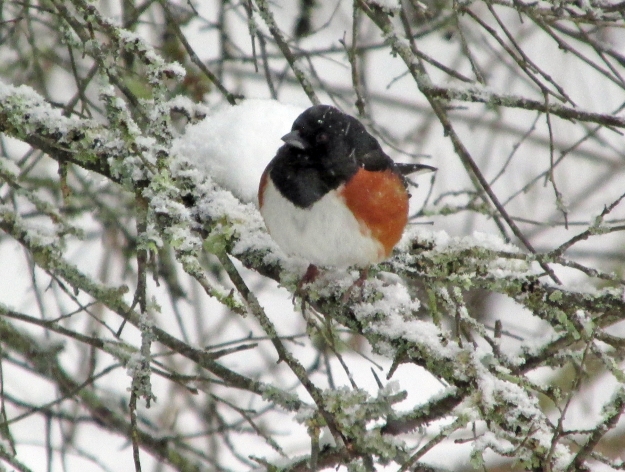
Towhee-Feb12

Photo by Bryan Stevens • A male Eastern Towhee waits out a snowstorm.
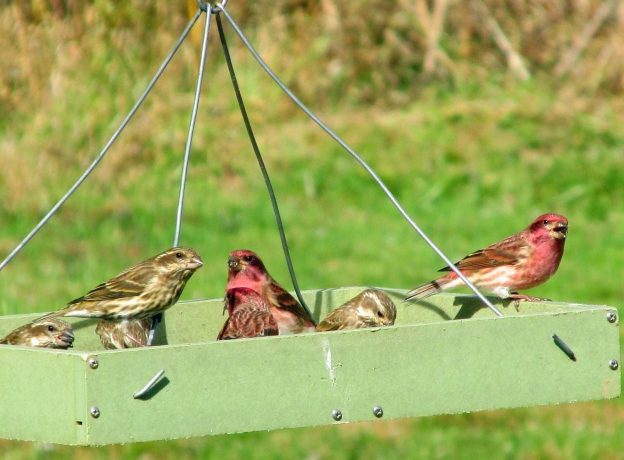
Purple finches always welcome winter visitors when snow and cold drives them to feeders

Purple-March30

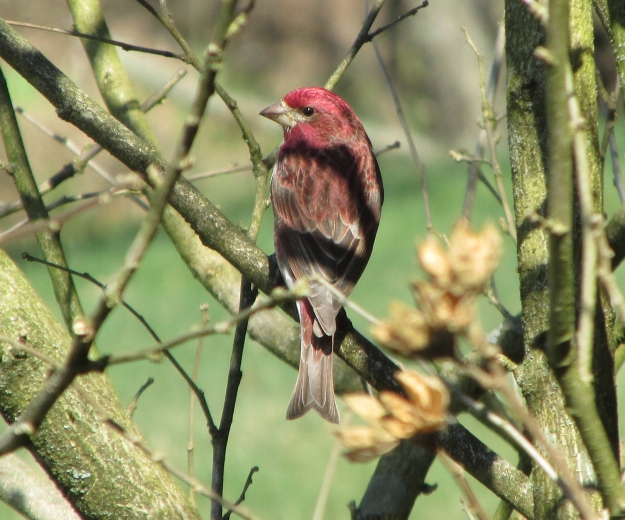
Photo by Bryan Stevens • Purple finches are mainly winter visitors in the region, although they may make appearances during their fall and spring migrations. Although similar to house finches, purple finches have their own unique appearance once observers become familiar with them. The notched tail, evident in this bird, is a good way to distinguish purple finches from very similar house finches.

The region experienced its first brush with wintry weather with the snowstorm that arrived Dec. 8. With a few inches of snow on the ground, some birds that had been ignoring my feeders decided to give them a second look. American goldfinches, dark-eyed juncos and a red-bellied woodpecker made frequent visits to the feeders over the weekend as more snow and cold temperatures put a temporary stop to the mild start of the 2017-2018 winter season.

So far, the feathered clientele at my feeders are the expected visitors, including Carolina chickadees, downy woodpeckers, song sparrows and white-breasted nuthatches. Some birds, such as pine siskin and purple finch, which can make feeder watching an exciting winter pastime, have not yet made an appearance. Both these species belong to a group of birds known in birding circles as “Northern finches” that also includes species like red crossbill, evening grosbeak and common redpoll.

Evening_Grosbeak

Photo by George Gentry/U.S. Fish & Wildlife Service • A male evening grosbeak perches on the side of a sunflower-stocked feeder.

The purple finch, which is a winter visitor to northeast Tennessee, southwest Virginia and western North Carolina is apparently not as common as in past years. Some experts have speculated that the decline in the numbers of purple finches each winter can be attributed, at least in part, to the closely related house finch. Today, the house finch is quite widespread, found across the United States. Originally, however, the house finch was a bird of the western part of the country, living in Mexico and the southwestern United States.

About 1940, the house finch became established in the eastern United States. In violation of federal law, these small finches were being sold in New York City as pet birds described as “Hollywood Finches.” To avoid trouble with authorities, vendors and even some owners released their “Hollywood Finches” into the wild. Finding the area around New York City to their liking, house finches spread. Within a few decades, they were common birds throughout the eastern United States, including Tennessee, Virginia and North Carolina. The house finch had also been introduced into Hawaii about 1870, and is still present today, along with many other species of birds not native to the island.

HousieFinch

Photo by Bryan Stevens • A male house finch perched on a cable. These finches are native to the western United States but became established in the eastern states thanks to the illicit pet trade.

As the house finch claimed a new range, they inevitably encountered the related purple finch. During the winter, both finches are often present at feeders in the region. When both are available for observation, bird enthusiasts should take advantage of the opportunity to compare and contrast these birds. Personally, I have never had any difficulty distinguishing a purple finch from a house finch. The two species, at least in my eyes, are easily recognized. I can understand why some people might have trouble separating the two birds. The late Roger Tory Peterson once described the purple finch as a bird “dipped in raspberry juice.” Think about that imagery for a moment and you’ve got a good start to distinguishing a male purple finch from a male house finch. Unfortunately, the description does nothing to distinguish females of the two species.

Let’s deal first with the males. Male purple finches are delicate pink-red (that raspberry coloration) on the head and breast, mixing with brown on the back and cloudy white on the belly. The red of a male purple finch is definitely a color I have not observed with many other birds. Even “red” birds such as male Northern cardinals and male scarlet tanagers do not show the same red color. Once you learn the way the red appears in the plumage of a male purple finch, you are on your way to telling this bird apart from its relative.

purple-finch-john-james-audubon

Early naturalist and artist John James Audubon painted this depiction of purple finches.

The red in the plumage of male house finches is surprisingly variable. In most cases, the heads, necks and shoulders of male birds are reddish and the red at times extends to the stomach and between the wings on the bird’s back. The intensity of the red changes with the seasons and is also derived from the berries and fruits in the bird’s diet. Pale yellow and bright orange are alternatives to the typical red plumage.

Look closely at the photograph of the purple finches accompanying this column. There’s a distinctive facial pattern evident on the birds. The strong facial markings include a whitish eye stripe and a dark line down the side of the throat. This pattern simply doesn’t exist with the male house finch. When I make a snap identification of these two birds, I always look for the facial pattern even before I study any other aspects of the appearance of the bird. In addition, purple finches have powerful, conical beaks and a tail that appears short and is clearly notched at the tip. Rounding out the description of a male house finch is the fact that they have a long, square-tipped brown tail and are brown or dull-brown across the back with some shading into gray on the wing feathers. The breast and stomach feathers may be streaked.

Females of both house finches and purple finches are dull brown birds that could easily be mistaken for sparrows. Again, the facial pattern is much more apparent on a female purple finch than on the related female house finch. In addition, I have always noticed that female purple finches are usually a darker shade of brown than the dull brown female house finches. Both male and female house finches are more slender than their more chunky-bodied counterparts.

PurpleFinches

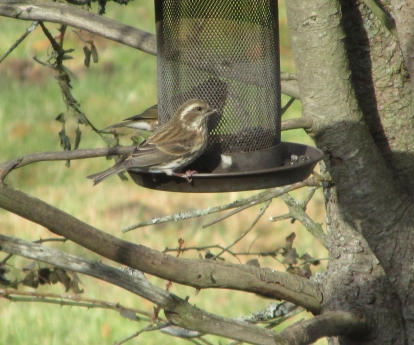
Photo by Bryan Stevens • A study of the facial pattern of a female purple finch helps contrast her from similar female house finches. Again, the notched tail is also a good indication of the bird’s identity.

In the United States, another close relative of the house finch and purple finch is the Cassin’s finch of the western United States. Together, the three species make up a classification known as the American rosefinches. Formerly placed in the genus Carpodacus, these three birds are now in the genus known as Haemorhous. The new classification separates them from the Eurasian rosefinches, which includes more than two dozen species including scarlet finch, great rosefinch and crimson-browed finch.

Purple finches occupy a variety of winter habitats, including fields and woodland edges, as well as yards and gardens. All it takes to lure these finches to your feeder is a plentiful offering of sunflower seeds. If you are lucky enough to have both of these finches visiting your feeders, take time to study the differences. It takes some practice, but they can be distinguished quite confidently.

Merry Christmas to all my fellow bird enthusiasts! 

Good intentions can have ill effects for ducks, geese, other waterfowl


Pattie Rowland contacted me on Facebook recently with a valid concern, especially now that the temperatures are turning a little cooler. People with good intentions often visit parks to feed the ducks and geese that reside at ponds and creeks.


“I see people with bags of bread thinking they are helping the ducks and geese,” she explained.

Despite the good intentions, Pattie, a resident of Erwin, Tennessee, has some concerns about the practice and requested that I help raise awareness about the possible unintended consequences.

While I’m not an expert, I applaud her attempt to raise the issue about what foods are nutritional and which are not when it comes to feeding wild or domesticated waterfowl. So, I did some research into the topic.

Dave McRuer, the director of Wildlife Medicine at the Wildlife Center of Virginia, wrote about the risks associated with feeding waterfowl in a 2015 article on the center’s website.

McRuer noted that wild ducks and geese feed on a variety of natural foods, such as wild grains and grasses, aquatic plants, and invertebrates. This varied diet provides the essentials waterfowl need to thrive.

Mallard-Drakes

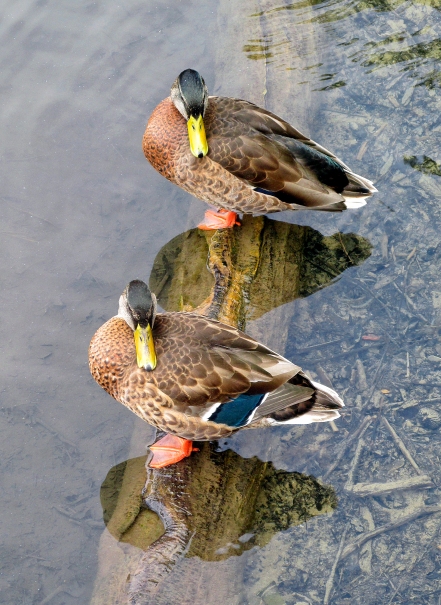
Photo by Bryan Stevens • Mallard drakes share a log during a period of relaxation. Mallards, Canada Geese, and some other waterfowl have voluntarily semi-domesticated themselves in exchange for an easy, but not always healthy, life based on human handouts.

On the other hand, McRuer warned about some of the foods commonly fed to waterfowl in public parks, such as bread, popcorn and corn, are typically low in protein and essential nutrients and minerals. Waterfowl feeding heavily on such fare are at risk for developing nutritional disorders.


His ultimate conclusion was that any benefits are far outweighed by risks when it comes to the feeding of waterfowl at public parks. His recommendation was to stop all forms of supplemental feeding.


He based his recommendation on more than nutritional concerns. Supplemental feeding can also lead to overcrowding, disease concerns, habitat degradation, and an unhealthy habituation to humans or animals associated with humans.


There are some alternatives to the quitting “cold turkey” option when it comes to feeding ducks and geese. Melissa Mayntz, a birder with more than 30 years of experience, penned an article for the website, The Spruce, recommending some foods that will not expose waterfowl to potential harm.


In an article titled “What to Feed Ducks,” Mayntz wrote that it is important to realize that waterfowl are capable of fending for themselves and do not require human handouts to survive, no matter what the season nor how much they seem to beg for treats. She did offer some tips on choosing nutritious treats to supplement the wild diet of park waterfowl.


Various grains, such as cracked corn, wheat, barley, oats, and rice can safely be offered as an occasional treat. In addition, she recommended grapes (sliced in half), chopped lettuce or other greens and vegetable trimmings or peels chopped into small, easily eaten pieces.

Mallard-March28

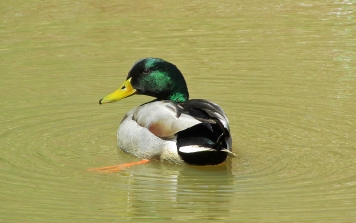
Photo by Bryan Stevens • A Mallard drake still shows some caution toward humans, arguing that this individual has not become dependent on human handouts.

Mayntz’s article basically echoes many of the warnings from the one by McRuer. Some of the foods commonly offered, such as bread, crackers, cereal and popcorn, offer very little nutritional value. In addition, bread and other similar foods are dangerous if they are moldy. Increasing the disk is the fact that any excess bread that isn’t eaten can quickly mold. Molded food can kill waterfowl, which is the last thing people would want to happen to these birds.


I agree with Mayntz in her conclusion, which admits that feeding waterfowl at local ponds and parks can be a fun experience in wildlife viewing for people of all ages. By avoiding potentially dangerous foods and restricting treats to items that actually provide nutritional value, birders can continue to enjoy this pastime without risking the lives of the birds they love so much.


As a general rule, I don’t feed the waterfowl at local parks. Many years ago I fed a flock of semi-domesticated mallards that took up residence at my fish pond. From a half dozen birds, the flock eventually grew to about two dozen ducks. The only food I fed them was cracked corn during the winter season. They foraged quite successfully for the rest of their food from the pond, the nearby creek and the fields. I’m convinced they helped control the numbers of pest insects during their stay. To this day, an occasional pair of mallards will visit on cold winter days. At times, they look at me like they’re expecting a handout and I wonder if they could be descendants of some of those mallards from the original flock.

Canada_Geese

Photo by Bryan Stevens • In some areas, Canada Geese have become so prevalent that they are considered pests. Human handouts to waterfowl are not always compatible with good health for the birds that receive them.


So, don’t let good intentions cause problems for any of our feathered friends. If you want to feed ducks at the local park, consider the healthy alternatives instead of providing bread. After all, people cannot live on bread alone, and neither can ducks.
 

•••••

Calendars make fun Christmas presents

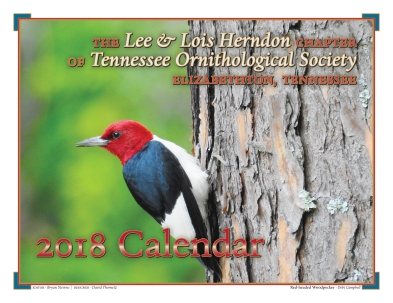
The Lee and Lois Herndon Chapter of Tennessee Ornithological Society produces an annual calendar featuring some exceptional bird photography from its members. This year’s calendar features full-color photographs of some colorful and engaging birds. The club sells the calendars for $15 each. All proceeds are used to support birding opportunities and bird-related causes. For instance, the club pays for bird seed to stock the feeders at Sycamore Shoals State Historic Park in Elizabethton, Tennessee. The club also regularly supports causes that benefit birds.HerndonCalendar2018(Cover)

The calendar also features an informative calendar grid with highlights for major holidays, as well as important bird-related dates. The calendar’s pages feature more than 80 full-color photographs of area birds, including common favorites, as well as a few more exotic birds. The front cover features a dazzling photograph of a red-headed woodpecker. The photo was taken by Debi Campbell, a resident of Bluff City, Tennessee, and current president of the Herndon chapter. If you’re interested in obtaining a calendar, contact ahoodedwarbler@aol.com by email. Calendars will also be available for purchase by cash or check only at the offices of the Bristol Herald Courier located at 320 Bob Morrison Blvd. in Bristol, Virginia.

If you’re interested in obtaining a calendar, contact ahoodedwarbler@aol.com by email. Calendars will also be available for purchase by cash or check only at the offices of the Bristol Herald Courier located at 320 Bob Morrison Blvd. in Bristol, Virginia.


Annual Fall Bird Count finds 122 species in Northeast Tennessee

Heron-UnderBridge

Photo by Bryan Stevens • A Great Blue Heron wades through the creek running through downtown historic Jonesborough on a warm afternoon this past summer. These large herons, helped by recent nesting colonies in Erwin, Elizabethton and other locations, have become more commonplace in the region. The 66 Great Blue Herons found on the recent Fall Bird Count represented a new high number for the species on this annual autumn survey of bird populations in the region.


The 48th annual Elizabethton Fall Count was held on Saturday, Sept. 30, with 54 observers in 12 parties covering Carter County and parts of the adjacent counties of Johnson, Sullivan, Unicoi and Washington. The participants tallied 122 species, which is slightly below the recent 30-year average of 126 species. The all-time high for this count was 137 species, which was reached in 1993.

Shorebirds were in very short supply due to a shortage of suitable habitat. Aside from killdeer, a solitary sandpiper was true to his name. In particular, two sites that formerly attracted shorebirds have undergone alterations that have essentially eliminated such conditions: Austin Springs and Bush Hog Pond.

This year’s count featured some other notable misses, as well, according to long-time count compiler Rick Knight. Birds missed include Northern Bobwhite (which has been found only four times in the last 24 years), Broad-winged Hawk, Spotted Sandpiper (first miss in last decade), Winter Wren, and Blue-gray Gnatcatcher.

Several birds set new high records for the number of individuals tallied, including Double-crested Cormorant (70); Great Blue Heron (66); Black Vulture (330); Turkey Vulture (215); Red-shouldered Hawk (6); Belted Kingfisher (40); and Red-bellied Woodpecker (90).

Bryan-KingfisherSunny

Photo by Bryan Stevens • The 40 Belted Kingfishers found during the Fall Bird Count represented a new high count for this long-running survey.

Fish Crow made its debut on a Fall Bird Count debut when two individuals were found in Kingsport along the Holston River.

The count total follows:

Canada Goose, 957; Wood Duck, 24; Mallard, 378; Blue-winged Teal, 2; Hooded Merganser, 1; Ruffed Grouse, 5; Wild Turkey, 79; Pied-billed Grebe, 11; and Double-crested Cormorant, 70.
Great Blue Heron, 66; Great Egret, 1; Green Heron, 4; Black-crowned Night-Heron, 2; Black Vulture, 330; and Turkey Vulture, 215.

Osprey, 12; Bald Eagle, 6; Northern Harrier, 2; Sharp-shinned Hawk, 7; Cooper’s Hawk, 7; Red-shouldered Hawk, 6; Red-tailed Haw, 27; American Kestrel, 16; Merlin, 1; and Peregrine Falcon, 1.

Killdeer 50; Solitary Sandpiper, 1; Ring-billed Gull, 1; Forster’s Tern, 1; Rock Pigeon, 404; Eurasian Collared-Dove, 2; Mourning Dove, 356; Yellow-billed Cuckoo, 1; Eastern Screech-Owl, 12; Great Horned Owl; 10; Barred Owl; 4; and Northern Saw-whet Owl; 1.

Common Nighthawk, 1; Chimney Swift, 254; Ruby-throated Hummingbird 8; Belted Kingfisher, 40; Red-headed Woodpecker, 7; Red-bellied Woodpecker, 90; Yellow-bellied Sapsucker, 16; Downy Woodpecker, 46; Hairy Woodpecker, 8; Northern Flicker, 63; and Pileated Woodpecker, 37.

Eastern Wood-Pewee 6; Eastern Phoebe, 76; Eastern Kingbird, 1; Loggerhead Shrike, 1; White-eyed Vireo; 2; Yellow-throated Vireo, 1; Blue-headed Vireo, 14; Red-eyed Vireo, 6; Blue Jay, 447; American Crow, 424; Fish Crow, 2; and Common Raven, 19.

SolitarySandpiper-One

Photo by Bryan Stevens • Migrating shorebirds, such as this Solitary Sandpiper, added diversity to this year’s Fall Bird Count in Northeast Tennessee.

Northern Rough-winged Swallow, 3; Tree Swallow, 68; Carolina Chickadee, 174; Tufted Titmouse,93; Red-breasted Nuthatch, 6; White-breasted Nuthatch, 44; Brown Creeper, 2; House Wren, 2; and Carolina Wren,180.

Golden-crowned Kinglet, 4; Ruby-crowned Kinglet,14; Eastern Bluebird, 163; Veery, 7; Gray-cheeked Thrush, 26; Swainson’s Thrush, 70; Hermit Thrush, 1; Wood Thrush, 19; American Robin, 301; Gray Catbird, 34; Brown Thrasher, 11; Northern Mockingbird, 100; European Starling, 2,106; and Cedar Waxwing, 205.

Ovenbird, 2; Black and White Warbler, 6; Tennessee Warbler, 32; Common Yellowthroat, 9; Hooded Warbler, 2; American Redstart, 5; Cape May Warbler, 8; Northern Parula, 3; Magnolia Warbler, 29; Bay-breasted Warbler, 10; Blackburnian Warbler, 2; Chestnut-sided Warbler, 2; Black-throated Blue Warbler, 5; Palm Warbler, 21; Pine Warbler, 11; Yellow-rumped Warbler, 5; Yellow-throated Warbler, 4; Prairie Warbler, 1; and Black-throated Green Warbler, 8.

grosbeak-photo

Photo by Bryan Stevens • Migrating Rose-breasted Grosbeaks were among the 122 species tallied for this year’s Fall Bird Count.

Eastern Towhee, 50; Chipping Sparrow, 57; Field Sparrow, 14; Song Sparrow,144; Lincoln’s Sparrow, 1; Swamp Sparrow, 1; Dark-eyed Junco, 75; Summer Tanager, 1; Scarlet Tanager, 11; Northern Cardinal, 173; Rose-breasted Grosbeak, 19; Indigo Bunting, 15.

Red-winged Blackbird, 41; Eastern Meadowlark, 17; Common Grackle, 859; Brown-headed Cowbird, 78; House Finch, 44; Pine Siskin, 1; American Goldfinch, 138; and House Sparrow, 33.

•••••

Bryan Stevens has been writing about birds on a weekly basis since 1995. If you have a question, wish to make a comment or share a sighting, email ahoodedwarbler@aol.com.

Dark-eyed junco faithful visitor to feeders during wintry weather

Junco-Ground

Photo by Kenneth Thomas / Dark-eyed juncos, often referred to as “snow birds,” flock to feeders in winter during periods of inclement weather.

I recently took part in the 48th annual Elizabethton Fall Count. Although part of the count’s focus is on Carter County, significant attention is paid to the adjacent counties of Johnson, Sullivan, Unicoi and Washington in Northeast Tennessee. This year’s count, which was held Saturday, Sept. 30, with 54 observers in 12 parties, tallied 122 species, which is slightly below the recent 30-year average of 126 species. The all-time high for this count was 137 species, which was reached in 1993.

Together with Brenda Richards, I travelled the Forest Service road on Holston Mountain to seek out some species that prefer higher elevation habitats, including dark-eyed juncos. The junco is also a winter visitor to yards and gardens throughout the region and should be returning any day now for a seasonal stay during the colder months of the year. During our progress up the mountain, we glimpsed several dark-eyed juncos as well as other birds such as blue-headed vireo and black-and-white warbler.

I have always had a fondness for juncos. In fact, I wrote my first birding column on Sunday, Nov. 5, 1995, which means that I recently celebrated the 22nd anniversary of my weekly accounts of birds and birding. The column has appeared weekly without interruption in various newspapers in the last 22 years. The column has also been a great conduit for getting to know other people interested in our “feathered friends.” I always enjoy hearing from readers, and I hope to continue to do so in the coming years. Since February of 2014, I’ve also been posting the column as a weekly blog on birds and birding.

Here, with some revisions I have made through the years, is that first column that has now involved into a look that is all “For the Birds.”
…..

Of all the birds associated with winter weather, few are as symbolic as the Dark-eyed Junco, or “snow bird.” The junco occurs in several geographic variations.dennisjl 2

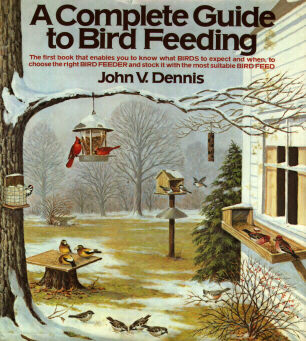
John V. Dennis, author of “A Complete Guide to Bird Feeding,” captures the essence of the junco in the following description: “Driving winds and swirling snow do not daunt this plucky bird. The coldest winter days see the junco as lively as ever and with a joie de vivre that bolsters our sagging spirits.” The Dark-eyed Junco’s scientific name, hyemalis, is New Latin for “wintry,” an apt description of this bird.

Most people look forward to the spring return of some of our brilliant birds — warblers, tanagers and orioles — and I must admit that I also enjoy the arrival of these birds. The junco, in comparison to some of these species, is not in the same league. Nevertheless, the junco is handsome in its slate gray and white plumage, giving rise to the old saying “dark skies above, snow below.”

Just as neotropical migrants make long distance journeys twice a year, the junco is also a migrating species. But in Appalachia, the junco is a special type of migrant. Most people think of birds as “going south for the winter.” In a basic sense this is true. But some juncos do not undertake a long horizontal (the scientific term) migration from north to south. Instead, these birds merely move from high elevations, such as the spruce fir peaks, to the lower elevations. This type of migration is known as vertical migration. Other juncos, such as those that spend their breeding season in northern locales, do make a southern migration and, at times, even mix with the vertical migrants.

Juncos are usually in residence around my home by early November. Once they make themselves at home I can expect to play host to them until at least late April or early May of the following year. So, for at least six months, the snow bird is one of the most common and delightful feeder visitors a bird enthusiast could want.

john-james-audubon-limited-centennial-edition-giclee-on-paper-dark-eyed-junco-2

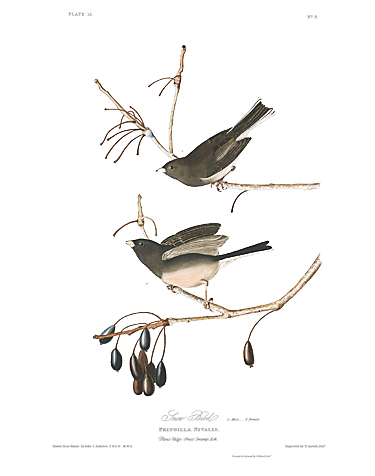
Early American naturalist and artist John James Audubon painted this pair of Dark-eyed Juncos.

Juncos flock to feeders where they are rather mild-mannered — except among themselves. There are definite pecking orders in a junco flock, and females are usually on the lower tiers of the hierarchy. Females can sometimes be distinguished from males because of their paler gray or even brown upper plumage.

Since juncos are primarily ground feeders, they tend to shun hanging feeders. But one winter I observed a junco that had mastered perching on a hanging “pine cone” feeder to enjoy a suet and peanut butter mixture.

Dark-eyed juncos often are content to glean the scraps other birds knock to the ground. Juncos are widespread. They visit feeders across North America. The junco is the most common species of bird to visit feeding stations. They will sample a variety of fare, but prefer such seeds as millet, cracked corn or black oil sunflower.

There’s something about winter that makes a junco’s dark and light garb an appropriate and even striking choice, particularly against a backdrop of newly fallen snow.

Junco-AtFeeder

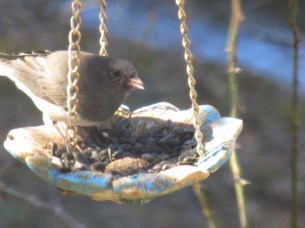
Photo by Bryan Stevens / A Dark-eyed Junco perches on the side of a hanging feeder offering sunflower seeds.

Of course, the real entertainment from juncos come from their frequent visits to our backyard feeders. When these birds flock to a feeder and begin a furious period of eating, I don’t even have to glance skyward or tune in the television weather forecast. I know what they know. Bad weather is on the way!

•••••

If you have a question, wish to make a comment or share a sighting, email ahoodedwarbler@aol.com.

Hummingbird numbers spike as summer season advances toward autumn


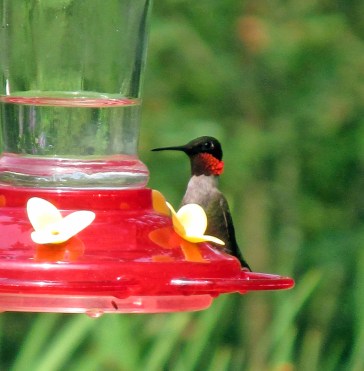
From the shade of my front porch, I watched about a half dozen ruby-throated hummingbirds cavort among the blooms of a large mimosa tree on a recent evening. The tree apparently holds an extraordinary attraction for the hummingbirds, as well as the pipevine swallowtail butterflies and other pollinating insects. I enjoyed watching the greenish hummingbirds zip among the profusion of pink mimosa blossoms, which have always reminded me of the thin fiber-optic filaments popular on some artificial Christmas trees and other decorations during the holidays. To draw so many different insects, as well as hummingbirds, the mimosa blooms must provide a rich source of nectar.

While I have almost wilted from the recent extended heat wave, the ruby-throated hummingbirds at my home appear to have downright thrived during these sunny, hot days of mid-summer. Once again, these tiny birds must have enjoyed a successful nesting season, based on the numbers of young hummers visiting both my feeders and flowers. The uptick in the presence of hummingbirds took place without much fanfare, but after a couple of months of “hummer doldrums,” it was impossible for any observer to miss the way these tiny birds have become much more prevalent in recent weeks.

Coinciding with this resurgence of the hummingbirds at my home, I received a post on Facebook from Philip Laws, a resident of Limestone Cove. Apparently, Philip, too, has noticed that hummingbird numbers are on the rise.

RubyRed

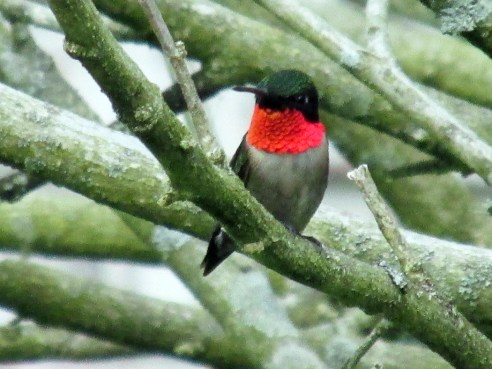
Photo by Bryan Stevens • A male ruby-throated hummingbird perches near a feeder that he is ready to defend from all comers.

“Seemed like a slow hummingbird summer,” he wrote. “But two days ago the babies started hitting the feeders and everything looks much brighter!”

I also enjoyed a recent phone conversation with Erwin resident Don Dutton, who wanted to know why hummingbirds have been scarce around his home this summer. I’ve noticed fewer hummers at my own home this summer, but it’s natural for numbers to fluctuate from year to year. I anticipate that numbers will rise as hummingbirds begin migrating south again in the coming weeks. At that time, the adult hummers will be joined by the young birds from this season’s successful nesting attempts.
Don shared that when he lived out west, he often visited Mount Charleston near Las Vegas, Nevada, where he saw swarms of hummingbirds comprised of various different species. In the eastern United States, the only nesting species is the Ruby-throated Hummingbird.

For readers who have felt slighted by hummers so far this season, perhaps it’s time to try your luck again at attracting them. The surest method is to keep a sugar water feeder available to attract them on their way south later this summer and into the fall. A visit to a plant nursery can also provide an abundance of blooms to use to lure hummers to your gardens. Some late-blooming summer flowers attractive to hummingbirds include canna, cardinal flower, gladiola and crocosmia. While the widely held belief is that hummingbirds prefer red blooms, they will gladly visit any flower that rewards them with a sip of nectar.501-7006-blk

Late summer and early fall, even more so than spring, are usually the best times to enjoy hummingbirds, when they are usually at their most common. There are a couple of reasons for this annual increase. First, nesting female hummingbirds have reared their young, which then begin visiting feeders and gardens to compete with their elders at flower blossoms and sugar water feeders. Second, adult males and females that migrated farther north usually begin swinging southward again in late July and early August.

According to the website hummingbirds.net, mature male hummingbirds usually follow an earlier departure date than adult females and immature birds. The organizers of the website theorize that by leaving early in the fall, the adult male hummingbirds free up resources for their developing offspring. After all, it’s the least they can do since adult male hummingbirds play absolutely no role in helping females with the process of nesting and rearing young. All young hummingbirds are, in effect, raised by single mothers.

IMG_2786

Photo by Bryan Stevens • A male ruby-throated hummingbird perches at a feeder for a sip of sugar water.

Despite their tiny size, hummingbirds are tough birds. One species, the rufous hummingbird, ranges as far north as Alaska. Several tropical species have adapted to the frigid conditions that occur at the higher elevations of the Andes Mountains.

As I have done in years past, I advise a patient but proactive approach for attracting hummingbirds. Keep feeders readily available. If possible, offer flowers, too. Don’t keep your landscape too tidy. A perfectly manicured lawn is like a desert for hummingbirds. Provide some shrubs and trees to provide cover and perching branches. Water features, particularly waterfalls and fountains, are also a reliable means of attracting hummingbirds, as well as other birds.

If you have felt slighted by hummers so far this year, keep a sugar water feeder available to attract them on their way south later this summer and into the fall. To share a sighting, make a comment, or ask a question, send email to ahoodedwarbler@aol.com.

•••••

Bryan Stevens has been writing about birds since 1995. To learn more about birds and other topics from the natural world, friend Stevens on Facebook at https://www.facebook.com/ahoodedwarbler. If you have a question, wish to make a comment or share a sighting, email ahoodedwarbler@aol.com.

Sleek elegance of cedar waxwing wins bird many fans

Main-CedarWaxwing-Pic

Photo by Annette Bryant • A cedar waxwing plucks a fresh blueberry.

I still remember my first look at a cedar waxwing. Sleek as silk, wearing a mask like a bandit, with a jaunty crest atop its head, this fairly common bird commands attention when making an appearance in a yard or garden. Of course, it’s usually not alone, more often traveling as a member of a larger flock that can number as high as dozens or even hundreds of individuals.

Cedar waxwings win fans almost anywhere they go. Chances of luring these birds to your home and property can increase by offering some essential requirements. Tall trees, especially those that bear fruit, are attractive to these sociable birds. It’s more often water, not food, however, that will bring a flock of these birds close. They love a good splash in a bath, whether the source is a shallow stream or an ornamental pool set into the landscape.

As noted, they travel in often sizable flocks, usually in search of new food sources. The many members comprising a flock can deplete resources in a remarkably short time. During the winter season, I’ve watched a flock of waxwings make short work of a harvest of berries from a holly tree. Their nomadic lifestyles makes it nearly impossible to predict where cedar waxwings might make an appearance.

Waxwing-Sept11
Photo by Bryan Stevens • A cedar waxwing perches on a branch.

Based on early observation, the wild cherry trees scattered around the edges of my yard are fully laden with berries. As they ripen in late August and into September, the crop will likely attract waxwings as well as a host of other species.

Why is the term “waxwing” applied to this bird? According to the website All About Birds, the name comes from the waxy red secretions found on the tips of wing feathers. The site also notes that the precise function of these waxy tips is not known. There’s speculation among some experts that the bright red tips on the feathers could play a role in helping waxwings attract mates.

The cedar waxwing has few relatives. Worldwide, there are only two other species: the Bohemian waxwing, of the northern forests of Eurasia and North America; and the Japanese waxwing, found in such northeast Asian countries as Japan, Korea and China.

Although it’s classified as a songbird, the cedar waxwing does’t truly produce a vocalization that anyone would contend qualifies as a song. They are, however, very vocal birds, producing shrill, high-pitched notes as they pass through the upper branches of tall trees.

As much as the waxwing has a fondness for fruit, it’s also a bird that would have made an excellent flycatcher. Flocks of these birds will often congregate in trees near the edge of a pond, garden or yard — anywhere winged insects might be found in good numbers — in order to hawk insects on the wing. A waxwing will sally forth from a branch, snatch its prey in mid-air, and return to its perch for a quick snack.

Perhaps because of the late-summer abundance of bugs and berries, cedar waxwings are known for nesting late into the summer. They’re certainly not among the birds impatient to begin nesting as soon as temperatures turn mild in the spring.

Waxwing-Pair

Photo by Bryan Stevens • A pair of cedar waxwings                           hawk for insects near a pond.

Although a female brown-headed cowbird succeeds on occasion at slipping an egg into a waxwing nest, that attempt at foisting offspring onto unwitting foster parents is doomed. According to All About Birds, baby cowbirds will starve on the diet high in fruit fed to waxwing babies.

Now that you know a little more about this sociable and elegant songbird, keep an eye out for cedar waxwings visiting your yard or garden. I know my own wild cherry trees await their arrival.

•••••

Bryan Stevens lives near Roan Mountain, Tennessee. To learn more about birds and other topics from the natural world, friend him on Facebook at https://www.facebook.com/ahoodedwarbler. If you have a question, wish to make a comment or share a sighting, email ahoodedwarbler@aol.com.

Keep a look out for wandering waders during late summer season

Summer heat and humidity make the summer season my least favorite one for birding, but every season brings birding surprises. I was reminded of this fact when Larry and Amelia Tipton sent me a recent email asking for help with the identification of some birds near their home.

Attaching a photo with their email, the Tiptons wrote, “These birds showed up a few days ago and we cannot identify them. We would like to know what they are.”

When I opened the photo, I realized that the birds captured in the image would not be considered out of place if the Tiptons lived near the coast of the Carolinas, Georgia or Florida. The birds in the photo, however, were somewhat unexpected in the foothills of western North Carolina near their home in the town of Old Fort.

WhiteIbises

Photo Courtesy of  Larry and Amelia Tipton • Immature white ibises in a field near the Catawba River in North Carolina.

“We live on a farm near the Catawba River but have mostly woodland and fields,” the couple added. “We do not have a pond on our property but have a branch and a larger creek nearby.”

I wrote back and told the Tiptons that the birds they photographed were young white ibises. I informed the Tiptons that the two young ibises are likely testing their wings, so to speak, after leaving the care of their parents. If they like the area, and it sounds like they do, they may decide that the branch and creek are just what they need.

I received a followup email. “We sort of knew these were water birds but were surprised to find them so far away from marsh or wetlands or the ocean,” the Tiptons wrote. “We thought maybe a storm blew them off course during flight.”

While a diverting storm can’t be ruled out, it’s normal behavior for young wading birds to disperse far and wide after leaving the nest. North American waders, or wading birds, include such long-legged species as herons, egrets, bitterns, ibises, storks and spoonbills. Most species are associated with wetlands or coastal areas.

Late summer birding is usually a period of doldrums as heat and humidity can discourage birders as well as diminish bird activity. However, it’s also the time of year when birders can make some unexpected surprises as wandering waders, such as the ibises discovered by the Tiptons, explore uncharted territory.

Other waders this season showing up in unexpected location have included a wood stork found by Linda Walker in Polk County, Tennessee. Likes the ibises in North Carolina, the stork was confining its activities to a small branch bordered by heavy vegetation. These branches are a far cry from the usual wetland haunts of these two species.

Overall, the white ibis and wood stork have some superficial similarities. They are both long-legged white birds with black wing tips and unusual down-turned bills that they use to probe for food, which largely consists of fish and other aquatic prey.

The latter is North America’s only native stork. According to the National Audubon Society, Florida once provided a stronghold for the wood stork in the United States. Unfortunately, the population crashed in the 1990s, decreasing from around 150,000 birds to fewer than 10,000. In recent years, numbers have increased and wood storks have expanded their breeding range into South Carolina. Wood storks are nearly four feet tall, making them one of the tallest of the waders. Wood storks have a dark, featherless heads, giving them a resemblance to vultures. For the most part, they’re rather grotesque birds when observed at close quarters. Soaring overhead on thermal updrafts, wood storks look quite graceful and even majestic thanks to their white plumage and black accents. A wingspan of 65 inches gives them the means to soar easily.

Storks-Two


Photo by Bryan Stevens 
Worldwide there are 19 species of storks, but the wood stork (pictured) is the only native stork   found in the United States.

The Audubon Society identifies the white ibis as one of the most numerous wading birds in Florida, but the bird is common also in other parts of the southeast with appropriate wetland habitat. Like the wood stork, the ibis has declined in Florida in recent decades largely as a result of human encroachment. The white ibis looks like a bird that could have been invented by Dr. Seuss. The all-white plumage is contrasted by pinkish-orange legs, a reddish-pink bill and bright blue eyes. In flight, the white ibis shows black feathers on the edges of its wings.

The affinity for water and wetlands relates to the diet of most waders, which consists of fish and other aquatic prey such as amphibians, crustaceans and even insects. For the remainder of July and into August and September, birders should monitor ponds, small lakes, rivers and even branches and creeks for any wandering waders. For instance, I once made a trip to a park in Greeneville, Tennessee, to observe a pink-hued roseate spoonbill that had made a rare stopover in the region. While that observation took place nearly 20 years ago, I remember vividly finding the pale pink bird playing odd man out among a flock of several dozen Canada geese as a soft rain drizzled from an overcast sky. Although many of the waders cling to coastal habitats, they have wings like other birds and know how to use them. Other waders have been known to show up in unlikely locations, including birds such as tri-colored heron, limpkin and snowy egret.

Of course, I hope to hear from any readers lucky enough to glimpse one of these unanticipated finds. Enjoy your birding.

•••••

Bryan Stevens lives near Roan Mountain, Tennessee. To learn more about birds and other topics from the natural world, friend Stevens on Facebook at https://www.facebook.com/ahoodedwarbler. He is always posting about local birds, wildlife, flowers, insects and much more.

Skittish nature means getting to know towhees takes some effort

Mary Beierle, who lives in Elizabethton, Tennessee, sent me an email to share information about recent nesting activity by a pair of Eastern towhees at her home in the Stoney Creek community.

“Just wanted to tell you that we have a nesting pair of Eastern towhees here in Stoney Creek,” Mary wrote in her email. “This is the first year they have stayed after a brief visit in early spring.”

While not as many people may be familiar with Eastern towhees as, say, northern cardinals or ruby-throated hummingbirds, those who have made an acquaintance with these unusual songbirds are, like Mary, captivated instantly.

“I am very fond of these birds,” she noted in her email. “The male is really beautiful and the female is also lovely, although not as colorful as the male.”9780307370020-us 2

Eastern towhees spend much of their time on the ground and hidden in thickets and hedges. As a result, other common names for this bird includes “ground robin” and “swamp robin,” which refer to some of this bird’s habitat preferences. They’re not thrushes, however, and are unrelated to thrush family members such as American robin, Eastern bluebird and wood thrush. Instead, towhees are one of the larger members of the sparrow family.

Mary noted some of this bird’s typical behavior from her observations. “I love the way they hop around,” she wrote. “They are very skittish, and I can’t get them to stand still for a photo.”

At my own home, I have a pair of Eastern towhees currently occupied with nesting. When I get too close, both parents claim an elevated perch and call in agitation as long as I am in the vicinity. The towhees are just one of many nesting birds so far this spring. Other nesting birds in my yard or the surrounding woodlands this spring have included tree swallow, Eastern bluebird, brown thrasher, song sparrow, American robin and Eastern phoebe.

The Eastern towhee represents a bit of a milestone in my personal birding history. I saw and identified my first Eastern towhee in early spring in 1993. At that time, I was struggling to identify some of the common visitors at my feeders. I was acquainted with white-breasted nuthatches, blue jays, downy woodpeckers, Carolina wrens, dark-eyed juncos and a handful of other birds. When I looked out a window and saw this bird feeding on the ground, the morning sun illuminating his dramatic plumage of black, white and rufous red, I was immediately aware this visitor represented something new and unexpected.

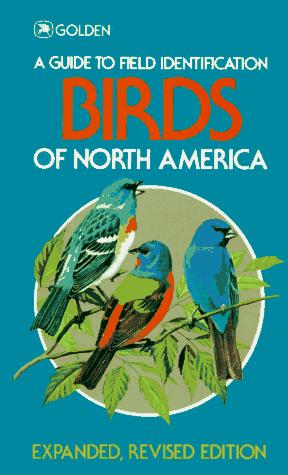
Consulting a field guide — I was using the Golden Nature Guide to the Most Familiar American Birds at the time — I soon found a painted illustration of a rufous-sided towhee that matched in every detail the bird I had just observed on the ground beneath a blue spruce in my yard.

Many of the older field guides still list the Eastern towhee as “rufous-sided towhee” which is actually more descriptive of the bird’s appearance than the word “eastern.” In 1995, ornithologists renamed the rufous-sided towhee to Eastern towhee and also separated the Eastern species from its western counterpart, the spotted towhee. Until that point, these two towhees had been considered different races of the same species. In 2003, I saw a spotted towhee during a visit to Salt Lake City, Utah. The bird looks almost identical to an Eastern towhee except for considerable white spotting — hence its common name — on the bird’s back.

3544493082_02f675508f_o

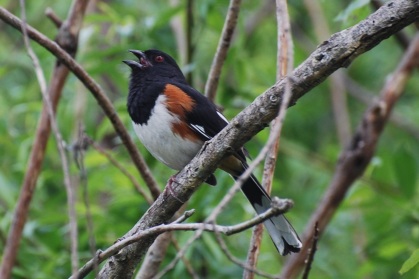
Male Eastern Towhee sings from a perch.

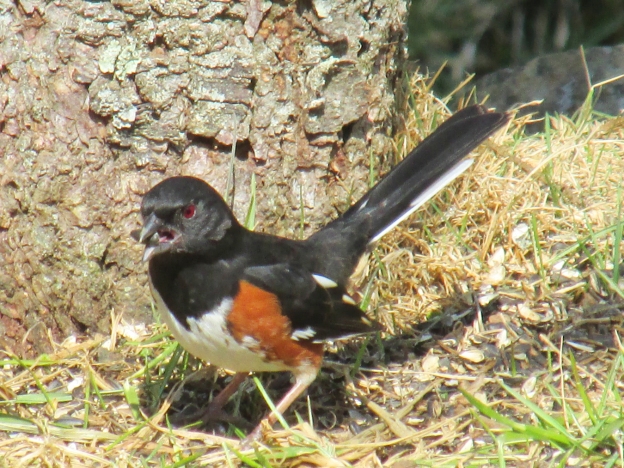
Male and female Eastern towhees each possess a stately if subtle beauty. Males have a black hood. The black coloration extends into the back and tail. The belly is white and the sides are flanked with a rusty-red color. In flight, their black tails are bordered with white feathers, which produces a dramatic flash of contrasting colors. The female Eastern towhee is an attractive bird in her own right. She shares the rufous sides and white coloration that are present in the male’s plumage. However, the male’s black feathers are replaced by a warm, chocolate brown plumage in the female. In addition, their bright red eyes help set these birds apart from other songbirds.

The Eastern towhee is one of my favorite yard birds, but not just because of its dramatic appearance. These birds also have some instantly recognizable vocalizations. With the arrival of spring, the males will seek elevated perches for extensive singing bouts to attract mates and establish territories. Their song has been interpreted, quite accurately, as an emphatically delivered “Drink your tea!” They also have some alarm notes, such as “Chew-ink” and “Toe-Hee,” which provides the basis for this bird’s common name.

Eastern_Towhee

Female Eastern Towhees are usually more retiring than males.

They are often found in the same sort of tangled habitat favored by Northern cardinals, gray catbirds and brown thrashers. To attract these birds, simply refrain from doing too much to alter your landscape. For instance, don’t manicure every square inch of your yard. Leave some wild corners that will run rampant and provide a luxurious tangle for birds that thrive under cover. In the southern United States, towhees prosper in scrub palmetto habitats. In our region, any hedge or bramble thicket will provide adequate cover to make these birds feel welcome.

While they may never completely lose their wariness, towhees will become gradually more accepting of sharing a yard with people. It helps that they will readily visit feeders for sunflower seeds. If you succeed in attracting a family of Eastern towhees to your yard and garden, I am confident you’ll not be disappointed.

Elizabethton summer bird count sets new record

The Lee and Lois Herndon Chapter of Tennessee Ornithological Society, also known as the Elizabethton Bird Club, conducts two summer surveys of area bird life. Last week, the results of the Unicoi County Summer Bird Count were explored. This week, the focus is on the Carter County Summer Bird Count, which set a new record. The 24th Carter County Summer Bird Count was held Saturday, June 10, under favorable weather conditions with twenty observers in six parties. A record high of 123 species were tallied, besting the previous high of 121 species set in 2013. The average over the previous 23 years was 112 species, ranging from a low of 105 to as many as 121.

Long-time count compiler Rick Knight said highlights of the count included seven Ruffed Grouse, including chicks, as well as such species as Yellow-crowned Night-heron, Bald Eagle, Red-shouldered Hawk and 21 species of warblers.

The American Robin, with 392 individuals counted, barely edged out European Starling, with 389 individuals counted, for most numerous bird on this year’s summer count.

Making the Summer Bird Count for the first time was Red-headed Woodpecker, represented by a pair of birds nesting at Watauga Point Recreation Area on Watauga Lake near Hampton. Other notable songbirds found included Vesper Sparrow, Blue Grosbeak, Red Crossbill and Pine Siskin. I counted birds with Chris Soto, Mary Anna Wheat, and Brookie and Jean Potter at such locations as Wilbur Lake, Holston Mountain and Sycamore Shoals State Historic Park.

IMG_4530

Photo by Bryan Stevens • Birds like this Red-bellied Woodpecker helped set a new record for most species on one of the Elizabethton Summer Bird Counts.

The count’s total follows:
Canada Goose, 258; Wood Duck, 7; Mallard, 125; Ruffed Grouse, 7; Wild Turkey, 21; and Double-crested Cormorant, 1.
Great Blue Heron, 10; Green Heron, 1; Yellow-crowned Night-heron, 1; Black Vulture, 7; and Turkey Vulture, 28.
Sharp-shinned Hawk, 1; Cooper’s Hawk, 7; Bald Eagle, 2; Red-shouldered Hawk, 3; Broad-winged Hawk, 7; and Red-tailed Hawk, 5.
Killdeer, 2; Rock Pigeon, 37; Eurasian Collared Dove, 1; Mourning Dove, 137; Yellow-billed Cuckoo, 4; Eastern Screech-owl, 2; Great Horned Owl, 2; Barred Owl, 2; Common Nighthawk, 1; Chuck-will’s-widow, 5; and Whip-poor-will, 8.
Chimney Swift, 80; Ruby-throated Hummingbird, 17; Belted Kingfisher, 3; Red-headed Woodpecker, 2; Red-bellied Woodpecker, 16; Yellow-bellied Sapsucker, 2; Downy Woodpecker, 12; Hairy Woodpecker, 4; Northern Flicker, 18; and Pileated Woodpecker, 24.
American Kestrel, 1; Eastern Wood-Pewee, 17; Eastern Phoebe, 71; Acadian Flycatcher, 20; Alder Flycatcher, 2; Willow Flycatcher, 1; Least Flycatcher, 5; Great Crested Flycatcher, 5; and Eastern Kingbird, 17.
White-eyed Vireo, 2; Yellow-throated Vireo, 2; Warbling Vireo, 1; Blue-headed Vireo, 41; Red-eyed Vireo, 126; Blue Jay, 69; American Crow, 227; and Common Raven, 7.
Northern Rough-winged Swallow, 45; Purple Martin, 53; Tree Swallow, 149; Barn Swallow, 129; and Cliff Swallow, 113.
Carolina Chickadee, 54; Tufted Titmouse, 71; Red-breasted Nuthatch, 12; White-breasted Nuthatch, 16; Brown Creeper, 2; House Wren, 79; Carolina Wren, 67; Blue-gray Gnatcatcher, 28; and Golden-crowned Kinglet, 12.
Eastern Bluebird, 88; Veery, 32; Hermit Thrush, 4; Wood Thrush, 43; American Robin, 392; Gray Catbird, 38; Brown Thrasher, 21; Northern Mockingbird, 42; European Starling, 389; and Cedar Waxwing, 64.
Ovenbird, 70; Worm-eating Warbler, 9; Louisiana Waterthrush, 9; Golden-winged Warbler, 13; Black-and-white Warbler, 26; Swainson’s Warbler, 2; Common Yellowthroat, 28; Hooded Warbler, 95; American Redstart, 6; Northern Parula, 25; Magnolia Warbler, 3; Blackburnian Warbler, 7; Yellow Warbler, 13; Chestnut-sided Warbler, 36; Black-throated Blue Warbler, 38; Pine Warbler, 3; Yellow-rumped Warbler, 1; Yellow-throated Warbler, 14; Black-throated Green Warbler, 26; Canada Warbler, 16; and Yellow-breasted Chat.
Eastern Towhee, 121; Chipping Sparrow, 78; Field Sparrow, 50; Vesper Sparrow, 1; Song Sparrow, 178; Dark-eyed Junco, 69; Scarlet Tanager, 31; Northern Cardinal, 94; Rose-breasted Grosbeak, 12; Blue Grosbeak, 2; and Indigo Bunting, 169.
Red-winged Blackbird, 77; Eastern Meadowlark, 11; Common Grackle, 84; Brown-headed Cowbird, 22; Orchard Oriole, 10; and Baltimore Oriole, 2.
House Finch, 26; Red Crossbill, 1; Pine Siskin, 5; American Goldfinch, 134; and House Sparrow, 27.

•••••

I had a recent phone call with Erwin resident Don Dutton, who wanted to know why hummingbirds have been scarce around his home this summer. I’ve noticed fewer hummers at my own home this summer, but it’s natural for numbers to fluctuate from year to year. I anticipate that numbers will rise as hummingbirds begin migrating south again in the coming weeks. At that time, the adult hummers will be joined by the young birds from this season’s successful nesting attempts.

Ruby-throated-WILLOWS

Photo by Bryan Stevens • Numbers of Ruby-throated Hummingbird in the region tend to fluctuate each year, but people should see a spike in their numbers as the hummingbirds end summer nesting and start migrating south again.

Don shared that when he lived out west, he often visited Mount Charleston near Las Vegas, Nevada, where he saw swarms of hummingbirds comprised of various different species. In the eastern United States, the only nesting species is the Ruby-throated Hummingbird.

If you have felt slighted by hummers so far this year, keep a sugar water feeder available to attract them on their way south later this summer and into the fall. To share a sighting, make a comment, or ask a question, send email to ahoodedwarbler@aol.com.