Tag Archives: warblers

Northern waterthrush provides warbler watching highlight

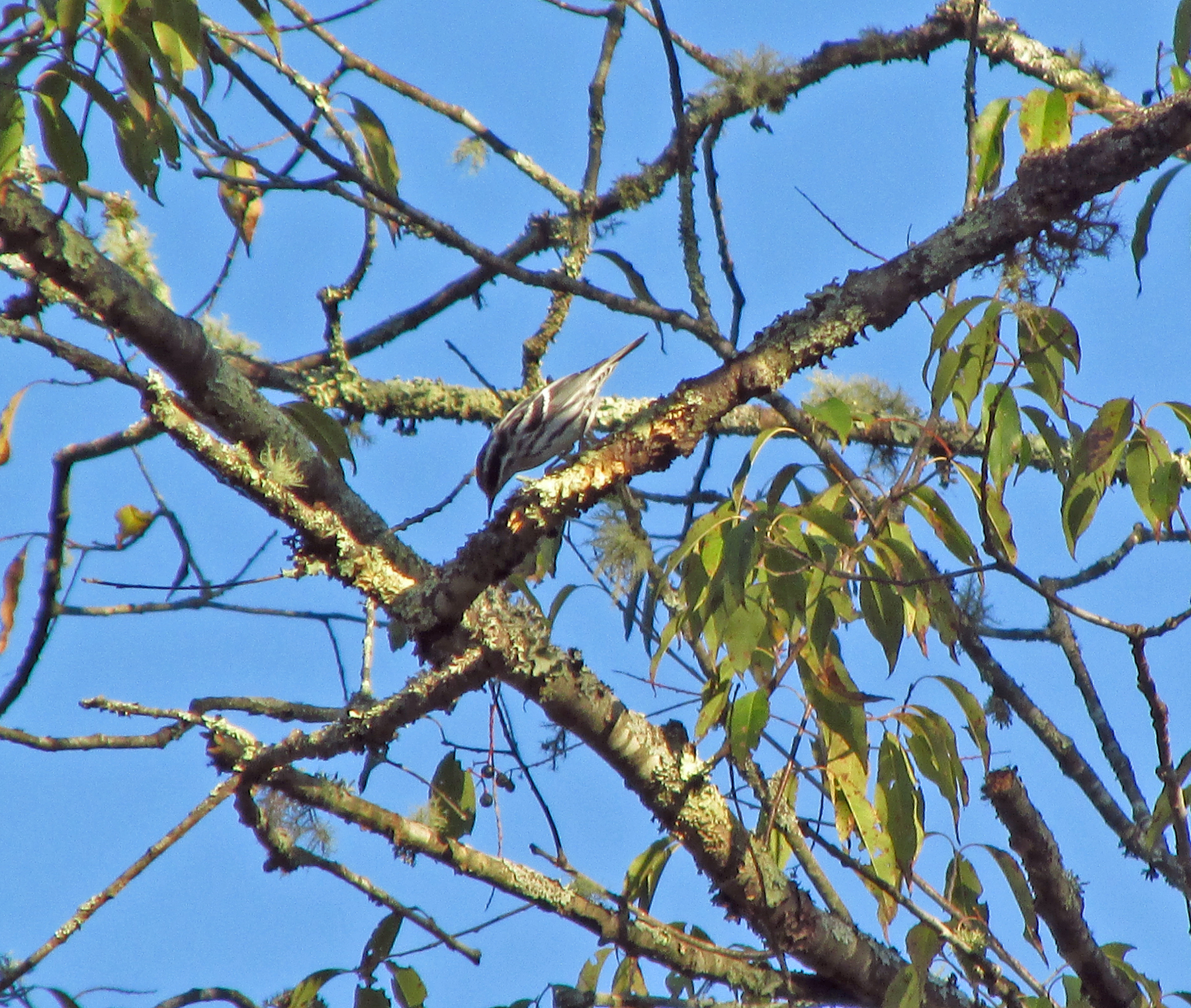
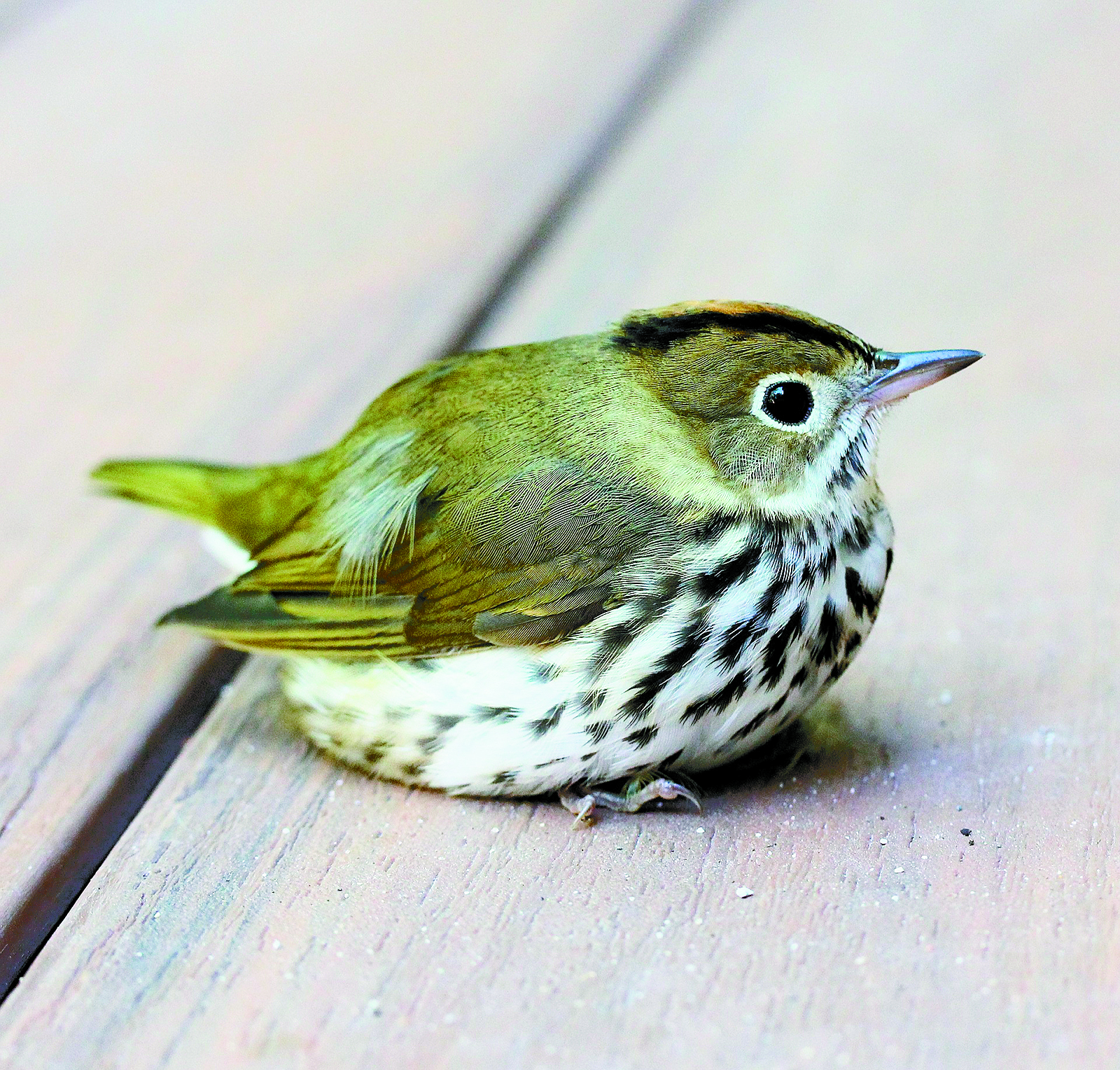
Photo by Bryan Stevens • Even in migration, both waterthrushes like to stay near water. This Northern waterthrush was photographed along the linear trail in Erwin, Tennessee.

My usual pastime of fall warbler watching declined somewhat this season, for a variety of reasons.

Time, that commodity so rare for many of us, played a part. It’s also more difficult these days to spot the movements of these swift, energetic birds in dense foliage. A vision problem that developed this past February that I have detailed in earlier columns hampered me.

My hearing’s still good, knock on wood, and I managed to hear quite a few warblers this autumn, including hooded warbler, black-throated blue warbler and Northern waterthrush.

So, I spent less time watching for the warblers this autumn and saw fewer warblers. There’s probably a connection.

I did manage to spot a few reliable favorites. I added a Northern waterthrush on a recent misty morning with that chill in the air so associated with the transition of seasons.

This warbler produces a rather loud “chunk!” chip note that’s distinctive enough to alert birders to the presence of one of these birds.

Photo by Bryan Stevens • The Northern waterthrush, pictured, has a beige eye line rather than the white one usually shown by the Louisiana waterthrush.

With some patience, I got a decent look at the Northern waterthrush, which is a migrant through the region in both spring and fall. Northern waterthrushes frequent wet habitats with dense ground cover. In migration, even a puddle or a damp thicket is enough to attract one of these warblers. My recent sighting took place in the branches of a sprawling yew tree adjacent to a creek.

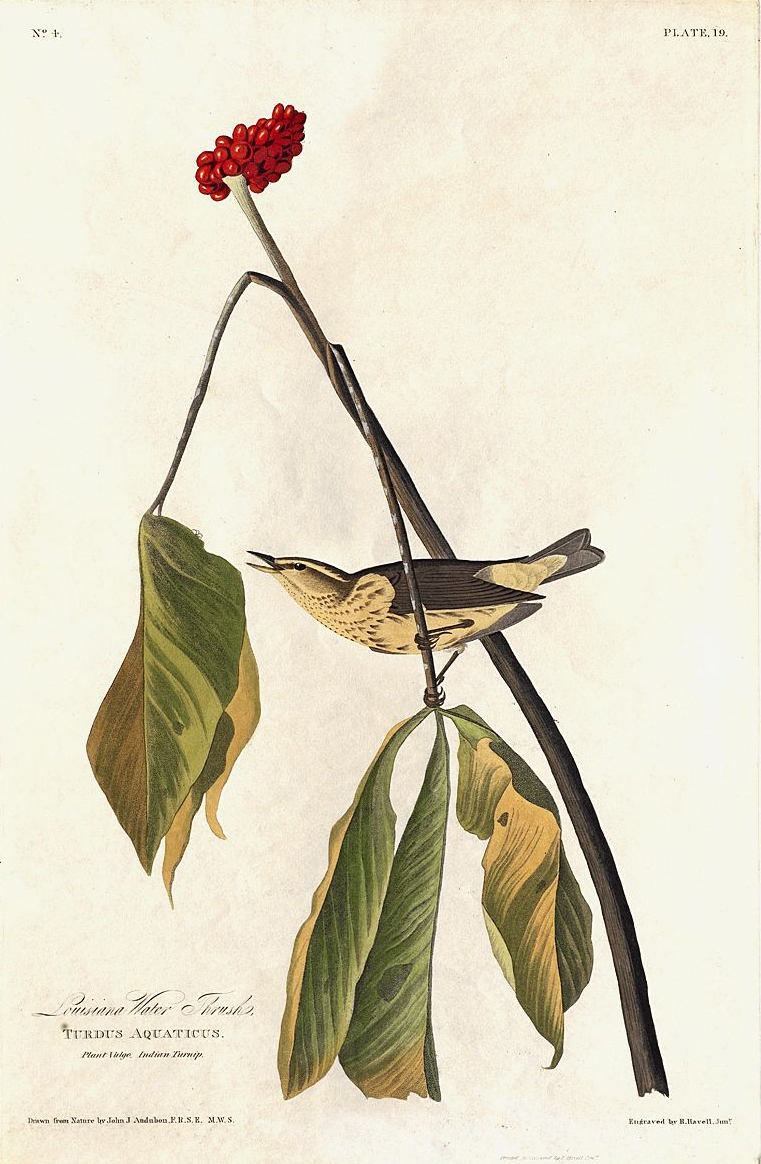
The related Louisiana waterthrush is a summer resident – and one of the first warblers to return each spring – that nests in the region. The two waterthrushes are very similar in appearance. The Louisiana waterthrush has a heavier bill and a white eye line, while the Northern waterthrush’s eye line is usually somewhat yellowish-beige. A Louisiana waterthrush typically also has a whiter belly and underparts.

The two waterthrushes are the only species in the genus Parkesia, so named to honor American ornithologist Kenneth C. Parkes, who was for many years Curator of Birds at Carnegie Museum of Natural History.

The common name of the Louisiana waterthrush is not a very apt one, as this bird does not have any special affinity for the state of Louisiana. Someone collected some of the early specimens of the Louisiana waterthrush in its namesake location, and the name has stuck through the years.

According to the website All About Birds, Northern waterthrushes are numerous, and their population has grown by an estimated 54% since 1970. Partners in Flight estimates the global breeding population at 17 million. The species rates an 8 out of 20 on the Continental Concern Score, indicating it is a species of low conservation concern.

Songbirds usually lead brief lives, but the oldest recorded Northern waterthrush was at least 8 years, 11 months old when it was recaptured and re-released during banding operations in Michigan in 1987, according to All About Birds. The bird had been banded originally in Ontario, Canada, in 1978.

Northern waterthrushes migrate through the region throughout October, so there’s still a window open for seeing one. Search near quiet water surrounded by thickets and listen for that chip note.

•••

To ask a question, share a sighting of make a comment, email me at ahoodedwarbler@aol.com.

Early artist and naturalist John James Audubon painted this Louisiana waterthrush.

Ovenbird is season’s first returning warbler

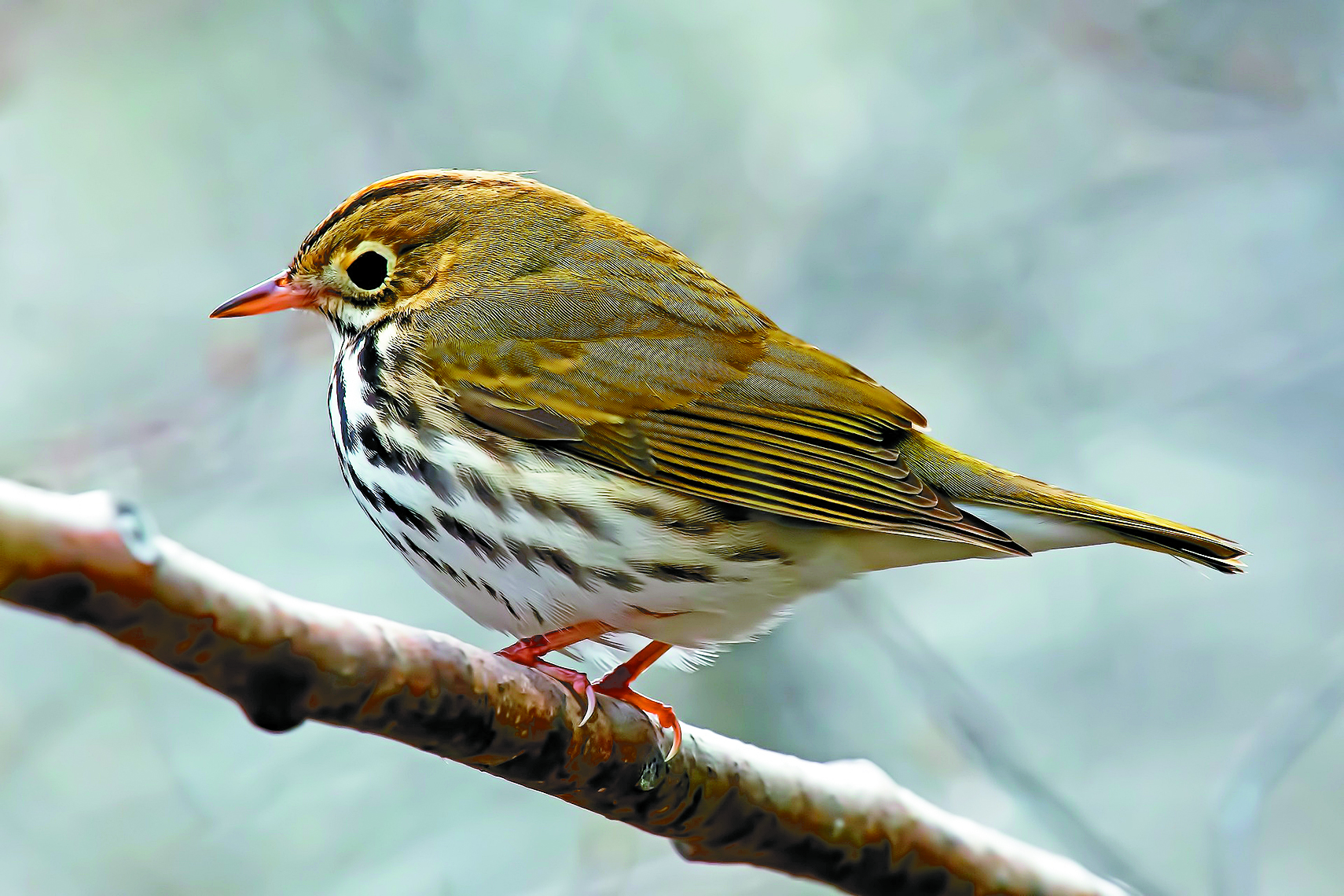
By Hans Toom from Pixabay • A patch of orange feathers on the crown of an overbid’s head often goes unseen. This shy and retiring bird is more often heard than seen.

It’s gotten to be a bit of a guessing game every spring about which of the warblers will be the first to return to my home.

In 2021, the first warbler to return in the spring was a male Northern parula that arrived on April 9. In 2022, this same species was the first to return, albeit a few days later than the previous year’s date.

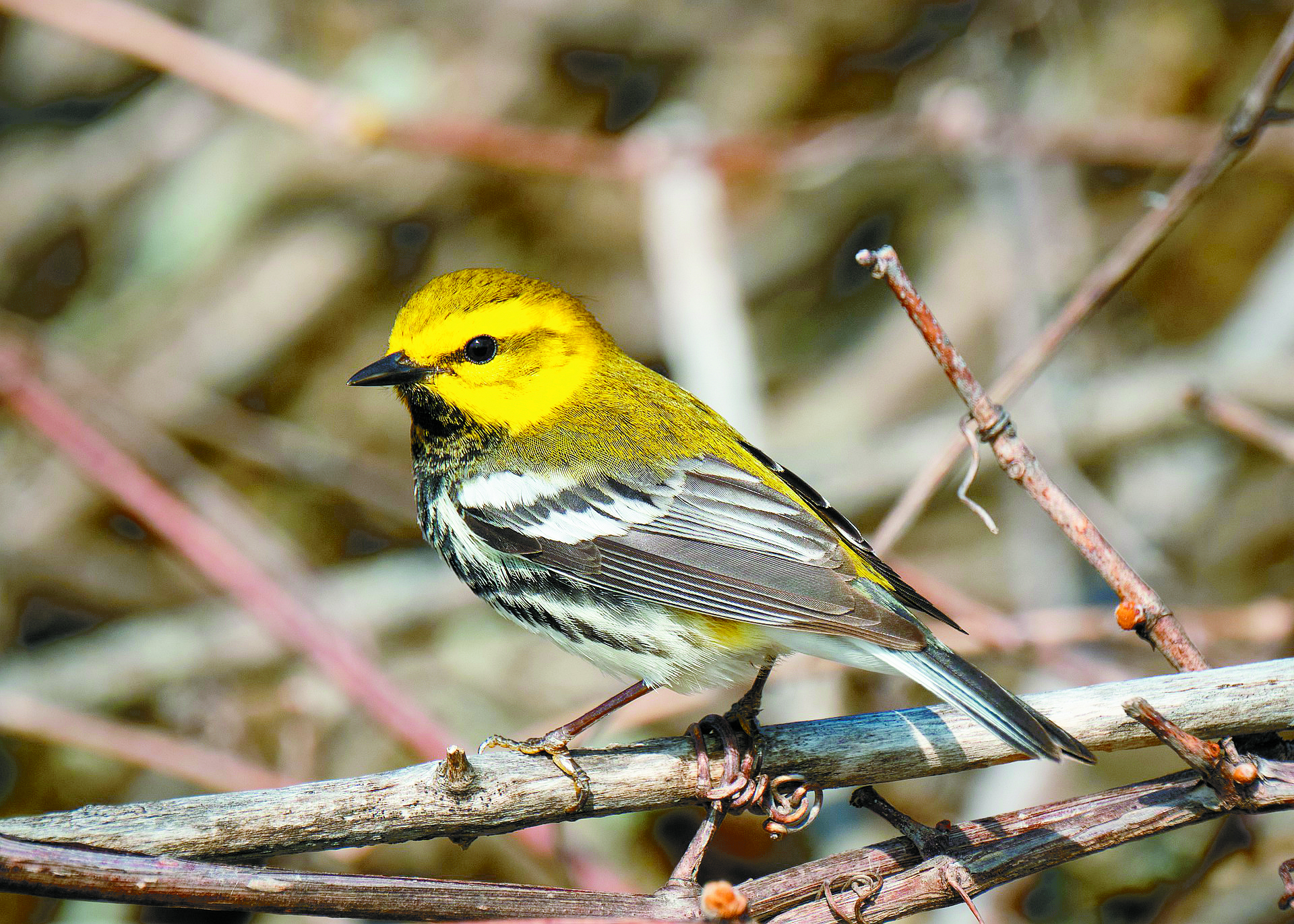
The Northern parula didn’t used to be one of the first returning warblers at my home. That honor used to go to hooded warbler or black-throated green warbler. This year, an ovenbird beat all of its kin to arrive on Friday, April 7, in the woodlands around my home, followed a few days later by a black-throated green warbler. This year’s first hooded warbler was a bit tardy and didn’t return until April 23.

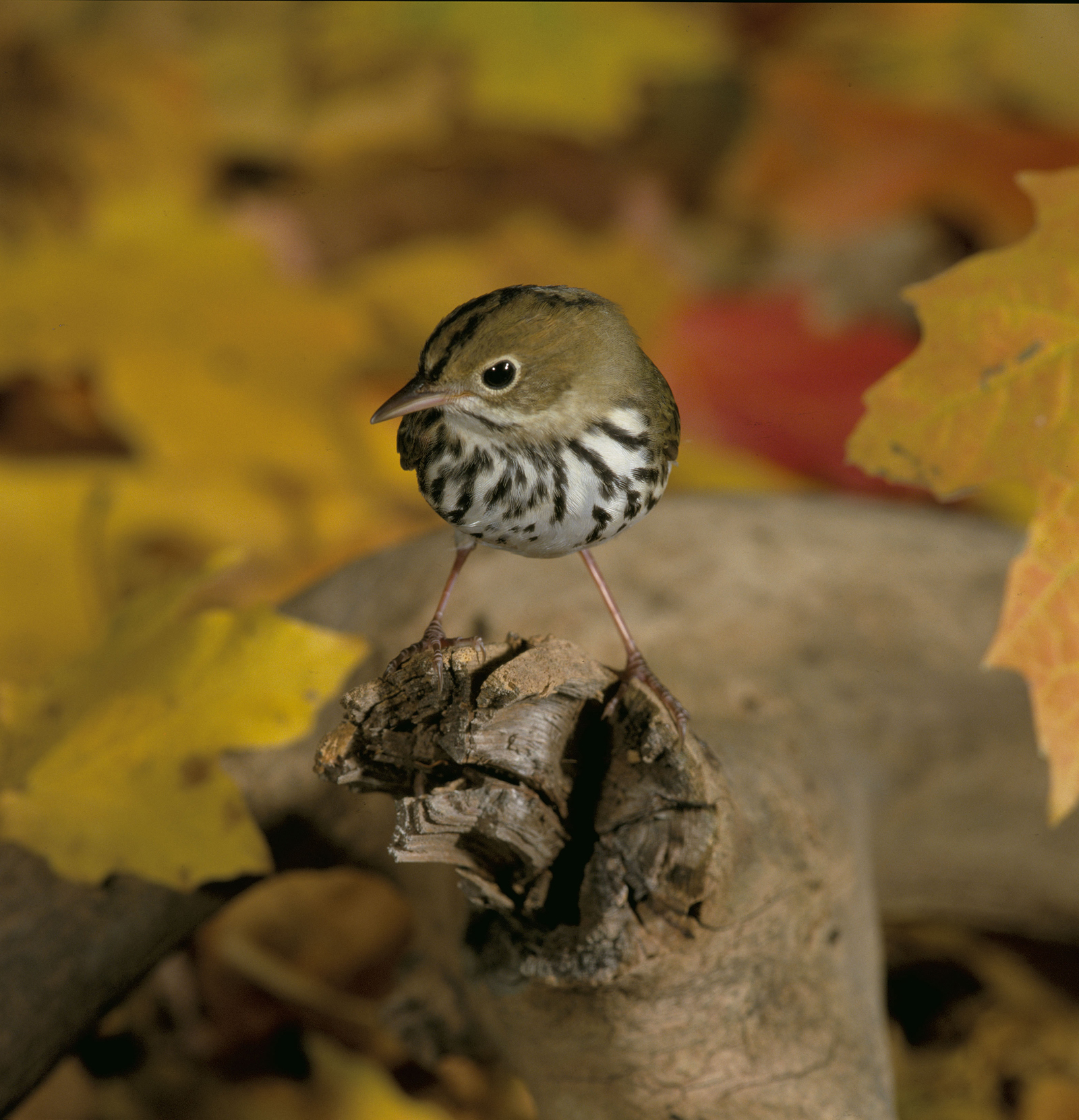
The ovenbird is not one of the brightly colored warblers, such as black-throated blue warbler or yellow warbler. The ovenbird is a small brown bird with a white breast marked with dark streaking — an appearance that bears a superficial resemblance to the larger thrushes that share the same woodland habitat. The only hint of color is an orange crown patch bordered by dark stripes atop the bird’s head. Even this orange crown patch is not easily seen. When agitated, an ovenbird may raise its head feathers, which makes this orange mark easier to detect. The ovenbird also shows a distinct white ring around each eye, as well as pink legs and a pinkish bill.

By Hans Toom from Pixabay • The ovenbird gets its name from the shape of its nest, which is said to resemble an old-fashioned Dutch oven.

The resemblance to North America’s brown thrushes didn’t go unnoticed by some early American naturalists. Painter and famous naturalist John James Audubon painted a pair of ovenbirds, which he knew as “golden-crowned thrushes.” When comparing the two names, one can’t help but wish that the inaccurate but more romantically descriptive golden-crowned thrush had stuck.

Unfortunately, ovenbirds are stubborn about letting themselves be seen. They’re easily heard. The males begin singing a loud, rollicking “Teacher! Teacher! Teacher” song almost as soon as they arrive on potential nesting grounds.

The ovenbird, unlike many warblers, is not named for its appearance. Instead, the bird’s name derives from the shape of the nest it builds. The nest is a domed structure placed on the ground, woven from vegetation and containing a side entrance. Early European settlers in North America thought the nest looked like a Dutch oven, hence the name “ovenbird” for the small warbler with the intricate nest.

In April and continuing into May, a couple of dozen warbler species will pass through Tennessee. Some of these warblers find area woodlands and other habitats to their liking. They will pause, explore and perhaps decide to spend their summer nesting season in Northeast Tennessee and Western North Carolina rather than continue migrating farther north.

Many of the warblers that pass through each spring, however, are destined to travel a much longer distance before settling down in their favored habitats for the summer nesting season. These warblers include the Tennessee warbler, Nashville warbler, Cape May warbler, blackpoll warbler and Connecticut warbler. Most of these species nest as far north as New England and Canada.

Others find the Southern Appalachians to their liking. Some of the first warblers to return each year include the Louisiana waterthrush, which favors rushing mountain streams, as well as species such as black-throated green warbler, hooded warbler, ovenbird, black-and-white warbler, worm-eating warbler and common yellowthroat.

The Northern parula offers an abundance of identifying characteristics. Adult males are bluish gray overall with a yellow-green patch on the back and two white wingbars. A chestnut band separates the male’s bright yellow throat and chest. Adult females are often a bit paler and typically lack the male’s breast band. Both males and females have distinctive white eye crescents.

Most warblers lead frenetic lives. They often sing high in the tops of trees, but they do occasionally venture closer to the ground, particularly when foraging for prey, which consists of a variety of insects and small spiders. The Northern parula is even more restless than most of its kin.

The more reliable means of locating a Northern parula is to listen for the male’s buzzy, ascending song. He is a persistent singer from the time of his arrival until mid-summer.

A quirk involving nesting material is somewhat unique to this warbler. In much of the southern United States, the Northern parula conceals its nest inside strands of Spanish moss draped from the limbs of live oaks and other trees. In the Southern Appalachians and other locations farther to the north, the absence of Spanish moss means that the birds rely on various Usnea lichens, which are sometimes referred to as “Old Man’s Beard.”

A pair of Northern parulas will attempt to raise two broods in a nesting season. The female lays two to seven eggs and does most of the nest construction.

Look for spring’s warblers in the coming weeks. Feel free to share any sightings with me by emailing ahoodedwarbler@aol.com.

Photo by Bryan Stevens • The Northern parula’s geographic location during the nesting season determines its use of nesting materials.


Black-throated green warbler a success story for New World warbler family

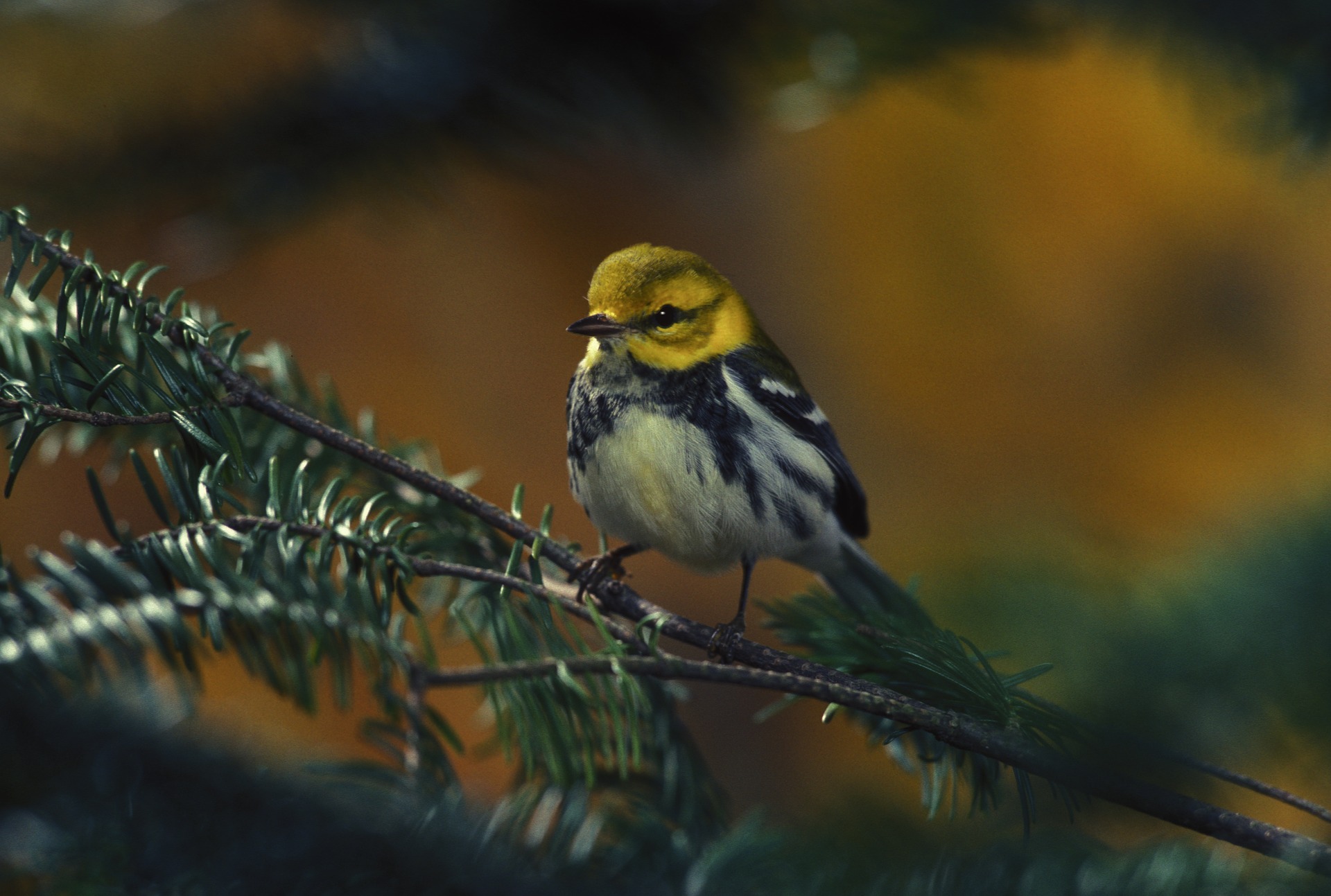
Photo by Howard Walsh/Pixabay • The black-throated green warbler nests in local mountains in coniferous and mixed woodlands during the summer months. Once the nesting season concludes, these warblers wing their way back to wintering grounds in Mexico and Central America, as well as the West Indies and southern Florida.

How can it be August already?

Yes, the pace of summer seems to have quickened. Tomatoes are ripening in the gardens, late summer flowers are blooming, and the birds have pushed their young out of the nest and are teaching them to fend for themselves.

I heard a chip note sound from a mimosa tree in my front yard on the evening of July 26. I scanned the foliage and saw the darting movements of a warbler. Without binoculars, I couldn’t determine the bird’s identity. Fortunately, my binoculars were in my parked car, so retrieving them was easy enough. With binoculars trained on the mimosa tree, I relocated the bird and identified a young black-throated green warbler. The faint black coloration on the bird’s throat pointed to the bird’s young age.

I’m hopeful that the successful nesting represented by the bird’s presence is extended farther into the future. I hope the bird makes its first fall migration without incident, spends the winter in a warmer climate and then returns to Simerly Creek Road in Northeast Tennessee next spring.

I watched as the bird successfully snapped up some caterpillars hidden in the green foliage of the mimosa tree. This young bird had the look of a survivor in my eyes.

Male black-throated green warblers are persistent singers. The website “All About Birds” describes the song, which is a series of buzzy notes, as “trees, trees, I love trees!” For a bird so associated with the treetops, I feel that’s an apt description.

Perhaps a couple of months earlier, the mother of this young black-throated green warbler constructed a nest of twigs, bark and spider silk. She would have carefully lined the nest with hair and moss before laying three to five eggs. She would then have incubated her eggs for 12 days. 

Once the eggs hatched, she and her mate would spend the next 10 to 11 days feeding hungry chicks until the chicks mature enough to leave the nest. Even after departing the nest, the young would remain with the parents for help in gleaning their food of insects and their larvae. 

The black-throated green warbler is a fortunate member of the family of New World warblers. Between 1970 and 2014, according to Partners in Flight, the population of black-throated green warblers actually increased. The group estimates a global population of 8.7 million individuals for the species.

Many of their warbler kin face declining numbers, and even black-throated green warblers face the consequences of habitat destruction on their wintering grounds and in their nesting range throughout the eastern United States. 

A lot of work goes into completing a bird’s journey from egg to young adult. Seeing any bird is a treat. Seeing a young bird through a pair of binoculars brings all that potential up close.

The black-throated green warbler’s closest kin consist of the hermit warbler and Townsend’s warbler of the western United States and the endangered golden-cheeked warbler of Texas. The warblers consist of more 120 different species. 

These small birds lead active, fast-paced lives. They typically don’t enjoy a lengthy life span. The oldest documented black-throated green warbler was a male that reached the age of at least four years and 11 months. He was banded and found in Nova Scotia, according to All About Birds.

We’re about a month out from the flurry of fall migration. I’ll be keeping my binoculars at the ready the closer we get to September.

To share a sighting, make a comment or ask a question, email me at ahoodedwarbler@aol.com.


Two warblers have names connected with the Volunteer State

Photo by GeorgeB2/Pixabay.com • The Nashville warbler is an attractive bird with more color than the Tennessee warbler.

Tennessee once represented the western frontier for many people in the United States, so the state acted as a beacon for naturalists wanting to make new discoveries. Some of those early naturalists, men such as Alexander Wilson, spent a lot of time in the Volunteer State.

Two of Wilson’s ornithological “discoveries” in Tennessee involved two species of warblers that were  given names to honor the state and its capital after the birds were first observed in Tennessee and near Nashville.

Those birds were both members of one of my absolute favorite bird families — the warblers. It’s necessary to differentiate the New World wood-warblers from a grouping of birds in Europe, Asia and Australia that are also called warblers.

What is a warbler? The Wikipedia entry for these birds describes the New World warblers or wood-warblers as a group of small, often colorful, passerine birds that make up the family Parulidae and are restricted to the New World. They are not closely related to Old World warblers or Australian warblers.

That’s an adequate description, from a scientific standpoint. But warblers are magic. To do them justice, I’m compelled to wax a little more eloquent. They are a combination of color, movement and energy wrapped in a tiny bundle of feathers. Warblers are constantly on the go, hardly ever staying still for long.

The frenetic lifestyle of warblers challenges new birders. These birds don’t often stop and pose long enough for someone to get binoculars focused on them. One doesn’t exactly watch warblers. Following a warbler through tangled vines or the leafy tree canopy isn’t watching so much as anticipating. One gets a “feel” for where the warbler will appear next while tracking them through binoculars. By getting familiar with the way these avian sprites behave is the best way to learn how to observe these birds.

It’s not for nothing that some birders suffer from a malady, particular during the migration seasons, called “warbler neck.” The direct cause is the strain on the neck and back from always looking upward toward the treetops where many warblers like to stay.

Some, but not all, warblers are suffused with bright colors: yellows, oranges, blacks, blues and whites. A few — ovenbird, worm-eating warbler, Northern waterthrush — are various shades of brown. Some of my favorite warblers are the hooded warbler, Blackburnian warbler and black-throated blue warbler.

Then we have the warblers I mentioned earlier, which were discovered in the Volunteer State and to this day bear names honoring the state and its capital city. These two birds are the Tennessee warbler and the Nashville warbler.

Photo by Paul Spark/Adobe Stock • The Tennessee warbler, while named for the Volunteer State, spends very little time within Tennessee. These warblers migrate through the region each spring and fall but nest much farther north in the boreal forests.

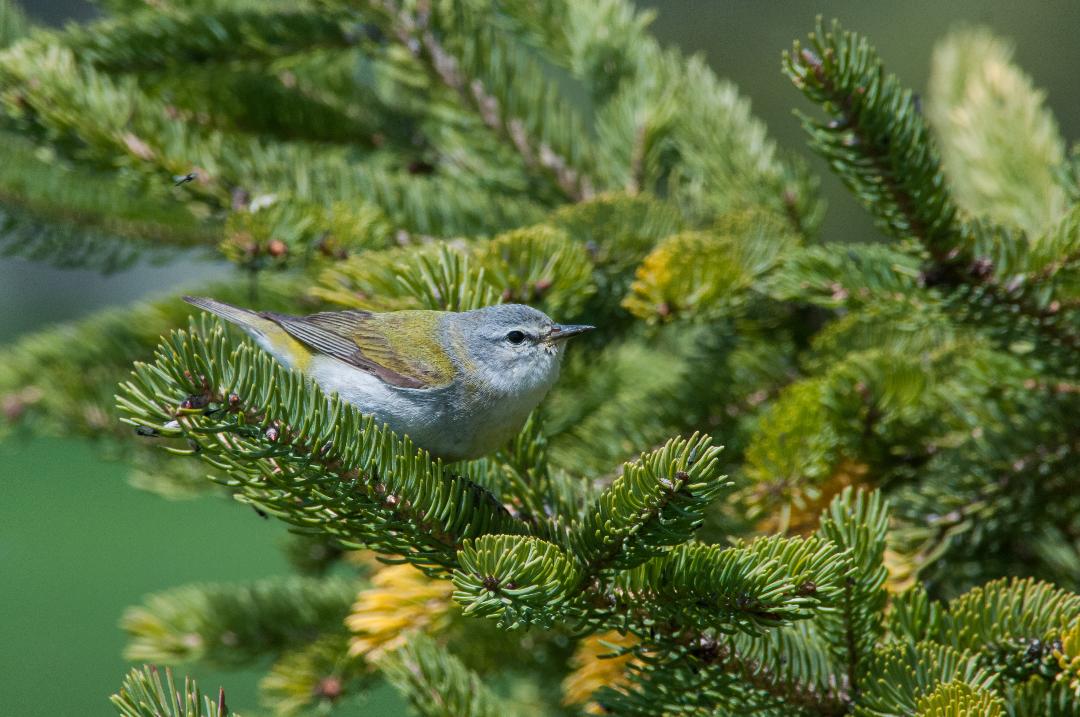
The appearance of the Tennessee warbler varies greatly depending on the season. In autumn, most Tennessee warblers are greenish-yellow birds with whitish-gray underparts. Sometimes that green color ranges into vivid chartreuse territory.

In the spring, the basic green and white pattern remains evident, but both males and females sport a gray head and a black line that runs through the eye and along the side of the bird’s face. The plumage — at least in illustrations and photographs — is shown as more crisp and distinct with spring birds.

The pioneering American ornithologist Alexander Wilson gave the Tennessee warbler its name, which, unfortunately, is not an accurate moniker. Don’t blame Wilson too harshly for the mistake. Even after he “discovered” the first Tennessee warblers back in 1811, it would be almost another century before scientists finally located the bird’s nesting grounds in Canada in 1901. The remote and inaccessible nature of the the region helped prolong this mystery about the Tennessee warbler’s life cycle.

Wilson was an interesting figure in the natural history of the United States. Born in Paisley, Scotland, in 1766. As a young man, he learned the trade of weaving. At the same time, he became interested in poetry and claimed inspiration in particular from the Scottish poet Robert Burns.

In 1794, after not succeeding at poetry or weaving, he departed Scotland for a new life in the United States of America. He settled with a nephew in Pennsylvania, but he found opportunities limited for poet-weavers.

To make a living, he took up teaching. He met the famous naturalist William Bartram, who encouraged Wilson’s interest in ornithology and painting. These two passions took off for Wilson.

He made his life’s work the undertaking of publishing the nine-volume “American Ornithology” that featured his own illustrations of American birds. The work featured 268 species with 26 of them having never previously been described for science.

His fame as an ornithologist grew, and several species of birds were named in his honor, including the Wilson’s storm-petrel, Wilson’s plover, Wilson’s phalarope, Wilson’s snipe and Wilson’s warbler. Wilson’s work probably inspired John James Audubon’s own more extensive and famous collection depicting the birds of North America.

Every autumn I see some of the birds Wilson documented and painted as they stage their fall migration through the Volunteer State to reach destinations farther south.

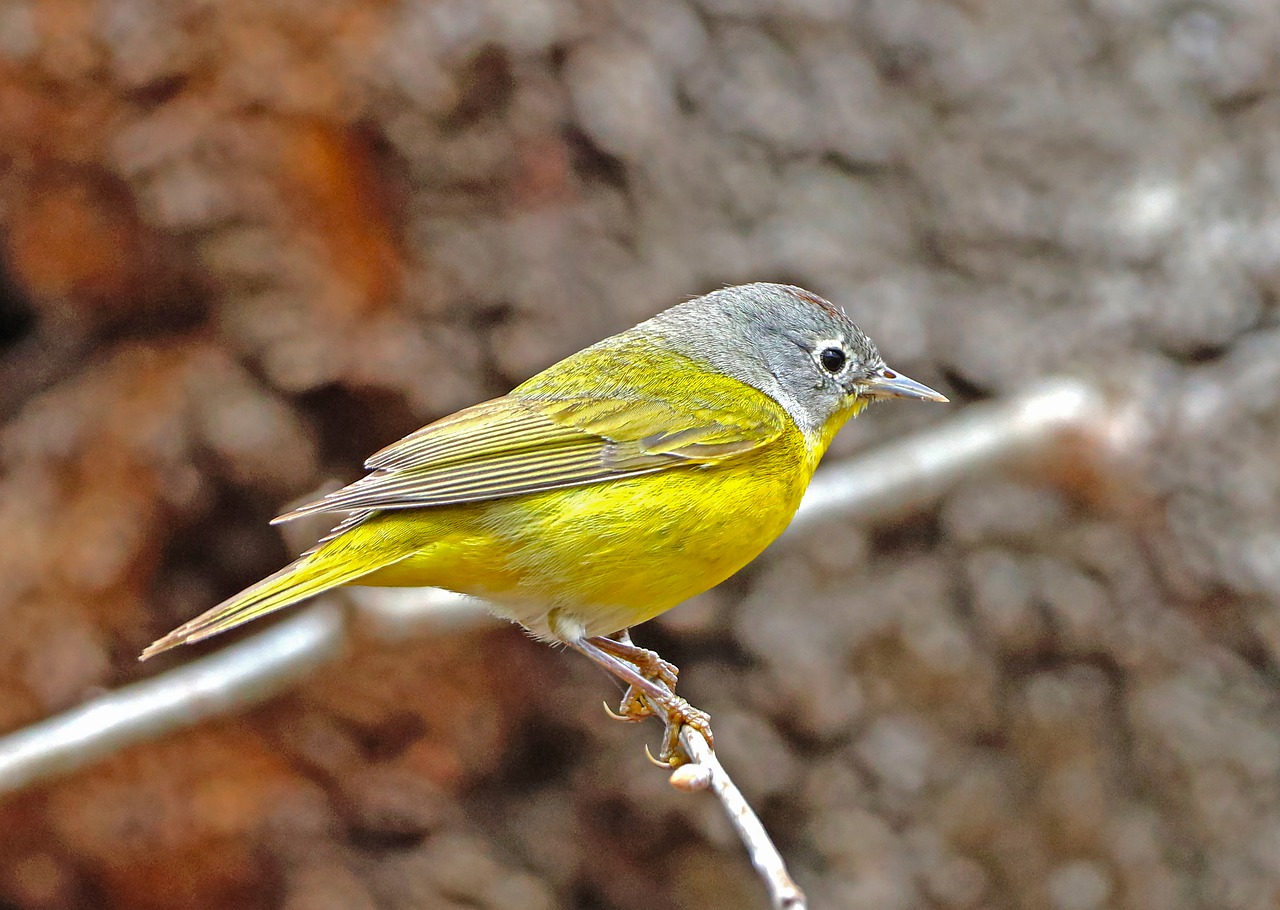
Our capital city of Nashville also provides a common name to one of the warbler clan. The Nashville warbler is a small bird with a rounded head and short tail. The plumage of this warbler consists of yellow below and olive above. The birds have a white eye-ring that stands out against a gray head. The Nashville warbler also has a thin chestnut-brown crown patch, but a really exceptional look is required to see this feature. Most guides don’t mention that the Nashville warbler has a white patch of feathers surrounding the area where its legs join the body. This section of white is completely surrounded by yellow feathers. This is a helpful feature to know when trying to distinguish this warbler from some similar species.

Once again, Wilson bestowed a rather inaccurate name on this species, as the bird in question is only a visitor to Nashville and the surrounding territories during a limited window of time each year. The same is true of the Tennessee warbler. At best, these birds can only be found in the Volunteer State in April and May and again in September and October. Otherwise, Tennesseans would have to travel a good distance to see these birds at other times of the year.

Fortunately, these birds come to us. I’ve already seen the first Tennessee warblers for fall migration, but I’ve not been lucky enough this fall to get binoculars on a Nashville warbler — yet! There’s still time. Migration continues, so get outdoors and see what you can find.

••••

To share an observation, make a comment or ask a question, email me at ahoodedwarbler@aol.com.

Ovenbird part of the returning warbler lineup

Photo by U.S. Fish & Wildlife Service • Ovenbirds are content to spend most of their time near the forest floor.

It’s been a week of arrivals at my home. Several species of warblers made their spring debuts, including a handful of male ovenbirds.

These warblers arrived on April 14 and immediately began singing their loud and ringing “Teacher! Teacher! Teacher!” song from concealment within the woodlands surrounding my home.

The ovenbird is not one of the brightly colored warblers, such as black-throated blue warbler or yellow warbler. The ovenbird is a small brown bird with a white breast with dark streaking — an appearance that bears a superficial resemblance to the larger thrushes that share the same woodland habitat. The only hint of color is an orange crown bordered by dark stripes atop the bird’s head. Even this orange crown patch is not easily seen. When agitated, an ovenbird may raise its head feathers, which makes this orange mark easier to detect. The ovenbird also shows a distinct white ring around each eye, as well as pink legs and a pinkish bill.

The resemblance to North America’s brown thrushes didn’t go unnoticed by some early American naturalists. Painter and famous naturalist John James Audubon painted a pair of ovenbirds, which he knew as “golden-crowned thrushes.” When comparing the two names, one can’t help but wish that the inaccurate but more romantically descriptive golden-crowned thrush had stuck.

While not likely to take an observer’s breath away with an unexpected explosion of vibrant plumage, the ovenbird’s not a drab bird. These warblers possess a subtle beauty all their own that is worth taking the time to behold.

Photo by Peggy Dyar from Pixabay • Despite the oliver-brown plumage, a closer look shows that the overbird is a bird with a subtle beauty, including an inconspicuous orange crown.

Unfortunately, ovenbirds are stubborn about letting themselves be seen. They’re easily heard. The males begin singing a loud, rollicking “Teacher! Teacher! Teacher” song almost as soon as they arrive on potential nesting grounds.

The ovenbird, unlike many warblers, is not named for its appearance. Instead, the bird’s name derives from the shape of the nest it builds. The nest is a domed structure placed on the ground, woven from vegetation and containing a side entrance. Early European settlers in North America thought the nest looked like a Dutch oven, hence the name “ovenbird” for the small warbler with the intricate nest.

Rather than hopping along the length of a branch or limb, an ovenbird walks in a deliberate fashion. This bird feeds on insects, spiders and other small prey items foraged from the woodland floor. On rare occasions, a lingering ovenbird shows up at feeders during the winter months.

Again, the most persistent characteristic of this warbler is the fact that it’s shy. It’s not as notoriously shy as warblers like mourning warbler of Connecticut warbler, but the ovenbird spends much of the time near the woodland floor and out of sight. The best time to catch a look at this warbler is once they begin nesting. Parents are extremely protective and defensive of their nest and young. Intruding too close is sure to bring some sharp alarm notes. The parents will often confront an intruder, flitting from branch to branch in nearby trees, utterly neglecting their usual preference for remaining unseen if not unheard.

Photo by Jean Potter • An ovenbird sings from a perch in the leaf canopy.

Ovenbirds spend the summer nesting season in mature deciduous and mixed forests across Canada and the eastern United States. They do not make as lengthy a migration as that undertaken by some of their relatives. Ovenbirds migrate each fall to the southeastern United States, the West Indies and also spreads out from Mexico to northern South America for the winter season.

It’s one of several warblers that nest in Northeast Tennessee and Western North Carolina. Others include Louisiana waterthrush, Kentucky warbler, common yellowthroat, Swainson’s warbler, black-throated blue warbler and American redstart, among others.

•••••

My mom saw her first hummingbird of spring on April 16 at 9:34 a.m. Of course, the bird waited until I’d left for work to make an appearance.

My solace has been an influx of other migrants in the past week. A blue-gray gnatcatcher’s fussy buzz alerted me to its return on April 10. I eventually got binoculars focused on the fidgety bird as it flitted in the upper branches of a cherry tree.

I heard the familiar chittering cries overhead while walking in downtown Erwin on April 14. Looking skyward, I watched a flock of chimney swifts flying gracefully over the rooftops of downtown buildings.

New warblers at home this week, other than the ovenbird, have included hooded warbler and black-throated green warbler, both of which put in their first spring appearance on April 15.

•••••

As noted, hummingbirds are returning. I’ve had reports from Western North Carolina and all across Northeast Tennessee. I will compile a listing of those who have shared their first sightings with me for next week’s column.
Keep sharing your hummingbird observations at ahoodedwarbler@aol.com or post them on my Facebook page. Please include the date and the approximate time of your sighting.

New arrivals include spring’s first warblers

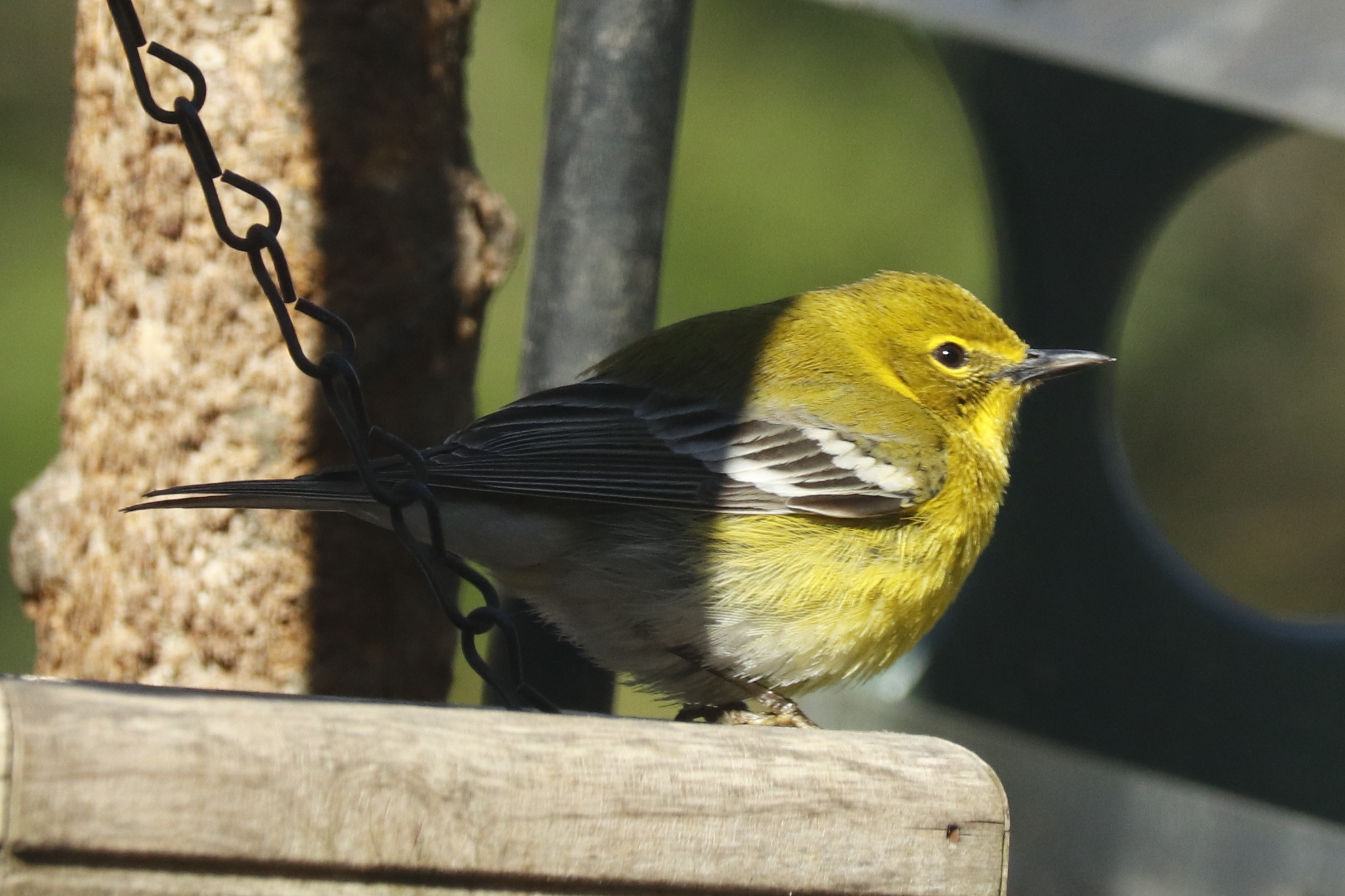
Photo by Kaylynn Wilster • Pine warblers, like this individual, have become more adaptable, learning to accept food at feeders and helping them remain in the United States during the winter season.

Mystery bird
Kaylynn Wilster, who lives in Piney Flats, Tennessee, emailed me recently for help with an identification on a bird visiting her feeders. When she described the bird and mentioned its fondness for suet at her feeders, I immediately suspected the identity of her visitor. A photo she provided gave instant verification that her visiting bird is, as she suspected, a warbler. To be exact, she is hosting a pine warbler.

The pine warbler is an attractive member of its clan with a plumage consisting mostly of various hues of yellow, olive and gray. Some males will show extremely bright yellow feathers, but females and young birds may show only a bare minimum of yellow coloration.
Unlike warblers such as the magnolia warbler and the palm warbler, the pine warbler truly does have an affinity for the tree for which it’s named. Magnolia warblers, on the other hand, are really more at home gleaning the branches of spruce trees while a weedy field is often the preferred habitat of a palm warbler.

Photo by Kaylynn Wilster • A pine warbler feeds on suet at a hanging feeder.

Look in the pines
The pine warbler is rarely found away from pine trees, but the bird is not too particular about the type of pine, being known to frequent about a dozen different varieties of pine trees. According to the website All About Birds, some of the favored pines include jack, pitch, red, white, Virginia, loblolly, shortleaf, slash, sand and pond pines.

The pine warbler is slightly less of an insect-eater than other warblers. This warbler will also feed on fruits, berries and some seeds. All About Birds states that some favored fruit includes bayberry, flowering dogwood, grape, sumac, persimmon and Virginia creeper.

When a pine warbler visits feeders, however, it’s often looking for supplemental protein. This fact explains why suet cakes, as well as homemade or commercial mixtures of suet and peanut butter, are one of the best ways to lure these warblers to feeding stations.

The population of this warbler has actually been on the increase since 1966, according to various surveys conducted on pine warbler numbers. Almost the entire population spreads out across the eastern United States, with much lesser numbers of pine warbler making their home in Canada.

Warbler migration
Kaylynn’s pine warbler is likely an early spring migrant or a pine warbler that elected to spend the winter months in the region. While warblers are scarce between October and March, their numbers are about to take off in a big way.

In April and continuing into May, a couple of dozen warbler species will pass through Tennessee. Some of these warblers find area woodlands and other habitats to their liking. They will pause, explore and perhaps decide to spend their summer nesting season in Northeast Tennessee and Western North Carolina rather than continue migrating farther north.

Many of the warblers that pass through each spring, however, are destined to travel a much longer distance before settling down in their favored habitats for the summer nesting season. These warblers include the Tennessee warbler, Nashville warbler, Cape May warbler, blackpoll warbler and Blackburnian warbler. Most of these species nest as far north as New England and Canada.

Others find the Southern Appalachians to their liking. Some of the first warblers to return each year include the Louisiana waterthrush, which favors rushing mountain streams, as well as species such as black-throated green warbler, hooded warbler, ovenbird, worm-eating warbler and common yellowthroat.

Photo by Jean Potter • A male hooded warbler flits through the foliage of a rhododendron thicket.

Kaylynn mentioned that her pine warbler has graced her with frequent bursts of song. This fact indicates that her bird is a male. Pine warblers are persistent singers, but they often sing their songs from the upper branches of tall pines, effectively camouflaging themselves from view. Pine warblers have become more frequent feeders visitors in recent decades, which brings them into closer proximity to humans than would otherwise be the case.

New Arrivals
A pair of wood ducks brought company when they returned to the fish pond on April 2. They were accompanied by a pair of mallards. Although our most common duck, mallards haven’t visited my pond for several years. It felt good to have them back. I’m hoping both the wood ducks and mallards might decide to use the pond as a home base throughout the spring and summer.

On April 7, I heard the first chipping sparrow of spring. This small, dapper sparrow has an easily recognizable song. All About Birds describes the song as “a long, dry trill of evenly spaced, almost mechanical-sounding chips,” to which I concur.

A pair of tree swallows arrived at my home on April 8. I wrote in last week’s column about these swallows and their anticipated return.

The first warbler of spring – a male Northern parula – arrived April 9. I heard his trademark buzzy song as I left for work.

Photo by Bryan Stevens • A Northern parula hides in the canopy while singing its buzzy song.

I still haven’t seen the first spring ruby-throated hummingbird, but I have received a report from North Carolina.

Susie Parks, who lives in North Cove in McDowell County, North Carolina, emailed me to report that she saw her first hummingbird of the season at 9:30 a.m. on Thursday, April 1.

She even elaborated on the “funny” timing.

“I assure you this is not an April Fool’s joke,” Susie wrote. “We are, indeed, thrilled to have seen this amazing little creature on such a chilly morning.”

I wrote back congratulating her on her sighting, which only makes me more impatient to have these delightful little birds back in my own yard.

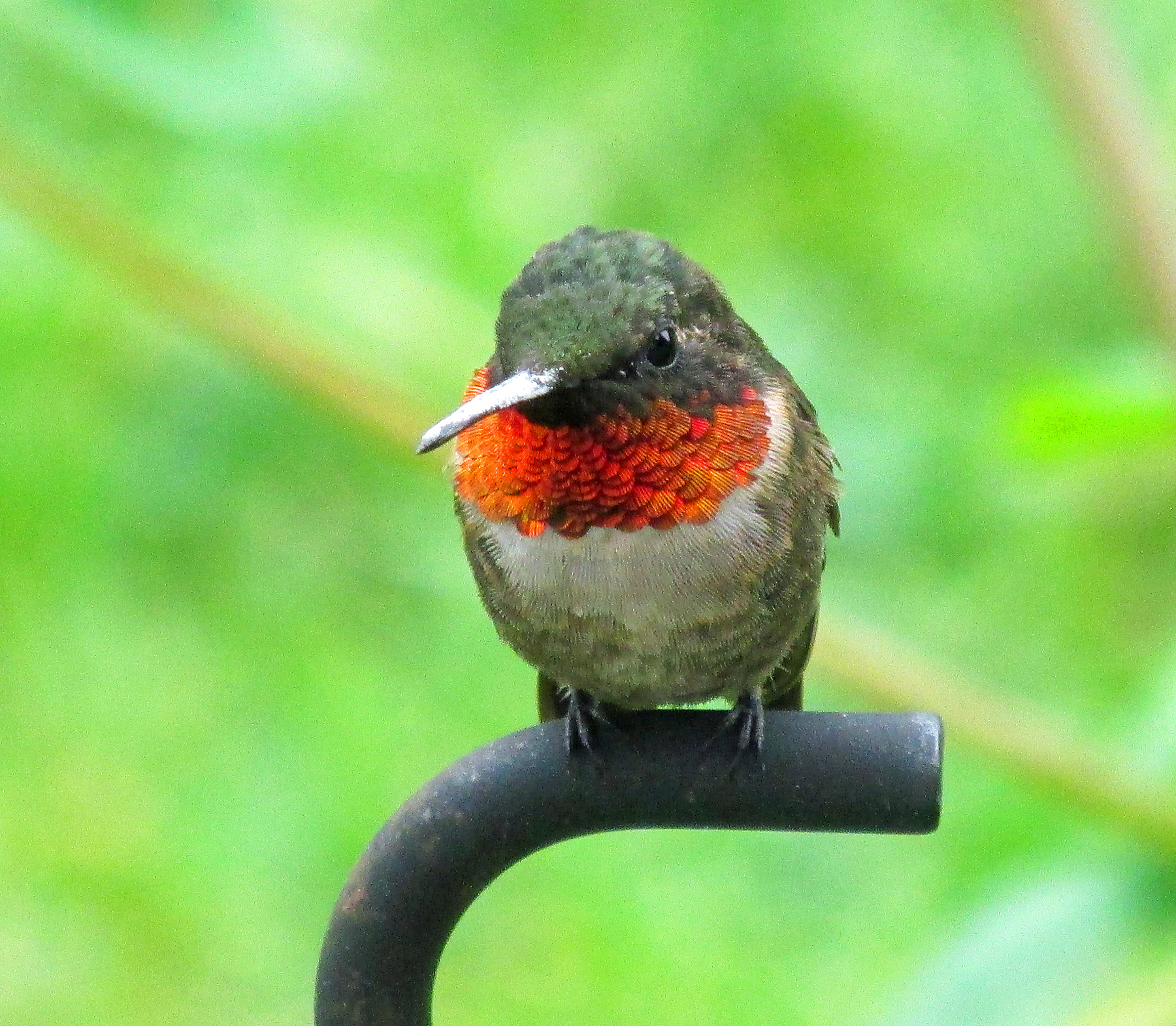
Photo by Bryan Stevens • Despite a perceived disadvantage of size, ruby-throated hummingbirds are quite capable of thriving in a giant world.

Journey North, a website that tracks hummingbird migration, as well as the migratory journeys of other wild creatures, reports that hummingbirds have reached Tennessee. A posting for a woman in Clinton, Tennessee, reported a ruby-throated hummingbird on Monday, April 5.

Hummingbird Anticipation

The arrival of ruby-throated hummingbirds is one of the most anticipated returns each spring. As I’ve done in years past, I want to hear from readers when they see their first hummingbird of spring. Email me your observations at ahoodedwarbler@aol.com or post them on my Facebook page. Please include the date and the approximate time of your sighting.


Two types of black-throated warblers number among New World bird family

Photo by Skeeze/Pixabay.com The female black-throated green warbler lacks the male’s all-black throat, but she is a striking bird in her own right. Black-throated green warblers and the related black-throated blue warbler are common birds in the Southern Appalachians from April to October.

I’ve enjoyed some lawn chair birding on recent September evenings, delighting in my observations of birds ranging from flycatchers and catbirds to warblers, vireos and hummingbirds. I enjoy my casual study of the daily changes in the bird population present in my yard and adjacent woods. The parade of warblers hasn’t been as productive as in past autumns, but I have managed to spot and identify hooded warbler, American redstart, chestnut-sided warbler, magnolia warbler, Northern parula, and black-throated green warbler visitors.


The black-throated green appeared suddenly in a fast-paced burst of foraging in a cherry tree. Alongside birds such as an Eastern wood-pewee and red-eyed vireo, the warbler gleaned the leaves of the trees for concealed caterpillars. I watched the bird swallow with gusto several of the caterpillars so skillfully plucked with its thin, pointed bill.

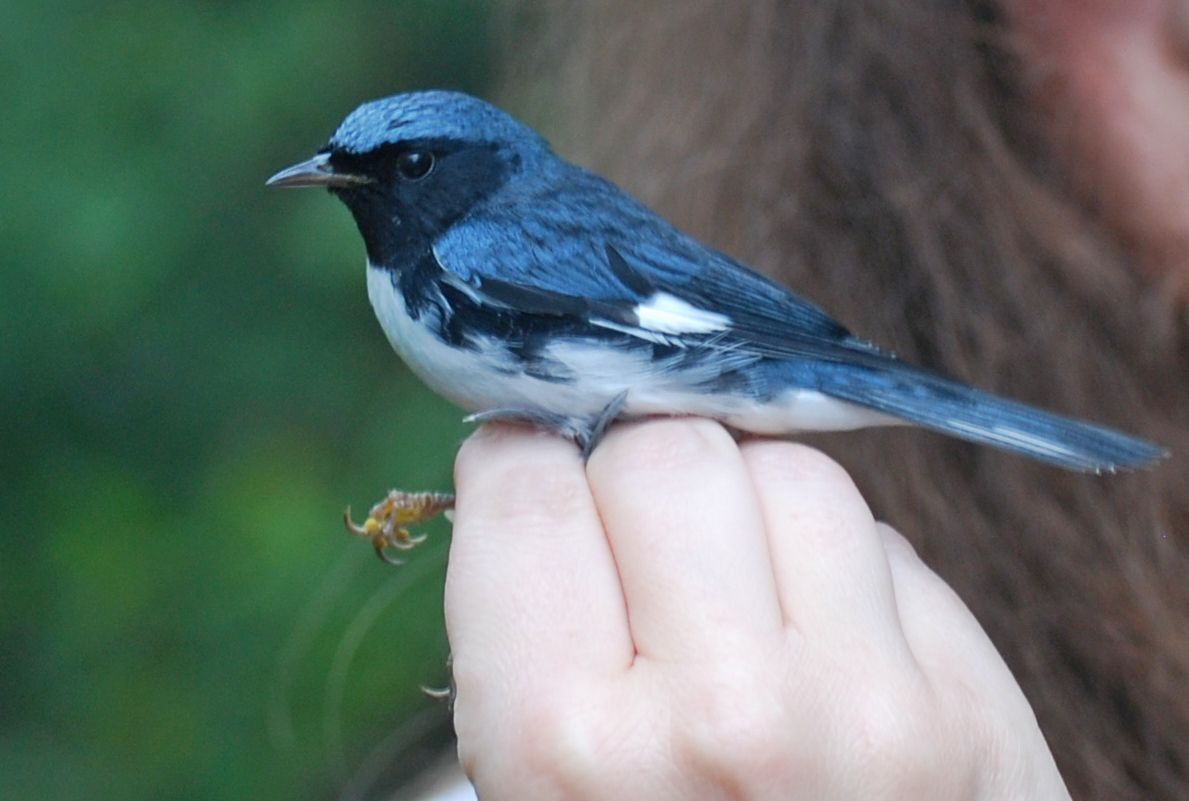
The black-throated green warbler and one other species, the black-throated blue warbler, share the appellation of “black-throated,” and rightfully so. Males in the spring look their best with a dark black throat in striking contrast to the rest of their plumage. The female black-throated green shows some black on the throat, but female black-throated blue warblers exhibit no black throat patch. In fact, black-throated blue males and females are extremely different in appearance. Scientists call such dramatic appearances differences “sexual dimorphism.” Among the warblers, this species provides the most striking example of sexual dimorphism of any of the warblers. The male and female do share one identifying mark — a white square near the outer edge of the middle of each wing. This square is usually more pronounced in the male, but it stands out enough that it helps distinguish the female black-throated blue from similar dull-plumaged birds such as vireos. 


German naturalist Johann Friedrich Gmelin described the black-throated blue warbler in 1789. I noted in last week’s column that Gmelin woefully misnamed such warblers as palm warbler and magnolia warbler. With the black-throated blue warbler, Gmelin did a better job. This bird’s scientific name name is the Latin term caerulescens, which translates into English as “turning blue.” The male is a stunning bird. Arguably, the black-throated blue warbler is one of the most distinctive members of the family of wood warblers. The adult male has a black face and cheeks, deep blue upperparts and a clean white underbelly. In contrast, the adult female is olive-brown above and light yellow below. 


When one’s binoculars first focus on a black-throated green warbler, the first impression is likely to be the black, yellow and white feathers in the bird’s plumage. The greenish-yellow coloration that gives this species part of its common name is mostly limited to the bird’s back, which is often not as evident when the bird’s being watched through binoculars.  
Both of the black-throated warblers nest in northeast Tennessee, western North Carolina, and southwestern Virginia. In the spring, the males of both these warblers are persistent singers from prominent perches in the green woodland canopy. Male black-throated greens contribute to the avian chorus by frequently singing a high-pitched song often described as a buzzy zee-zee-zee-zooo-zeet. Male black-throated blues produce a buzzy zee-zee-zeeee. 

The black-throated green warblers currently departing the region will likely travel as far as Mexico, Central America, the West Indies and southern Florida for the colder winter months. Black-throated blue warblers, on the other hand, migrate to the Caribbean for the winter, making their homes on Cuba, Jamaica, Hispaniola and Puerto Rico, as well as other islands. 
Nearly half of the world’s New World warblers spend the months between spring and fall in North America. The other half reside exclusively in Central and South Americas, as well as the Caribbean. Some of the more descriptively named individuals residing in the tropical areas south of North America include flame-throated warbler, crescent-chested warbler, arrowhead warbler, white-rimmed warbler, buff-rumped warbler, golden-bellied warbler, fan-tailed warbler, pink-headed warbler and pale-legged warbler. 


The warblers bring some exciting tropical flair into the hills and hollows of Southern Appalachia for several months every year. I miss them once they’re gone for the winter season, but the promise of their return keeps my spirits buoyed during the cold, darker months until spring. 

Warbler parade imminent as September advances

Photo by Mickey Estes/Pixabay.com • A pine warbler takes a brief rest on a perch during a break from foraging for insects.

I detected some signs of migration during a backyard lawn chair birding session on Thursday, Sept. 3. A croaking great blue heron circling the property, the shrill cries of cedar waxwings, scolding vireos, and the intermittent buzz of hummingbird wings all contributed to the background noise. 

The first warbler of the season, a quick blur of yellow and white, disappeared into the green and thus escaped identification. That’s the way of it: Sometimes, you identify the bird, but at other times it slips past without lingering enough for that moment of confidence. You have to love September, even if the birds are entirely ignorant of pages on a calendar. As summer wanes, the pace of migration has spiked. If that first warbler got away, I know others will follow behind it.

Some of them will have fanciful names like blue-winged warbler, black-throated blue warbler, Blackburnian warbler and American redstart. Each of the warblers exists as a sort of magnet to induce me to keep binoculars always close at hand.


The 50 or so species of warblers that make their home in the eastern parts of the United States and Canada during the spring and summer months are now winging their way south.  The blackpoll warbler, which holds the distinction for the longest migration of any species of New World warbler, will journey from the forests of Canada to spend the colder months in northern South America. Because of a peculiarity of this bird’s fall migratory habits, birders in Northeast Tennessee are far more likely to see this late-arriving warbler in May than in the autumn.

A few warblers — pine warbler, magnolia warbler and palm warbler — are named for trees for the simple reason that their European discoverers happened to first observe them in the branches of their namesake trees.

Photo by Bryan Stevens • A Palm Warbler forages along a chain-link fence.

For most of these warblers named to honor various trees,  their common names are, at best, a misnomer. Throughout most of its life, the palm warbler doesn’t even encounter palm trees. Johann Friedrich Gmelin, a German naturalist who lived from 1748 to 1804, saddled the palm warbler with its inappropriate name. Gmelin based his naming of the bird on the fact that a specimen had been collected on Hispaniola, an island in the Caribbean with an abundance of palm trees. Gmelin published several textbooks in the fields of chemistry, pharmaceutical science, mineralogy, and botany. He also had a hand in publishing a catalog of scientific names for various species, including some birds that had until that point never been given a species classification. Thanks to his efforts, the palm warbler has forever been linked with a type of tree that is, at best, entirely incidental to the bird’s life cycle.

The same is true for the Magnolia Warbler, which would have been more suitably named the spruce or fir Warbler, as the species is highly dependent on northern coniferous forests as nesting habitat. The pine warbler, at least, restores credibility to some of the early experts who have these tiny birds their common names. The pine warbler does indeed prefer stands of pine trees, showing particular favor for pitch pines.

Photo by Bryan Stevens A Yellow-throated Warbler makes a migratory stop in my yard on the first day of September.

These three “tree warblers” are all fairly common fall migrants, making stops in gardens, backyards and woodland edges throughout Northeast Tennessee, southwest Virginia, and western North Carolina. They and their relatives will make the remaining weeks of September and early October an exciting time for warbler enthusiasts. 


Arctic tern migratory champion among world’s birds

September’s arrival puts fall migration into overdrive. The birds that returned this past spring — the warblers, vireos, tanagers, grosbeaks, flycatchers and hummingbirds — have begun or are beginning to make their way back to the locations where they will spend the winter months far from the cold, bleak conditions over most of North America.

Photo by Jonathan Cannon/Pixabay.com • The Arctic tern outdoes all other birds when it comes to migration. These seabirds journey from their Arctic nesting grounds to spend the winter around the Antarctic, a journey of some 50,000 miles a year.

Some of these birds migrate out of the tropics to avoid competition. Others find North America a land of abundant, albeit temporary, resources. This land of plenty offers a wealth of insects, seeds, fruit and other nourishing, nutritious food to help parent birds keep their strength while they work to ensure their young thrive. Of course, once the bountiful period concludes, they return to the tropics of Central and South America to winter. Those that do so successfully will make the journey back to the United States and Canada in the spring.

The phenomenon of migration isn’t exclusive to the neotropical migrants of the New World. Birds in other parts of the world migrate, too. Waterfowl, shorebirds and raptors are among some of the families of birds that stage impressive migrations.

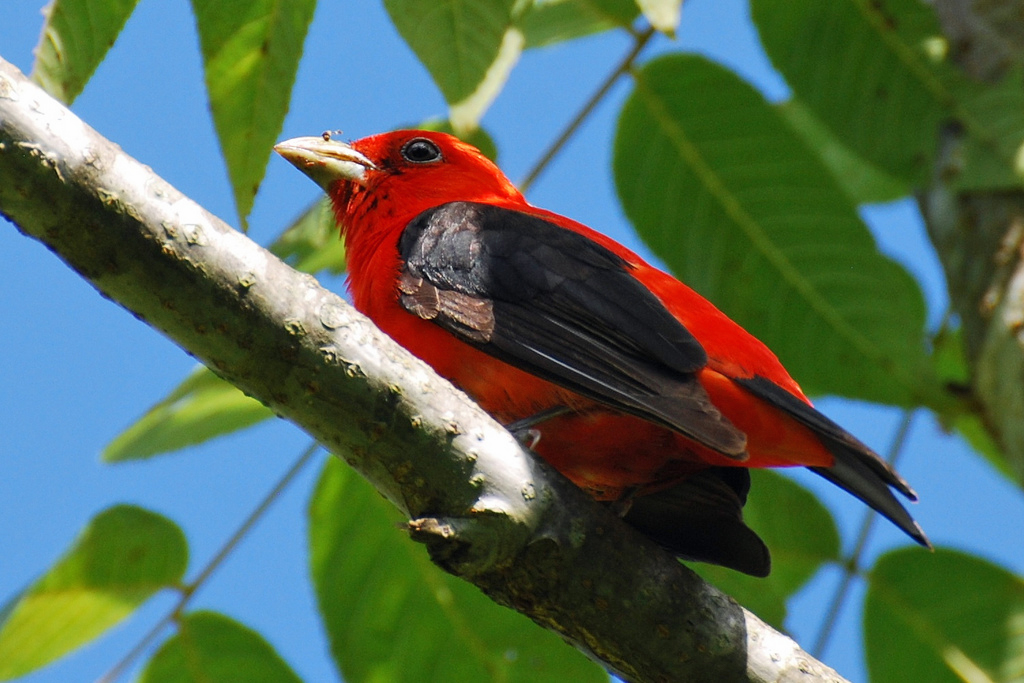
Photo by Bryan Stevens • A female scarlet tanager is a study in contrast from her mate with her dull greenish-yellow plumage being much less vibrant than the male’s bright red and black feathers.

The Arctic tern, for example, truly takes migration to extremes. This small seabird travels each year from its Arctic nesting grounds to the Antarctic region, where it spends the winter months. Put into terms of mileage, the Arctic tern can travel about 50,000 miles in a single year. For a bird with a body length of about 15 inches and a wingspan of about 28 inches, this incredible migration is an astonishing feat. These statistics permit the Arctic tern to easily lay claim to the title of champion migrant among our feathered friends.

According to the website for National Geographic, Arctic terns face a serious threat from climate change. In a profile on the tern at its website, National Geographic warns that Arctic terns are projected to lose 20 to 50 percent of their habitat due to the temperature changes linked to climate change. They also face loss of habitat due to encroachment by human activities such as oil drilling.

The ruby-throated hummingbird, a favorite of many bird enthusiasts living in the eastern United States, makes an impressive migration each year. Just to reach the United States, these tiny birds undertake a strenuous journey. They leave their wintering grounds in Central America to return to the United States and Canada for the nesting season. Most of these tiny birds, which are barely four inches long, make a non-stop flight of more than 500 miles across the Gulf of Mexico. The journey can take almost an entire day. With the end of summer, the entire population of ruby-throated hummingbirds, increased by a new generation of young birds, makes the Gulf crossing for a second time in a year to return to the American tropics for the winter months.

Photo by Bryan Stevens • A ruby-throated hummingbird visits a feeder for a sip of sugar water.

Among North America’s buteo hawks, which includes raptors such as red-shouldered hawk and red-tailed hawk, the broad-winged hawk stands out as a dedicated migrant. These hawks form flocks that at times number in the hundreds or thousands as they sail and glide on thermals rising over various mountain ranges. These hawks and other raptors are well-known in the region for migrating past the Mendota Fire Tower in Southwest Virginia every September and early October.

The broad-winged hawk’s counterpart in the western United States is Swainson’s hawk, which shares the broad-winged hawk’s inclination for migrating in large flocks. Swainson’s hawk is named for William Swainson, the famous 19th century English naturalist for which Swainson’s thrush is also named.

The hooded warbler, my favorite member of the migratory New World warblers, migrates back to Mexico and Central America for the winter months after nesting during the spring and summer in a range concentrated in the southeastern United States. The males, after going quiet in late summer, have started singing on occasion from the shaded woods around my house. I think this has more to do with restlessness as they prepare for to depart on a migration flight that will take them to the balmy Caribbean, Mexico and Central America while we shiver through the months between October and April. It’s not a migration of an incredible distance, but it’s still quite an accomplishment for a bird only five inches long and weighing less than half an ounce.

Photo by Jean Potter • A male hooded warbler flits through the foliage of a rhododendron thicket.

Fall’s a great time to witness the variety of avian life. Look for some of these migrants passing through your yards, gardens or favorite birding spots.

Woman documents special relationship with pine warblers in photographs

Photo by Rebecca Boyd • Pine warblers Petey and Petunia take mealworms from a waiting hand. These two warblers have learned to trust Rebecca “Becky” Boyd in order to get a quick meal.

For Becky Boyd, the ongoing pandemic has provided an unexpected opportunity to get to know some of her resident birds on a more personal basis. She has even won the trust of some of her backyard birds, succeeding at persuading them to take food right from her hands. She has posted photographs of some of these up close and personal engagements with birds to her Facebook page, where I first began to look with awe at her success.

Boyd, who resides in Knoxville, Tennessee, discussed some of her incredible stories involving some of her own feathered friends. “First, I feel like I should explain my bird-feeding station,” she said. “My bedroom window is on the second story, adjacent to a deck.”

She noted that there is a flower box under the window that she placed a board across so that she could set food containers right outside the window. “I also have a mealworm feeder hanging from a swing arm near this window,” Becky said.

She removed the screen covering the window so that she could pull the window open to take pictures up close. “This window is next to my home office work desk, where I sit every day during the COVID pandemic while working from home,” Becky continued. “The birds have become accustomed to seeing me at the window, and the first bird that I was able to feed by hand was a ruby-throated hummingbird.”

The process didn’t take all that much effort. “I got one of those little ‘button’ feeders’ that I held out the window next to the regular feeder,” she explained. “After a half dozen attempts, it worked!”

She added that she was even able to take a video of the experience.

Boyd also spoke about her relationship with the Eastern bluebirds living in her yard. “I have a bonded pair of bluebirds that live in my yard year round, and produce three broods of babies every year,” she said. “During time periods when natural food is scarce and when they are raising offspring, I provide live mealworms in addition to dried mealworms.”

She also has a section of a tree limb with recessed holes in which she spreads Wild Birds Unlimited’s Bark Butter (a specially formulated suet) onto. The limb hangs from a hook outside the same window.

Photo by Rebecca Boyd • Petey the pine warbler grabs a mealworm from a waiting hand. Petey’s trust eventually helped introduce his mate, Petunia, to the concept of a “free lunch” at the Knoxville home of Rebecca Boyd.

Most birding enthusiasts know that bluebirds and hummingbirds are among the most trusting of birds in regard to people, but Becky has enjoyed success with some species that are usually more aloof. For instance, the limb with the “bark butter” attracted the notice of a male pine warbler earlier this year.

“Sometimes when I would spread new butter on the stick, he would flutter around close by, being impatient to get something to eat,” she explained. “A few times he landed on my hand or arm during the process.”

Then the warbler discovered the little white dish that Becky keeps filled with live mealworms intended for the bluebirds. “At first, I would reach out to take the bowl away,” she said. “Live worms are sort of expensive.”

But the persistent warbler, who she named Petey, started landing on the lip of the bowl while she held it in her hand to protect the mealworms for the bluebirds.

“Once he associated that white bowl with yummy live worms, he started watching from a nearby tree for me to open the window to put out worms,” Becky said. “He would fly over immediately to grab some.”

His forward nature inspired her to conduct an experiment.

“Often, he would helicopter over the bowl in my hand with impatience, so I tried keeping the bowl in my hand instead of setting it on the ledge,” Becky continued. “He adapted right away, and before long his mate, Petunia, started copying his behavior.”

Becky expanded the experiment. “Within a week or so, I decided to try just putting the worms in the palm of my hand instead of in the bowl,” she said. “Petey adapted right away, but Petunia was a bit more reluctant.”

Becky noted with pride that Petey will perch on her hand for quite a while to gobble up some worms for himself. He will then grab a few in his beak to take back to the nest for their offspring.

“Petunia is more tentative and strategic, and will typically land just long enough to grab a few worms,” Becky said. “I’ve noticed that oftentimes they will take their worms and squish them into the bark butter or dunk them in the birdbath before taking them back to the nest. I wonder if that makes the worms stop wiggling to make it easier for the babies to eat them.”

Becky assumed that the warblers would only eat from her hand stuck out through the window opening, but one day she was sitting in a lawn chair in her back yard.

Photo by Rebecca Boyd • Pine warbler Petey ducks his beak into a bowl of mealworms for a quick snack.

“Petey found me and started fluttering around looking for food,” she recalled. “He followed me back to the house and waited on the deck ledge for me to fetch him some worms.”

He has become quite insistent. “When I would sit on the deck to read or watch the birds, he would land on the table and trill at me with a loud, shrill song until I met his requirements,” Becky said.

Now, when she is sitting at her desk working, Petey often gets her attention by pecking on the window to let her know he’s there and waiting for worms.

“So, I keep a cup with some worms next to the window so I can quickly slide the window open and shake a few into my hand to offer him,” Becky said. “Once the first brood of fledglings started coming to the window, they chose to only eat the bark butter instead of gravitating to the mealworm feeder.”

Becky added that the fledglings have moved on now, and Petey and Petunia are working on their second brood.

Becky has some aspirations about other resident birds. “I would love to be able to hand-feed the bluebirds,” she shared. “They will come very close to me — sometimes almost nose to beak through the closed window — but they are not willing to get close enough to hand-feed.”

She has had some success getting a few of her resident tufted titmice to accept food from her hands. Petey and Petunia deserve some of the credit.

“The titmice watched how the pine warblers ate from my hand and picked up the routine very quickly,” Becky said. “One of them is so bold, I sometimes have to try to shake him off my hand like he’s a housefly, but he comes right back to latch onto my fingers!”

She often names some of the regular cast of characters among her feathered friends.

Pine warbler pair Petey and Petunia have raised two fledglings, which Becky dubbed Posey and Pansy.

She has given her Eastern bluebird pair the names of Bogie and Bacall.

“They lost all but one fledgling from their first brood this year, so I named her Solo,” Becky added. “This pair has nested in my yard for four years in a row.

Her two reliable ruby-throated hummingbirds have been given the names LeRoy and Loretta.

Photo by Jean Potter • A pine warbler visits a seed feeder at the home of Brookie and Jean Potter near Wilbur Lake in Elizabethton, Tennessee.

I asked if she has ever been described as a “bird whisperer” by her friends. “All the time!” Becky responded. “Many of my friends and Facebook Birding Group members are as amazed as I am about this experience.

Becky noted that her backyard attracts a wide variety, as well as volume, of birds. “I try to make it attractive to the birds versus pretty for the people,” she said. “I always keep two clean birdbaths available to them, and consistently keep feeders full of different types of seeds.”

In addition, she said that she plants bird-loving trees and shrubs and even left a couple of dead trees standing in the yard for the woodpeckers to enjoy. “I also try to make myself visible to the birds on a regular basis so that they understand that I’m not a threat,” Becky said. “I’m not sure if I have an actual gift, or if this is all just a wonderful result of spending so much time at home in their environment.”

Her special encounters with backyard birds provides a “rewarding feeling of awe and intrigue,” she said. “Having such a personal relationship with wild birds deepens my awareness of nature and makes me even more determined to help our songbird populations survive and thrive. That being said, I do recognize that wild birds should not be tamed such that they lose their fear of humans. Understanding this risk, I feel a mixture of joy and a little guilt. I don’t plan to encourage this behavior with any new birds, but I sure am enjoying my bond with this pine warbler pair.

Friends don’t always fully understand her enthusiasm for birds.

“Some don’t understand my passion for this or recognize how rare it is to have a personal relationship with wild birds, but most of my friends are also nature lovers who are in awe of this and wish they could do it, too,” Becky said.

“I joke that I should build a solid fence around my property and charge admission to my bird park,” Becky said. “My friends have encouraged me to start my own website to display and sell my bird photos, and I am in the process now of building my website, which will be named RidgeRockArts.com.”

In the meantime, Petey is on the verge of achieving a taste of international fame.

“An accomplished artist in Amsterdam recently saw one of my photos of Petey perched on my hand and asked to paint him to add to her portfolio,” Becky said.

Petey even crowded into the interview’s conclusion. “Here he is right now pecking on the window during this interview,” Becky said. “I must stop what I’m doing and get him a handful of worms right this instant. I think he is the one that trained me versus me training him.”