Tag Archives: Hummingbirds

The thrill of the chase keeps some fervent birders seeking out ‘rare’ birds

northernwheatear-one

Photo by Jean Potter • This Northern wheatear caused great excitement in the Tennessee birding community with an extended stay at a farm in the Volunteer State in November.

A little bird caused a huge stir among birders in the Volunteer State back in November.

A Northern wheatear — a six-inch-long bird that breeds in open, stony terrain across the Northern hemisphere from Asia and Europe as well as northwestern and northeastern Canada, Alaska and Greenland — made a most unlikely migratory stop at a farm in Loudon County, Tennessee, supposedly en route to its wintering grounds in Africa. The visiting songbird turned out to be the first of its kind ever documented in Tennessee.
Credit for the discovery of the bird goes to Tony King, a birder who hails from Lenoir City, Tennessee. He found the bird at Windy Hill Farm, a privately owned agricultural enterprise in Loudon County. After seeking confirmation from other experienced birders, King put out the word about his rare bird.
Almost immediately, birders flocked to the Loudon County farm — with the gracious permission from the farm’s owners — for a chance to see a bird not often glimpsed in the Lower 48 states.
Birders who saw the wheatear observed the bird actively feeding on the ground and perching on fence posts. Several members from the Elizabethton and Bristol bird clubs made the journey to Loudon County to add the wheatear to their state list for Tennessee and, for many individuals, on life lists of birds seen nationwide.

northernwheatear-two

Photo by Jean Potter • The Northern wheatear at the Loudon County farm spent much time perched on fence posts.

The wheatear is a truly long-distance migrant, but it’s difficult to speculate why this individual bird’s journey took it far enough off course to land in Tennessee. My schedule didn’t permit me to immediately try to add this bird to my own life list. I made plans to make the trip on Nov. 23 as part of my Thanksgiving break. Unfortunately, the bird departed on Nov. 20, hopefully to continue its long journey to Africa for the winter months.
The wheatear got me to thinking about the way determined birders “chase” rare birds to add to their life lists. Some people are quite dedicated — or fanatical — to pursuing reports of rare birds to the point they will drop everything to chase down coveted birds.
Adding to the thrill of the chase for birders in Tennessee was the fact that a couple of days after the wheatear departed, a Bohemian waxwing became another “first” for its kind in the state. Unfortunately, that bird apparently didn’t stick around. It’s fun to speculate their reasons, but finding the motivation among our feathered friends can be an exercise in futility. I have my own motto about these rare visitors. Birds have wings, and they know how to use them. It’s that ability to pick up and fly to distant places that is part of their appeal.
I understand the appeal of chasing after a rare or hard-to-get bird. I’ve chased my share of birds. I achieved a long-held desire to see a snowy owl when I made the trip to Spring Hill, Tennessee, back in February of 2009. That’s probably the farthest I’ve traveled to observe a specific bird.
In November of 2003 I made a shorter but ultimately unsuccessful trip to Knoxville, Tennessee, for an attempt at getting binoculars on a sage thrasher that had been reported. Although I spent several hours with dozens of other birders looking for the bird, it never put in an appearance.


rufous-halloween

Photo by Bryan Stevens • The rufous hummingbird is one of several hummingbirds native to the western United States that has ventured into Tennessee on occasion.

My most memorable “rare bird” — and one that I chased across state lines — was a green-breasted mango, a tropical species of hummingbird. I saw that bird while it was visiting a feeder at a home in Concord, North Carolina, in November of 2000. The species is known to stray into southern Texas, but appearances outside of the Lone Star State have been rare. This hummingbird is normally found in Mexico and Central America, but in addition to the Concord bird the species was documented in Beloit, Wisconsin, back in September of 2007. The Wisconsin bird was captured and taken to a zoo because of fears it would not survive the onslaught of the frigid Wisconsin winter season.
Another personal miss — and I should kick myself for not making an attempt at seeing this bird — was a hooded crane that visited Hiwassee Refuge in December of 2011 and January of 2012. The hooded crane, a rare species from Asia, was associating with the thousands of sandhill cranes that regularly gather at the wildlife refuge near Brentwood, Tennessee.
I’m quite proud of the four hummingbird species on my Tennessee list. I traveled to Nashville, Tennessee, in December of 1997 to see a calliope hummingbird. Closer to home I’ve seen Allen’s hummingbirds and rufous hummingbirds, and, of course, ruby-throated hummingbirds.
One pertinent bit of information about the Northern wheatear is in order. The wheatear is not a rare bird. In fact, the bird is quite common with an estimated population of almost three million birds. The same is true of many of the “rare bird” sightings that excite birders. Some of these exceptional visitors are often not considered rare. The rarity comes from the bird showing up in a totally unexpected location, such as a Northern wheatear spending a week at a Tennessee farm.
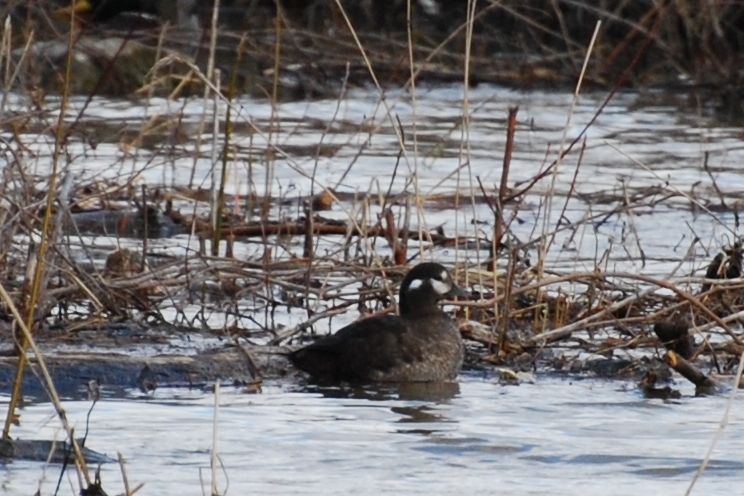
That’s why an American white pelican at Middlebrook Lake in Bristol, Tennessee, a harlequin duck on the Holston River in Kingsport, Tennessee, and a Northern redpoll in Shady Valley, Tennessee, can quickly generate excitement in the birding community.
jp-harlequinduck

Photo by Jean Potter • This harlequin duck was a remarkable find a few years ago on the Holston River in Kingsport, Tennessee.

Most experienced birders offer one bit of advice — don’t delay. They’re words to take to heart for those seeking to chase after rare birds. In other words, if you snooze, you lose. My friend, the late Howard Langridge, was of that persuasion. In January of 2000, Howard tried to persuade me to ride with him from Elizabethton to Shady Valley in the midst of a raging snowstorm for the opportunity to see a long-eared owl. I declined. Howard made the trip, regardless of the snow and ice. As a reward, he saw the owl at the home of John and Lorrie Shumate.
After the storm passed, Howard accompanied me and Allan Trently to Shady Valley on a night when the mercury in the thermometer hovered at around zero. Almost needless to say, we didn’t even glimpse a feather of the long-eared owl. The owl’s stay at the Shumate home proved quite brief.
Of course, that’s all part of the thrill of the chase. You see some, but some you don’t see. It makes the birds that you do see even more memorable.

kayla-calendar

Photo by Bryan Stevens • Kayla Carter with the Elizabethton Chamber of Commerce displays one of the calendars being sold by members of the Elizabethton Bird Club.

•••••
The Lee and Lois Herndon Chapter of Tennessee Ornithological Society, based in Elizabethton, is once again offering for sale its annual calendar.

All proceeds from sales of the 2017 calendar benefit the chapter’s work to promote birds and birding. This year’s calendar features nearly 100 full-color photographs. Calendars are $15. They are currently available at the Elizabethton Chamber of Commerce. In addition, for another $2 for shipping and handling, a calendar can be mailed.  To reserve a copy, email me at ahoodedwarbler@aol.com or message me on Facebook.

Arduous migration journeys by some birds represent wondrous natural achievements

grosbeak-photo

Photo by Bryan Stevens                                                          This rose-breasted grosbeak struck a window Monday, Oct. 3, during fall migration. Although this bird rested and later recovered, many birds are felled by similar perils and obstacles as they migrate south each fall.

A stunned rose-breasted grosbeak recuperating on the front porch on Oct. 3 provided a reminder that migrating birds face a variety of perils and obstacles as they wing their way back south. Now that we’re into October, many of the birds of summer — orioles, tanagers, warblers and hummingbirds — are becoming scarce in our yards and gardens. These neotropical migrants are temporary visitors, remaining in North America only long enough to nest and raise young before they take to the wing to return to more tropical regions for the winter months that will grip their summer home in snow and ice for several months.

Some of these birds migrate out of the tropics to avoid competition. Others find North America a land of abundant, albeit temporary, resources. This land of plenty offers a wealth of insects, seeds, fruit and other nourishing, nutritious food to help parent birds keep their strength while they work to ensure their young thrive. The phenomenon of migration isn’t exclusive to the neotropical migrants of the New World. Birds in other parts of the world migrate, too.

rubythroated_hummingbird

Photo by U.S. Fish & Wildlife Service                 The tiny ruby-throated hummingbird crosses the Gulf of Mexico twice yearly to migrate from Central America to North America in the spring and back again in the fall.

The Arctic tern, for example, truly takes migration to extremes. This small seabird travels each year from its Arctic nesting grounds to the Antarctic region, where it spends the winter months. Put into terms of mileage, the Arctic tern can travel about 50,000 miles in a single year. For a bird with a body length of about 15 inches and a wingspan of about 28 inches, this incredible migration is an astonishing feat.

The ruby-throated hummingbird, a favorite of many bird enthusiasts living in the eastern United States, makes an impressive migration each year. Just to reach the United States, these tiny birds undertake a strenuous journey. They leave their wintering grounds in Central America to return to the United States and Canada for the nesting season. Most of these tiny birds, which are barely four inches long, make a non-stop flight of more than 500 miles across the Gulf of Mexico. The journey can take almost an entire day! With the end of summer, the entire population of ruby-throated hummingbirds, increased by a new generation of young birds, makes the Gulf crossing for a second time in a year to return to the American tropics for the winter months.

The broad-winged hawk, a raptor found in the region during the summer, makes a fall migration back to South America every fall that astonishes human onlookers who gather along mountain peaks to witness the spectacle. The hawks form large flocks, also called kettles, that can number thousands of birds.

bartailed_godwit_on_tundra

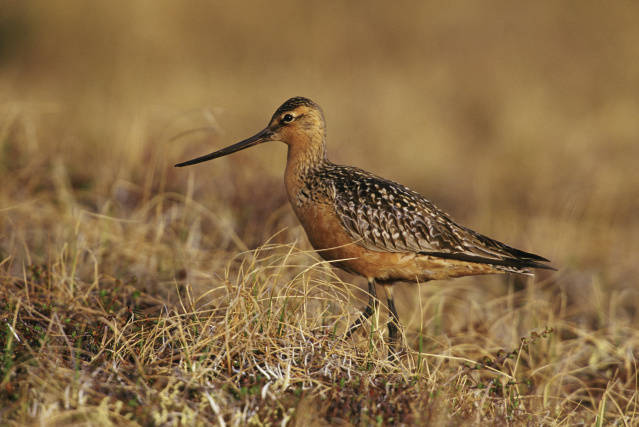
Photo by U.S. Fish & Wildlife Service/Steve Maslowski The bar-tailed godwit stages migrations that can take nine days of non-stop flight spanning nearly 6,000 miles.

Shorebirds, which in North America can consist of birds ranging from plovers and godwits to dowitchers and avocets, are champion migrants. The bar-tailed godwit makes an even more impressive non-stop migratory flight. This shorebird nests in parts of Scandinavia, northern Asia and Alaska. Some of these godwits make a nine-day non-stop migratory flight that takes them from New Zealand to the Yellow Sea of China, a distance of almost 6,000 miles. Needless to say, since the godwits make no stops along the way, they must also go without food for the duration of their journey.

Most of the warblers that nest in North America retreat to Central and South America during the winter months. Few warblers, however, make as great a journey as the blackpoll warbler. Instead of migrating over land, this five-inch-long warbler undertakes a two-stage migration. The first half of the migration is a non-stop flight of about 1,500 miles. Every fall, these tiny birds fly over the ocean during this part of their migration, departing from Canada or the northern United States and not stopping until they reach various locations in the Caribbean. There they will spend some time recovering from the exhausting first half of their journey before they continue their way to such South American countries as Colombia and Venezuela. Once again, during the time they spend flying over open ocean, these tiny warblers do not feed.

Even birds that cannot fly undertake migrations. For instance, flightless penguins swim hundreds or thousands of miles to reach preferred ranges for feeding or nesting. The Australian emu, a smaller relative of the ostrich, makes seasonal migrations on foot to ensure access to abundant food supplies at all seasons.

arctic_tern

Photo by U.S. Fish & Wildlife Service/Kirk Rogers         The Arctic tern’s migration, which takes it from the Arctic to the Antarctic, keeps this small seabird in the sky for about 50,000 miles each year.

Birds are not even the only animals to migrate. Many creatures, from whales and wildebeest to dragonflies and butterflies, impress humans with their endurance as they stage regular migrations.

Even as some of our summer favorites depart, we should prepare to welcome back some winter favorites, including dark-eyed juncos, yellow-rumped warblers, white-throated sparrows and yellow-bellied sapsuckers. Fall is indeed a time of departure for many birds, but it’s also a time to make new friends with the other birds that should soon start arriving in our yards and gardens.

As for the rose-breasted grosbeak on the porch, that story had a happy ending. After taking some time to recover after apparently striking a window, the bird hopped around the porch for a moment and then took wing and flew to nearby hawthorn trees. The bird’s flight — strong and straight — delighted me. The grosbeak could have been badly injured or even killed. I wished it the best for the remainder of its journey.

•••••

I’m dedicating this week’s column to the memory of J. Wallace Coffey, a great birder and wonderful individual who died Tuesday, Sept. 27. I met Wallace, a native of Bristol, Tennessee, back in the late 1990s. He introduced me to some wonderful birding destinations in the region, including such Virginia locations as Burke’s Garden, Steele Creek Park in Bristol, the wetlands of Saltville and Musick’s Campground on Holston Lake. Wallace was a tireless promoter of birds, birding and birders, and he loved to encourage young people to explore nature. He was also a great leader for the Bristol Bird Club, as well as the Elizabethton Bird Club. He will be greatly missed.
•••••

Bryan Stevens lives near Roan Mountain, Tennessee. To learn more about birds and other topics from the natural world, friend Stevens on Facebook at https://www.facebook.com/ahoodedwarbler. He is always posting about local birds, wildlife, flowers, insects and much more. If you have a question, wish to make a comment or share a sighting, email ahoodedwarbler@aol.com.

Hummingbirds receive warm welcome upon their return

12080287_10206626890023339_7221944377156024273_o

Photo by Bryan Stevens                                    The last Ruby-throated Hummingbird to visit my feeders in 2015.

My last ruby-throated hummingbird in 2015 visited my sugar water feeder close to dusk on Oct. 10. I never saw any hummingbirds after that date.

I’m always a little wistful when the last hummingbirds depart in the autumn, but I know they’ll return in the spring. This year, a male ruby-throated hummingbird returned on April 12, 180 days after the last hummingbird departed last fall.

What do the hummingbirds that make their homes in our yards from April to October do during the five months they are absent from the region?

Hummer-Shy

Photo by Bryan Stevens                                       The first male Ruby-throated Hummingbird to visit my feeders in 2016 was a bit camera shy.

Most ruby-throated hummingbirds retreat to southern Mexico and Central America, some winging their way as far south as extreme western Panama, as well as the West Indies and southern Florida. They utilize a variety of habitats, ranging from citrus groves and forest edges to tropical deciduous forests and the edges of rivers and wetlands.

Those ruby-throated hummingbirds that make it as far south as Panama may find that they must compete with 59 other species of hummingbirds that call the Central America country home. Panamanian species that a ruby-throated hummingbird might possibly come into contract with include violet sabrewing, purple-throated mountain gem and white-necked jacobin.

In this region, we can only expect with any confidence to enjoy a single species — the aforementioned ruby-throated hummingbird — for half the year. It’s always great to welcome them home. Here are some of the other hummingbird enthusiasts who shared their “first arrivals” with me.

••••••

Doris Cochran in Marion, North Carolina, saw her first hummingbird on April 6.

“I was having my morning coffee … looking out at the frost we got in Marion last night,” she wrote. Then, from inside her home, she happened to notice something. Giving her sugar water feeder a closer look, she was surprised to see a hummingbird perched on it.

•••••

Beverly Puerckhauer sent me an email on April 5. She informed me that she has house finches visiting at her home, but she hasn’t yet seen a hummingbird.

•••••

Jimmie Daniels, Newland, North Carolina, reported her first hummingbird on April 8.

“I just saw a hummingbird at my house and my feeder was inside,” she informed me by email. “The feeder is out now, but he had already left. I sure hope he comes back.”

•••••

Glen Eller, a resident of Kingsport, Tennessee, saw his first ruby-throated hummingbird of the season on Sunday, April 10, at 6:35 p.m. He shared his observation through a post to the list-serve bristol-birds.

•••••

Pat Stakely Cook notified me of a first hummingbird sighting by Facebook post. “We had our first one here in Marion, North Carolina, on Sunday, April 10,” Pat reported, adding that there had been lots of activity around the feeders once that first hummer showed up.

•••••

Philip Laws, a resident of the Limestone Cove community in Unicoi County, Tennessee, reported his first hummingbird on Monday, April 11.

“I just saw my first hummingbird in Limestone Cove, a male of course, about noon,” he reported in a Facebook message. He added that he hadn’t had time to check his feeder on the previous day, but that the sugar water level was down enough to suggest that the hummingbird had probably been feeding on Sunday, too.

•••••

Susie Condrey of Marion, North Carolina, welcomed back a hummingbird on April 11 at 4:15 p.m.

•••••

Janice Denton of Bristol, Tennessee, reported her first spring hummer arrived on April 11.

“I was sitting on my front porch about 7 on Monday evening when a hummingbird went flying by,” she wrote in an email. “I have my feeders in front of three different windows, so when I went inside, I saw the ruby-throated hummingbird feeding at each of my feeders.”

Janice added that she loves watching the hummingbirds feed. “They are such amazing creatures of God,” she wrote.

•••••

Debbie Oliver, also of Bristol, Tennessee, also reported that her first hummer arrived on April 11.

“I just saw my first hummingbird this spring,” she wrote in her email. She noticed the bird flying around the hummingbird feeder at 7:35 p.m.

•••••

Lorraine Hale posted on bristol-birds that she saw two hummingbirds on Monday, April 11, at her home in Bluff City, Tennessee.

•••••

Karen Andis saw her first hummingbird at her shop on Smith Creek Road in Washington County, Virginia.

“I wanted to let you know we saw our first hummingbird on April 12 at 12:25 p.m.,” she wrote. She added that she has only one feeder out, which still managed to attract this hummingbird.

•••••

Joan Moffitt posted on my Facebook page that she saw her first hummingbird of spring on Tuesday, April 12, around 2:45 p.m. She put out her feeder on Saturday, April 9.

•••••

Harold and Elizabeth Willis saw their first hummingbird at 8 a.m. on Wednesday, April 13. The couple resides in Marion, North Carolina, in the Hankins community near Lake James.

•••••

13063046_10208044734309902_6436013255540173042_o

Photo Courtesy of Linda Kessinger Rhodes Linda Kessinger Rhodes photographed her newly-arrived hummingbird and shared the photo on Facebook.
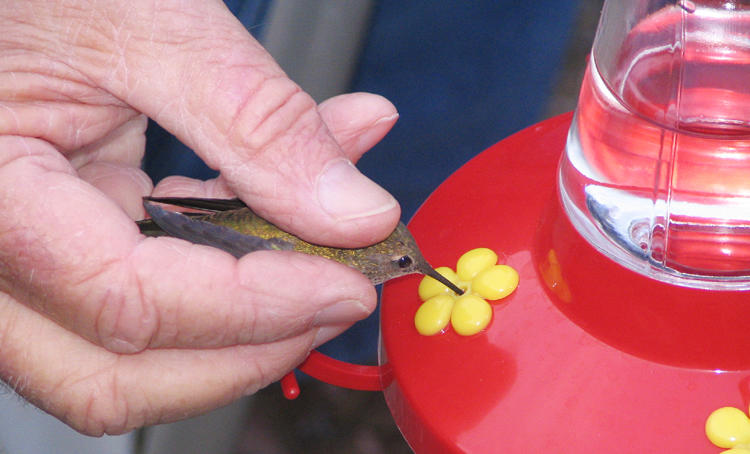
Linda Kessinger Rhodes sent me a Facebook message reporting her first hummingbird of spring on Thursday, April 14. “There he was — the first hummer I’ve seen at my waiting feeder off Volunteer Parkway in Bristol near the racetrack,” she wrote.

•••••

Marty Huber and Jo Ann Detta of Abingdon, Virginia, spotted their first spring hummer on April 14.

“Our hummingbird arrived  April 14 at 8:10 p.m. just before it got dark,” they shared in an email. “it was so exciting to see the hummer sitting and relaxing on our nectar feeder.”

This year’s hummingbird arrived two days later than last year.

“We hope this one stays around as last year it was ten days before we saw another hummer,” they added.

•••••

Bill and Judy Beckman, who reside on Spivey Mountain in Unicoi County, Tennessee, saw their first hummingbird — a male — around 2 p.m. on Thursday, April 14.

••••••

Steve Meigs saw his first hummingbird of the spring at 11:30 a.m. on April 14 at his home in Foxhound Hills in the Limestone Cove community of Unicoi. “That’s a few days earlier than the last few years,” Steve noted, adding that his home is located at an elevation of 2,800 feet.

••••••

Phyllis Moore informed me via Facebook that her hummingbirds are back in Bristol, Virginia, as of 7:30 p.m. on April 20.

••••••

Hummer-Male

Photo by Bryan Stevens                                     Now that they’re back, hummingbirds will probably stick around until early October.

James Noel Smith of Unicoi informed my via Facebook that the hummingbirds are back at his Unicoi, Tennessee, home as of April 26.

••••••

To learn more about birds and other topics from the natural world, friend Stevens on Facebook at https://www.facebook.com/ahoodedwarbler. He is always posting about local birds, wildlife, flowers, insects and much more. If you have a question, wish to make a comment or share a sighting, email ahoodedwarbler@aol.com.

Birds adopt many strategies for care of their young

One question that tends to pop up every June in my email or on Facebook concerns the presence of hummingbirds.  The status of hummingbirds at my own home since their arrival back in April has been somewhat sporadic. I think this has been noticed by some other people, too.

MommyHummer

Photo by Bryan Stevens                                                                  A female Ruby-throated Hummingbird visits a feeders. Female hummingbirds in our yards in June and July are probably nesting residents.

The hummingbirds were scarce in April and May. When June arrived, their numbers began to increase.

However, this pattern that I saw this year is usually just the opposite. The hummingbirds are usually abundant in early spring, taper off in June and July, and then increase again in August and September. Basically, I think their numbers just naturally fluctuate. Some years we have more of them than other years.

There are other possibilities to explain the absence of hummingbirds. It’s always possible that hummingbirds, adhering to the philosophy that “the grass is always greener” elsewhere have taken to exploring a neighbor’s yard and gardens.

Hummingbirds, like many of the songbirds that spend the summer season with us, keep busy this time of year with the task of raising offspring. That alone could explain a temporary lull in their numbers in our yards and gardens.

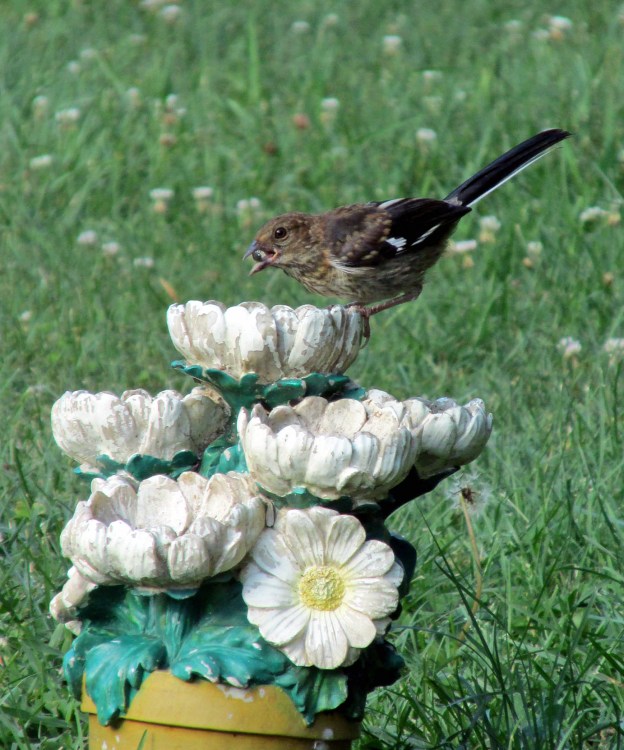
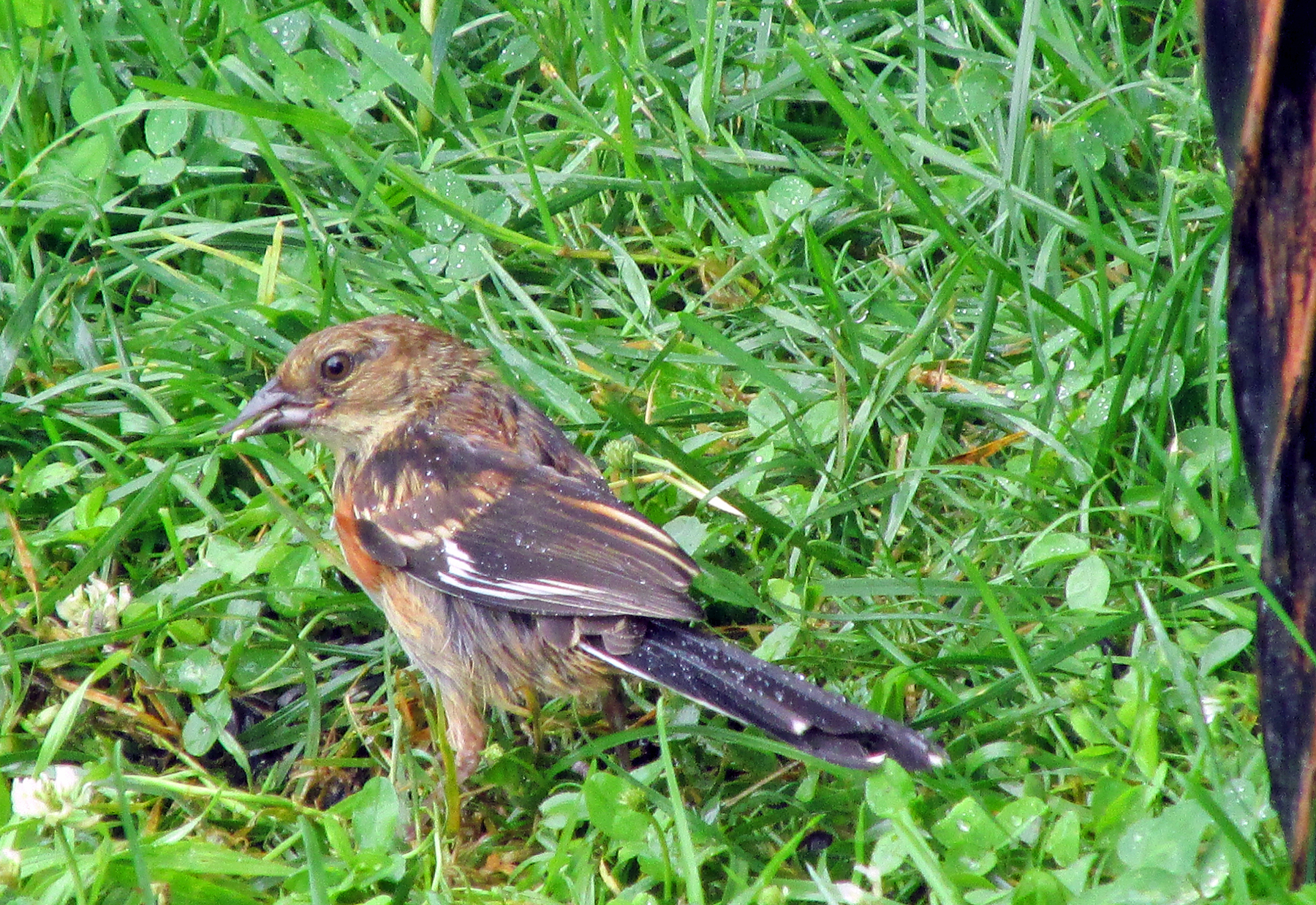
BabyTowhee

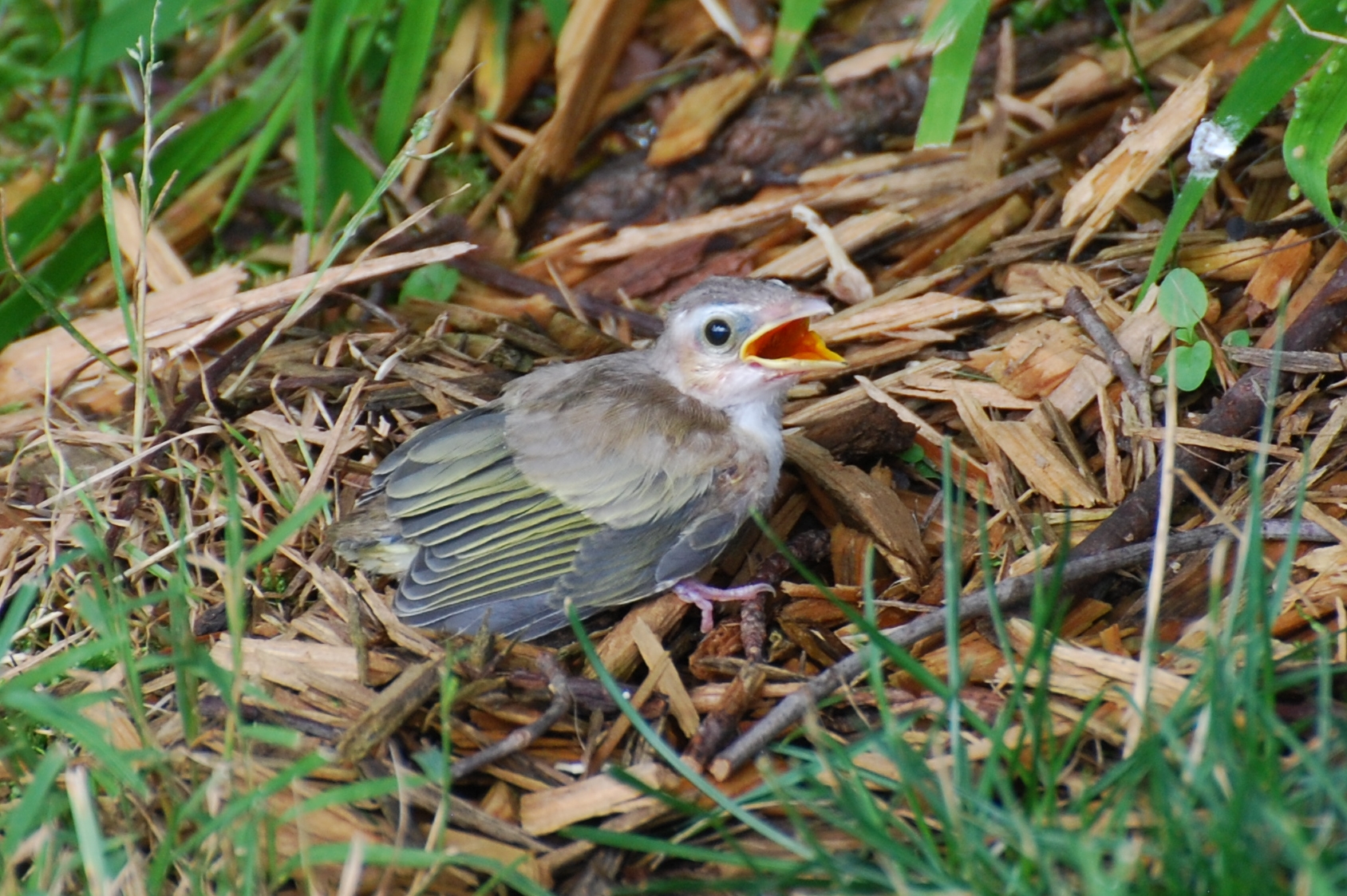
Photo by Bryan Stevens                                                A young Eastern Towhee, not long out of the nest, looks for sunflower seeds in the grass beneath a feeder.

Many species of birds attempt to nest two or even three times during the summer nesting season. So far this year, I’ve observed nesting activity by a wide variety of birds, including Northern cardinals, brown thrashers, Eastern towhees, Eastern bluebirds, tree swallows, song sparrows, white-breasted nuthatches, Carolina wrens and downy woodpeckers.

All birds, from tiny hummingbirds that are mere inches long to an ostrich that can stand more than nine feet tall, start out as eggs. Birds have developed a range of ways to protect and incubate eggs to ensure the continuance of the species.

For many birds, the strategy is to produce as many young as possible in a limited amount of time. The hooded warbler, which spends the winter months in Central America, will usually make multiple nesting attempts in a season. The female constructs a cup-shaped nest, which is a design common to many of our songbirds. She will lay three to five eggs in the nest. Incubation of the eggs is a duty usually performed solely by the female, but her mate helps by guarding the nest and surrounding territory. Both parents feed the young once they have hatched after about two weeks.

Not all birds share in the task of caring for helpless young. For instance, the male ruby-throated hummingbird shows not the slightest inclination to assist the female with the duties of rearing young. All ruby-throated hummingbirds are raised by single mothers. Male hummingbirds spend the summer sipping nectar, dueling with other male hummers and courting multiple females.

Hooded warbler pairs, as is the case with many songbirds, share the work of feeding and tending young. Many of these young birds spend very little time in the nest after hatching. Hooded warblers have typically left the nest within nine days of hatching, although parents continue to feed the young as they learn to fly and care for themselves.

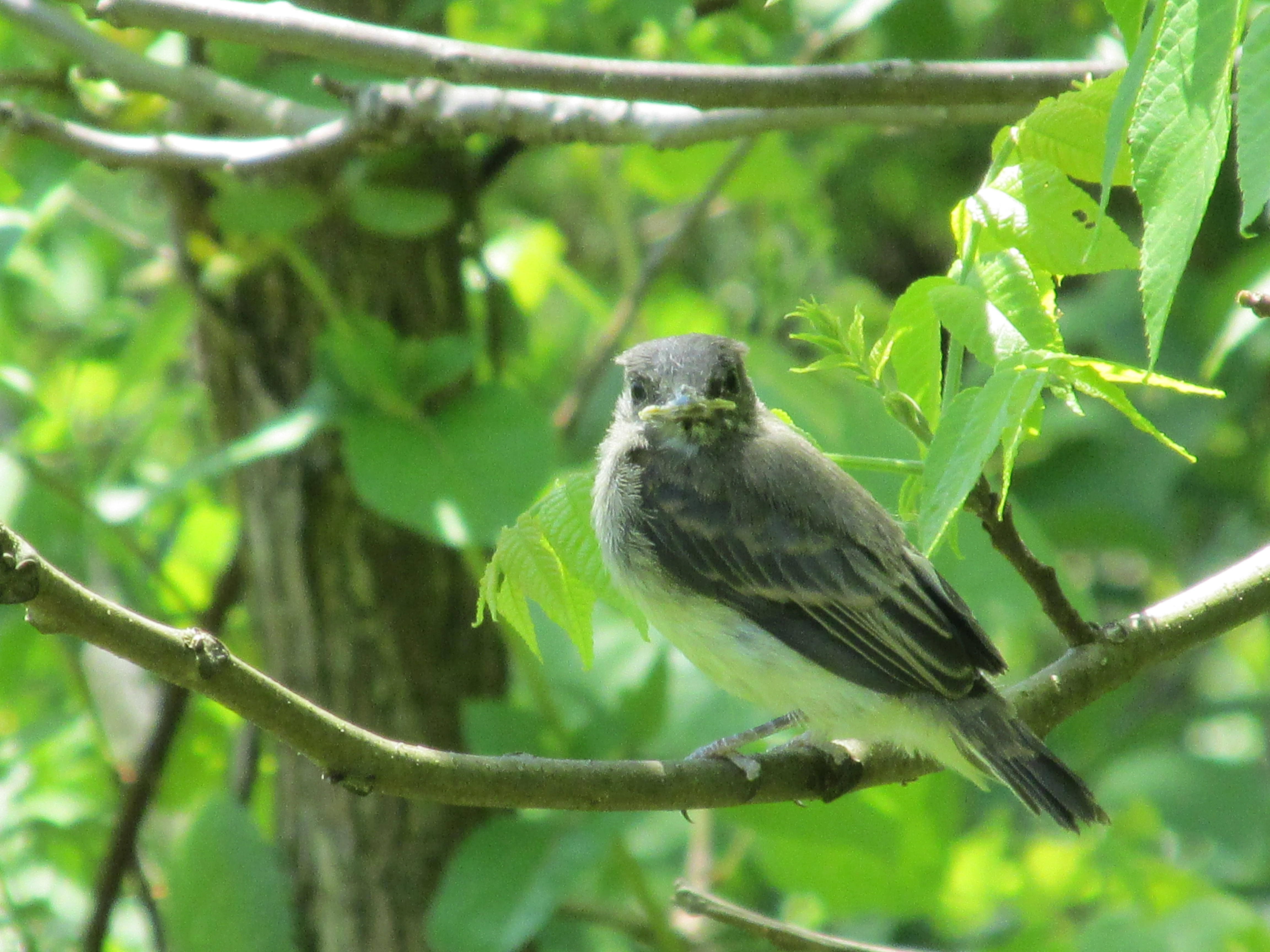
BS-Phoebe-Baby

Photo by Bryan Stevens                                    An Eastern phoebe fledgling perches on a tree branch.

Some birds, such as Northern Cardinals, often delegate the duty to the male for caring for young that have fledged from the nest. As the male trains and continues to feed the maturing young, the female cardinal often begins the work of building a second nest, laying another clutch of eggs and incubating them. Time is scarce. By getting a jump-start on a second nest, the female cardinal, if successful, may produce eight to ten new cardinals in a single nesting season.

John-James-Audubon-Common-Cow-bird.-1.-Male.-2.-Female.-3.-Young

A painting of Brown-headed Cowbirds by John James Audubon.

Some birds, however, have bypassed the necessity of nesting altogether. If all hummingbirds are reared by females, then all young cowbirds are from foster homes, or nests. Female cowbirds slip their eggs into the nest of other unsuspecting songbirds. The hooded warbler is often a victim of this practice, which is known as “nest parasitism.” Some experts have conducted studies that indicate as many as 75 percent of hooded warblers in some areas are parents to cowbirds foisted on them.

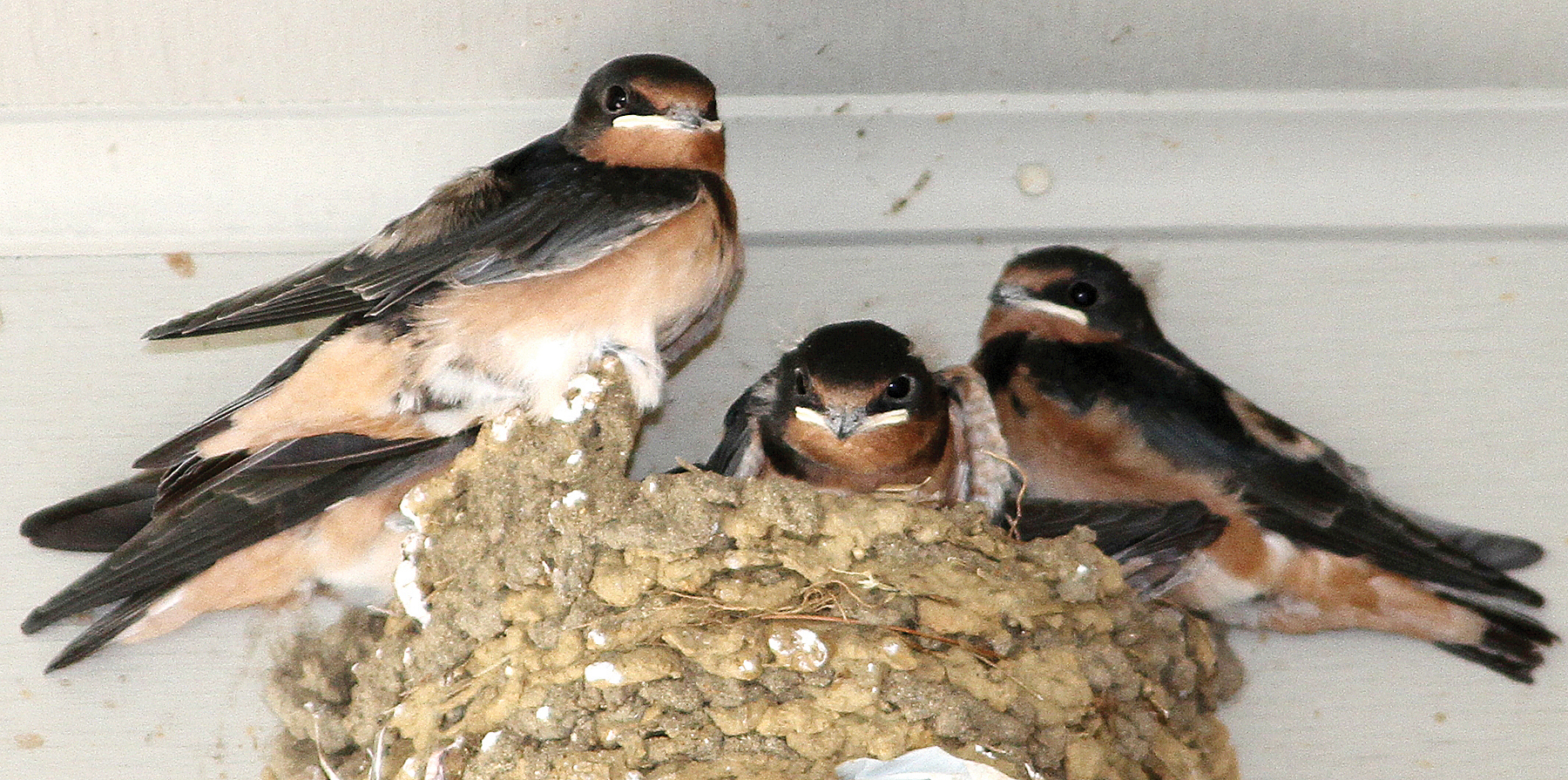
BarnSwallows.jpg

Photo by Bryan Stevens                                Young barn swallows in their nest await a delivery of food by their parents.

It’s not wise to condemn cowbirds for a behavior that would strike us as immoral. The peculiar reproduction strategy for the cowbird came about as a natural necessity. Cowbirds once followed the massive herds of bison across the North American continent, feeding on the insects and seeds displaced by the hooves of these huge animals. Since the bison herds stayed on the move, the cowbirds didn’t have the luxury of staying put for a couple of months to raise young.

The decimation of the bison herds could have proven a disaster for the cowbirds. That wasn’t the case, however, since these adaptable birds simply switched from following bison herd to doing the same with the enormous numbers of domestic cattle that inherited the range of the buffalo, or bison.

These are just a select few ways that birds succeed year after year in the never-ending effort to ensure the survival of the species for another generation. Many obstacles stand in their way. Any time you see birds bringing their babies to a feeder in your yard or a shrub in your garden, recognize this moment as a singular triumph for the labor and dedication our fine feathered friends have invested in this outcome.

JP-RedEyedVireo-Fledgling

Photo Courtesy of Jean Potter                                                                                                                A young Red-eyed Vireo calls for food while concealed on the ground after leaving the nest. As is the case with most songbirds, parents continue to care for young even after they have left the nest.

Wintering hummingbirds are not exclusive to United States

GE DIGITAL CAMERA

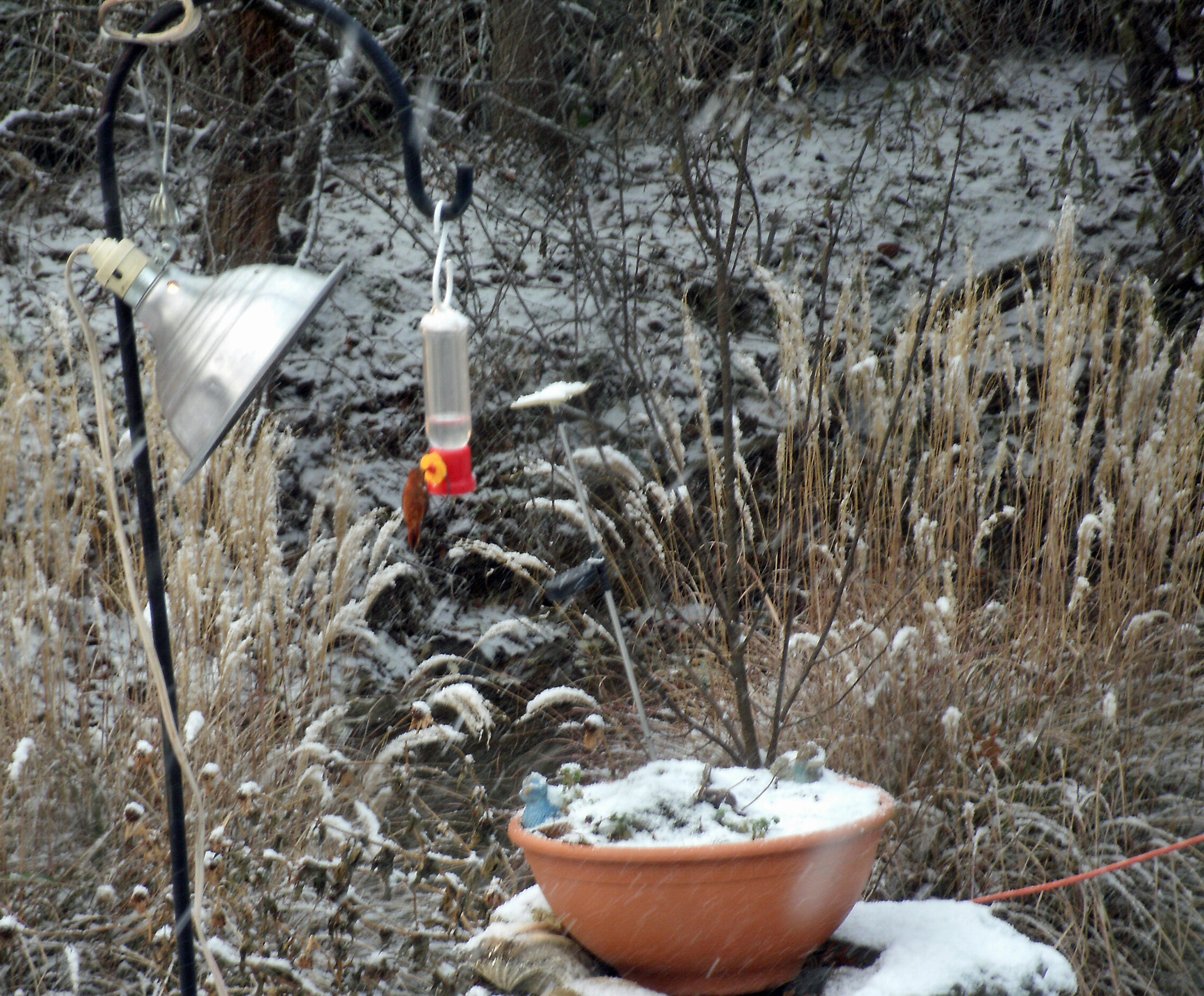
Photo Courtesy of Faye Guinn                  The Rufous Hummingbird is shown visiting a feeder at the Guinn home.

The hummingbird that had been at the home of Howard and Faye Guinn since October departed on Dec. 23. Faye informed me of the bird’s departure in an email.

“I got to have a winter hummingbird for two days of winter,” she wrote. “He surely decided to spend the holidays in Mexico. I hope he finds flowers in bloom there. Hummingbirds and flowers just go together.”

••••••

I had written about wintering hummingbirds in previous blog posts, including the one visiting the Guinn home near Jonesborough, Tennessee. After reading one of my recent blog posts on wintering hummingbirds, I received an email from Oscar, a resident of Vancouver, Canada, and a self-proclaimed “bird-lover.”

He also informed me that wintering hummingbirds are not a phenomenon exclusive to the United States. Some of these tiny birds also spend time north of the border during the winter months.

“We are delighted  to have these beautiful little birds visiting our feeder at our window every day,” Oscar wrote. “Every 10 minutes he drinks and goes back to the same tree branch.”

While Vancouver is a rather temperate city, Oscar said the temperature can get cool on some days.

“He doesn’t  go away for long periods,” Oscar reported. “It seems to look like he is afraid to lose his food to another bird, when his partner tries to feed he chases him away like he is very upset and not sharing his food, no matter what. Is this  behavior common among these birds?”

In my reply, I did note that hummingbirds are usually quite territorial. Any readers who hosts more than one hummingbird at a time is probably familiar with the chasing antics Oscar described in his email.

Annas_hummingbird

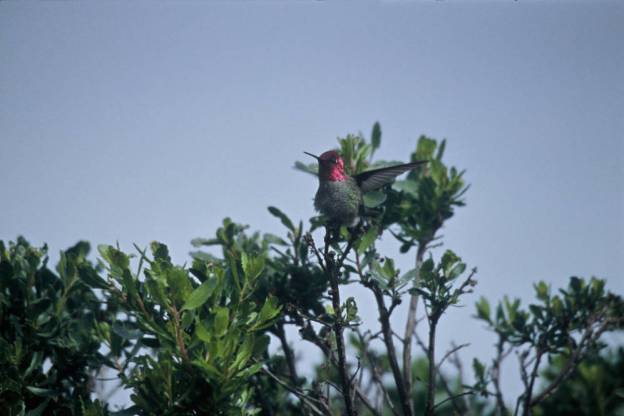
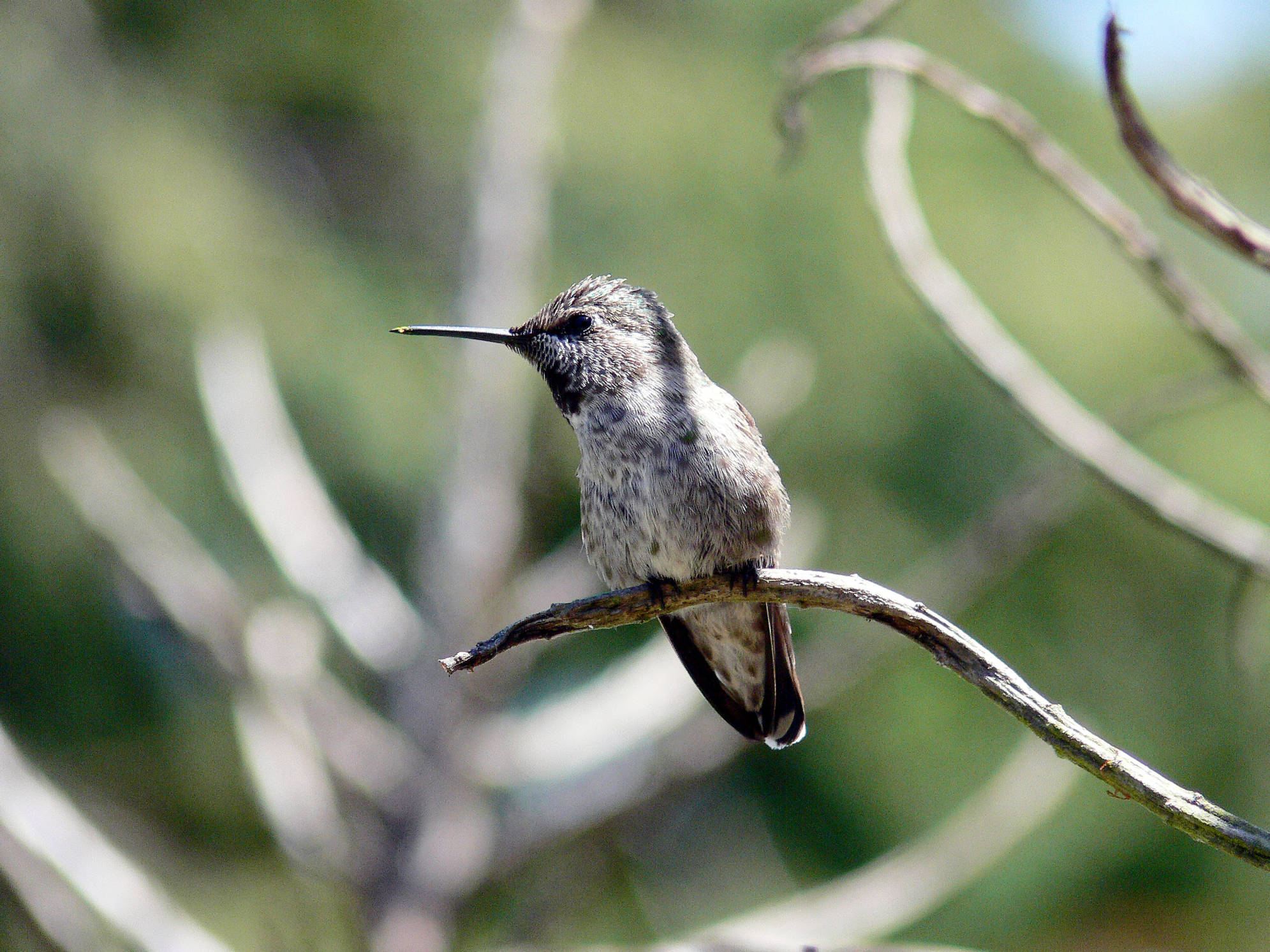
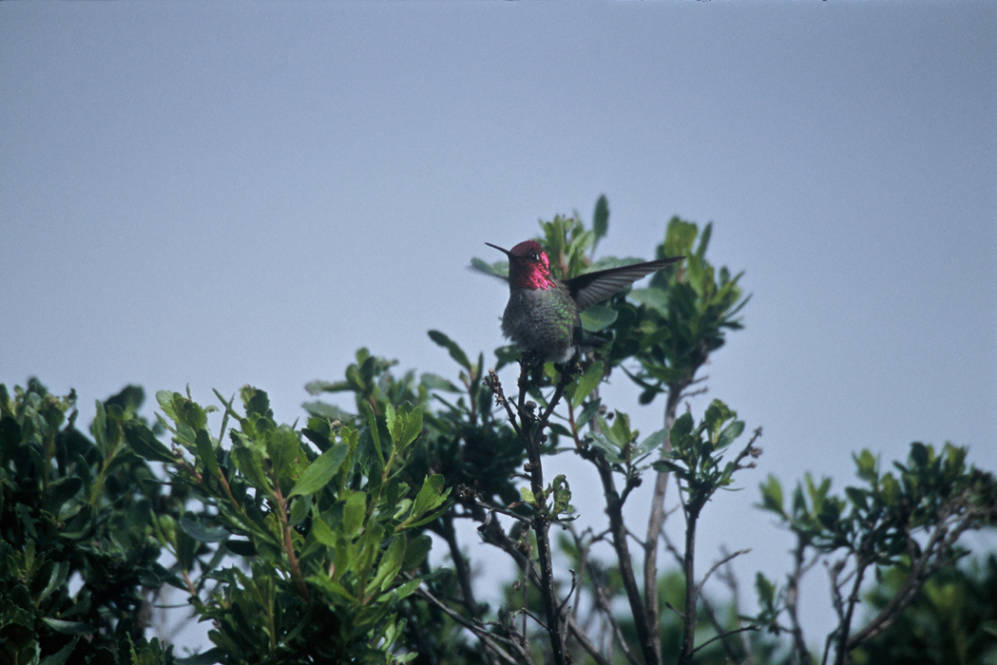
Photo by U.S. Fish and Wildlife Service                        An Anna’s Hummingbird perches on a branch.

“Watching this is so entertaining , like a gift from God,” Oscar shared. “We can’t have enough of it.”

I did some research, which informed me that Oscar’s visiting hummingbirds are likely Anna’s hummingbirds.

A species native to western North America, the Anna’s

hummingbird is a year-round resident of the Pacific Coast. It ranges from northern Baja to points as far north as Vancouver and southern British Columbia.

Annas_Hummingbird (1)

Photo by U.S. Fish and Wildlife Service              A male Anna’s Hummingbird spreads it wings while settling onto a perch.

René Primevère Lesson, a French ornithologist and author of a manual for ornithology, gave the Anna’s Hummingbird its name.

This bird was named after Anna Masséna, Duchess of Rivoli. She served as an attendant for  Empress Eugenie, the wife of Napoleon III and the last Empress consort of the French.

Another hummingbird — the Magnificent Hummingbird — was also named by Lesson to honor François Victor Masséna, the Duke of Rivoli and husband of the Duchess Anna. Until the 1980s this large hummingbird was known as Rivoli’s Hummingbird.

In the early 20th century, Anna’s hummingbird bred only in northern Baja California and southern California. Modern landscaping techniques, including the planting of exotic shrubs and flowers, has helped this hummingbird expand its range north, especially in urban and suburban areas.

James-Audubon-Art-2

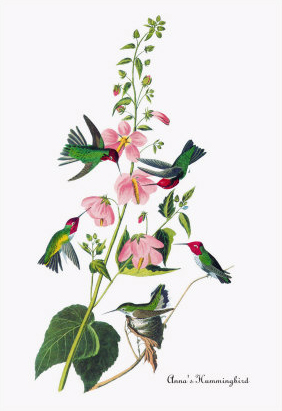
Early naturalist John James Audubon created this painting of Anna’s Hummingbirds.

I’ve seen several of the western species of hummingbirds, but I haven’t had the opportunity to observe an Anna’s Hummingbird. I suppose that species remains near the top of my “bird bucket list.”

•••••••

Until the recent cold snap, it has been a relatively mild winter. Even the Arctic blast produced mostly cold and very little in the way of snow.

The frigid conditions did, not surprisingly, result in increased traffic at my feeders.

DUo-Downy-Titmouse

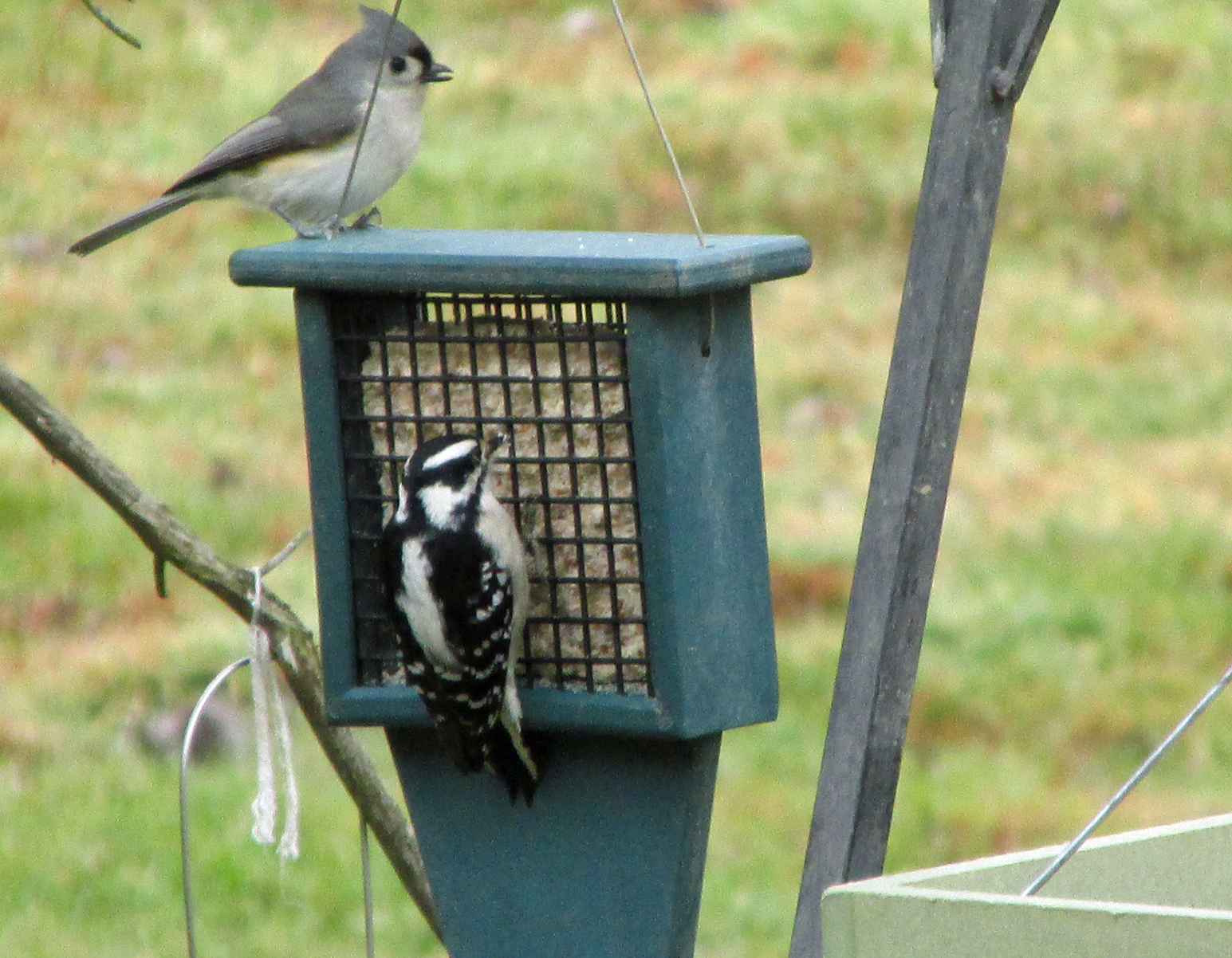
Photo by Bryan Stevens                                     A Tufted Titmouse and Downy Woodpecker visit a suet feeder.

I haven’t hosted any birds as exotic as an Anna’s Hummingbird this winter, but the flocks of Pine Siskins and Purple Finches continue to grow. The arrival of January has seen as many as 25 Pine Siskins and about a dozen Purple Finches at my feeders.

I always offer suet cakes as well as seeds, an offering that seems much appreciated by birds as diverse as Carolina Chickadees and Downy Woodpeckers to Carolina Wrens and Blue Jays. I usually buy commercially prepared suet/peanut butter cakes, which disappear quickly once the birds find them. The occasional squirrel also helps with making short work of them.

MixedFlock-Gold-Siskens

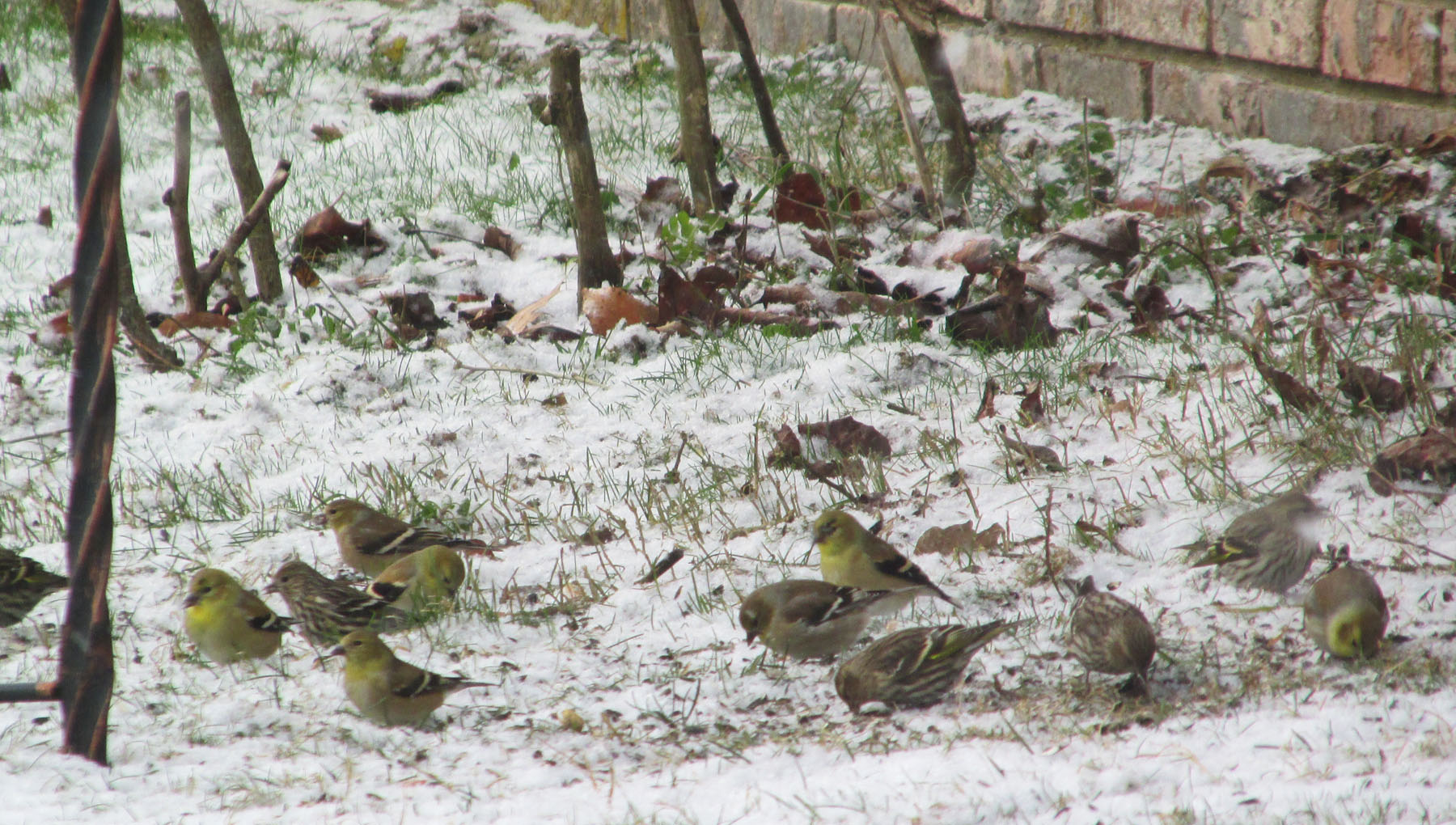
Photo by Bryan Stevens                                                                                                                              A mixed flock of American Goldfinches and Pine Siskins scour the ground beneath a feeder.

Bob Sargent leaves behind legacy of decades of hummingbird research

n_a (18)

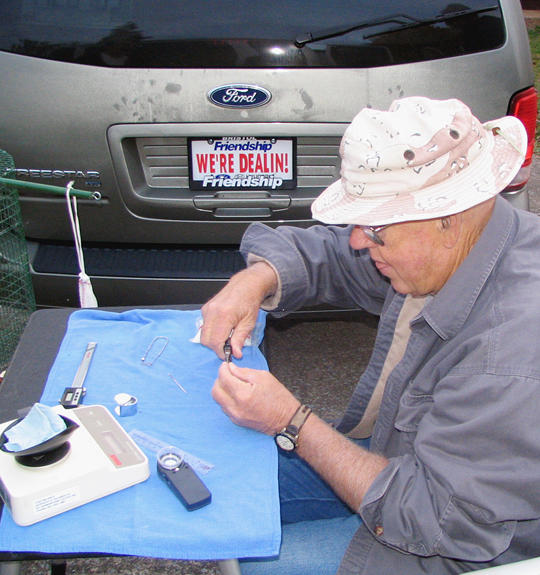
Photo by Bryan Stevens                                                                                                        Bob Sargent works diligently to band a Rufous Hummingbird at the home of Gary and Brenda Wallace in Elizabethton, Tenn.

I was saddened to learn of the recent passing of Bob Sargent. With his wife, Martha, Bob was the co-founder of the The Hummer/Bird Study Group. This non-profit organization founded by the Sargents was based in their hometown of Clay, Alabama, and dedicated to the study and preservation of hummingbirds and other neotropical migrants.

Their research programs with hummingbirds and migrating songbirds got underway back in 1987. The HBSG was formed in 1994. The Sargents have described the HBSG as a child born of the necessity to support their continuing research.

 Photo by Bryan Stevens                                                                                                          A Rufous Hummingbird gets a sip of sugar water midway through the banding process.


Photo by Bryan Stevens                                                                                  A Rufous Hummingbird gets a sip of sugar water midway through the banding process.

It was also a way to reward those who contributed financially to that effort. In the early days the Sargents’ savings account paid the expenses incurred by the HBSG. Many friends and bird conservationists contributed financially to the cause, and the Sargents wanted these donations to be tax-deductible.

The Sargent also became ambassadors in the promotion of hummingbirds. Their specialty became those species of western hummingbirds that have been gradually shifting their migration routes and wintering grounds to include forays into the eastern half of the United States.

n_a (16)

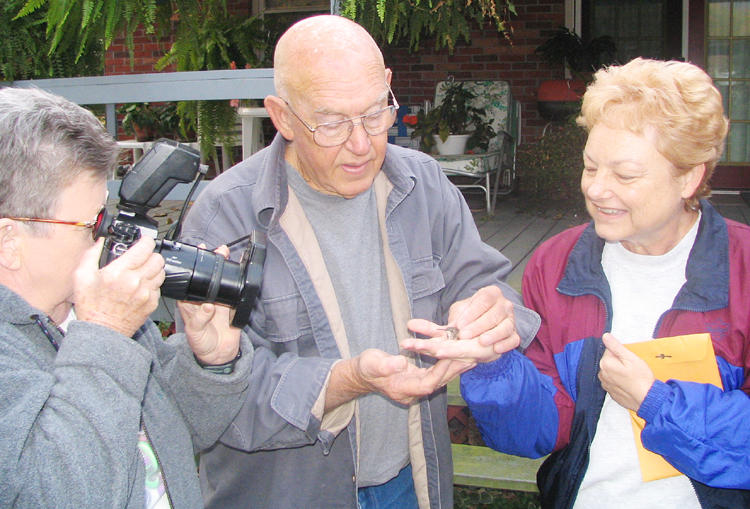
Photo by Bryan Stevens                                                                                            Martha Sargent takes a photo as her husband, Bob, lets Brenda Wallace hold a Rufous Hummingbird ready to be released after the banding process.

In the late 1990s, the Sargents presented a well-attended program sponsored by the Bristol Bird Club. That was the first occasion I had to meet this energetic and dedicated couple. I wrote about the fascinating program in my bird column and shared with readers Bob’s emphasis on keeping sugar water feeders available during the winter months. It was an eye-opening program that tuned me into the phenomenon of wintering hummingbirds.

Not too long after that column ran, I received a call from Bennette Rowan, an artist and Johnson City resident, in November of 1997. She had one of those western hummingbirds at her feeder. After she got in touch with me, the Sargents were also alerted. The couple arrived in Johnson City on Dec. 3, 1997, to band and identify the bird. To the surprise and delight of everyone present, the bird turned out to be an Allen’s hummingbird — the first of its kind ever found in Northeast Tennessee and only the fourth for the entire state. Bennette, who had orginally named her bird “Rusty,” modified the name to Rusty-Allen. The bird remained at her home until Dec. 16 of that year.

n_a (17)

Photo by Bryan Stevens                                                                                                       From left: Bob Sargent, Brenda Wallace, Martha Sargent and Gary Wallace pose for a photo after the Sargents successfully banded a Rufous Hummingbird at the Elizabethton home of the Wallaces.

A few years later I got to watch the Sargents band another hummingbird at the home of Brenda and Gary Wallace in Elizabethton. On that occasion, I also photographed the couple as they went expertly about the precise job of capturing, documenting, identifying and banding the hummingbird. It turned out to be a female Rufous hummingbird.

As more of these reports arrived every late fall and early winter, the Sargents became overwhelmed and could not respond to each and every case. They began to bring other hummingbird banders under their wing, so to speak. Individuals such as Chris Sloan and Mark Armstrong became principally involved with the documentation and banding of hummingbirds found within the Volunteer State.

I feel extremely fortunate to have known Bob Sargent, who died Sept. 7, 2014, at the age of 77.  An electrician by trade, he leaves a lasting legacy of more than a quarter-century of research into the mysteries of some of our tiniest birds.

Several birders across Tennessee posted tributes to Bob on the TN-Birds list-serve forum.

Cyndi Routledge of Montgomery County described him as a “dear friend and mentor” who “positively impacted my life in infinite ways as he did with endless others. He leaves a legacy of hummingbird banders and hummingbird lovers across the United States and even beyond its borders.”

She also made a suggestion to those reading her post.

“And perhaps at some point today, go outside, sit near your hummingbird feeders, listen for the hums and chirps of those tiny miracles and give thanks for Bob, for his life and for those birds,” she wrote in her post.

Jud Johnston of Waynesboro, Tennessee, commented on Bob’s death. “A great loss for birders and birding in the Southeast,” Jud wrote.

In the years since I saw that program, presented in such educational and entertaining fashion by Bob and Martha Sargent, hardly a year has gone by when a reader hasn’t alerted me to the presence of one of those “brown hummingbirds” that show up at their feeders when the Ruby-throated Hummingbirds have already flown south for the winter season.

In the next couple of weeks, the Ruby-throated Hummingbirds that have made our spring, summer and fall so delightful will once again disappear. They’ll return in about six to seven months, but our lives will be a bleaker without them.

This is where things can get interesting. Don’t take down your feeders. Keep a supply of sugar water available as “bait” to attract any Rufous Hummingbirds, or even Allen’s or Black-chinned Hummingbirds that might decide to spend late fall and early winter with you.

So, be very attentive to any hummingbird that arrives at your feeders in late October or early November. Most Ruby-throated Hummingbirds depart the region in early October. Many of these winter-visiting hummingbirds show a great amount of brown plumage instead of the usual green. Any of these conditions may indicate you’ve been gifted with a rare visit from one of these exceptional little birds. If you are so fortunate, please send me an email at ahoodedwarbler@aol.com.

Photo by U.S. Fish & Wildlife Service/Dave Menke The Rufous Hummingbird is increasingly becoming a migrant/winter resident  in the eastern United States.

Photo by U.S. Fish & Wildlife Service/Dave Menke
The Rufous Hummingbird is increasingly becoming a migrant/winter resident in the eastern United States.

Annual Carter County Summer Bird Count tallies 116 species


Members of the Lee and Lois Herndon Chapter of Tennessee Ornithological Society, known less formally as the Elizabethton Bird Club, conducted the 21st annual Carter County Summer Bird Count on Saturday, June 7.

Photo by Bryan Stevens  A total of 231 Song Sparrows, such as the one pictured here, were found during the recent Summer Bird Count.

Photo by Bryan Stevens
A total of 231 Song Sparrows, such as the one pictured here, were found during the recent Summer Bird Count.

The 19 observers in six parties logged 58 party hours, plus 5.5 nocturnal party hours. The total of 116 species tallied was slightly above the average of 112. The range for this count has varied between 105 and 121 species.

 Observers included Jim Anderson, Rob Armistead, Kevin Brooks, J.G. and Deb Campbell, Harry Lee Farthing, Don Holt, Christy Kendall, Rick Knight, Roy Knispel, Joe McGuiness, Tom McNeil, Cathy Myers, Kathy Noblet, Chris Soto, Bryan Stevens, Kim Stroud, Mary Anna Wheat and John Whinery.

The species list follows:

Canada Goose, 379; Wood Duck, 11; Mallard, 74; Ruffed Grouse,  6; Wild Turkey,  9; Double-crested Cormorant, 1; Great Blue Heron, 25; and Yellow-crowned Night-Heron, 3.

Black Vulture, 4; Turkey Vulture,  60; Sharp-shinned Hawk,  2; Cooper’s Hawk,  1; Broad-winged Hawk, 4; Red-tailed Hawk, 4; and American Kestrel,  6.

Killdeer,  6; American Woodcock, 1; Rock Pigeon, 67; Mourning Dove, 111; and Yellow-billed Cuckoo, 1.

Eastern Screech-Owl, 3; Barred Owl, 3; Common Nighthawk, 1; Chuck-will’s-widow, 2; and Eastern Whip-poor-will, 13.

Chimney Swift,  96; Ruby-throated Hummingbird,  30; Belted Kingfisher,  7; Red-bellied Woodpecker, 15; Yellow-bellied Sapsucker, 1; Downy Woodpecker,  21; Hairy Woodpecker, 6; Northern Flicker, 22; and Pileated Woodpecker, 11.

Photo by Bryan Stevens The Ruby-throated Hummingbird was represented by a total of 30 individuals on the recent Summer Bird Count.

Photo by Bryan Stevens
The Ruby-throated Hummingbird was represented by a total of 30 individuals on the recent Summer Bird Count.

Eastern Wood-Pewee, 26; Acadian Flycatcher, 44; Alder Flycatcher, 4; Least Flycatcher, 9; Eastern Phoebe, 38; Great Crested Flycatcher, 4; and Eastern Kingbird, 17.

White-eyed Vireo, 10; Yellow-throated Vireo, 2; Blue-headed Vireo, 54; Red-eyed Vireo, 166; Blue Jay, 91; American Crow, 130; and Common Raven, 6.

Purple Martin, 21; Tree Swallow, 152; Northern Rough-winged Swallow, 36; Cliff Swallow, 295; and Barn Swallow, 159.

Carolina Chickadee, 71; Tufted Titmouse, 72; Red-breasted Nuthatch, 9; White-breasted Nuthatch, 15; Brown Creeper, 1; Carolina Wren, 86; House Wren, 54; and Winter Wren, 8.

Blue-gray Gnatcatcher, 41; Golden-crowned Kinglet, 10; Eastern Bluebird, 48; Veery, 31; Hermit Thrush, 2; Wood Thrush,  56; American Robin,  356; Gray Catbird,  44; N. Mockingbird,  59; Brown Thrasher, 16; European Starling,  607; and Cedar Waxwing,  94.

Ovenbird, 70; Worm-eating Warbler, 14; Louisiana Waterthrush, 4; Golden-winged Warbler, 3; Black-and-white Warbler,  38; Swainson’s Warbler, 3; Kentucky Warbler, 1; Common Yellowthroat,  27; Hooded Warbler, 88; American Redstart, 9; Northern Parula,  15; Magnolia Warbler, 2; Blackburnian Warbler,  14; Yellow Warbler, 5; Chestnut-sided Warbler, 27; Black-throated Blue Warbler,  35; Pine Warbler, 4; Yellow-rumped Warbler, 1; Yellow-throated Warbler, 13; Black-throated Green Warbler, 34; Canada Warbler, 24; and Yellow-breasted Chat, 10.

Eastern Towhee, 120; Chipping Sparrow, 100; Field Sparrow,  37; Vesper Sparrow,  1; Song Sparrow, 231; Dark-eyed Junco, 89; Scarlet Tanager, 27; Northern Cardinal,  157; Rose-breasted Grosbeak, 17; Blue Grosbeak, 2; and Indigo Bunting, 181.

Red-winged Blackbird, 69; Eastern Meadowlark, 25; Common Grackle,  95; Brown-headed Cowbird, 39; Orchard Oriole, 7; Baltimore Oriole, 4; House Finch,  28; Red Crossbill, 1; American Goldfinch, 166; and House Sparrow, 128.

Photo by Bryan Stevens Although waterfowl can be difficult to find in Carter County during the summer months, a total of 11 Wood Ducks were tallied for the Summer Bird Count.

Photo by Bryan Stevens
Although waterfowl can be difficult to find in Carter County during the summer months, a total of 11 Wood Ducks were tallied for the Summer Bird Count.

All 116 species found on the count are known or suspected to nest in Carter County, except for the Double-crested Cormorant.

•••••

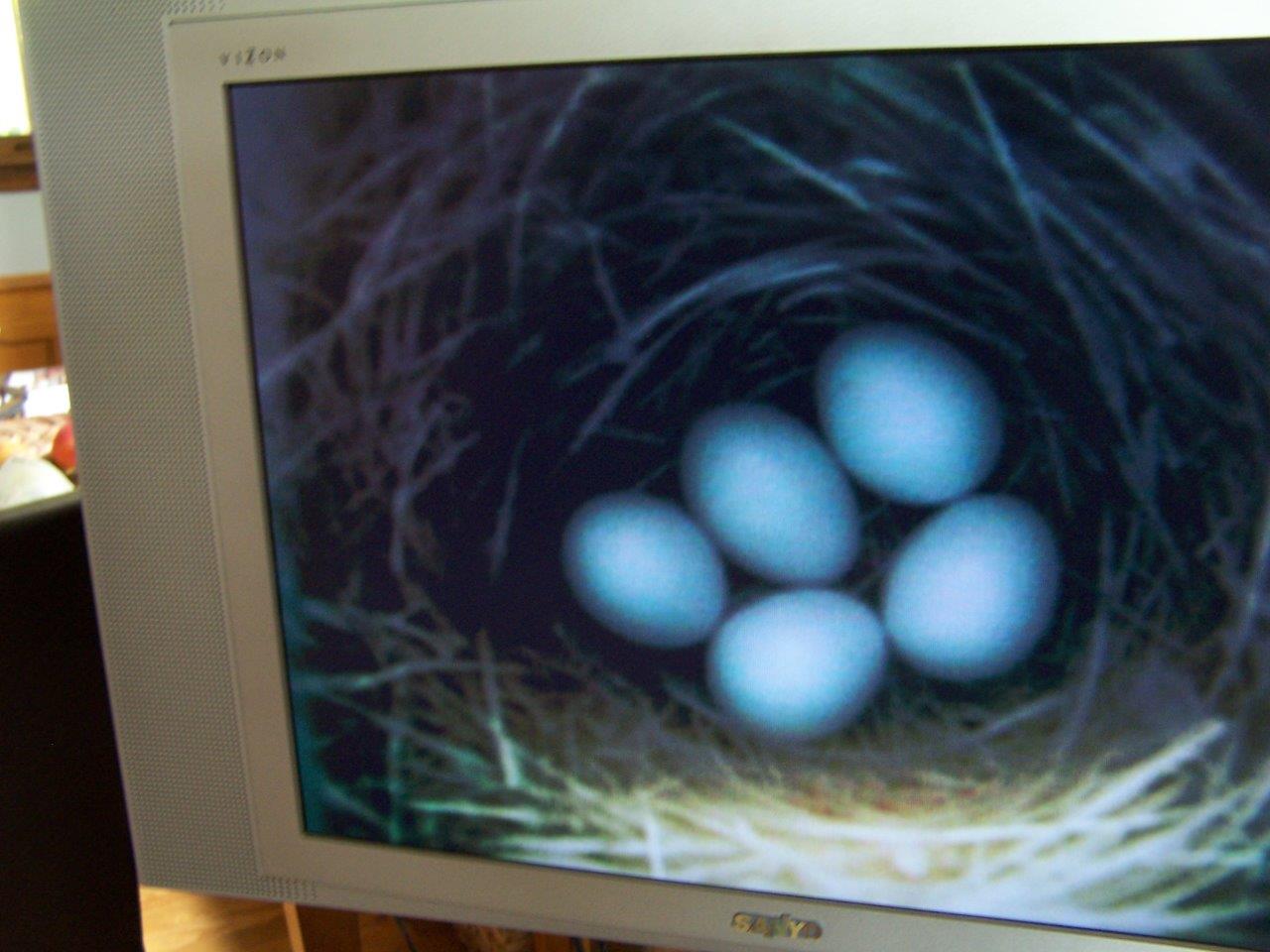
Hampton resident Barbara Lake emailed me to share some photos of a clutch of eggs in one of her bluebird boxes.

Photo Courtesy of Barbara Lake A clutch of five Eastern Bluebird eggs in a box at the home of Barbara and Jerry Lake in Hampton.

Photo Courtesy of Barbara Lake
A clutch of five Eastern Bluebird eggs in a box at the home of Barbara and Jerry Lake in Hampton.

She actually has two pairs of Eastern Bluebirds nesting in boxes at her home. She has named the bird Blossom and Max, as well as Aliy and Allen. The latter are named for Iditarod and Yukon Quest musher friends.

“I wrote to Aliy and told her I named a bluebird after her, and she is happy about it.  So now I have to keep her up to date about what’s going on.”

Some of Barbara’s bluebird boxes are equipped with television cameras, which allows her to monitor activity on a television screen in the comfort of her home.

•••••

Now that it is July, birding sometimes becomes more difficult because of the intense heat, high humidity and other factors. There are still interesting bird observations to make. Many birds are still taking care of young, either in or out of the nest. If you’d like to share an observation, make a comment or ask a question, email me at ahoodedwarbler@aol.com or post a comment here.